H.R. 2842: Bureau of Reclamation Small Conduit Hydropower Development and Rural Jobs Act of 2011, introduced by U.S. Representative Scott Tipton

hydroelectricdam.jpg

Here’s the link to the bill on Govtrack.us. The bill was referred to the Subcommittee on Water and Power from the House Committee on Natural Resources on September 7.

Here’s the release from Representative Tipton’s office:

This week, Rep. Scott Tipton (CO-R) introduced H.R. 2842, The Bureau of Reclamation Small Conduit Hydropower Development and Rural Jobs Act of 2011.

This legislation seeks to streamline the regulatory process and reduce administrative costs for small hydropower development at Reclamation’s facilities while supporting the creation of badly needed rural jobs. H.R. 2842 authorizes power development at the agency’s conduits to clear up multi-agency confusion and duplicative processes and reduces the regulatory costs associated with hydropower development.

“At a time when our country needs to focus on domestic energy production and job creation, hydropower can play a critical role in providing clean renewable energy while expanding job opportunities in rural America,” Tipton said. “Hydropower is the cheapest and cleanest source of electricity available through modern technology, and a key component of an ‘all of the above’ energy platform that I continue to strongly support.”

Hydropower is the highest source of non-carbon emitting energy in the world and accounts for approximately 75% of the United States’ total renewable electricity generation, making it the leading renewable energy source of power. Nearly 37% of Colorado’s renewable energy is hydropower, but only 3.7% of all Colorado energy is hydropower.

“Colorado has a significant opportunity to follow the lead of many of its western neighbors and expand on this clean, renewable source of power while creating badly needed jobs for the Third district and Colorado in the process,” Tipton said.

Background

Many rural water and irrigation districts and electric utilities in Colorado and other western states seek to develop hydropower on Bureau of Reclamation water canals and pipelines, but over-burdensome and unnecessary regulations stand in the way. Increased conduit hydropower serves a number of purposes: it produces renewable and emissions-free energy that can be used to pump water or sell electricity to the grid; it can generate revenue for the hydropower developer to help pay for aging infrastructure costs and water/power facility modernization; and it can create local jobs and generate revenue to the federal government.

One thing stands in the way of such common-sense development: outdated and unnecessary federal regulations. H.R. 795, introduced in the House of Representatives by Congressman Adrian Smith and Jim Costa, provides regulatory reform for non-federal conduit hydropower generation, and I believe it’s time to begin reform for hydropower development on federal conduits as well.

As it stands, federal regulations hinder this development on federal projects and subject job creators to unnecessary requirements which render small hydropower projects economically unfeasible.

H.R. 2842 seeks to remove one major economic handcuff: unnecessary environmental analysis. Even though Reclamation conduit hydropower units would already be on disturbed ground within existing facilities that have already gone through federal environmental review, another National Environmental Policy Act (NEPA) analysis must still be done in this case under existing regulations. This is done despite the fact that the Interior Department’s current Reclamation Manual allows for NEPA categorical exclusions for “Minor construction activities associated with authorized projects…which merely augment or supplement, or are enclosed within existing facilities.”

H.R. 2842 also substantially reduces administrative costs so that the projects are no longer cost prohibitive. Instead of the current process where Reclamation must painstakingly analyze each and every proposal for development, the bill gives the first development right to the entity/entities operating and maintaining the federal conduit. Most Reclamation irrigation and water supply projects have an arrangement where operation and maintenance activities are transferred to the local beneficiary as a way to reduce paperwork and other costs. The rationale for the legislation’s first right of refusal provision is that the non-federal operator knows the details of the facility and is locally invested into the project. This provision would significantly decrease conduit hydropower planning costs.

The hydropower development encouraged by this legislation will not harm the environment since the generation units would be placed on already disturbed ground within existing facilities that have already gone through federal environmental review. H.R. 2842 also protects water users by specifically re-affirming hydropower development as secondary to water supply and delivery purposes and ensuring that there will be no financial and operational impacts to existing water and power users. Furthermore, H.R. 2842 protects agreements that the water users have on existing conduit generation projects and provides additional safeguards to ensure such projects do not undermine water deliveries.

H.R. 2842 is supported by the Family Farm Alliance, the National Water Resources Association, and the American Public Power Association, among others.

Here’s a report from Reid Wright writing for the Cortez Journal. From the article:

The Cortez lawmaker’s proposed legislation, The Small Conduit Hydropower Development and Rural Jobs Act of 2011, seeks to eliminate a second environmental analysis of small hydroelectric projects built within existing water facilities already approved by the National Environmental Policy Act.

The bill is also aimed at reducing administrative costs by giving more authority to local entities and protecting water users by assuring electricity generation is secondary to water delivery.

Under the bill, the secretary of the interior will first offer the lease of power privilege to a local irrigation district or water users association.

Tipton’s bill is related to the Small-Scale Hydropower Enhancement Act of 2011, sponsored by Adrian Smith, R-Neb, aimed at regulatory reform for non-federal hydropower generation.

The Small Conduit Hydropower Development and Rural Jobs Act of 2011 is targeted specifically at federal hydroelectric facilities producing 1.5 megawatts of power or less.

More hydroelectric coverage here and here.

Rio Grande Roundtable recap: Runoff was up and down for the water year, mostly down

riograndebasin.jpg

From the Valley Courier (Ruth Heide):

Colorado Division of Water Resources Division Engineer for Division III Craig Cotten described the roller coaster ride to members of the basin-wide water group, the Rio Grande Roundtable, on Tuesday. “It was kind of a strange year, way below average, above average and then way below average again,” he said…

The annual index supply forecast for the Rio Grande at Del Norte varied up and down, with the latest preliminary annual flow sitting at 505,000 acre feet, quite a bit less than the average 650,000 acre feet, according to Cotten. Of that amount, the Rio Grande will have to supply 128,700 acre feet to downstream states to satisfy Rio Grande Compact obligations. Curtailment of irrigators on the Rio Grande is about 10 percent currently. Cotten said since ditches are not running in the wintertime, curtailment at that time was 100 percent, and when the ditches on the Rio Grande system began diversions on March 28, curtailments were 7 percent, dropping to 6 percent, then back up to 10 percent, 14 percent, 17 percent, 19 percent and a high of 22 percent, as predictions changed with varying runoff flows…

The Conejos had below average flows through half of June. “They were significantly below average, especially during the first part of May, way lower than what we usually have,” Cotten said. Then the Conejos system picked up to above average flows, which remained above average. The annual forecast on the Conejos River system is 245,000 acre feet, which is lower than the average 325,000-350,000 acre feet, according to Cotten. Of that total, the Conejos owes 72,000 acre feet to downstream states to complete its Rio Grande Compact obligation. To meet that compact obligation, irrigators are experiencing a 40-percent curtailment right now on the Conejos, Cotten said.

More Rio Grande River basin coverage here.

Milton-Seaman Reservoir outlet works undergoing rehab

miltonseamanreservoiroutlettunnel07252011.jpg

From the Fort Collins Coloradoan (Kevin Duggan):

Plans for lowering the water level of the reservoir to provide access to the gates that control flows to the North Fork call for slowly “ramping up” releases to keep too much sediment from getting into the water too fast and discoloring the river…

Seaman Reservoir was built in the 1940s and serves as drought protection for the city of Greeley’s water supply. Releases from the bottom of the reservoir are controlled by five heavy gates near the base of the dam. An inspection of the gates in 2008 found that the hydraulic controls known as actuators on two of the five gates had failed. A project to replace the 65-year-old hydraulic and mechanical systems controlling the gates has begun and is expected to last until April. The actuators currently are near the base of the dam and can only be accessed by divers unless the reservoir is completely drained. Part of the $1.6 million maintenance project will include moving the mechanical systems higher so they are more easily accessible. When full, the reservoir near the dam is 77 feet deep. The water level has been drawn down to 50 feet and is expected to come down another 12 to 11 feet…

Greeley officials have a solid mitigation plan for the project, said Ken Kehmeier, senior aquatic biologist for the Platte River Basin with the Colorado Division of Parks and Wildlife. Lowering the reservoir level is likely to cause a fish kill when the reservoir freezes this winter, he said, and some dead fish may end up in the river. The project includes $3,000 for the division to restock the reservoir with rainbow trout, he said.

More South Platte River basin coverage here.

Colorado-Big Thompson Project update: Carter Lake elevation about average, Horsetooth Reservoir a little above average elevation

coloradobigthompsonprojecteastslopesystemncwcd.jpg

From email from Reclamation (Kara Lamb):

There are a few changes coming up for Carter and Horsetooth reservoirs this week. This is just a quick update on what to expect.

Carter Lake is sitting at a fairly average water elevation for this time of year. Full is around 5759 feet above sea level. Currently, the reservoir is at about 5717 feet. This is largely because we have been delivering water from Carter Lake via both the St. Vrain Supply Canal out of Carter Lake Dam #1 and through Unit #3–the reversible pump unit at Flatiron Power Plant.

Normally, Unit 3 is used to pump water up to Carter, filling it, but it can be used in reverse to generate hydro-electricity and deliver water down the Charles Hansen Feeder Canal, which runs all the way to Horsetooth. For the past month, we have been using Unit 3 to meet some water demands downstream of the canal.

That will end tomorrow. On Wednesday, September 14, Unit 3 will go back into pump mode and the water elevation at Carter Lake will likely start rising again.

Meanwhile, Horsetooth is at a water level elevation that is actually higher than average for this time of year. The reservoir is at an elevation of about 5407. All ramps are still in the water–and that is not usually the case after Labor Day.

When the pump to Carter goes on tomorrow, we will be taking a section of the canal which feeds Horsetooth down for annual maintenance. With little water coming into the reservoir, it is likely its rate of drop will increase. The rate of drop will depend on water demands, which are driven largely by the weather. Visitors to and residents around Horsetooth should anticipate that its water level will continue to go down through September and October, as is typical.

More Colorado-Big Thompson Project coverage here.

Denver Water asks the General Assembly for legislation that would set tough standards for low-flow toilets

waterefficenttoilet.jpg

From The Denver Post (Bruce Finley):

They’ve asked lawmakers to consider setting a statewide toilet standard of 1.28 gallons per flush. Toilets account for about a quarter of household water use, and the new standard could save 44,000 acre-feet of water a year by 2050…

New toilets sold today use a maximum of 1.6 gallons per flush, in compliance with Environmental Protection Agency limits set in the 1990s. But in Denver, an abundance of homes still have old-style fixtures that use an average volume of 3.14 gallons per flush, according to Denver Water’s latest “end-use study.”[…]

State Sen. Gail Schwartz, D-Snowmass Village, said the proposal will be considered along with other water-conservation measures that have become a top priority for Colorado. “This not only saves water consumption overall, but it also provides an opportunity to reduce the amount of water sent to wastewater treatment,” she said. “If consumers can save money and also work toward saving water, I think this might be popular.”

Toilet manufacturers backed the measures because they are eager for more people to buy new products. Plumbing Manufacturers International “drove” the passage of flush limits in California and Texas, PMI executive director Barbara Higgens said. “People typically only replace a toilet when something goes wrong,” she said. “We really like them to embrace the new technology, just as they would a computer or cellphone.”

More 2012 Colorado legislation coverage here.

Dillon Reservoir starting to drop

morninggloryspillwaydillonreservoir.jpg

From the Summit County Citizens Voice (Bob Berwyn):

…the reservoir has once again been dropping slowly, down to an elevation of 9,016.26 feet on Sept. 7, or about nine inches below the lip of the spillway as of late last week. Last year, the reservoir was about three feet lower on the same date, at 9,013.33 feet.

Last winter’s big snowfall is still reflected by runoff numbers. The combined flow of the Blue River and its tributaries totaled 323 cubic feet per second on Sept. 7, almost triple of the inflow on the same date in 2010 (111 cfs). Currently, flows in the Blue River below the dam are at 126 cfs, with 230 cfs going out through the Roberts Tunnel and into Denver Water’s South Platte storage system.

The Roberts Tunnel will be shut off around Thanksgiving, but the tunnel will remain full to enable Keystone to use the water to supplement flows in the Snake River based on snowmaking use.

More Denver Water coverage here.

Greeley Tribune book review: ‘Cowboy in the Board Room’

wdfarr.jpg

The book is about northern Colorado legend W.D. Farr. Here’s the review from Eric Brown writing for the The Greeley Tribune. Here’s an excerpt:

Tyler’s newest book, “W.D. Farr: Cowboy in the Boardroom,” examines the Greeley resident who was a key figure in the development of large Colorado water projects, served as president of the National Cattlemen’s Association, was an adviser to the U.S. Department of Agriculture under three U.S. presidents and was appointed by President Richard Nixon to the Environmental Protection Agency…

But in piecing together Farr’s biography during the last three years, Tyler, who is retired and now lives in Steamboat Springs, became more familiar with the leadership qualities Farr possessed, characteristics that made his foresight — visions of bringing more water to residents of northern Colorado and improving standards and practices in the beef industry — a reality for himself and those who would reap the benefits.

“In writing this book, it further confirmed to me what an exceptional leader he was,” Tyler said. “So many characteristics contributed to that; his willingness to learn from others who knew more than him on a particular topic, his thinking ahead, his interactions with people.

“He’s just a great example of what can be accomplished with great leadership. I think that’s what this book highlights more than anything; how effective he was because of his leadership.”

More coverage from Bill Jackson (former Tribune journalist) running in The Greeley Tribune. From the article:

W.D. early on also recognized the need for more water and, with Greeley Tribune publisher Charles Hansen as a mentor, would help develop the Colorado-Big Thompson Project, a trans-mountain diversion that brought Colorado River water to northern Colorado. Hansen was considered the “father” of the C-BT and W.D. its oldest son. W.D. was quoted in the book as saying, “Probably, Charlie Hansen contributed more to the city of Greeley than any other man I have ever known.” Farr always referred to the C-BT as a second Poudre River for northern Colorado. As a member of the Greeley Water Board, which he started, and a 40-year member of the board of directors of Northern Water, W.D. was instrumental in assuring a future water supply for the city and area.

Flaming Gorge pipeline: The CWCB will discuss funding today for the Flaming Gorge Task Force

flaminggorgedrycoloradoestuary9billionbillboard.jpg

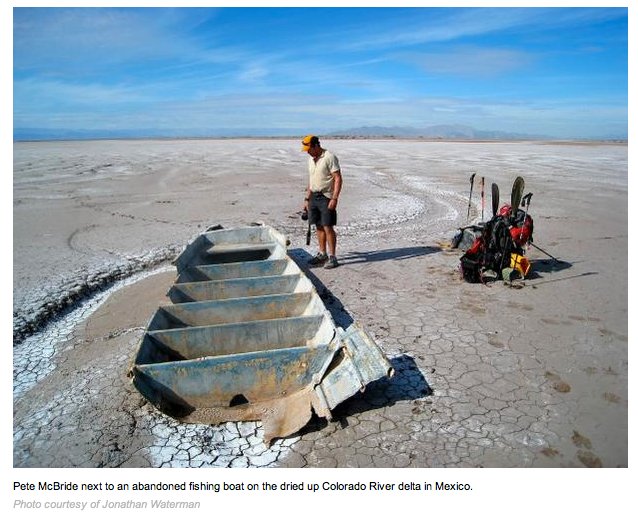
Click on the thumbnail graphic for the image of the billboards on display in Grand Junction this week. The Colorado Environmental Coalition, Save the Colorado [ed. be careful clicking on this link at work] and Western Resource Advocates are hoping to influence the vote. The photo is from Peter McBride and is of the dry Colorado River estuary in Mexico. The Colorado River is now an ephemeral stream at its terminus.

Here’s a report detailing the state of the battle over moving water from the Green River basin to slake the thirst of the Front Range, from Bob Berwyn writing for the Summit County Citizens Voice. From the article:

The Colorado Water Conservation Board is meeting Sept. 13 in Grand Junction to decide whether to spend $150,000 in taxpayer dollars on a special task force to further study the feasibility of the project, projected to cost as much as $9 billion to construct.

One big goal of the billboards is to raise public awareness. In the past, many major water projects received little public scrutiny in the early stages. By the time formal public comment periods are announced, the projects have already taken on a life of their own.
“At a time when government budgets are in deficit and we need to create jobs, it makes no sense to spend $9 billion on a pipeline that will hurt our economy,” said Bill Dvorak, owner of Dvorak Expeditions. “If we drain billions of gallons out of the Colorado River basin, fewer people will come out here to fish, boat and hike – businesses like mine will suffer and the West Slope will lose jobs.” Dvorak’s company leads boating expeditions on the Green River, which is a tributary of the Colorado River, and other rivers in the region.

Colorado Environmental Coalition, Save the Colorado and Western Resource Advocates joined forces to unveil the billboards, which display an image of a dried-up river bed with the message, “This will only cost you $9 billion.”

More coverage from NBC11News.com (Scott Aldridge):

…the chairman of the Colorado Wyoming Coalition, Frank Jaeger says he doesn’t know where they are coming up with those numbers, because their initial studies aren’t even done yet. “As far as numbers that others have thrown out there or published, I can’t speak to that…Right of way is going to be of immense concern, cost of pipeline, cost of pumping, electrical cost, all of these things are going to be reviewed in a study that we’re proposing to get those answers to…All of those issues have to be answered before you can put numbers on the table.”

Yet the Colorado Environmental Coalition is convinced the impacts would be devastating to Western Colorado. “Many aquatic habitats being devastated, all the great fishing on the green river would be hugely impacted.” Argues Wedemeyer.

“The Colorado River is the lifeblood of this community, we use it for our winery’s, we use it for tourism, for rafting, fishing, it’s the most important thing to our economy, and protecting water on the Western Slope is crucial to our livelihood.” Says Claudette Konola with Western Colorado Congress of Mesa County.

But Jaeger asks, how can critics cite these problems if the proposed study to find problems hasn’t even been done yet?

“Well it’s premature in that when we started this process two and a half years ago we went immediately to the Bureau of Reclamation first to find out if there’s adequate water. We are still waiting to determine that because the Bureau of Rec started a study to determine what the hydrologic amount of water would be on the reservoir, we don’t have that information yet…Until you’ve done a full investigation of a project how can you tout the pros and con’s if you don’t have the answers? I mean it’s kind of nonsensical to me for people to sit on the outside and say this is bad or that is bad, they don’t know what all the issues are.”

More coverage from KJCT8.com (Honora Swanson):

[Save the Colorado’s Gary Wockner] says the pipeline would cost between seven and nine billion dollars, making it the most expensive water in Colorado’s history. He says instead of a pipeline, the state should pursue conservation and recycled water.

More coverage from Alan Prendergast writing for Westword. He’s linking to Joel Warner’s in-depth piece from 2009 about the proposed pipeline. Here’s an excerpt Mr. Prendergast’s article:

The Colorado Water Conservation Board has pegged the cost of the pipeline at somewhere between $7 billion and $9 billion, up to triple the cost of Million’s own estimates. Despite that daunting figure, the CWCB is looking into spending $150,000 on a task force to study the project.

When board members arrived in Grand Junction to take part in that discussion, they were greeted by three billboards erected by a cadre of conservation groups, including Western Resource Advocates, Save the Colorado and the Colorado Environmental Coalition. The signs feature the dried-up, parched delta where the Colorado River supposedly (but only rarely) reaches the Sea of Cortez and refer viewers to an online petition at a website address — which, according to WRA spokesman Peter Roessmann, shut down at midnight last night after collecting 21,300 signatures protesting the plan.

More Flaming Gorge Task Force coverage here.

Energy policy — coalbed methane: The state of Colorado and the Southern Ute Tribe are considering their options in light of Judge James Hartmann’s ruling last Thursday

nontributarycoalbedmethane.jpg

From the Associated Press (Catharine Tsai) via The Albuquerque Journal. From the article:

The judge last week upheld rules by the state engineer that allowed some oil and gas wells in the state to be exempt from getting water well permits for their operations, but he also said the rules shouldn’t apply within the Southern Ute reservation because it is unclear who has jurisdiction over water…

Despite the ruling last week upholding the rules, [Colorado First Assistant Attorney General John Cyran] told The Durango Herald (http://bit.ly/qrNKDV) the state was considering whether to ask the judge for a clarification of part of the ruling that said the state engineer’s rules should not apply within the Southern Ute reservation. “I don’t think there was any problem with us passing that rule because I do think we have authority there,” Cyran said.

More coalbed methane coverage here and here.

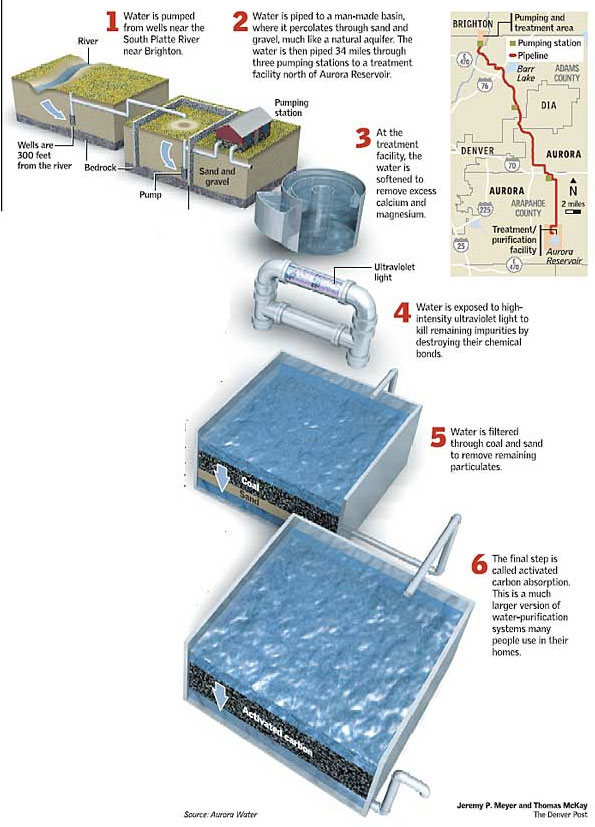
Castle Rock: Wednesday the Town Council and the Town Utilities Commission will hear from water providers who want to supply the long-term needs for the town

denveraquifer.jpg

From the Town of Castle Rock via the Castle Rock News Press:

Members of the public, along with Town Council and the Town Utilities Commission, will hear from the groups that wish to provide the Town with long-term water at a special meeting Sept. 14.

The meeting will begin at 6 p.m. in Council Chambers at Town Hall, 100 N. Wilcox St.

Three of the four groups that have been short-listed in the search for the Town’s long-term water provider – Renew Strategies, Stillwater Resources and United Water – will each make a half-hour presentation, followed by questions from Town officials and the public.

The fourth proposal – the WISE agreement between South Metro Water Supply Authority, Aurora Water and Denver Water – is being reviewed by the Aurora City Council prior to being released to the public.

All four proposals will be evaluated against the same criteria, which include the opportunity to succeed, cost, local partnership opportunities, existing infrastructure, experience and water rights.

Seven proposals in all were received in response to the Town’s June request for water supply proposals. All of those proposals were reviewed against the same criteria in placing the four remaining proposals on the short list. At [this] week’s special meeting, the three groups will introduce their projects and provide information on their concept, water supply characteristics and costs.

This effort to secure a long-term water source is just one component of the Town’s Legacy Water Projects – the goal of which is to transition the Town to 75 percent renewable water by the time it is built out. (All of the Town’s water currently comes from nonrenewable wells.)
There are two other major components to Legacy Waters:

• The purchase of water storage space in Rueter-Hess Reservoir, which will open next year near Parker
• The construction of a water purification facility in Castle Rock, which will provide for 35 percent of the Town’s renewable water needs by 2013

Additional funding will be needed to secure the water that is needed for the Town’s future. The Town may hold a property tax election in 2012 or 2013 in order to fund the Legacy Water Projects.

More Denver Basin aquifer system coverage here.

Summitville superfund site: New water treatment plant dedication last Friday

summitvillemine.jpg

From The South Fork Tines:

“I want to thank the U.S. Environmental Protection Agency and the American Recovery and Reinvestment Act for providing funding to complete the new water treatment plant at Summitville,” said Chris Urbina, executive director and chief medical officer of the Colorado Department of Public Health and Environment. “This project provided more than a 100 construction jobs in this area, and significantly improved water quality, restoring fish and aquatic life to the Alamosa River and Terrace Reservoir,” he said…

In May 2009, the Colorado Department of Public Health and Environment was awarded more than $16 million from the American Recovery and Reinvestment Act, and construction of the 1600-gallon-per minute water treatment plant began on Sept. 14, 2009. The plant will remove contaminants from acidic metals-contaminated mine drainage before the water leaves the site and enters the headwaters of the Alamosa River, which flows into the Rio Grande. Funds from the act are paying 90 percent of this remedial action; the department is paying the remaining 10 percent.

Gold and silver mining began at Summitville around 1870. Large-scale, open-pit mining began at the site in 1984. The mine operator, Summitville Consolidated Mining Corp., Inc., used cyanide heap leaching to extract precious metals from the ore. In this process, ore excavated from the mountain was crushed and placed onto the clay- and synthetic-lined heap leach pad. A sodium cyanide solution was then applied to leach out gold and silver.

Almost immediately after the heap leach pad was constructed in 1986, a leak was detected. In December 1992, the company abandoned the site and announced it was filing for bankruptcy. EPA immediately assumed responsibility of the site as an emergency response, avoiding a significant environmental disaster. On May 31, 1994, Summitville was placed on EPA’s National Priorities List of Superfund sites.

Since 1992, EPA and the department have conducted several interim projects designed to slow the amount of acid mine drainage coming from the site. These interim projects included: 1) detoxifying, capping and revegetating the heap leach pad; 2) removing waste rock piles and filling the mine pits; 3) plugging the adits or underground mine entrances; and 4) expanding the water runoff holding ponds and operating a water treatment plant on site. The new water plant, dedicated today, replaces one built several years ago.

More Summitville Mine superfund site coverage here and here.

Energy policy — oil and gas: Treating water used in hydraulic fracturing leads to opportunities to generate profit

marcellushydraulicfracturing.jpg

From The Wall Street Journal (Yuliya Chernova):

Ecosphere Technologies Inc., based in Stuart, Fla., is one of the dominant providers of water treatment for the shale-gas industry, according to Lux Research, a technology research and consulting firm. The company’s technology avoids the use of chemicals typically employed to treat wastewater.

Ecosphere’s process forces dirty water through pipes where ozone breaks down contaminants with the help of sound waves, electrically charged particles and changes in pressure. No waste is created in the process, because while the technology renders contaminants harmless it doesn’t filter anything out.

Another strong competitor for new business, according to Lux analyst Brent Giles, is WaterTectonics Inc., based in Everett, Wash. The company uses a process called electric coagulation, in which an electric charge forces contaminant particles into clumps that can be removed after they either rise to the surface of the water or sink to the bottom. The process avoids the use of chemicals, but it does produce waste that has to be disposed of.

Another company, Altela Inc., based in Albuquerque, N.M., earned a spot on Artemis Project’s 2011 list of the 50 most innovative water-technology companies in the U.S. Its technology mimics rainmaking. Wastewater is heated to the point of evaporation, which produces clean water in the form of vapor, leaving contaminant particles behind. The vapor is then condensed back into liquid form.

The basic process, called thermal distillation, isn’t new, but Altela has found a way to make it more efficient, by capturing the heat generated by condensation and using it for evaporation. Ned Godshall, the company’s chief executive, says Altela’s method uses a third of the energy typically required for conventional thermal distillation.

Meanwhile, a Wheat Ridge company, ProTreat Technology Corporation, has just inked a deal with Select Energy Services for treatment technology. Here’s a release from MarketWire:

Select Energy Services, LLC (“Select”), a water solutions and oilfield service company headquartered in Houston, Texas, announced today the signing of a license agreement with ProTreat Technology Corporation, (“ProTreat”), a Wheat Ridge, Colorado based provider of water treatment, recycling and reuse technology to oil and gas operators.

The agreement gives Select additional access to expertise in water treatment and recycling services and ProTreat licensed technology, while ProTreat gains exposure into new markets and geographical areas. “The strategic partnership with ProTreat will provide Select with a valuable partner in water solutions, water treatment and water recycling, and is expected to enhance our Water Solutions and Environmental service offerings throughout the US,” said John Schmitz, CEO of Select. “We look forward to providing a proven water treatment solution to the oil and gas industry.”

The ProTreat technology takes flow back water and produced water, blends, treats, and produces a salt solution (sodium/potassium chloride) that can be utilized by operators for hydraulic fracturing and other well operations. Construction of the first treatment facility has commenced at the recently acquired Lone Star facility in Weld County, Colorado, in the heart of the Niobrara Shale and DJ Basin. Additionally, Select and ProTreat have plans to begin working on a mobile version that can be utilized at the well site.

More oil and gas coverage here and here.

Boulder: The Environmental Group and the Greater Gross Dam Citizens Coalition are hosting an informational Rally and ‘Afternoon on the River’ today to protest the Moffat Collection System Project

grossdamandreservoirenlargement.jpg

Here’s the release from The Environmental Group and the Greater Gross Dam Citizens Coalition:

The World’s Largest Kayak Drum Circle, Citizen Rally and Public Meeting before the Boulder County Commissioners to Stop The Expansion of Gross Dam, Monday, September 12, 2011, 2:30-7:30pm.

The Environmental Group and the Greater Gross Dam Citizens Coalition are hosting an informational Rally and “Afternoon on the River” on the Boulder County Courthouse lawn. Join us for the World’s Largest Kayak Drum Circle where boaters and River Lovers alike are invited to participate. Bring Boats, bailing buckets, musical instruments or whatever else you want to bang on. We can Save Our Rivers, but we have to make some noise! Bring your boat, and bang it like a bongo! Wear Blue and dress for the River.

The Rally and Kayak Drum Circle begin at 2:30. The Public meeting with the Boulder County Commissioners begins at 4:30 pm.

The Boulder County Commissioners are determining their stance on the expansion of Gross Dam and after a barrage of citizen letters, have invited citizens to share their thoughts. Gross Dam is located wholly within Boulder County, but will take water from the Fraser and Colorado Rivers, pump it through the Continental Divide, and feed it to urban sprawl and golf courses along the front range. Specifically, much of the water from the Gross Dam expansion will be fed to the new Candelas Development along the HWY 93 corridor in between Boulder and Golden, and just south of Rocky Flats. Join us to Save Boulder County & Stop Gross Dam!

The Fraser River has already been declared an endangered River by national nonprofit American Rivers and because of too much diversion, the Colorado River no longer reaches its Delta at the Sea of Cortez. The expansion of Gross Dam means even more water will be taken out of these rivers pushing them definitively to the brink.

Colorado is a Local Rule State, which means land use decisions and planning are made at the local level. Our State Legislators tell us they have no authority at this time to create a statewide water allocation strategy or to stop water diversions and dam projects, even when river ecosystems are on the brink of collapse. That’s why it is so essential that we ask Boulder County to utilize its 1041 Local Rule Powers (just like Eagle County did) to stop this dam – because no one else can or will!

These events are centered around the public asking the Boulder County Commissioners to use their 1041 local rule powers to Stop Gross Dam, to save our Rivers and natural ecosystems, to save Boulder and to save our mountain communities. We are also asking Boulder County to use its 1041 or other powers to Stop Gross Dam in order to create a statewide discussion about our water use and allocation policies and strategies to protect river ecosystems, recreational activities and river-related economies. Until now, developers and water extractors have controlled water policy in the state. That’s about to change!

There are two pieces to the day’s events. First, The Environmental Group and the Greater Gross Dam Citizens Coalition will host a Rally, The World’s Largest Kayak Drum Circle and Workshop on the Courthouse Lawn at 1325 Pearl Street in Boulder, Colorado. This will include:

– Live Music and the World’s Largest Kayak Drum Circle. Bring your boat – and bang it like a bongo! Citizens are invited to bring their boats, inner tubes, paddles, bailing buckets and other musical instruments. Wear blue and dress for an afternoon of music on the River on the Boulder County Courthouse lawn. We can save our Rivers, but we gotta make some noise!
– Information about the issues of Gross Dam, what Boulder County can do to stop it, and water use issues in Colorado will be provided.
– Workshop and talking points to assist citizens in writing their public statement for the evening’s Public Meeting with the Boulder County Commissioners.
Billboard Slogan Contest.
– Kid friendly events including art stations to create pictures about rivers.
– Bring signs, slogans and river gear. Families welcome!
– Boats can be dropped off from 12:00 noon on.
– This is a 100% peaceful event.

Second, citizens are invited to attend a Public Meeting hosted by the Boulder County Commissioners to discuss the issue of the expansion of Gross Dam and what the County can do about it. The County will give a presentation on the Gross Dam project and then open the floor to citizen comments. Each citizen can speak for up to 3 minutes. It is recommended that citizens arrive early to sign up for a speaking slot. Sign up begins at 3:30pm. The Public Meeting begins promptly at 4:30pm at 1325 Pearl St., 3rd Floor, Boulder, CO.

This deal is far from done, and now is the time for citizens to join together with our elected officials and together save our Rivers and our Communities. Be part of this important conversation to determine the fate of our State and to Preserve Colorado. The Rally and Kayak Drum Circle will begin at 2:30pm on Monday, September 12, 2011, at 1325 Pearl St., Boulder, Colorado on the Courthouse Lawn. The Public Meeting before the Boulder County Commissioners begins at 4:30pm at the Boulder County Courthouse located at 1325 Pearl St., 3rd Floor, Boulder, Colorado.

Visit www.StopGrossDam.com for full schedule and additional details.

More coverage from Laura Snider writing for the Boulder Daily Camera. From the article:

…some opponents of the Gross Reservoir expansion are asking the Boulder County commissioners to consider using their own 1041 powers to fight Denver Water, which says that nearly tripling the size of the reservoir is necessary to quench the thirst of its growing number of customers and to provide more stability in its supply system. Denver Water would like to pull more water from the Fraser and Williams Fork rivers through the Moffat Tunnel to fill the newly expanded reservoir. “We’re trying to say to Boulder County, ‘You have the power to stop this project, and you should use it to protect people in the mountain communities and, on a bigger scale, to protect the Colorado River Basin,'” said Liz Brown Morgan, a resident of Coal Creek Canyon who has worked to connect neighborhood groups and local environmental groups into the Greater Gross Dam Citizens Coalition.

Letters of concern about the reservoir expansion — many of which are from people who live near the reservoir and who would be directly affected by the construction on the dam — have begun to fill up the Boulder County commissioners’ inboxes. In response, the commissioners are holding a meeting at 4:30 p.m. Monday. “The intent on Monday night is really for us to hear more about the concerns that residents are bringing forward and to make sure that we have as much information as we can on the potential impacts,” said Commissioner Will Toor…

Boulder County’s 1041 rules are designed, among other things, to protect the beauty of the landscape and to conserve soil, water and forest resources. But even if the county decides to use its 1041 powers in the case of Gross Reservoir, the commissioners must grant a development permit to Denver Water if the agency is able to show that it can meet the criteria laid out in the county’s land use code. “We wouldn’t just be deciding if we liked the project,” Toor said. “We would be looking at the impacts and requiring a set of conditions to mitigate those impacts.”

For its part, Denver Water disputes the county’s authority to regulate the Gross Reservoir construction. “Gross Reservoir is governed under the Federal Energy Regulatory Commission,” said Joe Sloan, of Denver Water’s community relations department. “Any permitting that we go through at Gross related to recreation of dam height or the perimeter is under FERC control. It’s our opinion that the federal governance by the FERC would cover all the issues.” But even though Denver Water does not agree that the county can use its 1041 powers, the agency said it’s still willing to work with the county to mitigate construction impacts through an intergovernmental agreement. “We’re working on IGAs on the West Slope with the folks in Summit and Eagle and Grand counties on flows,” Sloan said. “We’re hoping to use that model that we’ve already used on the West Slope with Boulder County.”

More Moffat Collection System Project coverage here and here.

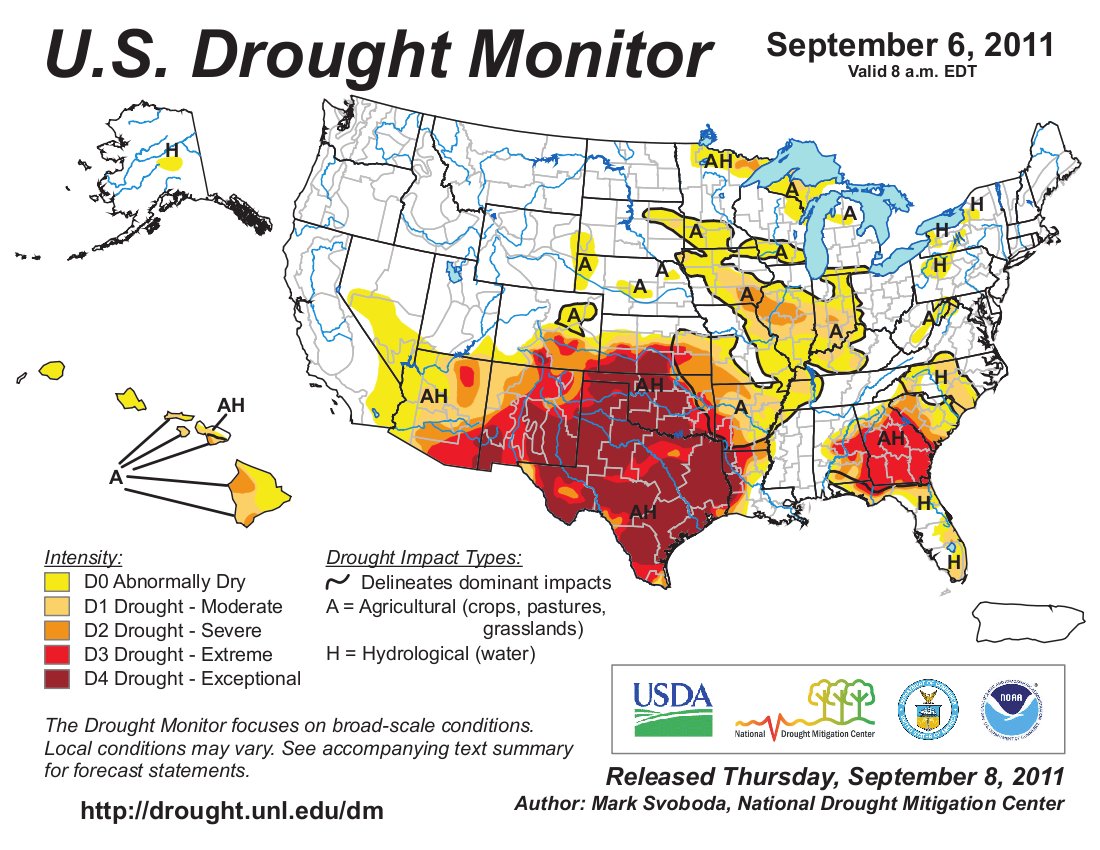
Drought news: Southeast Colorado ranchers continue to cull herds, lack of suitable pasture along with high costs for water and feed are cited

usdroughtmonitor09062011.jpg

From The Pueblo Chieftain (Chris Woodka):

“The biggest part of it in our area is that there’s no water,” said Dan Henrichs, president of the Pueblo County Stockman’s Association. “A little bit of rain will grow grass, but you need a lot of rain to fill up a dugout dirt pond.” One rancher was paying $70 per 1,000 gallons to haul water — about 10 times the going rate for the upper end of urban water costs — to what remained of her herd before she finally sold off the rest, he said. “This spring we sold off 60 head of cows because the price was good,” Henrichs said. “I didn’t want to get behind the curve like we did in 2002.”

The last big sell-off of cattle came during the historic drought of 2002. This year, much of the state saw near-record snowpack and ample summer rains…

In the Arkansas River basin, a drought that began a year ago still persists. While there have been some storms, precipitation remains below normal and the lack of moisture over the winter months was devastating to grasslands…

The current drought has been most severe in Texas, but stretches into Baca, Las Animas and Huerfano counties in Southeastern Colorado…

“You have an unusual situation with the cattle prices so high, and the price of grain and hay also up. On top of that, hay is hard to find,” Sabel said…

Farmers in Nebraska are selling hay in Texas for more than twice the price of a year ago — up to $330 a ton.

Club 20 fall meeting recap: Governor Hickenlooper bangs the job creation drum while U.S. Representative Scott Tipton touts the need for new water storage projects

barkermeadowdam.jpg

From KJCT8.com (Tami Brehse):

“A lot of businesses are sitting on a significant amount of cash,” Hickenlooper says. “We just need to get that log jam going. They’re not going to spend money and hire people unless they think they can make more profit.”

One of the other big topics on the state agenda right now is our water. Hickenlooper says the state is on tap to see a major shortage within the next 40 years. He says we need to find ways to store more water in the state. It’s an issue many of Colorado’s leaders see eye to eye on.

“I think it’s appropriate for the state to be exploring a variety of different areas to be able to store more water here in Colorado,” says Representative Scott Tipton, “to be able to meet some of the growing needs.”

More infrastructure coverage here.

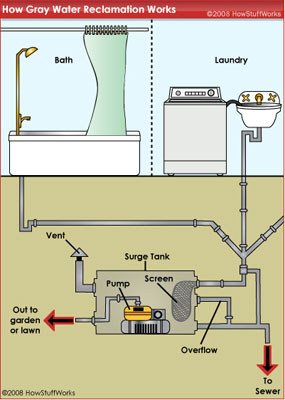
2012 Colorado legislation: Are approved gray water systems on the horizon?

graywatersystem.jpg

They will be if CSU assistant professor, Sybil Sharvelle and CSU professor, Larry Roesner, can convince enough legislators that public health is not a concern along with the folly of not reusing outflows from dish washing, clothes washing, showers and other activiites that generate gray water in the home. Here’s a report from Joe Hanel writing for The Durango Herald. From the article:

Sharvelle and professor Larry Roesner want the Legislature to pass a law that gives state water regulators the power to write new rules for reusing water from showers, sinks and washing machines.

They have run tests for several years on household systems that collect used water in tanks about the size of a hot-water heater and redirect the water into toilets or gardens.

Legislators on the Water Resources Review Committee voted 9-0 Wednesday to start writing a bill to be introduced in 2012, although some lawmakers had qualms about it.

“I’m a little gun shy, but I guess it doesn’t hurt for us to draft a bill and take a look,” said Rep. Jerry Sonnenberg, R-Sterling.

Sonnenberg’s hesitation stems from one of the unresolved questions about gray water. His largely agricultural district lies downhill from Denver, and if many people in the metro area start reusing their water instead of literally flushing it down the drain, it could lead to less water in the rivers downstream.

More gray water coverage here.

Anticipated retirements to fuel need for approximately 2,775 new operators over the next five years in a four county area including Boulder

prairiewaterstreatment.jpg

From the Boulder Daily Camera (Amy Bounds):

The Boulder High class is part of the “Get Into Water” project through the Boulder Valley School District’s Lifelong Learning Program, in conjunction with the Rocky Mountain Section of American Water Works Association and the Colorado Workforce Development Council.

Along with the Boulder High class, two classes are offered this fall through Boulder Valley’s fee-based adult education program — Water Foundations and Wastewater Collection. Scholarships for the adult classes are available through Boulder County Workforce.

The idea, organizers said, is to connect adults with well-paying jobs and fill an industry need. Within the next five years, 25 percent of the water operators in a four-county area that includes Boulder County are expected to retire, opening up about 2,775 jobs.

Boulder High students who take the Water Foundations class this semester and a water distribution class next semester are eligible to take a state certification test. If they pass, they’re qualified for entry-level jobs…

The class covers water source, treatment and distribution, along with water regulations, storm water and water conservation with an emphasis on local water information, history and issues. The class will visit area water sources and treatment plants, along with hearing directly from those who work in Boulder’s water industry.

More water treatment coverage here.

Grand Junction: IBCC meeting Monday, CWCB meeting Tuesday and Wednesday this week, Colorado River District annual seminar Thursday

grandmesa.jpg

From email from Hannh Holm (Coordinator
Water Center at Colorado Mesa University and the Mesa County Water Association):

There are a whole slew of important water meetings in Grand Junction next week that are open to the public:

* Colorado’s Inter-Basin Compact Committee is meeting out at Ute Water on Monday. For more info on the IBCC and the meeting, see: http://cwcb.state.co.us/about-us/about-the-ibcc-brts/Pages/main.aspx/Templates/Home.aspx (look in the upper right corner of the screen for mtg info).

* The Colorado Water Conservation Board is meeting at Ute Water on Tuesday Sept 13 & Wed Sept 14. On the 13th, things could get interesting, as a number of environmental advocacy groups have been encouraging people to show up to tell the CWCB not to fund a $150,000 task force to study the feasibility of the Flaming Gorge pipeline. Here’s a link to info on the CWCB & the mtg agenda: http://cwcb.state.co.us/about-us/cwcb-board/Pages/main.aspx

* On Thursday Sept 15, the Colorado River District is having their annual seminar. The topic is “Supply and Demand on an Imbalanced Colorado River,” and the agenda looks great. You can find it at: http://www.crwcd.org/

More Colorado River basin coverage here. More IBCC — basin roundtables coverage here. More CWCB coverage here.

NOAA’s Climate Prediction Center: La Niña is back

seasurfacetemps083111.jpg

From the Climate Prediction Center:

La Niña, which contributed to extreme weather around the globe during the first half of 2011, has re-emerged in the tropical Pacific Ocean and is forecast to gradually strengthen and continue into winter. Today, forecasters with NOAA’s Climate Prediction Center upgraded last month’s La Niña Watch to a La Niña Advisory.

NOAA will issue its official winter outlook in mid-October, but La Niña winters often see drier than normal conditions across the southern tier of the United States and wetter than normal conditions in the Pacific Northwest and Ohio Valley.

“This means drought is likely to continue in the drought-stricken states of Texas, Oklahoma and New Mexico,” said Mike Halpert, deputy director of the Climate Prediction Center. “La Niña also often brings colder winters to the Pacific Northwest and the northern Plains, and warmer temperatures to the southern states.”

Climate forecasts from NOAA’s National Weather Service give American communities advance notice of what to expect in the coming months so they can prepare for potential impacts. This service is helping the country to become a Weather Ready Nation at a time when extreme weather is on the rise.

Seasonal hurricane forecasters factored the potential return of La Niña into NOAA’s updated 2011 Atlantic hurricane season outlook, issued in August, which called for an active hurricane season. With the development of tropical storm Nate this week, the number of tropical cyclones entered the predicted range of 14-19 named storms.

The strong 2010-11 La Niña contributed to record winter snowfall, spring flooding and drought across the United States, as well as other extreme weather events throughout the world, such as heavy rain in Australia and an extremely dry equatorial eastern Africa.

More coverage from Reuters Africa. From the article:

“While it is not yet clear what the ultimate strength of this La Nina
will be, La Nina conditions have returned and are expected to gradually strengthen and continue into the Northern Hemisphere winter (of) 2011-12,” the CPC said in a monthly update. It said waters in the eastern half of the equatorial Pacific Ocean cooled in August, and the “oceanic and atmospheric patterns reflect the return of La Nina conditions.”

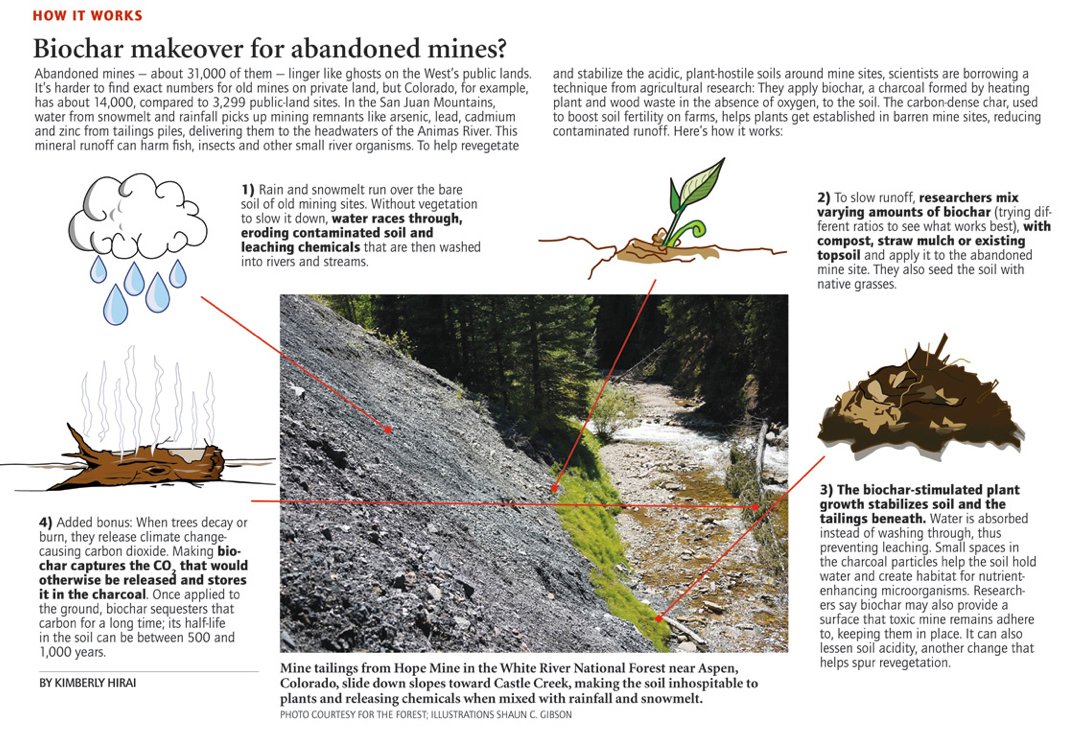
Restoration: Hope Mine biochar application has yielded surprising results

biocharhowitworkshighcountrynews.jpg

From the Colorado Independent (Troy Hooper):

What was once a wasteland of arsenic, cadmium, lead and zinc on a steep mountainside that abuts Castle Creek is now a haven for natural grasses and wildflowers that have stabilized the slope and drastically reduced the risk of the heavy metals crashing into the city’s main water supply.

The striking change of scenery around Hope Mine is the result of the first whole-scale reclamation project ever attempted in the United States, and possibly the world, using biochar — a type of charcoal produced through the thermal treatment of organic material in an oxygen-limited environment.

how aggressive the regrowth was,” said John Bennett, executive director of For The Forest, which teamed up with Carbondale-based Flux Farm Foundation at the request of the U.S. Forest Service, which is exploring new ways to partner with private groups to reclaim landscapes. “We did not expect waist-high grass in the very first summer. We thought it would take longer.”

Not only is biochar restoring the ecology and containing the mine tailings that fan down toward Castle Creek but experts say it is also immobilizing the heavy metals long enough so that they naturally degrade and it is sequestering carbon that would otherwise escape into the earth’s atmosphere.

Click through for the rest of the article and the cool before and after photos.

More coverage from Chadwick Bowman writing for The Aspen Times. From the article:

“This project is going better than I would have dared hoped,” John Bennett, executive director of For the Forest, an Aspen-based nonprofit focused on forest health, said Thursday during a press conference at the site.

The reclamation of the slope, south of Aspen in the Castle Creek Valley, became more pressing when it was discovered that very low levels if toxic metals had been sliding into the creek, a source of Aspen’s drinking water.

Even though the levels of toxins were minute, the reclamation plan was intended to prevent a potential landslide on a mine tailings pile — debris left from mineral extraction — that could add poisons into the creek.

“The Forest Service turned us on to the project because it’s their land,” said Kate Holstein, program director of For the Forest. “They told us there is a situation where this big slope is continually eroding into Castle Creek. … If a large erosion were to occur where the whole slope slid into the creek, it could be catastrophic.”

Holstein said such a landslide could shut down the Castle Creek water source potentially for years…

Forty-two test plots were laid out at the site; each contains different variations of biochar mixed with soil and seeds, as well as control plots that contain no biochar. Williams said there are significant differences between the plots, and that biochar is making growth happen.

More restoration coverage here.

U.S. Government Accounting Office report: Action Needed to Sustain Agencies’ Collaboration on Pharmaceuticals in Drinking Water

genderbendingpollution.jpg

Here’s the link to the GAO website where you can download the full report. Here’s the summary:

Drinking water in some metropolitan areas contains concentrations of pharmaceuticals, raising concerns about their potential impact on human health. The Safe Drinking Water Act (SDWA) authorizes the Environmental Protection Agency (EPA) to regulate contaminants, including pharmaceuticals, in public drinking water systems if they may adversely affect human health among other criteria. Pharmaceuticals may enter drinking water supplies from several pathways, including discharge from wastewater facilities. GAO was asked to provide information on the (1) extent to which pharmaceuticals occur in drinking water and their effects, if any, on human health; (2) U.S. and other countries’ approaches to reducing their occurrence; and (3) challenges, if any, that EPA faces in determining whether to regulate pharmaceuticals. GAO reviewed federal and peer-reviewed reports, and surveyed a nonprobability sample of five U.S. programs designed to properly dispose of pharmaceuticals. We selected these programs based on geographic diversity and program characteristics. We also researched such programs in two countries, and interviewed scientists and agency officials.

Research has detected pharmaceuticals in the nation’s drinking water. National and regional studies by the U.S. Geological Survey, EPA, and others have detected pharmaceuticals in source water, treated drinking water, and treated wastewater; but the full extent of occurrence is unknown. The concentrations detected for any one pharmaceutical were measured most frequently in parts per trillion. Research has not determined the human health effects of exposure to these concentrations of pharmaceuticals in drinking water. However, federal research has demonstrated the potential impact to human health from exposure to some pharmaceuticals found in drinking water, such as antibiotics and those that interfere with the functioning and development of hormones in humans. Some states and local governments as well as the Drug Enforcement Administration have taken actions that could reduce the extent to which pharmaceuticals occur in drinking water. These efforts have primarily been through drug take-back programs to encourage proper control and disposal of pharmaceuticals. Additional efforts have been adopted in Europe following the European Union’s directive in 2004 requiring member states to have appropriate collection systems for unused or expired medicinal products. In addition to collection systems, Sweden also encourages actions such as writing small initial prescriptions to reduce the amount of pharmaceuticals that are disposed of if patients switch to a different pharmaceutical course. EPA faces challenges in obtaining sufficient occurrence and health effects data on pharmaceuticals and other contaminants in drinking water to support analyses and decisions to identify which, if any, pharmaceuticals should be regulated under SDWA. EPA is collaborating with the Food and Drug Administration and U.S. Geological Survey on research to help obtain such data but these efforts are largely informal. EPA officials said there is no formal mechanism, such as a long-term strategy or formal agreement, to manage and sustain these collaborative efforts. A recently expired interagency workgroup, which EPA co-chaired, initiated work on a research strategy to identify opportunities that will enhance collaborative federal efforts on pharmaceuticals in the environment, but its draft report did not contain key details about how the agencies will coordinate such collaborative efforts. GAO previously identified key practices for enhancing and sustaining collaboration among federal agencies, some of which may help clarify such coordination, such as establishing the roles and responsibilities of collaborating agencies; leveraging their resources; and establishing a process for monitoring, evaluating, and reporting to the public the results of the collaborative research efforts. GAO recommends that the Administrator of EPA establish a workgroup or other formal mechanism to coordinate research on pharmaceuticals and other contaminants in drinking water. EPA agreed with the recommendation.

More water pollution coverage here.

Colorado WaterWise Annual Conservation Workshop, ‘Making Dollars and Sense of Water Conservation’ — Friday, October 14, 2011

watersprinkler.jpg

From email from Natalie Stevens at Greeley Water:

Colorado WaterWise Annual Conservation Workshop
“Making Dollars and Sense of Water Conservation”

Friday, October 14, 2011
8:15 am – 4:15 pm
Police Protective Association
2105 Decatur Street, Denver, CO 80211

Early Bird Registration
Members $85
Non-Members $127.50

After September 14, 2011
Members $100
Non-Members $150

http://www.coloradowaterwise.org/Default.aspx?pageId=1104658

More conservation coverage here.

The U.S. Fish and Wildlife Service honors Scott Yates with the 2011 Outstanding Partner award for his work restoring trout habitat

cutthroattrouthistoricranges.jpg

From the Summit County Citizens Voice (Bob Berwyn):

[Scott] Yates has been working for years with private landowners and state and federal agencies to try and improve habitat for fish, and this week he was honored by the U.S. Fish and Wildlife Service with the 2011 Outstanding Partner award for his collaboration with the agency’s national fish passage program, which aims to restore habitat connectivity. “Yates has worked tirelessly in collaboration with federal, state and private organizations and landowners to improve habitat to enhance populations of native Bonneville, Colorado River and Yellowstone cutthroat trout,” said Scott Roth, the fish passage program coordinator for the Mountain-Prairie region…

To meet their life cycle needs, river-dwelling fish migrate between feeding and spawning areas. But their passage is often blocked by the thousands of culverts, dikes, water diversions, dams, and other artificial barriers that have been constructed over the last century to provide water for irrigation, flood control, electricity, and other purposes. As a result, some populations of native fish have disappeared and others are on the brink of disappearing. An estimated 6 million of these barriers still exist, many of which no longer serve their original purpose and were abandoned years ago. Launched by the U.S. Fish and Wildlife Service in 1999, the National Fish Passage Program is a voluntary, non-regulatory effort that provides financial and technical assistance to restore aquatic connectivity by removing or bypassing barriers that impede the movement of fish and contribute to their decline.

More restoration coverage here.

State Engineer’s rules for non-tributary coalbed methane produced water affirmed by water court

nontributarycoalbedmethane.jpg

Here’s an in-depth look at Thursday’s decision by Water Court Division One Judge James Hartmann, from Joe Hanel writing for The Durango Herald. Their headline asks the question, “Did gas industry win water ruling?” From the article:

Judge James Hartmann of the water court in Greeley ruled in favor of State Engineer Dick Wolfe, who adopted rules in 2010 that allowed his office to avoid detailed regulation of the water use by many of the 40,000 gas and oil wells in Colorado. However, he threw out the portion of the rules that covers the Southern Ute Indian Reservation, where most of the region’s gas drilling occurs…

Until the Vance ruling, the industry and state regulators had treated the water as a waste product that did not need to be regulated under Colorado’s complicated set of water laws.

Fearing a deluge of 40,000 well permit applications, the Legislature gave the state engineer the authority to decide which gas wells are so deep they will not hurt other people’s water rights, and which ones need stricter scrutiny, including plans to replace the water they use.

The Vances, Fitzgeralds and many others sued again, but on Thursday, the judge upheld most of the rules Wolfe adopted. “For the most part, I think it was a good ruling for the state,” said First Assistant Attorney General John Cyran, who defended the state engineer’s office in the lawsuit.

But the plaintiffs also are happy about the ruling because of one paragraph near the end. In that paragraph, the judge declared the rules apply only to the use of water in gas and oil drilling, and they can’t be used in court to win a water right for the industry. “That is the main event, believe it or not,” said Sarah Klahn, a lawyer for the plaintiffs…

However, Hartmann’s ruling leaves much of Southwest Colorado in a legal limbo.

Although the judge upheld the state engineer’s rules statewide, he ruled that they should not apply within the boundaries of the Southern Ute Indian Reservation because it is unclear who has jurisdiction over water. Lawyers for the state and the tribe said they are considering appealing that portion of Hartmann’s ruling or at least asking him for clarification. “We were surprised by the decision,” said Adam Reeves, a lawyer for the Southern Ute tribe. “We’re evaluating our next step.”

Here’s the link to Coyote Gulch when the original ruling was announced. Scroll down to the end of the page for the article.

More coalbed methane coverage here and here.

San Luis Valley: Michael Anthony Gonzales appointed as new district judge in the 12th Judicial District

riograndebasin.jpg

Here’s the release from Governor Hickenlooper’s office (Eric Brown/Holly Shrewsbury):

Gov. John Hickenlooper announced today the appointment of Michael Anthony Gonzales to serve as a district judge in the 12th Judicial District (Alamosa, Conejos, Costilla, Mineral, Rio Grande and Saguache counties). Gonzales will fill a vacancy created by the retirement of the Honorable O. John Kuenhold.

Gonzales, of Alamosa, is the Alamosa County Court Judge, where he has worked since 2007. He has spent the majority of his career working on criminal law prosecution and litigation.

Gonzales earlier worked in the 12th Judicial District’s Office of the District Attorney, serving as Chief Deputy District Attorney for six years. Before that, he worked as an adjunct professor at Trinidad State College. He earned a bachelor’s degree from Creighton University and a J.D. from the University of Colorado.

Gonzales’ judicial appointment is effective Oct. 1, 2011.

More coverage from Matt Hildner writing for The Pueblo Chieftain. From the article:

Gonzales worked as deputy district attorney for the 12th Judicial District for six years before being appointed a county judge in 2007. On the county bench, Gonzales presided over misdemeanors, preliminary felony matters, small claims and some civil cases. He earned his law degree from the University of Colorado and undergraduate degree from Creighton University. He joins Judge Pattie Swift, who has served since 2002, and Judge Martin Gonzales, an appointee in 2007, on the district court bench.

More Rio Grande River basin coverage here.

Report — ‘Land & Water: A Quantitative Analysis of Land Conservation’s Impact on Water in Colorado’

saguachecreek.jpg

Here’s a link to the report. Here’s the introduction:

Water has been a prominent concern for agricultural, municipal, and industrial sectors in Colorado for quite some time, and its significance will only continue to increase. Over the last couple of years, conservation proponents have been placing a higher priority on water projects and organizations working with water. After several discussions with various conservation advocates, the Colorado Coalition of Land Trusts (CCLT) realized that, although land trusts and open space programs are associated with land preservation and recreation, we, as a community, are not as strongly inked with water and watershed protection as we can be. The fact is when conservation organizations conserve land, they also protect water. Conserving land around rivers and streams protects valuable habitat and riparian zones that are crucial to a river’s health and water quality. Until now, the impact of Colorado land conservation efforts on water and watersheds was not quantified. Though undocumented, Colorado land conservation programs have been protecting water all along. This report quantifies how much water has already been protected by land conservation in Colorado. As funders increasingly focus on water, this knowledge will provide a platform for further protecting Colorado’s water through land conservation.

This report quantifies the miles of river corridor protected by conservation easements in the state. The research was performed by CCLT, in collaboration with the Colorado Water Trust, (CWT), and in cooperation with Great Outdoors Colorado, (GOCO). Even though water rights encumbered by easements and in-stream flows held by the state are not included in this report, protecting the land surrounding streams and rivers is a major step in protecting water in Colorado. Land and water are intrinsically linked habitats and environmental systems. Similarly, the land and water communities are intrinsically linked, and connecting their work can only strengthen the efforts of each. Land conservation already has a broad impact on water protection: this report recognizes what has already been done and provides knowledge to allow that impact to continue to grow. Highlighting land conservation’s affect on water is another way for land trusts to be strategic about obtaining funds and also to determine how those funds are used. The Rio Grande Headwaters Land Trust has shown the potential of tying land conservation to water with the success of their “Rio Grand Initiative”to protect the Rio Grande River corridor. From local land trusts to GOCO, up to the national level, with the Land Trust Alliance and the Department of the Interior, the information in this report is a valuable tool for prioritizing land conservation on all levels.

More coverage from Jeannie McGinnis writing for The Pagosa Daily Post. From the article:

The study, carried out by Matt Ashley for CCLT, focuses on protection of river and stream corridors and is the only report of its kind. The bulk of the research for the project was performed using the Colorado Ownership, Management, and Protection project (COMap) a detailed map of all protected areas in the state of Colorado.

The results show that over 2000 miles of 2nd and 3rd order stream and river corridors are protected by conservation easements in Colorado. The study omits 1st order streams which are intermittent. This represents a significant portion of valuable habitat and riparian zones that directly affect river health and water quality in Colorado.

Amy Beatie, Executive Director for the Colorado Water Trust said the report shows that land trusts target riparian lands for conservation because of their scenic, open space, and wildlife benefits. “For years, the Colorado conservation community has had to guess at the effect of private land conservation on the health of Colorado rivers,” stated Beatie. “Land and Water has succeeded in providing the groundwork to find a concrete answer. Rivers and streams are often the centerpiece of communities in this state – rural and urban alike – and their protection is widely supported.”

More conservation coverage here.

Nuestro Rio (the Colorado River) a National Latino Water Conservation Campaign will Launch in Washington, DC Next Week

coloradoriverbasin.jpg

Here’s the release from Nuestro Rio via PRNewswire.com:

WHAT:
A reception to kick-off Nuestro Rio, a national Latino-led campaign that seeks to preserve the Colorado River and its tributaries for generations to come. This national campaign to engage Latinos in this conservation effort is the first of its kind.

WHAT:
Tuesday, September 13, 2011
4 p.m. to 6 p.m.

WHERE:
The Source Restaurant
575 Pennsylvania Avenue, N.W.
Washington, DC 20001

WHO:
Actress and philanthropist, Celines Toribio will welcome and introduce the goals of Nuestro Rio to invited guests. Department of the Interior, Secretary Ken Salazar has also been invited to speak about his views of the Colorado River and the growing demands on the river’s resources

WHY:
Latinos have a rich cultural history connected to the Colorado River, and now the River and its tributaries are under threat. The mighty River is drying up due to consumption, drought and climate change. In fact the River no longer reaches Mexico’s Sea of Cortez as it had for millions of years.Latinos and other Americans in the southwest depend upon the River to sustain their way of life and bolster the economy through recreation and tourism. Nuestro Rio’s goal is to educate decision-makers and the public about the need protect this lifeline in the West. They have begun by collecting 10,000 Latino signatures on a letter to Sec. Salazar and other decision-makers in Arizona, California, Colorado, Nevada, New Mexico, Utah and Wyoming to urge action on this challenge.

Background:
The Colorado River is the most plumbed river in the nation. So much water is taken out that the water rarely makes it to the river’s delta. Right now, the Bureau of Reclamation is reviewing the current water demands on the Colorado River for the seven states that depend on those waters for hydration, agriculture, power, and economic viability. However, the debate over water rights typically centers on drinking water, agriculture, and electricity. People forget that the Colorado River is the cultural and economic foundation for everyone who lives in the Southwest, and thus requires a focus on the environmental health of the river itself.

Nuestro Rio is a network of Hispanics in the West. As advocates for a healthy, sustainable Colorado River, we are educating our communities, the public and decision-makers about the history of Hispanics and the Colorado River and the need to preserve the legacies of 20 generations of Latino life in the Southwest.

For more information please visit NuestroRio.com.

More Colorado River basin coverage here.

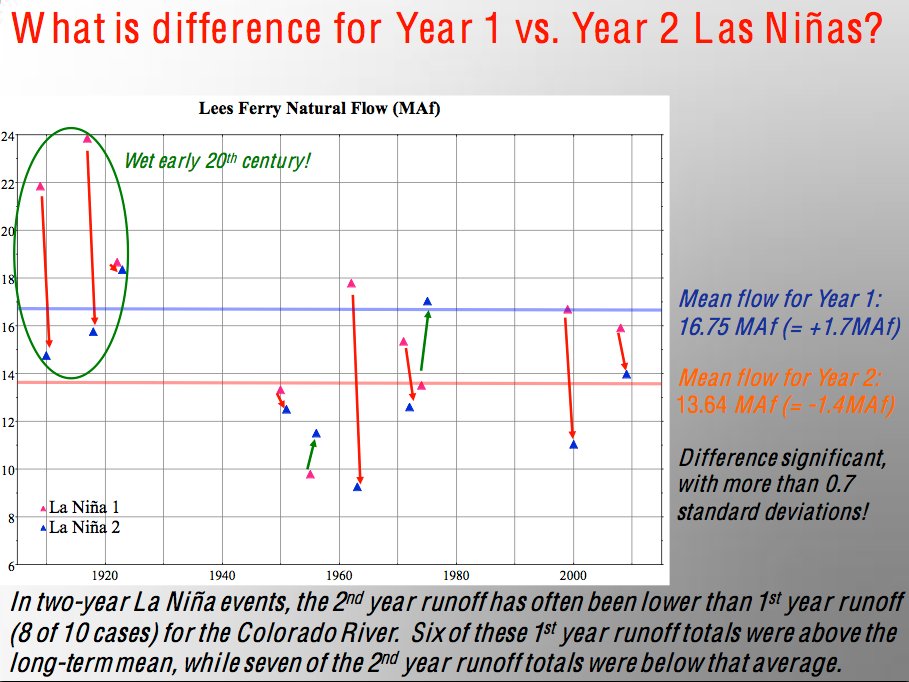
Odds are that La Niña will return this winter

1yearvs2yealaninascoloradoriverklauswolter.jpg

From the Summit County Citizens Voice (Bob Berwyn):

While La Niña conditions (cooler-than-average sea surface temperatures in the eastern Pacific) often return for a repeat performance after a strong episode like last year’s, the second time around is often much less intense, with a less pronounced effect on Colorado’s winter weather…

In a La Niña watch issued Aug. 4, the CPC said readings from the central Pacific show a strengthening of the below-average temperature readings at depth, and some atmospheric circulation patterns are still echoing last winter’s La Niña, including enhanced convection over the eastern Pacific, around Indonesia and New Guinea, with suppressed convection over the central equatorial Pacific. About half the long-range models are now forecasting that La Niña will reform in the fall.

State Engineer’s rules for non-tributary coalbed methane produced water affirmed by water court

nontributarycoalbedmethane.jpg

From the Associated Press (Catharine Tsai) via Loveland Reporter-Herald:

…the rules’ challengers are cheering because the ruling Thursday also said those determinations don’t have any legal effects outside of decisions on water well permits…

The San Juan Citizens Alliance and others had challenged the rules [ed. for non-tributary wells], which were adopted after a court decision on water pumped out during coalbed methane drilling. That decision said the water wasn’t just a waste product. Therefore companies for 40,000 existing wells that withdraw water during drilling potentially had to get water well permits or file plans for replacing the water if senior water rights holders were affected.

More coalbed methane coverage here and here.

Denver Water asks the General Assembly for legislation that would set tough standards for low-flow toilets

waterefficenttoilet.jpg

From The Pueblo Chieftain (Patrick Malone):

Lawmakers on the Water Resources Review Committee agreed to prepare draft legislation that would make the restriction of toilet flows in Colorado stricter than federal Environmental Protection Agency standards adopted in 1996. But some on the committee wondered whether government has a place in citizens’ bathrooms…

Toilets installed after 1996 are capped at a 1.6 gallons maximum flush volume, and urinals at 1 gallon maximum under EPA standards. Melissa Elliott of Denver Water told the committee that the legislation the utility is pushing would cap new toilets at a maximum of 1.28 gallons per flush and 0.5 gallon for urinals. “We’ve actually done a survey in our service area in 2005,” Elliott said. “It showed the average toilet flush at 3.14 gallons. We still find ones that flush 7 gallons.”[…]

As Denver Water envisions the proposed law, it would not require immediate replacement of less efficient toilets, but it would apply statewide…

In October the Water Resources Review Committee hopes to have a draft of the proposed toilet-efficiency standard legislation for consideration and to hear from representatives of the industries that it could potentially affect.

More conservation coverage here.

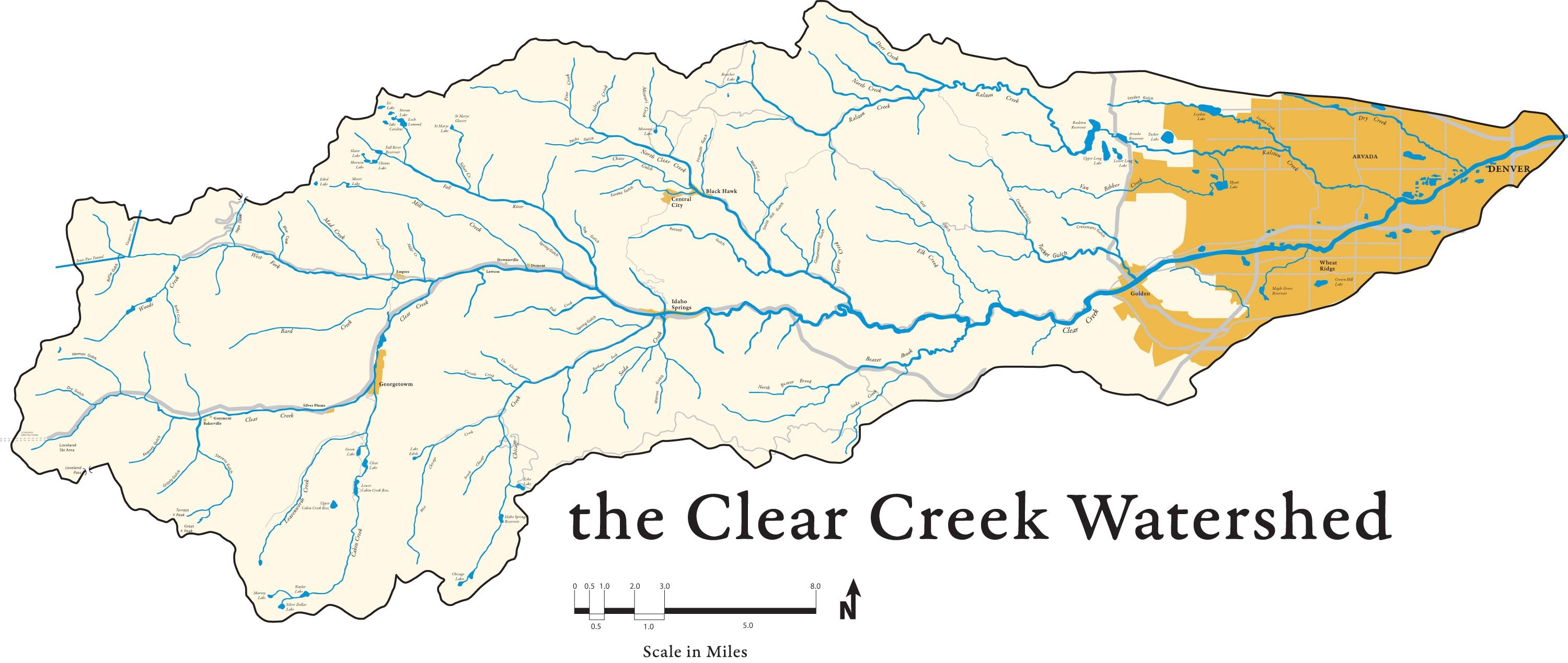
Idaho Springs: Clear Creek Watershed Festival September 17

clearcreekwatershedmap.jpg

From email from the Clear Creek Watershed Foundation (Christine Crouse):

Join us at the 3rd annual CLEAR CREEK WATERSHED FESTIVAL on Saturday, September 17, 10am – 3pm, creekside at Courtney-Ryley-Cooper Park in Idaho Springs.

Learn what a watershed is; what makes the Clear Creek Watershed so unique; and how we impact the watersheds we live, work, and play in.

Participants receive a WATERSHED PASSPORT and reusable tote bag to collect give-aways from 33 environmental education PASSPORT STATIONS. Learn about water and mineral resources, water quality, sustainable development/living, alternative energy and transportation, mining history, mine remediation, ecotourism, wildlife/habitat, and more.

Upon completion of the passport circuit, watershed explorers are rewarded with a cool color-changing water bottle, BBQ lunch, and ice cream. The festival is free of charge, but participants have to earn their passport stamps, prizes, and food coupons by engaging in the activities. There will be fly-tying and fishing, live music, goldpanning, facepainting, snow making, a model wind turbine, and much more!

The festival offers an out-of-the-classroom learning opportunity and the information lends itself to interesting family and class discussions/lessons on watersheds, natural resources, water science, and sustainable living.

More Clear Creek watershed coverage here.

The Bureau of Reclamation is increasing releases from Ruedi Reservoir for the Upper Colorado River Endangered Fish Program

coloradopikeminnow.jpg

From email from Reclamation (Kara Lamb):

Tonight [ed. September 6] at 5 p.m., releases from Ruedi Reservoir to the Fryingpan River will increase. We will be increasing by about 50 cfs. The reason for the change is that flows in the Colorado River through the 15 Mile Reach of critical habitat for endangered fish species have dropped. As a result, the Fish and Wildlife Service is requesting additional water. Currently, the Fryingpan is flowing around 260 cfs. After the change, it will be closer to about 312 cfs.

More endangered/threatened species coverage here and here.

NIDIS Weekly Climate, Water and Drought Assessment Summary of the Upper Colorado River Basin

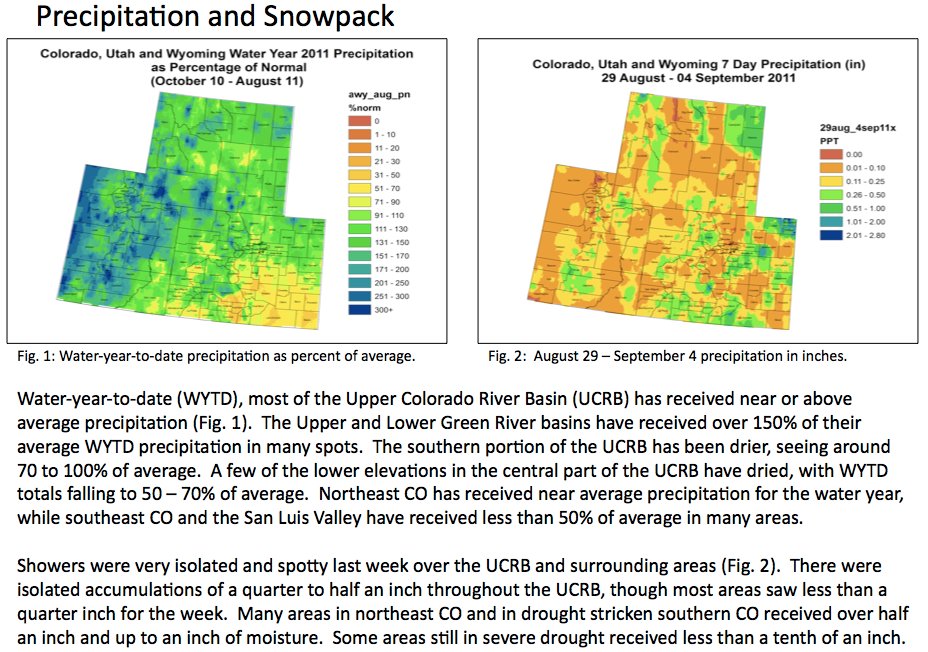
wyutcoprecipitation829to942011coloradoclimatecenter.jpg

Here are the presentations from this week’s webinar, from the Colorado Climate Center. Click on the thumbnail graphic to the right for the precipitation summary.

The City of Montrose is hoping that Montrose County will pitch in some dough for a whitewater park on the Uncompahre River

kayaker.jpg

From the Montrose Daily Press (Katie O’Hare):

“We have a lot of requests this year, but we can put it in with the other requests in preparing for our budget season,” Commissioner David White said.

City officials are seeking the county’s help to build a proposed white water park on the river. White said he was leery about allocating the money to the white water park after the county just recently completed it fairgrounds master plan, which includes several capital improvement projects…

Although the park is projected to cost between $600,000 to $900,000, Erickson said the annual economic benefits the area would realize would be far greater.

More whitewater coverage here.

Forbes: Peter Gleick discusses the concept of ‘Peak Water’ in a guest column

petermcbridecoloradoriverestuary.jpg

From Forbes (Peter Gleick):

Peak Renewable Water. Most water resources are renewable, in the form of flows of rainfall, rivers, streams, and groundwater basins that are recharged over relatively short time frames. Renewable, however, does not mean unlimited. When human demands for water from a watershed reach 100% of renewable supply, we can’t take any more, and we reach “peak renewable” limits…

Peak Nonrenewable Water. In some places, water comes from stocks of water that are effectively nonrenewable, such as groundwater aquifers with very slow recharge rates or groundwater systems damaged by compaction or other physical changes in the basin. When the use of water from a groundwater aquifer far exceeds natural recharge rates, this stock of groundwater will be depleted or fall to a level where the cost of extraction exceeds the value of the water when used, very much like oil fields…

Peak Ecological Water. Water supports commercial and industrial activity and human health, but it is also fundamental for animals, plants, habitats, and environmentally dependent livelihoods…

The good news, however, is that the assumption that a growing population and economy require ever growing amounts of water (or other natural resources) may be false. Indeed…the U.S. has continued to expand our economy and meet the demands of growing populations, with less and less water, through smarter technology, regulations, education, improved water pricing, and water conservation and efficiency programs…

Peak water may be a reality, but it doesn’t have to be a constraint on our well-being.

Colorado Supreme Court to hear San Luis Valley groundwater sub-district rules appeal September 28

slvdischargerecharge.jpg

From The Pueblo Chieftain (Matt Hildner):

The valley’s local Water Court signed off on the plan of management for Subdistrict No. 1 in May 2010, but three parties made up largely of surface irrigators have appealed that ruling. They argue that the management plan does too little to protect the owners of senior surface water right from injury caused by the pumping of the subdistrict’s roughly 3,000 irrigation wells…

The appellants include two groups — The San Antonio, Los Pinos and Conejos River Acequia Preservation Association and Save Our Senior Water Rights which are represented by Arvada attorney Tim Buchanan. Richard Ramstetter and Peter Atkins have joined as individual appellants, who are represented by Alamosa attorney Stephane Atencio.

More San Luis Valley groundwater coverage here and here.

Colorado Springs Utilities tells the state legislature Water Resources Review Committee that the Southern Delivery System is a regional economic stimulus project

sdspreferredalternative.jpg

From The Pueblo Chieftain (Patrick Malone):

“It’s our own regional stimulus project,” John Fredell, SDS program director, told the Water Resources Review Committee.

Already $330 million of the anticipated $880 million sum the project is expected to cost has been committed. Colorado Springs Utilities’ customers will pay for the project with 12 percent rate hikes annually from now through the project’s completion in 2016. Fredell said SDS was parceled into several efforts in order to spread the wealth between Southern Colorado contractors. He referred to a Colorado Springs Chamber of Commerce study of the economic impact of the project that estimates construction of SDS will generate 780 jobs a year. Fredell said Colorado Springs Utilities hopes that the water it is securing through the pipeline to Pueblo Reservoir will yield fruitful economic development that transcends the immediate construction jobs.

More Southern Delivery System coverage here.

Lamar pipeline: Arkansas River basin roundtable members had many questions for Karl Nyquist yesterday

lamarpipeline.jpg

From The Pueblo Chieftain (Chris Woodka):

Questions about cost, economic impact, water quality and whether the project is speculative greeted Karl Nyquist, a partner in GP Water, which is proposing a 150-mile, $350 million pipeline from the Lamar Canal to northern El Paso County and other points along the Front Range. Up to 12,000 acre-feet of water annually could be delivered…

“You’ve said the water template [ed. ag water transfers template developed by the Arkansas basin roundtable] would be used as a guide, how does it get enforced?” asked Dave Taussig, an attorney from Lincoln County.

Nyquist responded that a change case in Water Court, when it is filed, would protect other water rights in the Arkansas Valley. The socioeconomic concerns identified in the roundtable report could be addressed in the Prowers County 1041 land-use process, he added…

Others wanted to know if GP Water was merely a water speculator. “We own the water and won’t go to court until we have end users in mind,” Nyquist said.

During his presentation, he said GP has bid for water service to Cherokee, Castle Rock, Bennett, the district it controls in Elbert County and others. Nyquist said the plan had come to light through media reports before it was fully formed…

The project includes a reservoir, underground storage and treatment plant near Lamar in Prowers County, which Nyquist said would more than offset the loss of agricultural jobs…

GP submitted a proposal to the Cherokee Metropolitan District in Colorado Springs to provide up to 4,000 acre-feet annually for $7 per 1,000 gallons. That works out to about $9 million per year for about one-third of the projected supply…

GP plans to reduce its storage costs by using underground reservoirs, which will cut down on water losses from evaporation. Water quality is better during high flows when GP would store the water, Nyquist explained…

About 40,000 acre-feet of underground storage is available under the ground GP owns. GP estimates its water rights would yield an average of 8,000-10,000 acre-feet annually to move from the Arkansas River basin.

Brine from the treatment plant — which Nyquist said would be about 3-5 percent of the total water supply — would be injected 4,000-8,000 feet underground into formations that are already watered, Nyquist added.

More Lamar pipeline coverage here.

Arctic sea ice near record lows

arcticseaicerecord962011nationalsnowicedatacenter.jpg

From the National Snow and Ice Data Center:

Arctic sea ice extent averaged for August 2011 reached the second lowest level for the month in the 1979 to 2011 satellite record. Both the Northwest Passage and the Northern Sea route appear to be open. Throughout August, sea ice extent tracked near the record lows of 2007, underscoring the continued decline in Arctic ice cover.

Note: Arctic sea ice extent will likely reach its minimum extent for the year sometime in the next two weeks. NSIDC will make a preliminary announcement when ice extent has stopped declining and has increased for several days in a row. Monthly data for September will be released in early October.

Overview of conditions
Average ice extent for August 2011 was 5.52 million square kilometers (2.13 million square miles). This is 160,000 square kilometers (61,800 square miles) above the previous record low for the month, set in August 2007, and 2.15 million square kilometers (830,000 square miles), or 28% below the average for 1979 to 2000. Sea ice coverage remained below normal everywhere except the East Greenland Sea. In addition, several large areas of open water (polynyas) have opened within the ice pack.

On August 31, 2011 Arctic sea ice extent was 4.63 million square kilometers (1.79 million square miles). This is 100,000 square kilometers (38,600 square miles) higher than the previous record low for the same day of the year, set in 2007. As of September 5, ice extent had fallen below the minimum ice extents in September 2010 and 2008 (previously the third- and second-lowest minima in the satellite record). If ice stopped declining in extent today it would be the second-lowest minimum extent in the satellite record.

Conditions in context
In August, sunlight wanes in the Arctic and the sea ice decline starts to slow down. Although the decline slowed somewhat during August, ice extent retreated at a faster pace than average, at a pace of 67,700 square kilometers (26,100 square miles) per day. In comparison, the average rate of decline for August 1979 to 2000 was 53,700 square kilometers (20,700 square miles) per day.

Air temperatures were 1 to 4 degrees Celsius (2 to 7 degrees Fahrenheit) higher than average (relative to the 1981 to 2010 climatology) over the Arctic Ocean (measured approximately 1000 meters above the surface). The strongest anomalies were over the Northwest Passage region. High pressure persisted over much of the central Arctic Ocean, associated with a wind pattern that helped to push ice from the Beaufort Sea westward into the Chukchi Sea. This may have slowed some ice loss in the Chukchi Sea region. However, the wind pattern also transported ice into open waters warmed during the summer, fostering melt.

August 2011 compared to previous years
Average Arctic sea ice extent for August 2011 was the second-lowest for August in the satellite data record. Including 2011 the linear trend for August now stands at –9.3% per decade.

Northwest Passage sea ice at record low levels
Sea ice is now almost completely gone from the channels of the Northwest Passage, with the exception of a small strip of ice across a stretch of the Parry Channel. The southern route (Amunden’s Route) is ice free. According to the Canadian Ice Service, sea ice extent in the western Parry Channel is now the lowest at this time of year since record keeping began in 1966 and very little multi-year ice remains. According to Multisensor Analyzed Sea Ice Extent (MASIE) data, ice cover across the Canadian Archipelago is at record low levels.
The Northern Sea Route along Siberia remains ice-free, with a number of cargo ships passing through in recent weeks. However, some areas of older, thicker ice have helped preserve the tongue of ice extending into the East Siberian Sea.

Will Arctic sea ice extent reach a new record in 2011?
The melt season for Arctic sea ice will soon draw to a close. Surface melt has already largely ended and the ocean waters are cooling. Air temperatures at the North Pole have fallen below freezing. However, with the ice cover now thinner than in years past, there is a greater potential for late-season ice loss, caused by warm water melting ice from below or winds that push the ice together.

Whether Arctic sea ice breaks a new record hinges on three factors: First, how much heat is left in the ocean to eat away at the ice edge and bottom? Second, will wind patterns blow the ice together and reduce ice extent or will they disperse the ice and expand ice extent? Finally, just how thin is the remaining ice cover? Thin ice quickly melts away when it is surrounded by warm water.

The Yampa Valley Stream Improvement Charitable Trust is seeking design proposals for the Chuck Lewis State Wildlife Area’s Phase III river restoration project

chucklewisstatewildlifearea.jpg

From Steamboat Today:

The Yampa Valley Stream Improvement Charitable Trust is seeking design proposals for the Chuck Lewis State Wildlife Area’s Phase III river restoration project. The project is a design of 3,300 feet of river habitat restoration on the Yampa River. Interested firms can find proposal information on the Colorado Department of Personnel and Administration’s Open Notices website, http://www.gssa.state.co.us/CDNotices.

More Yampa River basin coverage here.

Animas River watershed: The City of Durango is asking for input on their ‘Animas River Management Plan’

animasrivertubing.jpg

From The Durango Herald:

The city of Durango is requesting assistance from individuals to participate in the development of the Animas River Management Plan. The city is seeking community comments by completing a brief survey on river-related activities and to provide thoughts about management practices. Responses will be accepted until Sept. 30. The survey can be found at http://www.durangogov.org with a link to the Animas River Management Plan.

More Animas River coverage here.

Flaming Gorge pipeline hydroelectric generation project moves to the Federal Energy Regulatory Commission permit process

pumpedstoragehydroelectricschematic.jpg

From the Fort Collins Coloradoan (Bobby Magill):

The Federal Energy Regulatory Commission, or FERC, is now considering Fort Collins entrepreneur Aaron Million’s permit application for the Regional Watershed Supply Project, a 501-mile water pipeline that would stretch from Flaming Gorge Reservoir in southwest Wyoming to Pueblo via Interstate 80 and northeast Larimer County, supplying water to Front Range water districts and irrigators…

Million filed revised plans for the pipeline with FERC on Sept. 1 as president of a new company formed on Aug. 25, Wyco Power and Water, Inc. [ed. I couldn’t find a website], 1436 W. Oak St. According to Million’s application, the pipeline would be up to 120 inches in diameter and would take water from the Green River about three miles downstream of the city of Green River, Wyo., and from the western shore of Flaming Gorge Reservoir. It would produce about 550 megawatts of hydroelectric power on its journey from Wyoming to Colorado while using nine natural gas-powered pump stations to send water over the Continental Divide. If the pipeline is built, it will also require construction of the proposed 185,000-acre-foot Cactus Hill Reservoir near Fort Collins…

In the application, Million said studies required for the permit would cost up to $4 million and he would pay for them.

More Flaming Gorge pipeline coverage here and here.

Flaming Gorge pipeline: ‘A Water Pipeline No One Can Afford’ — Western Resource Advocates

flaminggorgepipelinemillion.jpg

The Colorado Water Conservation Board will take up the question of funding a Flaming Gorge Task Force at their next meeting but meanwhile, economist Geore Oamek, put a pencil to the project and determined that it will produce the most expensive water in Colorado history. Here’s the release from Western Resource Advocates (Stacy Tellinghuisen):

The most expensive water in the history of Colorado. That would be the dubious distinction of the proposed Flaming Gorge Pipeline. A new report written by economist George Oamek outlines the costs of the proposed pipeline to Front Range water users, impacts on the tourism and recreation economy on the Green River, and some of the financial risks that Westerners would bear.

The proposed Flaming Gorge Pipeline would move 81 billion gallons each year 560 miles from southwestern Wyoming to cities along Colorado’s Front Range. The concept is proposed by both a private developer, Aaron Million, and a group of municipalities in Douglas County.

The project – estimated by the Colorado Water Conservation Board to cost $7 to $9 billion – would provide water two to 10 times more expensive than water from other proposed or recently developed water projects. The report finds Flaming Gorge water would cost up to $4,700 per acre-foot per year, compared to several other proposed projects expected to cost less than $700 per acre-foot per year.

“Flaming Gorge pipeline costs would be completely out-of-whack with what Coloradans can afford and should have to pay, especially when there are cheaper alternatives.” said Stacy Tellinghuisen, a water and energy expert with Western Resource Advocates.

Other recent water projects in Colorado have had substantial impacts on ratepayers. Colorado Springs’ Southern Delivery System, which, at just under $1 billion is a relative bargain compared to the proposed Flaming Gorge project, has led to multi-year, double-digit rate increases for customers, long before construction began. The Flaming Gorge Pipeline would result in even greater rate impacts.

Water providers and project proponents in Douglas County would be unable to foot the bill. Neither federal nor state government agencies are poised to subsidize enormous new water projects. The State of Colorado faced a 715 million dollar budget shortfall in 2011, leaving no funds available to pay for a multi-billion dollar water project.

The cost of this pipeline project will not only be paid by those who use the water. The report finds that for the recreation-dependent economy in the rural region surrounding the Flaming Gorge Reservoir, the impact of losing nearly a quarter of the Green River’s flow would reduce the region’s recreation revenue by $58.5 million per year, roughly a 19% hit to this economic sector.

“Local businesses like mine depend on the same water that the Flaming Gorge pipeline wants to divert away,” said Zeke Hersh, the owner of Blue River Anglers. “The recreation industry supports a lot of working people in rural Colorado, and if visitors aren’t drawn out here for the fishing and rafting, they won’t be around to eat in local restaurants, shop in our stores , or stay in local hotels. Businesses here will take a hit.”

The Colorado Water Conservation Board, when it meets on September 13th in Grand Junction, is considering whether to spend $150,000 to fund a task force to study the Flaming Gorge Pipeline.
“The proposed task force would squander taxpayer dollars,” said Elise Jones, of the Colorado Environmental Coalition. “The State of Colorado should be looking at projects that are affordable, viable, and collaborative, not spending money on gold-plated pipedreams.”

More coverage from the Associated Press (Catharine Tsai) via NorthernColorado5.com. From the article:

In a study commissioned by Western Resource Advocates, economic consultant George Oamek said diversions could reduce opportunities for fishing, rafting and camping and in turn reduce business for hotels, restaurants, and commercial outfitters and guides. It estimates regional expenditures could fall by about $39 million annually, representing less than 1% of the regional economy.

More Flaming Gore pipeline coverage here and here.

August in Salida: Temperatures up over average, precipitation down 55% from average

salidacolorado.jpg

From The Mountain Mail (Ericka Kastner):

Total precipitation during August in Salida was down 55 percent from the historical average, but average temperature was higher than in the same month in previous years. In August this year, Salida recorded .71 inch of precipitation, down .86 of an inch from the historical average of 1.57 inches. Measurable moisture was recorded on 9 of 31 days in August, with the greatest amounts falling Aug. 2 with .13 inch, Aug. 3 with .22 inch, and Aug. 31 with .12 inch. Four days were reported as having received a “trace.” The average temperature in August was 69.7 degrees, up from the historical average of 64.05 degrees.

Progressive 15 Fall Conference to be held in Wiggins September 14-16

southplatteriverbasincgs.jpg

From email from the Progressive 15:

Your 2011 Progressive 15 officers invite you to attend the 2011 Fall Conference.

Lt. Governor Joe Garcia; Senator Michael Bennet; and U. S. House Representative Cory Gardner are just some of who you will interact with. Additional speakers, workshops and activities make this a don’t miss event.

Here’s the agenda. Here’s the registration page.

More South Platte River basin coverage here.

Energy policy — oil and gas: There will be a public working session to discuss oil and gas regulations for El Paso County Thursday

niobrarashale.jpg

From The Colorado Springs Gazette:

Commissioners’ work session will begin at 2 p.m. Thursday, following the board’s regular 9 a.m. meeting. The work session will be in the hearing room of Regional Development Center, 2880 International Circle.

At the El Paso County assessor’s office, the number of mineral rights leases recorded for crude oil and natural gas is nearly twice that of last year. Leasing activity has jumped from 20 in 2008, to 215 in 2009, then 320 in 2010. This year’s tally: 611, with more than three months to go, according to County Assessor Mark Lowderman.

The office recently hired an oil and gas coordinator to handle valuations of the industry. “It’s everywhere out east,” Lowderman said last month of leasing activity. “We’re trying to educate ourselves and quickly get a handle on this because we haven’t dealt with it before.”[…]

Unlike other parts of the state, El Paso County has never had a commercial gas or oil well in production. There have been about 100 exploratory drills here, including two last year, according to the Colorado Oil and Gas Conservation Commission.

More oil and gas coverage here and here.

Castle Pines and the Castle Pines North Metropolitan District have spent upwards of $500,000 since early 2010 over the potential dissolution of the district

castlepinesmap.jpg

From The Denver Post (Carlos Illescas):

The city says that by integrating the metro district into the city, it will be able to provide services at a cheaper rate and save taxpayers money. But the metro district doesn’t trust the city and thinks Castle Pines isn’t working with them to come up with the best solution…

The metro district provides services that include water, wastewater, storm draining, and parks and open space to about 3,200 customers. The district was formed in 1984 and has provided services for Castle Pines residents since then. After residents voted in 2007 to incorporate as a city, leaders envisioned consolidating the district into the city, but keeping related taxes to provide services or to fund other improvements. The metro district recently received an extension until February to come up with a dissolution plan. Should the judge approve it, the issue will be decided by voters…

Dwight Kemp, a Castle Pines North Metro District board member, said some of the animosity stems from the timing of the dissolution by the city. Both sides had been discussing how to proceed, he said, when the council suddenly moved to eliminate the metro district altogether…

More Denver Basin aquifer system coverage here and here.

Over 7,000 attend telephone town hall meeting about the proposed Flaming Gorge pipeline

flaminggorgepipelinemillion.jpg

Here’s the report about the meeting from Western Resource Advocates. Here’s an excerpt:

Residents of the West don’t want their rivers dried-up, their recreation ruined, and special places destroyed. They especially don’t want their taxpayer dollars to support irresponsible projects. That was the feedback received through a telephone town hall meeting that provided 7,400 members of the public the opportunity to learn and ask questions about the proposed Flaming Gorge pipeline.

The controversial pipeline is a 560 mile-long project that would remove a massive amount of water from both the Green and Colorado Rivers. The water would be used for future growth along Colorado’s Front Range. The audience uniformly expressed concern and consternation about this proposed pipeline that would from stretch from Flaming Gorge Reservoir in southwestern Wyoming to cities in the South Denver Metro region.

A panel of experts, including WRA Water Program director Bart Miller, laid-out what’s behind the proposal and what it means to residents in a three-state region. Callers lit-up switchboards to ask questions about how much the project would cost, who would benefit, and remark how little information has been publicly available up until now.

Participants sent a clear message: they are not convinced that the pipeline should be built at all. It would transport the most expensive water Colorado has ever seen, use a huge amount of energy, and have severe negative economic impacts to the region around Flaming Gorge Reservoir. The proposal also ignores less expensive and less controversial solutions for meeting water needs, such as conservation, efficiency, reuse, and other smaller projects.

In mid-September, the Colorado Water Conservation Board will determine whether they will continue to use taxpayer dollars to fund a task force looking into the viability of the Flaming Gorge pipeline. Upon gathering feedback from the public at the town hall forum, this appears to be a very unpopular idea.

Click through for video from Peter McBride.

More Flaming Gorge Pipeline coverage here and here.

South Platte River basin: The State Engineer’s office is looking to account more accurately for flows leaving the state to Nebraska

lowersouthplatte.jpg

From The Pueblo Chieftain (Chris Woodka):

A study by Halepaska and Associates for the Weld County Farm Bureau and Colorado Corn Growers found that deliveries of water to Nebraska have significantly increased since 2006. As much as 600,000 acre-feet of water more than necessary under the South Platte River Compact flowed out of the state in 2010 because of artificial recharge ordered by the state, the consultants said. The study found elevated groundwater levels and recommended better procedures for measuring the relationship between surface and underground water supplies. “One conclusion is that by neglect, inadvertance or mistake the state of Colorado is assisting the irrigation community of Nebraska, causing the economic dislocation of thousands of Colorado irrigators,” John Halepaska said.

Wolfe said other factors could be in play, and while the state is reviewing the analysis, it doesn’t necessarily agree with the conclusions. “What we’ve been trying to do is get a common understanding,” Wolfe said. “For instance, this year we’ve seen a huge amount of precipitation and a small amount of recharge (from past years).” Wolfe said he plans to meet with the groups in the next few weeks to assess the situation, but his initial assessement was that the study “oversimplified” the state-generated data it used.

The South Platte River Compact [is] indefinite on how much water Colorado is required to deliver, he said. The compact requires curtailment in Colorado if the flow at the state line is below 120 cubic feet per second from April 1 to Oct. 15. The compact requires Colorado to meet deliveries that would have been available at the time of Nebraska’s claim, June 14, 1897…

Wolfe said the state is conducting studies in Northeastern Colorado to refine measurements of how aquifers are recharged, as suggested by the consultants. The state is also developing better management tools for managing water accounting.

More South Platte River basin coverage here and here.

Drought news: August was fourth warmest on record for Boulder

usdroughtmonitor08302011.jpg

From the Boulder Daily Camera (William Callahan):

Locally, our August was hot and dry. Denver had its warmest August on record, a record that goes all the way back to 1870. It was hot in Boulder as well. The month was the fourth-warmest August on record. There were two record-high temperature readings. Aug. 23 hit 98 degrees, eclipsing the record of 97 set in 1949, and Aug. 25 hit 96, beating out the 95-degree reading in 1953…

There have been at least three dozen Augusts that were drier than this year’s. But August was even drier than it looked because the 0.38-inch tally for Aug. 1 really fell on July 31, after the 5 p.m. reporting time.