San Luis Valley: Summer pumping has erased much of the acquifer recharge gains made since 2002

slvdischargerecharge.jpg

Here’s a guest commentary from Lynn McCullough, president of the Subdistrict 1 Board of Managers, Rio Grande Water Conservation District, running in The Pueblo Chieftain. From the article:

The Board of Managers of Subdistrict No. 1 in the Rio Grande Conservation District would like to impart some very important information to all irrigators in Subdistrict No. 1. We are facing a potentially calamitous situation as the result of groundwater pumping during the 2011 irrigation season.

It now appears that the unconfined aquifer in the Closed Basin may fall to levels below those experienced following the 2002 drought, eliminating all of the gains made in restoring the aquifer through the voluntary efforts of the past eight years.

Although many irrigators have continued to practice conservation practices, the highly favorable commodity prices of the past year and the incredibly dry and windy conditions have led to a significant increase in groundwater withdrawals.

More Rio Grande River basin coverage here.

Lamar pipeline: Developer of the proposed pipeline to brief the Arkansas Basin roundtable Wednesday

rockyfordditch.jpg

From The Pueblo Chieftain (Chris Woodka):

Karl Nyquist, a partner with GP Water, will discuss his proposal to build a reservoir and treatment plant at Lamar in order to move up to 12,000 acre-feet annually to growing Front Range communities. This will be the first presentation to the roundtable on the plan, which came to light in July when Nyquist and his partners asked the Elbert County commissioners to expand the Elbert and Highway 84 Commercial Metro District, which they control, as a way to expedite the project. The company has proposed using the roundtable’s report “Considerations for Agriculture to Urban Water Transfers” as a way to identify third-party impacts if water is moved from Prowers County, a rural area historically dependent on its farm economy, to growing cities on the Front Range…

GP Water proposes to pump water from Denver Basin aquifers in Elbert County to supply the Cherokee Metro District in Colorado Springs. In the long-term, GP proposes to pump treated water from Lamar to Cherokee and other users. Nyquist held five public meetings in Prowers, Elbert and El Paso counties during August to explain the plan to local communities that would be involved. About 1,000 people showed up to protest the expansion of the district at an Aug. 24 Elbert County commissioners meeting. The district withdrew its application in response to the public opposition, but Nyquist said the company will still work toward building the pipeline project…

The Lamar Canal is closely tied to the Granada Ditch, where some irrigators are fearful of what could happen to their water deliveries if the GP project is developed.

More Lamar pipeline coverage here.

NWS meterologist Joe Ramey says there is a 70-80% that La Niña will be back this winter

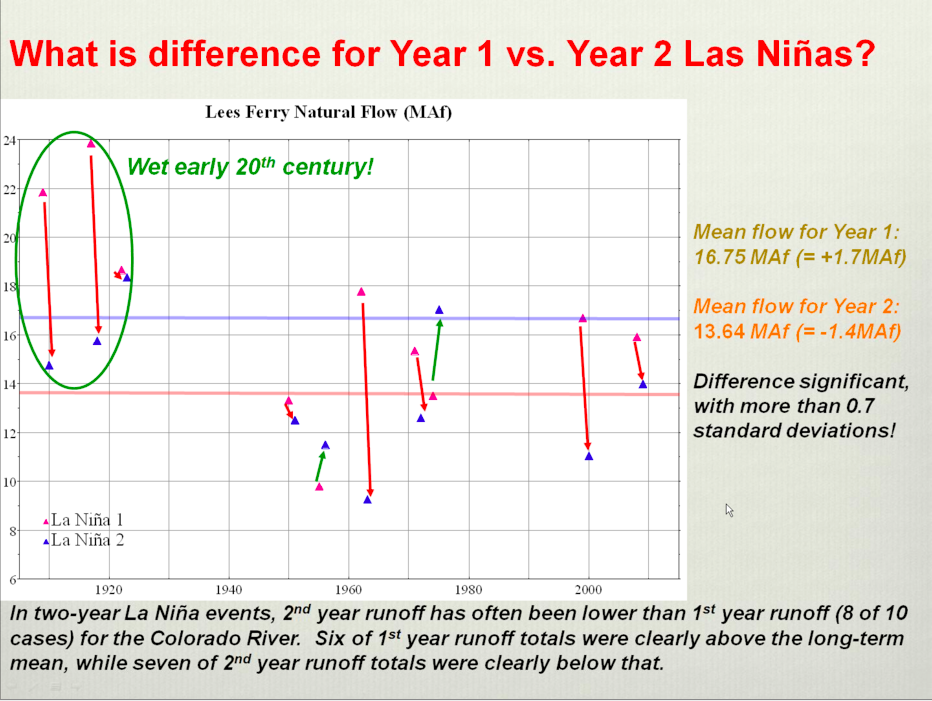
year1vsyear2laninaklauswolter.jpg

From Steamboat Today (Matt Stensland):

With 70 to 80 percent certainty, La Niña is expected to return, according to Joe Ramey, a meteorologist and climate expert at the National Weather Service in Grand Junction. “It’s not a given that it will be La Niña, but it’s about as strong as we can get,” he said. “We had La Niña last year, and it turned out to be a great year for Steamboat.”[…]

Ramey said that he is studying back-to-back La Niña events and the effect on snowfall. He said consecutive events have happened seven times since 1950 and that it appears the consecutive event has not typically been as strong. This could result in a near or slightly-above normal snowfall.

Click on the thumbnail graphic above and to the right for Klaus Wolter’s chart of first year and second year La Niña events. His data shows that there is often a drop off in flows at Lees Ferry in the second year.

Gunnison River basin: Next Upper Slate River Committee meeting September 6

ohbejoyfulslatecreek.jpg

From The Crested Butte News (Alissa Johnson):

The Upper Slate River Committee, a new group formed by the Coal Creek Watershed Coalition (CCWC) in early 2011, is bringing together key stakeholders to develop a Slate River Watershed plan. The plan will identify potential non-point source pollutants and where to focus efforts to prevent contamination within the watershed…

In order to fully understand the Slate River, the committee has contracted with environmental consultant Ashley Bembeneck to compile an initial report to inform the group’s work. “[The report] will use existing water quality to assess spatial water quality trends…and identify areas or items for additional investigation,” Bembeneck said…

A more detailed summary of the report will be given at the next Upper Slate River Committee meeting on Tuesday, September 6 at 4 p.m. at the Crested Butte town hall.

“It’s additional data compilation,” said Poponi. “You identify where you would like more info, get that info and then roll it into the plan instead of doing the plan first with limited amount of data. We want to do the plan with most data possible.”

More Gunnison River basin coverage here.

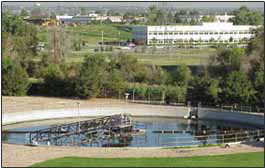
The Metropolitan Wastewater Reclamation District has switched disinfection dosing from chlorine gas to sodium hypchlorite

metrowastewater.jpg

From email from the Metropolitan Wastewater Reclamation District (Steve Frank):

As of August 18, the Metro Wastewater Reclamation District stopped using gaseous chlorine brought to its treatment plant via rail car as its disinfecting agent. The District now uses a much safer chemical, sodium hypochlorite, instead.

Sodium hypochlorite is added to the treated water at the Robert W. Hite Treatment Facility (RWHTF) to disinfect it before it is discharged to the South Platte River. Sodium bisulfite is added after the sodium hypochlorite to remove residual chlorine to make the treated water friendlier to fish.

“We are glad to have transitioned away from the gaseous chlorine,” said Director of Operations and Maintenance Steve Rogowski.

“The sodium hypochlorite we now use is much safer, both for our employees and for people who live and work near our treatment facility.”

The District used gaseous chlorine for disinfection from the time the facility was built more than 45 years ago until recently.

From October 1988 to July 2009, liquid sulfur dioxide was used to remove residual chlorine from the effluent, but sodium bisulfite took its place in 2009.

The Metro District is the largest wastewater treatment agency in the Rocky Mountain West. The District’s Robert W. Hite Treatment Facility at 64th and York treats about 140 million gallons of wastewater a day. The service area includes nearly 1.7 million people and encompasses approximately 715 square miles, including Denver, Arvada, Aurora, Brighton, Lakewood, Wheat Ridge, Thornton, and part of Westminster, together with about 40 sanitation and water and sanitation districts in the metropolitan Denver area.

While on their website I ran into their page for the shiny new wastewater treatment plant they’re building on the South Platte River near Brighton. Say hello to the Northern Treatment Plant.

More wastewater coverage here.

Colorado College ‘State of the Rockies monthly Speaker Series’ kicks off September 12

stateoftherockiewproject.jpg

Update: From the press release for Monday night (Leslie Weddell):

Acclaimed photographer Peter McBride and award-winning author Jonathan Waterman will kick off the Colorado College State of the Rockies Project Speakers Series on Monday, Sept. 12, presenting “The Colorado River: Flowing Through Conflict,” a discussion on the issues affecting the Colorado River Basin. They will present what they learned during the two years they spent documenting the Colorado River, which culminated in their book “The Colorado River: Flowing Through Conflict,” an award-winning short film, “Chasing Water” and a traveling exhibition currently on display at the Denver Museum of Nature and Science.

Here’s the release. Here’s an excerpt:

Leading experts and well-known river advocates will headline the Colorado College State of the Rockies Project monthly Speakers Series, examining the Colorado River Basin and the complex water use, environmental and economic challenges facing future generations. This year’s topic is “The Colorado River Basin: Use, Restoration and Sustainability as if the Next Generation Counts.”

The Speakers Series, which is free and open to the public, kicks off on Monday, Sept. 12 with Peter McBride and Jonathan Waterman, who will discuss their book “The Colorado River: Flowing Through Conflict.” McBride and Waterman spent more than two years documenting the Colorado River culminating in the coffee table book, an award-winning short film, “Chasing Water,” and a traveling exhibition currently on display at the Denver Museum of Nature & Science. The talk will be presented at the Celeste South Theatre, Cornerstone Arts Building, 825 N. Cascade Ave. on the Colorado College campus (corner of Cache La Poudre Street and Cascade Avenue).

The Colorado River Basin winds 1,400 miles through seven states on its way to Mexico. It supplies water to households, communities, businesses and farms. Roughly 27 million people rely on the river for water, energy and healthy ecosystems. But climate studies and projected population growth indicate that unless immediate action is taken, municipalities, industry, agriculture and recreation will be unable to meet the water demands of the next generation. Some experts predict that by 2050, climate change and burgeoning uses of the river system will result in inadequate water to meet all of its allocated shares 65 to 90 percent of the time.

The Speakers Series features monthly programs scheduled through January 2012, leading up to a public conference April 8-10, where students will present the 2012 State of the Rockies Report examining current water, agricultural and recreational issues in the Basin and highlighting how economic, demographic and climate changes will impact what the Colorado River looks like to future generations. All lectures in the series begin at 7 p.m. Additional upcoming talks include:

Monday, Oct. 17 – “The Law of the Colorado River Basin: Rigid Relic or Flexible Foundation for the Future?” presented by Gregory Hobbs Jr., Colorado Supreme Court, and Larry MacDonnell, University of Wyoming College of Law Location: Richard F. Celeste Theatre, Cornerstone Arts Building, 825 N. Cascade Ave., on the Colorado College campus

Monday, Nov. 7 – “The Colorado River Basin: Environmental Perspectives and Action” presented by Bart Miller, Water Program Director for Western Resource Advocates; Jennifer Pitt, Director of the Colorado River Project for the Environmental Defense Fund; and Tom Chart, USFWS, Director of the Upper Colorado River Endangered Fish Recovery Program
Location: Richard F. Celeste Theatre, Cornerstone Arts Building, 825 N. Cascade Ave., on the Colorado College campus

Monday, Dec. 5 – “The Colorado River Basin and Climate: Perfect Storm for the 21st Century?” presented by Stephen Saunders, president of the Rocky Mountain Climate Organization, and Jeff Lukas with the Western Water Assessment, and moderated by Beth Conover, editor of “How the West Was Warmed”
Location: Gates Common Room, Palmer Hall, 1025 N. Cascade Ave., east of Tutt Library on the Colorado College campus

Monday, Jan. 30, 2012 – “Unheard Voices of the Colorado River Basin: Bringing Mexico and the Native American Tribes to the Table” presented by Bidtah Becker with the Water Rights Unit of the Navajo Nation Department of Justice and Osvel Hinojosa, director of the Pronatura Noroeste’s Water and Wetlands Program Location: Gates Common Room, Palmer Hall, 1025 N. Cascade Ave., east of Tutt Library on the Colorado College campus

The State of the Rockies Project is an annual research study conducted collaboratively by undergraduate students and faculty to increase public understanding of vital issues affecting the Rockies. For more information, or to learn how to connect to podcast and videos of each program, visit the State of the Rockies Project website at http://www.stateoftherockies.com.

For information, directions or disability accommodation at the event, members of the public may call (719) 389-6607.

About State of the Rockies Project
The Colorado College State of the Rockies Project is in its ninth year and seeks to increase public understanding of vital issues affecting the Rocky Mountain Region. All events are free and open to the public, and we encourage the public to join the ongoing discussion of the issues that affect our beautiful yet fragile region. More information can be found by visiting the State of the Rockies Project website, blog, Facebook page and YouTube channel.

NIDIS Weekly Climate, Water and Drought Assessment Summary of the Upper Colorado River Basin

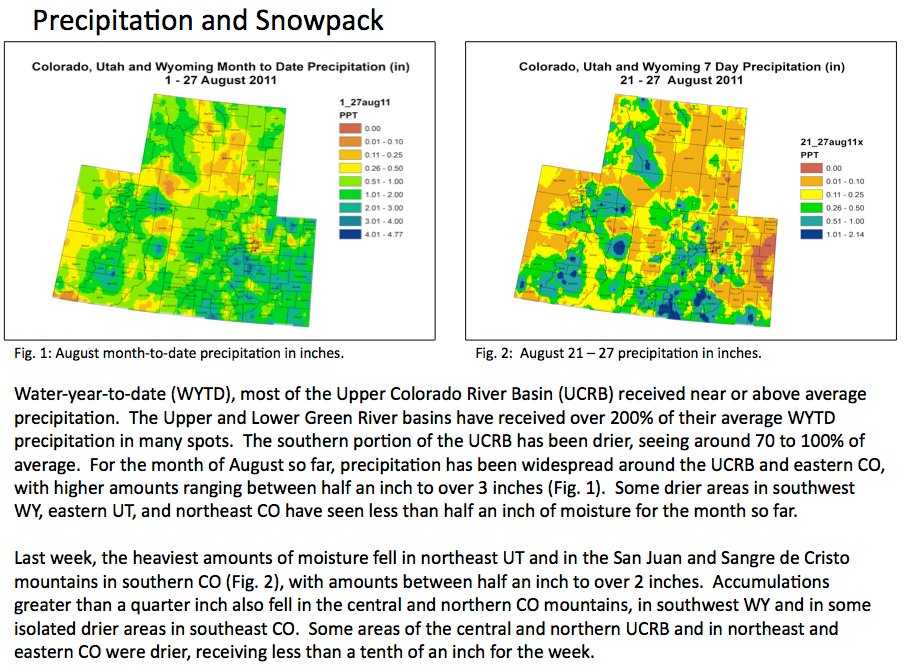
wyutcoprecipaugust2011coloradoclimatecenter.jpg

Here are the presentations from Tuesday’s webinar from the Colorado Climate Center. Click on the thumbnail graphic to the right for the precipitation summary.

Energy policy — oil and gas: The Denver Business Journal is running a photo essay about hydraulic fracturing

gelledhyrdraulicfracturingfluid.jpg

Here’s the link to the photo essay.

More oil and gas coverage here and here.

Aquarius Makes First Ocean Salt Measurements

aqariussatelliteartistconceptionjplaugust2011.jpg

Here’s the release from the Jet Propulsion Laboratory:

NASA’s Aquarius instrument has successfully completed its commissioning phase and is now “tasting” the saltiness of Earth’s ocean surface, making measurements from its perch in near-polar orbit.

“This marks the end of the long odyssey to design, build and launch this mission, and the start of a new journey of scientific exploration,” said Aquarius Principal Investigator Gary Lagerloef of Earth & Space Research, Seattle. “Scientists from around the world are ready and waiting to study this important new satellite measurement for ocean and climate research.”

The Aquarius/SAC-D (Satélite de Aplicaciones Científicas) observatory, a collaboration between NASA and Argentina’s space agency, Comisión Nacional de Actividades Espaciales (CONAE), launched from California’s Vandenberg Air Force Base on June 10 aboard a United Launch Alliance Delta II rocket and was placed in its proper initial orbit. Ground controllers at the SAC-D Mission Operations Center in Teófilo Tabanera Space Center in Cordoba, Argentina, then began a complete in-orbit checkout of all SAC-D spacecraft systems.

With all observatory systems confirmed to be healthy, SAC-D spacecraft commissioning activities were completed on July 24. The spacecraft’s propulsion system then underwent a series of tests, and preliminary orbit adjustments were performed in preparation for turning on the observatory’s eight science instruments.

Aquarius will make NASA’s first space observations of the salinity, or concentration of salt, at the ocean surface, a key variable in satellite studies of Earth. Variations in salinity influence the ocean’s deep circulation, outline the path freshwater takes around our planet and help drive Earth’s climate.

On Aug. 14, the Aquarius Instrument Flight Operations Team, together with the SAC-D Mission Flight Operations Team, began powering up the Aquarius instrument, and successfully completed deployment of the Aquarius antenna on Aug. 17. The team then began sequentially powering on the instrument’s subsystems. On Aug. 20, the Aquarius radiometer, which collects the brightness temperature data from which salinity measurements are derived, was powered on for the first time in space and transmitted its first science data back to Earth, which were analyzed and found to be as expected. On Aug. 21, the team began powering on Aquarius’ radar scatterometer, which corrects for the effects of ocean roughness on the radiometer readings. Commissioning of Aquarius was completed and regular data collection began on Aug. 24.

The Aquarius science team will spend the coming months analyzing and calibrating the measurements and releasing preliminary data.

With the Aquarius instrument commissioning now complete, the SAC-D Instruments Flight Operations Teams, together with the SAC-D Mission Flight Operations Team in Argentina, are now engaged in commissioning the other seven SAC-D instruments. Once all the observatory instruments are commissioned, a maneuver will be conducted to place Aquarius/SAC-D in its final orbit, 408 miles (657 kilometers) above Earth.

Aquarius was built by NASA’s Jet Propulsion Laboratory in Pasadena, Calif., and the Goddard Space Flight Center in Greenbelt, Md. NASA’s Launch Services Program, at Kennedy Space Center in Florida, managed the launch. JPL is managing Aquarius through its commissioning phase and will archive mission data. Goddard will manage Aquarius mission operations and process science data. CONAE is providing the SAC-D spacecraft, an optical camera, a thermal camera with Canada, a microwave radiometer, other sensors and the mission operations center. France and Italy also are contributing instruments.

For more information about Aquarius/SAC-D, visit: http://www.nasa.gov/aquarius and http://www.conae.gov.ar/eng/principal.html.

Grand Junction: Interbasin Compact Committee meeting September 12

grandvalleyirrigationditch.jpg

From email from the IBCC (Eric Hecox):

The 34th meeting of the Interbasin Compact Committee, formed under the Colorado Water for the 21st Century Act, will be:

Date: Monday, September 12, 2011
Time: 8:30 a.m. – 4:00 p.m.
Location: Ute Water Conservancy District, 2190 H 1⁄4 Road, Grand Junction, CO.

More IBCC — basin roundtables coverage here.

Drought news: The summer was the second hottest on record for the Pueblo area

usdroughtmonitor08302011.jpg

From The Pueblo Chieftain (Gayle Perez):

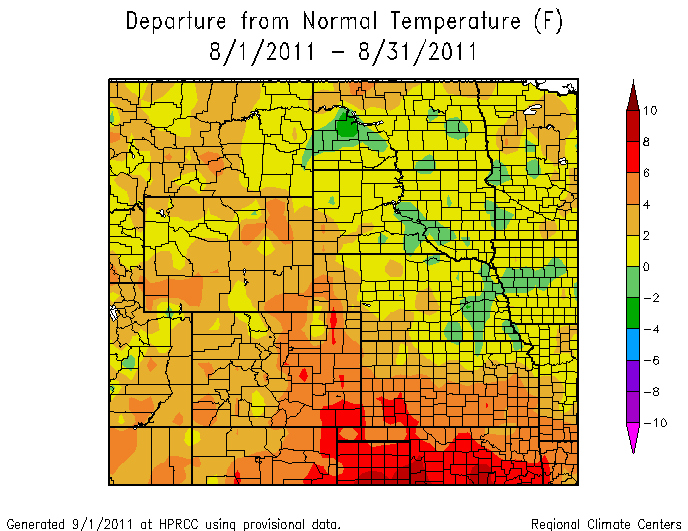
For the months of June, July and August, Pueblo’s highest average temperature of 77.2 degrees was just six-tenth of a degree shy of breaking the 41-year-old record. Neighboring Southeastern Colorado communities of Alamosa and Colorado Springs had their warmest summers on record, according to statistics from the National Weather Service. Alamosa’s average temperature was 65.3 degrees, nearly a degree hotter than the record set last year at 64.4 degrees. Colorado Springs’ average temperature was 73.2 degrees, which broke a 31-year record. In Pueblo, the three-month highest average was 77.2 degrees. The statistics are for June 1 through Wednesday…

The average high temperature in Pueblo was 93.8 degrees, the third-hottest on record. The record high average is 94.1 degrees, set in 2002…

“It was a general heat wave. It was hot and dry in Texas and the ridge of high pressure extended into Southeastern Colorado,” [Paul Wolyn of the National Weather Service] said. “Besides the warm, we had the monsoon plume push away from us and we didn’t have those afternoon thunderstorms like we’ve had in the past. Without the afternoon storms, it just got a little warmer around here.”

august2011departurefromnormaltemperaturehighplainsregionalclimatecenber.jpg

Meanwhile, Denver recorded the hottest on record August, as well. Here’s a report from Bob Berwyn writing for the Summit County Citizens Voice. From the article:

according to the National Weather Service, where Denver recorded its all-time hottest August on record, with an average temperature of 77 degrees for the month. That may not sound so hot but remember, that reading is the average of all highs and lows for the entire month. The previous record, 76.8 degrees, was set in the Dust Bowl era, back in 1937.

It was also the sixth-hottest month in the Mile High City, with the hottest August on record way back in July 1934, with an average temperature of 77.8 degrees.

The near-record readings came courtesy of a sustained string of warm days, and not just from a few extreme spikes. Through Aug. 31, Denver recorded 71 consecutive days with temperatures climbing above 80 degrees. The previous record streak for 80-degree-plus days was 59 days, set during the epic 2002 drought year.

Here’s the August 2011 Climate Summary from the High Plains Regional Climate Center.

Great Outdoors Colorado Board Accepting Concept Papers For River Corridors Initiative

farmershighlinecanalarvada.jpg

Here’s the release from GOCO:

The Great Outdoors Colorado (GOCO) Board is requesting concept papers for large-scale projects centered around river-based recreation and open space. The Board has allocated $14 to $18 million for this initiative, which also includes projects surrounding creeks, streams, canals and other water sources suitable for outdoor recreation.

GOCO’s intent with this Rivers Initiative is to provide more places and facilities for Colorado’s citizens and visitors to enjoy the state’s vast river resources while maintaining the important river ecosystems and natural values they provide.

Given the high level of demand and the Board’s desire to see an immediate impact from these funds, GOCO is seeking projects that:

• are of regional or statewide significance; and
• can be completed within three years of award; and
• entail one or more of the following project types:

o will give people direct access to a river-based open space or recreational experience in appropriate locations
o will provide buffers to river-based open space or recreational facilities
o will provide critical planning for future river-based open space and recreation. (If you anticipate seeking planning funds, please contact GOCO staff prior to submitting a concept paper.)

The Board will evaluate concept papers based on eligibility and criteria available at http://www.goco.org. At its December 6, 2011, meeting, the Board will invite selected concept papers to submit full applications. Concept papers are due at the GOCO office no later than 5:00 p.m., October 14, 2011.

Restored Lake John Fishery Opens September 3

lakejohn.jpg

What a great name for a lake, if I do say so myself. Here’s an excerpt from the release from the Colorado Department of Wildlife and Parks:

Colorado Parks and Wildlife has completed a reclamation project at Lake John, setting the stage for a rejuvenated fishery that will be open for angling in early September. Lake John is located northwest of Walden along CO Road 7A.

“The success we have had with the reclamation is like a reset button for Lake John,” said Kurt Davies, aquatic biologist for the northeast region. “The lake will be back online by the first week of September and back to growing fish at its maximum potential. The fish we are planting now will see tremendous growth before the lake is even iced up and with the large brood fish we are putting in there, there’s the possibility someone will hook into a real trophy.”

Parks and Wildlife biologists and managers anticipate dramatic improvements in Lake John post –reclamation. Signs posted at the entrance to Lake John will notify the public of the re-opened fishery in the near future.

“The reclamation has been very successful to this point and I’m looking forward to seeing anglers catch fish out of Lake John this September,” said Walden District Wildlife Manager Josh Dilley. “This water is important to the local economy as well as to the recreation of my district.

More North Platte River basin coverage here.

Lamar pipeline: GP Resources LLC launches ‘Southeast Renewable Water Initiative’ website

pipeline.jpg

Say hello to the GP Resources LLC Southeast Renewable Water Initiative website. From the “concept” page:

GP Resources, LLC, is a Colorado-based agriculture and natural resources company committed to providing treated drinking water and water storage for users throughout the Front Range and southeastern Colorado as part of a new regional water project intended to serve as a model for how in-state water transfers can be structured in a way that benefits all stakeholders.

The project involves limited amounts of ground water from Elbert County and a significant amount of agricultural surface water from the lower Arkansas River, both of which are privately owned by GP Resources. It is anticipated that the project will create jobs and provide homeowners and businesses with access to much-needed renewable water supplies, helping solve the increasing problems associated with reliance on aquifer resources.

In an effort to make this project a model for how water transfers should be done, GP will take guidance from the Water Transfer Template developed by the Arkansas River Roundtable as a framework for addressing the needs and concerns of all stakeholders.

Significant groundwork has gone into project analysis, finance, and planning. Key components include:

Investments in equipment, systems, and practices to increase the efficiencies of current water consumption on GP’s farms based in Lamar. Large portions of the farms will continue to be irrigated after the project is completed and the remaining water will become available for municipal use after going through Colorado’s mandated water court process. The court process ensures that downstream agricultural and municipal users will not be adversely affected by the change in use. Since this is an existing diversion, the project will not remove any water from the Arkansas basin that is not already being consumed and therefore should have minimal environmental impact. In addition, all required permitting processes will be followed and the project will comply with the Arkansas River Compact.

Investments in GP’s water rights and systems in Elbert County, involving a local water District to provide the transmission of GP’s privately owned and adjudicated water on an interim basis to a water District in the greater Colorado Springs area. This will include construction of a below-ground pipeline through or adjacent to an existing service easement for most of the alignment and will bring much-needed relief to the community, which has experienced problems with its current water sources. Upon delivery of GP’s renewable water supply to this community, the same pipeline will be re-used to deliver additional renewable water to other Front Range communities.

Investments in water treatment, storage, and transmission facilities which will allow the efficient movement of GP’s Lamar water to Front Range and eastern plains communities, providing them with a stable, cost-effective, and perpetual water supply. Additionally, jobs will be created in both Elbert and Prowers counties through the construction, on-going maintenance and operation of the system.

To implement these plans, GP is currently in discussions with several water Districts to provide them with an efficient solution to their water needs as quickly as possible. GP has also had preliminary consultations with relevant County and State authorities to ensure its project is responsive to local needs and provides a win-win for key stakeholders. GP plans to continue these efforts through immediate contact with all interested parties in the Arkansas Valley, eastern plains and along the Front Range.

More Lamar pipeline coverage here.

Invasive species: Mudsnails and Eurasian watermilfoil found at Eleven Mile Reservoir

elevenmilereservoir.jpg

From the Fairplay Flume (Quintn Parker/Tom Locke):

The New Zealand mudsnail cannot be controlled, reproduces very rapidly and could lead to smaller fish in Eleven Mile, while the Eurasian milfoil can be controlled but not eradicated, and it could lead to dense weed mats in the reservoir that could make it difficult to navigate for swimmers or boaters, Elizabeth Brown, invasive species coordinator for Colorado Parks and Wildlife, told The Flume.

“Eleven Mile State Park is a fabulous place, and it will continue to be so. It’s something we’re going to have to manage,” said Brown. “We’re working on a strategy.”

Eleven Mile State Park is of significant importance to Park County. In 2009, it drew 309,266 visitors, and between June 2008 and May 2009, $15.7 million was spent by non-resident visitors to Eleven Mile, according to survey results released Sept. 2, 2010.

Here’s the release from Colorado Parks and Wildlife:

Officials with Colorado Parks and Wildlife are continuing efforts to educate boaters, anglers and other recreationists about the need to clean, drain and dry boats, waders and other equipment when using Colorado waters.

“We have had success with our boat inspection programs to prevent invasive species, but there are a few aquatic nuisance species that can spread via methods other than boats,” said Elizabeth Brown, an Invasive Species Coordinator with Colorado Parks and Wildlife. “The fact that we’re finding new populations means we have to work harder to engage the public to do their part to clean and dry all their gear and equipment as well as their boats to protect our waters.”

Rusty crayfish, discovered in 2009 in the headwaters of the Yampa River, have been recently confirmed in the reservoir at Stagecoach State Park, near Steamboat Springs. A July 6 survey found that New Zealand mudsnails, another aquatic invader, have made their way from South Delaney Butte Reservoir to nearby East Delaney Butte Reservoir within the Delaney Buttes State Wildlife Area in North Park. Colorado Parks and Wildlife monitoring crews have also recently confirmed New Zealand mudsnails and an aquatic invasive weed, Eurasian watermilfoil, in the reservoir at Eleven Mile State Park. Earlier this summer it was announced that quagga mussel veligers were again confirmed through monitoring at Lake Pueblo State Park.

The effort to educate recreationists began in earnest in Colorado in 2004 as both Colorado State Parks and the Colorado Division of Wildlife undertook campaigns following the initial discovery of New Zealand mudsnails in Colorado. The effort intensified in 2007 when invasive zebra mussels were discovered in Lake Pueblo. With legislative funding assistance, Colorado State Parks and the Division of Wildlife rolled out a statewide effort to inspect boats on major waters in the state and try to prevent the spread of zebra and quagga mussels and other invasive species. Gov. John Hickenlooper signed legislation earlier this year that merged Colorado State Parks and the Division of Wildlife and the separate programs are being combined with an eye toward identifying efficiencies that will make the programs more effective.

“Invasive species are very effective at hitching a ride to new places on everything from boats to waders to hiking boots,” explained Brown. “Recreationists can stop the spread of these costly invaders by cleaning their equipment in between each and every use. The majority of Colorado’s waters are still free of invasive species and through a comprehensive education program we hope to keep it that way.”

Some invasive species have shown the ability to live for several weeks out of the water in nothing more than a crevice or clump of mud. Invasive species threaten fisheries, ecosystems and water management equipment. In areas where invasive mussels have become established they have altered fishing, littered beaches with sharp shells, clogged pipes and damaged underwater structures.

Boaters can find information about how to protect Colorado waters from invasive species online at http://wildlife.state.co.us/Fishing/Pages/MandatoryBoatInspections.aspx or http://www.parks.state.co.us/Boating/NewBoatInspection/Pages/BoatInspection.aspx.

The most important thing anglers can do is to remove all mud, plants and organic material from their waders and equipment after every use. Anglers are advised to then submerge waders and gear in a large tub filled with a mixture of half Kitchen Formula 409 and half water for at least 10 minutes. Debris should be scrubbed from surfaces and a visual inspection should be done before rinsing. Items can also be soaked in water greater than 140 degrees Fahrenheit for a minimum of 10 minutes. Waders or boots can also be stored in a freezer overnight between each use or can be dried completely for at least 10 days before using them in another body of water.

More information is available about New Zealand mud snails at http://wildlife.state.co.us/WildlifeSpecies/Profiles/InvasiveSpecies/Pages/RustyCrayfish.aspx.

Additional information about rusty crayfish, including regulations prohibiting crayfish movement in western Colorado, can be found online at http://wildlife.state.co.us/WildlifeSpecies/Profiles/InvasiveSpecies/Pages/RustyCrayfish.aspx.

Detailed information on zebra and quagga mussels can be found at http://wildlife.state.co.us/WildlifeSpecies/Profiles/InvasiveSpecies/Pages/ZebraandQuaggaMussels.aspx.

More invasive species coverage here.

Drought news: August was the driest month on record for Alamosa

usdroughtmonitor08302011.jpg

Click on the thumbnail graphic to the right for the August 30, 2011 U.S. Drought Monitor map.

From The Pueblo Chieftain (Matt Hildner):

The average daily high temperature for June, July and August was 85.5 degrees, while the average daily temperature during those three months was 65.3 degrees. Technically, summer runs from June 21 to Sept. 23 this year, but the three months yearly hold the hottest days as September starts the gradual cool-down to fall…

This summer topped previous records for average daily high temperature set in 2002 and average daily temperature in 1980…

Normally one of the coldest spots in the state, Alamosa’s average daily high was still more than 8 degrees below Pueblo’s figure, which ranked as the Steel City’s third highest on record.

Meanwhile, Denver County also set a record for August. Here’s a report from Jordan Steffen writing for The Denver Post. From the article:

The average temperature in the metro area last month was 77 degrees, climbing above the previous record average of 76.8 degrees, set in 1937, according to the National Weather Service…Wednesday marked a record hot streak for the metro area, with 71 consecutive days above 80 degrees, shattering the previous record of 59 days set in 2002. Last month tied for the most days in the month of August with temperatures at or above 90 degrees with 22 days. The previous record was set in 1960 and 1995. Five record highs were matched or set in the month of August, including Wednesday’s record [ed. 98].

Even Steamboat, where the mountains set records for winter snowpack this season, experienced one of the driest Augusts on record, according to Tom Ross writing for Steamboat Today. From the article:

Local weather observer Art Judson recorded 0.68 inches of rain at his weather station between downtown and the ski mountain. That compares with the August average of 1.63 inches. August rainfall often is driven by a monsoonal pattern that pumps subtropical moisture into the Colorado Rockies through Arizona. While the monsoon hung on into August this year, it began earlier than usual in July and appeared to have spent itself before August arrived. July, typically the second driest month of the year in Steamboat, was quite the opposite this summer. Last month was the second wettest July on record for Steamboat, with 3.68 inches of rain…

Steamboat avoided an overnight frost in August, an event that is not uncommon. The average daily low was 46 degrees and the average daily high was 83.4 degrees. The coldest reading at Judson’s weather station was 41 degrees Aug. 8, and the warmest reading was 90 degrees Aug. 25.

Finally, the southern U.S. can’t catch a break. Record exceptional drought and the possibility of another La Niña season are worrying water suppliers across Texas, New Mexico, Oklahoma and Arizona. I’ve lost count of how many counties in Colorado have received a disaster declaration from the USDA. Here’s a report from Carey Gilliam writing for Reuters. From the article:

The drought is edging its way to the east even as it intensifies in the southern states, according to a weekly report released Thursday by a consortium of state and federal climatologists dubbed the U.S. Drought Monitor. “We are seeing intensification in the southeast, in particular Georgia, eastern Alabama,” said Svoboda.

The drought increasingly looks likely to extend into next year, he said…

Texas has been the hardest hit, and 2011 was expected to be the driest calendar year since records were first kept in the late 19th century. In that key agricultural state, levels of extreme and exceptional drought totaled 95.04 percent of area this week, up from 94.42 percent a week ago, the Drought Monitor reported…

Oklahoma was also suffering, with extreme an exceptional levels of drought now across 85.37 percent of the state. And nearly a third of Kansas is in extreme or exceptional drought, according to the Drought Monitor. Wheat farmers are questioning whether or not to even try to plant their new crop this autumn with soils lacking moisture the plants need to grow.

The drought was starting to engulf Louisiana, where extreme and exceptional drought grew to 59.50 percent of the state, up from 55.97 percent a week earlier.

Durango: ‘The Water Crisis at Home and Abroad,’ a study and discussion series to be held Tuesdays from September 6 – 27

animasriverdurangorealestate.jpg

From The Durango Herald:

The League of Women Voters of La Plata County and the Durango Public Library will host “The Water Crisis at Home and Abroad,” a study and discussion series, from noon to 2 p.m. Tuesdays Sept. 6-27 in Program Room 2 at the Durango Public Library, 1900 East Third Ave.

Dennis Lum, professor emeritus at Fort Lewis College, will speak and moderate discussions.

For more information and a syllabus, visit www.lwvlaplata.org/waterseries.html.

More Animas River watershed coverage here.

Flaming Gorge Task Force: Colorado conservation organizations have collected 16,195 signatures opposing funding the task force (and the project) as of this morning

flaminggorgepipelinemillion.jpg

From The Pueblo Chieftain (Chris Woodka):

The groups plan to ask the Colorado Water Conservation Board not to fund a proposed task force that has been approved by basin roundtables throughout the state…

As of Thursday, more than 13,000 [ed. 16,195 as of 5:30 a.m. today) had signed the online petition at the Change.org website.

From the Change.org website:

As population increases along the Front Range of Colorado, from Pueblo to Fort Collins, some developers and water utilities have proposed projects to ship and sell more water to the region. One extreme proposal is to take 81 billion gallons of water every year out of the Green River at Flaming Gorge Reservoir in southwest Wyoming and pump it 560 miles across Wyoming, up and over the Continental Divide, and down to Colorado. This proposal – called the “Flaming Gorge Pipeline” – could cost up to $9 billion. If it were constructed, it would deliver water at a price that would be the most expensive in Colorado’s history.

The true cost only begins with the outrageous financial figures. The environmental damage would be severe. A world-class trout fishery, the ecosystem within Dinosaur National Monument, and other important habitat would be harmed by the project. This, in turn, would hurt the local tourism economy, and take away recreational opportunities that are the core of our Western way of life. This great river system and the people who depend upon it need your help to speak up for its protection!

On September 13, 2011, the Colorado Water Conservation Board – which is appointed by Colorado Governor John Hickenlooper – will consider a $150,000 grant request from a regional water authority pushing the Flaming Gorge Pipeline to create a special task force to study the proposed project. There are existing stakeholder forums, such as the Interbasin Compact Committee, that can, and are, evaluating this project and others, but the pipeline’s proponents want a special process with their rules and their participants. We are petitioning the Colorado Water Conservation Board to deny this grant request – taxpayer money should not used to study or support a project that would irrevocably damage Colorado’s rivers.

Please sign the petition. You do not have to live in Colorado to sign – anyone, anywhere who wants to protect the Green River and the Colorado River can sign on.

More Flaming Gorge pipeline coverage here.

Lamar pipeline: The Cherokee Metro District could become one of the GP Water’s customers

coloradodesignatedgroundwaterbasins.jpg

Colorado water law does not allow speculation so when the GP Water starts their change case in water court it will be important to have customers lined up. Municipalities are given wide latitude (Great and Growing Cities Doctrine) in planning because of the length of time it takes to plan, fund and build facilities but speculation findings bit Pagosa Springs and High Plains A&M in recent years.

The Cherokee Metropolitan District has supply woes after they were deemed to be pumping out of priority from the Upper Black Squirrel designated groundwater basin. They’ve been buying supplemental water supplies from Colorado Springs but they’re looking for a permanent supply. It looks like they’re in talks with GP. Here’s a report from Chris Woodka writing for The Pueblo Chieftain. From the article:

The pipeline, proposed by GP Water of Littleton, is one of two options that survived a review Wednesday by Cherokee’s board, said Sean Chambers, manager of the district. A contract with GP Water would move its proposal from the realm of speculation by identifying an end-user, a condition required under Colorado water law. GP has purchased 40 percent of the Lamar Canal, and plans to market it to Front Range communities, but has not filed an application in Water Court…

Cherokee is also looking at a proposal by the Greenland Basin Pipeline Co., which would provide water from Denver Basin aquifers in Northern El Paso County through a much shorter pipeline that the district would have the option of purchasing…

Currently the district buys about one-third of its water supply — 1,000 acre-feet a year — from Colorado Springs at the rate of $13.60 per 1,000 gallons. (Pueblo water customers pay $2.21 per 1,000 gallons.) The rate is tied to Colorado Springs’ rate increases of 12 percent each year expected through 2016 to pay for Southern Delivery System. That gets compounded, since Cherokee’s rate is 187 percent of the Colorado Springs base rate. The proposals Cherokee is looking at would cut the cost of water to $6-$7.50 per 1,000 gallons, Chambers said…

In June, GP Water also submitted a proposal to Castle Rock, and continues to negotiate with other water providers, [Karl] Nyquist said.

More Lamar pipeline coverage here.

Gov. Hickenlooper announces payments of more than $54 million for local governments

salidawaterpark.jpg

Here’s the release from Governor Hickenlooper’s office. Here’s an excerpt:

Gov. John Hickenlooper and Reeves Brown, executive director of the Colorado Department of Local Affairs (DOLA), announced today $54,655,280 in annual state Severance Tax and Federal Mineral Lease Direct Distribution payments will be made to 506 Colorado counties, municipalities and school districts…

Ken Parsons, a Rio Blanco County Commissioner and member of the State’s Energy and Mineral Impact Advisory Committee said, “In these difficult economic times, this is a critical source of funding statewide for communities impacted by energy and mineral production. These funds help communities address the ongoing impacts of development, processing, or energy conversion on local infrastructure and provide assistance in sustaining the economies of their communities.”

CWCB: Board meeting September 13-14 in Grand Junction

grandmesa.gif

From email from the Colorado Water Conservation Board:

A meeting of the CWCB will be held on Tuesday, September, 13, 2011 commencing at 10:00 a.m. and continuing through Wednesday, September 14, 2011. These meetings will be held the Ute Water Conservancy District offices, located at 2190 H ¼ Road, Grand Junction, CO 81505. A BBQ reception sponsored by the City of Grand Junction, Clifton Water District, and Ute Water Conservancy District has will be held on the evening of Monday, September 12th. A finance committee workshop will also be held the morning of September 13th from 8:00 am – 9:45 am.

More CWCB coverage here.

Grand Junction: Club 20 fall meeting, September 9 and 10

grandmesa.gif

From email from Club 20 (Bonnie Petersen):

Registration is now open for the 2011 CLUB 20 Fall Meeting on September 9 and 10 at the Colorado Mesa University Ballroom in Grand Junction. On Friday, September 9 during the day CLUB 20 will hold its organizational meetings followed by a Chuckwagon Steak Fry at Cross Orchards Historic Site. On Saturday, September 10 there will be a series of presenters including keynote speaker Senator Michael Bennet (CO), Representative Scott Tipton (CO 3rd District) and Governor John Hickenlooper, among others. Presentation topics will include regulatory challenges to business development, Colorado’s economic forecast and the merger between the Division of Wildlife and State Parks…

The two-day event is open to the public. For more information or to register, visit the CLUB 20 website at www.club20.org or call the office at (970) 242-3264. There are a limited number of tickets available for the Friday evening Steak Fry, so be sure to register early!

Ty Churchwell — ‘It is not worth offending someone who agrees with me on most issues to take a stance on climate change or global warming’

cutthroattrouthistoricranges.jpg

From The Durango Herald (Lynda Edwards):

…conservationists have tried dozens of ways to restore trout to the Animas and its tributaries. After World War II, cowboys helping the U.S. Wildlife Service would carry hatchery or farmed trout in cast-iron jugs on their horses into the mountains, where they released the fish into Animas headwaters. Tanker trucks and helicopters with huge buckets also have been used to plop trout into the river and its tributaries…

[Ty] Churchwell, who has degrees in horticulture and chemistry, refuses to discuss climate change. He won’t even say whether he believes it exists…

“To get my work done, I need to be able to sit at the table and forge alliances with people who have very different ideas about global warming,” Churchwell said. “It is not worth offending someone who agrees with me on most issues to take a stance on climate change or global warming.”

More Animas River watershed coverage here.

Cheesman Reservoir closed to fishing

firstwaterovercheesman.jpg

Here’s an excerpt from the release, from the Colorado Division of Parks and Wildlife (Jennifer Churchill):

Colorado Parks and Wildlife is reminding Kokanee anglers and snaggers that Cheesman Reservoir is closed to all fishing through April 2012. The reservoir remains closed due to Denver Water’s continued work on the dam.

More Denver Water coverage here.

IBCC: The Pueblo Board of Water Works hopes to sustain agriculture on the Bessemer ditch after converting shares to municipal use

bessemerditch1.jpg

From The Pueblo Chieftain (Chris Woodka):

“We included a 20-year lease-back so we could work on other options to sustain agriculture,” Alan Hamel, executive director of the Pueblo water board, told a state Interbasin Compact Committee group earlier this week…

The IBCC subcommittee is looking at alternative agriculture transfers. The group met in Denver with the Front Range Water Council, which includes the state’s largest municipal water providers, and the Colorado Agricultural Water Alliance, which encompasses the state’s major agricultural associations.

The Pueblo water board now owns 28 percent of the Bessemer Ditch, about 5,400 shares. The ditch is the largest in Pueblo County, and a major factor in the local economy. Other cities also are looking at maintaining the viability of agriculture in their neighboring communities.
“People in the cities are figuring out that they also need to eat,” said Jay Winner, general manager of the Lower Arkansas Valley Water Conservancy District…

“We have to make sure that agriculture doesn’t become a sharecropper,” said T. Wright Dickinson, a Moffat County rancher. “We could be entering a time where agriculture could out-compete the cities in terms of the economic value of water.”

Cities also have concerns about sharing the water. “I can’t make any long-term decision and a big investment up-front knowing that all I’ve got is a five-year water supply,” said Mark Pifher, director of Aurora Water.

Meanwhile the Two Rivers Water Co. is busy buying up agricultural land and shares in the Arkansas River basin. Here’s a report from the Associated Press via The Columbus Republic:

Two Rivers Water Co. says it has finished raising $5.25 million, allowing it to close on its purchase of 2,500 acres of irrigated farmland in Huerfano and Pueblo counties…

Two Rivers bought 91 percent of the Huerfano Cucharas Irrigation Co. last year and added the Orlando Reservoir to its water rights portfolio in February. It says will be able to store more than 70,000 acre-feet of water when its reservoirs and canals systems are fully restored.

More IBCC — basin roundtables coverage here. More Front Range Water Council coverage here.