
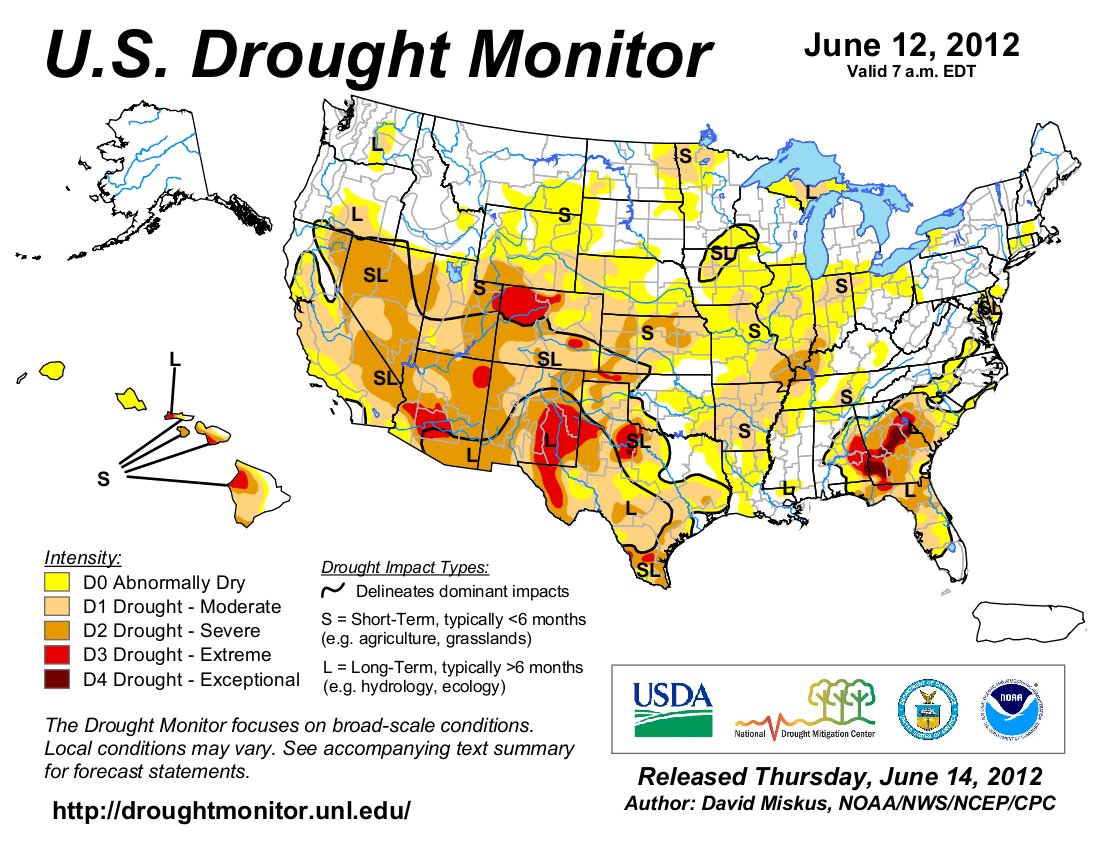
From the Fort Collins Coloradoan (Bobby Magill):
“The continued hot, dry conditions are wreaking havoc on agriculture on the Eastern Plains,” said Wendy Ryan, a researcher with the Colorado Climate Center at Colorado State University. “Many people have very poor range conditions out there. We’ve gotten reports of people that are getting water who will irrigate for 30 hours and it makes it 300 feet down the field.”[…]
Currently, most of Larimer County is considered to be under both severe and extreme drought conditions, depending on the area. Extreme drought conditions are spreading throughout northwestern Colorado, where the mountain snow has completely melted off the slopes and very little precipitation has fallen in recent months…
The Poudre River’s flow through Fort Collins is in the third percentile at a time when it should be near its peak spring runoff flow. “It means 97 percent of other years were (seeing) a higher flow than right now,” Ryan said.
On Tuesday, the Poudre was running through the Fort Collins gauging station at 79 cubic feet per second, or cfs. The average flow for June 19 is 979 cfs, and a year ago the river was running through the city around 2,500 cfs, according to U.S. Geological Survey data.
From The Pueblo Chieftain (Chris Woodka):
Low water levels are creating odor problems for residents near Lake Minnequa. The good news is that the city of Pueblo, Pueblo Board of Water Works and Evraz Rocky Mountain Steel are working on a long-term solution. The bad news is that the water level of the lake continues to fall during the drought. Residents, particularly on the west side of the lake, have been complaining about the odor for several weeks. “As more shoreline is exposed, the smell probably comes from vegetation rotting,” said Scott Hobson, assistant city manager for community investment. “I don’t know of a quick fix for the odor issue.”
Low levels are affecting other water supplies around the lake. “People who live nearby say the water levels in wells are the lowest they’ve seen in more than 30 years,” Hobson said. The only source of water for the lake at the current time is stormwater, and even a fairly intense storm like the one last week doesn’t do much to fill the lake. Last year, there were two large fish die-offs at the lake that created a brief, intense smell.
From KJCT.com via the Aurora Sentinel:
Ranchers in western Colorado are selling off cattle to avoid losing them to a severe drought. Livestock auctioneer Bill Martin of Loma says his auction barn usually sees between 200 and 400 cows a week, but this year the numbers have sometimes nearly quadrupled.