Drought news: Voluntary fishing ban still in effect on the Yampa River through Steamboat

yampariveratsteamboatmarch1thruaugust42012.jpg

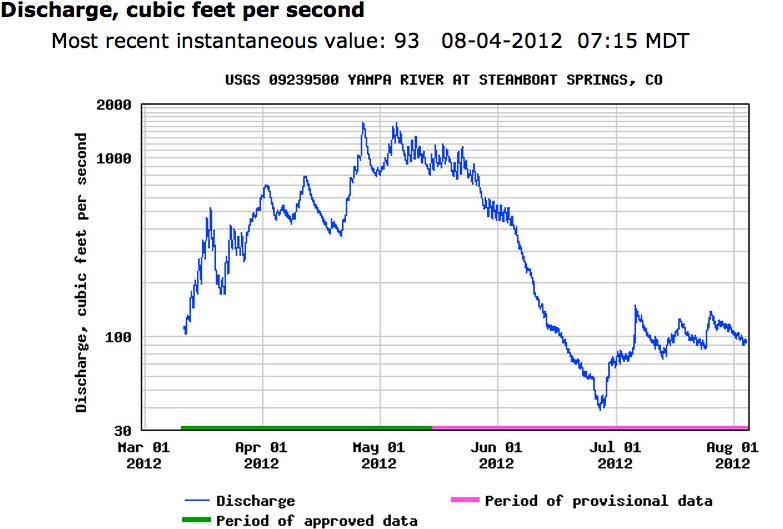
Click on the thumbnail graphic for the hydrograph for the Yampa River at Steamboat since March 1.

From Steamboat Today (Tom Ross):

Just back in his office from the Flat Tops Wilderness Area after four days of research in the field, [Colorado Division of Parks and Wildlife fisheries biologist Billy Atkinson] said a high priority is consulting with reservoir managers on the upper Yampa River to gather information about their plans to release water in the near term.

“As I’ve always said, and even with all this rain we’ve had lately, I want to see a week straight of improved dissolved oxygen levels and a good weather forecast” before contemplating a lifting of the ban, Atkinson said.

The voluntary fishing ban was imposed by Parks and Wildlife in conjunction with a city ban on tubing when the river dropped below 85 cubic feet per second. It is in effect from the Chuck Lewis State Wildlife Area upstream from Steamboat and downstream all the way to the city’s western limits.

From Steamboat Today (Tom Ross):

“We haven’t had nearly as much rain as (Steamboat has). The most we’ve gotten at one time is a quarter inch,” [North Routt Rancher Doug Carlson] said. “The past 10 days, we’ve had just enough to stop us from doing any haying but really not enough to do us a whole lot of good.”

Routt County CSU Extension Agent Todd Hagenbuch said the weather forecast that calls for mostly sunny skies for the next six days tells him that a good part of the agricultural community will be out in the fields mowing and baling hay.

“It’s supposed to be partly sunny to mostly clear through Monday,” Hagenbuch said. “I think people are going to be putting up a lot of hay in the next few days. Some people have been getting their (mowed) hay turned just in time for it to get rained on again. Some folks are just waiting to cut it.”

Adding extra urgency to the desire to get the hay crop baled and stacked, Hagenbuch said, is the potential for regrowth in the mowed hay fields to allow cattle ranchers to get their livestock off stressed pastureland and set the cows to grazing in the fields.

From the Glenwood Springs Post Independent:

The city of Rifle is lifting restrictions on outside watering and irrigation. The end to restrictions took effect on Thursday, according to a press release issued by the city of Rifle.

From The Denver Post (Matt Stensland):

During a two-week period in the beginning of July, drought conditions for parts of Routt County were upped to “exceptional,” a rating that state climatologist Nolan Doesken has said is reserved for “the worst of the worst.” According to the Palmer Drought Index, the area needed between 6 and 9 inches of rain to return to normal moisture levels.

Almost as soon as drought conditions were categorized as “exceptional,” monsoonal moisture started arriving in the region and resulted in more than 3 inches of rain in Steamboat Springs during July. After two weeks of “exceptional” drought conditions, the rating was lowered to “extreme.”

Buena Vista: Trustees are looking into fluoride dosing

calciumfluoride.jpg

From The Chaffee County Times (Casey Kelly):

The Town of Buena Vista board of trustees heard the second of two presentations on the possible benefits and risks of adding fluoride to the town’s municipal water system during a regular meeting July 24.

The first presentation was from Julie Drake of the Chaffee County Oral Health Program, who spoke to the board June 26 about the dental health benefits of adding fluoride to the municipal water system. Local doctors Eric Gibb, Thomas White and Amy Varble, as well as local dentist Ryan Mueller, all cited the benefits of fluoridating municipal water systems.

More water treatment coverage here and here.

New agency director at the Colorado Oil and Gas Conservation Commission: Denver lawyer Matthew Lepore

derrick.jpg

From the Northern Colorado Business Report:

Lepore, former state assistant attorney general, recently served as lead counsel for the commission, representing the agency in environmental protection, permitting and regulatory enforcement matters. Lepore, whose legal career spans nearly 20 years, also has worked for private firms.

“Matt is a longtime Coloradan whose love and appreciation of the outdoors and experience with legal and natural resource issues make him an ideal leader for the Commission,” Gov. John Hickenlooper said in a statement. “We expect Matt and the Commission to maintain the high standards that protect the environment and help Colorado’s economy to continue moving forward.”

Drought news: Index that measures economic health in CO, WY and UT drops slightly

farmershighlinecanalarvada.jpg

From the Northern Colorado Business Report (Steve Lynn):

The index, a mathematical average of indices for new orders, production, sales, employment, inventories and delivery lead time, declined from 57.2 in June to 56.1, according to Creighton University’s Goss Institute for Economic Research. The good news? The index in June remained above a growth neutral rating of 50 for the 33rd straight month, meaning the region’s economy remains healthy overall…

At the time of the survey, weather conditions had not yet adversely affected companies in the mountain states, Goss Institute for Economic Research Director Ernie Goss said. “Only 14 percent of the firms reported that drought conditions had increased the costs of inputs for their companies’ sales, while almost none reported impacts on company sales,” Goss said. “I expect this to change in the months ahead, pulling the overall index lower.”

Teachers/schools can get free rain gauges and training from CoCoRaHS

nolandoesken1.jpg

From CoCoRaHS via the Fort Collins Coloradoan:

CSU and its volunteer network, called Community Collaborative Rain, Hail and Snow Network, or CoCoRaHs, is donating the devices as a means to educate students about the importance of taking scientific measurements and to bolster precipitation data collection efforts.

Teachers who would like to obtain a rain gauge and receive training on how to use it should contact education@CoCoRaHs.org for more information, according to a news release from CSU. Training webinars are scheduled on the following days:

• 10 a.m. Wednesday: To register, visit bit.ly/N671bp.

• 4:30 p.m. Aug. 20: To register, visit bit.ly/Oulj81.

Between Sept. 5 and 11, the Community Collaborative Rain, Hail and Snow Network, plans to host “Rain Gauge Week.” During this time, the group will encourage participating schools to submit their measurements.

Data collected by CoCoRaHs, which formed after the 1997 Spring Creek Flood in Fort Collins and now has 16,000 volunteers in the U.S. and Canada, helps predict flooding on the Missouri River and verifies satellite data on crop health, among other uses.

Drought news: ‘You have to be really careful how you use your water this year’ — Rod Weimer

usdroughtmonitor07312012.jpg

From CBS Denver:

“You have to be really careful how you use your water this year,” said Fagerberg Farms employee Rod Weimer. “This year it’s been really tough because the ground started off really dry.”[…]

Weimer said the water situation is concerning but they’ll have to wait until harvest to see how their crops will yield without the benefit of enough water.

From the Associated Press (Jim Suhr) via The Durango Herald:

More than half of U.S. counties now are classified by the federal government as natural disaster areas mostly because of the drought. The U.S. Agriculture Department on Wednesday added 218 counties in a dozen states as disaster areas. That brings this year’s total to 1,584 in 32 states, more than 90 percent of them because of the drought.

From the Grand Junction Free Press (Denis Reich):

In 2012, we’ve had the worst year for snow-pack runoff in some time, perhaps since the late 1970s. Many stream beds are already down to a trickle. Still, irrigators aren’t sure how to classify 2012 as a water year. In some ways, it’s clearly a bad drought: scarce snow pack, warm winter, low soil moisture, dry conditions and large wildfires. But the picture is complicated by reservoir storage and, to a lesser degree, the recent monsoon rains.

From high altitude tributaries all the way to Mexico, there is a network of reservoirs in the Colorado River basin. There’s a largely invisible world of horse-trading that allows water to be released from one reservoir to the next so rivers and canals can flow, regardless of what conditions might have naturally been. Perhaps your grandfather remembers the confluence of the Uncompahgre and Gunnison Rivers being dry in August, but it’s been many decades since it’s happened.

One of the wettest years on record in 2011 left local reservoirs nearly full heading into 2012. This is what’s keeping water flowing now, unlike in 2002, which followed a dry year. Releases from Taylor, Blue Mesa and Ridgway reservoirs are maintaining just enough flow to prevent the Gunnison Tunnel, which carries water into the Uncompahgre Valley, from putting a call on the river that would cut off water to junior users upstream. It’s a good thing, too, for hay producers. Prior to recent rains, the Gunnison County hay crop was under serious threat. As it is, they will probably get a cutting of sorts and limp into the fall.

What is truly concerning is the risk of a curtain call from the drought in 2013. In 2003, we were about two months from apocalyptic drought and were saved mid-March by a record-breaking snow storm. With residual soil moisture only slightly replenished by the recent rains, another below average year would create significant problems. Consecutive years of drought are unusual in Colorado, but not unheard of. We just had two 30-year extremes back to back and that is exceptionally unusual.

McPhee and Jackson Gulch reservoirs status

jacksongulchreservoir.jpg

mcpheereservoiroverlook.jpg

From the U.S. Bureau of Reclamation via the Cortez Journal:

Jackson Gulch reservoir live content stood at 6,020 acre-feet with a 9,948 acre-feet maximum capacity and a 9,014 acre-feet average (1981-2010) end-of-month content. At Jackson Gulch, a daily maximum/minimum of 76/51 cubic-feet-per second was released into the Mancos River, and 88 acre-feet were released for municipal purposes.

McPhee Reservoir live content stood at 299,646 acre-feet, with a 381,051 acre-feet maximum capacity and a 343,394 average (1981-2010) end-of-month content. At McPhee, 4,120 acre-feet were released into the Dolores River, and 45,079 acre-feet were released for trans-basin purposes. At McPhee, a daily maximum/minimum of 70/57 cubic-feet-per-second was released into the Dolores River.

Questions can be directed to the Southern Water Management Group, Resource Management Division of the Western Colorado Area Office, Durango.

More Dolores River Watershed coverage here. More Mancos River Watershed coverage here.

Uncompahgre River Watershed: ‘Good Samaritan’ clean up of Red Mountain Creek in the offing?

redmountaincreekacidminedrainage.jpg

From The Telluride Watch (Samantha Wright):

The Uncompahgre Watershed Partnership, a grassroots coalition of citizens, nonprofits, local and regional governments, and federal and state agencies dedicated to understanding the Uncompahgre Watershed, would like to do something about this caustic problem child. Red Mountain Creek is, after all, a tributary of the Uncompahgre River, and one of the main reasons why the southernmost portion of the river is deemed “impaired” – or, as some would say, dead, because it cannot support aquatic life.

The coalition has recently identified its top priority as improving water quality so as to remove impaired segments of the Uncompahgre River from the State of Colorado’s list of impaired streams.

Thus, Przeszlowska is watching with interest current efforts headed up by U.S. Senator Mark Udall (D-Colo.) to find a way to allow so-called Good Samaritans (ranging from individuals to citizen groups like UWP to governmental and nongovernmental agencies) to take on projects to improve water quality in areas where there are abandoned mines, without fear of incurring liability under the Clean Water Act.

Reclamation experts have found plenty of ways to shore up leaky old mines and reduce acid mine drainage flowing into impaired watersheds. These range from simple fixes, like reducing the amount of water entering into the mine by building plugs or diverting the water around old workings, to treating drainage with settling ponds, wetlands, limestone drains, or some other form of passive or active treatment.

But certain provisions in the federal Clean Water Act create major stumbling blocks to such efforts. The Clean Water Act likes big, perfect fixes – like permanent water treatment pants that cost millions to build and millions more annually to operate, and which convert toxic water into potable stuff that fish can cruise around in.

So-called Good Samaritans have had to walk away from more modest mine cleanup projects for fear that if they don’t bring the discharge water all the way up to CWA standards, they may be sued by a third-party citizen or even another environmental group.

Pat Willits, the executive director of the Ridgway-based Trust for Land Restoration, which helps communities deal with a myriad of issues related to abandoned mining, explains the liability problem like this: “Good Samaritans are spooked by the ‘citizen suit’ provision of the Clean Water Act, which says that if someone suspects a violation of the Clean Water Act, a citizen may begin a legal action and if successful, the defending party will have to pay all of the legal expenses of the citizen’s group. If they are unsuccessful, the defendant does not have recourse to countersue.”[…]

Two decades’ worth of efforts to shield would-be Good Samaritans legislatively by creating a new provision in the Clean Water Act (including, most recently, U.S. Senator Mark Udall’s Good Samaritan Cleanup of Abandoned Hardrock Mines Act of 2009), have floundered in Congress, due to fears from environmentalists about opening up the Clean Water Act, even for such benign and altruistic purposes as protecting Good Samaritans…

Fed up with past efforts, Udall is now taking a new approach. He believes that updating, or even simply clarifying, Environmental Protection Agency policy may accomplish pretty much the same thing as legislation in terms of affording legal protection to Good Samaritans.

The agency already has some existing guidance that encourages potential Good Samaritans to enter into voluntary agreements with EPA or federal land management agencies that helps to facilitate certain kinds of Good Samaritan cleanups.

As they stand, these protections are considered good enough protection for Good Samaritans to undertake reclamation projects that do not include direct attempts to improve water quality beyond, for example, rerouting a stream so it does not flow through a mining waste dump, or preventing water from flowing into old mine workings.

More water pollution coverage here.

Montrose: The Montrose County Commissioners endorse the the town’s whitewater park application

uncompahgreriver.jpg

From The Telluride Watch (Katie O’Hare):

City Councilors and the Montrose Recreation District board asked county commissioners to the table on July 31 to discuss if the county was willing – and at what cost – to support a project that would include creating a whitewater park along the Uncompaghre River at Riverbottom Park.

The city teamed up with MRD hoping to submit a Great Outdoors Colorado grant application by Aug. 29 that could provide $350,000 toward the project, which includes improvements to the MRD’s ball fields and surrounding areas, also in Riverbottom Park.

“In principal, it’s all about improving the community for all of us,” said Kerwin Jensen, City of Montrose community development director.

After a two-hour meeting, commissioners David White and Gary Ellis – who did most of the talking for the county – agreed to put the request for funding help on their regular commissioner meeting agenda for Monday, Aug. 6…

The city staff stressed the economic benefits the county could see from having a whitewater park in Montrose, which included increased tourism and new businesses to cater to those visitors, as well as the recreational opportunity it would provide county residents.

“Economic development is number one in our strategic plan, and things like this contribute to that,” Commissioner David White said.

Drought/precipitation news: Denver records hottest July ever, previous record set in 1934 during the dust bowl

usdroughtmonitor07172012.jpg

usdroughtmonitor07242012.jpg

usdroughtmonitor07312012.jpg

Click on the thumbnail graphics for the U.S. Drought Monitor maps for the last three weeks. It appears that the monsoon is alleviating the Colorado drought.

From the Summit County Citizens Voice (Bob Berwyn):

July ended up being the hottest ever for Denver, breaking the previous record by 1.1 degrees, based on statistics going back to 1872. The average temperature for the months was 78.9 degrees, topping the Dust Bowl-era record of 77.8 degrees set in 1934…

And while the monsoon delivered plenty of moisture in the mountains, mostly west of the Continental Divide, Denver stayed very dry, officially reporting only .48 inches of rain, less than 25 percent of the average 2.16 inches for the month.

Republican River Compliance pipeline dedication August 16

republicanriverbasinbydistrict.jpg

From the Republican River Water Conservation District (Deb Daniel) via The Yuma Pioneer :

The Republican River Water Conservation District will be hosting the public dedication ceremony of the Compact Compliance Pipeline on Thursday, August 16, beginning at 7 p.m.

The location of the ceremony will be at the outfall structure near Yuma County Road SS east of Laird.

On July 14, 2011, during a quarterly meeting, the RRWCD Board voted to build the pipeline in an effort to assist Colorado in complying with the Republican River Compact. The groundbreaking ceremony was held on August 29, 2011, near the pipeline collection tank location.

GEI Consultants, an engineering firm from Denver, has designed the pipeline, and Garney Construction, headquartered in Kansas City, Missouri, was selected as the general contractor. Construction of the pipeline started in early September 2011.

Funding for the compact compliance pipeline has been provided through a loan from the Colorado Water Conservation Board and from water use fees paid by well owners throughout the Republican River Basin in Colorado.

Speakers during the ceremony include: Congressman Cory Gardner, John Stulp, Special Advisor to Governor Hickenlooper on Water Issues, Dick Wolfe, State Engineer with the Colorado Division of Water Resources and Dennis Coryell, Chairman of the Republican River Water Conservation District.

The ceremony will conclude with opening the main-line valve and delivering water into the North Fork of the Republican River.

Everyone is welcome to attend. Transportation to the ceremony will be provided by the District. If you wish to attend the ceremony, please notify the District so ensure seating.

More Republican River Basin coverage here and here.

Fryingpan-Arkansas Project update: 195 cfs in the river below Ruedi Dam

ruedidam.jpg

From email from Reclamation (Kara Lamb):

After the coordination call [yesterday], it was determined that the afternoon rainstorms are no longer contributing much to the Colorado River Basin. As a result, we have bumped releases from Ruedi Dam to the Fryingpan River back up to 195 cfs.

More Fryingpan-Arkansas Project coverage here.

Green Mountain Reservoir operations update: 365 cfs in the Blue River below the dam

greenmountainreservoir.jpg

From email from Reclamation (Kara Lamb):

After the coordination call [yesterday], it was determined that the afternoon rainstorms are no longer contributing much to the Colorado River Basin. As a result, we have spent the day bumping releases from Green Mountain Dam to the lower Blue River back up.

We bumped up by 60 cfs earlier this afternoon and are increasing releases another 65 cfs this evening. The resulting flow in the lower Blue River will be around 365 cfs.

I appreciate you all being patient with our changes this summer. We, like other reservoir operators, are doing our best to chase what inflows there are to keep our rivers in the Colorado River Basin in good stead during this very hot and dry season.

More Green Mountain Reservoir coverage here.

Colorado Water 2012: Historical look at reservoir construction and operations in the San Luis Valley

riograndereservoir.jpg

Here’s the latest installment of the Valley Courier’s Colorado Water 2012 series. Melvin and Camille Getz recap the recent “100 Years of San Luis Valley Reservoirs” event in the Valley. Here’s an excerpt:

The San Luis Valley, inhospitable in many ways such as climate (cold winters, windy springs) and elevation averaging 7500’ with surrounding mountains isolating it from the rest of Colorado, was blessed with rich soil and seemingly unlimited water over 100 years ago. Melting mountain snow rushed down into the valley in spring, filling rivers, streams and irrigation ditches that had been constructed all across the valley. There was no way to control the water. It was used when it was available, which was not usually when farmers needed it most; then the severe drought of the 1890s affecting all the other communities dependent on the Rio Grande as much as the San Luis Valley caused an international crisis. The United States government, hoping to avoid a lawsuit from Mexico, imposed an embargo on reservoir construction.

With its removal, the floodgates of hope and ambition opened to initiate an amazing number of projects on the upper Rio Grande or its tributaries. Although sites had been located and water rights secured earlier, in 1907 engineering plans were drawn, financing arranged which was all private — no government money involved — workers hired, and the construction began. By 1914 nine major storage projects had been completed and were in operation.

More Colorado Water 2012 coverage here.

Southern Delivery System: Reclamation’s EIS incorporated Colorado Springs’ stormwater enterprise which is now defunct

sdspreferredalternative.jpg

From The Pueblo Chieftain (Chris Woodka):

“As I view it, there were firm commitments made on stormwater and the (SDS) contract requires that the environmental commitments are met,” Mike Connor, commissioner of the Bureau of Reclamation said Wednesday, meeting with the editorial board of The Pueblo Chieftain.

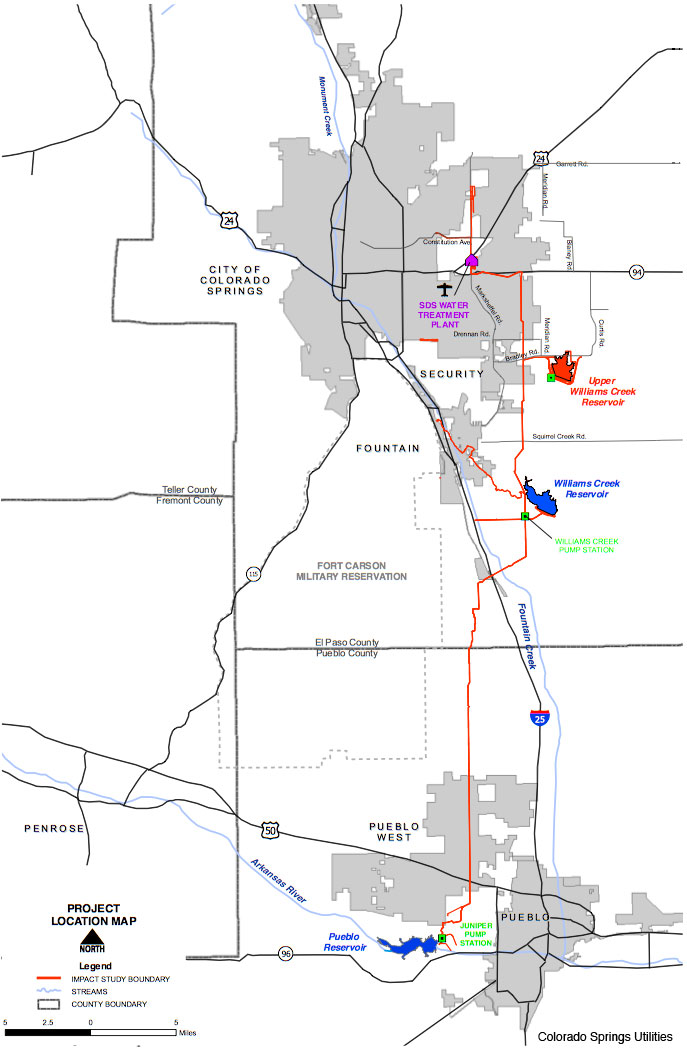
In the SDS environmental impact statement, Reclamation states a stormwater enterprise is in place for Colorado Springs. The EIS laid the foundation for the 2010 contract for the project. The contract also incorporates all environmental conditions of Pueblo County’s 1041 landuse permit and state water quality measures. Connor’s goal is to assure the conditions are being met before 2016, when SDS is scheduled to go online. The $1 billion project would pipe water from Pueblo Dam to Colorado Springs, Security, Fountain and Pueblo West. Because Colorado Springs abolished its stormwater enterprise in 2009, no fees have been collected for the past three years. Meanwhile, Colorado Springs faces a $500 million backlog of stormwater projects and should be paying up to $15 million annually, according to City Attorney Chris Melcher.

“A plan is not enough,” Connor said. “We need to make sure the resources are there.”

Meanwhile, Colorado Springs is not alone in needing to fund stormwater improvements. El Paso County faces similar problems. Here’s a report from Scott Harrison writing for KRDO.com. From the article:

Andre Brackin, the El Paso County Engineer, said the area, specifically the communities of Security and Widefield, have only a few drainage channels for runoff to drain into Fountain Creek.

Those communities were established in the 1950s and have grown since then, said Brackin. He estimated that addressing the area’s stormwater needs would cost $10 million — an amount the county can’t afford…

The lack of funds means the county also can’t afford to clear vegetation and rubbish out of the few existing drainage channels, such as the one along Widefield Boulevard…

Ultimately, said Brackin, local leaders must consider enacting some type of regional fee or tax to pay for stormwater improvements. He said the county has a backlog of as much as $100 million in needed improvements.

More Southern Delivery System coverage here and here.

Windy Gap Firming Project: Chimney Hollow Reservoir site tour August 23

windygapmoffatfirmingboulderviewpoint.jpg

From Larimer County via the Loveland Reporter-Herald:

By popular demand, Larimer County Natural Resources and Northern Water has planned another field trip to the Chimney Hollow Open Space in the Blue Mountain Conservation Area, which is not currently open to the public.

The next tour will be offered at 9 a.m. to noon Thursday, Aug. 23.

The field trip will include an easy, round-trip walk of 0.5 mile for the whole group. After learning about the Windy Gap Firming Project’s proposed Chimney Hollow Reservoir and the Chimney Hollow property, the group will split up, and one group will have an opportunity to hike farther, and the other group will receive a historical interpretive tour of the property.

The tour is free, but space is limited. Register at larimer.org/naturalresources/registration.

More Windy Gap coverage here and here.

2011 Colorado River Cleanup Day August 11 #CORiver

2009coloradorivercleanupdaycmu.jpg

Click here for all the inside skinny for the project.

More Colorado River Basin coverage here and here.

Judge rules that the EPA stepped on state authority when promulgating waste rules for coal mines

mountaintopremovalmininglonesomecoyote.jpg

From the Associated Press (John Raby) via The Denver Post:

U.S. District Judge Reggie B. Walton in Washington ruled that the EPA infringed on the authority given to state regulators by federal clean- water and surface-mining laws. A coal mining industry coalition sued the EPA and Administrator Lisa Jackson, and the lawsuit was joined by West Virginia and Kentucky.

The ruling represents the latest setback to the Obama administration’s attempts to crack down on mountaintop removal coal mining.

Last year, the EPA revised standards issued in April 2010 by tightening guidelines on the practice of dumping waste from surface mine blasting into Appalachian valley waterways. Critics say that practice destroys the environment. The mining industry defends it as an efficient way to produce cheap power and employ thousands in well-paying jobs.

The EPA had written that the fundamental premise of its new guidelines was that “no discharge of dredged or fill material may be permitted” under any of three conditions: if the nation’s waters would be “significantly degraded”; if it causes or contributes to violations of a state’s water quality standard; or “if a practicable alternative exists that is less damaging to the aquatic environment.”

The National Mining Association, one of the plaintiffs, denounced the guidelines as a “jobs destroyer” and hailed Walton’s decision as a way to get miners back to work “by allowing the state permitting agencies to do their jobs.”

Meanwhile, it’s the forty third anniversary of the Time Magazine article that became a call to arms for conservationists. The EPA grew out of the legislation from that time. Here’s a the August 1, 1969 article from Time. Here’s an excerpt:

Cleveland’s great industries have lately made efforts to dump fewer noxious effluents into the Cuyahoga. If their record is still not good, the city’s has been far worse. Whenever it rains hard, the archaic sanitary storm system floods the sewer mains, sending untreated household wastes into the river. Sometimes the old mains break, as recently happened on the Big Creek interceptor line. Each day for the past month, 25 million gallons of raw sewage have cascaded from a ruptured pipe, spilling a gray-green torrent into the Cuyahoga and thence into Lake Erie.

Some lake! Industrial wastes from Detroit’s auto companies, Toledo’s steel mills and the paper plants of Erie, Pa., have helped turn Lake Erie into a gigantic cesspool. Of 62 beaches along its U.S. shores, only three are rated completely safe for swimming. Even wading is unpleasant; as many as 30,000 sludge worms carpet each square yard of lake bottom.

Each day, Detroit, Cleveland and 120 other municipalities fill Erie with 1.5 billion gallons of inadequately treated wastes, including nitrates and phosphates. These chemicals act as fertilizer for growths of algae that suck oxygen from the lower depths and rise to the surface as odoriferous green scum. Commercial and game fish—blue pike, whitefish, sturgeon, northern pike—have nearly vanished, yielding the waters to trash fish that need less oxygen. Weeds proliferate, turning water frontage into swamp. In short, Lake Erie is in danger of dying by suffocation…

Like Apple Pie. “We have some of the lowest sewer tax rates in the country,” says Stefanski. “I figured we’d double the rates to amortize our bonds.” To persuade the people to pay, Stefanski enlisted newspaper support, lined up citizen groups and got 33 suburban governments to endorse the plan. “It became like apple pie and motherhood,” he recalls. “No one could be against clean water.” Last fall Clevelanders approved the bond issue by a vote of 2 to 1, giving it more “yes” votes than any other proposal on the ballot. In five years, Cleveland should have the best sewage system in the U.S., one capable of handling even industrial wastes.

The accomplishment, huge as it is, only fixes the price of optimism. Unfortunately, water pollution knows no political boundaries. The Cuyahoga can be cleaned up in Cleveland, but as long as other cities keep dumping wastes upriver, it will remain exactly what it is today—an open sewer filling Lake Erie with scummy wavelets, sullen reminders that even a great lake can die.

More water pollution coverage here.

Precipitation news: July is likely Boulder’s third wettest on record

precipitationboulderareajuly2012urbandrainage.jpg

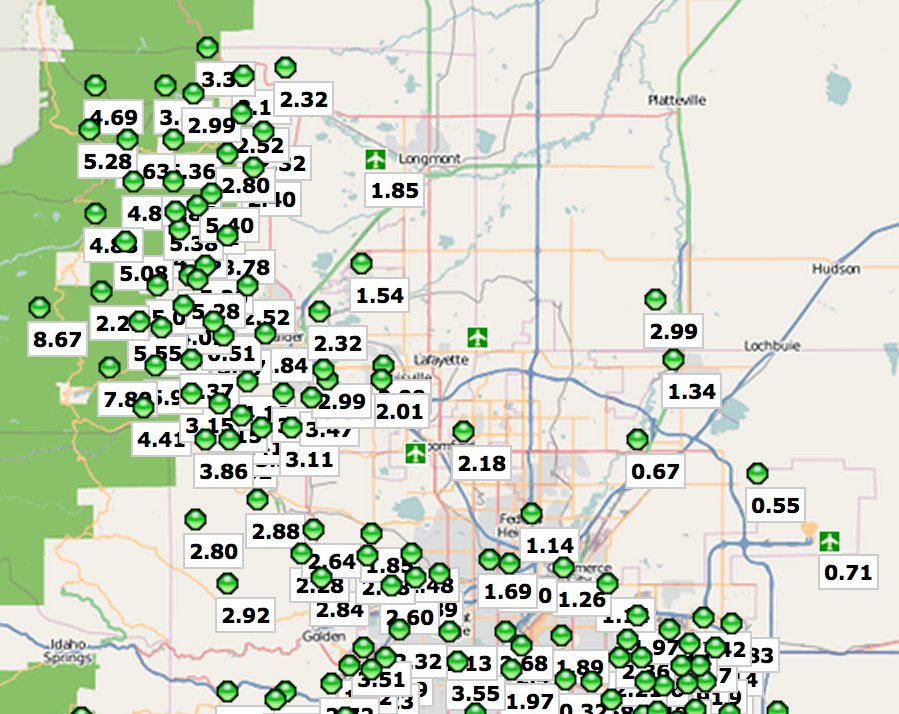
Click on the thumbnail graphic for the Urban Drainage precipitation map for the Boulder area for the last 30 days.

From the Longmont Times-Call:

Matt Kelsch, a meteorologist at the University Corp. for Atmospheric Research, said Boulder, as of Monday, had received 4.99 inches of rain this month. The record was set in July 1919 with 7.46 inches, followed by the second-wettest July in 1965, with 5.2 inches. The thunderstorms also cooled off the city enough to keep this July from breaking heat records — unlike Denver, which is expected to close out its hottest month ever recorded.

Pueblo County (Commissioner Jeff Chostner) rattles its sabers over Colorado Springs’ stormwater policies

fountaincreekmonsoonjuly2012.jpg

From The Pueblo Chieftain (Chris Woodka):

“When I looked at Fountain Creek this morning, I thought, ‘Here we are about to be hit by another flood, possibly this week, and they are doing nothing,’ ” Chostner said. “We need to see a good outline of next year’s (Colorado Springs) city budget that has $15 million directed toward stormwater funding.” When commissioners approved the 1041 permit for SDS in 2009, Colorado Springs had a stormwater enterprise in place. Council voted to end the enterprise in late 2009 after voters approved a ballot issue promoted by Doug Bruce, who called the stormwater fee a “rain tax.”

More coverage from Chris Woodka writing for The Pueblo Chieftain. From the article:

A Chieftain editorial Monday asked Pueblo County commissioners to insist on a surcharge to Colorado Springs water rates on water provided by the Southern Delivery System that would raise $18 million a year to address the city’s $500 million in stormwater needs. Commissioners have some control through the county’s 1041 land-use regulations.

There are practical, but not insurmountable, hurdles to implementing a stormwater fee through water bills.
Colorado Springs Utilities policies, set by the Colorado Springs City Council, do not allow for a surcharge for stormwater fees. Fees for water service have to directly affect the water system, said spokesman Steve Berry.
“Utilities would not be able to do what the editorial suggested,” he said. “Stormwater would have to be a separate service, which we are open to if our customers and board directed us to do so.”

More Southern Delivery System coverage here and here.

The Grand County Commissioners are pondering the Windy Gap Firming Project 1041 permit this week

windygapmoffatfirmingboulderviewpoint.jpg

From the Summit County Citizens Voice (Bob Berwyn):

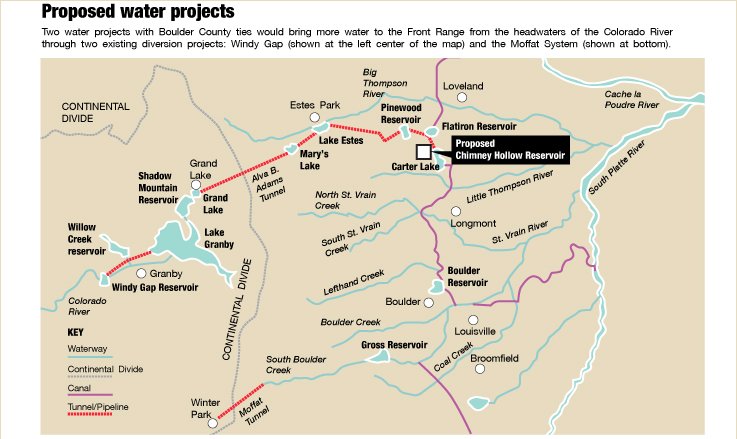
The Windy Gap Project consists of a diversion dam on the Colorado River, a 445-acre-foot reservoir, a pumping plant, and a six-mile pipeline to Lake Granby. Windy Gap water is pumped and stored in Lake Granby before it is delivered to water users via the Colorado-Big Thompson Project’s East Slope distribution system…

“The Upper Colorado River is under severe stress from multiple impacts, from drought to diversions,” said Kirk Klancke, president of Trout Unlimited’s Headwaters chapter. “This is the last best opportunity for Grand County officials to push for stronger protections to ensure that the Windy Gap project doesn’t destroy the health of our rivers.”[…]

The Grand County Commissioners are currently accepting comments and have scheduled a two-day hearing in Hot Sulphur Springs that will include public testimony on August 1-2…

State studies show that the Upper Colorado below Windy Gap Reservoir has suffered a sharp decline since the construction of the reservoir , including an almost total loss of once-plentiful stoneflies and mottled sculpin — key aquatic species that are an important link in the food chain for trout and other fish. The studies point to the reservoir’s contribution of silt combined with a lack of healthy flows, which has caused a spike in water temperatures, algae, sediment and other negative impacts on river and fishery health.

More Colorado River Basin coverage here and here.