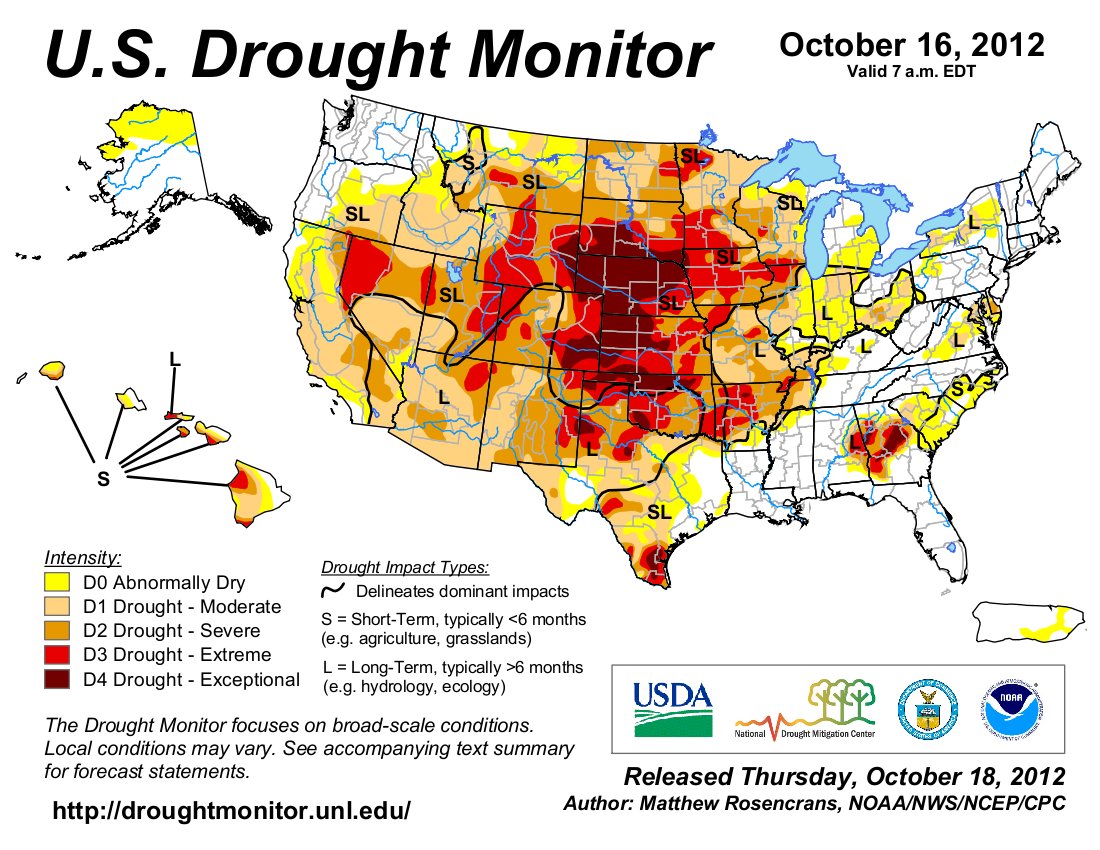
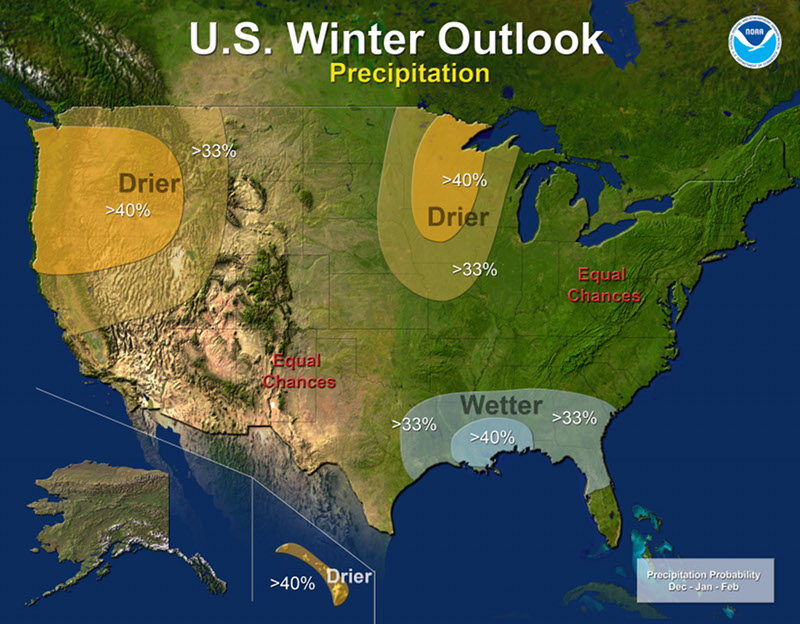
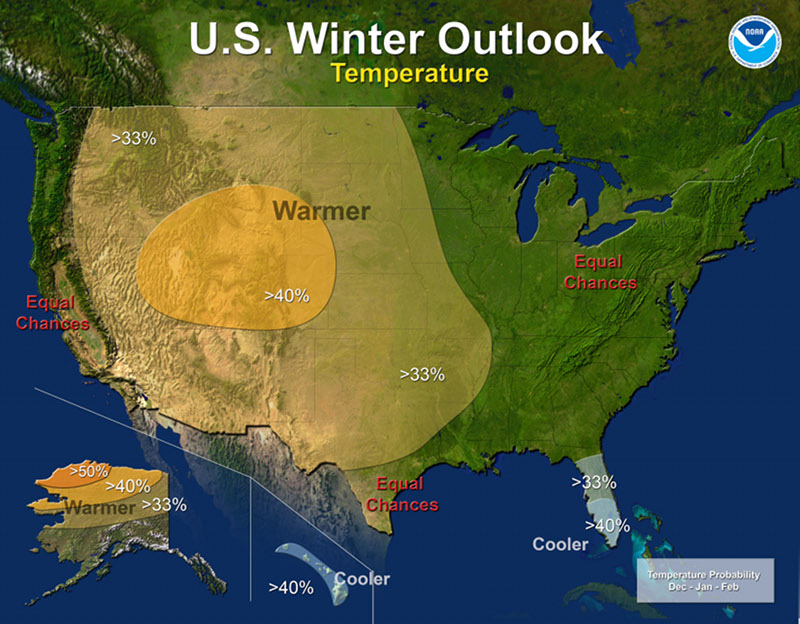
Click on the thumbnail graphics for the forecasted precipitation map, temperature map and the current U.S. Drought Monitor map. Here’s the winter outlook from the NOAA:
The western half of the continental U.S. and central and northern Alaska could be in for a warmer-than-average winter, while most of Florida might be colder-than-normal December through February, according to NOAA’s annual Winter Outlook announced today from the agency’s new Center for Weather and Climate Prediction in College Park, Md.
Forecasters with NOAA’s Climate Prediction Center say a wavering El Niño, expected to have developed by now, makes this year’s winter outlook less certain than previous years.
“This is one of the most challenging outlooks we’ve produced in recent years because El Niño decided not to show up as expected,” said Mike Halpert, deputy director of NOAA’s Climate Prediction Center. “In fact, it stalled out last month, leaving neutral conditions in place in the tropical Pacific.”
When El Niño is present, warmer ocean water in the equatorial Pacific shifts the patterns of tropical rainfall that in turn influence the strength and position of the jetstream and storms over the Pacific Ocean and United States. This climate pattern gives seasonal forecasters confidence in how the U.S. winter will unfold. An El Niño watch remains in effect because there’s still a window for it to emerge.
Other climate factors can influence winter weather across the country. Some of these factors, such as the North Atlantic Oscillation, a prominent climate pattern, are difficult to predict more than one to two weeks in advance. The NAO adds uncertainty to the winter outlook in the Northeast and Mid-Atlantic portions of the country.
Areas ravaged by extreme drought over the past year are unlikely to see much relief from drought conditions this winter [ed. emphasis mine].
In the 2012 U.S. Winter Outlook (December through February) odds favor:
– Warmer-than-average temperatures in much of Texas, northward through the Central and Northern Plains and westward across the Southwest, the Northern Rockies, and eastern Washington, Oregon and California, as well as the northern two-thirds of Alaska.
– Cooler-than-average temperatures in Hawaii and in most of Florida, excluding the panhandle.
– Drier-than-average conditions in Hawaii, the Pacific Northwest and Northern California, including Idaho, western Montana, and portions of Wyoming, Utah and most of Nevada.
– Drier-than-average conditions in the upper Midwest, including Minnesota, Wisconsin, Iowa and northern Missouri and eastern parts of North and South Dakota, Nebraska, Kansas, and western Illinois.
– Wetter-than-average conditions across the Gulf Coast states from the northern half of Florida to eastern Texas.
The rest of the country falls into the “equal chance” category, meaning these areas have an equal chance for above-, near-, or below-normal temperatures and/or precipitation.
This seasonal outlook does not project where and when snowstorms may hit or provide total seasonal snowfall accumulations. Snow forecasts are dependent upon the strength and track of winter storms, which are generally not predictable more than a week in advance [ed. emphasis mine].
From USA Today (Doyle Rice):
Almost every state west of the Mississippi is expected to be warmer than average, according to Mike Halpert, deputy director of the Climate Prediction Center in College Park, Md. The CPC is a branch of the National Oceanic and Atmospheric Administration.
The center’s forecast covers the months of December, January and February, which is known as meteorological winter.
The western warmth would continue the amazing heat that the nation has seen this year. So far, the U.S. is enduring its hottest year on record, based on weather records that go back to 1895, reports Deke Arndt, chief of climate monitoring of the National Climatic Data Center in Asheville, N.C. The year 2012 will almost certainly go down as the warmest in U.S. history, he says.
Halpert also says the Pacific Northwest and upper Midwest should see less rain and snow than average, which isn’t good news for those drought-plagued regions.
As of Thursday morning’s U.S. Drought Monitor, a federal website that tracks drought, 62% of the lower 48 states are currently in drought conditions, with the worst of the drought centered in the northern and western U.S…
“Climate prediction is still in its infancy,” reminds [Mike Halpert, deputy director of the Climate Prediction Center in College Park, Md.].
From Reuters:
The drought that ravaged the United States this year does not appear to be abating and may spread through the winter, government forecasters said on Thursday.
“The large majority of that drought we expect to persist,” said Mike Halpert, deputy director of the National Oceanic and Atmospheric Administration. “We even see drought expanding westward … into Montana, Idaho and part of Oregon and Washington.”