
From NPR (Joe Wertz):
The [U.S. Supreme Court] will hear oral arguments [Tuesday] in the case of Tarrant Regional Water District v. Herrmann, et al. The case pits Oklahoma against Texas over rights to water from the river that forms part of the border between them. Depending on how the court decides, it could impact interstate water-sharing agreements across the country…
The future looks bright for this part of Texas, but it also looks dry. Drought has hit Texas particularly hard over the past couple of years. Water officials say the north Texas region’s growth is outpacing the water supply nearby.
“All of the locations — watershed locations — close by have been tapped for us,” says Linda Christie, government relations director for the Tarrant Regional Water District. The district is the water authority for an 11-county stretch of north Texas that includes Ft.Worth. “So now we’re going to have to go 200, 300 miles. And most of it would be water that is being pumped uphill.”
The Red River, less than 75 miles from Fort Worth, seems like an ideal solution to the Tarrant Water District’s problem. Fed by the Rocky Mountain snow pack, the river runs southeast on its way to the Gulf of Mexico.
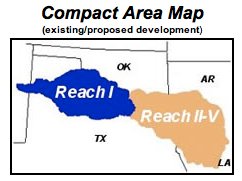
Texas and Oklahoma already have a formal agreement on how to share water from the Red River. In 1980, Congress ratified the Red River Compact, giving the two states — along with Arkansas and Louisiana — an equitable apportionment of water from the river and its tributaries.
But what’s “equitable” is arguable. And that’s what the Supreme Court case is all about.
The Red River lies entirely within the state of Oklahoma. Texas argues that it can’t get its share of the Red River watershed from the Texas side of the river, so it needs to reach across the river into southeastern Oklahoma to get it…
Texas has tried to buy Oklahoma water from the state, its cities and towns, and its Native American tribes. But Oklahoma lawmakers have blocked those efforts with a string of laws restricting out-of-state water exports.
The view in Texas is that Oklahoma isn’t even using its full allocation of Red River water. Oklahomans respond that Texas hasn’t gotten serious enough about conservation.
In 2007 — citing the compact — the Tarrant District sought permission from Oklahoma regulators to tap the Kiamichi River, a Red River tributary located entirely within Oklahoma. Oklahoma said no, arguing that the compact does not supersede the state’s own authority over a water resource within its borders. The dispute has been in court ever since.
The lower courts have agreed with Oklahoma so far. But Christie says the Tarrant Water District is encouraged by the Supreme Court’s decision to hear the case. And the Obama administration has sided with Texas, too. In a friend-of-the-court brief, the U.S. solicitor general worried about the impact to North Texas’ population growth, and argued that the 10th Circuit Court of Appeals improperly assumed Oklahoma’s laws preempt the Red River Compact’s authority.
State and local policymakers and water authorities throughout the country are closely watching the outcome of the case, says Stephen Draper, a water expert who helped write guidelines for interstate water sharing for the American Society of Civil Engineers. Here’s why: The Red River Compact contains a lot of the same boilerplate language used in other state-to-state water sharing agreements.
If Oklahoma’s protectionist water laws are upheld, Draper says other states could be inspired to pass similar laws of their own.
More water law coverage here.