
From The Pueblo Chieftain (James Hagadorn):
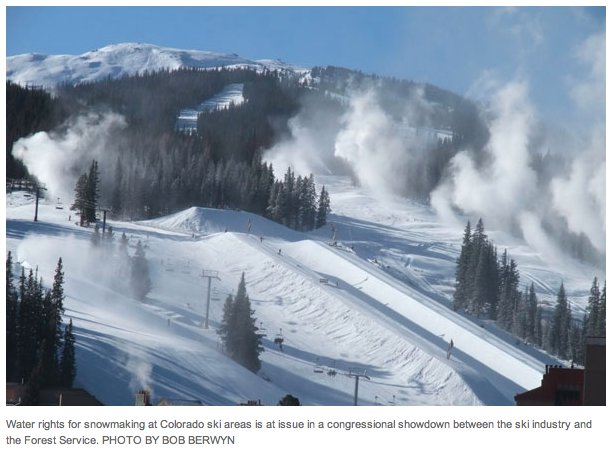
Snowmaking, once relegated to hills frequented by lowland landlubbers, has become one of Colorado’s key economic catalysts. And along the way, we were the proving ground for a secret ingredient now used in snowmaking worldwide.
Our watershed moment was the winter of 1976-77, when there was not a fluff of snow on most mountain slopes, not even by the time the Grinch arrived. For perspective, Steamboat’s season lasted less than a month and a half, compared to the 4½ months it’s regularly open today.
The situation was the same all over the West, and repeated itself again in the winter of 1980-81.
Hands were wrung.
Snow was hauled in by garbage bags. Snow dances were performed.
Governors scowled, declaring it a disaster. And the effect was the same: Tourists and locals who’d bought ski passes and planned trips canceled.
Employees and employers whose livelihood hinged on travel and winter life were devastated.
Despite the fact that ski areas like Golden’s Magic Mountain and Colorado Springs’ Ski Broadmoor had been making snow since 1958-59, it took these two brutally dry and unpredictable winters for Colorado to get on board with what the Midwest and Northeast had been doing for decades. After that, we never looked back.
Opening dates
The purpose of snowmaking is to allow the industry to reliably predict when their winter terrain will be open. An earlyseason base not only helps preserve naturally falling snow, but with the assistance of Snowcats’ and snow-dozers, it helps patch protected or hightraffic areas that wouldn’t normally accumulate sufficient snow.
Most snowmaking starts in October or November, with an eye toward having a base built up by Thanksgiving. This is the industry’s key target date because most direct and indirect ski/snowboard revenue comes from out-of-state visitors, and they want to plan their trips for holidays.
Fortunately, Colorado adopted snowmaking long after the first garden hose, spray nozzle and paint compressor were tested at Mohawk Mountain in Connecticut in 1949. Thus we benefited from and later fed into the evolution of snowmaking technology and strategy.Bacterial help
Fundamentally, snow is produced by blowing highly pressurized air and water out of a “cannon” or “gun” when it’s cold. The science behind manipulating water, air and microclimate to engineer snow is a topic in and of itself.
But making snow isn’t just physics and engineering. It’s chemistry and biology, too.
That’s because to make snowflakes, a nucleus is needed. In the sky, the nucleus might be a bit of windblown dust or silica that gets heaved up into the freezing-cold clouds. But to make snowflakes down near the ground, and to do it in relatively “warm” temperatures (i.e., above 17 degrees), water droplets need a really good nucleus to trigger crystallization.
Most of the naturally occurring nuclei in our waters only catalyze snowflake growth below 17 degrees. Enter good luck. Some geneticists discovered that a nontoxic bacterium native to most plant leaves, flowers and vegetables helps tiny ice crystals to form. They produced these bacteria en masse, freeze-dried them, and sent them to Colorado. Our very own Copper Mountain tested them, making snow under warmer temperatures than usual.
Major payback
Before we knew it, nearly every resort was injecting this dried bacterial powder into their snowmaking water supply to act as nucleating agents. These nucleating agents are key when temperatures are relatively high (about 27 degrees) because they permit droplets to freeze quickly, during the limited “hang time” they have when falling from a snow-gun’s nozzle to the ground.
Many resorts also use a surfactant in their snowwater, which is a substance that reduces the surface tension of water (the property that makes water bead up in a domelike shape when you fill a glass to its brim). The surfactant allows droplets to break apart more easily and be smaller.
Smaller droplets have a larger surface area relative to their volume and thus freeze more quickly, during their travel time from snow gun to the ground. Snowmaking takes sophisticated equipment, savvy and fit operators, tons of advance planning, and Mother Nature’s cold, dry, still air to pull it all off. Our snowmaking comes at a high cost (tens of millions each year), has risks and directly and indirectly impacts the environment. Yet per unit of energy, water or investment dollar, it brings a tremendous payback to the state, in terms of predictability, safety and fun.
That’s why every major Colorado ski area makes snow, except for Monarch Mountain (it sits on the Continental Divide), Ski Cooper (home of the 10th Mountain Division) and Silverton Mountain (our highest and steepest terrain).