
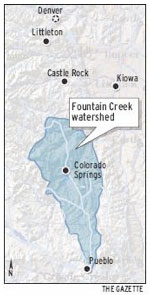
From the Colorado Springs Business Journal (John Hazlehurst):
Recent studies in Fountain, Security and Widefield show that the water there is contaminated with industrial chemicals that could cause a public health hazard.
Known as perfluoroalkyls, or PFAs, research suggests the chemicals are potent carcinogens and endocrine disrupters at levels far below the Environmental Protection Agency’s provisional exposure limits for drinking water.
And no one seems to know where the contaminants are coming from — or even that they were there in the first place. The city of Fountain’s 2015 Drinking Water Quality Report doesn’t mention PFAs or any other “unregulated reportable contaminant.”
Ron Woolsey, who heads Fountain’s Water Department, was unaware of any PFA contamination of the city’s water supply or of the EPA test results. It’s not clear if the EPA reported these results to the three affected systems.
“We get about 70 percent of our water from the Frying Pan/Arkansas project, via Pueblo Reservoir,” he said. “The remaining 30 percent comes from wells in Fountain and wells on the Venetucci Farm that we share with Security and Widefield. When [CSU’s] SDS [Southern Delivery System] comes on line, we’ll get 100 percent of our water from Pueblo Reservoir.”
[…]
It could be that water from Fountain Valley wells or surface water sources are contaminated by either landfills or residue from industrial processes, but no one is really sure.
WHAT ARE PFAS?
Perfluoroalkyls were first developed by 3M in 1951. DuPont used them for decades to manufacture common commercial products such as Teflon and Scotchgard.
Many are ubiquitous in world ecosystems. Once in a fish, a bird or a human body, they neither decay nor metabolize. The chemicals have been found in people’s bloodstreams, in polar bears in the Arctic and salmon caught in Alaska.
PFAs are highly toxic, but it has long been assumed by public health officials that minute quantities in drinking water pose no risk.
But that might not be the case.
TESTS CONFIRM
Although industrial use of these compounds has been curtailed recently, EPA testing has found that 6.5 million Americans in 27 states are exposed to PFA-tainted drinking water. The chemicals have been detected in 94 public water systems — including the three El Paso County systems.
According to information on the EPA’s website, PFAs are present in drinking water systems that serve 70,000 customers in El Paso County; the agency found more than 200 contaminants in 106 tested samples with a maximum contaminant level of 1.3 parts per billion — among the highest levels of all the water systems that showed evidence of PFA contamination.
“In January 2009,” according to the EPA’s website, “the EPA’s Office of Water established a provisional health advisory of 0.2 micrograms per liter for PFOS and 0.4 µg/L for PFOAs to assess the potential risk from short-term exposure of these chemicals through drinking water. PHAs [advisories] reflect reasonable, health-based hazard concentrations above which action should be taken to reduce exposure to unregulated contaminants in drinking water.”
[…]
CHANGING REGULATIONS
But the EPA might soon deliver new regulations based on recent studies. A paper by Philippe Grandjean of the Harvard School of Public Health and Richard Clapp of the University of Massachusetts-Lowell published in the journal “New Solutions” found that PFAs are hazardous at much lower levels. They can cause cancer, heart disease, birth defects and weaker immune systems.
“Grandjean and Clapp suggested that the EPA’s approach in 2009 led to a presumed safe level ‘at least two orders of magnitude’ higher than the newer studies indicate would protect human health with an adequate margin of safety,” the Environmental Working Group said in an analysis of the study. “… lower than the EPA advisory level by a factor of more than 1,300.”
About 200 prominent scientists worldwide signed the 2015 Madrid Statement, calling on the international community to limit the production and use of PFAs. The statement noted the “growing body of epidemiological evidence” linking PFAs to testicular and liver cancer, liver malfunction, hypothyroidism, high cholesterol, ulcerative colitis, obesity, decreased immune response to vaccines, reduced hormone levels and delayed puberty.
If EWG’s calculations are correct, drinking water in Security, Widefield and Fountain could contain hundreds, even thousands of times the safe level of PFOA and PFOS contaminants. Other PFA contaminants detected in the three systems include perfluoroheptanoic acid, perfluorohexanesulfonic acid and perfluorobutanesulfonic acid.
A REGULATORY TANGLE
Thanks to legal constrictions, the EPA has little power to regulate industrial chemicals such as PFAs.
“Under the 1976 Toxic Substances Control Act,” reporter Nathaniel Rich pointed out in a recent New York Times article, “the EPA can test chemicals only when it has been provided evidence of harm. This arrangement, which largely allows chemical companies to regulate themselves, is the reason that the EPA has restricted only five chemicals, out of tens of thousands on the market, in the last 40 years.”
Lawsuits related to a class action against DuPont for harmful use of PFAs have been making their way slowly through the courts. Filed on behalf of thousands of residents of Ohio and West Virginia, the suits allege that DuPont is responsible for adverse health effects from PFA pollution of multiple drinking water systems.
While there are no certain guidelines that specify PFA drinking water safety levels. The lawsuit against DuPont in West Virginia included anyone whose drinking water had PFOA or PFOS levels above 0.05 parts per billion.
Water provided to residents of Fountain, Security and Widefield showed maximum PFA contaminant level of 1.3 ppb, 26 times greater than the 0.05 cut-off for West Virginia plaintiffs.
NO STATE RECOURSE
Although a handful of states — Minnesota, New Jersey and North Carolina — have established guidelines for PFA contaminants, Colorado is not among them.
CDPHE administers the federal Safe Drinking Water Act, but its regulatory flexibility is limited by state legislative mandate to be neither more nor less restrictive than those set by the EPA. CDPHE is able to give assistance to local water providers.
“We provide assistance to water systems throughout the state,” said Nicole Graziano, CDPHE’s technical and regulatory implementation and coordination unit manager for the safe drinking water program.
“We have a lot of staff who work to assure that drinking water is at the highest level of safety to protect public health.”
Fountain’s Woolsey is determined to find the source of the PFA contaminants and eliminate them. It’s not his first rodeo.
“We went through this sort of thing with Schlage Lock and PCBs (polychlorinated biphenyls) years ago,” he said. “Well pollution has always been a concern. The three systems are all interconnected in lots of ways, so it’s possible that we can identify the source, but it may not be simple.”
The EPA confirmed that the chemicals can be removed from water by implementing treatment at centralized facilities or in homes by installing activated carbon filters.