
From The Denver Post (Bruce Finley):
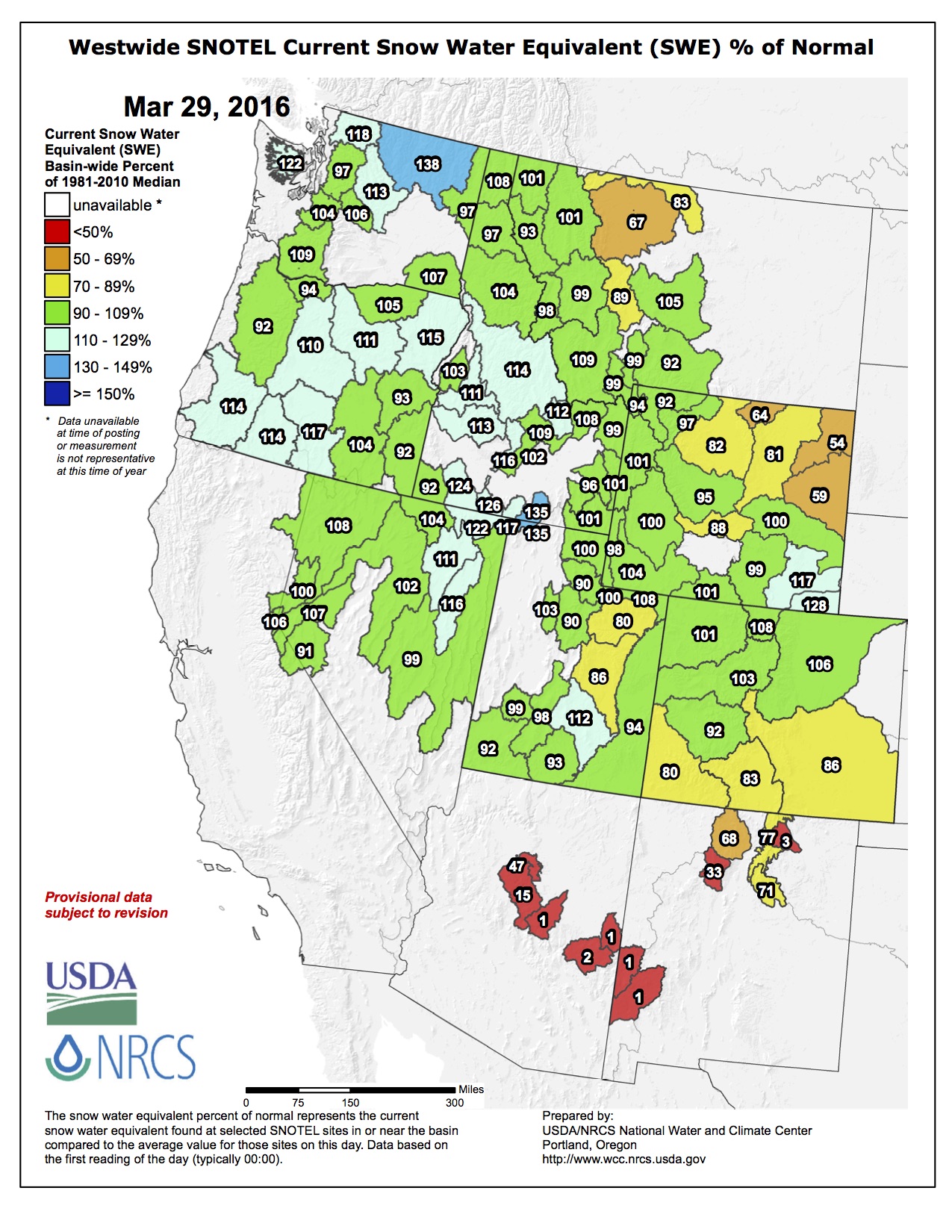
Federal snow survey data show snowpack at 96 percent of the median statewide, with most mountain areas above average and less in southern parts of the state.
Stream flows at 80 percent of the 115 monitors registered normal or higher, including the Colorado River and headwaters west of the Continental Divide.
Mountain snowpack serves as slow-release water storage, closely watched by irrigators and municipal supply managers, because it affects the amount of water that will end up in streams, rivers, reservoirs and irrigation canals. Water in mountain snowpack normally peaks in April.
“We know we were getting nervous and uneasy a couple of weeks ago because of the lack of March snow. It looked as if we were losing snowpack. But the last two weeks, we reverted to colder and stormier weather, and we are pretty much good for this time of year,” state climatologist Nolan Doesken said.
“You put it all together, we are looking pretty good into July on water supply. Municipal water supplies are in great shape. Agricultural supplies may need a little more bolstering yet.”
At a drought forecast meeting Tuesday, state and federal officials noted that soil in southeastern parts of Colorado remains dry, registering on federal drought monitors.
Weather forecasters were anticipating temperature increases over the next two weeks, accelerating snow melting and runoff, along with significant precipitation.
Recent storms in the San Juan Mountains of southwestern Colorado were stirring up reddish dust, which absorbs sunlight when deposited on mountain snowfields.
Dust on snowfields could accelerate snow melting in the coming weeks, causing melting up to 50 percent faster, said Karl Wetlaufer, assistant Colorado snow survey supervisor for the federal Natural Resources Conservation Service.
“This can have a notable effect. It absorbs a lot more sun, and the snow melts faster. That causes more of a peak in water runoff. With that faster runoff, it could possibly increase the chances of flooding.”
From CBS Denver (Justin McHeffey):
All watersheds in Northern Colorado are in good shape. The North Platte is the highest with 108 percent of average, the Yampa and White River basin have 102 percent, and the Colorado River remains at a strong 105 percent.
Southern Colorado hasn’t benefited from as much snowfall recently and is due for a storm. The San Miguel, Dolores, Animas, and San Juan River basins have fallen to 81 percent. There should be some relief coming to the southwest this week with mountain snow in the forecast.
Earlier this month, snowmelt was accelerated by a stretch of warm and dry conditions.
Since the weather has become more active, we’ve reversed this trend in the South Platte basin and snowpack is now moving in the right direction. Looking at the graph, notice how the purple line is now on the left side of the red line — this means the amount of snow on the ground is greater than average. The surrounding lines represent previous years’ moisture and how they compare to a typical season. The yellow line is from the year 2014 when the South Platte had over 120 percent of average snow.
Last week’s storm broke Denver’s snowfall record for March 23 — Denver International Airport measured 13.1 inches. The snow that fell was particularly heavy and wet. In Boulder, the snow reached a 7 to 1 ratio. In other words, 7 parts snow to 1 part water — just about as moisture-packed as we see in Colorado.
From The Colorado Springs Gazette (Kaitlin Durbin):
Concerns about water supply heading into Colorado’s dry season were alleviated in parts of the state by last week’s two-punch snowstorm.
In a matter of days, snowpack went from “Are we going to have enough?” to normal or better levels in northern Colorado, according to Larry Walrod, meteorologist with the National Weather Service in Pueblo. The southern half still has reason to worry, he said.
The Pikes Peak region looked promising based on levels of water in snowpack calculated at Glen Cove.
On March 20, three days ahead of the first snowstorm, Glen Cove reported 4.6 inches of water in the snowpack. The average for that time of year is 5.6 inches, Walrod said.
By March 29, the numbers had jumped to 7.2 inches, Walrod said.
That’s important, because mountain snowpack trickles down to city supplies during the runoff season.
“We made some ground in a couple of storms,” Walrod said. “We want to keep those numbers near average. That’s what our system is built on.”
Other areas north of Highway 50 also showed an increase.
Fremont Pass was 4 percent above average with 15.5 inches of water in the snowpack. The median for this time of year is 14.9 inches, Walrod said.
South of Highway 50 has not been as lucky.
Reports at the Apishapa Snotel site, north of Trinidad, showed 0 inches of water in snowpack as of March 20. Following storms later that week, counts were only up to 0.4 inches, Walrod said. The average for this time of the year is 5.9 inches, he said.
The Whiskey Creek Snotel site west of Trinidad, in the Sangre De Cristo Mountains, wasn’t faring better, Walrod said. The area gained 0.3 inches of potential snowmelt following the storm, leaving their total 4.3 inches well below the 10.8 inches expected this time of year, he said.