During the next few years, two major installations will take shape in Denver that will seek to inform urban development of the future, including the use of water.
Along I-25, jut southwest of downtown, Denver Water has already started redeveloping its administrative campus. Most of the buildings there are more than 50 years old, but the water agency also sees it as an opportunity with the $195 million redevelopment to demonstrate the technology and concepts of the future.
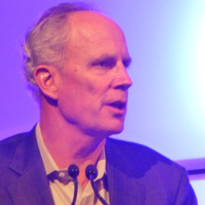
Jim Lochhead — photo via Westword (Alan Prendergast)
With all that it has planned said Jim Lochhead, the chief executive of Denver Water, the agency thinks it can reduce the amount of water needed for the campus by 50 percent. The agency, he said, is embracing “total reuse.”
The other project to keep an eye on within Denver is at the Coliseum and Western Stock Show complex along I-70 north of downtown Denver. With state backing, the aging complex will be redeveloped by Denver in concert with Colorado State University using cutting-edge building technologies but also minimal water uses.
Denver and the West have entered a new era that recognizes limits. Lochhead, in a recent presentation at the Rocky Mountain Land Use Institute. During the 25 years of the conference there has been an “extraordinary remarkable transition in the paradigm of water,” he said.
In the first half of the 20th century, water developers, commonly called “water buffaloes,” encountered little opposition to their work. But after World War II, they “really ran into this new world that they didn’t understand,” said Lochhead.
The South Platte River typically all but vanishes as it passes through Denver’s industrial neighborhood north of downtown, downstream of the Burlington Ditch diversion, near the Cherokee power plant. Photo/Allen Best
The buffaloes understood water development in ways that were both monolithic and linear. Major cities and other agencies developed water, and they just ran over the opposition. Their development was linear, in that they just expected to do one more project after another. Their attitude, he said, was “if we run out of water, we’ll just get more.”
Lochhead identified a pivotal change in the 1950s, when a proposal to dam the Yampa River at Echo Park in northwest Colorado was fought by environmental groups and conservationists such as Wallace Stegner.
“They really didn’t see the first signs of the world shifting from under them as the Sierra Club was able to defeat construction of the dam in Echo Park,” he said. The water buffaloes didn’t see what was coming as Congress adopted the Wilderness Act and then a raft of environmental legislation. They didn’t see it when Jimmy Carter issued his “hit list” of federally funded reclamation projects in 1977, which effectively became the end of the era of dam building.
In Colorado, according to Lochhead, the pivot came in the early 1990s, when Two Forks Dam was defeated. It was a stern rebuke to the thinking of Colorado’s water developers, who believed if “just only they could get one more big water project.”
Denver, in the 21st century, has been part of the new wave of thinking. This has been evident most clearly in the plans to enlarge Gross Reservoir, southwest of Boulder. The increased water will come from stepped-up diversions from across the Continental Divide, in the Fraser and Williams Fork valleys, at the head of the Colorado River.
At first glance, this looks like business as usual. But this project has been different. Nobody questioned Denver’s right to the water under Colorado water law. But Denver at the outset admitted that there were other considerations, especially when the streams were already nearly tapped out. With the increased diversions, up to 80 percent of the flows of the Fraser River will be diverted.
West portal Moffat Water Tunnel
The plan worked out after lengthy negotiations between Denver Water representatives and those from Grand County and the Western Slope is complex. What is pertinent is that some of the major environmental groups, most notably Trout Unlimited, endorsed the settlement. And here’s a key principle:
When diversions occur will matter equally, or even more so, than how much is diverted.
Lochhead also pointed to the need for partnerships with irrigators downstream on the South Platte River. Denver has pledged to step up the reuse of the water it imports from the Western Slope, and it is entitled, by law, to use that water to extinction. Using the water to extinction, however, means less water for those downstream.
“We will have to have partnerships in how we deal with those impacts,” said Lochhead.
Also speaking on the same panel at the Rocky Mountain Land Use institute was Lawrence McDonnell, an adjunct professor of water law at the University of Colorado. The broad change in the West in the last quarter-century has been a small shift of water from agricultural produce to municipal uses, to accommodate rapid population growth. In the eight states, population grew 60 percent from 1990 to 2010, with most of that growth occurring on urban areas.
“Leadership has to come from cities,” he said, and it has. Growth has occurred “in ways that often resulted in far less per-capita water use.”