It was on this day, July 25, in 1921 when U.S. federal legislation was passed to officially re-name the river from the “Grande” to the “Colorado”. How many place names can you think of named “Grand”? Grand Canyon, Rio Grande Railroad, Grand Junction, Grand Lake, and the list goes on. They were presumably named before 1921.
I want to share a handful of success stories below from the past couple months. In spite of wildland fires, drought, smokey haze, dangerously low river levels, and the rocky uncertain political landscape there is still a lot to celebrate. I find hope in the people, youth, and organizations/institutions that continue to be consistent, tenacious, and unrelenting in standing firm by their mission of making the world a better place for all each and every day.
Enjoy the rest of the summer and keep praying for rain in western Colorado.
Working Together for a Healthier Colorado River Basin
For millions across the West, the Colorado River is life. This magnificent river and its tributaries supply drinking water to communities big and small, keep thousands of ranches and farms in business and provide critical habitat for fish and wildlife. But the Colorado is a river at risk.
Water in the West is a series of stories about the people working to address threats to water supply in the Colorado River Basin and find conservation solutions that make economic sense for people and communities. The Walton Family Foundation is working with partners throughout the basin, in the U.S. and Mexico, to ensure healthy rivers by restoring riparian areas, encouraging water efficiency and pursuing flexible, market-based solutions that improve water management.
Enjoy a few photos from the Coyote Gulch archives.
Just inside the Mexican border, at San Luis Rio Colorado, nothing remains of the Colorado River except for its sandy bed. Photo/Allen Best
Low water on the Colorado River near Westwater. Photo: Brent Gardner-Smith/Aspen Journalism
On the Colorado River. Photo: Brent Gardner-Smith/Aspen Journalism
Sean, recreating, on the Colorado River. Photo: via Aspen Journalism
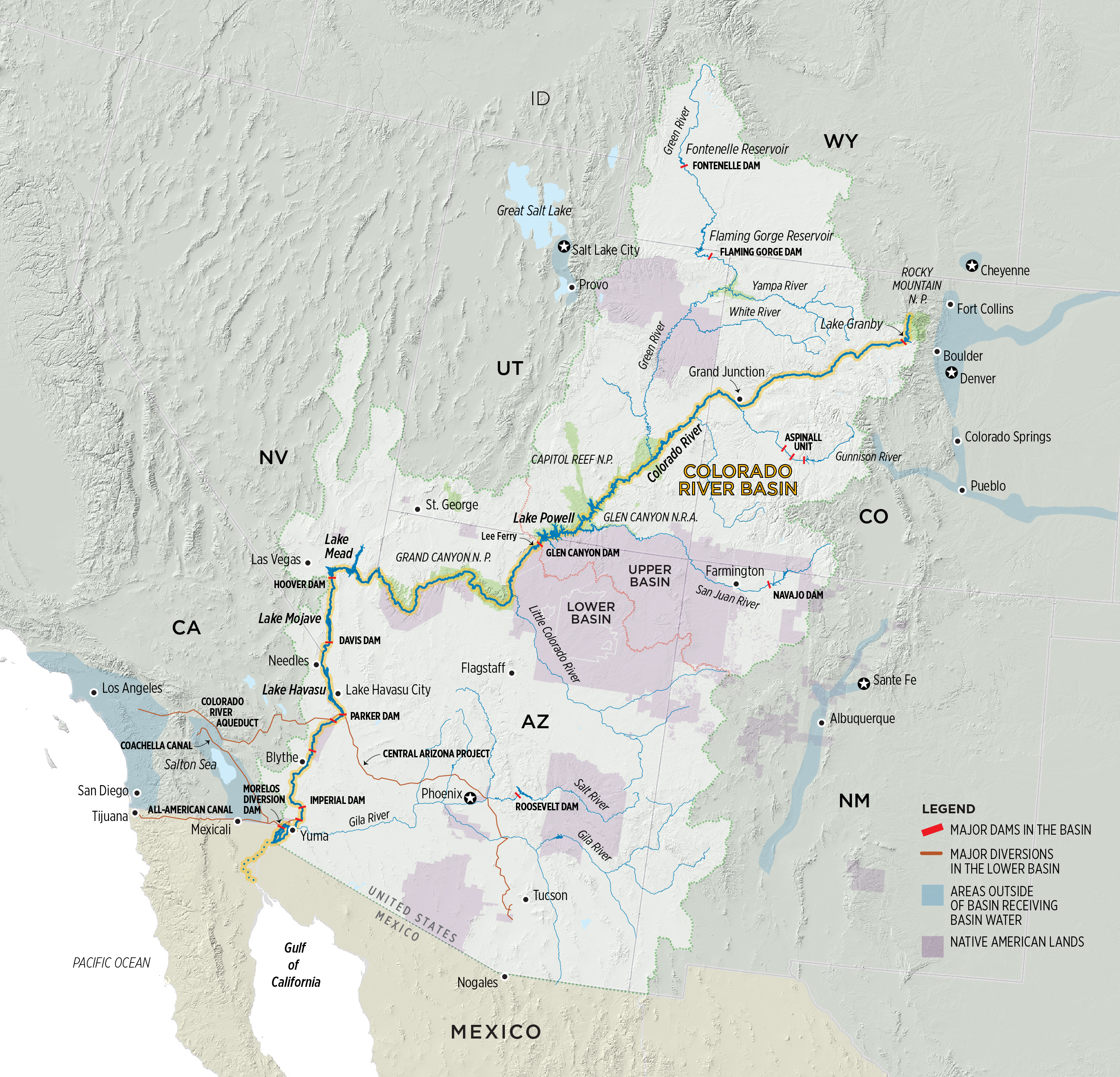
Colorado River Basin with out of basin uses shown in magenta. Credit: Wikipedia.org
The upper Colorado River, above State Bridge. Photo: Brent Gardner-Smith/Aspen Journalism
Prior to 1921 this section of the Colorado River at Dead Horse Point near Moab, Utah was known as the Grand River. Mike Nielsen – Dead Horse Point State Park
The upper Colorado River below the Pumphouse put-in.
The Colorado River and other crucial sources of water in the West are declining, thanks to climate change. brewbooks/CC Flickr
In 1922, Federal and State representatives met for the Colorado River Compact Commission in Santa Fe, New Mexico. Among the attendees were Arthur P. Davis, Director of Reclamation Service, and Herbert Hoover, who at the time, was the Secretary of Commerce. Photo taken November 24, 1922. USBR photo.
Colorado River headwaters tributary in Rocky Mountain National Park photo via Greg Hobbs.
Delph Carpenter’s 1922 Colorado River Basin map with Lake Mead and Lake Powell shown. The two giant reservoirs have always been part of the governance of the river.
President Hoover at the signing of the Colorado River Compact.
Upstream view of the Colorado River at the mouth of the Roaring fork River
Colorado National Monument from the Colorado River Trail near Fruita September 2014
Colorado River pulse flow (Minute 319) reaches the Sea of Cortez for the first time since 1998 on May 15, 2014 via the Sonoran Institute
Upper Basin States vs. Lower Basin circa 1925 via CSU Water Resources Archives
Lake Granby spill June 2011 via USBR. Granby Dam was retrofitted with a hydroelectric component and began producing electricity earlier this year as water is released in the Colorado River.