Nitrogen is everywhere. It makes up 80 percent of the air you’re breathing. On its own, it has no real value. But if it’s combined into a molecule with another element, like hydrogen or oxygen, it becomes something that can react with other chemicals. In this “fixed” state, plants can use it to build proteins. Our bodies use those proteins, in turn, to build muscles, bones, DNA, and babies.
But back in the 19th century, fixed nitrogen was limited. In the early 1800s, the English scholar Thomas Malthus warned of famine as population growth began to overtake farm production. Then settlers discovered the guano islands and nitrate mines of South America, and fertilizer-laden clipper ships streamed around Cape Horn back to Europe, giving farmers bumper crops and feeding a baby boom.
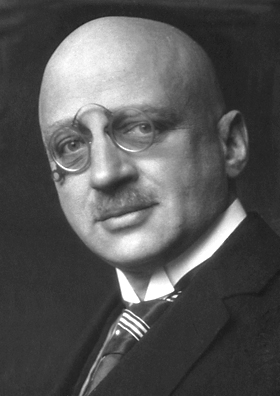
By The Nobel Foundation – Public Domain via Wikipedia
Britain’s population quadrupled over the next 100 years. Then in 1908, as South American nitrogen was beginning to run low, the chemist Fritz Haber discovered a way to take the inert nitrogen in air and turn it into the reactive forms plants and animals use. “Haber opened the faucet for nitrogen to flow from the air to the living world,” wrote geographer Ruth DeFries. Instead of waning, populations continued to boom.
This breakthrough solution created a crisis as large as the one it solved. Since Haber’s discovery, humans have nearly doubled Earth’s natural flow of fixed nitrogen, overwhelming the capacity of ecosystems to remove it. The resulting buildup is poisoning the planet’s waterways, creating a crisis some consider even more threatening than the buildup of carbon dioxide in the atmosphere.
But we can’t simply turn off the spigot of industrial nitrogen, because we depend on it. More than 3 billion people wouldn’t be alive today without Haber’s industrial process.
Now, for the first time in over a hundred years, there’s a potential solution. A pack of startups is racing to market with a means of fixing nitrogen without polluting the Earth. One of them, Pivot Bio, just garnered a $70 million vote of confidence in a funding round led by Breakthrough Energy Ventures, the coalition of big-name billionaires — Bill Gates, Jeff Bezos, Michael Bloomberg, Richard Branson — hoping to power climate change-beating innovation.
“Pivot Bio is addressing one of the largest sources of GHGs on the planet,” said Carmichael Roberts, a Breakthrough investor, in a press release. He noted that the Berkeley, California-based biotech might earn a fortune by “disrupting the $200 billion fertilizer market.”
Next year, Pivot plans to start getting farmers nitrogen-fixing bacteria — which efficiently delivers fertilizer to crops, no fossil fuels required. Farmers will spritz seeds with a liquid probiotic as they bury them in the ground. Another startup, Azotic Technologies based in England, is racing to bring a different bacterium to market around the same time. Intrinsyx Bio — a spin-off from a company that supplies NASA with bacteria and other critters for experiments — plans to put yet another bacterium on the market in 2020. And at least one other, the Bayer-backed Joyn Bio, is just ramping up. If any of them is able to provide a viable alternative to the international fertilizer industry, it could be the most significant environmental breakthrough since Haber figured out a way to synthetically release nitrogen from its natural bonds.
Seemingly every startup — even CryptoKitties selling cartoon cats — likes to say it’s creating “technology that will change the world.” But for the companies racing to fix nitrogen, it’s no stretch. If this solution proves out, it would clean up the pollution choking the planet’s life support systems, without forcing widespread famine and a return to the nitrogen wars.
Here’s the release from the Bureau of Reclamation:
Water and energy efficiency grants focus on projects that improve water management including projects that conserve water
Bureau of Reclamation Commissioner Brenda Burman announced that Reclamation has selected 54 projects to receive a total of $26.5 million through WaterSMART water and energy efficiency grants. This funding will be leveraged to accomplish approximately $167 million in improvements throughout the West. The projects funded with these grants include canal lining and piping, automated gates and control systems, and installation of advanced metering.
“President Trump is dedicated to better water infrastructure for communities and farmers, and adequate and safe water supplies are fundamental to the health, economy, and security of the country,” said U.S. Secretary of the Interior Ryan Zinke. “WaterSMART water and energy efficiency grants enable Interior, states, tribes, and local entities to work together to take action to increase available water supply through infrastructure investments.”
“Improving water efficiency is an important part of ensuring communities have a reliable water supply in the future,” Commissioner Burman said. “The projects we’ve selected today will help communities throughout the Western United States by providing them with tools they can use to better manage their water needs.”
Water and energy efficiency grants focus on projects that conserve and use water more efficiently. Projects may also lessen the risk of future water conflicts and provide other benefits that contribute to water supply reliability in the western United States. Other projects complement on-farm improvements that can be carried out with the assistance of the U.S. Department of Agriculture’s Natural Resources Conservation Service to accomplish coordinated water conservation improvements.
Funding is provided in two groups. Funding Group I projects receive up to $300,000 and can be completed within two years. Funding Group II projects may receive up to $1 million for a phased project up to three years.
The Shoshone-Bannock Tribes near Pocatello, Idaho, will receive $888,818 to replace a 1,500-horsepower pump on the Portneuf River and install a new variable frequency drive pump. It will also line one mile of earthen canal to reduce water losses due to seepage. The project is expected to result in a water savings of 5,628 acre-feet per year which will increase tribal water supply and improve drought resiliency.
The Mapleton Irrigation District and Company near Provo, Utah, will replace three miles of existing open canals and a box culvert in Hobble Creek Canyon with a pressurized pipeline that will eliminate water losses due to seepage, evaporation and ditch failure. They will receive $300,000 towards the $1.2 million project. It is expected to result in an annual water savings of 1,685 acre-feet each year.
The City of Bakersfield will receive $743,300 to install monitoring devices with telemetry at 20 locations along the Kern River and a Supervisory Control and Data Acquisition system to accurately and remotely measure Kern River diversions. The $1.6 million project will result in an annual water savings of 4,592 acre-feet that will be used to replenish the local groundwater and make more water available to users, helping to reduce the potential for water-related conflicts in the area.
The complete list of projects is available at https://www.usbr.gov/watersmart/weeg/. Projects were selected through a competitive process and must provide a minimum of a 50-percent cost-share.
FromThe Grand Junction Daily Sentinel (Dennis Webb):
A Senate committee Tuesday approved a bill that would permanently reauthorize the Land and Water Conservation Fund.
The action by the Senate Energy and Natural Resources Committee was one of several it took Tuesday on measures backed by U.S. Sen. Cory Gardner, R-Colo., and Sen. Michael Bennet, D-Colo. Others that were approved by the committee and are supported by the two are bills to address a $12 billion National Park Service maintenance backlog, and to extend endangered fish recovery programs in the Upper Colorado and San Juan rivers through the 2023 fiscal year.
Gardner sits on the Energy and Natural Resources Committee.
Tuesday’s action on the Land and Water Conservation Fund came after it expired Sunday due to a lack of congressional action to reauthorize it.
A bipartisan contingent in Congress is seeking to get legislation through the Senate and House to reauthorize the program. It dates back to 1964 and has resulted in nearly $270 million in spending in Colorado for purposes such as acquiring private inholdings surrounded by federal lands, and to help fund state and local trails and parks, including in Mesa County…
The measure approved Tuesday also would fully fund the program. Congress rarely appropriates the roughly $900 million a year in funding the legislation creating it allows…
Meanwhile, another measure the committee passed Tuesday seeks to reduce the National Park Service maintenance backlog by tapping half of existing unobligated revenues from on and offshore energy development — up to $1.3 billion per year — for the next five years, Gardner’s office said.
The Senate Committee on Energy and Natural Resources today approved six bills sponsored by Colorado U.S. Senator Michael Bennet.
Bennet Reaction:
“Today we moved one step closer to passing important public lands legislation for Colorado. From designating a new National Historic Trail to establishing the 21st Century Conservation Service Corps—a program Senator McCain and I worked on for years to make a reality for America’s youth and veterans—the legislation reaffirms our commitment to America’s public lands.
“On Sunday, despite bipartisan support in both chambers, Congress failed to reauthorize LWCF—a widely popular conservation tool in Colorado and across the country. We must pass the bill approved today as soon as possible to ensure LWCF is permanently reauthorized and fully funded for the next generation of Coloradans.
“During a recent trip to Rocky Mountain National Park, I witnessed the effects of chronic underfunding of land management agencies like the National Park Service. It’s critical we address the ongoing maintenance backlog by passing the Restore Our Parks Act.”
Legislative Background:
Land and Water Conservation Authorization and Funding Act: Bennet cosponsored this legislation to permanently reauthorize and fully find the Land and Water Conservation Fund (LWCF), which conserves and promotes access to America’s parks, rivers, forests, and public lands.
Restore Our Parks Act: Bennet cosponsored this legislation to establish the National Park Service Legacy Restoration Fund to address the $12 billion maintenance backlog at the National Park Service.
21st Century Conservation Service Corps Act: With the late Senator John McCain (R-AZ), Bennet introduced this legislation to place youth and returning veterans in national service positions to protect, restore, and enhance America’s great outdoors. The bill would amend the Public Lands Corps Act of 1993 to establish the 21st Century Conservation Service Corps.
Pike National Historic Trail Study Act: With Senator Cory Gardner (R-CO), Bennet introduced this legislation to direct the National Park Service to conduct a study on designating explorer Zebulon Pike’s route through the American Southwest—including significant stretches in Colorado—as a National Historic Trail.
Amache Study Act: With Senator Cory Gardner (R-CO), Bennet introduced this legislation to direct the Department of the Interior to conduct a special resource study on the historical significance of the former Japanese American relocation center, Amache, and evaluate the feasibility of it becoming part of the National Park System.
Endangered Fish Recovery Programs Extension Act: Bennet cosponsored this legislation to continue to fund the Upper Colorado and San Juan fish recovery programs through Fiscal Year 2023 to protect four endangered species in the Upper Colorado River Basin.
On Tuesday the Senate Energy and Natural Resources Committee, which Senator Cory Gardner (R-CO) serves on, advanced out of committee several pieces of legislation important to Colorado.
Included in the hearing was S. 569, the Land and Water Conservation Authorization and Funding Act. This legislation, of which Senator Gardner is a cosponsor, aims to fully fund and permanently reauthorize the Land and Water Conservation Fund (LWCF). Authorization for LWCF expired on September 30th, and Senator Gardner has been working with a bipartisan group, including Senator Bennet, to reauthorize the conservation program.
“I’ve been fighting to protect the Land and Water Conservation Fund, and today was an important step for the Senate to move out of committee a bipartisan measure that permanently reauthorizes this critical program for Colorado’s public lands,” said Senator Gardner. “There is no excuse on why we can’t get this done as there is a clear bipartisan consensus in both the House and Senate on the immense benefits of this crown jewel of conservation programs.”
Also passing out of committee in today’s hearing was S.3172, the Restore our Parks Act. This legislation, of which Senator Gardner is also a cosponsor, addresses the $12 billion park maintenance backlog that is preventing new investments and infrastructure improvements to parks in Colorado and across the country. This measure would establish the “National Park Service Legacy Restoration Fund” and reduce the maintenance backlog by allocating half of the existing unobligated revenues the government receives from on and offshore energy development – up to $1.3 billion per year – for the next five years.
“We have to provide Colorado’s parks the funding necessary to help address the billions of dollars in deferred maintenance that the park system is currently facing,” said Senator Gardner. “The Restore our Parks Act will protect these lands by allowing for needed investments for park infrastructure and preservation projects.”
Bicycling the Colorado National Monument, Grand Valley in the distance via Colorado.com
FromThe Grand Junction Daily Sentinel (Amy Hamilton):
Tens of thousands of Mesa County residents who paid millions of dollars to the Grand Valley Drainage District to manage storm water starting in 2016 — fees a judge ruled earlier this year were actually an illegally collected tax — will receive refunds in the mail, including additional interest payments on their money.
But don’t hold your breath.
The process of full repayment will take three to six years, drainage district officials estimated Tuesday
The agency spent roughly $2.2 million of that money on projects before it lost a lawsuit lodged by Mesa County commissioners and the Grand Junction Area Chamber of Commerce, and now the agency is legally required to pay residents back.
“We are going to pay people back,” drainage district Manager Tim Ryan said in an interview following a two-hour meeting of the district’s board of directors. “It’s not a matter of if, it’s a matter of when.”
A first payment should be mailed to residents late in the first quarter or early in the second quarter of 2019, Ryan said.
The district plans to make the first round of refunds the largest share of the dollars they owe residents, but officials haven’t determined yet what percentage of the total refund owed that will be.
For the past week or so, the river in Durango has registered the lowest flows ever recorded at a water-level gauge, which has been in operation for 107 years, located behind the Powerhouse Science Center, according to data maintained by the U.S. Geological Survey.
Around Sept. 26, the Animas River dipped below 100 cubic feet per second – the measurement used for waterways.
According to a review of the water-level gauge’s data, the Animas River has never dropped below 100 cfs.
Robert Kimbrough with the USGS in Denver said although the gauge shows the Animas below 100 cfs, the information needs to be confirmed before it can be considered an official record. He did not have a timeline for when that would be finished.
Click here for all the inside skinny and to register:
Join in the growing excitement and energy for the Healthy Rivers Youth Water Summit. All are invited to follow this event online by clicking ‘follow’ on the Summit website. We will be posting photos, videos of speakers, and more. If you are local and would like to attend, please email info@wildroseeducation.com for a registration code.
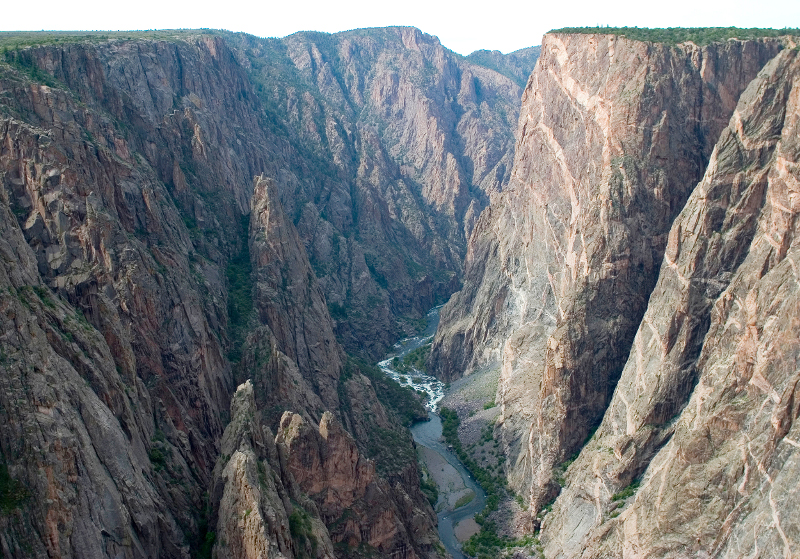
Fog-filled Black Canyon via the National Park Service
FromThe Grand Junction Daily Sentinel (Dennis Webb):
The fund was created in 1964. It has provided protections over the years in Colorado to national parks, monuments and forests, and helped create local recreation amenities like the Blue Heron Trail along the Colorado River in Grand Junction.
A bipartisan congressional majority that in Colorado includes Sens. Michael Bennet and Cory Gardner and Reps. Scott Tipton, Jared Polis, Mike Coffman, Ed Perlmutter and Diana DeGette has supported a bill to permanently reauthorize the fund. But it hasn’t been brought up for a vote by congressional leadership.
Amy Roberts, executive director of Outdoor Industry Association, said in a news release, “We are extremely disappointed that Congress is letting one of the most popular and bipartisan programs which supports our nation’s public lands and outdoor recreation opportunities expire before the November elections. Our public lands are one of our nation’s underlying unifiers, not to mention that they help to fuel the growing $887 billion outdoor recreation economy.”
Gardner spokesman Casey Contres said the Senate Energy and Natural Resources Committee likely will be voting on conservation fund legislation this week.
Left: Fossil fuel emissions 1850 to 2010 and since 2000. Right: Amount of fossil fuel emissions to keep warming under 2 C, vs. potential emissions from proven reserves. Fossil fuel companies know that they cannot compete with renewable energy v. cost. The competitive cost advantage will be advanced if the fossil fuel companies are compelled to pay a cost for their pollution.
…the federal government authorized a 14-mile corridor across public land in eastern Utah’s Uinta Basin to service a proposed strip mine and processing plant that could produce 50,000 barrels of a crude a day — but also deplete the Green River.
The Bureau of Land Management issued the decision last week after a six-year environmental review that dodged studying impacts associated with the controversial South Project, proposed by Estonia-based Enefit American Oil on private land 40 miles southeast of Vernal.
Environmental activists argue that this omission renders the decision suspect because the 9,000-acre mine’s impacts to air quality, groundwater, the Green and White rivers and the landscape remain unknown.
“Oil shale has been the next big thing for a hundred years!” — Ed Quillen
Photo credit from report “A Preliminary Evaluation of Seasonal Water Levels Necessary to Sustain Mount Emmons Fen: Grand Mesa, Uncompahgre and Gunnison National Forests,” David J. Cooper, Ph.D, December 2003.
The restoration of a unique wetland on Mt. Emmons is wrapping up this summer season. This special wetland—specifically called an iron fen—was designated in 1999 as a Natural Area by the state of Colorado because of the unusual chemical makeup of the water and soils that provide an ideal ecosystem for rare carnivorous plants and unusual dragonflies. The iron fen has likely been around for about 8,000 years, according to fen expert and senior research scientist and professor at Colorado State University Dr. David Cooper.
According to a report compiled for the Coal Creek Watershed Coalition by Dr. Cooper, “Where perennial ground water discharges to saturate wetlands all year, dead plant leaves, stems and roots only partially decompose and accumulate to form peat soils, and these ecosystems are fens.”
What makes the Mt. Emmons fen unique is that it contains a pyrite-rich bedrock and talus, characteristic of only a few fens in the region. When the pyrite oxidizes it produces sulfuric acid, “which, when dissolved in water, forms a strong acid that can leach ions from the rock, including iron,” Cooper states.
According to Colorado Parks and Wildlife, “Mount Emmons and a few other iron fens in the southern Rocky Mountains … are rich in mineral ions (especially iron and sulfur) but have a very low pH, which results in an unusual flora,” including small orchids and one of only four populations of roundleaf sundew in Colorado. Roundleaf sundew is a carnivorous plant that lures insects into a sticky trap, then digests its meal with enzymes before unfurling its trap once again.
The Grand Mesa, Uncompahgre, and Gunnison National Forests District (GMUG), along with the Army Corps of Engineers and Coal Creek Watershed Coalition, are working to restore the iron fen to pre–wagon road days, which runs parallel with Kebler Pass. The iron fen is located to the north of Kebler Pass Road on Mt. Emmons, and spans 15.1 acres across a sloping hillside.
The dewatering of the fen is mostly being caused by water being diverted into a historic ditch away from the old wagon road. According to Ashley Hom, a hydrologist for the GMUG Forest Service, “Without that ditch the water would destabilize the hillside,” which poses a risk for Kebler Pass Road.
In 2015 a storm on Kebler Pass dumped rain on top of snow, causing “substantial surface flow” across the fen, down the hillside and onto the road, which prompted emergency action by the National Forest personnel to widen the ditch between Kebler Pass Road and the fen, according to the Mt. Emmons restoration and mitigation plan.
While the ditch helped stabilize the hillside by diverting water out of the ground, it also resulted in significant dewatering of the iron fen. This issue is what prompted the restoration project through the GMUG Ranger District, which began in fall 2016.
“The goal of this project is to restore the surface and groundwater hydrology, along with the native vegetation, on the portion of the Mt. Emmons iron fen that was impaired by the emergency action that extended portions of the historic ditch… and included construction of a rockery wall, spillway, culverts, and rip-rap on Kebler Pass Road to protect the road yet allow for natural surface and sub-surface water flow from the fen,” according to the restoration and mitigation plan.
There is still some work to be done, states Hom, including more ditch work, planting, feeding and monitoring in the area, which will resume this summer.
Eight monitoring wells have been placed in the fen, four above the ditch and four below the ditch, and hydrologists will monitor the ground water levels in the wells, and the restoration “will be considered successful if [the wells] below the ditch show the water table depth there to be decreasing or rising closer to the surface,” according to the restoration and mitigation plan.
The plan states that “restoring the presence of a shallow water table within the area should provide for fen-like hydrology,” which will, in turn, restore historic vegetation to the iron fen below the ditch.
“Overall the rehabilitation of the drainage ditch within the Mt. Emmons iron fen appears to be successful. Ground water levels have already risen to within 30 centimeters of the surface and water table levels below the ditch are within at least 15 centimeters of those above the ditch,” according to the GMUG watershed team.
There have been many agencies involved in the restoration of this unique swath of wetland, including the Army Corps of Engineers, which permitted the project, and the Coal Creek Watershed Coalition that allocated $45,000 for phases 1 and 2 of the restoration and mitigation project.
You can follow progress of the project and direct questions to Ashley Hom at the Gunnison Ranger District, (970) 642-4406 or ashleyhom@fs.fed.su.
The Fryingpan River, above Basalt. Photo: Brent Gardner-Smith/Aspen Journalism
From email from Reclamation (James Bishop):
At 1 p.m. today, Oct 1, Reclamation plans to decrease the releases from Ruedi Reservoir to the Fryingpan River from 300 to 270 cubic feet per second until further notice.
A federal fund that’s paid for public land improvements across Colorado’s national parks and built trails on the Front Range expired over the weekend — and environmental groups are crying foul.
The Land and Water Conservation Fund has pumped nearly $270 million into the state over the last 50 years. The money comes from offshore drilling royalties.
“There’s no good reason to let this expire. Congress needs to act, get this done and provide for permanent reauthorization, and full and dedicated funding,” said Jim Ramey, Colorado director of the Wilderness Society.
Right now, Ramey said it’s unclear where money will come from for future public land improvements…
Here are some highlights from project grants over the years:
Black Canyon of the Gunnison National Park, land acquisition near Park boundary, $5.3 million, 2013.
Milk Run Trail, Salida, $178,890, 2011.
Ute Pass Trail Work, El Paso County, $77,200, 2005.
Cherry Creek State Park, Dog off-leash area, $547,565, 2011.
Riverside Park, Englewood, $767,781, 1975.
Poudre River Trail, improvements near &1st Ave in Greeley, $250,000, 2003.
Vanderbilt Park, No. 2 Ballfields Denver, $138,927, 1975.
Rampart Park, Colorado Springs, $80,501, 1980.
Nederland Recreational Facility, Nederland, $42,500, 1988.
St. Vrain Greenway, Longmont, $200,000, 2006.
With reservoir levels falling along the Colorado River, Arizona’s top water officials say they are making progress in talks toward a set of agreements for cities, farmers and tribes to share in water cutbacks and join in a larger proposed deal to prevent Lake Mead from dropping even further.
Since July, state water managers have been leading a series of biweekly meetings to work out details of the proposed drought-contingency plan. After their latest three-hour session Thursday, the two officials leading the talks said they are optimistic about finalizing agreements within Arizona in November so that the Legislature can sign off in January.
The proposed three-state plan would involve California, Arizona and Nevada jointly taking less water out of Lake Mead to give the reservoir a boost.
Based on Arizona’s priority system of water rights, complying with the plan without an additional adjustment would cut off water for farmers who depend on deliveries from the Central Arizona Project.
The idea is to reach an agreement that “more equitably spreads around the pain and the benefits” of the drought-contingency plan in Arizona, said Tom Buschatzke, director of the state Department of Water Resources.
“People are getting their real issues out on the table,” Buschatzke told The Arizona Republic. “People are really looking for solutions. They really are. There are some who are still holding their cards close to their vests, but I think the vast majority of people are trying to find ways to make this happen.”
Buschatzke spoke alongside Central Arizona Project General Manager Ted Cooke, who said he’s also optimistic about finishing a deal during the next two months.
“Nobody wants to see anybody lose any water, but people are going to,” Cooke said. “Nobody wants to see that hardship come to anybody, but there is going to be hardship and we need to spread it around.”
Cooke said it will be critical to get buy-in and widespread support to prepare for Buschatzke to take an agreement before the Legislature for approval.
“We need to get everybody on board,” Cooke said, “so that when he needs to go to the Legislature and say, ‘Give me the authorization to enter into this multistate deal,’ that everybody — or as many people as possible — can stand up and say, ‘We support this.’”
Some of the hurdles lie in negotiating agreements between the players to conserve water in places and free up some for the lowest-priority water users — such as farmers in central Arizona — to prevent them from losing their water supplies completely. Those talks about where the water will come from, and about the compromises needed to achieve such a deal, have been underway in a series of smaller meetings, Cooke said, and working through the details takes time…
One potential approach for freeing up water to make an agreement work, Buschatzke said, would be paying a higher-priority entity like a tribe to leave some farmland fallow and send that water elsewhere. He said officials are talking about ideas of where they might get the funding needed to compensate parties that would conserve water…
Arizona officials have said the goal now isn’t to prevent a shortage, which is looking very likely in little more than a year from now, but rather to prevent even more severe shortages…
Managers of water districts from across the region met in Las Vegas earlier this month for talks on the plan. James Hanks, the board president of California’s Imperial Irrigation District, said there was a “full-court press” by federal officials to get an agreement finished…
Hanks said federal officials talked about releasing drafts of the main agreements around Oct. 10.
Federal officials have made it clear they hope to have a deal finished by the annual conference of the Colorado River Water Users Association in mid-December, and that Interior Secretary Ryan Zinke wants to be there to “sign the deal,” Buschatzke said. He said federal officials know he won’t be able to formally sign until the Arizona Legislature passes a resolution granting him that authority…
“Progress has been good and steady, and I think we’re close,” said Jeffrey Kightlinger, general manager of the Metropolitan Water District of Southern California. “I think in California we have conceptually resolved all our intrastate issues and now we’re in the process of drafting them up.”
Kightlinger plans to brief the Metropolitan board on the proposed deal on Oct. 8. The way the agreement will work in California, he said, is that districts will leave water in Lake Mead according to how much they have used historically…
In Arizona, Kevin Moran of the Environmental Defense Fund has been participating in talks since early 2016 promoting the drought-contingency plan.
“Our view is that it’s better to plan ahead and avoid crisis if you can, because in a crisis, the environment will often lose,” Moran said. “It’s in the interest really of the entire region.”
He said adopting the deal will be a critical step toward managing water sustainably. And if the three states approve their agreement, Mexico has pledged under a separate deal to contribute by temporarily leaving more water in Lake Mead.
“I think the momentum is building because the hydrology of the region is grim and people realize that,” Moran said.
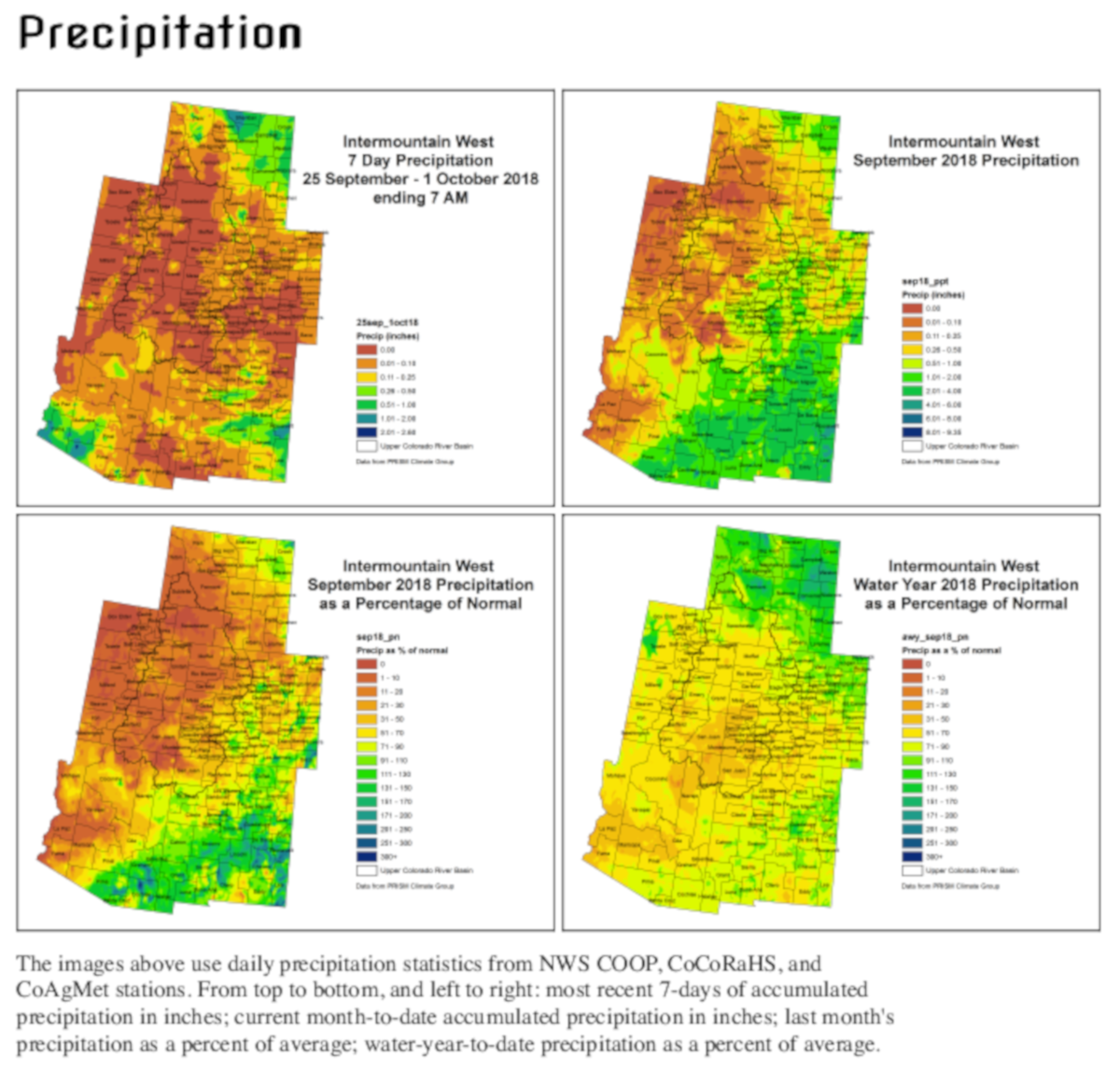
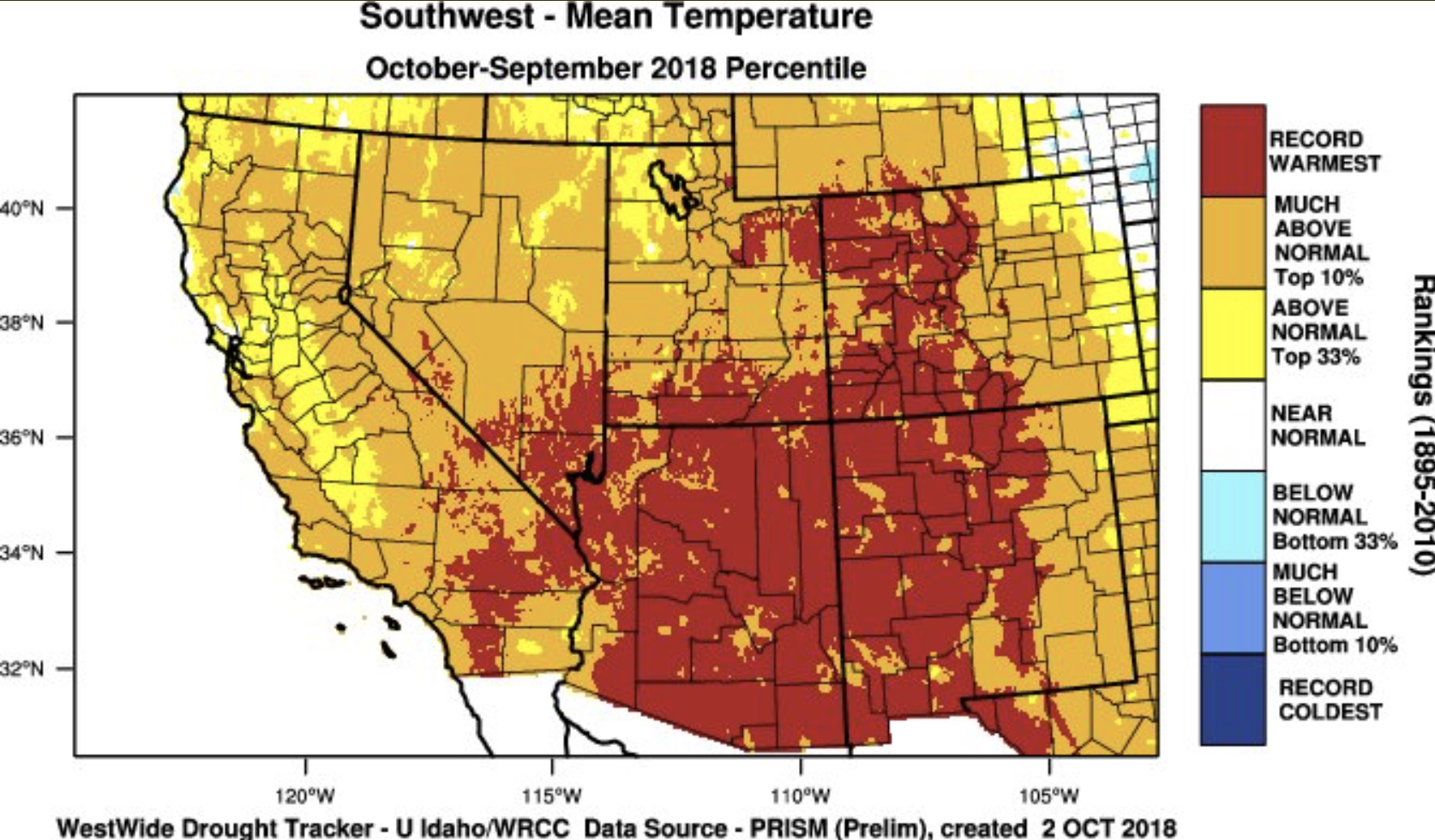
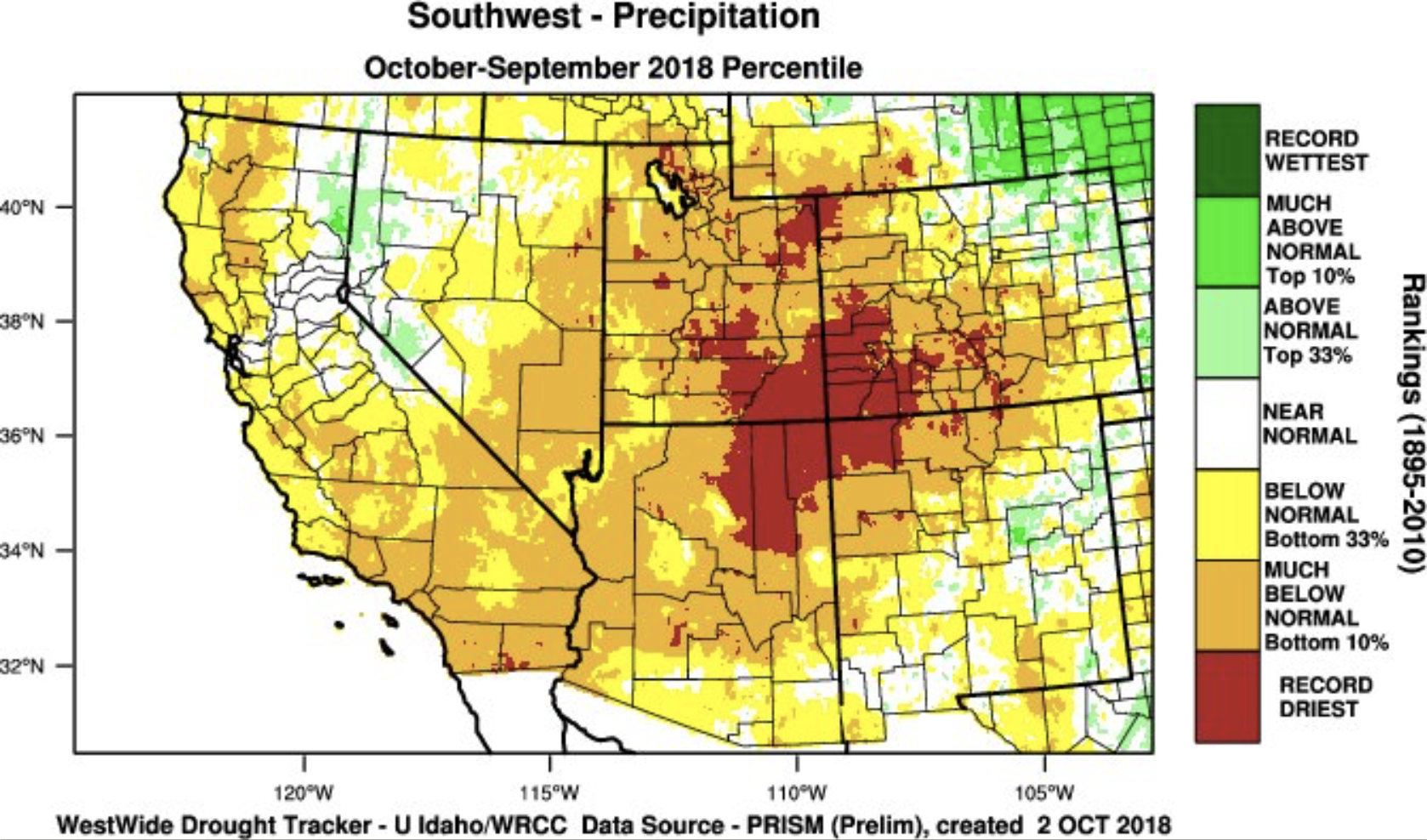
According to the U.S. Drought Monitor all of Rio Blanco County is still currently classified as D3, or Extreme Drought, as precipitation around the county continues to fall well under normal rates. However, there is some hope to be found in the winter forecast.
Drought Levels in Rangely
The National Oceanic and Atmospheric Administration, or NOAA, has been tracking weather and climate related data in Rangely since 1894. The station currently sits near the Rangely Water Treatment Plant. According to NOAA data, by the end of August Rangely was 1.37 inches below normal precipitation, receiving only 6.22 inches from January through August.
In 2017 Rangely received total precipitation of 8.66 inches for the entire year while the historic average total annual precipitation sits at 10.03 inches.
NOAA predicts that the below normal precipitation will continue through the rest of September.
The fact that precipitation has been well below normal for multiple years has certainly exacerbated the drought conditions.
Dry conditions in Meeker
NOAA tracks Meeker’s climate and weather at a station located at the Bureau of Land Management Office. Meeker is currently below normal for precipitation by 0.81 of an inch, receiving 9.16 inches through the end of August.
In 2017, Meeker received a total of 15.73 inches of precipitation for the year and the historical data, which dates back to 1893 for the community, places an average annual precipitation of 16.54 inches. Jim Pringle with NOAA doesn’t anticipate much change in the standings through the month of September, saying, “Although we still have to wait just under two weeks from now to obtain the September 2018 precipitation for Meeker, it is doubtful based on the latest computer-generated atmospheric model guidance that Meeker will receive normal precipitation for September.”
Winter Forecast
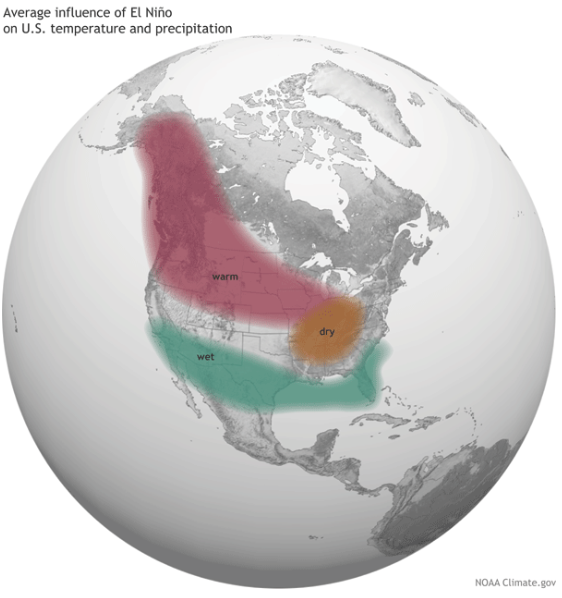
The good news is that the National Weather Services’ Climate Prediction Center (CPC) is anticipating an El Niño episode for the upcoming 2018-2019 winter season, with odds favoring at least near normal precipitation in northwest Colorado during the late fall, winter and spring months.
An El Niño event is characterized as bringing unusually warm waters in the Pacific Ocean. This typically produces warmer-than-average temperatures over the western and northern United States. Wetter-than-average conditions are likely over portions of the western U.S and Gulf Coast regions, while drier-than-average conditions are usually expected in the Ohio Valley and the Pacific Northwest.
Average influence of El Niño on US temperature and precipitation
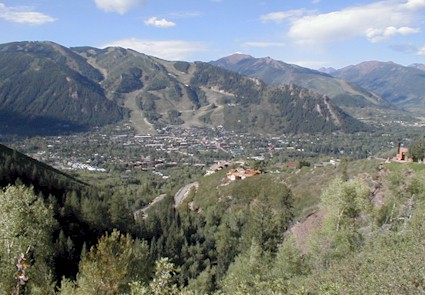
Despite an unprecedented water restriction amid the ongoing drought affecting much of Colorado and the West, officials with the city of Aspen and Aspen Skiing Co. said the dry conditions should not impact the company’s ability to make snow at its four resorts…
SkiCo uses municipal water for snowmaking on Aspen Mountain and Aspen Highlands from the city’s 3-million-gallon reservoir up Castle Creek, water from Maroon Creek for Buttermilk, and water stored in Ziegler Reservoir for the Snowmass Ski Area. And communication between the city and the SkiCo is key, particularly now amid the drought.
Margaret Medellin, the city of Aspen’s portfolio utilities manager, said Friday that Thomas Reservoir doesn’t afford much storage for the city’s needs, and the municipality relies largely on direct flows from Maroon and Castle creeks. Still, “there are a lot of reasons why snowmaking is a water use that can be done even during this dry period,” she said.
That includes snowmaking mostly happening during November and early December, when water demand has lessened because of fewer residents, second-home owners and visitors; along with fewer times nowadays with temperatures suitable for making flakes.
In summertime, the largest use of city water, as much as 86 percent at times, goes to irrigation, but now “irrigation systems are starting to shut down, and we’re seeing the demand on the system dropping,” she said…
She also said that snowmaking overall is a pretty small use — annually less than 8 percent — of the city water supply.
“Having said that, we do constantly monitor our creeks,” Medellin said. “If SkiCo wanted to make snow, and it’s too close to in-stream flow [requirements], we’d communicate with them that they wouldn’t be able to make snow…
Katie Ertl, SkiCo’s senior vice president of mountain operations, said the drought and city water restrictions have “been on our minds,” and led to a recent, in-company meeting.
She agreed the health of the streams is paramount and echoed Medellin: “We’re putting snow on the hill when not a lot of water is being used.
“We recognize that we have a bit of time before now and then, and we’re hoping for the possibility of natural snow,” Ertl said. “We knew this conversation was going to come up with Stage 2 water restrictions. We’re paying attention to what the city requirements may be and will work in conjunction with them for Aspen Mountain and Highlands.”
She said SkiCo, being the valley’s largest employer and driver of tourism, will also consult with other businesses and interest groups about water use for snowmaking…
Ertl and Medellin both said that 70 to 80 percent of the man-made snow ends up back in the watershed during runoff, rather than being lost to evaporation.