Restoring Flows in Urban #Colorado: A new frontier for Colorado Water Trust? — Josh Boissevain (ColoradoWaterTrust.org)

Photo credit: Colorado Water Trust

Click the link to read the release on the Colorado Water Trust website (Josh Boissevain):

March 31, 2025

At Colorado Water Trust, we’ve spent more than two decades working to restore the health of Colorado’s rivers, primarily in rural and agricultural areas. But as Colorado’s population grows, as our urban spaces expand, and as our climate gets hotter and drier, our rivers and streams face new sets of challenges. These new challenges are surfacing at the same time that cities and towns across the state are reevaluating and rediscovering their relationships with their local waterways.

As part of our Strategic Plan, Colorado Water Trust is embarking on an exciting new initiative to see how we can help protect and restore river flows in more urban settings than we have historically operated in. As part of this initiative, we are thrilled to announce that we’re partnering with the University of Colorado’s Master of the Environment (MENV) capstone program to help us get a better understanding of how to do just that.

This partnership brings together a team of three talented MENV capstone students, who will work alongside Colorado Water Trust staff to help us better understand how cities and towns across the state relate to the streams and rivers that run right through their communities. Whether that’s recreation, water quality, wildlife or something else, Colorado Water Trust wants to know what residents care about most when it comes their local waterway.

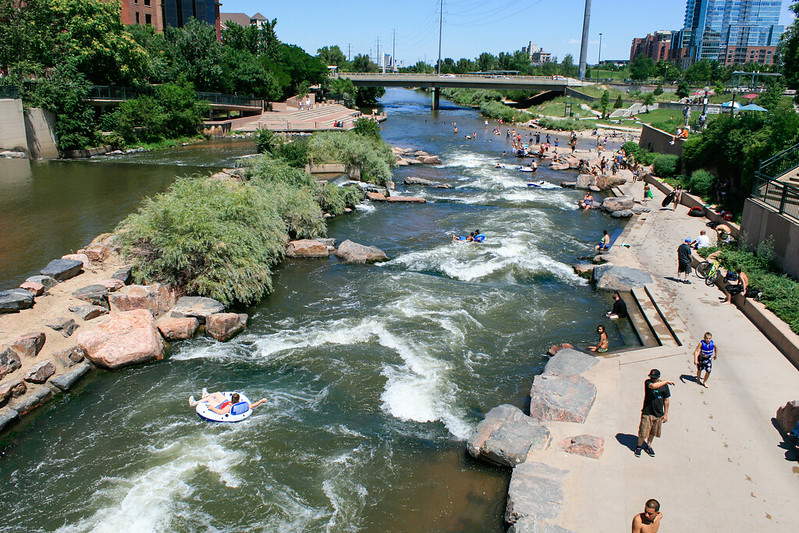
Historic Arkansas Riverwalk of Pueblo, credit: Jeffrey Beall

Throughout 2025, the MENV students will be systematically analyzing the needs, opportunities, and challenges for urban river flow restoration around the state. Through their collaboration with Colorado Water Trust, these students will gain invaluable experience in water law, environmental policy, and community mapping and engagement—all while contributing to the future of urban water management in Colorado. To learn more about the MENV capstone program, check out their website. And stay tuned here, as we will also be featuring blog posts by the MENV students throughout their project to give you an inside look at who they are and what they are learning.

Why Urban River Flow Restoration Matters

In Colorado, the conversation about river health has historically centered on rural rivers and agricultural uses of water. While those concerns remain critical, urban rivers face their own set of unique challenges. With climate change, rapid urbanization, population growth, and competing demands on water resources, cities (and towns) need innovative solutions to ensure their waterways remain healthy, vibrant, and accessible to local communities. And by urban, we don’t just mean Denver and Colorado Springs, we mean towns of all sizes that have natural waterways running through their population centers.

Urban rivers provide a host of ecological, recreational, and social benefits. They help mitigate urban heat islands, improve water quality, provide green spaces for recreation, and offer an opportunity to connect with nature. Unfortunately, many of Colorado’s urban rivers are struggling with degraded water quality, reduced flows, and lack of public access. These problems are compounded by infrastructure demands, development pressures, competition from other water uses, and the complexities of managing water in urban settings.

Restoring water to urban rivers is crucial for sustaining these benefits. But to make meaningful progress, we need to develop strategies that reflect the unique needs and perspectives of urban communities. And to do that, we need to better understand the lay of the land. That’s where our community mapping approach with the MENV students comes in.

Pueblo River Walk at Night, credit: John Wark
The Power of Community Mapping

Community mapping doesn’t mean literal mapping of cities and their water ways, rather it is a process that involves identifying a community’s assets, resources, and challenges (in this case related to how residents of towns and cities interact with their local streams). Through conversations with water managers, municipal staff, residents, organizations, and local businesses, the MENV capstone students will gather insights into how these communities use and value their rivers, as well as any challenges or barriers they face in accessing or engaging with these waterways.

This participatory process will allow us to create a flow-restoration strategy that is tailored to the unique needs of each community. For example, understanding whether a river is used primarily for recreation, as a wildlife corridor, or as a local water source can help us develop solutions that not only improve river health but also meet the needs of the people who live and work alongside these rivers.
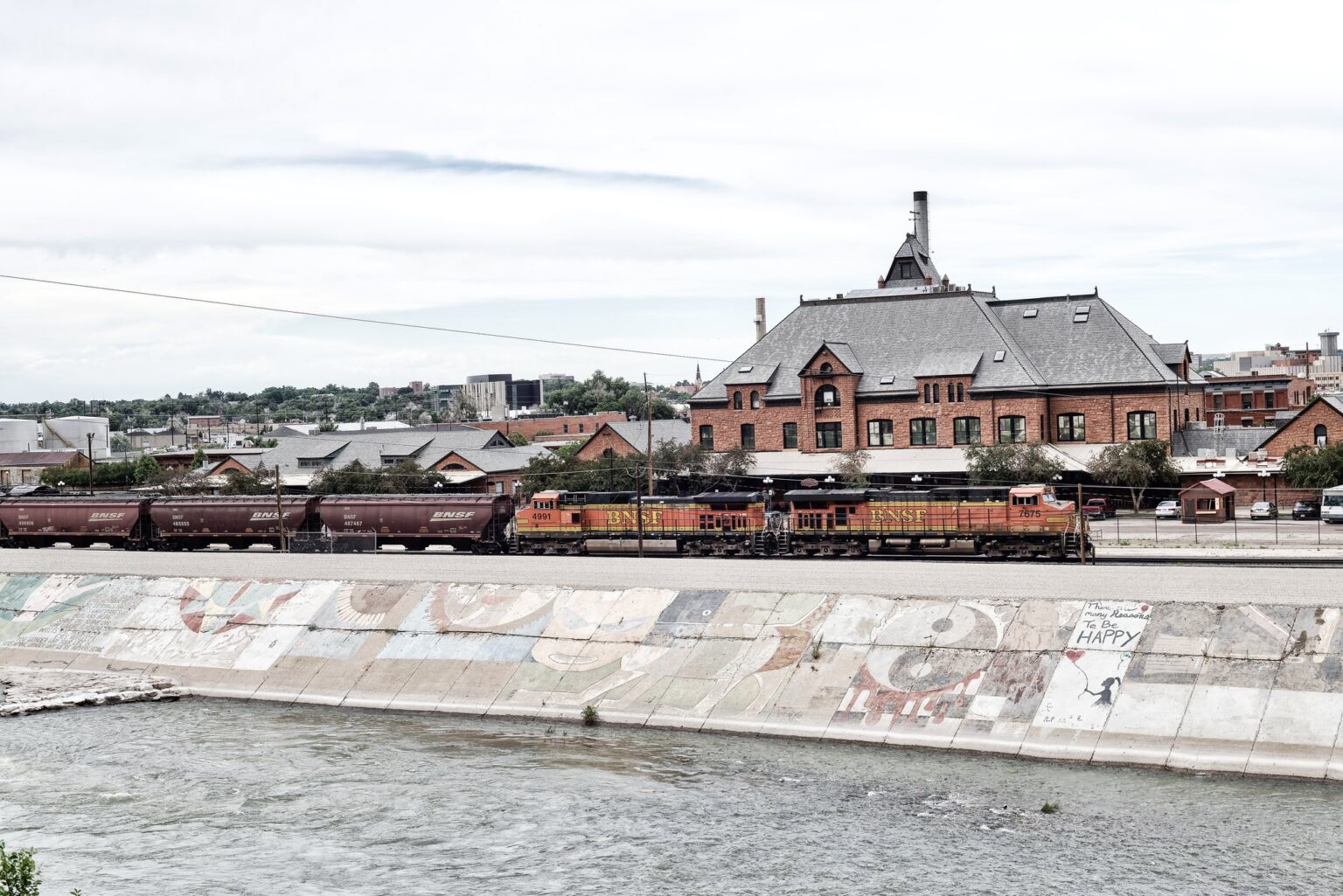
BNSF Train at The Arkansas River in Pueblo
What’s Next

With Colorado Water Trust staff support, the MENV capstone students will play the lead role in this mapping process. By conducting interviews and surveys, collecting data, and analyzing community needs, they’ll provide valuable insights that will inform the ways Colorado Water Trust supports these communities to implement their visions.

Our collaboration with the MENV capstone program offers several benefits for the students involved. The capstone project is designed to be a hands-on, real-world experience where students can apply the knowledge and skills they’ve gained throughout their academic careers to tackle complex and pressing environmental issues like urban river restoration.

Additionally, Colorado Water Trust will continue to emphasize equity and inclusion in all aspects of this project. Ensuring that the voices of historically marginalized communities are heard and incorporated into the process is critical to creating a water management strategy that works for everyone.

In the coming months keep an eye out for more blog posts as we’ll be introducing the MENV team and sharing more updates on our progress. If you are interested in being involved in this process and would be open to sharing thoughts about your local urban stream, please reach out to Josh Boissevain at jboissevain@coloradowatertrust.org.
American Farmers and the USDA Had Finally Embraced Their Role in the #Climate Crisis. Then Came the Federal Funding Freeze — Georgina Gustin (InsideClimateNews.org)

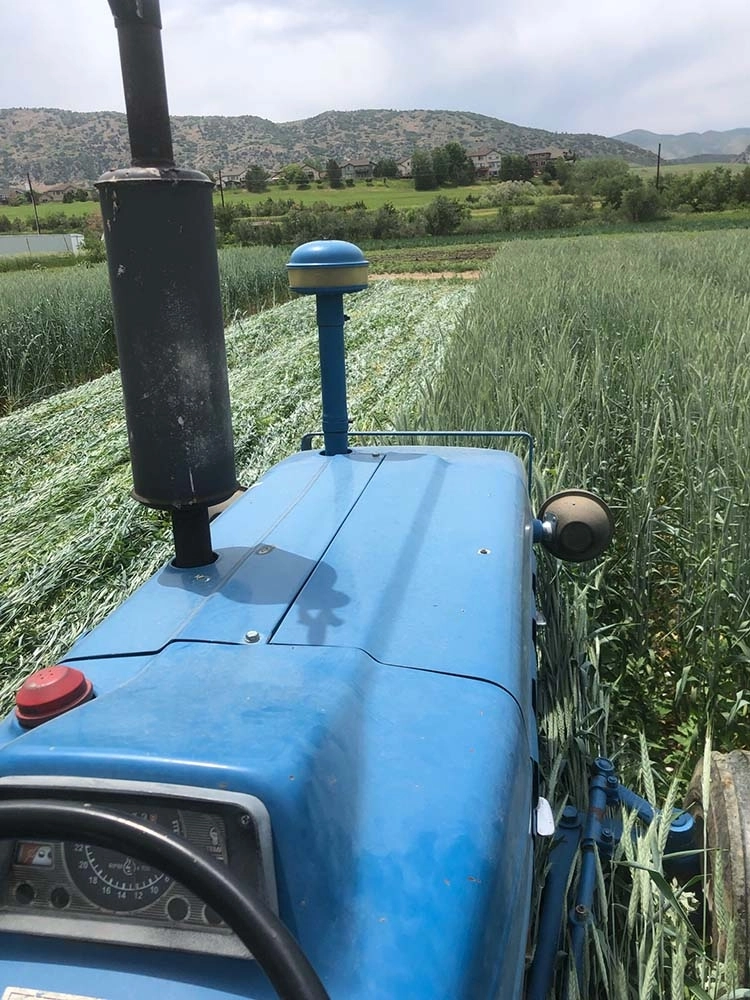
Tractor at Chatfield Farms. Photo credit: Denver Botanic Gardens

Click the link to read the article on the Inside Climate News website (Georgina Gustin):

April 4, 2025

Critics say the Trump administration’s halt to billions in conservation spending could cause long-term damage and slow hard-won progress.

For two decades, farmer John Burk has been working to improve the soil on his farm in Michigan, taking a few extra steps to make it more resilient and productive. His efforts have paid off.

“When we have the dry, hot summers or lack of rainfall, our crops can sustain the dry spells better. We don’t have huge yield decreases,” Burk said. “And when it rains and we have the freak storms, like it seems to do so much now, we don’t have the ponding and all the runoff.”

An added bonus: He needs less fertilizer, a major operating expense.

But Burk, and tens of thousands of farmers across the country like him, have learned that the Trump administration now considers these steps—which include limiting tillage, planting soil-enriching cover crops or installing water chutes to control erosion—“far left climate” activities. The administration has frozen billions of dollars in funding that pay for these activities while the U.S. Department of Agriculture (USDA) and White House conduct ongoing reviews.

The funding freeze, along with layoffs, threatened cutbacks and orders from the administration to remove climate information from the USDA’s website, have had a destabilizing effect on farmers and the agency alike. The agency, which under the Biden administration had more seriously embraced a role in addressing the climate crisis, is in chaos, former staffers say. Frustration from farmers is growing.

“I hear a lot of anger,” said Mike Lavender, policy director at the National Sustainable Agriculture Coalition.

The freeze has stoked uncertainty across farming communities at a particularly bad time. The Trump administration’s tariffs on imports from China, Canada and Mexico have sparked retaliatory tariffs that are expected to hurt American farmers already struggling with low crop prices and high fertilizer costs. Most farmers make decisions about the year ahead in the spring, but without knowing how much funding they can count on, those decisions are especially fraught this year. As extreme weather becomes the norm, the uncertainty mounts. Last year alone, farmers lost more than $20 billion to weather disasters, prompting Congress to approve  $31 billion in disaster assistance.

“We’ve got an ag economy where prices are down and you’ve got increasing pressure because of Trump’s trade war—and now you’re taking away a source of income,” said Robert Bonnie, the under secretary for farm production and conservation at USDA under Biden. “You can put payments on hold. You can’t put spring on hold.”

The agency did not respond to specific questions or a request for comment for this story. 

For decades, the agency has funneled support and funding for conservation projects through hugely popular programs that are so in demand each year, the agency turns away applicants. These farm practices make the soil healthier and more productive. They also help it store more carbon and are seen as significant tools for controlling climate-warming greenhouse gas emissions. 

“Everyone thinks these conservation programs are about farmers,” Burk said. “But it’s way bigger than just the farmer. These don’t just help with yield. It’s helping every single person on the planet.”

The USDA oversees 20 conservation programs that are funded through the Farm Bill, the massive legislation covering farm and nutrition programs that’s negotiated every five years. Under the Biden administration these conservation and energy programs got a huge boost: $19.5 billion from the Inflation Reduction Act, Biden’s signature climate legislation. 

But amid the Trump administration’s broader attacks on climate action, most of the unspent dollars remain frozen, despite the popularity of these programs and their benefits beyond addressing climate change.

One analysis, by former USDA employees, says the agency currently owes nearly $2 billion in promised grants and unpaid funds for conservation and energy efficiency programs to more than 22,000 farmers. Another, by an agricultural economist at the University of Illinois Urbana-Champaign, finds that farmers stand to lose $12.5 billion from the agency’s most popular and widely used programs. Congressional Republicans have signalled that they would shift the funds to other programs covered by the Farm Bill. 

While the agency and its new secretary, Brooke Rollins, announced in February that $20 million in IRA funding will be released, it’s not clear when and how. Rollins said in a statement that the agency was concerned the dollars were being spent on programs “that had nothing to do with agriculture,” but went on to say the review was being conducted “to ensure that programs are focused on supporting farmers and ranchers, not DEIA programs or far-left climate programs.”

On March 26, the agency said it would release funding for the Rural Energy for America Program, which gives grants for farmers to install energy-efficient projects, like solar panels. In order to receive the funds, recipients of the grants will have to revise their applications to ensure that they “remove harmful DEIA and far-left climate features,” the agency said.

“The Biden administration didn’t go out and make up new practices,” Bonnie said. “These are things farmers have been doing for a long time.”

Advocacy groups sued the agency earlier in March to make it honor its contracts. 

Cuts or freezes to funding aren’t the only potential challenges to climate action within the agency. The administration cut as many as 1,200 jobs from the agency’s Natural Resources Conservation Service (NRCS) and threatened to relocate offices, terminating dozens of leases. It has directed staff to remove mentions of climate change from the agency’s website (an action over which it was subsequently sued) and has threatened to defund or derail climate research, which would also impact work at universities that partner with the agency. 

“Even conservative estimates have been that ag research returns $20 for every dollar spent,” said Karen Perry Stillerman, a deputy director at the Union of Concerned Scientists. “A major retrenchment would be a big deal for farms and for climate adaptation and resilience.”

For decades, environmental and farm groups pushed Congress, the USDA and farmers to adopt new conservation programs, but progress came in incremental steps. With each Farm Bill, some lawmakers threaten to whittle down conservation programs, but they have essentially managed to survive and even expand.

The country’s largest farm lobby, the American Farm Bureau Federation, had long denied the realities of climate change, fighting against climate action and adopting official policy positions that question the scientific consensus that climate change is human-caused. Its members—the bulk of American farmers—largely adhered to the same mindset.

But as the realities of climate change have started to hit American farmers on the ground in the form of more extreme weather, and as funding opportunities have expanded through conservation and climate-focused programs, that mindset has started to shift.

“They were concerned about what climate policy meant for their operations,” Bonnie said. “They felt judged. But we said: Let’s partner up.”

The Trump administration’s rollbacks and freezes threaten to stall or undo that progress, advocacy groups and former USDA employees say. 

“We created this enormous infrastructure. We’ve solved huge problems,” Bonnie added, “and they’re undermining all of it.”

“It took so long,” Stillerman said. “The idea that climate change was happening and that farmers could be part of the solution, and could build more resilient farming and food systems against that threat—the IRA really put dollars behind that. All of that is at risk now.”

Burk says he plans to continue with conservation and carbon-storing practices on his Michigan farm, even without conservation dollars from the USDA. 

But, he says, many of his neighboring farmers likely will stop conservation measures without the certainty of government support. 

“So many people are struggling, just trying to figure out how to pay their bills, to get the fuel to run their tractors, to plant,” he said. “The last thing they want to be doing is sitting down with someone from NRCS who says, ‘If I do these things, maybe I’ll get paid in a year.’ That’s not going to happen.”

Longs Peak

Denver Water statement regarding the April 3, 2025, court remedy order on Gross Reservoir Expansion Project #ColoradoRiver #SouthPlatteRiver

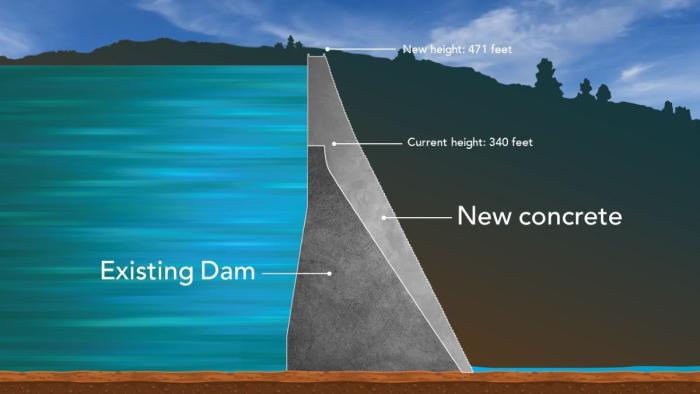
Roller-compacted concrete will be placed on top of the existing dam to raise it to a new height of 471 feet. A total of 118 new steps will make up the new dam. Image credit: Denver Water.

From email from Denver Water:

April 4, 2025

Denver Water is gravely concerned about this ruling and its ramifications for the future of metro Denver and its water supply. We plan to appeal and seek an immediate stay of this order that leaves a critical project that is 60% complete on hold and puts at risk our ability to efficiently provide a safe, secure and reliable water supply to 1.5 million people. Denver Water will do everything in its power to see this project through to completion.

It’s impossible to reconcile the judge’s order with what is clearly in the broader public interest.

 We view this decision as a radical remedy that should raise alarm bells with the public, not only because of its impacts to water security in an era of longer, deeper droughts, catastrophic wildfire and extreme weather, but because it serves as an egregious example of how difficult it has become to build critical infrastructure in the face of relentless litigation and a broken permitting process. In this case, the order is even more appalling with the project so deep into construction. 

Denver Water will abide by the judge’s order and temporarily halt construction on the dam pending a hearing with the judge and will rapidly appeal the decision. Work for the spring season was scheduled to begin April 10, and the final part of the dam raise was to be completed this year. Leaving the project incomplete creates ongoing safety and water supply issues, as Denver Water cannot fill the reservoir to capacity during construction and, as we have testified to the judge, the original gravity dam has been deconstructed and its foundation excavated, exposing steep rock slopes that depend on bolts to temporarily shore them up. These are among the issues that we will address with the judge in an upcoming hearing.  

This order is also exacting a significant human cost, as it comes just as Denver Water and its contractors were preparing for spring construction season. With an extended freeze on construction, hundreds of men and women will be thrown out of work, many with specific skillsets who relocated to the region to work on this specific project. It also required enormous effort over years from Denver Water and its contractors to build the workforce for this complex project. All of that now stands in jeopardy, causing immediate harm to our valued workers, their families, the dozens of business partners, and our local economy. 

It’s crucial to understand that Denver Water was granted all required local, state and federal permits to move ahead with the project after a regulatory oversight process stretching over nearly two decades, dating to 2002. Further, Denver Water has committed more than $30 million to over 60 environmental mitigation and enhancement projects on the Front Range and West Slope. The utility proceeded with construction on the expansion in 2022, under an order from the Federal Energy Regulatory Commission to complete the project by 2027.

On top of that legally binding FERC order, Denver Water has an enormous sense of urgency surrounding the project, considering increasingly variable weather and water supply patterns, how close we have come to falling short of water on the north side of our system in years past, our harrowing experiences with the threats and impacts of wildfire in our collection area and the need for system flexibility to ensure we can provide a critical public resource under crisis conditions. 

To be clear, these are not theoretical matters. Denver has seen the impact of drought and catastrophic wildfire before. The starkest example came in 2002, when extended drought and fast-moving wildfire struck the region in dramatic fashion. Denver Water came very close to being unable to provide our northern customers with safe, clean drinking water – an absolute human health and safety priority, and the responsibility of this utility, as the region’s water provider.  

Denver Water is also missing opportunities to store additional, critical water supplies. Had the expansion been complete in 2013, for example, Denver Water could have easily filled Gross Reservoir, including storing additional storm water during the catastrophic flooding that year. In 2015, water flowed out of state because existing Denver Water reservoirs were full and there was no place to capture and store it. In the hot, dry 2018 summer, we would have been able to provide extra water to the Fraser River or Williams Fork River basin to help enhance the conditions of these dry rivers. 

The expansion of Gross Reservoir is intended to protect the people who rely on us, now and in the future. The Gross Reservoir expansion reduces the significant pressure on our southern system, which delivers 80% of our water supply, depends heavily on the South Platte River and has seen a series of wildfires that threaten water delivery, water quality and water treatment. In both 1996 and 2002, sediment loads from deluges following the Buffalo Creek and Hayman fires created impacts to our southern system that challenged our ability to ensure water supply to our customers; we are still addressing these impacts to this very day. 

Denver Water is responsible for providing a safe and secure water supply for 1.5 million people in Denver and portions of the surrounding metro area and has understood the urgency of the Gross Reservoir expansion since the 1990s, when the environmental community recommended expansion of the reservoir as part of a plan to address future supply and water security. 

To repeat: The utility began working on permitting for this project in 2002, more than 20 years ago. The project has been analyzed and permitted in various forms by no fewer than seven state and federal environmental agencies, and Denver Water has consulted extensively with environmental organizations, nonprofits, the public and other stakeholders to identify efforts to enhance and reasonably restore resources on both the West Slope and Front Range. Denver Water is operating under a legally mandated deadline for project completion in 2027 from the Federal Energy Regulatory Commission, which is not part of this current lawsuit. 

Throughout the permitting process, Denver Water has been driven by these values: the need to do this expansion the right way and the safe way, by involving the community; upholding the highest environmental standards; providing a sustainable, high-quality water supply to our customers; and protecting and managing the water and natural environment that define Colorado. In keeping with these values, Denver Water designed and implemented the project to provide a net environmental benefit to impacted local watersheds. 

Denver Water looks forward to working with the agencies and the courts to move this critical project toward completion.

Back to Romancing the River: What’s Your Reality? — George Sibley (SibleysRiver.com) #ColoradoRiver #COriver #aridification

Credit: USGS

Click the link to read the article on the Sibleys Rivers website (George Sibley):

April 2, 2025

I was chastised by a couple readers after the last post: you’re just giving the Trumpty-Mumpty dynamic duo what it wants by focusing on what it is doing. What we want to know is what this is going to mean for us out here in the arid lands, and thoughts on what we should be doing about that. What does it mean here in the Colorado River region?

This led me to wonder: is focusing too much on what nasty people are doing just another form of surrendering to them? In chess, and probably all other competitive sports, there’s the matter of the ‘impetus’: one player or team of players will achieve the point in a game where they are ‘calling the shots,’ forcing the other player(s) to react to their strategies rather than pursuing the others’ own game plan. Players with that impetus will usually win, so long as they don’t lose that impetus through some misplay of their own.

The Trumpty-Mumpties have certainly seized the impetus in America’s 250-year ‘game’ of trying to work out a collaborative governance for the American nation-state; and our response so far has been railing editorially at them, or suing them, or just kind of watching in shocked silence as they break things. ‘Roll over and play dead,’ was the recommendation of one prominent Democrat for his party; let the Repugnicans dig themselves into a hole they can’t get out of, then get up and kick the debris in on top of them. The trouble with that is the fact that the debris will be our dismantled constitutional government, and as was the case when Humpty-Dumpty had his great fall, all of us (and our horsepower) may not be able to put it back together again. When one of Mumpty’s ‘Space X’ rockets blew up shortly after blastoff a few weeks ago, his company described it as a ‘rapid unplanned disassembly,’ a wonderful bit of euphemistic language. What we are watching happen in our government is a ‘rapid barely planned disassembly,’ giving a little credit to the ‘Project 2025’ planners who knew their Repugnican wet dreams only stood a chance if they hit the ground running and ‘flooded the zone.’

So what can we do besides watch it happen, and express our dismay and horror? While we still can?

One thing we ought to do is to confront our own complicity in what is happening to us. American historian and philosopher Heather Cox Richardson started one of her daily columns (3/21/25) with the recollection of a really interesting commentary on our times reported twenty years ago by journalist Ron Suskind. A commentary that many of us may have encountered before, but it is really worth revisiting in the murky light of what’s happening today – here’s the paragraph from her column:

This is something for us to ‘study,’ the 35-40 million of us who depend to some extent on the water of the Colorado River – First River of the Anthropocene Epoch. Suskind’s unnamed presidential advisor basically articulated the attitude that drove the first century of the Early American Anthropocene – and the development of the Colorado River, one of several places where the imperial business of ‘creating a new reality’ overriding the existing ‘discernible reality’ began. (The Panama Canal and the Columbia River being two other sites for the ‘Early American Anthropocene.’)

The history of the development of the Colorado River in the first two-thirds of the 20th century is the story of how we began to ‘create our own reality,’ and that story is told in the evolution of the Bureau of Reclamation. The Bureau came into being as the ‘Reclamation Service’ as part of  the ‘Newlands Act’ of 1902. The Service had a modest mission, working with communities of desert homesteaders to develop the irrigation systems that would make their land arable.

The Reclamation Service came into being as part of the United States Geological Survey – very much what Bush’s advisor called a ‘reality-based’ organization, grounded in the scientific belief that ‘people could find solutions based on their observations and careful study of discernible reality.’ The USGS had essentially been given its operating ethos by John Wesley Powell, a consummate scientist whose observations and careful study of the arid lands led him to make policy recommendations as director of the USGS that fell afoul of the West’s industrial movers and shakers, and got him fired from that agency.

The scientists who had escaped the Powell purge, however, continued the ‘reality-based’ scientific discipline Powell had established for the USGS, and that was the science-based agency into which the Reclamation Service was placed in 1902. But the mission of the Reclamation Service was to help farming communities develop irrigation systems – essentially an engineering assignment.

The challenge in the Lower Colorado River deserts, for both the scientists and the engineers in the USGS, was learning to live with a water supply that ran in a flood for two or three months of the late spring and early summer, then became a comparative trickle the rest of year. The scientists and the engineers responded to that challenge in different ways. For the scientist, it was a challenge of adapting crops and plantings to what would grow in flood-mud, and spreading the muddy flood out accordingly. For the engineer, the challenge was to change the water supply, storing it to release it in more manageable full-season flows for growing whatever the farmers wanted to grow.

In short, the challenge was perceived to be either using science to adapt the human culture to whatever nature provided (however erratically), or using engineering and other related skill sets to adapt nature to provide whatever the culture needed or wanted. And in the early 20th century, with America just really learning how to use fossil fuels to construct an industrial civilization like the world had never seen….  We are an empire now, and when we act, we create our own reality….

Perceiving that choice, the Bureau quickly grew impatient with trying to adapt local community irrigation systems to the wild Colorado River. By 1905 they and their emerging technology were ready to spread their wings, take on the imperial challenge of changing the river. In 1905 they stretched their legislated local charge by taking on three projects with a regional scale: a large (for its day) masonry dam on the Salt River to control flooding and store irrigation water for growth in the Phoenix area; an irrigation weir almost a mile wide across the Colorado mainstem above Yuma, Arizona, to keep water levels up for late-season irrigation water; and a five-mile transbasin tunnel in the upper reaches of the river, carrying water from the Gunnison River to the Uncompahgre River valley.

In 1907, halfway through those larger, more regional projects, the Reclamation Service left the Geological Survey, and became the Bureau of Reclamation, an independent agency in the Interior Department. Basically, the engineers left the scientists to their methodological study of ‘discernible reality’; they were ready to roll their own realities. They dreamed of the structures that would break the Colorado River to harness, and the other really big projects that would put the river to work making the desert bloom.

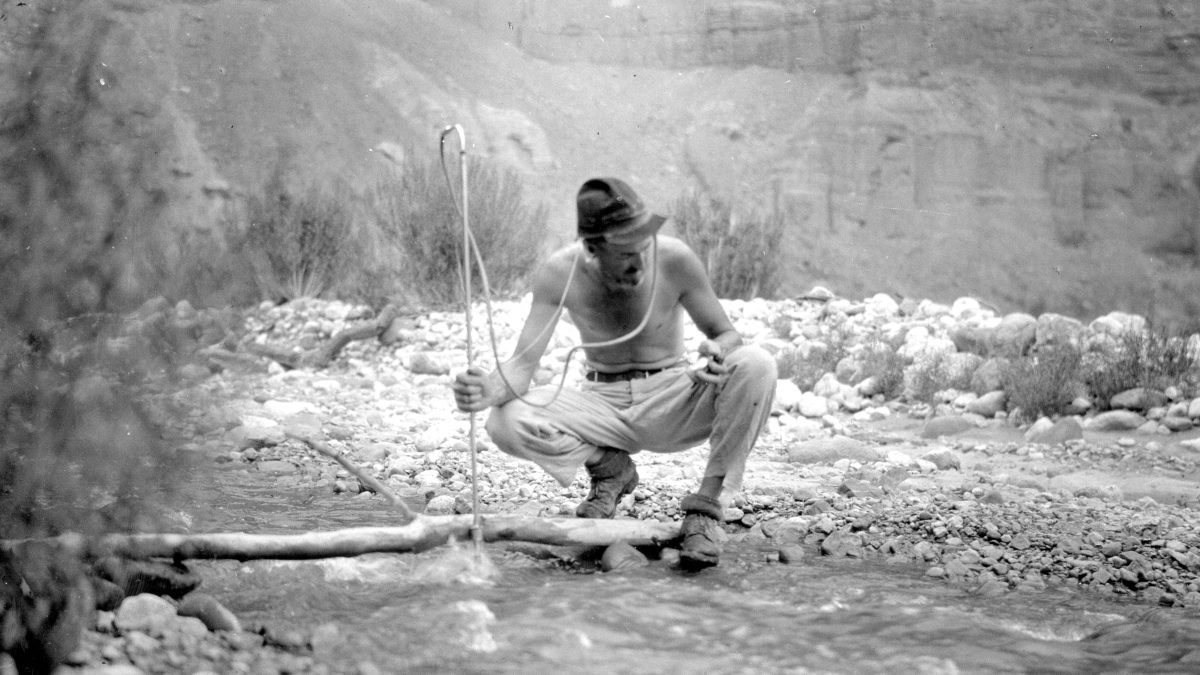
Eugene Clyde LaRue measuring the flow in Nankoweap Creek, 1923. Photo credit: USGS

This never really became a declared war between the scientists and the engineers, but there was a distinct tension. When the seven Colorado River Basin states sat down in 1922 to divide the use of the river’s waters among themselves, they found conflicting opinions on how much water actually flowed in the river on average. Bureau engineers, including Reclamation Commissioner Arthur Powell Davis, were a frequent presence at the Compact Commission meetings; they had a 25-year record of flows at Yuma going back to 1896, showing an average annual flow of just under 18 million acre-feet for that short period. Meanwhile, E.C. LaRue, a USGS hydrologist and geologist, had been working on that flow problem for years, and had done some early work on tree rings and desert evaporation, leading him to believe that flows between 12 and 14 million acre-feet of usable water were a reasonable long range expectation for the river.

LaRue volunteered his assistance to the Compact Commission, but Commission Chair Herbert Hoover (the federal representative on the Commission, and himself an engineer) thought that would be unnecessary, and the Colorado River Compact used Bureau numbers – and within a decade, certainly within the century, the willful river had demonstrated that scientist LaRue’s stodgy old researched numbers were much closer to the real river we have contended with down to the present. River ‘elder’ Eric Kuhn and journalist-historian John Fleck wrote a book, Science Be Dammed, exploring this tension between the scientists and the engineers in creating the Compact, for those interested in a more detailed account of that.

But for my story here – the Bureau did go on to ‘create its new reality.’ The 1928 Boulder Canyon Act, as it unfolded, became a lamp in the darkness of the Great Depression. Private capitalism – probably our least democratic economic engine – had failed utterly to deal with the Depression, but federal funding coupled with private initiative under the direction of the Bureau put thousands of people to work, building not one but three big structures on the Colorado River mainstem: Hoover Dam capable of storing two year’s flow of the river, Parker Dam to provide water for a huge aqueduct to the Los Angeles-San Diego metropolis, and the Imperial Weir Dam and All-American Canal to carry water to the vast reaches of the Imperial Valley – and every drop of water through the dams generating electric power for the Southwest. The desert reality was transformed for – well, maybe not forever, but for the life of the dams, ultimately proscribed by the inflow of mud as the busy river continued its mindlesstask of reducing the Southern Rockies and the Colorado Plateau to sea level peneplains.

But the Bureau did not stop there. After the second World War, under the aegis of the Colorado River Storage Project, the Bureau continued to build big storage dams with canals to carry water out into the high orographic deserts above the canyons and the hot subtropical deserts below the canyons, remaking most of the river – mountain tributaries collected the melted snowpack into rivers, as with all rivers – but then it went into desert ‘distributaries’ distributing the water to vast farms and rapidly growing cities in regions called ‘Death Marches’ by early explorers. That very little freshwater was left to ‘waste’ into the salty ocean was regarded as a victory – until it wasn’t. Another story there.

What we have to confront today, in the Colorado River region (natural basin plus out-of-basin areas served), is the extent to which the engineered new reality is ultimately dragged down and even stalled by the scientist’s dour desert realities the engineers thought could be transcended. It is unfair to blame the Bureau for the apparently unlimited growth of people moving into the river’s region, but the engineer’s ‘Can Do!’ attitude toward that growth has done little until very recently to bring us to confronting the unavoidable collision of unlimited demand on a limited resource – and now, a shrinking resource, given new concerns raised by those relentlessly reality-based scientists.

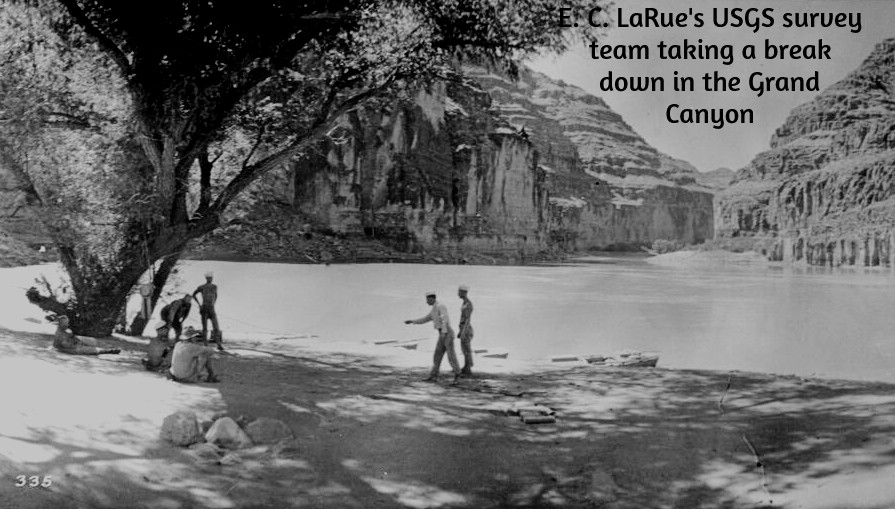
The Grand Canyon survey party at Lees Ferry. Left to right: Leigh Lint, boatman; H.E. Blake, boatman; Frank Word, cook; C.H. Birdseye, expedition leader; R.C. Moore, geologist; R.W. Burchard, topographer; E.C. LaRue, hydraulic engineer; Lewis Freeman, boatman, and Emery Kolb, head boatman. Boatman Leigh Lint, “a beefy athlete who could tear the rowlocks off a boat…absolutely fearless,” later went to college and became an engineer for the USGS. The Grand Canyon survey party at Lees Ferry in 1923. (Public domain.)

E.C. LaRue of the USGS warned us back in 1922 that storing the river’s water in big open reservoirs would reduce the supply of available water due to evaporation and bank-storage losses, but that seemed like a reasonable trade for water availability year-round over a river whose three-month flood was mostly lost to the sea anyway. The loss could be written off as ‘surplus’ – until the relentless demand ate up the fictional ‘surplus.’ Now it is suddenly necessary for the Lower Basin to count the ~800,000 acre-feet of evaporation from the Lower Basin reservoirs, canals and fields, as well as their half of the Mexican decree, against their Compact decreed 7.5 million acre-feet. Which they have reluctantly agreed to do – so long as the federal government pays them for not using what was not theirs to use anyway. (money that may be threatened by Mumpty’s DOGE).

And on top of that, there is gradual, general, reluctant acceptance of the fact that the burning of fossil fuels that powers nearly all of our civilization, plus the vast tonnage of cooling concrete that has gone into our great works, plus the gases from an increasingly vicious cycle of expanding wildfires and melting permafrost, are adding gases and heat to our atmosphere that are raising temperatures around the planet and causing changes in the global climate – oops.

I forgot; ‘climate change’ and ‘global warming’ have been officially eradicated from the public discourse. We are  creating another new reality to pile on top of the old new realities we’ve created over the past century plus: We have grown so accustomed to thinking like George Bush’s advisors that we don’t really notice that our newest new reality is just the child’s belief that putting our hands over our eyes will make the real world go away.

So I think that’s what we can do, at least in the Colorado River region: uncover our eyes, and start adjusting our new realities (which are not entirely bad) with the natural realities that still constrain the engineers – as even most of the engineers seem willing to acknowledge. We need to acknowledge that Becky Mitchell’s advice is now counterrevolutionary – ‘We must learn to plan for the river we have, not the river we wish we had.’ To the Trumpty-Mumpties, that’s almost Unamerican, saints be praised.

Whatever we do along those lines, however, it seems necessary that the scientists and engineers work together on it: both acknowledging the wisdom in the scientist looking carefully before the engineers leap – but both also acknowledging that some leaps will be needed….

***

Margaret Chase Smith in 1950:

President Trump’s administration thaws frozen IRA money: But will #Colorado’s electric cooperatives get all the money they were promised? The answer remains unclear — Allen Best (BigPivots.com)

The main street in Nucla, located in western Montrose County. Photo credit: Allen Best/Big Pivots

Click the link to read the article on the Big Pivots website (Allen Best):

March 28, 2025

Electrical cooperatives in Colorado were informed before Joe Biden left the White House that they would be getting about $3.5 billion from the federal government via programs funded by the Inflation Reduction Act of 2022.

Will they? U.S. Secretary of Agriculture Brooke Rollins announced Tuesday that her department was releasing funds previously committed but also described a “course correction.” Just what constitutes a “course correction” will likely not become fully apparent for weeks, perhaps months.

The release said that electrical cooperatives must first revise their project plans to “remove harmful DEIA and far-left climate features.” DEIA stands for diversity, equity, inclusion and accessibility.

The announcement by the USDA —the department houses the Rural Utility Services, the agency that works with cooperatives — also said electrical cooperatives would be asked several questions and would need to provide a short narrative description of any proposed changes in their projects.

The revised projects must also align with an executive order issued by President Donald Trump on Jan. 20 called “Unleashing American Energy.” Just exactly what those revisions need to look like remains unclear. In that executive order Trump rescinded a long list of executive orders issued by former President Joe Biden, including 10 that had to do with climate change.

Trump’s order made no mention of renewable energy but did order agency heads to identify actions that “impose an undue burden on the identification, development, or use of domestic energy resources – with particular attention to oil, natural gas, coal, hydropower, biofuels, critical mineral, and nuclear energy resources…”

“We are as interested to find out as you are,” replied Alex Shelley, who has the public information job at San Miguel Power Association, when I called him Wednesday afternoon. San Miguel expected to get a $9.8 million grant from the New ERA program to construct a 20-megawatt solar project in western Montrose County. That area of Montrose County includes Nucla, Naturita, and Uravan. Tri-State Generation and Transmission Association operated Nucla Station, a coal burning plant, until 2019.

In a statement posted on Jan. 23, Brad Zaporski, the chief executive of San Miguel Power, called the project a “shining example of partnership in action to help bolster our rural communities.”

The project, said Shelley, is to be on private land that is not useful for agriculture or anything other than light industry.

Brighton-based United Power was to get $262 million for six solar projects in its service territory in northern Colorado and one other project involving hydroelectricity. About 40% of the service territory is in Wattenberg Field, Colorado’s primary oil and gas producing area.

“I think the story is that the RUS wants to get the money moving to help rural communities,” said Mark Gabriel, the chief executive. “We were given the opportunity to make any edits or resubmit, and we chose not to (make changes to our application).”

The original application, he added, made no mention of diversity or inclusion. It asserted the desire to make United’s members more reliant on local resources and with lower-cost electricity.

Tri-State G&T has the most skin in this game. It provides wholesale electricity for 40 electric cooperatives in a four-state area, including 15 in Colorado. Tri-State in 2024 said it was getting a financial package worth $2.5 billion, most of that in loans of less than 2%. Those low-interest loans will allow it to get out from under higher-interest financing as it prepares to close its coal units in Colorado and Arizona during coming years.

In an October announcement, Tri-State said New ERA funding would support financing for 1,280 megawatts of energy from solar, wind and wind-storage projects, and more than 100 megawatts of stand-alone energy storage.

The company also plans a natural gas plant, preferably in northwest Colorado or conceivably southwest Wyoming.

Tri State expects to reach 70% clean energy by 2030. Within Colorado, this will be an 89% reduction as compared to a 2005 baseline.

“We appreciate the work of Secretary Rollins and her team to advance the program, and we will be reviewing the USDA’s guidance and look forward to continuing our work through their process,” said Tri-State CEO Duane Highley in a statement posted on Wednesday.

In Fort Collins, Jeff Wadsworth was cautious about what the final tally will look like. He’s the chief executive of Poudre Valley REA, which is in line to get $9 million to help pay for two solar-and-storage projects. The grant was through Powering Affordable Clean Energy, or PACE, another program funded by the IRA.

“We are thrilled about this development and look forward to collaborating with the dedicated team at the USDA,” he said initially when asked for a response. In a telephone conversation the next day, however, he said that the full story remains to be written.

Wadsworth is optimistic that Poudre Valley will get its money. Demand for electricity has continued to grow for multiple reasons, and these projects will help Poudre Valley meet that demand. But this grant is not the end-all, be-all for Poudre Valley as it moves forward, he said.

“It helps our ratepayers, who are part of rural Colorado, We are excited about that,” said Wadsworth. “But our path is pretty clear as we move forward.”

Still another perspective comes from Eric Frankowski, the executive director of the Western Clean Energy Campaign.  He believes that despite the “problematic” language of the announcement, the guidance that RUS has issued for the cooperatives has eased a lot of concerns.

“It appears that the process is completely voluntary and that co-ops do not need to do anything. The language says that RUS will NOT approve proposed modifications ‘that affect the scoring of projects that were competitively scored.’ Since community benefits, decarbonization and lowering rates were all integral to how proposals were evaluated, I think we can take that as a good sign,” he wrote in an e-mail.

That guidance can be found here.

“The guidance also says that if awardees do not respond within 30 days requesting a revision, ‘it will be considered that they do not wish to make changes to their proposals, and disbursements and other actions will resume after the 30 days.’ (emphasis added) It also says that awardees can respond that they are not changing their proposal and processing of payments will begin immediately. Also good signs,” said Frankowski.

“There doesn’t seem to be a pathway where co-ops are punished for staying the course on their clean energy plans,” he added. “Who knows what happens after the 30-day window, but things seem good for now.”

Granby-based Mountain Parks Electric in January announced that it had executed a letter of commitment with the U.S. Department of Agriculture for a grant prog ram of $100 million across the next 20 years. The announcement said that the money will be used to help procure power through power-purchase agreements and to advance and promote scholarships and apprenticeship programs. The announcement was made two weeks before Mountain Parks left Tri-State and began getting its wholesale power from Guzman Energy in a 20-year agreement.

Sedalia-based CORE Electric Cooperative hopes for $225 million and Steamboat Springs-based Yampa Valley Electric $50 million. Grand Junction-based Grand Valley Power Lines also expected to get federal funds.

In his statement, Highley credited the work of U.S. Representatives Jeff Hurd, Gabe Evans, Lauren Boebert, all from Colorado, and Gabe Vasquez, of New Mexico, as well as Colorado Senators John Hickenlooper and Michael Bennet. Bennet, in particular, had gone to bat for the New ERA provision for cooperatives in the IRA. He spoke in October at Tri-State’s headquarters when a finalized announcement was made.

#Colorado Basin River Forecast Center Water Supply Forecast Discussion April 1, 2025 #ColoradoRiver #COriver #aridification

Click the link to read the discussion on the Colorado Basin River Forecast Center website:

The Colorado Basin River Forecast Center (CBRFC) geographic forecast area includes the Upper Colorado River Basin (UCRB), Lower Colorado River Basin (LCRB), and Eastern Great Basin (GB).

Water Supply Forecasts

April 1 water supply forecasts across the CRB and GB are generally below to well below normal and summarized in the figure and table below. Snowpack, soil moisture, and future weather are the primary hydrologic conditions that impact the water supply outlook.

April 1, 2025 seasonal water supply forecast summary. Credit: Colorado Basin River Forecast Center

March Weather

March brought stretches of both active and quiet weather for the CBRFC area. Overall, conditions were neither extremely wet nor extremely dry, and most of the significant runoff areas ended the month within 30% of average March precipitation. Generally, the storm track benefitted the western side of the CBRFC area (mountains of UT and central/western AZ) more than the eastern side. Most of the systems were cold in nature with precipitation falling as snow over the high terrain.

In the LCRB, March featured this season’s wettest period of weather to-date. For context, Flagstaff, AZ experienced its 16th snowiest March on record (out of 126 years) with 35.6 inches of snow. However, if the season were to end today, it would also rank as the 22nd least snowy water year on record. A similar story can be applied to much of the rest of the LCRB — while March was beneficially wet, the season as a whole remains historically dry.

Toward the end of the month, a strong ridge of high pressure resulted in well above normal temperatures for the region. Numerous record high maximum and minimum temperatures were observed. This period of warm, sunny weather led to snowmelt in many lower and middle elevation locations. A cold storm system arrived during the final days of the month that reduced snowmelt rates and brought additional snow to higher elevations.

Snowpack Conditions

Snow water equivalent (SWE) conditions as a percent of normal remained relatively steady during the past month due to near normal March precipitation. UCRB April 1 SWE conditions range between 60-110% of normal and are most favorable across northern areas including the Upper Green, White/Yampa, and Colorado River headwaters. SWE conditions across southern basins including the Dolores and San Juan are well below normal, with April 1 SWE at several SNOTEL stations ranked in the driest three on record. UCRB April 1 snow covered area is around 103% of the 2001-2024 median <superscript>1</superscript> LCRB SWE conditions this season have been at or near record low across southwest UT, central AZ, and west-central NM as a result of near record dry winter weather. GB April 1 SWE conditions range between 45-105% of normal and generally improve from south to north.

SWE is near normal across most of the GB, with the least favorable snowpack conditions in the Sevier River Basin, where April 1 SWE ranks in the driest three on record at several SNOTEL stations. UT snow covered area is around 125% of the 2001-2024 median. <superscript>1</superscript> SWE conditions are summarized in the figure and table below.

Left: April 1, 2025 SWE – NRCS SNOTEL observed (squares) and CBRFC hydrologic model. Right: CBRFC hydrologic model SWE conditions summary.

Soil Moisture

CBRFC hydrologic model fall (antecedent) soil moisture conditions impact water supply forecasts and the efficiency of spring runoff. Basins with above average soil moisture conditions can be expected to experience more efficient runoff from rainfall or snowmelt while basins with below average soil moisture conditions can be expected to have lower runoff efficiency until soil moisture deficits are fulfilled. The timing and magnitude of spring runoff is impacted by snowpack conditions, spring weather, and soil moisture conditions.

A very dry June-October 2024 across southwest WY and UT resulted in soil moisture conditions that are below normal and worse compared to a year ago. NW CO soil moisture conditions are near to below normal and similar compared to a year ago. SW CO soil moisture conditions are closer to average and improved from a year ago due to a wetter than normal monsoon (mid-June through September). Monsoon precipitation was near/below normal across the LCRB, where soil moisture conditions are below average and similar compared to last year. CBRFC hydrologic model soil moisture conditions are shown in the figures below.

November 2024 CBRFC hydrologic model soil moisture conditions – as a percent of the 1991-2020 average (left) and compared to November 2023 (right).

Upcoming Weather

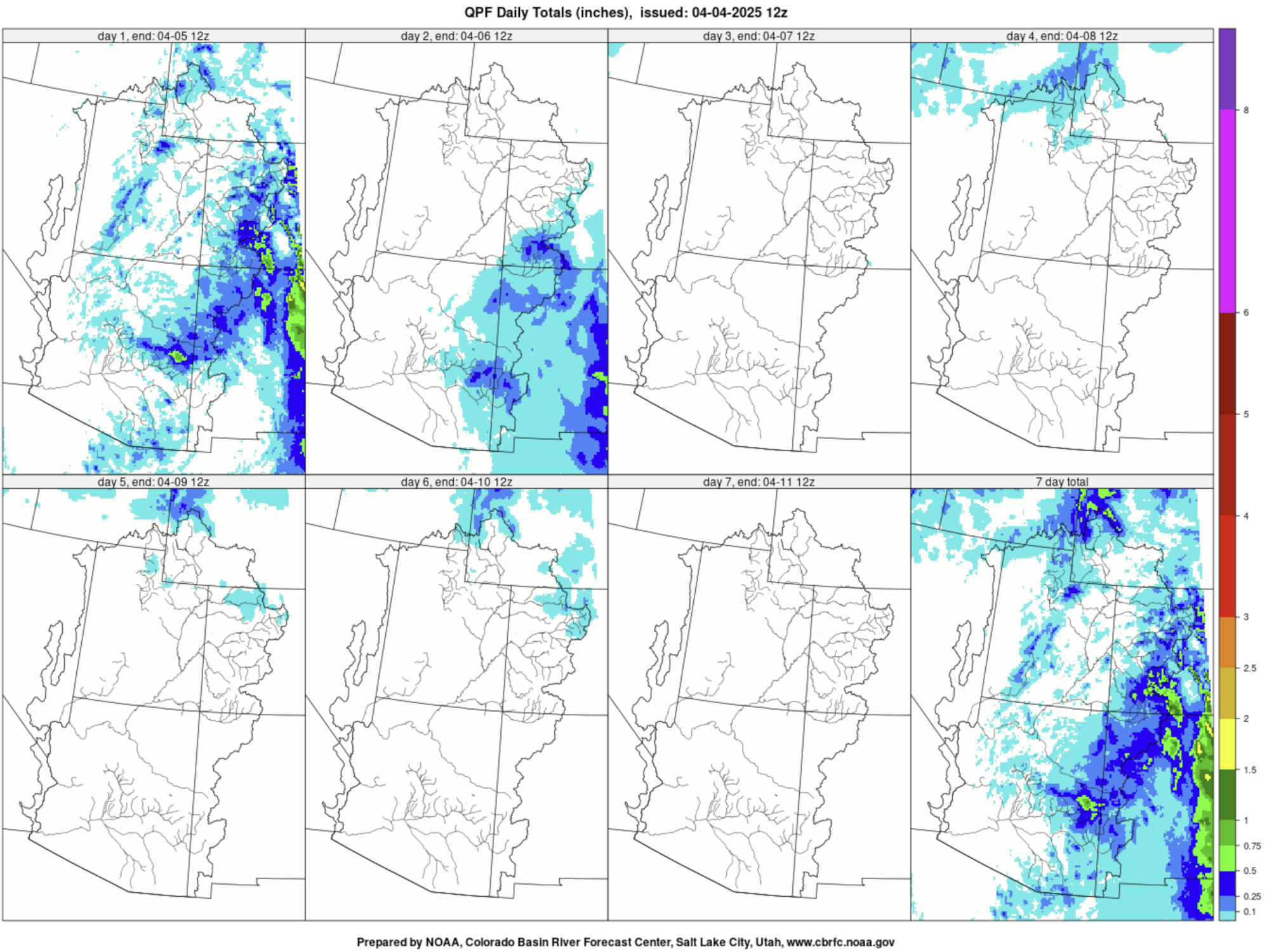
The next two days (April 4-5) will continue to bring cool and unsettled weather across much of the region before a warming and drying trend takes hold at the beginning of next week. Precipitation amounts through Sunday, April 6, will be highest along the Continental Divide and into eastern portions of the Mogollon Rim in AZ, however, maximum precipitation totals will likely be less than an inch. Temperatures across the region are expected to warm to around 10 degrees above normal by the middle of next week, with mostly dry conditions. The only exception to this will be the far northern portions of the GB and UCRB, where a passing disturbance will bring a chance of light precipitation to higher terrain. Above average temperatures and drier than normal conditions are expected to persist into mid-April.

7-day precipitation forecast for April 4 – 11, 2025.
Climate Prediction Center precipitation probability forecast for April 12–18, 2025.
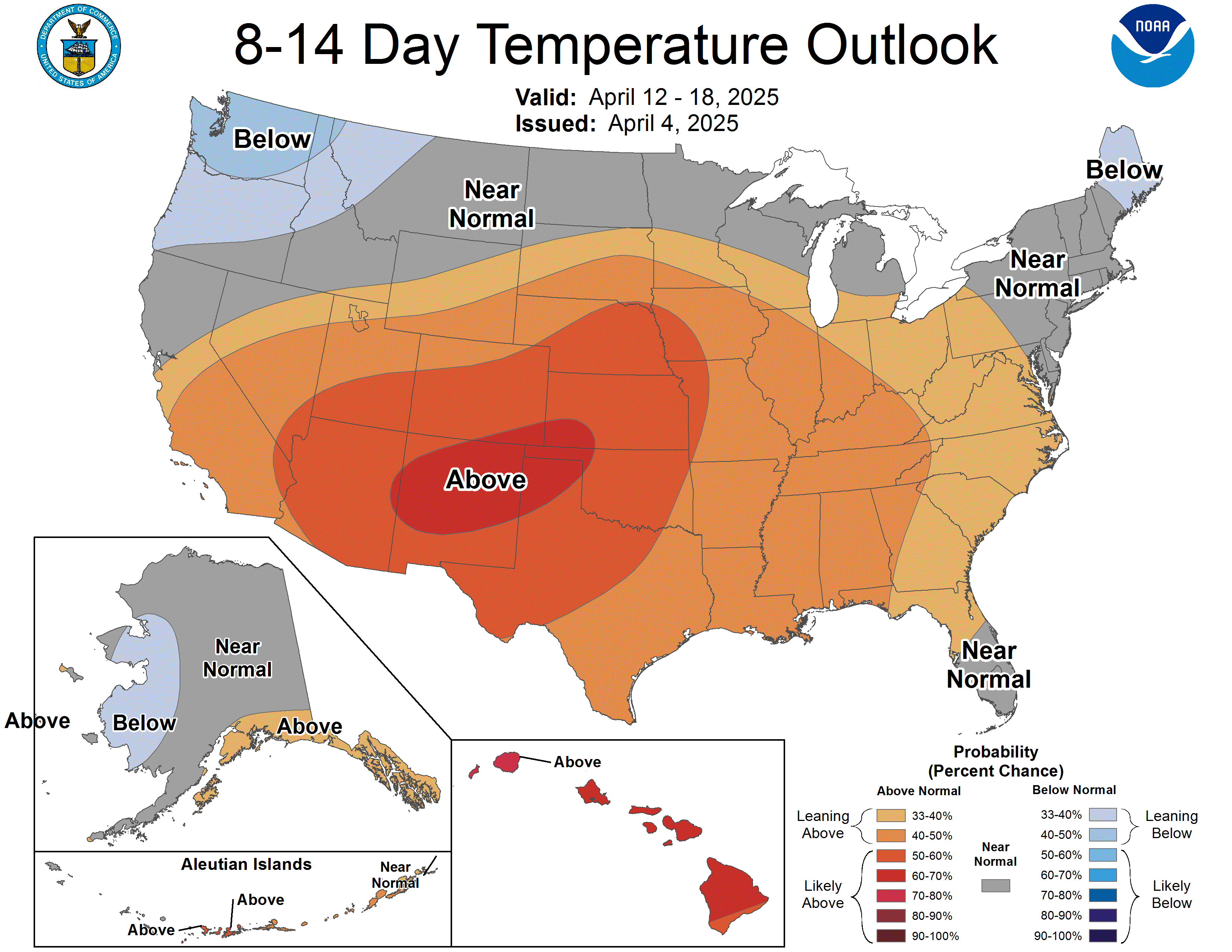
Climate Prediction Center temperature probability forecast for April 12–18, 2025.

Judge orders Denver Water to halt expansion of Gross Reservoir over flawed environmental permitting: Water provider’s $531 million project has been underway in Boulder County since 2022 — The #Denver Post #ColoradoRiver #SouthPlatteRiver

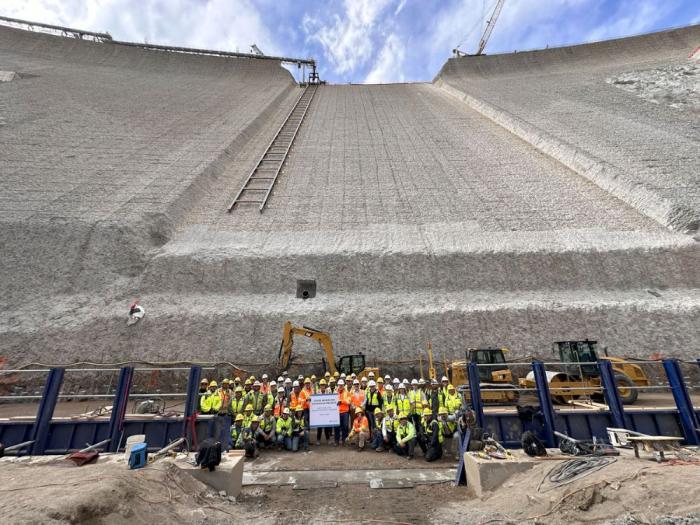
Workers from Denver Water and contractor Kiewit Barnard stand in front of Gross Dam in May 2024 to mark the start of the dam raise process. Photo credit: Denver Water.

Click the link to read the article on The Denver Post website (Elise Schmelzer). Here’s an excerpt:

April 4, 2025

Colorado’s largest water provider must stop construction on a $531 million dam expansion already underway in Boulder County after a federal judge found that assessments of how the project would impact the environment were flawed. U.S. District Court Judge Christine Arguello in an order late Thursday blocked Denver Water from enlarging Gross Reservoir east of Nederland until major federal environmental permitting processes are redone. The judge found that allowing the reservoir expansion to continue without redoing the permits would cause irreparable environmental damage that cannot be compensated for by monetary payments. That harm would outweigh any financial costs Denver Water would incur from halting construction, she wrote.

“Environmental injury is often the very definition of irreparable harm — often permanent or at least of long duration,” Arguello wrote. “All parties agree that there will be environmental harm resulting from completion of the Moffat Collection System Project, including the destruction of 500,000 trees, water diversion from several creeks, and impacts to wildlife by the sudden loss of land.”

She issued a preliminary injunction ordering Denver Water to halt construction on the dam until a further hearing when engineers can explain how much further construction is needed to make the partially built dam safe and structurally sound. Denver Water planned to raise the height of the dam by 131 feet, allowing the utility to store more water. She will then issue a permanent injunction on how much more construction will be allowed. The order is a huge victory for environmental groups that for years have opposed the controversial project. A coalition of environmental groups first filed suit in 2018 to stop the expansion of the reservoir, which they say would harm the health of the Colorado River system — where the reservoir’s water is sourced.