The USGS helps Department of the Interior partners explore possible management decisions to prevent invasive fish from spreading into the Grand Canyon.
Sources/Usage: Public Domain. View Media Details Learn about how USGS scientists work with the U.S. Fish and Wildlife Service and Bureau of Reclamation to protect Grand Canyon ecosystems from invasive smallmouth bass. From modeling fish population growth to forecasting the effects of future dam operations, the USGS’s unbiased, high-quality science helps on-the-ground managers rise to new challenges brought on by climate change. (Click to view the video)
Part 1: The River
The Colorado River is not a naturally flowing river, not anymore. With Glen Canyon Dam upstream and Hoover Dam downstream, the Colorado River in Grand Canyon is one of the most highly regulated water systems in the world. Its flow generates hydroelectricity, irrigates crops and provides water to nearly 40 million people across seven U.S. states, 30 Tribal Nations and two Mexican states.
Graphic via Holly McClelland/High Country News.
Managing the Colorado River Basin is complicated. Federal, state and Tribal agencies balance the needs of many user groups, from anglers to farmers to city municipalities. They also care for the river as an ecosystem, home to rare fish and the foundation of Grand Canyon, one of the Nation’s natural treasures. In an era of heat waves and drought, when there is less water than ever to go around, managers increasingly need high-quality science to respond to emerging challenges.
The USGS provides critical science to resource managers in the Colorado River and Grand Canyon. Our stream gages monitor water quality and flows, our researchers track fish populations and our modelers forecast how resources may respond to future conditions. We help managers anticipate new threats and consider potential outcomes of management decisions.
And on a scorching day in June 2022, the summer Lake Powell reached its lowest water level in five decades, we sprang into action when one of our predictions became suddenly real.
Did you hear what they caught in Lees Ferry?
For the first time, National Park Service staff caught baby smallmouth bass in the lower Colorado River, south of the Glen Canyon Dam holding back Lake Powell. While this voracious, predatory fish had previously been caught in very low numbers in the relatively pristine Grand Canyon ecosystem, such captures had been rare, and they had never been observed reproducing.
The finding raised fresh concerns about the future of native fish of the Grand Canyon.
Part 2: The Fish
Smallmouth bass were originally stocked in Lake Powell as a valued catch for anglers and have since established healthy populations throughout the lake. But with low lake levels in recent years, smallmouth bass can be sucked through the dam and spat into the Colorado River. Worse, extended drought means river temperatures are warmer than usual, creating especially hospitable conditions for the warm-water fish to proliferate.
To slow the spread, Eppehimer and USGS research statistician Charles Yackulic worked with academic, state and federal cooperators to develop models predicting when and where the fish might invade, based on projected temperatures and Lake Powell water levels. These models help the National Park Service prioritize locations for smallmouth bass monitoring and eradication.
Adding extra urgency: Smallmouth bass threaten to erase years of conservation gains for the threatened and endangered species of Grand Canyon. Most of the fish in the park today are native species, a hard-fought accomplishment in an era of constant non-native species invasions. And the humpback chub was recently downlisted from “endangered” to “threatened” after successful conservation efforts from park staff.
But smallmouth bass are a particularly lethal threat. Laboratory predation trials by the USGS and U.S. Fish and Wildlife Service (USFWS) show that smallmouth bass eat native fish at all life stages, from small babies to grown adults.
“Most of the sport fish species have big mouths and big teeth and they like to eat native fish,” says David Ward, fish biologist and assistant project leader for USFWS Conservation Office in Flagstaff, AZ. “When you get all those species preying on the chubs at all different life stages, they just don’t get a break.”
Part 3: The Dam
If managers want to prevent smallmouth bass from becoming a permanent addition to Grand Canyon, they need to act fast. Once a species becomes established, it becomes virtually impossible to eradicate completely.
Smallmouth bass management is a high priority for the Glen Canyon Dam Adaptive Management Program (GCDAMP) and the Adaptive Management Work Group (AMWG), a Federal Advisory Committee in the Colorado River Basin. Led by the Bureau of Reclamation (BOR), this group brings together twenty-five stakeholder and rightsholder groups representing different interests, including states, Tribal Nations, economic sectors, non-profit environmental organizations and hobby groups. Together, they provide recommendations to the U.S. Secretary of the Interior for how to manage flows from Glen Canyon Dam.
The USGS’s Grand Canyon Monitoring and Research Group (GCMRC) is a fixture of these quarterly meetings, tasked with providing science to help members understand environmental change happening on the landscape and how different management alternatives may perform under future conditions.
A major discussion point for the advisory committee is how water should flow out of the dam – how often water should be released, how much water at a time, which part of the dam it should be released from, etc. These questions are important, impacting everything from hydroelectricity production to downstream rafting conditions.
Eppehimer, Yackulic and other USGS researchers created models to predict how changes to Glen Canyon Dam flows may affect different systems, including energy production, river hydrology and sandbar formation. Of particular interest: they explored how pumping cold water from the dam’s deep bypass jet tubes could impact smallmouth bass viability below the dam. They identified ideal water temperatures for bass to grow and reproduce and modeled how cooling river temperatures using dam flows could impact overall population growth.
Using one of the USGS-modeled alternatives, the Bureau of Reclamation has begun modifying Glen Canyon Dam flows to try to prevent smallmouth bass spawning. When river temperatures reach 60°F (15.5°C) in the Colorado River at the confluence with the Little Colorado River tributary (76 miles downstream from the dam), the BOR releases deeper, cooler flows from Glen Canyon Dam to create less favorable conditions for smallmouth bass growth and reproduction. They began these releases on July 9, 2024, and are now working with the USGS and other DOI agencies to actively monitor the effects on river conditions and smallmouth bass populations.
This work was funded by USGS’s Southwest Climate Adaptation Science Center (Southwest CASC), Ecosystems Mission Area, Water Mission Area, and the U.S. Bureau of Reclamation. The project embodies the USGS’s actionable science model, which prioritizes applied research designed to meet on-the-ground needs.
“It is an excellent example of partnership-based science,” says Sarah LeRoy, Research Coordinator with the Southwest CASC. “From the very beginning, managers asked a question about what’s going to happen to fish, native and invasive, in the Colorado River Basin, and the scientists answered their questions in a way that helps them better care for the river in the future.”
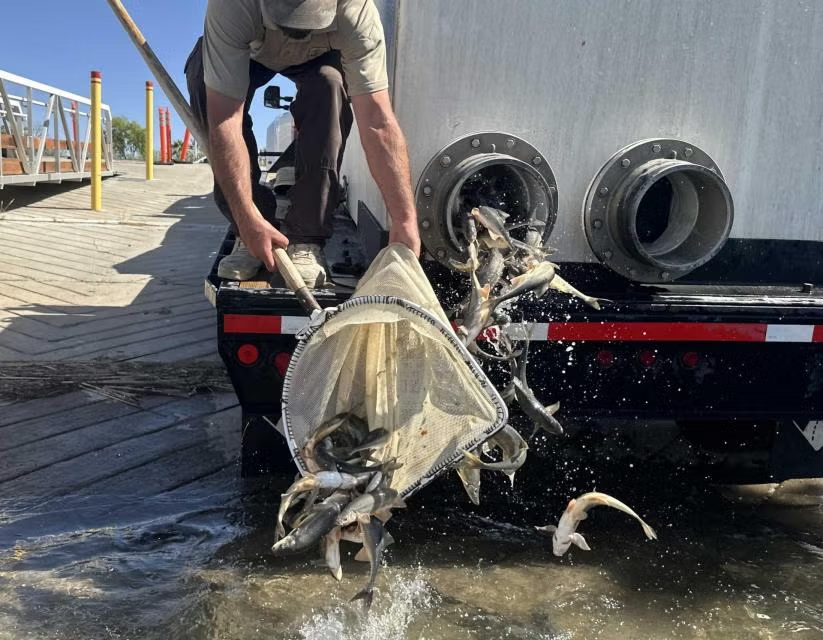
Endangered bonytail chub were released into a Colorado River lagoon south of Laughlin, Nev., in spring of 2024 as part of the MSCP. (Source: Bureau of Reclamation)
WESTERN WATER IN-DEPTH: As the 50-year Multi-Species Conservation Program hits the 20-year mark this month, new questions about how to keep it strong hang over its future
Before the construction of Hoover Dam on the lower Colorado River, as well as a slew of smaller sisters downstream, the stretch downriver served as a biological oasis in the middle of the unrelenting Mojave and Sonoran deserts. The marshes and backwaters along the river’s edge provided sheltered areas for fish to spawn and rear their young, and mesquite and cottonwood-willow forests provided important habitat for numerous species of birds and other animals. But when Lake Mead began filling behind Hoover Dam in 1935, it drastically reduced the amount of water flowing downstream, radically altering the habitat there.
In the decades that followed, the river flow captured by Hoover Dam became a critical source of water for farms and cities across Southern California, Nevada and Arizona – transforming deserts into some of the nation’s most productive farmland and creating some of the most populous cities such as Los Angeles, Phoenix and Las Vegas. Today, more than 27 million people in the three states rely on water from the Colorado River—roughly two-thirds of the total population that the river serves. Yet even as that dependence on the river grew, a collision between human and environmental needs was brewing.
Historically, the Colorado River was home to more than 30 mostly endemic native fish species. In 1967, a native fish called the pikeminnow and another called the humpback chub were classified as endangered under federal law. They were the first of what are known as the four “big river” fish species to be added to the endangered species list. Thirteen years later, in 1980, came the bonytail chub. Then, in 1991, came the fourth – the razorback sucker. (An endemic bird called the Yuma clapper rail had also been classified as endangered in 1967.)
For municipal and agricultural water managers who depended on the Colorado, the growing list of endangered species was a wakeup call. It spurred a decade-long effort to craft a multi-party agreement that allowed water agencies to continue delivering water to their users while staying ahead of the mounting endangered species issues. That effort has largely proven successful, but as the program now crosses the 20-year mark, new questions are arising about how to keep it strong for the next three decades in the face of grinding drought, contentious negotiations over the river’s future, and new uncertainties about the federal government’s role in its continued implementation.
A New Approach on Habitat
In November 1994, the federal Bureau of Reclamation, which operates the big Colorado River dams and makes water deliveries, agreed to work together with state and local agencies to mitigate the effects of water and power operations on threatened and endangered species. The effort didn’t come a moment too soon: Four months later, another species — a bird called the southwestern willow flycatcher — was also declared endangered.
“When the big-river fishes were listed, it was a kick in the pants for folks along the river to put together something broad enough to anticipate most of what’s going to happen in the next 50 years,” said Jessica Neuwerth, the executive director of the Colorado River Board of California, which represents the state’s agricultural and urban users of the river’s water. “Then the southwestern willow flycatcher kicked it into overdrive.”
As it happened, a new approach had recently appeared on the horizon that focused on restoring and protecting habitat not just for individual endangered species, but for a broad range of them existing in a particular region. Long-term, large-scale “multispecies habitat conservation plans” were taking shape in a variety of places, including California’s San Diego County, southwestern Riverside County and the Coachella Valley.
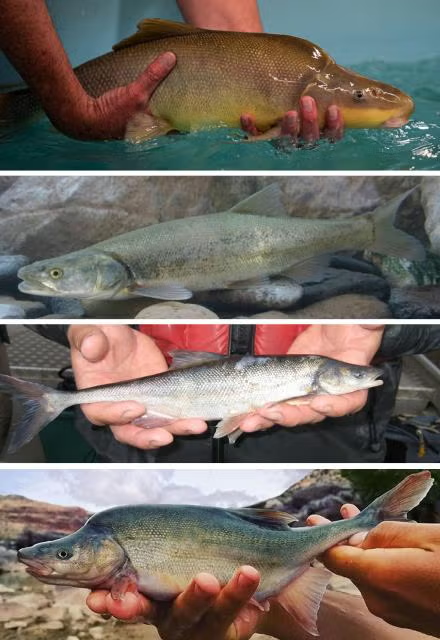
The four so-called big river fish, from top: razorback sucker, Colorado pikeminnow, bonytail chub and humpback chub. (Source: U.S. Fish and Wildlife Service)
The new approach was championed by Bruce Babbitt, the former governor of Arizona who, at the time, was Interior secretary under Bill Clinton. “Babbitt was a big advocate for this style of landscape-level species and habitat management,” said Chris Harris, who preceded Neuwerth at California’s Colorado River Board and was involved in the early discussions. “And he really urged all of us to keep our noses to the grindstone and put something together that could work.”
The effort to create a broad habitat conservation program for the Lower Colorado dragged on for a decade. But it quickly became clear that all the participants would be better off if they tackled the endangered species issue together. Finally, in April 2005, the federal government and non-federal participants signed an agreement that officially launched the Lower Colorado River Multi-Species Conservation Program. Under it, the Bureau of Reclamation, irrigation districts and municipal water agencies committed to a 50-year, $626 million inflation-adjusted program, splitting the cost evenly between the federal government and state parties.
The Lower Colorado River MSCP “is unique in a lot of ways — partly because it is a federal and non-federal program, where we really haven’t even tried necessarily to disentangle whose impact is whose,” said Neuwerth. “There’s so much overlap between what the feds do and what the state or local agencies do that we really are bound together. We’ve blended both the non-federal and federal compliance into one package, and it’s more efficient than everybody going off and doing their own thing.”
Managed by the Bureau of Reclamation, the program pledged to create 512 acres of marsh and 360 acres of backwaters — habitat for Colorado River native fish — as well as 1,320 acres of mesquite woodland and 5,940 acres of cottonwood-willow forest along the river for the imperiled birds. In addition, the program would pay for rearing and stocking more than 660,000 razorback suckers and 620,000 bonytail; fund ongoing maintenance of the newly created habitat; and carry out monitoring and research to adaptively manage restoration efforts based on an
Intended to last over the long term, the MSCP was also designed to be flexible. “That’s always been the goal,” said Neuwerth, “to be proactive and make sure that we have this umbrella that’s going to protect us for a pretty wide range of future conditions.”
Seth Shanahan, Colorado River Program Manager for the Southern Nevada Water Authority. (Source: Water Education Foundation)
The program was not designed to recover endangered species populations. But it was, at its root, an insurance program to protect Lower Basin water users and the federal government against potential violations of the Endangered Species Act, or ESA, as they continued their primary mission of delivering water to cities and farms.
“We couldn’t do what we do on a day-to-day basis without this program,” said Seth Shanahan, the Colorado River Program Manager for the Southern Nevada Water Authority (SNWA), which supplies water to the Las Vegas metropolitan area. He noted that water agencies are dependent on the Bureau of Reclamation’s ability to store water in Lake Mead and deliver it downstream, as well as to develop plans for when to take shortages and how to share water among themselves to lessen the impacts of drought. “All of that is enabled by the MSCP.”
Helping Species Survive and Thrive
In contrast to an endangered-species recovery program, the MSCP isn’t explicitly intended to increase endangered species populations to the point that they can be taken off the endangered species list, or their protection status at least downgraded.
“MSCP is a habitat creation program,” said Vineetha Kartha, Colorado River programs manager for the Central Arizona Project (CAP), which transports river water to Phoenix, Tucson, farms and tribes. “We are creating habitat so that species thrive and can still survive under these changed circumstances.”
Twenty years in, the program has already created roughly 75 percent of the habitat it initially pledged to take on.
“We’re trying to do the best we can with what is available,” said SNWA’s Shanahan. “Restoring the functionality of habitat for species is the important part, not necessarily (restoring) it to what was there 500 years ago.”
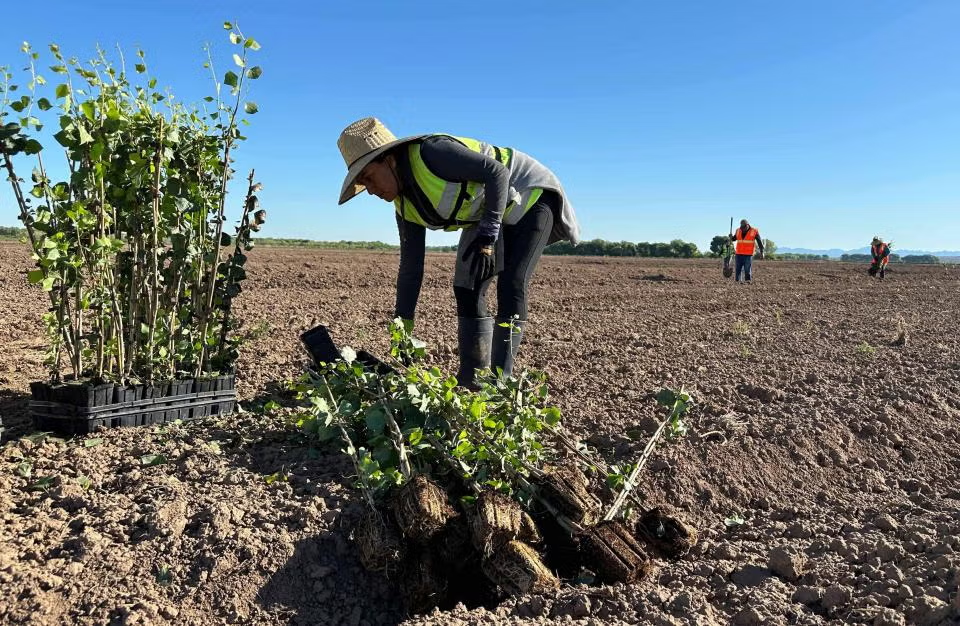
Workers plant seedlings of cottonwoods, willows and mesquite trees at an MSCP habitat restoration project south of Blythe, California. (Source: Bureau of Reclamation)
MSCP’s adaptive management, or adjust-as-you-go, approach has helped it adapt to changing conditions and a constantly improving understanding of how to meet the needs of individual species. “Folks early on realized they didn’t know everything. So they gave us an opportunity to modify the course as we learn more information, and that’s really useful,” Shanahan said. “We need to have some space to try different things and see what works.”
One important part of the program focuses on stocking hatchery-raised razorback suckers and bonytail into their native habitat below Hoover Dam. But because the natural system has been so drastically altered, ensuring their survival hasn’t been easy.
“It’s a tough hand of cards for native fish in this part of the world,” said Neuwerth, an environmental scientist by training. “We have dams, we have diversions, we have introduced fish, and there’s really no way of turning that clock back. We’re doing the best we can with the system as it is, and we’re trying out new stuff all the time. Anything that can give our fish an edge, we’ve looked at it.”
Giving native fish — which are raised in hatcheries as far away as eastern New Mexico — that edge has gone as far as running “fish survival camps” to teach them the kind of street smarts they need to survive in the modern-day river. At one point, fisheries biologists even used Botox injections to paralyze the jaws of non-native fish and then released them, along with a dose of predator-alarm pheromones, into ponds filled with razorback suckers and bonytail chub to teach them how to recognize and avoid predators.
Outside-the-box experimentation like that has been just one of the ways the MSCP has been able to adapt to changing realities on the river.
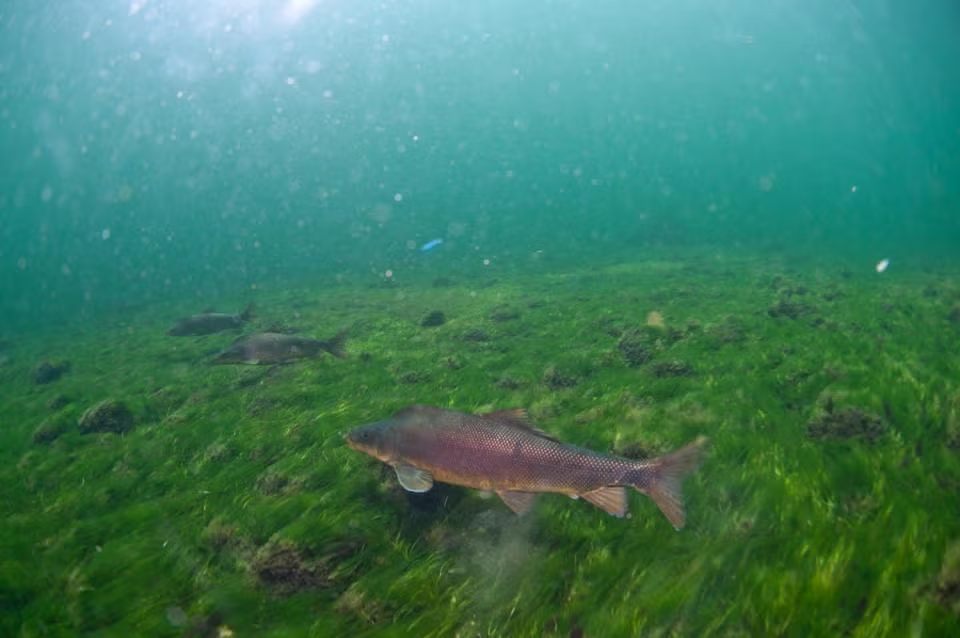
Humpback chub swim in the waters of the Lower Colorado River. (Source: Bureau of Reclamation)
“We always knew that what we were doing was not going to be the be-all, end-all, for the full 50-year term,” Harris said. To accommodate unanticipated events such as the discovery of new protected species within the MSCP project area, the program’s creators adopted what he called a “plug and play” approach.
In 2015, biologists discovered the presence of the threatened Northern Mexican gartersnake upstream of Lake Havasu, a key reservoir for Southern California and Arizona, possibly drawn in by habitat improvements made under the MSCP.
“That wasn’t on our list (in 2005) but then became threatened, and it was found within our program area,” said SNWA’s Shanahan. “So we also had to go back and consult on the impacts to that species. But there were mechanisms in the permits that allowed us to do that pretty efficiently.”
‘A String of Pearls’
The heart of the MSCP is its commitment to create conservation areas that provide the marshes, backwaters and riverside forest on which endangered species depend. One of the MSCP conservation areas lies on tribal land of the Fort Yuma Quechan Indian Tribe.
“The tribe had a strong interest in pursuing a project that would reconnect the tribal people and the larger community back to the river,” said Brian Golding, Sr., the Quechan tribe’s economic development director. As dams, levees and irrigation projects were developed, “the river was forgotten. Anything on the river side of the levees essentially became overgrown and invaded by invasive species and became a no-man’s land.”
Lower Colorado River Multi-Species Conservation Program
Since 2005, the Lower Colorado River Multi-Species Conservation Program has grown to include 18 habitat conservation areas along the river. The map below highlights the six stretches of the river with MSCP-managed habitat.
In 2004 the tribe, in partnership with the Yuma Crossing National Heritage Area, the city of Yuma and the Arizona Game and Fish Department, began restoring wetlands on the tribe’s reservation along the Colorado River, creating a mosaic of marshes and stands of mesquite, cottonwood and willow that benefit an array of endangered species. In 2013, the tribe finalized an agreement with the MSCP to include the 380-acre Yuma East Wetlands within the program in exchange for operation and maintenance funding over 50 years.
That has helped the tribe develop its own ability to restore and maintain natural habitat along the river. Today, six members of the tribe work on habitat restoration and maintenance, along with a tribe member-owned contracting company, and Golding said the tribe is in talks with the MSCP program to restore another 30 to 40 acres of wetlands along the river.
The Yuma East Wetlands are just one piece of the bigger network of conservation areas, which has grown to 18 sites between Hoover Dam and the Mexican border.
When the MSCP first started, “I think people thought this was just a Band-Aid and duct tape approach,” said Harris. “Now, these conservation areas are really a string of pearls, and they’re all sort of connected together. Every few miles, there’s a huge patch of native riparian marsh and aquatic habitat that’s being managed by the program so the species can travel up and down the riverine corridor – whether they’re birds or fish or terrestrial species – and have these areas of safe haven.”
Although the MSCP is a stand-alone program, it’s ecologically linked with an ambitious restoration effort taking place across the border in Mexico. There, a coalition of non-governmental organizations including National Audubon Society, Restauremos el Colorado, the Sonoran Institute and Pronatura have been working to restore portions of the Colorado River Delta. “Many of the ideas and techniques that have been developed and utilized in the MSCP have now been applied in the Mexican restoration program,” Harris said, “so there’s been a lot of carryover and cross pollination from work done under the MSCP down to the environmental program in Mexico.”
The Hart Mine Marsh was initially created by historic flood flows from the Colorado River, but as the river system changed, including from water operations, the marsh deteriorated. Reconstruction of the marsh is among the habitat projects undertaken through the MSCP. (Source: Bureau of Reclamation)
Ecologically, both those efforts also tie together with the ongoing initiative to restore habitat at the Salton Sea, Harris said. “If you can link those three areas,” he said, “you’ve got a pretty good mosaic now from Lake Mead downstream all the way to the Gulf of California.”
Julia Morton, Audubon’s Colorado River program manager, said MSCP’s comprehensive approach and its rigorous scientific monitoring program can help improve conditions not just for the species it’s specifically designed to protect, but for the entire ecosystem along the lower reaches of the river. “That’s a huge improvement over ‘one-off’ mitigation projects,” she said.
In late April, the MSCP’s steering committee will vote on a request by Audubon to join the committee — a move that would only strengthen the synergy between the U.S and Mexican restoration efforts. “The frameworks and the driving forces of each program are pretty different,” said Morton, “but at the end of the day, these programs are both creating quality habitat.”
The Catch-22 of Historic Drought
Those efforts seem to be yielding positive results. In 2021, for instance, the humpback chub was “down listed” from endangered to threatened. But along the way, the MSCP has been forced to contend with a number of unanticipated challenges – especially drought.
“A lot of thought was put into MSCP,” said CAP’s Kartha. But when the program was designed, “we didn’t understand how bad the hydrologies could tank.”
Vineetha Kartha, Colorado River programs manager for the Central Arizona Project. (Source: Central Arizona Project)
When the MSCP was officially launched in 2005, the Colorado River Basin was already five years into a major drought, which has only gotten worse in the years since. The drought is now dragging into its 25th year, and studies suggest that it could be the worst drought on the river in the past 1,200 years.
“Hydrology has been our biggest surprise so far,” said Kartha. “And basically, we have had to move with the times.”
In 2019, the seven Colorado River states and the federal government agreed to a pair of “drought contingency plans” to save water and store it in lakes Mead and Powell, the river’s two largest reservoirs. In 2024, the Lower Basin states agreed to a follow-on plan to conserve an additional 3 million acre-feet over three years and store that in Lake Mead. Those actions helped the states prop up their water supply, but that also meant somewhere around 1.7 million acre-feet less water was released from Hoover Dam per year.
Those efforts to weather the drought have revealed a Catch-22. For decades, water use contributed to the decline in the river’s native species. Now, though, using less water potentially harms the environment, because as that conserved water is stored in Lake Mead, less water flows down the lower Colorado River, potentially amplifying damage to habitat.
“We are in this strange paradox where folks doing the right thing for the system and leaving water behind (in Lake Mead) could potentially have an impact on the river channel,” Neuwerth said. “So we’re balancing those two things and trying to avoid getting caught in a situation where we’re penalized for saving water.”
The 2019 and 2024 drought-protection strategies forced the Bureau of Reclamation to initiate two rounds of “reconsultation,” a process under which the U.S. Fish and Wildlife Service reviews any new federal actions that may harm endangered species or their habitat. In response, the Fish and Wildlife Service issued a pair of biological opinions that required the MSCP to create another 180 acres of marsh and backwater habitat to offset the potential loss of habitat caused by the reduced flows.
Uncertain Future Federal Role
Questions about water availability, funding and regulatory oversight may only sharpen in the future. The change in presidential administration earlier this year has already raised uncertainty about the federal government’s role going forward.
In March, the Bureau of Reclamation declined comment for this story “due to our on-going mission requirements, the increased workload to accommodate the new administration’s priorities and awaiting the appointment of the new Reclamation Commissioner and their direction.” The U.S. Fish and Wildlife Service also declined comment, using nearly identical language.
The lowland leopard frog, one of the species covered by the MSCP. (Source: Bureau of Reclamation)
It’s indisputable that the federal government has played a critical role in the success of the MSCP — and its role in assuring reliable water supplies for some 27 million people in the river’s Lower Basin states.
“When (the non-federal participants) were originally talking about putting together the program, they were considering whether to hire a third party to do the work. But instead, we have Reclamation as the implementing agency, and their workers are the ones that build the habitats and maintain them,” said Neuwerth. “That’s really helped us keep the cost down. And I think it just makes a lot of sense to have one of the parties to the MSCP responsible for the actual on-the-ground work.”
The Trump administration has already signaled its intent to rescind at least parts of both the Endangered Species Act (ESA) and the National Environmental Policy Act (NEPA). On April 16, it proposed a rule that would strip federal protections for habitat needed by threatened and endangered species to survive. Fully repealing the ESA and NEPA would take an act of Congress, but if that were to happen it would gut the primary drivers behind the creation of the MSCP.
Yet even if federal environmental and endangered species-protection laws were gutted, California’s Endangered Species and Environmental Quality acts (known as CESA and CEQA) — which are even more stringent than their federal equivalents — would almost certainly remain in place.
Under California law, “the California permittees have made certain commitments. If there was no more ESA and there was no more MSCP, those commitments would still exist,” said Neuwerth. “It’s tough to know exactly how it would all shake out, but I think CESA and CEQA provide a backstop in California that wouldn’t go away if the MSCP did.”
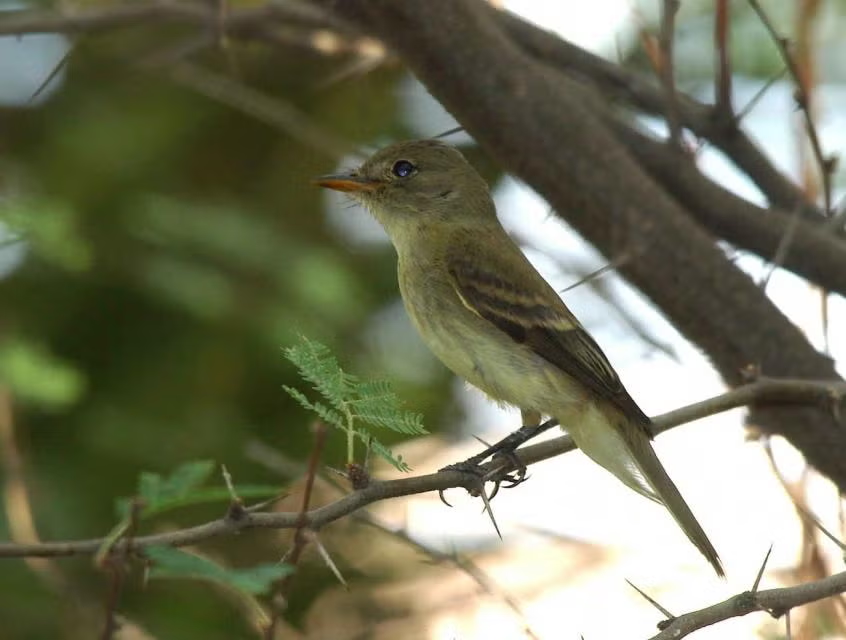
The Southwestern willow flycatcher, listed as an endangered species by the U.S. Fish and Wildlife Service. (Source: USFWS)
While Arizona and Nevada aren’t subject to similar state requirements, they may not be willing to step away from the program, either. Water agencies would face tremendous uncertainty in their long-term planning with a federal abandonment of the ESA and NEPA and the drawn-out legal challenges sure to follow — to say nothing of the fact that the MSCP, as originally agreed to by the participants, would still have a quarter-century left to run after the end of the current presidential administration.
“With the agreements we have in place, I don’t know that it would be all that easy for any administration to reel that back,” Harris said. “This program works, and it works well. It gives the feds what they need to be able to optimize their management flexibility for the entire Colorado River system — and particularly from Glen Canyon Dam downstream. And from a federal perspective, I think that’s got to be hugely important.”
“Having that environmental regulatory compliance package in place,” he added, “gives all the stakeholders — whether it’s the agricultural water users, the municipal water users or the federal agencies operating the system — a pretty significant measure of reliability and certainty for future operations.”
Regardless of what happens on the regulatory front, the MSCP’s participants are already contemplating potential big changes in how the Colorado River will be managed over roughly the next two decades. The current set of guidelines governing Colorado River operations expires next year, so states and the federal government are scrambling to agree on a new set of post-2026 operating guidelines.
That negotiation has proven particularly contentious and nearly broke down last year, so it’s far from clear what the final guidelines might look like — but they are nearly certain to include at least an additional 1 million acre-foot per year reduction in river flows below Hoover Dam. Regardless of what the exact numbers are, the MSCP’s steering committee is already anticipating the need to initiate a third, much more significant round of reconsultation with the U.S. Fish and Wildlife Service.
Sunrise at the Laguna Division Conservation Area near Yuma, Arizona, where Reclamation has worked on riparian and marsh restoration as part of the Lower Colorado River MSCP. (Source: Bureau of Reclamation)
The 2022 and 2024 biological opinions gave MSCP participants “a pretty wide band of coverage” through 2028, but “that’s sort of a short-term patch,” said Neuwerth.
“We’d like to make sure that the umbrella going forward is big enough to cover us through 2055, so that requires a little bit of crystal-ball reading of what could be coming down the line,” she said. “We’re also struggling with the effects of climate change reducing the amount of water that’s available, and what does it look like for a recovery program to navigate through that?”
Despite the uncertainty over the program’s future, Neuwerth said the MSCP has already proven its worth. “We’ve seen over the past 20 years that we’re all pulling in the same direction.”
Now, at a time when tensions over future operations on the Colorado River are exceptionally high, MSCP “has provided us a lot of certainty, and it’s allowed us breathing room to do things like (water conservation and drought management) without having to scramble to put together compliance every time something new is happening on the river,” she said. “That’s really helped provide stability on the Lower Colorado River, and it’s one less thing to fight over if we’re making changes.”
Matt Jenkins. Photo credit: Water Education Foundation
In the past an inland sea covered the area of the North Fork of the Gunnison River. Screenshot from The Creation of the Night Owl Forest
A heartwarming story about a love of place and mimicking natural processes to create new life on a small uplands farm outside Paonia, Colorado. Using agroforestry, hugelkultur, and careful observation this short film shows how one woman’s inspiration becomes the Night Owl Food Forest. Thanks to LOR Foundation for making this film possible.