
Click the link to read the article on The Land Desk website (Jonathan P. Thompson):
April 11, 2025
The News: This week, President Donald Trump signed a slew of executive orders that wipe away environmental protections in the name of saving “beautiful, clean” coal from what Trump and his minions call a regulatory “war on energy.” The purpose, he says, is to make the grid more reliable and to ensure there is adequate generating capacity to meet AI-powering and cryptocurrency mining data centers’ burgeoning power demand.
The orders:
- Designate coal as a “mineral” so that it qualifies for regulatory relief under Trump’s pro-mining executive order, and suggest designating coal as a “critical material” due to its use in steel making. (As if that’s going to do anything?)
- Orders the secretaries of Interior, Agriculture, and Energy to identify coal resources on federal lands and any impediments to extracting them, and propose “policies to address such impediments and ultimately enable the mining of such coal resources by either private or public actors.” (Public actors? Does this mean what I think it means: The feds are going to start coal mining? Maybe they’ll just nationalize the industry — Hello comrade Trump! — to wipe away all so-called impediments, of which there are very few, by the way.)
- Orders the Interior Secretary to lift barriers to mining coal on federal lands, including definitively ending an Obama-era moratorium on new coal leasing and the Biden-era halting of new leases in the Powder River Basin. (These are only speculative “barriers” because existing leases hold enough coal to meet current levels of demand for another 40 years — and demand is likely to keep dropping, meaning coal companies probably would never be affected by the leasing freeze).
- Encourages coal exports. (Umm, yeah, you should have thought about that before all of this tariff talk, dude.)
- Looks to identify regions where “coal-powered infrastructure is available and suitable for supporting AI data centers and assess … the potential for expanding coal-based infrastructure to power data centers … .”
- Exempts some coal power plants from Biden-era Mercury and Air Toxics Standards for two years.
- Looks to prevent large power sources “from leaving the bulk-power system or converting the source of fuel of such generation resource if such conversion would result in a net reduction in accredited generating capacity.” (He wants to block utilities from retiring or converting or old coal plants to run on cheaper, cleaner fuels.)
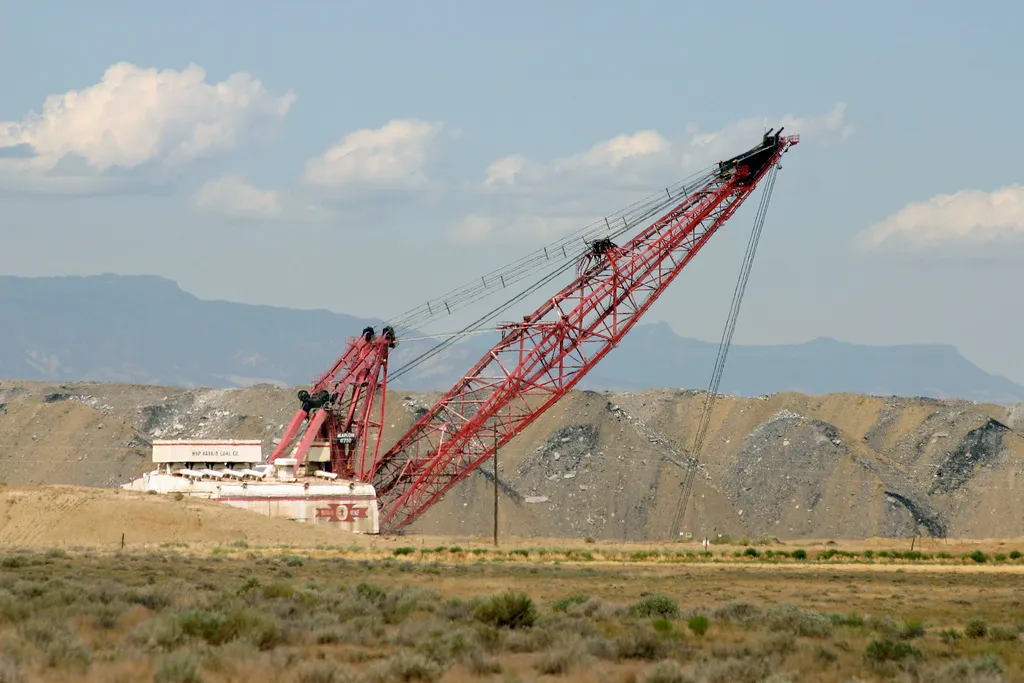
The Context: Let’s just get a couple things straight right off the bat. First, there are no significant regulatory barriers to mining coal. Arch, Peabody, Navajo Transitional Energy Company, and a handful of other companies have leases on and essentially unfettered access to billions of tons of coal at their gargantuan Powder River Basin mines. They could continue tearing apart the earth for decades before needing to lease more land, making Biden’s freeze on future leasing — and Trump’s unfreezing of it — speculative and symbolic.
In Biden’s case, it symbolized his desire to do something about the climate crisis and to cement a legacy as an environmentally minded president; for Trump it’s all about fossil fuel fetishization.
Coal mine production has been dropping due to declining demand: Utilities simply aren’t burning as much coal as they used to, in part because it’s dirty, but mostly because the shale revolution — i.e. “fracking” — has resulted in a natural gas supply glut, bringing the cost of the slightly cleaner-burning fuel below that of coal. More recently, increasingly affordable wind and solar power have also been displacing coal — and gas — generation from the grid.
So rolling back regulations on mining is useless if you’re trying to spur production. The only way to do that is get utilities to go against their own financial interests and burn more coal.
That’s where some of the other provisions in the orders come in. By exempting coal plants from the MATS rule for two years, Trump is opening the door for facilities such as the Colstrip coal plant in Montana to continue to operate without expensive new pollution control equipment. Colstrip is considered one of the dirtiest facilities in the nation, spewing harmful emissions from its smokestack and in the form of coal combustion waste.
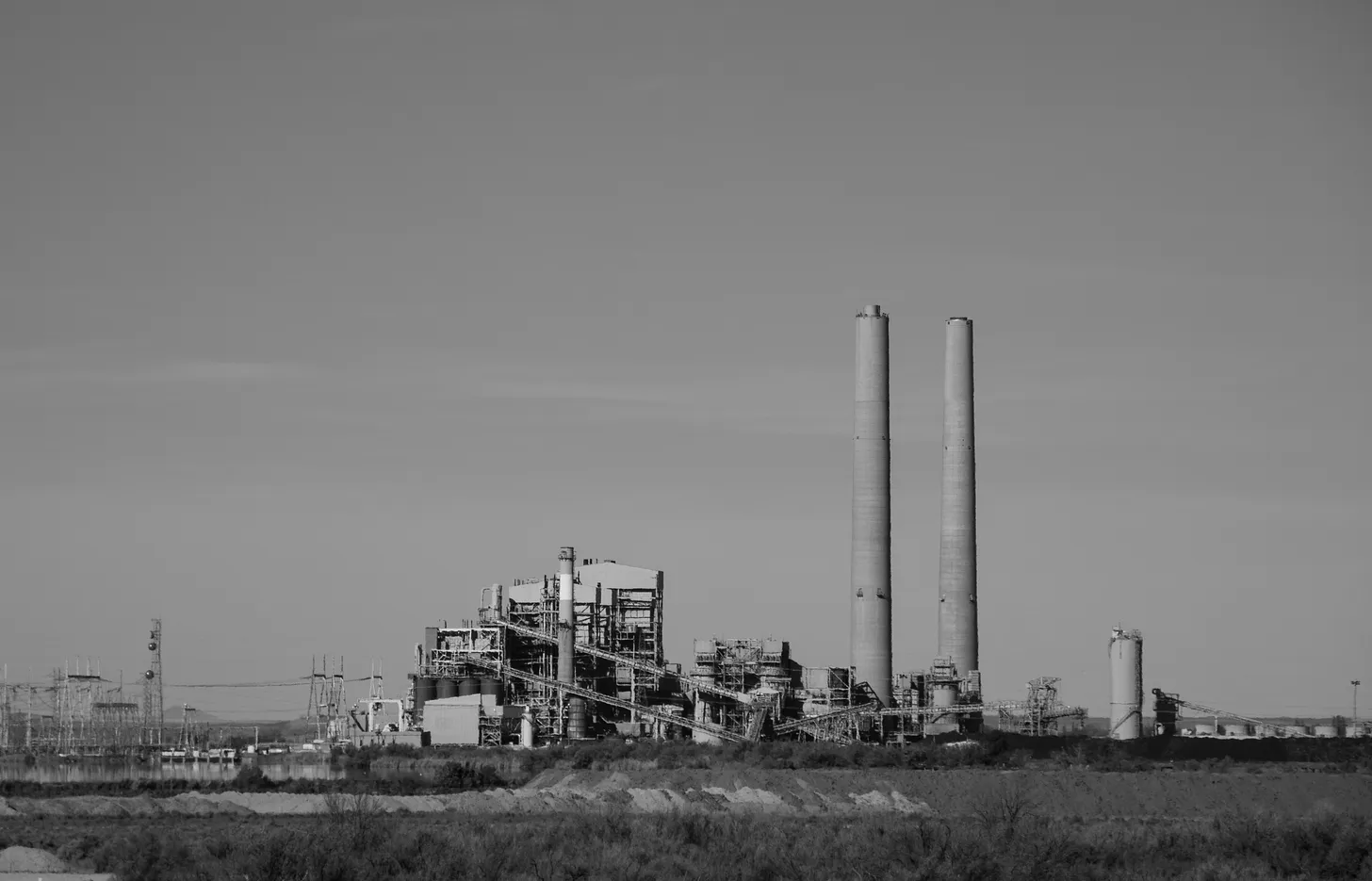
Trump mentioned the Cholla coal plant near Holbrook, Arizona, as one that he would “save” from “destruction,” adding, “We’re going to have that plant opening and burning the clean coal, beautiful clean coal, in a very short period of time.” But its operator, Arizona Public Service, said it has already procured cleaner, cheaper replacement generation for the plant, and indicated it has no desire to keep burning coal there. Meanwhile, even before the orders, PacifiCorp backed off on plans to retire some of its coal plants in the next several years, citing projected increased demand and easing regulations.
The big question mark is how the provision aiming to prevent coal plants from shutting down will play out. It seems illegal to force a utility to keep a power plant running, but then that hasn’t gotten in Trump’s way before. Still, the most all of these efforts can hope to achieve is to slow the decline of the coal industry for a few years. It’s certainly not going to bring back the Navajo Generating Sation, the Nucla Station, the San Juan Generating Station, the Escalante coal plant, or the Mohave plant from the dead.
Now for the data! Click on the images to see a larger version.


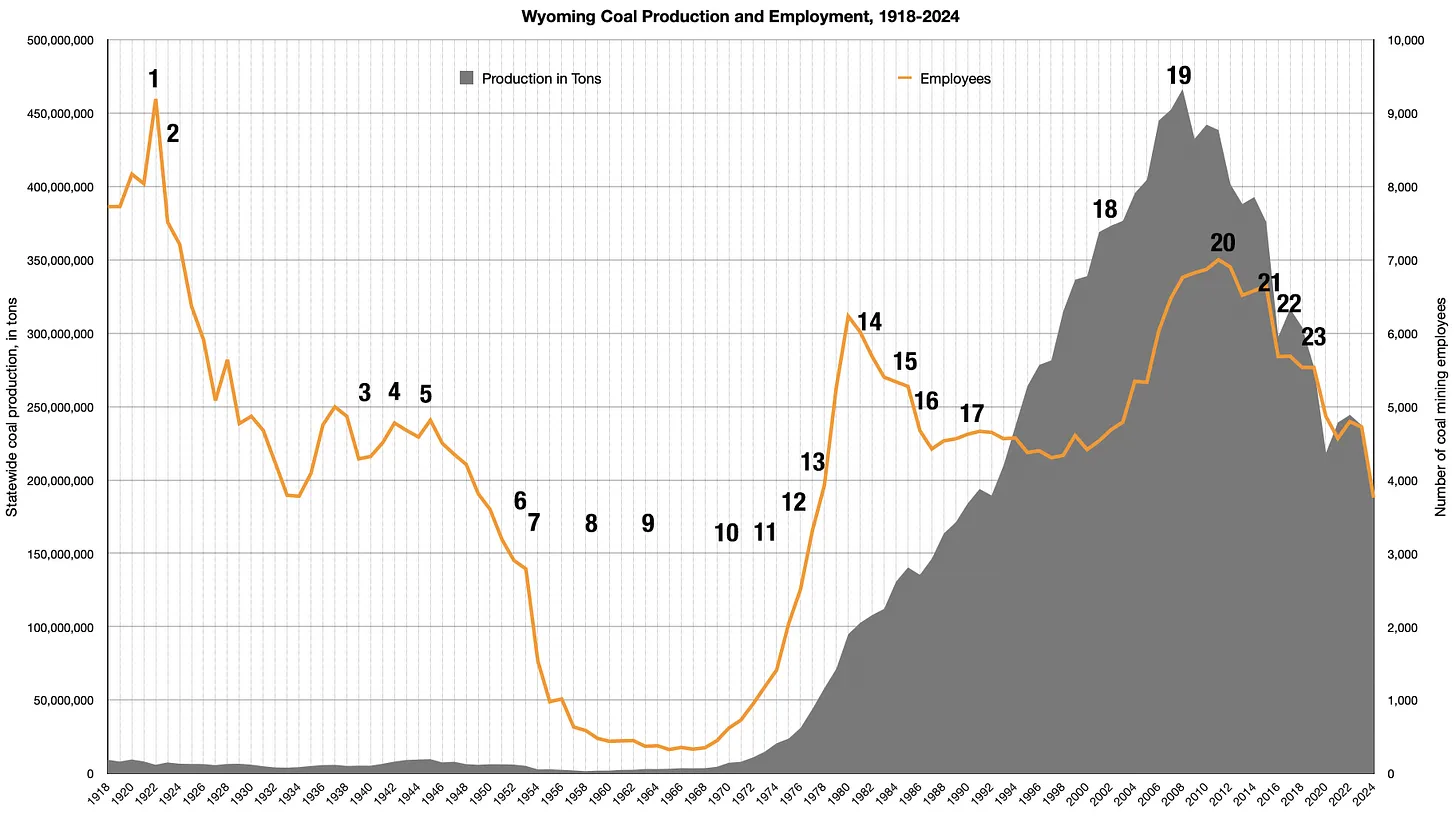
- 1920: Wyoming coal industry hits peak employment, with 9,000 employees working in coal mines during a time when less than 200,000 people lived in the state. A few years later, a Wyoming newspaper noted: “Next to food, coal and iron are of first importance to mankind.”
- Drilling for natural gas gets underway in New Mexico and Texas, and the gas is piped into towns for heating and cooking, displacing coal. A 1927 Steamboat Pilot headline about a gas pipeline from Texas to Denver, Colorado, read: “Natural gas would injure coal industry.”
- 1940: Electro Motive Division of General Motors unveils a diesel freight locomotive, but it is slow to catch on and in 1944 the steam engine still dominated, with the railroad industry consuming 152 million tons of coal per year.
- Heightened industrial activity during World War II briefly drove up coal consumption and production.
- Late 1940s: Development of high-voltage transmission lines that can carry electricity long distances, which will ultimately be a boon for coal power.
- 1950s: Coal consumption in the West plummets by 40 percent as highways replace rails, and diesel locomotives replace coal-fired ones. More long-distance gas pipelines are built from Texas and New Mexico oil fields to population centers, making it easier for residents and institutions to ditch coal for heating and cooking. More than half of the West’s electricity is generated by hydroelectric dams, with coal only providing 10%. The coal industry had made a lot of cash and built up a lot of political power over the years, however, which they used to lean on government to look for new markets for their product.
- 1952: Bureau of Reclamation releases A Study Of Future Power Transmission in the West, calling for the buildup of large coal-fired power plants in the Interior West, which would then send electricity to faraway population centers. It said, “… the growth of power in the West will be so great that increasing dependence on its main fuel resource, coal, is inevitable.”
- 1960: Congress establishes the Office of Coal Research “to encourage and stimulate the production and conservation of coal in the United States…” and to “maximize the contribution of coal to the overall energy market.”
- Sierra Club, Friends of the Earth and other environmental groups join with the coal industry and coal-state leaders in opposition to new hydroelectric dams. The Sierra Club actively supports the construction of Navajo Generating Station as a preferable alternative to a new dam in the Grand Canyon. Several other coal-fired plants are built across the West.
- The Clean Air Act is passed, actually helping Western coal because it’s low in sulfur, and therefore emits less sulfur dioxide when burned.
- Energy Crises erupt, spurring calls for “energy independence.” This includes mining for coal and government subsidies to develop synfuels, or gasoline or diesel from coal and other materials, like oil shale.
- 1977: ARCO opens Black Thunder mine in the Powder River Basin. It will become the largest coal mine in the world and the first to transport 1 billion tons of coal.
- 1978 Industrial Fuels Power Act more or less kills the construction of new natural gas power plants, locking in coal as the fuel of choice for electricity generation for the long-term.
- Even as coal production climbs, the number of employees in the industry drops due to mechanization and the migration of coal-mining from more labor-intensive underground mines to larger, surface strip mines such as those in the Powder River Basin.
- Reagan opens up foreign markets, kills subsidies, stops price controls and government prop-ups. Oil, natural gas, and uranium development crash, spreading economic malaise across the West. Coal falters in many parts of the West, including Wyoming, but the mines of the Powder River Basin continue to produce steadily.
- 1987: The Industrial Fuels Act is repealed, allowing for the buildup of natural gas plants. This doesn’t have an immediate effect on coal because natural gas is still far more expensive, but it sets the stage for utilities to switch fuels in the decades to come.
- Clean Air Act amendments of 1990, which limit emissions of acid rain-causing sulfur dioxide, give a big boost to Western coal because of its relatively low sulfur content. Wyoming surpasses Appalachia as the nation’s number one coal producer.
- 2001: Demand for electricity, and therefore for coal, climbed steadily nationwide for 50 years, experiencing just a few small hiccups in 1982, 1986 and, most dramatically, in 2001, due to a national recession. But it quickly recovered.
- 2008: The national financial crisis hits, putting a huge dent in consumption of both electricity and coal. At the same time, the price of natural gas plummets when the market is glutted with newly accessed gas from shale formations in Texas, North Dakota and the East.
- 2011: Wyoming hits peak coal-mine employment, even though electricity demand and coal consumption has yet to rebound.
- 2012-2016: Although electricity demand has plateaued, coal production goes into freefall as utilities start getting more and more power from natural gas plants and solar and wind. Mass layoffs hit Wyoming’s coal industry, including in the Powder River Basin.
- 2018: U.S. electricity demand finally bounces back to pre-2008 levels. It doesn’t help coal at all.
- 2017-2024: Despite the efforts of the Trump administration to prop up the coal industry by meddling in markets and rolling back environmental, public health and worker safety regulations, coal consumption, production and employment continue to fall. Biden’s “war on coal” doesn’t affect the slide.


🤯 Crazytown Chronicle 🤡
Yesterday, Kathleen Sgamma withdrew her name from consideration to run the Bureau of Land Management. Was it because the oil and gas lobbyist and advocate had a conflict of interest? Nope. Was it because she has spent much of her career battling the very agency she was chosen to helm? Nope.
Sgamma resigned because a watchdog group scandalously revealed that she actually has an inkling of morality. In the days following the Jan. 6, 2021, riots and invasion of the U.S. Capitol, Sgamma wrote that she was “disgusted by the violence” and “President Trump’s role in spreading misinformation that incited it.” She was hoping for a “resurgence of sanity.” That right there is enough to disqualify you from serving in this administration.
I’m anxiously awaiting to see whom Trump picks now.


