#Utah Governor Cox issues drought executive order, urges Utahns to conserve water — Katie McKellar (UtahNewsDispatch.com)

Glen Canyon Dam holds back the waters of Lake Powell near Page, Arizona on Sunday, Feb. 2, 2025. Photo credit: Spenser Heaps/Utah News Dispatch

Click the link to read the article on the Utah News-Dispatch website (Katie McKellar):

April 24, 2025

With Utah facing a drier year, Gov. Spencer Cox issued an executive order declaring a state of emergency in 17 counties due to drought conditions. 

The counties covered by the order include southern and rural areas of Washington, Iron, San Juan, Kane, Juab, Emery, Grand, Beaver, Garfield, Piute, Millard, Tooele, Uintah, Carbon, Sevier, Sanpete and Wayne counties. 
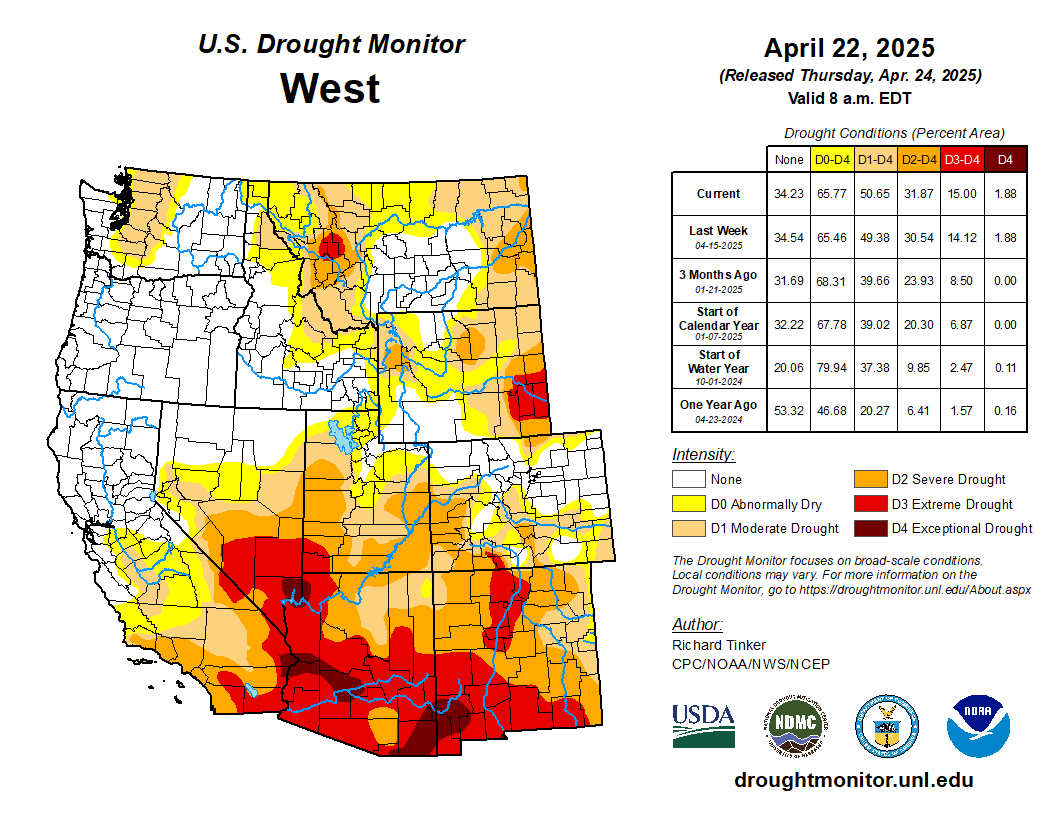
West Drought Monitor map April 22, 2205.

The governor’s executive order comes after the Drought Response Committee recently recommended he act due to drought conditions. 

“We’ve been monitoring drought conditions closely, and unfortunately, our streamflow forecasts are low, particularly in southern Utah,” Cox said in a prepared statement. “I urge all Utahns to be extremely mindful of their water use and find every possible way to conserve. Water conservation is critical for Utah’s future.”

Cox’s emergency declaration also comes after he told reporters last week he was working on issuing one due to worsening drought conditions in southern Utah, which has seen a weak snowpack this winter. 

Though the governor said last week it’s been a “pretty normal year for most of the state,” there are some areas that are worse off than others. 

Currently, severe drought covers 42% of the state, and 4% is in extreme drought, according to the state’s website

This year, Utah’s snowpack peaked at 14.3 inches on March 23, which is equal to the state’s typical annual peak, according to state officials. However, southwestern Utah’s snowpack was only about 44% of normal. Plus, winter temperatures were 2 degrees Fahrenheit higher than normal. 

The state’s reservoir storage levels are at 84% of capacity, “which will help the state weather drought,” the governor’s office said in a news release. “However, drought is unpredictable, and taking proactive measures to prepare is critical.”

Cox’s order reflects the U.S. Department of Agriculture’s disaster classifications, which are informed by the U.S. Drought Monitor and NRCS’s water supply report.

“The state partners closely with federal agencies to share critical water supply and drought updates,” Joel Ferry, executive director for the Utah Department of Natural Resources, said in a  statement. “Proactive planning is essential. We ask all Utahns across all sectors to use less water to help stretch the water supply.”

It’s been almost exactly three years since the governor declared a drought declaration. The last time he did so was April 22, 2022, when 65% of the state was in extreme drought, and more than 99% of the state was experiencing at least severe drought conditions. 

As part of his order, Cox urged Utahns to watch their water use, both inside and outside their homes. 

Water-saving tips listed by SlowTheFlow.org include: 

  • Wait to water your lawn until temperatures are in the mid-70s for several consecutive days, and check the Weekly Lawn Watering Guide for other tips on how to optimize water use.
  • Fix leaks.
  • Run full loads for dishwashers and washing machines.
  • Turn off the faucet while brushing your teeth, shaving, soaping up, doing dishes or rinsing vegetables.
  • Shorten your shower time by at least one minute.
  • Participate in water-saving programs like water-smart landscaping, toilet replacement, and smart sprinkler controllers.
Utah Rivers map via Geology.com

Out to dry: Water managers brace for lean supply in Southwest #Colorado — The #Durango Herald

Westwide SNOTEL basin-filled map April 24, 2025 via the NRCS.

Click the link to read the article on The Durango Herald website (Reuben M. Schafir). Here’s an excerpt:

April 9, 2025

Vallecito Reservoir expected to fill, but low snowpack means short irrigation season

[Ken Curtis] expects users will receive no more than 50% of their allocated water and could get as little as 25%. Ken Beck, superintendent of the Pine River Irrigation District, which manages Vallecito Reservoir, said he’s optimistic the reservoir will fill to its 123,500-acre-foot capacity. He needs another 31,000 acre-feet of water to get there. Beck thinks he’ll get it – but probably not much more…Snowpack water supply in the northern part of the state is at or above 30-year median levels, but those numbers decline the farther south one goes. The Upper San Juan Basin, which contains Vallecito and Navajo Lake, has 67% of the median snow-water equivalent for this time of year. The Animas basin sits at 76%; the basin containing the Mancos and La Plata rivers is at 65%; and the Dolores basin, which feeds McPhee Reservoir, is at 72%…Water accumulation in the San Miguel-Dolores-Animas-San Juan subbasin, which spans much of the southwest corner of the state, typically peaks around April 2. This year, however, it appeared to peak more than a week early, on March 23. Snow-water equivalent dipped at the end of March but perked up with early April storms.

Vallecito Lake via Vallecito Chamber

Denver Water vows to take Gross Reservoir Dam expansion fight to the U.S. Supreme Court — Jerd Smith (Fresh Water News)

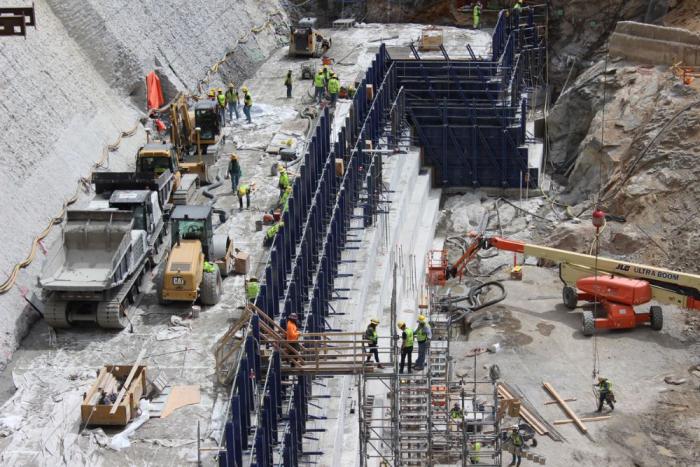
The dam raise process begins at the bottom of the dam using roller-compacted concrete to build the new steps that will go up the face of the dam. Photo credit: Denver Water.

Click the link to read the article on the Water Education Colorado website (Jerd Smith):

April 24, 2025

Denver Water vowed this week to take the high-stakes battle over a partially built dam in Boulder County to the U.S. Supreme Court if necessary to defend what it sees as its well-established right to continue construction and deliver water to its 1.5 million metro-area customers.

“It would be irresponsible not to do that,” Denver Water’s General Manager Alan Salazar said in an interview Tuesday as a tense month of legal maneuvering continued.

Senior U.S. District Court Judge Christine Arguello on April 3 put a halt to construction of the $531 million Gross Reservoir Dam raise nearly four months after Denver Water and the river-defending nonprofit Save the Colorado failed to negotiate a settlement that would add new environmental protections to the project. When settlement talks stalled, Save the Colorado asked for and was granted an injunction.

Almost immediately, Denver Water filed for temporary relief from the injunction, saying, in part, that it would be unsafe to stop work as the incomplete concrete walls towered above Gross Reservoir in western Boulder County.

Arguello granted that request, too.

Now the water agency, the largest utility in the Intermountain West, has filed an emergency request with the federal appeals court, seeking to permanently protect its right to continue construction as the legal battle continues.

A decision could come as early as this week as a 10th Circuit Court of Appeals panel considers Denver Water’s emergency request, according to environmental advocate Gary Wockner. Wockner leads Save The Colorado, a group that has financed and led litigation against Denver Water and many other agencies seeking new dams or river diversions. Wockner said he is ready to continue the fight as well.

“We are prepared to defend the district court’s decision,” Wockner said, referring to the construction halt.

Alan Salazar, who became Denver Water CEO/Manager in August 2023 Photo credit: Denver Water

The high-profile dispute erupted in Denver just weeks after Northern Water agreed to a $100 million settlement with Save The Colorado and its sister group, Save The Poudre, to allow construction of the Northern Integrated Supply Project, or NISP, to proceed.

The money will be used to help restore the Cache la Poudre River, including moving diversion points and crafting new agreements with diverters that will ultimately leave more water in the river. Northern Water, which operates the federally owned Colorado-Big Thompson Project for the U.S. Bureau of Reclamation, is overseeing the permitting and construction of NISP.

But two years of talks and negotiations between Save The Colorado and Denver Water failed to yield a similar environmental settlement over the Gross Reservoir Dam expansion project. It was after the talks failed that Federal District Court Judge Arguello agreed to halt construction on the dam.

Whether a new environmental deal will be forthcoming now isn’t clear. Both sides declined to comment on whether settlement talks had resumed.

Salazar also declined to discuss whether a deal similar to the $100 million NISP settlement would emerge over the Gross Reservoir lawsuit.

“I don’t want to get into the cost of a settlement,” Salazar said. “But the impact on ratepayers would be significant.

Case sets the stage for future water projects in Colorado

Across the state, water officials are closely watching the case play out.

For fast-growing Parker Water and Sanitation, the preliminary injunction to stop construction, though temporary, is worrisome.

Its general manager, Ron Redd, said he wasn’t sure how his small district, which is planning a major new water project in northeastern Colorado, would cope with a similar injunction or a U.S. Supreme Court battle.

“In everything permitting-wise you need consistency in how you move projects forward,” Redd said. “To have that disrupted causes concern. Is this going to be the new normal going forward? That bothers me.”

Denver Water first moved to raise Gross Dam more than 20 years ago when it began designing the expansion and seeking the federal and state permits required by most water projects.

After years of engineering, studies and federal and state analyses, construction began in 2022. It has involved taking part of the original dam, built in the 1950s, and raising its height by 131 feet to nearly triple the reservoir’s storage capacity to 119,000 acre-feet from 42,000 acre-feet. An acre-foot of water equals 326,000 gallons, enough to serve up to four urban households each year.

The giant utility has said it needs the additional storage to secure future water supplies as climate change threatens stream flows in its water system, a key part of which lies in the Fraser River, a tributary to the Upper Colorado River in Grand County. The expansion was also necessary to strengthen its ability to distribute water from the northern end of its system, especially if problems emerged elsewhere in the southern part of its distribution area, as occurred during the 2002 drought.

And the judge agreed climate change is a factor but she said it’s not clear the water would ever even materialize as flows shrink. She overturned Denver Water’s permits because she said the Army Corps had not factored in Colorado River flow losses from climate change, and whether Denver would ever actually see the water it plans to store in an expanded Gross. Arguello also ruled the Army Corps had not spent enough time analyzing alternatives to the Gross Reservoir expansion.

Wockner said forcing Denver Water and the U.S. Army Corps of Engineers to re-analyze water projections under new climate change scenarios, as his group has asked, is critical to helping protect the broader Colorado River and stopping destructive dam projects.

Whether the questions the case raises about permitting and environmental protections ultimately make their way to the U.S. Supreme Court isn’t clear yet.

But James Eklund, a water attorney and former director of the Colorado Water Conservation Board, the state’s lead agency on water planning and funding, said Denver Water has the expertise and financial muscle to take it there.

“They have really sharp people over there,” he said. “I would say they are not only willing, they would have the facts to present a case they believe would be successful.”

[…]

More by Jerd Smith

The Gross Reservoir Expansion Project involves raising the height of the existing dam by 131 feet. The dam will be built out and will have “steps” made of roller-compacted concrete to reach the new height. Image credit: Denver Water

Despite DOGE at Interior, Yellowstone staffing ‘higher than last year’ — Angus M. Thuermer Jr. (WyoFile.com)

Yellowstone park workers help search for a lost hiker on Eagle Peak in 2024. (Cam Sholly/Yellowstone National Park)

Click the link to read the article on the WyoFile.com website (Angus M. Thuermer Jr.):

April 22, 2025

Oilfield executive takes charge of consolidating workforce of 70,000 at national parks, BLM, Fish and Wildlife Service.

Five days into the Trump administration’s DOGE takeover of the Department of Interior’s policy, management and budget, Yellowstone National Park staffing is “higher than last year,” an Interior Department spokesperson in Washington, D.C. said Monday.

​​Yellowstone Park confirmed the increase. “Going into this year, we should have a total of 769 NPS employees,” park spokeswoman Linda Veress said in an email, up from 748 last year. During the park’s record year for visitation in 2021, the park’s workforce numbered 693 permanent and seasonal workers.

“We had an outstanding opening weekend, and it was great to see everyone enjoying the park,” Yellowstone Park Superintendent Cam Sholly said in an email Monday. “The plow crews are working hard to clear the remainder of the park’s roads from snow, and we are on schedule for our normal sequenced opening in the upcoming weeks, including the Beartooth Highway.”

After personally greeting the season’s first visitors at the West Entrance on Friday, Sholly reported the opening weekend drew 8,324 vehicles from there and the North Entrance at Mammoth, the only two entrances that have opened so far. That’s an increase of more than 11% from last year and put the weekend rush, unofficially Sholly said, at 21,642.

The staffing and opening weekend updates came as Secretary of the Interior Doug Burgum put an oilfield executive in charge of “consolidation, unification and optimization of administrative functions” at the 70,000-person agency last week. Burgum, earlier this year, named Tyler Hassen as assistant secretary for policy, management and budget. Now Hassen will oversee Burgum’s consolidation order as the Trump administration’s DOGE plan to shrink the size of the federal government advances.

Burgum’s appointment of Hassen and the consolidation order sparked worries in the conservation community, including at the Center for Western Priorities. The Denver-based nonpartisan conservation and advocacy organization accused the secretary of abdicating his responsibilities by not reserving any authority over firings or requiring any reporting by Hassen.

“If Doug Burgum doesn’t want this job, he should quit now,” said Jennifer Rokala, executive director of Western Priorities. “Instead, it looks like Burgum plans to sit by the fire eating warm cookies while Elon Musk’s lackeys dismantle our national parks and public lands,” she said in a statement.

“Warm cookies” refers to a report in The Atlantic that Burgum’s chief of staff told political appointees to learn to bake cookies for their boss.

But potential visitors to the world’s first national park need not worry, said J. Elizabeth Peace, a spokesperson at Burgum’s office.

“Visitors can expect the same great service they had in years past,” Peace wrote in an email Monday. “[I]n some National Parks, like at Yellowstone National Park, staffing numbers are higher than last year.”

Peace made her reassurances as regional business owners fret over the upcoming tourism season in Yellowstone, at neighboring Grand Teton and across Wyoming. Overseas traveler numbers to the U.S. dropped 11.6% in March after Trump tariffs, tariff threats, indiscriminate DOGE firings, resignations and economic turmoil battered expectations.

Oilman

The order Burgum issued Thursday gives Hassen, now an assistant secretary, authority over the department’s Working Capital Fund, an office that in 2023 provided $119 million for department functions. Hassen will be able to rewrite manuals outlining employee responsibilities and may transfer funds, programs, records and property, according to the order.

Burgum’s order described his actions as furthering Trump’s February initiative for “implementing the president’s ‘Department of Government Efficiency’ workforce optimization.”

In addition to great service at national parks, Bureau of Land Management lands in Wyoming remain welcoming, Peace wrote. “Visitors to BLM-managed public lands can expect continued access and service across recreation sites, trails and campgrounds,” her email reads. “We are implementing necessary reforms to ensure fiscal responsibility, operational efficiency and government accountability.”

Burgum and DOGE’s “unification effort” will accelerate technology, enhance the mission to preserve parks and historic sites, serve Native American tribes and manage department holdings in Wyoming, Burgum’s order states. All told, the Department of the Interior manages 2.34 million acres of national park system lands, 18.4 million acres of BLM property and 70,000 acres of Fish and Wildlife Service reserves in the state. 

In Wyoming, Interior-managed land accounts for a third of the state’s area or about 21 million acres.

Hassen, a Deerfield Academy prep and Princeton grad, was CEO of Basin Energy, a Houston-based international oilfield services company, according to his LinkedIn profile. Before that, he worked for Wenzel Downhole Tools, Basin Power, and served as chairman of the associate board of the nonprofit Cancer Research Institute in New York. He was an associate involved in global energy investment banking at Morgan Stanley in New York and London from 2005-2008, according to his profile.

He emerged on the DOGE scene after the Los Angeles fires in January when President Trump said California Gov. Gavin Newsom compounded the firefighting problem by not diverting water to southern California. Critics said DOGE conflated agricultural diversions, needs of the endangered Sacramento-San Joaquin Estuary delta smelt and firefighting. 

Unqualified?

Western Priorities said DOGE efforts assign inexpert people to inappropriate positions.

“Since Elon Musk is now effectively in charge of America’s public lands, it’s up to Congress and the American people to stand up and demand oversight,” Rokala’s statement reads. “DOGE’s unelected bureaucrats in Washington have no idea how to staff a park, a wildlife refuge, or a campground. They have no idea how to manage a forest or prepare for fires in the wildland-urban interface. But Doug Burgum just gave DOGE free rein over all of that.”

This map shows land owned by different federal government agencies. By National Atlas of the United States – http://nationalatlas.gov/printable/fedlands.html, “All Federal and Indian Lands”, Public Domain, https://commons.wikimedia.org/w/index.php?curid=32180954

Snowcats aren’t just for ski areas: When Denver Water crews head for snowy, remote locations, they call the ’cat #snowpack

Click the link to read the article on the Denver Water website (Jay Adams):

April 19, 2025

On a picture perfect, late-March bluebird day in the Colorado mountains, Rob Krueger and Jay Joslyn gear up for a unique job at Denver Water — venturing into the wilderness to measure snowpack.

Boots? Check. Gloves? Check. Hats? Check. Jackets? Check. Very special metal tube and a scale? Check, check. All of it is loaded into their winter travel vehicle, a snowcat.

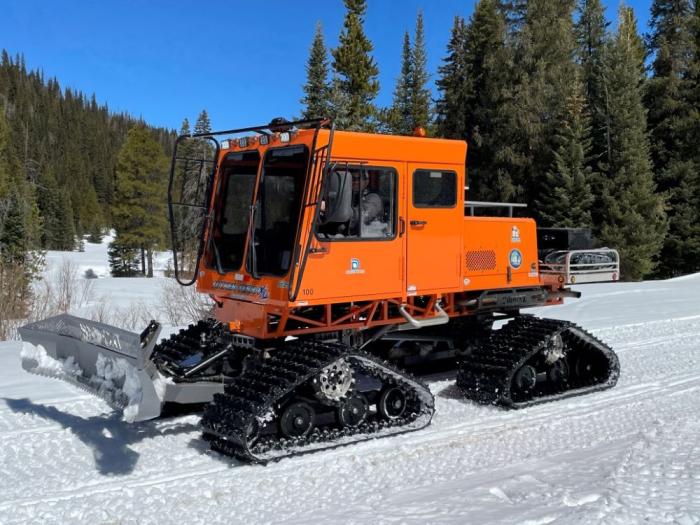
Denver Water owns a snowcat that is used to access facilities and remote locations during the winter months in Grand County. Photo credit: Denver Water.

“We’re heading up to Vasquez Creek to one of our snow courses,” Krueger says as he fires up the Tucker 2000XL and starts rolling. “It’s around 10 miles up to our destination, and it takes about 30-40 minutes in the snowcat.” 

The journey starts at Denver Water’s Grand County office just west of Fraser and heads into the Arapaho National Forest.

“The snowcat is kind of like a truck with tank-like tracks on it,” Krueger said. “We use it throughout the winter to reach our remote buildings and dams and to get to our snow courses.” 

The journey would be impossible in a regular car or truck. But the snowcat, designed to tackle this type of terrain, easily powers over the snow.

“We’re a 24/7 operation so we need a vehicle like this in the winter,” he said. “Whether it’s snowing, sleeting, raining or we have 60-mile-per-hour winds and it’s negative 6 degrees out, we still have to get around. So that’s what makes the snowcat such an important piece of equipment for us.”

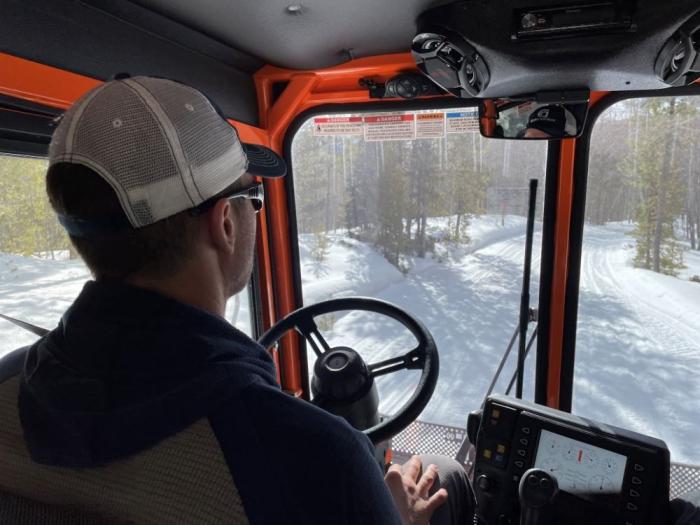
Rob Krueger drives the snowcat through a snow-covered road near Winter Park. Photo credit: Denver Water.

Krueger drives the snowcat through the trees on a snow-covered U.S. Forest Service road and into Denver Water’s collection system. 

The collection system is the area where Denver Water captures melting snow during the spring runoff. The water then flows through creeks, canals, tunnels and reservoirs to treatment facilities on the Front Range where it’s cleaned for delivery to 1.5 million people in metro Denver.

After reaching their destination, Krueger and Joslyn get ready for their task of measuring the snowpack.


See how scientists take to the skies to measure the snow below.


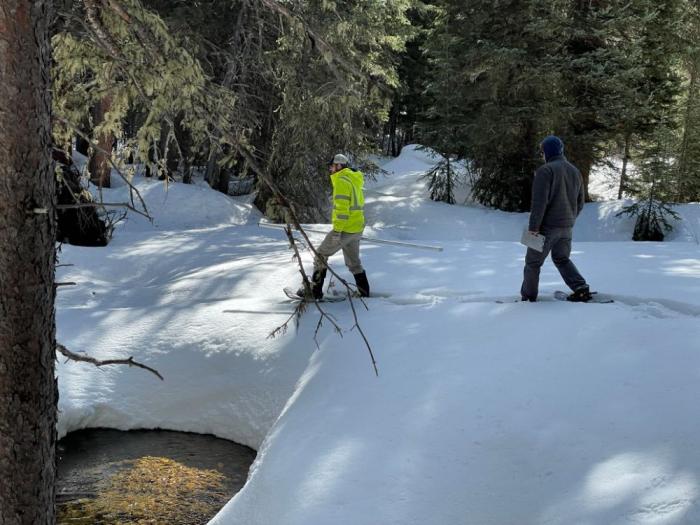
Snowshoes are strapped on and equipment, including a snow measuring tube, is assembled for the trek across Vasquez Creek to reach a “snow course.”

“A snow course is basically a preset path where we take samples to measure the snowpack,” Joslyn said. “We do these same courses four times over the winter.”

The courses are set up across Colorado’s mountains and managed by the U.S. Department of Agriculture’s National Resources Conservation Service, also known as the NRCS, to monitor snowpack. The data from these courses are used by cities, farmers, ranchers, water utilities and recreationists to help predict the amount of water that will flow down the mountains during the spring runoff.

Joslyn and Krueger snowshoe across Vasquez Creek to reach the snow course. Photo credit: Denver Water.

Denver Water partners with the NRCS to do snow courses in Grand, Park and Summit counties where the utility collects its water.

In Grand County, there are five locations where Denver Water samples snow. 

The Vasquez snow course starts a few feet from the creek and is surrounded by a canopy of spruce and fir trees. On this trip, the snow on the course ranged from 4 to 5 feet deep.

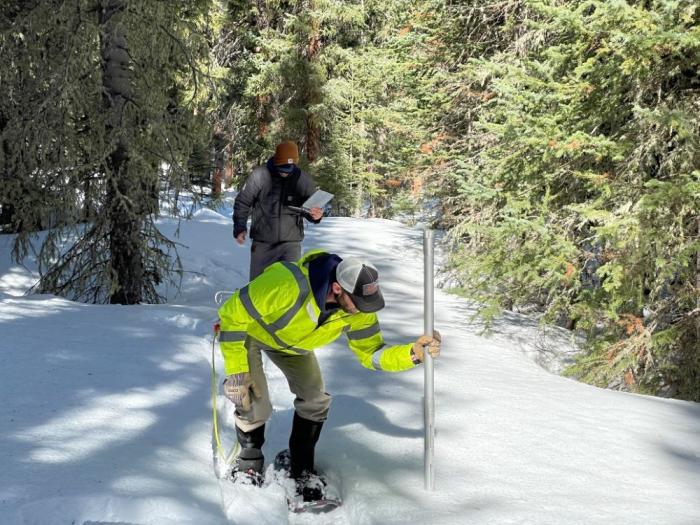
Joslyn stabs the snow with the measuring tube to collect a snow sample. Photo credit: Denver Water.

Joslyn carries the measuring tube [Federal Snow Sampler], then stabs it into the snow and checks the reading. He calls out “53,” which is the depth of the snow in inches. Then he takes a closer look at the slots on the tube and calls out a second number; this one is the length of the snow core captured inside.

Next up, Joslyn uses a handheld scale to weigh the tube with the snow inside. “42,” he calls out. This time referring to the weight in ounces. 

Krueger records this number, then subtracts the weight of the empty tube from the total, which gives the water content in inches of the snow core sample. They also calculate the density of the snow. 

Joslyn weighs the tube with the snow inside. The process is used to determine the water content and density of the snowpack. Photo credit: Denver Water.

The pair does the same process 10 times at 25-foot intervals on the course. On this trip, the snowpack was in good shape, coming in at 118% of normal for the end of March 2025.

“Denver Water has a long history in this valley, and we’ve been doing snow courses in Grand County dating back to 1939,” Krueger said. “With decades worth of data, we can get a really good idea of how much water we’ll see during the spring runoff.”

The data is sent to Denver Water’s planning department and the NRCS. Planners combine the snow course information with data from SNOTEL sites and high-tech flights over the mountains to predict how much water will flow into the utility’s reservoirs where water is stored for customers.

“The information from the snow courses is critical to our planning, as it gives us boots-on-the-ground information about the snowpack,” said Nathan Elder, water supply manager at Denver Water. “Our crews in the mountains often have to brave a lot of harsh weather to get the data we need, so we’re thankful for their hard work.”

Working for Denver Water in Grand County involves a variety of jobs that change throughout the seasons, with the snow courses being one of the most unique.

“The snow courses are interesting and of course being out in the snow and driving the snowcat is pretty fun,” Krueger said. “Our work feels valuable to Denver Water as a whole to understand what kind of water resource we have to send to the city.” 

Denver Water’s entire collection system. Image credit: Denver Water.