Uranium Monitoring, Testing and Modeling Continue — Northern Water E-Waternews October 2025

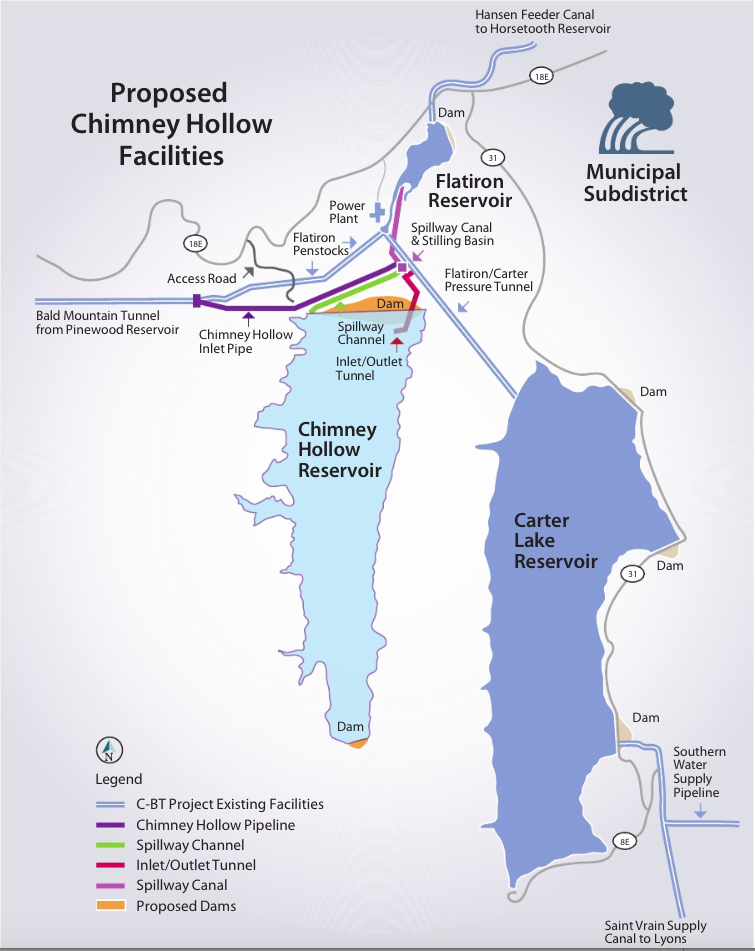
Map from Northern Water via the Fort Collins Coloradan.

From email from Northern Water:

Northern Water and Chimney Hollow participants are committed to keeping our customers, stakeholders and end users, as well as the general public, informed as we gather additional information on the discovery of uranium at the Chimney Hollow Reservoir construction site. Collecting data and modeling are crucial steps in the development of mitigation strategies, and we are actively working to learn more by evaluating test results from field investigations and modeling scenarios.   

Before making mitigation decisions, we want to make sure we have all the information to evaluate operational and treatment options. We are following a rigorous process, starting with geochemical characterization and scoping studies, to inform mitigation alternatives analyses and ultimately select a final approach. Following these steps allows us to make informed decisions, evaluate trade-offs and determine the best path forward.   

Northern Water has been testing how the uranium minerals leach into water and what concentration to expect when the reservoir fills and its operation begins. To allow time for additional data collection and investigations to advance, we have elected not to fill the reservoir as quickly as initially planned. A small amount of water (less than 2 percent of total capacity) will be moved into Chimney Hollow Reservoir in November 2025. During this time, additional water quality data will be collected and used to evaluate the performance of model simulations, and required dam safety monitoring will begin. Even as the reservoir fills, no water will be released as further assessments are underway and mitigation options continue to be evaluated.  

Because the mineralized uranium is coming from materials quarried at the site, excess (unused) rock from construction has been buried under a layer of water-sealing clay. The clay cap will effectively minimize uranium leaching from these materials.  

We expect uranium leaching from the dam to decrease over time because there is a finite quantity of soluble uranium at the site. The duration of the leaching process is not yet fully understood and will depend on how the reservoir is operated over time. While the discovery of mineralized uranium has caused Northern Water and the Chimney Hollow participants to modify our plans, it is an issue that can be safely managed. The new reservoir remains an important part of securing water supply needs for Northern Colorado and its future. Please visit the Water Quality page on our website for more information and a list of Frequently Asked Questions.

Michael Mann to Bill Gates: You can’t reboot the planet if you crash it — Bulletin of Atomic Scientists

Bill Gates poses with Rick Perry in 2019, during Perry’s tenure as Secretary of Energy under the first Trump administration. (Public Domain)

Click the link to read the article on the Bulletin of Atomic Scientists website (Michael Mann):

October 31, 2025

“I suppose it is tempting, if the only tool you have is a hammer, to treat everything as if it were a nail.” Thus wrote the famous psychologist Abraham Maslow in 1966.

If Maslow were around today, I imagine he might endorse the corollary that if your only tool is technology, every problem appears to have a technofix. And that’s an apt characterization of the “tech bro”-centered thinking so prevalent today in public environmental discourse.

There is no better example than Bill Gates, who just this week redefined the concept of bad timing with the release of a 17-page memo intended to influence the proceedings at the upcoming COP30 international climate summit in Brazil. The memo dismissed the seriousness of the climate crisis just as (quite possibly) the most powerful Atlantic hurricane in human history—climate-fueled Melissa—struck Jamaica with catastrophic impact. The very next day a major new climate report (disclaimer: I was a co-author) entitled “a planet on the brink” was published. The report received far less press coverage than the Gates missive. The legacy media is apparently more interested in the climate musings of an erstwhile PC mogul than a sober assessment by the world’s leading climate scientists.

Gates became a household name in the 1990s as the Microsoft CEO who delivered the Windows operating system. (I must confess, I was a Mac guy). Microsoft was notorious for releasing software mired with security vulnerabilities. Critics argued that Gates was prioritizing the premature release of features and profit over security and reliability. His response to the latest worm or virus crashing your PC and compromising your personal data? “Hey, we’ve got a patch for that!”

That’s the very same approach Gates has taken with the climate crisis. His venture capital group, Breakthrough Energy Ventures, invests in fossil fuel-based infrastructure (like natural gas with carbon capture and enhanced oil recovery), while Gates downplays the role of clean energy and rapid decarbonization. Instead, he favors hypothetical new energy tech, including “modular nuclear reactors” that couldn’t possibly be scaled up over the time frame in which the world must transition off fossil fuels.

Most troublingly, Gates has peddled a planetary “patch” for the climate crisis. He has financed for-profit schemes to implement geoengineering interventions that involve spraying massive amounts of sulfur dioxide into the stratosphere to block out sunlight and cool the planet. What could possibly go wrong? And hey, if we screw up this planet, we’ll just geoengineer Mars. Right Elon?

Such technofixes for the climate, in fact, lead us down a dangerous road, both because they displace far safer and more reliable options—namely the clean energy transition—and because they provide an excuse for business-as-usual burning of fossil fuels. Why decarbonize, after all, if we can just solve the problem with a “patch” later?

Here’s the thing, Bill Gates: There is no “patch” for the climate crisis. And there is no way to reboot the planet if you crash it. The only safe and reliable way out when you find yourself in a climate hole is to stop digging—and burning—fossil fuels. [ed. emphasis mine]

It was arguably Gates who—at least in part—inspired the tech-bro villain Peter Isherwell in the Adam McKay film “Don’t Look Up.” The premise of the film is that a giant “comet” (a very thinly veiled metaphor for the climate crisis) is hurtling toward Earth as politicians fail to act. So they turn to Isherwell who insists he has proprietary tech (a metaphor for geoengineering, again thinly veiled) that can save the day: space drones developed by his corporation that will break the comet apart. Coincidentally, the drones are designed to then mine the comet fragments for trillions of dollars’ worth of rare metals, that all go to Isherwell and his corporation. If you haven’t seen the film (which I highly recommend), I’ll let you imagine how it all works out.

For those who have been following Gates on climate for some time, his so-called sudden “pivot” isn’t really a “pivot” at all. It’s a logical consequence of the misguided path he’s been headed down for well over a decade.

I became concerned about Gates’ framing of the climate crisis nearly a decade ago when a journalist reached out to me, asking me to comment on his supposed “discovery” of a formula for predicting carbon emissions. (The formula is really an “identity” that involves expressing carbon emissions as a product of terms related to population, economic growth, energy efficiency, and fossil fuel dependence). I noted, with some amusement, that the mathematical relationship Gates had “discovered” was so widely known it had a name, the “Kaya identity,” after the energy economist Yōichi Kaya who presented the relationship in a textbook nearly three decades ago. It’s familiar not just to climate scientists in the field but to college students taking an introductory course on climate change.

If this seems like a gratuitous critique, it is not. It speaks to a concerning degree of arrogance. Did Gates really think that something as conceptually basic as decomposing carbon emissions into a product of constituent terms had never been attempted before? That he’s so brilliant that anything he thinks up must be a novel discovery?

I reserved my criticism of Gates, at the time, not for his rediscovery of the Kaya identity (hey—if can help his readers understand it, that’s great) but for declaring that it somehow implies that “we need an energy miracle” to get to zero carbon emissions. It doesn’t. I explained that Gates “does an injustice to the very dramatic inroads that renewable energy and energy efficiency are making,” noting peer-reviewed studies by leading experts that provide “very credible outlines for how we could reach a 100 percent noncarbon energy generation by 2050.”

The so-called “miracle” he speaks of exists—it’s called the sun, and wind, and geothermal, and energy storage technology. Real world solutions exist now and are easily scalable with the right investments and priorities. The obstacles aren’t technological. They’re political.

Gates’ dismissiveness in this case wasn’t a one-off. It was part of a consistent pattern of downplaying clean energy while promoting dubious and potentially dangerous technofixes in which he is often personally invested. When I had the chance to question him about this directly (The Guardian asked me to contribute to a list of questions they were planning on asking him in an interview a few years ago), his response was evasive and misleading. He insisted that there is a “premium” paid for clean energy buildout when in fact it has a lower levelized cost than fossil fuels or nuclear and deflected the questions with ad hominem swipes. (“He [Mann] actually does very good work on climate change. So I don’t understand why he’s acting like he’s anti-innovation.”)

This all provides us some context for evaluating Gates’ latest missive, which plays like a game of climate change-diminishing bingo, drawing upon nearly every one of the tropes embraced by professional climate disinformers like self-styled “Skeptical Environmentalist” Bjorn Lomborg. (Incidentally, Lomborg’s center has received millions of dollars of funding from the Gates Foundation in recent years and Lomborg recently acknowledged serving as an adviser to Gates on climate issues.)

Among the classic Lomborgian myths promoted in Gates’ new screed, which I’ll paraphrase here, is the old standby that “clean energy is too expensive.” (Gates likes to emphasize a few difficult-to-decarbonize sectors like steel or air travel as a distraction from the fact that most of our energy infrastructure can readily be decarbonized now.) He also insists that “we can just adapt,” although in the absence of concerted action, warming could plausibly push us past the limit of our adaptive capacity as a species.

He argues that “efforts to fight climate change detract from efforts to address human health threats.” (A central point of my new book Science Under Siegewith public health scientist Peter Hotez is that climate and human health are inseparable, with climate change fueling the spread of deadly disease). Then there is his assertion that “the poor and downtrodden have more pressing concerns” when, actually, it is just the opposite; the poor and downtrodden are the most threatened by climate change because they have the least wealth and resilience.

What Gates is putting forward aren’t legitimate arguments that can be made in good faith. They are shopworn fossil fuel industry talking points. Being found parroting them is every bit as embarrassing as being caught—metaphorically speaking—with your pants down.

For years when I would criticize Gates for what I consider to be his misguided take on climate, colleagues would say, “you just don’t understand what Gates is saying!” Now, with Donald Trump and the right-wing Murdoch media machine (the Wall Street Journal editorial board and now an op-ed by none other than Lomborg himself in the New York Post) celebrating Gates’ new missive, I can confidently turn around and say, “No, you didn’t understand what he was saying.”

Maybe—just maybe—we’ve learned an important lesson here: The solution to the climate crisis isn’t going to come from the fairy-dust-sprinkled flying unicorns that are the “benevolent plutocrats.” They don’t exist. The solution is going to have to come from everyone else, using every tool at our disposal to push back against an ecocidal agenda driven by plutocrats, polluters, petrostates, propagandists, and too often now, the press. [ed. emphasis mine]

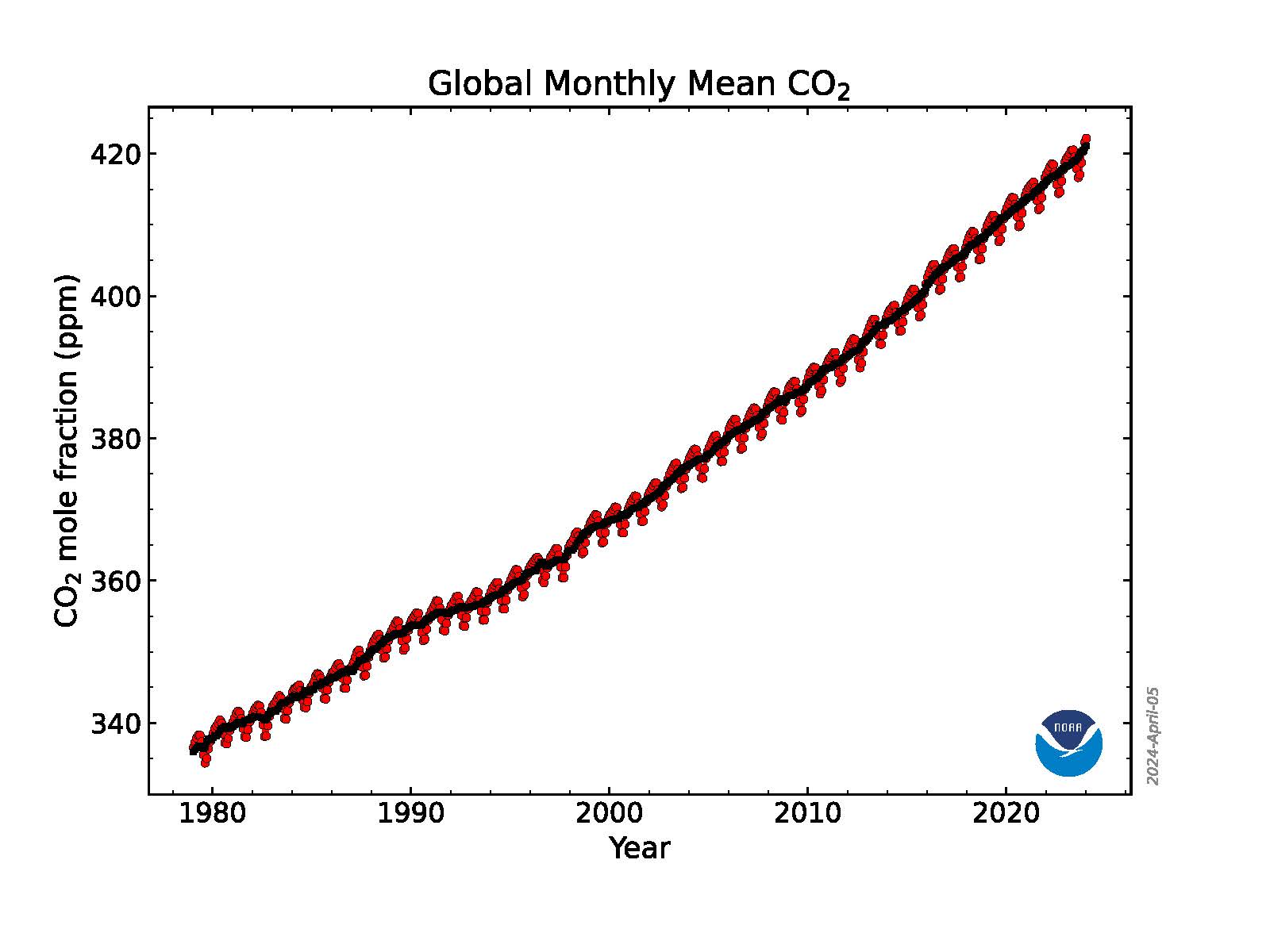
This graph shows the globally averaged monthly mean carbon dioxide abundance measured at the Global Monitoring Laboratory’s global network of air sampling sites since 1980. Data are still preliminary, pending recalibrations of reference gases and other quality control checks. Credit: NOAA GML

#BlueRiver Watershed Group plans water quality monitoring website

Map of the Blue River drainage basin in Colorado, USA. Made using USGS data. By Shannon1 – Own work, CC BY-SA 4.0, https://commons.wikimedia.org/w/index.php?curid=69327693

Click the link to read the release on the Summit Daily News website (Blue River Watershed Group):

October 31, 2025

With a newly approved grant of over $30,000 from the Colorado Basin Roundtable, the Blue River Watershed Group will install cameras and measuring devices on the river to report on stream conditions.

A news release stated the group will use a technical consultant to create a webpage with a community-facing geographic information system map to share water quality data, as well as information about how the data affects the Summit County community.

The database will share locations, data types, collection purposes and data quality objectives from each of the Blue River watershed’s collecting entities.

The grant was part of the more than $180,000 of spending the Colorado Basin Roundtable approved in its September meeting. The rest of the money is funding projects around the state.

#Drought is quietly pushing American cities toward a fiscal cliff: Drought is set to pose a greater risk to the $4 trillion municipal bond market than floods, hurricanes, and wildfires combined. — Tik Root (Grist.org)

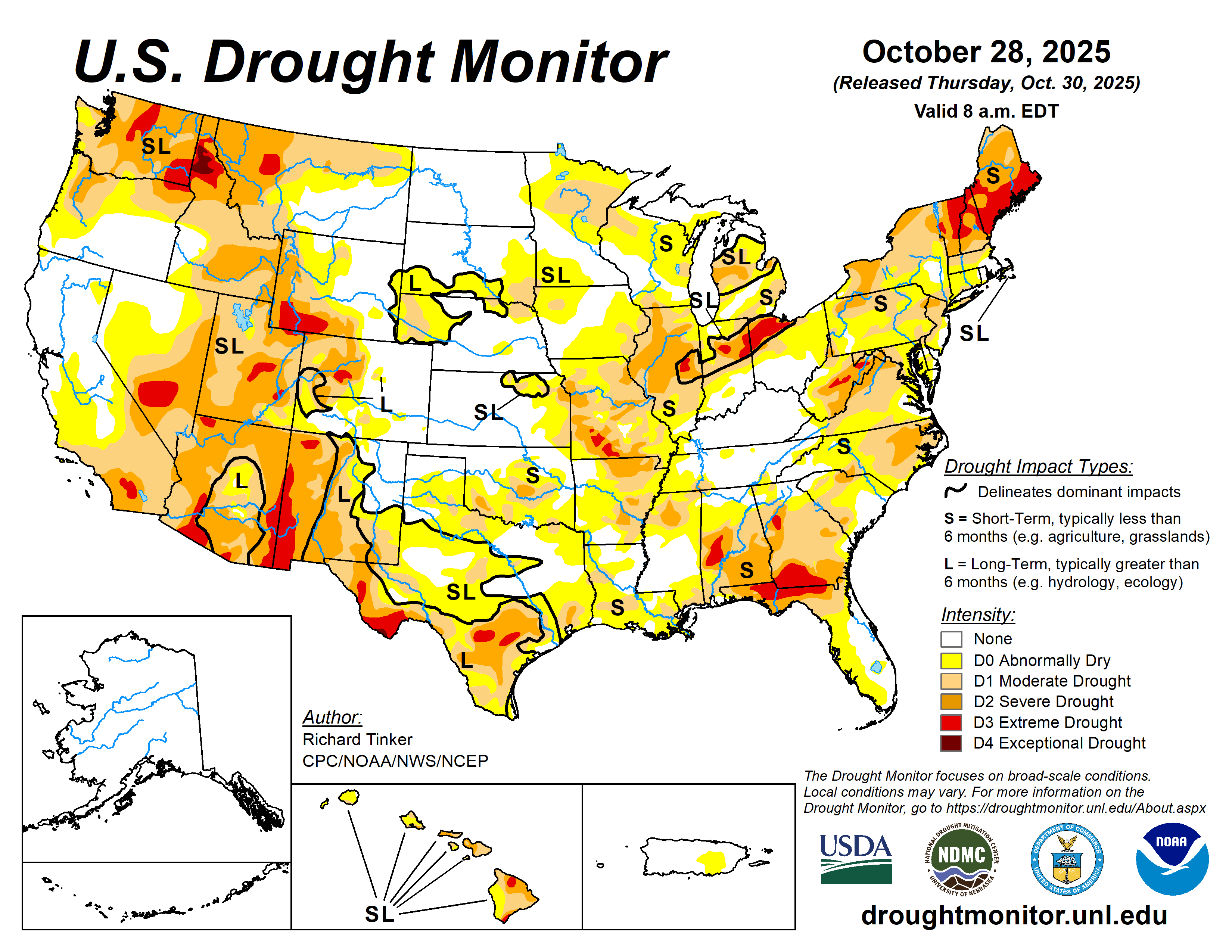
US Drought Monitor map October 25, 2025.

Click the link to read the article on the Grist website (Tik Root):

October 27, 2025

The city of Clyde sits about two hours west of Fort Worth on the plains of north Texas. It gets its water from a lake by the same name a few miles away. Starting in 2022, scorching weather caused its levels to drop farther and farther. Within a year, officials had declared a water conservation emergency, and on August 1 of last year, they raised the warning level again. That meant residents rationing their spigot use even more tightly, especially lawn irrigation. The restrictions weren’t, however, the worst news that day: The city also missed two debt payments.

Municipal bond defaults of any kind are extraordinarily rare, let alone those linked to a changing climate. But with about 4,000 residents and an annual budget of under $10 million, Clyde has never had room to absorb surprises. So when poor financial planning collided with the prolonged dry spell, the city found itself stretched beyond its limits.

The drought meant that Clyde sold millions of gallons less water, even as it imported more of it from neighboring Abilene, at about $1,200 per day. Worse, as the ground dried, it cracked, destroying a sewer main and bursting another quarter-million dollar hole in the town budget. Within days of Clyde missing its payments, rating agency Standard & Poor’s slashed the city’s bond ratings, which limited its ability to borrow more money. Within weeks, officials had hiked taxes and water rates to help staunch the financial bleeding.

“There’s more to a drought than just the cost of water,” said Rodger Brown, who was mayor at the time and is now interim city manager. “It tanks your credibility.”

Drought, of course, isn’t the only climate-driven disaster hitting places like Clyde. Hurricanes, floods, and fires are bankrupting cities across America. After flames ripped through Paradise, California, in 2018, the town’s redevelopment agency defaulted on some of its obligations. Naples, Florida, resorted to selling $11 million in bonds to rebuild its pier after Hurricane Ian in 2022. Earlier this year, the Los Angeles Department of Water and Power had a harder time raising money after massive fires swept the city. Kerr County, Texas, is in the midst of raising taxes after devastating floods in July. 

Each episode underscores how climate shocks once seen as exceptional are now straining local budgets. But drought may be the most insidious of these threats. Compared to other types of disasters, it often hits everyone in a community, affects large areas, and can last months, if not years. There are also fewer defenses and relatively limited government assistance. Experts worry that drought could ultimately prove an enormous risk to the $4 trillion municipal bond market that underwrites everything from roads and schools to the water running through millions of taps.

“I personally think this is a dark horse in the conversation right now,” said Evan Kodra, the head of climate research for the financial data company Intercontinental Exchange, or ICE. “It should be a bigger deal.”


This year alone has seen droughts in at least 43 states, from Vermont to California, affecting 125 million people. And ICE projects that more of the currently outstanding municipal debt will be located in areas prone to drought by 2040 than hurricanes, floods, and wildfires combined. The financial effects of prolonged water woes can mount in ways not seen in one-off events, said Jeremy Porter, the chief economist at First Street Foundation, a nonprofit climate research firm.  

“Drought is one of those things, if there is an impact, there’s a step-function impact,” he said. “You just don’t have the capacity to cover the risk.” 

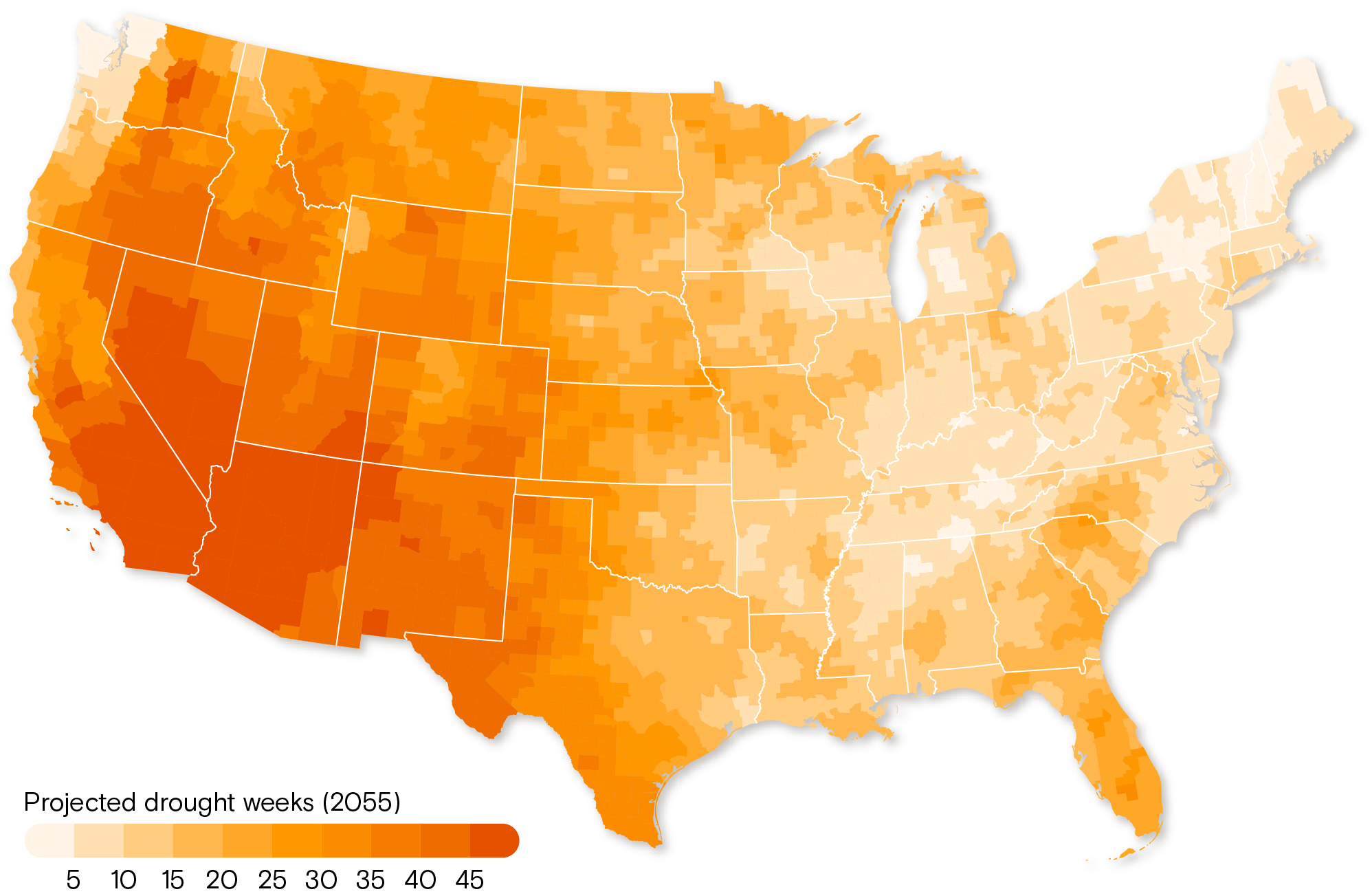
Projected severe drought in 2055

Average weeks per year in severe drought conditions

Average weeks per year in severe drought conditions. Source: First Street Foundation Clayton Aldern / Grist

30-year change in drought risk

Increase in severe drought weeks from current conditions to 2055

Increase in severe drought weeks from current conditions to 2055. Source: First Street Foundation Clayton Aldern / Grist

Droughts are particularly difficult for cities to guard against. While building codes and insurance discounts can encourage homeowners to raise their houses, use wind-resistant shingles, or clear brush to slow fires, the options for making sure people have enough water are far more limited without curbing development

Also unlike with its headline-grabbing cousins, drought has a much weaker federal safety net when something does go wrong. The Department of Agriculture offers some aid to farmers, but there’s little funding for individuals or municipalities. The Federal Emergency Management Agency hasn’t issued a drought-related emergency or disaster declaration in the United States since 1993, despite states requesting aid. “There is no adapting to drought,” said Porter. “The federal government is probably not going to come in.” 

As the planet warms, the dry conditions that sent Clyde into the financial abyss are only set to become more frequent and more intense. Intercontinental Exchange researchers found that even in a “best-case” climate scenario, drought, heat stress, and water stress will place billions of dollars of municipal bonds at risk by 2040. Under a worst-case situation, that number could reach hundreds of billions. While Clyde’s default was relatively tiny, municipal debt is the bedrock of everything from hedge funds to retirement accounts, making a string of such events potentially catastrophic for the economy.

But well before dramatic rolling defaults, the financial pressures of drought will likely alter daily life in many regions. That’s already the reality for one community in Arizona, where the rush for water has turned into a years-long financial and political standoff.

Rio Verde Foothills lies on the outskirts of Scottsdale. Residents there have been trucking water in from its larger neighbor ever since the unincorporated, “wildcat” development was founded in the early 2000s. The arrangement worked well until 2021, when a severe drought gripped the area, and Scottsdale decided it could no longer spare the dwindling resource. Cut-off residents of Rio Verde scrambled and eventually signed a $12 million contract with the state’s largest private water company, Epcor Utilities, to build a permanent supply line.

Three years later, though, the feud continues. Scottsdale agreed to keep providing water through the end of this year while Epcor Utilities built new infrastructure. But construction is months behind schedule and Scottsdale is sticking to its deadline — leaving the foothills once again facing a cutoff. (Epcor remains confident this won’t happen.) 

Even when the new line is connected, Rio Verde Foothills residents could see their water bills double or triple. Hikes like that are going to be a far wider concern across the West than outright disconnection, says Sara Fletcher, an environmental engineer at Stanford University who works on water scarcity issues. “Water prices are going up, and up, and up,” she said. “They are going to go up much faster than inflation for the past decade.” 

Credit: City of Clyde, Texas

The irony of drought is that as people conserve water to combat it, there is less money for the utility, whose costs remain relatively fixed. That results in “drought surcharges,” or other fees, for customers. [ed. emphasis mine] It’s a cycle that was on full display in Clyde. 

By August 2023, the wave of aridity that hit West Texas had stretched for months, and officials in Clyde declared a stage 2 water emergency, which targets a 20 percent decrease in demand. By the following year they raised it to stage 3, or a 30 percent decline — one step below mandatory rationing. The measures worked, but at a cost. “Water sales are one of the main things that a city, almost any city, has,” said Brown. “That’s big for a city’s revenue generation.”

According to Clyde’s financial statements, it sold 7 million gallons less in 2023 than the year prior. It also had to import water from nearby Abilene at a premium of around $3 per thousand gallons. While Brown didn’t know exactly how much Clyde bought, he said it wasn’t as much as in some previous droughts but still significant. The bigger blow came when the parched ground split, shifted, and ruptured a major sewer line. The roughly $250,000 repair bill turned the cracks in the town’s finances into crevasses.

“You can’t have people out here without the services. So we had to fix it,” he said. These new liabilities and dwindling income came on top of millions of dollars in debt that Clyde had amassed over the years, despite having kept taxes or utility prices relatively flat. It created what Brown called a “perfect storm.”

On August 1, 2024, the city missed two bond payments — one for $354,325, another for $308,400 — and filed a claim on its bond insurance to cover them. By the end of the year Clyde had failed to meet a total of $1.4 million in liabilities. Standard & Poor’s slashed the ratings of the bonds with missed payments from A- to D, and the city’s creditworthiness to B, moves that will raise future borrowing costs for the city. 

Outstanding debt

Current municipal bond debt by 2040 climate risk category, billions of dollars

Source: ICE Data Services Clayton Aldern / Grist / Bogomil Mihaylov / Unsplash

While drought wasn’t the whole story, Brown called it a “significant reason” for Clyde’s woes. Whatever the cause, the fallout rippled quickly. The city council raised property taxes by 10 percent and tacked a $35 surcharge onto monthly utility bills. “We have people in this very room who have to decide already, do I buy medicine [or] do I buy groceries?” pleaded one person at a city council hearing. “This is reality in Clyde. You can’t raise their typical water bills any further.”

So far residents have absorbed the added costs, which has allowed the city to continue to operate. But the spiral from expensive, inaccessible, or nonexistent water could have been much worse. High bills can lead to compromises in daily life, whether that be letting parks wither or skipping showers. Over time, those inconveniences could make a town a less desirable place to live, which, in turn, might result in lower property values, a dwindling tax base, and, consequently, more financial troubles.

“If you don’t have water, if you don’t have a functioning city, there is a vicious cycle dynamic that could come into play,” said Kodra at Intercontinental Exchange. “Once your property tax base is decently lower than it was, then it’s harder to borrow money to dig out of that hole.”

Just for grins here’s a slideshow of early November US Drought Monitor maps for the past few years.