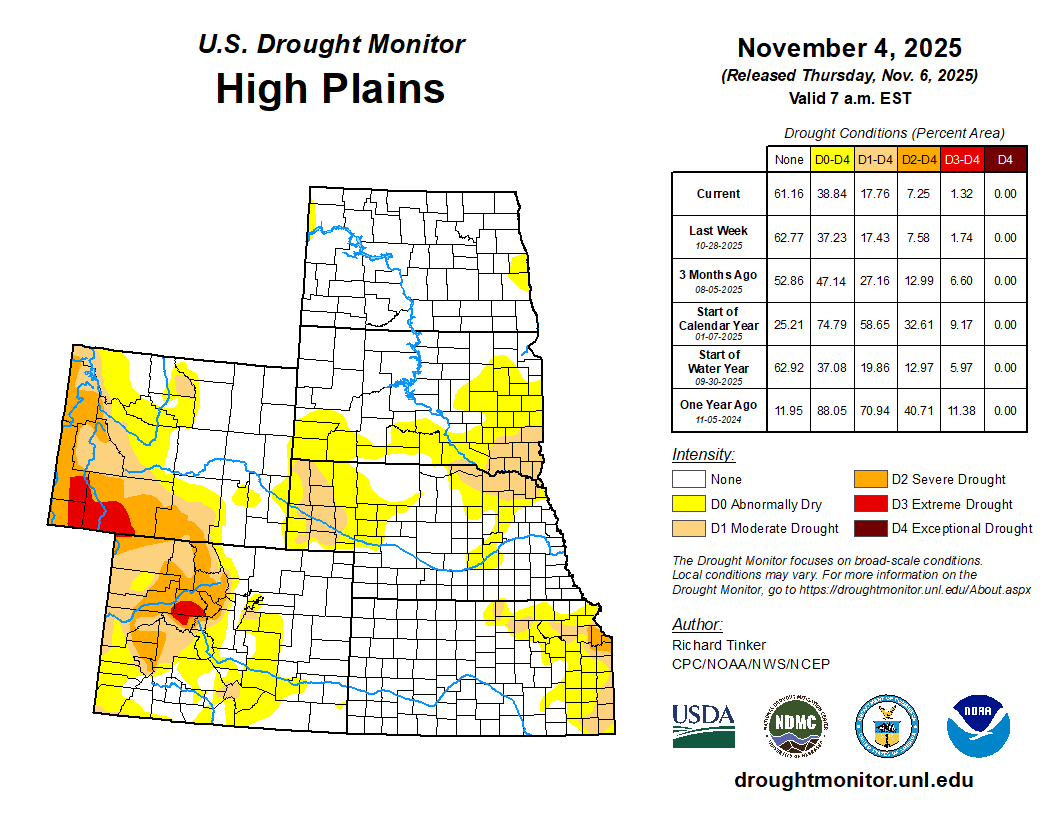
#Drought news November 6, 2025: The High Plains Region is currently the Region least-affected by dryness and drought even though coverage in sum increased slightly this past week when most of the region reported a few tenths of an inch of precipitation at best

Click on a thumbnail graphic to view a gallery of drought data from the US Drought Monitor website.
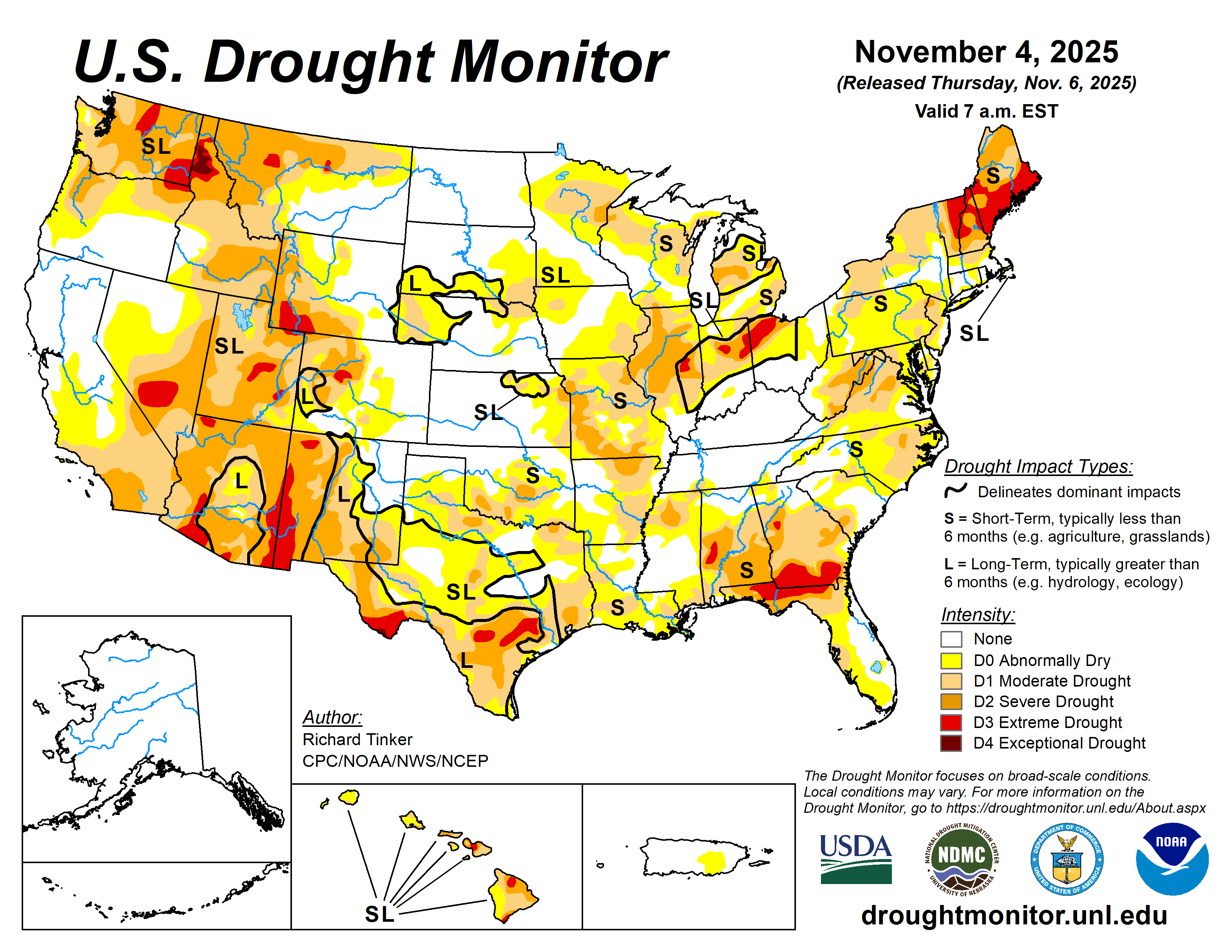
Click the link to go to the US Drought Monitor website. Here’s an excerpt:

This Week’s Drought Summary

Heavy precipitation again doused the Pacific Northwest, especially across the northern half of the Cascades and along the Washington and northern Oregon Coast. Between 6 and 10 inches of precipitation fell on most of northwesternmost Washington, and 6 to 8 inches fell on most of the northern Washington Cascades and a few areas near the Washington/Oregon border and along the northwestern Oregon Coast. From central Oregon northward, over 3 inches fell on the Cascades and coastal areas while 1.5 to 3.0 inches fell on other locations there from the Cascade Foothills to the Pacific Ocean. Farther east, locally heavy precipitation (1 to locally approaching 4 inches) was observed in northwestern Montana and northern Idaho. Other locations from the Great Plains westward to the Pacific Ocean were much drier, with most locations recording no measurable precipitation. Across the eastern half of the country, moderate to heavy precipitation (1 to locally 4 inches) fell on most of the Northeast, with the heaviest amounts falling on northern New York and in a swath from southwestern New England and the New York City area northward through northeastern New York and adjacent Vermont. Areas around the Outer Banks of North Carolina and southeastern Virginia also recorded heavy precipitation (2 to 4 inches) while amounts ranged from 1 to 3 inches in most of central and eastern Maine, New Jersey, central and eastern Pennsylvania, parts of the Mid-Atlantic region, and across Kentucky, most of Tennessee, and the adjacent Ohio and Mississippi Valleys. The west side of the Middle and Lower Mississippi Valley recorded generally 0.5 to locally 2.0 inches of precipitation, similar to totals reported across the upper Southeast, the central Carolinas, the central Appalachians, and the Upper Ohio Valley. In contrast, little or no precipitation was also observed across most of the Lower Mississippi Valley, near the central and eastern Gulf Coast, over the South Atlantic region from South Carolina through southern Florida, and through the Great Lakes region and adjacent portions of the Midwest.

These conditions led to broad areas of improvement across the Northeast, the Mid-Atlantic region, most of the Carolinas, the central and southern Appalachians, the Ohio Valley, portions of the Middle Mississippi Valley and adjacent Lower Mississippi Valley, a few parts of the central and northern Rockies and southern California, and portions of the Pacific Northwest, where the heavy precipitation did not improve moisture shortages as much as might be expected due to quickly-increasing normal at this time of year. Meanwhile, after the prior week’s beneficial precipitation, low precipitation totals this past week allowed for broad areas of intensification or re-intensification of dryness and drought over most of Texas, southern Oklahoma, the northern Great Lakes, parts of the northern Great Plains, portions of the central High Plains, north-central Montana, and central Maui. A few areas of deterioration were also introduced from southern South Carolina through southern Florida and through parts of the Virginia Piedmont…

High Plains

The High Plains Region is currently the Region least-affected by dryness and drought even though coverage in sum increased slightly this past week when most of the region reported a few tenths of an inch of precipitation at best. Measurable totals were restricted to eastern Kansas and southeastern Nebraska. The dry week induced a few areas of deterioration, but even so, less than 39 percent of the Region is experiencing some degree of dryness (D0+), and only 17.8 percent is enduring drought (D1+). Precipitation deficits on most time frames crept upward Region-wide, but areas of deterioration were relatively limited given the relatively low natural and human water demand this time of year…
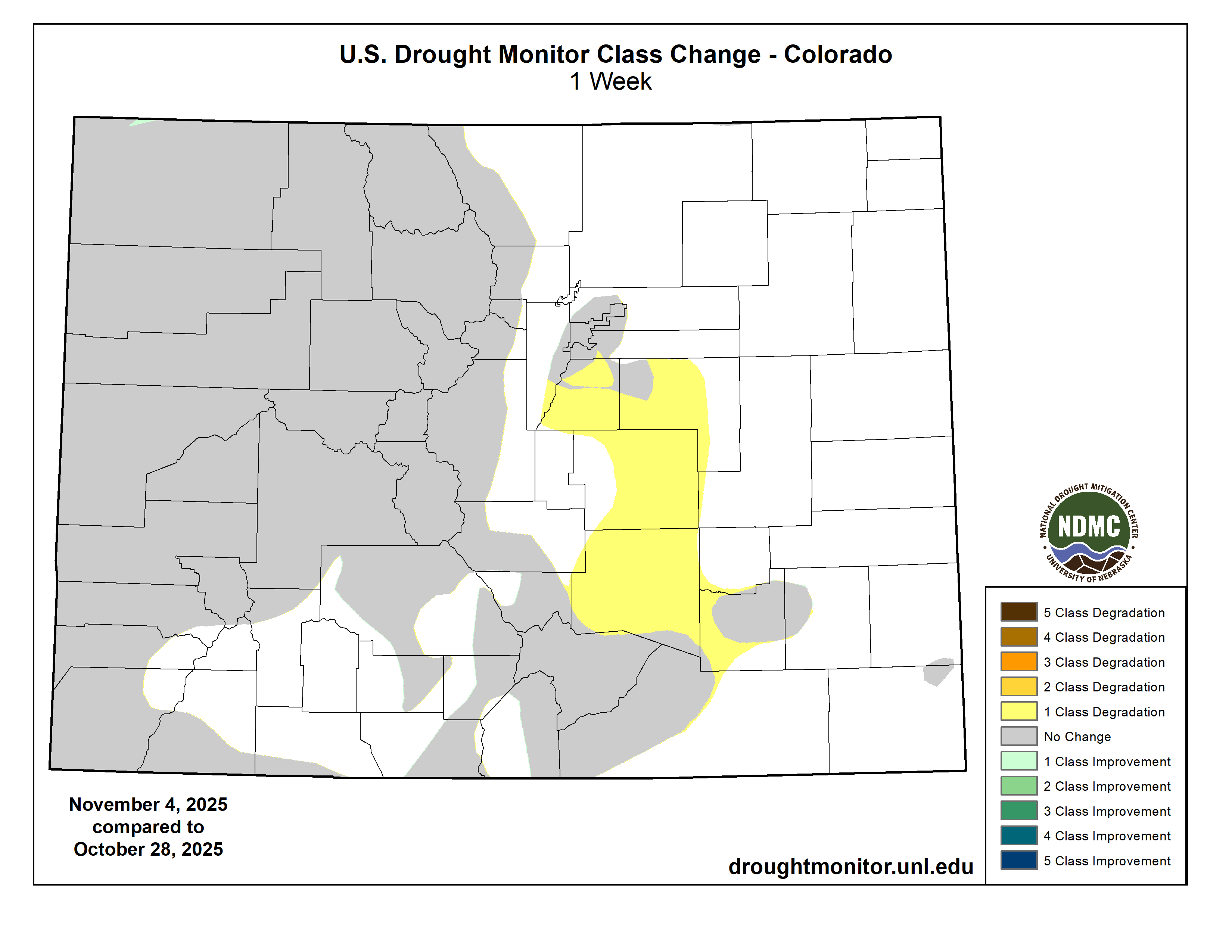
Colorado Drought Monitor one week change map ending November 4, 2025.

West

Several inches of precipitation pelted central and northern sections of the Cascades and coastal Pacific Northwest, and 1 to 3 inch totals were common across northwestern Montana and northern Idaho, as well as the lower elevations in the Pacific Northwest between the coast and the Cascades. Several tenths of an inch of precipitation were reported farther south along the West Coast and in the lower elevations of the northern Intermountain West, but most of the West Region received no measurable precipitation for the week. This prompted areas of intensification in north-central Montana and southeastern New Mexico while the heavy precipitation led to areas of improvement in the Pacific Northwest. But given how early it is in the wet season and that normals are ramping upward fairly quickly there, improvement in dryness and drought was not as widespread as one might assume. Drought coverage (D1+) in Washington was unchanged from the prior week at 94.8 percent, and the extent of the more intense drought classifications (D2-D4) declined only slightly from 65.1 to 63.9 percent. There was even less change in Oregon, although dryness there is not as widespread as in Washington. Montana reported intensification in north-central parts of the state, but a little improvement farther west, as was the case in the fringes of the D3 and D4 areas in Idaho. According to the U.S. Geological Survey, flows along numerous rivers in the West remain very low. On the Missouri River at Great Falls, MT, in early November, streamflow was observed at 3,620 cubic feet per second, well below the mean for the date since the turn of the century (4,934 cubic feet per second, ranging from 3,880 in 2021 up to 6,470 in 2010). On the Firehole River, near West Yellowstone, MT, streamflow was 212 cubic feet per second in early November, below the 2002-2024 mean of 272 for similar dates, which ranged from 236 in 2022 to 318 in 2008. These amounts are up slightly since late summer. In late August, a field measurement of 193 cubic feet per second was bested only by 192 in early August 2016…

South

Moderate to heavy rain (1 to 3 inches) doused Tennessee, portions of Arkansas, and some adjacent areas last week. Dryness and drought over western Tennessee and much of Arkansas eased a bit as a result. Most other locations across Tennessee, Arkansas, eastern Oklahoma, and northern Mississippi reported several tenths of an inch of rain, and similar totals fell on isolated areas across southern Mississippi, Louisiana, and coastal Texas. The remainder of the Region, including most of Texas and Oklahoma, observed no measurable rain. After beneficial precipitation the prior week, the precipitation-free week allowed dryness and drought to re-intensify or expand over large parts of Texas and southern Oklahoma. After drought coverage (D1+) declined to about one-third of the state the prior week, coverage increased to over 45 percent this past week, which is the greatest extent since early May. Areas of late-season crop stress and some die-off has been reported across Oklahoma and Texas over the past few weeks…
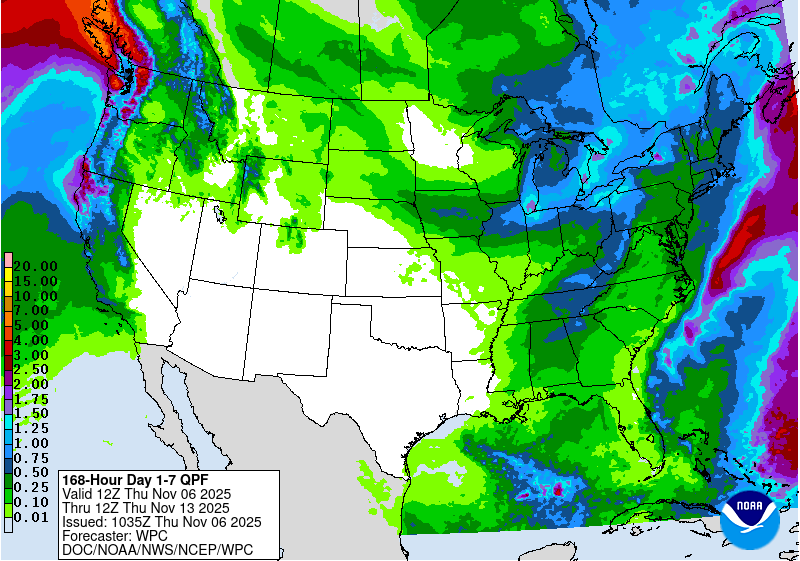
Looking Ahead

Over the next 5 days (through November 10), the Pacific Northwest is expected to remain relatively wet. Between 3 and 6 inches are anticipated in parts of the Washington and northern Oregon Cascades and far northwestern Washington. Generally 2 to 3 inches are forecast through the rest of the central and northern Cascades, most of coastal Washington, and coastal areas in northwestern Oregon and northwestern California. Elsewhere, moderate to locally heavy precipitation (1 to 2 inches) is anticipated in the remaining areas from northern California to the Canadian Border. Over much of the northern Rockies, in southern Michigan, to the lee of Lake Erie, across northern New York, and over parts of New England. Totals ranging from a few tenths of an inch to about an inch are anticipated across the northern Intermountain West, higher elevations of western Wyoming, isolated parts of the northern Great Plains, portions of the Midwest, the east half of the Great Lakes, most of the Appalachians, the middle and upper Ohio Valley, the central Gulf Coast states, much of the Northeast, and southeastern Florida. Other locations are expected to receive a few tenths of an inch at best, with little or none anticipated in the South Atlantic Coastal Plain, most of interior Florida, the Lower Mississippi Valley, and from the central and southern Great Plains westward into California. Temperatures are forecast to average warmer than normal in the West and cooler than normal in the East. A shot of cold air – the coldest of the season so far – should push through the East early next week. It will not linger for long, but on one or two nights temperatures could approach freezing as far south as the central Gulf Coast, and readings in the 50’s deg. F may reach into the southern Florida Peninsula. For the 5 days overall, high temperatures are expected to average 5 to 8 deg. F below normal from the Great Lakes and Midwest southeastward into northern Florida. In contrast, daily highs from the High Plains to the Pacific Coast should average 5 to 12 deg. F above normal, with the largest departures expected in parts of the Great Basin, near the California/Oregon border, and over the northernmost Rockies.

The 6- to 10-day outlook from the Climate Prediction Center for November 11-15 favors subnormal precipitation for most areas from the Great Plains to the Atlantic Coast, except along the northern tier of the region. Odds for unusual dryness exceed 50 percent from the Lower Mississippi and Ohio Valleys eastward through the South Atlantic States outside southern Florida. Abnormally wet weather is favored from the High Plains to the Pacific Coast, with chances for unusually heavy precipitation exceeding 60 percent across central and southwestern California. Wet weather is also somewhat favored through Hawaii and over most of Alaska. Temperatures are expected to average below normal in the East from the lower Great Lakes, Middle Ohio Valley, and central Gulf Coast eastward to the Atlantic Coast. The likelihood for subnormal temperatures exceeds 70 percent from northern Florida northward along the Coastal Plain into southern New England. From roughly the Mississippi River to the Pacific Coast, warmer than normal weather is favored, with odds topping 70 percent across a broad area covering most of the central and southern Rockies and High Plains. Warm weather is also expected over most of Alaska and across Hawaii.

US Drought Monitor one week change map ending November 4, 2025.

Just for grins here’s a slideshow of early November US Drought Monitor maps for the past few years.

Rainfall brings #ColoradoRiver drought relief, but concerns for next year’s water supply remain — Ā Cassie Sherwood (WaterDesk.org) #COriver #aridification

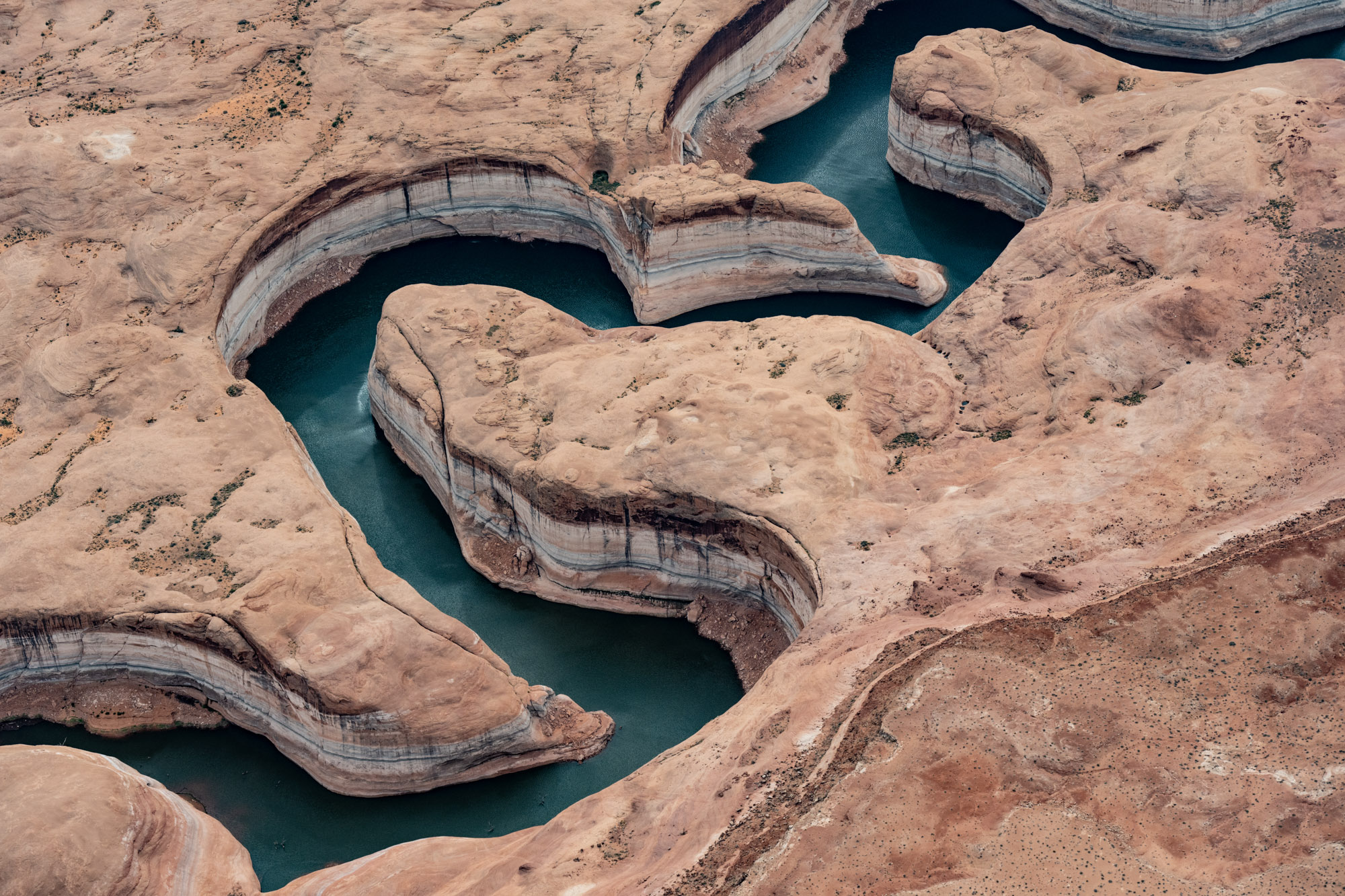
The Colorado River fills Glen Canyon, forming Lake Powell, the nation’s second-largest reservoir. The reservoir could drop to a new record low in 2026 if conditions remain dry in the Southwestern watershed. (Alexander Heilner/The Water Desk with aerial support from LightHawk)

Click the link to read the article on The Water Desk website (Cassie Sherwood):

November 4, 2025

This story is produced and distributed by The Water Desk at the University of Colorado Boulder’s Center for Environmental Journalism.Ā 

Heavy autumn rains brought relief to drought-plagued portions of the Southwest, but across the Colorado River basin ongoing water supply concerns still linger amid tense policy negotiations and near record-low reservoir storage.  

Even after accounting for the heavy rain, 57% of the Colorado River watershed remains in severe drought, according to the U.S. Drought Monitor. More than 11% of the basin is in extreme drought. 

A less than average upcoming snow season combined with a dry spring or early summer in 2026 could create conditions for another low runoff year. The Colorado River’s headwaters saw a weak snowpack last winter, which contributed to one of the worst spring runoff seasons on record in 2025. Drought conditions spread and worsened into summer throughout the southern Rocky Mountains. 

Peter Goble, Colorado’s assistant state climatologist, explained that the recent rainfall ā€œcertainly recharged soils,ā€ in some watersheds. 

Flows on the Animas River at Durango. Water Year 2026 is shown in black in comparison to past years. From https://climate.colostate.edu/drought/#streamflow

Streamflow in the Animas River and Rio Grande increased significantly following the October rains and flooding. Rain in southwest Colorado, particularly around Pagosa Springs, brought flooding that damaged homes and downtown businesses. Rain gauges near the San Juan Mountains recorded 7 to 10 inches of precipitation from October 9-15. 

ā€œWe would love to see this rain come over a more steady incremental period,ā€ Goble said. ā€œBut oftentimes it is these flooding events that kind of put the kibosh on a drought more locally.ā€ 

The flooding erased drought designations on the Drought Monitor map in those localized areas, but basinwide drought conditions tell a different story. Dry soils, depleted reservoirs and winter weather forecasts continue to cause water managers to worry.

Even with the recent rain, soils in many parts of the Colorado River basin remain dry. Soil absorbs moisture almost like a sponge. When the soil moisture is low, spring runoff soaks into the soil, saturating the ground first. Soils that are more saturated lead to more water filtering into streams and reservoirs when runoff occurs, making the process more efficient. 

ā€œWe’re still going to need a good snowpack in order to be set up nicely, but this (rain) improves our outlook for the efficiency of that snowpack,ā€ Goble said.

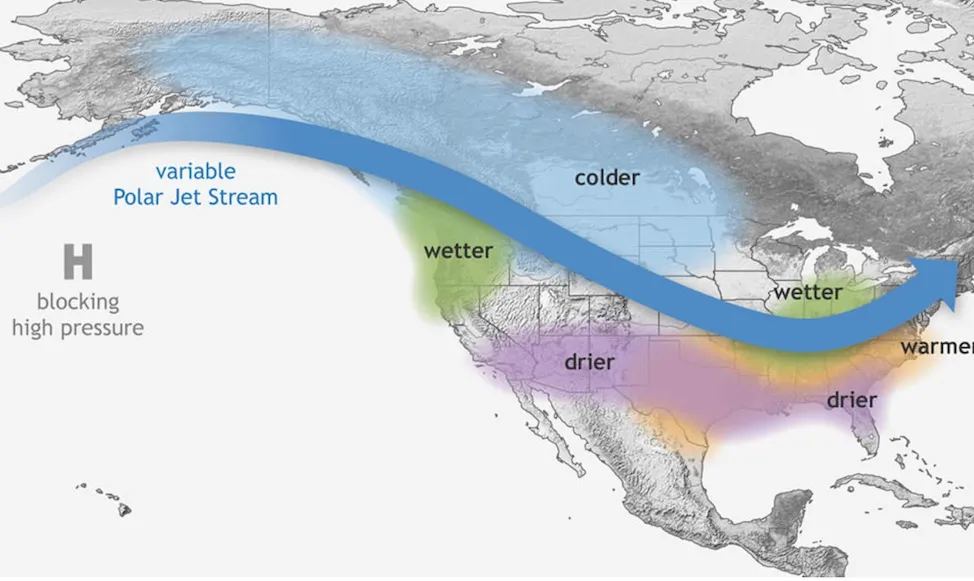
La NiƱa causes the jet stream to move northward and to weaken over the eastern Pacific. During La NiƱa winters, the Southwest tends to see warmer and drier conditions than usual. Since La NiƱa conditions are more common during the negative phase of the Pacific Decadal Oscillation, a negative PDO is likewise associated with warmer, drier conditions across the Southwest. (Image credit: NOAA)

Federal forecasts show the possibility of a mild La NiƱa through February. The climate pattern occurs when Pacific Ocean waters cool down and alter global weather conditions. La NiƱa patterns often impact the amount of snowpack accumulation in the coming year. The southern part of Colorado is often drier in a La NiƱa year while northern areas, around Steamboat Springs, typically see snowier conditions. 

The stakes for an above average runoff next year are high. The two biggest reservoirs in the country, Lake Powell and Lake Mead have steadily declined over the last 25 years. Powell is currently at 29% of its capacity and Lake Mead is at 32%. A lessened runoff could push them dangerously low.

While the rain slightly alleviates local drought, it’s ā€œonly a drop in the bucket when it comes to refilling Lake Powell and Lake Mead,ā€ Goble said. ā€œWe’re still going to see those regional water shortages persist.ā€ 

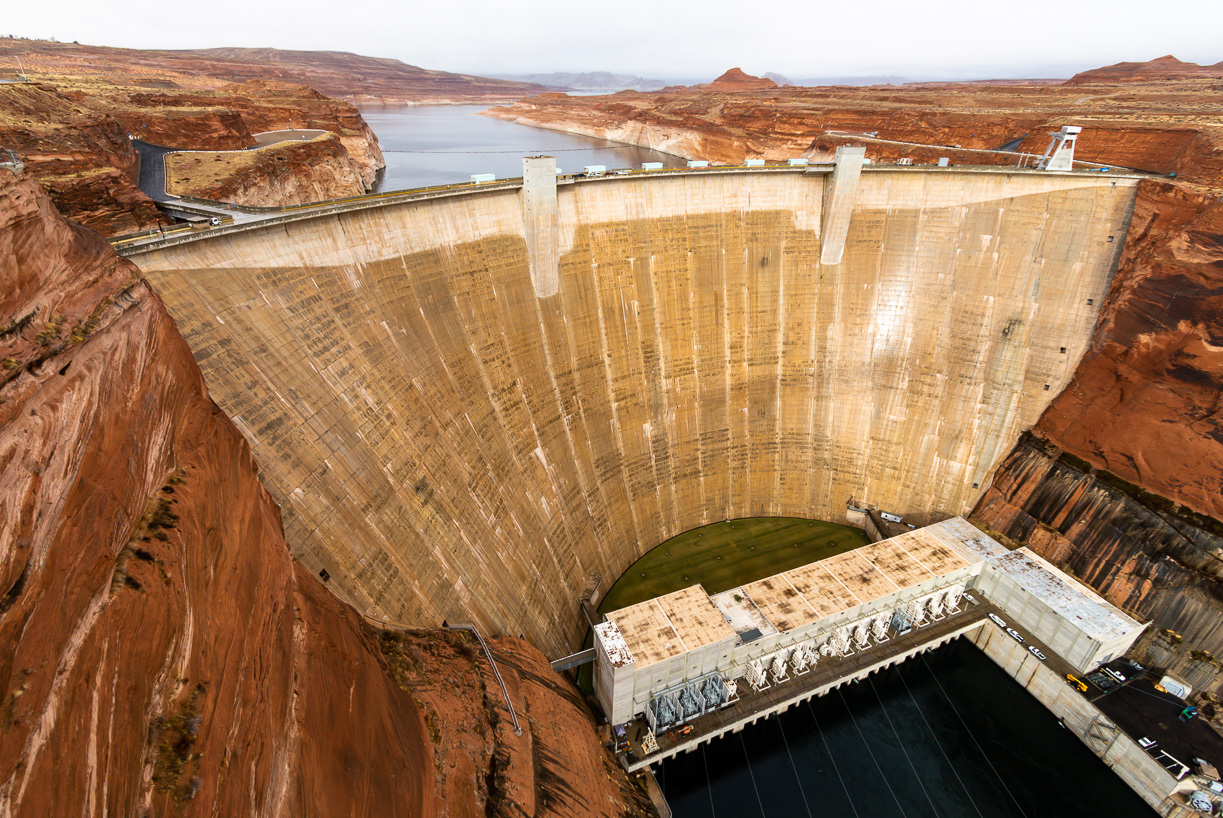
Glen Canyon Dam holds back the waters of Lake Powell, which has reached critically low levels in the last three years. The reservoir serves downstream water use in Arizona, California, Nevada and Mexico. (Mitch Tobin/The Water Desk)

If water levels continue to decline in these larger reservoirs, the dams’ infrastructure is threatened and the hydropower turbines can’t be used. Lake Powell, for example, has different outlets installed so water can be released in low conditions, however they are not designed to be the main outlet source. New federal projections show it’s possible Powell’s levels could drop low enough to cease hydropower production as early as October 2026, if conditions remain dry.

ā€œThey could reach levels they have never reached before and potentially reach catastrophic levels,ā€ said John Berggren, regional policy manager for Western Resource Advocates.  

In response to extremely low water conditions, it’s possible water from upstream reservoirs in Colorado, Wyoming and New Mexico could be released to support Powell’s hydropower turbines. 

ā€œWe are seeing a new normal because of climate change, because of aridification,ā€ Eric Kuhn said, former general manager of the Colorado River District, on the state’s Western Slope. In 2022, the basin saw similar drought conditions. 

ā€œWe are back where we were just a few years later,ā€ Kuhn said. ā€œThe system is slipping away.ā€ 

The basin states are also engaged in negotiations for new operating guidelines for the Colorado River, set to be in place by 2027. Given the ongoing drought conditions, water experts say the two reservoirs cannot wait for new guidelines.

ā€œDon’t forget the short term problem while you are focused on a long-term agreement,ā€ Kuhn said. A recent research paper, co-authored by Kuhn, highlights the need for urgent consumptive cuts basinwide. ā€œWe have got to figure out what’s going to happen next year if next year happens to be dry.ā€

Map of the Colorado River drainage basin, created using USGS data. By Shannon1 Creative Commons Attribution-Share Alike 4.0

#Arizona Governor Katie Hobbs rips Upper Basin States’ ‘extreme negotiating position’ on #ColoradoRiver — Tucson.com #COriver #aridification

Udall/Overpeck 4-panel Figure Colorado River temperature/precipitation/natural flows with trend. Lake Mead and Lake Powell storage. Updated through Water Year 2024. Credit: Brad Udall

Click the link to read the article on the Tucson.com website (Tony Davis). Here’s an excerpt:

November 5, 2025

Gov. Katie Hobbs blasted officials of the four Upper Colorado River Basin states for what she called their ā€œextreme negotiating positionā€ in refusing to offer curbs on their water use to help save the depleted river.

ā€œThis river is shared by seven states, and it benefits seven states. Therefore there must be water conservation efforts in all seven states within the Colorado River Basin,ā€ Hobbs said Wednesday in Tucson at a gathering of the National Water Resources Association Meeting Leadership Forum.

Arizona Governor Katie Hobbs. Photo credit: Arizona Office of the Govenor

ā€œYet as I stand before you today, after years of negotiations and meeting after meeting after meeting, and time running short to cut a deal, we have yet to see any offer or real, verifiable plan to conserve water from the four Upper Basin States who rely upon this shrinking river,ā€ Hobbs said in a talk at Loew’s Ventana Canyon resort on the northeast side…

The seven states this century have been using far more river water for farms, homes and businesses than is provided by Mother Nature, with the overuse now reaching 3.6 million acre-feet a year, or more than one-fourth of the river’s annual average flow. Those annual flows have declined at least 20% since the turn of the century due to drought and human-caused climate change, many scientists have said. The Upper Basin states have so far not retreated from their position that they see no reason to conserve any additional water because they say many of their farmers, in particular, have already suffered many shortages in recent years when flows in the river and its tributaries aren’t enough to satisfy demand. The Upper Basin states also note that they use significantly less water than they have rights to use under the 1922 Colorado River Compact, while the Lower Basin states typically use more than their allocated rights, particularly when evaporation of water in the Lower Basin’s stretch of river and its tributaries is considered…In a brief interview Wednesday, Hobbs noted that Arizona has one of the fastest growing economies in the US and that could be undercut by an unfavorable CAP allotment. Hobbs went on to say the state maintaining a leadership role in the chip manufacturing industry is not only an economic issue, but also one of national security because some of the most advanced computer chips in the U.S. are being manufactured here. In her speech Hobbs said, ā€œWe see time and time again, Arizona, California and Nevada coming to the table, offering significant water cutbacks, and seeing nothing from the Upper Basin.

Fig. 1. The Colorado River Basin covers parts of seven U.S. states as well as part of Mexico. Credit: U.S. Geological Survey

ā€˜Burning Money’: Dept. of Energy Directs $100 Million to Modernize Declining Coal Plants

Craig station. Photo credit: Allen Best/Big Pivots

The funding represents Trump’s latest attempt at coal revitalization, but updating the nation’s aging facilities would cost billions, experts say.

By Anika Jane Beamer

November 3, 2025

This article originally appeared on Inside Climate News, a nonprofit, non-partisan news organization that covers climate, energy and the environment. Sign up for their newsletter here.

The U.S. Department of Energy has announced up to $100 million in federal funding for projects modernizing the nation’s remaining coal plants, nearly half of which were slated to close by 2030. 

The investment, a fraction of what would be needed for a comprehensive upgrade, is unlikely to make coal power more affordable, energy experts and anti-coal advocates say.

On Friday, U.S. Secretary of Energy Chris Wright issued the Notice of Funding Opportunity, calling for applications to design, implement, or test refurbishments and retrofit systems that allow coal plants to ā€œoperate more efficiently, reliably, and affordably.ā€ 

The announcement outlined three key areas for development projects: advanced wastewater management systems, systems that enable plants to switch between coal and natural gas, and advanced ā€œco-firingā€ systems that allow simultaneous combustion of both fuel types.

The funding comes just a month after the department announced $625 million to ā€œexpand and reinvigorateā€ America’s coal industry. 

That investment already included $350 million to recommission closed coal power plants or modernize plants and $100 million for the three development areas outlined in Friday’s announcement. The DOE did not respond to questions about why additional funds were announced just a month later.

Trump’s investments in coal are a drop in the bucket of what would realistically be needed to revamp the plants, said Michelle Solomon, a manager in the electricity program at Energy Innovation, a nonpartisan energy and climate policy research firm based in San Francisco.

ā€œThose types of retrofits for a single plant can cost hundreds of millions of dollars,ā€ said Solomon. ā€œTo do that for every plant in the coal fleet, you’re looking at billions of dollars. And you’d be putting those billions of dollars into clunkers. Literally burning that money.ā€

In April, following Trump’s ā€œBeautiful Clean Coalā€ executive order, the Department of Energy rolled out a series of actions intended to reinvigorate American coal production. The department reinstated the National Coal Council as a federal advisory committee, offered long-term financing for coal infrastructure, designated coal as a critical material and mineral and ended a moratorium prohibiting new coal mining leases on federal land.

ā€œYou’d be putting those billions of dollars into clunkers. Literally burning that money.ā€ā€” Michelle Solomon, Energy Innovation

Last week’s funding announcement advances Trump’s commitment to restore U.S. energy dominance, the official press release read. 

ā€œFor years, the Biden and Obama administrations relentlessly targeted America’s coal industry and workers, resulting in the closure of reliable power plants and higher electricity costs,ā€ U.S. Secretary of Energy Chris Wright said in the report. ā€œThankfully, President Trump has ended the war on American coal and is restoring common sense energy policies that put Americans first.ā€

Yet Trump’s attempt to save coal from the brink is unlikely to succeed.

In 2001, coal made up half of the electricity generated by utility-scale facilities in the United States. Today, it accounts for less than a fifth of generated power; the decline reflects the changing energy landscape.

The decline of coal energy is due to rising coal prices and the proven cost-effectiveness of alternative energy sources, including solar, wind and natural gas, said Solomon. 

Analysis by Energy Innovation found that coal prices increased 28 percent between 2021 and 2024, while inflation rose only 16 percent in that time.

At 99 percent of U.S. coal plants—209 out of 210—it would be cheaper to replace energy with new wind and solar than to keep them operating, a 2023 Energy Innovation analysis found.

The Sierra Club has led the charge to close power plants in the U.S. through their decades-long ā€œBeyond Coalā€ campaign. The new coal funding is ā€œjust the latest Trump administration action that harms people and the planet,ā€ Sierra Club climate policy director Patrick Drupp wrote in a statement to Inside Climate News.

ā€œTheir pro fossil fuel agenda is intent on keeping deadly and expensive coal plants alive while Americans foot the bill and suffer the public health damage,ā€ Drupp added.

Trump’s emergency orders to keep operating multiple coal plants slated for retirement have cost ratepayers tens of millions of dollars in the last year alone.

A 90-day emergency order requiring continued operation of Consumers Energy’s J.H. Campbell coal plant in Michigan has generated an additional $80 million in costs since May. The company has said that it will seek payment from ratepayers across the Midwest, in accordance with the cost-collection process set by the U.S. Department of Energy.

Trump has repeatedly argued that coal is critical to improving the reliability of the American energy grid amid surging power demand. But the reliability of coal plants may be overstated.

Between 2013 and 2024, forced-outage rates (excluding planned outages for maintenance) for coal exceeded those for other major sources of electricity, including gas, nuclear and hydroelectric power, according to a report by the North American Electric Reliability Corporation.

Most coal plants in the U.S. were built before 1990. Keeping those plants running as they age requires more and more money, leading utilities to schedule retirement dates for nearly half of all plants.

Solomon uses the analogy of car ownership to explain the decline of coal energy in the U.S. ā€œIf you have a car that has 250,000 miles on it, very little is going to bring that car back to new,ā€ she said. ā€œYou can only do so much when the infrastructure is that old.ā€

Correction: This story was updated Nov. 4, 2025, to reflect that inflation rose 16%, not 6%, between 2021 and 2024, according to Energy Innovation’s analysis.

2 ways you can conserve the water used to make yourĀ food — Huma Tariq Malik and Thomas Borch (#Colorado State University)

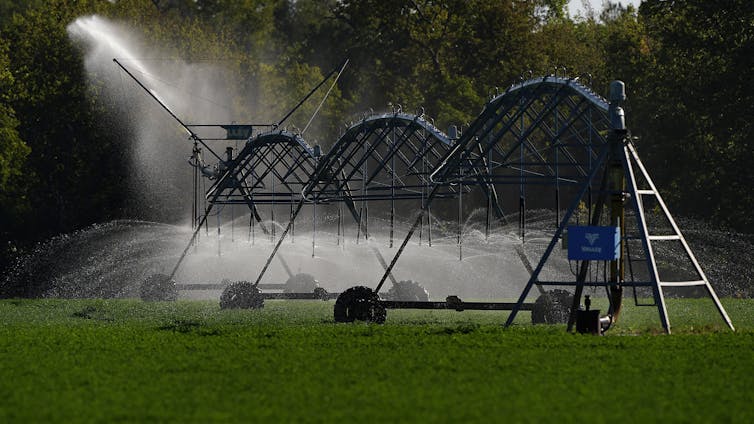
Irrigation equipment waters an alfalfa field in Kansas. AP Photo/Charlie Riedel

Huma Tariq Malik, Colorado State University and Thomas Borch, Colorado State University

As the world’s climate warms and droughts and water shortages are becoming more common, farmers are struggling to produce enough food. Farmers continue to adapt, but there are ways for you to help, too.

For decades, farmers have sought to conserve water in agriculture, with a focus on improving irrigation efficiency. That has included decreasing the practice of flood irrigation, in which water flows through trenches between rows of plants. Instead, many farmers are adopting more precise methods of delivering water to plants’ roots, such as sprinklers and drip systems.

In recent years, policymakers, researchers and consumers have come to look more closely at opportunities to conserve water throughout the entire process of growing, shipping, selling and eating food. Working with colleagues, we have identified several key ways to reduce water used in agriculture – some of which directly involve farmers, but two of which everyone can follow, to help reduce how much water is used to grow the food they eat.

Some work for farmers

Farmers can match crops to local land, water and climate conditions to reduce stress on scarce resources and make food production more sustainable in the long run. That could include reducing the amount of alfalfa and other hay crops used to feed livestock, or swapping out wheat and sorghum and instead planting corn and potatoes.

The condition of the soil also matters. Many farmers have focused on short-term productivity, relying on fertilizers or frequent tillage to boost yields from one season to the next. But over time, those practices wear down the soil, making it less fertile and less able to hold water.

Soil is not just a surface to grow things on. It is a living system that can be built and fed or depleted. Practices such as planting cover crops in the off-season to protect the soil, reducing tillage, applying compost and rotating different types of crops can all help soil hold more water and support crops even during droughts.

A choice for consumers

Adapting on-farm practices addresses only part of the water conservation effort. While crops are grown in fields, they move through a vast network of processors, distributors, supermarkets and households before being eaten, wasted or lost. At each link in this chain, consumers’ choices determine how much agricultural water is ultimately saved.

People’s dietary preferences, in particular, play a major role in agricultural water use. Producing meat requires significantly more water than growing plant-based foods.

Per capita, Americans consume nearly three times the global average amount of meat each year.

While eliminating meat altogether is not everyone’s goal, even modest shifts in diet, whether reducing overall meat consumption or selecting proteins that use less water to produce, can ease the strain. Producing a pound of beef requires an estimated 1,800 gallons of water, compared with about 500 gallons for a pound of chicken.

Replacing all meat with the equivalent quantities of plant-based foods with comparable nutrition profiles could cut the average American’s food-related water use by nearly 30%. Even replacing a small amount of meat with plant-based foods or meats that require less water can make a difference.

While a single meal may seem inconsequential, if multiplied across millions of households these choices translate into meaningful water savings.

Discarded food and plant waste sits in a pile.
How much water did it take to grow all this discarded food? Sarah Reingewirtz/MediaNews Group/Los Angeles Daily News via Getty Images

A second savings opportunity

Perhaps the simplest and most powerful step people can take to save water used in agriculture is to cut back on food waste.

In the United States, 22% of total water use is tied to producing food that ultimately goes uneaten.

In developing countries, losses often result from limited storage and transportation, but in high-income nations like the United States, most waste happens at the retail and household level. In the U.S., households alone account for nearly 50% of all food discarded nationwide.

This creates a major opportunity for everyone to contribute to water conservation. Understanding the water embedded in different foods can make people more mindful about what ends up in the trash.

And on top of feeling good about helping the environment, there’s a financial reward: Wasting less food also means saving the money spent on food that would have gone to waste.

Huma Tariq Malik, Ph.D. Student in Soil and Crop Sciences, Colorado State University and Thomas Borch, Professor of Environmental and Agricultural Chemistry, Colorado State University

This article is republished from The Conversation under a Creative Commons license. Read the original article.