#Utah, 6 other states hopeful to secure new #ColoradoRiver deal after missing key deadline — The Deseret News #COriver #aridification

Rebecca Mitchell, John Entsminger, Estevan Lopez, Gene Shawcroft, JB Hamby, Tom Buschatzke at the Getches-Wilkinson Center/Water and Tribes Initiative Conference June 6, 2024. Photo credit: Rebecca Mitchell

Click the link to read the article on the Deseret News website (Carter Williams). Here’s an excerpt:

November 12, 2025

Utah and the six other Colorado River states reached a tentative agreement to continue working together on a plan to share the river’s water, but failed to secure a consensus plan ahead of an important Tuesday deadline. Utah, Arizona, California, Colorado, Nevada, New Mexico and Wyoming, all of which rely on the river for water, agreed to continue to meet until they have a “framework solution” by mid-February 2026, said Gene Shawcroft, chairman of the Colorado River Authority of Utah.

“We were able to have enough of a framework put together that the federal government agrees with us that the framework can be continued to be refined in order for us to have a deal by the middle of February,” he told reporters in a negotiations update briefing on Wednesday…

The basin states have had agreements in place on how Colorado River water has been allocated for over a century, and the post-2026 plan seeks to be the largest operational update since a 2007 plan to address how water is stored and pulled from Lake Powell and Lake Mead, the nation’s two largest reservoirs. Its users agree that prolonged drought and low reservoir conditions remain persistent challenges facing the river, but there’s still division on how to handle the discrepancy between water needs and what’s available in the system within one of the fastest-growing regions of the country. Lower Basin states have called for mandatory reductions during dry years. In a public letter to Interior Secretary Doug Burgum on Tuesday, Arizona Gov. Katie Hobbs and other Arizona leaders called it “alarming” that Upper Basin states, including Utah, “have repeatedly refused to implement any volume of binding, verifiable water supply reductions.”

[…]

Upper Basin states don’t believe those types of cuts are necessary because they use less water than Lower Basin states, largely because of how water rights are allocated, favoring senior rights holders like California, Shawcroft said. These are the types of arguments still holding up a long-term deal.

“The major sticking point is there’s a whole lot less water in the system than we anticipated, or there’s historically been,” he said. “The question is, how do you divide a pie that’s significantly smaller than it has been, when everyone’s used to getting that big piece of the pie?”
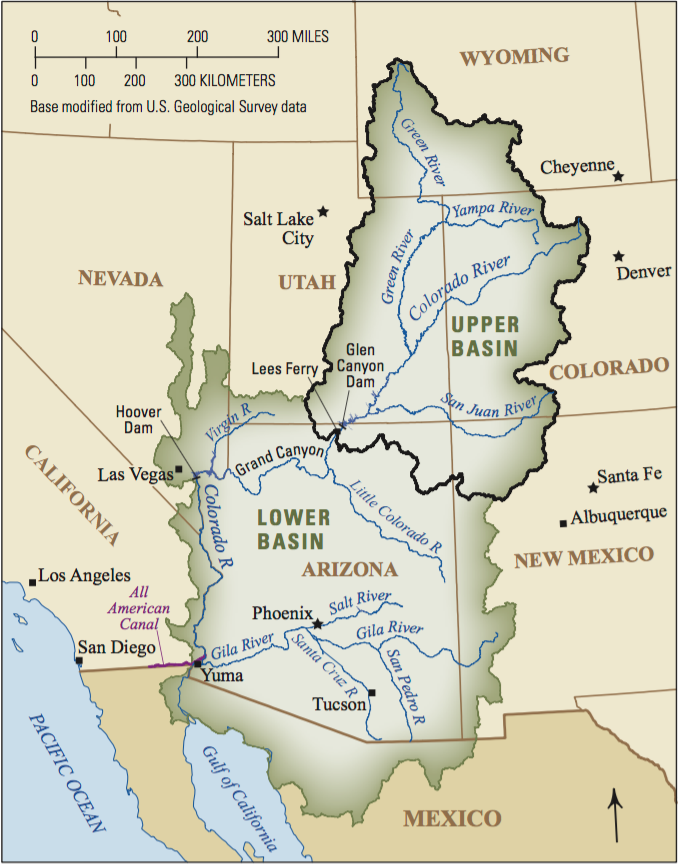
The Colorado River Compact divided the basin into an upper and lower half, with each having the right to develop and use 7.5 million acre-feet of river water annually. (Source: U.S. Geological Survey via The Water Education Foundation)

The latest El Niño/Southern Oscillation (#ENSO) diagnostic discussion is hot off the presses from the #Climate Prediction Center

October 2025 ENSO Model Predictions. Credit: Climate Prediction Center

Click the link to read the discussion on the Climate Prediction Center website:

November 13, 2025

ENSO Alert System Status: La Niña Advisory

Synopsis: La Niña is favored to continue into the Northern Hemisphere winter, with a transition to ENSO-neutral most likely in January-March 2026 (61% chance).

La Niña continued over the past month, as indicated by the strengthening of below-average sea surface temperatures (SSTs) across the central and eastern equatorial Pacific Ocean. The latest weekly Niño indices were between -0.5°C and -0.7°C, with the exception of the easternmost Niño-1+2 index at -0.2°C. Negative subsurface temperature anomalies persisted (averaged from 180°-100°W; Fig. 3), with below-average temperatures prevailing from the surface to 200m depth in the eastern half of the equatorial Pacific. The atmosphere continued to reflect La Niña, with low-level easterly wind anomalies and upper-level westerly wind anomalies observed across most of the equatorial Pacific Ocean. Enhanced convection persisted over Indonesia and was weakly suppressed near the Date Line. Both the traditional and equatorial Southern Oscillation indices were positive. Collectively, the coupled ocean-atmosphere system reflected La Niña.

The IRI multi-model predictions favor La Niña to continue through December-February (DJF) 2025-26. While also considering predictions from the North American Multi-Model Ensemble, the ENSO team believes uncertainty for the DJF season is high with La Niña (51% chance) slightly favored over ENSO-neutral (48% chance). La Niña is expected to remain weak (3-month average Niño-3.4 index value at or between -0.5°C and -0.9°C). A weak La Niña would be less likely to result in conventional winter impacts, though predictable signals could still influence the forecast guidance (e.g., CPC’s seasonal outlooks). In summary, La Niña is favored to continue into the Northern Hemisphere winter, with a transition to ENSO-neutral most likely in January-March 2026 (61% chance).

#ColoradoRiver Basin states miss another deadline to agree on water plan — AspenPublicRadio.org #COriver #aridification

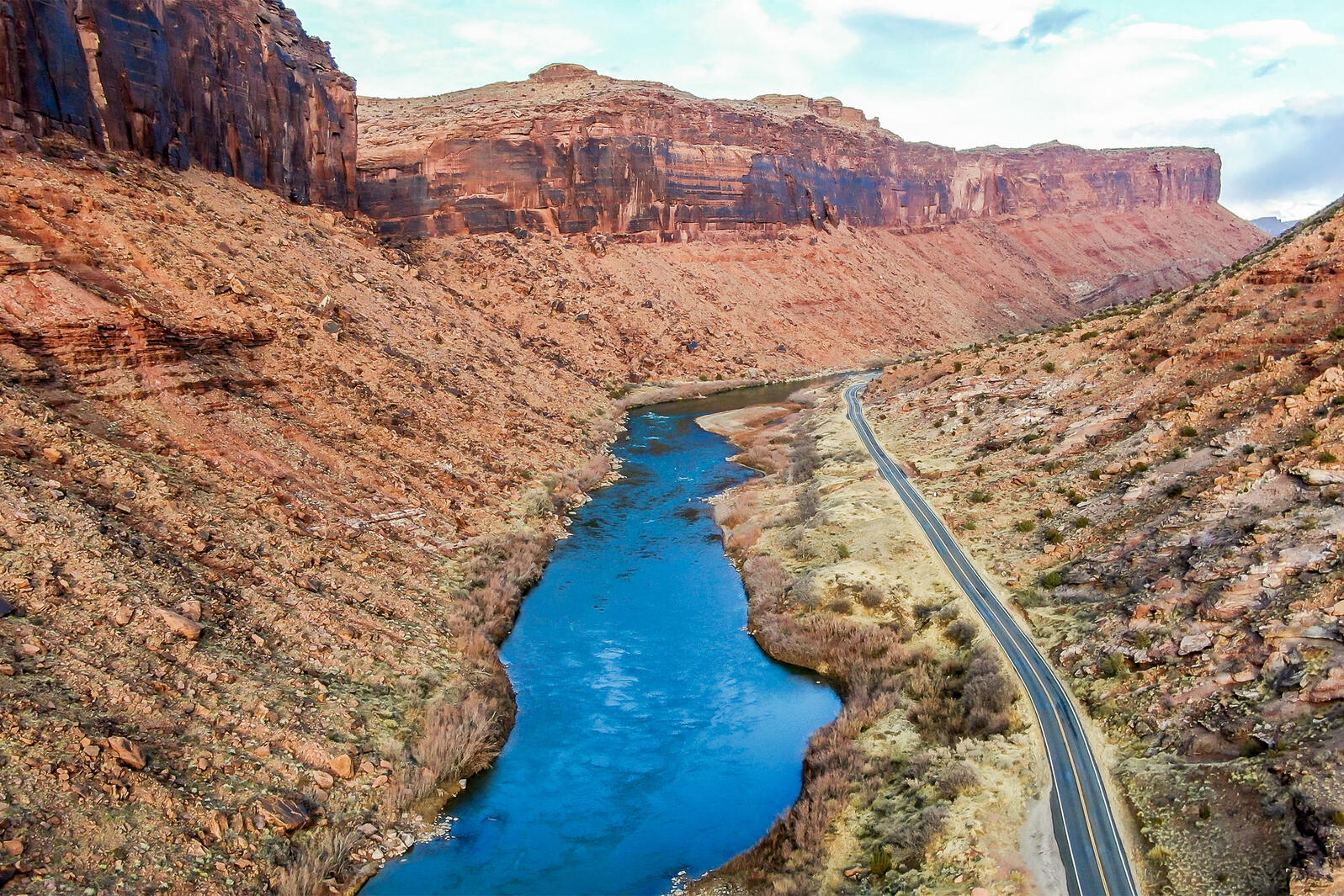
Colorado River near Moab, Utah. Photo: Mitch Tobin/WaterDesk.org

Click the link to read the article on the Aspen Public Radio website (Caroline Llanes). Here’s an excerpt:

November 12, 2025

There’s still no plan for how the seven states that use water from the Colorado River will allocate the scarce resource after 2026. Tuesday, November 11, marked a deadline set by the federal government for the states to share a framework for new operating guidelines—another deadline that’s come and gone with no agreement. The river’s supply has drastically decreased since the original Colorado River Compactwas signed in 1922, due to climate change and overallocation of water. In 2007, the states agreed to interim operating guidelines, but those expire in 2026. Because Lake Powell and Lake Mead, the basin’s two biggest reservoirs, are federal projects managed by federal agencies, those agencies will need to do an environmental review and public comment period, as required by law. The federal government needs input from the states in a timely fashion to complete the review and public comment process, in order to have new rules in place by October 2026. On Tuesday night, the seven states, along with the Department of Interior and Bureau of Reclamation, issued a statement on the negotiations…

“A supply-based proposal is the only way to move forward,” [Becky Mitchell] told attendees at the Colorado River District’s Across Divides conference on October 3. “We all have to be responding to supply.”

That means that the new guidelines should be based on actual streamflows, rather than demand from water users.

“We need to set aside building an operations plan that meets the needs as they are currently,” she said. “We need to let go of that dream and be able to figure out how to respond, and I think that’s been a bit of a struggle.”

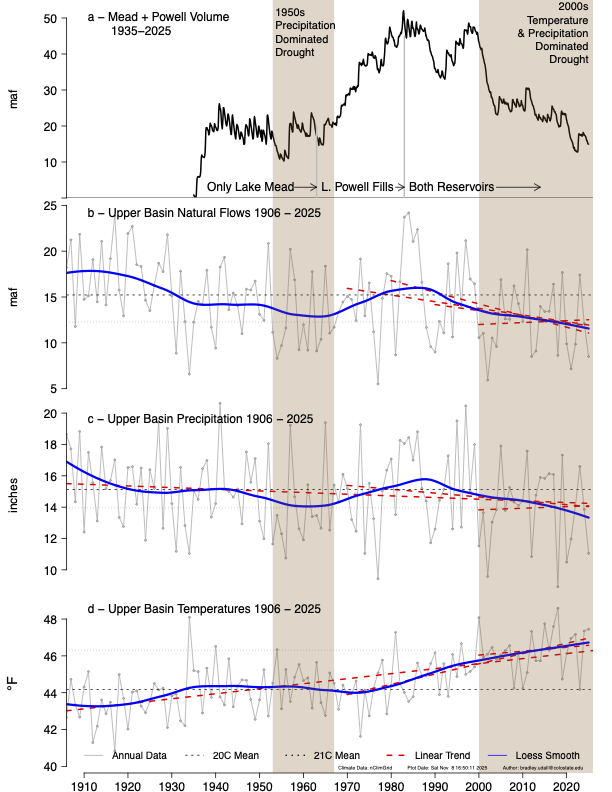
Udall/Overpeck 4-panel Figure Colorado River temperature/precipitation/natural flows with trend. Lake Mead and Lake Powell storage. Updated through Water Year 2025. Note the tiny points on the annual data so that you can flyspeck the individual years. Credit: Brad Udall

Massive #solar project moves forward: Alamosa County commissioners hope it will lead to power grid improvements — AlamosaCitizen.com

Credit: Illustration by The Citizen

Click the link to read the article on the Alamosa Citizen website:

November 12, 2025

an Alamosa County Commissioners meeting on Wednesday.

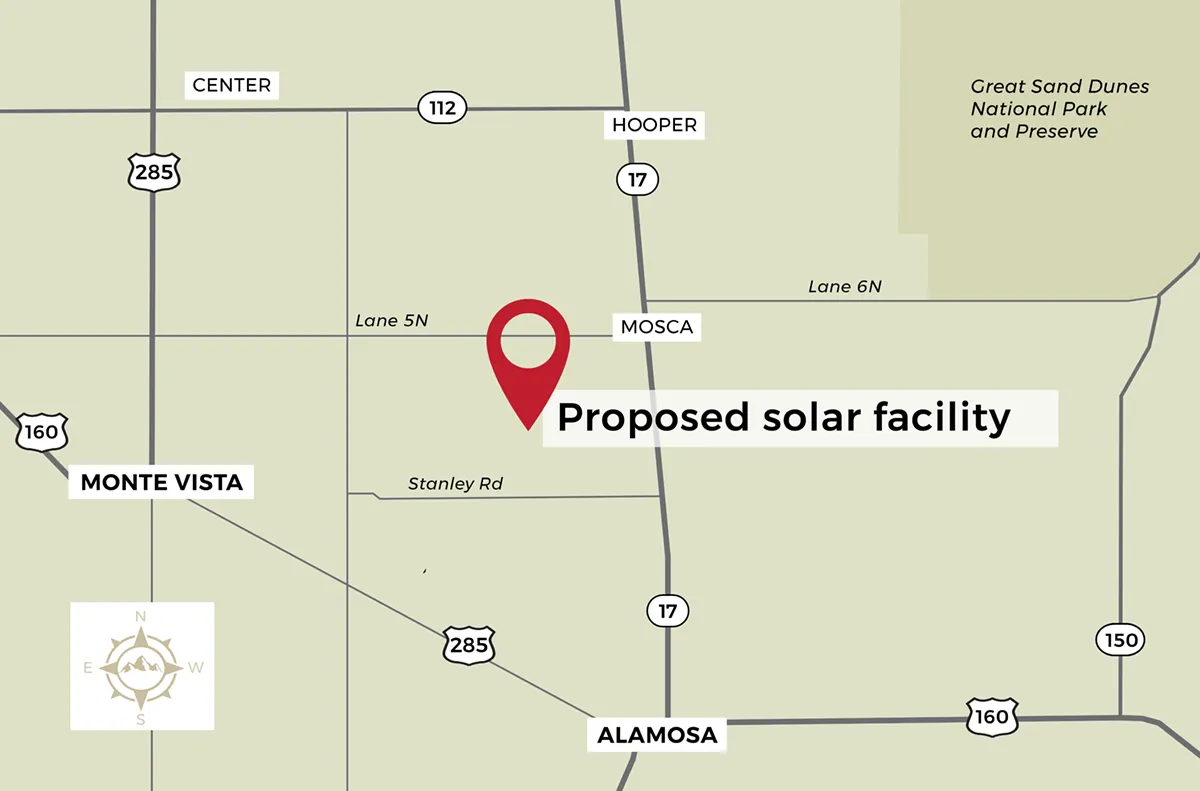
NextEra Energy is planning a maximum 600 megawatt solar plant and 600 megawatts of solar storage off Lane 2N between County Road 104 and County Road 108 in the central part of unincorporated Alamosa County.

So massive is the project that Alamosa County Commissioners are hoping it will help to convince state officials about the importance of increasing transmission capacity to move power in and out of the Valley.

As it stands, Colorado’s power grid currently isn’t equipped to support this size of the proposed new plant, which NextEra Energy is calling its “Spud Valley” solar project. The company plans to connect its Alamosa County project to the existing Public Service Co. and Xcel Energy substation that is adjacent to the site.

A single megawatt can power around 160 homes, so 600 megawatts has the equivalent power for tens of thousands of homes. Plus, Spud Valley includes just as much solar storage.

The Spud Valley project would be located on four square miles with 10 different land owners either selling or leasing property to NextEra Energy. The project is located in Subdistrict 1 of the Rio Grande Water Conservation District and a section of Alamosa County that has been rapidly reducing its agricultural output due to water constraints from the declining unconfined aquifer.

NextEra Energy is hoping to begin construction by the middle of 2027 and have the plant operational in 2028, according to company officials as they gained approval from Alamosa County on waivers to certain regulations within the required 1041 permit that didn’t apply to the project. Final steps with Alamosa County will be taken in 2026 and notice given for a public hearing.

“This is substantially larger than anything now,” Alamosa County Land Use Director Richard Hubler told the county commissioners. He said he hopes the project positively impacts the discussion around increasing the San Luis Valley’s transmission capacity.

Xcel Energy actively manages the power grid. When demand for power is high across the state, power generated in the Valley is transmitted out to meet the state’s demand. Given the size of the Spud Valley project, the power grid would have to be further developed to be able to handle the amount of solar from the new Alamosa County operation.

“This is a massive project and so it changes the balance of power more or less,” Hubler said.

The Spud Valley site is adjacent to the 30 megawatt Alamosa Solar Generating Facility managed by Whetstone Power.

Screenshot from Google maps of vicinity for new solar plant

#Colorado State Land board approves 45,950-acre La Jara Reservoir transfer: Three-hour meeting heard support for the deal from ranchers, recreationists, conservationists and local and federal officials — AlamosaCitizen.com

Click the link to read the article on the Alamosa Citizen website:

November 13, 2025

The Colorado State Land Board gave final approval Thursday to the three-way transfer of 45,950 acres that make up the La Jara Basin, which includes La Jara Reservoir in Conejos County.

The decision came with plenty of apprehension around the federal government and whether the Trump Administration is a reliable partner in the deal. In the end, state land board commissioners agreed to “roll the dice” and hope for the best.

In the end, Commissioner Josie Heath was the lone no vote. 

The La Jara Basin land transfer will net the state land board $49.6 million, or $1,000 per acre for the land transferred to the U.S. Forest Service and BLM, and $2,500 per acre for the La Jara Reservoir area which will be managed by Colorado Parks & Wildlife.

The deal includes $43.5 million from the coveted Land and Water Conservation Fund, which sits with the U.S. Department of Interior and is used to “safeguard natural areas, water resources and cultural heritage.”

Pressure mounted on the state land board to approve the transfer as U.S. Sens. Michael Bennet and John Hickenlooper urged final approval. Former U.S. Secretary of the Interior Ken Salazar compared the transfer to the establishment of the Great Sand Dunes National Park. 

“This is the project of the 21st Century for the San Luis Valley,” Salazar said.

State land board commissioners acknowledged their apprehension for giving final approval centered around mistrust for the Trump Administration and whether the current federal administration would abide by the deal. The commissioners hoped that even though the funds were appropriated that they would actually “materialize” in the future. 

When Alamosa Citizen published this story on the state land board’s hesitation on a final deal, the state agency found itself under pressure to give final approval. The state land board spent more than three hours hearing support for the deal from San Luis Valley local officials and the federal agencies that will assume management of the public lands once the land transfer is completed.

The state land board had three options – approve the land transfer to the federal agencies and CPW; keep the property with the state land board; or approve the La Jara Reservoir transfer to Colorado Parks & Wildlife and keep the portion of the property that the U.S. Forest Service and BLM sought.

A trove of local officials and residents spoke in-person and over Zoom of their support for the approval of the land transfer.  Alongside ranchers, farmers and recreationists, local officials provided their input, including Conejos County Commissioner Mitchel Jarvies and district manager for the San Luis Valley Water Conservation District Heather Dutton.

Representatives of the two federal agencies told state land board members that it was doubtful they could muster support in Congress to approve money for the acquisition again if the current deal wasn’t accepted.

With the deal finalized, the U.S. Forest Service will take over 21,821 acres and BLM will manage 21,704 acres of the La Jara Basin. Colorado Parks & Wildlife will take management of La Jara Reservoir.

The federal Office of Budget and Management still has to free up the money for the Bureau of Land Management’s portion of the sale, according to BLM officials.

A view across La Jara Reservoir from a hill between the reservoir’s two dams. The reservoir is in Conejos County, Colorado. By Jeffrey Beall – Own work, CC BY 4.0, https://commons.wikimedia.org/w/index.php?curid=140180051

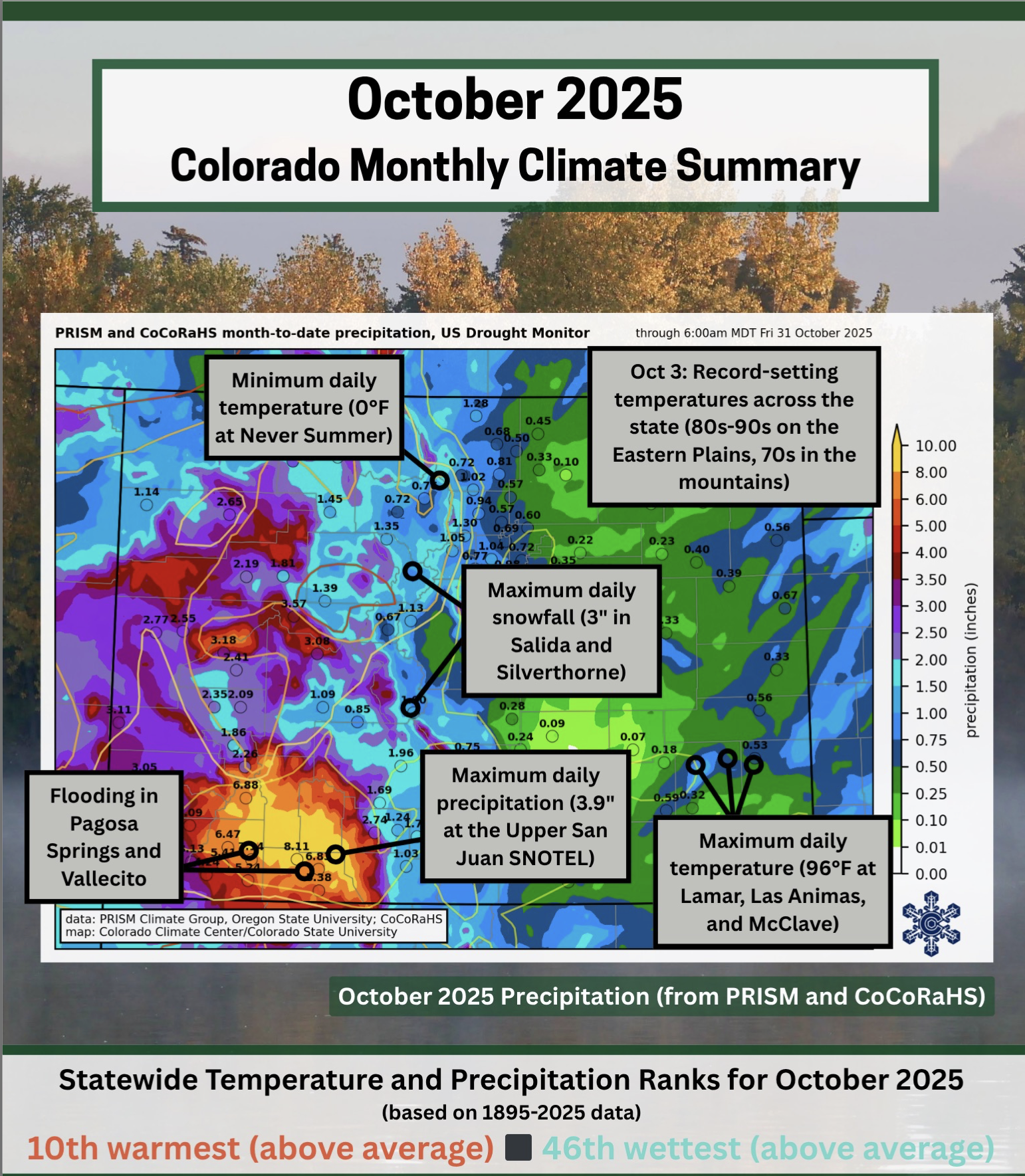
October 2025 Monthly #Climate Summary — #Colorado Climate Center

Click the link to read the monthly climate summary on the Colorado Climate Center website.