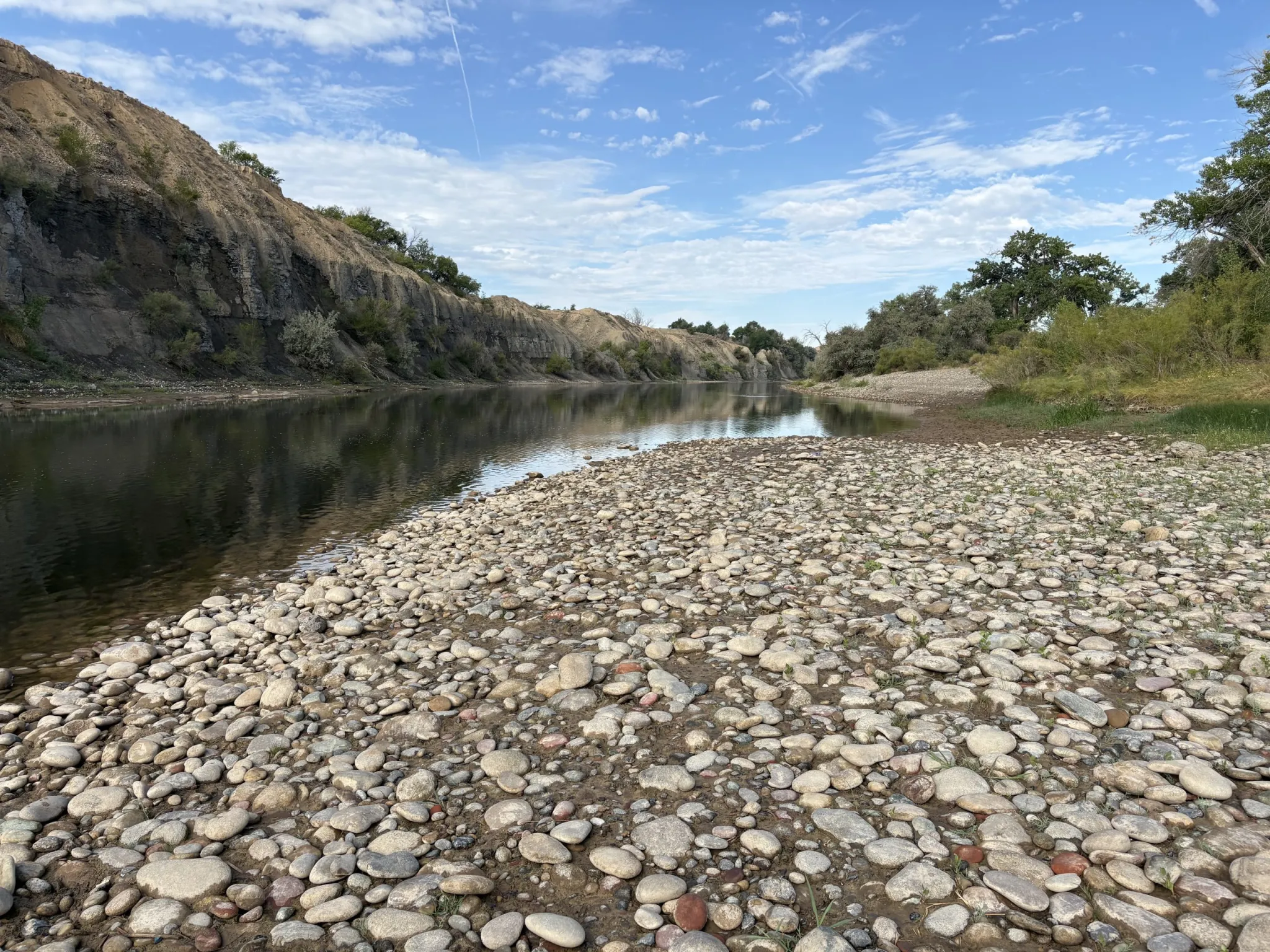
#Drought news November 13, 2025: Most of the High Plains region was warmer than normal, especially western #Nebraska and central and western portions of #Colorado and #Wyoming, where temperatures from 4-8 degrees above normal were common this week

Click on a thumbnail graphic to view a gallery of drought data from the US Drought Monitor website.

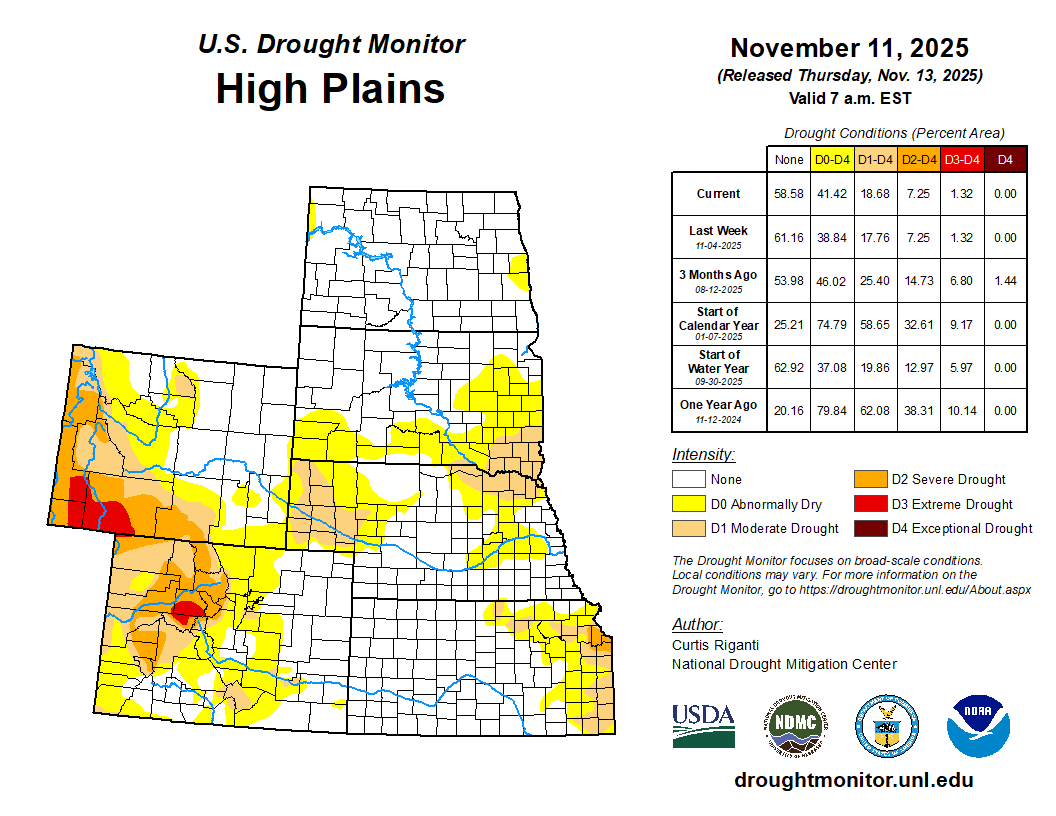
Click the link to go to the US Drought Monitor website. Here’s an excerpt:

This Week’s Drought Summary

Mostly dry weather occurred this week across the Great Plains, Minnesota and Wisconsin, the south-central U.S. and the Southwest. The northern half of California, western Oregon, western Washington, the northern Idaho Panhandle and northwest Montana received moderate to heavy precipitation amounts. From northern California northward into the Pacific Northwest, amounts this week were locally over 3 inches. Locally higher precipitation amounts fell in the Northeast and in portions of the Great Lakes region. This included heavy lake-effect snow in north-central and northwest Indiana. Spotty rainfall amounts of over half an inch fell across the Southeast, but most of the region experienced a dry week. Drier weather in parts of the Great Plains and south-central U.S. led to widespread degradations, especially in Texas, Oklahoma and Louisiana. Heavy precipitation in Oregon and Idaho led to improvements in both states. Montana was split with improvement in the west and degradation in north-central areas, which continued a recent dry spell. Mostly drier weather in the Southeast led to degradations in Florida and southern Georgia and portions of Virginia. In northeast Illinois, northwest Indiana, Ohio, West Virginia and much of New England, improvements occurred after recent precipitation…

High Plains

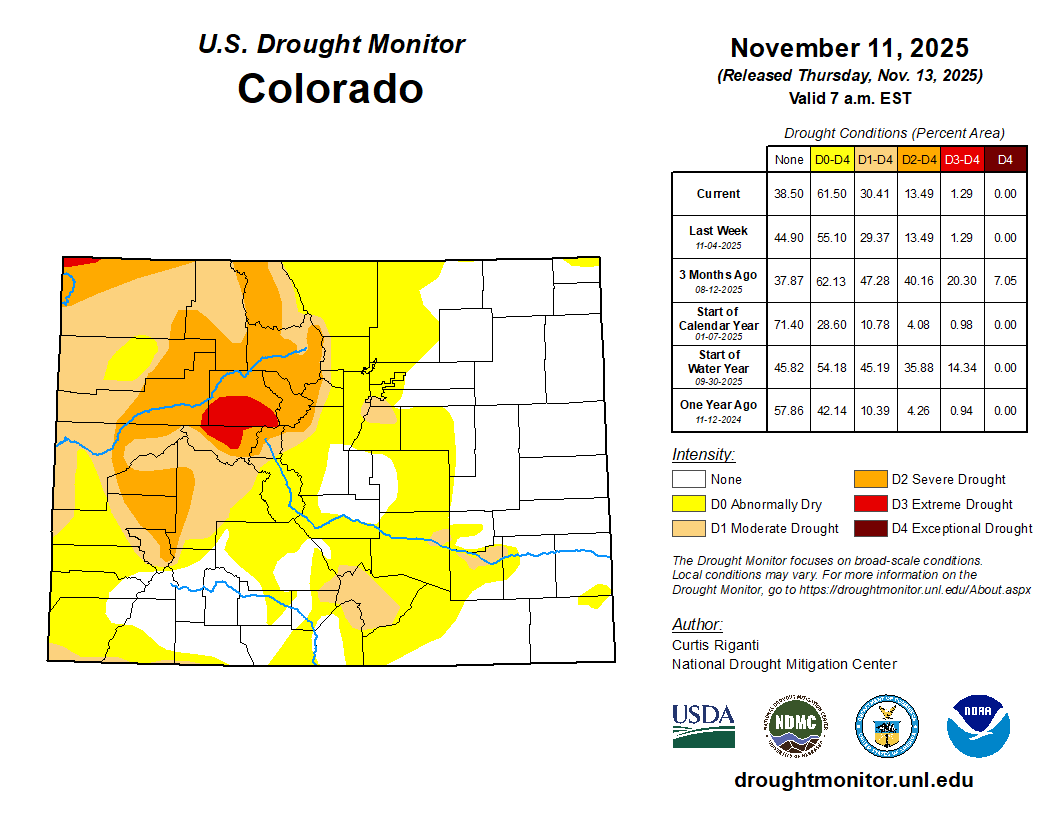
Temperatures in the eastern edge of the High Plains area remained mostly within a couple degrees of normal, as a strong cold front moved into the central U.S. near the end of the period. Otherwise, most of the region was warmer than normal, especially western Nebraska and central and western portions of Colorado and Wyoming, where temperatures from 4-8 degrees above normal were common this week. Some precipitation, generally under a half inch liquid equivalent, fell from central South Dakota to northeast Nebraska. Precipitation exceeding a half inch also fell in northwest Wyoming in the vicinity of Yellowstone National Park and in a section of the Black Hills of South Dakota. Elsewhere, mostly dry weather was the rule across the region. Short-term precipitation deficits grew in parts of eastern Nebraska, where abnormal dryness expanded in coverage north and northwest of Lincoln. Portions of western Nebraska and adjacent southeast Wyoming and Colorado continued to dry as well, and abnormal dryness and some moderate drought grew in these areas. In south-central Colorado, localized degradations were also due in part to effects from longer-term precipitation deficits…
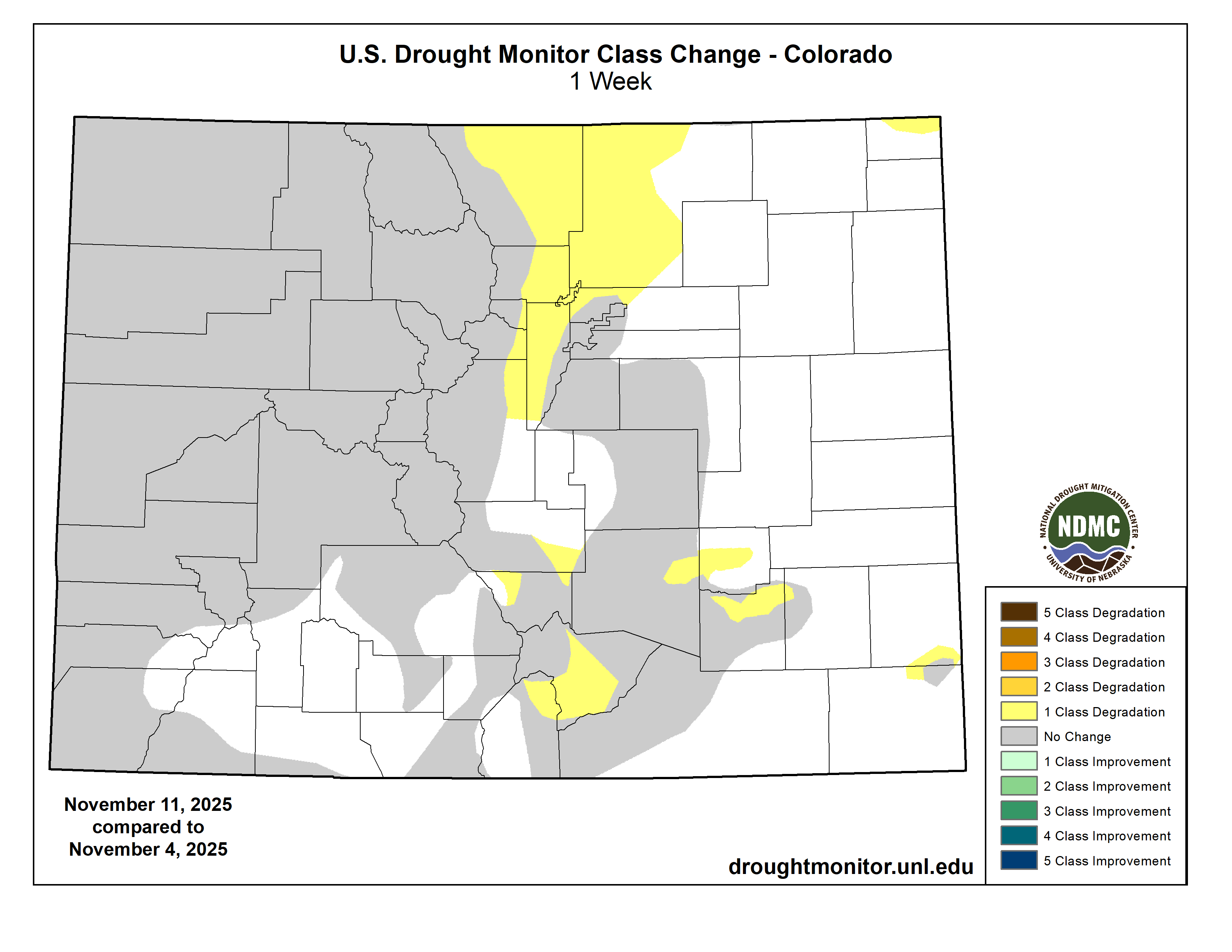
Drought Monitor one week change map ending November 11, 2025.

West

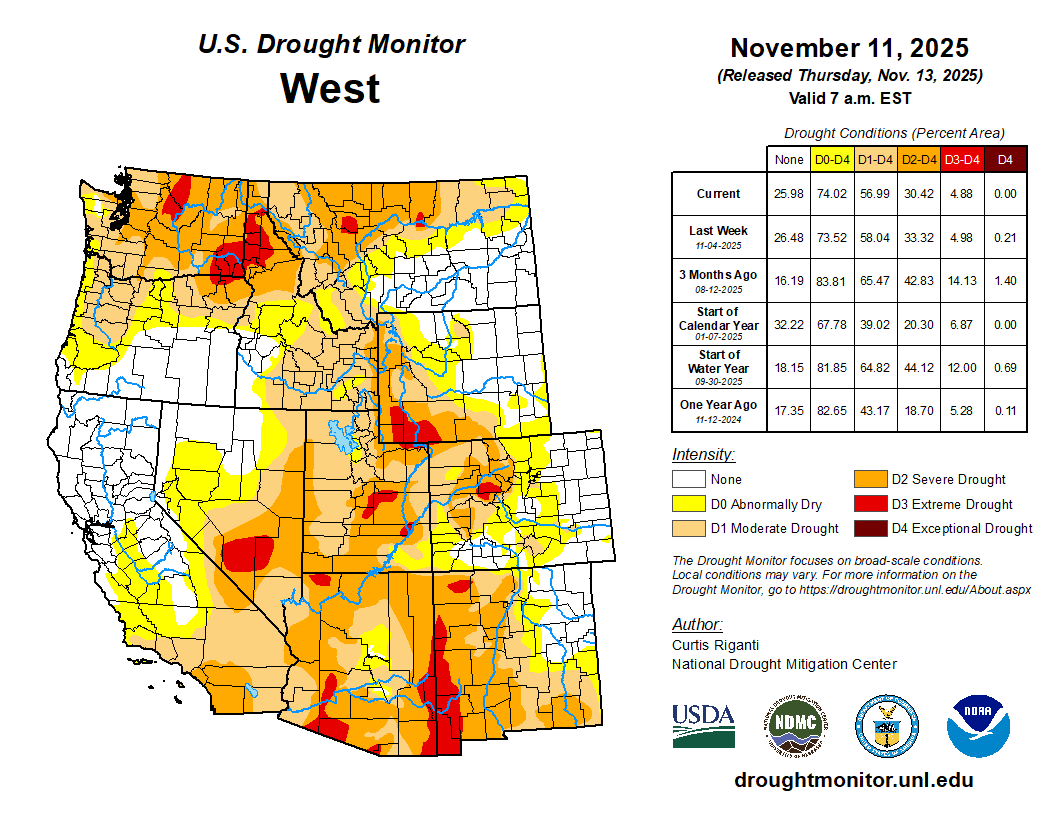
Temperatures were above normal across the region. Southeast California, Nevada, Utah and southern New Mexico were generally the warmest compared to normal, with many spots in these areas finishing the week 6-10 degrees above normal. Parts of the northwest U.S. saw moderate to heavy precipitation amounts this week, while most areas from central California southward and eastward were dry. Many parts of northwest Montana and northern Idaho received half an inch to 2 inches of precipitation this week. Eastern Washington mostly received over a half inch of precipitation, while western Washington, western Oregon and north-central and northwest California received heavier amounts ranging from 2 to locally over 5 inches of precipitation. Recent precipitation helped to improve streamflow and precipitation deficits across much of Idaho, leading to widespread improvements in drought conditions. Severe also improved across much of western Montana as a result of recent precipitation events. Severe drought was also removed in northwest Oregon after recent heavy precipitation improved streamflow levels and lessened short- and long-term precipitation deficits. In north-central Montana, drought conditions worsened as weather stayed mostly dry, leading to larger short-term precipitation deficits and low streamflow levels…

South

Warmer-than-normal temperatures occurred across most of the South this week. Temperatures in Texas and Oklahoma were especially warm, with many areas in these states finishing the week 4-8 degrees above normal. Parts of southwest Texas were even warmer, with some sites finishing the week more than 10 degrees above normal. Most of the South remained dry this week, though a few parts of central and eastern Tennessee received over a half inch of precipitation. Degradations to abnormal dryness and drought were widespread from the southern half of Oklahoma to southwest Arkansas, and from central and eastern Texas into parts of Louisiana. Short-term drought impacts were the big story in southern Oklahoma, where short-term precipitation deficits grew and soil moisture and pond levels dropped and vegetation struggled. Streamflow levels struggled in portions of central and southern Texas, while soil moisture levels also dropped in south Texas amid unusually high evaporative demand for the time of year. Short-term precipitation deficits also drove some degradation in areas of abnormal dryness and moderate and severe drought in Louisiana…

Looking Ahead

From the evening of Nov. 12 through Nov. 17, the National Weather Service (NWS) Weather Prediction Center is forecasting heavy precipitation to fall across parts of the western U.S. Precipitation amounts from 3-5 inches (locally higher) may fall across large portions of California, especially the southwest coastal areas and portions of the Sierra Nevada. Heavy precipitation amounts from 2-5 inches (locally higher) are also anticipated in parts of northwest Washington and the Olympic Peninsula. Over 0.75 inches of precipitation is also forecast in southeast California, southern Nevada, portions of western and central Arizona and southwest Utah. A few other locales may receive an inch or more of precipitation, including the San Juan Mountains in southwest Colorado and parts of the northern Idaho Panhandle and northwest Montana. Much drier weather is forecast across most of the rest of the Contiguous U.S. for this period, though some parts of New York and New England may receive over a half inch of precipitation.

For the period from Nov. 18-22, the NWS Climate Prediction Center forecast favors above-normal precipitation across much of the Contiguous U.S., especially from the Southwest northeastward to the Lower Ohio River Valley. Drier-than-normal weather is slightly favored in northeast parts of Maine, while near-normal precipitation amounts are most likely in the Florida Peninsula. Near-normal temperatures are favored for New England, while elsewhere, colder-than-normal temperatures are likelier west of the Continental Divide, while warmer-than-normal temperatures are favored to the east of the Continental Divide. Forecaster confidence in warmer-than-normal weather is highest from the Gulf Coast north to the Lower Midwest and southern Great Plains, and near and west of Lake Superior. Above-normal precipitation and temperatures are favored in Hawaii. In Alaska, above-normal precipitation is also favored, with the strongest chances being in the southwest part of the state. Above-normal temperatures are favored in most areas of Alaska, except for the far northwest, where near-normal temperatures are expected.

US Drought Monitor one week change map ending November 11, 2025.

No deal on #ColoradoRiver: Seven states fail to reach agreement by feds’ Nov. 11 deadline — Heather Sackett (AspenJournalism.org) #COriver #aridification

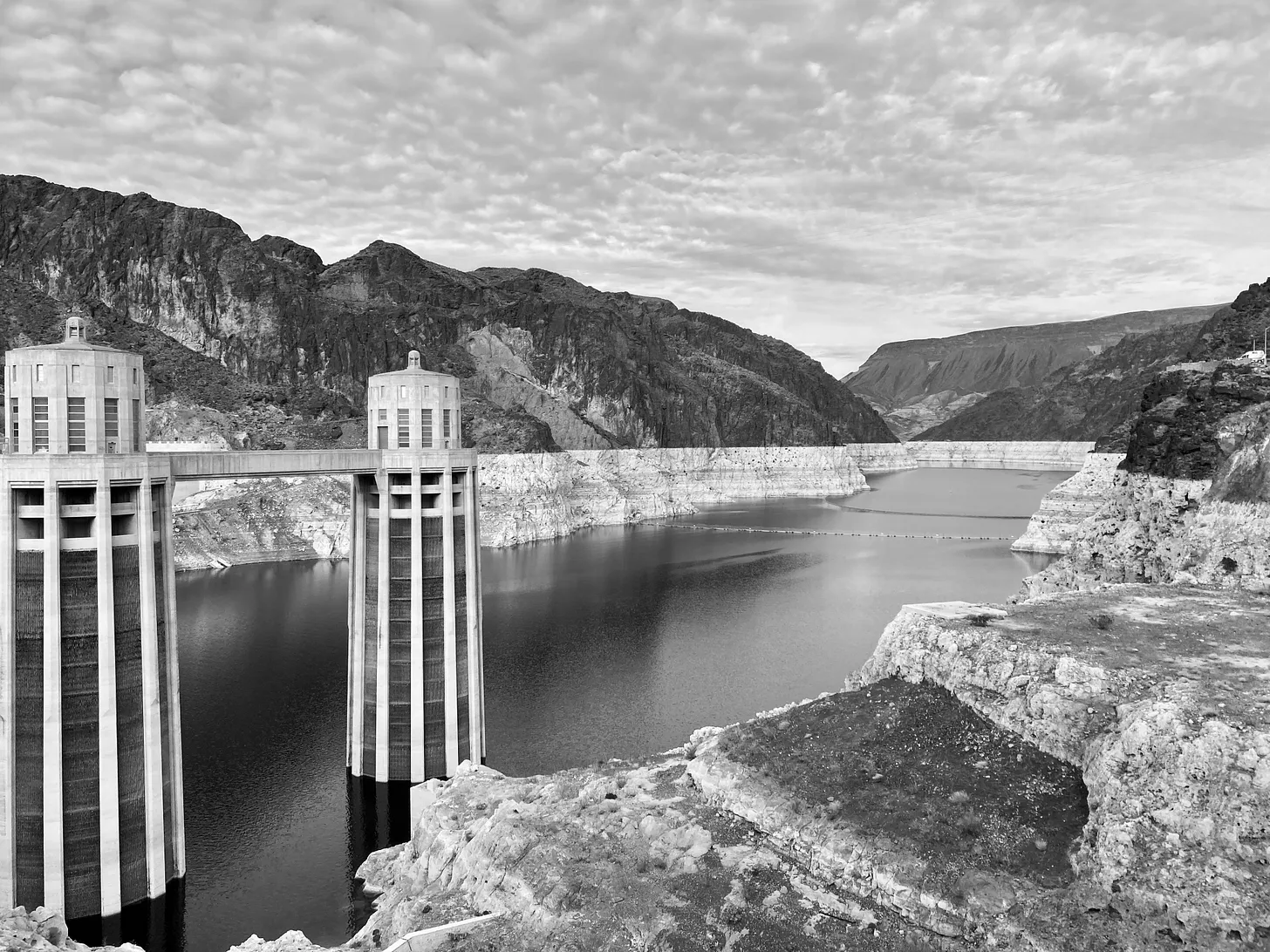
Lake Mead and the big ā€œbathtub ringā€ as seen from next to Hoover Dam. Jonathan P. Thompson photo.

Click the link to read the article on the Aspen Journalism website (Heather Sackett):

November 12, 2025

Water managers from the seven states that share the Colorado River have blown a deadline given to them by the federal government to come up with a rough plan on how the drought-stricken river will be shared in the future.

The Upper Basin (Colorado, New Mexico, Utah and Wyoming) still cannot find agreement with the Lower Basin (California, Arizona and Nevada) about how the nation’s two largest reservoirs — Lake Powell and Lake Mead — will be operated and how cuts will be shared in dry years.

In June, Scott Cameron, the U.S. Bureau of Reclamation’s acting assistant secretary for water and science, said federal officials would need to know the broad outlines of a plan from the states by Nov. 11. Despite frequent meetings in recent months, negotiators were unable to hammer out a deal by Tuesday, leaving future management for the water supply for 40 million people in the Southwest cloaked in uncertainty. 

Instead, the states, the Interior Department and the federal Bureau of Reclamation released a short joint statement Tuesday afternoon, noting that serious and ongoing challenges face the Colorado River.

ā€œWhile more work needs to be done, collective progress has been made that warrants continued efforts to define and approve details for a finalized agreement,ā€ the statement reads. ā€œThrough continued cooperation and coordinated action, there is a shared commitment to ensuring the long-term sustainability and resilience of the Colorado River system.ā€ 

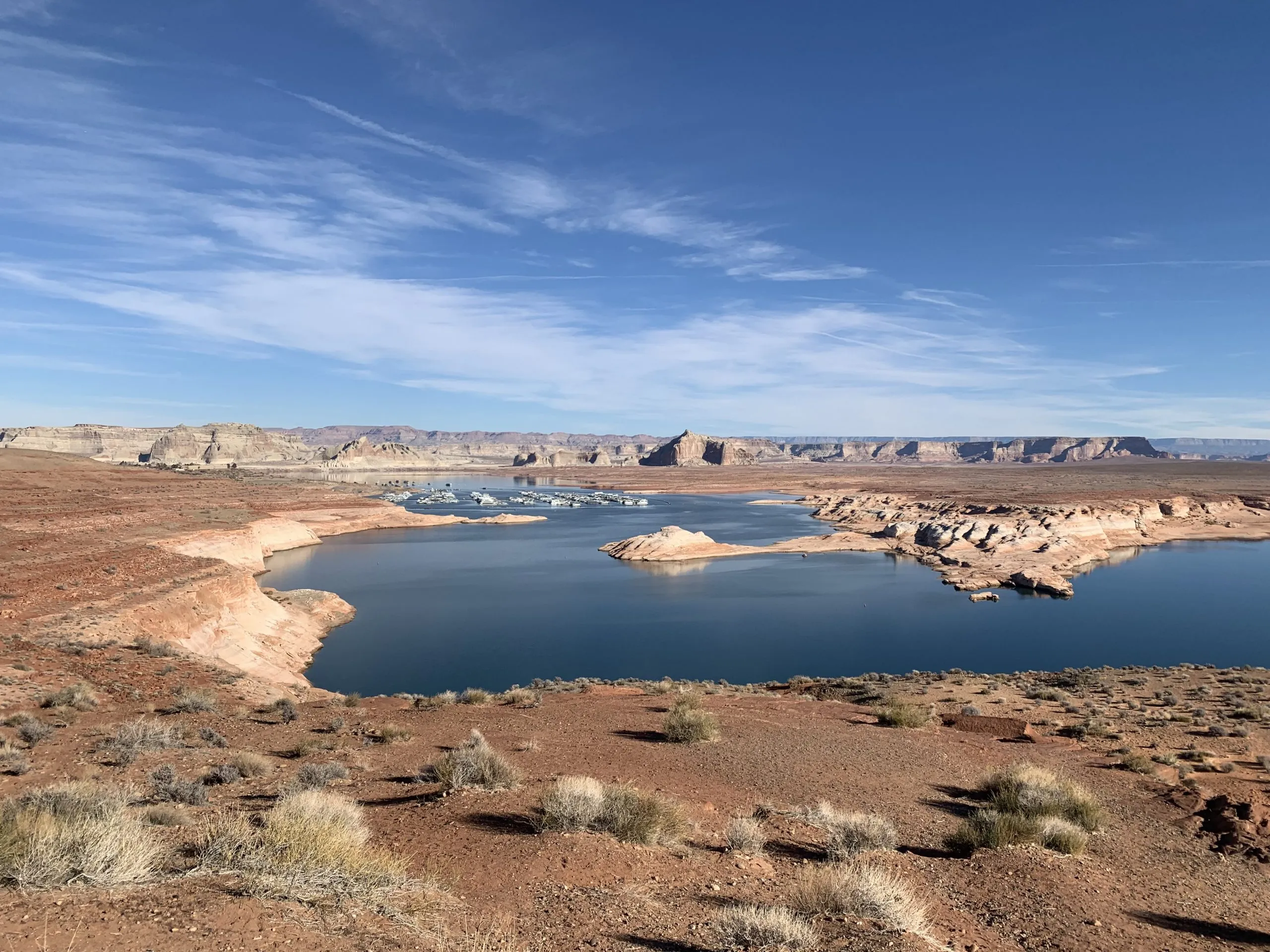
Wahweap Marina at Lake Powell when water levels were at near-historic lows in 2021. The seven states and the federal government must figure out how to share the Colorado River after the current guidelines expire in 2026.Ā CREDIT:Ā HEATHER SACKETT/ASPEN JOURNALISM

Environmental groups disappointed

The failure to come up with a plan by the deadline has sparked criticism from the basin’s environmental groups. 

ā€œI’m really disappointed with how yesterday played out; the states did not have anything to meet the Nov. 11 deadline,ā€ said John Berggren, a regional policy manager with Western Resource Advocates. ā€œThe fact that they didn’t have a basic framework for how to manage the system after 2026 is really unfortunate, and I think they missed a good chance to put forward something that we can all consider and examine as a basin.ā€ 

Representatives from the seven states have been in talks for two years about how to manage the river after the current guidelines expire. After a long standoff without much progress throughout 2024, state representatives in June offered a glimmer of hope for a way forward, floating a concept for sharing the river based on natural flows at Lee Ferry, the dividing line between the Upper and Lower basins, instead of water demand. But that hope evaporated like water off Lake Mead, with negotiators reportedly deadlocked again by the end of the summer.  

A statement from environmental groups Great Basin Water Network and Living Rivers called the Nov. 11 deadline arbitrary and ineffectual, and said the inaction symbolizes the overall dysfunction on the river and in government. They chastised the states and federal government for the lack of transparency and lack of public participation surrounding negotiations.

ā€œThe states don’t deserve the kid-glove treatment any longer,ā€ Kyle Roerink, executive director of the Great Basin Water Network, said in a prepared statement. ā€œThey have a behavioral problem as much as they do a hydrology problem. Any entity that wants to increase use is unfit to manage our most precious resource.ā€

A group of influential environmental organizations, including American Rivers, National Audubon Society, Environmental Defense Fund, The Nature Conservancy, Theodore Roosevelt Conservation Partnership, Trout Unlimited and Western Resource Advocates, released a joint statement Wednesday saying that they were deeply disappointed the states did not find consensus and that federal leadership will be essential. 

The statement called for solutions that ground management decisions in the best available science, expand conservation programs, modernize infrastructure and ensure that Native American tribes — which have underutilized rights to a large share of the river’s water — play a meaningful role in shaping the river’s future.

ā€œWe understand the extraordinary complexity of this challenge and the difficult tradeoffs the states are working hard to navigate — but the river isn’t going to wait for process or for politics,ā€ the statement said. ā€œDrought, intensified by increasingly extreme conditions, is reshaping the basin, and the window to secure the river’s future and move beyond crisis-driven policymaking is closing fast.ā€

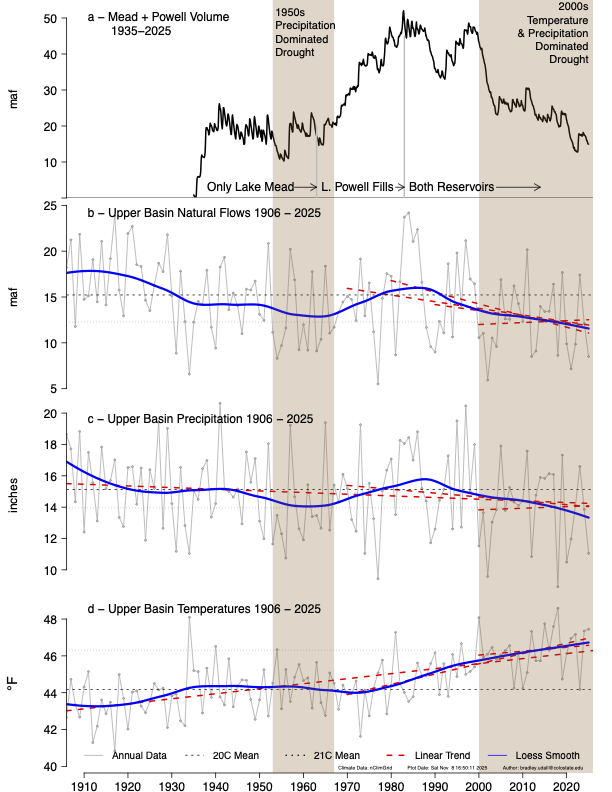
Udall/Overpeck 4-panel Figure Colorado River temperature/precipitation/natural flows with trend. Lake Mead and Lake Powell storage. Updated through Water Year 2025. Note the tiny points on the annual data so that you can flyspeck the individual years. Credit: Brad Udall

Since the turn of the century, the Colorado River basin has been locked in the grip of a megadrought. Climate change has robbed Western rivers of their flows, with the basin seeing a 20% decline from the 20th century average, according to scientists. Those factors, as well as unrelenting water demands, have pushed Lake Powell and Lake Mead to record-low levels in recent years and thrown river management into crisis mode. 

The current negotiations between the seven states are aimed at replacing the 2007 Interim Guidelines, which lay out how the reservoirs will be operated and shortages shared, and which expire at the end of 2026. New guidelines would need to be in place by the beginning of the next water year, Oct. 1, 2026, leaving little time to complete the required National Environmental Policy Act (NEPA) review process.

The 2007 guidelines set annual Powell and Mead releases based on reservoir levels and do not go far enough to prevent them from being drawn down during consecutive dry years. In 2022, Lake Powell flirted with falling below a critical elevation to make hydropower, and may be headed there again next year if conditions don’t improve.

(Left to right) John McClow, Rebecca Mitchell, Gene Shawcroft, Tom Bucshatzke at the Colorado Water Congress 2022 Annual Summer Conference. Colorado representative Becky Mitchell, second from left, and Arizona representative Tom Buschatzke, farthest right, speak on a panel at Colorado Water Congress in 2022. The positions of the two states have emerged as one of the main sources of disagreement between the Upper Basin and Lower Basin.Ā CREDIT:Ā HEATHER SACKETT/ASPEN JOURNALISM

Sticking points

Over the past few months, the positions of two of the states — Colorado and Arizona — have emerged as one of the main sources of disagreement. Water from the Colorado River has fueled the exponential growth in recent decades of Arizona’s cities, which are the economic and political powerhouse of the state, along with some of the most productive farmland in the basin. But Arizona’s reliance on the junior water rights of the Central Arizona Project means it is first on the chopping block for cuts. 

Arizona representatives have said that the deepest cuts should be shared basinwide, including by the Upper Basin. Gov. Katie Hobbs and other state lawmakers said in a Nov. 11 letter to Interior Secretary Doug Burgum that Arizona’s Colorado River allocation is important to the nation’s growth and independence and that Colorado River reliability is a matter of national security. The letter highlighted how the state plays a critical role in manufacturing semiconductors and information-technology products. 

ā€œWith such high stakes for Arizona and the nation, we find it alarming that the Upper Basin states have repeatedly refused to implement any volume of binding, verifiable water supply reductions,ā€ the letter reads. ā€œThis extreme negotiating posture — four of the seven basin states refusing to participate in any sharing of water shortages — has led to a fundamental impasse that is preventing the successful development of a seven-state consensus plan for the management of the Colorado River.ā€

The Lower Basin has committed to a 1.5 million acre-foot reduction, which accounts for evaporation and transit losses.

This shows that Colorado’s Western Slope is the biggest supplier of water to the Colorado River. Source: David F. Gold et al, Exploring the Spatially Compounding Multi‐Sectoral Drought Vulnerabilities in Colorado’s West Slope River Basins, Earth’s Future (2024). DOI: 10.1029/2024EF004841

Water managers from Colorado — which is the de facto leader of the Upper Basin with a 51.75% share of the water allocated to the four Upper Basin states — have pushed back on the notion that their states should contribute to cutbacks in water use since their water users already suffer shortages in dry years and the four states have never used their entire allocation of the river, while the Lower Basin overuses its share. Colorado representative Becky Mitchell has repeatedly said that any cuts the state makes must be voluntary, not mandatory.

However, the Upper Basin states have been experimenting for years with conservation programs that pay water users to cut back, most recently in 2023 and 2024 with the federally funded System Conservation Pilot Program. In a proposal submitted in March 2024, the Upper Basin states offered up a potential conservation pool in Lake Powell of up to 200,000 acre-feet a year, and most water users accept that some type of future conservation program for the Upper Basin is inevitable

What happens now?

Federal officials had previously set a second deadline of Feb. 14, 2026, for the states to present details of a plan. They have repeatedly said that if the seven states fail to come up with an agreement, Reclamation will exercise its authority to protect critical reservoir levels. That could include releases from upstream reservoirs to prop up Powell and Mead, including releasing water from Colorado’s Blue Mesa Reservoir on the Gunnison River. 

Reclamation is moving forward with its NEPA process and said in early October that it plans to have a draft environmental impact statement by the end of the year. Representatives from the bureau were not available for comment Wednesday due to the government shutdown. Cameron has said that the alternatives analyzed in the EIS will be broad enough that they would capture any seven-state agreement, which they could then plug in as the preferred alternative — assuming the states come up with something.

ā€œThe basin states remain committed to collaboration grounded in the best available science and respect for all Colorado River water users,ā€ Mitchell said in a prepared statement. ā€œWe are taking a meaningful step toward long-term sustainability and demonstrating a shared determination to find supply-driven solutions.ā€

Map of the Colorado River drainage basin, created using USGS data. By Shannon1 Creative Commons Attribution-Share Alike 4.0

#ColoradoRiver:Ā States miss their deadline on a deal, but they’re still talking, #Utah and the federal government aren’t giving details or a new timeline — Annie Knox (UtahNewsDispatch.com) #COriver #aridification

Udall/Overpeck 4-panel Figure Colorado River temperature/precipitation/natural flows with trend. Lake Mead and Lake Powell storage. Updated through Water Year 2025. Note the tiny points on the annual data so that you can flyspeck the individual years. Credit: Brad Udall

Click the link to read the article on the Utah News Dispatch website (Annie Knox):

November 11, 2025

Utah and six other states along the Colorado River blew past their deadline Tuesday to reach a new deal on managing the dwindling river, but negotiations aren’t over.Ā 

ā€œWe will continue to engage with our partners across the Basin to develop a framework that protects water users and the system as a whole,ā€ Utah Gov. Spencer Cox said Tuesday afternoon on the social media site X. 

The river contributes 27% of Utah’s water supply, and provides water to 40 million people across the U.S. and Mexico. Drought, overuse and hotter temperatures tied to climate change have all combined to shrink its flow. 

The federal government had said it would step in and make its own plan if states failed to reach broad consensus by Tuesday, but the states agree they don’t want that to happen, Cox said.

ā€œWhile the Basin States did not finalize an agreement today on post-2026 Colorado River operations, our commitment to a state-led path remains,ā€ the governor said. 

The U.S. Department of the Interior did not respond to questions from Utah News Dispatch Tuesday evening about the timeline and whether it would intervene. The current agreement runs through late 2026. 

The federal agency and Utah’sĀ negotiator Gene Shawcroft issued the same prepared statement, saying the talks yielded ā€œcollective progress.ā€ They did not give any details on sticking points.Ā 

The seven states, the Department of the Interior and the U.S. Bureau of Reclamation, which manages water in the West, all ā€œrecognize the serious and ongoing challenges facing the Colorado River,ā€ their statement says. ā€œProlonged drought and low reservoir conditions have placed extraordinary pressure on this critical water resource that supports 40 million people, tribal nations, agriculture, and industry.ā€ 

They said the states and federal agencies share a commitment to ensuring the river’s long-term sustainability. 

ā€œWhile more work needs to be done, collective progress has been made that warrants continued efforts to define and approve details for a finalized agreement,ā€ the statement says. 

The four Upper Basin states — Utah, Colorado, New Mexico and Wyoming — and the Lower Basin states of Nevada, Arizona and California presented competing plans to the federal government last year. 

The Upper Basin states have sought to fend off mandatory cuts in dry years, saying they generally use much less than they’re allocated. The Lower Basin states have insisted that all seven absorb cuts in dry years. 

In part to prepare for the possibility of mandatory cuts, Utah has been investing in measuring and monitoring water use in recent years. 

In 2023, the Legislature set aside $1 million for a Colorado River measurement infrastructure project and $650,000 in ongoing yearly funding, according to the Utah Division of Water Rights.

Map of the Colorado River drainage basin, created using USGS data. By Shannon1 Creative Commons Attribution-Share Alike 4.0

The Metropolitan Water District of Southern #California issues statement on continued efforts to negotiate new rules for #ColoradoRiver operations #COriver #aridification

Click the link to read the release on the Metropolitan Water District of Southern California website:

Nov. 12, 2025

Metropolitan General Manager Deven Upadhyay issues the following statement regarding the seven Colorado River Basin states continued efforts to reach consensus on post-2026 rules governing operation of the Colorado River: 

ā€œThe only path to developing a sustainable Colorado River is through collaboration and consensus. We are grateful that the seven states that rely on the river remain at the table, along with the federal Department of Interior, but more work needs to be done, and quickly.

ā€œThe work ahead will require every state and water user to look beyond just their own needs and work toward the greater good of the Southwest. If reductions in water use are shared equitably across the Basin, no one state or sector will bear the burden alone.

ā€œMetropolitan remains committed to forging such a consensus, and we look forward to the opportunity to participate in the ongoing discussions in a meaningful way. An agreement that includes tools allowing for smart water management, like flexible storage in Lake Mead and opportunities for shared investments across states, will minimize the pain of living with the new, lower flows of the Colorado River. If we focus on building solutions – rather than legal arguments – we can develop new guidelines that allow water users to have access to the water they need, when they need it most.ā€

ā€œMetropolitan is preparing to live with less imported water in urban Southern California, building on decades of lower water use. But we cannot solve the problem alone. We cannot lose our access to the Colorado River entirely. Our region – home to half of the people and half of the economic activity in the Basin – relies on the river. And we are committed to its success.ā€

Learn more about Metropolitan and the Colorado River.

Built to Fail: Rules at UN Climate Talks Favor the Status Quo, Not Progress: Experts say stifling bureaucratic procedures that are disconnected from the #ClimateCrisis have consistently stalled COP negotiations — Bob Berwyn (InsideClimateNews.org) #COP30

This section of the Colorado River at the boat launch near Corn Lake dipped to around 150 cfs in lake August 2025. Known as the 15-mile reach, this stretch of river should have at least 810 cfs to meet the needs of endangered fish. CREDIT: HEATHER SACKETT/ASPEN JOURNALISM

By Bob Berwyn

November 12, 2025

This article originally appeared on Inside Climate News, a nonprofit, non-partisan news organization that covers climate, energy and the environment. Sign up for their newsletter here.

Frustration about slow progress at the United Nations climate talks boiled over this week. After hours under the equatorial sun at COP30 in BelƩm, Brazil, scores of protesters pushed past security guards Tuesday evening and briefly occupied parts of the negotiating area, calling for an end to mining and logging in the Amazon, among other demands.

The clash symbolized a deeper tension at the heart of the U.N. climate summits. The people demanding change are often outside the gates while those with power inside are bound by rules that slow progress to a crawl.

UNFCCC officials said two people suffered minor injuries and that parts of the venue were temporarily closed for cleanup and security checks. The U.N. and local police are investigating the protests and the talks resumed on schedule Wednesday morning. 

On Instagram, a group calling itself Juventude Kokama OJIK posted a video of the Blue Zone occupation and called it an act against exclusion.

ā€œThey created an ā€˜exclusive’ space within a territory that has ALWAYS been Indigenous, and this violates our dignity,ā€ the group wrote. ā€œThe demonstration is to say that we will not accept being separated, limited, or prevented from circulating in our own land. The territory is ancestral, and the right to occupy this space is non-negotiable.ā€

The Tuesday tumult was a stark contrast to normal proceedings at the annual conference, where delegates with swinging lanyards and beeping phones usually file meekly through the metal detectors and past the espresso kiosks as if they’re heading to an office supply expo rather than negotiations to avert catastrophic climate collapse.

Somehow, that urgency rarely crept inside, partly because the United Nations Framework Convention on Climate Change runs the annual meetings like a corporate conference, said Danielle Falzon, a sociologist at Rutgers University whose research on the climate talks draws on dozens of interviews with negotiators and other participants from both developed and developing countries at most COPs since 2016. 

In the UNFCCC setting, she said, success is measured by how long you stay in the room, how polished your presentation is, how fluent you are in bureaucratic English—and how well you can pretend that the world isn’t burning outside.

ā€œI’d like to go to the negotiations and see people taking seriously the urgency and the undeniability of the massive changes we’re seeing,ā€ she said. ā€œI’d like to see them break through the sterilized, shallow, diplomatic language and talk about climate change for what it actually is.ā€

For all its talk of unity, the climate summit has struggled to deliver because the talks mirror the global inequalities they are meant to fix, Falzon said. Based on her research, COP hasn’t made much progress because it still fails to serve the countries that have contributed least to the problem but are suffering the most from it.

The negotiations, she said, are dominated by well-staffed teams from wealthy, developed nations that can afford to be everywhere at once. Smaller delegations from less-developed countries often can’t even attend the dozens of overlapping meetings.

ā€œEveryone is exhausted but people from smaller delegations are just trying to keep up,ā€ she said. That exhaustion, she added, shapes the talks themselves: those with the most capacity set the pace and define the terms, while the rest simply try not to fall behind.

ā€œYou can’t just pretend that all countries are equal in the negotiating space,ā€ she said.

The imbalance is built into the institution, she said. The U.N. climate process was designed to keep everyone at the table, not to shake it. That makes it resilient, but also resistant to change, and she said her multiyear study of the talks shows the system values consensus and procedure over outcomes and the appearance of progress over actual results. 

ā€œMuch of what’s called success at COP now is the creation of new texts, new work programs, rather than real climate action,ā€ she said. After 30 years of meetings, the pattern delivers new agendas, new acronyms and new promises that keep the gears grinding but rarely move the needle on emissions, she added.

Most people involved in the climate talks see the need for change, but Falzon said that institutions are built to preserve themselves.

How (Not) to Talk About Climate

Part of the paralysis Falzon describes stems from a reluctance to speak plainly about the emergency it exists to address, said Max Boykoff, a climate communications researcher at the University of Colorado Boulder.

ā€œThe problems associated with climate change were first framed as scientific issues all the way back in the 1980s, and that has become the dominant way we understand a changing climate,ā€ Boykoff said. ā€œBut that has crowded out other ways of knowing; emotional, experiential, aesthetic, or even just visceral ways of understanding that something’s not right.ā€

The experts at COP ā€œtend to focus on what can be measured and reported, on outputs and deliverables, which shapes the negotiations themselves,ā€ he said. ā€œThe cadence of those encounters becomes ritualized to their detriment.ā€

A quick look at some of the daily notifications from COP30 displays what Boykoff describes, with invitations to a ā€œHigh-Level Ministerial on Multilevel Governanceā€ or ā€œThe Launch of the Plan to Accelerate Multilevel Governance and the Operationalization of the Coalition for High Ambition Multilevel Partnerships.ā€ 

Such language, he said, reflects a culture that prizes precision and hierarchy over connection and clarity. It’s a diplomatic shorthand that signals professionalism while numbing urgency, and it narrows the space for creativity, emotion, or reflection, he added.

Boykoff said the only way to move beyond the rituals of repetition may be to break them. 

ā€œWhat we really need,ā€ he said, ā€œis to shake it up, to create spaces that let people reflect, feel, and engage in new ways. Because if we keep doing the same thing year after year, we shouldn’t expect different results.ā€

Falzon said the technocratic UNFCCC language reflects the dominance at the talks of an ā€œold world hierarchy in which rich countries set the agenda, poor countries fight to be heard, and the system keeps reproducing the conditions it’s supposed to fix. 

ā€œIt’s not just the negotiations that are unequal,ā€ she said. ā€œThe whole thing mirrors the inequalities of the world it’s meant to change.ā€