

Click the link to read the article on The Land Desk website (Jonathan P. Thompson):
December 8, 2025
🐓 Regulatory Capture Chronicles 🦊
The rhetoric of the so-called sagebrush rebels, members of the Wise-Use movement, the anti-federal land management crowd, public lands ranchers, and the like gives a certain impression: They are salt-of-the-earth folks who are just trying to eke out a meagre living and feed the nation from the hostile land of the Western U.S., and they are doing battle with the coastal elites and moneyed environmentalists who have the federal bureaucrats in their pockets.
There are certainly instances in which this holds true, when a rancher can’t afford pasture of their own, so they rely on the public lands, the public forage, and the taxpayer-subsidized fees to stay afloat. But just as often, these “cowboys” are actually millionaires — sometimes even billionaires — who are accumulating even more cash with the help of the American taxpayers. (And sometimes the public land ranchers and the moneyed environmentalists are one and the same).
Two recent pieces from the folks over at Public Domain — which is run by long-time public lands reporters Jimmy Tobias and Chris D’Angelo — shed more light on this phenomenon. Tobias and ProPublica’s Mark Olalde looked into how ultra-wealthy ranch-owners were benefitting from absurdly low federal grazing fees for High Country News. When you get a chance, check it out.
And it turns out one of those millionaires is high-ranking Interior Department official Karen Budd-Falen. Public Domain managed to pry her financial disclosure from the Trump administration and they posted it online. The Land Desk dove into it and followed a few segues to find not only that Budd-Falen and her husband Frank have done quite well for themselves, amassing large amounts of acreage in the process, but that their ranches have also benefitted from federal subsidies — even as they battled the federal government.
As Land Desk readers are likely aware, Wyoming attorney Budd-Falen built a career fighting federal and state land management agencies on behalf of sagebrush rebels and members of the Wise-Use movement. She and her husband, Frank Falen, once argued that a public lands grazing permit actually conveyed a “private property right” protected by the Constitution. She described land-management agencies as part of “a dictatorship” and in the 1990s helped draft a New Mexico county’s resolution declaring that federal and state land-management officials “threaten the life, liberty, and happiness of the people of Catron County … and present danger to the land and livelihood of every man, woman, and child.”
But Budd-Falen has also been a part of the federal land-management bureaucracy. She worked in Ronald Reagan’s Interior Department under James Watt, and then signed on as deputy Interior solicitor for wildlife and parks under the first Trump administration. Now she is the department’s associate deputy secretary, which gives her plenty of power and influence without the need to be confirmed by the Senate. Notably, she headed up a closed-door meeting early this month aimed at giving Utah more sway over national park management.
The financial disclosure, which is missing the usual signature from an Interior ethics official to verify it is in compliance with the law, shows that Budd-Falen’s firm — which is now owned entirely by her husband — continues to represent clients that her department may regulate. She holds stock in oil and gas companies that operate on public land. And she and her husband own millions of dollars worth of land in Nevada and Wyoming.
Here’s a rundown of their land-holdings, per the disclosure:
- A ranch in Big Piney, Wyoming, valued between $1 million and $5 million, leased out to a 3rd party for between $50,000 and $100,000 annually. Karen Budd-Falen owns this several-thousand-acre spread with her siblings and says they reinvest the proceeds back into the property
- Home Ranch LLC in Orovada and UC Cattle Company LLC in McDermitt, Nevada, each valued at over $1 million, and each with a livestock operation that brings in over $1 million in income annually. Together, Home Ranch and UC Cattle Company cover about 11,740 acres in northwestern Nevada.
The ranches were previously owned by Frank’s parents, John and Sharon Falen. The late John Falen, who once leased nearly 300,000 acres of public land for grazing, was featured in a 1991 Newsweek story titled “The War for the West” due to his conflict with the BLM for requiring him to fence off streams that provided habitat for imperiled Lahontan cutthroat trout. “I never figured I’d be fighting my own government to defend my way of life,” he told the reporter.
But they also relied pretty heavily on the feds for their livelihood. Not only did they pay well below-market rates for grazing on public land, but the elder Falens’ livestock operation received over $1.3 million in USDA subsidies between 1995 and 2015, according to the EWG Farm Subsidy Database.
Home Ranch LLC in Nevada received an additional $580,000 in federal farm subsidies between 2016 and 2024, while Home Ranch LLC and UC Cattle Company — both registered by Frank Falen at the Budd-Falen law office’s address in Cheyenne — received yet another $871,000 from 2022-2024.
Both Home Ranch and UC Cattle are listed as grazing permittees under the BLM’s Humboldt River Field Office. And in 2020, Home Ranch applied for a grazing permit renewal on the 106,000-acre Jordan Meadows allotment, but after a rangeland health analysis found that several categories did not meet standards, the process was canceled. Currently the allotment is listed as active and permitted for 11,720 animal unit-months, with 8,939 suspended AUMS.- L-F Enterprises LLC, a cattle operation and rentals, in Cheyenne, Wyoming, valued at $1 million to $5 million that brings in between $100,000 and $1 million annually. A note on the disclosure says Budd-Falen is a “passive” owner of this entity.
- Divide Ranch, a cattle operation covering about 2,800 acres in Wheatland, Wyoming, valued at $1 million to $5 million. There is a lot of loopy stuff in this disclosure: This one has a footnote that says L-F Enterprises grazes cattle on land owned by Divide Ranch, meaning the Budd-Falens are leasing land from themselves.
- Five residential properties in Cheyenne and Laramie, Wyoming, each valued between $250,000 and $500,000 that together bring in a rental income of between $50,000 and $165,000 annually.
- Two commercial properties in Cheyenne, each valued between $500,000 and $1 million, that together bring in between $115,000 and $1.1 million annually.
And then there are the stocks:
- Budd-Falen has held between $15,000 and $50,000 worth of shares in Enterprise Products Partners L.P. That’s the midstream oil and gas company that owns and operates the pipeline that spilled about 97,000 gallons of gasoline near Durango, Colorado, last December. The spill contaminated groundwater, forced people to move out of their homes, and is still being cleaned up — recently the EPA joined the effort.
- And she held between $15,000 and $50,000 shares in Exxon Mobil Corp., the oil and gas giant that drills on the same public lands Budd-Falen oversees.
I know it’s cliche, but I can’t help but think that this is yet another example of the foxes guarding the henhouse, something that the Trump administration seems to specialize in.
🤖 Data Center Watch 👾
The Big Data Center Buildup continues, with larger and larger projects put on the table every day, many in places that one wouldn’t expect. This has sparked a backlash of growing intensity, both among those worried about the centers’ electricity and water consumption, and those who see AI — which is driving much of the growth — as a threat.
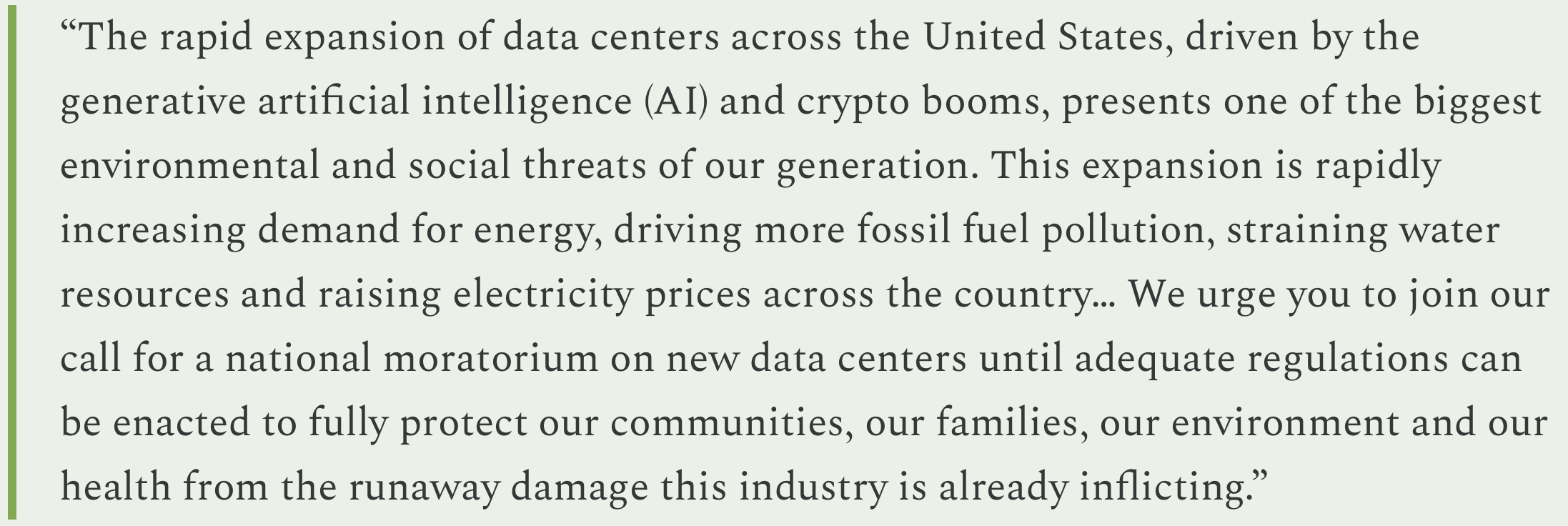
This week, a group of more than 200 environmental, social justice, and consumer organizations sent a letter to Congress calling for a nationwide ban on new data centers. It says, in part:
Given the Trump administration’s fondness for AI, and donations from Big Tech, I don’t see the GOP-dominated Congress acting on this.
More news tidbits:
- As if to verify the opposition groups’ concerns, the developers of the massive proposed Project Jupiter data center complex near Santa Teresa, New Mexico, recentlyy asked state regulators for permission to generate more power than the state’s largest utility and emit more greenhouse gases than both Albuquerque and Las Cruces combined, according to a Source NM report. The latter figure was so high that many observers assumed it was a typo. But then, given its purported size — developers say the complex will cost $165 billion — and ginormous energy consumption, fueled by methane, it surely will emit a lot of carbon, typo or not.
- Then there’s Beale Infrastructure’s Project Blue, the hyperscale data center planned for 290 acres outside of Tucson that was originally slated to be occupied and operated by Amazon Web Services. From the outset, it has run into stiff local opposition, nixing plans to annex it into Tucson so it could use recycled wastewater for cooling. The developers shifted gears, saying they would use air-cooling instead to save water in the very water-constrained area. But that was a no-go for Amazon, which pulled out of the deal last week. Beale says other tenants have lined up in the tech giant’s stead. Meanwhile, the Arizona Corporation Commission approved the data center’s power purchase deal with Tucson Electric Power.
- And in the places-you-wouldn’t-expect-a-data-center beat: An obscure UK-based developer has proposed building a $10-billion, 1-gigawatt data center on 500 acres of land it plans to purchase from the city of Page, Arizona.

Details remain sketchy: It’s not clear who, exactly, the developer is; a land-purchase agreement indicates the data center might generate its own power, but no fuel source is listed — and 1 GW is the capacity of a big coal or natural gas plant; they plan to “acquire, develop, construct, and use water in a sufficient quantity and quality to continuously serve the Data Center and Energy Project,” yet don’t say where they would get this water; and the developer said the project would create 500 permanent jobs, which is a rather large staff to oversee a bunch of computer processing units. A majority of the city council has supported the $7 million land sale, which is contingent on a successful feasibility study, and the attendant tax revenues and jobs. That is not a surprise given the economic blow dealt by Navajo Generating Station’s 2019 closure and lower visitor numbers at Lake Powell and Glen Canyon National Recreation Area. But local opposition is growing and may derail the plans — if the lack of water doesn’t.
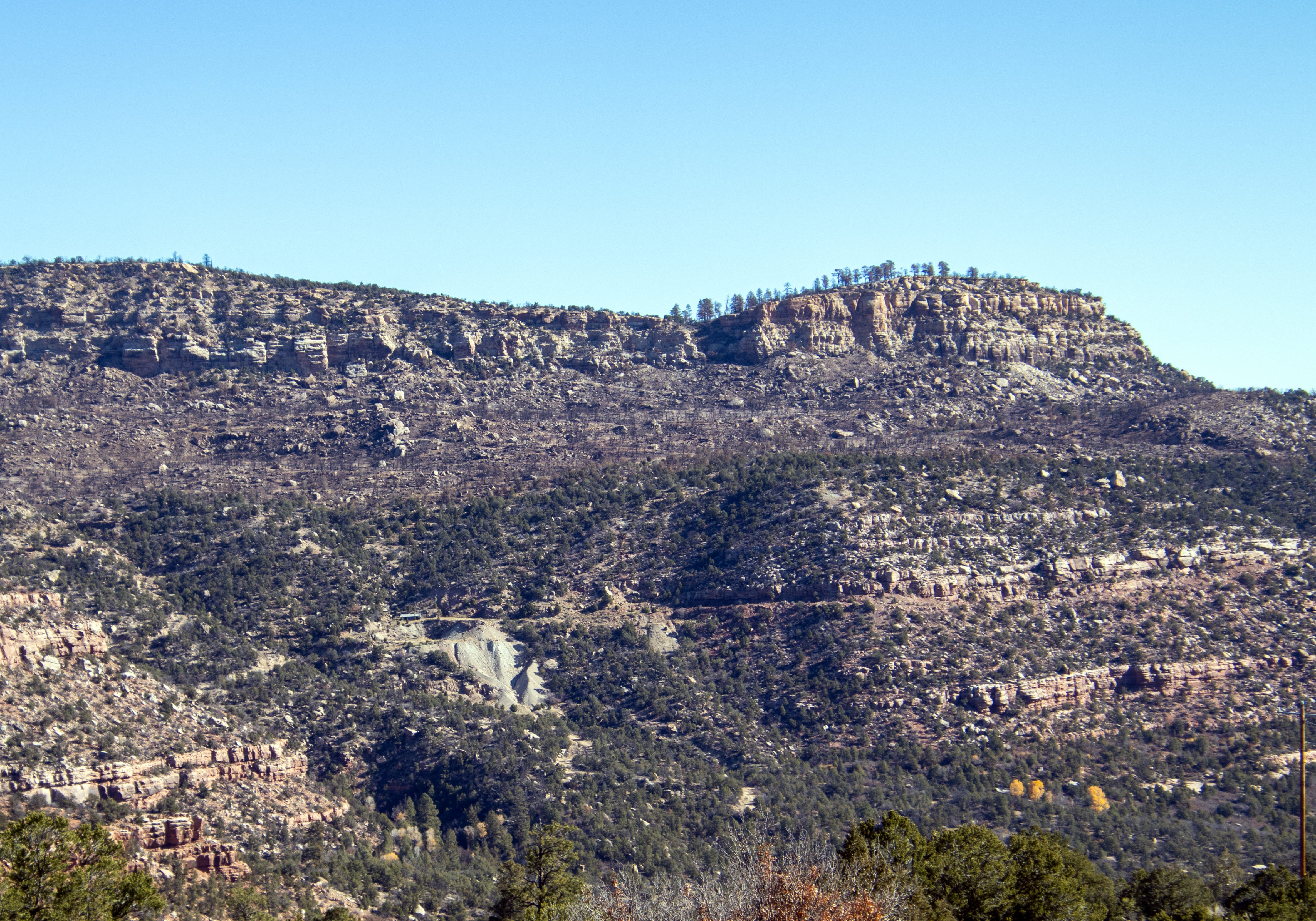
Another uranium project is coming to the Lisbon Valley in southeastern Utah, though this one is a bit unconventional. Last month, Mandrake Resources signed onwith Disa technologies to use its “high-pressure slurry ablation,” or HPSA, technology to “recover saleable uranium and other critical minerals” from old mining waste piles on Mandrake’s 94,000 project area south of La Sal.
The Nuclear Regulatory Commission’s environmental review of the Disa’s proposal to remediate abandoned mine dumps with HPSA describes the technology as involving …
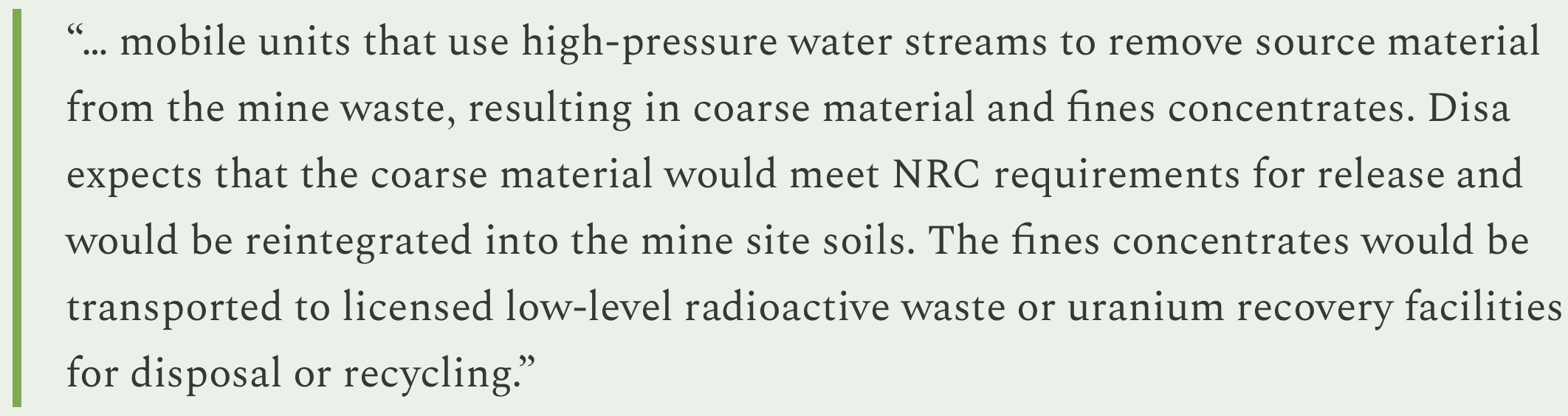
Because the process is separating uranium and thorium fines from ore, it is considered a form of milling, not mining. And that’s an important distinction, because when you mill uranium ore, you leave behind mill tailings, which must be disposed of according to NRC and Environmental Protection Agency standards. Instead, the “coarse material,” as the waste is described, would be reintegrated into the mine site — even though it may contain radioactive and other harmful materials.
Nevertheless, the NRC granted Disa a license to use HPSA to remediate waste rock at abandoned uranium mines. “The NRC failed to define and regulate the wastes that would be produced by the HPSA process at former uranium mine sites in accordance with the Atomic Energy Act and NRC and EPA regulations applicable to the wastes from the processing of any ore for its uranium content,” said Sarah Fields, of Uranium Watch.
Also of concern is water use: Disa says it would obtain water from offsite, trucking it in at volumes between 10,000 and 40,000 gallons daily. Most likely this would come from a nearby municipal water supply, but it’s not clear which municipality that would be for the Mandrake/Lisbon Valley project.
Mandrake originally acquired and staked hundreds of mining claims on federal and state lands in the Lisbon Valley to extract lithium. But when its drilling samples showed high levels of uranium — and when lithium prices crashed — the Australian company switched gears, or perhaps just broadened their scope. The firm’s website still refers to the land-holdings as its “Utah Lithium Project.”
🗺️ Messing with Maps 🧭

This is a pretty cool tool released by the U.S. Census Bureau a little while back. It shows how many housing units were added (or lost), along with the percent change, from each state, county, town, and even census tract between 2020 and 2025. Assuming it’s accurate, it could really help inform discussions about housing supply and demand, about the drivers of the housing affordability crisis, and whether land-use regulations and NIMBYism are really shutting down housing construction.
Check it out here and play around with it a little. Here are some screenshots of more detailed views of Phoenix and Durango.

