Secretary Scott Turner (L) with Secretary Doug Burgham (R).
Click the link to read the article on the AZCentral.com website (Brandon Loomis). Here’s an excerpt:
January 17, 2026
Key Points
After negotiators for the seven Colorado River states failed to reach a water-sharing agreement, federal officials have invited governors to continue talks.
The feds may impose their own plan if states cannot agree, potentially leading to major cuts for Arizona, with its junior water rights.
The states face a mid-February timeline to present a “deal in principle” to replace guidelines expiring in September.
Interior Secretary Doug Burgum has invited all seven governors and their negotiators to meet in Washington in late January, [Tom] Buschatzke said. Perhaps getting the governors face-to-face could lead to a breakthrough, he added..The seven states have tried unsuccessfully for more than a year to reach a voluntary agreement to replace dam-operating guidelines that will expire with the end of the water year in September. The U.S. Bureau of Reclamation has asked states to submit an agreement by Feb. 14. That date falls on a weekend and likely isn’t a hard deadline for every detail in the plan, Buschatzke said, but a “deal in principle” probably needs to take shape by then if the states want to control their own destinies.
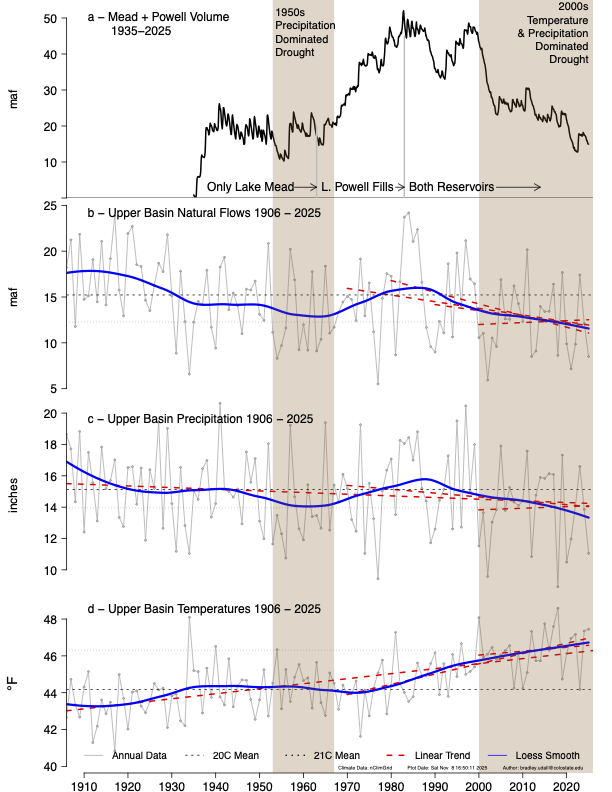
Udall/Overpeck 4-panel Figure Colorado River temperature/precipitation/natural flows with trend. Lake Mead and Lake Powell storage. Updated through Water Year 2025. Note the tiny points on the annual data so that you can flyspeck the individual years. Credit: Brad Udall
Click the link to read the article on the Summit Daily News website (Ali Longwell). Here’s an excerpt:
January 17, 2026
While the four Upper Basin states in the compact — Colorado, New Mexico, Utah, and Wyoming — rely predominantly on snowpack for water supply, the Lower Basin states — Arizona, California, and Nevada — rely on releases from Lake Powell and Lake Mead..It’s not the compact, but the 2007 operational guidelines for Lake Powell and Lake Mead that are being renegotiated as they are set to expire this year. A decision must be made prior to Oct. 1, 2026, according to the Bureau…The federal government, seven states and 30 tribal nations all agree the best path forward is for a consensus between the upper and lower basins. However, with the looming deadline and unresolved disagreements about the future of the river, the Department of the Interior and its subagency, the Bureau of Reclamation, are forging ahead.
”The Department of the Interior is moving forward with this process to ensure environmental compliance is in place so operations can continue without interruption when the current guidelines expire,” said Andrea Travnicek, the assistant secretary of water and science for the Bureau of Reclamation, in a news release announcing the agency’s latest draft options. “In the face of an ongoing severe drought, inaction is not an option.”
One of the main disagreements throughout negotiations has been who should be making cuts to water use. The Lower Basin states have advocated for basin-wide water use reductions. The Upper Basin states, however, have pushed back on the idea, claiming they already face natural water shortages driven primarily by the ups and downs of snowpack…The draft Environmental Impact Statement released by the Bureau of Reclamation last week offers five options — including a required “no action” alternative and four others — that represent a broad range of operating strategies. The draft’s publication initiates a 45-day public comment period ending on March 2, 2026. In a statement, Scott Cameron, acting lead of the Bureau of Reclamation, said that the federal agency has purposefully not identified a preferred alternative, “given the importance of a consensus-based approach to operations for the stability of the system.” The expectation is that whatever agreement is reached incorporates elements of all five options offered by the Bureau of Reclamation, Cameron added.
The five options identified are:
No Action
Basic Coordination
Enhanced Coordination
Maximum Operational Flexibility
Supply Driven
Each option offers differing methods for how the Bureau of Reclamation will operate Lake Powell and Lake Mead, particularly under low reservoir conditions; allocate, reduce or increase annual allocations for consumptive use of water from Lake Mead to the lower basin states; store and deliver water that has been saved through conservation efforts; manage and deliver surplus water; manage activities above Lake Powell; and more.
Map of the Colorado River drainage basin, created using USGS data. By Shannon1 Creative Commons Attribution-Share Alike 4.0
Click the link to read the article on the Sky-Hi News website (Ryan Spencer). Here’s an excerpt:
January 17, 2026
Colorado’s statewide snowpack has again hit record-lows, and could remain there for several days as the state is expected to enter a dry spell until the last week of January. Colorado Assistant State Climatologist Peter Goble described the snow season as “a bummer so far.” With each passing day that this low-snow trend continues, Goble said the less likely it becomes that the state will see enough snow to dig itself out of its snowpack deficit.
“It’s likely to get worse before it gets better,” he said. “We’re starting to look at the rest of the snow season and see a limited runway for improvements. It’s not impossible, but it’s not probable either.” [ed. emphasis mine]
The snowpack statewide has sat at the zeroth percentile, meaning it’s the worst on record, since Wednesday, and remained there as of Friday, according to the U.S. Department of Agriculture’s Snow Telemetry or SNOTEL program. It’s at least the third time the statewide snowpack has hit record-lows so far this season. The snowpack also hit record-lows in late November and late December. Midway into January, Colorado is “rapidly approaching the halfway point of a normal snow season,” Goble said. With most forecasts calling for little-to-no snow for at least the next seven days, he said it is likely the state will enter February at or near record lows…As of Friday, Colorado’s snowpack sat at 4.8 inches of snow-water equivalent, more than 3 inches below the median of 7.1 inches that is more typical of this time of year, according to SNOTEL data. Statewide, the median peak snowpack has occurred on April 8, with a snow-water equivalent of 16.7 inches. While it is too early to call this winter the worst in Colorado’s history, the state is “not keeping good company at this point in the season,” Goble said. The snow-water equivalent so far this season is about an inch below where it was during the 2011-12 season, which was one of the worst winters in the 21st century. The season so far is more comparable to the winters of 1980-81 and 1976-77, which is often considered the worst winter in Colorado history. Since Colorado’s SNOTEL system wasn’t fully built out in those years, it is hard to make direct comparisons to those historically poor snow years, Goble said. Notably, the winter of 1980-81 saw a significant amount of snow later in the year, and ended the season far better than it started. While he said he is hopeful this season will see significant late-season snow, it is far from certain.
Westwide SNOTEL basin-filled map January 19, 2026.