
Click the link to read the article on the Summit Daily News website (Ali Longwell). Here’s an excerpt:
January 17, 2026
While the four Upper Basin states in the compact — Colorado, New Mexico, Utah, and Wyoming — rely predominantly on snowpack for water supply, the Lower Basin states — Arizona, California, and Nevada — rely on releases from Lake Powell and Lake Mead..It’s not the compact, but the 2007 operational guidelines for Lake Powell and Lake Mead that are being renegotiated as they are set to expire this year. A decision must be made prior to Oct. 1, 2026, according to the Bureau…The federal government, seven states and 30 tribal nations all agree the best path forward is for a consensus between the upper and lower basins. However, with the looming deadline and unresolved disagreements about the future of the river, the Department of the Interior and its subagency, the Bureau of Reclamation, are forging ahead.
”The Department of the Interior is moving forward with this process to ensure environmental compliance is in place so operations can continue without interruption when the current guidelines expire,” said Andrea Travnicek, the assistant secretary of water and science for the Bureau of Reclamation, in a news release announcing the agency’s latest draft options. “In the face of an ongoing severe drought, inaction is not an option.”
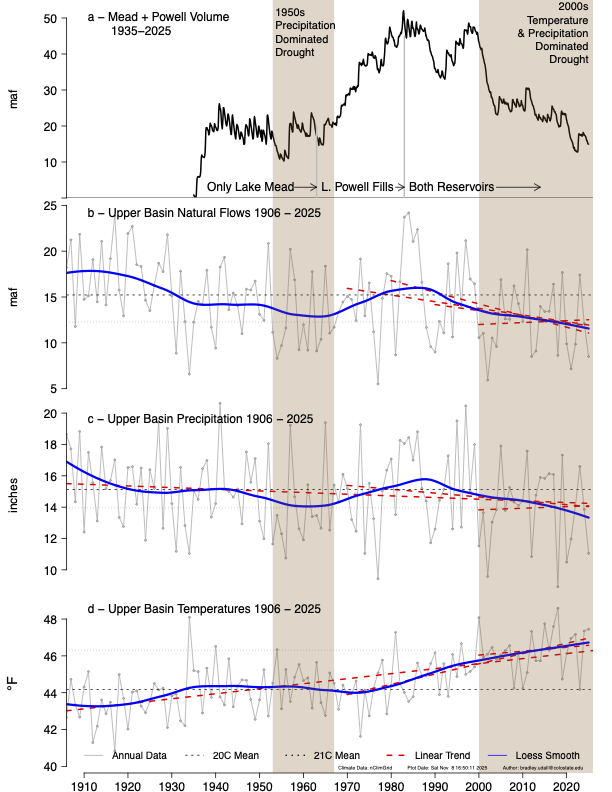
One of the main disagreements throughout negotiations has been who should be making cuts to water use. The Lower Basin states have advocated for basin-wide water use reductions. The Upper Basin states, however, have pushed back on the idea, claiming they already face natural water shortages driven primarily by the ups and downs of snowpack…The draft Environmental Impact Statement released by the Bureau of Reclamation last week offers five options — including a required “no action” alternative and four others — that represent a broad range of operating strategies. The draft’s publication initiates a 45-day public comment period ending on March 2, 2026. In a statement, Scott Cameron, acting lead of the Bureau of Reclamation, said that the federal agency has purposefully not identified a preferred alternative, “given the importance of a consensus-based approach to operations for the stability of the system.” The expectation is that whatever agreement is reached incorporates elements of all five options offered by the Bureau of Reclamation, Cameron added.
The five options identified are:
- No Action
- Basic Coordination
- Enhanced Coordination
- Maximum Operational Flexibility
- Supply Driven
Each option offers differing methods for how the Bureau of Reclamation will operate Lake Powell and Lake Mead, particularly under low reservoir conditions; allocate, reduce or increase annual allocations for consumptive use of water from Lake Mead to the lower basin states; store and deliver water that has been saved through conservation efforts; manage and deliver surplus water; manage activities above Lake Powell; and more.
