President Trump’s ’emergency’ #Colorado #coal plant order will raise electricity costs, operator says — Chase Woodruff (ColoradoNewsline.com)

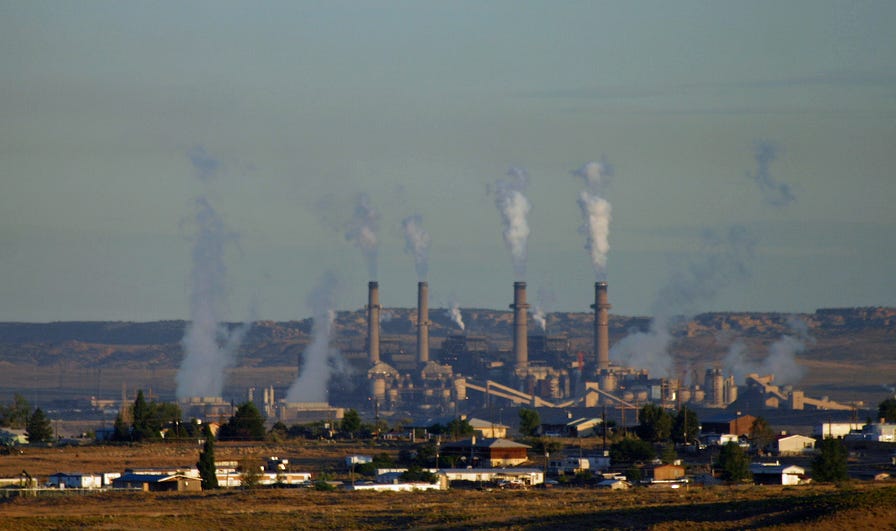
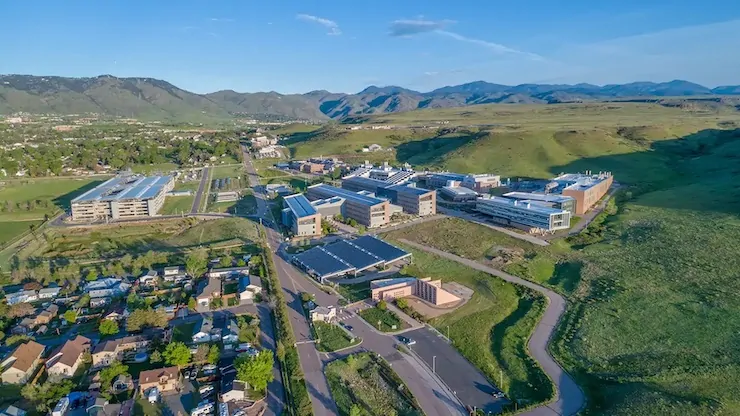
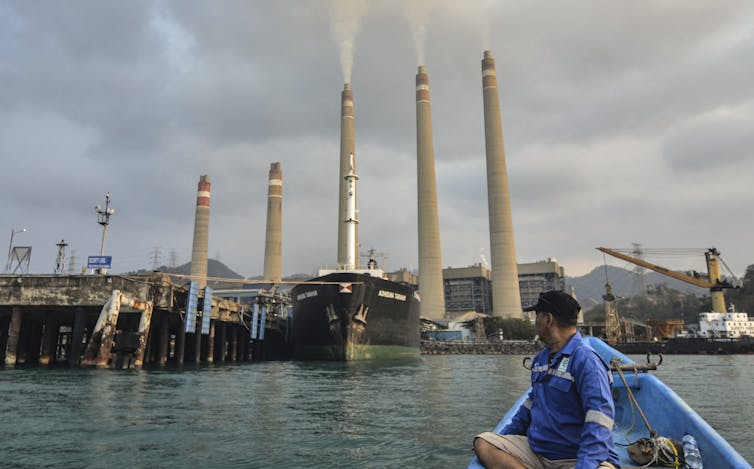
Chris Wright has argued that energy scarcity poses a greater threat to quality of life than climate change. Here, he speaks to reporters in April 2025 while Martin Keller, then the director of NREL, looks on. Photo/Allen Best. Top image/National Laboratory of the Rockies.

Click the link to read the article on the Colorado Newsline website (Chase Woodruff):

January 2, 2026

Following the Trump administration’s last-minute invocation of an energy “emergency” to order a Colorado coal plant to postpone its scheduled retirement, the electricity provider that co-owns the plant is warning that the high costs of continuing to operate it will be shouldered by Colorado utility customers.

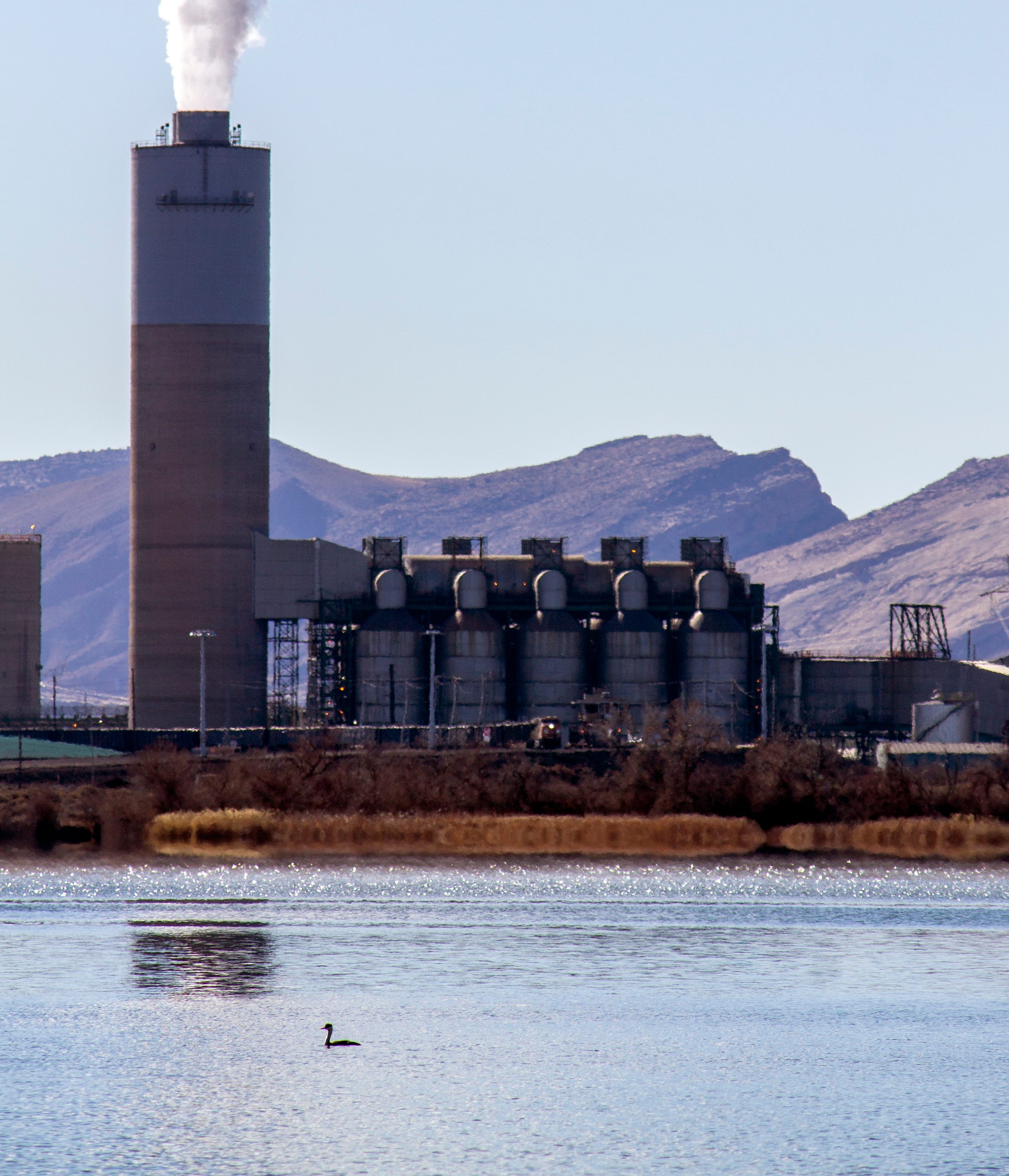
Located in Moffat County, Craig Generating Station’s 446-megawatt Unit 1 had been scheduled to go offline on Dec. 31, 2025, part of a wave of coal retirements planned across Colorado through 2030. But an emergency order issued Dec. 30 by the Department of Energy requires the plant to “take all measures necessary to ensure that Craig Unit 1 is available to operate” until at least March 30, 2026.

Tri-State Generation and Transmission Association, co-owner of Craig Generating Station, said in a press release that the “additional investments in operations, repairs, maintenance and, potentially, fuel supply” required by the order will raise costs for the plant’s customers, which include dozens of electric utilities and rural co-ops. Unit 1 was already offline due to a mechanical failure on Dec. 19, Tri-State said.

“We are continuing to review the order to determine what this means for Craig Station employees and operations, and the financial impacts,” said Tri-State CEO Duane Highley. “As a not-for-profit cooperative, our membership will bear the costs of compliance with this order unless we can identify a method to share costs with those in the region. There is not a clear path for doing so, but we will continue to evaluate our options.”

The five-page DOE order, signed by Energy Secretary Chris Wright, cites “growing resource adequacy concerns” as justification for the move, which followed similar actions in Indiana and Washington.

Shortly after taking office last year, President Donald Trump declared a “national energy emergency” in an executive order blasted by environmental advocates as a pretext for advancing the interests of fossil-fuel companies. Despite the declaration’s stated concerns about “insufficient energy production,” the administration has continued to cancel and delay major wind and solar projects.

An analysis released in December by the Sierra Club estimated that keeping Craig’s Unit 1 open for 90 days would cost ratepayers at least $20 million. Critics of the administration anticipate that the DOE’s orders will continue to be renewed every 90 days under the authority granted to the department by Federal Power Act, raising costs by $85 million to $150 million annually.

“Keeping this dirty and outdated coal plant online will harm the health of surrounding communities and hurt all of our pocketbooks,” said Michael Hiatt of environmental group Earthjustice. “This unlawful order will benefit no one but the struggling coal industry.”

The DOE order comes amid a series of Trump administration actions targeting Colorado that are widely viewed as retaliation for the ongoing incarceration of Trump ally and former Mesa County Clerk Tina Peters, who was convicted on felony charges for her role in a breach of her own office’s secure election equipment in 2021.

Colorado U.S. Sen. Michael Bennet voted to confirm Wright, a former Denver oil executive, as Trump’s pick for Energy Secretary in January 2025, calling Wright “passionate about strengthening America’s energy independence and lowering costs for Colorado families.” In a statement Wednesday, Bennet, a Democrat who is running for Colorado governor, said he was “disappointed but not surprised by this continued revenge tour.”

“The DOE order is the latest in a string of attacks against Colorado, because we refuse to bend to the President,” Bennet said. “President Trump continues to take out his personal and political grievances on Coloradans who are already struggling to make ends meet.”

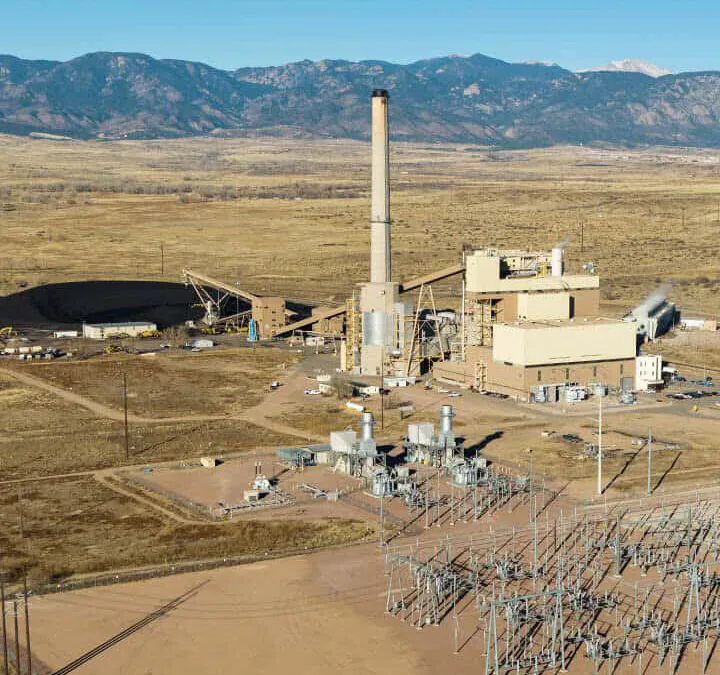
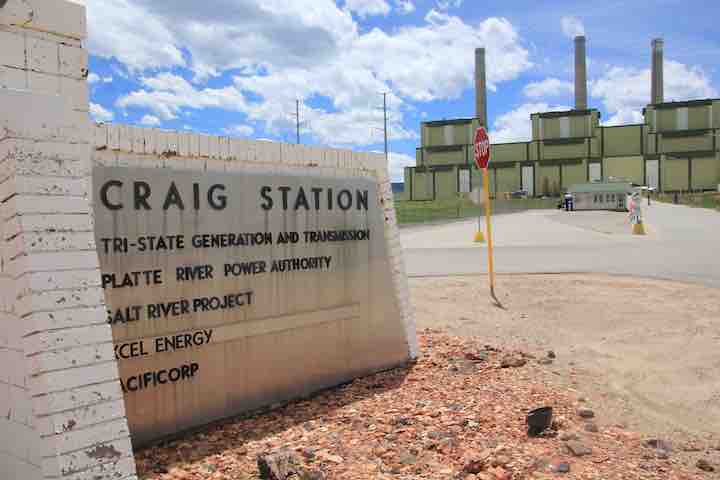
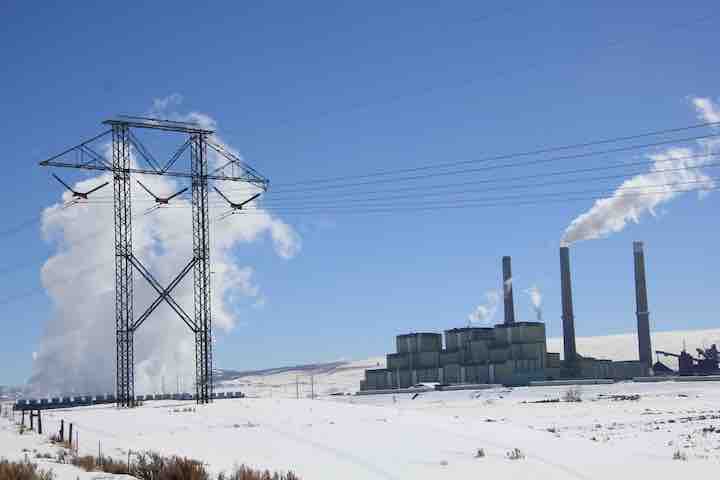
The three units of Craig Station were constructed from 1974 to 1984. Photo credit: Allen Best/Big Pivots

Oh, the irony of Craig No. 1! — Allen Best (BigPivots.com) #coal

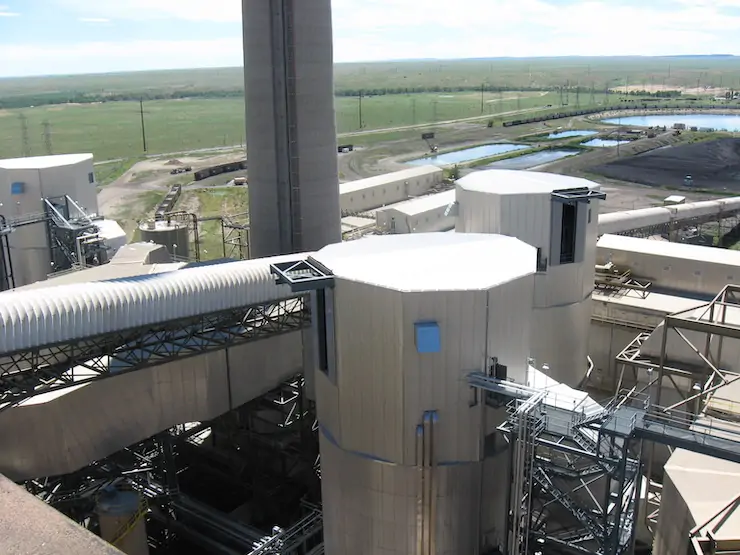
Craig Station. Photo credit: Allen Best/Big Pivots

Click the link to read the article on the Big Pivots website (Allen Best):

December 31, 2025

Trump orders Craig coal unit planned for retirement to stay open. But it so happens the unit is broken. Ludicrous says Polis team. Sierra Club challenges basis for emergency declaration.

It was no surprise. Tri-State Generation and Transmission has said for at least three months that it expected to get orders from the Trump administration to continue operating a coal-burning unit at Craig, in northwest Colorado, beyond its scheduled retirement on Dec. 31, 2025.

The order was posted at 6 p.m. MST Tuesday. Citing emergency authority claimed by President Donald Trump, Energy Secretary Chris Wright ordered the coal unit to remain in operation through March 2026. The order cited a sudden increase in demand for electricity, or a shortage of generation capacity.

The irony of the order is that it was issued when the 427-megawatt unit was out of operation, according to a statement issued by the office of Colorado Gov. Jared Polis.

Ludicrously, the coal plant isn’t even operational right now, meaning repairs — to the tune of millions of dollars — just to get it running, all on the backs of rural Colorado ratepayers!” Polis said.

“Going backwards is an attempt to force local communities to foot the bill to extend plant operations and will cost energy consumers more. Today’s action flies in the face of this careful planning, is inconsistent with market forces, and will hurt Coloradans.”

The Polis team estimated continued operations would cost tens of millions of dollars “to keep a coal plant open that is broken and not needed.”

Tri-State, in a statement on Wednesday morning, explained that the unit “went into an outage” on Dec. 19, 2025, due to a mechanical failure of a valve. “Tri-State and the other co-owners will need to take the necessary steps to repair the valve in a timely manner,” the statement said.

“Tri-State has a policy of 100% compliance, and we will work with Unit 1 co-owners, and federal and state governments to determine the most cost-effective path to that end,” said Duane Highley, Tri-State CEO. “We are continuing to review the order to determine what this means for Craig Station employees and operations, and the financial impacts. As a not-for-profit cooperative, our membership will bear the costs of compliance with this order unless we can identify a method to share costs with those in the region. There is not a clear path for doing so, but we will continue to evaluate our options.”

As a result of the order, retaining Unit 1 will likely require additional investments in operations, repairs, maintenance and, potentially, fuel supply, all factors increasing costs, Tri-State said. “Tri-State is continuing to review the order to determine how best to comply while limiting the costs to its members, and the impacts to its employees and operations.”

Highley told Big Pivots in October that the wholesale supplier for cooperatives in Colorado and three other states did not need the electrical production at this time, as it is actually producing more than it needs.

Wright, in his order, No. 202-25-14, cited several justifications.

One justification was a 2024 report by the Western Electricity Coordinating Council that forecast growth of 8.5% in peak demand during the next decade in Colorado and several adjoining states.

The order also said that Tri-State and its co-owners — Fort Collins-based Platte River Power Authority, Phoenix-based Salt River Project, Salt Lake City-based PacifiCorp., and Denver-based Xcel Energy — “take all measures necessary” to ensure that Craig Unit 1 is available to operate at the direction of either Western Area Power Administration in its role as a balancing authority or the Southwest Power Pool West in its role as the reliability coordinator.

The Sierra Club emphasized the cost of operating Craig No. 1. It cited a recent report by Grid Strategies that found operating the unit past the retirement deadline will cost the plant owners $85 million per year. This is distinct from repairs that may be necessary.

“Trump is playing politics with coal,” said Margaret Kran-Annexstein, director of the Colorado chapter, in a statement issued shortly after the order was posted.

Matthew Gerhart, the senior attorney for the Sierra Club at its Denver office, had even stronger language in an interview with Big Pivots.

“I think this order is a joke even by this administration’s standards,” he said. “This is quite clearly just a political move. None of the documents they cite even come close to saying there is an emergency.”

Wright’s order cited the 2025-2026 Winter Reliability Assessment issued by the North America Electric Reliability Corporation. That report in November noted total and net internal demand increases of almost 1% driven primarily by data centers and commercial and industrial customer growth. Even so, the operating reserve margins in the Rocky Mountain were expected to be met before imports in all winter scenarios.
That being said, Xcel Energy almost a year ago began expressing concerns about resource adequacy.

Gerhart also found fault with Wright’s order that the unit be available to operate at the direction of the Southwest Power Pool West in its role as the reliability coordinator. SPP exists, but not the configuration — a regional transmission organization — that would allow SPP to do this, he said. SPP has a day-ahead market and also a balancing market but not the apparatus set up to manage the operation of Craig No. 1, he said.

Will Toor, director of the Colorado Energy Office, also pointed to the report from the North America Reliability Corporation that found no short-term or long-term elevated reliability risks in the Rocky Mountain region,

“These orders will take money out of the pockets of Colorado ratepayers, and especially harm rural communities across the West who could be forced to absorb the unnecessary excess costs required to keep this plant operational,” he said. “The Trump administration is engaging in Soviet-style central planning, driven by ideology rather than the realities of the electric grid, that will drive dirtier air and higher electric rates across our state. These orders are unlawful and will not improve energy security in Colorado or the region.”

Trump has claimed authority to order coal plants remain in operation under the Federal Power Act. That nearly century-old law explicitly gives presidents authority to order electrical plants to operate under duress of war or weather emergencies. Since last April, Trump has sought to expand the power, citing emergencies caused by concerns about resource adequacy. The concerns, he has said, result from retiring fossil fuel and nuclear plants, dramatic growth in demand, and the intermittency of renewables.

For a deeper dive on Trump’s contested use of the emergency clause in the Federal Power Act, see this Big Pivots story from Nov. 3: “Will feds order Colorado coal plants to stay open?”

U.S. Sen. Michael Bennet, a gubernatorial candidate, also pushed back: “The DOE order is the latest in a string of attacks against Colorado, because we refuse to bend to the President. President Trump continues to take out his personal and political grievances on Coloradans who are already struggling to make ends meet. Federal intervention like this makes long-term planning impossible – this is not how you operate a business, plan an electric grid, or help a community stay prosperous. I am disappointed but not surprised by this continued revenge tour.”

Wright’s order said that 417.3 megawatts of coal-fired generating capacity across six units at three locations have retired in Colorado since 2019. It cited the Western Electricity Coordinating Council. “Looking forward, by 2029, about 3,700 megawatts of coal-fired generating capacity in Colorado is scheduled to be retired.” The order said that during that time, 675.6 megawatts of natural gas-fired generating capacity in Colorado will retire as well.

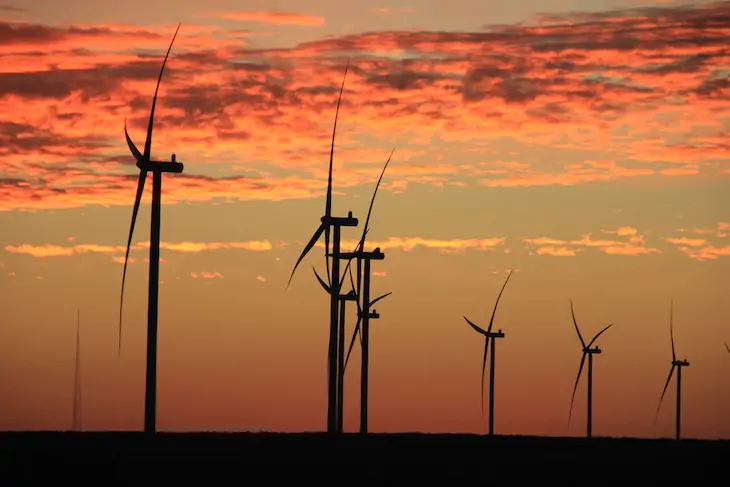
Wind turbines near Pawnee Buttes in northeastern Colorado. Photo/Allen Best

In 2025, wind accounted for over 5,300 megawatts of Colorado’s electricity generating capacity, the order noted.

Wright’s order described wind as intermittent. Of course, coal can be intermittent, too. That has been demonstrated repeatedly at Pueblo, particularly in the case of Comanche 3. The coal unit went down again in August and is not expected to be restored into operation until June 2026. In its absence, Xcel asked — and the Polis administration agreed — that Comanche 2 would not be retired this month, as had been planned for several years.

As for Craig No. 1, its retirement was planned in an agreement reached almost a decade ago. Air quality standards in Rocky Mountain National Park and other national parks and wilderness areas are being violated in part because of emissions from the unit. The regional haze standards were federally created and state enforced. The agreement with the Colordo Air Quality Control Commission was reached in 2016.

Tri-State’s electric resource plan of 2023 showed adequate resources to maintain reliability on Tri-State’s system following the retirement of Craig No. 1 as well as two other units at Craig Station that are scheduled to close in 2028. Unit 2, which Tri-State owns with its other partners in Unit 1, has a capacity of 410 megawatts. Tri-State owns 100% of Unit 3, which has a capacity of 448 megawatts. The three units were constructed and went on line in the late 1970s and early 1980s.

The Trump administration first cited the Federal Power Act earlier this year this year for plants in Michigan and in Pennsylvania and has recently used that same emergency power to order continued operation of fossil fuel plants in Indiana and Washington.

Even with President Trump’s support, #coal power remains expensive – and dangerous — Hannah Wiseman and Seth Blumsack (TheConversation.com)

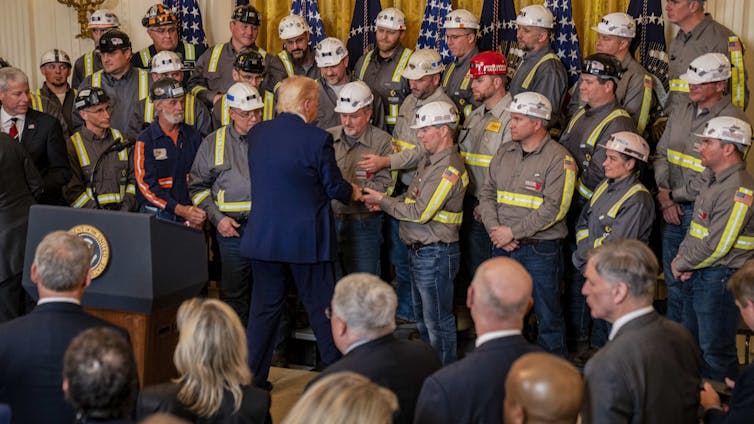
President Donald Trump has aligned himself with the coal industry, including at this meeting in April 2025. Andrew Thomas/Middle East Images/AFP via Getty Images

Hannah Wiseman, Penn State and Seth Blumsack, Penn State

As projections of U.S. electricity demand rise sharply, President Donald Trump is looking to coal – historically a dominant force in the U.S. energy economy – as a key part of the solution.

In an April 2025 executive order, for instance, Trump used emergency powers to direct the Department of Energy to order the owners of coal-fired power plants that were slated to be shut down to keep the plants running.

He also directed federal agencies to “identify coal resources on Federal lands” and ease the process for leasing and mining coal on those lands. In addition, he issued orders to exclude coal-related projects from environmental reviews, promote coal exports and potentially subsidize the production of coal as a national security resource.

But there remain limits to the president’s power to slow the declining use of coal in the U.S. And while efforts continue to overcome these limits and prop up coal, mining coal remains an ongoing danger to workers: In 2025, there have been five coal-mining deaths in West Virginia and at least two others elsewhere in the U.S.

A large industrial area with towers, a rail line and large buildings with large metal connections.
A coal-fired power plant in Michigan has remained open at Trump administration orders. Jim West/UCG/Universal Images Group via Getty Images

A long legacy

Until 2015, coal-fired power plants generated more electricity than any other type of fuel in the U.S. But with the rapid expansion of a new type of hydraulic fracturing, natural gas became a cheap and stable source for power generation. The prices of solar and wind power also dropped steadily. These alternatives ultimately overcame coal in the U.S. power supply.

Before this change, coal mining defined the economy and culture of many U.S. towns – and some states and regions, such as Wyoming and Appalachia – for decades. And in many small towns, coal-related businesses, including power plants, were key employers.

Coal has both benefits and drawbacks. It provides a reliable fuel source for electricity that can be piled up on-site at power plants without needing a tank or underground facility for storage.

But it’s dirty: Thousands of coal miners developed a disease called black lung. The federal government pays for medical care for some sick miners and makes monthly payments to family members of miners who die prematurely. Burning coal also emits multiple air pollutants, prematurely killing half a million people in the United States from 1999 through 2020.

Coal is dangerous for workers, too. Some coal-mining companies have had abysmal safety records, leading to miner deaths, such as the recent drowning of a miner in a sudden flood in a West Virginia mine. Safety reforms have been implemented since the Big Branch Mine explosion in 2010, and coal miner deaths in the U.S. have since declined. But coal mining remains a hazardous job.

A stone plaque with names carved on it, between two statues of coal miners.
A memorial honors coal miners who died on the job in Harlan County, Ky. Jim West/UCG/Universal Images Group via Getty Images

A champion of coal

In both of his terms, Trump has championed the revival of coal. In 2017, for example, Trump’s Department of Energy asked the Federal Energy Regulatory Commission to pay coal and nuclear plants higher rates than the competitive market would pay, saying they were key to keeping the U.S. electricity grid running. The commission declined.

In his second term, Trump is more broadly using powers granted to the president in emergencies, and he is seeking to subsidize coal across the board – in mining, power plants and exports.

At least some of the urgency is coming from the rapid construction of data centers for artificial intelligence, which the Trump administration champions. Many individual data centers use as much power as a small or medium city. There’s enough generation capacity to power them, though only by activating power plants that are idle most of the time and that operate only during peak demand periods. Using those plants would require data centers to reduce their electricity use during those peaks – which it’s not clear they would agree to do.

So many data centers, desperate for 24/7 electricity, are relying on old coal-fired power plants – buying electricity from plants that otherwise would be shutting down.

A long train of cargo cars carrying a black substance stretches to the horizon.
The sun rises on a coal train outside Ritzville, Wash. Visions of America/Joseph Sohm/Universal Images Group via Getty Images

Limits remain

Despite the Trump adminstration’s efforts to rapidly expand data centers and coal to power them, coal is more expensive than most other fuels for power generation, with costs still rising.

Half of U.S. coal mines have closed within the past two decades, and productivity at the remaining mines is declining due to a variety of factors, such as rising mining costs, environmental regulation and competition from cheaper sources. Coal exports have also seen declines in the midst of the tariff wars.

The U.S. Department of the Interior’s recent effort to follow Trump’s orders and lease more coal on federal lands received only one bid – at a historically low price of less than a penny per ton. But in fact, even if the government gave its coal away for free, it would still make more economic sense for utilities to build power plants that use other fuels. This is due to the high cost of running old coal plants as compared to new natural gas and renewable infrastructure.

Natural gas is cheaper – and, in some places, so are renewable energy and battery storage. Government efforts to prevent the retirement of coal-fired power plants and boost the demand for coal may slow coal’s decline in the short term. In the long term, however, coal faces a very uncertain future as a part of the U.S. electricity mix.

Hannah Wiseman, Professor of Law, Penn State and Seth Blumsack, Professor of Energy and Environmental Economics and International Affairs, Penn State

This article is republished from The Conversation under a Creative Commons license. Read the original article.

Bureau of Land Management nominee draws criticism from #conservation groups over support for selling public land — Micah Drew (UtahNewsDispatch.com)

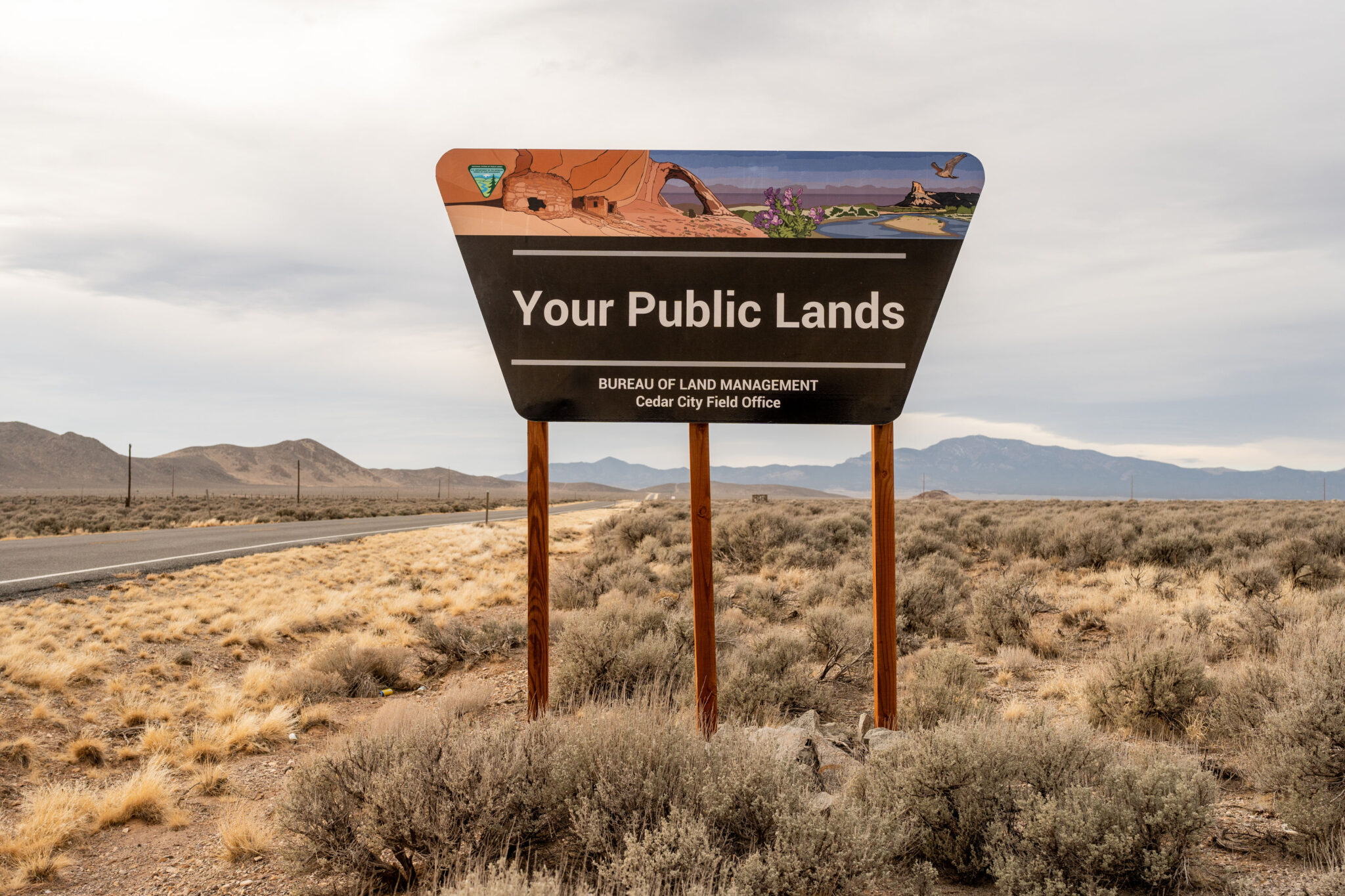
Signage welcomes visitors to Bureau of Land Management land near Cedar City on Sunday, Feb. 2, 2025. (Photo by Spenser Heaps for Utah News Dispatch)

Click the link to read the article on the Utah News Dispatch website (Micah Drew):

December 4, 2025

Republicans are rallying around former New Mexico Rep. Steve Pearce, Trump’s nominee to oversee the land management agency

Conservation groups in Montana and across the West are raising concerns about Steve Pearce, a former New Mexico representative who is President Donald Trump’s newest nominee to lead the Bureau of Land Management. 

The nomination has reignited a fight over the management of public lands which was highlighted during negotiations over Trump’s “One Big Beautiful Bill” due to proposed amendments to sell off federal land. The fight also spawned two new bipartisan caucuses in Congress, both co-chaired by Montanans, and predicated on public land access and management. 

In Montana and the two Dakotas, the BLM manages more than 8.3 million acres of federal land. Nationwide, the BLM oversees 245 million acres of federal land, along with 700 million acres of subsurface rights for extraction and energy development, putting the position directly in the crosshairs of energy developers and outdoor industry groups. 

According to the Center for Western Priorities, Pearce amassed a “lengthy anti-public lands record,” sponsoring bills to shrink national monuments and increase extraction on national forest land. 

Many conservation groups are specifically honing in on Pearce’s long record of advocating to sell off federal lands, including sponsoring legislation in Congress to authorize land sales or exchanges with local governments. 

In a letter to then-House Speaker John Boehner in 2012, Pearce wrote that of the federal lands located in the West, “most of it we do not even need.”

He proposed using land sales to reduce the deficit, similar to rhetoric heard earlier when Interior Secretary Doug Burgum equated federal lands to the nation’s “balance sheet.”

“We cannot afford to hand the keys to 245 million acres of our public lands over to someone who has spent his career trying to auction them off to the highest bidder,” Aubrey Bertram, staff attorney and federal policy director at Wild Montana, said. “Steve Pearce’s record is crystal clear: he believes public lands should be privatized for billionaires’ benefit, not protected for the people’s.”

But Pearce’s nomination has been greeted with enthusiasm by mining and energy companies that operate on federal land, as well as by many Republican officials, including Montana Sen. Steve Daines.

“I knew Steve in the House days, and Steve is a great pick. And I particularly like the fact that it’s a Westerner,” Daines said in an interview. “I think it’s helpful when we have leaders in those important positions that come from the West, when they understand uniquely the challenges we face as it relates to federal land, state land, private land. And Steve Pearce has lived it and breathed it.”

Daines is a member of the newly formed Senate Stewardship Caucus, which is co-chaired by Montana Sen. Tim Sheehy. 

The two Montanans also bucked their party earlier this year by joining Senate Democrats in a resolution that would have prevented the use of public land sales to reduce the deficit. 

Representatives for Daines and Sheehy did not respond to questions about Pearce’s nomination. 

Sheehy has not publicly stated whether he will support Pearce. 

But Montana’s federal delegation has been supportive of increasing coal and energy extraction in the state. 

In eastern Montana, Congress recently voted to overturn a Biden-era restriction on resource extraction on federal land, reopening nearly 1.7 million acres to future coal leasing.  

All members of the state’s delegation supported the move calling it vital to the state’s economy and the nation’s energy security.

Pearce has roots in the oil and gas industry that stretch beyond his political work. 

In the 1980s, Pearce founded an oilfield services company in New Mexico, which he later sold when he won his first election. 

Starting in 2003, he represented New Mexico in Congress for seven terms.

He lost races for the U.S. Senate in 2008 and governor in 2018. 

While conservation and public land advocates have pushed back against Pearce’s nomination, industry groups have applauded Trump’s pick. 

The National Cattleman’s Beef Association said Pearce’s experience makes him “thoroughly qualified to lead the BLM and tackle the issues federal lands ranchers are facing.”

The Western Energy Alliance, comprising oil and gas companies across nine western states, also put out a statement of support for Pearce. 

“As a westerner coming from a state that’s nearly 20 percent BLM land, he understands the bureau’s mission. As a former congressman and chair of the Congressional Western Caucus, his record shows he’s been a champion of multiple-uses of public lands. Steve has been a longtime friend who understands the value of energy development among other uses,” the Alliance said. 

This story was originally produced by Daily Montanan, which is part of States Newsroom, a nonprofit news network which includes Utah News Dispatch, and is supported by grants and a coalition of donors as a 501c(3) public charity.

This map shows land owned by different federal government agencies. By National Atlas of the United States – http://nationalatlas.gov/printable/fedlands.html, “All Federal and Indian Lands”, Public Domain, https://commons.wikimedia.org/w/index.php?curid=32180954

Might good come from the NREL name change?: Maybe, but also plentiful skepticism about scrubbing of ‘renewable energy’ from name of laboratory by President Trump’s team  — Allen Best (BigPivots.com)

National Renewable Energy Laboratory

Click the link to read the article on the Big Pivots website (Allen Best):

December 2, 2025

Changing a name is simple enough, if somewhat expensive and time-consuming, at least in the case of businesses.

But what to make of the National Renewable Energy Laboratory’s new name? Is the change all bad for the laboratory and for its mission of the last 34 years?

It became National Laboratory of the Rockies as of Monday. It had been known as NREL since 1991 and before that had been the Solar Energy Research Institute since its founding in 1977 during the presidency of Jimmy Carter.

The laboratory has become one of the nation’s — and perhaps the world’s — seminal institutions devoted to engineering an energy transition. As of October, it had 3,717 employees after a reduction of 114 during May.

“Clearly an effort is underway (by President Donald Trump)‚ to downplay renewable energy as a premier, viable energy source in the United States. So it is hard to separate the politics from this given the timing,” said David Renee, who worked at the laboratory from 1991 until his recent retirement.

Renee said that in part he was very disappointed to see the words “renewable energy” deleted from the name but does see the new name allowing the institution to broaden its mission to reflect needs of the ever-more-complex electrical grid.

“I can see some good, long-term benefits from this. It gives the laboratory flexibility to have a broader scope,” he said. “A lot of the work is not exclusively related to renewable energy but more related to grid reliability and expansion, of which renewables play an important part. So one could argue that the name change was overdue anyway in order to be consistent with other national laboratories, which are mostly named for their locations and not the technology.”

The United States has 17 national laboratories engaged in energy and other research, and most are named for their local geographies. New Mexico, for example, has the Sandia and Los Alamos labs, the former named for a mountain range and the latter a town. Renee arrived in Golden from the Pacific Northwest National Laboratory and retired after running the solar resource assessment program.

Ron Larson, one of the earliest employees of the solar institute who arrived in 1977, a time when solar was 100 times more expensive than it is now, also tends toward a charitable view of the name change.

A possible reason, and a valid one, he said, could be that other national labs wanted more to do on renewable energy topics and are qualified to do so. “Too, maybe some at NREL have wanted to expand into other sectors, including fossil fuels and nuclear.”


See: “Jimmy Carter’s overlooked Colorado nexus” Big Pivots, Jan. 2, 2025.


Peter Lilienthal, an NREL employee from 1990 to 2007, when he formed an energy-related business, was less charitable. He was incensed by a statement from Audrey Robertson, the assistant secretary of energy, in Monday’s announcement.

“The energy crisis we face today is unlike the crisis that gave rise to NREL,” Robertson said. “We are no longer picking and choosing energy sources. Our highest priority is to invest in the scientific capabilities that will restore American manufacturing, drive down costs, and help this country meet its soaring energy demand. The National Lab of the Rockies will play a vital role in those efforts.”

Lilienthal called that statement gaslighting. “That is just not true,” he said of Robertson’s assertion about no longer picking energy sources. He points to the promises of President Donald Trump on the campaign trail and elsewhere to restore fossil fuels and discourage renewable energy. This, he said, will slow the energy transition away from fossil fuels, he believes.

Jud Virden, the director of the renamed laboratory since October, said the new name “embraces a broader applied energy mission entrusted to us by the Department of Energy to deliver a more affordable and secure energy future for all.”

That statement clearly fits in with the narrative of Chris Wright, the Colorado-born director of the Department of Energy. A graduate of Cherry Creek High School, in south Denver, Wright was a rock climber and skier before going to the Massachusetts Institute of Technology to study engineering, first mechanical and then electrical. He also later studied at the University of California at Berkeley.

In April, Wright returned to Colorado to tour NREL. Afterward, he met with reporters, where he said that he had worked on solar energy during graduate school and then geothermal. Only later, needing a paycheck, did he begin work in the oil and gas industry. In Denver, he founded Liberty, an oil and gas field services company, in 2011.

In his remarks, Wright did not dismiss renewable energy, but he did — as he had done before — dismiss “climate alarmism.” He said the science does not support the perception of risk that has, in part, driven the work to make renewable energy affordable and integrated into the electrical grid.

Wright sees the need for more energy being paramount and climate change worries a hindrance to archiving that plentitude that will result in higher standards of living.

“The biggest barrier to energy development the last few decades is people, for political reasons, calling climate change a crisis,” he claimed.

He went on to cite 3 million people dying every year because they don’t have clean cooking fuels or the 4 or 5 million people dying because they don’t have sufficient food as well as the disconnect notices to American consumers for non-payment.

“If you call climate change a crisis and you don’t look at any data, you can pass laws to do anything.

Chris Wright has argued that energy scarcity poses a greater threat to quality of life than climate change. Here, he speaks to reporters in April 2025 while Martin Keller, then the director of NREL, looks on. Photo/Allen Best. Top image/National Laboratory of the Rockies.

In an essay published in The Economist in July, Wright said much the same thing.


See: “Climate change is a product of progress, not an existential crisis.”


Wright also talked about the need to deliver plentiful energy and lowering energy prices. He talked about the drive to integrate artificial intelligence data centers into the U.S. economy.

“Artificial Intelligence is critical. This is a phenomenal new technology. People are seeing the great consumer services it provides, the business efficiencies it provides, and we are very early on.”

And again, he talked about the need to expand electrical production as necessary to support artificial intelligence. Even without strong demand for data centers, he said, electricity prices have been rising.

“We’ve seen 20 to 25% rise in the price of electricity over the last four years. Americans are mad and angry and upset about that, which is why they’re all worried about AI — ‘No, we don’t want new demand on our grid that’s just going to make our prices more expensive.’ — We need to show them we can walk and chew gum at the same time. We’ve got to grow our electricity production capacity without raising the prices to consumers, and we’ve got to keep our grid stable, not just the complicated system stable, but the increasing cyber threats of people that want to do us harm on our grid.”

Chuck Kutscher took a broad view of the change. A mechanical engineer by training, he began working at NREL in the 1980s before retiring in 2018.

“NREL is widely viewed as the leading renewable energy laboratory in the world. In the U.S. and throughout the world, solar and wind dominate the new electricity generation being deployed because they are now the lowest in cost and are also the fastest to deploy, in addition to avoiding air pollution and greenhouse gas emissions. China is clearly the world leader in renewable energy development and deployment, but NREL has played a critical role in keeping the U.S. competitive,” he said in a statement.

“As a Department of Energy lab, NREL takes direction from DOE. The current administration made it clear in the last election that it would support fossil fuels. DOE does have a lab that focuses primarily on fossil fuels, the National Energy Technology Lab, so continuing to have a lab that performs R&D on renewables makes perfect sense, especially given the transition to renewable energy happening around the world. I’m sure the new lab director is working hard to preserve NREL’s tremendous expertise and important work in renewable energy while at the same time being responsive to DOE directives to strengthen the lab’s portfolio in areas such as AI and data centers.”

The Crossing Trails Wind Farm between Kit Carson and Seibert, about 150 miles east of Denver, has an installed capacity of 104 megawatts, which goes to Tri-State Generation and Transmission. Photo/Allen Best

On President Trump’s arroyo-phobic Clean Water Act rule: Plus: Congress kills another RMP, sows chaos; President Trump endangers Endangered Species Act — Jonathan P. Thompson (LandDesk.org)

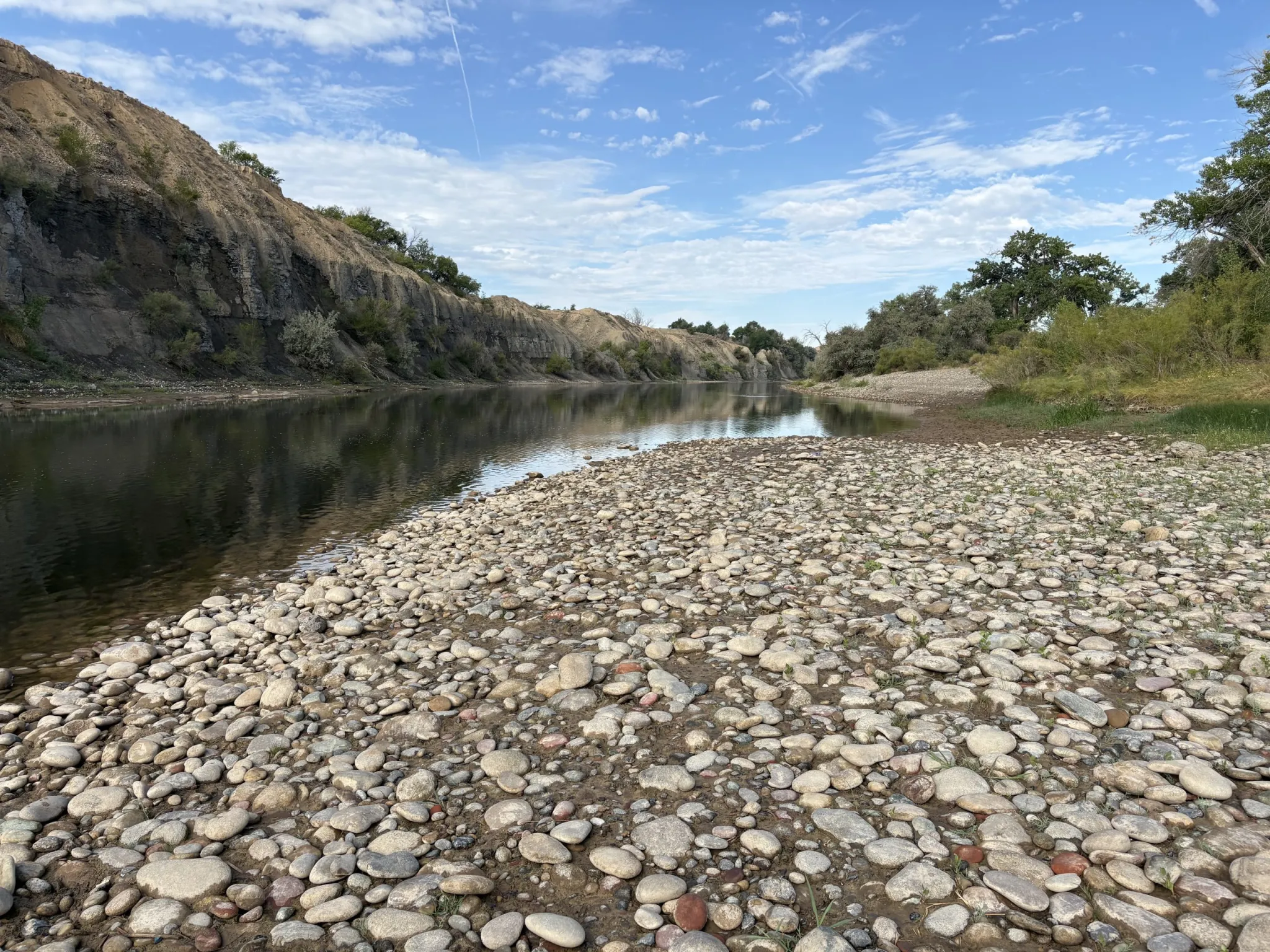
Ephemeral desert water. Jonathan P. Thompson photo

Click the link to read the article on The Land Desk website (Jonathan P. Thompson):

November 25, 2025

The News: The Trump administration last week weighed in on the 53-year battle over what waterways are covered by the 1972 Clean Water Act — with a draft rule that would narrow the definition of “Waters of the United States,” or WOTUS. The rule would effectively remove federal CWA protections from hundreds of arroyos, rivers, and ephemeral streams in the Southwest, giving developers industries more latitude to alter or pollute those waterways. The public has until Jan. 5 to submit comments.

The Context: For years, the Environmental Protection Agency and Army Corps of Engineers—the agencies charged with enforcing the CWA—considered WOTUS to include everything from arroyos to prairie potholes to sloughs to mudflats, so long as the destruction or degradation thereof might ultimately affect traditionally navigable waters or interstate commerce (which could include recreation, sightseeing, or wildlife watching). It was a broad definition that gave the agencies latitude to “restore and maintain the chemical, physical, and biological integrity of the Nation’s waters,” as Congress mandated when creating the law in 1972.

Developers and property rights ideologues pushed back on this definition, saying it was too broad and therefore gave the feds too much power to curb pollution or restrict development. The issue ended up in the courts and, ultimately, to the U.S. Supreme Court.

The waters were muddied, so to speak, by the 2006 Supreme Court split decision on the Rapanos case. The late Justice Antonin Scalia wrote what would become the right-wing’s preferred definition of waters of the U.S. He argued that they should include only “relatively permanent, standing or continuously flowing bodies of water … described in ordinary parlance as streams[,] … oceans, rivers, [and] lakes.” Scalia’s definition emphatically excluded “ephemeral streams” and “dry arroyos in the middle of the desert.” Justice Anthony Kennedy disputed Scalia, saying instead the CWA should extend to any stream or body of water with a “significant nexus” to navigable waters, determined by a wetland’s or waterway’s status as an “integral part of the aquatic environment.”

Then, in 2023, in its ruling on the Sackett case, the SCOTUS majority deferred to Scalia’s Rapanos definition, writing: “… we conclude that the Rapanos plurality was correct: the CWA’s use of ‘waters’ encompasses ‘only those relatively permanent, standing or continuously flowing bodies of water forming geographical features that are described in ordinary parlance as streams oceans, rivers and lakes.’”

It’s up to the relevant agencies to translate these rulings into actual rules, often adding their own ideological twists. The W. Bush, Obama, and Trump I administrations issued their own post-Rapanos definitions of WOTUS, Biden weighed in post-Sackett, now Trump II is submitting its own set of industry-friendly, deregulatory definitions.

The EPA’s proposed definition of ‘‘waters of the United States’’ would include:

“Relatively permanent,” under the new rule, would mean

And then there’s this weird and vague, yet critical, term, “wet season,” which the rule defines as:

Sometimes you have to wonder whether the bureaucrats who come up with these things have ever even been to the Western U.S., particularly the arid Southwest.

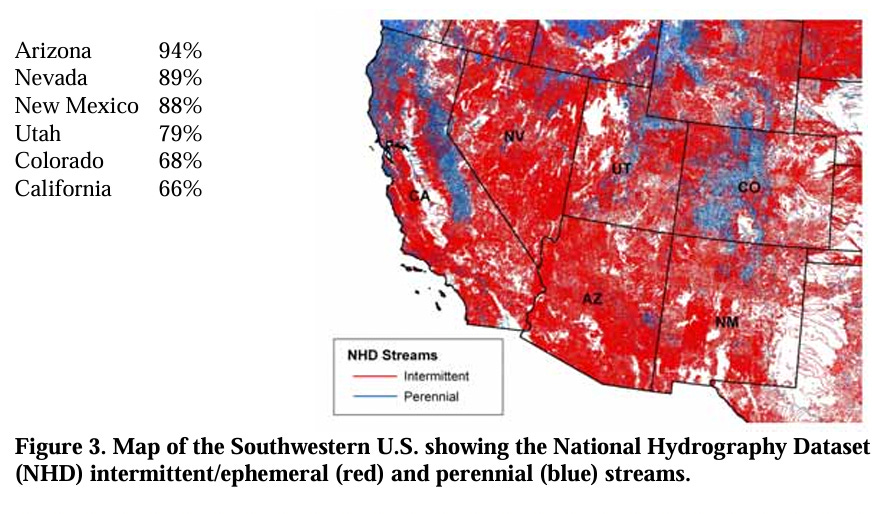
The “relatively permanent” requirement clearly excludes thousands of arroyos, ephemeral streams, washes, gullies, and even rios and rivers — from the Santa Cruz to the Rillito to the Santa Fe to the Puerco and the Dirty Devil — from CWA jurisdiction. Indeed, it leaves huge swaths of the Southwest without Clean Water Act protections, and at the mercy of respective states or counties. A 2008 EPA study estimates that ephemeral and intermittent streams make up 59% of all of the waterways in the U.S. (excluding Alaska) and over 81% in the arid and semi-arid Southwest (AZ, NM, UT, CO, CA).

Source: U.S. EPA.

The ecological benefits of ephemeral streams are obvious to any Western wanderer who happens to venture down a seemingly dry and barren arroyo bed, where they may find cool air, the smell of water even on the hottest day, tiny tracks of animals seeking sanctuary from the sun, the lascivous bloom of a datura, and cottonwoods and even willows miles and miles away from any “relatively permanent” water source. And if that’s not enough, then consider that peer-reviewed research has found that these same ephemeral streams are major contributors to the water quantity and quality of the entire river drainage network of which they are a part.

Ephemeral streams are streams that do not always flow. They are above the groundwater reservoir and appear after precipitation in the area. Via Socratic.org

A 2024 study by Craig Brinkerhoff et al concludes: “This ephemeral influence directly implicates downstream water quality standards: Excluding ephemeral streams from coverage under the CWA would substantially narrow the extent of federal authority to regulate water quality in the United States.”

While the administration was looking to provide “clarity,” the “wet season” provision does exactly the opposite, especially when one tries to apply it to the desert Southwest. If southern Arizona has a wet season, wouldn’t it be the days and weeks of the late summer monsoon? Many arroyos do run continuously during a good monsoon season, even if it is only for two or three weeks. So would that put them back under CWA jurisdiction?

How these proposed changes would play out on the ground is a bit of a puzzle — especially given the “wet season” ambiguity. But what is clear is that developers of big housing projects in the desert outside Phoenix or Las Vegas or Tucson, for example, would be allowed to fill in or build roads through arroyos and washes without obtaining a federal CWA permit from the Army Corps of Engineers. That would leave it to the state and county to implement their own, similar, permitting systems if they chose to do so.

As one might expect, the energy industry, developers, ranchers, and farmers generally support the changes, since it will eliminate some of the red tape that tangles up and delays projects.

“For U.S. oil and natural gas operators, this is a game-changer,” wrote the head of a Texas petroleum industry group in the Odessa American. “Picture the Permian Basin or Bakken Formation: vast swaths dotted with intermittent draws and playas that previous rules treated like sacred rivers, triggering Section 404 permits under the U.S. Army Corps that could drag on for years and cost millions in mitigation. Now, with ephemeral features sidelined and groundwater off-limits, operators can overcome those hurdles for well pads, access roads, and seismic surveys.”

If you live in the West, you probably live near at least one of the ephemeral streams that would lose federal protections under these new definitions. You might want to go walk up it sometime soon before it goes away.

In the meantime, you have until Jan. 5 to send your comments, identified by Docket ID No. EPA–HQ– OW–2025–0322, by any of the following methods:

  • Federal eRulemaking Portal: https://www.regulations.gov/ (our preferred method). Follow the online instructions for submitting comments.
  • Email: OW-Docket@epa.gov. Include Docket ID No. EPA–HQ–OW– 2025–0322 in the subject line of the message.
  • Mail: U.S. Environmental Protection Agency, EPA Docket Center, Water Docket, Mail Code 28221T, 1200 Pennsylvania Avenue NW, Washington, DC 20460.

Read more about the Clean Water Act, WOTUS, and the value of ephemeral waterways here (but remember, you gotta become a paid subscriber to bust through the paywall!)


News Roundup: Arroyos on trial; Superstition Vistas; Lake Powell bridge — Jonathan P. Thompson


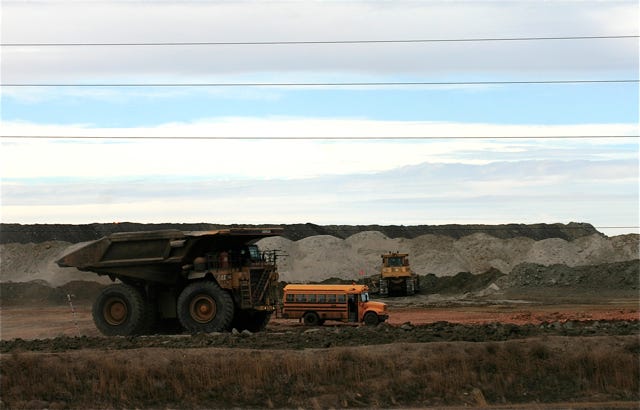
Scene from a huge coal mine in the Powder River Basin. Jonathan P. Thompson photo.

🌵 Public Lands 🌲

Congressional Republicans have apparently decided that the best way to turn over public lands to the extractive industries is to do away with the plans guiding management of those lands. Earlier this year, Congress revoked three Bureau of Land Management resource management plans in Montana, North Dakota, and Alaska. Now, they’ve done the same for the RMP for the BLM’s Buffalo Field Office in Wyoming, which covers a good portion of the coal-rich Powder River Basin.

These mark the first times ever that the Congressional Review Act, which is intended to give Congress the power to review and possibly revoke recently implemented administrative rules, has been used in this manner. That’s in part because RMPs have not been considered “rules” in the past, meaning they are not subject to congressional review.

Resource Management Plans provide a framework for managing large swaths of land and authorize the BLM to permit mining, drilling, grazing, and other activities. They endeavor to balance the agency’s multiple-use mandate with environmental protections, guiding resource extraction and development away from sensitive areas and toward more appropriate ones, for example. They can take years to develop, and incorporate science, legal considerations, court orders, tribal consultation, and input from local officials and the general public.

And then, with just a few hours of debate and no opportunity for public input, Congress can toss the whole thing into the can. 

In this case, the main target was a provision of the Biden-era RMP that halted new coal leasing on that swath of public land. While the moratorium was celebrated by environmentalists and panned by fossil fuel lovers when it was implemented late last year, it was largely symbolic, since existing leases contain enough coal to meet demand at least until 2040. So revoking the ban similarly won’t lead to any new mining anytime soon, nor are resulting lease sales likely to fetch much industry interest or acceptable bids. 

But in their haste to scrap the ban, Congress also may have taken away the BLM’s power to issue new leases altogether — not just for coal, but for oil and gas drilling, grazing, or any other use. And not just for the Buffalo Field Office, either. This is a bit wonky, but basically it goes like this:

  • By applying the CRA to RMPs, Congress is saying that RMPs are “rules.”
  • According to the CRA, rules must be submitted to Congress before they can take effect.
  • No RMP that has been implemented since 1996 has been submitted to Congress.
  • Therefore, no post-1996 RMP has legally taken effect, making it invalid.
  • The Federal Land Policy Management Act says the BLM can only issue permits, leases, rights of way, and other authorizations “in accordance with” a valid land use plan, or RMP.
  • Therefore all permits, leases, ROWs, and other authorizations issued under post-1996 RMPs — including over 5,000 oil and gas leases, and hundreds more coming up for auction in the near future — are invalid.

This summer, 31 law professors and public land experts called on Congress to refrain from using the CRA to revoke RMPs. “The resulting uncertainty could trigger an endless cycle of litigation,” they wrote, “effectively freezing the ability of the BLM and other agencies to manage public lands for years, if not decades to come.”

Just last week, a group of conservation organization legal analysts expanded on the potential for chaos, and called on the BLM to pause new leasing and address the “potential legal deficiencies” of oil and gas leases covering some 4 million acres that were issued under now potentially invalid RMPs. The agency should not issue drilling permits for those leases, the analysts wrote, and it should consider canceling the leases.

Somehow, I don’t think the BLM under the current administration is going to follow that suggestion. Given its track record, it seems more likely that the agency will see the sudden lack of valid RMPs as an open gate through which it can ferry its pro-extractive agenda. This one is almost sure to end up in court.

🦫 Wildlife Watch 🦅

The Trump administration is proposing new regulations that would dial back Endangered Species Act protections and weaken the landmark law to “strengthen American energy independence,” according to an Interior Department news release.

The new rules would:

  • Make it more difficult for the U.S. Fish & Wildlife Service to designate critical habitat in areas that are not currently occupied by an endangered species — likely because they were extirpated from the area — but that are essential for the conservation of that species. This would make recovering an endangered species that much more difficult.
  • Remove a rule that extends ESA protections to species that are listed as “threatened,” which is one step away from “endangered.” This would potentially remove protections for species such as the marbled murrelet, vernal pool fairy shrimp, western snowy plover, Gunnison sage grouse, northern sea otter, and many others.
  • Direct agencies to give economic impacts greater weight when deciding whether to extend ESA protections to a species. This could have potentially pushed the feds to, say, back off on listing the Tiehm’s buckwheat under the ESA, because doing so would potentially restrict or nix a proposed lithium mine in its only known habitat.
  • Make it more difficult for the U.S. Fish & Wildlife Service to designate critical habitat in areas that are not currently occupied by an endangered species — likely because they were extirpated from the area — but that are essential for the conservation of that species. This would make recovering an endangered species that much more difficult.
  • Remove a rule that extends ESA protections to species that are listed as “threatened,” which is one step away from “endangered.” This would potentially remove protections for species such as the marbled murrelet, vernal pool fairy shrimp, western snowy plover, Gunnison sage grouse, northern sea otter, and many others.
  • Direct agencies to give economic impacts greater weight when deciding whether to extend ESA protections to a species. This could have potentially pushed the feds to, say, back off on listing the Tiehm’s buckwheat under the ESA, because doing so would potentially restrict or nix a proposed lithium mine in its only known habitat.

“This plan hacks apart the Endangered Species Act and creates a blueprint for the extinction for some of America’s most beloved wildlife,” said Stephanie Kurose, deputy director of government affairs at the Center for Biological Diversity, in a written statement.

📸 Parting Shot 🎞️
Raven and the red, white, and blue. Digital Painting by Jonathan P. Thompson.

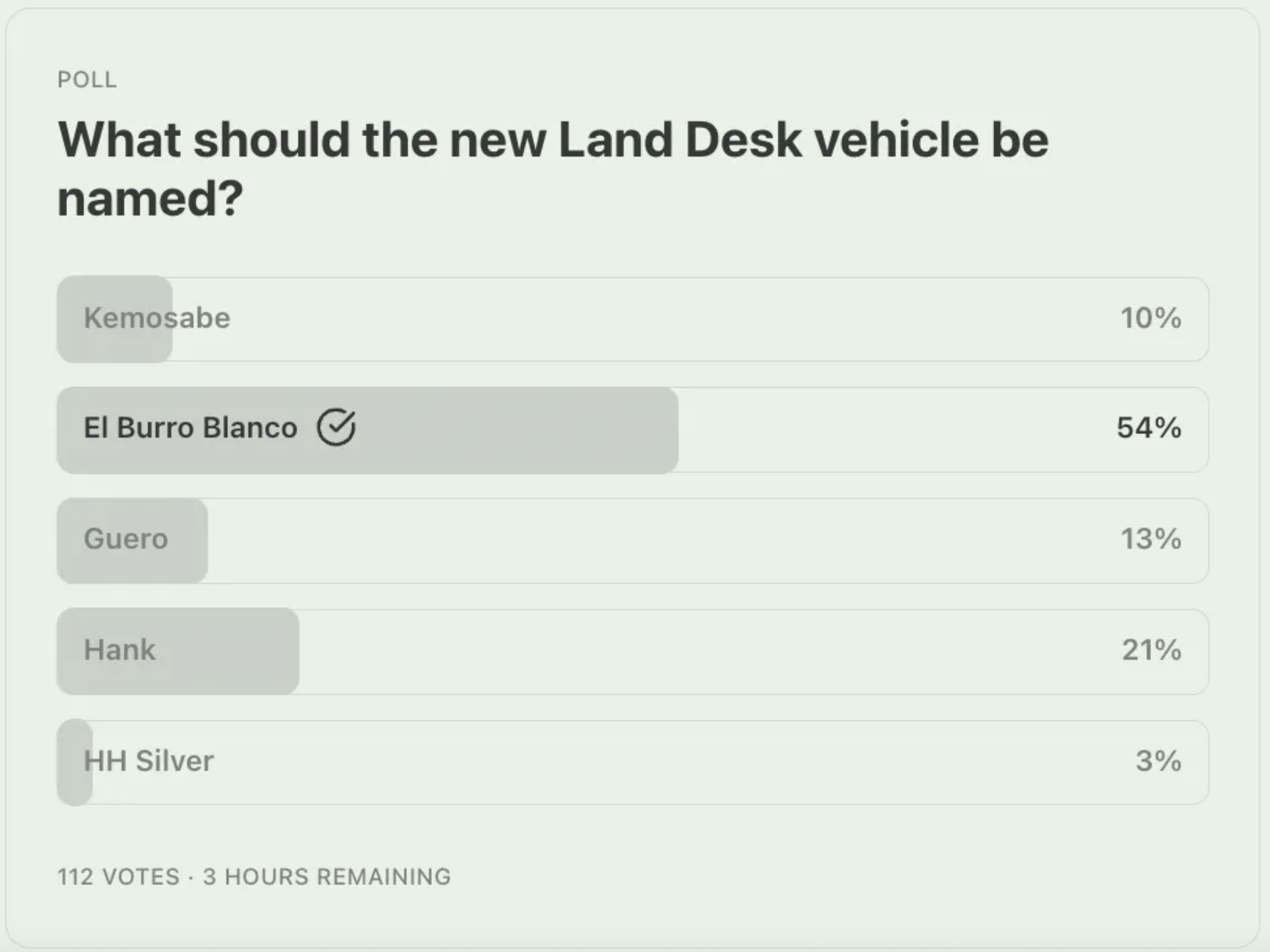
And, finally, the Land Desk readers have spoken, and they have chosen El Burro Blanco as the name for the new Land Desk dispatch-mobile, with Hank coming in a distant second.


Moab seeks bigger crowds? — Jonathan P. Thompson


The big data center buildup: An AI server farm tsunami threatens to overwhelm the West’s power grid and water supplies — Jonathan P. Thompson (High Country News)

Welcome to the Landline, a monthly newsletter from High Country News about land, water, wildlife, climate and conservation in the Western United States. Sign up to get it in your inbox. Screenshot from the High Country News website.

Click the link to read the article on the High Country News website (Jonathan P. Thompson):

November 25, 2025

This is an installment of the Landline, a monthly newsletter from High Country News about land, water, wildlife, climate and conservation in the Western United States. Sign up to get it in your inbox.

In early November, Texas-based New Era Energy & Digital announced plans to build a “hyperscale,” meaning massive, AI-processing data center complex in Lea County, New Mexico, the epicenter of the Permian Basin oil and gas drilling boom. The campus will be so big, and use so much power, that, if and when it is built, it will come with its own nuclear and gas power plants, with a mind-blowing combined generation capacity of about 7 gigawatts. That’s like piling the West’s largest nuclear and natural gas plants — Palo Verde and Gila River, both near Phoenix — on top of one another, and then adding another 800 megawatts. That kind of power could electrify something like 5.3 million homes, though these power plants’ output presumably will all go toward more pressing requirements: processing movie streaming, doomscrolling, social media posting and, especially, AI-related activities. [ed. emphasis mine]

Despite the enormity of this proposal, it has received very little news coverage. This is not because anyone is trying to keep it secret, but rather because such announcements have become so common that it’s hardly worth mentioning every new one. New Era’s hyperscale server farm and others like it are still a long way from generating and then devouring their own electricity. But even if only a fraction of the current proposals succeed, they will transform the West’s power grid, its landscapes and its economies as significantly as the post-World War II Big Buildup, when huge coal plants and hydroelectric dams sprouted across the region to deliver power to burgeoning cities via high-voltage transmission lines.

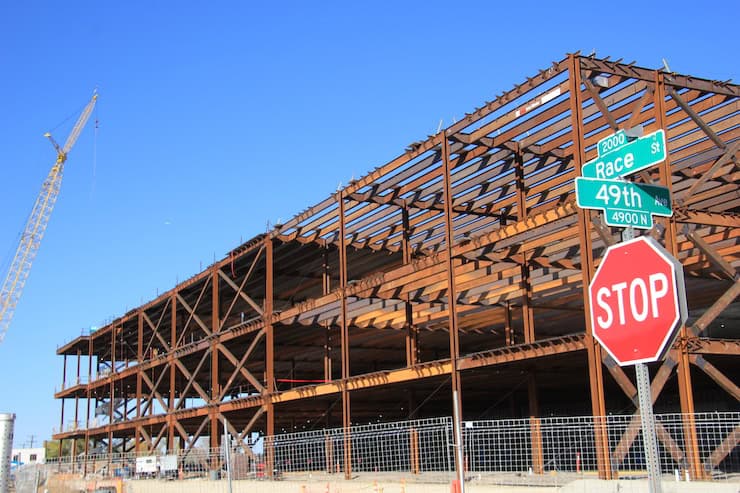
Data center construction at 49th & Race, Denver. Photo credit: Allen Best

In fact, this transformation is already underway. A new report from the nonprofit NEXT 10 and University of California Riverside found that, in 2023, data centers in California pulled 10.82 terawatt-hours of electricity — 1 terawatt equals 1 trillion watts — from the state’s grid, or about enough to power 1 million U.S. households. This resulted in about 2.4 million tons of carbon emissions, even with California’s relatively clean energy mix. (On more fossil fuel-reliant grids, the emissions would have been twice that, or even more.) These same centers directly and indirectly consumed about 13.2 billion gallons of water for cooling and electricity generation. In Silicon Valley, more than 50 data centers accounted for about 60% of one electricity provider’s total load, prompting the utility to raise its customers rates to fund the transmission and substation upgrades and new battery energy storage the facilities required.

These facilities are also colonizing cities and towns far from Big Tech’s Silicon Valley epicenter. Over 100 data centers — structures that resemble big-box stores overflowing with row after row of computer processors — have already sprung up in Phoenix-area business parks, and the planned new ones could increase Arizona’s total power load by 300% over current levels, according to utilities. Recently, Arizona Public Service announced it would keep burning coal at the Four Corners Power Plant beyond its scheduled 2031 retirement to help meet this growing demand.

Data center developments around the West include:

  • NorthWestern Energy signed on to provide up to 1,000 MW of power — or nearly all of the utility’s generating capacity — to Quantica Infrastructure’s AI data center under development in Montana’s Yellowstone County.
  • The 290-mile Boardman-to-Hemingway transmission project under development in Idaho and Oregon was initially designed to serve about 800,000 PacifiCorp utility customers. But in October it was revealed that the line now will deliver all of its electricity to a single industrial customer in Oregon, most likely a new data center.
  • In September, an NV Energy executive told a gathering in Las Vegas that tech firms are asking the utility to supply up to 22,000 megawatts of electricity for planned data centers. Since the utility has largely moved away from coal, this new load would likely be met by generation from existing and planned natural gas facilities, along with proposed utility-scale solar installations.
  • Xcel Energy expects to spend about $22 billion in the next 15 years to meet new data centers’ projected power demand in Colorado, potentially doubling or even tripling legacy customers’ rates. Xcel and the state’s public utilities commission are currently working to reverse the planned closure of a coal plant due to projected data center-associated electricity shortages.
  • Wyoming officials are doing their best to lure data centers and cryptocurrency firms to the state, and it seems to be working. This summer, Tallgrass proposed building an 1,800 MW data center, along with dedicated gas-fired and renewable power facilities, near Cheyenne. It would add to Meta’s facility in Cheyenne and the 1,200 MW natural gas-powered Prometheus Hyperscale data center under development in Evanston. Observers say electricity demand from these centers could transform the physical and regulatory utility landscape and potentially drive up costs for “legacy” customers.
  • New Mexico utilities are struggling to meet growing demand from an increasing number of data centers while also complying with the state’s Energy Transition Act’s requirements for cutting greenhouse gas emissions.
  • Doña Ana County approved tax incentives for Project Jupiter, a proposed $165 billion data center campus in Santa Teresa in the southeastern corner of New Mexico. Developers have indicated they plan on building dedicated power generation, though they have not yet disclosed the energy sources.
  • Numerous companies are eyeing Delta, Utah, as a site for new data centers, drawn by the area’s relatively cheap land, existing agricultural water rights and the fact that it’s home to the Intermountain Power Project, a colossal coal plant built during the original Big Buildup in the years after World War II. The plant is scheduled to be converted to run on natural gas and, ultimately, hydrogen, but Utah lawmakers want at least one of its units to continue to burn coal. They just need a buyer for the dirty power it would produce, and data centers could fit the bill. Fibernet MercuryDelta is looking to construct the 20 million-square-foot Delta Gigasite there, and Creekstone Energy plans to manage 10 gigawatts of capacity there, with power coming from coal, solar and natural gas.
The Intermountain Power Project plant in Delta, Utah. The plant was scheduled to be converted away from coal, but Utah lawmakers want it to continue to burn coal. They need a buyer for the dirty power, and data centers could fit the bill. By Doc Searls from Santa Barbara, USA – 2014_11_21_lhr-lax_330, CC BY 2.0, https://commons.wikimedia.org/w/index.php?curid=38536818

The Western power grid is interconnected but also divided into 38 balancing authorities, or grid operators. Nearly every one of them is expected to see an increase in data center-driven demand over the next decade or so as the Big Digital Buildup gains steam, and few of them are currently equipped to meet that demand. In fact, the North American Electricity Reliability Corp. warned this month that growing data center-driven power demand is increasing the risk of outages this winter in parts of the West. Therefore, many of the largest data centers are going to need to generate their own power, while utilities also will have to scramble to add generating capacity and associated infrastructure as quickly as possible to serve the region’s on-grid facilities. The costs of that new infrastructure will be borne by each utility’s ratepayers.

How will the needed power be generated?

There’s simply no way utilities and developers can meet the projected demand with solar and wind, alone. So, utilities are already making plans to keep existing coal plants running past previously scheduled retirement dates, and to build new natural gas plants and even nuclear reactors. Yes, nukes: Google, Switch, Amazon, Open AI and Meta are all looking to power proposed facilities with the new — so new they have yet to be developed — crop of small, modular and advanced reactors, if and when they are finally up and running.

Can data centers be “sustainable”?

These developments will have environmental consequences, some more than others. Fossil fuel burning feeds climate change and pollutes the air, and oil and gas drilling and coal mining ravage landscapes; utility-scale solar and wind facilities can harm wildlife habitat and often require hundreds of miles of new transmission lines to move the power around; and nuclear power comes with unique safety hazards and a nagging radioactive waste problem, while the uranium mining and milling industry risks reenacting its deadly Cold War legacy. Even a facility that gets all of its power from solar and batteries is still using resources that, without the extra demand, would otherwise be replacing fossil fuels on the grid. And, unless it has a closed-loop air-cooled system, the data center will still consume water for cooling, usually from municipal drinking water systems.

Wyoming-based Prometheus Hyperscale has made waves with its ambitious and seemingly visionary talk of building “sustainable” data centers with dedicated clean energy generation, water recycling and efficient cooling systems that would capitalize on the cold in the Northern Rockies. It’s even talked about harnessing the heat from the servers to warm greenhouses and shrimp-farming operations. Maybe, one day, the power will be supplemented by nuclear micro-reactors. But so far, the company’s walk is not exactly matching its talk. In the beginning, at least, the facility will run on natural gas, and Prometheus says it will offset carbon emissions by paying another company to capture and sequester carbon dioxide from biofuel plants in Nebraska.

Is resistance futile?

Resistance to the imminent server farm tsunami and its outsized energy and water use is widespread, but because these are local projects considered on local levels, battling them can feel a bit like playing whack-a-mole. After Tucson-area residents defeated the city’s plan to annex the proposed Project Blue data center, which would have enabled it to use treated wastewater for cooling, the developers simply moved the project into the county and planned to use an air-cooling system, which requires less water but more energy. When opposition continued, the firm committed to investing in enough renewable energy on Tucson Electric Power’s grid to offset all of its electricity use.

Also working against the resistance is the fact that many local governments and utilities actually welcome the onslaught. Data centers can bring jobs and tax revenues — assuming the state, county or municipality doesn’t exempt them from taxes — to economically distraught areas. Meanwhile, utilities are champing at the bit to sell more of their product and raise rates to pay for the needed additional infrastructure. When announcing all the data centers headed for Nevada, NV Energy executive Jeff Brigger noted that the utility is “excited to serve this load.”

While much of the opposition to data centers is based on their environmental impacts and the effects they might have on utility rates and on the communities where they’re built, the notion of AI itself is also a factor. It’s one thing to see a lot of water or power used to grow food, for instance, but quite another to see coal power plants continue to run simply so that a computer can write a high school essay or answer an inane question or draw a picture or even serve as a companion of sorts. To be fair, AI does have potentially significant and positive applications, such as diagnosing medical conditions and crunching large quantities of data to find, say, possible cures for cancer or solutions to geopolitical problems.

But before it goes about changing the world, maybe AI ought to start with itself and figure out how to do its thing without using so much energy and water.

How about just closing Comanche 3 for good?: Environmental groups outline their views about what is best in wake of Colorado #coal plant’s latest — and extended — outage — Allen Best (BigPivots.com)

Comanche 3 in 2010. Photo credit: Allen Best/Big Pivots

Click the link to read the article on the Big Pivots website (Allen Best):

November 21, 2025

Comanche 3, the trouble-plagued coal-fired power plant in Pueblo, went down on Aug. 12. Xcel Energy, the unit’s operator and primary owner, says it can’t be restored to service until June 2026.

This will be the third extended outage since 2020 for the coal plant, Colorado’s largest and newest unit.

Might the best thing for Xcel’s customers be if the plant remained dormant? Don’t try to repair it, whatever is wrong this time. Instead, save the money and just continue operating the much older and more reliable — but soon to be retired — Comanche 2?

Several environmental groups have advanced that idea in response to a proposal by Xcel and three state agencies to keep Comanche 2 operating for a full year beyond its current planned retirement at the end of December.

That plan on the table would leave both coal-burning units operating in the second half of 2026, point out the Sierra Club and Natural Resources Defense Council. They would provide more power than needed and will also generate pollution at levels greater than acceptable.

Western Resource Advocates, the City of Boulder and others have similar things to say. They also embrace an alternative plan. That plan would have the state’s Public Utilities Commission give Comanche 3 a hard look in coming months instead of waiting until next summer.

“The question must be asked whether any further reliance on Comanche at this juncture is prudent,” says Boulder in its filing with the PUC yesterday. “Ratepayers continue to bear the consequences of (Xcel subsidiary) Public Service’s failings when it comes to Comanche 3. At some point, the bleeding must stop.”

In asking to keep the plant open, Xcel insists that it is vulnerable to having too little generating capacity. It is at risk of having resource inadequacy. The basics of any utility are to keep the lights on, with only rare outages. The environmental groups do not disagree, but they do question whether Xcel — in concert with a trio of state agencies — have over-stated the case.

Western Resource Advocates also questions what is causing the “resource adequacy” about which Xcel has been fretting.

“The proposed extension to the retirement of Comanche 2 and the unplanned, extended outage of Comanche 3 represent extreme circumstances that may result in tens of millions of dollars in unexpected cost and increased emissions above levels previously expected,” the Boulder-based WRA says in a filing with the PUC.

“Further, the proposed variance calls into question whether the company has strained its resource capacity position — at the expense of all existing customers — by soliciting and accepting new large-load interconnections.”

Large loads are commonly understood to consist mostly of data centers.

Pueblo County, along with the city and economic development group there, take a contrary point of view. They want to see the coal plants operating without question. They insist that the coal-fired power production from both units will be needed to power the steel mill in Pueblo. The plant is formally called Rocky Mountain Steel.

That’s partly accurate. However, the steel plant in 2023 went on-line with the Bighorn Solar Project, which has a capacity of 300 megawatts and can, on a net-basis, deliver almost all the electricity needed at the steel plant. The steel plant also operates when the sun does not shine, of course.

As part of their long-standing complaint, the Pueblo interests say that they badly need the coal jobs at Comanche. “Approximately one out of every four residents receive SNAP benefits compared to the state average of one in 10,” says Pueblo.

In 2018, Xcel and other parties at the negotiating table agreed that Comanche 2 would be retired by the end of 2025. The PUC commissioners stamped their approval on the agreement. That agreement assumed more or less steady operations of Comanche 3. The assumption was misguided.

Comanche 3 was down for an average 91 days each year during its first decade. Then came 2020, an outage that extended about a year and into 2021. Another outage soon followed. A 2021 PUC staff report found that the actual cost of energy from Comanche 3 had been nearly 50% higher than expected when the unit was proposed almost 20 years before.

The proposal has the backing of the Polis administration, including the Colorado Energy Office, the Office of the Utility Consumer Advocate, and the PUC trial staff. The petition with the PUC was filed Nov. 10 by Attorney General Phil Weiser.

The petitioners said that keeping Comanche 2 operating for a year was the “most cost-effective approach to providing needed electricity for the system” as identified by Xcel.

Given the outage of Comanche 3, say the environmental groups, they do not object to Comanche 2 remaining open for a year longer. They do, however, see problems with the proposal by Xcel.

First, the solution is “far broader than the problem it tries to solve,” says the Sierra Club and NRDC. If both Comanche 2 and 3 are operating, they will produce more power — and pollution — than had been planned.

They also point to a “glaring contraction” in the petition by Xcel and the state agencies. They see an imminent need to justify continued operation of Comanche 2 yet propose to delay starting a litigated proceeding at the PUC until next June to investigate all options for dealing with a near-term need.

This is getting the cart before the horse, they say. “Given the long history of forced outages at Comanche 3, its repeated cost overruns, and the fact that it is already slated to retire by 2031,” the PUC commissioners should weigh in before Xcel decides whether to repair Comanche 3.

The alternative plan advocated by the environmental community would keep Comanche 2 operating for a full year — but place limits on the operations of the unit coupled with that of Comanche 3, whenever it returns to service. “This allows the same total amount of generation from the two units as if Comanche 3 were available for all of 2026.”

Comanche Generating Station. Photo credit: Allen Best/Big Pivots

#COP30 Backpedals on #Climate Action: Offering no new plans to cut fossil fuels, the UN’s climate conference failed to produce a roadmap to stop #GlobalWarming — Bob Berwyn (InsideClimateNews.org)

The convention center in Belem, Brazil, where COP30, the United Nations annual climate talks, took place over the past 12 days. Credit: Bob Berwyn/Inside Climate News

November 22, 2025

BELÉM, Brazil—After negotiators at COP30 retreated from meaningful climate action by failing to specifically mention the need to stop using fossil fuels in the final conference documents published Saturday, the disappointment inside the COP30 conference center was as pervasive as the diesel fumes from the generators outside the tent.

This year’s United Nations Framework Convention on Climate Change was billed as the “COP of Truth” by host country Brazil, but it could go down in history “as the deadliest talk show ever,” said Harjeet Singh, founding director of the Satat Sampada Climate Foundation in India and strategic advisor to the Fossil Fuel Non-Proliferation Treaty Initiative.

COP30 was yet another “theater of delay” with endless discussions, and the creation of yet more administrative duties, “solely to avoid the actions that matter—committing to a just transition away from fossil fuels and putting money on the table,” he said.

A draft text released Nov. 18 clearly spelled out the need to transition away from fossil fuels, but in the final version, the language was watered down, merely acknowledging that “the global transition towards low greenhouse gas emissions and climate-resilient development is irreversible and the trend of the future.”

After setting out ambitious targets ahead of the climate talks, COP30 President André Corrêa do Lago, the secretary for climate, energy and environment in Brazil’s Ministry of Foreign Affairs, acknowledged the disappointment. 

“We know some of you had greater ambitions for some of the issues at hand. I know the youth civil society will demand us to do more to fight climate change,” he said during the opening of the final plenary.

Do Lago pledged to press for more action during his upcoming year as the COP president.

“I, as president of COP30, will therefore create two roadmaps, one on halting and reversing deforestation and another on transitioning away from fossil fuels in a just, orderly, and equitable manner,” he said.

That was not enough for some leading climate scientists. 

“Implementation requires concrete roadmaps to accelerate the phase out of fossil fuels, and we got neither,” said Johan Rockström, director of the Potsdam Institute for Climate Impact Research in Germany.

Indigenous climate activists marched on Friday through the conference hall at COP30 in Belem, Brazil, to protest continued fossil fuel exploitation on Indigenous lands. Credit: Bob Berwyn/Inside Climate News

During the closing plenary, a representative from Colombia said that her country refused to accept parts of the decision as written. “Denying the best available science not only puts the climate regime at risk, but also our own existence. Which message are we sending the world, Mr. President?”

In a post on X, Colombian President Gustavo Petro elaborated, saying, “I do not accept that in the COP 30 declaration. It is not clearly stated, as science says, that the cause of the climate crisis is the fossil fuels used by capital. If that is not said, everything else is hypocrisy.”

He noted that life on the planet is only possible “if we separate from oil, coal, and natural gas as a source of energy … Colombia opposes a COP 30 declaration that does not tell the scientific truth to the world.”

After several similar objections, do Lago suspended the plenary to consult with the UNFCCC secretariat about how to proceed, since the entire process is built on consensus. And while consensus isn’t the same as unanimity, the U.N.’s climate body has faced repeated criticism in recent years for ignoring the pleas of smaller countries amid the rush to finalize COP agreements.

But apparently there was enough consensus to proceed.

Looking for bright spots, former Irish President Mary Robinson, now a member of The Elders, a group of global leaders that works to address issues, including climate change, said the deal is far from perfect, but it shows that countries can still work together “at a time when multilateralism is being tested.”

Robinson said the COP30 outcome includes concrete steps toward establishing a mechanism to ensure no countries are left behind in the transition away from fossil fuels.

“We opened this COP noting the absence of the United States administration,” she said. “But no one country, present or absent, could dampen the ‘mutirao’ spirit,” or collective effort.

Given the recent rise of global political tensions, she said Belém “revealed the limits of the possible, but also the power of the determined. We must follow where that determination leads.”

In another of the final documents, COP30 emphasized “the inherent connection between pursuing efforts to limit the global temperature increase to 1.5 °C and pursuing just transition pathways,” and that such a pathway leads to “more robust and equitable mitigation and adaptation outcomes.”

The conference’s adoption of a just transition mechanism was hailed as a huge win by the Climate Action Network International, an umbrella group that represents hundreds of local, regional and national grassroots organizations working on climate justice. In a statement, the group called it “one of the strongest rights-based outcomes in the history of the UN climate negotiations.”

The outcome could have been even better with stronger leadership from the European Union, which publicly advocated for more ambition, but opposed key provisions in closed-door negotiations, several observers said.

“With the U.S. absent, the European Union had a chance to lead; instead, they stepped into the vacuum as the primary obstructionist,” said Singh, including opposition to language on fossil fuel phaseout timetables.

He said the European Union member countries were “playing a cynical blame game while the planet burns.” Decisions made at this and previous COPs provided the tools needed to address the crisis, but the political will and the money to implement them are still lacking.

Federal Water Tap, November 17, 2025: Bureau of Reclamation Cancels Fall High-Flow Experiment at Glen Canyon Dam — Brett Walton (circleofblue.org)

Click the link to read the article on the Circle of Blue website (Brett Walton):

November 17, 2025

The Rundown

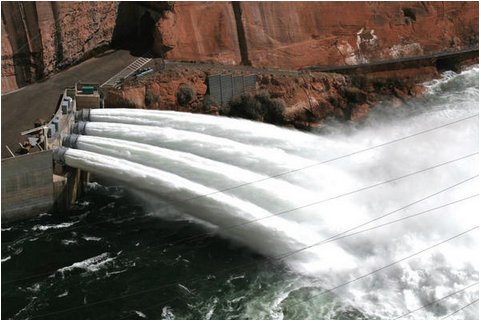
  • Because of the government shutdown, the Bureau of Reclamation cancels a high-volume water release from Glen Canyon Dam meant to rebuild Colorado River beaches.
  • Department of Energy research lab announces a funding opportunity to develop cheaper wastewater treatment for coal power plants.
  • Economic disaster declaration approved for an Illinois county where a harmful algal bloom in July resulted in a ‘do not drink’ water advisory.
  • The Bureau of Land Management is scheduled this week to publish a final environmental impact statement for a proposed groundwater pipeline in Utah.
  • Hydropower generation at federal dams in the western states was below average in fiscal year 2025.

And lastly, House Democrats from Illinois ask the EPA to release lead pipe replacement funds.

“Using federal funds as leverage against communities based on political considerations represents a dangerous abuse of power that undermines public trust and puts lives at risk. The longer we wait, the higher the long-term health, educational, and economic costs will climb, with costs being borne disproportionately by low-income and marginalized communities who have the least political power to demand faster action.” – Letter from seven Illinois representatives to Lee Zeldin, the EPA administrator, asking him to release federal funds for lead pipe replacements.

By the Numbers

River Mile 46.5: Estimated location, as of November 14, of the leading edge of the saltwater “wedge” in the Mississippi River in southern Louisiana. The wedge – salt water that pushed upriver due to weak water flow – has retreated 10 miles in the last three weeks.

88: Percent of average hydropower generation at federal dams overseen by the Western Area Power Administration in fiscal year 2025.

In context: Two-Decade Hydropower Plunge at Big Colorado River Dams

November 2012 High Flow Experiment via Protect the Flows

News Briefs

Glen Canyon Dam High-Flow Release Canceled
Due to the government shutdown, the Bureau of Reclamation canceled a planned high-volume release of water from Glen Canyon Dam.

“This decision is based on the current lapse in appropriations, which has created uncertainty concerning necessary resources,” said Wayne Pullan, director of the Upper Colorado Basin Region, in a letter dated October 31.

High-flow releases are typically carried out when downstream sediment conditions are ripe for rebuilding Colorado River beaches. The last such release was in April 2023.

Pullan said that conditions in spring 2026 will probably be conducive to a high-flow release.

Illinois Harmful Algal Bloom
The Small Business Administration approved an economic disaster declaration for Coles County, Illinois, for a harmful algal bloom in July that resulted in residents being told not to drink their tap water.

The disaster declaration allows small businesses that were hurt by the do-not-drink order to receive low-interest loans. Small businesses in six contiguous counties are also eligible.

Microcystin, a neurotoxin produced by the algae, was found in the treated water above safety limits in the town of Mattoon. The town issued two do-not-drink orders in a week. Businesses closed and residents bought bottled water.

Mattoon’s water comes from Lake Paradise, the source of the algae.

Studies and Reports

Keeping Coal Going
The National Energy Technology Laboratory, a Department of Energy research arm, is offering $50 million in federal funding for projects to develop wastewater treatment systems for coal power plants.

It is the largest part of a $100 million funding announcement intended to improve the “efficiency, effectiveness, costs, emissions reductions, and environmental performance of coal and natural gas use.”

For wastewater treatment, the goal is to reduce discharges and generate useful, money-making byproducts.

Applications are due January 7, 2026.

On the Radar

Senate Hearings
On November 19, the Senate Committee on Environment and Public Works will hold a hearing on PFAS cleanup and disposal.

Also that day, the Senate Energy and Natural Resources Committee will discuss BLM land use planning.

Utah Rivers map via Geology.com

Utah Groundwater Supply Pipeline
The BLM is due to release an environmental impact statement on November 21 for the Pine Valley Water Supply Project, a scheme to pump groundwater in southwest Utah’s Beaver County and move it to neighboring Iron County for municipal supply and irrigation water.

Proposed by the Central Iron County Water Conservancy District, the project includes 15 wells to supply 15,000 acre-feet of groundwater per year, 70 miles of pipeline, and a 200-acre solar field.

In context: Big Water Pipelines, and Old Pursuit, Still Alluring in Drying West

Federal Water Tap is a weekly digest spotting trends in U.S. government water policy. To get more water news, follow Circle of Blue on Twitter and sign up for our newsletter.

Can the world quit coal? — Stacy D. VanDeveer (TheConvesation.com)

A fisherman looks at the Suralaya coal-fired power plant in Cilegon, Indonesia, in 2023. Ronald Siagian/AFP via Getty Images

Stacy D. VanDeveer, UMass Boston

As world leaders and thousands of researchers, activists and lobbyists meet in Brazil at the 30th annual United Nations climate conference, there is plenty of frustration that the world isn’t making progress on climate change fast enough.

Globally, greenhouse gas emissions and global temperatures continue to rise. In the U.S., the Trump administration, which didn’t send an official delegation to the climate talks, is rolling back environmental and energy regulations and pressuring other countries to boost their use of fossil fuels – the leading driver of climate change.

Coal use is also rising, particularly in India and China. And debates rage about justice and the future for coal-dependent communities as coal burning and coal mining end.

But underneath the bad news is a set of complex, contradictory and sometimes hopeful developments.

The problem with coal

Coal is the dirtiest source of fossil fuel energy and a major contributor of greenhouse gas emissions, making it bad not just for the climate but also for human health. That makes it a good target for cutting global emissions.

A swift drop in coal use is the main reason U.S. greenhouse gas emissions fell in recent years as natural gas and renewable energy became cheaper.

Today, nearly a third of all countries worldwide have pledged to phase out their unabated coal-burning power plants in the coming years, including several countries you might not expect. Germany, Spain, Malaysia, the Czech Republic – all have substantial coal reserves and coal use today, yet they are among the more than 60 countries that have joined the Powering Past Coal Alliance and set phase-out deadlines between 2025 and 2040.

Several governments in the European Union and Latin America are now coal phase-out leaders, and EU greenhouse gas emissions continue to fall.

Progress, and challenges ahead

So, where do things stand for phasing out coal burning globally? The picture is mixed. For example:

  • The accelerating deployment of renewable energy, energy storage, electric vehicles and energy efficiency globally offer hope that global emissions are on their way to peaking. More than 90% of the new electricity capacity installed worldwide in 2024 came from clean energy sources. However, energy demand is also growing quickly, so new renewable power does not always replace older fossil fuel plants or prevent new ones, including coal.
  • China now burns more coal than the rest of the world combined, and it continues to build new coal plants. But China is also a driving force in the dramatic growth in solar and wind energy investments and electricity generation inside China and around the world. As the industry leader in renewable energy technology, it has a strong economic interest in solar and wind power’s success around the world.
  • While climate policies that can reduce coal use are being subject to backlash politics and policy rollbacks in the U.S. and several European democracies, many other governments around the world continue to enact and implement cleaner energy and emissions reduction policies.

Phasing out coal isn’t easy, or happening as quickly as studies show is needed to slow climate change.

To meet the 2015 Paris Agreement’s goals of limiting global warming to well under 2 degrees Celsius (3.6 Fahrenheit) compared to pre-industrial times, research shows that the world will need to rapidly reduce nearly all fossil fuel burning and associated emissions – and it is not close to being on track.

Ensuring a just transition for coal communities

Many countries with coal mining operations worry about the transition for coal-dependent communities as mines shut down and jobs disappear.

No one wants a repeat of then-Prime Minister Margaret Thatcher’s destruction of British coal communities in the 1980s in her effort to break the mineworkers union. Mines rapidly closed, and many coal communities and regions were left languishing in economic and social decline for decades.

Two men put coal chunks into a sack with a power plant in the background.
Two men collect coal for cooking outside the Komati Power Station, where they used to work, in 2024, in Komati, South Africa. Both lost their jobs when Eskom closed the power plant in 2022 under international pressure to cut emissions. Per-Anders Pettersson/Getty Images

But as more countries phase out coal, they offer examples of how to ensure coal-dependent workers, communities, regions and entire countries benefit from a just transition to a coal-free system.

At local and national levels, research shows that careful planning, grid updates and reliable financing schemes, worker retraining, small-business development and public funding of coal worker pensions and community and infrastructure investments can help set coal communities on a path for prosperity.

A fossil fuel nonproliferation treaty?

At the global climate talks, several groups, including the Powering Past Coal Alliance and an affiliated Coal Transition Commission, have been pushing for a fossil fuel nonproliferation treaty. It would legally bind governments to a ban on new fossil fuel expansion and eventually eliminate fossil fuel use.

The world has affordable renewable energy technologies with which to replace coal-fired electricity generation – solar and wind are cheaper than fossil fuels in most places. There are still challenges with the transition, but also clear ways forward. Removing political and regulatory obstacles to building renewable energy generation and transmission lines, boosting production of renewable energy equipment, and helping low-income countries manage the upfront cost with more affordable financing can help expand those technologies more widely around the world.

Shifting to renewable energy also has added benefits: It’s much less harmful to the health of those who live and work nearby than mining and burning coal is.

So can the world quit coal? Yes, I believe we can. Or, as Brazilians say, “Sim, nós podemos.”

Stacy D. VanDeveer, Professor of Global Governance & Human Security, UMass Boston

This article is republished from The Conversation under a Creative Commons license. Read the original article.

Built to Fail: Rules at UN Climate Talks Favor the Status Quo, Not Progress: Experts say stifling bureaucratic procedures that are disconnected from the #ClimateCrisis have consistently stalled COP negotiations — Bob Berwyn (InsideClimateNews.org) #COP30

This section of the Colorado River at the boat launch near Corn Lake dipped to around 150 cfs in lake August 2025. Known as the 15-mile reach, this stretch of river should have at least 810 cfs to meet the needs of endangered fish. CREDIT: HEATHER SACKETT/ASPEN JOURNALISM

By Bob Berwyn

November 12, 2025

This article originally appeared on Inside Climate News, a nonprofit, non-partisan news organization that covers climate, energy and the environment. Sign up for their newsletter here.

Frustration about slow progress at the United Nations climate talks boiled over this week. After hours under the equatorial sun at COP30 in Belém, Brazil, scores of protesters pushed past security guards Tuesday evening and briefly occupied parts of the negotiating area, calling for an end to mining and logging in the Amazon, among other demands.

The clash symbolized a deeper tension at the heart of the U.N. climate summits. The people demanding change are often outside the gates while those with power inside are bound by rules that slow progress to a crawl.

UNFCCC officials said two people suffered minor injuries and that parts of the venue were temporarily closed for cleanup and security checks. The U.N. and local police are investigating the protests and the talks resumed on schedule Wednesday morning. 

On Instagram, a group calling itself Juventude Kokama OJIK posted a video of the Blue Zone occupation and called it an act against exclusion.

“They created an ‘exclusive’ space within a territory that has ALWAYS been Indigenous, and this violates our dignity,” the group wrote. “The demonstration is to say that we will not accept being separated, limited, or prevented from circulating in our own land. The territory is ancestral, and the right to occupy this space is non-negotiable.”

The Tuesday tumult was a stark contrast to normal proceedings at the annual conference, where delegates with swinging lanyards and beeping phones usually file meekly through the metal detectors and past the espresso kiosks as if they’re heading to an office supply expo rather than negotiations to avert catastrophic climate collapse.

Somehow, that urgency rarely crept inside, partly because the United Nations Framework Convention on Climate Change runs the annual meetings like a corporate conference, said Danielle Falzon, a sociologist at Rutgers University whose research on the climate talks draws on dozens of interviews with negotiators and other participants from both developed and developing countries at most COPs since 2016. 

In the UNFCCC setting, she said, success is measured by how long you stay in the room, how polished your presentation is, how fluent you are in bureaucratic English—and how well you can pretend that the world isn’t burning outside.

“I’d like to go to the negotiations and see people taking seriously the urgency and the undeniability of the massive changes we’re seeing,” she said. “I’d like to see them break through the sterilized, shallow, diplomatic language and talk about climate change for what it actually is.”

For all its talk of unity, the climate summit has struggled to deliver because the talks mirror the global inequalities they are meant to fix, Falzon said. Based on her research, COP hasn’t made much progress because it still fails to serve the countries that have contributed least to the problem but are suffering the most from it.

The negotiations, she said, are dominated by well-staffed teams from wealthy, developed nations that can afford to be everywhere at once. Smaller delegations from less-developed countries often can’t even attend the dozens of overlapping meetings.

“Everyone is exhausted but people from smaller delegations are just trying to keep up,” she said. That exhaustion, she added, shapes the talks themselves: those with the most capacity set the pace and define the terms, while the rest simply try not to fall behind.

“You can’t just pretend that all countries are equal in the negotiating space,” she said.

The imbalance is built into the institution, she said. The U.N. climate process was designed to keep everyone at the table, not to shake it. That makes it resilient, but also resistant to change, and she said her multiyear study of the talks shows the system values consensus and procedure over outcomes and the appearance of progress over actual results. 

“Much of what’s called success at COP now is the creation of new texts, new work programs, rather than real climate action,” she said. After 30 years of meetings, the pattern delivers new agendas, new acronyms and new promises that keep the gears grinding but rarely move the needle on emissions, she added.

Most people involved in the climate talks see the need for change, but Falzon said that institutions are built to preserve themselves.

How (Not) to Talk About Climate

Part of the paralysis Falzon describes stems from a reluctance to speak plainly about the emergency it exists to address, said Max Boykoff, a climate communications researcher at the University of Colorado Boulder.

“The problems associated with climate change were first framed as scientific issues all the way back in the 1980s, and that has become the dominant way we understand a changing climate,” Boykoff said. “But that has crowded out other ways of knowing; emotional, experiential, aesthetic, or even just visceral ways of understanding that something’s not right.”

The experts at COP “tend to focus on what can be measured and reported, on outputs and deliverables, which shapes the negotiations themselves,” he said. “The cadence of those encounters becomes ritualized to their detriment.”

A quick look at some of the daily notifications from COP30 displays what Boykoff describes, with invitations to a High-Level Ministerial on Multilevel Governance” or “The Launch of the Plan to Accelerate Multilevel Governance and the Operationalization of the Coalition for High Ambition Multilevel Partnerships.” 

Such language, he said, reflects a culture that prizes precision and hierarchy over connection and clarity. It’s a diplomatic shorthand that signals professionalism while numbing urgency, and it narrows the space for creativity, emotion, or reflection, he added.

Boykoff said the only way to move beyond the rituals of repetition may be to break them. 

“What we really need,” he said, “is to shake it up, to create spaces that let people reflect, feel, and engage in new ways. Because if we keep doing the same thing year after year, we shouldn’t expect different results.”

Falzon said the technocratic UNFCCC language reflects the dominance at the talks of an “old world hierarchy in which rich countries set the agenda, poor countries fight to be heard, and the system keeps reproducing the conditions it’s supposed to fix. 

“It’s not just the negotiations that are unequal,” she said. “The whole thing mirrors the inequalities of the world it’s meant to change.” 

President Trump picks Steve Pearce to run Bureau of Land Management: Also: Drill, baby, drill continues during shutdown; appropriately sited #solar — Jonathan P. Thompson (LandDesk.org)

Stone and evening light, Bears Ears National Monument, Utah. Jonathan P. Thompson photo.

Click the link to read the article on The Land Desk website (Jonathan P. Thompson):

November 7, 2025

🌵 Public Lands 🌲

The Trump administration has nominated Steve Pearce, a hard-right Republican and former congressman from New Mexico, to lead the Bureau of Land Management. Pearce’s political career was infused with hostility toward public lands and the BLM, so, as one would expect for these guys, Trump chose him to oversee those lands and head up the same agency.

Pearce has opposed new national monument designations, is a fan of drilling public lands, has tried to weaken or eliminate the Endangered Species Act, lied about wolves in an effort to defund the Mexican wolf recovery program, received a 4% score from the League of Conservation Voters. … the list goes on.

A hat button expresses a sentiment common in parts of the rural West — and among the folks the Trump administration picks to run the Bureau of Land Management. Jonathan P. Thompson photo.

You may remember that Trump’s first pick to helm the BLM didn’t work out so well. Soon after his inauguration, he nominated oil and gas lobbyist Kathleen Sgamma to fill the post and carry out his “energy dominance” agenda on public lands. But Sgamma pulled out after it was revealed that in the days following the Jan. 6, 2021, riots and invasion of the U.S. Capitol, Sgamma wrote that she was “disgusted by the violence” and “President Trump’s role in spreading misinformation that incited it.”

Meanwhile, Trump’s first-term pick, William Perry Pendley, was never confirmed due to his checkered past, and was found to unlawfully be serving as acting director.

If confirmed, Pearce would probably be involved in determining whether the Trump administration will revoke a ban on new oil and gas leasing within 10 miles of Chaco Culture National Historical Park’s boundary. The Biden administration implemented the ban on the urging of Pueblo leaders to keep drilling away from the park and Chacoan-era Great Houses that surround it, but to which the national park protections do not extend.

The Navajo Nation initially supported the leasing moratorium, as well, but under the Buu Nygren administration reversed itself after allotment owners within the buffer zone protested, saying the ban would indirectly hamper drilling on their allotments and cut into their royalty income.

Project 2025, the extreme right-wing’s playbook for the Trump administration, called for revoking the leasing moratorium, and doing so certainly fits with Trump’s “energy dominance” and “drill, baby, drill” agenda. Late last month the Interior Department informed tribal leaders it was moving forward with and sought their input on possibly re-opening the land to the oil and gas industry.


Indigenous leaders call for oil and gas leasing reform — Jonathan P. Thompson


Meanwhile, the BLM is busy auctioning off oil and gas leases on public land in the Greater Chaco Region just outside the buffer zone around the park.

This week (yes, during the government shutdown), the agency leased about 3,100 acres of land to oil and gas companies in the San Juan Basin. This was regardless of multiple formal and informal protests opposing the lease sale, including ones from environmental groups, the Torreon/Star Lake Chapter of the Navajo Nation, and Sovereign Energy, a Pueblo women-led organization committed to advancing tribal energy sovereignty and protecting sacred landscapes.

“The BLM’s continued approval of lease sales in and around the Ojo Encino, Torreon/Star Lake, and Counselor Chapters not only perpetuates harm to frontline communities,” Sovereign Energy wrote, “but also demonstrates a systemic failure to uphold federal trust and treaty responsibilities. These lands are not vacant or disposable — they are the living homelands of Indigenous peoples with profound cultural and ceremonial importance.”

One parcel received no bids, while the bidders on five others will pay just $10 to $12 per acre for the exclusive right to drill them. A seventh parcel, in Rio Arriba County, received a high bid of $501 per acre.

The agency is planning a June auction to lease a 160-acre parcel and a 671-acre parcel in the Greater Chaco Region. The larger tract is a few miles northeast of Lybrook and the other one is about seven miles southeast of Lybrook in piñon-juniper-strewn hills.

***

The federal government shutdown may be depriving thousands of workers of paychecks, imperiling food stamps and other benefits, and leading to delayed and cancelled flights nationwide, but it isn’t stopping the Trump administration from implementing its “drill, baby, drill” agenda.

The BLM has issued 628 drilling permits for federal lands since the shutdown began, according to the Center for Western Priorities’ oil and gas tracker, including 530 in New Mexico, of which seven were issued by the Farmington Field Office for drilling in the San Juan Basin (the rest were for the much busier Permian Basin).

Rig counts remain relatively low, which indicates that oil and gas companies are snatching up as many drilling permits as they can while the getting is good, but may not use them anytime soon.


A Delta County hayfield (freshly cut in early November(!!!!), with the Garnet Mesa Solar Project in the background.

🔋 Notes from the Energy Transition 🔌

Parts of the agriculture-heavy Delta County in western Colorado could certainly be described as pastoral or idyllic, with the rows of vineyards and fruit orchards beautifully framing the West Elk and Ragged Mountains in the background. In summer (and even in November, this year), hay bales sit in freshly cut green fields and sparkling yellow and flame-orange cottonwoods rise up along stream and ditch banks. 

So when I heard a couple years back that the Delta County commissioners had put the kibosh on a proposed utility-scale solar project, in part because it would defile prime agricultural land and views, I was somewhat sympathetic. It would, indeed, be atrocious to wipe out a viable orchard to make way for a sea of solar panels. That said, I was a bit flabbergasted, too, since Delta County is normally pro-private property rights to a fault (I doubt they’d deny an industrial-scale feedlot or chicken farm or, for that matter, a coal mine), and because the region needs new, clean energy sources to replace and displace natural gas and coal generation. 

Eventually the county relented — in part because the proponents agreed to design the project to allow for sheep grazing — and approved the project. Now the Garnet Mesa solar project is complete. I went and checked it out last week, and it wasn’t until I actually saw it that I understood where, exactly, it is — and how my concerns about it wrecking idyllic farmland were misplaced.

Don’t get me wrong: Garnet Mesa has a distinct, spare sort of beauty to it. Its wide-open spaces afford lovely views of Grand Mesa and the other mountains in the distance, and there is an occasional irrigated hayfield here and there (along with patches of the aforementioned cottonwoods). But the ash-gray soil has very high levels of selenium, making growing things difficult, and the whole area has long been a sort of sacrifice zone and dumping place for dilapidated single-wides, old cars, and various other detritus. 

It is the kind of place, in other words, that a developer might expect to be able to put up a solar project — even a really big one — without much resistance, especially on private land that hadn’t been in agriculture for years, if ever. But these days it seems that there’s a sort of knee-jerk opposition to almost any solar development, large or small, on relatively undisturbed public lands or long-abused private lands. And that’s really too bad.


Meditations on solar, Joshua trees, and the movement to kill clean energy — Jonathan P. Thompson


Certainly developers, even of “clean energy,” should not be given carte blanche to build wherever they see fit. And they absolutely should look to brownfields, industrial rooftops, parking lots, and other already-developed areas to put their energy installations, first. But the fact is, we’re never going to be able to generate enough clean energy to displace coal and natural gas without some utility-scale installations on land that isn’t a rooftop or a parking lot. 

Admittedly, the Garnet Mesa project is striking looking, and I have to agree with a friend’s description of it as “totally industrial.” But it’s also got its own aesthetic appeal to it, it doesn’t mar the long-distance vistas, and the fact that those panels are generating enough power to electrify some 18,000 homes without burning or emitting anything is super cool, if you ask me.

Garnet Mesa solar project. Photo credit: Jonathan P. Thompson

📖 Reading (and watching) Room 🧐
  • Krista Langlois has a nice and heartbreaking piece in High Country News reflecting on the ICE raids in Durango, the subsequent protests, and the violent response to the protesters. 
  • Jerry Redfern continues his strong reporting for Capital & Main on oil and gas industry misdeeds in New Mexico’s San Juan Basin with a story about the Hodgson ranching family that is butting heads with Hilcorp Energy. The Hodgsons used to have a decent working relationship with the oil companies, but when Hilcorp moved in and acquired ConocoPhillips’ assets, things went downhill. Now, the Hodgsons — along with their neighbors Don and Jane Schreiber — are pushing back and trying to get Hilcorp to clean up their act. It isn’t an easy row to hoe by any means.
  • NM LAWS coalition is hosting a screening of Annie Ersinghaus’s new documentary, The Land of Sacrifice: The Burden of New Mexico’s Oil and Gas Extraction on Nov. 22, from 5 p.m. to 6:30 p.m. at the Totah Theater in Farmington. After the film, there will be a Q&A with a panel of local experts and advocates. Check out the trailer below.
  • I just finished watching The LowdownSterlin Harjo’s new tv series, and I gotta say: It’s really damned good. I highly recommend it.

⛏️ Mining Monitor ⛏️

I recently joined Kate Groetzinger and Aaron Weiss of Center for Western Priorities to talk uranium mining and the so-called nuclear renaissance. You can listen to our discussion here or, if you don’t mind looking at my made-for-radio mug, you can watch it by clicking on the image below.

📸 Parting Shot  🎞️
A climber enjoys an unusually warm late-October day in Unaweep Canyon. Jonathan P. Thompson photo.

‘Burning Money’: Dept. of Energy Directs $100 Million to Modernize Declining Coal Plants

Craig station. Photo credit: Allen Best/Big Pivots

The funding represents Trump’s latest attempt at coal revitalization, but updating the nation’s aging facilities would cost billions, experts say.

By Anika Jane Beamer

November 3, 2025

This article originally appeared on Inside Climate News, a nonprofit, non-partisan news organization that covers climate, energy and the environment. Sign up for their newsletter here.

The U.S. Department of Energy has announced up to $100 million in federal funding for projects modernizing the nation’s remaining coal plants, nearly half of which were slated to close by 2030. 

The investment, a fraction of what would be needed for a comprehensive upgrade, is unlikely to make coal power more affordable, energy experts and anti-coal advocates say.

On Friday, U.S. Secretary of Energy Chris Wright issued the Notice of Funding Opportunity, calling for applications to design, implement, or test refurbishments and retrofit systems that allow coal plants to “operate more efficiently, reliably, and affordably.” 

The announcement outlined three key areas for development projects: advanced wastewater management systems, systems that enable plants to switch between coal and natural gas, and advanced “co-firing” systems that allow simultaneous combustion of both fuel types.

The funding comes just a month after the department announced $625 million to “expand and reinvigorate” America’s coal industry. 

That investment already included $350 million to recommission closed coal power plants or modernize plants and $100 million for the three development areas outlined in Friday’s announcement. The DOE did not respond to questions about why additional funds were announced just a month later.

Trump’s investments in coal are a drop in the bucket of what would realistically be needed to revamp the plants, said Michelle Solomon, a manager in the electricity program at Energy Innovation, a nonpartisan energy and climate policy research firm based in San Francisco.

“Those types of retrofits for a single plant can cost hundreds of millions of dollars,” said Solomon. “To do that for every plant in the coal fleet, you’re looking at billions of dollars. And you’d be putting those billions of dollars into clunkers. Literally burning that money.”

In April, following Trump’s “Beautiful Clean Coal” executive order, the Department of Energy rolled out a series of actions intended to reinvigorate American coal production. The department reinstated the National Coal Council as a federal advisory committee, offered long-term financing for coal infrastructure, designated coal as a critical material and mineral and ended a moratorium prohibiting new coal mining leases on federal land.

“You’d be putting those billions of dollars into clunkers. Literally burning that money.”— Michelle Solomon, Energy Innovation

Last week’s funding announcement advances Trump’s commitment to restore U.S. energy dominance, the official press release read. 

“For years, the Biden and Obama administrations relentlessly targeted America’s coal industry and workers, resulting in the closure of reliable power plants and higher electricity costs,” U.S. Secretary of Energy Chris Wright said in the report. “Thankfully, President Trump has ended the war on American coal and is restoring common sense energy policies that put Americans first.”

Yet Trump’s attempt to save coal from the brink is unlikely to succeed.

In 2001, coal made up half of the electricity generated by utility-scale facilities in the United States. Today, it accounts for less than a fifth of generated power; the decline reflects the changing energy landscape.

The decline of coal energy is due to rising coal prices and the proven cost-effectiveness of alternative energy sources, including solar, wind and natural gas, said Solomon. 

Analysis by Energy Innovation found that coal prices increased 28 percent between 2021 and 2024, while inflation rose only 16 percent in that time.

At 99 percent of U.S. coal plants—209 out of 210—it would be cheaper to replace energy with new wind and solar than to keep them operating, a 2023 Energy Innovation analysis found.

The Sierra Club has led the charge to close power plants in the U.S. through their decades-long “Beyond Coal” campaign. The new coal funding is “just the latest Trump administration action that harms people and the planet,” Sierra Club climate policy director Patrick Drupp wrote in a statement to Inside Climate News.

“Their pro fossil fuel agenda is intent on keeping deadly and expensive coal plants alive while Americans foot the bill and suffer the public health damage,” Drupp added.

Trump’s emergency orders to keep operating multiple coal plants slated for retirement have cost ratepayers tens of millions of dollars in the last year alone.

A 90-day emergency order requiring continued operation of Consumers Energy’s J.H. Campbell coal plant in Michigan has generated an additional $80 million in costs since May. The company has said that it will seek payment from ratepayers across the Midwest, in accordance with the cost-collection process set by the U.S. Department of Energy.

Trump has repeatedly argued that coal is critical to improving the reliability of the American energy grid amid surging power demand. But the reliability of coal plants may be overstated.

Between 2013 and 2024, forced-outage rates (excluding planned outages for maintenance) for coal exceeded those for other major sources of electricity, including gas, nuclear and hydroelectric power, according to a report by the North American Electric Reliability Corporation.

Most coal plants in the U.S. were built before 1990. Keeping those plants running as they age requires more and more money, leading utilities to schedule retirement dates for nearly half of all plants.

Solomon uses the analogy of car ownership to explain the decline of coal energy in the U.S. “If you have a car that has 250,000 miles on it, very little is going to bring that car back to new,” she said. “You can only do so much when the infrastructure is that old.”

Correction: This story was updated Nov. 4, 2025, to reflect that inflation rose 16%, not 6%, between 2021 and 2024, according to Energy Innovation’s analysis.

Michael Mann to Bill Gates: You can’t reboot the planet if you crash it — Bulletin of Atomic Scientists

Bill Gates poses with Rick Perry in 2019, during Perry’s tenure as Secretary of Energy under the first Trump administration. (Public Domain)

Click the link to read the article on the Bulletin of Atomic Scientists website (Michael Mann):

October 31, 2025

“I suppose it is tempting, if the only tool you have is a hammer, to treat everything as if it were a nail.” Thus wrote the famous psychologist Abraham Maslow in 1966.

If Maslow were around today, I imagine he might endorse the corollary that if your only tool is technology, every problem appears to have a technofix. And that’s an apt characterization of the “tech bro”-centered thinking so prevalent today in public environmental discourse.

There is no better example than Bill Gates, who just this week redefined the concept of bad timing with the release of a 17-page memo intended to influence the proceedings at the upcoming COP30 international climate summit in Brazil. The memo dismissed the seriousness of the climate crisis just as (quite possibly) the most powerful Atlantic hurricane in human history—climate-fueled Melissa—struck Jamaica with catastrophic impact. The very next day a major new climate report (disclaimer: I was a co-author) entitled “a planet on the brink” was published. The report received far less press coverage than the Gates missive. The legacy media is apparently more interested in the climate musings of an erstwhile PC mogul than a sober assessment by the world’s leading climate scientists.

Gates became a household name in the 1990s as the Microsoft CEO who delivered the Windows operating system. (I must confess, I was a Mac guy). Microsoft was notorious for releasing software mired with security vulnerabilities. Critics argued that Gates was prioritizing the premature release of features and profit over security and reliability. His response to the latest worm or virus crashing your PC and compromising your personal data? “Hey, we’ve got a patch for that!”

That’s the very same approach Gates has taken with the climate crisis. His venture capital group, Breakthrough Energy Ventures, invests in fossil fuel-based infrastructure (like natural gas with carbon capture and enhanced oil recovery), while Gates downplays the role of clean energy and rapid decarbonization. Instead, he favors hypothetical new energy tech, including “modular nuclear reactors” that couldn’t possibly be scaled up over the time frame in which the world must transition off fossil fuels.

Most troublingly, Gates has peddled a planetary “patch” for the climate crisis. He has financed for-profit schemes to implement geoengineering interventions that involve spraying massive amounts of sulfur dioxide into the stratosphere to block out sunlight and cool the planet. What could possibly go wrong? And hey, if we screw up this planet, we’ll just geoengineer Mars. Right Elon?

Such technofixes for the climate, in fact, lead us down a dangerous road, both because they displace far safer and more reliable options—namely the clean energy transition—and because they provide an excuse for business-as-usual burning of fossil fuels. Why decarbonize, after all, if we can just solve the problem with a “patch” later?

Here’s the thing, Bill Gates: There is no “patch” for the climate crisis. And there is no way to reboot the planet if you crash it. The only safe and reliable way out when you find yourself in a climate hole is to stop digging—and burning—fossil fuels. [ed. emphasis mine]

It was arguably Gates who—at least in part—inspired the tech-bro villain Peter Isherwell in the Adam McKay film “Don’t Look Up.” The premise of the film is that a giant “comet” (a very thinly veiled metaphor for the climate crisis) is hurtling toward Earth as politicians fail to act. So they turn to Isherwell who insists he has proprietary tech (a metaphor for geoengineering, again thinly veiled) that can save the day: space drones developed by his corporation that will break the comet apart. Coincidentally, the drones are designed to then mine the comet fragments for trillions of dollars’ worth of rare metals, that all go to Isherwell and his corporation. If you haven’t seen the film (which I highly recommend), I’ll let you imagine how it all works out.

For those who have been following Gates on climate for some time, his so-called sudden “pivot” isn’t really a “pivot” at all. It’s a logical consequence of the misguided path he’s been headed down for well over a decade.

I became concerned about Gates’ framing of the climate crisis nearly a decade ago when a journalist reached out to me, asking me to comment on his supposed “discovery” of a formula for predicting carbon emissions. (The formula is really an “identity” that involves expressing carbon emissions as a product of terms related to population, economic growth, energy efficiency, and fossil fuel dependence). I noted, with some amusement, that the mathematical relationship Gates had “discovered” was so widely known it had a name, the “Kaya identity,” after the energy economist Yōichi Kaya who presented the relationship in a textbook nearly three decades ago. It’s familiar not just to climate scientists in the field but to college students taking an introductory course on climate change.

If this seems like a gratuitous critique, it is not. It speaks to a concerning degree of arrogance. Did Gates really think that something as conceptually basic as decomposing carbon emissions into a product of constituent terms had never been attempted before? That he’s so brilliant that anything he thinks up must be a novel discovery?

I reserved my criticism of Gates, at the time, not for his rediscovery of the Kaya identity (hey—if can help his readers understand it, that’s great) but for declaring that it somehow implies that “we need an energy miracle” to get to zero carbon emissions. It doesn’t. I explained that Gates “does an injustice to the very dramatic inroads that renewable energy and energy efficiency are making,” noting peer-reviewed studies by leading experts that provide “very credible outlines for how we could reach a 100 percent noncarbon energy generation by 2050.”

The so-called “miracle” he speaks of exists—it’s called the sun, and wind, and geothermal, and energy storage technology. Real world solutions exist now and are easily scalable with the right investments and priorities. The obstacles aren’t technological. They’re political.

Gates’ dismissiveness in this case wasn’t a one-off. It was part of a consistent pattern of downplaying clean energy while promoting dubious and potentially dangerous technofixes in which he is often personally invested. When I had the chance to question him about this directly (The Guardian asked me to contribute to a list of questions they were planning on asking him in an interview a few years ago), his response was evasive and misleading. He insisted that there is a “premium” paid for clean energy buildout when in fact it has a lower levelized cost than fossil fuels or nuclear and deflected the questions with ad hominem swipes. (“He [Mann] actually does very good work on climate change. So I don’t understand why he’s acting like he’s anti-innovation.”)

This all provides us some context for evaluating Gates’ latest missive, which plays like a game of climate change-diminishing bingo, drawing upon nearly every one of the tropes embraced by professional climate disinformers like self-styled “Skeptical Environmentalist” Bjorn Lomborg. (Incidentally, Lomborg’s center has received millions of dollars of funding from the Gates Foundation in recent years and Lomborg recently acknowledged serving as an adviser to Gates on climate issues.)

Among the classic Lomborgian myths promoted in Gates’ new screed, which I’ll paraphrase here, is the old standby that “clean energy is too expensive.” (Gates likes to emphasize a few difficult-to-decarbonize sectors like steel or air travel as a distraction from the fact that most of our energy infrastructure can readily be decarbonized now.) He also insists that “we can just adapt,” although in the absence of concerted action, warming could plausibly push us past the limit of our adaptive capacity as a species.

He argues that “efforts to fight climate change detract from efforts to address human health threats.” (A central point of my new book Science Under Siegewith public health scientist Peter Hotez is that climate and human health are inseparable, with climate change fueling the spread of deadly disease). Then there is his assertion that “the poor and downtrodden have more pressing concerns” when, actually, it is just the opposite; the poor and downtrodden are the most threatened by climate change because they have the least wealth and resilience.

What Gates is putting forward aren’t legitimate arguments that can be made in good faith. They are shopworn fossil fuel industry talking points. Being found parroting them is every bit as embarrassing as being caught—metaphorically speaking—with your pants down.

For years when I would criticize Gates for what I consider to be his misguided take on climate, colleagues would say, “you just don’t understand what Gates is saying!” Now, with Donald Trump and the right-wing Murdoch media machine (the Wall Street Journal editorial board and now an op-ed by none other than Lomborg himself in the New York Post) celebrating Gates’ new missive, I can confidently turn around and say, “No, you didn’t understand what he was saying.”

Maybe—just maybe—we’ve learned an important lesson here: The solution to the climate crisis isn’t going to come from the fairy-dust-sprinkled flying unicorns that are the “benevolent plutocrats.” They don’t exist. The solution is going to have to come from everyone else, using every tool at our disposal to push back against an ecocidal agenda driven by plutocrats, polluters, petrostates, propagandists, and too often now, the press. [ed. emphasis mine]

This graph shows the globally averaged monthly mean carbon dioxide abundance measured at the Global Monitoring Laboratory’s global network of air sampling sites since 1980. Data are still preliminary, pending recalibrations of reference gases and other quality control checks. Credit: NOAA GML

The nation’s energy dominance falters: President Trump is killing clean energy, and it’s not even helping fossil fuels — Jonathan P. Thompson (High Country News) #renewable

Welcome to the Landline, a monthly newsletter from High Country News about land, water, wildlife, climate and conservation in the Western United States. Sign up to get it in your inbox. Screenshot from the High Country News website.

Click the link to read the article on the High County News website (Jonathan P. Thompson):

October 30, 2025

Amid all of Donald Trump’s haphazard policymaking and chaos-mongering, one part of his agenda has remained remarkably consistent throughout both terms: the quest for something he calls “energy dominance.” While Trump probably thinks he coined the concept, only the name is new; it’s really merely a macho rebranding of what was traditionally known as “energy independence,” the desire to produce the nation’s energy domestically rather than import it from potential adversaries. The yearning for energy independence became a focus back during the Nixon era, when geopolitical tensions sparked overlapping energy crises. Ever since, it’s been pursued by every administration, both Democratic and Republican.

So, yes, even cardigan-wearing, thermostat-adjusting Jimmy Carter was an energy dominance guy, maybe even the most successful one. Same goes for Presidents Obama and Biden. What distinguishes Trump — despite all of his regulatory rollbacks, his “Drill, Baby, Drill” and “Mine, Baby, Mine” and “Beautiful Clean Coal” rhetoric and various “emergency” orders — is that his push for dominance has not only been ineffective, it has actually served to weaken the domestic energy industry and has even diminished its ability to produce the power needed to keep modern society running.

If Trump really cared about energy dominance, independence or abundance, he would use all of the tools at his disposal to “win” this war. Even an energy warrior who didn’t give a hoot about pollution or the climate would insist on keeping the fastest-growing energy sources — wind and solar with battery backup — in the nation’s arsenal, along with nuclear, geothermal, hydropower and natural gas, simply for practical reasons, relying on what previous administrations have called an “all-of-the-above” approach.

Instead, Trump has essentially discarded the most promising and effective energy technologies by eliminating federal tax credits for wind power and both rooftop and utility-scale solar, shuttering new wind projects on federal land and in federal waters, subjecting proposed utility-scale solar on federal land to additional scrutiny and red tape, and canceling the Solar for All program that aimed to bring clean energy and energy self-reliance to lower-income families. More recently, the administration clawed back over $7 billion in Biden-era funding for clean energy and grid-reliability projects, many of which were in Western states and all of which came from states that favored Kamala Harris over Trump in the 2024 election.

Meanwhile, Trump’s administration is trying to prop up the decrepit and rusty weapons of old, i.e. fossil fuels, and putting them on the front lines in the apparent hope that they don’t crumble away before his term ends.

The administration plans to fork out about $625 million in subsidies in hopes of revitalizing the flagging coal industry and has rolled back myriad regulations (also a form of subsidy) on coal-fired power plants. It has also opened 13 million acres of public land across the West to new coal leasing and overturned Biden-era bans on new leasing in the Powder River Basin in Wyoming and Montana. At the same time, it has inexplicably canceled funding for carbon capture projects aimed at prolonging nearby coal plants’ lives.

Trump is clearly not looking to achieve energy dominance, but rather to exercise his countless grievances and realize some historical fantasy — while, of course, helping fossil fuel executives rake in a few more bucks while they still can. It’s a sort of qualified bid for coal and oil dominance, so long as it benefits red-leaning states.

But so far, even that’s not going too well.

Earlier this month, the Bureau of Land Management held its first coal lease sale in over a decade on public land in the Powder River Basin. There was only one would-be buyer, the Navajo Transitional Energy Company, which bid just $186,000 for a tract containing about 167 million tons of coal — meaning about one-tenth of one cent per ton. That’s in contrast to sales in 2012 that brought in over $1 per ton. The feds rejected the bid on the grounds that it didn’t comply with the Mineral Leasing Act since it didn’t fetch fair market value. The Interior Department promptly canceled another sale in the Powder River Basin for 441 million tons of coal just days before it was scheduled to take place. And a third sale, this one on public lands in southwestern Utah, attracted only one low bid as well; and it, too, was rejected.

One of the generating units at the power plant at Kemmerer, Wyo., is being shut down this year [2017] to reduce emissions that are causing regional haze. 2009 photo/Allen Best

And just days after the administration announced its plans to pour taxpayers’ cash into the coal industry, PacifiCorp, the largest grid operator in the Western U.S., doubled down on its plans to convert its Naughton coal plant in Wyoming to run on natural gas. Idaho Power actually proposed a rate decrease for its customers after it cut costs by shutting down a unit at a Nevada coal plant. Meanwhile, no utility anywhere has seriously proposed building any new coal plants, mainly because it is simply an obsolete, expensive and dirty technology.

The president’s continual desire to “Drill, Baby, Drill” is experiencing a failure to launch, as well. The BLM has handed out drilling permits like Shriners throwing candy to the crowd at a parade, continuing to do so at an alarming rate despite the government shutdown. During the first six months of Trump’s term, the administration issued 2,660 permits to drill on public lands — about 524 per month. That eclipses Biden’s biggest year of 2023, when he issued 317 per month and garnered the disdain of climate activists.

And yet, drill rig counts, the most accurate indicator of the industry’s enthusiasm and a good barometer of future crude oil and natural gas production levels, have remained stagnant during Trump’s term. In fact, they’re significantly lower than they were a year ago, shortly before Trump was elected. That’s due in part to low oil prices, which is something Trump has pushed for (and maybe prodded Saudi Arabia and other OPEC members to encourage by increasing their own oilfield pumping), but also because Trump’s disorderly trade wars are sowing confusion, while his tariffs on steel and aluminum are raising costs for drillers.

The most recent Federal Reserve Bank of Dallas survey of oil and gas executives revealed how poorly Trump’s policies are playing out in the oilfields. Most of the executives surveyed said that Trump’s regulatory rollbacks and federal royalty reductions would bring down their “break-even” costs only slightly, and that they would not appreciably increase production.

Generally speaking, optimism is in short supply in the oilpatch these days.

“It’s going to be a bleak three-plus years for the oilpatch,” one executive said, in a survey that was designed to be anonymous to encourage a candid response. Another noted: “After Liberation Day, we cut our drilling budget in half from 10 wells to five wells.”

And yet another declared, “We have begun the twilight of shale. Several multibillion-dollar firms that have previously been U.S.-onshore-only are making investments in foreign countries and riskier (waterborne) geologies.” They went on to question what will happen to the hundreds of thousands of abandoned and orphaned wells when the drilling boom ends, noting, “Society will not treat us kindly unless we do our part to clean up after we are gone.”

Area of the Arctic National Wildlife Refuge coastal plain, looking south toward the Brooks Range. By U.S. Fish and Wildlife Service – images.fws.gov (image description page), Public Domain, https://commons.wikimedia.org/w/index.php?curid=5787251

Last week, the Trump administration moved to reopen 1.56 million acres on the Arctic National Wildlife Refuge’s coastal plain to oil and gas leasing, just as he did in 2017 at the outset of his first term. The first lease sale in the refuge was held in 2021, just days before Biden was inaugurated, but it attracted only low bids — none from major oil companies — with most of the leases going to an Alaska state agency. Another auction in January 2025 drew no bids at all. The industry simply isn’t all that interested.

Just as Biden’s heightened regulations on oil and gas drilling didn’t slow drilling or production, Trump’s determined deregulation is unlikely to speed it up. Nor will his hostility toward solar and wind kill their momentum: Firms are bringing utility-scale projects online at a rapid rate and financing new proposals despite the lack of federal incentives. Federal policies can serve to mitigate energy development’s impacts or perhaps bolster the companies’ profits somewhat, but they are only one of many factors that influence how much and at what rate development occurs. All the political rhetoric in the world won’t help; so-called energy dominance simply cannot be willed — or forced — into existence.

What’s the ‘hub-bub’ about at the #Colorado State University Spur campus? — Allen Best (BigPivots.com

CSU Spur at dusk October 14, 2025. Photo credit: Allen Best/Big Pivots

Click the link to read the article on the Big Pivots website (Allen Best):

October 17, 2025

We heard about Colorado’s warming but uncertain climate. We heard about research projects. But what exactly is this new Climate Hub all about?

Colorado State University has created a Climate Hub that is to be based at its Spur campus in the heart of what used to be industrial Denver. This is on the grounds of the National Western Complex.

This is north of downtown Denver, near Colorado’s transportation hub: the intersection of Interstates 70 and I-25. When I first visited the National Western, no interstate highways existed anywhere. That dates me. I can vaguely remember my grandfather, a farmer/rancher from northeastern Colorado, boosting me up atop a fence to see all the cattle. I suspect that some were his.

The cattle have all disappeared except during the Stock Show each January. You can still smell a bit of manure, though, when walking from the parking lot to the Hydro Building, one of four major and architecturally interesting buildings erected on this new campus so far. A certain amount of research goes on at this campus. A correspondent from Gardner, a hamlet in south-central Colorado, mentioned that he had just mailed water and soil samples that he needed tested to the laboratory in the Hydro Building. Denver Water operates its lab there.

As for this event, I suspect it would fall under the label of “marketing.” I was there for the full two hours of presentations and heard much that was interesting but left without understanding exactly what was new.

CSU undeniably has its fingers in what the Climate Hub, at its website, calls “a defining challenge of our time.”

Russ Schumacher, the state climatologist, a professor at CSU, was an obvious choice for leading off a program like this. He recapped the climate report issued in 2024: We have already warmed an average 1.5 degrees Fahrenheit, he said. The 10 warmest years in Colorado’s recorded history going back to the 1870s have been in the 21st century. Last year was the fourth warmest, but this year, not as warm — but still in the top 20 on record.

And much more warming is in store, between 1 and 4 degrees Fahrenheit by 2050, given current emissions trajectories.

“Precipitation is more complicated,” he explained. “If you look at long-term trends, it hits hard, too, but you see a lot of ups and downs.”

Flooding will worsen, as will wildfires. We can also expect more heat waves and droughts.

Oh yummy. Somebody other than Russ, with his happy persona, could leave you very depressed.

The Climate Hub “explainer” meeting on Oct. 14 on the CSU Spur campus. Photo credit: Allen Best/Big Pivots

But then, that’s the story at CSU. They are figuring out solutions. Debby-downer is not the vibe.

For example, there was no talk of converting the world into vegetarians. Instead, Dr. Sara Place, who is an associate professor of feedlot systems (yes, I’m not making this up), talked about the effort to reduce the methane from the burping of cattle. It’s burps, not farts, that produce this significant component of our greenhouse problem. They constitute 3.1% of total U.S. greenhouse gas emissions.

The takeaway static from the cows-burping presentation was that 80% of the methane emissions come from cattle grazing on grass, not cattle chowing down in feedlots as they fatten up for the conveyor belt to the butchery. And yes, solutions are being devised, although I am at a loss to explain any of this.

Somewhat similarly, we got a peek at the research that has been underway at CSU now for a number of years to tighten up the methane emissions leaking from our “natural” gas infrastructure. “You can’t manage what you don’t measure,” said Dr. Dan Zimmerle.

And still other research, some of it global in scale, is underway, a bit difficult to summarize in something less than, well, maybe a 10,000-word tome. And some of it very Colorado-centric. One presenter asked if any of those in the room had been to Sterling? To Eads? (These are towns in eastern Colorado). My hand was only among a few raised in the room.

This was all part of an explanation about a new concept called digital twins. They can observe what is happening in the field from laboratories.

Surprising, though, was a tag-team effort to peel us back from the narrow confines of what we think we know to imagine possible futures. It was a marked departure from the usual conveyor belt of facts and exhortations at climate meetings.

Courtney Schultz, director of the CSU Climate Initiative, quoted an author, Jim Dater, who had said that the future cannot be predicted. The only useful ideas about the future should (at first) appear to be ridiculous.

Only later did I think about science itself. Some of the big ideas, such as plate tectonics, were originally seen as ludicrous, to be laughed out of the room.

We were asked by Lynn Badia, a professor of English, to engage in what she called speculative storytelling.

We were quickly induced to exercise some of this outside-our-boxes imagining. Can’t say that anything I imagined for Olde Town Arvada in 2050 was all that imaginative. High(er) rises? Fewer blue skies. The next round, I got a little more adventurous: glasses that you could wear that would allow you to see the essence of the person you were looking at.

Again, only later, did I ponder smart phones. Twenty-five years ago could I see people wandering down sidewalks, sauntering across streets, seemingly mindless of traffic or, for that matter, anything else around them, their faces scrunched close to little boxes in their hands? We call them smart phones, and sometimes I seem them in droves — and just down the street.

“Have you exaggerated the possible changes to the point of absurdity?” Badia asked us.

It was fun. I am so accustomed to trying to verify facts, not to imagine the future.

Others in attendance that I consulted afterward echoed my read on the event. CSU wants to make its presence better known and the willingness to work with the private sector. That already exists with the methane-testing center. Zimmerle said they were working with many oil and gas companies trying to respond to increasing regulation by the Colorado Department of Public Health and Environment. A member of the Climate Central team talked about providing help to Fort Collins Utilities.

One individual pointed to two themes: (a) the value of collecting, analyzing and making available substantive data; and (b) a growing partnership between universities and the private sector, filling in the new gap caused by the termination of the federal government as a research partner.

You can also see that at the CSU Climate Hub website in its statement that it “partners with diverse groups to co-create impactful solutions.”

The Legacy building, which is located across the street from the Hydro and Terrra buildings on the CSU Spur campus in Denver, appears to be ready for imminent occupancy. Photo credit: Allen Best/Big Pivots

As we left the Hydro building, I paused to study the latest edifice — a word I use with deliberation — that is soon to be available for public occupation. Just down the street, though, were train cars, perhaps containing crude oil. Who knows.

When I first moved from the mountains to Denver in 1998, I remember the vacant field west of the train tracks at Union Station. Nothing there. A place of homeless people, maybe. Now? The folks from Aspen and Vail have built luxury real estate. Some of the units overlook the train tracks that to this day are used by coal trains exporting carbon from the coal pits of Wyoming to distant power plants.

I could not then imagine the scene observable today at Union Station. Frankly, it has been very hard for some people to imagine the end of the fossil fuel era. But I may live long enough to see the end of those coal trains. I can imagine that.

Friday quick takes: Energy impotence? Uranium. Floods and reservoirs — Jonathan P. Thompson (LandDesk.org)

The West Elk coal mine near Somerset, Colorado. It’s the largest coal producer in the state. Jonathan P. Thompson photo.

Click the link to read the article on The Land Desk website (Jonathan P. Thompson):

October 17, 2025

🔋Notes from the Energy Transition 🔌

President Donald Trump’s quest for what he calls energy dominance has run into a few snags, many of which are of his own making. Let’s set aside, for a moment, the fact that the term “energy dominance” doesn’t really make sense (What is energy dominating? Or are we dominating energy? Or …????). Let’s assume that it’s just an insecure male’s version of energy independence (so woke!), or just a dumb term for producing enough energy to keep all the data centers running. 

In that case, don’t you think you’d want to use all of the tools — or weapons, if you prefer — at your disposal? Certainly any reasonable person, even one who doesn’t care about pollution or greenhouse gas emissions, would do that, pushing for more solar, wind, battery storage, hydropower, and geothermal, in addition to nuclear and natural gas. But as has been shown over and over, Trump tends to let his personal whims — along with a desire to crush everything that he thinks Democrats favor — erase rationality. 

As a result, he has waged war on the most promising energy sources (i.e. solar and wind), while trying to dust off the old, dying ones (i.e. fossil fuels) and prop them up on the battle lines in hopes they won’t fall down too soon. Well, it’s not working out so well. 

Oil and gas drilling is continuing on federal lands, although at a much slower pace than during the Biden administration, even though Trump has handed out drilling permits like candy at a parade. That’s in part due to low oil prices, and in part due to higher drilling costs: Trump’s tariffs have increased the price of pipe and other materials used on the rigs.

The number of rigs actively drilling has stayed somewhat steady over the last nine months, but rig counts remain below what they were in 2023 and 2024 and there are no signs that Trump’s “drill, baby, drill” rhetoric is having the desired effect. Source: Baker Hughes, Land Desk graphic.

But the most obvious failure is playing out in the administration’s bid to revitalize the flagging coal industry. Let’s take a look:

  • After the administration and congressional Republicans made much ado about rescinding Biden-era moratoria on new federal coal leasing, the Interior Department rushed to auction off parcels containing hundreds of millions of tons of coal in Montana, Wyoming, and Utah. They flopped:
    • In Montana, the Navajo Transitional Energy Company bid $186,000 for a tract containing an estimated 167 million tons of coal adjacent to its Spring Creek Mine in the Powder River Basin. That’s a mere 1/10 of one cent per ton. Contrast that with other Powder River Basin leases in 2012 that brought in more than $1/ton. The feds rejected the bid, saying it was below fair market value. 
    • The dismal result prompted the Bureau of Land Management to cancel the 441-million-ton West Antelope coal lease sale in Wyoming. 
    • And then the Interior Department rejected a single lowball bid for a lease containing about 6 million tons of federal coal in Utah. 
    • On a somewhat related note: After the Trump administration announced it would subsidize the coal industry to the tune of $625 million, PacifiCorp said it would go forward with its plans to convert the Naughton coal plant in Wyoming to run on natural gas.

You’d think that maybe the administration would get a hint and adjust their strategy accordingly. Yeah, right.


A warning sign in the Lisbon Valley. Jonathan P. Thompson photo.
⛏️ Mining Monitor ⛏️

Last week, Anfield Energy announced that Utah regulators had approved its proposed Velvet Wood uranium mine in the Lisbon Valley. “Permitting Complete, Construction to Follow,” the company’s press release says, adding that they expected to break ground within 30 days. The project was the first beneficiary of Trump’s accelerated “energy emergency” permitting, and the BLM completed its environmental review in a mere 13 days. 

The company may be jumping the gun a bit. The Utah Division of Oil, Gas, and Mining actually gave only tentative approval to the project, conditioned upon the company posting a $539,000 bond. And it specifies that no ground disturbance can happen until the project gets other applicable agencies’ go-ahead. 

But as Sarah Fields of Uranium Watch points out, Anfield has not yet received approvals from other state agencies for its radon ventilation shafts, wastewater treatment plant, or its air quality permit.


Trump “emergency” fast-tracks Utah uranium mine — Jonathan P. Thompson


Paradox Valley.

***

Anfield — or at least its PR team — is busy as of late. They also announced that they had completed the first phase of exploratory drilling at the defunct JD-7 uranium mine in the Paradox Valley. While these announcements are a dime-a-dozen, I was a bit intrigued by this one, because the JD-7 is like a poster child of the follies of the last uranium “boom.” It’s an open pit, a gaping wound overlooking the valley, but never actually produced any uranium because the “boom” busted before it even really began. Somehow I’m not convinced that this time will be much different.


A day in Uranium Country — Jonathan P. Thompson


🥵 Aridification Watch 🐫

As one might expect, the recent rains and resulting flooding boosted reservoir levels. Navajo Reservoir saw its surface level jump considerably (rising about 10 feet) due to all that water in the San Juan River. However, it’s still lower than it was this time last year.

Source: Lake Navajo Water Database

Lake Powell, which is much, much bigger, only added 1.28 feet to its surface level, and remains 32 feet below what it was on this date last year. But as the following graph shows, the big water is still making its way into the reservoir, so its level could keep climbing.

📸 Parting Shot 🎞️

I’m on the road right now, making my way from southern Oregon to southwestern Colorado via a circuitous route. And no, I’m not in the Silver Bullet (I’ll reveal the purpose of the trip later, along with more details about Land Desk transportation). I don’t have my good camera with me, but I’ve tried to get some snapshots anyway.

Gravestones in City Cemetery, Yreka, California. Photo credit: Jonathan P. Thompson
Snow and water in the eastern Sierras. Jonathan P. Thompson photo.
Basin and Range country along Hwy 50. Photo credit: Jonathan P. Thompson

I was wrong about President Trump, okay!?: But I was right about “governance by spite” — Jonathan P. Thompson (LandDesk.org)

Carrizo Sunrise. Jonathan P. Thompson photo.

Click the link to read the article on The Land Desk website (Jonathan P. Thompson):

October 7, 2025

🤯 Trump Ticker 😱

I was wrong, and woefully so. I want to apologize for that and let you know how remorseful I am: I dearly, dearly wish that I was right. But alas …

See, back in November I wrote a dispatch about what to expect from the incoming Trump administration, particularly concerning public lands and the environment. It actually turned out to be fairly accurate on the public lands stuff, but there was this one offending paragraph that, I fear, may have lulled some of my readers into complacency (when they should have been preparing to resist). Here it is:

Oh, boy. Trump has been in office for less than nine months, and already he’s checked off all of the boxes that naive little me figured (and hoped) he would never dare even attempt. He and Goebbels-clone Stephen Miller and friends are going full-on fascist and trampling on the First Amendment and the U.S. Constitution in general, they are prosecuting political opponents, they are using the “Department of War” to target the “enemy within,” they are suing and bullying the media for reporting the truth and making fun of him, and they have engaged in a brutal — and performative — intimidation and terror campaign against immigrants and anyone who “looks” like they might be an immigrant. Making it even worse, the President of the United States treats it all like some sort of joke, acting like a pre-pubescent middle school bully while posting stupid videos portraying he and Russell Vought (a primary architect of Project 2025, which Trump disavowed during the campaign) as the grim reaper out to destroy America’s democracy (and the economy).

So, yeah, I was way off. Apologies for my naivety.

But I was right about one thing. I predicted Trump would practice governance by spite. He has, and done it to the extreme. Not only are his words malicious, but so are his policies, fueled by a lust for vengeance. His tariffs are aimed at punishing other countries (even though they ultimately only punish American consumers and businesses — even his beloved oil and gas industry).

His quest for “Energy Dominance” is anything but that. Sure, he’s trying to help out his fossil fuel tycoon buddies, but I think he’s even more interested in retribution against the “libs” and the environmentalists that takes the form of an all-out assault on the environment, the climate, public lands — and everyone who cherishes or depends on these things. If he wanted to bolster energy, he would have at least stood aside and let the burgeoning solar and wind do their thing alongside fossil fuels by taking an “all of the above” approach. Instead, he has done everything possible to stifle these energy sources, simply because they are cleaner than coal and gas. He shut down the Solar for All program, thus denying thousands of low- and middle-income families access to rooftop solar and a smidgeon of their own energy independence and lower utility bills. Where’s the dominance in that?

And now the Trump administration has canceled some $8 billion in federal funding for clean energy, efficiency, and grid reliability projects across the nation, many of them in the West. And while one might think that this is just another assault on clean energy (which it is), or maybe a way to slash expenses to pay for tax cuts for billionaires (that, too), it’s primarily motivated by, yet again, revenge: The cuts were limited to states that voted for Kamala Harris in the 2024 election.

Yes, you read that correctly. While funding was zeroed out for blue states, identical projects in neighboring red states were left untouched. He is doing this to punish Democrat-leaning states, but the victims end up being small and large businesses that banked on those funds, the folks who work for those firms, the environment, and ultimately folks like you and me who will see our utility bills increase (because someone has to pay for those grid upgrades). And guess what? You won’t be saved just because you’re in a red congressional district.

This is not normal, nor is it politics as usual.

In fact, the funding that the Trump administration is taking away from individuals, organizations, and businesses, was allocated by the Infrastructure Investment and Jobs Act and the Inflation Reduction Act, both of which Congress passed during the Biden administration. The vast majority of the funding from those bills went to Republican states and districts that voted for Trump in 2024. The funded projects created thousands of new jobs across the country and added up to billions in investment in communities in the Phoenix area, along Colorado’s Front Range, in Nevada, and elsewhere.

I’m not saying all of these projects were wonderful, or that they’d all succeed. Some were full on boondoggles, others would inflict more harm than good. But the funding was approved by Congress, and the organizations that received them were banking on them, had invested a great deal of their own money into the funded projects, and had built up workforces. For the administration to then take back the money, some of which had already been spent, for purely political, vindictive reasons, is both wrong and cruel.

And if you think that this is just for a bunch of solar panels, think again. Here’s a list of some of the biggest projects that were defunded (which includes some funds that Trump had previously cancelled).

  • $2.2 billion: Amount rescinded for hydrogen fuel production and distribution hubs in California and the Pacific Northwest.
  • $250 million: Amount clawed back from the Confederated Tribes of the Warm Springs Reservation of Oregon to fund transmission and power grid upgrades.
  • $70 million: Amount rescinded from Xcel Energy to install 1,000 megawatt-hour iron-air battery energy storage systems in Colorado and Minnesota.
  • $50 million: Amount rescinded from the Tribal Energy Consortium’s Ignacio, Colorado-based program aimed at reducing methane emissions from tribal owned and operated oil and gas wells and facilities located on tribal lands.
  • $326 million: Amount rescinded from Colorado State University for a projectdesigned to develop methods for reducing methane emissions from oil and gas wells.
  • $15 million: Amount rescinded from Kit Carson Electric Cooperative in northern New Mexico for a grid resilience project.
  • $6.6 million: Amount rescinded from Navajo Transitional Energy Company for studying and developing a carbon capture retrofit project for the Four Corners coal-burning power plant in New Mexico.

Hundreds of millions of dollars more are being clawed back from Portland General Electric, Southern California Edison, Tri-State Generation and Transmission, the Imperial Irrigation District, and the Electric Power Research Institute — the list goes on and on. But it never extends to similar projects in red states.

Even as Energy Secretary Chris Wright was announcing the funding cuts, for example, his department went forward with a $2.23 billion loan for Lithium Americas and its contentious Thacker Pass mine in Nevada (which voted Republican in the last presidential election). In exchange, the administration took a 5% equity stake in both the company and in the firm. Never mind that the project is opposed by the Reno-Sparks Indian Colony, the Burns Paiute Tribe, and the Summit Lake Paiute Tribe, as well as by numerous environmental groups, and that the price of lithium is lower than it’s been since 2021. Go figure.


🌵 Public Lands 🌲

As expected (and as I correctly predicted would happen), the Trump administration is busy unraveling environmental protections and resource and travel management plans for public lands around the West. The most recent targets include:

  • The Bureau of Land Management’s Rock Springs resource management planwhich covers about 3.6 million acres of public lands in southwestern Wyoming, including the Red Desert. A solid, common-sense plan was first released about two years ago that aimed to push energy and other development away from the most sensitive areas. It was years in the making, and was a compromise. And yet, Wyoming’s right-wing was up in arms, saying it was too restrictive. That prompted the BLM to go back to the drawing board and incorporate more public input. They came back with a far less restrictive plan, a compromised compromise, I guess you could call it. That’s not enough for the current administration and their industry donors, however: The BLM is going to revise it again, this time to bring it in line with Trump’s “Unleashing American Energy” agenda. More details and commenting instructions here
  • The BLM is “reassessing” the off-road route designations in its Labyrinth/Gemini Bridges travel plan that includes about 300,000 acres of slickrock-covered public lands near Moab. The new plan was issued late in 2023, and left a whopping 800 miles of roads and trails opened to motorized travel. The off-road-vehicle lobby sued to overturn the plan, but were shot down in court. You have until Oct. 24 to comment on this one.

During water year 2025, drought moved into and intensified throughout most of the Interior West. Source: U.S. Drought Monitor.

🥵 Aridification Watch 🐫

The 2025 water year has come to an end (on Sept. 30), and while we know it was a fairly lousy one for most of the Western U.S., the data is now beginning to come in letting us know just how lousy it was. Some of the stats aren’t updated yet, and may not be for a while, thanks to the government shutdown and the Trump administration’s fear of the word “climate.” 

For the most part, the water year started out quite nicely, precipitation wise, with above “normal” amounts of rain and snow falling in October and November. But that was followed by a severe lack of snow, a dry, warm spring, and a late-to-arrive monsoon. The snowpack deteriorated, spring runoff was weak, and drought intensified under the hot, dry sun of summer, with only a bit of relief finally arriving in September. 

Resulting low streamflows led to a 33-foot drop in Lake Powell’s surface level during the water year. Here are the charts and the numbers:

  • 8.08 million acre-feet: Total Lake Powell inflows, water year 2024 (Unregulated inflows = 7.98 MAF)
  • 3,578 feet: Lake Powell’s surface elevation on Oct. 1, 2024
  • 5.14 million acre-feet: Total flows into Lake Powell during the 2025 water year. (Unregulated inflows = 4.69 MAF)
  • 3,545 feet: Lake Powell’s surface elevation on Oct. 1, 2025
  • 11.96 MAF: Inflows during water year 2023
  • 21.65 MAF: Inflows during water year 1984 (the highest since Glen Canyon Dam was completed in 1963). 
  • 9.85%: Percent of the Western U.S. that was experiencing severe to exceptional drought at the beginning of the 2025 water year.
  • 44.12%: Percent of the Western U.S. that was experiencing severe to exceptional drought at the end of the 2025 water year.


🤯 Annals of Inanity 🤡

You just can’t make this stuff up. MAGA-world is rife with conspiracies about the Charlie Kirk killing last month, which is hardly surprising. I guess it’s tough for some folks to believe that some 22-year-old Mormon kid from a Republican, gun-loving family could assassinate a right-wing entertainer and provocateur on his own. He must have had help from that ever-elusive Antifa (which is not an organization, but simply a shortening of the term anti-fascist). Or maybe it was Mossad — a favorite theory among a certain sect of the right wing. 

But then there’s Candace Owens, MAGA podcaster and Crazytown mayoral candidate. She’s raising the possibility that Phil Lyman was involved in the plot to assassinate Kirk. Yes, that Phil Lyman: the former San Juan County Commissioner who gained notoriety after leading an ATV ride — with Ryan Bundy and his “militia” buddies making a cameo — down Recapture Canyon just days after the Bunkerville standoff. Lyman has since swerved further and further into MAGA-land, served as a Utah state representative, received a pardon from Trump, and hurled some conspiracy-laden accusations of his own after losing the gubernatorial election to Gov. Spencer Cox. 

I tried to listen to Owens’ argument and alleged evidence (including the link, with a suggestion not to click on it) regarding Lyman and couldn’t make any sense of it. But I guess Owens’s following is big enough for folks to take it kind of seriously. Even Cox, whom Lyman has assailed with accusations of his own, took to social media to defend his right-wing rival. Meanwhile, I’ll be making some popcorn while I wait to see how this one plays out.

Federal Water Tap October 6, 2025: First Government Shutdown Since 2018 — Brett Walton (circleofblue.org)

American beaver, he was happily sitting back and munching on something. and munching, and munching. By Steve from washington, dc, usa – American Beaver, CC BY-SA 2.0, https://commons.wikimedia.org/w/index.php?curid=3963858

Click the link to read the article on the Circle of Blue website (Brett Walton):

October 6, 2025

The Rundown

  • GAO assesses FEMA’s extreme heat assistance.
  • State Department’s “America First” global health strategy does not directly mention water, sanitation, or hygiene.
  • EPA extends deadline for coal power plants to comply with water pollution standards.
  • USGS investigates how beavers change a watershed in northwest Oregon.

And lastly, a North Carolina senator urges Congress to fund FEMA’s disaster response.

“But for every community that is back on its feet, there are still several communities that are on their knees or flat on their back. In fact, there are some communities that we wonder whether or not they ever will come back.” – Sen. Thom Tillis (R-NC) speaking on the Senate floor on October 1 to mark the one-year anniversary of Hurricane Helene, which wreaked the western part of his state.

The state budget office for North Carolina estimated that the record-breaking storm caused at least $53.8 billion in direct and indirect damage. Tillis complained that Congress was not adequately funding recovery efforts through FEMA. The current government shutdown, he said, added an obstacle just when hurricane risk is peaking. “FEMA simply doesn’t have the funding needed to respond to a major disaster.”

By the Numbers

$1.4 Billion: FEMA’s account balance for major disasters, as of August 31.

News Briefs

Shutdown
The federal government closed its operations on October 1, except for those necessary for public safety or funded outside the annual budgeting process.

Agencies have posted their shutdown plans. The Bureau of Reclamation notes that dam operators and water treatment plant operators are exempted from furloughs.

Coal Help
During an event to promote the most polluting fossil fuel for generating electricity, Lee Zeldin, the EPA administrator, announced several measures to help the coal industry, which is having trouble competing with cheaper, cleaner power sources.

Zeldin finalized or proposed extending the compliance deadline for new water pollution standards for coal-fired power plants.

final rule gives coal plants six more years to decide whether they will stop operating by the end of 2034. Once they decide, they are allowed to continue operating under less-strict pollution standards.

The agency justified the extensions by pointing to rising electricity demand due to AI. “A significant number of facilities need more time to understand how their operations fit within a changing landscape of local and regional demand,” the agency wrote. Zeldin has made AI promotion a pillar of his term as EPA administrator.

Studies and Reports

Extreme Heat Disasters
A U.S. president has never declared an extreme heat disaster, the GAO reports.

But such a declaration is allowed under the Stafford Act, the federal statute that governs disaster response.

GAO, the watchdog arm of Congress, assessed FEMA’s role in assisting states and tribes with extreme heat.

The report found “limited assistance.” Less than 1 percent of FEMA’s climate resilience grants from 2020 to 2023 were directed to projects addressing extreme heat.

If a disaster declaration were requested and approved, FEMA could provide bottled water or set up cooling shelters.

Beavers in Oregon
The U.S. Geological Survey published a multi-part study that examined how beavers influence water quality and hydrology in the Tualatin River basin of northwest Oregon. More than 600,000 people live in the basin.

The studies found that beaver dams trap sediment, can increase water temperatures in unshaded ponds, and in some cases dampen stream flows during small storms. The findings are important for water managers, whose treatment processes are affected by water quality changes.

On the Radar

Global Health Strategy Missing WASH
The State Department published an “America First” global health strategy – but it does not directly mention water, sanitation, or hygiene.

A foundation for public health, the WASH trio is absent from the 40-page strategy, which emphasizes instead American safety and prosperity.

An overriding goal is to prevent disease outbreaks abroad from reaching U.S. soil. Yet the strategy also acknowledges that disease outbreaks can cause political instability in their country of origin. Good health, in this sense, makes for good politics.

“Given that instability can be a breeding ground for national security threats, targeted U.S. health foreign assistance has helped preempt those threats from emerging.”

Federal Water Tap is a weekly digest spotting trends in U.S. government water policy. To get more water news, follow Circle of Blue on Twitter and sign up for our newsletter.

#Solar and #wind power has grown faster than electricity demand this year, report says — The #Denver Post

May 6, 2023 – Volunteers with the National Renewable Energy Laboratory’s (NREL’s) ESCAPES (Education, Stewardship, and Community Action for Promoting Environmental Sustainability) program lend a hand to Jack’s Solar Garden in Longmont, Colo. Bethany Speer (left) goes back for more while Nancy Trejo distributes her wheelbarrow load to the agrivoltaic plots. (Photo by Bryan Bechtold / NREL)

Click the link to read the article on The Denver Post website (Alexa St. John). Here’s an excerpt:

October 6, 2025

Worldwide solar and wind power generation has outpaced electricity demand this year, and for the first time on record, renewable energies combined generated more power than coal, according to a new analysis. Global solar generation grew by a record 31% in the first half of the year, while wind generation grew by 7.7%, according to the report by the energy think tank Ember, which was released after midnight Tuesday London time. Solar and wind generation combined grew by more than 400 terawatt hours, which was more than overall global demand increased in the same period, it found. The findings suggest it is possible for the world to wean off polluting sources of power — even as demand for electricity skyrockets — with continued investment in renewables including solar, wind, hydropower, bioenergy and geothermal energies.

“That means that they can keep up the pace with growing appetite for electricity worldwide,” said Małgorzata Wiatros-Motyka, senior electricity analyst at Ember and lead author of the study.

At the same time, total fossil fuel generation dropped slightly, by less than 1%.

“The fall overall of fossil may be small, but it is significant,” said Wiatros-Motyka. “This is a turning point when we see emissions plateauing.”

The firm analyzes monthly data from 88 countries representing the vast majority of electricity demand around the world. Reasons that demand is increasing include economic growth, electric vehicles and data centers, rising populations in developing countries and the need for more cooling as temperatures rise. Meeting that demand by burning fossil fuels such as coal and gas for electricity releases planet-warming gases including carbon dioxide and methane. This leads to more severe, costly and deadly extreme weather.

Are nukes the solution to the data center problem?: Or are data centers the solution to the nuclear reactor infeasibility problem? — Jonathan P. Thompson (LandDesk.org) 

Palo Verde Nuclear Generating Station. Jonathan P. Thompson photo.

Click the link to read the article on The Land Desk website (Jonathan P. Thompson):

September 30, 2025

“America’s Data Centers Could Go Dark,” the subject line of the email read.

If only, I mused. I’m less worried about data centers going dark than about everything else going dark because of data centers. But whatever. That’s not what the PR person (or AI bot?) who sent the email was trying to say. They were there to ask, rhetorically: “Can Microreactors Save the Day?” They then offered to connect me with James Walker, CEO of a firm called NANO Nuclear Energy, who would then try to sell me on his KRONOS MMR™, described as a “compact, carbon free” way to power data centers.

There is a lot of hysteria around data centers these days. Folks like me are worried about how much energy and water they use, and the effect that might have on the grid, the climate, scarce water supplies, and other utility customers. Others are panicking over the possibility that the U.S. might fall behind in the AI race — though I have no idea what winning the race would entail or look like.


A Dog Day Diatribe on AI, cryptocurrency, energy consumption, and capitalism — Jonathan P. Thompson


And, in our capitalistic system, where there is fear, there are myriad solutions, most of which entail building or making or consuming more of something rather than just, well, you know, turning off the damned data centers. The Trump administration would solve the problem by subsidizing more coal-burning, while the petroleum industry is offering up its surplus natural gas. Tech firms are buying up all the power from new solar arrays and geothermal facilities, long before they’re even built.

Perhaps the most hype, and the loftiest promises of salvation, however, involve nuclear power and a new generation of reactors that are smaller, portable, require less up-front capital, and supposedly not weighed down with all of the baggage of the old-school conventional reactors, which not only cost a lot to build, but also tend to evoke visions of Chernobyl, Three Mile Island, or Fukushima.

Yet for all the buzz — which may be loudest in the Western U.S. — it’s far from certain that this so-called nuclear renaissance will ever come to fruition. The latest generation of reactors may go by slick, newfangled names, but they are still expensive, require dangerous and damaging mining to extract uranium for fuel, produce waste, are potentially dangerous — and are still largely unproven.

Experimental Breeder Reactor II on the Idaho National Laboratory. The reactor was shut down and decommissioned in 1994. Now Oklo is building a new reactor, using similar technology, nearby. Jonathan P. Thompson photo.

Several years ago I visited Experimental Breeder Reactor I, located west of Idaho Falls. It has been defunct since 1963 and is now a museum, and a sort of time capsule taking one back to heady times when atomic energy promised to help feed the exploding, electricity-hungry population of the post-war Western U.S. and its growing number of electric gadgets (remember electric can openers?).

The retro-futuristic facility is decked out with control panels and knobs and valves and other apparatus that possess the characteristic sleek chunkiness of mid-century high-tech design. A temperature gauge for the “rod farm” goes up to 500 degrees centigrade, and if you look closely you’ll see a red button labeled “SCRAM” that, if pushed, would have plunged the control rods into the reactor, thereby “poisoning” the reaction and shutting it down. If you have to push it, you’d best scram on out of there.

I couldn’t help but get caught up in the marvels of the technology. On a cold December day in 1951, scientists here had blasted a neutron into a uranium-235 atom and shattered it, releasing energy and yet more neutrons that split other uranium atoms, causing a frenetically energetic chain reaction identical to the one that led to the explosions that annihilated Hiroshima and Nagasaki several years earlier. Mass is destroyed, energy created. Only this time the energy was harnessed not to blow up cities, but to create steam that turned a turbine that generated electricity that illuminated a string of lightbulbs and then powered the entire facility — all without burning fossil fuels or building dams.

This particular reactor was known as a “breeder” because its fuel reproduces itself, in a way. During the reaction, loose neutrons are “captured” by uranium-238 atoms, turning them into plutonium-239, which is readily fissionable, meaning it can be used as fuel for future reactions.

A diagram of the atomic fission and breeding process at Experimental Breeder Reactor-I in Idaho. The reactor began generating electricity in 1951. Jonathan P. Thompson photo.

At first glance it seems like the answer to the world’s energy problems, and two years after EBR-I lit up, Dwight D. Eisenhower delivered his 1953 “Atoms for Peace” speech. Nuclear energy would help redeem the world from the terrible scourge of atomic weapons, the president said; it would be used to “serve the needs rather than the fears of the world — to make the deserts flourish, to warm the cold, to feed the hungry, to alleviate the misery of the world.”*

Now, with Arizona utilities teaming up to develop and build new reactors; with Wyoming’s, Idaho’s, and Utah’s governors collaborating on their nuclear-powered “Energy Superabundance” effort; and with Oklo looking to build a modern version of EBR-I not far from the original, it’s beginning to feel like 1953 all over again. Only now the nuclear reaction promises to serve the needs of cyberspace rather than the real world — to make AI do your homework, to cool the server banks, to feed the Instagram feeds, to send out those Tik-Toks at twice the speed.

Advertisement from 1954.

Seven decades later, Eisenhower’s hopes have yet to be fulfilled.

It turns out a lot of people aren’t comfortable with the idea nuclear reactions taking place down the road, regardless of how many safety backstops are in place to avoid a catastrophic meltdown a la Chernobyl. Nuke plants cost a lot of money and take forever to build. They need water for steam generation and for cooling, which can be a problem in water-constrained places and even in water-abundant areas: Diablo Canyon nuke plant sucks up about 2.5 billion gallons of ocean water to generate steam and to cool the reactors, before spitting it — 20 degrees warmer — back into the Pacific. This kills an estimated 5,000 adult fish each year, along with an additional 1.5 billion fish eggs and fry and messes up water temperature and the marine ecosystem. And while nukes are good at producing baseload power (meaning steady, 24/7 generation), they aren’t very flexible, meaning they can’t be ramped up or down to accommodate fluctuating demand or variable power sources like wind and solar.

And then there’s the waste. The nuclear reaction itself may seem almost miraculous in its power, simplicity, and even purity.

But the steps required to create the reaction, along with the aftermath, are hardly magical. To fuel a single reactor requires extracting hundreds of thousands of tons of ore from the earth, milling the ore to produce yellowcake (triuranium octoxide), converting the yellowcake to uranium hexafluoride gas, enriching it to concentrate the uranium-235, and fabricating the fuel pellets and rods.

Each step generates ample volumes of toxic waste products. Mining leaves behind lightly radioactive waste rock; milling produces mill tailings containing radium, thorium, radon, lead, arsenic, and other nasty stuff; and enrichment and fabrication both produce liquid and solid waste. It has been about 40 years since the Cold War uranium boom busted, and yet the abandoned mines and mills are still contaminating areas and still being cleaned up — if you can ever truly clean up this sort of pollution.

Yet the reaction, itself, generates the most dangerous form of leftovers, containing radioactive fission products such as iodine, strontium, and caesium and transuranic elements including plutonium. This “spent nuclear fuel,” or radioactive waste, is removed from the reactor during refueling and for now is typically stored on site. Efforts to create a national depository for these nasty leftovers have failed, usually because the sites aren’t deemed safe enough to contain the waste for a couple hundred thousand years, or because locals don’t want it in their back yard. If it were to fall into the wrong hands, it could be used in a “dirty bomb,” a conventional explosive that scatters radioactive material around an area.

Plus, breeder reactors, especially, produce plutonium, which can then be used in nuclear warheads (India used U.S.-supported breeder technology to acquire nuclear weapons). That’s one of the reasons folks soured on the technology and the U.S. ended its federal plutonium breeder reactor development program in the 1980s. The other reasons were high costs and sodium coolant leaks (and resulting fires). After the EBR-I shut down in 1963, because it was outdated, the Idaho National Laboratory built EBR-II nearby. It was shut down and decommissioned in 1994.

Nevertheless, Oklo — one of the rising new-nuke stars — is touting its use of similar technology as the EBR-II, i.e. liquid-metal-cooled, metal-fueled fast reactor, as a selling point for the reactor it is currently developing at the INL.

The envisioned new fleet of reactors go by many names: SMRs, or small modular reactors, and advanced, fast, micro, or nano-reactors. Most of them can be fabricated in a factory, then trucked to or assembled on-site. Some are small enough to fit in a truck. They can be used alone to power a microgrid or a data center, or clustered to create a utility-scale operation that feeds the grid.

Their main selling point is that they require less up-front capital than a conventional reactor, that you can build and install one of these things for a fraction of the cost and a fraction of the time (once the reactors are actually licensed, developed, and produced on a commercial scale, which is still not the case).

A decade ago, companies like NuScale were also promoting them as ways to power the grid in a time of increasing restraints on carbon. Now that the feds are not only declaring climate change a “hoax,” but also forbidding agencies from even uttering the term, that no longer carries as much weight. Instead, almost every new proposal now is marketed as a “solution” to the data center “problem.” Google, Switch, Amazon, Open AI, and Meta are all looking to power their facilities with nukes, if and when they are finally up and running.

The new technology is not monolithic. Some are cooled in different ways, or use different types of fuel, but they all work on the same principle as old-school conventional reactors. As such, they also require the same fuel-production process, also have potential safety issues, and also create hazardous waste.

In fact, a 2022 Stanford study found that small modular reactors could create more, and equally hazardous, waste than conventional reactors per unit of power generated. The authors wrote: “Results reveal that water-, molten salt–, and sodium-cooled SMR designs will increase the volume of nuclear waste in need of management and disposal by factors of 2 to 30 {compared to an 1,100 MW pressurized water reactor}.”

The cost thing isn’t all that clear cut, either. The smaller reactors may be cheaper to build, but because they don’t take advantage of economies of scale, they are more expensive per unit of electricity generated than conventional reactors, and still can be cost prohibitive.

In 2015, for example, Oregon-based NuScale proposed installing 12 of its 50-MW small modular reactors at the Idaho National Laboratories to provide 600 MW of capacity to the Utah Associated Municipal Power Systems, or UAMPS (which also includes a handful of non-Utah utilities). In 2018 — after receiving at least $288 million in federal subsidies — NuScale upped the planned capacity to 720 MW, saying it would lower operating costs. 

But what started out as a $3 billion project in 2015 kept increasing, so that even after it was ramped down to 421 MW, the projected price tag had ballooned to $9.3 billion in 2023 (still about one-third of the cost of the new Vogtle plant in Georgia, but with a fraction of the generating capacity). UAMPS’s collective members, realizing there were plenty of more cost-effective ways to keep their grids running, canceled the project later that year.

It kind of makes you wonder: Is this new wave of nuclear reactors solving the data center energy demand problem? Or are data centers’ energy-gobbling habits solving the nuclear reactors’ cost and feasibility problems?


Data Centers: The Big Buildup of the Digital Age — Jonathan P. Thompson


I suspect it’s a little bit of both, with the balance swinging toward the latter. In that case, nuclear reactors are not alone: The Trump administration is using data center demand as the prime justification for propping up the dying coal industry. 

Before the Big Data Center Buildup, utilities really had no need for expensive, waste-producing reactors — they could more cheaply and safely build solar and wind installations with battery storage systems for backup. If needed, they could supplement it with geothermal or natural gas-fired peaker plants. 

But if data centers end up demanding as much power as projected (like 22,000 additional megawatts in Nevada, alone), utilities will need to pull out all the stops and add generating capacity of all sorts as quickly as possible, or they’ll tell the data centers to generate their own power. Either scenario would likely make small nukes more attractive, even if they do cost too much, and even if it means that data centers end up being radioactive waste repositories, too. 

Another plausible scenario is that the tech firms figure out ways to make their data centers more efficient; that it’s more cost-effective (and therefore profitable) to develop less energy- and water-intensive data processing hardware than to spend billions on an experimental reactor that may not be operating for years from now. 

What a novel concept: To use less, rather than always hungering for more and more and more.

What do fens do? Make peat, store water and help combat #ClimateChange: Meet the researchers restoring these unique wetlands high in #Colorado’s San Juan Mountains — Anna Marija Helt (High Country News)

Scientists secure jute netting over mulch on a newly planted section of the Ophir Pass fen in Colorado’s San Juan Mountains. Anna Marija Helt/High Country News

Click the link to read the article on the High Country News website (Anna Marija Helt):

September 28, 2025

The resinous scent of Engelmann spruce wafted over a shallow, mossy pool surrounded by lush sedges near the 11,800-foot summit of Ophir Pass, in southwestern Colorado’s rugged San Juan Mountains. This type of wetland, known as a fen, forms when perennial water saturates the ground, limiting plant decomposition and allowing organic matter to accumulate as peat. 

Just downhill, however, on that hot, sunny July day, another part of the fen was visible: a degraded area, bare soil exposed on a steep slope. 

Peatlands — fens and bogs — are key climate regulators. (Bogs are maintained by precipitation, but fens, which, in North America, occur in the Northeast, Midwest and Mountain West, depend on groundwater.) Their peat retains plant carbon that would otherwise decompose and be released as carbon dioxide. Despite covering only about 4% of Earth’s land area, peatlands store a third of the world’s soil carbon — twice the amount trapped in forest biomass. “Fens are old-growth wetlands,” said Delia Malone, a recently retired field ecologist with the Colorado Natural Heritage Program. Some of Colorado’s fens are over 10,000 years old. 

In relatively dry southern Colorado, they also provide a secondary round of water storage. The first round is Colorado’s snowpack, which, as it melts, feeds groundwater that fens’ spongy peat captures and later releases to dwindling waterways and drying landscapes after the snow is gone. 

But the steep and degraded bare patch at Ophir Pass no longer functions. Where sedges, mosses, bog birch and other wetland species should be thriving, white PVC groundwater testing wells dot the ground, and heavy straw tubes called wattles reduce water and sediment runoff into the creek below. 

“This is the steepest peatland we’ve ever tried to restore, as far as I know,” said wetland ecologist Rod Chimner, a professor at Michigan Tech. In the Rockies, fens lie at high elevations, which complicates restoration. Approximately 2,000 fens have been mapped so far in the San Juans, and about 200 need work. Chimner’s Ph.D. advisor, David Cooper, began restoring the area’s fens decades ago, and together they’ve literally written the book on mountain peatland restoration. Now, Chimner and staff from Mountain Studies Institute (MSI) — a local nonprofit research and education center — are restoring an ecosystem born from the last ice age but damaged by bulldozing in the 1970s. 

Dams, road-building and other human activities harm Colorado’s fens, which can take 1,000 years to build just 8 inches of peat soil. The Ophir Pass fen is a rare iron fen, fed by groundwater rendered acidic by iron pyrite. The resulting chemistry supports unique plant communities — and leaves iron and other minerals incorporated in the peat or deposited in hardened layers. This fen was likely damaged by bog iron mining, which has degraded several iron fens in the San Juans. 

Wattles on a steep degraded section of the fen. Anna Maria Helt/High Country News
Lenka Doskocil examines roots in peat that could be centuries old. Anna Maria Helt/High Country News
A restored pool flanked by sedges. Anna Maria Helt/High Country News

CLOUDS STARTED TO BUILD as workers used hand saws to extract plugs of sedge and soil from a healthy, already restored part of the fen. Like Goldilocks’ bed, the plugs have to be just right: Too large or too many, and digging them up disturbs the soil surface; too small, and they won’t survive transplantation. “As long as it has at least one rhizome, it will plant and spread,” said Lenka Doskocil, a research associate with MSI’s Water Program and Chimner’s graduate student. She split a plug, revealing rhizomes embedded in the rusty-brown peat, then nestled it into a bucket of plugs. Sometimes, workers plant nursery plugs or greenhouse starts from seeds collected in the area. 

Chimner and Doskocil hauled the first bucket of plugs up to the bare patch, began digging small, regularly spaced holes, then gently inserted one sedge plug per opening. A stiff breeze provided relief as several other people joined in. “Take your time and do it right,” Chimner said encouragingly as he stepped back to observe. Otherwise, the plugs wouldn’t take.

Doskocil spotted an older plug protruding from the soil. But it wasn’t from rushed planting: Frost heave, a freeze-thaw cycle that thrusts soil upwards, had kicked it out of the ground, she said, tucking it back in. Frost heave complicates planting and breaks rhizomes, preventing nearby plants from colonizing bare soil. But Chimner’s past research has yielded a solution: Team members insulated the surface around each newly transplanted sedge with Excelsior, a shredded aspen mulch tough enough to withstand several winters. “We’re giving them little down jackets,” Chimner said.

A rhythm of extract-portage-dig-plant-mulch ensued as the iron-painted ridge of Lookout Peak towered to the north. A passenger yelled “thank you” from a truck descending the pass. Doskocil broke open a handful of peat, revealing roots that were hundreds of years old, if not older.

Planting the steepest quarter acre here has been difficult, and a 2021 fire didn’t help. “We’re kind of starting all over again” in that section, Chimner explained. They’re experimenting with direct seeding, which is common in wetland restoration, but challenging at the high-elevation site. “I’ve seeded here three times,” said Haley Perez, a community science program assistant with MSI. 

Conservation biologist Anthony Culpepper, associate director of MSI’s Forest Program, gestured uphill toward what used to be a bare “Mars slope.” He listed the challenges: timing, winds that blow seeds away, variable winter and monsoonal precipitation, a short growing season, a sunbaked slope and animals that eat the seeds. Still, over many seasons and with multiple collaborators — several federal agencies, San Juan National Forest, Purgatory Village Land, the National Forest Foundation, San Juan Citizens Alliance and others — they’ve made great progress. That former Mars slope is now covered with mat-forming, soil-stabilizing wetland plants, including rare species. 

The fen is wetter from strategic placement of wattles and check dams, wooden slats that slow surface water flow so that it soaks into the ground instead of running straight downhill. In turn, more groundwater has enabled transplantation and spread of thousands of plants. Much of the fen is now green, with mosses and other vegetation colonizing on their own. “This is the first time I’ve seen arnica at the site,” said Culpepper, who also noted the lack of invasives, a promising sign. 

MSI takes an adaptive approach to restoration: Research guides planning and execution, and outcomes are carefully monitored to guide future work. That’s important in a region and state where rising temperatures and declining snowpack are predicted to lower water tables, which could disrupt new peat formation and even promote peat decomposition, potentially shifting some fens from carbon storage to carbon release. “How do we get our systems to a spot where they’re resilient enough to withstand the challenges that are going to continue to come?” asked Doskocil. MSI and its collaborators are working on it — at Ophir Pass; at Burrows Fen, a new project north of Silverton; and elsewhere throughout the San Juans. 

Fat raindrops landed as the group debated whether to secure the mulch with a layer of jute netting. A wind gust decided it; they added the netting and then, just as the sun returned, trooped uphill to their vehicles to head home. Someone asked Chimner if he was satisfied with the day. “When I can look down and see all green, I’ll be satisfied,” he replied.   

We welcome reader letters. Email High Country News at editor@hcn.org or submit a letter to the editor. See our letters to the editor policy.

This article appeared in the October 2025 print edition of the magazine with the headline “Fen fixers.”

Orange rivers signal toxic shift in Arctic wilderness: Warming soil unleashes metals deadly to fish and food chains — University of #California, Riverside

Salmon River Brooks Range Alaska: Photo credit: Taylor Rhoades/University of California, Riverside

Click the link to read the release on the University of California website (Jules Bernstein):

September 8, 2025

In Alaska’s Brooks Range, rivers once clear enough to drink from now run orange and hazy with toxic metals. As warming thaws formerly frozen ground, it sets off a chemical chain reaction that is poisoning fish and wreaking havoc on ecosystems. 

Researcher testing murky waters in Alaska’s Brooks Range. (Photo: Taylor Rhoades)

As the planet warms, a layer of permafrost — permanently frozen Arctic soil that locked away minerals for millennia — is beginning to thaw. Water and oxygen creep into the newly exposed soil, triggering the breakdown of sulfide-rich rocks, and creating sulfuric acid that leaches naturally occurring metals like iron, cadmium, and aluminum from rocks into the river. 

Often times, geochemical reactions like these are triggered by mining operations. But that is not the case this time. 

“This is what acid mine drainage looks like,” said Tim Lyons, a biogeochemist at the University of California, Riverside. “But here, there’s no mine. The permafrost is thawing and changing the chemistry of the landscape.”

How the Salmon River looked prior to the permafrost thawing. (Patrick Sullivan/University of Alaska)

A new paper detailing the severity of the contamination has been published in the Proceedings of the National Academy of Sciences. Though the study focuses on the Salmon River, researchers warn that similar transformations are already underway across dozens of other Arctic watersheds. 

“I have worked and traveled in the Brooks Range since 1976, and the recent changes in landforms and water chemistry are truly astounding,” said David Cooper, Colorado State University research scientist and study co-author. 

Ecologist Paddy Sullivan of the University of Alaska first noticed the dramatic changes in 2019 while conducting fieldwork on Arctic forests shifting northward — another consequence of climate change. A pilot flying Sullivan into the field warned him the Salmon River hadn’t cleared up after the snowmelt and looked “like sewage.” Alarmed by what he saw, Sullivan joined forces with Lyons, Roman Dial from Alaska Pacific University, and others to investigate the causes and ecological consequences. 

The research team on site in the Alaska wilderness. (Photo: Taylor Rhoades)

Their analysis confirmed that thawing permafrost was unleashing geochemical reactions that oxidize sulfide-rich rocks like pyrite, generating acidity and mobilizing a wide suite of metals, including cadmium, which accumulates in fish organs and could affect animals like bears and birds that eat fish.

In small amounts, metals aren’t necessarily toxic. However, the study shows that levels of metals in the river’s waters exceed U.S. Environmental Protection Agency toxicity thresholds for aquatic life. In addition, the iron-clouded waters reduce the amount of light reaching the bottom of the river and smother insect larvae eaten by the salmon and other fish.

While current metal concentrations in edible fish tissue are not considered hazardous to humans, the changes to the rivers pose indirect but serious threats. Chum salmon, a key subsistence species for many Indigenous communities, might struggle to spawn in gravel beds choked with fine sediment. Other species, such as grayling and Dolly Varden, may also be affected.

Hoof prints serve as reminders that river contamination affects more than fish. There are implications for whole ecosystems. (Photo: Taylor Rhoades)

“It’s not just a Salmon River story,” Lyons said. “This is happening across the Arctic. Wherever you have the right kind of rock and thawing permafrost, this process can start.”

Unlike mine sites, where acid drainage can be mitigated with buffers or containment systems, these remote watersheds might have hundreds of contamination sources and no such infrastructure. Once the chemical process begins, the only thing that can stop it is recovery of the permafrost.

“There’s no fixing this once it starts,” Lyons said. “It’s another irreversible shift driven by a warming planet.” [ed. emphasis mine]

The study, funded by the National Science Foundation’s Rapid Response program, highlights the potential danger for other Arctic regions. The researchers would like to help communities and land managers anticipate future impacts and, when possible, prepare for them.

“There are few places left on Earth as untouched as these rivers,” Lyons said. “But even here, far from cities and highways, the fingerprint of global warming is unmistakable. No place is spared.”

Big Tech invades #Nevada’s power grid (and desert): Data Center Watch; President Trump Ticker; Messing with Maps — Jonathan P. Thompson (LandDesk.org)

Click the link to read the article on The Land Desk website (Jonathan P. Thompson):

September 23, 2025

🤖 Data Center Watch 👾

Last week, Jeff Brigger, an executive with NV Energy, Nevada’s largest utility — and a Berkshire Hathaway subsidiary — told a gathering in Las Vegas that tech firms are asking the utility to supply up to 22,000 megawatts of electricity to support planned data centers.

That is an insanely enormous amount of generation capacity. It’s about two-and-a-half times NV Energy’s current peak demand of 9,000 MW, according to a Las Vegas Review-Journal story. It’s enough to power about 11 million homes. And it’s equivalent to the generating capacity of five Palo Verde generating stations, the nation’s largest nuclear power plant.

Brigger noted, correctly, that these are “unprecedented times” before going on to say that the utility is “excited to serve this load.” I bet they are. Not only does it mean selling a hell of a lot more of their product, but it will also require investing in new infrastructure in a massive way, for which they can then recover the costs, with a profit, from all of their ratepayers. Warren Buffet’s about to get even richer — so long as power line-sparked wildfires don’t drain his utilities of all their cash.

To its credit, NV Energy has largely moved away from coal generation, shutting down its heavily polluting Reid Gardner plant near Moapa and replacing it with battery storage and solar. It is in the process of shutting down its North Valmy coal plant, too, but instead of tearing it down, the utility will convert it to run on natural gas, adding to its already substantial fleet of the fossil fuel-burning facilities. It’s likely that a portion of that requested 22,000 MW will come from new methane-fired plants.

But a great deal of the new capacity will also come from solar power. NV Energy is currently constructing the $4.2-billion Greenlink West transmission line between Las Vegas and Reno. And it is seeking Bureau of Land Management approval for its Greenlink North line that will run along Highway 50, also known as the Loneliest Road in America. These lines will open up hundreds of square miles of public land to utility-scale solar development, with most or all of the power going to data centers in the Reno and Las Vegas areas.

Proposed path of the Greenlink North transmission project. Credit: BLM

Look, I’d much rather see a solar or wind facility than a coal or natural gas plant. No matter how you figure it, the environmental and human health toll from burning fossil fuels is far greater than solar or wind power. A solar plant doesn’t spew sulfur dioxide and mercury and arsenic into the air (and bodies of those nearby); nor will it explode catastrophically, as a natural gas pipeline did this week in southern Wyoming, damaging a freight train and sending up flames visible from Colorado. Coal mining and natural gas extraction often occurs on public lands, damaging the ecosystem, fragmenting wildlife habitat, and polluting the water.

So it’s one thing when a new giant solar installation leads to a fossil fuel generator being retired. Yet the Big Data Center Buildup’s energy needs are so high that utilities end up deferring coal and gas plant retirements, building more gas plants, and carpeting public lands with solar. As the Center for Biological Diversity’s Patrick Donnelly put it in an email: “Turns out the destruction of the desert for renewable energy isn’t about displacing fossil fuels, it’s about feeding the big tech machine.”

Of course, at this point it’s anyone’s guess whether those solar and wind installations are ultimately built. While some are already under development in Nevada along the Greenlink West line, the Greenlink North line has yet to garner BLM approval. And since it is intended to carry primarily solar-generated electrons, it could face added scrutiny from the Trump administration. Meanwhile, Trump’s “Big Beautiful Bill” wiped out federal tax credits for solar and wind, making new developments less feasible.

It’s somewhat surprising that data centers continue to flock to the Las Vegas area given the water constraints. Nevada has butted up against the limits of its 300,000 acre-feet (down to 279,000 under current restrictions) Colorado River allotment for years. That has forced the Southern Nevada Water Authority to crack down on water consumption by banning new lawns, limiting pool sizes, and putting a moratorium on commercial and industrial evaporative cooling systems like those used by many data centers in arid regions.

As long as the moratorium stays in place — a Nevada lawmaker unsuccessfully tried to ban the ban this year — it will force new data centers in the Vegas-area to use less water-intensive, but more energy-intensive, cooling methods1. Still, the Las Vegas data centers that began operating prior to the 2023 ban use a lot of water: more than 716 million gallons, or about 2,200 acre-feet2, in 2024, according to Las Vegas Valley Water data obtained and reported by the Review-Journal.

It’s a bit overwhelming, especially since it all came on so fast. I looked back through the news and noticed that just five years ago talk about data centers’ energy and water use was confined to a few cryptocurrency miners setting up shop in rural Washington to take advantage of cheap hydropower. While the impact was big locally, it wasn’t yet throwing utilities’ long-term plans into disarray. But here we are.

Stopping the Big Data Center Buildup may not be possible. But there are ways to mitigate the impacts, and the Great Basin Water Network has some good ideas for doing so.

***

In other data center news, the Doña Ana County commissioners voted 4-1 to approve tax incentives for Project Jupiter, a proposed $165 billion data center campus in Santa Teresa in the southeastern corner of New Mexico. Once again it’s a situation in which the community and region need the economic benefits and diversity the campus offered, but which is also short on water. As such, it sparked both opposition and support.

New Mexico journalist Heath Haussamen has the most in-depth rundown in a series of stories at haussamen.com.


🤯 Trump Ticker 😱

You may wonder why a place would try to lure, welcome, or even allow data centers into their communities, given their hefty resource consumption.

Sometimes they don’t: Tucson’s city council recently rejected a proposed data center after local residents raised concerns about water and power use and a lack of transparency. (The developers re-upped their proposal for a site outside the city, but opponents aren’t backing down).

The answer, as is often the case, is for the economic shot in the arm they offer. These sprawling facilities each create hundreds of construction jobs, which offer relatively high wages (even if they are short lived). Then they need employees to operate the centers (although not nearly as many). And they pay property taxes.

Right now, Las Vegas and Nevada as a whole seem to need a little help, given that they are one of the nation’s biggest victims of Trumponomics. Visitor volume to Las Vegas was down 11% in June and 12% in July compared to the same months in 2024, with hotel occupancy rates also taking a big hit. The state has lost 600 federal government jobs since Trump took office. And it has shed a whopping 7,300 construction jobs since January. Ouch.

On a similar note, Wyoming’s mining and logging sector shed about 1,000 jobs since January, a 6% drop. That’s surprising, given that this includes coal and uranium miners and oil and gas workers, who are supposed to be the main beneficiaries of Trump’s “energy dominance” agenda. Go figure.

🗺️ Messing with Maps 🧭

Here’s one more from the USGS’s Guidebook of the western United States: Part E – The Denver & Rio Grande Western route, published in 1922. This map shows a segment of the Wasatch Front in Utah. I’ve also included a Google Earth image of the same area now. It’s remarkable to me because back then Salt Lake City was a small city that stood on its own; now it’s surrounded by a sea of sprawl. Salt Lake was a bit bigger then (or rather, the lake level was higher than it was when the Google Earth image was made; when the map was made in 1909 it was 4,203 feet, now it’s about 13 feet lower). And Bingham Canyon still was a canyon, with little towns in it, rather than the gaping hole known as the Bingham Canyon copper mine.

Interior Department moves to repeal public lands rule, shifting focus to energy — KUNC

Oil and gas production on Bureau of Land Management land in Wyoming. The Trump Administration’s move to repeal a Biden-era conservation rule aligns with a greater push for energy production on public lands. Photo credit: Bureau Of Land Management

Click the link to read the article on the KUNC website (Rachel Cohen). Here’s an excerpt:

September 11, 2025

[President Trump’s] Administration is moving to repeal a major Biden-era rule that elevated conservation in federal land use decisions, paving the way for expanded energy production on public lands. The Public Lands Rule was among the Biden Administration’s signature efforts to protect and restore Bureau of Land Management (BLM) land in the face of climate change and increasing land fragmentation. The BLM is legally required to manage public lands for “multiple use” and “sustained yield” under the 1976 Federal Land Policy and Management Act, and also to maintain natural, cultural and historic resources for future generations. But critics say the agency prioritized extractive uses. The Public Lands Rule clarified that conservation could be an official use of the land, alongside grazing, oil and gas drilling, mining and logging. Among other things, it created a framework for leases focused on restoring or maintaining landscapes. In a press release Wednesday, Interior Secretary Doug Burgum announced the agency’s proposal to repeal the rule, saying promoting conservation in this way threatened to curtail traditional land uses.

“The previous administration’s Public Lands Rule had the potential to block access to hundreds of thousands of acres of multiple-use land – preventing energy and mineral production, timber management, grazing and recreation across the West,” said Secretary Burgum. “The most effective caretakers of our federal lands are those whose livelihoods rely on its well-being. Overturning this rule protects our American way of life and gives our communities a voice in the land that they depend on.”

#ClimateChange is accelerating, scientists find in ‘grim’ report — Dana Nuccitelli (YaleClimateConnections.org)

A restoration project at Virginia Beach. Photo: U.S. Army/Pamela Spaugy

Click the link to read the article on the Yale Climate Connections website (Dana Nuccitelli):

September 15, 2025

They warn that humanity is just three years from overshooting the Paris Agreement’s 1.5°C target, with seas rising faster than ever. But the report also contains a little bit of good news.

The amount of heat trapped by climate-warming pollution in our atmosphere is continuing to increase, the planet’s sea levels are rising at an accelerating rate, and the Paris agreement’s ambitious 1.5°C target is on the verge of being breached, according to a recent report by the world’s top climate scientists. 

“The news is grim,” said study co-author Zeke Hausfather, a former Yale Climate Connections contributor, on Bluesky. 

A team of over 60 international scientists published the latest edition of an annual report updating key metrics that are used in reports of the Intergovernmental Panel on Climate Change, the leading international scientific authority on climate change. 

Earth out of balance 

Climate change is caused by variations in Earth’s energy balance – the difference between the planet’s incoming and outgoing energy. Nearly all incoming energy originates from the sun. The Earth absorbs that sunlight and sends it back out toward space in the form of infrared light, or heat. Greenhouse gases such as carbon dioxide absorb infrared light, and so increased levels in those gases trap more heat in the atmosphere, warming the planet’s surface and oceans.

The new report finds that as a result of this increasing greenhouse effect, Earth’s energy imbalance has been consistently rising every decade. In fact, the global imbalance has more than doubled just since the 1980s. And from 2020 to 2024, humans exacerbated the problem by adding about 200 billion more tons of carbon dioxide-equivalent greenhouse gases to the atmosphere.

This increase in trapped energy has continued to warm Earth’s surface temperatures. The new study estimated that at current rates, humans will burn enough fossil fuels and release enough climate pollution to commit the planet to over 1.5°C of global warming above preindustrial temperatures within about three more years, in 2028.

The most recent report from the Intergovernmental Panel on Climate Change, published in 2021, concluded that average temperatures had increased 1.09°C since the late 1800s. The new study updates this number to 1.24°C, driven largely by the record-shattering hot years of 2023 and 2024.

The paper also finds that global surface temperatures are warming at a rate of about 0.27°C per decade. That’s nearly 50% faster than the close to 0.2°C-per-decade warming rate of the 1990s and 2000s, indicating an acceleration of global warming.

Human-caused and total observed average global surface temperature increase since the Industrial Revolution. Created by Dana Nuccitelli with data by https://climatechangetracker.org/igcc from June 17, 2025.

That warming causes the water in the ocean to expand and land-based ice to melt, both of which contribute to rising sea levels. Since 1900, global sea levels have risen by nine inches, at an average rate of 1.85 millimeters per year. But the rate of sea level rise since 2000 has been twice as fast, at 3.7 millimeters per year. And over the past decade it’s risen faster yet, at 4.5 millimeters per year. In other words, sea level rise is also accelerating.

“Unfortunately, the unprecedented rates of global warming and accelerating sea-level rise are as expected from greenhouse emissions being at an all-time high,” University of Leeds climate scientist and the study’s lead author Piers Forster wrote by email.

Global mean sea level rise since the early 20th century, accelerating since the start of the 21st century. Created by Dana Nuccitelli with data by https://climatechangetracker.org/igcc from June 17, 2025.

A thin silver lining

Most, but not all, of the findings in the new paper are grim. For example, although humanity will almost certainly miss the more ambitious 1.5°C target in the Paris agreement, the study finds that its primary target of limiting global warming to 2°C remains within reach. At current emissions rates, 2°C global warming will be breached around midcentury, but that still leaves several decades to bring emissions down.

“Future emissions control future warming,” Forster said. “And if the world were to rapidly act on carbon dioxide and methane emissions, we could halve the rate of warming.”

The study identifies glimmers of hope that climate policies and solutions around the world could soon begin to move emissions in this direction.

“I think there is not much silver lining in the report per se given the apparent acceleration of warming,” Hausfather said in an email to Yale Climate Connections. “But I would note that global CO2 emissions have slowed notably over the past 15 years or so, and the cost of clean energy continues to fall. We are clearly moving away from the worst-case emissions scenarios, even if we are still heading toward potentially catastrophic warming of 3°C by 2100.”

China will be a key player in determining the future evolution of Earth’s climate. Because of its large population and rapid economic growth, China is responsible for nearly one-third of global climate pollution. But as the result of a rapid deployment of clean technologies, China’s emissions have begun to slightly decline over the past year.

“This is also the decade when global [greenhouse gas] emissions could be expected to peak and begin to substantially decline,” the report’s authors conclude. “Depending on the societal choices made in this critical decade, a continued series of these annual updates could track an improving trend.”

Where are the anti-tyranny, federal overreach folks when you need them? — Jonathan P. Thompson (LandDesk.org)

Looking up Recapture Canyon in the Lands Between. Jonathan P. Thompson photo.

Click the link to read the article on The Land Desk website (Jonathan P. Thompson):

September 9, 2025

🤯 Annals of Inanity 🤡

Please forgive me for being confused about the state of our nation, about the actions of our president, and about the reaction to it.

See, a decade ago, Western state politicians — particularly conservative Republicans and, if you will, Sagebrush Rebels — were up in arms, sometimes literally, about something they called “federal overreach.” In most cases, it referred to actions by the Bureau of Land Management and U.S. Forest Service that ranged from closing roads or prohibiting motorized vehicles in sensitive areas to attempting to round up cattle that had been grazing illegally on public land to arresting suspected pothunters to enforcing laws on federal land.

When a herd of assault-weapon toting self-proclaimed militia showed up at Cliven Bundy’s Bunkerville ranch in 2014, they were resisting federal overreach; when Phil Lyman led a flock of ATV riders down Recapture Canyon in Utah, he was protesting federal overreach; when Ammon and Ryan Bundy led the siege of the Malheur Wildlife Refuge in Oregon, they were protesting federal overreach.

In 2014, congressional Republicans even held a hearing on what they called “Threats, Intimidation, and Bullying by Federal Land Managing Agencies.” In this case, according to witnesses, “bullying” included enforcing the Endangered Species Act and failing to coordinate with the local sheriff.

Indeed, in 2011 Dennis Spruell, then-sheriff of Montezuma County, Colorado, threatened to arrest land management officials who dared to close roads across federal lands. He continued: “The sheriff is the ultimate law enforcement authority. I have an obligation to protect my county from enemies, both foreign and domestic. So if the federal government comes in and violates the law, it’s my responsibility to make sure it stops.”

A couple of years later, 28 Utah sheriffs wrote a letter to President Obama threatening violent revolt if he were to enact gun control. “No federal official will be permitted to descend upon our constituents and take from them what the Bill of Rights — in particular Amendment II — has given them,” they wrote. “We, like you, swore a solemn oath to protect and defend the Constitution of the United States, and we are prepared to trade our lives for the preservation of its traditional interpretation.”

All of which is a very wordy lead in to a question: Where the hell is the concern about federal overreach now?

The Trump administration is figuratively shredding the U.S. Constitution on an almost daily basis; masked federal ICE agents are terrorizing immigrants and citizens, alike; the administration is forcing utilities to keep operating coal plants; and not only has it sent the National Guard and even the Marines into Democratic-led cities unbidden in clear violation of states rights, but Trump himself declared “war” on an American city in a social media post. This makes a bit of BLM “overreach” look like child’s play.

If anything would warrant a response from the so-called militia, or the folks who oppose gun control because it would hamper their ability to resist tyranny, it would be this. Or so it seems. After all, sending the Marines to Los Angeles appears to have violated the Posse Comitatus Act, which makes it illegal “to employ any part of the Army of the United States, as a posse comitatus, or otherwise, for the purpose of executing the laws.” This Reconstruction-era law is often used by “constitutional” sheriffs and federal overreach crowd to bolster their positions.

So where’s Ryan Bundy and his pocket Constitution? Where are Richard Mack and the “constitutional sheriffs” and the folks that used to rail about posse comitatus? Where’s Phil Lyman, who repeatedly called the Obama administration and the BLM “despotic” for daring to increase protections on public lands and for sending in law enforcement officers to arrest folks who violated the Antiquities Act?

They are, it turns out, nowhere to be found. The reason is obvious: All of the “federal overreach” grievance was performative. An act based not on principle, but on false victimhood, on a sense of entitlement, on a selfish desire the liberty to do what they please, not for Liberty as a principle or creed. So long as ICE doesn’t come after them, their cattle, their guns, they don’t have any beef with federal overreach, no matter how egregious or harmful — especially if it’s done in the name of retribution and “owning the libs.”

But there is an exception, and a surprising one to me. Ammon Bundy, who led the armed takeover of the wildlife refuge in Oregon, told Mother Jones’ Stephanie Mencimer that he actually finds the military occupation of cities “very concerning.” I’ll admit I didn’t catch Mencimer’s story, which was published a month ago, until I was writing this piece, and was looking for possible Bundy reactions. Ammon told her he has been relatively subdued (he hasn’t occupied any federal facilities yet) in response to Trump because he’s got enough legal troubles as it is 1.

While I’m no supporter of Ammon Bundy, you got to hand it to him for his consistency. He rightly considers the ICE raids as an affront to the founding principles of the United States. And he points out — apparently referring to his one-time allies — “It has been my sad experience that most people will set principles, justice, and good aside to spite those whom they despise.” You got that one right. [ed. emphasis mine]


Wise Use Echoes: The rhetoric and ideology of today’s right-wing extremism mirrors that of a lesser-known anti-public lands movement of the 1990s — Jonathan P. Thompson

Sage Brush Rebellion folks, Recapture Canyon, Utah Photo credit: Jonathan P. Thompson

Like millions of people from around the globe, I watched the images of coup-pawns invading the U.S. Capitol on Jan. 6 with shock, rage, and sadness. But, like many others, I wasn’t surprised. After all, almost exactly five years earlier we had been transfixed and alarmed by another violent attack on an American institution, the occupation of the Malheur…


1 *Ammon Bundy was one of the few people to speak out against the Trump administration and FBI head Kash Patel for honoring the FBI agents who shot and killed LaVoy Finicum amid the Malheur occupation, and for fabricating the circumstances surrounding the incident.

Xcel Energy plans to sell water it once held for power production to Lower #ArkansasRiver farmers — Jerd Smith (Fresh Water News)

As part of the sale, a new company is being formed by combining shares in two irrigation companies the Las Animas Consolidated Canal System and the Las Animas Consolidated Extension Canal, both in in Bent County. (Western Water Partnerships map)

Click the link to read the article on the Water Education Colorado website (Jerd Smith):

September 11, 2025

Xcel Energy will offer water it owns but no longer needs to farmers in the water-strapped Lower Arkansas River Valley, in an innovative deal advocates hope will help the struggling region regain control of vital water supplies and protect its agricultural economy.

Under the preliminary terms of the proposal, valued at more than $44 million, Xcel will sell 12,500 acre-feet of water to a newly formed irrigation company, 70% of which will be owned by farmers and 30% of which will be owned by Colorado Springs Utilities.

An acre-foot of water equals 326,000 gallons, enough to serve two to four urban households for one year, or enough to cover an acre of farmland with a foot of water.

The news comes as tensions continue to rise between farm interests in the Lower Arkansas River Basin and cities, such as Colorado Springs and Aurora, that continue to tap its water to supply growth.

Advocates say this new project may be an important new method for reducing those tensions by keeping farm water in the communities where it has historically been used.

The water sale is backed by a coalition that includes Xcel Energy, the Palmer Land Conservancy, farmers, and Colorado Springs Utilities. The planning work is funded by a $245,000 grant from the Colorado Water Conservation Board and additional support from Colorado Springs and Palmer.

“The new company means farmers will become owners,” said Jennifer Jordan, a spokesperson for Colorado Springs Utilities. “It also means the water will remain in the Arkansas Basin.”

Xcel bought the water back in the 1980s as part of a new coal-fired power plant project that never materialized. Since then, the power company has leased the water to farmers in the region under year-to-year contracts.

The decision to sell the water to farmers is an effort by Xcel to aid the community, according to Todd Doherty, a principal with Western Water Partnerships, which is coordinating the sale.

“Xcel is really wanting to leave this community as good as, or better off, than they found it,” Doherty said. “They could have sold the water to the highest bidder and walked away.”

Closing coal-fired power plants frees up water

Xcel officials did not respond to a request for comment. The power company is also involved in another, larger water sale on the Western Slope, where it has agreed to sell several hundred thousand acre-feet of water it owns on the Colorado River to local water districts and cities.

Power companies are closing coal-fired power plants across the state and the country, and Doherty said the hope is the sale to a company majority-owned by farmers could serve as a model when water previously used for power production is sold.

An appraisal placed the value of the water rights at $9,000 an acre-foot for municipal use and $1,250 an acre-foot for agricultural use, Doherty said. At those prices, the deal would be valued at $44.6 million.

Rebecca Jewett, president of the Palmer Land Conservancy, said the Las Animas project has the potential to create new tools to protect irrigated farm lands in Colorado. During the past 30 years, those lands have shrunk by 30% due to chronic drought, climate-related reductions in streamflows and municipal water purchases.

The state has tried for decades to find ways to keep farm communities whole and to protect their water supplies and economies. To do so, it has spent millions of dollars and crafted new laws that made it easier for farmers and cities to share water, largely through leasing deals. But farm economies have continued to suffer and farmers have called for better tools to protect their water.

Through the new company, farmers will control their water supplies and will be able to use their water each year. But some dry up of farmland will occur to provide 30% of the water to Colorado Springs, Doherty said.

Originally, some 6,500 acres were served by the irrigation systems that will now become part of a new consolidated ditch company. But because hundreds of acres of irrigated land on the system are no longer being used as farmers have left the system, the sale will likely require a dry up of just 100 new acres, once Colorado Springs Utilities begins taking its water out of the system. That will leave 4,100 acres still in production.

Farmer and rancher Glen Brown, president of the new company, said the intent of the sale agreement and the new company “is to keep the water in the valley. We’ve protected 70% of this water better than it has ever been protected before.”

But other growers in the valley remain concerned that this deal doesn’t provide enough long-term protection.

“If there is no perpetual tying of 70% of the water to the land, that would be a major concern of ours,” said Jack Goble, general manager of the Lower Arkansas Valley Water Conservancy District. “Who knows, when enough money is laid on the table 10 or 20 years down the road, unless it’s a perpetual agreement, what will happen.”

Doherty and Jewett acknowledge that the legal mechanism in place right now, which gives farmers majority control of the new company, might not prevent a future sale of the water if the farmers decided to do so themselves, but they say it would be extremely difficult to pull off.

“At Palmer, our ultimate goal is an unbreakable long-term tying of the water to the land,” Jewitt said, and she said more protections may be added before the final papers are signed early next year.

For now, Brown said, growers are ready to move forward with the purchase.

“Getting the water back on the ground is an opportunity that can’t be passed up,” he said.

More by Jerd Smith

Straight line diagram of the Lower Arkansas Valley ditches via Headwaters Magazine

Federal Water Tap, September 8, 2025: House Budget Bill Increases Army Corps Spending — Brett Walton (circleofblue.org)

Click the link to read the article on the Circle of Blue website (Brett Walton):

September 8, 2025

The Rundown

  • House passes a water and energy spending bill for fiscal year 2026 that boosts Army Corps construction budget.
  • White House uses an illegal maneuver to retract an additional $3.2 billion in foreign aid.
  • With Congress having returned from summer break, committees will hold hearings this week on water infrastructure, AI, energy efficiency, permitting reform, and the state of federal forests.

And lastly, NOAA expands a national flood mapping project..

“Energy strength is national strength – fueling jobs, innovation, and resilience in every community – and no longer will traditional energy sources be punished for being affordable and reliable.” – Rep. Tom Cole (R-OK) in a written statement after the House passed a fiscal year 2026 spending bill for water and energy agencies. Cole did not mention the failures of natural gas plants in the winter storm in 2021 that forced multi-day blackouts in Texas and led to a number of deaths. Nor that solar photovoltaic is the cheapest source of new electricity in the U.S.

By the Numbers

$3.2 Billion: Foreign aid spending retracted by Donald Trump using a “pocket rescission” that withholds spending late in the fiscal year. The retracted funds are from USAID’s development assistance program, which is meant for poverty reduction. But the administration opposes spending on things like climate adaptation abroad. The Government Accountability Office, an independent watchdog for Congress, calls the pocket rescission an illegal maneuver.

News Briefs

2026 Budget
The 2026 fiscal year is just over three weeks away, and Congress is making typical slow progress on the budget bills.

Last week, with a one-vote margin, the House passed a spending bill for energy and water agencies.

The bill increases the Army Corps construction budget by nearly 40 percent, to $2.55 billion. That is for waterway navigation, flood protection, and ecosystem restoration. It also adds 10 percent to the operations and maintenance budget.


See: US Army Corps of Engineers fully funds Denver restoration project


Energy efficiency and renewable energy programs, however, were cut 47 percent.

The bill does not include the EPA, which is handled in a separate piece of legislation.

Not making the September 30 deadline and needing to pass a continuing resolution to keep the government running is the way Congress now works. According to Pew Research, the last year that a budget was completed on time was 1997.

Studies and Reports

Flood Maps
Real-time and predictive flood maps from NOAA are now available for 60 percent of the U.S. population.

The mapping service provides a model-based picture of areas currently underwater from river flooding. It also forecasts the area that will be flooded in the upcoming five days.

Regions that are not yet depicted in the maps include the intermountain West and the northern Plains.

Irrigation Organizations
The USDA’s Economic Research Service published a report on the structure of irrigation organizations in the country. These are a mix of Bureau of Indian Affairs projects, mutual companies, unincorporated mutuals, and special-purpose government units.

On the Radar

California Water Meeting
On September 9, the Bureau of Reclamation will hold its quarterly public meeting to provide updates on the coordinated operation of the two big canals in the state: the State Water Project and the Central Valley Project.

The meeting will run from 1:00 p.m. to 3:00 p.m. Pacific. Join via Microsoft Teams using this link. The meeting ID is 262 767 956 444 and the passcode is f74jJg

House Hearings
On September 9, a House Natural Resources subcommittee will hold a hearing on the nation’s federal forests.

That same day a different Natural Resources subcommittee will discuss the economic implications of the “energy dominance” agenda.

Also on September 9, a House Energy and Commerce subcommittee will discuss energy efficiency standards for buildings. Republicans have criticized efficiency standards for both water and energy as a waste of money.

On September 10, the Natural Resources Committee will hold a hearing on three permitting reform bills.

And also on September 10, a Transportation and Infrastructure subcommittee will hold a hearing on implementation of previous iterations of the Water Resources Development Act.

Senate Hearing
On September 10, a Senate Commerce subcommittee will discuss the Trump administration’s AI plan. The witness is Michael Kratsios, director of the White House Office of Science and Technology Policy.

Federal Water Tap is a weekly digest spotting trends in U.S. government water policy. To get more water news, follow Circle of Blue on Twitter and sign up for our newsletter.

Screenshot from Kestrel Kunz’s presentation at the CRWUA 2023 Annual Conference.

Republicans are still waging war on public lands — Jonathan P. Thompson (LandDesk.org)

Jonathan P. Thompson photo.

Click the link to read the article on The Land Desk website (Jonathan P. Thompson):

September 5, 2025

🌵 Public Lands 🌲

Can I just make a little confession: I don’t like constantly writing about the Republicans’ relentless attacks on Americans’ public lands, the agencies that oversee them, and the regulations designed to protect them. I’d much rather be delivering some good news, or pondering some historical mystery or old maps, or explaining the complicated workings of the Colorado River’s plumbing, the power grid, or oil and gas drilling.

And yet, the Trump administration and the GOP simply won’t let up, so neither can I. For those of you who come here for not-so-gloomy content, please stick around. The nightmare has to end sometime. Doesn’t it? (And just to be clear, much more heinous things are happening outside the public lands/environmental sphere like, you know, the loss of democracy and the rapid slide into authoritarianism — but this is the Land Desk, so I’ll stick to land coverage, mostly.)

The latest developments include:

  • In an unprecedented move, House Republicans this week voted to wield the Congressional Review Act to “disapprove” Bureau of Land Management Resource Management Plans in Alaska, Montana, and North Dakota. It is the first time the CRA — which allows Congress to revoke recently implemented administrative rules — has been used to eviscerate an RMP. That’s in part because RMPs are not considered “rules,” according to a January opinion by the Interior Department’s Solicitor. The Senate is expected to vote on the resolutions soon.
    These plans provide a framework for managing large swaths of land and authorize the BLM to permit mining, drilling, grazing, and other activities. They endeavor to balance the agency’s multiple-use mandate with environmental protections, guiding resource extraction and development away from sensitive areas and toward more appropriate ones, for example. They can take years to develop, and incorporate science, legal considerations, court orders, tribal consultation, and input from local officials and the general public. 

    Overturning the three RMPs in question would reopen: 2 million acres in Montana’s Miles City Field Office planning area to future coal leasing; 4 million acres to coal leasing and 213,000 acres to oil and gas leasing in North Dakota; and 13.3 million acres in Alaska’s Central Yukon planning area to oil and gas leasing and mining claims. The Alaska move would also revive the Ambler Access Project, a proposed 211-mile road through the Brooks Range foothills and the Gates of the Arctic National Park and Preserve that would provide mining companies access to copper and zinc deposits. 

    But it also throws management of these planning areas, covering some 30 million acres, into question. While the Miles City resolution only targets a court-ordered, coal leasing-specific amendment to the RMP, the others include the entire RMPs, and don’t say anything about whether the agency is supposed to revert back to the older — sorely outdated (the 2024 Central Yukon RMP replaced a 1986 version) — RMPs, or simply try to manage the land without RMPs (which they are not authorized to do). The CRA not only revokes the “rules,” but also bans the agency from issuing a rule in “substantially the same form.” That will severely limit the BLM in efforts to replace the revoked RMPs, and could hinder it from issuing any permits or authorizations at all. 

    Using the CRA in this way (as if RMPs were “rules”) also blows a cloud of uncertainty over every other RMP implemented since 1996, when the CRA was passed. First off, it makes other Biden-era RMPs subject to being revoked by Congress. More broadly, if Resource Management Plans are deemed subject to the CRA, wrote Interior Solicitor Robert Anderson in January, it would create “uncertainty as to whether post-1996 RMPs have ever gone into effect, which also raises questions as to the validity of implementation decisions issued pursuant to these plans …” 

    Prior to the House vote, 31 law professors and public land experts called on Congress to refrain from using the CRA to revoke RMPs. “The resulting uncertainty could trigger an endless cycle of litigation,” they wrote, “effectively freezing the ability of the BLM and other agencies to manage public lands for years, if not decades to come.”
  • The Interior Department has been on a bit of a tear recently, especially when it comes to blocking solar and wind projects and encouraging fossil fuel extraction, especially coal. Over the last month, the department has:
    • Fast-tracked the environmental impact statement for Canyon Fuel Company’s application to expand the Skyline Mine in Utah via lease modifications.
    • Approved Navajo Transitional Energy Company’s bid to expand its Antelope Coal Mine in the Powder River Basin to an additional 857 federal acres.
    • Accelerated its review of the proposed Black Butte Mine expansion in southwestern Wyoming.
    • Moved forward with coal lease sales in Utah (the Little Eccles tract as requested by Canyon Fuel Company) and Montana (at the Navajo Transitional Energy Company’s Spring Creek Mine).
  • The Trump administration is moving to rescind the 2001 Roadless Rule, which limits new roadbuilding in parts of the National Forest that are currently roadless. It would open up nearly 45 million acres of public land to new roadbuilding and, by extension, new logging, mining, and drilling, including in the Tongass National Forest in Alaska. Colorado’s and Idaho’s state-specific roadless rules would be spared from this move. At least for now. 

    It’s important to remember that this rule didn’t and doesn’t shut down roads — of which there are already far too many criss-crossing our public lands — it just keeps new ones from being built. That’s important because roads are, well, pretty darned bad for forests and deserts and everywhere else. 

    Roads fragment landscapes, they enhance erosion, and liberate dust to be carried away by the wind, degrading air quality. Vehicles traveling on the roads leak oil and other nasty fluids, while also spewing exhaust and disrupting the natural sounds of the wild. A study found that a toxicant used to protect car-tires is winding up in streams, killing salmon. Most problematic: a backcountry road serves as a giant hypodermic syringe, injecting humanity and accoutrements deep into the backcountry, where they can do more damage to otherwise difficult-to-access, sensitive areas. 

    You can comment here until Sept. 19.
  • Interior Secretary Doug Burgum issued new restrictions on the Land and Water Conservation Fund yesterday, possibly hampering the program’s effectiveness.Still, it could have been worse.

    Congress established the LWCF in 1964 to further conservation and enhance recreation by using offshore oil and gas drilling revenues to acquire private land in or near national parks, wilderness areas and forests, and then making it public. It has been popular with both parties, and in 2020, Congress passed the Great American Outdoors Act with bipartisan support, permanently funding the LWCF to the tune of $900 million annually and creating a separate account for national park and public lands maintenance. After the bill’s sponsor, Sen. Cory Gardner, R-Colo., showed Trump a photo of a spectacular parcel acquired by the fund in Black Canyon of the Gunnison National Park, the president agreed to sign the bill into law.

    Initially Trump and Burgum wanted to divert hundreds of millions of dollars from the fund and use it to maintain infrastructure in national parks and other public lands. But they backed off, perhaps because they knew congressional Republicans would bear the brunt of the backlash. Instead, Burgum tacked a bunch of restrictions on how the funds can be used, which could slow or nix proposed land acquisitions.

I wrote about the fund and the threats for High Country News.


On an entirely unrelated note, I happened upon this quote the other day while reading How to Blow Up a Pipeline, by Andreas Malm:

📖 Reading Room 🧐

There’s a nice piece in the New York Times Magazine about Rose Simpson, a fabulous artist from Kha’p’o Owingeh, aka Santa Clara Pueblo, in New Mexico. I’ve long admired Simpson’s work, along with that of her mother, Roxanne Swentzell, and grandmother, Rina Swentzell (best known as a scholar and architect). It’s great to see her get this kind of recognition. Rose’s figurines are striking, while her beautifully painted El Camino (yeah, the car) is simply bad ass. Check out the article, and her website and Instagram

🥵 Aridification Watch 🐫

A while back I mentioned the new surfing wave on the Animas River in Farmington and how that has been rendered un-surfable by low streamflows. I don’t have any good news to report on that, but I do have a link to a live webcam of the surf wave, which is pretty cool and a good way to check in on the lower Animas River from anywhere at anytime!

🤖 Data Center Watch 👾

Some readers have asked what they can do about data centers, AI, and their profligate energy and water use. There aren’t any easy answers. You can’t exactly boycott data centers unless you’re willing to remove yourself from the modern age. After all, virtually the entire digital world requires data centers to operate, including me sending you this newsletter. Abstaining from AI might be a little easier, except that you’re often using it without knowing, simply because the tech companies employ it as a default (try doing a Google search and you’ll see that the first result is usually an AI-generated answer; you can opt out by adding “-ai” after your search query, but you’re still using a data center). 

I would recommend learning as much as you can about the technology and how much water and power each one uses. This piece from The Conversation provides a good breakdown of some of these things, and is a good place to start.


Data Centers: The Big Buildup of the Digital Age — Jonathan P. Thompson


Here’s a crazy one: Texas firm BorderPlex Digital Assets is looking to build what they say will be a $165 billion data center complex in Doña Ana County, New Mexico. Holy frijole, that’s a lot of cash (all of the property in neighboring El Paso County is currently valued at $95 billion, according to El Paso Matters

The developers are claiming Project Jupiter, as it’s called, would create 750 new jobs, use minimal amounts of water, and would be powered by a dedicated, on-site microgrid. But the details are sparse on exactly how they would cool the facilities (which is the where most of the water use comes from) and what their electricity generation sources would be. Solar? Natural gas? Nuclear?

Seems like these details should be made public before the county commissioners enter into a deal with the developers in which they would issue industrial revenue bonds and exempt the facility from property taxes in exchange for a $300 million payment. El Paso Matters has more on the plan.


A Dog Day Diatribe on AI, cryptocurrency, energy consumption, and capitalism — Jonathan P. Thompson


📸 Parting Shot 🎞️

Aneth Oil Field. Jonathan P. Thompson photo.

Federal Water Tap, September 1, 2025: EPA Won’t Strengthen #Wastewater Pollution Rules for Meat and Poultry Industries — Brett Walton

Rio Grande and Pecos River basins. Map credit: By Kmusser – Own work, Elevation data from SRTM, drainage basin from GTOPO [1], U.S. stream from the National Atlas [2], all other features from Vector Map., CC BY-SA 3.0, https://commons.wikimedia.org/w/index.php?curid=11218868

Click the link to read the article on the Circle of Blue website (Brett Walton):

September 1, 2025

The Rundown

  • EPA withdraws a proposed rule to reduce wastewater pollution from slaughterhouses.
  • EPA will seek to cut federal protections for wetlands.
  • USDA will prepare an environmental impact statement for repealing the Roadless Rule that shields national forests and grasslands from logging and road building.
  • New Mexico and Texas agree to Rio Grande lawsuit settlement.
  • CBO reports on U.S. agriculture’s greenhouse gas emissions.
  • EPA proposes allowing Wyoming to manage its own coal-waste program.
  • Interior Department completes work on soil burn severity assessment for a large fire north of the Grand Canyon.

And lastly, the Department of Energy supports a feasibility study for what would be one of the country’s largest pumped storage hydropower projects.

“The seven states need to recognize that there is pain and sacrifice all over the place and try and get past that visceral perception and figure out what they can do to work together to provide water reliability for the 40 million people who depend on the Colorado River.” – Scott Cameron, senior adviser to the interior secretary, speaking at a meeting of the Glen Canyon Dam Adaptive Management Work Group on August 20. Cameron, who said he is “cautiously optimistic” about a seven-state deal on managing the river before the current operating rules expire at the end of next year, said the basin needs to look for strategies to reduce consumption and “to facilitate transfers and exchanges.”

By the Numbers

10 Percent: Share of U.S. greenhouse gas emissions generated by agriculture, according to a Congressional Budget Office report. The main pollutants in this total are nitrous oxide, a byproduct of fertilizer, and methane, which comes from livestock manure and cow burps.

$21 Million: Research and development funding from the Department of Energy for hydropower projects. The largest portion ($7.1 million) is to investigate the feasibility of a massive pumped storage hydropower project proposed for Navajo Nation land. Pumped storage toggles water between a lower and upper reservoir, a system that functions like a battery. New Mexico State University is the co-investigator for Carrizo Four Corners, the 1,500-megawatt pumped storage project that could provide 70 hours of energy storage, far more than the several hours of storage provided by the largest lithium-ion batteries.

News Briefs

Slaughterhouse Waste
The Environmental Protection Agency will not strengthen wastewater discharge rules for meat and poultry producers. The rules were proposed during the Biden administration.

To justify the action, the agency cited its desire to lower food prices and reduce industry operating costs.

The Biden-era rule intended to reduce the volume of pollutants that enter waterways from some 3,879 slaughterhouses nationally. Those pollutants include nitrogen, phosphorus, organic matter, fecal coliform, and grease. They contribute to harmful algal blooms and low-oxygen dead zones in rivers, lakes, and coastal ecosystems.

A Narrow Wetlands Definition
The EPA is preparing to release a rule by the end of the year that would shrink the number of wetlands with federal protection under the Clean Water Act, E&E News reports.

According to a slide presentation seen by E&E, the agency “would regulate wetlands only if they meet a two-part test: They would need to contain surface water throughout the ‘wet season,’ and they would need to be abutting and touching a river, stream or other waterbody that also flows throughout the wet season.”

The changes are in response to a 2023 Supreme Court ruling that provided narrower, but undefined criteria for determining which water bodies have federal protection.

Rio Grande Settlement
By signing a settlement agreement, New Mexico, Texas, and the Justice Department are closer to ending a long-running dispute over water rights from the Rio Grande and the groundwater pumping that affects river flows, Inside Climate News reports.

“The settlement package includes new formulas to calculate how much water each entity is owed; an agreement for New Mexico to reduce groundwater depletion, and changes to the operating manual for the Bureau of Reclamation’s Rio Grande Project.”

Roadless Rule
The U.S. Department of Agriculture is pushing ahead with its attempt to undo a 24-year-old rule that prevents logging and road building in “roadless” areas of national forests and grasslands.

Rescinding the Roadless Rule, which was adopted in the last month of the Clinton administration, will affect more than 44 million acres, mostly in 10 western states.

The department will prepare an environmental impact statement for its intent to repeal the rule. It argues that more local control over land management decisions are needed.

Comments are due September 19. Submit them via http://www.regulations.gov using docket number FS-2025-0001.

Studies and Reports

Dragon Bravo Fire Burn Severity
An Interior Department team completed an evaluation of the soil burn severity of the Dragon Bravo Fire, which has burned across more than 149,000 acres north of the Grand Canyon.

The fire severely burned the soils on just over 2 percent of the acres. Another 26 percent was moderately burned. The most severe burns cook the soil, which increases surface runoff after storms. Erosion and downstream floods can be the result.

In context: As Flames Scorch Western Forests, Flagstaff Area Offers Roadmap for Post-Wildfire Flood Prevention

On the Radar

Emergency Alert System Improvements
The Federal Communication Commission is beginning the process to assess and potentially upgrade the nation’s emergency alert systems that local agencies use to inform residents about natural hazards like floods and fires.

The commission is taking public comments through September 25. Submit them hereusing docket number 25-224.

Wyoming Coal Waste
The EPA wants to grant more states the authority to regulate waste products from burning coal for electricity. Wyoming is the latest state to seek this power, called primacy.

The agency is proposing to approve Wyoming’s bid to oversee its coal ash permitting program.

A public meeting will be held October 30. Public comments on the proposed approval are due November 3. Details are in the above link.

Three states currently have primacy. North Dakota’s application is being reviewed.

Federal Water Tap is a weekly digest spotting trends in U.S. government water policy. To get more water news, follow Circle of Blue on Twitter and sign up for our newsletter.

#DataCenters The Big Buildup of the Digital Age: Server farms are colonizing the West’s power grids and upending the energy transition — Jonathan P. Thompson (LandDesk.org)

Click the link to read the article on The Land Desk website (Jonathan P. Thompson):

August 26, 2025

🤖 Data Center Watch 👾

What I’m about to write is strange, even a little surreal, even to me. It seems over the top, hyperbolic, and alarmist, all things I try to avoid in my writing (unless I’m going for satire). But here it is: The Big Data Center Buildup is transforming the West (and other regions) as quickly and radically as the post-war Big Buildup of coal plants and other power infrastructure in the 1950s, ‘60s, and ‘70s.

See what I mean by hyperbolic? After all, data centers are just big box stores filled with walls of computer, processors, servers, and other equipment rather than cheap plastic items. How transformative could they really be?

Very, it turns out. As I’ve written here before, data centers use huge amounts of energy and water, and if they keep sprouting like weeds in business parks and rural areas, then they very well could not only hamper, but reverse the transition away from fossil fuels.

Tech bros will certainly say I’m being hysterical, and point to the latest estimates showing that each AI query uses a tiny fraction of the energy and water that a person consumes by doing other cyberspace activities or, for that matter, simply existing in modern times. Google, for example, says a “median” Gemini text query uses .24 watt-hours of electricity, which is about the same as watching 9 seconds of television, or microwaving for 1 second, or running a refrigerator for six seconds. And growing the beef for a single hamburger uses hundreds of times more water than hundreds of AI queries.

As far as I can tell, these figures are accurate. But what do they really tell us? I suppose we can feel a bit less guilty about succumbing to the temptation to use that iPhone AI thingy to identify something we photograph, or for asking ChatGPT to pen a song. It has no bearing, however, on what’s playing out on the ground, which is a sort of colonization of the power grid by larger and larger server farms.

I closely follow energy-related news as part of my job, and hardly a day goes by when I don’t encounter a story about the growing electricity demand from new data centers and utilities scrambling to keep up. Less than a decade ago, most Western utilities were expecting power consumption to plateau or even begin decreasing by now.

In 2018, for example, California utility regulators approved a plan to shutter Diablo Canyon’s two nuclear reactors in 2024 and 2025. Doing so would deprive the state’s grid of enough juice to power some 1.7 million homes. But Pacific Gas & Electric, the plant’s operator, figured it wouldn’t be a problem, since demand was expected to decline over time due to efficiency gains and more rooftop solar, and they could cover the rest with new renewables.

Instead, demand has increased substantially on PG&E’s grid since then, in large part due to new data centers in Silicon Valley, and it’s likely to continue to balloon over the next couple of decades. This forecast-blowing turnaround has prompted PG&E to toss out its old resource plans, work on acquiring more energy generation, and delay Diablo Canyon’s retirement for at least another five years. The pattern is being repeated all over the West with alarming regularity. It seems as if no place is safe from the invasion.

Some recent examples:

  • In late July, PG&E said it expects 10 gigawatts of new data center capacity to connect to its grid over the next ten years. Ten gigawatts, or 10,000 megawatts, is about one-fourth of the total demand on the California grid on a hot summer’s day, or equivalent to about five Diablo Canyons. It’s a crapload of power, in other words, and there’s no way they’re going to serve that kind of demand growth with just solar and wind, especially since a certain administration is doing all it can to stop all solar and wind from being built. It’s also notable because it’s a 20% increase in projected data center capacity since May.
  • NorthWestern Energy signed on to provide up to 1,000 MW of power — or nearly all of the utility’s generating capacity — to Quantica Infrastructure’s AI data center under development in Montana’s Yellowstone County. This would require the utility to either construct or purchase additional power, which could lead to higher rates for their existing customers. Now NorthWestern is proposing to merge with Black Hills Corp., another electricity and gas utility, saying the combined utility would be better positioned to meet rising power demand from, you guessed it, new data centers.
  • Xcel Energy expects to spend about $22 billion in the next 15 years to meet new data centers’ projected power demand in Colorado, potentially doubling or even tripling legacy customers’ rates. Also of concern: If the projections are overblown, Xcel could end up building a bunch of new generation that’s not needed, leaving the utility and its customers with a bunch of stranded assets.
  • Wyoming officials have worked to lure data centers and cryptocurrency firms to the state, and it seems to be working. Earlier this month energy firm Tallgrass proposed building an 1,800 MW data center, along with dedicated gas-fired and renewable power facilities, near Cheyenne. That adds to Meta’s facility in Cheyenne and the 1,200 MW natural gas-powered Prometheus Hyperscale data center under development in Evanston. Observers say electricity demand from these centers could transform the physical and regulatory utility landscape and potentially drive up costs for “legacy” customers.
  • New Mexico utilities are struggling to meet growing demand from an increasing number of data centers, while also complying with the state’s Energy Transition Act’s requirements for cutting greenhouse gas emissions.
  • Numerous companies are eyeing Delta, Utah, as a site for new data centers. This is in part because land is cheap there. But also because it is home to the Intermountain Power Project, a massive coal plant built during the Big Buildup. The plant is scheduled to be converted to run off natural gas and, ultimately, hydrogen, but Utah lawmakers want at least one of its units to continue to burn coal. They just need a buyer for the dirty power: Enter data centers. Fibernet MercuryDelta is looking to construct the 20-million-square-foot Delta Gigasite there; and Creekstone Energy plans to manage 10 gigawatts of capacity there, with power coming from coal, solar, and natural gas.
  • And Arizona’s largest utilities say demand from planned new data centers could increase total power load by 300% over current levels. Recently, Arizona Public Service announced it would keep burning coal at Four Corners Power Plant beyond its scheduled 2031 retirement to help meet this growing demand.

Sometimes the tech firms will purchase renewable power or build their own solar, wind, or geothermal facilities. But in most cases, they rely partly or wholly on fossil fuel generation, whether it’s from the grid — which is still largely dominated by natural gas and coal in many places — or from dedicated generators. While a lot of solar is still being added to the grid, it isn’t enough to keep up with rapidly growing demand. Plus, it may not last. The GOP phased out federal tax credits for wind and solar. And the Trump administration killed the Solar for All program that funded rooftop solar for lower-income households, and crippled the REAP program, which helps farmers install solar panels. Interior Secretary Doug Burgum has vowed to make it as difficult as possible to develop solar and wind on federal lands.

What that means is that we’re likely to see another Big Buildup for the cyber age. It will include single new data centers that span nearly 500 acres and consume more power than all of the homes of Montana and Wyoming combined. And it will include the generating facilities to run the servers and to keep them cool. In the absence of policies limiting fossil fuel burning and preventing cost shifts to existing customers, we’re all going to pay the price.


📸 Parting Shot 🎞️

Bullfrog Creek and the Little Rockies, Utah. Jonathan P. Thompson photo.

Meditations on Monkeywrenching: Also: The Data Center boom and the Four Corners Power Plant — Jonathan P. Thompson (LandDesk.org)

Click the link to read the article on The Land Desk website (Jonathan P. Thompson):

August 12, 2025

When I was a kid, I collected pinback buttons, political and otherwise. Most of you probably know what that is, but for the youngs out there, it’s basically an analog meme you pin to your clothing to let folks know which political candidate or other cause you might support.

I’m pretty sure I had a “John Anderson for President” button. My parents supported the Independent candidate in the 1980 election because he had been a vocal opponent of the Vietnam War. Jimmy Carter, while championing environmental preservation, had supercharged the fossil fuel industries in the West, which ravaged landscapes and economies, losing their support. I had a couple of buttons from the early Snowdown celebrations in Durango, and one from Wolverton Mountain Days, a funky event held at the Durango nordic center whose motto was: “Track, Telly, Twinkie,” or something along those lines. Maybe the little collection included a “Gilbert Slade for County Commissioner,” that I would have picked up at one of Slade’s Democratic Party goat roasts out on the Dryside.

But perhaps the most intriguing one was small, dark blue or black, with a bold white typeface declaring: “Fight Blight / Burn a Billboard Tonight.” I probably had to ask an adult what blight meant, though the second part I understood. It was, perhaps, my first encounter with the concept of monkey-wrenching, or sabotaging equipment or structures or billboards as a form of protest, usually with environmental motivations.

This would have been shortly after Edward Abbey’s The Monkey Wrench Gang was published (50 years ago this month), in which Doc Sarvis and Bonnie Abbzug did some billboard burning of their own before joining up with Seldom Seen and George Hayduke and moving on to bigger acts of sabotage. But the button’s text preceded the novel. The slogan was a favorite of David Brower, according to John McPhee’s “Encounters of the Archdruid,” which ran in the New Yorker in 1971.

Though I wouldn’t find out until much later, it turns out my father lived out the slogan during his younger days in Silverton, Colorado.

***

Up until the 1950s, Silverton was a full-on mining town, with a little bit of tourism on top. Following World War II, however, the last big mine, the Shenandoah-Dives, shut down. The local economy, sputtered and gasped, ushering in what Silvertonians would come to call the “Black Decade.”

Desperate, the townsfolk turned to tourism, capitalizing on a Hollywood-fueled, global fascination with the Wild West of American mythology. The Durango-to-Silverton stretch of railroad switched from hauling ore to carrying sightseers, and almost overnight Silverton morphed from mining town to a facsimile of a Hollywood version of a place that never existed. In order to lure motorists, some local businesses installed billboards along Highway 550 as it dropped into town from Molas Pass.

My parents arrived in Silverton in the 1960s. Mining had come back in force, with Standard Metals’ American Tunnel facilitating the re-opening of the fabled Sunnyside Mine. Yet the tourism industry and its cheesy theatrics persisted, much to the disgust of my parents and their peers, who were members of a sort of rural Western intelligentsia, drawn there by the mountains, the wildness, the culture, the history, and perhaps most of all, the authenticity of the community. They saw the tchotchke-peddling economy as the antithesis of the richer, more real mining culture.

In July 1963, Terry Marshall summed up the sentiment in a Silverton Standard editorial on the surreal scene that unfolded every day at “train time.”

Ultimately, the town would pass statutes and rules that reined in the carnival atmosphere. Yet the billboards on 550 remained and fell into disrepair, and efforts to have the highway department take them down apparently went nowhere. One day in the late 1960s — the story goes 1 — my father was telling his cousin about his frustration with the situation, not just at how ugly the billboards were, but at the powerlessness to do anything about it. This relative (who will remain nameless), suggested in his sanguine way: “Let’s just burn it.”

And so, on one dark night, that’s exactly what they did, with my mother possibly driving the get-away car, nearly a decade before the fictional George Hayduke sabotaged the equipment building the road through Comb Ridge. My father and accomplices were never caught. Indeed, the billboard was so damned ugly that maybe nobody cared.

***

People who knew or knew of my father might find it incredible that he would go to this extreme. He was a diplomat and uniter, someone who could bring together disparate factions to benefit the community. He also had a strong moral compass and cared deeply about this land and its communities, and would do what he could to defend it — within reason — even if it may have skirted the law just a little bit.

I know this because when I was maybe 12 or 13, I went camping with my dad and his friend and the friend’s kid. It was way up near Raplee Ridge, in southeastern Utah, looking down into the San Juan River, on a dusty two-track. On the way to the campsite, we noticed some survey flags sticking up from the sparse and rocky earth. 

This would have been the early 1980s, when the Carter-era quest for “energy independence” was still in full-force, and miners and drillers were ripping apart the Western landscape for whatever uranium, coal, oil and gas, or oil shale they could find. My young heart ached at the realization that the stakes marked a future extraction site, that soon the bulldozers and the drill rigs would show up and tear the earth apart and suck out whatever minerals dwelled down there. 

On the way back, the adults stopped the car near the site, told us kids to stay put, got out, walked over to the stakes, methodically pulled them out of the ground, and threw them over the edge of the cliff. Then they got back in and we drove away, without saying anything else about it. It was a soothing site to witness, even from the remove of the old car. 

The site was never developed or drilled or mined, though I’m guessing that had less to do with this little act of sabotage than with the fact that the energy booms all faded shortly thereafter. For them, however, it was a significant act of resistance, and perhaps of love for the Place. Maybe just as importantly, they were defying the powerlessness we feel in the face of the churning gears of progress and greed, apathy and cruelty.

***

The Monkey Wrench Gang is often considered monkey-wrenching’s literary debut. It’s not. Two years before Abbey published his book, there was Jim Harrison’s A Good Day to Die, which followed a trio on a Florida-to-Idaho road trip in a quest to blow up a dam.

Harrison’s protagonist is named Tim, a Hayduke-esque guy just back from a couple tours in Vietnam, scarred in more ways than one and with a hankering for booze and pills to ease the pain. The story’s narrator, a bit of a cad with relationship issues, is on a fishing trip and escapist odyssey in Florida’s Keys when he encounters Tim. During a drinking session, the narrator tells Tim offhandedly that there’s a dam in the Grand Canyon, or at least they are planning one, pushing Tim into a melancholic slump. “Jesus Christ,” he says, “it will fill up with water.”

Tim is immediately fixated by the idea, noting that he has never seen the Grand Canyon. The narrator “had seen Glen Canyon years ago before it was literally drowned and liked it better but any comparison was absurd with such splendors.” After a little more thought, he notes, casually: “We probably ought to blow up the goddamn thing.”

Tim takes the idea and runs with it, though it isn’t entirely clear what his motives are. Is he truly looking to defend the environment and free the Colorado River? Is he seeking to punish those who deigned dam up something as sacred as the Grand Canyon? Or is he merely lashing out at the general injustice of the world, hoping to be heard among all the cruel noise?

Whatever it is, the narrator gets caught up in it, too, maybe just to have a bit of purpose beyond baking in the sun and waiting for the fish to bite. When Tim suggests a trip West, the narrator hesitates and says only if they return quickly. But as the story progresses he becomes more invested in the act, even if it is only a means for pursuing the alluring Sylvia, Tim’s on-again-off-again girlfriend.

When they discover there is no dam in the Grand Canyon, the narrator refuses to abandon the mission, and suggests they instead decommission an earthen dam on a tributary of the Clearwater in Idaho, “where a wealthy rancher ruined a good steelhead stream … out of greed and contempt for the natural world.” Once the new target is picked, the narrator feels “strong and clean and very moral. Heroic, in fact.” 2

***

A Good Day to Die may have preceded and even inspired the Monkey Wrench Gang, but the latter was far more widely read and influential. Abbey’s classic was published 50 years ago this month, inspiring many acts of low- and high-level eco-sabotage in the decades that followed. And in 1985, Bill Haywood and Dave Foreman published a manual for Abbey’s acolytes called Ecodefense: A Field Guide to Monkeywrenching.

Monkeywrenchers pulled up survey stakes by the dozen, spiked trees to halt logging projects, cut commercial fishing drift nets, dumped sand and corn syrup into bulldozers’ gas tanks and crankcases, vandalized ski-lift supports, cut power to uranium mines, and plotted to topple transmission towers carrying electricity from nuclear plants. Some were caught. Others were not.

In the late 1990s, factions of the Animal Liberation Front and the Earth Liberation Front took it up a notch by torching a Bureau of Land Management wild horse captivity facility in Burns, Oregon. Then, in 1998, they burned down several structures at the Vail Ski Resort in an effort to block the ski area expansion and its deleterious effects on lynx habitat.

The ski area recovered and expanded, despite an estimated $24 million worth of damage. Direct environmental action, however, took a hit as federal law enforcement (and corporate interests) began throwing around the term “eco-terrorist,” the connotations of which became far more grim after 9/11 3. The FBI then declared monkeywrenching to be one of the nation’s leading domestic terror threats, surpassing even right-wing militia groups, despite the fact that the saboteurs only damage property and make a point of not harming humans or other living beings.

This put quite a damper on environmental direct action, since even pulling up a few survey stakes might get you labeled a terrorist and tossed in the clink — or even Guantanamo Bay — for years. Monkeywrenching, however, did not die. In 2016, for example, a crew of “Valve Turners” managed to shut down several major oil pipelines in an attempt to slow fossil fuel burning and bring attention to the climate crisis (Michelle Nijhuis wrote a terrific piece on this in 2018). Otherwise there have been very few high-profile direct-action eco-sabotage cases, at least from what I can gather.

***

Monkeywrenching is on my mind not because it’s MWG’s half-century birthday or even because the White House, Congress, and the courts have been occupied by authoritarians, oligarchs, and their enablers, who value profit over everything else, especially the environment. I’ve actually been pondering it for several months, since long before Trump was elected.

A couple of things sparked this line of thought. First, it seems as if there’s a bit of a literary revival of monkeywrenching. It’s one of the methods employed by climate activists in Stephen Markey’s excellent novel The Deluge. And it is the main theme of the film, How to Blow Up a Pipeline, which is a fictional rendering of Andreas Malm’s non-fiction treatise of the same name.

I began to write that these books and films are Monkey Wrench Gangs for the global warming age. But I don’t think that’s quite right. The tone of the newer book and film is far different — more urgent and somber — than MWG or a Good Day to Die. And the motives of the protagonists are also more serious and deep, if you will. Pipeline’s characters, for example, mostly were direct victims of the fossil fuel industry, making their sabotage a form of self-defense, while the Deluge’s eco-saboteurs see themselves as warriors fighting for the planet’s very survival.

It’s not surprising that eco-sabotage is experiencing a revival, even if it’s only fictional. The urgency of a warming climate is becoming acute, and yet the powers that be are diddling their thumbs. More and more people are frustrated and fed up with the lugubrious process of fighting climate change and environmental destruction in legal and legitimate ways. Even when the Democrats control the executive and legislative branches of the federal government, they rarely are able to take more than a half-step forward policy-wise, only to see their incremental progress obliterated by Trump, the MAGA-dominated Congress, and a runaway Supreme Court within weeks after taking power.

Now the Trump administration is even precluding public input for major mines, oil and gas drilling, and other developments on public lands, all in the name of a bogus “energy emergency.” They are literally blocking the public’s legal avenues for making a difference, leaving concerned citizens with little choice but to take more direct action.

What is surprising to me is that a new wave of eco-sabotage has not made it from the screen and page to real life. 4 Instead, climate activists are throwing soup, paint, and other stuff at prominent artworks, hoping to bring attention to their cause. They are gluing themselves to the road and disrupting bicycle races, from the World Championships in Scotland to the Tour de France, and Just Stop Oil even defaced Charles Darwin’s graves.

The activists and their supporters claim that these actions raise public awareness. That may be so, but awareness of what, exactly? How does disrupting a bike race, of all things, reduce fossil fuel combustion? How does defacing a painting — even if only “symbolically” — relate to environmental destruction? And what’s with targeting Darwin’s grave? While I appreciate the zeal, I can’t help but wonder: If you’re going to vandalize something and risk jail time, why not do something that makes a direct and immediate difference — even if only temporarily?

When the narrator in a Good Day to Die decides to get rid of the dam in Idaho, he is hit with a moment of moral clarity. I suspect it has to do with the directness of his planned action. He sees a problem, a fish-harming dam, and sets about to solve it in the most logical and direct way possible: blowing it up — preferably without harming anybody. He’s not looking to send a message, to make a symbolic gesture, or raise awareness. He’s just trying to fix something that’s wrong, not unlike burning an atrocious billboard or surreptitiously removing some survey stakes from a remote area or destroying a pipeline that defiles the land and carries planet-killing fossil fuels.

Don’t get me wrong. I’m not suggesting that anyone go out and do anything illegal. I’m just saying that when a person’s home — whether that’s a house, a community, a Place, or the entire planet — comes under attack, it shouldn’t be surprising that they would go to extreme lengths to defend it.


Four Corners Power Plant. Jonathan P. Thompson photo.

For the last several years, the coal industry in the Western U.S. has been suffering from what I call the Big Breakdown — as opposed to the Big Buildup of the 1960s and 1970s, when coal power plants and mines popped up all over the Colorado Plateau and beyond. Now, it appears that the proliferation of energy-intensive data centers is stalling the Breakdown, maybe even reversing it. Last week, Arizona Public Service announced it would keep the Four Corners coal plant in northwestern New Mexico running — and polluting — for another seven years beyond its scheduled 2031 retirement. 

The coal-burning extension is part of the state’s largest utility’s plan to shift its climate goal from becoming zero carbon by 2050 to carbon neutral. While that sounds like a mere semantic switch, its on-the-ground effects will be significant. Along with the coal plant news, APS and the state’s other largest utilities are going in on a new natural gas pipeline from the Permian Basin so it can increase fossil fuel generation rather than pivoting entirely to solar, wind, battery energy storage, and other carbon-free sources.

APS officials say the shift is necessary to meet growing power demand. While population growth and increasingly hot temperatures play a role in the ever-larger load on the grid, the crop of new energy-intensive data centers sprouting in the Phoenix area is a principle driver. The utility is also likely reacting to the Trump administration’s fondness for fossil fuels and disdain for renewables.

The Four Corners plant and its accompanying Navajo Mine were constructed about 15 miles west of Farmington in the early 1960s by a consortium of utilities led by APS and Utah Construction & Mining Co, a subsidiary of Kennecott, a global mining firm. It was the flagship of a much larger fleet that would include the San Juan, Navajo, Mojave, Cholla, Coronado, and Escalante plants. Mojave was shuttered in 2005, with the other big plants closing down more recently (Coronado will be converted to natural gas). That leaves just Four Corners, which was supposed to be shuttered in 2031, or even sooner, if Public Service Company of New Mexico were able to get out of its 13% stake before then. 

But over the last few years, utilities have been second-guessing plans to decommission the aging behemoths as data centers have sprouted across the region, significantly increasing demand on the power grid. Over the last week, both Salt River Project and APS have set new peak power demand records as both residents and data centers crank up the coolers to offset extreme heat. Demand is projected to grow significantly over the next decade, mostly due to new data centers. It’s the Big Buildup all over again, only this time it’s high-tech server farms sprouting all over the place, with power generating sources struggling to keep up.


1 *I didn’t hear this story until after my father died, so this is all second-hand and the details may be a bit off.

2 I won’t tell you what happens. If you read the book, you should be warned that reviewers of the time sneered at it for being too macho, too crude, having too much drug and alcohol use, “adolescent,” and so forth. Maybe that’s all true, but I liked it the first time I read it decades ago, and I still liked it when I read it again recently.

3 * The term was apparently coined in the 1980s by Ron Arnold, the founder of the anti-environment Wise Use Movement.

4 ** Right-wing nationalist attacks on the power grid are not, in my mind, a form of monkeywrenching. Their goal is to disrupt and harm society, including humans, not to stop environmental damage or even make a political protest.

Commentary: #Colorado fires expose danger of ‘energy dominance’ hypocrisy, U.S. Representative Jeff Hurd owes constituents an apology — Quentin Young (ColoradoNewsline.com)

A crew member fights a fire in western Colorado in this photo posted Thursday. (Elk and Lee Fire Information Facebook)

Click the link to read the commentary on the Colorado Newsline website (Quentin Young):

August 14, 2025

Jeff Hurd, the U.S. representative from western Colorado, met this week with first responders and residents from a region where multiple wildfires are raging. The Lee Fire had become the fifth-largest wildfire in state history and was threatening the town of Rifle, where officials had to evacuate a state prison in the fire’s potential path.

In a social media post about the visits, Hurd thanked local authorities and community members for their response to the fires tearing across his district, and he vowed to “be here for the long haul to help recover.”

But nowhere did he offer the most appropriate gesture: an apology.

Hurd, along with the other three Republican members of Colorado’s U.S. House delegation, has promoted drill-baby-drill policies as part of a Trumpist “energy dominance” agenda, even though those policies crank up the greenhouse gas emissions that guarantee more megafires in Colorado. The only posture truly available to Hurd when he meets constituents is contrition. The only plausible message is, “I was wrong.”

Rising global temperatures are increasing the risk and frequency of extreme weather across the globe. The Southwest is being transformed by aridification amid the worst drought in 1,200 years. There is no scientific doubt that the primary cause of climate change is the combustion of fossil fuels.

In Coloradothis means bigger, fiercer wildfires and a fire season that no longer respects warm-month limits. The most destructive wildfire in state history, the Marshall Fire in 2021 in Boulder County, occurred five days after Christmas. The state’s 20 biggest fires have all occurred since the turn of the century. The three biggest came in 2020, when one of them, East Troublesome, grew so ferocious it leapt over the Continental Divide. A 2021 study found that hotter, drier conditions in the American West are causing fires, such as East Troublesome, to reach high elevations that were previously too wet to burn.

“And they are burning at rates unprecedented in recent fire history,” the authors wrote. “While historical fire suppression and other forest management practices play a role in the West’s worsening fire problem, the high-elevation forests we studied have had little human intervention. The results provide a clear indication that climate change is enabling these normally wet forests to burn.”

Colorado is especially exposed. A huge part of the state is the site of one of the largest areas of the highest temperature spikes in the lower 48 states. It covers Hurd’s hometown of Grand Junction and much of his district. Either Hurd is oblivious to the science or he’s cynically chosen to side with oil and gas industry interests.

During the freshman Hurd’s campaign last year, he sometimes seemed to align with an “all of the above” energy policy, which at least purports to include renewables, but he also signaled a strong preference for fossil fuel extraction over wind, solar and other renewable energy sources. He even champions coal, the most damaging of fossil fuels, a position he’s reinforced as recently as April.

Hurd found himself in an awkward spot once he was in the House as MAGA extremism sought to demolish the all-of-the-above plank and demonize renewables. He and U.S. Rep. Gabe Evans of Fort Lupton were among 21 Republicans who urged colleagues not to eliminate energy tax credits, which support wind and solar jobs and development in Colorado. (The other two House members from Colorado, Lauren Boebert and Jeff Crank, left their names off the letter.) But they both voted to pass the recent Trump megabill, which eliminated the credits.

Hurd insists he believes climate change is real. But this just makes his approach all the more hypocritical. For example, he repeats the pro-carbon talking point that since fossil fuel in other countries is dirtier than America’s the U.S. should maximize production.

“If you genuinely care about reducing global greenhouse gas emissions, then you ought to support getting as much energy out of Colorado as possible. That includes not only the clean coal that we have, but also natural gas,” he told CPR in September.

But that’s like saying that since people are going to abuse fentanyl even though it’s deadly, America should manufacture a superior product to preempt China’s more dangerous supply. An immoral practice should be avoided because it’s immoral, not pursued with improvements.

If he has any doubt that prioritizing carbon-based energy is immoral, Hurd should take a closer look at the environmental catastrophe unfolding in his own district. He often cites the jobs at risk in the transition to renewable energy, but this short-sighted perspective ignores substantial state greening efforts to responsibly transition local economies, and it misses the larger risk that whole regions of a cooked Earth will be uninhabitable.

The megafires in Hurd’s district are exposing “energy dominance” as disastrously self-defeating.

President Trump’s war on energy: If we’re in an energy emergency, why kill the cleanest, best, and fastest growing sources? — Jonathan P. Thompson (LandDesk.org)

The Route 66 Solar Energy Center near Grants, New Mexico. Jonathan P. Thompson photo.

Click the link to read the article on The Land Desk website (Jonathan P. Thompson):

August 25, 2025

🌵 Public Lands 🌲

During both the Obama and Biden presidencies, Republicans and the fossil fuel industry often accused the administration of waging a “war on energy.” It was a demonstrably false allegation. The most either of the Democrats did to attack the energy industry was to incrementally increase common sense regulations and environmental protections, which apparently did little to hamper energy development. The so-called shale revolution, when “fracking” opened up huge new reserves of tight oil and gas, began under Obama, and truly came to fruition under Biden, when domestic oil and gas production reached new record highs. Meanwhile, Biden’s Interior Department approved dozens of utility-scale solar and wind and long-delayed transmission projects on public lands.

But now the Trump administration is, in fact, waging a very real war on energy — renewable energy, that is, namely wind and solar power. They’ve frozen and even clawed back funds for projects, killed federal clean energy tax credits, subjected wind and solar projects on public lands to heightened reviews, and eliminated wind energy leasing areas off Oregon’s coast. And they’ve done it all as America is supposedly gripped by an “energy emergency.”

Now, the Interior Department has gone even further with a new order that threatens to kill all new renewable power development on federal lands. I know there are some readers out there who might applaud this, since so many of our public lands are not suited for sprawling utility-scale solar or wind developments. But this order — deceptively and cynically titled, “Managing Federal Energy Resources and Protecting the Environment” — would potentially replace proposed wind and solar projects with coal or uranium mines and/or power plants, oil and gas fields, or other non-renewable energy projects.

The order requires land management agencies, when reviewing proposed solar or wind energy projects, to consider “a reasonable range of alternatives that includes projects with capacity densities meeting or exceeding that of the proposed project.”

Capacity density is basically the amount of energy a project can generate per acre. According to the Interior Department’s calculations (we’ll get to the flaws there in a moment), the capacity density (megawatts/acre) for various power sources are:

  • Advanced nuclear reactor: 33.17 MW/acre
  • Combined cycle gas plant: 5.4 to 24.42 MW/acre (depending on configuration)
  • Gas combustion turbine: 2.13 to 4.23 MW/acre
  • Ultra-supercritical coal plant w/out carbon capture: .69 MW/acre
  • Geothermal: .16
  • Solar PV w/ battery storage: .04
  • Onshore wind: .01
  • Offshore wind: .006

In other words, wind and solar are the big losers, taking up far more space to generate the same amount of electricity as, say, a nuclear plant. According to the new order, this raises the question of “whether the use of federal lands for any wind and solar projects is consistent with the law.”

This isn’t a new argument: The specter of “renewable energy sprawl” has long been wielded to push back against solar and wind development. And certainly the amount of space a project takes up should be one of many considerations in whether to permit it. But should it really have more weight than the amount of damage the project would inflict? How about pollutants emitted per megawatt, or amount of harm to people, the climate, and the environment per megawatt? Is there consideration for the fact that there is a lot of space between the turbines within a wind facility that is minimally affected? And why doesn’t their chart include hydroelectric, which has the lowest capacity density of all?

Also, the Interior Department’s calculations are a bit fishy, or at least incomplete. They say they are based on a 2023 Sargent & Lundy report commissioned by the Energy Information Administration. The report is not on capacity density, but rather the costs of building and operating various power generating technologies. When determining the acreage of the nuclear and fossil fuel plants, they do not take into account the land required for fuel production, which can be extensive.

The supercritical coal plant referenced in the report, for example, would require a mere 600 acres. Yet, the Four Corners coal plant in northwestern New Mexico — along with its associated Navajo Mine (current mining areas as well as reclaimed areas), Morgan Lake, and coal combustion waste disposal facilities — covers (and wrecks) some 15,000 acres. That acreage will continue to grow for as long as the plant operates, since the mine and waste dumps will continue to expand. Compare that to the 2,400 acres covered by the nearby San Juan solar plant.

I’d also argue that if the goal is to get the most energy out of every acre of public land (which is a silly goal, but whatever), then they should figure in the amount of energy the proposed project consumes. Coal mining and oil and gas drilling require large amounts of electricity and petroleum (along with human labor, which is also a form of energy), as does transporting coal and gas by train and pipeline. Uranium enrichment, which is necessary to produce reactor fuel, is extremely power-intensive.

None of this really matters to Interior Secretary Doug Burgum, however. That’s because he knows we’re not really in an “energy emergency,” and that it is merely a fabricated excuse to give more handouts and regulatory relief to his fossil fuel-industry buddies and to get revenge on Trump’s political opponents by punishing cleaner energy sources.

Proposed utility-scale solar and wind facilities on public lands should by all means be scrutinized and subjected to the same reviews as any other projects, contrary to what the Abundance faction might believe. The projects should be denied if their impacts outweigh the benefits, with bonus benefit-points for solar or wind projects that displace or replace coal or natural gas generation.

But judging the projects based on a virtually meaningless metric is not only spiteful, unfair, and stupid, but it also will needlessly hamper the fight against health-harming pollution and climate change. And that’s simply irresponsible, at best. [ed. emphasis mine]

⛏️ Mining Monitor ⛏️

Speaking of fake energy emergencies … In May, the Bureau of Land Management completed its environmental review and approval of the Velvet-Wood uranium mine in Utah’s Lisbon Valley in just 11 days. The rush, sans public input, ostensibly was necessary to get the mine online quickly to address the supposed uranium shortage.

The mine’s proponent, Anfield Resources, apparently doesn’t share the Trump administration’s sense of urgency. At the end of April, the Utah Division of Oil, Gas, and Mining asked Anfield for more information on its application to commence large mining operations, which was deemed technically incomplete. Anfield has yet to respond. The company is also not rushing forward to get state approval for its water treatment plant permit or to reopen its Shootaring Mill near Ticaboo, where the Velvet-Wood’s uranium would be processed.

In other words, the fast-tracked permitting was merely a ruse, intended to bypass environmental regulations and public input, not to expedite the project, itself.

***

Photo-illustration of the Animas River a few days after the spill from the air. Jonathan P. Thompson photo and illustration.

It’s the tenth anniversary of the Gold King Mine blowout that affected the Animas and San Juan rivers in Colorado, New Mexico, and Utah. A few folks have asked if I’m going to write anything about it — since I did write a book about it — but I don’t think there’s much more to say, really.

The Gold King Mine continues to drain acidic, heavy metal-laden water — though it is being treated before it’s released into the watershed — and neighboring mines continue to do the same (though they aren’t being treated). Superfund designation hasn’t been the boon to water quality that some hoped for, nor did it stigmatize Silverton as many feared it would (property values continue to soar into the unreachable zone).

While the event did bring more attention to the problem of abandoned mine sites (even though the Gold King wasn’t technically abandoned when it blew out), and injected “acid mine drainage” into the public’s vocabulary, it hasn’t led to mining law reform or any widespread effort to address the issue. That said, Congress finally did pass a Good Samaritan bill, that might clear the way for volunteer groups to do some additional cleanup without being sued for it. Still, they need funding, and that’s in short supply these days.

If you’d like to read more on it, check out this piece by Peter Butler. And you can check out past stories in the Land Desk for more information (links below, but they are behind the paywall). Better yet, go down to your local bookstore and buy River of Lost Souls.

On Superfund and the Gold King, 9 years later — Jonathan P. Thompson

Wonkfest: Sunnyside Gold King Settlement, explained — Jonathan P. Thompson

Gold King documents and map unearthed — Jonathan P. Thompson

This image was taken during the peak outflow from the Gold King Mine spill at 10:57 a.m. Aug. 5, 2015. The waste-rock dump can be seen eroding on the right. Federal investigators placed blame for the blowout squarely on engineering errors made by the Environmental Protection Agency’s-contracted company in a 132-page report released Thursday [October 22, 2015]

An image of the Sharp Fire near Cahone, Colorado, from the Benchmark fire lookout. Source: Watch Duty.

🥵 Aridification Watch 🐫

Fire season is really heating up, along with the summer temperatures. The relatively dry spring was followed by higher than normal temperatures in July and zero to minimal precipitation in many places, turning low- and mid-elevation forests to kindling. Officials working the Leroux Fire west of Paonia said the relative humidity was just 2%, contributing to rapid fire growth.

The Leroux blaze was just one of many new starts on Colorado’s Western Slope over the last several days. The Sharp Canyon Fire north of Cahone, Colorado, grew rapidly to 400 acres on Monday, forcing evacuations, but it seems to have quieted down overnight. The Lee and Elk fires in Rio Blanco County blew up to 13,000 and 7,700 acres, respectively, over a couple of days. The Middle Mesa Fire east of Navajo Reservoir and just south of the Colorado-New Mexico line grew to 2,500 acres as of Monday night.

Meanwhile, the Dragon Bravo Fire on the Grand Canyon’s North Rim has lived up to its name, reaching 126,445 acres as of Tuesday morning with only 13% containment a month after it ignited.

The situation is probably going to get worse before it gets better. The National Weather Service has issued red flag warnings for parts of Nevada, Utah, Colorado, and Wyoming, with extreme heat warnings in parts of Arizona and southern California. The mercury in Moab is expected to reach 100° F or more every day this week, and there’s no significant rainfall in sight.

Toxicity: The Invisible Tsunami — Deep Science Ventures

Click the link to access the report on the Deep Science Ventures website:

How pervasive toxicity threatens  human and planetary survival

What if one of the biggest threats to our health and planet is invisible, yet found in our air, food, and water?

Our latest report is the first time that a single report has attempted to analyse the broader collective problem and solution spaces of chemical toxicity answering the questions: how and why are toxic chemicals produced, how do they get into our bodies and the environment, and how do they affect the health of humans and other organisms?

Over eight months, we conducted an extensive analysis, including reviewing countless peer-reviewed studies and 50+ interviews with global experts. This research shows that the impacts of chemical toxicity are largely underestimated, contributing to increasing cancer rates, declining fertility, and a surge in chronic diseases, alongside ecosystem damage.

The overarching conclusion is that chemical toxicity is an underestimated risk to society and deserves significantly more attention and resources. 

But this report isn’t just about the problem; it’s a call to action for solutions. We highlight critical industry, regulatory gaps and, most importantly, identify key areas for innovation and urgent funding that can put us on the right path to increase our understanding and make positive changes where it’s most needed.

We identified three opportunity areas that demand solutions: pesticides (herbicides and insecticide), food contact materials, personal care products.

Key takeaways include:

  • Over 3,600 synthetic chemicals from food contact materials are found within human bodies globally.
  • PFAS have contaminated the entire world, with levels in rainwater often exceeding safe drinking water limits.
  • Over 90% of the global population is exposed to air pollution exceeding World Health Organisation (WHO) guidelines.
  • The impact of pesticide use on cancer incidence may rival that of smoking and is linked to leukaemia, non-Hodgkin’s lymphoma, bladder, colon, and liver cancer. Prenatal pesticide exposure increases the odds of childhood leukemia and lymphoma by over 50%.

To learn more, you can download both the executive summary and the full report below. If you’re curious about how to create an impactful and commercially viable company in this space, we’d love to hear from you!

Download the report.

The US government has declared war on the very idea of #ClimateChange — CNN

Youth plaintiffs walking and chatting outside the courthouse in Montana summer 2023. Photo credit: Robin Loznak via Youth v. Gov

Click the link to read the article on the CNN website (Zachary B. Wolf):

August 1, 2025

…in his second administration, President Donald Trump is not just approaching climate science with skepticism. Instead, his administration is moving to destroy the methods by which his or any future administration can respond to climate change. These moves, which are sure to be challenged in court, extend far beyond Trump’s well-documented antipathy toward solar and wind energy and his pledges to drill ever more oil even though the US is already the world’s largest oil producer. His Environmental Protection Agency announced plans this week to declare that greenhouse gas emissions do not endanger humans, a move meant to pull the rug out from under nearly all environmental regulation related to the climate. But that’s just one data point. There are many others:

  • Instead of continuing a push away from coal, the Trump administration wants to do a U-turn; Trump has signed executive orders intended to boost the coal industry and has ordered the EPA to end federal limits on coal- and gas-fired power-plant pollution that’s been tied to climate change.
  • Tax credits for electric vehicles persisted during Trump’s first term before they were expanded during Joe Biden’s presidency. Now, Republicans are abruptly ending them next month.
  • The administration is also ending Biden-era US government incentives to bring renewable energy projects online, a move that actually appears to be driving up the cost of electricity.
  • Republicans in Congress and Trump enacted legislation to strip California of its authority to ban the sale of new gas-powered vehicles beginning in 2035.
  • Trump is also expected to overturn national tailpipe standards enacted under Biden’s EPA and is also to challenge California’s long-held power to regulate tailpipe emissions.
  • The authors of a congressionally mandated report on climate change were all fired; previous versions of the report, the National Climate Assessment, which showed likely effects from climate change across the country, have been hidden from view on government websites.
  • Other countries, large and small, will gather in Brazil later this year for a consequential meeting on how the world should respond to climate change. Rather than play a leading role — or any role at all — the US will not attend.
  • Cuts to the federal workforce directly targeted offices and employees focused on climate change.

#Drought intensifies and spreads: Also: Introducing Data Center Watch, alfalfa exports fall, federal agency trolling — Jonathan P. Thompson (LandDesk.org)

Click the link to read the article on The Land Desk (Jonathan P. Thompson):

August 1, 2025

🥵 Aridification Watch 🐫

The monsoon is on its way, apparently, but seems to be delivering more lightning than rain to many areas that are grappling with wildfires. Meanwhile, the drought is intensifying and spreading in almost all parts of the West, especially in the deep Southwest. 

Streamflows are dropping, too. The Animas River in Durango has fallen to about 200 cubic feet per second, and it’s only at about half that by the time it gets to Farmington, New Mexico’s, new surfing wave. The Rio Grande already dried up in Albuquerque a couple of weeks ago (but got a good boost from a thunderstorm early this morning). WyoFile reports that the Snake, Wind, and Bear Rivers are all at record low flows for this date, even though the snowpack was about average this winter. 

And, of course, the wildfires continue to burn. The Dragon Bravo Fire on the Grand Canyon’s North Rim has burned through 112,000 acres so far, with only 9% containment. The Monroe Canyon Fire in southwestern Utah is at 55,642 acres with 7% containment, and is causing power outages in surrounding communities. The Turner Gulch Fire northeast of Gateway is still growing “due to continuous hot and dry conditions and erratic winds.” And the Elkhorn Fire north of Durango has settled down a bit at 317 acres, but officials worry forecasted hot and dry conditions could reawaken it.

Below are some satellite moisture index maps, with blue being moist and red indicating dryness. The top image shows Dove Creek and areas south of there. This was dryland farming country for many years (Pinto Bean Capital of the World), but irrigation from McPhee Reservoir on the Dolores River was later extended out to Dove Creek. Problem is, their water rights are junior to the farmers in the Montezuma Valley near Cortez, so when reservoir levels are low, they tend to get less irrigation water. Here you can see the difference between 2023 (on the left), when snow, river, and reservoir levels were high, and this year (right), when they are not. What stands out to me is that some fields are still being irrigated this year, despite the drought, as is indicated by the circles of bright blue. But there are more fallow fields now, and the areas around the fields are especially dry.

Here are two more images showing the Ute Mountain Ute Tribe’s farms south of Ute Mountain in 2023 compared to 2025. Again, some irrigation is still reaching the fields, but apparently far less, given the number of fields that are apparently fallow.

📈 Data Center Watch 📊

The Land Desk is adding another beat to its roster, the Data Center Watch, which is just to say that I’ll be covering data centers and their economic and environmental ramifications a bit more frequently from here on out. Why? Because they currently are proliferating throughout the West: There are 93 data centers in the Phoenix area, 54 in the greater Denver area, and eight in Albuquerque, with many more on their way. And every one of them uses outsized quantities of electricity and water, straining power grids, and throwing utilities’ resource planning into disarray.

Cheyenne, Wyoming, is already home to six data centers. That doesn’t count Meta’s $800 million center that is under construction there, or energy firm Tallgrass’s proposed facility that would pull 1,800 megawatts of electricity from new, dedicated natural gas plants and renewable power installations (presumably solar and wind). Down in Tucson, city officials are considering Amazon Web Services’ proposed Project Blue, a massive complex that is poised to consume up to 2,000 acre-feet of water per year and become Tucson Electric Power’s largest single customer.

In Alaska, a company is looking to build a large data center and a dedicated natural gas plant that would run off of oilfield methane. Numerous data centers can be found along the banks of the Columbia River, drawn there in part by the relatively cheap and abundant hydropower. In Montana, a proposed data center would use all of the powergenerated by NorthWestern Energy’s existing resources. And Pacific Gas & Electric expects new data centers in Silicon Valley to drive a 10 GW increase in electricity demand over the next decade, which is about one-third of today’s forecast peak demand for California’s grid.

The biggest concern with these sprawling warehouses packed with processors is their power consumption. Each one can draw as much electricity as a small city — the proposed Cheyenne server farm would use more power than all of the state’s households. As recently as half a decade ago, most utilities weren’t expecting the speed and magnitude of the big data center buildout. Now it’s hitting hard, and coinciding with increased demand from a growing number of electric vehicles and electrified homes, and utilities are scrambling to bring new power sources online to meet the projected demand growth. This includes geothermal, wind, and solar power — each with impacts of their own — but also new natural gas plants and even small nuclear reactors. Some utilities are cancelling plans to retire coal plants to keep enough generating capacity online.

In other words, the data center boom is likely to radically reshape the energy landscape of the West, and will spur more debates over the costs of this sort of economic development and the impacts our cyber-world has on the environment and humanity.

📈 Data Dump 📊

In some ways, I guess you could say that as alfalfa is to the Colorado River, data centers are to the Western power grid: they both suck up a lot of the resources. That doesn’t make them bad. Alfalfa mostly goes to dairy cows, which make cheese and ice cream and other really good things. Data centers power annoying AI art, sure, but they also make everything internet possible, including me sending this newsletter to you.

Anyway, it’s worth tracking both — alfalfa and data centers, I mean. So here’s a quick update on hay exports from the U.S. (which includes alfalfa and other hay), as well as a look at acreage planted in alfalfa (excl. other hay) over time. Exports seem to have peaked in 2022 and are now in decline. Nevertheless, sending alfalfa and other hay overseas is big business.


🤯 Annals of Inanity 🤡

You might think that our federal agencies under Trump would be content to wreck the environment and trample civil liberties in a quiet, not-so-noticeable way. But no, of course not: They’re so proud of their racism and fetishization of fossil fuels that they plaster social media with their proclamations thereof — they are trolling us, in other words. 

Above are just two recent examples. In the first one, the Department of Energy fawns over a sparkling chunk of coal. In the other, the Department of Homeland Security posts an 1872 painting by John Gast titled “American Progress.”

Both are gross in their own way.

What the hell kind of sexualization of coal — i.e. “She is the moment” — are they going for in that first one? Friggin’ perverts, if you ask me.

As for the second, it glorifies the crimes the American military and white colonial settlers perpetrated against the Indigenous peoples in order to get more Lebensraum, one might say (it makes sense to use Hitler’s term given that he was inspired by the U.S.’s policies toward Native Americans). Not only is the use of the word “Heritage” in this way a dog whistle to white supremacists, but it’s also kind of weird to be talking about defending the “Homeland” against immigrants when, in the image, the immigrant invaders are the white settlers, and the folks trying to defend themselves and their homeland are the Indigenous people (and wildlife) fleeing from the settlers.

📸 Parting Shot 🎞️

I don’t want to leave y’all with that awful taste in your mouth, so here are a couple of nicer images of one of my favorite flowers out there.

Photo credit: Jonathan P. Thompson/The Land Desk

No, there is not plenty of water for data centers: And, yes, we should worry about it, along with the facilities’ power use — Jonathan P. Thompson (LandDesk.org) #ColoradoRiver #COriver #RioGrande #aridification

A satellite view of Mesa, Arizona, showing a handful of the 91 energy- and water-intensive data centers in the greater Phoenix metro area. Source: Google Earth.

Click the link to read the article on The Land Desk website (Jonathan P. Thompson):

July 29, 2025

📈 Data CENTER Dump 📊

When I first read a recent headline in Matthew Yglesias’s Slow Boring newsletter, I assumed it was a sort of joke to rope me into reading. “There’s plenty of water for data centers,” it said, reassuringly. “Probably the last worry you should have about either water or AI.”

Unfortunately, he wasn’t joking. But he opened his piece with a line that should have warned his readers to take everything else he said with a grain of salt:

Before I continue with my rant, I’d just like to encourage Yglesias to do a little more thinking about water scarcity before writing about it. Oh, and also, maybe consider spending a little bit of time in the water-starved West before committing punditry about it. (This is the same guy who tweeted that Sen. Mike Lee’s proposal to sell off public land was “pretty reasonable” and an “okay idea on the merits”).

Yglesias acknowledges that data centers use water, and that more data centers will lead to more water consumption. But it’s okay, he says, because “We’re not living on Arrakis, and rich countries are not, in general, abstemious in their water usage.”

No, we are not on Arrakis, but have you seen the lower reaches of the Colorado River or even the mid-reaches of the Rio Grande lately? It’s looking pretty Dune-like if you ask me.

Well, sure, Yglesias argues, but even in those places, people are doing frivolous things with water, like filling up their Super Soakers or using it to make ice cubes for their cocktails. Yes, he used those actual examples. Never mind that the potable water used each day by a single Microsoft data center in Goodyear, Arizona, could yield more than 35 million ice cubes or fill about 223,000 Super Soakers. That would be one big, drunken water fight.

Yglesias also notes that agriculture, especially growing alfalfa and other feed crops for cattle, is an even larger water consumer than Big Tech. True, for now. And he writes:

His logic appears to be: People are currently using a lot of water for all sorts of things — frivolous or otherwise. So, it should be fine to use a lot more water for data centers in perpetuity, since water is “sufficiently plentiful.” This is the sort of thinking that got the Colorado River Basin into its current mess, in which there actually may not be enough water to drink very soon if its collective users don’t change their ways. Adding a fleet of water-guzzling hyperscale data centers to places like Phoenix, Las Vegas, and Tucson, where water is anything but “sufficiently plentiful,” will only exacerbate the crisis.


A Dog Day Diatribe on AI, cryptocurrency, energy consumption, and capitalism — Jonathan P. Thompson


Researchers have tried various methods to determine how much water a single ChatGPT query or AI-assisted Google search uses as compared to, say, streaming a Netflix video or writing a standard e-mail. So far the estimates diverge wildly. An early calculation came up with a whopping 500 ml for each AI query, but the estimates have since gone down. The difficulty is due in part to the fact that water use data isn’t always publicly available, and also because data centers’ water use can vary depending on location, as do their carbon footprints.

What is clear is this: Data centers use large quantities of both energy and water, no matter where they are. The massive server banks churning away in warehouse-like buildings on the fringes of Phoenix and Las Vegas, and even in rural Washington and Wyoming, each gobble as much electricity as a small city to process AI queries, cryptocurrency extraction, and other aspects of our increasingly cloud-based society. The harder they work, the hotter they get, and the more power and water they need to cool off to the optimum operating temperature of between 70° to 80° F.

Evaporative or adiabatic cooling, where air is cooled by blowing it through moistened pads (i.e. high-tech swamp coolers), works well in arid areas like Phoenix, Tucson, or Las Vegas. They use less energy than refrigerated cooling, but also use far more water.

Data centers can also indirectly consume water through their energy use, depending on the power source. Thermal coal, nuclear, or natural gas plants need water for cooling and steam-production (some of this water may be returned to the source after use, except with zero-discharge facilities); natural gas extraction uses water for hydraulic fracturing; and solar installations can require large amounts of water for dust-suppression and cleaning. This explains how Google’s data centers withdrew 8.65 billion gallons of water globally in 2023 1.


Energy-Water Nexus Data Dump 1: Fracking — Jonathan P. Thompson


A 2023 study found that a single Chat GPT-3 request processed at an Arizona data center uses about 30 milliliters of water, compared to 12 ml per request in Wyoming. That doesn’t seem like much (it’s less than a shot-glass) until you consider that there are at least 1 billion ChatGPT queries worldwide per day and growing, using a total of some 8 million gallons of water daily, worldwide. And, training the AI at an Arizona data center would use about 9.6 million liters — or 2.5 million gallons — of additional water.

Another estimate finds the average data center uses between 1 million and 5 million gallons of water per day, onsite, which would be far more than the aforementioned Goodyear center (56 million gallons/year), but in line with a planned Google data center in Mesa, Arizona. When Google was first planning the facility back in 2019, the city of Mesa guaranteed delivery of nearly 1 million gallons of water per day. If they reach certain milestones they can use up to 4 million gallons daily, or about 4,480 acre-feet per year.

Now multiply those numbers by the more than 90 data centers of various sizes and water and energy intensity in the Phoenix area, alone, which would amount to somewhere between 14 million to 450 million gallons per day. No matter how you add it up, they collectively are sucking up a huge amount of water and power, and enough to strain even Yglesias’s purported “sufficiently plentiful” supplies (which do not exist in Arizona, by the way).

The average Phoenix-area household uses about 338 gallons of water per day, or almost 123,000 gallons per year. One of these big data centers, then, could guzzle as much water as some 10,000 homes. And yet housing developments in groundwater-dependent areas on Phoenix’s fringe must obtain 100-year assured water supply certification before they can begin building. The same is not the case for data centers.

According to Open ET maps, a 75-acre alfalfa field in Buckeye (western Phoenix metro area), uses about 156 acre-feet — or 50.8 million gallons — per year. That’s far less than the 28-acre Apple Data Center in Mesa consumes. Of course, there are the equivalent of about 3,470 alfalfa fields of that same size in Arizona (260,000 acres), meaning the total water consumption of hay and alfalfa is still greater than that of data centers. But it shows that while replacing an alfalfa field with houses would result in a net decrease in water consumption, replacing those same fields with data centers would substantially increase consumption.

And don’t forget that the 75-acre alfalfa field produces about 690 tons of alfalfa per year, which could feed quite a few dairy cows, which in turn would produce a bunch of milk for making cheese and ice cream. Just saying. Maybe it’s time to update the old saying: “I’d rather see a cow than a data center.”


Western water: Where values, math, and the “Law of the River” collide, Part I — Jonathan P. Thompson


Data centers aren’t going away. After all, they are the hearts and brains of the Internet Age. Many of us may wish that AI (not to mention cryptocurrency), which are more water- and energy-intensive than other applications, would just up and vanish. But that’s probably too much to ask for. Besides, AI, at least, does have real value. 

So what can be done to keep the data center boom from devouring the West’s water and driving its power grid to the snapping point? Here’s where Yglesias had a good point: Policymakers and utilities should adjust water and power pricing for large industrial users, i.e. data centers, to discourage waste, incentivize efficiency and recycling, and push tech firms to develop their own clean energy sources to power their facilities.

It’s imperative that utilities force data centers to pay their fair share for infrastructure upgrades made necessary by added water or power demand, rather than shifting those costs to other ratepayers, as is usually the case. Arizona should make data centers prove out their water supply, just like they do with housing developments. Plus, states should stop trying to lure data centers with big tax breaks, which ultimately are paid for by the other taxpayers. And local governments and planners should subject proposed data centers to the highest level of scrutiny, and not give in to promises of jobs and economic development if it means sacrificing the community’s water supply or the reliability of the power grid.

Proper policy isn’t a cure all, by any means. But it could mitigate the impacts of the imminent data center boom. Meanwhile, Mr. Yglesias, I will reiterate that the West, at least, does not have plenty of water for data centers, and I will continue to worry about them guzzling up what little water remains.


📖 Reading Room 🧐

  • The Land Desk is reading all of y’all’s great responses to last week’s open thread about forms of resistance. Check it out and weigh in if you haven’t already.
  • Len Necefer has had some really strong pieces on his All At Once by Dr. Lennewsletter recently, including this one musing about the opportunities for the Navajo Nation to build a recreation economy on the San Juan River (great idea!). He writes about how strange it is that he, a Navajo Nation citizen, must get a permit from the BLM to raft the river, when it borders his homeland (and is at the heart of Diné Bikeyah). I also like that he sees boating/recreational opportunities along the entirety of the river, not just from Sand Island to Clay Hills Crossing. I’ve always thought it would be super cool to boat the reaches between Farmington and Bluff (actually, I’ve always wanted to boat from Durango to Farmington to Bluff). 
  • Another Substack that’s been getting my attention is Time Zero, a podcast and Substack on “the nuclearized world.” The Wastelanding series is about the legacy of uranium mining and milling on the Colorado Plateau, the Navajo Nation, and on Pueblo lands. Very powerful stuff. 
  • The Colorado Sun’s Shannon Mullane has a good story about the Southern Ute Tribe finally getting some of its Animas-La Plata water, which was the whole reason the last big Western water project, as it’s known, was finally built.

Cisco Resort and other water buffalo oddities — Jonathan P. Thompson


1 This is not the same as consumption, which is the amount of water withdrawn minus the amount returned to the source.

Udall/Overpeck 4-panel Figure Colorado River temperature/precipitation/natural flows with trend. Lake Mead and Lake Powell storage. Updated through Water Year 2024. Credit: Brad Udall

#ClimateChange Is Real in #Colorado: EPA Denial of Science Comes at Major Costs — Governor Jared Polis

East Troublesome Fire. Photo credit: Northern Water

Click the link to read the release on Governor Polis’ website:

JULY 29, 2025

DENVER – Today, by repealing the 16-year-old “Endangerment Finding,” which determined that greenhouse gas (GHG) pollution poses a threat to public health and welfare, the Trump administration’s U.S. Environmental Protection Agency (EPA) paved the way for more extreme weather and natural disasters, hurting Colorado communities. 

“This decision flies in the face of decades of data about the negative public health impact of greenhouse gasses including heat exposure and fire risk. Colorado is all too familiar with the impacts of climate change, seeing the three largest fires in our state’s history and the most destructive in the last five years. Despite the EPA’s denial of our reality, Colorado will continue to achieve our ambitious clean energy goals to save people more on energy bills, reduce emissions and improve our air-quality and health,” said Governor Jared Polis. 

Climate change is already negatively impacting Coloradans in all aspects of life. Homeowner’s insurance costs are skyrocketing due to increased hail and fire claims. Extreme weather is destroying homes, jobs, and crops. In 2024, the United States experienced $27 billion in weather- and climate-related disasters. And higher temperatures are increasing the risk of illness and medical emergencies. 

MAGA continues to pillage public lands: Plus: President Trump issues oodles of drilling permits; national park visitation; inane coal policy — Jonathan P. Thompson (LandDesk.org)

An idle drill rig with Raplee Ridge in the background near Mexican Hat, Utah, an oil and gas hotspot back in the early 1900s. Jonathan P. Thompson photo

Click the link to read the article on The Land Desk website (Jonathan P. Thompson):

July 22, 2025

🌵 Public Lands 🌲

Remember back in the pre-Trump II days, when every six months or so the environmental community would harp on Biden for issuing more oil and gas drilling permits than Trump did during his first term? If so, you probably also remember the Land Desk harping on the greens for making the comparison in the first place, saying it doesn’t really mean anything.

Well, it looks like it does mean something to Trump. And, wanting to demonstrate his fondness for those big fat drill rigs, his administration has been handing out drilling permits at a mind-bending rate. Between Jan. 21 and Jul. 21 of this year, the BLM has issued 2,660 permits, or about 524 per month. And since everyone likes comparisons: That eclipses Biden’s biggest year of 2023, when he issued 317 per month.

But do you know who likes drill rigs more than Trump? George W. Bush and Dick Cheney, who issued a whopping 569 per month in 2007. Yet this is a good example of why these comparisons are not really meaningful.

Most of George W.’s APDs (approved permit to drill) were for coalbed methane wells (which is just natural gas extracted from coal seams) in places like New Mexico’s and Colorado’s San Juan Basin, Wyoming’s Sublette County, or Colorado’s Piceance Basin. They are smaller and lower-producing than the horizontal “fracking” wells that sparked the “shale revolution” in about 2008, altering the industry and the geography of oil and gas extraction. Most new wells are aiming for oil rather than gas with drilling centered in the Permian Basin. The Farmington office of the BLM has issued just 48 APDs in the past six months, while the Carlsbad office has handed out 2,565.

Whether these permits are ever used is another question altogether. So far this year, the rig count is down from last year. There certainly are not enough rigs operating to burn through all of these new permits anytime soon, meaning the companies will just sit on them until oil prices increase again and then go on a frenzy.

Back in the San Juan Basin, where the natural gas industry pretty much collapsed in 2009 and has stayed that way since, rig activity is beginning to pick up just a bit, according to Hart Energy. But it’s all relative: There are only about six rigs operating in the basin currently, compared to more than 90 in the Permian.


Fresh off legislatively pillaging the public lands — and so much else — in the “One Big Beautiful” law, MAGA is looking to rub a little bit of acid in those wounds with the House’s 2026 fiscal year budget. Last week, they released their appropriations bill for Interior, environment, and related agencies, and it robs the public lands of cash and environmental protections, while handing concessions to the extractive and fossil fuel industries. It is, like so much that this administration and its lackeys do, straight out of Project 2025, the radical right wing’s roadmap for crushing democracy and turning America into a a corporate-run oligarchy.

Basically every public lands and environment related agency is getting its funding cut, not out of some sort of fiscal responsibility (Defense and Homeland Security are getting massive infusions of additional taxpayer funding), but because today’s GOP is dead set on taking out their resentment on the planet and in offsetting a small portion of tax cuts for corporations and the wealthy. The only good news is that some of the cuts are less than what Trump asked for. Some examples:

  • The Bureau of Land Management would take a $110.4 million cut below fiscal year 2025’s level, or an 8% decrease.
  • The U.S. Geological Survey’s budget will be slashed by 5.6%, or $82 million.
  • The National Park Service will see it’s budget cut by about $176 million, a 6% decrease.
  • The Environmental Protection Agency will have its funding slashed by $2.12 billion, or a whopping 23%. That includes huge cuts to Science and Technology, Environmental Programs and Management, and State and Tribal Assistance Grants.
  • The U.S. Forest Service’s budget will be reduced by $16.8 million.
  • The National Institute of Environmental Health Science will see a budget cut of $27.9 million, or 35%.
  • Some good news: The Indian Health Service would get a $182 million increaseunder the bill and the Bureau of Indian Affairs is getting about the same funding as last year, in defiance of Trump’s request to slash its budget by more than 30%.
  • Also taking deep cuts under the Interior et al appropriations bill: Smithsonian, National Gallery of Art, National Endowment for the Arts, National Endowment for the Humanities, and the Woodrow Wilson International Center for Scholars. The Presidio Trust’s funding will be totally eliminated, after receiving $90 million last year. This could open the way for the Presidio to be developed or become a “Freedom City.”

But this is more than just about bean counting. It’s also a way for lawmakers to exert their will over federal agencies by way of funding.

For example, since the Trump administration has yet to shrink or eliminate any national monuments, congressional Republicans are doing some de facto national monument shrinkage of their own. The appropriation bill would freeze funding for Grand Staircase-Escalante National Monument’s new management plan, forcing the relevant agencies to revert back to the February 2020 plan enacted under the previous Trump administration and applying only to the vastly reduced, Trump I-era monument boundaries. This effectively voids Biden’s restoration of the monument’s original boundaries and trashes the new management plan and all of the work that went into it.

The GOP’s bill also would suffocate the BLM’s 2024 Conservation and Landscape Health Rule, aka the Public Lands Rule, which aims to put conservation on a par with drilling, mining, and grazing on public lands.


Can a new rule fix the Bureau of Livestock and Mining? (Jonathan P. Thompson)


The appropriation bill is also a sort of MAGA love letter to the fossil fuel industry, including provisions such as:

  • Cutting off funding for — and thereby killing — the Biden administration’s Fluid Mineral Leasing rule, which increased oil and gas royalty rates from 12.5% to 16.67% to reflect modern times and give taxpayers a slightly better deal; increased minimum leasing bids to $10 per acre; established an “expression of interest” fee for leases; eliminated non-competitive leasing; increased minimum reclamation bonds for oil and gas wells from $10,000 to $150,000 and eliminated blanket nationwide operator bonds. It also directed leasing towards areas with high oil and gas potential and away from more sensitive cultural, wildlife, and recreation resources. In other words: All very common sense, some might say watered-down, provisions.
  • Cutting off funding for and killing the Biden administration’s methane fee aimed at incentivizing oil producers to sell natural gas — a byproduct of oil drilling — on the market rather than simply venting or flaring the potent greenhouse gas into the atmosphere. The bill would also eliminate the greenhouse gas reporting system for the oil and gas industry.
  • Mandating quarterly oil and gas leases on public lands in nine states (WY, NM, CO, UT, MT, ND, OK, NV, AK) and expanding the definition of lands eligible for leasing.
  • Cutting off all funding for the Biden administration’s environmental protections in the National Petroleum Reserve-Alaska.
  • Cuts off funding for a 2024 coal combustion waste disposal rule that had been in the works for decades as part of an effort to tackle one of the nation’s largest and nastiest solid waste streams.

The GOP isn’t too fond of wildlife. The bill takes aim at numerous endangered species — from the lesser prairie chicken and grizzly, to the gray wolf, wolverine, and long-eared bat — and blocks funding for bans or restrictions on lead ammunition, even though that’s a leading killer of condors and some birds of prey.


The condors of Marble Canyon — Jonathan P. Thompson


I’ve been really curious about how the Trump administration’s policy chaos might affect visitation at national parks. Would the threat to privatize public lands through various means (from selling it off to turning reservation systems over to private concessionaires) inspire folks to get to their parks while they’re still around? Would the administration’s hostility towards non-Americans (tariffs and trade wars, deportations) keep international tourists at bay? Or would the declining value of the U.S. dollar bring more foreign tourists to America?

We’re six months in to this nightmare … er … administration, and there aren’t any obvious trends in the year-to-date visitation statistics. A lot of parks have actually seen an increase in visitation over the last couple of years so far. Drill down a bit, however, and something else becomes apparent: While visitation was unusually high in the winter and spring in Zion, Grand Canyon, Arches, Bryce Canyon, Capitol Reef, Chaco Canyon, and other parks, it dropped off relative to previous years in May and June.

This may be due to heat and drought, but it also may be tied to the drop in international tourism into the U.S. Federal data show that incoming international air travel during the first half of the year is down 3.6% from the same period last year. (Meanwhile, more U.S. citizens are flying overseas, despite the weak U.S. dollar. Perhaps they are fleeing something?).

I’ve always been interested in visitation patterns at Glen Canyon National Recreation Area, as well. It seems like it used to correlate with water levels: No one wants to visit Lake Powell when many of the boat ramps are high and dry, the shores are mudflats, and Rainbow Bridge isn’t accessible by boat. Or that’s what I used to think. But more recently it seems that visitation rates are driven by other factors, perhaps because people are coming to the recreation area for different reasons, such as the spectacular landscape that surrounds the reservoir. 

That said, visitation this year is down again along with the water levels.


Yes, the Department of Energy’s social media account did tweet this stupidity, I’m sorry to say.

🤯 Annals of Inanity 🤡

Dumb, dumb, dumb, dumb … One of the many, many stupid, ugly provisions in the Big Beautiful (I cringe every time I write it) law was a royalty reduction for coal production on federal lands. The rate has been at 12.5% for about a century. If you think of that as the wholesale price that Peabody, Arch, Oxbow, and other corporations have been paying to purchase Americans’ coal, then you could say they are marking the product up by about 800%. 

It seems like a pretty good deal for the corporations — and a crappy one for us taxpayers. But it wasn’t enough, apparently, so the Republicans lowered the royalty rate to a measly 7%. And just so you understand, this isn’t just for new coal leases, it’s for all existing and future coal leases on public lands and for the public’s coal. 

What that means is that all of those coal mines in the Powder River Basin, Colorado, and Utah are now paying the federal government only about 56% as much as they paid before the bill was signed into law. So that means if production levels remain flat and coal prices remain steady — which is not a given — then the federal government will bring in about $250 million from coal royalties this year, which is about $200 million less than last year. What about that is fiscally responsible, may I ask?

But here’s the kicker: The states where the coal is mined get 50% of that royalty revenue back. This means Wyoming will receive something like $50 million less per year from coal royalties, according to a report by Wyoming Public Radio’s Caitlin Tan. That’s My estimates say Wyoming could take an even bigger hit of more like $80 million annually, depending on the price of coal and production levels. That’s $50 million to $80 million less for the state to spend on schools, public services, roads, and so forth. Heck, it may even spur Wyoming to finally implement a corporate and individual income tax!

Federal coal royalty revenues from calendar year 2024. This is from a 12.5% royalty rate. Congressional Republicans just dropped it to 7%, meaning the taxpayers are going to be shorted about $200 million per year.

The pushers of this plan claim to be doing it to boost production, which would then offset some of the losses. But that’s not how it works. Coal mines aren’t going to produce more just because it’s cheaper to do so; they produce more when demand goes up. Production will remain the same or, more likely, drop, since fewer and fewer utilities are interested in burning coal. The corporations will make more profit. Everyone else will get screwed.

Federal Water Tap, July 21, 2025: Draft House Budget Would Cut Key Water Infrastructure Funds — Brett Walton (circleofblue.org)

December 22, 2008 Kingston Fossil Plant coal ash retention pond failure via the Environmental Protection Agency and the Tennessee Valley Authority

Click the link to read the article on the Circle of Blue website (Brett Walton):

The Rundown

  • The House budget, though not as severe as the White House’s, proposes a 25 percent cut to the main source of federal funding for local water systems.
  • Senate approves Trump’s $9.4 billion in cuts to public broadcasting and foreign aid.
  • Other water bills in Congress include tribal water infrastructure funding, sinkhole monitoring, microplastics, and Great Lakes fisheries.
  • Bureau of Reclamation announces $200 million for water recycling projects in two western states.
  • EPA delays requirements to monitor groundwater at coal ash dumps.
  • Before taking summer break, Congress will hold hearings this week on fossil fuel pipeline safety, rising electricity demand, FEMA improvement, and NEPA reviews.

And lastly, Congress’s watchdog finds NRCS could improve its dam safety approach.

“While requests greatly exceeded the funding available for projects, we did our best to provide some funding for all eligible projects given the impact these dollars will have in communities across the country.” Rep. Mike Simpson (R-ID), speaking about water infrastructure earmarks in his committee’s 2026 budget proposal.

By the Numbers

$200 Million: Bureau of Reclamation funding announced for two water reuse projects in the western states. Phoenix will receive $179 million for its North Gateway project, which will produce 8 million gallons of recycled water a day. Washington County Water Conservancy District, which encompasses high-growth St. George in southwest Utah, will see more than $20 million for its regional recycled water system. The final cost for that system is expected at more than $1 billion.

News Briefs

House Proposes Water Cuts
In its draft fiscal year 2026 budget, a House Appropriations subcommittee proposes a 25 percent combined cut to the state revolving funds, the main source of federal funding for local water systems.

The Drinking Water State Revolving Fund would be funded at $895 million, down from $1.1 billion. The Clean Water State Revolving Fund, which is for sewer and stormwater projects, would be funded at $1.2 billion, compared to $1.6 billion in 2025.

Though not as deep as President Trump’s proposal of a 90 percent cut, the budget proposal still drew criticism from water utility groups, who would prefer federal assistance be maintained or increased.

Combined, half of the appropriated funds would be redirected as earmarks to specific projects. This action pulls money out of circulation in the revolving funds, which grow as utilities repay interest. Water groups worry that if Congress continues down this path of carving out earmarks from the revolving funds the viability of the funds will be at risk.

In context: Will Congress Defy Trump on Water Infrastructure Spending?

Delaying Coal Ash Compliance
The EPA granted states and utilities more time to meet federal rules for cleaning up waste pits at coal-fired power plants that pollute groundwater and rivers.

Groundwater monitoring requirements will not be mandatory until August 2029, according to the new timeline. It is a 15-month extension.

In context: President Trump Wants Coal Ash in State Hands

Senate Approves Foreign Aid, Public Broadcasting Cuts
Joining the House, the Senate endorsed the president’s desire to cut $9.4 billion in already approved spending on public broadcasting and foreign aid.

Reuters details the on-the-ground fallout from U.S. foreign aid cuts, documenting 21 water projects that were abandoned before completion.

Other Water Bills in Congress
Besides the budget, members introduced bills on microplastics, tribal water access, and sinkholes.

  • Representatives from Florida and Oregon introduced a bipartisan bill in both chambers that would require a federal study on the damage to human health from microplastics in food and water.
  • The House Natural Resources Committee approved a bill to reauthorize a federal research program for Great Lakes fisheries.
  • The House passed a bill to establish within the U.S. Geological Survey a sinkhole mapping and risk assessment program.
  • Democrats in the House and Senate introduced the Tribal Access to Clean Water Act, a bill that would increase funding authorizations for a number of federal programs that invest in water infrastructure and technical assistance on tribal lands. The largest chunk would be directed to the Indian Health Service, authorized at $500 million annually through 2030 for sanitation facilities. Even if the bill were to pass, Congress would still need to appropriate the money.

Studies and Reports

Dam Safety
The Government Accountability Office reviewed the Natural Resources Conservation Service’s approach to dam safety.

The report found that NRCS could improve in several areas. For one, the agency does not monitor completion of dam inspections with its local project sponsors.

Also, the agency is missing data on the condition of the dams, even those that are rated high-hazard and threaten lives and property downstream if they fail.

NRCS helped to plan, design, and construct nearly 12,000 dams.

On the Radar

Congressional Hearings
A few hearings on tap this week before the representatives take summer break.

On July 22, the House Natural Resources Committee will hold a hearing on NEPA reviews, which agencies are beginning to shorten.

That same day, a House Energy and Commerce subcommittee will hold a hearing on fossil fuel pipeline safety. This week marks the 15th anniversary of one of the nation’s largest inland oil spills. In July 2010, an Enbridge pipeline ruptured near Marshall, Michigan, spilling more than 843,000 gallons of oil into local waterways.

Also on July 22, the House Appropriations Committee will vote on the fiscal year 2026 budget bill for EPA and Interior.

On July 23, the Senate Energy and Natural Resources Committee will discuss challenges to meeting rising electricity demand. Data center growth is causing energy demand to soar.

Also on July 23, a House Transportation and Infrastructure subcommittee will discuss ways to improve FEMA’s disaster response.

Cybersecurity Webinar for Water Utilities
The EPA and the federal government’s cybersecurity agency will hold a free webinar for water utilities on cybersecurity vulnerabilities.

The webinar is July 24 at 2:00 p.m. Eastern. Register here.

Federal Water Tap is a weekly digest spotting trends in U.S. government water policy. To get more water news, follow Circle of Blue on Twitter and sign up for our newsletter.

The role of aerosols in lesser precipitation in the Southwest U.S.: How what happens in the North Pacific can effect snowfall in the San Juan Mountains — Caitlin Hayes (BigPivots.com)

The Upper Rio Grande near Creede, Colorado. By Jerry R. DeVault KSUJD – Own work, CC BY-SA 2.5, https://commons.wikimedia.org/w/index.php?curid=12062576

Click the link to read the article on the Big Pivots website (Caitlin Hayes):

July 10, 2025

In the late 2010s, when  Flavio Lehner worked for the National Center for Atmospheric Research in Boulder, water managers often asked him about the drought in the Southwest. Was the low precipitation simply an unlucky draw in the cycle of long-term weather variations? What role did climate change play? Most importantly, was the drought there to stay?

No one had answers, but Lehner began pursuing them.

Now a study by Lehner and his team, published July 9 in Nature Geoscience, shows that climate change and aerosols have indeed led to lower precipitation in the Southwest and made drought inevitable.

The research is the first to isolate the variables of human-caused climate change and air pollution to show how they directly affect the region’s precipitation; the study predicts that drought conditions will likely continue as the planet warms.

“What we find is that precipitation is more directly influenced by climate change than we previously thought, and precipitation is pretty sensitive to these external influences that are caused by humans,” said Lehner, the senior author. He is now an assistant professor of earth and atmospheric sciences in the College of Agriculture and Life Sciences at Cornell University.

A trend towards lower precipitation in the Southwest started around 1980, with the onset largely attributed to La Niña-like conditions, a climate phenomenon that results in cooler surface temperatures in the tropical Pacific Ocean. The new research shows that even if El Niño-like conditions had prevailed instead, the Southwest would not have experienced a corresponding increase in precipitation.

“In our models, if we see a warming trend in the tropical Pacific, we would expect more precipitation in the Southwestern United States, but that’s not the case here,” said first-author and doctoral student Yan-Ning Kuo.

“On top of the El Niño and La Niña sea surface temperature trends, there’s a uniform warming trend because of historical climate change, as well as emissions from anthropogenic aerosols, that both create a certain circulation pattern over the North Pacific. Those two factors prevent the precipitation for the Southwestern U.S. from increasing, even under El Niño-like trends.”

Lehner said the results point to a bigger shift in the connection between the weather in the tropical Pacific and in the U.S., due to climate change and aerosols.

“What we call a teleconnection from that region to the Southwestern U.S. is changing systematically,” he said, “and these external influences really modulate that relationship, so it doesn’t behave exactly how we expect it to behave.”

There is some good news. Researchers expect that the concentration of aerosols – which includes the emissions from vehicles and industry – will drop as China and other countries in East Asia implement policies to improve air quality. But Lehner said warming temperatures may offset those improvements.

“Most experts expect the world as a whole to reduce air pollution, and globally, it’s already going down quite quickly. That’s good news on the precipitation side,” Lehner said. “At the same time, the warming is going to continue as far as we can tell, and that will gradually outweigh those benefits, as a warmer atmosphere tends to be thirstier, gradually drying out the Southwest.”

The researchers were able to determine the role of climate change and aerosols by eschewing prevailing climate models that in recent years have not been able to accurately reflect the sea surface temperatures observed in real-time. The team designed their own simulations that allowed them to plug in data from satellites and statistical models to understand the impact of each contributing factor.

Lehner said the research offers new methods for approaching questions about climate change’s impact on weather patterns, while also specifically helping water managers and other stakeholders in the Southwest plan for the future.

“In the Southwest, people really depend on what little water there is – every drop in the Colorado River, for example, is accounted for through water rights,” he said. “I am excited to go back and show the results to people who need them.”

Co-authors include Isla R. Simpson, Clara Deser and Adam Phillips from the National Center for Atmospheric Research (NCAR); Matthew Newman from the National Oceanic and Atmospheric Administration (NOAA); Sang-Ik Shin from NOAA and the Cooperative Institute for Research in Environmental Sciences; and Julie M. Arblaster and Spencer Wong from Monash University.

The study was supported by NOAA, the U.S. Department of Energy, the National Science Foundation and the Australian Research Council Centre of Excellence for Climate Extremes.

This was originally published in the Cornell Chronicle.

San Juan Mountain foothills and sunset from the window of a plane. Jonathan P. Thompson photo.

The Texas Flash Flood Is a Preview of the Chaos to Come — ProPublica.org

It's been a bit since I've done a meteorological deep dive, but the devastating flash #flood in central Texas this July 4th/5th deserve a closer look. #TXwxYes remnants of #Barry were involved helping enhance moisture. A remnant MCV from Mexico on 3 July also played a role.Full evolution below ⤵️

Philippe Papin (@pppapin.bsky.social) 2025-07-05T22:00:33.079Z

Click the link to read the article on the ProPublica website by Abrahm Lustgarten

July 9, 2025

ProPublica is a Pulitzer Prize-winning investigative newsroom. Sign up for The Big Story newsletter to receive stories like this one in your inbox.

On July 4, the broken remnants of a powerful tropical storm spun off the warm waters of the Gulf of Mexico so heavy with moisture that it seemed to stagger under its load. Then, colliding with another soggy system sliding north off the Pacific, the storm wobbled and its clouds tipped, waterboarding south central Texas with an extraordinary 20 inches of rain. In the predawn blackness, the Guadalupe River, which drains from the Hill Country, rose by more than 26 vertical feet in just 45 minutes, jumping its banks and hurtling downstream, killing 109 people, including at least 27 children at a summer camp located inside a federally designated floodway.

Over the days and weeks to come there will be tireless — and warranted — analysis of who is to blame for this heart-wrenching loss. Should Kerr County, where most of the deaths occurred, have installed warning sirens along that stretch of the waterway, and why were children allowed to sleep in an area prone to high-velocity flash flooding? Why were urgent updates apparently only conveyed by cellphone and online in a rural area with limited connectivity? Did the National Weather Service, enduring steep budget cuts under the current administration, adequately forecast this storm?

Those questions are critical. But so is a far larger concern: The rapid onset of disruptive climate change — driven by the burning of oil, gasoline and coal — is making disasters like this one more common, more deadly and far more costly to Americans, even as the federal government is running away from the policies and research that might begin to address it.

President Lyndon B. Johnson was briefed in 1965 that a climate crisis was being caused by burning fossil fuels and was warned that it would create the conditions for intensifying storms and extreme events, and this country — including 10 more presidents — has debated how to respond to that warning ever since. Still, it took decades for the slow-motion change to grow large enough to affect people’s everyday lives and safety and for the world to reach the stage it is in now: an age of climate-driven chaos, where the past is no longer prologue and the specific challenges of the future might be foreseeable but are less predictable.

Climate change doesn’t chart a linear path where each day is warmer than the last. Rather, science suggests that we’re now in an age of discontinuity, with heat one day and hail the next and with more dramatic extremes. Across the planet, dry places are getting drier while wet places are getting wetter. The jet stream — the band of air that circulates through the Northern Hemisphere — is slowing to a near stall at times, weaving off its tracks, causing unprecedented events like polar vortexes drawing arctic air far south. Meanwhile the heat is sucking moisture from the drought-plagued plains of Kansas only to dump it over Spain, contributing to last year’s cataclysmic floods.

We saw something similar when Hurricane Harvey dumped as much as 60 inches of rain on parts of Texas in 2017 and when Hurricane Helene devastated North Carolina last year — and countless times in between. We witnessed it again in Texas this past weekend. Warmer oceans evaporate faster, and warmer air holds more water, transporting it in the form of humidity across the atmosphere, until it can’t hold it any longer and it falls. Meteorologists estimate that the atmosphere had reached its capacity for moisture before the storm struck.

The disaster comes during a week in which extreme heat and extreme weather have battered the planet. Parts of northern Spain and southern France are burning out of control, as are parts of California. In the past 72 hours, storms have torn the roofs off of five-story apartment buildings in Slovakia, while intense rainfall has turned streets into rivers in southern Italy. Same story in Lombok, Indonesia, where cars floated like buoys, and in eastern China, where an inland typhoon-like storm sent furniture blowing down the streets like so many sheafs of paper. Léon, Mexico, was battered by hail so thick on Monday it covered the city in white. And North Carolina is, again, enduring 10 inches of rainfall.

There is no longer much debate that climate change is making many of these events demonstrably worse. Scientists conducting a rapid analysis of last week’s extreme heat wave that spread across Europe have concluded that human-caused warming killed roughly 1,500 more people than might have otherwise perished. Early reports suggest that the flooding in Texas, too, was substantially influenced by climate change. According to a preliminary analysis by ClimaMeter, a joint project of the European Union and the French National Centre for Scientific Research, the weather in Texas was 7% wetter on July 4 than it was before climate change warmed that part of the state, and natural variability alone cannot explain “this very exceptional meteorological condition.”

That the United States once again is reeling from familiar but alarming headlines and body counts should not be a surprise by now. According to the World Meteorological Organization, the number of extreme weather disasters has jumped fivefold worldwide over the past 50 years, and the number of deaths has nearly tripled. In the United States, which prefers to measure its losses in dollars, the damage from major storms was more than $180 billion last year, nearly 10 times the average annual toll during the 1980s, after accounting for inflation. These storms have now cost Americans nearly $3 trillion. Meanwhile, the number of annual major disasters has grown sevenfold. Fatalities in billion-dollar storms last year alone were nearly equal to the number of such deaths counted by the federal government in the 20 years between 1980 and 2000.

The most worrisome fact, though, may be that the warming of the planet has scarcely begun. Just as each step up on the Richter scale represents a massive increase in the force of an earthquake, the damage caused by the next 1 or 2 degrees Celsius of warming stands to be far greater than that caused by the 1.5 degrees we have so far endured. The world’s leading scientists, the United Nations panel on climate change and even many global energy experts warn that we face something akin to our last chance before it is too late to curtail a runaway crisis. It’s one reason our predictions and modeling capabilities are becoming an essential, lifesaving mechanism of national defense.

What is extraordinary is that at such a volatile moment, President Donald Trump’s administration would choose not just to minimize the climate danger — and thus the suffering of the people affected by it — but to revoke funding for the very data collection and research that would help the country better understand and prepare for this moment.

Over the past couple of months, the administration has defunded much of the operations of the National Oceanic and Atmospheric Administration, the nation’s chief climate and scientific agency responsible for weather forecasting, as well as the cutting-edge earth systems research at places like Princeton University, which is essential to modeling an aberrant future. It has canceled the nation’s seminal scientific assessment of climate change and risk. The administration has defunded the Federal Emergency Management Agency’s core program paying for infrastructure projects meant to prevent major disasters from causing harm, and it has threatened to eliminate FEMA itself, the main federal agency charged with helping Americans after a climate emergency like the Texas floods. It has — as of last week — signed legislation that unravels the federal programs meant to slow warming by helping the country’s industries transition to cleaner energy. And it has even stopped the reporting of the cost of disasters, stating that doing so is “in alignment with evolving priorities” of the administration. It is as if the administration hopes that making the price tag for the Kerr County flooding invisible would make the events unfolding there seem less devastating.

Given the abandonment of policy that might forestall more severe events like the Texas floods by reducing the emissions that cause them, Americans are left to the daunting task of adapting. In Texas, it is critical to ask whether the protocols in place at the time of the storm were good enough. This week is not the first time that children have died in a flash flood along the Guadalupe River, and reports suggest county officials struggled to raise money and then declined to install a warning system in 2018 in order to save approximately $1 million. But the country faces a larger and more daunting challenge, because this disaster — like the firestorms in Los Angeles and the hurricanes repeatedly pummeling Florida and the southeast — once again raises the question of where people can continue to safely live. It might be that in an era of what researchers are calling “mega rain” events, a flood plain should now be off-limits.

Federal Water Tap, July 7, 2025: President Signs Budget Bill, Agencies Move to Streamline Environmental Reviews — Brett Walton (circleofblue.org)

Sensitive satellite-based instruments enable scientists to measure relative variations of Earth’s gravitational field. Data gathered by NASA’s Gravity Recovery and Climate Experiment (GRACE) is used in a new study to show that many continental regions are experiencing long-term aridification. Credit: NASA/JPL/University of Texas Center for Space Research

The Rundown

  • President Trump’s budget bill targets a few water projects while eliminating some climate and environment programs.
  • Agencies move to constrain environmental reviews under NEPA.
  • EPA says it will loosen wastewater pollution rules for thermal power plants later this summer.
  • GAO reviews NASA’s major projects, including the third generation of a water-tracking satellite.
  • EPA intends to take public comments on its idea to narrow state and tribal reviews under Section 401 of the Clean Water Act.
  • White House orders higher fees for foreign tourists visiting national parks.

And lastly, EPA’s internal watchdog notes the risks of rising seas to federally owned Superfund sites.

“If contaminants from federal facility Superfund sites are released into the surrounding communities, the health, jobs, and environment of millions of U.S. residents may be threatened. Further, the federal funds expended to implement those remedies would have been wasted.” – Report from the EPA Office of Inspector General that identifies 49 federally owned Superfund sites at risk of flooding from rising seas and increased storm surge.

By the Numbers

$658 Million: Expected baseline cost of the third generation of NASA’s satellite mission that measures changes in the planet’s water storage. The GRACE-C mission is scheduled for July 2029, according to a Government Accountability Office review of NASA’s major projects. Operating for more than two decades, the GRACE satellites have been instrumental in tracking global groundwater depletion.

News Briefs

NEPA Overhaul
Cabinet and other agencies – including the Interior DepartmentU.S. Department of Agriculture, and Army Corps of Engineers – announced they will revise their rules for environmental reviews of major projects and prioritize shorter and quicker assessments of potential harms.

The agencies are shortening the administrative timeline for implementing a new rule, arguing that the standard notice-and-comment process would be an unnecessary delay and “contrary to the public interest.”

The Council on Environmental Quality, the White House arm that traditionally oversees NEPA, revoked its regulations in April in response to an executive order promoting domestic energy production. The agencies, now seeking faster, more efficient reviews, are establishing their own rules.

Besides the arrival of the new administration, recent legal rulings have also rearranged the playing field for environmental reviews.

In justifying its action, each agency cited the U.S. Supreme Court’s ruling in May in Seven County Infrastructure Coalition v. Eagle County, ColoradoThat ruling, in a case which centered on a railroad line in Utah for crude oil, allowed for narrowly focused environmental reviews that assess only a specific project and not the actions – like upstream oil drilling and downstream oil refining – it would enable.

Budget Bill
The budget reconciliation bill, which could add $3 trillion to the national debt over the next decade, barely mentioned water directly.

Among the few call outs: The bill delivers $1 billion for surface water storage and water conveyance in the western United States. The money is for projects that increase or restore capacity of Bureau of Reclamation water conveyance systems or increase their use. Increasing reservoir storage capacity – such as raising Shasta Dam, a Republican-driven idea that’s been on the table for years – is also acceptable. The money is available through September 30, 2034.

More broadly, climate and environment programs were chopped. Unobligated Inflation Reduction Act funds – those not yet committed to a recipient – were yanked back for programs on climate data, environmental justice block grants, reducing air pollution at schools, and more.

National Parks Fees
President Trump ordered the Interior Department to increase national park entry fees for foreign visitors. The additional revenue would be channeled to infrastructure improvements at the parks or to increase park access.

Still Storm Watching, For Now
NOAA said it would delay by one month the termination of certain storm-tracking satellite data, the Associated Press reports.

Studies and Reports

Superfund Sites at Risk from Rising Seas
The federal government owns 157 Superfund sites. Forty-nine of those sites are at risk of flooding from rising seas and increased storm surge.

The assessment comes from the EPA’s internal watchdog, which published the report to draw attention to federal liabilities related to climate change and the nation’s most toxic sites.

The at-risk Superfund sites are clustered at military sites around Chesapeake Bay, Puget Sound, and San Francisco Bay.

Arizona Groundwater Assessment
The U.S. Geological Survey published a report on water quality in the Coconino aquifer in northern Arizona, where it could be a water source for the Hopi Tribe and Navajo Nation.

On the Radar

Water Quality Permitting
The EPA is considering a rulemaking that would narrow the scope of Clean Water Act reviews undertaken by states and tribes.

These Section 401 reviews have been a target of the Trump administration. Energy companies complain that states have used their review authority to block fossil fuel infrastructure such as natural gas pipelines.

Before the rulemaking, the EPA is asking for public input. The agency opened a docket for written submissions, and it will hold two online events at a time to be announced.

File written comments at www.regulations.gov using docket number EPA-HQ-OW-2025-0272. The deadline is August 6.

Another Slogan Commission
Through an executive order, President Trump established the President’s Make America Beautiful Again Commission.

The commission’s objectives – “promote responsible stewardship of natural resources while driving economic growth; expand access to public lands and waters for recreation, hunting, and fishing; encourage responsible, voluntary conservation efforts; cut bureaucratic delays; and recover America’s fish and wildlife populations through proactive, voluntary, on-the-ground collaborative conservation efforts” – in some ways conflict with the administration’s desire to cut budgets and greenlight fossil fuel projects.

One of the commission’s charges is to recommend to the president “solutions to expand access to clean drinking water and restore aquatic ecosystems to improve water quality and availability.” Stay tuned.

Power Plant Wastewater
Lee Zeldin, EPA administrator, said his agency later this summer will relax wastewater pollution rules for thermal power plants that burn fossil fuel and nuclear fuel.

The Biden administration placed stricter limits on these wastewater discharges last year. In a press release, Zeldin said compliance deadlines would be extended. The agency will also reconsider technological requirements for preventing polluted discharges.

Federal Water Tap is a weekly digest spotting trends in U.S. government water policy. To get more water news, follow Circle of Blue on Twitter and sign up for our newsletter.

Study from 2020 Shows #GlobalWarming Intensifying Extreme Rainstorms Over North America — Bob Berwyn (InsideClimateNews.org)

Last night’s storm (July 30, 2021) was epic — Ranger Tiffany (@RangerTMcCauley) via her Twitter feed.

Click the link to read the article on the Inside Climate News website (Bob Berwyn):

June 2, 2025

The current warming trajectory could bring 100-year rainstorms as often as every 2.5 years by 2100, driving calls for improved infrastructure and planning.

New research showing how global warming intensifies extreme rainfall at the regional level could help communities better prepare for storms that in the decades ahead threaten to swamp cities and farms. 

The likelihood of intense storms is rising rapidly in North America, and the study, published Monday in the Proceedings of the National Academy of Sciences, projects big increases in such deluges.

“The longer you have the warming, the stronger the signal gets, and the more you can separate it from random natural variability,” said co-author Megan Kirchmeier-Young, a climate scientist with Environment Canada.

Previous research showed that global warming increases the frequency of extreme rainstorms across the Northern Hemisphere, and the new study was able to find that fingerprint for extreme rain in North America.

“We’re finding that extreme precipitation has increased over North America, and we’re finding that’s consistent with what the models are showing about the influence of human-caused warming,” she said. “We have very high confidence of extreme precipitation in the future.” 

At the current level of warming caused by greenhouse gases—about 1.8 degrees Fahrenheit above the pre-industrial average—extreme rainstorms that in the past happened once every 20 years will occur every five years, according to the study. If the current rate of warming continues, Earth will heat up 5.4 degrees by 2100. Then, 20, 50 and 100-year extreme rainstorms could happen every 1.5 to 2.5 years, the researchers concluded.

“The changes in the return periods really stood out,” she said. “That is a key contributor to flash flooding events and it will mean that flash flooding is going to be an increasing concern as well.”

Better Science, Better Forecasts

The 2013 floods in Boulder, Colorado that killed nine people and caused more than $2 billion in property damage are a good example of how such climate studies can help improve flood forecasts, said Kevin Trenberth, a climate scientist with the National Center for Atmospheric Research in Boulder, Colorado.

“That was an exceptional event and the rain was like tropical rain. The radars greatly underestimated the magnitude as a result,” said Trenberth who returned to his home in Boulder during the floods with a broken foot, only to have to climb on his roof to direct the gushing water away from his house.

From: The Great Colorado Flood of September 2013

A subsequent study found that the rain resulted from an unusual atmospheric brew over Colorado. Mountain thunderstorms mingled with a juicy atmospheric river from the tropics, dropping up to 17 inches of rain in a few days, nearly as much as Boulder’s annual average total. Human-caused climate change “increased the magnitude of heavy northeast Colorado rainfall for the wet week in September 2013 by 30%,” the study found.

A separate study concluded that global warming actually decreased the likelihood of the 2013 floods. The conflicting results hint at the complexities of climate research, but, since then, the influence of human-caused climate change on extreme weather has become more clear.

The risks will continue to increase as the atmosphere warms, said David R. Easterling, a climate extremes researcher and director of the U.S. National Climate Assessment. “The detection has been there for a while on a lot of extreme events,” said Easterling, who was not involved in the new study. “We’re going to see increases in extreme events, and we need to be prepared.” 

Easterling said most current infrastructure, such as dams and bridges, was designed based on rainfall values from the mid- to late-20th century and was not built to withstand the more frequent extreme rains identified by the new research.

“There are going to be much more damaging floods that are going to wash out a lot of the infrastructure,” he said. “You’ll see more floods and bigger floods and major impacts to our civil engineering infrastructure.”

According to the Environmental Protection Agency’s website, data from the National Oceanic and Atmospheric Administration indicates that the percentage of total precipitation coming from intense single day events has increased significantly since about 1980, with nine of the top 10 years for extreme one-day precipitation events occurring since 1990. The EPA’s precipitation indicator website also shows similar changes at the global scale.

Warmer Air, More Moisture and Shifting Storm Tracks

One way to visualize the planet’s climate system is as a heat-driven pump that tries to balance the planet’s energy by circulating it around the globe and cycling it from oceans, to land, to the atmosphere. Global warming puts more heat into the pump and that energy is manifested elsewhere in the system. For instance, for every 1.8 degrees Fahrenheit of warming, the atmosphere holds 7 percent more moisture that can fall as extreme rain, hail or snow. 

But global warming can increase rainfall by much more than 7 percent in individual events. In Hurricane Harvey, for example, the estimated boost in rainfall was about 30 percent, said Trenberth.

“The outcome depends on the kind of storm. If the rainfall is in or near the center of the storm, as for a hurricane, then the extra oomph from the latent heat release intensifies the storm and makes it bigger and longer lasting,” he said. “This can also happen for an individual thunderstorm.” He was not involved in the new study.

For storms outside the tropics, the most rain happens away from the center, which doesn’t necessarily make the rain more intense, but can affect the way the storms move and develop, he added.

“This is the atmospheric river phenomenon and requires the weather situation to remain stuck for a bit, as a river of moisture from the subtropics, like the pineapple express, pours into a region,” he said. A 2019 study showed that atmospheric rivers cause most of the flood damage in the Western United States already, and global warming is projected to intensify those events.

In addition to simply having more moisture in the atmosphere, global warming may also drive more extreme rainfall by shifting global weather patterns, said climate scientist Peter Pfleiderer, with Climate Analytics in Berlin. 

In a 2019 study published in the journal Nature Climate Change, Pfleiderer and other scientists looked at how global warming changes weather patterns in ways that make heat waves, droughts or rainstorms longer or more intense. With global temperature increases of 2.7 to 3.6 degrees Fahrenheit (the range to which the Paris climate agreement hopes to limit warming), periods of heavy rain would increase 26 percent—the most of all the weather phenomena studied—the research found.

Friederike Otto, acting Director of the Environmental Change Institute at Oxford, said new research showing how global warming affects extreme rain regionally complements studies that identify the effect on individual events.

As a co-investigator with World Weather Attribution, Otto has been involved in a series of recent studies looking at how global warming affects droughtsheat waves and extreme rain. The strongest signal, as she expected, was with heat waves, but she expects rain events “far outside the observations so far.”

“One thing I only started to realize in the last year, is how important attribution is for making projections,” she said. Climate attribution studies show how the warming of the planet makes some extremes more likely, and intensifies other weather events. Linking measurements of what actually happens with model predictions “gives you more confidence that the changes are because of climate change,” she said.

Escalating Impacts Require Adaptation and Resilience

Floods caused by extreme rain are among the costliest climate-related disasters. A NOAA compilation of billion-dollar disasters lists a long string of deadly catastrophes caused, at least in part, by extreme rain. These include the January 2020 floods in New York, Michigan and Wisconsin, where significant damage along the shoreline of Lake Michigan was compounded by extremely high water levels in the lake, as well as a lack of seasonal ice cover.

In 2019, extreme and persistent spring rainfall in the Midwest led to one of the costliest inland flooding events on record. Floodwaters inundated millions of acres of farms, along with numerous cities and towns and Offut Air Force Base in Nebraska—the third U.S. military base to be damaged by a billion-dollar disaster in a six-month period. In all, that wave of flooding caused $10.9 billion in damage, NOAA estimated.

Earlier this month, persistent heavy rains contributed to the failure of a dam in Michigan, and Easterling said heavy rains were also implicated in the 2017 Oroville Dam failure that cost $1.1 billion and forced the evacuation of 180,000 people. The flooding caused by record rainfall from Hurricane Harvey in 2017 was a big part of the $125 billion worth of damage caused by the storm.

Extreme rain can also have an impact on a smaller scale. In mountainous areas, heavy precipitation over even a small area can be disastrous. In the Rocky Mountains, such cloudbursts have caused toxic floods of acidic water from abandoned mines, and in the European Alps, scientists say extreme rains are unleashing larger and more destructive rockfalls and landslides.

“We are going to get more intense, extreme precipitation, this is one of the things we are sure about,” said Hannah Cloke, a University of Reading natural hazards researcher and hydrologist specializing in flood forecasting. 

The United Kingdom has been hit repeatedly by extreme rain in recent years, including Storm Desmond in 2015, which was linked with global warming and caused at least $550 million in damage, flooding nearly 10,000 homes and businesses. Cloke said the recent flooding has apparently even shaped her daughter’s world view. For a recent school assignment, the nine-year-old used plastic bottles to build a floating house reminiscent of the movie Waterworld.

“Most of the design standards for storm infrastructure are not high enough for the predictions, or even what we’re seeing right now,” she said. “We have to get away from the idea that you can just carry on business as usual. We have to adjust our expectations of what could happen. We need to get people out of harm’s way and be realistic about where we live.”

Cloke said the certainty of increased extreme rainfall means that communities have to adapt by creating or restoring natural areas that can soak up the rains in the uplands, and cities need to be redesigned with green roofs and other measures to prevent flood waters from piling up and destroying property. More and more, flood experts are thinking in terms of socio-hydrology, she said.

“You can’t just look at the water, at the heavier rain, and how fast it’s running down the rivers,” she said. “It’s about how humans and water interact at all levels, and how politics controls where the water is. It’s about who is at risk of flooding and whether those people have any agency to reduce the risk.” 

New research like the PNAS study that shows the regional fingerprint of global warming on extreme rainfall can help reduce the risk, she said, because it enables better short-term forecasts. 

“We have a lot of the right science in place but we still can’t predict the exact locations and amounts,” she said. “We don’t quite understand the development of the water cycle and we often underestimate rainfall for those reasons. But we shouldn’t be surprised that these rains are happening. We’re going to see entire cities at a standstill.”

It's been a bit since I've done a meteorological deep dive, but the devastating flash #flood in central Texas this July 4th/5th deserve a closer look. #TXwxYes remnants of #Barry were involved helping enhance moisture. A remnant MCV from Mexico on 3 July also played a role.Full evolution below ⤵️

Philippe Papin (@pppapin.bsky.social) 2025-07-05T22:00:33.079Z

Data Dump: Abandoned oil and gas wells in #NewMexico: Also: Public lands continue to take a beating, despite one small victory — Jonathan P. Thompson (LandDesk.org)

A serious mess, also known as the NE Hogback #53 well and associated infrastructure. Chuza, the most recent owner of the site in the Horseshoe Gallup oil field in northwestern New Mexico, went bankrupt. That left New Mexico and federal taxpayers holding the cleanup bill. The site has been partially reclaimed, but only partially. Jonathan P. Thompson photo.

Click the link to read the article on The Land Desk website (Jonathan P. Thompson):

July 2, 2025

🛢️ Hydrocarbon Hoedown 📈 Data Dump 📊

A new report on New Mexico’s abandoned and orphaned oil and gas wells presents an alarming and expensive scenario for the state. It reveals that while the industry generates a lot of revenue for the state, cleaning up its mess is also poised to cost state and federal taxpayers hundreds of millions of dollars. No, this report was not put out by an environmental or progressive advocates, but by the state’s legislative finance committee.

New Mexico has been an oil and gas hotspot for more than a century, during which drillers have sunk at least 121,000 wells, mostly in the San Juan and Permian basins in the northwest and southeast portions of the state. Newly drilled wells typically kick out a large volume of oil and/or gas during the first months after drilling, generating a lot of cash for their operators and for state coffers, and helping to push production numbers for the state through the roof.

Decline curve generated by decline curve analysis software, utilized in petroleum economics to indicate the depletion of oil & gas in a petroleum reservoir. By Richard Banks – Sent to me personally, GFDL, https://commons.wikimedia.org/w/index.php?curid=33914059

But the wells are soon afflicted with what’s known as the decline curve, meaning that the longer they pump, the less they pump. You know, it’s kind of like aging in people. Eventually, aging will render all oil and gas wells into low-producing stripper wells (I’m not sure how this analogy extends to the human realm, but hey …) that kick out less than 10 barrels of oil per day. Thousands of New Mexico wells are extreme strippers, producing one barrel or less daily. Yet they continue to spew methane, hydrogen sulfide, and volatile organic compounds at the same as or an even higher rate than their younger, more vital counterparts.


A trip through a sacrifice zone: The Horseshoe Gallup oilfield — Jonathan P. Thompson


This is problematic for a number of reasons. For one, the operators of stripper wells are likely to be smaller, less financially secure companies, and it’s easier and cheaper for them to keep the wells in a nearly inactive state — during which the wells continue to ooze pollutants into the air and groundwater — than to decommission, plug, and reclaim them. It may make economic sense to abandon these wells, or for the companies to cease to exist and “orphan” the wells, leaving them to the state or federal taxpayers to clean up, since reclamation bonds are woefully inadequate. And, finally, these wells generate almost nothing in production taxes, meaning that they aren’t contributing much to the state’s conservation fund, a portion of which is used to clean up abandoned and orphaned wells.


Saga of an Oil Well (The Horseshoe Gallup Field Sacrifice Zone Part II) — Jonathan P. Thompson


The near constant drone of drilling for over a century has resulted in a near-constant addition of low- to non-producing wells to New Mexico’s rosters. While responsible and financially solvent companies plug and reclaim their own wells, many smaller operators simply walk away.

New Mexico’s Oil Conservation Division is currently responsible for plugging close to 1,000 abandoned and orphaned wells, including 700 on state or private land, and for remediation and reclamation of an additional 500 well sites and 18 infrastructure sites (such as leaky tank batteries).

Detail of interactive map showing orphaned, inactive, and low-producing wells on state and private land in the San Juan Basin (this leaves out hundreds of additional such wells on federal lands).

At recent rates, plugging them will take close to a decade, not including remediation/reclamation. OCD is also responsible for remediation and reclamation of an additional 500 well sites and 18 infrastructure sties. In total, plugging, remediation, and reclamation of all currently orphaned wells and infrastructure on state and private land is estimated to cost a minimum of $208 million, and likely more. And that’s just for now.

The report goes on to say: “… in addition to wells the state already has legal authority to plug, thousands of inactive and low-producing wells are at risk of being orphaned, potentially increasing the state’s liability by many orders of magnitude.” There are about 1,400 inactive at high risk of being orphaned on state and private land, according to the OCD. And there are thousands more that are extremely low-producing wells — putting out less than one barrel of oil equivalent per day — for which the “expected cost of cleanup far exceeds predicted future revenues, increasing their risk of being orphaned.”

And the kicker: “Altogether, the state’s current and near-future liability for well plugging and site remediation is estimated to be between $700 million and $1.6 billion.”

More data from the report:

  • 38,817 Number of stripper wells, meaning they produce less than 10 barrels of oil-equivalent daily, in New Mexico, making up about 64% of the state’s active wells. This number will continue to increase.
  • $100,000 Average cost to plug single oil and gas well.
  • 450% Percent the average state-contracted cost to plug an oil and gas well in New Mexico has increased since 2019.
  • $250,000 Maximum amount of financial assurance an operator in New Mexico must post to cover the costs of plugging and reclaiming its wells. This cap applies whether the operator has five wells or 500 wells, meaning it actually provides almost no financial assurance whatsoever.
  • $46.4 million Amount spent by the New Mexico Oil Conservation Division to plug and reclaim 360 wells and associated infrastructure between 2019 and 2024.
  • 9% Percent by which the cost of plugging a gas well exceeds that of an oil well. Most of the wells in the San Juan Basin are gas wells.
  • $208 million Estimated cost to New Mexico to plug, remediate, and reclaim all existing orphaned and abandoned wells and infrastructure on state and private land.
  • $5.6 million Amount in financial assurance associated with orphaned wells or their operators, meaning most of the costs will be shouldered by the taxpayers — either via the state reclamation fund or federal grants.
  • $66.7 million April 2025 balance of New Mexico’s oil and gas reclamation fund (which is funded by a portion of conservation tax revenues).
  • $6 million Tax revenue New Mexico’s 3,024 wells producing less than 1BOE/day would generate with the West Texas Intermediate oil price at $70/barrel (it’s currently lower than that). Plugging and reclaiming those same wells would cost an estimated $531 million to $885 million. “The vast majority of the wells—87%—are owned by private companies whose financial health is difficult for regulators to assess.”
  • $1.6 million Amount New Mexico paid in 2024 to plug six of Ridgeway Arizona’s wells under a 2023 settlement agreement with the company. Under the agreement, the state pays to plug 299 of the company’s wells, and the company reimburses the state $2 for each barrel of oil it sells, with a minimum payment of $30k per month. But at current rates, the total cost to plug the remaining wells could be $60 million or more, meaning it would take the company as long as 170 years to pay it off.

🌵 Public Lands 🌲

By now you’ve probably heard that Sen. Mike Lee pulled his public land sell-off provision from the budget reconciliation bill that the Senate just passed following intense backlash. And perhaps you’re planning on celebrating the salvation of America’s public lands on July 4.

There’s so much BS in Lee’s statement. How, for example, does selling public land to developers keep it from being ruined for the next generation? It doesn’t, it just locks up that land for every generation except those that can afford to buy a house in the new subdivision that would go there. Public land is not “locked away from the people who live there.” But it would be locked away if it was privatized. And while there is no property tax on public lands, there are federal payments in lieu of taxes, or PILT, which a county can use to fund schools and search and rescue operations. Plus, public lands generate billions in revenue for gateway communities through public land users’ sales and lodgers taxes and local spending.

Well, I hate to be Mr. Buzzkill, but while this victory may be sweet, it does little to offset the bitterness brought by continuing attacks on public lands, along with democracy, morality, decency, and, well, America, itself, this Independence Day week.

The “Big, Beautiful Bill” perpetuates and amplifies the massive transfer of wealth from low- and middle-income and working-class Americans to the richest 10%. It will slash Medicaid and other vital programs Americans have paid into and rely upon, while also dismantling tribal sovereignty. And yet, it will also drive up the deficit by trillions of dollars due to additional spending on the military industrial complex, which is reaching its tentacles further into immigration enforcement, wildlife blocking border walls, deportations, and $450-million-per-year concentration camps. With Trump threatening to revoke citizenship from U.S.-born citizens whom he considers threats (e.g. Zohran Mamdani and Elon Musk), those camps may end up housing his political opponents. I really hate to make this comparison, but that is some severe Nazi-esque nastiness.

The Senate’s bill gives more handouts to the oil and gas and coal industries, while revoking tax credits for wind and solar power, which could kill those industries when they are needed most.

And yes, some of you may cheer a weaker renewable-energy industry, since it will mean fewer utility-scale installations blanketing the desert. I get that. But it will also hurt rooftop solar and larger installations on big box stores, over parking lots, or in fallow agricultural land, brownfields or other appropriate sites. A western Colorado farmer’s plan to install solar panels to generate electricity and shade his crops, for example, is imperiled by the GOP’s plans.

This at a time when strain on the power grid is exponentially increasing due to the outsized demand of more and more AI-powering, hyperscale data centers. That power will come from somewhere, and if it’s not solar or wind or batteries, then it’s likely to be from pollution-intensive coal and natural gas (mined and drilled from public lands), fish-killing hydropower, or new nuclear reactors (that will require uranium mined from public lands).

And keep in mind, oil and gas leasing and mining claims represent a sort of quasi-privatization of public lands. Sure, the government retains title to the land, but the corporations get access to the minerals within, can rip the land apart to get to them, and can cut off public access with the necessary permits. With its accelerated 14-day “energy emergency” permitting process, the Trump administration is making it a heck of a lot easier for corporations to mine, drill, and otherwise develop public lands, sans public input. The latest beneficiaries include:

I’m not suggesting that these are horrible projects that shouldn’t have been approved. Geothermal holds a lot of potential as a relatively clean, round-the-clock baseline power source, and these are merely upgrades and exploration, not full on developments. Still, geothermal development and even exploration have impacts and can affect groundwater aquifers, springs, and wetlands. Land agencies should have as much time as it takes to adequately analyze potential effects, and tribal nations should be consulted and have time to do their own analysis. And if it’s happening on public lands, then the public deserves to know about it and have an opportunity to weigh in. None of that is possible under this 14-day permitting process.

So, yeah, happy Fourth of July, y’all and welcome to the Divided States of Project 2025. And on that note, the Land Desk will be taking the rest of the week off.


📸 Parting Shot 🎞️

Just getting into the ol’ July Fourth spirit with this picture of Raymond “Squeek” Hunt’s signs near his mutton meat slaughterhouse and shop in Waterflow, New Mexico. I mean, it does have an American flag in it, after all.

Western public land sale axed from Senate budget bill: #Utah U.S. Senator Mike Lee withdraws a plan that could have auctioned more than a million acres — Angus M. Thuermer Jr. (WyoFile.com)

This map shows land owned by different federal government agencies. By National Atlas of the United States – http://nationalatlas.gov/printable/fedlands.html, “All Federal and Indian Lands”, Public Domain, https://commons.wikimedia.org/w/index.php?curid=32180954

Click the link to read the article on the WyoFile website (Angus M. Thuermer Jr.):

June 28, 2025

Utah Sen. Mike Lee withdrew his land-sale provision from the Senate reconciliation budget bill Saturday evening.

“I was unable to secure clear, enforceable safeguards to guarantee that these lands would be sold only to American families – not to China, not to Blackrock, and not to any foreign interest,” Lee posted on X. “For that reason, I’ve made the decision to withdraw the federal land sales provision from the bill.”

The Republican had sought to require the sale of Bureau of Land Management property — owned by all Americans — to help Western communities resolve affordable housing worries. Critics said existing laws allow such sales and that the measure violated a core western value — public access to public land.

More than one million acres of public land were at stake. The provision required the government to auction the property rapidly and with curtailed public involvement.

Conservationists, hunters and anglers and outdoor recreation businesses erupted in virtual applause after Lee conceded. Opposition across the West stirred thousands to rally in support of continued ownership of and access to their publicly owned property.

“Public lands are the cornerstone of our conservation legacy,” Chris Wood, president and CEO of Trout Unlimited said in a statement heralding the provision’s demise.

Others were less reserved.

“Total faceplant,” wrote Land Tawney, co-chair of American Hunters & Anglers.

“He rewrote his scheme multiple times,” Tawney said of Lee. “And tonight? He yanked his own language from the bill,” Tawney wrote in a statement.

Al Gore: Why #climate action is unstoppable — and “climate realism” is a myth