Click the link to read the article on The Land Desk website (Jonathan P. Thompson):
September 23, 2025
🤖 Data Center Watch 👾
Last week, Jeff Brigger, an executive with NV Energy, Nevada’s largest utility — and a Berkshire Hathaway subsidiary — told a gathering in Las Vegas that tech firms are asking the utility to supply up to 22,000 megawatts of electricity to support planned data centers.
That is an insanely enormous amount of generation capacity. It’s about two-and-a-half times NV Energy’s current peak demand of 9,000 MW, according to a Las Vegas Review-Journal story. It’s enough to power about 11 million homes. And it’s equivalent to the generating capacity of five Palo Verde generating stations, the nation’s largest nuclear power plant.
Brigger noted, correctly, that these are “unprecedented times” before going on to say that the utility is “excited to serve this load.” I bet they are. Not only does it mean selling a hell of a lot more of their product, but it will also require investing in new infrastructure in a massive way, for which they can then recover the costs, with a profit, from all of their ratepayers. Warren Buffet’s about to get even richer — so long as power line-sparked wildfires don’t drain his utilities of all their cash.
To its credit, NV Energy has largely moved away from coal generation, shutting down its heavily polluting Reid Gardner plant near Moapa and replacing it with battery storage and solar. It is in the process of shutting down its North Valmy coal plant, too, but instead of tearing it down, the utility will convert it to run on natural gas, adding to its already substantial fleet of the fossil fuel-burning facilities. It’s likely that a portion of that requested 22,000 MW will come from new methane-fired plants.
But a great deal of the new capacity will also come from solar power. NV Energy is currently constructing the $4.2-billion Greenlink West transmission line between Las Vegas and Reno. And it is seeking Bureau of Land Management approval for its Greenlink North line that will run along Highway 50, also known as the Loneliest Road in America. These lines will open up hundreds of square miles of public land to utility-scale solar development, with most or all of the power going to data centers in the Reno and Las Vegas areas.

Look, I’d much rather see a solar or wind facility than a coal or natural gas plant. No matter how you figure it, the environmental and human health toll from burning fossil fuels is far greater than solar or wind power. A solar plant doesn’t spew sulfur dioxide and mercury and arsenic into the air (and bodies of those nearby); nor will it explode catastrophically, as a natural gas pipeline did this week in southern Wyoming, damaging a freight train and sending up flames visible from Colorado. Coal mining and natural gas extraction often occurs on public lands, damaging the ecosystem, fragmenting wildlife habitat, and polluting the water.
So it’s one thing when a new giant solar installation leads to a fossil fuel generator being retired. Yet the Big Data Center Buildup’s energy needs are so high that utilities end up deferring coal and gas plant retirements, building more gas plants, and carpeting public lands with solar. As the Center for Biological Diversity’s Patrick Donnelly put it in an email: “Turns out the destruction of the desert for renewable energy isn’t about displacing fossil fuels, it’s about feeding the big tech machine.”
Of course, at this point it’s anyone’s guess whether those solar and wind installations are ultimately built. While some are already under development in Nevada along the Greenlink West line, the Greenlink North line has yet to garner BLM approval. And since it is intended to carry primarily solar-generated electrons, it could face added scrutiny from the Trump administration. Meanwhile, Trump’s “Big Beautiful Bill” wiped out federal tax credits for solar and wind, making new developments less feasible.
It’s somewhat surprising that data centers continue to flock to the Las Vegas area given the water constraints. Nevada has butted up against the limits of its 300,000 acre-feet (down to 279,000 under current restrictions) Colorado River allotment for years. That has forced the Southern Nevada Water Authority to crack down on water consumption by banning new lawns, limiting pool sizes, and putting a moratorium on commercial and industrial evaporative cooling systems like those used by many data centers in arid regions.
As long as the moratorium stays in place — a Nevada lawmaker unsuccessfully tried to ban the ban this year — it will force new data centers in the Vegas-area to use less water-intensive, but more energy-intensive, cooling methods1. Still, the Las Vegas data centers that began operating prior to the 2023 ban use a lot of water: more than 716 million gallons, or about 2,200 acre-feet2, in 2024, according to Las Vegas Valley Water data obtained and reported by the Review-Journal.
It’s a bit overwhelming, especially since it all came on so fast. I looked back through the news and noticed that just five years ago talk about data centers’ energy and water use was confined to a few cryptocurrency miners setting up shop in rural Washington to take advantage of cheap hydropower. While the impact was big locally, it wasn’t yet throwing utilities’ long-term plans into disarray. But here we are.
Stopping the Big Data Center Buildup may not be possible. But there are ways to mitigate the impacts, and the Great Basin Water Network has some good ideas for doing so.
***
In other data center news, the Doña Ana County commissioners voted 4-1 to approve tax incentives for Project Jupiter, a proposed $165 billion data center campus in Santa Teresa in the southeastern corner of New Mexico. Once again it’s a situation in which the community and region need the economic benefits and diversity the campus offered, but which is also short on water. As such, it sparked both opposition and support.
🤯 Trump Ticker 😱
You may wonder why a place would try to lure, welcome, or even allow data centers into their communities, given their hefty resource consumption.
Sometimes they don’t: Tucson’s city council recently rejected a proposed data center after local residents raised concerns about water and power use and a lack of transparency. (The developers re-upped their proposal for a site outside the city, but opponents aren’t backing down).
The answer, as is often the case, is for the economic shot in the arm they offer. These sprawling facilities each create hundreds of construction jobs, which offer relatively high wages (even if they are short lived). Then they need employees to operate the centers (although not nearly as many). And they pay property taxes.
Right now, Las Vegas and Nevada as a whole seem to need a little help, given that they are one of the nation’s biggest victims of Trumponomics. Visitor volume to Las Vegas was down 11% in June and 12% in July compared to the same months in 2024, with hotel occupancy rates also taking a big hit. The state has lost 600 federal government jobs since Trump took office. And it has shed a whopping 7,300 construction jobs since January. Ouch.
On a similar note, Wyoming’s mining and logging sector shed about 1,000 jobs since January, a 6% drop. That’s surprising, given that this includes coal and uranium miners and oil and gas workers, who are supposed to be the main beneficiaries of Trump’s “energy dominance” agenda. Go figure.
🗺️ Messing with Maps 🧭
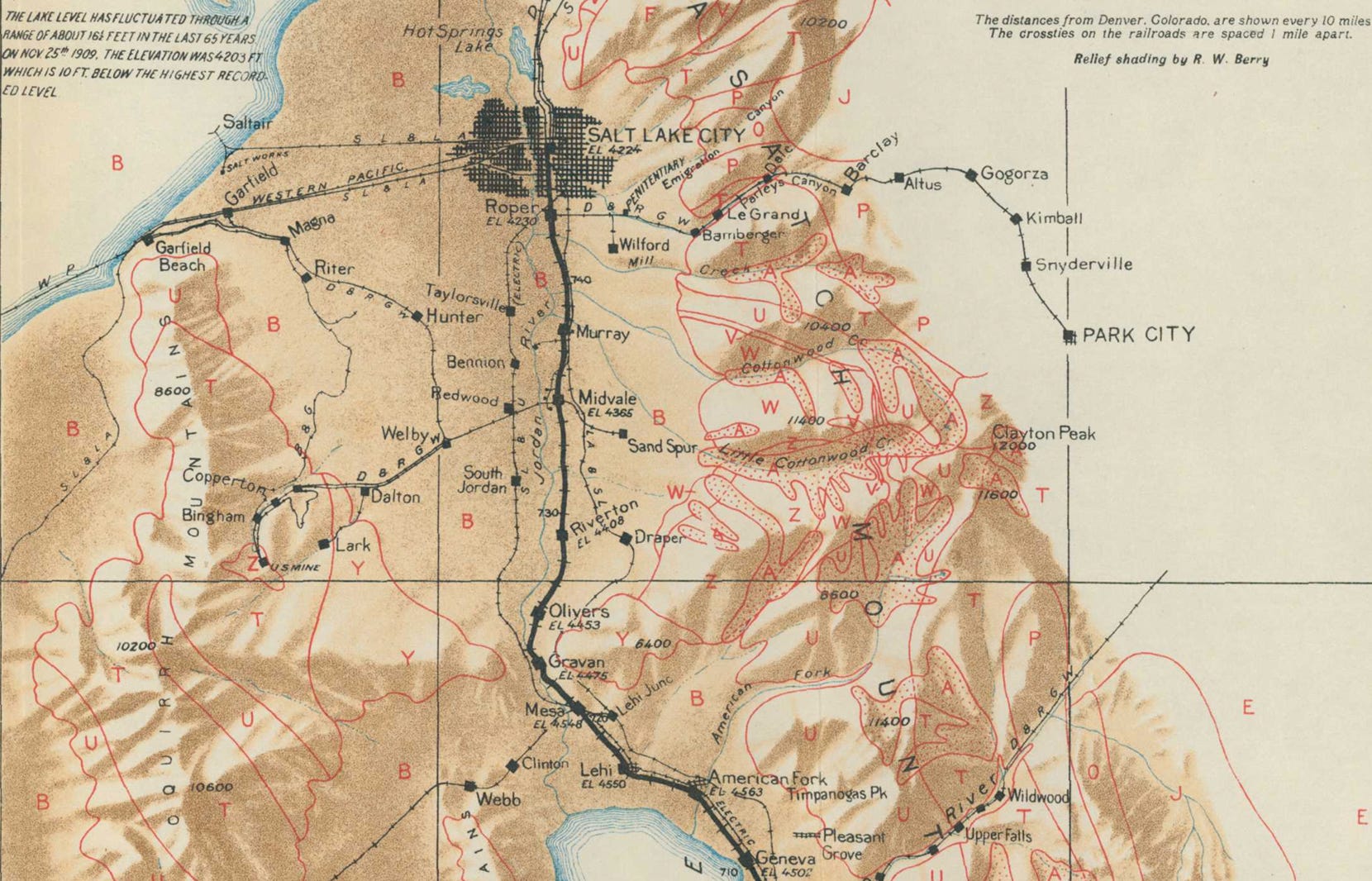
Here’s one more from the USGS’s Guidebook of the western United States: Part E – The Denver & Rio Grande Western route, published in 1922. This map shows a segment of the Wasatch Front in Utah. I’ve also included a Google Earth image of the same area now. It’s remarkable to me because back then Salt Lake City was a small city that stood on its own; now it’s surrounded by a sea of sprawl. Salt Lake was a bit bigger then (or rather, the lake level was higher than it was when the Google Earth image was made; when the map was made in 1909 it was 4,203 feet, now it’s about 13 feet lower). And Bingham Canyon still was a canyon, with little towns in it, rather than the gaping hole known as the Bingham Canyon copper mine.