Douglas County water projects could receive $2.75 million in federal funding — #Colorado Politics

Douglas County.

Click the link to read the article on the Colorado Politics website (Noah Festenstein). Here’s an excerpt:

September 4, 2025

Select Douglas County water districts are poised to receive up to $2.75 million combined for projects dealing with sustainable drinking water or new pipelines. That’s on top of $20 million in American Rescue Plan Act funding already allocated for a wastewater project in northwest Douglas County. Back in May, U.S. Rep. Lauren Boebert of Colorado’s 4th Congressional District, had requested $9 million in federal funding for the Louviers Water & Sanitation District’s drinking water distribution replacement and Castle Rock Water’s Plum Creek to Reuter-Hess Reservoir pipeline projects. On July 22, the federal House Appropriations Committee advanced a bill that included $1.75 million specifically for Castle Rock’s project. The panel also advanced $1 million for the Louviers project, according to county officials…The funding still needs the full approval of Congress, which is expected later in the year…

Castle Rock Water officials said the $1.75 million is likely the most the project has ever received in outside funding. The money is needed for a new transmission water pipeline and pump station from Plum Creek in Castle Rock to the Reuter-Hess Reservoir in Parker, a roughly a seven-mile stretch. The $24.8 million project had earlier been “put on hold until additional funding could be secured,” according to Castle Rock Assistant Director Mark Henderson…A major water project aims to replace about 12,000 feet of aged galvanized steel pipe, including 86 service lines and 15 fire hydrants, in a small northwest Douglas County town. The project, called the Louvier’s Water & Sanitation District Water Distribution Replacement, will provide residents with “cleaner drinking water, increase system reliability, and enable better fire flow capacity,” Douglas County officials said in a news release…Meanwhile, near Louviers, a new million wastewater treatment facility near Chatfield Reservoir seeks to improve water quality in the area. The $20 million facility is funded with American Rescue Plan Act dollars. The project would benefit five nearby communities, according to Dominion Water & Wastewater officials, who oversee the project.

‘I feel let down by my state’: Kids sue #Wisconsin over climate change — Henry Redman (NewsFromTheStates.com)

Protesters in Milwaukee take part in a 2019 march demanding action to address climate change. Fifteen young people are suing the state of Wisconsin for harming their future by allowing pollution that hastens climate change. (Photo by Isiah Holmes/Wisconsin Examiner)

Click the link to read the article on the News from the States website (Henry Redman):

September 8, 2025

Kaarina Dunn has grown up hearing stories of the Wisconsin winters her parents and grandparents got to enjoy. Winters with enough snow cover that the family of ski-enthusiasts could get on the slopes from Thanksgiving to Easter. 

But despite the state’s continued connection with ice and snow, winters like those of her family’s past are gone. Climate change has caused Wisconsin’s winters to warm more than any other season. A number of recent winters have seen drought conditions with little to no snow across the northern part of the state — severely damaging winter tourism and canceling or modifying events such as the American Birkebeiner. While data shows that the amount of snowfall on average is similar to decades past, the weather doesn’t stay as cold throughout the winter, meaning that the snow melts before it can accumulate to the truly deep levels of previous generations. 

Kaarina Dunn | Photo courtesy Midwest Environmental Advocates

“I hear all these great stories about how they got to ski over Thanksgiving, how they skied past Easter time, how they went on all these great trips around the state of Wisconsin to all these ski hills, mountains, all these amazing places,” Dunn, a 17-year-old Onalaska resident, tells the Wisconsin Examiner. “And I can’t help but feel incredibly saddened by this. I will never experience these things. These are family traditions, trips that my family would go on, with family members, with friends, and do all these amazing and fun things. And honestly, I do feel left out. I feel let down by my state. I can no longer enjoy these things due to the direct results of fossil fuels in the environment.” 

Dunn is one of 15 young people suing the state of Wisconsin, arguing that state laws violate their constitutional rights and worsen climate change. The lawsuit mirrors a similar lawsuit from children in Montana, who successfully argued that the state had to consider the greenhouse gas emissions and climate change impact of permits involving fossil fuels. 

The children are represented in the lawsuit by Madison-based Midwest Environmental Advocates and Oregon-based Our Children’s Trust. 

In Wisconsin, the suit argues that state lawmakers have made a number of declarations that the state’s energy production should be decarbonized and the greenhouse gas emissions of that production should be reduced, but state laws prevent that from happening. 

The state’s law for siting power plants requires that the state Public Service Commission determine that “[t]he proposed facility will not have undue adverse impact on other environmental values such as, but not limited to, ecological balance, public health and welfare, historic sites, geological formations, the aesthetics of land and water and recreational use.” However the law also prohibits the PSC from considering air pollution, including from greenhouse gas emissions, in that determination. 

Additionally, the state set a goal in 2005 that 10% of Wisconsin’s energy come from renewable sources by 2015. That goal was met in 2013. However, now that the goal has been met, state law treats it as a ceiling on renewable energy the PSC can require. 

“The Commission cannot require any electric provider to increase its percentage of renewable energy generation above the required level,” the lawsuit states, meaning that for more than a decade, Wisconsin’s energy regulators have been unable to push the state’s power companies to develop more renewable energy sources. 

Coal and natural gas make up 75% of the energy produced in Wisconsin and renewable sources make up 17%. 

Skylar Harris, an attorney for Midwest Environmental Advocates, says that children today are going to spend most of their lives dealing with the effects of climate change on their health and lifestyles yet don’t yet have the ability to vote and influence environmental policy. 

“I think people are really starting to acknowledge the direness of the situation that we’re in and the situation that climate change is causing, and how it impacts our inherent rights such as life and liberty and the pursuit of happiness,” Harris says. “And courts are really starting to see that without the right to a stable climate, which is what we’re arguing for in this case, the rights to life, the rights to liberty, the rights to the pursuit of happiness, they mean nothing, because people can’t pursue them to the fullest extent.” 

Harris says that if the lawsuit is successful, she believes that the PSC will use its new authority to deny permits for new or expanded fossil fuel burning power plants and push the state’s power companies to expand their renewable capacities. 

In the Montana lawsuit, officials argued that the state can’t be held responsible for the effects of climate change on the children in that lawsuit because climate change is caused by emissions from across the globe. Harris says that yes, climate change is a global problem, but it gets fixed by individual governments doing something about it. 

“Climate change is a global problem, but there is no such thing as a global government,” she says. “So if we are to address this global issue, that means every individual, every business and every government, including the state of Wisconsin, has to step forward and do its part. And that’s what we’re trying to make sure is happening with this lawsuit.”

The 15 children in the lawsuit represent a wide swathe of Wisconsin. They live in urban and rural parts of the state and include athletes who have had wildfire smoke affect their sports, farm kids who have had droughts and heavy rains affect their families’ livelihoods and members of the state’s Native American tribes who have seen their cultural traditions put at risk. 

Dunn has spent much of her childhood fighting for environmental causes as president of her local 4-H club and has won three grants for environmentally focused projects from the Bloomberg Philanthropies Climate Action Fund. She says she joined the lawsuit because it can help her community and kids like her across the state. 

“I began my environmental work because I always believed in doing the right thing,” she says. “I believe in fighting for my community, fighting for my family, fighting for my siblings, fighting for everyone, fighting for youth and fighting for families.”

She adds that the PSC “knows that what they are doing is wrong. The governor and the Wisconsin Legislature have indicated that they want renewable energy, and the Public Service Commission simply isn’t changing the laws, and the Legislature isn’t changing the laws.” 

Dunn’s family has lived western Wisconsin’s Driftless Region for generations and she spent most of her childhood in Vernon County. She says the Mississippi River is “almost a family member.”

But massive rain events causing flooding and erosion triggered a massive boulder to tumble down a bluff and into her backyard, making her family fear that it wasn’t safe in their home anymore. They moved north to La Crosse County. 

“We felt very unsafe in the childhood home that I planned to live my entire life in. We made the difficult decision to move cities, move counties, move school districts,” she says. 

A member of her school’s tennis team, Dunn says hotter summers and poor air quality caused by wildfires elsewhere on the continent have forced her to change how and when she practices. Flooding has prevented her and her family from swimming off the dock at her grandparents’ home and affected the work done at their walnut tree farm. 

Dunn says that for her, joining the lawsuit is about standing up and trying to force her state government to admit it has a role to play in mitigating climate change and responding to the ways in which climate change has harmed her life and the lives of the other kids in the suit. 

“Ultimately, our country knows the science that is creating climate change, the fossil fuel industry, and especially Wisconsin, they can no longer stand behind saying, ‘There’s nothing we can do. We don’t know about it. There’s nothing that we can do,’” she says. “But ultimately, we have the science and technology to make changes and to save my life and my future children’s life and have a safe and healthy environment.”

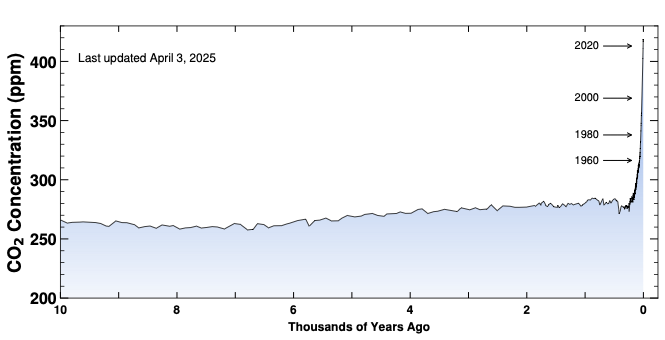
10,000 years of CO2. Credit: https://keelingcurve.ucsd.edu/

Mud, silt, ash from run-off damaging water resources in rural Rio Blanco County — Steamboat Pilot & Today #WhiteRiver

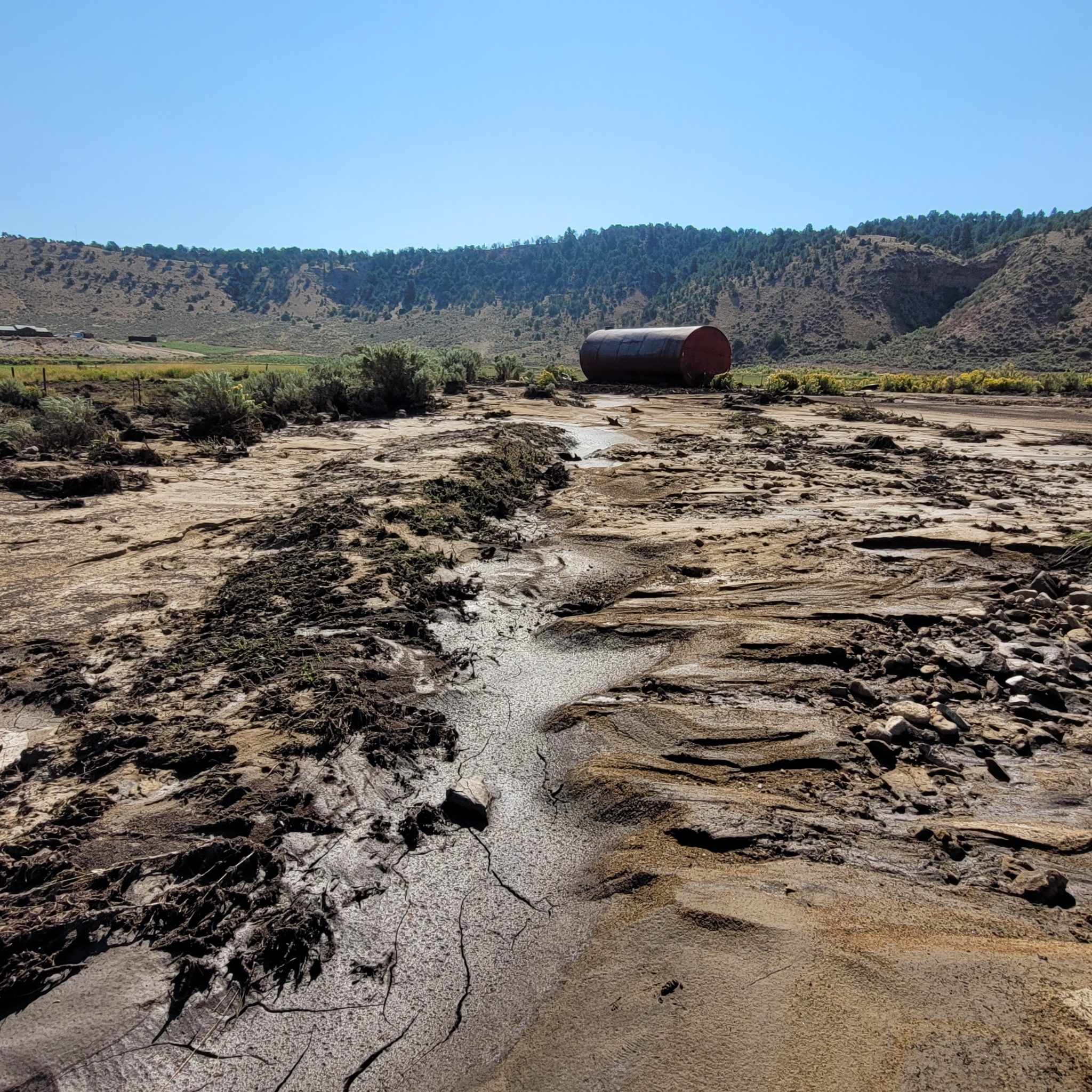
A flume and ditch is covered with silt, mud, rocks and debris along the White River following run-off damage from rains after the Lee Fire in Rio Blanco County. Colorado Division of Water Resources/Courtesy photo

Click the link to read the article on the Steamboat Pilot & Today website (Suzie Romig). Here’s an excerpt:

September 6, 2025

Irrigation ditch structures can be seen buried under mud in rural Rio Blanco County. Some livestock ponds are contaminated with ash and are unusable for animals. Residents posted post-rain videos last week of black, mucky water crossing roads, surging through culverts, rushing down bar ditches and running onto fields.  Colorado Parks and Wildlife reports some fish have died in the White River on the northwest edge of the Lee Fire burn scar after heavy rains that pushed silt and ash into the river…With every rainstorm, there is another chance for flash flooding and debris flows, said Rio Blanco County Commissioner Callie Scritchfield.

An irrigation ditch is filled in with sediment and debris on Piceance Creek in Rio Blanco County due to run-off damage after the Lee Fire. Colorado Division of Water Resources/Courtesy photo

[Suzan] Pelloni, a Realtor in Meeker, said ranchers and landowners are helping each other as best they can right now, such as sharing heavy equipment.

“They are pooling resources. They are working together to try and help the immediate needs of the neighbor,” Pelloni said.

Pelloni highlighted some example immediate concerns for the rural landowners ranging from water tanks where electricity service repair is delayed to a ranch where both summer and winter grazing lands were burned. Looking at the big picture, Pelloni said ranchers may have to sell cattle early or sell more cattle than anticipated, and ranchers who supplement their income with guided hunting likely will lose income this fall too…In the meantime, the White River & Douglas Creek Conservation Districts
 soil conservation agency, along with the Bureau of Land Management and Rio Blanco County, are hosting weekly question-and-answer sessions on Thursday afternoons continuing on Sept. 11 and 18. The meetings provide resources to assist with questions for residents in need of recovery recommendations and financial and technical recovery resources.

White River Basin. By Shannon1 – Own work, CC BY-SA 4.0, https://commons.wikimedia.org/w/index.php?curid=69281367

Federal Water Tap, September 8, 2025: House Budget Bill Increases Army Corps Spending — Brett Walton (circleofblue.org)

Click the link to read the article on the Circle of Blue website (Brett Walton):

September 8, 2025

The Rundown

  • House passes a water and energy spending bill for fiscal year 2026 that boosts Army Corps construction budget.
  • White House uses an illegal maneuver to retract an additional $3.2 billion in foreign aid.
  • With Congress having returned from summer break, committees will hold hearings this week on water infrastructure, AI, energy efficiency, permitting reform, and the state of federal forests.

And lastly, NOAA expands a national flood mapping project..

“Energy strength is national strength – fueling jobs, innovation, and resilience in every community – and no longer will traditional energy sources be punished for being affordable and reliable.” – Rep. Tom Cole (R-OK) in a written statement after the House passed a fiscal year 2026 spending bill for water and energy agencies. Cole did not mention the failures of natural gas plants in the winter storm in 2021 that forced multi-day blackouts in Texas and led to a number of deaths. Nor that solar photovoltaic is the cheapest source of new electricity in the U.S.

By the Numbers

$3.2 Billion: Foreign aid spending retracted by Donald Trump using a “pocket rescission” that withholds spending late in the fiscal year. The retracted funds are from USAID’s development assistance program, which is meant for poverty reduction. But the administration opposes spending on things like climate adaptation abroad. The Government Accountability Office, an independent watchdog for Congress, calls the pocket rescission an illegal maneuver.

News Briefs

2026 Budget
The 2026 fiscal year is just over three weeks away, and Congress is making typical slow progress on the budget bills.

Last week, with a one-vote margin, the House passed a spending bill for energy and water agencies.

The bill increases the Army Corps construction budget by nearly 40 percent, to $2.55 billion. That is for waterway navigation, flood protection, and ecosystem restoration. It also adds 10 percent to the operations and maintenance budget.


See: US Army Corps of Engineers fully funds Denver restoration project


Energy efficiency and renewable energy programs, however, were cut 47 percent.

The bill does not include the EPA, which is handled in a separate piece of legislation.

Not making the September 30 deadline and needing to pass a continuing resolution to keep the government running is the way Congress now works. According to Pew Research, the last year that a budget was completed on time was 1997.

Studies and Reports

Flood Maps
Real-time and predictive flood maps from NOAA are now available for 60 percent of the U.S. population.

The mapping service provides a model-based picture of areas currently underwater from river flooding. It also forecasts the area that will be flooded in the upcoming five days.

Regions that are not yet depicted in the maps include the intermountain West and the northern Plains.

Irrigation Organizations
The USDA’s Economic Research Service published a report on the structure of irrigation organizations in the country. These are a mix of Bureau of Indian Affairs projects, mutual companies, unincorporated mutuals, and special-purpose government units.

On the Radar

California Water Meeting
On September 9, the Bureau of Reclamation will hold its quarterly public meeting to provide updates on the coordinated operation of the two big canals in the state: the State Water Project and the Central Valley Project.

The meeting will run from 1:00 p.m. to 3:00 p.m. Pacific. Join via Microsoft Teams using this link. The meeting ID is 262 767 956 444 and the passcode is f74jJg

House Hearings
On September 9, a House Natural Resources subcommittee will hold a hearing on the nation’s federal forests.

That same day a different Natural Resources subcommittee will discuss the economic implications of the “energy dominance” agenda.

Also on September 9, a House Energy and Commerce subcommittee will discuss energy efficiency standards for buildings. Republicans have criticized efficiency standards for both water and energy as a waste of money.

On September 10, the Natural Resources Committee will hold a hearing on three permitting reform bills.

And also on September 10, a Transportation and Infrastructure subcommittee will hold a hearing on implementation of previous iterations of the Water Resources Development Act.

Senate Hearing
On September 10, a Senate Commerce subcommittee will discuss the Trump administration’s AI plan. The witness is Michael Kratsios, director of the White House Office of Science and Technology Policy.

Federal Water Tap is a weekly digest spotting trends in U.S. government water policy. To get more water news, follow Circle of Blue on Twitter and sign up for our newsletter.

Screenshot from Kestrel Kunz’s presentation at the CRWUA 2023 Annual Conference.

As November deadline nears, Colorado River states ‘nowhere close to an agreement’ — Jennifer Solis #COriver #aridification

The Colorado River is pictured near Moab on Sunday, Feb. 18, 2024. (Photo by Spenser Heaps for Utah News Dispatch)

Click the link to read the article on the Utah News Dispatch website (Jennifer Solis):

August 29, 2025

Amid tense negotiations over the Colorado River’s future, Nevada leaders came together Thursday to focus on the state’s strategy to meet the climate and drought crisis threatening Lake Mead and the Hoover Dam.

Democratic Rep. Susie Lee, whose district falls within the boundaries of Lake Mead and half of the Hoover Dam, brought together regional water and hydropower leaders to highlight mounting needs the state faces during her third annual Southern Nevada Water Summit at the Springs Preserve.

Before water was piped from the Colorado River to Las Vegas, the burgeoning community relied entirely on groundwater from the Las Vegas Springs located on the site where the Springs Preserve now sits.

That water soon dried up after demand from the growing city depleted the aquifer. Now water managers are working to ensure Lake Mead – which provides nearly 90% of the city’s water – does not meet the same fate.

The summit comes at a critical time as states run against a mid-November deadline to reach a consensus on how the river and its reservoirs should be managed after current guidelines expire at the end of 2026. If states can’t reach a deal ahead of the deadline, the federal government will likely step in and make those decisions for them.

“The reality is it’s a really tough set of negotiations right now, so we’re meeting pretty regularly,” said Southern Nevada Water Authority Deputy General Manager Colby Pellegrino.

“There’s a lot of work that still needs to be done. We are nowhere close to agreement,” Pellegrino said.

Still, it’s an improvement from December when representatives from Lower Basin states — Nevada, Arizona, and California — and Upper Basin states — Colorado, New Mexico, Utah, and Wyoming — left a major water summit in Las Vegas without even speaking to each other.

Upper and Lower Basin states have largely quarreled over which portion of the basin should decrease its water use, and by how much.

States did come closer to a consensus after a breakthrough proposal in July to share the waterway based on the actual flow of the river, as opposed to projected flows and historical agreements. The proposal is still in play, said Pellegrino.

“I personally think it’s really good public policy for us to pursue something like that. It’s very responsive to current conditions. It does a decent job of creating some equity between the Upper Basin and Lower Basin,” Pellegrino said.

“But we’ve got a long way to go to see if we can agree on the details,” she continued.

Water flows in the Colorado River are shrinking due to climate change, and the reality of what that means for states reliant on the river is becoming more stark.

Earlier this month, federal officials announced they would continue water allocation cuts on the Colorado River for the fifth consecutive year following a persistent drought that’s drained Lake Mead.

Lake Mead’s elevation is currently at about 1,054 feet above sea level – 175 feet below what’s considered full. Based on water storage, the reservoir is at 31% of capacity.

Nevada is ahead of the game when it comes to preparing for those reductions, said Pellegrino.

Nevada receives less than 2% of Colorado River water each year, the smallest share of any state in the basin. Those limitations have forced Nevada to become a conservation pioneer.

Southern Nevada hasn’t used its full allocation of Colorado River water for years. Conservation efforts have helped Southern Nevada use 36% less water from Lake Mead than it did two decades ago, according to the Southern Nevada Water Authority (SNWA).

Even under the most severe water shortage, the Southern Nevada Water Authority would be able to access its share of the river thanks to major infrastructure projects, including Intake 3 — the ‘third straw’ — and the Low Lake Level Pumping Station.

“Our intake and our infrastructure allows us to deliver water to this valley even when water cannot be released from Hoover Dam,” Pellegrino said.

Other water infrastructure projects in Nevada have been funded by the Southern Nevada Public Land Management Act, which allocated 10% of revenue derived from land sales to the Southern Nevada Water Authority.

To date, SNPLMA has generated more than $368 million to fund Nevada’s water priorities and infrastructure needs. Pellegrino said SNWA will continue leveraging that funding to support water conservation, infrastructure upgrades, long-term drought planning, and environmental restoration.

Additional sources of federal funding have also been a major contributor to water conservation on the Colorado River, said Lee.

The congresswoman highlighted the Inflation Reduction Act, which included $4 billion in investments for drought mitigation along the Colorado River Basin. She also highlighted the Bipartisan Infrastructure Law which provided $141 million for water conservation projects in Southern Nevada, including funding for the Las Vegas Wash, which carries millions of gallons of treated wastewater to Lake Mead.

That funding allowed California, Arizona and Nevada to collectively reduce water use by at least 3 million acre-feet through the end of 2026, stabilizing Lake Mead for several years.

Another major issue created by lower water levels at Lake Mead is the loss of hydropower productivity. Hoover Dam generates half the power that it did in 2000 due to consistently lower water levels in Lake Mead.

If Lake Mead falls another 20 feet, Hoover Dam’s capacity to generate electricity would be slashed by 70% from its current level.

The break point for hydropower is 1,035 feet. At that level, 12 older turbines at Hoover that are not designed for low reservoir levels would be shut down. Only five newer turbines installed a decade ago would continue to generate power.

There is a way to fix the problem, said the Colorado River Commission of Nevada’s director of hydropower Gail Bates.

Replacing the 12 older turbines would maintain power generation even at low levels, however it would require significant investment.

“We’re really getting to the point where they’re urgently needed. Bad news is the cost. They cost about $8 million each to install. So it’s a very heavy investment,” Bates said.

During the summit, Lee and Sen. Catherine Cortez Masto said they are working together to advance the Help Hoover Dam Act, a bill that would unlock some $50 million in stranded funding for the dam from an orphaned federal account.

The funds had been set aside for pension benefits for federal employees, but advocates for the bill say Congress funds pension benefits through other means and that the funds could be spent on dam upgrades if the Bureau of Reclamation was given the authority to do so.

“The dam is turning 100 years old in 2035 and the Bureau of Reclamation is estimating that it will require about $200 million in upgrades. This is money that’s just sitting there stranded. It would be so good to free that up so we can make those investments,” Cortez Masto said.

Nevada Current is part of States Newsroom, a nonprofit news network supported by grants and a coalition of donors as a 501c(3) public charity. Nevada Current maintains editorial independence. Contact Editor Hugh Jackson for questions: info@nevadacurrent.com.

Map of the Colorado River drainage basin, created using USGS data. By Shannon1 Creative Commons Attribution-Share Alike 4.0