Summer’s over; and it was a dry one: #Drought covers about 82% of the Western U.S. — Jonathan P. Thompson (LandDesk.org)

Click the link to read the article on The Land Desk website (Jonathan P. Thompson):

September 2, 2025

🥵 Aridification Watch 🐫

Summer’s officially over. Meteorological summer, that is. And damn what a dry and hot and smoky summer it was. It wasn’t one of those summers with superlative maximum temps: The mercury in Death Valley only climbed to 124 on a couple of occasions this summer, for example, far off the record high. But in most places the average temperatures for the months of July and August were far higher than normal.
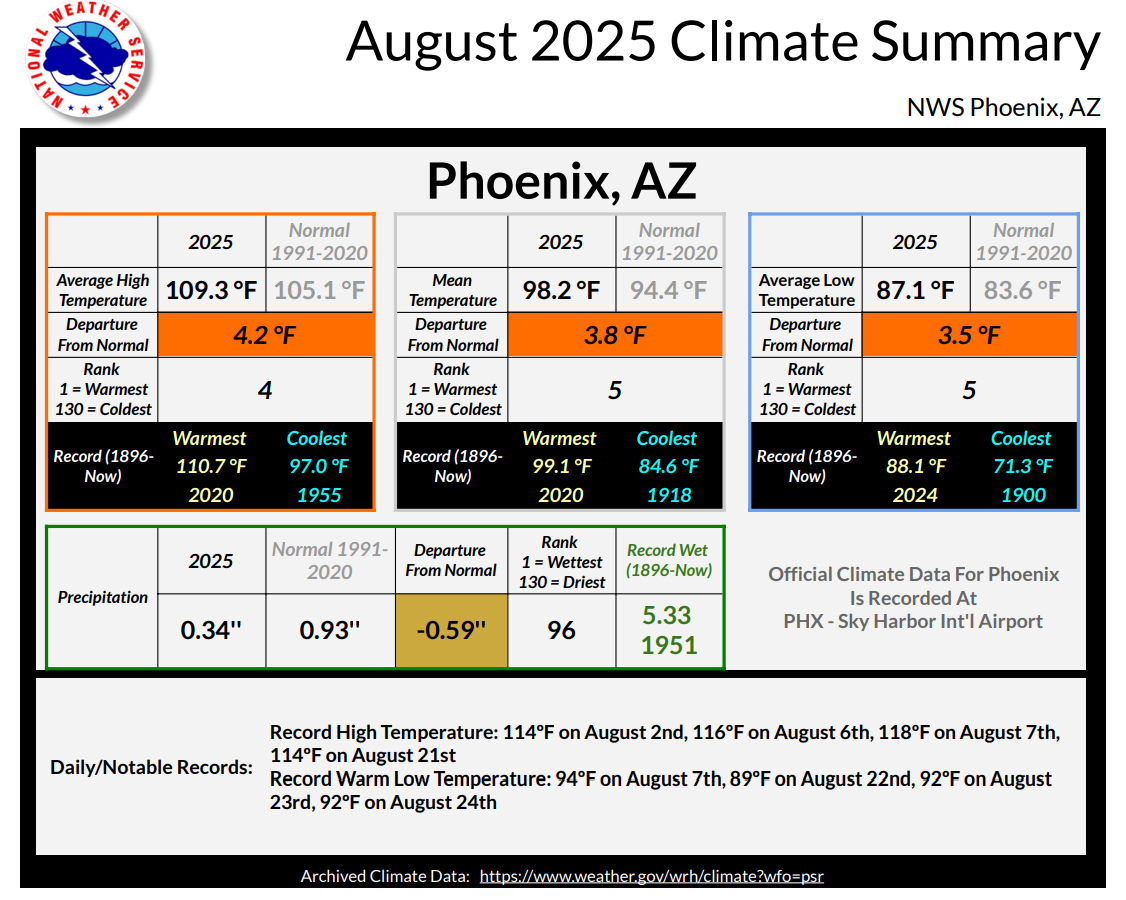
Phoenix’s max temp hit 118°F on two occasions this summer and 117°F once. More significant, though, was the relentlessness of the heat, and the lack of much monsoon relief. The result was significantly higher average temperatures than normal. National Weather Service.

Meanwhile, almost everywhere in the West was cursed with below normal precipitation. The monsoon was late, and when it finally did arrive, it was a dud. At least it has been so far. Not only were rainfall amounts lower than usual, but the soil was so dry that it sucked up a lot of the moisture before it reached the rivers. That has meant that the typical August streamflow jumps never really materialized, especially in the Colorado River Basin. The fish aren’t doing so well. Heather Sackett of Aspen Journalism reports that the Crystal River, along with the rest of the Roaring Fork, Gunnison, and White/Yampa River Basins are hurting, prompting officials to institute voluntary fishing and floating closures.


The trouble with normal … — Jonathan P. Thompson


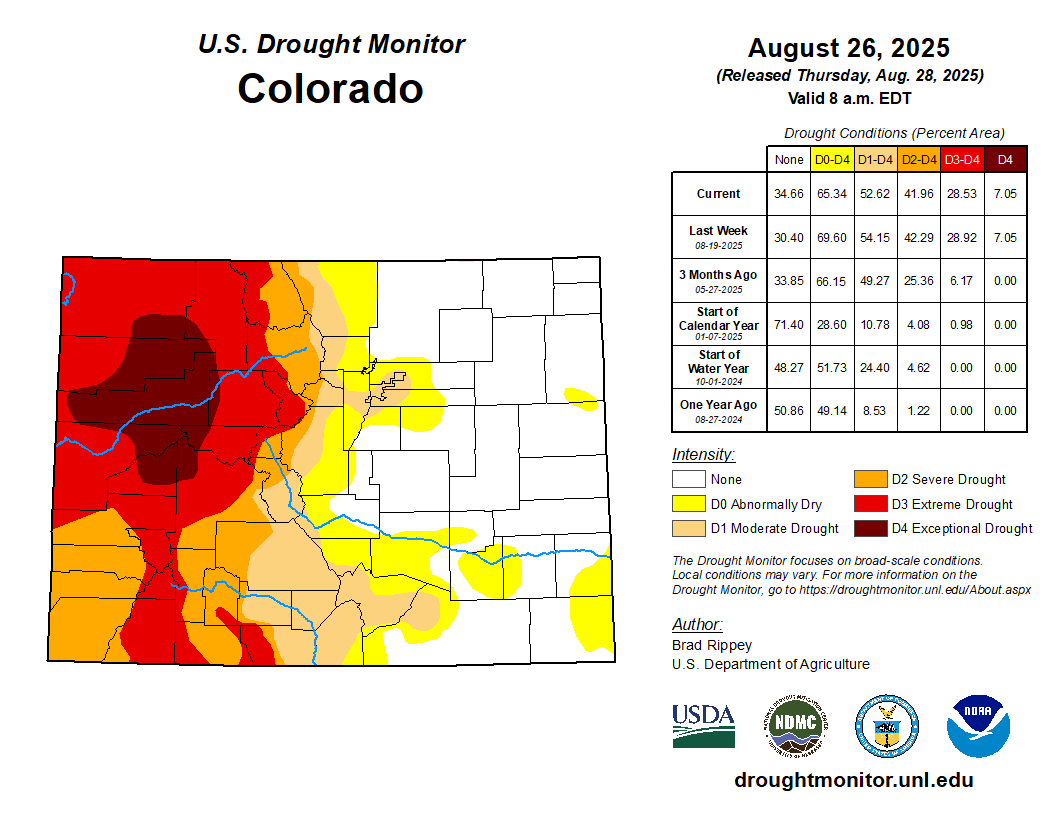
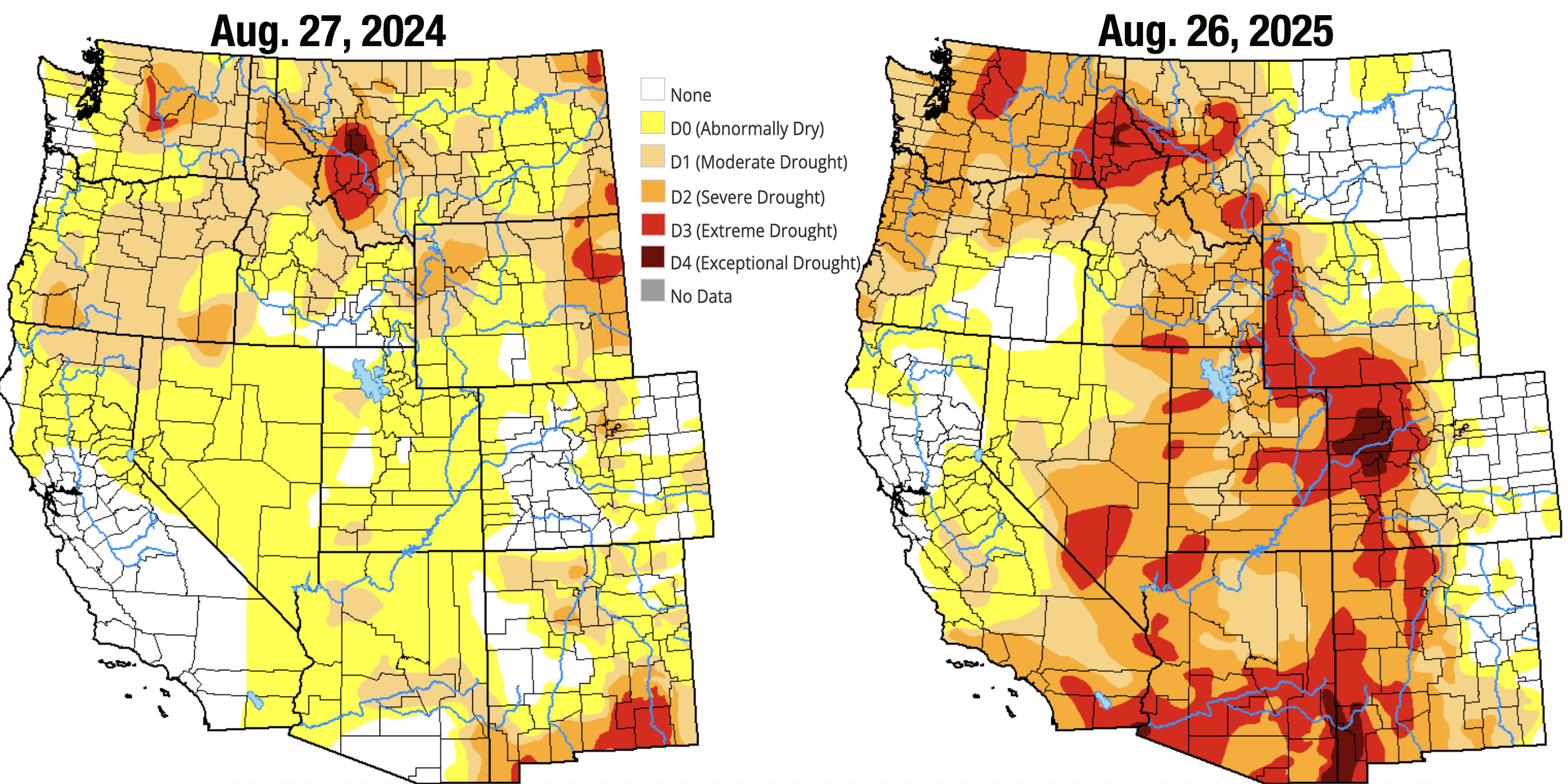
About 82% of the West is in drought, with about 47% suffering from severe to exceptional drought. The hardest hit areas include northwestern Colorado and southwestern Wyoming (aka the Colorado River headwaters), southeastern Arizona and southwestern New Mexico, and the Idaho panhandle.

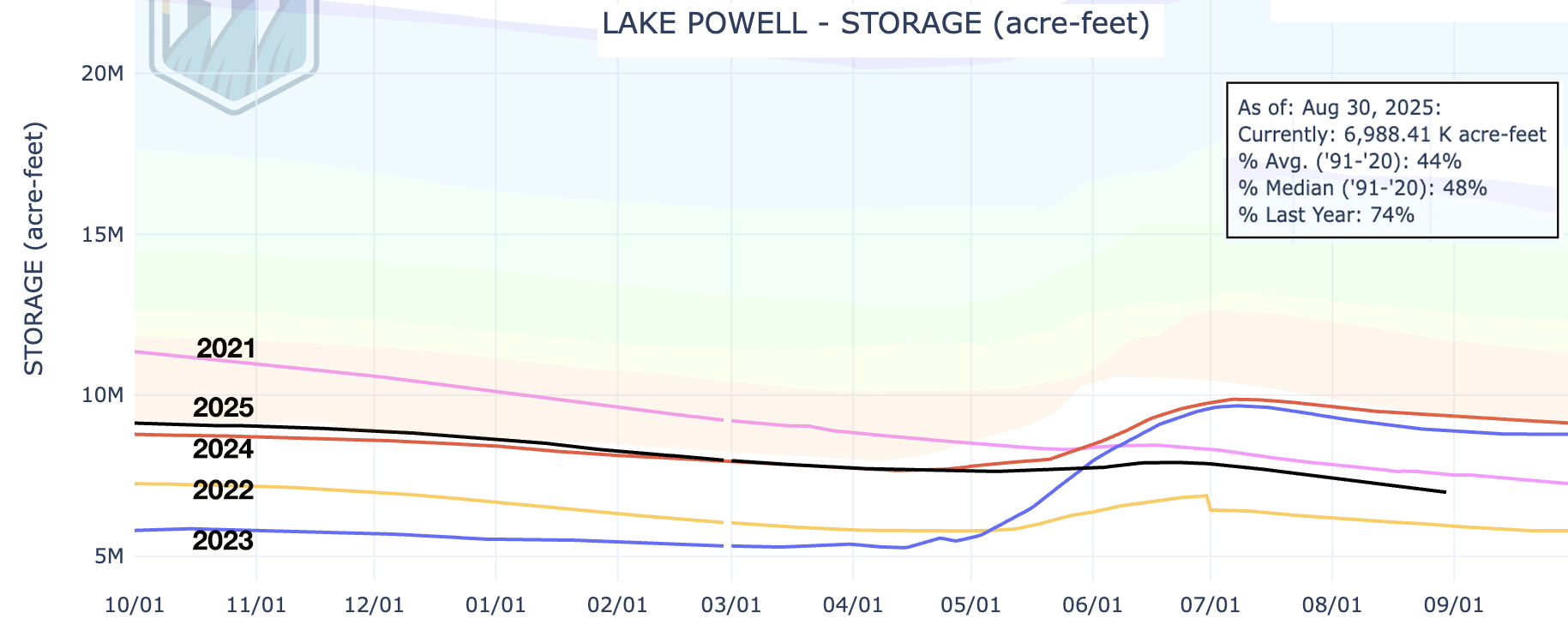
The combination of factors has resulted in low inflows into and steep declines in water storage in Lake Powell. The reservoir — which is both a barometer of the Colorado River’s health and the Upper Basin’s savings account — is now at about the same level as it was in early September of 2021. It both complicates and adds urgency to negotiations over how to split up the Colorado River in a warmer, dryer world.

Let’s look at some graphics:

What a difference a year makes. At the end of last summer, most of the West was fairly healthy, moisture-wise, and a wet September, October, and November further improved the situation. But after that, things started drying out and warming up, desiccating large swaths of the region, with only northern California, southern Oregon, and the plains getting a reprieve. Source: U.S. Drought Monitor.

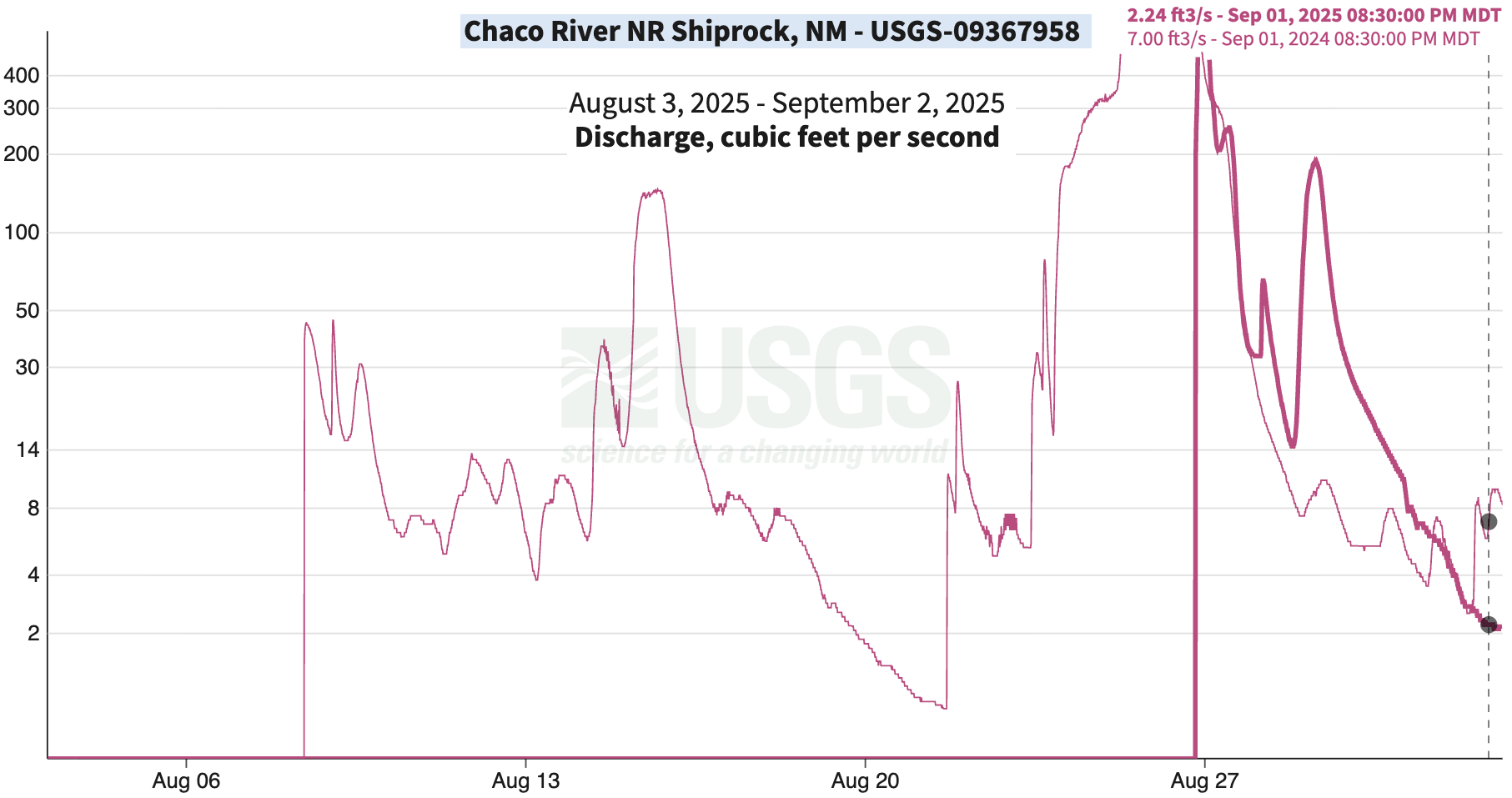
These hydrographs for the Animas River in Durango, the Chaco River just above its confluence with the San Juan, and the Rio Grande through Albuquerque, show that the monsoon did, in fact, arrive, albeit dreadfully late and bringing nothing but chips and cheap bean dip (a potluck metaphor, by the way). The Chaco River ballooned from bone dry to raging river (off the charts!) in a matter of hours, but was nothing but a muddy trickle a couple days later. The Animas also got a boost, but nothing close to as big as it normally gets this time of year. For once, the Rio Grande looks the best, with flows jumping from zero to about 300 cfs, before plateauing around 120 cfs for several days now.
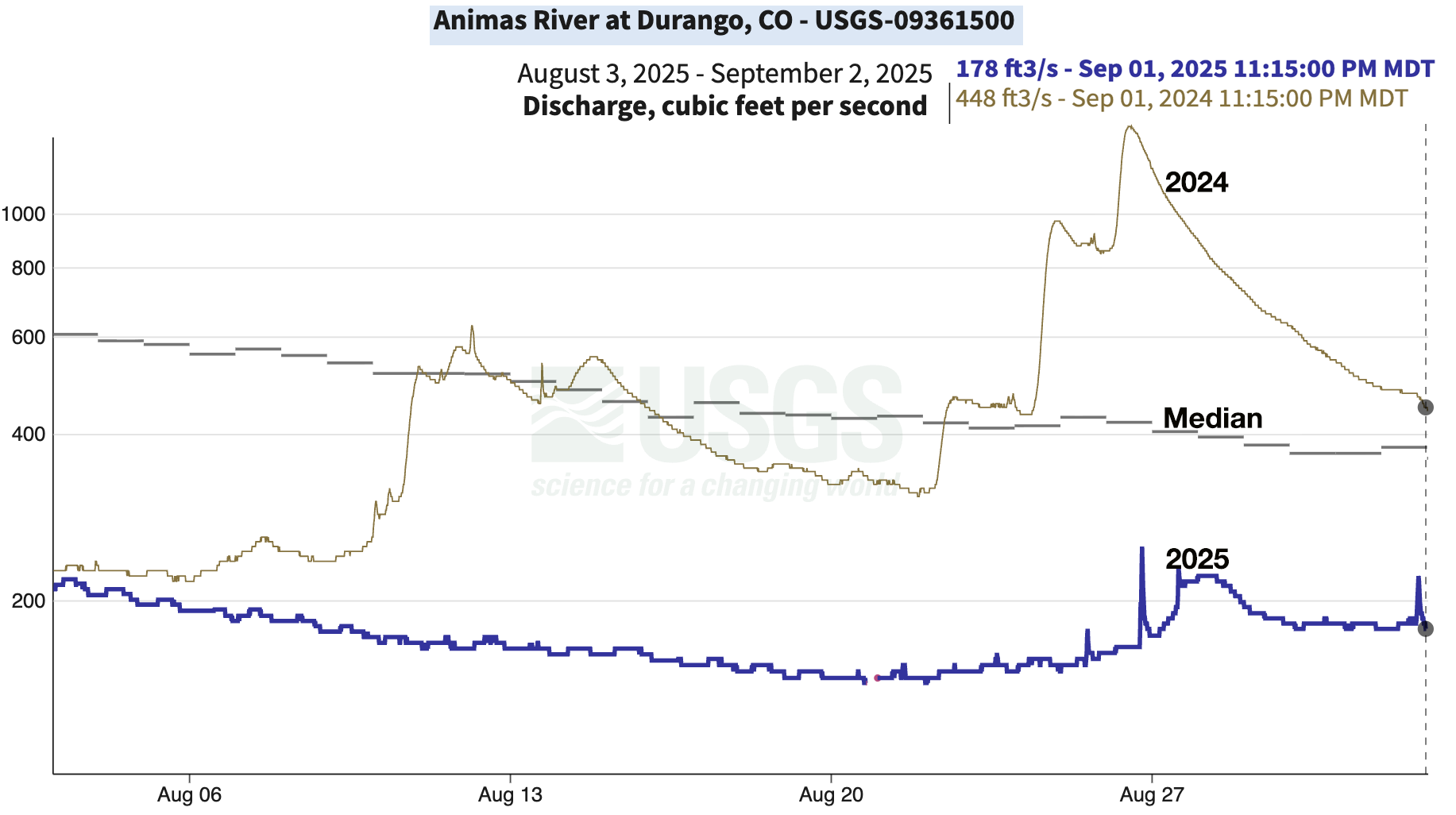
A couple of decent storms basically kept the Animas from drying up entirely, but not much more than that.
It looks like the Chaco River went from very, very dry to about 600 cfs (it literally jumped off the chart at 460 cfs, so….) and did so in the form of a wall of water.
The Rio Grande in Albuquerque was dry until the monsoon managed to kick it up to a not-dry 120 cfs or so.

Of course, these charts could turn around at any time. The monsoon may just be getting started, and will end up bringing steady, autumn rain and sustained higher streamflows with it. The biggest floods of the region have typically come in September and October, usually as tropical storms make their way inland and dump their load on the Interior West, think Oct. 1911 or Sept. 1970. That could happen again.

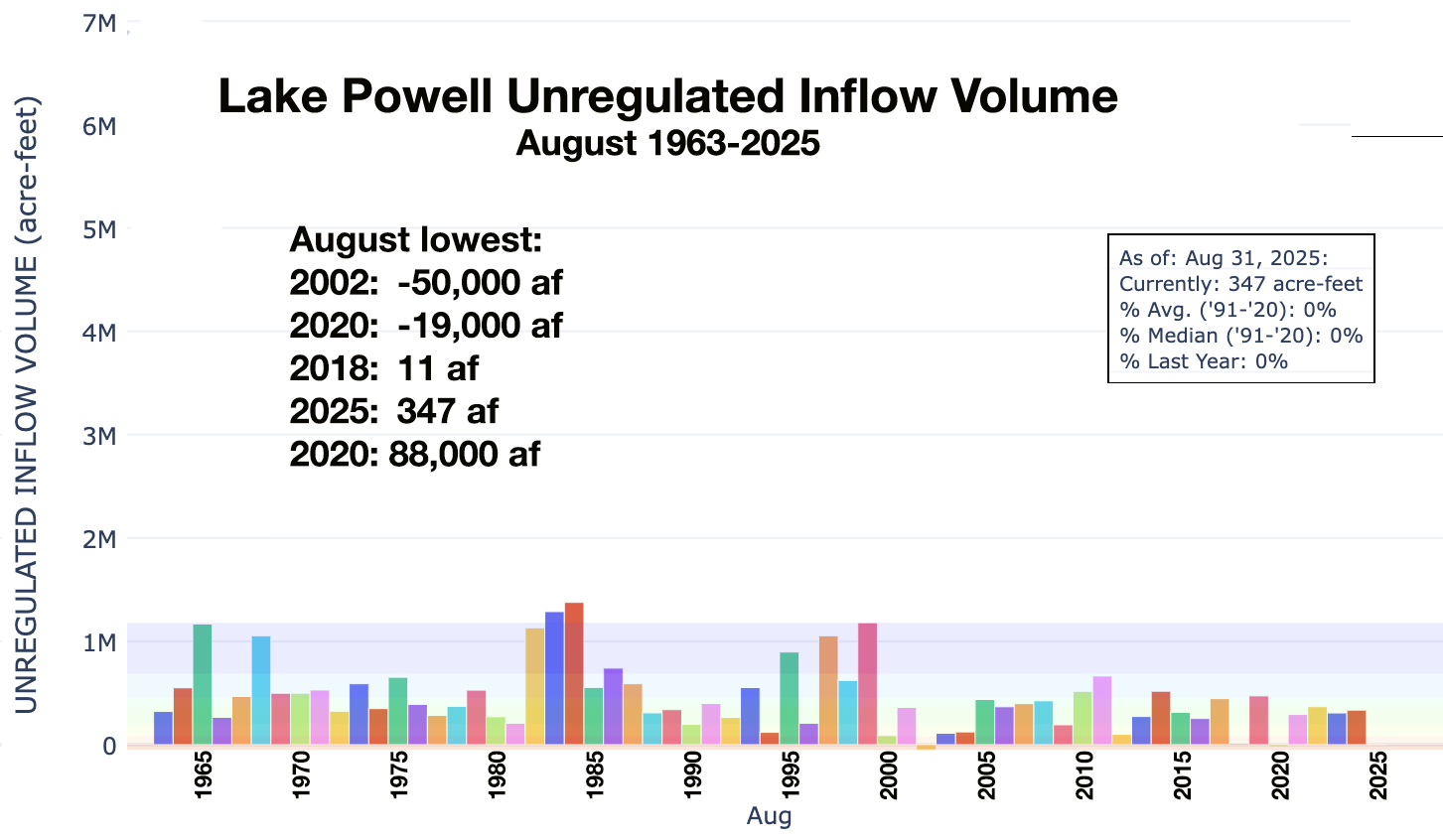
Even multiple deluges won’t reverse the Lake Powell deficit that’s built up this year, however. This water year’s actual inflows into the reservoir have been below normal for nearly every month, and were especially low in August. But more alarming are the unregulated inflows, which are an estimate of how much water would be flowing into the reservoir if there were no diversions or reservoirs upstream. This can look a bit weird, since in some months the estimate is a negative number.
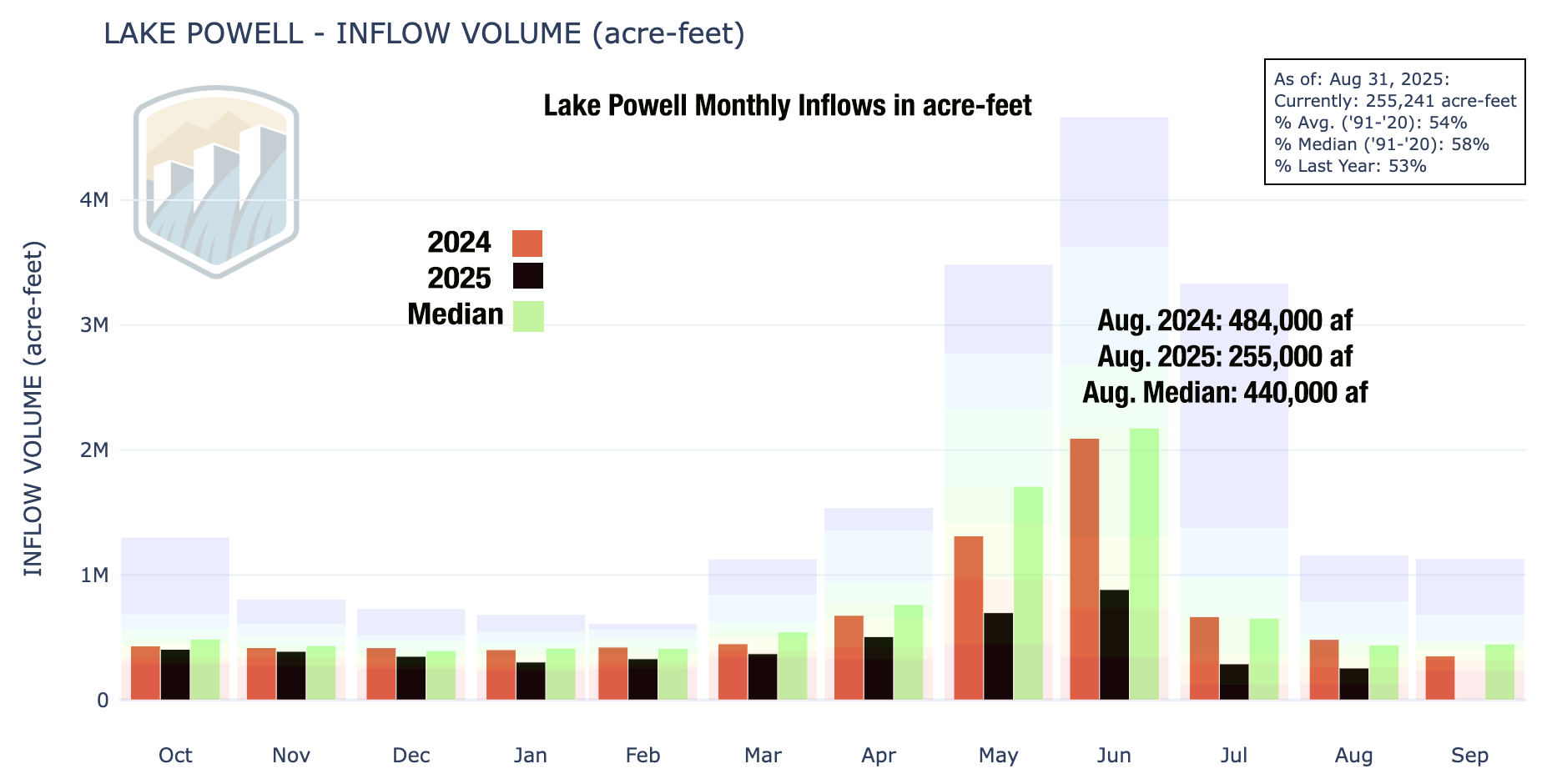
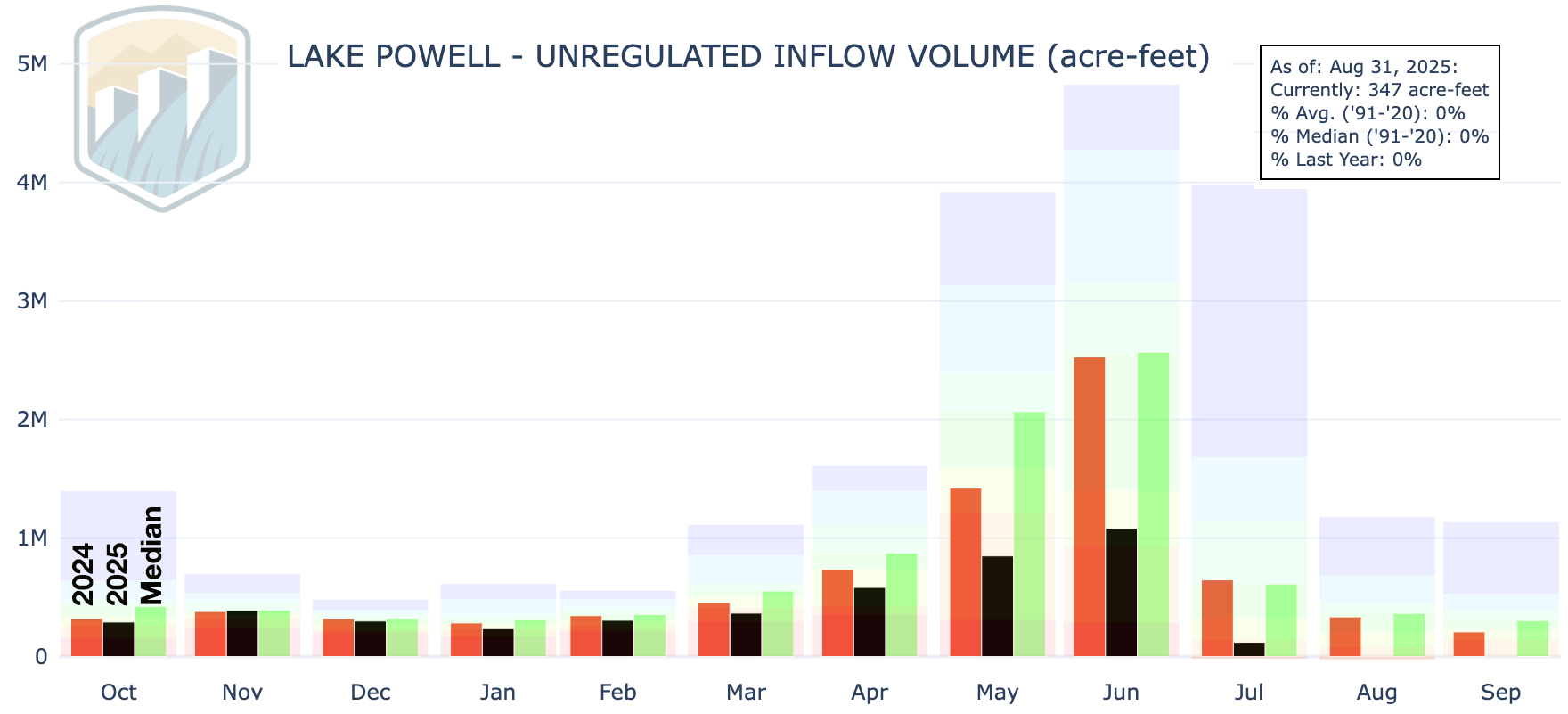
During August, about 255,000 acre-feet ran into Lake Powell. This was just 58% of normal. But that’s more than 254,000 acre-feet more than it would have been without upstream reservoir releases.
Note that the unregulated inflow volume tends to be higher than the actual inflow volumes during spring runoff (when upstream reservoirs are holding water back) and lower during the summer (when upstream reservoirs are releasing water for irrigation and so forth). The unregulated inflows have been lower than normal all water year so far.
The negative numbers shouldn’t be taken literally — I don’t know what that would look like. It’s just showing that without upstream reservoir releases, the flows would have gotten pretty meager in August during the pre-dam days.
Lake Powell’s storage is at its second lowest level ever for the end of August. An average or below average winter could further drain it to critical levels by next year.

Federal Water Tap, September 1, 2025: EPA Won’t Strengthen #Wastewater Pollution Rules for Meat and Poultry Industries — Brett Walton

Rio Grande and Pecos River basins. Map credit: By Kmusser – Own work, Elevation data from SRTM, drainage basin from GTOPO [1], U.S. stream from the National Atlas [2], all other features from Vector Map., CC BY-SA 3.0, https://commons.wikimedia.org/w/index.php?curid=11218868

Click the link to read the article on the Circle of Blue website (Brett Walton):

September 1, 2025

The Rundown

  • EPA withdraws a proposed rule to reduce wastewater pollution from slaughterhouses.
  • EPA will seek to cut federal protections for wetlands.
  • USDA will prepare an environmental impact statement for repealing the Roadless Rule that shields national forests and grasslands from logging and road building.
  • New Mexico and Texas agree to Rio Grande lawsuit settlement.
  • CBO reports on U.S. agriculture’s greenhouse gas emissions.
  • EPA proposes allowing Wyoming to manage its own coal-waste program.
  • Interior Department completes work on soil burn severity assessment for a large fire north of the Grand Canyon.

And lastly, the Department of Energy supports a feasibility study for what would be one of the country’s largest pumped storage hydropower projects.

“The seven states need to recognize that there is pain and sacrifice all over the place and try and get past that visceral perception and figure out what they can do to work together to provide water reliability for the 40 million people who depend on the Colorado River.” – Scott Cameron, senior adviser to the interior secretary, speaking at a meeting of the Glen Canyon Dam Adaptive Management Work Group on August 20. Cameron, who said he is “cautiously optimistic” about a seven-state deal on managing the river before the current operating rules expire at the end of next year, said the basin needs to look for strategies to reduce consumption and “to facilitate transfers and exchanges.”

By the Numbers

10 Percent: Share of U.S. greenhouse gas emissions generated by agriculture, according to a Congressional Budget Office report. The main pollutants in this total are nitrous oxide, a byproduct of fertilizer, and methane, which comes from livestock manure and cow burps.

$21 Million: Research and development funding from the Department of Energy for hydropower projects. The largest portion ($7.1 million) is to investigate the feasibility of a massive pumped storage hydropower project proposed for Navajo Nation land. Pumped storage toggles water between a lower and upper reservoir, a system that functions like a battery. New Mexico State University is the co-investigator for Carrizo Four Corners, the 1,500-megawatt pumped storage project that could provide 70 hours of energy storage, far more than the several hours of storage provided by the largest lithium-ion batteries.

News Briefs

Slaughterhouse Waste
The Environmental Protection Agency will not strengthen wastewater discharge rules for meat and poultry producers. The rules were proposed during the Biden administration.

To justify the action, the agency cited its desire to lower food prices and reduce industry operating costs.

The Biden-era rule intended to reduce the volume of pollutants that enter waterways from some 3,879 slaughterhouses nationally. Those pollutants include nitrogen, phosphorus, organic matter, fecal coliform, and grease. They contribute to harmful algal blooms and low-oxygen dead zones in rivers, lakes, and coastal ecosystems.

A Narrow Wetlands Definition
The EPA is preparing to release a rule by the end of the year that would shrink the number of wetlands with federal protection under the Clean Water Act, E&E News reports.

According to a slide presentation seen by E&E, the agency “would regulate wetlands only if they meet a two-part test: They would need to contain surface water throughout the ‘wet season,’ and they would need to be abutting and touching a river, stream or other waterbody that also flows throughout the wet season.”

The changes are in response to a 2023 Supreme Court ruling that provided narrower, but undefined criteria for determining which water bodies have federal protection.

Rio Grande Settlement
By signing a settlement agreement, New Mexico, Texas, and the Justice Department are closer to ending a long-running dispute over water rights from the Rio Grande and the groundwater pumping that affects river flows, Inside Climate News reports.

“The settlement package includes new formulas to calculate how much water each entity is owed; an agreement for New Mexico to reduce groundwater depletion, and changes to the operating manual for the Bureau of Reclamation’s Rio Grande Project.”

Roadless Rule
The U.S. Department of Agriculture is pushing ahead with its attempt to undo a 24-year-old rule that prevents logging and road building in “roadless” areas of national forests and grasslands.

Rescinding the Roadless Rule, which was adopted in the last month of the Clinton administration, will affect more than 44 million acres, mostly in 10 western states.

The department will prepare an environmental impact statement for its intent to repeal the rule. It argues that more local control over land management decisions are needed.

Comments are due September 19. Submit them via http://www.regulations.gov using docket number FS-2025-0001.

Studies and Reports

Dragon Bravo Fire Burn Severity
An Interior Department team completed an evaluation of the soil burn severity of the Dragon Bravo Fire, which has burned across more than 149,000 acres north of the Grand Canyon.

The fire severely burned the soils on just over 2 percent of the acres. Another 26 percent was moderately burned. The most severe burns cook the soil, which increases surface runoff after storms. Erosion and downstream floods can be the result.

In context: As Flames Scorch Western Forests, Flagstaff Area Offers Roadmap for Post-Wildfire Flood Prevention

On the Radar

Emergency Alert System Improvements
The Federal Communication Commission is beginning the process to assess and potentially upgrade the nation’s emergency alert systems that local agencies use to inform residents about natural hazards like floods and fires.

The commission is taking public comments through September 25. Submit them hereusing docket number 25-224.

Wyoming Coal Waste
The EPA wants to grant more states the authority to regulate waste products from burning coal for electricity. Wyoming is the latest state to seek this power, called primacy.

The agency is proposing to approve Wyoming’s bid to oversee its coal ash permitting program.

A public meeting will be held October 30. Public comments on the proposed approval are due November 3. Details are in the above link.

Three states currently have primacy. North Dakota’s application is being reviewed.

Federal Water Tap is a weekly digest spotting trends in U.S. government water policy. To get more water news, follow Circle of Blue on Twitter and sign up for our newsletter.

#Kremmling approves watering restrictions for residents due to #drought — The Sky-Hi News

Colorado Drought Monitor map August 26, 2025.

Click the link to read the article on the Sky-Hi News website (Meg Soyars Van Hauen). Here’s an excerpt:

September 2, 2205

At the town of Kremmling board of trustees meeting on Aug. 20, members approved an emergency declaration for watering restrictions due to ongoing drought conditions. The following Level 1 restrictions are in effect:

  • Even-numbered addresses (street numbers ending in 0, 2, 4, 6, 8) may use municipal water for outside irrigation and other outdoor purposes only on even-numbered days of the month.
  • Odd-numbered addresses (street numbers ending in 1, 3, 5, 7, 9) may use municipal water for outside irrigation and other outdoor purposes only on odd-numbered days of the month.
  • Town Parks will be watered no more than every third day.

“The restrictions are necessary because of a dry summer and our aging water treatment plant’s inability to keep up with current demands,” stated town manager Jen MacPherson. “They are important for residents to follow because we are in a position where we can hopefully prevent additional restrictions if everyone pulls together and cuts back now.”

Settlement Signed in #Texas v. #NewMexico #RioGrande Case: The Rio Grande states and the Department of Justice are one step closer to resolving a long-standing Supreme Court case over water rights — Martha Pskowski (InsideClimateNews.org)

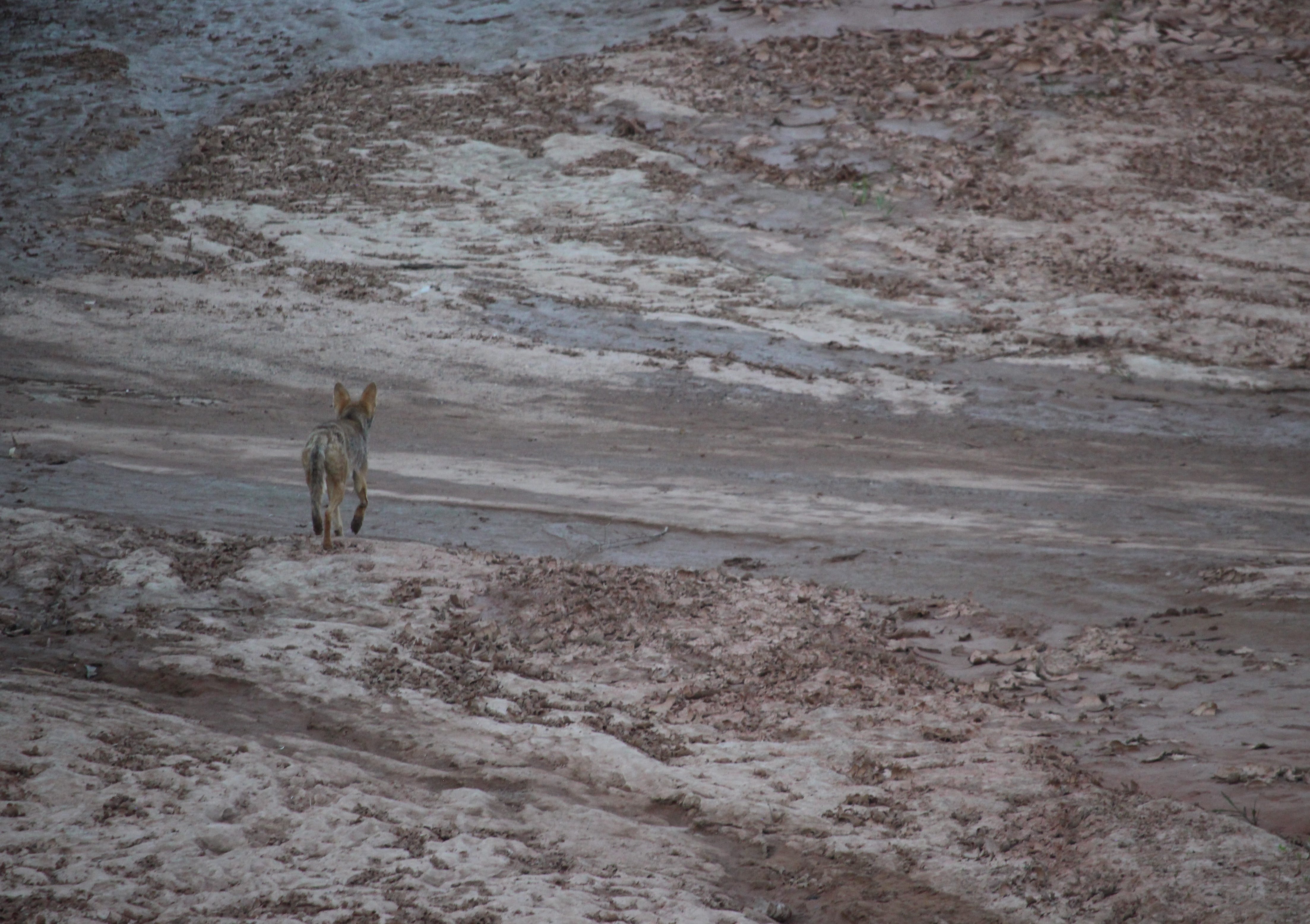
Young coyote crosses the dry bed of the Rio Grande August 11, 2025. Photo credit: Laura Paskus

Click the link to read the article on the Inside Climate News website (Martha Pskowski):

August 29, 2025

The Rio Grande flows over 1,800 miles from the mountains of southwestern Colorado to the Gulf of Mexico. A lawsuit filed in 2013 between Texas and New Mexico over Rio Grande water has taken as many twists and turns as the river itself.

A settlement signed this week by New Mexico, the Department of Justice and two irrigation districts, and reviewed by Inside Climate News, lays out agreements for irrigation management on the Rio Grande. It is one part of a larger settlement package that will be presented to a special master in the case, Judge D. Brooks Smith of the U.S. Third Circuit Court of Appeals, for approval next month. 

The outcome of the case is expected to have broad implications for cities that rely on the Rio Grande and farmers throughout New Mexico and far west Texas.

The settlement package includes new formulas to calculate how much water each entity is owed; an agreement for New Mexico to reduce groundwater depletion, and changes to the operating manual for the Bureau of Reclamation’s Rio Grande Project. 

Under the settlement, New Mexico could transfer water rights from the Elephant Butte Irrigation District (EBID) in Southern New Mexico in order to meet its obligations to Texas. The state agrees in the settlement that it would compensate EBID. 

The case began when Texas alleged that groundwater pumping in Southern New Mexico deprives the state of water it is owed under the Rio Grande Compact. Colorado and the United States are also parties to the case. Local irrigation districts, cities and agricultural interest groups have been involved as friends of the court. The case has evolved from a dispute between Texas and New Mexico to encompass conflicts between groundwater and surface water users in the area.

“We are ecstatic to have reached a settlement and look forward to continue delivering water to our farmers and the City of El Paso,” said Jay Ornelas, general manager of the El Paso Water Improvement District No. 1, an irrigation district. “The agreement provides long-term protection to El Paso farmers and the City of El Paso that rely on water from the federal Rio Grande Project.”

A Strained Inter-State Compact

The Rio Grande Compact, signed in 1938, lays out how much water Colorado, New Mexico and Texas can use from the Rio Grande. The compact only addresses surface water in the river. But hydrologists now understand that aquifers and rivers are connected. Wells drilled into adjoining aquifers can reduce the flow of water into the Rio Grande.

At issue in the case is a 100-mile stretch of the river between Elephant Butte Reservoir in Southern New Mexico and the Texas-New Mexico state line. Water is released from the reservoir for both Southern New Mexico and far West Texas, including El Paso. 

As agriculture expanded and severe droughts hit the region, farmers drilled more wells into the aquifer. Texas argues these wells in Southern New Mexico are siphoning off water that should flow to Texas.

“In one way it’s a conflict between the state of Texas and the state of New Mexico,” said Burke Griggs, a professor of water law at Washburn University in Topeka, Kansas. “But the conflict that really matters here is the conflict between surface water rights and groundwater pumping.”

Climate change is impacting snowmelt in the river’s headwaters. Extreme heat is increasing evaporation rates from the river where it flows downstream through the desert. The case is closely watched in New Mexico, where scientists predict thatwithin 50 years water supply from rivers and aquifers will decline by 25 percent. The City of El Paso, which relies on Rio Grande water, has diversified its water sources as the river became less reliable.

The Supreme Court rejected a settlement that the states reached in 2022 because the federal government had not consented to its terms. The parties went back to the drawing board. A new settlement was announced on May 15, with the United States on board. 

“The United States got what it needed in terms of firm commitments by New Mexico to reduce groundwater depletions,” Griggs said.

In a statement, the El Paso Water Improvement District No. 1 said that the settlement will improve efficiency, conserve scarce water resources and ensure that water is available for the district’s farmers and the City of El Paso. EBID has also signed on to the settlement.

Judge Smith, the special master, has called the parties to appear in court in Philadelphia on September 30 to explain the agreements. The details of the other parts of the settlement package have not been made public. As surface water dwindles across the Southwest, the settlement could bring to an end years of uncertainty surrounding the Rio Grande. 

“We’ll know with this settlement, I think with much greater precision, how much water there is to be used, how much water people are going to be able to pump a year or two out,” Nat Chakeres, general counsel for New Mexico’s Office of the State Engineer, told lawmakers in Santa Fe earlier this month.

While Texas v. New Mexico may soon come to a close, water challenges in the desert Southwest are becoming ever more urgent. The settlement comes as Elephant Butte reservoir is at less than four percent capacity, nearly a record low, and the Rio Grande south of Albuquerque has run dry for over a month.

Rio Grande and Pecos River basins. Map credit: By Kmusser – Own work, Elevation data from SRTM, drainage basin from GTOPO [1], U.S. stream from the National Atlas [2], all other features from Vector Map., CC BY-SA 3.0, https://commons.wikimedia.org/w/index.php?curid=11218868