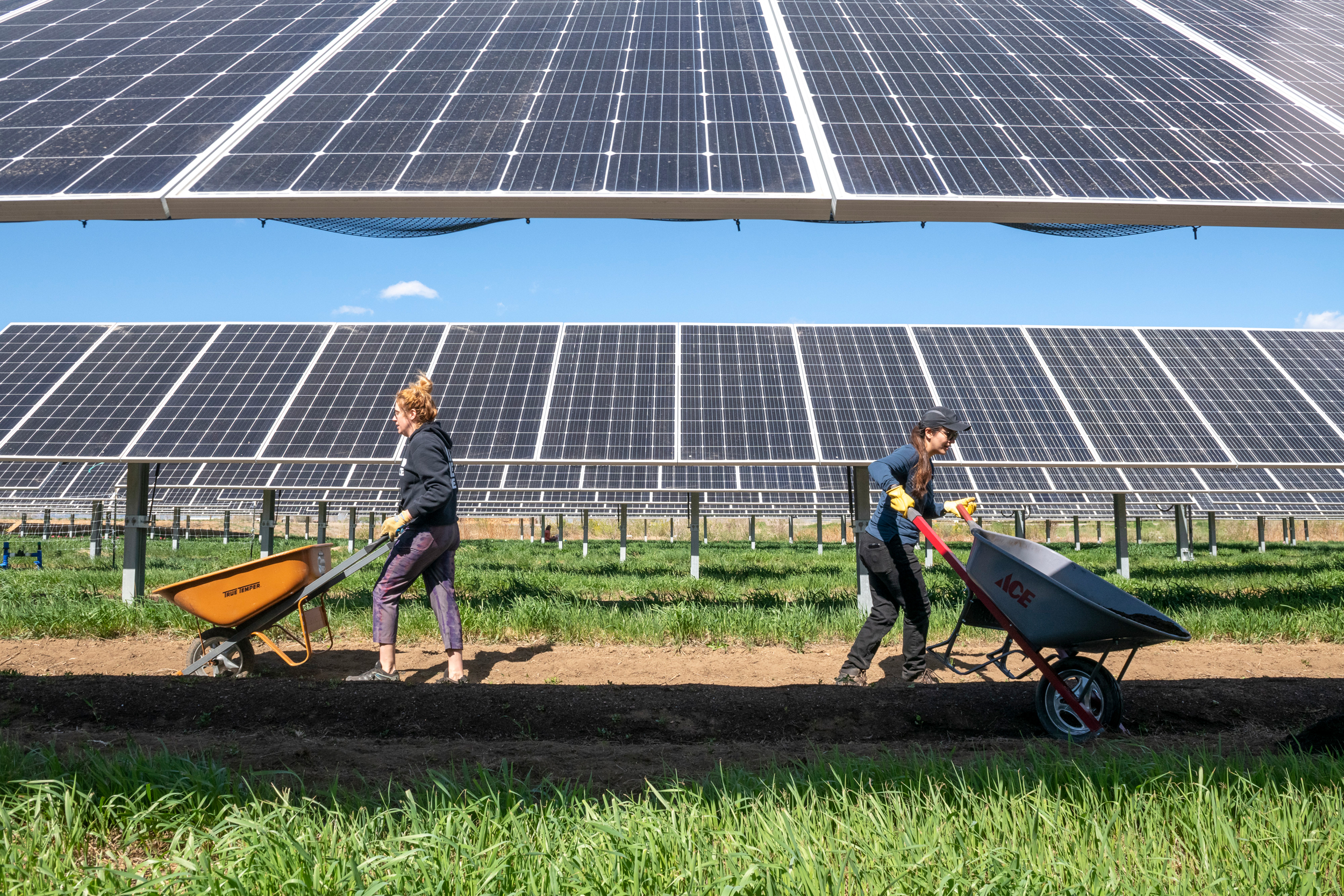
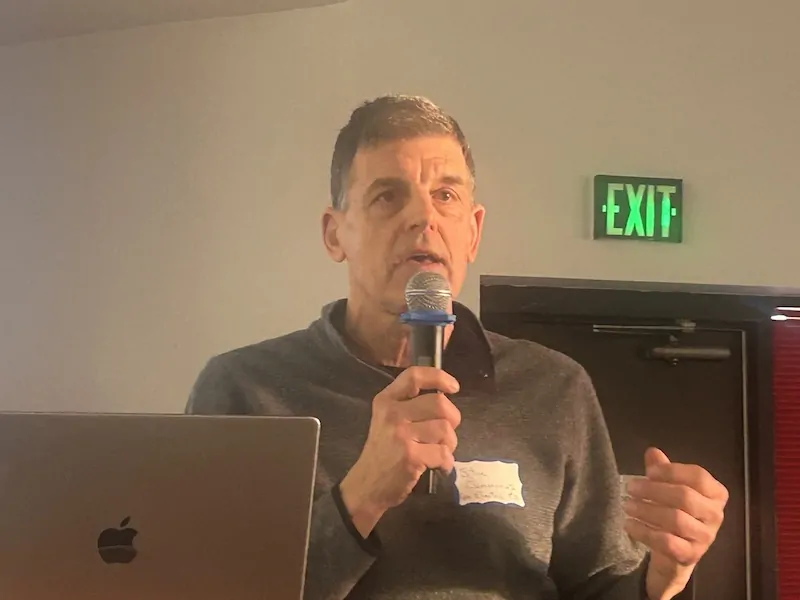
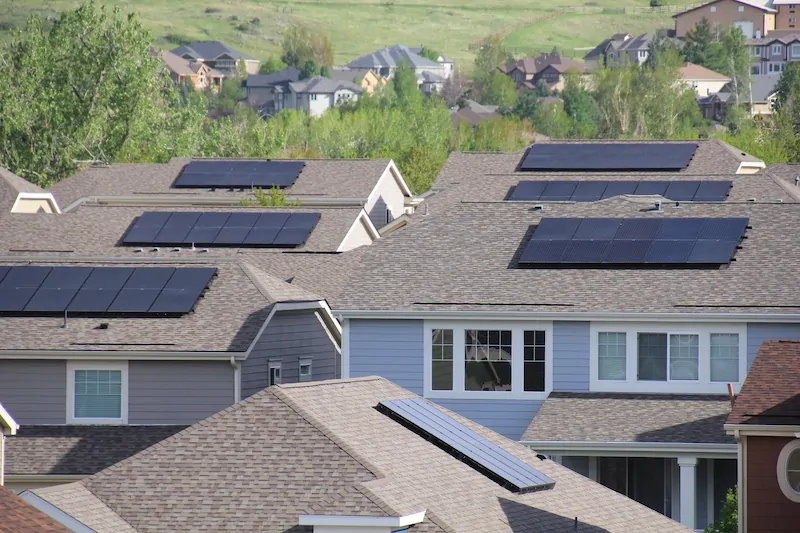
May 6, 2023 – Volunteers with the National Renewable Energy Laboratory’s (NREL’s) ESCAPES (Education, Stewardship, and Community Action for Promoting Environmental Sustainability) program lend a hand to Jack’s Solar Garden in Longmont, Colo. Bethany Speer (left) goes back for more while Nancy Trejo distributes her wheelbarrow load to the agrivoltaic plots. (Photo by Bryan Bechtold / NREL)
Click the link to read the article on The Denver Post website (Alexa St. John). Here’s an excerpt:
October 6, 2025
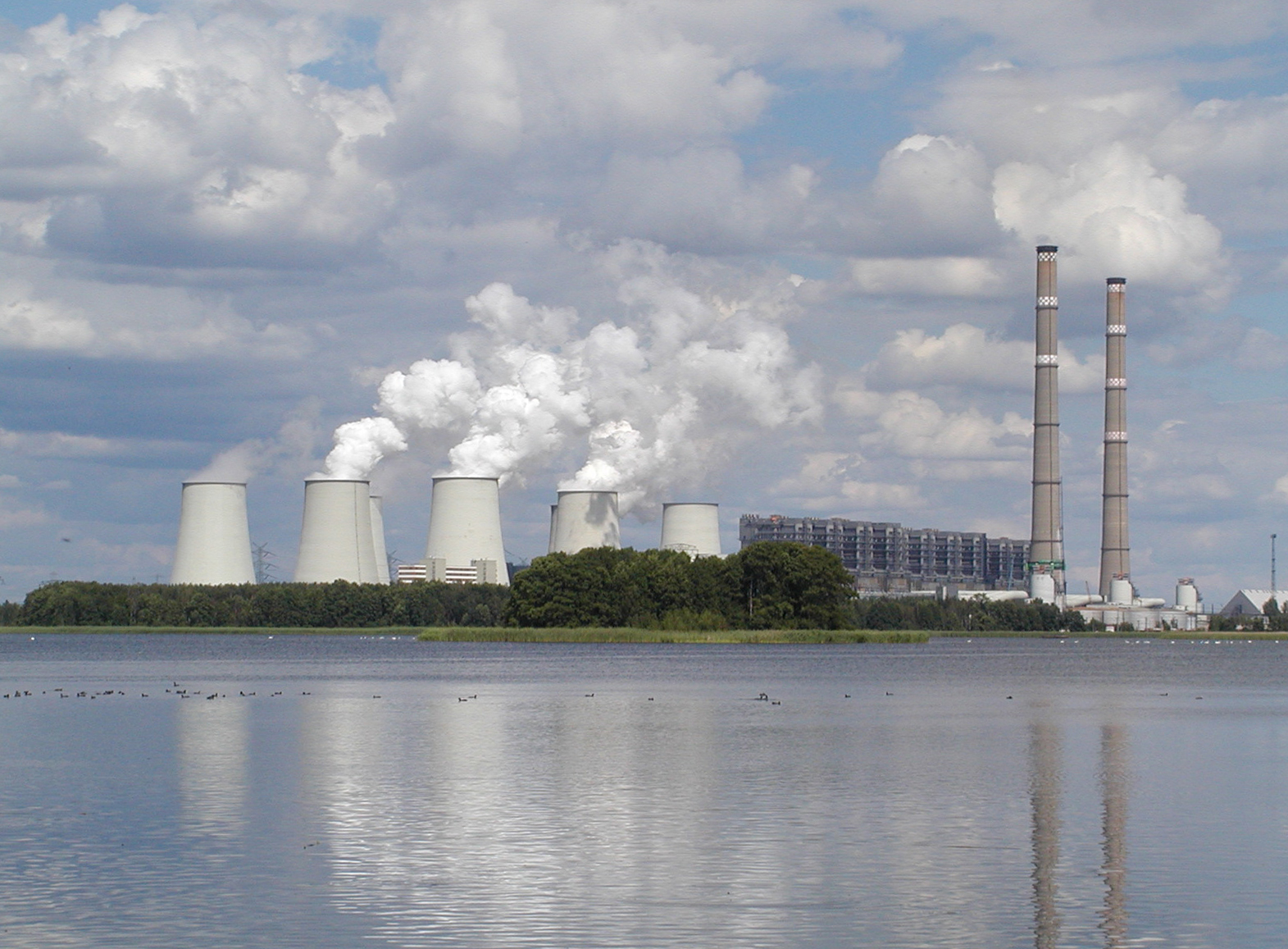
Worldwide solar and wind power generation has outpaced electricity demand this year, and for the first time on record, renewable energies combined generated more power than coal, according to a new analysis. Global solar generation grew by a record 31% in the first half of the year, while wind generation grew by 7.7%, according to the report by the energy think tank Ember, which was released after midnight Tuesday London time. Solar and wind generation combined grew by more than 400 terawatt hours, which was more than overall global demand increased in the same period, it found. The findings suggest it is possible for the world to wean off polluting sources of power — even as demand for electricity skyrockets — with continued investment in renewables including solar, wind, hydropower, bioenergy and geothermal energies.
“That means that they can keep up the pace with growing appetite for electricity worldwide,” said Małgorzata Wiatros-Motyka, senior electricity analyst at Ember and lead author of the study.
At the same time, total fossil fuel generation dropped slightly, by less than 1%.
“The fall overall of fossil may be small, but it is significant,” said Wiatros-Motyka. “This is a turning point when we see emissions plateauing.”
The firm analyzes monthly data from 88 countries representing the vast majority of electricity demand around the world. Reasons that demand is increasing include economic growth, electric vehicles and data centers, rising populations in developing countries and the need for more cooling as temperatures rise. Meeting that demand by burning fossil fuels such as coal and gas for electricity releases planet-warming gases including carbon dioxide and methane. This leads to more severe, costly and deadly extreme weather.
“America’s Data Centers Could Go Dark,” the subject line of the email read.
If only, I mused. I’m less worried about data centers going dark than about everything else going dark because of data centers. But whatever. That’s not what the PR person (or AI bot?) who sent the email was trying to say. They were there to ask, rhetorically: “Can Microreactors Save the Day?”They then offered to connect me with James Walker, CEO of a firm called NANO Nuclear Energy, who would then try to sell me on his KRONOS MMR™, described as a “compact, carbon free” way to power data centers.
There is a lot of hysteria around data centers these days. Folks like me are worried about how much energy and water they use, and the effect that might have on the grid, the climate, scarce water supplies, and other utility customers. Others are panicking over the possibility that the U.S. might fall behind in the AI race — though I have no idea what winning the race would entail or look like.
And, in our capitalistic system, where there is fear, there are myriad solutions, most of which entail building or making or consuming more of something rather than just, well, you know, turning off the damned data centers. The Trump administration would solve the problem by subsidizing more coal-burning, while the petroleum industry is offering up its surplus natural gas. Tech firms are buying up all the power from new solar arrays and geothermal facilities, long before they’re even built.
Perhaps the most hype, and the loftiest promises of salvation, however, involve nuclear power and a new generation of reactors that are smaller, portable, require less up-front capital, and supposedly not weighed down with all of the baggage of the old-school conventional reactors, which not only cost a lot to build, but also tend to evoke visions of Chernobyl, Three Mile Island, or Fukushima.
Yet for all the buzz — which may be loudest in the Western U.S. — it’s far from certain that this so-called nuclear renaissance will ever come to fruition. The latest generation of reactors may go by slick, newfangled names, but they are still expensive, require dangerous and damaging mining to extract uranium for fuel, produce waste, are potentially dangerous — and are still largely unproven.
Experimental Breeder Reactor II on the Idaho National Laboratory. The reactor was shut down and decommissioned in 1994. Now Oklo is building a new reactor, using similar technology, nearby. Jonathan P. Thompson photo.
Several years ago I visited Experimental Breeder Reactor I, located west of Idaho Falls. It has been defunct since 1963 and is now a museum, and a sort of time capsule taking one back to heady times when atomic energy promised to help feed the exploding, electricity-hungry population of the post-war Western U.S. and its growing number of electric gadgets (remember electric can openers?).
The retro-futuristic facility is decked out with control panels and knobs and valves and other apparatus that possess the characteristic sleek chunkiness of mid-century high-tech design. A temperature gauge for the “rod farm” goes up to 500 degrees centigrade, and if you look closely you’ll see a red button labeled “SCRAM” that, if pushed, would have plunged the control rods into the reactor, thereby “poisoning” the reaction and shutting it down. If you have to push it, you’d best scram on out of there.
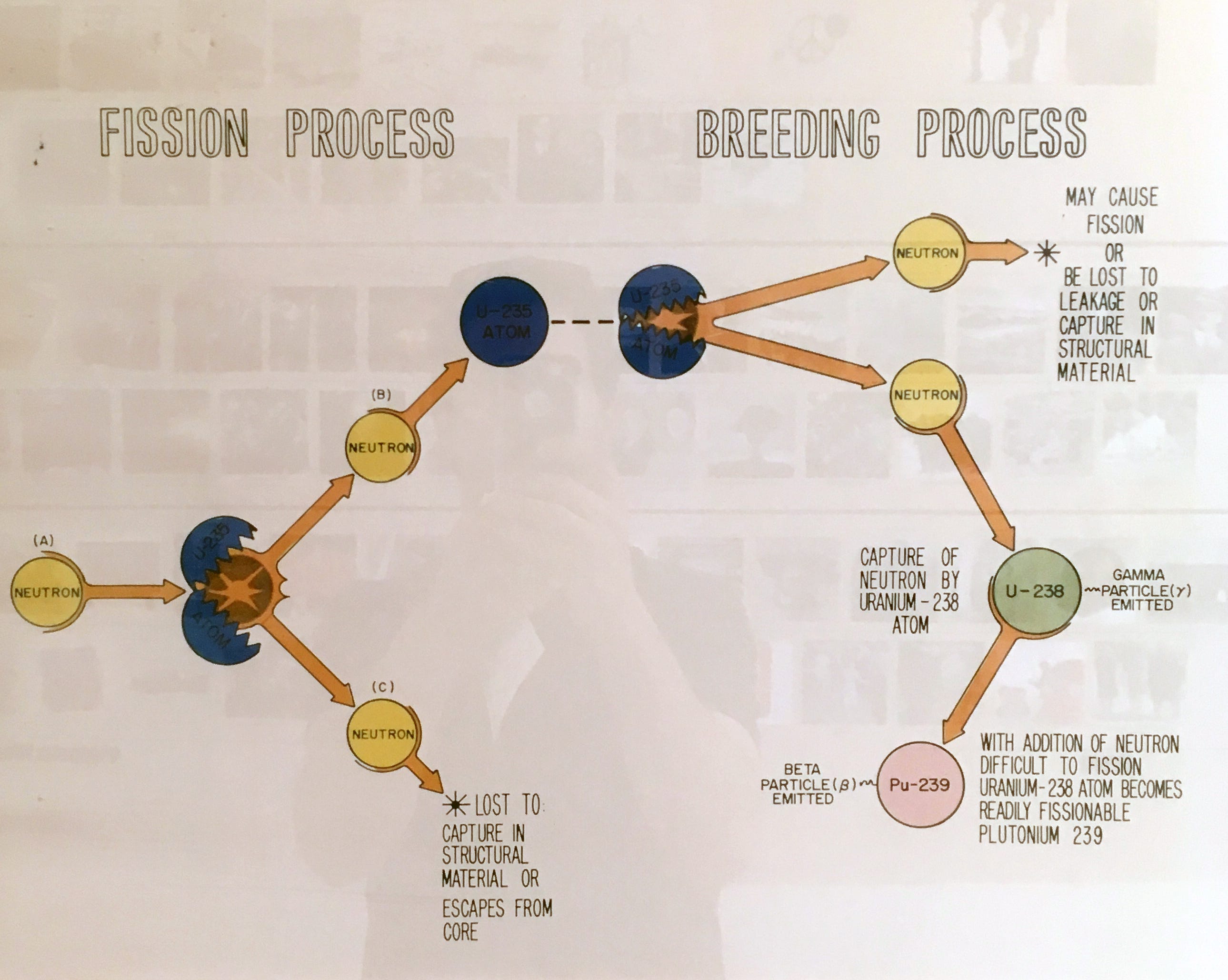
I couldn’t help but get caught up in the marvels of the technology. On a cold December day in 1951, scientists here had blasted a neutron into a uranium-235 atom and shattered it, releasing energy and yet more neutrons that split other uranium atoms, causing a frenetically energetic chain reaction identical to the one that led to the explosions that annihilated Hiroshima and Nagasaki several years earlier. Mass is destroyed, energy created. Only this time the energy was harnessed not to blow up cities, but to create steam that turned a turbine that generated electricity that illuminated a string of lightbulbs and then powered the entire facility — all without burning fossil fuels or building dams.
This particular reactor was known as a “breeder” because its fuel reproduces itself, in a way. During the reaction, loose neutrons are “captured” by uranium-238 atoms, turning them into plutonium-239, which is readily fissionable, meaning it can be used as fuel for future reactions.
A diagram of the atomic fission and breeding process at Experimental Breeder Reactor-I in Idaho. The reactor began generating electricity in 1951. Jonathan P. Thompson photo.
At first glance it seems like the answer to the world’s energy problems, and two years after EBR-I lit up, Dwight D. Eisenhower delivered his 1953 “Atoms for Peace” speech. Nuclear energy would help redeem the world from the terrible scourge of atomic weapons, the president said; it would be used to “serve the needs rather than the fears of the world — to make the deserts flourish, to warm the cold, to feed the hungry, to alleviate the misery of the world.”*
Now, with Arizona utilities teaming up to develop and build new reactors; with Wyoming’s, Idaho’s, and Utah’s governors collaborating on their nuclear-powered “Energy Superabundance” effort; and with Oklo looking to build a modern version of EBR-I not far from the original, it’s beginning to feel like 1953 all over again. Only now the nuclear reaction promises to serve the needs of cyberspace rather than the real world — to make AI do your homework, to cool the server banks, to feed the Instagram feeds, to send out those Tik-Toks at twice the speed.
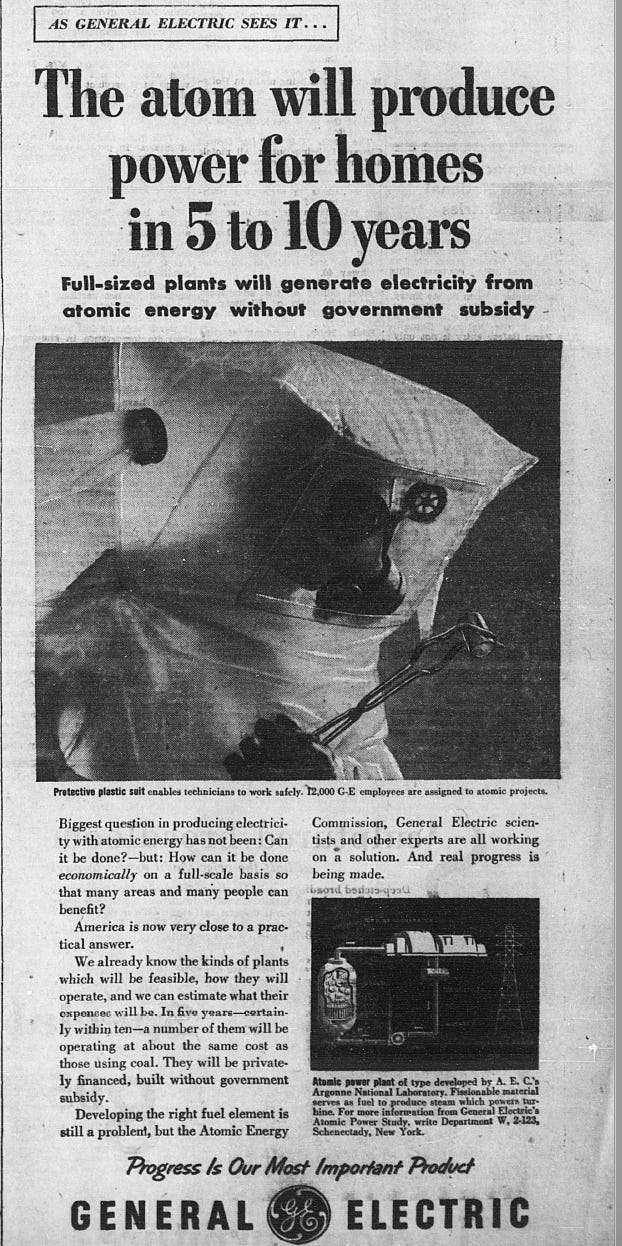
Advertisement from 1954.
Seven decades later, Eisenhower’s hopes have yet to be fulfilled.
It turns out a lot of people aren’t comfortable with the idea nuclear reactions taking place down the road, regardless of how many safety backstops are in place to avoid a catastrophic meltdown a la Chernobyl. Nuke plants cost a lot of money and take forever to build. They need water for steam generation and for cooling, which can be a problem in water-constrained places and even in water-abundant areas: Diablo Canyon nuke plant sucks up about 2.5 billion gallons of ocean water to generate steam and to cool the reactors, before spitting it — 20 degrees warmer — back into the Pacific. This kills an estimated 5,000 adult fish each year, along with an additional 1.5 billion fish eggs and fry and messes up water temperature and the marine ecosystem. And while nukes are good at producing baseload power (meaning steady, 24/7 generation), they aren’t very flexible, meaning they can’t be ramped up or down to accommodate fluctuating demand or variable power sources like wind and solar.
And then there’s the waste. The nuclear reaction itself may seem almost miraculous in its power, simplicity, and even purity.
But the steps required to create the reaction, along with the aftermath, are hardly magical. To fuel a single reactor requires extracting hundreds of thousands of tons of ore from the earth, milling the ore to produce yellowcake (triuranium octoxide), converting the yellowcake to uranium hexafluoride gas, enriching it to concentrate the uranium-235, and fabricating the fuel pellets and rods.
Each step generates ample volumes of toxic waste products. Mining leaves behind lightly radioactive waste rock; milling produces mill tailings containing radium, thorium, radon, lead, arsenic, and other nasty stuff; and enrichment and fabrication both produce liquid and solid waste. It has been about 40 years since the Cold War uranium boom busted, and yet the abandoned mines and mills are still contaminating areas and still being cleaned up — if you can ever truly clean up this sort of pollution.
Yet the reaction, itself, generates the most dangerous form of leftovers, containing radioactive fission products such as iodine, strontium, and caesium and transuranic elements including plutonium. This “spent nuclear fuel,” or radioactive waste, is removed from the reactor during refueling and for now is typically stored on site. Efforts to create a national depository for these nasty leftovers have failed, usually because the sites aren’t deemed safe enough to contain the waste for a couple hundred thousand years, or because locals don’t want it in their back yard. If it were to fall into the wrong hands, it could be used in a “dirty bomb,” a conventional explosive that scatters radioactive material around an area.
Plus, breeder reactors, especially, produce plutonium, which can then be used in nuclear warheads (India used U.S.-supported breeder technology to acquire nuclear weapons). That’s one of the reasons folks soured on the technology and the U.S. ended its federal plutonium breeder reactor development program in the 1980s. The other reasons were high costs and sodium coolant leaks (and resulting fires). After the EBR-I shut down in 1963, because it was outdated, the Idaho National Laboratory built EBR-II nearby. It was shut down and decommissioned in 1994.
Nevertheless, Oklo — one of the rising new-nuke stars — is touting its use of similar technology as the EBR-II, i.e. liquid-metal-cooled, metal-fueled fast reactor, as a selling point for the reactor it is currently developing at the INL.
The envisioned new fleet of reactors go by many names: SMRs, or small modular reactors, and advanced, fast, micro, or nano-reactors. Most of them can be fabricated in a factory, then trucked to or assembled on-site. Some are small enough to fit in a truck. They can be used alone to power a microgrid or a data center, or clustered to create a utility-scale operation that feeds the grid.
Their main selling point is that they require less up-front capital than a conventional reactor, that you can build and install one of these things for a fraction of the cost and a fraction of the time (once the reactors are actually licensed, developed, and produced on a commercial scale, which is still not the case).
A decade ago, companies like NuScale were also promoting them as ways to power the grid in a time of increasing restraints on carbon. Now that the feds are not only declaring climate change a “hoax,” but also forbidding agencies from even uttering the term, that no longer carries as much weight. Instead, almost every new proposal now is marketed as a “solution” to the data center “problem.” Google, Switch, Amazon, Open AI, and Meta are all looking to power their facilities with nukes, if and when they are finally up and running.
The new technology is not monolithic. Some are cooled in different ways, or use different types of fuel, but they all work on the same principle as old-school conventional reactors. As such, they also require the same fuel-production process, also have potential safety issues, and also create hazardous waste.
In fact, a 2022 Stanford study found that small modular reactors could create more, and equally hazardous, waste than conventional reactors per unit of power generated. The authors wrote: “Results reveal that water-, molten salt–, and sodium-cooled SMR designs will increase the volume of nuclear waste in need of management and disposal by factors of 2 to 30 {compared to an 1,100 MW pressurized water reactor}.”
The cost thing isn’t all that clear cut, either. The smaller reactors may be cheaper to build, but because they don’t take advantage of economies of scale, they are more expensive per unit of electricity generated than conventional reactors, and still can be cost prohibitive.
In 2015, for example, Oregon-based NuScale proposed installing 12 of its 50-MW small modular reactors at the Idaho National Laboratories to provide 600 MW of capacity to the Utah Associated Municipal Power Systems, or UAMPS (which also includes a handful of non-Utah utilities). In 2018 — after receiving at least $288 million in federal subsidies — NuScale upped the planned capacity to 720 MW, saying it would lower operating costs.
But what started out as a $3 billion project in 2015 kept increasing, so that even after it was ramped down to 421 MW, the projected price tag had ballooned to $9.3 billion in 2023 (still about one-third of the cost of the new Vogtle plant in Georgia, but with a fraction of the generating capacity). UAMPS’s collective members, realizing there were plenty of more cost-effective ways to keep their grids running, canceled the project later that year.
It kind of makes you wonder: Is this new wave of nuclear reactors solving the data center energy demand problem? Or are data centers’ energy-gobbling habits solving the nuclear reactors’ cost and feasibility problems?
I suspect it’s a little bit of both, with the balance swinging toward the latter. In that case, nuclear reactors are not alone: The Trump administration is using data center demand as the prime justification for propping up the dying coal industry.
Before the Big Data Center Buildup, utilities really had no need for expensive, waste-producing reactors — they could more cheaply and safely build solar and wind installations with battery storage systems for backup. If needed, they could supplement it with geothermal or natural gas-fired peaker plants.
But if data centers end up demanding as much power as projected (like 22,000 additional megawatts in Nevada, alone), utilities will need to pull out all the stops and add generating capacity of all sorts as quickly as possible, or they’ll tell the data centers to generate their own power. Either scenario would likely make small nukes more attractive, even if they do cost too much, and even if it means that data centers end up being radioactive waste repositories, too.
Another plausible scenario is that the tech firms figure out ways to make their data centers more efficient; that it’s more cost-effective (and therefore profitable) to develop less energy- and water-intensive data processing hardware than to spend billions on an experimental reactor that may not be operating for years from now.
What a novel concept: To use less, rather than always hungering for more and more and more.
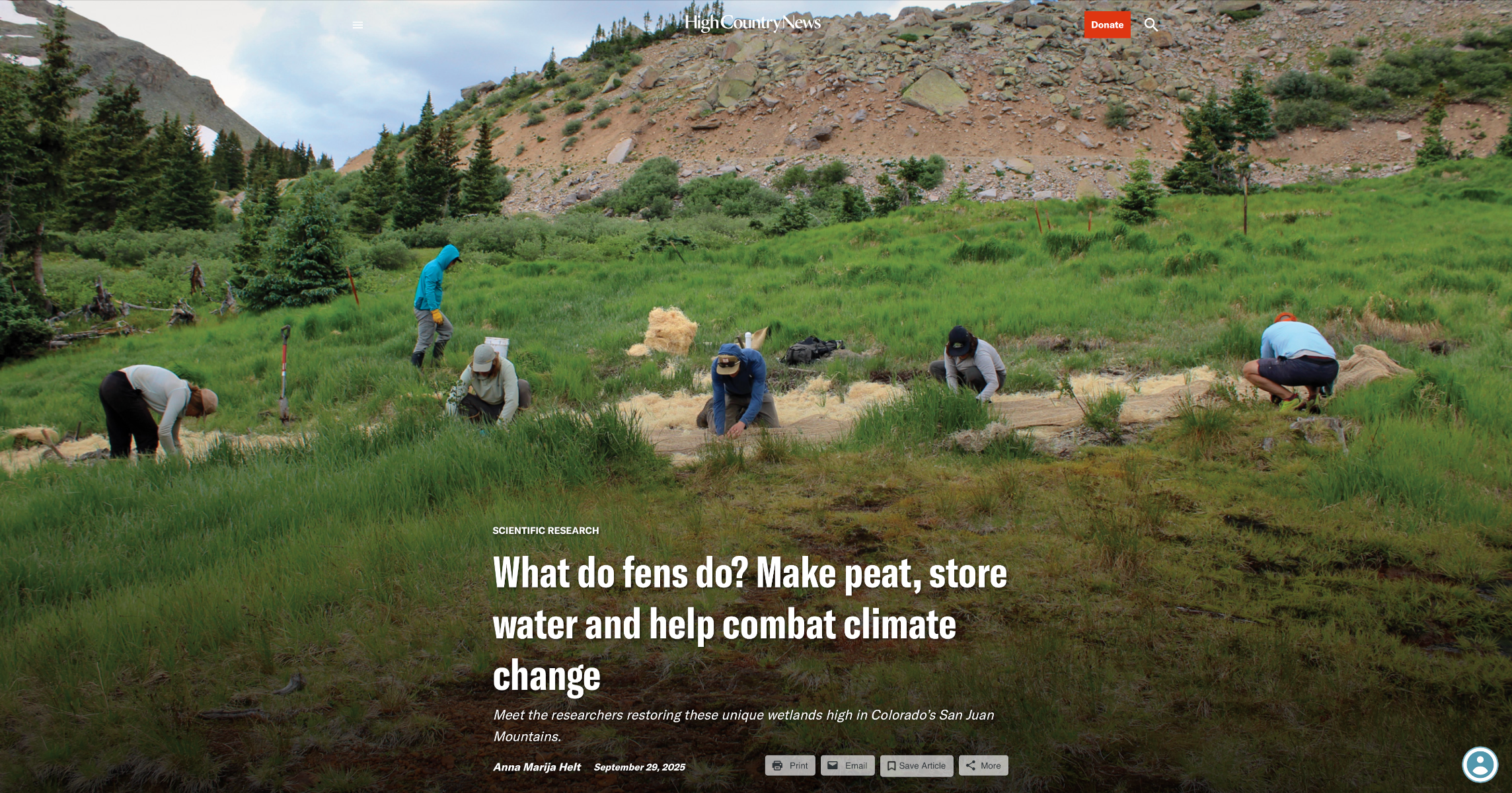
Scientists secure jute netting over mulch on a newly planted section of the Ophir Pass fen in Colorado’s San Juan Mountains. Anna Marija Helt/High Country News
The resinous scentof Engelmann spruce wafted over a shallow, mossy pool surrounded by lush sedges near the 11,800-foot summit of Ophir Pass, in southwestern Colorado’s rugged San Juan Mountains. This type of wetland, known as a fen, forms when perennial water saturates the ground, limiting plant decomposition and allowing organic matter to accumulate as peat.
Just downhill, however, on that hot, sunny July day, another part of the fen was visible: a degraded area, bare soil exposed on a steep slope.
Peatlands — fens and bogs — are key climate regulators. (Bogs are maintained by precipitation, but fens, which, in North America, occur in the Northeast, Midwest and Mountain West, depend on groundwater.) Their peat retains plant carbon that would otherwise decompose and be released as carbon dioxide. Despite covering only about 4% of Earth’s land area, peatlands store a third of the world’s soil carbon — twice the amount trapped in forest biomass. “Fens are old-growth wetlands,” said Delia Malone, a recently retired field ecologist with the Colorado Natural Heritage Program. Some of Colorado’s fens are over 10,000 years old.
In relatively dry southern Colorado, they also provide a secondary round of water storage. The first round is Colorado’s snowpack, which, as it melts, feeds groundwater that fens’ spongy peat captures and later releases to dwindling waterways and drying landscapes after the snow is gone.
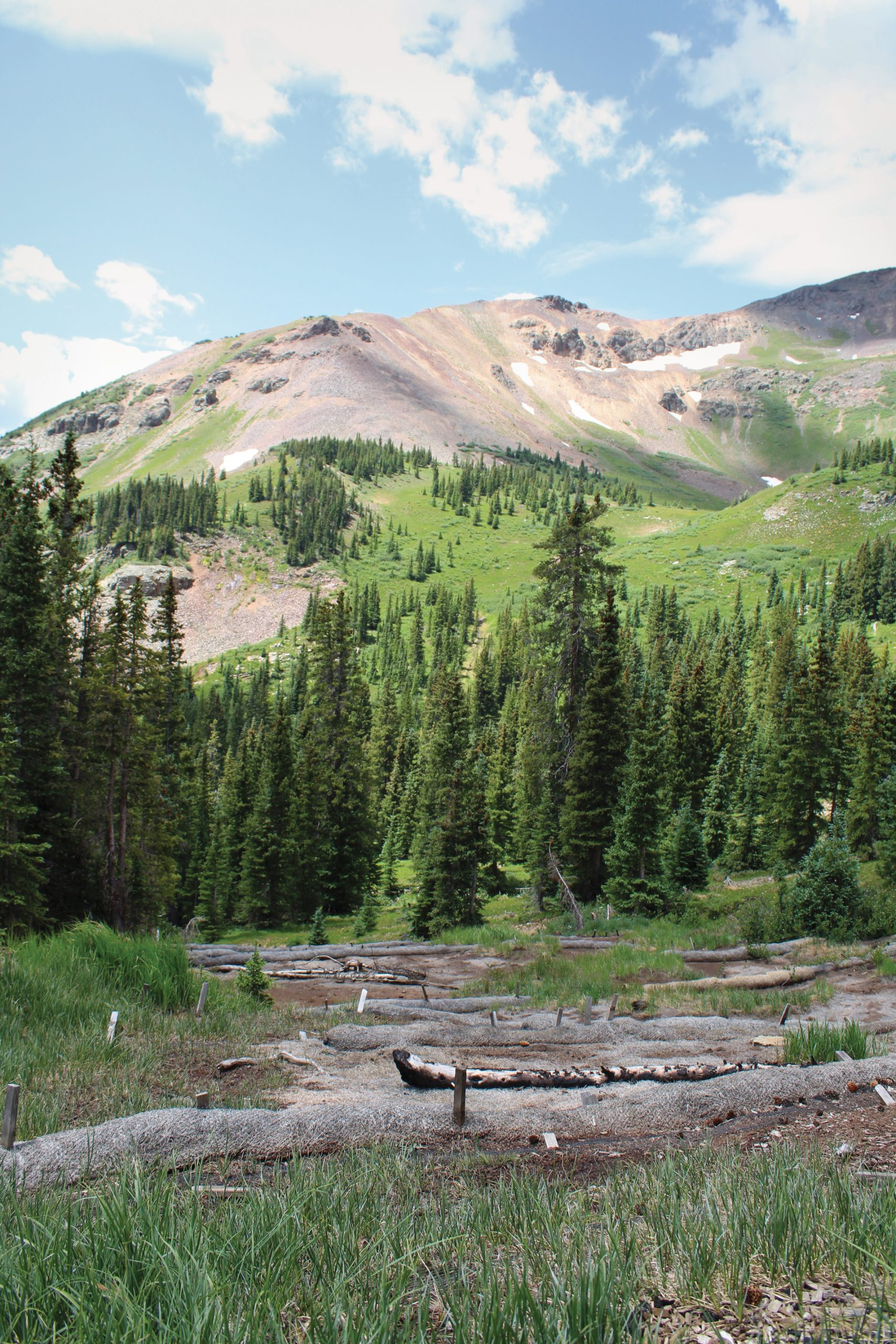
But the steep and degraded bare patch at Ophir Pass no longer functions. Where sedges, mosses, bog birch and other wetland species should be thriving, white PVC groundwater testing wells dot the ground, and heavy straw tubes called wattles reduce water and sediment runoff into the creek below.
“This is the steepest peatland we’ve ever tried to restore, as far as I know,” said wetland ecologist Rod Chimner, a professor at Michigan Tech. In the Rockies, fens lie at high elevations, which complicates restoration. Approximately 2,000 fens have been mapped so far in the San Juans, and about 200 need work. Chimner’s Ph.D. advisor, David Cooper, began restoring the area’s fens decades ago, and together they’ve literally written the book on mountain peatland restoration. Now, Chimner and staff from Mountain Studies Institute (MSI) — a local nonprofit research and education center — are restoring an ecosystem born from the last ice age but damaged by bulldozing in the 1970s.
Dams, road-building and other human activities harm Colorado’s fens, which can take 1,000 years to build just 8 inches of peat soil. The Ophir Pass fen is a rare iron fen, fed by groundwater rendered acidic by iron pyrite. The resulting chemistry supports unique plant communities — and leaves iron and other minerals incorporated in the peat or deposited in hardened layers. This fen was likely damaged by bog iron mining, which has degraded several iron fens in the San Juans.
Wattles on a steep degraded section of the fen. Anna Maria Helt/High Country News
Lenka Doskocil examines roots in peat that could be centuries old. Anna Maria Helt/High Country News
A restored pool flanked by sedges. Anna Maria Helt/High Country News
CLOUDS STARTED TO BUILD as workers used hand saws to extract plugs of sedge and soil from a healthy, already restored part of the fen. Like Goldilocks’ bed, the plugs have to be just right: Too large or too many, and digging them up disturbs the soil surface; too small, and they won’t survive transplantation. “As long as it has at least one rhizome, it will plant and spread,” said Lenka Doskocil, a research associate with MSI’s Water Program and Chimner’s graduate student. She split a plug, revealing rhizomes embedded in the rusty-brown peat, then nestled it into a bucket of plugs. Sometimes, workers plant nursery plugs or greenhouse starts from seeds collected in the area.
Chimner and Doskocil hauled the first bucket of plugs up to the bare patch, began digging small, regularly spaced holes, then gently inserted one sedge plug per opening. A stiff breeze provided relief as several other people joined in. “Take your time and do it right,” Chimner said encouragingly as he stepped back to observe. Otherwise, the plugs wouldn’t take.
Doskocil spotted an older plug protruding from the soil. But it wasn’t from rushed planting: Frost heave, a freeze-thaw cycle that thrusts soil upwards, had kicked it out of the ground, she said, tucking it back in. Frost heave complicates planting and breaks rhizomes, preventing nearby plants from colonizing bare soil. But Chimner’s past research has yielded a solution: Team members insulated the surface around each newly transplanted sedge with Excelsior, a shredded aspen mulch tough enough to withstand several winters. “We’re giving them little down jackets,” Chimner said.
A rhythm of extract-portage-dig-plant-mulch ensued as the iron-painted ridge of Lookout Peak towered to the north. A passenger yelled “thank you” from a truck descending the pass. Doskocil broke open a handful of peat, revealing roots that were hundreds of years old, if not older.
Planting the steepest quarter acre here has been difficult, and a 2021 fire didn’t help. “We’re kind of starting all over again” in that section, Chimner explained. They’re experimenting with direct seeding, which is common in wetland restoration, but challenging at the high-elevation site. “I’ve seeded here three times,” said Haley Perez, a community science program assistant with MSI.
Conservation biologist Anthony Culpepper, associate director of MSI’s Forest Program, gestured uphill toward what used to be a bare “Mars slope.” He listed the challenges: timing, winds that blow seeds away, variable winter and monsoonal precipitation, a short growing season, a sunbaked slope and animals that eat the seeds. Still, over many seasons and with multiple collaborators — several federal agencies, San Juan National Forest, Purgatory Village Land, the National Forest Foundation, San Juan Citizens Alliance and others — they’ve made great progress. That former Mars slope is now covered with mat-forming, soil-stabilizing wetland plants, including rare species.
The fen is wetter from strategic placement of wattles and check dams, wooden slats that slow surface water flow so that it soaks into the ground instead of running straight downhill. In turn, more groundwater has enabled transplantation and spread of thousands of plants. Much of the fen is now green, with mosses and other vegetation colonizing on their own. “This is the first time I’ve seen arnica at the site,” said Culpepper, who also noted the lack of invasives, a promising sign.
MSI takes an adaptive approach to restoration: Research guides planning and execution, and outcomes are carefully monitored to guide future work. That’s important in a region and state where rising temperatures and declining snowpack are predicted to lower water tables, which could disrupt new peat formation and even promote peat decomposition, potentially shifting some fens from carbon storage to carbon release. “How do we get our systems to a spot where they’re resilient enough to withstand the challenges that are going to continue to come?” asked Doskocil. MSI and its collaborators are working on it — at Ophir Pass; at Burrows Fen, a new project north of Silverton; and elsewhere throughout the San Juans.
Fat raindrops landed as the group debated whether to secure the mulch with a layer of jute netting. A wind gust decided it; they added the netting and then, just as the sun returned, trooped uphill to their vehicles to head home. Someone asked Chimner if he was satisfied with the day. “When I can look down and see all green, I’ll be satisfied,” he replied.
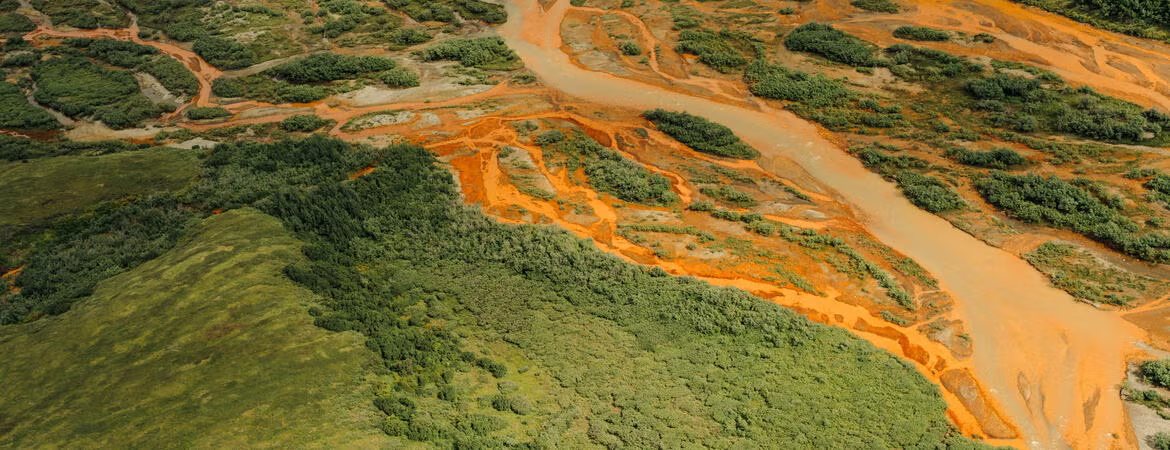
In Alaska’s Brooks Range, rivers once clear enough to drink from now run orange and hazy with toxic metals. As warming thaws formerly frozen ground, it sets off a chemical chain reaction that is poisoning fish and wreaking havoc on ecosystems.
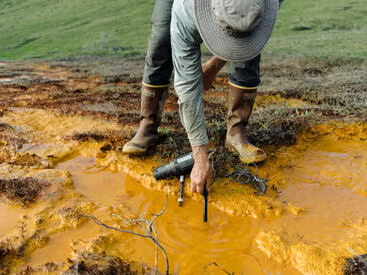
Researcher testing murky waters in Alaska’s Brooks Range. (Photo: Taylor Rhoades)
As the planet warms, a layer of permafrost — permanently frozen Arctic soil that locked away minerals for millennia — is beginning to thaw. Water and oxygen creep into the newly exposed soil, triggering the breakdown of sulfide-rich rocks, and creating sulfuric acid that leaches naturally occurring metals like iron, cadmium, and aluminum from rocks into the river.
Often times, geochemical reactions like these are triggered by mining operations. But that is not the case this time.
“This is what acid mine drainage looks like,” said Tim Lyons, a biogeochemist at the University of California, Riverside. “But here, there’s no mine. The permafrost is thawing and changing the chemistry of the landscape.”
How the Salmon River looked prior to the permafrost thawing. (Patrick Sullivan/University of Alaska)
A new paper detailing the severity of the contamination has been published in the Proceedings of the National Academy of Sciences. Though the study focuses on the Salmon River, researchers warn that similar transformations are already underway across dozens of other Arctic watersheds.
“I have worked and traveled in the Brooks Range since 1976, and the recent changes in landforms and water chemistry are truly astounding,” said David Cooper, Colorado State University research scientist and study co-author.
Ecologist Paddy Sullivan of the University of Alaska first noticed the dramatic changes in 2019 while conducting fieldwork on Arctic forests shifting northward — another consequence of climate change. A pilot flying Sullivan into the field warned him the Salmon River hadn’t cleared up after the snowmelt and looked “like sewage.” Alarmed by what he saw, Sullivan joined forces with Lyons, Roman Dial from Alaska Pacific University, and others to investigate the causes and ecological consequences.
The research team on site in the Alaska wilderness. (Photo: Taylor Rhoades)
Their analysis confirmed that thawing permafrost was unleashing geochemical reactions that oxidize sulfide-rich rocks like pyrite, generating acidity and mobilizing a wide suite of metals, including cadmium, which accumulates in fish organs and could affect animals like bears and birds that eat fish.
In small amounts, metals aren’t necessarily toxic. However, the study shows that levels of metals in the river’s waters exceed U.S. Environmental Protection Agency toxicity thresholds for aquatic life. In addition, the iron-clouded waters reduce the amount of light reaching the bottom of the river and smother insect larvae eaten by the salmon and other fish.
While current metal concentrations in edible fish tissue are not considered hazardous to humans, the changes to the rivers pose indirect but serious threats. Chum salmon, a key subsistence species for many Indigenous communities, might struggle to spawn in gravel beds choked with fine sediment. Other species, such as grayling and Dolly Varden, may also be affected.
Hoof prints serve as reminders that river contamination affects more than fish. There are implications for whole ecosystems. (Photo: Taylor Rhoades)
“It’s not just a Salmon River story,” Lyons said. “This is happening across the Arctic. Wherever you have the right kind of rock and thawing permafrost, this process can start.”
Unlike mine sites, where acid drainage can be mitigated with buffers or containment systems, these remote watersheds might have hundreds of contamination sources and no such infrastructure. Once the chemical process begins, the only thing that can stop it is recovery of the permafrost.
“There’s no fixing this once it starts,” Lyons said. “It’s another irreversible shift driven by a warming planet.” [ed. emphasis mine]
The study, funded by the National Science Foundation’s Rapid Response program, highlights the potential danger for other Arctic regions. The researchers would like to help communities and land managers anticipate future impacts and, when possible, prepare for them.
“There are few places left on Earth as untouched as these rivers,” Lyons said. “But even here, far from cities and highways, the fingerprint of global warming is unmistakable. No place is spared.”
Last week, Jeff Brigger, an executive with NV Energy, Nevada’s largest utility — and a Berkshire Hathaway subsidiary — told a gathering in Las Vegas that tech firms are asking the utility to supply up to 22,000 megawatts of electricity to support planned data centers.
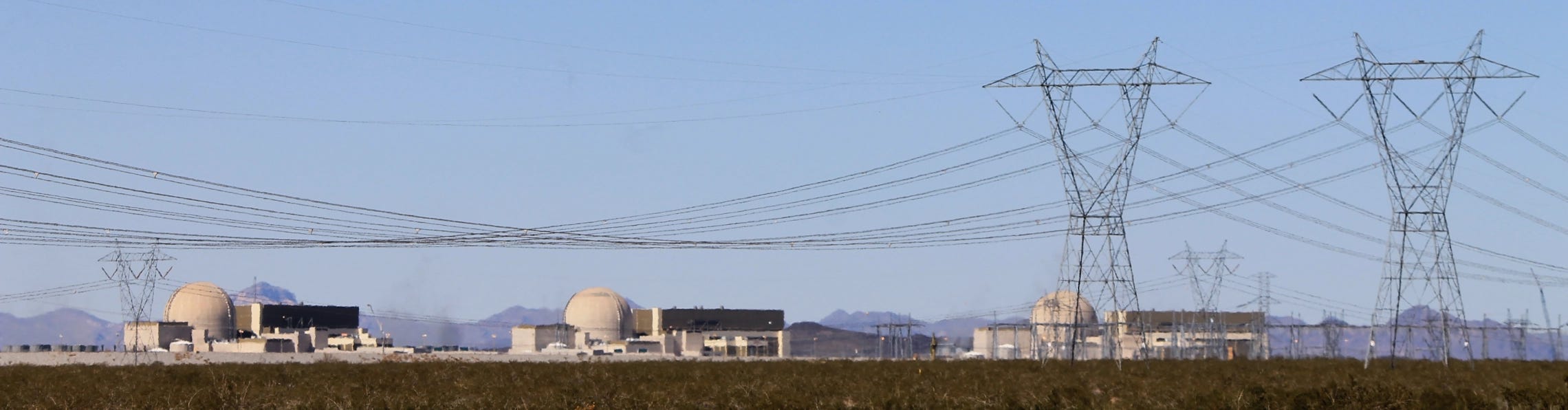
That is an insanely enormous amount of generation capacity. It’s about two-and-a-half times NV Energy’s current peak demand of 9,000 MW, according to a Las Vegas Review-Journal story. It’s enough to power about 11 million homes. And it’s equivalent to the generating capacity of five Palo Verde generating stations, the nation’s largest nuclear power plant.
Brigger noted, correctly, that these are “unprecedented times” before going on to say that the utility is “excited to serve this load.” I bet they are. Not only does it mean selling a hell of a lot more of their product, but it will also require investing in new infrastructure in a massive way, for which they can then recover the costs, with a profit, from all of their ratepayers. Warren Buffet’s about to get even richer — so long as power line-sparked wildfires don’t drain his utilities of all their cash.
To its credit, NV Energy has largely moved away from coal generation, shutting down its heavily polluting Reid Gardner plant near Moapa and replacing it with battery storage and solar. It is in the process of shutting down its North Valmy coal plant, too, but instead of tearing it down, the utility will convert it to run on natural gas, adding to its already substantial fleet of the fossil fuel-burning facilities. It’s likely that a portion of that requested 22,000 MW will come from new methane-fired plants.
But a great deal of the new capacity will also come from solar power. NV Energy is currently constructing the $4.2-billion Greenlink West transmission line between Las Vegas and Reno. And it is seeking Bureau of Land Management approval for its Greenlink North line that will run along Highway 50, also known as the Loneliest Road in America. These lines will open up hundreds of square miles of public land to utility-scale solar development, with most or all of the power going to data centers in the Reno and Las Vegas areas.
Proposed path of the Greenlink North transmission project. Credit: BLM
Look, I’d much rather see a solar or wind facility than a coal or natural gas plant. No matter how you figure it, the environmental and human health toll from burning fossil fuels is far greater than solar or wind power. A solar plant doesn’t spew sulfur dioxide and mercury and arsenic into the air (and bodies of those nearby); nor will it explode catastrophically, as a natural gas pipeline did this week in southern Wyoming, damaging a freight train and sending up flames visible from Colorado. Coal mining and natural gas extraction often occurs on public lands, damaging the ecosystem, fragmenting wildlife habitat, and polluting the water.
So it’s one thing when a new giant solar installation leads to a fossil fuel generator being retired. Yet the Big Data Center Buildup’s energy needs are so high that utilities end up deferring coal and gas plant retirements, building more gas plants, and carpeting public lands with solar. As the Center for Biological Diversity’s Patrick Donnelly put it in an email: “Turns out the destruction of the desert for renewable energy isn’t about displacing fossil fuels, it’s about feeding the big tech machine.”
Of course, at this point it’s anyone’s guess whether those solar and wind installations are ultimately built. While some are already under development in Nevada along the Greenlink West line, the Greenlink North line has yet to garner BLM approval. And since it is intended to carry primarily solar-generated electrons, it could face added scrutiny from the Trump administration. Meanwhile, Trump’s “Big Beautiful Bill” wiped out federal tax credits for solar and wind, making new developments less feasible.
It’s somewhat surprising that data centers continue to flock to the Las Vegas area given the water constraints. Nevada has butted up against the limits of its 300,000 acre-feet (down to 279,000 under current restrictions) Colorado River allotment for years. That has forced the Southern Nevada Water Authority to crack down on water consumption by banning new lawns, limiting pool sizes, and putting a moratorium on commercial and industrial evaporative cooling systems like those used by many data centers in arid regions.
As long as the moratorium stays in place — a Nevada lawmaker unsuccessfully tried to ban the ban this year — it will force new data centers in the Vegas-area to use less water-intensive, but more energy-intensive, cooling methods1. Still, the Las Vegas data centers that began operating prior to the 2023 ban use a lot of water: more than 716 million gallons, or about 2,200 acre-feet2, in 2024, according to Las Vegas Valley Water data obtained and reported by the Review-Journal.
It’s a bit overwhelming, especially since it all came on so fast. I looked back through the news and noticed that just five years ago talk about data centers’ energy and water use was confined to a few cryptocurrency miners setting up shop in rural Washington to take advantage of cheap hydropower. While the impact was big locally, it wasn’t yet throwing utilities’ long-term plans into disarray. But here we are.
In other data center news, the Doña Ana County commissioners voted 4-1 to approve tax incentives for Project Jupiter, a proposed $165 billion data center campus in Santa Teresa in the southeastern corner of New Mexico. Once again it’s a situation in which the community and region need the economic benefits and diversity the campus offered, but which is also short on water. As such, it sparked both opposition and support.
You may wonder why a place would try to lure, welcome, or even allow data centers into their communities, given their hefty resource consumption.
Sometimes they don’t: Tucson’s city council recently rejected a proposed data center after local residents raised concerns about water and power use and a lack of transparency. (The developers re-upped their proposal for a site outside the city, but opponents aren’t backing down).
The answer, as is often the case, is for the economic shot in the arm they offer. These sprawling facilities each create hundreds of construction jobs, which offer relatively high wages (even if they are short lived). Then they need employees to operate the centers (although not nearly as many). And they pay property taxes.
Right now, Las Vegas and Nevada as a whole seem to need a little help, given that they are one of the nation’s biggest victims of Trumponomics. Visitor volume to Las Vegas was down 11% in June and 12% in July compared to the same months in 2024, with hotel occupancy rates also taking a big hit. The state has lost 600 federal government jobs since Trump took office. And it has shed a whopping 7,300 construction jobs since January. Ouch.
On a similar note, Wyoming’s mining and logging sector shed about 1,000 jobs since January, a 6% drop. That’s surprising, given that this includes coal and uranium miners and oil and gas workers, who are supposed to be the main beneficiaries of Trump’s “energy dominance” agenda. Go figure.
🗺️ Messing with Maps 🧭
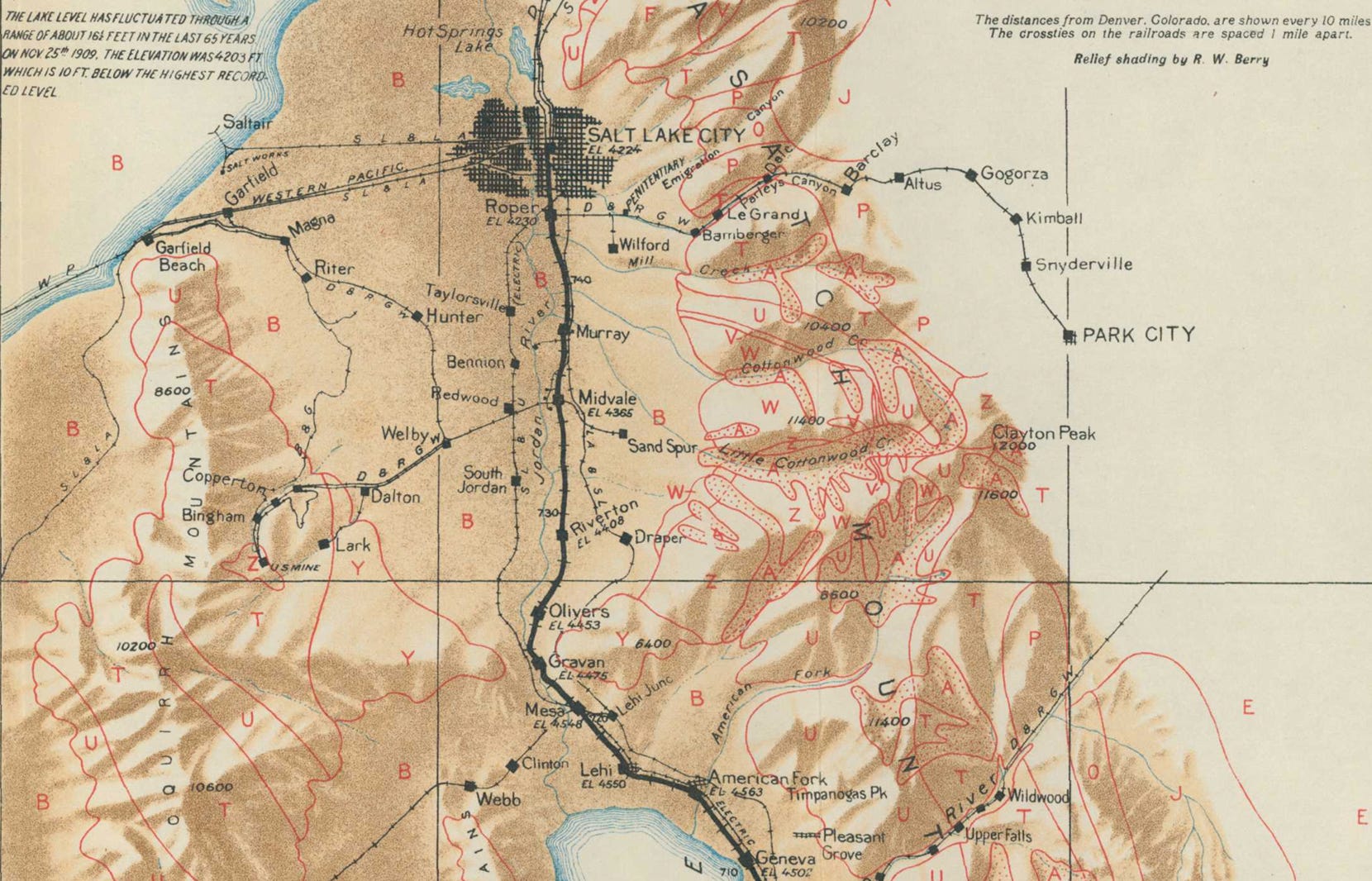
Here’s one more from the USGS’s Guidebook of the western United States: Part E – The Denver & Rio Grande Western route, published in 1922. This map shows a segment of the Wasatch Front in Utah. I’ve also included a Google Earth image of the same area now. It’s remarkable to me because back then Salt Lake City was a small city that stood on its own; now it’s surrounded by a sea of sprawl. Salt Lake was a bit bigger then (or rather, the lake level was higher than it was when the Google Earth image was made; when the map was made in 1909 it was 4,203 feet, now it’s about 13 feet lower). And Bingham Canyon still was a canyon, with little towns in it, rather than the gaping hole known as the Bingham Canyon copper mine.
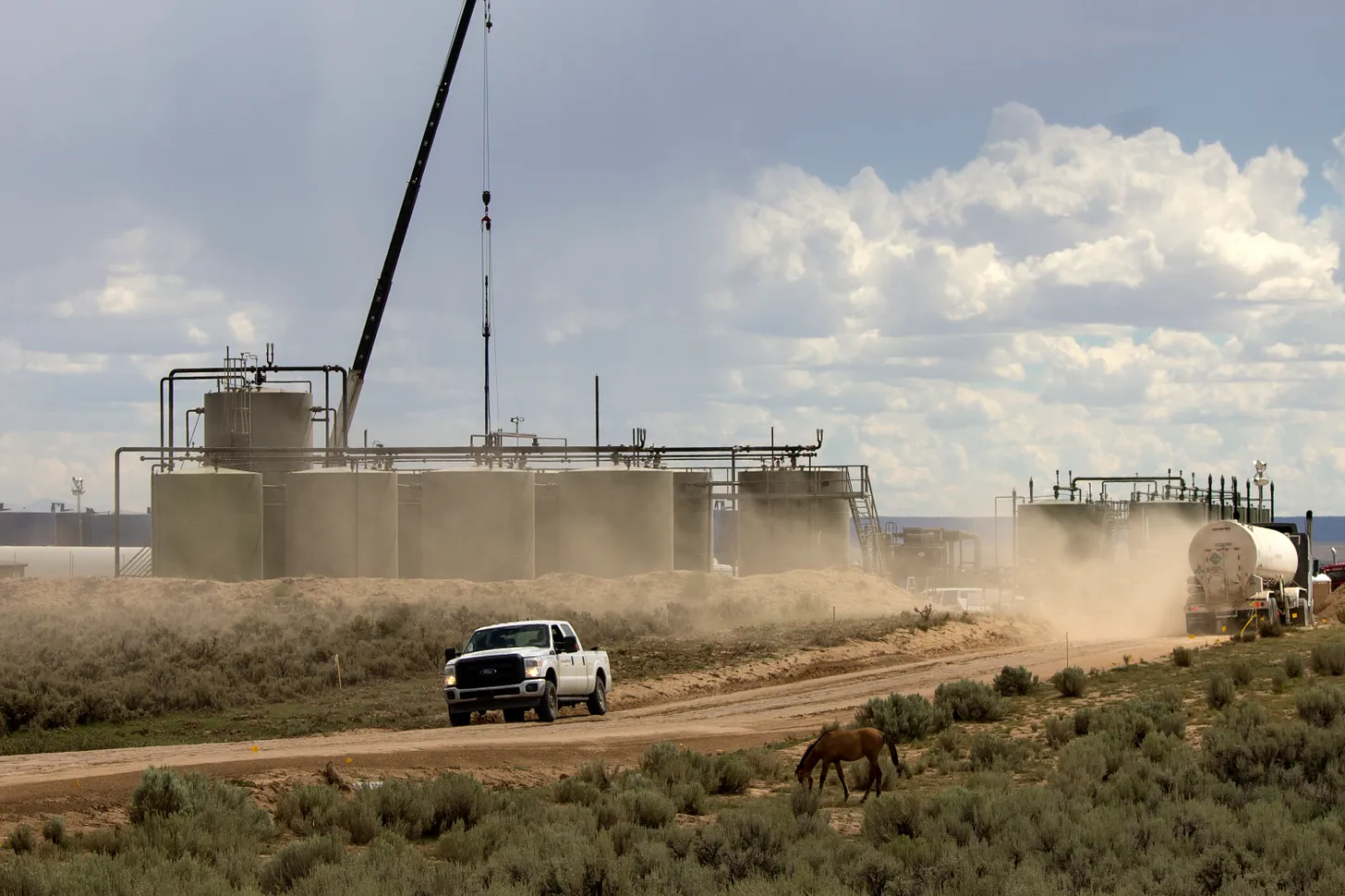
Oil and gas production on Bureau of Land Management land in Wyoming. The Trump Administration’s move to repeal a Biden-era conservation rule aligns with a greater push for energy production on public lands. Photo credit: Bureau Of Land Management
Click the link to read the article on the KUNC website (Rachel Cohen). Here’s an excerpt:
September 11, 2025
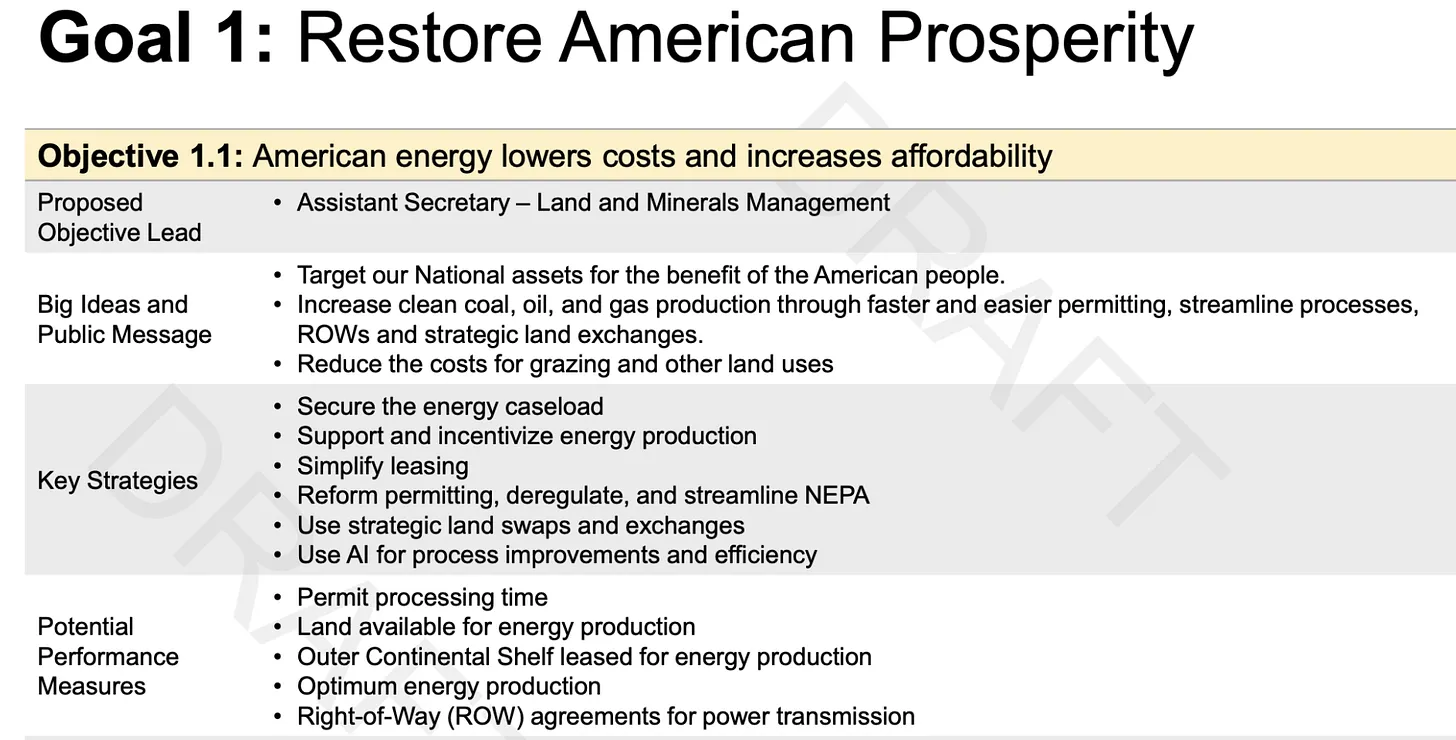
[President Trump’s] Administration is moving to repeal a major Biden-era rule that elevated conservation in federal land use decisions, paving the way for expanded energy production on public lands. The Public Lands Rule was among the Biden Administration’s signature efforts to protect and restore Bureau of Land Management (BLM) land in the face of climate change and increasing land fragmentation. The BLM is legally required to manage public lands for “multiple use” and “sustained yield” under the 1976 Federal Land Policy and Management Act, and also to maintain natural, cultural and historic resources for future generations. But critics say the agency prioritized extractive uses. The Public Lands Rule clarified that conservation could be an official use of the land, alongside grazing, oil and gas drilling, mining and logging. Among other things, it created a framework for leases focused on restoring or maintaining landscapes. In a press release Wednesday, Interior Secretary Doug Burgum announced the agency’s proposal to repeal the rule, saying promoting conservation in this way threatened to curtail traditional land uses.
“The previous administration’s Public Lands Rule had the potential to block access to hundreds of thousands of acres of multiple-use land – preventing energy and mineral production, timber management, grazing and recreation across the West,” said Secretary Burgum. “The most effective caretakers of our federal lands are those whose livelihoods rely on its well-being. Overturning this rule protects our American way of life and gives our communities a voice in the land that they depend on.”
They warn that humanity is just three years from overshooting the Paris Agreement’s 1.5°C target, with seas rising faster than ever. But the report also contains a little bit of good news.
The amount of heat trapped by climate-warming pollution in our atmosphere is continuing to increase, the planet’s sea levels are rising at an accelerating rate, and the Paris agreement’s ambitious 1.5°C target is on the verge of being breached, according to a recent report by the world’s top climate scientists.
“The news is grim,” said study co-author Zeke Hausfather, a former Yale Climate Connections contributor, on Bluesky.
A team of over 60 international scientists published the latest edition of an annual report updating key metrics that are used in reports of the Intergovernmental Panel on Climate Change, the leading international scientific authority on climate change.
Earth out of balance
Climate change is caused by variations in Earth’s energy balance – the difference between the planet’s incoming and outgoing energy. Nearly all incoming energy originates from the sun. The Earth absorbs that sunlight and sends it back out toward space in the form of infrared light, or heat. Greenhouse gases such as carbon dioxide absorb infrared light, and so increased levels in those gases trap more heat in the atmosphere, warming the planet’s surface and oceans.
The new report finds that as a result of this increasing greenhouse effect, Earth’s energy imbalance has been consistently rising every decade. In fact, the global imbalance has more than doubled just since the 1980s. And from 2020 to 2024, humans exacerbated the problem by adding about 200 billion more tons of carbon dioxide-equivalent greenhouse gases to the atmosphere.
This increase in trapped energy has continued to warm Earth’s surface temperatures. The new study estimated that at current rates, humans will burn enough fossil fuels and release enough climate pollution to commit the planet to over 1.5°C of global warming above preindustrial temperatures within about three more years, in 2028.
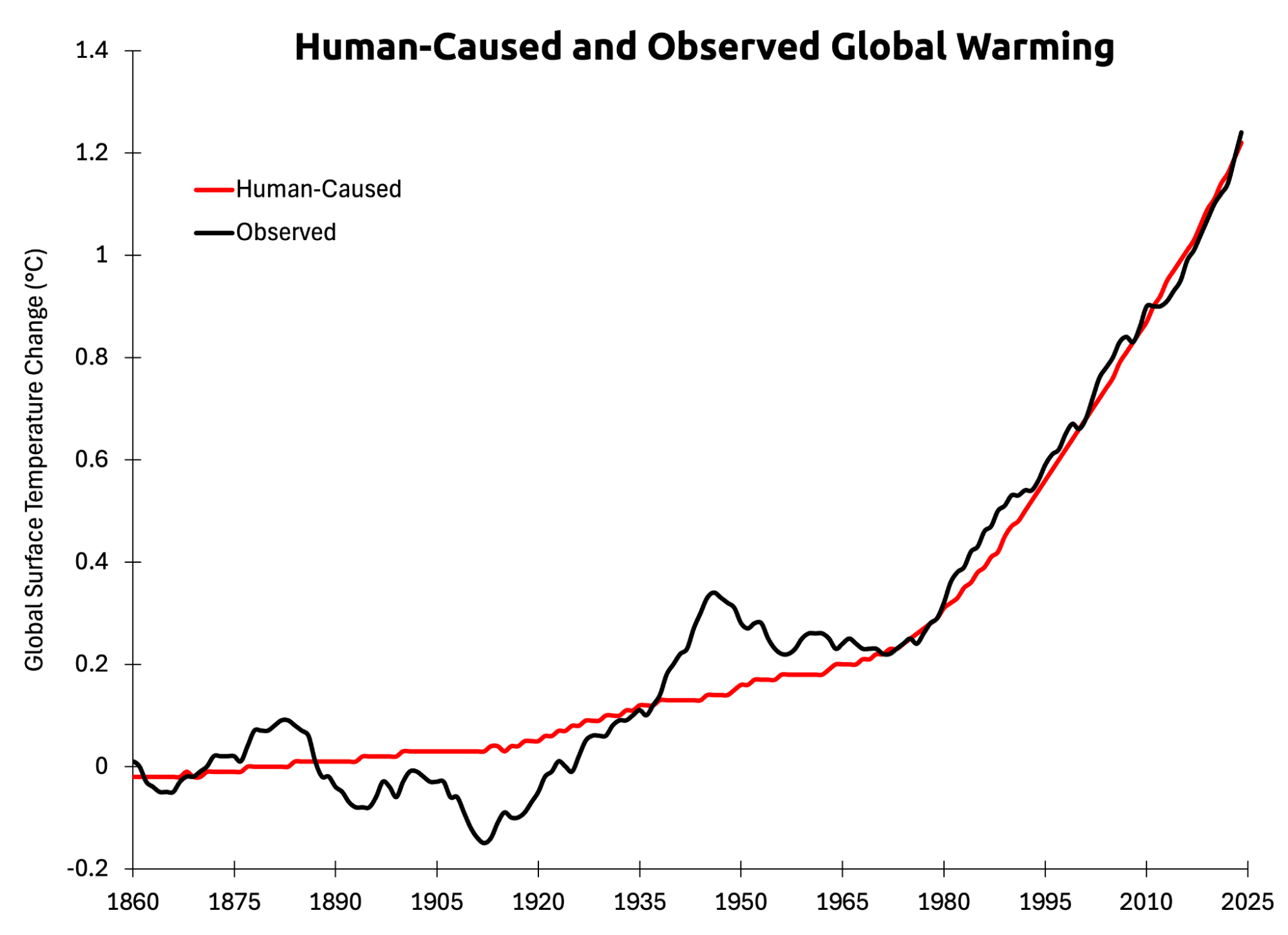
The most recent report from the Intergovernmental Panel on Climate Change, published in 2021, concluded that average temperatures had increased 1.09°C since the late 1800s. The new study updates this number to 1.24°C, driven largely by the record-shattering hot years of 2023 and 2024.
The paper also finds that global surface temperatures are warming at a rate of about 0.27°C per decade. That’s nearly 50% faster than the close to 0.2°C-per-decade warming rate of the 1990s and 2000s, indicating an acceleration of global warming.
Human-caused and total observed average global surface temperature increase since the Industrial Revolution. Created by Dana Nuccitelli with data by https://climatechangetracker.org/igcc from June 17, 2025.
That warming causes the water in the ocean to expand and land-based ice to melt, both of which contribute to rising sea levels. Since 1900, global sea levels have risen by nine inches, at an average rate of 1.85 millimeters per year. But the rate of sea level rise since 2000 has been twice as fast, at 3.7 millimeters per year. And over the past decade it’s risen faster yet, at 4.5 millimeters per year. In other words, sea level rise is also accelerating.
“Unfortunately, the unprecedented rates of global warming and accelerating sea-level rise are as expected from greenhouse emissions being at an all-time high,” University of Leeds climate scientist and the study’s lead author Piers Forster wrote by email.
Global mean sea level rise since the early 20th century, accelerating since the start of the 21st century. Created by Dana Nuccitelli with data by https://climatechangetracker.org/igcc from June 17, 2025.
A thin silver lining
Most, but not all, of the findings in the new paper are grim. For example, although humanity will almost certainly miss the more ambitious 1.5°C target in the Paris agreement, the study finds that its primary target of limiting global warming to 2°C remains within reach. At current emissions rates, 2°C global warming will be breached around midcentury, but that still leaves several decades to bring emissions down.
“Future emissions control future warming,” Forster said. “And if the world were to rapidly act on carbon dioxide and methane emissions, we could halve the rate of warming.”
The study identifies glimmers of hope that climate policies and solutions around the world could soon begin to move emissions in this direction.
“I think there is not much silver lining in the report per se given the apparent acceleration of warming,” Hausfather said in an email to Yale Climate Connections. “But I would note that global CO2 emissions have slowed notably over the past 15 years or so, and the cost of clean energy continues to fall. We are clearly moving away from the worst-case emissions scenarios, even if we are still heading toward potentially catastrophic warming of 3°C by 2100.”
China will be a key player in determining the future evolution of Earth’s climate. Because of its large population and rapid economic growth, China is responsible for nearly one-third of global climate pollution. But as the result of a rapid deployment of clean technologies, China’s emissions have begun to slightly decline over the past year.
“This is also the decade when global [greenhouse gas] emissions could be expected to peak and begin to substantially decline,” the report’s authors conclude. “Depending on the societal choices made in this critical decade, a continued series of these annual updates could track an improving trend.”
Please forgive me for being confused about the state of our nation, about the actions of our president, and about the reaction to it.
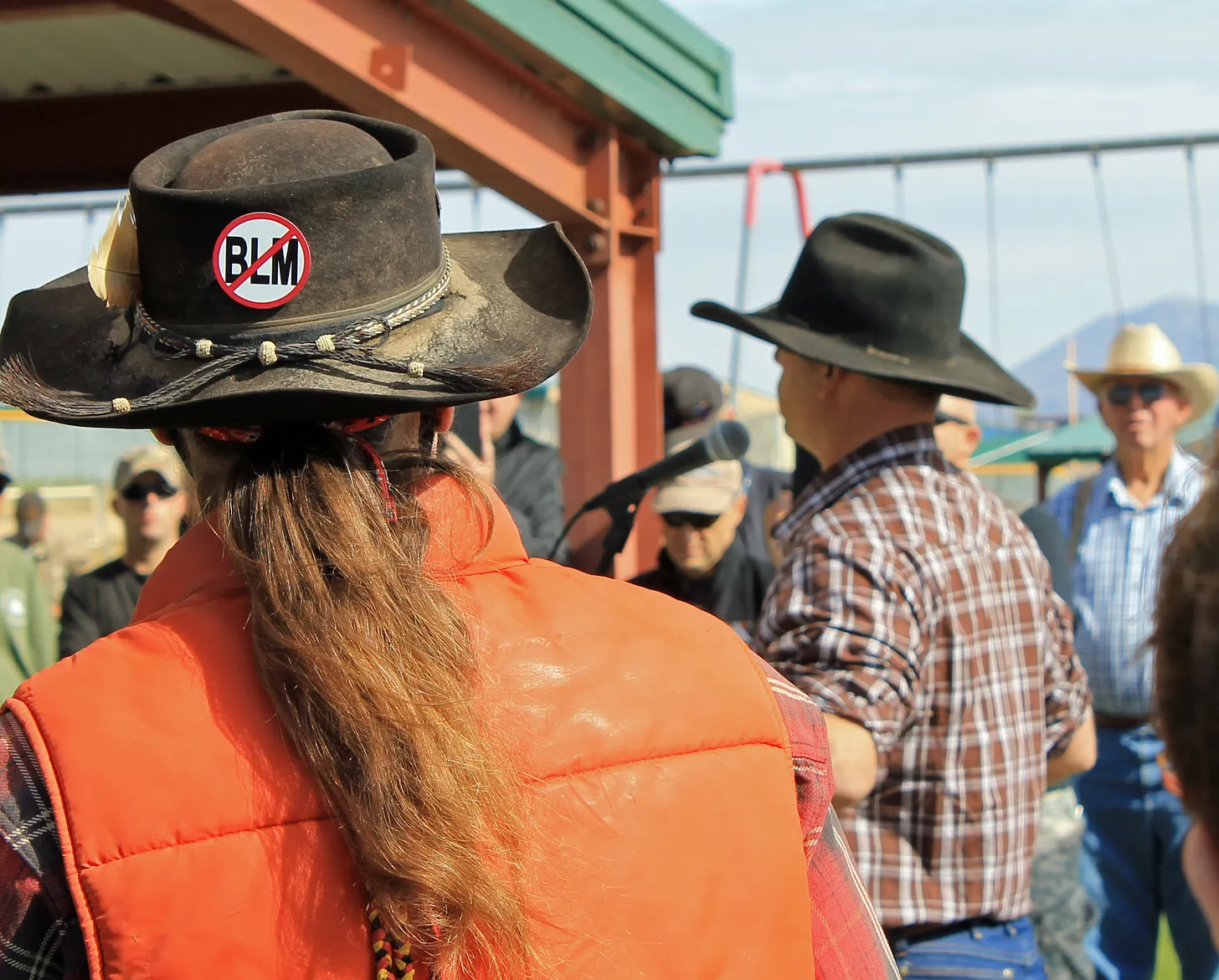
See, a decade ago, Western state politicians — particularly conservative Republicans and, if you will, Sagebrush Rebels — were up in arms, sometimes literally, about something they called “federal overreach.” In most cases, it referred to actions by the Bureau of Land Management and U.S. Forest Service that ranged from closing roads or prohibiting motorized vehicles in sensitive areas to attempting to round up cattle that had been grazing illegally on public land to arresting suspected pothunters to enforcing laws on federal land.
When a herd of assault-weapon toting self-proclaimed militia showed up at Cliven Bundy’s Bunkerville ranch in 2014, they were resisting federal overreach; when Phil Lyman led a flock of ATV riders down Recapture Canyon in Utah, he was protesting federal overreach; when Ammon and Ryan Bundy led the siege of the Malheur Wildlife Refuge in Oregon, they were protesting federal overreach.
In 2014, congressional Republicans even held a hearing on what they called “Threats, Intimidation, and Bullying by Federal Land Managing Agencies.” In this case, according to witnesses, “bullying” included enforcing the Endangered Species Act and failing to coordinate with the local sheriff.
Indeed, in 2011 Dennis Spruell, then-sheriff of Montezuma County, Colorado, threatened to arrest land management officials who dared to close roads across federal lands. He continued: “The sheriff is the ultimate law enforcement authority. I have an obligation to protect my county from enemies, both foreign and domestic. So if the federal government comes in and violates the law, it’s my responsibility to make sure it stops.”
A couple of years later, 28 Utah sheriffs wrote a letter to President Obama threatening violent revolt if he were to enact gun control. “No federal official will be permitted to descend upon our constituents and take from them what the Bill of Rights — in particular Amendment II — has given them,” they wrote. “We, like you, swore a solemn oath to protect and defend the Constitution of the United States, and we are prepared to trade our lives for the preservation of its traditional interpretation.”
All of which is a very wordy lead in to a question: Where the hell is the concern about federal overreach now?
The Trump administration is figuratively shredding the U.S. Constitution on an almost daily basis; masked federal ICE agents are terrorizing immigrants and citizens, alike; the administration is forcing utilities to keep operating coal plants; and not only has it sent the National Guard and even the Marines into Democratic-led cities unbidden in clear violation of states rights, but Trump himself declared “war” on an American city in a social media post. This makes a bit of BLM “overreach” look like child’s play.
If anything would warrant a response from the so-called militia, or the folks who oppose gun control because it would hamper their ability to resist tyranny, it would be this. Or so it seems. After all, sending the Marines to Los Angeles appears to have violated the Posse Comitatus Act, which makes it illegal “to employ any part of the Army of the United States, as a posse comitatus, or otherwise, for the purpose of executing the laws.” This Reconstruction-era law is often used by “constitutional” sheriffs and federal overreach crowd to bolster their positions.
So where’s Ryan Bundy and his pocket Constitution? Where are Richard Mack and the “constitutional sheriffs” and the folks that used to rail about posse comitatus? Where’s Phil Lyman, who repeatedly called the Obama administration and the BLM “despotic” for daring to increase protections on public lands and for sending in law enforcement officers to arrest folks who violated the Antiquities Act?
They are, it turns out, nowhere to be found. The reason is obvious: All of the “federal overreach” grievance was performative. An act based not on principle, but on false victimhood, on a sense of entitlement, on a selfish desire the liberty to do what they please, not for Liberty as a principle or creed. So long as ICE doesn’t come after them, their cattle, their guns, they don’t have any beef with federal overreach, no matter how egregious or harmful — especially if it’s done in the name of retribution and “owning the libs.”
But there is an exception, and a surprising one to me. Ammon Bundy, who led the armed takeover of the wildlife refuge in Oregon, told Mother Jones’ Stephanie Mencimer that he actually finds the military occupation of cities “very concerning.” I’ll admit I didn’t catch Mencimer’s story, which was published a month ago, until I was writing this piece, and was looking for possible Bundy reactions. Ammon told her he has been relatively subdued (he hasn’t occupied any federal facilities yet) in response to Trump because he’s got enough legal troubles as it is 1.
While I’m no supporter of Ammon Bundy, you got to hand it to him for his consistency. He rightly considers the ICE raids as an affront to the founding principles of the United States. And he points out — apparently referring to his one-time allies — “It has been my sad experience that most people will set principles, justice, and good aside to spite those whom they despise.” You got that one right. [ed. emphasis mine]
Sage Brush Rebellion folks, Recapture Canyon, Utah Photo credit: Jonathan P. Thompson
Like millions of people from around the globe, I watched the images of coup-pawns invading the U.S. Capitol on Jan. 6 with shock, rage, and sadness. But, like many others, I wasn’t surprised. After all, almost exactly five years earlier we had been transfixed and alarmed by another violent attack on an American institution, the occupation of the Malheur…
1 *Ammon Bundy was one of the few people to speak out against the Trump administration and FBI head Kash Patel for honoring the FBI agents who shot and killed LaVoy Finicum amid the Malheur occupation, and for fabricating the circumstances surrounding the incident.
As part of the sale, a new company is being formed by combining shares in two irrigation companies the Las Animas Consolidated Canal System and the Las Animas Consolidated Extension Canal, both in in Bent County. (Western Water Partnerships map)
Under the preliminary terms of the proposal, valued at more than $44 million, Xcel will sell 12,500 acre-feet of water to a newly formed irrigation company, 70% of which will be owned by farmers and 30% of which will be owned by Colorado Springs Utilities.
An acre-foot of water equals 326,000 gallons, enough to serve two to four urban households for one year, or enough to cover an acre of farmland with a foot of water.
The news comes as tensions continue to rise between farm interests in the Lower Arkansas River Basin and cities, such as Colorado Springs and Aurora, that continue to tap its water to supply growth.
Advocates say this new project may be an important new method for reducing those tensions by keeping farm water in the communities where it has historically been used.
The water sale is backed by a coalition that includes Xcel Energy, the Palmer Land Conservancy, farmers, and Colorado Springs Utilities. The planning work is funded by a $245,000 grant from the Colorado Water Conservation Board and additional support from Colorado Springs and Palmer.
“The new company means farmers will become owners,” said Jennifer Jordan, a spokesperson for Colorado Springs Utilities. “It also means the water will remain in the Arkansas Basin.”
Xcel bought the water back in the 1980s as part of a new coal-fired power plant project that never materialized. Since then, the power company has leased the water to farmers in the region under year-to-year contracts.
The decision to sell the water to farmers is an effort by Xcel to aid the community, according to Todd Doherty, a principal with Western Water Partnerships, which is coordinating the sale.
“Xcel is really wanting to leave this community as good as, or better off, than they found it,” Doherty said. “They could have sold the water to the highest bidder and walked away.”
Closing coal-fired power plants frees up water
Xcel officials did not respond to a request for comment. The power company is also involved in another, larger water sale on the Western Slope, where it has agreed to sell several hundred thousand acre-feet of water it owns on the Colorado River to local water districts and cities.
An appraisal placed the value of the water rights at $9,000 an acre-foot for municipal use and $1,250 an acre-foot for agricultural use, Doherty said. At those prices, the deal would be valued at $44.6 million.
Rebecca Jewett, president of the Palmer Land Conservancy, said the Las Animas project has the potential to create new tools to protect irrigated farm lands in Colorado. During the past 30 years, those lands have shrunk by 30% due to chronic drought, climate-related reductions in streamflows and municipal water purchases.
The state has tried for decades to find ways to keep farm communities whole and to protect their water supplies and economies. To do so, it has spent millions of dollars and crafted new laws that made it easier for farmers and cities to share water, largely through leasing deals. But farm economies have continued to suffer and farmers have called for better tools to protect their water.
Through the new company, farmers will control their water supplies and will be able to use their water each year. But some dry up of farmland will occur to provide 30% of the water to Colorado Springs, Doherty said.
Originally, some 6,500 acres were served by the irrigation systems that will now become part of a new consolidated ditch company. But because hundreds of acres of irrigated land on the system are no longer being used as farmers have left the system, the sale will likely require a dry up of just 100 new acres, once Colorado Springs Utilities begins taking its water out of the system. That will leave 4,100 acres still in production.
Farmer and rancher Glen Brown, president of the new company, said the intent of the sale agreement and the new company “is to keep the water in the valley. We’ve protected 70% of this water better than it has ever been protected before.”
But other growers in the valley remain concerned that this deal doesn’t provide enough long-term protection.
“If there is no perpetual tying of 70% of the water to the land, that would be a major concern of ours,” said Jack Goble, general manager of the Lower Arkansas Valley Water Conservancy District. “Who knows, when enough money is laid on the table 10 or 20 years down the road, unless it’s a perpetual agreement, what will happen.”
Doherty and Jewett acknowledge that the legal mechanism in place right now, which gives farmers majority control of the new company, might not prevent a future sale of the water if the farmers decided to do so themselves, but they say it would be extremely difficult to pull off.
“At Palmer, our ultimate goal is an unbreakable long-term tying of the water to the land,” Jewitt said, and she said more protections may be added before the final papers are signed early next year.
For now, Brown said, growers are ready to move forward with the purchase.
“Getting the water back on the ground is an opportunity that can’t be passed up,” he said.
House passes a water and energy spending bill for fiscal year 2026 that boosts Army Corps construction budget.
White House uses an illegal maneuver to retract an additional $3.2 billion in foreign aid.
With Congress having returned from summer break, committees will hold hearings this week on water infrastructure, AI, energy efficiency, permitting reform, and the state of federal forests.
And lastly, NOAA expands a national flood mapping project..
“Energy strength is national strength – fueling jobs, innovation, and resilience in every community – and no longer will traditional energy sources be punished for being affordable and reliable.” – Rep. Tom Cole (R-OK) in a written statement after the House passed a fiscal year 2026 spending bill for water and energy agencies. Cole did not mention the failures of natural gas plants in the winter storm in 2021 that forced multi-day blackouts in Texas and led to a number of deaths. Nor that solar photovoltaic is the cheapest source of new electricity in the U.S.
By the Numbers
$3.2 Billion: Foreign aid spending retracted by Donald Trump using a “pocket rescission” that withholds spending late in the fiscal year. The retracted funds are from USAID’s development assistance program, which is meant for poverty reduction. But the administration opposes spending on things like climate adaptation abroad. The Government Accountability Office, an independent watchdog for Congress, calls the pocket rescission an illegal maneuver.
News Briefs
2026 Budget The 2026 fiscal year is just over three weeks away, and Congress is making typical slow progress on the budget bills.
The bill increases the Army Corps construction budget by nearly 40 percent, to $2.55 billion. That is for waterway navigation, flood protection, and ecosystem restoration. It also adds 10 percent to the operations and maintenance budget.
Energy efficiency and renewable energy programs, however, were cut 47 percent.
The bill does not include the EPA, which is handled in a separate piece of legislation.
Not making the September 30 deadline and needing to pass a continuing resolution to keep the government running is the way Congress now works. According to Pew Research, the last year that a budget was completed on time was 1997.
Studies and Reports
Flood Maps Real-time and predictive flood maps from NOAA are now available for 60 percent of the U.S. population.
The mapping service provides a model-based picture of areas currently underwater from river flooding. It also forecasts the area that will be flooded in the upcoming five days.
Regions that are not yet depicted in the maps include the intermountain West and the northern Plains.
Irrigation Organizations The USDA’s Economic Research Service published a report on the structure of irrigation organizations in the country. These are a mix of Bureau of Indian Affairs projects, mutual companies, unincorporated mutuals, and special-purpose government units.
On the Radar
California Water Meeting On September 9, the Bureau of Reclamation will hold its quarterly public meeting to provide updates on the coordinated operation of the two big canals in the state: the State Water Project and the Central Valley Project.
The meeting will run from 1:00 p.m. to 3:00 p.m. Pacific. Join via Microsoft Teams using this link. The meeting ID is 262 767 956 444 and the passcode is f74jJg
House Hearings On September 9, a House Natural Resources subcommittee will hold a hearing on the nation’s federal forests.
Also on September 9, a House Energy and Commerce subcommittee will discuss energy efficiency standards for buildings. Republicans have criticized efficiency standards for both water and energy as a waste of money.
And also on September 10, a Transportation and Infrastructure subcommittee will hold a hearing on implementation of previous iterations of the Water Resources Development Act.
Senate Hearing On September 10, a Senate Commerce subcommittee will discuss the Trump administration’s AI plan. The witness is Michael Kratsios, director of the White House Office of Science and Technology Policy.
Federal Water Tap is a weekly digest spotting trends in U.S. government water policy. To get more water news, follow Circle of Blue on Twitter and sign up for our newsletter.
Screenshot from Kestrel Kunz’s presentation at the CRWUA 2023 Annual Conference.
Can I just make a little confession: I don’t like constantly writing about the Republicans’ relentless attacks on Americans’ public lands, the agencies that oversee them, and the regulations designed to protect them. I’d much rather be delivering some good news, or pondering some historical mystery or old maps, or explaining the complicated workings of the Colorado River’s plumbing, the power grid, or oil and gas drilling.
And yet, the Trump administration and the GOP simply won’t let up, so neither can I. For those of you who come here for not-so-gloomy content, please stick around. The nightmare has to end sometime. Doesn’t it? (And just to be clear, much more heinous things are happening outside the public lands/environmental sphere like, you know, the loss of democracy and the rapid slide into authoritarianism — but this is the Land Desk, so I’ll stick to land coverage, mostly.)
The latest developments include:
In an unprecedented move, House Republicans this week voted to wield the Congressional Review Act to “disapprove” Bureau of Land Management Resource Management Plans in Alaska, Montana, and North Dakota. It is the first time the CRA — which allows Congress to revoke recently implemented administrative rules — has been used to eviscerate an RMP. That’s in part because RMPs are not considered “rules,” according to a January opinion by the Interior Department’s Solicitor. The Senate is expected to vote on the resolutions soon. These plans provide a framework for managing large swaths of land and authorize the BLM to permit mining, drilling, grazing, and other activities. They endeavor to balance the agency’s multiple-use mandate with environmental protections, guiding resource extraction and development away from sensitive areas and toward more appropriate ones, for example. They can take years to develop, and incorporate science, legal considerations, court orders, tribal consultation, and input from local officials and the general public.
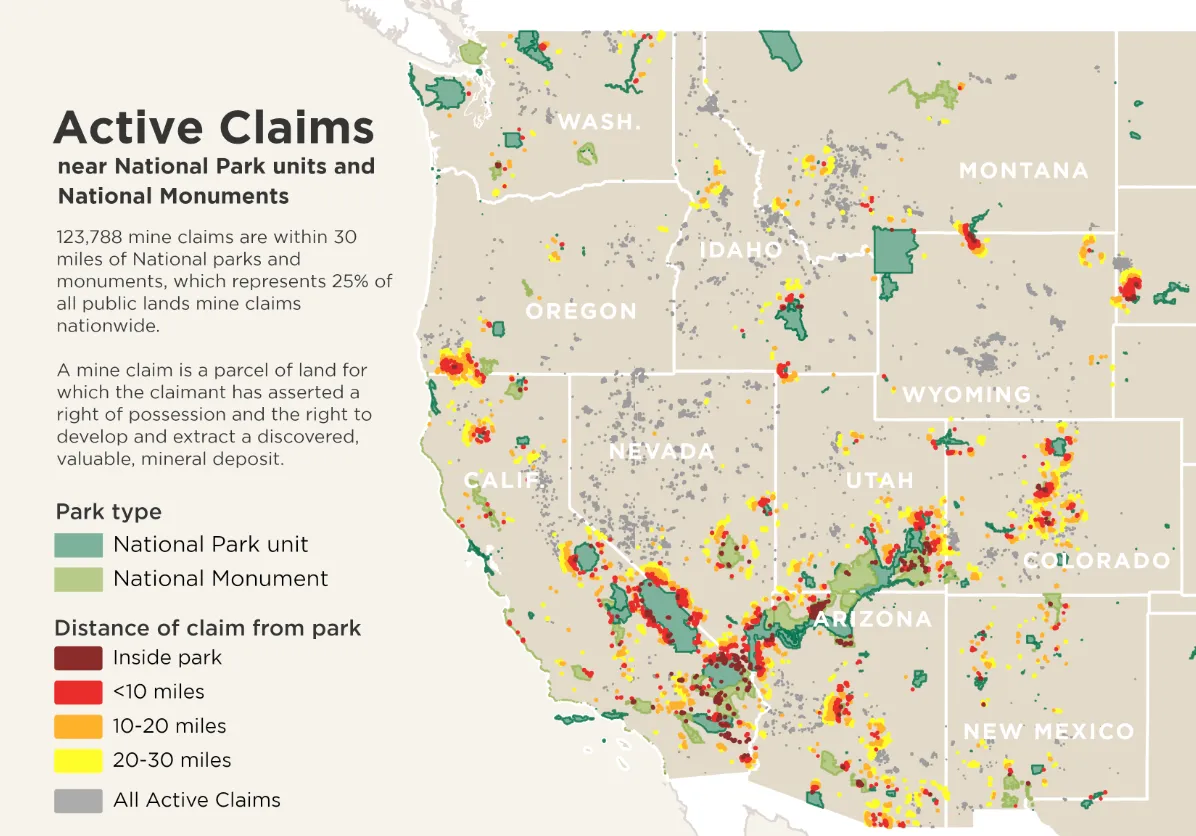
Overturning the three RMPs in question would reopen: 2 million acres in Montana’s Miles City Field Office planning area to future coal leasing; 4 million acres to coal leasing and 213,000 acres to oil and gas leasing in North Dakota; and 13.3 million acres in Alaska’s Central Yukon planning area to oil and gas leasing and mining claims. The Alaska move would also revive the Ambler Access Project, a proposed 211-mile road through the Brooks Range foothills and the Gates of the Arctic National Park and Preserve that would provide mining companies access to copper and zinc deposits.
But it also throws management of these planning areas, covering some 30 million acres, into question. While the Miles City resolution only targets a court-ordered, coal leasing-specific amendment to the RMP, the others include the entire RMPs, and don’t say anything about whether the agency is supposed to revert back to the older — sorely outdated (the 2024 Central Yukon RMP replaced a 1986 version) — RMPs, or simply try to manage the land without RMPs (which they are not authorized to do). The CRA not only revokes the “rules,” but also bans the agency from issuing a rule in “substantially the same form.” That will severely limit the BLM in efforts to replace the revoked RMPs, and could hinder it from issuing any permits or authorizations at all.
Using the CRA in this way (as if RMPs were “rules”) also blows a cloud of uncertainty over every other RMP implemented since 1996, when the CRA was passed. First off, it makes other Biden-era RMPs subject to being revoked by Congress. More broadly, if Resource Management Plans are deemed subject to the CRA, wrote Interior Solicitor Robert Anderson in January, it would create “uncertainty as to whether post-1996 RMPs have ever gone into effect, which also raises questions as to the validity of implementation decisions issued pursuant to these plans …”
Prior to the House vote, 31 law professors and public land experts called on Congress to refrain from using the CRA to revoke RMPs. “The resulting uncertainty could trigger an endless cycle of litigation,” they wrote, “effectively freezing the ability of the BLM and other agencies to manage public lands for years, if not decades to come.”
The Interior Department has been on a bit of a tear recently, especially when it comes to blocking solar and wind projects and encouraging fossil fuel extraction, especially coal. Over the last month, the department has:
Fast-tracked the environmental impact statement for Canyon Fuel Company’s application to expand the Skyline Mine in Utah via lease modifications.
Approved Navajo Transitional Energy Company’s bid to expand its Antelope Coal Mine in the Powder River Basin to an additional 857 federal acres.
Moved forward with coal lease sales in Utah (the Little Eccles tract as requested by Canyon Fuel Company) and Montana (at the Navajo Transitional Energy Company’s Spring Creek Mine).
The Trump administration is moving to rescind the 2001 Roadless Rule, which limits new roadbuilding in parts of the National Forest that are currently roadless. It would open up nearly 45 million acres of public land to new roadbuilding and, by extension, new logging, mining, and drilling, including in the Tongass National Forest in Alaska. Colorado’s and Idaho’s state-specific roadless rules would be spared from this move. At least for now.
It’s important to remember that this rule didn’t and doesn’t shut down roads — of which there are already far too many criss-crossing our public lands — it just keeps new ones from being built. That’s important because roads are, well, pretty darned bad for forests and deserts and everywhere else.
Roads fragment landscapes, they enhance erosion, and liberate dust to be carried away by the wind, degrading air quality. Vehicles traveling on the roads leak oil and other nasty fluids, while also spewing exhaust and disrupting the natural sounds of the wild. A study found that a toxicant used to protect car-tires is winding up in streams, killing salmon. Most problematic: a backcountry road serves as a giant hypodermic syringe, injecting humanity and accoutrements deep into the backcountry, where they can do more damage to otherwise difficult-to-access, sensitive areas.
Interior Secretary Doug Burgum issued new restrictions on the Land and Water Conservation Fund yesterday, possibly hampering the program’s effectiveness.Still, it could have been worse.
Congress established the LWCF in 1964 to further conservation and enhance recreation by using offshore oil and gas drilling revenues to acquire private land in or near national parks, wilderness areas and forests, and then making it public. It has been popular with both parties, and in 2020, Congress passed the Great American Outdoors Act with bipartisan support, permanently funding the LWCF to the tune of $900 million annually and creating a separate account for national park and public lands maintenance. After the bill’s sponsor, Sen. Cory Gardner, R-Colo., showed Trump a photo of a spectacular parcel acquired by the fund in Black Canyon of the Gunnison National Park, the president agreed to sign the bill into law.
Initially Trump and Burgum wanted to divert hundreds of millions of dollars from the fund and use it to maintain infrastructure in national parks and other public lands. But they backed off, perhaps because they knew congressional Republicans would bear the brunt of the backlash. Instead, Burgum tacked a bunch of restrictions on how the funds can be used, which could slow or nix proposed land acquisitions.
A while back I mentioned the new surfing wave on the Animas River in Farmington and how that has been rendered un-surfable by low streamflows. I don’t have any good news to report on that, but I do have a link to a live webcam of the surf wave, which is pretty cool and a good way to check in on the lower Animas River from anywhere at anytime!
🤖 Data Center Watch 👾
Some readers have asked what they can do about data centers, AI, and their profligate energy and water use. There aren’t any easy answers. You can’t exactly boycott data centers unless you’re willing to remove yourself from the modern age. After all, virtually the entire digital world requires data centers to operate, including me sending you this newsletter. Abstaining from AI might be a little easier, except that you’re often using it without knowing, simply because the tech companies employ it as a default (try doing a Google search and you’ll see that the first result is usually an AI-generated answer; you can opt out by adding “-ai” after your search query, but you’re still using a data center).
I would recommend learning as much as you can about the technology and how much water and power each one uses. This piece from The Conversation provides a good breakdown of some of these things, and is a good place to start.
Here’s a crazy one: Texas firm BorderPlex Digital Assets is looking to build what they say will be a $165 billion data center complex in Doña Ana County, New Mexico. Holy frijole, that’s a lot of cash (all of the property in neighboring El Paso County is currently valued at $95 billion, according to El Paso Matters.
The developers are claiming Project Jupiter, as it’s called, would create 750 new jobs, use minimal amounts of water, and would be powered by a dedicated, on-site microgrid. But the details are sparse on exactly how they would cool the facilities (which is the where most of the water use comes from) and what their electricity generation sources would be. Solar? Natural gas? Nuclear?
Seems like these details should be made public before the county commissioners enter into a deal with the developers in which they would issue industrial revenue bonds and exempt the facility from property taxes in exchange for a $300 million payment. El Paso Matters has more on the plan.
Rio Grande and Pecos River basins. Map credit: By Kmusser – Own work, Elevation data from SRTM, drainage basin from GTOPO [1], U.S. stream from the National Atlas [2], all other features from Vector Map., CC BY-SA 3.0, https://commons.wikimedia.org/w/index.php?curid=11218868
EPA withdraws a proposed rule to reduce wastewater pollution from slaughterhouses.
EPA will seek to cut federal protections for wetlands.
USDA will prepare an environmental impact statement for repealing the Roadless Rule that shields national forests and grasslands from logging and road building.
New Mexico and Texas agree to Rio Grande lawsuit settlement.
CBO reports on U.S. agriculture’s greenhouse gas emissions.
EPA proposes allowing Wyoming to manage its own coal-waste program.
Interior Department completes work on soil burn severity assessment for a large fire north of the Grand Canyon.
And lastly, the Department of Energy supports a feasibility study for what would be one of the country’s largest pumped storage hydropower projects.
“The seven states need to recognize that there is pain and sacrifice all over the place and try and get past that visceral perception and figure out what they can do to work together to provide water reliability for the 40 million people who depend on the Colorado River.” – Scott Cameron, senior adviser to the interior secretary, speaking at a meeting of the Glen Canyon Dam Adaptive Management Work Group on August 20. Cameron, who said he is “cautiously optimistic” about a seven-state deal on managing the river before the current operating rules expire at the end of next year, said the basin needs to look for strategies to reduce consumption and “to facilitate transfers and exchanges.”
By the Numbers
10 Percent: Share of U.S. greenhouse gas emissions generated by agriculture, according to a Congressional Budget Office report. The main pollutants in this total are nitrous oxide, a byproduct of fertilizer, and methane, which comes from livestock manure and cow burps.
$21 Million: Research and development funding from the Department of Energy for hydropower projects. The largest portion ($7.1 million) is to investigate the feasibility of a massive pumped storage hydropower project proposed for Navajo Nation land. Pumped storage toggles water between a lower and upper reservoir, a system that functions like a battery. New Mexico State University is the co-investigator for Carrizo Four Corners, the 1,500-megawatt pumped storage project that could provide 70 hours of energy storage, far more than the several hours of storage provided by the largest lithium-ion batteries.
News Briefs
Slaughterhouse Waste The Environmental Protection Agency will not strengthen wastewater discharge rules for meat and poultry producers. The rules were proposed during the Biden administration.
To justify the action, the agency cited its desire to lower food prices and reduce industry operating costs.
The Biden-era rule intended to reduce the volume of pollutants that enter waterways from some 3,879 slaughterhouses nationally. Those pollutants include nitrogen, phosphorus, organic matter, fecal coliform, and grease. They contribute to harmful algal blooms and low-oxygen dead zones in rivers, lakes, and coastal ecosystems.
A Narrow Wetlands Definition The EPA is preparing to release a rule by the end of the year that would shrink the number of wetlands with federal protection under the Clean Water Act, E&E News reports.
According to a slide presentation seen by E&E, the agency “would regulate wetlands only if they meet a two-part test: They would need to contain surface water throughout the ‘wet season,’ and they would need to be abutting and touching a river, stream or other waterbody that also flows throughout the wet season.”
The changes are in response to a 2023 Supreme Court ruling that provided narrower, but undefined criteria for determining which water bodies have federal protection.
Rio Grande Settlement By signing a settlement agreement, New Mexico, Texas, and the Justice Department are closer to ending a long-running dispute over water rights from the Rio Grande and the groundwater pumping that affects river flows, Inside Climate News reports.
“The settlement package includes new formulas to calculate how much water each entity is owed; an agreement for New Mexico to reduce groundwater depletion, and changes to the operating manual for the Bureau of Reclamation’s Rio Grande Project.”
Roadless Rule The U.S. Department of Agriculture is pushing ahead with its attempt to undo a 24-year-old rule that prevents logging and road building in “roadless” areas of national forests and grasslands.
Rescinding the Roadless Rule, which was adopted in the last month of the Clinton administration, will affect more than 44 million acres, mostly in 10 western states.
The department will prepare an environmental impact statement for its intent to repeal the rule. It argues that more local control over land management decisions are needed.
Comments are due September 19. Submit them via http://www.regulations.gov using docket number FS-2025-0001.
Studies and Reports
Dragon Bravo Fire Burn Severity An Interior Department team completed an evaluation of the soil burn severity of the Dragon Bravo Fire, which has burned across more than 149,000 acres north of the Grand Canyon.
The fire severely burned the soils on just over 2 percent of the acres. Another 26 percent was moderately burned. The most severe burns cook the soil, which increases surface runoff after storms. Erosion and downstream floods can be the result.
Emergency Alert System Improvements The Federal Communication Commission is beginning the process to assess and potentially upgrade the nation’s emergency alert systems that local agencies use to inform residents about natural hazards like floods and fires.
The commission is taking public comments through September 25. Submit them hereusing docket number 25-224.
Wyoming Coal Waste The EPA wants to grant more states the authority to regulate waste products from burning coal for electricity. Wyoming is the latest state to seek this power, called primacy.
The agency is proposing to approve Wyoming’s bid to oversee its coal ash permitting program.
A public meeting will be held October 30. Public comments on the proposed approval are due November 3. Details are in the above link.
Three states currently have primacy. North Dakota’s application is being reviewed.
Federal Water Tap is a weekly digest spotting trends in U.S. government water policy. To get more water news, follow Circle of Blue on Twitter and sign up for our newsletter.
Click the link to read the article on The Land Desk website (Jonathan P. Thompson):
August 26, 2025
🤖 Data Center Watch 👾
What I’m about to write is strange, even a little surreal, even to me. It seems over the top, hyperbolic, and alarmist, all things I try to avoid in my writing (unless I’m going for satire). But here it is: The Big Data Center Buildup is transforming the West (and other regions) as quickly and radically as the post-war Big Buildup of coal plants and other power infrastructure in the 1950s, ‘60s, and ‘70s.
See what I mean by hyperbolic? After all, data centers are just big box stores filled with walls of computer, processors, servers, and other equipment rather than cheap plastic items. How transformative could they really be?
Very, it turns out. As I’ve written here before, data centers use huge amounts of energy and water, and if they keep sprouting like weeds in business parks and rural areas, then they very well could not only hamper, but reverse the transition away from fossil fuels.
Tech bros will certainly say I’m being hysterical, and point to the latest estimates showing that each AI query uses a tiny fraction of the energy and water that a person consumes by doing other cyberspace activities or, for that matter, simply existing in modern times. Google, for example, says a “median” Gemini text query uses .24 watt-hours of electricity, which is about the same as watching 9 seconds of television, or microwaving for 1 second, or running a refrigerator for six seconds. And growing the beef for a single hamburger uses hundreds of times more water than hundreds of AI queries.
As far as I can tell, these figures are accurate. But what do they really tell us? I suppose we can feel a bit less guilty about succumbing to the temptation to use that iPhone AI thingy to identify something we photograph, or for asking ChatGPT to pen a song. It has no bearing, however, on what’s playing out on the ground, which is a sort of colonization of the power grid by larger and larger server farms.
I closely follow energy-related news as part of my job, and hardly a day goes by when I don’t encounter a story about the growing electricity demand from new data centers and utilities scrambling to keep up. Less than a decade ago, most Western utilities were expecting power consumption to plateau or even begin decreasing by now.
In 2018, for example, California utility regulators approved a plan to shutter Diablo Canyon’s two nuclear reactors in 2024 and 2025. Doing so would deprive the state’s grid of enough juice to power some 1.7 million homes. But Pacific Gas & Electric, the plant’s operator, figured it wouldn’t be a problem, since demand was expected to decline over time due to efficiency gains and more rooftop solar, and they could cover the rest with new renewables.
Instead, demand has increased substantially on PG&E’s grid since then, in large part due to new data centers in Silicon Valley, and it’s likely to continue to balloon over the next couple of decades. This forecast-blowing turnaround has prompted PG&E to toss out its old resource plans, work on acquiring more energy generation, and delay Diablo Canyon’s retirement for at least another five years. The pattern is being repeated all over the West with alarming regularity. It seems as if no place is safe from the invasion.
Some recent examples:
In late July, PG&E said it expects 10 gigawatts of new data center capacity to connect to its grid over the next ten years. Ten gigawatts, or 10,000 megawatts, is about one-fourth of the total demand on the California grid on a hot summer’s day, or equivalent to about five Diablo Canyons. It’s a crapload of power, in other words, and there’s no way they’re going to serve that kind of demand growth with just solar and wind, especially since a certain administration is doing all it can to stop all solar and wind from being built. It’s also notable because it’s a 20% increase in projected data center capacity since May.
NorthWestern Energy signed on to provide up to 1,000 MW of power — or nearly all of the utility’s generating capacity — to Quantica Infrastructure’s AI data center under development in Montana’s Yellowstone County. This would require the utility to either construct or purchase additional power, which could lead to higher rates for their existing customers. Now NorthWestern is proposing to merge with Black Hills Corp., another electricity and gas utility, saying the combined utility would be better positioned to meet rising power demand from, you guessed it, new data centers.
Xcel Energy expects to spend about $22 billion in the next 15 years to meet new data centers’ projected power demand in Colorado, potentially doubling or even tripling legacy customers’ rates. Also of concern: If the projections are overblown, Xcel could end up building a bunch of new generation that’s not needed, leaving the utility and its customers with a bunch of stranded assets.
Wyoming officials have worked to lure data centers and cryptocurrency firms to the state, and it seems to be working. Earlier this month energy firm Tallgrass proposed building an 1,800 MW data center, along with dedicated gas-fired and renewable power facilities, near Cheyenne. That adds to Meta’s facility in Cheyenne and the 1,200 MW natural gas-powered Prometheus Hyperscale data center under development in Evanston. Observers say electricity demand from these centers could transform the physical and regulatory utility landscape and potentially drive up costs for “legacy” customers.
New Mexico utilities are struggling to meet growing demand from an increasing number of data centers, while also complying with the state’s Energy Transition Act’s requirements for cutting greenhouse gas emissions.
Numerous companies are eyeing Delta, Utah, as a site for new data centers. This is in part because land is cheap there. But also because it is home to the Intermountain Power Project, a massive coal plant built during the Big Buildup. The plant is scheduled to be converted to run off natural gas and, ultimately, hydrogen, but Utah lawmakers want at least one of its units to continue to burn coal. They just need a buyer for the dirty power: Enter data centers. Fibernet MercuryDelta is looking to construct the 20-million-square-foot Delta Gigasite there; and Creekstone Energy plans to manage 10 gigawatts of capacity there, with power coming from coal, solar, and natural gas.
And Arizona’s largest utilities say demand from planned new data centers could increase total power load by 300% over current levels. Recently, Arizona Public Service announced it would keep burning coal at Four Corners Power Plant beyond its scheduled 2031 retirement to help meet this growing demand.
Sometimes the tech firms will purchase renewable power or build their own solar, wind, or geothermal facilities. But in most cases, they rely partly or wholly on fossil fuel generation, whether it’s from the grid — which is still largely dominated by natural gas and coal in many places — or from dedicated generators. While a lot of solar is still being added to the grid, it isn’t enough to keep up with rapidly growing demand. Plus, it may not last. The GOP phased out federal tax credits for wind and solar. And the Trump administration killed the Solar for All program that funded rooftop solar for lower-income households, and crippled the REAP program, which helps farmers install solar panels. Interior Secretary Doug Burgum has vowed to make it as difficult as possible to develop solar and wind on federal lands.
What that means is that we’re likely to see another Big Buildup for the cyber age. It will include single new data centers that span nearly 500 acres and consume more power than all of the homes of Montana and Wyoming combined. And it will include the generating facilities to run the servers and to keep them cool. In the absence of policies limiting fossil fuel burning and preventing cost shifts to existing customers, we’re all going to pay the price.
📸 Parting Shot 🎞️
Bullfrog Creek and the Little Rockies, Utah. Jonathan P. Thompson photo.
When I was a kid, I collected pinback buttons, political and otherwise. Most of you probably know what that is, but for the youngs out there, it’s basically an analog meme you pin to your clothing to let folks know which political candidate or other cause you might support.
I’m pretty sure I had a “John Anderson for President” button. My parents supported the Independent candidate in the 1980 election because he had been a vocal opponent of the Vietnam War. Jimmy Carter, while championing environmental preservation, had supercharged the fossil fuel industries in the West, which ravaged landscapes and economies, losing their support. I had a couple of buttons from the early Snowdown celebrations in Durango, and one from Wolverton Mountain Days, a funky event held at the Durango nordic center whose motto was: “Track, Telly, Twinkie,” or something along those lines. Maybe the little collection included a “Gilbert Slade for County Commissioner,” that I would have picked up at one of Slade’s Democratic Party goat roasts out on the Dryside.
But perhaps the most intriguing one was small, dark blue or black, with a bold white typeface declaring: “Fight Blight / Burn a Billboard Tonight.” I probably had to ask an adult what blight meant, though the second part I understood. It was, perhaps, my first encounter with the concept of monkey-wrenching, or sabotaging equipment or structures or billboards as a form of protest, usually with environmental motivations.
This would have been shortly after Edward Abbey’s The Monkey Wrench Gang was published (50 years ago this month), in which Doc Sarvis and Bonnie Abbzug did some billboard burning of their own before joining up with Seldom Seen and George Hayduke and moving on to bigger acts of sabotage. But the button’s text preceded the novel. The slogan was a favorite of David Brower, according to John McPhee’s “Encounters of the Archdruid,” which ran in the New Yorker in 1971.
Though I wouldn’t find out until much later, it turns out my father lived out the slogan during his younger days in Silverton, Colorado.
***
Up until the 1950s, Silverton was a full-on mining town, with a little bit of tourism on top. Following World War II, however, the last big mine, the Shenandoah-Dives, shut down. The local economy, sputtered and gasped, ushering in what Silvertonians would come to call the “Black Decade.”
Desperate, the townsfolk turned to tourism, capitalizing on a Hollywood-fueled, global fascination with the Wild West of American mythology. The Durango-to-Silverton stretch of railroad switched from hauling ore to carrying sightseers, and almost overnight Silverton morphed from mining town to a facsimile of a Hollywood version of a place that never existed. In order to lure motorists, some local businesses installed billboards along Highway 550 as it dropped into town from Molas Pass.
My parents arrived in Silverton in the 1960s. Mining had come back in force, with Standard Metals’ American Tunnel facilitating the re-opening of the fabled Sunnyside Mine. Yet the tourism industry and its cheesy theatrics persisted, much to the disgust of my parents and their peers, who were members of a sort of rural Western intelligentsia, drawn there by the mountains, the wildness, the culture, the history, and perhaps most of all, the authenticity of the community. They saw the tchotchke-peddling economy as the antithesis of the richer, more real mining culture.
In July 1963, Terry Marshall summed up the sentiment in a Silverton Standard editorial on the surreal scene that unfolded every day at “train time.”
Ultimately, the town would pass statutes and rules that reined in the carnival atmosphere. Yet the billboards on 550 remained and fell into disrepair, and efforts to have the highway department take them down apparently went nowhere. One day in the late 1960s — the story goes 1 — my father was telling his cousin about his frustration with the situation, not just at how ugly the billboards were, but at the powerlessness to do anything about it. This relative (who will remain nameless), suggested in his sanguine way: “Let’s just burn it.”
And so, on one dark night, that’s exactly what they did, with my mother possibly driving the get-away car, nearly a decade before the fictional George Hayduke sabotaged the equipment building the road through Comb Ridge. My father and accomplices were never caught. Indeed, the billboard was so damned ugly that maybe nobody cared.
***
People who knew or knew of my father might find it incredible that he would go to this extreme. He was a diplomat and uniter, someone who could bring together disparate factions to benefit the community. He also had a strong moral compass and cared deeply about this land and its communities, and would do what he could to defend it — within reason — even if it may have skirted the law just a little bit.
I know this because when I was maybe 12 or 13, I went camping with my dad and his friend and the friend’s kid. It was way up near Raplee Ridge, in southeastern Utah, looking down into the San Juan River, on a dusty two-track. On the way to the campsite, we noticed some survey flags sticking up from the sparse and rocky earth.
This would have been the early 1980s, when the Carter-era quest for “energy independence” was still in full-force, and miners and drillers were ripping apart the Western landscape for whatever uranium, coal, oil and gas, or oil shale they could find. My young heart ached at the realization that the stakes marked a future extraction site, that soon the bulldozers and the drill rigs would show up and tear the earth apart and suck out whatever minerals dwelled down there.
On the way back, the adults stopped the car near the site, told us kids to stay put, got out, walked over to the stakes, methodically pulled them out of the ground, and threw them over the edge of the cliff. Then they got back in and we drove away, without saying anything else about it. It was a soothing site to witness, even from the remove of the old car.
The site was never developed or drilled or mined, though I’m guessing that had less to do with this little act of sabotage than with the fact that the energy booms all faded shortly thereafter. For them, however, it was a significant act of resistance, and perhaps of love for the Place. Maybe just as importantly, they were defying the powerlessness we feel in the face of the churning gears of progress and greed, apathy and cruelty.
***
The Monkey Wrench Gang is often considered monkey-wrenching’s literary debut. It’s not. Two years before Abbey published his book, there was Jim Harrison’s A Good Day to Die, which followed a trio on a Florida-to-Idaho road trip in a quest to blow up a dam.
Harrison’s protagonist is named Tim, a Hayduke-esque guy just back from a couple tours in Vietnam, scarred in more ways than one and with a hankering for booze and pills to ease the pain. The story’s narrator, a bit of a cad with relationship issues, is on a fishing trip and escapist odyssey in Florida’s Keys when he encounters Tim. During a drinking session, the narrator tells Tim offhandedly that there’s a dam in the Grand Canyon, or at least they are planning one, pushing Tim into a melancholic slump. “Jesus Christ,” he says, “it will fill up with water.”
Tim is immediately fixated by the idea, noting that he has never seen the Grand Canyon. The narrator “had seen Glen Canyon years ago before it was literally drowned and liked it better but any comparison was absurd with such splendors.” After a little more thought, he notes, casually: “We probably ought to blow up the goddamn thing.”
Tim takes the idea and runs with it, though it isn’t entirely clear what his motives are. Is he truly looking to defend the environment and free the Colorado River? Is he seeking to punish those who deigned dam up something as sacred as the Grand Canyon? Or is he merely lashing out at the general injustice of the world, hoping to be heard among all the cruel noise?
Whatever it is, the narrator gets caught up in it, too, maybe just to have a bit of purpose beyond baking in the sun and waiting for the fish to bite. When Tim suggests a trip West, the narrator hesitates and says only if they return quickly. But as the story progresses he becomes more invested in the act, even if it is only a means for pursuing the alluring Sylvia, Tim’s on-again-off-again girlfriend.
When they discover there is no dam in the Grand Canyon, the narrator refuses to abandon the mission, and suggests they instead decommission an earthen dam on a tributary of the Clearwater in Idaho, “where a wealthy rancher ruined a good steelhead stream … out of greed and contempt for the natural world.” Once the new target is picked, the narrator feels “strong and clean and very moral. Heroic, in fact.” 2
***
A Good Day to Die may have preceded and even inspired the Monkey Wrench Gang, but the latter was far more widely read and influential. Abbey’s classic was published 50 years ago this month, inspiring many acts of low- and high-level eco-sabotage in the decades that followed. And in 1985, Bill Haywood and Dave Foreman published a manual for Abbey’s acolytes called Ecodefense: A Field Guide to Monkeywrenching.
Monkeywrenchers pulled up survey stakes by the dozen, spiked trees to halt logging projects, cut commercial fishing drift nets, dumped sand and corn syrup into bulldozers’ gas tanks and crankcases, vandalized ski-lift supports, cut power to uranium mines, and plotted to topple transmission towers carrying electricity from nuclear plants. Some were caught. Others were not.
In the late 1990s, factions of the Animal Liberation Front and the Earth Liberation Front took it up a notch by torching a Bureau of Land Management wild horse captivity facility in Burns, Oregon. Then, in 1998, they burned down several structures at the Vail Ski Resort in an effort to block the ski area expansion and its deleterious effects on lynx habitat.
The ski area recovered and expanded, despite an estimated $24 million worth of damage. Direct environmental action, however, took a hit as federal law enforcement (and corporate interests) began throwing around the term “eco-terrorist,” the connotations of which became far more grim after 9/11 3. The FBI then declared monkeywrenching to be one of the nation’s leading domestic terror threats, surpassing even right-wing militia groups, despite the fact that the saboteurs only damage property and make a point of not harming humans or other living beings.
This put quite a damper on environmental direct action, since even pulling up a few survey stakes might get you labeled a terrorist and tossed in the clink — or even Guantanamo Bay — for years. Monkeywrenching, however, did not die. In 2016, for example, a crew of “Valve Turners” managed to shut down several major oil pipelines in an attempt to slow fossil fuel burning and bring attention to the climate crisis (Michelle Nijhuis wrote a terrific piece on this in 2018). Otherwise there have been very few high-profile direct-action eco-sabotage cases, at least from what I can gather.
***
Monkeywrenching is on my mind not because it’s MWG’s half-century birthday or even because the White House, Congress, and the courts have been occupied by authoritarians, oligarchs, and their enablers, who value profit over everything else, especially the environment. I’ve actually been pondering it for several months, since long before Trump was elected.
A couple of things sparked this line of thought. First, it seems as if there’s a bit of a literary revival of monkeywrenching. It’s one of the methods employed by climate activists in Stephen Markey’s excellent novel The Deluge. And it is the main theme of the film, How to Blow Up a Pipeline, which is a fictional rendering of Andreas Malm’s non-fiction treatise of the same name.
I began to write that these books and films are Monkey Wrench Gangs for the global warming age. But I don’t think that’s quite right. The tone of the newer book and film is far different — more urgent and somber — than MWG or a Good Day to Die. And the motives of the protagonists are also more serious and deep, if you will. Pipeline’s characters, for example, mostly were direct victims of the fossil fuel industry, making their sabotage a form of self-defense, while the Deluge’s eco-saboteurs see themselves as warriors fighting for the planet’s very survival.
It’s not surprising that eco-sabotage is experiencing a revival, even if it’s only fictional. The urgency of a warming climate is becoming acute, and yet the powers that be are diddling their thumbs. More and more people are frustrated and fed up with the lugubrious process of fighting climate change and environmental destruction in legal and legitimate ways. Even when the Democrats control the executive and legislative branches of the federal government, they rarely are able to take more than a half-step forward policy-wise, only to see their incremental progress obliterated by Trump, the MAGA-dominated Congress, and a runaway Supreme Court within weeks after taking power.
Now the Trump administration is even precluding public input for major mines, oil and gas drilling, and other developments on public lands, all in the name of a bogus “energy emergency.” They are literally blocking the public’s legal avenues for making a difference, leaving concerned citizens with little choice but to take more direct action.
What is surprising to me is that a new wave of eco-sabotage has not made it from the screen and page to real life. 4 Instead, climate activists are throwing soup, paint, and other stuff at prominent artworks, hoping to bring attention to their cause. They are gluing themselves to the road and disrupting bicycle races, from the World Championships in Scotland to the Tour de France, and Just Stop Oil even defaced Charles Darwin’s graves.
The activists and their supporters claim that these actions raise public awareness. That may be so, but awareness of what, exactly? How does disrupting a bike race, of all things, reduce fossil fuel combustion? How does defacing a painting — even if only “symbolically” — relate to environmental destruction? And what’s with targeting Darwin’s grave? While I appreciate the zeal, I can’t help but wonder: If you’re going to vandalize something and risk jail time, why not do something that makes a direct and immediate difference — even if only temporarily?
When the narrator in a Good Day to Die decides to get rid of the dam in Idaho, he is hit with a moment of moral clarity. I suspect it has to do with the directness of his planned action. He sees a problem, a fish-harming dam, and sets about to solve it in the most logical and direct way possible: blowing it up — preferably without harming anybody. He’s not looking to send a message, to make a symbolic gesture, or raise awareness. He’s just trying to fix something that’s wrong, not unlike burning an atrocious billboard or surreptitiously removing some survey stakes from a remote area or destroying a pipeline that defiles the land and carries planet-killing fossil fuels.
Don’t get me wrong. I’m not suggesting that anyone go out and do anything illegal. I’m just saying that when a person’s home — whether that’s a house, a community, a Place, or the entire planet — comes under attack, it shouldn’t be surprising that they would go to extreme lengths to defend it.
Four Corners Power Plant. Jonathan P. Thompson photo.
For the last several years, the coal industry in the Western U.S. has been suffering from what I call the Big Breakdown — as opposed to the Big Buildup of the 1960s and 1970s, when coal power plants and mines popped up all over the Colorado Plateau and beyond. Now, it appears that the proliferation of energy-intensive data centers is stalling the Breakdown, maybe even reversing it. Last week, Arizona Public Service announced it would keep the Four Corners coal plant in northwestern New Mexico running — and polluting — for another seven years beyond its scheduled 2031 retirement.
The coal-burning extension is part of the state’s largest utility’s plan to shift its climate goal from becoming zero carbon by 2050 to carbon neutral. While that sounds like a mere semantic switch, its on-the-ground effects will be significant. Along with the coal plant news, APS and the state’s other largest utilities are going in on a new natural gas pipeline from the Permian Basin so it can increase fossil fuel generation rather than pivoting entirely to solar, wind, battery energy storage, and other carbon-free sources.
APS officials say the shift is necessary to meet growing power demand. While population growth and increasingly hot temperatures play a role in the ever-larger load on the grid, the crop of new energy-intensive data centers sprouting in the Phoenix area is a principle driver. The utility is also likely reacting to the Trump administration’s fondness for fossil fuels and disdain for renewables.
The Four Corners plant and its accompanying Navajo Mine were constructed about 15 miles west of Farmington in the early 1960s by a consortium of utilities led by APS and Utah Construction & Mining Co, a subsidiary of Kennecott, a global mining firm. It was the flagship of a much larger fleet that would include the San Juan, Navajo, Mojave, Cholla, Coronado, and Escalante plants. Mojave was shuttered in 2005, with the other big plants closing down more recently (Coronado will be converted to natural gas). That leaves just Four Corners, which was supposed to be shuttered in 2031, or even sooner, if Public Service Company of New Mexico were able to get out of its 13% stake before then.
But over the last few years, utilities have been second-guessing plans to decommission the aging behemoths as data centers have sprouted across the region, significantly increasing demand on the power grid. Over the last week, both Salt River Project and APS have set new peak power demand records as both residents and data centers crank up the coolers to offset extreme heat. Demand is projected to grow significantly over the next decade, mostly due to new data centers. It’s the Big Buildup all over again, only this time it’s high-tech server farms sprouting all over the place, with power generating sources struggling to keep up.
1 *I didn’t hear this story until after my father died, so this is all second-hand and the details may be a bit off.
2 I won’t tell you what happens. If you read the book, you should be warned that reviewers of the time sneered at it for being too macho, too crude, having too much drug and alcohol use, “adolescent,” and so forth. Maybe that’s all true, but I liked it the first time I read it decades ago, and I still liked it when I read it again recently.
3 * The term was apparently coined in the 1980s by Ron Arnold, the founder of the anti-environment Wise Use Movement.
4** Right-wing nationalist attacks on the power grid are not, in my mind, a form of monkeywrenching. Their goal is to disrupt and harm society, including humans, not to stop environmental damage or even make a political protest.
Jeff Hurd, the U.S. representative from western Colorado, met this week with first responders and residents from a region where multiple wildfires are raging. The Lee Fire had become the fifth-largest wildfire in state history and was threatening the town of Rifle, where officials had to evacuate a state prison in the fire’s potential path.
In a social media post about the visits, Hurd thanked local authorities and community members for their response to the fires tearing across his district, and he vowed to “be here for the long haul to help recover.”
But nowhere did he offer the most appropriate gesture: an apology.
Hurd, along with the other three Republican members of Colorado’s U.S. House delegation, has promoted drill-baby-drill policies as part of a Trumpist “energy dominance” agenda, even though those policies crank up the greenhouse gas emissions that guarantee more megafires in Colorado. The only posture truly available to Hurd when he meets constituents is contrition. The only plausible message is, “I was wrong.”
Rising global temperatures are increasing the risk and frequency of extreme weather across the globe. The Southwest is being transformed by aridification amid the worst drought in 1,200 years. There is no scientific doubt that the primary cause of climate change is the combustion of fossil fuels.
In Colorado, this means bigger, fiercer wildfires and a fire season that no longer respects warm-month limits. The most destructive wildfire in state history, the Marshall Fire in 2021 in Boulder County, occurred five days after Christmas. The state’s 20 biggest fires have all occurred since the turn of the century. The three biggest came in 2020, when one of them, East Troublesome, grew so ferocious it leapt over the Continental Divide. A 2021 study found that hotter, drier conditions in the American West are causing fires, such as East Troublesome, to reach high elevations that were previously too wet to burn.
“And they are burning at rates unprecedented in recent fire history,” the authors wrote. “While historical fire suppression and other forest management practices play a role in the West’s worsening fire problem, the high-elevation forests we studied have had little human intervention. The results provide a clear indication that climate change is enabling these normally wet forests to burn.”
Colorado is especially exposed. A huge part of the state is the site of one of the largest areas of the highest temperature spikes in the lower 48 states. It covers Hurd’s hometown of Grand Junction and much of his district. Either Hurd is oblivious to the science or he’s cynically chosen to side with oil and gas industry interests.
During the freshman Hurd’s campaign last year, he sometimes seemed to align with an “all of the above” energy policy, which at least purports to include renewables, but he also signaled a strong preference for fossil fuel extraction over wind, solar and other renewable energy sources. He even champions coal, the most damaging of fossil fuels, a position he’s reinforced as recently as April.
Hurd found himself in an awkward spot once he was in the House as MAGA extremism sought to demolish the all-of-the-above plank and demonize renewables. He and U.S. Rep. Gabe Evans of Fort Lupton were among 21 Republicans who urged colleagues not to eliminate energy tax credits, which support wind and solar jobs and development in Colorado. (The other two House members from Colorado, Lauren Boebert and Jeff Crank, left their names off the letter.) But they both voted to pass the recent Trump megabill, which eliminated the credits.
Hurd insists he believes climate change is real. But this just makes his approach all the more hypocritical. For example, he repeats the pro-carbon talking point that since fossil fuel in other countries is dirtier than America’s the U.S. should maximize production.
“If you genuinely care about reducing global greenhouse gas emissions, then you ought to support getting as much energy out of Colorado as possible. That includes not only the clean coal that we have, but also natural gas,” he told CPR in September.
But that’s like saying that since people are going to abuse fentanyl even though it’s deadly, America should manufacture a superior product to preempt China’s more dangerous supply. An immoral practice should be avoided because it’s immoral, not pursued with improvements.
If he has any doubt that prioritizing carbon-based energy is immoral, Hurd should take a closer look at the environmental catastrophe unfolding in his own district. He often cites the jobs at risk in the transition to renewable energy, but this short-sighted perspective ignores substantial state greening efforts to responsibly transition local economies, and it misses the larger risk that whole regions of a cooked Earth will be uninhabitable.
The megafires in Hurd’s district are exposing “energy dominance” as disastrously self-defeating.
During both the Obama and Biden presidencies, Republicans and the fossil fuel industry often accused the administration of waging a “war on energy.” It was a demonstrably false allegation. The most either of the Democrats did to attack the energy industry was to incrementally increase common sense regulations and environmental protections, which apparently did little to hamper energy development. The so-called shale revolution, when “fracking” opened up huge new reserves of tight oil and gas, began under Obama, and truly came to fruition under Biden, when domestic oil and gas production reached new record highs. Meanwhile, Biden’s Interior Department approved dozens of utility-scale solar and wind and long-delayed transmission projects on public lands.
But now the Trump administration is, in fact, waging a very real war on energy — renewable energy, that is, namely wind and solar power. They’ve frozen and even clawed back funds for projects, killed federal clean energy tax credits, subjected wind and solar projects on public lands to heightened reviews, and eliminated wind energy leasing areas off Oregon’s coast. And they’ve done it all as America is supposedly gripped by an “energy emergency.”
Now, the Interior Department has gone even further with a new order that threatens to kill all new renewable power development on federal lands. I know there are some readers out there who might applaud this, since so many of our public lands are not suited for sprawling utility-scale solar or wind developments. But this order — deceptively and cynically titled, “Managing Federal Energy Resources and Protecting the Environment” — would potentially replace proposed wind and solar projects with coal or uranium mines and/or power plants, oil and gas fields, or other non-renewable energy projects.
The order requires land management agencies, when reviewing proposed solar or wind energy projects, to consider “a reasonable range of alternatives that includes projects with capacity densities meeting or exceeding that of the proposed project.”
Capacity density is basically the amount of energy a project can generate per acre. According to the Interior Department’s calculations (we’ll get to the flaws there in a moment), the capacity density (megawatts/acre) for various power sources are:
Advanced nuclear reactor: 33.17 MW/acre
Combined cycle gas plant: 5.4 to 24.42 MW/acre (depending on configuration)
In other words, wind and solar are the big losers, taking up far more space to generate the same amount of electricity as, say, a nuclear plant. According to the new order, this raises the question of “whether the use of federal lands for any wind and solar projects is consistent with the law.”
This isn’t a new argument: The specter of “renewable energy sprawl” has long been wielded to push back against solar and wind development. And certainly the amount of space a project takes up should be one of many considerations in whether to permit it. But should it really have more weight than the amount of damage the project would inflict? How about pollutants emitted per megawatt, or amount of harm to people, the climate, and the environment per megawatt? Is there consideration for the fact that there is a lot of space between the turbines within a wind facility that is minimally affected? And why doesn’t their chart include hydroelectric, which has the lowest capacity density of all?
Also, the Interior Department’s calculations are a bit fishy, or at least incomplete. They say they are based on a 2023 Sargent & Lundy report commissioned by the Energy Information Administration. The report is not on capacity density, but rather the costs of building and operating various power generating technologies. When determining the acreage of the nuclear and fossil fuel plants, they do not take into account the land required for fuel production, which can be extensive.
The supercritical coal plant referenced in the report, for example, would require a mere 600 acres. Yet, the Four Corners coal plant in northwestern New Mexico — along with its associated Navajo Mine (current mining areas as well as reclaimed areas), Morgan Lake, and coal combustion waste disposal facilities — covers (and wrecks) some 15,000 acres. That acreage will continue to grow for as long as the plant operates, since the mine and waste dumps will continue to expand. Compare that to the 2,400 acres covered by the nearby San Juan solar plant.
I’d also argue that if the goal is to get the most energy out of every acre of public land (which is a silly goal, but whatever), then they should figure in the amount of energy the proposed project consumes. Coal mining and oil and gas drilling require large amounts of electricity and petroleum (along with human labor, which is also a form of energy), as does transporting coal and gas by train and pipeline. Uranium enrichment, which is necessary to produce reactor fuel, is extremely power-intensive.
None of this really matters to Interior Secretary Doug Burgum, however. That’s because he knows we’re not really in an “energy emergency,” and that it is merely a fabricated excuse to give more handouts and regulatory relief to his fossil fuel-industry buddies and to get revenge on Trump’s political opponents by punishing cleaner energy sources.
Proposed utility-scale solar and wind facilities on public lands should by all means be scrutinized and subjected to the same reviews as any other projects, contrary to what the Abundance faction might believe. The projects should be denied if their impacts outweigh the benefits, with bonus benefit-points for solar or wind projects that displace or replace coal or natural gas generation.
But judging the projects based on a virtually meaningless metric is not only spiteful, unfair, and stupid, but it also will needlessly hamper the fight against health-harming pollution and climate change. And that’s simply irresponsible, at best. [ed. emphasis mine]
⛏️ Mining Monitor ⛏️
Speaking of fake energy emergencies … In May, the Bureau of Land Management completed its environmental review and approval of the Velvet-Wood uranium mine in Utah’s Lisbon Valley in just 11 days. The rush, sans public input, ostensibly was necessary to get the mine online quickly to address the supposed uranium shortage.
The mine’s proponent, Anfield Resources, apparently doesn’t share the Trump administration’s sense of urgency. At the end of April, the Utah Division of Oil, Gas, and Mining asked Anfield for more information on its application to commence large mining operations, which was deemed technically incomplete. Anfield has yet to respond. The company is also not rushing forward to get state approval for its water treatment plant permit or to reopen its Shootaring Mill near Ticaboo, where the Velvet-Wood’s uranium would be processed.
In other words, the fast-tracked permitting was merely a ruse, intended to bypass environmental regulations and public input, not to expedite the project, itself.
***
Photo-illustration of the Animas River a few days after the spill from the air. Jonathan P. Thompson photo and illustration.
It’s the tenth anniversary of the Gold King Mine blowout that affected the Animas and San Juan rivers in Colorado, New Mexico, and Utah. A few folks have asked if I’m going to write anything about it — since I did write a book about it — but I don’t think there’s much more to say, really.
The Gold King Mine continues to drain acidic, heavy metal-laden water — though it is being treated before it’s released into the watershed — and neighboring mines continue to do the same (though they aren’t being treated). Superfund designation hasn’t been the boon to water quality that some hoped for, nor did it stigmatize Silverton as many feared it would (property values continue to soar into the unreachable zone).
While the event did bring more attention to the problem of abandoned mine sites (even though the Gold King wasn’t technically abandoned when it blew out), and injected “acid mine drainage” into the public’s vocabulary, it hasn’t led to mining law reform or any widespread effort to address the issue. That said, Congress finally did pass a Good Samaritan bill, that might clear the way for volunteer groups to do some additional cleanup without being sued for it. Still, they need funding, and that’s in short supply these days.
If you’d like to read more on it, check out this piece by Peter Butler. And you can check out past stories in the Land Desk for more information (links below, but they are behind the paywall). Better yet, go down to your local bookstore and buy River of Lost Souls.
This image was taken during the peak outflow from the Gold King Mine spill at 10:57 a.m. Aug. 5, 2015. The waste-rock dump can be seen eroding on the right. Federal investigators placed blame for the blowout squarely on engineering errors made by the Environmental Protection Agency’s-contracted company in a 132-page report released Thursday [October 22, 2015]
An image of the Sharp Fire near Cahone, Colorado, from the Benchmark fire lookout. Source: Watch Duty.
🥵 Aridification Watch 🐫
Fire season is really heating up, along with the summer temperatures. The relatively dry spring was followed by higher than normal temperatures in July and zero to minimal precipitation in many places, turning low- and mid-elevation forests to kindling. Officials working the Leroux Fire west of Paonia said the relative humidity was just 2%, contributing to rapid fire growth.
The Leroux blaze was just one of many new starts on Colorado’s Western Slope over the last several days. The Sharp Canyon Fire north of Cahone, Colorado, grew rapidly to 400 acres on Monday, forcing evacuations, but it seems to have quieted down overnight. The Lee and Elk fires in Rio Blanco County blew up to 13,000 and 7,700 acres, respectively, over a couple of days. The Middle Mesa Fire east of Navajo Reservoir and just south of the Colorado-New Mexico line grew to 2,500 acres as of Monday night.
Meanwhile, the Dragon Bravo Fire on the Grand Canyon’s North Rim has lived up to its name, reaching 126,445 acres as of Tuesday morning with only 13% containment a month after it ignited.
The situation is probably going to get worse before it gets better. The National Weather Service has issued red flag warnings for parts of Nevada, Utah, Colorado, and Wyoming, with extreme heat warnings in parts of Arizona and southern California. The mercury in Moab is expected to reach 100° F or more every day this week, and there’s no significant rainfall in sight.
How pervasive toxicity threatens human and planetary survival
What if one of the biggest threats to our health and planet is invisible, yet found in our air, food, and water?
Our latest report is the first time that a single report has attempted to analyse the broader collective problem and solution spaces of chemical toxicity answering the questions: how and why are toxic chemicals produced, how do they get into our bodies and the environment, and how do they affect the health of humans and other organisms?
Over eight months, we conducted an extensive analysis, including reviewing countless peer-reviewed studies and 50+ interviews with global experts. This research shows that the impacts of chemical toxicity are largely underestimated, contributing to increasing cancer rates, declining fertility, and a surge in chronic diseases, alongside ecosystem damage.
The overarching conclusion is that chemical toxicity is an underestimated risk to society and deserves significantly more attention and resources.
But this report isn’t just about the problem; it’s a call to action for solutions. We highlight critical industry, regulatory gaps and, most importantly, identify key areas for innovation and urgent funding that can put us on the right path to increase our understanding and make positive changes where it’s most needed.
We identified three opportunity areas that demand solutions: pesticides (herbicides and insecticide), food contact materials, personal care products.
Key takeaways include:
Over 3,600 synthetic chemicals from food contact materials are found within human bodies globally.
PFAS have contaminated the entire world, with levels in rainwater often exceeding safe drinking water limits.
Over 90% of the global population is exposed to air pollution exceeding World Health Organisation (WHO) guidelines.
The impact of pesticide use on cancer incidence may rival that of smoking and is linked to leukaemia, non-Hodgkin’s lymphoma, bladder, colon, and liver cancer. Prenatal pesticide exposure increases the odds of childhood leukemia and lymphoma by over 50%.
To learn more, you can download both the executive summary and the full report below. If you’re curious about how to create an impactful and commercially viable company in this space, we’d love to hear from you!
…in his second administration, President Donald Trump is not just approaching climate science with skepticism. Instead, his administration is moving to destroy the methods by which his or any future administration can respond to climate change. These moves, which are sure to be challenged in court, extend far beyond Trump’s well-documented antipathy toward solar and wind energy and his pledges to drill ever more oil even though the US is already the world’s largest oil producer. His Environmental Protection Agency announced plans this week to declare that greenhouse gas emissions do not endanger humans, a move meant to pull the rug out from under nearly all environmental regulation related to the climate. But that’s just one data point. There are many others:
Instead of continuing a push away from coal, the Trump administration wants to do a U-turn; Trump has signed executive orders intended to boost the coal industry and has ordered the EPA to end federal limits on coal- and gas-fired power-plant pollution that’s been tied to climate change.
Tax credits for electric vehicles persisted during Trump’s first term before they were expanded during Joe Biden’s presidency. Now, Republicans are abruptly ending them next month.
The administration is also ending Biden-era US government incentives to bring renewable energy projects online, a move that actually appears to be driving up the cost of electricity.
Republicans in Congress and Trump enacted legislation to strip California of its authority to ban the sale of new gas-powered vehicles beginning in 2035.
Trump is also expected to overturn national tailpipe standards enacted under Biden’s EPA and is also to challenge California’s long-held power to regulate tailpipe emissions.
The authors of a congressionally mandated report on climate change were all fired; previous versions of the report, the National Climate Assessment, which showed likely effects from climate change across the country, have been hidden from view on government websites.
Other countries, large and small, will gather in Brazil later this year for a consequential meeting on how the world should respond to climate change. Rather than play a leading role — or any role at all — the US will not attend.
Click the link to read the article on The Land Desk (Jonathan P. Thompson):
August 1, 2025
🥵 Aridification Watch 🐫
The monsoon is on its way, apparently, but seems to be delivering more lightning than rain to many areas that are grappling with wildfires. Meanwhile, the drought is intensifying and spreading in almost all parts of the West, especially in the deep Southwest.
Streamflows are dropping, too. The Animas River in Durango has fallen to about 200 cubic feet per second, and it’s only at about half that by the time it gets to Farmington, New Mexico’s, new surfing wave. The Rio Grande already dried up in Albuquerque a couple of weeks ago (but got a good boost from a thunderstorm early this morning). WyoFile reports that the Snake, Wind, and Bear Rivers are all at record low flows for this date, even though the snowpack was about average this winter.
And, of course, the wildfires continue to burn. The Dragon Bravo Fire on the Grand Canyon’s North Rim has burned through 112,000 acres so far, with only 9% containment. The Monroe Canyon Fire in southwestern Utah is at 55,642 acres with 7% containment, and is causing power outages in surrounding communities. The Turner Gulch Fire northeast of Gateway is still growing “due to continuous hot and dry conditions and erratic winds.” And the Elkhorn Fire north of Durango has settled down a bit at 317 acres, but officials worry forecasted hot and dry conditions could reawaken it.
Below are some satellite moisture index maps, with blue being moist and red indicating dryness. The top image shows Dove Creek and areas south of there. This was dryland farming country for many years (Pinto Bean Capital of the World), but irrigation from McPhee Reservoir on the Dolores River was later extended out to Dove Creek. Problem is, their water rights are junior to the farmers in the Montezuma Valley near Cortez, so when reservoir levels are low, they tend to get less irrigation water. Here you can see the difference between 2023 (on the left), when snow, river, and reservoir levels were high, and this year (right), when they are not. What stands out to me is that some fields are still being irrigated this year, despite the drought, as is indicated by the circles of bright blue. But there are more fallow fields now, and the areas around the fields are especially dry.
Here are two more images showing the Ute Mountain Ute Tribe’s farms south of Ute Mountain in 2023 compared to 2025. Again, some irrigation is still reaching the fields, but apparently far less, given the number of fields that are apparently fallow.
📈 Data Center Watch 📊
The Land Desk is adding another beat to its roster, the Data Center Watch, which is just to say that I’ll be covering data centers and their economic and environmental ramifications a bit more frequently from here on out. Why? Because they currently are proliferating throughout the West: There are 93 data centers in the Phoenix area, 54 in the greater Denver area, and eight in Albuquerque, with many more on their way. And every one of them uses outsized quantities of electricity and water, straining power grids, and throwing utilities’ resource planning into disarray.
Cheyenne, Wyoming, is already home to six data centers. That doesn’t count Meta’s $800 million center that is under construction there, or energy firm Tallgrass’s proposed facility that would pull 1,800 megawatts of electricity from new, dedicated natural gas plants and renewable power installations (presumably solar and wind). Down in Tucson, city officials are considering Amazon Web Services’ proposed Project Blue, a massive complex that is poised to consume up to 2,000 acre-feet of water per year and become Tucson Electric Power’s largest single customer.
In Alaska, a company is looking to build a large data center and a dedicated natural gas plant that would run off of oilfield methane. Numerous data centers can be found along the banks of the Columbia River, drawn there in part by the relatively cheap and abundant hydropower. In Montana, a proposed data center would use all of the powergenerated by NorthWestern Energy’s existing resources. And Pacific Gas & Electric expects new data centers in Silicon Valley to drive a 10 GW increase in electricity demand over the next decade, which is about one-third of today’s forecast peak demand for California’s grid.
The biggest concern with these sprawling warehouses packed with processors is their power consumption. Each one can draw as much electricity as a small city — the proposed Cheyenne server farm would use more power than all of the state’s households. As recently as half a decade ago, most utilities weren’t expecting the speed and magnitude of the big data center buildout. Now it’s hitting hard, and coinciding with increased demand from a growing number of electric vehicles and electrified homes, and utilities are scrambling to bring new power sources online to meet the projected demand growth. This includes geothermal, wind, and solar power — each with impacts of their own — but also new natural gas plants and even small nuclear reactors. Some utilities are cancelling plans to retire coal plants to keep enough generating capacity online.
In other words, the data center boom is likely to radically reshape the energy landscape of the West, and will spur more debates over the costs of this sort of economic development and the impacts our cyber-world has on the environment and humanity.
📈 Data Dump 📊
In some ways, I guess you could say that as alfalfa is to the Colorado River, data centers are to the Western power grid: they both suck up a lot of the resources. That doesn’t make them bad. Alfalfa mostly goes to dairy cows, which make cheese and ice cream and other really good things. Data centers power annoying AI art, sure, but they also make everything internet possible, including me sending this newsletter to you.
Anyway, it’s worth tracking both — alfalfa and data centers, I mean. So here’s a quick update on hay exports from the U.S. (which includes alfalfa and other hay), as well as a look at acreage planted in alfalfa (excl. other hay) over time. Exports seem to have peaked in 2022 and are now in decline. Nevertheless, sending alfalfa and other hay overseas is big business.
🤯 Annals of Inanity 🤡
You might think that our federal agencies under Trump would be content to wreck the environment and trample civil liberties in a quiet, not-so-noticeable way. But no, of course not: They’re so proud of their racism and fetishization of fossil fuels that they plaster social media with their proclamations thereof — they are trolling us, in other words.
Above are just two recent examples. In the first one, the Department of Energy fawns over a sparkling chunk of coal. In the other, the Department of Homeland Security posts an 1872 painting by John Gast titled “American Progress.”
Both are gross in their own way.
What the hell kind of sexualization of coal — i.e. “She is the moment” — are they going for in that first one? Friggin’ perverts, if you ask me.
As for the second, it glorifies the crimes the American military and white colonial settlers perpetrated against the Indigenous peoples in order to get more Lebensraum, one might say (it makes sense to use Hitler’s term given that he was inspired by the U.S.’s policies toward Native Americans). Not only is the use of the word “Heritage” in this way a dog whistle to white supremacists, but it’s also kind of weird to be talking about defending the “Homeland” against immigrants when, in the image, the immigrant invaders are the white settlers, and the folks trying to defend themselves and their homeland are the Indigenous people (and wildlife) fleeing from the settlers.
📸 Parting Shot 🎞️
I don’t want to leave y’all with that awful taste in your mouth, so here are a couple of nicer images of one of my favorite flowers out there.
A satellite view of Mesa, Arizona, showing a handful of the 91 energy- and water-intensive data centers in the greater Phoenix metro area. Source: Google Earth.
When I first read a recent headline in Matthew Yglesias’s Slow Boringnewsletter, I assumed it was a sort of joke to rope me into reading. “There’s plenty of water for data centers,” it said, reassuringly. “Probably the last worry you should have about either water or AI.”
Unfortunately, he wasn’t joking. But he opened his piece with a line that should have warned his readers to take everything else he said with a grain of salt:
Before I continue with my rant, I’d just like to encourage Yglesias to do a little more thinking about water scarcity before writing about it. Oh, and also, maybe consider spending a little bit of time in the water-starved West before committing punditry about it. (This is the same guy who tweeted that Sen. Mike Lee’s proposal to sell off public land was “pretty reasonable” and an “okay idea on the merits”).
Yglesias acknowledges that data centers use water, and that more data centers will lead to more water consumption. But it’s okay, he says, because “We’re not living on Arrakis, and rich countries are not, in general, abstemious in their water usage.”
No, we are not on Arrakis, but have you seen the lower reaches of the Colorado River or even the mid-reaches of the Rio Grande lately? It’s looking pretty Dune-like if you ask me.
Well, sure, Yglesias argues, but even in those places, people are doing frivolous things with water, like filling up their Super Soakers or using it to make ice cubes for their cocktails. Yes, he used those actual examples. Never mind that the potable water used each day by a single Microsoft data center in Goodyear, Arizona, could yield more than 35 million ice cubes or fill about 223,000 Super Soakers. That would be one big, drunken water fight.
Yglesias also notes that agriculture, especially growing alfalfa and other feed crops for cattle, is an even larger water consumer than Big Tech. True, for now. And he writes:
His logic appears to be: People are currently using a lot of water for all sorts of things — frivolous or otherwise. So, it should be fine to use a lot more water for data centers in perpetuity, since water is “sufficiently plentiful.” This is the sort of thinking that got the Colorado River Basin into its current mess, in which there actually may not be enough water to drink very soon if its collective users don’t change their ways. Adding a fleet of water-guzzling hyperscale data centers to places like Phoenix, Las Vegas, and Tucson, where water is anything but “sufficiently plentiful,” will only exacerbate the crisis.
Researchers have tried various methods to determine how much water a single ChatGPT query or AI-assisted Google search uses as compared to, say, streaming a Netflix video or writing a standard e-mail. So far the estimates diverge wildly. An early calculation came up with a whopping 500 ml for each AI query, but the estimates have since gone down. The difficulty is due in part to the fact that water use data isn’t always publicly available, and also because data centers’ water use can vary depending on location, as do their carbon footprints.
What is clear is this: Data centers use large quantities of both energy and water, no matter where they are. The massive server banks churning away in warehouse-like buildings on the fringes of Phoenix and Las Vegas, and even in rural Washington and Wyoming, each gobble as much electricity as a small city to process AI queries, cryptocurrency extraction, and other aspects of our increasingly cloud-based society. The harder they work, the hotter they get, and the more power and water they need to cool off to the optimum operating temperature of between 70° to 80° F.
Evaporative or adiabatic cooling, where air is cooled by blowing it through moistened pads (i.e. high-tech swamp coolers), works well in arid areas like Phoenix, Tucson, or Las Vegas. They use less energy than refrigerated cooling, but also use far more water.
Data centers can also indirectly consume water through their energy use, depending on the power source. Thermal coal, nuclear, or natural gas plants need water for cooling and steam-production (some of this water may be returned to the source after use, except with zero-discharge facilities); natural gas extraction uses water for hydraulic fracturing; and solar installations can require large amounts of water for dust-suppression and cleaning. This explains how Google’s data centers withdrew 8.65 billion gallons of water globally in 2023 1.
A 2023 study found that a single Chat GPT-3 request processed at an Arizona data center uses about 30 milliliters of water, compared to 12 ml per request in Wyoming. That doesn’t seem like much (it’s less than a shot-glass) until you consider that there are at least 1 billion ChatGPT queries worldwide per day and growing, using a total of some 8 million gallons of water daily, worldwide. And, training the AI at an Arizona data center would use about 9.6 million liters — or 2.5 million gallons — of additional water.
Another estimate finds the average data center uses between 1 million and 5 million gallons of water per day, onsite, which would be far more than the aforementioned Goodyear center (56 million gallons/year), but in line with a planned Google data center in Mesa, Arizona. When Google was first planning the facility back in 2019, the city of Mesa guaranteed delivery of nearly 1 million gallons of water per day. If they reach certain milestones they can use up to 4 million gallons daily, or about 4,480 acre-feet per year.
Now multiply those numbers by the more than 90 data centers of various sizes and water and energy intensity in the Phoenix area, alone, which would amount to somewhere between 14 million to 450 million gallons per day. No matter how you add it up, they collectively are sucking up a huge amount of water and power, and enough to strain even Yglesias’s purported “sufficiently plentiful” supplies (which do not exist in Arizona, by the way).
The average Phoenix-area household uses about 338 gallons of water per day, or almost 123,000 gallons per year. One of these big data centers, then, could guzzle as much water as some 10,000 homes. And yet housing developments in groundwater-dependent areas on Phoenix’s fringe must obtain 100-year assured water supply certification before they can begin building. The same is not the case for data centers.
According to Open ET maps, a 75-acre alfalfa field in Buckeye (western Phoenix metro area), uses about 156 acre-feet — or 50.8 million gallons — per year. That’s far less than the 28-acre Apple Data Center in Mesa consumes. Of course, there are the equivalent of about 3,470 alfalfa fields of that same size in Arizona (260,000 acres), meaning the total water consumption of hay and alfalfa is still greater than that of data centers. But it shows that while replacing an alfalfa field with houses would result in a net decrease in water consumption, replacing those same fields with data centers would substantially increase consumption.
And don’t forget that the 75-acre alfalfa field produces about 690 tons of alfalfa per year, which could feed quite a few dairy cows, which in turn would produce a bunch of milk for making cheese and ice cream. Just saying. Maybe it’s time to update the old saying: “I’d rather see a cow than a data center.”
Data centers aren’t going away. After all, they are the hearts and brains of the Internet Age. Many of us may wish that AI (not to mention cryptocurrency), which are more water- and energy-intensive than other applications, would just up and vanish. But that’s probably too much to ask for. Besides, AI, at least, does have real value.
So what can be done to keep the data center boom from devouring the West’s water and driving its power grid to the snapping point? Here’s where Yglesias had a good point: Policymakers and utilities should adjust water and power pricing for large industrial users, i.e. data centers, to discourage waste, incentivize efficiency and recycling, and push tech firms to develop their own clean energy sources to power their facilities.
It’s imperative that utilities force data centers to pay their fair share for infrastructure upgrades made necessary by added water or power demand, rather than shifting those costs to other ratepayers, as is usually the case. Arizona should make data centers prove out their water supply, just like they do with housing developments. Plus, states should stop trying to lure data centers with big tax breaks, which ultimately are paid for by the other taxpayers. And local governments and planners should subject proposed data centers to the highest level of scrutiny, and not give in to promises of jobs and economic development if it means sacrificing the community’s water supply or the reliability of the power grid.
Proper policy isn’t a cure all, by any means. But it could mitigate the impacts of the imminent data center boom. Meanwhile, Mr. Yglesias, I will reiterate that the West, at least, does not have plenty of water for data centers, and I will continue to worry about them guzzling up what little water remains.
📖 Reading Room 🧐
The Land Desk is reading all of y’all’s great responses to last week’s open thread about forms of resistance. Check it out and weigh in if you haven’t already.
Len Necefer has had some really strong pieces on his All At Once by Dr. Lennewsletter recently, including this one musing about the opportunities for the Navajo Nation to build a recreation economy on the San Juan River (great idea!). He writes about how strange it is that he, a Navajo Nation citizen, must get a permit from the BLM to raft the river, when it borders his homeland (and is at the heart of Diné Bikeyah). I also like that he sees boating/recreational opportunities along the entirety of the river, not just from Sand Island to Clay Hills Crossing. I’ve always thought it would be super cool to boat the reaches between Farmington and Bluff (actually, I’ve always wanted to boat from Durango to Farmington to Bluff).
Another Substack that’s been getting my attention is Time Zero, a podcast and Substack on “the nuclearized world.” The Wastelanding series is about the legacy of uranium mining and milling on the Colorado Plateau, the Navajo Nation, and on Pueblo lands. Very powerful stuff.
The Colorado Sun’s Shannon Mullane has a good story about the Southern Ute Tribe finally getting some of its Animas-La Plata water, which was the whole reason the last big Western water project, as it’s known, was finally built.
1 This is not the same as consumption, which is the amount of water withdrawn minus the amount returned to the source.
Udall/Overpeck 4-panel Figure Colorado River temperature/precipitation/natural flows with trend. Lake Mead and Lake Powell storage. Updated through Water Year 2024. Credit: Brad Udall
DENVER – Today, by repealing the 16-year-old “Endangerment Finding,” which determined that greenhouse gas (GHG) pollution poses a threat to public health and welfare, the Trump administration’s U.S. Environmental Protection Agency (EPA) paved the way for more extreme weather and natural disasters, hurting Colorado communities.
“This decision flies in the face of decades of data about the negative public health impact of greenhouse gasses including heat exposure and fire risk. Colorado is all too familiar with the impacts of climate change, seeing the three largest fires in our state’s history and the most destructive in the last five years. Despite the EPA’s denial of our reality, Colorado will continue to achieve our ambitious clean energy goals to save people more on energy bills, reduce emissions and improve our air-quality and health,” said Governor Jared Polis.
An idle drill rig with Raplee Ridge in the background near Mexican Hat, Utah, an oil and gas hotspot back in the early 1900s. Jonathan P. Thompson photo
Remember back in the pre-Trump II days, when every six months or so the environmental community would harp on Biden for issuing more oil and gas drilling permits than Trump did during his first term? If so, you probably also remember the Land Desk harping on the greens for making the comparison in the first place, saying it doesn’t really mean anything.
Well, it looks like it does mean something to Trump. And, wanting to demonstrate his fondness for those big fat drill rigs, his administration has been handing out drilling permits at a mind-bending rate. Between Jan. 21 and Jul. 21 of this year, the BLM has issued 2,660 permits, or about 524 per month. And since everyone likes comparisons: That eclipses Biden’s biggest year of 2023, when he issued 317 per month.
But do you know who likes drill rigs more than Trump? George W. Bush and Dick Cheney, who issued a whopping 569 per month in 2007. Yet this is a good example of why these comparisons are not really meaningful.
Most of George W.’s APDs (approved permit to drill) were for coalbed methane wells (which is just natural gas extracted from coal seams) in places like New Mexico’s and Colorado’s San Juan Basin, Wyoming’s Sublette County, or Colorado’s Piceance Basin. They are smaller and lower-producing than the horizontal “fracking” wells that sparked the “shale revolution” in about 2008, altering the industry and the geography of oil and gas extraction. Most new wells are aiming for oil rather than gas with drilling centered in the Permian Basin. The Farmington office of the BLM has issued just 48 APDs in the past six months, while the Carlsbad office has handed out 2,565.
Whether these permits are ever used is another question altogether. So far this year, the rig count is down from last year. There certainly are not enough rigs operating to burn through all of these new permits anytime soon, meaning the companies will just sit on them until oil prices increase again and then go on a frenzy.
Back in the San Juan Basin, where the natural gas industry pretty much collapsed in 2009 and has stayed that way since, rig activity is beginning to pick up just a bit, according to Hart Energy. But it’s all relative: There are only about six rigs operating in the basin currently, compared to more than 90 in the Permian.
Fresh off legislatively pillaging the public lands — and so much else — in the “One Big Beautiful” law, MAGA is looking to rub a little bit of acid in those wounds with the House’s 2026 fiscal year budget. Last week, they released their appropriations bill for Interior, environment, and related agencies, and it robs the public lands of cash and environmental protections, while handing concessions to the extractive and fossil fuel industries. It is, like so much that this administration and its lackeys do, straight out of Project 2025, the radical right wing’s roadmap for crushing democracy and turning America into a a corporate-run oligarchy.
Basically every public lands and environment related agency is getting its funding cut, not out of some sort of fiscal responsibility (Defense and Homeland Security are getting massive infusions of additional taxpayer funding), but because today’s GOP is dead set on taking out their resentment on the planet and in offsetting a small portion of tax cuts for corporations and the wealthy. The only good news is that some of the cuts are less than what Trump asked for. Some examples:
The Bureau of Land Management would take a $110.4 million cut below fiscal year 2025’s level, or an 8% decrease.
The U.S. Geological Survey’s budget will be slashed by 5.6%, or $82 million.
The National Park Service will see it’s budget cut by about $176 million, a 6% decrease.
The Environmental Protection Agency will have its funding slashed by $2.12 billion, or a whopping 23%. That includes huge cuts to Science and Technology, Environmental Programs and Management, and State and Tribal Assistance Grants.
The U.S. Forest Service’s budget will be reduced by $16.8 million.
The National Institute of Environmental Health Science will see a budget cut of $27.9 million, or 35%.
Some good news: The Indian Health Service would get a $182 million increaseunder the bill and the Bureau of Indian Affairs is getting about the same funding as last year, in defiance of Trump’s request to slash its budget by more than 30%.
Also taking deep cuts under the Interior et al appropriations bill: Smithsonian, National Gallery of Art, National Endowment for the Arts, National Endowment for the Humanities, and the Woodrow Wilson International Center for Scholars. The Presidio Trust’s funding will be totally eliminated, after receiving $90 million last year. This could open the way for the Presidio to be developed or become a “Freedom City.”
But this is more than just about bean counting. It’s also a way for lawmakers to exert their will over federal agencies by way of funding.
For example, since the Trump administration has yet to shrink or eliminate any national monuments, congressional Republicans are doing some de facto national monument shrinkage of their own. The appropriation bill would freeze funding for Grand Staircase-Escalante National Monument’s new management plan, forcing the relevant agencies to revert back to the February 2020 plan enacted under the previous Trump administration and applying only to the vastly reduced, Trump I-era monument boundaries. This effectively voids Biden’s restoration of the monument’s original boundaries and trashes the new management plan and all of the work that went into it.
The GOP’s bill also would suffocate the BLM’s 2024 Conservation and Landscape Health Rule, aka the Public Lands Rule, which aims to put conservation on a par with drilling, mining, and grazing on public lands.
The appropriation bill is also a sort of MAGA love letter to the fossil fuel industry, including provisions such as:
Cutting off funding for — and thereby killing — the Biden administration’s Fluid Mineral Leasing rule, which increased oil and gas royalty rates from 12.5% to 16.67% to reflect modern times and give taxpayers a slightly better deal; increased minimum leasing bids to $10 per acre; established an “expression of interest” fee for leases; eliminated non-competitive leasing; increased minimum reclamation bonds for oil and gas wells from $10,000 to $150,000 and eliminated blanket nationwide operator bonds. It also directed leasing towards areas with high oil and gas potential and away from more sensitive cultural, wildlife, and recreation resources. In other words: All very common sense, some might say watered-down, provisions.
Cutting off funding for and killing the Biden administration’s methane fee aimed at incentivizing oil producers to sell natural gas — a byproduct of oil drilling — on the market rather than simply venting or flaring the potent greenhouse gas into the atmosphere. The bill would also eliminate the greenhouse gas reporting system for the oil and gas industry.
Mandating quarterly oil and gas leases on public lands in nine states (WY, NM, CO, UT, MT, ND, OK, NV, AK) and expanding the definition of lands eligible for leasing.
Cutting off all funding for the Biden administration’s environmental protections in the National Petroleum Reserve-Alaska.
Cuts off funding for a 2024 coal combustion waste disposal rule that had been in the works for decades as part of an effort to tackle one of the nation’s largest and nastiest solid waste streams.
The GOP isn’t too fond of wildlife. The bill takes aim at numerous endangered species — from the lesser prairie chicken and grizzly, to the gray wolf, wolverine, and long-eared bat — and blocks funding for bans or restrictions on lead ammunition, even though that’s a leading killer of condors and some birds of prey.
I’ve been really curious about how the Trump administration’s policy chaos might affect visitation at national parks. Would the threat to privatize public lands through various means (from selling it off to turning reservation systems over to private concessionaires) inspire folks to get to their parks while they’re still around? Would the administration’s hostility towards non-Americans (tariffs and trade wars, deportations) keep international tourists at bay? Or would the declining value of the U.S. dollar bring more foreign tourists to America?
We’re six months in to this nightmare … er … administration, and there aren’t any obvious trends in the year-to-date visitation statistics. A lot of parks have actually seen an increase in visitation over the last couple of years so far. Drill down a bit, however, and something else becomes apparent: While visitation was unusually high in the winter and spring in Zion, Grand Canyon, Arches, Bryce Canyon, Capitol Reef, Chaco Canyon, and other parks, it dropped off relative to previous years in May and June.
This may be due to heat and drought, but it also may be tied to the drop in international tourism into the U.S. Federal data show that incoming international air travel during the first half of the year is down 3.6% from the same period last year. (Meanwhile, more U.S. citizens are flying overseas, despite the weak U.S. dollar. Perhaps they are fleeing something?).
I’ve always been interested in visitation patterns at Glen Canyon National Recreation Area, as well. It seems like it used to correlate with water levels: No one wants to visit Lake Powell when many of the boat ramps are high and dry, the shores are mudflats, and Rainbow Bridge isn’t accessible by boat. Or that’s what I used to think. But more recently it seems that visitation rates are driven by other factors, perhaps because people are coming to the recreation area for different reasons, such as the spectacular landscape that surrounds the reservoir.
That said, visitation this year is down again along with the water levels.
Yes, the Department of Energy’s social media account did tweet this stupidity, I’m sorry to say.
🤯 Annals of Inanity 🤡
Dumb, dumb, dumb, dumb … One of the many, many stupid, ugly provisions in the Big Beautiful (I cringe every time I write it) law was a royalty reduction for coal production on federal lands. The rate has been at 12.5% for about a century. If you think of that as the wholesale price that Peabody, Arch, Oxbow, and other corporations have been paying to purchase Americans’ coal, then you could say they are marking the product up by about 800%.
It seems like a pretty good deal for the corporations — and a crappy one for us taxpayers. But it wasn’t enough, apparently, so the Republicans lowered the royalty rate to a measly 7%. And just so you understand, this isn’t just for new coal leases, it’s for all existing and future coal leases on public lands and for the public’s coal.
What that means is that all of those coal mines in the Powder River Basin, Colorado, and Utah are now paying the federal government only about 56% as much as they paid before the bill was signed into law. So that means if production levels remain flat and coal prices remain steady — which is not a given — then the federal government will bring in about $250 million from coal royalties this year, which is about $200 million less than last year. What about that is fiscally responsible, may I ask?
But here’s the kicker: The states where the coal is mined get 50% of that royalty revenue back. This means Wyoming will receive something like $50 million less per year from coal royalties, according to a report by Wyoming Public Radio’s Caitlin Tan. That’s My estimates say Wyoming could take an even bigger hit of more like $80 million annually, depending on the price of coal and production levels. That’s $50 million to $80 million less for the state to spend on schools, public services, roads, and so forth. Heck, it may even spur Wyoming to finally implement a corporate and individual income tax!
Federal coal royalty revenues from calendar year 2024. This is from a 12.5% royalty rate. Congressional Republicans just dropped it to 7%, meaning the taxpayers are going to be shorted about $200 million per year.
The pushers of this plan claim to be doing it to boost production, which would then offset some of the losses. But that’s not how it works. Coal mines aren’t going to produce more just because it’s cheaper to do so; they produce more when demand goes up. Production will remain the same or, more likely, drop, since fewer and fewer utilities are interested in burning coal. The corporations will make more profit. Everyone else will get screwed.
The House budget, though not as severe as the White House’s, proposes a 25 percent cut to the main source of federal funding for local water systems.
Senate approves Trump’s $9.4 billion in cuts to public broadcasting and foreign aid.
Other water bills in Congress include tribal water infrastructure funding, sinkhole monitoring, microplastics, and Great Lakes fisheries.
Bureau of Reclamation announces $200 million for water recycling projects in two western states.
EPA delays requirements to monitor groundwater at coal ash dumps.
Before taking summer break, Congress will hold hearings this week on fossil fuel pipeline safety, rising electricity demand, FEMA improvement, and NEPA reviews.
And lastly, Congress’s watchdog finds NRCS could improve its dam safety approach.
“While requests greatly exceeded the funding available for projects, we did our best to provide some funding for all eligible projects given the impact these dollars will have in communities across the country.” Rep. Mike Simpson (R-ID), speaking about water infrastructure earmarks in his committee’s 2026 budget proposal.
By the Numbers
$200 Million: Bureau of Reclamation funding announced for two water reuse projects in the western states. Phoenix will receive $179 million for its North Gateway project, which will produce 8 million gallons of recycled water a day. Washington County Water Conservancy District, which encompasses high-growth St. George in southwest Utah, will see more than $20 million for its regional recycled water system. The final cost for that system is expected at more than $1 billion.
News Briefs
House Proposes Water Cuts In its draft fiscal year 2026 budget, a House Appropriations subcommittee proposes a 25 percent combined cut to the state revolving funds, the main source of federal funding for local water systems.
The Drinking Water State Revolving Fund would be funded at $895 million, down from $1.1 billion. The Clean Water State Revolving Fund, which is for sewer and stormwater projects, would be funded at $1.2 billion, compared to $1.6 billion in 2025.
Though not as deep as President Trump’s proposal of a 90 percent cut, the budget proposal still drew criticism from water utility groups, who would prefer federal assistance be maintained or increased.
Combined, half of the appropriated funds would be redirected as earmarks to specific projects. This action pulls money out of circulation in the revolving funds, which grow as utilities repay interest. Water groups worry that if Congress continues down this path of carving out earmarks from the revolving funds the viability of the funds will be at risk.
Delaying Coal Ash Compliance The EPA granted states and utilities more time to meet federal rules for cleaning up waste pits at coal-fired power plants that pollute groundwater and rivers.
Groundwater monitoring requirements will not be mandatory until August 2029, according to the new timeline. It is a 15-month extension.
Senate Approves Foreign Aid, Public Broadcasting Cuts Joining the House, the Senate endorsed the president’s desire to cut $9.4 billion in already approved spending on public broadcasting and foreign aid.
Reuters details the on-the-ground fallout from U.S. foreign aid cuts, documenting 21 water projects that were abandoned before completion.
Other Water Bills in Congress Besides the budget, members introduced bills on microplastics, tribal water access, and sinkholes.
Representatives from Florida and Oregon introduced a bipartisan bill in both chambers that would require a federal study on the damage to human health from microplastics in food and water.
The House Natural Resources Committee approved a bill to reauthorize a federal research program for Great Lakes fisheries.
The House passed a bill to establish within the U.S. Geological Survey a sinkhole mapping and risk assessment program.
Democrats in the House and Senate introduced the Tribal Access to Clean Water Act, a bill that would increase funding authorizations for a number of federal programs that invest in water infrastructure and technical assistance on tribal lands. The largest chunk would be directed to the Indian Health Service, authorized at $500 million annually through 2030 for sanitation facilities. Even if the bill were to pass, Congress would still need to appropriate the money.
Studies and Reports
Dam Safety The Government Accountability Office reviewed the Natural Resources Conservation Service’s approach to dam safety.
The report found that NRCS could improve in several areas. For one, the agency does not monitor completion of dam inspections with its local project sponsors.
Also, the agency is missing data on the condition of the dams, even those that are rated high-hazard and threaten lives and property downstream if they fail.
NRCS helped to plan, design, and construct nearly 12,000 dams.
On the Radar
Congressional Hearings A few hearings on tap this week before the representatives take summer break.
On July 22, the House Natural Resources Committee will hold a hearing on NEPA reviews, which agencies are beginning to shorten.
That same day, a House Energy and Commerce subcommittee will hold a hearing on fossil fuel pipeline safety. This week marks the 15th anniversary of one of the nation’s largest inland oil spills. In July 2010, an Enbridge pipeline ruptured near Marshall, Michigan, spilling more than 843,000 gallons of oil into local waterways.
Also on July 22, the House Appropriations Committee will vote on the fiscal year 2026 budget bill for EPA and Interior.
Cybersecurity Webinar for Water Utilities The EPA and the federal government’s cybersecurity agency will hold a free webinar for water utilities on cybersecurity vulnerabilities.
The webinar is July 24 at 2:00 p.m. Eastern. Register here.
Federal Water Tap is a weekly digest spotting trends in U.S. government water policy. To get more water news, follow Circle of Blue on Twitter and sign up for our newsletter.
Click the link to read the article on the Big Pivots website (Caitlin Hayes):
July 10, 2025
In the late 2010s, when Flavio Lehner worked for the National Center for Atmospheric Research in Boulder, water managers often asked him about the drought in the Southwest. Was the low precipitation simply an unlucky draw in the cycle of long-term weather variations? What role did climate change play? Most importantly, was the drought there to stay?
No one had answers, but Lehner began pursuing them.
Now a study by Lehner and his team, published July 9 in Nature Geoscience, shows that climate change and aerosols have indeed led to lower precipitation in the Southwest and made drought inevitable.
The research is the first to isolate the variables of human-caused climate change and air pollution to show how they directly affect the region’s precipitation; the study predicts that drought conditions will likely continue as the planet warms.
“What we find is that precipitation is more directly influenced by climate change than we previously thought, and precipitation is pretty sensitive to these external influences that are caused by humans,” said Lehner, the senior author. He is now an assistant professor of earth and atmospheric sciences in the College of Agriculture and Life Sciences at Cornell University.
A trend towards lower precipitation in the Southwest started around 1980, with the onset largely attributed to La Niña-like conditions, a climate phenomenon that results in cooler surface temperatures in the tropical Pacific Ocean. The new research shows that even if El Niño-like conditions had prevailed instead, the Southwest would not have experienced a corresponding increase in precipitation.
“In our models, if we see a warming trend in the tropical Pacific, we would expect more precipitation in the Southwestern United States, but that’s not the case here,” said first-author and doctoral student Yan-Ning Kuo.
“On top of the El Niño and La Niña sea surface temperature trends, there’s a uniform warming trend because of historical climate change, as well as emissions from anthropogenic aerosols, that both create a certain circulation pattern over the North Pacific. Those two factors prevent the precipitation for the Southwestern U.S. from increasing, even under El Niño-like trends.”
Lehner said the results point to a bigger shift in the connection between the weather in the tropical Pacific and in the U.S., due to climate change and aerosols.
“What we call a teleconnection from that region to the Southwestern U.S. is changing systematically,” he said, “and these external influences really modulate that relationship, so it doesn’t behave exactly how we expect it to behave.”
There is some good news. Researchers expect that the concentration of aerosols – which includes the emissions from vehicles and industry – will drop as China and other countries in East Asia implement policies to improve air quality. But Lehner said warming temperatures may offset those improvements.
“Most experts expect the world as a whole to reduce air pollution, and globally, it’s already going down quite quickly. That’s good news on the precipitation side,” Lehner said. “At the same time, the warming is going to continue as far as we can tell, and that will gradually outweigh those benefits, as a warmer atmosphere tends to be thirstier, gradually drying out the Southwest.”
The researchers were able to determine the role of climate change and aerosols by eschewing prevailing climate models that in recent years have not been able to accurately reflect the sea surface temperatures observed in real-time. The team designed their own simulations that allowed them to plug in data from satellites and statistical models to understand the impact of each contributing factor.
Lehner said the research offers new methods for approaching questions about climate change’s impact on weather patterns, while also specifically helping water managers and other stakeholders in the Southwest plan for the future.
“In the Southwest, people really depend on what little water there is – every drop in the Colorado River, for example, is accounted for through water rights,” he said. “I am excited to go back and show the results to people who need them.”
Co-authors include Isla R. Simpson, Clara Deser and Adam Phillips from the National Center for Atmospheric Research (NCAR); Matthew Newman from the National Oceanic and Atmospheric Administration (NOAA); Sang-Ik Shin from NOAA and the Cooperative Institute for Research in Environmental Sciences; and Julie M. Arblaster and Spencer Wong from Monash University.
The study was supported by NOAA, the U.S. Department of Energy, the National Science Foundation and the Australian Research Council Centre of Excellence for Climate Extremes.
It's been a bit since I've done a meteorological deep dive, but the devastating flash #flood in central Texas this July 4th/5th deserve a closer look. #TXwxYes remnants of #Barry were involved helping enhance moisture. A remnant MCV from Mexico on 3 July also played a role.Full evolution below ⤵️
Click the link to read the article on the ProPublica website by Abrahm Lustgarten
July 9, 2025
ProPublica is a Pulitzer Prize-winning investigative newsroom. Sign up for The Big Story newsletter to receive stories like this one in your inbox.
On July 4, the broken remnants of a powerful tropical storm spun off the warm waters of the Gulf of Mexico so heavy with moisture that it seemed to stagger under its load. Then, colliding with another soggy system sliding north off the Pacific, the storm wobbled and its clouds tipped, waterboarding south central Texas with an extraordinary 20 inches of rain. In the predawn blackness, the Guadalupe River, which drains from the Hill Country, rose by more than 26 vertical feet in just 45 minutes, jumping its banks and hurtling downstream, killing 109 people, including at least 27 children at a summer camp located inside a federally designated floodway.
Over the days and weeks to come there will be tireless — and warranted — analysis of who is to blame for this heart-wrenching loss. Should Kerr County, where most of the deaths occurred, have installed warning sirens along that stretch of the waterway, and why were children allowed to sleep in an area prone to high-velocity flash flooding? Why were urgent updates apparently only conveyed by cellphone and online in a rural area with limited connectivity? Did the National Weather Service, enduring steep budget cuts under the current administration, adequately forecast this storm?
Those questions are critical. But so is a far larger concern: The rapid onset of disruptive climate change — driven by the burning of oil, gasoline and coal — is making disasters like this one more common, more deadly and far more costly to Americans, even as the federal government is running away from the policies and research that might begin to address it.
President Lyndon B. Johnson was briefed in 1965 that a climate crisis was being caused by burning fossil fuels and was warned that it would create the conditions for intensifying storms and extreme events, and this country — including 10 more presidents — has debated how to respond to that warning ever since. Still, it took decades for the slow-motion change to grow large enough to affect people’s everyday lives and safety and for the world to reach the stage it is in now: an age of climate-driven chaos, where the past is no longer prologue and the specific challenges of the future might be foreseeable but are less predictable.
Climate change doesn’t chart a linear path where each day is warmer than the last. Rather, science suggests that we’re now in an age of discontinuity, with heat one day and hail the next and with more dramatic extremes. Across the planet, dry places are getting drier while wet places are getting wetter. The jet stream — the band of air that circulates through the Northern Hemisphere — is slowing to a near stall at times, weaving off its tracks, causing unprecedented events like polar vortexes drawing arctic air far south. Meanwhile the heat is sucking moisture from the drought-plagued plains of Kansas only to dump it over Spain, contributing to last year’s cataclysmic floods.
We saw something similar when Hurricane Harvey dumped as much as 60 inches of rain on parts of Texas in 2017 and when Hurricane Helene devastated North Carolina last year — and countless times in between. We witnessed it again in Texas this past weekend. Warmer oceans evaporate faster, and warmer air holds more water, transporting it in the form of humidity across the atmosphere, until it can’t hold it any longer and it falls. Meteorologists estimate that the atmosphere had reached its capacity for moisture before the storm struck.
The disaster comes during a week in which extreme heat and extreme weather have battered the planet. Parts of northern Spain and southern France are burning out of control, as are parts of California. In the past 72 hours, storms have torn the roofs off of five-story apartment buildings in Slovakia, while intense rainfall has turned streets into rivers in southern Italy. Same story in Lombok, Indonesia, where cars floated like buoys, and in eastern China, where an inland typhoon-like storm sent furniture blowing down the streets like so many sheafs of paper. Léon, Mexico, was battered by hail so thick on Monday it covered the city in white. And North Carolina is, again, enduring 10 inches of rainfall.
There is no longer much debate that climate change is making many of these events demonstrably worse. Scientists conducting a rapid analysis of last week’s extreme heat wave that spread across Europe have concluded that human-caused warming killed roughly 1,500 more people than might have otherwise perished. Early reports suggest that the flooding in Texas, too, was substantially influenced by climate change. According to a preliminary analysis by ClimaMeter, a joint project of the European Union and the French National Centre for Scientific Research, the weather in Texas was 7% wetter on July 4 than it was before climate change warmed that part of the state, and natural variability alone cannot explain “this very exceptional meteorological condition.”
That the United States once again is reeling from familiar but alarming headlines and body counts should not be a surprise by now. According to the World Meteorological Organization, the number of extreme weather disasters has jumped fivefold worldwide over the past 50 years, and the number of deaths has nearly tripled. In the United States, which prefers to measure its losses in dollars, the damage from major storms was more than $180 billion last year, nearly 10 times the average annual toll during the 1980s, after accounting for inflation. These storms have now cost Americans nearly $3 trillion. Meanwhile, the number of annual major disasters has grown sevenfold. Fatalities in billion-dollar storms last year alone were nearly equal to the number of such deaths counted by the federal government in the 20 years between 1980 and 2000.
The most worrisome fact, though, may be that the warming of the planet has scarcely begun. Just as each step up on the Richter scale represents a massive increase in the force of an earthquake, the damage caused by the next 1 or 2 degrees Celsius of warming stands to be far greater than that caused by the 1.5 degrees we have so far endured. The world’s leading scientists, the United Nations panel on climate change and even many global energy experts warn that we face something akin to our last chance before it is too late to curtail a runaway crisis. It’s one reason our predictions and modeling capabilities are becoming an essential, lifesaving mechanism of national defense.
What is extraordinary is that at such a volatile moment, President Donald Trump’s administration would choose not just to minimize the climate danger — and thus the suffering of the people affected by it — but to revoke funding for the very data collection and research that would help the country better understand and prepare for this moment.
Over the past couple of months, the administration has defunded much of the operations of the National Oceanic and Atmospheric Administration, the nation’s chief climate and scientific agency responsible for weather forecasting, as well as the cutting-edge earth systems research at places like Princeton University, which is essential to modeling an aberrant future. It has canceled the nation’s seminal scientific assessment of climate change and risk. The administration has defunded the Federal Emergency Management Agency’s core program paying for infrastructure projects meant to prevent major disasters from causing harm, and it has threatened to eliminate FEMA itself, the main federal agency charged with helping Americans after a climate emergency like the Texas floods. It has — as of last week — signed legislation that unravels the federal programs meant to slow warming by helping the country’s industries transition to cleaner energy. And it has even stopped the reporting of the cost of disasters, stating that doing so is “in alignment with evolving priorities” of the administration. It is as if the administration hopes that making the price tag for the Kerr County flooding invisible would make the events unfolding there seem less devastating.
Given the abandonment of policy that might forestall more severe events like the Texas floods by reducing the emissions that cause them, Americans are left to the daunting task of adapting. In Texas, it is critical to ask whether the protocols in place at the time of the storm were good enough. This week is not the first time that children have died in a flash flood along the Guadalupe River, and reports suggest county officials struggled to raise money and then declined to install a warning system in 2018 in order to save approximately $1 million. But the country faces a larger and more daunting challenge, because this disaster — like the firestorms in Los Angeles and the hurricanes repeatedly pummeling Florida and the southeast — once again raises the question of where people can continue to safely live. It might be that in an era of what researchers are calling “mega rain” events, a flood plain should now be off-limits.
Sensitive satellite-based instruments enable scientists to measure relative variations of Earth’s gravitational field. Data gathered by NASA’s Gravity Recovery and Climate Experiment (GRACE) is used in a new study to show that many continental regions are experiencing long-term aridification. Credit: NASA/JPL/University of Texas Center for Space Research
The Rundown
President Trump’s budget bill targets a few water projects while eliminating some climate and environment programs.
Agencies move to constrain environmental reviews under NEPA.
EPA says it will loosen wastewater pollution rules for thermal power plants later this summer.
GAO reviews NASA’s major projects, including the third generation of a water-tracking satellite.
EPA intends to take public comments on its idea to narrow state and tribal reviews under Section 401 of the Clean Water Act.
White House orders higher fees for foreign tourists visiting national parks.
And lastly, EPA’s internal watchdog notes the risks of rising seas to federally owned Superfund sites.
“If contaminants from federal facility Superfund sites are released into the surrounding communities, the health, jobs, and environment of millions of U.S. residents may be threatened. Further, the federal funds expended to implement those remedies would have been wasted.” – Report from the EPA Office of Inspector General that identifies 49 federally owned Superfund sites at risk of flooding from rising seas and increased storm surge.
By the Numbers
$658 Million: Expected baseline cost of the third generation of NASA’s satellite mission that measures changes in the planet’s water storage. The GRACE-C mission is scheduled for July 2029, according to a Government Accountability Office review of NASA’s major projects. Operating for more than two decades, the GRACE satellites have been instrumental in tracking global groundwater depletion.
News Briefs
NEPA Overhaul Cabinet and other agencies – including the Interior Department, U.S. Department of Agriculture, and Army Corps of Engineers – announced they will revise their rules for environmental reviews of major projects and prioritize shorter and quicker assessments of potential harms.
The agencies are shortening the administrative timeline for implementing a new rule, arguing that the standard notice-and-comment process would be an unnecessary delay and “contrary to the public interest.”
The Council on Environmental Quality, the White House arm that traditionally oversees NEPA, revoked its regulations in April in response to an executive order promoting domestic energy production. The agencies, now seeking faster, more efficient reviews, are establishing their own rules.
Besides the arrival of the new administration, recent legal rulings have also rearranged the playing field for environmental reviews.
In justifying its action, each agency cited the U.S. Supreme Court’s ruling in May in Seven County Infrastructure Coalition v. Eagle County, Colorado. That ruling, in a case which centered on a railroad line in Utah for crude oil, allowed for narrowly focused environmental reviews that assess only a specific project and not the actions – like upstream oil drilling and downstream oil refining – it would enable.
Among the few call outs: The bill delivers $1 billion for surface water storage and water conveyance in the western United States. The money is for projects that increase or restore capacity of Bureau of Reclamation water conveyance systems or increase their use. Increasing reservoir storage capacity – such as raising Shasta Dam, a Republican-driven idea that’s been on the table for years – is also acceptable. The money is available through September 30, 2034.
More broadly, climate and environment programs were chopped. Unobligated Inflation Reduction Act funds – those not yet committed to a recipient – were yanked back for programs on climate data, environmental justice block grants, reducing air pollution at schools, and more.
National Parks Fees President Trump ordered the Interior Department to increase national park entry fees for foreign visitors. The additional revenue would be channeled to infrastructure improvements at the parks or to increase park access.
Still Storm Watching, For Now NOAA said it would delay by one month the termination of certain storm-tracking satellite data, the Associated Press reports.
Studies and Reports
Superfund Sites at Risk from Rising Seas The federal government owns 157 Superfund sites. Forty-nine of those sites are at risk of flooding from rising seas and increased storm surge.
The assessment comes from the EPA’s internal watchdog, which published the report to draw attention to federal liabilities related to climate change and the nation’s most toxic sites.
The at-risk Superfund sites are clustered at military sites around Chesapeake Bay, Puget Sound, and San Francisco Bay.
Arizona Groundwater Assessment The U.S. Geological Survey published a report on water quality in the Coconino aquifer in northern Arizona, where it could be a water source for the Hopi Tribe and Navajo Nation.
On the Radar
Water Quality Permitting The EPA is considering a rulemaking that would narrow the scope of Clean Water Act reviews undertaken by states and tribes.
These Section 401 reviews have been a target of the Trump administration. Energy companies complain that states have used their review authority to block fossil fuel infrastructure such as natural gas pipelines.
Before the rulemaking, the EPA is asking for public input. The agency opened a docket for written submissions, and it will hold two online events at a time to be announced.
File written comments at www.regulations.gov using docket number EPA-HQ-OW-2025-0272. The deadline is August 6.
Another Slogan Commission Through an executive order, President Trump established the President’s Make America Beautiful Again Commission.
The commission’s objectives – “promote responsible stewardship of natural resources while driving economic growth; expand access to public lands and waters for recreation, hunting, and fishing; encourage responsible, voluntary conservation efforts; cut bureaucratic delays; and recover America’s fish and wildlife populations through proactive, voluntary, on-the-ground collaborative conservation efforts” – in some ways conflict with the administration’s desire to cut budgets and greenlight fossil fuel projects.
One of the commission’s charges is to recommend to the president “solutions to expand access to clean drinking water and restore aquatic ecosystems to improve water quality and availability.” Stay tuned.
Power Plant Wastewater Lee Zeldin, EPA administrator, said his agency later this summer will relax wastewater pollution rules for thermal power plants that burn fossil fuel and nuclear fuel.
The Biden administration placed stricter limits on these wastewater discharges last year. In a press release, Zeldin said compliance deadlines would be extended. The agency will also reconsider technological requirements for preventing polluted discharges.
Federal Water Tap is a weekly digest spotting trends in U.S. government water policy. To get more water news, follow Circle of Blue on Twitter and sign up for our newsletter.
Last night’s storm (July 30, 2021) was epic — Ranger Tiffany (@RangerTMcCauley) via her Twitter feed.
Click the link to read the article on the Inside Climate News website (Bob Berwyn):
June 2, 2025
The current warming trajectory could bring 100-year rainstorms as often as every 2.5 years by 2100, driving calls for improved infrastructure and planning.
New research showing how global warming intensifies extreme rainfall at the regional level could help communities better prepare for storms that in the decades ahead threaten to swamp cities and farms.
The likelihood of intense storms is rising rapidly in North America, and the study, published Monday in the Proceedings of the National Academy of Sciences, projects big increases in such deluges.
“The longer you have the warming, the stronger the signal gets, and the more you can separate it from random natural variability,” said co-author Megan Kirchmeier-Young, a climate scientist with Environment Canada.
Previous research showed that global warming increases the frequency of extreme rainstorms across the Northern Hemisphere, and the new study was able to find that fingerprint for extreme rain in North America.
“We’re finding that extreme precipitation has increased over North America, and we’re finding that’s consistent with what the models are showing about the influence of human-caused warming,” she said. “We have very high confidence of extreme precipitation in the future.”
At the current level of warming caused by greenhouse gases—about 1.8 degrees Fahrenheit above the pre-industrial average—extreme rainstorms that in the past happened once every 20 years will occur every five years, according to the study. If the current rate of warming continues, Earth will heat up 5.4 degrees by 2100. Then, 20, 50 and 100-year extreme rainstorms could happen every 1.5 to 2.5 years, the researchers concluded.
“The changes in the return periods really stood out,” she said. “That is a key contributor to flash flooding events and it will mean that flash flooding is going to be an increasing concern as well.”
Better Science, Better Forecasts
The 2013 floods in Boulder, Colorado that killed nine people and caused more than $2 billion in property damage are a good example of how such climate studies can help improve flood forecasts, said Kevin Trenberth, a climate scientist with the National Center for Atmospheric Research in Boulder, Colorado.
“That was an exceptional event and the rain was like tropical rain. The radars greatly underestimated the magnitude as a result,” said Trenberth who returned to his home in Boulder during the floods with a broken foot, only to have to climb on his roof to direct the gushing water away from his house.
From: The Great Colorado Flood of September 2013
A subsequent study found that the rain resulted from an unusual atmospheric brew over Colorado. Mountain thunderstorms mingled with a juicy atmospheric river from the tropics, dropping up to 17 inches of rain in a few days, nearly as much as Boulder’s annual average total. Human-caused climate change “increased the magnitude of heavy northeast Colorado rainfall for the wet week in September 2013 by 30%,” the study found.
A separate study concluded that global warming actually decreased the likelihood of the 2013 floods. The conflicting results hint at the complexities of climate research, but, since then, the influence of human-caused climate change on extreme weather has become more clear.
The risks will continue to increase as the atmosphere warms, said David R. Easterling, a climate extremes researcher and director of the U.S. National Climate Assessment. “The detection has been there for a while on a lot of extreme events,” said Easterling, who was not involved in the new study. “We’re going to see increases in extreme events, and we need to be prepared.”
Easterling said most current infrastructure, such as dams and bridges, was designed based on rainfall values from the mid- to late-20th century and was not built to withstand the more frequent extreme rains identified by the new research.
“There are going to be much more damaging floods that are going to wash out a lot of the infrastructure,” he said. “You’ll see more floods and bigger floods and major impacts to our civil engineering infrastructure.”
According to the Environmental Protection Agency’s website, data from the National Oceanic and Atmospheric Administration indicates that the percentage of total precipitation coming from intense single day events has increased significantly since about 1980, with nine of the top 10 years for extreme one-day precipitation events occurring since 1990. The EPA’s precipitation indicator website also shows similar changes at the global scale.
Warmer Air, More Moisture and Shifting Storm Tracks
One way to visualize the planet’s climate system is as a heat-driven pump that tries to balance the planet’s energy by circulating it around the globe and cycling it from oceans, to land, to the atmosphere. Global warming puts more heat into the pump and that energy is manifested elsewhere in the system. For instance, for every 1.8 degrees Fahrenheit of warming, the atmosphere holds 7 percent more moisture that can fall as extreme rain, hail or snow.
But global warming can increase rainfall by much more than 7 percent in individual events. In Hurricane Harvey, for example, the estimated boost in rainfall was about 30 percent, said Trenberth.
“The outcome depends on the kind of storm. If the rainfall is in or near the center of the storm, as for a hurricane, then the extra oomph from the latent heat release intensifies the storm and makes it bigger and longer lasting,” he said. “This can also happen for an individual thunderstorm.” He was not involved in the new study.
For storms outside the tropics, the most rain happens away from the center, which doesn’t necessarily make the rain more intense, but can affect the way the storms move and develop, he added.
“This is the atmospheric river phenomenon and requires the weather situation to remain stuck for a bit, as a river of moisture from the subtropics, like the pineapple express, pours into a region,” he said. A 2019 study showed that atmospheric rivers cause most of the flood damage in the Western United States already, and global warming is projected to intensify those events.
In a 2019 study published in the journal Nature Climate Change, Pfleiderer and other scientists looked at how global warming changes weather patterns in ways that make heat waves, droughts or rainstorms longer or more intense. With global temperature increases of 2.7 to 3.6 degrees Fahrenheit (the range to which the Paris climate agreement hopes to limit warming), periods of heavy rain would increase 26 percent—the most of all the weather phenomena studied—the research found.
Friederike Otto, acting Director of the Environmental Change Institute at Oxford, said new research showing how global warming affects extreme rain regionally complements studies that identify the effect on individual events.
As a co-investigator with World Weather Attribution, Otto has been involved in a series of recent studies looking at how global warming affects droughts, heat waves and extreme rain. The strongest signal, as she expected, was with heat waves, but she expects rain events “far outside the observations so far.”
“One thing I only started to realize in the last year, is how important attribution is for making projections,” she said. Climate attribution studies show how the warming of the planet makes some extremes more likely, and intensifies other weather events. Linking measurements of what actually happens with model predictions “gives you more confidence that the changes are because of climate change,” she said.
Escalating Impacts Require Adaptation and Resilience
Floods caused by extreme rain are among the costliest climate-related disasters. A NOAA compilation of billion-dollar disasters lists a long string of deadly catastrophes caused, at least in part, by extreme rain. These include the January 2020 floods in New York, Michigan and Wisconsin, where significant damage along the shoreline of Lake Michigan was compounded by extremely high water levels in the lake, as well as a lack of seasonal ice cover.
In 2019, extreme and persistent spring rainfall in the Midwest led to one of the costliest inland flooding events on record. Floodwaters inundated millions of acres of farms, along with numerous cities and towns and Offut Air Force Base in Nebraska—the third U.S. military base to be damaged by a billion-dollar disaster in a six-month period. In all, that wave of flooding caused $10.9 billion in damage, NOAA estimated.
Earlier this month, persistent heavy rains contributed to the failure of a dam in Michigan, and Easterling said heavy rains were also implicated in the 2017 Oroville Dam failure that cost $1.1 billion and forced the evacuation of 180,000 people. The flooding caused by record rainfall from Hurricane Harvey in 2017 was a big part of the $125 billion worth of damage caused by the storm.
Extreme rain can also have an impact on a smaller scale. In mountainous areas, heavy precipitation over even a small area can be disastrous. In the Rocky Mountains, such cloudbursts have caused toxic floods of acidic water from abandoned mines, and in the European Alps, scientists say extreme rains are unleashing larger and more destructive rockfalls and landslides.
“We are going to get more intense, extreme precipitation, this is one of the things we are sure about,” said Hannah Cloke, a University of Reading natural hazards researcher and hydrologist specializing in flood forecasting.
The United Kingdom has been hit repeatedly by extreme rain in recent years, including Storm Desmond in 2015, which was linked with global warming and caused at least $550 million in damage, flooding nearly 10,000 homes and businesses. Cloke said the recent flooding has apparently even shaped her daughter’s world view. For a recent school assignment, the nine-year-old used plastic bottles to build a floating house reminiscent of the movie Waterworld.
“Most of the design standards for storm infrastructure are not high enough for the predictions, or even what we’re seeing right now,” she said. “We have to get away from the idea that you can just carry on business as usual. We have to adjust our expectations of what could happen. We need to get people out of harm’s way and be realistic about where we live.”
Cloke said the certainty of increased extreme rainfall means that communities have to adapt by creating or restoring natural areas that can soak up the rains in the uplands, and cities need to be redesigned with green roofs and other measures to prevent flood waters from piling up and destroying property. More and more, flood experts are thinking in terms of socio-hydrology, she said.
“You can’t just look at the water, at the heavier rain, and how fast it’s running down the rivers,” she said. “It’s about how humans and water interact at all levels, and how politics controls where the water is. It’s about who is at risk of flooding and whether those people have any agency to reduce the risk.”
New research like the PNAS study that shows the regional fingerprint of global warming on extreme rainfall can help reduce the risk, she said, because it enables better short-term forecasts.
“We have a lot of the right science in place but we still can’t predict the exact locations and amounts,” she said. “We don’t quite understand the development of the water cycle and we often underestimate rainfall for those reasons. But we shouldn’t be surprised that these rains are happening. We’re going to see entire cities at a standstill.”
It's been a bit since I've done a meteorological deep dive, but the devastating flash #flood in central Texas this July 4th/5th deserve a closer look. #TXwxYes remnants of #Barry were involved helping enhance moisture. A remnant MCV from Mexico on 3 July also played a role.Full evolution below ⤵️
A serious mess, also known as the NE Hogback #53 well and associated infrastructure. Chuza, the most recent owner of the site in the Horseshoe Gallup oil field in northwestern New Mexico, went bankrupt. That left New Mexico and federal taxpayers holding the cleanup bill. The site has been partially reclaimed, but only partially. Jonathan P. Thompson photo.
A new report on New Mexico’s abandoned and orphaned oil and gas wells presents an alarming and expensive scenario for the state. It reveals that while the industry generates a lot of revenue for the state, cleaning up its mess is also poised to cost state and federal taxpayers hundreds of millions of dollars. No, this report was not put out by an environmental or progressive advocates, but by the state’s legislative finance committee.
New Mexico has been an oil and gas hotspot for more than a century, during which drillers have sunk at least 121,000 wells, mostly in the San Juan and Permian basins in the northwest and southeast portions of the state. Newly drilled wells typically kick out a large volume of oil and/or gas during the first months after drilling, generating a lot of cash for their operators and for state coffers, and helping to push production numbers for the state through the roof.
Decline curve generated by decline curve analysis software, utilized in petroleum economics to indicate the depletion of oil & gas in a petroleum reservoir. By Richard Banks – Sent to me personally, GFDL, https://commons.wikimedia.org/w/index.php?curid=33914059
But the wells are soon afflicted with what’s known as the decline curve, meaning that the longer they pump, the less they pump. You know, it’s kind of like aging in people. Eventually, aging will render all oil and gas wells into low-producing stripper wells (I’m not sure how this analogy extends to the human realm, but hey …) that kick out less than 10 barrels of oil per day. Thousands of New Mexico wells are extreme strippers, producing one barrel or less daily. Yet they continue to spew methane, hydrogen sulfide, and volatile organic compounds at the same as or an even higher rate than their younger, more vital counterparts.
This is problematic for a number of reasons. For one, the operators of stripper wells are likely to be smaller, less financially secure companies, and it’s easier and cheaper for them to keep the wells in a nearly inactive state — during which the wells continue to ooze pollutants into the air and groundwater — than to decommission, plug, and reclaim them. It may make economic sense to abandon these wells, or for the companies to cease to exist and “orphan” the wells, leaving them to the state or federal taxpayers to clean up, since reclamation bonds are woefully inadequate. And, finally, these wells generate almost nothing in production taxes, meaning that they aren’t contributing much to the state’s conservation fund, a portion of which is used to clean up abandoned and orphaned wells.
The near constant drone of drilling for over a century has resulted in a near-constant addition of low- to non-producing wells to New Mexico’s rosters. While responsible and financially solvent companies plug and reclaim their own wells, many smaller operators simply walk away.
New Mexico’s Oil Conservation Division is currently responsible for plugging close to 1,000 abandoned and orphaned wells, including 700 on state or private land, and for remediation and reclamation of an additional 500 well sites and 18 infrastructure sites (such as leaky tank batteries).
Detail of interactive map showing orphaned, inactive, and low-producing wells on state and private land in the San Juan Basin (this leaves out hundreds of additional such wells on federal lands).
At recent rates, plugging them will take close to a decade, not including remediation/reclamation. OCD is also responsible for remediation and reclamation of an additional 500 well sites and 18 infrastructure sties. In total, plugging, remediation, and reclamation of all currently orphaned wells and infrastructure on state and private land is estimated to cost a minimum of $208 million, and likely more. And that’s just for now.
The report goes on to say: “… in addition to wells the state already has legal authority to plug, thousands of inactive and low-producing wells are at risk of being orphaned, potentially increasing the state’s liability by many orders of magnitude.” There are about 1,400 inactive at high risk of being orphaned on state and private land, according to the OCD. And there are thousands more that are extremely low-producing wells — putting out less than one barrel of oil equivalent per day — for which the “expected cost of cleanup far exceeds predicted future revenues, increasing their risk of being orphaned.”
And the kicker: “Altogether, the state’s current and near-future liability for well plugging and site remediation is estimated to be between $700 million and $1.6 billion.”
More data from the report:
38,817 Number of stripper wells, meaning they produce less than 10 barrels of oil-equivalent daily, in New Mexico, making up about 64% of the state’s active wells. This number will continue to increase.
$100,000 Average cost to plug single oil and gas well.
450% Percent the average state-contracted cost to plug an oil and gas well in New Mexico has increased since 2019.
$250,000 Maximum amount of financial assurance an operator in New Mexico must post to cover the costs of plugging and reclaiming its wells. This cap applies whether the operator has five wells or 500 wells, meaning it actually provides almost no financial assurance whatsoever.
$46.4 million Amount spent by the New Mexico Oil Conservation Division to plug and reclaim 360 wells and associated infrastructure between 2019 and 2024.
9% Percent by which the cost of plugging a gas well exceeds that of an oil well. Most of the wells in the San Juan Basin are gas wells.
$208 million Estimated cost to New Mexico to plug, remediate, and reclaim all existing orphaned and abandoned wells and infrastructure on state and private land.
$5.6 million Amount in financial assurance associated with orphaned wells or their operators, meaning most of the costs will be shouldered by the taxpayers — either via the state reclamation fund or federal grants.
$66.7 million April 2025 balance of New Mexico’s oil and gas reclamation fund (which is funded by a portion of conservation tax revenues).
$6 million Tax revenue New Mexico’s 3,024 wells producing less than 1BOE/day would generate with the West Texas Intermediate oil price at $70/barrel (it’s currently lower than that). Plugging and reclaiming those same wells would cost an estimated $531 million to $885 million. “The vast majority of the wells—87%—are owned by private companies whose financial health is difficult for regulators to assess.”
$1.6 million Amount New Mexico paid in 2024 to plug six of Ridgeway Arizona’s wells under a 2023 settlement agreement with the company. Under the agreement, the state pays to plug 299 of the company’s wells, and the company reimburses the state $2 for each barrel of oil it sells, with a minimum payment of $30k per month. But at current rates, the total cost to plug the remaining wells could be $60 million or more, meaning it would take the company as long as 170 years to pay it off.
🌵 Public Lands 🌲
By now you’ve probably heard that Sen. Mike Lee pulled his public land sell-off provision from the budget reconciliation bill that the Senate just passed following intense backlash. And perhaps you’re planning on celebrating the salvation of America’s public lands on July 4.
There’s so much BS in Lee’s statement. How, for example, does selling public land to developers keep it from being ruined for the next generation? It doesn’t, it just locks up that land for every generation except those that can afford to buy a house in the new subdivision that would go there. Public land is not “locked away from the people who live there.” But it would be locked away if it was privatized. And while there is no property tax on public lands, there are federal payments in lieu of taxes, or PILT, which a county can use to fund schools and search and rescue operations. Plus, public lands generate billions in revenue for gateway communities through public land users’ sales and lodgers taxes and local spending.
Well, I hate to be Mr. Buzzkill, but while this victory may be sweet, it does little to offset the bitterness brought by continuing attacks on public lands, along with democracy, morality, decency, and, well, America, itself, this Independence Day week.
The “Big, Beautiful Bill” perpetuates and amplifies the massive transfer of wealth from low- and middle-income and working-class Americans to the richest 10%. It will slash Medicaid and other vital programs Americans have paid into and rely upon, while also dismantling tribal sovereignty. And yet, it will also drive up the deficit by trillions of dollars due to additional spending on the military industrial complex, which is reaching its tentacles further into immigration enforcement, wildlife blocking border walls, deportations, and $450-million-per-year concentration camps. With Trump threatening to revoke citizenship from U.S.-born citizens whom he considers threats (e.g. Zohran Mamdani and Elon Musk), those camps may end up housing his political opponents. I really hate to make this comparison, but that is some severe Nazi-esque nastiness.
The Senate’s bill gives more handouts to the oil and gas and coal industries, while revoking tax credits for wind and solar power, which could kill those industries when they are needed most.
And yes, some of you may cheer a weaker renewable-energy industry, since it will mean fewer utility-scale installations blanketing the desert. I get that. But it will also hurt rooftop solar and larger installations on big box stores, over parking lots, or in fallow agricultural land, brownfields or other appropriate sites. A western Colorado farmer’s plan to install solar panels to generate electricity and shade his crops, for example, is imperiled by the GOP’s plans.
This at a time when strain on the power grid is exponentially increasing due to the outsized demand of more and more AI-powering, hyperscale data centers. That power will come from somewhere, and if it’s not solar or wind or batteries, then it’s likely to be from pollution-intensive coal and natural gas (mined and drilled from public lands), fish-killing hydropower, or new nuclear reactors (that will require uranium mined from public lands).
And keep in mind, oil and gas leasing and mining claims represent a sort of quasi-privatization of public lands. Sure, the government retains title to the land, but the corporations get access to the minerals within, can rip the land apart to get to them, and can cut off public access with the necessary permits. With its accelerated 14-day “energy emergency” permitting process, the Trump administration is making it a heck of a lot easier for corporations to mine, drill, and otherwise develop public lands, sans public input. The latest beneficiaries include:
NorthWestern Energy, which was given the Bureau of Land Management green light to build a 74-mile natural gas pipeline between Helena and Three Forks, Montana.
Ormat got the BLM go-ahead to move forward on three separate geothermal projects in Nevada: • Exploration work at the Diamond Flat project near Fallon; • Upgrades at the McGinness Hills project in Lander County; • Exploration drilling at the Pinto Geothermal Project near Denio.
I’m not suggesting that these are horrible projects that shouldn’t have been approved. Geothermal holds a lot of potential as a relatively clean, round-the-clock baseline power source, and these are merely upgrades and exploration, not full on developments. Still, geothermal development and even exploration have impacts and can affect groundwater aquifers, springs, and wetlands. Land agencies should have as much time as it takes to adequately analyze potential effects, and tribal nations should be consulted and have time to do their own analysis. And if it’s happening on public lands, then the public deserves to know about it and have an opportunity to weigh in. None of that is possible under this 14-day permitting process.
So, yeah, happy Fourth of July, y’all and welcome to the Divided States of Project 2025. And on that note, the Land Desk will be taking the rest of the week off.
📸 Parting Shot 🎞️
Just getting into the ol’ July Fourth spirit with this picture of Raymond “Squeek” Hunt’s signs near his mutton meat slaughterhouse and shop in Waterflow, New Mexico. I mean, it does have an American flag in it, after all.
Click the link to read the article on the WyoFile website (Angus M. Thuermer Jr.):
June 28, 2025
Utah Sen. Mike Lee withdrew his land-sale provision from the Senate reconciliation budget bill Saturday evening.
“I was unable to secure clear, enforceable safeguards to guarantee that these lands would be sold only to American families – not to China, not to Blackrock, and not to any foreign interest,” Lee posted on X. “For that reason, I’ve made the decision to withdraw the federal land sales provision from the bill.”
The Republican had sought to require the sale of Bureau of Land Management property — owned by all Americans — to help Western communities resolve affordable housing worries. Critics said existing laws allow such sales and that the measure violated a core western value — public access to public land.
More than one million acres of public land were at stake. The provision required the government to auction the property rapidly and with curtailed public involvement.
Conservationists, hunters and anglers and outdoor recreation businesses erupted in virtual applause after Lee conceded. Opposition across the West stirred thousands to rally in support of continued ownership of and access to their publicly owned property.
“Public lands are the cornerstone of our conservation legacy,” Chris Wood, president and CEO of Trout Unlimited said in a statement heralding the provision’s demise.
Others were less reserved.
“Total faceplant,” wrote Land Tawney, co-chair of American Hunters & Anglers.
“He rewrote his scheme multiple times,” Tawney said of Lee. “And tonight? He yanked his own language from the bill,” Tawney wrote in a statement.
[Colorado U.S.] Senator John Hickenlooper is looking into the proposal to create a U.S. Wildland Fire Service and what it could mean for wildfire response and resources
President Donald Trump’s 2026 budget proposal outlines plans to create a new U.S. Wildland Fire Service by combining the wildfire assets currently distributed between the U.S. Forest Service, the U.S. Fish and Wildlife Service, the Bureau of Land Management and the National Park Service. The budget request states that the “dispersed nature” of the federal wildfire program “creates significant coordination and cost inefficiencies that result in sub-optimal performance.” It would house the U.S. Wildland Fire Service in the Department of Interior. But in a letter to the Senate earlier this month, a nonprofit group representing thousands of U.S. Forest Service retirees, including seven previous chiefs of the agency, raised concern that consolidating federal firefighting operations would be “a costly mistake.”
“Wildfire management is more than extinguishing fires,” National Association of Forest Service Retirees Chair Steve Ellis wrote in the letter. “The critical linkage between fire suppression and forest management, including fuels reduction and prescribed fire, must be maintained. Severing forest management and forest managers from fire suppression will make firefighting less safe and put communities at greater risk.”
In addition to relocating firefighting operations, Trump’s budget request for the Forest Service asks Congress to zero out millions of dollars of funding, including for forestry research and grants that support state, tribal and private forestry efforts. It also proposes cuts of $392 million to the Forest Service management budget and $391 million to forest operations…Ellis, who worked for the federal government for 38 years in both the Forest Service and the Bureau of Land Management, said “the fire program is integrated into almost everything the Forest Service does.” From forest thinning to prescribed burns, prevention and suppression, Ellis said strategies have to be integrated into the broader forest management goals. By removing firefighting operations from the Forest Service, the proposal could divorce firefighting from land management, he added…
When asked about the U.S. Wildland Fire Service proposal, White House Assistant Press Secretary Taylor Rogers pointed to the Los Angeles wildfires that killed 30 people, forced 200,000 to evacuate and burned 57,000 acres earlier this year…But Ellis questioned whether a consolidated federal firefighting agency like the U.S. Wildland Fire Service would have done anything to prevent or lessen the impacts of the Los Angeles fires. In his experience, Ellis said the fire program in the United States is “pretty seamless” with different agencies not only working with each other but also collaborating with state and local partners to combat wildfires.
Public lands are the birthright of every American. One of the great privileges of living in this country is the ability to access hundreds of millions of acres to enjoy the great outdoors — all for free.
People care about and use public lands for many reasons. From hunters and anglers to miners and ranchers, hikers and mountain bikers—there is something for almost everyone on public lands. But what if you live in a city and never set foot on public lands? Why care about them then?
Log Meadow, California | Maiya Greenwood
Not everyone hunts, fishes, mines, ranches, hikes, or bikes; but everyone, truly everyone, depends on clean water. The big secret about public lands is that they are arguably the country’s single biggest clean water provider. According to the US Forest Service, National Forests are the largest source of municipal water supply in the nation, serving over 60 million people in 3,400 communities across 33 states. Many of the country’s largest urban areas, including Los Angeles, Portland, Denver, and Atlanta receive a significant portion of their water supply from national forests.
Healthy forests and grasslands perform many of the functions of traditional water infrastructure. They store water, filter pollutants, and transport clean water to downstream communities. And they do it naturally — essentially for free. When rivers are damaged from land uses on public lands, we all pay the price — literally; we all pay more in taxes and utility bills to clean up the water.
What happens on the public’s land also happens to the public’s water. The importance of managing public lands for the benefit of public water is so fundamental, it has been a pillar of public lands management agencies’ missions since their inception over a century ago. For example, The Organic Act of 1897[1] that created the US Forest Service stated:
A two-track road cuts through Bureau of Land Management property west of Pinedale in April 2024. (Mike Koshmrl/WyoFile)
Click the link to read the article on the WyoFile website (Angus M. Thuermer Jr.):
June 25, 2025
In the face of a backlash, Utah Republican Sen. Mike Lee has revamped his public land sell-off measure to target only Bureau of Land Management holdings while also declaring, “we’re just getting started.”
A reconciliation budget proposal revised by Lee’s Senate Energy and Natural Resources Committee targets BLM land within five miles of undefined “population centers.” It puts checkerboard BLM holdings back on a priority list for his “mandatory disposal” measure and takes lands under permit for grazing off the auction block.
The revision would shift 15% of revenue to local governments and conservation. The bill would appropriate $5 million to carry out the mandatory sales, which are designed to be offered within 60 days of passage and regularly thereafter.
Lee has not said or mapped how much land must be sold, ostensibly for affordable housing.
“We haven’t put out maps because there are a whole bunch of criteria established by the legislation, and those criteria are very difficult to reduce to a map,” Lee told conservative radio host Charlie Kirk in a video posted on X.
But opposition to Lee’s measure comes from “all walks of life,” said Land Tawney, former president and CEO of Backcountry Hunters and Anglers. That includes “Democrats, Independents, Republicans, hunters, anglers, bird watchers, kayakers, ranchers [and] loggers,” he said Wednesday at a roundtable hosted by Democratic U.S. Sen. Martin Heinrich of New Mexico.
Heinrich excoriated Lee’s measure.
“Eighty-five percent of the money from these sales would go to pay for tax cuts,” Heinrich said. “That means that folks like Elon Musk, who already own[s] 4,400 acres of land in Texas [worth] some $3.4 billion, will make money off the public lands that should belong to the American people.
“That’s horseshit,” Heinrich said.
A spectrum of opposition
Lee’s plan to include U.S. Forest Service land in the “mandatory disposal” provision flunked a parliamentarian’s rules test that limits reconciliation budget measures to relevant budget matters. The revised provision must undergo the same scrutiny, Democrats say.
Heinrich poo-pooed the notion that Lee’s measure would result in affordable housing. “An out-of-town billionaire can show up, buy a 100-acre parcel and throw a trophy home on it,” he said.
Powell resident Mike Tracy criticized Lee’s linking of public land and affordable housing.
“If you put those two concepts in the same sentence,” he said of Lee’s proposal, “it makes them seem somehow related, maybe even somehow causal.
“It makes people not feel comfortable speaking out against it because who wants to be against affordable housing?” he said at the roundtable. “I don’t think it’s proper to say that they’re related.”
U.S. Sen. Catherine Cortez Masto, a Democrat from Nevada, had a message for Lee. “Don’t come into our states and dictate what should be done.
“It is clear they’re trying to sell this public land to pay for this reconciliation package, which gives tax cuts to billionaires,” she said. “That’s what this is about.”
“Right now, we are pissed,” said hunting advocate Tawney, who represented American Hunters and Anglers. “They want to defund, dismantle and then divest,” he said of President Donald Trump’s administration.
Native American tribes are upset, too, said Hilary Tompkins, former solicitor for the Department of the Interior.
“The Southern Ute Indian tribe in southwestern Colorado is concerned because they have off-reservation hunting and fishing rights on an area that includes BLM lands,” she said. “They have not heard from anyone who is advocating for this proposal about the impact on those off-reservation treaty rights.”
Wyoming Gov. Mark Gordon sees opportunities to resolve the state’s challenges with the checkerboard land ownership pattern along the Union Pacific Railroad line, said Jess Johnson, government affairs director with the Wyoming Wildlife Federation.
“I want to figure out how we do this in a Wyoming way,” she said of the checkerboard conundrum. “This budget reconciliation is not it.”
Not sensitive lands?
Wyoming’s U.S. Sens. John Barrasso and Cynthia Lummis, Republicans who continue to support Trump’s agenda, did not respond Wednesday to requests for comment about the backlash. “It is clear that our congressional delegation isn’t in it for Wyoming,” the state’s Democratic Party chair, Lucas Fralick, said in a statement.
Lee, however, explained some of his thinking.
“I’m working closely with the Trump administration to ensure that any federal land sales serve the American people — not foreign governments, not the Chinese Communist Party, and not massive corporations looking to pad their portfolios,” he said in a post. “This land must go to American families. Period.”
In the radio interview, he said opposition was ginned up.
American Enterprise Institute’s proposed Freedom City sites on BLM land near Grand Junction, Colorado.
“The left is working overtime to dupe conservatives about my federal land sale bill,” he said. “This is just basically surplus land that’s suitable for housing because it’s right next to where people live.”
He characterized critics as having an agenda. “What I’ve heard is that people on the left generally want people moving from rural areas into urban areas, more suburban areas and from single-family housing into multi-family housing, higher density housing units,” he said. “They believe that that’s good for them, perhaps for Mother Earth, or whatever their reasons might be.
“These are not sensitive lands,” Lee said of the targeted BLM parcels. “They are not lands that are out there, that are part of an environment that’s appropriate for hunting, for hiking, for fishing, etc.”
Wyoming’s Johnson challenged that notion at the roundtable. She said she arrowed her first mule deer on public land near town.
“I was on this amazing parcel of public land — tiny,” she said. “It’s little. It’s one to three miles from Lander. It’s BLM. It’s really nothing special to look at, except it is everything to me.”
Sen. Mike Lee, the Utah Republican and Trump sycophant, has slightly backed off on his proposal to sell-off public lands, but only slightly.
Lee posted the following on X/Twitter at 5:42 a.m. today:
Big sigh of relief? Nope. Sure, it’s great he’s removing Forest Service land from the pool of land eligible for “disposal.” This means the Hidden Valley/Falls Creek areanear Durango is out of danger, as are parcels near Flagstaff and Boise and Santa Fe that could have ended up on the auction block under the original provision. The 5-mile limit from population centers will also take some remote BLM parcels out of consideration — parcels that wouldn’t have been prioritized, anyway.
The change reduces the size of the pool of available land, and presumably also reduces the amount of land that would be sold to between 1.25 million and 1.9 million acres. That’s still a crap-ton of public lands that will be privatized, cluttered up with houses and roads and cul-de-sacs and power lines and so forth, and to which the public will lose access. If this goes forward, you can plan on houses popping up on some of your favorite hiking, trail-running, or biking areas.
And it still includes places like:
Animas Mountain and upper Horse Gulch near Durango;
swaths of BLM land near Naturita and Nucla, Colorado;
BLM land, including wilderness study areas, near Moab (wilderness study areas and areas of critical environmental concern are not exempted from the sell off);
parcels that abut Zion National Park’s boundaries (within five miles of Springdale and Rockville);
the lower slopes of Jumbo Mountain near Paonia;
parcels on Las Vegas’s fringe, along with tracts around Mesquite and Moapa that the Freedom Cities folks have their eyes on;
other Freedom City-proposed parcels near Fruita and Grand Junction;
the list goes on and on. (To get an idea just check out the Wilderness Society map, ignore the green areas, and look for “population centers” around the brass-colored areas to see what might be eligible).
Lee says he will protect ranchers, which may or may not mean his provision would again leave out land that is in active grazing allotments. He doesn’t explain what the hell he means by “FREEDOM ZONES,” except to imply that he wouldn’t let any foreigners buy the land(?). Lee once again doesn’t mention a damned thing about affordable housing, meaning he’s just fine with public lands being used for luxury developments or even multi-million dollar mansions.
Oh, and then there’s that little aside about the Byrd Rule. Yeah, that might get in Lee’s way. See, the Senate parliamentarian ruled that the public land sell off provision, along with several other sections relating to energy development on public lands, were subject to a 60-vote threshold. This means they would likely be dropped from the reconciliation bill altogether, since leaving it in could sink the entire “Big Beautiful” whatever. Still, the GOP has a thing about ignoring the parliamentarian and the usual rules, and Lee indicated he would push on with this concept in one form or another. So now is not the time to back down.
The public lands sell-off provision has generated a huge amount of outrage and public push back, which is clearly working (after all, why else would Lee make those changes?). But it’s not the only or even the worst thing the MAGA folks are inflicting on the American public’s lands.
For example, yesterday Agriculture Secretary Brooke announced that the U.S. Forest Service plans to repeal the Clinton-era Roadless Rule, which blocks roadbuilding and other development on about 58 million acres of Forest Service land. If the rollback survives inevitable legal challenges, it will open up a lot of forest to logging.
Glen Canyon Dam, January 2022. Jonathan P. Thompson photo.
🥵 Aridification Watch 🐫
To be a Colorado River watcher is to ride a slow-motion emotional roller coaster. We reached extreme highs during the late 1980s and into the 1990s, fell into a two-decade depression beginning in 2002 — with ebullient spikes in 2005, 2008, 2011, 2019 — and then the bountiful winter of 2023 came along and was followed up by a not-so-sad 2024.
It was enough to convince us we were recovering, and we could quit therapy, cut back on the meds, and stop worrying (all figuratively, of course). During this period of relative abundance, all of the studies about climate heating diminishing snowpacks and threatening the West’s lifeline seemed a bit abstract: Scary, sure, but we still had years and years before it manifested itself.
Yeah, no. It turns out that 2023 was just another manic and anomalous episode that falsely lulled us into complacency. And now that it has past, we’ve been sent spiraling back down into a deep aridification-sparked depression (somewhat figuratively speaking).
The snowpack-meagre 2025 winter delivered the first buzzkill to the Upper Colorado River Basin, followed by a warm and dry and dismal spring. Now, Lake Powell’s surface level is flatlining just as it should be shooting upward, an indicator that the river is back to its new normal. That is to say it is once again shrinking, and the gap between how much water has been allocated to the river’s users and what’s actually in there continues to grow. Which is to say, we’re still f&$#ed, and getting even more so with each passing year.
In fact, the U.S. Bureau of Reclamation’s latest projection has Lake Powell possibly dropping below the minimum power pool, or the level at which hydropower production shuts down, as soon as the end of 2026. Mind you, that’s their worst case scenario, but these forecasts often lean towards optimism. Most notable is how dramatically the forecast has changed since April, a difference that is visible in the graph below.
This story was published in partnership with Public Domain.
Last year, as Utah prepared to file a federal lawsuit aiming to take control of millions of acres of federal public land within its borders, state officials sought help swaying public opinion in their favor. So they turned to a group of public relations professionals at Penna Powers, a media and branding firm based in Salt Lake City.
Backed with a commitment of more than two million in tax-payer funds, the firm sprang into action. One of the early orders of business was studying the opposition. In June 2024, an assistant attorney general sent an email to numerous state government colleagues and Penna Powers staffers that contained a video from the Theodore Roosevelt Conservation Partnership (TRCP) in which the well-known hunter and media personality Randy Newberg described the dangers of transferring federal land to state control. “It doesn’t matter how many promises are made,” warned Newberg, “the financial realities would force states to sell off our public lands.”
Noting that organizations like TRCP are good at connecting with “traditionally conservative” audiences, the Utah official told his colleagues that “our PR efforts will largely depend on how well we can anticipate and effectively respond to these expected criticisms.”
“That definitely helps us know what we need to counter the opposition,” added Redge Johnson, director of Utah’s Public Lands Policy and Coordinating Office, or PLPCO, which has played a central role in organizing the state’s campaign to seize federal land.
Throughout 2024, Penna Powers put together an elaborate PR and media campaign to do just that — counter the opposition and build support for Utah’s efforts. They churned out videos, newspaper ads, social media spots and more. They hired actors, ran focus groups and helped prominent Utah politicians write talking points. In at least one instance, Penna Powers relied on AI to help create voice-overs in videos. In another instance, PLPCO staffers warned Penna Powers not to use too much scenic imagery in the campaign for fear it might undermine their efforts. They called the campaign “Stand for Our Land,” and those who worked on it were required to sign non-disclosure agreements. “The Office of the Attorney General is taking this NDA extremely seriously,” wrote one government official.
Hundreds of records reviewed by Public Domain shed light on the key players involved in this campaign and the strategies they used to persuade the public in their favor. Among other themes, their campaign relentlessly portrays the federal government as an absentee landlord that mismanages land and cuts off access to the public domain. Utah, on the other hand, is painted as a benevolent force working to ensure public land access. The campaign — like the lawsuit it was meant to support — seeks one principal outcome: federal land disposal. Utah has identified some 18.5 million acres of federal land within the state’s boundaries that are currently administered by the Bureau of Land Management on behalf of all Americans — and it wants those lands for itself.
Penna Powers, meanwhile, landed a big pay day. The contract between the PR firm and PLPCO runs until 2029 for a total cost of some $2.6 million.
In response to queries, PLPCO in a written statement said that,“Utah believes in protecting access to public lands for all users of all ages and abilities, and we are committed to actively managing these lands for generations to come. Utah is home to five national parks, several national monuments, and many other natural wonders. The state has always welcomed, and will continue to welcome visitors from around the world to visit and enjoy all that this great state has to offer.” Penna Powers did not respond to requests for comment.
Meanwhile, critics of the Utah PR effort called it a “propaganda” campaign meant to mislead Utahns and the general public.
“Penna Powers worked hand-in-hand with the state of Utah to craft a misleading message about the state’s land grab lawsuit,” said Kate Groetzinger, communications manager at the Center for Western Priorities, a conservation group. “They made it seem like forcibly taking ownership of public lands would help recreationists and ranchers, when the real goal of this lawsuit was to increase extraction and privatize national public lands in Utah. This campaign is the very definition of propaganda — misleading political messaging paid for by taxpayers.”
UTAH’S EFFORT TO take control of federal lands kicked off in earnest in 2012, when Utah’s then-Governor Gary Herbert signed into law the Utah Transfer of Public Lands Act, demanding state control of the majority of federal public land in Utah. “This is only the first step in a long process,” Herbert said at the time, “but it is a step we must take.” In 2018, Senator Mike Lee, a leading proponent of the land transfer movement, shared similar sentiments during a speech to the conservative Sutherland Institute in Salt Lake City. The campaign for land transfer, he said, “will take years, and the fight will be brutal.” Indeed, just last week, Lee put forward a proposal in the GOP’s massive reconciliation bill that would force the sell off of millions of acres of federal land in the Western U.S.
Utah’s actions to seize control of federal land have only grown more aggressive as the years have progressed. In August last year, it filed a lawsuit directly with the Supreme Court seeking to strip federal ownership over some 18.5 million acres of BLM land within Utah. It claims these lands are “unappropriated,” a novel argument meant to create a legal distinction between national parks, forests and monuments, and large swaths of BLM land across the West. If successful, Utah’s lawsuit would deprive the vast majority of Americans of their ownership stake in such BLM lands. Tribal nations, meanwhile, have been staunch opponents of Utah’s lawsuit, which the Ute Indian Tribe described as an “existential threat” to the tribe and its reservation lands.
In January this year, the Supreme Court declined to hear Utah’s case. It remains unclear whether Utah will refile its lawsuit in lower court, but its efforts to seize federal land are a generational project.
Regardless, Utah, faces a major public opinion hurdle. A large majority of Western voters are opposed to the idea of state control over federal public lands, according to Colorado College’s annual polling. Even in Utah, some 57% of voters oppose public land transfers. That is where Penna Powers comes in. The firm worked to reshape public opinion in the state’s favor, with a focus on building support among Utah residents as well as key decision makers at the national level.
“The Stand for Our Land public education campaign is informing Utahns about the management of public lands, and how federal agencies are restricting access to public lands and ignoring local concerns,” wrote PLPCO in a statement. “The Bureau of Land Management closed over 2,000 miles of Utah roads on public lands in the past two years.”
A centerpiece of Penna Powers’ effort has been glossy videos that portray federal land agencies as an exclusionary force bent on keeping people off the public domain. In one video, Penna Powers and PLPCO hired a voice actor to portray a “disabled camper” in a wheelchair on a camping trip with her family. “Because of my disability I need to reach campsites in a motorized vehicle,” the actor said. “If I lose road access, I lose the ability to do something I love with my family. That’s why I think Utah should be managing Utah land.” The actor who was selected to voice the video does not appear to use a wheelchair or mobility aid in social media posts and other records reviewed by Public Domain. PLPCO appears to have had many of those involved in its video shoots also sign NDAs. A talent agent for the actor in question did not provide comment at the time of publication.
Redge Johnson, the executive director of PLPCO, was particularly keen on the “disabled camper” storyline, among others. He asked about a video that combined the “disabled camper” story with one about an off-highway vehicles business. “I really want that video in the folder, it tells a great story,” he wrote to Penna Powers staffer Allyse Christensen, who worked on the Stand for Our Land campaign.
Others, like disability community advocate Syren Nagakyrie, said Utah’s use of a “disabled camper” storyline to promote its political agenda is “disingenuous.”
WESTERN PUBLIC LANDS ARE HABITAT FOR ARIDLAND BIRDS
This map shows the cumulative range for 30 aridland bird species in North America, with the vast majority of that range falling within the boundaries of federal and state public lands. Source: Aridland bird data from Bird Conservation Regions, Bird Studies Canada and NABCI. Public lands map from GISGeography.com.
The Wyoming Office of State Lands and Investments was ultimately given $75,000 for the study, and it picked Jackson-based Y2 Consultants to complete the analysis. When the 357-page study was completed the following fall, state land managers and lawmakers were warned that they lacked staff and resources to take over control of 25 million acres of Bureau of Land Management, U.S. Forest Service and Bureau of Reclamation property that fell within state boundaries.
A two-track road cuts through Bureau of Land Management property west of Pinedale in April 2024. Such tracts of public land could be on the chopping block because of federal budget reconciliation text that seeks to sell between 2-3 million acres of the federal estate. (Mike Koshmrl/WyoFile)
“Ultimately, without significant changes to federal law, the greatest challenge would be that the state would be inheriting the same bureaucratic maze of overlapping, entwined, often conflicting federal mandates established in the labyrinth of laws and directives laid out by Congress,” the 2016 Y2 Consultants report stated. “The land management trials, conundrums, and conflicts encountered would largely be the same for the state that exist under present [federal] management.”
The first author listed on the report, a slot that typically denotes the lead, was Brenda Younkin, a natural resource specialist who co-founded Y2 Consultants with her husband, Zia Yasrobi.
On Wednesday, Politico’s E&E News publicized that Younkin had been appointed by the Trump administration and had started working in a senior advisor post at the Bureau of Land Management, where she’d report to its acting director, Jon Raby. Trump’s first pick to lead the BLM, Colorado oil and gas advocate Kathleen Sgamma, withdrew her bid after it was revealed that she’d written a memo expressing “disgust” for “President Trump’s role in spreading misinformation that incited” the Jan. 6, 2021 riot at the U.S. Capitol.
WyoFile was unable to reach Younkin for an interview Friday, but an auto-response from her Y2 Consultants email address confirmed a “leave of absence” because of a new gig with the U.S. Department of the Interior, the BLM’s government parent.
The Bureau of Land Management’s 245 million surface acres, depicted in yellow in this map, account for about 10% of the United States’ landmass. (Library of Congress)
According to her biography and past interviews, Younkin has worked in the public lands and ranching sphere her entire career.
In statements made to the Cowboy State Daily, U.S. Sens. Cynthia Lummis and John Barrasso both lauded Younkin’s appointment.
“The more Wyoming voices we can have in the room, the better off we will all be,” Barrasso told the outlet.
Younkin joins a handful of other Wyoming residents who’ve gone to work for the Trump administration’s Interior Department via political appointments, or who have been nominated for positions.
Wyoming Game and Fish Director Brian Nesvik speaks at a Game and Fish Commission meeting in Douglas in September 2024. (Mike Koshmrl/WyoFile)
Last, southwestern Wyoming big game hunting advocate Josh Coursey was appointed to a Fish and Wildlife Service post, pulling him away from the Muley Fanatic Foundation, which he co-founded. That group has since gone on record opposing a provision expected to be yoked into the so-called “One Big Beautiful Bill Act” that would mandate the sale of an estimated 2-3 million acres of federal land in 11 western states.
“Public lands need to stay in public hands and the Muley Fanatic Foundation opposes anything or anyone that threatens our lands that we hold dear for personal use,” President and CEO Joey Faigle told WyoFile in a written statement. “The public land sales being included in the reconciliation needs to stop now.”
If the public land sale mandates don’t stop, the amount of land that Younkin, the Jackson Hole consultant, will be tasked with overseeing at the Bureau of Land Management will shrink.
The disposal language in the Senate Committee on Energy and Natural Resources legislative text demands selling between 0.5% and 0.75% of the BLM and U.S. Forest Service’s 438 million surface acres within the next five years. Although just a fraction of the agencies’ overall holdings, it’d translate to doing away with public lands that collectively add up to an area no smaller than Yellowstone National Park.
War, tariffs and inflation are not the only things driving up the price of food. Widespread drought is also looming over what people around the world eat. In Brazil, parched coffee farms have affected latte prices everywhere. In the Midwestern United States, years of poor rainshave led ranchers to cull cattle herds and have raised beef prices to their highest levels ever. In China, one of the nation’s key wheat-producing regions, the Yellow River Basin, is withering under unusually hot, dry conditions. Germany had its driest spring since 1931, though rains in recent weeks have allayed concerns about its wheat and barley crops. Ukraine and Russia, rivals on the battlefield, are also facing the threat of drought for their wheat crops. Both countries are breadbaskets for millions of people far and wide. Morocco, for instance, now in its sixth year of drought, has relied increasingly on wheat imports from Russia. Droughts are part of the natural weather cycle but are exacerbated in many parts of the world by the burning of fossil fuels, which is warming the world and exacerbating extreme weather. Droughts can be particularly risky as the production of important foods becomes increasingly concentrated. For example, much of the world’s coffee comes from Brazil, cacao from Ivory Coast and Ghana in West Africa, and corn from Brazil, China and the American Midwest…Around the world, most people get their calories from three staple grains — rice, wheat and corn — which means that weather hazards to places where they are produced can have big repercussions for food security. Bad weather in one or two of those regions can destabilize the global supply…
Sandwiches, instant noodles, rotis. Wheat, in all its forms, has become one of the world’s most commonly eaten grains, second only to rice. That makes it one of the most closely watched crops in the era of extreme weather. Wheat is also often closely guarded. Take India, for instance. Prompted by an intense heat wave in 2022, the Indian government banned wheat exports in order to stockpile it at home…
Summer barbecue season is approaching just as the price of beef has topped records. Ground beef in the United States is close to $6 per pound, and steak is nearly twice that…A few factors are driving the price rise, including soaring insurance costs for farmers and the abiding demand for beef. But central to the rising cost of beef is a drought that has stretched across the Midwestern United States over the past several years. The conditions have dried up a lot of grazing land. Cattle herd numbers are at their lowest in 70 years.
Hidden Valley on National Forest land near Durango, Colorado. This is the type of parcel that could be on the auction block if Sen. Mike Lee gets his way. Photo credit: The Land Desk
It is not hyperbole to say we are living in dark times.
The U.S. President is about to hold a multi-million-dollar, taxpayer-funded, dictator-style military parade — for his frigging birthday. He activated the national guard and the marines to violently quell non-violent protests in Los Angeles. A U.S. senator was tackled, thrown to the ground, and handcuffed for deigning to ask a question of Homeland Security Secretary Kristi Noem during a press conference in which she admitted that federal troops were in Los Angeles not to stop rioting, but to “liberate the city from the socialists and the burdensome leadership that this governor and that this mayor have placed on this country.” Oh …
American democracy, morality, empathy, civil liberties, and the rule of law are all under attack, and the assailants are none other than the President, his administration, and a vast majority of congressional Republicans.
So when Sen. Mike Lee, the Jello-slurping Utah MAGA-ite, proposed selling off a mere one half of one percent of the nation’s public land, it might not seem worth squandering whatever remains of one’s outrage on. But we — as in the American people — stand to lose a lot from this latest push to take public lands out of the public’s hands.
Lee installed his amendment into the Energy and Natural Resources section of the so-called “Big, Beautiful Bill,” which proposes to rescind environmental protections on millions of acres in Alaska, slash royalty rates for oil and gas, and revive noncompetitive leasing, among other mining- and drilling-friendly provisions.
Lee’s provision would require the Interior Secretary to “select for disposal not less than .50% and not more than .75% of Bureau of Management land, and shall dispose of all right, title, and interest of the United States in and to those tracts” and the Agriculture Secretary shall select for disposal .50% to .75% of National Forest System.” Lands in national parks, monuments, or conservation areas, wilderness, wildlife refuges, and other protected areas would not be eligible for disposal.
While that’s a tiny fraction of the nation’s public lands, it adds up to between 2 million and 3.2 million acres, which on the upper end is about equivalent to Bears Ears and Grand Staircase-Escalante national monuments combined. The amendment would apply to every Western state except Montana, which was probably exempted in the hopes of winning Rep. Ryan Zinke’s support.
While the amendment is purportedly to free up more land for affordable housing, there is nothing in the text restricting the end use of the land after it’s sold or transferred. It only requires someone nominating a parcel to specify what they plan to use land for and the extent to which development of the tract would address local housing needs (including housing supply and affordability).
It would prioritize tracts for disposal that are:
nominated by states or local governments
adjacent to existing developed areas
have access to existing infrastructure
suitable for residential housing
would reduce checkerboard land patterns
inefficient to manage.
At first glance, this appears relatively harmless: It would merely consolidate private holdings on the urban fringe, and ease the management nightmares of checkerboard land-ownership. But this is where I urge you to think about your favorite public land-adjacent community and consider what might parcels might be prioritized for disposal.
I went through this exercise somewhat inadvertently recently as I rode my bike on a trail through a place known as Hidden Valley on National Forest land north of town. The valley floor is nearly perfectly level, having been carved by a glacier many millennia ago, and bounded on two sides by bone-white sandstone cliffs. Up until the fifth century A.D., Pueblo people inhabited and farmed the valley, and the area continues to hold cultural and archaeological significance. Grass — green during this time of year — covers much of the valley. Cattails, nourished by the waters of Falls Creek, jut from the northern end.
Durango folks come up here to walk and seek solace from the din of humanity. They walk and bike and in the winter even ski and snowshoe here and coexist — sometimes uneasily — with bears and mountain lions and deer and elk and even rattlesnakes.
That this tract of public land would be sold off for development is almost unthinkable. And yet, it fits all of the criteria: It is just a few miles from town, is sandwiched between existing residential areas, is easily accessible and quite buildable, and infrastructure is already in place. Durango is grappling with a severe housing affordability crisis and Hidden Valley could theoretically support hundreds of housing units, alleviating some pressure on the real estate market. Unthinkable to you and I, yes. But keep in mind that it would be the Trump administration calling the shots on this one.
There are hundreds of other Hidden Valley-like tracts of land across the West, pieces of public land near communities that provide all kinds of benefits to wildlife and humans and the ecosystem and solitude. And if Mike Lee has his way, 3 million acres of these special places would go on the auction block, ultimately to be covered with homes, affordable or otherwise, and other development.
Public lands in Bears Ears National Monument. The Trump administration has indicated it may attempt to shrink the monument’s boundaries once again, potentially removing this area near White Canyon from heightened protections. Jonathan P. Thompson photo.
Even before public lands lovers were still celebrating one small victory — i.e. killing a budget bill amendment that would have sold off a half-million acres of federal holdings in Nevada and Utah — the MAGA/Trump/GOP launched a multi-pronged assault on the places Americans hold dear.
The blows come from all three branches of the federal government and seem to be designed to unravel the nation’s framework of environmental protections that have been developed over the last 50 years and more. Meanwhile, the Trump administration’s proposed 2026 budget would gut the agencies that oversee public lands and the programs aimed at stewarding them. Here’s a breakdown of just some of the attacks:
Oak Flat, Arizona features groves of Emory oak trees, canyons, and springs. This is sacred land for the San Carlos Apache tribe. Resolution Copper (Rio Tinto subsidiary) lobbied politicians to deliver this National Forest land to the company with the intent to build a destructive copper mine. By SinaguaWiki – Own work, CC BY-SA 4.0, https://commons.wikimedia.org/w/index.php?curid=98967960
The Supreme Court rejected Apache Stronghold’s bid to block a land swap at Chi’chil Biłdagoteel, aka Oak Flat, in central Arizona, clearing the way for Resolution Copper’s massive mine on sacred ground.
SCOTUS also overturned a lower court’s decision to block federal approval of a proposed Utah railway that would ship Uinta Basin oil alongside the Colorado River and across multiple states to larger markets. More significantly, the ruling also limited the scope of federal environmental reviews to the direct impacts of a proposed project. This means the relevant federal agency need not consider effects of upstream oil and gas drilling facilitated by the railway, or those of processing and burning the oil downstream. The ruling will make it easier for corporations to build pipelines, highways, major oil and gas projects, and so forth.
Excerpt from the Supreme Court’s decision on SEVEN COUNTY INFRASTRUCTURE COALITION ET AL. v. EAGLE COUNTY, COLORADO, ET AL.
The U.S. Interior Department egregiously fast-tracked its approval of the Velvet-Wood Mine in Utah’s Lisbon Valley and promised to do the same for similar projects on federal lands to address a purported “energy emergency.”
Interior also expedited permitting for geothermal energy developments on federal lands, beginning with three projects in Nevada.
Interior Secretary Doug Burgum — whose original appointment was endorsed by none other than outdoor retailer REI (remorsefully, it turns out) — moved to roll back protections on 13 million acres of wilderness-quality lands on Alaska’s North Slope, reopening it to oil and gas drilling, mining, and other development.
Sen. Mike Lee, the Utah Republican who apparently still holds Jell-O socials in his office every Wednesday, said he plans to revive the public land sell-off provision in the budget bill. So much for dodging that bullet!
The Trump administration has granted FAST-41 status to Laramide Resources’ proposed La Jara Mesa and Crownpoint-Churchrock uranium mines in New Mexico. The designation is aimed at streamlining permitting for the contested projects in the Grants area. However, the FAST-41 program does not compress the environmental review or licensing process as radically as the BLM did for the Velvet-Wood mine. The Environmental Impact Statement likely won’t be completed until next November.
And then there’s the Trump administration’s proposed 2026 budget. A while back I gave a more general overview of the budget and the deep, deep cuts to almost everything except for defense, border security and Trump’s golf trips. Now we have more detail in the form of the Technical Supplement to the 2026 budget.
Just like the overview, it would would tear apart the nation’s social safety net, set back science, destroy America’s global standing, erode education, eviscerate the federal workforce, rob communities and low-income households of vital funding, gut dozens of federal agencies, generally weaken regulatory oversight, and even transfer some national park units to states. You can read my take on that one here.
Yet the budget still increases the federal deficit — even Elon Musk calls it an “abomination” (harsh words coming from the guy who brought us the vehicular abomination known as the cybertruck) — because it would hike spending to more than $1 trillion for the military industrial complex and the Department of Homeland Security. It would slash funding for nuclear energy research, but spend an additional $11 billion annually to build more nuclear weapons.
This time, I’ll focus on public lands (and related bureaus under the Interior Department and the USFS) because we only have so much space in these emails, and I only have enough self-medication to handle so much outrage and anxiety. Comparisons are between the 2024 actual expenditures and proposed spending for 2026. This is merely a sampling of some items that really stood out.
Cuts for the Bureau of Land Management:
1,157 full-time-equivalent staff positions (or about 20% of the entire full-time workforce)
– $216 million for personnel compensation
– $45 million for recreation management
– $17 million for energy and minerals
– $65 million for workforce and organizational support
– $30 million for aquatic resources management
– $114 million for wildlife habitat management
– $45 million for national monuments and national conservation areas
National Park Service
-$980 million (yes, you read that right: The agency that oversees America’s “Best Idea” is having its budget slashed by nearly a billion buckaroos …).
– 5,518 full-time-equivalent employees (… and the agency is losing over 40% of its full-time workforce).
U.S. Geological Survey
$563 million budget cut for the agency
– $281 million from ecosystems programs
– $46 million from natural hazards programs
– $74 million from water resources programs
– 2,067 full-time-equivalent employees (44% of the permanent workforce)
U.S. Fish and Wildlife Service
$149 million from the National Wildlife Refuge System
– $50 million from conservation and enforcement programs
– $16 million from habitat conservation
– $9 million from science support
– $33 million from state and tribal wildlife grants
– 1,785 full-time-equivalent employees (27% of the workforce
Bureau of Indian Affairs
$120 million from public safety and justice
– $625 million from gross outlays
– 282 full-time-equivalent employees
Bureau of Reclamation:
$253 million from water and energy management and development
– $51 million from fish and wildlife management and development
National Forest System
4,636 full-time-equivalent employees (or 33% of the workforce)
Other notes
The Bureau of Ocean Energy Management would have its renewable energy program zeroed out, along with $51 million in cuts for its environmental programs. The Bureau would slash about 10% of its workforce.
The Bureau of Safety and Environmental Enforcement (which regulates offshore oil and gas operations on the Outer Continental Shelf) would see its budget cut by $150 million.
The Office of Surface Mining Reclamation and Enforcement’s budget would be reduced by $15 million.
The strikes are coming so rapidly, and from so many different directions, that it has become difficult to keep track, let alone to fight back. That is by design, of course. Advocates can take to the courts to block some regulatory rollbacks, but they have little recourse against Supreme Court decisions. Citizens may be able to convince their congressional representatives to block public land sell-offs, but that draws attention away from lawmakers’ efforts to make it easier to drill and develop public lands.
The attacks will only intensify. The resistance must meet it with equal, opposing force.
📸 Parting Shot 🎞️
Sacred Datura in Utah. Jonathan P. Thompson photo.
Sacred Datura in Utah. Jonathan P. Thompson photo.
We are an empire now, and when we act, we create our own reality…. And while you’re studying that reality—judiciously, as you will—we’ll act again, creating other new realities, which you can study too, and that’s how things will sort out.’
That is indeed the way things seem to be sorting out today, in imperial America, under the imperious Trump, breakers of things. ‘The administration’ breaks a law in the process of creating Trump’s still vaguely formulated imperial reality. Citizen groups bring suit against his action, and the action is studied by judges in the context of the Constitutional rule-of-law, part of our existing (recently existing?) triumvirate reality of legislate-execute-evaluate, checks-and-balances, et cetera.
The judges tell Trump that he is exceeding his Constitutional authority, and he must undo most of what he has done. But by then he has distracted us from that by breaking something else in his chainsaw massacre of 250 years of American evolution, another action the judges must study and pass judgment on, thanks to suits brought by groups faithful to Constitutional reality.
But Trump ignores all of their judgments by appealing them, as he continues to commit actions reshaping reality and warranting further judicial study. And the Constituttional reality we’ve taken for granted for 250 years suddenly begins to seem somewhat less real than it was back in good old 2024. When we should have known better – but those damn grocery prices, and Trump promised that on day one…. Well, fool us once, shame on the fool; fool us twice (or fifty or a hundred times), shame on us.
So on to damage control. Today I want to look at the unfolding situation with the nation’s public lands – always a sore spot with many true conservative Republicans from western states as well as Trump’s Repugnicans. The map below shows the situation – more than 630 million acres of public land, most of it by far in the West: small dots and patches of it east of the Great Plains, but vast swaths west of the plains. This land is our land, as the song says, but how the composite ‘we the people’ can or should relate to and live with this land has been an ongoing debate at all levels of governance for more than 250 years.
You’ll quickly note from the map above that public land is almost half of what we call the ‘Intermountain West’ – the region between (and including) the Rocky Mountains on the east and the Sierra-Cascade ranges on the West. The importance of these particular public lands and their resources extends well beyond their actual geography. Most all of the water for the Colorado River, for example, starts on public lands in the green areas (National Forest lands) in the states of Colorado, New Mexico, Utah and Wyoming, and nurtures the entire River Basin and some out-of-basin extensions all the way to southern California. Coal trains continue to rumble eastward from Wyoming, Utah and Colorado carrying low-sulphur coal to the remaining back-east coal-fired power plants – and the Trumpsters want to make coal great again (‘clean, coal’ of course). Trucks roll down from the public’s mountain forests carrying 150-year-old spruce logs like we will not see again for four or five generations, if then, destined for suburban housing – and the Trumptsters want to increase logging from those lands by 25 percent.
But what I want to focus on today is the yellow land on the map, the Bureau of Land Management (BLM) land that makes up around half of the Intermountain West, and a large portion of the Colorado River Basin, mostly below 8,000 feet elevation. The BLM is a bureaucracy in the Interior Department, I’ll remind you, charged with managing all of the public lands that have not yet been designated for more specific uses, like National Forests or National Parks.
This gets the BLM nicknamed the ‘Bureau of Leftover Management,’ but that misses the real picture. The BLM lands do include a lot of brown or just barren land that makes one think nature is still trying to figure out what to do with it. But the BLM lands also include a very diverse and often spectacularly beautiful array of ecological landscapes from which areas are regularly designated (and sometimes undesignated then redesignated) as National Monuments (28 of them now on former BLM land), Wilderness Areas (221), and more than 600 others areas designated as part of the National Conservation Lands, including National Scenic Rivers, National Scenic and Historic Trails, and,refuges for various threatened and endangered species. There are treasures yet to be discovered, and either used or protected from use, in the BLM lands.
Significant segments of this land made the news recently when my congressman, Jeff Hurd of Colorado’s Third District (the West Slope, headwaters of the Colorado River), introduced a bill for a ‘Productive Public Lands Act.’ Rep. Hurd, I will note, occasionally behaves more like a true Republican than a Repugnican. He was one of the few Republican congressmen brave enough to voice disapproval of Trump’s pardon of all the January Sixth rebels. Most recently, he was the only Republican to vote against the suspicious sale of some BLM lands in the vicinity of ‘growth hot spots’ in Nevada and Utah. He has shown some spine in not drinking all of the Trump koolaid.
But the ‘Productive Public Lands Act’ bill, and the language used to sell it, are pure Trumpish bullshit. I will let Congressman Hurd speak first for it: ‘This bill would force the Bureau of Land Management to reissue nine Biden-era Resource Management Plans (RMPs) which locked up access to viable lands throughout Colorado and the West. A reissuance of [the Trump-era] RMPs will put us on a path to energy dominance allowing for a more secure and prosperous United States.’
A colleague in the Western Republican Caucus, California Congressman Doug LaMalfa, chimes in: ‘The Biden Administration was hell-bent on locking up public lands, threatening the prosperity of rural economies across the country…. Fortunately, a new era has dawned, and we have the opportunity to reverse these lockups and reinstate the multiple-use mandate on America’s public lands.’
That’s raw meat to the Trump base, but it’s also disinformation of the sort that sounds good to the uncommitted but under-informed – and most of us are somewhat under-informed on the public lands. ‘Multiple use’ – who can object to that? Especially if Joe Biden was trying to ‘lock up’ the pubic lands and threatening our rural prosperity!
But as usual the barefoot lie has legs and runs off in all directions while the truth is still pulling on its support hose. The nine Resource Management Plans in question were not created by President Biden and his ‘deep state’ cronies in Washington; they were created in accord with the rule of law, in this case, the Federal Land Policy and Management Act. (FLMPA), passed in 1976 in a couple of remarkable decades of what might be called ‘eco-populism’: a nation of people deeply concerned about the growing impacts of a century of unbridled industrial capitalism supercharged by fossil-fuel technology – acid rain killing the forests, industrial pollution killing the rivers, out-of-sight-out-of-mind buried barrels of unidentified stuff killing people drinking from aquifers. The people elected Congresses in the 1960s and 70s that – imagine this! – actually addressed the people’s concerns with legislation that began to change the game; tempering the enthusiastic power to change the planet with a growing sense of responsibility for the changes being wrought, and their consequences.
American Progress (1872) by John Gast is an allegorical representation of the modernization of the new west. Columbia, a personification of the United States, is shown leading civilization westward with the American settlers. She is shown bringing light from east to west, stringing telegraph wire, holding a book, and highlighting different stages of economic activity and evolving forms of transportation. By John Gast – This image is available from the United States Library of Congress’s Prints and Photographs division under the digital ID 09855.This tag does not indicate the copyright status of the attached work. A normal copyright tag is still required. See Commons:Licensing for more information., Public Domain, https://commons.wikimedia.org/w/index.php?curid=373152
Passage of the FLMPA in 1976 marked a major step in the evolution of public land management – which did not even exist overall until after World War II. From the 1780s until 1946, all of the new nation’s undesignated lands were under the U.S. General Land Office, which essentially had one purpose: to get as much of that land as possible into private hands as soon as possible, through vehicles like the 1864 Homestead Act, the 1872 General Mining Act, and others going back the 1787 Northwest Ordinance. The American expansionist vision was a land full of rugged American individuals, farming, mining, logging, stockgrowing, all with their own piece of land, and all living in modest decentralized self-sufficient communities that would be the safely dispersed foundation of American democracy.
But by 1900 we were beginning to take ever-larger segments of the public lands out of Land Office control, realizing that cheap land was often getting treated cheaply. Congress began setting aside National Parks and Monuments, beginning with Yellowstone in 1872. In the 1890s presidents began establishing ‘Forest Reserves’ to protect valuable forest land from ‘timber miners’; early in the 20th century these became National Forests, and were moved administratively to the Department of Agriculture, with rangers to protect them and set up grazing fees and timber sales.
Charging for uses on the unclaimed public lands that had basically been used free was not popular (still isn’t), but there was a grudging acknowledgment that management was probably necessary. This was affirmed in the 1930s when a group of Colorado ranchers worked with their congressman Edward Taylor to create the 1934 Taylor Grazing Act, and 80 million acres were withdrawn from General Land Office disposition to be managed by a new Grazing Service – with fees for users.
That paralleled another big cultural change happening in America through the first half of the 20th century: rural Americans were moving to the cities; around 1920 the growing urban population passed the declining rural population, and while the nation still paid lip service to the ‘family farm,’ there were few people going out to homestead on the public lands. Instead, an increasingly well-off and mobile urban ‘middle class,’ with two-week paid vacations, rediscovered the public lands as a resource for recreation, relaxation and renewal; they wanted the public lands to stay forever beautiful, spectacular, adventuresome – and accessible.
These two changes led to the Grazing Service and the General Land Office being quietly combined in 1946 into the Bureau of Land Management – with the Land Office gradually fading into irrelevance: the United States were no longer in the business of selling off national treasures cheap.
What we see in this evolution is a nation of people gradually waking up to the reality of needing to begin taking responsibility for the consequences of a century of enthusiastic exploitation. The final step came 30 years later with the Federal Land Management and Planning Act in 1976 noted earlier – following the foundational National Environmental Policy Act of 1970. NEPA mandated that any project involving federal funding would be preceded by a full environmental impact analysis: we will look before we leap. And if it involved public land, it would have to fit in with developed Resource Management Plans, and some larger projects would have to do their own RMP. This was tedious, difficult, often contentious work – but essential to serious democratic governance. Impatience with this hard work is the first seed of submission to tyranny.
The Resource Management Plans for public lands are all required to have two components. One is planning for multiple uses – all the uses practiced or potentially practiced on the land in question had to be fit into the overall purposes of each plan. The other requirement is public participation at every stage of the process, from all groups with a practical or potential use interest in that land.
‘Multiple use’ does not mean ‘everything going on everywhere’; it means determining how much of every use represented at the table can go on with reasonable accommodation to every other use, and where in the planning area it should happen. There are land and resource uses that are compatible with other uses, and there are uses destined to be the only thing happening in specific places. Mining/drilling, logging, and intensive farming are obviously single uses on any given piece of land, while grazing and hiking and some conservation uses can all go on in the same area, with reasonable accommodations to each other. And the ‘mandated’ public participation means that all would-be users will be heard from in the planning process – participate or shut up.
A Gunnison sage-grouse hen leads her chicks in the Gunnison basin during the summer of 2019. Some private landowners have undertaken habitat restoration projects on placed conservation easements on their property in an effort to protect the bird. Photo credit: Greg Petersen via Aspen Journalism
I can’t speak to all nine of the Resource Management Plans that Hurd and LaMalfa want to repeal, but I am quite familiar with one of them: ‘The Gunnison Sage-Grouse Record of Decision and Approved Resource Management Plan Amendment, dated October 2024.’ This is a RMP to try to save a species of Sage Grouse that has been listed as ‘Threatened’ by the U.S. Fish and Wildlife Service, under the Endangered Species Act. Without going into the multiple decades of detail, this plan was worked out among ranchers, outdoor recreational users (both motorized and unmotorized), fishermen, environmental organizations, scientists, local government representatives, state and federal agencies, industrial reps when relevant, and citizens just interested.
There are places in the basin where some of the single-use land users are indeed ‘locked out’ for restoration needs, but this is not ‘Joe Biden locking them out’; this is the people establishing priorities based on difficult efforts to balance economic and ecological needs, in places at least as dependent on recreational uses as extractive uses. Biden’s only relationship with the whole process was to give the rule of law (FLMPA/NEPA) his blessing, and the time and space it warrants to get it hashed out down on the ground where the problem shapes lives.
To hammer the point home, in case you don’t get it – This is not an absence of ‘multiple use planning’; it is a stellar example of it. The RMP has been worked out over the past two decades by multiple users of landscapes shared with a threatened species who are all willing to try to live with the plan – the kind of local governance that was once celebrated by ‘Main Street Republicans’ (as opposed to ‘Wall Street Republicans’). I expect the other eight plans have somewhat the same rooted authenticity.
So long as we have the legal mandate to do this, and the local patience and will to work it out in our down-on-the-ground reality, we have not yet fully succumbed to the imperial ‘created reality’ that Trump and our local Congressman want to impose on us.
The next logical step here is to ask whether the poor oppressed oil and gas industry, which the Repugnicans want to ‘liberate’ through the Productive Public Lands Bill, really needs liberating – which requires looking at what they can and cannot do now, and whose fault that is or isn’t. But I’ve taken so long here in providing some background for that discussion that it’s time to give you a breather. I’ll be back with the rest of the story in a couple weeks. Stay tuned.
Meanwhile, I’ll leave you with this irrelevant reflection on Trump’s rejection of the low-flow showerhead:
An anti-BLM sticker (referring, presumably, to the federal land agency, not the Black Lives Matter movement) at another Phil Lyman rally against “federal overreach” and motorized travel closures in southeastern Utah back in 2014. Photo credit: Jonathan P. Thompson/The Land Desk
It appears that Republicans are actually serious about taking America’s public lands out of the public’s hands.
During a late night-early morning move this week, Republican Reps. Mark Amodei of Nevada and Celeste Maloy of Utah sneakily added an amendment to the House reconciliation bill that would open the door to selling off thousands of acres of Bureau of Land Management parcels (and some U.S. Forest Service land) in Utah and Nevada. Revenues would be used to help offset proposed tax cuts for the wealthy. The bill passed through committee, despite strong opposition from Democrats, but has not been voted on by the whole House yet.
The amendment will serve as an important test for Republicans who have condemned or remained ambivalent about public land transfers in the past. Rep. Ryan Zinke, the Montana Republican and Interior Secretary under Trump I, has said public land sales are his “red line” he refuses to cross, which makes sense since his constituents — and the general public — tend to be opposed to this sort of transfer1. We’ll see. The question is whether the GOP’s urge to pass a “big, beautiful bill” for Trump will erase that line for him and others. And if the amendment does pass, it may break the seal, so to speak, and open the door to much larger land transfers.
The whole deal has been wrapped in confusion, due to the rush of adding the amendment and lack of transparency around it, along with its vague language, which points to parcels on maps that are also a bit unclear. But it appears that it includes about 11,000 acres of BLM land in Utah and 200,000 acres or more in Nevada.
At least some of the land earmarked for “disposal” (bureaucratese for selling, giving away, or transferring public land) ostensibly would be used for housing. The amendment specifies that parcels in southern Nevada and in Washoe County be made “available at less than fair market value for affordable housing.” And parcels marked for disposal near Mesquite and Mormon Mesa in Nevada overlap with the American Enterprise Institute’s target areas for its Homesteading 2.0 and Freedom Cities initiatives. The Utah land is all in Washington and Beaver counties, the former of which is one of the nation’s fastest growing areas. The land is all on the urban fringe, meaning developing it would lead to more sprawl.
The Great Basin Water Network notes that some of the Washington County parcels also follow the path of the proposed $2 billion Lake Powell Pipeline, which would pull up to 28 billion gallons of water from the reservoir, use huge amounts of power to pump it across 141 miles of mesas and valleys to southwestern Utah, where it would water lawns and golf courses and irrigate alfalfa. Other parcels are long skinny segments that follow roads.
While some news reports and environmental groups have suggested that the proposed transfer is aimed at facilitating oil and gas drilling, it’s highly unlikely, as none of the parcels are in oil and gas-rich areas.
I did a mashup of the various maps for the Washington County, Utah, parcels, with the maroon and fuchsia indicating transfers requested by Washington County and St. George, and the dark blue by the water conservancy district. (To see a larger version click on it and go to the Land Desk website).
The fuchsia parcels were apparently requested by Washington County, and include the proposed path of the Lake Powell pipeline as well as what look to be parcels intended for housing or commercial development, including one on the border of Zion National Park.
The pink indicates BLM parcels that would be disposed of under the amendment and total about 65,000 acres. If the land were transferred, it would allow for a major expansion of Searchlight, a small former mining town, and Mesquite. It would provide enough acreage for a whole new sprawling city in the Moapa Valley.
🥵 Aridification Watch 🐫
There’s really no avoiding it now: This year’s spring runoff is going to be pretty piddly (in some cases this is in the past tense, since peak runoff has already come and gone). The winter started out pretty strong, and for some areas continued to be average into early spring, but then it all went to hell in a handbasket, despite early May storms.
Hopes for a continued recovery of Lake Powell levels this year are pretty much dashed. The Bureau of Reclamation’s latest 2025 water year unregulated inflow forecast for the reservoir is a meagre 6.78 million acre-feet, or 71% of normal. That would mean Lake Powell will continue to shrink over the next 12 months.
📸 Parting Shot 🎞️
I browse through old newspapers quite often to research the history of things. And lately, when I was looking into wolves in Colorado and Utah, I stumbled across a bunch of ads with a similar theme. And I couldn’t help but be reminded of some of the crazy spam that clogs up my email and social media feeds. These are from the late 1800s and early 1900s, and here merely for your amusement.
1 Let’s just be clear about something here: Zinke and others may express opposition to full-on land transfers, but they strongly support de facto land transfers, i.e. oil and gas and coal leases and mining claims. While they don’t transfer title of the land to the lessee or claimant, they do transfer the American public’s minerals and hydrocarbons to the corporations for little or no cost. And access can be cut off from the land while it’s being drilled or mined, and those activities can not only wreck the land, but also preclude future uses even after mining and drilling has ceased.
The shiny new cold-weather air source heat pump installed during summer 2023 at Coyote Gulch Manor.
Click the link to read the article on the Big Pivots website (Allen Best):
May 12, 2025
A Boulder County couple — we’ll call them Fred and Wilma — decided to live their values and reduce the carbon footprint of their house. This is what they did.
This was originally published in the Boulder Weekly on April 16.
Fred and Wilma (not their real names) take climate change very seriously. For the last several years, they have been members of Citizens’ Climate Lobby, an organization that advocates for a tax on greenhouse gas emissions.
Yet like most of us, they were burning natural gas to heat the space and water in their 2,800-square-foot house near Niwot. Last year, they decided to live their values. They set out to go nearly all electric.
You, too, can be like Fred and Wilma. Here’s how.
Step 1: Assess
Energy audits provide great value in guiding investment choices. They can be had for $190 after rebates.
Even more valuable are blow-door tests. Most effective in cold weather, they provide visual images of heat escaping a house. Many Boulder residents can expect to pay $60 to $150 for a conventional blow-door test. In other jurisdictions, these advanced tests typically run $200 to $450.
EnergySmart
For Boulder County residents, EnergySmart is an excellent place to start on this journey. It’s a partnership of Boulder County, Boulder and Longmont with Xcel Energy and Platte River Power Authority.
Advisors can address everything from building insulation to solar panels to the needs of electric vehicles.
Efficiency Works (Longmont Power)
An Efficiency Works assessment will cost Longmont residents $60. While funds last, assessments are free of charge for rental properties in 2025.
Xcel Energy
The state’s largest utility provider currently offers two options for audits:
Home Energy Squad Plus Visit. The current cost is $100 (limited-time discounted rate; the cost without the discount is $150)
Stuart Cummings, a former pilot, and others created Go Electric Colorado with a goal of sharing their knowledge with homeowners who wanted to figure out ways to reduce the greenhouse gas emissions associated with their homes. Here Stuart Cummings explains heat pumps to an audience in East December. Photo/Allen Best
Go Electric Colorado coalesced in 2023 after Stuart Cummings, Julia Moravcsik and Nick Stevens met and realized how many people were interested in electric cars but remained fearful about ranges and reliability. They suspected the same was true about suppressing emissions in buildings.
Abundant information about home electrification can be found on the internet. But, as Moravcsik points out, “people kind of don’t know what they don’t know.”
“Even in Boulder, where people know a lot about this kind of stuff, most people knew nothing or next to nothing about home electrification,” she says.
Go Electric Colorado’s volunteer counselors have now provided nearly 400 consultations, about half in Boulder County, with others ranging from the eastern plains to the desert valleys of the Western Slope.
Step 2: Getting started
Insulation: Fred, who recently retired after several decades as a home remodeler, knew insulation was the most important thing in reducing energy use, no matter the fuel source. He and Wilma hired Net Zero Insulation to boost the attic insulation to R-60, the gold standard. (The R-value is the capacity of an insulating material to resist heat flow. The higher the R-value, the greater the insulating power.)
It cost $3,200, and the impact was immediate. The house stayed warmer in winter, cooler in summer — and lowered their utility bills.
Windows and doors: Many older houses have single-pane windows, which have an R-value of 1. Replacing them with double-pane windows can cost $10,000 to $20,000 depending upon the house size and number of windows. Some newer homes have triple-pane windows. Windows produced by Alpen High Performance at its Louisville factory can get up to R-11. They are also far more pricey.
The federal Energy Star program allows you to claim 30% of product cost up to a maximum of $600.
In the basement of their 1967 home, Fred installed six small double-paned windows at a cost of $2,000. Upgrading a single-paned patio door cost $3,200.
Go Electric Colorado’s Paul Bousquet counsels caution before upgrading from double to triple-pane windows. He instead advises having an energy auditor use an infrared camera to find imperfections in seals around windows.
Heat pumps: Heat pumps can replace gas-burning furnaces. Using electricity, they milk the heat from outdoor air then feed it into the building’s interior. During summer, the reverse process can replace air conditioners and swamp coolers. Heat pumps can also use the same process to produce hot water in lieu of natural gas.
Metro Denver-Boulder has several companies that specialize in heat pump installation. Xcel Energy has a list of contractors registered with the company. So does Energy Smart. Go Electric Colorado endorses a handful of contractors; Bousquet advises getting at least three bids.
Fred and Wilma used Elephant Energy for the air-source heat pump to warm and cool their house and heat their 50-gallon water heater. The $22,000 cost (after rebates) included an electrical upgrade. The Flintstone house stayed comfortable in January even when the temperature dipped to 9 below. Fred strongly advises finding a company that knows all the rebates.
(For example, Superior has a host of rebates for projects that serve up to four residential units, everything from insulation to electric induction cookstoves).
Kitchen stoves: Going electric also means replacing the kitchen gas-burning stove with an electric model. Plus, studies have shown that gas fumes while cooking the tamales can be unhealthy to cooks and others.
Boulder County offers an induction cook-top lending program for people who are curious about switching to an electric range: rebuildingbetter.org/induction-resources.
While roof-top solar is abundant in this Jefferson County housing development along Highway 93 between Golden and Arvada, Go Electric Colorado counselors say it should not be the first, second or even third investment for homeowners wanting to shrink the carbon footprint of their buildings. Photo/Allen Best
Solar: Going all-electric in your house may not get you 100% clean of fossil fuels. You might achieve that by investing in solar and battery storage, a path that Go Electric Colorado can also help with.
Locally, Boulder-based Namaste Solar — an employee-owned co-op — offers free quotes. Federal tax incentives can cover up to 30% of the cost of solar panels and battery storage.
Fred and Wilma, however, decided against going with rooftop solar. Solar farms can generate electricity at scale, and roof-top solar is a long-term investment.
That has also been the advice of Go Electric Colorado. Nice, they say, but it’s not the first, second or even third priority.
Getting electricity from the utilities will include some fossil fuel. But that should diminish to near zero during the next 15 to 25 years.
Fred says that upgrading their house was a reflection of their resolve to be a part, if a small one, of the climate solution. “You can tell how much people care by what they do,” he says.
As the world blows past 1.5°C of anthropogenic warming and looks increasingly likely to hit 2.6°C–3.1°C by the end of the century, plenty of controversy still exists, even among geoscientists, about how to slow, stop, or reverse the rapid climate change we are causing. As so many studies have documented, such warming will cause inundation of many coastal cities, trillions of dollars in damage from extreme weather, widespread species extinctions, and unrelenting heat waves. It will also fundamentally threaten financial sectors and economies at all scales. One thing is clear: To mitigate these outcomes, humanity’s first priority should be to drastically reduce its annual emissions of roughly 40 gigatons (billion metric tons) of carbon dioxide (CO2), the greenhouse gas most responsible for driving warming. Without this reduction, other measures will be only modestly effective at best. But unfortunately, at this point, the scale of mitigation needed to keep warming to below 2°C–3°C goes beyond reducing annual emissions. We must also remove and store carbon that has accumulated in the atmosphere…
Not only has focusing on annual emissions over the past few decades failed to reduce them, but it’s also not our annual emissions today (and into the future) that are causing the 1.55°C of warming we’re witnessing. It’s how much CO2 we have already emitted. Our cumulative emissions of 1.8 trillion tons (1,800 gigatons) of CO2 from energy and industry—heavier than the combined mass of all living things on Earth—taken from geologic reservoirs and dumped into the atmosphere, will stay there (and in the ocean) for thousands of years. Even on that happy day when we finally start reducing emissions, we will be the farthest we have ever been from solving the problem, and in fact, we will still be adding to it…
The biggest opportunity—and perhaps the biggest responsibility—for geoscientists to contribute to mitigation is through facilitating durable carbon dioxide removal (CDR). Concerns are sometimes raised about CDR as a form of climate intervention, or geoengineering, yet it is far less risky than the centuries-long geoengineering experiment of using the atmosphere as a sewer. Indeed, removing gigatons of CO2 per year is essential to net zero strategies and avoiding disastrous amounts of warming, as unequivocally stated by the Intergovernmental Panel on Climate Change, Energy Transitions Commission, and American Physical Society. Three principles are generally considered fundamental to CDR. First, CO2 already in the atmosphere must be taken out. This principle distinguishes it from point source carbon capture and storage (CCS), which simply reduces new CO2 emissions from fossil fuel energy and industry sources while competing with clean energy…Many approaches to CDR exist. Direct air capture (DAC), for example, is a rapidly growing method in which CO2 is pulled straight from the atmosphere. Biomass carbon removal and storage (BiCRS) methods capture a fraction of the 480 gigatons of CO2 that plants naturally absorb each year and prevent it from cycling back to the atmosphere by converting biomass to forms that can be isolated and stored. Other CDR approaches focus on managing ecosystems to stimulate more CO2 removal than would occur naturally, the second of the three principles of CDR. Examples include various strategies for enhanced rock weathering in croplands or forests and for marine CDR, such as using nutrients to promote biomass growth and raising the alkalinity of seawater so it pulls more CO2 from the air. Third, and most important, is the fact that however CO2 is removed, it must be stored durably, with minimal likelihood it can return to the atmosphere for a long time. Using captured carbon to create marketable stuff like fertilizer and chemicals may seem economically savvy, but it’s not a durable approach. The entire global industrial demand for CO2 is less than 1% of our annual emissions, and much of this carbon goes right back to the atmosphere or is used for enhanced oil recovery (EOR) to extract more petroleum.
For the past three months and change, the Trump administration, in a series of executive orders, has been working to dismantle the administrative state, or the framework of agencies, rules, and regulations designed to protect the nation and its citizens. For the most part, however, the Interior Department — the sprawling agency that oversees much of the nation’s public lands — has been relatively (and suspiciously) quiet, refraining from big actions beyond merely repeating some of Trump’s orders.
That has rapidly changed in recent days as Interior Secretary Doug Burgum — or perhaps Tyler Hassan, the DOGE minion Elon Musk appointed to reorganize Interior — set off a figurative bomb that could demolish protections for public lands.
The most alarming move, so far, is the department’s implementation of “emergency permitting procedures” for oil and gas, uranium, coal, biofuels, and critical mineral projects on federal lands. Under this order, the department will compress the entire environmental review for these projects down to 28 days or less — even for a full environmental impact statement.
“By reducing a multi-year permitting process down to just 28 days,” Burgum said in a press release, “the Department will lead with urgency, resolve, and a clear focus on strengthening the nation’s energy independence.”
If you’ve ever skimmed through an EIS, you know how insane this concept is.
The Bureau of Land Management will be packing the entire process mandated by the National Environmental Policy Act, Endangered Species Act, National Historic Preservation Act, and other rules and regulations into an impossibly short timeframe.
By impossibly short, I mean that it is virtually impossible to comply with these laws and requirements — which include tribal consultation, archaeological surveys and mitigation, environmental and endangered species reviews, socioeconomic impact analyses, and public comment periods — in four weeks or less. So by radically compressing the timeline, Burgum is essentially telling his staff to skirt the requirements, i.e. violate the law.
Burgum uses President Trump’s claim that the U.S. is experiencing an “energy emergency,” to justify the destructive rubber-stamping, and says fast-tracking project approvals is necessary to address that emergency.
I’ve said it many times, but I will say it again: There is no energy emergency. The U.S. is pumping more crude oil than ever before from the Permian Basin and other fields, it is the largest petroleum producer in the world, it is a net exporter of petroleum products, and liquefied natural gas exports are at an all-time high. The U.S. market is glutted with natural gas and the coal supply has been outpacing demand for nearly two decades. Lithium — for electric vehicle batteries and grid-scale energy storage — is so plentiful that prices have plummeted nearly 90% since 2022. Uranium shortage? Nope.
One could certainly argue that the power grid in the West is outdated, its operation balkanized, and that it is not up to the challenges posed by growing data center electricity demand. But aside from geothermal and hydropower (solar, wind, and transmission projects are not included), none of the categories of projects on the fast-track list would do anything to fix the grid. Even if they were, it would not justify truncating environmental reviews so severely — or at all.
Environmental reviews can take a maddeningly long time, especially for big projects. But the way to speed things up is not to throw the laws and protections in the the trash bin. That will only lead to lawsuits, which likely will delay the projects even more. The only way to truly streamline permitting, while still safeguarding human health and the environment, is to beef up staffing, resources, and expertise. And that’s exactly the opposite of what Trump and Musk and Burgum are doing.
Pages from the Interior Department’s 2026-2030 Strategic Plan Draft Framework acquired and published by Public Domain. Note that one objective is to “release federal holdings” for housing. And that in the top one they want to “reduce the costs for grazing” on public land (can it go any lower?), while in the bottom one they want to “increase revenues from grazing … .” Uh … okay?
But wait. It gets worse.
We might take some comfort in the fact that national monuments are off-limits to the extractive industries and Trump’s energy dominance agenda, right? Maybe not for long.
Earlier this week, the folks at Public Domain acquired a copy of the Interior Department’s 2026-2030 Strategic Plan Draft Framework. The plan aims to, among other things: “restore American prosperity,” “assess and right-size monuments,” and “return heritage lands and sites to the states.”
The Washington Post, however, is reporting that Burgum is not necessarily waiting until next year to “right-size,” or shrink, national monuments. From the Post:
If they go through with the shrinkage of any or all of these national monuments, it would open up additional lands to oil and gas leasing and new mining claims, which would then be subject to the fast-tracked permitting.
Baaj Nwaavjo I’tah Kukveni-Ancestral Footprints of the Grand Canyon is especially rich in high-grade uranium deposits, and the White Canyon area in Bears Ears might also be targeted for uranium if the monument were shrunk. Grand Staircase-Escalante includes a large coal deposit on the Kaipairowitz Plateau, but it’s exceedingly unlikely that anyone would be interested in mining it given the faulty economics of coal.
One thing you can be sure of is that none of this will go unchallenged. The tribal nations that proposed the designation of Bears Ears and other national monuments will sue to keep them intact, and advocacy groups and land and water protectors will support them and take the administration to court over its flouting of environmental laws.
A look across Glen Canyon National Recreation Area and into Bears Ears National Monument from the Little Rockies. Jonathan P. Thompson photo.
🌵 Public Lands 🌲
For many people, the mention of Glen Canyon National Recreation Area evokes images of Lake Powell and all that entails: boats plying the blue-sky-reflecting waters and the sandstone cliffs and formations that rise up from the murky depths. That makes sense, given that the national park unit was established because the reservoir was there in 1972.
Yet the reservoir makes up just 13% of the 1.25 million-acre recreation area. The remaining 87% contains some of the more remote and spectacular country in the lower 48, shares borders with a half-dozen other national parks and monuments, and makes up the core of the Moab to Mojave Conservation Corridor.
So, the manner in which the area is managed matters — a lot. And for five decades after the recreation area’s establishment, off-road vehicle travel went virtually unmanaged, allowing for a destructive free-for-all along shorelines and in remote parts of the recreation area. In 2018, the Park Service released a plan that more or less codified the pre-plan anarchy. Environmentalists sued and forced the Park Service back to the drawing board.
This January the Park Service finally issued an amended rule celebrated by conservationists for adding protections to some of GCNRA’s more sensitive areas from motorized vehicle travel (this does not affect boating, by the way). It bars OHV-riding yahoos from roaring around the lake’s shore unheeded, and restricts motorized travel in the Orange Cliffs area on the north end of the recreation area adjacent to the Maze in Canyonlands.
The off-road vehicle lobby, however, was unhappy with the added restrictions, and they took their victim-complex grievances to the Utah congressional delegation, all of whom appear to have a fetish for fossil-fueled combustion-engines. Now the plan and the recreation area are being put in jeopardy by — you guessed it — those same Utah politicians. Sens. John Curtis and Mike Lee, along with Rep. Celeste Maloy, are asking Congress to revoke the rule under the Congressional Review Act and to prohibit the Park Service from implementing similar protections in the future.
🗺️ Messing with Maps 🧭
The National Parks Conservation Association created a nifty map showing active mining claims and mines near national parks and national monuments. It gives a good sense of how vulnerable some areas might be to new mining claims and projects if the Trump administration goes ahead with shrinking the aforementioned national monuments. You can look at the interactive version here.
One note of caution: An active mining claim ≠ a valid mining claim. An active claim simply means it has been located and filed, and that the claimant has paid their annual maintenance fee. The validity of a claim, on the other hand, depends on the discovery of a valuable mineral deposit there, which must be demonstrated. Rights to mine are only attached to valid claims.
Parting Poem
Here’s another one from Richard Shelton’s Selected Poems, 1969-1981.
Scientists are worried because they can’t fully explain the big jump, but they think it might mean that carbon absorption by forests, fields and wetlands is slowing down—a major problem for the world.
The latest anomaly in the climate system that can’t be fully explained by researchers is a record annual jump in the global mean concentration of carbon dioxide in the atmosphere measured in 2024.
The concentration, measured in parts per million, has been increasing rapidly since human civilizations started burning coal and oil in the mid-1800s from the pre-industrial level of 280 ppm.
In recent decades, the increase has often been in annual increments of 1 to 2 ppm. But last year, the increase measured by the National Oceanic and Atmospheric Administration’s Global Monitoring Laboratory was 3.75 ppm, according to the lab’s early April update of atmospheric greenhouse gas concentrations.
That brings the annual mean global concentration close to 430 ppm, about 40 percent more than the pre-industrial level, and enough to heat the planet by about 2.7 degrees Fahrenheit (1.5 degrees Celsius). Climate researchers have noted that the continuing increase of global CO2 emissions means the world will probably not be able to reach the Paris Agreement target of limiting warming to 2.7 degrees Fahrenheit above the pre-industrial level.
“It’s definitely worrying to see such a large jump in 2024,” said Berkeley Earth climate researcher Zeke Hausfather. “While it’s not surprising to set new records given global emissions have yet to peak, and there are generally higher ppm increases in El Niño years, 2024 was still anomalous for just how large it was.”
El Niño refers to the warm phase of a tropical Pacific Ocean cycle that’s formally called the El Niño Southern Oscillation. During other recent El Niño phases, like in 1998 and 2016, the annual CO2 increase was about 3 ppm, Hausfather said.
“Because we know the magnitude of emissions and the ocean sink does not vary that much year to year, this has to reflect a weakening of the land sink,” he said, referring to the amount of carbon absorbed by terrestrial ecosystems like forests and wetlands. Those ecosystems did still take up some carbon last year, he noted, but the land sink was the weakest since 1998, when it touched zero, and 1987, when it was a net emitter of CO2.
Even if the growth rate slows again in 2025, he said, “the worry is that this year’s jump might include [non-El Niño] factors like temperature responses from soils and vegetation that might persist or intensify as the Earth warms.”
The unprecedented increase of atmospheric CO2 is just one of several red lights flashing on the climate dashboard.
This graph shows the annual mean growth rates of carbon dioxide, with decadal averages shown as horizontal lines across the bars. The largest spike shown in 2024, represents an annual increase of 3.75 parts per million of carbon dioxide in the air. It is the largest yearly increase since measurements started in the 1950s. Credit: NOAA
Others include the 2023-2024 spike of the global average surface temperature, which has also not been fully explained, and the fact that Earth’s average temperature has stayed above a 2.7 degree Fahrenheit temperature target set by the Paris Agreement for 20 of the last 21 months. Additionally, the combined sea ice extent in both polar regions has dropped to record or near-record lows the last few years, which means Earth is losing some of its biggest heat shields.
In recent years, NOAA publicized the annual updates to the global greenhouse gas index with press releases and explanatory articles on its website, and the agency was set to do the same this year, said Tom Di Liberto, a former NOAA public affairs specialist who was fired by the Trump administration in late February along with hundreds of other NOAA staffers.
“That article was written, and then it was taken down by the current political communications leader of NOAA because it would not make the administration happy,” he said. “NOAA is likely to still be doing the work internally, but it’s very unlikely you will see stuff coming out of NOAA like you had in the past.”
NOAA did not provide answers to Inside Climate News’ questions about this year’s increase.
Climate scientist Michael Mann, director of the Center for Science, Sustainability & the Media at the University of Pennsylvania, said the CO2 spike may reflect the post-COVID emissions bounce as economies restarted after lockdowns, but he said the general expectation is that emissions will start to plateau this year, largely driven by decarbonization by China and other countries.
“I’ve seen the claim made that decreased uptake by natural sinks and wildfire emissions might have played a role,” he said. “But my view is that this may be a misinterpretation of the fleeting impacts of extended, major El Niño events like 2023-2024.”
James Hansen, an adjunct professor at Columbia University’s Earth Institute and director of the Program on Climate Science, Awareness and Solutions, said the 2024 CO2 increase is not surprising, given continued record-high emissions from fossil fuels, as well as the record-warm oceans.
“Similar increases have occurred with lesser emissions, but stronger El Niños,” he said. “It’s not all gloom and doom. The airborne fraction of emissions has actually trended downward over the past several decades, so once we begin to reduce emissions, we should be able to get the growth rate of CO2 to decline.”
Selling off federal public lands, once a fringe idea, is now gaining traction among Republicans in Congress, the courts and in the White House. President Donald Trump has proposed using the money from such sales to offset the cost of extending his 2017 tax cuts, which would massively increase the federal budget.
In March, the U.S. Senate narrowly voted down an amendment that would have banned selling public land to balance the federal budget. Around the same time, the House adopted new rules that, opponents say, quietly lowered the bar for disposing of such lands.
“Republicans’ plans to sell off our public lands to pay for tax handouts for their billionaire donors is an outrageous slap in the face to all of us,” New Mexico Sen. Martin Heinrich, D, who sponsored the amendment blocking those sales, told High Country News in a statement.
Under the revised rules, legislation authorizing the sale of land managed by agencies such as the U.S. Forest Service, Bureau of Land Management and National Park Service would no longer require assigning a dollar value to the property first — a change that would make it much easier for lawmakers to introduce and pass such bills without triggering fiscal scrutiny. All this comes at a time when recent mass layoffs have further destabilized the agencies tasked with managing public lands.
“The threats have never been higher,” said Land Tawney, executive director of American Hunters and Anglers, a nonpartisan network of public-lands advocates. “Politicians are saying things out loud about divesting our public lands with more vigor and publicly. The threats are real.”
Canyons surrounding the Owyhee River, Oregon, on BLM land. Bob Wick/BLM
But even as these ideas gain traction in the GOP, most Americans, regardless of their political belief remain largely united in their love for the nation’s public lands, especially in the Western U.S. This has forced some Republicans to break with the national party on the issue, setting the stage for what could become an unusual political alliance.
THE ATTACKS ON public lands began immediately after Trump took office in January. Staffing cuts implemented by the Department of Government Efficiency (DOGE) have disproportionately impacted land-management agencies. Critics say these staffing reductions are part of a deliberate strategy to undermine the agencies’ ability to manage their lands effectively, thereby paving the way for privatization.
“I’m really concerned about what I see as a deliberate effort to set federal land management agencies up to fail. Once they fail, it’s not such a stretch to say, ‘Well, someone else could do a better job,’” said Susan Brown, a lawyer at Silvix Resources, a nonprofit legal group that focuses on public lands and environmental governance. [ed. emphasis mine]
The Trump administration — working with Interior Secretary Doug Burgum and Housing and Urban Development Secretary Scott Turner — has launched a joint task force to identify “underutilized” federal lands suitable for residential development, arguing that selling off these acres could help solve the nationwide housing shortage.
Critics argue that this idea is simply an excuse to open the door to privatization, as well as being a poor solution to the housing crisis. A new report from the Center for American Progress found that in the 10 Western states with the most BLM-managed land, less than 1% of that land is located within 10 miles of a population center, and much of it is unlikely to be suitable for sale or development.
Colorado Republican Lauren Boebert of Colorado told HCN that she is trying to strike a balance on the issue. “I stand with the far majority of Coloradans who see and believe in the value of protecting our public lands,” she said in a statement provided by her office. At the same time, Boebert added that she rejected “the idea that these public lands must be completely locked up from reasonable economic development and responsible energy exploration.” Utah Sen. Mike Lee, chairman of the Energy and Natural Resources Committee, did not respond to HCN’s requests for comment.
Across the West, Democrats and conservation advocates have used the threat of public land transfers to galvanize support. Protests against potential sales have erupted in various state capitols, including Idaho and Colorado, as well as at Arches National Park. Meanwhile, major outdoor brands are trying to rally recreationists around the issue. Earlier this month, more than 70 businesses launched an initiative called Brands for Public Lands, headlined by Patagonia and Black Diamond. The group is helping people contact their congressional representatives and urge them to oppose public land sales.
“The overwhelming majority (of Americans) want to keep public lands in public hands. It’s where we hunt, fish, gather berries, mountain bike, hike, float and just go escape,” said Tawney. “It’s all of our backyards, and I have confidence that the people will stand united.”
Welcome to the Landline, a monthly newsletter from High Country News about land, water, wildlife, climate and conservation in the Western United States. Sign up to get it in your inbox. Screenshot from the High Country News website.
Eight years ago, just a few weeks after President Donald Trump began his first term in the White House, the Salt River Project — one of Arizona’s largest utilities — announced its plans to shutter the coal-fired Navajo Generating Station some 25 years ahead of schedule. Shortly afterward, Public Service Company of New Mexico indicated that it, too, would be closing its San Juan coal plant earlier than previously planned.
In some ways, Trump couldn’t have asked for a better occasion to rally the troops and re-enter the great “war on coal” — to swoop in and snatch victory from the jaws of defeat, freeing the plant owners from regulatory burdens, saving hundreds of relatively high-wage jobs and preserving millions in tax, lease and royalty dollars for the local communities and the Navajo Nation and Hopi Tribe. He already had a battlefield advantage: The federal government owned 25% of the Navajo plant.
But all the president’s policies and all his Cabinet men couldn’t put King Coal back on the throne again.
The Navajo plant stopped spewing sulfur dioxide, mercury and smog over the sandstone expanse around Glen Canyon in December 2019, and San Juan burned its last ton of coal in 2022. Both facilities were eventually demolished, and Trump’s first term saw a steeper decline in U.S. electric power coal consumption than any other president before or since.
The Navajo Generating Station seen before it was demolished in 2021. Photo credit: EcoFlight
So this April, early in his second term, when Trump signed four executive orders aimed at “Reinvigorating America’s Beautiful Clean Coal Industry” to shore up the power grid and feed energy-greedy data centers, it felt more than a bit like déjà vu. It also demonstrated that Trump is not only a lousy economist, he can’t even remember the failures of his own first term. Once again, he is trying to “rescue” the industry from “regulatory burdens.” And once again he is likely to fail, primarily because he has never understood the reasons behind coal’s downfall.
For the signing, Trump invited a troop of burly, hardhat-wearing coal miners — all part of his fossil fuel-fetish circus — along with Navajo Nation President Buu Nygren, who lauded the executive orders as a “pivotal moment for energy policy.” Nygren’s attendance may seem unusual, considering the coal industry’s legacy of exploitation and pollution in the Southwest, especially since most of the revenue-producing coal plants and mines on the nation have already closed. But the tribally owned Navajo Transitional Energy Company (NTEC) is the nation’s third-largest coal producer, with mines in the Powder River Basin and northwest New Mexico, and it also owns a share of the Four Corners Power Plant, one of the last big coal plants on the Colorado Plateau. And NTEC is banking on a Trump boost.
The orders are broken into two categories, those looking to boost coal mining and those dealing with coal burning. The main provisions include:
Rescinding the Biden-era ban on new federal coal leases in the Powder River Basin and designating coal a “critical mineral,” thereby potentially giving mines more regulatory relief.
Ordering Cabinet secretaries to identify coal resources on federal lands and propose policies to “enable the mining of such coal resources by either private or public actors.”
Exempting facilities from the Environmental Protection Agency’s strengthened mercury and air toxics emissions rule for two years — while the administration hastens to rescind that rule altogether — including facilities in Montana, Wyoming, Arizona and Alaska.
Directing agencies to identify regions where “coal-powered infrastructure is available and suitable for supporting AI data centers and assess … the potential for expanding coal-based infrastructure to power data centers.”
Directing agencies to prevent large power sources “from leaving the bulk-power system or converting the source of fuel of such generation resource if such conversion would result in a net reduction in accredited generating capacity.”
Diné water and land protectors roundly condemned the orders, along with Nygren’s endorsement of them. In a statement, Tó Nizhóní Ání Executive Director Nicole Horseherder said that coal “has been disastrous for our health and planet” and that Trump’s efforts to rescue “failing coal plants and mines” could harm nearby communities. She also pointed out that Trump was ignorant of the financial barriers standing in the way of a coal industry revival.
Trump’s approach is inherently flawed in that he operates under the assumption that utilities are simply aching to burn more coal, while the mining companies can’t wait to extract even more of it, if only the big bad federal government would get out of the way. So all Trump has to do is “unleash” the companies from those pesky regulations and remove “impediments,” and the utilities will swiftly rebuild all the demolished plants, while Peabody, Arch and NTEC will send out an army of draglines and restore domestic coal mining to its 1 billion-tons-a-year glory days.
But that is simply not the case. There are virtually no impediments now to mining more coal, period. Corporations already have access to and leases on billions of tons of coal on federal lands, and no one is stopping them from going after it. Biden’s moratorium on new leasing sounds significant, but in reality, it wouldn’t have any effect for years to come, because existing leases won’t be depleted for another four decades or so.
The domestic coal mining industry peaked in 2007, when it churned out about 1 billion tons of fuel for the electric power sector, along with a fraction more for export and metallurgical uses. It has been in a free fall ever since, producing just 500 million tons of coal last year. This is due not to regulations, but to market forces that clearly prefer other generation sources.
Fracking freed up massive deposits of previously unrecoverable natural gas, glutting the market, depressing prices and dethroning coal from its long domination of the U.S. energy mix. Wind, solar and other renewable sources are increasingly cost-competitive, and increasing battery storage is helping to smooth out renewables’ intermittency and bolstering the grid. Tech giants are looking to a new generation of nuclear reactors, geothermal energy and natural gas to power their data centers. None of them have expressed any interest in building a new coal plant, and it’s likely none ever will, given the economics.
In 2015, signs supporting coal were abundant in Craig, Colo. Photo/Allen Best
Trump’s orders, combined with AI-processing data centers’ growing hunger for electricity, may help keep existing coal plants alive for a while longer. Take the Colstrip plant in Montana: Its owners, Talen and NorthWestern, want to keep the plant running, but have told federal regulators that the Biden administration’s moves to bolster the Mercury and Air Toxics Rule would force them either to install prohibitively expensive pollution controls or shut down. Trump’s exemption will allow them to keep running the plant and to keep spewing health-harming pollutants into the Montana air. Even before the orders, PacifiCorp backed off on plans to shutter some Wyoming plants early, citing growing demand and Trump’s fossil fuel-friendliness.
Others, however, appear to have simply fallen out of love with coal. Tri-State Generation and Transmission, for example, is moving forward with plans to retire the coal-fired Craig Station in northwestern Colorado and replace it with a natural gas plant and battery storage.
And then there’s the Cholla plant in Joseph City, Arizona. During the signing ceremony, Trump mentioned it by name, saying he was directing Energy Secretary Chris Wright to “save” the plant. “We’re going to keep those coal miners on the job,” he said. “Can you tell them to just remain calm, because we’re going to have that plant opening and burning the clean coal, beautiful clean coal, in a very short period of time. … Plants that have been closed are going to be opened if they’re modern enough, or they’ll be ripped down and brand new ones will be built.”
There’s just one problem: Arizona Public Service had stopped operating the plant weeks before Trump signed the orders, citing “increasing costs” that rendered the plant “uneconomical.” APS told the Arizona Republic: “At this time, APS has already procured reliable and cost-effective generation that will replace the energy previously generated by Cholla Power Plant.” King Coal appears increasingly ready to retire, and no amount of speechifying appears likely to change that, no matter how many burly miners are crammed into the room.
Yellowstone park workers help search for a lost hiker on Eagle Peak in 2024. (Cam Sholly/Yellowstone National Park)
Click the link to read the article on the WyoFile.com website (Angus M. Thuermer Jr.):
April 22, 2025
Oilfield executive takes charge of consolidating workforce of 70,000 at national parks, BLM, Fish and Wildlife Service.
Five days into the Trump administration’s DOGE takeover of the Department of Interior’s policy, management and budget, Yellowstone National Park staffing is “higher than last year,” an Interior Department spokesperson in Washington, D.C. said Monday.
Yellowstone Park confirmed the increase. “Going into this year, we should have a total of 769 NPS employees,” park spokeswoman Linda Veress said in an email, up from 748 last year. During the park’s record year for visitation in 2021, the park’s workforce numbered 693 permanent and seasonal workers.
“We had an outstanding opening weekend, and it was great to see everyone enjoying the park,” Yellowstone Park Superintendent Cam Sholly said in an email Monday. “The plow crews are working hard to clear the remainder of the park’s roads from snow, and we are on schedule for our normal sequenced opening in the upcoming weeks, including the Beartooth Highway.”
After personally greeting the season’s first visitors at the West Entrance on Friday, Sholly reported the opening weekend drew 8,324 vehicles from there and the North Entrance at Mammoth, the only two entrances that have opened so far. That’s an increase of more than 11% from last year and put the weekend rush, unofficially Sholly said, at 21,642.
The staffing and opening weekend updates came as Secretary of the Interior Doug Burgum put an oilfield executive in charge of “consolidation, unification and optimization of administrative functions” at the 70,000-person agency last week. Burgum, earlier this year, named Tyler Hassen as assistant secretary for policy, management and budget. Now Hassen will oversee Burgum’s consolidation order as the Trump administration’s DOGE plan to shrink the size of the federal government advances.
Burgum’s appointment of Hassen and the consolidation order sparked worries in the conservation community, including at the Center for Western Priorities. The Denver-based nonpartisan conservation and advocacy organization accused the secretary of abdicating his responsibilities by not reserving any authority over firings or requiring any reporting by Hassen.
“If Doug Burgum doesn’t want this job, he should quit now,” said Jennifer Rokala, executive director of Western Priorities. “Instead, it looks like Burgum plans to sit by the fire eating warm cookies while Elon Musk’s lackeys dismantle our national parks and public lands,” she said in a statement.
“Warm cookies” refers to a report in The Atlantic that Burgum’s chief of staff told political appointees to learn to bake cookies for their boss.
But potential visitors to the world’s first national park need not worry, said J. Elizabeth Peace, a spokesperson at Burgum’s office.
“Visitors can expect the same great service they had in years past,” Peace wrote in an email Monday. “[I]n some National Parks, like at Yellowstone National Park, staffing numbers are higher than last year.”
Peace made her reassurances as regional business owners fret over the upcoming tourism season in Yellowstone, at neighboring Grand Teton and across Wyoming. Overseas traveler numbers to the U.S. dropped 11.6% in March after Trump tariffs, tariff threats, indiscriminate DOGE firings, resignations and economic turmoil battered expectations.
Oilman
The order Burgum issued Thursday gives Hassen, now an assistant secretary, authority over the department’s Working Capital Fund, an office that in 2023 provided $119 million for department functions. Hassen will be able to rewrite manuals outlining employee responsibilities and may transfer funds, programs, records and property, according to the order.
Burgum’s order described his actions as furthering Trump’s February initiative for “implementing the president’s ‘Department of Government Efficiency’ workforce optimization.”
In addition to great service at national parks, Bureau of Land Management lands in Wyoming remain welcoming, Peace wrote. “Visitors to BLM-managed public lands can expect continued access and service across recreation sites, trails and campgrounds,” her email reads. “We are implementing necessary reforms to ensure fiscal responsibility, operational efficiency and government accountability.”
Burgum and DOGE’s “unification effort” will accelerate technology, enhance the mission to preserve parks and historic sites, serve Native American tribes and manage department holdings in Wyoming, Burgum’s order states. All told, the Department of the Interior manages 2.34 million acres of national park system lands, 18.4 million acres of BLM property and 70,000 acres of Fish and Wildlife Service reserves in the state.
In Wyoming, Interior-managed land accounts for a third of the state’s area or about 21 million acres.
Hassen, a Deerfield Academy prep and Princeton grad, was CEO of Basin Energy, a Houston-based international oilfield services company, according to his LinkedIn profile. Before that, he worked for Wenzel Downhole Tools, Basin Power, and served as chairman of the associate board of the nonprofit Cancer Research Institute in New York. He was an associate involved in global energy investment banking at Morgan Stanley in New York and London from 2005-2008, according to his profile.
He emerged on the DOGE scene after the Los Angeles fires in January when President Trump said California Gov. Gavin Newsom compounded the firefighting problem by not diverting water to southern California. Critics said DOGE conflated agricultural diversions, needs of the endangered Sacramento-San Joaquin Estuary delta smelt and firefighting.
Unqualified?
Western Priorities said DOGE efforts assign inexpert people to inappropriate positions.
“Since Elon Musk is now effectively in charge of America’s public lands, it’s up to Congress and the American people to stand up and demand oversight,” Rokala’s statement reads. “DOGE’s unelected bureaucrats in Washington have no idea how to staff a park, a wildlife refuge, or a campground. They have no idea how to manage a forest or prepare for fires in the wildland-urban interface. But Doug Burgum just gave DOGE free rein over all of that.”