Click the link to read the article on The Land Desk website (Jonathan P. Thompson):
June 24, 2025
🌵 Public Lands 🌲
Sen. Mike Lee, the Utah Republican and Trump sycophant, has slightly backed off on his proposal to sell-off public lands, but only slightly.
Lee posted the following on X/Twitter at 5:42 a.m. today:

Big sigh of relief? Nope. Sure, it’s great he’s removing Forest Service land from the pool of land eligible for “disposal.” This means the Hidden Valley/Falls Creek areanear Durango is out of danger, as are parcels near Flagstaff and Boise and Santa Fe that could have ended up on the auction block under the original provision. The 5-mile limit from population centers will also take some remote BLM parcels out of consideration — parcels that wouldn’t have been prioritized, anyway.
The change reduces the size of the pool of available land, and presumably also reduces the amount of land that would be sold to between 1.25 million and 1.9 million acres. That’s still a crap-ton of public lands that will be privatized, cluttered up with houses and roads and cul-de-sacs and power lines and so forth, and to which the public will lose access. If this goes forward, you can plan on houses popping up on some of your favorite hiking, trail-running, or biking areas.
And it still includes places like:
- Animas Mountain and upper Horse Gulch near Durango;
- swaths of BLM land near Naturita and Nucla, Colorado;
- BLM land, including wilderness study areas, near Moab (wilderness study areas and areas of critical environmental concern are not exempted from the sell off);
- parcels that abut Zion National Park’s boundaries (within five miles of Springdale and Rockville);
- the lower slopes of Jumbo Mountain near Paonia;
- parcels on Las Vegas’s fringe, along with tracts around Mesquite and Moapa that the Freedom Cities folks have their eyes on;
- other Freedom City-proposed parcels near Fruita and Grand Junction;
- the list goes on and on. (To get an idea just check out the Wilderness Society map, ignore the green areas, and look for “population centers” around the brass-colored areas to see what might be eligible).
Freedom Cities are back! — Jonathan P. Thompson
Lee says he will protect ranchers, which may or may not mean his provision would again leave out land that is in active grazing allotments. He doesn’t explain what the hell he means by “FREEDOM ZONES,” except to imply that he wouldn’t let any foreigners buy the land(?). Lee once again doesn’t mention a damned thing about affordable housing, meaning he’s just fine with public lands being used for luxury developments or even multi-million dollar mansions.
Oh, and then there’s that little aside about the Byrd Rule. Yeah, that might get in Lee’s way. See, the Senate parliamentarian ruled that the public land sell off provision, along with several other sections relating to energy development on public lands, were subject to a 60-vote threshold. This means they would likely be dropped from the reconciliation bill altogether, since leaving it in could sink the entire “Big Beautiful” whatever. Still, the GOP has a thing about ignoring the parliamentarian and the usual rules, and Lee indicated he would push on with this concept in one form or another. So now is not the time to back down.
The public lands sell-off provision has generated a huge amount of outrage and public push back, which is clearly working (after all, why else would Lee make those changes?). But it’s not the only or even the worst thing the MAGA folks are inflicting on the American public’s lands.
For example, yesterday Agriculture Secretary Brooke announced that the U.S. Forest Service plans to repeal the Clinton-era Roadless Rule, which blocks roadbuilding and other development on about 58 million acres of Forest Service land. If the rollback survives inevitable legal challenges, it will open up a lot of forest to logging.

🥵 Aridification Watch 🐫
To be a Colorado River watcher is to ride a slow-motion emotional roller coaster. We reached extreme highs during the late 1980s and into the 1990s, fell into a two-decade depression beginning in 2002 — with ebullient spikes in 2005, 2008, 2011, 2019 — and then the bountiful winter of 2023 came along and was followed up by a not-so-sad 2024.
It was enough to convince us we were recovering, and we could quit therapy, cut back on the meds, and stop worrying (all figuratively, of course). During this period of relative abundance, all of the studies about climate heating diminishing snowpacks and threatening the West’s lifeline seemed a bit abstract: Scary, sure, but we still had years and years before it manifested itself.
Yeah, no. It turns out that 2023 was just another manic and anomalous episode that falsely lulled us into complacency. And now that it has past, we’ve been sent spiraling back down into a deep aridification-sparked depression (somewhat figuratively speaking).
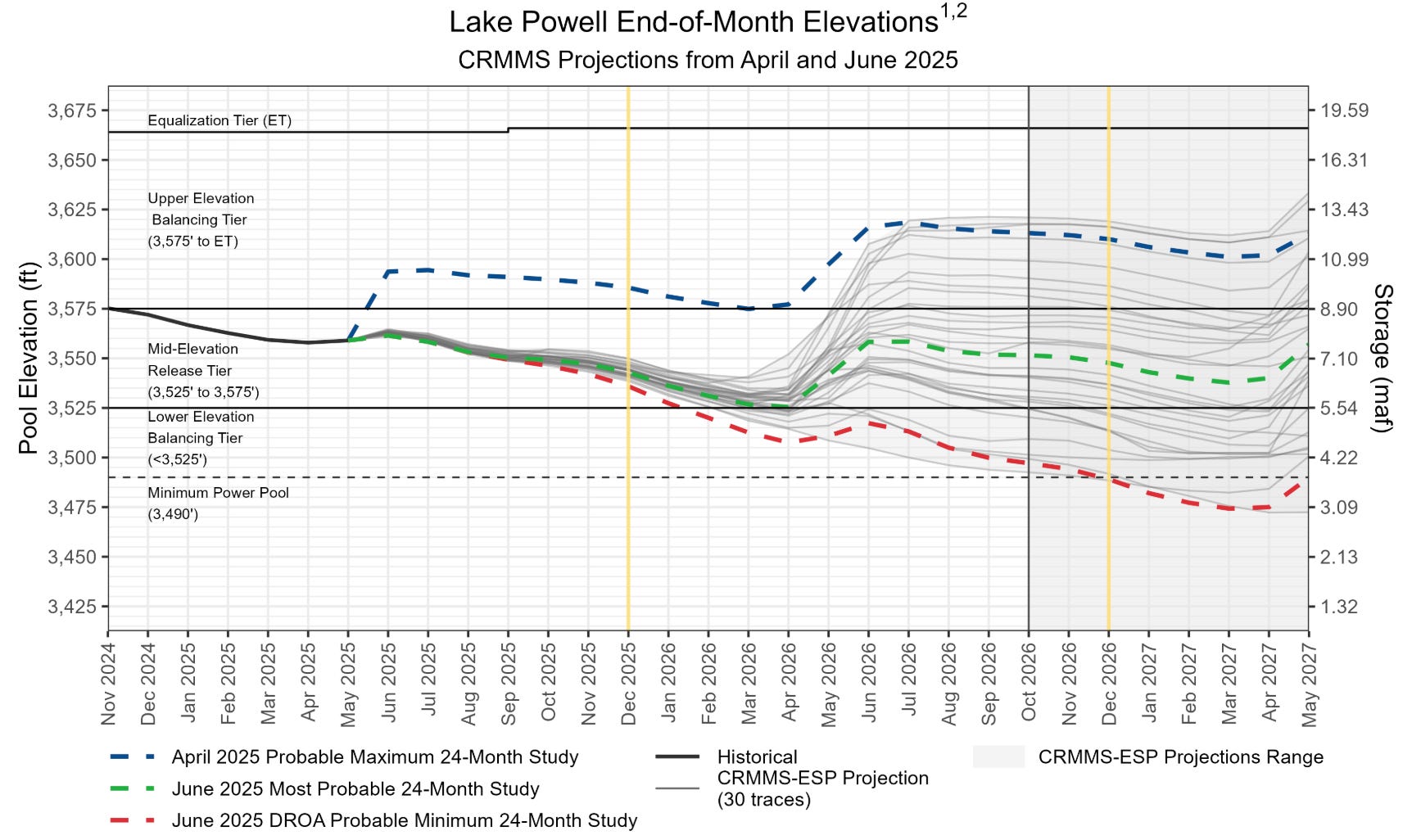
The snowpack-meagre 2025 winter delivered the first buzzkill to the Upper Colorado River Basin, followed by a warm and dry and dismal spring. Now, Lake Powell’s surface level is flatlining just as it should be shooting upward, an indicator that the river is back to its new normal. That is to say it is once again shrinking, and the gap between how much water has been allocated to the river’s users and what’s actually in there continues to grow. Which is to say, we’re still f&$#ed, and getting even more so with each passing year.
In fact, the U.S. Bureau of Reclamation’s latest projection has Lake Powell possibly dropping below the minimum power pool, or the level at which hydropower production shuts down, as soon as the end of 2026. Mind you, that’s their worst case scenario, but these forecasts often lean towards optimism. Most notable is how dramatically the forecast has changed since April, a difference that is visible in the graph below.