Click the link to read the article on the Colorado State University website (Benjamin Randall):
June 9, 2025
At Colorado State University, innovation doesn’t always start in a state-of-the-art lab. It sometimes begins with a farmer in need, a researcher with a goal and a healthy dose of curiosity. That spirit drives work at the Colorado Water Center, where scientists and collaborators are rethinking how we manage and measure one of our most vital resources.
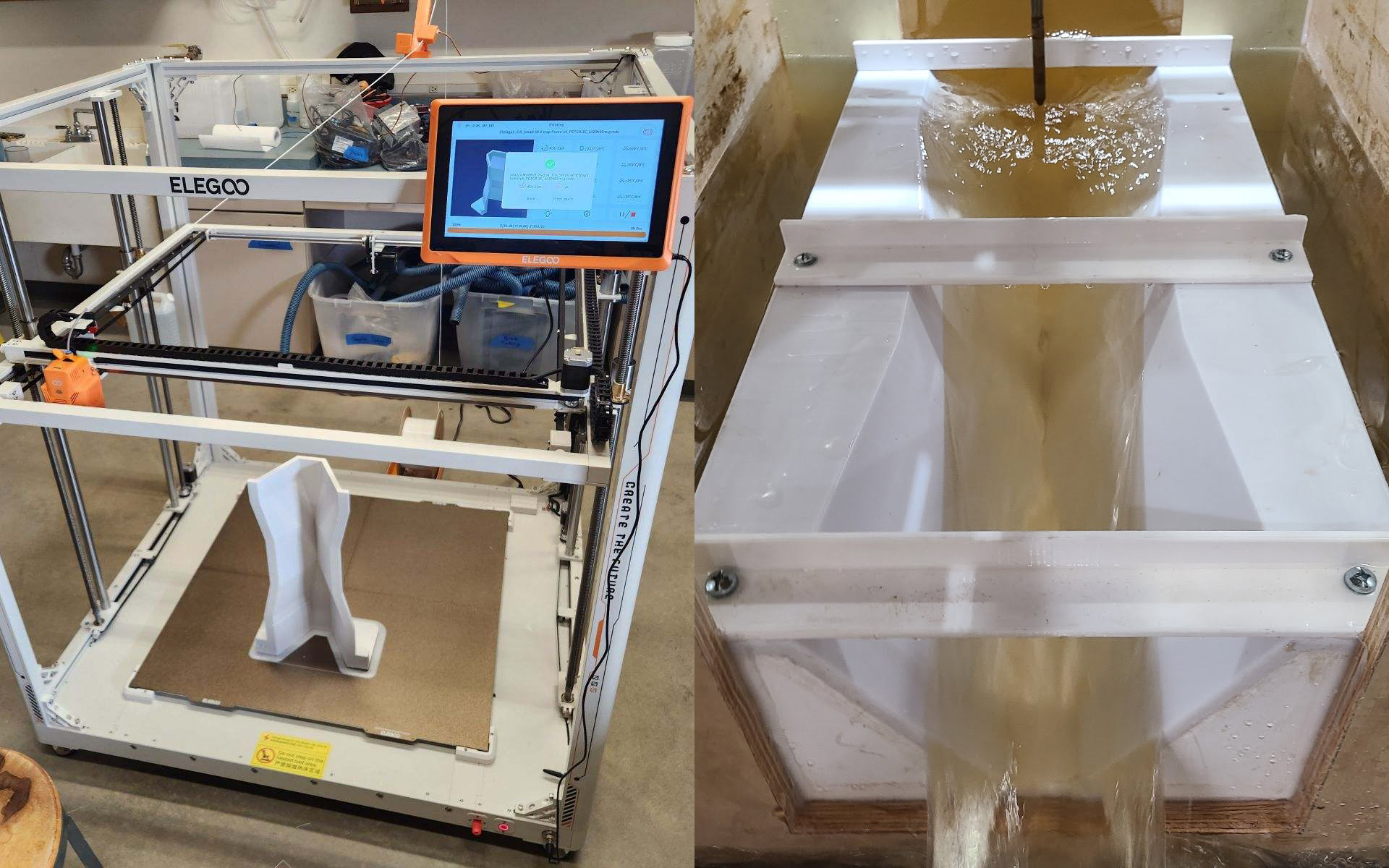
CSU Extension Professor Perry Cabot, who is jointly appointed through the Colorado Water Center and the Agricultural Experiment Station, is blending historic engineering with cutting-edge technology to make irrigation measurement more affordable and accessible. Cabot and a team of CSU researchers are harnessing the power of large-format 3D printing to revive and reimagine the Parshall flume – a century-old water measurement device first developed at CSU.
The project was made possible through funding from the Colorado Water Center’s grant program, which supports applied research projects that address urgent water issues across Colorado.
From legacy to low-cost innovation
The Parshall flume, invented by Ralph Parshall in 1921 at what was then called Colorado Agricultural College, remains one of the best methods for measuring water in open channels like irrigation ditches. Its distinctive shape slows and constricts the water as it flows through, making it possible to calculate the flow rate, or how much water is flowing through per second, by measuring the height of the water at a specific point in the flume. The flow rate is multiplied by the amount of time the water flows through the flume to calculate the amount of water. This information is essential for tracking and managing water used for irrigation, especially in regions where every drop counts.
“The genius of the flume is in the geometry,” Cabot said. “We can convert the height of the water in the flume into flow without needing fancy instruments, which is precisely why it has stood the test of time.”
Farmers can use flume data to schedule precise watering, reduce excess runoff and document their water use to meet regulatory requirements. By knowing the exact flow rate, a farmer can match irrigation timing and volume to crop needs more accurately. This minimizes the risk of overwatering, which wastes both water and energy, and reduces the risk of nutrient runoff. Over the course of a growing season, this kind of precision can lead to better harvests, lower costs and more sustainable use of limited water supplies.
However, traditional flumes are expensive, often ranging from hundreds to thousands of dollars, depending on size, and they are cumbersome to ship. For many farmers, researchers and conservation districts, the cost alone can be a barrier to access.
“We measure what we value, and we value water, but it’s a resource that’s increasingly difficult to put a clear, consistent price on,” said Cabot. “That lack of clarity makes it harder to justify costs associated with industrial tools like Parshall flumes.”
A common-sized Parshall flume (9 inches to 18 inches) made out of fiberglass can cost a few thousand dollars, while larger flumes made out of materials like aluminum, stainless steel or concrete can cost tens of thousands of dollars. The cost of the flume, plus installation and accessories, can make it a significant investment compared to the value of the water measured.
“Instead of buying an expensive, prefabricated flume, 3D printing allows us to create and sell Parshall flumes at a much more affordable rate,” Cabot said.
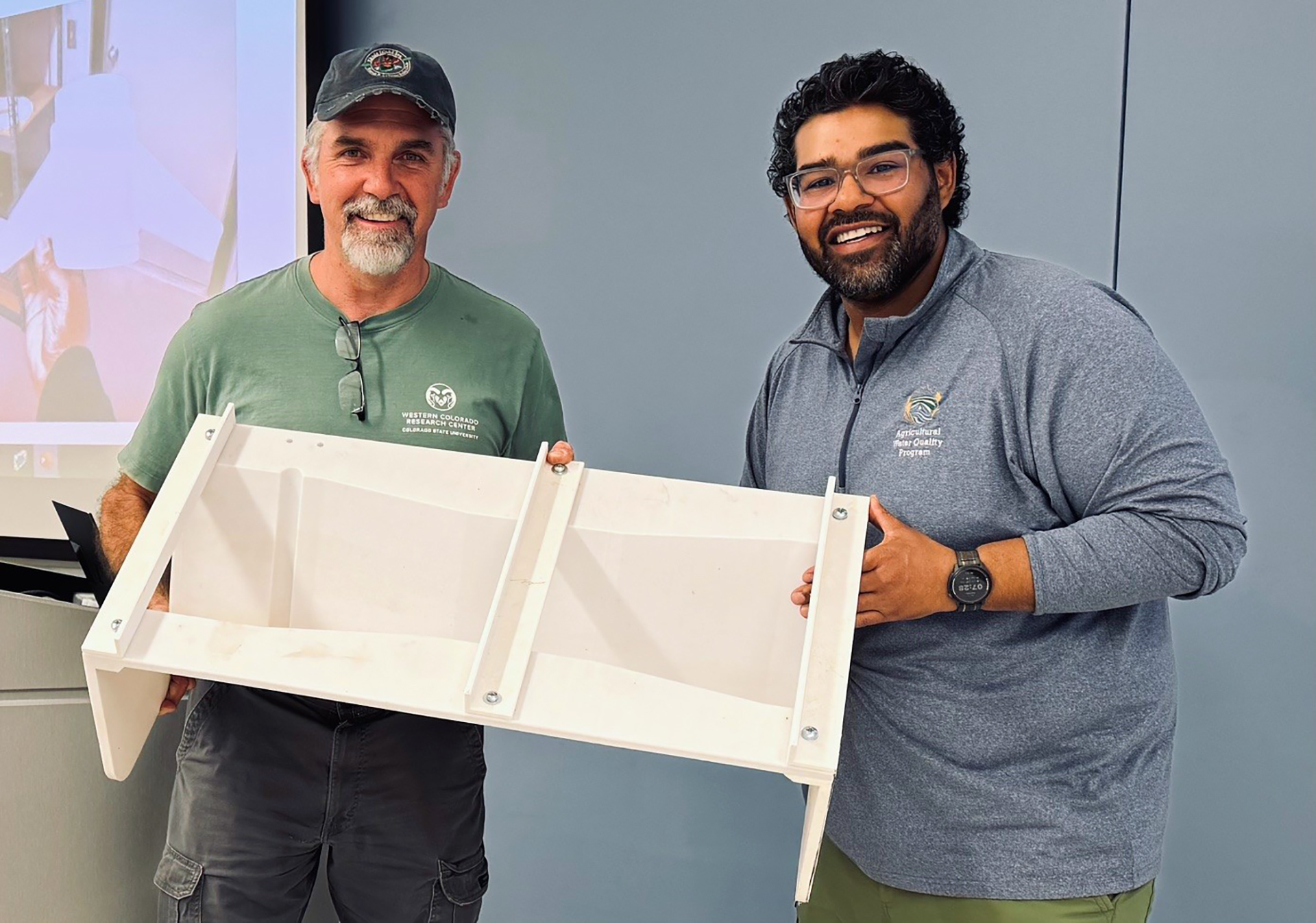
Manny DeLeon, a CSU researcher in the College of Agricultural Sciences and research technician on Cabot’s team, uses tools such as 3D printing to help develop low-cost technologies to make water measurement more accessible and efficient.
Using a durable, petroleum-based resin, Cabot and DeLeon have successfully printed the first large-scale Parshall flumes ever produced using additive manufacturing. Their 3D-printed version costs as little as 10%-20% of its traditional counterpart, with minimal compromise in durability or accuracy.
Printing the future of water management
Cabot sees this as a transformative step toward democratizing water measurement tools. His long-term vision is to decentralize flume manufacturing by equipping local conservation and river districts with the 3D printers needed to build and calibrate their own equipment.
“Imagine a farmer walking into their local conservation office, asking for a flume and walking out with one the next day,” Cabot explained. “This puts the tools of water management into the hands of the people using them.”
Rooted in service, driven by ingenuity
For Cabot, this project represents more than cost savings or tech adoption; it’s about service.
“My job is to help people,” he said. “Engineering, for me, is fun, but it’s also about solving problems that matter. That’s what engagement and extension are all about.”
That mindset has shaped every step of the process, from co-developing prototype irrigation tools with local farmers like Paul Kehmeier, to mentoring students involved in Cabot and DeLeon’s growing 3D printing lab at CSU’s Western Colorado Research Center, located about 7 miles southeast of Grand Junction.
Cabot said his work on the Western Slope is a great reminder for the future of research and innovation at CSU. “We don’t need to have the flashiest tools to build something transformative that can change the world. All it takes is a little ingenuity, a bit of resin and those willing to do the work.”
Learn more
To explore more about CSU’s legacy in water innovation and the Colorado Water Center’s work, visit the Colorado Water Center’s website.