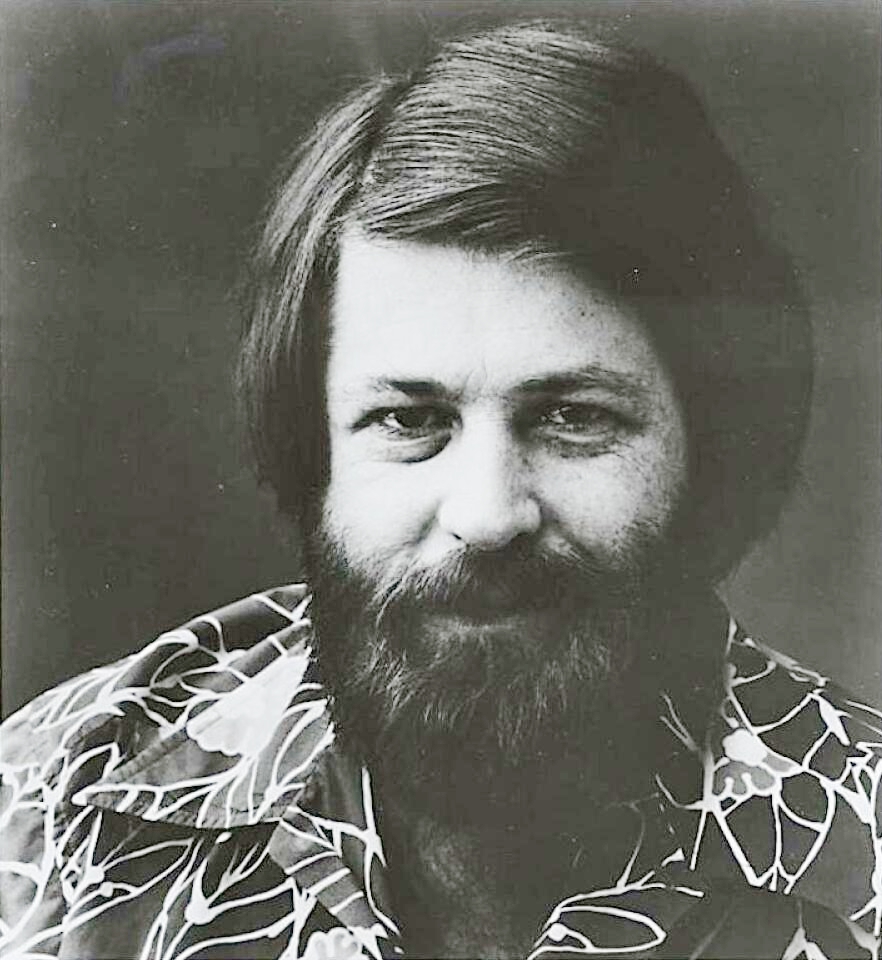
Brian Wilson, who as the leader and chief songwriter of the Beach Boys became rock’s poet laureate of surf-and-sun innocence, but also an embodiment of damaged genius through his struggles with mental illness and drugs, has died. He was 82…On mid-1960s hits like “Surfin’ U.S.A.,”“California Girls” and “Fun, Fun, Fun,” the Beach Boys created a musical counterpart to the myth of Southern California as paradise — a soundtrack of cheerful harmonies and a boogie beat to accompany a lifestyle of youthful leisure. Cars, sex and rolling waves were the only cares. That vision, manifested in Mr. Wilson’s crystalline vocal arrangements, helped make the Beach Boys the defining American band of the era. During its clean-cut heyday of 1962 to 1966, the group landed 13 singles in the Billboard Top 10. Three of them went to No. 1: “I Get Around,”“Help Me, Rhonda” and “Good Vibrations.”…At the same time, the round-faced, soft-spoken Mr. Wilson — who didn’t surf — became one of pop’s most gifted and idiosyncratic studio auteurs, crafting complex and innovative productions that awed his peers.
“That ear,” Bob Dylan once remarked. “I mean, Jesus, he’s got to will that to the Smithsonian.”
Mr. Wilson’s masterpiece was the 1966 album “Pet Sounds,” a wistful song cycle that he directed in elaborate recording sessions, blending the sound of a rock band with classical instrumentation and oddities like the Electro-Theremin, whose otherworldly whistle Mr. Wilson would use again on “Good Vibrations.” “Pet Sounds” was a commercial disappointment upon its release, but the technical sophistication and melancholic depth of tracks like “God Only Knows” and “I Just Wasn’t Made for These Times”eventually led critics and fellow musicians to honor it as an epochal achievement. In both 2003 and 2020, Rolling Stone ranked “Pet Sounds” No. 2 on its list of the greatest albums of all time. (No. 1 was the Beatles’ “Sgt. Pepper’s Lonely Hearts Club Band” in 2003, Marvin Gaye’s “What’s Going On” in 2020.)
Colorado River Basin reservoir storage. Credit: InkStain.net
Click the link to read the article on the InkStain.net website (Jack Schmidt and John Fleck):
June 1, 2025
We now begin June, when the Colorado River’s two largest reservoirs, Lake Mead and Lake Powell, should be swelling with melting snow for use later this year and beyond, but that is not happening. Although Lake Powell is our reservoir and Lake Mead is theirs (or vice versa), the two reservoirs are effectively one very large facility located downstream from Upper Basin consumptive users and upstream from Lower Basin users. At least 60% of the total storage in 46 reservoirs tracked by Reclamation is in Lake Powell and Lake Mead. The total contents of the two reservoirs have been steadily declining since early July 2024 and continued to decline through at least 31 May 2025. Never in the past 15 years has the decline in total storage of Powell and Mead extended so late into spring. Current reservoir storage data are showing us, in real time, an ominous pattern familiar from past dry years: upstream use of water before it has a chance to get to Lake Powell combined with releases from Lake Mead to users further downstream is outpacing the melting snowpack’s ability to replenish the two reservoirs.
While the normal tools we use for measuring and managing use of Colorado River water – the Consumptive Uses and Losses Reports and the Lower Basin decree accounting reports – lag by weeks or even years, reservoir storage, which is the net difference between stream flow into reservoirs and what is released downstream or is lost to evaporation, provides the closest thing we have to an accurate, real-time measure of the Colorado River basin’s water budget. Right now, we are not doing well.
The duration of time this year during which total storage in Lake Powell and Lake Mead has declined is unprecedented in the past 15 years. In a typical year, the steady decrease in the combined contents of Powell and Mead that begins the preceding summer ends in early May when Rocky Mountain snowmelt becomes significant. However, inflows to Lake Powell this year have yet to exceed releases from Lake Mead , and the total contents continue to decline, suggesting that this year’s recovery in storage will be minimal.
Data from other years also suggests that reservoir recovery this year will be relatively small. This year, total unregulated inflow to Lake Powell is predicted to be 55% of normal. Based on past trends, net increase in total reservoir storage of the 46 reservoirs tracked by Reclamation will be ~1.2 million acre feet (af). By July, we are likely to resume draw down the basin’s reservoirs until the 2026 snowmelt season begins.
Presently, storage in the watershed’s reservoirs is comparable to conditions in late summer and fall 2021 when water managers expressed significant concern. The very wet conditions of 2023 averted a major crisis, but the system remains depleted. In 2024, total basin reservoir storage climbed by 2.5 million af, but subsequent drawdown of those reservoirs was 3.6 million af during the following 10 months. Although the net difference between reservoir gain and subsequent drawdown of 1.1 million af might be considered “balanced” in the context of the last 15 years, there is no question that we have begun to mine the bounty of 2023, and we are likely to continue to do so until at least spring 2026 unless we greatly reduce consumptive uses.
For too long, we have hoped that big wet years will occur with sufficient frequency to avert true crisis, but there have been too few of those wet years during the 21st century. Only three of the last 15 years have been sufficiently wet to result in a significant increase in reservoir storage given the magnitude of the basin’s consumptive uses. We can’t continue with a water management policy that hopes for another wet year. The basin’s water managers have no choice but to further reduce consumptive uses to sustainably manage the dwindling water supply.
In response to a previously posted mini-white paper on reservoir storage, a supportive friend commented, “Nobody cares.” Another friend said, “I don’t see how we can get agreement about recovering storage. Let’s hope for more wet years.” We should care, and we need to try harder.
These mini-white papers seek to demonstrate that reservoir storage data, analyzed in aggregate, provide timely and accurate data relevant to understanding the reliability and security of the Colorado River’s water supply. These data are more precise, accurate, and timely than estimates of natural runoff, reservoir inflow, consumptive uses, or evaporation. Reservoir storage data provided by Reclamation are a significant contribution to transparency in water management. However, these data are under-utilized and under-analyzed and are typically reported without long-term context. We can do better.
These data can be used to develop an excellent correlation between April-July unregulated inflow to Lake Powell, forecast by the Colorado Basin River Forecast Center, and anticipated increase in basin-wide storage. Such an analysis strongly indicates that the 2025 snowmelt runoff will yield only a small increase in basin storage and necessitate greater reductions in consumptive use so as to better position the basin’s water users should next year also be dry.
In May 2022, a couple paused at once had been the bottom of the boat put-in ramp in Antelope Canyon to lok down on the receding waters of Lake Powell. The reservoir at that point was 22% full. Photo/Allen Best
Almost 300 water wonks converged on Boulder Thursday [June 3, 2025] for two days of sobering conversations about the river’s future punctuated by frustration, pleas for creative solutions and references to everything from the musician Lizzo to the kids movie “Frozen.”
Udall/Overpeck 4-panel Figure Colorado River temperature/precipitation/natural flows with trend. Lake Mead and Lake Powell storage. Updated through Water Year 2024. Credit: Brad Udall
The Colorado River Basin is in dire straits: The water supply for 40 million people has been dwindling, and climatologists say the climate future is bleak. State officials have spent months mired in thorny negotiations over things like how to split painful water cuts in the driest conditions — with scant progress to report publicly. The lack of progress and insight into the talks had some conference-goers feeling frustrated. Concerned. Uncertain.
High-ranking federal officials joined the Boulder event to reassert the federal government’s frequent role in talks over the Colorado River’s future: The parent ready to stop the car if the kids can’t stop fighting.
In the event that the states can’t agree on how to manage the river’s reservoirs and water supply in a timely fashion, Department of Interior Secretary Doug Burgum is ready to wield his federal authority over reservoirs, water contracts and more in the basin.
“He’s not looking forward to that, but in the absence of a seven-state agreement, he will do it,” Scott Cameron, the Department of the Interior’s acting assistant secretary for water and science, said Friday at the 45th annual Conference on the Colorado River at the University of Colorado’s Getches-Wilkinson Center.
The basin’s task is to submit a joint management proposal to the federal government for analysis. For months, however, they’ve been stuck working on separate ideas for how to manage the river.
Upper Basin states — Colorado, New Mexico, Utah and Wyoming — are on one side, and Lower Basin states — Arizona, California and Nevada — on the other. The 30 tribal nations in the basin are advocating for their individual needs, as is Mexico.
Notably, the top state negotiators, except California’s, skipped the Boulder conference this year, unlike in the past.
The Interior Department will analyze a joint basin proposal as part of a larger process to select draft alternatives and then settle on a final plan.
The final plan could determine everything from how key reservoirs store and release water to who takes cuts in dry years and how environments, like the Grand Canyon, will be impacted for years to come. It will impact water supplies for cities, like Denver, Phoenix and Los Angeles, ecosystems, a multibillion-dollar agricultural industry, hydroelectric power and more.
“The time for action is now,” Cameron told the gathering in a speech. “We do not have a lot of time to waste, people.”
Mounting challenges and a bleak climate future
The Bureau of Reclamation plans to release a draft outlining management options by the end of 2025 with a final plan in place by early summer 2026, Cameron said.
But the negotiating challenges are significant. State officials face the political problem of bringing home a deal that includes water cuts. Policymakers distrust each other. Anxious water users are nixing ideas before they have time to grow into policy solutions.
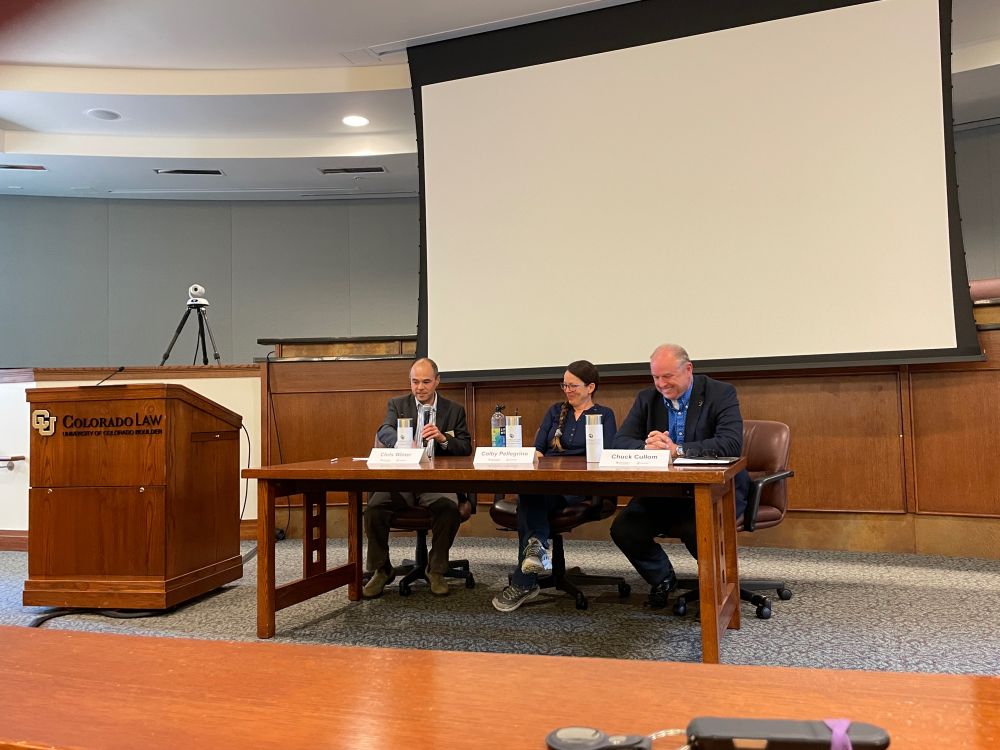
L. to R. Chris Winter, Colby Pelligrino, Chuck Cullom June 4, 2025 during the “Turning Hindsight into Foresight: The Colorado River at a Crossroads” the annual Getches Wilikinson Center/Water & Tribes Initiative shindig in Boulder.
We have to let people develop their ideas, said Colby Pellegrino with the Southern Nevada Water Authority and part of the Nevada negotiating team.
“We’ve done a really crappy job of that. Everyone in this room,” she said. “We need to do more to support the compromise.”
The basin states are already running behind schedule: In March, Upper Basin officials said the basin states had until May to submit their joint management proposal for federal analysis. But May passed, and nothing happened.
It’s like watching the Catholic Church’s secluded conclave to select the next pope, Jim Lochhead, former CEO of Denver Water and state negotiator, said.
“The smoke is all black right now,” he said. “I’m not hearing of any major breakthroughs.”
That’s not for lack of effort: The states are meeting twice a month, and they’re at the negotiating table together.
“We know that we get the best solutions when the states work together,” Colorado’s top negotiator Becky Mitchell said in a prepared statement. (She wasn’t at the conference.) “I am focused on building a broad consensus to address the risks facing the Basin States.”
One of those risks is a changing climate: The basin, along with the rest of the planet, is facing a “beyond awful” climate future, said Brad Udall, senior research scientist at Colorado State University.
The world is on track to warm by 9 degrees Fahrenheit by 2100, and continue warming from there. It’s a future with even less water to share among the U.S., Mexico and 30 tribal nations — and an outcome that, frankly, terrifies scientists, Udall said.
“That’s a world unlike anything we currently know, and it’s going to challenge us all on every front,” Udall told the gathering.
Searching for a unicorn
While some conference-goers were frustrated, speakers took the opportunity to pull lessons from past interstate negotiations and share their ideas for how to break the deadlock.
Tribal leaders called for continued and increased tribal involvement in the Colorado River talks.
“Honestly, I think if our state representatives are going to sit silent, then we have 30 tribal nations that are ready to take over and make a decision and save our river,” said Lorelei Cloud, a member of the Southern Ute Indian Tribe bordered by Colorado and chair of the Colorado Water Conservation Board. “We’ve been doing it since time immemorial.”
Some suggested solutions, like bringing in an external facilitator. Former negotiator and federal official Mike Connor said the states need to seize every olive branch and set aside personal agendas or political legacies. (This is where speakers turned to the “Frozen” mantra: “Let it go.”)
Jennifer Pitt of the National Audubon Society said building personal connections has been the key to progress in the past. Many people pushed for states to find creative solutions, like desalting seawater — a very expensive solution with a relatively small benefit (the equivalent of Lizzo’s tiny, Valentino purse, one water expert said).
“People are trying to turn this thing upside down and sideways to find a unicorn,” Chuck Cullom, executive director of the Upper Colorado River Commission, said.
Concerns abounded. Lochhead said the basin had a once-in-a-generation influx of federal funding — and blew it. Reclamation’s staff has been cut, something that Cameron said he was working to address. With shrinking water supplies, the basin’s communities are feeling the impacts of dry conditions more immediately than in the past.
Western Slope water leader Andy Mueller pushed for more information and faster action to help Colorado communities have more time to adapt and come up with water conservation plans.
“I think failure of our negotiators would be to fail to recognize that our hydrology could be just as bad as Brad Udall is predicting, or worse,” Mueller said.