The #ColoradoRiver ā€œpsst psstā€ scheme emerges into public view: the ā€œSupply Drivenā€ concept — John Fleck (InkStain.net) #COriver #aridification #GWCWTI2025

The potential path forward.

Click the link to read the article on the InkStain website (John Fleck):

June 18, 2025

Arizona yesterday finally moved the super-secret idea at the heart of current Colorado River negotiations out of the shadows.

The idea is deceptively simple: base Lake Powell releases on a percentage of the three-year rolling average of the Colorado River’s estimated ā€œnatural flowā€ at Lee Ferry. Allocate water based not on a century-old hydrologic mistake, but rather based on what the river actually has to offer. It presents an attractive alternative to the increasingly baroque and unproductive shitshow that had taken over interstate negotiations.

It has the great virtue of each basin getting out of the other basin’s business – one clean, simple number. But establishing the right percentage remains the hard part. Make the percentage too high and the Upper Basin will have to cut users with pre-Compact water rights. Make the percentage too low and Lake Powell fills up while Central Arizona goes dry.

But some of the early modeling suggests that there may be a sweet spot where a combination of Lower Basin cuts along the lines of what the Lower Basin has already been willing to offer, combined with modest Upper Basin system conservation programs, might thread a needle that could allow the crafting of a compromise. This is very good news if the negotiators and the folks back home who have been egging them on can seize this opportunity to set aside parochial smallness and think at the basin scale.

The possibility of a new approach was hinted at a CU Boulder’s Colorado River conference two weeks ago (I spent most of the conference hidden away watching and listening on Zoom through a covid haze, so it might have just been a fever dream, but I thought I heard the hints), and I’m told was a topic of some of the hallway conversations. But Tom Buschatzke’s reveal at yesterday’s meeting of the Arizona Reconsultation Committee (the closest thing we have to the much-needed C-SPAN for the Colorado River Basin) was the first public discussion of the hush-hush stuff that shouldn’t be quite so hush-hush given, y’know, 40 million of us stakeholders.

The full slide deck from the Colorado River C-SPAN Arizona Reconsultation Committee is useful. Reclamation’s Dan Bunk, for example, shared a slide slowing the latest ā€œmin probableā€ forecast (hilarious typo – ā€œmin problemā€ now corrected) showing the system tanking – dropping below minimum power pool at Powell – in winter 2026. The min probable forecast has been a useful guide lately, frankly, and the latest version is horrifying. (On any other day this would be the lead, and probably deserves its own post, but I try not to work on Wednesdays.)

We don’t have a lot of time here.

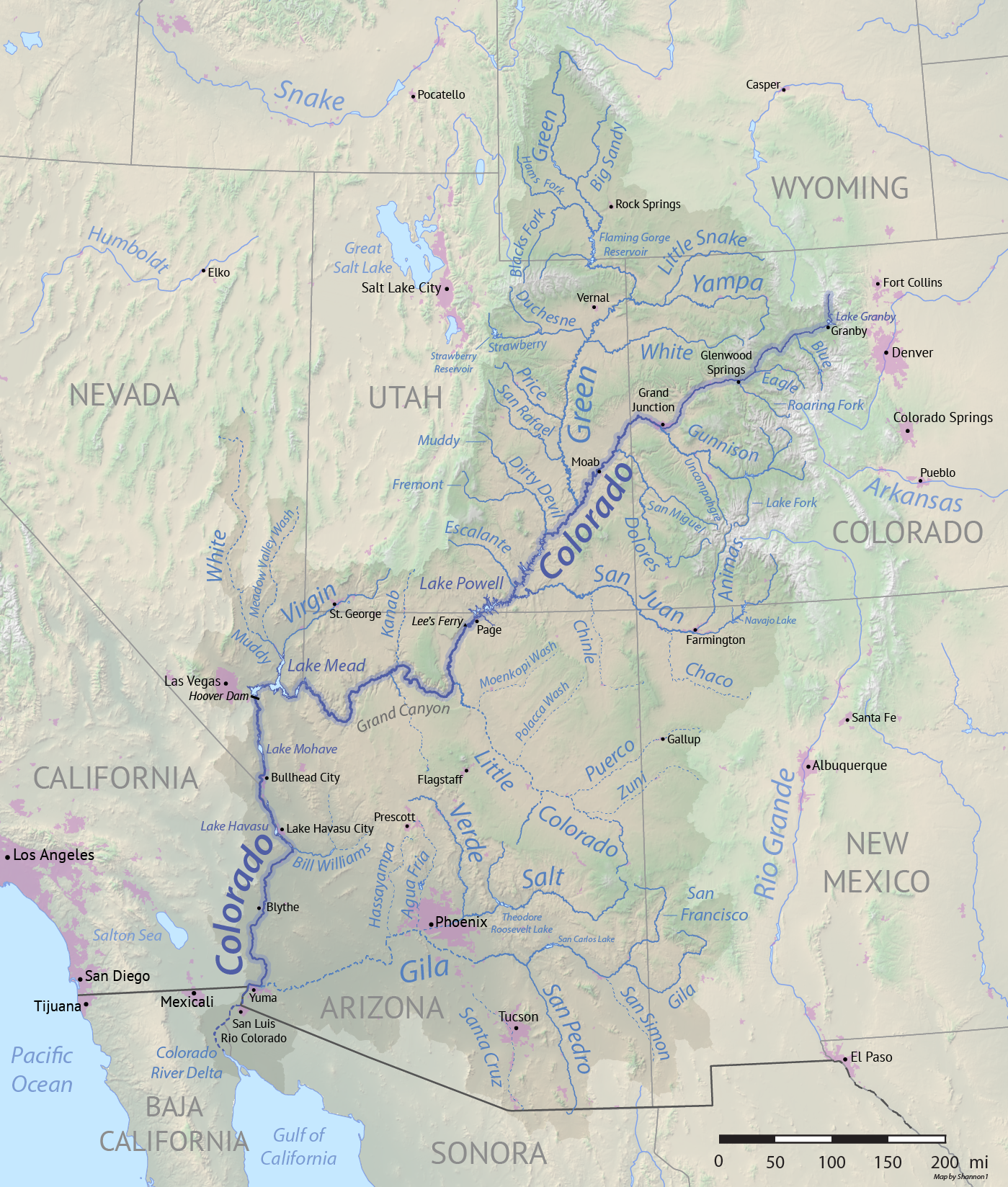
Map of the Colorado River drainage basin, created using USGS data. By Shannon1 – Own work, CC BY-SA 4.0, https://commons.wikimedia.org/w/index.php?curid=65868008

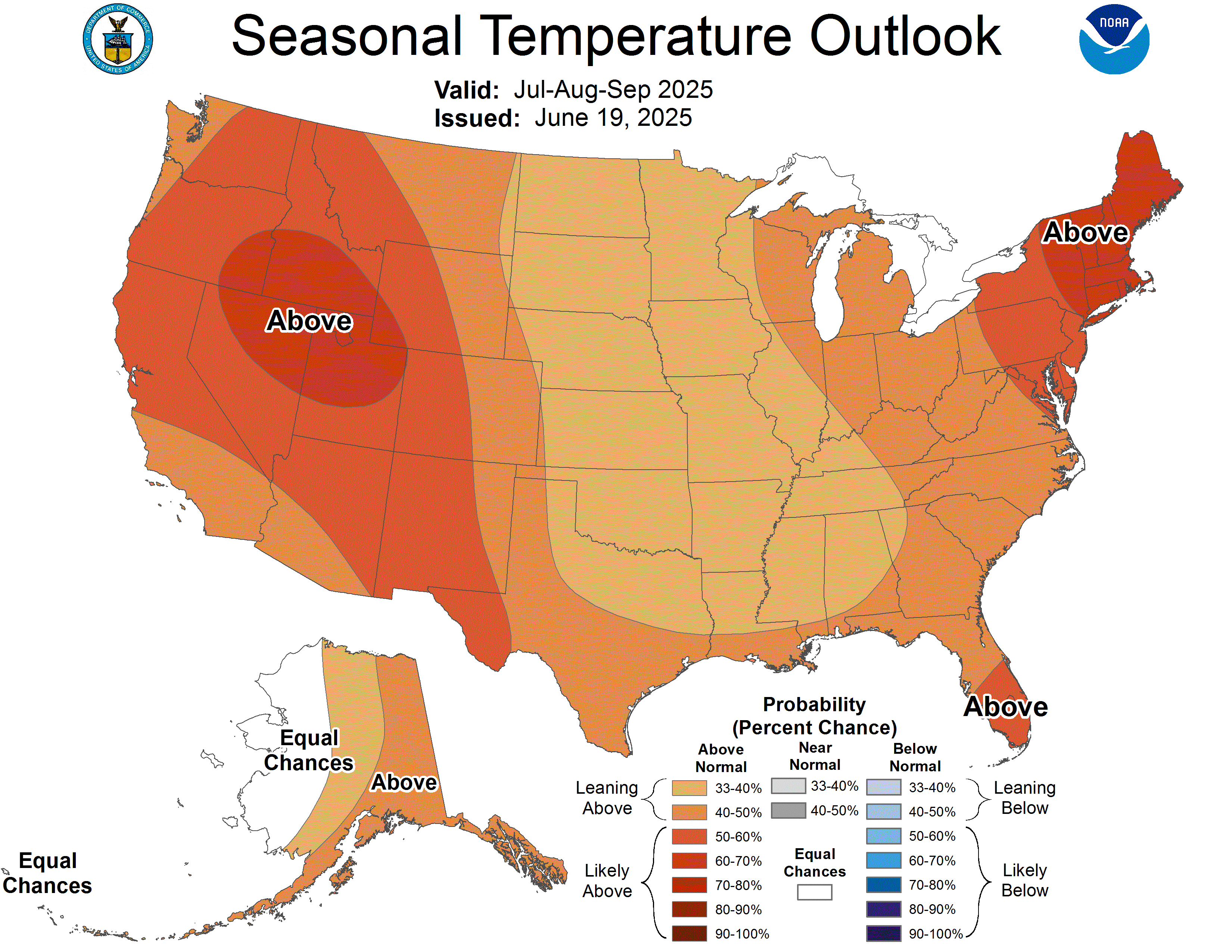
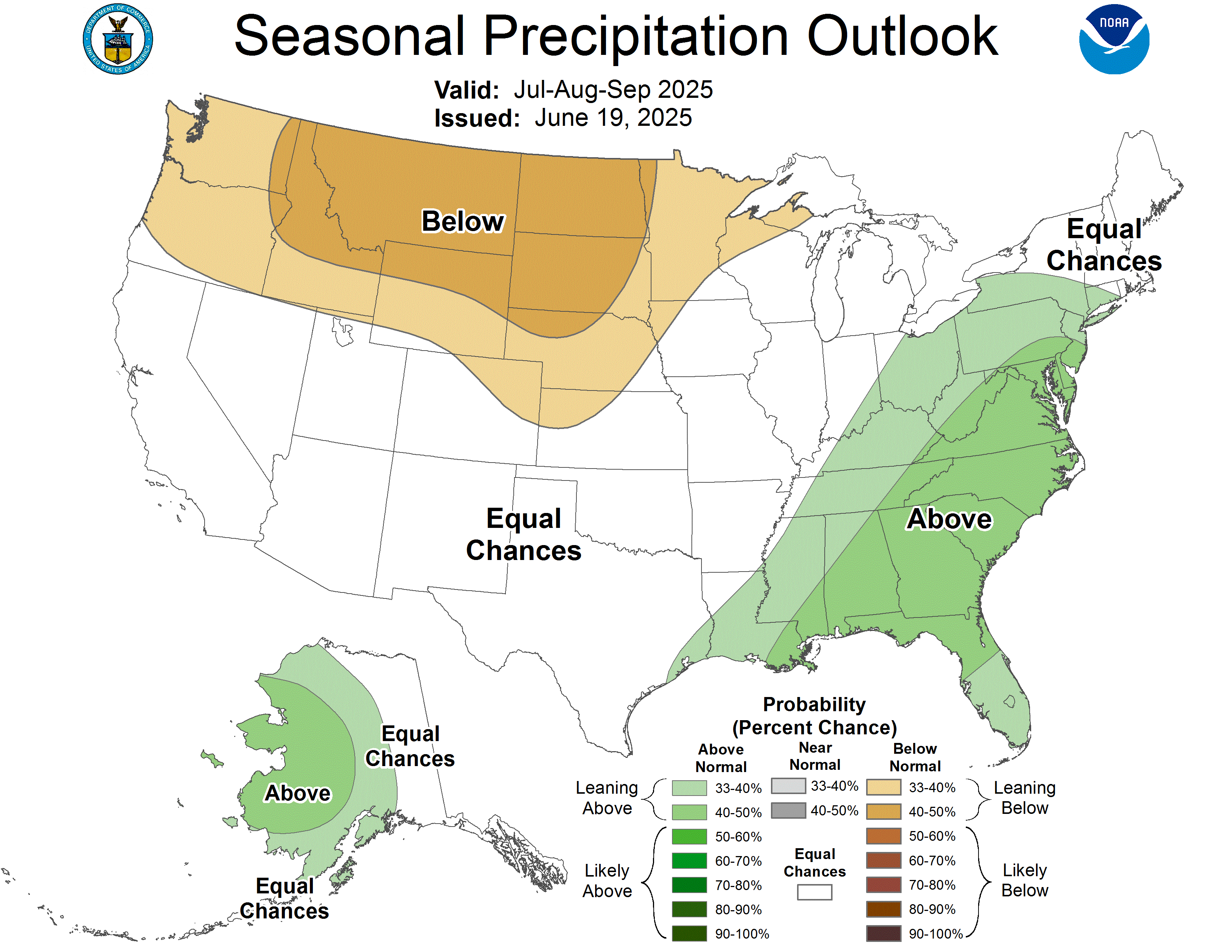
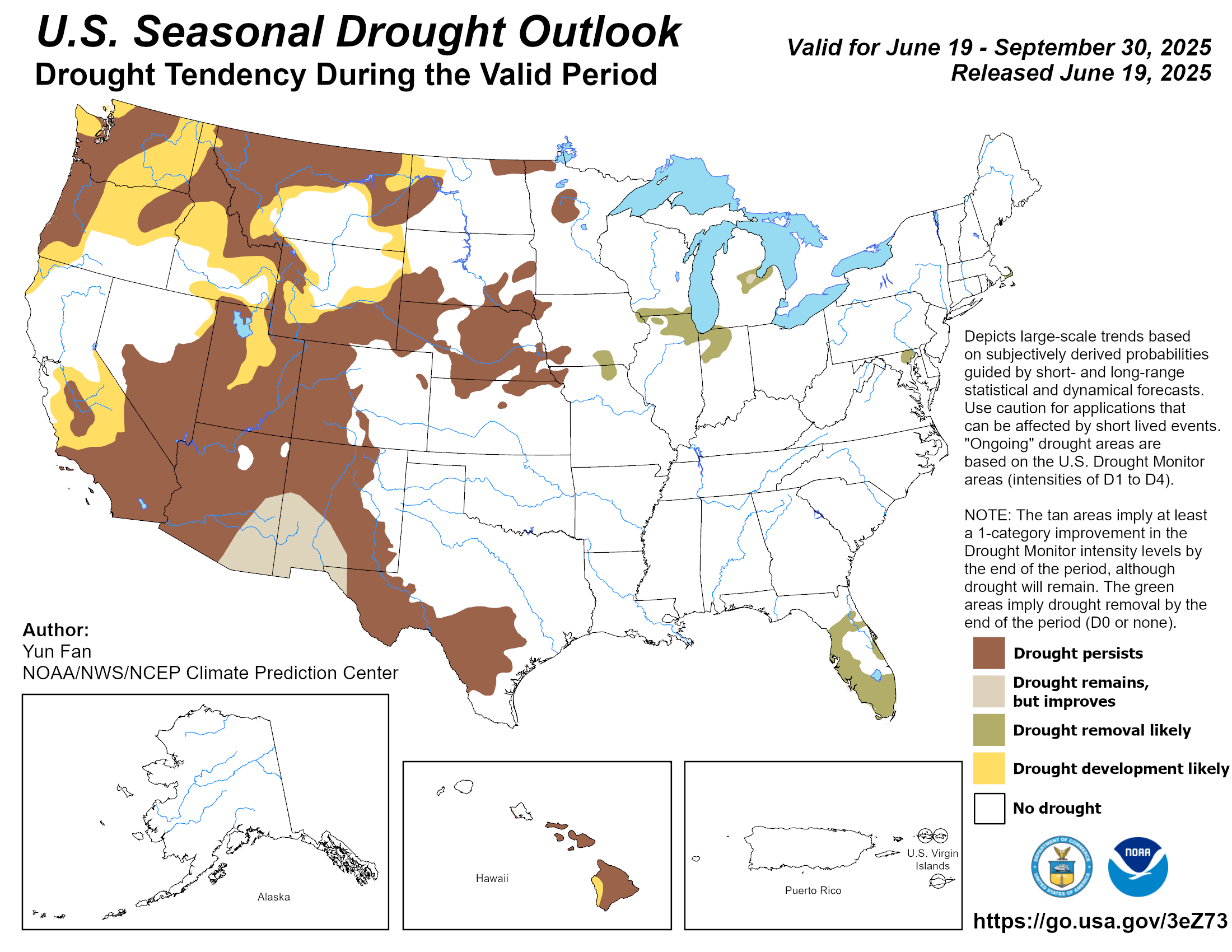
The latest seasonal outlooks through September 30, 2025 are hot off the presses from the #Climate Prediction Center

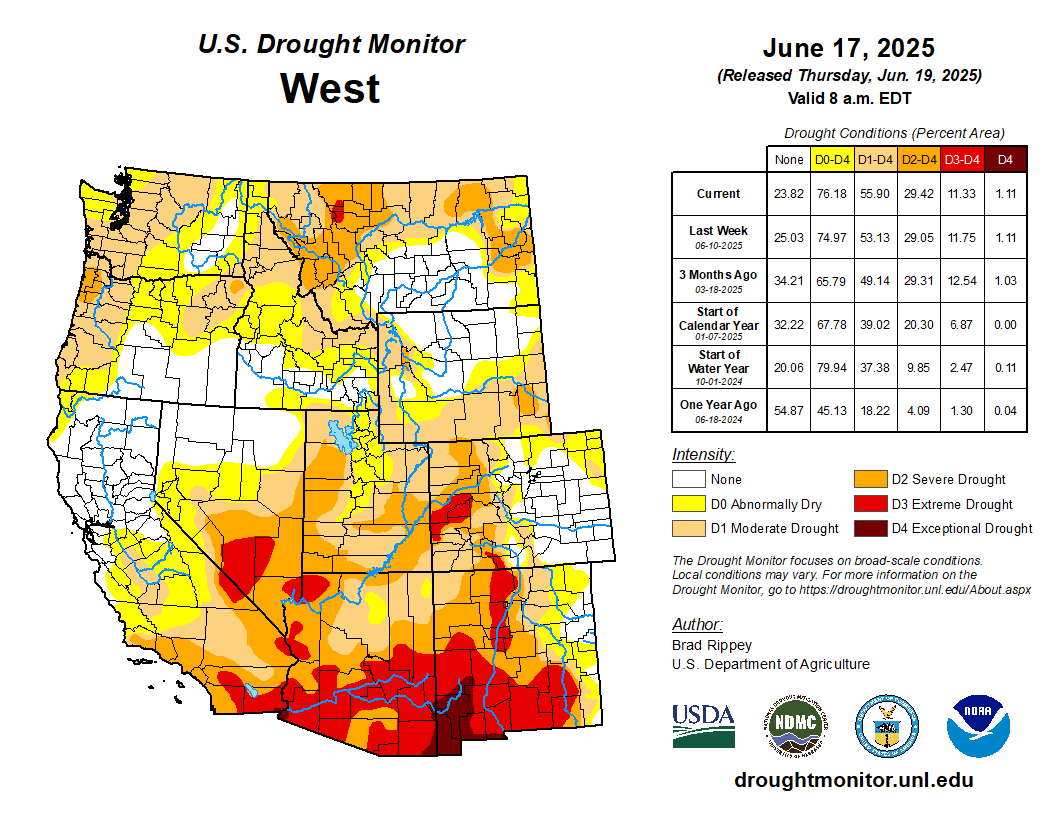
#Drought news June 19, 2025: Rain-related drought improvement dominated the High Plains, although some significant drought-related agricultural problems persisted

Click on a thumbnail graphic to view a gallery of drought data from the US Drought Monitor website.

Click the link to go to the US Drought Monitor website. Here’s an excerpt:

This Week’s Drought Summary

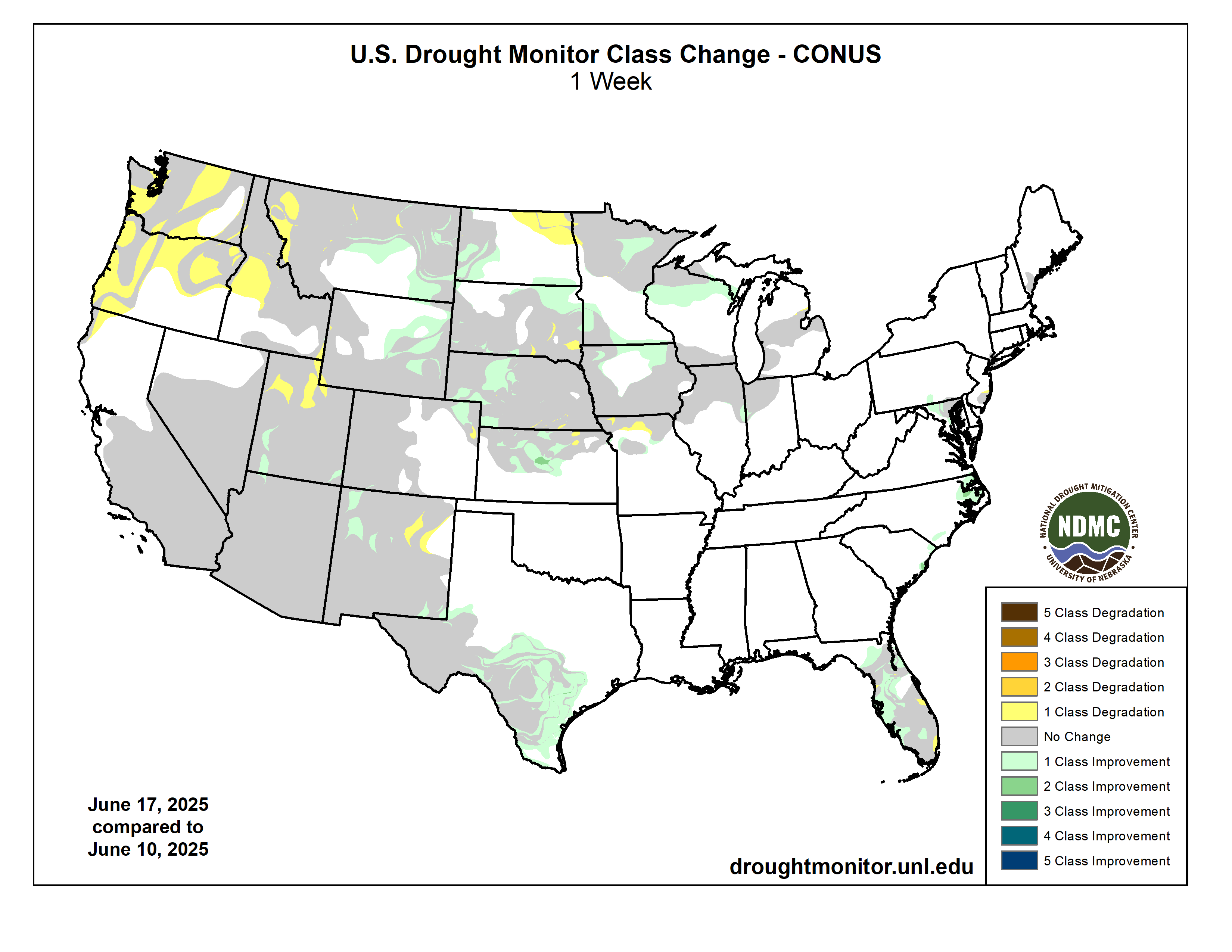
Active weather east of the Rockies led to significant reductions in drought coverage, especially in Florida, Texas, the northern and central Plains, and the upper Midwest. Amid early-summer showers, drought-free conditions largely continued from the southern Plains to the Atlantic Coast, excluding parts of Florida. Meanwhile, a Western hot spell—accompanied by short-term dryness across roughly the northern half of the region—was manifested in rapidly developing soil moisture shortages, declining prospects for summer water supplies, an elevated wildfire threat, a boost in irrigation demands, and increased stress on rain-fed crops…

High Plains

Rain-related drought improvement dominated the High Plains, although some significant drought-related agricultural problems persisted. By June 15, statewide topsoil moisture ratings on the High Plains ranged from 19% very short to short in Kansas to 50% in Wyoming, according to the U.S. Department of Agriculture. Wyoming led the region on that date with 36% of its rangeland and pastures rated in very poor to poor condition, followed by Nebraska at 30%. Elsewhere, significant rain bypassed a few areas, including northeastern North Dakota, where moderate drought (D1) expanded…

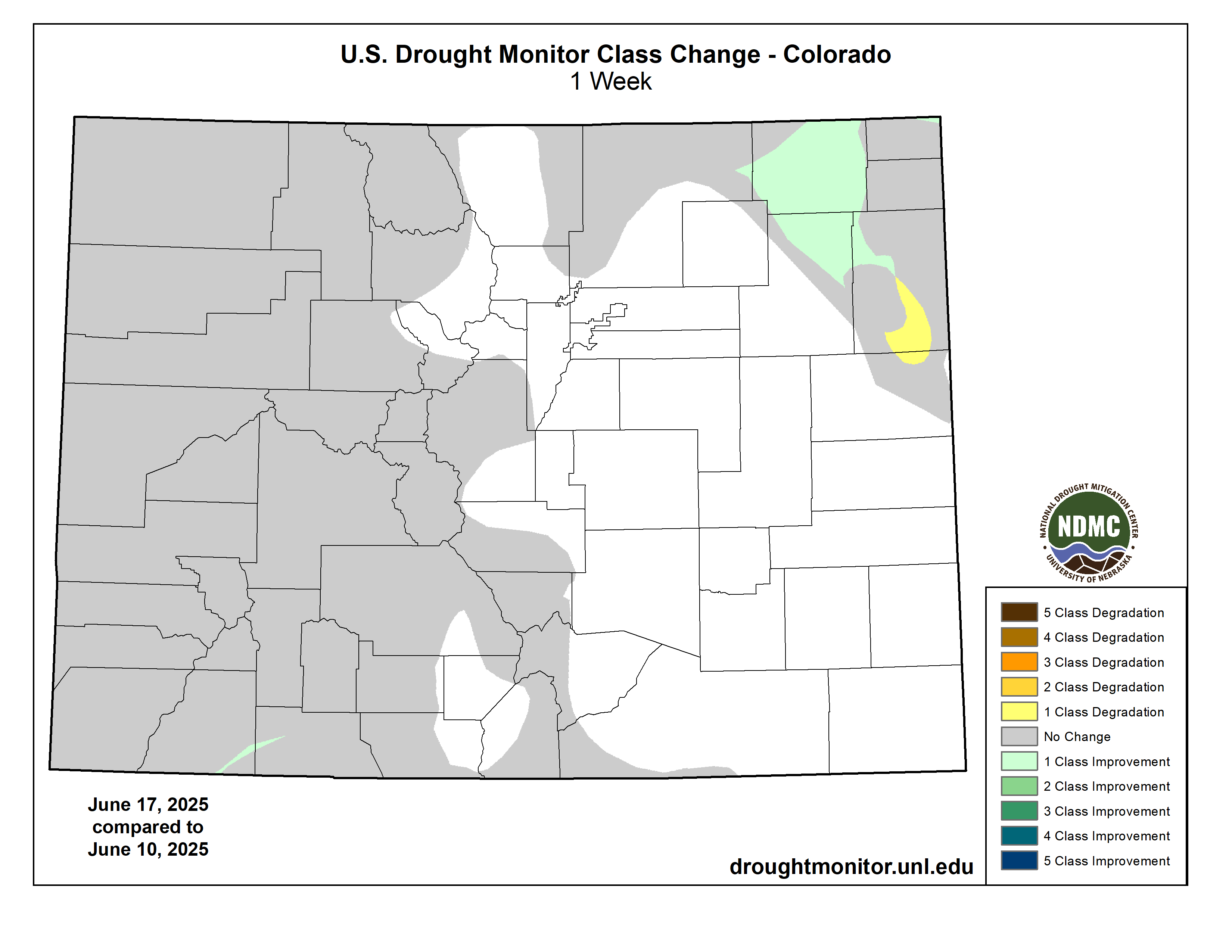
Colorado Drought Monitor one week change map ending June 17, 2025.

West

In contrast to areas east of the Rockies, mostly dry weather dominated the West during the drought-monitoring period. Rapid surface drying and prematurely melting (or melted) snowpack had led to a variety of agricultural and water-supply issues and concerns. The Northwest has been especially dry in recent weeks, with topsoil moisture—as reported by the U.S. Department of Agriculture on June 15—rated 65% very short to short in Montana, along with 56% in Oregon and 45% in Washington. Unlike Oregon and Washington, Montana received some much-needed precipitation in mid-June—but continued to experience agricultural drought impacts. For example, Montana’s rangeland and pastures were rated 46% in very poor to poor condition on June 15. Among major production states, Montana led the nation on that date in very poor to poor ratings for spring wheat (28% of the crop) and barley (25%). Meanwhile, among several early-season Northwestern wildfires was the 3,600-acre Rowena Fire near The Dalles, Oregon, which has destroyed more than 150 structures, including several dozen homes…

South

Downpours in parts of Texas, the only state in the region still experiencing drought, delivered significant relief but also sparked flooding. In fact, deadly flash flooding struck the San Antonio area on June 12, when the official airport observation site received 6.11 inches—the second-wettest June day on record in that location, behind only 6.18 inches on June 3, 1951. San Antonio also set a one-hour station rainfall record for any time of year, with 3.98 inches falling from 3 to 4 am CDT. In drought-affected areas where heavier rain fell, some of the water was lost due to runoff, rather than absorption into parched soils. Additionally, groundwater and aquifer depletion in south-central Texas and neighboring areas has developed over many years—and will require much more than a singular heavy-rainfall event for replenishment…

Looking Ahead

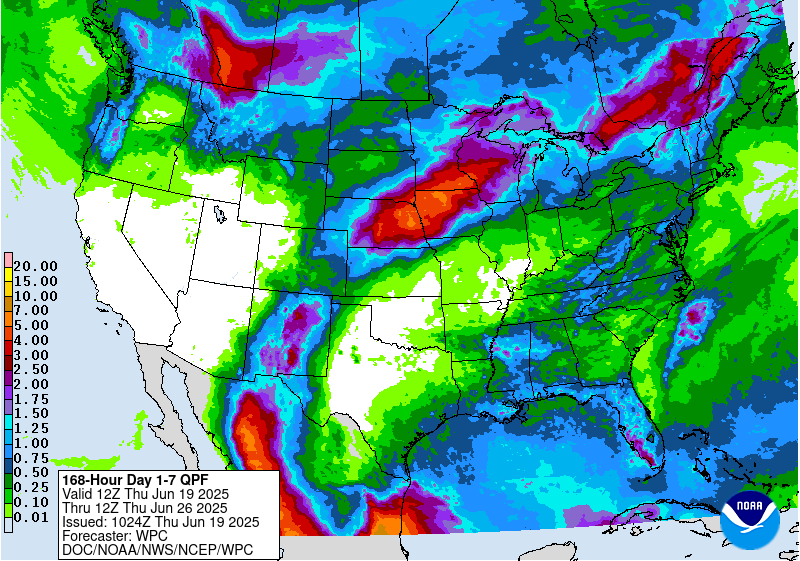
Active weather will shift eastward during the next couple of days, as a hotter, drier pattern envelops the nation’s mid-section and quickly expands. Additional rainfall could total 1 to 3 inches across the eastern one-third of the United States, with some of the highest amounts expected from the lower Great Lakes States into northern New England. However, by the end of the week, any significant precipitation should be limited to parts of the North, with hot, dry weather dominating the remainder of the country. During the weekend, high temperatures should top 100°F in the western Corn Belt as far north as South Dakota, while readings will reach 95°F in nearly all areas of the Midwest. By Sunday, however, cooler air should spread as far east as the northern High Plains. During the transition to cooler weather, showers will develop from the Pacific Northwest to Montana. In the East, the first major heat wave of the season will persist into the first half of next week, with high temperatures near 100°F expected at lower elevations of the Atlantic Coast States from Georgia to southern New England. There are some indications that, by early next week, remnant tropical moisture once associated with Eastern Pacific Hurricane Erick could be entrained by a cold front, leading to an increase in shower activity from the southern Rockies into the upper Midwest.

The NWS 6- to 10-day outlook for June 24-28 calls for the likelihood of above-normal temperatures across much of the eastern half of the country, as well as the northern Rockies and environs, while cooler-than-normal conditions will be mostly limited to the Southwest. Meanwhile, near- or above-normal rainfall can be expected nationwide, with an area stretching from the Southwest into the Great Lakes States having the greatest likelihood of experiencing wet weather.

US Drought Monitor one week change map ending June 17, 2025.

Why #ClimateChange must be part of the #ColoradoRiver conversation — Allen Best (BigPivots.com) #COriver #aridification #GWCWTI2025

Jennifer Pitt and Brad Udall at the Getches-Wilkinson Center/Water and Tribes Initiative conference June 5, 2025. Photo credit: Allen Best/Big Pivots

Click the link to read the article on the Big Pivots website (Allen Best):

June 12, 2025

Brad Udall also makes the case that stakeholders in the basin can work together to solve this ā€œreally sticky, difficult issueā€

Brad Udall was on a panel on June 5 at the annual Colorado River conference hosted by the Getches-Wilkinson Center at the University of Colorado-Boulder’s School of Law.

In his brief slot on the panel, Udall was first a cheerleader for Colorado River problem solving but reminding listeners that climate change was the elephant in the room, as several speakers later in the conference acknowledged.

Following are his remarks, lightly edited:

Given the policy expertise on this panel, I’m going to constrain my remarks to what’s going on in the climate space. I want to make the following two points and end with a heartfelt plea.

Within this basin, we can and have worked together to deal with a really sticky, difficult issue like climate change, to inform decision-making given the right partners, including the federal government at the table. Point two is our current climate trajectory is beyond awful, and that makes our challenge even worse.

So let me get to point one. We can, in fact, work together on a really difficult issue. In late 2006 Terry Fulp (then regional director of the Lower Colorado Basin Region for the U.S. Bureau of Reclamation), pulled together six different sciences to consider how a changing climate would impact runoff, to inform the 2007 Interim Guidelines EIS. That effort became Appendix U.

Interestingly, it was the first time climate science was incorporated into a major EIS. It was not particularly controversial, and it was done during a Republican administration. It set the stage for future (Bureau of) Reclamation climate change efforts, efforts that have continued to this day.

But put an asterisk next to that.

The next year (2008), the Water Utility Climate Alliance was formed by eight major national water providers, and four of those were actually in our basin: the San Diego County Water Authority, Denver Water, Metropolitan Water District of Southern California, and Southern Nevada Water Authority.

Members have led the way in figuring out how to adapt to climate change, including hiring certain staff to deal with this. And a hat tip for this to both Jim (Lochhead, former CEO of Denver Water) and Bill Hasencamp (Colorado River resources manager for Metropolitan).

Let me mention Reclamation again, because in 2009 Mike Connor, as a congressional staffer, wrote the SECURE Water Act, which made Reclamation perform a series of continuing climate change studies that are important to this day.

The lesson here is that when faced with such a daunting and unknown challenge, we actually can come together to discover scientific truths, but we need both federal and basic leadership to make this happen. Unfortunately, right now, one leg of this is seriously threatened, hence my asterisk.

My second point is about our awful moment, our global climate change trajectory. Hold on to your seats, because I’m going to make you uncomfortable. The world is on track for 3 degrees Celsius warming by 2100. This far exceeds anything agreed to by the 2015 Paris Climate Accords. And frankly, terrifies scientists. Three Celsius is a projected average global warming, but over land, that’s 5 Celsius. Converted into Fahrenheit, it’s nine Fahrenheit. Imagine every day, 9 Fahrenheit warmer. Highs, 9 Fahrenheit warmer. Lows, 9 Fahrenheit warmer. That’s a world unlike anything we currently know, and it’s going to challenge us all on every front.

And what’s worse about this, and not particularly appreciated, is that to get to 3 Celsius, we need large global greenhouse emissions to continue through this century to 2100. So, it will continue to warm significantly beyond 2100. Nine Fahrenheit is not where we end up. It’s kind of where we start.

This 3 Celsius outcome has been has been obvious for at least five years, as climate policy progress has stalled and even gone backwards. You know, post-Paris in 2015 there were all kinds of great net-zero by 2050 pledges by government and industry, including the fossil fuel industry.

But since then, the fossil fuel industry is trying to have it both ways. They love to tout these goals while at the same time talking to the shareholders about how they’re going to expand production in ways that are completely incompatible with 2 Celsius. And there are about 25 large, mostly national oil companies that are living this lie. Each one thinks they’re going to be the last one standing, selling a product that’s fundamentally incompatible with a stable climate. [ed. emphasis mine]

If you think we’ve got plenty of time to solve this, like 75 years, normally, I’d agree with you. But think about what’s happened over the past 35 years. Emissions have gone up 60% and continue to rise. With these bad actors and with banks willing to finance this and governments willing to subsidize it, what we’re witnessing is a monumental failure of both capitalism and governance.

Now, if this weren’t all bad enough for you, we now have an anti-knowledge president and his vile enablers systematically attacking all forms of knowledge using illegal and unconstitutional tactics. Nowhere has this been more true than in this climate science space, where they’re going after anything and everything that has the word climate on it, every federal agency.

I’ll mention three here in our basin that are really critical: NOAA, the USGS and Reclamation. All of that climate work is in the sights of these vile enablers and the administration. Hence that nasty asterisk again. This administration aims to stop all work at preventing future greenhouse gas emissions as well as our ability to adapt to coming changes.

And 95% of what I can say on this panel about this is not suitable for this room, but let’s call it what it is: it’s insanity what they’re doing.

There are also recent, strong signs that climate warming is speeding up. So 2023 and 2024 were 1.5 Celsius above a pre-Industrial average. And there, those two years have a trend line that’s twice what we’re used to seeing, and it has climate scientists flummoxed about the reasons behind it.

So why talk about global climate issues in a conference about the Colorado River? Well, it should be obvious. There is no way this makes for a better world in which we live, a better world in which the Colorado River flows, and if you live in that world, tell me how to join in la-la land, because I’d love to be there.

I’m now convinced that we need to plan for the worst possible climate future, and that’s somewhere around 10 million acre-feet runoff. But what it also means is taking a hard look at every existing agreement in the river. It either breaks them or substantially modifies them.

Let me get to my plea. These facts should be a call to action to everybody. Not only are we in a really deep climate hole, we’re continuing to dig. Absolutely the last thing we need is the federal government undercutting our efforts to meet the water supply challenges in this basin. There’s a term called the pessimism aversion trap. I’m going to urge you not to fall on that. And it’s the tendency to look the other way when confronted with dark realities. We still control our destiny, even if the solutions seem daunting.

So I’m going to ask for two things. One, obviously, fight back against all these harmful cutbacks to all aspects of our national climate effort, including the abandonment of science and scientists. Our federal allies are critical partners in this fight, and lasting damage has been done.

Second, some of you think that your job description doesn’t include worrying about reducing greenhouse gas emissions or what might happen at 2100 or beyond. I disagree. I plead with you to get serious about figuring out how to reduce the emissions of your organization and even your own personal emissions. I agree that individual actions aren’t going to solve this, but they send a really strong signal to everyone around us.

Finally, I need to apologize to and beg forgiveness our next speaker who deserves to follow someone far nicer than I am.

Map credit: AGU