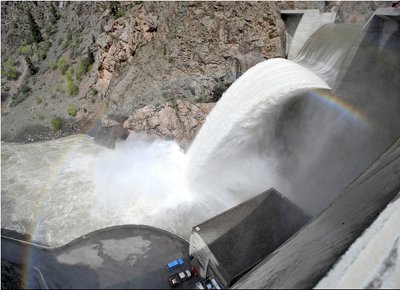
Today, Monday, June 23rd at noon MT, the releases from Crystal Dam will increase to 1,650 cfs. On Tuesday, June 24th at 9am MT, the scheduled releases from Crystal Dam will increase to 1,750 cfs. Releases are currently at 1,550 cfs. This release change is intended to meet the baseflow target in light of rapidly declining tributary flows. Reclamation will evaluate the need for further release increases in the coming days based on updated forecasts.
Gunnison River flows in the Black Canyon/Gunnison Gorge are currently ~500 cfs and are anticipated to increase to approximately 700 cfs. Gunnison Tunnel diversions remain at 1025 cfs.
Releases are made for the authorized purposes of the Aspinall Unit, and to attempt to maintain a target base flow through the endangered fish critical habitat reach of the Gunnison. Future release changes will be determined based on changes in tributary flows and weather
Click the link to read the article on the AZCentral website (Brandon Loomis). Here’s an excerpt:
June 18, 2025
Key Points
Arizona officials present details of a new proposal to share future shortages on the Colorado River.
The “supply-driven” solution would base allocations on the river’s actual flows, not on storage in the reservoirs.
Upper Basin states say the plan has problems, but Gov. Katie Hobbs insisted Arizona will defend its river allocation and demand other states take cuts.
Negotiators for the seven states arguing over diminished Colorado River water are discussing an option they hope will end their deadlock, one that Arizona officials say would focus less on who gets what and more on what the river can realistically provide. They’re calling it the “supply-driven” solution, Arizona Water Resources Director Tom Buschatzke said, and it links the required water deliveries out of Glen Canyon Dam to what might naturally be flowing downstream at Lees Ferry if the dam weren’t there. The Rocky Mountain states upstream from there would have to let that amount pass, and the Southwestern states would have to live within its limits. It’s intended as a fair way of adapting — and shrinking — the region’s use of a river whose flow was once thought to exceed 15 million acre-feet of water a year but, in the last 25 years, has averaged 12.4 million…
Jennifer Pitt and Brad Udall at the Getches-Wilkinson Center/Water and Tribes Initiative conference June 5, 2025. Photo credit: Allen Best/Big Pivots
Udall/Overpeck 4-panel Figure Colorado River temperature/precipitation/natural flows with trend. Lake Mead and Lake Powell storage. Updated through Water Year 2024. Credit: Brad Udall
So far, agreement about what’s fair has appeared distant. The Lower Basin states of Arizona, California and Nevada have the bulk of the region’s population and farm production, and have fully developed and then started to cut back on the half of the river’s flow that the compact awarded them. The Upper Basin states of Colorado, New Mexico, Utah and Wyoming have not fully developed their share of the water — a share that no longer fully exists. They have balked at cutting their existing uses to meet the compact’s requirement that they send at least half of the river’s flow of a century ago now that a changing climate has exposed the folly of the compact’s numbers. The supply-driven model would generally mandate a flow past Lees Ferry to the Southwestern states equal to a rolling three-year average of the natural flow that the mountain snowmelt provides, Buschatzke said. There would be upper and lower bounds on that number, to account for needs such as protecting reservoir levels that are safe for Glen Canyon and Hoover dam operations. Those bounds are as yet unidentified.
Map of the Colorado River drainage basin, created using USGS data. By Shannon1 Creative Commons Attribution-Share Alike 4.0
The long-term drying of the American Southwest poses a gathering and measurable threat to hydropower generation in the Colorado River basin.
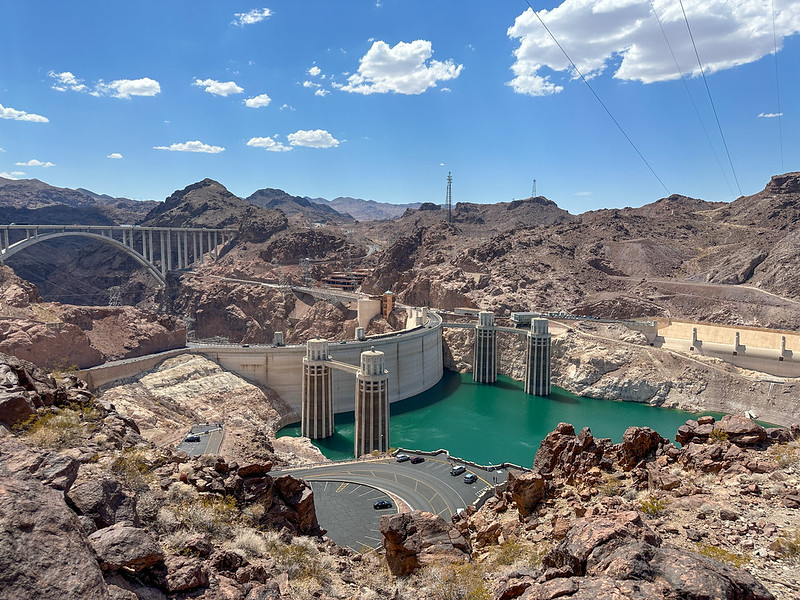
Should Lake Mead, the reservoir formed by Hoover Dam, continue to shrink, a substantial drop in the dam’s hydropower output is on the horizon.
The diminished state of the lake and the potential severe drop in electricity supply illustrate the consequences of a warming climate for the region. Built in the throes of the Great Depression, Hoover was the signature project of a country displaying its grit and engineering prowess to tame the West’s mightiest rivers to irrigate farmland and build cities. Today the dam is an aging asset buffeted by hydrological change and generating half the power that it did just a generation ago.
According to the Bureau of Reclamation, the federal agency that manages the basin’s large dams, if Lake Mead falls another 20 feet, Hoover Dam’s capacity to generate electricity would be slashed by 70 percent from its current level.
If there is a reason not to be especially alarmed it’s this: Hoover is just a small piece of the region’s electric power infrastructure. Federal dams along the Colorado River account for just over 4 percent of Arizona’s generating capacity, for instance.
Still, the cheap electricity is a lifeline for tribes and small rural electric providers. And the dam’s ability to be quickly turned on and off helps regulate the peaks and troughs of electricity demand. Curtailing this source of inexpensive electricity would raise the cost of power in the region while also challenging the integration of renewable energy into the electric grid.
A hydropower shortfall will be “bad news for us,” said Ed Gerak, executive director of the Irrigation and Electrical Districts Association of Arizona, which represents power providers that receive federal hydropower from Colorado River dams.
Lake Mead now sits at an elevation of 1,055 feet. The break point for hydropower is 1,035 feet. At that level, 12 older turbines at Hoover that are not designed for low reservoir levels would be shut down, Reclamation said. Five newer turbines installed a decade ago would continue to generate power.
The threat is real, especially as this year’s runoff forecast for the basin continues to worsen. Every month, Reclamation updates its projection of reservoir levels over the next two years. The June update shows a 10 percent chance that Lake Mead breaches 1,035 feet in spring 2027.
In a worst-case scenario, the breach would happen at the end of 2026, just when current operating rules for Lake Mead and Lake Powell expire. The modeling indicates a similar chance that Lake Powell drops low enough in 2027 that Glen Canyon Dam, another key hydropower asset in the basin, stops producing electricity.
The probability that Lake Mead drops that far is small and laden with uncertainties about weather and water use. But it is large enough that Hoover’s power customers are signaling their concern.
Reclamation, for its part, acknowledges the problem at Hoover and is evaluating its options. The agency estimates that replacing the 12 turbines would cost $156 million.
“Reclamation is assessing the cost-benefit analysis of replacing some of the older style turbines and the timeline for installation,” the agency wrote in a statement to Circle of Blue. “Ordering new turbines is a lengthy process as they have to be designed, model tested, built and ultimately installed.”
The dozen older turbines are not designed to operate at low reservoir levels. Dams like Hoover, which was completed in 1936, function based on the principle of hydraulic head, which is the difference in elevation between the top of the reservoir and the intake pipes for the dam’s powerhouse. When the hydraulic head drops, so does the water pressure. That can trigger the formation of air bubbles in the water, which can gouge and damage the turbines in a process called cavitation.
The five turbines that would not be shut down are low-head units that can accommodate lower reservoir levels. Installed a decade ago at a cost of $42 million in response to a previous rapid decline in Lake Mead, they can operate down to 950 feet. (One of those five turbines is currently offline, and Reclamation does not have an estimate for when it will resume operating.)
Hoover is already hobbled by low water. Power generation in 2023 was roughly half the output of 2000, the last year that Lake Mead was effectively full.
When Lake Mead is full, Hoover has a generating capacity of 2,080 megawatts, equivalent to a large coal-fired or nuclear power plant. Today its capacity is 1,304 MW. If the dozen older turbines go offline, it will drop again, to 382 MW.
These declines in hydropower generation have been felt by the customers who buy Hoover Dam’s electricity, Gerak said. In a shortfall, they have to buy market-rate electricity. Depending on the season and power demand, market rates can be considerably more expensive.
Eric Witkoski is the executive director of the Colorado River Commission of Nevada, which manages the state’s allocation of Hoover’s power. Witkoski said that rural electric companies in his state have a higher share of their electricity coming from the dams and would be most affected by a shortfall.
The value of Hoover’s electricity is measured not just in raw megawatts and dollars. It is a flexible power source that can be ramped up and down to match the region’s daily and seasonal rhythms. Energy use rises in summer afternoons when air conditioning units are blasting and electricity-consuming household chores are at hand. It falls at night when cooler air prevails and washing machines are silent.
“The beauty of hydropower is that it’s great for helping to stabilize and regulate the grid,” Gerak said.
IEDA and other interest groups are pursuing a number of fixes. They are encouraging Reclamation and its parent agency the Interior Department to use federal infrastructure funds to install new low-head turbines or to request appropriations from Congress.
They are writing their congressional representatives in support of the Help Hoover Dam Act, a bill that would unlock some $50 million in ratepayer funds that had been set aside for pension benefits for federal employees. The trade groups claim that Congress funds the pension benefits through other means and that the funds could be spent on dam upgrades if Reclamation was given the authority to do so.
They also want to set up an organization modeled after the National Parks Foundation that can accept donations for dam operations and maintenance, including the visitor center, which is supported by power sales.
These fixes will take time. But as Lake Mead declines, the urgency to achieve them will intensify.