The 1965 Flood: How #Denver’s Greatest Disaster Changed the City: Sixty years ago, a flood swept through the Mile High City — Westword.com

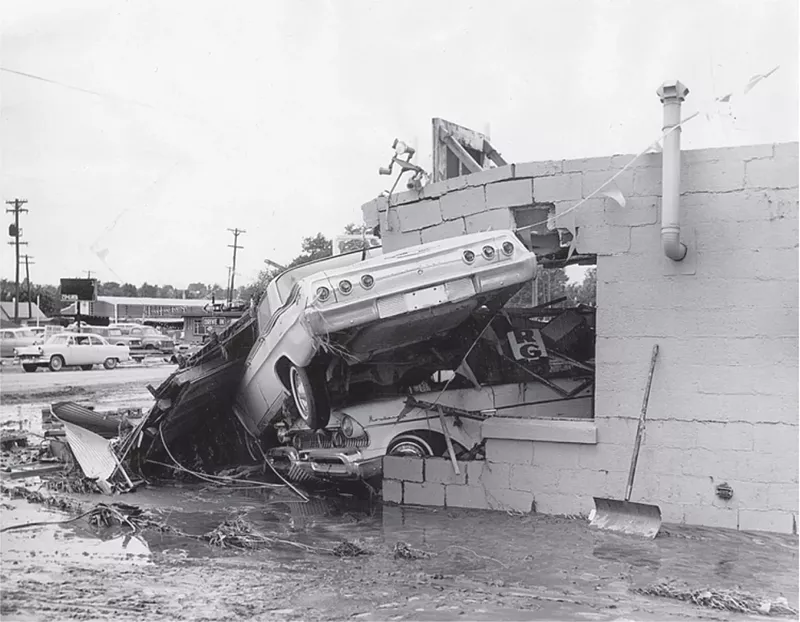
Cars piled up on West Alameda Avenue Denver Public Library

Click the link to read the article on the Westword website (Alan Prendergast). Here’s an excerpt:

June 17, 2025

Those who lived through it will tell you that the spring of 1965 was not like other springs in eastern Colorado. From Fort Collins to La Junta, the land shuddered and groaned, afflicted with mini-earthquakes and baby twisters, freak hailstorms and gale-force winds. But to say people should have paid attention is to wrap yourself smugly in half a century of hindsight. At the time, the bad winds and unfriendly skies were seen as mere anomalies, a little Wild West weather, nothing more. Nobody could anticipate what was coming because there had been nothing like it around here for generations, and the past was not much studied in these parts. Yes, it was wet, but after three years of drought, the farmers welcomed the rain. June arrived gray and damp, more like a New York November than the parade of dry, sunny days and mild nights the citizens of Denver had come to expect. A cold front from the Northeast butted against the Front Range and camped out, entwined with a flow of warm, humid air oozing up from the Gulf of Mexico. The unholy coupling went on for days, blotting out the sun and generating bursts of what the meteorologists called “orographic precipitation.”  A few parched burgs got hosed. For the most part, though, the bank of dark thunderclouds just sat there over the mountains, swollen and ominous. Then the signs, the portents, became too violent to ignore…

The main event came on Wednesday, June 16, starting at about half past one in the afternoon. It began on the southern edge of Douglas County, with a hard rain and a tornado that ripped through the tiny town of Palmer Lake, peeling the roofs off thirty houses like so many soup-can lids. The twister scooped up water from the lake and dumped it into the houses, mixed with frogs, fish and gravel…Then it went away. But the rain kept coming. The rain was torrential. It was record-busting. It was biblical…It was no longer simply a flood. It had leapt in rank to a hundred-year flood, or even a five-hundred-year or thousand-year model, a millennial event. State patrol officers reported a wall of water estimated to be twenty feet high headed for Littleton, carrying in its wake a tangle of trees, asphalt, cars and other debris, with a second crest not far behind…It would be the darkest night in Denver’s history, a night of destruction far exceeding anything the city had ever known. The ’65 flood claimed 21 lives and resulted in property losses statewide estimated at $543 million — adjusted for inflation, that’s more than $4 billion in 2015 money — with the worst damage in the Denver metro area. Other floods in the state’s history have resulted in a greater loss of life; the Big Thompson flash flood in 1976 killed 143 people, while the death toll from a 1921 flood in Pueblo has been set as high as 1,500 people. But no natural disaster has had a more profound or lasting impact on state policy — or in shaping the Denver we know today…

The flood ravaged hundreds of homes and all but obliterated dozens of businesses; many never recovered. But it also triggered a painful re-examination of a century of haphazard growth and myopic planning, during which the city had abused and poisoned its main waterway and ignored the communities on its banks. The disaster became a trigger for long-delayed flood-control projects, ambitious urban-renewal plans and a bitter diaspora for longtime residents of Auraria…It was also the start of a renaissance along the South Platte itself. What was once the city’s greatest eyesore is now its showcase. But the transformation of the river didn’t occur overnight, or even over a decade. It took the determination of many officials, businesses, philanthropists and volunteers, as well as a still-evolving discussion of what the city lost — and found — in the flood.

The Colfax Viaduct during the 1965 flood of the South Platte River. Denver Public LIbrary
A welding company at West 11th Avenue and Zuni Street. Denver Public Library
Trains at 14th St and South Platte River June 19, 1965. Photo via Westword.com

Could data center boom threaten #Colorado’s water supply and #climate goals?: ‘Arms race’ to build more data centers is boosting economic impact, along with power and cooling needs — The #Denver Post

Steam rises above the cooling towers in The Dalles data center in Oregon (Google, 2020).

Click the link to read the article on The Denver Post website (Elise Schmelzer). Here’s an excerpt:

June 5, 2025

On Aurora’s eastern edge, where the bustle of metro Denver fades to farms, the first building of what will become the state’s largest data center stands behind a wrought-iron fence. In another section of the 65-acre campus, front-end loaders are at work preparing for the foundation of another building. Seventeen miles west, in a dusty industrial nook of northern Denver, workers on a recent day scattered across a huge pit dug into the earth to lay the foundation for that city’s newest data center. The two construction sites offer a glimpse into what a predicted boom in Colorado’s data center industry may look like as the industry expands exponentially nationwide to meet the needs of Americans’ increasingly online lives — and to provide the computing power demanded by artificial intelligence. The potential growth — and repeated proposals for state incentives to expedite that development — are creating concerns that the centers’ required power and cooling needs could keep Colorado from meeting its climate goals and drain already-stretched water resources…

Already, an “absolute arms race” among data center developers has prompted the state’s largest electricity provider to stop offering lower rates for the facilities, according to Xcel Energy executives. If all of the data centers’ requests to the utility for power were to come to fruition, Xcel would need to double its current generating power. When completed, the Aurora data center will be a 160 megawatt hyperscale facility that, at max capacity, could consume as much power as 176,000 homes. The northern Denver data center, once completed in the Elyria-Swansea neighborhood, could use a maximum of 805,000 gallons of water a day for cooling — the same as 16,100 Denverites’ average daily indoor water use. Regulators, environmental advocates and data center representatives all say Colorado faces a critical moment: Can the state balance the desire from some government leaders for the economic development brought by data centers with Colorado’s climate goals and water realities? And can it do that while protecting electric customers from bearing the costs of the burgeoning industry?

Ted Cooke tapped to run Bureau of Reclamation amid pivotal #ColoradoRiver talks — Alex Hager (KUNC.org) #COriver #aridification

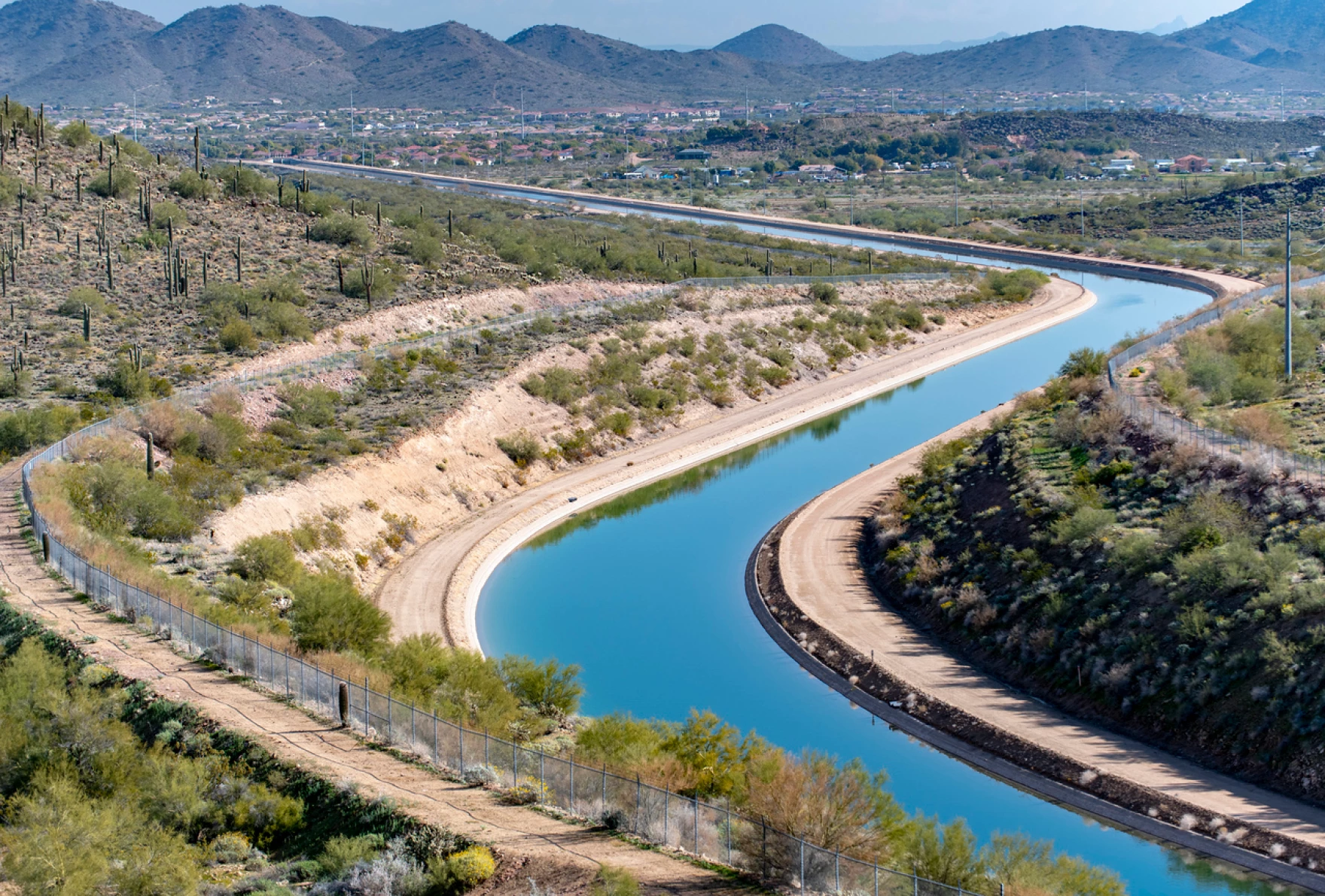
The Central Arizona Project canal carries water through Phoenix in 2019. The project’s former general manager, Ted Cooke, was recently nominated to run the top federal agency for the Colorado River. Those who have worked with Cooke described him as a qualified expert. Ted Wood/The Water Desk

Click the link to read the article on the KUNC website (Alex Hager):

June 17, 2025

This story is part of ongoing coverage of the Colorado River, produced by KUNC and supported by the Walton Family Foundation.

President Donald Trump has tapped longtime water manager Ted Cooke to be the next commissioner of the U.S. Bureau of Reclamation. The nomination, submitted Mondayto the Senate Committee on Energy and Natural Resources, attempts to fill a pivotal role at the top federal agency for Western rivers, reservoirs and dams.

If confirmed, Cooke will become the main federal official overseeing Colorado River matters. His nomination comes at a tense time for the river. The seven states that use its water appear deadlocked in closed-door negotiations about sharing the shrinking water supply in the future.

Cooke will likely try to push those state negotiators toward agreement about who should feel the pain of water cutbacks and when. If they can’t reach a deal ahead of a 2026 deadline, the federal government can step in and make those decisions itself.

Cooke has spent most of his lengthy career with the Central Arizona Project, which brings Colorado River water to the Phoenix area. He first joined the agency in 2003, according to his LinkedIn page. He climbed the ranks and served as CAP’s general manager from 2015 to 2023.

Ted Cooke and Tom Buschatzke: Photo credit: Arizona Department of Water Resources

Water experts across the Colorado River basin, including some who have worked with him in the past, told KUNC they regard Cooke as a qualified technical expert. Sharon Megdal, whose tenure on CAP’s board of directors overlapped with Cooke’s time as general manager, said she had “great admiration” for Cooke.

“He’s thorough, he’s deliberative, he looks for solutions, and boy, we need to find solutions right now,” said Megdal, who now directs the Water Resources Research Center at the University of Arizona. “My observation of seeing him in action in tough situations shows that he’ll keep working until a resolution is reached or a solution is achieved, and I think that’s what we need now.”

John Entsminger, Nevada’s top water negotiator, called Cooke’s appointment a “great choice,” and cited his work in shaping the 2019 Drought Contingency Plan. If confirmed, Cooke will likely be in the same negotiating rooms as Entsminger.

“There are times when [the Bureau of Reclamation Commissioner] has to level pretty realistic threats at everybody,” Entsminger said. There’s also times when they have to be the mediator… I think Ted has both of those skills. I’ve seen him be pretty pointed, and I’ve seen him drive compromise.”

The seven states working on the next set of rules for managing the Colorado River are currently split into two caucuses – the Upper Basin states of Colorado, Wyoming, Utah and New Mexico and the Lower Basin states of California, Arizona and Nevada.

The appointment of Cooke, a longtime Arizonan, could upset some on the other side of that divide. The Central Arizona Project, his former employer, is generally among the first entities to lose water under any plan for cutbacks.

Eric Kuhn is the former general manager of the Colorado River District. The taxpayer-funded agency was founded to keep water flowing to the cities and farms of Western Colorado. He said Cooke is qualified, but added “the nomination of someone from Arizona is interesting at a time when the Lower Division and the Upper Division states are far off.”

“I assume that he would recuse himself from decisions that could affect the CAP – which is just about any decision in the basin,” Kuhn wrote to KUNC. “None the less, his nomination is a plus for Arizona and the Lower Division States.”

Negotiators from Colorado and New Mexico declined to comment, and negotiators from Wyoming and Utah did not get back to KUNC in time for publication. Chuck Cullom, executive director of the Upper Colorado River Commission and a former colleague of Cooke’s, also declined to comment.

Map credit: AGU