
Click the link to read the article on the Westword website (Alan Prendergast). Here’s an excerpt:
June 17, 2025
Those who lived through it will tell you that the spring of 1965 was not like other springs in eastern Colorado. From Fort Collins to La Junta, the land shuddered and groaned, afflicted with mini-earthquakes and baby twisters, freak hailstorms and gale-force winds. But to say people should have paid attention is to wrap yourself smugly in half a century of hindsight. At the time, the bad winds and unfriendly skies were seen as mere anomalies, a little Wild West weather, nothing more. Nobody could anticipate what was coming because there had been nothing like it around here for generations, and the past was not much studied in these parts. Yes, it was wet, but after three years of drought, the farmers welcomed the rain. June arrived gray and damp, more like a New York November than the parade of dry, sunny days and mild nights the citizens of Denver had come to expect. A cold front from the Northeast butted against the Front Range and camped out, entwined with a flow of warm, humid air oozing up from the Gulf of Mexico. The unholy coupling went on for days, blotting out the sun and generating bursts of what the meteorologists called “orographic precipitation.” A few parched burgs got hosed. For the most part, though, the bank of dark thunderclouds just sat there over the mountains, swollen and ominous. Then the signs, the portents, became too violent to ignore…
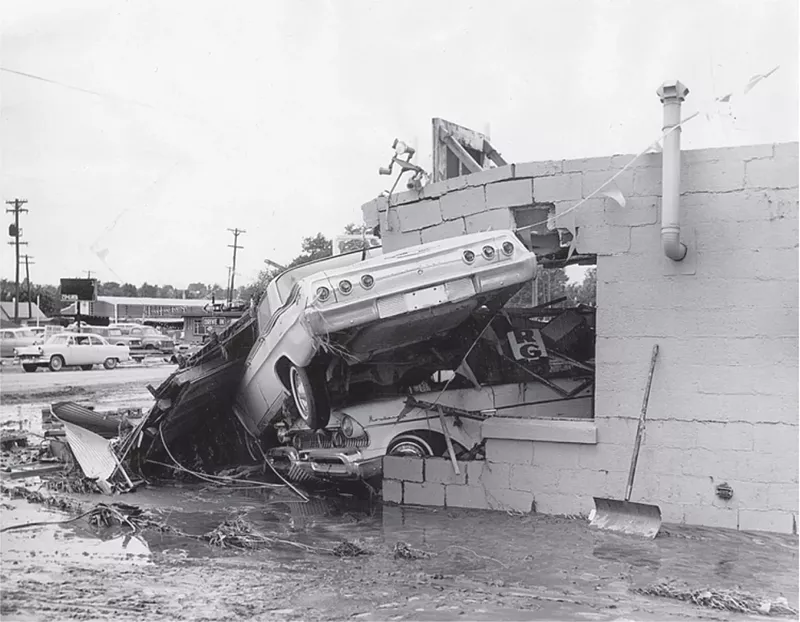
The main event came on Wednesday, June 16, starting at about half past one in the afternoon. It began on the southern edge of Douglas County, with a hard rain and a tornado that ripped through the tiny town of Palmer Lake, peeling the roofs off thirty houses like so many soup-can lids. The twister scooped up water from the lake and dumped it into the houses, mixed with frogs, fish and gravel…Then it went away. But the rain kept coming. The rain was torrential. It was record-busting. It was biblical…It was no longer simply a flood. It had leapt in rank to a hundred-year flood, or even a five-hundred-year or thousand-year model, a millennial event. State patrol officers reported a wall of water estimated to be twenty feet high headed for Littleton, carrying in its wake a tangle of trees, asphalt, cars and other debris, with a second crest not far behind…It would be the darkest night in Denver’s history, a night of destruction far exceeding anything the city had ever known. The ’65 flood claimed 21 lives and resulted in property losses statewide estimated at $543 million — adjusted for inflation, that’s more than $4 billion in 2015 money — with the worst damage in the Denver metro area. Other floods in the state’s history have resulted in a greater loss of life; the Big Thompson flash flood in 1976 killed 143 people, while the death toll from a 1921 flood in Pueblo has been set as high as 1,500 people. But no natural disaster has had a more profound or lasting impact on state policy — or in shaping the Denver we know today…
The flood ravaged hundreds of homes and all but obliterated dozens of businesses; many never recovered. But it also triggered a painful re-examination of a century of haphazard growth and myopic planning, during which the city had abused and poisoned its main waterway and ignored the communities on its banks. The disaster became a trigger for long-delayed flood-control projects, ambitious urban-renewal plans and a bitter diaspora for longtime residents of Auraria…It was also the start of a renaissance along the South Platte itself. What was once the city’s greatest eyesore is now its showcase. But the transformation of the river didn’t occur overnight, or even over a decade. It took the determination of many officials, businesses, philanthropists and volunteers, as well as a still-evolving discussion of what the city lost — and found — in the flood.


