
BREAKING: #Utah Senator Mike MAGA Lee changes public land sell off bill — Jonathan P. Thompson (LandDesk.org) #ColoradoRiver #COriver #aridification

Condors perched on steel girders some 450 feet above the Colorado River. Jonathan P. Thompson photo.

Click the link to read the article on The Land Desk website (Jonathan P. Thompson):

June 24, 2025

🌵 Public Lands 🌲

Sen. Mike Lee, the Utah Republican and Trump sycophant, has slightly backed off on his proposal to sell-off public lands, but only slightly. 

Lee posted the following on X/Twitter at 5:42 a.m. today:

Big sigh of relief? Nope. Sure, it’s great he’s removing Forest Service land from the pool of land eligible for “disposal.” This means the Hidden Valley/Falls Creek areanear Durango is out of danger, as are parcels near Flagstaff and Boise and Santa Fe that could have ended up on the auction block under the original provision. The 5-mile limit from population centers will also take some remote BLM parcels out of consideration — parcels that wouldn’t have been prioritized, anyway. 

The change reduces the size of the pool of available land, and presumably also reduces the amount of land that would be sold to between 1.25 million and 1.9 million acres. That’s still a crap-ton of public lands that will be privatized, cluttered up with houses and roads and cul-de-sacs and power lines and so forth, and to which the public will lose access. If this goes forward, you can plan on houses popping up on some of your favorite hiking, trail-running, or biking areas. 

And it still includes places like:

  • Animas Mountain and upper Horse Gulch near Durango; 
  • swaths of BLM land near Naturita and Nucla, Colorado; 
  • BLM land, including wilderness study areas, near Moab (wilderness study areas and areas of critical environmental concern are not exempted from the sell off);
  • parcels that abut Zion National Park’s boundaries (within five miles of Springdale and Rockville);
  • the lower slopes of Jumbo Mountain near Paonia; 
  • parcels on Las Vegas’s fringe, along with tracts around Mesquite and Moapa that the Freedom Cities folks have their eyes on; 
  • other Freedom City-proposed parcels near Fruita and Grand Junction;
  • the list goes on and on. (To get an idea just check out the Wilderness Society map, ignore the green areas, and look for “population centers” around the brass-colored areas to see what might be eligible).

Freedom Cities are back! — Jonathan P. Thompson

Lee says he will protect ranchers, which may or may not mean his provision would again leave out land that is in active grazing allotments. He doesn’t explain what the hell he means by “FREEDOM ZONES,” except to imply that he wouldn’t let any foreigners buy the land(?). Lee once again doesn’t mention a damned thing about affordable housing, meaning he’s just fine with public lands being used for luxury developments or even multi-million dollar mansions. 

Oh, and then there’s that little aside about the Byrd Rule. Yeah, that might get in Lee’s way. See, the Senate parliamentarian ruled that the public land sell off provision, along with several other sections relating to energy development on public lands, were subject to a 60-vote threshold. This means they would likely be dropped from the reconciliation bill altogether, since leaving it in could sink the entire “Big Beautiful” whatever. Still, the GOP has a thing about ignoring the parliamentarian and the usual rules, and Lee indicated he would push on with this concept in one form or another. So now is not the time to back down. 


The public lands sell-off provision has generated a huge amount of outrage and public push back, which is clearly working (after all, why else would Lee make those changes?). But it’s not the only or even the worst thing the MAGA folks are inflicting on the American public’s lands. 

For example, yesterday Agriculture Secretary Brooke announced that the U.S. Forest Service plans to repeal the Clinton-era Roadless Rule, which blocks roadbuilding and other development on about 58 million acres of Forest Service land. If the rollback survives inevitable legal challenges, it will open up a lot of forest to logging.


Glen Canyon Dam, January 2022. Jonathan P. Thompson photo.
🥵 Aridification Watch 🐫

To be a Colorado River watcher is to ride a slow-motion emotional roller coaster. We reached extreme highs during the late 1980s and into the 1990s, fell into a two-decade depression beginning in 2002 — with ebullient spikes in 2005, 2008, 2011, 2019 — and then the bountiful winter of 2023 came along and was followed up by a not-so-sad 2024.

It was enough to convince us we were recovering, and we could quit therapy, cut back on the meds, and stop worrying (all figuratively, of course). During this period of relative abundance, all of the studies about climate heating diminishing snowpacks and threatening the West’s lifeline seemed a bit abstract: Scary, sure, but we still had years and years before it manifested itself.

Yeah, no. It turns out that 2023 was just another manic and anomalous episode that falsely lulled us into complacency. And now that it has past, we’ve been sent spiraling back down into a deep aridification-sparked depression (somewhat figuratively speaking).

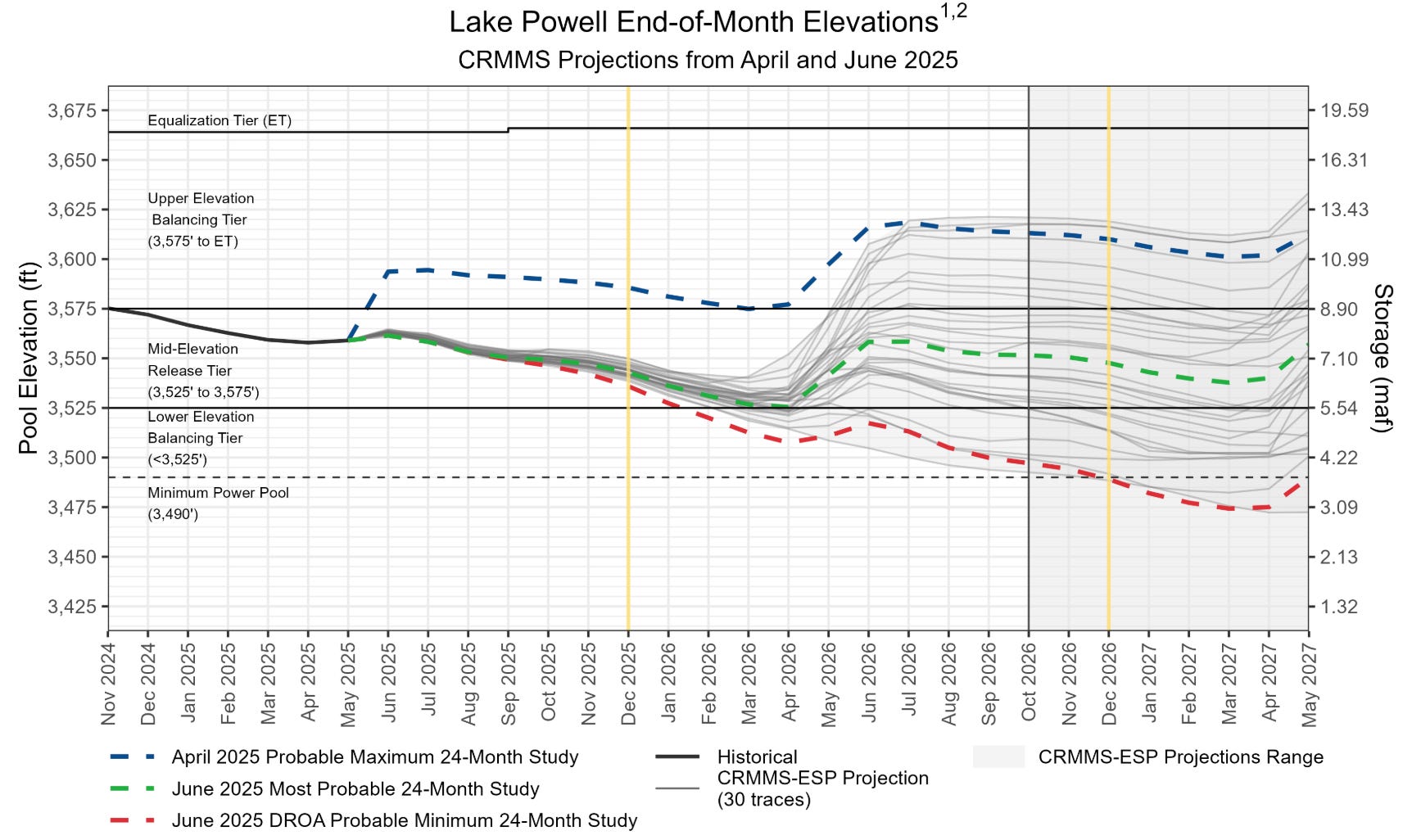
The snowpack-meagre 2025 winter delivered the first buzzkill to the Upper Colorado River Basin, followed by a warm and dry and dismal spring. Now, Lake Powell’s surface level is flatlining just as it should be shooting upward, an indicator that the river is back to its new normal. That is to say it is once again shrinking, and the gap between how much water has been allocated to the river’s users and what’s actually in there continues to grow. Which is to say, we’re still f&$#ed, and getting even more so with each passing year.

In fact, the U.S. Bureau of Reclamation’s latest projection has Lake Powell possibly dropping below the minimum power pool, or the level at which hydropower production shuts down, as soon as the end of 2026. Mind you, that’s their worst case scenario, but these forecasts often lean towards optimism. Most notable is how dramatically the forecast has changed since April, a difference that is visible in the graph below.
Romancing the River: The Empire Strikes the Public Lands, Part 2 — George Sibley (SibleysRivers.com)

Click the link to read the article on the Sibley’s Rivers website (George Sibley):

June 10, 2025

Get used to it: I’m probably going to be using that quote at the head of every post here for the near future at least; nothing so perfectly summarizes the history not just of the past several months, but of the past century, beginning – so I would argue – in the 1920s with the first crash of over-financialized hog-trough capitalism,  resolved with the construction of Hoover Dam, and the birth of a growing government partnership with the private sector in financing and building what we came to accept as 20thcentury reality.

Since the 1990s and the creation of the internet and virtual reality, we have seen the process of imperial reality creation speed up – now to a literally unbelievable speed with leadership standing firmly athwart the line between the merely incredible and the absolutely ridiculous.

Science has been puffing and panting along behind the juggernaut of industrial civilization for that whole century, trying to point out the’ real realities’ we have to ultimately confront and learn to live with, real realities whose consequences for what we have been doing are measurable, documentable – and increasingly alarming. So alarming that the Trumpty-Mumpty masters of the universe are telling us we can ignore, deny them. No, not can, but will deny and ignore them, because in their new reality such things as ‘climate crisis,’ ‘social inequity,’ ‘resource depletion’ (including potable water) either do not exist, or are deported, or are otherwise under control.

A Big Beautiful Joke: How many Republicans does it take to change a light bulb? Answer: None; Trump just says I’ve fixed it, and the Republicans sit in the dark and applaud….

Okay – moving on. I’ll begin with a couple of corrections to the last post, about the Trumpish assault on the public lands, specifically the lands managed by the Bureau of Land Management (BLM). First, the correct name of the law mandating the BLM Resource Management Plans that the MAGAs don’t like, is the Federal Land Policy and Management Act (FLPMA). And second, the Gunnison Sage Grouse is not a subspecies of Sage Grouse; it has been recognized as a distinct species. My apologies, and thanks to Arden Anderson, a retired BLM agent living in Gunnsion.

But now – well, I’m confused.

In my last post here, I got about halfway through some historical perspective on a bill proposed by my occasional congressional representative, Jeff Hurd, a lawyer from Grand Junction. (By ‘occasional representative,’ I mean I occasionally feel represented by Congressman Hurd, a definite improvement over the Repugnican Lauren Boebert whom he replaced.) But – now he’s got me almost as confused as Trump gets us all on tariffs.

Hurd’s bill to the House is for a ‘Productive Public Lands Act’ (‘PPL Act’). In Hurd’s own words: ‘This bill would force the Bureau of Land Management to reissue nine Biden-era Resource Management Plans (RMPs) which locked up access to viable lands throughout Colorado and the West. A reissue of these RMPs will put us on a path to energy dominance allowing for a more secure and prosperous United States.’ This is a direct legislative response supporting Trump’s trumped-up ‘national energy emergency,’ announced his first day in office with an executive order titled ‘Unleashing American Energy.’ One ‘First Day’ promise he did keep. We will look at more closely at the ‘national energy emergency’ in the next post (if it is still part of official reality).

Meanwhile, however, at about the time my post about Hurd’s PPL Act was appearing in your inbox, Hurd announced that he was introducing in the House, as a bipartisan legislation proposal, the bill that Colorado Democrat Senator [Michael Bennet] had just introduced in the Senate, for a ‘Gunnison Outdoor Resources Protection Act’ (‘GORP Act’).

The GORP Act, if passed, according to Senator [Bennet’s] website description, ‘will protect over 730,000 acres of public lands in Western Colorado, safeguarding the region’s local economy, world-class recreation, ranching heritage, wildlife habitat, and clean air and water.’ It’s a true mulitple-use bill, in the spirit of the FLPMA, that includes:

  • Enlargement of existing wilderness areas into undeveloped land around their edges;
  • ‘Protection Areas’ designated to protect the natural and undeveloped character of public lands;
  • ‘Recreation Management Areas’ to provide for sustainable management of both motorized and unmotorized recreation;
  • ‘Special Management Areas’ set aside for ‘broadly conserving, protecting, and enhancing the natural, scenic, scientific, cultural, watershed, recreation and wildlife resources’;
  • A ‘Rocky Mountain Scientific Research and Education Area’ in the upper East River valley, above and below the Rocky Mountain Biological Lab in Gothic;
  • ‘Wildlife Conservation Areas’ to conserve and restore wildlife and wildlife habitat (including the Gunnison Sage Grouse);
  • Existing mineral claims or oil and gas leases can be developed, but there will be no further withdrawals for minerals or oil and gas on the public lands covered by GORP, and the oil and gas rights under some of the land can only be developed with no surface disturbance (by horizontal drilling or tunneling).

If the GORP bill were to pass, it would require new Resource Management Plans that would, in Repugnican terminology, be ‘locking up’ a large quantity of public land for a diversity of uses valued in the local economy and culture – with no accommodation for the ‘national energy emergency.’ The GORP bill includes practically everything the ‘Productive Public Lands’ bill wants to undo in nine existing BLM Resource Management Plans.

It is not, in short, a bill anyone would expect from even a Republican, let alone a Repugnican – and certainly not from the congressman who put the ‘Productive Public Lands’ bill before the House. I’ve submitted a question to Congressman Hurd asking for his rationale, in submitting one bill that essentially contradicts another bill he had submitted. I’ve received no answer yet, but will pass it along when I do.

The simplest explanation – maybe just simplistic, fitting the Trumpty-Mumpty era – is that Rep, Hurd knows that the ‘Productive Public Lands’ bill will probably be passed by the Republican-majority House (the usual one or two vote ‘landslide’), while the GORP Act has practically no chance of passing. But proposing it will make him some friends among the conservationists and environmentalists that continue to be a growing part of his district, grasping at any straw in these times. Or maybe, I’ve heard it suggested locally, his work session with the Gunnison County Commissioners, between his presentation of the two bill, was a low voltage version of the biblical bolt that struck Saul/Paul on the road to Damascus. The commissioners did make a well-informed and passionate defense of the grassroots input on and support for the amended Gunnison Sage Grouse RMP that Rep. Hurd’s PPL Act would throw out.

And the amended Sage Grouse Resource Management Plan deserves a defense, in what’s left of our democratic system of governance. Rep. Hurd and other Repugnican supporters blame these RMPs on President Biden, but all President Biden did was what other presidents this century, excepting Trump, have done: they have stood back and let the 1970 National Environmental Policy Act, and the two 1976 Acts, the Federal Land Policy and Management Act and the National Forest Management Act, work as Congress intended, back in the way-too-short 1970s ‘enviro-populist’ era.

That legislation happened before the Supreme Court turned our elections over to the plutocrats who only want to get richer. From the mid-1960s through the 1970s, the people elected a series of Congresses that actually performed the will of the people, who saw the forests dying from acid rain, rivers too polluted to even swim in let alone drink from, air sometimes unbreathable, and who wanted to protect and restore what was still salvagable on the planet after a century of pedal-to-the-metal, balls-to-the-wall industrial capitalism. That, in at least my mind, is one of the times when America was great. And needs to be great again in that way, even greater as the challenges escalate – but that won’t happen during the Trumpty-Mumpty hog-trough administration.

The GORP bill is a synthesis of portions of the plans evolving since the turn of the century to keep the Gunnison Sage Grouse viable as a species, and also of a ‘Gunnison Public Lands Initiative’ that has been evolving since 2014. The ‘GPLI’ is a collaboration involving ranchers, motorized and non-motorized recreational users, whitewater and flatwater interests, and other stakeholders whose joint purpose is to strike a balance between conservation (in culture as well as nature), preservation, and tourism on the 2.5 million acres of public lands in Gunnison County – four-fifths of the County. Sage Grouse concerns spread the GORP bill into counties beyond Gunnison County where the bird is found in small populations.

The national public land agencies – mainly the BLM and Forest Service – accept the need for public participation in resource management planning, and respect the level of knowledge that most stakeholders bring to the table; but they also have top-down management priorities to work into the mix, and are a little reluctant about ‘citizen initiatives’ with a more local economic and ecological focus. Senator Bennett used the Gunnison Public Lands Initiative as a foundation document for his GORP bill, but the U.S. Forest Service mostly ignored it in the recent Grand Mesa, Uncompahgre and Gunnison National Forest planning process for the next decade.

They prefer citizen response to alternatives established (with citizen participation) through the NEPA environmental analysis procedure; various alternative management action plans are outlined and analyzed according to the exhaustive (and often exhausting to read) environmental analysis that had been assembled. There is always a ‘no action, continue current management’ alternative; there is usually a ‘heavy industrial’ alternative that the environmental and recreational users don’t like, a ‘heavy recreation and preservation’ alternative that the loggers and miners don’t like, and gradations between leading to a ‘preferred alternative’ that tries to balance the various multiple uses in a way that everyone can live with.

So that is where we stand now: Senator [Bennet] and Representative Hurd are presenting the grassroots, multiple-use ‘Gunnison Outdoor Resource Planning Act’ bill (GORP Act) in the two houses of Congress, with thirty West Slope participating organizations signed on, including eleven County Boards of Commissioners. And Representative Hurd is presenting in the House of Representatives the ‘Productive Public Lands Act bill (PPL Act). The GORP bill, if passed, would require Resource Management Plans of exactly the type that the PPL bill, if passed, would seek to rescind, in favor of a top-down, single-use bill to ‘Unleash American Energy.’

Next time, we will take a deeper look at the unleashing of American energy on our public lands. (And after that, I promise, it’s back to the river – the beautiful, the beautiful and also useful river.

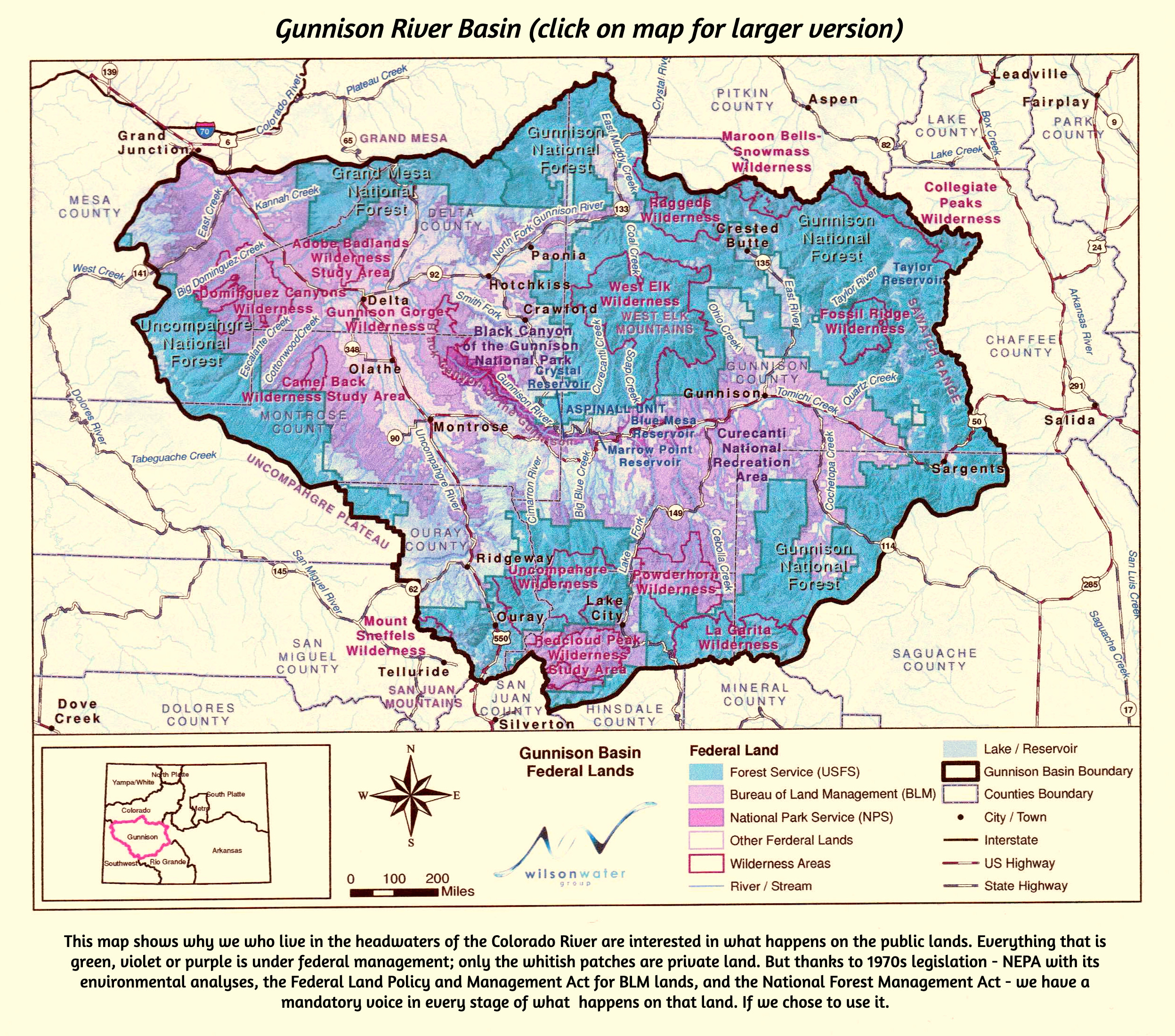
Map of the Gunnison River drainage basin in Colorado, USA. Made using public domain USGS data. By Shannon1 – Own work, CC BY-SA 4.0, https://commons.wikimedia.org/w/index.php?curid=69257550

‘A glimmer of hope’ emerges from long-stuck #ColoradoRiver negotiations — Alex Hager (KUNC.org) #COriver #aridification

The potential path forward.

Click the link to read the article on the KUNC website (Alex Hager):

June 23, 2025

This story is part of ongoing coverage of the Colorado River, produced by KUNC and supported by the Walton Family Foundation.

There’s a break in the clouds that have hovered over Colorado River negotiations for more than a year. State water leaders appear to be coalescing behind a new proposal for sharing the river after talks were stuck in a deadlock for more than a year.

The river is used by nearly 40 million people across seven states and Mexico, but it’s shrinking due to climate change. As a result, state leaders need to rein in demand. For months, they were mired in a standoff about how to interpret a century-old legal agreement. The new proposal is completely different.

Instead of those states leaning on old rules that don’t account for climate change, they’re proposing a new system that divides the river based on how much water is in it today.

“We finally have an approach that at least allows a glimmer of hope that the laying down of arms is possible,” said John Fleck, a writer and water policy researcher at the University of New Mexico.

The long, tense negotiations have mostly been stuck on one issue: How much water should the Upper Basin states — Colorado, Utah, Wyoming, and New Mexico — send downstream from their largest reservoir, Lake Powell? 

The new plan says the amount should be based on a three-year rolling average of the “natural flows” in the river — basically, how much water would flow through it if human dams and diversion weren’t in the way.

States would still have to negotiate the exact percentage of those “natural flows” that would go downstream to the Lower Basin states of California, Arizona and Nevada. Picking that number will likely be difficult, but the fact that states are willing to base it on current climate conditions represents a major philosophical shift in how the river is divided.

“This new approach gets beyond the obsessively arcane discussions about various interpretations of laws written 100 years ago, with people hoping that their lawyers’ arguments can mean they get more water,” Fleck said. “It says, ‘Look, we all have to share this river. We have to do some math about how much water it really has.’”

Nevada’s John Entsminger, Arizona’s Tom Buschatzke, and California’s JB Hamby sit on a panel of state water leaders at the Colorado River Water Users Association annual conference in Las Vegas on December 5, 2024. Arizona’s Tom Buschatzke (center) brought details of a Colorado River plan to the public, and said it “allows for a fair division of what Mother Nature provides to us. Alex Hager/KUNC

Details of the plan first emerged in a meeting of the Arizona Reconsultation Committee, where the state’s water leaders gather to discuss Arizona’s position in multistate talks. Tom Buschatzke, director of the Arizona Department of Water Resources, described the plan as “innovative.”

“I was very pessimistic that we were on a path towards litigation,” he said. “I’m more optimistic now that we can avoid that path if we can make this work.”

Buschatzke emphasized that the proposal is in its early stages. The concept is now heading to the Bureau of Reclamation, the federal water agency which manages dams and reservoirs in the West. Employees there will run models to figure out exactly how much water would flow between the two basins.

State and federal leaders are in a crunch to finalize new water sharing rules before a 2026 deadline, when the current rules expire.

“It is still just a concept,” Buschatzke said. “We haven’t agreed to anything at this point, but we agreed to test it.”

Colorado, which often speaks on behalf of all four Upper Basin states, appears cautiously supportive of the plan.

“Colorado remains committed to developing supply-driven, sustainable operations of Lake Powell and Lake Mead,” Becky Mitchell, Colorado’s top water negotiator, wrote to KUNC in a statement. “The natural flow approach is one way to achieve this, if it is done right.”

Colorado and its allies initially dug in their heels on a very specific interpretation of the 1922 Colorado River compact, arguing that they shouldn’t have to take new cutbacks to their water supplies since they feel the impacts of climate change-fueled shortages more than their downstream neighbors.

“There is no doubt that Arizona views things differently than the Upper Division States, and a successful framework will set aside our differing views and focus instead on the health and sustainability of the Colorado River System for all who depend upon it,” Mitchell wrote.

Map credit: AGU