Click the link to read the article on the the Big Pivots website (Allen Best):
In Colorado’s energy transition, some work has advanced at a remarkable pace in the last 15 years. Other aspects are as perplexing now as in 2011 when Dave Bowden interviewed Matt Baker, then a Colorado public utilities commissioner, for a documentary film commemorating CRES’s accomplishments on its 15th anniversary.
Baker described a two-fold challenge. One was to achieve the legislative mandate of getting 30% of electricity from renewables while keeping the cost increase below 2%.
Check that box. In 2021, renewables provided 35% of Colorado’s electricity, according to the Energy Information Administration, even as costs of wind, solar and batteries continue to decline. And utilities now say they can achieve at least 70% by 2030 (and some aim for 100%).
With its sunny days and its windy prairies, Colorado has resources many states would envy. Plus, it’s nice to have NREL in your midst.
Clean energy technologies can and must ramp up even faster. At one time, the atmospheric pollution could be dismissed as unpleasant but worth the tradeoff. That debate has ended. The science of climate change is clear about the rising risks and unsavory outcomes of continuing this 200-year devotion to burning fossil fuels.
Big, big questions remain, though. Some are no more near resolution than they were in 2011 when Baker, who now directs the public advocates office at the California Public Utilities, identified the “desperate need to modernize the grid,” including the imperative for demand-side management.
Leave that box unchecked. Work is underway, but oh so much remains to be figured out.
For example, how much transmission do we need if we emphasize more dispersed renewable generation? Can we figure out the storage mechanisms to supplement them? Might we need fewer giant power lines from distant wind and solar farms? This debate is simmering, on the verge of boiling.
In buildings, the work is only beginning. Colorado has started, in part nudged by the host of laws adopted in 2021, among them the bill that Meillon had worked on for a decade.
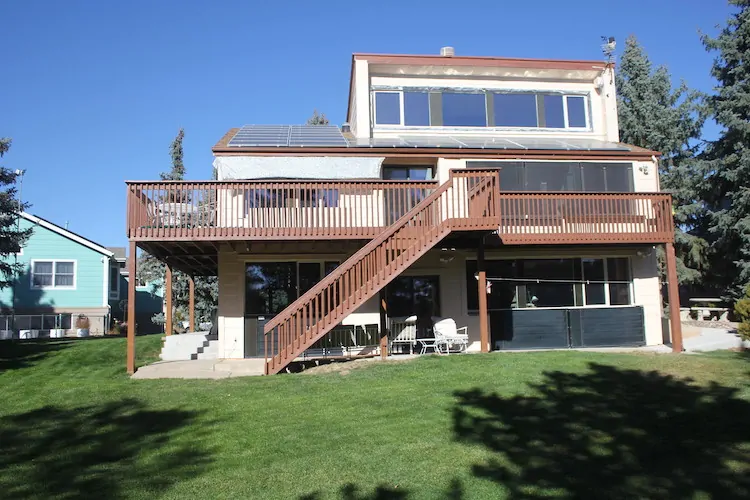
John Avenson took a house with strong fundamentals, most prominently southern exposure, and tweaked it until he was confident that he could stub the natural gas line. Photo/Allen Best
Others had been working on the same issue in a different way. Consider John Avenson. Now retired, he was still working as an engineer at Bell Labs when he began retrofitting his house in Westminster to reduce its use of fossil fuels.
The house had a good foundation. It was built in the early 1980s in a program using designs created in partnership with SERI, the NREL precursor. It was part of a Passive Solar Parade of Homes in 1981. And unlike about 80% of houses in metro Denver according to the calculations of Steve Andrews, it faces south, allowing it to harvest sunshine as needed and minimizing the need for imported energy.
Avenson then tweaked and fussed over how to save energy here and then there. Finally, in 2017, he convinced himself that he no longer needed natural gas. He ordered the line stubbed.
To those who want to follow the same path, Avenson has been generous with his time. He can commonly be seen pitching in on other, mostly behind-the-scene roles, for CRES and affiliated events.
CRES’s membership is full of such individuals, people committed to taking action, whether in their own lives or in making the case why change must occur in our policies.
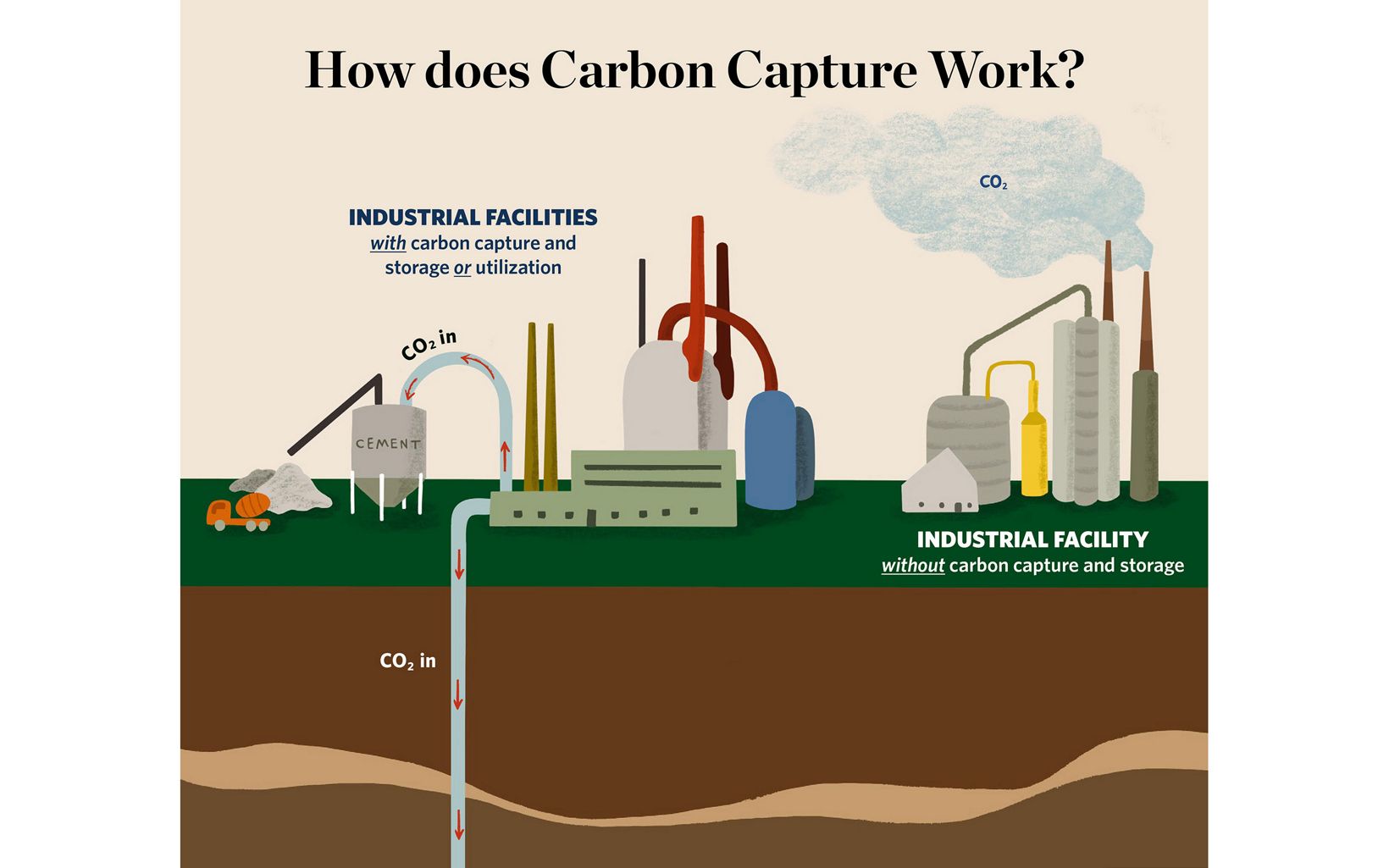
Graphic credit: The Nature Conservancy
But what about the carbon dioxide already in the atmosphere? Can it be mopped up just a bit? Certainly, it’s better to not emit emissions. But we’re cornered now. Focus is growing on ways to return carbon from the atmosphere into the soil. Revised and rewarded agricultural practices may be one way. That will be a component of a major bill in the 2023 Colorado General Assembly climate change docket.
This is also a topic that Larson, since his time in Africa after the Reagan administration short-sheeted the solar laboratory in Golden, has avidly promoted. In 2007, the idea got a name: biochar. It is one technique for restoring carbon to soils. Today, it remains an obtuse idea to most people. It may be useful to remember that a renewables-powered economy sounded weird to many people in 1996, if they thought about it at all.
CRES has been regaining its financial health. “Through disciplined and lean operations, we have been able to slowly grow our annual income to nearly $40,000 a year,” said Eberle, the board president at a 25th anniversary celebration in October. “We have a solid financial base to not only maintain our current programs but consider new opportunities.”
The question lingers for those deeply engaged in CRES about what exactly its role can be and should be.
Always, there are opportunities for informed citizens such as those who are the lifeblood of CRES. Mike Kruger made this point clear in a CRES presentation in October 2022. As the executive director of COSSA, he routinely contacts elected officials and their staff in Washington D.C.
“The same thing happens at the State Capitol,” he said. Two or three phone calls to a state legislator has been enough to bring to their attention a particular issue or even change their vote.
And that takes us to the big, big question: What exactly has CRES achieved in its 26 years?
In this history you have read about a few salient elements:
the shove of Xcel into accepting Colorado Green;
the passing of Amendment 37, which raised Colorado’s profile nationally and set the stage for the election of Bill Ritter on a platform of stepped-up integration of renewables;
the work in recent years to revamp the calculations used in evaluating alternatives to methane.
Teasing out accomplishments, connecting lines directly can be a difficult task. Perhaps instructive might be a sideways glance to other major societal changes. Much has been written about the civil rights movement after World War II that culminated in the landmark federal legislation of the mid-1960s.
There were individuals, most notably the Rev. Martin Luther King Jr. and, in some contexts, his key lieutenants, John Lewis and Jessie Jackson.
But there were others. Consider the march from Selma to Montgomery. There were strong-willed individuals such as Amelia Boynton Robinson and, at one point in the Selma story, the school children themselves who took up the cause as their parents and other elders hesitated.
Civil rights and the energy transition have differences. The former had a deep moral component that was not yet clearly evident in energy when CRES was founded in 1996. The seriousness of climate change was not at the same level then, although arguably it is now.
Now Colorado has emerged as a national leader in this energy transition. For that, CRES deserves recognition. It’s not a singular success. CRES has had teammates in this. But it can rightfully take credit.
Other installments in this series about the history of CRES:
Click the link to read the article on The Denver Post website (Nick Coltrain and Seth Klamann). Here’s an excerpt:
Clean air and eyes on water
[Steve] Fenberg said members are working on several bills to reduce ozone emissions and aiming to boost air quality in the state . First, officials need to separate out what is in state control and what isn’t, while also balancing that regulations come with economic and personal costs. Fenberg cited the temporary closure of the Suncor refinery specifically: It may lead to cleaner air for a few months, but it may also mean people already under the thumb of inflation may pay more for energy. Lawmakers will also continue to look at the oil and gas industry, though Fenberg said those details aren’t yet finished. He mentioned incentivizing the electrification of drill rigs to tamp down on pre-production drilling emissions as one likely effort. Regulators have also been working on new rules for energy production, a product of 2019’s Senate Bill 181, and lawmakers will be watching to see if it accomplishes what they wanted, he said.
“I want to be careful and make sure the appropriate things are at the regulatory side so that we’re not over-prescribing at the legislative level,” Fenberg said.
Water remains a defining aspect of life in the West, and Colorado’s water crisis remains as acute as ever. Fenberg called it “a bit of an existential threat” to the state’s economy and its communities. Conservation, drought resilience and infrastructure efforts will be big aims, though the legislative leaders did not have specific policies yet.
“One of the biggest frustrations when we talk about water quantity is certainly the diverse interests that come to the table,” McCluskie said. “This isn’t a Republican and Democrat issue, this is a Western Slope and eastern slope issue. It is an ag economy, a tourist economy and outdoor recreation economy interest.”
Right now, the goal is to convene stakeholders to find common ground across those sometimes disparate interests, she said. And the bevy of new lawmakers also need time to brush up on the dissertation-worthy topic of western water law. McCluskie said state Rep. Karen McCormick, who will chair the Agriculture, Water and Natural Resources Committee, has been putting together a “water boot camp” for her members.
Patty Limerick. Photo credit Volunteers for Outdoor Colorado.
Click the link to read the article on the Big Pivots website (Allen Best):
The organization grew and then decided to spread its wings. It didn’t work out, raising questions of how a group like CRES should operate. What it did do was expand with two new chapters in Colorado.
CRES has had its ups and downs, its time of growth and expanding influence and then times of retraction.
Annual conferences have been held but with some lengthy gaps. The first, held in 1998 at Snow Mountain Ranch, between Granby and Fraser, was regarded as a splendid retreat. However, CRES leaders decided it would be better to hold conferences in places more accessible to the broader public and with greater geographic diversity. Accordingly, the 2002 conference was held in Colorado Springs with Amory Lovins as the featured speaker. The next was in Montrose, followed by the University of Denver, with still others in Fort Collins, Pueblo, and then again in Montrose.
Remarks made by speakers at the conference in Steamboat Springs in June 2007 reveal the rapid change during the last 15 years.
Organizers had recruited Stan Lewandowski, then general manager of Intermountain Rural Electric Association (now called CORE Electric Cooperative) to explain himself. He was known for his embrace of coal and for his financial contribution to Pat Michaels, a climate scientist who argued global warming will cause relatively minor and even beneficial charges. Renewables, said Lewandowski, were expensive, and he refused to socialize their cost to the detriment of elderly people on fixed income.
Now, that same cooperative—under new leadership—is hurrying to get out of its ownership in what will likely be Colorado’s last operating coal plant, Comanche 3.
Chuck Kutscher, then an engineer at NREL (and now a member of the CRES policy committee), also spoke, stressing the importance of the “beef” of energy efficiency to the “sizzle” of renewables. Paul Bony, who was then with Delta-Montrose Electric Association, told about the 100 ground-source heat pumps whose installation he had overseen.
Keynote speaker at the 2007 conference in Steamboat Springs was Patty Limerick, a historian from the University of Colorado-Boulder, who talked about energy conversions of the past 200 years. She warned against expecting immediate change. Even adoption of fossil fuels, if “astonishing in its scale and scope of change,” did not arrive as “one, coherent sequential change.” Fossil fuels, she noted, had lifted women out of household drudgery.
And she left listeners to ponder this thought: “The most consequential question of the early 21st century is who controls the definition of progress.”
Membership in CRES grew from 200 to 2,000 during the 21st century’s first decade. Sheila Townsend, executive director from 2001 to 2011, deftly managed all of CRES’s events, including fundraising, the group’s annual conference, Tour of Solar Homes, and annual party, supported by well-staffed teams of volunteer members over the years.
The Tour of Solar Homes has been an annual event since the beginning of CRES—and an important money raiser, too. Starting in 1996, the tour was focused on Golden but then expanded to the Denver metro area under the umbrella of New Energy Colorado. The tours are part of ASES’s national network, conducted over many years, to showcase green-built and sustainable homes.
From its roots in Golden, driven largely by SERI/NREL employees who sought a greater public impact for renewables, CRES also added new chapters elsewhere in Colorado. Some had lasting power, others not so much. For example, chapters had been created in Durango and Montrose in the early 2000’s. They didn’t survive. The populations were relatively small, and the distances to other population centers too great.
The chapter founded in Pueblo in 2003 had greater success. Tom Corlett and Judy Fosdick founded SECRES (for South East) with the hope of advancing distributed generation and helping develop support for Amendment 37. In time, the chapter gravitated to Colorado Springs, where its current organizer Jim Riggins points with pride to outreach efforts with youngsters in local schools as well as some collaborations with the local military institutions. “Our goal is to inform and educate in a fashion as unbiased as we can and let people make their own decisions based on facts,” he says.
NCRES (for Northern) has cut a notable swath in Larimer County. Jim Manuel had been active in CRES in Jefferson County and other precursor groups in Denver, including the Energy Network, before moving to Loveland. There and in Fort Collins he found kindred spirits who would sometimes meet at restaurants, other times at Colorado State University.
Manuel says he began thinking that it would make sense to be formally affiliated with CRES in an organizational structure similar to that of the Colorado Mountain Club. That latter group has its largest membership in Denver but has chapters at various locations around Colorado. One advantage was avoiding the necessity of duplicating non-profit status by forming a different 501(c)(3).
Alex Blackmer was asked if his off-the-grid solar home in Redstone Canyon, west of Fort Collins, could be included in the 1998 solar tour. His friends who organized that event then started attending NCRES gatherings at the Odell Brewery.
“The meetings were always great networking events and gave me a range of valuable business contacts that have served me to this day,” says Blackmer, who later became a state board member. “In fact, I met my two current business partners through my NCRES interactions. We now a run a nation-wide solar financing company (Solaris Energy) that has been a player in the exponential growth of the solar industry in the last 10 years,” he says.
“I think that my work with NCRES and CRES added greatly to my ability to grow Solaris by making the personal connections and contacts necessary to put all the pieces together.”
Blackmer says that without CRES, he’s not sure Solaris would ever have grown into the successful business that it is. “And it would not have had the national impact that it is now having,” he adds.
Broad influences of NCRES and other chapters can be hard to document. Peter Eberle, the current chair of the state board of directors as well as the leader of NCRES, believes that NCRES, working in concert with other groups, has nudged Fort Collins toward its ambitions to redefine energy. The community’s energy deliberations have drawn national attention, sometimes eclipsing Colorado’s better-known university town.
Blackmer concurs, citing the “steady pressure from the bottom to move the city in the direction of more renewable energy.”
Wade Troxel, a mechanical engineering professor at Colorado State University who has been personally and professionally involved in pushing that transition, confirms being influenced by CRES programming. He sometimes attended NCRES meetings, occasionally asking questions. “I was very aware of NCRES,” says Troxell, who was mayor from 2015 to 2021.
The 501(c)(3) non-profit status for CRES is formally based in Fort Collins in conjunction with Colorado State University’s Powerhouse Energy Campus. That’s where postal mail goes.
A stumble, then a rebirth
Still sensitive more than a decade later is the 2010 decision to spread the organization’s wings by hiring a full-time director. In the eyes of at least some of its members, the organization tended to be “clubby.” Everybody knew everybody else, and the atmosphere was collegial.
But in terms of impact? Well, board members believed CRES could step up its game.
Carol Tombari was among the board members who voted to hire Tony Frank, the clear favorite because of his experience at the Rocky Mountain Farmers Union.
She describes the times around 2010 as difficult. Yes, there had been substantial wins: Colorado Green in 2001, Amendment 37 in 2004, and the 57 bills passed during the Ritter Administration. But public policy was a slog. Advocates were finding it difficult to make their case.
“We did not want to hire somebody who was like us, because we clearly had not succeeded,” says Tombari, now retired from NREL and living in Texas. “We needed somebody who had much more of an entrepreneurial approach than we did. Some of us were academics, some of us were scientists. We weren’t entrepreneurial.”
Tony Frank emerged as the clear favorite. He wanted an office, so a lease was negotiated for space at a cost of $3,000 per year in a former school in North Denver repurposed for non-profit office space. A salary of $55,000 per year was negotiated along with modest insurance and other benefits. The bill, including office space, for the new director came to $68,590 for his first year.
The director was to raise the profile of CRES in the Legislature and elsewhere. CRES was to become the go-to organization for renewable energy in Colorado.
CRES became a partner in creating what was then called the Denver Sustainability Park in the Five Points neighborhood. From his previous experiences with non-profit organizations, Frank was able to introduce CRES volunteers to key state legislators.
But the executive director—this is crucial—was required to figure out how to pay his or her salary. This happened, but not enough. Possibly a factor was that Frank was hired even as the effects of the 2009-2010 recession lingered. When he resigned in February 2012 after nearly two years at the helm, the treasury had drawn down to $59,000. He was replaced by a part-time executive director.
‘We all knew it was risky,” says Tombari. “We felt it was a risk worth taking. It just didn’t work out.”
What lessons can be drawn from this? The simplest takeaway is that CRES over-reached.
The deeper question, though, is what does it take to create an organization with impact? The education that has always been front-and-center of CRES has impact, and grassroots activism has impact. But volunteerism usually needs to be anchored by staff to achieve deeper leverage.
Michael Haughey arrived on the board in 2010 after the decision had largely been made to hire a full-time director. He says he counseled fellow members against the hiring without first creating a better plan to raise money.
“The expectation was that the new director would raise the profile of CRES and money will come. That was the hope, but it didn’t work.”
In a recent interview, he cited the Colorado chapter of the U.S. Green Building Council, which created a book of instruction on LEED certification. It sold nationally and continues to sell—creating the revenue to pay the salary of full-time director. With its arsenal of videos, CRES might now have something similar, he says.
Larry Christiansen, another board member at the time, applauds the effort to professionalize CRES and to add muscle to its mission. To be taken seriously, he says, an organization needs full-time staff working from offices.
While CRES temporarily elevated, it didn’t get far enough along to make a legitimate “ask” for funding. Neither the executive director nor board members felt comfortable in making that ask.
“We did not have a board that was able to go out and ask for money or bring money to the table,” he says. “To get an organization off the ground, you need some fundraisers on the board.”
Here’s a question to ponder:
So, why do some organizations immediately spread their wings and others do not? The comparison that may be most relevant is Boulder-based Southwest Energy Efficiency Project [SWEEP]. It was founded in 2001, five years after CRES. It now has a staff of 18 spread out across Colorado as well as other Southwestern states. SWEEP definitely gets invited to the table for policy discussions.
The difference?
Howard Geller, its founder, had previously been in Washington D.C., where he had established a reputation. That likely made fundraising easier.
Two new chapters
Distributed energy has been one theme for the transition to renewables. That has also been the model for CRES. From three chapters, CRES has grown to five strong chapters during the last decade
Boulder’s chapter, called BCRES, was organized in Boulder in 2014. Kirsten Frysinger, one of the three co-founders, had graduated in 2013 from the University of Colorado-Boulder with a masters’ degree in environmental studies. When Roger Alexander, then the board chair, asked for volunteers from the Boulder area to start the chapter, she enthusiastically raised her hand. She had a strong motivation.
“I needed to find work,’ says Frysinger. “I needed to network with people.”
It took a few years, but she succeeded. Having coffee with CRES member Leslie Glustrom, she learned of a job opening at the Southwest Energy Efficiency Project for an operations manager. She applied for the job at SWEEP and was hired.
The BCRES meetings, which were commonly attended by 50 to 100 people before covid, always begin with an invitation to job-seekers to announce themselves, their qualifications, and hopes. Job providers were then given time. At a September 2022 meeting, the first in-person gathering since covid, half of attendees were seeking jobs.
In Denver, MDCRES (for metro Denver) has become a significant player. A prominent figure there—and in the CRES policy and other groups—has been Jonathan Rogers. He arrived in Colorado in 2018 as an energy consultant. In that capacity he began seeking out professional groups. CRES emerged on that landscape. What he found was a refreshing change from Washington DC.
“It was all talk,” says Rogers of his time in Washington. “It was decades-long research and development, everybody was a consultant, and the only real buyer was the government. So we had the same conversations over and over again.”
Somewhat around the same time as Rogers joined CRES he took a job as the City of Denver’s representative in regulatory affairs. It was his job to build relationships with legislators and get immersed in affairs of the PUC, which operates in mostly arcane ways that can test the patience even of lawyers.
It’s one thing to pass a bill, he observes, but another yet to execute it. That, as the cliché goes, is where the rubber meets the road.
The covid pandemic caused MDCRES to shift its programming to online. Attendance jumped to 70 attendees, but then slackened in 2022 as other activities resumed. If convenient, online sessions deprive attendees the pleasure of face-to-face networking. CRES chapters altogether have been trying to strike the right balance.
Bill McKibben, right, conferring with Land Institute founder Wes Jackson at the 2019 Prairie Festival, has strongly motivated many, including some CRES members. Photo/Allen Best
In Jefferson County, Martin Voelker arrived to continue the thread of prior meetings at the Jefferson Unitarian Church. A native of Germany, Voelker had been a journalist before emigrating to the United States in 1997 with his wife, a college professor. In Boston, while his wife taught at the Massachusetts Institute of Technology, Voelker interviewed progressive speakers.
In 2004, the Voelker family moved to Golden where his wife had secured a professorship at the Colorado School of Mines. With the lower-priced real estate of Golden compared to that of Boston, there was enough financial comfort that Martin decided he did not need to chase a paycheck. Beginning in 2015, he began pouring his energy into assembling monthly programs for JCRES.
Voelker traces his epiphany, his desire to get more active, to the appearance in Boulder by Bill McKibben. Voelker had actually interviewed McKibben when in Boston, but he was galvanized by McKibben’s speech in Boulder during McKibben’s national tour following his compelling 2012 essay in Rolling Stone, “Global Warming’s Terrifying New Math.”
“Knowing stuff is fine and dandy, and if you don’t do anything about it, what is it really worth?” says Voelker.
Securing speakers has never been a problem for Voelker, given the proximity of NREL to other institutions in the Denver-Boulder area. He has filmed and edited dozens of the group’s events, building up a large on-line library of CRES and other presentations.
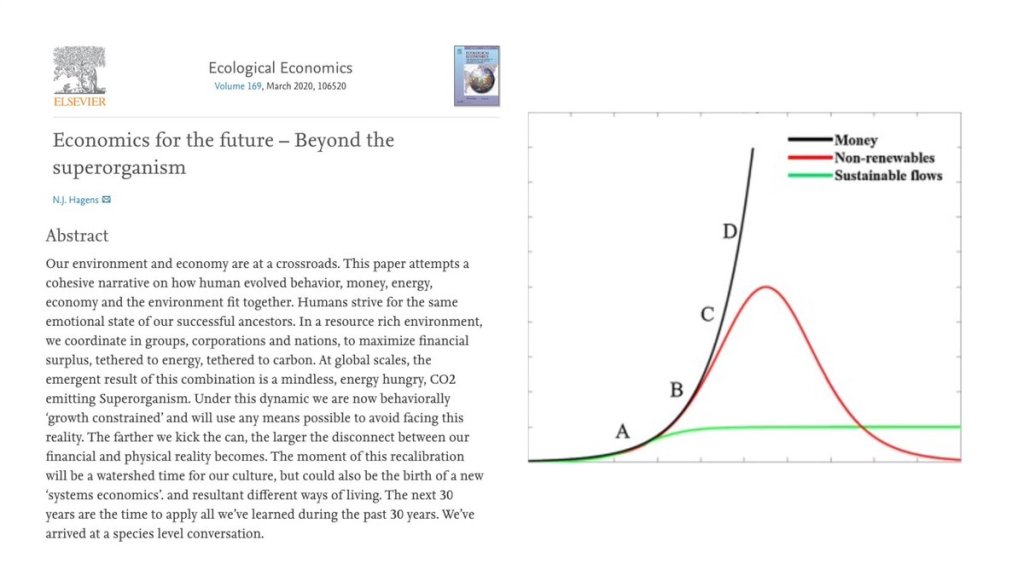
Our environment and economy are at a crossroads. This paper attempts a cohesive narrative on how human evolved behavior, money, energy, economy and the environment fit together. Humans strive for the same emotional state of our successful ancestors. In a resource rich environment, we coordinate in groups, corporations and nations, to maximize financial surplus, tethered to energy, tethered to carbon. At global scales, the emergent result of this combination is a mindless, energy hungry, CO2 emitting Superorganism. Under this dynamic we are now behaviorally ‘growth constrained’ and will use any means possible to avoid facing this reality. The farther we kick the can, the larger the disconnect between our financial and physical reality becomes. The moment of this recalibration will be a watershed time for our culture, but could also be the birth of a new ‘systems economics’. and resultant different ways of living. The next 30 years are the time to apply all we’ve learned during the past 30 years. We’ve arrived at a species level conversation.
“Ecological Economics addresses the relationships between ecosystems and economic systems in the broadest sense.” –Robert Costanza, (the first sentence in the first article in the first issue of Ecological Economics)
“The real problem of humanity is the following: we have paleolithic emotions; medieval institutions; and god-like technology.”– E.O. Wilson
“We live in a world where there is more and more information, and less and less meaning.”–Jean Baudrillard
“Not everything that is faced can be changed, but nothing can be changed until it is faced.” –James Baldwin
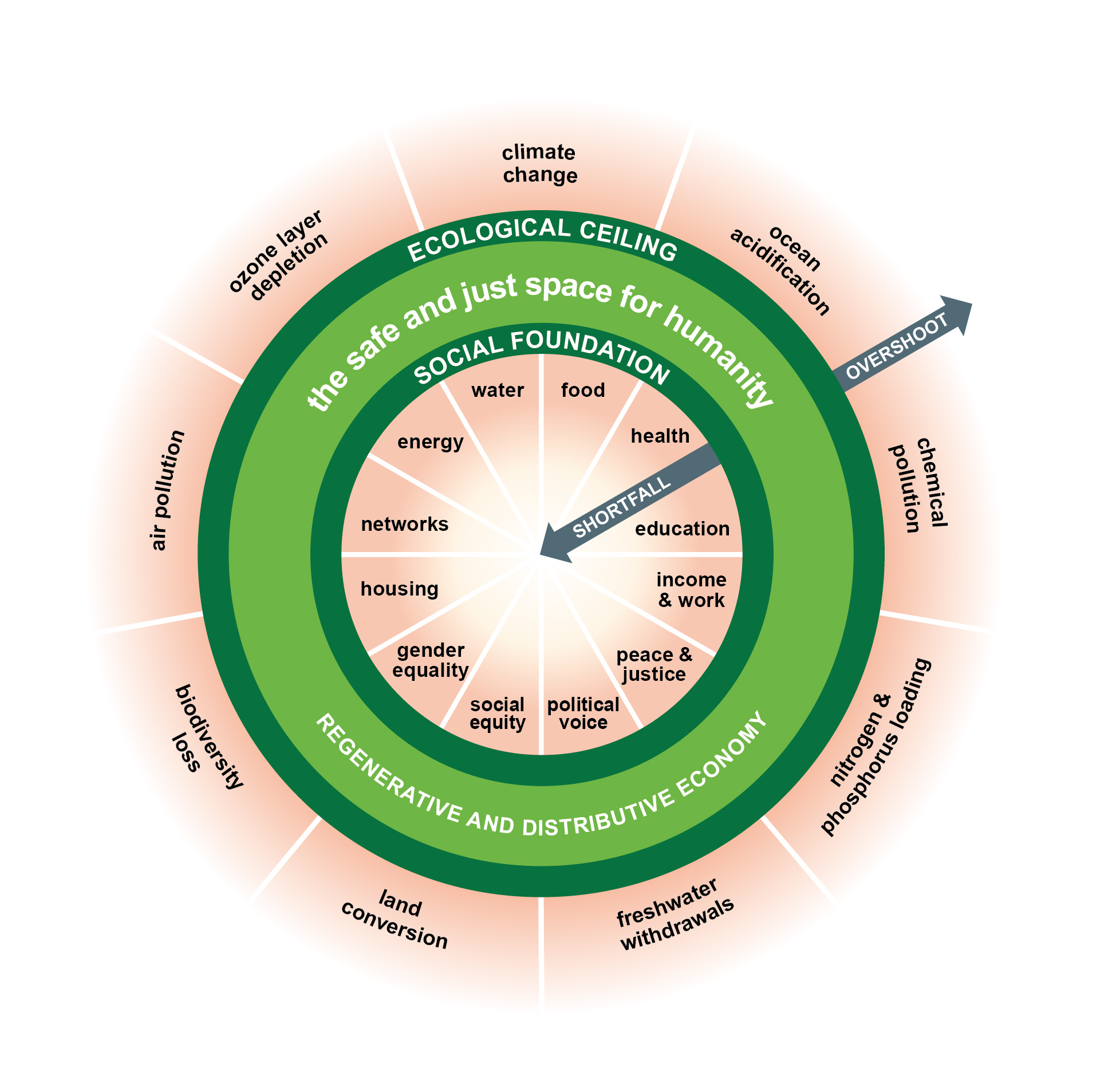
The classic image of the Doughnut; the extent to which boundaries are transgressed and social foundations are met are not visible on this diagram. Graphic via Wikipedia.com: https://www.kateraworth.com/doughnut/
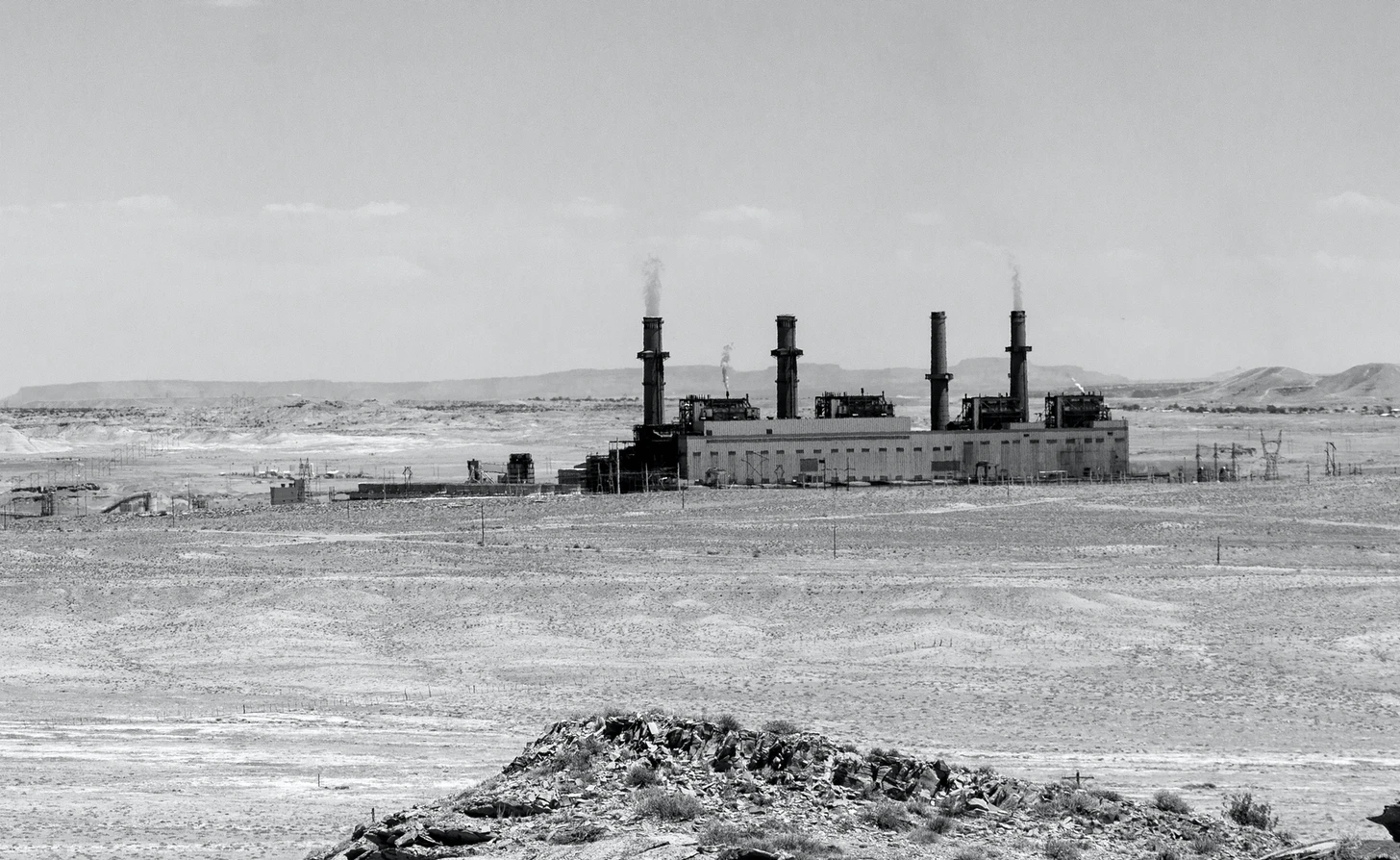
The San Juan Generating Station in mid-June of 2022 The two middle units (#2 and #3) were shut down in 2017 to help the plant comply with air pollution limits. Unit #1 shut down mid-June 2022 and #4 was shut down on September 30, 2022. Jonathan P. Thompson photo.
The City of Farmington announced it has ended the plan it began years ago to acquire the San Juan Generating Station and run it with a partner.
The announcement Dec. 20 followed a loss during arbitration hearings Dec. 14 that the city called a “catastrophic blow” to the partnership between it and Enchant Energy.
Farmington Mayor Nate Duckett said a strategy employed by Public Service Company of New Mexico (PNM) and other plant owners to dismantle key parts of the facility during decommissioning work got the go-ahead from a panel of arbitrators – a panel the city had hoped would instead put a hold on equipment auctions.
“Given PNM’s and the other co-owners’ actions to quickly dismantle SJGS, and the panel’s recent decision to allow them to do so, we have arrived at a point where those actions directly undermine the viability of successful implementation of the Carbon Capture Project,” Duckett said in the press release issued by the city Tuesday afternoon.
The biggest hurdle proponents of the Coal Basin methane project might face may not be the layers of bureaucracy they will have to navigate, but convincing Redstone residents that doing something is better than doing nothing. CREDIT: WILL SARDINSKY/ASPEN JOURNALISM
On a dark evening in early October, about 20 people gathered in a dimly lit room on the bottom floor of the Redstone Church. Many of the chairs were empty, but a smattering of locals from around the small, tightknit hamlet of Redstone had come to learn more about a project that could transform Coal Basin, a mountain valley just west of town.
For more than a century, invisible clouds of methane gas have been leaking out of several former coal mines that once operated in the basin. Although methane occurs naturally in coal deposits, ripping a hole in the mountain in the form of a coal mine releases the methane much faster. A potent greenhouse gas, methane is 25 times more powerful than carbon dioxide at trapping heat in the atmosphere over a 100-year time period. (Over a 20-year period, methane is 84 times more powerful.)
Standing in front of the audience, Chris Caskey, a Paonia-based scientist and architect of a proposal to deal with the methane leaks, pulled up a picture of one of the mine portals on a projector screen. The image was taken with an infrared camera, which made visible the methane billowing out from around the concrete header on the mine portal.
“These mines are doing $12 million of damage a year on society,” said Caskey, referring to the social cost of methane, a calculation that seeks to put a dollar figure on the total damages to society as a whole by emitting 1 ton of methane into the atmosphere. This includes, for instance, contributing to climate change, damaging public health and reducing the yield of agricultural ecosystems.
Not everyone was convinced. For many locals, the methane leaking out of the mine was less problematic than the potential changes to what they consider a treasured backyard wilderness, encompassing 6,000 mountainous acres of aspen groves, waterfalls and a new mountain-bike trail system.
The meeting was supposed to inform locals about the project — and ultimately win their support — but it also offered a window into a much deeper debate in the fight against climate change: How can the global benefits of a project that would reduce heat-trapping emissions be reconciled with the impacts the project would inevitably have on the local environment? For Caskey and the other proponents of the Coal Basin methane project, their biggest hurdle might not be the layers of bureaucracy they will have to navigate, but convincing Redstone residents that doing something is better than doing nothing.
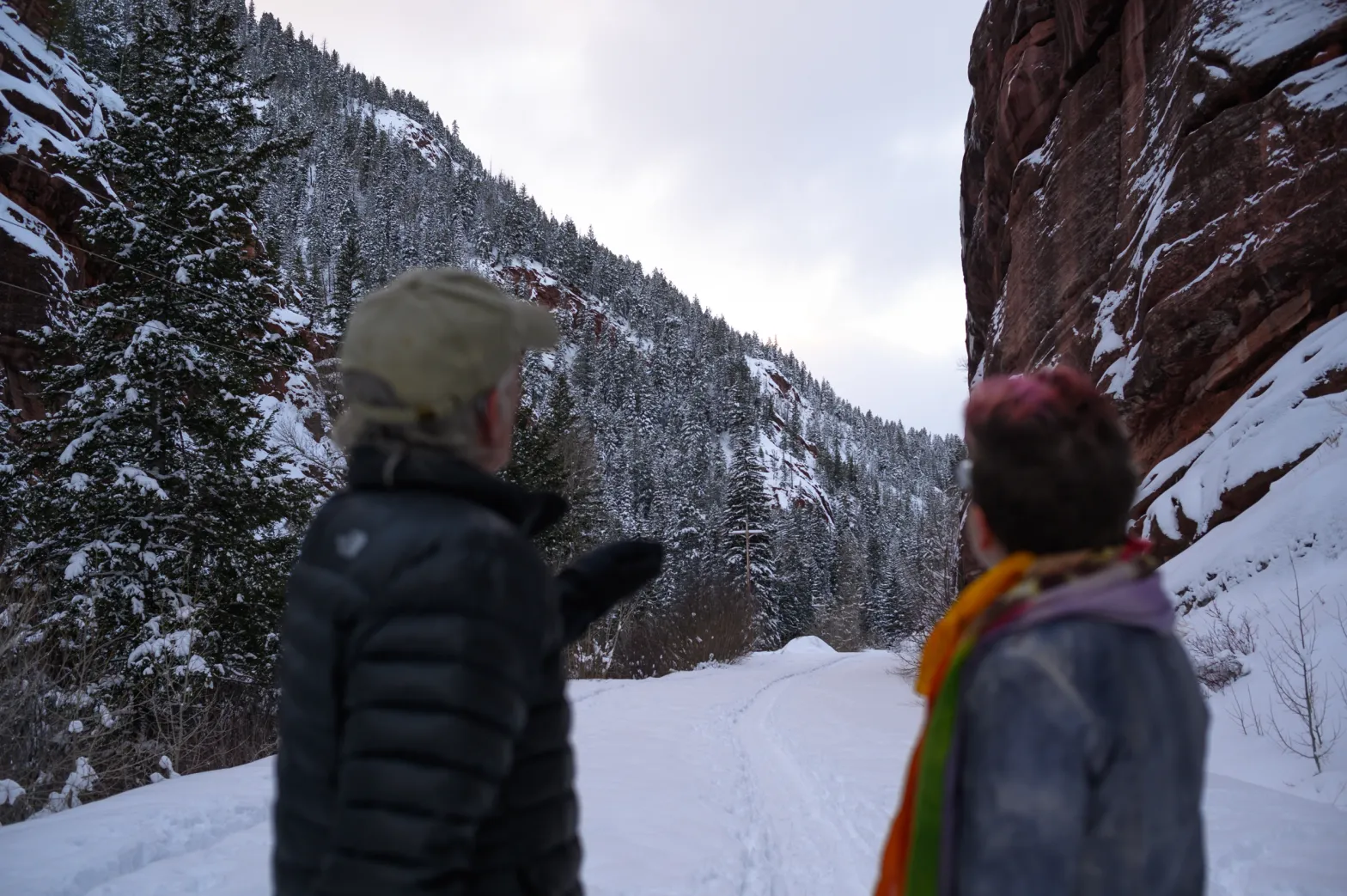
Redstone residents Chuck Downey and Gentrye Houghton on Coal Basin Road on Dec. 8, 2022. The scenic valley just west of Redstone, once home to industrial coal mining, is a favorite local recreation destination. Both have expressed concern about the impact of a potential project to capture methane leaking form the shuttered mines.
CREDIT: WILL SARDINSKY/ASPEN JOURNALISM
Identify and authorize
The Coal Basin mines are among thousands of shuttered coal mines across the country currently leaking methane long after they have closed. So far, Caskey has identified 12 major leaks in Coal Basin, but there are probably more, which he hopes to find with a drone or by helicopter. Using a portable methane sensor, Caskey has measured methane from two of those leaks (the only two that are easy to measure) at a combined rate of 100 to 200 tons per year. Extrapolating that number using Environmental Protection Agency data, he believes the Coal Basin mines are, in total, emitting roughly 10,000 tons, or the equivalent of 248,040 tons of carbon dioxide, which is roughly half of Pitkin County’s total annual greenhouse gas emissions.
That situation is untenable to Caskey, a self-described “climate guy” who learned about the problem a few years ago and began thinking of solutions. Backed by almost $900,000 in funding from private companies such as Atlantic Aviation, nonprofits such as Community Office for Resource Efficiency (CORE) and Pitkin County, Caskey hopes he can find a way to deal with the methane leaks. He has proposed capturing the methane and either using it or destroying it, depending on which option proves most viable. The purpose of the meeting was to outline the next steps in the process to identify a project and get it authorized — and hopefully, gain more support from the Redstone community, which appears skeptical based on the sentiment expressed at the October meeting and in subsequent interviews.
Early this month, Caskey submitted clarifications for his proposal to the U.S. Forest Service asking for permission to run a “flow test” this spring or summer at the mines in Coal Basin. The test would deliver more precise information about the methane and other gases coming out of the mines, revealing the exact quantity and quality of the methane — and the best option for dealing with it. If the test reveals that the gas contains a minimum of 18% methane, the most viable project would be destroying the methane through flaring, or burning, it. If the test shows the emissions have more than 30% methane, then it would be possible to capture the methane and convert it to electricity — a much costlier and more environmentally invasive project, involving pumping stations and building a pipe (either above ground or below) to bring the gas down.
Doing nothing is also an option, Caskey said, but, given the urgency of the climate crisis, it was not one he favored.
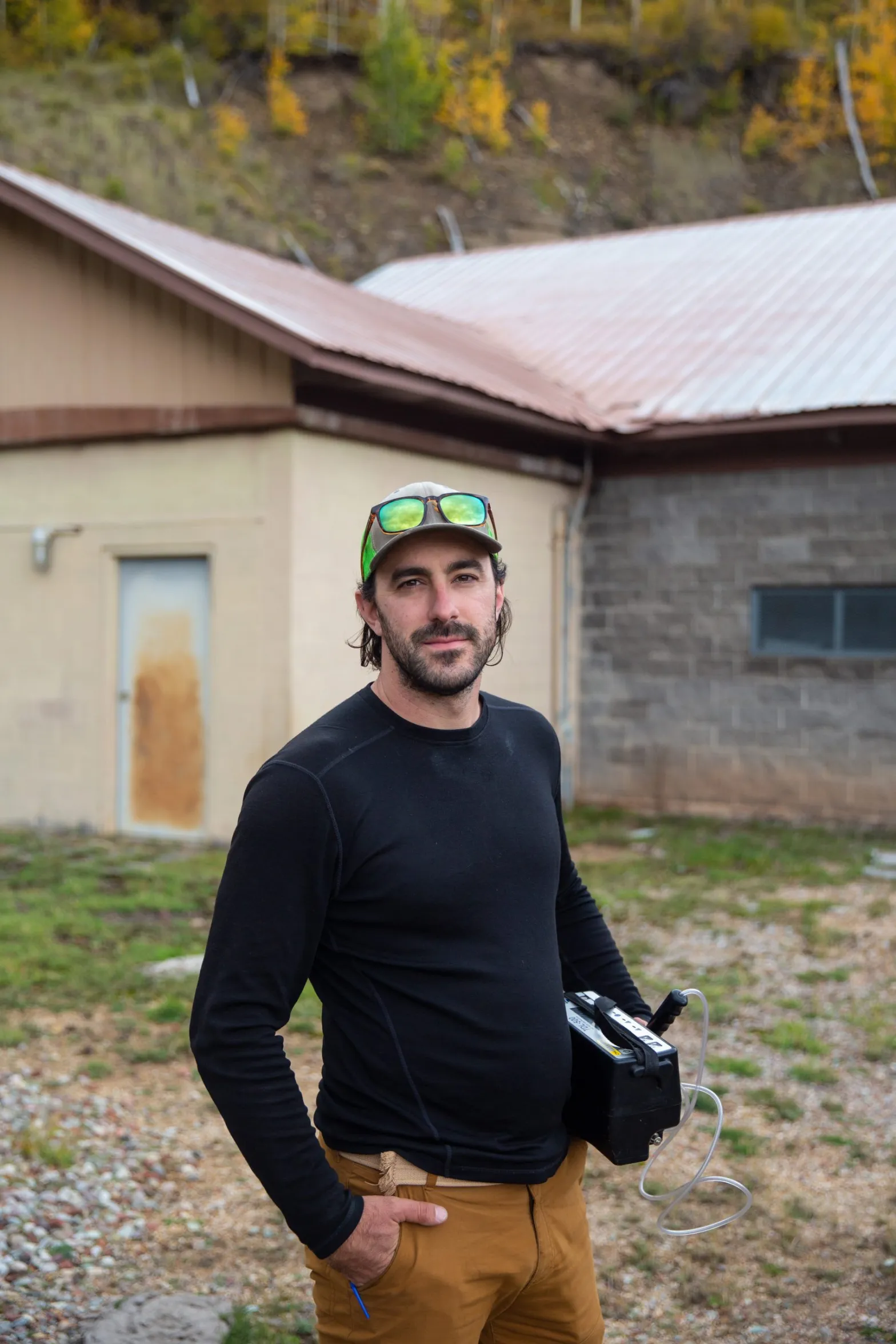
Chris Caskey stands for a portrait during a hike to shuttered mines in Coal Basin, near Redstone, Colo., in September 2021. Caskey is leading an effort to investigate potential strategies to capture methane leaking from the shuttered mines.
CREDIT: LUNA ANNA ARCHEY/ASPEN JOURNALISM
Reading the room
As the meeting progressed, tensions in the room rose as Caskey described what the flow test would entail. The test requires having to haul up a large, heavy measuring device to the mine portals in Coal Basin. To do that, they would have to reopen the old road, building culverts over the stream crossings so that a truck could get through.
A woman in the audience asked, “Any other way to do this without dragging equipment up there?”
“Will this project kill our dwindling elk herd?” asked Gentrye Houghton, a Redstoneresident.
Caskey assured her that a project to deal with the methane would not kill the elk herd. Still, his affirmations that any project proposal would first undergo environmental impact studies under the National Environmental Policy Act seemed not to have much sway.
“That’s not what the residents want to see up there,” a man said. Another person asked how many diesel generators a methane electrification project would require.
Caskey tried to acknowledge the sentiments diplomatically: “I’m hearing that people have noise concerns,” he said.
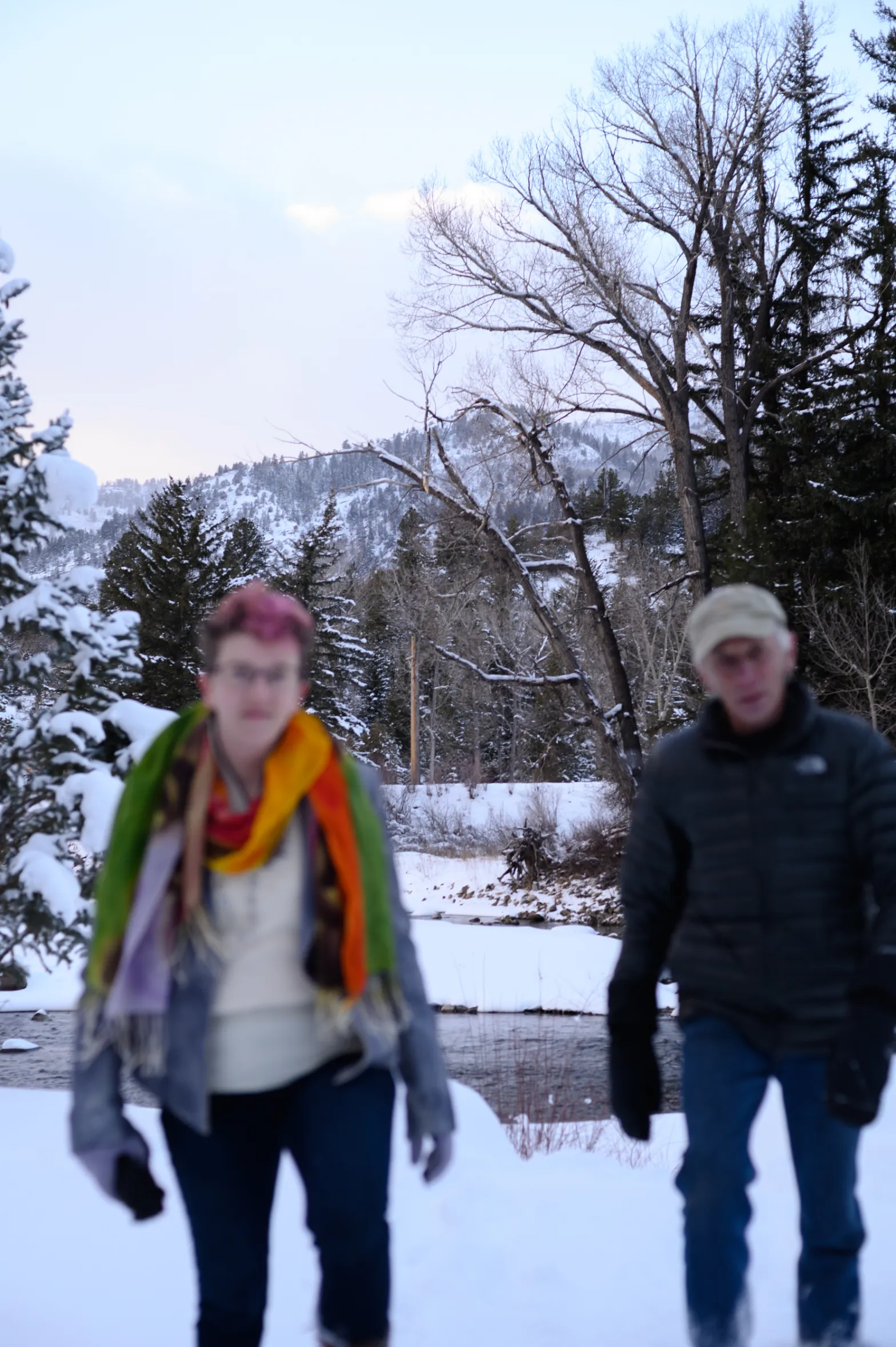
Redstone residents Chuck Downey and Gentrye Houghton, pictured here on Dec. 8, 2022, are skeptical that the methane leaking from shuttered mines in Coal Basin, just west of town, is a big enough problem to justify the impacts of a potential project to capture the potent greenhouse gas.
CREDIT: WILL SARDINSKY/ASPEN JOURNALISM
Cost versus benefit
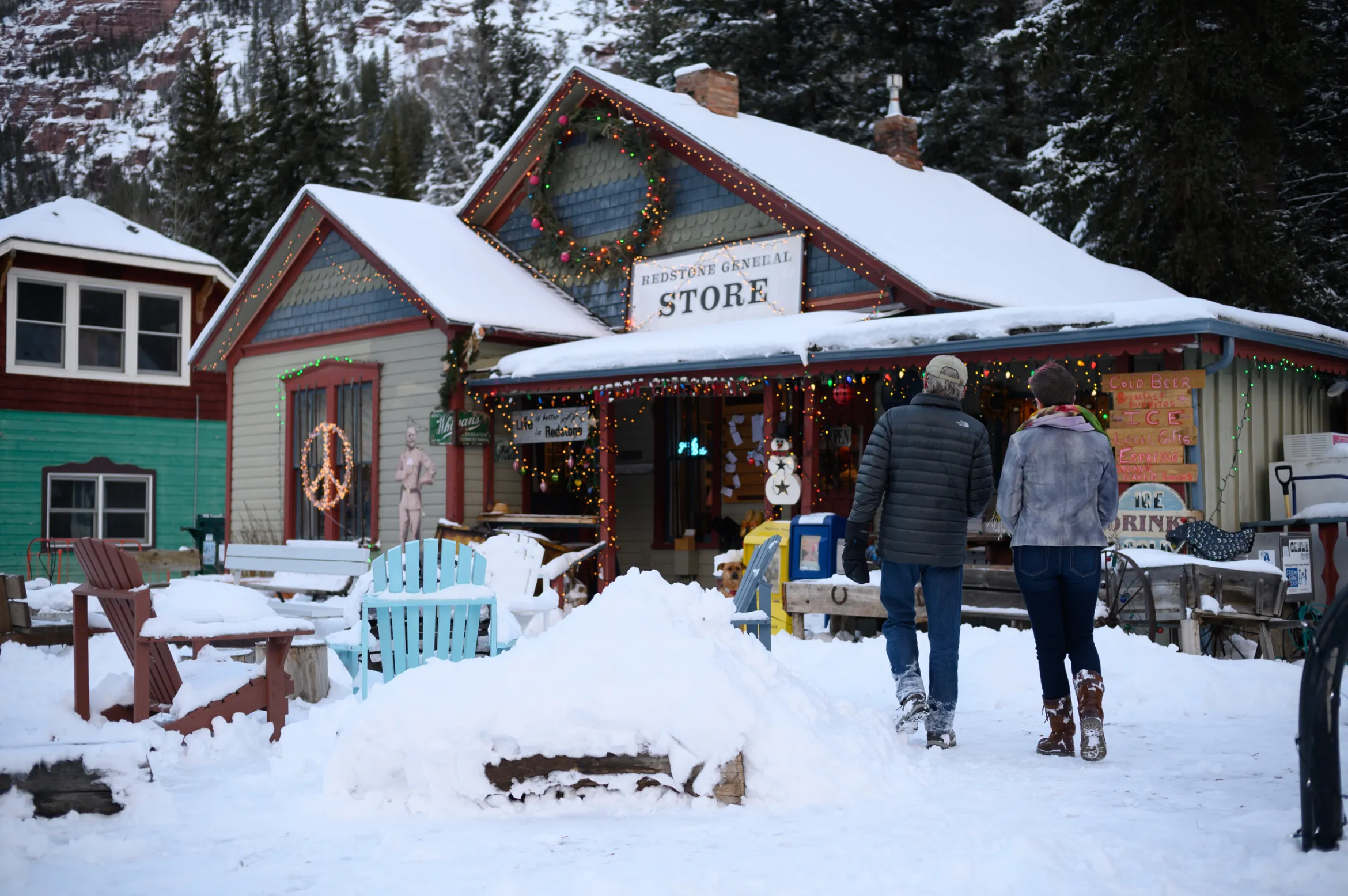
A month after the meeting, I met with Houghton at the Redstone General Store. Thirty-seven years old with short pink hair, Houghton is publisher and editor-in-chief of the Crystal Valley Echo, a local paper, and works as a massage therapist on the side. She moved to Redstone almost 10 years ago, after an internship with Rock and Ice, a now-defunct Carbondale magazine. In 2018, she bought a house — formerly the town laundromat and, at 430 square feet, “literally the smallest home in Redstone,” she said. Coal Basin is where Houghton taught herself to backcountry ski — on a hillside she later found out was not a natural slope but, rather, a mound of old coal tailings. These days, she estimates that she is up in the basin at least once a day to recreate, depending on the season.
Houghton first heard about Caskey’s methane project proposal while scrolling through the minutes from a Pitkin County commissioners meeting. The commissioners had allocated $200,000 to the project, which Houghton said helps illuminate some of her and other Redstone residents’ broader frustrations about the project. “The big sentiment is: Is this big money bulldozing us over?” she said. “Is this just a pet project for billionaires who don’t have to look at it in their backyard?”
Many residents, she said, remember Coal Basin’s reclamation process, a $4 million restoration effort that lasted until 2002 to clean up the environmental disaster left over from the mining operations. They fear that a methane project could undo those decades of progress. Houghton pushed back at the notion that Redstone residents were prioritizing their own interests over addressing climate change. The 10,000 tons produced annually by the Coal Basin mines are just a small fraction of the 570 million tons of methane emissions that occur globally. According to Houghton, many locals are unconvinced that the environmental impacts of the project are worth the benefits.
Chuck Downey, 84, another longtime Redstone resident, echoed those feelings. Growing up in the Fryingpan Valley, he saw how the Ruedi Dam construction in the 1960s forever changed the valley. Afterward, he vowed to fight if another project that would negatively affect his local ecosystem ever arose. Of particular concern to Downey was the electricity-generation option. Initially, Caskey had hoped that the flow-test results would support his idea to convert the methane leaking from the coal mines into electricity. However, based on the lessons learned from the nearby methane-to-electricity power plant at a mine in Somerset (one of only two such facilities in the country), Caskey said he now questions whether electricity generation from the Coal Basin methane will be viable. Downey would be more amenable to Caskey’s other proposal — flaring the methane — but he said he would still not endorse the plan, believing that the amount of methane leaking from the mines is too small to warrant the impacts to national forest land. “The way I see it,” he said, “what’s being proposed is indeed a really good idea, but it’s in the wrong place.”
Coal Creek flows into the Crystal River in Redstone.
CREDIT: WILL SARDINSKY/ASPEN JOURNALISM
Local responsibility
Caskey isn’t surprised that locals are wary of the project. “I run a for-profit company. Anytime one shows up in your town, you should be suspicious,” he said. Overall, he added, the reception to his proposal has been overwhelmingly positive, but the closer you get physically to where the project would occur, the more concerns there are.
At the meeting, proponents expressed how Coal Basin’s mining history and already-disturbed status make it an ideal location for a methane project. “It’s not a pristine mountain area,” a man said. “It’s not even fully restored.”
A lady in a puffy pink jacket objected to his assessment, saying that she hikes in Coal Basin regularly. “I know what I’m talking about,” she said tartly.
For Caskey, the local impacts aren’t the only questions relevant to the methane project. Wealthy Coloradans have benefited from resource exploitation, he said. “The more pertinent question is: ‘What responsibility do we have to clean up the mess related to that exploitation given that it hurts other people?’”
Another proponent reminded the room that Coal Basin’s minerals are owned by the Bureau of Land Management, which manages resources for all Americans, not just the few who live in Redstone. “What if this project could contribute to good?” the person added. “It could be a model for the rest of the world — opportunity for Redstone to rally around in a time when so much is wrong.”
“We need more studies,” said a man in a blue fleece.
“Oh, there will definitely be more studies,” said Caskey, flipping the projector to the next slide.
Editor’s note: Aspen Journalism is supported by the Catena Foundation, which is affiliated with the owner of the parcel home to the mountain-bike trail network referenced in the story. We are also supported by Pitkin County’s Healthy Community Fund. Aspen Journalism is solely responsible for its editorial coverage.
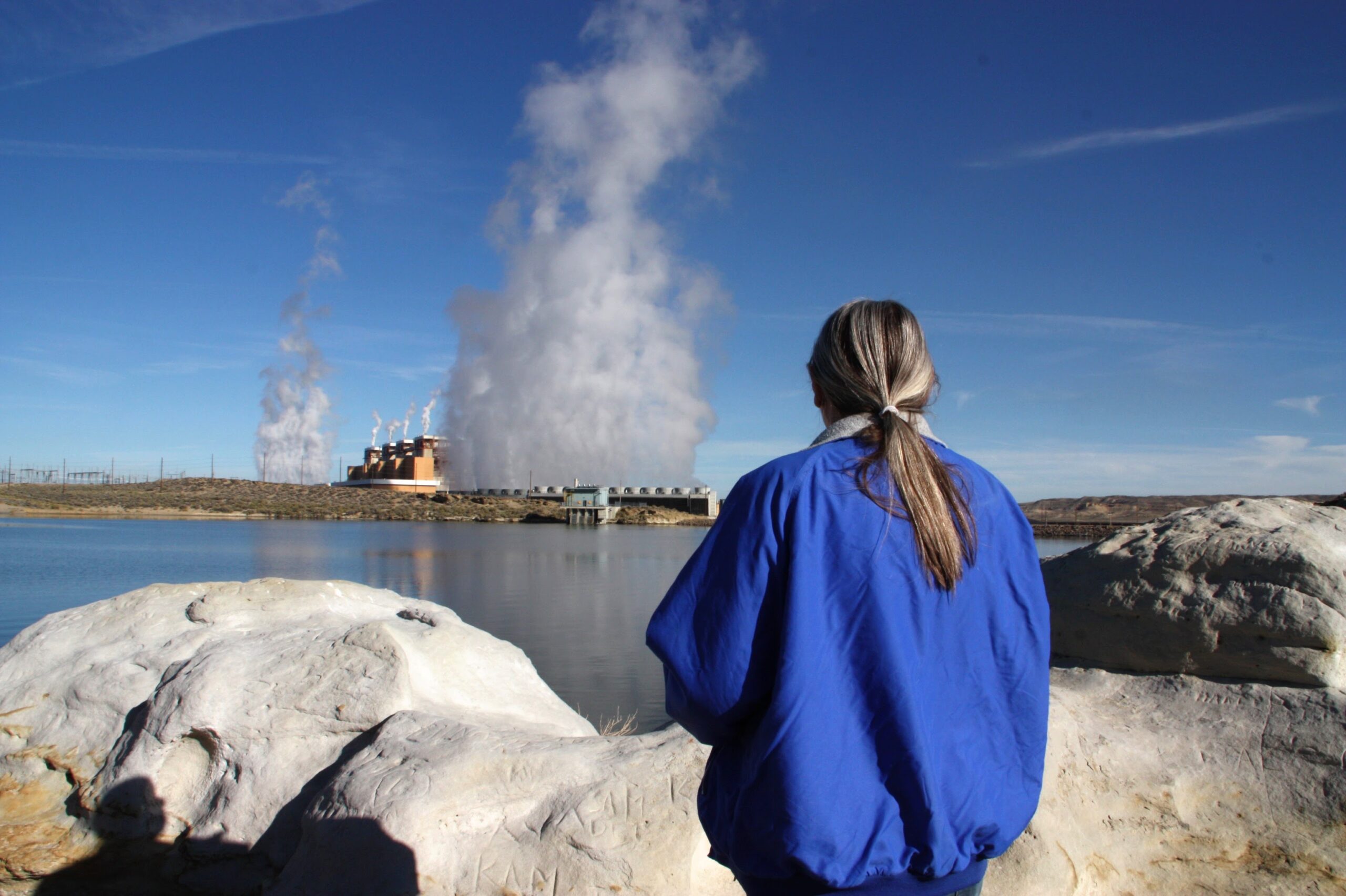
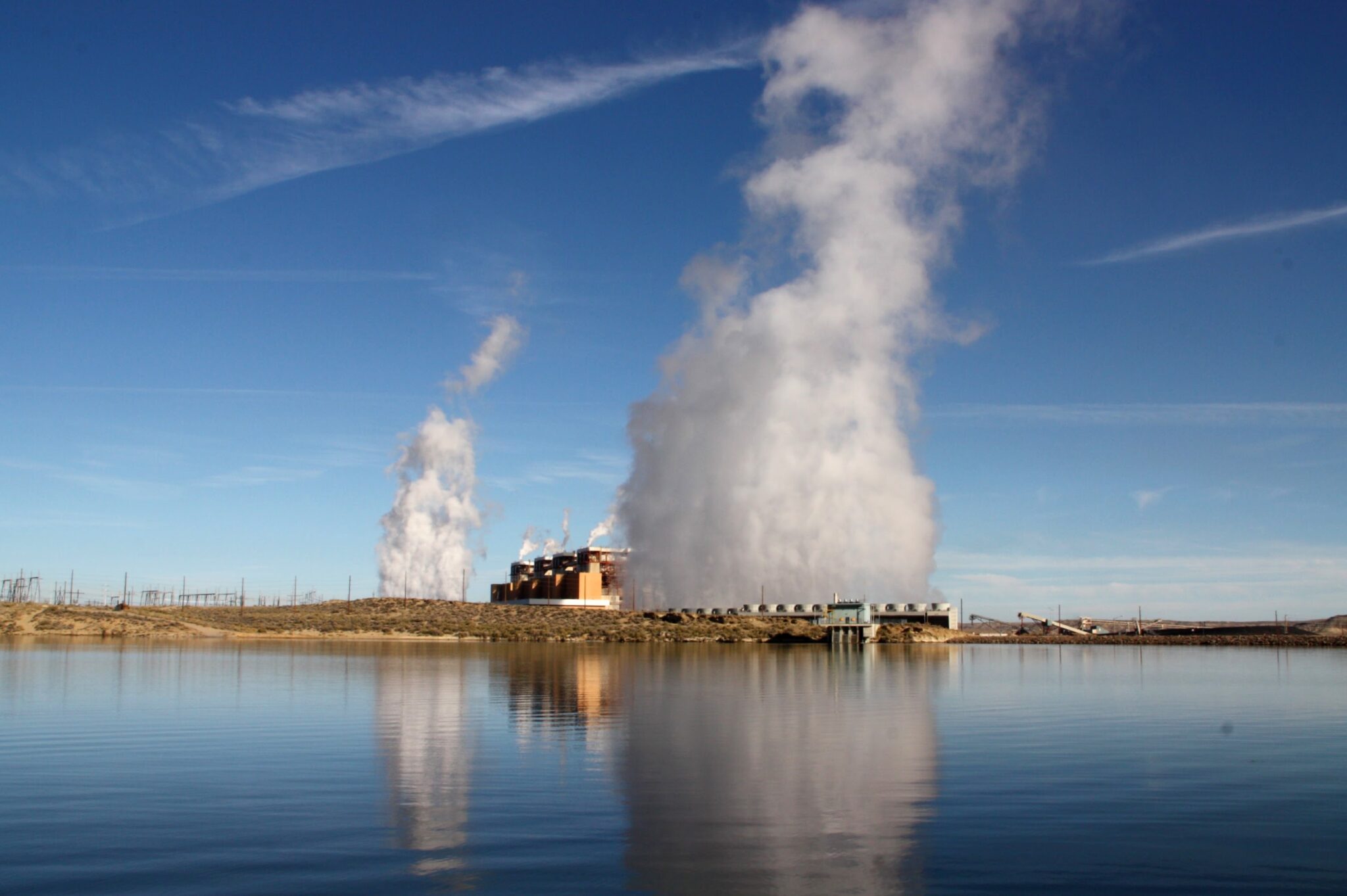
Lou Ann Varley looks out across the pond that holds water for the cooling towers at the Jim Bridger coal plant, where she worked for 37 years before retiring in 2020. Credit: Nicholas Kusnetz
In early fall, residents of this desolate corner of southwestern Wyoming opened their mailboxes to find a glossy flyer. On the front, a truck barreled down a four-lane desert highway with a solar farm on one side and what looked like rows of shipping containers on the other. On the back was an invitation.
“CarbonCapture Inc. is launching Project Bison,” it read, announcing a “direct air capture facility” set to begin operations here next year. “Join us at our town hall event to learn more.”
Few had heard about the proposal before receiving the flyer, let alone had any idea what a direct air capture facility was. So the following week, about 150 people packed into a large classroom at Western Wyoming Community College in Rock Springs to find out.
“We are a company that takes CO2 out of the air and stores it underground,” said Patricia Loria, CarbonCapture’s vice president of business development, in opening the meeting.
Loria described a plan to deploy a series of units—the shipping container-like boxes pictured on the flyer—that would filter carbon dioxide from the air and then compress the greenhouse gas for injection underground, where it would remain permanently.
As carbon dioxide levels continue to climb, scientists, entrepreneurs and governments are increasingly determining that cutting emissions is no longer enough. In addition, they say, people will need to pull the greenhouse gas out of the atmosphere, and an emerging field of carbon removal, also called carbon dioxide removal or CDR, is attempting to do just that.
There are companies like Loria’s looking to use machines and others trying to accelerate natural carbon cycles by altering the chemistry of seawater, for example, or mixing crushed minerals into agricultural soils. These efforts remain wildly speculative and have removed hardly any of the greenhouse gas so far.
Some environmental advocates warn that carbon removal will be too expensive or too difficult and is a dangerous diversion of money and attention from the more urgent task of eliminating fossil fuels. Perhaps more troubling, they say, the various approaches could carry profound environmental impacts of their own, disrupting fragile ocean ecosystems or swallowing vast swaths of agricultural fields and open lands for the energy production needed to power the operations.
Yet even as those potential impacts remain poorly understood, the Biden administration is making a multi-billion dollar bet on carbon removal. The administration’s long-term climate strategy assumes that such approaches will account for 6 to 8 percent of the nation’s greenhouse gas reductions by 2050, equal to hundreds of millions of tons per year, and it has pushed through a series of laws to subsidize the technology.
The first investments will come from the Energy Department, which is expected to open applications within weeks for $3.5 billion in federal grants to help build “direct air capture hubs” around the country, with a particular focus on fossil fuel-dependent communities like Rock Springs, where mineral extraction is by far the largest private employer. The goal is to pair climate action with job creation.
The money has prompted a rush of carbon-removal-focused companies to fossil fuel communities, from Rock Springs to West Texas to California’s San Joaquin Valley, seeding hope from supporters that a concept long relegated to pilot plants and academic literature is on the cusp of arriving as an industry.
As Loria made her pitch, Lou Ann Varley was listening intently. Varley sits on a local labor union council and spent a 37-year career working at the Jim Bridger coal plant outside town before retiring in 2020. She knows that young workers starting at the plant today won’t be able to match her longevity there, with its four units slated to close over the next 15 years, and hoped Project Bison might offer some of them a new opportunity.
Others weren’t having it. Throughout the presentation, residents listened quietly, sitting in pairs at folding tables in the classroom. Some munched on sandwiches and cookies the company had provided. Others leaned back, arms crossed. But when it came time for questions, they launched a volley of concerns about the potential risks and unknowns.
Who was going to pay for this? Would it use hazardous chemicals? What about earthquakes from the underground injections of carbon dioxide? What would happen if the company went bankrupt, and who would be liable in the event of an accident? Wyomingites are deeply protective of their open landscapes, and many wondered about the impacts of all of the renewable energy that would be required for power.
Direct air capture machines consume tremendous amounts of energy. Project Bison, according to CarbonCapture’s figures, could eventually require anywhere from 5 to 15 terawatt hours of power per year, equal to 30 percent to 90 percent of Wyoming’s current electricity consumption, depending on whether the company can increase its efficiency.
Laura Pearson, a sheep rancher who wore heavy work clothes, was sitting in the back row that night feeling deeply skeptical of the entire premise. Pearson’s family has worked the same land for generations, and she sees the wind farms and solar panels that have started covering parts of her state as a threat to its open range.
“If you don’t think those affect wildlife and livestock grazing and everything else in this state,” she told Loria from across the room, “you’re crazy.”
Loria said the company was working with wildlife scientists and officials to minimize impacts, but Pearson was unswayed.
“I love Wyoming and I don’t want to see it change,” Pearson said after the meeting ended. She said she doubted the company’s intentions, didn’t think carbon dioxide posed such a threat to the planet and didn’t like seeing out-of-state interests, whose demands for cleaner energy have sent Wyoming’s coal sector into decline and are threatening to do the same for its oil and gas, coming to peddle something new. “It’s all about the money,” she said.
A Town With a Storied Coal History
Rock Springs was built on coal. In 1850, an Army expedition found coal seams cropping out of the valley bluffs. Less than 20 years later the Union Pacific Railroad routed the nation’s first transcontinental line through here so its locomotives could refuel as they crossed the Rockies. The mines soon snaked right under the center of town, where the outlaw Butch Cassidy once worked at a butcher shop and earned his nickname.
The rail line still bisects the town, although the old station has been converted into the Coal Train Coffee Depot cafe. A large sign arcs above the tracks outside: “Home of Rock Springs Coal, Welcome.” A stone monument next to the depot lists everyone who died in the mines each year, coming by the dozen in the early 1900s, with names like Fogliatti, Mihajlovic and Papas reflecting all the countries from which men flocked to find work.
The Jim Bridger coal plant, one of the nation’s largest, has faced forced retirement and is slated for closure within 15 years. The impending loss of jobs has brought anxiety to the coal-reliant community of Rock Springs, Wyoming. Credit: Nicholas Kusnetz
Varley started at Jim Bridger, one of the country’s largest coal plants, in 1983 after getting laid off from mining trona, a mineral used in the manufacturing of glass, detergents, chemicals and other products. All but one of the eight largest private employers in Sweetwater County either mine or use the minerals and fossil fuels that underlie this part of Wyoming. As oil, gas and coal operations have shed jobs in recent years, the trona mines have absorbed many of the losses.
Varley began as a laborer, sweeping and shoveling coal or ash, before working her way up through operations and maintenance. Eventually, she helped operate the computer systems that ran the plant. “I loved the job,” she said.
Two years after retiring, Varley still refers to Bridger as “my plant.”
Until recently, her plant was facing the forced shutdown of some of its units for failing to meet federal pollution rules set by the Environmental Protection Agency. But in February, Wyoming Gov. Mark Gordon struck a deal to forestall any retirements by converting two of Bridger’s four units to burn natural gas instead. Still, all of its units are expected to close within 15 years.
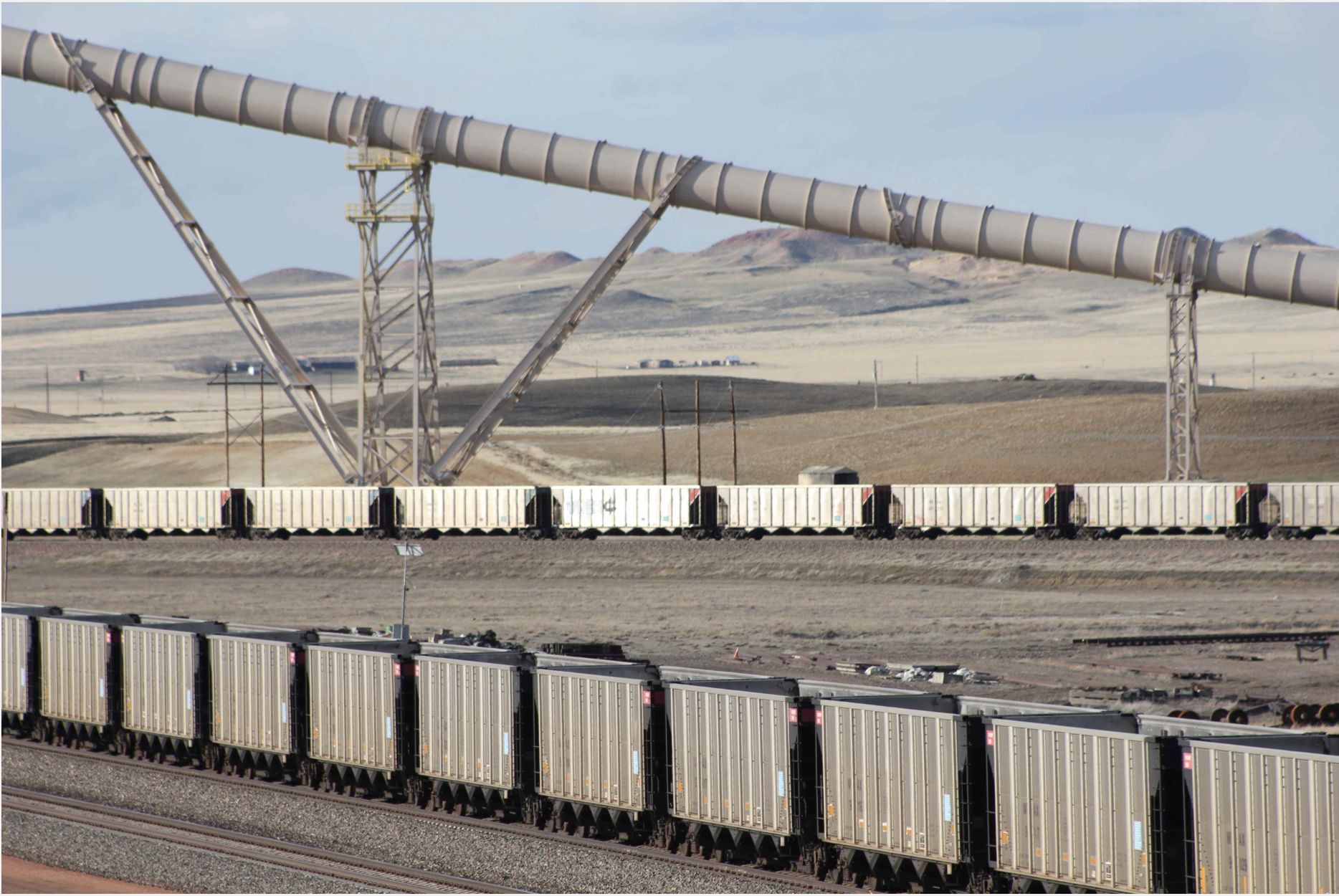
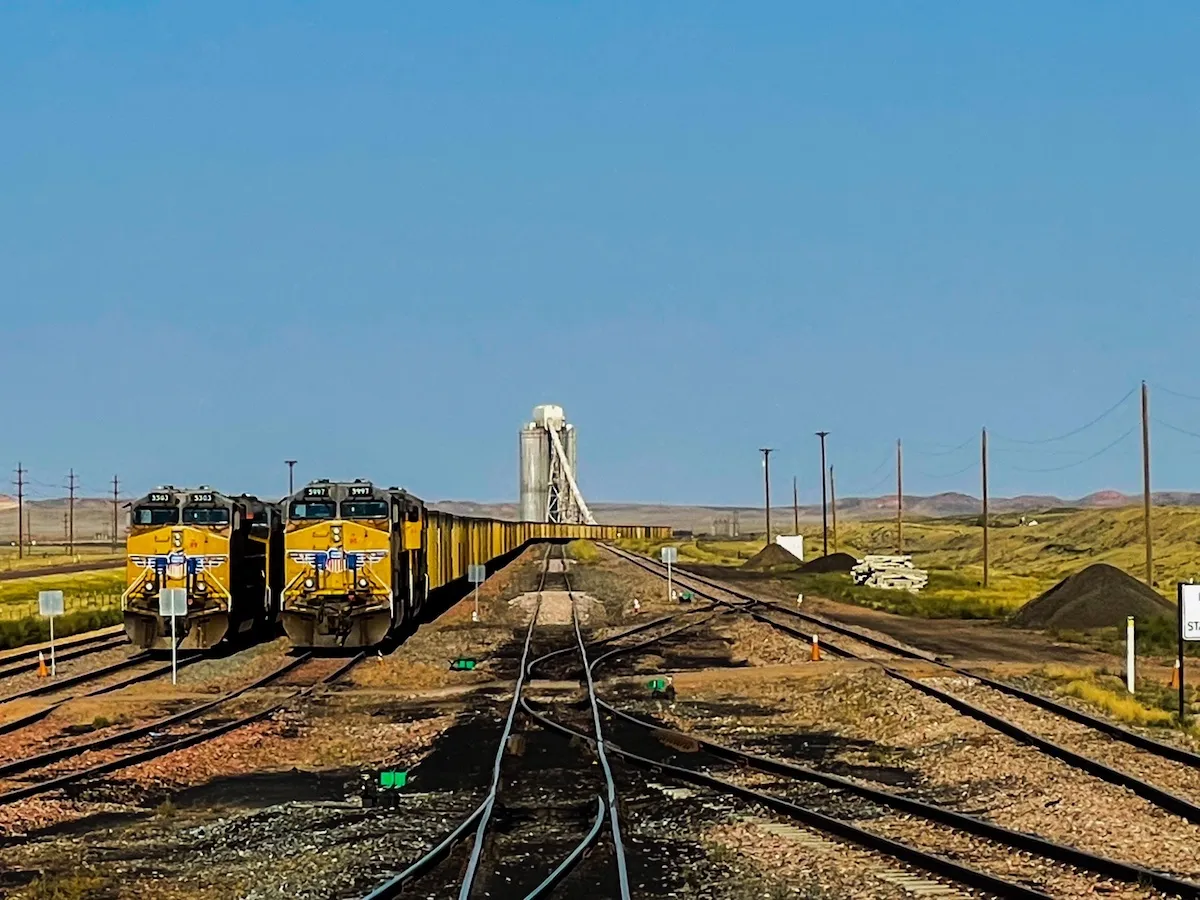
Coal trains await loading in the Powder River Basin of Wyoming. Photo/Allen Best
Wyoming produces about 40 percent of the nation’s coal, so the fuel’s plummeting share in the nation’s electricity—from half in 2005 to about 20 percent this year—has brought acute anxiety to towns like Rock Springs.
“It makes it kind of tough when you know that they’re talking towards phasing out coal,” Varley said. Many people who work at the plant, which employs more than 300, get angry about the prospect, she said. “Especially some of the younger ones, because they hired in believing like me that they would be able to retire from that facility.”
Wyoming officials have spent years trying everything to promote carbon capture technology, which removes carbon dioxide from power plant or industrial emissions, in the hope it could save coal. The state university has mapped its geology for places to store CO2. Regulators won federal approval to oversee the underground injection of carbon dioxide, one of only two states to do so, along with North Dakota. (The EPA oversees the practice everywhere else.) In 2020, Wyoming lawmakers passed a law that tried to force utilities to install carbon capture equipment at their coal plants.
These efforts have not yielded a single commercial carbon capture operation at a power plant, but they do seem to have attracted CarbonCapture Inc., to the delight of state economic development officials.
A California-based start-up, CarbonCapture said it has secured enough private investment to begin work next year on the Wyoming plant, although it still needs to receive state and local permits. Rather than attaching to a coal plant, this project would pull carbon dioxide out of ambient air by passing it through giant fans fitted with a chemical sorbent, which traps the CO2. The sorbent is then heated to release the gas for compression before being reused.
Project Bison would initially capture 10,000 metric tons of carbon dioxide per year, but the company said it plans to expand to reach a capacity of 5 million metric tons by 2030. That higher figure would be orders of magnitude above what any company has achieved so far, yet roughly equal to the emissions of one coal power plant, or less than 0.1 percent of total U.S. emissions of nearly 6 billion metric tons in 2020.
The operations would be financed by selling carbon credits to corporations seeking to offset their own emissions. The company said it has already sold credits at $800 per ton to Cloverly, a carbon-offset marketer, and to CO2.com, a new carbon offset venture of TIME, the magazine owned by the billionaire Marc Benioff.
Varley had gone into the town hall meeting feeling optimistic that the project could potentially provide high-quality jobs while also helping the environment. While she wants the coal plant to continue operating for as long as possible, she knows its days are numbered, and when it closes, it could take more than 300 jobs with it.
Southwest Wyoming is hard country to live in: Varley has spent her entire life here and said “it grows on you like a fungus.” The state has the highest suicide rate in the country, and the decline of fossil fuels, it feels to many, will only make life harder.
“People are looking for ways to maintain our ability to live here,” Varley said.
These disasters have driven many people toward desperate acts of civil disobedience, like a scientist who chained himself to the doors of a private jet terminal. They’ve also pushed many to conclude that carbon removal technologies, however unlikely their deployment, will now be necessary to avoid the worst impacts of warming.
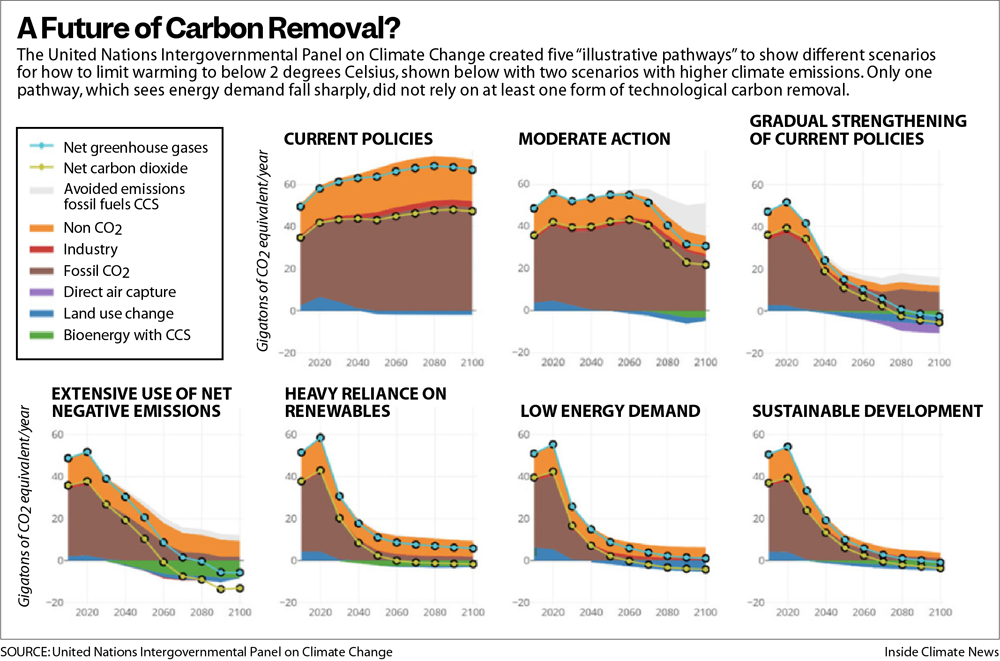
When the United Nations Intergovernmental Panel on Climate Change released its latest report this year on how to keep warming below 2 degrees Celsius, it determined that at least some degree of carbon removal was needed but that the amount could vary drastically, depending on how quickly fossil fuel consumption declined and whether nations adopt more sustainable practices.
A future of carbon removal? Credit: Inside Climate News
The only scenarios that did not include meaningful levels of carbon removal generally required global energy use to decline, which seemed unlikely, especially if there was any hope of supplying electricity to the nearly 800 million people who currently lack it.
“It’s critical to have this tool,” said Jennifer Wilcox, the principal deputy assistant secretary in the Office of Fossil Energy and Carbon Management at the Department of Energy, “and we need to have it on the order of gigatons,” or billions of tons.
The last year has brought an explosion of funding to try to make that happen. In addition to the $3.5 billion that Congress allocated to the Energy Department for direct air capture hubs, lawmakers earmarked another $1 billion for research and development this year and, as part of the Inflation Reduction Act, more than tripled the value of a federal tax credit for direct air capture.
United Airlines, Airbus, Microsoft, Alphabet, Meta, Stripe and other corporations have collectively pledged billions more. The billionaire entrepreneur Elon Musk has funded a $100 million prize for carbon removal startups. The field is also one of the fastest growing areas of climate philanthropy.
So far, however, hardly any carbon dioxide has been pulled from the atmosphere. The largest direct air capture plant in operation, opened by a company called Climeworks in Iceland, pulls in about 4,000 metric tons of CO2 per year. By contrast, the Jim Bridger plant outside Rock Springs spewed out 10.8 million metric tons of carbon dioxide in 2021 alone.
Skeptics have noted how far carbon removal is from making a dent in global emissions. Supporters, however, argue that the rates of growth the industry must achieve to make a difference, while high, are comparable to what solar energy generation has seen since the 1990s.
The rush of funding and attention has prompted a new set of questions about carbon removal technologies. The concerns of many skeptics have moved beyond whether carbon removal can possibly work, to wondering what it would look like if it somehow did.
Displacing Herds of Native Pronghorn
Pearson’s route to town takes her past Wyoming’s first utility-scale solar farm, which was built in 2018. The 700-acre site was cleared of vegetation before the panels were installed and surrounded with a chain-link fence. Now it marks a shiny, incongruous break in the high desert, though it is hardly the only disturbance around, with trona mines in each direction.
The sight of it was bad enough for Pearson and other residents, but soon after the project’s completion, residents noticed herds of pronghorn, a fleet-footed antelope-like animal indigenous to the region, tramping onto the highway. The area that the solar farm had enclosed, it turned out, had been used by resident pronghorn, and the fences shut them out. The companies behind the project sponsored a study, published last spring in a scientific journal, that determined that the animals lost nearly a square mile of high-use habitat, about 10 percent of their core range. Today, the pronghorn’s trails and droppings line the perimeter of the fence that locked the animals out of lands they once called home.
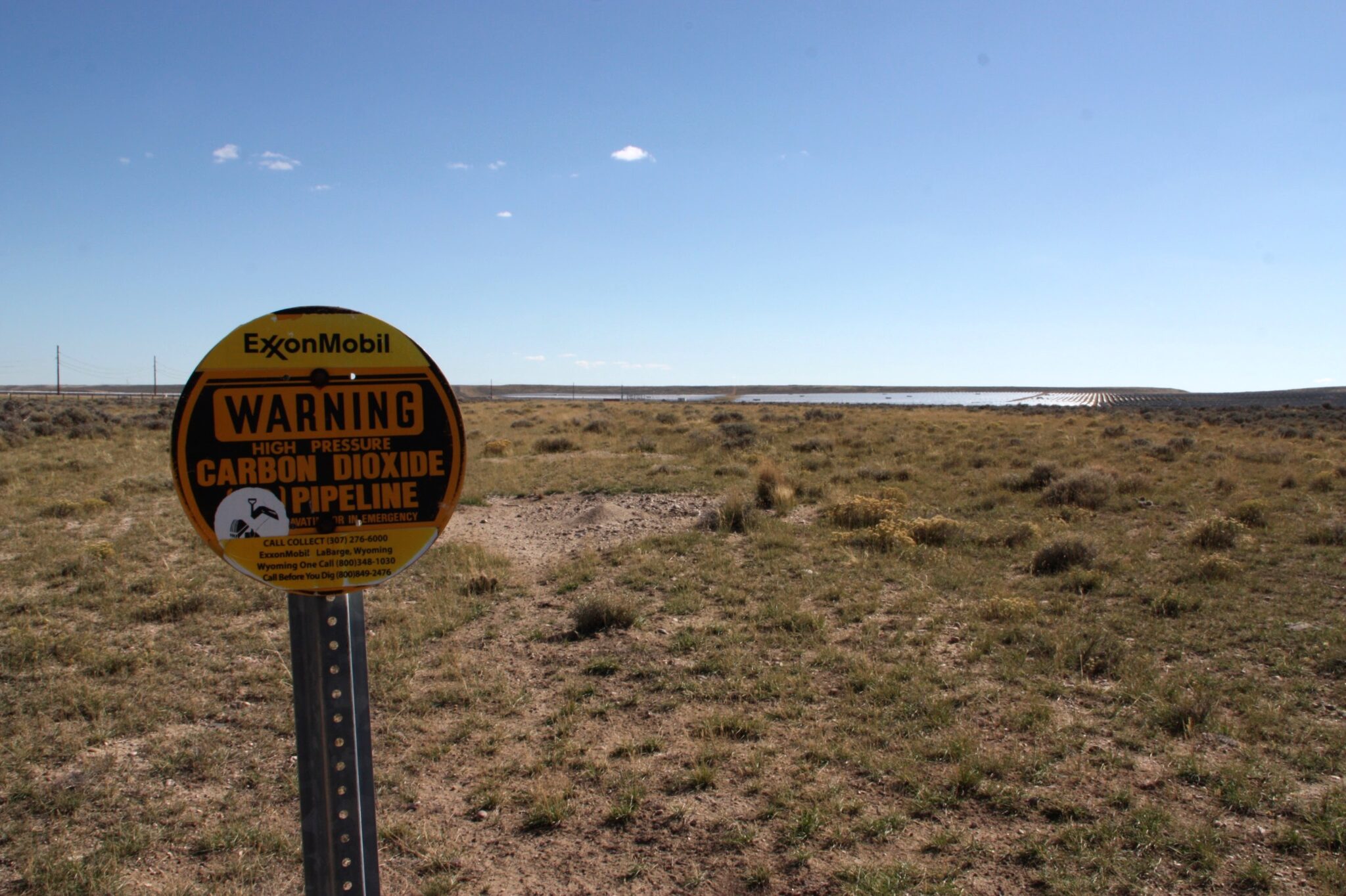
A carbon dioxide pipeline runs from an ExxonMobil gas processing plant under Wyoming’s first utility-scale solar farm. The state has tried to attract carbon capture operations to help its ailing coal industry, as well as renewable energy development. The solar farm upstate many locals after it displaced wildlife. Credit: Nicholas Kusnetz
CarbonCapture plans to build its new facility about 20 miles west of the solar farm, a rough and barren landscape of greasewood and sagebrush, and it could eventually need much more solar development to run its operations.
The company has said it will try to minimize the impacts, by choosing lands already disturbed by oil development, for example. But some will be unavoidable. State maps show that the sage grouse, a protected game bird, has core habitats surrounding the area where the plant would be built. Closer to the site, cattle roam on rangeland that is dotted with oil wells and a creek trickles south on its way to the Green River, a tributary of the Colorado.
CarbonCapture said it would initially use natural gas to power its operations while capturing the resulting carbon dioxide emissions, but aims to eventually rely on renewable energy. At full scale, that would require 1,000 acres to house the energy supply, and 100 acres more for the project itself.
The World Resources Institute, an environmental think tank, has estimated that if direct air capture technology reaches the scale envisioned by the Biden administration, about 500 million metric tons of carbon dioxide per year by mid-century, the industry would consume more than 4 percent of the nation’s current total energy supply. If all that energy were generated by wind and solar power, that could mean covering an area equal to a small state with turbines and panels.
The prospect alarms Pearson, who said her family has been offered money to allow solar panels on their land, but that they declined. “We would have been set for life, and we said no way. Because we knew what it would do to the wildlife, to our way of life, to Wyoming’s way of life.”
Adrian Corless, CarbonCapture’s chief executive, said that because the project will connect to the electric grid, the new renewable energy development could be located in other parts of the state, or even out of state.
“There’s a lot of opportunity to find the right situations for land use that are aligned with community expectations and needs,” Corless said.
Justin Loyka, energy program manager in the Wyoming office of the Nature Conservancy, said CarbonCapture asked his organization for help in reducing its impacts, and that there were opportunities to do so. But he added that as renewable energy development spreads, some impacts are inevitable.
“The vast majority of Wyoming is some of the most intact ecosystem in the lower 48,” Loyka said. “Wyoming has these wildlife migration corridors that are hundreds of miles long, and that really doesn’t exist in many other places.”
Part of the problem was evident at COP27, the United Nations climate conference in Egypt.
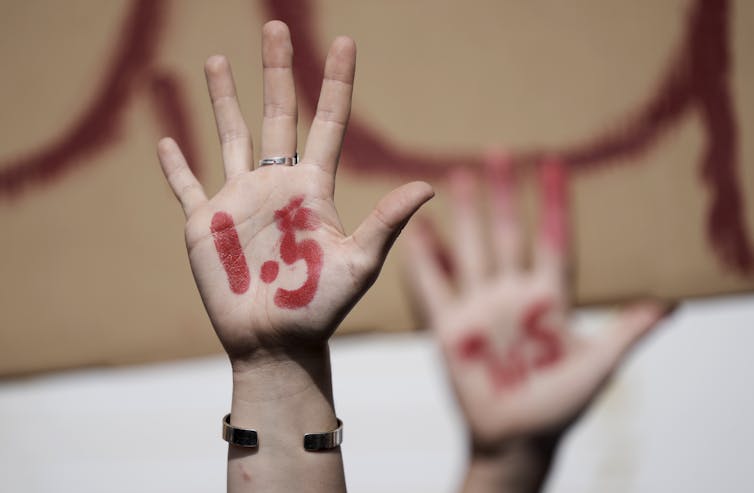
While nations’ climate negotiators were successfully fighting to “keep 1.5 alive” as the global goal in the official agreement, reached Nov. 20, 2022, some of their countries were negotiating new fossil fuel deals, driven in part by the global energy crisis. Any expansion of fossil fuels – the primary driver of climate change – makes keeping warming under 1.5 C (2.7 Fahrenheit) compared to pre-industrial times much harder.
Attempts at the climate talks to get all countries to agree to phase out coal, oil, natural gas and all fossil fuel subsidies failed. And countries have done little to strengthen their commitments to cut greenhouse gas emissions in the past year.
But all signs now point toward a scenario in which the world will overshoot the 1.5 C limit, likely by a large amount. The World Meteorological Organization estimates global temperatures have a 50-50 chance of reaching 1.5C of warming, at least temporarily, in the next five years.
We know from the reconstruction of historical climate records that, over the past 12,000 years, life was able to thrive on Earth at a global annual average temperature of around 14 C (57 F). As one would expect from the behavior of a complex system, the temperatures varied, but they never warmed by more than about 1.5 C during this relatively stable climate regime.
Today, with the world 1.2 C warmer than pre-industrial times, people are already experiencing the effects of climate change in more locations, more forms and at higher frequencies and amplitudes.
Climate model projections clearly show that warming beyond 1.5 C will dramatically increase the risk of extreme weather events, more frequent wildfires with higher intensity, sea level rise, and changes in flood and drought patterns with implications for food systems collapse, among other adverse impacts. And there can be abrupt transitions, the impacts of which will result in major challenges on local to global scales. https://www.youtube.com/embed/MR6-sgRqW0k?wmode=transparent&start=0 Tipping points: Warmer ocean water is contributing to the collapse of the Thwaites Glacier, a major contributor to sea level rise with global consequences.
Steep reductions and negative emissions
Meeting the 1.5 goal at this point will require steep reductions in carbon dioxide emissions, but that alone isn’t enough. It will also require “negative emissions” to reduce the concentration of carbon dioxide that human activities have already put into the atmosphere.
Carbon dioxide lingers in the atmosphere for decades to centuries, so just stopping emissions doesn’t stop its warming effect. Technology exists that can pull carbon dioxide out of the air and lock it away. It’s still only operating at a very small scale, but corporate agreements like Microsoft’s 10-year commitment to pay for carbon removed could help scale it up.
A report in 2018 by the Intergovernmental Panel on Climate Change determined that meeting the 1.5 C goal would require cutting carbon dioxide emissions by 50% globally by 2030 – plus significant negative emissions from both technology and natural sources by 2050 up to about half of present-day emissions.
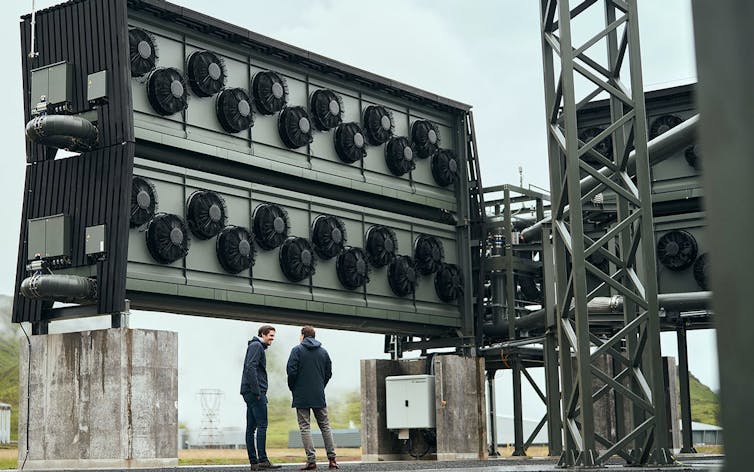
A direct air capture project in Iceland stores captured carbon dioxide underground in basalt formations, where chemical reactions mineralize it. Climeworks
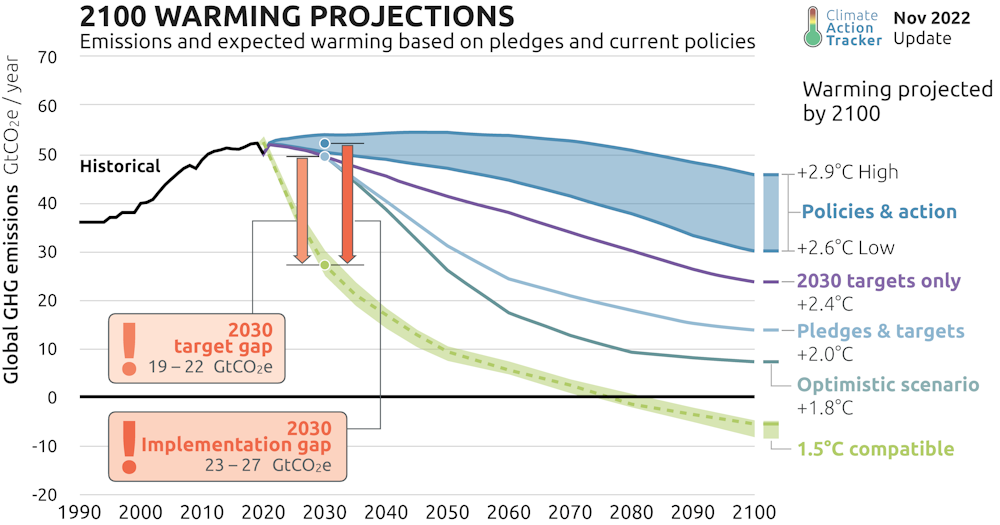
A recent report by the United Nations Environment Program highlights the shortfalls. The world is on track to produce 58 gigatons of carbon dioxide-equivalent greenhouse gas emissions in 2030 – more than twice where it should be for the path to 1.5 C. The result would be an average global temperature increase of 2.7 C (4.9 F) in this century, nearly double the 1.5 C target.
Given the gap between countries’ actual commitments and the emissions cuts required to keep temperatures to 1.5 C, it appears practically impossible to stay within the 1.5 C goal.
Global emissions aren’t close to plateauing, and with the amount of carbon dioxide already in the atmosphere, it is very likely that the world will reach the 1.5 C warming level within the next five to 10 years.
With current policies and pledges, the world will far exceed the 1.5 C goal. Climate Action Tracker
How large the overshoot will be and for how long it will exist critically hinges on accelerating emissions cuts and scaling up negative emissions solutions, including carbon capture technology.
At this point, nothing short of an extraordinary and unprecedented effort to cut emissions will save the 1.5 C goal. We know what can be done – the question is whether people are ready for a radical and immediate change of the actions that lead to climate change, primarily a transformation away from a fossil fuel-based energy system.
The Kemmerer coal mine (left) and Naughton coal-fired power plant, pictured Jan. 19, 2022. The power plant will be retired in 2028 when TerraPower commences operations for its proposed Natrium nuclear reactor power plant at the same location. (Dustin Bleizeffer/WyoFile)
Having already agreed to take on one nuclear power plant in Wyoming, western utility giant PacifiCorp will now consider adding five more to its electric generation fleet by 2035, by co-locating “small modular reactors” where it plans to retire coal-fired power plants in Wyoming and Utah.
PacifiCorp, which serves customers in six western states and operates as Rocky Mountain Power in Wyoming, will join nuclear energy developer TerraPower to study “the potential for advanced reactors to be located near current fossil-fueled generation sites, enabling the companies to repurpose existing generation and transmission assets for the benefit of [PacifiCorp’s] customers,” the companies announced in a joint statement Oct. 27.
Before choosing locations, “both companies will engage with local communities.”
“This is just a first step, as advanced nuclear power needs to be evaluated through our resource planning processes as well as receive regulatory approval,” Rocky Mountain Power President and CEO Gary Hoogeveen said in a prepared statement. “But it’s an exciting opportunity that advances us down the path to a net-zero energy future.”
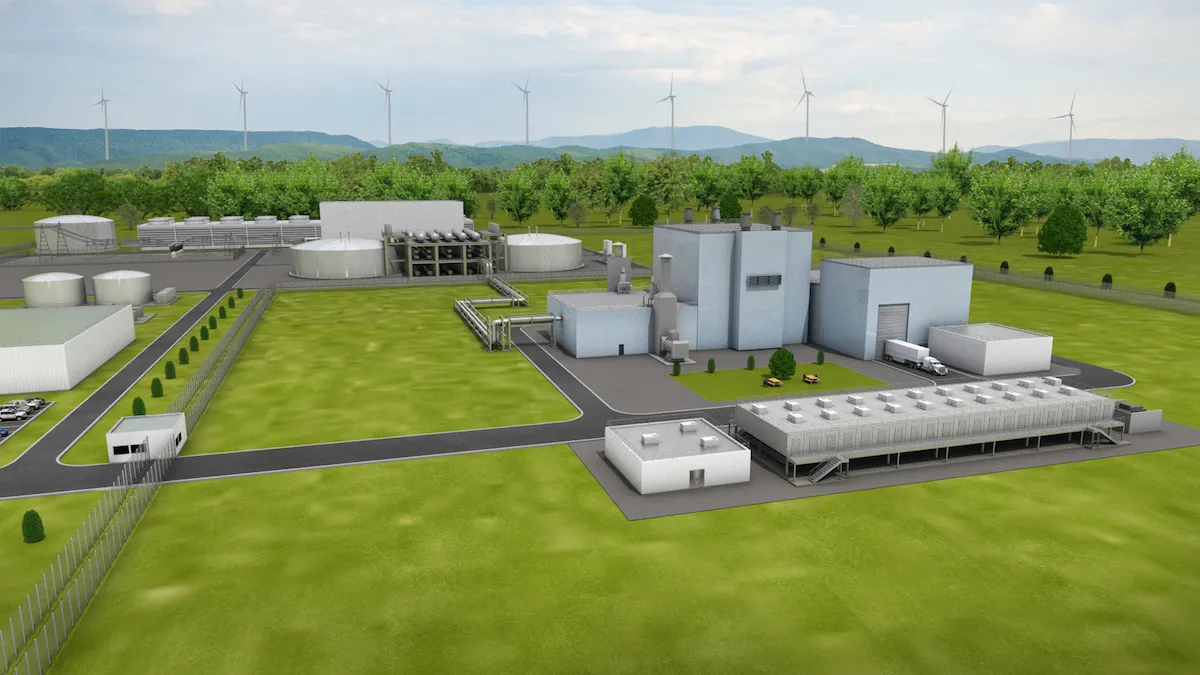
A schematic of TerraPower’s proposed Natrium nuclear power plant. Credit: TerraPower
PacifiCorp entered into a tentative agreement in 2021 to take ownership of TerraPower’s first-of-its-kind Natrium nuclear power facility slated for construction at the Naughton coal-fired plant site outside Kemmerer. The plant is scheduled to begin operations in 2028. PacifiCorp would take ownership sometime thereafter.
Coal-to-nuclear shift
Nuclear power is emerging as a potential strategy to help PacifiCorp meet low-carbon emission standards — particularly in California, Oregon and Washington — while also meeting continuous power reliability and making use of its existing coal-fired power facilities.
The utility plans to convert fuel sources or retire at least six coal-burning units in Wyoming by 2035, taking offline about 2,691 megawatts of continuous “baseload” power capacity, or more than 36% of the state’s coal-fired power generating capacity, according to PacifiCorp data and WyoFile calculations. It plans to shut down its entire coal-fired power fleet in the state by 2039, according to its 2021 Integrated Resource Plan.
A turbine whirls on a farm east of Burlington, Colo. Colorado’s eastern plains already have many wind farms—but it may look like a pin cushion during the next several years. Photo/Allen Best
Aside from potentially replacing coal plants with nuclear reactors, PacifiCorp plans to add more than 3,700 megawatts of new wind power by 2040 throughout its six-state region, including in Wyoming, while adding commercial-scale solar power and battery storage.
Wyoming lawmakers have passed a suite of bills aimed at delaying coal-plant closures in the state by forcing regulated utilities like PacifiCorp to retrofit coal units with carbon capture utilization and sequestration technologies. But so far, the cost-benefit of CCUS retrofits haven’t penciled out for PacifiCorp or Black Hills Energy, according to the companies.
Legislators and the state’s top energy officials, however, are also enthusiastic about adding nuclear to the state’s power mix. Not only would it provide replacement jobs for coal-plant workers, but some hope it would also help revive Wyoming’s languishing uranium mining sector.
“Wyoming has been working hard to develop a nuclear industry — from the supply chain via our uranium reserves all the way through the value chain to produce zero-emissions electricity that can then be used as feedstock for other net-negative emission products,” Wyoming Energy Authority Executive Director Glen Murrell wrote WyoFile. “The news that [TerraPower and PacifiCorp are] taking on an additional feasibility study to potentially deploy more reactors in the area will strengthen the industry and create jobs and growth for Wyoming’s benefit.”
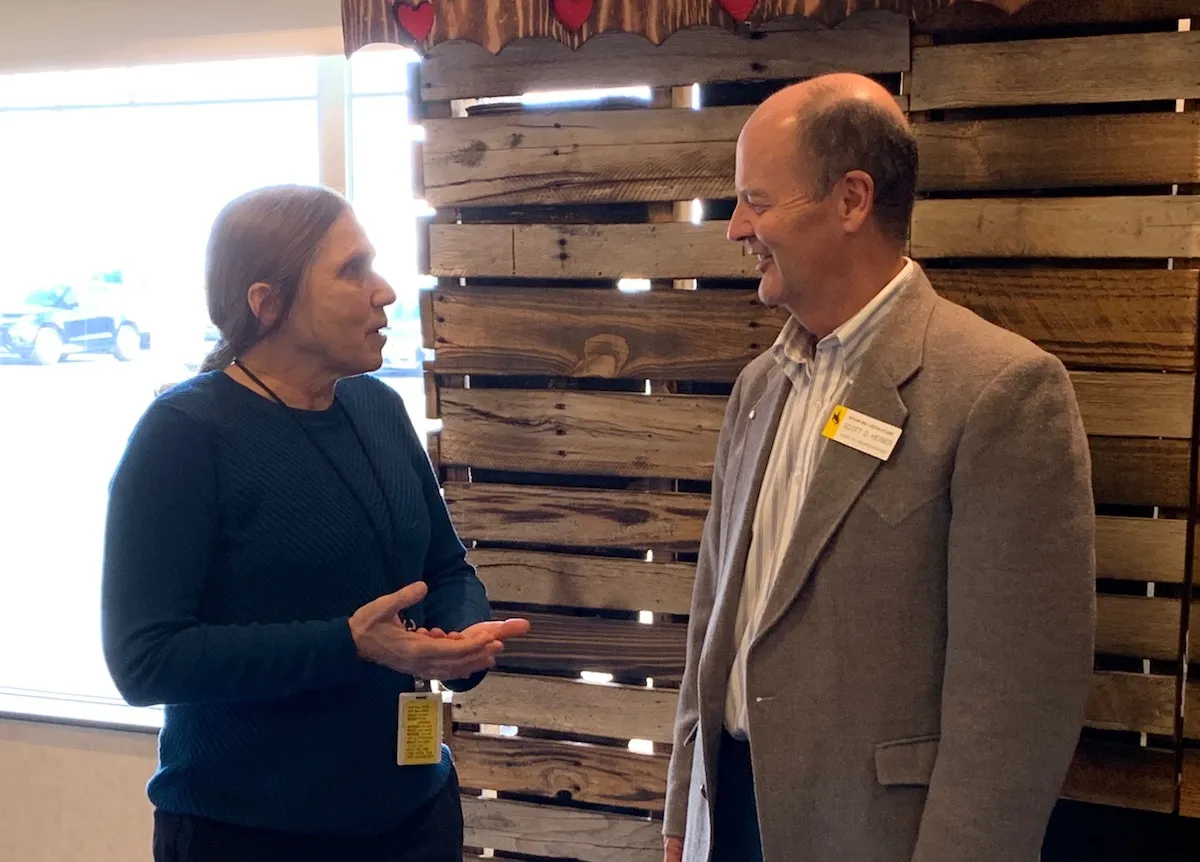
TerraPower’s Natrium Project Director Tara Neider visits with Wyoming Rep. Scott Heiner (R-Green River) during a Jan. 19, 2022 meeting with officials from TerraPower and PacifiCorp. (Dustin Bleizeffer/WyoFile)
It makes sense to begin analysis and planning for multiple nuclear power reactors now because TerraPower needs to deploy the technology “at scale” if it’s going to prove the Natrium technology commercially viable, University of Wyoming energy economist Rob Godby said.
“You have to look that far down the road when you’re talking about this sort of technological change if you’re [selling nuclear plants to a utility],” Godby said. “So it makes sense for both TerraPower and PacificCorp.”
Targeting Wyoming
TerraPower, backed by Microsoft billionaire Bill Gates, selected PacifiCorp’s Naughton power plant at Kemmerer for its demonstration Natrium nuclear power plant in November 2021. Engineering and geologic sampling work is ongoing at the Kemmerer location. Construction is slated to begin in 2024 and bring 2,000 workers to the tiny community.
The company is looking to the U.S. Department of Energy to cover about half of the estimated $4 billion cost of the Kemmerer plant, contingent on a 2028 in-service date.
That schedule, however, was thrown into question after Russia invaded Ukraine earlier this year. TerraPower cut ties with the Russian state-owned Tenex — the only facility in the world with the capacity to supply commercial volumes of high-assay, low-enriched uranium fuel. The company is working with DOE and Congress to speed up the development of a domestic HALEU supply chain, including the potential to “downblend” weapons-grade uranium to meet initial fuel needs at Kemmerer by end of 2025, according to TerraPower.
Yet some doubt the viability of adding new nuclear power to the grid under such a time constraint. The Oregon Public Utility Commission in March declined to formally acknowledge PacifiCorp’s plans for Natrium to be a part of its future electrical generation portfolio.
TerraPower is confident of a speedy federal permitting process and that a domestic HALEU supply will come into play, however, and is moving forward with the project as scheduled, a company official told WyoFile.
Kemmerer and PacifiCorp’s Naughton power plant make an ideal location for TerraPower’s demonstration Natrium plant due to “local community support, the physical characteristics of the site, the ability to obtain a license from the U.S. Nuclear Regulatory Commission for the site, access to existing infrastructure, and the needs of the grid,” the company said.
Those same factors make other locations in Wyoming a prime target for Natrium facilities, according to the company.
In its initial analysis to choose a location for its demonstration plant now slated for Kemmerer, TerraPower had also considered the Jim Bridger plant near Rock Springs, the Dave Johnston plant in Glenrock and the Wyodak plant near Gillette — all owned by PacifiCorp.
“We have been impressed and humbled by our work with the Kemmerer community and PacifiCorp,” TerraPower President and CEO Chris Levesque said in a prepared statement. “We look forward to evaluating new potential sites for Natrium plants that have the same energy expertise and capabilities as our demonstration site.”
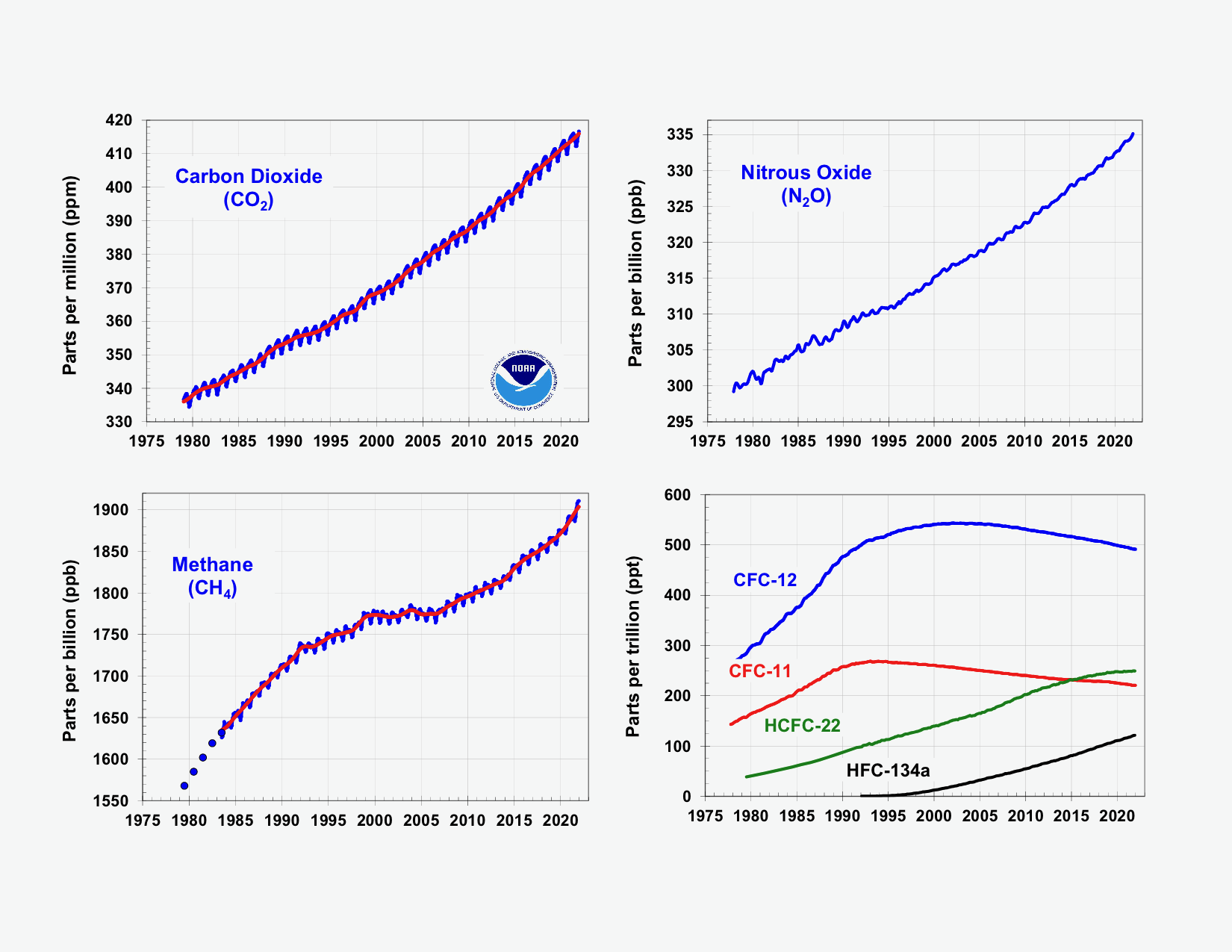
In yet another ominous climate change warning, atmospheric levels of the three main greenhouse gases – carbon dioxide, methane and nitrous oxide all reached new record highs in 2021, according to a new report from the World Meteorological Organization (WMO).
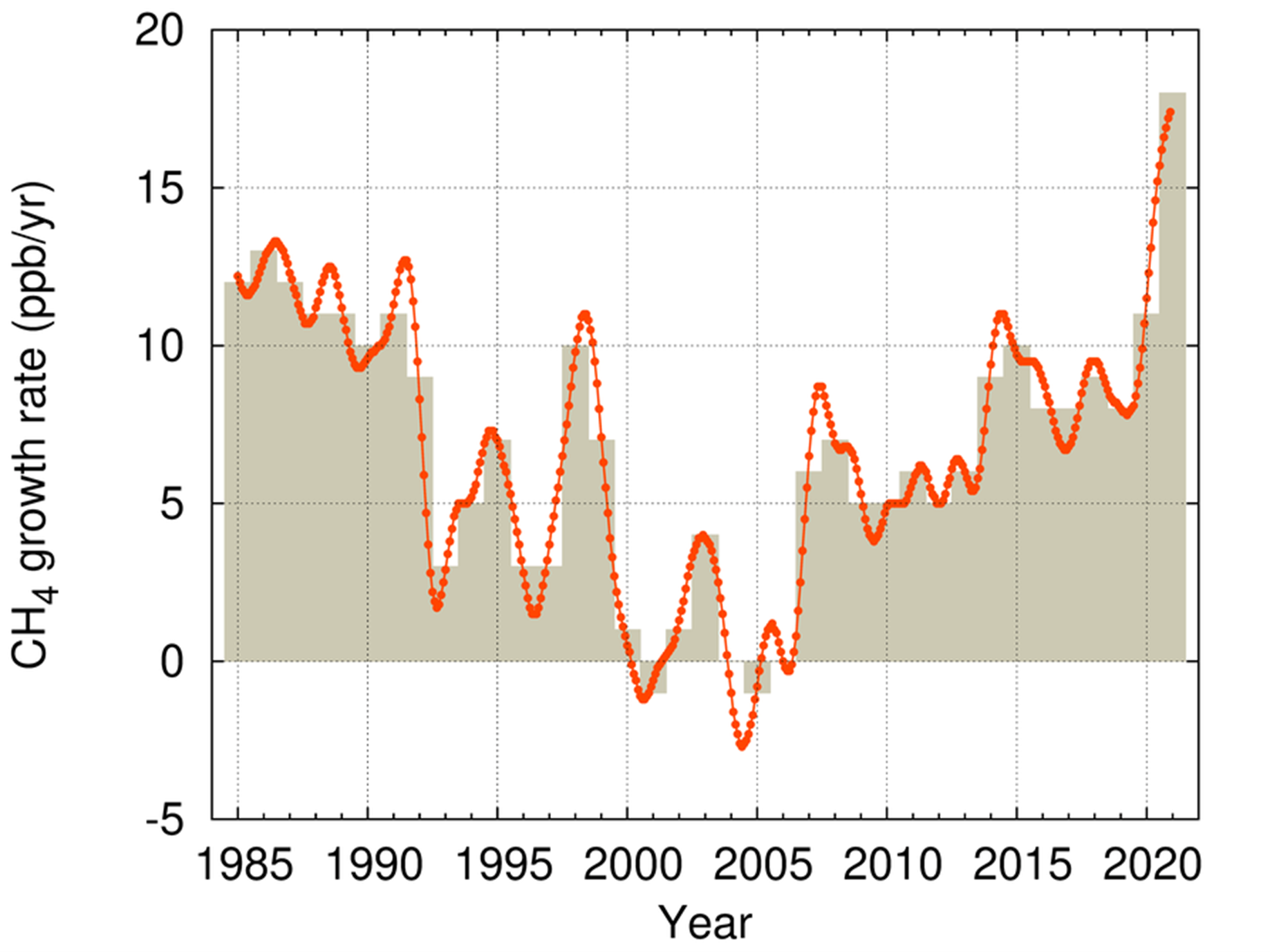
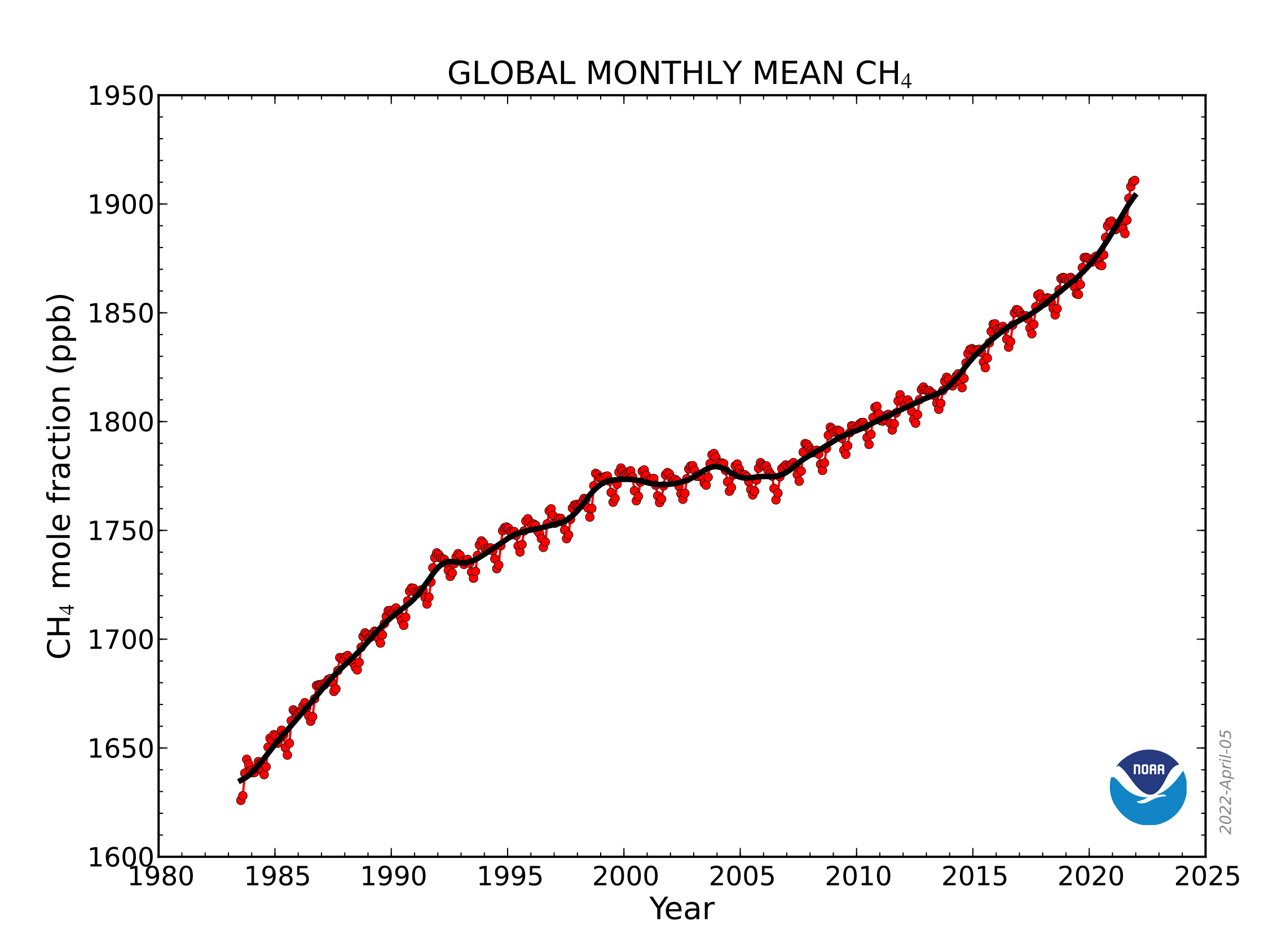
WMO’s Greenhouse Gas Bulletin reported the biggest year-on-year jump in methane concentrations in 2021 since systematic measurements began nearly 40 years ago. The reason for this exceptional increase is not clear, but seems to be a result of both biological and human-induced processes.
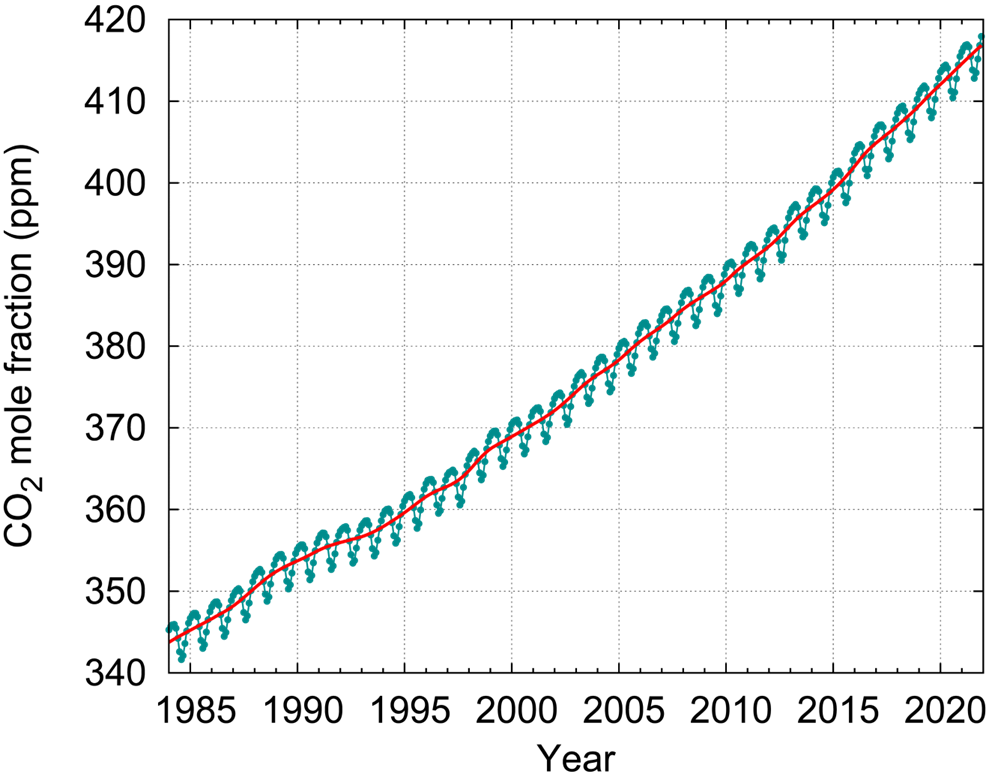
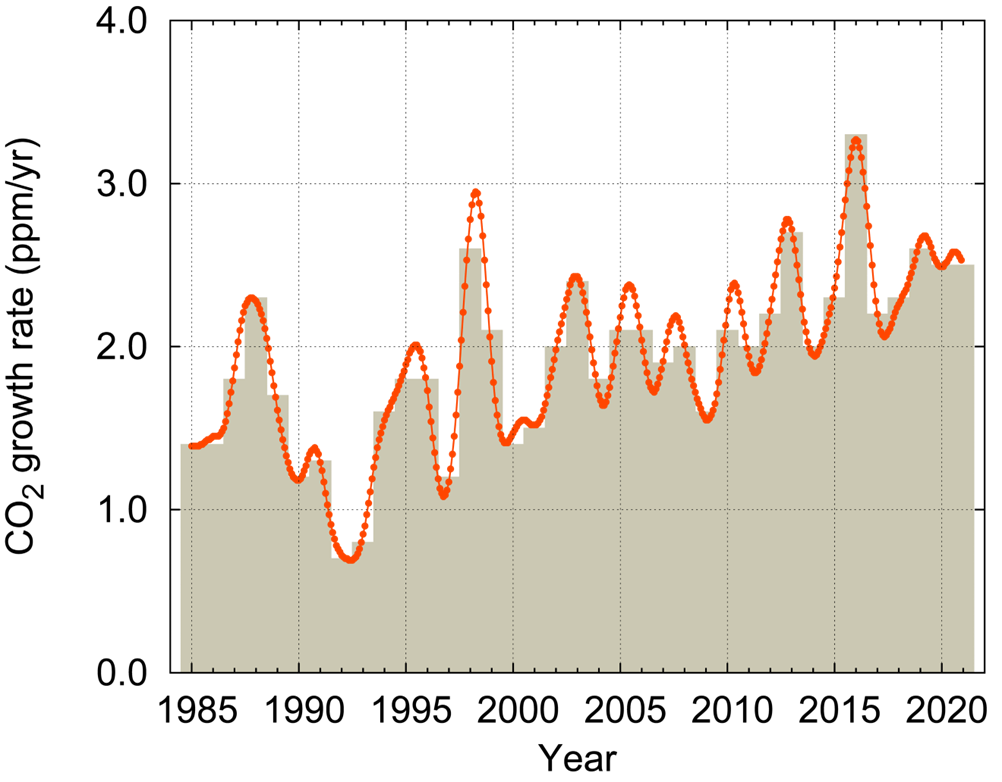
The increase in carbon dioxide levels from 2020 to 2021 was larger than the average annual growth rate over the last decade. Measurements from WMO’s Global Atmosphere Watch network stations show that these levels continues to rise in 2022 over the whole globe.
Between 1990 and 2021, the warming effect on our climate (known as radiative forcing) by long-lived greenhouse gases rose by nearly 50%, with carbon dioxide accounting for about 80% of this increase.
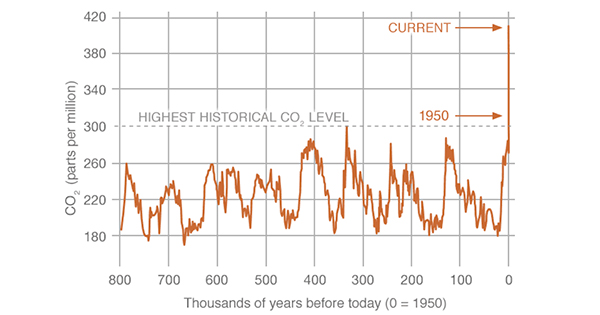
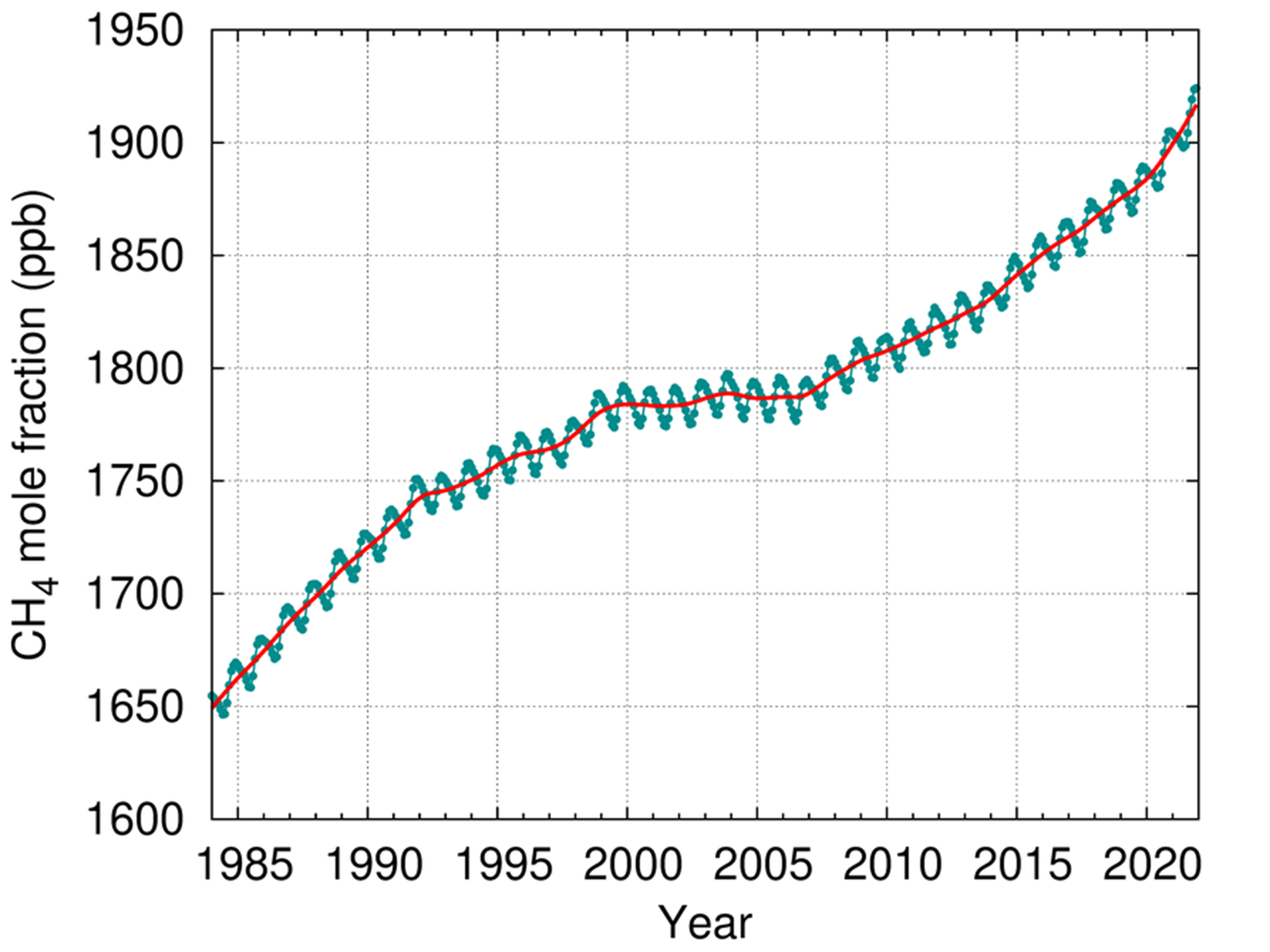
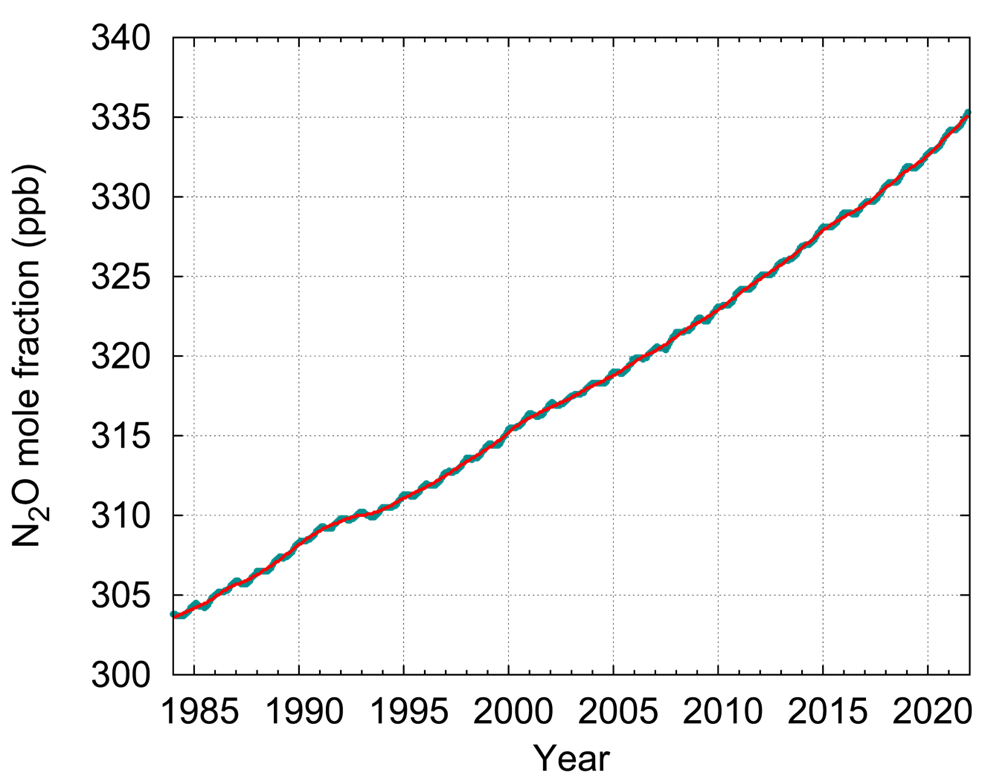
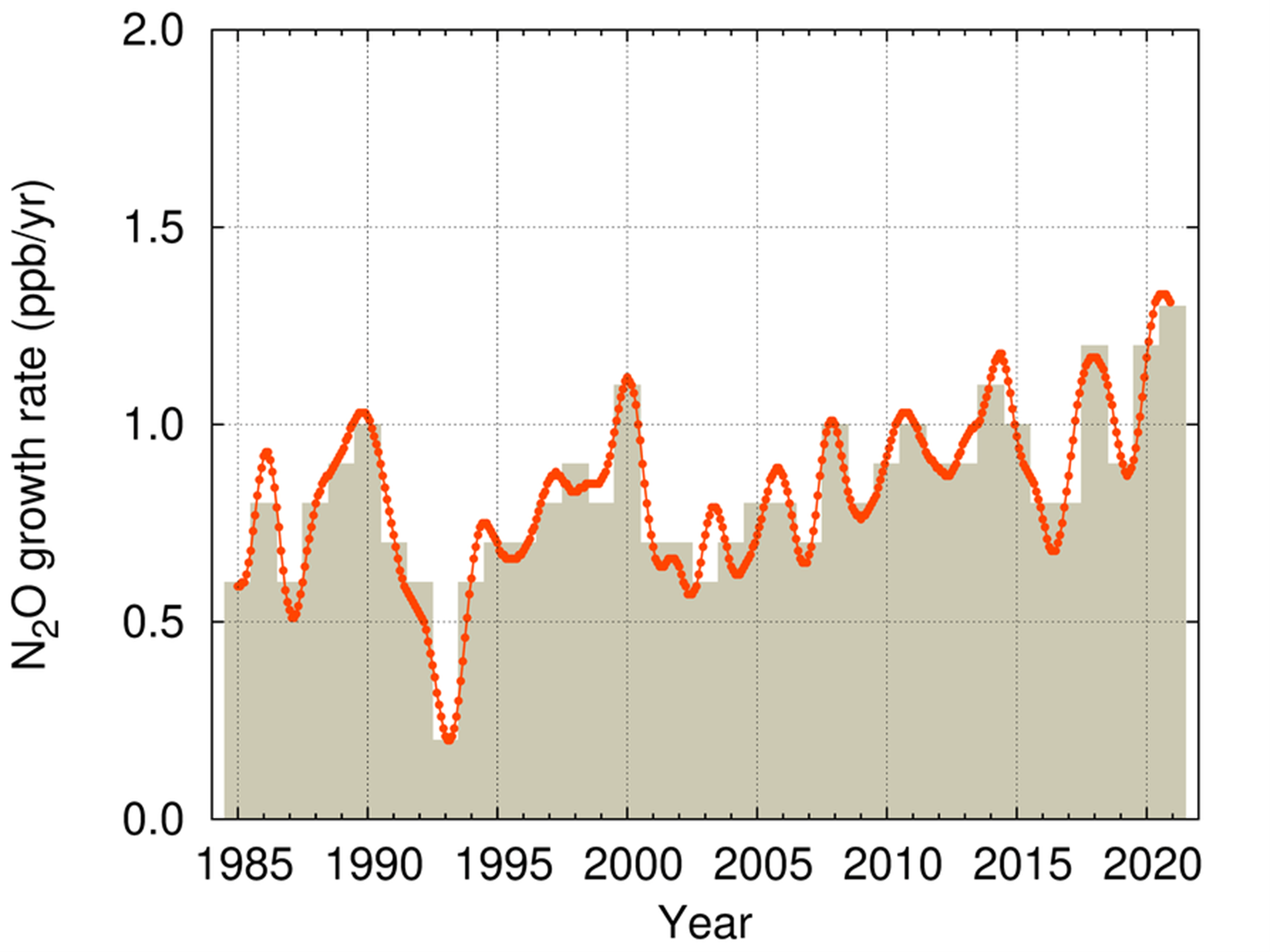
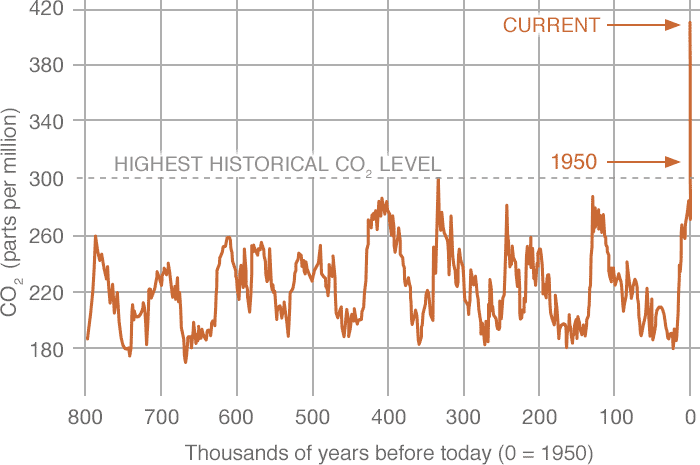
Carbon dioxide concentrations in 2021 were 415.7 parts per million (ppm), methane at 1908 parts per billion (ppb) and nitrous oxide at 334.5 ppb. These values constitute, respectively, 149%, 262% and 124% of pre-industrial levels before human activities started disrupting natural equilibrium of these gases in the atmosphere.
“WMO’s Greenhouse Gas Bulletin has underlined, once again, the enormous challenge – and the vital necessity – of urgent action to cut greenhouse gas emissions and prevent global temperatures rising even further in the future,” said WMO Secretary-General Prof. Petteri Taalas.
Credit: World Meteorological Organization
“The continuing rise in concentrations of the main heat-trapping gases, including the record acceleration in methane levels, shows that we are heading in the wrong direction,” he said.
“There are cost-effective strategies available to tackle methane emissions, especially from the fossil fuel sector, and we should implement these without delay. However, methane has a relatively short lifetime of less than 10 years and so its impact on climate is reversible. As the top and most urgent priority, we have to slash carbon dioxide emissions which are the main driver of climate change and associated extreme weather, and which will affect climate for thousands of years through polar ice loss, ocean warming and sea level rise,” said Prof. Taalas.
“We need to transform our industrial, energy and transport systems and whole way of life. The needed changes are economically affordable and technically possible. Time is running out,” said Prof. Taalas.
Given the need to strengthen the greenhouse gas information basis for decisions on climate mitigation efforts, WMO is working with the broader greenhouse gas community to develop a framework for sustained, internationally coordinated global greenhouse gas monitoring, including observing network design and international exchange and use of the resulting observations. It will engage with the broader scientific and international community, in particular regarding land surface and ocean observation and modelling.
WMO measures atmospheric concentrations of greenhouse gases – what remains in the atmosphere after gases are absorbed by sinks like the ocean and biosphere. This is not the same as emissions.
A separate and complementary Emissions Gap Report by UN Environment will be released on 27 October. The Emissions Gap report assesses the latest scientific studies on current and estimated future greenhouse gas emissions. This difference between “where we are likely to be and where we need to be” is known as the emissions gap.
As long as emissions continue, global temperature will continue to rise. Given the long life of CO2, the temperature level already observed will persist for decades even if emissions are rapidly reduced to net zero.
Highlights of the Bulletin
Carbon dioxide (CO2)
Atmospheric carbon dioxide reached 149% of the pre-industrial level in 2021, primarily because of emissions from the combustion of fossil fuels and cement production. Global emissions have rebounded since the COVID-related lockdowns in 2020. Of the total emissions from human activities during the 2011–2020 period, about 48% accumulated in the atmosphere, 26% in the ocean and 29% on land.
There is concern that the ability of land ecosystems and oceans to act as “sinks” may become less effective in future, thus reducing their ability to absorb carbon dioxide and act as a buffer against larger temperature increase. In some parts of the world the transition of the land sink into CO2 source is already happening.
Credit: WMO
Credit: WMO
Methane (CH4)
Atmospheric methane is the second largest contributor to climate change and consists of a diverse mix of overlapping sources and sinks, so it is difficult to quantify emissions by source type.
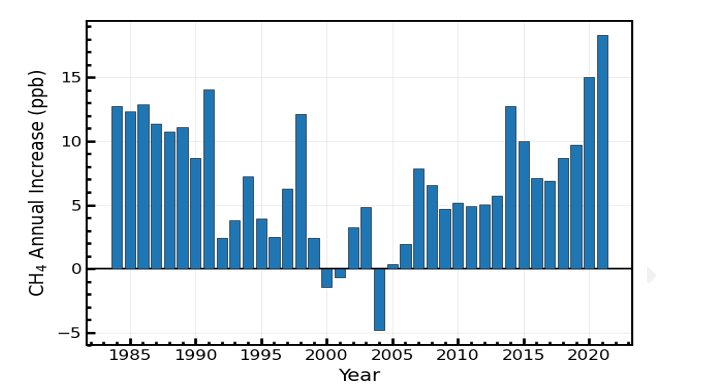
Since 2007, globally-averaged atmospheric methane concentration has been increasing at an accelerating rate. The annual increases in 2020 and 2021 (15 and 18 ppb respectively) are the largest since systematic record began in 1983.
Causes are still being investigated by the global greenhouse gas science community. Analysis indicates that the largest contribution to the renewed increase in methane since 2007 comes from biogenic sources, such as wetlands or rice paddies. It is not yet possible to say if the extreme increases in 2020 an 2021 represent a climate feedback – if it gets warmer, the organic material decomposes faster. If it decomposes in the water (without oxygen) this leads to methane emissions. Thus, if tropical wetlands become wetter and warmer, more emissions are possible.
The dramatic increase might also be because of natural interannual variability. The years 2020 and 2021 saw La Niña events which are associated with increased precipitation in tropics.
Credit: WMO
Credit: WMO
Nitrous oxide (N2O)
Nitrous oxide is the third most important greenhouse gas. It is emitted into the atmosphere from both natural sources (approximately 57%) and anthropogenic sources (approximately 43%), including oceans, soils, biomass burning, fertilizer use, and various industrial processes. The increase from 2020 to 2021 was slightly higher than that observed from 2019 to 2020 and higher than the average annual growth rate over the past 10 years.
Click the link to read the guest column on The Guardian website (Greta Thunberg). Here’s an excerpt:
Governments may say they’re doing all they can to halt the climate crisis. Don’t fall for it – then we might still have time to turn things around
Maybe it is the name that is the problem. Climate change. It doesn’t sound that bad. The word “change” resonates quite pleasantly in our restless world. No matter how fortunate we are, there is always room for the appealing possibility of improvement. Then there is the “climate” part. Again, it does not sound so bad. If you live in many of the high-emitting nations of the global north, the idea of a “changing climate” could well be interpreted as the very opposite of scary and dangerous. A changing world. A warming planet. What’s not to like?
Perhaps that is partly why so many people still think of climate change as a slow, linear and even rather harmless process. But the climate is not just changing. It is destabilising. It is breaking down. The delicately balanced natural patterns and cycles that are a vital part of the systems that sustain life on Earth are being disrupted, and the consequences could be catastrophic. Because there are negative tipping points, points of no return. And we do not know exactly when we might cross them. What we do know, however, is that they are getting awfully close, even the really big ones. Transformation often starts slowly, but then it begins to accelerate.
The German oceanographer and climatologist Stefan Rahmstorf writes: “We have enough ice on Earth to raise sea levels by 65 metres – about the height of a 20-storey building – and, at the end of the last ice age, sea levels rose by 120 metres as a result of about 5C of warming.” Taken together, these figures give us a perspective on the powers we are dealing with. Sea-level rise will not remain a question of centimetres for very long.
The Greenland ice sheet is melting, as are the “doomsday glaciers” of west Antarctica. Recent reports have stated that the tipping points for these two events have already been passed. Other reports say they are imminent. That means we might already have inflicted so much built-in warming that the melting process can no longer be stopped, or that we are very close to that point. Either way, we must do everything in our power to stop the process because, once that invisible line has been crossed, there might be no going back. We can slow it down, but once the snowball has been set in motion it will just keep going…
“This is the new normal” is a phrase we often hear when the rapid changes in our daily weather patterns – wildfires, hurricanes, heatwaves, floods, storms, droughts and so on – are being discussed. These weather events aren’t just increasing in frequency, they are becoming more and more extreme. The weather seems to be on steroids, and natural disasters increasingly appear less and less natural. But this is not the “new normal”. What we are seeing now is only the very beginning of a changing climate, caused by human emissions of greenhouse gases. Until now, Earth’s natural systems have been acting as a shock absorber, smoothing out the dramatic transformations that are taking place. But the planetary resilience that has been so vital to us will not last for ever, and the evidence seems to suggest more and more clearly that we are entering a new era of more dramatic change.
Climate change has become a crisis sooner than expected. So many of the researchers I’ve spoken to have said that they were shocked to witness how quickly it is escalating.
In 2017, majority owner and operator Public Service Company of New Mexico (PNM) announced that the coal-fired San Juan Generating Station was too expensive to operate and that the last two of the plant’s four units would be retired in 2022, rather than operating until 2053. On-the-ground communities and advocates had long since called attention to the plant’s expense as well as its damage to health, air and our climate.
In 2019, New Mexico passed the Energy Transition Act (ETA) to build on PNM and Tucson Electric’s closure decisions by enabling use of low-interest bonds to save customers money and provide economic transition benefits to plant and mine workers and the community. About $40 million in funding through the Energy Transition Act has been or will be disbursed to plant and mine workers and the impacted community. Four Corners residents encouraged state agencies to act urgently to use the $20 million earmarked for community funding to invest in local, sustainable projects that move the region forward.
As PNM and the other owners retire the plant (which was shuttered sometime early this morning, when the coal stockpile ran out), community organizations issued the following statements:
“The plant closure has significant positive and negative implications. One positive impact is the anticipated release of ETA funds to help secure the self-sustenance of communities that were impacted by the plant,” said Duane “Chili” Yazzie of ToohBAA, a Shiprock Farmers Cooperative. “Our farmers group in Shiprock applied for the funds in the hope that it will help address one of the great needs that our farmers have, with the provision of skilled labor. With the funds, we expect to acquire equipment operators, diesel mechanics, planners and administrators who will help organize our farming activity to optimize our agricultural potential. We look forward to an expedited release of those funds.”
Community organizations also focused on the need to properly reclaim, decommission and clean up the plant, rather than allowing it to continue to pollute under Enchant, which has failed to obtain the permits, buyers or funding to operate with carbon capture, a technology that has failed in every commercial coal plant where it has been tried. At its peak, San Juan Generating Station used more water than the entire city of Santa Fe. Some of the water rights from the plant have now been allocated to run in the San Juan River.
“We now have an opportunity to protect and manage water sources in the Four Corners region,” said Jessica Keetso of Tó Nizhóni Aní, Navajo Nation. “A transition to solar, wind, renewable, clean-energy investments helps eliminate the waste and misuse of water. Precious water sources have been used to feed giant power plants all over the Four Corners region for over half a century. These water sources are limited and have been compromised in many regions. It’s time to make sure that transition and cleanup happen in an organized and speedy manner, and that ETA investments bring an opportunity for coal-impacted communities to drive economic diversification.”
“As Four Corners residents, we want to see the negotiated replacement power, solar and energy storage, and we want the ETA implementation money to go to the impacted coal workers and communities,” said Mike Eisenfeld of San Juan Citizens Alliance. “Enchant Energy has been disingenuous and unaccountable on the progress of their project, which joins a long list of failed carbon-capture and sequestration projects funded through the Department of Energy. City of Farmington has expended nearly $2 million in legal fees supporting Enchant’s failed project with timelines now extending to 2027. We’re looking at the immediate need for past and current owners to carry out their decommissioning and reclamation responsibilities within 90 days of SJGS and San Juan Mine closure.”
“Today marks a pivotal moment in our Four Corners region with the decline of fossil-fuel production. We regard this moment as a transformation for the environment in less CO2, methane, NOx, VOCs, coal ash, and other toxic pollutants. We welcome a return of cleaner air and water for the health of tribal communities and climate,” said Ahtza Chavez, Executive Director of Naeva.
“Abandonment and remediation will be difficult. Over 50 years of damage was done to the environment,” said Norman Norvelle, former San Juan Generating Station plant chemist and Farmington resident. “From releasing plant wastewater effluent into the Shumway arroyo, to air pollutants and mercury into the San Juan River watershed and the fish of quality waters. Also, plant solid and liquid waste disposal into unlined surface mine pits. Even after the plant is shut down there will be need for extensive cleanup and monitoring to verify cleanup of the contaminants. Sampling and monitoring should be done by 3 or 4 different organizations to assure completeness and honesty.”
“If not done adequately, the San Juan Generating Station chemical contaminants will go into the San Juan River near the Hogback. All of the contaminants from the plant plus the biological contaminants from San Juan County, such as fecal bacteria, will flow into the San Juan River Basin onto the Navajo Reservation to Lake Powell,” Norvelle said.
“The San Juan Generating Station has been a source of jobs and revenues in Four Corners for more than half a century, but it can no longer be operated in a manner that is fiscally and environmentally responsible,” said Cydney Beadles, Managing Senior Staff Attorney of Western Resource Advocates’ Clean Energy Program. “The Energy Transition Act helps mitigate the impacts on local workers and communities and ensures that ratepayers get the cost savings that come from shutting down an inefficient coal plant, and the Public Regulation Commission issued an order requiring bill credits upon abandonment. Unfortunately, those credits have been temporarily suspended by the state Supreme Court at PNM’s request, but we remain hopeful that the court will soon lift that stay.”
“The solar and storage replacement power approved in 2020 will provide $1 billion in investment in the communities most impacted by San Juan,” added Camilla Feibelman, Sierra Club Rio Grande Chapter Director. “With pandemic supply-chain and other delays, it is incumbent upon PNM to work with developers of the solar and storage replacement power to overcome these obstacles and get those projects online as soon as possible. Analyses showed that the San Juan Solar project, to be sited in the same school district, will replace 100% of the property-tax base of San Juan.”
A new progress report on Colorado’s greenhouse gas emission reductions shows the state is not on track to meet key goals. And anyone could have seen it coming.
The goals are set by statute, yet state officials haven’t taken climate action with sufficient seriousness to do right by the law, let alone public health and the planet. One hopes the new report inspires urgent action, though state officials have approached the climate emergency with a maddening combination of strong rhetoric and weak action for years.
Colorado residents will pay the price.
State lawmakers three years ago enacted House Bill 19-1261, a landmark achievement that requires the state to reduce greenhouse gas pollution compared to 2005 levels by goals of 26% by 2025, 50% by 2030 and 90% by 2050. As part of the effort to meet those targets, the Colorado Air Quality Control Commission in 2020 established a regime to track and ensure progress on emission reductions. It set targets for a handful of sectors that are to blame for the most emissions, including electricity generation, oil and gas production, transportation, and residential and commercial building energy use.
The state has since made some notable strides toward hitting the targets. State law now requires electric utilities to file clean energy plans and work to reduce emissions. While renewable energy is becoming much cheaper to produce, and market forces rather than state action has much to do with the green transition, Colorado’s last coal plant is expected to close by the beginning of 2031, and utilities in the state are expected to see a roughly 80% reduction in emissions by 2030.
In 2019, the state adopted a zero-emission vehicle standard that requires an increased percentage of cars available for sale in Colorado to be electric-powered. The modest measure, which does not require drivers to actually buy electric cars, is expected to boost from 2.6% three years ago to 6.2% in 2030 the proportion of zero-emission vehicles sold in Colorado.
Officials recently enacted standards that require state and local transportation planners to meet a series of greenhouse gas reduction targets. And during the most recent legislative session, the General Assembly enacted a package of climate-friendly measures, the largest climate investment being a $65 million grant program to help school districts buy electric buses.
But for every climate advance in Colorado there’s often a planet-threatening failure.
As Newsline’s Chase Woodruff reported last year, the administration of Gov. Jared Polis abandoned one of its own top climate-action priorities, an initiative called the Employee Traffic Reduction Program, which would have required big Denver-area businesses to reduce the number of their employees commuting in single-occupant vehicles. The initiative was dropped following “intense opposition from business groups and conservatives, many of whom spread misinformation and conspiracy theories,” Woodruff reported.
Earlier this year the administration frustrated environmentalists again when it delayed adoption of an Advanced Clean Trucks rule, which would impose emissions standards on medium- and heavy-duty vehicles.
This is all aligns with the governor’s insistence on a “market-driven transition” to renewable energy and a preference for voluntary industry action.
Is it any surprise then that the transportation sector accounts for Colorado’s most grievous instance of greenhouse gas negligence? What makes this especially troubling is that, with all those internal combustion engines buzzing around Colorado roads, transportation is the state’s single largest source of greenhouse gas emissions.
“Additional strategies for reducing emissions from the transportation sector will be needed” to meet state targets, the recent progress report concludes.
Emissions from transportation in Colorado have in fact grown in recent years, contributing greatly to the state’s overall off-track status.
The average temperature in Colorado keeps trending up. Denver this year experienced its third-hottest summer on record. The city’s four hottest summers have occurred in the last 10 years, and 3 of 4 of its hottest summers have occurred in the last three years.
Climate change is contributing to the aridification of the Southwest, it’s depleting water resources and it’s fueling more frequent and ferocious wildfires. It’s killing people, and it’s getting worse.
Polis, a Democrat, sits in the governor’s chair, so he shoulders the most responsibility, but Republicans would no doubt exacerbate the crisis were they in his position. Heidi Ganahl, the Republican nominee for Colorado governor, recently released her proposed transportation policy, which is almost entirely about investing in highways and almost exhaustively dismissive of climate change.
State officials, to safeguard the wellbeing of present and future generations of Coloradans, must take urgent steps to meet the 2025 emissions reduction targets. The progress report shows they’re failing to do so.
Click the link to read the release on the Wild Earth Guardians website (Jeremy Nichols):
Affected areas in Colorado, Connecticut, Texas, New Jersey, and New York are home to nearly 40 million people
As a result of a lawsuit brought by a coalition of environmental groups, today the U.S. Environmental Protection Agency downgraded four areas across the country from a “serious” to a “severe” rating for their smog pollution. This downgrade in the ratings triggers more protective measures to reduce smog pollution.
The four areas, including the Denver Metro area, have some of the nation’s worst air quality. EPA downgraded the areas because their ground-level ozone pollution—commonly called smog—continues to exceed the levels that are safe for human health, wildlife, and plants.
“Recognizing that these areas have a severe smog problem marks an important step forward in reducing this pollution,” said Ryan Maher, an environmental health attorney at the Center for Biological Diversity. “Now it’s time for concrete plans to fix it.”
Smog pollution is linked to human health problems like asthma attacks, cardiovascular problems, and even premature death. Those most at risk include older adults, children and people who work outdoors. The harm smog does to plants can damage entire ecosystems and reduce biodiversity.
“For the more than 3.5 million people living in the Denver Metro and North Front Range region of Colorado, today’s finding gives new hope for clean air,” said Jeremy Nichols, climate and energy program director for WildEarth Guardians. “Now it’s up to Governor Polis and his administration to do the right thing and finally clean up this smoggy mess and restore healthy skies along Colorado’s Front Range.”
The four environmental groups sued the EPA in March 2022 after the agency missed its deadline to reclassify these areas from a serious to a severe rating for smog. The agreement resulting from this lawsuit required EPA to finalize the ratings for these four areas by today: the Dallas-Fort Worth and Houston-Galveston-Brazoria areas in Texas; the New York City metro areas of Connecticut, New York, and New Jersey; and the Denver-Boulder-Greeley-Fort Collins-Loveland area in Colorado.
“The 37 million people who live in these areas with unsafe levels of toxic pollution deserve clean air and immediate federal action,” said Kaya Allan Sugerman, director of the Center for Environmental Health’s illegal toxic threats program. “Today’s victory will help protect these communities from the dangers of this pollution.”
Under this agreement, EPA must also determine whether the smog ratings for Ventura County and western Nevada County in California need to be downgraded by December 16, 2022.
The downgraded ratings finalized today are part of the environmental groups’ ongoing effort to compel the EPA to protect human health and the environment from smog pollution in accordance with the requirements of the Clean Air Act.
The 1960s and 1970s were a golden age of infrastructure development in the U.S., with the expansion of the interstate system and widespread construction of new water treatment, wastewater and flood control systems reflecting national priorities in public health and national defense. But infrastructure requires maintenance, and, eventually, it has to be replaced.
That hasn’t been happening in many parts of the country. Increasingly, extreme heat and storms are putting roads, bridges, water systems and other infrastructure under stress.
Two recent examples – an intense heat wave that pushed California’s power grid to its limits in September 2022, and the failure of the water system in Jackson, Mississippi, amid flooding in August – show how a growing maintenance backlog and increasing climate change are turning the 2020s and 2030s into a golden age of infrastructure failure.
I am a civil engineer whose work focuses on the impacts of climate change on infrastructure. Often, low-income communities and communities of color like Jackson see the least investment in infrastructure replacements and repairs.
Crumbling bridge and water systems
The United States is consistently falling short on funding infrastructure maintenance. A report by former Federal Reserve Board Chairman Paul Volcker’s Volcker Alliance in 2019 estimated the U.S. has a US$1 trillion backlog of needed repairs.
A water main break now occurs somewhere in the U.S. every two minutes, and an estimated 6 million gallons of treated water are lost each day. This is happening at the same time the western United States is implementing water restrictions amid the driest 20-year span in 1,200 years. Similarly, drinking water distribution in the United States relies on over 2 million miles of pipes that have limited life spans.
The underlying issue for infrastructure failure is age, resulting in the failure of critical parts such as pumps and motors.
Aging systems have been blamed for failures of the water system in Jackson, wastewater treatment plants in Baltimore that leaked dangerous amounts of sewage into the Chesapeake Bay and dam failures in Michigan that have resulted in widespread damage and evacuations.
Inequality in investment
Compounding the problem of age is the lack of funds to modernize critical systems and perform essential maintenance. Fixing that will require systemic change.
Infrastructure is primarily a city and county responsibility financed through local taxes. However, these entities are also dependent on state and federal funds. As populations increase and development expands, local governments have cumulatively had to double their infrastructure spending since the 1950s, while federal sources remained mostly flat.
Inequity often underlies the growing need for investment in low-income U.S. communities.
Over 2 million people in the United States lack access to safe drinking water and basic sanitation. The greatest predictor of those who lack this access is race: 5.8% of Native American households lack access, while only 0.3% of white households lack access. In terms of sanitation, studies in predominantly African American counties have found disproportionate impacts from nonworking sewage systems.
Jackson, a majority-Black state capital, has dealt with water system breakdowns for years and has repeatedly requested infrastructure funding from the state to upgrade its struggling water treatment plants.
Climate change exacerbates the risk
The consequences of inadequate maintenance are compounded by climate change, which is accelerating infrastructure failure with increased flooding, extreme heat and growing storm intensity.
Much of the world’s infrastructure was designed for an environment that no longer exists. The historic precipitation levels, temperature profiles, extreme weather events and storm surge levels those systems were designed and built to handle are now exceeded on a regular basis.
Unprecedented rainfall in the California desert in 2015 tore apart a bridge over Interstate 10, one of the state’s most important east-west routes. Temperatures near 120 degrees Fahrenheit (49 C) forced the Phoenix airport to cancel flights in 2017 out of concern the planes might not be able to safely take off.
A heat wave in the Pacific Northwest in 2020 buckled roads and melted streetcar cables in Portland. Amtrak slowed its train speeds in the Northeast in July 2022 out of concern that a heat wave would cause the overhead wires to expand and sag and rails to potentially buckle.
Power outages during California’s September 2022 heat wave are another potentially life-threatening infrastructure problem.
The rising costs of delayed repairs
My research with colleagues shows that the vulnerability of the national transportation system, energy distribution system, water treatment facilities and coastal infrastructure will significantly increase over the next decade due to climate change.
We estimate that rail infrastructure faces additional repair costs of $5 billion to $10 billion annually by 2050, while road repairs due to temperature increases could reach a cumulative $200 billion to $300 billion by the end of the century. Similarly, water utilities are facing the possibility of a trillion-dollar price tag by 2050.
A city bus was caught and several people were injured when a bridge collapsed in Pittsburgh in January 2022. Jeff Swensen/Getty Images
After studying the issue of climate change impacts on infrastructure for two decades, with climate projections getting worse, not better, I believe addressing the multiple challenges to the nation’s infrastructure requires systemic change.
Two items are at the top of the list: national prioritization and funding.
Prioritizing the infrastructure challenge is essential to bring government responsibilities into the national conversation. Most local jurisdictions simply can’t afford to absorb the cost of needed infrastructure. The recent infrastructure bill and the Inflation Reduction Act are starting points, but they still fall short of fixing the long-term issue.
Without systemic change, Jackson, Mississippi, will be just the start of an escalating trend.
A federal judge in Wyoming affirmed on Friday the Biden administration’s decisions to postpone oil and gas lease sales in early 2021, holding that the federal government has broad authority to postpone sales in order to address environmental concerns.
The Wyoming court rejected across the board the arguments by industry and Wyoming, and found that the Bureau of Land Management (BLM) acted within its legal authority under the Mineral Leasing Act, National Environmental Policy Act (NEPA), and other laws when it postponed lease sales in order to ensure that it fully considered the environmental harms they could cause. The court also held that industry and Wyoming lacked standing to challenge the postponement.
“We find it reassuring that the court affirmed the Bureau of Land Management’s authority to postpone oil and gas lease sales in order to make certain they adhere to the law,” said Melissa Hornbein, senior attorney at the Western Environmental Law Center. “The judge called out as nonsensical the state and industry group’s argument that postponing a lease to ensure compliance with the National Environmental Policy Act (NEPA) requires a NEPA analysis of its own. This suggests any appeal of this decision will have an uphill battle in court.”
“We’re pleased the Judge affirmed the Department of the Interior has significant discretion to decide when to offer public oil and gas resources at lease sales. The law requires Interior to serve the public interest by analyzing and considering the environmental and social costs of leasing before holding lease sales, and that’s what they did,” said Bob LeResche, Powder River Basin Resource Council Board member from Clearmont, Wyoming. “Last year BLM initiated a comprehensive review of the federal oil and gas program, and this is the perfect time for the Department to complete their review and fully reform the federal oil and gas program to better protect taxpayers, communities, and the environment. We call on them to do so.”
In early 2021, the Biden administration issued an executive order aimed at tackling the climate crisis, which directed the Department of the Interior to temporarily pause new oil and gas leasing on federal lands and offshore waters. The pause was meant to provide the federal government an opportunity to undertake a systematic review of its oil and gas program and consider how to address its climate impacts. Before Interior could decide how to implement the executive order, it was targeted in five lawsuits filed by industry trade associations and Republican-led states. Friday’s ruling came in two of those lawsuits, brought by the State of Wyoming, Western Energy Alliance (WEA), and the Petroleum Association of Wyoming. Earthjustice and the Western Environmental Law Center (WELC) intervened on behalf of 21 groups to defend the lease sale postponements and leasing pause.
“This ruling is a victory for people who cherish public lands, and the communities whose livelihoods are intertwined with these special places,” said Ben Tettlebaum, senior staff attorney with The Wilderness Society. “The court rightly affirmed that our public lands are not up for a fire sale to the fossil fuel industry whenever it chooses. The Interior Department has the clear authority to manage these lands for conservation, wildlife, and the health and well-being of communities who rely on them.”
The Wyoming ruling follows an August 18 ruling from the Western District of Louisiana Louisiana that permanently blocked a blanket leasing pause in thirteen states (not including Wyoming) that had sued over the executive order in Louisiana District Court. The Louisiana ruling came one day after the 5th Circuit Court of Appeals overturned a preliminary injunction previously issued by the Louisiana court, finding that it lacked adequate “specificity.” Similar to the Wyoming decision, however, the August 18 Louisiana ruling appears to permit the government to postpone sales based on National Environmental Policy Act (NEPA) and other concerns.
“Given the climate crisis and its superstorms, floods, fires, and droughts, it’s essential that the President have the authority to control oil and gas leasing – or deny leasing – on mineral deposits owned by the American people,” said Erik Molvar, executive director with Western Watersheds Project. “Friday’s ruling puts the federal government back in the driver’s seat for managing federal mineral deposits and paves the way for keeping oil and gas in the ground.”
“BLM has never adequately considered the impacts of its fossil fuel leasing program on climate,” said Peter Hart, attorney at Wilderness Workshop. “Courts across the country have found BLM’s leasing decisions illegal based on this failure. This opinion confirms that BLM doesn’t have to continue selling leases that don’t comply with law. Instead, the agency should STOP and consider the real impacts of more leasing. After that, we may all agree: ‘it isn’t worth it!’”
“The climate induced disasters keep stacking up, from mega droughts and catastrophic floods to wildfires and unhealthy air. Business as usual is not working,” said Anne Hedges, director of policy for the Montana Environmental Information Center. “The President simply must have the ability to take the time necessary to find a better path forward. People’s lives, livelihoods and communities depend on getting this right. This pause is a small step in the right direction.”
“The court reaffirmed the federal government’s long-standing obligation to protect the environment and public interest, not just sell off lands when demanded by oil and gas companies,” said Michael Freeman, senior attorney with Earthjustice’s Rocky Mountain Office. “We hope the Biden administration will exercise that authority to limit new oil and gas leasing and avoid the worst impacts of the climate crisis.”
“This welcome decision affirms that the Biden administration has wide latitude to rein in federal fossil fuels,” said Taylor McKinnon with the Center for Biological Diversity. “Allowing any new fossil fuel projects, including oil and gas leasing, is flatly incompatible with avoiding catastrophic climate change. The administration still has much work to do to bring federal fossil fuel production to a swift and orderly end.”
“The law is clear, the oil and gas industry doesn’t have a right to frack public lands,” said Jeremy Nichols, WildEarth Guardians’ Climate and Energy Program Director. “And given our climate crisis, it’s more critical than ever to ensure the industry is not fracking public lands.”
“This decision shows that the Department of Interior is not beholden to the fossil fuel industry, as many states and industry groups have alleged,” said Adam Carlesco, staff attorney with Food & Water Watch. “Given this understanding of its legal authority, Interior must move towards a future where public lands are protected for a variety of uses – not simply used as sacrifice zones for a polluting industry that is exacerbating our climate crisis.”
“This decision marks a step forward in ensuring our public lands are part of the climate solution, not the problem,” said Dan Ritzman, Director of the Sierra Club’s Lands Water Wildlife Campaign. “At a time when we need to be rapidly transitioning away from dirty oil and gas to meet our climate commitments and avoid the worst of the climate crisis, the last thing we need is to sell off even more of our treasured public lands to the fossil fuel industry.”
Earthjustice and the Western Environmental Law Center represent a coalition of conservation and citizen groups in the Wyoming litigation. Earthjustice represents Conservation Colorado, Friends of the Earth, Great Old Broads for Wilderness, National Parks Conservation Association, Sierra Club, Southern Utah Wilderness Alliance, The Wilderness Society, Valley Organic Growers Association, Western Colorado Alliance, Western Watersheds Project, and Wilderness Workshop. The Western Environmental Law Center represents Center for Biological Diversity, Citizens for a Healthy Community, Diné Citizens Against Ruining Our Environment, Earthworks, Food & Water Watch, Indian People’s Action, Montana Environmental Information Center, Powder River Basin Resource Council, Western Organization of Resource Councils, and WildEarth Guardians.
Click the link to read the bulletin on the WMO website:
Increasing risk of “climate penalty” from pollution and climate change
An anticipated rise in the frequency, intensity and duration of heatwaves and an associated increase in wildfires this century is likely to worsen air quality, harming human health and ecosystems. The interaction between pollution and climate change will impose an additional “climate penalty” for hundreds of millions of people, according to a new report from the World Meteorological Organization (WMO).
The annual WMO Air Quality and Climate Bulletin reports on the state of air quality and its close interlinkages with climate change. The bulletin explores a range of possible air quality outcomes under high and low greenhouse gas emission scenarios.
The WMO Air Quality and Climate Bulletin 2022 focuses in particular on the impact of wildfire smoke in 2021. As in 2020, hot and dry conditions exacerbated the spread of wildfires across western North America and Siberia, producing widespread increases in particulate small matter ( PM2.5) levels harmful to health.
“As the globe warms, wildfires and associated air pollution are expected to increase, even under a low emissions scenario. In addition to human health impacts, this will also affect ecosystems as air pollutants settle from the atmosphere to Earth’s surface,” says WMO Secretary-General Prof. Petteri Taalas.
“We have seen this in the heatwaves in Europe and China this year when stable high atmospheric conditions, sunlight and low wind speeds were conducive to high pollution levels,” said Prof. Taalas.
“This is a foretaste of the future because we expect a further increase in the frequency, intensity and duration of heatwaves, which could lead to even worse air quality, a phenomenon known as the “climate penalty,” he said.
The “climate penalty” refers specifically to the climate change amplification effect on ground-level ozone production, which negatively impacts the air people breathe. The regions with the strongest projected climate penalty – mainly in Asia – are home to roughly one quarter of the world’s population. Climate change could exacerbate surface ozone pollution episodes, leading to detrimental health impacts for hundreds of millions of people.
The Air Quality and Climate Bulletin, the second in an annual series, and an accompanying animation on atmospheric deposition was published ahead of International Day of Clean Air for blue skies on 7 September. The theme of this year’s event, spearheaded by the UN Environment Programme, is The Air We Share, focusing on the transboundary nature of air pollution and stressing the need for collective action.
The bulletin is based on input from experts in WMO’s Global Atmosphere Watch network which monitors air quality and greenhouse gas concentrations and so can quantify the efficacy of the policies designed to limit climate change and improve air quality.
Air quality and climate are interconnected because the chemical species that lead to a degradation in air quality are normally co-emitted with greenhouse gases. Thus, changes in one inevitably cause changes in the other. The combustion of fossil fuels (a major source of carbon dioxide (CO2)) also emits nitrogen oxide (NO), which can react with sunlight to lead to the formation of ozone and nitrate aerosols.
Air quality in turn affects ecosystem health via atmospheric deposition (as air pollutants settle from the atmosphere to Earth’s surface). Deposition of nitrogen, sulfur and ozone can negatively affect the services provided by natural ecosystems such as clean water, biodiversity, and carbon storage, and can impact crop yields in agricultural systems.
Wildfires in 2021
The European Union’s Copernicus Atmosphere Monitoring Service measures global particulate matter. PM2.5 (i.e. particulate matter with a diameter of 2.5 micrometers or smaller) is a severe health hazard if inhaled over long periods of time. Sources include emissions from fossil fuel combustion, wildfires and wind-blown desert dust.
Intense wildfires generated anomalously high PM2.5 concentrations in Siberia and Canada and the western USA in July and August 2021. PM2.5 concentrations in eastern Siberia reached levels not observed before, driven mainly by increasing high temperatures and dry soil conditions.
The annual total estimated emissions in Western North America ranked amongst the top five years of the period 2003 to 2021, with PM2.5 concentrations well above limits recommended by the World Health Organization.
At the global scale, observations of the annual total burned area show a downward trend over the last two decades as a result of decreasing numbers of fires in savannas and grasslands (2021 WMO Aerosol Bulletin ). However, at continental scales, some regions are experiencing increasing trends, including parts of western North America, the Amazon and Australia.
Future scenarios
The Intergovernmental Panel on Climate Change (IPCC) Sixth Assessment Report (AR6) includes scenarios on the evolution of air quality as temperatures increase in the 21st century. It has assessed that the probability of catastrophic wildfire events –like those observed over central Chile in 2017, Australia 2019 or the western United States in 2020 and 2021– is likely to increase by 40-60% by the end of this century under a high emission scenario, and by 30-50% under a low emission scenario.
If greenhouse gas emissions remain high, such that global temperatures rise by 3° C from preindustrial levels by the second half of the 21st century, surface ozone levels are expected to increase across heavily polluted areas, particularly in Asia. This includes a 20% increase across Pakistan, northern India and Bangladesh, and 10% across eastern China. Most of the ozone increase will be due to an increase in emissions from fossil fuel combustion, but roughly a fifth of this increase will be due to climate change, most likely realized through increased heatwaves, which amplify air pollution episodes. Therefore heatwaves, which are becoming increasingly common due to climate change, are likely to continue leading to a degradation in air quality.
Projected changes in surface ozone levels due to climate change alone in the late part of the 21st Century (2055-2081), if average global surface temperature rises by 3.0 °C above the average temperature of the late 19th Century (1850-1900). Credit: WMO
A worldwide carbon neutrality emissions scenario would limit the future occurrence of extreme ozone air pollution episodes. This is because efforts to mitigate climate change by eliminating the burning of fossil fuels (carbon-based) will also eliminate most human-caused emissions of ozone precursor gases (particularly nitrogen oxides (NOx), Volatile Organic Compounds and methane).
Particulate matter, commonly referred to as aerosols, have complex characteristics which can either cool or warm the atmosphere. High aerosol amounts – and thus poor air quality – can cool the atmosphere by reflecting sunlight back to space, or by absorbing sunlight in the atmosphere so that it never reaches the ground.
The IPCC suggests that the low-carbon scenario will be associated with a small, short-term warming prior to temperature decreases. This is because the effects of reducing aerosol particles, i.e. less sunlight reflected into space, will be felt first, while the temperature stabilization in response to reductions in carbon dioxide emissions will take longer. However, natural aerosol emissions (e.g., dust, wildfire smoke) are likely to increase in a warmer, drier environment due to desertification and drought conditions, and may cancel out some of the effects of the reductions in aerosols related to human activities.
A future world that follows a low-carbon emissions scenario would also benefit from reduced deposition of nitrogen and sulfur compounds from the atmosphere to the Earth’s surface, where they can damage ecosystems. The response of air quality and ecosystem health to proposed future emissions reductions will be monitored by WMO stations around the world, which can quantify the efficacy of the policies designed to limit climate change and improve air quality. WMO will therefore continue to work with a wide range of partners including the World Health Organization and the EU’s Copernicus Atmospheric Monitoring Service to monitor and mitigate the impacts.
The World Meteorological Organization is the United Nations System’s authoritative voice on Weather, Climate and Water
For further information contact: Clare Nullis, WMO media officer, cnullis@wmo.int. Tel 41-79-7091397
Xcel Energy proposes to close two of its coal-fired generating units at Comanche, indicated by smokestacks at right. The stack at left, for the plant completed in 2010, provides energy for a portion of Aspen and for the Roaring Fork and Eagle valleys. In the foreground is the largest solar farm east of the Rocky Mountains at its opening. Photo/Allen Best
But there’s a problem that looms for the [Jim Bridger] coal plant operator and the customers that rely on it for electricity. This water is piped here from the Green River, a tributary of the rapidly shrinking Colorado River. Now, amidst a decades-long drought and a shortage of water downstream across the Southwest, future conservation in the basin could mean industrial users like Jim Bridger see their water shut off, says Wyoming State Engineer Brandon Gebhart.
“They would be likely the first one shut off. Unless they were able to find a different source of water, we would have to just shut off their water and not allow them to divert,” Gebhart says.
The western U.S. hasn’t been this dry for more than 1,200 years, but 30 western coal plants continue to suck up 156 million gallons a day of the region’s scarce water, according to the Energy Information Administration. Now the very plants whose emissions help drive climate change are at risk of shutdowns, because the water they need to operate has fallen to unprecedented levels. Some utilities are already sending warnings, telling federal regulators that the drought could threaten coal plant operations. But there’s uncertainty at the state level over which officials are responsible for managing drought risk to power plants and the threat of brownouts and blackouts.
Old coal plants like Jim Bridger have for decades been critical to the grid, says David Eskelsen, spokesman for Rocky Mountain Power, a division of PacifiCorp, which operates the Wyoming plant. “With all the concerns about the use of fossil fuels, climate change, and the use of water in this way,” Eskelsen says, “that has to be balanced against the role that these particular power plants play in the stability of the regional transmission system.” But rising water scarcity in the West means the stability of coal plants like Jim Bridger is no longer a sure thing, says Joe Smyth, research manager at the Energy and Policy Institute, a utility watchdog group.
“If you don’t have water to cool it, you can’t run it, right? Like it’s not a minor risk. It is a very disruptive event,” he says, “If you’re not aware of those risks, then you are not really operating your power plants responsibly.”
The big climate law that Congress just enacted will go a long way toward meeting Mr. Biden’s goal [of cutting GHG emissions]. Coupled with other policies and with trends in the marketplace, it is expected to cut emissions by something like 40 percent. But the law — even assuming it survives Republican attacks and defunding attempts over the coming years — does not fully redeem Mr. Biden’s pledge. How can America get the rest of the way toward meeting his 50 percent goal?
The answer is in all of our hands. Many of us are already trying to help as best we can, perhaps by nudging the thermostat a degree or two, by driving or flying less or by eating differently. These actions are useful, but they are not enough. The public must make the transition from green consumers to green citizens and devote greater political energy to pushing America forward in its transition to a clean economy. How? The answers may be as close as your city hall or county commission. Your local school board — yes, the school board — has some critical decisions to make in the next few years. Opportunities to make a difference abound in your state Capitol.
The reason the public needs to speak up is simple. What Congress just did was, in a nutshell, to change the economics of clean energy and clean cars, using the tax code to make them more affordable. But it did not remove many of the other barriers to the adoption of these technologies, and a lot of those hurdles are under the control of state and local governments.
Consider this: Every school day, millions of Americans put their children on dirty diesel buses. Not only are the emissions from those buses helping to wreck the planet on which the children will have to live, but the fumes are blowing into their faces, too, contributing to America’s growing problem with childhood asthma. It is now possible to replace those diesel buses with clean, electric buses. Has your school board made a plan to do so? Why isn’t every parent in America marching down to school district headquarters to demand it? Electric buses are more expensive right now, but the operating costs are so much lower that the gap can be bridged with creative financing. A school board that is not thinking hard about this and making plans for the transition is simply not doing its job.
Here is another example. The power grid in your state is under the control of a political body known as a public utilities commission or public service commission. It has the legal authority to tell electric companies what power plants they are allowed to build and what rates they can charge. By law, these boards are supposed to listen to citizens and make decisions in the public interest, but the public rarely weighs in. We once needed special state laws to push utilities toward renewable energy, but Congress just changed the ground rules. With wind and solar farms becoming far more affordable, every utility in America now needs to re-examine its spreadsheet on how it will acquire power in the future. The public utility commissions supervise this process, and they are supposed to ensure that the utilities build the most affordable systems they reasonably can. But too many utilities, heavily invested in dirty energy, still see clean energy as a threat. They are going to drag their feet, and they will ply their influence with state government to try to get away with it. Citizens need to get in the faces of these commission members with a simple demand: Do your jobs. Make the utilities study all options and go for clean power wherever possible.
One more example: The conversion to electric cars has begun, but as everyone knows, we still don’t have enough places to charge them, especially for people on long trips. State governments can play a major role in alleviating this bottleneck. Under Gov. Jared Polis in Colorado, the state is investing hundreds of millions of dollars to build charging stations, with poor neighborhoods included. Other states can do the same, and citizens need to speak up to demand it.
If you live in a sizable city or county, your local government is probably slowing down the automotive transition, too. These governments buy fleets of vehicles for their workers, and this year most of them will once again order gasoline-powered cars. Why? Because that’s what they’re used to doing. Citizens need to confront the people making these decisions and jolt them from their lethargy.
Most of the $9-$10 billion that Xcel Energy will spend in the next few years will be spent on Colorado’s eastern plains. Why is this such a big deal for Colorado?
Click the image to go to Xcel’s project page and the interactive map.
Colorado will soon embark on a change with few rivals in the last 100 years. Think of the dismantling of geography by construction of Interstate 70 through the tunnels, over Vail Pass, and through Glenwood Canyon. Think of Denver International Airport. Think of the arrival of electricity to farms and small towns in the 1930s and 1940s.
Within a decade, Xcel Energy, the state’s largest electrical utility, will retire all its coal plants, convert one to burn natural gas, and add massive amounts of wind on Colorado’s eastern plains and solar generation, some of it in the Western Slope’s Grand Valley, along with batteries nad perhaps other storage, as it pursues a mid-century goal of net-zero carbon. Combined with potentially 740 miles of new transmission lines looping around eastern Colorado, this investment in new generation could hit $9 billion to $10 billion. Xcel will likely get its final green light from state regulators in the next month, maybe two.
This has repercussions beyond Xcel Energy, which sells more than half the electricity in Colorado. It also delivers wholesale sales to some municipalities and cooperatives, including Holy Cross Energy, Yampa Valley Electric, and Grand Valley Power.
Is this money well spent? If you’re a climate hawk, as I am, convinced we must dramatically reduce our emissions of greenhouse gases, this represents a giant step forward. We must immediately reduce emissions from electrical generation and also displace fossil fuels in transportation and buildings.
True, China’s emissions keep growing. But Colorado can lead the United States by example, and the United States can lead the world.
Some people, even champions of this transition, disagree with the precise pathway. For example, if demand were shaved through energy efficiency and other programs, will less investment in new generating resources be needed, says Western Resource Advocates, an environmental group.
From Colorado eastern plains, already dotted with wind turbines, come other complaints about cluttered skylines. This is not universal. Other plainsmen (and women) welcome the property taxes local governments will realize and the lease payments to land owners.
Nuclear power represents another question. Colorado’s lone experiment with nuclear power, at the St. Vrain plant near Greeley, went seriously awry. But now come efforts with presumably smaller and hence lower-risk modular reactors, such as are being planned in Idaho and also Wyoming. Cost, more than safety, is the fulcrum for the debate. Nuclear has had exorbitant cost overruns. Will this new technology be better?
Comanche 3, a coal plant in Pueblo, has become the symbol for this energy transition. It was approved 18 years ago by Colorado regulators, a $1 billion investment (in today’s dollars). Utilities had been building ever-bigger coal-fired coal plants, abetted by natural gas plants to meet peak demands, for a half-century. Few were willing to give credence to the vision of renewable energy. I remember in about 2008, a geologist in Meeker who still hoped for the dream of milking hydrocarbons from the oil shale of northwestern Colorado. “We can’t run a civilization on windmills,” he fumed.
We still can’t. And as somebody pointed out to me, even wind turbines need oil and grease and so forth. But we can do far, far more than Xcel or most others thought just 18 years ago.
Cheyenne Ridge, located between Burlington and Cheyenne Wells, near the Kansas border, is one of many wind projects on Colorado’s eastern plains. Soon, new transmission will enable far more wind and solar projects. Photos/Allen Best Photo credit: Allen Best/The Mountain Town News
This has come in increments. Almost simultaneous with approval of Comanche 3 came Colorado’s first renewable energy mandate. Xcel fought it. Then it set out to comply. Costs of wind tumbled dramatically, and then so did solar. Something of the same thing is now happening with lithium-ion batteries.
It’s not yet possible on a large scale to affordably eliminate all emissions. But also note this. In 2005, when Xcel began building Comanche 3, about two-thirds of its electricity came from coal plants. Within a decade, it will be close to zero. We’re moving fast, because we can and because we must.
Will there be adverse consequences beyond altered prairie vistas on the Great Plains? Quite possibly. With I-70, what once was close to a full-day journey from Grand Junction to Denver was shortened to a long morning. But the highway has made mountain valleys a little less lovely and far more noisy.
This course correction in our energy foundation may also prove to have flaws that may require further altering. And in 18 years we may look back and wonder if we should have held off just a little longer for a technological breakthrough instead of making Colorado’s eastern plains look like Paul Bunyan’s playground for Erector Set creations.
What we cannot afford is to do nothing. Given what we know today, about the cost of energy and the cost of climate change, this massive investment soon to happen looks to be the wisest path forward.
Suncor Refinery with Sand Creek in the foreground July 9, 2022. Photo credit: Allen Best/Big Pivots
Click the link to read the article on the Big Pivots website (Allen Best):
Colorado legislators in 2021 passed a suite of laws that in various ways give state agencies new marching orders that this energy transition will reconcile past wrongs and put people on an equal footing. But there’s a lot to sort through in this.
Now comes the part where the rhetoric about a just transition of the energy economy — paying special attention to disproportionately impacted communities and rectifying past wrongs with the word “equity” in mind — gets tested in the field.
In late July and early August, the three members of the Colorado Public Utilities Commission will take turns hosting six meetings from Lamar to Grand Junction, places selectively chosen because of evidence of disproportionate impacts from energy.
The meetings serve a dual purpose. The commissioners are gathering thoughts about how the state’s four regulated gas-distribution utilities will start changing how we heat buildings and water in order to reduce emissions. They are required to submit what are called clean-heat plans.
The four gas utilities —Xcel Energy, Black Hills Energy, Atmos Energy, and Colorado Natural Gas — must show how they will be able to reduce greenhouse gas emissions 4% by 2025 and 22% by 2030, based on a 2015 baseline.
But the commissioners are also very deliberately meeting in cities that have been identified by mapping tools as having, or being proximate to, disproportionately impacted communities.
Get accustomed to hearing that phrase, now used so often it has been reduced to an acronym in many documents: DIC. Among other things, the commissioners want to better understand how to define equity (as distinct from equality) and what constitutes a DIC community.
It’s an early milestone in Colorado’s difficult and still new process, one parallel to others underway in several states around the country.
Pushing their investigation are five laws passed by Colorado legislators in 2021 that collectively seek to put the hands of those communities on the steering wheel in ways that they have not before.
SB 21-272, “Modernize the Public Utilities Commission,” tells the PUC that it must adopt rules that “consider how best to provide equity, minimize impacts, and prioritize benefits to disproportionately impacted communities and address historical inequalities.”
What are disproportionately impacted communities? This law provides a glimpse:
“Certain communities, both in Colorado and internationally, have historically been forced to bear a disproportionate burden of adverse human health or environmental effects, as documented in numerous studies, while also facing systemic exclusion from environmental decision-making processes and enjoying fewer environmental benefits,” says SB21-272.
The law cites a 2021 report from the Goldman School of Public Policy at the University of California, Berkeley. The project, called Mapping for Environmental Justice, attempted to paint a holistic picture of intersecting environmental, social, and health impacts in individual states, including Colorado.
The study found that “communities of color breathe nearly twice as much diesel pollution and are 1.5 times more likely to live near a Superfund site than white communities. The disparity holds across an array of environmental hazards: from wastewater releases to air toxins, Coloradoans of color are consistently exposed to more pollution.”
This same law, SB 21-272, instructs the PUC to “identify disproportionately impacted communities” and host meetings and in other ways invite input from them to ensure that they will have at least proportionate access to the benefits of retail customer programs, incentives and investments.”
The PUC must go through a rule-making process that governs how the PUC reviews plans by utilities —including not just energy utilities, but also transportation and other sectors it regulates.
The goal is to deliver equity – which will be defined later – in programs and incentives that serve low-income customers and disproportionately impacted communities.
Clean Heat
The second law of relevance, SB 21-264, the “Clean Heat Bill,” requires Colorado’s four natural gas utilities to start figuring out how to reduce fossil fuel combustion from buildings. It gives the largest gas utilities, including Xcel, various ways to achieve a 22% reduction in emissions by 2030. They can, for example, help customers convert to electricity through use of air-source heat pumps. Utilities are required to submit clean-heat plans.
This clean-heat bill also has an environmental justice component. That law also calls out the “historic injustices that impact lower-income Coloradans and black, indigenous, and other people of color who have borne a disproportionate share of environmental risks while also enjoying fewer environmental benefits.”
As the PUC goes about creating the rules for evaluating clean-heat plans, it must hold at least two meetings in disproportionately impacted communities.
In planning six meetings, not just two, the PUC obviously aims for a robust compliance with the letter of the law. The PUC has gone a step beyond, and we’ll explain that later in this article.
Yet a third law, HB 21-1266, called the “Environmental Justice Act,” takes direct aim and, unlike the others, delivers more explicit instructions for the Air Quality Control Commission – an agency within the state’s health department – to engage with disproportionately impacted communities.
The law incorporates demographic factors but delegated to a new Environmental Justice Action Task Force the work of defining what exactly constitutes a disproportionately impacted community. The law also added transition to a more equitable clean energy economy to the mission of the Colorado Energy Office.
Two more laws deserve mention.
SB 21-246, Promote Beneficial Electrification, requires investor-owned utilities to file plans with the PUC that must include “programs targeted to low-income housing or disproportionately impacted communities with at least 20% of the total beneficial electrification program funding” directed to those communities and income levels.
HB21-1105 modified the eligibility standards for low-income programs.
The trajectory
Why did all of this come together in 2021?
Ean Tafoya, of GreenLatinos, who is co-chair of the new task force, says the thinking had been growing for years of the need to “redress” inequities.
In 2019, the first year that Democrats gained a majority in both chambers, as well as the governor’s mansion, the legislators who might have carried the bills were too new to the General Assembly to be effective.
Then came the killing of George Floyd by a Minneapolis police officer in 2020, spurring national protests, including in Denver. This was just months after the covid pandemic descended, hitting minority populations harder.
Those things “helped to galvanize the creation of a more formidable environmental justice coalition,” says Tafoya. This pressure seems to have created “more political room for the politicians to move forward.”
Tafoya also says that this powerful new environmental justice coalition wouldn’t settle for legislation that in early drafts didn’t initially include equity provisions.
In this, he refers to major bills driven by Sen. Chris Hansen of Denver and two Boulder County legislators, Sen. Steve Fenberg and Rep. Tracey Bernett, as well as Rep. Alex Valdez and Rep. Meg Froehlich.
A bill that started out as SB 200 was recreated in SB 1266 with Faith Winter as a primary author. She did not respond to several requests for an interview.
The Environmental Justice Act is sweeping. It requires the Air Quality Control Commission to adopt rules to reduce greenhouse gas emissions from oil and gas operations. It also requires that commission to adopt rules to reduce emissions from the industrial and manufacturing sector in Colorado by at least 20% by 2030 relative to 2015 levels.
Environmental justice, though, is front and center in the law. It requires the Air Quality Control Commission to promote outreach to disproportionately impacted communities by creating new ways to gather input from communities across Colorado, using multiple languages and multiple formats.
The law also created the task force of which Tafoya is a member with the responsibility to make recommendations to legislators of “practical means to address environmental justice inequities” by Nov. 14.
That task force has met four times beginning in December, and it also has five subcommittees that meet monthly.
Pueblo’s Jamie Valdez, who is also on the task force, describes it as a “very difficult process.” But the goal is to avoid compromising as has occurred in the past.
Members have received much testimony “that there has not been enough consideration or responsiveness to community and too much to industry,” he says.
The table has been tilted heavily to a discussion between industry and regulators, to the exclusion of others, says Valdez, who is paid staff and a community organizer for southern Colorado on behalf of Mothers Outfront, a mothers-funded environmental justice organization whose mission is to work for a livable climate for all children.
Equity and equitable
The Colorado Public Utilities Commission has also been moving along. The commission held a workshop in February to get insights from participants about how to implement the environmental justice component of HB21-264, the law that requires the meetings in disproportionately impacted communities. In March, the PUC asked the states’ four natural gas utilities – Xcel, Black Hills Energy, Atmos, and Colorado Natural Gas – to identify three ideas for meeting locations.
Xcel identified Grand Junction, metro Denver, and Pueblo. Black Hills identified Montrose, Rocky Ford, and Yuma. Atmos Energy identified Greeley, Lamar, and Craig.
The utilities were advised to consult a data-rich mapping tool created by the Colorado Department of Public Health and Environment called EnviroScreen. This was a result of the Environmental Justice Bill. When I first looked at this a year ago, I found it primitive. It showed the Wildridge neighborhood north of Avon and the Singletree neighborhood of Edwards to be in an environmentally impacted tract. (That all of us should be so unfortunate as to live in such areas.)
A review for this article shows a sophisticated tool, if still not complete. A tutorial explains it was created “to help identify the relative health burdens and environmental risks facing different communities across Colorado.”
On June 1, the PUC hosted a session on equity initiatives. Kelly Crandell, of the PUC staff, explained the SB 21-272 requirement to promulgate rules that seek to “provide equity and minimize impacts and prioritizes benefits to disproportionately impacted communities that have experienced historical inequalities.”
During the next few months, she said, the PUC commissioners and staff will be focusing on learning things that can be used to shape these new rules, the ones being drawn up to govern how the PUC evaluates plans by utilities.
Crandell carefully distinguished between equality and equity. With the equality, the idea is to provide something to everyone equally. So, your residential rates for electricity will be the same as your neighbors’.
Equity as Crandell explained it has a historical dimension. It recognizes that things may need to change so that others can participate, that actions of the past such as redlining must be acknowledged to properly rectify going forward.
“It’s challenging to an agency such as ours because conversations more traditionally operated in the vein of equality,” she said.
The legislation, she explained, had three dimensions: 1) recognize why certain communities have suffered, such as because of redlining practices; 2) procedural inequalities. How can the PUC make its process more accessible to the public; and 3) broadly prioritizing the benefits of new energy programs to disproportionately impacted communities.
Different sorts of meetings
Most interesting of these meetings may be at Montbello, located in northeastern Denver on the north side of I-70. It will use a new format of outreach.
There, community members will be paid to attend and share their thoughts. The meeting will be led by the Denver Office of Climate Action, Sustainability and Resiliency. That municipal agency has been hosting community meetings. In this case two community-based organizations have been enlisted to put it together.
“The event will include a listening session on energy priorities within these neighborhoods in addition to a discussion about clean heat plans,” the decision notice issued by the PUC on July 6 says. The event will be presented in both English and Spanish.
Ah yes – the clean heat plans. The natural gas utilities must figure out how to reduce emissions from buildings. A small bit of this can be accomplished by augmenting supplies of methane distributed to homes for heating and cooking with what is called renewable natural gas, such as that harvested from landfills. But there are many other tools – including beneficial electrification, including the use of air source heat pumps to displace or at least augment natural gas furnaces. They’re still relatively expensive, though, with a payback that in most cases will take at least several years.
Tafoya observes that focus groups have already found that tax credits won’t work for lower-income residents. “It’s clear that people want down-payment assistance, not just tax credits.”
Colorado is far from alone in trying to look at utility decisions through the new lenses of equity. A report called “Advancing Equity in Utility Regulation” issued in November 2021 by Berkeley National Laboratory notes an effort in California in 2020 requiring “environmental justice” to be part of the state’s mission. New York and Washington also adopted legislation in 2019, the latter state charging the utilities commission with “ensuring that all customers are benefiting from the transition to clean energy.”
In 2021, Massachusetts, Oregon, Illinois, and Maine all passed somewhat parallel legislation along with Colorado.
July 21: Greeley, Greeley Recreation Center, 11:30 a.m. to 1 p.m.
July 21: Denver, Montebello Recreation Center, 5-7:30 p.m.
July 27: Grand Junction, Colorado Mesa University Center, 11:30 a.m.-1 p.m.
July 28: Montrose, Montrose Event Center, 11:30 a.m.-1 p.m.
Aug. 4: Pueblo, Bessemer Community Room at Steelworks Center for the West, 11:30 a.m.-1 p.m.
Aug. 4: Lamar Cultural Events Center, 4:30-6 p.m.
The 5 bills: SB21-272 “Measures to Modernize the Public Utilities Commission.” Requires PUC to identify disproportionately impacted communities (DICs) and to reach out to let them help create new rules.
SB 21-264, “Clean Heat Bill.” Requires natural gas utilities to begin decarbonizing gas distributed to buildings. Requires PUC to hold at least two meetings in DICs.
HB 21-1266 “Environmental Justice Act.” Instructions specifically to Air Quality Control Commission.
SB 21-246, “Promote Beneficial Electrification.” Requires 20% of program funds be used for low-income households or disproportionately impacted communities.
HB21-1105, modifies eligibility standards for low-income programs.
PROXY (INDIRECT) MEASUREMENTS Data source: Reconstruction from ice cores. Credit: NOAA
Click the link to go to the NASA website for all the inside skinny and to use the interactive map:
Carbon Dioxide
LATEST MEASUREMENT: June 2022
419 ppm
Carbon dioxide (CO2) is an important heat-trapping gas, or greenhouse gas, that comes from the extraction and burning of fossil fuels (such as coal, oil, and natural gas), from wildfires, and from natural processes like volcanic eruptions. The first graph shows atmospheric CO2 levels measured at Mauna Loa Observatory, Hawaii, in recent years, with natural, seasonal changes removed. The second graph shows CO2 levels during Earth’s last three glacial cycles, as captured by air bubbles trapped in ice sheets and glaciers.
Since the beginning of industrial times (in the 18th century), human activities have raised atmospheric CO2 by 50% – meaning the amount of CO2 is now 150% of its value in 1750. This is greater than what naturally happened at the end of the last ice age 20,000 years ago.
The animated map shows how global carbon dioxide has changed over time. Note how the map changes colors as the amount of CO2 rises from 365 parts per million (ppm) in 2002 to over 400 ppm currently. (“Parts per million” refers to the number of carbon dioxide molecules per million molecules of dry air.) These measurements are from the mid-troposphere, the layer of Earth’s atmosphere that is 8 to 12 kilometers (about 5 to 7 miles) above the ground.
Over the last year and a half, I’ve dissected every remark I could find in the press from Senator Joe Manchin on climate change. With the fate of our planet hanging in the balance, his every utterance was of global significance. But his statements have been like a weather vane, blowing in every direction. It’s now clear that Mr. Manchin has wasted what little time this Congress had left to make real progress on the climate crisis.
Since early 2021, congressional Democrats and President Biden have worked relentlessly to negotiate a climate policy package. When Build Back Better passed the House last fall, it included $555 billion in clean energy and climate investments. After four decades of gridlock in Congress, the Democrats were poised to finally pass a major climate bill, with agreement from 49 senators. But yesterday, one man torched the deal, and with it the climate: Mr. Manchin.
By stringing his colleagues along, Mr. Manchin didn’t just waste legislators’ time. He also delayed crucial regulations that would cut carbon pollution. Wary of upsetting the delicate negotiations, the Biden administration has held back on using the full force of its executive authority on climate over the past 18 months, likely in hopes of securing legislation first.
The stakes of delay could not be higher. Last summer, while the climate negotiations dragged on, record-breaking heat waves killed hundreds of Americans. Hurricanes, wildfires and floods pummeled the country from coast to coast. Over the last 10 years, the largest climate and weather disasters have cost Americans more than a trillion dollars — far more than the Democrats had hoped to spend to stop the climate crisis. With each year we delay, the climate impacts keep growing. We do not have another month, let alone another year or decade, to wait for Mr. Manchin to negotiate in good faith.
The climate investments in the bill ranged from incentives for clean power like wind and solar, to support for electric vehicles. They were essential to meeting President Biden’s goal of cutting carbon pollution in half from its 2005 levels by 2030 — the United States’ contribution to limiting global warming to 1.5 degrees Celsius. Congress’s failure to act means that, under the best case scenario with the policies we already have in place, we will only get 70 percent of the way there.
After months of stop-and-start discussions, with Mr. Manchin repeatedly walking away from the negotiations, Congress has largely run out of time. Democrats need to pass their reconciliation package this summer, and despite weeks of round-the-clock effort from Senator Chuck Schumer, the majority leader, and his team, Mr. Manchin has now refused to agree to vote for spending on climate. While he claimed on a West Virginia talk show on Friday that it wasn’t over, that “we’ve had good conversations, we’ve had good negotiations,” this is doublespeak; he simply doesn’t want to be held accountable for his actions. He has consistently said one thing and done another.
Mr. Manchin’s refusal to agree to climate investments will hurt the economy he claims he wants to protect. The package would have built domestic manufacturing, supporting more than 750,000 climate jobs annually. It would have also fought inflation, helping to make energy bills more affordable for everyday Americans. This is particularly ironic since Mr. Manchin said inflation was the chief reason he was uncomfortable with supporting tax incentives for clean energy right now.
Over the past year, Mr. Manchin has taken more money from the oil and gas industry than any other member of Congress — including every Republican — according to federal filings. A Times investigation found that he also personally profited from coal, making roughly $5 million between 2010 and 2020 — about three times his Senate salary. Coal has made Mr. Manchin a millionaire, even as it has poisoned the air his own constituents in West Virginia breathe.
As Upton Sinclair put it: “It is difficult to get a man to understand something, when his salary depends on his not understanding it.”
But one thing I have never understood about Mr. Manchin is how he looks his grandchildren in the eye. While he may leave his descendants plenty of money, they will also inherit a broken planet. Like other young people, Mr. Manchin’s grandchildren will grow up knowing that his legacy is climate destruction.
Today, Colorado Governor Jared Polis urged the Colorado Department of Public Health and Environment (CDPHE) and other state agencies to take additional steps to improve air quality for Coloradans.
In a letter to key leaders within his administration at the agency level, the Governor wrote: “Clean air is critical to the Colorado way of life. We value protecting our environment, ensuring environmental justice, and promoting better health for all Coloradans. This past legislative session we made substantial progress toward improving our air, including:
Wildfire smoke and ozone have been a daily blur for long range views along the Front Range this summer [2021]. Photo credit: Chase Woodruff/Colorado Newsline
A significant investment over three years to increase resources available to our Air Pollution Control Division (APCD) to right size and modernize the Division. Recent expansion in core responsibilities specifically related to the EPA Ozone non-attainment did not come with adequate resources. These investments now empower the Division to expand monitoring and emissions work, accelerate the transition to cleaner technologies across various industries, and to more thoroughly engage with communities across the state, particularly those most affected by air pollution.
West Grand School District electric school bus. Photo credit: The Mountain Town News/Allen Best
Hundreds of millions of dollars of state money to clean up our transportation system, including resources to position Colorado as a national leader in the electrification of our school bus fleet; substantial resources to decarbonize the industrial and aviation sectors above and beyond current and future greenhouse gas emissions rules; saving people money on transit with free and reduced-cost fares, and significant investments to reduce pollution from the buildings sector.
New plating at the Glenwood Springs water intake on Grizzly Creek was installed by the city to protect the system’s valve controls and screen before next spring’s [2021] snowmelt scours the Grizzly Creek burn zone and potentially clogs the creek with debris. (Provided by the City of Glenwood Springs)
Expanded capabilities across the State to mitigate, prepare for, and respond to disasters such as wildfires, mudslides and flooding and other devastating impacts of climate change.”
The Governor acknowledged that CDPHE and the Air Quality Control Commission have an ambitious agenda over the next 12 months to establish new plans, and standards to improve air quality, reduce greenhouse gas pollution, and reduce paperwork for Colorado businesses.
The Governor also urged CDPHE and the Colorado Oil and Gas Conservation Commission (COGCC) to take steps to improve air permit modeling, the permitting process, and oil and gas emissions reporting, evaluate cumulative impacts, reduce emissions from heavy duty off-road engines, improve collaboration between COGCC and APCD, and provide greater access to air quality information for the public.
Natural gas flares near a community in Colorado. Colorado health officials and some legislators agree that better monitoring is necessary. Photo credit the Environmental Defense Fund.
Federal, state action needed to implement policies
Colorado leaders say the U.S. Supreme Court’s ruling last week to limit the Environmental Protection Agency’s ability to regulate carbon dioxide emissions from power plants further demonstrates the urgency to enact federal and statewide policies that curb greenhouse gas emissions. The ruling means the EPA needs authorization from Congress to regulate the carbon emissions from power plants. The decision raises questions about how much the federal government can do to fight climate change and the extent that federal agencies can impose regulations. Though the ruling will not affect Colorado’s ability to address climate change on a state level, environmental policy experts say it illuminates the need to find ways to make policy to address the climate crisis facing the state. With the EPA having more limitations to its powers, the court’s decision underscores the importance for states to recognize the threat that climate change poses through policymaking…
Colorado Sens. John Hickenlooper and Michael Bennet expressed a sense of urgency for Congress to take steps to address climate change…
“The bipartisan Clean Air Act has a 50-year track record of effectively protecting public health, curbing air pollution, and safeguarding our environment,” Bennet wrote in a news release. “This decision ignores the clear authority the Act gives EPA to keep our communities healthy and safe. With climate change bearing down on the American West, now is the time to strengthen protections for cleaning up air and water and for cutting climate pollution, not weaken them.”
[…]
[Alex] DeGolia said Colorado has made good efforts to address climate change through policy, such as the passage of House Bill 1261 in the state Legislature in 2019. The bill established statewide goals for reducing emissions over the next 30 years by 90% compared with 2005 levels. However, he said a big thing Colorado can do would be for the Air Quality Control Commission to evaluate the progress the state is making in reaching those targets as a result of the new policies being implemented. Doing that, he said, will help evaluate any gaps between the targets and the projections and eventually establish new regulations to help ensure the targets are met.
“States like Colorado have broad authority to regulate greenhouse gas emissions,” he said. “We just need to double down on our work at the state level and elsewhere, in order to make sure that we are reducing emissions as fast as we can.
Click the link to read the article on the Big Pivots website (Allen Best):
Colorado’s largest electrical utility has halved its coal generation since 2005 and will achieve effectively zero by 2030. Surely this investment ranks as among the biggest, most important of the last century
A cliché seems like a terrible way to begin a story that strives for deeper analysis of this milestone in Colorado history, but I’m not clever enough to come up with my own simile or metaphor, so here goes:
Colorado’s reinvention of its energy system is like trying to rebuild an airplane in mid-air. Plans by Xcel Energy, by far the state’s largest utility, to revamp its electrical generation constitute the most compelling exhibit.
Colorado has been flying a plane using technology and infrastructure from the 1970-1990s. The rebuilding has been underway for awhile now, particularly since 2016, after prices of wind, in particular, had plummeted, and utilities satisfied themselves that they could integrate renewables without endangering reliability.
Now comes the giant stride. This coupled with new transmission could yield investment of up to $10 billion.
I’d suggest that Colorado has had few singular rivals in the last 100 years in terms of investment in public and quasi-public infrastructure. The splurge of roadbuilding unleashed by the National Interstate and Defense Highways Act of 1956 certainly surpasses this. I’d single out the Colorado-Big Thompson water diversion project of the ‘40s and ‘50s. Arguably construction of DIA, too. Buy me a beer, and we can chew through this at length.
But by whatever yardstick you choose, this is – and you knew I had to say this – a Big Pivot. This represents Colorado’s most muscular turn yet from centralized power generation from fossil fuel sources to more dispersed renewables.
Click the image to go to Xcel’s project page and the interactive map.
The landscape of eastern Colorado can be expected to look substantially different by the end of 2025. The plans — approved conceptually in a series of meetings during recent weeks by the Colorado Public Utilities Commission —will yield thousands and thousands of new wind turbines during the next few years scattered across eastern Colorado, likely massive amounts of solar, and game-changing amounts of storage. I can’t cite precise numbers, because they are yet to be worked out.
More clear is the transmission needed for this farm-to-market delivery of renewable energy: up to 650 miles of high-strung wires looping around eastern Colorado in a project called Power Pathway. Also possible is a 90-mile extension from a substation north of Lamar to the Springfield area.
Driving this hurried, gold rush-type of development in Colorado’s wind-rich regions is the state’s determination to dramatically reduce carbon dioxide emissions from electrical generation during this decade. It aims to do this even as it displaces use of fossil fuels in transportation and for space and water heating in buildings.
A hard deadline is imposed by the expiration of federal tax credits for wind and solar at the end of 2025.
An Xcel representative, Amanda King, had testified to the importance of completing the first two Power Pathway transmission segments sooner rather than later. The PUC commissioners cited that testimony in their June 2 decision approving the transmission lines:
“The company asserts that by having these segments in-service by the end of 2025, wind and solar developers will be able to interconnect resources prior to the expiration of the production tax credit and step-down of the investment tax credit, which would represent cost savings of approximately $300 million per (gigawatt) of interconnected wind capacity and $100 million per (gigawatt) of interconnected solar capacity, in net present value, to customers,” the decision said.
“It’s a pretty amazing amount of infrastructure that needs to go into the ground in a really short time,” says one individual, a stakeholder in the PUC process, speaking on condition of confidentiality.
Because of that exigency, a written decision is likely in July, no later than August. Appeals by Xcel or other stakeholders could delay the actual green light, but not for long.
For some, this represents a triumph of arguments going back almost two decades.
“It helps unleash the innovation we need to build the 21st century electrical system,” said Leslie Glustrom, who wears various hats but was speaking as a representative of the Colorado Renewable Energy Society the day I talked with her.
She uses the metaphor of inheritance vs. income. In this case, fossil fuels are the inheritance. In the future we must live off the income of renewables.
“If you were lucky enough to have a big inheritance you could buy three houses and five condos,” she said. Living off income poses a major challenge, she says, especially if you haven’t acquired the skills you need.
“We can do it,” she adds, “especially if we are better at matching our demands to the times when we have an abundance of wind and solar.”
Risk is inherent in this process of transition. But risk cuts both ways, as pointed out by Gwen Farnsworth, senior policy advisor for Western Resource Advocates. The PUC deliberations are focused on how to evaluate those risks of relying upon fossil fuel generation in terms of system reliability and climate change. The commission, she says, is “pushing Xcel so that its future resources are cleaner, more flexible and more reliable.”
With this triumph also comes anxiety. The three commissioners used the word “uncertainty” maybe a dozen times when they deliberated during a long afternoon on June 10.
Eric Blank. Photo via Big Pivots
“We are making decisions about billions of dollars of investments under conditions that may have unprecedented uncertainty,” said Eric Blank, the chair, while mentioning climate change, inflationary pressures, rising labor costs, and supply chain disruptions.
Renewables won’t be the steal they were in 2018. Demand has grown. This is the gold rush. California alone wants to add 8,000 megawatts of renewable generation.
Closely related is the growing concern about “resource adequacy” mentioned by Commissioner Megan Gilman and also Commissioner John Gavan. Can Xcel keep the air conditioners on during a really, really hot day—or, as in February 2021, on a very cold day?
After, I talked with Jeffrey Ackermann, the chair of the PUC for four years prior to Blank, to get his big-picture assessment of what this represents.
“I think everyone – regulators and utilities, but stakeholders, too – are eager to move forward while also realizing that you can’t get it mostly right. It has to be 100% right.”
Ackermann was referring to the greater complexity of the electrical grid being assembled with its more diverse resources and greater interplay between utilities and consumers. The stakes have also elevated.
Jeffrey Ackermann. Photo via Big Pivots
Overlay that onto the burgeoning Western markets that are still taking shape, which provokes new questions about resource adequacy and reserve margins. What if the interconnected utilities from Montana to New Mexico get struck by a heat wave at the same time?
In the PUC handling of this complex case, Ackermann commends his successor, Blank.
“I like how this chairman has sequenced the conversation,” he said. “It affirms the complexity of this and also the uncertainty. At the same time it doesn’t shy away from realizing that some tough decisions need to be made now if you want to achieve 2030 goals and beyond. It’s a tough balance.”
Ron Lehr, who chaired the PUC beginning in 1983, concedes the complexity, acknowledges the uncertainty – although pointing out that in 1983, interest rates stood at 18%. (I can confirm; I was suffocating that year, paying 21% interest on my loan for a purchase of a trailer in Granby).
Colorado’s planning process, says Lehr, deserves credit. For outsiders, it’s maddeningly complex and anything but transparent. Even those deeply engaged in the process sometimes get frustrated with the filing system at the PUC. Joe “Schmo,” public citizen? Fuggedaboutit.
Despite these shortcomings, Lehr argues the process itself has been very effective and has improved over time. It creates a forum for diverse voices to exchange ideas.
That process yields some crackpot ideas, he said, “but you weed through them. Then you can diversify your thinking and create a lower-risk template that can attract investment from the private sector.”
Colorado’s process, he added, has drawn national attention for yielding lots of bids for electrical generation — and lower prices.
“The more inclusive and integrated our planning and the more far-sighted the planning, the better we can handle the uncertainty,” he told me.
The story about moving on from coal is the easy story here, but Lehr thinks a side story – about the impacts of Winter Storm Uri on natural gas prices in Colorado — will move the needle past natural gas, too.
“Gas is a bankrupt long-term strategy. You don’t have it when you need it.”
Back to the metaphor of rebuilding the airplane in mid-flight. It was given to me by Mike Kruger, the chief executive of the Colorado Solar and Storage Association, and in a far more colorful way than I’ve articulated here.
We wouldn’t be remodeling this plane in flight if it wasn’t necessary, he says. Yes, uncertainties exist, and likely new uncertainties will become apparent. But the status quo of centralized fossil fuel generation isn’t working.
“We have to try something.”
Despite its cumbersome aspect, he believes Colorado’s legal structure and the stakeholders – Xcel but also the business, consumer, environmental, government, and other groups – have enough flexibility to respond rapidly if necessary.
“If in two and a half years we find we missed the mark on something, I would be surprised if the industry and the environmental and labor groups and Xcel would not be able to figure how to correct it quickly.”
Segments of wind turbine towers at the former Vestas (now CS Wind) factory in Pueblo with the smokestacks of Comanche Generating Station in the background, unit 3 on the left. Photo/Allen Best
That brings up Colorado’s newest coal plant, not quite a dozen years old, and also its largest, at 750 megawatts: Comanche 3.
(Some refuse to call it by that name in the belief that it besmirches tribal people. I couldn’t help note that almost invariably in the PUC discussions it was referred to as unit 3 or Pueblo unit 3.” Maybe Leslie Glustrom’s rants on this are being heard).
When the plant was formally approved in 2005, Colorado’s first major wind farm, Colorado Green, located near Lamar, had just begun producing electricity. It was the future, not coal, but most utilities had not yet gotten that memo. Tri-State was about to start spending $100 million on a humongous coal plant downstream along the Arkansas River in Kansas—a decision from which it has not fully recovered. And, of course, Comanche 3 cost upwards of $1 billion in today’s dollars. Xcel still had humongous debt, a central issue in how soon it is retired.
Coal’s rapid fall from favor and competitiveness is told in these numbers. The fuel produced 66% of Xcel’s electricity for Colorado retail and wholesale customers in 2005. Last year It had fallen by more than half, to 32%. It should be close to zero by 2030. (Xcel may still buy some power from the market that will come from coal plants).
As Noah Long of the Natural Resources Defense Council pointed out in a May 25 posting, this electric resource plan being approved could put Xcel on track to achieve approximately 90% carbon emissions’ reductions as compared to 2005 when Comanche closes, no later than New Year’s Eve of 2030.
Actually, the plant will likely close before then, perhaps long before.
Operations of Comanche will be determined, in part, by a new filter, the social cost of carbon, as specified by new Colorado laws in the last several years.
Another element of the plan being approved by the PUC will create a performance-incentive mechanism (PIM, in the acronym-heavy soup of PUC discussions) to give Xcel financial incentives to steer the plant with decarbonization goals in mind.
The PUC commissioners are going beyond the settlement agreement submitted to them in May by Xcel and the various stakeholder groups. At the suggestion of Blank, the commissioners plan to adopt an additional review governing operations and management that is to be tripped if another major investment is needed to continue operations of the plant.
At issue is how much money will be poured into propping up what one person close to these proceedings described as a “dog.” The analogy is to a car. At what point do you just walk away from it?
“Five years down the road we may have another turbine-bearing outage, and it just isn’t worth it,” said Commissioner Gavan, alluding to the cause of the most recent outage that has had “Pueblo unit 3” off-line for most of 2022 (it’s back in operation now). It was also off-line for most of 2020.
It seemingly has been cursed with problems since it began operations in the summer of 2010. The latest evidence was the deaths of two men in a slide of coal outside the plant on June 5. Their bodies were found under about 60 feet of coal.
A sharper definition of the closing should come into view during a “Just Transition” proceeding that begins in 2024. That proceeding will consider another round of new generation, presumably renewables, likely with a preference for those that can be added to property tax rolls in Pueblo County, to compensate for the loss of property tax there as the coal plants get retired.
The Pawnee Power Plant near Brush is to be converted to natural gas, but with retirement of some components of the coal-burning operation. Photo/Allen Best
In all this, the PUC has much balancing to do. Xcel is ultimately responsible for reliability of electricity, the PUC in protecting the interests of ratepayers. At least in theory – and I believe in practice – both have an interest in reducing greenhouse gas emissions, while Xcel has the additional motivation of delivering profits to investors.
This gets into a complex area of cost-recovery. As Glustrom points out, “these are not insignificant numbers.” The Colorado Renewable Energy Society documented undepreciated assets of the Hayden coal units of somewhere around $70 million, the Pawnee plant at Brush of $170 million, Comanche 3 even more.
Glustrom has long argued that state regulators allow Xcel and its investors unreasonably large returns on their investments. The authorized rate of return is 9.3%. If the utility’s decisions are risk free, then the return on equity should be below 5%, she says. Most everybody else is inclined to be more generous to Xcel than Glustrom.
What almost certainly will come into play is a concept called securitization. It’s fundamentally a way for an investor-owned utility to shuffle its debt into lower-interest long-term bonds. This will be part of the process going forward and, once again, could alter the retirement date of Comanche 3.
This area of cost recovery, almost certainly will be controversial – and might trigger an appeal by Xcel.
Three of the many additional elements of this deserve mention.
Pre-construction development
One is the idea advanced by Blank to give Xcel some leeway to begin planning and incurring expenses for gas-fired generation, but also wind, solar, and storage – with the expectation that the company will be able to recoup costs short of actual commissioning construction of the assets. It’s called “pre-construction development assets.”
This provision reflects the concern about the uncertainties and fluidities that Blank talked about in the June 10 meeting. This gives the company some rope to move forward but only so far.
Yampa River. Photo credit: Yampa River Integrated Water Management Plan website
Status of water
Another new element never seen before in Colorado – and perhaps no other state, either – is a provision that Xcel must report the status of its water rights associated with its retiring coal plants. Think particularly of Hayden, although Xcel has an interest in the coal plants at Craig, too. And then there is Comanche 3.
At first glance, this seems like a strange requirement. After all, Colorado state government already has a Division of Water Resources. Why does the PUC need to poke its nose into water?
That was essentially Xcel’s argument. The PUC commissioners, though, hesitated not at all in embracing this requirement
The idea had been advanced by Western Resource Advocates. WRA’s Ellen Howard Kutzer explains the expansive view here: Water is an essential component of the coal-fired steam plants built by the monopoly to create a public good, the production of electricity. As the coal plants go, the PUC should have some purview over the disposition of those assets. And Xcel has the staff that can provide the essential information in a way that is understandable to PUC staff.
True, the state water agency gets the same information. But the water world gets weirdly wonky at times. So, Xcel’s water staff can translate it for non-water-wonks. It won’t be a major imposition.
Five coal-burning units at Craig and Hayden now require water, but by 2030 those uses of Yampa River water will crease. Future uses remain unclear. 2020 photo/Allen Best
But why does this information matter?
Xcel likely has not decided, and certainly has not disclosed, what it will do at Hayden. It has talked about molten salt but has not dismissed the possibility for green hydrogen or other technologies that may – or may not – be ready for prime time. They can involve water.
The way Western Resource Advocates sees the water, it should be considered as part of the just transition process for Yampa Valley communities. The water that is kept there will most benefit the local communities.
The fear here is of water export, particularly to the Front Range. I dove deeply into this in late 2019 and early 2020 on behalf of Aspen Journalism. Geography matters entirely here. Exporting the water would require pumping it over two mountain ranges. That’s a big lift. That said, money has surfaced recently to reanimate the even bigger stretch of exporting water from Flaming Gorge Reservoir to the Front Range, so who knows.
Just how much water is involved in water for the coal plants? I forget the precise volumes, but they are not as much as you might think, but neither were they insignificant. Importantly, they have relatively high seniority.
WRA’s position, Howard Kutzer said, is that it’s not right to leave the utility to do with the water entirely what it pleases.
“They used these public resources to create a public good, so ultimately — not now, but in the future — the PUC should be able to say whether transferring those water rights is in the public interest.”
Level playing field for storage
Finally, the PUC affirmed their support for the treatment of storage proposed by Colorado Solar and Storage.
“Storage will be a critical path to getting the grid of the future that we want,” said Gilman at the June 10 meeting of the commissioners in endorsing the recommendation of the trade group.
The critical issues here are of the value assigned to storage and the role of private operators in providing that storage as opposed to company-owned storage. The limitations of storage are well known. Lithium-ion batteries currently can store reserves for about four hours. Because of that, Xcel Energy wanted to assign a lower value, but others wanted a higher value. This outcome favors higher value and hence greater incentive for private developers to propose projects.
Fred and Kay Lynn Hefley arranged to have a wind turbine erected on their farm near Walsh, in southeastern Colorado, to record the wind speeds and durations. 2021 photo/Allen Best
Other elements of this plan being approved could deserve mention. An entire story could be written through the lens of Pueblo County (and maybe I will—later).
Or through the lens of Akron, or Cope or Walsh, places on the eastern plains near which these new transmission lines will be draped, along with wind turbines. I hear diverse voices. Some resent the coming wind turbines, an intrusion into rural life to benefit city residents. Others – more commonly those who will directly benefit from lease payments – welcome the development of wind and solar resources.
This won’t solve all the problems of eastern Colorado, where mechanization has left farmers arguably more prosperous but it’s the main street of towns ever more anemic. Many, like Yuma County, had larger populations 100 years ago than they do today. Several times in recent years, I’ve had young people from eastern Colorado say to me, “I just wish Kit Carson had two or three restaurants,” or “It would be nice if Lamar was just a bit bigger.”
This won’t make that happen, but it will at least slow some of the erosion.
What’s next in this transition? So many things are up in the air. Rules are being drawn up governing the minimized use of natural gas in buildings (and boy, is that stuff tedious).
Then there will be the question of demand-side management and energy efficiency. Xcel is expected to submit its plans for that and for beneficial electrification of buildings on July 1. Expect a lot of push and pull here, as there has been over Comanche 3. The environmental community believes Xcel has vastly under-estimated what it can do in terms of reducing demand and shaping demand to better correspond with this vast fleet of renewables soon to take shape on Colorado’s High Plains.
There’s good cause for high-five’s, but there will be little time to dawdle.
The San Juan Generating Station in mid-June of this year. The two middle units (#2 and #3) were shut down in 2017 to help the plant comply with air pollution limits. Unit #1 shut down today and #4 will shut down on Sept. 30 of this year. Jonathan P. Thompson photo.
By now I suspect most of you are aware of the bad news of the day when it comes to the federal government’s power to limit carbon dioxide emissions from power plants. That power has been taken away by the conservative majority of the Supreme Court, which is on a rampage lately.
The case, West Virginia v. EPA, concerned the Obama administration’s Clean Power Plan, which limited carbon dioxide emissions from power plants in a manner that aimed at phasing out coal-fired power plants altogether — albeit not immediately and, some might say, not quickly enough. The Court ruled, 6-3, that only Congress can limit carbon dioxide emissions to a level that forces a nationwide transition away from coal, which is to say: Given that most of Congress is owned by corporations and so will do nothing, this ruling essentially gives corporations free rein to spew climate changing pollutants into the atmosphere. “The Court appoints itself — instead of Congress or the expert agency — the decisionmaker on climate policy,” noted Justice Elena Kagan in her dissent. “I cannot think of many things more frightening.”
Yeah, same here. I haven’t delved too deeply into the decision and all of its intricacies yet. But, from what I can tell, we aren’t doomed entirely by this decision, alone. That’s because it leaves a lot of tools intact that can be used to limit other pollutants, aside from carbon dioxide, from coal power plant stacks. And because in most places coal is being phased out anyway, thanks to economics, to years of tenacious environmentalists’ efforts, to state-level regulations, and, in some cases, thanks to corporate shareholders actually pushing companies to clean up their act.
This is where we get to today’s good news. Today (June 30) Public Service Company of New Mexico shut down one of two remaining units on the coal-burning San Juan Generating Station in northwestern New Mexico. In three months, PNM will abandon the entire plant and, if all goes according to plan, it will be demolished, the accompanying mine will shut down and be reclaimed, and a major solar array will be constructed nearby to utilize the capacity on the high-voltage transmission lines that spoke out across the West from the Shiprock Substation.
The smokestacks will cease emitting thousands of pounds of sulfur dioxide, mercury, arsenic, nitrogen oxides, and other harmful pollutants along with millions of tons of climate-warming carbon dioxide each year. The plant will stop gulping up more than 5 billion gallons of San Juan River water annually, leaving that water for other uses or to stay in the river for the fishes’ sake. And it will no longer dump millions of tons of toxic coal combustion waste in the mine and in settling ponds nearby. (The Four Corners Power Plant, a dozen miles away, will continue to burn coal and emit pollution).
And, to help offset the economic pain from losing one of the region’s biggest employers and tax payers, PNM will pay the affected communities tens of millions of dollars to develop their economies and help and retrain workers.
Yes, there is a hitch or two standing in the way of cleaner air and a diversified economy.
For starters, an obscure company called Enchant Energy has teamed up with the City of Farmington in a long-shot bid to take over ownership of the plant and keep it running as is until it can scrape up $1.4 billion or more to install carbon capture equipment on the plant. It’s a long-shot for a number of reasons, most of which are outlined in a story I wrote for the Energy News Network. But to sum up the obstacles:
Enchant has not lined up investors or financing for the project, in part because the only thing making the project remotely economically feasible are federal tax credits for capturing carbon;
Enchant has not secured water rights, transmission capacity, a coal contract, or any of the permits it would need to continue running the plant, let alone construct carbon capture and sequestration infrastructure;
PNM doesn’t want to buy electricity from the plant, and even if it did, New Mexico’s Energy Transition Act wouldn’t allow it to due to emissions limits;
New Mexico’s environment department is about to implement a rule that would prohibit the plant from running without carbon capture starting Jan. 1 of next year;
While Enchant might be able to sell power from the plant in the near-term, since many utilities are facing generation crunches this summer and next summer, it’s unlikely that many utilities are going to be willing to purchase dirty coal power in the future;
The idea of installing carbon capture on aging coal plants in order to keep them running is insane. If you’re really concerned about preserving jobs and tax revenues, why not invest that $1.4 billion (probably more like $1.7 billion, at least) directly into the affected communities? Why spend so much damned money just to keep polluting? And yes, even if the carbon capture equipment were ever installed, the plant would continue to spew out other pollutants at the current rate. Carbon capture may have a place on cement plants, for example, or even natural gas plants. Not on coal plants.
Most environmentalists I’ve spoken to are optimistic about Enchant, which is to say they are pretty confident that their attempt to keep the plant running after PNM leaves is not going to fly.
I hope they’re right. However, I can imagine a scenario in which Enchant and city leaders leverage the region’s deep ties to and reliance upon fossil fuels, along with the Biden administration’s apparent zeal for carbon capture, to lure federal subsidies to the project, maybe get some exemptions from state or federal agencies, and so forth, if only to keep dragging this scheme out for years. Maybe they’ll even switch gears and team up with the governor to create some sort of blue hydrogen production plant.
But I’m not going to let those unlikely scenarios get me down. I’m going to celebrate. I’ll wait a few days for the air to clear, then I’ll go up to a favorite high spot of mine atop the McElmo Dome and look out onto the landscape. And so long as there’s no wildfire smoke blowing through, I should be able to see it more clearly than I ever have before. And it should only get better.
Climate Shift Index For High Temperature on June 26, 2022. Graphic credit: Climate Central
Click the link to read the article on The Washington Post website (John Muyskens, Kasha Patel and Naema Ahmed). Here’s an excerpt:
Last week, 96 percent of people in the contiguous United States experienced nighttime temperatures more likely to occur due to human-caused warming. The findings come from a Washington Post analysis of data provided by the nonprofit Climate Central, which released the world’s first tool to show how climate change is affecting daily temperatures in real time. Overnight temperatures, as opposed to daytime temperatures, were boosted the most by climate change. While more and more people are increasingly exposed to warmer nighttime temperatures, which are potentially more dangerous to the body, last week’s number stands out.
Screenshot from The Washington Post website.
More than 3,000 new daily high temperatures were reached in the Lower 48 states that week – with nearly twice as many unprecedented warm temperatures reached at night than during daytime.
“Climate change is impacting us every day somewhere. That’s a big part of the world that we’re living in right now,” said Andrew Pershing, director of climate science at Climate Central. “Our goal is really to be able to talk about everyday conditions.”
These are thorny questions. What do tribes do now with their coal? What about the country? And what’s the best transition plan that will preserve at least some of the best paying jobs in rural communities?
Globally, the stage is set. The United Nations has been clear about the need to “dismantle coal infrastructure” and phase out that fossil fuel over the next eight years.
“The only true path to energy security, stable power prices, prosperity and a liveable planet lies in abandoning polluting fossil fuels, especially coal, and accelerating the renewables-based energy transition,” UN Secretary-General António Guterres said in Australia this month.
In other words there is no possible route to reach greenhouse gas emission targets unless coal is no longer mined and processed. And not every government, or company, is on board with that notion.
There are some 25 tribes that have some form of coal reserves, power plants or mines. On top of that the Associated Press reported in 2012 that 10 percent of all U.S. power plants operate within 20 miles of tribal nations, impacting nearly 50 tribal nations.
The shift away from coal is a big story.
Navajo Nation President Jonathan Nez, at a conference on coal transition, called the challenge “unprecendented” and it’s coming faster than anyone expected. “We would like to continue our role as an Arizona energy generator,” he said, “but through the renewable energy projects that will make our shared clean energy future possible.”
Northern Colorado on July 9, 2021, sunset with Longs Peak in the background. Photo credit: Allen Best/Big Pivots
Click the link to read the article on the Big Pivots website (Allen Best):
This late-June coolish spell in Colorado is unusual. The trend is toward hot and hotter. Denver in June matched a record set just a few years ago for the earliest time to hit 100 degrees. Grand Junction last year set an all-time record of 107.
What if the heat rises to 116 degrees, such as baked Portland a year ago? Could Xcel Energy deliver the electricity needed to chill the air?
It can in 2022, the company says, but it has less confidence for 2023 and 2024 after it shuts down a coal plant. Xcel frets about disruption to supply chains necessary to add renewable generation.
Tri-State Generation and Transmission, Colorado’s second-largest electrical supplier, also foresees supply-chain issues as it replaces coal-fired generation with renewables. It has extended the deadline for bids from developers of wind, solar, and storage projects by more than two months, to Sept. 16.
Colorado has hit a bump in its energy transition. The climate sends ever-louder signals that we must quit polluting the atmosphere with greenhouse gases. After a sluggish response, Colorado has been hurrying to pivot. Now, inflation and other problems threaten to gum up the switch.
The glitch is significant enough that Eric Blank, the Colorado Public Utilities Commission chair, asked Xcel representatives at a June 17 meeting whether it might be wise to keep Comanche I, the aging coal plant in Pueblo, operating beyond its scheduled retirement at the end of 2022.
“It kills me to even ask this question,” said Blank, a former developer of wind and solar energy projects.
In northwestern New Mexico, the aging San Juan Generating Station has been allowed to puff several months past its planned retirement because of problems in getting a new solar farm on line. Even so, the utility predicts rolling blackouts, as has happened in other states.
No blackouts have been predicted in Colorado. Xcel has a healthy reserve margin of 18%.
But even if Xcel wanted to keep Comanche 1 operating beyond 2022, it lacks the permits to do so, company representatives told PUC commissioners at a June 17 meeting devoted to “resource adequacy.”
In addition to the supply chain disruptions, Xcel failed to adequately foresee demand growth. Residential demand was expected to decline as people returned to offices after the covid shutdown. They have, but less than expected. Too, demand from Xcel’s wholesale customers – it provides power for Holy Cross Energy but also some other utilities – has grown more than projected.
“We can’t go into the summer of 2023 with less than 10% reserve margins,” said Blank. “We just can’t.”
Old technology, though, isn’t always a sure-fire answer. Coal plants routinely must shut down for maintenance. Then there are the fiascos. Problems have repeatedly idled Comanche 3, the state’s youngest and largest coal plant, during its 12 years. Cabin Creek, Xcel’s trusty pumped-storage hydro project at Georgetown, has also been down.
The electrical grid now being assembled will be more diverse, dispersed, and flexible. Many homes will have storage, the batteries of electric vehicles will be integrated into the grid, and demand will be shaved and then shaped to better correspond with supplies. Megan Gilman, a PUC commissioner from Edwards, pointed out that this strategy could be a key response to tightening margins between supplies and demands. Xcel has had a small-scale peak-shaving program but will soon submit plans for expanded demand management.
Meanwhile, it gets hotter and hotter. Russ Schumacher, the state climatologist, says Colorado’s seven of the nine warmest years on record have occurred since 2012. We haven’t had a year cooler than the 20th century average since 1992. Air conditioning has become the new normal for high-end real estate offerings even in Winter Park, elevation 9,000 feet. It’s not just the heat. There’s also the matter of smoke, as more intense wildfires grow larger and expand across the calendar, too. For weeks, sometimes months on end, opening the windows is no option.
Colorado’s record temperature of 115 degrees was set in 2019 near Lamar, in southeastern Colorado. Nobody yet has made public modeling of the potential for that kind of heat in Front Range cities, where 90% of Coloradans live. Last year the deaths of 339 people were attributed to heat in the Phoenix area, where nighttime temperatures sometimes stay above 90.
Power outages in Texas during February 2021 were blamed — mostly without merit — on wind farms. Nobody in Colorado wants to see any plausible excuse to blame renewables. The best way to avoid that is to keep the air conditioners running.
Western Resource Advocates signed on to a revised settlement agreement filed today in Xcel Energy’s Electric Resource and Clean Energy Plan proceeding before the Colorado Public Utilities Commission. The new settlement includes accelerated dates for retiring the Comanche 3 coal unit, helps avoid building unnecessary and potentially stranded new fossil gas generation, and establishes commitments to achieve interim carbon emission reductions in 2024 and 2027.
“If approved, this settlement secures the next stage of Colorado’s energy transition, ensuring commitments from Xcel to reduce its harmful fossil-fuel emissions that contribute to climate change,” said Gwen Farnsworth, Western Resource Advocates’ managing senior policy advisor in Colorado. “The earlier date for retiring Comanche 3, plus cutting the assumed lifetime for any new fossil gas generation and establishing interim targets for reducing carbon emissions, will all help Colorado reach its climate goals. Important provisions also extend community assistance to the Pueblo community for 10 years and will help in the transition to new economic opportunities as the coal-fired Comanche unit closes.”
These are all key improvements to the settlement WRA has advocated for during the commission proceeding on Xcel’s plan. WRA opposed a previous version of the settlement signed by other parties late last year. Specifically, the new settlement calls for Xcel to:
Retire Comanche 3 by January 1, 2031 — four years earlier than the original settlement, which will avoid an additional 3.5 million tons of carbon emissions compared to the original settlement filed in November and will cut toxic local air pollutants in Pueblo;
Commit to interim reductions in carbon dioxide emissions, with targets of a 50% reduction by 2024 and 65% by 2027, compared with the utility’s 2005 levels;
Cut the modeled lifetime for any new fossil gas generation to 25 years; and
Expand Xcel’s Just Transition Plan, by extending the community assistance benefits for Pueblo to 10 years.
The settlement overall will provide more than 17 million tons of carbon dioxide emissions reductions. Reducing these fossil-fuel emissions will help curb the harmful effects of climate change. The Comanche generating station is also responsible for over 80% of all toxic chemicals released into the surrounding community of Pueblo.
Several provisions in the revised settlement reduce the utility’s expected future reliance on fossil-fuel gas generation. According to the Intergovernmental Panel on Climate Change, reducing methane emissions from fossil-fuel gas is one of the biggest and fastest strategies for slowing climate change.
The Xcel settlement today follows the utility’s February 2021 announcement of its Clean Energy Plan committing to achieve an 85% reduction in carbon emissions and 80% renewable energy generation by 2030, as well as 100% clean energy by 2050. A 2019 Colorado law requires Xcel to reduce its emissions by 80% below 2005 levels by 2030. In 2019, the Colorado Legislature also passed House Bill 1261, requiring the state to reduce its economy-wide greenhouse gas emissions by 50% below 2005 levels by 2030 and 90% by 2050.
Lees Ferry, located 15 miles downstream of Glen Canyon Dam is the dividing line between the upper and lower Colorado River basins. Photo/Allen Best
Click the link to read the article on the Big Pivots website (Allen Best):
The Colorado River Basin has suffered a handful of extended, deep droughts. We’re in one of them. But as bad as the current drought is, leaving reservoirs far more empty than full, new evidence has emerged of an even worse drought. It occurred 2,000 years ago.
“The new findings should “help water managers plan for even more persistent and severe droughts than previously considered,” said Subhrendu Gangopadhyay, the lead author of the study that was published in Geophysical Research Letters. Gangopadhyay is principal engineer for the Water Resources Engineer and Management Group at the Bureau of Reclamation.
September 21, 1923, 9:00 a.m. — Colorado River at Lees Ferry. From right bank on line with Klohr’s house and gage house. Old “Dugway” or inclined gage shows to left of gage house. Gage height 11.05′, discharge 27,000 cfs. Lens 16, time =1/25, camera supported. Photo by G.C. Stevens of the USGS. Source: 1921-1937 Surface Water Records File, Colorado R. @ Lees Ferry, Laguna Niguel Federal Records Center, Accession No. 57-78-0006, Box 2 of 2 , Location No. MB053635.
The definition of average used by the team of researchers was the average of flows recorded at Lees Ferry since 1906. This location below Glen Canyon Dam is the official dividing line between the lower Colorado River Basin and the upper basin. The latter is where nearly all of the river flows originate, more than half in Colorado.
The new research finds that compared to the current 220-year drought in the Colorado River, with only 84% of average water flow, it was surpassed by a 22-year period in the second century, when the average water flow was 68% of average.
Farview Reservoir Mesa Verde NP
Paleoclimatologists have long known of severe droughts in the Colorado River. One occurred in the late 16th century, about the time Spanish colonists were staking claims in the Southwest, and others occurred midway through the 12th century, and again in the late 13th century, about the time the ancestral Pueblo were vacating cliff dwellings in Mesa Verde.
This new study stretches the record deeper into the past.
“This new finding suggests that the range of natural hydroclimatic variability in the Colorado River is broader than previously recognized, setting a new bar for worst-case scenario from natural variability alone,” the study concludes.
In other words, Mother Nature could deliver even worse.
Annual CO2 emissions from fossil fuels, by world region
That’s not even including the effect of artificial heating of the atmosphere caused by accumulating greenhouse gases. Previous studies have calculated that a third to a half of the reduced precipitation is due to global warming.
New tree ring studies in Alaska help shed light on climate-change impacts to forests.
Paleoclimatologists have a variety of tools for establishing precipitation of past centuries. Tree rings reflect growing conditions, especially precipitation. Wider bands correspond with more moisture, narrower rings less.
These tree ring studies have been catalogued at many areas. For example, one of the researchers in the current study, Connie Woodhouse, then affiliated with the University of Colorado at Boulder but now with the University of Arizona, has studied Douglas fir trees near Eagle among many other places.
San Juan Mountains December 19, 2016. Photo credit: Allen Best
Prominent in this study was research conducted in the San Juan Mountains southwest of Alamosa, near the former mining site of Summitville. It is not in the Colorado River Basin but it does reflect the climate in the San Juan Mountains, which provides a tributary for the Colorado River. That particular site showed a severe drought in the second century, the driest in the last 2,250 years.
For this study, tree rings were not enough. There were just a few fragments. “Tree-ring records are sparse back in the second century,” said Woodhouse. “However, this extreme drought event is also documented in paleoclimatic data from lakes, bogs, and caves.”
Researchers also used statistical method called grid-point reconstructions.
The take-away, once again, is that the natural drought could lift from the Colorado River Basin next year. Or it could deepen.
As for the aridification caused by greenhouse gases in the atmosphere, we’re likely stuck with that even if a miracle occurs and the world figures out how to stop the production of carbon dioxide and other gases.
Observed upper 2000 m ocean heat content and ocean salinity trends in the past half century. Data from IAP ocean dataset (http://www.ocean.iap.ac.cn/).
Click the link to read the article on the EurekAlert website (Institute of Atmospheric Physics, Chinese Academy of Sciences):
Even if society is able to slow all greenhouse gas emissions and get to “net zero” by mid-century as targeted by nations of the world in the UN Paris Agreement, there is a lag built into the climate system primarily as a result of ocean thermal inertia (also ice sheets) that means slow emerging changes such as deep ocean warming and sea-level rise will continue very long afterward.
Climate scientists argue in a new review paper that this means climate actions need to be established at multiple time scales. The paper has recently been published in Atmospheric and Oceanic Science Letters.
In the near term (∼2030), goals such as the United Nations Sustainable Development Goals (SDGs) will be critical. Over longer times (∼2050–2060 and beyond), global carbon neutrality targets may be met as countries continue to work toward reducing emissions. The climate actions need to extend far beyond the current period of focus to time scales of hundreds of years. On these time scales, preparation for “high impact, low probability” risks—such as an abrupt slowdown of Atlantic Ocean circulation and irreversible ice sheet loss—should be fully integrated into long-term planning.
The global ocean, which covers some 70 percent of the Earth’s surface, is slower to absorb and release heat than land. The large mass and heat capacity also means the ocean is much more capable of storing heat than air or land, and the ocean is hence the most important controlling component of the Earth’s climate.
This “ocean thermal inertia” offers both good news and bad news with respect to climate change. It means that the planet is not heating up as fast as it would without an ocean. But it also means that even once we halt greenhouse gas emissions by about 2050 to 2060, as laid out in the United Nations Paris Agreement—like a speeding train taking time to slow down once the brakes are hit—the climate system will still continue to change for a considerable amount of time afterward.
The ocean will keep on warming as heat is transported downwards into deeper ocean waters, and the climate system will only re-stabilize when that deep ocean stops warming and the Earth reaches an equilibrium between incoming and outgoing heat.
“This process means that while surface warming may stabilize at about 1.5-2℃ when global emissions reach net-zero emissions, sub-surface ocean warming will continue for at least hundreds of years, yet we normally only talk about climate action on the scale of a few decades to the end of the century at the most,” said lead-author, Prof. John Abraham, a mechanical engineering researcher with the University of St. Thomas in Minnesota, “That needs to change.”
As a consequence, a system of scientific ocean monitoring with that time-scale in mind needs to be developed. Besides subsurface temperature and sea level, the tracking of ocean climate trends such as pH, sea ice, ocean surface heat flux, currents, salinity, carbon, will require long-duration consistent and calibrated measurements, and compared with temperature, these essential climate variables are currently much less observed.
“Changes to the ocean will also continue to impact extreme weather over these longer periods, as well as sea-level rise.” said Prof. Lijing Cheng, an ocean and climate scientist from Institute of Atmospheric Physics, Chinese Academy of Sciences. “And infiltration of sea water into fresh water supplies can affect coastal food supplies, aquifers, and local economies. Other impacts that are connected to ocean warming and so need to be considered for the very long term include more damaging storm surges, coastal erosion, marine heatwaves, ocean acidification, and marine oxygen depletion.”
“Clearly this later group of measures will take a much longer time to implement but will also provide much longer lasting benefits”, added Pennsylvania State University climatologist Michael E Mann, another co-author of the paper. “Multi-scale adaptation practices like this should be considered throughout the globe.”
Finally, the researchers argue, societies need to begin to consider ensuring they are resilient in the face of “high impact, low probability” events (an unlikely event that would have significant consequences if it happens), such as an abrupt slowdown of Atlantic Meridional Overturning Circulation, large methane emissions from the seabed or thawing permafrost, passing a tipping point for losing a major ice sheet, or an abrupt shift and transition of ocean ecosystem including a major extinction event.
Moving forward, the researchers hope to connect with key decision-makers, city planners, and vulnerable communities that will need to be involved with such very long-term social decision-making to ensure that are basing their conclusions on sound climate and ocean science.
Air samples from NOAA’s Mauna Loa observatory in Hawaii provide important data for climate scientists around the world. On Thursday, NOAA announced that analysis of data from their global sampling network showed that levels of the potent greenhouse gas methane recorded the largest annual increase ever observed in 2021, while carbon dioxide continued to increase at historically high rates. (NOAA)
Humans pumped 36 billion tons of the planet-warming gas into the atmosphere in 2021, more than in any previous year. It comes from burning oil, gas and coal.
The amount of planet-warming carbon dioxide in the atmosphere broke a record in May, continuing its relentless climb, scientists said Friday. It is now 50 percent higher than the preindustrial average, before humans began the widespread burning of oil, gas and coal in the late 19th century.
There is more carbon dioxide in the atmosphere now than at any time in at least 4 million years, National Oceanic and Atmospheric Administration officials said.
The concentration of the gas reached nearly 421 parts per million in May, the peak for the year, as power plants, vehicles, farms and other sources around the world continued to pump huge amounts of carbon dioxide into the atmosphere. Emissions totaled 36.3 billion tons in 2021, the highest level in history.
As the amount of carbon dioxide increases, the planet keeps warming, with effects like increased flooding, more extreme heat, drought and worsening wildfires that are already being experienced by millions of people worldwide. Average global temperatures are now about 1.1 degrees Celsius, or 2 degrees Fahrenheit, higher than in preindustrial times.
This graphic shows the increasing warming influence over time of CO2 and non-CO2 greenhouse gases, in CO2 equivalents, on the left axis. The corresponding increase in the AGGI is shown on the right axis. Credit: NOAA Global Monitoring Laboratory.
Click the link to read the release on the NOAA website:
Greenhouse gas pollution caused by human activities trapped 49% more heat in the atmosphere in 2021 than they did in 1990, according to NOAA scientists.
NOAA’s Annual Greenhouse Gas Index, known as the AGGI, tracks increases in the warming influence of human emissions of heat-trapping gases, including carbon dioxide, methane, nitrous oxide, chlorofluorocarbons, and 16 other chemicals. The AGGI converts the complex scientific computations of how much extra heat these gases capture into a single number that can easily be compared to previous years and tracks the rate of change.
This graph depicts the relative contributions of the major greenhouse gas pollutants to global warming, in watts per square meter along the left axis. The NOAA Annual Greenhouse Gas Index (AGGI) is shown on the right axis. Credit: NOAA Global Monitoring Laboratory
The AGGI is indexed to 1990, the baseline year for the Kyoto Protocol and the year the first IPCC Scientific Assessment of Climate Change was published.
“The AGGI tells us the rate at which we are driving global warming,” said Ariel Stein, the acting director of NOAA’s Global Monitoring Laboratory (GML). “Our measurements show the primary gases responsible for climate change continue rising rapidly, even as the damage caused by climate change becomes more and more clear. The scientific conclusion that humans are responsible for their increase is irrefutable.”
In 2021, the AGGI reached a value of 1.49, which means that human-emitted greenhouse gases trapped 49% more heat in the atmosphere than in 1990. Because it is based primarily on highly accurate measurements of greenhouse gases in air samples collected around the globe, the result contains little uncertainty.
Global average abundances of the major, well-mixed, long-lived greenhouse gases – carbon dioxide, methane, nitrous oxide, CFC-12 and CFC-11 – from the NOAA global air sampling network since the beginning of 1979 are depicted here. These five gases account for about 96% of the direct radiative forcing by long-lived greenhouse gases since 1750. The remaining 4% is contributed by 15 other halogenated gases including HCFC-22 and HFC-134a, for which NOAA observations are also shown here. Credit: NOAA Global Monitoring Laboratory
The biggest culprit
Carbon dioxide, or CO2, is by far the most abundant human-emitted greenhouse gas. Roughly 36 billion metric tons of CO2 are emitted each year by transportation, electrical generation, cement manufacturing, deforestation, agriculture, and many other practices. A substantial fraction of CO2 emitted today will persist in the atmosphere for more than 1,000 years. Not surprisingly, it is also the largest contributor to the AGGI in terms of both amount and rate of increase.
NOAA measurements showed the global average concentration of CO2 in 2021 was 414.7 parts per million (ppm). The annual increase was 2.6 ppm during this year, about the average annual increase for the previous decade, and much higher than the increase measured during 2000-2009. CO2 levels have risen by 61 ppm since 1990, accounting for 80% of the increased heat tracked by the AGGI since that year.
“CO2 is the main player because it stays in the atmosphere and oceans for thousands of years and it is by far the largest contributor to global warming,” said GML Senior Scientist Pieter Tans. “Eliminating CO2 pollution has to be front and center in any efforts to deal with climate change.”
This graphic shows the increasing warming influence over time of CO2 and non-CO2 greenhouse gases, in CO2 equivalents, on the left axis. The corresponding increase in the AGGI is shown on the right axis. Credit: NOAA Global Monitoring Laboratory.
Methane: Is warming feeding warming?
One of the most important scientific questions for climate scientists is what’s been driving the sharp, sustained increase of the second-most important greenhouse gas – methane – since 2006.
Levels of atmospheric methane, or CH4, averaged 1,895.7 parts per billion during 2021. The 16.9 ppb increase recorded for 2021 was the fastest observed since the early 1980s, when a more rigorous measurement regime was initiated. Methane levels are currently around 162% greater than pre-industrial levels. From NOAA’s observations, scientists estimate the amount of methane emitted in 2021 was 15% greater than the 1984-2006 period.
Methane is the second-most important greenhouse gas in warming the globe. The warming influence of CH4 since pre-industrial times is about a quarter of that from CO2. Causes for the dramatic post-2007 increase are not fully understood, but NOAA scientists have concluded that changes in isotopic composition of atmospheric methane over time point to microbial sources, likely from wetlands, agriculture and landfills, as the dominant driver. Fossil fuel emissions, they suggest, have made a smaller contribution.
“We should absolutely target man-made methane emissions – especially those from fossil fuel – because it is technologically feasible to control them,” said Xin Lan, a CIRES scientist working in the Global Monitoring Lab. “If wetlands are giving off more methane because of warming and changes in global precipitation caused by rising CO2 levels , that’s something we can’t control directly. And that would be very concerning.”
No laughing matter
The third-most important greenhouse gas is one you may have encountered as an anesthesia in the dentist’s chair. Nitrous oxide, or N2O, is another long-lived climate forcing pollutant primarily emitted by people. It is rising every year. But it’s different in that it’s being driven by expanding populations, not energy demands. N2O pollution is primarily a result of fertilizer use to support agriculture and food production, especially for an expanding global population .
“We can find alternative energy sources to replace fossil fuels,” said Stephen Montzka, the GML scientist who leads the AGGI report each year, “but cutting emissions associated with producing food is a very difficult task.”
These three greenhouse gases, plus two banned ozone-depleting chemicals, account for about 96% of the excess heat trapped in the atmosphere due to human activity since 1750. The remaining 4% is from 16 other greenhouse gases also tracked by the AGGI. In aggregate, they trapped an amount of heat equivalent to 508 ppm of CO2 in 2021.
One number to track human impact on climate
NOAA scientists released the first AGGI in 2006 as a way to help policymakers, educators, and the public understand the cumulative impact of greenhouse gases on climate over time.
Scientists benchmarked the AGGI to the year 1750, the onset of the Industrial Revolution, assigning it a value of zero. An AGGI value of 1.0 was assigned to 1990.
The AGGI is based on thousands of air samples collected from sites around the world each year from NOAA’s Global Greenhouse Gas Reference Network. Concentrations of these greenhouse gases and other chemicals are determined through the analysis of those samples at NOAA’s Global Monitoring Laboratory in Boulder, Colorado. Scientists then calculate the amount of extra heat being trapped in the Earth system by these gases and how much that has changed over time to understand the contribution from human activity.
For more information, contact Theo Stein, NOAA Communications, at theo.stein@noaa.gov.
Click the link to read the article on the Rolling Stone website (Jeff Goodell). Here’s an excerpt:
The clock is running on the climate crisis, but we have the tools and knowledge — and the crickets — that we need
The climate crisis is here, and heartbreak is all around us. The early promise of dramatic action from President Biden is sinking in the old mud bog of fossil-fuel politics. Meanwhile, despite 40 years of warnings from scientists and the decline in the cost of clean energy, carbon pollution is still increasing and the world is heating up as fast as ever. The final sentence of last February’s U.N.’s latest Intergovernmental Panel on Climate Change (IPCC) report on the impacts of that warming is stark and unequivocal: “Climate change is a threat to human well-being and the health of the planet. Any further delay in concerted global action will miss a brief and rapidly closing window to secure a livable future.” Or as U.N. Secretary-General António Guterres put it after an IPCC report on the mitigation of climate change was released this month: “Investing in new fossil fuels infrastructure is moral and economic madness.”
[…]
1. Tax carbon.
In February, Rhode Island Sen. Sheldon Whitehouse took to the Senate floor for his 280th “Time to Wake Up!” speech about the climate crisis. The centerpiece of Whitehouse’s plan was the need for a tax on fossil fuels. It is an argument that speaks to a truism of economics: to make something scarce, tax it…
Leaf charging at the Lionshead parking facility in Vail September 30, 2021.
2. Electrify everything.
In the U.S. there are roughly 290 million cars and trucks, 70 million fossil-fueled furnaces, 60 million fossil-fueled water heaters, 20 million gas dryers, and 50 million gas stoves. What if all those were electrified? Saul Griffith, an Australian American engineer and author of Electrify: An Optimist’s Playbook for Our Clean Energy Future, thinks electrification can reduce 80 percent of U.S. emissions by 2035…
A solar parking facility at Rutgers University in Piscataway, New Jersey, with an output of 8 megawatts of electricity.
3. Go local with solar.
It’s now obvious: The future is solar on homes, solar on apartment buildings, solar on malls, solar on parking lots, solar on fast-food joints, burrito stands, and strip clubs. With the sun, small is beautiful. Wasted space becomes a platform for power generation. With solar, cost has always been a problem, but that is ending now as the price of solar panels has plummeted over the past decade. Nobody pretends that you are going to make steel from solar, or that it will be the best way to generate power in every situation,but it is clean and reliable and won’t go down in a blackout like the one in 2021 that left 11 millions Texans freezing in the dark for days and was responsible for as many as 700 deaths…
Xcel Energy proposes to close two of its coal-fired generating units at Comanche, indicated by smokestacks at right. The stack at left, for the plant completed in 2010, provides energy for a portion of Aspen and for the Roaring Fork and Eagle valleys. In the foreground is the largest solar farm east of the Rocky Mountains at its opening. Photo/Allen Best
4. Buy out coal plants.
Coal is the dirtiest, most carbon-intensive fossil fuel, responsible for 30 percent of global carbon emissions. The biggest coal burner is China, which consumes more coal than the rest of the world combined. Here in the U.S., coal is slowly being displaced by cheap gas, wind, and solar. But there are still 179 active coal plants, generating 20 percent of U.S. electricity. Shutting them down and replacing them with cleaner, cheaper energy is the fastest way to lower carbon emissions and slow the climate crisis. “The transition beyond coal is inevitable,” says Justin Guay, director for global climate strategy at the Sunrise Project. “But the timeline on which it happens isn’t.”
[…]
Denver School Strike for Climate, September 20, 2019.
5. Start telling the truth about the climate crisis.
How much is that $2 million house on the beach going to be worth when there’s an octopus swimming through the living room? What’s going to happen to all those refineries on the Gulf Coast as the demand for oil plummets? Banks and corporations face huge financial risks as the age of climate disruption accelerates. One just-published report found around $343 billion in weather- and climate-related economic losses in 2021 alone, the third-costliest year on record. A 2019 study concluded that 215 of the world’s largest companies face nearly $1 trillion in climate-related risk as soon as 2024. Very little of this is disclosed in corporate financial reports. “The coronavirus pandemic has laid bare just how vulnerable the United States is to sudden, catastrophic shocks,” Sarah Bloom Raskin, Biden’s nominee to the Federal Reserve Board of Governors, wrote in The New York Times. “Climate change poses the next big threat.”
[…]
Denver Water’s planned new administration building via the Denver Business Journal
6. Build denser, fairer, more humane cities.
Urban life is far gentler on the planet than suburban life. People who live in cities spend less time stuck in traffic in their SUVs; they have better access to local food; they live in buildings that are more efficient. But cities need a climate upgrade too: more bikes, better public transit, more green space…
Bears Ears Protest in Salt Lake December 2, 2017. Photo credit: Mother Jones Magazine
7. Get loud and hit them where it hurts.
The biggest roadblock to climate action has always been the cowardice and complicity of our political leaders. For many, the lack of significant accomplishments at last year’s Glasgow climate talks and the failure of Biden’s Build Back Better agenda have been a brutal awakening. “Activists have become jaded because there’s been a lot of promises from politicians without a lot of action to back it up,” says Dana Fisher, an environmental-activism expert at the University of Maryland and author of American Resistance. “A lot of young people are looking at other tactics now.”
[…]
Graphic credit: The Nature Conservancy
8. Fund small-scale geo-engineering research.
Maybe Dr. Evil wants to deliberately fuck with the Earth’s climate, but nobody else does. Nevertheless, it’s probably inevitable, given the risks we face. There are many potential forms of geoengineering, from brightening clouds to stabilizing glaciers, but the technology that gets the most attention is solar engineering, which amounts to scattering particles in the stratosphere to reflect away sunlight and cool the Earth. Scientists know it works because it’s essentially what volcanoes do (particles injected into the stratosphere from Mount Pinatubo, which erupted in 1991, cooled the planet 0.6 C for more than a year, until they rained out of the sky)…
9. Eat crickets!
America’s (and, increasingly, the world’s) appetite for meat is barbecuing the planet. Livestock eat up a lot of land, drive deforestation, and are carbon-intensive in their own right. Without reforming industrial agriculture and reducing meat consumption, it will be virtually impossible to limit warming to 2 C, much less 1.5 C…
Protest against Enbridge’s Line 3 pipeline in Minnesota. Photo: Dio Cramer
10. Fight and win the culture war.
Much has been said about the failure of Big Media to cover the climate crisis. It’s too often pigeonholed as an environmental issue rather than a slow-rolling planet-wide catastrophe. Or it’s infused with “both-sidesism,” in which journalists are duped into the false idea that there is any real debate about the fundamentals of climate science. Or it’s just not discussed at all. When Hurricane Ida slammed into the Gulf Coast late last summer, six of the biggest commercial TV networks in the U.S. — ABC, CBS, CNN, Fox, NBC, and MSNBC — ran 774 stories about Ida, an analysis by the watchdog group Media Matters found. Only 34 of those stories mentioned climate change. Mark Hertsgaard, the executive director of Covering Climate Now, an initiative dedicated to improving climate reporting, calls it “media malpractice.”
Air-source heat pumps at the home of Joe Smyth and Kristen Taddonio in Fraser, Colo. Photo/Joe Smyth
Click the link to read the article on the Big Pivots website (Allen Best):
The coldest temperature this winter at the new home of Joe Smyth and Kristen Taddonio was 17 below. They live in Fraser, the Colorado town that used to get far, far colder.
Still, that February night was cold enough to test the design and technologies employed in construction of the couple’s 1,176-square-foot house. They insulated carefully, of course, and have solar panels. Even after charging their electric car, their house produces more energy than it consumes.
An air-source heat pump was central to their mission in creating a net-zero home, one gutted of emissions from fossil fuels. It extracts heat from outside, even on chilly nights, to warm the interior.
The Mitsubishi model used at the Fraser house promises to deliver the necessary indoor heat even when outside temperatures dip to 13 below. To supplement the air-source heat pump should temperatures dive to 30 below, as was once common, the couple also installed electrical-resistance heating. It wasn’t needed.
Colorado needs many more air-source heat pumps — and fewer carbon emissions from buildings — to meet its mid-century decarbonization target goals of 90%.
Getting this right during housing construction costs less in the not-very-long term. Building permits for 48,200 housing units, both single-family and multi-family, were issued last year, according to the Colorado Business Economic Outlook. That’s like adding a new Greeley each year along with a few small towns.
Retrofitting our older buildings is laborious and expensive. I know, because my house was built in 1889. You don’t swap out buildings the way you would computers or cars.
Several bills working their way through the Colorado Legislature this spring would nudge Coloradans toward low- and no-carbon technologies. All cost more upfront, but save money, sometimes lots of it, over time, while reducing or eliminating emissions.
Carrots would be offered by SB22-051 to those who purchase air- and ground-source heat pumps. Purchasers would be allowed income-tax exemptions of up to 10% of the purchase price.
Other provisions in the bill approved by the House Energy and Environment Committee offer tax incentives for energy storage and buildings materials with low levels of embodied carbon.
Christine Brinker, representing the Southwest Energy Efficiency Project, testified that her family’s air-source heat pump paid for itself in six years because of lower energy costs. Air-source heat pumps help residents of Geos, a project in Arvada, to pay as little as $6 a month in energy costs.
“It is just more efficient to move heat than to create heat,” said Rep. Mike Weissman, a Democrat from Louisville and a bill supporter. “I think we can do some good here by amending that pay-off time curve just a little bit. That’s something that we need to do to facilitate our transition” from fossil fuels.
Air-source heat pumps can also move heat from inside buildings during summer, effectively becoming air conditioners. Even in Winter Park, real estate buyers expect air conditioning.
The second bill, HB-1362, would require towns, cities, and counties to adopt the 2021 International Energy Conservation Code before 2025. This latest code advances efficiency 8% to 9% compared to the 2018 iteration.
Natural gas will still be allowed, but air-source heat pumps more efficiently meet the 2021 code’s elevated standards.
The Colorado Municipal League objected to loss of local control. Two representatives of rural areas described it as onerous for small towns despite $3 million earmarked for training. Homebuilders argued that the advanced standards would make already expensive housing less affordable.
Howard Geller, representing the Southwest Energy Efficiency Project, cited a study from the Pacific Northwest National Laboratory that found the latest code would indeed add $200 to the cost of an average mortgage in Colorado built to this latest code. Lower energy costs will more than recoup that extra cost, he said, even in the first year.
Rep. Tracey Bernett, a Democrat from Longmont whose district includes nearly half the 1,084 homes destroyed by the Marshall Fire, said she sponsored the bill with full confidence it will help, not harm, her constituents.
These bills both moved from the House committee on strictly party-line votes, Democrats in support. A third bill, HB22-1381, has bipartisan sponsors — and bipartisan support. It would allocate $20 million for grants to further geothermal development by tapping the year-round heat of 55 degrees found 8 to 10 feet below the surface.
As with air-source heat pumps, sponsors said the market needs to be nudged to adopt technology that costs more upfront than installing natural gas infrastructure but pays off in the long term. “This is something we don’t do enough of,” said Rep. Hugh McKean, a Republican from Loveland, who is installing geothermal in a house he is constructing.
“I really like this bill,” said Perry Will, a Republican from New Castle, citing the experiences of family members with the technology at Rulison and elsewhere.
Pawnee, a coal-burning plant near Brush, in northeastern Colorado, would be converted to natural gas no later than 2026, according to a proposal submitted to state regulators yesterday., It’s located a mile from where this writer and photographer emerged into the world. Photo/Allen Best
Click the link to read the article on the Big Pivots website (Allen Best):
A settlement agreement proposes an earlier coal plant retirement and a way way to evaluate need for new natural gas plants. It also punts some key decisions.
An agreement filed Tuesday with state regulators proposes a sharper, faster pivot by Colorado’s largest electrical utility from coal to renewables and alternative technologies.
The settlement agreement filed by Xcel Energy and other parties calls for retirement of Comanche 3, the state’s youngest and most powerful coal plant, “no later than” Jan. 1, 2031. Retirement could actually occur sooner.
As for new natural gas generation, the agreement calls for a new measuring stick: How cost-effective can the gas plant be if it operates only 25 years?
This could potentially result in Xcel Energy reducing carbon emissions from its electrical generation 88% by 2030 as compared to 2005 levels. As of 2021 Xcel’s electrical generation in Colorado was 39% carbon free.
But the proposal would also kick some major decisions down the road to 2024 and 2025. “The modeling and technologies need just a little more time to improve,” said Gwen Farnsworth, managing senior policy advisor in Colorado for Boulder-based Western Resource Advocates.
Among the items almost certain to be taken up in 2024 are questions of whether new programs and business models can be used to configure demand for electricity to better match supplies. For example, can batteries of electric cars be charged during the middle of night, when wind turbines in eastern Colorado most reliably whirl? Can peak demand be shaved more on hot summer afternoons? Such strategies and new technologies could reduce need for new generation, both fossil and renewables,
Those decisions include when exactly Comanche 3 needs to close. When the $1 billion plant opened in 2010, it was projected to operate until 2070. It has had a troubled history, a largely unreliable source of electricity with massive amounts of debt remaining. The 750-megawatt plant has been idled – again – since January, with no certain date for reopening.
Noting that lack of reliability, two of the three PUC commissioners in March indicated that they saw no good reason for the plant to remain operational beyond 2029.
Xcel last year proposed continuing operations to 2040, then agreed to a 2034 closing. This moves up the no-later-than date to the end of 2030.
“No-later-than is a key phrase, because it allows for flexibility and even improving the results of this settlement over time,” said Farnsworth. She said the accelerated retirement of Comanche 3 by just four years will save Xcel ratepayers up to $39 million.
And having Comanche off-line this year has helped save money because otherwise production from wind farms and other renewable generation would have been curtailed.
As for new natural gas, Xcel originally proposed 1,300 megawatts of “dispatchable” resources, meaning natural gas or other fossil fuels. Dispatchable resources can – at least in theory – be turned on quickly to meet demand. In practice, it’s more complicated. See Comanche 3.
How much natural gas?
Some of Xcel’s plans for natural gas remain. The coal-burning Pawnee Power Plant near Brush, about 90 miles northeast of Denver, is to be converted to natural gas no later than January 2026. Still in question is how much additional natural gas generation Xcel will acquire.
Xcel could still propose new burn natural gas plants to go on line in 2030, for example, but they would have to cease producing emissions by 2050.
But the settlement agreement also will result in new modeling that the Sierra Club’s Anna McDevitt says will allow battery storage coupled with renewable generation to better compete with natural gas in giving Xcel the confidence it can meet demands. Previous modeling used what the Sierra Club believes were flawed assumptions that favored natural gas.
“There is much in the settlement that will result in less likelihood of building new gas plants,” she said.
Xcel, in a presentation to investors in November 2021, estimated its Colorado division, would spend $9.9 billion from 2022 through 2026, not quite two-thirds for electric distribution and transmission but almost a quarter for natural gas.
Another major component of the plan calls for Xcel to continue property tax payments to Pueblo and Pueblo County districts from 2031 through 2040, the previous retirement date.
The proposal would have Xcel continue tax payments to Pueblo and Pueblo County until 2040.
Holy Cross Energy, the electrical cooperative serving the Vail and Aspen areas, owns 8% of Comanche 3. That translates to a potential 60 megawatts of production.
The agreement specifies that Holy Cross will be able to continue to use Xcel Energy’s transmission lines from eastern Colorado for an equal amount of electrical production, either from the resources owned by Holy Cross or from the new generating resources being brought on-line by Xcel in coming years.
Xcel’s plans for new generation, to be determined by competitive bidding, are estimated to include 2,400 megawatts of new wind, 1,600 megawatts of large-scale solar, 400 megawatts of energy storage, and nearly 1,200 megawatts of distributed solar resources.
“In a way, we are held harmless by the early retirement” of Comanche 3, said Bryan Hannegan, the chief executive of Holy Cross.
Holy Cross is currently projected to pay off its portion of the Comanche 3 debt in 2042.
Sedalia-based CORE Electric Cooperative, the state’s largest electrical cooperative, which serves Castle Rock and other suburban and exurban communities on the south flanks of metropolitan Denver, owns 25% of Comanche 3.
Hannegan and many others credited Xcel with a major achievement in getting a diverse set of parties – Boulder, Pueblo and other cities, as well as labor and business groups, environmental organizations, and still others – to come to a compromise.
Release of the agreement was accompanied by press releases from many organizations with a chorus of hosannahs.
“This agreement is a significant step toward meeting Colorado’s climate goals,” said Will Toor, chief executive of the Colorado Energy Office. “We’re so proud to lead the charge on reducing carbon emissions in Colorado,” said Alice Jackson, president of Xcel’s Colorado division. The Natural Resources Defense Council’s Noah Long also saluted a future of “savings for Xcel Energy customers and cleaner skies for Colorado.”
Farnsworth, of Western Resource Advocates, offered similar praise, but also pointed to a strong motivation: “I think the parties all made it possible because there’s a common understanding of the urgency of addressing climate change and also the urgency of moving this resource planning process forward in time to benefit from the federal tax credits for wind and solar.”
That, she added, made everybody want to reach compromise and avoid litigation.
The key word used by many was “flexible.”
Forward movement, but…
Not all were equally enthused. “Any date for shutting Pueblo unit 3 that isn’t 2022 is the wrong date,” said Leslie Glustrom of Boulder-based Clean Energy Action, referring to Comanche 3. “The climate crisis now clear to everyone.”
The Colorado Renewable Energy Society policy committee members were miffed that the social cost of methane was not used in the agreement as they had advocated.
“A big move forward, but there are pieces missing,” said the group’s Laurent Meillon. He charged that the plan still favors Xcel building generating facilities – that it can then use to justify higher rates to customers than necessary.
CH4 trend: This graph shows globally-averaged, monthly mean atmospheric methane abundance determined from marine surface sites since 1983. Values for the last year are preliminary. (NOAA Global Monitoring Laboratory)
“Xcel is orienting itself toward the construction of unnecessary gas plants, thus maximizing its investments and profits, right before it becomes entirely too obvious that only renewables and efficiencies are worthy of more investments. A repeat of its profitable coal mistakes, despite the current early coal closures with decades left to amortize those stranded assets,” he wrote in an e-mail.
CRES members, Glustrom and others say that Xcel must more aggressively pursue strategies that shave peak demands. Others involved in the agreement said they believe that those programs will become a central component of discussions in the middle of this decade. Xcel is beginning an update this summer of the thinking behind its programs.
All in all, how might this settlement be seen in a broader context – say, the United States? Farnsworth offers what must be considered a hometown view but one worth considering.
“Colorado might be on a smaller scale than some other states, but Xcel and this settlement are really on the leading edge.”
Solar installation in the San Luis Valley. Photo credit: Western Resource Advocates
Western Resource Advocates signed on to a revised settlement agreement filed today in Xcel Energy’s Electric Resource and Clean Energy Plan proceeding before the Colorado Public Utilities Commission. The new settlement includes accelerated dates for retiring the Comanche 3 coal unit, helps avoid building unnecessary and potentially stranded new fossil gas generation, and establishes commitments to achieve interim carbon emission reductions in 2024 and 2027.
“If approved, this settlement secures the next stage of Colorado’s energy transition, ensuring commitments from Xcel to reduce its harmful fossil-fuel emissions that contribute to climate change,” said Gwen Farnsworth, Western Resource Advocates’ managing senior policy advisor in Colorado. “The earlier date for retiring Comanche 3, plus cutting the assumed lifetime for any new fossil gas generation and establishing interim targets for reducing carbon emissions, will all help Colorado reach its climate goals. Important provisions also extend community assistance to the Pueblo community for 10 years and will help in the transition to new economic opportunities as the coal-fired Comanche unit closes.”
These are all key improvements to the settlement WRA has advocated for during the commission proceeding on Xcel’s plan. WRA opposed a previous version of the settlement signed by other parties late last year. Specifically, the new settlement calls for Xcel to:
Retire Comanche 3 by January 1, 2031 — four years earlier than the original settlement, which will avoid an additional 3.5 million tons of carbon emissions compared to the original settlement filed in November and will cut toxic local air pollutants in Pueblo;
Commit to interim reductions in carbon dioxide emissions, with targets of a 50% reduction by 2024 and 65% by 2027, compared with the utility’s 2005 levels;
Cut the modeled lifetime for any new fossil gas generation to 25 years; and
Expand Xcel’s Just Transition Plan, by extending the community assistance benefits for Pueblo to 10 years.
The settlement overall will provide more than 17 million tons of carbon dioxide emissions reductions. Reducing these fossil-fuel emissions will help curb the harmful effects of climate change. The Comanche generating station is also responsible for over 80% of all toxic chemicals released into the surrounding community of Pueblo.
Photo credit: Allen Best/The Mountain Town News
Several provisions in the revised settlement reduce the utility’s expected future reliance on fossil-fuel gas generation. According to the Intergovernmental Panel on Climate Change, reducing methane emissions from fossil-fuel gas is one of the biggest and fastest strategies for slowing climate change.
The Xcel settlement today follows the utility’s February 2021 announcement of its Clean Energy Plan committing to achieve an 85% reduction in carbon emissions and 80% renewable energy generation by 2030, as well as 100% clean energy by 2050. A 2019 Colorado law requires Xcel to reduce its emissions by 80% below 2005 levels by 2030. In 2019, the Colorado Legislature also passed House Bill 1261, requiring the state to reduce its economy-wide greenhouse gas emissions by 50% below 2005 levels by 2030 and 90% by 2050.
We’re into that time of year again where the CO2 at Mauna Loa is higher than last year’s peak – so we’re now seeing the highest CO2 ever recorded and for at least 2 million years. Data and graphics from – https://t.co/pEcJRegDaMpic.twitter.com/CKQjxt3p2t
Interior Secretary Deb Haaland, left, and Sen Joe Manchin participated in a roundtable event hosted by the White House Interagency Working Group on Coal and Power Plant Communities, on March 18, 2022. (Interior Department via Flickr/Public domain)
President Joe Biden’s climate agenda took a hit this month when the Interior Department said it would open 144,000 acres of federal land up for oil and gas development to comply with a court order to restart fossil fuel development.
The announcement marked yet another setback for a presidential climate plan that was once seen as historically ambitious.
Biden’s signature climate bill has gone nowhere in the U.S. Senate, he’s called for more domestic fossil fuel production to combat rising gas prices, and members of his own party doubt whether he can meet goals for a U.S. transition to electric vehicles.
GET THE MORNING HEADLINES DELIVERED TO YOUR INBOX
After noting climate as one of four crises facing the nation during his 2020 campaign, Biden gave it only a passing mention in his State of the Union address in March.
The White House defense on the oil and gas leases is that a court order forced adoption of a policy contrary to Biden’s climate objectives. Accompanying the move was a raise in the royalty rates for energy companies drilling on federal land, a reform long sought by environmental advocates.
But it still represented a departure from the president’s campaign rhetoric that promised no more drilling on federal lands, and it was met with derision by some environmental advocates.
Randi Spivak, the public lands director for the Center for Biological Diversity, called it “a reckless failure of climate leadership.”
Other advocacy groups were more understanding — the National Wildlife Federation, for example, stressed provisions of the restart that raised rates for fossil fuel development and limited the area that would be available.
As the nation having celebrated Earth Day on Friday, the administration has said it is still committed to climate action.
The evidence? Biden’s move to rejoin the Paris Climate Agreement, funding to target carbon reduction and electric vehicles in last year’s transportation infrastructure law, and a goal set to reduce carbon emissions by 50 to 52% below 2005 levels by 2030.
“The press and the pundits may want to declare President Biden’s climate agenda dead,” an administration official said at a press briefing Monday. “But this week, we will show how it is very much alive and well.”
Thursday, the Transportation Department announced a $6.4 billion program funded by the infrastructure law to help state transportation departments limit greenhouse gases from vehicles. Biden addressed climate issues in an Earth Day speech in Seattle Friday.
Here are three big reasons why the White House has struggled with its climate agenda:
Court decisions
During the presidential campaign, Biden pledged to end new fossil fuel development on federal lands. He followed through on that promise on his first day in office, issuing an executive order to pause new oil and gas leases as the administration reviewed the program and its impact on climate change.
A federal judge, though, U.S. District Judge Terry Doughty in Louisiana, found the executive order was illegal and ordered the administration to restart leasing.
In a tweet, Interior Secretary Deb Haaland said that the order forced the new oil and gas lease sales.
She noted the parcels available for lease were decreased 80% from what had been nominated for leases in 2021 and touted the raise in royalty rates from 12.5% to 18.75%.
Oil and gas infrastructure is seen on the Roan Plateau in far western Colorado. (Courtesy of EcoFlight)
White House press secretary Jen Psaki said the move “was the result of a court injunction that we continue to appeal. And it’s not in line with the president’s policy.”
House Natural Resources Chairman Raúl Grijalva, an Arizona Democrat and former chairman of the Congressional Progressive Caucus who has pushed the Biden administration for more ambitious climate action, accepted that the court order forced the administration’s hand and credited Haaland with the reforms.
“I’m glad we finally have an administration that recognizes that the status quo for our oil and gas leasing program is a rip-off for the American people,” Chair Grijalva said.
But some outside groups called it a violation of Biden’s campaign pledge.
Kyle Tisdel, director of energy and climate at the environmental legal group Western Environmental Law Center, said in an interview the administration had options, even after the “flawed” injunction from Doughty.
The court order only said the administration could not issue a blanket pause on new leases, he said. But the Bureau of Land Management could still decline to issues new leases on a case-by-case basis, he said.
Congress
Bipartisan members of the House and Senate passed a $1.2 trillion infrastructure bill that the administration helped steer and Biden signed last year.
A group of progressive lawmakers almost sank the measure over concerns it would exacerbate — not solve — the climate crisis. The administration and congressional leaders promised to pair the infrastructure bill with a sweeping $3.5 trillion bill that would include major climate provisions.
The House passed the larger bill, but the Senate never took it up. West Virginia Democrat Joe Manchin III came out against the legislation in December. With no Republican support, Manchin’s opposition doomed the bill in the evenly divided Senate.
“What the last year has shown us is that the Biden administration trying to calibrate action to the whims of certain senators or congresspeople or midterm elections has been sort of a fool’s errand,” Tisdel said.
Some members of Congress remain optimistic that a climate bill can be passed. Manchin has indicated an openness to supporting the clean energy tax credits in the Biden plan, but also has said that negotiations on the so-called Build Back Better plan must start from scratch.
U.S. Sen. Martin Heinrich, a New Mexico Democrat who earlier this year called for passing the climate provisions of the Biden spending plan, said in a Thursday statement he remained focused on expanding clean energy, funding conservation work and supporting fish and wildlife protections.
“All eyes are rightly on the Biden administration and on Congress to pass transformative climate investments,” Heinrich said. “We need to deliver.”
War and spiraling gas prices
Biden’s State of the Union address this year focused on the war in Ukraine, then just days old, and spiking prices for consumer goods — including energy.
His top priority, he said, was “getting prices under control.”
The drive to cut costs seemed to displace climate action, which he only mentioned twice, once in the context of lowering energy prices.
To address rising prices in the short term, Biden has also called on domestic producers to pump more oil and has released millions of barrels of oil from the Strategic Petroleum Reserve, a complex of underground storage caverns in Louisiana and Texas.
Biden, in Iowa, also waived a regulation banning sales of the ethanol blend E15 during the summer months. The Environmental Protection Agency normally doesn’t allow sales from June to mid-September due to concerns over air pollution.
Julie McNamara, a deputy policy director with the climate and energy program at the Union of Concerned Scientists, a climate advocacy group, said using rising energy prices to make the case should be an opportunity to hasten a transition away from fossil fuels to less volatile energy sources.
“We’re seeing a push from the fossil fuel industry and their supporters to increase our dependence on fossil fuels, to increase production and fighting back against clean energy,” she said.
“When every indicator says now is the time to be doubling down on our commitment to this clean energy transition.”
Colorado Newsline is part of States Newsroom, a network of news bureaus supported by grants and a coalition of donors as a 501c(3) public charity. Colorado Newsline maintains editorial independence. Contact Editor Quentin Young for questions: info@coloradonewsline.com. Follow Colorado Newsline on Facebook and Twitter.
Suncor refinery Commerce City. Photo credit: Allen Best/Big Pivots
Click the link to read the article on the Big Pivots website (Allen Best):
San Miguel County and Boulder lawsuits against two oil companies will be heard in Colorado. That helps. But these cases will still have an uphill struggle to prove damages that might seem obvious.
Colorado has abundant evidence of destruction caused by the warming, and more volatile, climate. Wildfires, ever larger and more destructive, now happen year-round, including the ghastly Marshall Fire of late December and the much smaller fires of recent weeks. Rising temperatures have robbed flows from the Colorado River, from which Boulder and Boulder County get substantial amounts of water. Air conditioning has become more necessity than luxury.
But can Boulder and other jurisdictions show harm from burning of fossil fuels — the primary cause of warming — in their climate liability lawsuits against oil companies?
Marshall Fire December 30, 2021. Photo credit: Boulder County
In 2018, Boulder (both the city and the county) as well as San Miguel County sued two oil giants, ExxonMobil and Suncor. These Colorado cases are among more than 20 climate lawsuits now in courts from Hawaii to Massachusetts. They’re the only cases from an inland state claiming actual damages from climate change — and after a recent legal victory, they could be among the first where substantive arguments are heard in court. (Only Honolulu’s case is on a faster track.)
Despite all the evidence of climate destruction, the legal case will be challenging, according to Pat Parenteau, a professor of environmental law at Vermont Law School.
“In a court of law, you have to prove by the preponderance of evidence and you have to convince the jury, all 12 of them,” says Parenteau, who has advised some parties who filed similar lawsuits, but is not currently involved directly in the litigation.
He points to the difficulty of pinning health impacts on tobacco companies in the 1990s. “Cigarettes kill people. Global warming, per se, kills people: Heat waves kill people. High tides kill people.”
Proving responsibility in a courtroom will be the tricky part. “There are multiple links in the causal change that you have to prove with climate change,” Parenteau says. “It was difficult enough to prove with tobacco. It never was proven [in court]. It was just settled. Just imagine how difficult it is for climate change.”
Suncor operates a refinery in Commerce City northeast of downtown Denver that processes 98,000 barrels of oil daily. “We purchase crude oil from the Denver-Julesburg Basin, process it in Commerce City, and sell nearly 95% of our products within the state,” Suncor’s website says.
Exxon’s private prediction of the future growth of carbon dioxide levels (left axis) and global temperature relative to 1982 (right axis). Elsewhere in its report, Exxon noted that the most widely accepted science at the time indicated that doubling carbon dioxide levels would cause a global warming of 3°C. Illustration: 1982 Exxon internal briefing document
Exxon has no refinery in Colorado, but it does sell fuel in the state.
“They are the two most consequential oil companies in Colorado, given their local operations,” says Marco Simons, the lead attorney with EarthRights International, the organization representing the three jurisdictions in Colorado.
So far, the arguments in the Colorado cases (and others) have been about process, namely where the cases should be tried.
In legal cases, as in basketball, home court matters. This is likely why Exxon and Suncor wanted lawsuits filed against them by Boulder and San Miguel heard in federal courts instead of Colorado district courts.
“Basically, their argument was that you can’t let state law allow these people to seek remedy before climate change injury when federal law doesn’t provide that remedy,” Simons explains.
The oil companies lost that round. The U.S. Court of Appeals for the 10th Circuit ruled on Feb. 8 that the two lawsuits should be heard in Colorado. The court then ordered, on March 2, for that mandate to take effect.
“The court is basically saying there’s nothing wrong with using ordinary state law to hold oil companies accountable to their contribution to climate change,’” says Simons. “That does not in any way violate federal law. It’s not something inappropriate for states to do.”
arenteau agrees there is value to the climate cases being heard in state courts. The empirical evidence is clear: “Where do the states and cities find the best success? It’s in their own courts. The faster these cases get back to state courts from federal courts, the better.”
Colorado’s cases, originally filed as one, have been separated. San Miguel County’s case is to be heard in Denver District Court, and the Boulder and Boulder County case in Boulder County District Court.
Telluride. San Miguel County alleges damages to its skiing economy at Telluride. The case will be heard in Denver District Court.
Home-court advantage goes only so far. Attorneys for EarthRights International must now prove that the fossil fuels sold by Suncor and ExxonMobil in Colorado have produced damages from a changing climate to the local jurisdictions.
While many legal analysts say that will be difficult to prove, some observers think the Colorado lawsuits could be successful, even short of total courtroom victories.
One of those making that case is Cara Horowitz, co-executive director of the Emmett Institute on Climate Change & the Environment, a program embedded in the law school at the University of California Los Angeles. She has coordinated with counsel for several jurisdictions in California that filed climate change lawsuits in 2017, but is no longer involved in those other climate liability cases.
“On an even more deep level, one goal that the plaintiffs have across the set of cases is undermining the social license of the corporations to do what they have been doing for decades,” says Horowitz. “They just need one good victory to hang their hats on.”
That could help supporters of these suits win verdicts in the court of public opinion.
Neither Suncor nor Exxon responded to requests for comment, but the premise of the fossil fuel companies is that they have been doing nothing wrong by peddling gasoline, diesel and other fossil fuel products.
Climate change-related lawsuits have been filed since the mid-1980s. Early lawsuits generally sought to force actions by state governments and federal agencies. The most notable such case is Massachusetts v. EPA, which resulted in the Supreme Court’s landmark 2007 decision that gave the U.S. Environmental Protection Agency authority to regulate carbon pollution under the Clean Air Act. Other lawsuits, such as Connecticut vs. American Electric Power in 2011, targeted energy companies. For complex legal reasons, these cases using federal courts have struggled to go forward.
Investigative reports in 2015 by Inside Climate News and independent work by the Los Angeles Times about ExxonMobil, the world’s largest oil and gas company, were important in triggering the wave of lawsuits of the last five years. The journalists showed that the oil giant misled the public about what it knew about climate change and the risks posed by fossil fuel emissions decades ago. The investigative series were based largely on the company’s internal records.
Since then have come a wave of lawsuits by state and local governments.
California jurisdictions — first Marin and San Mateo counties along with the city of Imperial Beach in July 2017, followed by Oakland and San Francisco that September — were at the forefront of suits by state and local governments. Currently pending are lawsuits filed by seven states and the District of Columbia and 19 by cities and counties, according to the Center for Climate Integrity.
These lawsuits fall into primarily two overlapping buckets. The two cases in Colorado fall into both.
In one bucket of lawsuits are claims of fraud and deception by oil companies, primarily by Exxon. The second bucket consists of suits alleging the oil companies have created “nuisances” that have caused damages. In the Colorado cases, local governments have suffered harm as a result, the lawsuits say.
“It’s about fundamental principles of tort law that basically boil down to, ‘If you harm someone, you have to pay for it,’” explains Simons, the EarthRights attorney.
Brad Udall: Here’s the latest version of my 4-Panel plot thru Water Year (Oct-Sep) of 2021 of the Colorado River big reservoirs, natural flows, precipitation, and temperature. Data (PRISM) goes back or 1906 (or 1935 for reservoirs.) This updates previous work with @GreatLakesPeck.
The 2018 lawsuits for the Colorado jurisdictions cite many climate impacts from fossil fuels. Rising temperatures will affect water supplies. Emergency management services will have to be ramped up because of increased wildfires, heavy rainfall and other extreme weather events. Warmer temperatures will worsen the already problematic ground-level ozone in Boulder County.
This car in Superior was among the victims of the Marshall Fire in late December 2021 that burned 1,084 homes and caused 30,000 residents of Superior and Louisville to flee. Photo/Allen Best
Some increased costs have already occurred, the lawsuit filed by the three Colorado jurisdictions in 2018 says. It points to the West Nile virus spread by mosquitoes amid rising temperatures. Prior to 2002, Boulder had no mosquito control program. That was the year the virus first appeared in Colorado. After that, costs of mosquito abatement grew steadily. By 2018 mosquito management nicked the city budget roughly $250,000. In Boulder County, the cost approached $400,000.
Buildings will have to be modified, the lawsuit says. “Due to the expected continued heat rise in Boulder County, a place that historically rarely saw days above 95 degrees, Boulder County and the City of Boulder are expected to see increased public health heat risks, such as heat stroke, and their associated costs,” the lawsuit filed in 2018 says.
This increasing heat, the lawsuit continues, will drive up costs, such as that of cooling infrastructure for buildings. “Cooling centers that are available during heat waves, and/or assisting with home air-conditioning installation, could cost Boulder County and the City of Boulder millions of dollars by mid-century.”
The lawsuit cites the $37.7 million of a $575.5 school construction bond for the Boulder Valley School District used for air-conditioning and better ventilation.
How the Colorado cases are different
Colorado’s lawsuits were the first filed in an interior state. Even now, the only other states without coastlines to have filed climate change lawsuits against oil companies are Minnesota and Vermont. They claim fraud. That makes the Colorado cases the only ones claiming damages.
This duality, an inland state claiming actual damages from climate change, sets Colorado’s cases apart from all others.
“It’s easy to imagine a city like Miami or other coastal cities being imperiled by climate change,” says Horowitz, the UCLA law professor. “The Boulder case is helping to illustrate that even inland cities, cities in the middle of America, are being harmed by climate change.”
One long-sought goal of the litigation is getting to what in courts is called the discovery phase. That’s the stage where documents, emails, other correspondence and information related to the suits could reach the public and prove devastating to the company. (That is essentially what happened to the tobacco industry, with the release of memos and documents in discovery.)
Horowitz, the law professor in Los Angeles, expects the filings and rulings to accelerate. “You will start to get state court decisions sooner rather than later, by which I mean probably in the next year,” she says. Appeals will follow, but these Colorado cases — and those similarly proceeding in other states — will move along.
“I wouldn’t think it will take five to 10 years,” she says.
And the fact that Colorado has no beach-front property could spur other similar cases. Sea level rise is not imminently threatening Boulder the way it is in Imperial Beach, a city of 26,000 people near San Diego that has also filed a climate change lawsuit.
“I wouldn’t be surprised if more jurisdictions realize they will need help in funding climate change adaptation,” Horowitz says, “and the fossil fuel companies are logical places to look as sources for that funding.”
This story was prepared in collaboration with the Boulder Reporting Lab, whose editing and suggestions enormously improved the story.
Change in sea level since the 1993. Blue indicates places where sea level has increased by up to 20 centimeters (8 inches); brown indicates places where sea level has dropped by the same amount. NOAA Climate.gov image, based on data from P. Thompson, UHSLC.
Click the link to read the article on the CBS News website. Here’s an excerpt:
If climate change were a disaster film, it would likely be accused of being too over-the-top: wildfires reducing entire towns to ashes, hurricanes swamping cities, droughts draining lakes and withering fields, and raging oceans redrawing the very maps of our coasts. And now, many cities and states are asking, who’s going to pay for all of this?
“This is real; we’re on the front line of climate change right here in Charleston,” said John Tecklenburg, the mayor of Charleston, South Carolina. The city’s been battered by an endless parade of floods due to sea level rise. Some desperate homeowners have resorted to raising their homes by several feet. So, the city is raising large parts of its existing sea wall, and the Army Corps of Engineers says Charleston should build another eight miles of wall. The city expects an estimated $3 billion in climate change-related costs…
Study after study has shown the companies’ carbon emissions from oil, coal and gas are major contributors to climate change. Charleston is one of more than two dozen cities, counties and states that are suing these companies (including ExxonMobil, Shell, Chevron, BP and ConocoPhillips)…
Exxon’s private prediction of the future growth of carbon dioxide levels (left axis) and global temperature relative to 1982 (right axis). Elsewhere in its report, Exxon noted that the most widely accepted science at the time indicated that doubling carbon dioxide levels would cause a global warming of 3°C. Illustration: 1982 Exxon internal briefing document
The suits are modeled after the “Big Tobacco” cases of the 1990s, and accuse the companies and industry groups of making false and misleading claims about climate change…
William Tong, attorney general of Connecticut, said, “I’m suing ExxonMobil because they lied to us.”
Tong is suing ExxonMobil under the state’s consumer protection laws. He said internal company research done by Exxon and Mobil (which used to be separate companies) shows they were aware of the dangers of climate change since at least the 1980s.
“There’s a study from, I think, 1982 in which they produce a chart that shows, as the levels of carbon dioxide rise, the temperature of our atmosphere will rise,” said Tong. “And that chart is almost exactly right.”
And the suit also cites a 1988 internal draft memo from an Exxon spokesperson advising the company “emphasize the uncertainty” of climate science…He points to ads that look like editorials from ExxonMobil, as well as their executives’ own words, including the 1996 statement by Lee Raymond (then the CEO of Exxon) that “the scientific evidence remains inconclusive as to whether human activities affect the global climate.”
Denver School Strike for Climate, September 20, 2019.
Click the link to read the article on The Guardian website (Bill McKibben). Here’s an excerpt:
Democracies are making more progress than autocracies when it comes to climate action. But divestment campaigns can put pressure on the most recalcitrant of political leaders
At first glance, last autumn’s Glasgow climate summit looked a lot like its 25 predecessors. It had:
A conference hall the size of an aircraft carrier stuffed with displays from problematic parties (the Saudis, for example, with a giant pavilion saluting their efforts at promoting a “circular carbon economy agenda”).
Squadrons of delegates rushing constantly to mysterious sessions (“Showcasing achievements of TBTTP and Protected Areas Initiative of GoP”) while actual negotiations took place in a few back rooms.
Earnest protesters with excellent signs (“The wrong Amazon is burning”).
But as I wandered the halls and the streets outside, it struck me again and again that a good deal had changed since the last big climate confab in Paris in 2015 – and not just because carbon levels and the temperature had risen ever higher. The biggest shift was in the political climate. Over those few years the world seemed to have swerved sharply away from democracy and toward autocracy – and in the process dramatically limited our ability to fight the climate crisis. Oligarchs of many kinds had grabbed power and were using it to uphold the status quo; there was a Potemkin quality to the whole gathering, as if everyone was reciting a script that no longer reflected the actual politics of the planet.
Now that we’ve watched Russia launch an oil-fired invasion of Ukraine, it’s a little easier to see this trend in high relief – but Putin is far from the only case…
The cost of energy delivered by the sun has not risen this year, and it will not rise next year…
As a general rule of thumb, those territories with the healthiest, least-captive-to-vested-interest democracies are making the most progress on climate change. Look around the world at Iceland or Costa Rica, around Europe at Finland or Spain, around the US at California or New York. So part of the job for climate campaigners is to work for functioning democratic states, where people’s demands for a working future will be prioritized over vested interest, ideology and personal fiefdoms. But given the time constraints that physics impose – the need for rapid action everywhere – that can’t be the whole strategy. In fact, activists have arguably been a little too focused on politics as a source of change, and paid not quite enough attention to the other power center in our civilization: money. If we could somehow persuade or force the world’s financial giants to change, that would yield quick progress as well. Maybe quicker, since speed is more a hallmark of stock exchanges than parliaments.
And here the news is a little better. Take my country as an example. Political power has come to rest in the reddest, most corrupt parts of America. The senators representing a relative handful of people in sparsely populated western states are able to tie up our political life, and those senators are almost all on the payroll of big oil. But money has collected in the blue parts of the country – Biden-voting counties account for 70% of the country’s economy. That’s one reason some of us have worked so hard on campaigns like fossil fuel divestment – we won big victories with New York’s pension funds and with California’s vast university system, and so were able to put real pressure on big oil. Now we’re doing the same with the huge banks that are the industry’s financial lifeline. We’re well aware that we may never win over Montana or Mississippi, so we better have some solutions that don’t depend on doing so. The same thing’s true globally. We may not be able to advocate in Beijing or Moscow or, increasingly, in Delhi. So, at least for these purposes, it’s useful that the biggest pots of money remain in Manhattan, in London, in Frankfurt, in Tokyo. These are places we still can make some noise.
A forest fire next to the Bitterroot River in Montana. UCLA-led research revealed that larger fires tend to be followed by larger increases in streamflow. | Photo by John MacColgan/Creative Commons
The world will probably burn through its carbon budget before the global climate panel issues its next update on mitigation
Whatever words and phrases the Intergovernmental Panel on Climate Change may have been parsing late into Sunday night, its new report, issued Monday, boils down to yet another dire scientific warning. Greenhouse gas emissions need to peak by 2025 to limit global warming close to 1.5 degrees Celsius (2.7 degrees Fahrenheit), as targeted by the Paris Agreement, the report says. In a way, it’s a final warning, because at the IPCC’s pace, the world most likely will have burned through its carbon budget by the time the panel releases its next climate mitigation report in about five or six years. Even with the climate clock so close to a deadline, it’s not surprising that the IPCC struggled to find consensus during the two-week approval session, said Paul Maidowski, an independent Berlin-based climate policy researcher and activist. The mitigation report may be the most challenging of the three climate assessments that are done every five to seven years under the United Nations Framework Convention on Climate Change, he said.
The first two reports of each IPCC assessment cycle, one on the physical basis of climate science, and another about impacts and adaptation, are mostly based on unyielding physics, like how much global temperature goes up for every added increment of CO2, and how fast and high sea level will rise based on that warming.
But the mitigation report, which outlines choices society can make to affect the trajectory of climate change, has to reconcile those scientific realities with economic and political assumptions that are not constrained by physics, Maidowski said. Other researchers have described the IPCC report as a mechanism to determine what is politically possible, he added. If those assumptions—for example about future availability of carbon dioxide removal technology—don’t materialize, “then you are left with illusions, essentially,” he said. The IPCC has “blinded itself” to deeper questions of sustainability and is thus asking the wrong questions, like how to decouple economic growth from greenhouse gas emissions, he added. Instead, it should be more up front about acknowledging the physical limits of the planet, and start asking how to downscale current resource consumption to a sustainable level.
The report found that “without immediate and deep emissions reductions across all sectors, limiting global warming to 1.5°C is beyond reach.”
On the hopeful side, the panel noted that renewable energy costs have dropped by as much as 85 percent in the past decade, and that new policies in many countries have accelerated deployment of wind and solar power.
Comanche Generating Station. Photo credit: Allen Best/Big Pivots
Click the link to read the article on the Big Pivots website (Allen Best):
For all electrical utilities, R is the first letter of the alphabet. Reliability, keeping the lights on, comes before A, affordability.
Colorado’s utility regulators soon will decide the role of Comanche 3, the state’s youngest but most unreliable coal-fired power plant, in ensuring reliability, and whether more natural gas generation will be required.
Xcel Energy, the operator and primary owner of the 750-megawatt coal plant, wants to keep the plant operating on limited, then seasonal-only, terms until 2034. It says the plant will meet peak demands during winter and summer. Several state agencies plus other groups have concurred.
Evidence for Comanche 3 serving this purpose is thin. All fossil fuel plants must occasionally be idled for repairs and maintenance. Comanche 3 has been first in this class. A 2021 report by the Public Utilities Commission staff found the coal unit from 2010 to 2020 “had the lowest availability” of all of Xcel’s coal and gas-fueled units in Colorado.
Comanche 3 was down for most of 2020. It’s down again this year, and until June at the earliest it won’t be generating any more electricity than a solar panel at midnight. At least the solar panels that now surround the plant on the edge of Pueblo generate electricity when the sun shines.
This should provide no comfort to people in Grand Junction, Denver, and other cities who expect air conditioning if temperatures soar to 116 degrees as happened in Portland last summer.
In a March meeting, two of the three PUC commissioners reported seeing no good argument for the plant operating beyond 2029. John Gavan, the commissioner from Paonia, was adamant in that. Megan Gilman, the commissioner from Edwards, was more inclined to kick the decision down the road until next year. Eric Blank, the chair of the PUC, who is from Boulder, observed that requiring the early retirement would in effect make the PUC responsible for ensuring reliability.
What may matter immensely is that Comanche 3 still hasn’t been paid off.
How different from just 18 years ago, when Comanche 3 was approved unanimously by a different set of PUC commissioners. Utilities and their regulators in 2004 saw a future that looked much like the past, giant coal plants gobbled coal delivered by a virtual conveyor belt from mines in Wyoming and Colorado. The plant that PUC commissioners approved was expected to continue operations until 2070.
Colorado Green, located between Springfield and Lamar, was Colorado’s first, large wind farm. Photo/Allen Best
Winds of change were even then picking up. Colorado Green, the state’s first wind farm, had begun operations between Lamar and Springfield earlier that year. That November, voters approved the state’s first renewable portfolio standard. Xcel easily met that initial 10% requirement years in advance of the deadline.
Today, Comanche 3 looks like a billion-dollar blunder. If ensuring winter lights or summer chillers is the goal, the relative grandfathers of Xcel’s coal-burning fleet, Hayden 1 and 2, completed in 1965 and 1976 respectively, might be better options for ensuring reliability. They’re currently scheduled to close in 2027 and 2028.
Xcel and other Colorado utilities now say with confidence they can achieve 80% carbon-free energy by 2030. Nobody, however, claims complete confidence in existing technologies and business models to go even higher than 90%. Holy Cross, the electrical provider for the Aspen and Vail areas, has a goal of 100%. Inconveniently, it also owns 8% of Comanche 3.
Xcel wants more natural gas generation to ensure reliability. This could potentially result in the better part of $1 billion in new infrastructure. But would those assets be stranded by new technology in another 20 years?
A decision may not be immediately necessary. In 2016, the last time Xcel submitted a plan to state regulators, it also wanted a ton of new natural gas generation. When it went shopping, it got bids for renewable generation in late 2017 that dropped jaws across the nation. The economics of renewables had become compelling.
Now, reliability remains a concern, but many ideas are percolating. Homes will likely become energy sources, the batteries of electric vehicles supplying household needs when the sun isn’t shining and the wind isn’t blowing. The grid increasingly will be two-way and with dispersed energy sources. Today’s electric grid that relies on a few big coal plants in a decade will look as quaint as a desk phone from … well, 2004.
By late next year we’ll have a much better idea whether new natural gas plants will be needed for reliability. As for Comanche 3, if it were a car, it’d already be in the automotive graveyard.
In recent weeks President Biden and his administration have moved to increase fossil fuel production and infrastructure. These actions fly in the face of climate science, which mandates a transition off of fossil fuels right away. Now scientists are speaking out, imploring President Biden to follow through on his commitments. As a candidate, Biden promised to listen to science, but his recent actions suggest the opposite.
The increased drought, wildfires, hurricanes, and floods that we’ve experienced recently would have been reason enough to curb this plan. But the Ukraine crisis has brought into full view the dangers of continued reliance on fossil fuels. Europe is planning for dramatic cuts in Russian gas and looking toward new sources. Rather than going all-in on renewable energy, Europe wants increased U.S. gas imports — for over a decade to come. This is a recipe for climate disaster.
A Broken Promise — President Biden Moves to Increase Fossil Fuel Production and Infrastructure
When President Biden ran for office, he pledged to listen to science. He also pledged to stop new drilling on federal lands, and initiate a transition off of fossil fuels. He was already falling massively short on these promises before the Ukraine crisis, but now he has reversed course completely. He and his administration have urged increased fossil fuel production, rush approvals of its infrastructure, and ramped-up exports to Europe. And his plan envisions a huge increase of gas exports by 2030 — more than tripling a big increase this year.
What these exports mean for the U.S. is more drilling, fracking, pipelines through communities and massive, polluting industrial facilities. These come with a litany of safety risks and local pollution, which have devastating environmental justice and health impacts.
It also will have monumental climate impacts, according to the most recent IPCC scientific report. Global emissions continue to increase and the very narrow window to avoid even 2 degrees of warming is rapidly closing. Building more infrastructure will certainly lock us into decades of more emissions.
As UN Secretary-General António Guterres said upon the release of the IPCC report: “Investing in new fossil fuels infrastructure is moral and economic madness.”
Failing on Climate: Lies From Leaders Will Be “Catastrophic”
The Biden approach to climate is, unfortunately, not unique. As the IPCC report highlights, governments worldwide have broken prior commitments even though those fell far short of requirements.
The only way to avert even worse impacts is to embrace scientific reality and adopt policies matching the rapidly escalating climate emergency. This means confronting hard truths and paying the crisis more than lip service. The only way to really achieve energy independence and security is to move off of fossil fuels. That means making quick, bold investments in renewable energy and immediately halting and rolling back fossil fuels and its infrastructure. To do otherwise fails to confront what is happening. Secretary-General Guterres said: “Some government and business leaders are saying one thing – but doing another…Simply put, they are lying, and the results will be catastrophic.”
Scientists Implore Biden to Reverse Course Before It’s Too Late
While President Biden has charted a perilous course, there’s still time to reverse and confront the reality of the climate crisis. Over 275 scientists wrote Biden to implore him to act. This is directly in response to his announced plans to double down on fossil fuels and the IPCC report release. They urged him to instead take bold action to move off fossil fuels and infrastructure and reject the mad dash to increase production and exports.
The initiative for this letter is led by scientists Bob Howarth, Mark Jacobson, Michael Mann, Sandra Steingraber, and Peter Kalmus. The message is prophetic and clear in its call to action. It concludes:
“As scientists who look at data every day, we implore you to keep this promise and listen to what the scientific community is saying about fossil fuels and the climate crisis. Do not facilitate more fuel extraction and infrastructure. The impacts of climate change are already significant and we have a very narrow window to avoid runaway climate chaos. We urge you to lead boldly, take on the fossil fuel titans, and rally the country towards a renewable energy future.”
Help amplify this call to action. Join them, and all of us at Food & Water Watch in calling on President Biden to reject fossil fuels — now.