Today, Congress passed the Bipartisan Infrastructure Deal (Infrastructure Investment and Jobs Act), a once-in-a-generation investment in our nation’s infrastructure and competitiveness. For far too long, Washington policymakers have celebrated “infrastructure week” without ever agreeing to build infrastructure. The President promised to work across the aisle to deliver results and rebuild our crumbling infrastructure. After the President put forward his plan to do exactly that and then negotiated a deal with Members of Congress from both parties, this historic legislation is moving to his desk for signature.
This Bipartisan Infrastructure Deal will rebuild America’s roads, bridges and rails, expand access to clean drinking water, ensure every American has access to high-speed internet, tackle the climate crisis, advance environmental justice, and invest in communities that have too often been left behind. The legislation will help ease inflationary pressures and strengthen supply chains by making long overdue improvements for our nation’s ports, airports, rail, and roads. It will drive the creation of good-paying union jobs and grow the economy sustainably and equitably so that everyone gets ahead for decades to come. Combined with the President’s Build Back Framework, it will add on average 1.5 million jobs per year for the next 10 years.
This historic legislation will:
Deliver clean water to all American families and eliminate the nation’s lead service lines. Currently, up to 10 million American households and 400,000 schools and child care centers lack safe drinking water. The Bipartisan Infrastructure Deal will invest $55 billion to expand access to clean drinking water for households, businesses, schools, and child care centers all across the country. From rural towns to struggling cities, the legislation will invest in water infrastructure and eliminate lead service pipes, including in Tribal Nations and disadvantaged communities that need it most.
Ensure every American has access to reliable high-speed internet. Broadband internet is necessary for Americans to do their jobs, to participate equally in school learning, health care, and to stay connected. Yet, by one definition, more than 30 million Americans live in areas where there is no broadband infrastructure that provides minimally acceptable speeds – a particular problem in rural communities throughout the country. And, according to the latest OECD data, among 35 countries studied, the United States has the second highest broadband costs. The Bipartisan Infrastructure Deal will deliver $65 billion to help ensure that every American has access to reliable high-speed internet through a historic investment in broadband infrastructure deployment. The legislation will also help lower prices for internet service and help close the digital divide, so that more Americans can afford internet access.
Repair and rebuild our roads and bridges with a focus on climate change mitigation, resilience, equity, and safety for all users. In the United States, 1 in 5 miles of highways and major roads, and 45,000 bridges, are in poor condition. The legislation will reauthorize surface transportation programs for five years and invest $110 billion in additional funding to repair our roads and bridges and support major, transformational projects. The Bipartisan Infrastructure Deal makes the single largest investment in repairing and reconstructing our nation’s bridges since the construction of the interstate highway system. It will rebuild the most economically significant bridges in the country as well as thousands of smaller bridges. The legislation also includes the first ever Safe Streets and Roads for All program to support projects to reduce traffic fatalities, which claimed more than 20,000 lives in the first half of 2021.
Improve transportation options for millions of Americans and reduce greenhouse emissions through the largest investment in public transit in U.S. history. America’s public transit infrastructure is inadequate – with a multibillion-dollar repair backlog, representing more than 24,000 buses, 5,000 rail cars, 200 stations, and thousands of miles of track, signals, and power systems in need of replacement. Communities of color are twice as likely to take public transportation and many of these communities lack sufficient public transit options. The transportation sector in the United States is now the largest single source of greenhouse gas emissions. The legislation includes $39 billion of new investment to modernize transit, in addition to continuing the existing transit programs for five years as part of surface transportation reauthorization. In total, the new investments and reauthorization in the Bipartisan Infrastructure Deal provide $89.9 billion in guaranteed funding for public transit over the next five years — the largest Federal investment in public transit in history. The legislation will expand public transit options across every state in the country, replace thousands of deficient transit vehicles, including buses, with clean, zero emission vehicles, and improve accessibility for the elderly and people with disabilities.
Upgrade our nation’s airports and ports to strengthen our supply chains and prevent disruptions that have caused inflation. This will improve U.S. competitiveness, create more and better jobs at these hubs, and reduce emissions. Decades of neglect and underinvestment in our infrastructure have left the links in our goods movement supply chains struggling to keep up with our strong economic recovery from the pandemic. The Bipartisan Infrastructure Deal will make the fundamental changes that are long overdue for our nation’s ports and airports so this will not happen again. The United States built modern aviation, but our airports lag far behind our competitors. According to some rankings, no U.S. airports rank in the top 25 of airports worldwide. Our ports and waterways need repair and reimagination too. The legislation invests $17 billion in port infrastructure and waterways and $25 billion in airports to address repair and maintenance backlogs, reduce congestion and emissions near ports and airports, and drive electrification and other low-carbon technologies. Modern, resilient, and sustainable port, airport, and freight infrastructure will strengthen our supply chains and support U.S. competitiveness by removing bottlenecks and expediting commerce and reduce the environmental impact on neighboring communities.
Make the largest investment in passenger rail since the creation of Amtrak. U.S. passenger rail lags behind the rest of the world in reliability, speed, and coverage. China already has 22,000 miles of high-speed rail, and is planning to double that by 2035. The legislation positions rail to play a central role in our transportation and economic future, investing $66 billion in additional rail funding to eliminate the Amtrak maintenance backlog, modernize the Northeast Corridor, and bring world-class rail service to areas outside the northeast and mid-Atlantic. This is the largest investment in passenger rail since Amtrak’s creation, 50 years ago and will create safe, efficient, and climate-friendly alternatives for moving people and freight.
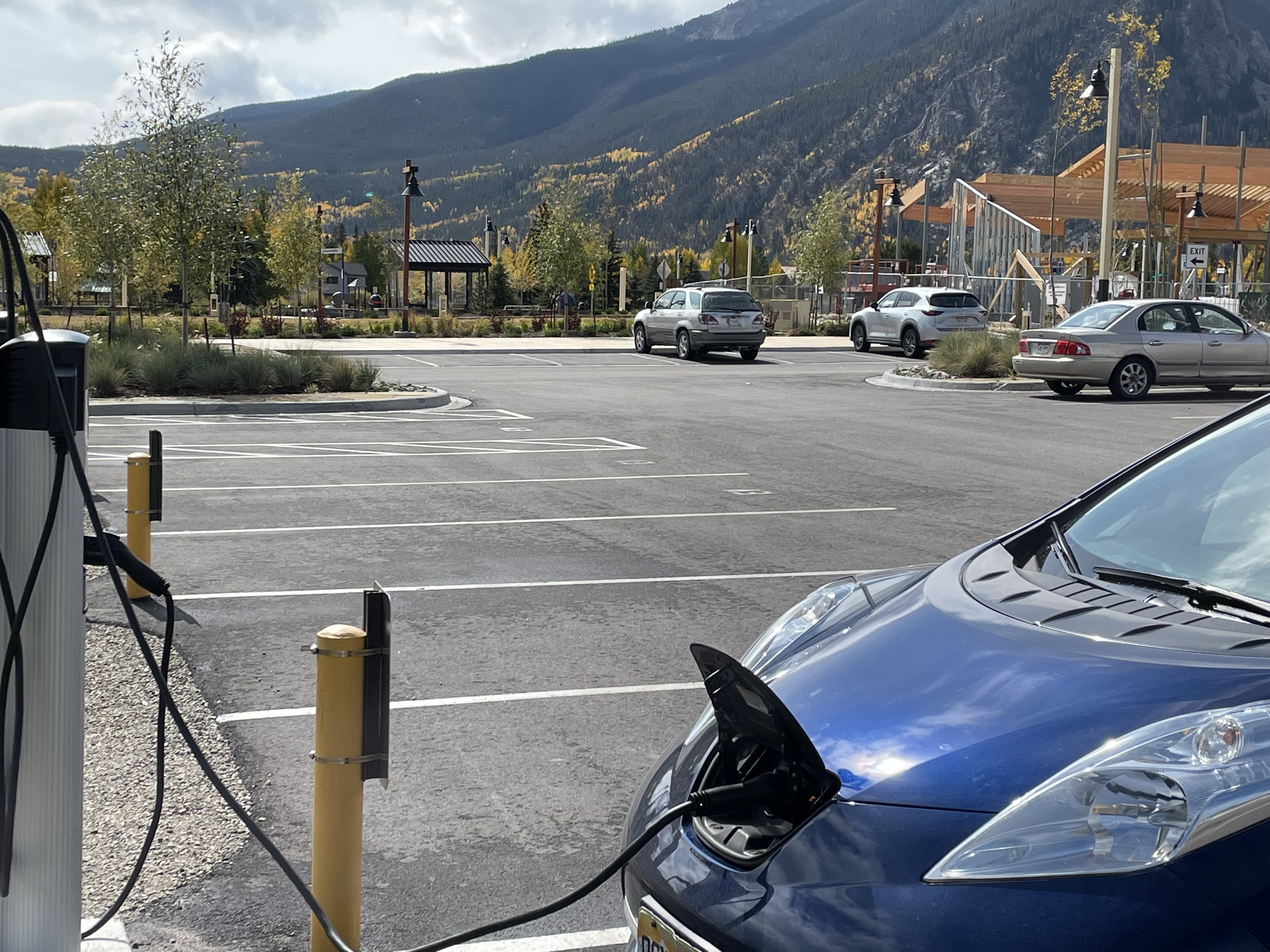
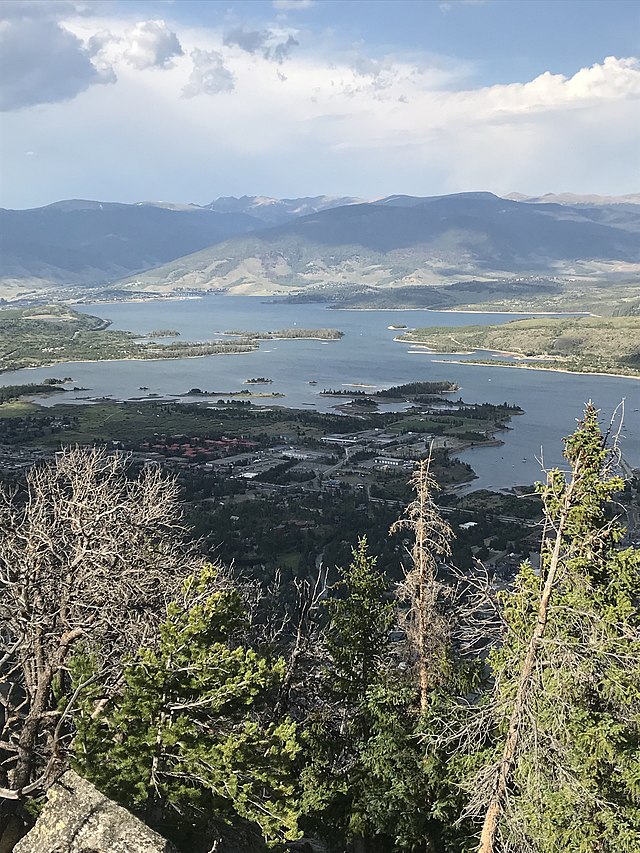
Leaf charging in Frisco September 30, 2021.
Build a national network of electric vehicle (EV) chargers. U.S. market share of plug-in EV sales is only one-third the size of the Chinese EV market. That needs to change. The legislation will invest $7.5 billion to build out a national network of EV chargers in the United States. This is a critical step in the President’s strategy to fight the climate crisis and it will create good U.S. manufacturing jobs. The legislation will provide funding for deployment of EV chargers along highway corridors to facilitate long-distance travel and within communities to provide convenient charging where people live, work, and shop. This investment will support the President’s goal of building a nationwide network of 500,000 EV chargers to accelerate the adoption of EVs, reduce emissions, improve air quality, and create good-paying jobs across the country.
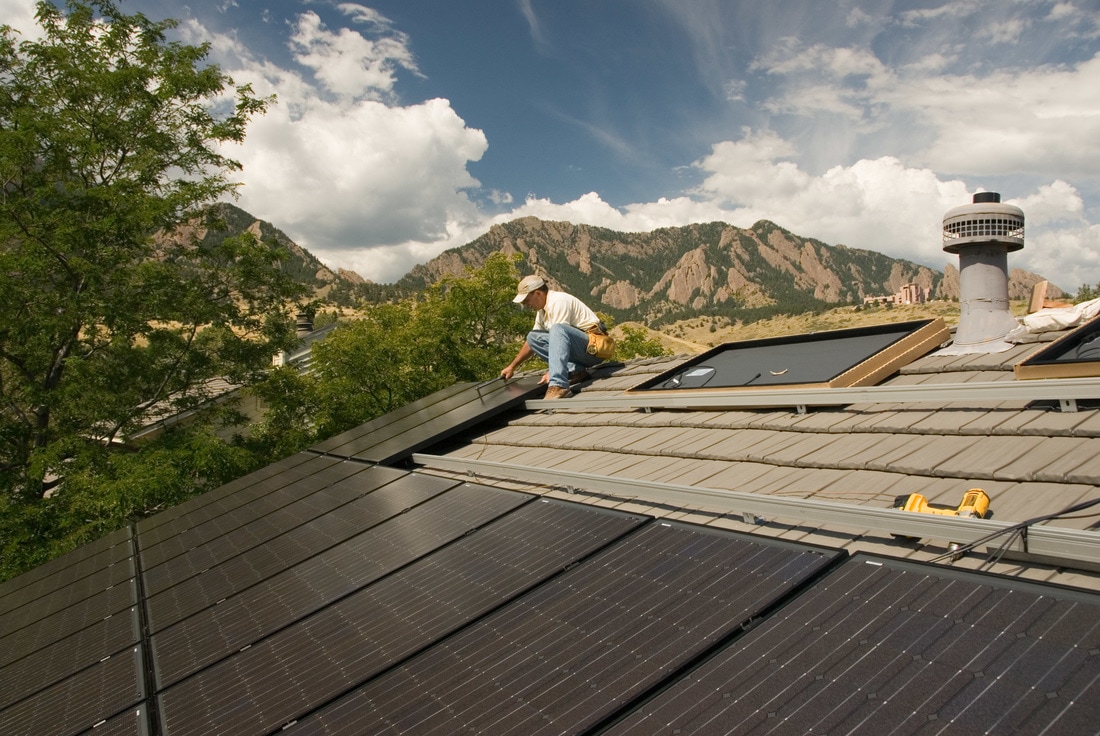
Upgrade our power infrastructure to deliver clean, reliable energy across the country and deploy cutting-edge energy technology to achieve a zero-emissions future. According to the Department of Energy, power outages cost the U.S. economy up to $70 billion annually. The Bipartisan Infrastructure Deal’s more than $65 billion investment includes the largest investment in clean energy transmission and grid in American history. It will upgrade our power infrastructure, by building thousands of miles of new, resilient transmission lines to facilitate the expansion of renewables and clean energy, while lowering costs. And it will fund new programs to support the development, demonstration, and deployment of cutting-edge clean energy technologies to accelerate our transition to a zero-emission economy.
Make our infrastructure resilient against the impacts of climate change, cyber-attacks, and extreme weather events. Millions of Americans feel the effects of climate change each year when their roads wash out, power goes down, or schools get flooded. Last year alone, the United States faced 22 extreme weather and climate-related disaster events with losses exceeding $1 billion each – a cumulative price tag of nearly $100 billion. People of color are more likely to live in areas most vulnerable to flooding and other climate change-related weather events. The legislation makes our communities safer and our infrastructure more resilient to the impacts of climate change and cyber-attacks, with an investment of over $50 billion to protect against droughts, heat, floods and wildfires, in addition to a major investment in weatherization. The legislation is the largest investment in the resilience of physical and natural systems in American history.
Deliver the largest investment in tackling legacy pollution in American history by cleaning up Superfund and brownfield sites, reclaiming abandoned mines, and capping orphaned oil and gas wells. In thousands of rural and urban communities around the country, hundreds of thousands of former industrial and energy sites are now idle – sources of blight and pollution. Proximity to a Superfund site can lead to elevated levels of lead in children’s blood. The bill will invest $21 billion clean up Superfund and brownfield sites, reclaim abandoned mine land and cap orphaned oil and gas wells. These projects will remediate environmental harms, address the legacy pollution that harms the public health of communities, create good-paying union jobs, and advance long overdue environmental justice This investment will benefit communities of color as, it has been found that 26% of Black Americans and 29% of Hispanic Americans live within 3 miles of a Superfund site, a higher percentage than for Americans overall.
Camille Touton of Nevada was confirmed by the Senate on Thursday to be commissioner of the Bureau of Reclamation, which oversees water management of the Colorado River in Western states.
Democratic and Republican senators approved President Joe Biden’s nominee on a voice vote.
Touton, of Filipino ancestry, moved as a child to Nevada. Las Vegas became her adopted home and she became interested in water, she told the Senate Energy and Natural Resources Committee during a September hearing.
She told the panel water management in the West is a major concern and priority.
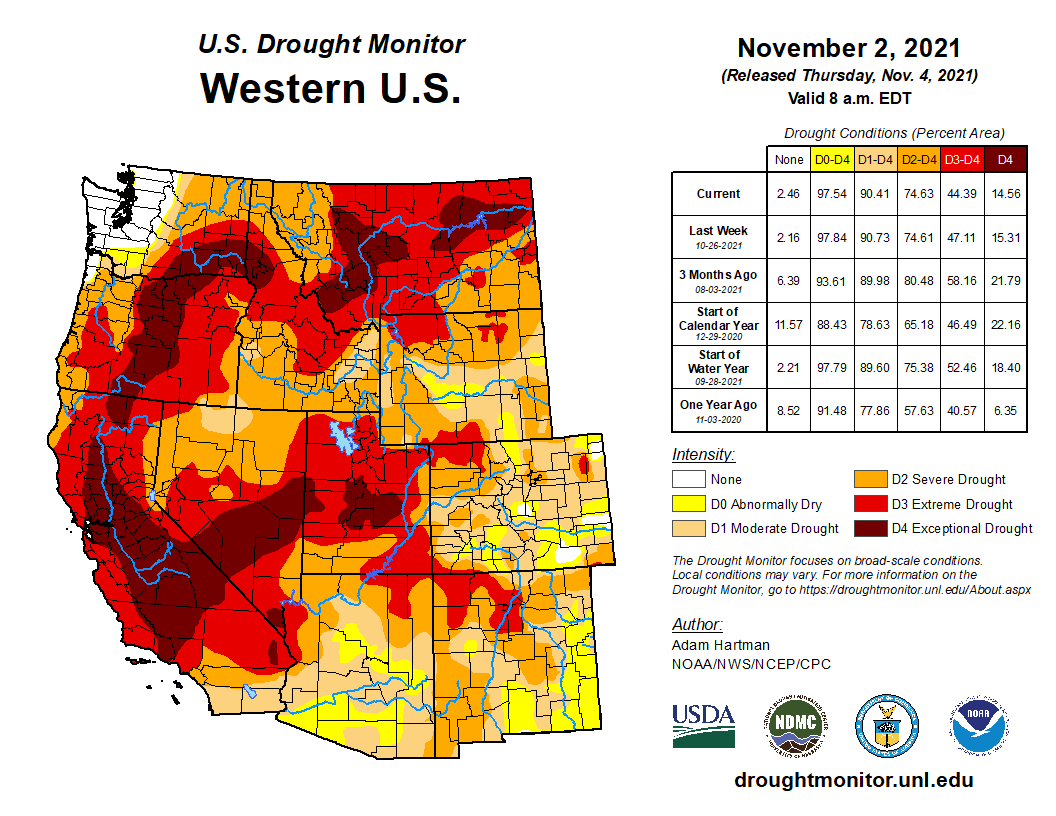
West Drought Monitor map November 2, 2021.
“The unprecedented drought has made the task even more challenging, as major reservoirs are at their lowest levels since filling, and the projections for relief in the face of climate change are not encouraging,” she told the hearing.
She was introduced to the panel by Sen. Catherine Cortez Masto, D-Nev., a member of the committee. Touton sailed through the confirmation process with bipartisan support, particularly from Western state Republican senators.
Touton recently served as Bureau of Reclamation deputy commissioner. She received degrees from the University of Nevada-Las Vegas and George Mason University…
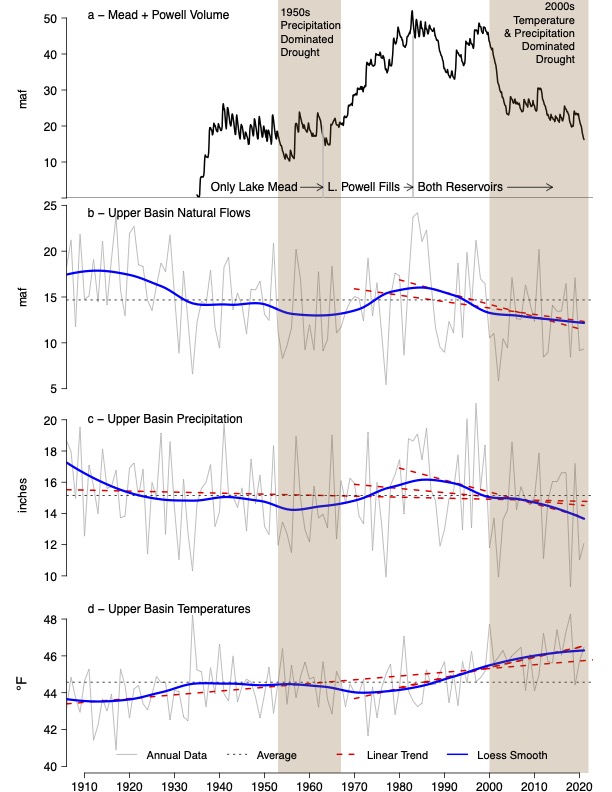
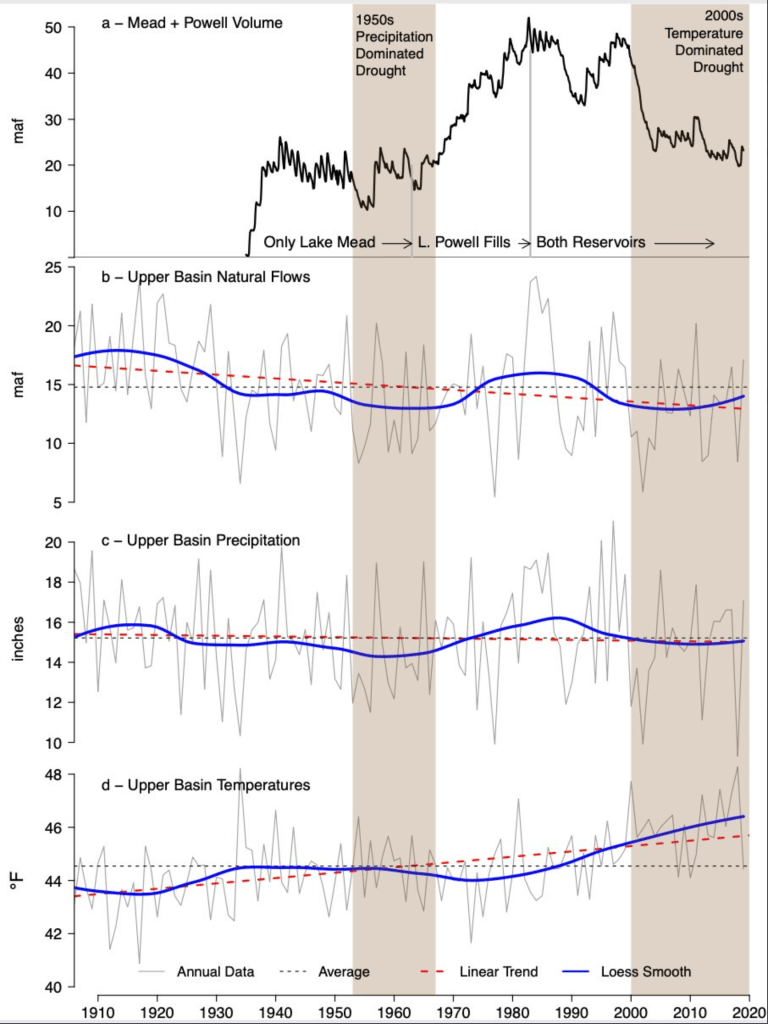
Brad Udall: Here’s the latest version of my 4-Panel plot thru Water Year (Oct-Sep) of 2021 of the Colorado River big reservoirs, natural flows, precipitation, and temperature. Data (PRISM) goes back or 1906 (or 1935 for reservoirs.) This updates previous work with @GreatLakesPeck.
Touton will be directly involved in Colorado River management, Lake Mead and water issues that impact Nevada and other Western states, Tobias said…
She also becomes the first Filipino-American to hold such a position in the Interior Department.
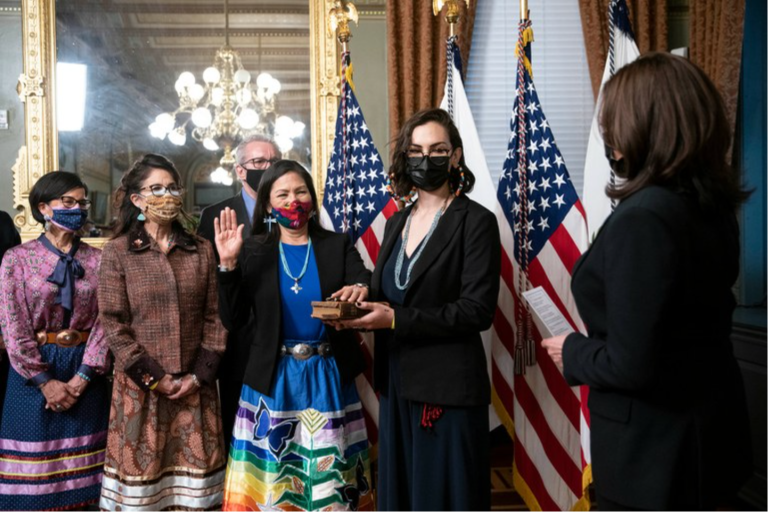
Interior Secretary Deb Haaland said Touton would bring a wealth of knowledge and experience to manage water for current and future generations.
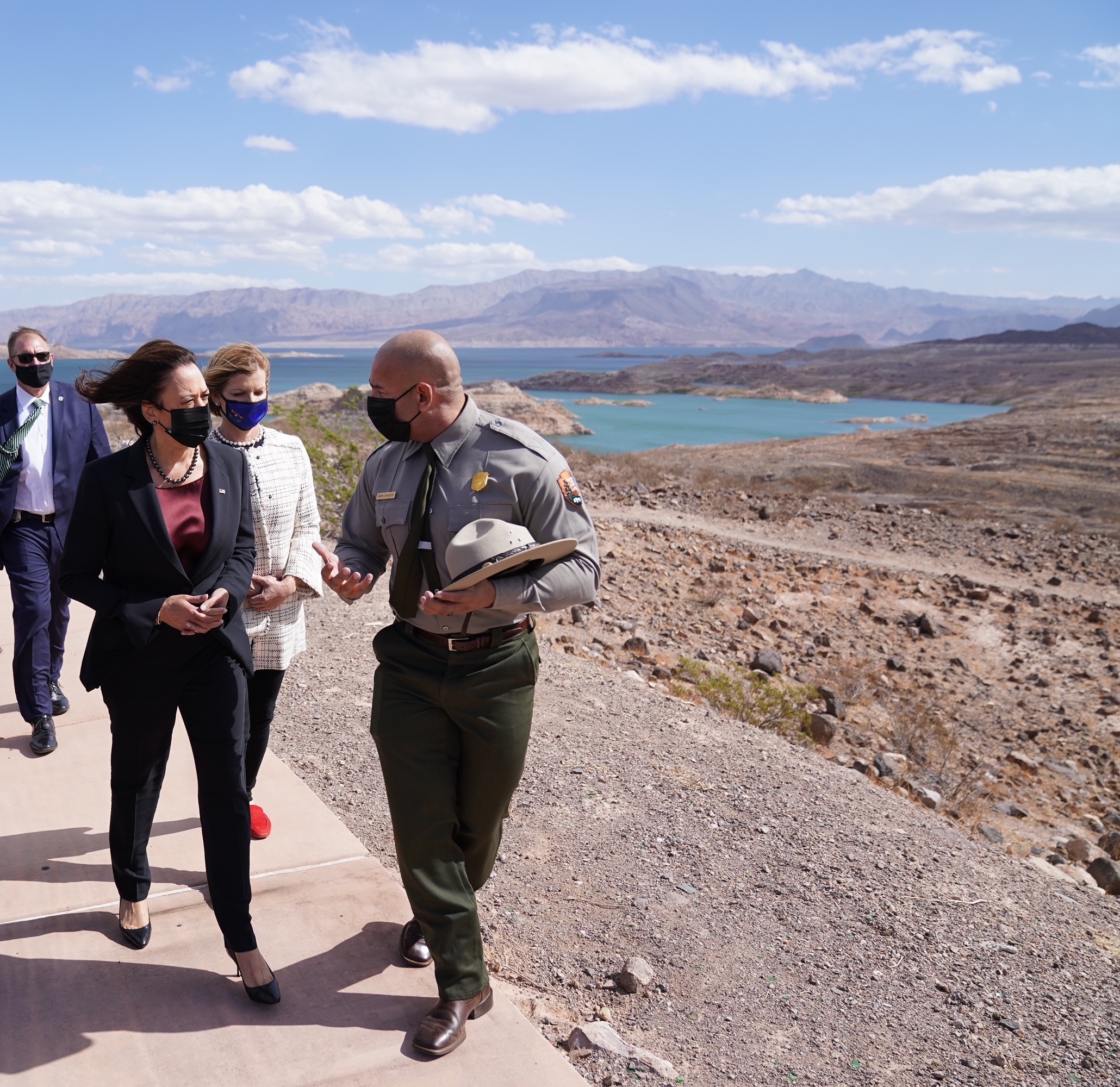
Vice President Kamala Harris stood before the record-low water levels of Nevada’s Lake Mead on Monday and made the case for the Biden administration’s climate change agenda by warning that “this is where we’re headed.”
“Look at where the water has receded over just the last 20 years,” she said, referring to the “bathtub ring” of minerals that marks where the reservoir’s water line previously stood. “That space is larger than the height of the Statue of Liberty.”
The vice president pitched the administration’s infrastructure and social safety net agenda as critical to tackling the effects of climate change — which scientists say intensify extreme weather events such as heatwaves and droughts.
Democrats have struggled to win support for that plan from some members of their party, who want to winnow down its $3.5 trillion price tag.
Harris made the case for the package by connecting human-caused climate change to the scene she stood near, saying emissions are “part of what is contributing to these drought conditions.”
[…]
Federal officials in August declared the first-ever water shortage in the Colorado River, which means Arizona, Nevada and Mexico will receive less water than normal next year amid a gripping Western drought.
In September, Reclamation released projections showing an even worse outlook for the river.
While California is spared from next year’s cuts, the nation’s most populous state has experienced one of its driest years on-record while battling scores of catastrophic wildfires.
In arguing for the $1 trillion public works infrastructure deal, Harris referenced the “good union jobs” that the spending package would create, naming pipefitters, electricians and plumbers as examples. That plan passed the Senate months ago and is awaiting House approval.
It contains roughly $8 billion for Western water projects, including desalination technology to make sea water usable, modernizing rural water infrastructure and building greater capacity to recycle wastewater.
Harris also spoke about the Biden administration’s proposed civilian Climate Corps, which it has said would create hundreds of thousands of jobs building trails, restoring streams and helping stop devastating wildfires…
Harris on Monday met with federal and regional water officials such as Tanya Trujillo, assistant interior secretary for water and science, and U.S. Reps. Dina Titus, Susie Lee and Steven Horsford of Nevada.
Passing Biden’s signature social services and climate change plans would serve future generations, Harris said, “in a way that will not only be about life, but about … beautiful places like Lake Mead.”
Water levels at Lake Mead fell this year to their lowest point since the reservoir was created in the 1930s, and in August, the U.S. government declared the first ever water shortage on the Colorado River.
“When we look at what’s happening here, we know this is about this lake, but it is about a region and it is about our nation,” Harris said.
Harris said Biden’s agenda was “thoughtful and foresightful,” and that along with the bipartisan $1 trillion infrastructure bill currently in Congress, would make investments “in things like water recycling and reuse, what we can do in terms of water desalination, what we can do in terms of implementation of drought contingency plans.”
“This is about thinking ahead, recognizing where we are and where we’re headed,” Harris said…
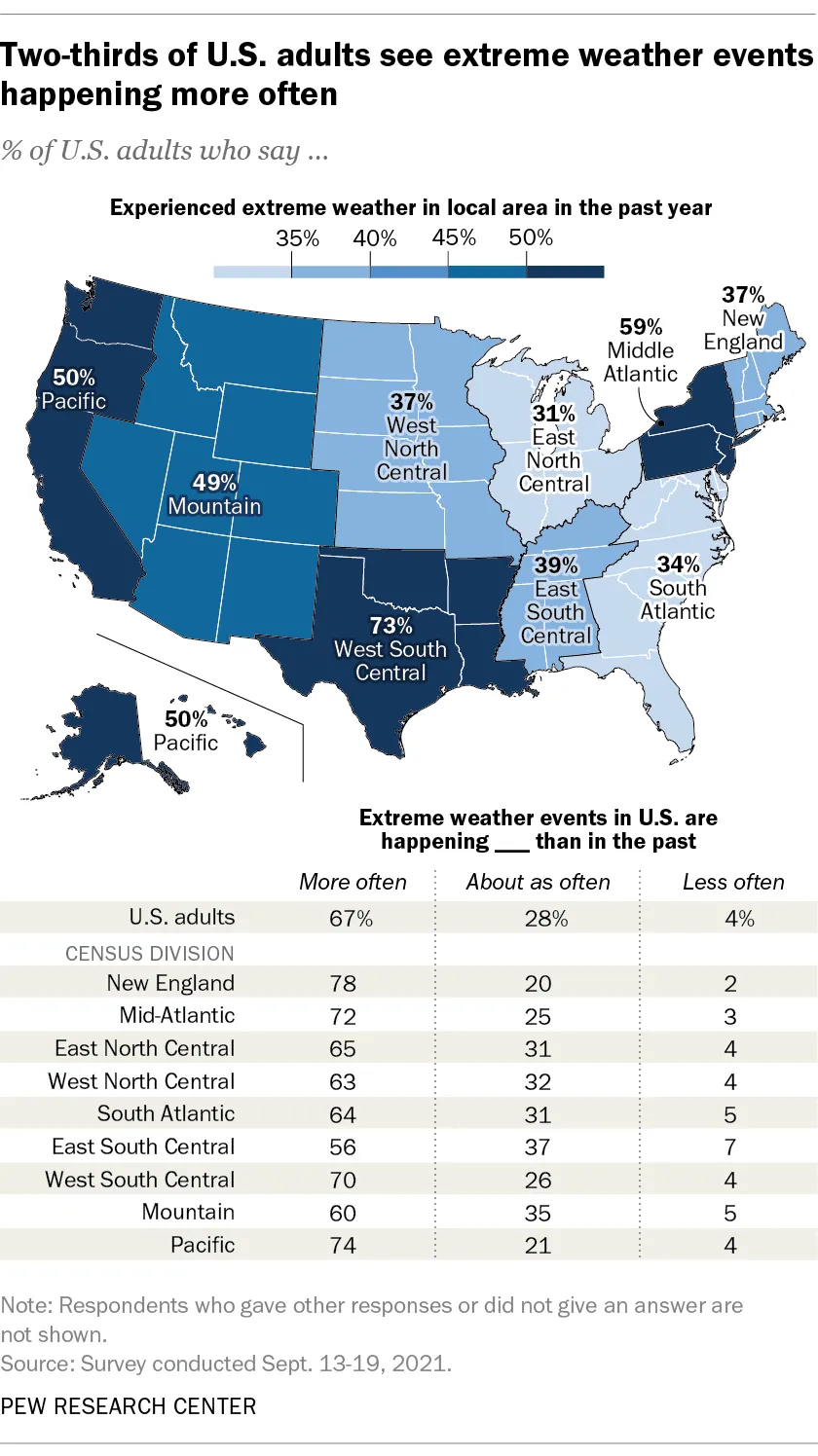
About half of all adults in western states said they’ve seen extreme weather events happening more often in their region, according to a Pew Research survey released Thursday. Currently, 90% of the West is in a drought, according to the U.S. Drought Monitor, and wildfires in California this year surpassed 4 million acres burned earlier this month, a record. The only regions with higher percentages of residents saying they’ve noticed extreme weather events on the rise were the West South Central region, which includes Texas and Louisiana which have been ravaged by hurricanes, and the Middle Atlantic.
Pew found wide support for the federal government to take action when it comes to building systems to make wastewater reusable in dry regions, with 88% of U.S. adults saying it is very or somewhat important. But there was a sharp partisan divide. The poll found 64% of Democrats support the federal government taking action, compared with 36% of Republicans.
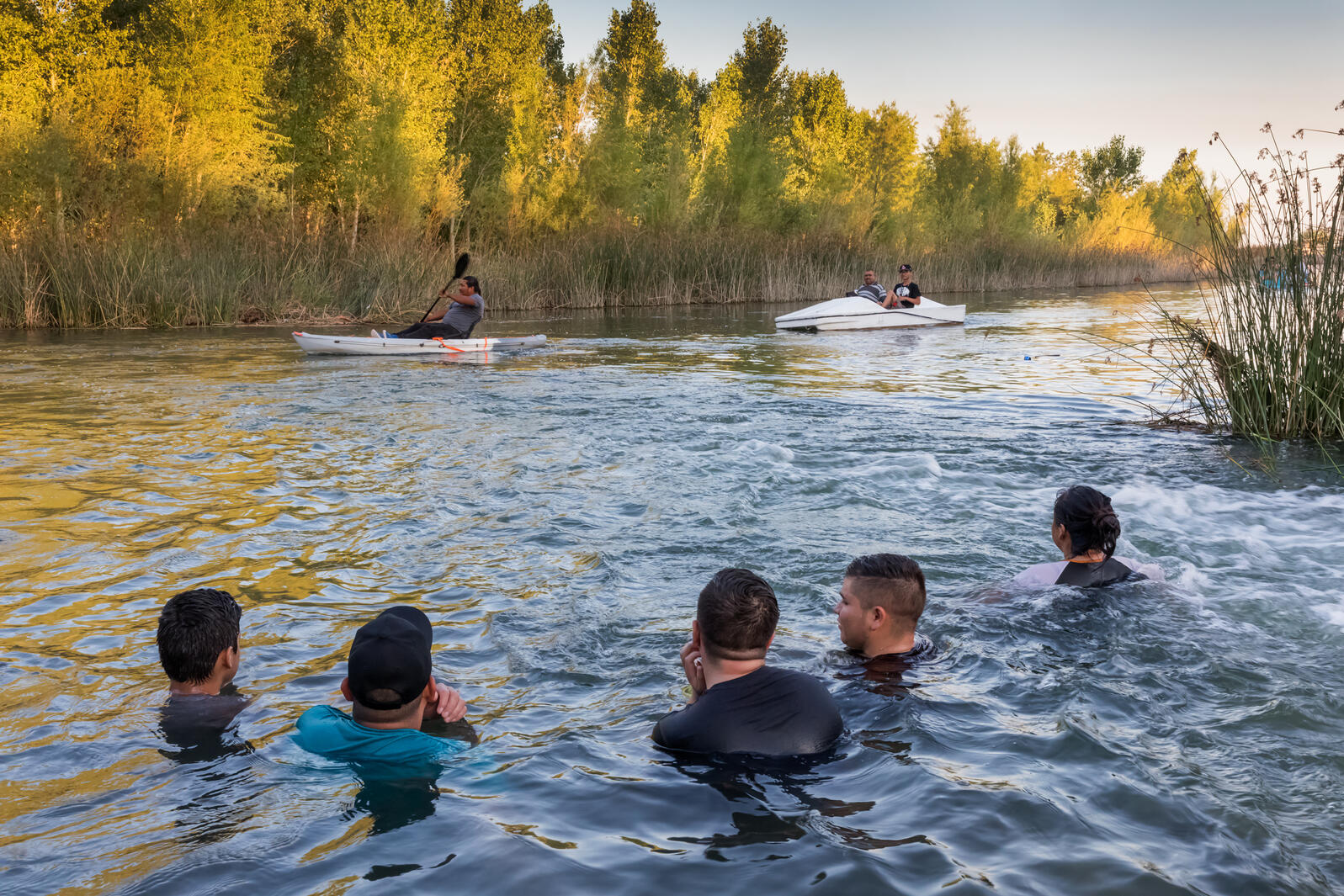
People enjoying the water pouring from the Canal Alimentador del Sur into the Chausse Restoration Site, Baja California, Mexico. Photo: Claudio Contreras Koob
On October 6, 2021, Audubon’s Colorado River Program Director gave the following testimony before the U.S. Senate Committee on Energy and Natural Resources, Subcommittee on Water and Power. This is slightly edited for length. The full testimony can be found at the bottom of this page.
Chairman Kelly, Ranking Member Hyde-Smith and members of the subcommittee, thank you for holding this important hearing on drought in the West, it is an honor to testify before you today.
My name is Jennifer Pitt, I serve as the Colorado River Program Director for the National Audubon Society (Audubon), and I have more than 20 years of experience working on water issues in the Colorado River basin. Audubon is a leading national nonprofit organization representing more than 1.8 million members. Since 1905, we have been dedicated to the conservation of birds and the places they need, today and tomorrow, throughout the Americas using science, advocacy, education, and on-the- ground conservation. Audubon advocates for solutions in the Colorado River basin that ensure adequate water supply for people and the environment.
As you consider options to support drought management in the West, it is important to recognize the consequences of severe drought in the Colorado River basin. The myriad rivers, wetlands, and lakes of the Colorado River basin have extraordinary value, economically, culturally, ecologically, and spiritually. While these freshwater-dependent resources cover only 2% of the landscape, they support 40% of all breeding birds. Water year 2021 is now the worst year on record for many farmers and ranchers, wildlife managers, and businesses and communities who rely on water supply from the basin, putting these irreplaceable resources at risk.
In the Colorado River basin, like other places across the arid West, climate change and drought are already worsening impacts on freshwater-dependent habitats long starved for water. While we cannot completely stop the impacts that are already occurring, with coordinated efforts and smart investments, we can avoid losing key habitats, and promote a stronger, more resilient basin for the future. In order to avoid the worst outcomes for birds and other species, Audubon has worked to ensure that water infrastructure does no additional environmental damage, worked with water managers to dedicate flows for the environment, and supports investing in habitat restoration.
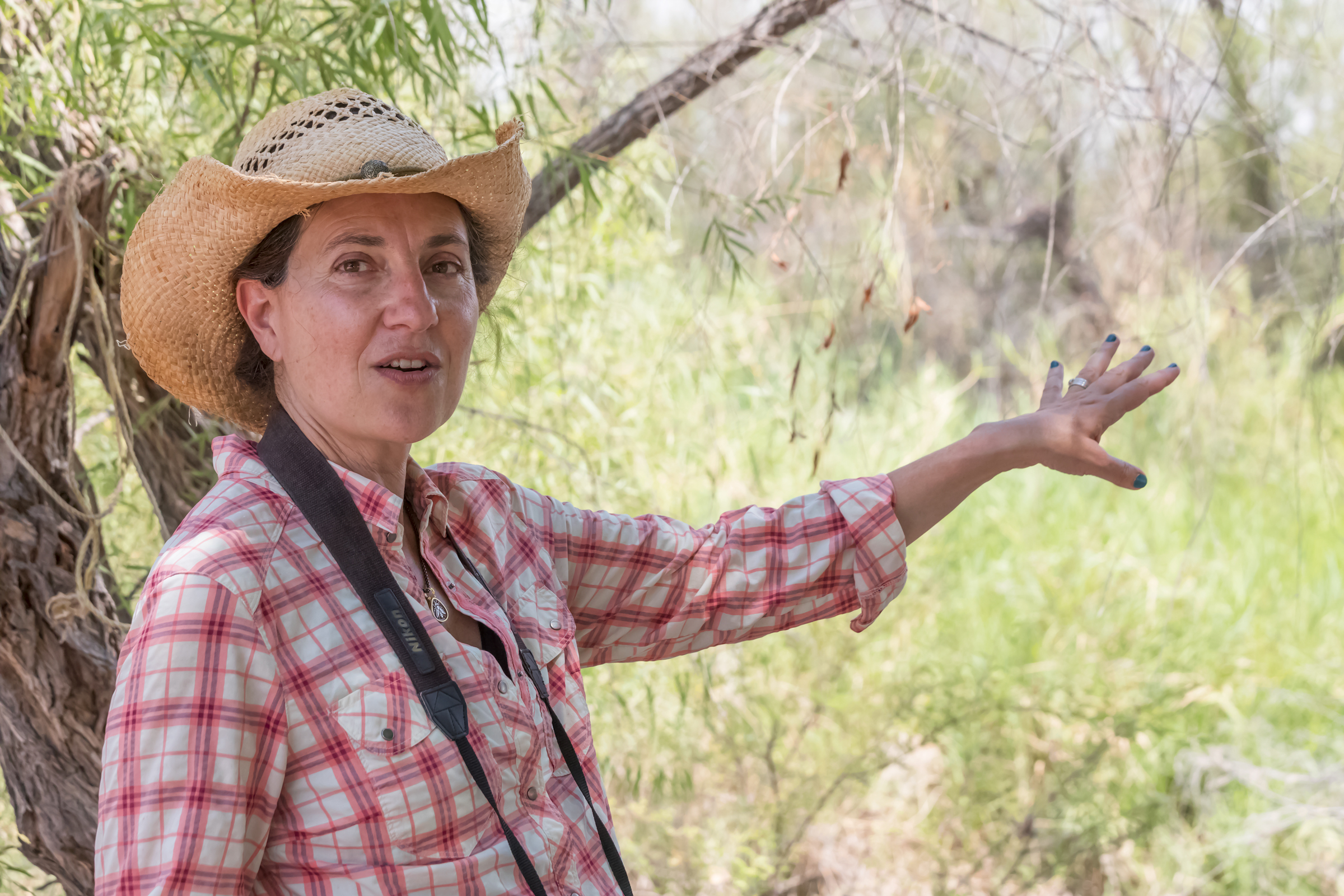
Audubon’s Colorado River Program Director, Jennifer Pitt, at the Laguna Grande Restoration Site, Baja California, Mexico. Photo: Claudio Contreras Koob
Federal Investment Needed to Help Manage Drought Impacts
Federal leadership is needed to provide the resources necessary to address this challenge. Congress should use all available options to invest in immediate and long-term solutions to mitigate current disasters and enhance the climate resilience of states affected by historic drought conditions. Audubon supports immediate disaster relief for communities hit hardest by compounding issues of drought, fire, COVID-19, and historic inequalities. Funding for a suite of common-sense strategies including natural infrastructure that creates distributed storage, forest management and wildfire mitigation, ecosystem restoration, upgraded agricultural irrigation infrastructure, binational water conservation and habitat restoration, water recycling and improved science will provide the means to help enhance overall climate resilience for people, wildlife, and economies throughout the Colorado River basin. Audubon’s federal funding priorities include:
Emergency Drought Response: Emergency drought relief funding is needed to respond to the historic drought conditions affecting tens of millions of Americans. There is no funding provided for immediate emergency response in the Infrastructure Investment and Jobs Act, so additional investment is needed.
USGS Monitoring and Research: Federal investment in monitoring and science, including Open ET, will allow water managers to replace and add new stream gages, comprehensively forecast, model and track water availability throughout the basin.
Reclamation’s binational program: Minute 323 carries forward the cooperative approach originally forged in Minute 319, and includes binational agreement to invest in agricultural infrastructure improvements in the Mexicali Valley that result in water conserved in Lake Mead and improvements to riparian habitats. Binational investments have proven effective since the United States and Mexico initiated the cooperative process 15 years ago, but much more needs to be done. With conservation opportunities and ecosystem restoration projects demonstrating the wisdom of the initial pilot projects, it is time to increase the scale of our binational investments. All Colorado River water users would benefit from additional investment in binational water conservation and habitat restoration. By doing so, we would continue to see the benefits in the water levels of Lake Mead and help slow the decline of these essential reservoirs. Without this cooperative process, governments and water leaders on both sides of the border would be investing precious time and energy to try to create the system we have in place today. With Minute 323, our existing binational framework for cooperation, water conservation and environmental restoration, it is time to increase investments to meet the challenges of drought and climate change that threaten the Basin.
Salton Sea Restoration: Funding will help mitigate the environmental and public health crisis caused by the receding shoreline of California’s Salton Sea.
Indian Health Service Sanitation and Construction Support: Tribal members suffered the highest rates of covid-19 infection and mortality of any ethnic group in the United States, and the fact that thousands of homes on tribal reservations do not have water service is unconscionable.
Reclamation Water Settlement Fund: Tribal water settlements are urgently needed to address long- overdue promises, to allow tribes to benefit from their water rights, and to reduce the uncertainty that unsettled rights imposes on all Colorado River water users.
WaterSMART grants, including the Cooperative Watershed Management Program, with a set-aside for natural infrastructure projects: Community resilience to climate change can be improved with funding for nature-based solutions for restoring rivers and wetlands. Natural infrastructure, including irrigated wetlands and restored high-elevation meadows, can build adaptive capacity in ecosystems and ranching operations to cope with ongoing climate shifts. These investments could also mitigate climate change by reducing and sequestering greenhouse gas emissions and increase economic resilience by providing cost-effective mechanisms to restore degraded working lands, improving land value and profitability of operations.
Reclamation’s Water Recycling and Reuse programs: Technologies are available to help municipal water systems stretch available water supplies through investments in recycling and reuse infrastructure. Federal funding to maximize water recycling and reuse can help maintain the trend already established among municipalities that use Colorado River water whereby population growth is decoupled from water demand.
Reclamation Aquatic Ecosystem Restoration Program: Beyond the funding in the Infrastructure Bill, additional funding is needed to restore imperiled ecosystems, especially ecosystems facing significant negative impacts caused by historic drought conditions.
Reclamation multi-benefit projects to improve watershed health: Beyond what was included in the Infrastructure Bill, robust funding is needed to improve watershed health and resiliency, especially for watersheds facing significant negative impacts from historic drought conditions.
Ecosystem restoration funding for the U.S. Forest Service and Department of the Interior: Well- managed forests provide numerous benefits, including preventing soil erosion; supporting water filtration and increasing runoff yields; regulating snow melt and water supply; improving water quality; lowering water treatment costs; capturing carbon; and benefiting wildlife habitat and fisheries. Implementing best practices in forest management and forest restoration can help maintain these benefits and mitigate against watershed degradation, severe wildfire, and other climate change impacts. Forest management and restoration can also help in adapting to climate shifts as conditions in the basin change, such as regulating snowmelt runoff and increasing economic resilience through job creation and reduced emergency costs, among other benefits.
Reclamation funding for Aging Agricultural Infrastructure: Ensuring that agricultural infrastructure and operations are up to the challenges of higher temperatures and reduced flows will sustain the economic resilience of rural communities. Improving agricultural infrastructure and operations can reduce pressure on existing water supplies by making operations more efficient, reducing the potential for over-diversion from streams and rivers, and potentially reducing consumptive use.
Improvements can also help the basin’s agriculture become more resilient to the effects of climate change such as reduced stream flows and higher temperatures.
Collaborative solutions are possible in the Colorado River basin
Freshwater-dependent habitats can be restored with effort and investment, and in some cases, restoration may be the key to reaching consensus in binational Colorado River shortage-sharing agreements.
Water conservation can be implemented with sensitivity to the species that depend on irrigated habitats.
Sensible water policies and state-level investments can help improve western watersheds and water supplies, and leverage federal funding.
We are all in this together, and cooperation and collaboration are critical.
Brad Udall: Here’s the latest version of my 4-Panel plot thru Water Year (Oct-Sep) of 2019 of the #coriver big reservoirs, natural flows, precipitation, and temperature. Data goes back or 1906 (or 1935 for reservoirs.) This updates previous work with @GreatLakesPeck
Why Action is needed now: drought has launched the Colorado River into crisis, and climate change means this is not a temporary condition
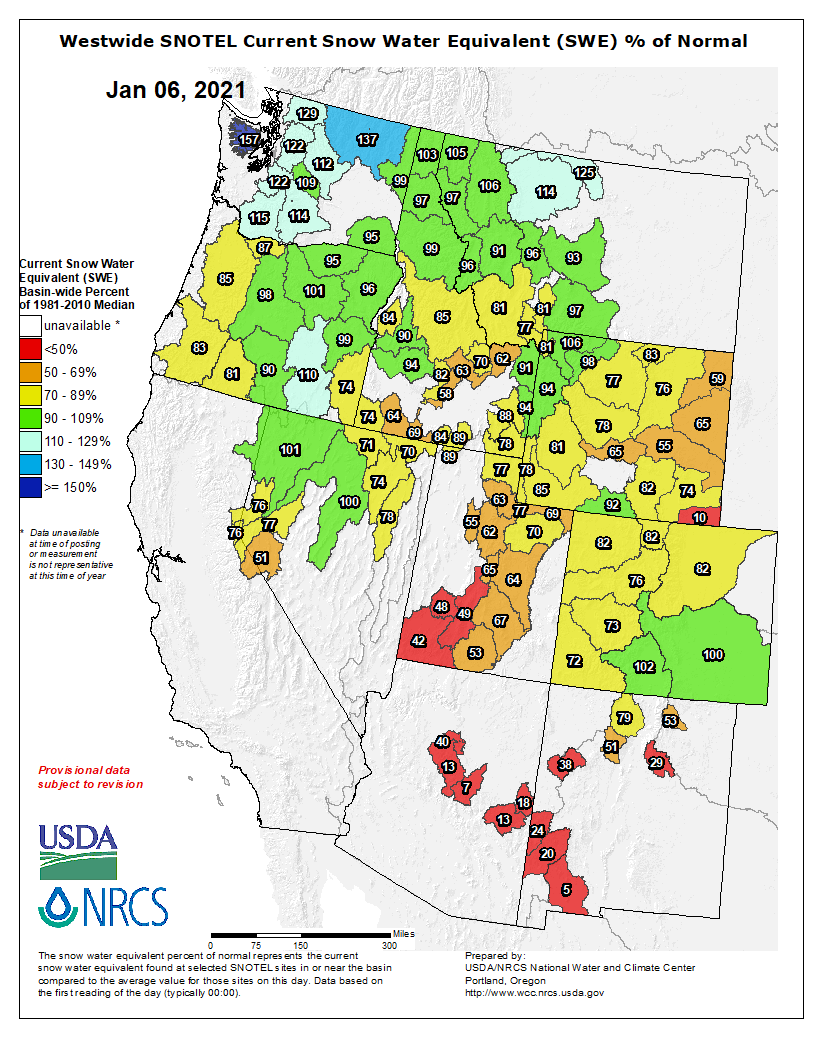
Climate change has come barging through the front doors of the Colorado River basin. The Colorado River has lost 20% of its historic flows in the past 20 years. Fifteen years ago, water managers pointed to drought, which has recurred periodically over the past century. Today it is clear – and Colorado River water managers understand – that the shrinking water supply is largely due to climate change, with increased temperatures accounting for 33% of the 21st century decline. In 2021, the Colorado River basin snowmelt measured 90% of average, but runoff – the snowmelt that filled the rivers – was only 30% of average. That discrepancy demonstrates an impact of climate change between the ridgetops and the valley bottoms: warm temperatures that drive evaporation, soil desiccation, and increased water use by every living thing.
What we do know is stark: Climate change and aridification are permanently changing our landscapes, threatening our way of life, jeopardizing our ability to produce hydropower and placing further strain on our communities. The possibility of severe declines at Lakes Mead and Powell should be a wake-up call to anyone who wants their children or grandchildren to be able to survive and thrive in the West.
Drought is devastating Colorado River habitats and the wildlife that depends on them
Because freshwater-dependent resources in the Colorado River basin support 40% of all breeding birds, these birds, like the proverbial canary in the coalmine, are telling us that the basin is in trouble. Birds like the Yellow Warbler and Summer Tanager, once familiar sights along the Colorado River, have experienced significant regional declines. The outlook for Yuma Ridgway’s Rail, Western Yellow-billed Cuckoo, and Southwestern Willow Flycatcher, all listed as federally endangered, is especially bleak if current trends continue.
Today, rivers in the basin suffer from reduced flow and changed seasonality of flows, resulting in a diminished river, and in loss of much of the native forest that flourished on the river’s banks. The loss of aquatic and riparian habitats has had devastating impacts on wildlife, particularly fish and birds.
The combination of drought and heatwaves – as witnessed this summer – can push birds to their physiological limits, leading to lethal dehydration. In drought times, birds may also congregate at remaining, dwindling water spots, causing conditions ripe for the spread of disease.
At the Salton Sea, declining inflows in the wake of the 2003 Imperial Valley to San Diego transfer is resulting in exposed playa, which creates significant air quality problems for communities that already suffer high asthma rates. The shrinking lake impacts wildlife too: colonial seabirds began abandoning nesting sites en masse in 2013, and shallow, marshy habitat areas at the sea’s edge have begun to rapidly vanish. As less water flows into the Sea, it is becoming more saline and inhospitable to birds, fish, and insects. In the Colorado River Delta, the near complete elimination of flows resulted in an 80% reduction of what had been an expansive, 1.5 million acre ecosystem of wetlands and riparian forests.
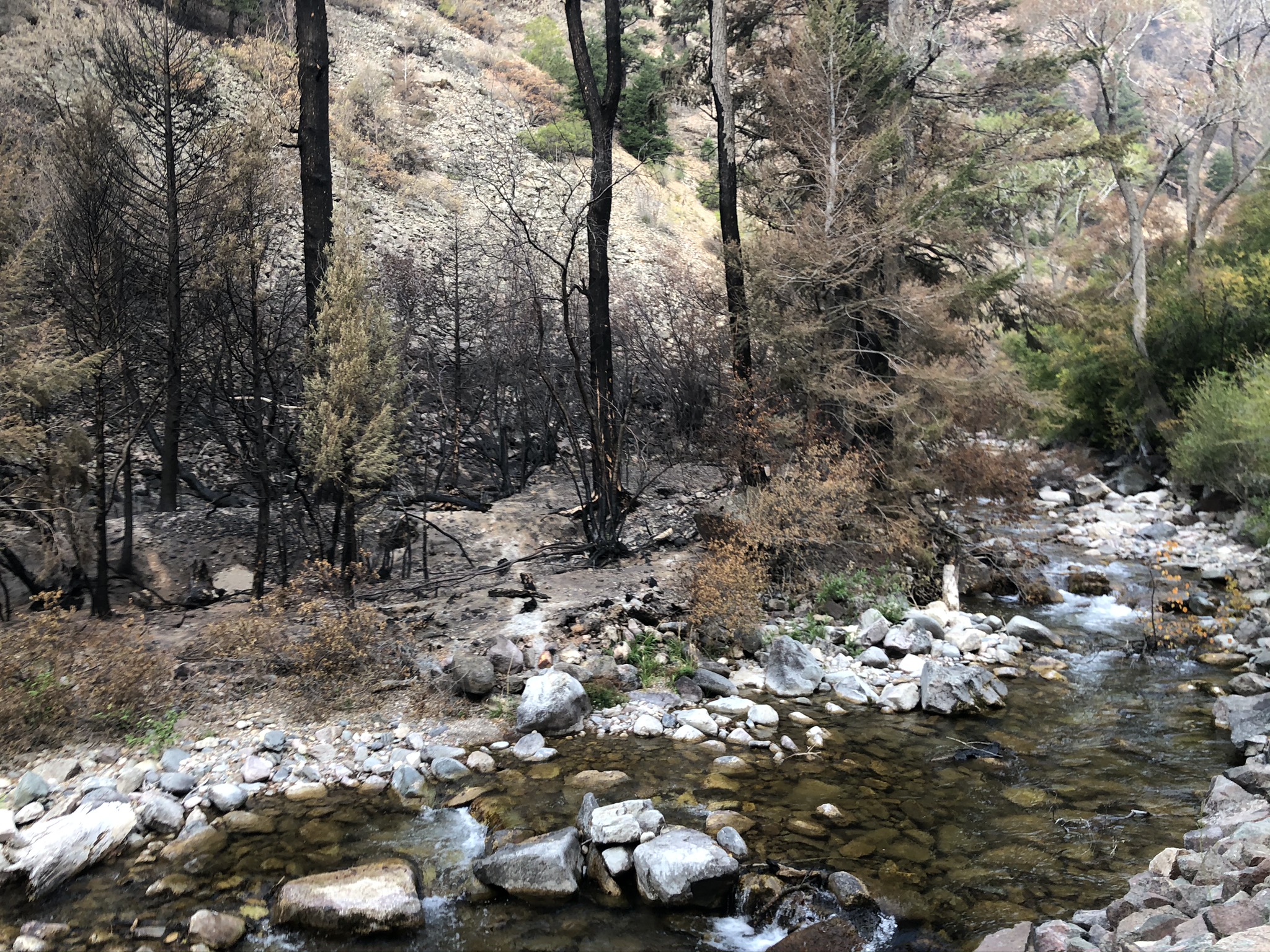
In the past couple of years, we have gotten a glimpse of how climate change impacts will compound with shattering consequences for the environment. With the increase in hot, windy, and dry days, fire season has more than doubled since 1973 in many parts of the West. Forests devastated by 20 years of beetle kill, drought stress, and low soil moisture have burned at record rates. In 2020, Colorado’s Grizzly Creek Fire burned more than 32,000 acres on the Colorado River above Glenwood Springs, and in 2021 rainstorms over the burn area triggered mudslides, repeatedly closing Interstate 70 in Glenwood Canyon, interrupting travel and trade, and choking the Colorado River, clogging fish breeding grounds and dumping untold volumes of ash and sediment into the water supply.
2021 river temperatures up to 80º F impacted numerous recreational fisheries leading to voluntary and mandatory closures. Warm rivers also boost populations of non-native bass and pike, which prey on protected Colorado River native fishes including the razorback sucker and humpback chub. 2021 also saw rivers like the Dolores go completely dry, which is not friendly habitat for any kind of fish.
This is a sobering and scary time for everyone and everything that depends on the Colorado River.
Conclusion
As Congress considers priorities and funding opportunities, Audubon supports increasing federal investments and leadership for the Colorado River Basin and natural resources across the West. After this year’s historic drought and catastrophic wildfires, we urge Congress to ensure that federal agencies receive critically needed resources to prepare now for the effects of climate change by promoting nature-based solutions for restoring watersheds and ecosystems. In addition, Congress has several pending bills with bipartisan support that respond to the many needs of tribal communities and western states’ water supply needs that we are supporting, including access to clean water and water settlements. It is imperative that our communities have the resources they need to prepare for and respond to the drought crisis that touches every living thing.
Thank you very much for the opportunity to testify and I would be happy to answers your questions.
President Barack Obama’s establishment of the Bears Ears National Monument in Proclamation 9558 of December 28, 2016, represented the culmination of more than a century of efforts to protect the ancestral homeland of Tribal Nations that all refer to the area by the same name — Hoon’Naqvut (Hopi), Shash Jaa’ (Navajo), Kwiyagatu Nukavachi (Ute), and Ansh An Lashokdiwe (Zuni): Bears Ears. Preserving the sacred landscape and unique cultural resources in the Bears Ears region was an impetus for passage of the Antiquities Act in 1906. As early as 1904, advocates for protection of cultural landscapes described for the Congress the tragedy of the destruction of objects of historic and scientific interest across the American Southwest and identified the Bears Ears region as one of seven areas in need of immediate protection. Nevertheless, for more than 100 years, indigenous people, historians, conservationists, scientists, archaeologists, and other groups advocated unsuccessfully for protection of the Bears Ears landscape. It was not until the Hopi Tribe, Navajo Nation, Ute Indian Tribe of the Uintah and Ouray Reservation, Ute Mountain Ute Tribe, and Pueblo of Zuni united in a common vision to protect these sacred lands and requested permanent protection from President Obama that Bears Ears National Monument became a reality. Few national monuments more clearly meet the Antiquities Act’s criteria for protection than the Bears Ears Buttes and surrounding areas. This proclamation confirms, restores, and supplements the boundaries and protections provided by Proclamation 9558, including the continued reservation of land added to the monument by Proclamation 9681 of December 4, 2017.
As Proclamation 9558 recognizes, the greater Bears Ears landscape, characterized by deep sandstone canyons, broad desert mesas, towering monoliths, forested mountaintops dotted with lush meadows, and the striking Bears Ears Buttes, has supported indigenous people of the Southwest from time immemorial and continues to be sacred land to the Hopi Tribe, Navajo Nation, Ute Indian Tribe of the Uintah and Ouray Reservation, Ute Mountain Ute Tribe, and Pueblo of Zuni. Approximately two dozen other Tribal Nations and Pueblos have cultural ties to the area as well.
Describing as much as 13,000 years of human occupation of the Bears Ears landscape, Proclamation 9558 contextualizes the compelling need to protect one of the most extraordinary cultural landscapes in the United States. The proclamation describes the landscape’s unique density of significant cultural, historical, and archaeological artifacts spanning thousands of years, including remains of single family homes, ancient cliff dwellings, large villages, granaries, kivas, towers, ceremonial sites, prehistoric steps cut into cliff faces, and a prehistoric road system that connected the people of Bears Ears to each other and possibly beyond. Proclamation 9558 also describes the cultural significance and importance of the area, exemplified by the petroglyphs, pictographs, and recent rock writings left by the indigenous people that have inhabited the area since time immemorial.
In addition to cultural and historic sites, Proclamation 9558 describes the Bears Ears landscape’s unique geology, biology, ecology, paleontology, and topography. The proclamation identifies geologic formations rich with fossils that provide a rare and relatively complete picture of the paleoenvironment, striking landscapes, unique landforms, and rare and important plant and animal species. While not objects of historic and scientific interest designated for protection, the proclamation also describes other resources in the area, historic grazing, and world class outdoor recreation opportunities — including rock climbing, hunting, hiking, backpacking, canyoneering, whitewater rafting, mountain biking, and horseback riding — that support a booming travel and tourism sector that is a source of economic opportunity for local communities.
To protect this singular and sacred landscape, President Obama reserved approximately 1.35 million acres through Proclamation 9558 as the smallest area compatible with protection of the objects identified within the boundaries of the monument. He also established the Bears Ears Commission to ensure that management of the monument would be guided by, and benefit from, expertise of Tribal Nations and traditional and historical knowledge of the area.
On December 4, 2017, President Donald Trump issued Proclamation 9681 to reduce the lands within the monument by more than 1.1 million acres. In doing so, Proclamation 9681 removes protection from objects of historic and scientific interest across the Bears Ears landscape, including some objects that Proclamation 9558 specifically identifies by name for protection. Multiple parties challenged Proclamation 9681 in Federal court, asserting that it exceeds the President’s authority under the Antiquities Act.
Restoring the Bears Ears National Monument honors the special relationship between the Federal Government and Tribal Nations, correcting the exclusion of lands and resources profoundly sacred to Tribal Nations, and ensuring the long-term protection of, and respect for, this remarkable and revered region. Given the unique nature and cultural significance of the objects identified across the Bears Ears landscape, the threat of damage and destruction to those objects, their spiritual, cultural, and historical significance to Tribal Nations, and the insufficiency of the protections afforded in the absence of Antiquities Act protections, the reservation described below is the smallest area compatible with the proper care and management of the objects of historic and scientific interest named in this proclamation and Proclamation 9558.
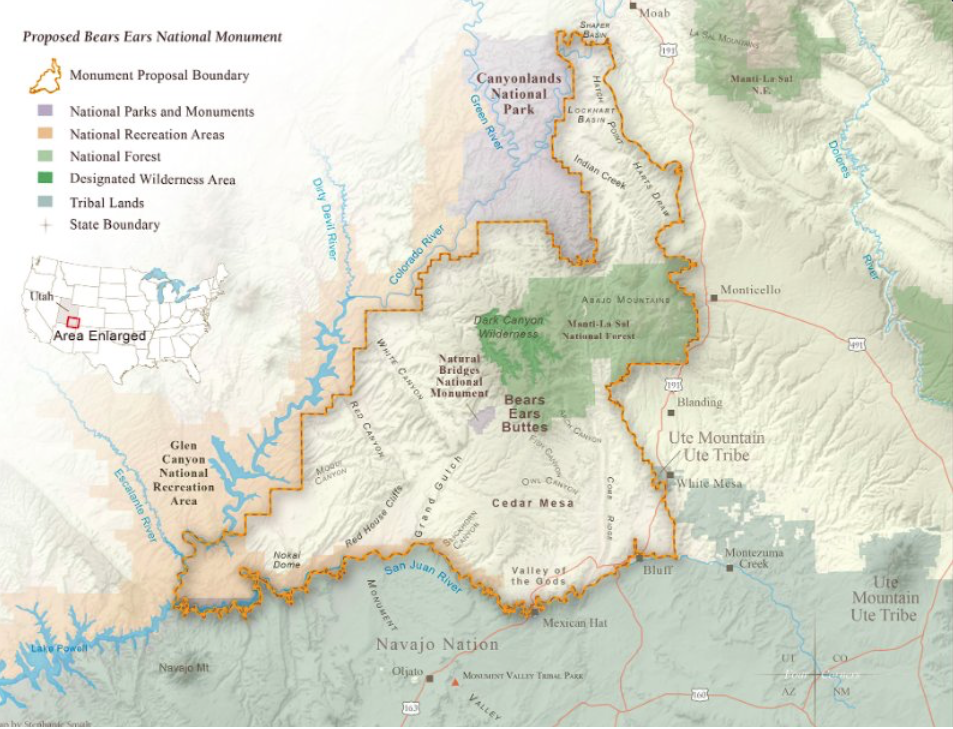
Proposed Bears Ears National Monument July 2016 via Elizabeth Shogren.
he Bears Ears landscape — bordered by the Colorado River to the west, the San Juan River and the Navajo Nation to the south, low bluffs and high mesas to the east and north, and Canyonlands National Park to the northwest, and brimming with towering sandstone spires, serpentine canyons, awe-inspiring natural bridges and arches, as well as the famous twin Bears Ears Buttes standing sentinel over the sacred region — is not just a series of isolated objects, but is, itself, an object of historic and scientific interest requiring protection under the Antiquities Act. Bears Ears is sacred land of spiritual significance, a historic homeland, and a place of belonging for indigenous people from the Southwest. Bears Ears is a living, breathing landscape, that — owing to the area’s arid environment and overall remoteness, as well as the building techniques that its inhabitants employed — retains remarkable and spiritually significant evidence of indigenous use and habitation since time immemorial, including from the Paleoindian Period, through the time of the Basketmakers and Ancestral Pueblos, to the more recent Navajo and Ute period, and continuing to this day. There are innumerable objects of historic or scientific interest within this extraordinary landscape. Some of the objects are also sacred to Tribal Nations, are sensitive, rare, or vulnerable to vandalism and theft, or are dangerous to visit and, therefore, revealing their specific names and locations could pose a danger to the objects or the public. The variety, density, and prevalence of these objects, such as prehistoric roads, structures, shrines, ceremonial sites, graves, pots, baskets, tools, petroglyphs, pictographs, and items of clothing, all contribute to the uniqueness of this region and underscore its sacred nature and living spiritual significance to indigenous people.
Many of the Tribal Nations that trace their ancestral origin to this area and continue their spiritual practices on these lands today view Bears Ears as a part of the personal identity of their members and as a cultural living space — a landscape where their traditions began, where their ancestors engaged in and handed down cultural practices, and where they developed and refined complex protocols for caring for the land. The Bears Ears region is also a tangible location that is integral to indigenous ceremonial practices, cultural traditions, and the sustainment of the daily lives of indigenous peoples. Since time immemorial, the lands of the Bears Ears region have fostered indigenous identity and spirituality. Indigenous people lived, hunted, gathered, prayed, and built homes in the Bears Ears region. As a result, each geographic subregion and the mountains, canyons, mesa tops, ridges, rivers, and streams therein that make up the Bears Ears landscape hold cultural significance. These individual locales come together as objects of historic and scientific interest — many of which have spiritual significance to indigenous people and are located across this living landscape ‑- to tell stories, facilitate the practice of traditions, and serve as a mnemonic device that elders use to teach younger generations where they came from, who they are, and how to live. Resources found throughout the Bears Ears region, including wildlife and plants that are native to the region, continue to serve integral roles in the development and practice of indigenous ceremonial and cultural lifeways. From family gatherings, dances, and ceremonies held on these sacred lands, to gathering roots, berries, firewood, piñon nuts, weaving materials, and medicines across the region, Bears Ears remains an essential landscape that members of Tribal Nations regularly visit to heal, practice their spirituality, pray, rejuvenate, and connect with their history.
From Hole in The Rock looking South East across the Colorado River in Glen Canyon at Mile 84.4. By Ken Bertossi – Grand Canyon National Park Museum Collection GRCA 117031, Public Domain, https://commons.wikimedia.org/w/index.php?curid=86669734
The Bears Ears region is also important to, and shows recent evidence of, non-Native migrants to the area. From the smoothed-over surfaces of the Hole-in-the-Rock Trail to the historic cattle-ranching cabins, and the convoluted series of passages and hideouts used by men like Butch Cassidy, the Sundance Kid, and other members of the Wild Bunch on the Outlaw Trail, including Hideout Canyon, the Bears Ears landscape conveys the story of westward expansion of European Americans and the settlement of Latter-day Saint communities in southern Utah. Hispanic sheep herders from New Mexico also migrated into this area during the late 1800s, and many of their descendants continue to live in local communities.
Despite millennia of human habitation, the Bears Ears landscape remains one of the most ecologically intact and least‑roaded regions in the contiguous United States. As a result, the area continues to provide habitat to a variety of threatened, endangered, sensitive, endemic, or otherwise rare species of wildlife, fish, and plants. The area also contains a diverse array of species that benefit from the preservation of the landscape’s intact ecosystems.
The Bears Ears landscape also tells the stories of epochs past. The area’s exposed geologic formations provide a continuous record of vertebrate life in North America as well as a rich history of invertebrate fossils. The Chinle Formation, and the Wingate, Kayenta, and Navajo Formations above it, demonstrate how the Triassic Period transitioned into the Jurassic Period and provide critical insight into both how dinosaurs dominated terrestrial ecosystems and how our mammalian ancestors evolved. The discovery of several taxa, including a prosauropod that gets its name from a Navajo word tied to the region where it was found, the archosauromorph Crosbysaurus harrisae, and a unique phytosaur, have occurred exclusively within Bears Ears or have significantly extended an extinct species’ known range. While paleontologists have only recently begun to systematically survey and study much of the fossil record in this region, experts are confident that scientifically important paleontological resources remain to be discovered, and future exploration will greatly expand our understanding of prehistoric life on the Colorado Plateau.
The road to Bears Ears via the Salt Lake Tribune.
The landscape itself is composed of several areas, each of which is unique and an object of scientific and historic interest requiring protection under the Antiquities Act. Near the center is the Bears Ears Buttes and Headwaters, the location of the iconic twin buttes, which soar over the surrounding landscape and maintain watch over the ancestral home of numerous Tribal Nations. Containing dense fir and aspen forests that provide firewood to heat homes as well as powerful medicines and habitat for wild game species, Tribal Nations view the high elevation oasis as the key to life in the Bears Ears region. The Bears Ears Buttes also hold historical significance to the Navajo people, as the landscape and natural cliff dwellings served as hiding places to escape the United States military during the forced Long Walk, where more than 11,000 Navajo were marched up to 450 miles on foot to internment camps in Fort Sumner, New Mexico. Many Navajo hid in the remote canyons to avoid the forced removal from their traditional homelands in the Southwest by the United States from 1864 to 1868.
Indian Creek, Utah. Photo credit: Andrew Burr
In the northern part of the Bears Ears landscape lies Indian Creek, the home of a world-renowned canyon characterized by sheer red cliffs and spires of exposed and eroded layers of Navajo, Kayenta, Wingate, and Cedar Mesa Sandstone, including the iconic North and South Six-Shooter Peaks. The canyon includes famous vertical cracks striating its sandstone walls and the area provides important habitat for a multitude of plant and animal species. Indian Creek’s palisades provide eyries for peregrine falcons and potential nesting sites for bald and golden eagles, and the Lockhart Basin area and Donnelly Canyon contain Mexican spotted owl habitat. The Indian Creek area further provides critical winter grounds for big-game species such as mule deer, elk, and bighorn sheep and potential habitat for endangered fish and threatened plant species. The prominent Bridger Jack and Lavender Mesas are home to largely unaltered relict plant communities composed of pinyon-juniper woodlands interspersed with small sagebrush islands. It is also in Indian Creek that one can find Newspaper Rock, a massive petroglyph panel displaying a notable concentration of rock writings from persons of the Basketmaker and Ancestral Pueblo periods, the Ute and Navajo people who still live in the Four Corners area and beyond, and early settlers of European descent. Indian Creek also contains possible evidence of trade with cultures extending into Mesoamerica, including a thousand-year-old ornamental sash found in the area made from azure and scarlet macaw feathers as well as a petroglyph featuring a macaw-like bird figure. Shay Canyon is a side canyon that houses extensive, well-preserved petroglyph panels from multiple prehistoric periods. The panels contain a unique rock writing style that is believed to be both Freemont and Ancestral Pueblo in origin. Harts Point is an escarpment that provides spectacular views of the Indian Creek Canyon. These mesa tops also contain evidence of historic connections of indigenous people to the region. Additionally, Indian Creek provides fossilized trackways of early tetrapods and fossilized traces of marine and aquatic creatures such as clams, crayfish, fish, and aquatic reptiles dating to the Triassic Period.
Southwest of Indian Creek and geographically nestled between the Needles District of Canyonlands National Park, the Dark Canyon Wilderness area, and the Glen Canyon National Recreation Area, lie Beef Basin and Fable Valley, areas characterized by well-preserved Ancestral Pueblo surface sites ‑- including freestanding Pueblo masonry structures and towers — as well as petroglyphs and pictographs. The areas are unique in their high concentration of large, mesa-top Pueblo structures. Sites in this region may also provide evidence of some of the furthest north migration of Pueblo in the Mesa Verde region.
The Abajo Mountains near Monticello. By The original uploader was SyzygyMan at English Wikipedia. – Transferred from en.wikipedia to Commons by Davemeistermoab., Public Domain, https://commons.wikimedia.org/w/index.php?curid=4538727
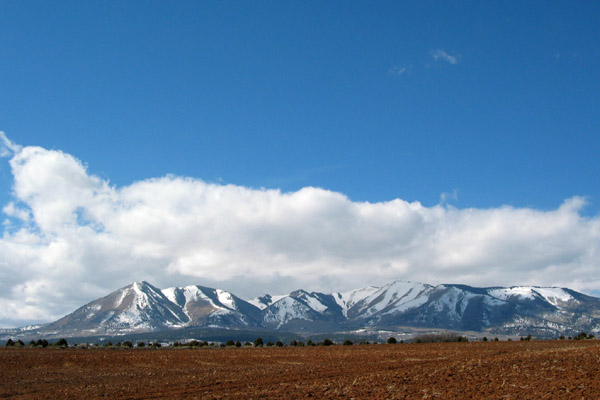
Just south of Indian Creek, the westernmost edge of the Abajo Mountains forms the eastern boundary of the Bears Ears landscape. An island laccolith series of peaks and domes known also as the Blue Mountains due to the appearance of their heavily forested slopes contrasted against the red desert that surrounds them, the Abajo Mountains are rich in wildlife and home to several rare and sensitive plant species. As a result of the breadth of species, the Abajo Mountains have long been a traditional hunting ground for the indigenous people that have lived in the area and are held sacred by a number of Tribal Nations, including the Navajo Nation, Pueblo of Zuni, and Ute Indian Tribes. These peaks represent the highest elevations in the Bears Ears landscape and provide unbroken views of the entire region.
South of Beef Basin and Indian Creek, the landscape contains a number of sandstone canyons that drain the northern edge of the Abajo Mountains and Elk Ridge, including the Tuerto, Trough, Ruin, and North Cottonwood Canyons, at the bottom of which runs a perennial creek. Ancestral Pueblo sites within this area have special significance to the Pueblos of New Mexico, who identify these sites as part of their ancestral footprints that extend their traditional territory north of the Abajo Mountains. The area, which is composed of both Cedar Mesa Sandstone and Chinle Formation deposits, has a very high potential for Permian and Triassic fossils.
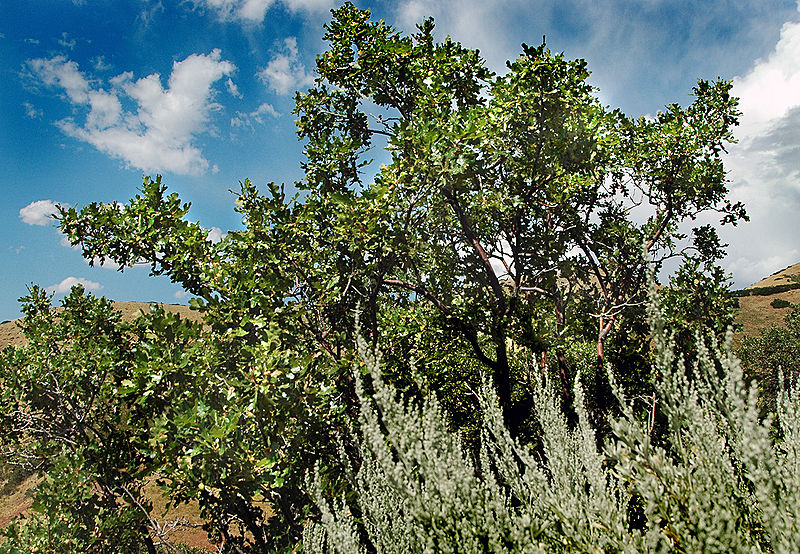
Gambel oak photo courtesy of Wikimedia.
The South Cottonwood Canyon region, characterized by prominent sandstone escarpments surrounded by forests of pinyon, juniper, and Gambel oak, interspersed with stands of ponderosa pine and mixed conifers, is situated west of the Abajo Mountains and south of the prominent sandstone towers known as the Chippean Rocks. The isolated area contains intact cultural landscapes of early Ancestral Pueblo communities. Some sites are organized as a larger central village surrounded by smaller family-sized dwellings, while others are large and inaccessible granaries. This region is home to a diversity of wildlife, including Townsend’s big-eared bats, beavers, and ringtail cats, as well as the Cliff Dwellers Pasture Research Natural Area, an ungrazed box canyon with a unique vegetative community and an imposing sandstone arch and natural bridge. The area also contains excellent big game habitat and is considered prime mule deer, elk, and black bear hunting grounds.
Further west, South Cottonwood Canyon is home to a unique density of Pueblo I to early Pueblo II village sites that are considered important to both archaeologists and Tribal Nations. One site, a collapsed two-story block masonry structure that appears to be an early version of a great house, was built during a time when the development of this kind of community structure was only beginning in Chaco Canyon. More recently, the South Cottonwood Canyon area proved critical to the survival of the White Mesa Ute during Anglo settlement of southern Utah. Paleontologically, there is high potential fossil yield on both the west side of the area, which contains portions of the Triassic Period Chinle and Moenkopi Formations, and the east side, which is composed of Jurassic Period Glen Canyon Group Kayenta Formation. The area also provides critical habitat for Mexican spotted owls, peregrine falcons, golden eagles, and spotted bats.
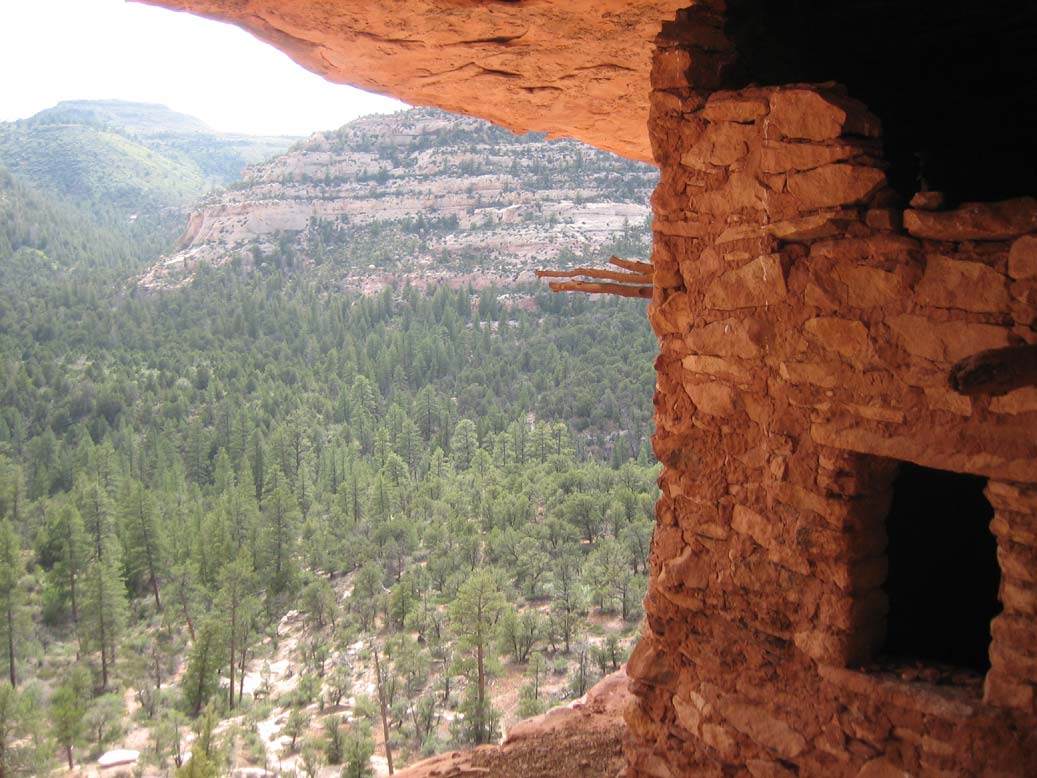
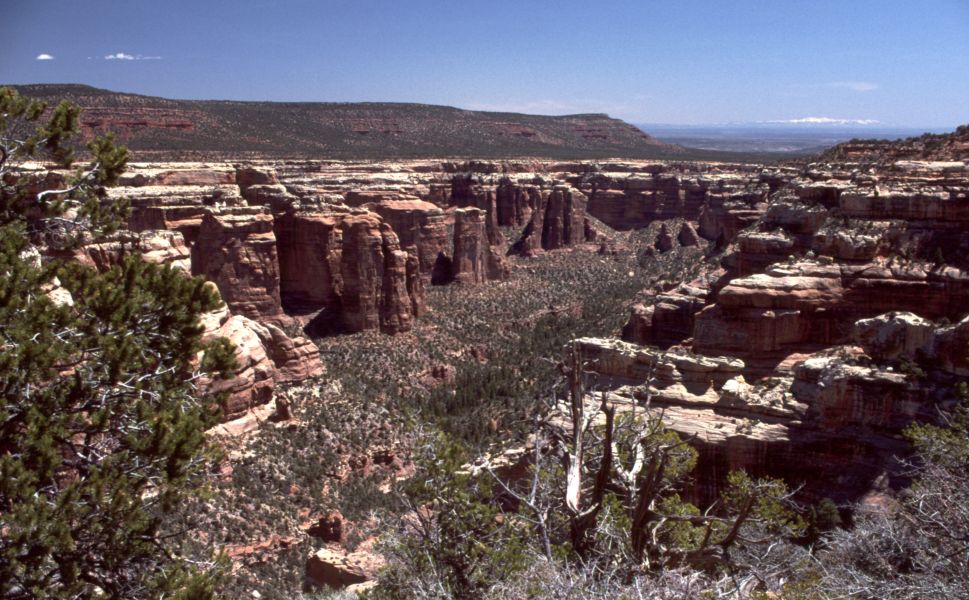
The Dark Canyon, Dry Mesa complex, located between Beef Basin and White Canyon, is wild and remote. In Dark Canyon — a canyon system that includes Peavine, Woodenshoe, and other minor tributaries — rock walls, which tower 3,000 feet above the canyon floor, provide a sense of solitude and isolation from the surrounding mesa tops. The canyon system, one of the only entirely intact and protected canyons from its headwaters on the Colorado Plateau to its confluence with the Colorado River, includes numerous hanging gardens, springs, and riparian areas and provides habitat for a wide range of wildlife, including known populations of Mexican spotted owl. Dry Mesa is relatively flat with stands of ponderosa pine, oak, and pinyon and juniper that provide foraging habitat for golden eagles and peregrine falcons. Many Tribal Nations have strong connections to sites in the area from three specific time periods: ancient hunter-gatherers during the Archaic period, Ancestral Pueblos during the Pueblo III period, and finally, Navajo, Ute, and Paiute families just before and during European migration into the Four Corners area. Visitors to the Dark Canyon Wilderness area will find the Doll House, a fully-intact and well-preserved single-room granary. Located at the bottom of Horse Pasture Canyon and Dark Canyon, visitors will also find Scorup Cabin, a line cabin originally built in Rig Canyon and later moved to its current location, that cowboys used as a summer camp while running cattle in the area. The area also contains exposures of Permian Period Cutler Group deposits that have a high potential to contain both vertebrate and invertebrate fossils.
Utah’s White Canyon. Photo credit: SUWA
Utah’s White Canyon makes a gorgeous, serpentine cut through Cedar Mesa, near Glen Canyon National Recreation Area. But it remains unprotected. It lies at the heart of the proposed Glen Canyon Wilderness, where the vast expanse of Paleozoic-era sandstone known as Nokai Dome eases its way to the upper reaches of Lake Powell in the Glen Canyon National Recreation Area. This region also includes the soaring Wingate Cliffs of the Red Rock Plateau, Mancos Mesa, Moqui Canyon with its meandering stream, Red Canyon, and the serpentine side canyons of White Canyon. This is one of the most remote regions of the state, but it lacks protection and is threatened by increasing ORV use.
It is all part of the San Juan-Canyonlands region of Southeastern Utah, one of the most iconic landscapes recommended for protection in America’s Red Rock Wilderness Act, boasting dramatic geologic features wrought by elemental forces, as well as internationally significant cultural sites of the Ancestral Puebloans and the Mormon Pioneers. Adorned with buttes and arches, vast stretches of slickrock deposited over 250 million years ago, ancient pinyon-juniper forests and an artist’s pallet of red-hued sandstone, the San Juan-Canyonlands region has inspired explorers since the days of John Wesley Powell, and its wonders represent some of the greatest unprotected wilderness in the country.[/caption]
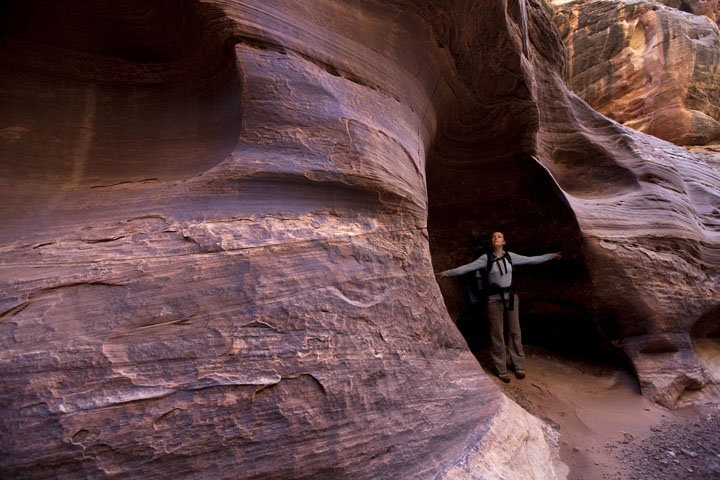
The White Canyon region, west of Dark Canyon, is a remote area featuring an extensive complex of steep and narrow canyons cut through light-colored Cedar Mesa Sandstone. Once used by outlaws to evade authorities, the area’s slot canyons, including the Black Hole, Fry Canyon, and Cheesebox Canyon, now draw adventurers in search of multi-day, technical canyoneering opportunities. The entire White Canyon area has a rich paleontological history. Research in the area is ongoing, but recent discoveries of track sites in the Triassic Moenkopi Formation and an assemblage of invertebrate burrows suggest that a diverse fauna once thrived here. Mollusks, phytosaurs, and possible theropod and ornithischian fossils have also been found in White Canyon.
Elk Ridge, Utah. Photo credit: Tim Peterson via the Bears Ears Inter-Tribal Coalition
Located between the Abajo Mountains and the Colorado River, the high plateau of Elk Ridge provides stunning views of the surrounding canyons and the Bears Ears Buttes to the south. Visitors passing through the Notch, a naturally occurring narrow pass between north and south Elk Ridge, are treated to spectacular vistas of Dark Canyon to the west and Notch Canyon to the east. The area’s higher elevations, which contain pockets of ancient Engelmann spruce, rare stands of old-growth ponderosa pine, aspen, and subalpine fir, and a genetically distinct population of Kachina daisy, provide welcome respite from the higher temperatures found in the region’s lower elevations, especially during the summer. There is evidence that indigenous people have hunted and gathered plants on Elk Ridge for at least 8,000 years, a practice that continues today and is considered sacred by the Navajo Nation. Elk Ridge also has a long history of livestock grazing by Navajo and Ute families and later Anglo settlers. While the mesa top is primarily dry, water naturally occurs at the area’s seeps and springs, as well as the ephemeral Duck Lake, a seasonal wetland located on top of Elk Ridge that results from snowmelt. The upper reaches of the ridge also contain Upper Triassic formations with a high potential to contain fossils.
Texas Canyon, Utah, looking southeast towards Arch Canyon and Comb Wash. G. Thomas at English Wikipedia, Public domain, via Wikimedia Commons
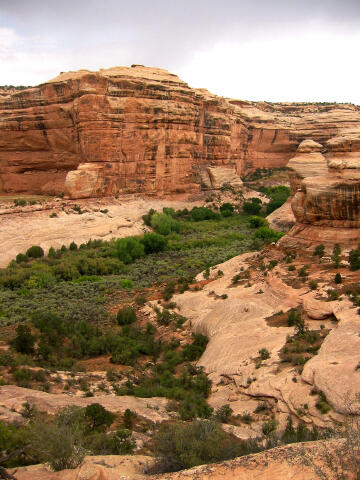
To the east of Elk Ridge lies a major system of canyons on National Forest System lands, including Hammond Canyon, Upper Arch Canyon, Texas Canyon, and Notch Canyon. This deeply incised canyon system is composed of stunning red sandstone walls, white pinnacles, lush green foliage, and several small waterfalls. Uniquely, the area also contains large sandstone towers and hoodoos in a forested setting. The Hammond Canyon area, which is central to the history of the White Mesa Utes, contains numerous Ancestral Pueblo sites, including cliff dwellings. Hammond Canyon also contains an Ancestral Pueblo village with structures and pottery from multiple Ancestral Pueblo periods. High fossil potential exists in both the Upper Triassic and Lower Jurassic Glen Canyon Sandstone of Hammond Canyon’s lower half as well as the Permian Period Cedar Mesa Sandstone found in its upper half.
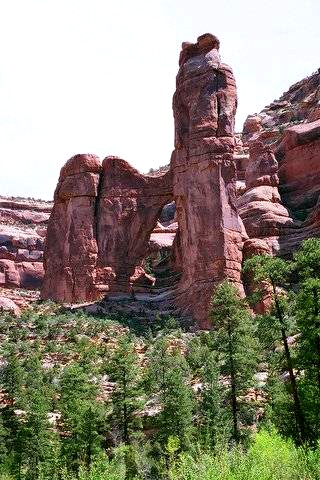
Ange Arch. This arch is located in Arch Canyon off Utah Rt. 95, the Bi-Centennial Highway. The opening has a height of 110 ft. and a span of 40 feet. Photo by Dr. Allen Crockett
Just south of Elk Ridge, Arch Canyon is a 12-mile long box canyon containing numerous arches, including Cathedral Arch, Angel Arch, and Keystone Arch. The area is teeming with fossilized remains, including numerous specimens from the Permian and Upper Permian eras. Cliff dwellings and hanging gardens are located throughout the canyon. Arch Canyon Great House, which spans the Pueblo II and III periods and contains pictographs and petroglyphs ranging from the Archaic to the historic periods, is located at the canyon’s mouth. A perennial stream that provides potential habitat for sensitive fish species and for the threatened Navajo sedge is located in the canyon’s bottom.
Mule Canyon. Photo credit: Utah.com
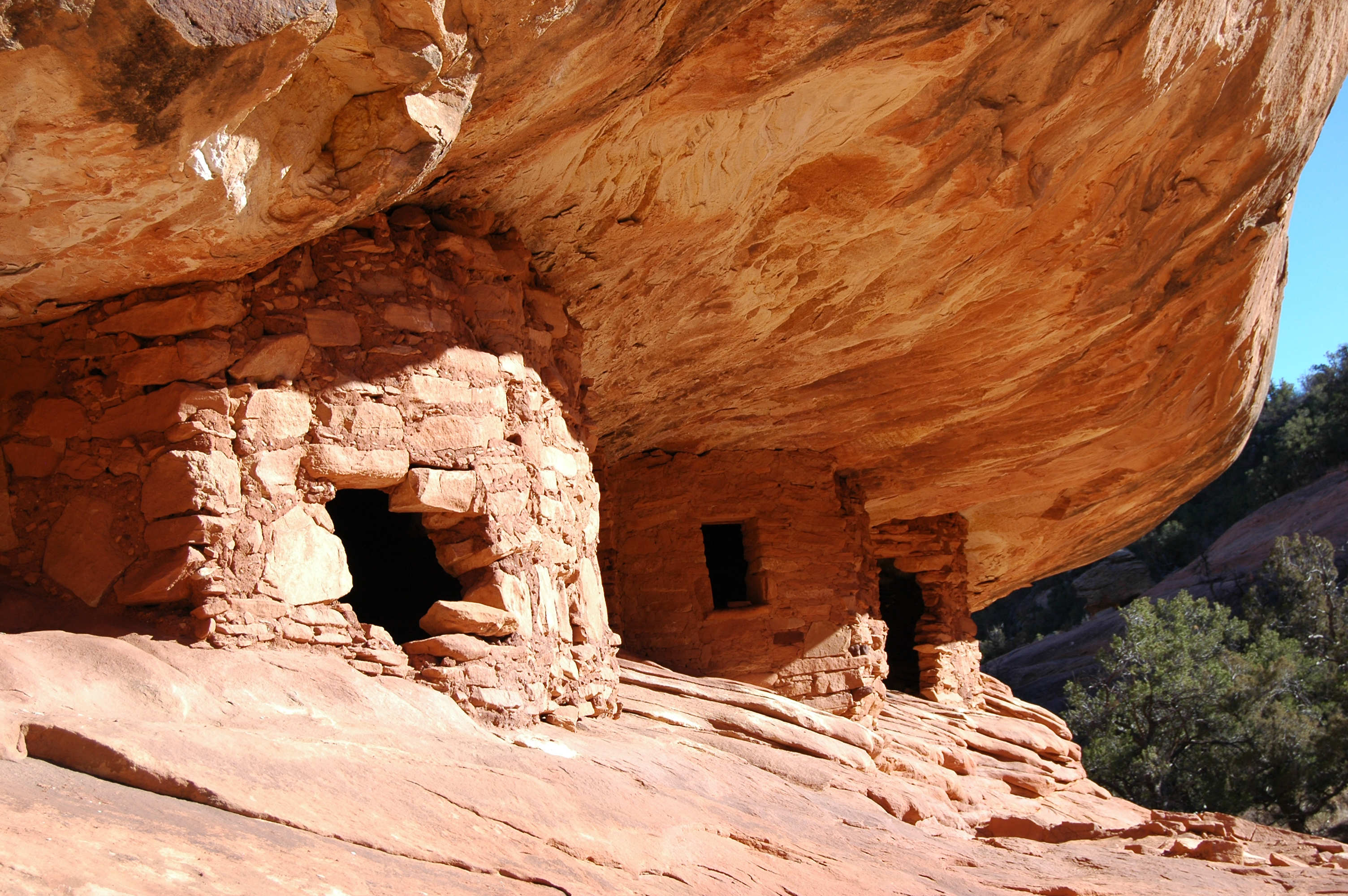
Mule Canyon, a 500-foot deep, 5-mile long chasm, is situated northeast of the Fish Creek area and southeast of the Bears Ears Buttes. Throughout the canyon, cliff dwellings and other archaeological sites are sheltered by rock walls composed of alternating layers of red and white sandstone. Among those are the stunning House on Fire, which has different masonry styles that indicate several episodes of construction and use. The area’s rich archaeological history is also evidenced on the nearby tablelands, where the Mule Canyon Village site allows visitors to view the exposed masonry walls of ancient living quarters and a partially restored kiva. Recent research suggests that Ancestral Pueblos in this area may have cultivated a variety of plants that are uncommon across the wider landscape and persist to this day, such as the Four Corners potato, goosefoot, wolfberry, and sumac. Although similar cultivation may have been occurring near Ancestral Pueblo sites across the Bears Ears landscape, it appears to have been particularly prevalent in and around the Mule, South Cottonwood, Dry, Arch, and Owl Canyons.
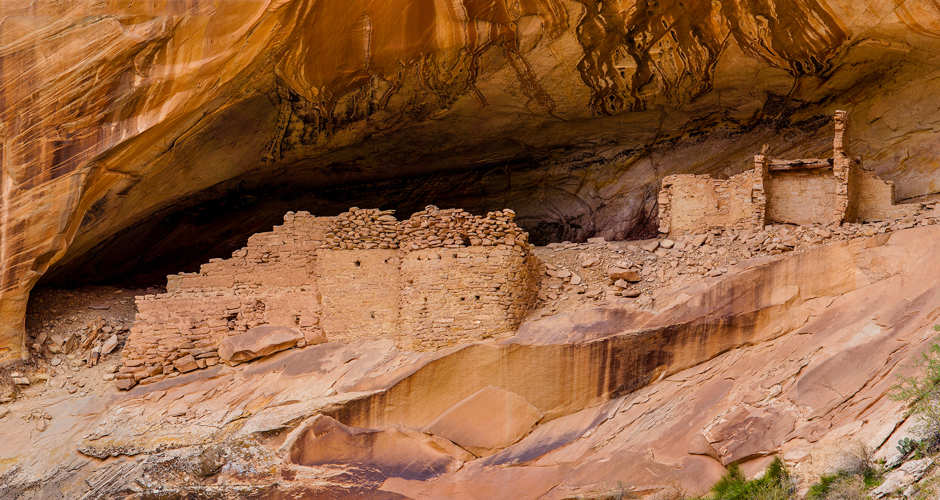
Tilted at almost 20 degrees and running along a north-south axis from the foothills of the Abajo Mountains, past the San Juan River, and onto the Navajo Nation, the serrated cliffs of the Comb Ridge monocline are visible from space and have both spiritual and practical significance to many Tribal Nations. It is in this area that one can find a series of alcoves in Whiskers Draw that have sheltered evidence of human habitation for thousands of years, including the site where Richard Wetherill first identified what we know today as the Basketmaker people, as well as Milk Ranch Point, where early Ancestral Pueblo farmers found refuge when the climate turned hotter and dryer at lower elevations. Comb Ridge, flanked on the west by Comb Wash and on the east by Butler Wash, holds additional evidence of centuries of human habitation, including cliff dwellings, such as the well-known Butler Wash Village and Monarch Cave, kivas, ceremonial sites, and rock writings, like the Procession Panel, Wolfman Panel, and Lower Butler Wash Panel, a wall-sized mural depicting San Juan Anthropomorph figures dating to the Basketmaker period that is considered important for understanding the daily life and rituals of the Basketmaker people. Chacoan roads as well as the handholds and steps carved into cliff faces found in this area formed part of the region’s migration system and are integral to the story of the Bears Ears landscape. The Comb Ridge area also contains a rich paleontological history, including an Upper Triassic microvertebrate site with greater taxonomic diversity than any other published site of the same nature in Utah, and the earliest recorded instance of a giant arthropod trackway in Utah. Paleontologists have also found phytosaur and dinosaur fossils from the Triassic Period and have identified new species of plant-eating crocodile-like reptiles and rich bonebeds of lumbering sauropods in the area.
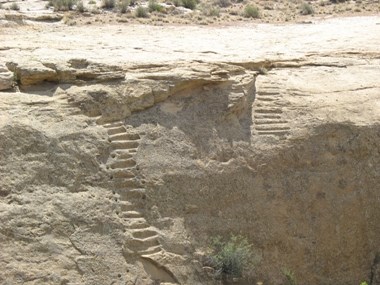
Jackson Stairway. Photo credit: NPS.com
South Cottonwood Wash is an extensive drainage just east of Comb Ridge that extends from the Abajo Mountains to the San Juan River near Bluff, Utah. The drainage contains at least three great houses as well as a number of alcove sites, and it has a high density of petroglyphs and pictographs, including a cave with more than 200 handprints in a variety of colors. There is also evidence of a Chacoan road that connected multiple great houses and kiva sites. These prehistoric transportation systems in the Bears Ears region are critical to understanding the trading patterns, economy, and social organization of ancient Pueblo communities and the other major cultural centers with whom they interacted, such as Chaco Canyon.
Late afternoon light flows across the desert in Valley of the Gods, near Bluff, Utah. By John Fowler from Placitas, NM, USA – Valley of the GodsUploaded by PDTillman, CC BY 2.0, https://commons.wikimedia.org/w/index.php?curid=19730031
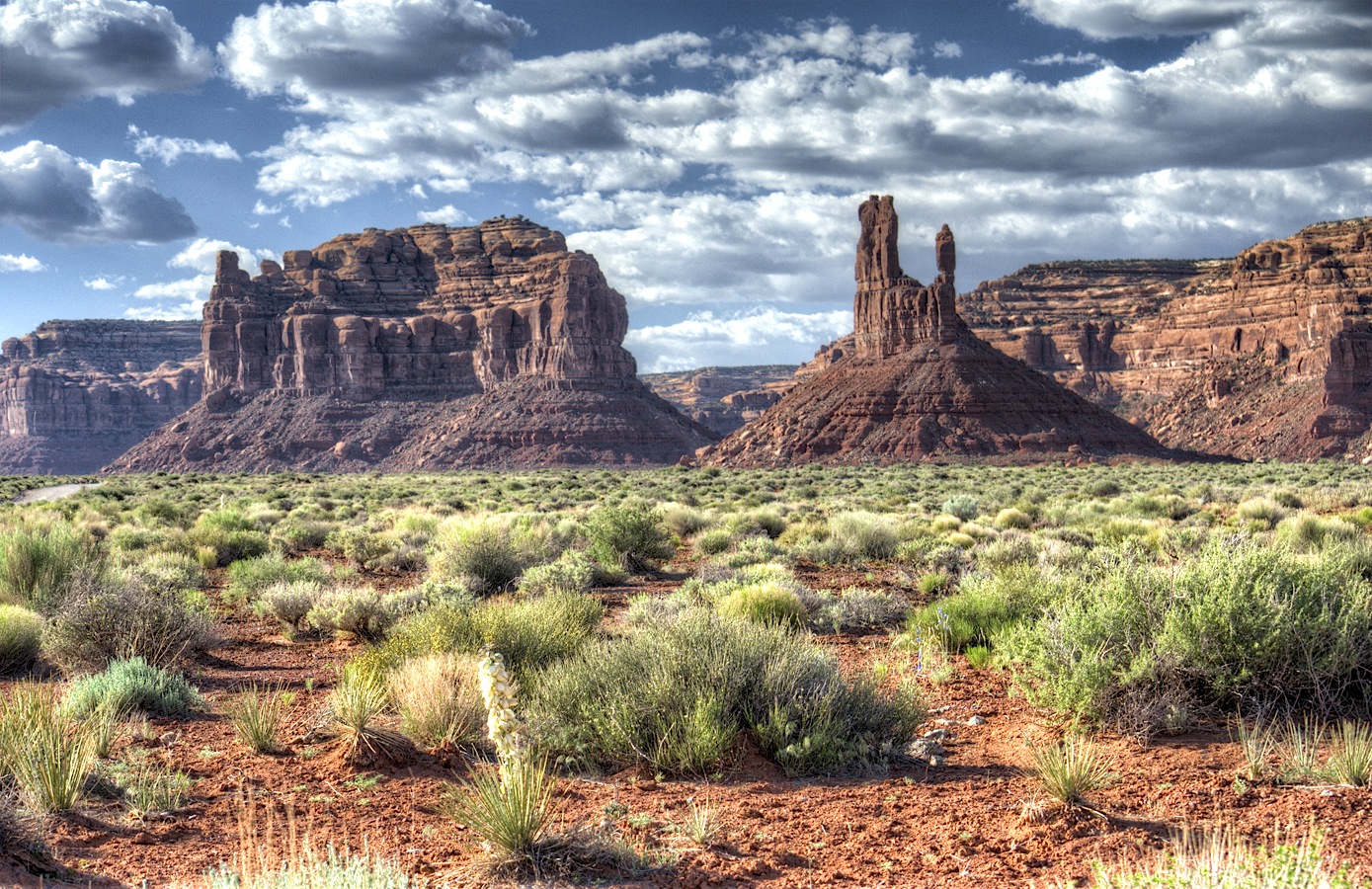
At the far southern end of the Bears Ears landscape lies Valley of the Gods, a broad expanse of sandstone monoliths, pinnacles, and other geological features of historic and scientific interest. Towering spires of red sandstone that rise from the valley floor are held sacred by the Navajo people, who view the formations as ancient warriors frozen in stone and places of power in which spirits reside. The austere valley, which is noteworthy in both its geology and ecology, provides habitat for Eucosma navajoensis, an endemic moth that lives nowhere else. The Mars-like landscape also contains evidence of our own planet’s distant past, including early tetrapod trackways, Paleozoic freshwater sharks, ray-finned fishes, lobe-finned fishes, giant primitive amphibians, and multiple unique taxa of mammal-like reptiles. Paleontologists have also uncovered notable plant macrofossils including ancestral conifers, giant horsetail-like plants, ferns the size of trees, and lycopsids (similar to modern clubmoss).
Swim class on the San Juan River. Photo: Brent Gardner-Smith/Aspen Journalism
The San Juan River forms the southern boundary of the Bears Ears landscape. One of the four sacred rivers that Tribal Nations believe were established by the gods to act as defensive guardians over their ancestral lands, the river is closely tied to traditional stories of creation, danger, protection, and healing. The Lime Ridge Clovis site demonstrates that the history of human occupation within the river corridor dates back at least 13,000 years. The Sand Island Petroglyph Panel presents petroglyphs primarily from the Basketmaker through the Pueblo III periods as well as more modern Navajo and Ute carvings. There are also a number of Ancestral Pueblo structures that are accessible by river, such as River House. Nearby San Juan Hill was the last major obstacle for the Hole-in-the-Rock expedition and presents visible evidence of the weary expedition’s effort to cross Comb Ridge, including parts of a road, wagon ruts, and an inscription at the top of the ridge. The river corridor also contains a number of unique geologic formations, such as the well-known balancing rock at Mexican Hat, and provides important habitat for the threatened yellow-billed cuckoo and the endangered southwestern willow flycatcher. The river itself is home to two endangered fish species: Colorado pikeminnow, the largest minnow in North America, which is believed to have evolved more than 3 million years ago, and the razorback sucker, the only member of its genus.
Cedar Mesa. Photo credit: Utah.com
Cedar Mesa is located in the heart of the Bears Ears landscape, west of Comb Ridge and north of the San Juan River. Ranging from approximately 4,000 to 6,500 feet in elevation, the approximately 400-square mile plateau is of deep significance to Tribal Nations. Characterized by pinyon-juniper forests on the mesa tops and canyons along its periphery, the entirety of Cedar Mesa is an object of scientific and historic interest, providing a broader context for the individual resources found there. It is the density of world-class cultural resources found throughout the remote, sloping plateau and its numerous canyons that make Cedar Mesa truly unique. For example, an open-twined yucca fiber sandal believed to be more than 7,000 years old was discovered in a dry shelter located in a narrow slickrock canyon in Cedar Mesa. Moon House is an example of iconic Pueblo-decorated architecture and was likely the last occupied site on Cedar Mesa. On the top of the plateau, Chacoan roads connect several Ancestral Pueblo great houses that show architectural influence from the Chaco Canyon region as well as ceramics that demonstrate both historic and modern Pueblo connections. And in the heart of Cedar Mesa, a multi-room, multi-story great house contains kivas with distinctive Chacoan features that are much larger than kivas found elsewhere on Cedar Mesa. Today, Cedar Mesa is home to bighorn sheep, but fossil evidence in the area’s sandstone has revealed large, mammal-like reptiles that burrowed into the sand to survive the blistering heat of the end of the Permian Period, when the region was dominated by a seaside desert. Later, during the Upper Triassic Period, seasonal monsoons flooded an ancient river system that fed a vast desert here. Salvation Knoll, a point from which lost Latter-day Saint pioneers were able to obtain their bearings on Christmas Day in 1879, is also located in the area.
Cedar Mesa is striated with deep chasms housing remarkably intact Ancestral Pueblo sites. John’s Canyon and Slickhorn Canyon, which empty into the San Juan River in the Glen Canyon National Recreation Area to the south, contain numerous petroglyphs, pictographs, and Ancestral Pueblo structures built into elongated alcoves on buff-colored cliffs. Similarly, the canyons on the east side of Cedar Mesa hold a significant density of archaeological sites providing a glimpse into the region’s past, including rock writings and Ancestral Pueblo dwellings. The Citadel cliff dwelling is just one example of the striking Ancestral Pueblo sites located in Road Canyon, while other sites include painted handprints and evidence of daily life left by Ancestral Pueblos. Located to the north of Road Canyon, the Fish Canyon area contains a number of Pueblo structures. The Fish Canyon area also contains one of the few perennial streams in the area and an important potential habitat for the Mexican spotted owl. Finally, the rust-colored, 145‑foot span of Nevills Arch awaits those who make the challenging trek down Owl Canyon. Opening to a height of 80 feet and named after Norman Nevills, the first boatman to take paying customers on the Colorado River through the Grand Canyon, the arch creates a striking window to the sky on the upper reaches of the canyon walls.
Upper Grand Gulch. Photo credit: ClimbUtah.com
Grand Gulch, a mostly dry canyon that meanders for nearly 50 miles on the western edge of Cedar Mesa and is replete with thousands of cliff dwellings and rock writing sites, likely contains the highest concentration of Ancestral Pueblo sites on the Colorado Plateau. Initially occupied in the Basketmaker II and III periods, Grand Gulch’s initial inhabitants left pictographs and constructed shallow pithouses and camps on the mesa top and dry shelters for storage. One pictograph dating from this time period depicting two large, anthropomorphic figures is of special religious significance to Tribal Nations. Grand Gulch also contains a multitude of Pueblo II to III sites and was one of the first prehistoric national historic districts designated on the National Register of Historic Places. The area contains the Turkey Pen site, which is believed to provide some of the earliest evidence of turkey domestication in North America, a pristine kiva in a remote canyon bend, and countless other unique Pueblo structures, such as Junction Village, a large Pueblo habitation site; Split Level Village, a multi-level Pueblo habitation; and Bannister House, a habitation consisting of two relatively intact structures and a spring at the base of the cliff face. Grand Gulch also contains unique artifacts, such as a tattoo needle, a site containing a multichromatic pictograph of a mask, important historic archaeological inscriptions from the Wetherill expedition, and a multitude of other rock writings.
Kane Gulch is a tributary canyon of Grand Gulch incised through Cedar Mesa Sandstone and clogged with house-sized boulders. The canyon houses an aspen grove — an uncommon occurrence at such elevations in the desert — and contains a number of archaeological sites that are perched on canyon walls high above cottonwood trees that provide welcomed shade to the riparian areas in the canyon bottom. Nearby, Bullet Canyon, which intersects with the upper reaches of Grand Gulch, also holds numerous structures, petroglyphs, pictographs, and other artifacts, such as the well-preserved Perfect Kiva — a partly restored kiva, accompanied by several rooms and other smaller structures.
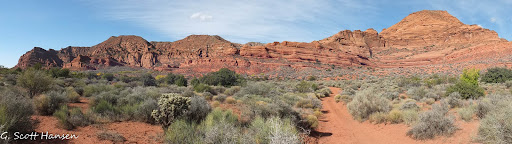
The Red Cliffs area. Photo credit: G. Scott Hansen
To the west of Cedar Mesa, the Clay Hills, Red House Cliffs, and Mike’s Canyon form the southwest corner of the Bears Ears landscape. This remote and rarely visited area remains largely unstudied by scientists. Tool- and arrowhead-making sites, dwellings, and granaries in the lower reaches of the canyons indicate that they sustained Archaic, Basketmaker, and Ancestral Pueblo cultures. The area’s unforgiving topography, composed of expansive stretches of slickrock periodically interrupted by deep canyons, challenged Latter-day Saint settlers that traveled along the Hole-in-the-Rock Trail and left wheel ruts and other traces of pioneer life. The harsh ecosystem still supports a herd of desert bighorn sheep throughout the year, and in the canyon bottoms, including Mike’s Canyon, intrepid beavers can be found in small areas of riparian habitat. The Clay Hills area contains the first discovery of vertebrate fossils from the Bears Ears region, which was also the first occurrence of a phytosaur identified in Utah.
White Canyon is a canyon in San Juan County, Utah notable for Ancestral Puebloan cliff dwellings and slot canyons. It is spanned by Sipapu Bridge, one of the largest natural bridges in the world. The canyon begins in the foothills of the Abajo Mountains and passes through Natural Bridges National Monument before emptying into Lake Powell or, if lake levels are low, the Dirty Devil River. Utah State Route 95 parallels the inner gorge of the canyon for much of its length. One particularly deep and narrow section of White Canyon is known as the Black Hole. The walls in this permanently flooded 500-foot (150 m) long section are only a few feet (about 1 m) apart in some places. Canyoneers sometimes wear wetsuits to guard against hypothermia while traversing this section. The danger of flash flooding is very high due to the canyon’s large drainage basin. A 16-year-old girl drowned in a flash flood while hiking in the Black Hole area in September 1996. Ken Lund from Reno, Nevada, USA, CC BY-SA 2.0 , via Wikimedia Commons
Standing alone west of Cedar Mesa and adjacent to the Glen Canyon National Recreation Area, Mancos Mesa is likely the largest isolated slickrock mesa in southern Utah. Covering approximately 180 square miles, Mancos Mesa’s roughly triangular shape is bounded by towering cliffs, some reaching more than 1,000 feet high. The entire area is dominated by Navajo Sandstone and is incised with canyons, including Moqui Canyon, a 20-mile canyon with sheer walls rising over 600 feet. The mesa, an ecological island in the sky, contains a relict plant community that supports Native perennial grasses, shrubs, and some cacti. Mancos Mesa also contains archaeological remains dating back 2,000 years and spanning across the Basketmaker II and III and Pueblo I, II, and III periods.
Protection of the Bears Ears area will preserve its spiritual, cultural, prehistoric, and historic legacy and maintain its diverse array of natural and scientific resources, ensuring that the prehistoric, historic, and scientific values of this area remain for the benefit of all Americans. For more than 100 years, and sometimes predating the enactment of the Antiquities Act, Presidents, Members of Congress, Secretaries of the Interior, Tribal Nations, State and local governments, scientists, and local conservationists have understood and championed the need to protect the Bears Ears area. The area contains numerous objects of historic and scientific interest and also includes other resources that contribute to the social and economic well-being of the area’s modern communities as a result of world-class outdoor recreation opportunities, including unparalleled rock climbing available at places like the canyons in Indian Creek; the paradise for hikers, birders, and horseback riders provided in areas like the canyons east of Elk Ridge; and other destinations for hunting, backpacking, canyoneering, whitewater rafting, and mountain biking, that are important to the increasing travel- and tourism-based economy in the region.
WHEREAS, section 320301 of title 54, United States Code (known as the “Antiquities Act”), authorizes the President, in his discretion, to declare by public proclamation historic landmarks, historic and prehistoric structures, and other objects of historic or scientific interest that are situated upon the lands owned or controlled by the Federal Government to be national monuments, and to reserve as a part thereof parcels of land, the limits of which shall be confined to the smallest area compatible with the proper care and management of the objects to be protected; and
WHEREAS, Proclamation 9558 of December 28, 2016, designated the Bears Ears National Monument in the State of Utah and reserved approximately 1.35 million acres of Federal lands as the smallest area compatible with the proper care and management of the objects of historic and scientific interest declared part of the monument; and
WHEREAS, Proclamation 9681 of December 4, 2017, modified the management direction of the Bears Ears National Monument and modified the boundaries to add approximately 11,200 new acres of Federal lands, and the objects of historic and scientific interest contained therein, and to exclude more than 1.1 million acres of Federal lands from the reservation, including lands containing objects of historic and scientific interest identified as needing protection in Proclamation 9558, such as Valley of the Gods, Hideout Canyon, portions of the San Juan River and Abajo Mountains, genetically distinct populations of Kachina daisy, and the Eucosma navajoensis moth; and
WHEREAS, December 4, 2017, was the first time that a President asserted that the Antiquities Act included the authority to reduce the boundaries of a national monument or remove objects from protection under the Antiquities Act since passage of the Federal Land Policy and Management Act of 1976, as amended (43 U.S.C. 1701 et seq.); and
WHEREAS, the entire Bears Ears landscape is profoundly sacred to sovereign Tribal Nations and indigenous people of the southwest region of the United States; and
WHEREAS, I find that the unique nature of the Bears Ears landscape, and the collection of objects and resources therein, make the entire landscape within the boundaries reserved by this proclamation an object of historic and scientific interest in need of protection under 54 U.S.C. 320301; and
WHEREAS, I find that all the historic and scientific resources identified above and in Proclamation 9558 are objects of historic or scientific interest in need of protection under 54 U.S.C. 320301; and
WHEREAS, I find that there are threats to the objects identified in this proclamation; and
WHEREAS, I find, in the absence of a reservation under the Antiquities Act, the objects identified in this proclamation and in Proclamation 9558 are not adequately protected by otherwise applicable law or administrative designations because neither provide Federal agencies with the specific mandate to ensure proper care and management of the objects, nor do they withdraw the lands from the operation of the public land, mining, and mineral leasing laws; thus a national monument reservation is necessary to protect the objects of historic and scientific interest in the Bears Ears region for current and future generations; and
WHEREAS, I find that the boundaries of the monument reserved by this proclamation represent the smallest area compatible with the protection of the objects of scientific or historic interest as required by the Antiquities Act; and
WHEREAS, it is in the public interest to ensure the preservation, restoration, and protection of the objects of scientific and historic interest on the Bears Ears region, including the entire monument landscape, reserved within the boundaries of the Bears Ears National Monument, as established by this proclamation;
NOW, THEREFORE, I, JOSEPH R. BIDEN JR., President of the United States of America, by the authority vested in me by section 320301 of title 54, United States Code, hereby proclaim the objects identified above and in Proclamation 9558 that are situated upon lands and interests in lands owned or controlled by the Federal Government to be the Bears Ears National Monument (monument) and, for the purpose of protecting those objects, reserve as part thereof all lands and interests in lands not currently reserved as part of a monument reservation and that are owned or controlled by the Federal Government within the boundaries described on the accompanying map, which is attached to and forms a part of this proclamation. These reserved Federal lands and interests in lands consist of those lands reserved as part of the Bears Ears National Monument as of December 3, 2017, and the approximately 11,200 acres added by Proclamation 9681, encompassing approximately 1.36 million acres. As a result of the distribution of the objects across the Bears Ears landscape, and additionally and independently, because the landscape itself is an object in need of protection, the boundaries described on the accompanying map are confined to the smallest area compatible with the proper care and management of the objects of historic or scientific interest identified above and in Proclamation 9558.
All Federal lands and interests in lands within the boundaries of the monument are hereby appropriated and withdrawn from all forms of entry, location, selection, sale, or other disposition under the public land laws or laws applicable to the United States Forest Service (USFS), from location, entry, and patent under the mining laws, and from disposition under all laws relating to mineral and geothermal leasing, other than by exchange that furthers the protective purposes of the monument.
This proclamation is subject to valid existing rights. If the Federal Government subsequently acquires any lands or interests in lands not currently owned or controlled by the Federal Government within the boundaries described on the accompanying map, such lands and interests in lands shall be reserved as a part of the monument, and objects identified above that are situated upon those lands and interests in lands shall be part of the monument, upon acquisition of ownership or control by the Federal Government.
The Secretary of Agriculture and the Secretary of the Interior (Secretaries) shall manage the monument through the USFS and the Bureau of Land Management (BLM), respectively, in accordance with the terms, conditions, and management direction provided by this proclamation and, unless otherwise specifically provided herein, those provided by Proclamation 9558, the latter of which are incorporated herein by reference. The USFS shall manage that portion of the monument within the boundaries of the National Forest System (NFS), and the BLM shall manage the remainder of the monument. The lands administered by the USFS shall be managed as part of the Manti-La Sal National Forest. The lands administered by the BLM shall be managed as a unit of the National Landscape Conservation System. To the extent any provision of Proclamation 9681 is inconsistent with this proclamation or Proclamation 9558, the terms of this proclamation and Proclamation 9558 shall govern. To further the orderly management of monument lands, the monument will be jointly managed as a single unit consisting of the entire 1.36 million-acre monument.
For purposes of protecting and restoring the objects identified above and in Proclamation 9558, the Secretaries shall jointly prepare and maintain a new management plan for the entire monument and shall promulgate such regulations for its management as they deem appropriate. The Secretaries, through the USFS and BLM, shall consult with other Federal land management agencies or agency components in the local area, including the National Park Service, in developing the management plan. In promulgating any management rules and regulations governing the NFS lands within the monument and developing the management plan, the Secretary of Agriculture, through the USFS, shall consult with the Secretary of the Interior, through the BLM. The Secretaries shall provide for maximum public involvement in the development of that plan, including consultation with federally recognized Tribes and State and local governments. In the development and implementation of the management plan, the Secretaries shall maximize opportunities, pursuant to applicable legal authorities, for shared resources, operational efficiency, and cooperation.
In recognition of the importance of knowledge of Tribal Nations about these lands and objects and participation in the care and management of the objects identified above, and to ensure that management decisions affecting the monument reflect expertise and traditional and historical knowledge of Tribal Nations, a Bears Ears Commission (Commission) is reestablished in accordance with the terms, conditions, and obligations set forth in Proclamation 9558 to provide guidance and recommendations on the development and implementation of management plans and on management of the entire monument.
To further the protective purposes of the monument, the Secretary of the Interior shall explore entering into a memorandum of understanding with the State of Utah that would set forth terms, pursuant to applicable laws and regulations, for an exchange of land owned by the State of Utah and administered by the Utah School and Institutional Trust Lands Administration within the boundary of the monument for land of approximately equal value managed by the BLM outside the boundary of the monument. Consolidation of lands within the monument boundary through exchange in this manner provides for the orderly management of public lands and is in the public interest.
The Secretaries shall manage livestock grazing as authorized under existing permits or leases, and subject to appropriate terms and conditions in accordance with existing laws and regulations, consistent with the care and management of the objects identified above and in Proclamation 9558. Should grazing permits or leases be voluntarily relinquished by existing holders, the Secretaries shall retire from livestock grazing the lands covered by such permits or leases pursuant to the processes of applicable law. Forage shall not be reallocated for livestock grazing purposes unless the Secretaries specifically find that such reallocation will advance the purposes of this proclamation and Proclamation 9558.
Nothing in this proclamation shall be deemed to revoke any existing withdrawal, reservation, or appropriation; however, the monument shall be the dominant reservation.
Warning is hereby given to all unauthorized persons not to appropriate, injure, destroy, or remove any feature of the monument and not to locate or settle upon any of the lands thereof.
If any provision of this proclamation, including its application to a particular parcel of land, is held to be invalid, the remainder of this proclamation and its application to other parcels of land shall not be affected thereby.
IN WITNESS WHEREOF, I have hereunto set my hand this eighth day of October, in the year of our Lord two thousand twenty-one, and of the Independence of the United States of America the two hundred and forty-sixth.
There’s 30% less water in the Colorado River than in the 1920’s and that trend is expected to continue according to the Colorado River District. General Manager for the CRD, Andy Mueller says, “We face a moment in time here that presents unprecedented challenges on the Colorado River.”
Record breaking temperatures, extreme drought conditions, and lowered streamflow were just some of the impacts discussed at the annual water seminar called, Wake-up Call on the Colorado River. “We’ve all got to work together to reduce our consumptive use to preserve the quality of life here in Western Colorado,” said Mueller.
72% of voters passed the river district tax hike generating $4.2 million dollars to fund projects to protect Western Slope water, but the best solution may simply be conservation. Mueller says, “Not necessarily how much you take from the river, but how much you take and never return.”
[…]
This unique water seminar comes at the end of a peculiar water year, but in order to adapt to a new future it’s going to take teamwork. State Representative Soper says, “I think it’s very important that we look at everything and that we try and protect as much of water here on the Western Slope as possible. Because if there’s one thing we’re caught between, it’s greedy front range interests and greedy downstream interests who would all like to use more than their fair share.”
With big spending bills on the horizon, Congress needs to prioritize water security for people and birds.
As Congress considers several major pieces of legislation to address urgent needs in the United States, Audubon’s Western Water team is keeping a close eye on funds to address the unprecedented drought emergency in the West. Congress should use all available options to invest in immediate and long-term solutions to mitigate current disasters and enhance the climate resilience of states affected by historic drought conditions.
In the West, snowpack has been at historic lows, and the major reservoirs that supply drinking water for 40 million people along the Colorado River are now less than half-full. This summer, more than 93% of the western United States has experienced drought conditions.
2021 has brought yet another year of record-breaking climate extremes. The Colorado River’s two largest reservoirs—Lake Mead and Lake Powell—are at their lowest levels ever. So is Great Salt Lake. The Rio Grande, Salton Sea, Klamath River Basin, and wetlands and tributaries across the West are also struggling. Because of the dire situation on the Colorado River, the Bureau of Reclamation announced that 2022 will bring unprecedented water shortages to Arizona, Nevada and the Republic of Mexico.
The ongoing drought crisis has been accelerated by climate change, which is the single biggest threat to birds, with more than 67% of bird species in the Americas at risk of extinction if we fail to meet our goals of reducing greenhouse gas emissions.
Currently, Congress is working to pass several important funding bills that will significantly improve our waterways and wetlands in the West—for people and birds.
Specifically, as Congress considers funding packages, Audubon is supporting the following priorities and projects that give federal agencies critically needed resources:
U.S. Bureau of Reclamation, Drought response programs and projects:
$500M for the Colorado River Drought Contingency Plan. This will address near-term risks to Lake Powell and Lake Mead in the face of significant water scarcity.
$300M for the implementation of Minute 323 to the 1944 Mexican Water Treaty, which includes funding for binational water conservation investments, development and maintenance of critical bird habitat in the Colorado River Delta.
$250 million to support the Salton Sea Projects Improvements Act to work with the State of California, local counties, tribal governments, and nonprofits to mitigate the environmental and public health crises—a result of the Sea’s receding shoreline.
$400 for WaterSMART, including $100M for natural infrastructure. WaterSMART programs provide a federal cost-share for the development of local watershed management programs; improve water delivery, efficiency, and reliability; support multi-benefit projects; and reduce conflicts over water-use in the West.
$50 million for multi-purposes watershed protection and restoration projects in the West.
$50 million for Colorado River Upper Basin Fish Recovery Implementation Plans and Endangered Species Act compliance in the Lower Colorado River Basin.
United States Geological Survey (USGS) science and monitoring:
$200 million for USGS science and monitoring. These additional resources could support programs like a federally coordinated assessment of the conservation needs across Saline (Salt) Lake Ecosystems, championed by Audubon and the development of OpenET, an online, satellite-driven water data platform.
U.S. Fish and Wildlife Service (FWS)
$150 million for the effective and efficient implementation of the National Environmental Policy Act (NEPA) and $40 million for Endangered Species Act interagency consultation. This funding will help ensure that infrastructure projects can advance efficiently while avoiding adverse environmental impacts.
$162M for Klamath River Basin and Wildlife Refuge to support infrastructure. We also encourage Congress to find additional funding to support water acquisition or invest in permanent solutions that protect fish and wildlife in Klamath. This includes a permanent bird hospital and more funding for operations and maintenance.
$25M for the Lahontan Valley and Pyramid Lake Fish and Wildlife Fund to ensure long-term availability of water at important habitats.
U.S. Department of Agriculture (USDA):
Double the amount of funding for Farm Bill voluntary, private land conservation programs (such as the Environmental Quality Incentives Program), which provide critical financial and technical assistance to help landowners protect and enhance natural spaces on their property. Funding through these programs should prioritize projects that increase bird habitat, benefit underserved farmers and ranchers, and provide carbon sequestration and increased resilience co-benefits.
More than $2B in additional funding for the U.S. Forest Service for restoration, land management, and emergency response recent wildfires.
These funds will make drought, limited water supplies, and decreasing bird habitat less dire. After this year’s catastrophic wildfires and historic drought, we urge Congress—and particularly our delegations in the West—to ensure that federal investments increase community resilience to the effects of climate change by promoting nature-based solutions for restoring watersheds and ecosystems.
In addition, Congress has several pending bills with bipartisan support that respond to the many needs of tribal communities and western states’ water supply needs that we are supporting, including access to clean water and water settlements.
An internal Facebook report found that the social media platform’s algorithms – the rules its computers follow in deciding the content that you see – enabled disinformation campaigns based in Eastern Europe to reach nearly half of all Americans in the run-up to the 2020 presidential election, according to a report in Technology Review.
The campaigns produced the most popular pages for Christian and Black American content, and overall reached 140 million U.S. users per month. Seventy-five percent of the people exposed to the content hadn’t followed any of the pages. People saw the content because Facebook’s content-recommendation system put it into their news feeds.
Social media platforms rely heavily on people’s behavior to decide on the content that you see. In particular, they watch for content that people respond to or “engage” with by liking, commenting and sharing. Troll farms, organizations that spread provocative content, exploit this by copying high-engagement content and posting it as their own.
As a computer scientist who studies the ways large numbers of people interact using technology, I understand the logic of using the wisdom of the crowds in these algorithms. I also see substantial pitfalls in how the social media companies do so in practice.
From lions on the savanna to likes on Facebook
The concept of the wisdom of crowds assumes that using signals from others’ actions, opinions and preferences as a guide will lead to sound decisions. For example, collective predictions are normally more accurate than individual ones. Collective intelligence is used to predict financial markets, sports, elections and even disease outbreaks.
Throughout millions of years of evolution, these principles have been coded into the human brain in the form of cognitive biases that come with names like familiarity, mere exposure and bandwagon effect. If everyone starts running, you should also start running; maybe someone saw a lion coming and running could save your life. You may not know why, but it’s wiser to ask questions later.
Your brain picks up clues from the environment – including your peers – and uses simple rules to quickly translate those signals into decisions: Go with the winner, follow the majority, copy your neighbor. These rules work remarkably well in typical situations because they are based on sound assumptions. For example, they assume that people often act rationally, it is unlikely that many are wrong, the past predicts the future, and so on.
Technology allows people to access signals from much larger numbers of other people, most of whom they do not know. Artificial intelligence applications make heavy use of these popularity or “engagement” signals, from selecting search engine results to recommending music and videos, and from suggesting friends to ranking posts on news feeds.
Not everything viral deserves to be
Our research shows that virtually all web technology platforms, such as social media and news recommendation systems, have a strong popularity bias. When applications are driven by cues like engagement rather than explicit search engine queries, popularity bias can lead to harmful unintended consequences.
Social media like Facebook, Instagram, Twitter, YouTube and TikTok rely heavily on AI algorithms to rank and recommend content. These algorithms take as input what you like, comment on and share – in other words, content you engage with. The goal of the algorithms is to maximize engagement by finding out what people like and ranking it at the top of their feeds.
A primer on the Facebook algorithm.
On the surface this seems reasonable. If people like credible news, expert opinions and fun videos, these algorithms should identify such high-quality content. But the wisdom of the crowds makes a key assumption here: that recommending what is popular will help high-quality content “bubble up.”
We tested this assumption by studying an algorithm that ranks items using a mix of quality and popularity. We found that in general, popularity bias is more likely to lower the overall quality of content. The reason is that engagement is not a reliable indicator of quality when few people have been exposed to an item. In these cases, engagement generates a noisy signal, and the algorithm is likely to amplify this initial noise. Once the popularity of a low-quality item is large enough, it will keep getting amplified.
Algorithms aren’t the only thing affected by engagement bias – it can affect people too. Evidence shows that information is transmitted via “complex contagion,” meaning the more times people are exposed to an idea online, the more likely they are to adopt and reshare it. When social media tells people an item is going viral, their cognitive biases kick in and translate into the irresistible urge to pay attention to it and share it.
Not-so-wise crowds
We recently ran an experiment using a news literacy app called Fakey. It is a game developed by our lab, which simulates a news feed like those of Facebook and Twitter. Players see a mix of current articles from fake news, junk science, hyperpartisan and conspiratorial sources, as well as mainstream sources. They get points for sharing or liking news from reliable sources and for flagging low-credibility articles for fact-checking.
We found that players are more likely to like or share and less likely to flag articles from low-credibility sources when players can see that many other users have engaged with those articles. Exposure to the engagement metrics thus creates a vulnerability.
The wisdom of the crowds fails because it is built on the false assumption that the crowd is made up of diverse, independent sources. There may be several reasons this is not the case.
First, because of people’s tendency to associate with similar people, their online neighborhoods are not very diverse. The ease with which social media users can unfriend those with whom they disagree pushes people into homogeneous communities, often referred to as echo chambers.
Second, because many people’s friends are friends of one another, they influence one another. A famous experiment demonstrated that knowing what music your friends like affects your own stated preferences. Your social desire to conform distorts your independent judgment.
Third, popularity signals can be gamed. Over the years, search engines have developed sophisticated techniques to counter so-called “link farms” and other schemes to manipulate search algorithms. Social media platforms, on the other hand, are just beginning to learn about their own vulnerabilities.
A different, preventive approach would be to add friction. In other words, to slow down the process of spreading information. High-frequency behaviors such as automated liking and sharing could be inhibited by CAPTCHA tests or fees. Not only would this decrease opportunities for manipulation, but with less information people would be able to pay more attention to what they see. It would leave less room for engagement bias to affect people’s decisions.
It would also help if social media companies adjusted their algorithms to rely less on engagement to determine the content they serve you. Perhaps the revelations of Facebook’s knowledge of troll farms exploiting engagement will provide the necessary impetus.
Click here to go to the Water for Colorado website tool for local funding initiatives:
Solving Colorado’s Water Issues
Colorado needs long-term funding to conserve, maintain, and restore our water supplies, river and stream flows, and economy in the face of numerous challenges, from prolonged drought and rising temperatures driven by climate change and population growth. Maintaining healthy river systems and water availability is essential to sustain Colorado’s way of life, preserve natural resources, grow our crops, and bolster our economy.
Our State Water Plan Lacks Sustainable Funding
The Colorado Water Plan, developed by the Colorado Water Conservation Board in 2015, sets forward a path to secure our water future by protecting Colorado’s rivers, securing clean, safe, reliable drinking water for our communities, and preserving our agricultural heritage.
Colorado’s existing public funding resources are insufficient to address the current and future needs identified in the Water Plan to secure our water future. Establishing new sources of funding – whether local or statewide – will help to keep Colorado’s rivers healthy and flowing to continue to support clean drinking water for all Coloradans and reliable water supplies for farms and ranches across the state.
In the last few years, Coloradans have illustrated their support for water funding by approving three different tax increases where water is the beneficiary. In 2019, the passing of Proposition DD legalized sports betting in Colorado with the majority of the proceeds of the betting taxes funding Colorado’s Water Plan. At the local level, both the Colorado River Water Conservation District and the St. Vrain and Left Hand Water Conservancy District successfully passed public funding initiatives to increase their mill levies in the fall of 2020, with other municipalities like the cities of Denver and Boulder and counties like Summit and Chaffee passing voter-approved funding for water and rivers in the last three years. Coloradans clearly understand the need for additional water funding and they are willing to pay for it.
How (and Why) to Use This Guide
The purpose of this guide is to assist water conservancy districts, nonprofits, local governments, citizen stakeholder initiatives and others in learning more about successfully implementing new local sources of public funding for water in Colorado. This guide is intended to help you understand the general process and important questions to ask when pursuing a public funding measure, such as a bond, property tax, sales tax, or mill levy increase. You will also see video interviews with individuals and organizations that have participated in public funding measures in Colorado, as well as with experts in the field of public funding.
Colorado state health officials said they’re hopeful a recent federal court ruling that effectively overturned Trump-era rules reducing oversight of Western rivers and streams will allow states to revert back to a more protective standard.
“We are aware of Arizona’s court decision and are following what it means for other states, especially arid states such as Colorado. We are hopeful the Arizona ruling will apply nationwide because it has the potential to allow states to revert back to standards that protected our state waters more,” said Trisha Oeth via email.
Oeth, who is the environmental health and protection policy director at the Colorado Department of Public Health and Environment (CDPHE), also said the state understood the need to ensure that more certainty regarding the regulations was critical to protect all the interest groups affected by them.
The Trump rule sought to overturn Obama Administration rules that expanded the scope of the Clean Water Act. But Aug. 30, the Arizona court rejected it, saying it harmed streams in Western states and ignored important science. It has directed regulators across the country to use a set of rules developed prior to the Obama Administration’s actions until the Biden Administration can develop new regulations.
Since 2019, when the Trump-era rule was finalized, the CDPHE has been working, without success, on a proposed permitting program that lawmakers would have to approve. The permitting program would have covered streams and rivers left unprotected by the Trump rule. The so-called dredge-and-fill permits proposed by the state would be required when activities such as road and home building affect streams no longer covered by the Trump rule.
But farm interests, developers and contractors remain concerned that the Clean Water Act (CWA) rule, known as the Waters of the U.S. (WOTUS) rule, will remain mired in legal battles and regulatory uncertainty, delaying projects and raising their costs.
“It’s a big fear of ours,” said Zach Riley, the Colorado Farm Bureau’s director of public policy. The organization, which has 23,000 members, had supported the narrower WOTUS rule.
The political seesaw has been going on for decades with the CWA legally hamstrung over murky definitions about which waterways fall under its jurisdiction, which wetlands must be regulated, what kinds of dredge-and-fill work in waterways should be permitted, what authority the CWA has over activities on farms and Western irrigation ditches.
Administered by the U.S. Army Corps of Engineers and the Environmental Protection Agency, the CWA is credited with making U.S. waters some of the cleanest in the world. But it has also been difficult to administer, in part because the country is home to widely different geographies and because of numerous court cases that have altered how it is interpreted by different presidential administrations.
Western states have been particularly concerned because in the Midwest and East, for instance, major rivers that carry barge and shipping traffic are clearly “navigable,” the term early courts used to determine how water would be regulated. If a stream was navigable, it was subject to federal law.
But Colorado and other Western states rely on shallow streams that often don’t flow year round and don’t carry traditional commercial traffic. Over the years many of those streams too became protected by the Clean Water Act.
The Trump administration’s WOTUS rule, however, excluded them, saying that only navigable streams would be regulated, meaning that thousands of miles of streams in Colorado and other Western states that don’t flow year round or carry commercial shipping traffic would no longer have been protected.
Whether Colorado can or should craft a new permitting regulation that will remove it from the political back-and-forth that has dogged WOTUS and provide industry and environmental groups with more certainty isn’t clear yet.
The CDPHE has not yet said what it plans to do, saying it is still analyzing the Arizona decision.
“At the state level, it will be interesting,” said Alex Funk, senior counsel and director of water with the Theodore Roosevelt Conservation Partnership, which has advocated for a new state permitting program. “We’re still supportive of a state program to get out of this habit of having new WOTUS rules every four years…we need something that will survive at the federal level.”
Still others want the CDPHE to take a breather, to wait and see how the EPA and other agencies interpret this latest ruling before trying to create a new state regulation.
“Given the pace of change and the multiple rounds of litigation, the state could take more time to discuss what’s needed,” said Gabe Racz, an attorney who represents water utilities and industry at the Colorado Water Congress.
And Racz said he believes there is a chance that the Biden Administration will be able to craft new rules that can endure at the federal level, regardless of who is in the White House.
“The Biden Administration announced they planned to develop a durable rule. I’m hopeful. That’s a step in the right direction,” Racz said.
Jerd Smith is editor of Fresh Water News. She can be reached at 720-398-6474, via email at jerd@wateredco.org or @jerd_smith.
FromHigh Country News [August 27, 2021] (Surya Milner):
Wearing leather gloves caked dry with mud, I grasped a pickax and began to hack. Beyond the occasional ring of metal striking mineral, there was no sound where I stood, on a rough-hewn alpine trail in Montana’s Absaroka-Beartooth Wilderness, under the breezeless blue of a summer sky. I paused, taking in my broken, unfinished line of dirt, then watched the rest of my crew move upward under spruce trees, away from the objects of our recent lunchtime adoration: wild raspberries, peanut butter and jelly, coveted 10-minute naps. By day’s end, we’d be spent, having cut a dozen yards of trail with miles more to go.
At 18, I had come to these mountains in response to the Montana Conservation Corps’ call to “find your place.” With family scattered across a 2,000-some-mile swath of the U.S. and the West Indian state of Maharashtra, I approached the corps hoping to anchor myself in this particular area. I wanted a visceral connection to these gentle, sloping foothills and granite peaks, which I would wrangle, in my mind, into some idea of home.
But “home” is a fickle concept, swiftly muddled when projected onto an actual, climate change-addled landscape. One week, my crew cleared underbrush to lessen the impact of future forest fires, working from a basecamp of a half-burnt forest floor encircled by fallen, scorched logs. It reminded me that no matter what sliver of the Earth I call home, an unstable climate suspends any illusion of continuity in that place.
The Montana Conservation Corps is a reincarnation of Franklin Delano Roosevelt’s Civilian Conservation Corps. In late July, Congress convened a subcommittee on another potential reinvention of the CCC: the Climate Conservation Corps. Nestled within President Joe Biden’s January executive order on the climate crisis and his American Jobs Plan in March, the corps would expand a number of existing AmeriCorps programs, including Montana’s, to create a hybrid program focused on conservation and climate change mitigation.
By creating jobs in clean energy and climate resiliency, the new CCC would revive the old CCC’s multibillion-dollar public relief program, formed during the Great Depression in 1933. In its early iterations, the CCC plucked young poor men from Eastern cities and shipped them to the forests of the West. Many had never swung an ax. The program sprang from the economic desperation that plagued countless American families at the time; participants earned $30 per month and were required to mail $25 home to their families, many of whom subsisted on government relief.
FDR’s immediate goal was to get 250,000 men to camps across the United States within four months. This was a task of war-sized proportions. “Never in peacetime had such a mass of men been recruited,” wrote CCC alum Robert Egan, in a 1983 article titled “Remembering the CCC: City Boys in the Woods.” The specter of war, and the American investment in war, appear throughout the archival materials that document the CCC’s nine-year existence. “CCC soldiers,” or the “forest army,” as enrollees were called, fought wildfires, planted trees and built trails, bridges and campground structures.
In many ways, the CCC of the 1930s set out to rescue what the U.S. then deemed two of its most precious resources: land and young men. As the Great Depression hollowed out the economy, there were fears that the latter had become listless and disaffected. When the program died, it was because resources were diverted to a new battlefront: World War II.
While the original CCC was lauded, receiving broad bipartisan support in Congress, it served an exclusive group of Americans: Most enrollees were young and white, and the relatively few Black and Indigenous corps members — and the veterans and women — were segregated from their fellows. The camps were separate and not equal: The corps proposed monthly wages of $5 per month in the women’s camps, compared to the men’s $30. Still, some non-citizens enrolled, and some camps celebrated “I Am An American Day” to honor newly naturalized citizens. In 1942, as the program came to a close, the government retooled abandoned CCC camps across the West, from Idaho to Montana, into Japanese American internment camps.
The CCC was born out of, and conformed to, the structural inequities inherent in the federal government at the time. These structures still persist, albeit often in more subtle ways — today, national parks see mostly white visitors, for example, and environmental groups still have a diversity problem — and they will inevitably inform the CCC’s next iteration. Perhaps to remedy this, in July, dozens of lawmakers sent a letter to congressional leaders supporting a new CCC that prioritizes investment in “environmental justice communities.” The authors don’t define this term but instead point to collaboration with tribal members, immigrants, refugees, people granted asylum, veterans, out-of-school or out-of-work youth and the formerly incarcerated.
It remains to be seen whether focusing on “environmental justice communities” will result in a more diverse and equitable corps, or if the term is an incoherent label that few claim as their own. Whatever the case, it’s possible to design a new CCC that attracts a multiracial workforce, one that’s generously compensated — not by a volunteer’s sense of pride, certificates or other intangible promises. Corps members willing to brave the intensifying climate crisis could do so because they care about softening its blows and because it’s a solid job.
During my time with the Montana Conservation Corps, I earned just $270 in four weeks; I was pursuing the program’s promise that I’d find my place rather than a paycheck. On some of those long summer afternoons with my crew, several miles up a winding, unfinished trail, I considered whether my actions — me and my ax, working in the wilderness — were in fact about me finding my place. Up there, thousands of feet above sea level, I found a series of fleeting and tangible sensations: sinking my knees into tawny, fragrant soil; arching my neck toward wildflowers; swatting horseflies with more vigor than I swung my tools.
I don’t recall a summer spent building a relationship with the land. I remember arguments about the merits of Lana Del Rey’s woozy ballads, which dominated the airwaves that summer, and conversations with my nonbinary, polyamorous crew leader about the mechanics of open relationships and the subtle misogyny of calling women “chicks.” The landscape’s sweeping vistas were merely a backdrop to these scenes. In the end, I didn’t find my place. But what I did find was enough: the seed of a realization that not having a romantic attachment to this stretch of land could coexist, beautifully, with a real resolve to care for it.
Late one afternoon, my crew and I traversed the ground we’d broken over the past few days. Within 10 minutes, we’d reached the end of our fresh-cut trail and stepped onto the section others had carved in previous years. I grasped, then, the size of our enterprise, decades in the making, and the work it would require in the years to come. This changing landscape wasn’t my home, but what we did here — the trail-building, the brush-clearing, the learned resolve — might ensure some semblance of one for others, in a future world. As I fell into step with my crew, my eyes traced the trail, its crooks and contours, on the long walk down.
Surya Milner is a former editorial intern at High Country News. She is currently based in Bozeman, Montana.
A nursery manager plants a whitebark pine at Glacier National Park in Montana in September 2019, part of an effort to restore vegetation following a wildfire. Photo credit: Chip Somodevilla/Getty Images via Pew Research
Former U.S. Sen. Ken Salazar of Colorado was unanimously confirmed by the U.S. Senate as the new ambassador to Mexico.
“Colorado is proud that one of our great statesmen will be representing the United States in Mexico,” Gov. Polis said in a press release Wednesday morning. “Ken Salazar was confirmed this morning by the United States Senate as Ambassador to Mexico. I congratulate my good friend Ambassador Salazar on his confirmation and look forward to working with him to expand our economic and cultural ties between Mexico and Colorado.”
GET THE MORNING HEADLINES DELIVERED TO YOUR INBOX
Salazar was the first Latino elected to statewide office in Colorado when he was elected as the Colorado attorney general in 1998. Salazar also served in the U.S. Senate, representing Colorado from 2005 until 2009, when he retired from the Senate after being nominated by former President Barack Obama to serve as the secretary of the Interior Department.
Salazar, a fifth-generation Coloradan, was born in Alamosa and raised on a family ranch. Salazar joined WilmerHale, a law firm with a branch in Denver, in 2013, according to the WilmerHale website.
On June 15, President Joe Biden announced Salazar and eight others as the ambassadors that he would submit to the Senate for confirmation. Both Colorado Sens. Michael Bennet and John Hickenlooper supported Salazar’s nomination.
“Ken Salazar is an exceptional leader who has served Colorado and our country at the highest levels. As ambassador to Mexico he will revitalize the relationship with a neighbor, ally, and one of our biggest trading partners,”Hickenlooper said in a press release on June 15.
“President Biden has made a terrific choice in nominating Ken Salazar as the next Ambassador to Mexico,” Bennet said in the same press release. “Ken is a tremendous public servant with a strong record of bipartisanship in the United States Senate. He has always led with integrity, and I have great confidence in his ability to represent the United States.”
An ambassador is the U.S. president’s representative to a country, and normally leads the embassy in the country he or she is the ambassador to, according to the National Museum of American Diplomacy website.
SUPPORT NEWS YOU TRUST.
Colorado Newsline is part of States Newsroom, a network of news bureaus supported by grants and a coalition of donors as a 501c(3) public charity. Colorado Newsline maintains editorial independence. Contact Editor Quentin Young for questions: info@coloradonewsline.com. Follow Colorado Newsline on Facebook and Twitter.
The Biden administration has an opportunity to help small forest owners become a more significant part of the carbon markets, earn an income on their land, and help with carbon sequestration.
The Biden administration has set its climate change policy agenda, with a broad call to engage rural America. But one approach lacking a laser focus is on incentivizing rural forest owners to use their land for capturing and storing carbon.
America’s forests and forest products already capture and store more than 750 million metric tons of carbon dioxide annually, the equivalent of nearly 15 percent of annual U.S. carbon dioxide emissions. With the right policies that enable voluntary action, the nation’s forests can do even more, with some estimates saying the U.S. could double this important contribution to climate mitigation.
“With the right tools and partnerships, American agriculture and forestry can lead the world in solutions that will increase climate resilience, sequester carbon, enhance agricultural productivity, and maintain critical environmental benefits,” the U.S. Agriculture Secretary, Tom Vilsack, said in a new progress report on using forests and agriculture to mitigate the impact of climate change.
One of those “right tools” must be action by the government to jumpstart carbon markets for small forest owners.
Families and individuals own the largest portion of forests – 36% – across the U.S. Research from the American Forest Foundation (AFF) and the U.S. Forest Service has found that these owners want to improve forest health, but the vast majority are not employing best practices due to the high costs associated with forest management.
Helping small forest owners access carbon markets would allow them to generate income from their land that can then be poured back into the trees for increased conservation and carbon capture. And generating income from carbon markets would provide a much-needed financial boost for forest owners, as many lack resources to sufficiently maintain their forests. One in three family forest owners has an annual income of less than $50,000.
Tackling the challenges surrounding climate change and water supply will require collaboration and creative thinking, Colorado’s top water leaders and senior federal officials agreed Thursday.
More than a dozen state officials and water leaders from across the state met at Denver Water’s Operations Complex with Department of the Interior Secretary Deb Haaland to discuss the impacts of climate change, the ongoing drought across the Colorado River Basin and how leadership and collaboration at every level will be needed to help address it.
After the discussion, Jim Lochhead, Denver Water’s CEO/Manager, welcomed the group — which included Interior’s Assistant Secretary for Water and Science Tanya Trujillo, Colorado Congresswoman Diana DeGette, Rebecca Mitchell, director of the Colorado Water Conservation Board, and Colorado Commissioner of Agriculture Kate Greenberg — to a news conference at the utility’s Administration Building, completed in 2019, that is itself a demonstration of the future of water and water efficiency in an urban setting.
Graphic via SustainableWater.com.
Lochhead said the roundtable also included a discussion of the investments Denver Water is making in watershed health, through its From Forests to Faucets program that includes partners at the state and federal level, water conservation, resiliency and sustainability.
Haaland said she was glad to tour “this beautiful building” and praised the roundtable for bringing a wide range of people together for a thoughtful and important discussion…
Greenberg said it meant a lot to the people working across Colorado’s agriculture sector to know issues surrounding climate change were “top of mind” at both the state and federal level…
Attendees at the water leaders’ roundtable discussion were:
Deb Haaland, Secretary of the U.S. Department of the Interior.
Tanya Trujillo, Assistant Secretary for Water and Science, U.S. Department of Interior.
Davis Raff, Chief Engineer, U.S. Bureau of Reclamation.
Carly Jerla, Senior Water Resources Program Manager, U.S. Bureau of Reclamation.
Diana DeGette, U.S. Representative for Colorado’s First Congressional District.
Colorado Gov. Jared Polis.
Colorado Lt. Governor Dianne Primavera.
Kate Greenberg, Colorado Commissioner of Agriculture.
Dan Gibbs, Executive Director, Colorado Department of Natural Resources.
Rebecca Mitchell, Director, Colorado Water Conservation Board.
Jim Lochhead, CEO/Manager, Denver Water.
Christine Arbogast, representing Colorado Water Congress.
Peter Fleming, General Counsel, Colorado River Water District.
Jim Broderick, Executive Director, Southeastern Colorado Water Conservation District.
Ken Curtis, General Manager, Dolores Water District Manager (retired).
Steve Wolff, General Manager, Southwest Water Conservation District.
Jennifer Pitt, Colorado River Program Director, National Audubon Society
Western governors told top federal officials that it was time to dramatically rework programs to help states recover from wildfires, thin overgrown, drought-ravaged forests, and protect mountain water systems.
Governors representing 17 states gathered last week for the virtual Western Governors’ Association conference, which included sessions on forest health, climate change and broadband initiatives, among other policy concerns.
Because the federal government owns vast swaths of land across the West, expanding shared stewardship programs, building in more flexibility to distribute more cash in new ways, and creating a new “green” timber industry to help thin ailing forests and reduce wildfire risk are all needed quickly, according to Colorado Gov. Jared Polis, who addressed a roundtable meeting with U.S. Secretary of Agriculture Tom Vilsack.
“With the federal government owning a big part of our state, it’s a shared responsibility to address forest health and fire mitigation,” Polis said. “Shared stewardship agreements are a valuable tool. But these need to be reimagined and re-upped given this new normal.”
The Western Governor’s Association represents 19 western states, as well as Guam, American Samoa and the Northern Mariana Islands.
The federal government owns roughly 30 percent of Colorado’s land and even more in other states, such as Idaho and Montana.
Thinning forests and protecting mountain watersheds is an often daunting, cross-boundary exercise between the U.S. Forest Service, the U.S. Bureau of Land Management, and state and local agencies.
Congress has been working on a massive infrastructure bill that has some bipartisan support and which will, if approved later this year, provide millions of dollars in new spending for roads, bridges and rural broadband networks, and may also include new funding to help deal with the devastation from wildfires across the West.
Governors made clear to federal leaders that forest health needs to be included in that definition of infrastructure, in part because of its importance to the West’s water supplies. In Colorado, for instance, approximately 80 percent of the drinking water for all residents flows off of forested watersheds.
“We have to have more treatment and to do that we will need more resources,” said Idaho Gov. Brad Little. “Hopefully we can get Congress to understand that as they are working on infrastructure [funding] for bridges and roads, we need to invest in our forests as well.”
Vilsack told governors he was hopeful that the new infrastructure bill as well as other federal legislation, such as the Great American Outdoors Act, would deliver funding and new programs that would help the West cope with a warming climate, water shortages and more frequent wildfires.
“We’re aware of the fire issue and we know the importance of having additional money on the treatment side, as well as ways to create more markets for the wood we produce [when forests are thinned],” Vilsack said.
“But I see a lot of opportunity, especially if we innovate and create voluntary programs and encourage people to take advantage of the income crops that are going to be created,” Vilsack said.
Jerd Smith is editor of Fresh Water News. She can be reached at 720-398-6474, via email at jerd@wateredco.org or @jerd_smith.
View atop Mount Royal overlooking the town of Frisco, CO and Lake Dillon. Photo credit: Ndebel Creative Commons Attribution-Share Alike 4.0
Here’s a guest column from Melissa Sherburne that’s running in The Colorado Sun:
We all have a choice to either engage in efforts to help combat the loss of biodiversity and climate change, or watch from the sidelines.
Because we love our public lands and want to protect them for future generations, the Frisco Town Council recently unanimously passed a resolution that states that we stand with President Biden, U.S. agencies, members of Congress, state and local officials, and others in support of science-based, locally-led conservation efforts that help the country achieve the goal of protecting 30% of our country’s lands and waters by 2030, commonly referred to as 30×30.
These efforts are a part of the administration’s America the Beautiful vision for how the United States can work collaboratively to conserve and restore the lands, waters, and wildlife that support and sustain our country and create jobs and strengthen the economy.
Melissa Sherburne. Photo credit: Town of Frisco
Last month, the world’s leading biodiversity and climate experts released an important peer-reviewed report that emphasizes the importance of looking at the loss of biodiversity and climate crises as one problem rather than tackling each individually. The report authors warn that if we don’t take this approach and instead try to solve these problems in isolation, we do so at our peril.
I am very encouraged that the 30×30 goal contained in the America the Beautiful vision does just what scientists are recommending by acknowledging that we have to address the loss of nature and climate change together. If we can restore whole ecosystems, then they will, in turn, cheaply and quickly absorb the carbon emissions that are the root cause of climate change and are wreaking havoc on the planet.
30×30 can ensure that we preserve a healthy network of biodiversity and protect our natural areas while not only helping to offset climate change, but also protect and restore more public lands that are foundational to our way of life, health, and economies in mountain communities like Frisco.
Local governments know how important it is to set attainable and forward-looking goals. Achievable targets can make small differences in the near term, and more significant impacts over the long term.
Making decisions about finite resources like lands and waters and climate change can be overwhelming, but they are so important because they have lasting impacts. We have to ensure that we are stewards for future generations.
I am proud that the Town of Frisco is committed to conserving our lands and waters. In 2020, we worked with Colorado Open Lands to place a permanent conservation easement on 10.88 acres in the Meadow Creek wetlands and also restored 0.41 acres of wetlands. This effort grew out of the need to restore and preserve a new wetlands area because we lost wetlands during the Frisco Bay Marina’s 2019 “Big Dig” project.
Because of this conservation easement, the land is protected from development allowing community members and visitors the opportunity to enjoy these lands for recreation and rejuvenation well into the future.
Because Frisco is surrounded by public land, we must continue to work in partnership with community partners, the U.S. Forest Service, Summit County, and Denver Water to protect natural resources and wildlife habitat, encourage human-powered recreation, and mitigate wildfire risk.
I would like our town to engage in more regional conservation efforts like Summit Safe Passages, which works to create safer roads for wildlife and people by building wildlife crossing structures across roads to reduce wildlife related collisions, ensure healthy wildlife populations and save taxpayers money.
We all have a choice to either engage in efforts to help combat the loss of biodiversity and climate change, or watch from the sidelines. I am grateful that President Biden has chosen the former by setting forth an inclusive and locally-led America the Beautiful conservation vision that includes the 30×30 goal — a way for us to collaborate and achieve results for natural resource protection at a national scale.
We and future generations will benefit if local, state, tribal governments, and local communities like Frisco can collaborate more frequently to achieve science-based voluntary landscape scale conservation.
Melissa Sherburne is a council member for the Town of Frisco, a board member for High Country Conservation Center, and a planning and public lands consultant with a master’s degree in Environmental Management degree from Duke University and a bachelor’s in Environmental Studies from the University of Colorado Boulder.
Boulder County Solar Contractor Residential Commerical. Photo credit: Flatiron Solar
Here’s a guest column from Jason Crow and Dennis Dougherty that’s running in The Colorado Sun:
The American Jobs Plan will help Colorado create tens of thousands of good-paying, clean energy, union jobs, and move us past the worst consequences of climate change.
It’s time for our government to work for all of us, not just the rich and powerful.
Ahead of the July 4 congressional recess, our elected leaders can get it right by tackling two related priorities — getting Coloradans back to work in good union jobs and addressing climate change.
Dennis Dougherty is the Executive Director of the Colorado AFL-CIO. Photo credit: Colorado AFL-CIO
The good news is we can accomplish both with the American Jobs Plan, which would invest in updating and modernizing Colorado’s infrastructure and create good-paying, clean energy union jobs while funding training and apprenticeship programs.
The plan fits our state’s exact challenges, putting us back to work in the very act of creating a 21st century clean economy to curb climate change.
The lack of good jobs and global climate change are urgent problems. This year, wildfire season has already started – and local officials now say Coloradans should prepare for wildfires all year, not just during the summer season. These wildfires are not part of a healthy environmental cycle but will destroy homes and lives.
At the same time, thousands of Coloradans are still out of work from the aftershocks of COVID-19. Every day, families write into both of our offices, wondering when jobs will come back? When will we receive meaningful economic recovery from COVID-19? What will happen with the planned closure of so many fossil fuel and coal-fired power plants?
In our eyes, the answer is clear: we must fight for the passage of the American Jobs Plan, which would bring tens of thousands of good-paying, union jobs to Colorado by bolstering our growing clean energy economy. The jobs created by the plan will allow us to fight against climate change and safeguard our state’s natural beauty while rebuilding our economy.
As society has changed and developed, so too has the definition of infrastructure. Our investment must match that new breadth.
For example, as consumers and automakers shift toward electric vehicles, we must build charging infrastructure. That means good clean energy jobs. We must also update and retrofit municipal buildings like schools and hospitals to be resilient and energy efficient. That means even more jobs. There are many more examples.
Infrastructure investments can also help mitigate the destruction from increasingly dangerous wildfires driven by climate change. Upgrading water management systems will enable us to better manage drought conditions that fuel fires, while rebuilding with different materials can reduce ignition risk, protecting our homes and businesses. All these infrastructure upgrades require workers.
President Biden’s American Jobs Plan also includes the Outdoor Restoration Partnership Act, which is a bipartisan piece of legislation introduced by Rep. Crow and Sen. Michael Bennet. It will create and sustain 2 million jobs by supporting locally led forest health and watershed restoration projects.
The American Jobs Plan is about making investments in workers while simultaneously fighting climate change and robust training and apprenticeship programs must be a part of the plan. These programs will equip our workers to lead in the modern economy.
As the representative for Colorado’s 6th Congressional District, a proud member of the House Small Business Committee, and chairman of the Innovation, Workforce Development and Entrepreneurship Subcommittee; and as the executive director of the Colorado AFL-CIO, we are laser-focused on this momentous opportunity to rebuild our state the right way to adequately solve the crises we face.
The American Jobs Plan will help Colorado create tens of thousands of good-paying, clean energy, union jobs, and move us past the worst consequences of climate change. At an inflection point for economic recovery such as this one, the stakes couldn’t be higher.
We urge our colleagues in Washington to pass this bill, and we thank our friends in the Colorado labor movement for being our partners in this work.
Jason Crow, D-Centennial, represents Colorado’s 6th District in the U.S. House of Representatives. Dennis Dougherty is the executive director of the Colorado AFL-CIO.
New Mexico Lakes, Rivers and Water Resources via Geology.com.
FromThe Santa Fe New Mexican (Scott Wyland) via The Taos News:
U.S. regulators aim to repeal a contentious Trump-era rule that stirred fierce opposition from conservationists and many New Mexico leaders because it removed most of the state’s water from federal protection.
The Environmental Protection Agency’s head said the agency and the Army Corps of Engineers had determined the rule was causing substantial harm to water bodies and pointed to New Mexico and Arizona as among the states most affected.
The current rule, which has spurred a string of lawsuits, only protects waterways that flow year-round or seasonally and connect to another body of water.
It excludes as “ephemeral” storm-generated streams as well as tributaries that don’t flow continuously to another water body – disqualifying most of New Mexico’s waters. Unregulated storm runoff can carry contaminants into rivers used for drinking water, conservationists say.
Water advocates see the announced change as an encouraging move, but warned it will take time to repeal and replace the rule…
After the EPA states its intention to scrap “the dirty water rule” in the Federal Register, a 30-day public comment period will follow and then the agency can work to repeal it, said Rachel Conn, projects director for Taos-based Amigos Bravos.
Establishing a new rule will take considerably more time, Conn said, but in the meantime it’s crucial to get rid of a standard that is leaving most of New Mexico’s waters unprotected…
Conn and other critics of the current rule have worried it would nix the EPA’s oversight of heavily polluted runoff from Los Alamos County into the Río Grande – a prime source of drinking water – and that it might disqualify the Gila River from protection because that waterway runs dry before reaching the Colorado River.
“After reviewing the Navigable Waters Protection Rule as directed by President Biden, the EPA and Department of the Army have determined that this rule is leading to significant environmental degradation,” EPA administrator Michael Regan said in a statement.
The lack of protections is especially significant in arid states such as New Mexico and Arizona, where nearly every one of over 1,500 streams has been found to be outside federal jurisdiction, the EPA said in a news release.
Regan said the agency is committed to creating a “durable definition” of U.S. waters based on Supreme Court precedents, learning from past regulations and getting input from a variety of interested parties. The agency also will consider the impacts of climate change, he said…
New Mexico is one of just three states that has no authority from the EPA to regulate discharges of pollution into rivers, streams and lakes under the Clean Water Act, which leaves it at the mercy of whomever is in the White House, Conn said…
If the rule is repealed, the regulations will revert to more stringent ones enacted in 1987, said Charles de Saillan, staff attorney for the New Mexico Environmental Law Center…
Congress should intervene and create well-defined and permanent updates to the Clean Water Act to stop the political seesawing that happens every change of administration, de Saillan said.
Congressional action would be much better than having the U.S. Supreme Court make rulings on it, de Saillan said. The last high court decision on which waters merited federal protection was ambiguous, causing more confusion and legal battles, he said.
Ken Salazar, a Coloradan who served as interior secretary and in the U.S. Senate, will be nominated by President Joe Biden to serve as the U.S. ambassador to Mexico, the White House announced on Tuesday.
Commisioner Salmon with U.S. Interior Secretary Ken Salazar, at a November 2012 in San Diego (Tami A. Heilemann — Office of Communication, U.S. Department of Interior)
Beth Conover, director of CSU’s Salazar Center for North American Conservation and former U.S. Secretary of the Interior Ken Salazar.
Minute 319 signing
Ken Salazar
Salazar’s nomination has been rumored for weeks. He’s a Colorado College graduate who has recently been working in the private sector at the Denver branch of the sprawling law firm WilmerHale.
In addition to his time in President Barack Obama’s administration and in Congress, Salazar served as Colorado’s attorney general.
Salazar grew up on a farm in the San Luis Valley where he spoke only Spanish at home. He is highly active in Democratic politics and in 2018 mulled a bid to become Colorado governor, ultimately deciding against launching a campaign, saying “my family’s well-being must come first.”
“President Biden has made a terrific choice in nominating Ken Salazar as the next ambassador to Mexico,” U.S. Sen. Michael Bennet, D-Colorado, said in a written statement. “Ken is a tremendous public servant with a strong record of bipartisanship in the United States Senate. He has always led with integrity, and I have great confidence in his ability to represent the United States. We, in Colorado, are proud of him and grateful for his service once again.”
Major funding shortfalls and bureaucratic barriers between state, federal and private entities are hobbling efforts to clean up watersheds and protect drinking water for more than 1 million Coloradans this summer.
Berthoud-based Northern Water is Colorado’s second-largest water provider, behind Denver Water. It operates the federally owned Colorado-Big Thompson Project, which serves a number of Front Range cities as well as hundreds of farms, and its collection systems were devastated last summer by the massive East Troublesome and Cameron Peak fires. It estimates that it will cost more than $100 million over the next three to five years to clean up some 400,000 acres of its mountain system, which spans the Continental Divide in Grand County and Rocky Mountain National Park.
Federal funds that have been used in the past have been depleted as states across the American West have turned to the U.S. Forest Service and the Natural Resources Conservation Service for help restoring burned forest lands.
Colorado lawmakers this week stepped in to help, approving SB21-258, which creates two new grant funds totaling nearly $30 million designed to help utilities and local governments do more to address forest restoration and wildfire risk mitigation.
And while agencies like Northern say the cash is critical, it’s only a down payment on what is going to be needed to restore mountain water collection systems embedded in national forests.
“We’re very worried,” said Esther Vincent, Northern Water’s manager of environmental services. “The runoff season is upon us and we’re starting to see the black water.” She’s referring to the water laden with sediment and toxins entering streams from burn areas.
Colorado’s 10 largest fires on record have occurred since 2000, with seven of them happening in the last 10 years. The red circles indicate the number of acres burned in proportion to one another. Locations are approximate. Credit: Chas Chamberlin via Water Education Colorado
Vincent said working through Congress to get emergency funds and to address federal agency rules that limit how funds can be used on private and federal lands will take months and, more likely, years.
“There is a reasonable chance that the U.S. Forest Service may not see funding for this until 2022. But it’s really urgent that we do some of this work now,” Vincent said.
To address the crisis, Northern, as well as a number of cities and agencies across the state, have turned to Colorado’s congressional delegations for help. But so far, little progress has been made.
U.S. Senator Michael Bennet and his staff are working on finding small pools of cash across a variety of federal agencies in various states to help fund work this summer. And there is some hope, staffers said, that emergency cash might be set aside by Congress later this summer through a special disaster appropriation or through a national infrastructure bill.
But longer-term fixes are needed, said Troy Timmons, director of federal relations for the Western Governors Association.
“There is no one thing that is broken. There are statutory issues, like how the [NRCS] Emergency Watershed Protection Program operates, and the limitations on what the forest service can do. There are cultural issues with how all of these agencies interact with one another,” Timmons said. “There are a lot of threads here that need to be worked on.”
But for this summer, Northern and other water utilities across the state are focused on restoring their watersheds and finding the cash needed to fix them.
“It’s a vast landscape,” said Northern General Manager Brad Wind. “How do we fix a burn and at the same time keep looking forward and investing in our watersheds for the future?”
Jerd Smith is editor of Fresh Water News. She can be reached at 720-398-6474, via email at jerd@wateredco.org or @jerd_smith.
A firefighting helicopter flies in the foreground while the Spring Creek Fire (August 2018) rages behind it. Photo credit: El Paso County
West Fork Fire June 20, 2013 photo the Pike Hot Shots Wildfire Today
Vallecito Reservoir during Missionary Ridge Fire via George Weber Environmental.
The 416 Fire near Durango, Colorado, ignited on June 1, 2018. By June 21, the wildfire covered more than 34,000 acres and was 37 percent contained. Photo credit USFS via The High Country News
Firefighters on the march: The Pine Gulch Fire, smoke of which shown here, was started by a lighting strike on July 31, 2020, approximately 18 miles north of Grand Junction, Colorado. According to InciWeb, as of August 27 2020, the Pine Gulch Fire became the largest wildfire in Colorado State history, surpassing Hayman Fire that burned near Colorado Springs in the summer of 2002. Photo credit: Bureau of Land Mangement-Colorado, via InciWeb and National Interagency Fire Center.
Slopes above Cheesman Reservoir after the Hayman fire photo credit Denver Water.
East Troublesome Fire. Photo credit: Brad White via The Mountain Town News
A forest burns during the High Park Fire West of Fort Collins in 2012. Photo credit: University of Colorado
The Cameron Peak fire soon after it started on Aug. 13, 2020. By Sept. 11, the fire had grown to more than 102,000 acres (now >200,000 acres) and was not expected to be considered out until Oct. 31. Photo credit: InciWeb via The Colorado Sun
Research technician and Grand County rancher Wendy Thompson collects hay samples as part of a far-reaching experiment to see if ranchers can fallow hay meadows and conserve more water for the Colorado River. Credit: Dave Timko, This American Land. Aug. 12, 2020 via Water Education Colorado
Citing lessons learned from the COVID-19 pandemic and recent supply chain disruptions, the U.S. Department of Agriculture (USDA) today announced plans to invest more than $4 billion to strengthen critical supply chains through the Build Back Better initiative. The new effort will strengthen the food system, create new market opportunities, tackle the climate crisis, help communities that have been left behind, and support good-paying jobs throughout the supply chain. Today’s announcement supports the Biden Administration’s broader work on strengthening the resilience of critical supply chains as directed by Executive Order 14017 America’s Supply Chains. Funding is provided by the American Rescue Plan Act and earlier pandemic assistance such as the Consolidated Appropriations Act of 2021.
Secretary Vilsack was also named co-chair of the Administration’s new Supply Chain Disruptions Task Force. The Task Force will provide a whole of government response to address near-term supply chain challenges to the economic recovery. The Task Force will convene stakeholders to diagnose problems and surface solutions—large and small, public or private—that could help alleviate bottlenecks and supply constraints related to the economy’s reopening after the Administration’s historic vaccination and economic relief efforts.
USDA will invest more than $4 billion to strengthen the food system, support food production, improved processing, investments in distribution and aggregation, and market opportunities. Through the Build Back Better initiative, USDA will help to ensure the food system of the future is fair, competitive, distributed, and resilient; supports health with access to healthy, affordable food; ensures growers and workers receive a greater share of the food dollar; and advances equity as well as climate resilience and mitigation. While the Build Back Better initiative addresses near- and long-term issues, recent events have exposed the immediate need for action. With attention to competition and investments in additional small- and medium-sized meat processing capacity, the Build Back Better initiative will spur economic opportunity while increasing resilience and certainty for producers and consumers alike.
“The COVID-19 pandemic led to massive disruption for growers and food workers. It exposed a food system that was rigid, consolidated, and fragile. Meanwhile, those growing, processing and preparing our food are earning less each year in a system that rewards size over all else,” said Agriculture Secretary Tom Vilsack. “The Build Back Better initiative will make meaningful investments to build a food system that is more resilient against shocks, delivers greater value to growers and workers, and offers consumers an affordable selection of healthy food produced and sourced locally and regionally by farmers and processors from diverse backgrounds. I am confident USDA’s investments will spur billions more in leveraged funding from the private sector and others as this initiative gains traction across the country. I look forward to getting to work as co-chair of the new Supply Chain Disruptions Task Force and help to mobilize a whole-of-government effort to address the short-term supply challenges our country faces as it recovers.”
The Build Back Better Initiative will strengthen and transform critical parts of the U.S. food system. As it makes investments through this initiative, USDA will also seek to increase transparency and competition with attention to how certain types of conduct in the livestock markets and the meat processing sector have resulted in thinly-traded markets and unfair treatment of some farmers, ranchers and small processors. Among other investments in the food system and food supply chain, Build Back Better will specifically address the shortage of small meat processing facilities across the country as well as the necessary local and regional food system infrastructure needed to support them.
Funding announcements under the Build Back Better initiative will include a mix of grants, loans, and innovative financing mechanisms for the following priorities, each of which includes mechanisms to tackle the climate crisis and help communities that have been left behind, including:
Food Production: Food production relies on growers, including farmers and ranchers, workers, and critical inputs. But a diminishing share of the food dollar goes to these essential workers. USDA will invest in the current and future generation of food producers and workers throughout the food system with direct assistance, grants, training and technical assistance, and more.
Food Processing: The pandemic highlighted challenges with consolidated processing capacity. It created supply bottlenecks, which led to a drop in effective plant and slaughter capacity. Small and midsize farmers often struggled to compete for processing access. USDA will make investments to support new and expanded regional processing capacity.
Food Distribution & Aggregation: Food aggregation and distribution relies on people working together throughout the food system and having the right infrastructure to gather, move and hold the food where and when it is needed. This system was stressed during the pandemic due to long shipping distances and lack of investment in local and regional capacity. USDA will make investments in food system infrastructure that can remain resilient, flexible and responsive.
Markets & Consumers: The U.S. spends more on health care and less on food than any other high-income nation; yet the U.S. has higher rates of diet-related illness and a lower life expectancy than those nations. At the same time, many socially disadvantaged and small and mid-sized producers do not have equitable access to markets. USDA will support new and expanded access to markets for a diversity of growers while helping eaters access healthy foods.
USDA will continue to make announcements through the Build Back Better initiative in the months to come. Today’s announcement is in addition to the $1 billion announced last week to purchase healthy food for food insecure Americans and build food bank capacity, putting the total announced thus far at more than $5 billion.
USDA touches the lives of all Americans each day in so many positive ways. In the Biden-Harris Administration, USDA is transforming America’s food system with a greater focus on more resilient local and regional food production, fairer markets for all producers, ensuring access to safe, healthy and nutritious food in all communities, building new markets and streams of income for farmers and producers using climate smart food and forestry practices, making historic investments in infrastructure and clean energy capabilities in rural America, and committing to equity across the Department by removing systemic barriers and building a workforce more representative of America. To learn more, visit http://www.usda.gov.
Arctic National Wildlife Refuge. Photo credit: Steven Chase, U.S. Fish and Wildlife Service, Public domain, via Wikimedia Commons
FromThe Washington Post (Juliet Eilperin and Joshua Partlow):
The Biden administration on Tuesday suspended oil and gas leases in the Arctic National Wildlife Refuge, targeting one of President Donald Trump’s most significant environmental acts during his last days in office.
The move by the Interior Department, which could spark a major legal battle, dims the prospect of oil drilling in a pristine and politically charged expanse of Alaskan wilderness that Republicans and Democrats have fought over for four decades. The Trump administration auctioned off the right to drill in the refuge’s coastal plain — home to hundreds of thousands of migrating caribou and waterfowl as well as the southern Beaufort Sea’s remaining polar bears — just two weeks before President Biden was inaugurated.
Now the Biden administration is taking steps to block those leases, citing problems with the environmental review process. In Tuesday’s Interior Department order, Secretary Deb Haaland said that a review of the Trump administration’s leasing program in the wildlife refuge found “multiple legal deficiencies” including “insufficient analysis” required by environmental laws and a failure to assess other alternatives. Haaland’s order calls for a temporary moratorium on all activities related to those leases in order to conduct “a new, comprehensive analysis of the potential environmental impacts of the oil and gas program.”
The step, coming just days after the Justice Department defended another drilling project on Alaska’s North Slope, underscores the balancing act the new administration aims to strike as it slows fossil fuel development on public lands. While Biden has paused new federal oil and gas leasing and pledged to drastically cut the nation’s greenhouse gas emissions, he has taken a much more cautious approach toward most oil and gas operations approved under his predecessor.
Last week, Justice Department attorneys filed a brief defending ConocoPhillips’s Willow project, an oil reservoir on the National Petroleum Reserve-Alaska that could hold up to 300 million barrels of oil. The administration also has defended the Trump administration’s decision to issue oil and gas leases in Wyoming and declined to press for the shutdown of the Dakota Access pipeline, a project Haaland protested while serving in Congress.
But Tuesday’s move signaled that the new administration was willing to take aggressive action in an area that has been a rallying cry for environmentalists for decades.
Area of the Arctic National Wildlife Refuge coastal plain, looking south toward the Brooks Range. By U.S. Fish and Wildlife Service – images.fws.gov (image description page), Public Domain, https://commons.wikimedia.org/w/index.php?curid=5787251
[On May 6, 2021] NOAA and federal partners released the Conserving and Restoring America the Beautiful report, a roadmap for a decade-long, inclusive, voluntary and locally-led effort to conserve at least 30% of lands and waters by 2030.
These conservation efforts build on five decades of NOAA’s work connecting people to places by conserving and restoring special marine, coastal and Great Lakes areas for the benefit of all Americans. This important work includes:
NOAA recently tripled the size of the Flower Garden Banks National Marine Sanctuary to protect 14 reefs and banks that are habitat for recreationally important fishing.
NOAA will soon publish a final rule regarding a proposal to designate a new sanctuary, the Wisconsin Shipwreck Coast National Marine Sanctuary in Lake Michigan. When finalized, the designation will expand public and recreational access to the area’s 36 known shipwreck sites.
NOAA and the State of Connecticut are working together to designate a new National Estuarine Research Reserve, expected in January 2022, which will create a “living classroom” for research and education on Long Island Sound.
The COVID-19 pandemic revealed a clear connection between access to clean water and public health, according to Navajo tribal member Bidtah Becker.
Becker is part of a group called the Water & Tribes Initiative that advocates for water access in Indian Country. She said the pandemic has made it easier to ask Congress for money to solve the problem.
“The conversation has shifted from, ‘Oh no, you could never get that amount of money.’ And there’s always a little subtext of, ‘Are you really deserving of that money?’” she said. “Now it’s like, ‘Yes. Everybody needs clean drinking water. No questions asked.”
Becker said a significant amount of funding is needed to bring clean, running water to every Native American household in the U.S.
Her group hired University of Utah law professor Heather Tanana to compile a report on the issues tribes in the Colorado River Basin face when it comes to clean water delivery. Tanana, who is Navajo, looked at four components: lack of infrastructure, contamination, increasing demand and insufficient maintenance funding.
“Even though we only looked at the Colorado River Basin tribes, we can confidently say every tribe in the U.S. is dealing with one of these issues,” she said.
A burnt sign on Larimer County Road 103 near Chambers Lake. The fire started in the area near Cameron Peak, which it is named after. The fire burned over 200,000 acres during its three-month run. Photo courtesy of Kate Stahla via the University of Northern Colorado
Wind blowing down from burned forests caressed a knoll where leaders from the Biden administration and Congress sat in camp chairs Friday, looking over charts showing massive new fire breaks along Colorado’s Front Range, mobilizing to combat cascading climate warming impacts…
Agriculture Secretary Tom Vilsack, a key player in carrying out President Joe Biden’s climate agenda, anchored this summit, calling the intensification of wildfires in the West a crisis and declaring “now is the time to dramatically infuse resources into forests.”
Americans “are becoming more sensitive to climate change, and forests play an incredibly important role. We’re committed to a net-zero U.S. agriculture industry by 2050, but that won’t make any difference if our forests continue to burn up… Hopefully people will see the necessity of investing,” Vilsack said in an interview.
Here’s the release from the Department of Interior:
Today, the U.S. Fish and Wildlife Service announced a proposed rule to revoke the January 7, 2021, final regulation that limited the scope of the Migratory Bird Treaty Act (MBTA). Significant concerns about the interpretation of the MBTA have been raised by the public, legal challenges in court and from the international treaty partners.
This proposed rule provides the public with notice of the Service’s intent to revoke the January 7 rule’s interpretation of the MBTA and return to implementing the MBTA as prohibiting incidental take and applying enforcement discretion, consistent with judicial precedent.
“The Migratory Bird Treaty Act is a bedrock environmental law that is critical to protecting migratory birds and restoring declining bird populations,” said Secretary Deb Haaland. “Today’s actions will serve to better align Interior with its mission and ensure that our decisions are guided by the best-available science.”
“Migratory bird conservation is an integral part of the U.S. Fish and Wildlife Service’s mission,” said Service Principal Deputy Director Martha Williams. “We have heard from our partners, the public, Tribes, states and numerous other stakeholders from across the country that it is imperative the previous administration’s rollback of the MBTA be reviewed to ensure continued progress toward commonsense standards that protect migratory birds.”
On January 7, the Service published a final rule defining the scope of the MBTA as it applies to conduct resulting in the injury or death of migratory birds protected by the MBTA. This rule made significant changes to the scope of the MBTA to exclude incidental take of migratory birds, with an effective date of February 8.
The Service extended the effective date until March 8 and opened a public comment period. Rather than extending the effective date again, the agency believes the most transparent and efficient path forward is instead to immediately propose to revoke the rule.
The Service requests public comments on issues of fact, law and policy raised by the MBTA rule published on January 7. Public comments must be received or postmarked on or before June 7, 2021. The notice will be available at http://www.regulations.gov, Docket Number: FWS-HQ-MB-2018-0090, and will include details on how to submit your comments.
The agency will not accept email or faxes. If you provided comments in response to the February 9, 2021, notice to extend the effective date, you do not need to resubmit those comments. All comments will be considered.
On March 8, 2021, Interior rescinded the 2017 Solicitor’s Opinion M-37050 on the MBTA that had overturned decades of bipartisan and international consensus. The reasoning and basis behind that M-Opinion were soundly rejected in federal court. The Endangered Species Act and the Bald and Golden Eagle Protection Act, as well as state laws and regulations, are not affected by the Solicitor’s Opinion M-37050 or the January 7 final regulation.
he Senate on Thursday overwhelmingly approved a $35 billion measure to clean up the nation’s water systems, offering a brief moment of bipartisan cooperation amid deep divisions between the two parties over President Biden’s much larger ambitions for a multitrillion-dollar infrastructure package.
Republicans and Democrats alike hailed passage of the bill on an 89-to-2 vote as evidence that bipartisan compromise is possible on infrastructure initiatives, but lawmakers in both parties suggested that the spirit of deal-making could be fleeting.
Mr. Biden and Democratic leaders have said they want Republican support for a broad infrastructure package that aims to improve the nation’s aging public works system and address economic and racial inequities, after pushing a nearly $1.9 trillion pandemic relief bill into law with just Democratic votes. But Republicans have panned those proposals, which are to be financed with tax increases on high earners and corporations, and Democrats have said they may have to move them unilaterally if no compromise can be reached.
“We’re trying to work in a bipartisan way whenever we can — and this bill is a classic example,” Senator Chuck Schumer of New York, the majority leader, said of the water bill. “It doesn’t mean that we’ll be able to do the whole thing bipartisan, but we’ll do as much as we can.”
The legislation approved on Thursday would authorize funding to shore up the nation’s water systems, particularly in rural and tribal communities that have long been neglected and suffer from poor sanitation and unclean drinking water. A House Democratic aide, speaking on the condition of anonymity, said House committees had their own substantial proposals and looked forward to negotiations.
“Artificially introduced” wolves are not welcome in Archuleta County, according to the Archuleta County Board of County Commissioners (BoCC).
At a work session held by the BoCC on April 6, the board discussed a trio of statewide concerns, including its opposition to the reintroduction of Canadian gray wolves within the county.
Commissioner Alvin Schaaf expressed his concerns and dissatisfaction with the recent approval of Colorado Proposition 114, Gray Wolf Reintroduction Initiative, that was passed in November 2020.
“It’s a hard pill to swallow when our citizens, the majority voted no on this topic and it’s still getting shoved down our throats just because there’s more population in the greater Denver area,” Schaaf said.
Later that day, the BoCC approved Resolution 2021-26, reaffirming the county’s opposition to the reintroduction of the wolves and specifically designating Archuleta County as a wolf reintroduction sanctuary…
“They’re already here. I don’t know why we’re reintroducing something that already exists,” Schaaf added.
Resolution 2021-26 highlights how the proposition was approved by voters “in only five western slope counties, including Pitkin, Summit, San Miguel, San Juan and La Plata Counties.”
At the work session, Schaaf stated, “It seems like a constant attack on the rural way of life and the ability of the American people to make a living and provide food.”
Beef cattle on a feedlot in the Texas Panhandle. Photo credit: Wikimedia
“A lot of people that live in the highly populated areas don’t understand the rural lifestyle,” Maez added. “I think in the populated areas, they need to teach them where their food comes from.”
[…]
The resolution declares Archuleta County “to be a Wolf Reintroduction Sanctuary County, allowing only for the natural migration and repopulation of Gray Wolves without the competi- tion from artificially introduced wolves.”
From The Department of Interior (Deb Haaland and Tom Vilsack):
In response to worsening drought conditions in the West, including in areas like the Klamath River Basin, Secretary of the Interior Deb Haaland and Secretary of Agriculture Tom Vilsack released the following statement:
“Water is a sacred resource essential to feeding families, growing crops, sustaining wildlife and the environment, and powering agricultural businesses. Unfortunately, drought conditions in the West continue to worsen, including in areas like the Klamath River Basin, leading to the potential for historically low water allocations. The Departments of the Interior and Agriculture recognize the urgency of this crisis and its impacts on farmers, Tribes, and communities, and are committed to an all-hands-on-deck approach that both minimizes the impacts of the drought and develops a long-term plan to facilitate conservation and economic growth. Our agencies are actively working with Oregon, California and other western states to coordinate resources and identify immediate financial and technical assistance for impacted irrigators and Tribes. We are also committed to robust and continued engagement with state, local, and Tribal governments to develop longer term measures to respond to climate change and improve water security.”
FromThe High Country News [March 18, 2021] (Anna V. Smith):
Four important decisions will impact the forests, lands and waters of tribal nations.
Tribal leaders see President Joe Biden’s administration as an opportunity to increase tribal consultation regarding issues like water management, oil and gas leasing, and land conservation. Here, we look at four major projects — all of them years in the making — that the new administration is tasked with advancing in the next four years. Most fall under the Department of the Interior, now headed by its first Indigenous secretary, Deb Haaland (Laguna Pueblo).
On his first day in office, Biden issued an executive order to revisit the U.S. Department of Agriculture’s Trump-era decision to exempt Alaska’s Tongass National Forest from a federal rule protecting 9.3 million acres of it from logging, mining and roadways. The Trump administration raced through the process despite the pandemic. The Tongass — the largest national forest in the U.S. — serves as a massive carbon sink and is of national importance. It also supports the old-growth red cedar, Sitka black-tailed deer and salmon that the Alaska Native tribes of the region rely on. None of the Southeast Alaska Native tribes who participated in the consultation process supported the exemption, and all withdrew in protest.
In addition to reviewing the Tongass protections, the Biden administration also has to decide on a rule proposed by 11 Southeast Alaska Native tribes in July 2020. The Traditional Homelands Conservation Rule would increase the role of Alaska Native tribes in the management of the forest’s trees, wildlife and waters. The tribes proposed the rule after decades of inadequate tribal consultation on the Tongass, their ancestral and current homeland.
From the 2018 Tribal Water Study, this graphic shows the location of the 29 federally-recognized tribes in the Colorado River Basin. Map credit: USBR
COLORADO RIVER BASIN GUIDELINES BY 2026
Negotiations among federal, tribal and state governments on water flows and allocations in the Colorado River Basin began last year and are set to conclude by 2026. At stake is the water supply for 40 million people.
The current set of interim guidelines was created in 2007 by the seven basin states — Colorado, Arizona, Utah, California, Nevada, Wyoming and New Mexico — and the federal government. None of the 29 federally recognized tribes in the Colorado River Basin were consulted, despite having senior water rights that account for 20% of the river’s water.
The negotiations are happening amid some of the most serious drought predictions the region has seen; in January, the river’s drought contingency plan was triggered for the first time. Climate change has brought extreme drought conditions to about 75% of the river’s Upper Basin, and that will no doubt influence the tenor of the negotiations.
Klamath River Basin. Map credit: American Rivers
KLAMATH RIVER DAM REMOVAL IN 2023
After years of political, social and regulatory barriers, the undamming of the Klamath River is within sight. When — or if — it’s completed, it will be the largest dam removal effort in U.S. history, bringing down four out of six dams on the river in southern Oregon and Northern California , including one that’s 103 years old. For now, the project is on track to begin in 2023, and by 2024 there could be free-flowing water in the river, opening up some 400 miles of habitat in California for salmon, lamprey and trout. The nonprofit charged with the dam removals, the Klamath River Renewal Corporation, still needs the Federal Energy Regulatory Committee, which is headed by political appointees, to approve its current plan.
Last year’s drought created more conflict over water allocations on the Klamath. In, August, the Bureau of Reclamation cancelled promised water flows for the Yurok Tribe’s Ceremonial Boat Dance. In response, the Yurok Tribe sued the agency. The federal government will need to bring stakeholders together for a large-scale agreement to end this cycle of seasonal litigation, something the Obama administration attempted unsuccessfully to do.
Oil and gas development on the Roan via Airphotona
OIL AND GAS LEASING PERMIT PAUSE ON FEDERAL LANDS
In late January, when Joe Biden signed multiple executive orders to address the “climate crisis,” he ordered Interior to put a temporary moratorium on new oil and gas leases on public lands and offshore waters. The administration called for a review of the leasing and royalties process, citing climate impacts and their growing cost, and specifically requested a review of leases in Alaska’s Arctic National Wildlife Refuge. President Donald Trump’s outgoing administration had opened ANWR for sale just weeks before Biden took office.
Biden’s executive orders don’t impact existing leases, or oil and gas on tribal lands. But much of the tribal opposition involves activities on ancestral territory that is currently public land, sometimes carried out without adequate tribal consultation. The Arctic Refuge and places like New Mexico’s Chaco Canyon have been flashpoints of conflict over leasing, and many advocates want Biden to extend the pause as a permanent ban. This was a key sticking point for many Republican senators during Haaland’s confirmation hearings, which Sen. Maria Cantwell, D-Wash., described as a “proxy fight over the future of fossil fuels.”
Anna V. Smith is an assistant editor for High Country News. Email us at editor@hcn.org.
Secretary of the Interior Deb Haaland is sworn into office by Vice President Kamala Harris. Haaland’s family surrounds her, and her daughter Somah Haaland holds a Bible. Sarah Silbiger/Getty Images via The High Country News
FromThe High Country News [March 18, 2021] (Graham Lee Brewer):
On her first official day in office, Secretary of the Interior Deb Haaland met briefly with a group of 10 Indigenous journalists from national, local and tribal publications, including High Country News. The press conference, which was organized by the Interior Department and the Native American Journalists Association, appears to be a sign of the kind of increased access Haaland is willing to offer tribal media. As Haaland, a member of the Pueblo of Laguna, has noted many times, both in her capacity as a member of Congress and a Cabinet nominee, she intends to make tribal concerns and regular consultation a significant part of her agenda. Here are some highlights from the half-hour session:
• Haaland spoke directly about her desire to involve tribes in federal decision-making in a new and unprecedented way. Tribal governments have long felt overlooked when it comes to consultation on federal contracts and land-management decisions, and their opinions have often been outright dismissed. Haaland said that she is determined to end that cycle. “So often everyone thinks that the BIA is the only location where Indian issues should be addressed, and we know that’s not true. Indian issues need to be addressed across the entire government.” She added that it’s important to consult with tribes early in any process, before decisions are made, and to give them proper access — no longer restricting public comments to online forums, for example, particularly when the tribal community in question might have limited broadband access. “I want the era when tribes were on the back burner to be over.”
• Tribal consultation also came up concerning the Biden administration’s commitment to protecting 30% of the country’s lands and water by the year 2030. Haaland touched on the necessity to revisit the boundaries of Utah’s Grand Staircase-Escalante and Bears Ears national monuments, as well as of New Mexico’s Chaco Canyon National Historical Park, an area that is part of some important ancestral homelands, including her own. Haaland said that management decisions have to be made between all the parties involved, including the public and tribes. “I know that a lot of people rely on pristine environment for the outdoor economy industry that is all over this country, so I think taking a balanced approach is absolutely something that we would like to do.”
• Assistant Secretary to the Interior Brian Newland, a citizen of the Bay Mills Indian Community (Ojibwe), also participated in the press briefing, and he indicated that the tribal recognition process — through which tribes seek federal recognition and access to federal funding and cultural protections — could evolve under Haaland’s tenure as well. “The department is consulting right now on a remand from two federal courts to look at whether tribes can petition again after they’ve been denied federal recognition from the department. We’ve gotten some feedback from the tribal consultation process and is something we are actively working on.” He added that the Biden administration is making it a priority to examine how lands are moved into federal trust, which is the process by which tribes turn private land into tribal-held land within their jurisdiction.
• Haaland shared an interesting anecdote from her early discussion with U.S. Rep. Tom Cole, an Oklahoma Republican and citizen of the Chickasaw Nation, regarding the recent U.S. Supreme Court decision to restore the reservation of the Muskogee (Creek) Nation. The decision has rippled across eastern Oklahoma and will likely lead to the restoration of four other reservations. Haaland said that, after the decision, she called Cole to ask for his advice; an Oklahoma court decision this month reaffirmed the Chickasaw Nation’s reservation boundaries. “He said, ‘Let the tribes talk it out, let the tribes come to their own decision, they should not have any interference from Congress at this point. They need to be able to make their own decision.’ So, I want to respect tribes in every possible way.” Oklahoma’s attorney general, members of its congressional delegation, and some tribes, including the Chickasaw Nation, believe that Congress should play a role in resolving the lingering issues created when the state of Oklahoma, for over a century, illegally assumed criminal jurisdiction over the land in question.
• Haaland also made what appeared to be her first public comments about the citizenship of Freedmen, the descendants of those formerly held in the bondage of slavery by tribes; she has been criticized for co-sponsoring the reauthorization of the Native American Housing Assistance and Self-Determination Act in 2019, which excluded Freedmen descendants from housing assistance. Haaland acknowledged the complicated nature of the issue, noting that even some of her immediate family members cannot enroll in her tribe due to the Pueblo of Laguna’s citizenship requirements. Haaland said the housing bill must be reauthorized constantly to assist tribes. “Largely, for me, it is seen as a positive thing, helping tribes to navigate those issues so that they can provide.” She said she’s open to speaking with tribal governments that want to discuss the issue and is eager to “respect the tribes’ sovereignty and authority to determine membership.”
• In her opening remarks, Haaland spoke of the devastating effects COVID-19 has had on Indigenous communities, noting that more than 80% of the Interior employees who died from the disease had worked in offices of the Bureau of Indian Affairs. A spokesperson for Interior later confirmed that 26 of the agency’s employees had died from the virus, and that 22 of them had been working in Indian Affairs.
Graham Lee Brewer is an associate editor at High Country News and a member of the Cherokee Nation. Email him at grahamb@hcn.org.
North American Indian regional losses 1850 thru 1890.
The Senate confirmed Ms. Haaland to lead the Interior Department. She’ll be charged with essentially reversing the agency’s course over the past four years.
Dozens of tribal leaders have called upon Biden to appoint U.S. Rep. Deb Haaland, D-N.M, an enrolled tribal member of the Laguna Pueblo. Photo credit: Bridget Badore via High Country News
Representative Deb Haaland of New Mexico made history on Monday when the Senate confirmed her as President Biden’s secretary of the Interior, making her the first Native American to lead a cabinet agency.
Ms. Haaland in 2018 became one of the first two Native American women elected to the House. But her new position is particularly redolent of history because the department she now leads has spent much of its history abusing or neglecting America’s Indigenous people.
Beyond the Interior Department’s responsibility for the well-being of the nation’s 1.9 million Native people, it oversees about 500 million acres of public land, federal waters off the United States coastline, a huge system of dams and reservoirs across the Western United States and the protection of thousands of endangered species.
“A voice like mine has never been a Cabinet secretary or at the head of the Department of Interior,” she wrote on Twitter before the vote. “Growing up in my mother’s Pueblo household made me fierce. I’ll be fierce for all of us, our planet, and all of our protected land.”
Republican opposition to her confirmation centered on Ms. Haaland’s history of fighting against oil and gas exploration, and the deliberations around her nomination highlighted her emerging role in the public debates on climate change, energy policy and racial equity. She was confirmed on a 51-40 vote. Only four Republican senators — Lisa Murkowski and Dan Sullivan of Alaska, Susan Collins of Maine and Lindsey Graham of South Carolina — voted for Ms. Haaland’s confirmation…
The new interior secretary will be charged with essentially reversing the agency’s mission over the past four years. The Interior Department, led by David Bernhardt, a former oil lobbyist, played a central role in the Trump administration’s systematic rollback of environmental regulations and the opening up of the nation’s lands and waters to drilling and mining.
Ms. Haaland is expected to quickly halt new drilling, reinstate wildlife conservation rules, rapidly expand wind and solar power on public lands and waters, and place the Interior Department at the center of Mr. Biden’s climate agenda.
At the same time, Ms. Haaland will quite likely assume a central role in realizing Mr. Biden’s promise to make racial equity a theme in his administration. Ms. Haaland, a member of the Laguna Pueblo who identifies herself as a 35th-generation New Mexican, will assume control of the Bureau of Indian Affairs and the Bureau of Indian Education, where she can address the needs of a population that has suffered from abuse and dislocation at the hands of the United States government for generations, and that has been disproportionately devastated by the coronavirus…
As the agency takes on a newly muscular role in addressing climate change, she added, the department “will have to deal with new strategies for managing more intense wildfires on public land and chronic drought in the West. It’s hard to overstate the challenges with water.”
Among the first and most contentious items on Ms. Haaland’s to-do list will be enacting Mr. Biden’s campaign pledge to ban new permits for oil and gas projects on public lands…
Ms. Haaland’s ability to implement that ban successfully could have major consequences both for the climate and for the Biden administration. According to one study by Interior Department scientists, the emissions associated with fossil fuel drilling on public lands account for about a quarter of the nation’s greenhouse gases. But the policy will most likely be enacted at a time when gasoline prices are projected to soar — spurring almost-certain political blowback from Republicans ahead of the 2022 midterm elections.
For the drilling ban to survive legal challenges, experts say, Ms. Haaland will have to move with care.
“They may attempt a total ban, but that would be more vulnerable to a court challenge,” said Marcella Burke, an energy policy lawyer and former Interior Department official. “Or there’s the ‘death by a thousand cuts’ approach.”
That approach would make oil drilling less feasible by creating such stringent regulations and cleanup rules that exploration would not be worth the cost…
Ms. Haaland is also expected to revisit the Trump administration’s rollback of habitat protections under the Endangered Species Act. Under the Trump rules, it became easier to remove a species from the endangered list, and for the first time, regulators were allowed to conduct economic assessments — for instance, estimating lost revenue from a prohibition on logging in a critical habitat — when deciding whether a species warrants protection.
Such rules led to an exodus of staff, particularly from the Fish and Wildlife Service, Mr. Clement said…
The Interior Department also must submit a detailed new plan by June 2022 that lays out how the federal government will manage the vast outer continental shelf off the American coastline, an area rich in marine wilderness and undersea oil and gas resources.
Given Mr. Biden’s pledge to ban new drilling, the new offshore management plan will quite likely reimpose Obama-era policies that barred oil exploration on the entire East and West Coasts of the United States — while possibly going further, by limiting drilling off the coasts of Alaska and in the Gulf of Mexico. But writing the legal, economic and scientific justifications will be difficult…
As the department moves against offshore drilling, it is expected to help ramp up offshore wind farms. Last week, the agency took a major step toward approving the nation’s first large-scale offshore wind farm, near Martha’s Vineyard, Mass., a project that had been in the works for years.
Ephemeral streams are streams that do not always flow. They are above the groundwater reservoir and appear after precipitation in the area. Via Socratic.org
On March 2, 2021, the Tenth Circuit Court of Appeals reversed a ruling from the United States District Court for the District of Colorado in the case of Colorado v. EPA, et al., Nos. 20-1238, 20-1262, and 20-1263, that had issued a preliminary injunction blocking implementation of the Trump Administration’s Navigable Waters Protection Rule (“NWPR”) in the State of Colorado. Under the Tenth Circuit ruling, the NWPR was put back into force, and the State of Colorado’s case was remanded back to district court for further proceedings challenging the rule…
A number of lawsuits were filed challenging the NWPR, including Colorado v. EPA. The Colorado case was significant because Colorado sought, and was granted, a preliminary injunction blocking implementation of the NWPR in the State of Colorado. The State had argued that by reducing the reach of the Clean Water Act, the NWPR caused irreparable injury to the State because Colorado would be forced to undertake additional enforcement actions in place of the federal government to protect the quality of its waterways. While the district court had found this to be sufficient injury to support the State’s preliminary injunction, the Tenth Circuit found that it was too speculative and uncertain. Thus, the preliminary injunction was rejected and reversed because the State of Colorado could not show irreparable injury. Notably, the Tenth Circuit did not address the merits of the State’s challenge to the NWPR.
Additionally, prior to the Tenth Circuit’s ruling, EPA and the Army Corps of Engineers had requested the court hold the appeal in abeyance for 60 days in light of the new leadership at the agencies following the election of President Biden. The court denied the request and issued its ruling lifting the preliminary injunction the following day. The Biden Administration has indicated it is reviewing the NWPR and may want to make changes to broaden the definition of “Waters of the United States” once again. If that is the case, the agencies may look to settle the Colorado case and other similar litigation with a promise of changes to come.
The U.S. Senate on Tuesday confirmed Tom Vilsack, a former Colorado State University System special adviser, as the agriculture secretary in the Biden administration.
The Senate voted 92-7 to approve Vilsack’s nomination.
Vilsack joined the CSU System in 2017 as a strategic adviser of food and water initiatives at CSU Spur for the Colorado State University System. He also worked as the global chair for the International Board of Counselors on Food and Water Initiatives.
At his Feb. 2 hearing, Vilsack said he plans to prioritize pandemic recovery and climate change during his term. He also spoke of the importance of racial justice and equity and how he hopes to change the USDA…
This will be Vilsack’s second term as the secretary of agriculture as he held the position for eight years in the Obama White House.
Here’s the release from the U.S. Department of Interior:
The Department of the Interior today announced additional members of the agency leadership team working to steward America’s natural, cultural and historic resources, and honor our nation-to-nation relationship with Tribes.
“As we work to advance President Biden’s vision for a clean energy future that creates good-paying jobs, protects the environment, and powers our nation, we are thrilled to welcome our newest teammates. The diverse experiences of our staff will help us address the four intersecting challenges that the president has made a priority for his administration: COVID-19, economic recovery, racial equity and climate change — all of which disproportionately impact Tribal communities with whom we have a critical trust responsibility,” said Jennifer Van der Heide, Chief of Staff.
Previous leadership announcements can be found here and here. Interior’s political team proudly reflects the diversity of America, with more than 50% identifying as BIPOC (black, Indigenous and people of color) and 80% as women.
The appointees are listed below in alphabetical order along with their new role:
Shakiyya Bland, Ed.D. – Albert Einstein Distinguished Educator Fellow, Office of the Secretary
Daniel Cordalis – Deputy Solicitor, Water
Nada Culver – Deputy Director, Policy and Programs, Bureau of Land Management
Bryan Newland – Principal Deputy Assistant Secretary, Indian Affairs
Biographies are listed below:
Shakiyya Bland, Ed.D. – Albert Einstein Distinguished Educator Fellow, Office of the Secretary
Shakiyya Bland is an educator, mathematics curriculum designer, and equity leader with more than 10 years of experience. Shakiyya produces culturally responsive instructional strategies to support scholars’ racial and cultural identities as contributors to STEM education. Shakiyya is an educational consultant, Institute for Teachers of Color femtor, BetterLesson, Inc. Master Teacher, KSDE Culturally Relevant Pedagogy Consultant, and Albert Einstein Distinguished Educator Fellow. She has served as a Congressional Policy Fellow for the past seven months in Representative Deb Haaland’s office managing priority issues, conducting research, developing legislation and strategies for legislative priorities, and managing and responding to constituent correspondence.
Daniel Cordalis – Deputy Solicitor, Water
Daniel Cordalis has more than a decade of experience working on natural resource and complex water and land management issues on behalf of Tribal governments and conservation groups. Daniel most recently worked in private practice. He previously was an attorney with Earthjustice, the Yurok Tribe, and clerked for the Colorado Supreme Court and the Native American Rights Fund. After graduating from Rice University, Daniel received a M.A. focused on hydrology and a J.D. from the University of Colorado, Boulder. Raised in southwest Colorado, Daniel is a Navajo Tribal member and lives with his family outside Arcata, California.
Nada Culver – Deputy Director, Policy and Programs, Bureau of Land Management
Nada Wolff Culver most recently served as the Vice President, Public Lands and Senior Policy Counsel at the National Audubon Society. Prior to joining Audubon, Nada was the Senior Counsel and Senior Director for Policy and Planning at The Wilderness Society. Nada began her career in the private sector, working on a variety of environmental issues including energy development and environmental remediation, and was a partner with the law firm of Patton Boggs. She is a graduate of Northwestern University and the University of Pennsylvania School of Law.
Bryan Newland – Principal Deputy Assistant Secretary, Indian Affairs
Bryan Newland is a citizen of the Bay Mills Indian Community (Ojibwe), where he recently completed his tenure as Tribal President. Prior to that, Bryan served as Chief Judge of the Bay Mills Tribal Court. From 2009 to 2012, he served as a Counselor and Policy Advisor to the Assistant Secretary of the Interior – Indian Affairs. He is a graduate of Michigan State University and the Michigan State University College of Law. Bryan enjoys hiking and kayaking the shores of Lake Superior, and is a nature photography enthusiast.
Fly fishing below Olympus Dam (Colorado-Big Thompson Project) September 17, 2015 via the Bureau of Reclamation
Here’s the release from the Department of Interior:
The Interior Department today took steps to strengthen the Land and Water Conservation Fund (LWCF) by rescinding Trump administration policies that significantly undermined the landmark conservation program. Secretarial Order 3396 revokes an order signed on November 9, 2020 (Secretarial Order 3388) that unilaterally imposed new restrictions to inhibit the availability of LWCF funding for federal land and water acquisitions.
“The Land and Water Conservation Fund has been crucial to protecting public lands, conserving wildlife habitats, and improving access to outdoor recreation. Interior’s actions today affirm our support for one of America’s most successful and popular conservation programs,” said Shannon A. Estenoz, Principal Deputy Assistant Secretary – Fish and Wildlife and Parks. “We look forward to further strengthening this successful program to ensure that all communities – from hikers and sportsmen to urban and underserved communities – have access to nature and the great outdoors.”
In addition to rescinding the November 2020 Bernhardt policy, Secretarial Order 3396 instructs the National Park Service to revise the Land and Water Conservation Fund Assistance Manual to remove the restrictive policies implemented in the previous order, and to reinstate pre-existing implementation of the LWCF state assistance program and Outdoor Recreation Legacy Partnership (ORLP) program. The ORLP program is the only LWCF competitive grant program dedicated to addressing the recreational gap in underserved urban areas.
Since its inception in 1965, the LWCF has funded $4 billion worth of projects in every county in the country. Last year, Congress permanently funded the LWCF at $900 million per year with wide bipartisan support. At no cost to taxpayers, the LWCF supports increased public access to and protection for federal public lands and waters – including national parks, forests, wildlife refuges, and recreation areas – and provides matching grants to state and tribal governments for the acquisition and development of public parks and other outdoor recreation sites.
Here’s the release from the Backcountry Hunters & Anglers (Walker Conyngham):
Interior order reverses restrictions, restores funding for public access programs, repeals damaging changes put in place by the Trump administration
The Interior Department today announced its intent to restore clarity to the implementation of and elevate conservation and access programs in the Land and Water Conservation Fund, reversing damaging measures put in place by former Interior Secretary David Bernhardt and reinstating bipartisan language passed overwhelmingly by Congress in the John D. Dingell Jr. Conservation, Management and Recreation Act and the Great American Outdoors Act.
The secretarial order from Acting Interior Secretary Scott de la Vega rescinds the order from the previous administration, removing a litany of rules governing deployment of LWCF funds that effectively eliminated funding for land acquisition projects by the Bureau of Land Management and stipulated that state and local officials could veto LWCF-funded land acquisitions from willing sellers (thereby infringing on the rights of private landowners). Interior’s new order also restores the Outdoor Recreation Legacy Partnership program, LWCF’s only competitive grant program dedicated to underserved recreation needs in urban areas – a program experiencing increased demands and needs.
Backcountry Hunters & Anglers for years has advocated for LWCF’s permanent reauthorization and full, dedicated funding and had strongly criticized the actions by the former administration at the time they were announced. BHA welcomed today’s action by the Biden administration.
“No other federal program has achieved such substantial, durable outcomes – outcomes that have benefited every county and citizens nationwide – than the Land and Water Conservation Fund,” said BHA President and CEO Land Tawney. “Over and over again, Backcountry Hunters & Anglers members have joined with other sportsmen and women, recreationists, business owners and others to stand up for LWCF. Today we offer thanks to the Biden administration for heeding the wishes of the people and the intent of bipartisan lawmakers to restore clarity and purpose to LWCF implementation.
“For over half a century, the Land and Water Conservation Fund has enhanced public access, conserved critical fish and wildlife habitat and bolstered state and local recreation infrastructure,” Tawney continued. “It’s well established as the most effective and popular conservation and access program in the country. BHA looks forward to working with the Biden administration to ensure that crucial LWCF funds are deployed in ways that will open up public recreational and access opportunities and sustain important populations of fish and wildlife, continuing a national outdoors legacy that is unique the world over.”
Advanced by Congress and signed into law last August, the Great American Outdoors Act achieved a longtime BHA goal by securing resources for deferred maintenance needs on public lands and ensuring full and dedicated funding at $900 million annually for LWCF. The Dingell Act, which became law in 2019, responded to the outspoken advocacy by millions of Americans, including sportsmen and women, by permanently reauthorizing LWCF.
FromColorado Politics (Marianne Goodland) via The Colorado Springs Gazette:
The Biden administration Thursday canceled a Trump administration executive order, issued on the day before the former president’s last day in office, that stripped a program designed to improve access to federal recreation for underserved communities, among other provisions.
On Jan. 19, then-Secretary of the Interior David Bernhardt announced grants totaling $452 million. Colorado’s share was $5,172,872.
Priority for grants totaling $302 million, according to an Interior news release, would be given “to projects that improve physical connectivity between federal and state-managed lands for recreational opportunities such as hunting, hiking, fishing, boating, camping and wildlife observation.”
Another $150 million would be allocated in grants in a competitive bid process, allowed under the Great American Outdoors Act, a bill sponsored by then-Sen. Cory Gardner, R-Yuma.
But the total is about half of what Congress appropriated for the LWCF and left off projects approved for funding in the 2020 budget year.
In addition, $125 million in funding for the Outdoor Recreation Legacy Program was rerouted to other Interior priorities. The program supports parks and greenspace projects in cities, urban areas and historically underserved communities.
The LWCF was approved by Congress for permanent authorization in 2019. Through the Great American Outdoors Act, the LWCF was finally approved for full funding of $900 million per year.
The program dates back to the 1950s and the Eisenhower administration. In 1965, the LWCF was fully funded for the first time; since then, Colorado has seen more than 1,000 projects covered by LWCF funding, according to the Colorado Division of Parks and Wildlife. Its funding comes from federal oil and gas drilling lease revenues from offshore sites. However, over its history, much of its funding has been siphoned off for other purposes, according to the Land and Water Conservation Fund Coalition, a nongovernmental nonprofit that advocates for the LWCF.
Specifically, the coalition said, the order “misuses LWCF funds, patently violates LWCF’s underlying statutes as well as the FY 2021 appropriations law, and undermines conservation and recreation projects across the country. Particularly objectionable is the blatant attempt to simply erase the Outdoor Recreation Legacy Partnership program and siphon away funding that Congress specifically directed to provide equitable and just park access to underserved communities who need it most.”
On Wednesday, the coalition, backed by 100 members of Congress, called on the Biden administration to rescind the order. Among the signatories: U.S. Reps. Diana DeGette, D-Denver; Jason Crow, D-Aurora, and Joe Neguse, D-Boulder.
The letter to the acting secretary of the Interior noted that the Trump administration undermined the LWCF for months after the Great American Outdoors Act was signed…
In the Thursday announcement to rescind the order, the Interior Department news release said that Secretarial Order 3396 “instructs the National Park Service to revise the Land and Water Conservation Fund Assistance Manual to remove the restrictive policies implemented in the previous order, and to reinstate preexisting implementation of the LWCF state assistance program and Outdoor Recreation Legacy Partnership (ORLP) program.”
The coalition cheered the decision Thursday. In a statement, coalition spokesman Tom Cors, director of government relations for lands at The Nature Conservancy, said the administration’s decision is “a swift and decisive step toward reversing the damaging policies of the previous Administration and unleashing the full potential of the Land and Water Conservation Fund in its first year of full funding.”
Oil and gas development on the Roan via Airphotona
FromThe Center Square (Derek Draplin) via The Kiowa County Press:
President Joe Biden on Wednesday signed an executive order halting new leases for oil and natural gas development on federal land, a move criticized by the industry and some state governors.
“We’re going to review and reset the oil and gas leasing program,” Biden said Wednesday at the White House.
Biden said his administration is going to “properly manage lands and waterways in ways that allow us to protect, preserve them and the full value that they provide for us for future generations,” adding that his administration won’t ban fracking.
The administration cites greenhouse gas emissions and “irresponsible leasing” that negatively affects communities as the reason for the order, which won’t affect existing oil and gas development on federal land and doesn’t apply to tribal land.
The lease moratorium, which also applies to offshore leases, expands a secretarial order signed last week suspending new land leases and drilling permits for 60 days unless approved by Department of Interior (DOI) leadership. It’s also part of broader executive actions Biden took on Wednesday.
The executive actions establish an Office of Domestic Climate Policy in the White House along with a National Climate Task Force. Biden is also directing DOI to establish a plan that will conserve 30% of the country’s land and water by 2030…
Other states, like Colorado, welcomed Biden’s climate actions and pledge to work with his administration.
“We will also work closely with the Biden administration as they begin a program-wide review of energy development policy on public lands to ensure that it works for Colorado,” Gov. Jared Polis said in a statement. “And as long as the review is completed expeditiously we don’t expect an economic impact in the short-term with current market factors and the many existing unused leases and permits.”
Environmental advocacy groups praised the moratorium along with the administration’s broader efforts on fighting climate change.
“Hitting pause on oil and gas leasing is a crucial first step toward reforming a rigged and broken system that for too long has put oil and gas lobbyists ahead of the American people,” said Jesse Prentice-Dunn, policy director for the Denver, Colo.-based Center for Western Priorities.
The Sierra Club said the lease moratorium “will improve the health of our communities, our climate and our wild places.”
“We look forward to working with the Biden administration to secure lasting solutions that address the climate impacts of coal, oil and gas leasing and put in place long-overdue protections for communities, taxpayers, and the climate,” said Athan Manuel, the Sierra Club’s director of Public Lands Protection.
Restoring a river channel in the Upper Colorado Basin
FromThe Grand Junction Daily Sentinel (Dennis Webb):
The Colorado River District will spend the first $1 million in partner project funds made possible from a recent tax approval to help pay for a Grand County effort to address environmental impacts from a reservoir.
The district board last week approved the contribution to a $23.5 million project for a channel to reconnect the Colorado River where the Windy Gap Reservoir blocks its flow.
The decision means nearly a quarter of the annual amount that the tax approval will generate for such projects will be spent in just one of the 15 counties in the river district. But district General Manager Andy Mueller believes it’s a good place to start. And a district policy newly approved by the board aims to ensure that over the long run, funding is allocated fairly and broadly around the district…
In November, voters, including in Mesa County, approved roughly doubling the district’s property tax rate to 0.5 mills. The measure is expected to boost its revenues by nearly $5 million in the first year. Some of the annual revenues from the new tax will help the district address operating budget needs, but most of it — about $4.2 million this year — is to go toward partnering on projects addressing agriculture, infrastructure, healthy rivers, watershed health and water quality, and conservation and efficiency.
Under the board’s new policy to implement the program, it is seeking over time to spread funds among those categories and among counties and river basins in the district, while also considering factors such as the relative populations of counties and basins, and the district’s strategic goals.
The district also plans to use funds to help lobby for contributions of funds from other sources, rather than paying for projects by itself…
Mueller told the board the Windy Gap project is the kind of funding partnership he had in mind, in that “it really brings together all of these folks to fix something.”
Among those who already have committed to the project are the federal Natural Resources Conservation Service (about $5.67 million), the Northern Colorado Water Conservation District and related entities ($5 million), the Colorado Water Conservation Board (more than $3.2 million) and Grand County ($1 million).
With the river district commitment, the project remains more than $6.3 million short of full funding, but Mueller plans to use the district’s commitment to push for further funding from a variety of sources, including by pressuring the Northern Colorado Water to chip in more…
The bypass project partly involves reconfiguring the reservoir through construction of a redesigned dam, and building a roughly mile-long natural channel around the reservoir to reconnect the river upstream and downstream of it.
The project is expected to improve Gold Medal trout habitat and improve water quality for downstream irrigators…
Steve Acquafresca, Mesa County’s representative on the river district board, told fellow board members that the project is necessary…
He said it provides a lesson to the current generation of the water community about the need to “really pay attention to what you’re doing” to avoid unintended consequences…
As for other projects that the new river district tax revenue could someday fund, the district more locally has pointed to possibilities such as helping rehabilitate the Grand Valley Roller Dam in Mesa County, and working to maintain for the long term Colorado River flows secured by the senior water right associated with the aging Shoshone hydropower plant in Glenwood Canyon.
Outflow from the dam across the Colorado River that forms Windy Gap Reservoir. Taken during a field trip the reservoir in September, 2017.
“This one was right up there, one of those the district thought was really qualified to be the initial (recipient),” said Catlin, of Montrose, who also represents State House District 58 in the Colorado Legislature. “Hopefully, it gets started right away, but all the communities will be able to apply for funding for projects across the district.”
Montrose and the 14 other counties that make up the Colorado River District voted in November to increase the district’s mill levy to 0.5. The same ballot measure eliminated spending and revenue caps under the Taxpayer Bill of Rights, but not the tax-rate cap, and allows the district to keep and spend state and local grant funds.
The mill levy increase was projected to generate about $5 million in 2021, with the bulk going to partnerships for priority water projects.
Applications may be made for the awarding of partnership funds, which are to be direct to priority projects; the money can also serve to leverage other funds from state, federal or private sources.
“The projects supported by the Partnership Project Funding Program will protect and sustain West Slope water for all of us who rely on it,” River District General Manager Andy Mueller said, in a provide statement announcing the Windy Gap funding.
“In launching this program and funding our first project, we’re fulfilling our promise to the voters who make our work possible. This and future projects will help build a brighter water future for Western Colorado.”
Under the Partnership Project Funding framework, the river district has created a line item in its general fund budget, identifying the moneys available for such funding.
Staff analyze requests for funding and forward those that match up with several criteria to the board for further consideration. Under those criteria, the proposed project must fit with the mission of the district and language of the 2020 ballot measure.
Risk analysis is part of consideration and applicants need buy-in from their respective local governments. Mostly, the river district will offer partial financial support, although some projects may also receive technical, legal or administrative advocacy.
District funds are not intended to be the sole funding source for any project.
Projects may involve improvements related to agriculture, infrastructure, healthy rivers, watershed health/water quality, conservation and efficiency. The framework calls for geographic equity in awarding the funds.
Created by Imgur user Fejetlenfej , a geographer and GIS analyst with a ‘lifelong passion for beautiful maps,’ it highlights the massive expanse of river basins across the country – in particular, those which feed the Mississippi River, in pink.
Here’s the release from the Department of Interior:
The Department of the Interior today announced key members of agency leadership who will advance the Biden-Harris administration’s agenda to build back better and address the four intersecting challenges of our time: COVID-19, economic recovery, racial equity, and climate change.
“With today’s announcement, President Biden is delivering on his commitment to build teams that exude talent and experience, and look like America,” said Jennifer Van der Heide, incoming Chief of Staff. “We look forward to working with the dedicated civil servants at the Department to fulfill Interior’s missions, advance President Biden’s vision to honor our nation-to-nation relationship with Tribes and uphold the trust and treaty responsibilities to them, address the climate and nature crises, and build a clean energy future that creates good-paying jobs and powers our nation. We are ready to get to work on behalf of the American people.”
Interior’s team reflects the Biden-Harris commitment to diversity, with more than 80% of First Day appointees identifying as people of color, women, or LGBTQ. Additional members of the Biden-Harris appointee team will be named in the days and weeks to come.
The incoming leadership team possesses a broad range of expertise and perspectives — representing decades of experience in federal, state, and tribal governments; academia; and non-profit and advocacy organizations. As part of the Biden-Harris administration’s commitment to the highest ethical standards, all appointees received an initial ethics training today following their swearing-in.
The leadership team is listed here in alphabetical order along with their new role:
Robert Anderson, Principal Deputy Solicitor
Travis Annatoyn, Deputy Solicitor for Energy and Mineral Resources
Ann Marie Bledsoe Downes, Deputy Solicitor for Indian Affairs
Tyler Cherry, Press Secretary
Laura Daniel Davis, Principal Deputy Assistant Secretary – Land and Minerals Management
Shannon Estenoz, Principal Deputy Assistant Secretary – Fish and Wildlife and Parks
Morgan Gray, Deputy Director of Congressional Affairs – Senate
Ruchi Jain, Deputy Solicitor for General Law
Kate Kelly, Deputy Chief of Staff – Policy
Marissa Knodel, Advisor, Bureau of Ocean Energy Management
Shantha Ready Alonso, Director for Intergovernmental and External Affairs
Paniz Rezaeerod, Deputy Director of Congressional Affairs – House
Melissa Schwartz, Communications Director
Janea Scott, Counselor to the Secretary
Rachael Taylor, Principal Deputy Assistant Secretary – Policy, Management and Budget
Maggie Thompson, White House Liaison
Maria (Camille) Touton, Deputy Commissioner, Bureau of Reclamation
Tanya Trujillo, Principal Deputy Assistant Secretary – Water and Science
Jennifer Van der Heide, Chief of Staff
Andrew Wallace, Director of Congressional Affairs
Martha Williams, Principal Deputy Director, Fish and Wildlife Service
Biographies of the new team are listed below:
Robert Anderson, Principal Deputy Solicitor
Bob Anderson is a law professor with extensive experience in American Indian law, public land, and water law. He is an enrolled member of the Bois Forte Band of the Minnesota Chippewa Tribe. He taught at the University of Washington School of Law and directed its Native American Law Center for the past twenty years. For over a decade he has been an annual visiting professor at Harvard Law School. He served as the Associate Solicitor for Indian Affairs and Counselor to the Secretary under Interior Secretary Bruce Babbitt. He began his career as a staff attorney for the Native American Rights Fund.
Travis Annatoyn, Deputy Solicitor for Energy and Mineral Resources
Travis Annatoyn joins the Department of the Interior from Democracy Forward Foundation, where he represented national and regional conservation organizations in novel challenges to the Trump administration’s environmental agenda. He began his litigation career as a trial attorney at the Department of Justice’s Environment and Natural Resources Division, and holds a B.A. from the University of Michigan and a J.D. from Columbia University.
Ann Marie Bledsoe Downes, Deputy Solicitor for Indian Affairs
Ann Marie Bledsoe Downes most recently served as the Executive Vice President of Community Impact and Engagement at Ho-Chunk, Inc. She previously served as the Deputy Assistant Secretary for Policy and Economic Development for Indian Affairs at the U.S. Department of the Interior and as Interim Director of the Bureau of Indian Education. She was also Executive Director of the Indian Legal Program (ILP) at ASU. She received a B.A. from Wayne State College and a J.D. from Arizona State University Sandra Day O’Connor College of Law. She is an enrolled member of the Winnebago Tribe of Nebraska.
Tyler Cherry, Press Secretary
Tyler Cherry most recently served as Director of Rapid Response for the Biden-Harris Arizona coordinated campaign. Before joining the campaign, Tyler was Director of Public Affairs at the political consulting firm SKDK, where he crafted and executed strategic communications plans for dozens of political, advocacy, corporate, and legal clients. He also previously worked at Media Matters for America as a campaigns associate and researcher. Tyler is a Los Angeles native and graduated from UCLA with a political science degree. He lives in Washington, D.C. with his partner and two exuberant cats.
Laura Daniel Davis, Principal Deputy Assistant Secretary – Land and Mineral
Management
Laura Daniel Davis has more than two decades of experience in the public and non-profit sectors. She served as Chief of Staff to Interior Secretaries Sally Jewell and Ken Salazar in the Obama administration. She was most recently the Chief of Policy and Advocacy for the National Wildlife Federation.
Shannon Estenoz, Principal Deputy Assistant Secretary – Fish and Wildlife and Parks
Shannon Estenoz most recently was the Chief Operating Officer of The Everglades Foundation. Previously, Shannon served as Interior’s Director of Everglades Restoration Initiatives and Executive Director of the South Florida Ecosystem Restoration Task Force. Shannon’s twenty four-year career in conservation includes roles with the World Wildlife Fund and the National Parks Conservation Association, and appointments by three Florida Governors including to the Governing Board of the South Florida Water Management District. Shannon is a fifth generation native of Key West, Florida, and holds degrees in International Affairs and Civil Engineering from Florida State University.
Morgan Gray, Deputy Director of Congressional Affairs – Senate
Morgan Gray has nearly two decades of experience in the Senate and House of Representatives working on climate, energy and environmental policy. Prior to joining the Department, he served as Legislative Director for Senator Edward J. Markey, where he oversaw the Senator’s policy agenda. Morgan previously served as Senator Markey’s Senior Policy Advisor, directing his climate and energy policy, and before that as a senior staffer on the House Natural Resources Committee and on the staff of the House Select Committee on Energy Independence and Global Warming. Morgan graduated from Pomona College and is originally from Lincoln, Massachusetts.
Ruchi Jain, Deputy Solicitor for General Law
Before joining Interior, Ruchi Jain was the Pro Bono Counsel for the Washington, D.C. office of Kirkland & Ellis LLP. Previously, Ruchi served as Special Assistant to President Obama, where she worked with other senior White House officials on federal agency management, Executive Branch nominations, and personnel matters. She held several other roles in the Obama-Biden White House and the Department of Justice. She began her career in private law practice. Ruchi has a J.D. from Georgetown University Law Center and a B.A. from Rice University.
Kate Kelly, Deputy Chief of Staff – Policy
Kate Kelly most recently was the Public Lands Director at the Center for American Progress. During the Obama administration, Kate served as senior advisor to then-Secretary of the Interior Sally Jewell and also served as communications director on behalf of Secretary Jewell and former Secretary of the Interior Ken Salazar. Prior to joining the Interior Department, Kate worked in the U.S. Senate. Kate received her bachelor’s degree from Washington University in St. Louis and hails from Colorado.
Marissa Knodel, Advisor, Bureau of Ocean Energy Management
Marissa Knodel is a passionate advocate for climate and environmental justice through a just and equitable transition to a clean energy-based society, and resilient adaptation to a changing climate. As Legislative Counsel with Earthjustice, her area of expertise included federal onshore, offshore, and Arctic oil and gas leasing and regulations. Prior to joining Earthjustice, Marissa managed a campaign at Friends of the Earth to stop new fossil fuel development on federal lands and waters. Marissa holds a dual J.D. and Master of Environmental Management degree from Vermont Law School and the Yale School of the Environment.
Shantha Ready-Alonso, Director for Intergovernmental and External Affairs
Shantha Ready-Alonso served as Executive Director of Creation Justice Ministries, Community Mobilization Manager for NETWORK Catholic Social Justice Lobby, and Director of the National Council of Churches Poverty Initiative. Shantha is listed among the 2018 “Grist 50 Fixers” and is the recipient of the 2020 National Council of Churches USA J. Irwin Miller Excellence in Ecumenical Leadership award. Shantha holds a Master of Social Work from Washington University in St. Louis and a Master of Pastoral Studies from Eden Theological Seminary. She did her undergraduate studies at the University of Notre Dame.
Paniz Rezaeerod, Deputy Director of Congressional Affairs – House
Paniz Rezaeerod previously served on the staff of Rep. Joe Cunningham (SC-01), where she was responsible for legislation to ban offshore drilling, protect irreplaceable natural resources, and secure full and permanent funding of the Land and Water Conservation Fund through the Great American Outdoors Act. Prior to Rep. Cunningham’s office, Paniz worked for the House Financial Services Committee and for CoBank. A first-generation American born in Iran and raised in South Carolina, Paniz is a graduate of Sewanee: The University of the South.
Melissa Schwartz, Communications Director
Melissa Schwartz is a strategic communicator and adjunct professor with two decades of experience in government, the private sector, and at nonprofit organizations. She most recently served as Senior Advisor to Dr. Jill Biden. As Chief Operating Officer at The Bromwich Group for nine years, projects included coordinating communications strategy to protect the Arctic National Wildlife Refuge, raise awareness of the rape kit backlog and gender-based violence, defend national monuments and the ocean, and facilitate a just transition for coal communities. Melissa is a former senior spokesperson for the U.S. Departments of Justice and Interior, and Senator Barbara Mikulski.
Janea Scott, Counselor to the Secretary
Janea A. Scott was most recently a Commissioner and Vice Chair of the California Energy Commission. Janea also served as the Vice Chair of the Western Interconnection Regional Advisory Body and is a member of the Western Interstate Energy Board and the Department of Energy’s Hydrogen and Fuel Cell Technical Advisory Committee. Janea previously worked at Interior as the Deputy Counselor for Renewable Energy and at Environmental Defense Fund as a senior attorney. She earned her J.D. from the University of Colorado Boulder Law School and her master’s of science and bachelor’s of science in earth systems from Stanford University.
Rachael Taylor, Principal Deputy Assistant Secretary – Policy, Management, and Budget
Rachael Taylor most recently served on the U.S. Senate Committee on Appropriations for nearly 16 years. In her role as Democratic clerk of the Subcommittee on the Interior, Environment, and Related Agencies, she negotiated a $38 billion annual appropriations bill and oversaw the budgets of Federal environmental, Tribal and cultural agencies. Rachael has also served in several other legislative and executive branch roles during her career, including in the Office of Vice President Al Gore. A West Virginia native, she received a B.A. from the University of North Carolina at Chapel Hill and a Master in Public Administration from American University.
Maggie Thompson, White House Liaison
Maggie Thompson was most recently the North Carolina State Advisor and Chief of Staff for the Biden campaign and currently serves on the campaign’s Education Unity Task Force. Maggie was also the State Director for Elizabeth Warren’s presidential campaign. She is the former Executive Director of Generation Progress, the youth engagement arm of the Center for American Progress. Maggie also worked in the Obama administration at the White House Council on Environmental Quality and in the office of the Director at U.S. Citizenship and Immigration Services. She graduated with a degree in economics and classical archaeology from Macalester College.
Maria (Camille) Touton, Deputy Commissioner, Bureau of Reclamation
Camille Calimlim Touton returns to Interior after serving as Professional Staff for the U.S. House Committee on Transportation and Infrastructure. She was the staff lead on the resiliency provisions enacted as part of the Water Resources Development Act of 2020. Camille’s congressional experience also includes serving as Professional Staff for Interior’s authorization committees: the Senate Energy and Natural Resources Committee and the House Natural Resources Committee. Camille also served as Interior’s Deputy Assistant Secretary for Water and Science under the Obama administration. Camille holds a BS in Engineering (Civil), BA in Communication Studies, and a Master of Public Policy.
Tanya Trujillo, Principal Deputy Assistant Secretary – Water and Science
Tanya Trujillo is a water lawyer with more than 20 years of experience working on complex natural resources management issues and interstate and transboundary water agreements. She most recently worked as a project director with the Colorado River Sustainability Campaign. Before then, she served as the Executive Director of the Colorado River Board of California. She has served as Senior Counsel to the U.S. Senate Energy and Natural Resources Committee and as Counselor to the Assistant Secretary for Water and Science at Interior. A native New Mexican, Tanya attended Stanford University and the University of Iowa College of Law.
Jennifer Van der Heide, Chief of Staff
Jennifer Van der Heide has over 25 years of federal, state and local experience in legislative, legal and electoral sectors. She most recently served as Chief of Staff for Congresswoman Deb Haaland, and had been Chief of Staff and Political Director for Rep. Mike Honda. Jennifer previously served as the Washington Director and on-reservation Tribal Attorney for the Hoopa Valley Tribe; Tribal Attorney for California Indian Legal Services; and in private litigation practice in CA. She has a B.A. in International Relations from Tufts University, and a J.D. from UC Hastings College of the Law in San Francisco, with a focus on public interest law.
Andrew (Drew) Wallace, Director of Congressional Affairs
A native of Houston, Texas, Drew Wallace has worked in senior policy roles in both houses of Congress. Over the last twelve years, he has served in the office of former Senator Tom Udall (D-N.M.), finishing as Chief of Staff. Drew has a record of significant contributions to bipartisan legislative successes across a range of issues, in particular energy, the environment, and conservation. He received a B.A. in Political Science from Kenyon College in Ohio and a J.D. from George Mason University School of Law in Virginia. Drew lives in Arlington, Va. with his wife and two sons.
Martha Williams, Principal Deputy Director, Fish and Wildlife Service
Martha has spent her career fostering a love of the outdoors. Growing up on a farm, she gained an appreciation for place and all that comprises it. This passion led her to the wild places of the West where she focused on public lands and wildlife – first as attorney for the Montana Department of Fish, Wildlife & Parks, then as Deputy Solicitor Parks and Wildlife at the Department of the Interior, as a professor at the Blewett School of Law at the University of Montana, and most recently returning to the Montana Department of Fish, Wildlife and Parks as its Director.
Kamala Harris and Joe Biden November, 2020. Photo credit: JoeBiden.com
FromThe New York Times (Megan Specia, Michael Crowley and Katie Glueck):
On Wednesday, 232 years after John Adams became the nation’s first vice president, Kamala Harris became the first woman — and the first woman of color — sworn into the office. The history-making moment is a milestone for Americans who have fought tirelessly for generations to see faces that resemble their own in the government’s executive branch.
But Ms. Harris’s role in the new administration will be much more than a symbolic one.
With the Senate now split evenly between Democrats and Republicans, Ms. Harris may find herself casting the decisive vote in many crucial moments, as the vice president wields tiebreaking power. Ambitious legislation on the coronavirus, the economy, climate change and other policy matters will be high on President Biden’s agenda, and her vote may prove critical. One of her first official acts in her new role will be to swear in three new Democratic senators.
Many expect Mr. Biden will also rely on her prosecutorial chops and her personal energy as a crucial member of the administration. And given speculation that Mr. Biden, who is 78, may not seek a second term, Ms. Harris is sure to face intense scrutiny over her own political future.
But for many, it’s the voice she will offer to women and people of color that was being reflected on as she took office.
“That’s so important, to have a Black woman, a South Asian woman’s perspective, on the big issues that this administration has to tackle,” said Representative Barbara Lee, Democrat of California and a longtime ally of Ms. Harris’s. “She’ll bring a justice lens, a racial justice lens, racial equity, to everything and every policy and every decision that’s going to be made.”
Across the country, women are wearing pearls on Wednesday to mark the occasion, a nod to the signature pearls that Ms. Harris has worn throughout major milestones in her life, and is likely to wear again when she is sworn in for her history-making turn as the first female vice president. Justice Sonia Sotomayor, who as the first woman of color to serve on the Supreme Court has broken barriers of her own, administered the oath.
Hillary Clinton, the only woman ever to receive a major party’s presidential nomination, highlighted the barrier-breaking nature of Ms. Harris’s achievement in a tweet on Wednesday.
“It delights me to think that what feels historical and amazing to us today — a woman sworn in to the vice presidency — will seem normal, obvious, “of course” to Kamala’s grand-nieces as they grow up,” she wrote, posting a photo of Ms. Harris with the two little girls. “And they will be right.”
With the inauguration of Ms. Harris as vice president, her husband, Douglas Emhoff, 56, had two firsts of his own: the first “second gentleman” and the first Jewish spouse of a president or vice president. The details of what Mr. Emhoff, an entertainment lawyer, might do with the platform are unclear, but he has discussed focusing on “access to justice.”
Like millions of people from around the globe, I watched the images of coup-pawns invading the U.S. Capitol on Jan. 6 with shock, rage, and sadness. But, like many others, I wasn’t surprised. After all, almost exactly five years earlier we had been transfixed and alarmed by another violent attack on an American institution, the occupation of the Malheur National Wildlife Refuge in Oregon by Sagebrush Insurgents. The Center for Western Priorities, an environmental group, aptly called Malheur a “dress rehearsal for what we saw at the Capitol.”
Malheur, meanwhile, was the culmination of what my colleagues and I at High Country News coined the Sagebrush Insurgency, a more violent remake of the seventies-era Sagebrush Rebellion, a movement focused on transferring public lands to state and private hands, that rose up largely in reaction to tightening environmental regulations on public lands.
So it makes sense that observers are now tracing the roots of the Capitol attack to Malheur and then back to the Sagebrush Rebellion. But to find the true antecedent to the recent insurgency, which was initially sparked by the election of Barack Obama to the presidency, one needn’t go back so far. In the late 1980s, another anti-environmental regulation movement known as Wise Use arose from the Sagebrush Rebellion’s ashes. Wise Use would turn out to be more radical, insidious, and ultimately more influential than its more glamorously named predecessor. And today’s right-wing extremist movements reverberate with echoes from Wise Use and its concurrent cousins the Patriot and Militia movements.
In the late 1980s, as President Ronald Reagan finished his second term and the Cold War neared its end, a right-wing, nationalist furor fulminated in the Heartland. Billboards sprouted along rural roadsides warning of black United Nations helicopters imposing a New World Order on the nation. And in Reno, Nevada, timber lobbyist and co-founder of the Center for Defense of Free Enterprise, Ron Arnold, held the inaugural Wise Use conference featuring sponsors such as Exxon, the National Rifle Association, Boise Cascade Corporation, the Mountain States Legal Foundation, and several cattlemen’s and motorized-recreation organizations.
While the Sagebrush Rebellion had been a direct reaction to the tightening of regulations on public lands and the relatively green ethos of President Jimmy Carter, Wise Use had no clear catalyst. Reagan, after all, had opened up the lands to exploitation once again, and his vice-president, not exactly a liberal, took over from him. Instead, it appears that the movement was sparked by a myriad of causes, one of which was Reaganism, although they would never admit to it. Reagan’s mission was to dismantle the framework created by the New Deal, a framework that protected workers’ rights, staved off extreme wealth-inequality with progressive taxation, and built up a strong middle-class. Reagan took the shame out of unbridled greed and let corporations run rampant with the promise that all that wealth would trickle down to the working classes. It did not, and the very farmers, miners, ranchers, and roughnecks who had sought salvation in Reagan’s laissez faire public lands policies instead were dealt damnation from his free-marketeer ways.
During Reagan’s two terms: Carter-era subsidies for oil shale production ended, triggering a deep recession in the Interior West. The oil boom spurred by energy crises busted, ending—for the time being—Denver’s Dynasty period. Metal mining went global, depressing prices in the U.S. and forcing the closure of numerous Western mines. The uranium mining industry in the West was diminished by Three Mile Island’s then Chernobyl’s impact on the nuclear power industry, followed by the end of the arms race. And the Farm Crisis ravaged agricultural communities everywhere. The middle class was hollowed out while a guy named Donald Trump became a celebrity simply by flaunting his wealth. Reagan’s policies aren’t responsible for all of this, but they did weaken the safety nets that should have caught these people when they were in trouble. Instead, the nets failed, and widespread economic malaise among the working class oozed across the land, spurring resentment that the Wise Use, Patriot, and Militia leaders seized upon to fuel their cause.
Colorado Governor Richard Lamm once called the Sagebrush Rebellion a “murky fusion of idealism and greed” and a “movement of confusion and hysteria.” Wise Use had the fusion of idealism and greed part down, but it was anything but confused, and was more focused, more radical, more sinister, and ultimately more influential than its predecessor. Like Sagebrush Rebels, Wise Users were looking to get out from the yoke of environmental regulations on public lands. But the adherents of the latter campaign also saw themselves as soldiers in a culture war, and their credo carried more than a whiff of evangelical Christianity. The federal government and environmentalists weren’t just a threat to their profits and occupations, but to their “heritage” and “civilization.” Arnold summed up his crusade’s Western civilization-centric ideology in a 1993 speech:
“I see environmentalism as the destroyer of the economy, as the destroyer of material well being—as the destroyer of industrial civilization—as the destroyer of individual liberties and civil rights. For those reasons, I fight against environmentalism as a matter of principle, as a matter of ethics, as a matter of survival. The same reasons for which I see environmentalists fighting against industrial civilization.”
Wise Use put a nifty little twist on the land-transfer ethos of the Sagebrush Rebels: Instead of focusing on transferring public lands into private hands, they would extend private property rights—for livestock operators, corporations, and counties—to the public lands. It was a brilliant idea, really, because it essentially privatized public land without the need for politically untenable land transfers. One of the leading practitioners of this notion was Karen Budd-Falen, a Wyoming-based attorney and alumna of both the Mountain States Legal Foundation and James Watt’s Interior Department, who argued that public land grazing leases bestowed private property rights on the lessee.
Budd-Falen was instrumental in crafting a slew of ordinances and a land-use plan for Catron County, New Mexico, declaring county authority over federally managed lands and, specifically, grazing allotments. The ordinances were “… about the legal authority of county governments and the legal rights of local citizens as regards the use of federal and state lands.” They were intended to preserve the “customs and culture” of the rural West—by which they apparently meant only the predominantly white, conservative, Euro-American settler-colonial culture and customs, with a big dose of corporate influence thrown into the mix. And the Catron County commissioners were ready to turn to violence and even civil war to stop, in the words of the ordinance, “federal and state agents {who} threaten the life, liberty, and happiness of the people of Catron County … and present danger to the land and livelihood of every man, woman, and child.” The Utah-based National Federal Lands Conference, launched in the late 1980s by Sagebrush Rebel and military-surplus-peddler Bert Smith, boiler-plated the ordinances and tried to sell them to other counties around the rural West.
Rising up alongside Wise Use was the Patriot/Militia movement. Whereas Wise Use was worried about the BLM coming after “their” lands, the Patriots were more concerned about the IRS or the ATF or the United Nations coming for their money and their guns (in black helicopters, of course). While the details of their crusades may have differed, the two movements shared followers, philosophies, and ideological roots.
One of those shared beliefs was the creed of county supremacy over the states and feds and that the county sheriff is the ultimate law enforcement authority. A prominent teacher of this philosophy was W. Cleon Skousen, an extreme right-wing author, Mormon theologian, and founder of the National Center for Constitutional Studies, née the Freeman Institute, known for its best-selling pocket-size versions of the U.S. Constitution. Skousen’s influence—indeed, his exact words—can be found in the Catron County ordinances, and Skousen and Bert Smith were contemporaries and collaborators. Skousen was also friends and ideological twins with Ezra Taft Benson, the president of the Church of Jesus Christ of Latter-day Saints who played a leading role in steering the Church from its collectivist roots onto a right-wing course.
Skousen, a former FBI agent and Salt Lake City police chief, gave talks to Rotary Clubs and other groups and taught classes to police officers. One of his students was a man named Richard Mack. Mack grew up in southern Arizona in a conservative Mormon family, graduated from Brigham Young University, then joined the Provo, Utah, police force in the 1980s. While he was a police officer, Mack attended one of Skousen’s classes in which he melded constitutional law with Mormon doctrine. Mack became a Skousen-convert and soon went back to Arizona to practice his new creed and where he was elected sheriff of Graham County in 1988 and was re-elected in 1992.
The 1992 standoff at Ruby Ridge in Idaho, followed by Bill Clinton’s election to the presidency and his appointments of Janet Reno as Attorney General and Bruce Babbitt as Interior Secretary, was akin to throwing gasoline on the Patriot-Wise Use fire. The reactionary conflagration was further inflamed by the 1993 Waco fiasco and the passage of the Brady Handgun Violence Prevention Act, requiring people purchasing firearms to get background checks. Among other things, the Act charged local law enforcement with conducting the checks until a federal system was set up. That provided an opening into which then-sheriff Mack could step and propel himself into the glow of the inferno that was whipping across America.
When the Brady Bill was passed, Mack, with backing from the National Rifle Association, joined up with other county sheriffs to sue the federal government over the background-check provision, and ultimately won a 5-4 ruling by the Supreme Court. Mack’s willingness to stand up to the federal government made him an instant folk hero among the anti-government factions (though he lost re-election in 1996) and he was soon headlining Patriot gatherings, railing at Clinton and his attorney general, Janet Reno, and he co-wrote a book with Randy Weaver, the man at the center of the Ruby Ridge shootout.
Meanwhile, prominent Wise Use leaders took pains to distance themselves from the Patriot movement’s more violent elements, while at the same time espousing identical ideologies. The National Federal Lands Conference’s Federal Land Update, edited for a time by Wayne Hage, the rancher who became famous for doing battle with the federal government, regularly ran rants against the New World Order and gun control legislation. In 1994 the Update ran a long article touting the “need for the Militia in America.” That same year, Helen Chenoweth—a staunch Republican, Sagebrush Rebel (she held “endangered salmon bakes” to piss off the greens), and an early Wise User—was elected to represent Idaho in Congress. Chenoweth, who would go on to marry Hage, claimed that U.S. Fish and Wildlife officers were utilizing black helicopters to enforce the Endangered Species Act and that white, Anglo-Saxon males were the real endangered species. Even after a militia-follower named Timothy McVeigh blew up a federal building in Oklahoma City, killing 167 people, Chenoweth told a newspaper reporter that she would not condemn militias and that “public policies may be pushing people too far,” and therefore were partially responsible for the bloodshed.
After George W. Bush was elected president he assembled an Interior Department staff that resembled the attendance roster for a petroleum association or Wise Use conference. It was led by Gale Norton, a disciple of James Watt’s and alumna of the Mountain States Legal Foundation, the litigating arm of the Sagebrush Rebels and then the Wise Users. Also on staff were J. Steven Griles, a lobbyist for energy companies; Rejane Burton, the former vice-president of an oil and gas exploration company; and David Bernhardt, a lobbyist for the extractive industry.
Naturally, that played out on the public lands. During Norton’s years in Interior, the BLM issued drilling permits at a record pace. Norton favored drilling in the Arctic National Wildlife Refuge, voided critical habitat on millions of acres, increased the number of snowmobiles in Yellowstone, and so on. Meanwhile, the Interior Department and its assorted agencies fell into a veritable orgy of ethical lapses, federal coffers were deprived of oil and gas royalties, fragile species denied protection, and industry was given yet more power to wreck public land in the name of greed.
With so many Wise Users in the government, the reactionary movement had nothing to push back against, and therefore lost a lot of steam. The same went for the Patriot movement. Mack’s pulpit dissolved as well and he became a used car salesman. But the movements were not dead, they were simply dormant, awaiting a new force against which to react and awaken them from their slumber. And that force arrived in the form of the 2008 election of President Barack Obama.
“What if the elitists in power also used their paid political hacks to manipulate the voting process? We do know that ANY electronic voting machine can be rigged to make sure that only the elitist chosen candidates will win. That’s when it’s time for an alert and vigilant militia to be on guard. Don’t those in power, the elitists, realize that if they continue in their ways there could be some dire consequences?”
That may sound like a rant from some Proud Boy’s Parler post, or—if it had more grammatical errors—President Donald Trump’s Twitter feed, in the days leading up to the 2020 election. In fact, these words were published in a 1994 article in the Federal Land Update, the Wise Use movement’s rag. The stolen-election trope that Trump and his followers have been spewing for months is just one of many current-day echoes of the Wise Use era. They are reverberating everywhere, whether it’s among the Tea Party or the Oath Keepers or the III-percenters or the Sagebrush Insurgency. Some examples:
W. Cleon Skousen: Skousen died in 2006, but his legacy lives on. Following Obama’s election, right-wing commentator Glenn Beck began touting Skousen’s 1981 tome, The Five Thousand Year Leap. A re-issued version sold hundreds of thousands of copies and came to be known as the Tea Party’s “bible.” Meanwhile, the Bundys are often seen carrying the pocket-sized constitutions published by Skousen’s NCCS in, well, their pockets. At the 2014 ATV-protest down Recapture Canyon in southeast Utah, led by Neo-Sagebrush Rebel and Wise User Phil Lyman, Ryan Bundy himself handed me one of these booklets, peppered with Scripture. Also at the event were a number of self-proclaimed militia-men.
“Sheriff” Richard Mack: Skousen-acolyte Mack was so distraught by Obama’s election that he wrote a book. The County Sheriff: America’s Last Hope, published in 2009, argues that the sheriff is the ultimate law enforcement authority and thus the “last line of defense” shielding individual liberties from out-of-control federal bureaucrats. Mack then launched the Constitutional Sheriffs and Police Officers Association. The organization’s 2012 conference attendance roster included Bert Smith, the Wise Use leader. Smith, who became wealthy from his giant military surplus business in Ogden, Utah, had provided seed money for the CSPOA and for the American Lands Council, created that year by Utah State Rep. Ken Ivory to push for transferring public lands to the states, counties, and private entities. Also speaking was Tom DeWeese, president of the American Policy Center, known for spreading fears that the United Nations, under Agenda 21, is taking over the world via bike paths and public transit, and Joe Arpaio, the notorious sheriff of Maricopa County, Arizona, whom Mack praised for launching an investigation into the validity of Obama’s birth certificate. Ivory gave a rousing speech at the September gathering about the “revolution of ideologies” in which he and the sheriffs were engaged. Mack would go on to lend support to Cliven Bundy during the Bunkerville standoff in 2014 and was a part of the 2016 protest against the prosecution of Wise Use rancher Dwight Hammond, a protest that would culminate in the Malheur takeover.
Bert Smith: Until his death in 2016, Smith remained active in the new iterations of the Sagebrush Rebellion/Wise Use. After the Bunkerville fiasco, Smith penned a piece on the Bundy Ranch blog in which he called Cliven Bundy a “hero of the range livestock operator on public land,” who had “a sacred God-given right of unalienable rights, private property rights” to graze his cows on the American public’s land.
Karen Budd-Falen: Falen emerged from Wise Use as a leading private property rights attorney, often fighting against the federal government, and gained new prominence in the latest Sagebrush Insurgency. She once represented Cliven Bundy. In 2011, she told a gathering of county sheriffs in Northern California that “the foundation for every single right in this country, our freedom of speech, our freedom to vote, our freedom to petition, is all based on the right of ownership of private property.” Trump appointed her to be deputy Interior solicitor for wildlife and parks, an obscure but powerful position, in 2018.
William Perry Pendley: Pendley worked under Sagebrush Rebel James Watt in Reagan’s Interior Department then became president of Mountain States Legal Foundation—the legal arm of Wise Use—just as the Wise Use movement was getting going. He stayed with the organization until just months before he went to work for the Trump administration. In 2019 he was named acting director of the BLM; in 2020 a judge found that he had been serving unlawfully.
Rep. Helen Chenoweth-Hage: Chenoweth-Hage died in 2006, but her firebrand, gun-loving, lib-hating, militia-sympathizing, conspiracy-theory-flinging spirit lives on in the likes of former Alaska Governor Sarah Palin and Rep. Lauren Boebert, who was recently elected to represent Colorado’s third congressional district. Boebert, who tweeted incendiary messages as the Capitol was being invaded, seems to be emerging as the leader of what I call the #ObnoxiousCaucus, which also includes Westerners such as Republican Rep. Paul Gosar, from Arizona.
Fake Victimhood: Both Wise Use and the current right-wing movements have portrayed themselves and their culture, customs, and heritage, as the victims of persecution and even genocide by the “elitists,” the environmentalists, cancel culture, liberals, the deep state, black helicopters, Hugo Chavez, and rigged voting machines. By falsely portraying themselves as the little guys getting beaten up by bullies—despite the fact that they are almost invariably members of the dominant power structure and backed by corporations and wealthy benefactors—they can justify responding with violence.
Now the question is whether these echoes will be amplified in reaction to a Biden-Harris administration, or whether widespread anger and alarm in response to the Capitol invasion will silence them. Will a Biden administration rollback of Trump’s environmental rollbacks and restoration of Bears Ears and Grand Staircase-Escalante National Monuments spark a new backlash? Or will the reactionaries finally learn that these protections aren’t an existential threat to their “way of life?”
It’s worth noting that Western politicians who have adhered to the Wise Use/Sagebrush Rebel philosophies in the past are now emerging as some of the few Republicans willing to stand up to Trump, including: Sen. Mitt Romney, of Utah, Sen. Lisa Murkowski, of Alaska, and Rep. Liz Cheney, of Wyoming.
It’s not a lot, and it may be too little too late, but it does provide a small glimmer of hope.
Joe Biden is preparing to deal with climate change in a way no U.S. president has done before – by mobilizing his entire administration to take on the challenge from every angle in a strategic, integrated way.
The strategy is evident in the people Biden has chosen for his Cabinet and senior leadership roles: Most have track records for incorporating climate change concerns into a wide range of policies, and they have experience partnering across agencies and levels of government.
Those skills are crucial, because slowing climate change will require a comprehensive and coordinated “all hands on deck” approach.
We did that with energy when I was governor of Colorado, and I can tell you it isn’t simple. Energy policy isn’t just about electricity. It’s about how homes are built, how they generate power and feed it into the grid and how the transportation, industrial and agriculture sectors evolve. It’s about regulations, trade rules, government purchases and funding for research for innovation. Coordination and collaboration among agencies and different levels of government is crucial.
The task of coordinating climate actions across the government falls to Gina McCarthy, a former EPA administrator who will be Biden’s national climate advisor. Joshua Roberts/Getty Images
A coordinated approach also helps ensure that vulnerable populations aren’t overlooked. Biden has committed to help disadvantaged communities that have too often borne the brunt of fossil fuel industry pollution, as well as those that have been losing fossil fuel jobs.
The Biden-Harris team’s depth of experience will be vital as they take over from a Trump administration that has been stripping government agencies of their expertise and eliminating environmental protections. With Democrats gaining control of both the House and Senate, the Biden administration may also have a better chance of overhauling laws, funding and tax incentives in ways that could fundamentally transform the U.S. approach to climate change.
Here are some of the biggest challenges ahead and what “all hands on deck” might mean.
Dealing with all those climate policy rollbacks
From its first days, the Trump administration began trying to nullify or weaken U.S. environmental regulations. It had rolled back 84 environmental rules by November 2020, including major climate policies, and more rollbacks were being pursued, according to a New York Times analysis of research from Harvard and Columbia law schools.
Many of these rules had been designed to reduce climate-warming pollution from power plants, cars and trucks. Several reduced emissions of methane, a potent greenhouse gas, from oil and gas production. The Trump administration also moved to open more land to more drilling, mining and pipelines.
Some rollbacks have been challenged in court and the rules then reinstated. Others are still being litigated. Many will require going through government rule-making processes that take years to reverse.
Michael Regan will contend with many of the Trump administration’s rollbacks as Biden’s choice to head the EPA. Alex Edelman/Getty Images
Pressuring other countries to take action
Biden can quickly bring the U.S. back into the international Paris climate agreement, through which countries worldwide agreed to reduce the greenhouse gas emissions driving global warming. But reestablishing the nation’s leadership role with the international climate community is a much longer haul.
Former Secretary of State John Kerry will lead this effort as special envoy for climate change, a new Cabinet-level position with a seat on the National Security Council. Other parts of the government can also pressure countries to take action. International development funding can encourage climate-friendly actions, and trade agreements and tariffs can establish rules of conduct.
Then-Secretary of State John Kerry (right), with climate envoy Todd Stern and Brian Deese while negotiating the Paris climate agreement in 2015. Deese (left) is Biden’s choice to head the National Economic Council. Mandel Ngan, Pool photo via AP
Cleaning up the power sector
The Biden-Harris climate plan aims to cut greenhouse gas emissions from the power sector to net zero by 2035.
While 62 major utilities in the U.S. have set their own emission reduction goals, most leaders in that sector would argue that requiring net zero emissions by 2035 is too much too fast.
One problem is that states are often more involved in regulating the power sector than the federal government. And, when federal regulations are passed, they are often challenged in court, meaning they can take years to implement.
Reducing greenhouse gases also requires modernizing the electricity transmission grid. The federal government can streamline the permitting process to allow more clean energy, like wind and solar power, onto the grid. Without that intervention, it could take a decade or more to permit a single transmission line.
What to do about vehicles, buildings and ag
The power sector may be the easiest sector to “decarbonize.” The transportation sector is another story.
Transportation is now the nation’s leading emitter of carbon dioxide. Decarbonizing it will require a transition away from the internal combustion engine in a relatively short amount of time.
Again, this is a challenge that requires many parts and levels of government working toward the same goal. It will require expanding carbon-free transportation, including more electric vehicles, charging stations, better battery technology and clean energy. That involves regulations and funding for research and development from multiple departments, as well as trade agreements, tax incentives for electric vehicles and a shift in how government agencies buy vehicles. The EPA can facilitate these efforts or hamstring them, as happened when the Trump EPA revoked California’s ability to set higher emissions standards – something the Biden administration is likely to quickly restore.
The other “hard to decarbonize” sectors – buildings, industry and agriculture – will require sophistication and collaboration among all federal departments and agencies unlike any previous efforts across government.
A new comprehensive climate bill
The best way to tackle these sectors would be a comprehensive climate bill that uses some mechanism, like a clean energy standard, that sets a cap, or limit, on emissions and tightens it over time. Here, the problem lies more in the politics of the moment than anything else. Biden and his team will have to convince lawmakers from fossil fuel-producing states to work on these efforts.
Democratic control of the Senate raises the chances that Congress could pass comprehensive climate legislation, but that isn’t a given. Until that happens, Biden will have to rely on agencies issuing new rules, which are vulnerable to being revoked by future administrations. It’s a little like playing chess without a queen or rooks.
Years of delays have allowed global warming to progress so far that many of its impacts may soon become irreversible. To meet its ambitious goals, the administration will need everyone, progressives and conservatives, state and local leaders, and the private sector, to work with them.
FromThe Denver Post (Saja Hindi and Alex Burgess):
A new legislative session is kicking off this week in Colorado, but it won’t really get going until February.
A batch of new Colorado state lawmakers will be sworn in Wednesday, and the legislature plans to pass about seven mostly minor bills this week. When they return Feb. 16, there will be backlogs of popular bills that were sidelined in the pandemic-shortened 2020 session, plus many new priorities.
Democrats are still in control, now with an expanded Senate majority. That means until at least 2022, the GOP will have its say but rarely its way…
Short, distanced start
Lawmakers will work quickly this week to pass time-sensitive bills and meet constitutional requirements before their break…
COVID relief
Ask nearly any lawmaker what they’re plotting for 2021, and they’ll tell you they want to do everything possible to address the coronavirus’ ripple effects.
But the public should temper its expectations, budget officials say, because there’s a limited pot of money for grants, direct payments and new programs…
Restricted ambitions
It is often the case that bills die — or never get introduced in the first place — not because of their merits but because lawmakers are nervous about how much they cost.
We’ll likely be seeing a lot of that in 2021, given the budget outlook. Take, for example, the bipartisan and generally popular proposal to eliminate the wait list for state-funded in-home care for adults with intellectual and developmental disabilities. Last year was supposed to be the year they committed more than $160 million over seven years to the program, but pandemic hits, plan scrapped…
Is the momentum for social justice still there?
The legislature last year repealed the death penalty and passed a police reform package inspired by the Black Lives Matter movement. Lawmakers vowed then that they would not relent on matters of criminal justice and law enforcement.
There’s plenty on the table for 2021, including banning no-knock warrants and restricting the use of ketamine against people detained by police. The latter is particularly close to home: First responders injected Elijah McClain with ketamine after he was violently detained by Aurora police in 2019…
Public participation
Members of the public will have the opportunity to testify on bills in person, remotely or submit written testimony as they were able to do during the special legislative session, but it will likely be limited. People interested in testifying will need to sign up ahead of time at http://leg.colorado.gov.
Plenty of people on both sides of the aisle have sought and failed to obtain a funding boost for Colorado’s chronically underfunded transportation system. This year, there’s real optimism for a breakthrough.
The latest plan involves raising certain fees — remember, Colorado lawmakers can’t raise taxes, but they can raise closely related fees — on things like gas and electric vehicle usage in order to generate money for transportation projects…
Can House Republicans get along?
Democrats have a strong 20-15 advantage in the Senate and in the House, it’s not even close — 41 of the 65 seats.
Having hemorrhaged power and influence in the House in recent years, GOP state representatives turned on last year’s minority leader, Rep. Patrick Neville of Castle Rock, and replaced him with Rep. Hugh McKean of Loveland…
Public option, take two
Last year, sponsors shelved an effort to implement a hybrid public health insurance option that would have provided Coloradans who buy insurance on the individual market another option.
Its return in 2021 amid the coronavirus pandemic will likely bring more conflict between supporters and hospital groups. But one of its sponsors, Avon Democratic Rep. Dylan Roberts said the bill will look very different, because it takes into account the changes to health care due to COVID…
A renewed push for gun legislation
Colorado House Rep. Tom Sullivan was beyond disappointed last year that proposed gun reforms were shelved when COVID arrived. The Centennial Democrat pledged last year to bring gun legislation to the forefront of the 2021 session, and he plans to make good on that promise…
Climate response
After a year of raging wildfires, shrinking water flows and record heat, Colorado’s Democratic lawmakers are planning to address climate and environmental policies.
“Unfortunately, it’s been a big issues for years and I think we’re sort of behind in where we need to be,” Fenberg said. “We basically don’t have the luxury of being able to take a year off of thinking critically about getting our emissions under control.”
Topics on deck include air-quality issues, improving the electric transmission grid in Colorado, addressing issues of methane leaks, a greenhouse road map and increasing the use of energy storage equipment in Colorado.
Westminster Democratic Sen. Faith Winter said climate mitigation is also important for communities of color and others who are disproportionately affected by pollution. She’s working on a bill to better define environmental justice and impacted communities, and also intends to address issues of environment in transportation funding bills.
“Climate change is a huge threat to our state,” she said. “It’s a threat to individual people’s health,” she said. “It’s a threat to our economy.”
George Washington addresses the Continental Congress via Son of the South
FromThe Grand Junction Daily Sentinel (Charles Ashby):
Because of the ongoing pandemic, lawmakers will only meet for three days this week, and then it will go into a recess until mid-February.
“Clearly, there’s going to be a change to how the 73rd General Assembly is going to get started,” said House Speaker Alec Garnett, D-Denver. “Everything is going to look a lot different than it has in the past. We’re still in the midst of a once-in-a-hundred-years pandemic, and the bulk of our work won’t start in earnest until Feb. 16 when we all come back from our temporary adjournment.”
Under the Colorado Constitution, the Legislature can only meet for 120 days. But after the pandemic hit at the start of last year’s session, Democratic leaders decided to recess for an extended period because of it, after Gov. Jared Polis issued his first COVID-19 executive order calling for a state of emergency…
So as a result of this built-in recess, which could be extended or ended early depending on what happens with coronavirus infection rates, lawmakers don’t plan to do much in these first three days…
Beyond typical beginning-of-session matters, including provisions to allow for lawmakers to participate in floor debates and committee hearings remotely, lawmakers have only a handful of bills they expect to address by Friday, one of which is to fix a problem with a bill approved during last month’s special session.
That was on a $57 million Small Business Relief Program, which is intended to provide grants and fee waivers to businesses most impacted by the downturned economy, particularly to restaurants and night clubs.
The bill also sets aside money for hard-hit minority-owned businesses, a provision that currently is facing a lawsuit filed by the white owner of a Colorado Springs barbershop…
Starting on Thursday, counties across the state are accepting applications for that money, and will do so until early February.
Businesses that qualify will then get their share, but how much will depend on how many apply and how much each county is allocated.
Under the bill, money is to go to very small businesses, primarily those hardest hit by the pandemic, such as restaurants, bars, distilleries, wineries, caterers, movie theaters, fitness centers and other recreational facilities, but only those with annual revenues of less that $2.5 million and only if they are following local public health orders.
Because of the monthlong recess, individual lawmakers were given more time to introduce their first three bills — under the law, they are allowed up to five — until the Legislature reconvenes in February.
Meanwhile, the four leaders in the House and Senate from both parties have approved committee assignments for legislators.
Locally, that means that Sen. Ray Scott, R-Grand Junction, will serve on the Senate Transportation & Energy and Finance committees, while Sen. Don Coram, R-Montrose, will be on the Senate Agriculture & Natural Resources and transportation committees.
Sen. Kerry Donovan, a Vail Democrat whose district includes Delta County, will serve as chairwoman of the agriculture committee. She also will serve on the transportation panel, and is the newly chosen Senate pro temp, the second highest-ranking position.
In the House, Rep. Janice Rich, R-Grand Junction, will be on the House Transportation & Local Government, Appropriations and Finance committees, while Rep. Perry Will, R-New Castle, will be on the House Agriculture, Livestock & Water Committee with Rep. Marc Catlin, R-Montrose.
Will also will serve on the transportation committee, while Catlin also will be on the House Energy & Environment Committee.
Rep. Matt Soper, R-Delta, was taken off the House Judiciary Committee where he served during his first term in office. Instead, he will be on the House Health & Insurance Committee and the energy panel.
Meanwhile, Sen. Bob Rankin, R-Carbondale, and Rep. Julie McCluskie, D-Dillon, will continue to be on the Joint Budget Committee. The two local lawmakers also will serve on the appropriations committees in their respective chambers.
Here’s a look at the bills lawmakers will debate this week before taking a break
Legislative leaders said not to expect a robust policy agenda at the start of the session, but rather “minor things we need to get done that are time sensitive,” Garnett said.
So far, nine bill drafts are on the table. One of the first would allow lawmakers to participate remotely in legislative meetings and conduct certain committee hearings even while the General Assembly is temporarily adjourned. Democratic leaders said they plan to conduct oversight hearings — known as SMART Act reviews — for state departments and agencies before returning in February. The public would be allowed to participate remotely.
In addition, the Joint Budget Committee will continue to meet behind closed doors with the public not permitted to attend but allowed to listen online.
The other legislation being considered in the first days would:
Change the requirements for a small business relief fund approved in December’s special session to apply to more than just minority-owned businesses, a move designed to nullify a lawsuit stating that the new law was unconstitutional and discriminatory.
Extend the deadlines to continue to allow for electronic wills and further suspend debt collection due to the pandemic.
Recreate regulations and licensing benchmarks on occupational therapists after lawmakers inadvertently repealed the requirements.
As the world reacts to the Jan. 6 armed attack on the U.S. Capitol encouraged by President Donald Trump, many Americans are wondering what happens next. Members of Congress, high-level officials and even major corporations and business groups have called for Trump’s removal from office.
Informal actions like this may continue, including House Speaker Nancy Pelosi’s reported request that Gen. Mark Milley, chairman of the Joint Chiefs of Staff, restrict Trump’s ability to use the nuclear codes. But political leaders are considering more formal options as well. They have two ways to handle it: impeachment and the 25th Amendment.
Article II of the U.S. Constitution authorizes Congress to impeach and remove the president – and other federal officials – from office for “Treason, Bribery, or other high Crimes and Misdemeanors.” The founders included this provision as a tool to punish a president for misconduct and abuses of power. It’s one of the many ways that Congress keeps the executive branch in check.
Impeachment proceedings begin in the House of Representatives. A member of the House files a resolution for impeachment. The resolution goes to the House Judiciary Committee, which usually holds a hearing to evaluate the resolution. If the House Judiciary Committee thinks impeachment is proper, its members draft and vote on articles of impeachment. Once the House Judiciary Committee approves articles of impeachment, they go to the full House for a vote.
If the House of Representatives impeaches a president or another official, the action then moves to the Senate. Under the Constitution’s Article I, the Senate has the responsibility for determining whether to remove the person from office. Normally, the Senate holds a trial, but it controls its procedures and can limit the process if it wants.
Ultimately, the Senate votes on whether to remove the president – which requires a two-thirds majority, or 67 senators. To date, the Senate has never voted to remove a president from office, although it almost did in 1868, when President Andrew Johnson escaped removal from office by one vote.
The Senate also has the power to disqualify a public official from holding public office in the future. If the person is convicted and removed from office, only then can senators vote on whether to permanently disqualify that person from ever again holding federal office. Members of Congress proposing the impeachment of Trump have promised to include a provision to do so. A simple majority vote is all that’s required then.
The Constitution’s 25th Amendment provides a second way for high-level officials to remove a president from office. It was ratified in 1967 in the wake of the 1963 assassination of John F. Kennedy – who was succeeded by Lyndon Johnson, who had already had one heart attack – as well as delayed disclosure of health problems experienced by Kennedy’s predecessor, Dwight Eisenhower.
It has never been invoked against a president’s will, and has been used only to temporarily transfer power, such as when a president is undergoing a medical procedure requiring anesthesia.
Section 4 of the 25th Amendment authorizes high-level officials – either the vice president and a majority of the Cabinet or another body designated by Congress – to remove a president from office without his consent when he is “unable to discharge the powers and duties of his office.” Congress has yet to designate an alternative body, and scholars disagree over the role, if any, of acting Cabinet officials.
The high-level officials simply send a written declaration to the president pro tempore of the Senate – the longest-serving senator from the majority party – and the speaker of the House of Representatives, stating that the president is unable to discharge the powers and duties of his office. The vice president immediately assumes the powers and duties of the president.
The president, however, can fight back. He or she can seek to resume their powers by informing congressional leadership in writing that they are fit for office and no disability exists. But the president doesn’t get the presidency back just by saying this.
The high-level officials originally questioning the president’s fitness then have four days to decide whether they disagree with the president. If they notify congressional leadership that they disagree, the vice president retains control and Congress has 48 hours to convene to discuss the issue. Congress has 21 days to debate and vote on whether the president is unfit or unable to resume his powers.
The vice president remains the acting president until Congress votes or the 21-day period lapses. A two-thirds majority vote by members of both houses of Congress is required to remove the president from office. If that vote fails or does not happen within the 21-day period, the president resumes his powers immediately.
Westwide SNOTEL basin-filled map January 6, 2021 via the NRCS.
FromThe Grand Junction Daily Sentinel (Dennis Webb):
Drought continues to grip the entire state of Colorado, and drought more regionally continues to drive increasing concerns about the adequacy of water supplies throughout the Colorado River Basin given the drier and warmer weather that generally has prevailed through much of the 21st century. That has added urgency to efforts by Upper Basin states such as Colorado to continue exploring measures to reduce water demand by agriculture, cities and other users in times of drought to help head off the possibility of a mandatory curtailment of uses under an interstate compact.
With snowpack below average so far, this winter has offered little promise of reversing the continuing dry trend. But the winter is young and a few big storms can improve the outlook quickly, which is why everyone from ranchers to municipal water providers to firefighters will be listening closely in coming months to what forecasters have to say about what weather is in store…
The road to Bears Ears via the Salt Lake Tribune.
The Antiquities Act of 1906 was signed into law by Theodore Roosevelt, for “… the protection of objects of historic and scientific interest” through the designation of national monuments by the President and Congress. National monuments are one of the types of specially-designated areas that make up the BLM’s National Conservation Lands. Some of the earliest national monuments included Devils Tower, the Grand Canyon, and Death Valley. They were initially protected by the War Department, then later by the National Park Service. More recently, the BLM and other Federal agencies have retained stewardship responsibilities for national monuments on public lands. In fact, the BLM manages more acres of national monuments in the continental U. S. than any other agency. This includes the largest land-based national monument, the Grand Staircase-Escalante National Monument in Utah featured here. National monuments under the BLM’s stewardship have yielded numerous scientific discoveries, ranging from fossils of previously unknown dinosaurs to new theories about prehistoric cultures. They provide places to view some of America’s darkest night skies, most unique wildlife, and treasured archaeological resources. In total, twenty BLM-managed national monuments, covering over five million acres, are found throughout the western U. S. and offer endless opportunities for discovery. Photos and description by Bob Wick, BLM.
Meanwhile, the Biden administration’s actions on other matters related to public lands and the environment should prove interesting in coming months. For example, Biden could decide to reverse the Trump administration’s decision to shrink the size of the Bears Ears and Grand Staircase-Escalante national monuments in Utah.
Among other actions that would draw strong reactions pro and con, he could follow through on a campaign promise to ban oil and gas leasing and drilling on federal lands. Such a move likely would be cheered heartily by some conservationist and activist groups concerned about the greenhouse-gas, public health and other impacts of oil and gas development.
But the Western Energy Alliance industry group already has promised a legal challenge of such an action, which a University of Wyoming professor has estimated would result in Colorado in an annual average loss of $73 million in tax revenues from 2021-25 and average annual job losses in the state nearing 5,200 over that same timeframe…
LOVED, HOPEFULLY NOT TO DEATH
Public-land use is yet one more issue where what has happened in 2020 raises questions about what might come in 2021. With all the limitations that COVID-19 forced on people, one way they responded was to head in huge numbers into the great outdoors where the socially distanced solace of scenery and fresh air has provided a balm for the malaise of pandemic-related restrictions.
Colorado Parks and Wildlife, the BLM, the Forest Service and the National Park Service all reported strong visitation numbers, from hikers to boaters to back-country skiers.
While those agencies love the fact that people are enjoying the lands and facilities they manage, they cringe at the many problems that can result, such as trail heads overflowing with cars, illegal camping and improper disposal of human waste.
This year, we can only hope, the threat from COVID-19 will subside as vaccination rates increase. It will be interesting to watch if public land visitation eases as well. Here’s guessing that it won’t, at least not by much.
Who, having discovered the joys of getting outdoors and enjoying the lands that belong to all of us, wants to then go backward, retreating to a life involving more indoor pursuits?
We love our public lands, perhaps now more than ever. The trick for us, and for those challenged with managing those lands, is how to prevent our loving them to death.
The fires burning in the American West were the prompt. Turning to the president, Wallace asked Trump what he believed about climate science and what he would do in the next four years to confront carbon pollution. Trump, at first, demurred.
“I want crystal clean water and air,” Trump responded. Then he pivoted to a familiar talking point: railing against cluttered forests as the cause of wildfires in California and other western states.
The initial line — the desire for crystal clean water — is one that the president repeats frequently, even dating to his 2016 presidential campaign. Immaculate water, he has also said. Clear water. Beautiful water. But the focus on appearances is superficial, according to a number of water advocates and analysts. Revisions to environmental rules that the administration has pursued during the first term of the Trump presidency will be detrimental to the nation’s waters, they said.
“President Trump loves to say that he wants crystal clear water,” Bob Irvin, president and chief executive of the conservation group American Rivers, told Circle of Blue. “But his administration has adopted policies that will result in dirtier water across the country.”
Irvin, an environmental lawyer by training, has worked in Washington D.C. for more than three decades, starting out as a trial attorney in the Justice Department during the Reagan administration. He was senior counsel for fish and wildlife for the Senate Committee on Environment and Public Works. He worked for conservation organizations like the World Wildlife Fund and the National Wildlife Federation. His career has spanned Republican and Democratic administrations and there was always at least some common ground for environmental priorities, he reflected.
Not during the Trump administration, though. Irvin could not name any beneficial administration policy for waterways. “It is stunning for me to say that,” he said.
Others interviewed for this story were not as absolute, but they echoed, to varying degrees, Irvin’s thoughts: “This administration has been unrelentingly hostile to the idea of conservation and environmental protection, and has been single-minded in its determination to undermine that protection.”
[…]
Failure to secure a big win for infrastructure was surpassed by an agenda to undo environmental protections.
First under Scott Pruitt and currently led by Andrew Wheeler, who lobbied for fossil fuel industries he now regulates, the U.S. Environmental Protection Agency took the reins in the administration’s plan to weaken federal authority and relinquish power to the states.
Like his boss, Wheeler made public statements that lifted water to a place of prominence.
“My frustration with the current dialogue around environmental issues is that water issues often take a backseat,” Wheeler told the audience at the Wilson Center on March 20, 2019, in an event to mark World Water Day. “It’s time to change that.”
And yet, many critics and analysts say that the administration did not change that. Regulatory rollbacks not only at the EPA but from the Army Corps of Engineers, Bureau of Reclamation, and the Department of Energy leave the country’s waters more vulnerable to pollution and development, they say. States, which are enduring budget cuts to their environmental units, are not in a position to be a backstop, argues Eric Schaeffer, executive director of the Environmental Integrity Project.
“The assumption that states are going to come in and fill the gap is not warranted,” Schaeffer told Circle of Blue. Schaeffer was the director of EPA’s Office of Civil Enforcement from 1997 to 2002. His group released a study showing that 31 states reduced funding for state pollution control agencies from 2008 to 2018. “When EPA leaves the field, it leaves a lot of work undone,” he said.
The list of places where EPA has left the field or stepped back from it is long. The administration gave coal power plants more time to close unlined waste pits and relaxed standards for pollutants in power plant wastewater that is discharged to rivers and lakes. It narrowed the scope of state reviews of pollution impacts under the Clean Water Act. It withdrew a proposal that would have required mining companies to provide more financial assurance that they could clean up future water contamination. Reversing an Obama-era decision, it decided not to regulate perchlorate in drinking water. Draft rules for lead in drinking water appear to give utilities more time to replace lead service lines.
The U.S. Forest Service, for its part, overturned an Obama-era prohibition on mining leases in about 234,000 acres of Superior National Forest in northern Minnesota. The administration is proceeding with an environmental review of the contested Twin Metals mine, a proposed copper-nickel mine that would be located in the national forest some five miles from Boundary Waters Canoe Area Wilderness.
The Bureau of Reclamation, meanwhile, has sought to increase the height of Shasta Dam over the objections of the state of California and the Winnemem Wintu tribe, which do not want higher waters to submerge salmon habitat and cultural sites along the McCloud River. And the Bureau is carrying out an executive order to maximize water exports from the Sacramento-San Joaquin delta.
Laura Ziemer, the senior counsel and water policy advisor for Trout Unlimited, said that there is a lot of opportunity for the Bureau of Reclamation to invest in drought and climate preparedness in the western states through certain forms of natural water storage and irrigation efficiency. But projects like the Shasta Dam raise are not that…
Rewriting WOTUS
Out of all these deregulatory actions, one stood out. Most people interviewed for this story singled out the administration’s changes to the scope of the Clean Water Act — the definition of what counts as a water of the United States, or WOTUS — as the most damaging policy for water.
“It’s going to have consequences that are irreversible and far-reaching,” Kyla Bennett, New England director and science policy director at Public Employees for Environmental Responsibility, told Circle of Blue.
Photo credit from report “A Preliminary Evaluation of Seasonal Water Levels Necessary to Sustain Mount Emmons Fen: Grand Mesa, Uncompahgre and Gunnison National Forests,” David J. Cooper, Ph.D, December 2003.
Written by the EPA and Army Corps, the WOTUS rule reduces protections for wetlands and ephemeral streams that only flow after rainfall. Agency staff used national hydrological datasets to calculate that as many as half of the nation’s wetlands and 18 percent of streams would be excluded under the new rule. That means developers will not have to seek permits to fill in wetlands and stream segments that formerly had protection. It also means that requirements to minimize damage and offset unavoidable impacts by restoring wetlands elsewhere have been stricken.
Ziemer noted that western rivers are particularly vulnerable to the removal of protections for ephemeral streams…
Watersheds that are connected from headwater channels to floodplains absorb high flows and retain that water through drought periods. “If we allow all of our hydrologic function to be paved over, we are going to expose ourselves to both flood and drought risk moving forward,” Ziemer said.
The EPA press office declined requests from Circle of Blue for interviews with Wheeler and David Ross, head of the Office of Water. It is the agency’s position that no existing map depicts accurately the boundaries of federal regulatory authority under the Clean Water Act. Several federal agencies are now working to publish such a guidepost.
Tipping the Balance of Power
What is the effect of this overhaul? In most cases, it is too early to say. Narrowing the scope of the Clean Water Act took effect this June for every state but Colorado. “It takes a while between the time you push the lever on a new policy or decision and the time the impacts show up in water quality,” Schaeffer said.
The administration touts other steps it has taken to secure the nation’s water: a national plan to coordinate the reuse of water, orders to speed up reviews and permitting of things like the management plan for federally managed dams on the Columbia River, and formalizing a water “subcabinet” of department heads who will coordinate policy, a determination that it will regulate two toxic PFAS substances in drinking water. FEMA, to the pleasure of green groups, also quietly advanced new guidance that allows greater use of federal flood prevention funds for natural infrastructure such as wetlands.
In general, the administration’s rules have tipped the balance of power to users of water: mining companies, energy developers, farmers, homebuilders. Even as it moves to regulate two PFAS in drinking water, the EPA is allowing the chemical industry to produce and sell new PFAS substances.
Among the president’s most ardent supporters is the American Farm Bureau Federation. Don Parrish, senior director of regulatory relations for the Farm Bureau, told Circle of Blue that the administration has assisted in three ways: collaborating with states on nutrient pollution, encouraging market-based systems for trading pollution credits, and simply listening to farm groups.
“One of our biggest priorities coming into this administration was a more realistic definition of waters of the United States,” Parrish told Circle of Blue. Narrowing the scope of the Clean Water Act accomplished that, Parrish said, though the Farm Bureau did not get everything it wanted in the revised rule.
The Utility Water Act Group, a coalition of energy utilities and industry groups that sued to overturn Obama-era coal ash regulations and to support the Trump administration’s environmental policies, declined to comment for this story.
It’s not just the policies that have drawn ire. The Trump administration has sought to transform the process by which those decisions are made: by sidelining scientific evidence and shrinking the environmental review process.
According to a survey of federal scientists, political appointees in the Trump administration raised barriers to using science in policy decisions. More than 4,200 federal scientists responded to the survey, which was conducted in 2018 by the Union of Concerned Scientists and Iowa State University. Half of respondents agreed or strongly agreed that political considerations outweighed scientific conclusions.
The legacy of these four years is still being written. The administration’s policy changes have fared poorly in court. Many have been overturned because of procedural missteps and hastily written justifications. Other rules like the definition of waters of the United States are in the early stages of litigation.
A healthy constitutional culture, in which the people and their leaders respect the authority of their Constitution, requires a baseline of trust in the government – a baseline that, in the United States, has eroded from 77% in the early 1960s to 17% today
In the past four years, President Trump has consolidated power to such an extent that the Republican Party has literally declined to adopt a party platform and effectively embraced the president as its alter ego.
But that strategy ultimately failed, because Trump’s populist control did not extend to the federal courts.
Lawyers who helped with Trump campaign lawsuits faced protests, like this one outside Rudy Giuliani’s apartment building in New York. Erik McGregor/LightRocket via Getty Images
Cases need facts
The legal assault on the election was spearheaded by attorneys who were willing to file suits based on unsupported suspicions and beliefs to perpetuate the president’s populist regime by any means necessary. These groundless suspicions and beliefs – bellowed loudly and often by the president and his entourage – may have gotten traction in politics, but they got none in courts of law. The judiciary’s firewall withstood the populist bomb that President Trump detonated.
Apart from the fact that neither the president nor his enthusiasts could threaten the tenure of unelected federal judges who are appointed for life, judges are a different kind of public official, and the lies, bullying and bombast that work well in populist politics fall flat in courts of law.
When judges hear cases, they follow a uniform system of procedural rules that enable them to evaluate the claims that the parties make and amass a body of information on which they rely to determine facts and ascertain truth. It’s a system that has served the judiciary well for generations, and served it well in the postelection cases that the courts decided in recent weeks.
Judges are lawyers who have been steeped in the rule of law for decades. It begins with three years of law school, where they “learn to think like lawyers” and are graded on their command of substantive and procedural law. Upon graduation, they must demonstrate their proficiency in law by passing a bar exam, and then practice law for years and typically decades before ascending the bench.
“We do not have Obama judges or Trump judges, Bush judges or Clinton judges,” Roberts said in a statement. “What we have is an extraordinary group of dedicated judges doing their level best to do equal right to those appearing before them. That independent judiciary is something we should all be thankful for.”
These critics, however, miss the mark. Yes, judges are subject to ideological influences in close cases, when the law is subject to conflicting interpretations, and judges tend to favor interpretations that align with their common sense and policy perspective.
But this does not refute Roberts’ point: Federal judges are trained to take law seriously and do their best to uphold the law as they understand it to be written. So when confronted with postelection fraud cases that were not close – that lacked factual allegations essential to proceeding with the case – judges ruled against the president.
As one judge said to Trump campaign lawyers, “Come on now!”
Chief Justice John Roberts, right, once chastised President Trump for saying that judges make rulings based on their politics. Here, the two shake hands at this year’s State of the Union address Feb. 4. Leah Millis-Pool/Getty Images
Facts and truth
Thanks to those judges, the rule of law held firm against a populist assault.
Celebrating the triumph of the rule of law in the courts, however, obscures the reality that innumerable voters, public officials and lawyers who were ostensibly committed to that rule of law stood ready – for the first time in U.S. history – to overturn a presidential election.
In the past, the majority of Americans drew their conclusions from a common body of information received from the same evening news and morning newspapers.
With the explosion of the information age and the decline of traditional media, that common body of information has disappeared, as the marketplace of ideas has been flooded with limitless information, the truth or falsity of which is increasingly difficult to assess. The consequences are voiced by a nihilistic spy in the latest “Call of Duty” video game: “There is no truth – only who you choose to believe.” And this, it would seem, has become the mantra for many public officials and their constituents.
Americans encountered a similar problem once before, during industrialization, when the nation was deluged with a flood of false and misleading information about new drugs, foods and consumer products – a problem that the administrative state ultimately emerged to regulate.
The trouble is that the government can’t regulate the marketplace of ideas the way it does the marketplace of goods and services – the First Amendment won’t allow it. In most cases, the government cannot prohibit you, media outlets or politicians from telling lies.
So the challenge is to reestablish a way to evaluate the reliability of information upon which we must depend for finding facts and ascertaining truth. Because if that can’t be done, the nation’s ability to elect its leaders and govern itself in an orderly and principled way will be lost.
The Constitution is fragile. It works because we the people will it to work, and that will is being tested, perhaps as never before. The judiciary passed its latest test. The American people will be tested again in the years to come – and the future of the democracy hangs in the balance.