Fort Morgan Times Year in Review Part 2

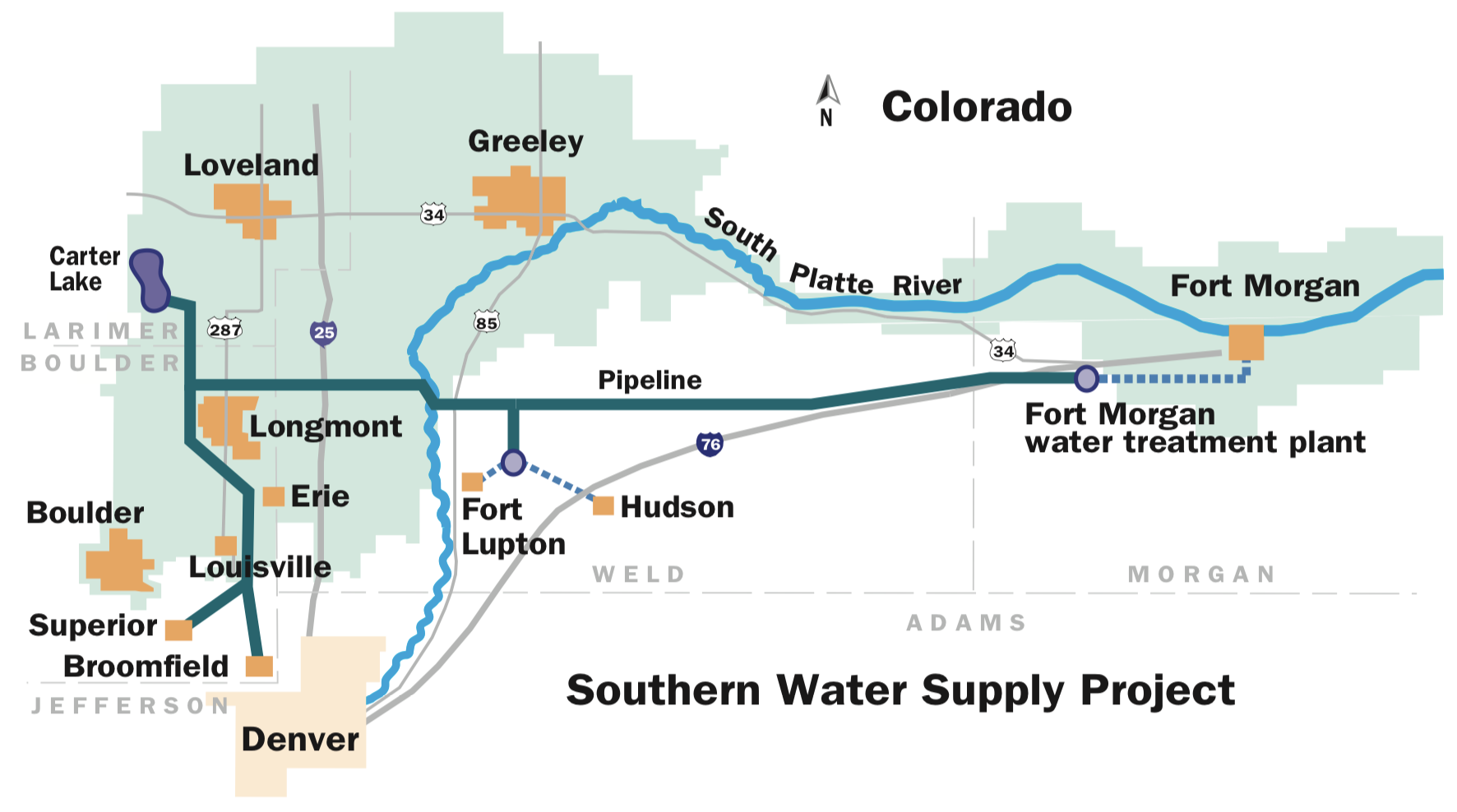
Map via Northern Water.

From The Fort Morgan Times (Jenni Grubbs):

Fort Morgan triggers building water pump station: Participants in the Southern Water Supply Project pipeline long knew that an eastern pump station may be needed to ensure enough water can be delivered to its farthest-out participants: Fort Morgan and Morgan County Quality Water District, the Times reported May 13.

Fort Morgan and Quality Water both reached their capacity of Colorado-Big Thompson water multiple times in recent summers. Gravity is currently what brings the water to Fort Morgan, since Carter Lake, where it is stored, is hundreds of feet higher than Fort Morgan. But growth in use of water by the pipeline’s participants meant less and less water can reach Fort Morgan just through gravity. All of the participants in the pipeline had the right to call for a pump station to be built, as per the original agreements. The council did approve directing staff to proceed with that request to Northern Water. But getting a pump station built will be expensive for all the participants in the pipeline, since the overall project is expected to cost about $6 million. It would take about three years from its start before the pump station would be online…

New water meter system for Log Lane: The new town water meter system will cost Log Lane Village approximately $154,520, the Times reported June 16.

The town’s board of trustees had previously approved contracting with Aclara/HD Systems for providing a new water meter system, but the costs and details had not yet been finalized. That’s happened June 14, with the board approving the expenditure and choosing the more expensive but longer-lasting scalable option of two proposals offered by contractor.

A look at the #Colorado-Big Thompson Project #ColoradoRiver #COriver

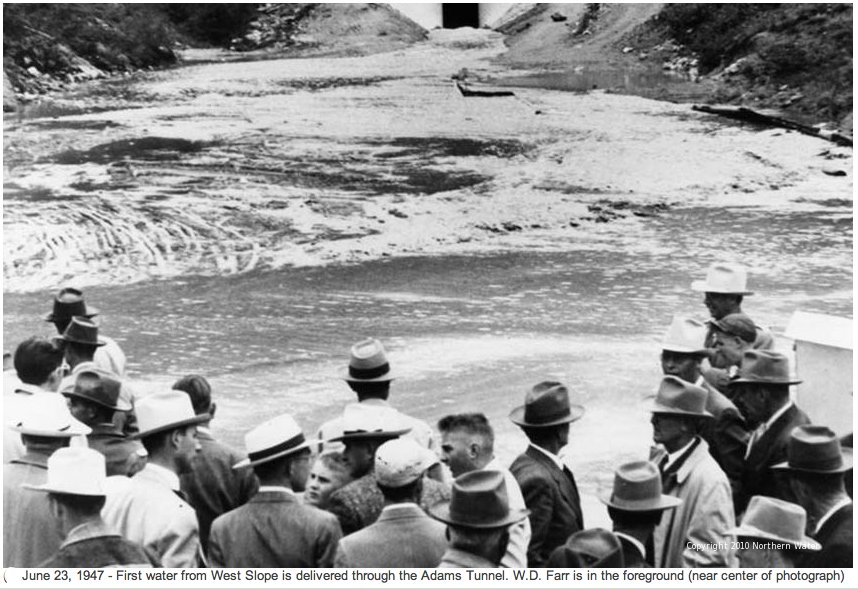
First water through the Adams Tunnel. Photo credit Northern Water.

From The Loveland Reporter-Herald (Kenneth Jessen):

The drought of the 1930s was the impetus for the Colorado-Big Thompson Project.

Work started in 1938 and would span nearly two decades to complete.

The first project was the Green Mountain Reservoir on the Blue River. The water stored ran north into the Colorado River and is used to compensate for water that would be diverted to the Eastern Slope.

A significant year for the project was 1944 when work ended on the Alva B. Adams Tunnel, just over 13 miles long. It carried water under the Continental Divide.

Lake Granby, the largest reservoir in the system, stores Colorado River water during the spring runoff. A second project was the nearby Shadow Mountain Reservoir connected to Grand Lake by a short canal. The two bodies of water are nearly 90 feet higher than Lake Granby.

The Alva B. Adams Tunnel’s west portal is on the east side of Grand Lake which, incidentally, is the largest natural water body in Colorado.

After the spring runoff and to keep Shadow Mountain Reservoir and Grand Lake filled, a pumping station brings Lake Granby water up to their level.

Added in 1951-52 and on the west side of the Continental Divide is the Willow Creek Reservoir. A pumping station elevates the water 175 feet to a canal flowing into Lake Granby.

The 9 ½ -foot in diameter Alva B. Adams Tunnel drops 109 feet in its 13 miles, ending at the East Portal.

From a small lake at the East Portal, the water is carried via a siphon under Aspen Brook to the Rams Horn Tunnel and via a penstock, down to the Marys Lake power plant. This is a drop of 205 feet.

Running directly under the summit of Prospect Mountain, yet another tunnel and penstock delivers water to the Lake Estes power plant, a drop of 482 feet.

From Lake Estes, water flows east first through the Olympus Tunnel to the 5 ½ -mile long Pole Hill Tunnel.

Water is delivered to the top of a canal then to a penstock. It drops 815 feet to the Pole Hill power plant. From there, the water enters the 1 ¾ -mile-long Rattlesnake Tunnel, ending on the west side of Pinewood Lake. An intake on the east end of Pinewood Reservoir takes water through the Bald Mountain Tunnel to the penstock visible from Loveland.

Water is delivered to the Flatiron power plant at Flatiron Reservoir over 1,000 feet below.

This is where things get complicated.

During times of excess water, it is pumped up to Carter Lake, 277 feet higher.

Water also flows through a short tunnel north to the Hansen Feeder Canal to Horsetooth Reservoir.

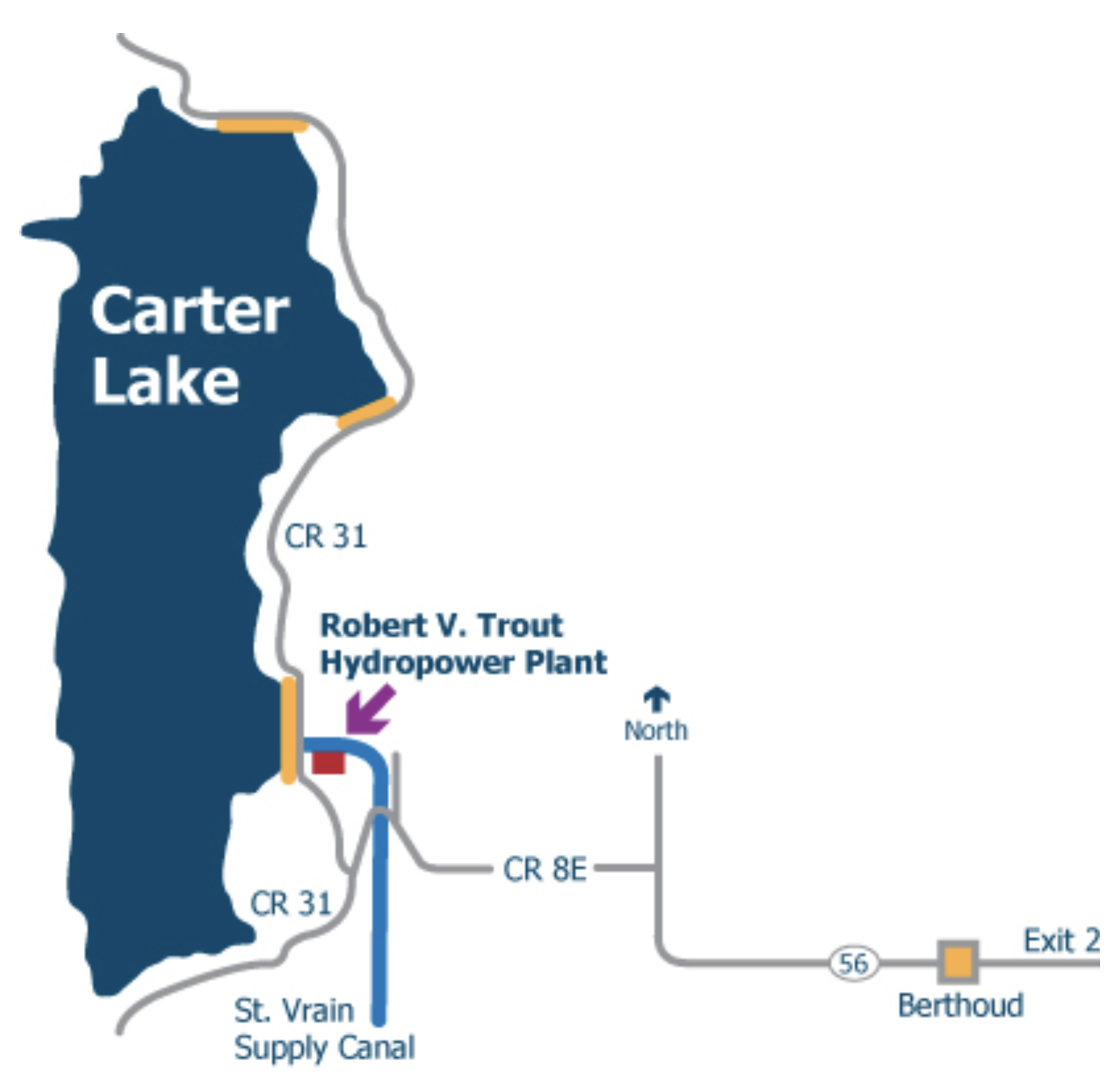
From the south end of Carter Lake, water is delivered into the South St. Vrain Supply Canal. This long canal takes water under part of Rabbit Mountain all the way the Boulder Reservoir.

In all, West Slope water drops nearly 3,000 feet during its journey to the East Slope.

The Colorado-Big Thompson Project has created a dozen reservoirs, uses 35 miles of tunnels and also generates a substantial amount of electric power. These are the power plants:

Marys Lake

Estes Park

Pole Hill

Flatiron

Green Mountain

Big Thompson

Trout

Fort Morgan water rates to go up 3%

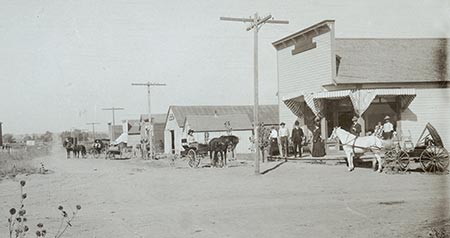
Fort Morgan vintage photo from Moody’s Vintage Collectible Postcards

From Fort Morgan Times (Jenni Grubbs):

Starting in January, Fort Morgan residents can expect to pay at least $2 more per month for water, depending on their water usage.

The Fort Morgan City Council recently approved adjusting water rates for 2018 to include the 3 percent increase recommended by the latest rates study.

Water Resources/Utilities Director Brent Nation said that a residential household that currently pays $71.90 for a monthly water bill likely would have a bill next year of $73.90.

The increase was recommended to the council so as to keep the city’s water fund revenue on track for the possibility of going out to bond for construction on the Northern Integrated Supply Project (NISP), as well as likely upcoming large capital projects at Fort Morgan Water Treatment Plant and ongoing maintenance of the city’s water delivery system, Nation and City Manager Jeff Wells explained…

He said the price of constructing NISP has not changed, but some of the projections for how it is expected to be financed for Northern Water by the 15 participants – including Fort Morgan and Morgan County Quality Water District – are changing. That meant the city needed to figure out how to “balance out” those financing expense projections with the water fund projections for revenue.

Nation said the latest water rates study included “a conservative approach” so that the city could “make sure that the fund is safely being funded for these projects” but also keep rates from having to skyrocket in the future.

For now, Nation said the 3 percent water rates increase for 2018 would “keep us moving forward towards where we’re projecting that we’re going to need over the next 10 to 15 years, depending on how NISP plays out.”

[…]

The current rate study did indicate that Fort Morgan’s water rates are on the higher end in northeast Colorado, but that had been the case since the Colorado-Big Thompson project began, Nation said.

“We pay for high quality water, and that’s what we’re getting,” he said.

But there also are other things the city’s water treatment and water delivery departments will look at doing so as to save money for rate payers, Nation told the council, not getting into specifics right now.

Wells pointed out that the city has been collecting a monthly NISP fee from rate-payers so as to start building up cash toward future bonding for that project, if or when it gets approved.

Windy Gap Firming Project update

Windy Gap Reservoir

From KUNC (Luke Runyon):

Collaboration is a lofty goal touted by political and business leaders as a potential way forward on anything from climate change to healthcare to obesity. Drop your weapons, turn your enemies into partners and achieve great things — or so the thinking goes. But collaboration is a concept that sounds great in the abstract and quickly turns messy in practice, with plenty of pitfalls along the way toward a common goal.

Avoiding drawn out fights has always been tough when dealing with water issues in the West. Collaboration wasn’t always the go-to strategy for environmentalists, political figures and water managers who held competing interests on overtaxed, overdrawn rivers.

But with the Windy Gap Firming Project in northern Colorado’s mountains, old grudges are being put aside in favor of new, collaborative tactics. While some of the West’s oldest enemies are working together, those who feel left behind by all the newfound teamwork aren’t ready to sing “Kumbaya.”

[…]

Windy Gap Reservoir — at the heart of the dispute — is a shallow, human-made lake just west of Rocky Mountain National Park. Colorado River water sits in a wide, shallow pool, kept in place by a dam…

It’s just one piece of a much larger diversion project that moves water from the headwaters of the Colorado through the mountains for use along the Front Range. Water managers have proposed, and received the federal permits needed, to use this small reservoir to move more water eastward, exercising water rights they say they’re unable to use now because the system is full to the brim at inopportune times.

That type of proposal — to send more Colorado River water eastward to supplement urban and suburban growth — stirs up all kinds of West Slope anxiety about Front Range growth.

“We know the flows are going to be diverted,” [Kirk] Klancke says. “We know the state’s not going to stop growing, that’s reality.”

“The pragmatic approach would be then to figure out how to keep your aquatic habitat healthy with those diminished flows, and that’s what we’re doing,” he says.

Rather than fight powerful water managers like Denver Water and Northern Water in the duke-it-out, courtroom-style battle some environmental groups have perfected over the years, Trout Unlimited and some of its allies took an unprecedented step: working together. Since the Windy Gap project’s revival more than a decade ago, they’ve had a seat at the negotiating table. If cities want to siphon away West Slope water, Klancke says, they need to give something in return.

“These are some of the most powerful people in the state because they control one of the state’s most important resources,” he says.

Which is exactly why other environmentalists, like Ken Fucik, don’t trust the water diverters and, by association, environmental groups like Trout Unlimited for working with them.

“When you look at the process over here, there are some of us over here who are unhappy,” Fucik says.

Fucik, a retired environmental consultant from Grand Lake, is opposed to a 2012 deal brokered by Trout Unlimited, county officials and others. In exchange for a permit to allow more water be sent to the Front Range as part of Windy Gap, the negotiators got $10 million in required mitigation to upgrade water quality in the headwaters and an additional $12 million in mitigation work for fish and wildlife, projects not required by law. That includes partial funding for a bypass channel that would skirt around Windy Gap dam and reservoir, reconnecting the upper reaches of the Colorado River, allowing fish to move more freely.

Grand County was also able to negotiate additional flows out of Windy Gap Dam to flush out sediment, an agreement that Northern Water be in charge of operation of the new bypass and more flows to support endangered fish in a stretch of the Colorado near Grand Junction…

Environmental consultant Geoff Elliott agrees. He lives in Grand County and says when you’re not part of collaborative agreements and weren’t invited to the negotiations, you end up feeling left out and unheard.

“It comes down to trust and we’re asked to trust in a process where we’ve been eliminated, pushed out and punished,” he says. “It’s hard for us to trust in that process.”

Fucik and Elliott are now supporting a recently filed lawsuit from a handful of environmental groups who take a different tactic with water projects, like Save The Colorado and WildEarth Guardians. Their goal is to prevent more water pulled from the Colorado River watershed from traveling to the Front Range…

For an environmentalist concerned about the health of the river, this conundrum has become the fork in the road: When do you collaborate with someone who’s supposed to be your enemy? And when do you roll the dice in court?

Lurline Curran photo credit Aspen Journalism.

Lurline Underbrink Curran says the path of most resistance has been tried before, with pretty erratic results. She’s the former Grand County manager and sat at the negotiating table with Northern Water.

“I don’t understand collaboration becoming a dirty word,” she says. “Because I can tell you, I can throw out some dirty words that will curl your hair, and that is not one of them.”

Because Grand County officials, like Curran, held the key to a permit that would allow the project to move forward, she joined forces with environmental groups like Trout Unlimited and ranchers concerned about the river’s flow downstream of Windy Gap. The negotiations took years and Curran says her team was a formidable opponent to the Front Range water suppliers, despite what detractors might think.

Curran admits some of the negotiations were done behind closed doors, as she says, to build trust among old enemies. But adds that the solutions they came up with will benefit the river in the long-term.

“Will the Colorado be as wide and deep as it used to be? Hell no. But that’s gone. Like it or not that’s been gone for decades,” she says. “But you can make it so it’s functional.”

Map from Northern Water via the Fort Collins Coloradan.

The idea of bringing parties with old grudges to the negotiating table was meant to avoid lawsuits in the first place. Now that one’s been filed it threatens to bring down the whole deal. Northern Water has already started planning the $400 million Chimney Hollow Reservoir. Trout Unlimited is still fundraising to secure enough money to build the Windy Gap bypass channel, the crown jewel of the agreement.

Northern Water spokesman Brian Werner says the agency is moving ahead with its plans.

“I’d be lying if I said there weren’t any concerns, we’d rather not have a lawsuit filed,” Werner says.

Werner doesn’t have any regrets on how the compromise went down. For decades, water managers have been seen as bullies who strong arm their opponents to get what they want. He says the Windy Gap Bypass project seemed like a turning point.

“What’s best for the river?” he asks. “We need water for growth in Colorado, there’s no question about that. How are we going to do it, folks?”

Either by working with your enemies. Or against them.

Windy Gap Firming Project: “This short-sighted lawsuit would only delay progress” — Mely Whiting

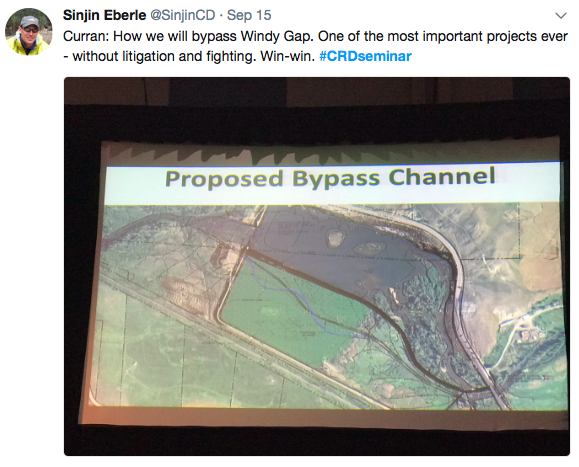
Proposed bypass channel for the Colorado River with Windy Gap Reservoir being taken offline, part of the agreements around Northern Water’s Windy Gap Firming project.

From The Loveland Reporter-Herald (Pamela Johnson):

Representatives of two of the utilities that hope to store water in Chimney Hollow say that if a lawsuit filed to halt the reservoir is successful it may not stop the water from being diverted from the Colorado River, and a leading conservation group says the lawsuit will hurt the river not help it.

“It could mean that instead of one big project that holds the 90,000 acre feet, participants use a bunch of smaller options (for water storage),” said Michael Cook, district manager of the Little Thompson Water District, one of 13 participants in the reservoir project led by Northern Water.

The participants already own the supply of water, called Windy Gap, that would be diverted into the reservoir. However, they do not have a place to store it during years when water is plentiful for use in dry years when it is needed.

This reservoir would provide that storage to firm up the supply, which is why it also is called the Windy Gap Firming project.

The Little Thompson Water District accounts for about 6 percent of the overall project and has been using some of its Windy Gap water each year.

The city of Loveland, which owns 10.5 percent of the water, has used it infrequently but is relying on the water, which it purchased with money from a bond, for future water needs as the city grows.

The city needs a place to store this water to firm up the supply and would be forced to look at other storage options for its Windy Gap water if the lawsuit were to prevail, said Larry Howard, the city’s water resources manager…

However, he, like Werner, expressed confidence that the 14-year permitting process was sound and that the reservoir project will go forward despite the lawsuit, which was filed Thursday.

An attorney for Trout Unlimited, too, expressed doubt that the lawsuit will stop the project, stating that, despite the lawsuit, water will continue to be diverted from the Colorado River as populations grow and other solutions are needed to turn the tide.

“This lawsuit likely won’t stop Windy Gap, but it could succeed in delaying real solutions to the problems,” Mely Whiting, attorney for Trout Unlimited, said in a written statement. Trout Unlimited was a leading participant in negotiations for mitigation and conservation efforts included in the project.

“Habitat restoration projects and other solutions are already being implemented and showing great success in improving the health of the Colorado River. That’s why many conservation groups who’ve been working the longest on this problem support our collaborative approach.

“These solutions offer the best hope for keeping the valuable resources of the Upper Colorado alive. This short-sighted lawsuit would only delay progress.”

Save the #Colorado, et al. file lawsuit over Windy Gap EIS

Proposed bypass channel for the Colorado River with Windy Gap Reservoir being taken offline, part of the agreements around Northern Water’s Windy Gap Firming project.

From The Greeley Tribune (Tyler Silvy):

The lawsuit, filed in U.S. District Court, questions the need for the Windy Gap Firming project, which would ensure the full complement of more than 40,000 acre feet of water is diverted from the Colorado and eventually stored in the planned, $400 million Chimney Hollow Reservoir the Front Range communities would share…

The lawsuit was filed by Save the Colorado, Save the Poudre, WildEarth Guardians, Living Rivers and the Waterkeeper Alliance, a collection of nonprofit environmental groups that have long opposed the project.

It was filed against the U.S. Bureau of Reclamation and the U.S. Army Corps of Engineers for their roles in approving the project in May and conducting the environmental impact statement. In April 2016, Gov. John Hickenlooper endorsed the project, as well.

Northern Colorado Water Conservancy District spokesman Brian Werner said he hasn’t had much time to review the lawsuit, but he said although he and others are disappointed, he’s confident the project will eventually move forward. Northern Water was the driving force behind the Windy Gap firming project, which was proposed as a way to ensure Front Range municipalities get the full yield they’re due based on water rights from the Colorado.

From The Loveland Reporter-Herald (Pamela Johnson):

The lawsuit, filed Thursday in U.S. District Court in Denver, asks the judge to throw out the records of decision by the U.S. Bureau of Reclamation and the U.S Army Corps of Engineers, claiming they violated the National Environmental Policy Act and the Clean Water Act in approving the project.

Save the Colorado, Save the Poudre, WildEarth Guardians, Living Rivers and Waterkeeper Alliance, together, filed the lawsuit against the Bureau of Reclamation and the U.S. Army Corps of Engineers, claiming that the permitting process was flawed and did not consider the cumulative effects on the river, the resulting effect on the ecosystem and tourism or alternatives for water supply…

The main target of the lawsuit is the environmental analysis, led by the Bureau of Reclamation and relied upon by the Corps of Engineers. That environmental process, which included both a draft and final environmental impact statement, took more than a decade…

“We think that the process has worked well,” said Werner. “The EIS, we don’t think that there is any basis in fact about it (in the lawsuit). In this country, anybody can say what they want about a process. We think the federal government has done it well.”

In fact, Northern Water has agreed to a wildlife mitigation plan that will benefit not destroy the river and the trout habitat, including channel work that has already begun and control of flows and diversions to boost the ecosystem for trout and other aquatic life, Werner said.

“The Colorado River below Windy Gap is better with the mitigation and enhancement and the project than it is without it,” Werner said.

The lawsuit claims that the project should have been replaced with other alternatives but that the applicants “stubbornly” continued to push forward because of how much money they had already sunk into the reservoir…

“Federal agencies must evaluate not only the impacts of a proposed project, but also alternatives to the intended course of action,” Zach Lass, student attorney at the University of Denver Sturm College of Law, said in a press release. “Reclamation and the Corps fell victim to a sunk costs bias that infected the entire review and approval process when they failed to consider alternatives that did not involve spending more money trying to salvage their failed Windy Gap Project.”

[…]

One of the big issues alleged in the lawsuit is that the extensive environmental analyses failed to consider alternative sources of water besides pulling more from the river and storing it in a brand new reservoir. The applicants failed to look at conservation, efficiency and water recycling, said [Gary] Wockner…

The lawsuit does not ask for an immediate injunction to stop work that is currently being done on the Chimney Hollow site, which includes blasting of a test quarry for construction of a small version of the dam to gather information on the geology of the area.

That work, along with planned tree removal and relocation of a power line, will continue as this lawsuit is heard in court, Werner said…

No court dates likely will be set until the Bureau of Reclamation and the U.S. Army Corps of Engineers have responded to the initial complaint, and they have 60 days to do so. Often, it takes at least a year for a decision in this type of lawsuit.

@USBR to Hold Public Meeting on Estes Valley Resource Management Plan for Lake Estes, Marys Lake and East Portal

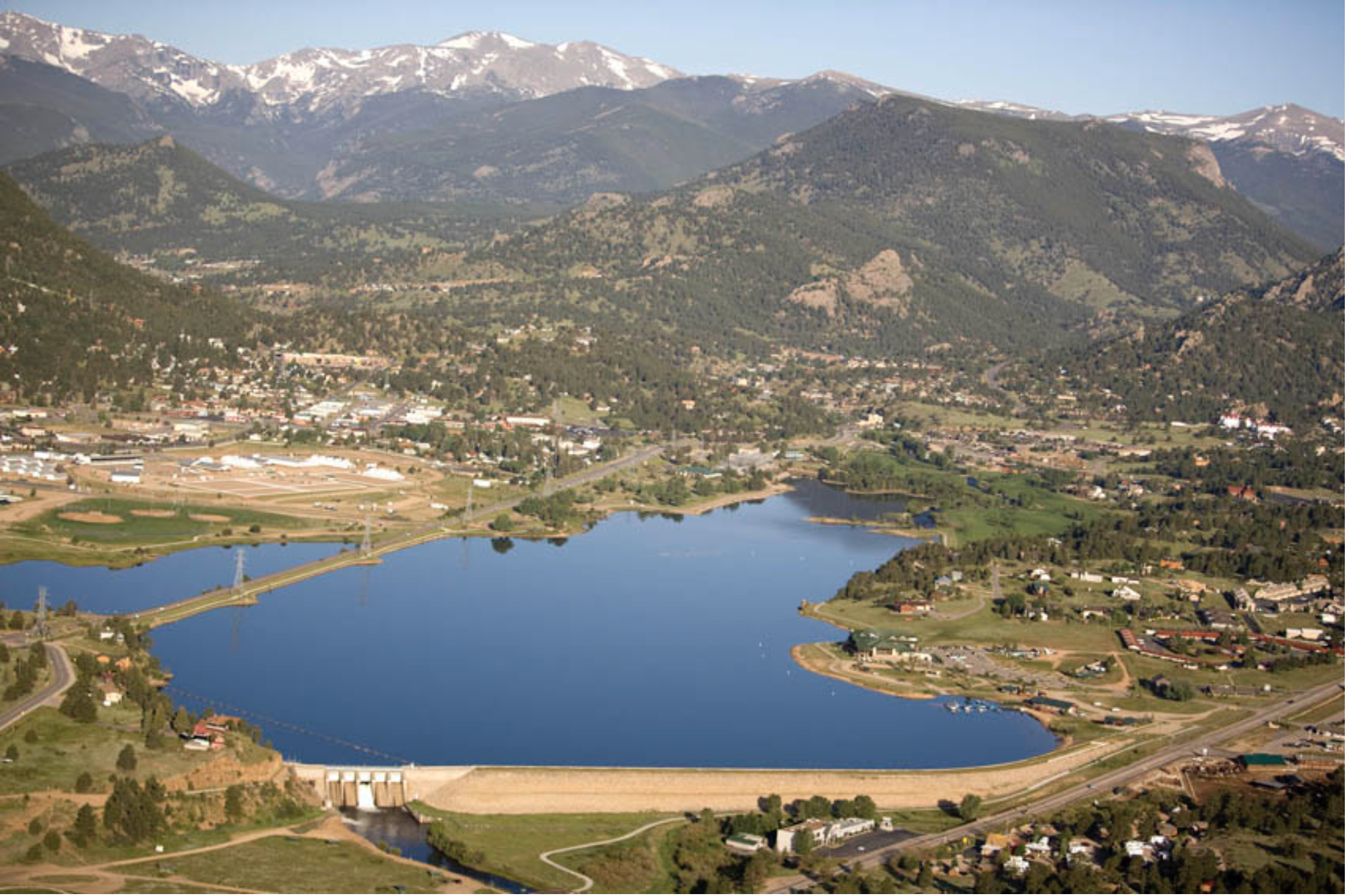
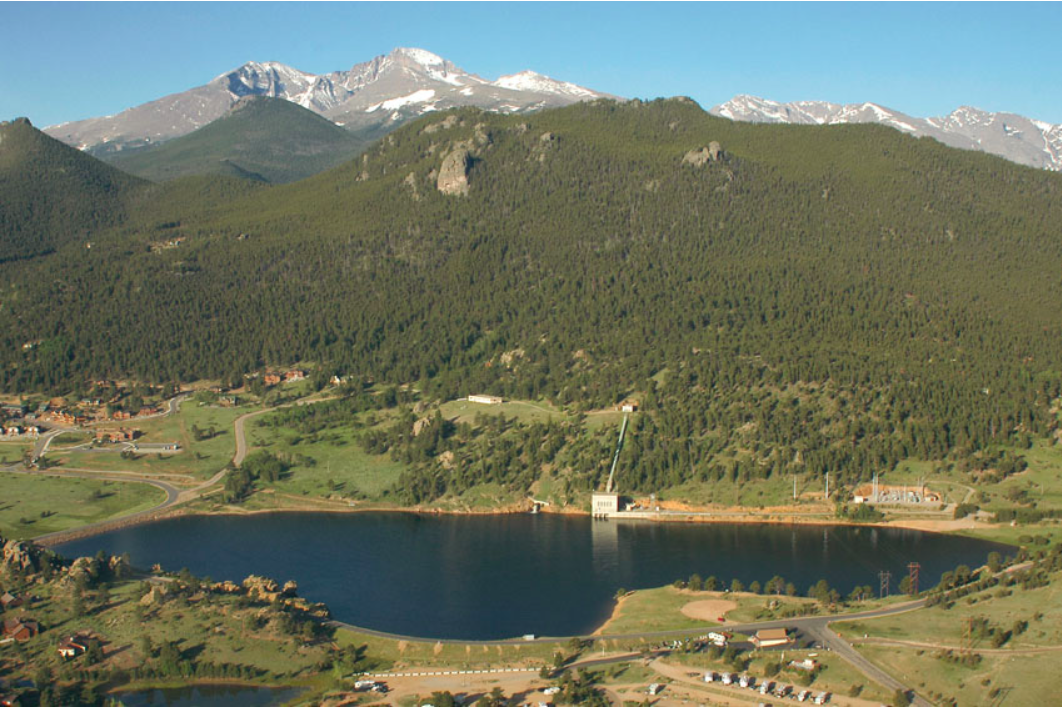
Aerial view of Lake Estes and Olympus Dam looking west. Photo credit Northern Water.

Here’s the release from Reclamation (James Bishop):

The Bureau of Reclamation, in cooperation with Estes Valley Recreation and Park District (EVRPD), is seeking public input on a Resource Management Plan (RMP) for Lake Estes, Marys Lake and East Portal lands.

The agencies will host an open house where the public can learn and ask questions about the resource management planning process, the lands affected by the plan, and provide comments. The open house will be held on Wednesday, October 25, 2017, from 6 to 8 p.m. at Estes Park High School Commons, 1600 Manford Avenue, Estes Park, Colo. Public comments will be welcomed in writing at the open house and throughout the 30-day public comment period.

The 30-day public comment period will begin on Wednesday, October 18, 2017 and will end at close-of-business on Friday, November 17, 2017. Comments must be provided in writing and can be submitted by e-mail, fax, or regular mail. E-mail comments can be sent to EstesRMP@usbr.gov, and faxed comments can be sent to the attention of Ms. Justina Thorsen at (970) 663-3212. Regular mail comments should be sent to the attention of Ms. Thorsen at: Bureau of Reclamation, 11056 W. County Road 18E, Loveland, Colo. 80537.

Reclamation is preparing the Estes Valley RMP. The agency will also prepare an Environmental Assessment in compliance with the National Environmental Policy Act. Reclamation owns and operates the Colorado-Big Thompson project, which includes Lake Estes, Marys Lake, East Portal, and the surrounding federal lands. Through a management agreement with Reclamation, EVRPD is responsible for managing recreation at Lake Estes, Marys Lake, and East Portal. The RMP will guide future recreation development as well as the management of natural and cultural resources on federal lands.

Media inquiries or general questions about Reclamation should be directed to James Bishop at 970-962-4326 or jbishop@usbr.gov. Specific questions about the resource management planning process should be directed to Justina Thorsen at 970-962-4207 or EstesRMP@usbr.gov.

@NorthernWater is drawing down Horsetooth for Soldier Canyon Dam outlet works maintenance

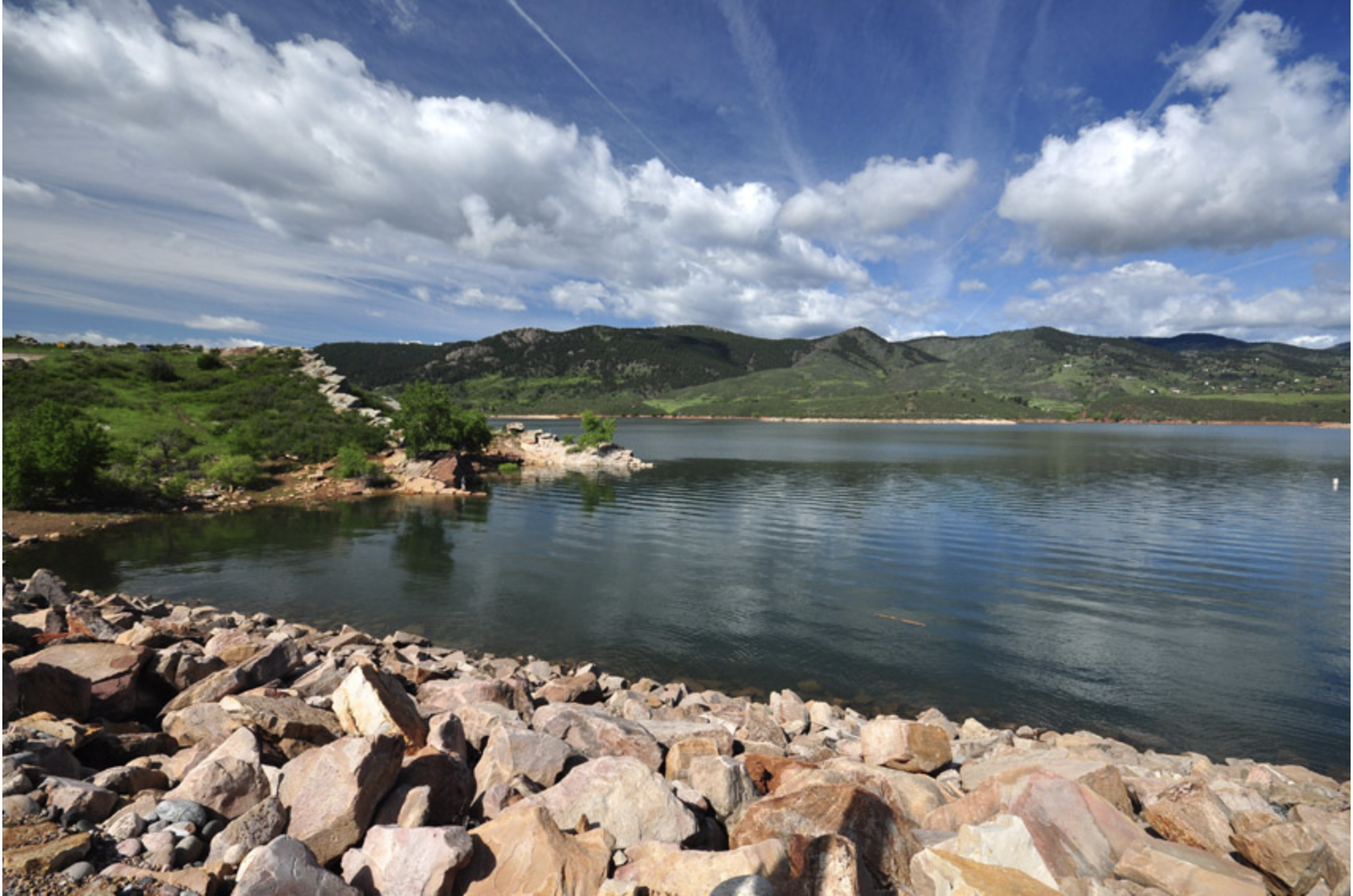
Horsetooth Reservoir looking west from Soldier Dam. Photo credit: Northern Water.

From The Fort Collins Coloradoan (Jacy Marmaduke):

In all, Horsetooth dropped 32 feet between Aug. 1 and Sept. 13. The reason for the decrease is two-fold, according to reservoir manager Northern Water.

One reason for the level change is the approaching end of the irrigation season. Water users often didn’t need to take advantage of their water rights earlier in the summer, when storm clouds dropped rain on Northern Colorado several times a week.

But as the weather’s dried up, Northern Water has delivered more water to ditch companies for irrigation, spokesman Brian Werner said. The Poudre and South Platte Rivers are running lower now that snowpack has waned, so irrigation water is coming out of storage at Horsetooth.
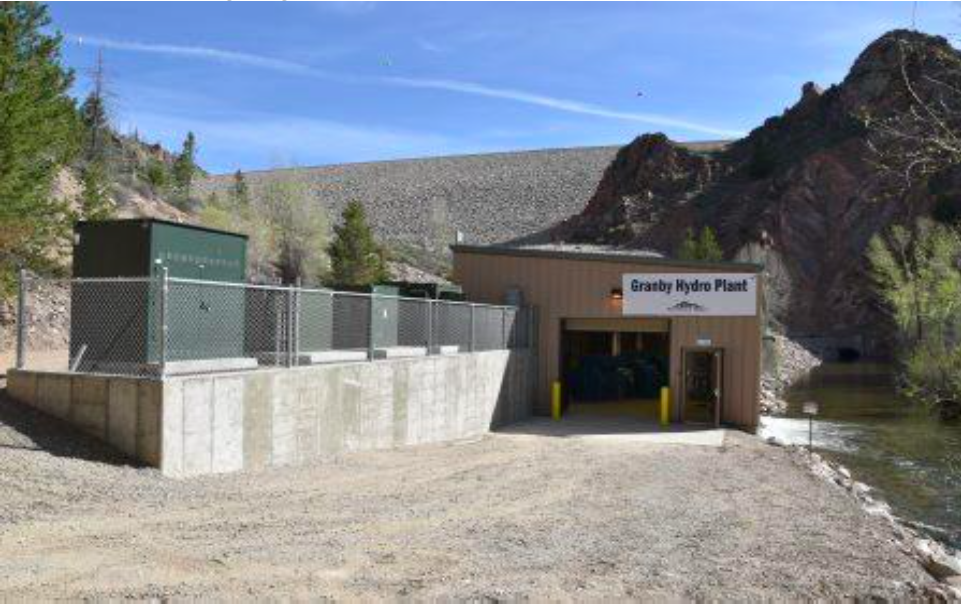
The Soldier Canyon Dam is located on the east shore of Horsetooth Reservoir, 3.5 miles west of Fort Collins, Colorado. The zoned earthfill dam has an outlet works consisting of a concrete conduit through the base of the dam, controlled by two 72-inch hollow-jet valves. The foundation is limey shales and sandstones overlain with silty, sandy clay. Photo credit Reclamation.

The releases are also necessary because Northern Water is planning maintenance on the Soldier Canyon Dam outlet works in early November, Werner said. Lower water levels make it easier for divers to access dams for repairs.
Horsetooth stood at 5,391 feet on Wednesday morning, which is about average for this time of year, Werner said. On Aug. 1, Horsetooth’s elevation was 5,423 feet, or 7 feet below full…

Northern Water plans to draw down Horsetooth another 4 feet but will do so more gradually during the coming weeks, Werner said. The reservoir will probably reach more of an “equilibrium” between inflows and outflows this weekend, he added.

Colorado-Big Thompson Project east slope facilities

@Northern_Water signs off on Broomfield/Larimer County ATM agreement

Colorado-Big Thompson Project Map via Northern Water

From The Broomfield Enterprise (Jennifer Rios):

The final nod was received by Northern Water last week, following earlier approvals by Broomfield and Larimer counties.

The agreement includes Broomfield buying 115 Colorado-Big Thompson water units for $25,550 each from Larimer, which would save Broomfield $109,250 if bought at open-market value.

It also includes an “Alternate Transfer Mechanism,” or ATM, that would give Broomfield the right to use 80 C-BT units a minimum of three out of 10 years, while paying an additional fee to use the water in those years to add to the farm’s viability.

The effort is a drought-protection effort that could be increased to five out of 10 years in extreme drought years. That period would be a rolling 10 years, meaning once Broomfield pulls water, the clock starts…

The ATM is the first of its kind in Colorado where water is shared from agricultural to municipal use in perpetuity.

“By piloting this agreement, we’ve demonstrated that, by working together and sharing valuable resources, it’s possible to conserve fast-disappearing farmland at a reduced cost while securing a source of water for Colorado’s growing cities,” Kerri Rollins, Open Lands Program manager for Larimer County, said in a Larimer Department of Natural Resources news release this week. “Hopefully, this creates a model for farmers and municipalities to work together and avoid simple ‘buy and dry’ of farmland.”

Through the agreement, Larimer County was able to conserve 211 acres of productive farmland, along with the farm’s agricultural, historic, scenic, community buffer and educational values, the release states, while reducing the cost of buying the farm and its water by 46 percent.

“Broomfield values a partnership approach to both water conservation and securing future water resources,” David Allen, director of Public Works for Broomfield, said. “We were pleased to work with Larimer County to bring this innovative Alternative Transfer Method to both of our communities.”

Larimer County retained 45 units of C-BT water unencumbered, along with native Handy Ditch water.

According to studies funded by the Colorado Water Conservation Board’s Alternative Agricultural Water Transfer Methods Grant Program, the water that will remain on the farm will be enough to keep it profitable and productive, according to the release. It will grow corn or sugar beets in wet years and water-efficient crops in dry years. In very dry years, when the farm might normally struggle to grow a profitable crop, the farm may now be better off financially with the ATM in place because it will bring in revenue from the ATM payment associated with the sharing of the water, the release states.

#ColoradoRiver: Prep work starts for Chimney Hollow Reservoir #COriver

From 9News.com (Cory Reppenhagen):

Work has started on the new Chimney Hollow Reservoir in Larimer County. Final approval was granted for a 90,000 acre foot reservoir in May, and crews are now surveying and drilling at the site, to determine the extent of building materials.

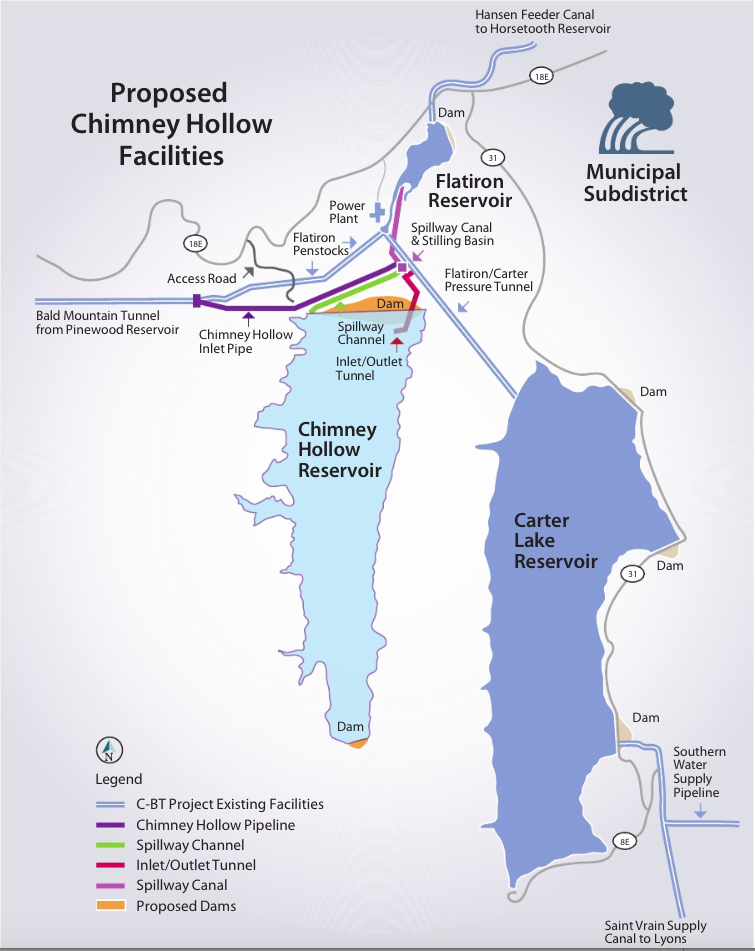
Chimney Hollow will be operated by Northern Water. It is located just west of Carter Lake Reservoir, and is going to be close to the same size of twin to the east. This location was chosen for it’s proximity to existing Colorado Big Thompson facilities, and because there were no threatened or endangered species, no existing residences to relocate, and they were able to acquire the property from a single owner, Hewlett Packard.

Nearly 400,000 northern Colorado residents will benefit from this new water supply. Those areas are Broomfield, Longmont, Loveland, Greeley, Erie, Superior, Louisville, Fort Lupton, Lafayette, and the towns in the Central Weld County Water District.

“This project specifically is to make some supplies reliable year in, and year out, for those communities. They will be able to have more of a guarantee that they will be able to pull water from the Windy Gap Project, which today, is not possible. There are some years where there is either no water available, or nowhere to store it,” said Brian Werner, spokesperson for Northern Water…

Contracts will start to get awarded in 2018, and Northern Water says that construction will likely start later next year, or early in 2019. It will be a three to four year build. The next step, which could happen this fall, is to relocate power lines that run through the middle of the property, and to also start clearing the vegetation.

Once construction is complete, they can start filling the reservoir with water. According to Northern Water, that could take several years to fill up.

“There are state regulations on dam safety, on how fast we can bring the water elevation up, so it’s sort of fill and seal, before we can go to that next incremental level. It could take 3, or 5, or even 10 years to fill it. A lot is dependent of mother nature as well, with how much water is available,” Werner said.

The water will come from the headwaters of the Colorado River, channeled back to the east from Windy Gap Reservoir.

The Chimney Hollow project has already been 14 years in the making. The permitting process began in 2003, and there have been $15 million spent in studies. The total estimated cost is $400 million.

The dam is estimated to be about 340 feet tall, which makes it the tallest dam to be built in Colorado since the Morrow Point Dam in Gunnison County back in 1968. Morrow Point is still the largest dam in Colorado at 468 feet. Denver Water has recently received approval to increase the size of Gross Dam, in Boulder County, to 471, which will make that the largest dam once it is finished.

Chimney Hollow Dam could be the first in the United States with an asphalt core. This type has been used in Europe and Canada for many years. The available land material in the area, made asphalt the more cost effective choice. The asphalt will be the inner seal of the dam, but the outside appearance will be more earthy, made of land and boulders. Arizona has also received approval to build an asphalt core dam, and could be completed about the same time as Colorado’s.

Larimer County will be handling the recreation on this new reservoir, and already has some initial plans for hiking, fishing, and boating. It will be a non-motorized boating lake and a day-use area. So far, there are no plans to allow overnight camping.

There had been some opposition to this project, and other proposals to build new reservoirs in Colorado. River conservation groups are concerned about the impacts of further taxing a the Colorado River system. Werner says they are addressing the future of the river, and the future of Colorado’s population at the same time.

“We are all for using water more efficiently, and water managers in this state are doing a darn good job of that, but the bottom line is that you have to provide some additional buckets, some additional water storage to meet our future demand, without drying up our agricultural lands,” he said.

Larimer County approves ATM IGA with Broomfield for C-BT shares

Colorado-Big Thompson Project east slope facilities

From The Longmont Times-Call (Pamela Johnson):

Following the lead of citizens who, in recent public outreach, expressed an interest in the county preserving agriculture and water, the Larimer County Department of Natural Resources spent $8.4 million in 2016 to buy the Malchow family farm and its associated water. The county is now calling the land the Little Thompson Farm because of its proximity to the river of that name.

The goal was to preserve the land as a working farm and to offset the cost of doing so with a water-sharing agreement, which is also a method the Colorado Water Plan endorses to stop simple “buy and dry” of farmland by municipalities that need the water to handle growth.

Extensive negotiations and studies by experts in agriculture, finance and water led to partnership agreement between Larimer County and the city and county of Broomfield. Experts made sure the farm could stay viable under the agreement by looking at water supply, economics and historic weather patterns.

That agreement, which was approved by Larimer County on Tuesday, basically sells Broomfield 115 shares of the farm’s Colorado-Big Thompson water outright, allows the municipality to use another 80 during three dry years out of every 10, and preserves 45 shares for the farm use.

The water that will stay on the farm — a mix of Colorado-Big Thompson and additional shares of Handy Ditch water — will be enough to keep the farm profitable and in production, growing corn and sugar beets in wet years and dryland crops in dry years, according to information from extensive studies.

For its part of the agreement, Broomfield will pay the county $3.7 million for the water. The price includes paying market value for the 115 shares that it will buy outright and 40 percent of market value for the 80 units that it can use only three out of every 10 years…

The municipality will be able to pull the 80 units of water in three dry years out of every 10, and the rest of the time, the water will remain on the farm to irrigate crops. During the years that the water leaves the farm, Broomfield agreed reimburse the farmer that is leasing the land from the county the cost of that farm lease to help keep the farm profitable in dry years.

Under the agreement, Larimer County will receive another $100,000 from a grant from the Gates Family Foundation and $52,750 from the Colorado Water Conservation Board.

This type of water sharing agreement is encouraged by the Colorado Water Plan as a way to protect farmland from the typical “buy and dry” that is occurring with growing municipal need across Colorado.

In fact, Larimer County officials noted that if the Malchow family had not wanted to sell to Larimer County to keep their family farm in production, buyers were lined up to pay top dollar just for the water…

A team of experts looked at historic weather data, financial models and water supply to determine if the farm could stay viable under this agreement, and deemed that it could.

With this model in place, Larimer County and state water officials hope this agreement, the first of its kind in the state, will result in more farmers and cities following suit instead of simply selling the water and taking the land out of production.

C-BT storage update

Horsetooth Reservoir

From 9News.com (Cory Reppenhagen):

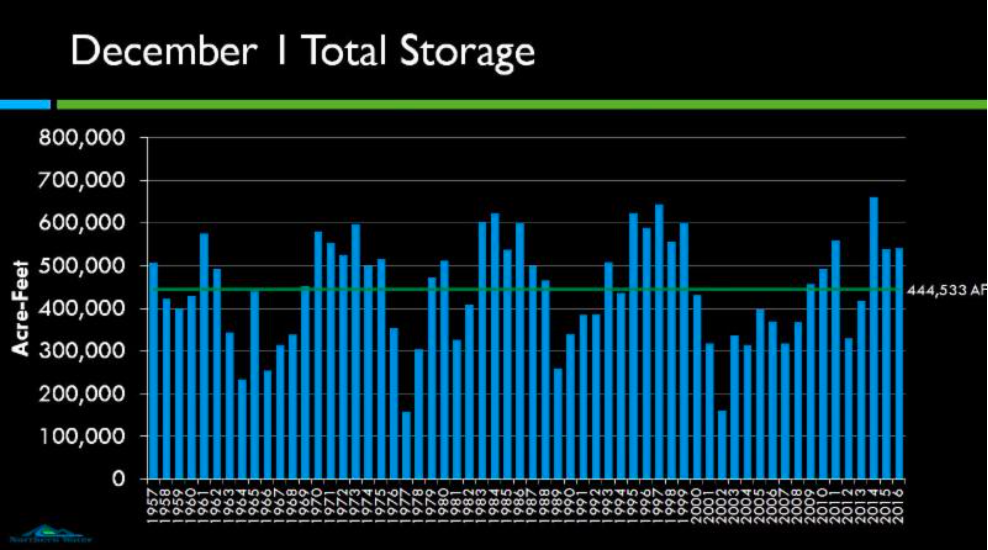
As of July 31, Lake Granby was more than 99 percent full, Horsetooth Reservoir was 95 percent full, Carter Lake was 94 percent full. That is just down slightly from mid July, when the Colorado Big Thompson Project hit a record high storage level of 724,865 acre feet..

Northern Water, the operator of this water district, told 9NEWS that they have to keep the levels high because our booming population is a concern, and there is not even enough water storage available to handle our current population, in the event of even a short duration drought.

Broomfield on path to sign IGA for C-BT shares with Larimer County

Broomfield

From The Broomfield Enterprise (Jennifer Rios):

Director of Public Works David Allen explained that Larimer County will sell Broomfield 115 Colorado Big Thompson water units for $25,550 each and share 80 more units that service the farm.

The outright sale of Colorado-Big Thompson units would save Broomfield $109,250 compared to if the city and county bought them at open-market value.

It also includes an “Alternate Transfer Mechanism,” or ATM, that gives Broomfield the right to use 80 C-BT units a minimum of three out of 10 years — a drought-protection effort that could be increased to five out of 10 years in extreme drought years. That period will be a rolling 10 years, meaning once Broomfield pulls water, the clock starts.

The those 80 units will cost $10,400 per unit, again a fraction of what Broomfield would pay outright for units…

Broomfield is buying the 115 C-BT units at a lower price because they are attached to the 80 units Broomfield with share with Larimer County. Currently water rights holders “use it or lose it” under the existing water plan. As communities like Broomfield grow, and rural communities shrink, this plan is a good way to keep farms active, but still use that same water for growing populations in dry periods…

Last year, Larimer County bought an irrigated farm just southwest of Berthoud and the intent is to maintain irrigated agriculture. It also got several shares of local ditch water. Currently, it has more water than needed to keep the farm operating, which prompted Open Land officials to reach out to Broomfield proposing the sale and shared 80 units.

If Larimer County decides to sell the 80 units, Broomfield would have the first right of refusal to purchase those. If not, Broomfield would get 40 percent of the sale price.

Now the plan will go before Larimer’s Open Lands Advisory Board Thursday, and before Larimer County Commissioners Tuesday.

The plan will still need final approval from Northern Water…

If everything is approved, municipalities will hope to have an intergovernmental agreement in place early by 2018. The outright sale of the 115 units will happen this year.

Longmont Councillors approve asking voters for Windy Gap bond issue

Map from Northern Water via the Fort Collins Coloradan.

From The Longmont Times-Call (John Fryar):

A 5-2 Longmont City Council majority decided Wednesday night to ask voters’ authorization to sell an estimated $36.3 million in bonds to help finance the city’s share of costs for the Windy Gap Firming Project…

…the city’s water customers would pay higher rates in 2018, with rates increasing by an average 13 percent above 2017 levels. There would be another 10 percent increase in 2019 and a 6 percent increase in 2020 as the city makes annual principal and interest repayments on the 20-year bonds.

The water rate-backed bonds, along with about $6.2 million the city projects it will be getting from development fees and other sources, would cover Longmont’s costs of paying for the project that would be able to provide the city with about 10,000 acre-feet of water. A council majority continued to endorse the 10,000 acre-feet level on Wednesday night.

Mayor Dennis Coombs and council members Brian Bagley, Bonnie Finley, Jeff Moore and Gabe Santos voted Tuesday to direct the city staff to prepare an ordinance that will, when adopted, advance the bonding question to November’s ballot.

Council members Polly Christensen and Joan Peck voted against the $36.3 million bonding scenario.

Christensen and Peck instead tried to get the council to support an alternative that would have lowered Longmont’s Windy Gap Firming Project level from 10,000 acre-feet of water to an 8,000 acre-foot participation. That option would have maintained a set of 9 percent annual water rate increases that already are to take place at the start of 2018 and again in 2019, but with no rate increases above that 9 percent level in either of those years.

The Christensen-Peck approach, however, failed on a 5-2 vote, with all other council members voting against that option.

Santos said that when it comes to water delivery and supplies, “it’s incumbent on us to make decisions for the future, for the next generations.”

Coombs noted that under Longmont’s tiered water-rate system, with residents’ and businesses’ actual water bills based on how much water they actually use, “people have some control,” even with the pending increases ahead.

Customers “can take some responsibility” for conserving water, and thereby reducing the water bills they get, even with the higher rates ahead in future years, he said.

Peck, however, said she was concerned that “we’re buying more (water) than we actually need” if Longmont sticks with the 10,000 acre-feet participation level from the Windy Gap Firming Project, which is to include construction of a new Chimney Hollow Reservoir southwest of Loveland.

Colorado transmountain diversions via the State Engineer’s office

Prior to the council’s Wednesday night action to direct the staff to prepare the ballot measure language for the bonding option, a number of residents spoke about their opposition to that project and questioned its need. Some also objected to the entire concept of diverting water from the Western Slope to the Front Range.

The June 2017 e-Waternews is hot off the presses from @Northern_Water

Click here to read the newsletter. Here’s an excerpt:

Chimney Hollow Reservoir receives final approval
The U.S. Army Corps of Engineers recently signed a final Record of Decision and approved a 404 Clean Water Act Permit for the Windy Gap Firming Project. This decision paves the way forward to construct Chimney Hollow Reservoir following a 14-year federal permitting process that began in 2003. Chimney Hollow Reservoir will be located in the foothills immediately west of Carter Lake in southern Larimer County. It will store up to 90,000 acre-feet of water behind a 350 ft. tall dam, which will be one of the first constructed in the United States with an asphalt core. For further information please click any of the links below.

Map from Northern Water via the Fort Collins Coloradan.

#Runoff news: Coordinated releases for #ColoradoRiver endangered fish #COriver

From the U.S. Fish and Wildlife Service via The Los Alamos Daily Post:

Coordinated releases from a series of Upper Colorado River Basin reservoirs began Saturday, June 3, and are anticipated to continue through this week as part of the Coordinated Reservoirs Operations Program.

The US Bureau of Reclamation, the Colorado River District, Denver Water and Northern Colorado Water Conservancy District as owners and operators of upper Colorado River reservoirs have mutually agreed to modify their operations to benefit the endangered fish of the Upper Colorado River Basin.

The Coordinated Reservoir Operations (CROS) program was established in 1995 as part of the Upper Colorado River Endangered Fish Recovery Program. The purpose of the Coordinated Operations is to enhance spring peak flows in a section of the Colorado River upstream of Grand Junction, Colo. Determined to be critical to the survival of four endangered fish species: the Humpback Chub, Razorback Sucker, Bonytail and the Colorado Pikeminnow. The higher peak flows remove more fine sediment from cobble bars that serve as spawning habitat for the endangered fish. In years with sufficient snowpack, surplus inflows to the reservoirs can be passed downstream to benefit these fish without impacting reservoir yields or future beneficial water uses.

Coordinated Reservoir Operations were most recently conducted in 2016, 2015 and 2010. In 2011 and 2014, wet conditions caused streamflows in certain areas of the basin to approach or exceed levels associated with minor flooding, so CROS was not performed. In 2012 and 2013, reservoirs did not have surplus inflow to contribute due to extremely dry conditions.

Managers of the reservoirs completed a conference call June 2, agreeing to voluntarily run the program this year. Planned reservoir operations as of June 2 are described below. Release and flow amounts are approximate. Most reservoirs will step up releases over the next several days, hold at a constant rate for 3-7 days, and then wind down releases.

Green Mountain Reservoir, operated by the Bureau of Reclamation, will increase releases from 418 cubic feet per second (cfs) to powerplant capacity of around 1400 cfs. Releases from Green Mountain include inflows bypassed by Dillon Reservoir, operated by Denver Water, that will be increased by approximately 100 cfs during CROS.

Denver Water also operates Williams Fork Reservoir, which is releasing 200 cfs. Releases will likely increase to approximately 600 cfs over the coming week to bypass increasing inflows.

Willow Creek Reservoir, operated by the Bureau of Reclamation and Northern Colorado Water Conservancy District, is releasing 90 cfs. Releases will increase this week to roughly 600 cfs by curtailing pumping operations to Granby Reservoir and bypassing those inflows instead.

Wolford Mountain Reservoir, operated by the Colorado River District, is passing inflows of 350 cfs. Outflows will be increased to around 600 cfs for approximately five days.

Ruedi Reservoir, operated by the Bureau of Reclamation, is releasing 182 cfs and will increase releases to approximately 600 cfs over the next few days.

The Colorado Basin River Forecast Center (CBRFC) will incorporate these planned reservoir operations into their streamflow forecasts. Based on weather forecasts and planned reservoir operations, flows in the Colorado River near Cameo (upriver of Palisade, Colo.) are anticipated to be approximately 14,000 – 17,500 cfs, June 7 through June 12, with the highest flows Thursday or Friday June 8 or 9. Flows in the forecasted range are still below defined “bankfull” and flood stages for the area.

More detailed information about forecasted streamflows in the Colorado River basin are available from the CBRFC website at http://www.cbrfc.noaa.gov. A map-based interface allows viewing of hydrographs detailing recent, current and anticipated flows.

For more information, contact Don Anderson, U.S. Fish & Wildlife Service, at 303.236.9883, donald_anderson@usfws.gov, Michelle Garrison, Colorado Water Conservation Board, at 303.866.3441, ext. 3213, michelle.garrison@state.co.us or James Bishop, Bureau of Reclamation, at 970.962.4326, jbishop@usbr.gov.

The Upper Colorado River Endangered Fish Recovery Program is a cooperative partnership of local, state and federal agencies, water developers, power customers and environmental groups established in 1988 to recover the endangered fishes while water development proceeds in accordance with federal and state laws and interstate compacts.

From The Summit Daily News (Kevin Fixler):

Through both natural and man-made activities, the area’s waterbodies will ramp back up to seasonal heights this week. The National Oceanic and Atmospheric Administration anticipates the Colorado River and its primary Summit County tributaries will reach their highest 2017 levels this Wednesday, June 7.

The volume-based flow rates, measured as cubic feet per second, on North Tenmile Creek, for example, will rise from about 600 to 900 cfs and the Blue River north of Dillon should grow in the next two days by another couple hundred cfs from its present 600. To offset forthcoming supply, Denver Water, which owns and oversees Dillon Reservoir, stated that it plans to up flows from Dillon Dam into the Lower Blue River from its Monday total of 380 cfs to 600 no later than Tuesday morning, and between 1,400 and 1,800 cfs by the end of the week.

“The snowpack up on the mountain, it’s now warmed up and is starting to come off,” said Jim Pokrandt, spokesman for the Colorado River District, a public policy agency that closely monitors the region’s major waterway. “It’s fast water, but shouldn’t flood anybody out. All streams will be quicker-paced than people are used to, but the flooding is not the danger.”

[…]

North of Silverthorne, additional releases at Green Mountain Reservoir also allow the Bureau of Reclamation to increase power plant capacity and generate more electricity. Those levels could reach approaching 1,400 cfs from the current 418.

Estimating that 40 percent of the winter’s snowpack still remains above Dillon, Denver Water is comfortable increasing the flows from Dillon Reservoir into the Lower Blue River that ultimately head to northern Arizona’s Lake Powell. That result is threefold, preventing wasteful overflow of the reservoir, maintaining ideal recreational heights on the lake, as well as fulfilling the demands of Lower Basin states based on senior water rights.

“Our experts are monitoring conditions carefully with the goal of ending runoff season with a full reservoir,” Matt Wittern, Denver Water Summit County liaison, wrote by email. “That way, we’re able to meet our customers’ needs while providing locals and tourists alike with valued summer recreation activities that have a positive impact on the local economy.”

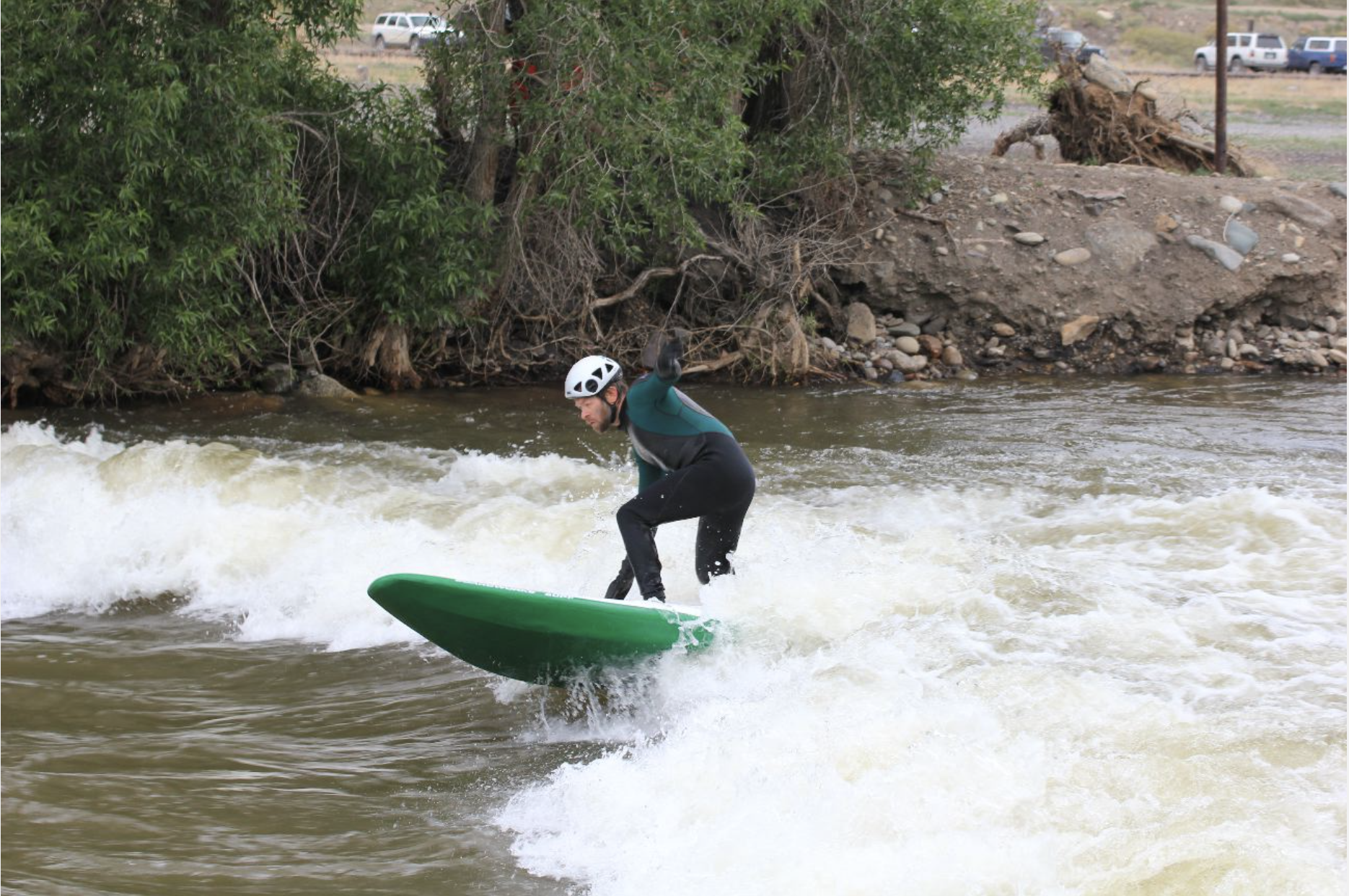
A standup surfer in the Arkansas River at Salida during Fibark, the river celebration held in late June. Photo/Allen Best

From The Mountain Town News (Allen Best):

Where spring runoff has been something like average—and where it hasn’t

Spring runoff of the Yampa River likely peaked on May 14 this year as it flowed through northwestern Colorado. That makes it an anomaly in the precipitation-dripping mountains of the West.

In most other locations, the peak runoff—the time when the largest volume of water in rivers occurs as winter’s snow melts—more normally occurs in early June after temperatures finally warmed. This year looks to be more or less normal, despite a trend to earlier runoff in many locations during the last several decades.

“The Yampa did have an early runoff, and that was the result of the warm temperatures and below-average snowpack,” said Ashley Nielson, senior hydrologist with the Colorado Basin River Forecast Center in Salt Lake City, when interviewed last week by Mountain Town News. The Yampa, she noted, will probably rise again in the next week or so, if not to the same high mark.

But elsewhere, the show is now, not a month ago. Peak runoff of the Green River was expected this week or next. It originates in the Wind River Range of west-central Wyoming. Unlike the Yampa, that basin still has a significant snowpack. That was also reported to be the case in Jackson Hole, at the headwaters of the Snake River. The snowpack there was 181 percent of average in late May, not a record but “up there,” in the words of one water official cited by the Jackson Hole News&Guide.

Peak runoff in the upper Colorado River at its headwaters along the Continental Divide in Colorado was also expected to occur in early June.

Winter had wild swings: barren until late fall, then torrents of snow in December and January. Temperatures were unseasonably warm in February and almost hot in March. It looked like an early runoff everywhere. Then May turned cold and snowy.

What explains the Yampa’s aberrant behavior? Karl Wetlaufer, a hydrologist with the Natural Resources Conservation Service in Denver, said the peak snowpack in northwestern Colorado arrived about a month earlier than usual. That snowpack around Steamboat Springs occurred on March 12, compared a more typical April 10.

Instead of mid-May for the Yampa, he says that rafters floating through Dinosaur National Monument more often experience the highest water flows of the year in early June.

The Dolores River in southwestern Colorado on Memorial Day in 2009. Photo/Allen Best

Flows in the Animas River through Silverton and Durango have had some “pretty wild swings,” Wetlaufer says. The Arkansas River has been slow to get started with runoff.

The Snake River of Wyoming and Idaho has a very different story than the Yampa, with around 200 percent of snowpack this year. The Snake originates in Jackson Hole and picks up water from the Big Wood River, which originates in the Sawtooth Mountains above Ketchum and Sun Valley, before joining the Columbia at the Idaho-Washington border.

“My takeaway is that this year is pretty normal” in terms of timing, says Bruce Anderson, the senior hydrologist at the Northwest River Forecast Center, in Portland, Ore. It was cooler and wetter in spring, but the big story was the amount of precipitation that fell during winter. “We are hugely above normal for precipitation.”

In the Tahoe-Truckee area of California’s Sierra Nevada, the snowpack was among the deeper ones on record after three bad drought years and then a so-so winter in 2015-16. Snowfall this winter was not a record, but it was a record for total precipitation. Being somewhat lower and closer to the coast than Colorado, the Sierra Nevada gets more rain during winter. This year it got a lot of rain.

Colorado, too, had rain on snow, which is not unprecedented. But it happened frequently this winter. The result was telling for travelers on I-70 who crossing Vail Pass.

“In general, there was less snow than you would expect,” says Klaus Wolter, a research scientist at the National Oceanic and Atmospheric Administration in Boulder.

Were those rain on snow storms of this past winter a result of accumulating greenhouse gas emissions? Wolter told Mountain Town News that thinks this is “probably partially climate change.”

Wolter, whose focus is empirical climate research, using statistical methods to solve climate problems, is reluctant to pin climate change on much of what we have seen this year. True, he says, one storm during May left 42 inches of fresh snow in the foothills above Boulder, a storm unprecedented since the 1920s. As extreme as that storm was, proving causality is difficult, he says.

A scientist in Oregon also shared the difficulty of proving causality. John Stevenson of Oregon State University told the Idaho Mountain Express in Ketchum that it’s “really difficult to judge any one year” to be a result of rising global temperatures.

“That’s one of the challenges we run into in the science world where people say, ‘Oh, it’s climate change.’ We’re not at the point where we can take any one random event and say it’s climate change.”

That said, his 2015 study concluded that the point each spring when half of the water year’s streamflow had run off was occurring an average 1.9 days earlier per decade.

But more extreme events are happening with greater frequency, said Mark Davidson, director of conservation initiatives with The Nature Conservancy. He pointed out that the Big Wood River has had two 100-year floods in the last 15 years.

Warm temperatures in the Ketchum and Sun Valley area were 6 to 13 degrees warmer than normal for early May, producing a flood in the Big Wood River that peaked on May 8. It was regarded as the largest in 101 years of recorded history, reports the Idaho Mountain Express.

But more warm weather was producing another surge in early June that threatened to surpass that peak of a month before, the newspaper reported last week.

Chimney Hollow reservoir construction may start in late 2018

Map from Northern Water via the Fort Collins Coloradan.

From the Loveland Reporter-Herald (Pamela Johnson):

The U.S. Army Corps of Engineers’ final decision allowing Northern Water to build Chimney Hollow Reservoir southwest of Loveland, issued 14 years after the federal permitting process began means, that construction could begin in late 2018 and water begin filling in 2022.

That same year, an open space around the reservoir with trails, backcountry camping and boating should open under the management of Larimer County’s Department of Natural Resources.

The permits that allow Northern Water to finish design and begin building the $400 million reservoir on behalf of 13 municipal water providers, including Loveland, require several different actions to mitigate environmental damage or concerns.

[Eric] Wilkinson, general manager of Northern Water, summarized some of the mitigations associated with Chimney Hollow Reservoir, which will store water pulled from the Colorado River through the Windy Gap project.

• Maintaining certain water temperatures on the Colorado River to make sure the habitat for fish stays healthy.

• Paying for about $4 million worth of stream channel improvements on the Colorado River for 14 miles ending near the confluence of the Williams Fork River, to make significant enhancements to aquatic habitat.

• Flush flows every six years to move sediment and improve habitat.

• Construct a channel that will carry the water around Windy Gap Reservoir, allowing fish to migrate through that area and improving spawning conditions in the Colorado River downstream of Windy Gap.

• Replace wetlands that will be destroyed by the actual construction of the reservoir with similar acres in another location.

• Conduct stream restoration along the Little Thompson River in two locations to help restore that channel to its pre-2013 flood conditions and maintain those enhancements over the long term.

Chimney Hollow will hold about 90,000 acre-feet of water, enough for more than 90,000 households, that will be pulled from the Colorado River in wet years and stored for use in dry years.

Windy Gap Reservoir

From The Greeley Tribune (Tyler Silvy):

The Windy Gap Firming project and its accompanying Chimney Hollow Reservoir has been approved, paving the way for more reliable water across the Front Range while also further draining the Colorado River.

The Windy Gap Project has its roots in the 1980s, and was intended to provide the Front Range with more than 40,000 acre-feet of water from the Colorado River. But without enough storage capacity, municipalities haven’t realized that yield every year.

“We are pleased to make it to this milestone with our partners at Northern Water and all of the other communities involved,” Greeley City Manager Roy Otto said in text message Thursday.

The firming project, centered on the construction of Chimney Hollow Reservoir near Carter Lake, is expected to address that problem at a cost of about $400 million.

The Army Corps of Engineers gave final approval Wednesday, and construction should start in late 2018 or early 2019.

It’s a project nearly 15 years in the making.

“We’re ecstatic,” Northern Water spokesman Brian Werner said. “You get one of these (types of projects) done in your whole lifetime.”

Water for the reservoir would be pumped from the Windy Gap Reservoir on the Colorado River near the town of Granby, west of the Continental Divide, through an existing tunnel under the Rocky Mountains to the east side of the divide.

Greeley is one of 12 beneficiaries of the project, which also will create more reliable water supply for Fort Lupton, Longmont and Loveland.

Chimney Hollow Reservoir will hold 90,000 acre-feet of water, and Greeley will get about 9,200 acre-feet of water per year from the project.

An acre-foot of water is 326,000 gallons, or equivalent to a foot of water covering a football field. Greeley residents, according to the city’s new water budget, will use about 20,000 gallons per year.

Sen. Cory Gadner, R-Colo., also applauded the decision, calling the project a major component of Colorado’s longterm water needs.

“Getting to this point has been years in the making, and it is hard to state just how important it is that Northern Water can finally move forward with construction,” Gardner said in a news release.

The project’s approval was met with resistance from some water conservation advocates, though, including Gary Wockner with Save the Colorado and Save the Poudre.

“The Colorado River is on life support right now,” Wockner told the Associated Press. “If the patient is bleeding out, you don’t cut open a new artery to try and heal it. Instead, you should work to protect and restore the river, not further drain it.”

Save the Colorado is opposed to the Windy Gap project, and Wockner told The Tribune it’s likely his group will file a lawsuit in federal court to stop the project.

“Our policy is no new dams and diversions out of the Colorado River system,” Wockner said. “This is a dam and diversion, so we’re going to do everything we can to stop it.”

Wockner, who said the Colorado River is being overused, instead calls for more water conservation, including moving away from green lawns, recycling water and managing growth better.

Werner points to the endorsement of Democratic Gov. John Hickenlooper, officials in Grand County on the Western Slope and Trout Unlimited, a trout and salmon conservation organization as proof the Windy Gap Firming project’s strong support.

Before the Windy Gap Firming project, Colorado had never endorsed a water project that has come before the federal government.

Without the project, Werner said municipalities would have to do what they’ve always done in particularly wet years: dump the excess water down the Colorado River rather than saving it for drier times.

“There is still a lot of work to do,” Otto said. “This project, along with the expansion of Milton Seaman Reservoir, are critically important to Greeley’s longterm water needs.”

Windy Gap Firming Project gets green light from @OmahaUSACE #ColoradoRiver #COriver

Here’s the release from the US Army Corps of Engineers Omaha District (Kiel Downing/Cheryl Moore):

The Corps of Engineers, Omaha District, finalized its Record of Decision (ROD) approving the Windy Gap Firming Project on May 17, 2017. The project is proposed by the Municipal Subdistrict, Northern Colorado Water Conservancy District (Subdistrict) and involves the construction of Windy Gap Firming Project Water Supply facilities for its customers and 13 other Front Range water providers. The Subdistrict requested a Section 404 Clean Water Act (CWA) Permit from the Corps’ Omaha District Denver Regulatory Branch. “Due to the potential for significant environmental impacts to the East and West Slopes of Colorado, this project resulted in the preparation of an Environmental Impact Statement (EIS)” said Kiel Downing, Denver Regulatory Office Chief. The U.S. Bureau of Reclamation (Reclamation) was the lead federal agency preparing the EIS, and the Corps participated as a Cooperating Agency.

The original Windy Gap Project, constructed in the early 1980’s, was intended to provide more than 40,000 acre-feet of firm yield to the east slope, but due to operational constraints that didn’t happen. The project currently captures water from the Colorado River, pumps it to existing reservoirs on the west slope and moves the water through a tunnel system (the Colorado-Big Thompson Project operated by Reclamation) to the Front Range of Colorado. Because of the historic deficiency in water deliveries and lack of storage, the Windy Gap Project participants have not been able to fully rely on existing Windy Gap Project water for meeting a portion of their annual water demand. As a result, the participants, initiated the proposed construction of the Chimney Hollow Reservoir, which would firm all or a portion of their individual Windy Gap Project water allotment units to meet a portion of existing and future municipal and industrial water requirements. The Chimney Hollow Reservoir, as proposed, is a 90,000 AF capacity reservoir that will be dammed at the northern and southern limits.

Reclamation published the Windy Gap Firming Project, Environmental Impact Statement in November of 2011, and ROD on December 12, 2014. The State CWA Section 401 Water Quality Certification began shortly thereafter with the Subdistrict submitting its application to the State in March of 2015. The State issued the Section 401 WQC for the WGFP on March 25, 2016. This determination was necessary for the Corps determination under Section 404 of the CWA. The Subdistrict provided the Corps its Mitigation Plan for permanent and temporary impacts to Waters of the U.S. associated with the WGFP on March 17, 2017 and the Corps with continued agency collaboration, updated study information, and new Federal and State requirements, finalized their ROD shortly thereafter marking the end of the federal approval process.

From The Loveland Reporter-Herald (Jeff Stahla):

Kiel Downing, Denver regulatory office chief for the Corps of Engineers, announced Wednesday afternoon the Record of Decision for the Clean Water Act permit for the Windy Gap Firming Project, which includes the reservoir.

With the final federal permit in hand, Northern Water officials can start planning for construction of the $400 million project, which is set to start in late 2018 or early 2019, according to Northern Water Public Information Officer Brian Werner.

“We’re smiling,” Werner said. “These things come along once in a generation.”

Berthoud-based Northern Water will manage the construction of a pair of dams in a valley west of Carter Lake that will hold approximately 90,000 acre-feet of water, or about 29 billion gallons — enough water for more than 90,000 households.

Water to fill Chimney Hollow will come from the Colorado River basin in years when its flows are above average. The water will be carried through a diversion at Windy Gap Reservoir in Grand County to Lake Granby and the Colorado-Big Thompson Project.

Municipalities including Loveland, Fort Collins and Greeley conceived of Windy Gap in 1970. The need for storage space for the communities involved to “firm” their ownership of the Windy Gap water rights expanded in later years to include Chimney Hollow Reservoir because in above-average precipitation years, Lake Granby often does not have enough space to store the additional water.

Rep. Hugh McKean, R-Loveland, said he was ecstatic when he heard about the Corps of Engineers’ approval, comparing it to Christmas.

In his time serving on the Loveland City Council and then the Colorado House of Representatives, he has seen how much the storage project was needed…

For cities such as Loveland, Windy Gap water fills an important role for its municipal users because it is a 365-day-a-year, deliverable water source, unlike in-basin seasonal water offered through local ditch companies. It will join the Colorado-Big Thompson Project shares in the city’s water portfolio…

McKean acknowledges that because the water has not been diverted before, questions and concerns will emerge from Western Slope water users and communities. However, because the Windy Gap Firming Project water is available only in years of above-average flows on the Colorado River, municipalities on the Front Range won’t be served until water rights holders on the Western Slope get their allocations.

He said he will be in Montrose this summer at a meeting of the Uncompahgre Water Users Association to talk about the project’s effect on the basins and in the context of the state water plan.

From the Associated Press (Dan Elliott) via The Colorado Springs Gazette:

The federal government gave final approval Wednesday for a $400 million dam and reservoir in northern Colorado where 13 cities and water districts will store water from the other side of the Continental Divide.

The Army Corps of Engineers issued a permit for construction of the Chimney Hollow Reservoir in the foothills about 50 miles (80 kilometers) north of Denver.

The corps regulates some of the environmental impacts of big water projects.

It is the last approval the reservoir needs, said Brian Werner, a spokesman for the Northern Colorado Water Conservancy District, which oversees the project.

Construction could start in early 2019, after the district refines the plans, hires a project manager and awards contracts.

Water for the reservoir would be pumped from the Windy Gap Reservoir on the Colorado River near the town of Granby, west of the Continental Divide, through an existing tunnel under the Rocky Mountains to the east side of the divide.

The 13 water providers own the rights to the water but have nowhere to store it. The project is formally called the Windy Gap Firming Project because it would firm up the water supply.

The Chimney Hollow Reservoir will store up to 90,000 acre-feet (1.1 million cubic meters). One acre-foot (1,200 cubic meters) can supply two typical households for a year.

New reservoirs are always contentious in Colorado. Water managers and urban planners argue the state needs more because it does not have the capacity to store all the water it is entitled to under agreements with other states. They also say Colorado needs more water for its growing population.

Some conservationists oppose new reservoirs because of their environmental damage and because the state’s rivers are already overtaxed.

“The Colorado River is on life support right now,” said Gary Wockner, director of Save the Colorado. “If the patient is bleeding out, you don’t cut open a new artery to try and heal it. Instead, you should work to protect and restore the river, not further drain it.”

Wockner said his group will likely challenge the Corps of Engineers permit in court.

Trout Unlimited negotiated some environmental improvements in the Colorado River near the Windy Gap Reservoir as part of the project. Mely Whiting, an attorney for the group, said she had not yet seen the final Corps of Engineers permit.

Water providers that will pay for and benefit from the Chimney Hollow Reservoir are the cities of Broomfield, Erie, Greeley, Longmont, Louisville, Loveland, Superior, Evans, Lafayette and Fort Lupton, as well as the Central Weld County and Little Thompson water districts.

#Snowpack/#runoff news: Big Thompson flows up

Olympus Dam photo via the US Bureau of Reclamation.

From The Loveland Reporter-Herald:

The U.S. Bureau of Reclamation has announced that it has begun to increase the amount of water it is releasing from Lake Estes into the Big Thompson River by way of Olympus Dam.

The increase began Monday, according to the bureau on its Facebook page.

The increase will go from the current level of 50 cubic feet per second (cfs) to about 100 cfs. The exact cfs released will depend on inflows into Lake Estes, but the range will be between 50 cfs and 100 cfs, the announcement said.

A cubic foot of water is equivalent to 7.48 gallons. That means there are 748 gallons in 100 cubic feet of water. The average American home uses 400 gallons of water a day, or about half of the flow when it’s 100 cubic feet.

The release from the lake into the river is expected to increase through the spring as the annual runoff flows increase.

The U.S. Bureau of Reclamation owns and operates Lake Estes and Olympus Dam as part of the federal trans-basin diversion Colorado-Big Thompson water project.

Water level and runoff information regarding Olympus Dam and Lake Estes can be found on the Bureau’s Facebook page at http://facebook.com/LakeEstesandOlyDam.

Fort Morgan should be able to avoid watering restrictions this season

First water through the Adams Tunnel. Photo credit Northern Water.

From The Fort Morgan Times (Jenni Grubbs):

The Northern Colorado Water Conservancy District Board of Directors on Thursday approved increasing the Colorado-Big Thompson Project water pipeline quota to 80 percent, according to a news release.

Fort Morgan receives its water from that [source], with water availability subject to the quota set periodically by the Northern Water Board. It had been adjusted to 50 percent last November.

Such quota changes do not affect city water rates, which are set by the Fort Morgan City Council. But it does affect the amount of water available to the city for use.

This new quota is one that means good news for Fort Morgan water customers, according to Nation…

Lots of data was taken into account by the Northern Water Board in setting this latest quota, according to the news release.

“The Board considered snowpack totals, stream flow runoff projections and input from farmers and municipal and industrial water providers in setting the quota,” the release stated. “C-BT supplements other sources of water for 33 cities and towns, 120 agricultural irrigation companies, various industries and other water users within Northern Water’s 1.6 million-acre service area.”

That includes Fort Morgan and Morgan County Quality Water District.

For Fort Morgan, the increased quota likely even means having more C-BT water available than will be needed by city residents and businesses, according to Nation.

“The higher quota also allows the city to lease out excess water above our projected needs for the year,” Nation said. “In most cases this water is leased by farmers to help complete their water supplies for the year.”

…the precipitation that fell in March within the water district’s collection area was 27 percent below what would be considered normal for that month, according to Northern Water.

@Northern_Water 2017 quota set at 80%

Map of the Colorado-Big Thompson Project via Northern Water

Here’s the release from Northern Water:

Northern Water’s Board increased the Colorado-Big Thompson Project quota allocation to 80 percent at its April 13 Board meeting. With many farmers concerned about the lack of recent moisture and the hope that cities may be willing to provide some rental water to help the region’s agricultural economy, the Board chose to make available an additional 30 percent as supplemental quota for 2017.

The approval increased available C-BT water supplies by 93,000 acre-feet, from the initial 50 percent quota made available last November.

The Board considered snowpack totals, streamflow runoff projections and input from farmers and municipal and industrial water providers in setting the quota. C-BT supplements other sources of water for 33 cities and towns, 120 agricultural irrigation companies, various industries and other water users within Northern Water’s 1.6 million-acre service area.

Directors considered the general dearth of moisture in March as they discussed the quota options. March precipitation was 27 percent below normal and contributed to the Board’s decision to raise the quota.

“It’s dry, it really is,” said Board President Mike Applegate. “The C-BT Project was created to provide a supplemental supply and we have the reserves to do that.”

He echoed the Board’s consensus in making its 61st annual C-BT quota. “Let’s make the water available now so our allottees can make their plans.”

Directors base their decision on the region’s need for supplemental water, while balancing project operations and maintaining water in storage for future dry years.

To learn more about Northern Water and the C-BT quota, visit http://www.northernwater.org.

Lake Granby spill June 2011 via USBR. Granby Dam was retrofitted with a hydroelectric component and began producing electricity [in 2011] as water is released in the Colorado River.

@Northern_Water will revisit boat inspection dough at March 2 meeting

From The Loveland Reporter-Herald (Pamela Johnson):

The board discussed the issue at its Thursday board meeting and will revisit contributing to the $300,000 program at its March 2 meeting.

The inspections are to prevent invasive mussels from getting into the water via boats. If these mussels get into the water, which is used for drinking and agriculture through the region, they can affect aquatic life as well as the infrastructure that stores and moves the water.

Previously, Colorado Parks and Wildlife paid for all the inspections statewide at a cost of $4.5 million, but the agency lost its funding this summer due to a Colorado Supreme Court decision that changed the face of oil and gas severance taxes.

The parks agency is working on legislation for new fees to cover the program as soon as 2018, but the funding for this summer is up in the air.

Stakeholders proposed a three-way split of the total $300,000 cost at the two reservoirs. Larimer County agreed to pay one third from its parks fees, Colorado Parks and Wildlife agreed to pay one third from its reduced budget, and officials with both agencies had hoped Northern Water would kick in the final piece.

After its meeting Thursday, the board released the following statement: “The Northern Water board was briefed … regarding the funding challenges for ongoing boat inspections on the reservoirs associated with the Colorado-Big Thompson Project. Following significant discussion, the board directed staff to continue discussions with the various aquatic nuisance species (ANS) stakeholders. It is likely staff will provide a related resolution and a 2017 ANS funding plan to the board at its March planning and action session.”

Map of the Colorado-Big Thompson Project via Northern Water

‘As the Poudre Flows — Forest to Plains’ theme of Poudre River Forum

Scott Hummer, general manager of North Poudre Irrigation Company, talks about how his agency worked with Fort Collins Natural Areas and Colorado Parks and Wildlife to include a fish passage when the irrigation company replaced a diversion structure on the Poudre River that was destroyed by the 2013 floods. Work was completed [in February 2016]. (Pamela Johnson / Loveland Reporter-Herald)

Here’s the release from Colorado State University (Jim Beers):

The Cache la Poudre River, which flows from the mountains through Fort Collins, Timnath and Windsor to the plains east of Greeley, is at the heart of countless activities: from irrigating crops and lawns to providing drinking water for more than 365,000 people and hosting numerous recreational activities.

Those with connections to and concerns for the Poudre River will gather on Friday, Feb. 3 for the fourth annual Poudre River Forum. After its first three years at Larimer County Fairgrounds, the forum is moving down the river to Greeley as a reminder that the Poudre River is important to all who benefit from it — from its headwaters to its confluence with the South Platte. This year’s forum — the theme is “As the Poudre Flows — Forest to Plains” — will be held from 8:30 a.m.-4:30 p.m. at the Island Grove Events Center, 501 N. 14th Ave., Greeley. Pre-registration is required for all participants.

Understanding the river, each other

Sponsored by the Poudre Runs Through It Study/Action Work Group, the forum serves as a community-wide gathering of people from agricultural, municipal, business, recreational and environmental backgrounds to learn about and discuss issues related to the Poudre River.

“The Poudre River Forum brings together those who use the river for agricultural and urban diversions and those who work to improve its ecological health. In the past those groups have not necessarily seen eye to eye,” said MaryLou Smith, PRTI facilitator. “Increasingly our participants are open to the idea that it takes collective vision and action to make the Poudre the world’s best example of a healthy, working river.”

Once again, this year’s event will be facilitated by the Colorado Water Institute at Colorado State University. “The Forum is a great opportunity for the communities connected by the Poudre River to come together to better understand the entire watershed, and each other,” said Reagan Waskom, director of CWI.

Forests and water quality/quantity

Laurie Huckaby with the U.S. Forest Service, will present “The last 1,000 years in the Poudre according to the trees,” to kick off the topic of how important the upper watershed is to water quantity and quality.

“Water quality and forests are inextricably linked,” said Joe Duda of the Colorado State Forest Service, who will join Huckaby as one of the presenters. “Forest conditions and insects, disease and fire all can have profound impacts on water flow and quality. Only healthy, resilient forests can continuously supply clean water.”

Global lessons for local success

“Finding the Balance: Managing Water for People and Nature” is the message of keynote speaker Brian Richter. Richter has been a global leader in water science and conservation for more than 25 years, and currently serves as chief scientist for the Global Water Program of The Nature Conservancy in Washington D.C. Richter’s ideas about the importance of recognizing the balance of working river/healthy river are the basis for which PRTI was initially formed. He has consulted on more than 120 water projects worldwide, and has served as a water advisor to some of the world’s largest corporations, investment banks, the United Nations, and has testified before Congress on multiple occasions. Richter co-authored,with Sandra Postel, the 2003 book Rivers for Life: Managing Water for People and Nature and in 2014 wrote Chasing Water: A Guide for Moving from Scarcity to Sustainability.

Change affects all sectors

An afternoon panel session will probe the impacts of change — positive and negative — along the Poudre River and how they have been similarly and differently addressed by agriculture, urban, and environmental sectors. They will discuss what anticipated future changes might these three sectors see as opportunities or incentives for mutually beneficial collaboration that could result in a healthier, working river?

“It has been said that the only thing that is constant is change,” said John Bartholow, retired ecologist from U.S. Geological Survey, and panel coordinator/moderator. “The question is, can we learn to adapt to those changes sure to come on the Poudre in ways that benefit agriculture, municipalities, and the environment?”

The panel will include Eric Reckentine, deputy director, City of Greeley Water and Sewer; John Sanderson, director of science, Nature Conservancy of Colorado; and Dale Trowbridge, general manager, New Cache la Poudre Irrigating Company.

Videos, displays and music too

The day-long forum also includes “River Snapshots” highlighting more than 15 projects undertaken by a variety of groups on the Poudre last year; “My How the Poudre Has Changed,” featuring historical 1970’s footage of the Poudre; updates from both the cities of Greeley and Fort Collins on current water programs; and over two dozen river-focused displays from community organizations and agencies. The day concludes with a social hour including food, beer and other beverages, and river-themed door prizes.

Registration is $50 and includes lunch. Scholarships for students and reduced rates are available. The deadline to register is Friday, Jan. 27 at http://prti.colostate.edu/forum_2017.shtml.

For more information, contact event coordinator Gailmarie Kimmel at PoudreRiverForum@gmail.com or 970-692-1443.

Longmont delays Windy Gap rate increase

Water hauler early Longmont via the Longmont Times-Call

From The Boulder Daily Camera (Karen Antonucci):

Following a closed-door session on Longmont’s water supply, the City Council tabled some of the water rate increases that were slated to start on Jan. 1.

The water rates were slated to increase by 17 percent in both 2017 and 2018, 8 percent of which in both years would go toward financing Longmont’s 10,000 acre-feet participation level in the Windy Gap Firming Project. However, on Tuesday, council decided rates will rise 9 percent in both years.

The council voted unanimously to table the water rate increase, which was on second reading Tuesday, until the U.S. Army Corps of Engineers issues a 404 permit for the Windy Gap Firming Project.

While design work is ongoing for the Windy Gap Firming Project, no construction work can start until the Corps issues the permit, Dale Rademacher, Longmont general manager of public works and natural resources, told the council Tuesday. While staff hoped it would come before the end of 2016, that doesn’t seem to be the case.

The latest E-Waternews is hot off the presses from Northern Water

Click here to read the newsletter. Here’s an excerpt:

Storage Continues Above Average

December 1 water storage levels in the Colorado Big-Thompson Project remain above average, with total C-BT Project storage at 540,028 acre-feet (Dec 1 average is 444,533 AF). With statewide snowpack slightly below normal, above-average C-BT storage is good news.

cbttotalstoragede122016

#ColoradoRiver: @USBR Lake Estes and Olympic Dam operations update #COriver

First water through the Adams Tunnel. Photo credit  Northern Water.
First water through the Adams Tunnel. Photo credit Northern Water.

From email from Reclamation (Peter Soeth):

On Monday at 5:30 pm of this week diversions through the Adams Tunnel to the east slope of the Colorado-Big Thompson Project began. While this picks up, Lake Estes will rise slightly and is expected to be return to typical levels by next mid-week.

The Olympus Dam slide gate remains set to release low-level winter flows to the Big Thompson River.

This rate of fill will be maintained for several days to ensure safe operations below the Estes Power Plant. The majority of the water in Lake Estes enters through the power plant via the C-BT Project.

Track Lake Estes’ water elevation at our tea cup page: http://www.usbr.gov/gp-bin/arcweb_olydamco.pl

Olympus Dam photo via the US Bureau of Reclamation.

The November 2016 eWaterNews is hot off the presses from @Northern_Water

First water through the Adams Tunnel. Photo credit  Northern Water.
First water through the Adams Tunnel. Photo credit Northern Water.

Click here to read the newsletter. Here’s an excerpt:

The C-BT Project water year ended on Oct. 31. C-BT Project storage levels on Nov. 1 were above average for a third consecutive year, with 548,274 acre-feet in active storage. The Nov. 1 average is 444,177 AF. Deliveries increased in 2016 over 2015 levels, with 204,078 AF delivered (including quota, Carryover Program and Regional Pool Program water). Forty-six percent of the deliveries were from Horsetooth Reservoir, 40 percent from Carter Lake and the remaining 14 percent went to the Big Thompson River, Hansen Feeder Canal and the South Platte River. Estimated deliveries to municipal and industrial users totaled 102,157 AF, while agricultural deliveries were approximately 101,921 AF.

Locals await grant news on #ColoradoRiver projects — Sky-Hi Daily News #COriver

Windy Gap Reservoir
Windy Gap Reservoir

From The Sky-Hi Daily News (Lance Maggart):

The long awaited Windy Gap Bypass Project may begin moving forward in the not-so-distant future.

Officials from Grand County as well as multiple local partnering agencies and groups are patiently awaiting news on a $10 million Regional Conservation Partnership Program (RCPP) grant. The announcement regarding which applicants will receive the grant is expected sometime in Dec. this year. If the grant award is approved full funding for the Windy Gap Bypass Project will be secured.

WORKIN ON THE RIVER

The RCPP grant is administered by the National Resources Conservation Service (NRCS) and is given to producers and landowners to provide conservation assistance. The grant application was submitted under a partnership of multiple local organizations and entities including: Grand County government, the Irrigators in the Lands in the Vicinity of Kremmling (ILVK), the Upper Colorado River Alliance (UCRA), Middle Park, the Colorado River District, Trout Unlimited, Colorado Parks and Wildlife (CPW) and Northern Water.

If awarded the $10 million grant monies will go directly to two specific projects: the Windy Gap Bypass Project and a streambed habitat improvement project in the Colorado River for the ILVK. Additionally CPW is working to secure funding from the States Wildlife Mitigation and Enhancement Plan to conduct a stream enhancement project on the Colorado River between the Windy Gap and the ILVK lands. If local organizers are able to secure funding for all three projects roughly 33-miles of the Colorado River will see stream improvements.

Lurline Underbrink-Curran is a contract employee for Grand County overseeing much of the County’s efforts on water issues. She worked closely with others to develop the RCPP grant application. “This will be a big deal if we are successful,” Underbrink-Curran said. “We think we have a strong application and we have a very strong partnership collaboration.”

She cautioned against expecting results too quickly though, even if full funding is approved. “The things that happened to the River didn’t happen over night and we won’t fix them overnight. But if we have methods and plans in place we will get them fixed.”

WINDY GAP BYPASS

The total cost of the Windy Gap Bypass Project is estimated at roughly $9.6 million. A total of $4.5 million has already been secured for the project and the $10 million RCPP grant would cover the remainder, with excess funds going to the ILVK Project.

Map of the Colorado-Big Thompson Project via Northern Water

The Windy Gap Bypass Project is intended to create a free flowing channel for water from the Colorado River to [bypass] the Windy Gap Reservoir. The Windy Gap Reservoir is located just a short distance west of Granby on US Highway 40 and is one of several water storage reservoir[s] that make up the Colorado Big-Thompson Project’s water diversion system.

Water from the Windy Gap is pumped through the Northern Water diversion and pump network eventually reaching Grand Lake before moving across the Continental Divide through the Alva B. Adams Tunnel. When the Windy Gap Reservoir was initially constructed no free flowing channel was created. As such the Windy Gap Reservoir divides the river habitat above and below the reservoir, preventing fish and other creatures from migrating freely.

Additionally the Windy Gap causes the Colorado River to lose nearly all of its velocity, allowing for a substantial amount of sediment to develop in both the reservoir and in the river downstream. The sediment buildup negatively impacts bug habitat, which has a domino effect on all other species living in the river.

The work that will be done for the Windy Gap Bypass is fairly simple in concept. Excavators will dig out a channel within the existing Windy Gap Reservoir. The dirt from the excavations will be used to construct a berm inside the Reservoir. The berm will establish a smaller reservoir while also creating a separate channel for the free flow of water down the Colorado.

ILVK PROJECT

The ILVK streambed habitat improvement project seeks to address two concerns: issues with irrigation infrastructure and improvements of streambed habitat for bug and aquatic life.

As Paul Bruchez, one of the ILVK landowners helping to spearhead the project explained, the project hopes to accomplish both goals through the same work; by rebuilding the pools and riffles that create healthy river habitat and focusing most of those efforts on areas where the irrigation pumping infrastructure already exists.

The ILVK is a landowners organization made up primarily of irrigating ranchers near the town of Kremmling. The ILVK holds some of the most senior water rights on the upper Colorado River; their senior water rights are recognized in Senate Document 80 and their rights precede the famous Colorado-Big Thompson Project (CBTP).

Prior to the establishment of the CBTP there were virtually no water storage reservoirs in the high country and no ditches bringing water to the landowners of the ILVK. At that time they were considered as having, “meadows act water rights” meaning they did not irrigate their fields using irrigation ditches, rather their fields naturally flooded each spring/summer as snow runoff from higher elevations made its way to the Colorado River.

When the CBTP was established irrigation pumps were constructed to provide water from the Colorado River to the landowners of the ILVK. As time has passed and additional water diversions and storage projects were undertaken above the ILVK region the flows that provided the ILVK members with irrigation water have diminished, along with the overall water table.

“We have a fixed station (irrigation) pump system with a river that is dynamic and changing,” Bruchez explained. “My neighbors and family struggle with irrigation issues. But I am also watching the regress of the Colorado River from a fishery standpoint. The concept of the ILVK project is to fix and repair our irrigation systems to be sustainable while using construction techniques that will improve the health of the river overall.”

In that way the ILVK project proverbially kills two birds with one stone. But for Bruchez and other landowners along the Colorado the effort isn’t just about improving their ability to access the water that is theirs by right, it is about the broader health of the River as well.

“If we can cut down water temps by even a fraction we are making headway,” Bruchez said. “It almost becomes a water quality issue. We are not just improving segments but improving the whole river system. We can’t look at one part or another as the priority. It is a system that needs a system wide repair.”

Flatiron Reservoir, Marys Lake and Lake Estes drawn down for work — Loveland Reporter-Herald

Colorado-Big Thompson Project east slope facilities

From The Loveland Reporter-Herald:

Starting Oct. 27, officials from the Bureau of Reclamation turned off the water diversion tunnel from the West Slope to the Colorado-Big Thompson Project that feeds many of the lakes and reservoirs in Larimer County. The reservoir levels have also been lowered through the release of water to storage downstream.

According to a news release from the agency, the shutdown has allowed for the inspection of dams at Marys Lake and Lake Estes near Estes Park, and Flatiron Reservoir west of Loveland.

While the reservoirs are at low levels, crews are also looking at the power generation facilities at the Marys and Pole Hill power plants and the Charles Hansen Feeder Canal.

According to agency officials, the work will continue on the reservoirs and facilities throughout November, with water diversions through the Adams Tunnel from the Western Slope slated to resume in mid-December.

#ColoradoRiver: Beauty, “It’s not a concept that lends itself very well to science” — Esther Vincent #COriver

Grand Lake via Cornell University

From Aspen Journalism (Allen Best) via The Aspen Daily News:

Nobody disputes that the Colorado-Big Thompson project has changed Grand Lake, the state’s largest, deepest natural lake. How could it not?

In the 1940s, Grand Lake was integrated into the giant C-BT, what the late historian David Lavender called a “massive violation of geography.” It’s Colorado’s largest transmountain diversion project. By one tally in the 1990s, it delivers an average 231,060 acre-feet annually from the headwaters of the Colorado River to cities and farms east of the Continental Divide. This compares to the 105,024 acre-feet from three tunnels through the Sawatch Range east of Aspen.

Almost immediately after the C-BT was completed in 1953, locals began to complain that the project shoehorned into the lake had sullied the lake’s clarity by introducing algae and sediments. This is, they insist, a violation of federal law.

The controversy pivots on Senate Document 80, a part of the Congressional authorization for project funding in 1937. The document describes the needs of irrigation, industrial and power production but also warns against impacts to nearby Rocky Mountain National Park.

The lake, if outside the park, has one of Colorado’s most memorable backdrops. The document specifies the need “to preserve the fishing and recreational facilities and the scenic attractions of Grand Lake…”

On that, say many locals, the C-BT has failed, and they say that until recently they got little response from the U.S. Bureau of Reclamation, the agency that built the C-BT.

But now, in a reversal, the bureau is working with 18 other stakeholders in an effort to solve the problem. Parties include Northern Colorado Water, the agency that manages the diversions for cities and farmers of northeastern Colorado, Grand County and other state and local organizations.

Grand Lake’s story fits into a broad theme of changed sensibilities in Colorado about 20th century river alterations. Restoration and remediation projects are starting or underway on the San Miguel River in Telluride, on the Eagle River at Camp Hale and on the Fraser River near Winter Park.

“It’s possible that at one time, the impacts of the CBT Project on Grand Lake clarity were thought to be just part of the price we pay for valuable water projects,” said Anne Castle, a fellow at the Getches-Wilkinson Center for Natural Resources, Energy and the Environment at the University of Colorado-Boulder. “Now, we are more inclined to believe that the environmental values have significance, including economic significance, and that operations can and should be adjusted to better accommodate these values.”

The work at Grand Lake also illustrates the power of persistence and spunk by advocates of environmental protection. And it involves a collaborative process called adaptive management that emphasizes consensus-based decision-making in solving stubborn issues involving water diversions.

Nobody thinks solving this problem will be easy, though. In April, after several years of working together, the Grand Lake stakeholders submitted a plan to the Colorado Water Quality Control Commission. The plan approved by the commission sets an interim clarity goal for summer pumping during the next five years.

During that time, the Bureau of Reclamation is to develop a plan for long-term solutions. Alternatives include expensive new tunnels, possibly bypassing Grand Lake altogether. A preview of the alternatives may emerge at a meeting of stakeholders in late November.

Not everybody in Grand Lake thinks that reduced clarity is a problem. “There are people who think there’s a problem, but there is no problem,” says Jim Gasner, a member of the Grand Lake Board of Trustees, the town’s elected body, and a fishing “teacher” at Rocky Mountain Outfitters.

But Elwin Crabtree, a real estate agent and former Grand County commissioner, sees something different. “It’s adverse to its natural being,” he said in early August in an interview at his office along the town’s main street of knotty-pined stores and lodges. “I think we look at it as a moral issue,” he added. “I think we believe in having responsibility to be good stewards of our environment.”

The C-BT is an effort to address what one historian in the 1950s called “nature’s error.” Even as Aspen was putting on its silver-lined britches in the 1880s, farmers along the South Platte River and its tributaries were struggling with inadequate water in late summer to finish their corn and other crops.

Grand River Ditch July 2016. Photo credit Greg Hobbs.

Irrigators set out to remedy this. The first large-scale transmountain diversion from the headwaters of the Colorado River began in 1890. Called the Grand River Ditch, it’s beveled into the side of the Never Summer Range in what is now Rocky Mountain National Park, collecting water like a rain gutter from a roof.

Then came the 1930s, the decade of the Dust Bowl, the Great Depression and the New Deal. Farmers in northeastern Colorado had long been agitating for added infusions of water from the Colorado River headwaters. But they couldn’t get it done themselves. They needed federal funding.

Map of the Colorado-Big Thompson Project via Northern Water

The flawed design

But the work along the Continental Divide from 1939 to 1953 created a wound at Grand Lake. In retrospect, the design was flawed.

The C-BT at the Colorado River headwaters consists of three main bodies of interconnected water. Only one, Grand Lake, is natural.

Farthest downstream is Granby Reservoir, which is Colorado’s third largest, capable of holding 539,758 acre-feet of water during runoff of spring and early summer. This compares to Ruedi Reservoir’s 102,373 acre-feet and Dillon’s 257,304 acre-feet.

From Granby, water is pumped upstream as needed by Eastern Slope diverters to Shadow Mountain Reservoir. Shallow, no more than nine feet deep, Shadow Mountain is directly connected through a short canal to Grand Lake.

In 2011, reservoirs east of the divide were full, so water was allowed to continue down the Colorado River without diversion. This photo shows what the lake looked like on Aug. 30, without pumping. Photo courtesy of Byron Metzler and pilot Steve Paul

The canal occupies the original path of the Colorado River emerging from Grand Lake. From the interconnected Grand Lake and Shadow Mountain Reservoir, water is then pumped through the 13.1-mile Alva Adams Tunnel underneath the national park to the Estes Park area for storage in reservoirs there and along the northern Front Range.

Shadow Mountain is a problem, though. Its shallowness allows water to be easily warmed in summer, producing algae that can float into Grand Lake. The shallowness also allows lake-bottom sediments to be disturbed more easily and dispersed into Grand Lake.

Evidence for the historic, pre-construction clarity of Grand Lake is scant: Just one measurement, taken in 1941, of 9.2 meters (30 feet).

Detailed observations during the last decade show clarity down to 6 meters (19.6 feet), but no more.

The standard adopted in April by the state agency specifies a minimum of 2.5 meters and an average of 3.8 meters (8.2 feet to 12.4 feet) during summer diversion season.

“I think the clarity standard has really elevated the discussion,” says Lane Wyatt, co-director of the water quality/quantity committee in the Northwest Council of Governments. “This is the only clarity standard in Colorado. It’s the first one we’ve ever done.”

Clarity is not the only issue, though. Water must be delivered to farms and cities. As it is flows downhill toward the Great Plains, it generates electricity distributed by the Western Area Power Authority. Purchasers of this low-cost power include Aspen Electric and Holy Cross Energy.

Canton “Scally” O’Donnell, president of the Three Lakes Watershed Association, remembers a more pristine past.

As a boy, his family summered at Grand Lake. That was in the 1930s and 1940s. “We drank the water right out of the lake, and many families did that,” O’Donnell said.

The first complaint about the sullied water was filed in 1954, the year after the project’s formal completion. In 1956, Grand Lake trustees adopted a resolution that informed Colorado’s congressional delegation of problems. The resolution was aimed at the Bureau of Reclamation.

“I think it’s fair to say that up until seven or eight years ago, the bureau pretty much stonewalled,” O’Donnell said. “They just did not want to recognize the problem, and Northern Colorado Water, the same.”

Movement has occurred during the last decade. One avenue for local protest was a proposed expansion of an existing diversion of the Colorado River at Windy Gap, about 15 miles downstream. Completed in 1985, the Windy Gap dam uses the C-BT infrastructure to deliver additional water to the Rawhide power plant north of Fort Collins, Greeley, Boulder and other cities.

The Windy Gap Firming, or expansion, plan was formally introduced after the drought of 2002. It proposes diversion of remaining water rights owned by a string of northern Front Range cities.

The effect of persistence

O’Donnell, of the Three Lakes Watershed Association, thinks the changed attitudes is explained by the persistence of individual public officials.

He singles out Lurline Underbrink Curran, then the Grand County manager. “She’s smart and she’s tough,” he said. “She just kept on beating on everybody to make it happen.”

He also points to the influence of Anne Castle, a long-time Denver water lawyer who served from 2009 to 20014 as assistant secretary for water and science in the Interior Department. Her responsibilities included oversight of the Bureau of Reclamation.

“I think part of the reason it has attention now is the fact that the Windy Gap Firming Project required the federal government to pay attention to Senate Document 80 and both C-BT and Windy Gap Firming Project do have an impact on Grand Lake’s recreation and scenic attraction. Calling attention to that issue, as both Lurline and I did, with prodding from Scally, had an impact,” Castle said.

But again, agreeing there is a problem is not the same thing as finding a solution.

“There is a lot of uncertainty about how our operations affect clarity,” said Victor Lee, an engineer for the Bureau of Reclamation.

The precise circumstances that cause algae and sediments to degrade clarity are poorly understood. Northern has been altering its diversion regimes, to see if that will improve clarity.

This year, from July until late August, pumping was conducted about 15 hours a day at 250 cubic feet per second. Clarity degraded, though. Algae growth was suspected. So the pumping was accelerated to about 20 hours a day with two pumps. Results were mixed.

It was a success, said Lee, in that they learned something. Clarity readings exceeded the minimum but did not meet the average standard. “I would say the experiment was successful, but we did not meet our objective,” he said.

Esther Vincent, water quality manager for Northern Water, said the effort to address Grand Lake’s muddled clarity is attracting attention across Colorado by water professionals. Spurring their interest, she said, is the possibility of other bodies of water being assigned clarity standards.

There’s also interest in the adaptive management process created for Grand Lake. It’s similar to but separate from Learning By Doing, which was created in response to expanded water diversions from both Windy Gap and by Denver Water’s Moffat Tunnel collection system.

Vincent also points out a deeply philosophical question. In 1937, when adopting S.D. 80, did Congress have the same notion about what constitutes “scenic attraction” as we do today?

“I am an engineer,” she said. “Asking an engineer to define what beauty is, is an interesting dilemma. It’s not a concept that lends itself very well to science.”

Editor’s note: Aspen Journalism and the Aspen Daily News are collaborating on coverage of Colorado’s rivers and water. More at http://www.aspenjournalism.org.

Longmont water rates keep going up

From The Longmont Times-Call (Karen Antonacci):

The Longmont City Council opted for the middle-of-the road option for funding Longmont’s portion of the Windy Gap Firming Project, despite survey responses of residents that indicated most favored an all-cash option.

The decision, along with the March decision to participate in the water storage project at 10,000 acre-feet, will likely mean water rate increases of 8 percent in both 2017 and 2018, above the 9 percent increases in both years that have already been approved.

The council had three funding options to choose from, while many residents in a survey commissioned for the city expressed doubt that Longmont needs the 10,000 acre-feet of water storage instead of the 6,000 that was originally proposed.

The money for the 6,000 acre-feet is already in the bank and the rate increases and debt come into play to pay for the additional 4,000 acre-feet of storage, Longmont general manager of public works and natural resources Dale Rademacher said Tuesday.

Rademacher said the city needed an extra $16 million to pay for the extra water storage. The council chose to raise $10 million of that cost in “cash” that will come from the rate increases. The remaining $6 million will be debt, which will need to be approved by the council but won’t need to go on a ballot like a larger amount of debt would require.

Some council members expressed surprise that of the 848 households who returned a random city survey on the issue, most favored an all-cash option. Survey data was weighted to more closely match Longmont demographic data. The survey has a 3 percent margin of error.

The all-cash option to raise the money would have raised rates 13 percent in 2017 and 12 percent in 2018 above the already-approved 9 percent increases in both years.

Most people who completed the scientific mail survey favored this all-cash option, with 46 percent of respondents saying they either “strongly support” or “somewhat support” it.

The city also released a web comment form where any resident — not just the ones who received the mailed survey — could tell the council about their preferences. While not scientific, most people online said they didn’t want any of the three options, but of the three, most supported a high-debt, low-rate increase option.

The third option would have required a vote of the people to issue $16.7 million in debt and mean water increases of 5 percent in both 2018 and 2019 above the already 9 percent increase.

Former Mayor Roger Lange spoke during the public-comment portion of the meeting, urging the council to keep water rates as low as they can by reducing the participation in the project back to the 6,000 acre-foot level and use debt.

“It’s surprising that option 1 — the all-cash option — appeared to be favored by the people who got the survey,” Lange said. “In the web response survey, option 1 got the least favorable comments and many said they want none of the options. So it seems these surveys are diametrically opposed.”

Former City Manager Gordon Pedrow also spoke and reiterated that he thought the city should have stayed with the 6,000 acre-feet participation level rather than the increased 10,000 acre-feet level.

“With that rash decision, you have forced upon your residents options along with these horrible rate increases,” Pedrow said. “When residents receive their bills and realize what you’ve done, it will result in a complete loss of trust in you elected officials.”

The Times-Call published a letter to the editor from Pedrow in September that touched on many of the same points, plus urged residents to recall any “draconian” water rate ordinance so it can be put to a general vote. Nine of the respondents in the web survey referenced the letter and said they don’t see the need for the extra 4,000 acre-feet of water storage.

The amount of participation in the Windy Gap decision was strange in that the Longmont water board recommended 10,000 acre-feet while city staff recommended 6,000 acre-feet. The higher participation level passed the council 5-2 with Councilwomen Polly Christensen and Joan Peck dissenting.

Water board Chair Todd Williams spoke during the public-comment portion of the meeting on Tuesday, defending the board’s March recommendation.

Windy Gap is a relatively low-cost option to add water to the collector system, plus is the project that is farthest along in the lengthy approval process, Williams said.

“By the time Windy Gap stores one drop of water, it will have been 20 years since the project started because of all the studies and permits associated with starting it. All other projects have much more uncertainty in terms of implementation, cost and timing,” Williams said.

Williams added that the variables determining how much water Longmont will need in the future are not set in stone. If other entities that Longmont trades water with walked away from the agreement, for example, Longmont would lose some sources of water, Williams said.

Mayor Dennis Coombs said if new information becomes available on whether Longmont needs 6,000 or 10,000 acre-feet of participation, he would like it presented to council. Christensen said she didn’t vote for the 10,000 acre-feet and she would be happy to return to the lower level, but none of the other council members seemed to support the idea.

Coombs said he noticed that people older than 55 years old wanted debt while younger people seemed to lean toward cash.

“My job is to do what I think most people in the city want and not favor one age group over another,” Coombs said. “Option 2 seems to thread the needle and satisfies the most people.”

Marys Lake, Lake Estes to be lowered for maintenance — The Estes Park Trail-Gazette

Marys Lake aerial photo via the Northern Colorado Water Conservancy District, October 2016.

From Reclamation via the Estes Park Trail-Gazette:

The U.S. Bureau of Reclamation has announced that it will begin shutting down this week the Colorado-Big Thompson Project east slope system for winter maintenance and system inspection.

Peter Soeth, a Bureau spokesperson, said in an e-mail that beginning Oct.27 diversions will first be stopped through the Adams Tunnel followed by the draining of Marys Lake and Lake Estes by the morning of October 31.

Flatiron Reservoir will be drained by November 4.

Maintenance activities include annual maintenance for Marys and Pole Hill powerplants, as well as the Charles Hansen Feeder Canal.

The inspection and maintenance is expected to last through the middle of December. Once complete, the system will begin diversions through the Adams Tunnel and preparing for the 2017 water year.

#ColoradoRiver: Windy Gap Firming Project update #COriver

Site of Chimney Hollow Reservoir via Northern Water.

From the Loveland Reporter-Herald (Pamela Johnson):

“Chimney Hollow dam will be the tallest one constructed in Colorado in the last 50 years,” said Don Mongomery, the principal engineer who will design the reservoir project, drawing on experience from dams around the globe.

“It will be in the order of 360 feet tall,” he said, with a crest estimated at 3,500 feet long.

Final design of Chimney Hollow will pare down the specific height and construction details for the dam, spillway, pipeline and inlets that will allow Northern Water to store as much as 90,000 acre-feet of Windy Gap Firming Project water.

Northern Water, the agency coordinating the project, recently hired the Broomfield-based MWH Global with an $11.9 million contract for engineering and design. Montgomery, who was raised and went to college in Boulder and Larimer counties, is leading that process.

He said he is excited to use the skills he has honed worldwide, working on projects on the Panama Canal and in Peru among other locations, in his home state to build a reservoir that will provide recreation that he, among many others, enjoys with his family.

“To be able to bring that home is pretty amazing,” said Montgomery. “To be able to help my community is pretty exciting. Once they’re done, they become these great resources to the community.”

Chimney Hollow Reservoir is expected to be completed by 2021 to begin storing water for 13 participants including Loveland, Longmont and the Little Thompson Water District. And it will become a new recreation area managed by the Larimer County Department of Natural Resources.

The reservoir and surrounding park will be located west of Loveland near Carter Lake, Flatiron Reservoir and Pinewood Reservoir, which are all managed by Northern Water for water storage and by Larimer County for recreation.

Specific recreation plans are still in the works, but Larimer County Department of Natural Resources officials are looking at a mix of camping, hiking and non-motorized boating, including paddle boats and sail boats. Campsites reachable only by boat also are in the initial plans.

The design of Chimney Hollow should take about two years and will include determining the best type of structure to be built, whether it will have a clay core made from materials on site, a concrete face or an asphalt core, noted Montgomery. This will be determined by drilling, sampling and studying the area.

The process will fine-tune the construction details and the costs as well as the exact height of the dam at Chimney Hollow. It will, however, be around 360 feet tall, which will make it the tallest in Larimer County,.

Construction of Chimney Hollow will be the biggest reservoir project in Larimer County in about six decades.

Northern Water began applying for permits in 2003, and the federal government approved the project in December 2014. Since then, the water district has been working on the rest of its needed permits. All that is left is a federal wetlands permit, which Werner expects to be approved this year.

“This is the very last piece in the puzzle,” said Werner. “At this point, there’s nothing else. No other permits, no other agreements that we have to do. We’ve done it all.”

Map from Northern Water via the Fort Collins Coloradan.

#ColoradoRiver: The latest “e-Waternews” is hot off the presses from Northern Water #COriver

Graph showing historical total active storage for Sept. 1. The green line indicates average storage, which is 492,333 AF via Northern Water.

Click here to read the newsletter. Here’s an excerpt:

C-BT Project Update
Going into September, C-BT Project storage continued to be above average. On Sept. 1, 2016, total active storage was 619,418 acre-feet, which is approximately 128,000 AF above average for this time of year.

For the 2016 water year, 142,579 AF has been delivered with 42 percent of the deliveries 0 from Carter Lake and 49 percent from Horsetooth Reservoir. The remaining nine percent is delivered from the Big Thompson River and the Hansen Feeder Canal.

Map of the Colorado-Big Thompson Project via Northern Water

Longmont councillors want rate payers to weigh in on paying for Windy Gap supply

Map from Northern Water via the Fort Collins Coloradan.

From the Longmont Times-Call (Karen Antonucci):

The Longmont City Council has opted to participate in the Windy Gap Firming Project, which would construct a reservoir in order to hold some of the water produced by Longmont’s water rights.

There are three options to finance Longmont’s projected $47 million portion of the Windy Gap Firming Project — one using all cash and two using variations of debt.

If the council chooses to pay the $47 million in cash, it would mean initial water rate increases of 13 percent in 2017 and 12 percent in 2018, above the 9 percent increase in both of those years that has already been approved, for totals of 22 percent and 21 percent.

Or, the council could choose to use $41 million cash and $6 million in debt. This would mean initial rate increases of 8 percent in both 2017 and 2018 above the already approved 9 percent increase in those years. With this option, the city would spend $50.1 million total, including interest, on the project.

Finally, the council could choose to finance the project with $30.3 million in cash and $16.7 million of debt, it would mean initiative water rate increases of 5 percent in both 2018 and 2019 above the 9 percent increase in both those years. This option would ultimately cost the city $55.8 million.

For the cash option and the $6 million debt option, the rate increases over 10 years would be similar. The $16.7 million debt option would result in the highest total rate increase over a decade.

Longmont spokeswoman Holly Milne said that the council asked for the survey and the online comment form because they wanted resident feedback before they make a decision.

Residents can visit http://longmontcolorado.gov/departments/departments-n-z/water/water-resources-supply/windy-gap-firming-project and fill out an online form with their opinion of what the city should do.

The city is also surveying 3,000 randomly selected Longmont households with a postcard survey. The households chosen will be different than the households that will receive the city’s separate customer satisfaction survey.

Larimer pays $8.4 million for farm, water rights — Loveland Reporter-Herald

Colorado-Big Thompson Project east slope facilities

Here’s the release from Larimer County (Kerri Rollins):

Larimer County Department of Natural Resources purchased a 211-acre farm southwest of Berthoud, along with its valuable water rights. The deal closed Monday, August 8.

Using Help Preserve Open Spaces sales and use tax dollars, Larimer County Department of Natural Resources purchased the property, known previously as the Malchow Farm, to conserve its agricultural, historic, scenic, community buffer and educational values. General public access is not permitted at this time. Larimer County plans to continue leasing the property as an active agricultural farming operation.

The Town of Berthoud provided $100,000 to Larimer County to help purchase the farm, which will also help leverage a potential Great Outdoors Colorado funding request being submitted later this month.

“We’re excited to acquire this farm and its myriad of conservation values,” said Gary Buffington, director of Larimer County Department of Natural Resources. “The property helps us further our mission to conserve working lands and foster an appreciation for our agricultural heritage in Larimer County.”

This property is located one mile southwest of Berthoud, just north of the Little Thompson River and adjacent to U.S. 287 on the highway’s west side. It consists of high-quality agricultural soils, with approximately 188 irrigated, 18 pasture and 5 farmstead acres. Located just north of the Larimer-Boulder county line, the property serves as a gateway to Larimer County and a doorstep to the town of Berthoud, with sweeping views of Longs Peak and the Front Range. The property contains several historic features, including a pioneer gravesite, beet shack and a big red barn that can be seen for miles. The Overland Trail once crossed the property.

The property, infrastructure and minerals were purchased along with the valuable water rights, including 240 units of Colorado-Big Thompson, or C-BT, water, 16 shares of Handy Ditch native water rights and 20 shares in Dry Creek Lateral Ditch.

Larimer County is actively seeking partners to engage in a water sharing agreement on this property that will provide partnership funds toward the purchase of the water, keep the farm in active production and allow water partners to share some of the water in drought years. This water sharing agreement, known as an Alternative Transfer Mechanism, or ATM, is a cooperative solution encouraged by the Colorado Water Plan to share water across uses without permanently drying up high-quality working farms, such as this farm near Berthoud.

Larimer County has developed a stewardship plan for the property and will develop a full management plan with public input within the next several years. The property was purchased from the Malchow family, but an official name for the property, now that it’s a Larimer County open space, will be chosen at a later date. Public tours of the property are planned for later this year.

For additional information, contact Kerri Rollins, Open Lands Program manager, at (970) 619-4577.

From The Loveland Reporter-Herald (Pamela Johnson):

Larimer County now officially owns the 211-acre Malchow farm south of Berthoud and its associated water rights — a unique agreement that includes a water sharing component.

The $8.4 million sale from the Malchow family to the Department of Natural Resources closed Monday.

The county bought the property to conserve its agricultural, historic and scenic values and plans to continue leasing the fields as an active farm.

One unique aspect of the sale was that the county also bought the water rights, including 240 units of Colorado-Big Thompson water, with the intention of entering into a water sharing agreement.

Under such an agreement, the farm may vary its crops over several years, so in drought years, some of the irrigation water can be sold.

This allows the farm to stay in production for the long-term and is an arrangement encouraged by the Colorado Water Plan.

The farm is located along U.S. 287 one mile southwest of Berthoud, and along with rich farmland, it includes historic buildings and a pioneer grave site believed to be tied to the Overland Trail, which once crossed the property…

The farm will not immediately be open for public access. However, a management plan that will be developed within the next few years could include an educational component in which the farm may be used to teach the public about agriculture.

The town of Berthoud pitched in $100,000 toward the purchase of the property, and Larimer County will be applying for a Great Outdoors Colorado grant to help with the cost.

Longmont councillors weighing cash v. debt for Windy Gap participation

Map from Northern Water via the Fort Collins Coloradan.

From the Longmont Times-Call (Karen Antonacci):

The Longmont City Council on Tuesday will make several high-level decisions on how to finance the Windy Gap Firming Project.

In March, the council opted for the costlier 10,000 acre-foot level of the $387.36 million project, which would bring the pricetag for Longmont up to about $47 million. In April, the council directed they would prefer to pay with cash rather than debt for the $47 million, which would save money in the long-term but mean steep rate hikes in the short-term.

Now, staff has come back with a third option — a mix of cash and debt financing.

The council has already approved and codified raises to rates of 9 percent in both 2017 and 2018. If the council chose to finance the complete $47 million through rate increases, rates would need to rise 21 percent in 2017 and 22 percent in 2018, staff wrote to council in a memo.

But, raising rates is a little unpredictable for staff, because people might use less water in order to save money. While that helps with the city’s water conservation goals, it could make financing a huge project like Windy Gap tough.

“What we do know is that if we have a rate increase, it dampens consumption because people do react to an increased cost. What we’ve seen over time is that initial reaction tends to go away over time,” said Dale Rademacher, general manager of Longmont public resources and natural works…

By contrast, if Longmont chose to finance the $47 million project with $16.7 million in bonds, rates would not increase beyond the planned 9 percent in 2017 and then by 14 percent in 2018 and another 14 percent in 2019. The downside to debt is that it costs more in the long-term.

At a projected 4.25 percent interest rate, bonding out $16.7 million would cost the city $55.75 million over 20 years.

In the middle, staff has proposed bonding out only $6 million of the cost and financing the rest through rate increases.

This option would mean rate increases of 17 percent each in 2017 and 2018, between the two extremes of 21 percent with all cash and 9 percent with the higher debt option.

Rademacher said council could choose to bond out $6 million of the cost without a vote of the public…

Council on Tuesday needs to decide which financing option they want, and by extension, how much rates should raise in 2017.

Rademacher said all the rate raises are projected to happen by January 1, 2017 and if a major bonding issue needed to go to the ballot, staff are projecting to put it in front of voters in November, 2017.

Council could also decide to wait on the financing decision and get more public feedback on the issue. While there were questions related to Windy Gap on the regular Longmont resident survey, staff decided to remove those questions and ask council about a more specific survey.

National Research Center submitted a bid in order to survey Longmont residents about whether they would prefer to pay cash or debt for Windy Gap. To do an online-only survey would cost $3,440. To mail out a survey to randomly selected households would cost between $5,130 and $11,850 depending if NRC targeted 800, 1,500 or 3,000 households.

Broomfield purchases 120 shares of water for $3.24 million — The Broomfield Enterprise

Colorado-Big Thompson Project east slope facilities

From The Broomfield enterprise (Danika Worthington):

The auction room was packed with bidders, but only 13 — including the City and County of Broomfield — emerged from the Larimer County Fairgrounds with a piece of the Reynolds portfolio. Municipalities, developers and farmers all grabbed some units of Colorado-Big Thompson water, while developers and growers signed deals for land.

The auction was of high interest, given the land’s location in the path of northern Front Range development and the large amount of water attached to it.

Although the numbers are still preliminary, Hall and Hall Auctions partner Scott Shuman said 276 CB-T units brought in the largest chunk of money, about $7.6 million or an average of $27,356 each. The CB-T units, already trading for high sums, were expected to be the most pricey given their scarcity and the ability to use the water for uses such as agriculture, development and industrial processes, including oil and gas extraction.

According to Pat Soderberg, finance director for Broomfield, the city and county placed a bid for 120 shares at $26,000 per share, plus a 4 percent processing fee.

That puts Broomfield’s purchase at $3.24 million, with a 10 percent down-payment of $324,480. The balance will be paid at closing, Soderberg said.

But on a per-share basis, the 15.75 Highland Ditch shares stole the show, averaging $148,900 each for an estimated total of $2.3 million. All the shares were sold to farmers or investors.

Although CB-T water got most of the attention prior to the auction, Shuman said the ditch shares provide more acre-feet of water than CB-T and are not limited to a specific geography. CB-T water, which is conveyed from the headwaters of the Colorado River near Grand Lake, can be used only within the boundaries of the Northern Colorado Water Conservancy District.

Loveland: City Council to consider buying more water Windy Gap storage, Tuesday, August 2

Map from Northern Water via the Fort Collins Coloradan.

From the Loveland Reporter-Herald (Saja Hindi):

City of Loveland staff members will ask for approval from the Loveland City Council Tuesday to buy up to an additional 3,000 acre-feet of storage space in the Windy Gap Firming Project.

The meeting will take place at 6 p.m. in the municipal building at 500 E. Third St…

The city of Loveland already has 7,000 acre-feet of storage committed in the project and has an immediate opportunity to buy 2,000 more, each 1,000 requiring an immediate payment of $159,851 to Northern Water, according to a council memo.

City staff members are bringing a resolution to council members to ask that they be allowed to purchase up to 3,000 acre-feet because council members previously expressed interest in bumping the city’s storage to 10,000 acre-feet, the memo stated.

“Modeling indicates that this storage acquisition would increase the City’s overall firm yield value, available during drought conditions, by 500 acre-feet,” the memo stated.

The city’s estimated costs for the 7,000 acre-feet is $32,866,434, $2,084,608 of which has already been paid, according to the memo. Adding the 2,000 acre-feet would make the city’s estimated payment costs $42,136,434. An additional 1,000 acre-feet would be another $4,635,000 in costs.

Staff members are seeking new resolutions to obtain the 10,000 acre-feet because the ones passed in 2008 were for lesser amounts.

The Loveland Utilities Commission unanimously approved the resolution being recommended to City Council.

Colorado-Big Thompson units average $27,356 per share in farm auction near Mead

Colorado-Big Thompson Project Map via Northern Water

From The Denver Post (Danika Worthington):

The auction of family-owned Reynolds Farm outside Mead raked in $12.6 million Thursday, as farmers, developers and five cities bid for land and the attached water and ditch rights.

The auction room was packed with bidders, but only 13 emerged from the Larimer County Fairgrounds with a piece of the Reynolds portfolio. Municipalities, developers and farmers all grabbed some units of Colorado-Big Thompson water, while developers and growers signed deals for land.

The auction was of high interest, given the land’s location in the path of northern Front Range development and the large amount of water attached to it.

Although the numbers are still preliminary, Hall and Hall Auctions partner Scott Shuman said 276 CB-T units brought in the largest chunk of money, about $7.6 million or an average of $27,356 each. The CB-T units, already trading for high sums, were expected to be the most pricey given their scarcity and the ability to use the water for uses such as agriculture, development and industrial processes, including oil and gas extraction.

But on a per-share basis, the 15.75 Highland Ditch shares stole the show, averaging $148,900 each for an estimated total of $2.3 million. All the shares were sold to farmers or investors.

@USBR Releases Draft Environmental Assessment for Tri-Districts Long-Term Excess Capacity Contracts

Colorado-Big Thompson Project east slope facilities

Here’s the release from Reclamation (Buck Feist):

The Bureau of Reclamation has released the Draft Environmental Assessment (EA) for the proposed Tri-Districts Long-Term Excess Capacity Contracts for public review and comment.

The Draft EA evaluates environmental impacts associated with Reclamation’s proposed approval of 40-year excess capacity storage, exchange, and conveyance contracts between Reclamation and East Larimer County Water District, Fort Collins-Loveland Water District, North Weld County Water District (collectively referred to as Tri-Districts).

“Excess capacity contracts are very important,” said Eastern-Colorado Area Manager, Signe Snortland. “These provide a needed benefit of water management flexibility, so Districts are better equipped to address drought, changes in municipal demand, and temporary changes in the watershed affecting water quality.”

Tri-Districts have annually requested annual excess capacity contracts to mitigate poor water quality conditions in the Cache La Poudre River due to increased particulate matter due to the High Park and Hewlett wildfires in 2012. The long-term contracts would allow Tri-Districts to utilize excess capacity in Horsetooth Reservoir for storage, exchange and conveyance of the Tri-Districts’ water supplies for delivery to the Soldier Canyon Water Treatment Plant. Each district would execute a separate contract with combined total exchange and storage contract volumes not to exceed 3,000 acre-feet (af).

The Draft EA is electronically available at http://www.usbr.gov/gp/ecao/nepa/cbt_tridistricts.html.

Comments on the Draft EA can be sent to: tstroh@usbr.gov; Terence Stroh, Bureau of Reclamation, 11056 West County Road 18E, Loveland, CO 80537; or faxed to 970-663-3212. For additional information or to receive a printed copy of the Draft EA, please contact Terence Stroh at 970-962-4369 or tstroh@usbr.gov. Reclamation requests comments on the Draft EA on or before August 5, 2016.

Mead: 13.75 shares in the Highland Ditch, 276 units of Colorado-Big Thompson water on auction block

For nearly 30 years, Mead was a bustling community. At its peak, Mead had three general stores, a hotel, a combination grocery store and meat market, two saloons, butcher shop, filling station, two auto garages. Photo via HistoricHighlandLake.org.

From The Denver Post (Danika Worthington):

“Water is the new gold,” said Scott Shuman, a partner in Hall and Hall, the auction house that will sell 411 acres of the Reynolds Farm and 13.75 shares in the Highland Ditch, along with the big-ticket item: 276 units of Colorado-Big Thompson water.

As Colorado’s population has grown, so has demand for water. Shuman said he expects farmers, cities and developers to try to get a piece of the Reynolds Farm portfolio…

High demand means prices are already high. C-BT shares have sold for between $25,000 and $28,000 each, according to the Northern Colorado Water Conservancy District, the agency that manages the C-BT system — which conveys water from the headwaters of the Colorado River to the Front Range and plains.

This means the C-BT water alone could bring in $6.9 million to $7.7 million, compared with the auction house’s estimate for the land of $5,000 to $15,000 per acre, or $2 million to $6.2 million…

These particular water rights are especially attractive because they can be used for multiple purposes — agriculture, development and industrial processes, including fracking — and can be easily traded as long as they stay within C-BT boundaries, said Reagan Waskom, director of Colorado State University’s Colorado Water Institute…

The Reynolds farmland, which is northeast of the intersection of Interstate 25 and Colorado 66, is bounded by Weld County roads 9 1/2, 32 and 13, and another property.

It is not annexed into a town, although it is in Mead’s growth area. Town manager Mike Segrest said he assumes it will be annexed in the future…

“The price of water is out of reach and the price of land is out of reach.” Waskom said. “Those are development prices.”

He said a farmer would need to have deep pockets and be willing to work the land without making much profit. He added that a young farmer could buy the land and the ditch rights and not the C-BT shares, shifting to dryland farming of crops such as wheat. But that’s a difficult transition and profits would be minimal, especially compared with an irrigated farm.

“Bankers are not going to go there with him,” Waskom said.

It’s more likely that a developer will buy the land, Waskom said. A developer could build on the land or transfer the water rights to a water provider that supplies an area where it has a project.

“I feel like it is inevitable,” Waskom said about the possibility that the water will be separated from the land. “I wish we could plan it better so that our best agricultural lands could stay in working lands. To me, it’s all being driven by the market, which I’m not saying is bad, but it may not end up with the kind of Front Range Colorado we want in 10 to 20 years.”

Colorado-Big Thompson Project Map via Northern Water

#ColoradoRiver: The June 2016 eNews is hot off the presses from Northern Water #COriver

View of the Granby Hydropower Plant with Granby Dam in the background. Photo via Northern Water.

Click here to read the newsletter. Here’s an excerpt:

Granby Hydropower Plant dedication ceremony

Northern Water’s second hydropower plant is operating and producing clean, renewable power. The Granby Hydropower Plant located at the base of Lake Granby Dam began producing hydroelectric power in May. On June 3, Northern Water hosted a dedication ceremony at the plant. Attendees included Colorado water leaders, state representatives, Grand County commissioners and representatives from Mountain Parks Electric (recipient and distributor of the hydroelectric power). Speakers included Northern Water General Manager Eric Wilkinson, Northern Water President Mike Applegate, Colorado Water Conservation Board Director James Eklund, Mountain Parks Electric General Manager Tom Sifers, Grand County District 2 Commissioner Merrit Linke and U.S. Bureau of Reclamation Area Manager Signe Snortland.

#Runoff news: Bureau of Reclamation increases water releases at Lake Estes — Loveland Reporter-Herald

Olympus Dam photo via the US Bureau of Reclamation.

From the US Bureau of Reclamation (Peter Soeth) via the Loveland Reporter-Herald:

With the warmer weather and more snow melting, runoff is increasing, according to the Bureau of Reclamation.

In a press release Sunday, a Reclamation spokesman said the agency planned to increase releases from Olympus Dam in Estes Park on Sunday from 125 cubic feet per second to 175 cfs.

“Please be safe around the river,” spokesman Peter Soeth said.

The dam at Lake Estes is part of the Colorado-Big Thompson Project.

For updates on water releases from the dam, visit http://www.facebook.com/LakeEstesandOlyDam.

#Runoff news: Flaming Gorge Dam to Increase Water Releases Tuesday — USBR

razorbacksucker

From email from Reclamation:

Spring snowmelt runoff in the Colorado Rocky Mountains has triggered the spawning and emergence of endangered razorback sucker fish populations in the Green River downstream from Flaming Gorge Dam, Utah. Larval emergence in the river was observed on May 28, 2016.

To assist the survival of this endangered fish population, Bureau of Reclamation officials will gradually increase water released from Flaming Gorge Dam from the current flow of 800 cubic feet per second (cfs) to 8,600 cfs beginning Tuesday, May 31, 2016. The rate of release will reach 8,600 cfs on Friday, June 3, 2016, and will remain at that flow rate until further notice. However, Reclamation officials anticipate the release to remain at this rate for only 7 to 14 days beyond June 3.

At the highest rate, Flaming Gorge reservoir will release approximately 4,600 cfs through the Flaming Gorge Dam powerplant, allowing power generation to reach its full capacity of approximately 150 megawatts. Another 4,000 cfs will be released through the dam’s bypass tubes to reach the total of 8,600 cfs.

Projected peak flow on the Green River at Jensen, Utah, resulting from the combined flows of Flaming Gorge Dam releases and the Yampa River, will be approximately 22,000 to 24,000 cubic feet per second. These projections are close to flood stage and Reclamation officials urge caution while recreating or farming along the Green River during the next few weeks.

Scientists monitor critical habitat to detect the first emergence of razorback sucker larvae as a “trigger” for this type of release by Reclamation in cooperation with the State of Utah Division of Wildlife Resources, U.S. Fish and Wildlife Service and the Upper Colorado River Endangered Fish Recovery Program. A major purpose of the higher release is to transport as many larval fish as possible into critical nursery habitats located in the floodplains along the Green River, downstream of the confluence of the Green and Yampa rivers. The increased releases from the dam, combined with the Yampa River flows, will provide the maximum possible flow of water to transport the larval fish.

Reclamation consulted with the Utah Division of Wildlife Resources concerning possible impacts of the releases to the rainbow trout fishery below the dam. While releases during this period will make fishing the river more difficult, no adverse impacts to the fishery are expected.

Meanwhile, Granby Reservoir should fill and spill this year. Here’s a report from Lance Maggart writing for the Sky-Hi Daily News:

Things look to be shaping up nicely in terms of water levels for 2016. The Colorado River District recently hosted a “Grand County State of the River” meeting at Mountain Parks Electric in Granby. During the meeting representatives from the Federal Bureau of Reclamation informed attendees their prediction models indicate Granby Reservoir will physically fill again this year, sometime around the second week of July at which point those administering the water flows will begin bypassing additional water downstream.

Officials expect the massive reservoir to spill slightly, around 1,700 acre-feet of water, right at maximum flow times. Bureau of Reclamation representatives said that if Granby does spill they anticipate moving the excess water through the outlet works for the reservoir’s dam.

So far 2016 has been a fairly average year in terms of precipitation. Reservoirs along the eastern slope of the continental divide are mostly full and transmountain diversions will likely be diminished because of storage levels in places like Horsetooth and Carter Lake Reservoirs.

Willow Creek Reservoir, a relatively small reservoir located just a few miles directly west of Granby Reservoir has seen high levels of runoff already and officials anticipate pumping roughly 40,000 acre-feet of water from Willow Creek into Granby Reservoir this summer. Because of storage limits water from Willow Creek Reservoir is already being bypassed downstream.

Because of the high water levels anticipated for Willow Creek Reservoir and the rest of the Three Lakes Colorado River Collection System officials do not expect to pump any water up from the Windy Gap Reservoir, located west of Granby on US Highway 40 and downstream from Granby Reservoir.

Existing directives from the US Secretary of the Interior require at least 75 cubic feet per second (cfs) of water be released from Granby Reservoir throughout the summer. The Bureau of Reclamation will maintain releases of 75 cfs from Granby Reservoir through October this year as part of the ongoing Upper Colorado River Endangered Fish Recovery Program.

#ColoradoRiver: Say hello to Grand County Learning by Doing #COriver

Here’s an introductory video.

Click here to go to the website. Here’s an excerpt:

The Grand County Learning By Doing Cooperative Effort (LBD) is a unique partnership of East and West Slope water stakeholders in Colorado.

LBD emerged from the Colorado River Cooperative Agreement, a five-year negotiation that became effective in 2013 and will be fully implemented with the successful construction of the Moffat Collection System and Windy Gap Firming Project. The agreement establishes a long-term partnership between Denver Water and Colorado’s West Slope, including several water utilities, nonprofit organizations and government agencies.

A Governance Committee oversees the LBD activities, with one voting member from each of these organizations:

  • Colorado Parks and Wildlife
  • Colorado River District
  • Denver Water
  • Grand County
  • Middle Park Water Conservancy District
  • Northern Colorado Water Conservancy District
  • Trout Unlimited
  • A Technical Committee, made up of representatives from the Governance organizations, as well as government agencies, regional water utilities and other partners, advises on LBD efforts and activities.

    Fort Collins: Area’s First Regional Water Collaboration Workshop, May 31

    stopcollaborateandlistenbusinessblog

    Here’s the release from the City of Fort Collins:

    The City of Fort Collins is hosting a regional water collaboration workshop for water providers serving the City’s Growth Management Area (GMA), including Fort Collins Utilities, East Larimer County Water District (ELCO) and Fort Collins-Loveland Water District (FCLWD), Tuesday, May 31, 4-8 p.m., Lincoln Center, 417 W. Magnolia St., Fort Collins.

    This workshop is focused on recognizing opportunities and discussion will identify needs over the next 20 to 50 years that can be cooperatively addressed. Plans show Fort Collins is expected to grow to approximately 250,000 people in that timeframe, offering a compelling reason to address water needs of the entire area.

    The City anticipates approximately 25 attendees, including Fort Collins City Council, professional staff from Fort Collins Utilities, and board members and professional staff from ELCO and FCLWD. This is a public listening session.

    Meeting attendees may submit comments at http://www.surveygizmo.com/s3/2710179/Regional-Water-Collaboration-Comment-Form until June 14, or via a written form at the workshop.

    Note: Because members of City Council may attend this event, it is being regarded as a meeting of the City Council and is open to the public. While no formal action by Council will be taken, the discussion of public business may occur.

    For more information, contact Water Resources and Treatment Operations Manager Carol Webb at cwebb@fcgov.com or 970-221-6231 or V/TDD 711.

    The May 2016 E-Waternews is hot off the presses from Northern Water

    Map from Northern Water via the Fort Collins Coloradan.
    Map from Northern Water via the Fort Collins Coloradan.

    Click here to read the newsletter. Here’s an excerpt:

    State endorses the Windy Gap Firming Project
    During Northern Water’s April 13 Spring Water Users meeting, Mr. John Stulp, Governor Hickenlooper’s water policy advisor, read a letter from the governor endorsing the Windy Gap Firming Project.

    The governor said, “Northern Water and its many project partners have worked diligently, transparently and exhaustively in a collorabitve public process that could stand as a model for a project of this nature.” Hickenlooper continued, “This is precisely the kind of cooperative effort envisioned for a project to earn a state endorsement in Colorado’s Water Plan.”

    The state’s endorsement followed the Colorado Department of Public Health and Environment’s March 25 issuance of a 401 water quality certification for the WGFP. Project Manager Jeff Drager said, “This is the next to last step in getting the project permitted. The final step is the federal 404 wetlands permit from the U.S. Army Corps of Engineers, which we believe will be forthcoming in the next few months.”

    This is the State of Colorado’s first endorsement of a water storage project.

    Denver Water official says more West Slope water projects ‘not on our radar’

    The dam that forms Gross Reservoir, located in the mountains west of Boulder. Photo: Brent Gardner-Smith/Aspen Journalism
    The dam that forms Gross Reservoir, located in the mountains west of Boulder. Photo: Brent Gardner-Smith/Aspen Journalism

    By Brent Gardner-Smith, Aspen Journalism

    LOVELAND – Mike King, the new director of planning for Denver Water, said at a recent meeting that beyond additional transmountain diversions through the Moffatt Tunnel into an expanded Gross Reservoir near Boulder, Denver Water doesn’t have other Western Slope projects on its radar.

    King served as executive director of Colorado’s Department of Natural Resources from 2010 until January of this year, when he took the planning director job with Denver Water.

    After speaking to a luncheon crowd of close to 200 at the Northern Water Conservancy District’s spring water users meeting in Loveland on April 13, King was asked from the audience “How much more water does Denver Water need from the Western Slope?”

    “I think if we get Gross Reservoir approved, the answer is for the foreseeable future, you know, we need to do that first,” King said.

    King is a native of Montrose, son of a water attorney, and has a journalism degree from CU Boulder, a law degree from the University of Denver, a master’s in public administration from CU Denver and 23 years of state government experience.

    “And I can tell you that the reality is, whether it is from a permitting perspective or a regulatory perspective, the West Slope is going to be a very difficult place,” King continued. “If there is water available, it is going to be a last resort. And I so think that the answer is, that won’t be on our radar.”

    Denver Water is seeking federal approval to raise the dam that forms Gross Reservoir, in the mountains west of Boulder, by 131 feet. That would store an additional 77,000 acre-feet of water and bring the reservoir capacity to 118,811 acre-feet. Ruedi Reservoir, by comparison, holds 102,373 acre-feet.

    The $360 million project would provide 18,000 acre-feet of firm yield to Denver Water’s system and result in an additional 15,000 acre-feet of water being diverted from the West Slope each year. On average, Denver Water’s 1.3 million customers use about 125,000 acre-feet of West Slope water each year.

    The water to fill an expanded Gross Reservoir would mainly come from tributaries of the Fraser and Williams Fork rivers, via the Moffat Tunnel, near Winter Park.

    Beyond the Gross Reservoir project, King explained that any future Denver Water projects on the West Slope would need to fit within the confines of the Colorado River Cooperative Agreement, signed by Denver Water and 17 West Slope entities in 2013.

    The CRCA, says that “if there is more water, it only comes after the West Slope says they agree with it and it makes sense,” King said. “That sets the bar so incredibly high and gives them the ultimate ability to say, ‘This is good for the West Slope.’

    “And so I just don’t think Denver Water is going to be looking to the West Slope,” King continued. “I think anybody who manages natural resources, and water in particular, will never say ‘never’ to anything, but I think it is certainly not on our radar.”

    Not on Denver Water’s radar, perhaps, but it is worth noting that Denver Water is the only major Front Range water provider to have signed the cooperative agreement with the West Slope.

    When asked what he thought of King’s remarks about West Slope water, Eric Kuhn, the general manager of the Colorado River District said he thought the comments reflect “the concept that if Denver takes more water from the West Slope it could undermine the security/reliability of what they already take.”

    Kuhn’s comment relates to the possibility that if Denver Water diverts too much water from the Western Slope, it could help trigger a compact call from the lower basin states, which could pinch Denver’s transmountain supply of water.

    Editor’s note: Above is a recording of Mike King, the director of planning for Denver Water, speaking after lunch in front of about 200 people at Northern Water’s spring water users meeting, a public meeting held at The Ranch event center in Loveland on Wednesday, April 13, 2016. The recording, made by Aspen Journalism, begins shortly after King had begun his remarks. It is 26:34 in length. At 8:20, King discusses the development of the Colorado Water Plan. At 22:40, King answers a question about the governor’s endorsement of the Windy Gap project and another phrased as “How much more water does Denver Water need from the Western Slope?”)

    A buoyant crowd

    Earlier in the meeting engineers from Northern Water — which supplies water to cities and farms from Broomfield to Fort Collins — told the mix of water providers and water users from northeastern Colorado that they could expect an average spring runoff this year, both from the South Platte and the Colorado Rivers.

    They were also told that Northern Water was making progress on its two biggest projects: the Windy Gap Firming Project, which includes construction of Chimney Hollow Reservoir near Berthoud; and NISP, the Northern Integrated Supply Project.

    NISP includes two new reservoirs, Glade and Galeton, to be filled with East Slope water from the Cache La Poudre River, which runs through Fort Collins and into the South Platte River.

    Just before lunch, John Stulp, the special policy advisor on water to Gov. John Hickenlooper, read a surprise letter from the governor endorsing the Windy Gap project, which would divert an additional 9,000 acre-feet of water each year, on average, from the upper Colorado River and send it through a tunnel toward Chimney Hollow.

    Windy Gap is part of the Colorado-Big Thompson Project, which diverts on average 260,000 acre-feet a year from the Western Slope.

    The Windy Gap project does include environmental mitigation measures for the sake of the Colorado River, and has approval from the required state agencies and Grand County, but it still needs a permit from the U.S. Army Corps of Engineers.

    Looking east toward the Chimney Hollow Reservoir site, which is just this side of the red ridge. On the other side is Carter Lake Reservoir and beyond that, the Loveland area.
    Looking east toward the Chimney Hollow Reservoir site, which is just this side of the red ridge. On the other side is Carter Lake Reservoir and beyond that, the Loveland area.
    A graphic from Northern Water showing the lay out of Windy Gap Firming Project.
    A graphic from Northern Water showing the lay out of Windy Gap Firming Project.

    A political risk

    After lunch, King shared some insights from his old job as head of the state’s department of natural resources.

    “I think it’s important that you understand what the development of the state water plan looked like from the governor’s perspective and the state’s perspective,” King told his audience.

    As head of DNR, King had oversight over the Colorado Water Conservation Board, which was specifically tasked by the governor in late 2013 to produce the state’s first-ever water plan, and to do so in just two years.

    King said that he, Stulp and the governor knew that a water plan in Colorado could be “the place where political careers went to die.”

    “So the thing we had to make sure that came out of this, knowing that we weren’t going to solve the state’s water issues in two years, was that we had to do this in a manner that politically, this was viewed as a big win, and that future governors and future elected officials would say, ‘We need to do this again and we need to continue this discussion,’” King said.

    “Not because the governor needed a political win,” King added, “but because to have the next stage of the water plan, to have the discussion in five years, you can’t have an albatross around this, and I think we were able to do that, and so we’re very proud of that.

    “If we had a political mushroom cloud, no one would have ever touched the Colorado Water Plan again,” King continued. “That meant we aimed a little bit lower than maybe we would have liked, and I’ve gotten this at Denver Water, talking about lost opportunities in the Colorado Water Plan. Maybe we did aim just a little bit lower than we should have.”

    King said the state was not able to “reconcile the inherent conflicts” in the various basin implementation plans, or BIPs, that were put together by regional basin roundtables as part of the water planning process.

    And he acknowledged that the plan has been criticized for not including a specific list of water projects supported by the state, and for reading more like a statement of problems and values than a working plan.

    “One of things that has been driven home to me time and time again in the two months that I’ve been at Denver Water is that planning is not something you do every five or six years,” King said. “Planning is a continuous process.”

    King also said that there were some “tremendous successes” in the water plan, including the basin implantation plans, or BIPs, even though they sometimes conflicted.

    “We got BIPs from every single basin,” King said. “The basins turned over their cards and said ‘This is what we need.’ So now we have a major step forward.”

    The "wedge-wheel" graphic that summarizes the approach of the Colorado Water Plan.

    Other plan elements

    King said other successes in the Colorado Water Plan include the stated goal of conserving 400,000 acre-feet of water by 2050 and a nod to changing land use planning in Colorado.

    King said tying land use to water availability “was something we never discussed in Colorado because it infringed on local control and it was just kind of a boogieman in the room.”

    But he pointed out that “the vast majority of the basin implementation plans said, expressly, ‘We need to have this discussion’ and ‘We need to start tying land use to water availability,’” King said. “That’s a good thing. That’s a major step forward.”

    When it comes to land use and Denver Water, King said driving down the per capita use remained a high priority and that if Denver proper grows, it is going to grow up through taller buildings, not by sprawling outward.

    King also said Denver Water was working to manage, and plan for, the already apparent effects of climate change, especially as spring runoff is now coming earlier than it used to.

    “We know that the flows are coming earlier, we know that the runoff is coming earlier,” King said, noting that reality is causing Denver Water to plan for different scenarios and ask questions about storage and late summer deliveries of water.

    “For us, the most immediate thing is, is that we know it’s getting warmer,” King said. “In the last 20 years we’ve seen that, the way the [run offs] are coming earlier. We know we’ve had catastrophic events that are incredibly difficult for us to manage. And so we’re trying to work through that.”

    Editor’s note: Aspen Journalism, the Aspen Daily News and Coyote Gulch are collaborating on coverage of rivers and water. The Daily News published this story on Wednesday, April 20, 2016.

    Windy Gap Firming Project: Longmont Councillors eschew debt, ready to pony up $47 million cash

    Map from Northern Water via the Fort Collins Coloradan.
    Map from Northern Water via the Fort Collins Coloradan.

    From The Longmont Times-Call (Karen Antonucci):

    The Longmont City Council reached a consensus Tuesday night — they would rather the city pay roughly $47 million in cash instead of using debt for a portion of the Windy Gap Firming Project.

    Water rates are set to increase by 9 percent in 2017, 2018 and 2019, then 8 percent in 2020 and 2021, said Dale Rademacher, general manager of public works and natural resources.

    Paying cash for Windy Gap is cheaper for the city in the long run, but staff estimates it will raise water rates by 21 percent in 2017 and then by another 22 percent in 2018, rather than the planned 9 percent. Debt financing would have cost almost $25 million more in the long term with a predicted 5 percent interest rate but resulted in more gradual rate increases between 5 and 14 percent in the short term…

    City Manager Harold Dominguez said there are plans in the works to test utility rate discounts for low-income households. To qualify, a single Longmont resident would need to make less than $12,720 in a year or a married couple would need to earn less than $17,146 in a year, although those limits could have adjusted slightly since the test program was introduced.

    The City Council also directed Rademacher to explore alternative financing so the entire burden of the $47 million doesn’t fall on ratepayers. There’s a Windy Gap surcharge on new water taps that sunsets at the end of 2017. Councilmembers said they’d rather the surcharge just stayed in place in order to generate funds for the Windy Gap project.

    Additionally, a property owner can either transfer non-historical water rights to satisfy a raw water requirement or pay cash-in-lieu. Staff will study limiting it to cash payment only in order to pay for Windy Gap.

    Meanwhile, here’s the view from Grand County (Lance Maggart):

    The long awaited development of Northern Water’s Chimney Hollow Reservoir cleared one of the final two hurdles on the road to construction in late March when the Colorado Department of Public Health and Environment (CDPHE) released its 401 water quality certification for the project, generally referred to as the Windy Gap Firming Project (WGFP).

    The issuance of the 401 water quality certification from the CDPHE was one of two final steps in the permitting process required for construction on the project to begin. The 401 certification from the state comes after 13 years of work. According to Northern Water’s Public Information Officer Brian Werner Northern Water began the formal permitting process for the development of Chimney Hollow Reservoir in 2003. Since beginning the formal permitting process Northern Water and other participants have spent roughly 15 million dollars on the projects permitting process.

    Now that Northern Water has received their 401 certification from the state the municipal water provider is awaiting a 404 wetlands permit from the US Army Corp of Engineers, the final permitting step before construction can begin on Chimney Hollow.

    404 WETLAND PERMITS

    As a matter of practice 404 wetlands permits from the Corp of Engineers require issuances of state certifications, like the CDPHE 401 water quality certification, before the Corp of Engineers can complete their own permitting processes. “This is the next to the last step in getting the project permitted,” stated Project Manager Jeff Drager.

    Officials at Northern Water said they expect the 404 wetlands permit is forthcoming and anticipate its issuance in the next few months. Werner was quick to point out that Governor John Hickenlooper has officially endorsed the project, a first in the history of the state according to a press release from Northern Water highlighting the endorsement.

    “Northern Water and its many project partners have worked diligently, transparently and exhaustively in a collaborative public process that could stand as a model fro assessing, reviewing and developing a project of this nature,” stated Hickenlooper in a letter read at Northern Water’s Spring Water Users meeting in Loveland last week by the Governor’s Water Policy Advisor John Stulp.

    Once Northern Water has secured the final permit for the project from the Corp of Engineers work on Chimney Hollow Reservoir can begin. Chimney Hollow is eventually expected to store 90,000 acre-feet of water and will be located just west of Carter Lake Reservoir in southern Larimer County. The development of the reservoir will mean additional water diversions out of Grand County. The total estimated price tag for the WGFP is around $400 million.

    ENDORSEMENTS

    Despite environmental concerns produced by the additional diversions both Grand County and the conservation group Trout Unlimited have endorsed the project, following sustained negotiations between Northern Water and various stakeholders from the western slope regarding environmental mitigation and adaptive management plans for the Colorado and Fraser Rivers. A press release from Trout Unlimited praised the river protections that were reaffirmed with the state 401 certification.

    “We strongly believe these permit conditions establish a strong health insurance policy for the Upper Colorado River,” stated Mely Whiting, counsel for Trout Unlimited. In their press release Trout Unlimited outlines conditions within the 401 certification the organization feels will address both fish habitat issues and water quality needs including: monitoring of stream temperatures, key nutrients and aquatic life, providing periodic “flushing flows” to cleanse the river during runoff and requiring ongoing monitoring and response if degraded conditions are detected.

    The 401 certification and the environmental protections included with it were made possible in part from a more collaboratively minded interaction between west slope stakeholders such as Grand County and Trout Unlimited and east slope diverters Northern Water and Denver Water. “This long-term monitoring and flexibility of response is called ‘adaptive management’ and it’s a critical feature of the permit requirements,” stated Whiting. “Adaptive management recognizes that stakeholders can’t foresee every problem, and it provides a process for ongoing monitoring and mitigation of river problems as they arise.”

    Grand County local Kirk Klancke is the president of the Colorado Headwaters Chapter of Trout Unlimited and has long championed the health of both the Fraser and Colorado Rivers. Klancke spoke positively about the adaptive management and collaborative spirit that has made negotiations for the WGFP possible. “We wouldn’t be at this point without the leadership of Grand County and their persistent efforts to improve the health of the Colorado River,” stated Klancke. “The Northern subdistrict also deserves credit for listening to our concerns and working with all stakeholders to find solutions.”