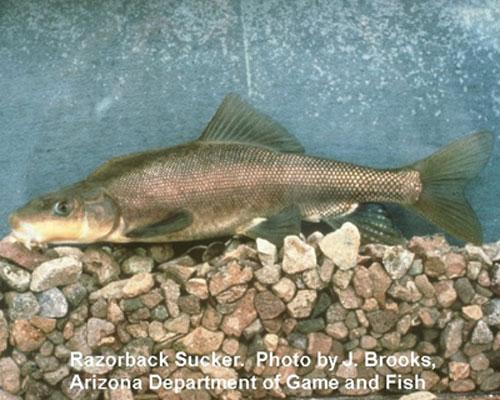
Spring snowmelt runoff in the Colorado Rocky Mountains has triggered the spawning and emergence of endangered razorback sucker fish populations in the Green River downstream from Flaming Gorge Dam, Utah. Larval emergence in the river was observed on May 28, 2016.
To assist the survival of this endangered fish population, Bureau of Reclamation officials will gradually increase water released from Flaming Gorge Dam from the current flow of 800 cubic feet per second (cfs) to 8,600 cfs beginning Tuesday, May 31, 2016. The rate of release will reach 8,600 cfs on Friday, June 3, 2016, and will remain at that flow rate until further notice. However, Reclamation officials anticipate the release to remain at this rate for only 7 to 14 days beyond June 3.
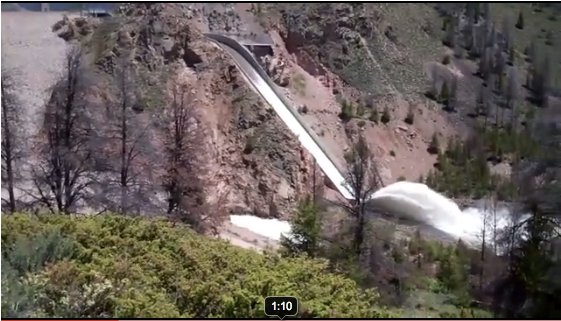
At the highest rate, Flaming Gorge reservoir will release approximately 4,600 cfs through the Flaming Gorge Dam powerplant, allowing power generation to reach its full capacity of approximately 150 megawatts. Another 4,000 cfs will be released through the dam’s bypass tubes to reach the total of 8,600 cfs.
Projected peak flow on the Green River at Jensen, Utah, resulting from the combined flows of Flaming Gorge Dam releases and the Yampa River, will be approximately 22,000 to 24,000 cubic feet per second. These projections are close to flood stage and Reclamation officials urge caution while recreating or farming along the Green River during the next few weeks.
Scientists monitor critical habitat to detect the first emergence of razorback sucker larvae as a “trigger” for this type of release by Reclamation in cooperation with the State of Utah Division of Wildlife Resources, U.S. Fish and Wildlife Service and the Upper Colorado River Endangered Fish Recovery Program. A major purpose of the higher release is to transport as many larval fish as possible into critical nursery habitats located in the floodplains along the Green River, downstream of the confluence of the Green and Yampa rivers. The increased releases from the dam, combined with the Yampa River flows, will provide the maximum possible flow of water to transport the larval fish.
Reclamation consulted with the Utah Division of Wildlife Resources concerning possible impacts of the releases to the rainbow trout fishery below the dam. While releases during this period will make fishing the river more difficult, no adverse impacts to the fishery are expected.
Meanwhile, Granby Reservoir should fill and spill this year. Here’s a report from Lance Maggart writing for the Sky-Hi Daily News:
Things look to be shaping up nicely in terms of water levels for 2016. The Colorado River District recently hosted a “Grand County State of the River” meeting at Mountain Parks Electric in Granby. During the meeting representatives from the Federal Bureau of Reclamation informed attendees their prediction models indicate Granby Reservoir will physically fill again this year, sometime around the second week of July at which point those administering the water flows will begin bypassing additional water downstream.
Officials expect the massive reservoir to spill slightly, around 1,700 acre-feet of water, right at maximum flow times. Bureau of Reclamation representatives said that if Granby does spill they anticipate moving the excess water through the outlet works for the reservoir’s dam.
So far 2016 has been a fairly average year in terms of precipitation. Reservoirs along the eastern slope of the continental divide are mostly full and transmountain diversions will likely be diminished because of storage levels in places like Horsetooth and Carter Lake Reservoirs.
Willow Creek Reservoir, a relatively small reservoir located just a few miles directly west of Granby Reservoir has seen high levels of runoff already and officials anticipate pumping roughly 40,000 acre-feet of water from Willow Creek into Granby Reservoir this summer. Because of storage limits water from Willow Creek Reservoir is already being bypassed downstream.
Because of the high water levels anticipated for Willow Creek Reservoir and the rest of the Three Lakes Colorado River Collection System officials do not expect to pump any water up from the Windy Gap Reservoir, located west of Granby on US Highway 40 and downstream from Granby Reservoir.
Existing directives from the US Secretary of the Interior require at least 75 cubic feet per second (cfs) of water be released from Granby Reservoir throughout the summer. The Bureau of Reclamation will maintain releases of 75 cfs from Granby Reservoir through October this year as part of the ongoing Upper Colorado River Endangered Fish Recovery Program.
Click here to go to the website. Here’s an excerpt:
The Grand County Learning By Doing Cooperative Effort (LBD) is a unique partnership of East and West Slope water stakeholders in Colorado.
LBD emerged from the Colorado River Cooperative Agreement, a five-year negotiation that became effective in 2013 and will be fully implemented with the successful construction of the Moffat Collection System and Windy Gap Firming Project. The agreement establishes a long-term partnership between Denver Water and Colorado’s West Slope, including several water utilities, nonprofit organizations and government agencies.
A Governance Committee oversees the LBD activities, with one voting member from each of these organizations:
Colorado Parks and Wildlife
Colorado River District
Denver Water
Grand County
Middle Park Water Conservancy District
Northern Colorado Water Conservancy District
Trout Unlimited
A Technical Committee, made up of representatives from the Governance organizations, as well as government agencies, regional water utilities and other partners, advises on LBD efforts and activities.
The City of Fort Collins is hosting a regional water collaboration workshop for water providers serving the City’s Growth Management Area (GMA), including Fort Collins Utilities, East Larimer County Water District (ELCO) and Fort Collins-Loveland Water District (FCLWD), Tuesday, May 31, 4-8 p.m., Lincoln Center, 417 W. Magnolia St., Fort Collins.
This workshop is focused on recognizing opportunities and discussion will identify needs over the next 20 to 50 years that can be cooperatively addressed. Plans show Fort Collins is expected to grow to approximately 250,000 people in that timeframe, offering a compelling reason to address water needs of the entire area.
The City anticipates approximately 25 attendees, including Fort Collins City Council, professional staff from Fort Collins Utilities, and board members and professional staff from ELCO and FCLWD. This is a public listening session.
Note: Because members of City Council may attend this event, it is being regarded as a meeting of the City Council and is open to the public. While no formal action by Council will be taken, the discussion of public business may occur.
For more information, contact Water Resources and Treatment Operations Manager Carol Webb at cwebb@fcgov.com or 970-221-6231 or V/TDD 711.
Map from Northern Water via the Fort Collins Coloradan.
Click here to read the newsletter. Here’s an excerpt:
State endorses the Windy Gap Firming Project
During Northern Water’s April 13 Spring Water Users meeting, Mr. John Stulp, Governor Hickenlooper’s water policy advisor, read a letter from the governor endorsing the Windy Gap Firming Project.
The governor said, “Northern Water and its many project partners have worked diligently, transparently and exhaustively in a collorabitve public process that could stand as a model for a project of this nature.” Hickenlooper continued, “This is precisely the kind of cooperative effort envisioned for a project to earn a state endorsement in Colorado’s Water Plan.”
The state’s endorsement followed the Colorado Department of Public Health and Environment’s March 25 issuance of a 401 water quality certification for the WGFP. Project Manager Jeff Drager said, “This is the next to last step in getting the project permitted. The final step is the federal 404 wetlands permit from the U.S. Army Corps of Engineers, which we believe will be forthcoming in the next few months.”
This is the State of Colorado’s first endorsement of a water storage project.
LOVELAND – Mike King, the new director of planning for Denver Water, said at a recent meeting that beyond additional transmountain diversions through the Moffatt Tunnel into an expanded Gross Reservoir near Boulder, Denver Water doesn’t have other Western Slope projects on its radar.
King served as executive director of Colorado’s Department of Natural Resources from 2010 until January of this year, when he took the planning director job with Denver Water.
After speaking to a luncheon crowd of close to 200 at the Northern Water Conservancy District’s spring water users meeting in Loveland on April 13, King was asked from the audience “How much more water does Denver Water need from the Western Slope?”
“I think if we get Gross Reservoir approved, the answer is for the foreseeable future, you know, we need to do that first,” King said.
King is a native of Montrose, son of a water attorney, and has a journalism degree from CU Boulder, a law degree from the University of Denver, a master’s in public administration from CU Denver and 23 years of state government experience.
“And I can tell you that the reality is, whether it is from a permitting perspective or a regulatory perspective, the West Slope is going to be a very difficult place,” King continued. “If there is water available, it is going to be a last resort. And I so think that the answer is, that won’t be on our radar.”
Denver Water is seeking federal approval to raise the dam that forms Gross Reservoir, in the mountains west of Boulder, by 131 feet. That would store an additional 77,000 acre-feet of water and bring the reservoir capacity to 118,811 acre-feet. Ruedi Reservoir, by comparison, holds 102,373 acre-feet.
The $360 million project would provide 18,000 acre-feet of firm yield to Denver Water’s system and result in an additional 15,000 acre-feet of water being diverted from the West Slope each year. On average, Denver Water’s 1.3 million customers use about 125,000 acre-feet of West Slope water each year.
The water to fill an expanded Gross Reservoir would mainly come from tributaries of the Fraser and Williams Fork rivers, via the Moffat Tunnel, near Winter Park.
Beyond the Gross Reservoir project, King explained that any future Denver Water projects on the West Slope would need to fit within the confines of the Colorado River Cooperative Agreement, signed by Denver Water and 17 West Slope entities in 2013.
The CRCA, says that “if there is more water, it only comes after the West Slope says they agree with it and it makes sense,” King said. “That sets the bar so incredibly high and gives them the ultimate ability to say, ‘This is good for the West Slope.’
“And so I just don’t think Denver Water is going to be looking to the West Slope,” King continued. “I think anybody who manages natural resources, and water in particular, will never say ‘never’ to anything, but I think it is certainly not on our radar.”
Not on Denver Water’s radar, perhaps, but it is worth noting that Denver Water is the only major Front Range water provider to have signed the cooperative agreement with the West Slope.
When asked what he thought of King’s remarks about West Slope water, Eric Kuhn, the general manager of the Colorado River District said he thought the comments reflect “the concept that if Denver takes more water from the West Slope it could undermine the security/reliability of what they already take.”
Kuhn’s comment relates to the possibility that if Denver Water diverts too much water from the Western Slope, it could help trigger a compact call from the lower basin states, which could pinch Denver’s transmountain supply of water.
Editor’s note: Above is a recording of Mike King, the director of planning for Denver Water, speaking after lunch in front of about 200 people at Northern Water’s spring water users meeting, a public meeting held at The Ranch event center in Loveland on Wednesday, April 13, 2016. The recording, made by Aspen Journalism, begins shortly after King had begun his remarks. It is 26:34 in length. At 8:20, King discusses the development of the Colorado Water Plan. At 22:40, King answers a question about the governor’s endorsement of the Windy Gap project and another phrased as “How much more water does Denver Water need from the Western Slope?”)
A buoyant crowd
Earlier in the meeting engineers from Northern Water — which supplies water to cities and farms from Broomfield to Fort Collins — told the mix of water providers and water users from northeastern Colorado that they could expect an average spring runoff this year, both from the South Platte and the Colorado Rivers.
They were also told that Northern Water was making progress on its two biggest projects: the Windy Gap Firming Project, which includes construction of Chimney Hollow Reservoir near Berthoud; and NISP, the Northern Integrated Supply Project.
NISP includes two new reservoirs, Glade and Galeton, to be filled with East Slope water from the Cache La Poudre River, which runs through Fort Collins and into the South Platte River.
Just before lunch, John Stulp, the special policy advisor on water to Gov. John Hickenlooper, read a surprise letter from the governor endorsing the Windy Gap project, which would divert an additional 9,000 acre-feet of water each year, on average, from the upper Colorado River and send it through a tunnel toward Chimney Hollow.
Windy Gap is part of the Colorado-Big Thompson Project, which diverts on average 260,000 acre-feet a year from the Western Slope.
The Windy Gap project does include environmental mitigation measures for the sake of the Colorado River, and has approval from the required state agencies and Grand County, but it still needs a permit from the U.S. Army Corps of Engineers.
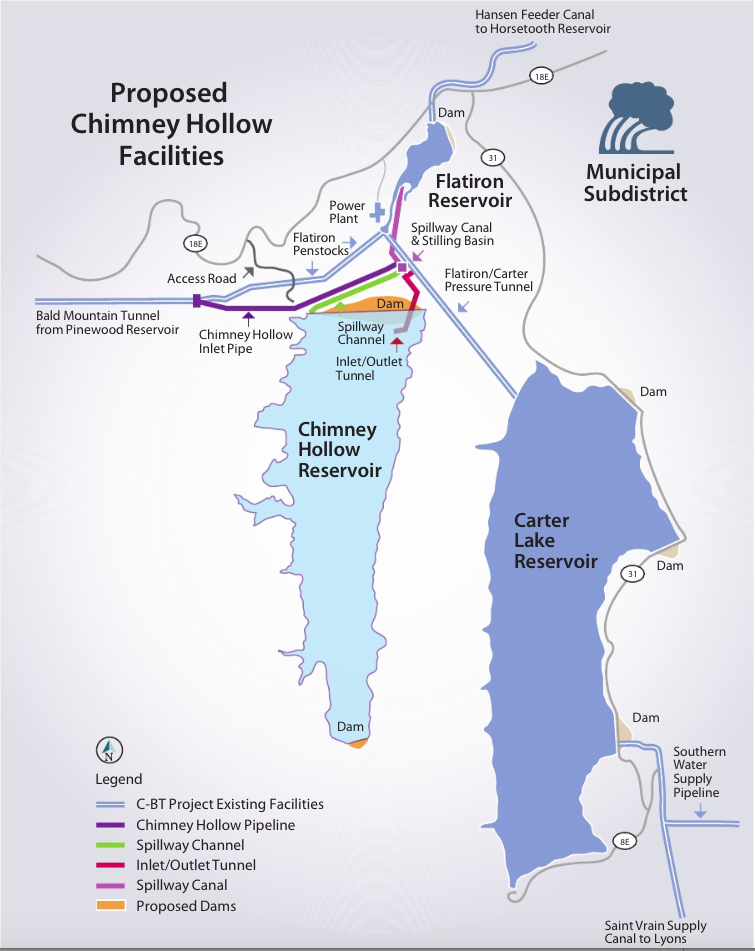
Looking east toward the Chimney Hollow Reservoir site, which is just this side of the red ridge. On the other side is Carter Lake Reservoir and beyond that, the Loveland area.A graphic from Northern Water showing the lay out of Windy Gap Firming Project.
A political risk
After lunch, King shared some insights from his old job as head of the state’s department of natural resources.
“I think it’s important that you understand what the development of the state water plan looked like from the governor’s perspective and the state’s perspective,” King told his audience.
As head of DNR, King had oversight over the Colorado Water Conservation Board, which was specifically tasked by the governor in late 2013 to produce the state’s first-ever water plan, and to do so in just two years.
King said that he, Stulp and the governor knew that a water plan in Colorado could be “the place where political careers went to die.”
“So the thing we had to make sure that came out of this, knowing that we weren’t going to solve the state’s water issues in two years, was that we had to do this in a manner that politically, this was viewed as a big win, and that future governors and future elected officials would say, ‘We need to do this again and we need to continue this discussion,’” King said.
“Not because the governor needed a political win,” King added, “but because to have the next stage of the water plan, to have the discussion in five years, you can’t have an albatross around this, and I think we were able to do that, and so we’re very proud of that.
“If we had a political mushroom cloud, no one would have ever touched the Colorado Water Plan again,” King continued. “That meant we aimed a little bit lower than maybe we would have liked, and I’ve gotten this at Denver Water, talking about lost opportunities in the Colorado Water Plan. Maybe we did aim just a little bit lower than we should have.”
King said the state was not able to “reconcile the inherent conflicts” in the various basin implementation plans, or BIPs, that were put together by regional basin roundtables as part of the water planning process.
And he acknowledged that the plan has been criticized for not including a specific list of water projects supported by the state, and for reading more like a statement of problems and values than a working plan.
“One of things that has been driven home to me time and time again in the two months that I’ve been at Denver Water is that planning is not something you do every five or six years,” King said. “Planning is a continuous process.”
King also said that there were some “tremendous successes” in the water plan, including the basin implantation plans, or BIPs, even though they sometimes conflicted.
“We got BIPs from every single basin,” King said. “The basins turned over their cards and said ‘This is what we need.’ So now we have a major step forward.”
Other plan elements
King said other successes in the Colorado Water Plan include the stated goal of conserving 400,000 acre-feet of water by 2050 and a nod to changing land use planning in Colorado.
King said tying land use to water availability “was something we never discussed in Colorado because it infringed on local control and it was just kind of a boogieman in the room.”
But he pointed out that “the vast majority of the basin implementation plans said, expressly, ‘We need to have this discussion’ and ‘We need to start tying land use to water availability,’” King said. “That’s a good thing. That’s a major step forward.”
When it comes to land use and Denver Water, King said driving down the per capita use remained a high priority and that if Denver proper grows, it is going to grow up through taller buildings, not by sprawling outward.
King also said Denver Water was working to manage, and plan for, the already apparent effects of climate change, especially as spring runoff is now coming earlier than it used to.
“We know that the flows are coming earlier, we know that the runoff is coming earlier,” King said, noting that reality is causing Denver Water to plan for different scenarios and ask questions about storage and late summer deliveries of water.
“For us, the most immediate thing is, is that we know it’s getting warmer,” King said. “In the last 20 years we’ve seen that, the way the [run offs] are coming earlier. We know we’ve had catastrophic events that are incredibly difficult for us to manage. And so we’re trying to work through that.”
Editor’s note: Aspen Journalism, the Aspen Daily News and Coyote Gulch are collaborating on coverage of rivers and water. The Daily News published this story on Wednesday, April 20, 2016.
The Longmont City Council reached a consensus Tuesday night — they would rather the city pay roughly $47 million in cash instead of using debt for a portion of the Windy Gap Firming Project.
Water rates are set to increase by 9 percent in 2017, 2018 and 2019, then 8 percent in 2020 and 2021, said Dale Rademacher, general manager of public works and natural resources.
Paying cash for Windy Gap is cheaper for the city in the long run, but staff estimates it will raise water rates by 21 percent in 2017 and then by another 22 percent in 2018, rather than the planned 9 percent. Debt financing would have cost almost $25 million more in the long term with a predicted 5 percent interest rate but resulted in more gradual rate increases between 5 and 14 percent in the short term…
City Manager Harold Dominguez said there are plans in the works to test utility rate discounts for low-income households. To qualify, a single Longmont resident would need to make less than $12,720 in a year or a married couple would need to earn less than $17,146 in a year, although those limits could have adjusted slightly since the test program was introduced.
The City Council also directed Rademacher to explore alternative financing so the entire burden of the $47 million doesn’t fall on ratepayers. There’s a Windy Gap surcharge on new water taps that sunsets at the end of 2017. Councilmembers said they’d rather the surcharge just stayed in place in order to generate funds for the Windy Gap project.
Additionally, a property owner can either transfer non-historical water rights to satisfy a raw water requirement or pay cash-in-lieu. Staff will study limiting it to cash payment only in order to pay for Windy Gap.
Meanwhile, here’s the view from Grand County (Lance Maggart):
The long awaited development of Northern Water’s Chimney Hollow Reservoir cleared one of the final two hurdles on the road to construction in late March when the Colorado Department of Public Health and Environment (CDPHE) released its 401 water quality certification for the project, generally referred to as the Windy Gap Firming Project (WGFP).
The issuance of the 401 water quality certification from the CDPHE was one of two final steps in the permitting process required for construction on the project to begin. The 401 certification from the state comes after 13 years of work. According to Northern Water’s Public Information Officer Brian Werner Northern Water began the formal permitting process for the development of Chimney Hollow Reservoir in 2003. Since beginning the formal permitting process Northern Water and other participants have spent roughly 15 million dollars on the projects permitting process.
Now that Northern Water has received their 401 certification from the state the municipal water provider is awaiting a 404 wetlands permit from the US Army Corp of Engineers, the final permitting step before construction can begin on Chimney Hollow.
404 WETLAND PERMITS
As a matter of practice 404 wetlands permits from the Corp of Engineers require issuances of state certifications, like the CDPHE 401 water quality certification, before the Corp of Engineers can complete their own permitting processes. “This is the next to the last step in getting the project permitted,” stated Project Manager Jeff Drager.
Officials at Northern Water said they expect the 404 wetlands permit is forthcoming and anticipate its issuance in the next few months. Werner was quick to point out that Governor John Hickenlooper has officially endorsed the project, a first in the history of the state according to a press release from Northern Water highlighting the endorsement.
“Northern Water and its many project partners have worked diligently, transparently and exhaustively in a collaborative public process that could stand as a model fro assessing, reviewing and developing a project of this nature,” stated Hickenlooper in a letter read at Northern Water’s Spring Water Users meeting in Loveland last week by the Governor’s Water Policy Advisor John Stulp.
Once Northern Water has secured the final permit for the project from the Corp of Engineers work on Chimney Hollow Reservoir can begin. Chimney Hollow is eventually expected to store 90,000 acre-feet of water and will be located just west of Carter Lake Reservoir in southern Larimer County. The development of the reservoir will mean additional water diversions out of Grand County. The total estimated price tag for the WGFP is around $400 million.
ENDORSEMENTS
Despite environmental concerns produced by the additional diversions both Grand County and the conservation group Trout Unlimited have endorsed the project, following sustained negotiations between Northern Water and various stakeholders from the western slope regarding environmental mitigation and adaptive management plans for the Colorado and Fraser Rivers. A press release from Trout Unlimited praised the river protections that were reaffirmed with the state 401 certification.
“We strongly believe these permit conditions establish a strong health insurance policy for the Upper Colorado River,” stated Mely Whiting, counsel for Trout Unlimited. In their press release Trout Unlimited outlines conditions within the 401 certification the organization feels will address both fish habitat issues and water quality needs including: monitoring of stream temperatures, key nutrients and aquatic life, providing periodic “flushing flows” to cleanse the river during runoff and requiring ongoing monitoring and response if degraded conditions are detected.
The 401 certification and the environmental protections included with it were made possible in part from a more collaboratively minded interaction between west slope stakeholders such as Grand County and Trout Unlimited and east slope diverters Northern Water and Denver Water. “This long-term monitoring and flexibility of response is called ‘adaptive management’ and it’s a critical feature of the permit requirements,” stated Whiting. “Adaptive management recognizes that stakeholders can’t foresee every problem, and it provides a process for ongoing monitoring and mitigation of river problems as they arise.”
Grand County local Kirk Klancke is the president of the Colorado Headwaters Chapter of Trout Unlimited and has long championed the health of both the Fraser and Colorado Rivers. Klancke spoke positively about the adaptive management and collaborative spirit that has made negotiations for the WGFP possible. “We wouldn’t be at this point without the leadership of Grand County and their persistent efforts to improve the health of the Colorado River,” stated Klancke. “The Northern subdistrict also deserves credit for listening to our concerns and working with all stakeholders to find solutions.”
Fort Morgan residents will be able to cultivate and enjoy green lawns and gardens this summer if they want to do so.
That is thanks to the increase in the Colorado-Big Thompson water quota announced Thursday and the resulting likelihood of no city lawn-watering or residential-water-use restrictions in coming months, according to Fort Morgan Water Resources/Utilities Director Brent Nation.
The Northern Colorado Water Conservancy District Board of Directors on Thursday approved increasing the Colorado-Big Thompson Project water pipeline quota to 70 percent, according to a news release. The Northern Water Board had set it at 50 percent last November.
Fort Morgan receives its water from that pipeline, with water availability subject to the quota set periodically by the Northern Water Board. This quota change does not affect city water rates, which are set by the Fort Morgan City Council. It only affects the amount of water available to the city for use.
But this new quota is one that still means good news for Fort Morgan water customers, according to Nation.
“I am pleased that the C-BT quota has been set at 70 percent for this water year,” he said Thursday afternoon. “70 percent allows our businesses and residents to enjoy high quality water with no restrictions.”
Here’s the release from the Northern Colorado Water Conservancy District:
Northern Water’s Board of Directors increased the Colorado-Big Thompson Project quota allocation to 70 percent at its April 14 meeting. With snowpacks that feed the C-BT Project system being above average and storage reservoirs in good shape, the Board chose to make available an additional 20 percent as a supplemental quota for 2015.
The approval increased available C-BT Project water supplies by 20 percent, or 62,000 acre-feet, from the initial 50 percent quota made available in November.
The Board considered input from farmers and municipal water providers, demonstrating the varying demands and complex circumstances directors must consider when setting the quota. The C-BT Project supplements other sources of water for 33 cities and towns, 120 agricultural irrigation companies, various industries and other water users within Northern Water’s 1.6 million-acre service area.
Directors carefully considered streamflow forecasts and snowpack in the South Platte and Upper Colorado watersheds that contribute to C-BT Project inflow. The snowpack in these watersheds has increased during the past month and March precipitation throughout Northern Water’s boundaries was 132 percent of average.
“The Board set an average quota of 70 percent based on this being as close to an average year as you can get,” said Andy Pineda, Water Resources Department Manager. “Snowpacks in the Upper Colorado and South Platte basins are in better shape today than a year ago.”
Directors based their decision on the need for supplemental water for the coming year while balancing project operations and maintaining water in storage for future dry years.
When Northern Water’s Andy Pineda hinted at a 70 percent quota for users of the Colorado-Big Thompson Project at the company’s Spring Water Users meeting Wednesday, the room was all smiles and nods.
The farmers and municipal water representatives in the room predicted that would be the magic number, and on Thursday, Northern Water’s board of directors voted to make that number official.
The 70 percent quota is about as average as it gets, said Northern Water’s Brian Werner. He knows the old saying ‘There’s no such thing as an average water year,’ but so far, 2016 is proving that statement pretty much wrong.
In fact, when C-BT users were asked for input on the projected quota at the Spring Water Users meeting — the reason the meeting is called every year — the room was quiet until a couple people were goaded into taking the microphone.
“I think this is what we were expecting,” Werner said, and that’s why there was so little input. “Most water users are comfortable with a 70 percent quota in a year like this (where it’s) not too dry, not too wet.”
The C-BT quota sets the percentage of water from the project each participant can use for the year, Werner said. This year, each water user can use 7/10 of each acre-foot of water they own. For example, if someone owns 100 acre-feet of water, they can use 70 of those acre-feet over the year.
“This gives the farmers who are making decisions on planting and other things a good idea of what water they’re going to get,” he said.
Werner said the Colorado-Big Thompson project is basically an insurance policy for water users in northern Colorado. He explains it like a pie cut into three pieces.
The first two pieces of the water pie are snowpack and storage, and this year, both of those slices are falling in line with historic averages, if not exceeding them. The C-BT project, which collects and delivers water from the West Slope over to the East Slope and northern Colorado, is the third piece, and it fills in the rest of the pie. When the first two pieces look normal, so does the third. If the first two pieces are lacking, the third makes up for it, like in 2012 when the C-BT quota was set to 100 percent.
That said, if the water year goes up in flames and the state dries up, Northern Water’s board might raise the quota closer to 100 percent to help water users supplement the shrinking snowpack and storage slices, Werner said.
Werner said 33 cities and towns, 120 ag irrigation or ditch companies and about 1,500 individual farmers rely on C-BT water as a additional water source during the summer…
OTHER NORTHERN WATER PROJECTS
At the Spring Water Users meeting this week at The Ranch in Loveland, both the Northern Integrated Supply Project and Windy Gap Firming Project unveiled new development plans:
» The Northern Integrated Supply Project, which is in the permitting and planning process, unveiled a new plan for downstream water conveyance. Plans for NISP include the construction of two reservoirs — the Glade Reservoir northwest of Fort Collins and the Galeton Reservoir east of Ault. Northern Water initially planned a system of linking pipelines to pump water to users further south, but instead, unveiled a new, more eco-friendly plan at the meeting. The new plan would entail releasing 44,000 acre-feet of water per year into the Poudre River from the Glade Reservoir, letting it flow a 12-mile stretch through Fort Collins, then catching it again at a pipeline that would flow it down the Weld/Larimer County line to the Southern Water Supply Project, another Northern Water project that serves communities from Broomfield to Fort Morgan. In case of poor water quality in the Poudre due to runoff or wildfires, the plan contains a redundancy pipeline.
This new strategy for conveyance of water southward should improve the flow of the Poudre eight months out of the year on a normal year, said Carl Brouwer of Northern Water at the meeting. On a dry year, that number is even better.
» The Windy Gap Firming Project, which is one step away from getting its final permit and authorization, unveiled a new plan at the meeting to divert water out of the existing Windy Gap reservoir into a bypass channel. This would make the actual reservoir about half its size and create a freeflowing stream for most of the year. A stream rather than a reservoir would create more natural conditions for the reservoir’s wildlife, like a better flow of water and sediment and more temperature control.
The Windy Gap Firming Project also recently joined the Learning by Doing cooperative effort, in which they work with other water stakeholders to monitor and improve aquatic health and habitat on the Colorado River, said Jeff Drager, deputy manager of engineering at Northern Water.
Colorado-Big Thompson Project Map via Northern Water
Here’s the release from Governor Hickenlooper’s office:
Gov. John Hickenlooper today formally endorsed the Windy Gap Firming Project, a water project that will serve cities and farmers on the northern Front Range as well as provide environmental benefits on the Western Slope.
The project expands the existing Windy Gap system built in the 1980s and includes the planned Chimney Hollow Reservoir southwest of Loveland to ensure more reliable supplies for the Northern Colorado Water Conservancy District and other project participants. It also includes several protective measures for fish and waterways on the Western Slope.
“Northern Water and its many project partners have worked diligently, transparently and exhaustively in a collaborative public process that could stand as a model for a project of this nature,” Hickenlooper said. “This is precisely the kind of cooperative effort envisioned for a project to earn a state endorsement in Colorado’s Water Plan.”
The Windy Gap Firming Project has been in the process of obtaining federal, state and local permits and certifications since 2003, including the required Fish and Wildlife Mitigation Plan approved by Colorado Parks and Wildlife, the Colorado Water Conservation Board and, most recently, the Section 401 Water Quality Certification from the Colorado Department of Public Health and Environment.
“Colorado moves the needle today with endorsement of a project that makes gains for the environment and water supply together,” said James Eklund, director of the Colorado Water Conservation Board, the agency that facilitated development of Colorado’s Water Plan. “Grand County, environmental stakeholders, and Northern Water set an excellent example of the collaboration necessary to achieve the bold measurable objectives of Colorado’s Water Plan and the Colorado and South Platte Basin Implementation Plans.”
“Northern Water worked closely with state biologists to ensure that impacts on streams and rivers – and the fish and wildlife that depend on them – were identified and addressed through mitigation for the benefit of the environment, wildlife and recreation,” said Bob Broscheid, director of Colorado Parks and Wildlife. “This was a thorough and unified process and shows what we can accomplish when we work together to reach shared goals.”
With necessary permits and certifications for the project in hand, Hickenlooper also today directed his staff to work with the U.S. Army Corps of Engineers in the federal agency’s issuance of a Section 404 Permit, the final federal regulatory step for the project.
Here’s the release from the Northern Colorado Water Conservancy District (Brian Werner):
Chimney Hollow Reservoir close to reality
Today the State of Colorado officially endorsed the Windy Gap Firming Project and Chimney Hollow Reservoir.
John Stulp, Governor John Hickenlooper’s Water Policy Advisor, made the announcement at Northern Water’s Spring Water Users meeting in Loveland. Reading a letter signed by Gov. Hickenlooper, Stulp told the 200 attendees that this is the state of Colorado’s first endorsement of a water project under the Colorado Water Plan, which was finalized last November.
“Further, the WGFP aligns with the key elements of the Colorado Water Plan…” Hickenlooper wrote.
Hickenlooper continued, “Northern Water and its many project partners have worked diligently, transparently and exhaustively in a collaborative public process that could stand as a model for assessing, reviewing and developing a project of this nature.”
Northern Water’s Municipal Subdistrict President Dennis Yanchunas spoke for the project’s participants in saying, “It’s really exciting to have that endorsement, the first ever by the state.” [ed. emphasis mine] Colorado’s endorsement came on the heels of state water quality certification in late March.
The Colorado Department of Public Health and Environment issued its 401 water quality certification for the Windy Gap Firming Project on March 25, bringing the project permitting process nearer to completion.
“This is the next to the last step in getting the project permitted,” said Project Manager Jeff Drager.
“The final step is the federal 404 wetlands permit from the U.S. Army Corps of Engineers, which we believe will be forthcoming in the next few months.”
The state’s endorsement of the WGFP culminates 13 years of diligent effort and lengthy negotiations to permit and authorize a project that will assure a reliable water supply for more than 500,000 northern Front Range residents.
The federal permitting process began in 2003 under the National Environmental Policy Act. The U.S. Bureau of Reclamation served as the lead federal agency and issued a final Environmental Impact Statement in 2011 and a Record of Decision in 2014 for Chimney Hollow Reservoir.
In addition, the Colorado Parks and Wildlife Commission and Colorado Water Conservation Board approved a fish and wildlife mitigation plan in 2011. The following year the Grand County Commissioners issued a 1041 permit and reached an agreement with Northern Water’s Municipal Subdistrict on a mitigation and enhancement package.
A wide variety of organizations, including Trout Unlimited, support the CDPHE’s long-awaited ruling.
“This permit is another step toward fulfilling the Windy Gap Firming Project’s potential to be part of a balanced water supply strategy for Colorado Front Range,” said Drew Peternell, director of TU’s Colorado Water and Habitat Project.
“Through a balanced portfolio – including responsible supply projects like WGFP – along with stronger conservation and reuse programs and ag-urban water sharing — Colorado can meet its diverse water needs…” Peternell added.
The Windy Gap Firming Project is a collaboration of 12 Northern Front Range water providers and the Platte River Power Authority to improve the reliability of their Windy Gap water supplies. Windy Gap began delivering water in 1985.
The participants include 10 municipalities: Broomfield, Erie, Evans, Fort Lupton, Greeley, Lafayette, Longmont, Louisville, Loveland and Superior; two water districts: Central Weld County and Little Thompson; and one power provider: Platte River. They currently provide water to 500,000 people.
The current cost estimate for WGFP is $400 million. To date the participants have spent $15 million on associated permitting costs.
The Windy Gap Firming Project is one step closer to being more than just big dreams and big dollar signs. The project, which would allow for the construction of the Chimney Hollow Reservoir southwest of Loveland, received the first endorsement a water project has ever gotten from the state of Colorado.
Governor Hickenlooper, John Salazar and John Stulp at the 2012 Drought Conference
John Stulp, special policy adviser for water to Gov. John Hickenlooper, read a letter from the governor at the Northern Water Spring Water Users meeting Wednesday at the Ranch in Loveland. In the letter, Hickenlooper applauded Northern Water for the Windy Gap Firming Project’s ability to bring communities together, protect fish and wildlife, and make Colorado’s water more sustainable, along with other ideals outlined in the Colorado Water Plan, which was adopted last November.
“Northern Water and its many project partners have worked diligently, transparently and exhaustively in a collaborative public process that could stand as a model for a project of this nature,” Hickenlooper said in a news release from his office. “This is precisely the kind of cooperative effort envisioned for a project to earn a state endorsement in Colorado’s Water Plan.”
While the endorsement from the state doesn’t advance the plan in earnest, it does give it credibility in the next and final step to getting its building permit completed.
“This is the next to the last step in getting the project permitted,” said Windy Gap Firming Project manager Jeff Drager in a release from Northern Water. “The final step is the federal 404 wetlands permit from the U.S. Army Corps of Engineers, which we believe will be forthcoming in the next few months.”
When the U.S. Army Corps of Engineers considers the project for the permit, it will want to know if the state approves of it. Now, with an official recommendation from the governor, the path should be smoother for the Windy Gap Firming Project and the Chimney Hollow Reservoir, Stulp said.
“I think this (project) is being done right,” Stulp said. “Now, we have the state’s endorsement and I think that will inform the fed agencies, the Corps at this point, that this has got strong support in Colorado.”
The city of Greeley was one of the original six cities to invest in the existing Windy Gap Reservoir. Now, the city is a participant in the Windy Gap Firming Project. Once the Chimney Hollow reservoir is built, Greeley will receive 4,400 acre-feet of water per year. An acre-foot of water is roughly the equivalent of one football field filled with a foot of water — that’s almost 326,000 gallons of water, or more than 8,000 bathtubs full.
Evans, Fort Lupton and the Central Weld County Water District are also participants in the Windy Gap Firming Project.
The project is estimated to cost about $400 million and participants have thus far spent $15 million, according to the Northern Water release. The reservoir will store 90,000 acre-feet of water and will be located near Carter Lake and parts of Northern Water’s Colorado-Big Thompson Project.
The Windy Gap Firming Project’s participants are primarily municipalities, but also include two water districts and one power company. The purpose of the project is to create an alternative water source for cities and companies to purchase water from instead of resorting to tactics like buy-and-dry or competing with agricultural land for water resources.
During his presentation at the Northern Water Spring Water Users Meeting, Metropolitan State University of Denver professor Tom Cech talked population growth. He said right now, Colorado is home to more than 5 million people. By 2030, that number’s projected to rise to more than 7 million after having already grown about 30 percent since 1990. In the South Platte Basin alone, that kind of population growth will equal a shortage of about 410,000 acre-feet of water, or about 134 billion gallons. Between 133,000 and 226,000 acres of irrigated land in the South Platte River Basin are expected to dry up by 2030.
With the rapid population expansion and resulting urban sprawl happening in Colorado, projects like these are more important than ever, said Eric Wilkinson, Northern Water’s general manager.
“People need water and we’re going to grow. Obviously people like this area, people move to this area and people will continue to come and we have to find ways to provide that water supply,” Wilkinson said. “This is a good way of doing it.”
Gov. John Hickenlooper on Wednesday weighed in formally backing the long-delayed and controversial $400 million Windy Gap project to divert more water from the Colorado River to the booming Front Range.
Hickenlooper ordered state officials to work with the U.S. Army Corps of Engineers to obtain a final federal wetlands permit needed for work to begin. His endorsement is expected to aid that effort.
Northern Water would expand its existing river diversion system built in 1985 by installing a new reservoir southwest of Loveland to hold diverted Colorado River water. That 29 billion-gallon Chimney Hollow Reservoir would supply farmers and growing cities.
“This is the first time he has endorsed this project. We were certainly hoping for it. We were pleasantly surprised,” Northern Water spokesman Brian Werner said.
“This means that construction, starting in 2019, is a reality.”
Northern Water has been planning the project, working with state and federal officials on permits, since 2003. A mitigation plan, approved by Colorado Parks and Wildlife and the Colorado Water Conservation Board, lays out measures to protect fish and off-set environmental harm including altered river flows.
Colorado Department of Public Health and Environment officials, responsible for ensuring water quality, signed off on March 25.
“Northern Water and its many project partners have worked diligently, transparently and exhaustively in a collaborative public process that could stand as a model for a project of this nature,” Hickenlooper said. “This is precisely the kind of cooperative effort envisioned for a project to earn a state endorsement in Colorado’s Water Plan.”
Front Range users would would siphon additional west-flowing water — up to 8.4 billion gallons a year — out of the Colorado River and pump it back eastward under the Continental Divide. That water, stored in the new reservoir, is expected to meet needs of 500,000 residents around Broomfield, Longmont, Loveland and Greeley.
Environment groups on Wednesday reacted with fury.
“This project will further drain and destroy the Colorado River and imperil endangered fish,” said Gary Wockner, director of Save the Colorado River. “We’ve registered 23 complaints with the Army Corps of Engineers. The federal government should deny the permit. This project is reckless.”
Colorado officials endorsed a long-sought water storage project that would include construction of Chimney Hollow Reservoir southwest of Loveland.
Gov. John Hickenlooper on Wednesday voiced his support for the Windy Gap Firming Project, which would divert water from the Western Slope to the Front Range to shore up supplies for municipalities and farmers…
Participants in the water-storage project include Loveland, Longmont, Greeley, Broomfield, Platte River Power Authority and two water districts.
The project recently received a key water quality certification from the Colorado Department of Public Health and Environment. The certification is needed to receive a final permit from the U.S. Army Corps of Engineers to build the project…
Map from Northern Water via the Fort Collins Coloradoan.
If the expected permits come through, final design on Chimney Hollow Reservoir would begin later this year with construction beginning in 2018-19, Werner said.
Chimney Hollow Reservoir would hold up to 90,000 acre feet of water. An acre foot is enough water to meet the annual needs of three to four urban households.
Larimer County would build and operate recreational facilities at the reservoir, which would be built west of Carter Lake. Carter Lake holds up to 112,000 acre feet of water.
The Windy Gap Firming Project has been under federal, state and local review since 2003. It has been challenged by environmentalists over the years because of its impact on the Colorado River’s ecosystem through increased water diversions.
In a recent email to the Coloradoan, the group Save the Colorado stated it would scrutinize the 404 permit decision from the Corps to ensure the project adheres to the National Environmental Policy Act, the Clean Water Act and the Endangered Species Act.
Supporters say the Windy Gap Firming includes measures that would mitigate its environmental impacts and protect fish, streams and water quality in Grand Lake and the Colorado River.
The project — formally called the Windy Gap Firming Project — calls for the construction of a new reservoir, called Chimney Hollow Reservoir southwest of Loveland. The reservoir will be designed to hold up to 90,000 acre feet of water, and reliably deliver about 30,000 acre feet of water every year, enough to support the needs of 60,000 families of four people.
It’s an expansion of the existing Windy Gap system built in the 1980s to divert water from the Colorado River to the Front Range. But the construction of a new reservoir is crucial, said Brian Werner, a spokesman for the Northern Colorado Water Conservancy District, the lead agency on the project.
Because of the Windy Gap project’s relatively junior water rights, water cannot be diverted in years when the snow pack is low. And during wet years, there’s not enough storage space in Lake Granby to store the Windy Gap water, which means it runs down the river.
“Windy Gap right now doesn’t have any firm yield,” Werner said, meaning that the system can’t be counted on to have water available for customers every single year.
“In wet years there’s no where to put it [the water], and in dry years there’s nothing to pump,” Werner said.
About 500,000 people live in the water districts that would be served by the Windy Gap Firming Project, including Broomfield, Lafayette, Louisville, Loveland, Erie and Evans. To date, the cost of planning and permitting the project has risen to $15 million, according to the Northern Colorado Water Conservancy District.
And with population numbers expected to jump in coming years, this project and others will be needed to ensure there’s enough water for the communities to grow, Werner said.
The project’s leaders have worked on agreements to mitigate environmental impacts to protect fish, ensure stream protection and reduce water quality impacts to Grand Lake and the Colorado River.
Last month, the Colorado Department of Public Health and Environment this week released its final “401 water quality certification,” meaning that the state had signed off on the plans to mitigate the environmental impact of the project on the Upper Colorado River.
Trout Unlimited, said the conditions imposed by the state health department put the “threatened river and fishery on road to recovery.
“We firmly believe these permit conditions establish a strong health insurance policy for the Upper Colorado River,” said Mely Whiting, counsel for Trout Unlimited, in a statement.
It took a long time to get here. Click here to take a trip back in time through the Coyote Gulch “Windy Gap” category. Click here for posts from the older Coyote Gulch blog.
Moffat Collection System Project/Windy Gap Firming Project via the Boulder Daily Camera
Windy Gap and C-BT Granby area facilities
Windy Gap Reservoir
Windy Gap Reservoir
Site of proposed Chimney Hollow Reservoir — Windy Gap Firming Project via the Longmont Times-Call
Chimney Hollow Reservoir site
Chimney Hollow Reservoir site via the Bureau of Reclamation
Here’s a column George Sibley writing for the The High Country News. Click through and read the whole thing. Here’s an excerpt:
The self-styled sensible people today seem to take it for granted that Americans have lost any capacity for working through difficult problems, especially where cultural differences are concerned. That attitude has certainly surfaced in response to Colorado’s water planning process. Given the absence of additional unappropriated water, the sensibles say, more water for one group means less water for other groups, an unacceptable zero-sum situation, especially across Colorado’s transmountain and rural-urban “divides.”
Colorado historian Patricia Limerick lent credence to that zero-sum thinking in her contribution to a “Citizen’s Guide to Colorado’s Transbasin Diversions,” published by the state’s Foundation for Water Education. “There is no moral algebra,” she said, “for calculating whether retaining water to support commercial development on the Western Slope is better or worse than transporting water to support commercial development on the Front Range.”
Her statement reflects the first-come-first-served approach of metropolitan Denver toward West Slope water until late in the 20th century. It is a legal approach under the longstanding “prior appropriation” doctrine (first in time, first in right), but one of questionable morality. Colorado’s big federal transmountain diversions in that same period – the Colorado-Big Thompson and Fryingpan-Arkansas projects – transcended the letter of the law and carefully worked through a more just process that resulted in compensatory storage and maintenance of “live streams.”
The goal was to ensure that future development of the Western Slope would not be sacrificed, however legally, to the thirsty and more populated Front Range.
If water were the only factor in the equations between Colorado’s “divides,” then zero-sum skepticism might be warranted. But it is never just about water. All uses of water, from irrigated fields to municipal utilities to float trips, also involve the application of money and ideas to water. So when water is moved from Colorado’s rural Western Slope to the Front Range, Front Range money to implement ideas for how to make up that loss should be moved back across the Continental Divide to maintain the equation.
This is already happening to a greater extent than the water-war stories in the press suggest. The Colorado Water Plan that skeptics question coincided with two successful transmountain negotiations that anticipated most of the “conceptual framework” for diversions in the new Water Plan: the Moffat Tunnel Firming Project negotiated between Denver Water and the Colorado River District, acting on behalf of 37 West Slope partners; and the Windy Gap Firming Project between Grand County on the West Slope and Northern Water’s Municipal Subdistrict (the Longmont-Fort Collins urban corridor).
A screenshot from the website for Colorado’s Water Plan.
The Longmont City Council weighed adviser, resident and staff testimony about both future water needs and water rates and voted 5-2 Tuesday to go with one of the more expensive participation levels in the Windy Gap Firming Project…
The council voted to start the process of participating in the $387.36 million Windy Gap Firming Project at the 10,000 acre-foot level…
The decision before the council was whether to participate at the 6,000, 8,000 or the 10,000 acre-foot level. Staff in the past had recommended that 6,000 acre-feet of water is projected as enough to cover a one-in-100-year drought. The Longmont Water Board, meanwhile, urged council to participate at the more-expensive 10,000 acre-foot level.
Early in Tuesday’s meeting, Longmont residents spoke about the plan during the public comment portion of the meeting. Some, such as Jim Wilson, were against the idea that rates may need to increase beyond the already-approved annual 9 percent increase to pay for Longmont’s portion of the Windy Gap Firming Project.
Site of proposed Chimney Hollow Reservoir — Windy Gap Firming Project via the Longmont Times-Call
Chimney Hollow Reservoir site
Chimney Hollow Reservoir site via the Bureau of Reclamation
Moffat Collection System Project/Windy Gap Firming Project via the Boulder Daily Camera
Click here to read the newsletter. Here’s an excerpt:
Spring Water Users Meeting
Northern Water’s annual Spring Water Users Meeting is sheduled for Wednesday, April 13, 2016, at The Ranch in Loveland.
The Spring Water Users Meeting is a forum to discuss the current water outlook and water-related issues, the Colorado-Big Thompson Project quota and updates on the Northern Integrated Supply Project and the Windy Gap Firming Project.
This spring’s meeting agenda also includes a presentation on the role of the Colorado Water Congress; activities of Metropolitan State University’s One World, One Water Center; and an update on the Upper Colorado River Endangered Fish Recovery Program. The keynote luncheon speaker will be Mike King, former executive director of the Colorado Department of Natural Resources, and currently the planning director for Denver Water.
To register for the meeting visit http://www.northernwater.org; view our April calendar and click Spring Water Users Meeting on April 13. There is a registration tab on the popup screen.
Colorado-Big Thompson Project Map via Northern Water
Click here to read the newsletter. Here’s an excerpt:
Snowpack and streamflow update
From now until the beginning of May, Northern Water will issue monthly snowpack and streamflow forecasts, which are available here. The Feb. 1, 2016, forecast showed Colorado’s statewide snowpack at 112 percent of average. The two river basins that Northern Water watches for forecasting are the Upper Colorado and South Platte, which were at 109 and 97 percent of average, respectively. Most basins throughout the state are near or above average for this time of year.
2016 spill?
Last year was the third largest spill from Lake Granby in Colorado-Big Thompson Project history. But will we see a spill in 2016? Maybe. Right now our water resources forecasters say it is a “bubble year,” meaning there is a 50/50 chance of a spill. Overall, it will depend on how much precipitation the higher elevations receive between now and spring runoff.
Colorado-Big Thompson Project Map via Northern Water
Click here to read the newsletter. Here’s an excerpt:
Snow accumulation season looks promising
Colorado’s 2016 snowpack is off to a good start. Most of the state’s river basins have above normal snowpack, and more importantly, above normal snow water equivalent readings. Northern Water monitors two river basins for forecasting – the Upper Colorado and the South Platte – which are at 99 percent and 105 percent of average, respectively, as of Jan. 14, 2016. Colorado’s statewide snowpack is 104 percent of average.
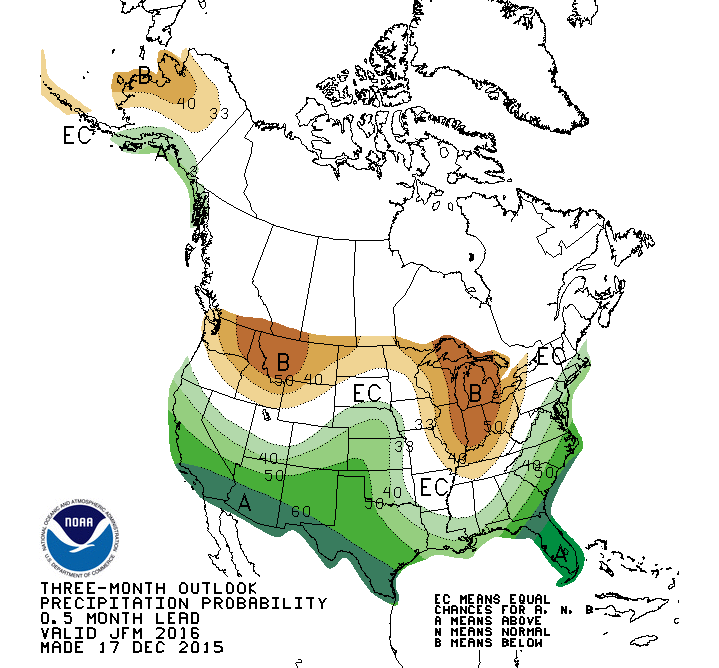
Precipitation in the mountains over the next few months will help determine the 2016 water supply. The National Oceanic and Atmospheric Administration is predicting a higher probability of above average precipitation for Colorado over the next three months. Beginning in February Northern Water will release monthly streamflow forecasts and which will be available here.
Click here to read the newsletter. Here’s an excerpt:
2015 Water Year Comes to an End
The 2015 water year (Nov.1 – Oct. 31) started slowly, but precipitation later in the spring more than made up for it. April and May storms brought much needed moisture to the mountains and plains, and set in motion another very good water year for Northeastern Colorado.
Deliveries in 2015 were more than the record low year of 2014, but were still below average. This year the C-BT Project delivered 187,291 acre-feet to East Slope water users. The historical average is 211,000 AF. Deliveries to agricultural users spiked in late summer due to dry conditions. These late-summer deliveries also made space available in Horsetooth Reservoir and Carter Lake, which will allow water to be transferred from Lake Granby to the East Slope this winter. This will also create space in Lake Granby for the spring runoff.
In 2015, the total C-BT Project spill was 191,000 AF, with 148,500 AF from Lake Granby and 42,500 AF from Willow Creek Reservoir.
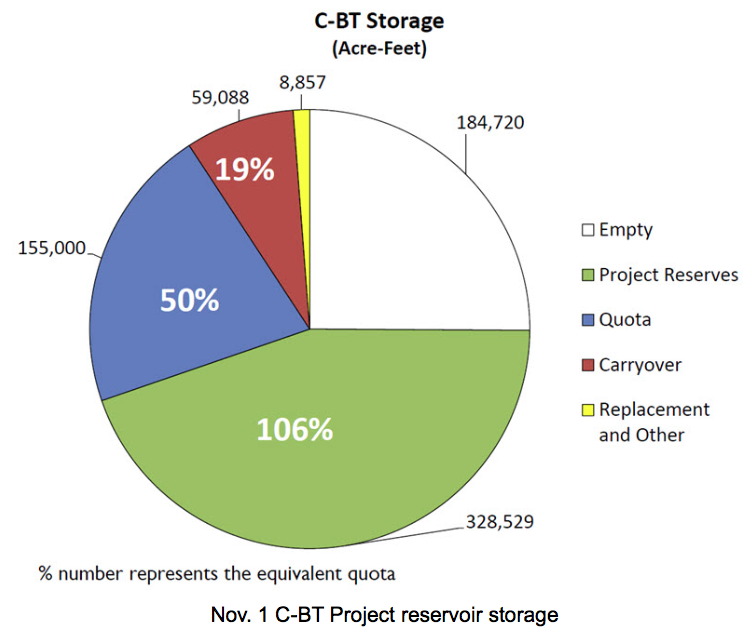
C-BT Project reservoir levels started the 2016 water year in good shape with more than 500,000 AF in storage. The average for Nov. 1 active storage is 442,413 AF.
From the Fort Collins Coloradoan (Jacy Marmaduke):
Thirteen gallons: It’s the volume of a standard kitchen trash bag, a 6-minute shower or a little more than a full tank of gas for a compact car.
And it’s the crux of Fort Collins Utilities’ vision for the city’s water use come 2030.
Average daily water use was 143 gallons per person in 2014. Utilities wants to reduce that to 130 gallons per person, a 9 percent cut, over the next 15 years.
The water saved would fill 2 1/2 Olympic-size swimming pools in just a year…
Conservation strategies laid out in a document released this month could affect your water bill, your lawn or even your toilet. And utilities staff hope a wide range of methods will prepare the community for inevitable dry spells in a semi-arid region vulnerable to unpredictable climate patterns.
“My colleague likes to say, instead of one silver bullet, there’s lots of little silver BBs,” said Liesel Hans, water conservation program manager with Fort Collins Utilities. “There’s a lot of ways to fit our goal, and it doesn’t have to be a one size fits all.”
Utilities is seeking feedback on its water efficiency plan update through Jan. 15. After resident and City Council review, the department will start making changes on a rolling basis in the coming months and years.
There are some big goals in the plan update, including:
Requiring more efficient plumbing and irrigation fixtures for re-developed homes and businesses.
Changing water rates to encourage conservation.
Increasing use of the online “Monitor My Use” tool, which shows users how much water they’re using on a daily, monthly and yearly basis. This helps customers see what time of day they’re using the most, among other features.
Revamping and spreading the Xeriscape Incentive Program, which pays residents to re-do their lawns with plants that conserve water.
Offering more rebates to businesses that conserve water.
Providing more education to increase community water literacy.
The strategies and their timelines are purposely vague because the department wants to hear what people think of them before deciding which ones to implement. And the plan targets residential and business use because both make up gluttonous portions of the water-use pie: Businesses account for 39 percent of water use in the district; homes account for 47 percent.
Utilities will “look at a wide range of options” for changing rates, Hans said, which could include changing the fixed rate, the variable rates or both…
Graphs of Fort Collins Utilities’ water demand over time tell a gripping story. Demand increased steadily as more people and businesses moved in during the 1990s. By 2000, the city was using more than 200 gallons per person per day to meet an annual demand of more than 10 billion gallons. That level of demand would fill Horsetooth Reservoir in about five years.
Then came the 2002 drought. Some people, including then-Gov. Bill Owens, called it Colorado’s worst drought in 350 years.
Fort Collins saw about 9 inches of rain that year, about 6 inches less than normal.
The historic drought got the city thinking about water conservation, Hans said. It wasn’t long before the utilities department switched to a “conservation-oriented” rate structure, so people who use more water pay a higher rate.
That change and other conservation efforts have helped the department cut use per person and in total. In 2014, annual demand was about 7 billion gallons, a 30 percent reduction from 2000 demand even as the city’s population swelled by 25 percent.
But progress has plateaued, Hans said, so her department hopes new methods — and a goal more ambitious than the original 2030 target of 140 gallons per person each day — will help galvanize next-level conservation.
A lot of the strategies involve building on existing programs that identify water leaks in homes, show residents how to more efficiently water their lawns, set efficiency goals for businesses and teach children and adults why water conservation matters.
Conservation fans say the 2030 water use goal is made more achievable by what seems to be an ingrained value for many in Fort Collins.
“We live in a semi-arid desert,” said Brian Werner, spokesman for the Northern Water Conservancy District — the agency that facilitates close to one-third of Fort Collins Utilities’ water supply.
“From Day 1, settlers realized you had to supplement what Mother Nature gave you if you wanted to grow crops. We were very conservation-oriented from the get-go.”
Julie Kallenberger, water education and outreach specialist for Colorado State University’s Water Center, added Colorado’s headwaters state status fosters more of a conservation-oriented mindset.
“Water becomes more of a topic because people understand how important it is,” she said. “I came here in ’02, and I immediately noticed it.”
…consistently hot temperature and little rain put the big drain on in late summer, as farmers called for more irrigation water. The reservoir on Friday was 61 percent of capacity, which is 125 percent of the average for Oct. 16.
Northern Water spokesman Zach Allen said what all that means is the reservoir is in good shape heading out of the agricultural irrigation season.
High reservoir levels at the end of 2014 coupled with a wet spring meant farmers diverted less water from the reservoir during the spring and most of the summer, water resources manager Sarah Smith said. That allowed for an excellent boating season for most of the summer.
Irrigation reservoirs, like Horsetooth, generally fill up in spring with rain and snowmelt. As summer progresses, they are drawn down as farmers’ need for irrigation increases.
While Horsetooth is doing well, the Poudre River is flowing more slowly than usual for this time of year. On Friday at the mouth of the Poudre Canyon, the river was flowing 74.6 cubic feet per second. The average for this time of year is 92 cfs.
Slower flows are likely due to the dry weather and lack of rainfall during the last several months, Smith said.
From email from the Northern Colorado Water Conservancy District:
Northern Water’s Fall Water Users Meeting will be held Tuesday, Nov. 10 at the Riverside Cultural Center, 3700 Golden St., Evans, CO starting at 8 a.m.
The meeting is a forum to discuss the current water situation and water-related issues, the water year, the Northern Integrated Supply Project and the Windy Gap Firming Project.
Other items on the agenda include the Granby Hydropower Plant project, Northern Water’s water management system and an update from the U.S. Bureau of Reclamation.
Dan Haley, the new CEO of the Colorado Oil and Gas Association, will be the luncheon speaker.
The afternoon session starts at 1:30 p.m. and will feature the screening of the documentary film The Great Divide. The 90-minute film documents the history of water development in Colorado from the Ancient Puebloan cultures to present day.
Go to the November Calendar page to register for the meeting online by Tuesday, Nov. 3. If you are unable to register online, please call our registration line at 970-622-2220. Please provide the name(s) of those who will be attending and the organization represented, if applicable. If you register and you later find you cannot attend, please cancel your reservation by calling us at 970-622-2220
Colorado-Big Thompson Project Map via Northern Water
Map of the Colorado-Big Thompson Project via Northern Water Click here to read the newsletter. Here’s an excerpt:
<blockquoteThe Northern Water Board of Directors set 2016 water assessments during an Aug. 6, 2015 public hearing. Assessments for open-rate irrigation contracts increased from $10.90 per acre-foot unit to $17.60, and assessments for open-rate municipal, industrial and multipurpose contracts increased from $30.50 per acre-foot unit to $35.90.
The Board followed its general rate-setting objectives, which are outlined in its 2014 forward guidance resolution. Among other objectives, the resolution proposed a 2-year step increase in assessments beginning in 2016, and moving irrigation assessments towards a cost-of-service based rate. Both of these objectives are represented in the 2016 assessments.
The Board will consider forward guidance that provides an estimated range for 2017 and 2018 water assessments at its Sept. 3 Planning and Action meeting.
For information on water assessments, please contact Sherri Rasmussen at 970-622-2217.
Debate continues to swirl around water clarity standards for Grand Lake, but recently stake holders on the Western Slope presented a new proposal in hopes of moving negotiations forward.
Western Slope stakeholders recently presented a revised clarity standard proposal to the Water Clarity Stakeholders group for consideration. The revised clarity standard proposal presented by the Western Slope stakeholders is for 3.8 meters, or 12.5 feet, with a 2.5 meter, or 8.2 feet, minimum clarity depth. This is a reduction from their previous proposal of a 4-meter standard.
Representatives from the Western slope stakeholders together with others from the east side of the continental Divide make up the Water Clarity Stakeholders Committee (WCSC). The WCSC is formed from the various entities affected by water clarity in Grand Lake and the operation of the Colorado-Big Thompson Project (C-BT), which pulls water from the Three Lakes region that is sent through the Alva B. Adams Tunnel out of Grand Lake to the Front Range.
The WCSC includes representatives from the U.S. Forest Service, Town of Grand Lake, Western Area Power Administration, Grand County, Northern Water, the U.S. Bureau of Reclamation, power consumers from the affected area, the U.S. Environmental Protection Administration, the Colorado River Water Conservation District, the Three Lakes Watershed Association, Northwest COG, Colorado Parks and Wildlife, Trout Unlimited, Middle Park Water Conservancy District, U.S. Geological Survey, the Grand County Water Information Network, and various other groups.
Representatives from the WCSC hope to negotiate a single water clarity proposal amongst themselves that can be presented to the Colorado Water Quality Control Commission, the entity that will give final approval of any new water clarity standard. The Commission is part of the Colorado Department of Public Health and Environment. The WCSC is working toward a deadline; their proposal is due in November.
WEST SLOPE COMPROMISE
Grand County Manager Lurline Underbrink-Curran has helped shepherd the process for the county.
“The West Slope group came up with compromises we felt we could live with and presented them to the larger group,” she said.
Underbrink-Curran explained that if the various groups cannot come to agreement on a proposal then multiple proposals will likely be submitted to the Water Quality Commission.
“Sometimes the various factors to consider are at odds,” she said. “If the Stakeholders group can’t come to a coordinated proposal then the West Slope group would make a proposal and the East Slope group would likely make their own proposal.”
The debate has been ongoing for several years now and started in earnest in 2008 when a committee was formed to study possible methods for improving water clarity in Grand Lake. According to Canton O’Donnell, president of the Three Lakes Watershed Association, that committee, which later became the Water Clarity Stakeholders Committee, was formed from the sustained lobbying efforts of the Three Lakes Watershed Association to improve the water clarity standard.
“All these years we have proposed a 4-meter standard,” said Canton. “Northern Water says that is not possible.”
UNATTAINABLE
The Northern Colorado Water Conservancy District, better known as Northern Water, operates the C-BT though the facilities are officially owned by the federal Bureau of Reclamation.
“We don’t think that is an attainable standard,” said Brian Werner, Public Information Officer for Northern Water. “Looking at history and what we have been able to achieve in the past; we’ve been able to achieve 4 meters some years at certain times of the year. But oftentimes the clarity gets worse than that.”
Werner also expressed concerns over how such a standard would be enforced and how penalties for failing to meet any new standard would be applied.
In 2008, those concerned for Grand Lake established a site-specific water clarity standard through the Colorado Water Quality Control Commission. This visionary application of a water quality standard to lake clarity, which was intended to restore the scenic attraction of Grand Lake, is unprecedented in Colorado.
Now, negotiations are ramping up to modify specifics of the standard. Western Slope stakeholders recently made broad concessions on a possible joint standard proposal with the Northern Colorado Water Conservancy District, which distributes C-BT water to Northern Front Range consumers. The concessions are intended to be motivating yet practical for all stakeholders
The Western Slope stakeholders’ proposal — a target of 12.5 feet average clarity, with a 8.2 foot minimum — is still a far cry from the 30.2 feet of clarity measured prior to implementation of the C-BT. Yet this proposed clarity standard is an effort to recognize the water-delivery mandate of the Colorado-Big Thompson system while protecting lake health and allowing time for the U.S. Bureau of Reclamation to evaluate a more robust permanent solution.
The Western Slope stakeholders — made up of Grand County government, the Three Lakes Watershed Association, the town of Grand Lake, Northwest Colorado Council of Governments, and the Colorado River District — proposed this modified standard to be applicable for all of July, August and 11 days in September at the height of the region’s tourist season.
It is the hope of Eastern and Western Slope stakeholders to arrive at an agreement prior to the start of Colorado Water Quality Control Commission submittals beginning in November, for the sake of this valued resource.
During the meeting, officials from the Upper Colorado River Basin’s biggest water interests including Northern Water, Denver Water and the U.S. Bureau of Reclamation spoke about some of the basin’s biggest issues, including the state of runoff and snowpack in the region and the movement at Ritschard Dam on Wolford Mountain Reservoir.
Though snowpack seemed to falter during what proved to be a rather dry March, it’s been building steadily over the last three to four weeks, explained Don Meyer with the Colorado River District.
The variations in snowpack have pushed the basin into “uncharted territory,” he said.
“I think the message here is think 2010 in terms of snowpack,” Meyer said.
Though he added that snowpack is not analogous to runoff, Meyer said 2015 “will likely eclipse 2010 in terms of stream flow.”
Victor Lee with the U.S. Bureau of Reclamation echoed Meyer, adding that recent cold temperatures across the region have allowed snowpack to persist.
Though snowpack is currently below average, it could linger past the point at which the average snowpack tends to drop…
If the current snowpack does translate into high runoff in Grand County, there may not be anywhere to put it, Lee said.
Front Range reservoirs are full, and storage in Lake Granby is the highest it’s ever been for this time of year, according to Lee’s presentation…
Though it could be a good runoff year for Grand County, Meyer said that snow-water equivalent above Lake Powell is still well below average, making it a dry year for the Upper Colorado River Basin overall.
RITSCHARD DAM
Officials aren’t sure when the settling and movement at Ritschard Dam will stop, but it poses no threat to safety, said John Currier with the Colorado River District.
“We really are absolutely confident that we don’t have an imminent safety problem with this dam,” Currier said…
ENDANGERED FISH
The Bureau of Reclamation will increase flows from the Granby Dam to 1,500 CFS around May 29 and maintain those flows until around June 8, Lee said.
The releases will be part of an endangered fish recovery program and will be coordinated with releases from other basin reservoirs to enhance peak flows in the Grand Valley where the plan is focused.
Wolford Mountain Reservoir will also participate in the coordinated releases, Meyer said.
The program hopes to re-establish bonytail chub, Colorado pikeminnow, razorback sucker and humpback chub populations to a 15-mile stretch of the Colorado River above Grand Junction.
WINDY GAP FIRMING
After receiving its Record of Decision last year, the Windy Gap Firming Project’s next major hurdle is acquiring a Section 404 permit from the Army Corps of Engineers for the construction of Chimney Hollow Reservoir, said Don Carlson with Northern Water.
The permit regulates dredged or fill material into water as part of the Clean Water Act.
Northern Water hopes to acquire the permit this year, with construction possibly beginning in 2016 or 2017, Carlson said.
The project seeks to firm up the Windy Gap water right with a new Front Range reservoir. The project currently stores water in Lake Granby.
Because it’s a junior water right, yield for the project is little to nothing in dry years.
Northern Water also hopes to establish a free-flowing channel of the Colorado River beside the Windy Gap Reservoir as part of the Windy Gap Reservoir Bypass Project.
The new channel would allow for fish migration and improve aquatic habitat along the Colorado River.
That project still needs $6 million of its projected $10 million cost.
MOFFAT TUNNEL FLOWS
Moffat Tunnel flows are hovering around 15 CFS as Denver Water is getting high yield from its Boulder Creek water right, said Bob Steger with Denver Water.
The increased yield from that junior water right means flows through Moffat Tunnel will remain low through early summer, Steger said.
“The point is we’ll be taking a lot less water than we normally do,” he said.
Denver Water expects its flows through the tunnel to increase in late summer as its yield from Boulder Creek drops, Steger said.
Williams Fork Reservoir, which is used to fulfill Denver Water’s obligations on the Western Slope, is expected to fill in three to four weeks, Steger said.
Here’s the release from Northern Water and the Bureau of Reclamation (Brian Werner/Peter Soeth):
Releases through outlet valves will make room in Lake Granby for predicted spring runoff
The Bureau of Reclamation and Northern Water will be increasing the water releases from Lake Granby on Friday, May 1. Operators will ramp up releases to 430 cubic feet per second through the outlet valves which will enable reservoir operators to better manage the peak spills later this spring.
With the Colorado-Big Thompson Project reservoirs at record storage levels for late April, the likelihood of spills at Lake Granby are a virtual certainty.
“What we are trying to do by increasing releases now is reduce the peak of the runoff to alleviate flooding concerns below Granby,” said Noble Underbrink, Collection Systems Department Manager for Northern Water.
Northern Water and Reclamation are completing maintenance and repair project on the Lake Granby spillway. Once complete by mid-May, reservoir operators will route the peak flows through the spillway to the Colorado River downstream.
“Working together, we can alleviate the flooding concerns below Granby and maximize the amount of water we can store in the Colorado-Big Thompson Project, ” Eastern Colorado Area Office Manager Jacklynn Gould said.
Lake Granby is currently at 92 percent of capacity, about 6 feet from full.
The current forecast is that operators will be able to keep the spills to below the amount at which downstream flooding occurs.
Underbrink said the preemptive releases have been used many times in previous years. “With the C-BT reservoir system nearly full, the forecasts indicate there will be more runoff than the reservoirs can hold.”
The flows and forecasts will be monitored and adjustments made accordingly as inflows pick up in the next few weeks.
Despite a dry March, Broomfield will not impose summer water restrictions this year after learning it will receive its typical allocation from its main water supplier.
The Northern Colorado Water Conservancy District last week announced it would provide users their typical amount of water from the Colorado-Big Thompson Project, because the storage reservoir is more full than normal. The district typically allocates about 70 percent of its supply for water users unless resources are limited. Last year, the allocation was 60 percent.
That means Broomfield residents won’t have to scrimp on water this summer, but officials are still asking residents to use only what they need…
Broomfield gets more than half of its water supply from the Northern Colorado Water Conservancy District, and the rest from Denver Water and the Windy Gap project. All three rely on mountain snowpack.
Water runoff from snowpack is a major indicator of how much water there will be for cities in the coming year.
Even though precipitation was just 21 percent of average in March, Northern Water’s overall water supplies are much higher than normal, said spokesman Brian Werner.
C-BT, which provides water for Broomfield and 32 other cities and towns, was “at an all-time high” for April 1, and other local storage reservoirs were above normal, Werner said.
On top of that, a large snowstorm on Thursday dumped more moisture in the high country, which “will help slow down the melt and keep us in good shape,” he said…
In Broomfield, single-family residential users account for 56 percent of total water use, according to the city’s 2013 water rate study.
Park Services Superintendent Gary Schnoor said Broomfield also is monitoring its water use. Conserving water is just as important for Broomfield as it is for its residents, especially because the parks department uses the most water of any department in Broomfield.
To conserve and reuse that water, about half of Broomfield’s parks, about 553 acres, are watered with reclaimed water.
“We pay per 1,000 gallons, just like you do at home. It’s one of our big budget items,” he said.
Caleb Davis, an irrigation systems coordinator for the city, said the dry March weather meant employees had to start watering parks a little earlier than usual.
Rain and snow can help save the city’s water supply. Last year, Broomfield used 380 million gallons of water on the parks and landscape.
Worst case, the parks department could use up to 500 million gallons during the driest years, Davis said.
Here’s the release from the Northern Colorado Water Conservancy District (Brian Werner):
Northern Water’s Board increased the Colorado-Big Thompson Project quota allocation to 70 percent today. With C-BT Project storage at an all-time high for April 1, local storage reservoirs above normal and with mountain snowpacks declining, the Board chose to make available an average supplemental quota for 2015.
The approval increased available C-BT water supplies by 20 percent, or 62,000 acre feet, from the initial 50 percent quota made available in November.
The Board considered input from farmers and municipal water providers, demonstrating the varying demands and complex circumstances directors must consider when setting the quota. C-BT supplements other sources of water for 33 cities and towns, 120 agricultural irrigation companies, various industries and other water users within Northern Water’s 1.6 million-acre service area.
Directors carefully considered streamflow forecasts, which have declined since the beginning of March to below average in all C-BT related watersheds. Snowpack in watersheds contributing to C-BT inflow have gone from above average on March 1 to approximately 15 percent below average in April. In addition, March precipitation throughout Northern Water’s boundaries was just 21 percent of average.
Directors also took into consideration the drought throughout much of the American West and the potential for a dry spring or summer. Board Vice-President Kenton Brunner emphasized, “The Board always has the option to increase the quota in future months if conditions warrant.”
“We’re in good shape storage-wise and better prepared to have a down snowpack year than in many other years,” said Andy Pineda, Water Resources Department Manager. “The weather changes from year-to-year and we never know how much precipitation the mountains will receive, so having storage reservoirs this full is very beneficial for water users.”
Directors based their decision on the need for supplemental water for the coming year, while balancing project operations and maintaining water in storage for future dry years.
By its natural flow, the Colorado River originates in Rocky Mountain National Park and ends in the Sea of Cortez. But flows of the Colorado decades ago ceased to be natural, as Phil Fradkin famously captured in his 1981 book “A River No More.”
A discussion on April 3 sponsored by the University of Colorado Law School’s Environmental Law Society examined two aspects of the unnatural flows. All three speakers, in different ways, talked about different management regimes for water revolving around the adage of “just add water.”
Since 1999, Jennifer Pitt has shepherded efforts on behalf of the Environmental Defense Fund to restore flows to the river’s delta in Mexico. Water has not reached the sea with regularity since the 1960s and, until special releases last spring, not at all since the late 1990s.
Eric Wilkinson talked about the diversions of the river and its tributaries to cities along the Front Range of Colorado and to benefitting farms at least as far downstream as the Nebraska and Kansas borders. He’s general manager of the Northern Colorado Water Conservation District, which administers the single largest diversion across the Continental Divide, the Colorado-Big Thompson Project.
Introducing the session, law professor Mark Squillace framed the primary issue of the Colorado as one of management that recognizes inherent limits and demands choices: “When do we say no, and who do we say no to?”
The two giant reservoirs on the Colorado, Powell and Mead, together were at 94 percent of capacity in 1999. By 2007, that storage had dropped to 54 percent of capacity.
This year looks even worse: 42 percent of storage capacity for the two reservoirs, and more decline as the year progresses look inevitable. The National Oceanic and Atmospheric Administration this year projected runoff in the Colorado River to be just 52 percent of normal. “Things are not looking good,” Squillace said.
“Are we facing a crisis?” he asked rhetorically, before answering his own question: “I would suggest it’s not a water crisis. It’s a management crisis.”
In talking about the successful effort to return water to the river delta in Mexico during March 2014, Pitt described a long, evolving process that essentially began in 1999 with a study that found that ecosystem functions in the river delta could be restored with just 1 percent of annual flows. Securing that water for a successful pulse of water last year required persistence and new levels of cooperation.
Wilkinson continued Pitt’s theme. “Everything you do with water takes time,” he said.
The Colorado-Big Thompson Project itself took time. It was conceived in at least some vague ways in the late 1890s as farmers in the South Platte Valley of northern Colorado noted insufficient water for late-summer irrigation. Recurrence of drought in the 1930s added argument for a giant, federally funded capital works project. Work began in 1938 on Green Mountain Reservoir, to serve needs of the Western Slope, but final work was not completed until 1957.
This and other diversions from the Colorado River headwaters have created a thriving economy along the Front Range. Weld County, the largest in the basin, is 8th in the nation in total agricultural production. By itself, Weld County produces more than all 20 counties on Colorado’s Western Slope combined.
All this belies the impression of Zebulon Pike who, upon encountering the high plains leading up to the Rockies, made comparisons to the deserts of Africa. “Just add water,” Wilkinson advised. He said that two-thirds of irrigated acres in Colorado get at least some of their water from the Colorado River.
The munificence of Colorado River water extends to the cities of the Front Range corridor, where about 85 percent of Coloradans live, mostly in the fast-urbanizing strip along I-25 north from Denver. The Front Range, said Wilkinson, represents 80 to 86 percent of Colorado’s economic activity.
Wilkinson’s description of Colorado’s transmountain infrastructure was a story of triumph. The future, he acknowledged, is far more muddled.
One outstanding issue is whether Colorado can expect to divert substantial amounts of additional water from the Colorado River and its tributaries. It’s not clear how much Colorado has left of its apportionments as specified by two major compacts governing the Colorado River, the seven-state compact of 1922 or the 1948 compact among the four headwaters states.
But even if there is water, said Wilkinson, there are additional questions: “If so, how do you develop it, and if so, how do you develop it in ways that protect basins of origin and still make the project economical?”
Then there’s this simple fact: existing diversions are not an absolute. They depend upon volumes of water in the river to meet compact requirements—and deepening drought could throw even long-standing diversions off the rail.
Responding to a question about California’s drought, Wilkinson said that he is “scared” that the federal government—administrator of the compact—will someday force curtailment of diversions with appropriation dates after 1922. That would include the Colorado-Big Thompson.
As the northern Front Range looks to add 2.5 million people during the next 35 years, the equivalent of the existing Denver-Boulder metroplex, there will be questions of where the water will come from. There is, said Wilkinson, a “disconnect” between the people who provide water and the people who approve residential developments.”
All this points to a new era of water management, as opposed to the “just add water” mantra of the mid-20th century.
The Big Thompson River September 14, 2013 via The Denver Post
Here’s the release from the Bureau of Reclamation (Tyler Johnson):
The Bureau of Reclamation has awarded a contract totaling nearly $1.5 million to Lillard and Clark Construction Company Inc., Denver, for repair to the Big Thompson Diversion Structure, an element of the Colorado-Big Thompson project that was damaged during the September 2013 flood, known as one of the worst natural disasters in Colorado history.
“Reclamation is addressing the infrastructure damage that occurred during the 2013 Colorado River flooding,” said Reclamation Commissioner Estevan López, while announcing today’s $1,457,570 contract award. “This work will ensure the project’s continued reliability.”
Big Thompson Diversion Structure, located 8.5 miles west of Loveland, Colorado, in Larimer County, requires removal and restoration of flood-damaged concrete areas, installation of a precast concrete building, repair and replacement of electrical systems, gates, gear boxes, electric motors and other rehabilitation tasks. The work is expected to begin in April 2015.
The Colorado-Big Thompson project spans approximately 250 miles in Colorado. It stores, regulates and diverts water from the Colorado River on the western slope of the Continental Divide to the eastern slope of the Rocky Mountains, providing supplemental water to irrigate about 720,000 acres of land for municipal and industrial uses, hydroelectric power and water-oriented recreation opportunities. Major features of the project include dams, dikes, reservoirs, power plants, pumping plants, pipelines, tunnels, transmission lines, substations and other associated structures. The Northern Colorado Water Conservancy District apportions water used for irrigation to more than 120 ditches and 60 reservoirs. Eleven communities receive municipal and industrial water from the project. Electric power produced by six power plants is marketed by the Western Division of the Pick-Sloan Missouri Basin Program.
Colorado-Big Thompson Project Map via Northern Water
Greeley Irrigation Ditch No. 3 construction via Greeley Water
Greeley irrigation ditch
W.D. Farr
Sugar beets via UC Berkeley
Milton Seaman Reservoir outlet July 2011
Reservoirs NW of Fort Collins
Cache la Poudre River
Cache la Poudre River
Here’s an in-depth look at the Greeley Water and Sewer Board from Sherrie Peif writing for The Greeley Tribune. Click through to read the whole article and for the sidebar with the details about the current board along with some historic notes:
Most anyone who works closely with the water industry agrees the commodity is taken for granted by consumers, except for in a couple of instances.
“When water doesn’t come out of the faucet,” said Harold Evans with a laugh. “And when they get their bill.”
Evans, the chairman of the Greeley Water and Sewer Board, said it is unlikely that most know where their water comes from or how it gets to their faucets.
It is a complicated process involving more than a dozen lakes, ponds, rivers and reservoirs across Colorado. And in Greeley, seven men oversee it all.
It is so complicated, in fact, that fellow board member Robert Ruyle said it takes several years on the board before a member really understands it.
“Water board members serve 10-15 years before they really know what to do,” Ruyle said. “Even if they come to the board with water experience. Our system is unique, and it takes a while to understand it.”
It is also why, Evans said, the water board needs the absolute power it currently enjoys.
“The primary reason for establishing it this way was to provide for long-term needs in a non-political way,” Evans said.
Not everyone agrees, however, including a former top Greeley official who may take a proposal to the voters to put the power back into the hands of the Greeley City Council.
Many argue the Greeley water board has too much power, and its authority to set rates, development fees and the cost to bring raw water to a new development are all too high and there is no one that can reverse its decisions.
Members of the water board say what most don’t realize is how far ahead of the game Greeley is compared to other communities and water districts in northern Colorado.
And that — they say — is because of the way the Greeley Home Rule Charter is set up, giving board members the power to set rates and fees, acquire water and manage the system that cleans and transports it.
“When you think about what you pay for a cup of coffee, we supply a gallon of safe drinking water for four-tenths of one penny,” Evans said.
Board members all believe they are assuring many more generations to come plenty of the precious resource.
But has the original intention of Greeley’s forefathers outlived its usefulness?
Should voters change the way water has been managed for nearly six decades?
It all depends on who you ask.
WHICH WAY DID IT GO?
From as far away as Lake Granby on the Western Slope, into the Colorado-Big Thompson system, and eventually the South Platte River; or from as far away as Cameron Pass and the Poudre River, spring snow melt from the mountains flows through 500 miles of pipeline into two water treatment plants and into homes and business in Greeley.
It didn’t take long after Greeley was founded in 1869 for its forefathers to realize they needed to secure the rights to the water coming out of the mountains.
W.D. Farr, known to many as Mr. Water, and former Greeley Tribune publisher Charles Hansen are credited for bringing water from the Colorado River across the Continental Divide and to the Front Range. The Greeley water system is among the most elaborate and most rich in the nation, everyone close to the situation says.
Many say that’s thanks to the authority granted the Greeley Water Board when it was formed in the 1958 charter to manage the system.
Norman Dean, who was a member of the charter committee and one of those responsible for the Water Board’s authority, said it was a battle over who to put in charge.
“It was a very contentious subject,” Dean said. “Some guys wanted it to be a department of the city.”
But in the end, a University of Northern Colorado professor convinced the majority, including Dean, that it needed to be separate.
“Water and sewer generates a lot of money,” Dean said. “He did not want it to flow into the general fund for city council to use it as they wanted.”
Technically, it is a department of the city, but it is run by the water board.
The other option, said Leonard Wiest, former Greeley city manager who is now a consultant, would be to make the board an advisory board. Let them continue to do what they do, but leave the final decision to the Greeley City Council.
“We get a chance to vote on the city council,” Wiest said. “If we don’t like what they do, we can vote them out. The only thing the council can do right now to the water board is cut the budget. But they never do that either.”
The seven members of the water board are appointed by city council to serve a five-year term and cannot be recalled by voters. At the end of that term, they must be reappointed to serve again. However, no one can recall a time when the council did not reappoint someone.
“If at anytime they came to one of us and said, ‘We don’t think you’re doing your job,’ we would step down,” Evans said. “We may make decisions that some may not like, but we have to do what is best for the whole big picture.”
Additionally, there are no limits to the number of terms a water board member can serve. New members are recommended to the city council by the current board, leaving some to refer to it as a “good ol’ boys club.”
Many members have served for decades. Dean, who served 15 years on the board from 1989-1994, said that, too, was thought out by the charter committee.
“It seemed a shame to put term limits on them,” Dean said. “They finally get to understand it all and then they have to leave the board.”
The board controls a $26 million budget. Although city council ultimately has to approve any loans the water board requests, the water board has the authority to borrow money and sell bonds without going to voters, Wiest said.
“It’s taxation without representation,” Wiest said. “The water and sewer board is entirely independent. They do whatever they want.”
The board is responsible for setting water and sewer rates, plant investment fees (which are fees paid by a developer when a new home or business is constructed) and cash-in-lieu charges to get water to a new development.
Council can raise the rates and fees, but has no authority to lower the rates below a minimum formula set by the charter, which includes things such as depreciation and maintenance.
City Manager Roy Otto equates it to buying a car. You have to pay a minimum amount for a basic car, but all the bells and whistles are additional. If the water and sewer board wanted to raise the rates above what the formula says is needed to pay the bills, council could deny that.
“I have never since I’ve been city manager had a disagreement over the budget,” Otto said of the recommended budget versus what the council wants. “We all understand the importance of our rate structure. We have a sound system, I would put our system up against any in the area because the charter language considers depreciation and maintenance.”
Developers, however, have recently threatened to stop building in Greeley because development fees, especially for water and sewer, are too high, they say.
Many developers in the area have asked Wiest to lead an effort to ask voters to amend the Home Rule Charter in November, to make it an advisory board.
Wiest isn’t sure yet if he will, but he’s leaning toward leading the effort.
WHO PAYS THE WAY FOR GROWTH?
Greeley City Council has long charged its staff with the directive that growth pays its own way. In other words, fees should be charged to handle improvements or expansions when new developments come in.
Water and sewer is no different. New developments require the developer to supply the water rights to service the area, and new residential and commercial development must pay plant investment fees to help with maintenance and expansion to the system when it is needed because of growth.
However, the fees set by the water board are the source of disagreement.
At several recent meetings held by the city to discuss increased development fees that go in effect March 1, real estate brokers and contractors expressed concern that development was about to stop in Greeley because they can’t afford to build here compared to other communities. In particular, many believe the water and sewer fees charged against developers are too excessive.
Their contention is the increased fees drive up the cost of new homes in an area continuing to battle with poverty.
A recent attempt to lower those fees failed on a 4-3 city council vote. The argument against lowering the fees is that it puts the burden of paying for growth in the water system on the current users.
“It’s a philosophical belief,” Evans said. “Because on the other hand, you can say new development benefits everyone.”
Wiest said the water and sewer board are more concerned about someone who may move here in 50 years than they are those who live here now.
“The growth factor flies in our face,” Wiest said. “The person who moves here in 50 years will still have to bring their own water. But we are spending hundreds of thousands of dollars for water for the future.”
WHAT THE FUTURE HOLDS
Water board members say they are only trying to continue the logic of Farr, which has made Greeley the envy of many in Colorado for its long-term planning and vision in acquiring water rights.
“When you think about the previous boards and what they’ve done, we have the chance to stand on the shoulders of giants,” Evans said.
He added the land around northern Colorado is drying up, and people need to remember where they live.
“We are an arid landscape, but we want to look like the Midwest,” Evans said. “We have had water restrictions in place since 1905 for a reason.”
Ruyle agreed, adding it is getting more and more difficult every day to acquire water.
“It is a challenge to be able to acquire enough raw water to supply new growth for the city,” Ruyle said. “It is a limited resource in the area we live.”
In fact, 80 percent to 85 percent of the water used in Colorado is still used for agricultural purposes. That is a real challenge, both men said, because changing water use from ag to domestic in water court is a complicated process.
So what happens when Greeley’s economy moves away from agriculture? Evans asked.
“It is predicted we will have more than double our population by 2050,” Evans said. “Where is the water going to come from? What is it going to look like in 2050? Who knows? We’ll figure it out, but it’s going to look different.
“But we are fortunate to have the system we have. It allows us to do things others can’t do. When 2100 rolls around, I hope people look back on us and say, ‘Those guys in 2015 did a great job for us.’ ”
Colorado-Big Thompson Project east slope facilities FromBizWest (Steve Lynn):
Prices of Colorado-Big Thompson water have reached an all-time high, selling for nearly three times more than just two years ago.
Shares of the water went for more than $26,000 apiece at an auction Jan. 23, according to Berthoud-based Northern Colorado Water Conservancy District, the equivalent of $52,000 an acre foot. An acre foot equals 326,000 gallons, enough water to serve 2.5 households annually.
The water was bought for industrial and municipal uses, said Brian Werner, spokesman for the district. The identity of the buyer has not yet been disclosed.
The high prices are likely to cause concern in the agricultural world, where farm water traditionally has been lower priced. Residential homebuilders also are likely to feel the squeeze, as fees for new water taps rise.
“It’s fairly expensive water these days, if you can find it,” Werner said. “Some people can’t even find it.”[…]
Built originally in the 1930s to serve the region’s massive irrigated agriculture economy, shares in the C-BT gradually have been acquired by fast-growing cities and energy companies. Now the water is largely owned by cities, and leased back to farmers or others who seek to use it on a temporary annual basis.
How much water is associated with each share in the system changes each year and is based on how much water is derived from snowpacks and precipitation. This year, a share of water equals six-tenths of an acre foot since the Northern Water Board of Directors declared a 60 percent quota last April, meaning water-rights owners can use only 60 percent of the resource they own.
The high prices for water come despite record levels of water storage in October in the district’s reservoirs, which span Northern Colorado and the Boulder Valley.
“Storage remained high throughout this year and through the winter,” Werner said.
As of Jan. 1, Colorado-Big Thompson had 665,000 acre feet of water in storage, 45 percent above normal, Werner said.
The higher levels stemmed from above-average snowpack, increased precipitation and less water delivered to water users. Flooding in September 2013 also replenished groundwater supplies in many areas.
Higher water storage may mean more water available to rent, but it may not affect water-rights prices, said Tom Cech, director of One World One Water at Metropolitan State University.
“The price of (Colorado-Big Thompson) water and other water rights in the region are directly tied to demand such as from energy development, water for fracking purposes, and then urban development,” Cech said. “Those are the two big drivers.”
Fracking involves pumping millions of gallons of water under high pressure deep underground to free oil and gas from dense shale formations. As energy companies benefit from the water, Cech said, agriculture has faced increasing challenges because of the high water prices.
“Irrigated agriculture is generally short of adequate water supplies,” he said. “In the wet years, there’s enough, but you always have the dry years around the corner.”
Slowing energy development because of lower oil prices could temper high water prices in the next year or so, he said. Oil and natural-gas drilling permits approved in Weld County remained flat during the third and fourth quarters amid falling oil prices, according to the Colorado Oil and Gas Conservation Commission.
Urban development, however, has shown no signs of abating. The population of Weld and Larimer counties is expected to grow from 580,000 to more than 1 million people by 2040.
“You have to have water supplies for the new residents, so developers and municipalities have to go out and acquire more water rights,” he said. “That should drive the price of water up.”
Developers in Northern Colorado cities such as Greeley already face higher tap fees when they have to rely on Colorado-Big Thompson water.
\If developers do not have water to supply their developments, they instead pay cash to use Greeley’s supply. Here also, rates have skyrocketed, with Greeley charging $25,000 per share in recent months, nearly triple the $9,000 per share it was charging in October 2012, according to Eric Reckentine, the city of Greeley’s deputy director of water resources.
Mike DiTullio, district manager for the Fort Collins-Loveland Water District, said the higher prices are making new homes increasingly expensive. He said he closed a deal in January for 200 units of Colorado-Big Thompson water – for about $5 million, at $25,000 per share.
The higher water prices will not affect rates of existing residential customers, DiTullio said. Instead, new homeowners and developers will foot the bill. The water district serves about 16,000 customers in Larimer County.
“That increase in raw water costs is paid for by new houses,” he said. “There’s no such thing as affordable housing in Larimer and Weld counties.”
The Northern Colorado Water Conservancy District plans to construct a hydropower plant at the base of Granby Dam.
“It’s economically feasible to put a little power plant on the outlet structure there, so we’re going to move forward with it,” said Brian Werner with Northern Water.
The Granby Hydropower Project could generate a maximum of 7 million kilowatt-hours per year, Werner said.
Revenues from the station could reach $390,000 annually, according to documents from the Colorado Water Conservation Board.
The project will use existing releases from Granby Dam to the Colorado River.
Northern Water plans to sell the power generated at the station to Mountain Parks Electric Inc., Werner said.
“This fits in well with those producers that have to have green power,” he said…
Construction on the new plant could begin in summer of 2015, Werner said.
Site of proposed Chimney Hollow Reservoir — Windy Gap Firming Project via the Longmont Times-Call
Chimney Hollow Reservoir site
Chimney Hollow Reservoir site via the Bureau of Reclamation
Windy Gap participants (2012)
Windy Gap Reservoir
Moffat Collection System Project/Windy Gap Firming Project via the Boulder Daily Camera
Windy Gap and C-BT Granby area facilities
Windy Gap Reservoir
Here’s the release from Reclamation (Tyler Johnson):
Today, the Bureau of Reclamation’s Great Plains Regional Director Michael J. Ryan signed the Record of Decision, contract and associated documents, for the Windy Gap Firming Project, located southwest of Loveland, Colo.
“The Windy Gap Firming Project is an exceptional example of the federal government working with our partners to get big things done,” said Ryan. “This project represents an immense effort from a diverse group of stakeholders who pulled together and created a workable project that provides benefits to the people of Colorado and the nation.”
The signing of the ROD culminates a years-long effort by multiple water providers to increase the reliability of, or “firm,” the Windy Gap Project water supply, increasing reliable annual yield from zero to approximately 26,000 acre-feet.
“This is an important milestone for the Windy Gap Participants who have worked tirelessly over many years to make today a reality,” said Eric Wilkinson, General Manager for the Northern Colorado Water Conservancy District. “Today the development and construction of the Windy Gap Firming Project is one very significant step closer to reality. Thanks go out to all those who negotiated in good faith over the last several years to develop a number of agreements that form the foundation for the documents being signed today.”
The project potentially entails construction of a 90,000 acre-foot water storage reservoir, Chimney Hollow, south of Flatiron Reservoir on the East Slope, to provide more reliable water deliveries to Colorado’s Front Range communities and industry. The construction of Chimney Hollow Reservoir will also provide additional recreational opportunities that would be developed and managed by Larimer County.
“The process outcome is what all future water projects should be based on,” the Grand County Commissioners said in a statement. “We believe that consultation with Grand County during the 2014 contract negotiations is an indication of Reclamation’s commitment to open decision-making on matters involving operations of the Colorado-Big Thompson Project.”
Reclamation, along with Northern Water Conservancy District and Northern Water’s Municipal Subdistrict, have negotiated a contract allowing the Subdistrict to use excess, or unused, capacity in Reclamation’s Colorado-Big Thompson Project for Windy Gap Project water. New connections between Chimney Hollow Reservoir and C-BT Project facilities would allow water delivery to participants using existing C-BT infrastructure. Colorado-Big Thompson Project water would also be “prepositioned” in the Subdistrict’s Chimney Hollow Reservoir to help improve the reliability of Windy Gap Project water deliveries. Total allowable C-BT Project storage or yield would not change. The estimated total construction cost for Chimney Hollow Reservoir and associated facilities is $223 million (in 2005 dollars) for the dam, reservoir, appurtenances and conveyance facilities. It is estimated that Chimney Hollow could be operational in five to seven years.
Here’s the release from Northern Water (Brian Werner):
The Windy Gap Firming Project received its Record of Decision Dec. 19, 2014, during a signing ceremony at Northern Water’s headquarters in Berthoud. Mike Ryan, Great Plains Regional Director for the U.S. Bureau of Reclamation, signed the firming project’s long- anticipated ROD.
Officials from Northern Water, Northern Water’s Municipal Subdistrict and Reclamation also signed a new Carriage Contract allowing Windy Gap water to be transported from the West Slope to Chimney Hollow Reservoir using existing Colorado-Big Thompson Project facilities.
The ROD identifies and confirms Chimney Hollow Reservoir as the firming project’s preferred alternative. If built as proposed, Chimney Hollow Reservoir would store up to 90,000 acre-feet of water southwest of Loveland and just west of Carter Lake.
“Signing the Record of Decision and new Carriage Contract is a major milestone for the project,” said Jeff Drager, Project Manager for the Windy Gap Firming Project. “With Chimney Hollow Reservoir, the Windy Gap Firming Project will be able to provide 26,000 acre-feet of water year in and year out to growing communities in Northeastern Colorado.”
Dennis Yanchunas, President of Northern Water’s Municipal Subdistrict, applauded the participants’ perseverance. “While this has taken a number of years, it is worth the effort as Chimney Hollow Reservoir is that much closer to reality.”
The Windy Gap Firming Project is a collaboration of 12 Northeastern Colorado water providers and Platte River Power Authority to improve the reliability of their Windy Gap water supplies. Windy Gap began delivering water in 1985.
The participants include 10 municipalities: Broomfield, Erie, Evans, Fort Lupton, Greeley, Lafayette, Longmont, Louisville, Loveland and Superior; two water districts: Central Weld County and Little Thompson; and one power provider: Platte River.
The firming project’s federal permitting process began in 2003 under the National Environmental Policy Act. Reclamation issued a final Environmental Impact Statement in 2011 along with the Colorado Parks and Wildlife Commission’s approval of a fish and wildlife mitigation plan.
Construction of Chimney Hollow Reservoir could begin in 2018.
Northern Water’s Municipal Subdistrict is a separate and independent conservancy district formed by six municipalities in 1970 to build and operate the Windy Gap Project. The Windy Gap Project consists of a diversion dam and pump plant on the Colorado River, and a six-mile pipeline to Lake Granby.
Northern Water is a public agency created in 1937 to contract with Reclamation to build the Colorado-Big Thompson Project, which collects water on the West Slope and delivers it to the East Slope through a 13-mile tunnel beneath Rocky Mountain National Park. Northern Water’s boundaries encompass portions of eight counties, 640,000 irrigated acres and a population of about 880,000 people. For more information, visit http://www.northernwater.org.Reservoir.
Lake Granby spill June 2011 via USBR. Granby Dam was retrofitted with a hydroelectric component and began producing electricity earlier this year as water is released in the Colorado River.
Granby Reservoir Indian Peaks in background
Colorado-Big Thompson Project Map via Northern Water
The numbers are in, and once again, the cards seemed to be stacked against the kokanee salmon population in Lake Granby.
This year’s annual kokanee salmon egg collection at Lake Granby yielded around 72,000 eggs, an alarming drop from the 357,000 eggs collected in 2013.
“This is the worst egg take since 1999,” said Jon Ewert, a biologist with Colorado Parks and Wildlife.
Ewert heads the annual egg count in Grand County, which includes Granby, Wolford and Williams Fork reservoirs.
“Historically, Granby used to be the biggest producer of eggs for the whole state, and it used to be the only source of eggs that we needed,” Ewert said…
Perfect storm
The question of why the kokanee are struggling in Lake Granby is a complicated one, and some are quick to point to one culprit – lake trout.
Lake trout, which eat kokanee, have grown in numbers in recent years, putting pressure on the kokanee population. But Ewert said the equation is more complicated.
Recent high water years have favored Mysis shrimp, which compete with the kokanee for zooplankton.
Lake Granby has a tendency to stratify in normal to low water years, which means warm water rises above cold to create two separate zones.
Mysis shrimp are usually confined to cold bottom layer, while kokanee and zooplankton stay in the warmer top layer, Ewert said.
In high water years, the lake takes longer to stratify, giving the shrimp access to the zooplankton for longer.
The high variability of water levels makes it difficult to maintain a consistent fishery.
“You’re always trying to achieve a balance between the Mysis, lake trout, kokanee and zooplankton,” Ewert said. “Those are kind of the main players, but the scale is always tipping one way or the other. There are very few years when you can say that it’s perfect.”
If the interplay of environmental pressures isn’t enough, Ewert said spilling over Granby Dam has also had an impact on the kokanee population.
Specifically, Ewert pointed to 2011, which was a heavy spill year. That year, CPW found kokanee at the bottom of Granby Dam.
This would be about the time when population impacts from spilling in 2011 would become apparent, Ewert said.
“There’s definitely a relationship there, too,” Ewert said.
Searching for solutions
CPW has been looking for a solution to Lake Granby’s kokanee problem in recent years.
But restocking isn’t enough to prop up Laky Granby’s dwindling population, and the CPW has been asking anglers in Lake Granby to keep their limit of Lake Trout.
Additionally, Ewert said that an increase on the bag limit for lake trout is a possibility.
But Keefe, whose main livelihood is trophy lake trout, said any future action needs to take the economic benefits of the lake trout fishery into account.
“If we’re changing the limits, we’ve got to make sure we’re changing them where it’s good for the long haul,” Keefe said. “If we take big fish out of the lake then we may never see them again.”
A healthy lake trout populations does rely on a healthy kokanee population, Ewert said.
Keefe suggested a slot limit, to help protect the trophy mackinaw that draw so many to Lake Granby.
Currently, Keefe said he asks anglers to throw back lake trout over 20 inches.
“Very few fish make it past 20 inches,” Keefe said.
An increase in the bag limit isn’t necessarily on tap for this year, but anglers could see one in the future, Ewert said.
“A lot of it is going to depend on what kind of a snow year that we have,” he said.
Keep Grand Lake Blue. If you’re a resident of Grand County, you’ve probably seen those words pasted proudly to someone’s bumper. To the uninitiated, it seems like an innocuous, if not benevolent, goal. But to some Grand Lake fisherman, the issue is far from clear…
…a recent study by Brett Johnson, a professor in CSU’s department of fish, wildlife and conservation biology.
The study found that “pumping from Shadow Mountain Reservoir has an “enriching effect that should be beneficial to Grand Lake’s fish populations.”[…]
In 2008, the Colorado Water Quality Control Commission set in motion a process to develop a clarity standard for Grand Lake.
Most of the solutions proposed so far would include bypassing Grand Lake, eliminating the influx of dirty, nutrient rich water from Shadow Mountain Reservoir.
In turn, Johnson postulates this could result in declines in sport fish growth and production.
During the Nov. 20 meeting, Katherine Morris, Grand County’s water quality specialist, raised some concerns with Johnson’s study, namely that the nutrient sources that Johnson identified were primarily cyanobacteria.
Cyanobacteria are less edible than phytoplankton, and when they die in large quantities, they can be toxic.
Johnson has conceded that pumping cyanobacteria into Grand Lake wouldn’t be a good idea, Morris said.
Cyanobacteria are currently the primary producers in both Grand Lake and Shadow Mountain Reservoir.
“If we weren’t pumping the wrong nutrient ratio into Grand Lake, that might not be a problem,” Morris said.
Grand County will be issuing a rebuttal to the study, Morris said.
The message about northern Colorado’s water resources was decidedly positive Wednesday at Northern Water’s annual year-in-review meeting at the Hilton in Fort Collins. Wet weather from spring and summer continued momentum started by 2013’s floods and replenished reservoirs to some of their highest levels on record, the conservancy district reported.
“We are in one of the best positions we’ve been in a long time,” said Andy Pineda, water resources department manager for Northern Water.
The Colorado-Big Thompson project has the highest storage levels on record, said Brian Werner, Northern Water’s communications director.
As of Nov. 1, Granby, Carter and Horsetooth reservoirs held over 700,000 acre feet. At the same time in 2012, a notable drought year for Colorado, the same three reservoirs hovered around half of current levels.
“We’ve known for quite a while that this is one of the best water years we’ve ever had. Anytime you’re at those kinds of numbers, you’re feeling pretty good about next year,” Werner said.
Pineda said storage levels began to climb with Colorado’s massive floods in 2013. Since then, snowpack has remained high and rainfall has stayed consistent.
“Because the year was so good and the rivers produced well, there was less pressure on our water in storage. So, we have the ability to carry that over to the future. We start off the year without having to worry about filling those reservoirs,” Pineda said.
“Even if it is dry, it’s going to have to be one of those extraordinary dry years, which I don’t see right now, in order for us to not get through that year. From what we’ve got in the system right now, we have a comfortable two-year supply.”
Division 1 engineer Dave Nettles explained that water abundance has also relieved pressure on the South Platte.
“We are under a free river in basically the whole basin right now. If you want water in the South Platte Basin right now, you can take it. We have plenty of water,” he said, in sharp contrast to the messaging in 2012.
Lower pressure on the river should provide farmers the opportunity to ease off of groundwater resources.
“Generally wells and pumps are supplemental. With abundant surface supplies, there is probably going to be less reliance on that. It will also give those farmers using those wells the opportunity to do some recharge,” Pineda said.
Going into winter, Pineda forecast some El Niño weather that could bring more moisture to Colorado and possibly to drought-stricken California.
More Northern Colorado Water Conservancy District coverage here.
Site of proposed Chimney Hollow Reservoir — Windy Gap Firming Project via the Longmont Times-Call From the Sky-Hi Daily News (Hank Shell):
The U.S. Bureau of Reclamation, Northern Colorado Water Conservancy District and the Northern Water Municipal Subdistrict have negotiated a contract that would allow the subdistrict to use excess capacity in the Colorado-Big Thompson Project for the Windy Gap Project and future Windy Gap Firming Project, according to a press release. A 30-day public comment period on the contract opened Oct. 8 and will close Nov. 7…
Currently, Windy Gap water rights are in priority during wet years, though paradoxically the C-BT project is often too full to hold excess water. Because the Windy Gap Project has a junior water right, it is often not able to divert water during dry years, when there is available capacity in the C-BT project.
“Right now the firm yield of Windy Gap is zero because there are some years where they can’t get any water out of the project,” said Brian Werner with Northern Water.
The Windy Gap Firming Project proposes construction of Chimney Hollow Reservoir near Carter Lake Reservoir in Larimer County. The added storage capacity would “firm up,” or reinforce the Windy Gap water right during dry years. The contract is needed to use federal infrastructure to firm up the Windy Gap water right.
“This project will make more efficient use of existing water rights,” said Mike Ryan with the U.S. Bureau of Reclamation, in a prepared statement. “When completed, Windy Gap Firming would provide water storage for 13 municipal providers.”
The Windy Gap project is allowed to divert a maximum of 90,000 acre feet in a single year, and its 10-year running average cannot exceed 65,000 acre feet per year.
The cost for using the excess capacity will be $34 per acre-foot, said Tyler Johnson with the U.S. Bureau of Reclamation.
Initial estimates for the Windy Gap Firming Project put the cost at $270 million.
Also up for comment is Senate Document 80, which contains guidelines for project facilities and auxiliary features, and Section 14 Determination Memos, which authorize the Secretary of the Interior to enter into contracts for the exchange or replacement of water, water rights, or electrical energy for the adjustment of water rights.
On Aug. 27, the Colorado-Big Thompson Project was at its highest level in history for that date, said Brian Werner with Northern Water. Lake Granby was at its second highest level for Aug. 27, only beaten by Aug. 27, 1984.
“I tell people ‘you cant give away water this year,’” Werner said.
Looking at rainfall in Grand County, this year’s precipitation is somewhat deceiving. Precipitation is still below that for a normal year to date for Grand County, according to Accessweather Inc. Historically, the county has had around 7.78 inches of precipitation by this time in a normal year, though this year it has only seen about 5.58 inches.
So what’s keeping Lake Granby so full? For the answer, one needs to look across the Continental Divide.
Lake Granby, as part of the Colorado-Big Thompson Project, is actually a reservoir for Front Range water users. Water is pumped through Lake Granby, Shadow Mountain Reservoir and Grand Lake, where it flows through the Alva B. Adams Tunnel to Estes Park.
This year, an unusually wet summer on the east side of the Divide has kept Front Range reservoirs full, leaving little recourse for water in Lake Granby. Couple that with increased snowpack on the West Slope and a clarity study that has kept flows through Alva B. Adams tunnel minimal, and what’s left is a swollen lake Granby, said Kara Lamb with the U.S. Bureau of Reclamation.
“We’ve run the East Slope of the Colorado Big Thomson Project largely on East Slope water most of the year,” Lamb said.
Lamb said she wasn’t sure, but she didn’t believe the Alva B. Adams Tunnel had been run at its full capacity of 550 cubic feet per second at all this year.
Gasner said the last year he could remember Lake Granby being at a comparable level at this time was 2011, but Lamb confirmed that there’s more water in the reservoir this year.
“Even though we were spilling in 2011 at this time, the volume of water is actually higher in this year than it was in 2011,” Lamb said.
Because of the way the spill gates at Lake Granby are situated, the lake can spill even at lower water levels.
Strong monsoon season
Earlier this summer, weather forecasters with the National Oceanic and Atmospheric Administration in Boulder believed a strong El Niño was in the works, meaning a wetter summer and drier winter for the Grand County area.
Surface water temperatures in the Pacific Ocean that are sustained above average, commonly referred to as an El Niño event, can have strong effects on weather patterns in Colorado.
Though climate models have changed and a strong El Niño is less certain, climate forecasters still saw an above average monsoon season across the Front Range, said Todd Dankers, a forecaster with NOAA in Boulder.
“We’ve had one of these better monsoon type seasons here for the summer,” Danker said. “We’ve been picking up good amounts of rain, and you can’t really pin that on El Niño.”
Dankers said surface temperatures in the Pacific haven’t been following through the model of a strong El Niño that climate models predicted at the beginning of the summer.
Rather, they’ve been dropping toward normal in recent months.
“We were thinking this pattern we’re in now, it’s been able to tap into a little bit of Hurricane Maria,” Dankers said. “That is contributing some moisture to the showers that we’re going to see.”
Some of the monsoon moisture coming into Colorado has also come from the subtropical Pacific, he said.
“It’s kind of the best monsoon pattern that we’ve seen in the last few years,” he said.
Winter outlook
Though forecasters have been able to pin recent moisture to events in the Gulf of Mexico and the Pacific, looking farther out, the view becomes much less clear.
A strong El Niño is still possible, Dankers said, which could mean a drier winter in the mountains.
Though right now, the outlook for the mountains is “unsettled,” with the possibility of drier weather moving into the Front Range.
“These long-term ridges and troughs shift every six or eight weeks,” Dankers said. “In the next week or two, we may see a big shift to a drier, warmer pattern that could persist for another five or six weeks.”
Northern Colorado Water Conservancy District moved to triple the yearly assessment for agricultural users by 2018, beginning with a 9 percent increase this year, though North Poudre Irrigation Co. users will be largely unaffected.
“It’s a fairly significant increase for agricultural users,” said Northern spokesman Brian Werner. “But we’ve been dipping into our reserves the last couple of years, and the board felt that we had to take a more fiscally responsible path.”
The Northern board in June set the 2015 assessment for a per acre-foot unit of Colorado Big-Thompson water at $30.50 for municipal and industrial users, up from $28, and $10.90 for agricultural users, up from $10. The board also approved a plan in which the rates will rise in 2018 to $53.10 for municipal and industrial and $30.20 for farmers.
The increase does not affect subject-to-change contracts or fixed-rate contracts, established between the creation of the water district in 1937 and 1959, when the district went to open rates. Today only one third of the district’s shares have a fixed-rate contract, which pay only a $1.50 a year assessment, but that includes all 40,000 C-BT shares owned by North Poudre Irrigation Company.
“We’ve really wrestled with these fixed-rate contracts,” Werner said, noting that while attorneys have been asked to take a long look at whether they could be changed, some fixed-rate contract holders have already threatened suit if the board takes such action.
At any rate, the hit on agriculture changes a long-held emphasis at Northern Water of trying not to price farmers and ranchers out of the market.
“We’ve always been focused on ability to pay, but now we are moving to more cost-of-service,” Werner said, noting the board attempted to come somewhere in between. “More than two thirds of our shares are now owned by municipal and industrial users, and they are yelling about why they are taking the brunt of the costs.”
Taking into consideration only the assessment cost, Werner said, the water is fairly inexpensive for agriculture, moving from about 6 cents per 1,000 gallons to about 16 cents through 2018. But after next year, the steep incline begins for farmers and ranchers, as in 2016 the rate will increase 61 percent, followed by a 61 percent raise in 2017.
And that may be just the tip of the iceberg, as the district’s future plans reveal a rate change through 2023 in which municipal and industrial users could be assessed more than $100 per acre foot and agriculture, $80…
For Colorado agriculture, however, the fastest growing cost is most probably water. A share of C-BT, with an average yield of 0.7 acre feet, is now selling for between $20,000 and $25,000, compared to $9,500 in January 2013, Werner said.
More Northern Colorado Water Conservancy District coverage here.
From the Fort Collins Coloradoan (Ryan Maye Handy):
Horsetooth Reservoir gets its water from a network of Western Slope reservoirs fed by mountain snowmelt. Water is usually pumped up from Lake Granby to Shadow Mountain Reservoir, where gravity eventually pulls it down through the 13-mile Adams Tunnel and into a couple of more reservoirs before it reaches Horsetooth.
Back in 1951, hundreds of people came to the reservoir to mark the event — it was a long-awaited milestone for farmers and cities along the Front Range, who had survived decades of drought.
The shuttling of Western Slope water into Horsetooth and the Poudre River is a system that Northern Colorado has been reliant on for decades. In Northern Colorado, the plea for more water started in the Great Depression, when a devastating drought plagued the western and central United States.
The federal government agreed to come to the aid of Colorado’s farmers and in the late 1930s began building the Colorado-Big Thompson project. Today, the C-BT project supplies Fort Collins with 65 percent of its water.
I was 4 months and 16 days old at time. I don’t remember the event. More Colorado-Big Thompson Project coverage here.
Colorado-Big Thompson Project Map via Northern Water
From the Fort Collins Coloradoan (Ryan Maye Handy):
The Northern Colorado Water Conservancy District will increase the cost of its water step-by-step over 2016 and 2017, which will mean 28 percent cost increase per year for cities like Fort Collins.
The district’s board came to a decision about the rate increases on July 11, after months of considering the best way to hike prices to balance out the district’s budget. The board initially considered a more than 40 percent increase in 2016, but decided to compromise with cities and other water users concerned that such drastic increases would harm their finances.
Fort Collins Utilities, which now gets the bulk of its water from the district, says that in the short term customers’ utility rates will not be affected…
For 2015, allotment prices for cities were set at $30.50 per acre foot, up from $28. While that cost will only increase for cities over the next few years, irrigators will face a 61 percent increase in allotment costs in 2016 and 2017.
Fort Collins Utilities directly owns 18,855 units in addition to about 14,000 units it leases from the North Poudre Irrigation Co. But, in terms of actual use for 2014, the city has used 14,900 acre feet of water since Nov. 1, when the water year begins.
After the High Park Fire, Utilities became even more reliant on C-BT water since the Poudre River, the city’s other water source, was filled with fire and flood debris. This year, the city gets about 65 percent of its water from Northern Water, and 35 percent from the Poudre.
From the Loveland Reporter-Herald (Jessica Maher):
Costs are expected to increase every year until 2018, when municipal and industrial C-BT users will be charged $53.10 per unit and agricultural users will be charged $30.20 per unit. That represents a nearly 90 percent increase for municipalities and 202 percent increase for agricultural users.
The city of Loveland owns 12,118 units of C-BT water, 5,112 of which are fixed at a rate of $1.50 per unit that will not change.
The increase for Loveland’s remaining 7,006 open-rate units will cost the city about $176,000 more by 2018. Loveland Water and Power staff will budget for the increase in the coming years, senior water resources engineer Larry Howard said.
“It’s real money, but it’s not something that’s devastating to the utility or something,” Howard said.
Next year, rates are set to increase by 9 percent. That’s a manageable increase that will not require rate increases for Loveland Water and Power customers, Howard said.
Whether customers will see an impact from the increase in future years is not known.
“When we do our cost of service study next year, the cost increase will be taken into account, along with any other changes in our costs,” Utility Accounting Manager Jim Lees said.
The city of Loveland’s primary two sources of water are the Green Ridge Glade Reservoir and water diverted directly from the Big Thompson River at the Big Dam.
“We generally rely on those each year and then start filling in with C-BT and Windy Gap water,” Howard said. “It depends on the year and how much we need.”
Depending on conditions year to year, the city rents C-BT water to farmers, so Howard said that could help to absorb the cost of the rate increases over the next few years.
Brian Werner, Northern Water’s public information officer, said that the increases are the result of a comprehensive study that started last year.
“The cost of doing business is going up,” Werner said. “Our management has charged us with looking at where we can control costs.”
Colorado River Basin including out of basin demands — Graphic/USBR
Flood irrigation — photo via the CSU Water Center
Crop circles — irrigated agriculture
Grand Valley Irrigation Ditch
Upper Basin States vs. Lower Basin circa 1925 via CSU Water Resources Archives
Colorado River Basin in Colorado via the Colorado Geological Survey
Drought affected Lake Mead via the Mountain Town News
Glen Canyon Dam June 2013 — Photo / Brad Udall
From the Glenwood Springs Post Independent (Jim Pokrandt):
It’s almost time for football training camps, so here’s a gridiron analogy for Colorado River water policy watchers: Western Colorado is defending two end zones. One is the Colorado River. The other is agriculture. The West Slope team has to make a big defensive play. If water planning errs on the side of overdeveloping the Colorado River, the river loses, the West Slope economy loses and West Slope agriculture could be on the way out.
This is how the Colorado River Basin Roundtable is viewing its contribution to the Colorado Water Plan ordered up by Gov. John Hickenlooper. A draft plan will be submitted this December and a final plan in December 2015. The Roundtable is assessing local water supply needs and environmental concerns for inclusion into the plan and there is plenty of work to consider in the region. But the big play may very well be the keeping of powerful forces from scoring on our two goal lines.
Here’s why: Colorado’s population is slated to double by 2050. Most of it will be on the Front Range, but our region is growing too. Mother Nature is not making any new water. We still depend on the same hydrological cycle that goes back to Day 1. So where is the “new” water going to come from? Right now, there seems to be two top targets, the Colorado River and agriculture (where 85 percent of state water use lies in irrigated fields). Colorado needs a better plan.
The Colorado Basin Roundtable represents Mesa, Garfield, Summit, Eagle, Grand and Pitkin counties. This region already sends between 450,000 and 600,000 acre feet of water annually across the Continental Divide through transmountain diversions (TMDs) to support the Front Range and the Arkansas River Basin.
That water is 100 percent gone. There are no return flows, such as there are with West Slope water users. On top of that, this region could see another 140,000 acre feet go east. A number of Roundtable constituents have long-standing or prospective agreements with Front Range interests wrapped around smaller TMDs. Existing infrastructure can still take some more water. That’s the scorecard right now. We assert another big TMD threatens streamflows and thus the recreational and agricultural economies that define Western Colorado, not to mention the environment.
In the bigger picture, the Colorado River Compact of 1922 requires Colorado to bypass about 70 percent of the river system to the state line to comply with legal limits on depletions so six other states can have their legal share of the water. Failure to do so, by overdeveloping the river, threatens compact curtailments and chaos nobody wants to see. For one thing, that kind of bad water planning could result in a rush to buy or condemn West Slope agricultural water rights.
The Roundtable has heard these concerns loudly and clearly from its own members across the six counties as well as from citizens who have given voice to our section of the water plan, known as the Basin Implementation Plan (BIP). A draft of the BIP can be viewed and comments offered by going online to http://coloradobip.sgm‐inc.com/. It is under the “Resources” tab.
A number of share holders in the Colorado-Big Thompson Project — the largest water-supply project in northern Colorado — will see assessment costs sharply increase during the next few years, the Northern Colorado Water Conservancy District board recently decided.
Although the numbers aren’t set in stone and are subject to change, the board on Friday approved a general outline that over time increases open-assessment fees for municipal and industrial water users from $28 this year to $53.10 by 2018, and increases those fees for agricultural users from $10 this year to $30.20 per unit by 2018.
The increases won’t apply to those who own fixed-assessment C-BT shares. Those who bought shares before 1959 and still own those shares still pay a fixed assessment of $1.50 per unit. The majority of the city of Greeley’s C-BT shares, for example, are fixed-assessment shares, and won’t be impacted by the changes, according to Brian Werner, public information officer with Northern Water.
The recently approved uptick for open assessments was made to keep up with the always-increasing expenses at Northern Water, Werner said, noting that the uptick in wildfire-mitigation efforts, water-quality measures and overall regulation, among other expenses, are making it more and more pricey to deliver water from the C-BT’s high-mountain reservoirs to its users across northern Colorado.
“It’s just another example of how water is getting more and more expensive. There’s no getting around it,” Werner said, noting that, despite Northern Water continuing its efforts to reduce operating costs, the increase in open assessments was needed.
Increases in water costs are nothing new for users in the state, particularly in northern Colorado, where rapid population growth along the Front Range, large ag use and increased oil-and-gas production have sharply increased demand for water.
And as supplies have tightened, prices have skyrocketed.
In January 2013, the price of a water unit in the C-BT Project was about $9,500. Now it’s well over $20,000 per unit.
But while costs are increasing, Northern water officials stress that, in the global picture, C-BT users are still getting a good deal on good water.
Werner noted that 1,000 gallons of water is still being delivered to C-BT share holders “for pennies.”
The C-BT Project collects and delivers on average more than 200,000 acre feet of water each year (about 65 billion gallons). Most of this water is the result of melting snow in the upper Colorado River basin west of the Continental Divide. The project transports the water to the East Slope via a 13.1-mile tunnel beneath Rocky Mountain National Park.
C-BT water flows to more than 640,000 acres of irrigated farm and ranch land and 860,000 people in portions of eight counties within Northern Water boundaries, according to Northern Water data.
More Northern Colorado Water Conservancy District coverage here.
Ash and silt pollute the Cache la Poudre River after the High Park Fire September 2012 From the Fort Collins Coloradoan (Ryan Maye Handy):
With Colorado’s water year at its mid-July end and many Northern Colorado reservoirs still flush with the bounty of a plentiful water year, water woes of years past have turned into discussions of how the state will store water in the future.
In the coming months, the Army Corps of Engineers will release an updated study on the Northern Water Conservancy District’s proposal to expand its water storage capacity near Fort Collins. The Northern Integrated Supply Project would build Glade Reservoir northwest of the city, bringing a new reservoir larger than Horsetooth Reservoir to the area.
Before the release of the study reignites the battle over the potential environmental impacts of expanding Northern Colorado’s water storage capacity, we look at where Fort Collins gets the water that provides the basis for everything from the natural resources residents enjoy to the craft beer they drink…
Before the High Park Fire, which burned more than 87,000 acres of the Poudre watershed, Fort Collins Utilities split its water sources between the project and the river. But the Poudre’s water has since become filled with fire and flood debris, which prompted a total shutdown of river water for Fort Collins customers.
Time and the September 2013 floods have cleaned out the river, but the city is still mostly reliant on the C-BT project for more than 60 percent of its water each year.
Fundamentally, snowmelt fills the many reservoirs in the C-BT project. The Northern Colorado Water Conservancy District, which helps manage the project, delivers a certain amount of water to cities like Fort Collins as well as farmers and irrigators — all of whom own hundreds or thousands of acre-feet of the project’s water…
Here’s a look at where our water comes from.
THE WESTERN SLOPE
The water that feeds Colorado — and a vast swath of the nation — begins its downward flow from the Continental Divide high in the Rocky Mountains. In order to harness water that otherwise would flow to the Pacific Ocean, water managers created a vast network of reservoirs, tunnels and canals to reroute Western Slope water to Colorado’s more populous Front Range.
LAKE GRANBY
For Fort Collins, and much of the northern Front Range, this is where it all begins. Snowmelt fills this Western Slope reservoir, and the water from it is pumped to Shadow Mountain Reservoir. From there, it’s literally all downhill — gravity pushes water through five reservoirs until it gets to Horsetooth Reservoir, southwest of Fort Collins. This year, due to above-average snowpack, Lake Granby soon will spill over its banks. It can hold up to 540,000 acre-feet of water.
HORSETOOTH RESERVOIR
Horsetooth was built along with the Colorado-Big Thompson Project and is a fraction of the size of Lake Granby — it holds about 156,000 acre-feet of water. This is where Fort Collins will get most of its C-BT water, which has traveled through the 13-mile Adams Tunnel, under U.S. Highway 34, and through several reservoirs. Fort Collins Utilities has its only operational water treatment plant at Horsetooth. In 2014, Fort Collins gets about 65 percent of its water from the C-BT project.
THE CACHE LA POUDRE RIVER
The Poudre River typically provides Fort Collins with 50 percent of its water. But after the High Park Fire polluted the river, Fort Collins has been forced to shut down its Poudre River sources, sometimes for months. The upper part of the river is considered “wild and scenic” — a federal designation. It is also one of the few remaining dam-free rivers in Colorado. In 2014, Fort Collins gets about 35 percent of its water from the Poudre.
CARTER LAKE
Carter Lake is one of many reservoirs that make up the Colorado-Big Thompson Project. Some of Fort Collins’ water can come from this reservoir, but not frequently. Other reservoirs in the system include Grand Lake, Mary’s Lake, Lake Estes and Flatiron Reservoir, to name just a few.
FORT COLLINS
Treated water coming into Fort Collins comes from a plant near Horsetooth Reservoir. Since Nov. 1, the city has used about 9,700 acre-feet of water from the Colorado-Big Thompson Project, and about 5,200 acre-feet from the Poudre River. Before the High Park Fire, the city typically split its water use between the two sources but has since had to use more C-BT water.
Meanwhile, Northern is looking at big rate increases to coverage operations. Here’s a report from Steve Lynn writing for the Northern Colorado Business Report. Here’s an excerpt:
Under current projections, rates for Colorado-Big Thompson Project water could rise from $28 to more than $100 per unit for municipal users and from $10 to $80 per unit for agricultural users by 2023, according to documents from the Northern Colorado Water Conservancy District…
The extra money is needed because Northern Water’s expenses have outpaced its revenue in three of the last four years. Property taxes, which have remained flat since the recession, make up more than half of Northern Water’s revenue, while water-rate revenue accounts for about 20 percent of its funding.
The agency has coped, up until now, by drawing from cash reserves to fund its operations. Reserve funds are partly intended to help stabilize revenue but are not a sustainable funding approach in the long term, according to Northern Water.
The agency’s board is expected to decide on short-term rate hikes through 2018 this month. These potential hikes to $52.70 for municipal users and $32.20 for irrigation users would represent the largest dollar increase in Northern Water’s history, although the district has seen similar, double-digit percentage increases in the past.
“In the early 1980s, there were several years with double-digit increases, similar to what we are looking at now,” Northern Water spokesman Brian Werner said.
The rate hikes are essential to maintain infrastructure, according to Northern Water, and experts believe they will lead to additional water conservation. But the higher prices will put pressure on farmers…
Northern’s customers receive water under two types of contracts: fixed and open rate. The new rate hikes apply to those customers who buy open-rate water. In June, Northern Water board members raised the open-rate assessment 9 percent for next year. The 2015 rate for cities will increase to $30.50 per unit while the agricultural rate will rise to $10.90 per unit. Fixed-rate assessments based on decades-old contracts will remain $1.50 per acre foot.
Roughly two-thirds of Northern’s water is delivered via open-rate contracts, while one-third is governed by fixed-rate agreements…
Northern Water isn’t the only water district that has had to raise water rates. The Greeley-based Central Colorado Water Conservancy District, which supplies water to areas of Weld, Adams and Morgan counties, also has passed rate-assessment increases in recent years and plans to meet this month to consider additional rate hikes.
“Our organization is looking at future (operations and maintenance costs) and how do we keep our finances up,” Central Water Executive Director Randy Ray said. “You’ve got regular operations costs like labor, electricity and gasoline for vehicles. Then you also have deferred maintenance.”
The rate increases come as the nation faces challenges from deteriorating water infrastructure, which will cost more than $1 trillion over the next 25 years to fix in order to maintain current water service levels, according to a report from the American Society of Civil Engineers. Customers will pick up the tab mostly through higher water bills.
Similarly, users of Colorado-Big Thompson Project water will pay higher water bills as a result of the increased rate assessments. Increased revenue from the assessments will help fund Northern Water’s operations and maintenance budget, which accounts for almost half of the water district’s expenses. Northern Water says it needs to make major upgrades to water delivery infrastructure, much of which was built more than 60 years ago.
Tom Cech, director of One World One Water Center at Metropolitan State University of Denver, said higher expenses and a rising population have pressured water supplies, leading to elevated costs. He noted, however, that investments in water infrastructure are critical to maintaining water delivery systems.
“Look at all the investments that water providers did 100 years ago in our water system: new reservoirs, delivery systems and so forth,” he said. “That’s just the process of keeping up with the costs and population growth.”
The Northern Board did pass an increase. Here’s a report from Steve Lynn writing for the Norther Colorado Business Report. Here’s an excerpt:
The board of directors for Colorado’s largest water wholesaler Friday passed a historic water-rate hike in terms of dollars, representing a 202 percent increase for agricultural users and 90 percent for municipal users from 2014 through 2018.
Customers of the Northern Colorado Water Conservancy District receive water units under two types of contracts: open rate and fixed. By 2018, the open-rate assessment for a unit of water from the Colorado-Big Thompson Project will cost $30.20 for agricultural users, up from $10 this year, and $53.10, up from $28, for municipal users.
Fixed-rate assessments based on decades-old contracts will remain $1.50 per acre foot.
Board members unanimously approved a steep rate hike for the open-rate assessments, though Colorado-Big Thompson Project water users had requested a smoother transition of increases over time. The rate hike through 2018 represented the largest dollar increase in the public water district’s 77-year history, though the water district’s board members has passed similar percentage increases in the past.
The steeper rate hikes will help Northern Water more quickly achieve a balanced budget, said Jerry Gibbens, project manager and water resources engineer for Northern Water. The water district’s expenses have outpaced its revenue in three of the last four years, but Northern Water expects to reach a balanced budget by fiscal 2017 through the rate hikes.
Based on decades-old contracts, the fixed-rate assessments remained the same, a point of contention among some water users who pay the higher open-rate assessments and contend that Northern Water should raise the fixed-rate assessments.
Northern Water’s board agreed to look into how it could adjust the fixed rates in the future, but the agency has indicated that it may not be able to do so because they are set “contractually in-perpetuity.”
In June, the board decided to raise 2015 open-rate assessments to $30.50 per unit while the agricultural rate will rise to $10.90 per unit.
Under current projections, rates for Colorado-Big Thompson Project water could increase to more than $100 per unit for municipal users and to $80 per unit for agricultural users by 2023, according to Northern Water documents.
Board members did not decide on increases after 2018, but they plan to set rates annually as well as make projections of rate adjustments two fiscal years in advance.
More Northern Colorado Water Conservancy District coverage here.
Typically, reservoirs on the Front Range fill by May, which lowers Lake Granby enough to accept additional water during runoff season, said Kara Lamb with the U.S. Bureau of Reclamation. But flooding on the East Slope in September, coupled with additional precipitation and runoff, have kept Carter and Horsetooth reservoirs, the Colorado-Big Thompson Project’s main draw points for Front Range water users, too full to accept much water. Add above-average runoff on the Western Slope to the equation, and there is a fair amount of uncertainty whether the Alva B. Adams Tunnel will have anywhere to transport water if and when Lake Granby spills.
“There could be a little pumping to help with the spill situation,” said Brian Werner with Northern Water. “It’s dependent on this side of the mountains, and if there’s any room to put any water, so demands really haven’t started, and like I said, we’re full everywhere.”
There’s a possibility that pumping could be halted until Labor Day, Werner said.
For Grand Lake residents, pumping can mean the difference between pristine clarity and a cloudy lake. Last year, reduced pumping saw the clarity of natural Grand Lake increase, while the shallower Shadow Mountain Reservoir became more turbid…
As of July 3, Lake Granby was at 2.6 feet from capacity, with levels rising around a third of a foot per day. Werner, of Northern, said if the lake does spill, forecasters expect it to do so between July 10 and July 14.
“Our forecaster, who I just talked to, said we’re still 50-50 on whether we’re going to spill,” Werner said.
Spilling is not a very common occurrence for Lake Granby. The last time the lake spilled was in 2011, and before that it was in 2000. The large amount of snowpack has led to above-average flows this year, and reservoirs on the Front Range are already near capacity. Specifically, Carter Lake is at 99 percent full, while Horsetooth Reservoir is 99.2 percent full, according to the Bureau of Reclamation’s website.
Broomfield offers two water conservation programs to help residents save water and money. Residents and businesses could qualify for an irrigation audit and/or rebates if they receive treated water from Broomfield.
Free irrigation audits are provided by Slow the Flow Colorado, a nonprofit program of the Center for Resource Conservation. To schedule an irrigation audit, call 303-999-3820 ext. 217 or go to conservationcenter.org/.
Water rebates help offset the cost to replace inefficient toilets and irrigation components. More information on rebates, including qualifying models and residential rebate instructions, go to broomfield.org/index.aspx?NID=1098.
More information on water conservation, including lawn watering guidelines, can be found at broomfield.org/index.aspx?NID=439.
Flooding along the Cache La Poudre River damaged nearly two dozen homes and businesses in Greeley last week, and according to officials at the Northern Colorado Water Conservancy District, the Poudre River does not have any dams or reservoirs specifically for flood control. But there is an effort underway to change that.
The Poudre River is full of melted snow — so much so right now that levels are well above average in Larimer and Weld counties, spilling over banks, and flooding homes and businesses.
“We could fill a reservoir in a year like this,” Brian Werner with the Northern Colorado’s Water Conservancy District said.
He points out farmers’ irrigation dams inside the Poudre Canyon, but says water cannot be diverted to those to prevent flooding. He says there is no reservoir along the river because the idea was unpopular in the past.
“I think the general public is more aware when they see these flows and saying, ‘Boy, couldn’t we just store a little bit of that?’ Which is what this proposal does,” Werner said.
Northern Water wants to build two reservoirs off stream that could store water during high flow times. Planners estimate the project would cost $500 million, including $40 million to re-route Highway 287 to make room for Glade Reservoir, and build a smaller one north of Greeley…
But the federal approval process is moving slowly.
“We’ve been working on this in some form for over 20 years, taking some of the flood flows here on the Poudre and storing it,” Werner said.
They do expect to get some news on the status of studies being conducted on the project by the end of this year. It’s unlikely building would start before 2018.
From the Fort Collins Coloradoan (Ryan Maye Handy):
Several of the reservoirs that feed Northern Colorado are full, or approaching overfull, said Brian Werner, a spokesman for the Northern Colorado Water Conservancy District, which helps manage the reservoirs. Carter Lake, southwest of Loveland, is full, and Lake Granby near Rocky Mountain National Park is about to overflow, Werner added.
“We wouldn’t have guessed that in a million years a year ago,” Werner said Tuesday. Only a month ago, it was fifty-fifty if the reservoir would spill. “Now it looks like it will spill.”
Horsetooth is just 2 feet shy of being full, the highest the reservoir has been in late May and early June in the past six years.
The reservoir can hold enough to submerge 156,735 football fields in a foot of water. As of June 3, Horsetooth was holding 154,480 acre-feet of water, putting it around 98.5 percent full, said Zach Allen, a spokesman for Northern Water.
But what happens if Horsetooth does get full? The answer, Werner said, is basically “nothing.”
“We can control all the inflows to Horsetooth,” he said. Flatiron Reservoir and the Big Thompson River feed Horsetooth, and Northern Water controls all the outflows and inflows to the reservoir; Horsetooth’s water level can’t get higher than Northern Water wants it to, Werner said…
Lake Granby, on the other hand, is fed with snowmelt straight from the mountains. It’s levels are uncontrollable, and it could spill over any day now, Werner said.
“You can’t control what nature is going to do” with Granby, he added…
Northern Water for years has pursued an expansion of its water storage capacity to take advantage of plentiful water years. The Northern Integrated Supply Project would build a reservoir larger than Horsetooth northwest of Fort Collins. The proposal has drawn opposition from environmental groups and is in a yearslong federal review of its potential environmental impacts expected to be released late this year…
Much of Northern Colorado’s snowpack, around 200 percent of normal levels after an early May snow, has yet to melt, which brings the potential for much more water to come down from the mountains in the coming weeks.
From email from Reclamation (Kara Lamb):
We have seen the water level at Green Mountain Reservoir rise to the spillway gates as snow melt runoff inflows continue to come into the reservoir. As a result, we were able to increase the release from the dam to the Lower Blue River by 300 cfs today [June 9], using the spillway.
We are now releasing 1800 cfs to the Lower Blue.
From email from Reclamation (Kara Lamb):
The weekend went pretty smoothly for runoff here on the east slope of the Colorado-Big Thompson Project. Thunderstorms boosted runoff to the Big Thompson River slightly with inflow into Lake Estes peaking early this morning around 721 cfs. But this is still a downward trend.
As a result, outflow through Olympus Dam to the Big Thompson Canyon dropped today down to about 125 cfs. As we move into the rest of the week, visitors to and residents of the canyon will continue to see nightly flows rise with snow runoff, enhanced some by rain runoff, just as they have seen for the past week.
Deliveries to the canal that feeds Horsetooth Reservoir have brought Horsetooth back up to full. Its water level elevation has been fluctuating within the top foot of its storage between 5429 and 5430 feet. With it back up near 5430, we have curtailed the canal to Horsetooth and increased the return of Big Thompson River water to the canyon at the canyon mouth using the concrete chute. By 5 p.m. this evening the chute should be running around 300 cfs.
The drop off in snowmelt runoff inflows will allow us to begin bringing some Colorado-Big Thompson Project West Slope water over again using the Alva B. Adams Tunnel. We anticipate the tunnel coming on mid-week and importing somewhere between 200-250 cfs.
Once the tunnel comes back on, we will also turn the pump to Carter Lake back on, probably on Wednesday of this week. Carter’s water level elevation dropped slightly during runoff operations. It is around 95% full. Now that Horsetooth is basically full, Carter will receive the C-BT water. Turning the pump back on to Carter means residents around and visitors to the reservoir will see it fill for a second time this season.
Pinewood Reservoir, between Lake Estes and Carter Lake, is seeing a more typical start to its summer season. It continues to draft and refill with power generation as it usually does this time of year. This is also true for Flatiron Reservoir, just below Carter Lake and the Flatiron Powerplant. Both are expected to continue operating this way through June.
That is the plan we anticipate the East Slope of the C-BT to follow the rest of this week, June 9-13. We will post information if there is a major change; but as it stands now, I do not plan on sending an update again until next Monday. The state’s gage page is always available for those wishing to continue watching the water on a daily basis.
Word on the street this spring was that Blue Mesa Reservoir would be bursting at its banks this summer. Predictions were based on official and unofficial reports of above-normal river flows. However, a 2012 Environmental Impact Statement (EIS) has changed how local dams are operated in wet years, in deference to endangered fish species downstream. This new operational protocol will preclude the reservoir from filling this year.
“The reservoir is now only scheduled to reach a maximum storage of around 80 percent capacity in 2014,” said Upper Gunnison River District manager Frank Kugel. The U.S. Bureau of Reclamation (BOR) began blasting water through Blue Mesa Dam last week, with simultaneous releases happening at Morrow Point and Crystal Reservoirs, a trifecta of water storage and management that makes up what’s known as the Aspinall Unit.
The Record of Decision (ROD) states, “The EIS modifies the operations of the Aspinall Unit to provide sufficient releases of water at times, quantities, and duration necessary to avoid jeopardy to endangered fish species and adverse modification of their designated critical habitat while maintaining and continuing to meet authorized purposes of the Aspinall Unit.”
Given this new norm of operations adapted by the bureau during wet years, will Blue Mesa ever fill again?
“That’s a valid question, since the reservoir often does not fill in dry years due to lack of supply, and now with the Aspinall EIS, it will have trouble filling in wet years,” said Kugel.
“We all signed onto this because we agreed it’s important to save these fish,” said Colorado Fish and Wildlife Aquatic Species coordinator Harry Crocket.
According to the BOR’s website, an update written by hydraulic engineer Paul Davidson, unregulated inflow to Blue Mesa is 126 percent of normal this year, April through July. That’s 850,000 acre-feet of water entering the lake during the runoff months. “This sets the senior Black Canyon Water Right call for a one-day spring peak flow of 6,400 cfs, the Aspinall 2012 ROD target at a 10-day peak flow of 14,350 cfs… Reclamation plans to operate the Aspinall Unit to meet both the water right and ROD recommendations,” said Davidson.
The Colorado pike minnow, bonytail chub, humpback chub and razorback sucker are the fish that stand to benefit. The big flows are expected to improve the fishes’ critical habitat, at a time when the fish will be looking to spawn. Water will inundate otherwise shallow or dry riverbank areas, creating calm, sheltered spots for hatchlings, and heavy flows will wash the larvae into those areas.
The Gunnison River, said Crocket, was “mostly omitted” from the EIS as critical habitat. However, he said, “Historically, it was home to at least a couple of these species.”
“It’s a highly migratory fish,” Crocket said of the Colorado pike minnow. “It’s adapted to this big river system.”
It’s a system irrefutably changed by humans. Critical habitat for the Colorado pike minnow includes 1,123.6 miles of river, to include stretches of the Green, Yampa and White rivers, from Rifle to Glen Canyon, and the Yampa River to its confluence with the Colorado River.
“They [US Fish and Wildlife] did designate critical habitat [from the mouth of the Gunnison] to the Uncompahgre confluence [at Delta],” Crocket said.
The Colorado pike minnow called the Gunnison River home through the 1960s. “After that,” said Crocket, “it blinked out. It’s not been possible for it to be re-colonized.” A new fish passage at the Redlands structure, two miles upriver from the Gunnison-Colorado River confluence at Grand Junction, allows fish to make their way around the barrier and upstream, marking the first time in more than 100 years for those downstream fish to gain passage to the Gunnison.
Meanwhile, upstream, a form of collateral damage resulting from the big water releases at Blue Mesa worries Fish and Wildlife personnel. The number of fish sucked into and blown out through the dam is staggering. The technical term for this is entrainment.
“Bigger water years mean more water through the dam, and more fish entrained,” said Gunnison area Colorado Fish and Wildlife aquatic biologist Dan Brauch. “Certainly, loss of kokanee with those releases is a concern.”
Water levels and snowpack are 121 percent of normal, with as much as 40 percent yet to melt at some higher elevation areas, according to Snotel data…
Snow water equivalent at the Fremont Pass Snotel site, the headwaters of the Eagle River, had 15.1 inches of snow water equivalent on Friday morning still to melt and run into the river. It hit 17 inches on March 18 and kept piling up until May 17 when it peaked at 25.6 inches. It usually doesn’t melt out until June 18, Johnson said.
Streamflow on the Eagle River in Avon may have peaked on May 30, when the daily mean discharge was 4,110 cubic feet per second, which was 249 percent of median for that date. Thursday’s daily mean discharge was 3,650 cfs, 197 percent of normal for Wednesday.
Gore Creek in Lionshead may have peaked June 4.
“Having 20 to 40 percent of the total snowpack remaining in higher elevations in the Colorado Basin is good overall. It should help sustain streamflows through the month,” [Diane Johnson] said…
Copper Mountain still has 4.1 inches of snow water equivalent. That would normally be melted out by now, Johnson said…
Reservoir storage in the state is running 95 percent of normal and 62 percent of capacity. That, however, depends on where you are.
From the Fort Collins Coloradoan (Ryan Maye Handy):
While the district’s board of directors opted to wait until July to resolve the debate of how to change long-term water rates, the short-term rates for 2015 were fixed. At its monthly meeting, the board voted to raise the cost of water 9 percent for all its customers — from irrigators to cities to industrial users.
Nearly three months ago, the district announced that it needs to change its water rates, or else it will continue to borrow from its financial reserves to stay afloat. It hired Denver-based CH2MHill consulting firm to come up with three suggested changes to its rate structure.
The water in question comes from the Colorado-Big Thompson Project, or C-BT, a network of reservoirs on the Western Slope that provides water to Northern Colorado. Like many cities, Fort Collins gets much of its water from the project. The city is equally dependent on water from the C-BT and from the Poudre River.
Northern Water charges for water by the acre foot. Fort Collins Utilities, for instance, owns 18,855 units of project water, 12,803 units of which go for about $28 per acre foot. That cost will likely double when Northern Water rates increase in 2016.
In addition to setting the rates for 2015, the board did agree that the rate structure should shift from being based on users’ ability to a model based on the cost of service. The board was divided, however, on how quickly the rates need to change.
CH2MHill gave the board two options: one is for a gradual increase, the other for a rapid increase that would help the district quickly recover lost revenue. The gradual increase would bump rates by 20 percent and 41 percent for cities and irrigators, respectively. The sharp increase would bump rates by a respective 61 percent and 92 percent.
More Northern Colorado Water Conservancy District coverage here.
The town council is considering legislation that would cap outdoor use at three days a week. It’s part of an effort to put a new emphasis on water conservation and efficiency, says Tim Gagen, the town manager.
“We have to walk the talk,” says Gagen. “We can’t just sit up here and say we have all the water, now we’ll use it.”
Breckenridge is not alone. Other mountains towns in Colorado are devoting more attention to water conservation and efficiency. A coalition in the Roaring Fork Valley is assembling plans for public outreach to elevate water efficiency. The Vail-based Eagle River Water and Sanitation District began crimping water use in 2003. Aspen’s water-efficiency measures go back even further, to the 1990s…
Colorado’s Front Range cities, where 85 percent of state residents live, have become more efficient with existing supplies. But they have also expanded supplies in recent decades by buying farms in the South Platte and Arkansas River valleys for their water rights, and allowing the farms to then dry up. They have also purchased mountain ranches in such buy-and-dry transactions.
Front Range water providers also want to retain the option of going to the Colorado River and its tributaries for one final, big diversion. Western Slope water leaders urge caution. But to have credibility, leaders in the mountain valleys realize they first must put their own houses in order.
“The Western Slope needs to be goosed,” says Chris Treese, director of external affairs for the Colorado River Water Conservation District. “Frankly, the Front Range has led most of the water-conservation efforts in Colorado to date.”[…]
Gagen says that Breckenridge has been nibbling at water conservation efforts for several years. Leaking segments of existing pipes, which can cause loss of 8 to 15 percent of all the municipal water supply, are being replaced. Sprinklers in parks are being changed out in favor of more efficient devices. And the town is now looking at narrowing irrigation at its golf course to avoid watering of the roughs.
Breckenridge, in its municipal operation, has also adopted more xeriscaping, using plants that don’t require irrigation, reducing irrigation of remaining turf, and, in some cases, installing artificial turf.
Still on the agenda is elevating rates for high-consumption users. The average water bill in Breckenridge is just $35 every two months, not much more than dinner at one of the town’s higher-end restaurants. As such, most people probably pay little, if any attention, to the idea of conserving water in order to reduce their costs. They just write the check, says Gagen.
While Breckenridge has broad goals of improved sustainability, Gagen says the plan to reduce outdoor lawn irrigation to three days a week was pushed by two council members who have been persuaded by books they’ve read: “Blue Revolution,” by Cynthia Barnett (2011), “Cadillac Desert,” by Marc Reisner (1986), and “Getting Green Done,” by Auden Schendler (2011)…
Eagle River Water and Sanitation District has achieved a 20 percent per capita reduction in use, according to Diane Johnson, communications director. That’s in line with the reduction in water use since 2000 by Denver Water’s 1.3 million direct and indirect customers.
However, Eagle River has not pushed indoor water savings. Because 95 percent of indoor water is treated and released into the Eagle River, explains Johnson, the impact is small on the valley’s creeks and rivers. This compares with just 15 to 40 percent of water returned to streams after outdoor irrigation. Given limited resources for messaging, the better return is to hammer home the message of reduced outdoor use.
“What we really try to work with local people to understand is that their outdoor use affects how much water is in the rivers,” says Johnson. “If you are using water indoors, save yourself some money and be efficient, but most of that water comes back to the treatment plant and returns to the river.”[…]
In adopting its regulations on outdoor lawn watering, Eagle River Water was motivated by the searing drought of 2002. But laws also provide incentives. When seeking permits for new or expanded reservoirs, county regulations ask about “efficient use” of existing resources. State and federal regulations approach it with different wording, but essentially the same intent. “Efficient use of resource is going to be a consideration in any of those permitting processes,” says Johnson.
Eagle River Water has also adopted tiered rates, charging higher rates per 1,000 gallons as consumers step up consumption. But what do you do about those pockets of consumers for whom money is no deterrent?
That’s an issue in the Vail Valley that water officials are starting to wrestle with. Aspen recognized years ago that price was no object to some homeowners—and charges nosebleed rates.
Aspen’s municipal utility, which delivers both electricity and water, uses the income from high-use water customers to pay for front-end renewable energy programs and demand-side energy efficiency, says Phil Overeynder, the former utilities director and now the utilities engineer for special projects.
Aspen in the early 1990s approached the forked paths of water use. But instead of continuing to build capacity for existing water demands, the city instead reined in use. Last year, Aspen used the same amount of water as it did in 1966, despite having three times as many residents. (See more detailed story).
Now, an effort has been launched to frame a broad water efficiency strategy for the Roaring Fork Valley. The seed was planted in 2010 by the Community Office for Resource Efficiency, or CORE, a non-profit founded in the mid-1990s. The effort has several motives—including energy.
Formation of the group was at least partly influenced by the writings of Amory Lovins, a resident of the area, who for decades talked about “negawatts”—the idea that efficiency in energy was as good as new supply. The group he co-founded, Rocky Mountain Institute, further applied this idea of a soft path to water efficiency.
CORE’s Jason Haber explains that saving water also saves energy in several ways. Developing water resources requires energy, but it also takes energy to pump water. Energy is also embedded in treatment of sewage, he points out. Typically, water and sewage are the largest components of any municipality’s energy budget…
Whether Colorado truly has any water to develop on the Western Slope is debatable—and has been debated frequently in state-wide water forums. The Colorado River Water Conservation District has suggested that major new diversions would be risky, simply because of the lack of certainty of legally entitled water in future years. Colorado’s use of the river that bears its name is tightly capped by two inter-state water compacts and one international treaty.