The orange plume flows through the Animas across the Colorado/New Mexico state line the afternoon of Aug. 7, 2015. (Photo by Melissa May, San Juan Soil and Conservation District)
A half dozen U.S. senators are backing an amendment to expedite federal reimbursements to states, tribes, local governments and individuals for expenses incurred during the Gold King Mine spill.
Sen. Cory Gardner, R-Colo., led the effort on Monday with senators Tom Udall, D-N.M., Martin Heinrich, D-N.M., Michael Bennet, D-Colo., Orrin Hatch, R-Utah, and John McCain, R-Ariz., in introducing an amendment to a Senate bill for the Water Resources Development Act.
In addition, the amendment calls on the U.S. Environmental Protection Agency to work with states, tribes and local governments to develop and implement a water quality program to monitor the rivers contaminated by the Aug. 5, 2015 spill…
The water quality program would be responsible for collecting water samples and sediment data, and releasing that information online for the public’s review, according to the amendment.
In a joint press release on Monday, the senators said they support holding the EPA accountable for the spill, and they emphasized that reimbursements to government entities and individuals are needed.
Udall said reimbursements to state and tribal governments “have taken far too long,” and the amendment will start the reimbursement process.
“It also takes important steps to help rebuild confidence in the quality of the water in the San Juan and Animas rivers through long-term monitoring,” Udall said.
Heinrich called the rate to repay individuals “unacceptable.” He also called for action to reform “outdated policies” to clean up contaminated mines in the West and on tribal lands.
“Western communities deserve full and complete protection of their water, land and livelihoods,” Heinrich said.
The bipartisan effort received support on Wednesday from Navajo Nation President Russell Begaye, who continued his calls for reimbursing Navajo farmers.
Begaye said in a press release that funds received as a result of the amendment would be used to build a laboratory in Shiprock that would be used to study the water quality of the San Juan River.
“This amendment sets forth funds to be provided for monitoring of the San Juan River and irrigation canals. We need for our farmers to be confident that the water quality is irrigable,” the tribal president said.
This image was taken during the peak outflow from the Gold King Mine spill at 10:57 a.m. Aug. 5. The waste-rock dump can be seen eroding on the right. Federal investigators placed blame for the blowout squarely on engineering errors made by the Environmental Protection Agency’s-contracted company in a 132-page report released Thursday [October 22, 2015]
Colorado senators Michael Bennet, a Democrat, and Cory Gardner, a Republican, joined Orrin Hatch, R-Utah, Martin Heinrich, D-New Mexico, John McCain, R-Arizona, and Tom Udall, D-New Mexico, in endorsing the measure, according to a news release…
In a prepared statement, the senators said they hope to push the Environmental Protection Agency to cover costs incurred beyond Oct. 31, 2015, which the agency said it would not do, barring extenuating circumstances.
The measure would require EPA to pay all costs eligible for reimbursement unless the agency proves that the amount is not consistent with what is mandated under federal law.
If approved, EPA would have 90 days to pay out claims and give notice whether the agency will pay within 30 days of reaching a decision. It would also establish a water quality-monitoring program, which the EPA would reimburse local agencies to operate.
“It’s been more than a year since the Gold King Mine spill, and it’s unacceptable that the EPA still hasn’t fully reimbursed Colorado communities for their costs,” Bennet said in the prepared statement.
“The communities in southwest Colorado paid out of their own pockets to maintain drinking water, provide for extra staffing costs, keep the public updated, provide water for irrigation and monitor water quality. This amendment ensures that the EPA fully reimburses these communities and works collaboratively to institute a robust long-term water quality monitoring plan.”
Reimbursements to entities affected by the Gold King Mine spill, for which the EPA has taken responsibility, have trickled in since an agency-contracted crew released a massive plume of mine wastewater more than a year ago…
According to EPA records, the agency has paid more than $5.2 million in costs associated with the Aug. 5 blowout, but local agencies say outstanding costs remain unpaid.
San Juan County (Colorado) administrator Willy Tookey said the EPA has paid more than $250,000 (EPA records show $269,196) to the county and town of Silverton, yet $90,000 remains outstanding.
Megan Graham, public affairs officer for La Plata County, said the county has received $172,000 in costs, and is waiting for an additional $87,000. EPA records indicate $369,578 has been paid out to La Plata County, and it was unclear Monday why there is a discrepancy.
The city of Durango, too, says it’s due more money, having been paid $45,410 of its $444,032 request. Finance director Julie Brown said the city was notified Monday that the EPA intends to pay $101,465.
Local companies and individuals impacted by the spill also are caught in the EPA’s waiting game for reimbursements.
As of July, the EPA received 68 claims for financial reimbursements, yet the agency has not made any awards. The EPA has maintained it must conduct all reviews and investigations before awarding grants for financial damages.
It was unclear Monday what the 68 filings totaled in cost amount. However, a response to a Freedom of Information Act request filed in October, when there were just over 30 filings, showed claims of financial damages surpassed $1.3 million.
Those who believe they have been financially damaged by the EPA-triggered event have until Aug. 5, 2017, to file a Form 95, the claim process for financial reimbursements from economic loss caused by wrongful U.S. government actions.
Cotter Corp. has agreed to pay the U.S. Environmental Protection Agency nearly $1 million to cover past costs the government agency incurred while working at the Superfund site during a two-year period.
The Cotter Corp. oversees a now-defunct uranium mill just south of Canon City which has been on the EPA’s Superfund cleanup list since 1984. Officials are in the process of decommissioning the mill.
The agreement requires Cotter to pay EPA $957,604 for past oversight costs, incurred between 2012 and 2014. Funds are required to be paid to the EPA by Sept. 23 and will be placed in a special account and used to pay for any future costs at the site, according to Richard Mylott, EPA spokesman.
Public comment submitted in June urged the EPA to seek full restitution.
“The EPA believes the settlement is in the government’s best interest. The EPA will immediately recover $957,604 in past response costs that will be used to fund EPA’s future work at the site and avoid potentially protracted expensive litigation,” according to the 19-page settlement agreement.
One public comment submitted indicated it is difficult for the public to weigh-in on the agreement because government documents were not made available to assess what the total cost of oversight has been to the EPA. Certain EPA billing documents were not made public because of confidential business information which protects the documents from being released under the Freedom of Information Act, according to the agreement.
In a separate agreement, penned in June 2014, Cotter Corp. has agreed to pay EPA’s costs for oversight of the mill’s cleanup into the future.
Cotter produced uranium oxide, or yellowcake, at the mill in Fremont County from 1958 until 2006. Contamination to groundwater and soil resulted from the use of unlined impoundment ponds to hold tailings between 1958 and 1979.
In addition, a June 1965 flood caused the impoundments to overflow into Sand Creek, releasing contaminates into the nearby Lincoln Park neighborhood, Mylott explained.
Cotter officials have been working to clean up contamination since 1988.
The Environmental Protection Agency decided this week that the Gold King Mine near Durango is a top priority for Superfund designation. The mine, which was abandoned in 1923, spilled about 3 million gallons of mustard hued, toxic sludge into the Animas River in August 2015 and continues to leach today.
The agency added the Bonita Peak Mining District, which includes Gold King, to its National Superfund Priorities List, meaning that congressional approval is the only remaining obstacle to Gold King becoming a Superfund site. The designation would unlock millions of dollars for the EPA to investigate and address years of contamination.
Environmentalists, however, aren’t optimistic about swift action from Washington.
Erica Brown, a spokeswoman at the Durango-based environmental group San Juan Citizens Alliance, called Congress “wholly uninterested in acting.” Brown noted that the area around Gold King receives funds for cleanup under the Comprehensive Environmental Response, Compensation, and Liability Act (CERCLA) of 1980, so cleanup will continue, but Superfund money is still out of reach.
The fact that it took more a year after the spill to access Superfund dollars has some wondering why there wasn’t a swifter federal reaction. According to Brown, it was actually a rapid response by the standards of federal bureaucracy. The EPA only considers sites for National Priority listing twice a year – and Gov. John Hickenlooper asked that they do so for Gold King’s district last winter.
The agency then assessed the district’s needs and held a public comment period. Wednesday’s announcement marked the end of the review process, which actually took less time than usual.
Overall, Brown said that the spill helped to highlight the gravity of the mining industry’s legacy in Colorado. State estimates put the number of abandoned and inactive mines in Colorado at about 17,000. But Brown says that, in the past, the potential hazard those mines presented wasn’t perceived with urgency. “A lot of folks in the downstream communities did not understand how bad the problem really was, so was there very little engagement.”
Now, public opinion research shows that Coloradans are more concerned about their waterways in the wake of the mine spill. According to a poll conducted by Chism Strategies in Colorado, 67 percent of Coloradans say they want their elected officials to do more about cleaning up mines.
Of particular concern is the fact that Gold King is still leaking. On the one-year anniversary of the spill, the mine was estimated to be spewing 500 gallons per minute into the river, which serves as a backbone for the region’s economy and way of life. It’s an alarming number, but not cause for alarm, thanks to mitigation efforts from the EPA. The agency installed a treatment plant at the mine in the wake of last year’s spill, so the water emerging from the mine is not likely to cause environmental damage.
While the Gold King disaster grabbed the country’s attention, environmentalists say it’s only a symptom of a much more widespread and grave problem. Some are looking ahead to wholesale reform of the mining industry and mining clean-up – but there are serious challenges.
At issue is the fact that taxpayer-funded government agencies are often on the hook for the impacts of mines abandoned by private companies, which is permitted by mining law from 1872, just before Colorado gained its statehood. Sen. Michael Bennet introduced legislation in November 2015 that would reform how the law works, but it has not yet been voted on in the Senate.
Brown expressed profound frustration about congressional apathy, saying that elected leaders are “more concerned with making the mining industry happy than they do the American people.”
Gold King is among ten other toxic sites being added to the priorities list, including a plastic manufacturing site in New York and a lumber site in Florida.
This week, the U.S. Environmental Protection Agency (EPA) added three mining-related sites to the National Priorities List (NPL) of Superfund sites. These include the Bonita Peak Mining District (BPMD) site in San Juan County, Colorado; the Argonaut mine, Amador County, California; and the Anaconda Aluminum Co.’s Columbia Falls Reduction Plant site, also known as the Columbia Falls Aluminum Co. (CFAC) site, in Columbia Falls, Montana.
The law establishing the Superfund program, the Comprehensive Environmental Response, Compensation and Liability Act (CERCLA), requires the EPA to update the NPL at least annually and clean up hazardous waste sites. The designation comes a little more than a year after the EPA released 3 million gallons of water from the Gold King mine into the Animas River fouling rivers and lakes from Colorado to Nevada. The Gold King mine is one of several abandoned mines in the Bonita Peak district…
The lawsuits stemming from this mishap are just now coming to a head. The state of New Mexico, however, is suing the state of Colorado, claiming it approved the plans that led to this situation.
The Bonita Peak Mining District site consists of historic and ongoing releases from mining operations in three drainages, which converge into the Animas River near Silverton, Colorado. Water quality in the BPMD has been impaired by acid mine drainage for decades. Since 1998, the state of Colorado has designated portions of the Animas River downstream from Cement Creek as impaired for heavy metals, including lead, iron and aluminum. The EPA has waste quantity data on 32 of Bonita Peak’s 48 sources. These 32 sources have waste rock and water discharging out of adits at a combined rate of 5.4 million gallons per day. Cadmium, copper, manganese and zinc are the known contaminants associated with these discharges.
On April 7, 2016, the Environmental Protection Agency proposed adding the “Bonita Peak Mining District” to the National Priorities List, making it eligible for Superfund. Forty-eight mine portals and tailings piles are “under consideration” to be included. The Gold King Mine will almost certainly be on the final list, as will the nearby American Tunnel. The Mayflower Mill #4 tailings repository, just outside Silverton, is another likely candidate, given that it appears to be leaching large quantities of metals into the Animas River. What Superfund will entail for the area beyond that, and when the actual cleanup will begin, remains unclear. Eric Baker
Here’s the release from the Environmental Protection Agency (Laura Jenkins):
The U.S. Environmental Protection Agency (EPA) will add the Bonita Peak Mining District (BPMD) site in San Juan County, Colo., to the National Priorities List (NPL) of Superfund sites on September 9, 2016. Superfund is the federal program that investigates and cleans up the most complex, uncontrolled or abandoned hazardous waste sites to protect public health and the environment.
“Listing the Bonita Peak Mining District on the National Priorities List is an important step that enables EPA to secure the necessary resources to investigate and address contamination concerns of San Juan and La Plata Counties, as well as other downstream communities in New Mexico, Utah, and the Navajo Nation,” said Shaun McGrath, EPA’s Regional Administrator. “We look forward to continuing our efforts with the State of Colorado, the Bureau of Land Management, the U.S Forest Service, Tribal governments, and our community partners to address the impacts of acid mine drainage on the Animas River.”
EPA proposed the BPMD site for addition to the NPL on April 7, 2016, and conducted a 68-day public comment period on the proposal. After reviewing and responding to all comments in a responsiveness summary, EPA has added the site to the NPL. To view the responsiveness summary (Support Document) and other documents related to the addition of the Bonita Peak Mining District to the National Priorities List, please visit: http://www.epa.gov/superfund/current-npl-updates-new-proposed-npl-sites-and-new-npl-sites.
The Bonita Peak Mining District site consists of historic and ongoing releases from mining operations in three drainages: Mineral Creek, Cement Creek and Upper Animas; which converge into the Animas River near Silverton, Colorado. Mining began in the area in the 1860s and both large- and small-scale mining operations continued into the 1990s, with the last mine ceasing production in 1991. The site includes 35 mines, seven tunnels, four tailings impoundments, and two study areas where additional information is needed to evaluate environmental concerns.
Water quality in the BPMD has been impaired by acid mine drainage for decades. Since 1998, Colorado has designated portions of the Animas River downstream from Cement Creek as impaired for heavy metals, including lead, iron and aluminum. EPA has waste quantity data on 32 of Bonita Peak’s 48 sources. These 32 sources have waste rock and water discharging out of mining adits at a combined rate of 5.4 million gallons per day. Cadmium, copper, manganese and zinc are the known contaminants associated with these discharges.
“Listing the Bonita Peak Mining District is critical to addressing historic mining impacts in San Juan County and our downstream communities,” said Martha Rudolph, director of environmental programs for the Colorado Department of Public Health and Environment. “We are committed to working closely with our Federal and state partners to achieve an effective cleanup, while ensuring that all our affected communities have a voice in the process as this moves forward.”
The Comprehensive Environmental Response, Compensation and Liability Act (CERCLA), the law establishing the Superfund program, requires EPA to update the NPL at least annually and clean up hazardous waste sites to protect human health with the goal of returning them to productive use. A site’s listing neither imposes a financial obligation on EPA nor assigns liability to any party. Updates to the NPL do, however, provide policymakers with a list of high-priority sites, serving to identify the size and nature of the nation’s cleanup challenges.
The Superfund program has provided important benefits for people and the environment since Congress established the program in 1980. Those benefits are both direct and indirect, and include reduction of threats to human health and ecological systems in the vicinity of Superfund sites, improvement of the economic conditions and quality of life in communities affected by hazardous waste sites, prevention of future releases of hazardous substances, and advances in science and technology.
From the Associated Press (Dan Elliott) via The Farmington Daily Times:
A Colorado mine that spewed 3 million gallons of contaminated wastewater into rivers in three Western states was designated a Superfund site Wednesday, clearing the way for a multimillion-dollar federal cleanup.
The U.S. Environmental Protection Agency added the inactive Gold King Mine and 47 other nearby sites to the Superfund list…
The Colorado Superfund designation is the beginning of a years-long effort to clean up the wreckage of a once-booming mining industry in the San Juan Mountains in the southwestern corner of the state. Abandoned mining sites send millions of gallons of acidic wastewater to creeks and rivers every year…
The spill triggered a storm of criticism of the EPA and at least three lawsuits.
New Mexico has sued both the EPA and Colorado over the spill, while the Navajo Nation sued the federal government. Utah officials say they also plan to sue…
An investigation last year by the Interior Department, which is independent of the EPA, said the cleanup crew could have avoided the spill but rushed its work.
Interior officials said they found no evidence of criminal wrongdoing. A separate criminal investigation is still underway, along with an internal EPA inquiry.
Congress has conducted multiple hearings on the spill and is considering several bills to address hundreds of old, leaking mines nationwide.
The EPA said Wednesday it’s too early to say how long the cleanup will take and what it will cost.
Authorities will first gather data including water and sediment samples and assessments of fish and wildlife habitat and other information. That process will probably end next year, said Rebecca Thomas, EPA’s manager for the project, known as the Bonita Peak Mining District Superfund Site.
The EPA will then study different cleanup methods, choose a preferred option and ask for public comment. Work would then start on designing and implementing the cleanup.
Fixes could include water treatment plants for acidic waste draining from the site, plugging abandoned mines that are leaking and moving mine waste piles away from streams, Thomas said.
The Superfund listing marks a dramatic shift in public sentiment in Silverton and surrounding San Juan County, where many residents first feared the designation would stamp the area with a stigma and hurt its vital tourism industry. The EPA does not designate Superfund sites without local support…
Esper said Silverton could become a research center for cleaning up leaking mines across the nation. The Government Accountability Office estimates that at least 33,000 abandoned mines across the West and in Alaska are contaminating water or causing other environmental problems.
The cleanup might also improve the town’s finances, which have been in decline since a mine and mill closed in 1991, Esper said.
The U.S. Environmental Protection Agency (EPA) will add the Bonita Peak Mining District (BPMD) site in San Juan County, Colo., to the National Priorities List (NPL) of Superfund sites on September 9, 2016. Superfund is the federal program that investigates and cleans up the most complex, uncontrolled or abandoned hazardous waste sites to protect public health and the environment.
“Listing the Bonita Peak Mining District on the National Priorities List is an important step that enables EPA to secure the necessary resources to investigate and address contamination concerns of San Juan and La Plata Counties, as well as other downstream communities in New Mexico, Utah, and the Navajo Nation,” said Shaun McGrath, EPA’s Regional Administrator. “We look forward to continuing our efforts with the State of Colorado, the Bureau of Land Management, the U.S Forest Service, Tribal governments, and our community partners to address the impacts of acid mine drainage on the Animas River.”
EPA proposed the BPMD site for addition to the NPL on April 7, 2016, and conducted a 68-day public comment period on the proposal. After reviewing and responding to all comments in a responsiveness summary, EPA has added the site to the NPL. The responsiveness summary can be found here: https://www.regulations.gov/docket?D=EPA-HQ-OLEM-2016-01522
Location map for abandoned mine near Silverton. The Silver Wing is in the upper right corner of the aerial.
The Environmental Protection Agency announced Wednesday its will add the district of mines around Silverton to its National Priorities List as a Superfund site this week.
In a press release, the EPA said it would add the “Bonita Peak Mining District” – a group of about 50 mine waste sites in San Juan County – to the NPL on Friday.
“Listing the Bonita Peak Mining District on the National Priorities List is an important step that enables EPA to secure the necessary resources to investigate and address contamination concerns of San Juan and La Plata counties, as well as other downstream communities in New Mexico, Utah and the Navajo Nation,” Shaun McGrath, EPA’s regional administrator, said in a prepared statement.
EPA officials said they’ll announce the prioritization of these sites along Animas River headwaters above Silverton – “the Bonita Peak Mining District” – in the federal register on Friday. These are among 10 new sites nationwide targeted for cleanups — dependent on Congress providing funds. The federal Superfund program involves investigating and cleaning up the nation’s worst environmental disasters to protect human health and the environment.
“Listing the Bonita Peak Mining District on the National Priorities List is an important step that enables EPA to secure the necessary resources to investigate and address contamination concerns of San Juan and La Plata Counties, as well as other downstream communities in New Mexico, Utah, and the Navajo Nation,” EPA regional administrator Shaun McGrath said in a prepared statement.
“We look forward to continuing our efforts with the state of Colorado, the Bureau of Land Management, the U.S Forest Service, tribal governments and our community partners to address the impacts of acid mine drainage on the Animas River.”
The district consists of 35 dormant mines, seven tunnels, four heaps of tailings and two study areas — sites located along Mineral Creek, Cement Creek and the Upper Animas. These waterways flow into the Animas River just below Silverton…
EPA data on 32 sources in the area, discharging contaminants at a combined rate of 5.4 million gallons per day, identify contaminants including cadmium, copper, manganese and zinc.
The EPA has stabilized the collapsing mouth of the Gold King Mine, cementing heaps of rock and sediment dug up during mining’s glory days, trying to prevent another blowout and pioneer a solution to the West’s continuing acid metals contamination of coveted water.
And as the feds push through this work, they face once-resistant Colorado communities that are increasingly keen on having a clean watershed.
The action this summer in the mine-scarred mountains above Silverton is raising expectations that, whatever final fix may be made at the Gold King, it will build momentum for dealing with toxic mines elsewhere.
That all depends on Congress lining up funding.
At the Gold King’s timberline portal, an EPA team sprayed gray cement across an area 50 feet high and 30 feet wide to secure entry. Initially, EPA workers crawled into the mine on hands and knees over planks put down to keep them from sinking into orange-hued acid metals muck. They installed cement blocks and a wooden dam to divert a 691 gallons-a-minute toxic discharge…
Then the EPA team welded steel frames 63 feet deep into a cleared 18 foot-wide tunnel. They buttressed the tunnel deeper, another 67 feet in, drilling in expanding screws, steel bolts and grates. They’re pumping that acid metals discharge through a partially buried pipeline that runs 4,000 feet to a temporary waste treatment plant.
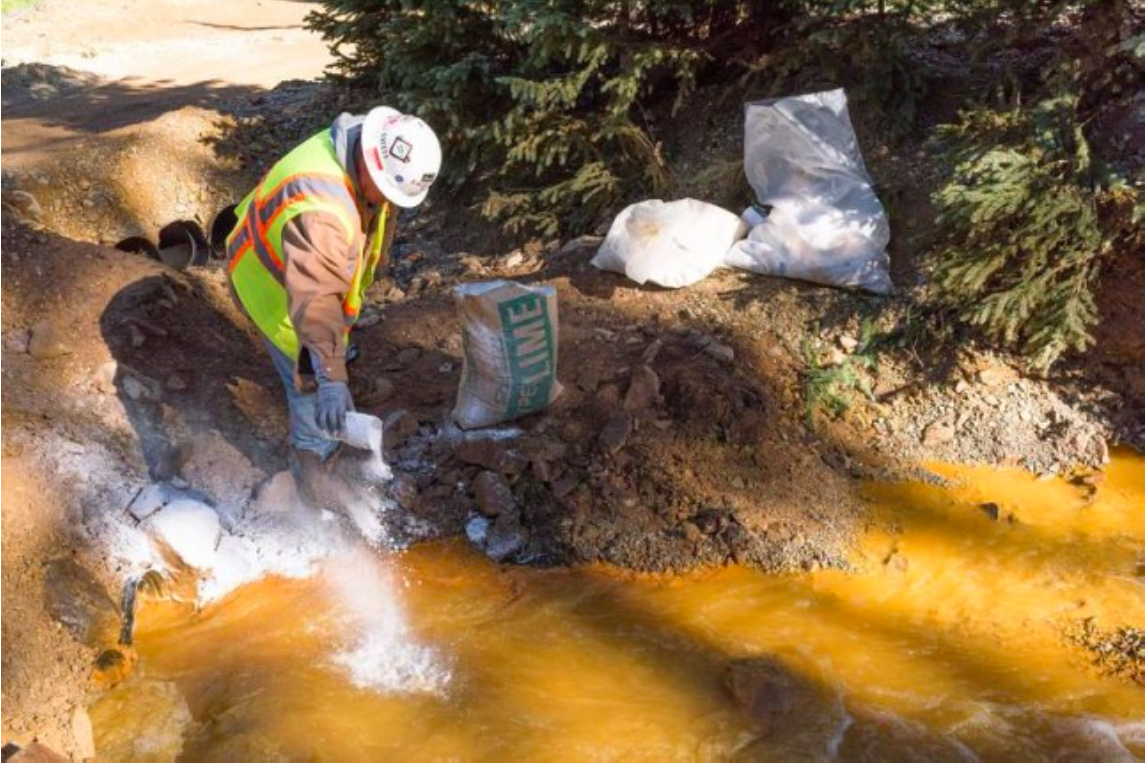
At the plant, EPA contractors — mixing in a ton a day of lime to neutralize the 8.3 pH acid flow to 3.5 pH — recently sliced open bulging sacks filled with reddish-brown sludge. They spread 3,500 cubic yards of the sludge across a flat area to dry, trying to extend the plant’s capacity to clean Gold King muck.
Generators rattle. A canary-yellow air tube snakes out the mouth as workers in helmets with head lamps hike in.
Down in town, Silverton and San Juan County leaders’ recent about-face — from a tribe-like mistrust of the EPA toward eagerness to get cleanup done at the Gold King and 46 other sites — is becoming more adamant. Some locals say they see economic benefits if mining’s toxic hangover can be cured. And Silverton’s town manager is broadening his appeal to the nation’s most ambitious geologists to make this a hub for hydrology research…
Next, the EPA must officially designate a National Priority List disaster and find a Superfund or other way to cover cleanup costs — action that’s delayed until fall. Then in the Superfund process, the EPA would start studies to find the best way to fix each of the Animas sites.
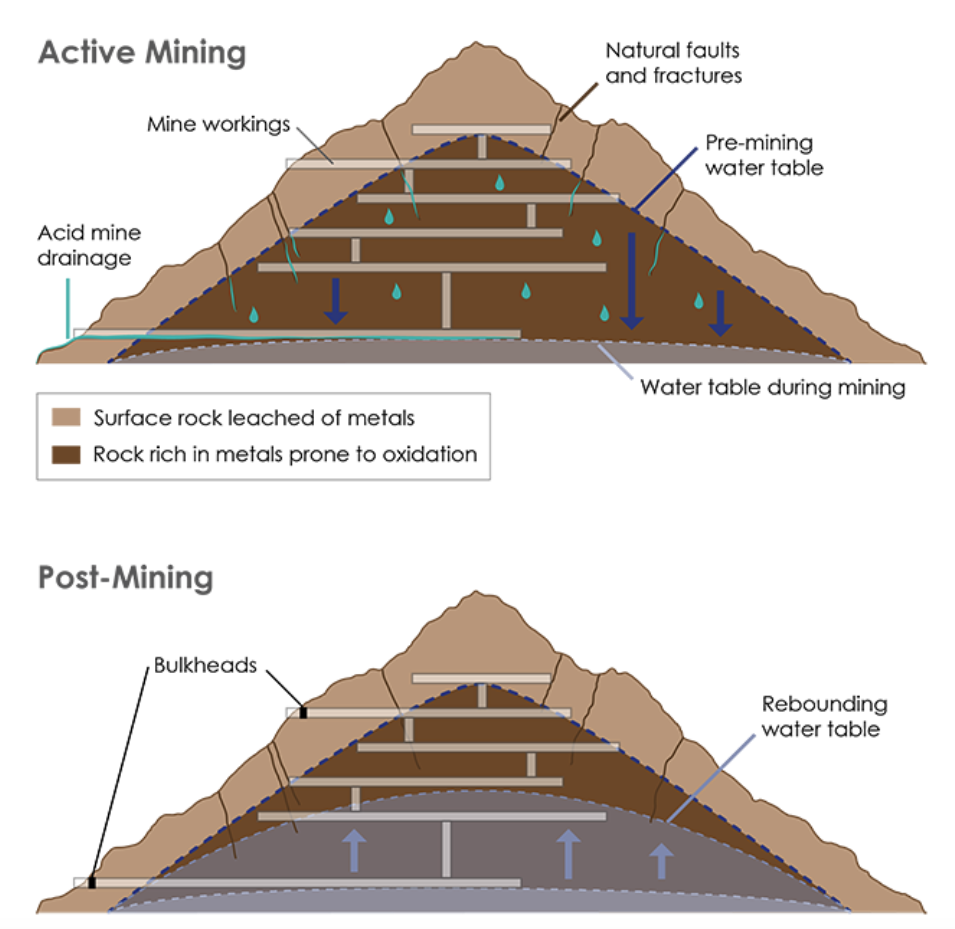
At issue is whether final cleanup should rely on water plants, costing up $26 million each, to treat mine drainage perpetually, saddling future generations with huge bills — or aim for a more complicated “bulkhead” plug approach that could contain acid muck inside mountains, perhaps using pressure sensors to give early warning of blowouts…
But Silverton and San Juan County leaders last month said they’re mostly pleased with EPA progress at the mine, though federal muzzling of front-line crews and access restrictions have impeded close-up inspection.
Outstanding issues include locals seek assurances water treatment will continue until final cleanup is done; a demand for reimbursement of $90,000 they spent — “They did pay one tithing, and promised more,” Kuhlman said; and a desire to close off an ore heap used by motorcross riders along the Animas…
A solution based on plugging likely would be controversial. State-backed bulkheads installed near the Gold King Mine “are what started this whole problem,” Commissioner Kuhlman said, referring to the plugs in the American Tunnel of the Sunnyside Mine, which backed up mine muck and doubled discharges from mines in the area — setting up the Gold King blowout. A bulkhead installed in the adjacent Red and Bonita Mine hasn’t been closed.
The appeal is that holding water inside mountains means the acidic muck, which forms when natural water leaches minerals exposed by mining, does less harm.
Bulkheads, like this one at the Red and Bonita Mine, help stop mine water discharges and allow engineers to monitor the mine pool. Credit: EPA.
Gold King Mine circa 1899 via The Silverton Standard
Bonita Mine acid mine drainage. Photo via the Animas River Stakeholders Group.
Settling ponds used to precipitate iron oxide and other suspended materials at the Red and Bonita mine drainage near Gold King mine, shown Aug. 14, 2015. (Photo by Eric Vance/EPA)
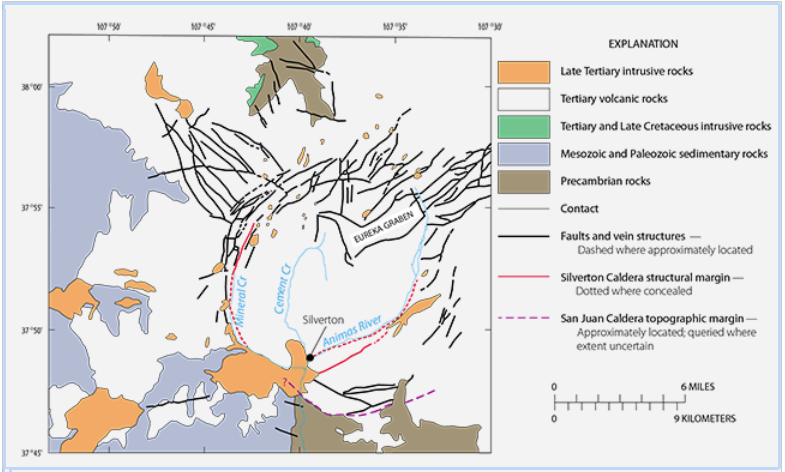
The “Bonita Peak Mining District” superfund site. Map via the Environmental Protection Agency
Location map for abandoned mine near Silverton. The Silver Wing is in the upper right corner of the aerial.
Wastewater continued to stream out of the Gold King Mine on Tuesday [August 11, 2015] near Silverton, several days after a rush of 3 million gallons of it flooded Cement Creek and the Animas River. At the top of the photo is the mine’s opening, where an Environmental Protection Agency cleanup team was working with heavy machinery Aug. 5 and hit an earthen wall that had millions of gallons of water built up behind it
A “get well soon” balloon floats in the contaminated waters of the Animas River flowing through Durango on Monday afternoon August 10, 2015 — photo The Durango Herald, Shane Benjamin
Animas River at the New Mexico/Colorado State line August, 2015.
Animas River through Durango August 9, 2015, after the Gold King Mine spill. Photo credit Grace Hood
Confluence of Cement Creek and the Animas River from the Coyote Gulch archives (11/21/2010)
Silverton, Colo., lies an at elevation of 9,300 feet in San Juan County, and the Gold King Mine is more than 1,000 feet higher in the valley at the left side of the photo. Photo/Allen Best
Gold King mine treatment pond via Eric Vance/EPA and the Colorado Independent
The EPA’s wastewater treatment plant near Silverton, Colorado, on Thursday, Oct. 16, 2015 — photo via Grace Hood Colorado Public Radio
The Environmental Protection Agency’s temporary water-treatment facility at Gold King Mine, October 2015, via Steve Lewis/The Durango Herald.
Health and environmental officials in San Juan County are evaluating the Animas River after roughly 1 million gallons of mine waste water were released Wednesday. August 6, 2015. (Photo courtesy San Juan Basin Health Department)
The Gold King Mine Citizens’ Advisory Committee heard an update on the quality of the drinking water during its meeting today at San Juan College.
Stephanie Stringer, chief of the New Mexico Environment Department’s Drinking Water Bureau, gave a presentation to the committee on the status of public water systems in the Animas and San Juan watersheds.
The committee includes 11 volunteers who monitor efforts to document the long-term effects of the mine spill, which in August 2015 released more than 3 million gallons of towaste water with heavy metals into the Animas Rivers.
About 89,000 San Juan County residents’ water systems were affected by the mine when intakes were closed to protect treatment plants and water reservoirs, according to Stringer’s presentation. That figure does not include water systems on the Navajo Nation, which are not monitored by the state agency.
But in the year after the mine spill, the affected public water systems have remained in compliance with drinking water quality standards, Stringer said.
She said no metal contamination was found in any of the drinking water samples collected by the U.S. Environmental Protection Agency.
“With a couple of minor exceptions of failing infrastructure systems, the public water systems are doing their job, and the water is safe to drink,” Stringer said after the meeting.
While not related to the mine spill, poor infrastructure maintenance is behind the failing treatment systems of the Morningstar and Harvest Gold water systems, Stringer said. Operated by the AV Water Co., the two systems serve nearly 7,000 residents in Crouch Mesa and areas outside Bloomfield. Those customers have been under a boil advisory since May 25 because of the failing treatment plants.
Drinking water from all other public water systems is safe for all uses, according to Stringer.
In her presentation, Stringer also detailed the bureau’s efforts to monitor the quality of the drinking water systems after the mine spill. Stringer said some public water systems are developing plans in case an emergency again threatens drinking water.
“We are encouraging all the public water systems to develop source water protection plans to ensure they know what to do in an event such as this,” Stringer said after the meeting.
The Gold King Mine Citizens’ Advisory Committee will meet next at 5:30 p.m. Sept. 26 at the Nenahnezad Chapter house in Fruitland.
The orange plume flows through the Animas across the Colorado/New Mexico state line the afternoon of Aug. 7, 2015. (Photo by Melissa May, San Juan Soil and Conservation District)
From the Associated Press (Susan Montoya Bryan) via The Durango Herald:
Leaders of one of the nation’s largest American Indian tribes blasted the U.S. Environmental Protection Agency as their attorneys sued Tuesday, claiming negligence in the cleanup of the Gold King Mine spill that tainted rivers in Colorado, New Mexico and Utah.
Navajo Nation President Russell Begaye stood on the bank of the San Juan River in northwestern New Mexico and explained his people’s link to the water and the economic, cultural and psychological damage inflicted in the wake of the August 2015 spill, which occurred in an inactive mine north of Silverton.
“EPA, we’re holding your feet to the fire,” Begaye said, promising that generations of Navajos are willing to fight. “We will not let you get away with this because you have caused great damage to our people, our river, our lifeblood.”
[…]
The Navajo Nation joins New Mexico in pursuing legal action over the spill. The state of New Mexico sued the EPA and Colorado earlier this year, citing environmental and economic damage.
Tribal officials at the news conference and in the lawsuit pointed to delays and resistance by the EPA, saying the agency has failed to compensate Navajos for their losses or provide any meaningful recovery efforts over the past year.
The EPA has dedicated more than $29 million to respond to the spill and for monitoring, but much of that is going toward stabilization and ongoing drainage at the mine. Reimbursement of state, local and tribal costs is underway, but the tribe has received only a fraction of the nearly $1.6 million doled out to all the parties.
Begaye said Navajo farmers have felt the brunt of the spill. Some crops went unplanted this year and cultural practices such as the gathering of corn pollen were skipped…
He called the actions of the agency, its contractor and the mining companies reckless and reiterated his disappointment that Navajos have yet to receive a phone call or letter of apology from President Barack Obama.
Navajo officials said the government has denied repeated requests for everything from compensation for farmers to resources for long-term monitoring and an on-site laboratory for real-time testing of river water.
“They have not done a thing,” Begaye said during his impassioned address.
While the lawsuit doesn’t include an exact dollar figure for damages the tribe is seeking, Begaye said Navajos are owed “millions” and that the scope of the contamination is still unknown.
A criminal investigation into the spill is being conducted by the EPA’s Office of Inspector General and the U.S. Justice Department, but it’s unclear how long that probe could take.
On April 7, 2016, the Environmental Protection Agency proposed adding the “Bonita Peak Mining District” to the National Priorities List, making it eligible for Superfund. Forty-eight mine portals and tailings piles are “under consideration” to be included. The Gold King Mine will almost certainly be on the final list, as will the nearby American Tunnel. The Mayflower Mill #4 tailings repository, just outside Silverton, is another likely candidate, given that it appears to be leaching large quantities of metals into the Animas River. What Superfund will entail for the area beyond that, and when the actual cleanup will begin, remains unclear. Eric Baker
The orange plume flows through the Animas across the Colorado/New Mexico state line the afternoon of Aug. 7, 2015. (Photo by Melissa May, San Juan Soil and Conservation District)
Local, state and tribal officials gathered at the Sycamore Park Community Center gym in Farmington today for a roundtable discussion aimed at prompting the U.S. Environmental Protection Agency to address lingering concerns from the Gold King Mine spill.
The meeting was convened by U.S. Rep. Ben Ray Luján, D-N.M., who billed it as an opportunity to combine voices and “hold the EPA accountable for damages.” Topping the list of grievances for most parties was the struggle to secure compensation for response efforts and losses in the wake of the spill.
“To this day, many farmers haven’t been reimbursed,” Navajo Nation President Russell Begaye said. “That’s been an ongoing battle.”
[…]
Farmington officials also noted that the city has not received full compensation for the $516,000 it spent on spill response measures, including the purchase of a $260,000-sensor system to protect the city’s drinking water supply from lingering contamination in the Animas River. Mayor Tommy Roberts said the city has received $110,000 so far.
Alexis Strauss, acting director of the EPA’s Region 9 office, represented the agency via a video feed. She said the EPA has allocated $3 million to states and tribes for emergency response costs. She said additional claims are currently under review and handled by the U.S. Justice Department rather than the EPA’s regional offices.
“Those decisions are imminent and will be announced very soon,” Strauss said.
According to a retrospective report compiled by the agency for the one-year anniversary of the spill, the EPA has dedicated a total of $29 million toward response measures. Costs include $7.3 million for sampling and analysis, and $5 million for agency personnel. The report states that the EPA is currently in the process of awarding $2 million in grant money to states and tribes for water quality monitoring.
Funding such programs has become a divisive subject between the state and the federal agency. The New Mexico Environment Department has criticized the scope of the EPA’s long-term monitoring plan, pushing for funding to develop its own.
Bruce Yurdin of the NMED’s Surface Water Quality Bureau told officials at the meeting that the department has only received 10 percent of what it considers necessary to study the impact of contaminants released during the spill.
Such disparities prompted the recent lawsuits filed by New Mexico against the EPA, the state of Colorado and several mining companies. Begaye said today that he supports the string of legal actions, and the Navajo Nation is considering filing litigation of its own.
In addition to the issue of restitution, the discussion also delved into methods to address future incidents.
“There’s a large possibility that this could happen again,” San Juan County Executive Officer Kim Carpenter said…
As the meeting drew to a close, Rep. Luján asked officials to compile a list of their concerns for submission to EPA Administrator Gina McCarthy. He said the spill has captured the attention of congress, and efforts to fund response programs have drawn bipartisan backing.
On April 7, 2016, the Environmental Protection Agency proposed adding the “Bonita Peak Mining District” to the National Priorities List, making it eligible for Superfund. Forty-eight mine portals and tailings piles are “under consideration” to be included. The Gold King Mine will almost certainly be on the final list, as will the nearby American Tunnel. The Mayflower Mill #4 tailings repository, just outside Silverton, is another likely candidate, given that it appears to be leaching large quantities of metals into the Animas River. What Superfund will entail for the area beyond that, and when the actual cleanup will begin, remains unclear. Eric Baker
The orange plume flows through the Animas across the Colorado/New Mexico state line the afternoon of Aug. 7, 2015. (Photo by Melissa May, San Juan Soil and Conservation District)
The U.S. Environmental Protection Agency announced on Friday it is awarding about $1.2 million in reimbursements to tribal and government agencies in the Four Regions region, including the Navajo Nation, for costs associated with the response to the Gold King Mine spill.
The announcement issued by the EPA came on the one-year anniversary of EPA crews accidentally triggering the release of about 880,000 pounds of heavy metals into a tributary of the Animas River near Silverton, Colo., while cleaning up abandoned mining sites.
According to the press release, the Navajo Nation will receive about $445,000 in reimbursements for costs associated with the response to the spill, including field evaluations, water quality sampling, laboratory work and personnel costs. The tribe previously was awarded about $158,000 by the EPA.
About $710,000 will be distributed to state, tribal and local governments in Colorado and Utah, according to an EPA press release.
The state of New Mexico was not included in the latest round of funding under the Comprehensive Environmental Response, Compensation, and Liability Act, also known as Superfund. New Mexico was previously awarded about $1.1 million in a previous round of funding, according to the EPA’s website…
Some of the response costs included about $130,000 to support the Navajo Nation Emergency Operations Center, about $72,000 to monitor drinking water and haul water, and about $71,000 to support visits by the Navajo Department of Agriculture to investigate possible needs for water and feed for farmers.
According to its press release, the EPA has dedicated more than $29 million to respond to the incident with the majority of the funds dedicated to stabilizing the mine and reducing the acid mine drainage at the Gold King Mine site.
In the year since, Chief and her team have worked with Navajo communities, with a particular focus on the Shiprock, Upper Fruitland and Aneth chapters, to understand how the metals in the river may affect their health and how it damaged their perceptions of the river.
“We focused in on the short-term exposure because that was a question the people were really concerned about: ‘What is the risk of using the river?’” Chief said.
After numerous meetings with people, held in Navajo and English, the researchers found people could be exposed to heavy metal contaminates in 40 ways. Some exposure paths were specific to their lifestyle, such as using plants near the river for medicinal purposes. The potential exposure extends beyond the recreational exposure the Environmental Protection Agency had considered, Chief said.
To assess risk, the EPA assumed an adult or child was exposed to river sediment and drinking river water and sediment over 64 days per year over many years – 10 years for a child and 20 years for an adult…
The University of Arizona researchers say not enough information has been gathered to say what the health impacts will be, and they don’t expect to deliver those result for nine months to a year.
They started collecting soil and river samples in November with the help of volunteers before receiving a National Institute of Environmental Health Sciences grant in March. They still need to collect urine and blood samples to see if people have a harmful level of lead or arsenic in their bodies.
“That will give us an idea if it makes sense to monitor long term,” said Paloma Beamer, an associate professor at the University of Arizona who is working on the study.
The data will allow researchers to answer the communities’ questions directly.
These are elements that have been extensively studied and so there is baseline data they can use for comparison, she said.
The researchers will take swabs from inside homes and gather information about residents’ diet to see if the lead and arsenic may come from other sources. For example, the coal some residents’ burn for heat can give off arsenic.
They also expect to take samples from sheep, corn, soil and river and tap water to assess the risk.
“We’re looking for lead and arsenic in everything, to trace the different ways it’s moving through the environment,” Beamer said.
They will use the data and information collected from the people to model what the exposure could be, so they can factor in activities that people are not doing anymore because they changed their habits, Paloma said…
“The history of environmental abuse has caused this distrust of other people’s information,” said Rebecca Clausen, an environmental sociologist at Fort Lewis College, who helped with the focus groups.
In the 1920s and ’30s, the federal government drastically reduced the animal herds of the reservation. From the 1940s through the 1980s, the federal government mined millions of tons of uranium, leaving behind radiation in homes and drinking sources.
So the Gold King Mine spill is just one piece of widespread environmental degradation, she said…
When this portion of the study is finished, Chief plans a three-year study, which is funded by a $600,000 grant.
“It will be really a discussion with the community where they want to go next.” Chief said.
A federal criminal investigation into the spill is now underway, and local governments and businesses are frustrated with the slow pace of compensation from the EPA one year later.
Matt Wilson, owner and operator of 4 Corners Whitewater, estimates he lost about $30,000 in revenue last year because of the spill. His was one of about six Colorado rafting companies affected from canceled trips and no customers for over a week.
“So after that it was hard to kind of reboot and get people back on the water after all that publicity,” Wilson said.
Wilson is now one of 68 individuals and businesses across Colorado, New Mexico, Utah and the Navajo Nation that filled out financial claims with the EPA.
Samples show water quality on the Animas River has returned to pre-spill conditions and the 2016 summer rafting season has been strong. But Wilson and others are still waiting to hear back on their claims.
Durango City Council member Dean Brookie said his city’s government is in another holding pattern. It spent over $440,000 responding to the spill. The tab includes everything from water-quality monitoring to “personnel that we assigned to the clean-up effort.”
He said Durango’s budget is strong without those funds, but other smaller communities may not have as much in reserves.
EPA Response
Laura Jenkins, an EPA spokeswoman, said the agency continues to work with local governments on reimbursing costs.
“We’re limited by what the regulations allow us to reimburse communities for,” said Jenkins. “They have to meet the requirements that are in the statutes.”
The EPA says laws like the Clean Water Act govern what is reimbursable for communities. Overall it has spent $29 million responding to the spill, with $3.7 million going to local governments to reimburse expenses like overtime pay and local water quality monitoring.
There are other issues that aren’t covered, and in some places like New Mexico, talks have broken down.
“It was just continual failed efforts,” said Tania Maestas, Deputy Attorney General for Civil Affairs in the New Mexico Attorney General’s office.
New Mexico sued the EPA this spring and the state has received $1.64 million from the EPA so far. The agency has made another $5.67 million available in unallocated funds to the state, but Maestas said it only covers a fraction of $130 million in estimated damages. The lawsuit covers everything from water quality monitoring to payment to local businesses for their losses.
“It’s our experience that the EPA met all these requests with either challenges, resistance or delays,” Maestas said about local business owners frustrated with the claims process
Maestas said other states could follow New Mexico’s path to court.
The Navajo Nation may be at the front of that line. Last August, it hired the California law firm Hueston Hennigan LLP to represent its claims. Attorney John Hueston said the firm has pursued multiple avenues resulting in some payment, but at the one year mark he said the window for cooperation is closing and the time for legal action is quickly approaching.
The full impact of the Gold King Mine spill on Aug. 5, 2015, may not be known for years on any front, and recovery is far from over. And some of that isn’t environmental, governmental or economic – it’s healing invisible trauma in the people and communities affected…
“If there’s good news to a bad news story, awareness of the river, the river basins and how it all works is through the roof,” said Bob Kunkel, executive director of the Durango Area Tourism Office. “Not only from a local level or a Colorado level, but the whole western U.S. level. That is really going to pay some dividends because none of us understood the spillage was ongoing.”
[…]
Real-life lessons
If there was another silver lining to the spill, it was the material it provided for teachers and professors. Several Durango School District 9-R schools, including Durango and Big Picture high schools and Escalante Middle School, Animas High and Mountain Middle charter schools and Fort Lewis College incorporated the spill in science, math and humanities courses.
“As an educator, the event of it inspired me to localize my curriculum, and it was more meaningful to them,” said Jessica McCallum, junior humanities teacher at Animas High. “The students, on reflection, said, ‘Wow, this is really complex.’ Some students are very deeply affected still.”
McCallum’s students interviewed more than 70 people, including second-graders, decision makers and tourism employees, about the spill for Story Corps and met with high school students in Silverton to understand the spill from a different point of view. The interviews are available online, and they tell the story from many perspectives.
Some common themes were: Distrust of and anger at the Environmental Protection Agency, whose workers caused the spill; fear, whether it’s financial, safety or concern for other community members; and, as Kunkel put it, an awareness of the river and the watershed in a bigger picture way.
‘Technological’ disaster
Sad. Betrayed. Devastated. Scared. Grief. Blame. Anger. Hostility.
“There’s a uniqueness to what happened in Durango, but there’s also a pattern,” Fort Lewis College sociology associate professor Rebecca Clausen said. “My experience after the Exxon (Valdez) spill (in Alaska) gave me a good context for not seeing this as an isolated event.”
Social science has identified two kinds of disasters: natural – such as hurricanes, earthquakes and tornados, and technological or environmental – and human-made disasters such as Chernobyl, the BP Deepwater Horizon rig oil spill in the Gulf of Mexico and the Gold King Mine spill, Clausen said. Communities tend to pull together and heal more quickly from the “acts of God,” she said, but technological disasters can rip them apart and have impacts that last generations…
A group of volunteers, including Clausen and hydrologist Jack Turner, without funding from any governmental agency or nonprofit, took on the task of addressing the mental health stresses on the communities impacted by the spill. Calling themselves the Animas Community Listening and Empowerment Project, they held listening sessions in Durango and Farmington.
“People tend not to go seek out a counselor for this kind of grief or anxiety,” Clausen said. “They’re hesitant to talk about it at the supermarket. We gave them an opportunity and permission to talk.”
[…]
River businesses
“From a tourism standpoint, it’s over,” Kunkel said. “For tourists, it ended like somebody pulled the shade down as soon as the river reopened. They essentially said, ‘All I want to do is get my family on the river, I don’t care about your local hooha.’”
The most affected, Kunkel said, were the river rafting companies.
“We’ll have a better answer in a year or so about how much it impacted us,” said Alex Mickel, owner of Mild to Wild Rafting and Jeep. “I expect it to have an impact for three to five years before it’s totally gone from people’s consciousness, but not catastrophic, not enough to put us out of business, and probably quite small in the third year.”
Two factors helped his rafting business get through, Mickel said, adding that his business is up slightly in June and up in July this year over 2015.
“We were having a really good season before the spill,” he said. “And I’m glad we have a clean and safe river to recreate in this summer, not just for the business but because our kids play in the river, and it’s just part of our lives.”
The big question is what would this summer’s business have been without the spill?
“We’ve had people call and not go because of it or cancel because of it,” Mickel said about this year’s bookings, with tourists concerned about the safety of the river. “But the hardest number to pin down is the people who are not calling. Our business really ties into how the state’s tourism goes, and Colorado is having a banner year. How much of that growth have we missed because of this?”
One indicator is how many people stayed in Durango’s hotels and motels during August 2015. Lodgers tax declined by about 5 percent, but the drop may not be attributable to the spill, Tim Walsworth of the Durango Business Improvement District said when the numbers came out in October 2015. Some of that was because the Labor Day weekend, one of the biggest of the year for visitors, fell totally in September.
Lodgers tax numbers for this summer will not be available until fall, but it has been a good season, Kunkel said…
Ongoing monitoring
Many organizations continue to monitor the river for water quality and health of fish and insects that call it home.
Nonprofit Mountain Studies Institute is collaborating with the city of Durango on Animas River monitoring. One big concern was whether spring runoff would re-suspend the sediment lining the riverbed.
“Our monitoring program aims to understand whether water quality this spring is any different than previous years,” said Marcie Bidwell, institute director, “and if metal concentrations in the river pose any threat to human health, agriculture or aquatic life. Results from the spring samples are encouraging.”
At least twice during the spring runoff, concentrations of manganese and lead, some of the metals contained in the spill sediment still lining the riverbed, surpassed the Colorado Department of Public Health and Environment water-quality standards of the Animas River as a source for domestic drinking water. All other results for all other purposes fell below screening levels.
The science is one part of the puzzle, Turner said. Another, individual use of the river, is something unmeasureable, but he believes it is down significantly.
“To see the river like that was piercing, and it made me feel insignificant, really small and helpless, in shock,” he said. “I’m waiting to see the river go down to see if the yellow ‘bathtub’ stain is still there. I don’t know if I’ve put my feet in the river yet, and I keep asking what’s happening to this community if we’re not going to the river?”
The EPA has proposed the Bonita Peak Mining District Superfund site in the aftermath of the spill and superfund status is warranted according the EPA project manager. From The Durango Herald:
Rebecca Thomas told more than 100 participants at the 2016 San Juan Mining Conference that she expects the Superfund designation to be finalized by this fall.
The sixth annual mining conference, which brings together people involved in mining in the Animas, Rio Grande, San Miguel and Uncompahgre watersheds, was held at the DoubleTree Hotel in Durango
The events of the Aug. 5, 2015, Gold King spill, in which an Environmental Protection Agency-contracted crew caused a release of 3 million gallons of mine wastewater into the Animas River, dominated the discussions.
“Just 363 days ago we were bracing ourselves for a river disaster with a lot of concern,” said La Plata County Commissioner Gwen Lachelt in her opening statements. “The color orange now has a whole new meaning for me. Yes, it was a lesson about our mining legacy, but it was also a lesson about our river’s health.”
Durango Mayor Christina Rinderle, too, acknowledged that the anniversary of the spill was a fitting backdrop to the conference, and a chance to provide insight on how communities affected by the event responded…
Speaking around noon, the EPA’s Thomas made the case for Superfund.
Thomas, based in Denver, said she worked in the highly-mineralized mountains around San Juan County about a week each month this summer, with crews sampling on a regular basis.
“Even though the (Superfund) site is just proposed, that hasn’t stopped us from beginning our work,” she said.
Thomas said that although there was resistance to federal intervention for years, she believes the only viable step toward improved water quality in the Animas River is through a Superfund designation.
She argued the federal listing would allow potentially responsible parties, such as mining companies, to be held financially liable for cleanup, and given the scope of the project, only the EPA could provide the funds necessary.
Thomas tried to quell frustrations that it can take more than 20 years for a Superfund to finish.
“This process … is one of the main criticisms of Superfund,” she said. “But we don’t want to wait 20 years to see improved water quality in the Animas, and we’ll take every opportunity we can to fast-track some of this stuff.”
The conference also showed how the spill affected communities around the region, all with a legacy of mining.
Randy Barnes with the San Miguel Watershed Coalition said the EPA recently steered away from remediating a draining mine near Ophir.
“They are not super enthusiastic about going and poking fingers into mines right now,” he said.
Barnes added that the project led by Griswold, which would clean up a mill tailings pile beneath the mine entrance, was canceled for undisclosed reasons.
…the environmental mishap wasn’t all bad news for La Plata County businesses; in fact, several companies, including motels and restaurants, profited as government agencies opened their pocketbooks to help manage the disaster.
In the two months after the spill, La Plata County government spent $115,000 on goods and services related to the spill, much of which went to local businesses, according to receipts obtained through an open records request.
Several other agencies spent hundreds of thousands of dollars, including the Environmental Protection Agency, which has authorized $23.3 million in spending as of July 15, including reimbursement to local communities but not including payroll or travel expenses. The agency, which triggered the spill, was not able to provide a detailed accounting of its expenses in time for this story, but county expenses provide a snapshot of how local businesses profited during the spill.
The county has received reimbursement for some expenses and is seeking compensation for others.
The county’s first expense occurred on Aug. 6, 2015 – the same day the mustard-yellow water snaked its way through the county – to purchase a case of copy paper for $27.65 from Office Depot. The county made several return trips that month to Office Depot, purchasing $2,020 worth of supplies, including six easels, 12 easel pads, sticky notes, ink cartridges, a wall clock and much more. The county is seeking reimbursement from the Colorado Department of Public Health and Environment.
The county also purchased hundreds of meals for government employees. They were fed at at least a dozen different restaurants, including Macho’s, J. Bo’s, Carvers, Doughworks, Steamworks, Raider Ridge Café, Serious Texas Bar-B-Q, Rice Monkeys and Hot Tomatoes Café, to name a few. Many of the purchases fed dozens of people, including tabs for $305 at Domino’s Pizza, $517 at Serious Texas Bar-B-Q, $325 at Raider Ridge Café, $400 at Schlotsky’s, and $1,309 for a “thank you lunch” for city of Durango and La Plata County employees catered by Zia Taqueria. The county is seeking reimbursement for the food, including the thank you lunch, from the EPA.
Dozens of snacks and meals were purchased from area grocery stores, including Albertsons, Walmart, City Market and Nature’s Oasis. Receipts suggest some less-than-healthy eating habits, including large quantities of Lays potato chips, candy, doughnuts and soda pop.
The county also picked up several hotel bills, but it appears most employees sought reimbursement from their individual agencies rather than the county, because the county paid only $4,533 to house eight people, according to the open records request. The bills range from $79 a night at the Grand Imperial Hotel in Silverton to $720 for six nights at the Super 8 in Durango.
Several other businesses profited as a result of the Gold King Mine blowout, including:
Fast Signs, which charged about $1,125 to make vinyl signs used to close the river.
Best Cleaning, which billed $2,522 to clean the La Plata County Fairgrounds after the EPA used it as a headquarters.
Durango Party Rental, which charged $746 for a temporary room divider.
Durango Joe’s, which charged $45.75 to serve 45 people coffee.
But the company that profited the most is Wright Water Engineers, which raked in about $70,000 to provide consulting and water sampling on behalf of the county.
Overall, charges appear to be fairly well spread out between businesses, without a preference for specific vendors, restaurants or grocery stores.
Assistant County Manager Joanne Spina said that is a good thing, but it’s likely a result of luck, preference and necessity rather than policy. Most people don’t want to eat the same meal every day, she noted, so multiple restaurants were visited.
“This was an emergency situation, so I think those decisions were made in the moment by the folks who were needing to acquire whatever the goods or services were,” Spina said.
This image was taken during the peak outflow from the Gold King Mine spill at 10:57 a.m. Aug. 5, 2015. The waste-rock dump can be seen eroding on the right. Federal investigators placed blame for the blowout squarely on engineering errors made by the Environmental Protection Agency’s-contracted company in a 132-page report released Thursday [October 22, 2015]
The “Bonita Peak Mining District” superfund site. Map via the Environmental Protection Agency
Cement Creek remains lined with orange sediment after the Gold King Mine spill. The Environmental Protection Agency accidentally triggered the release of orange wastewater laced with heavy metals into Cement Creek on Aug. 5. The creek flows into the Animas River at Silverton, and eventually crosses into New Mexico and Utah
Gold King mine treatment pond via Eric Vance/EPA and the Colorado Independent
The Environmental Protection Agency’s temporary water-treatment facility at Gold King Mine, October 2015, via Steve Lewis/The Durango Herald.
Gold King Mine circa 1899 via The Silverton Standard
Gold King Mine access road August 2015 via the EPA/Twitter
Silverton, Colo., lies an at elevation of 9,300 feet in San Juan County, and the Gold King Mine is more than 1,000 feet higher in the valley at the left side of the photo. Photo/Allen Best
Settling ponds used to precipitate iron oxide and other suspended materials at the Red and Bonita mine drainage near Gold King mine, shown Aug. 14, 2015. (Photo by Eric Vance/EPA)
The Animas flows orange through Durango on Aug. 7, 2015, two days after the Gold King Mine spill. (Photo by Esm Cadiente http://www.terraprojectdiaries.com)
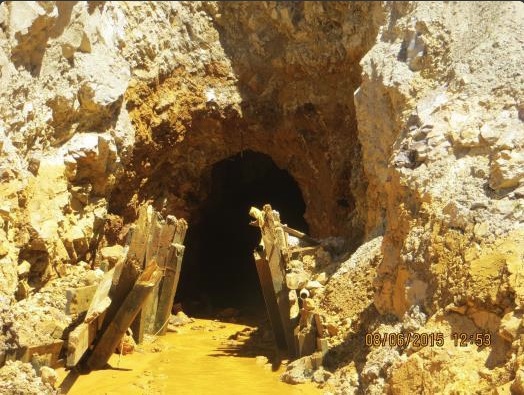
Gold King mine entrance August 2015 via the EPA
Wastewater continued to stream out of the Gold King Mine on Tuesday [August 11, 2015] near Silverton, several days after a rush of 3 million gallons of it flooded Cement Creek and the Animas River. At the top of the photo is the mine’s opening, where an Environmental Protection Agency cleanup team was working with heavy machinery Aug. 5 and hit an earthen wall that had millions of gallons of water built up behind it
Gold King mine spill Animas River August 2015 photo — Nancy Fisher via The Colorado Independent
New settlement ponds at Gold King Mine August 2015
The confluence of Cement Creek, at right, and the Animas River, left, as seen September 2015 in Silverton, Colo. This is where the plume of contaminated water from the Gold King Mine entered the Animas River. (Jon Austria — The Daily Times)
Acid mind drainage Cement Creek watershed
Gold King Mine entrance after blowout August 2015
Emergency detention ponds Gold Hill Mine spill August 2015 via Bruce Finley
Gold King Mine via Blog.YourColoradoWater.org
“Water is life; water is sacred,” said Southern Ute Sun Dance Chief Kenny Frost, who led a ceremony to heal the Animas River on Sunday at sunrise at Santa Rita Park in Durango
A “get well soon” balloon floats in the contaminated waters of the Animas River flowing through Durango on Monday afternoon August 10, 2015 — photo The Durango Herald, Shane Benjamin
Bottom of Animas River at Durango August 8, 2015 via Twitter and The Durango Herald
Animas River through Durango August 9, 2015, after the Gold King Mine spill. Photo credit Grace Hood
Confluence of Cement Creek and the Animas River from the Coyote Gulch archives (11/21/2010)
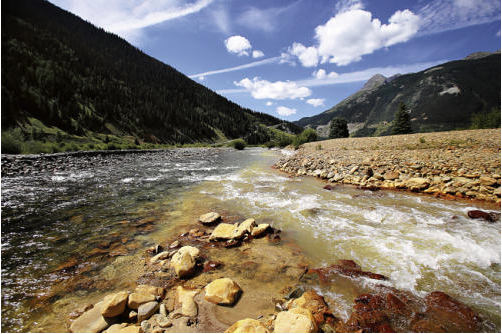
Animas River
Tubing the Animas River via Flipkey.com
Location map for abandoned mine near Silverton. The Silver Wing is in the upper right corner of the aerial.
Bonita Mine acid mine drainage. Photo via the Animas River Stakeholders Group.
Cement Creek photo via the @USGS Twitter feed
The EPA’s wastewater treatment plant near Silverton, Colorado, on Thursday, Oct. 16, 2015 — photo via Grace Hood Colorado Public Radio
Cement Creek aerial photo — Jonathan Thompson via Twitter
Cement Creek August 8, 2015 — Bruce Finley via Twitter
In a one-year retrospective released Monday by the EPA, the federal agency is careful to underscore how the state was involved in planning that led to the blowout, which turned the Animas mustard yellow and deposited heavy metals.
“Throughout the winter and spring of 2015, EPA and CDRMS (Colorado Division of Reclamation, Mining and Safety) developed plans … During the 2014-2015 investigatory process with CDRMS, the EPA team concluded the GKM (Gold King Mine) adit was likely only partially full of water,” the report says…
The state has attempted to distance itself from planning that led to the blowout.
“DRMS did not have any authority to manage, assess, or approve any work at the Gold King Mine,” former Natural Resources Director Mike King wrote in a Sept. 2, 2015, letter to the EPA, just a week after an EPA internal report was released.
The issue is likely to be highlighted as the state defends itself against a lawsuit filed by New Mexico in the U.S. Supreme Court. The state has until Aug. 22 to respond…
The account does not offer much new information, largely recounting the circumstances that led to the Aug. 5, 2015, blowout, which the EPA described as an “inadvertent” release.
“EPA recognizes the impact that the GKM release had on the people of the Four Corners region,” the retrospective states. “The Agency has worked with affected residents, small businesses, universities, local governments, states and tribes in an extensive effort to assess and address the immediate and potential long-term impacts of the release on water quality in a region adversely impacted by a legacy of contaminated mine-influenced waters from abandoned and unstable hard-rock mines.”
It goes on to encourage Congress to approve a fee on the hard-rock mining industry to help cover costs associated with cleanups. The Republican-controlled Congress has expressed concerns with the proposal.
The EPA has dedicated more than $29 million to respond to the Gold King Mine spill and to provide monitoring in the area. A Superfund listing – which is likely to be approved as early as the fall – would inject millions more into cleanup efforts.
On Friday, Sunnyside – now owned by international mining conglomerate Kinross Gold Corp. – called for New Mexico’s lawsuit over the Gold King Mine spill’s impact to the state to be dismissed.
“We see no basis for us even being named in this litigation,” Sunnyside spokesman Larry Perino wrote in an email.
In May, the state of New Mexico, seeking compensation for environmental and economic damages, filed a lawsuit in U.S. District Court in New Mexico, naming the Environmental Protection Agency and its contractor, as well as Sunnyside and its parent company, as responsible parties for the Aug. 5, 2015, mine blowout.
In the complaint, New Mexico state officials claim the “root cause” of the disaster dates back more than 20 years to Sunnyside’s attempt to block waste water drainage by building bulkheads in tunnels below the vast Sunnyside Mine network north of Silverton…
In its July 29 motion to dismiss, Sunnyside argued that installing the American Tunnel bulkhead was done at the direction of the state of Colorado, and that New Mexico officials “point to no facts to support that historic discharges from the Sunnyside Mine pool in Colorado, unrelated to the Gold King Mine blowout, somehow impacted New Mexico.”
The motion further alleges New Mexico has no personal jurisdiction over Sunnyside; the state of Colorado is a required party in the case and is not named (Colorado was sued by New Mexico in the U.S. Supreme Court); and New Mexico is not entitled to punitive damages.
Sunnyside has long dismissed claims that water backed up behind the American Tunnel has seeped to other mine workings, though most experts in the region suspected the opposite.
Regardless, as a result of the proposed Superfund listing, the EPA plans to enter the mine and investigate, which should provide clarity, EPA officials previously said. It is unclear if those efforts have started this summer.
And Sunnyside’s involvement does not end with the New Mexico lawsuit, as the company has emerged high atop the list of potentially responsible parties that the EPA would seek financial costs from should a Superfund be declared.
Though Sunnyside claims an agreement with the state of Colorado to install three bulkheads in the 1990s would release the company of further liability for pollution in the district, officials familiar with the Superfund process say otherwise.
“It’s a different law,” Doug Jamison, of the Colorado Department of Public Health and Environment, said in a previous interview. “(Sunnyside) was relieved of their liability from a discharge permit under the Clean Water Act. It has nothing to do with Superfund liability.”
It’s been a convoluted, and expensive, quarter century since the company last hauled gold, silver, copper and other precious metals from the highly mineralized mountains surrounding San Juan County.
After the mine shut down in 1991, a number of remedial efforts began, with Perino estimating about $15 million has been directed to cleaning up sites around the basin.
Still, ever since Sunnyside’s water treatment plant shut down in 2004 (a result of a sale to local Steve Fearn, who was evicted by current Gold King Mine owner Todd Hennis), water quality in the Animas River has degraded.
The town, too, felt the departure.
“It was a wrenching time,” Silverton native Bev Rich said.
Rich said nearly 150 workers lost high paying jobs. The only school in the small mountain hamlet of about 600 full-time residents went from 150 students to about 50, and San Juan County lost $300,000 – about one third – of its annual budget.
Meanwhile the U.S. Attorney General’s office has launched a criminal investigation into the August 2015 Gold King Mine spill. Here’s a report from Jesse Paul writing for The Denver Post. Here’s an excerpt:
Federal authorities have confirmed for the first time that a criminal investigation into the 2015 Gold King Mine spill is underway, saying their probe involves the U.S. Attorney’s Office and came at the request of members of Congress.
The announcement Monday came from the Environmental Protection Agency’s Office of Inspector General (OIG) as it released letters sent to lawmakers about the status of its work to analyze the disaster. Documents reviewed by The Denver Post on Monday indicate the probe has been in progress for nearly a year.
Jeffrey Lagda, spokesman for the inspector general’s office, said the OIG is working with the U.S. Attorney’s Office on the criminal investigation. It was “based on requests from several members of the House and Senate,” he added…
In a June 29 letter to Colorado Sen. Cory Gardner, the inspector general’s office said a number of investigations into the spill “have been underway.”
Gardner said Monday in a statement that he appreciates the criminal review and urged the expedited release of a full report on the disaster. He added: “I look forward to a response to my questions surrounding EPA’s insufficient and untimely recovery efforts immediately following the spill.”
In recent letters to members of Congress, the OIG wrote: “There is investigative material that we cannot reveal in any report about our program evaluation until the investigation reaches a point where the U.S. Department of Justice and the EPA’s OIG’s Office of Investigations inform us that we may do so. Many of your questions to us, including those that go to the heart of what you asked us to address, directly implicate and will have to be answered in part by investigative results that are not currently releasable.”
[…]
Also Monday, the EPA released a 23-page retrospective report on the Gold King and its efforts since the incident to restore and protect impacted communities.
The agency said that as of July 15 it has dedicated $29 million in response efforts and for continued water quality monitoring. Officials say they are also evaluating more incident-related expenses and that they are working to expedite the distribution of those funds.
“We have been responsive in terms of doing the cleanup and demonstrating how we’ve done the cleanup,” Mathy Stanislaus, EPA’s assistant administrator, told The Post in an interview Monday.
He added that 68 claims that have been filed against the EPA, which include a mixture of individuals, businesses and local and state governments, are pending review…
The National Wildlife Federation on Monday proclaimed “no meaningful effort has been made” since the Gold King spill to address the ongoing threats from hundreds of mines across the country. Jim Lyon, the federation’s vice president of conservation policy, called for legislation to stop the clock from ticking toward another similar catastrophe.
Stanislaus said the universal problem is broader than the EPA and is being examined from many federal levels.
“I think the EPA can only take on an extremely small subset of the abandoned mine situation,” Stanislaus said. “We only get involved in the highest risk situations where you have this high risk (to) ecological and public health.”
This image was taken during the peak outflow from the Gold King Mine spill at 10:57 a.m. Aug. 5. The waste-rock dump can be seen eroding on the right. Federal investigators placed blame for the blowout squarely on engineering errors made by the Environmental Protection Agency’s-contracted company in a 132-page report released Thursday [October 22, 2015]
In a July 22 interview with the Telluride Daily Planet, Hays Griswold, speaking of a cleanup project set to begin at a mine near Ophir, cautioned residents there that work might cause some discoloration in the Howard Fork of the San Miguel River.
“You may see some yellow water. Don’t get excited like they do in Durango,” Griswold said.
EPA press secretary Melissa Harrison wrote in an emailed response that Griswold’s comments do not reflect the views of the agency. Requests for an interview with Griswold were ignored, and independent attempts to reach him Thursday were unsuccessful…
Griswold last August was charged with taking over cleanup efforts at the Gold King Mine north of Silverton while the EPA’s permanent on-scene coordinator, Steve Way, was on vacation.
Just days into his command, Griswold gave the EPA’s contracted crews orders to dig into the loose pile of dirt and rock that covered the entrance to the mine – despite clear instructions left by Way to postpone any such work due to the inherit risk of a blowout…
Griswold is now tasked with cleaning up 15,000 cubic yards of mill tailings at the Carribeau Mine, west of Ophir, according to the Telluride Daily Planet. He will not, however, be touching the mine’s adit, which is leaking anywhere from 600 to 800 gallons of mine drainage a minute.
The EPA’s Harrison wrote that the remediation plan for Carribeau Mine is under review by the regional office, and no final decisions have been made about the work.
The EPA’s efforts in the Silverton mining district, now proposed for Superfund listing as the Bonita Peak Mining District, are under the direction of Rebecca Thomas, remedial project manager.
At the urging of congressional leaders, the EPA’s Office of Inspector General is investigating the rupture from the Gold King Mine above Silverton, Colorado, that fouled waterways in three states and Native American lands, the agency said in a statement.
“Based on requests from several members of the House and Senate, the OIG is conducting both a program evaluation and a criminal investigation of the Gold King Mine spill,” the EPA said in a statement.
The OIG is an independent office that audits, investigates and evaluates the agency’s activities, the EPA statement said…
Jeffrey Lagda, a spokesman for the EPA’s Inspector General, told Reuters that the probe has been ongoing for some time, and that investigators are working with prosecutors at the U.S. Attorney’s Office in Denver.
On April 7, 2016, the Environmental Protection Agency proposed adding the “Bonita Peak Mining District” to the National Priorities List, making it eligible for Superfund. Forty-eight mine portals and tailings piles are “under consideration” to be included. The Gold King Mine will almost certainly be on the final list, as will the nearby American Tunnel. The Mayflower Mill #4 tailings repository, just outside Silverton, is another likely candidate, given that it appears to be leaching large quantities of metals into the Animas River. What Superfund will entail for the area beyond that, and when the actual cleanup will begin, remains unclear. Eric Baker
The confluence of Cement Creek, at right, and the Animas River, left, as seen September 2015 in Silverton, Colo. This is where the plume of contaminated water from the Gold King Mine entered the Animas River. (Jon Austria — The Daily Times)
Environmental Protection Agency officials said Wednesday in a meeting with La Plata County and Durango city officials that funds will be awarded to the governmental entities within the next couple of weeks, though the precise amounts to each won’t be apparent until next week…
Reimbursement to businesses, such as local rafting companies, which took a hit last summer when the river was temporarily closed to recreation, is a separate matter, which Durango City Councilor Dean Brookie said will be in the spotlight next week on the spill’s one-year anniversary…
In other updates:
EPA officials said in the coming months, crews will be investigating polluted tributaries around the Bonita Peak Mining District and whether they have the potential to support fish habitat.
Dan Wall, an environmental risk assessor on the Superfund team, said these studies will be “more specific to the physical habitat” than data collection done in previous years by other entities, including the U.S. Geological Survey and the Animas River Stakeholders Group.
In the months ahead, Superfund site manager Rebecca Thomas said the agency is planning a process called an engineering evaluation cost analysis, which will determine the need for and feasibility of continued operations at the Gladstone water-treatment plant.
The plant is a temporary facility intended to operate until fall 2016.
On April 7, 2016, the Environmental Protection Agency proposed adding the “Bonita Peak Mining District” to the National Priorities List, making it eligible for Superfund. Forty-eight mine portals and tailings piles are “under consideration” to be included. The Gold King Mine will almost certainly be on the final list, as will the nearby American Tunnel. The Mayflower Mill #4 tailings repository, just outside Silverton, is another likely candidate, given that it appears to be leaching large quantities of metals into the Animas River. What Superfund will entail for the area beyond that, and when the actual cleanup will begin, remains unclear. Eric Baker
On April 7, 2016, the Environmental Protection Agency proposed adding the “Bonita Peak Mining District” to the National Priorities List, making it eligible for Superfund. Forty-eight mine portals and tailings piles are “under consideration” to be included. The Gold King Mine will almost certainly be on the final list, as will the nearby American Tunnel. The Mayflower Mill #4 tailings repository, just outside Silverton, is another likely candidate, given that it appears to be leaching large quantities of metals into the Animas River. What Superfund will entail for the area beyond that, and when the actual cleanup will begin, remains unclear. Eric Baker
Federal steps toward a Superfund cleanup still consist mostly of meetings. The EPA decision on whether to designate the Gold King and other nearby mines a national priority disaster — crucial to secure cleanup funds — still hasn’t been made.
While the Gold King blowout boosted awareness of the tens of thousands of dormant mines draining into western waterways, Congress continues to debate remedies, failing so far to create a national cleanup fund and reduce Clean Water Act liability to encourage voluntary cleanups.
And Colorado lawmakers, too, have been considering the problem but haven’t yet acted to increase state mining regulators’ capacity. State inspectors have not begun planned visits of 140 leaking mines, those causing the worst harm along more than 1,800 miles of streams classified as impaired.
“The Gold King Mine release has prompted some activities, like the draining mines inventory and characterization efforts through the Mining Impacted Streams Task Force — but no new money for the Inactive Mines Program that the program wouldn’t potentially have received absent the Gold King release,” said Ginny Brannon, director of Colorado’s Division of Reclamation, Mining and Safety.
“There’s nothing we can do now that we could not do before,” Brannon said.
So what is the overall legacy, one year later, of the Gold King disaster? It prompted Silverton and San Juan County to reverse their long opposition to a federally run cleanup. Numerous local forums have been held for planning what might be done. But conditions at the Gold King and hundreds of other inactive mines, steadily contaminating waterways to the point that fish cannot reproduce, remain the same as on Aug. 5, 2015, when EPA-led contractors botched efforts to open the portal and triggered a 3 million-gallon deluge.
“There’s much more awareness about the issue of abandoned mines,” said Peter Butler, chairman of the Animas River Stakeholders Group that for two decades drove efforts to deal the acid metals draining into mountains above Silverton.
Conservation groups acknowledged the lag but are hoping robust conversations after the disaster will lead to getting cleanups done.
“We really need a sense of urgency on this. Many of these old mines are leaching poisons into our rivers, day in and day out,” said Ty Churchwell, Trout Unlimited’s southwestern Colorado coordinator.
“It’s good to see some momentum in Washington, D.C. to address two big needs: liability protection, and funding for mine cleanups. We’re eager to roll up our sleeves and get to work on cleanups, but we need the tools to do it,” Churchwell said, referring to efforts by Colorado Sens. Michael Bennet and Cory Gardner, and Rep. Scott Tipton, to push legal changes that would hold mining companies more accountable. “The sad truth is, mining pollution is forever. We need a sustainable, long-term fund for dealing with this long-term problem.”
No one at EPA has been punished. The Gold King site coordinator, Steve Way, retired in June. He was on vacation on Aug. 5, 2015, and fellow EPA coordinator Hays Griswold led efforts to gain access to the Gold King. A Government Accountability Office investigation and an internal EPA probe, demanded by House Republicans, haven’t been completed…
Nor have owners of the Gold King and adjacent Sunnyside mines been cleared as potentially responsible parties. Gold King owner Todd Hennis, and Canada-based Kinross, owner of Sunnyside, could be forced to pay cleanup costs if the EPA decides on a Superfund cleanup…
EPA officials would not discuss their efforts.
That agency has made internal changes to be more careful around toxic mines. EPA chiefs this year issued orders that, whenever anyone is working to open up a collapsed mine that could release fluids, senior officials in Washington D.C. must sign off first. EPA assistant administrator Mathy Stanislaus issued a statement saying “additional consultation, coordination, and technical review prior to site work being conducted will help minimize the potential for uncontrolled fluid releases.”
Yet in other ways the EPA approach, working with the Colorado Department of Public Health and Environment, still involves considerable expense and delay. EPA administrator Gina McCarthy, visiting Colorado after the spill, vowed greater transparency. The agency communicates with reporters mostly through prepared statements, discouraging direct conversations, with instructions to reporters to attribute statements to officials. Neither McCarthy nor Denver-based regional director Shaun McGrath were made available for interviews.
And requested public documents — The Denver Post asked for Gold King-related records on Aug. 20, 2015, under the Freedom of Information Act — still are being reviewed by agency lawyers who said they are limiting the requested documents to about 75 that the EPA deems “responsive” and then redacting portions of those documents.
CDPHE water qualify officials have not received any new funding to deal with mines draining into streams, the agency’s senior hydrologist Andrew Ross said. However, the Gold King Mine incident has led to “a more coordinated effort between local, state and federal agencies that will, over time, be more successful at addressing water quality impairments from abandoned mines,” Ross said.
This month, EPA officials announced they’d work at the Gold King portal and 30 feet inside, the stabilization initiated after the EPA-run crew triggered the disaster. “EPA initiated these stabilization efforts immediately following the August 5, 2015 release and continued efforts through November 2015, when winter weather inhibited further action,” according to an agency statement attributed to spokeswoman Nancy Grantham.
EPA crews have been sampling water and sediment and the agency gave funds for locals to test water. The EPA also is working on plans for “stabilizing a waste pile on site and installing steel bracing and concrete to continue stabilizing the portal,” the statement said. “This work is designed to prevent collapses and ensure safe access for future work.”
EPA officials said the portal should be safe by October.
At other toxic mines, EPA-run cleanups typically take more than 20 years.
Gov. John Hickenlooper and local leaders repeatedly have urged EPA officials to commit to keep running a temporary water treatment plant below the Gold King, reducing contamination of Animas headwaters until a final cleanup is done.
EPA officials say they’ll run the treatment system until November, but that they haven’t decided what to do after that.
“The EPA’s water treatment plant at the Gold King Mine is operating now to protect Colorado’s waterways and communities. We are assisting EPA on mine sites in the area and on the national priority listing, and we trust that cooperation will continue,” Hickenlooper said.
“We’re working with the EPA and others to ensure that an appropriate long-term plan is in place that ensures the health and safety of our waters and communities. The temporary water treatment facility is one part of that process.”
In Washington D.C., environment groups steadily pressed for a more aggressive approach to the mines that pollute western waterways.
“The main thing that has changed” is that the problem has received attention, said Alan Septoff of the advocacy group Earthworks. “In Congress, both the left and the right have focused attention on the issue of abandoned and inoperative mines in a way that hasn’t occurred since the early 1990s,” Septoff said.
Animas River through Durango August 9, 2015 photo credit Grace Hood
This image was taken during the peak outflow from the Gold King Mine spill at 10:57 a.m. Aug. 5. The waste-rock dump can be seen eroding on the right. Federal investigators placed blame for the blowout squarely on engineering errors made by the Environmental Protection Agency’s-contracted company in a 132-page report released Thursday [October 22, 2015]
Senators Cory Gardner, R-Colorado, and Orrin Hatch, R-Utah, on Thursday called for a hearing on a bill that would expedite reimbursements to communities impacted by last year’s Gold King Mine spill.
In a letter to senators Chuck Grassley, R-Iowa, and Patrick Leahy, D-Vermont, the chairman and ranking member of the Senate Judiciary Committee, the pair called for a hearing on Gold King Mine Accountability and Compensation for Taxpayers legislation that they introduced in May.
The bill would require the EPA to fully reimburse communities for expenses caused by the spill. It would also expedite the payout of emergency response costs for tribes, local and state governments. The letter asks for the “swift consideration” of the bill.
It is one of several pieces of legislation pending approval in Congress concerning the spill, as well as good Samaritan legislation for mine reclamation. Sen. Michael Bennet, D-Colorado, introduced a similar EPA reimbursement bill in September last year that would also require the EPA to compensate those affected by the spill.
Here’s the release from US Senator Gardner’s office.
On April 7, 2016, the Environmental Protection Agency proposed adding the “Bonita Peak Mining District” to the National Priorities List, making it eligible for Superfund. Forty-eight mine portals and tailings piles are “under consideration” to be included. The Gold King Mine will almost certainly be on the final list, as will the nearby American Tunnel. The Mayflower Mill #4 tailings repository, just outside Silverton, is another likely candidate, given that it appears to be leaching large quantities of metals into the Animas River. What Superfund will entail for the area beyond that, and when the actual cleanup will begin, remains unclear. Eric Baker
The Navajo Nation has formally endorsed a Superfund cleanup of southwestern Colorado mines, including one that released millions of gallons of wastewater into a river on Navajo land.
The U.S. Environmental Protection Agency, which is considering a Superfund designation for the Gold King Mine and other sites, released the letter Monday…
A Superfund designation could release millions of dollars for a cleanup. The EPA says a decision could come as early as this fall.
Cement Creek aerial photo — Jonathan Thompson via Twitter
The long-closed site is on about 80 acres just north of Rico. Its leaking St. Louis Tunnel and pond treatment system sit beside the Dolores River, which provides agricultural and municipal water for 27,000 people in two downstream counties, several towns and the Ute Mountain Ute reservation.
But unlike Gold King Mine, the Rico Argentine Mine has had significant pollution-control systems in place. And more control systems are planned, said Paul Peronard, the Environmental Protection Agency’s cleanup coordinator at the mine.
“Here, we have a great understanding of the mineworks and have controls and monitoring in place, so we know where the pressure is,” Peronard said during a June 29 tour. “Based on that, the risk is pretty low.”
The mine is being reclaimed by Atlantic Richfield Co. under a 2011 Superfund order from the EPA. The reclamation program has four major components: new relief wells, more advanced water treatment, real-time monitoring, and a new waste disposal site.
How crews work to prevent a blowoutConstruction and drilling have begun on two new relief wells that will help drain the tunnel and prevent a blowout.
Mine and EPA officials estimate there is 1.7 million to 2.2 million gallons of water backed up in the mine. The contaminated water has high concentrations of manganese, zinc, copper, arsenic and cadmium.
The Rico Argentine mine’s workings come together to continuously drain through the collapsed St. Louis tunnel at a base flow of 400-600 gallons per minute, spiking to 1,000 gallons per minute in the spring.
But in the past few years, officials have noticed that the pressure behind the collapsed tunnel has been increasing each spring, which they attribute to silt, which has constricted the flow of the drainage.
Monitoring devices in the mine tunnel give operators real-time data on the elevation of the of backed-up water and the built-up pressure. Currently, the water level in the tunnel is at 8,860 feet elevation from sea level. A level considered dangerous is 8,871 feet.
A siphon in the tunnel has been pulling water out and piping it to the treatment facility. But officials fear that is not enough, so two new horizontal relief wells are being drilled into the tunnel to pump backed-up water to the treatment facility. The new wells and pumps are scheduled to be operational by the end of summer.
“We are currently getting water out of there, but let’s not miss the point of preventing a blowout, so we’re installing big relief wells as a redundant safety factor. If it backs up to a level we don’t want, we can pump it out more efficiently,” Peronard said.
Water-treatment system is scaled upA pilot water-treatment system that uses biological controls is working better than expected and is being scaled up to treat higher volumes of mine drainage year-round.
The Enhanced Wetland Demonstration Treatment System is one of two in the nation and is the only one at such a high elevation.
Water from the mine flows through a series of treatment cells with bio-reactor substrates of sawdust and organic material that use bacteria to break down heavy metals.
The treated mine water then flows through a series of 11 settling ponds before being released into the Dolores River.
“The water treatment plant is designed to handle the variable flows and water temperatures year-round,” Peronard said.
The biological system is preferred over the previous lime treatment system, he said, because the spent substrate matrix only has to be replaced every 5-15 years. It also can operate during winter without on-site management in the avalanche-prone area…
“The water here needs to be treated forever, so we want to make the costs as low as possible to give the plant longevity and not be a huge money pit,” Peronard said.
A double-lined, solid waste disposal site has been built at the site to permanently store mine wastes from the abandoned lime-treatment system as well as the toxic sludge that is removed from settling ponds. The pit can hold 60,000 cubic yards of waste, and can be expanded to store up to 365,000 cubic yards of waste.
Systems monitored in real timeCritical systems are wired to be monitored in real time, and there are live cameras throughout the plant. Mine managers and the EPA are notified remotely about the water level and pressure behind the collapsed tunnel, and on flow rates from the mine into the water treatment facility.
“We get real-time readings that ping us on the conditions,” Peronard said. “It’s an impressive system that continuously tracks and monitors operations.”
If a problem threatens the Dolores River, an automated notification system alerts county and emergency managers, irrigation managers, sheriff departments and irrigators.
And the historic and current monitoring data is, or soon will be, posted on the EPA website.
“If the public wanted to know the elevation of water behind the tunnel, they can look it up,” Peronard said.
New dam considered as a backupAs an additional precaution against a blowout, the EPA and Atlantic Richfield are considering building a dam just beyond the St. Louis adit that would be capable of capturing up to 2.2 million gallons of water backed up inside the mine.
“If you did have a catastrophic blowout, the dam would knock everything down right there,” Peronard said.
The plans for the dam are in place, and the EPA will make the decision by the end of the summer on whether it is necessary.
Atlantic Richfield is paying for “99 percent” of the costs of the mitigation and reclamation project at the mine, the EPA said, but total costs were not reported. Eventually, a long-term operator will be contracted to maintain the system, and oversight will be handed off to the Colorado Department of Health and Environment.
The tour gave area water managers confidence that the old mine is being controlled.
“It gives me peace of mind that the are doing a good job with the treatment of water and are planning for larger flows,” said Randy McGuire, water-plant manager for the downstream town of Dolores.
“The redundancies designed into the system raises my confidence level,” said Todd Parisi, emergency operations coordinator for Dolores County.
A “get well soon” balloon floats in the contaminated waters of the Animas River flowing through Durango on Monday afternoon August 10, 2015 — photo The Durango Herald, Shane Benjamin
On Friday the EPA mobilized contractors to stabilize the mine and the waste pile…
Wildlife officials shared some good news, saying their testing shows the fish survived with no evidence of die-offs. But the problems are far from over…
The spill drew attention to the thousands of abandoned mines throughout the West that may also pollute rivers.
And on Friday EPA crews returned to the mine to start work stabilizing the entrance. Here’s a report from Dan Elliott writing for the Associated Press. Here’s an excerpt:
Construction crews will return this weekend to the scene of a massive mine-waste spill in southwestern Colorado to stabilize the mine opening with steel and concrete, the U.S. Environmental Protection Agency said Friday.
The EPA said the work is designed to keep rock and dirt from collapsing at the entrance to the Gold King Mine and to make sure it’s safe to enter during future cleanup efforts. The stabilization work will last through October…
In an email to The Associated Press, the EPA said it is very unlikely the work being done at the mine this year would trigger another spill. “The EPA has taken precautions to prevent any unanticipated discharges,” the agency said.
The contractor hired to do this summer’s work, Environmental Restoration LLC, was also on the scene at the time of the August blowout. But the EPA and outside investigators have said it was government officials, not the contractor, who made the decision to begin the work that led to the spill.
The EPA pledged to alert downstream communities if anything goes wrong this summer, using a notification plan put in place after the August blowout. The agency was widely criticized for not alerting all the tribal, state and local governments affected by the spill.
Wastewater is still running from the mine, and if the rate increases during this summer’s work, a temporary treatment plant installed last fall can handle a higher flow, the EPA said.
The $1.8 million plant went into operation in October. Officials said at the time it could handle 800 gallons per minute, while wastewater was flowing from the mine at about 560 gallons per minute.
The plant is scheduled to run through November of this year. Colorado lawmakers have urged the EPA to keep it operating, and the agency said Friday it is looking into that.
Government agencies are just beginning to scratch the surface of costs incurred by a frustratingly hardy, toxic chemical polluting waterways across the U.S.
Air Force officials already expect to spend more than $400 million to study the chemical’s use in a firefighting foam at nearly 200 sites and replace it. Peterson Air Force Base and the Air Force Academy are on that list.
And on a local level, officials for water districts serving Security, Widefield and Fountain say they also may have to pay millions of dollars upgrading their water systems over the next few years to filter it out of tap water.
The tabs are expected to grow, and they don’t include costs associated with cleanup efforts. In one such project, the Air Force will pay $4.3 million to help filter well water across southeast El Paso County.
Nor does that tally include similar assessment efforts being conducted by the Navy and Army as well as clean up efforts in many other communities across the nation. One such study at Fort Carson had yet to start as of Wednesday.
All of it is for a chemical that the Environmental Protection Agency says may cause health ailments at levels no greater than a drop of water in a string of railroad tank cars 10 miles long.
“The fact that it doesn’t go away – it doesn’t degrade naturally, it stays in the environment – is a cause for concern,” said Daniel Medina, who is heading up the Air Force Civil Engineer Center’s response.
The substance, called perfluorinated compounds, or PFCs, remains unregulated by the Environmental Protection Agency. However, the EPA has grown increasingly concerned about the substance.
In May, the EPA’s health advisory level dropped to 70 parts per trillion – leaving every well used by water districts in Security, Widefield and Fountain above the new limit.
The advisory was tailored to ensure it protected the most sensitive population – in this case, developing fetuses and breast-fed and bottle-fed infants. That means people using water below that level should not expect health effects, even if drinking that water over a lifetime, state and federal health officials said at a town hall Thursday.
Communities across the U.S. are grappling with the chemical.
To mitigate residents’ exposure here, local water officials have relied more heavily on surface water pumped in from the Pueblo Reservoir.
Doing so has limited the number of people receiving contaminated tap water to 10,000 to 15,000, said Tyson Ingels, with the Colorado Department of Public Health and Environment’s Water Quality Control Division.
Officials running local water districts are working to drop that number to zero, though it may take time. Projects underway or in development are unlikely to change how many people receive PFC-laden water this summer, water district officials say (see accompanying report).
In the meantime, people receiving water above the EPA’s new limit should consider other water sources – especially women who are pregnant, planning to become pregnant or breastfeeding, as well as infants, a Colorado health department official said Thursday.
The exact source of the PFCs in the Widefield aquifer remains unclear, though an Air Force official recently said that the chemicals possibly originated at Peterson Air Force Base.
From 1970 through the mid-1990s, firefighters at the base used a type of foam laden with the chemicals while training to extinguish high-intensity fires, such as during plane crashes.
Ever since then, firefighter have trained using water in a lined basin. It still has the firefighting foam that contains PFCs, but it is only used in emergency situations, Medina said.
The Air Force has spent more than $137 million through Thursday as part of an effort to study 191 sites across the nation where the foam is believed to have been used, Medina said. They include active duty and National Guard installations, as well as decommissioned bases.
So far, assessments have been completed at 96 percent of those sites, he said.
The Air Force also expects to spend another $271 million incinerating that foam and replacing it with another substance, Medina said. That effort is underway at Peterson, base officials said.
The price tag is expected to grow as more thorough assessments are ordered across the nation.
At Peterson, for example, officials plan to drill monitoring wells to pinpoint the source, and a draft report is due in March 2017.
Widefield aquifer via the Colorado Water Institute.
The Environmental Protection Agency said Friday morning, specifically, it is mobilizing contractors to shore up the mine’s opening and the waste rock pile just outside the adit. The operations are expected to continue through October.
“We anticipate that the interim water treatment plant (below the Gold King) will continue to capture and treat any discharge from the mine,” the EPA said in a news release. “However, should any of this work impact downstream watersheds, EPA will notify stakeholders.”
The work will include installing steel bracing and concrete, the removal of waste sludge stored in the mine’s temporary water treatment plant and an analysis of how to move forward with water treatment in the long run.
With the beginning of the new initiative, the EPA is signaling it has heard the complaints of communities downstream of the mine who say they weren’t notified quickly of the Gold King disaster. The agency says it has an expansive notification plan in place to prevent any further communication issues.
Perhaps the biggest focus, however, of downstream stakeholders has been the still-leaching mine’s temporary water treatment plant. Officials have been worried about the EPA’s commitment to keep open the facility, which has been running since October.
Gov. John Hickenlooper, Sen. Cory Gardner and local leaders for months have urged EPA officials to commit to keep this temporary plant running, and maybe expand it, until a federal Superfund cleanup of old mines is done.
The plant’s future, as of Friday, remained an unknown though the EPA said it has committed to taking a hard look — including public input — about how to proceed in the long-term. The plant will continue to operate as officials investigate alternatives.
Meanwhile the House of Representatives passed a funding bill for mine cleanups today. Here’s a report from Kate Magill writing for The Durango Herald. Here’s an excerpt:
The bill, introduced by Rep. Jody Hice, R-Ga., would create the Energy and Minerals Reclamation Foundation, which would be tasked with obtaining and using funds for the cleanup of abandoned coal mines, hard-rock mines and onshore oil and gas wells.
Hice’s legislation is part of a three-part bill package introduced to address abandoned mine cleanup. The other two bills include the Mining Schools Enhancement Act and the Locatable Minerals Claim Location and Maintenance Fees Act, which also includes good Samaritan language that was added by Rep. Scott Tipton, R-Cortez.
The Foundation Act specifically refers to mines that are located on federally managed lands. If created, the foundation would be a nonprofit corporation that would not be associated with an agency or government establishment. It would be led by a board of directors appointed by the Interior Department secretary.
The purpose of the foundation would be to obtain and administer private donations to be used for the “activities and services of the BLM,” according to the bill. In addition to the cleanup of abandoned mine sites and oil and gas wells, these activities include caring for wildlife habitats, National Conservation Lands, and cultural, recreation and historical resources. The foundation would also raise money for educational and technical resources to help with the management of the Bureau of Land Management.
Though Tipton supported Tuesday’s passage of the Foundation Act, he believes it is just the first step in the process of reclaiming abandoned mines, and it needs to be followed by the passage of good Samaritan legislation, according to Liz Payne, a spokesperson for Tipton.
Payne said it is a positive step to raise money to do site cleanup, but good Samaritan groups need liability coverage, a key component of the language Tipton added to legislation. Such coverage would protect groups that have the technical expertise to reclaim abandoned mine lands from being held completely liable for unforeseen problems such as a mine blowout.
Hice introduced the bill in part because of the Aug. 5 Gold King Mine spill, so that more private sector resources could be dedicated to cleanup efforts.
“By incorporating private sector policies and procedures, H.R. 3844, the Bureau of Land Management Foundation Act, revamps and improves the cleanup of contaminated water in abandoned mine sites,” Hice said in a statement following the passage of the bill.
The bill now goes to the Senate, where it has been assigned to the Energy and Natural Resources Committee.
Colorado abandoned mines
There is little opposition to Superfund designation for the Bonita Peak Mining District according to Dan Elliot writing for the Associated Press via The Colorado Springs Gazette:
A proposal to deploy the powerful Superfund program to clean up leaky Colorado mines — including one that unleashed millions of gallons of wastewater last year — isn’t stirring up much passion, despite formidable resistance in the past.
Some people who live in the scenic southwest corner of the state feared a Superfund designation would scare off vital tourist traffic, even though dormant mines have been belching poisonous wastewater into rivers for years.
Others objected on the grounds that it was a federal intrusion. Some worried Superfund status, which delivers federal money up-front for extensive cleanups, would diminish the chances of mining making a comeback.
But as of Wednesday, the U.S. Environmental Protection Agency had received only seven written comments opposing the planned cleanup, and 18 supporting it.
“I’ve gotten more letters to the editor on this topic,” said Mark Esper, editor of the Silverton Standard, a weekly newspaper in the heart of the storied mining district in the San Juan Mountains. “I’m a little bit surprised,” he said.
Since opening the public comment period in April, the EPA said, the agency has received a total of just 33 written comments , with 25 clearly for or against. Others made suggestions about specific sites or commented on other projects.
Monday is the deadline for the public to weigh in.
Opposition to a Superfund designation softened after a 3-million-gallon spill from the Gold King Mine on Aug. 5, 2015, even though it was an EPA-led crew that inadvertently triggered the blowout during a preliminary cleanup operation.
Many people came to believe only the federal government could pull off the sweeping cleanup that will be required, Esper said. The project is expected to cost millions and take years.
Silverton Town Administrator Bill Gardner said the scant comments might signal that residents had their say during months of public meetings.
“I’m hoping that people feel included and that their concerns have been heard,” he said.
Tainted wastewater from the Gold King reached the Animas River in Colorado and the San Juan River in New Mexico and Utah. The EPA estimates the spill sent 880,000 pounds of metals into the Animas, including arsenic, cadmium, copper, lead, mercury, nickel and zinc.
Water utilities shut down their intake valves and farmers stopped drawing from the rivers. The EPA says the water quality quickly returned to pre-spill levels.
After local officials and Colorado Gov. John Hickenlooper endorsed a Superfund cleanup, the EPA proposed the Bonita Peak Mining District Superfund area in April. It encompasses 48 sites that spill a combined 5.4 million gallons of acidic waste daily, the agency said.
The EPA could formally create the Superfund district as early as this fall, after the agency reviews the comments and makes any changes to the plan.
If the area is designated a Superfund site, the EPA would examine the mountains for pollution sources and compile a list of cleanup alternatives. Long-term cleanup work would begin once the EPA chooses an alternative.
On April 7, 2016, the Environmental Protection Agency proposed adding the “Bonita Peak Mining District” to the National Priorities List, making it eligible for Superfund. Forty-eight mine portals and tailings piles are “under consideration” to be included. The Gold King Mine will almost certainly be on the final list, as will the nearby American Tunnel. The Mayflower Mill #4 tailings repository, just outside Silverton, is another likely candidate, given that it appears to be leaching large quantities of metals into the Animas River. What Superfund will entail for the area beyond that, and when the actual cleanup will begin, remains unclear. Eric Baker
Not much happened around the Silverton Caldera in southwestern Colorado between 26 million years ago — when hydrothermal alteration of the caldera’s fractured granitic rocks left behind extensive veins of metal-rich ores — and 1871, when those deposits were discovered by prospectors. That’s when Silverton really started to boom. From 1871 to 1991 — when the Sunnyside Mine on the east side of Bonita Peak, the largest of dozens in the area, closed — an estimated $530 million worth of gold, silver, copper, lead and zinc were extracted from the Silverton Caldera. Most of the prospectors and mining companies that extracted that wealth are long gone, but a legacy of widespread environmental impacts remains…
A map of the results of the water and sediment sampling published by the Arizona Geological Survey indicates that only a handful of samples, mostly in the upper reaches of the watershed in the early days of the spill, had pollutant levels that exceeded maximums established for drinking water standards. While the Animas and San Juan rivers remained closed to use for irrigation, drinking water and recreation for about 10 days, the impact to agriculture along the banks of the river was minimal although future crop yields could suffer from the shutdown of irrigation, according to the University of Arizona researchers, led by Karletta Chief, a hydrologist and tribal extension specialist in the Department of Soil, Water and Environmental Science.
The report also put the 3-million-gallon spill into perspective. Each year, Silverton mines collectively discharge more than 330 million gallons of acid mine drainage into the Animas River watershed — more than 100 times the volume of the Gold King spill. In other words, the Animas River is experiencing a Gold King-sized spill, albeit less concentrated, roughly every three days.
After more than a century of largely unmitigated mining in the West, Gold King is just the latest example of the slow-motion environmental problem that has been unfolding in hundreds of mines and along thousands of kilometers of waterways. The EPA’s involvement in this particular spill, however, is an unusual twist that has brought controversy and attention, but at least, researchers say, it is shining a light on the larger problem of abandoned mine lands and the complexities surrounding their regulation and remediation.
In recent decades, the movement to remediate abandoned mine lands has gained momentum, and geoscientists from many different fields, from environmental scientists and hydrologists to geologists and mining engineers, are bringing their expertise to bear in characterizing abandoned mine sites, monitoring their environmental impacts, and assessing and prioritizing them for reclamation. But regulatory, legislative and funding issues remain — and a looming geoscience workforce crisis may leave future cleanup projects in the lurch.
The Impacts of Abandoned Mine Lands
Today, the U.S. has an estimated 400,000 to 500,000 abandoned mine sites mostly concentrated in eastern coal mining regions, like Pennsylvania and West Virginia, and western hardrock and coal mining regions like Colorado and Wyoming.
“Abandoned mines” are those abandoned before 1977 by owners who pulled up stakes when the veins tapped out or market economics changed, making the mine no longer profitable to work. Prior to 1977, when the Surface Mining Control and Reclamation Act (SMCRA) established the national Abandoned Mine Land Reclamation Program, few regulations held former mine owners accountable for the environmental consequences of abandoning a mine. SMCRA assesses fees on active coal mining operations to pay for remediation of abandoned coal mine sites. There is, however, no similar program for hardrock abandoned mines.
Geologic map of the Silverton Caldera showing the Animas River, Cement Creek and Mineral Creek, which outline the ring-shaped caldera. Much of the mineralization occurs in radial and graben faults. Credit: USGS/Church, von Guerard and Finger, 2007 (modified from Casadevall and Ohmoto, 1977).
Abandoned mines can range from small prospect pits that merely pock the surface, to deep underground mines with kilometer upon kilometer of adits, shafts, drifts, stopes and tunnels. Such underground cavities often intersected the water table — the surface, or top, of water stored underground — requiring drainage tunnels or pumping during active mining. When mines were abandoned, however, the pumping often stopped, and drainage tunnels — which were graded to allow water, as well as loaded ore cars, to passively flow downslope — continued to drain.
Seeping groundwater can then pool in the mine and possibly escape into the surrounding environment, potentially leading to the most prominent and far-reaching of the many health, safety and environmental dangers posed by abandoned mines: the degradation of water resources by acid mine drainage.
Acid rock drainage can occur naturally, without mining, when rocks containing gold, silver, copper and other valuable metals — which also usually contain pyrite, an iron sulfide that, when exposed to air and water, creates sulfuric acid that further leaches metals from the rock — are exposed via weathering and erosion, fractures or exhumation. But mining accelerates and scales up this natural weathering, exposing vast amounts of fresh rock surfaces both inside and outside the mine to oxygen and water.
Until the 1930s, it was common practice to dump mine tailings directly into streams. When acid mine drainage flows into creeks or streams, it can impact reaches of a watershed far downstream, often leaving trails of iron-hydroxide deposits — “yellow boy” in mining terminology — that stain rocks and riverbanks red, yellow and orange. Today, tens of thousands of kilometers of U.S. rivers and streams are still affected by acid mine drainage.
In addition to water-quality impacts, other hazards that also require mitigation include spoils and tailings piles, open portals and shafts, underground fires, ground subsidence, explosive gases and rusting equipment, just to name a few.
In addition to Gold King, Colorado alone has more than 23,000 other abandoned mines posing varying degrees of threats. More than 6,000 have been remediated by the Colorado Division of Reclamation, Mining and Safety in cooperation with the Colorado Department of Public Health and Environment — but $66 million worth of unfunded projects remain listed on the national database of abandoned mine lands. Other states have similar backlogs.
In Pennsylvania, the state most impacted by acid mine drainage and with a long history of remediating it, abandoned mines discharge 300 million gallons of acid mine drainage per day, affecting more than 8,800 kilometers of streams, says Eric Cavazza, director of the state’s Bureau of Abandoned Mine Reclamation and past president of the National Association of Abandoned Mine Land Programs.
The Watershed Approach
The problem may seem vast and intractable, but the science of acid mine drainage is well understood. And, over the last few decades, a well-stocked toolbox of mitigation techniques has been developed, including treating acid mine drainage waters with lime (calcium carbonate) to buffer the water’s pH to normal levels and channeling mine discharges through settling ponds to allow metals to precipitate.
Gold King mine treatment pond via Eric Vance/EPA and the Colorado Independent
The bigger challenge is determining where and how to allocate limited resources, says Geoffrey Plumlee, a geochemist with USGS in Denver who testified before Congress in November 2015 on the role geoscientists can play in assessing and prioritizing remediation of abandoned mines.
In his testimony, Plumlee emphasized the importance of involving geoscience expertise at every stage: identifying and assessing sites, determining remediation options, and prioritizing projects based on the potential return. The task is figuring out which sites pose the greatest hazard and possess the greatest potential for improvement, he says.
Plumlee cites the example of Colorado’s Summitville Mine, a hardrock gold mine about 100 kilometers southeast of Silverton, where mining had occurred on and off since the late 1800s. In the 1980s, open-pit mining began using a new cyanide-leaching technique to dissolve gold from lower-grade ores. Almost from the beginning, heavy-metal discharges, pH levels lower than 3, and cyanide leakage plagued the operation.
In 1992, the mining company declared bankruptcy and was unable to meet its remediation responsibilities. In 1994, to prevent a major spill into the Alamosa River, the state of Colorado asked the EPA to designate it a Superfund site and take over cleanup, the cost of which has since exceeded $100 million.
The ore geology at Summitville — massive sulfide-rich volcanic deposits, with no underlying carbonates to help buffer and neutralize acidity — “was basically a geologic recipe for extreme acid rock drainage,” Plumlee says. Meanwhile, the ore geology at other mines can result in discharges near drinking-water quality. Although not all mine drainage is acidic, it can still carry substantial amounts of toxic elements.
“Not all mine drainage is created equal,” Plumlee says. “This is why understanding the geology of the deposits is so important to helping predict mine drainage chemistry.” That is just one way geoscientists can help prioritize different sites for cleanup. Another example of how geoscience may be brought to bear is the interdisciplinary “watershed approach,” exemplified in a 10-year pilot study of the effects of more than a century of historical mining in two watersheds: Boulder Creek in Montana and the Animas River in Colorado, which includes Gold King. In the comprehensive study, which ran from 1997 to 2007, researchers examined “the geology and geochemistry of rock and sediment, the hydrology and water chemistry of streams and groundwater, and the diversity and health of aquatic and terrestrial organisms” in each watershed.
Diverting mine drainage into settling ponds allows iron oxides, heavy metals and other suspended particles to precipitate. Credit: EPA.
In the study, undertaken when the USGS implemented a new program in cooperation with federal land-management agencies called the Abandoned Mine Lands Initiative, researchers inventoried mine sites, analyzed an array of water, rock and mine waste samples, and characterized the geologic conditions controlling acidity and the release of toxic metals.
The results of the study, published in a 2007 report edited by USGS scientists Stanley E. Church, Paul von Guerard and Susan E. Finger, demonstrated the full potential of a comprehensive geotechnical assessment of watersheds impacted by mining, Plumlee says. Eight years later, that report became a vital resource for the teams investigating the Gold King Mine spill, helping to establish both pre-spill and pre-mining conditions.
Determining the natural conditions that existed in an environment prior to mining is important, Plumlee says, because it provides a baseline for the conditions that are technically feasible to achieve with remediation. This, in turn, can help planners set realistic goals for reclamation plans.
During mining (top), the water table is often lowered to access ore, exposing the rock to oxygen and creating acid mine drainage. Sealing off a mine can return the water table to pre-mining levels (bottom), creating anoxic conditions inside the mine and preventing further acidification. Credit: K. Cantner, AGI.
In establishing those conditions, it is important to remember that nature is not always pristine when left to its own devices. In Colorado, for example, the first European settlers gave streams names like Iron Creek, Alum Creek and Bitter Creek: names that alluded to natural acid rock drainage. In 1875, prior to intensive mining, the topographer of the Hayden Expedition noted the “iron-sulfate” waters of Cement Creek and Mineral Creek were not fit for drinking.
In 2011, the Colorado Geological Survey released a study identifying a number of streams whose headwaters, lying at elevations high above where mining impacts are felt, were acidic with high metals concentrations due to the hydrothermally altered metal-sulfide rocks in the surrounding geology. “Natural acid rock drainage has been active in Colorado for thousands, possibly millions of years,” the authors wrote.
In addition to understanding surface geology, knowing a site’s underground history is also crucial for remediation decision-making. Pairing historic documents with modern geoscientific technologies can help uncover that history.
Tools & Technologies
If the Gold King spill did nothing else, it raised awareness that a better understanding of a mine’s underground structure and hydrologic conduits and connections, both man-made and natural, is needed to make effective remediation decisions.
Gold King was part of a complex of mines including the large Sunnyside Mine. During the decommissioning of the Sunnyside Mine in the 1990s, 12 bulkheads — bunker-like structures made of steel and concrete — were installed to seal off the mine. Like plugging a bathtub drain, the bulkheading prevented acid mine drainage from flowing out at the lowest levels of the mine. After bulkheading, the local water table rose 300 meters, flooding the mine.
Bulkheads, like this one at the Red and Bonita Mine, help stop mine water discharges and allow engineers to monitor the mine pool. Credit: EPA.
Although it might seem like flooding a mine would exacerbate the aquatic chemical reactions that result in acid mine drainage, sometimes water is part of the solution.“The idea behind the bulkheads is to raise the groundwater table back to pre-mining levels and remove oxygen from the acid mine drainage equation,” says Kirstin Brown, a geologist with the Colorado Division of Reclamation, Mining and Safety.
Soon after Sunnyside was bulkheaded and the water table rose, however, acid mine drainage at nearby mines — including the Red and Bonita, Mogul, and Gold King, each of which had previously been dry or discharging minimally — began flowing again. The renewed flows of acid mine drainage into Upper Cement Creek and the Animas River were at first actively treated to raise the pH. However, in 2003 and 2004, treatment ceased when disputes among the mine companies over who was responsible for its cost led to litigation, and streamwater quality again declined.
In 2010, in an effort to better understand the flow of mine drainage into Upper Cement Creek, the Bureau of Land Management, the Animas River Stakeholders Group and the Colorado Department of Public Health and Environment contacted the Colorado Division of Reclamation, Mining and Safety about creating a three-dimensional model of how the mine workings might be intersecting the water table.
The task fell to Brown, who worked with the U.S. Office of Surface Mining Reclamation and Enforcement, to learn and use EarthVision software to create the model, which drew on data from historic mine maps, some of which the researchers had to track down and “dig out of people’s basements in Silverton,” she says.
After scanning and georeferencing the old maps, groundwater data was then overlaid on the workings. Researchers can’t see the groundwater surface underground, but they can see where it flows out on the surface. If a mine portal, spring or stream is flowing at the ground surface, it shows researchers a fixed point on the surface of the groundwater table. Researchers also can check groundwater head pressures on some bulkhead gauges to see the current pressure and depth of the water table.
The result was a model that can be manipulated in three dimensions that gives officials the ability to “better visualize and understand the groundwater in the mountain and to help communicate the problem [of acid mine drainage] to the public,” Brown says. The model could also “help make predictions for the best practices for remediation.”
Understanding the hydrology at work in a mine can also allow for the most potent remediation technique: controlling the water at its source to prevent contamination in the first place. Sealing off mine entries with bulkheads can help prevent water from entering mine workings, and the flow of water inside the mountain can be manipulated to direct acid water away from clean water sources, Brown says.
Remediation teams employ other tools and technologies to investigate what’s going on belowground. Salt and dye tracer solutions can be introduced into mine waters to follow the hydrological connections among the workings. Drilling boreholes to send cameras, sensors or other instruments down into a mine is another common technique, often used to check the pressure and depth of a mine pool prior to beginning work.
“We do a lot of mine pool evaluations and mine pool monitoring, which is what didn’t happen at Gold King that resulted in uncontrolled releases of mine water,” Cavazza says. “Before we open up an abandoned underground mine, we almost always drill and put in monitoring wells so we have a good understanding of exactly how large [the mine pool] is, what the volume is, and how to contain and control it if we decide to open it.”
Another way to figure out what’s going on is to go underground with an engineering team, says Brown, adding that this is only done after ground conditions have been assessed, stabilized and deemed safe. Once underground, teams can map faults and fractures, collect information about water quality and water sources underground, and assess how to control those sources, for example, by determining where to place bulkheads.
But, it turns out, it is getting harder and harder these days to find engineers trained to work in mines.
Mining Engineers: A Depleted Resource
Since 1982, the number of accredited mining engineering schools has shrunk from 25 to 14 and for the last decade they have produced fewer than 200 graduates a year.
“Here in Pennsylvania, we have had a very difficult time recruiting new mining engineers to replace our mining engineers who are reaching retirement age,” Cavazza says. “There are fewer mining engineers being trained nationally, and there is probably going to be a continued need for them into the future.”
Last fall, in response to the Gold King spill, three bills were introduced in the U.S. House of Representatives Subcommittee on Energy and Mineral Resources chaired by Rep. Doug Lamborn (R-Colo.), who noted in his opening remarks the importance of having mining engineers on staff at agencies tasked with acid mine drainage cleanup.
“In the Committee’s investigation of the Gold King Mine spill, we discovered that, out of 15,326 employees, [the EPA] has no mining engineers and only 68 geologists, two of [whom] are assigned to [EPA] Region 8 where the spill occurred,” Lamborn said.
One bill, H.R. 3734, the Mining Schools Enhancement Act, would require the Office of Surface Mining Reclamation and Enforcement to direct 70 percent of its research funding to mining schools to help train the next generation of mining engineers.
In addition to mining engineers working on abandoned mine lands cleanup, it is “crucial to have economic and structural geologists who can help the mining engineers interpret and address the complexities of the geology, and hydrologists who can develop the detailed hydrologic models for groundwater flow,” Plumlee adds.
Legislative Will
The other two bills introduced last fall, H.R. 3843 and H.R. 3844, propose to assess a maintenance fee on mineral claims for the next seven years, establish a federal “Good Samaritan” law, and establish a foundation that would oversee private gifts and bequests to fund abandoned mine lands remediation projects.
The bills are not the sweeping legislation that has been called for to replace the current law governing hardrock mining — the General Mining Act of 1872. Signed into law by Ulysses S. Grant to promote the settling of the West, it was enacted a century before the environmental movement took hold and made no provision for funding or regulation of remediation. “It’s never been updated, which is a very long time for an environmental law to be on the books,” Cavazza says. But, he says, “some people don’t want it updated.”
The most recent legislation proposing to update the 1872 mining act, H.R. 963, the Hardrock Mining Reform and Reclamation Act of 2015, was referred to subcommittee, where it remains. It would have, among other things, assessed reclamation fees to establish a fund for future cleanups and established a federal Good Samaritan law to waive some liability for private citizens, groups or companies who want to become involved in mine cleanup projects. Opponents contend that while domestic coal producers can pass the additional cost of reclamation fees onto consumers, U.S. mineral producers competing in a global market would suffer a competitive disadvantage if additional fees were imposed.
“There’s really never been the legislative will in Congress to enact a hardrock abandoned mine lands program,” Cavazza says.
Thus, hardrock abandoned mine lands are instead overseen by an alphabet soup of local, state and federal agencies, each with its own rules and guidelines. And funding to remediate a particular site may come from a hodge-podge of sources, including federal, state, and private partners who, in turn, get funding from a variety of sources, including SMCRA, Superfund, and the Clean Water Act Grant Program.
“Currently, no single source of funding, whether it be federal, state, tribal or private, is adequate on its own to address the magnitude of the problem that exists,” the Bureau of Land Management (BLM) and the U.S. Forest Service (USFS) reported in 2007. As of 2011, according to a General Accounting Office report, BLM, USFS, the Environmental Protection Agency and the U.S. Office of Surface Mining Reclamation and Enforcement had spent at least $2.6 billion to reclaim abandoned hardrock mines on federal, state, tribal and private lands.
Good Samaritans
Some of the private funding comes from corporations or groups — like Trout Unlimited, a nonprofit organization dedicated to conserving trout fisheries — that have a vested interest in cleaning up their local waterways. However, under certain laws anyone involved with mine cleanup in any way over the years can potentially be held responsible for environmental damage, even that which preceded their involvement with cleanup, and be liable for legal damages and cleanup costs.
Thus, Good Samaritan laws offer permits to waive or reduce the liability of private parties that want to participate in environmental cleanup projects. For example, if a group helped remediate a polluted stream that was previously unable to support aquatic life to the point that fish could survive in it, but not necessarily to the point that the water met the standards of the Clean Water Act, Good Samaritan laws might exempt the company from the more stringent requirement.
South Dakota and Pennsylvania are currently the only states with “Good Sam” laws. In Pennsylvania, Cavazza says, the 1999 law increased the number of private parties participating in acid mine drainage cleanup projects. But, he says, he suspects that many potential corporate partners are still dissuaded by legal teams who do not want to risk federal liability.
“I don’t know why you would want to discourage anybody from going in to try to clean something up that they had nothing to do with creating, that they are not in any way liable for, and for which they are providing their own resources,” says Cavazza, who last fall testified in his capacity as past president of the National Association of Abandoned Mine Land Programs (not in his role as a state official) to the benefits of Good Sam laws before the House subcommittee.
The Legacy of Gold King
Whether the Gold King spill will provide the impetus to create a national program for hardrock abandoned mine lands remains to be seen. The case of Gold King is currently mired in litigation and hearings. At the site, the EPA has set up a temporary water treatment plant in the nearby ghost town of Gladstone to treat Gold King discharge before it reaches Cement Creek. Downstream, state and federal public health agencies and other researchers continue to monitor the Animas watershed, especially during spring runoff and high-water events that may mobilize sediments laden with heavy metals.
“Although there appear to be no short-term effects to health or the environment following the Gold King Mine spill,” the University of Arizona researchers wrote last November, “we will not understand the long-term impacts of this highly concentrated release of metals into our environment for quite some time.”
In April, in response to a request from Colorado Governor John Hickenlooper and towns, counties and tribes in the Animas and San Juan watersheds, the EPA proposed listing 48 historic mine sites in the Silverton Caldera as a Superfund site. Some residents of Silverton had long resisted the designation, despite the fact that it would bring additional federal resources for remediation, because it was thought that associating the town’s name with Superfund, often synonymous with hazardous waste, could threaten tourism. But after seeing the Animas run orange, many changed their minds.
If approved, the Superfund site will be called the Bonita Peak Mining District.
On April 7, 2016, the Environmental Protection Agency proposed adding the “Bonita Peak Mining District” to the National Priorities List, making it eligible for Superfund. Forty-eight mine portals and tailings piles are “under consideration” to be included. The Gold King Mine will almost certainly be on the final list, as will the nearby American Tunnel. The Mayflower Mill #4 tailings repository, just outside Silverton, is another likely candidate, given that it appears to be leaching large quantities of metals into the Animas River. What Superfund will entail for the area beyond that, and when the actual cleanup will begin, remains unclear. Eric Baker
On April 7, 2016, the Environmental Protection Agency proposed adding the “Bonita Peak Mining District” to the National Priorities List, making it eligible for Superfund. Forty-eight mine portals and tailings piles are “under consideration” to be included. The Gold King Mine will almost certainly be on the final list, as will the nearby American Tunnel. The Mayflower Mill #4 tailings repository, just outside Silverton, is another likely candidate, given that it appears to be leaching large quantities of metals into the Animas River. What Superfund will entail for the area beyond that, and when the actual cleanup will begin, remains unclear. Eric Baker
An annual Colorado College project focusing on issues affecting the Rocky Mountain West is turning its spotlight on the governance of Western water, including the Animas River.
On Monday morning, several student researchers and staff with the State of the Rockies Project took a flight from Durango to survey from above the Gladstone area and Gold King Mine, just north of Silverton…
Below the Gold King, passengers could see another pock in the mountainside – a temporary treatment facility catching drainage from the mine.
“I was struck by the scale of it,” said Emelie Frojen, a Colorado College senior. “It’s amazing how small one mine is compared to the scale of the damage.”
The group will meet this week with officials to learn about the Animas-La Plata Project and the U.S. Forest Service’s plans for managing the Hermosa Creek area, and will attend an Animas River Stakeholders Group meeting.
“We try to make complex issues more digestible,” Brendan Boepple, assistant project director, said of the State of the Rockies Project, which produces an annual report on its focus of study.
Environmental Protection Agency officials said Wednesday they are deciding where to haul sludge from the temporary water-treatment plant for Gold King Mine wastewater.
The EPA periodically has updated the communities of San Juan and La Plata counties in recent months as a Superfund proposal moves forward, and most aspects of the agency’s work has been in the evaluation stages thus far.
On Wednesday, the EPA told La Plata County commissioners that the agency is considering whether to dispose of nontoxic sludge produced by the temporary treatment plant at a mining district site or a landfill.
La Plata County Commissioner Brad Blake said he opts for the least expensive option.
“It’s not toxic waste, so it can go anywhere,” he said.
Commissioners inquired about the life of the plant, which is supposed to end this fall.
“It was designed and constructed to be an interim measure,” Superfund project manager Rebecca Thomas said. “We’ll continue to evaluate options, but we’ll come up with a comprehensive remedy for the entire mining district.”
Thomas said for now, the temporary plant is operating as usual, and a long-term solution could include a permanent water-treatment facility.
The EPA also is evaluating what Superfund designation will mean for private property owners, officials said Wednesday.
The orange plume flows through the Animas across the Colorado/New Mexico state line the afternoon of Aug. 7, 2015. (Photo by Melissa May, San Juan Soil and Conservation District)
The state of New Mexico has filed a lawsuit against the state of Colorado in U.S. Supreme Court, adding to a string of legal actions in response to the Gold King Mine spill.
New Mexico Attorney General Hector Balderas filed the complaint on Monday, alleging that Colorado’s policies and practices led to the Aug. 5 incident. In May, Balderas’ office filed similar lawsuits against the U.S Environmental Protection Agency and two mining companies.
The case against Colorado focuses on the state’s attitude toward the threat that abandoned mines pose to downstream communities. The Gold King Mine spill north of Silverton, Colo., occurred when a crew from the EPA working to address wastewater seepage accidentally released 880,000 pounds of heavy metals into the Animas River.
New Mexico is demanding reimbursements for the costs incurred during the emergency and for cleanup efforts moving forward. The complaint also calls for Colorado to claim partial responsibility for the spill.
“It was Colorado’s permitting process that ultimately failed,” said Tania Maestas, New Mexico’s Deputy Attorney General for Civil Affairs. “It was a complete catastrophe that flowed downstream.”
The lawsuit points to a 1996 agreement between Colorado and the Sunnyside Gold Corp., a major mining company in the Bonita Peak Mining District outside Silverton, that allowed the mining company to plug leaking mine shafts, rather than operate expensive water treatment plants. This caused wastewater to build inside abandoned tunnels, eventually spilling out of sites that are higher in elevation, according to the complaint.
These new sources of seepage garnered the attention of the EPA, which in 2011 proposed designating the mining district outside Silverton, Colo., as a Superfund site to spur cleanup efforts. According to the complaint, however, Colorado fought the designation due to its negative connotations, “choosing instead to protect the local tourism and skiing economy.”
“While Colorado refused to act, the volume of water and hydraulic pressure within the Gold King Mine continued to build, setting the stage for the catastrophic blowout,” the complaint states.
The lawsuit also takes issue with Colorado’s plans moving forward.
“It’s the response that’s equally, if not more, frustrating,” said Ryan Flynn, secretary of the New Mexico Environment Department.
Flynn said Colorado has focused on the impacts to recreation and tourism, rather than addressing the needs of downstream stakeholders in New Mexico. He said the move to sue is a last resort, but efforts to communicate outside of court have failed to produce results.
Colorado’s Attorney General Cynthia Coffman, however, expressed concern that the lawsuit will cost unnecessary amounts of time and money.
“I have done what I can within the bounds of my power and authority as Attorney General to resolve this matter without litigation,” Coffman said in a statement on Wednesday. “It could take years, even decades, to resolve this.”
Flynn said he thinks New Mexico has a strong case, though, and hopes that it will prompt action.
“Our job is to protect New Mexico,” he said. “All we want is to start getting results.”
Flynn added that he is open to further discussion if Colorado chooses to rethink its response. He said the issue lies in the state government, not with regional officials north of the state border.
Kim Carpenter, San Juan County’s executive officer, echoed this sentiment. He said he has worked well with county officials in Colorado, but doesn’t agree with how higher-ups in Denver have handled the situation.
“At times, it seems the state doesn’t think this is a big deal,” Carpenter said.
The gravity of the situation, however, is one of the main points that New Mexico has consistently argued. Flynn said the mine spill caused immense economic and environmental damage and will continue to pose problems in the future.
“We want communities to be compensated for their losses,” Flynn said. “When people think about the Four Corners, I don’t want the image to be a yellow river.”
The lawsuit seeks restitution for the financial damages suffered in the wake of the spill, including declines in tourism and crop losses for farmers.
Maestas said the case against Colorado doesn’t specify a dollar amount. She said the federal tort claim against the EPA asks for $154 million, and it would be up to the EPA to determine how much Colorado would pay.
The lawsuit, filed in the U.S. Supreme Court this week by Attorney General Hector Balderas and outside attorneys hired by the state Environment Department, seeks reimbursement for all costs – including “stigma” damages – connected to the mine spill, in which more than 3 million gallons of toxic waste was spewed into a tributary of the Animas River and flowed into New Mexico.
“The Gold King Mine release is the result of two decades of disastrous environmental decision-making by Colorado, for which New Mexico and its citizens are now paying the price,” Balderas said in a statement.
Meanwhile, Environment Secretary Ryan Flynn described the lawsuit as a last resort, saying his agency’s attempts to negotiate a deal with Colorado officials have been unsuccessful.
“We can’t continue to wait,” Flynn told the Journal . “At some point, we have an obligation with the citizens we’re serving to move forward.”
Specifically, the lawsuit alleges a Colorado department signed off on a plan to block the tunnels of a closed mine in the same network as the Gold King Mine with concrete plugs – or bulkheads – to try to block acidic wastewater from escaping, the lawsuit alleges.
The plan essentially turned the mine into an “enormous wastewater storage facility” and Colorado environment officials were aware of the possible risk of a blowout, the suit claims.
“It’s going to be very difficult for Colorado to explain why they ignored these warnings,” Flynn said…
In addition to the lawsuit against Colorado, New Mexico has also filed a lawsuit in federal court against the EPA and the owners of the Gold King Mine that seeks more than $136 million in damages. That amount would include money to pay for economic losses the state attributes to the mine spill, specifically in the tourism, recreation and agriculture sectors.
New Mexico is no stranger to lawsuits with its neighbors. The state has also been embroiled in a lengthy legal battle with Texas that hinges on whether groundwater pumping in southern New Mexico is draining the Rio Grande and depriving downriver water users in the Lone Star State from their rightful share.
That lawsuit also was filed with the U.S. Supreme Court, as is typically the case when one state sues another.
In the Wednesday interview, Flynn acknowledged interstate lawsuits are typically not resolved quickly and said there’s a good likelihood the case could still be pending when Gov. Susana Martinez’s second term expires at the end of 2018.
“Anytime you go to court, there’s some risk,” Flynn said, adding that New Mexico officials are still open to negotiating with Colorado and hopeful the case might be resolved out of court.
Both mine spill lawsuits are being driven by Attorney General Balderas, a Democrat, working with the administration of Martinez, a two-term Republican.
This week’s lawsuit claims Colorado’s actions have “prejudiced New Mexico’s economy, finances and natural resources, and have injured the health, comfort, safety and property of New Mexico’s citizens.”
Although New Mexico officials have taken a hard-line approach to the Gold King Mine spill fallout, some Colorado officials have said their testing shows no risk to human health from the contaminants.
Colorado Gov. John Hickenlooper even drank water from the Animas River just days after the spill – after adding an iodine tablet to purify the water – in an attempt to downplay environmental concerns.
“If that shows that Durango is open for business, I’m happy to help,” Hickenlooper said, according to the Durango Herald.
From the Associated Press via the The Denver Post:
The New Mexico Attorney General’s Office and the state Environment Department announced late Wednesday that they filed a complaint against Colorado with the U.S. Supreme Court.
It marks the second major legal salvo fired by New Mexico in the wake of the August 2015 spill, which fouled rivers in three western states with a bright-yellow plume of arsenic, lead and other heavy metals…
New Mexico is also suing the U.S. Environmental Protection Agency and the owners of two mines.
“We had hoped EPA and Colorado would try to work with us and come up with solutions,” New Mexico Environment Secretary Ryan Flynn told The Associated Press. “But the state of Colorado, its leadership, seems intent on defending EPA at every turn and is unwilling to work with us to move forward in a meaningful manner.”
The EPA has declined to comment on the litigation, but it has said repeatedly that it takes responsibility for the cleanup.
Colorado officials previously declined to comment on New Mexico’s claims, citing possible litigation…
The EPA said water quality quickly returned to pre-spill levels. But New Mexico officials and others continue to warn about heavy metals collecting in the sediment and getting stirred up each time rain or snowmelt results in runoff.
The lawsuit against Colorado details the results of recent soil samples taken north of Durango, Colorado, where discolored sediment was visible at residential properties. The results showed lead at concentrations far above the risk level established by EPA.
The lawsuit also outlines the business and regulatory history of the Sunnyside Gold Mine, where operators were allowed to install plugs — or bulkheads — that eventually caused wastewater to back up and fill the mine and its workings. That led to problems at nearby mines.
The shuttering of a water treatment plant for mine discharge further aggravated the situation, according to New Mexico officials.
By 2011, acidic drainage from four inactive mine sites at and above the former treatment plant — including at Gold King Mine — was pouring into Cement Creek, a tributary of the Animas River, at a rate of nearly 850 gallons per minute, according to the lawsuit.
“The Gold King Mine release was the coup de gr—ce of two decades of disastrous environmental decision-making by Colorado, for which New Mexico and its citizens are now paying the price,” the lawsuit states.
New Mexico contends Colorado’s past, present and ongoing conduct and the resulting contamination amounts to a public nuisance.
Attorney General Hector Balderas said New Mexicans rely on the Animas and San Juan rivers for drinking water, ranching, farming, tourism and more, so communities must be compensated and protected from future health and safety risks.
The state is seeking damages and demands that Colorado address the problems at the mines.
New Mexico and Colorado officials had been in talks for months, and Flynn said the state is still open to discussions in hopes of settling with the EPA and Colorado.
“We’re here out of necessity,” Flynn said. “I would prefer to spend time and resources resolving this rather than duking it out in court.”
On April 7, the Environmental Protection Agency proposed adding the “Bonita Peak Mining District” to the National Priorities List, making it eligible for Superfund. Forty-eight mine portals and tailings piles are “under consideration” to be included. The Gold King Mine will almost certainly be on the final list, as will the nearby American Tunnel. The Mayflower Mill #4 tailings repository, just outside Silverton, is another likely candidate, given that it appears to be leaching large quantities of metals into the Animas River. What Superfund will entail for the area beyond that, and when the actual cleanup will begin, remains unclear. Eric Baker
State regulators are calling for more study of Lake Powell and sections of the San Juan River in light of unusual test results that may or may not be tied to last summer’s Gold King Mine spill.
Two sections of the San Juan River were added to the state’s list of “impaired” waters in the latest state water quality report. Those portions of the river were found to have concentrations of aluminum, cadmium, copper, iron, lead and mercury that exceeded state water quality standards on at least two occasions last fall.
The state also added portions of Lake Powell to the list — a move that greatly increased the overall percentage of freshwater lake acreage deemed as impaired, said Walt Baker, director of the Utah Division of Water Quality (DWQ). In the state report, released this week, 71 percent of Utah’s freshwater lakes did not meet the water quality standards for their designated uses, which include providing drinking water, recreation or wildlife habitat.
The overages in the San Juan River were detected by the Environmental Protection Agency while the feds were sampling the river to evaluate the fallout from the Gold King Mine blowout upriver, and are possibly related to the Aug. 5 incident, said Erica Gaddis, assistant director of the DWQ.
Gaddis said the department had feared this spring’s runoff could dislodge even more contamination and flush it downstream, but so far, the division hasn’t found evidence of that. And though portions of Lake Powell are listed as impaired, it’s unlikely that it’s related to the Gold King Mine, Gaddis said.
Water directly downstream of the mine saw decreased pH levels — becoming more acidic — immediately following the Gold King spill in August, but Lake Powell has had unusually high pH readings — a situation that itself is a mystery.
Now, the division’s scientists are also wondering where the estimated 880,000 pounds of heavy metals released during the August 2016 Gold King Mine incident ended up.
The common thought, Gaddis said, is that the metals were deposited in sediment somewhere upstream, on the Animas River in Colorado — and that they remained there, waiting for high river flows to flush them out.
It’s possible that those metals are already making their way downstream, she said, and increased river flow could be diluting the metals so that concentrations remain below the state’s screening values.
The potential for further contamination pushed the state to develop a long-term monitoring plan for the San Juan and Lake Powell, the likely final resting place for all that sediment, should it make its way farther down the river.
As part of that plan, the state has installed devices on the river capable of measuring the amount of sediment in the water in real-time. That data is available to the public at water data.usgs.gov.
It’s not yet clear how the amount of mobilized sediment correlates to the concentration of metals in the river. Gaddis said it could take another year for the DWQ to create a working model that will be used to issuing warnings when the river may be contaminated…
The primary concern, Gaddis said, is aquatic life. The state is also watching aquatic life in the region to determine whether metals in the river, or in the river’s sediment, are potentially harming fish or other creatures that live in the river. Gaddis said the DWQ has yet to see direct evidence of metals poisoning.
The long-term monitoring plan is anticipated to cost $1.2 million altogether, Gaddis said. So far the EPA has offered Utah $645,000 related to the Gold King Mine spill. Gaddis said the state intends to apply all of that money to its monitoring initiatives.
The state also intends to sue the EPA for its role in the Gold King Mine incident. Wade Fairway, an assistant Utah attorney general, told lawmakers during a Tuesday interim legislative meeting that his office was still in the process of hiring outside legal counsel to assist with the suit.
Meanwhile, Gaddis said, the DWQ has begun to turn its attention to the chronic effect of mining in the Bonita Peak Mining District in Colorado and on the San Juan River and its tributaries. The Gold King Mine alone, she said, could have released between 500 million and 850 million gallons of contaminated water over the past decade, and it’s just one of 48 old mines in the Bonita district.
The EPA proposed making the entire Bonita district a superfund site this past April.
A “get well soon” balloon floats in the contaminated waters of the Animas River flowing through Durango on Monday afternoon August 10, 2015 — photo The Durango Herald, Shane Benjamin
The Latest on the reaction to the Colorado mine waste spill (all times local):
The U.S. Environmental Protection Agency is defending water tests it conducted after a massive mine spill in southwestern Colorado that tainted rivers in three states.
The EPA issued a statement Tuesday saying the tests were thorough and science-based.
Earlier Tuesday, New Mexico officials accused the EPA of misrepresenting test results to make water quality look better than it was.
They also criticized the EPA for saying the water met recreational standards after the spill instead of using the more stringent residential standard…
New Mexico’s criticisms were included in the state’s official comment on an EPA proposal to use the Superfund program to clean up the Gold King and nearby sites…
An agency spokeswoman didn’t immediately respond to an after-hours request for comment. Previously, the agency has defended its handling of the aftermath.
Meanwhile the EPA supervisor who was in charge last August 5 is retiring from the agency. Here’s a report from The Denver Post (Bruce Finley):
EPA on-scene coordinator Steve Way was away on vacation Aug. 5 when contractors led by fellow EPA coordinator Hays Griswold triggered a blowout at the Gold King. But after the disaster, Way faced questioning about EPA activities around the Gold King.
Way, who worked for the EPA for 32 years, could not be reached for comment Tuesday. Colleagues confirmed his departure, as did Silverton town administrator Bill Gardner, who added that Way was knowledgeable and effective.
“It would be fair to say the intense criticism of him at the congressional level could not have helped,” Gardner said. “He really had been put through terrible scrutiny.”
EPA officials declined to discuss the situation.
“The agency doesn’t comment on personnel matters,” spokeswoman Nancy Grantham said in an e-mail.
Two other EPA officials with extensive experience — Joyel Dhieux and Kerry Guy — will manage mine waste removal at the Gold King and adjacent Red and Bonita Mine and the temporary water treatment plant below the mines at Gladstone, according to an EPA notice sent to congressional, state and tribal leaders.
Dozens of EPA and Colorado Department of Public Health and Environment employees last week began testing water and soil along the Animas. The feds also have been moving heavy equipment above Silverton. Two toxicologists are part of the effort.
EPA officials did not respond to questions about current work. A Denver-based “community involvement coordinator” referred queries to headquarters in Washington, D.C. EPA officials in Washington also did not respond. CDPHE spokesman Warren Smith said the state agency would defer to the EPA. State health officials are involved in work around the mines.
Steve Way, the Environmental Protection Agency’s on-scene coordinator for activities around the Gold King Mine, has announced his retirement, the federal agency confirmed Tuesday.
Way spent 32 years working for the EPA, and the last two in the area north of Silverton known as Gladstone, where the largest concentration of heavy metals discharge from inactive mines into Cement Creek, a tributary of the Animas River.
However, on Aug. 5, Way was on vacation when his EPA-contracted crew breached the loose pile of dirt and rock collapsed over the Gold King Mine, releasing a massive mustard yellow-colored plume of heavy metal sludge.
Regardless of his absence and clear orders not to touch the entrance of the mine, Way became the center of intense criticism.
“Sadly, it appears that Mr. Way is going to be the sacrificial lamb here and that is very disappointing,” state Rep. Don Coram, a Republican from Montrose, wrote to the Daily Sentinel.
“Mr. Way has had an exemplary career, having worked with the Washington, D.C. anthrax mitigation project, and the Hurricane Katrina and World Trade Center recovery efforts. Mr. Way and his field team are well qualified and experienced mine reclamation officials, but it seems the bureaucratic EPA leadership ignored their concerns for a potential blowout.”
[…]
In 2014, the EPA decided that metal-laden discharges from the Red and Bonita and the Gold King mines had gotten so bad, it would begin a $1.5 million remediation project.
The plan, originally, was to place a bulkhead on the Red and Bonita mine, which at the time, was pouring out 500 gallons of acid mine drainage per minute, accounting for about 18 percent of the heavy metals in the Animas River.
Knowing that plugging the mine might have the same effect as the American Tunnel (Sunnyside Gold Corp.’s bulkhead, which is considered the culprit for increased discharges out of Red and Bonita and Gold King), Way laid out a monitoring plan that would allow the agency to open and close the valve as needed.
In late July 2015, crews began exploring the Level 7 adit of the adjacent Gold King Mine, which was well documented for its potential of a blowout. Way, aware of this risk, postponed further work on the mine pending further preparation and study.
But while he was on vacation, his replacement, Hayes Griswold, ordered crews to clear the dirt blocking the tunnel to install a pipe to divert the contaminated water.
The contractors, St. Louis-based Environmental Restoration LLC, dug too far, causing the massive blowout on Aug. 5. The actions of that day remain a source of suspicious speculation.
The EPA has claimed Griswold’s orders were “completely consistent” with the direction set by Way prior to his leave. Yet, emails released after the spill clearly show Way said to not excavate the adit until a series of tasks were completed to prepare for its opening – tasks an investigatin found Griswold did not complete.
In a Feburary report, the House Committee on Natural Resources flogged Griswold for veering from Way’s instructions, and said Griswold’s post-spill testimony raised “serious questions about nearly everything …. about the EPA’s work at the Gold King Mine and the disaster caused by the EPA.”
“EPA needs to come clean on who gave the order to proceed as the contractors did on August 5, 2015 at Gold King #7 level,” local filmmaker Tom Schillaci wrote in a public comment. “Who gave Hays Griswold the order to use an excavator to open that portal that day?”
EPA officials confirmed that Griswold still works for the EPA.
Despite the spill, Way is regarded among colleagues as an apt, sharp manager when it comes to mine remediation. Peter Butler, coordinator of the Animas River Stakeholders Group, said the longtime volunteer coalition agreed with many of Way’s decisions in the mining district.
“We supported putting a bulkhead in Red and Bonita, and opening up the Gold King,” Butler said. “I think he was a very capable person.”
Butler also commended Way for the quick cleanup of mine waste left behind from the blowout in a nearby gulley, as well as the speedy installment of a temporary water treatment plant for Gold King discharges before the hazardous winter weather set in on the remote area.
Speculation on whether the spill would have occurred had he not gone on vacation remains just that: speculation.
“It’s 20-20 hindsight at this point,” Butler said.
The EPA said in a prepared statement, that in Way’s place, “Joyel Dhieux will manage removal activities at the Gold King and Red and Bonita Mines, and Kerry Guy will manage the interim water treatment plant at Gladstone. Paul Peronard will serve as backup OSC and provide technical support to the team.”
On April 7, the Environmental Protection Agency proposed adding the “Bonita Peak Mining District” to the National Priorities List, making it eligible for Superfund. Forty-eight mine portals and tailings piles are “under consideration” to be included. The Gold King Mine will almost certainly be on the final list, as will the nearby American Tunnel. The Mayflower Mill #4 tailings repository, just outside Silverton, is another likely candidate, given that it appears to be leaching large quantities of metals into the Animas River. What Superfund will entail for the area beyond that, and when the actual cleanup will begin, remains unclear. Eric Baker
On April 7, the Environmental Protection Agency proposed adding the “Bonita Peak Mining District” to the National Priorities List, making it eligible for Superfund. Forty-eight mine portals and tailings piles are “under consideration” to be included. The Gold King Mine will almost certainly be on the final list, as will the nearby American Tunnel. The Mayflower Mill #4 tailings repository, just outside Silverton, is another likely candidate, given that it appears to be leaching large quantities of metals into the Animas River. What Superfund will entail for the area beyond that, and when the actual cleanup will begin, remains unclear. Eric Baker
From the Associated Press via The Fort Collins Coloradoan:
Time is up for people to comment on a proposed Superfund cleanup for leaking mines in southwestern Colorado, and not many have spoken up.
A few hours before the Monday deadline, 34 people had submitted comments
to the Environmental Protection Agency on the planned Bonita Peak Mining District Superfund site.
The site would include the Gold King Mine north of Silverton, which released 3 million gallons of acidic waste into Colorado, New Mexico and Utah rivers last August.
A finally tally on comments is expected later Tuesday.
The low number of comments came as a surprise after years of controversy over a Superfund site. Some worried it would hurt the region’s tourist economy or give the federal government too much power over local affairs.
The orange plume flows through the Animas across the Colorado/New Mexico state line the afternoon of Aug. 7, 2015. (Photo by Melissa May, San Juan Soil and Conservation District)
The U.S. Environmental ProtectionAgency says it’s giving the Navajo Nation $465,000 to monitor water quality in the San Juan River for contamination from a massive mine waste spill last August.
The EPA says the money is in addition to $1 million the agency agreed to give the tribe last October.
The new grant was announced Thursday.
An EPA-led cleanup crew inadvertently triggered the spill of 3 million gallons of acid mine waste from the Gold King Mine in southwestern Colorado on Aug. 5. The spill tainted rivers in Colorado, New Mexico and Utah.
One of the rivers was the San Juan, which runs across Navajo land in New Mexico.
“Corn are thirsty and dying, damn the EPA, damn the government, damn the industry!”
— Duane “Chili” Yazzie, Navajo farmer, activist and President of the Shiprock Chapter, from his poem “Yellow River”
On May 23, the State of New Mexico filed a lawsuit against the U.S. Environmental Protection Agency and the owners of the Sunnyside Mine near Silverton, Colorado, over damages caused by last year’s Gold King mine blowout. It’s likely just the first volley in what could be a long legal fracas emerging from both the spill and the impending Superfund listing for the Gold King and surrounding mines.
The action was hardly a surprise: New Mexico had expressed its intention to take legal action when the impacted rivers — the Animas and the San Juan — were still orange from the spill of 3 million gallons of acid mine drainage and iron oxide sludge. Initially, however, the state was targeting not just the EPA, but also the State of Colorado, the owner of the Gold King Mine and others. The only defendants in the actual complaint are: the EPA and its administrator Gina McCarthy; the contractor working on the mine when it blew out; and Sunnyside owner Kinross, a Canada-based global mining company, and its subsidiary Sunnyside Gold Corp.
Animas River through Durango August 9, 2015 photo credit Grace Hood
While the EPA has accepted blame for inadvertently causing the spill, Sunnyside’s culpability in the matter is murky. After being almost dry for years, the Gold King mine started draining water in the late 1990s or early 2000s, most likely a result of water backing up behind one or more of the three bulkheads that Sunnyside installed in the American Tunnel, below the Gold King. Yet still unknown is which bulkhead, in particular, is causing the drainage, and whether Gold King water is just being returned to its historic course, or Sunnyside mine water is somehow infiltrating the Gold King. (See our extensive, interactive timeline, which clearly helped inform the New Mexico complaint, for details.)
The complaint alleges that the “garish yellow cloud of contamination wrought environmental and economic damage throughout the Animas and San Juan Rivers” and that it deposited sediment that could be re-mobilized during spring runoff, causing a potential repeat. Perhaps more damaging than the metals contained in the plume and sediment was the psychological impact, and the “uncertainty and anxiety generated by widely-circulated images of a sickly yellow river.” The state seeks reimbursement of all of its costs related to the spill, which it says exceed $100 million.
At a recent regional water quality conference in Farmington, New Mexico, one speaker noted that the “river would never be the same” after the spill. Yet water sampling and fish counts conducted since the spill have shown that things haven’t changed significantly. At the conference, a presentation by Jim White, aquatic biologist with Colorado Parks and Wildlife, noted that fish counts showed “no discernible changes in species composition, biomass, and/or quality of trout or native fishes POST Gold King Mine spill.” And an analysis conducted by the Mountain Studies Institute in Durango this spring showed that metal concentrations in the Animas River have increased during spring runoff, but not noticeably more than in past years.
On April 7, the Environmental Protection Agency proposed adding the “Bonita Peak Mining District” to the National Priorities List, making it eligible for Superfund. Forty-eight mine portals and tailings piles are “under consideration” to be included. The Gold King Mine will almost certainly be on the final list, as will the nearby American Tunnel. The Mayflower Mill #4 tailings repository, just outside Silverton, is another likely candidate, given that it appears to be leaching large quantities of metals into the Animas River. What Superfund will entail for the area beyond that, and when the actual cleanup will begin, remains unclear. Eric Baker
The majority of private wells tested in the Widefield, Security and Fountain area have tested above new levels announced Thursday for chemicals that may cause low birth weight in children or certain types of cancer.
Fourteen of the 17 wells tested so far were above the newly announced levels – leading health officials to say some people who rely on those wells may want to switch to bottled or treated water. Those people include infants, nursing or pregnant women or women planning to become pregnant.
In addition, health officials are urging people using private wells that draw from the Widefield aquifer to contact El Paso County Public Health and get their water tested for free.
In the meantime, people using those wells – especially those at highest risk – also may want to use other sources of water, said Larry Wolk, the Colorado Department of Public Health and Environment’s executive director and chief medical officer.
“It’s really more out of caution and trying to be as conservative as possible to provide the advisory and pass on the information,” Wolk said.
The developments mark the latest in a growing concern over the presence of perfluorinated compounds, or PFCs, in groundwater across the nation.
The Environmental Protection Agency does not regulate the chemicals, but they are on a list of potential pollutants that might be regulated in the future.
On Thursday, the EPA issued new health advisory levels for the human-made chemicals, which have been used for decades in firefighting foams, furniture fabrics, food wrappers and in chemicals used to protect carpets and clothing.
The EPA’s previous alert level was 200 parts per trillion. But current research – while limited – suggests the chemicals may cause low infant birth weight.
As a result, the EPA lowered its advisory level Thursday to 70 parts per trillion.
Low birth weight has been linked to a higher risk of physical or developmental health issues later in life.
Links also may exist between PFCs and several conditions, including kidney and testicular cancer, liver damage and thyroid issues, the EPA said.
Determining the exact risk in humans is difficult, because research has only focused on animals so far, Wolk said. Still, many companies that once used PFCs have stopped them.
The new advisory is a so-called lifetime advisory – meaning that the chemical may be harmful after repeated use over a long period.
The 14 wells that tested above the new health advisory level did not exceed the old level, said Tom Gonzales, El Paso County Public Health’s deputy director.
State health officials say that historical data does not show a “significant difference” in low birth weight between areas where PFCs have been detected and the rest of El Paso County. However, their analysis is ongoing.
The source of the contaminants remains unclear, Gonzales said.
Several other water sources near the aquifer – such as surface water – as well other wells tapped into it are being analyzed to pinpoint its source. The tests usually take about three weeks to process.
The county Health Department plans to continue testing water in the area through March – all to gain a better idea of where the PFCs originated.
The aquifer stretches from Stratton Meadows area to Fountain and extends east to the Colorado Springs Airport. It’s the only one in Colorado where PFCs have been detected, Wolk said.
The chemicals initially reached or exceeded the EPA’s old health advisory levels in three public wells in Security and one public well in Widefield.
That water, however, has been diluted with water pumped into the area from the Pueblo Reservoir.
Local health officials’ main concern has been private wells that draw directly from the aquifer, of which there are an estimated 87.
For those people, Gonzales urged water quality tests. They are available by calling El Paso County Public Health at 575-8602.
El Paso County health officials are aware of more people using water contaminated with chemicals that may cause low infant birth weight.
Security Mobile Home Park, which has about 150 residents, and the Fountain Valley Shopping Center appear, to be drawing from Widefield aquifer wells with unhealthy levels of perfluorinated compounds, said Tom Gonzales, El Paso County Public Health’s deputy director, during a Board of Health meeting Wednesday.
Further, residents on the western end of Security and Widefield may be using water with unhealthy levels of the compounds, water district managers said. That is because efforts to dilute it do not appear to work well enough…
It’s a lifetime advisory – meaning adverse health effects might happen after prolonged use over years. Those effects include low infant birth weights and kidney and testicular cancer.
The Widefield aquifer, which stretches along Interstate 25 from the Stratton Meadows area to Fountain and east to the Colorado Springs Airport, appears to be the only aquifer in Colorado contaminated by PFCs at levels triggering health alerts. The contaminants’ source remains unknown.
Different types of wells pull from the aquifer.
Concerns first centered on public wells, which help supply water to thousands of people in the area via a few water districts. Some of those wells tested positive for elevated levels of PFCs during initial tests by the EPA. In those cases water from the Pueblo Reservoir was used to dilute the chemicals.
However, in a few areas, those efforts may not be working well enough, officials with the Widefield Water and Sanitation District and Security Water and Sanitation Districts said.
Each district serves roughly 18,000 or 19,000 residents. Water serving some of those people – especially those on the western end of each district – may be using water with too many PFCs. That is based on tests performed prior to the middle of last week, and further testing is ongoing.
In Security, the issue may be of particular concern on peak water usage days, when the district must use a higher ratio of well water to meet demand, said Roy Heald, general manager of the Security Water and Sanitation Districts.
As a result, the Security water district will institute voluntary watering restrictions from June 1 to Oct. 1 to limit water usage, he said. Those restrictions are three days a week, based on address. [ed. emphasis mine]
El Paso County Public Health officials also have been testing private wells, which are often only used by one household and tap directly into the aquifer, meaning they do not include water from other sources.
The vast majority of the roughly 15 to 20 private wells tested have registered levels above the new EPA advisory level, and more testing is ongoing.
Gonzales once again urged people drawing from private wells to contact the health department for free tests, to determine the PFC levels of their drinking water.
In the meantime, he said the health department is working on ways to remove the chemicals from the water.
“That is our number one priority right now,” Gonzales said.
From the Associated Press via the The Colorado Springs Gazette:
Federal regulators announced tighter guidelines [May 19, 2016] for human exposure to an industrial chemical used for decades in such consumer products as non-stick pans, stain-resistant carpets and microwave popcorn bags.
The cancer-causing chemical perfluorooctanoic acid, known as PFOA, has been found in the tap water of dozens of factory towns near industrial sites where it was manufactured. DuPont, 3M and other U.S. chemical companies voluntarily phased out the use of PFOA in recent years.
Also at issue is the related chemical perfluorooctane sulfonate, or PFOS, used in firefighting foam.
The Environmental Protection Agency issued the stricter guidelines for the chemicals after years of pressure from public health experts and advocacy groups. The agency said the new limits were prompted by recent scientific studies linking PFOA and PFOS to testicular and kidney cancers, as well as birth defects and liver damage.
“EPA will continue sharing the latest science and information so that state and local officials can make informed decisions and take actions to protect public health,” said Joel Beauvais, the EPA’s deputy assistant administrator for the Office of Water. “This is an important part of our broader effort to support states and public water systems as we work together to strengthen the safety of America’s drinking water.”
Trace amounts of PFOA and PFOS can be detected in the blood of almost every American as the result of exposure through food and consumer products. But of specific concern to regulators is the risk posed to residents in the relatively small number of communities where higher levels of PFOA and PFOS have been found in public drinking water.
EPA now says long-term exposure to either chemical at concentrations above 70 parts per trillion could have adverse health impacts. That’s significantly lower than the agency’s prior advisory level based on short-term exposure of 400 parts per trillion.
Under the EPA’s new guidance, water systems where concentrations of PFOA or PFOS are found above 70 parts per trillion are advised to promptly notify local residents and consult with their state drinking water agencies.
EPA said public notification is especially important for pregnant or nursing women because of the impact the chemicals can have on the development of fetuses and infants who are breastfed or drinking formula made with tap water.
In 2013, EPA ordered about 4,800 public water systems nationwide to test for PFOA. More than 100 cities and towns in 29 states had trace amounts of PFOA, but none exceeded 400 parts per trillion.
However, the new lower limit means that a handful of those communities will now qualify as having water with contamination levels above the advised threshold.
EPA’s national survey also did not include many smaller communities located near sites where the chemicals were used for decades.
Hoosick Falls, New York, is located near a plastics plant and where the water supply system serves just 4,500 people, wasn’t included in the testing. PFOA levels of 600 part per trillion were discovered in village wells in 2014 because residents demanded testing amid concerns about what they perceived as a high cancer rates.
More recently, testing turned up PFOA concentrations of about 100 parts per trillion in the drinking water of nearby Petersburgh, New York, and North Bennington, Vermont, which also had plastics plants. A second round of water testing in North Bennington recently yielded readings of up to 2,730 parts per trillion — nearly 40 times the EPA’s new advisory limit.
This image was taken during the peak outflow from the Gold King Mine spill at 10:57 a.m. Aug. 5. The waste-rock dump can be seen eroding on the right. Federal investigators placed blame for the blowout squarely on engineering errors made by the Environmental Protection Agency’s-contracted company in a 132-page report released Thursday [October 22, 2015]
New Mexico launched a legal fight against the EPA and owners of a Colorado gold mine Monday, demanding action, contending the Gold King disaster caused catastrophic harm to downriver people, aquatic insects and fish.
“Not only is this an environmental crisis, but it is a crisis in poor governance. … Governments need to be accountable to neighboring communities as well as their own community,” New Mexico Attorney General Hector Balderas said after filing a lawsuit in federal court.
The lawsuit does not specify monetary damages, but state attorneys said New Mexico is entitled to at least $7 million to reimburse communities for emergency expenditures after the disaster and for independent, third-party monitoring of water quality. In addition, the attorneys estimated New Mexico suffered economic harm of $140 million.
It spares Colorado, for now. Balderas said he’s “having a conversation” with Colorado Attorney General Cynthia Coffman and hopes legal issues between the states can be resolved.
EPA officials declined to comment on the lawsuit, but agency officials said the EPA has paid $1.3 million to help New Mexico cover costs related to the disaster. Coffman declined to comment.
The lawsuit contends New Mexico, tribes and Utah suffered catastrophic damage from the EPA-triggered Aug. 5 spill into Animas River headwaters, a “sickly yellow plume of contamination” that flowed out of southwestern Colorado into New Mexico, the Navajo Nation, Utah and eventually Lake Powell atop the Grand Canyon.The spill damaged water that is the lifeblood of downriver communities’ economy and culture with devastating impact, the lawsuit said.
It demands tougher water-quality testing — using “the highest testing standards that the EPA would impose in any other state in the nation” — by someone outside the EPA.
Compensation would go for remediation and to help agricultural and cultural communities that depend on the river for irrigation and drinking water. “They must be properly compensated and there must be appropriate independent monitoring to prevent future dangers to public health and the economy,” the lawsuit said.
New Mexico blames the plugging of the Sunnyside Mine, currently owned by Kinross Corp., as the root cause of the Gold King disaster because this action backed up acidic, metals-laden water, causing water levels to spread to nearby mines, including the Gold King Mine. The lawsuit also targets Environmental Restoration, the EPA’s contractor, involved in work to try to drain the Gold King when workers accidentally caused a blowout.
New Mexico Attorney General Hector Balderas filed the complaint today on behalf of the New Mexico Environment Department in U.S. District Court in Albuquerque.
The EPA has admitted responsibility for the Aug. 5 mine blowout. Employees of an EPA contractor, Environmental Restoration, released millions of gallons of mine waste laced with heavy metals into the Animas and San Juan rivers during a cleanup operation. The plume carried more than 880,000 pounds of toxic metals including lead, cadmium, copper, mercury and zinc through state and tribal lands.
In addition to the EPA, the lawsuit names EPA Administrator Gina McCarthy, Environmental Restoration, Kinross Gold Corp., Kinross Gold USA Inc. and Sunnyside Gold Corp.
New Mexico is demanding the defendants “abate the imminent and substantial threats” from the Sunnyside Mine network and remediate residual contamination from mine releases. The state is also seeking compensation for environmental and economic damages.
The complaint alleges the state is experiencing “enormous economic losses” because of the spill.
“The indelible images of a mustard-hewed toxic plume meandering downstream – into the habitat of several endangered species and superb sport fishing and recreational grounds – will linger long after the visible impacts of the release have vanished,” the complaint states.
The “lingering stigma” will result in reduced economic activity and a decline in taxes, fees and income because of lost tourism, fishing and land use, according to the complaint.
State Environment Secretary Ryan Flynn said the federal Tort claim notice filed this month included an estimate the state has suffered and will suffer $130 million in lost income, taxes, fees and revenues.
In a telephone interview Monday, Flynn said the department tried to work with the EPA to address ongoing concerns — including monitoring heavy metals levels in the river — but were unable to resolve those matters.
“We tried over seven months to pursue a diplomatic path forward,” he said adding the agency has to be accountable for its promises to address the spill and its aftermath.
A press release from the attorney general’s office states New Mexico and the EPA have been unable to “mutually agree” on a monitoring plan that “appropriately protects” state and tribal lands.
“It is inappropriate for the EPA to impose weak testing standards in New Mexico and I am demanding the highest testing standards that the EPA would impose in any other state in the nation to protect the health and well-being of our citizens,” Balderas said in the release.
In a statement emailed to The Daily Times Monday, EPA Region 6 spokesman David Gray said the agency takes responsibility for the cleanup and has been working to reimburse response costs and provide funding for monitoring plans developed by state and tribal governments.
“EPA’s longstanding practice has been not to comment on pending litigation filed by external parties,” Gray said.
He added the EPA has paid approximately $1.3 million in reimbursements and monitoring costs for New Mexico. Other funding has been distributed to Colorado, Utah, the Southern Ute Indian Tribe, the Navajo Nation and the Ute Mountain Ute Tribe.
Louie Diaz, spokesman for Kinross, said in an email Monday that Kinross and Sunnyside Gold were not involved and have no responsibility regarding the mine spill.
The complaint names Kinross Gold Corp., through its subsidiary Kinross Gold USA, as owner of the Sunnyside Mine and neighboring properties near Silverton, Colo.
“Kinross and Sunnyside never owned or operated the Gold King Mine. We will vigorously defend ourselves from this legal action,” Diaz said.
The 51-page complaint asks the federal court to declare the defendants liable under the Comprehensive Environmental Response, Compensation and Liability Act for all costs incurred by New Mexico for its response to the releases or threatened releases of hazardous substances from the Gold King Mine and two additional locations, which are also mine sites in the mountains above Silverton.
The court is being asked to declare the named mining companies and EPA contractor in violation of the “imminent and substantial endangerment” provision in the Resource Conservation and Recovery Act.
The contractor, Environmental Restoration, did not return calls seeking comment today.
In addition, it requests EPA Administrator McCarthy to find a way to moderate pollution from inactive and abandoned mines in Colorado that discharge acid mine waste water into the Animas River.
New Mexico is asking the court to declare the mine owners and EPA contractor “negligent, grossly negligent or both” and award the state compensatory, consequential and punitive damages.
The complaint comes months after the state announced its intent to sue the EPA, the owners of the Gold King and Sunnyside mines, and the state of Colorado, which was not named in Monday’s complaint.
James Hallinan, spokesman for the attorney general’s office, said the state is still attempting to resolve issues with Colorado. Letters obtained by The Daily Times sent by Balderas to the EPA and the Colorado attorney general last week detailed some of the state’s problems with responses to the spill.
Navajo Nation President Russell Begaye said the tribe will support New Mexico in its action and the tribe will closely monitor the lawsuit.
The president added the economic and environmental impacts and losses related to the spill, including abandoned crops, “heavily affect” the tribe, and the EPA has yet to reimburse those Navajo farmers and ranchers.
“The U.S. EPA has yet to provide significant clean-up along the river banks and in the river beds. The Navajo Nation is still very concerned that the contaminants will continue to migrate down river, particularly when there is a spike in the flow of the river,” Begaye said.
The orange plume flows through the Animas across the Colorado/New Mexico state line the afternoon of Aug. 7, 2015. (Photo by Melissa May, San Juan Soil and Conservation District)
From the Associated Press (Susan Montoya Bryan) via The Columbian:
The federal lawsuit says the environmental effects of the August 2015 spill are far worse than claimed by the U.S. Environmental Protection Agency. New Mexico wants to be paid back for its immediate response to the disaster and receive funding for long-term monitoring, lost revenue and a marketing campaign to undo the stigma left behind by the bright-yellow plume of arsenic, lead and other heavy metals that fouled rivers in three Western states.
“The liability is crystal clear. The facts speak for themselves, and EPA for whatever reason is unwilling to resolve this outside of court,” New Mexico Environment Secretary Ryan Flynn told The Associated Press. “We’re going to do what we need to do to make sure New Mexicans are protected and compensated for the harm caused.”
[…]
Balderas said the spill has had a devastating effect on communities and that the federal agency should be held to the same standards it would impose on private interests accused of polluting.
“Remediation and compensation dollars have been far too minimal for these very special agricultural and cultural communities who depend on this precious water source for irrigation and drinking water,” Balderas said. “They must be properly compensated and there must be appropriate independent monitoring to prevent future dangers to public health and the economy.”
The EPA typically declines to comment about pending litigation but a spokeswoman said last week that the agency was taking responsibility for the cleanup…
A notice sent this month to the EPA outlined the damage and argued that heavy metals in the Animas and San Juan rivers remain at levels that “present unacceptable risks to health and the environment.”
Attorneys for New Mexico argue that the spill was preventable and that the EPA had been warned about a potential blowout nearly a year before the incident.
The state also contends its offers to lead a regional long-term monitoring project to better understand the damage and the prospects of future contamination flowing down the river system have been repeatedly rebuffed by the EPA.
The agency offered $2 million to states and tribes affected by the spill for monitoring, but New Mexico officials say that’s only a fraction of the more than $6 million that would be needed for adequate monitoring in the state.
New Mexico also estimates the spill is costing the state $130 million in lost income taxes, fees and revenue. Officials have pointed to reduced tourism, fishing and land use throughout the region.
The state sued the Environmental Protection Agency, contractor Environmental Restoration LLC, and owners of the Gold King Mine as defendants. It’s the first state to take this kind of legal action…
New Mexico officials say that about $130 million would go toward economic damages, $17 million would be spent on a marketing fund to promote the state’s image, and $6 million would be spent on long-term water quality monitoring. About $1 million would help recoup emergency response costs at the time of the spill.
New Mexico isn’t the only state struggling with covering costs associated with the spill. La Plata County, in Colorado, reports a deficit of nearly $185,849 spent on wages, benefits and water quality monitoring since the spill. San Juan County reports that it’s seeking reimbursement for $357,363 for spill-related expenses through Feb. 29, 2016.
Animas River through Durango August 9, 2015 photo credit Grace Hood
In a lawsuit filed Monday in federal court, Attorney General Hector Balderas and the New Mexico Environment Department cite economic setbacks and environmental damage suffered by the state after more than 3 million gallons of toxic waste was dumped into the river.
It demands reimbursement of $889,327 for short-term emergency-response costs paid by the state, more than $6 million to pay for long-term monitoring of the Animas and San Juan rivers and $130 million for lost income, taxes, fees and revenues suffered by the state because of the spill.
“The river only flows one way,” said Ryan Flynn, New Mexico environment secretary. “Trouble could still be coming for New Mexico. We have been pushing for a monitoring effort since October. Our concept is $6 million plus and five years of comprehensive monitoring that would give us a firm grasp of what is happening in the watershed. All EPA has said is we will give you is $465,000. That just doesn’t cut it.”
[…]
Flynn said efforts to resolve issues with the EPA outside of court have proved fruitless.
“I couldn’t tell you what EPA is thinking,” Flynn said. “EPA seems totally unwilling to resolve this in a collaborative manner.”
Among the major impasses between New Mexico and the EPA has been appropriate screening levels for contaminant metals such as lead.
Flynn said the EPA wants to impose a recreational standard that would be safe for hikers and campers, but New Mexico believes the much more strict residential standard should be applied because people live along the affected rivers in New Mexico.
“There are a lot of people whose homes are right on the river or who use the river for a lot more than kayaking,” Flynn said.
Balderas agrees.
“It is inappropriate for the EPA to impose weak testing standards in New Mexico, and I am demanding the highest testing standards that the EPA would impose in any other state in the nation to protect the health and well being of our citizens,” Balderas said. “Additionally, remediation and compensation dollars have been far too minimal for these very special agricultural and cultural communities who depend on this precious water source for irrigation and drinking water. They must be properly compensated, and there must be appropriate independent monitoring to prevent future dangers to public health and economy.”
The EPA does not comment on pending litigation filed by outside parties. But in a statement released Monday, the EPA said the agency takes responsibility for the mine spill cleanup and has been working to reimburse response costs and fund tribal and state monitoring plans as well as conduct its own monitoring of the Animas and San Juan rivers.
“EPA has funded about $1.3 million in reimbursements and monitoring cost for New Mexico to date,” the EPA statement said. “We continue to review documentation and applications for different entities in the state and will expedite payments. New Mexico has $7.1 million available in unallocated federal funds – of which $108,000 has already been approved – to fund real-time monitors in the river.”
[…]
Flynn said the EPA has paid back more than $700,000 of the emergency-response money New Mexico shelled out dealing with the spill, but that the state is seeking another $800,000-plus from the federal agency to cover those costs.
New Mexico also wants $130 million to pay for economic losses it attributes to the mine spill.
“We asked our analyst to be as conservative as possible,” Flynn said. “But there is stigma associated with this region due to the yellow river.”
He said that stigma had hurt New Mexico in revenue lost because kayakers, fishermen, hikers and other outdoorsmen have sought other places to enjoy outdoor recreation, tourists have selected other vacation destinations and consumers of agricultural products have looked elsewhere for their purchases.
“The facts speak for themselves,” Flynn said. “They (EPA) are clearly at fault. At the end of the day the law is on our side. EPA is now on the other side of the law it has been fighting to enforce for so many years.”
Cement Creek aerial photo — Jonathan Thompson via Twitter
The lawsuit, filed in U.S. District Court in New Mexico, names the EPA and its administrator, Gina McCarthy, Environmental Restoration, LLC, Kinross Gold Corp., Kinross Gold U.S.A. Inc., and Sunnyside Gold Corp. as defendants. Kinross is the parent company of Sunnyside.
Along with seeking compensation for environmental and economic damages related to the Aug. 5, 2015, Gold King Mine spill, the lawsuit “demands that the Defendants abate the imminent and substantial threats emanating from the mines in Colorado, and remediate residual contamination from the Gold King Mine releases in New Mexico’s surface waters and sediments.”
James Hallinan, communications director for the New Mexico Office of the Attorney General, said he could not comment on open litigation, but the New Mexico Attorney General’s Office is in “ongoing communication” with the state of Colorado over the Gold King spill. The state of Colorado and the owner of the Gold King Mine were not named in the lawsuit filed Monday, although in March the New Mexico Environment Department filed notice of its intent to sue those parties as well.
Colorado Attorney General Office spokeswoman Erin Lamb declined to comment on the lawsuit.
A spokesman with Kinross Gold Corp. responded in an email to a request for comment: “Kinross Gold and Sunnyside Gold were not involved and have no responsibility regarding the incident on August 5th, 2015 and Kinross and Sunnyside never owned or operated the Gold King Mine. We will vigorously defend ourselves from this legal action.”
The lawsuit claims the “root cause” of the disaster dates back more than 20 years to Sunnyside Gold’s attempt to block acid mine drainage by building bulkheads in drainage tunnels below the mine. The owners of the Gold King and Sunnyside mines have disputed the source of the wastewater buildup.
“These bulkheads impounded possibly billions of gallons of acid mine drainage and wastewater in Bonita Peak Mountain and caused the water to flood several adjacent mines,” the complaint says. It accuses Sunnyside Gold of using the mountain to store its waste rather than properly treating it.
General view of the Sunnyside Mine, southwestern Colorado photo via the Denver Public Library
A federal grant will fund an economic development coordinator to help Silverton and San Juan County businesses during the potential Superfund cleanup of historic mines.
“They are totally reliant on tourism, and we don’t know how that will be impacted,” said Laura Lewis Marchino, the deputy director of the Region 9 Economic Development District.
The U.S. Economic Development Administration is providing about $115,600 to pay a coordinator for two years and cover expenses such as marketing materials and travel, Marchino said.
The coordinator will be focused on supporting existing businesses through the federal cleanup of the Bonita Peak Mining District, which could include 48 mine-related sites.
The mining district was recommended for a Superfund listing in April following the Aug. 5 mine blowout, and the proposed designation is nearing the end of a 60-day comment period.
Easing the housing shortage when Superfund workers come to town will likely be another priority for the coordinator, she said.
During the construction of the temporary water-treatment plant near the Gold King Mine, there was not enough housing, she said.
The town needs more rentals so that hotel and motel rooms aren’t used as permanent housing.
The five-member San Juan Development Association Board that includes representatives from the town of Silverton, San Juan County, the Silverton Chamber of Commerce and Region 9 will hire the new coordinator.
Region 9 will manage the two-year grant, and Marchino would like to have the position filled by late summer.
“We needed to do what we could to help,” she said.
Silverton, Colo., lies an at elevation of 9,300 feet in San Juan County, and the Gold King Mine is more than 1,000 feet higher in the valley at the left side of the photo. Photo/Allen Best
On April 7, the Environmental Protection Agency proposed adding the “Bonita Peak Mining District” to the National Priorities List, making it eligible for Superfund. Forty-eight mine portals and tailings piles are “under consideration” to be included. The Gold King Mine will almost certainly be on the final list, as will the nearby American Tunnel. The Mayflower Mill #4 tailings repository, just outside Silverton, is another likely candidate, given that it appears to be leaching large quantities of metals into the Animas River. What Superfund will entail for the area beyond that, and when the actual cleanup will begin, remains unclear. Eric Baker
From the Associated Press (Susan Montoya Bryan) via The Native Times:
The federal government and Colorado have made little progress in remedying damage from the release of millions of gallons of wastewater from a southern Colorado mine last year, New Mexico’s top prosecutor charged in a pair of scathing letters sent to officials this week.
The wastewater, which contained arsenic, copper, lead, mercury and other dangerous pollutants, rushed down a Colorado mountainside and eventually fouled rivers in three Western states, setting off a major response by government agencies and private groups.
Attorney General Hector Balderas wrote to the head of the U.S Environmental Protection Agency and Colorado officials as New Mexico’s threat to sue the agency, the neighboring state and two mining companies remains on the table.
Balderas said New Mexico reached out to discuss independent monitoring and remedial measures in the wake of the spill, but he’s concerned about the lack of progress.
New Mexico’s requests have been disregarded and minimized, he said.
“I am disappointed by the continued unwillingness to respond to the New Mexico Environment Department’s numerous attempts to resolve this matter diplomatically and outside of court,” Balderas said. “The safe and peaceful livelihood of our citizens should override any political or scientific indifferences that we face.”
The EPA didn’t comment directly on the letter, but a spokeswoman told The Associated Press that the agency takes responsibility for the cleanup of the spill.
Erin Lamb, a spokeswoman for Colorado Attorney General Cynthia Coffman, declined to comment because of the possible litigation.
The EPA announced last month that it would reimburse states, tribes and local governments about $1 million for their costs after an EPA-led crew triggered the release of 3 million gallons of wastewater from the inactive Gold King Mine while doing preliminary cleanup work.
Most of the money is for the cost of responding to the spill, but requests for another $570,000 in expenses from the immediate aftermath are still being considered.
During the spill, water utilities briefly shut down their intake valves and farmers stopped drawing from the rivers as the bright yellow plume moved downstream.
The EPA said the water quality quickly returned to pre-spill levels, but some continue to warn about heavy metals collecting in the sediment and being stirred up each time rain or snowmelt results in runoff.
In his letters, Balderas said New Mexico’s agricultural landscape was severely damaged by what he described as a catastrophe. He said meeting the state’s repeated and reasonable demands for compensation and long-term monitoring would be a step toward justice.
“Following this tragic incident, our greatest concern should be ensuring that the people and the lands we live on are free from hazardous materials,” he wrote.
According to the EPA, $2 million has been allocated to support the states’ and tribes’ monitoring plans. Another $628,000 will help to fund a real-time alert system that will monitor water quality.
Sampling locations also have been set up in Colorado, New Mexico, Utah and on Southern Ute, Ute Mountain Ute and Navajo tribal lands as part of the EPA’s monitoring program.
New Mexico has developed its own monitoring plan and the city of Farmington, which taps the Animas River for drinking water, has installed sensors to detect contamination.
For two decades, the local Animas River Stakeholder Group drove efforts to deal with acid metals draining from the hundreds of mines drilled into mountains above Silverton. And the EPA-triggered Aug. 5 Gold King disaster prompted formation of more groups motivated to clean the river and restore riparian habitat.
But with the EPA launching a federal bureaucratic process, locals are asking how, if at all, they will fit. Residents want a role beyond sitting at meetings.
“It definitely has taken the wind out of our sails,” stakeholder group coordinator Peter Butler said. “It’s unclear what the Animas River Stakeholder Group’s future will be.”
This jumble of inactive mines ranks among the worst in the West, draining more than 1,000 gallons a minute of arsenic, cadmium, zinc, lead and other contaminants into streams.
The locals hired mining engineers and identified major polluters, tested soil and water at 160 mines, and began to route water away from exposed minerals.
But the job is huge, and locals, even with the state and federal support they received, hit limits.
Butler said they “ran out of steam” due to high costs of plugging mines and treating water and liability under the Clean Water Act for projects that only partially reduce pollution — a legal catch Congress has not addressed.
An EPA takeover means more federal funding may be available.
The issue is whether momentum, buy-in and funding for grassroots stewardship will suffer.
At a recent EPA briefing on the Superfund process, San Juan County Commissioner Pete McKay asked about the role for locals.
EPA officials say they want to include residents and propose creating a Community Advisory Group that the EPA could use for communication and dialogue.
“I certainly appreciate the opportunity to learn from all the information they have,” EPA project manager Rebecca Thomas said. “There are a lot of different stakeholder groups. We’re looking forward to working with all of them.”
At other mining Superfund sites — around Leadville, Central City and Creede — the EPA established advisory groups. Colorado Department of Public Health and Environment officials, who work with the EPA, embrace this approach.
“We’ve learned it’s better to get people involved on the front end. It makes for a smoother process,” CDPHE Superfund unit leader Doug Jamison said in an interview.
Yet mistrust of the EPA runs deep in Silverton — all the deeper because it was an EPA-contractor crew that botched work at the Gold King, triggering the 3 million-gallon blowout that turned the Animas mustard-yellow…
When the last mine closed in 1991 (the Sunnyside), old-timers couldn’t accept falling behind. They resisted an EPA-run cleanup, dreading federal control, and hoped for a mining revival.
That has changed after the Gold King disaster. More residents are involved, demanding cleanup, launching new projects that build on work done by the Animas stakeholders and conservation groups such as Trout Unlimited. At the recent meeting, Silverton town manager Bill Gardner challenged EPA assurances that sufficient federal funds are available and said he wants the EPA to make sure research scientists are involved in developing solutions at mines.
A new Animas River Community Forum has drawn on expertise at Fort Lewis College in Durango. San Juan Basin Health officials recently installed one of the nation’s most-advanced river monitoring systems on the Animas. Sensors in the river send acidity, turbidity and metals information every 15 minutes that local officials can monitor on computers.
“We have a lot more attention to the health of our watershed than we’ve had for a long time, maybe ever. We have a lot more focus on getting things done since the river turned orange,” county health spokesman Brian Devine said…
Superfund cleanups are slow and can last decades.
“We’re all going to die before this thing’s over,” [Marcie Bidwell] said.
“But this is a great opportunity for the EPA to innovate in how they go about the process of involving communities.”
Location map for abandoned mine near Silverton. The Silver Wing is in the upper right corner of the aerial.
The orange plume flows through the Animas across the Colorado/New Mexico state line the afternoon of Aug. 7, 2015. (Photo by Melissa May, San Juan Soil and Conservation District)
On the second and final day of a mining conference in Farmington, a question borne out of mounting frustration was raised by a New Mexico representative: “Are we going to benefit from Colorado’s Superfund designation? And if not, do we have to apply?”
The inquiry, posed by Rich Dembowski, chairman of the New Mexico Gold King Mine Citizen’s Advisory Committee, stems from lingering resentment that as the Environmental Protection Agency and Colorado pursue the federal hazardous cleanup program, New Mexico, and its concerns, are being ignored.
Dennis McQuillan, chief scientist of New Mexico’s Environmental Department, said requests for an informational meeting about the Superfund listing in New Mexico have gone unanswered by the federal agency.
Yet when New Mexico officials see EPA hearings scheduled in Silverton, Durango and Ignacio, McQuillan said it feels like an outright slight toward downstream interests.
“It’s a reoccurring theme – we’re not treated like stakeholders down here because we’re not in Colorado,” he said. “We’re basically forgotten. But we are stakeholders. Our people use the water.”
For two days, researchers from New Mexico and Native American tribes pored over the science behind the spill, the highly mineralized Silverton mining district, and the possible short and long-term effects of sediment loading in the Animas and San Juan rivers.
McQuillan said the conference was a bit of an attempt to play catch-up to years of research well-known in Southwest Colorado through groups such as the Animas River Stakeholders Group. He hopes next year’s conference will have more data to compare.
“I think the Gold King spill brought a lot of attention to the existing situation down here,” he said.
“We have this shocking visual of yellow river, and yet the issue’s been around a long time.”
E.coli Bacterium
McQuillan said instead, the state environmental department has been more concerned over the high levels of E. coli found in the stretches of the Animas and San Juan rivers within New Mexico, which pose a more immediate risk to human health.
“The Gold King spill took a lot of the attention away from that issue that’s still out there,” he said. “That’s why we need a holistic approach to the entire watershed. Maybe this single event will cause that holistic response.”
The EPA listed 48 mining-related sites in its Superfund proposal, all around the Silverton area. However, New Mexico officials maintained Wednesday a real cleanup of the watershed should include other contaminating sites from Silverton to Lake Powell.
“The elephant in the room right now is we don’t trust the government, and that’s focused at the EPA,” Dembowski said. “Why aren’t they answering questions?”
New Mexico officials claim the EPA hasn’t justified important data, such as metal levels in the water returning to pre-spill conditions, and failed to answer simple questions about the temporary water-treatment plant, which led the state to file a Freedom of Information Act request.
San Juan County Commissioner Kim Carpenter, who referred to the post-Gold King spill world as “hell,” made it clear he too is no fan of the EPA.
“There’s a lot of resentment over the mine spill,” he said.
“In every state there’s a fight about water. And sometimes we overlook the fact we have to fight for what we have, not just what we want.”
However, Carpenter said New Mexico communities along the Animas and San Juan watershed are “at the mercy of where it all starts,” and for real cleanup efforts to begin, “the blaming has to stop.”
Virginia McLemore, with the New Mexico Bureau of Geology and Mineral Resources, begrudgingly agreed that although relationships between communities along the watershed might not historically be fair, they must work toward a shared goal.
“For years, Colorado gets the financial benefits, and we have to deal with the metal laden sludge,” she said. “But this is a problem that affects us all, and we have to trust the federal agencies will do their part.”
Location map for abandoned mine near Silverton. The Silver Wing is in the upper right corner of the aerial.
A “get well soon” balloon floats in the contaminated waters of the Animas River flowing through Durango on Monday afternoon August 10, 2015 — photo The Durango Herald, Shane Benjamin
The Durango City Council unanimously adopted the Animas River Alert and Notification Plan on Tuesday. La Plata County, San Juan County, the Southern Ute Indian Tribe, regional health departments and others collaborated on the plan. The idea for the plan emerged in the weeks following the Gold King Mine blowout, said Tom McNamara, La Plata County emergency management coordinator…
The U.S. Geological Survey installed sensors in March and April that measure indicators such as water acidity, cloudiness and temperature. If any of these indicators reach concerning levels, local researchers receive alerts in the form of text messages, emails and phone calls, to go check the condition of the river in person.
In addition to automated notifications from these sensors, river spotters will be trained to alert officials when they see major changes in the river.
These people will likely include law enforcement, river guides and people who operate irrigation ditches on the north end of the Animas Valley.
“We really want folks who know the river well and who have a good idea of what’s normal and what’s not,” McNamara said.
Call lists were also pre-built into the Durango-La Plata Emergency Communications Center’s CodeRED system to send out notifications to all the right officials.
“It’s essentially one click to get the information out to those people,” he said.
The public can also sign up for the alerts through the CodeRED system. Users must opt in to receive Animas River alerts.
The habitat of the American Dipper (Cinclus americana) is usually clear, rushing, boulder-strewn, mountain streams, within tall conifer forests. Photo via http://birdingisfun.com
“He is the mountain streams’ own darling, the humming-bird of blooming waters, loving rocky ripple-slopes and sheets of foam as a bee loves flowers, as a lark loves sunshine and meadows,” he wrote in 1894.
On and off for 30 years, Muir, regarded as America’s most influential naturalist, noted the American Dipper in his explorations of Yosemite, and saw the bird as intrinsically tied with the life of the rivers.
“They scarce suggest any other origin than the streams themselves; and one might almost be pardoned in fancying they come direct from the living waters, like flowers from the ground.”
And now, more than 120 years later, a community reeling from a mine spill that has reinvigorated questions over the Animas River basin’s health will monitor the bird to gain a better understanding of the local watershed.
“I think the spill served to highlight we live in a really contaminated watershed,” said Kimberly Johnson, a volunteer with the American Dipper Project. “So a group of us bird aficionados got together to look at the river from a wildlife point of view.”
[…]
While the spill caused no immediate die-off of fish and other aquatic life, the heavy-metal laden sediment deposited in the river has raised concerns about the long-term health of aquatic species.
University of Saskatchewan biologist Christy Morrissey said the American Dipper – a bird she researched to earn her doctorate – is the “perfect indicator of water quality.”
“Basically, just the presence of dippers will indicate the suitability of the habitat. Then you can measure a lot of things, contaminate-wise, which are useful for understanding the effects of something like a mine spill.”
The American Dipper, a sooty gray bird with a tail that points upward, lives its entire life on a river, rarely straying more than a few meters from the fast-moving, cold water.
Weighing about 2 ounces, North America’s only aquatic songbird can dive and spend up to 30 seconds under water, upturning rocks for aquatic insects, such as stoneflies, mayflies and caddisflies, midges and even small fish.
Yet for how stalwart the bird is – it’s been noted to withstand negative 40-degree air temperatures in Montana – the avian diver is extremely vulnerable to instability in a river’s ecosystem.
Pete Marra, head of the Smithsonian Migratory Bird Center, said if a dipper’s food source begins to decline, the bird has been known to decrease in numbers along rivers, and in some cases, completely abandon waterways.
In a reverse situation, after a dam in Washington was removed, Marra said a flailing population of dippers almost immediately rebounded as salmon were able to reach upstream and reproduce, thereby providing an essential food source for the bird.
“We used dippers to show how rapidly a river system can rebound,” Marra said. “But they can also be used as evidence of how contaminant releases affect ecosystems.”
A 10-month study on aquatic bugs, which are known to accumulate metals over time, will be released later this week, said Scott Roberts, an aquatic biologist with Mountain Studies Institute, which is part of a multi-year monitoring program on the Animas.
And while the institute and others look below the surface, a group of self-organized volunteers operating under the name The American Dipper Project will keep a lookout above this summer.
The project extends along the Animas from behind Home Depot all the way to Silverton. Volunteers are assigned a stretch of the river and asked to visit three times throughout the summer, for a minimum of 20 minutes.
“Not long enough to disturb but long enough to observe what they’re doing,” said Kristi Dranginis, an organizer and owner of Bird Mentor.
Dranginis said the project’s first-year goal is to identify where nests of the American Dipper are located along the Animas. And then in following years, since the bird is non-migratory, behavior such as reproduction can be further analyzed.
“There was a feeling after the spill of what can we do?” said Shelley Silbert, executive director of the Great Old Broads for Wilderness, which is supporting the effort. “This project offers people who are not scientists, or even really skilled bird watchers, to get involved and contribute.”
With no historical data on the bird, Dranginis hopes to correlate the dipper’s habitat with state and federal findings on metal levels. If a particular dipper’s behavior takes a downturn, the group would ultimately like to test the bird – either through blood or its feathers – for any abnormalities or bio-accumulations.
But that’ll be difficult, Morrissey said. Field studies are almost never sufficient to pinpoint the effect of contaminates on a species, she said, and other environmental factors further entangle research.
“That said, it’s additional evidence that’s supposed to get regulators info that can give some clues,” Morrissey said. “And if the pattern holds, even with variations, then you have a greater support for your hypothesis that it’s whatever the disturbance is that’s caused the problem.”
If you want some good clues about river health, check out the bug life.
Trout Unlimited, Mountain Studies Institute and partners today announced plans for a multi-year monitoring of the Animas River in southwest Colorado to gauge the overall health of the Animas River and whether the Gold King Mine spill in 2015 is impacting aquatic health in the world-class trout waters through Durango.
“We’re lucky that our community’s Gold Medal trout fishery wasn’t immediately damaged by the Gold King spill,” said Ty Churchwell, TU’s San Juan Mountains coordinator, in a release. “But long-term, it’s unclear what the effects of the spill might be. Trout Unlimited wants to make sure the aquatic health of the river—and specifically, its bug life—is closely monitored in coming months and years.”
Why look at bugs? Scott Roberts, aquatic biologist with MSI, pointed out that aquatic macroinvertebrate orders—such as mayflies, caddis and stoneflies—provide the foundation of the aquatic food chain, not just for trout but for a range of wildlife, from birds to mammals.
“Aquatic bugs are widely considered an excellent indicator of water quality,” said Roberts. “That’s because they live in the water column as well as river sediment. We’re going to learn a lot by seeing which bugs are doing well and which aren’t.”
Salmonflies (Pteronarcys), for instance, are present in the lower Animas watershed—a good sign because they are considered sensitive to pollution.
TU is committed to following up on the Animas spill in coming months and years and making sure the EPA and others in charge of cleanup don’t lose sight of the health of this amazing recreational fishery.
The orange plume flows through the Animas across the Colorado/New Mexico state line the afternoon of Aug. 7, 2015. (Photo by Melissa May, San Juan Soil and Conservation District)
From the University of Arizona and Northern Arizona University via the Farmington Daily Times:
A study of the Gold King Mine spill being conducted by researchers from two universities is seeking participants from three communities on the Navajo Nation.
The research team is from the University of Arizona and Northern Arizona University. The study was started last year with researchers collecting and testing water, sediment and soil samples from the portion of the San Juan River that flows through the communities.
This part of the study will focus on the short-term exposure and perception of risk of residents who were impacted by the mine spill, which saw the release of millions of gallons of toxic mine waste into the Animas and San Juan rivers last August, according to a press release.
Researchers are looking for enough participants to develop four focus groups in Shiprock and Upper Fruitland and in Aneth, Utah. Each group will consist of 10 individuals, and the names and identities of participants will remain private, the release states.
A series of community meetings to explain the study will be held for Shiprock residents at 10 a.m. Friday, at 6 p.m. Monday and at 6 p.m. Tuesday. Each meeting will be at the Shiprock Chapter house.
Meetings for Upper Fruitland residents will be at 10 a.m. Saturday at the Walter Collins Center and at 6 p.m. Wednesday at the Upper Fruitland Chapter house.
The research team will also have meetings in Aneth, Utah, at 10 a.m. May 20-22 at the Aneth Chapter house.
For more information about the study, contact Karletta Chief, principal investigator, at 520-222-9801 or email her at kchief@email.arizona.edu.
Photo via Greg Hobbs
Here’s the release from the Environmental Protection Agency (Lisa McClain-Vanderpool, Cathy Milbourn, Karen Gilbert):
[On May 4, 2016] the U.S. Environmental Protection Agency (EPA) announced $3.9 million in funding to two institutions to research innovative, cost-effective technologies to manage stormwater runoff and combined sewer overflows. Colorado School of Mines received $1.95M to develop a decision support tool to help communities evaluate alternative stormwater treatment technologies that consider diverse climates, regional practices and policies across the country. The tool will evaluate options and risks as well as life cycle costs associated with improving stormwater runoff management using green, gray and hybrid infrastructure. Colorado School of Mines will also create resources and hold workshops to conduct training sessions for these tools.
“EPA has done extensive research on green infrastructure to ensure the availability and quality of water in the United States,” said Thomas A. Burke, EPA Science Advisor and Deputy Assistant Administrator of EPA’s Office of Research and Development. “These grants will take this work a step further by developing green infrastructure technologies and providing an understanding of the full costs of using these new technologies over time.”
As water flows through storm drains, it carries many pollutants that end up in streams, rivers, ponds, lakes and oceans. Additionally, combined sewers carry sewage and stormwater runoff in the same pipe and when these exceed capacity, untreated water can be released into nearby waterways. Using the funding provided through these grants, researchers will produce tools and models to help communities evaluate the optimal mix of technologies that will treat stormwater with less energy, less expense and less burden on the environment. They will also research the possibility of reusing the cleaner water to help meet communities’ needs.
“Our decision support tool will help advance urban water management across the U.S. through integration of new green infrastructure technologies and by allowing decision makers to have access to state-of-the art tools, data sources and life cycle information” said Professor Terri Hogue, lead investigator at Colorado School of Mines.
Due to aging water infrastructure systems and regulatory requirements, stormwater management is an expensive challenge for many communities. The awardees will focus on the most cost-effective options like green infrastructure, practices that enhance natural ecological functions, such as growing gardens on roofs or building artificial ponds, to help manage stormwater and combined sewer overflows. Green infrastructure can replenish groundwater, provide flood control, add green spaces and parks, and revitalize neighborhoods.
The Water Environment Research Foundation in Alexandria, Virginia Also received $1.9 million to develop a life cycle cost and analysis framework, a publically accessible tool and database and a guide for decision makers that includes case studies.
Silverton, Colo., lies an at elevation of 9,300 feet in San Juan County, and the Gold King Mine is more than 1,000 feet higher in the valley at the left side of the photo. Photo/Allen Best
FromThe High Country News (Jonathan Thompson) via The Colorado Independent:
“Instead of a pure, sparkling stream of water, an opiate for tired mind and jaded nerves, what do you see? A murky, gray stream of filthy, slimy, polluted water, a cesspool for the waste of man.” —Durango-area farmer, 1937
On the morning of Aug. 5, 2015, a deep pool of acidic, metal-laden water was backed up behind debris in the Level 7 adit of the Gold King Mine on the slope of Bonita Peak, roughly 10 miles north of Silverton, Colorado. The pool had been rising for years, imprisoned in the dark of the mine, yearning, as all water does, to be free.
Outside, on the other side of the wall, a CAT excavator scooped jerkily at the debris and the slope. A few contractors and Environmental Protection Agency employees stood in the hard light of the high-altitude sun, watching.
For most of the summer, the crew had been working down the hill on the Red & Bonita Mine, putting in a concrete bulkhead to control the drainage of toxic water from its tunnels. In late July, workers moved on to the more challenging collapsed portal of the Gold King, which in recent years had become one of Colorado’s most polluting mines. Uncertain how to proceed, the EPA’s on-scene coordinator, Steve Way, postponed the job, pending a Bureau of Reclamation site inspection.
While Way was on vacation, however, his replacement, Hayes Griswold, a thick-necked, gray-haired man in his 60s, ordered work to proceed. He knew the risks. In May, the contractor on the job had noted, in the action plan, “Conditions may exist that could result in a blow-out of the blockages and cause a release of large volumes of contaminated mine waters and sediment.” In situations such as this, the typical first step would be to drill in from above to assess the mine pool’s depth and the pressure it exerted on the dirt and rock. Instead, apparently unsure about where the actual mine portal was, the crew burrowed into the debris.
Around 10:30 a.m., a thin stream of water spurted out, steadily growing into a fountain, then a roiling torrent of thick, Tang-colored water. As the workers looked on, stunned, the water roared over the edge of the mine waste-rock dump, carrying tons of the metal-laden material with it, crashing into the gently gurgling stream of the North Fork of Cement Creek, far below.
“Should we get out of here?” one worried worker asked.
“Oh, he’s going to be pissed,” another answered. “This isn’t good.”
“What do we do now?” someone else asked, shocked yet oddly calm, as though a household plumbing project had gone awry.
The workers avoided the deluge, but one of their vehicles, left below the jobsite, was submerged in orange slime. Farther downstream, along Cement Creek, the 3 million-gallon “slug” of water and sludge, laden with high concentrations of iron, zinc, cadmium and arsenic, roared past the old town site of Gladstone and another six miles to Silverton, where it cannoned into the waters of the Animas River.
It took about 24 hours for the prow of the slug to navigate the narrow, steep gorge below Silverton and reach the Animas River Valley, seven miles upstream from Durango, where I live.
I spent most of my childhood summers in, on or near the Animas, and often watched the river turn sickly colors: Yellowish-gray after the 1975 tailings pond failure; almost black when Lake Emma burst through the Sunnyside Mine three years later. Back during the 1950s, a uranium mill in Durango dumped 15 tons of radioactive goop into the river daily. Surely, I thought, as news of the catastrophe hit social media, this couldn’t be any worse than that.
Curious, I raced out to examine the river, at a place where the valley, scoured flat by glaciers some 10,000 years ago, slows the Animas to a placid flow. Turbid, electric-orange water, utterly opaque, sprawled out between the sandy banks, as iron hydroxide particles thickened within the current, like psychedelic smoke. Downstream, the Animas was empty, not a sign of Durango’s ubiquitous boaters, swimmers and partiers. For 100 miles along the river, irrigation intakes were shut. After nightfall, the plume slipped through town like a prowler and continued toward the San Juan River and New Mexico and Utah.
In the weeks and months that followed, there was plenty of pain to go around. Durango rafting companies lost hundreds of thousands of dollars’ worth of potential business. In the small fields of the Navajo Nation, along the San Juan River, corn shriveled without water. For many Navajo, the water is spiritually significant, and seeing it marred was heartbreaking, a bitter reminder of the many times they had borne the brunt of upstream pollution.
Most of the vitriol was directed at the EPA and its careless actions on Aug. 5. But others blamed a federal mining law that hasn’t been updated in 150 years. In Durango, though, most of the ire was directed at its upstream neighbor, Silverton, which had long resisted federal efforts to use the Superfund to clean up the hundreds of now-abandoned mines that gave birth to the town and sustained it for decades.
Like a cathartic purge, the Gold King disaster swept most of that resistance away.
In February, the town of Silverton and the San Juan County commissioners voted unanimously to request Superfund designation, carefully calling the site the “Bonita Peak Mining District,” to divert attention from Silverton and mitigate impacts to its tourist industry. In Durango, and even, to my surprise, in Silverton, there was a palpable sense of relief, a feeling that the whole region might finally move beyond its messy past, clean up the river for good and embrace the future.
But I had my doubts. Having watched the decades-long collaborative effort to clean up the watershed, I knew that the problem was too complex, the wounds too deep and stubborn to easily heal. And I knew that “The Mining Town That Wouldn’t Quit” was too deeply attached to its extractive past to easily refashion a shiny new identity from the rubble of the industry’s demise.
So I went upstream to dig up the real story behind the Gold King Mine disaster, a tale of a community, of mining and of water, and the inextricable way they are entwined.
Acid mine drainage may be the perfect pollutant. It kills fish, it kills bugs, and it lasts forever. And you don’t need a factory, lab or fancy chemicals to create it. All you have to do is dig a hole in the ground. [ed emphasis mine]
The hole — assuming it’s in a mineralized area — will expose iron sulfide, aka pyrite, to groundwater and oxygen. And when these collide, a series of atom-swapping reactions ensues. Oxygen “rusts” the iron in the pyrite, yielding orange iron oxides. And hydrogen, sulfur and oxygen atoms bond to create sulfuric acid, which dissolves zinc, cadmium, lead, copper, aluminum, arsenic and other metals. Naturally occurring, acid-loving microbes then feast on the metals, vastly accelerating the whole process. The acids in this bisque can devour iron pipes, and the toxic metals render streams uninhabitable, sickening fish for miles downstream. Once the process is catalyzed, it’s almost impossible to stop. A Copper Age mine in southern Spain, abandoned four millennia ago, pollutes the aptly named Rio Tinto to this day.
Mining not only indelibly alters a watershed’s hydrology and chemistry, it also forever shapes the identity of the communities around it.
Miners first started drilling, blasting and digging holes into the mountainsides of the Silverton Caldera, a 27-million-year-old collapsed magma chamber, in 1872. The San Juan Mountains were still officially the domain of the Utes, who for centuries had followed the game into the high country every summer. Silverton was founded in 1874, and that same summer the Hayden Survey came through, marveling at the complicated mass of mountains, among the last piece of the Lower 48 to be invaded, or even visited, by European-Americans. What they found was a wilderness we can only imagine today. One of the surveyors, Franklin Rhoda, wrote about how, on Uncompahgre Peak, “at an elevation of over 13,000 feet, a she grizzly, with her two cubs, came rushing past us,” and about huge herds of mountain sheep stampeding across rolling, wildflower-spattered highlands.
Less than a decade later, the railroad reached the caldera, opening the doors to humanity and its detritus. Giant mills crowded the valley floors, tramlines hung across meadows. The mountains’ innards were honeycombed with hundreds of miles of mine workings, which served as vast, subterranean acid mine drainage cauldrons. Steep slopes were stripped of their trees, the waters ran gray with mill tailings. The wild lands that Rhoda had marveled at were now industrialized, the grizzly on the run, the Utes pushed onto a sliver of land to the south.
On April 7, the Environmental Protection Agency proposed adding the “Bonita Peak Mining District” to the National Priorities List, making it eligible for Superfund. Forty-eight mine portals and tailings piles are “under consideration” to be included. The Gold King Mine will almost certainly be on the final list, as will the nearby American Tunnel. The Mayflower Mill #4 tailings repository, just outside Silverton, is another likely candidate, given that it appears to be leaching large quantities of metals into the Animas River. What Superfund will entail for the area beyond that, and when the actual cleanup will begin, remains unclear. Eric Baker
Despite Silverton’s wind-bitten perch at 9,318 feet, its isolation, inhospitable climate and lack of coal for fuel or arable land, the town blossomed. Homes sprouted across the floor of Baker’s Park, from Quality Hill to Poverty Flats. In the early 1880s, Greene Street, the main drag, was lined with businesses, from the Saddle Rock Restaurant and Stockman Barber Shop to the Wong Ling Laundry and Lewke Shoe Shop. Nearly every other hastily constructed facade was a saloon: Tivoli, Olympic, Occidental, Cohen and, surely the rowdiest, the Diamond, run by the notorious Bronco Lou, a “wily she-devil” and “enticing seductress,” who, it was rumored, killed as many as five lovers and husbands.
Silverton’s adolescent rowdiness ultimately mellowed (Bronco Lou was even run out of town), and the prosperity snowballed. At its 1907 peak, the mining industry employed more than 2,000 men — half the local population. The mélange of ethnicities fostered a rich culture, and the relatively stable flow of cash supported several newspapers, a healthy school, and strong government institutions, as well as a powerful miners’ union.
Ugliness could arise from the amalgamation, too. In 1906, a union-led mob drove the entire Chinese-American population from town. And after a protracted, bitter strike, a company-led mob drove the labor organizers from the caldera, killing the union for good. Still, the residents enjoyed an economic equality that seems these days to have gone extinct.
“It was a blue-collar town, but an upper-class blue-collar town,” remembers Bev Rich, a Silverton native, now in her mid-60s and chairman of the San Juan County Historical Society, easily the town’s most influential nonprofit. “It was a great place to grow up, because everyone’s dad worked in the mine and everyone was equal. The community was racially diverse, and it was safe.”
Yet it all hinged on one industry, mining, prone even then to the ups and downs of the national and global market. In 1924, the once wildly profitable Gold King, beleaguered by a string of disasters and bad management, went dark. The county’s biggest mine, the Sunnyside, shut down in the late 1930s, partly because of the cost of hauling ore and pumping water uphill to get it out of the mine. And in 1953, the only major operator remaining, the Shenandoah-Dives, also went quiet.
With the industry virtually dormant, Silverton struggled through what became known as the “Black Decade.”
The town clung to life, however, thanks in part to the silver screen’s mythical Wild West and a steam locomotive that had long hauled ore from Silverton to Durango’s smelter. The train itself became a movie star, along with Clark Gable and Barbara Stanwyck, and it began to haul tourists into Silverton, where they were greeted by a surrealistic spectacle — part Western movie-set, part Third World medina — that included elaborate fake gunfights. Loudspeakers blared advertisements and merchants swarmed passengers, begging them to buy hamburgers or tchotchkes.
Tourism kept the town afloat, but it was no replacement for mining. The pay was lousy, the season short, and it banked on what Bev Rich calls a false “rinky-dink, rubber tomahawk” version of history. “You develop a foul taste in your mouth when one of the gunfight participants says, as she walks away from the pile of bodies, ‘Everyone come to the Bent Elbow, the best food in town,’ ” noted a Silverton Standard editorial in 1963, summing up the sentiment of many locals.
So when Standard Metals announced in 1959 that it would re-open the Sunnyside Mine, the people of Silverton rejoiced. The plan was to extend the existing American Tunnel — started in the early 1900s but never finished — from the old town site of Gladstone two miles underground to the Sunnyside, where ore still lingered in the rock. It worked, leading a revival of mining that lasted for three decades.
Tourism continued to grow, though the locals accepted it grudgingly. “Prosperity stemming from mining is welcome,” Ian Thompson, my father, wrote in 1964 in theStandard. “Prosperity stemming from tourists is inevitable.” Miners, working underground, looked out for one another. Tourism, on the other hand, was a crassly commercial, dog-eat-dog world. Silverton was torn apart by these conflicting identities in a long-running, Dr. Jekyll-Mr. Hyde struggle.
“The Train is the instrument of death,” George Sibley, a longtime western Colorado writer, wrote in the Mountain Gazette in 1975, referring not to the railroad itself but to the new economy it ushered in. “Among the miners, still the core of what remains of the Silverton community, there is an attitude ranging from bare tolerance to outright disgust toward The Train.”
Inevitably, though, global economics would triumph over local sentiment. Gold prices slumped, and massive open-pit mines in Chile and Nevada brought competition. By the mid-1980s, mining company bankruptcies were weekly headline fodder. Finally, in 1991, the Sunnyside shut down for good. One hundred and fifty miners lost their jobs, and Silverton lost its center. All that remained was a rich historic legacy — and the toxic water still draining from the mines.
Not long after the Gold King blowout, I sat down with Bill Simon at his earthen home north of Durango. Simon is an ecologist who has long worked to improve the environmental health of the Silverton Caldera. I first met him in 1996, when I was a cub reporter for the Silverton Standard & the Miner. Back then, Simon was leading the local effort to understand and tackle mine pollution, traipsing around the caldera, sampling streams and piloting a backhoe on remediation projects. Now, his old mop of brown hair is a roughly shorn gray, and he moves slowly and awkwardly. Simon has Parkinson’s, but its physical ravages have not affected his intellect. We talked for more than three hours, and it struck me that he carries a multidimensional map of the upper Animas watershed in his head, its geology, hydrology and history — even its politics. He’s as intent as ever on solving the caldera’s mysteries.
Simon was quick to remind me that Silverton’s pollution problem is relatively small on a global scale, paling in comparison to, say, the Bingham Canyon Mine outside Salt Lake City, which has created a 70-square-mile underground plume of contaminated groundwater, or California’s Iron Mountain Mine, the waters of which are some of the most acidic ever sampled outside the lab. More rock is scooped from a large-scale modern mine in a day than the Sunnyside Mine produced in a lifetime.
“So the problem of acid mine drainage is huge. It’s worldwide,” says Simon. “That’s why I got involved. The problem is being ignored.”
Simon’s involvement began incrementally back in 1970, when he first came to Silverton. Originally from Colorado’s Front Range, he attended the University of California, Berkeley, in the 1960s, where he helped found the Environmental Studies College and worked toward a doctorate in evolutionary ecology. After the military began taking “too much interest” in his work, though, he fled, landing in southwestern Colorado’s high country.
He worked for various mining companies, doing excavation or surface work and then big welding jobs, sometimes cleaning up a site or planting trees afterward. By then, the Colorado Department of Public Health and Environment and the state Division of Wildlife (now Colorado Parks and Wildlife) had pronounced most of the Silverton Caldera’s waters “dead,” thanks to natural mineralization, acid mine drainage and tailings spills. That’s why the wildlife agency had stopped stocking them with trout, a common practice in the state for decades. But Simon had noticed areas that he thought seemed fish-worthy.
So, when he became a San Juan County commissioner in 1984, Simon decided to test his theory, using fish as his guinea pigs and the watershed’s streams, beaver ponds and lakes as his laboratory. With a group of miners, who were also anglers, he hiked to backcountry waters carrying packs that held thousands of fingerling trout, donated by the state Division of Wildlife.
Even Simon was surprised by how many of those trout survived, including fish in seemingly sullied stretches of water. That meant that other stream segments might be able to support fish, too, if they were cleaned up. This realization ushered in Silverton’s next challenge — one that was less about the town’s economy or its historic past and more about ecology and the future.
Charged with enforcing the 1972 Clean Water Act, “the state health department took note,” Simon says, and began the process of setting water-quality standards for local streams. That made locals, Simon included, nervous. The state appeared to be working with incomplete data that did not account for natural sources of metal loading. That could result in unrealistic water standards, or even lead to the Silverton Caldera being designated under the Comprehensive Environmental Response, Compensation and Liability Act, better known as Superfund.
The last thing most people wanted was to be declared the nation’s next Love Canal. Locals dreaded an invasion of federal bureaucrats who would end any possibility of hardrock mining’s return, because once a mine has been listed, no company will touch it. As an alternative, the state agreed to help the community form a consensus-driven organization called the Animas River Stakeholders Group, hiring Simon as its coordinator. “We figured we could empower the people to do the job without top-down management,” Simon explained, “and develop stewardship for the resource, which is particularly useful in this day and age.”
Members spanned the spectrum from environmentalists to miners. Some of them — such as Steve Fearn and Todd Hennis, past and present owners of the Gold King Mine — hoped to mine here in the future.
Fearn, in particular, believed that active mining could actually result in cleaner water in a place like Silverton, which was already pocked with abandoned, draining portals. Any new mining is likely to occur in existing mines (more destructive open-pit mining is not considered feasible here) where drainage is already a problem. Re-opening such a mine would require a discharge permit, as mandated by the Clean Water Act, and a plan for treating the drainage, bringing in a responsible party — a company — where none currently existed.
Working with a team of U.S. Geological Survey scientists and intent on identifying all the ingredients of the watershed’s acid-drainage chowder, Simon and other stakeholders took thousands of water samples, studied draining mine portals and natural springs, counted bugs and subjected fish to doses of metal and acid.
They found that the concoction was considerably more complicated than just a couple of spewing mines. Nature, it turns out, is the biggest polluter in the watershed. Some springs, untouched by mining, were as acidic as lemon juice or Coca-Cola, inhabited only by extremophilic microbes. About 90 percent of the aluminum and 80 percent of the copper in the middle fork of Mineral Creek was natural, a finding that jibed with Franklin Rhoda’s 1874 observation of a stream “so strongly impregnated with mineral ingredients as to be quite unfit for drinking.”
That didn’t let mining off the hook, however. Almost 400 of the nearly 5,400 mineshafts, adits, tunnels, waste dumps and prospects in the upper Animas watershed had some impact on water quality. About 60 were particularly nasty, together depositing more than 516,000 pounds of aluminum, cadmium, copper, iron and zinc into the watershed each year.
Notably, neither the Gold King nor the Red & Bonita were on the list yet. At the time, the Gold King was technically dry. No one knew that the mines would soon become two of the state’s biggest polluters — ironically, because of the very effort to clean up a neighboring mine.
When I first moved to Silverton, in March 1996, the town seemed like a jilted lover, abandoned by mining but yearning for its return. There were no tourists; people simply didn’t visit during the springtime. What was there to do but watch the thawing snow and ice retreat, revealing an interminable winter’s worth of dog turds and other junk? Most of the windows on the century-old buildings were boarded up, awaiting train season — the only economic season remaining.
Five years after the mine shut down, the impacts still rippled through the community. The year-round population was half what it had been a decade before, and the school was left with just 60 kids in grades kindergarten through 12. About a quarter of the county’s revenue, from production taxes, had vanished. That spring, the Sunnyside Mine’s owners cut a pollution deal with the state to release them from their water discharge permit and allow them to stop treating the water still leaking from the American Tunnel, paving the way for their eventual exit.
If I’d had any money, I could have picked up a run-down mining shack for less than $30,000. I was broke, though, so I rented a tiny room in the Benson Hotel, no cooking allowed. Because almost all year-round eating establishments had fallen victim to the mine closure and the seasonal tourist season, I regularly dined at the one remaining culinary option, the Miner’s Tavern’s microwave burritos notwithstanding: The Drive-In.
Most evenings that spring, after I’d sat down with my burger and fries, a tall man in his 70s came over and sat down across from me. Russ was a fixture at the Drive-In, though his role there was unclear. Between not-so-furtive swigs of Old Crow, he occasionally pushed a dust mop across the tiled floor, or wiped down a counter, or washed a plate. Mostly, though, he waxed nostalgic about the old days, when the streets were “full of men with boots,” and any able man could make a decent wage underground.
At the time, Russ struck me as an anachronism, a bourbon-soaked leftover from days long gone. I couldn’t comprehend how or why anyone would even entertain the notion that mining might return. It was time to move on. After all, Aspen, Telluride, Park City and even Moab had all abandoned their extractive past, welcomed the feds in to clean up the mess, and cashed in on the New West’s amenity-based economy. Give it five more years, I wanted to tell Russ, and you won’t even recognize this place. I may not have been entirely wrong, but I didn’t yet understand what might be lost in pursuing such a path.
Some time later, after dandelions had replaced the springtime slush in the yards of the old mining shacks, I sat outside Silverton’s first, and (at the time) only real coffee shop, the Avalanche, eating key lime pie with Dolores LaChapelle. She had come to Silverton in the 1970s with her then-husband Ed, one of a group of snow scientists who had descended on the caldera to study the potential impacts of cloud seeding on avalanches. Ed left, but Dolores stuck around, building a reputation as an author, scholar and pioneer of Deep Ecology.
I asked her what it was like to be someone like her, writing books about sacred sex, the earth and the rapture of deep-powder skiing in a hard-core mining town. “I just told people I was writing children’s books,” she replied, a nod to the mean streak often hidden in working-class towns. She was in her early 70s then, her face deeply lined, her trademark silver braid hanging over her shoulder, her brown eyes bright as ever.
Then she spoke about the particular strain of culture that mountains foster, and about how, in Silverton, that culture was, and still is, directly tied to mining. Tearing ore out of the earth mars the landscape and might poison the water irreparably, but, like farming, it also creates an unbreakable, visceral link between people and place. The entire community depended upon this relationship — abusive though it often was — with the earth. “It seems that mining was better than what we have now, in terms of culture,” Dolores said. “Now, a lot of people just want to ruin Silverton by making it into a tourist trap.”
I think Russ, in his own way, tried to tell me the same thing. He mourned the loss not just of jobs and money, but also of authenticity and, in a way, of identity. Mining is real, genuine, palpable; tourism is entertainment. The people of Silverton had little control over whether the Sunnyside’s absentee owner mined here or not. But they did have some say over how mining’s mess is handled. And by opposing Superfund, they believed, they were not fighting against clean water. Rather, they were exerting what little power they had over their own identity and culture and future.
A few years after I arrived, it looked as if the Animas River Stakeholders Group might actually get a handle on the caldera’s dirtier legacy, and all without the feds invading.
Fearn ramped up his mining plans, inspiring hopes for economic and cultural revitalization. He wanted to re-open the long-abandoned Silver Wing Mine, testing experimental water treatment methods, as well as the Gold King, which had last been mined in the late 1980s. He also planned to overhaul the Pride of the West Mill, which he would use not only to mill the ore, but also to process mine waste, both recovering metals and removing a source of pollution.
Meanwhile, Sunnyside Gold, after spending millions of dollars remediating its own mess and that of past miners, was finally ready to shut down for good. With state and federal funding, the Stakeholders had tackled a number of projects on their own, and, in cooperation with Sunnyside Gold, plugged some draining mines that were off-limits to the Stakeholders because of liability concerns. Those combined efforts were paying off, resulting in lasting improvements to water quality. No one knew then that within Bonita Peak’s byzantine plumbing system a yet more perplexing and vile mess was brewing.
In July 1996, some 6,500 feet into the dank, dark American Tunnel, one of the last remaining Sunnyside employees screwed shut the valve on bulkhead #1 — a concrete plug about the size of a boxcar — cutting off a stream of acidic water for good. Behind the plug, the labyrinthine shafts and tunnels of the Sunnyside Mine became a 1,200-foot-deep aqueous grave. Two more bulkheads were installed closer to the surface in 2001 and 2003, to stanch water pouring into the lower section of the tunnel through cracks and faults. Together, the three plugs stopped as much as 1,600 gallons per minute of acidic water, keeping 300 pounds per day of fish-killing zinc from Cement Creek and, ultimately, the Animas River. At least, that was the plan.
But in the early 2000s, tainted water started pouring out of the Gold King, which had gone almost dry when the first section of American Tunnel was built back in the early 1900s. By 2005, the Gold King had “started to belch out seriously,” says Simon. Suddenly, it was one of the worst polluters in the state. To make matters worse, the Sunnyside water treatment plant — transferred to Fearn in 2003 — closed at about the same time, when Fearn’s mining venture went broke, killing the best hope for cleaning up the new drainages. Water quality deteriorated. In the Animas Gorge below Silverton, the number of fish per mile dropped by as much as 75 percent, and where mottled sculpins and brown, rainbow and brook trout once flourished, only a few brooks remained.
It was a baffling plot twist in a long saga that was supposed to be nearing a tidy resolution. Clearly, the American Tunnel bulkheads were responsible. But no one knew for sure where the water was coming from — whether it was the Sunnyside Mine pool, or near-surface water returning to its historic path, or perhaps a bit of both. Until the mystery is solved, no one will know who’s really responsible and how best to handle the new drainage.
The Stakeholders knew that the most logical solution was another water treatment plant, like the one that operated for years at the Sunnyside. But finding the $10 million or so to construct it, and another $1 million per year to operate it, wasn’t easy. “We’d spent all of our money, plus we knew that we had limited abilities,” says Simon. “We didn’t feel comfortable checking these out on our own, so we invited the EPA to help.” That launched a process that revived old efforts to get a Superfund designation, and it also, ultimately, inadvertently led to the Gold King blowout, some 10 years later.
Silverton is no longer the town I stumbled into two decades ago. Both Russ and Dolores are gone. The Silverton Mountain ski area, a stone’s throw from the site of all the acid mine drainage action, has kick-started a fledgling winter tourist economy. Many of the town’s historic buildings have gotten makeovers, and you can now grab a decent bite to eat, even in the dead of winter. Those mining shacks that were $30,000 in the mid-1990s? They sell for 10 times that now. Like many mining-turned-resort towns, Silverton’s chock-full of vacant homes for most of the winter, but long-term rentals are either unavailable or too expensive for the locals — the average wage remains the lowest in the state, even worse than in the chronically depressed counties out on the eastern plains. The absence of a “basic industry” is deeply felt.
For a while, it seemed that this might change. In 2007, Todd Hennis, the current owner of the Gold King, brought an upstart company called Colorado Goldfields to town, buying the Pride of the West Mill and intending to pick up where Fearn had left off. The company put out slick brochures and optimistic videos and press releases, issued shares of stock like it was Monopoly money and pulled in investors, even a handful of locals, on news of rising gold prices. Hennis soon cut ties with the company, however, and ultimately sued, taking the Gold King off the table. And without ever extracting any ore, Colorado Goldfields faded away in 2014, taking with it shareholders’ cash along with another shred of hope that mining could return. When Superfund became inevitable, the rest of the hope fluttered out the window — almost.
This February, Fearn, who has been involved in mining ventures here for 40 years, told me that Superfund will surely kill the possibility of mining the Gold King ever again. But infected with the sort of chronic optimism endemic to mining country, he thought other mines, like his Silver Wing, still had a chance.
Yet Bev Rich, who for a time sat on Colorado Goldfields’ board of directors, remains doubtful. “Mining probably won’t return,” she told me. “We are two generations removed from that economy. We’re proud of our mining history. We wouldn’t be here without it. But global economics makes it almost impossible.” Besides, even if the industry did return, its effect on the community would surely be far different than before. It would bring money, yes, but culture, equality and diversity? Maybe not.
Instead, Rich thinks, Silverton should push a more viable industry: historic preservation, perhaps, or acid mine drainage research and remediation. She has long opposed Superfund designation, but now accepts it as inevitable. Like other local leaders, she worries about how the town will handle an influx of outside EPA contractors, given the rental shortage, and the added impacts to public services and infrastructure. Mostly, though, she’s concerned that cleaning up pollution might also wipe away the artifacts of mining’s history. After all, in many cases they are one and the same.
Last year, on a winter’s eve, a friend and I, visiting for Thanksgiving, headed out for a drink at one of Silverton’s local bars. Just a few weeks earlier, local elected officials had tentatively thrown their support behind a Superfund designation. A blanket of snow covered the ground, and another storm had settled in, along with the giddiness that comes when you know the snow might close the passes, trapping you for hours, maybe days, transforming the town into the solitary domain of extremophiles. Just before darkness, the world went cerulean blue in a way that is only possible in the mountains in winter.
“The Miner’s Tavern has got to be open,” I said. It had been years, but I knew what it would be like: The dim light shining down through a haze of cigarette smoke; Judy, with her raven hair and stiletto heels, running the pool table to her rival’s chagrin; Terry, who worked in the mines like his father, bellied up to the bar with his son, who never got the chance; Ernie holding court at the round table up front, with another elected official or three, tipsily deciding the fate of the town.
It was eerily quiet, and as we made our way down the empty main drag, all the shop windows were either boarded up or dark. Maybe everyone went home early, I thought. The last few years were tough, after all: Most of the cottage industries that sprouted before the national recession were gone, the community had been ripped apart by an ugly political battle and its heart was broken by a recent domestic homicide. To top it all off, the Gold King Mine blew out, and now the community was diving into the uncertain waters of Superfund.
We pulled up in front of the Miner’s Tavern and started to get out of the car before we noticed something amiss. The neon beer signs were dark. Through the window, we saw pool tables piled with junk, and the door was padlocked from the outside. Turns out Silverton Mountain Ski Area bought the entire Miner’s Union Hall, including the tavern and theatre upstairs, and made them into its office and, apparently, storage locker.
We continued on our futile search for an open bar, an open anything, and as snowflakes swarmed the streetlights like a million falling moths, I felt an ineffable sadness, and a nagging notion that Superfund, in this instance, somehow translated to surrender.
High Country News is a nonprofit news organization that covers the important issues that define the American West. Subscribe, get the enewsletter, and follow HCN on Facebook and Twitter.
Senior Editor Jonathan Thompson writes from Durango, Colorado.
Halfway through a public comment period, a mere five short responses have been posted regarding the proposed Superfund designation for the mining district north of Silverton…
In the wake of the blowout, impromptu emergency meetings lighted up with bombardments toward federal agents and impassioned calls for a swift and immediate cleanup of the river.
Social media transformed into a stomping ground for the concerned, the opinionated and the distrustful – an Aug. 6, 2015, Durango Herald report generated 404 comments. And months later, several Facebook groups cropped up, dedicated to the spill.
As alarmed anger transformed into serious conversations on how to address the long-standing problem of metal loading in the Animas watershed, an even more controversial prospect entered: a Superfund designation that had been opposed for nearly two decades by Silverton and San Juan County.
Yet pressure from downstream communities swelled. After much negotiation and discussion with the EPA, Superfund listing was sought by area and state officials. Labeled the Bonita Peak Mining District that includes 48 mining-related sites, a 60-day public comment period began on April 6.
But now, it seems the flood of convictions has subsided to a trickle of concerns.
The few responses include the plain and simple: “Add the Bonita Peak Mining District in San Juan County, CO to the NPL.”
The wary: “Yes it’s scary that this could or already has happened again, but as a tourious (sic), that loves to go ATVING with my family to see all the history of the area, I’m afraid that by cleaning up all these sites, the tourisium (sic) with (sic) domenish (sic) and the towns of Silverton, Oray (sic), and many others will suffer.”
[…]
And another disagreed with inclusion of the Little Nation mine, located in the Upper Animas, on the listing.
“The Little Nation mine has no water discharge,” wrote Brad Clark, pinning a nearby drainage tunnel as the culprit discharging mine wastewater into a wetland…
First, the pre-problem stage, in which an existing issue alarms experts, but hasn’t captured much public attention. Then comes alarmed discovery: an event that thrusts the problem into the spotlight, and jars people to awareness, who in turn call for a quick fix.
In the final three stages general interest wanes. The public realizes there are no silver bullets; solutions are complicated and time intensive. Some feel discouraged, overwhelmed or bored and the issue recedes to the backgrounds of people’s minds.
And by that time, a new problem has taken its place.
Brian Burke, a psychology professor at Fort Lewis College, agreed. He said the sight of orange water activated public interest. But now, it’s out of sight, out of mind.
“The problem is much more complicated than the EPA making a mistake and leaking some disgusting poison into our river,” he said. “The problem requires critical thinking, and most people won’t take the time to do that.
“Now that it’s not orange anymore, it’s harder to notice, although pollutants are being dumped daily.”
Location map for abandoned mine near Silverton. The Silver Wing is in the upper right corner of the aerial.
Contamination of river sediment became a public safety concern after the Aug. 5 Gold King Mine spill that released about 3 million gallons of acid mine drainage into the river.
But heavy-metal pollution from historical mines above Silverton is an ongoing problem, and data from Mountain Studies Institute collected in February showed that aluminum and iron were at levels that could be unsafe for aquatic life if they persist at that level. Iron remained at an unsafe level for aquatic life in March, according to the MSI report.
The Environmental Protection Agency said earlier this week that it will provide $600,000 for additional monitoring, and part of that funding will help San Juan Basin Health Department, Fort Lewis College and the Colorado Department of Public Health and Environment study the river. The EPA initially designated $2 million to all the states and tribes involved for river monitoring.
“We know moms and dads are going to want to know continuously the water is safe,” Bennet said.
It is not clear how the $600,000 will be divided between the states and tribes, said Nicole Rowan, clean water program manager for CDPHE. But water and sand sampling will happen at the beach, along with other recreation sites yet to be determined, to understand how the spring runoff might change the composition of the sediment over the spring and summer, said Brian Devine, water program manager for the San Juan Basin Health Department.
If the researchers don’t find anything concerning, the testing could end in August, he said.
He could not say when the data will be released, but it would be shortly after testing is complete.
Other long-term testing to better understand the river system and alert public officials to problems also is underway.
The U.S. Geological Survey installed three water quality monitors along the Animas in Colorado in March and April that measure acidity, cloudiness and temperature that can indicate higher metal levels. No automated sensor can track the concentration of metals.
If any of these indicators reach concerning levels, local researchers receive alerts in the form of text messages, emails and phone calls, Devine said. This allows researchers to physically take samples from the river and then, if necessary, alert emergency managers at the city, county and state levels, Devine said.
“We’re pretty sure we’ll have no need for that,” he said.
These readings are also available online in real time.
Fort Lewis College also is installing two new Sonde monitors, one at Baker’s Bridge and upstream from the 32nd Street Bridge, said Heidi Steltzer, an associate professor in biology, who has led research on the river.
These sensors track similar factors monitored by the USGS and the Southern Ute Indian Tribe. The Sonde sensors also track algae, nitrates and ammonium, which indicate pollution from fertilizer, another ongoing problem in the river.
The San Juan Health Department would like to use the additional funding from the EPA to allow for the Sondes data to be live on the web.
Bonita Mine acid mine drainage. Photo via the Animas River Stakeholders Group.
Snowmass Village water district residents approved a tax increase to pay for a new wastewater treatment plant Tuesday.
Four hundred twenty-eight residents voted in favor of the mill levy increase that will cover the almost $20 million cost of the project, according to unofficial results from Tuesday’s election.
The increase means property owners in the district will pay an additional $1.89 per $100,000 of assessed property value each month. The water district is required to overhaul its wastewater treatment facility in order to comply with new standards handed down by the Environmental Protection Agency.
Sixty-nine residents voted against ballot measure 5A. All residents of the district, including rental tenants, who are registered to vote could participate in the election as well as any property owners or their spouses who are registered to vote in the state of Colorado.
Snowmass Villagers also elected Shawn Gleason and David Spence to fill two vacancies on the district’s board.
Since Aug. 5, state and local entities estimate they’ve spent hundreds of thousands on expenses associated with the Gold King Mine spill. While the Environmental Protection Agency has footed the bill for some expenses, communities don’t know if and how much more they’ll be reimbursed.
The EPA, which triggered the spill that polluted regional watersheds with 3 million gallons of heavy-metal mine water, has reimbursed partial sums to state, tribal and local governments, and pledges to provide more. But on Wednesday, an EPA official told La Plata County commissioners and staff that reimbursement in full isn’t feasible.
And others are facing the same uncertainties.
In the spill’s aftermath, government, health and environment officials scrambled to understand the impacts, coordinate efforts, communicate with the public, seek money from the EPA and plan for the future. These efforts continue almost nine months later. Figures provided by the La Plata County finance department reflect expenditures of $472,714, for personnel, travel, water monitoring and other costs. For that, the county has received $197,792 reimbursement through the Colorado Department of Public Health and Environment and $6,170 through the state of Colorado, which leaves $258,966 unpaid.
In Silverton and San Juan County, the story is much the same.
The town and county were reimbursed $220,000 for costs associated with the spill from August to October, but are seeking an additional $110,000.
“We haven’t been promised anything at all from that amount,” said San Juan County Commissioner Ernie Kuhlman. “And that bothers me.”
Bill Gardner, the town administrator, said the costs to pursue a Superfund listing extended through February. The issue of reimbursement was a roadblock for the community in deciding to pursue the listing.
Ultimately, the town and county agreed to pursue the EPA’s hazardous cleanup program.
“Now the EPA is saying we can’t reimburse you for costs, but the costs are directly related to achieving a Superfund status, which everyone – the EPA, La Plata County and Silverton – agreed they wanted,” Gardner said.
“So it is frustrating.”
Kuhlman said in a public meeting with the EPA this week, representatives said the agency could not commit to paying any further reimbursements.
That, Kuhlman said, may have the adverse effect of Silverton and San Juan County not making any commitments themselves.
“We’re the smallest county in the state, and probably the smallest budget, so it was our expectation we would be paid back for this,” he said. “The EPA saturates you with paperwork, and it costs money to have people to process that paperwork, and I don’t recommend we spend anymore unless we get paid back.”
The city of Durango spent $444,032 in the wake of the Gold King spill, which includes revenue the city lost when irrigation was shut down for nine days. The sum also included helping close the Animas River, keeping the public informed and research and meetings on how to address the spill, among other costs, according to city documents. So far, the EPA has agreed to pay the city $2,471, but the city has not received a check.
The city has asked for about $5.7 million in compensation over the next 15 years, which would include the amount spent on the immediate response and ongoing monitoring of river health, said City Manager Ron LeBlanc.
“We just want the city to be made whole,” he said.
The EPA keeps changing the rules about reimbursement requirements and the Oct. 31 deadline seems arbitrary, he said. “The EPA, quite frankly, has not made anything clear to us,” LeBlanc said.
The EPA has encouraged communities to draft cooperative agreements outlining goals and anticipated costs related to the spill. But last week, an EPA official told La Plata County that the federal agency could not accommodate all requests. County staff considered that a reversal of what the EPA had told them.
“The intent is not that this co-op agreement would cover future activities,” EPA Superfund remedial program director Bill Murray told the county on Wednesday. “For Superfund sites, we don’t often have future costs included.” Murray also pointed out that the EPA will incur its own costs with Superfund remediation at the Bonita Peak Mining District.
Calls to legal staff for the Southern Ute and Ute Mountain Ute tribes were not returned, but the Southern Ute tribe said in September that response costs totaled about $200,000, with more expenses expected. The EPA reported it has reimbursed the Southern Ute tribe $116,372 to date…
Gov. John Hickenlooper said he spoke with EPA Administrator Gina McCarthy on Thursday and she said the EPA intends to stick with its commitments.
“I think the right way to do this is to sit down with the local county officials and municipal officials and some people from the state and some people from the EPA in an aggressive, but thoughtful, way, and make sure that what compensation should be taken care of, that gets paid and we hold the EPA’s feet to the fire and not budge an inch,” Hickenlooper said. “They made certain commitments that I think we should hold them to.”
La Plata County recently received $9,700 from the Environmental Protection Agency for costs related to the Gold King Mine spill, which county officials say is a fraction of what it is owed.
Earlier this year, the county received about $200,000 from the EPA for costs incurred immediately after the Aug. 5 EPA-triggered spill of 3 million gallons of contaminated mine drainage into the Animas and San Juan rivers.
But county staff calculated the federal agency should cover an additional $249,224 in expenses related to the spill, and $9,817 to cover costs related to a tour of Superfund sites officials attended last fall to determine the feasibility of Superfund designation for the Bonita Peak Mining District.
“Last week, we received an award of $9,786 to reimburse for the majority of the costs incurred on the feasibility of the Superfund designation,” County Finance Director Diane Sorensen said. “The $249,224 is still unpaid.”
The county applied to establish a cooperative agreement with the EPA, asking for a total of $2.4 million, which includes the $249,224, over a 10-year period for remediation efforts directed toward water quality and mine cleanup. The federal agency is reviewing that agreement.
County commissioners were dismayed with receiving only $9,786 and the lengthy process.
“This has been an expensive education,” Commissioner Brad Blake said.
County officials plan to meet next week with the EPA’s Superfund remedial program director, Bill Murray, to discuss the proposed cooperative agreement.
The call for reimbursement is regional. Last month, the New Mexico Environment Department called for the EPA to issue $1.5 million for costs related to short-term emergency response efforts. The collective request came from 14 New Mexico state agencies, university organizations and communities.
The city of Durango recently received about $2,471 of a initial $444,000 request. The city applied for its own cooperative agreement for $5.6 million to be paid over a 15-year period for incurred and ongoing remedial expenses.
“The initial ($9,786) award to La Plata County was solely to reimburse them for some verifiable costs toward activities they participated in, referring to the Superfund tour to evaluate eligibility for the National Priorities List,” said Cinna Vallejos, who leads the regional Ecosystems Protection and Remediation Support Program for the EPA. “It’s not uncommon for these agreements to be funded incrementally.”
Vallejos said the EPA will continue to evaluate cooperative agreement applications from the county, city and other entities and determine what is allowable. She said they stand to receive more in the future but could not say if the requested amounts will be awarded in full.
She could not disclose details about the Southern Ute Indian Tribe’s application for reimbursement or amounts awarded.
The EPA’s recommendation to designate the Bonita Peak Mining District as a Superfund site was added to the Federal Register on April 7.
Environmental Protection Agency officials say by next month they intend to provide La Plata and San Juan counties a list of tasks it expects to complete in 2016 at the proposed Bonita Peak Mining District Superfund site.
“Next month, we could provide a more comprehensive briefing on 2016 activities, where we will collect data and figure out what questions that data will answer,” Superfund project manager Rebecca Thomas said in a brief meeting with Durango city councilors and La Plata County commissioners Thursday afternoon.
The rest of the year includes plans for a hydrology study to evaluate risks to human health and water quality as well as an evaluation of historic and cultural resources in the area.
Thomas said the sampling will answer the question of which mining sites, if any, can be quickly remedied and removed from the National Priorities List, such as those contributing to Mineral Creek, which is less complex than the areas surrounding the Upper Animas River and Cement Creek.
Thursday’s meeting was largely a repeat of information from the EPA, though local officials had questions and comments about the process.
“There are a lot of people in Durango concerned it could happen again,” City Councilor Sweetie Marbury said, referring to the EPA-triggered Gold King Mine spill on Aug. 5 that ejected 3 million gallons of metal-laden water into regional watersheds.
“How will you identify the risk areas to prevent another spill happening?”
Thomas said one of the leading priorities for the Superfund team will be to examine draining adits to assess their structural stability.
Thomas said the EPA is deciding whether to expand the Gold King Mine treatment facility to treat other nearby drainage sources.
The Bonita Peak Mining District near Silverton contains 48 mine-related sites and was recommended for placement on the Federal Register for Superfund designation on April 7. The EPA now seeks comments from the public, which can be submitted online at the EPA Superfund Program Bonita Peak Mining District page.
The Superfund managerial team will return for updates the week of May 23.
Meanwhile, Animas River pollution has many sources. Here’s a report from Jonathan Romeo writing for The Durango Herald
With much of the recent focus on the Cement Creek drainage, the major sources for metal loading into the reaches of the Upper Animas River remain a bit of a mystery for researchers.
Yet Sunnyside Gold Corp.’s four massive tailings ponds along the Upper Animas River – about a mile northeast of Silverton, above the confluence with Cement Creek – have long been under suspicion.
“From Arrastra Gulch down to Silverton, there is a substantial amount of metal loading, and it’s not clear where that is coming from,” said Peter Butler, a coordinator with the Animas River Stakeholder’s Group. “The sources are not as identifiable as Cement Creek.”
From the late 19th century to the early 20th century, miners routinely dumped any by-product from metal extraction directly into rivers or lakes throughout the highly productive Silverton caldera.
In the 1930s, Sunnyside began hauling ore from Gladstone through Silverton and up what is now County Road 2 to the Mayflower Mill for processing. Only 5 percent of the ore contained precious metals.
The leftover 95 percent of waste rock, which usually contained heavy metals that included cadmium, copper and lead, was dumped beside the mill until 1992. The four piles now stretch about a mile and a half.
Sunnyside over the years has conducted numerous projects to reduce the leeching of metals into the Upper Animas, including covering the piles with clay to reduce the entry of water and digging diversions to prevent groundwater from seeping into the ponds.
Still, high concentrations of metals continue to load, according to data collected by the stakeholder’s group. Butler said in March and April, more concentrations of metals can enter the river along that stretch than all the loading that discharges from Cement Creek, considered the worst polluter in the mining district.
On Tuesday, Silverton native Larry Perino, a spokesman for Sunnyside, revealed the results of sampling conducted last year during high-flow and low-flow points to the stakeholder’s group.
Water samples taken within the tailings pond showed levels of cadmium, copper and six other metals that exceeded Colorado Department of Public Health and Environment standards. Within the Animas River along that stretch, cadmium and copper were the only metals in excess.
However, the results leave many gaps for researchers characterizing the watershed. Testing occurred only a few days in May and September, and neglected the historically high period of metal concentrations that occur in March and April.
When questioned, Perino doubted the veracity of the historical data and cited the company’s tight time frame for testing. He later added those months would have been difficult to take samples given the inclement weather.
“I think it’s impossible (to draw conclusions) unless you’re out there weekly,” said Perino, adding the company has no further plans to test this summer.
Regardless, the next steps for remediating the tailings ponds are unknown. The site, owned mostly by Sunnyside, a subsidiary of mining conglomerate Kinross, is included on the Environmental Protection Agency’s proposed Superfund listing, raising uncertainty over jurisdiction and responsibility. Sunnyside, one of the region’s largest and longest running mining operations, could be targeted as a potentially responsible party, despite years of undergoing voluntary cleanup projects aimed at being cleared of further liability.
“Right now, there are no formal agreements between EPA and Sunnyside,” said Rebecca Thomas, the EPA’s manager for the Superfund site. “So if they chose to collect data, that’s certainly their prerogative. We’ve had a cooperative relationship historically, and I think that will stay.”
Doug Jamison with the state health department said it’s too early to draw conclusions on just how much Sunnyside’s tailings contribute to the overall metal loading in the Animas watershed.
“I think there’s a lot of evaluation that needs to be done,” he said. “On the other side of the valley, there are also some potential sources.”
Indeed, of the 48 mine-related waste sites included in the Superfund listing, nearly 30 are along the stretches of the Upper Animas.
Perino said testing was done at Howardsville, above the tailings, to compare how water quality changed during its flow downstream, but he did not have that information available.
In the coming summer months, the tailings – designated a National Historic Landmark in 2000 – will be the subject of further scrutiny.
“In general, I think people were hoping (Tuesday) for a more definitive answer,” Butler said. “But I think what we learned is that it’s a difficult thing to figure out.”

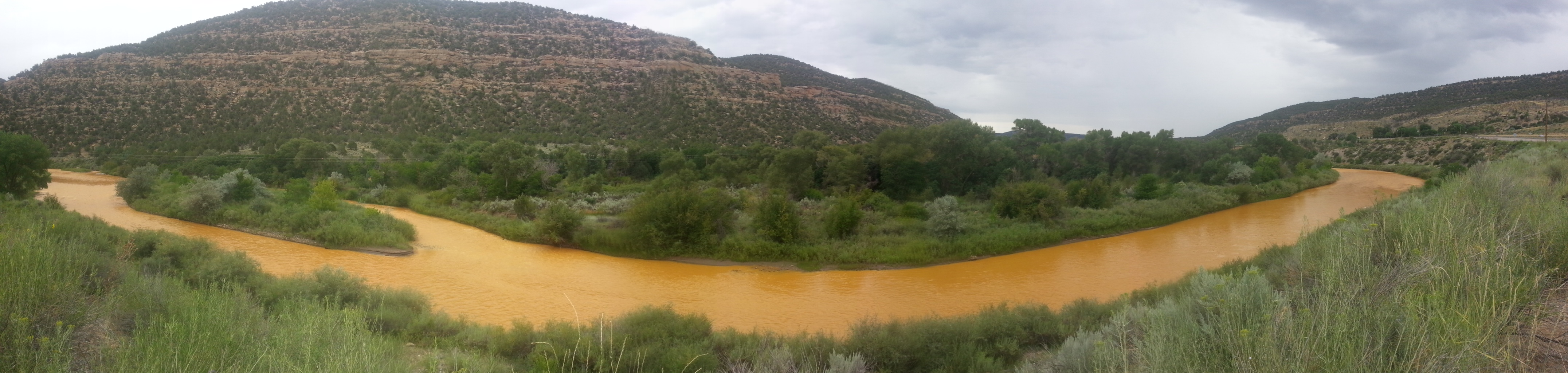
![This image was taken during the peak outflow from the Gold King Mine spill at 10:57 a.m. Aug. 5. The waste-rock dump can be seen eroding on the right. Federal investigators placed blame for the blowout squarely on engineering errors made by the Environmental Protection Agency’s-contracted company in a 132-page report released Thursday [October 22, 2015]](https://coyotegulch.blog/wp-content/uploads/2015/10/goldkingminespill1057am08052015viaepa.png)
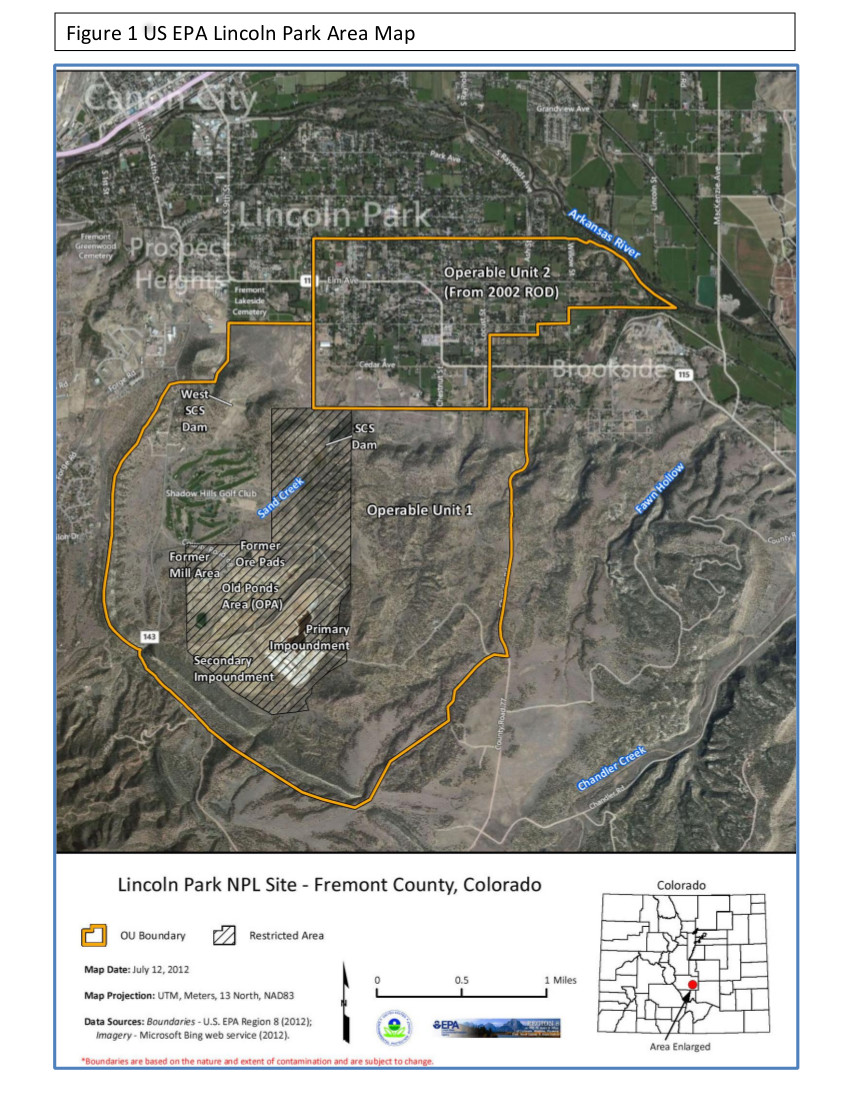


![Wastewater continued to stream out of the Gold King Mine on Tuesday [August 11, 2015] near Silverton, several days after a rush of 3 million gallons of it flooded Cement Creek and the Animas River. At the top of the photo is the mine’s opening, where an Environmental Protection Agency cleanup team was working with heavy machinery Aug. 5 and hit an earthen wall that had millions of gallons of water built up behind it](https://i0.wp.com/coyotegulch.blog/wp-content/uploads/2015/08/goldkingmine08132015deseretnewsgeoffliesik.png?w=422&h=296&ssl=1 "goldkingmine08112015deseretnewsgeoffliesik")


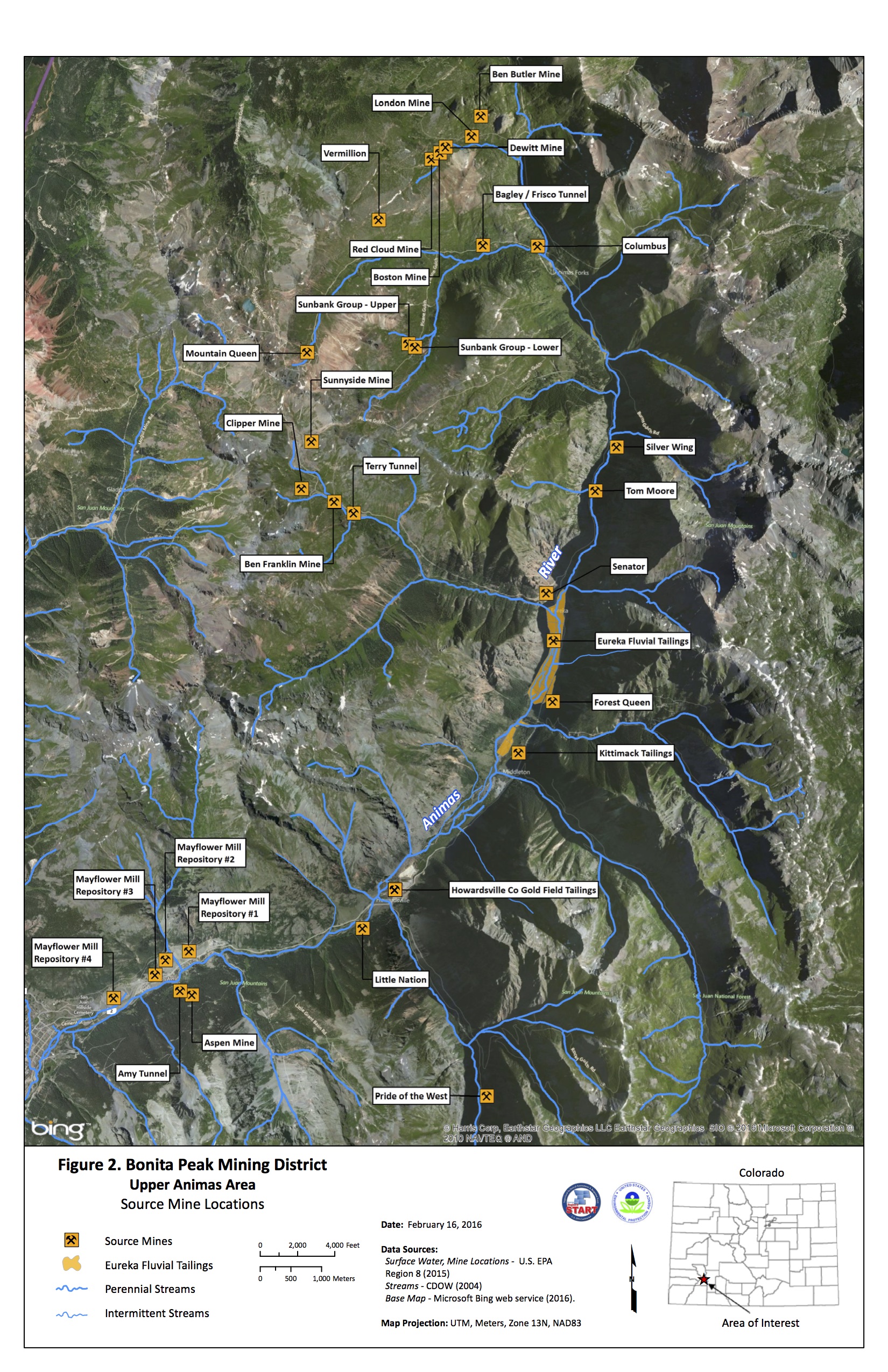

![This image was taken during the peak outflow from the Gold King Mine spill at 10:57 a.m. Aug. 5, 2015. The waste-rock dump can be seen eroding on the right. Federal investigators placed blame for the blowout squarely on engineering errors made by the Environmental Protection Agency’s-contracted company in a 132-page report released Thursday [October 22, 2015]](https://i0.wp.com/coyotegulch.blog/wp-content/uploads/2015/10/goldkingminespill1057am08052015viaepa.png?w=274&h=154&ssl=1 "goldkingminespill1057am08052015viaepa")


![Wastewater continued to stream out of the Gold King Mine on Tuesday [August 11, 2015] near Silverton, several days after a rush of 3 million gallons of it flooded Cement Creek and the Animas River. At the top of the photo is the mine’s opening, where an Environmental Protection Agency cleanup team was working with heavy machinery Aug. 5 and hit an earthen wall that had millions of gallons of water built up behind it](https://i0.wp.com/coyotegulch.blog/wp-content/uploads/2015/08/goldkingmine08132015deseretnewsgeoffliesik.png?w=332&h=233&ssl=1 "goldkingmine08112015deseretnewsgeoffliesik")