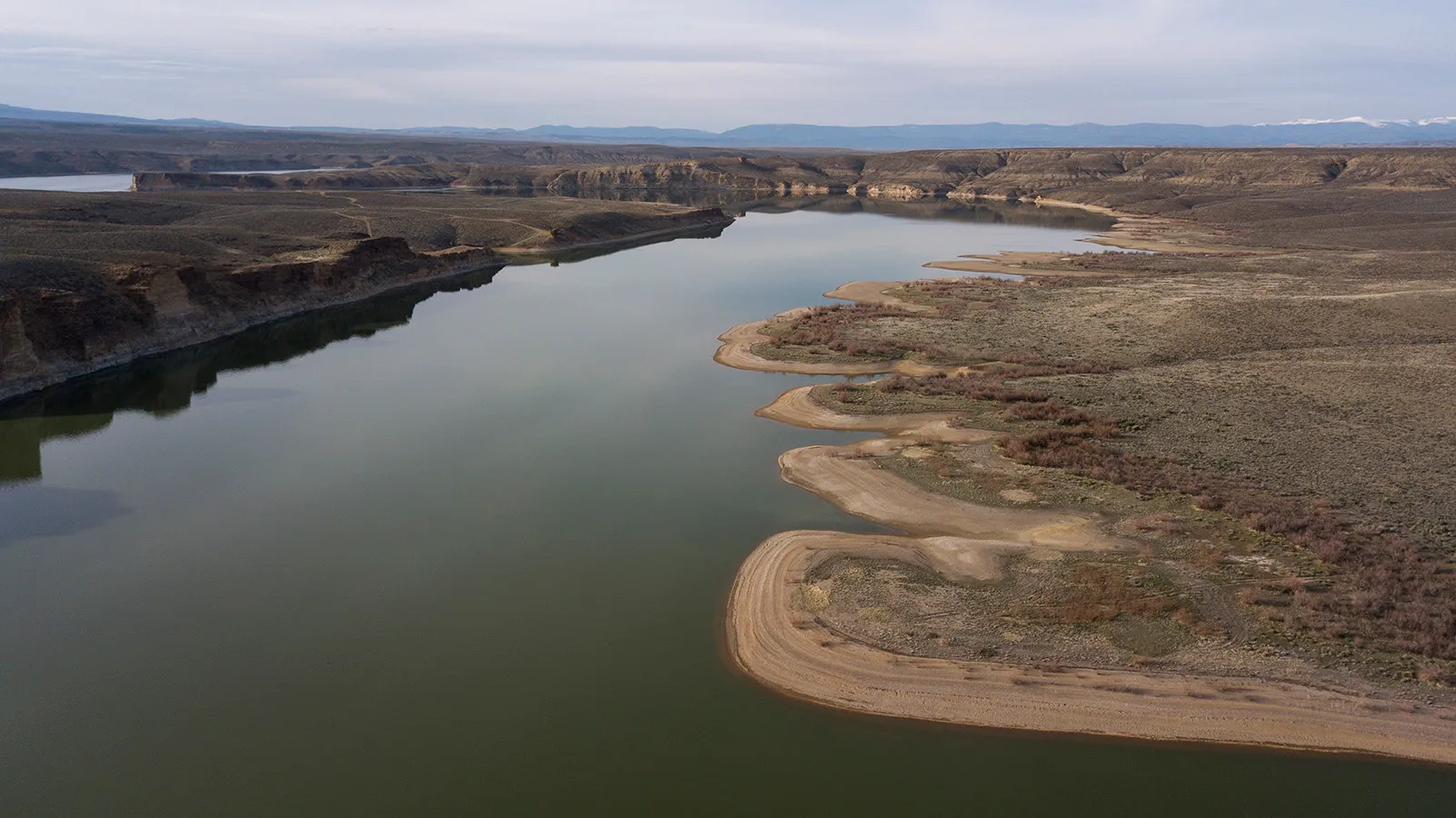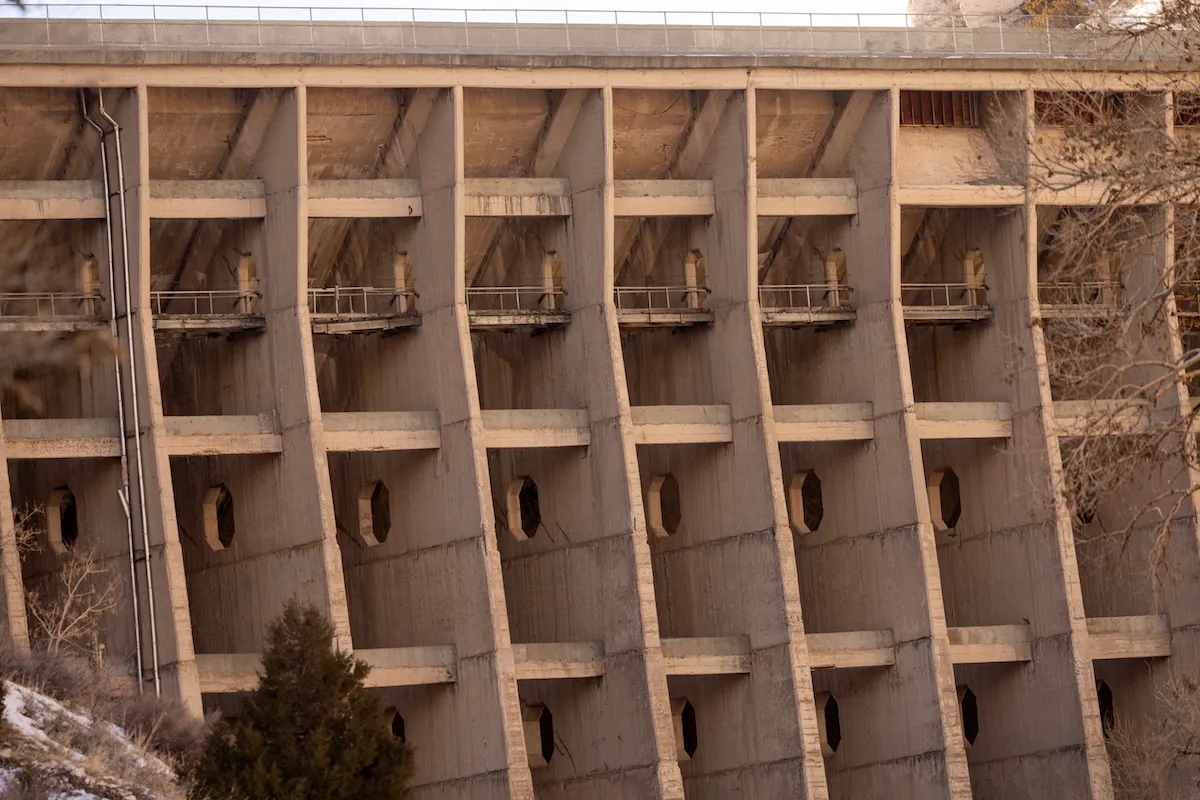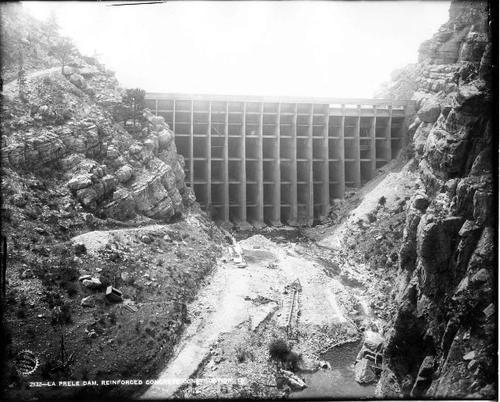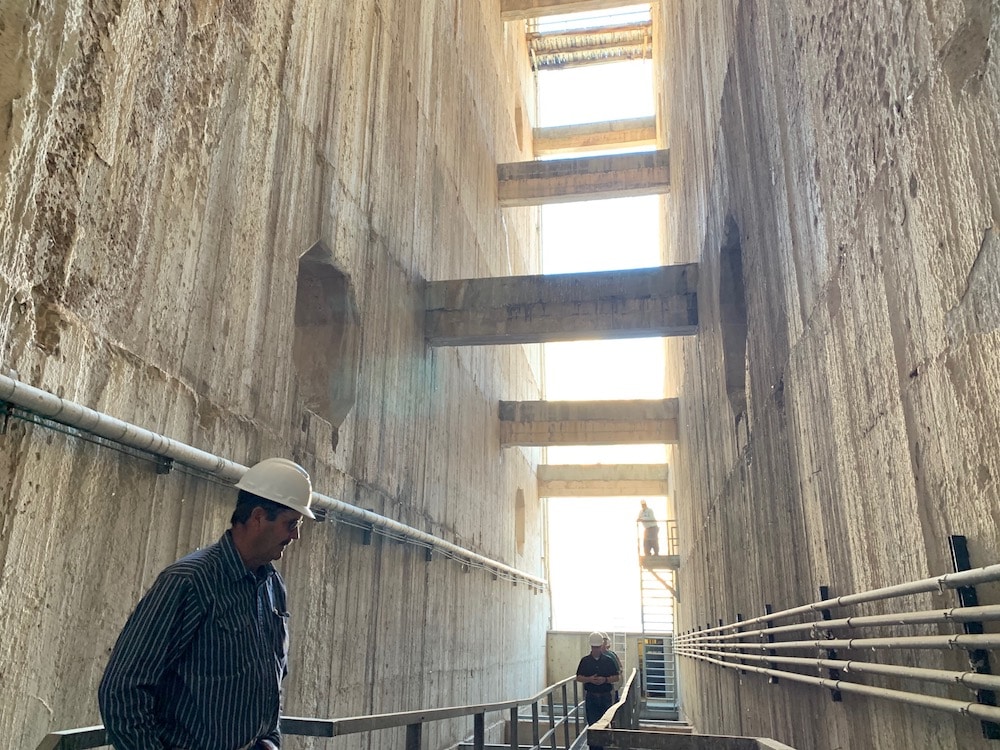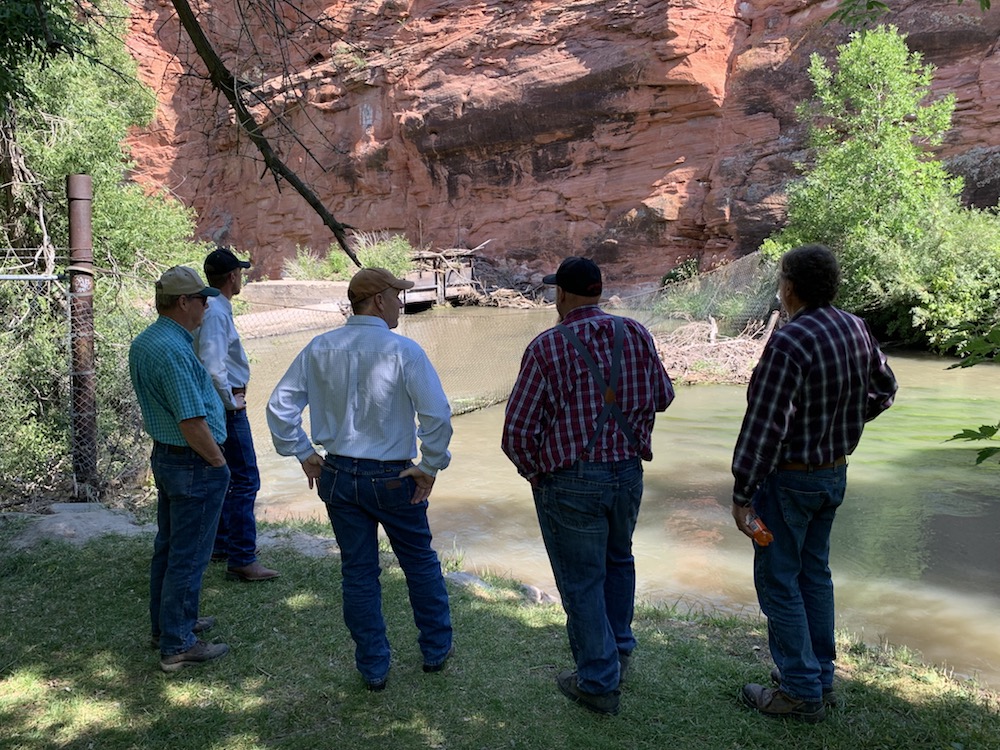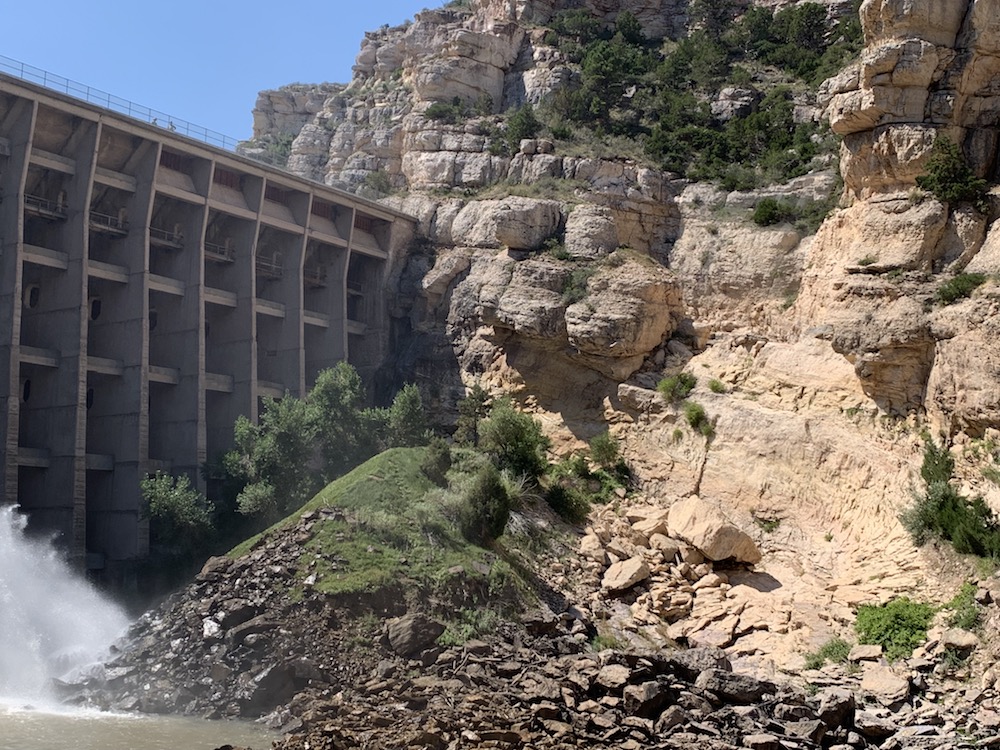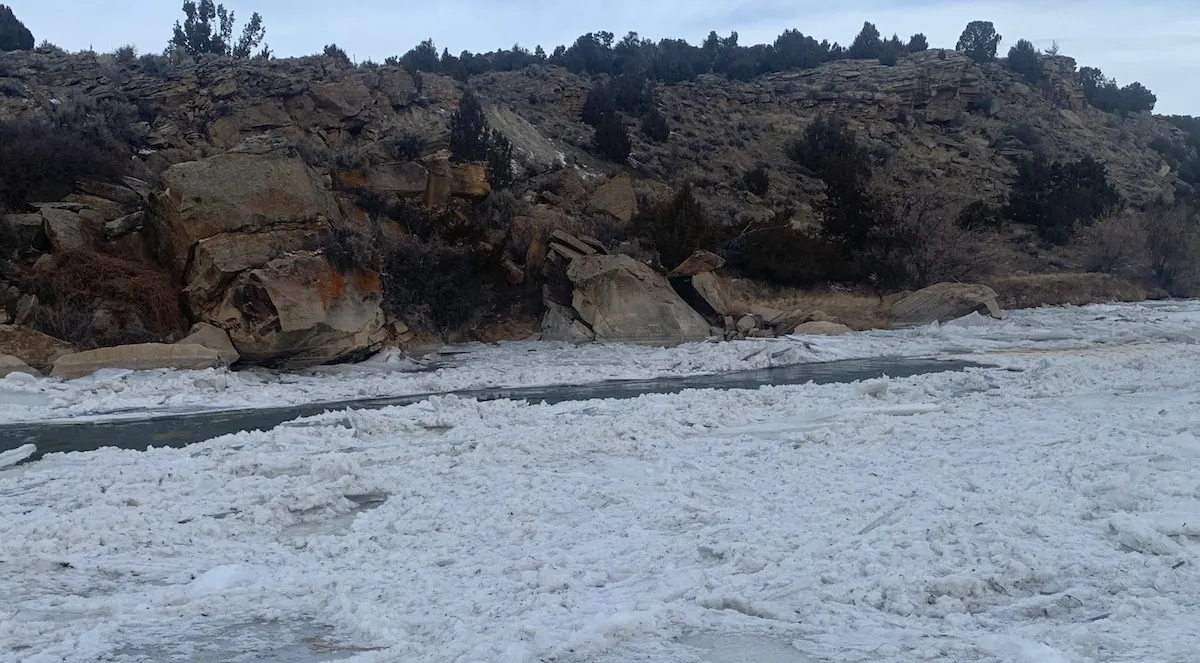
The aging LaPrele Dam is seen in Converse County on Jan. 31, 2025. Late last year, the state ordered the 115-year-old concrete structure to be breached and eventually demolished to avoid possible catastrophic failure. (Dan Cepeda)
Bill Brewer with the Wyoming Water Development Office told the Select Water Committee that work on the replacement dam in the LaPrele Irrigation District is progressing rapidly…Weather permitting, December 2025 will see access roads and laydown areas begin to pop up around the construction site. Project managers will also order specialized equipment around this time, like valve piping. March 2026 will mark the start of excavation work, alongside the creation of a foundation for the dam. By 2027, construction of “the main portion of the dam” will have started. Come 2028, engineers plan to perform a “partial refill” of the reservoir. If it all goes according to plan, a fully functional dam will begin operation in 2029.
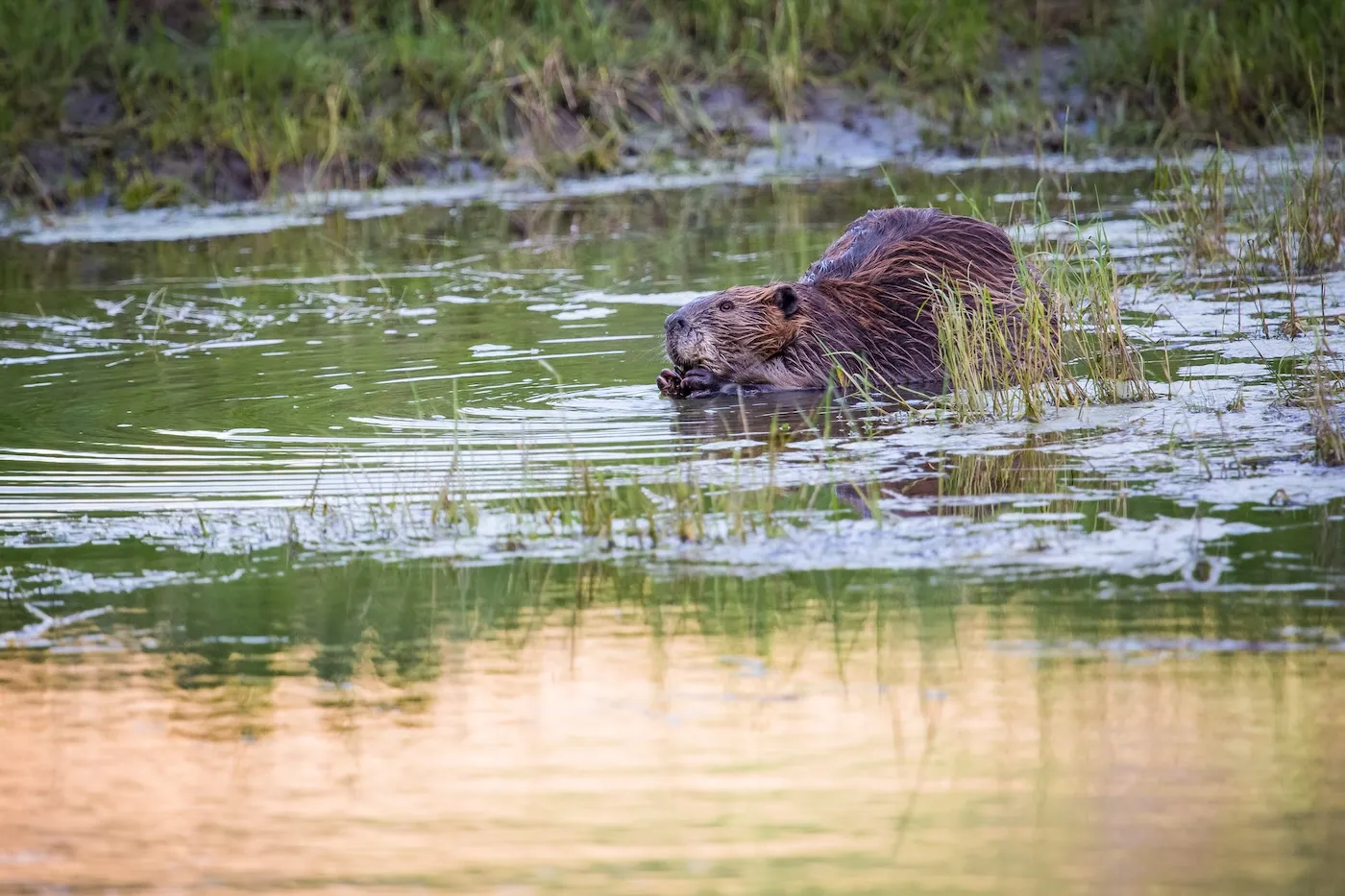
A beaver in the Lamar River. (Neal Herbert/National Park Service)
Click the link to read the article on the WyoFile website (Christine Peterson):
October 29, 2025
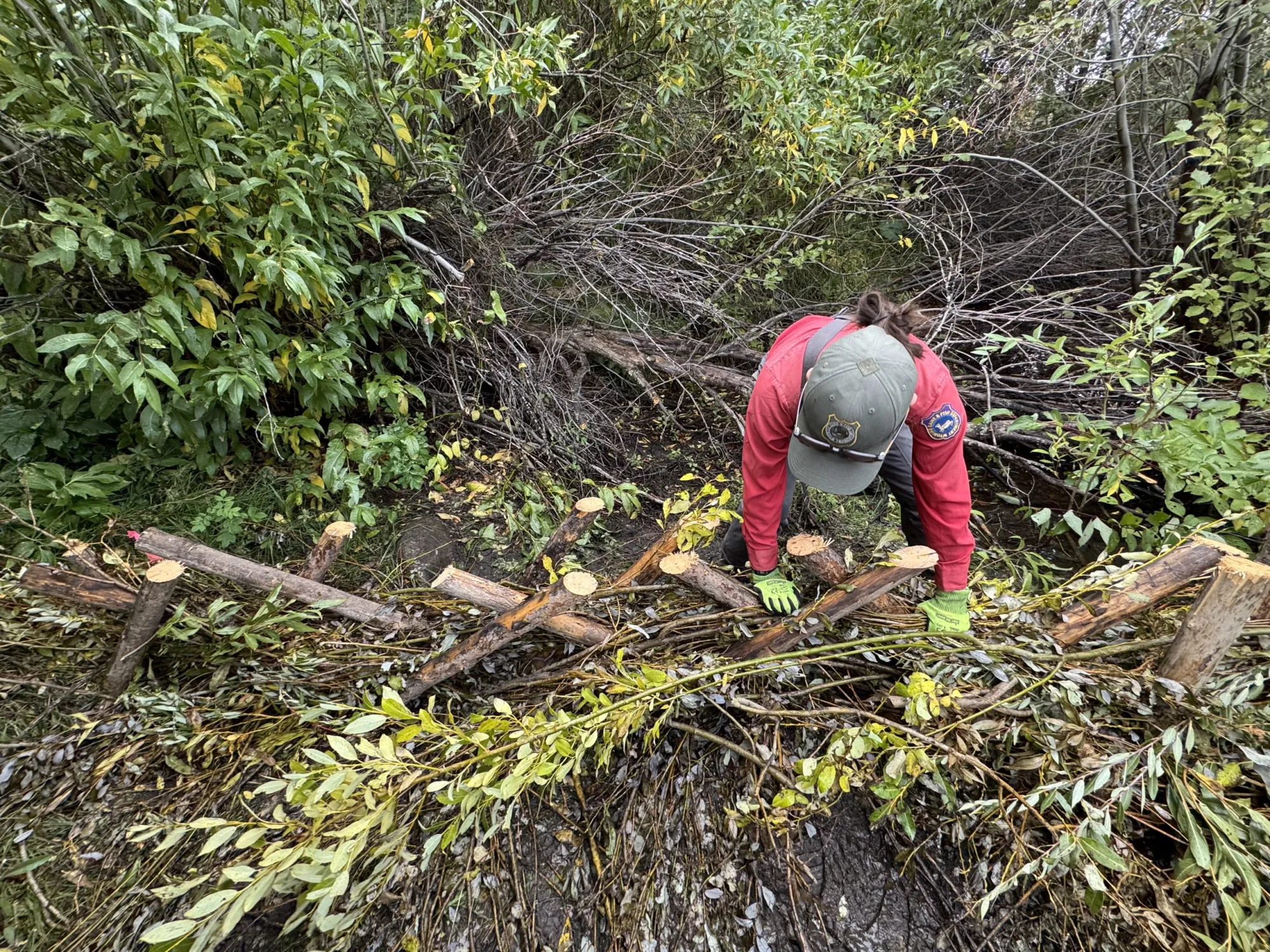
My rubber boots squelched as I grabbed another 5-gallon bucket full of mud from a Wyoming Game and Fish Department herpetology technician. We performed an awkward handoff before I dumped the mud on the ground in front of my sinking boots. The squelching continued as I used my boots to mash the fresh mud up against willow branches woven among 4-inch-wide posts rammed in a streambed.
Our little team, the herpetology technician, a Trout Unlimited project manager and another volunteer like me, were finishing up the first in a series of nearly a dozen fake beaver dams on a creek on the west side of the Snowy Range Mountains in southeast Wyoming. They’re technically called beaver dam analogues — since with their complex patterns of sticks and mud, they’re supposed to imitate real beaver dams. Although I’m not sure my noisy rubber boots really compare to the efficacy of the beaver tail.
The dams’ purpose, as the name implies, is to slow streamflow, lightly flooding banks and providing the water more time to seep into the ground.
If we’re lucky, a family of beavers will come along and make this analogue their home, even tearing out our handiwork to construct something they like better that’s more permanent and sturdier. Beavers are, after all, professional furry engineers, who perfected their craft over millennia.
A Wyoming Game and Fish Department herpetology technician pushes willow branches through posts in the South Fork of Lake Creek in the Snowy Range. The willow branches help create a beaver dam analogue, meant to slow water flow and replenish the water table. (Christine Peterson)
Our fake beaver dams aren’t meant to last forever. They’ll be maintained annually for about five years (unless real beavers take over earlier), but the result when established in the right place can be remarkable, restoring and rejuvenating wetlands, replenishing the water table, keeping water higher up in systems longer in the year, and providing habitat for everything from insects, frogs and toads to elk and moose, and yes, even beavers.
Stream restoration experts like Steve Gale, the Wyoming Game and Fish Department’s aquatic habitat biologist, can and do extoll the benefits of beavers and beaver dams. And while the rest of us standing in the stream bed see their utility, we also agreed with Gale when he said: “Who doesn’t want to play in the water with mud and sticks?”
Bigger than just beavers
Before European settlers streamed onto this continent, bringing an insatiable demand for beaver pelts, the rodents lived in streams, creeks and rivers almost everywhere. They dammed any flowing water they could find and had a hand in shaping large swaths of the nation.
While beavers can be a nuisance, falling ancient cottonwoods in parched areas and flooding creeks and irrigation ditches, they’re also one of the best examples of ecosystem engineers, Gale said, and their services have been missed. Without beavers and beaver dams, rivers run faster and cut down into the soil, they wash away sediment and move water faster from headwater states like Wyoming to other states downstream.
So now watershed managers are turning to contraptions like the ones a team of nearly 20, including Game and Fish employees and volunteers from all over the state, helped build in mid-September.
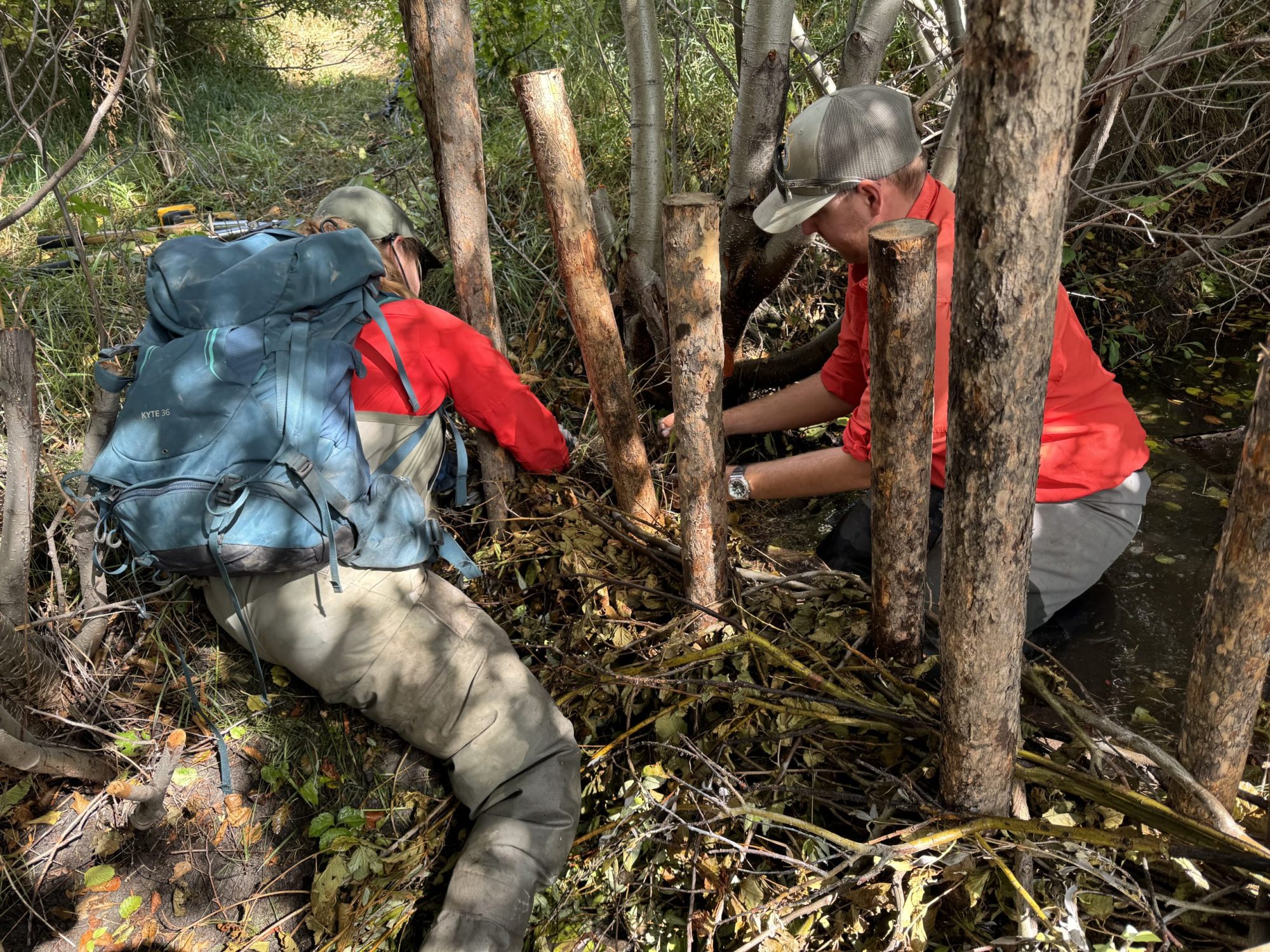
Two specialists with the Wyoming Game and Fish Department weave willow branches between posts in one of 11 beaver dam analogues built in mid-September. (Christine Peterson)
We stood on the banks of the South Fork of Lake Creek in the Pennock Wildlife Habitat Management Area and listened to Gale walk us through the process. In the last few decades, the South Fork of Lake Creek had cut deeper and deeper into the earth, ultimately sinking lower than the floodplain and as a result offering little water to surrounding vegetation. When runoff hit each spring, the water rushed down as plants sat parched on the banks.
“We lost riparian habitat and riparian width, which is important for calving areas,” he said. “We’re doing this work primarily for the deer, elk and moose.”
Beavers had been reintroduced here before, but even the industrious rodents had a hard time building dams and ponds deep enough to keep them alive and safe through winter.
We were here to help, hopefully. We would spend the bulk of the day pounding posts made from trees across the width of the creek over a quarter-mile-long stretch and then weaving bendy willow branches through the posts. After building a wall of willows, we would use buckets of mud and sod to fill in the cracks. With any luck, water would begin backing up almost immediately, eventually filling and slowly trickling over the tops.
Life or death
As beaver dam analogues become increasingly popular, biologists with state agencies and nonprofits are teaming up to place them in streams across the landscape.
Austin Quynn, the Trout Unlimited project manager helping direct our team, worked with groups of youth corps members over the last couple summers building, maintaining and repairing hundreds of analogues on a stream called Muddy Creek southwest of Rawlinsto help habitat for four native fish species: flannelmouth and bluehead suckers, roundtail chubs and Colorado River cutthroat. Last summer, beavers came from miles downstream and tore out dozens of analogues in one stretch. He sounded amused that his work was destroyed, because in its place, they’d built a massive dam that must have been what the beavers wanted and needed.
A finished beaver dam analogue stretches across a section of the South Fork of Lake Creek in the west side of the Snowy Range. Mud and woven willow branches help slow water, keeping the creek from becoming too incised and restoring wetlands. (Christine Peterson)
Some of the dams blew out from spring runoff, scouring the creek bed of sediment and leaving behind gravel that cutthroat trout could use for spawning.
Deep pools created by the analogues — and eventually beavers themselves — also offer fish refuge from the heat on mid-summer days.
On the east side of the Snowy Range, Wendy Estes-Zumpf, Game and Fish’s herpetological coordinator, and others built eight analogues in a creek which contains one of the last boreal toad populations in southeast Wyoming. It had been a stronghold for the creatures, but in the absence of beavers, the creek became incised, leaving little wetland habitat for toads to breed and survive.
A few seasons after Estes-Zumpf’s team erected the fake beaver dams, boreal toad populations have started to come back. She counted as few as four toads on past spring surveys and found almost 30 this spring including multiple age classes.
Beaver dam analogues aren’t a silver bullet for a drought-stricken West, Gale said, but for some species and some creeks, they could be the difference between life and death.
Snow blankets the mountains around Teton Pass on Jan. 12, 2025. (Angus M. Thuermer Jr./WyoFile)
Click the link to read the article on the WyoFile.net website (Dustin Bleizeffer):
March 17, 2025
If you want to know how weather is shaping life in Wyoming on any given day, just ask a Wyoming Department of Transportation employee, like Andrea Staley.
Her phone was blowing up early Friday afternoon with reports about a rash of crashes along Interstate 80 between Rawlins and Vedauwoo — Wyoming’s busiest roadway.
“By about 11 [a.m.], the road surface had gotten real icy,” she told WyoFile. “And with the wind, the visibility was causing issues.”
Staley, a WyDOT senior public relations publicist for southeast Wyoming, pines for “boring winters.”
“They’re my favorite,” she said.
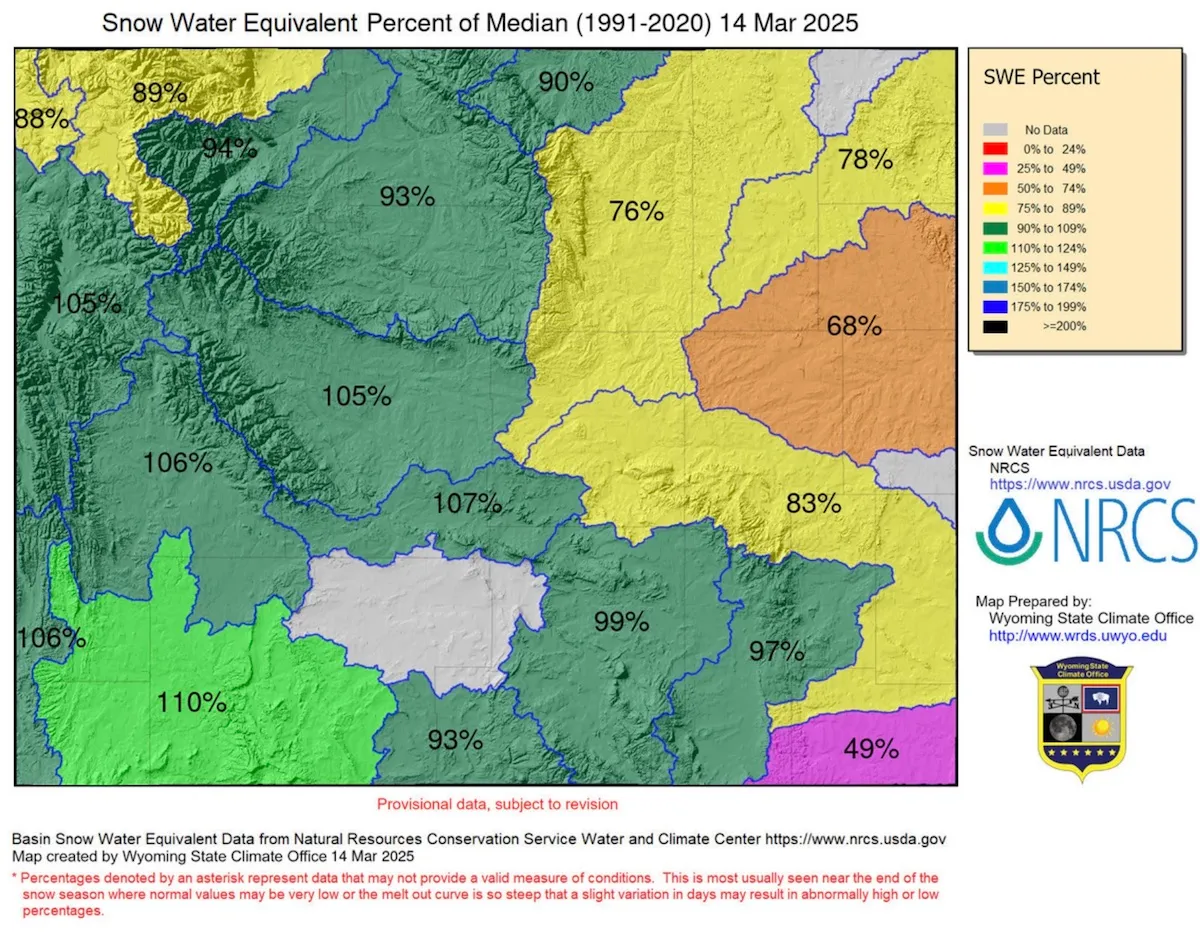
This map depicts Wyoming’s 2025 winter precipitation as of March 14, 2025. (Wyoming State Climate Office)
It’s been a bit of a mixed bag, according to local meteorologists. But no big surprises, and for an economy that thrives on predictable levels of snow and cold, the weather basically delivered.
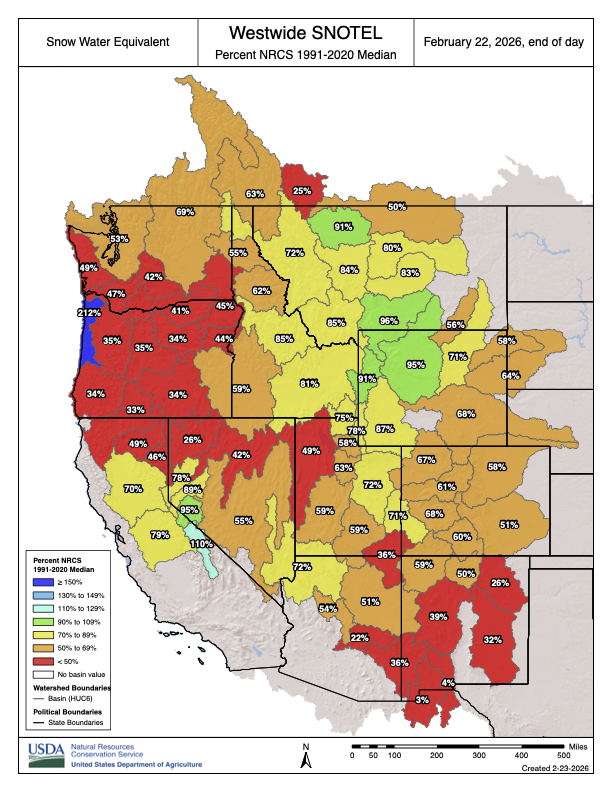
Wyoming is emerging from a fairly mild winter that has been devoid of brutal, prolonged cold snaps or massive snow dumps. With a “snow water equivalent” hovering around 94% of the median across the state, snowpack is “looking pretty good,” according to Natural Resources Conservation Service Water Supply Specialist Jeff Coyle.
There’s lower-than-normal snowpack in the northeast, including the southern portion of the Bighorn Mountains and some parts of the Black Hills on the South Dakota border.
“We’re on course to be kind of an average year in most areas of the state,” Coyle said, adding that both high elevations and basin areas appear to be meeting typical expectations. The wild card, of course, is what Mother Nature might deliver this spring — a time when Wyoming can see its biggest snow dumps.
A view of the Laramie Plains from the Snowy Range in southeast Wyoming on March 1, 2025. (Mike Koshmrl/WyoFile)
Despite an early February snowstorm that helped pad winter snowpack in the southeast, areas around Cheyenne and Laramie are about a foot below average, according to Cheyenne National Weather Service Meteorologist Mike Charnick. Accumulation of the white stuff in the Snowy Range, however, is average and even a bit more in some areas there.
In terms of overall winter precipitation in the southeast, it was among the top 10 or 12 driest years, according to another Wyoming meteorologist.
Generally speaking, it was a “mild” winter in terms of temperature — particularly in the southeast, Charnick said. “We have certainly been pretty far above average,” he said. “The lowest temperature in February was minus six [degrees Fahrenheit] and minus 12 [degrees Fahrenheit] in January.”
Winter was warmer-than-usual in other parts of the state, too.
“Western and southwest Wyoming was in the top third of warmest years over the last 115 years, whereas the rest of the state was pretty close to normal,” Riverton National Weather Service Meteorologist Lance VandenBoogart said.
Westwide SNOTEL basin-filled map March 16, 2025 via the NRCS.
The aging LaPrele Dam is seen in Converse County on Jan. 31, 2025. Late last year, the state ordered the 116-year-old concrete structure to be breached and eventually demolished to avoid possible catastrophic failure. (Dan Cepeda)
Click the link to read the article on the WyoFile.com website (Dustin Bleizeffer):
February 18, 2025
As crews prepare to crack the dam this month, farmers who rely on that water prepare for lean times and lawmakers debate funding for a new structure.
As a kid, Casey Darr would hop in the truck with his father for the drive up the narrow canyon to LaPrele Dam to check outflow gauges and the water level behind the hulking concrete structure.
His family’s ranch relied on that storage water, and these excursions were a welcomed break from tending to livestock on the open prairie a few miles away.
During spring runoff, when water gushed from the overflow tunnel near the top of the structure and shot out of the dam’s lower outlet, the spray cast richly colored rainbows between the canyon walls and over lush, green flora below. The mist combined with the roar of moving water tamed by early 20th-century ingenuity created a weirdly tranquil atmosphere. It was an exclusive experience: The reservoir, dam and stretch of canyon leading to them are private property, accessible only to the landowners and irrigators who hold title to the dam.
“It was almost like going into Jurassic Park,” Darr said, noting the oddity of such a space hidden in what appears, from a distance, to be dull foothills of the Laramie Range. “It was just mind-blowing. It was just really, really beautiful to see, and you felt honored to be one of the few individuals that got to see it.”
Philip Dziardziel, Vice President of the LaPrele irrigation district board, and Casey Darr, Treasurer of the irrigation district board, pose on a small bridge near the LaPrele Dam on Jan. 31, 2025. They and many locals feel a special connection to the dam, which has allowed generations of families to thrive on the land it protects. (Dan Cepeda)
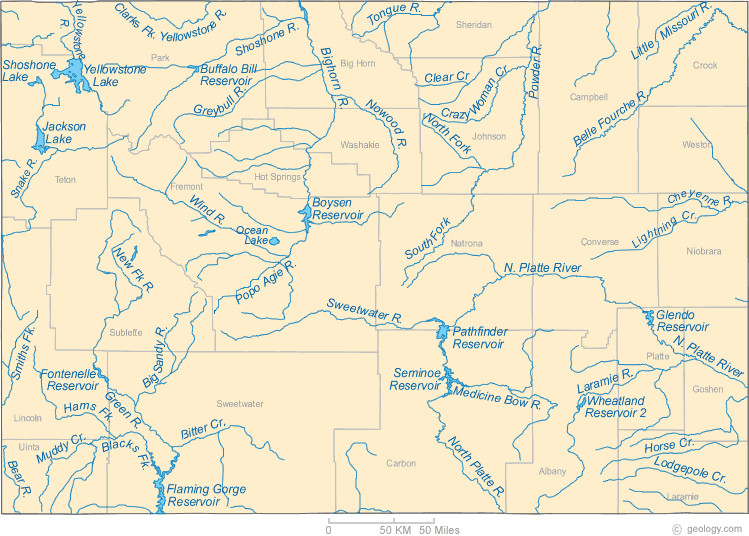
But in January, when Darr, who serves as treasurer on the LaPrele Irrigation District Board, and District Vice President Philip Dziardziel drove up the canyon with two journalists, they had to stop at a temporary, mobile office to ask permission to approach the dam. It’s now a condemned structure because it poses a catastrophic risk to humans and everything below it — including, according to engineers, Ayres Natural Bridge Park, several ranch homes and other structures, two bridges on Interstate 25 and, potentially, anything or anyone along the North Platte River banks all the way through Douglas, a town with 6,400 people 20 miles to the east.
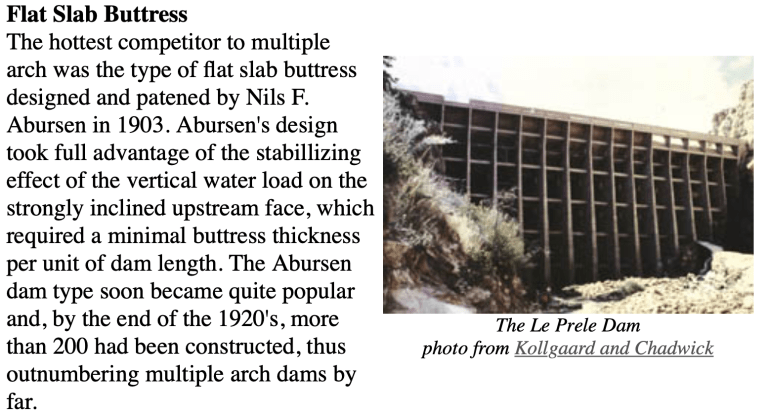
In fact, it’s a wonder the dam has stood this long, engineers who have studied it say. Completed in 1909, it’s the last standing Ambursen-style flat-slab and fin-buttress dam in the U.S. — a design that was determined to be a bad idea decades later. With so many individual concrete slabs, there’s more potential for flaws and erosion, and there’s little redundancy to hold if there’s a failure in one piece. If any of the multiple concrete slabs fail while holding back a full reservoir, it wouldn’t merely leak, according to engineers. It would immediately crumble like a house of cards.
The aging LaPrele Dam is seen in Converse County on Jan. 31, 2025. Late last year, the state ordered the 115-year-old concrete structure to be breached and eventually demolished to avoid possible catastrophic failure. (Dan Cepeda)
Under a full reservoir scenario, the torrent of water would rip through about 1.5 miles of narrow canyon before it overcomes Ayres Natural Bridge while shredding old stands of cottonwood and boxelder trees and filling the natural bowl with flotsam before boiling over to continue its path of destruction.
‘Got to suck it up’
Darr and thousands of others who have relied on the LaPrele Dam for their livelihoods for more than a century have always carried with them a sense of nausea understanding their concrete savior that bestowed an unusually prolific agricultural economy to otherwise high-and-dry plains wouldn’t last forever. Now, with crews setting up to breach, then take down Darr’s Jurassic Park concrete wall, he and others are preparing for what will feel like a “funeral.”
“It’s been a part of our lives and these communities for over 100 years,” Dziardziel said, hands in his pockets, while standing next to Darr just below the dam.
“It’s been very emotional for a lot of people — ourselves included,” Darr agreed. “But at the same time, you’ve got to take your own personal feelings, thoughts, opinions aside and do what’s right for the safety of others.”
Not all irrigators reliant on the dam share the sentiment. Some suppose that engineers’ warnings and estimations of worst-case failure and destruction models amount to hyperbole, and insist the dam will hold until a replacement is constructed in about five years.
Farmland is seen near the LaPrele Dam in Converse County. (Dan Cepeda)
“It’s not necessary at all to destroy the old one and to open up all those people, all that land and everything else, to destruction [from potential flooding],” said Leonard Chamberlain, who grew up in the irrigation district and whose family business still has a stake in it. “I would like to see it in place to make sure all the funding, permitting and lawsuits are done, and it’s up before you take out the structure that’s protecting everybody.”
Dziardziel said he’d felt the same way and, for a long time, was dead set against taking the dam down before a replacement was built.
“But once I was up there with the engineers and actually put my hands on the surface of that dam, and they showed me the cracks, it was obvious that, just for safety reasons, we could not store water in that dam,” he said. “It would just put people at risk. There was absolutely no way we could do that.”
Though design plans are in the works for a new dam — estimated at $182 million — not all of the funding pieces have fallen into place. Nor is there unanimous support for how much or whether the state and federal government should pitch in.
Farmland is seen near the LaPrele Dam in Converse County. (Dan Cepeda)
There is one thing for certain: The dam will be mechanically breached before spring runoff — enough to ensure that LaPrele Creek free-flows through the structure without any water backing up behind it, according to state officials. Until a replacement is completed, LaPrele irrigators will be entirely at the whims of Mother Nature, which rarely provides enough natural flow for late-season irrigation. With the dam cracked open to the point of free flow, Mother Nature might also serve up floods in an agricultural community that, for the past 116 years, has built up an infrastructure without much consideration for a deluge.
“We just got to suck it up and deal with it for a few years in exchange for the safety of the community,” Darr said. “It’s been a hard decision. None of us are happy about this. But at the same time, the right decision isn’t always the easy one.”
Patchwork, boulder fall and a change of plans
Construction of the original dam was funded via the federal Carey Act of 1894, a measure pushed by Wyoming’s U.S. Sens. Francis E. Warren and Joseph M. Carey to help arid western states develop more water for irrigation. Completed in 1909 with an expected lifespan of about 50 years, the dam enabled a prosperous little agricultural community of 104 different family businesses that, in turn, became an integral part of the economy for the broader region.
The aging LaPrele Dam is seen in Converse County on Jan. 31, 2025. Late last year, the state ordered the 115-year-old concrete structure to be breached and eventually demolished to avoid possible catastrophic failure. (Dan Cepeda)
Irrigators were aware of concerns surrounding the dam’s Ambursen buttress-style design, but held a sort of cross-that-bridge-when hope for its longevity, which was first tested in 1970s when it was first determined to have reached the end of its safely useful life. Cost estimates for a replacement then seemed insurmountable for members of the LaPrele Irrigation District.
But the district received an offer from a private company that it couldn’t refuse.
The Panhandle Eastern Pipeline Co. was gunning to develop a coal-gasification project nearby, and it needed water. In return for a slice of storage water rights, the company agreed to finance major patching and concrete refurbishing. The work was completed, but Panhandle’s coal-gasification project never came to fruition. LaPrele irrigators retained all their storage rights — and a gussied-up dam, to boot — and carried on with their operations that continued to inject dollars into the economies of Glenrock, Douglas and beyond.
Until somebody noticed a boulder that had apparently tumbled — in 2016 — from the western side of the limestone-walled canyon just below the dam. It struck a dirt mound on the way down and, by luck, rolled away from the dam’s concrete fins instead of toward them, according to engineers’ accounts. Had it landed on the other side of the mound, it would have rolled toward the dam.
The aging LaPrele Dam is seen in Converse County on Jan. 31, 2025. Late last year, the state ordered the 115-year-old concrete structure to be breached and eventually demolished to avoid possible catastrophic failure. (Dan Cepeda)
The boulder aroused curiosity about the state of the dam.
Migrating cracks, observed from usual vantage points, were apparent. Engineers took a closer look by rappelling down the structure. Crack measurement devices were installed, and in November 2019 the data led to a state order to maintain the reservoir behind the dam at a lower level — to ease pressure on the structure — resulting in a 45% squeeze on available storage water for irrigation.
The dam continued to crumble and crack, and in August 2021 a tour was organized to begin underscoring the dam’s inevitable demise, setting into motion plans for a replacement and how to fund it. The plan, until recently, was to maintain the aging dam while constructing a new one just below, allowing for mostly uninterrupted irrigation. But cracks continued to widen, alarming state officials, and in November, State Engineer Brandon Gebhart issued a breach order, declaring the dam at risk of “catastrophic failure.”
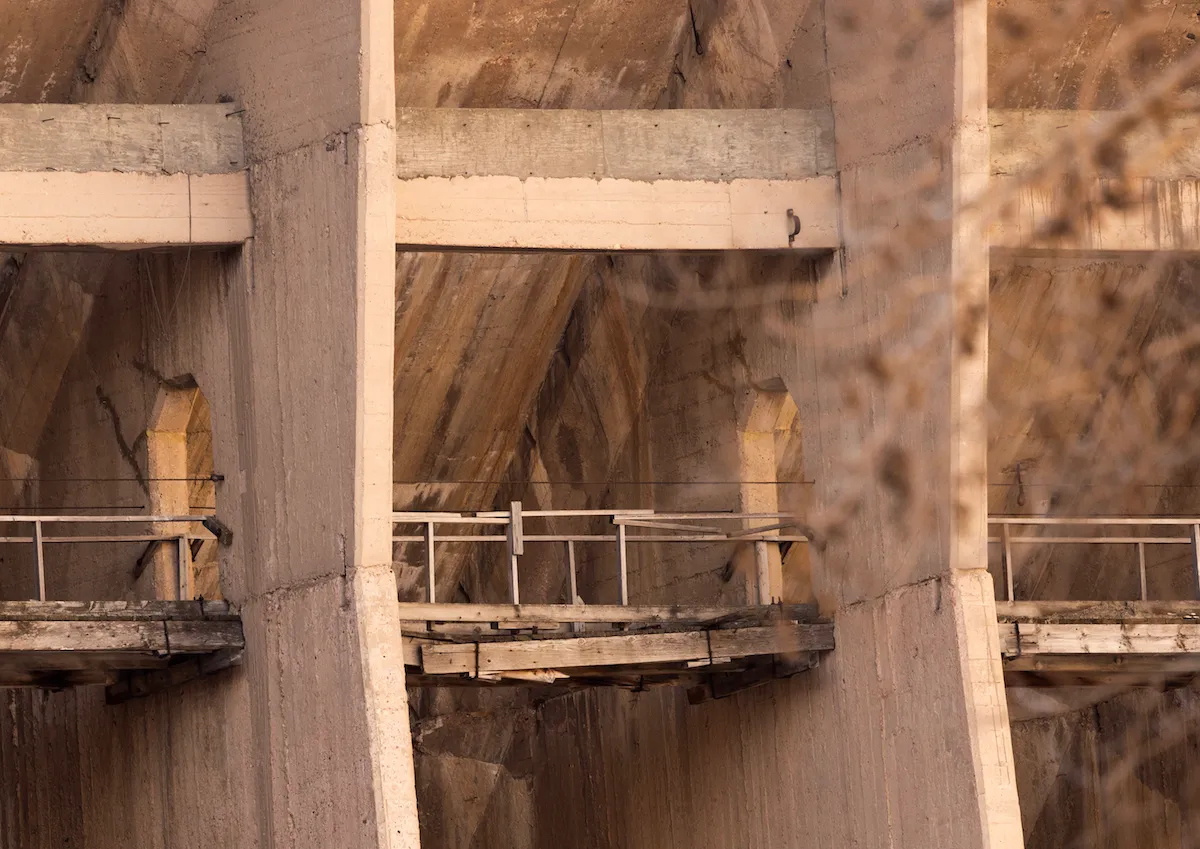
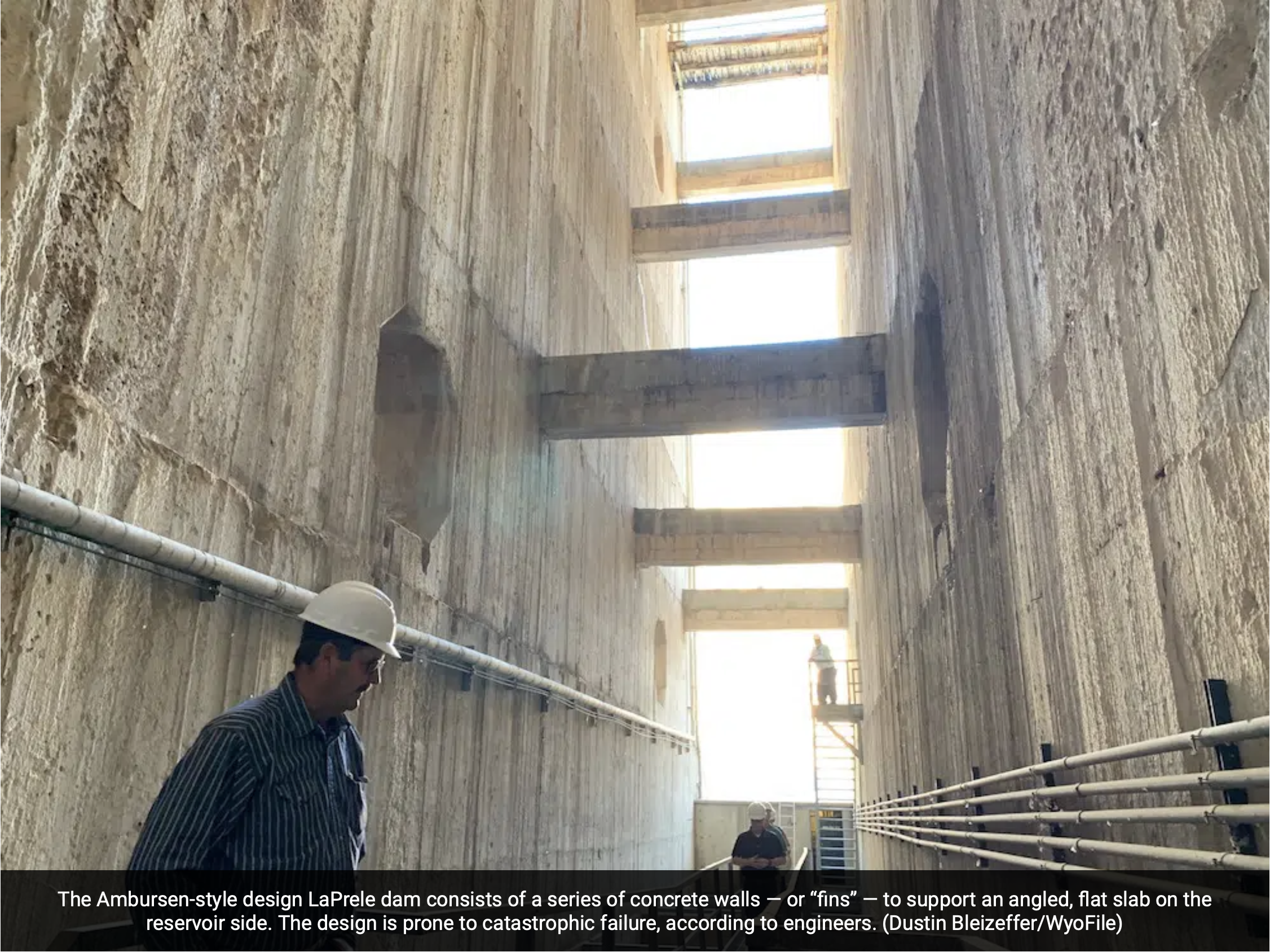
The Ambursen-style design LaPrele Dam consists of a series of concrete walls — or “fins” — to support an angled, flat slab on the reservoir side. The design is prone to catastrophic failure, according to engineers. (Dustin Bleizeffer/WyoFile)
“This dam has significant structural deficiencies and has exceeded its useful life,” Gebhart said in issuing the order.
Funding, legislation and criticism
When Darr and Dziardziel guided a pair of journalists to the dam on a recent, breezy January day, they had to remain at a distance from the structure. Cold water gurgled under a bridge and beneath crusts of ice at the creek’s edges.
“I’ve been coming here for 50 years, and every time I come around that bend [and the dam comes into view],” Dziardziel said, “it always reminds me of what they accomplished back in the early 1900s. I mean it was just amazing, and it makes you proud to be an American, really.”
Self-described “hermits” who prefer the solitude of ditch riding and tending to their ranches (WyoFile had to twist their arms for an in-person interview), Darr and Dziardziel lamented their forced entrance into the bureaucracy and politics of government needed to negotiate a tangle of demolition and reconstruction matters.
Bison graze on farmland near the LaPrele Dam in Converse County, an area that has relied on the dam for stored irrigation water and flood control for more than a century. (Dan Cepeda)
“We were all petrified of having to go deal with all this stuff that we’re not experienced with,” Darr said. “But it’s been remarkable how members from both sides of the table see a problem and have come together with us to help work through it. It’s taken a lot of fear out of politics for me, to be honest.”
But the work isn’t over.
As LaPrele irrigators prepare for a spring of free-flowing water and a late season without storage, lawmakers are in Cheyenne debating how much money to provide, which pots of money to dip into and whether the state ought to demand public access for fishing and recreation in return for the investment or even, potentially, assume state ownership of the new structure.
The estimate for the dam’s replacement ranges from $116 million to about $182 million, according to state-level discussions. The Wyoming Legislature, in 2022, set aside $30 million and is now considering adding another $60 million.
So far, the state has secured a total $63 million in federal grants for the project via the Infrastructure Investment and Jobs Act to help cover both demolition and replacement costs.
With Wyoming potentially kicking in a total $90 million — which faces some opposition — lawmakers have said they’re hopeful the federal government will kick in an additional $34 million. Though LaPrele irrigators and state officials have received assurances of supplemental federal funding for the project in recent years, the picture has become less clear under the Trump administration.
The primary funding proposal for Wyoming’s potential $60 million appropriation lies within House Bill 117, “Omnibus water bill-construction.” The majority of that funding comes from redirecting $50 million away from the Alkali Reservoir. A prudent move, proponents say, because that project doesn’t have the easements needed to start construction.
A “backup” measure, of sorts, House Bill 143, “LaPrele dam rebuilding,” would provide the same level of funding without shifting dollars from the Alkali project.
Meantime, HB 117 has been amended to include a $1 million grant to the LaPrele Irrigation District to assess the feasibility of drilling one or more water wells to supplement water supplies during the expected five-year period between demolition and replacement. The amendments would also provide a loan of $19 million to construct the wells.
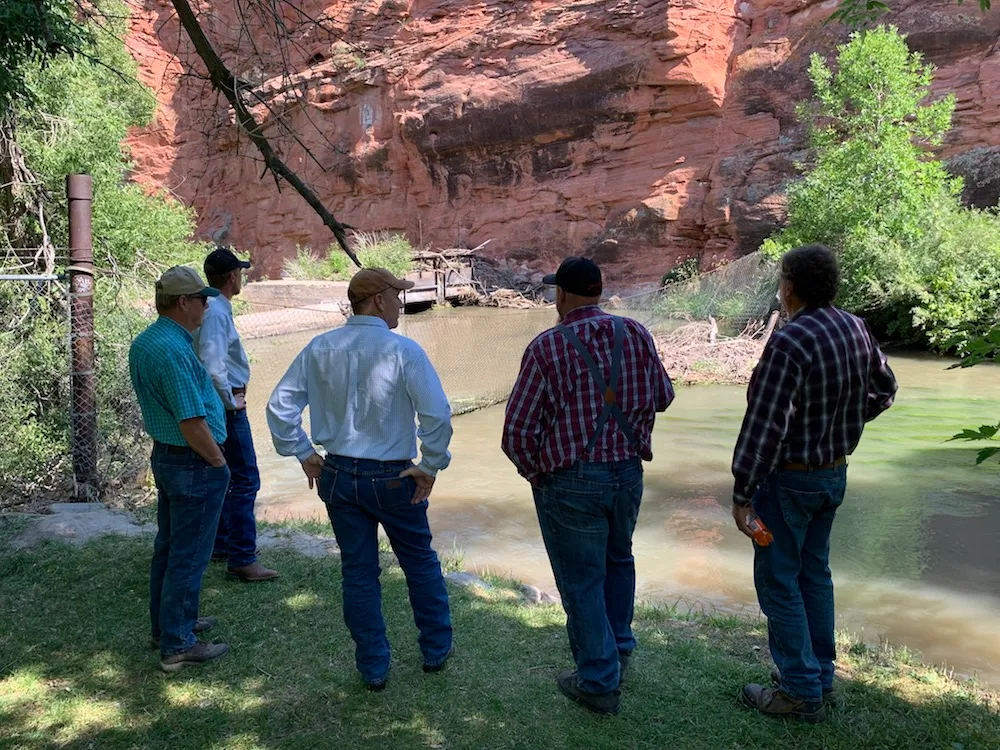
Members of the Wyoming Water Commission and a member of the LaPrele Irrigation District examine a diversion in LaPrele Creek. (Dustin Bleizeffer/WyoFile)
The funding proposals — like many water infrastructure construction projects — face criticism from many who see them as spending taxpayer money for the benefit of a limited number of irrigation operations. Such appropriations amount to “picking winners and losers,” Lander Republican Rep. Lloyd Larsen of Lander said during a recent committee discussion regarding one portion of the funding proposals. “Government can’t just step in and take care of things for everybody,” he added.
Regarding such criticism, Darr said, yes, the LaPrele Irrigation District and the family businesses it supports would be prime beneficiaries of the investment. But, he pointed out, this would be the first major state investment in an irrigation district that provides economic support to the broader communities in the area, including businesses in Glenrock, Douglas and beyond.
The Army Corps of Engineers and the Wyoming Department of Environmental Quality are reviewing aspects of the controlled demolition of the LaPrele Dam near Douglas. On Nov. 1, the state engineer ordered the destruction of the failing 115-year-old dam by April 1. The announcement was made following inspections that found new cracks on the front face of the structure, suggesting near-irreparable damage to the dam’s foundation. State officials, land owners and locals have been in discussion on how best to handle a situation that the state engineer referred to as an “emergency.”
Despite a search for alternatives, the LaPrele Irrigation District is proposing to mechanically breach or blast the 135-foot-tall concrete dam. Some concrete would partially remain within the dam’s footprint, some would be placed in a rubble chute in LaPrele Creek to prevent excessive erosion and some would go in optional disposal areas. The district is also proposing to use fill material within the creek and reservoir bed to build equipment access ramps to the north side of the dam, a structure to capture sediment and debris from demolition and for a southern access road. The blast is scheduled to happen before April in an effort to avoid spring runoff, but the state has considered the possibility of taking action sooner should the dam deteriorate faster than expected. Emergency permitting procedures have been approved, according to the Corps, in the event that expedited action is required.
The Wyoming Water Development Commission organized a tour of the LaPrele dam Aug. 12, 2021. Constructed in 1909, the dam is now slated for emergency demolition. (Dustin Bleizeffer/WyoFile)
Click the link to read the article on the WyoFile website (Dustin Bleizeffer):
November 7, 2024
It is no longer safe to hold any amount of water behind the LaPrele dam, and the long deteriorating 115-year-old concrete structure located 20 miles west of Douglas must be demolished as soon as possible to avoid a “catastrophic failure,” according to state officials.
State Engineer Brandon Gebhart issued a “breach order” earlier this month, noting the recent discovery of several new cracks compounding other structural problems identified years ago.
“This dam has significant structural deficiencies and has exceeded its useful life,” Gebhart said in a prepared statement.
In 2021, the Wyoming Water Development Office estimated that, at full storage, a catastrophic failure would send a torrent of water and debris through the Ayres Natural Bridge Park just two miles below the dam, overwhelm several roadway bridges and flood areas of Douglas along the North Platte River.
Fortunately, the state and local irrigation district had already taken measures to avoid such a scenario by draining the LaPrele reservoir earlier this fall.
The Ambursen-style LaPrele dam consists of a series of concrete walls — or “fins” — to support an angled, flat slab on the reservoir side. The design is prone to catastrophic failure, according to engineers. (Dustin Bleizeffer/WyoFile)
“I want to commend the State Engineer and his staff for recognizing the significant risks of a potential dam failure and proactively addressing them before a disaster occurred,” Gov. Mark Gordon said in a prepared statement. “This decision was not made lightly, and we recognize the impact this will have on those who rely on that water for irrigation.”
Now that authorities have mitigated an immediate catastrophic failure of the LaPrele dam, the state is racing against the clock to demolish the structure before April when spring runoff begins.
“These [structural] threats need to be mitigated before the spring runoff, when flows are expected to exceed the dam’s ability to pass inflows,” Gebhart said.
Runoff is also a potential concern this winter, state officials added, noting there’s always a possibility for unseasonable flows that might exceed the dam’s ability to allow water to freely pass through the outlet, which has a maximum output of up to 300 cubic feet per second.
Local and state officials, in consultation with engineering firms, came to terms with the pending demise of the LaPrele dam several years ago and initiated planning for how to eventually replace it. Cost estimates reach above $118 million. In addition to a $30 million appropriation from the Legislature, the state has secured $32 million via the federal Infrastructure Investment and Jobs Act and hopes to secure the rest of the necessary funds from the same federal program.
Members of the Wyoming Water Commission and a member of the LaPrele Irrigation District examine a diversion in LaPrele Creek in August 2021. (Dustin Bleizeffer/WyoFile)
“There will be uncertainty on costs until the design is complete and a price can be agreed upon through a construction contract,” Wyoming Water Development Office Director Jason Mead told WyoFile. “However, with the inflation seen over the last several years, it is expected additional funds may be needed to complete the project and everyone is working to identify potential sources for that funding.”
After demolition work is completed, construction on a replacement dam may begin in 2026 with a completion date of 2029, according to Mead. The dam served about 100 irrigators along LaPrele Creek, which flows out of the Laramie Range into the North Platte River.
LaPrele’s history of problems
The dam, standing 130 feet high and stretching 325 feet over LaPrele Creek, serves late-season water to irrigators between the dam and the nearby North Platte River, according to the state. The Ambursen-style dam consists of a series of concrete buttresses — or “fins” — supporting an angled, flat slab on the reservoir side, and is anchored into a fractured Madison limestone formation on both sides.
In 2016, a boulder fell from the west wall on the dam’s downstream side, barely missing the structure. The discovery of the boulder’s near-miss led to investigations that revealed several migrating cracks in the dam, spawning further engineering investigations and a determination a few years later that the dam’s days were numbered.
The dam’s structural integrity, in fact, has been in question for decades.
A boulder in the limestone wall behind the LaPrele dam fell in 2016. (Dustin Bleizeffer/WyoFile)
Talk of LaPrele reaching the end of its useful life emerged in the 1970s due to leaks and the problematic nature of the Ambursen-buttress design. But the Panhandle Eastern Pipeline Co., eager at the time to access water for its coal-gasification ambitions, struck a deal with irrigators to repair the structure in return for a share of water.
The company paid to grout cracks and add new layers of concrete. Panhandle Eastern Pipeline’s coal-gasification plans never came to fruition, but the company’s patching efforts restored confidence in the dam — for a while.
Challenges ahead
Irrigators reliant on the LaPrele dam have seen dwindling late-season water deliveries — by about half — since 2019, when the state ordered the reservoir be maintained at lower levels to avoid stress on the structure. Now those ranching operations rely completely on what Mother Nature delivers, without the benefit of measured releases for late-season crops or a functional dam to help avoid potential flooding.
“The farms and ranches will see significant production losses until the new dam is constructed,” LaPrele Irrigation District Secretary Anna McClure said. “Streambank integrity and infrastructure on the LaPrele Creek will be affected by the uncontrolled flow of water.”
State officials are assessing the flood risk, but so far there’s no particular mitigation plan.
“There are areas downstream of LaPrele Dam that could be impacted by uncontrolled spring flows, including Ayres Natural Bridge,” Gebhart said.
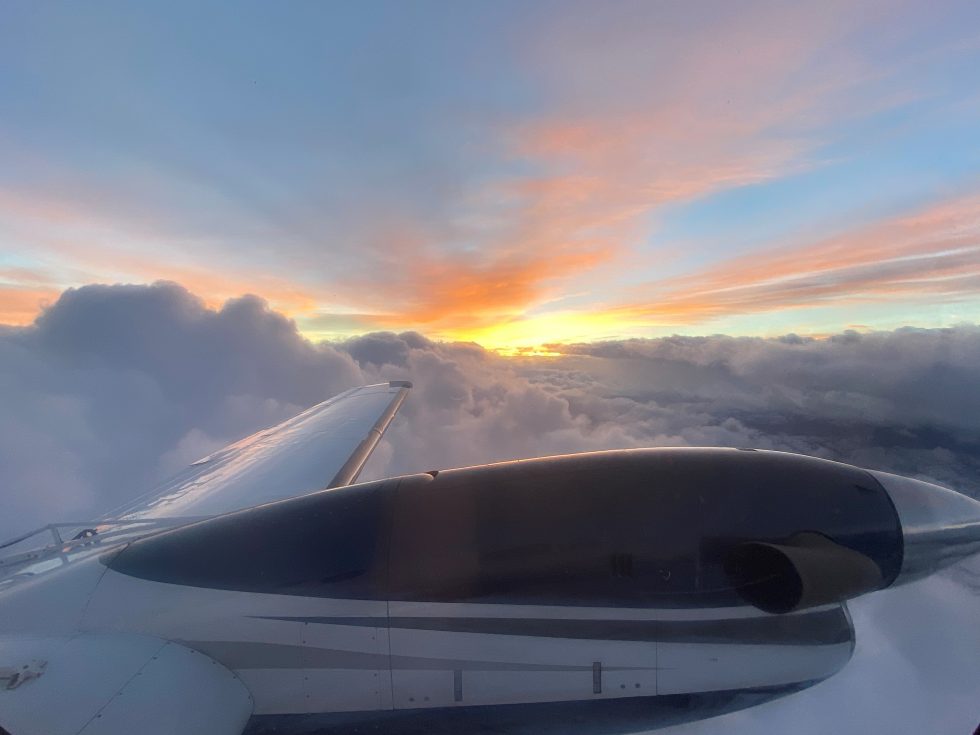
Captain Kirk Hamilton snapped the above photo in the early morning hours of Feb. 3, 2021 on one of his aerial cloud seeding missions in the North Platte River Basin as part of the Jackson County pilot program over the Never Summer mountain range. (Kirk Hamilton, Weather Modification International)
An experiment to use a potentially more effective form of cloud-seeding in the North Platte Basin has been postponed indefinitely due to a shortage of planes and funding.
Cloud-seeding from airplanes is able to target specific storms, increasing the technology’s ability to generate more water, but it’s expensive and can cost up to three times more than ground-based programs, according to Andrew Rickert, weather modification program manager with the Colorado Water Conservation Board.
According to Barbara Vasquez, representative from the North Platte Basin to the Colorado Water Conservation Board, the North Platte is the only basin in Colorado where aerial cloud seeding has been conducted so far. Aerial cloud seeding has taken place in the Medicine Bow Range and the Sierra Madre mountains in Wyoming and Colorado, and in Colorado’s Never Summer range.
Rickert said such programs, despite their funding difficulties, are important in building a range of tools to increase water supplies. “With where the state is heading with climate change and drought, it is important for Colorado to do everything we can to bolster our snowpack. You can do as much storage and conservation as possible, but cloud seeding is the only way to physically add water to a system which is something we need to constantly be focused on.”
Cloud-seeding graphic via Science Matters
Cloud seeding involves dispersing a small amount of silver iodide into the atmosphere. The chemical acts as a “dust” particle allowing for water droplets or ice crystals to form in clouds and increase precipitation. Silver iodide is a naturally occurring compound that proponents of cloud seeding claim has no known harmful environmental effects.
The Jackson County Water Conservancy District partnered with the State of Wyoming and Colorado to take on a pilot project in the Never Summer Mountain Range from Cameron Pass to Willow Creek Pass in 2019.
The decision to suspend the North Platte aerial cloud-seeding program is partly due to limited availability of the aircraft from Wyoming, which supplied the plane for Colorado.
“We were working with the Wyoming [Water] Development Office which was paying to house the plane in Wyoming, so one of the problems we ran into was when there were seedable storms in both states, Wyoming always got preference,” Rickert said. “We were OK with that because we weren’t paying as much as them, but we were always playing second fiddle.”
Barry Lawrence, deputy director of planning with the Wyoming Water Development Office, said it was important for Wyoming to have first shot at airplane use. “It was written into our contract that the second priority was to go into Colorado if conditions were right.”
But Lawrence also said there are important benefits to the collaboration between the two states. “It’s important to start thinking watershed wide and not to bar political boundaries/state lines, but to think about the watersheds and what we can do to make the system whole.”
An additional reason for ending the pilot program is funding. In 2018, the Colorado Water Conservation Board approved a three-year, $150,000 grant for the aerial cloud seeding. It was renewed in 2021 for $225,000.
But that’s not much money when it comes to aerial cloud-seeding.
In 2022-2023, Wyoming spent $873,353.00. The Jackson County Water Conservancy District provided an additional $84,000.00 for operations conducted in Colorado’s Never Summer Mountains.
Jimmer Baller, president of the Jackson County water district, says that the program is just too costly right now for the county to take on without future funding from the state, but a revival of the program is not out of the question.
The CWCB’s Rickert said he is already working on increasing cloud seeding operations in the state and is considering how to support aerial seeding.
At the same time, the CWCB has seven permitted ground-based cloud seeding programs in the state from Vail to Grand Mesa, Rickert said.
The budget, which is not yet finalized, includes funding for non-lethal wolf deterrence, water litigation and wildlife management. The six-member Joint Budget Committee, which writes the state budget, settled on a $40.6 billion budget that would take effect July 1…
Water
The proposed budget also includes about $300,000 for two additional full-time employees in the Department of Law to help secure the state’s water interests…Colorado is part of nine interstate water compacts, one international treaty, two U.S. Supreme Court decrees and one interstate agreement.
“As climate change and population growth continue to impact Colorado’s water obligations, the DOL’s defense of Colorado’s water rights is more critical than ever,” according to the document.
One of the new employees, a policy analyst, will monitor government regulations and neighboring states’ activities on water policy. The other position will “bolster the representation and litigation support of the DOL across the various river basins,” support the state’s efforts to negotiate Colorado’s water and compact positions and communicate with the state’s significant water interests.
A second atmospheric river of moisture in a matter of days is further bolstering Colorado snowpack levels that have continued to lag a bit behind normal…An initial atmospheric river storm system that wound down over the weekend dumped as much as three feet of snow in parts of the mountains, with the Colorado Avalanche Information Center saying the Ruby and Ragged ranges west of Crested Butte and south of Marble were particularly hard-hit. The Mesa Lakes area on Grand Mesa got about 15 inches of snow in that storm and Park Reservoir saw about a foot of snow fall, while another measuring site on Grand Mesa got only about 4 inches, said Dennis Phillips, a meteorologist for the National Weather Service in Grand Junction. The second atmospheric river that arrived this week is expected to be a stronger system, he said…
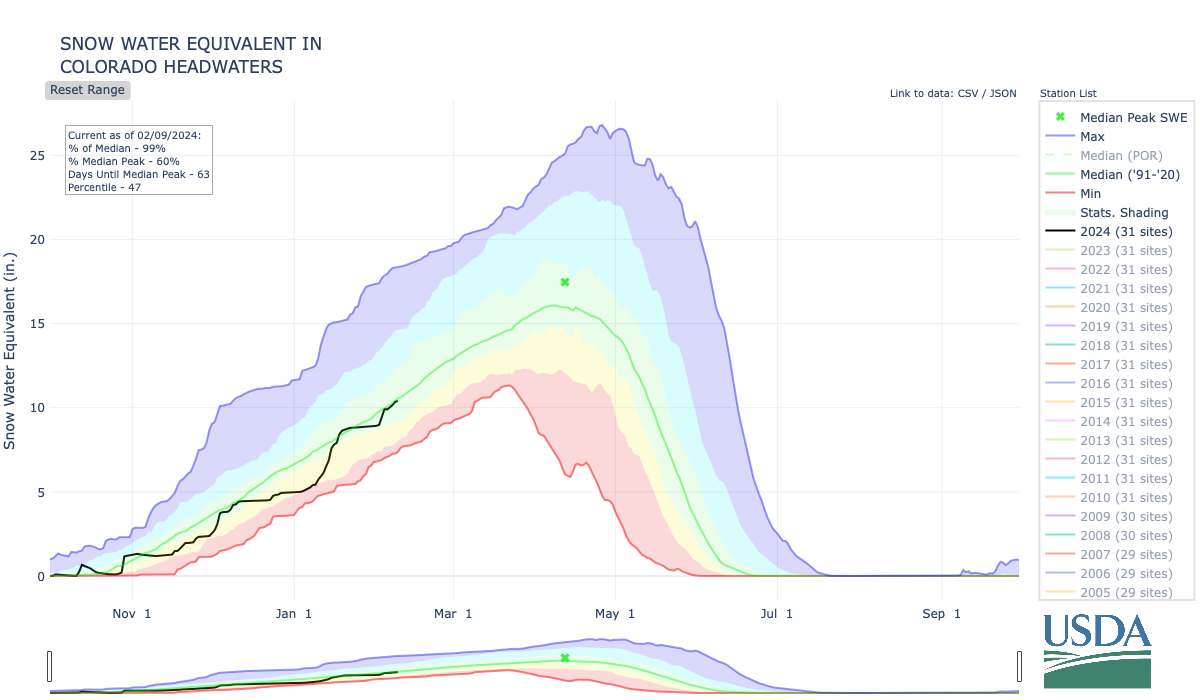
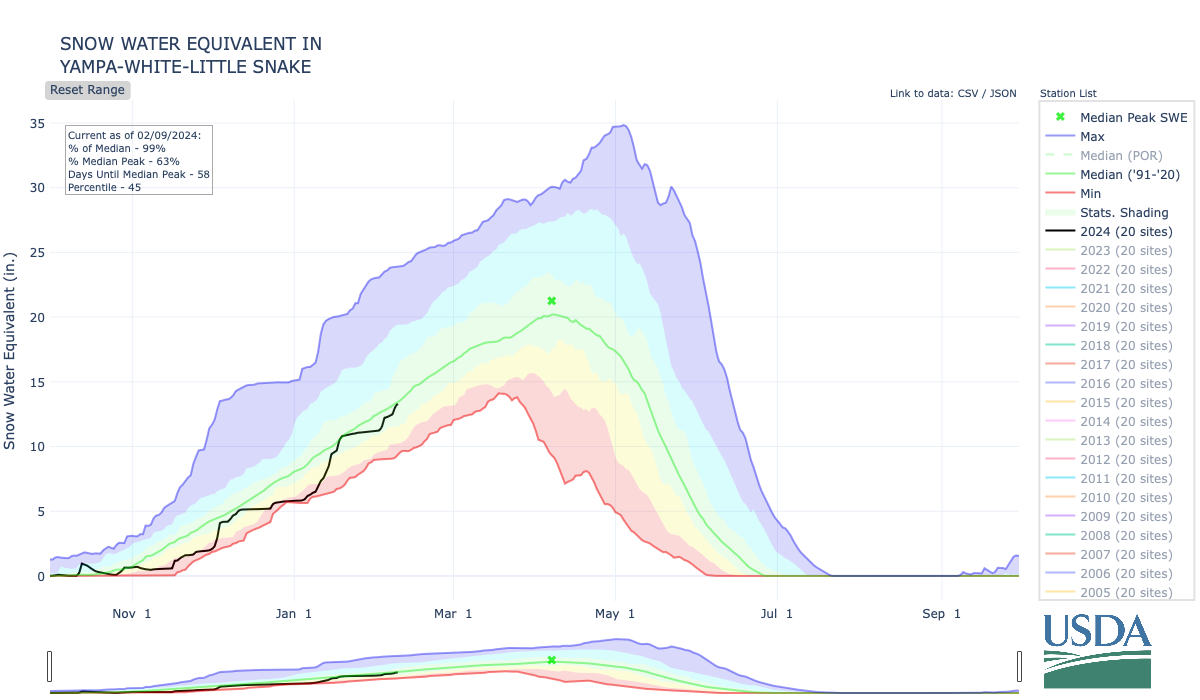
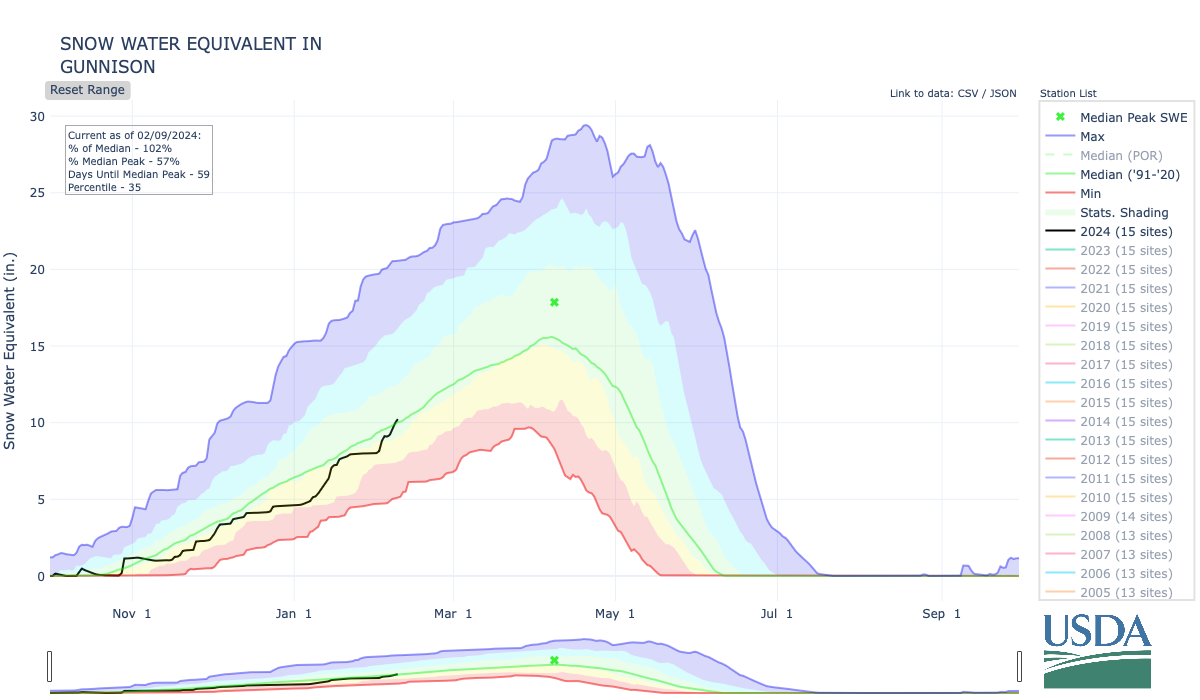
The federal Natural Resources Conservation Service on Tuesday said that statewide snowpack in Colorado stood at 93% of normal for Feb. 6. It has seen little growth since the middle of last month or so, after increasingly sharply from below 70% of normal at the start of January.
Snowpack in the Colorado headwaters basin on Tuesday stood at 96% of normal for Feb. 6. The Yampa-White-Little Snake basins were at 95% of normal, as was the Gunnison River Basin, and the Arkansas River Basin was at 91%.
Southwest Colorado is drier, with the combined San Miguel-Dolores-Animas-San Juan basins at 84% of normal and Upper Rio Grande River Basin at 80%. On Grand Mesa, snowpack levels at NRCS sites Tuesday ranged from 93% at Mesa Lakes to 74% at Overland Reservoir. Mountain snowpack is relied upon to bolster streamflows, reservoirs and agricultural and municipal supplies when that snow melts and runs off.
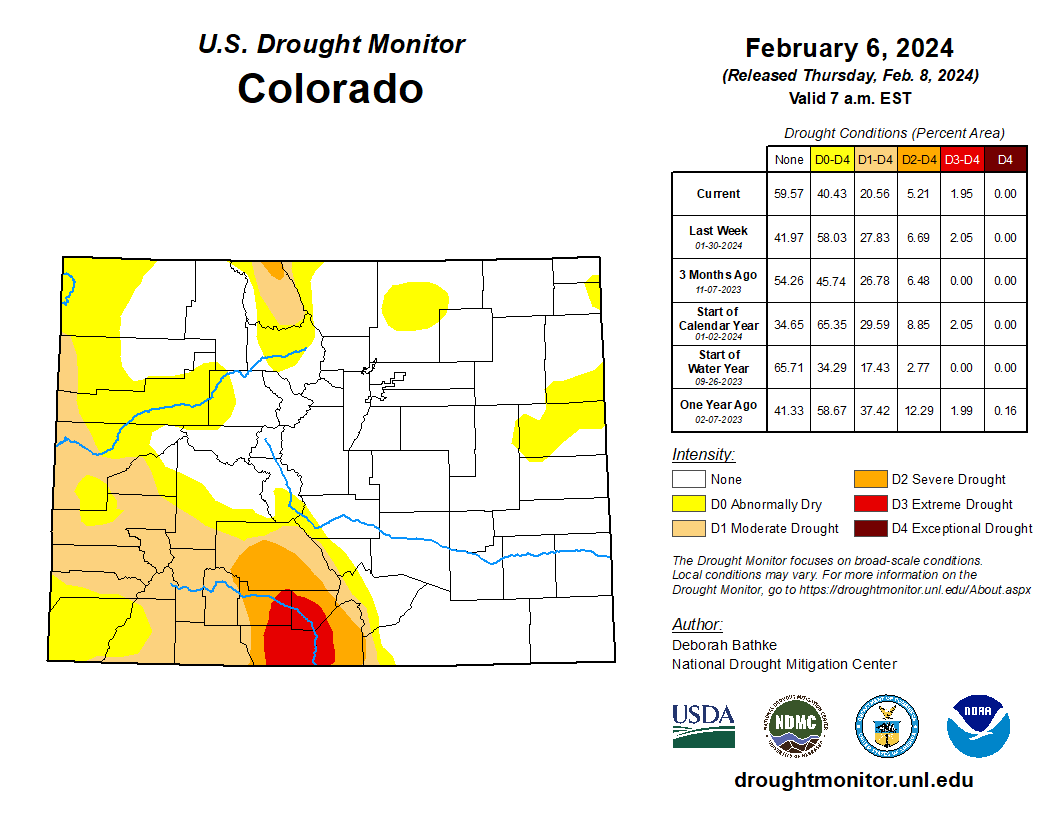
Colorado Drought Monitor map February 6, 2024.
Most of Southwest Colorado is in varying levels of drought, with moderate drought stretching into western and southern Mesa County, according to the U.S. Drought Monitor.
Scott Hummer, former water commissioner for District 58 in the Yampa River basin, checks out a Parshall flume installed on an irrigation ditch in this August 2020 photo. CREDIT: HEATHER SACKETT/ASPEN JOURNALISM
From email from the Colorado Division of Water Resources (Michael Elizabeth Sakas):
January 26, 2024
The Colorado Division of Water Resources announced that as of January 16, 2024, new rules governing the measurement of surface and groundwater diversions and storage are now in effect for Division 6. The division includes the Yampa, White, Green and North Platte River basins.
“The Division 6 Measurement Rules are the first set of rules covering surface water measurement in the State of Colorado and are a significant milestone for the Division of Water Resources,” said Erin Light, Division 6 Engineer. “The adoption of the rules will provide the Division of Water Resources greater leverage in assuring that the diversion and use of water is administerable and properly measured and recorded.”
For background, Colorado statutes include a requirement that owners of ditches and reservoirs install headgates where water is taken from the natural stream. These statutes also give the state and division engineer the authority to require owners and users of water rights to install measuring devices.
“Accurate measurement of diversions is critical to protect Colorado’s entitlement to water, including under the Colorado River Compact, and to ensure we are maximizing the beneficial use of the public’s water resource for consumptive and environmental purposes,” said Jason Ullmann, Deputy State Engineer.
The statutes, however, do not include any specifics regarding what is considered an acceptable headgate or measuring device. Historically, it has been administered by the Division of Water Resources (DWR) through issuing orders to owners for the installation of headgates or measuring devices.
“Over several years, Division 6 has issued hundreds of orders for the installation of operable headgates and measuring devices with varying degrees of success,” said Division Engineer Light. “I believe that these rules will help water users in Division 6 by providing clarity regarding what structures require measurement and what is considered an acceptable level of accuracy for the required measurement methods.”
The rules describe two types of measurement methods: measuring devices, which are physical devices (flumes, weirs, etc) that are placed in a diversion for measurement. Then there are alternative measurement methods, which are typically indirect methods of measuring flow rates without a physical device.
Water users are provided the following time periods to comply with the rules:
Diversion structures with a capacity or water rights greater than or equal to 5.0 cfs – 12 months (January 16, 2025);
Diversion structures with a capacity or water rights greater than or equal to 2.0 cfs and less than 5.0 cfs – 18 months (July 16, 2025);
Diversion structures with a capacity or water rights less than 2.0 cfs – 24 months (January 16, 2026);
Reservoirs with a capacity or water rights greater than or equal to 5.0 AF – 12 months (January 16, 2025);
Reservoirs with a capacity or water rights less than 5.0 AF – 24 months (January 16 2026).
Water users unsure of their decreed water right or permitted well permit flow rates and volumes can use DWR’s online tools available through CDSS (https://dwr.state.co.us/Tools/) to find this information. Anyone who has questions regarding how these Rules apply to their diversion or how to install a measuring device on their system can contact the DWR’s Division 6 Lead Hydrographer at (970) 291-6551. The Rules are available on the DWR website as a Laserfiche imaged document.
Yampa River Basin via Wikimedia.
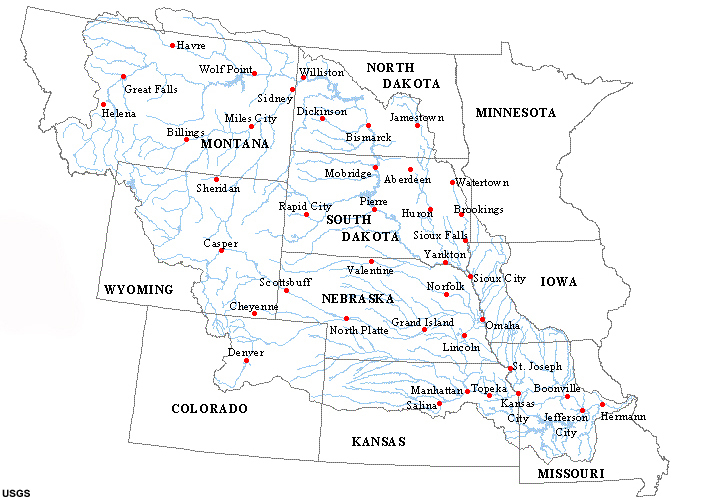
Map of the North Platte River drainage basin, a tributary of the Platte River, in the central US. Made using USGS National Map and NASA SRTM data. By Shannon1 – Own work, CC BY-SA 4.0, https://commons.wikimedia.org/w/index.php?curid=79266632
Wyoming angler Jeff Streeter’s shadow casts over the shallow flow of the Encampment River, a tributary to the North Platte River, July 21, 2021. (Dustin Bleizeffer/WyoFile)
Click the link to read the article on the WyoFile website (Anne MacKinnon):
Climate change poses challenges for Wyoming water law, seen these days on the Grand Encampment River southwest of Saratoga.
The Encampment River valley is like many small, irrigated valleys in Wyoming. It was once the home of a few pioneer ranches that built a network of ditches, but the ranches have been divided up, the river has moved over time, and people have kept irrigating using the old ditches, sometimes with a little jerry-rigging. The Encampment valley is also narrow, with usually more than enough water, so state water officials haven’t had to “regulate” to keep water use in line with water rights.
Enter the Sinclair Refinery near Rawlins, Carbon County’s biggest employer. Its workforce includes people from the Encampment valley, located some 40 miles away. In just the last year and a half, the oil company that took over the refinery bought a ranch on the Grand Encampment River.
The attraction: the old water rights on the ranch. The goal: to bolster the refinery’s water supply in the face of climate change.
Two years out of the last six, the Upper North Platte Basin has seen climate change in low snowpack. It has meant that in spring, the refinery couldn’t legally use its own 100-year-old water rights. Refinery managers had to arrange for temporary use of older water rights from elsewhere. Buying the Encampment ranch offers the new refinery’s owners, called HF Sinclair, a more permanent solution for those low snow-pack years.
That has some neighbors worried. Now, how water works in the Encampment valley — which lands are irrigated or not, when and through what ditch — must be examined.
It might seem neighboring irrigators wouldn’t care if a ranch won’t use its water rights in some years. But in a classic Wyoming spot like the Encampment valley, where the water rights and ditches and the irrigation practices and the water table and the water runoff from irrigation are interwoven, the refinery’s water use could disrupt the current pattern.
The HollyFrontier Sinclair refinery in Sinclair, Wyoming as seen in July 2011. (James St. John/FlickrCC)
HF Sinclair’s plan will test the capacity of Wyoming water law to serve both the refinery and the Encampment irrigation community in the era of climate change. Will water officials’ decisions start to unravel the fabric of the community, as some fear, or will it leave that fabric substantially intact?
Map of the North Platte River drainage basin, a tributary of the Platte River, in the central US. Made using USGS National Map and NASA SRTM data. By Shannon1 – Own work, CC BY-SA 4.0, https://commons.wikimedia.org/w/index.php?curid=79266632
Most climate change headlines in Wyoming have focused on the Colorado River Basin, but the Upper North Platte River Basin — embracing both the Sinclair refinery on the North Platte and the Encampment River, a North Platte tributary upstream — has also gotten steadily hotter in the last 20 years.
HF Sinclair’s proposal to move water rights from one location to another — in response to the impending climate crisis — is a prospect that has long alarmed Wyoming irrigators. The fear is that “drying up” a ranch can damage local economies. Such moves were once mostly illegal in Wyoming, and many irrigators believe they still are. But 50 years ago in another national crisis — rising energy prices, creating demand for power plants in Wyoming — the state changed its law to allow such moves if they meet strict standards. There must, for instance, be proof of how much water was consumed at the original spot — no more can be consumed at the new spot, and the amount of water that used to return to the stream from the original irrigation must be left in the stream at that point.
Notably, HF Sinclair is not proposing to dry up its ranch with any such permanent move of water rights. Only in low snowpack years would the refinery activate a new arrangement — a proposed “exchange.” The plan is that in those years the refinery would legally get to use its rights on the North Platte despite low flows, while it would not irrigate its Encampment ranch at all in spring or summer. That would allow Encampment water unused at the ranch to flow down the North Platte to Pathfinder Reservoir as “makeup” water, as required by the Wyoming water exchange law.
HF Sinclair also says it will invest in the interconnected headgate and ditch system on the Encampment to make sure that when the ranch does not tap the Encampment River at all for a year, neighbors still get water for their rights.
There is heavy pressure for an uncomplicated review of HF Sinclair’s plan. The company does not hesitate to underline the implications for sustaining local jobs. To get approval, the company has hired a phalanx of high-powered law and technical people, including a former Wyoming State Engineer.
But leading irrigators on the Encampment have asked state officials for a thorough review — they don’t, however, want the cost and trouble of hiring lawyers and engineers to fall on them. The Wyoming Stock Growers, meanwhile, this summer called for public meetings on water changes as a review of Sinclair’s plans got underway.
Neighbors don’t have grounds to complain if a ranch just decides not to irrigate in a few years. But because HF Sinclair is proposing a legal change, the ranch neighbors have brought concerns to the state water officials who must decide whether to approve the exchange.
To get that approval, HF Sinclair must take two steps: first clean up the water rights on the ranch, and then get the exchange petition granted.
Cleanups are standard in places like the Encampment River, since actual use of old water rights in Wyoming often changes over decades, as streams move a little and ditches fall into disuse. Often old water rights must be identified and nailed down to the current use, at the expense of the right-holder. Sometimes, cleanups get complicated. The strict standards of Wyoming’s water-moves law can apply, if change over time includes water moving some distance.
HF Sinclair is asking for a simple cleanup, which could avoid that scrutiny. The company has filed documents to show that only relatively insignificant changes in irrigation have taken place in over a century of ranch operations — nothing that should invoke the scrutiny required for serious movements of water rights.
There are, of course, all kinds of questions that could arise in HF Sinclair’s cleanup: How much of the ranch’s Encampment River rights have actually been used, where and from what headgates? Does the groundwater level in low-lying lands mean that water consumption there can’t really be stopped, and maybe fields there haven’t required much irrigation water? Has enough irrigation water been used on other ranch fields to provide the proposed “makeup” water for the exchange?
How intensely to review HF Sinclair’s cleanup is a decision for the state Board of Control (the State Engineer and the superintendents of Wyoming’s four geographical water divisions). Then HG Sinclair’s separate request for an exchange – a transaction expressly encouraged by state law – goes to the State Engineer alone to decide.
It will take months or years to see how Wyoming’s water rights review process plays out in this case. And the practical impact may finally depend on how many low snowpack years the future holds for the North Platte Basin. But ultimately, what happens on the Encampment will say a lot about how the state’s water law system will handle the pressures on water that are brought by climate change.
Yampa River Basin via Wikimedia.
Relatively smooth approval of an exchange on the Encampment could encourage towns and industries in Wyoming’s Green and Little Snake River basins to seek their own exchanges. For them, exchanges could be a solution to water supply shutdowns threatened by climate change on the Colorado River. In recent years the State Engineer’s Office has suggested that exchanges could be useful for that purpose, using reservoirs as makeup water.
On the Encampment, HF Sinclair’s experts include former State Engineer Pat Tyrrell, former Division I Water Superintendent Brian Pugsley, and veteran water lawyer Dave Palmerlee.
The facts on the ground may well be such that the refinery’s proposal would easily survive any tough scrutiny. But the way the consultants have couched the requests makes it appear they’re betting they won’t trigger that kind of review, so they get approval — and relatively quickly.
The Encampment community’s fear of local damage has brought an audience to the normally unnoticed Board of Control meetings, however.
Nearby ranchers would like to see Sinclair offer a signed contract for the investment in headgates and ditches to secure access to all neighbors’ water rights. They don’t want to contend with Sinclair’s experts in formal hearings or appeals. But they do want a very careful state review.
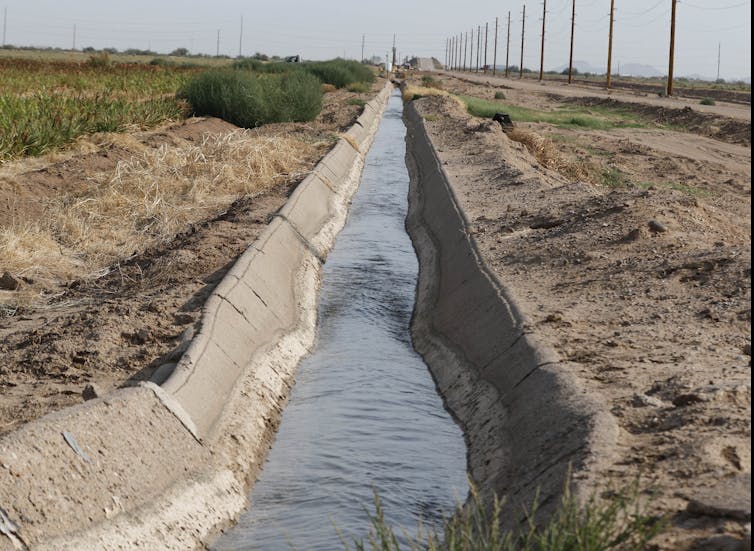
Canal in the San Luis Valley. Photo credit: Allen Best/Big Pivots
Click the link to read the article on the Big Pivots website (Allen Best):
Colorado will probe the pairing of solar panels with canals and reservoirs. Can solar integrated into agriculture help solve the San Luis Valley’s water woes?
Agrivoltaics—the marriage of solar photovoltaics and agriculture production— has been filtering into public consciousness, if still more as an abstraction than as a reality. In Colorado, other than Jack’s Solar Garden near Longmont, there’s little to see.
Aquavoltics? The idea of putting solar panels above water? Similarly thin. You have to travel to North Park to see the solar panels above the small water-treatment pond for Walden.
SB23-092, a bill passed on the final day of Colorado’s 2023 legislative session, [ed. Signed by Governor Polis May 18, 2023] orders study of both concepts. In the case of aquavoltaics, the bill headed toward the desk of Gov. Jared Polis authorizes the Colorado Water Conservation Board to study the feasibility of using solar panels over or floating on, irrigation canals or reservoirs. The bill also authorizes the state’s Department of Agriculture to award grants for new or ongoing agrivoltaics demonstration projects.
Still another section requires the Colorado Department of Agriculture, in consultation with related state agencies, to begin examining how farmers and ranchers can be integrated into carbon markets. The specific assignment is to “examine greenhouse gas sequestration opportunities in the agricultural sector, including the use of dry digesters, and the potential for creating and offering a certified greenhouse gas offset program and credit instruments.”
While Democrats and Republicans got angry with each other in some cases, in this case there was broad comity. The primary Democratic sponsors were from Denver and Boulder County, and the Republicans from the San Luis Valley and Delta. Votes were lopsided in favor.
The agrivoltaics idea was originally included in the 2022 session in a big suitcase of ideas sponsored by Sen. Chris Hansen, a Democrat from Denver. It fell just short of getting across the finish line.
This past summer, Sen. Cleve Simpson, a Republican from the San Luis Valley whose district now sprawls across southwestern Colorado, took keen interest—and for very good reason. A fourth-generation native of the San Luis Valley, his day job there is general manager of the Rio Grande Water Conservation District, whose farming members must cut back water use so that Colorado can comply with the Rio Grande Compact with New Mexico and Texas. It will be a tough challenge—and he’s trying to figure out how to leave his communities as economically whole as might be possible.
This canal in the South Platte Valley east of Firestone, north of Denver, could conceivably also be a place to erect solar panels without loss of agricultural productivity. Photo/Allen Best
The aquavoltaics idea is new to this year’s bill, though.
Hansen, who grew up along the edge of the declining Ogallala Aquifer in Kansas, said his study of water conservation efforts around the world found that aquavoltaics was one of the most advantageous ways to reduce evaporation from canals and reservoirs. Doing so with solar panels, he said in an April interview, produces a “huge number of compounded value streams.”
Covering the water can reduce evaporation by 5% to 10%, he explained, while the cooler water can cause solar panels to produce electricity more efficiently, with a gain of 5% to 10%. Electricity can in turn be used to defray pumping costs.
Solar panels in cooler climates can actually produce electricity more efficiently, which is why solar developers have looked eagerly at potential of Colorado’s San Luis Valley. At more than 7,000 feet in elevation, the valley is high enough to be far cooler than the Arizona deserts but with almost as much sunshine.
Walden became Colorado’s first location for aquavoltaics when solar panels were placed atop the pond at the water-treatment plant in 2018. Christmas 2020 photo/Allen Best
Colorado already has limited deployment of aquavoltaics. Walden in 2018 became the state’s first location to deploy solar panels above a small pond used in conjunction water treatment. The 208 panels provide roughly half the electricity needed to operate the plant. The town of 600 people, which is located at an elevation of 8,100 feet in North Park, paid for half the $400,000 cost, with a state grant covering the other.
Other water and sewage treatment plants, including Fort Collins, Boulder and Steamboat Springs, also employ renewable generation, but not necessarily on top of water, as is done with aquavoltaics.
Hansen said he believes Colorado has significant potential for deploying floating solar panels on reservoirs or panels installed above irrigation canals. “There is significant opportunity in just the Denver Water reservoirs,” he said. “Plus you add some of the canals in the state, and there are hundreds of megawatts of opportunity here.”
Bighorn, Colorado’s largest solar project, has a 300-megawatt generating capacity on land in Pueblo adjacent to the Rocky Mountain Steel plant Comanche’s two remaining units have a combined capacity of 1,250 megawatts, although both are scheduled to be retired by 2031.
Why now and not a decade ago for aquavoltaics? Because, says Hansen, most of the best sites for solar were still available. Because aquavoltaics has an incremental cost, land-based solar was the low-hanging fruit.
Now, as land sites are taken, the economics look better, says Hansen, who has a degree in economics. Plus, with solar prices dropping 10% annually, the economics look even better. The Inflation Reduction Act passed by Congress in August 2022 delivers even more incentives. “I think there will be more and more aquavoltaic projects that will pencil out,” he said.
Arizona water providers have resisted aquavoltaics but are now taking a second look. The Gila River Indian Community announced last year that it is building a canal-covering pilot project south of Phoenix with aid of the U.S. Army Corps of Engineers. “This project will provide an example of new technology that can help the Southwest address the worst drought in over 1,200 years,” said Stephen Roe Lewis, governor of the tribe.
When completed, the canal-covered solar project will be the first in the United States. But both the Gila and a $20 million pilot project launched this year by California’s Turklock Irrigation District are preceded by examples in India.
Officials with the Central Arizona Project, the largest consumer of electricity in Arizona, responsible for delivering Colorado River water through 336 miles of canals to Phoenix and Tucson, will be following closely the new projects in Arizona and California, according to a report in the Arizona Republic.
Byron Kominek on a February afternoon at the site of his late grandfather’s farm, which he calls Jack’s Solar Garden. Photo/Allen Best
In its final legislative committee hearing in late April, the bill got robust support. Both the Colorado Farm Bureau and the Rocky Mountain Farmers Union voiced support.
So did a Nature Conservancy representative. “If we want to solve the climate crisis while at the same time not exacerbating biodiversity and farmland loss, we have to think creatively,” testified Duncan Gilchrist.
“This bill has nothing but winners,” said Jan Rose, representing the Colorado Coalition for a Livable Climate.
The most probing questions were directed to Byron Kominek, the owner and manager of Jack’s Solar Garden. There for the last several summers, vegetable row crops have been grown in conjunction with dozens of solar arrays assembled on a portion of the 24-acre farm. He readily receives reporters and all others, casting the seeds of this idea across Colorado and beyond.
The questions were directed by State Sen. Rod Pelton, whose one district covers close to a quarter of all of Colorado’s landscape, the thinly populated southeast quadrant. A farmer and rancher from the Cheyenne Wells area, Pelton wondered how high off the ground the panels were and what kind of racking system was high enough to address the issue of cattle rubbing against them?
The question, though, jibes with what Mike Kruger, chief executive of the Colorado Solar and Storage Association, sees for agrivoltaics. “I don’t think it will ever be ‘amber waves of grain’ under panels,” he said in April. “It will more likely be cattle and sheep grazing.”
Hansen, in his wrap-up comments before the committee in April, talked about different places needing different approaches depending upon climate zones, topography, growing conditions and other factors. That, he said, was the intent of the studies: to figure out how to maximize potential, to get it right.
NREL researcher Jordan Macknick and Michael Lehan discuss solar panel orientation and spacing. The project is seeking to improve the environmental compatibility and mutual benefits of solar development with agriculture and native landscapes. Photo by Dennis Schroeder, NREL
Unfortunately, the situation on the Colorado River is not unique. Colorado’s mountains are the headwaters of four major river systems: the Colorado, the Platte, the Arkansas and the Rio Grande. Each river provides critical water supplies for the present and future needs of our state; each is being impacted by the effects of climate change; and under Interstate water compacts signed decades ago, Colorado must share each with its neighboring downstream states. Climate change, or what scientists are now referring to as aridification, has caused all of Colorado to be hotter and drier. The combined effects of climate change, interstate water compact obligations and intense competition for the available water among different communities and water use sectors within our state means that future Coloradans will have to learn to do more with less water. This will take bold action, compromise and a new era of innovation and cooperation among competing water interests within Colorado and among Colorado and its neighboring states.
Rio Grande through the eastern edge of Alamosa July 5, 2022. Photo credit: Chris Lopez/Alamosa Citizen
Already, the farmers in Colorado’s fertile Rio Grande Basin are struggling to maintain an aquifer by restricting pumping. They face an awful choice — reduce their collective uses of the aquifer to a sustainable level so that some farms can survive, or they all fail. At the same time, the surface water supply from the Rio Grande River, which must be shared with New Mexico and Texas, has diminished and most likely will continue to do so.
The Republican River’s South Fork near Hale, Colorado, with the region’s seemingly endless fields. Credit: Wikimedia Commons/Jeffrey Beall
The Republican River Basin, a small but agriculturally important river system that originates on the plains and flows east to its confluence with the Missouri River, is also stressed by overuse of the river supply. Productive farm fields are being fallowed so that Colorado can comply with the Republican River Compact. Fortunately for the Rio Grande and Republican river basins, the General Assembly set aside $60 million to buy out farms in order to leave water in the aquifers and river systems. That amount is a drop in the bucket for what will be needed to recover and sustain those systems.
Photo shows Tennessee Creek near the confluence of the East Fork Arkansas River in winter with snow on the Continental Divide of the Americas. The report evaluates current and emerging snow measurement technologies for the Western United States. Photo: Reclamation
The South Platte River runs near a farm in Henderson, Colorado, northeast of Denver. Henderson is the site of one of the possible reservoirs for the regional water project proposed by SPROWG. Photo credit: Lindsay Fendt/Aspen Journalism
The Arkansas River and South Platte River systems also have significant challenges. These basins are home to 85% of Colorado’s population and to most of its commercial agriculture. The farm economy in the Arkansas has already suffered when the Colorado State Engineer had to cut back the use of alluvial wells, which were depleting flows to the Arkansas River and causing Colorado to be out of compliance with the Arkansas River Compact. The South Platte River system, which relies on return flows to sustain the river past the state line, is seeing much higher demands. The current return flow regime is threatened by Nebraska reinvigorating the proposed Perkin’s Ditch, a century-old feature provided for in the 1923 South Platte Compact. Both these basins are being hammered by the combined impacts of Front Range cities rushing to buy and dry existing farms to provide water for future growth while their water supplies imported from the Colorado River Basin have become less reliable due to climate change caused drought and compact obligations.
Colorado’s future economy will depend on implementing innovative methods to sustain, deliver and treat water supplies while leaving enough water in our streams to maintain healthy and thriving aquatic ecosystems. Water delivery entities need to think broader to collaborate with others on ways to manage and share their supplies and their systems.
Pathfinder Dam part of the North Platte Project (originally the Sweetwater Project) is an irrigation project in the U.S. states of Wyoming and Nebraska. The Interstate Canal is part of the project. By Josh Hallett – originally posted to Flickr as Pathfinder Dam – Wyoming, CC BY-SA 2.0, https://commons.wikimedia.org/w/index.php?curid=4171115
From email from Governor Gordon:
Governor Mark Gordon has mobilized the Wyoming National Guard and multiple state agencies to provide assistance to the residents of Lingle and Goshen County in response to flooding that is occurring as a result of a breach in the Interstate Canal north of Lingle.
“I want to thank our state agencies for their quick response to this concerning situation and I praise them for their hard work and dedication to help minimize the impact on our citizens and communities there. Thanks to the quick and competent response from our state agencies, including the Wyoming Office of Homeland Security and the State Engineer’s Office, we were able to rapidly respond to the situation.
At my request, Secretary of State Buchanan is on the ground to personally survey the scope of the damage and to ascertain what resources are needed to help the citizens of Goshen County. Secretary Buchanan has reported the local folks are working together to sandbag the canal. As I have said many times before, I am proud of our Wyoming people who do what they do best—helping neighbors.
My office has been in contact with Governor Ricketts of Nebraska, as the majority of the water in the canal flows to our neighbors in Nebraska. We will continue to communicate with Nebraska officials as we work to resolve the issue.” Gov. Gordon said.
After Goshen County Commissioners issued an emergency declaration, the Governor activated the Wyoming National Guard to place 1,000-pound sandbags in the breach. The Laramie County Fire Authority assisted the State by transporting the sandbags to the site of the canal breach.
Staff from the Wyoming Office of Homeland Security, the State Engineer’s Office and county officials immediately traveled to the site to assess the situation. The Wyoming Public Service Commission is working with utilities. Water was promptly diverted from the canal at the Whalen Diversion Dam and parts of Lingle were evacuated. Early estimates determined that water levels would begin receding around 2 p.m. this afternoon. However, water is expected to continue flowing for the next twelve hours, as the canal was full prior to diversion.
Click the link to read the article on the InkStain website (Eric Kuhn and John Fleck):
With a single statement, the United States Supreme Court changed the direction and tone of the compact negotiations:
“[T]he waters of an innavigable stream rising in one state and flowing into a state adjoining may not be disposed of by the upper state as she may choose, regardless of the harm that may ensue to the lower state and her citizens.”
In a unanimous ruling, on June 5, 1922, the court issued its decision in Wyoming v. Colorado, ruling that Colorado could not develop waters of the Laramie River in a manner that ignored and injured downstream senior appropriators in Wyoming.
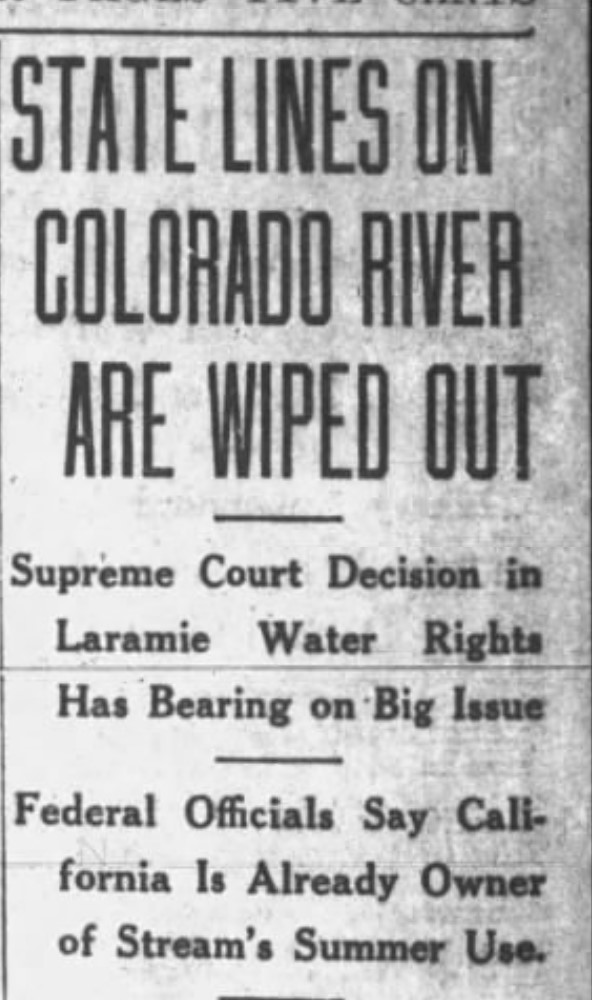
Salt Lake Tribune, June 8, 1922 via InkStain
The decision, and its clear implications for the development of the Colorado River, echoed around the West. “State Lines on Colorado River Are Wiped Out”, blared a front page headline in the Salt Lake Tribune, adding “Federal Officials Say California is Already Owner of Stream’s Summer Use.”
This was the risk that states in the river’s upper basin had long feared – that the doctrine of prior appropriation, used by the states within their own borders, might be determined to apply across state lines. Nervously, they all eyed California.
Laramie and Poudre Tunnel inlet October 3, 2010.
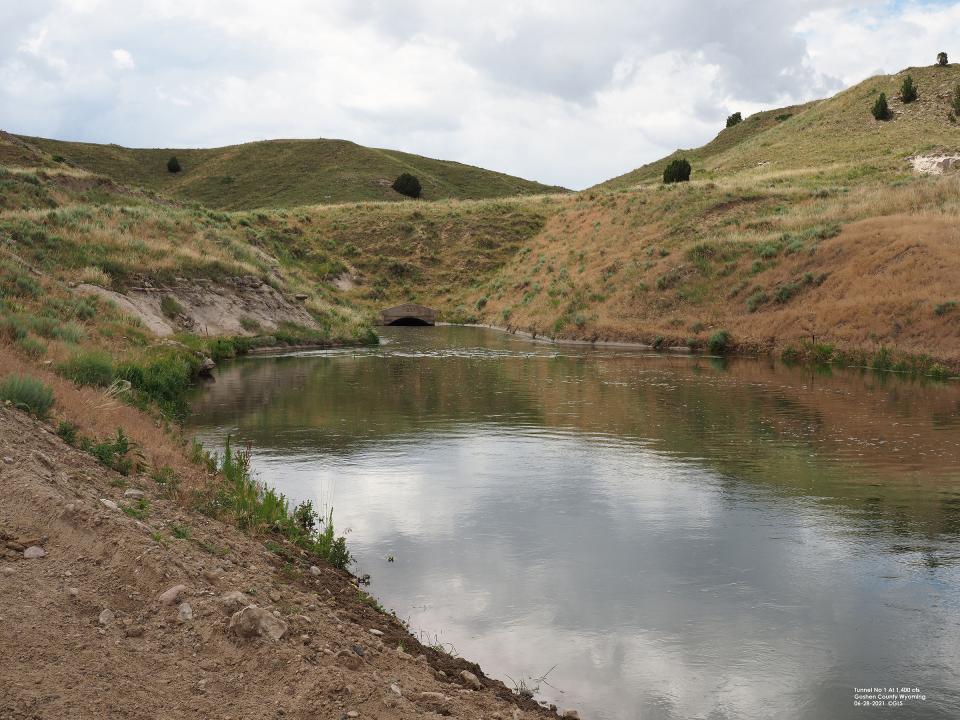
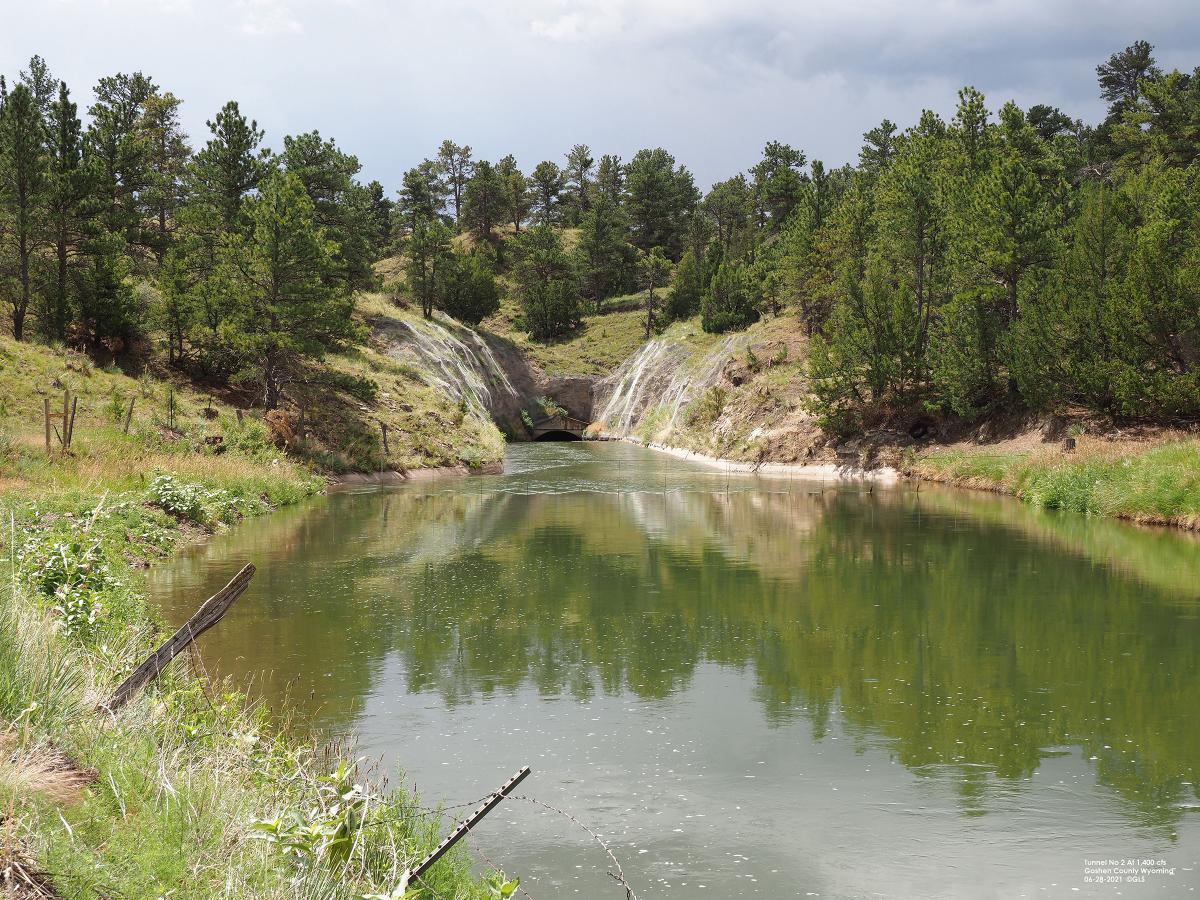
The Laramie, the river at the center of the court’s ruling, has its headwaters in the Northern Front Range Mountains about 40 miles west of Ft. Collins. From there it flows 280 miles north into Wyoming, reaching the North Platte River near Ft. Laramie, WY. Wyoming farmers and ranchers began using the river for irrigation purpose in the 1880s and 1890s. Within Colorado there is little irrigable land along the river’s path, but its elevation just happens to be about 225 feet higher than the Cache La Poudre River where the two rivers are a little more than two miles apart. Thus, in 1909 two Colorado water companies, including the North Poudre Irrigation District, a client of Colorado’s Delph Carpenter, began construction of an 11,500 foot tunnel that would divert 800 cfs (essentially the entire river in low flow years) from the Laramie River into the already fully developed Poudre. In 1911 the State of Wyoming filed suit against Colorado to protect its existing irrigators.
Over the course of the eleven-year case, the Supreme Court held three oral hearings, the last in January 1921, only weeks before the Colorado River Commission first met. Wyoming’s basic argument was that Colorado’s proposed project would cause great damage and injury to its citizens who were already using the river for irrigation. Colorado’s basic argument was that it had a sovereign right to take and use any water within its boundaries without regard to the rights of states or individuals outside of Colorado. Both states used prior appropriation, but details of how the doctrine was administered were quite different. In Colorado water rights were adjudicated by the local district court. In Wyoming they were granted by a state Board of Control.
The opinion, written by Justice William Van Devanter, determined that since both states used prior appropriation, this doctrine would set the rule for the equitable interstate division of water on the Laramie River. The effect of the opinion was that to protect downstream senior appropriators in Wyoming, the Colorado project would be limited to an annual diversion of 15,500 acre-feet per year, about 20% of the original plan. The opinion was not a complete loss for Colorado. Wyoming had challenged the legality of the Colorado’s project because it was a transbasin diversion. The court found that there was nothing illegal with projects that move water.
As soon as the opinion was released, Colorado River Compact Commission Secretary Clarence Stetson sent copies of the opinion to the commissioners along with a six-point summary. For Colorado’s Carpenter, the loss was probably not a great surprise, but it was nonetheless a bitter defeat. He told his upper river colleagues that the decision left them badly exposed.
For the compact negotiations, the court decision required Carpenter to change his basic strategy. Up to this point, he and Utah’s Caldwell had held firm for a compact based on the concept that water projects in the Lower Basin would never interfere with water uses in the Upper Basin. The decision coupled with building public pressure for Congressional approval of a large storage reservoir to control floods, regulate the river, and produce much needed hydroelectric power meant that it was now time for Carpenter to propose a more practical alternative. He turned his attention to a concept proposed by Reclamation Service Director Arthur Powell Davis at the Los Angeles field hearing – a compact based on dividing the use of the river’s waters between two basins.
Stetson’s goal was to get the Commission back together in August. Hoover had asked New Mexico Governor Merritt Mechem for a recommendation on where they might meet in relative seclusion. Mechem found such a place, but finding a date that would work for Hoover and the other commissioners would push the meeting date out to November – stay tune[d].
Map of the North Platte River drainage basin, a tributary of the Platte River, in the central US. Made using USGS National Map and NASA SRTM data. By Shannon1 – Own work, CC BY-SA 4.0, https://commons.wikimedia.org/w/index.php?curid=79266632
The Western U.S. is in a water crisis, from California to Nebraska. An ongoing drought is predicted to last at least through July 2022. Recent research suggests that these conditions may be better labeled aridification – meaning that warming and drying are long-term trends.
On the Colorado River, the country’s two largest reservoirs – Lake Powell and Lake Mead – are at their lowest levels in 50 years. This could threaten water supplies for Western states and electricity generation from the massive hydropower turbines embedded in the lakes’ dams. In August 2021 the federal government issued a first-ever water shortage declaration for the Colorado, forcing supply cuts in several states.
My work as head archivist for Colorado State University’s Water Resources Archive gives me a unique perspective on these conflicts. Our collection includes the papers of Delph Carpenter, a lawyer who developed the concept of interstate river compacts and negotiated both the Colorado and South Platte agreements.
Carpenter’s drafts, letters, research and reports show that he believed compacts would reduce litigation, preserve state autonomy and promote the common good. Indeed, many states use them now. Viewing Carpenter’s documents with hindsight, we can see that interstate river compacts were an innovative solution 100 years ago – but were written for a West far different from today.
Water for development
In the early 1900s, there was plenty of water to go around. But there weren’t enough dams, canals or pipelines to store, move or make use of it. Devastating floods in California and Arizona spurred plans for building dams to hold back high river flows.
With the Reclamation Act of 1902, Congress directed the Interior Department to develop infrastructure in the West to supply water for irrigation. As the Reclamation Service, which later became the powerful Bureau of Reclamation, moved forward, it began planning for dams that could also generate hydropower. Low-cost electricity and irrigation water would become important drivers of development in the West.
Carpenter worried that downstream states, building dams for their own needs, would demand water from upstream states. He was especially attuned to this issue as a native of mountainous Colorado, the source of four major rivers – the Platte, the Arkansas, the Rio Grande and the Colorado. Carpenter wanted to see upper basin states “adequately protected before the construction of the structures upon the lower river.”
The Colorado River flows through seven U.S. states and Mexico, ending at the Gulf of California. USGS
Carpenter also knew about interstate water conflicts. In 1916, a group of Nebraska irrigators sued farmers in Colorado for drying up the South Platte River at the state line. Carpenter was already lead counsel for Colorado in Wyoming v. Colorado, a case involving the Laramie River that began in 1911 and would not be resolved until 1922.
Eventually Carpenter persuaded his Colorado clients to resolve their litigation with Nebraska by negotiating a compact to share water from the South Platte. It took seven years of data collection and discussion, but Carpenter believed the agreement would ensure “permanent peace with our neighboring state.”
Or maybe not. Today Nebraska officials want to revive an unfinished canal to pull water from the South Platte in Colorado, citing concerns about Colorado’s numerous planned upstream water projects. With Colorado officials pledging to aggressively defend their state’s water rights, the states could be headed to court.
Portioning out the Colorado
West of the Continental Divide, the Colorado River flows more than 1,400 miles southwest to the Gulf of California in Mexico. Once, its delta was a lush network of lagoons; now the river peters out in the desert because states take so much water out of it upstream.
In 2014, the U.S. and Mexico started collaborating to restore the ecosystems of the Colorado River Delta.
When settlers developed the West, their prevailing attitude was that water reaching the sea was wasted, so people aimed to use it all. California had a bigger population than the other six Colorado River Basin states combined, and Carpenter worried that California’s river use could hinder Colorado under the prior appropriation doctrine, which dictates that the first person to use water acquires a right to use it in the future. With the U.S. Reclamation Service studying the Colorado to find good dam sites, Carpenter also feared that the federal government would take control of river development.
Carpenter studied international treaties as models for river compacts. He knew that U.S. states had a right under Article 1, Section 10 of the U.S. Constitution to make agreements with each other. And he believed that solving water conflicts between states required “statesmanship of the highest order.”
In 1920, officials agreed to try his approach. After the states and the federal government adopted legislation to authorize the process, representatives began meeting as the Colorado River Commission in January 1922, with then-Secretary of Commerce Herbert Hoover as chair. Meeting minutes show that negotiations nearly collapsed several times, but the end goal of rapid river development held them together.
The commissioners reached agreement in 11 months, adopting a final version of the compact in November 1922. It allocated fixed amounts of water – measured in absolute acre-feet, not percentages of the river’s flow – to the upper and lower basins. With water levels in the river declining, this approach has proved to be a major challenge today.
In 2021 the Interior Department declared a water shortage for the Colorado River, triggering supply cuts for Arizona, Nevada and Mexico.
At their meetings, the commissioners discussed both the variability of the river’s flow and their lack of sufficient data for long-term planning. Yet in the final compact they allowed for dividing up surplus water starting in 1963. We know now that they used optimistic flow numbers measured during a particularly wet period.
A hotter, more crowded West
Today the West faces conditions that Carpenter and his peers did not anticipate. In 1922, Hoover imagined that the basin’s population, which totaled about 457,000 in 1915, might quadruple in the future. Today, the Colorado River supplies some 40 million people – more than 20 times Hoover’s projection.
Testifying before Congress in 1926 about the Colorado River Compact, Hoover stated, “If we can provide for equity for the next 40 to 75 years we can trust to the generation after the next to be as intelligent as we are today.” In the face of extreme Western water challenges, it is now up to Westerners to meet – or exceed – that expectation.
The Kortez dam below Seminoe Reservoir is a crucial part of a seven-reservoir water storage system on the North Platte River in Wyoming. (Dustin Bleizeffer/WyoFile)
Click the link to read the article on the WyoFile website (Dustin Bleizeffer):
April is typically when thousands of irrigators on the North Platte River — particularly along its tributaries — begin to divert spring runoff onto hayfields and crops, kicking off what they hope will be a productive growing season. Today, however, those with junior water rights are under new orders to curtail those critical early springtime diversions — a rare scenario that could prove costly for many farmers and ranchers in the state.
“When the water is coming, you’ve got one shot at it,” Upper North Platte Water Users Association Chairman Chris Williams said. Watching spring runoff flow downstream without tapping it is counterintuitive and frustrating for any ag producer, he added. “It has the potential to dry acres up.”
The “call,” or order, to restrict water diversions among North Platte River users with junior rights was initiated by the U.S. Bureau of Reclamation during the first week of April. The order, which is enforced by the Wyoming State Engineer’s Office, is set to expire at the end of the month. Water rights are prioritized based on a “first in time, first in right” doctrine. Those who gain rights to use water first have “senior” rights over those who gain water rights after them.
It’s unlikely the BOR will recommend extending the call, even if hydrological conditions and forecasts for the seven-reservoir North Platte River water storage system do not improve, according to Lyle Myler, acting manager for the Wyoming Area Office of the Bureau of Reclamation.
Ice crusts over the banks of the North Platte River near Casper in December 2021. (Dustin Bleizeffer/WyoFile)
“Our hope is that the curtailment of [junior] water rights will allow us to receive our share that’s allotted to us under our 1904 water rights, or as much as we can get,” Myler said.
Water users with junior rights on the Tongue River and its tributaries in northeast Wyoming are also on notice for similar, legally enforceable water conservation measures, following a call from Montana. Though no actual water diversion curtailment orders have resulted so far, those users will remain on notice until Montana officials remove the call, according to the Wyoming State Engineer’s Office.
‘Calls’ and climate
A call on a river or drainage system is a legal mechanism to order water conservation actions to help ensure minimum, legally required flows to users with senior rights to divert water — typically for irrigation. It can also apply to groundwater wells that pump from a drainage for municipal or industrial uses. In the event of a potential water shortage, those with junior rights can be ordered to forgo diverting water to help ensure that senior-rights holders downstream get their full allotment.
The BOR and water management authorities in Wyoming and Montana all cited low snowpack, persistent drought conditions and forecasts for lower-than-average precipitation for initiating the water conservation measures and notices.
“The Tongue River Basin has been experiencing drought conditions over the past year with below average winter snowpack and streamflow conditions,” according to an April 7 statement from the Wyoming SEO. “The North Platte River system has experienced multiple years of drought resulting in low reservoir storage carryover.”
Wyoming angler Jeff Streeter’s shadow casts over the shallow flow of the Encampment River — a tributary to the North Platte River — July 21, 2021. (Dustin Bleizeffer/WyoFile)
The conditions are consistent with climate trends that have pushed the statewide annual mean temperature upward by 2.2 degrees Fahrenheit from 1920 to 2020, according to National Oceanic and Atmospheric Administration data. The climate trend is also altering hydrological conditions in the state, such as lower snowpack and an earlier spring runoff season.
Despite current conditions and forecasts for lower-than-normal precipitation, however, it’s too early to know what spring may have in store, Wyoming State Engineer Brandon Gebhart said. If heavy spring snow and rain events do materialize, it could negate the need to curtail water diversions, he added.
The climate conditions contributing to the calls in Wyoming are likely to continue to force water managers to cooperate on conservation measures throughout the West, according to Utah Rivers Council Executive Director Zachary Frankel.
Clouds threaten rain over Pathfinder Reservoir, July 2019. (Dustin Bleizeffer/WyoFile)
“As our precipitation shifts from snow to rain, it is causing havoc on our water supplies, and that’s going to continue in coming years and decades,” Frankel said. “Although some climate model runs show increased precipitation — meaning more rain — it’s not likely to increase our total water supplies because of additional challenges from decreased soil moisture and a range of other challenges on the water demand side.”
Mandates
The BOR initiated the call on the North Platte River during the first week of April based on measurements and forecasts that indicate the seven-reservoir storage system might fill to only 950,000 acre-feet of water during this year’s “water season.” That’s below the Modified North Platte Decree’s call-triggering minimum of 1.1 million acre feet. The order applies to those with post 1904 water rights from the Wyoming-Colorado border to Guernsey Reservoir.
The Tongue River cascades over boulders near Dayton, September 2020. (Maggie Mullen/WyoFile)
In a separate action, the Montana Department of Natural Resources and Conservation issued a call on the Tongue River and its tributaries in Wyoming on April 1. The call is necessary to ensure that the Tongue River Reservoir in Montana fills this summer, and to otherwise hold Wyoming to account for legal obligations under the Yellowstone River Compact, according to Montana NRC Commissioner Anna Pakenham Stevenson.
Gebhart responded by notifying those with post-1950 water rights — junior rights — on the Tongue River and its tributaries that they may be ordered to curtail diversions at some point this summer. However, Gebhart and the agency’s Division II management that oversees the Tongue River drainage took issue with Montana’s initial assertions regarding forecasts for flows in the Tongue River.
Although both states acknowledged critical “data gaps,” the water storage and snowpack assessments initially cited by Montana should never have resulted in a call on the Tongue River, according to Gebhart. At the time, snowpack measurements for the drainage area measured more than 90% of the annual average. On April 19, it increased to 99%, according to a Natural Resources Conservation Service report.
Montana issued similar calls on the Tongue River in 2015 and 2016 based on more dire assessments than those cited this year, Gebhart said. But no orders to limit water diversions were necessary in response to either of those calls.
For now, both Wyoming and Montana continue to measure snowpack, water volumes and forecasts in the Tongue and greater Yellowstone River systems — hopeful that it might not be necessary to order irrigators to curtail normal irrigation practices, Gebhart said.
Dustin Bleizeffer is a Report for America Corps member covering energy and climate at WyoFile. He has worked as a coal miner, an oilfield mechanic, and for 22 years as a statewide reporter and editor primarily covering the energy industry in Wyoming. He served as MIT Environmental Solutions Initiative Journalism Fellow, John S. Knight Journalism Fellow at Stanford, communications director for Wyoming Outdoor Council and WyoFile editor-in-chief. He lives in Casper. You can reach him at (307) 267-3327, dustin@wyofile.com and follow him on Twitter @DBleizeffer.
Map of the North Platte River drainage basin, a tributary of the Platte River, in the central US. Made using USGS National Map and NASA SRTM data. By Shannon1 – Own work, CC BY-SA 4.0, https://commons.wikimedia.org/w/index.php?curid=79266632
Here’s the release from the Colorado Department of Natural Resources (Chris Arend):
The Colorado Division of Water Resources (DWR) is announcing a virtual Measurement Rules Rulemaking stakeholder meeting to present an update of the draft Measurement Rules for Water Division 6 (North Central and Northwest Colorado for the Yampa, White, and North Platte River basins) and gather feedback and comment. DWR conducted in-person stakeholder meetings during October 2021 in Steamboat Springs, Oak Creek, Rangely, Meeker, Walden, and Craig, CO.
DWR invites participants from those meetings, as well as those who have not been to an in-person public meeting, to attend.
The purpose of the rulemaking is to develop consistent, stakeholder-driven standards for the implementation of DWR’s statutory authority for requiring measuring devices for water diversion and storage and reporting of records.
For questions, to submit written comments, or sign up for notification lists, please see Division 6 Measurement Rules Rulemaking section on DWR’s website (scroll down to Water Administration Rulemaking and click on Rule-making – Division 6 Measurement Rules (2CCR-402-18): https://dwr.colorado.gov/services/water-administration#div6-rulemaking
WHO: Colorado Division of Water Resources
WHAT: Virtual Public Meeting on Yampa, White, and North Platte River Basins Measurement Rules Rulemaking
Ranchers and other water users gather at a stakeholder meeting in North Park on Oct. 22 to ask questions and provide input as state officials make case for measuring devices and recording. Credit: Allen Best
As the gap between water supplies and demands narrows in northwestern Colorado, state officials want to ensure that, as best as reasonably can be done, every last drop gets measured and recorded.
They made their case to about 60 ranchers in North Park’s Walden, Colo., on Friday in the fifth of six stakeholder meetings during October that will conclude tonight with a meeting in Craig.
The proposed rules governing the Yampa, White and North Platte River basins would require that headgates, which allow water diversions into ditches, be supplemented with measuring infrastructure, either flumes or weirs, to track the amount of water being diverted. The rules would also institute protocols for reporting the measurements, for collection in state databases. Authority to require the measuring and reporting is clearly defined by state law, but the law leaves room for discretion about the particulars, hence the stakeholder process.
In an already drought-stricken region likely to become hotter and drier yet in the 21st century, those measurements will become ever-more important in administering water rights. The Yampa River this century has carried on average 6% less water than it did during the 20th century. On the White River, flows have fallen 19%.
Already, there is concern that Colorado will be forced to curtail diversions of water rights dated later than the 1922 Colorado River Compact if the aridification of the Colorado River Basin continues, said Kevin Rein, the state water engineer, at the outset of the meeting in Walden.
The compact specifies that Colorado along with Wyoming, Utah and New Mexico “will not cause the flow of the river” at Lee Ferry, at the top of the Grand Canyon, “to be depleted below an aggregate” of 75 million-acre feet for an period of 10 consecutive years. Colorado and the three other upper basin states are in relatively good shape—for at least the next couple of years. In the last decade, 92 million acre-feet have flowed past Lee Ferry toward Arizona, Nevada, California and, eventually, Mexico.
Kevin Rein, Colorado state water engineer, explains why Colorado needs stepped-up measuring of water diversions in the North Park and other rivers in Northwest Colorado while Erin Light, Division 6 engineer, looks on during a meeting in Walden on Oct. 22. Credit: Allen Best
But if below-average becomes the new normal, as climate scientists warn almost certainly will be the case, Colorado may be forced to defend its diversions in light of the compact. “When they come in and ask for water, we can’t refuse if we have no data,” said Mike Sullivan, the deputy state water engineer.
The state water officials pointed to the Aug. 2021 report Lessons Learned from Colorado Experiences with Interstate Compact Administration issued by the Hutchins Water Center at Colorado Mesa University and MacIlroy Research and Consulting. “Confronting the limits of a water supply is a painful experience,” the report said after studying the Republican, Arkansas and Rio Grande basins. “Across each of the basins, earlier action to address potential compact and supply issues has enhanced the control communities have to develop and choose their own, less painful, options.”
The North Platte River does not flow into the Colorado River. It’s east of the Continental Divide but separated from the Front Range by the Medicine Bow and other mountain ranges. So why the need to measure water in North Park the same as in the Yampa and White river valleys?
Because it’s good to have the data should it be necessary as required by other interstate agreements, in this case involving Wyoming and Nebraska, said Sullivan.
But there’s another reason for more rigorous accounting of diversions, said the state water officials. Owners of water rights can best look out after their own interests by documenting their water use. This guards against those rights being placed on lists of abandoned water rights that state law requires be issued every 10 years. The most recent list for all river basins, including North Park, was issued last year.
Measuring devices also give those with more senior water appropriations the right to divert their legal entitlements in water-scarce years. And in the case of land sales with connected water rights, it gives owners the proof of water use to demonstrate value to potential purchasers.
In several river basins in Colorado, notably those east of the Continental Divide, measurements became crucial as early as the 19th century. In those river basins where water users experienced an earlier squeeze between supplies and demands, those with senior water rights began placing calls that required those with newer—and hence more junior— rights upstream to cease or cut back diversions.
In Water Division 6, which includes the North Platte, Yampa and White river basins, 54% of headgates had appropriate measuring devices as of April. This compares with upwards of 90% in several other water divisions of Colorado.
Overlapping the new rules is a proposal being considered by the Colorado Division of Water Resources to designate the Yampa River as over-appropriated. Most rivers in the state are already considered over-appropriated, in some cases over a century ago. Segments of the Yampa—including the river upstream from Steamboat Springs and several tributaries—already have been so designated. This designation will require irrigators drilling wells to have water that they can use to augment streamflows if there is a call on the river by a senior user. Improved measuring will assist in administration. Meetings to gather input were scheduled for Monday night in Craig and Thursday night in Hayden.
State officials hope to get the measurement rulemaking as well as the Yampa designation completed by early next year. Rules will be unique to the needs of Northwest Colorado, just as rules governing the Republican and Arkansas River basins are unique to the interstate water agreements and other circumstances governing water use in those basins.
North Park was particularly warm and dry last winter. One rancher after the Walden meeting recalled that it was possible to drive across his hay meadows all of last winter whereas many years he has to plow the driveway almost daily.
“It was pathetic, really,” said Keith Holsinger, standing on a bridge over the Michigan River east of Walden where he grows hay on 800 acres. One of his neighbors, who usually gets 500 to 600 tons of hay, got only 90 tons this year, he reported.
Holsinger has lived on the ranch all of his 77 years. His water rights range from among the oldest in North Park, an 1885 decree with a priority number of 32, to more junior rights of 240th in priority.
He remembers putting in the first measuring device sometime after the drought of 1977. His last device, a weir, he had installed last year.
Keith Holsinger has been installing measuring devices on ditches for his ranch along the Michigan River in North Park for several decades. Credit: Allen Best
During the meeting, some skepticism was voiced about the coming measurement rules. State representatives characterized the relationship between water users and state authorities as one of cooperation and trust. But one audience member pushed back. Implementation seemed to be discretionary, he said. “It’s a trust issue, and I’m sorry to say I don’t have a lot of faith.”
But as for the need for the rules, Holsinger is already persuaded. “If it’s free water in priority, if you want that water, you had better have a headgate and weir,” he said. “It’s as simple as that.”
The most significant discontent voiced in the background of the meeting agenda was about the high turnover in water commissioners. It’s a common problem across Colorado, say state water officials, as the job is by nature semi-seasonal. But in conversations after the meeting, North Park residents suggested that if the state wants water users to be partners in administration, the state needs to allow proper resources. A water commissioner has between 350 and 500 headgates to check, and there’s a learning curve.
Some people wanted to know why the state wanted the ability to lock headgates. State representatives said they rely primarily on voluntary compliance with water allocations but need the ability to force compliance if diverters take more than they are entitled to.
“In 20-some years, I have probably ordered a half-dozen headgates locked,” said Sullivan. “If we can’t get someone to keep their hands out of the cookie jar, we lock the cookie jar.”
As for the specific type of weir or flume, there are several formal varieties as well as less formal ones. They can be expensive, but none of the irrigators in Walden indicated that cost alone is an issue. Erin Light, the Steamboat Springs-based water engineer for Division 6, said she had seen a flume made of a road sign. It worked, she reported. Sullivan reported seeing one made of rock that worked effectively.
Said Sullivan, speaking to people mostly old enough to remember a bestselling small-model car in 1979 and 1980, “We don’t want to require a gold-plated Cadillac headgate when a Chevette will do.”
Long-time Colorado journalist Allen Best publishes Big Pivots, an e-magazine that covers energy and other transitions in Colorado. He can be reached at allen@bigpivots.com and allen.best@comcast.net.
Map of the North Platte River drainage basin, a tributary of the Platte River, in the central US. Made using USGS National Map and NASA SRTM data. By Shannon1 – Own work, CC BY-SA 4.0, https://commons.wikimedia.org/w/index.php?curid=79266632
Irrigation water flows through Tunnel No. 1 on the Goshen/Gering-Fort Laramie supply canal on July 16, 2021. Photo credit: University of Nebraska Lincoln
From The Unviversity of Nebraska Lincoln via The Fence Post:
In the months following the collapse of Tunnel No. 2 on the Goshen/Gering-Fort Laramie main canal in July 2019, temporary repairs were made to Tunnels No 1 and 2. Steel ribs were installed inside the tunnels to support the concrete tunnel walls.
Irrigation water flows through Tunnel No. 2 on the Goshen/Gering-Fort Laramie supply canal on July 17, 2021; this is the tunnel where the collapse occurred in 2019. Photo credit: University of Nebraska Lincoln
The tunnel collapse and resulting washout of the supply canal south of Fort Laramie, Wyo., immediately ended water deliveries by Goshen and Gering-Fort Laramie districts for 44 days, during the critical growth period for crops. About 107,000 acres were affected by the loss of irrigation water, and many farmers’ yields were reduced as a result.
The temporary repairs allowed the irrigation districts to resume deliveries in 2020, but installation of the ribs restricted water flow to 80-85 percent of capacity of the tunnel.
During the winter of 2020-21, metal sheeting was installed over the ribs to increase water flow through the tunnels. This increased the water flow through the tunnels to 97 percent of capacity in the summer of 2021. Water deliveries by the three major irrigation districts in the North Platte Valley (Goshen and Gering-Fort Laramie on the south side of the river, Pathfinder Irrigation District on the north) were near normal for the 2021 growing season.
The districts had to utilize some storage water to meet the needs of the growers, leaving the reservoirs in Wyoming at lower-than-average carryover at the end of the water year. In mid-October, Seminoe Reservoir was at 31 percent, Pathfinder Reservoir at 58 percent, and Glendo Reservoir at 32 percent of capacity.
For spring runoff to fill the reservoirs by the 2022 irrigation season, major snowfall events would be needed in the Snowy Range and Siera Madre mountains of north-central Colorado and south-central Wyoming this winter.
Inspection of the tunnels by the irrigation districts and U.S. Bureau of Reclamation was scheduled for the week of Oct. 18. Permanent repairs to the tunnels still must be completed, the final construction plans pending approval from the Bureau of Reclamation.
The collapse site above Tunnel No. 2 on the Goshen/Gering-Fort Laramie supply canal, as it appears in the summer of 2021, two years after the collapse. Subsequent repairs allow the tunnel to carry 97% of the previous maximum capacity. Photo credit: University of Nebraska Lincoln
Tyler Swarr, aquatic biologist for CPW, holds up a brown trout from Antero Reservoir on Wednesday, Oct. 6 when officials conducted the brown trout spawn there in South Park (photo by Jason Clay/CPW)
Here’s the release from Colorado Parks & Wildlife (Jason Clay):
Each fall, brown trout spawn in the mountain creeks and rivers across Colorado. It is also when aquatic biologists, hatchery staff, wildlife officers and volunteers for Colorado Parks and Wildlife come together to conduct its annual brown trout spawning operation at North Delaney Butte Lake and Antero Reservoir.
A quota is set to collect the number of eggs necessary to meet the needs for hatchery production, which CPW uses to augment natural reproduction across Colorado’s creeks, rivers and reservoirs.
This year, that quota was 1.1 million brown trout eggs. It took just three working days at those two brood stock bodies of water to meet the quota of fertilized eggs that get sent to CPW’s Mt. Shavano Hatchery in Salida and its Poudre Rearing Hatchery in Larimer County.
The hatcheries will rear the fish to a fingerling size, around three inches, before being stocked out across Colorado in 2022. Those brown trout fingerlings will get stocked back into both Antero Reservoir and North Delaney Butte Lake to ensure a strong brood stock population, but also across many other reservoirs and rivers.
“Some of them will come back and be stocked into Antero and some will go to North Delaney as well, so we can come back in three or four years and still will have fish,” said Tyler Swarr, aquatic biologist leading the brown trout spawning operation at Antero Reservoir. “The rest of them will get stocked out across the state.”
CPW stocks more than 700,000 brown trout annually to provide exceptional fishing opportunities.
Crews at Antero Reservoir were able to collect and fertilize 227,026 brown trout eggs from 117 females during its lone spawning day on Wednesday, Oct. 6.
At North Delaney Butte Lake in North Park, CPW’s team needed just three days (Oct. 5-7) to gather 888,574 eggs to surpass the quota of 1.1 million fertilized brown trout eggs for the year.
“2021 was another good brown trout spawn year at North Delaney,” said Kyle Battige, aquatic biologist leading the brown trout spawning operation there. “We saw many year classes present, handled over 1,500 brown trout in three days and I’m happy overall with the current condition of the brood lake”
Brown trout spawn in the wild occurs over the months of October and November. It is temperature dependent.
“River fish spawn a little bit later since it is colder,” Swarr said. “Since reservoirs absorb a lot more solar radiation, they are warmer, so they’ll actually spawn earlier here than they will in rivers.”
In the reservoirs, the silt from the wave action can cover the eggs and prevent them from getting the fresh oxygen they need to grow and hatch. In a river setting, brown trout will lay eggs in the gravel on the river bottom. Those eggs typically get laid in places of upwelling where there is a crest of a riffle and you have a plunge that causes the water to travel through the gravel, slowly turning the eggs and delivering oxygen to them.
“Our spawning operation helps to sustain some of our brown trout fisheries in the state and provides a little bit more fishing diversity for anglers,” Swarr said.
Brown trout are a hard-fighting fish and have beautiful coloration that matches the autumn season. Brown trout are golden brown with vibrant black, red and orange spots.
“The cool thing about them in the state of Colorado is they are resistant to whirling disease since they evolved with that in Europe,” Swarr said. “So, they’ve become kind of the bread and butter of our wild trout fisheries, at least in our northeast region, because really most of the brown trout in the state of Colorado are naturally reproducing wild populations and we don’t have to stock them to the numbers we do with rainbows. Rainbow trout are still impacted heavily by whirling disease.”
Drought isn’t a new thing in the West, but right now, much of the region is gripped in a historic drought. An unusually dry year coupled with record-breaking heat waves has strained water resources in the West this year. In fact, water levels are so low that the Bureau of Reclamation declared a water shortage on the Colorado River basin for the first time ever in mid-August. There are a lot of ideas for how to relieve the drought and ease its impacts—some more feasible than others. But when you think about water in the West, you have to think about scarcity too.
“You’re really thinking about, well, why is it scarce? Is it too little supply? Or is it too much demand? And in the case of water, it’s both, right?” said Jason Shogren, an economist at the University of Wyoming (UW). “You have a drought, and that is going to restrict the supply of water. And you have an increase in demand because people are moving more and more to the Rocky Mountain region, moving more and more to the west coast.”
And as Shogren pointed out, a lot of people move to the West and expect to keep parts of their lifestyles from where they came from, like lawns of lush green grass. But those require a lot of water. And Shogren said we have to think about all the different demands.
“And since we have a lot of demand for water in Southern California, Phoenix, Las Vegas. We have a lot of demand for water in agriculture production, whether it’s crops, or whether it’s nuts, or whether it’s wine,” he said. “And on the supply side, the question is, ‘Who gets what water? And why?'”
He added property rights over water are different by state and deciding how water rights are allocated and how they can be used gets tricky fast…
And with climate change intensifying extreme weather like droughts and flooding, there’s one potential solution that would help solve both problems. Dr. Tom Minckley said it involves moving water.
Missouri River Reuse Project via The New York Times
“We could say, ‘Oh, well, the western states are in drought. So we could take water from, say, the Mississippi or the Missouri River, and when it floods, we could capture that floodwater, and then basically return it to the head of the watershed,'” he said.
Dr. Minckley is a Professor in the Department of Geology and Geophysics at the University of Wyoming. He studies water in the West and how it’s managed. He said piping water from a flooded place to a place in drought is an idea that’s becoming much more popular. State governments already transfer water between some states in the west…
But because of Wyoming’s high elevation, moving water here from almost anywhere else would mean fighting gravity. It would require a lot of energy because water is actually quite heavy. Not to mention the logistics of where a pipeline would even go and how much it would cost – water is valued by the acre-foot.
“On average, it’s about $2,000 per acre-foot. And some of the Colorado River water in the state of Colorado is running for $85,000 an acre-foot. So, like, there’s these crazy, really big numbers out there,” said Minckley. “And the question is if we start moving water from where it is to where we want it to be, how do we pay for it?”
The idea has been researched and despite its growing popularity, the Bureau of Reclamation found its implementation highly unlikely because of the cost and logistics.
Cloud-seeding graphic via Science Matters
Another idea that’s been floated is cloud seeding…
[Bart] Geerts said farming communities in the High Plains have financially supported seeding operations in thunderstorms for decades, but it can be really hard to prove that kind of seeding actually worked. But, he said it is a lot easier to demonstrate that it worked when they seed winter clouds. Which can be more useful in the High Plains anyway.
Because there’s natural variability between the years, you can’t pinpoint exactly how much more snowfall there was due to seeding and they work with averages. Geerts said a common belief is that cloud seeding keeps moisture from falling in other places where it’s needed.
“It’s really not understood. There is that possibility but in general, these wintertime clouds are not very efficient,” he said. “Essentially water vapor condenses, you extract it, make it into snow, and thereby you reduce the downstream amount of water vapor to some extent. But that amount is so, so small, so insignificant compared to the total water vapor content.”
But Geerts added on the flip side of that, some of the seeding materials may float downwind and increase snowfall on the next mountain range.
“So it can work either way. We don’t really have an answer,” he said.
It seems like a lot of ideas and conversations about this topic end with that – “we don’t really have an answer.” But as droughts intensify, driven by climate change, those conversations continue to happen. And some may lead to more viable solutions.
A pair of engineering firms contracted by the state warn that cracks in the 112-year-old concrete LaPrele dam, along with deterioration in its geologic foundation, could result in catastrophic failure.
Such an event would threaten people and infrastructure downstream, including the town of Douglas, and likely destroy the Ayres Natural Bridge Park directly below the dam, as well as two Interstate 25 bridges, the Wyoming Water Development office said during a tour last week.
“This is more than an irrigation district matter,” Water Development Office Director Brandon Gebhart said. “It’s a hazard.”
Rehabilitating the dam might be impossible, according to Gebhart. Instead, the office and its governing citizen commission is considering building a new dam directly below the existing structure. The commission will consider seeking funds to develop a complete engineering study for a project that could exceed $50 million.
Such an effort may qualify, in part, under several provisions in the $1 trillion infrastructure bill passed by the U.S. Senate this month, buttressing a Wyoming policy ambition to impound more water for use before it leaves the headwaters state, according to state officials. Meantime, the state is examining multiple other funding sources due to the potential for loss of life and property if the dam were to fail.
The matter is urgent, officials say.
“It’s not a slow failure with this dam design,” Gebhart said. “It would be very abrupt.”
The water office organized a public tour of the dam Aug. 12 to better inform the public of the risks and potential solutions under consideration.
A rumble and a warning
When a magnitude 3.7 earthquake rumbled the towns of Glenrock and Casper on the night of Aug. 1, personnel at the nearby Ayres Natural Bridge Park said it felt like a sonic boom. They sprang into action, caretaker Dee McDonald said.
Dee and her husband Doug McDonald have served as caretakers for six years.
The natural arch was still intact. But their minds were on a more pressing danger still looming: water. So they evacuated the handful of campers in the park that night.
“Anybody with any sense would do that,” McDonald said.
The park is situated in a small geologic bowl filled with old boxelder and tall cottonwood trees, along with manicured grass and picnic areas surrounded by high sandstone cliffs carved out over millennia by LaPrele Creek. The creek runs directly under the natural bridge. The rare high-plains oasis was a retreat for European settlers traveling the Oregon Trail. Today it remains a popular leisure destination for locals and travelers alike.
Visitors from around the world packed into the park on Aug. 21, 2017 to experience the totality of the solar eclipse that swept across central Wyoming.
Less than two miles upstream, however, is a not-so-natural wonder: the LaPrele dam. Completed in 1909, the concrete structure today presents a danger to an area far beyond the Ayres Natural Bridge Park, state officials and engineering teams say.
Aging, patchwork infrastructure
The Ambursen-style-designed LaPrele dam consists of a series of concrete buttresses supporting an angled, flat slab on the reservoir side. It is 130 feet high and 325 feet wide, and serves late-season water to about 100 irrigators via 94 miles of irrigation infrastructure, according to the state. The dam is anchored into a fractured Madison limestone formation on both sides.
Construction was funded via the federal Carey Act of 1894, a measure pushed by Wyoming U.S. Sens. Francis E. Warren and Joseph M. Carey to help arid western states develop more water for irrigation.
In the 1970s, the LaPrele dam was determined to have reached the end of its useful life. But dozens of irrigators downstream still depended on late-season releases from the reservoir to help them eke out a living on the plains along the North Platte. Neither the state nor federal government were eager to pay for refurbishing the dam, so the Panhandle Eastern Pipeline Co. agreed to fund the repair effort in return for a share of water for a coal-gasification project.
Crews grouted cracks and added new layers of concrete to the dam. Panhandle Eastern Pipeline Co., along with the lead engineering company that oversaw the project, received the “Outstanding Civil Engineering Achievement of 1979” award from the American Society of Civil Engineers.
Panhandle Eastern’s coal gasification project never came to fruition. Grateful for the investment and newfound confidence in the dam, however, members of the LaPrele Irrigation District went about their business of relying on the patched up dam for late-season water.
Then, in 2016, a boulder in the west limestone wall behind the dam fell. The event was listed as a mere notation in records reviewed a couple years later by a team commissioned to assess water and water infrastructure along the North Platte.
Discovered by accident
When the team of engineers examined the rockfall behind the LaPrele dam, it alarmed them.
Peter Rausch of the engineering firm RESPEC said that during the initial inspection it appeared that if another large boulder in the same strata were to fall it might roll into one or more of the dam’s concrete fins. Then, looking at the potential targets, they noticed what looked like a large, unrepaired crack in one of the boulder-zone concrete structures.
RESPEC called another firm, HDR, which specializes in dams, to assess the structure itself. Apart from the potential of damage via rockfall, developing cracks in the dam pose a risk of catastrophic failure, according to the company.
In November 2019, the Wyoming Water Development Office ordered the LaPrele Reservoir be maintained at a lower level to avoid stress on the dam. Consequently, the LaPrele Irrigation District receives about 55% of its normal appropriation of water, according to the state.
That’s concerning enough for eastern plains irrigators facing a warming, drier Wyoming where late-season irrigation is becoming increasingly vital in the face of a global climate crisis. But the risk of a dam failure, and the catastrophes that might result, add to anxieties — even if it might move a new dam construction project higher up the list of infrastructure priorities.
“This is a classic example of aging infrastructure,” Gebhart said. “We were lucky to find this — it was happenstance that we found the deficiencies in this.
“I think there’s probably a lot of infrastructure in the state, not just irrigation but also municipal, that is maybe at or near the end of its useful life,” Gebhart said. “Some of it may not even be known. It’s an example of a significant problem I see in the state.”
WyoFile is an independent nonprofit news organization focused on Wyoming people, places and policy.
Le Prele Dam a slab buttress design. Credit: Cornell.edu
A Laramie County family said last week statutes and regulations obligate the state engineer to approve its plan to drill eight high-capacity water wells into the troubled High Plains Aquifer, a plan some neighbors strongly oppose.
Members of the Lerwick family made their case for the new wells in a three-day public hearing in Cheyenne that pit neighbor against neighbor. Farmers and ranchers living near the proposed development said it would draw water from the aquifer under their lands, imperiling springs, creeks and wells on which their operations depend.
If the project moves forward, opponents said, they will be left with unsatisfactory legal recourse. But expert witnesses called by the Lerwicks contested those claims, saying that there’s enough water for the development and that they’re not looking to harm their neighbors
The hearing stemmed from a 2019 application by Ty Lerwick, Keith Lerwick and Rod and Jill Lerwick to the State Engineer’s Office for eight permits to drill irrigation wells in the High Plains Aquifer system.
The proceeding’s purpose was to provide information to the Laramie County Control Area Advisory Board and the State Engineer’s Office. The advisory board will make a recommendation to the state engineer, who will then issue a decision on the Lerwick applications…
The various parties presented their cases, and participation was limited to the parties, their representatives and their identified witnesses. Those opposed to the Lerwick wells were identified as contestants, and the Lerwicks as contestees.
The applications would allow the Lerwicks to drill high-capacity wells that protesters say would draw more than 1.5 billion gallons from the ground each year. Several farmers and ranchers testified that they would have to drill new wells at significant cost to replace water sources that could be lost if the proposed wells are approved…
Epler even argued that approval could set a dangerous precedent for Wyoming.
The Lerwicks used their words sparsely throughout the proceeding. Rod Lerwick said his intention is to develop the water for irrigation, not harm his neighbors.
The area in question, which covers two-thirds of eastern Laramie County, is designated as the Laramie County Control Area. Since it was established in 1981, groundwater levels have continued to decline, according to the state engineer’s records. Despite that, in 2015, then-state engineer Pat Tyrell issued an order that created potential for new high-capacity wells to be drilled in the area.
Both the Lerwicks and their opponents contend that the law is on their side.
Evidence shows there is water available for appropriation in the aquifer and that law requires the state engineer to approve development that is of benefit to the public interest, according to the Lerwicks’ lawyer, Laramie attorney Bill Hiser. The state engineer could impose regulations on the Lerwicks’ development designed to protect the public interest, and that his clients would comply, Hiser said.
He also noted that guideposts are in place to ensure development proceeds properly. Not only would people who believe they’ve been injured by the development have an interference claim as a recourse, Hiser said, but the state engineer has the ability to monitor the development as it proceeds. (Hiser said there is “no chance” the Lerwicks would start eight new high capacity wells at one time.)…
Epler, attorney for the contestants, painted a different picture.
The Lerwicks’ permit applications are not legally sufficient, Epler said, pointing to what she saw as errors and omissions. The burden is on the applicants to demonstrate there is water available for appropriation in the source, and the Lerwicks failed to do so, she said.
The contestants’ position, Epler said, is that there is not, in fact, water available for the Lerwicks’ development. Granting the permits would only lead to more high capacity wells, she said, exacerbating the problem…
The rights of established water users needed to be considered, Mark Stewart, a Cheyenne attorney representing Lerwick-opponents at the Gross-Wilkinson Ranch, said. The ability to bring an interference claim, Stewart said, is an insufficient legal remedy.
“That’s too little too late,” Stewart said. “You’ve heard uncontroverted evidence that an injury to groundwater cannot be remedied immediately. It takes time to investigate, to determine the amount of injury, and it takes time to remedy and redress that.”
The development’s relative harm to the community would “far outweigh” the benefit to the Lerwicks, Conner Nicklas, a Cheyenne attorney representing Harding Ranch, Inc., said. Nicklas said his client had already seen water drying up in wells and on the surface, and estimated it would cost $500,000 to resupply water lost because of the Lerwick development…
Probing the ultimate purpose, contestants’ attorneys asked Lerwick about any plans to transfer water rights temporarily — potentially for significant profit — for oilfield use. Lerwick testified that he had not entered into third-party agreements to transfer water rights for fracking and that there was no third-party financing of the application…
Epler asked if there could be a profit incentive to eventually transfer water for fracking, to which Lerwick replied it was “possible, but not likely.”
Rod Lerwick said he has “nothing to hide” when it comes to the family’s plans for groundwater development. The plan for now, he said, is to use the development for irrigation.
When asked how he would feel if he were in the contestants’ situation, Rod Lerwick said he has thought about that, but doesn’t know if he would be among protesters to a permit application…
Expert testimony
Two expert witnesses testified for the Lerwicks that there is groundwater available for high-capacity irrigation wells in the Laramie County Conservation Area.
In 2012, the state engineer’s office contracted with AMEC Environment & Infrastructure to conduct a hydrogeologic study largely focused on the conservation area. The modeling depicted current aquifer drawdown compared to pre-development conditions, and also evaluated future groundwater level changes with several modeling scenarios…
Ben Jordan, senior hydrologist at Weston Groundwater Engineering in Laramie, said that the modeling in what’s known as the AMEC Report, as well as hydrographs and monitoring wells, tell him there is water available for appropriation in the district where the proposed wells would be located…
Jordan also said there “are tools in place to make sure harm is minimized,” whether that’s the state engineer putting certain requirements on the permit or the recourse of filing an interference claim…
The contestants responded with their own expert witnesses, who questioned the picture Jordan and Rhodes painted…
Russ Dahlgren, a hydrologist and engineer with Dahlgren Consulting, Inc., testified that he does not believe there is water available for a development like the one proposed by the Lerwicks. The AMEC model, he said, needs to be vetted, reviewed and modified. In an April 2020 letter to the State Engineer’s Office, Dahlgren wrote that the 2015 order that opened up the conservation area to high-capacity drilling should be discontinued and urged a moratorium on new high-capacity wells.
Dahlgren also testified that filing an interference claim takes a significant amount of time and effort. “I think we can do better than that particular standard,” he said.
The application now moves to the Laramie County Control Area Advisory Board, which has yet to set a date to consider the information gathered at the hearing.
A controversial water dispute in Laramie County that got held up last year because of the pandemic will see its day in court June 9-11 in Cheyenne.
17 ranch families are pushing back on a permit application by three members of the Lerwick family to drill eight high-pressure wells north of Cheyenne. These wells would appropriate 1.6 billion gallons of ground water from the Ogallala Aquifer, a water source that’s already gone dry in several other Western states.
Attorney Reba Epler owns a ranch in the area and said this case is crucial for establishing a more modern approach to water management in Wyoming…
The wells would use 4700-acre feet of water or the equivalent used by a town of about 10,000 people. Epler said her dad remembers fishing on some creeks that no longer flow in the area. Most local creeks have gone dry.
Wyoming rivers map via Geology.com
“Horse Creek is probably the last flowing creek in Laramie County,” Epler said. “And that creek sustains so much agriculture and so much wildlife, so many birds and fish and it is quite a magnificent creek and it is sustained by the base flow of the groundwater from the Ogallala Aquifer.”
Epler said granting permits on these wells would endanger Horse Creek.
The Ogallala aquifer, also referred to as the High Plains aquifer. Source: National Oceanic and Atmospheric Adminstration
Wyoming’s Powder, Bighorn and North Platte rivers serve as headwaters of the Missouri River. They begin as trickles in the mountains and rush down into bottomlands as they gain volume. Once, all three ran full with a buffet of warm- and cool-water fish, from the prehistoric, armor-plated shovelnose sturgeon to the shimmery goldeye.
That’s where their similarities end.
Today, the Powder River remains one of the longest free-flowing rivers in the West. The Bighorn River has several dams, but still retains some of its native species. The North Platte River, on the other hand, has been fundamentally altered. What pollution didn’t kill was largely extirpated by dams and irrigation projects…
It’s no surprise then, that the uninterrupted Powder River still retains the same suite of native fish as it had millennia ago. Sauger, plains minnow, sturgeon chub and many other species swim in its waters. The North Platte, meanwhile, transformed slowly over the course of the mid-to-late 1900s into a thriving cold-water fishery with trophy brown and rainbow trout.
But biologists see a future where at least some of those native fish can be restored not only to the Bighorn River, where species have been lost or are struggling, but also to the lower stretches of the North Platte…
Sauger once ran up and down the North Platte River in such abundance that historical records show they were a major food source for soldiers stationed at Fort Laramie. Sauger are a bit smaller than their nonnative but more popular cousin the walleye, and have telltale black spots on their dorsal fins, said David Zafft, the Wyoming Game and Fish Department’s fisheries management coordinator…
But where sauger struggled in the Platte, they held on in the undammed and relatively untouched Powder River. They can also be found in sections of the Wind River, and have maintained strongholds in the Bighorn River — the same stream by a different name — largely downstream of Worland…
If you wondered what a swimming dinosaur might have resembled, take a look at the shovelnose sturgeon.
The ancient fish is covered in armored plates and has a giant forked tail and long nose used to scoot sand away from river bottoms to find food. Wyoming’s state record is only 10 pounds — big but not notable for a fish in the state — but that record catch measured an impressive 44 inches long…
Unfortunately, the shovelnose sturgeon went the same way as the sauger in the North Platte River. It needs long expanses of uninterrupted running water to spawn and survive, something the Platte lacked once it was developed into a series of reservoirs.
They are doing well in the Powder River, but were largely extirpated from the Bighorn River until reintroduction efforts in the mid-90s, Zafft said. Shovelnose sturgeon were stocked almost every year between 1996 and 2020, when the final batch poured in…
One of the largest channel catfish recorded in the state in its native range came from a fish survey in Glendo Reservoir. Biologists estimated it weighed between 25 and 30 pounds, but an exact measurement proved impossible because it was too big for the scale.
Channel catfish are often associated with southern states, but they were also abundant in the Platte, Powder and Bighorn. Like the others, channel catfish were gone from the Platte by the mid-1900s, but unlike other species, they are now thriving in places like Glendo Reservoir, Zafft said.
There, fisheries biologists have been stocking about 20,000 a year, with another 8,000 stocked in the North Platte River above Glendo. These catfish are not completely the original, though. Native channel catfish are part of a harder-to-obtain northern strain, and biologists have been reintroducing a southern strain imported from Arkansas.
Channel catfish are still sustainably reproducing in the Bighorn and Powder rivers, and are, according to Zafft, one of the state’s “most underutilized game fish.”
[…]
Hiodon alosoides Goldeye. Photo credit: USGS
Goldeye
Somewhere in the slow-moving expanses of the Powder River near the Montana border is a nongame fish that looks like a herring.
The goldeye — a member of the mooneye family — has a compressed body, keeled belly and giant eyes.
They’re not classified as game fish, but they’re aggressive and “fight like crazy,” said Zafft. They also grow to be up to 15 inches long.
They’re gone now from the North Platte, and likely won’t be reintroduced. Biologists say they couldn’t naturally reproduce anymore because of the system of dams and reservoirs.
But goldeye are another fish that still thrives in the strange Powder River system.
The LaPrele dam is an Ambursen style dam, which makes it unique. CREDIT J. E. STIMSON / WYOMING STATE ARCHIVES
FromWyofile.com (Angus M. Thuermer Jr) via The Wyoming Business Report:
Lawmakers appropriated $24.3 million for water development, earmarking significant funding to rebuild the old and suspect LaPrele Dam above Douglas and repair a domestic water line to Midwest and Edgerton.
The Wyoming House and Senate both approved two water bills last week despite questions over cloud seeding and whether the state should prioritize water development over other crucial needs amid the ongoing budget crisis. Much of the money, some of which will be spent over several years, will upgrade aging water infrastructure.
In the largest appropriations, lawmakers earmarked grants of $4.3 million to study replacement of the unconventional and suspect Ambursen-style LaPrele Dam and $7.3 million to rehabilitate the Salt Creek water line to Midwest and Edgerton north of Casper.
Underscoring the need to repair aging infrastructure, one provision in the bills would transfer $7.5 million from a planning to a rehabilitation account to help fund the LaPrele reconstruction. The 137-foot high, 325-foot long dam, finished in 1909, may be the poster child for suspect, aging infrastructure.
LaPrele Dam held 20,000 acre-feet for an irrigation district before operators restricted storage because of safety worries. The $4.3 million allocation would help find a replacement for the unusual buttressed concrete-wall construction that blocks a canyon on LaPrele Creek above Ayres Natural Bridge Park, Interstate 25 and the city of Douglas 27 miles away.
The Water Development Office favors building a new dam downstream at an estimated cost of $50-$80 million, according to the Glenrock Independent…
Bust-town blues
Another big-ticket item addresses aging infrastructure and a lack of maintenance in an oilfield boom community north of Casper that’s gone bust. The bills would grant $7.3 million to the towns of Midwest and Edgerton, two Teapot Dome-Salt Creek oilfield communities that rely on a 45-mile water line.
Midwest and Edgerton were home to a combined 1,500 people in 1980, but by 2010, only 600 lived there. There’s no good water to be found in the area, according to a consultant.
The towns built their transmission line in 1996, didn’t maintain it well and corrosive soils have eaten at it. The line connects to the Central Wyoming Regional Water System at Bar Nunn, which draws water from the North Platte River.
Until it recently failed, part of the towns’ water system operated on a Windows 95 program and a dial-up modem, consultants wrote. Now operators manipulate valves manually. Water meters are plagued by freezing, poorly insulated pits and neglect.
Water spends 20 days in the system before reaching the user, degrading quality with “disinfectant residues and byproduct residuals,” the consultant wrote. As recently as 2017, Edgerton violated a water-quality rule limiting coliform bacteria.
Edgerton must monitor for impacts from its system’s asbestos-cement pipes.
The grant would amount to approximately $12,166 per resident. Those residents’ water bills could double from about $50 a month.
Cloud-seeding graphic via Science Matters
The legislation’s $24.3-million price tag is a fraction of the roughly $315 million Wyoming has already appropriated for water projects. The water Development Office holds those previously allocated funds in earmarked accounts and is poised to spend them. Those appropriations include $156 million for dams and reservoirs, $36 million for a rehabilitation account and $123 million that’s essentially for planning.
With the bills’ approval, water development will have about $35 million to appropriate going into next year’s biennium budget process, Gebhart told lawmakers.
Laws fund the water office annually with about $23.3 million diverted from mineral severance taxes. Because the diversion comes from the first $155 million of taxes generated annually, the arrangement isn’t threatened by declining revenues from fossil fuels.
Wyoming water development will receive that $23 million whether oil sells for $25 a barrel or $77 a barrel, Rep. Steve Harshman (R-Casper) told a House committee. Sen. Brian Boner (R-Douglas) told colleagues the most recent estimate put those tax revenues at $500 million a year, well above the $155 million necessary to generate the expected water office funding.
The state has a couple of dam projects under construction and “probably five or six additional projects at various levels of permitting” Gebhart told a committee. “Not many states are able to do what we’re doing,” he said.
Work is completed on the Big Sandy Dam enlargement in Sweetwater County and planning continues to enable Fontenelle Dam in Lincoln County to disgorge an additional 81,000 acre feet a year, Rep. Eklund said. Reconstruction is ongoing on the suspect Middle Piney Dam, partially located on a landslide.
Audubon works to protect wildlife like birds and their habitats.
As part of an agreement between Nebraska, Colorado, and Kansas, this water transfer would help meet the state’s delivery obligations within the Republican River Compact.
But over the years, water from the Platte River has heavily been used by municipalities and agriculture.
This has led to the compact being short on water deliveries for quite some time.
The state also has an agreement with other neighboring states to balance this overused water supply through the Endangered Species Act, which began about 30 years after the river compact, and through the Platte River Recovery Implementation Program that aims to add water back to the river…
A diversion of the already short water supply to the Republican could create a ripple effect.
“Overall, taking water from one basin that is already water short and transferring it to another basin that’s water short.. that doesn’t really give us a long term solution. It doesn’t provide certainty for water users and it potentially has ecological impacts for both river basins,” said Mosier.
Taddicken said almost 70% of the water from the Platte River is gone before it even makes it to Nebraska and an interbasin transfer would heavily impact the its supply.
“This water removed from the Platte actually leaves the basin which is a real problem. Moving water around irrigation canals and things like that, eventually a lot of that water seeps back into the groundwater and back to the Platte River. This kind of a transfer takes it out completely,” said Taddicken.
He said farmers in the Platte River Valley should be really concerned if the transfer goes through…
Streamflow also helps to create multiple channels and varying depths which attract many wildlife species, especially birds.
Sandhill Cranes in flight via Colorado Parks and Wildlife
“Sandhill cranes, whooping cranes, piping plovers and other birds.. they use those sand bars for protection. That’s where they like to nest and roost, so that’s really important. Stream flow makes that happen,” stated Mosier, “there’s also an important connection between streams on the Platte River and wetlands. Those wetlands are where a lot of birds and other wildlife find their protein sources.”
Taddicken said we’ve made a lot of compromises for wildlife already as the width of the Platte River has slowly declined and vegetation has taken over where the waters don’t extend.
The impact then extends its reach to the economy, with less sandhill cranes coming to the area that could impact tourists traveling to Central Nebraska.
Invasive species making their way into Kansas is also a concern.
Back in 2018, former Kansas Governor Jeff Colyer wrote a letter objecting to the transfer due to the risk of invasive species.
The Platte River is formed in western Nebraska east of the city of North Platte, Nebraska by the confluence of the North Platte and the South Platte Rivers, which both arise from snowmelt in the eastern Rockies east of the Continental Divide. Map via Wikimedia.
…while a significant portion of the water supply that is held and accessed by the project that serves the northern Front Range communities is impacted by the fires, the water supply itself is not in danger.
According to Jeff Stahla, public information officer for the Northern Colorado Water Conservancy District — or simply Northern Water — the near-term supply is fine.
The decision to close off a tunnel — which transports water pumped from Lake Granby to Shadow Mountain Reservoir before traveling by gravity through the tunnel through Rocky Mountain National Park to Lake Estes and elsewhere, before eventually settling in Horsetooth Reservoir and Carter Lake in Fort Collins and Loveland — will not impact the water supply that’s eventually drawn from those two reservoirs to supply much of Northern Water’s million-plus customers in Northern Colorado, including Greeley.
That’s because, Stahla explained, the system is proactive. While new water will not be replenished quite according to the normal schedule in the Horsetooth and Carter Lake reservoirs, that water is, in essence, paying down a future withdrawal that won’t happen for a year or more…
“The water coming out of your faucet now, if it’s this project’s water, was probably snow that fell in maybe 2018,” Stahla explained. “It ran off in spring of ’18 and filled up Lake Granby, and then around the end of 2018 into 2019, it would’ve been used to fill up reservoirs on the front range. That would’ve happened over winter of 2018-2019, and then it would’ve been in reservoirs all of 2019 and probably drawn out now in 2020. This project works on a multi-year cycle of gathering runoff, feeding reservoirs and serving the public.”
The water is still in Lake Granby, but temporarily won’t be pumped up to Shadow Mountain because of concerns that the fire will impact the power supply to the pump at Lake Granby…
However, that water is only a portion — a very sizable portion, close to half — of the water that is used by Greeley customers, according to city of Greeley water and sewer director Sean Chambers.
And, truly incredibly, the other major sources of water, four in total, from which the city draws its 20,000 to 25,000 acre feet-per-year supply are also being impacted by these unfathomable wildfires.
“We have water from four different river basins,” Chambers said. “We get water from the Poudre River Basin, that’s where the year-round treatment plan by Bellevue, northwest of For Collins is. The top of the Poudre is where the fire started. You go north and cross into Laramie River Basin — the Laramie flows north into Wyoming but we have a system of ditches and tunnels that brings water back into the Poudre. The fires burned a bit of the headwaters of the Laramie. We also get water from the Big Thompson Basin, and the Cameron Peak Fire spread southeast over the last ten days, blown over the ridge line and the divide into the Big Thompson Basin. And then the last basin is the Colorado River Basin, which is where the East Troublesome Fire comes from.”
Chambers, marveling, called this phenomenon the first time “in recorded history” that this has happened, where all four major water sources are affected by fires at the same time…
Further, while snow melt over burned land could well impact other water sources as well, there are plans in place, Chambers said.
“When the High Park Fire happened, that fire had these post-precipitation water-quality events in the river, where Fort Collins and Greeley and others, who take water directly off the Poudre River for municipal treatment, we turned off our intakes and let the bad water go by, let the water quality improve. We can do that because of the beautiful supplemental supply in the Colorado Big Thompson project.”
The flexibility requires planning, though, including, Chambers said, installing source-site filtration systems where snow runoff on its way the river systems are filtered prior to entering the water supply…
In the immediate moment, though, the water supply even well into next year is in good shape, regardless of the fires Stahla said.
“Not even just into early next year,” Stahla said. “Reservoirs are there for that kind of demand management that you can have some stocked away close to meet your needs. As of now, there’s no operational changes because of the wildfires to the water supply on the Northern Front Range. Those reservoirs will be refilled by next spring.”
Click here to read the report. Here’s the abstract:
Across the Upper Missouri River Basin, the recent drought of 2000 to 2010, known as the “turn-of-the-century drought,” was likely more severe than any in the instrumental record including the Dust Bowl drought. However, until now, adequate proxy records needed to better understand this event with regard to long-term variability have been lacking. Here we examine 1,200 y of streamflow from a network of 17 new tree-ring–based reconstructions for gages across the upper Missouri basin and an independent reconstruction of warm-season regional temperature in order to place the recent drought in a long-term climate context. We find that temperature has increasingly influenced the severity of drought events by decreasing runoff efficiency in the basin since the late 20th century (1980s) onward. The occurrence of extreme heat, higher evapotranspiration, and associated low-flow conditions across the basin has increased substantially over the 20th and 21st centuries, and recent warming aligns with increasing drought severities that rival or exceed any estimated over the last 12 centuries. Future warming is anticipated to cause increasingly severe droughts by enhancing water deficits that could prove challenging for water management.
In much of the western United States (hereafter “the West”), water demand (i.e., the combination of atmospheric demands, ecological requirements, and consumptive use) is approaching or has exceeded supply, making the threat of future drought an increasing concern for water managers. Prolonged drought can disrupt agricultural systems and economies, challenge river system control and navigation, and complicate management of sensitive ecological resources. Recently, ample evidence has emerged to suggest that the severity of several regional 21st-century droughts has exceeded the severity of historical drought events; these recent extreme droughts include the 2011 to 2016 California drought and the 2000 to 2015 drought in the Colorado River basin.
Conspicuously absent thus far from investigations of recent droughts has been the Missouri River, the longest river in North America draining the largest independent river basin in the United States. Similar to California and the Upper Colorado River Basin, parts of the early 21st century have been remarkably dry across the Upper Missouri River Basin (UMRB). In fact, our assessment of streamflow for the UMRB suggests that the widespread drought period of 2000 to 2010, termed the “turn-of-the-century drought” by Cook et al., was a period of observationally unprecedented and sustained hydrologic drought likely surpassing even the drought of the Dust Bowl period.
Northern Hemisphere summer temperatures are now likely higher than they have been in the last 1,200 y, and the unique combination of recent anomalously high temperatures and severe droughts across much of the West has led numerous researchers to revisit the role of temperature in changing the timing and efficiency of runoff in the new millennium. Evidence suggests that across much of the West atmospheric moisture demands due to warming are reducing the effectiveness of precipitation in generating streamflow and ultimately surface-water supplies.
The waters of the Upper Missouri River originate predominantly in the Rocky Mountains of Montana, Wyoming, and Colorado, where high-elevation catchments capture and store large volumes of water as winter snowpack that are later released as spring and early summer snowmelt. This mountain water is an important component of the total annual flow of the Missouri, accounting for roughly 30% of the annual discharge delivered to the Mississippi River on average, but ranging between 14% to more than 50% from year to year, most of which is delivered during the critical warm-season months (May through September). Across much of the UMRB, cool-season (October through May) precipitation stored as winter snowpack has historically been the primary driver of streamflow, with observed April 1 snow-water equivalent (SWE) usually accounting for at least half of the variability in observed streamflow from the primary headwaters regions. However, since the 1950s, warming spring temperatures have increasingly driven regional snowpack declines that have intensified since the 1980s. By 2006, these declines amounted to a low snowpack anomaly of unusual severity relative to the last 800 y and spanned the snow-dominated watersheds of the interior West. A recent reassessment of snowpack declines across the West by Mote et al. suggests continued temperature-driven snowpack declines through 2016 totaling a volumetric storage loss of between 25 and 50 km3, which is comparable to the storage capacity of Lake Mead, the United States’ largest reservoir.
Here we examine the extended record (ca. 800 to 2010 CE) of streamflow and the influence of temperature on drought through the Medieval Climate Anomaly, with a focus on the recent turn-of-the-century drought in the UMRB. The role of increasing temperature on streamflow and basin-wide drought is examined in the UMRB over the last 1,200 y by analyzing a basin-wide composite streamflow record developed from a network of 17 tree-ring–based reconstructions of streamflow for major gages in the UMRB (Fig. 1) and an independent runoff-season (March through August) regional temperature reconstruction. We also explore the hydrologic implications (e.g., drought severity and spatial extent) and climatic drivers (temperature and precipitation) of the observed changes in streamflow across the UMRB and characterize shifts in the likelihood of extreme flow levels and reductions in runoff efficiency across the basin.
The Missouri River Basin and its subregions. The location of the Missouri River Basin within the continental United States (gray watershed, upper right) and the location of the five hydrologically distinct subregions (colored watersheds) that define the UMRB. Reconstructed gages used to develop the estimate of basin-wide mean annual streamflow are shown as triangles. FromThe Washington Post (Darryl Fears):
For the first decade of the century, the Upper Missouri River Basin was the driest it’s been in 1,200 years, even more parched than during the disastrous Dust Bowl of the 1930s, a new study says.
The drop in water level at the mouth of the Missouri — the country’s longest river — was due to rising temperatures linked to climate change that reduced the amount of snowfall in the Rocky Mountains in Montana and North Dakota, scientists found.
The basin has continued to experience droughts this decade — in 2012, 2013 and 2017 — but their severity in comparison with historic drought is unknown. The “Turn-Of-The-Century Drought” study, published Monday in the Proceedings of the National Academy of Sciences, focused only on the 10 years after 2000.
“In terms of the most severe flow deficits, the driest years of the Turn-Of-The-Century-Drought in the [Upper Missouri River Basin] appear unmatched over the last 1,200 years,” the study said. “Only a single event in the late 13th century rivaled the greatest deficits of this most recent event.”
Researchers familiar with drought of this magnitude in the dry Southwest were surprised to find it in the Midwest…
“These findings show that the upper Missouri Basin is reflecting some of the same changes that we see elsewhere across North America, including the increased occurrence of hot drought” that’s more severe than usual, [Erika] Wise said.
The study is the latest to show how human-influenced climate change threatens to reshape the landscape by making naturally occurring drought far more severe.
In June, a small team of PBT interns set out for the highest point in the Platte Basin watershed.
We had big intentions of catching 5-star media to fill in cracks for the Grays Peak scene in the upcoming PBT documentary featuring Mike and Pete’s 55-day, 1,300-mile journey across the watershed.
Grays and Torreys, Dillon Reservoir May 2017. Photo credit Greg Hobbs.
Grays Peak is the highest point in the Platte Basin watershed. The mountain, located west of Denver in the Front Range of Colorado, is ranked as the tenth-highest summit of the Rocky Mountains of North America. With the top reaching an elevation of 14,278 feet, it may be considered to some as quite a commitment to reach the top.
The beginning of the trip went as intended. We had the car loaded with all of our equipment and prepared a schedule that would allow us enough time to focus on what we needed to do, or so we thought.
After incidents of altitude sickness, a split hiking boot, bird invasions, and a major bear spray accident, we all accepted our humorous situation of what the trip turned into. We came back with quite the story for the rest of the PBT team. Nevertheless, we agreed the trip had been a successful one and after arriving back in Lincoln, made the best out of what we managed to capture.
The Platte River is formed in western Nebraska east of the city of North Platte, Nebraska by the confluence of the North Platte and the South Platte Rivers, which both arise from snowmelt in the eastern Rockies east of the Continental Divide. Map via Wikimedia.
A year after flooding battered the Missouri River’s levee system, inundating towns and farmland and causing multiple closures to the nation’s interstate highway system, early forecasts warn that more of the same could be on the way: above-normal rainfall, greater than normal spring runoff. A USA TODAY Network analysis delves into records of an aging system of nearly a thousand levees where nobody knows how many were damaged last year or how many were repaired…
The forecast is a veritable index of meteorological plagues: above-normal rainfall; greater than normal spring runoff; thoroughly saturated soils; and an aging system of nearly a thousand levees where nobody knows how many were damaged last year and in previous floods or how many were repaired.
The 855 levee systems throughout the Missouri River basin protect at least half a million people and more than $92 billion in property. Yet a USA TODAY Network analysis of Army Corps of Engineers’ records found at least 144 levee systems haven’t been fully repaired and that only 231 show an inspection date.
Of those, nearly half were rated “unacceptable,” which means something could prevent the levee from performing as intended or a serious deficiency was not corrected. Only 3.5% were deemed acceptable; the rest were found to be “minimally acceptable.”
U.S. levee systems map via the U.S. Army Corps of Engineers. Click on the map to go to the interactive website.
Only 231 of the levee systems show any inspection date. For 38, the most recent inspection date was more than five years ago.
In the Army Corps’ Kansas City district, for example, about 70 projects, spanning 119 levees that requested repair assistance, are eligible for funding, but that doesn’t mean they’ll be ready if the waters rise like they did last year.
“Some of them have been repaired, but from a total system perspective, I don’t think any of them are whole,” said Jud Kneuvean, the district’s chief of emergency management, who expects full levee rehabilitation and repair to take at least another year.
In the meantime, the extent and impacts of flooding will depend on when and where the rain falls…
The 2,300-mile Missouri River begins in southwestern Montana, where the Gallatin, Madison and Jefferson rivers converge near the community of Three Forks, before gathering water from 10 states and parts of two Canadian provinces to become the “Big Muddy,” North America’s longest river.
In recent years, more rainfall has been pouring into the Missouri River basin, raising questions about whether climate change is bringing worsening floods more often. Data from the National Oceanic and Atmospheric Administration dating back to 1895 shows record-setting rainfalls in the area occurring more often. Last year, for example, was the wettest on record in North Dakota, South Dakota and Minnesota.
All that water adds to the challenge faced by Corps policymakers, who juggle sometimes conflicting priorities that include maintaining navigation; managing the reservoir system to prevent flooding; providing farmers with irrigation and hydropower; protecting endangered species; and preserving recreational opportunities.
While the priority is protecting human life and safety, the Corps’ decision-making sometimes puts special interest groups at odds, and the agency remains embroiled in controversy over whether the engineering of the river exacerbates flooding.
Things came to a head last year when a bomb cyclone in March melted all the snow in Nebraska and Iowa at once and dumped tremendous rain, swelling not just the Missouri, but the Elkhorn, Platte, James and Big Sioux rivers.
The Niobrara River in Nebraska breached the Spencer Dam on March 14, sending a wall of water downstream and into the Gavins Point reservoir near Yankton, South Dakota. At the peak, water flowed into the reservoir at 180,000 cubic feet per second — nine times more than the normal average for March. Meanwhile water was coursing into the rivers downstream of the dam and the effects of all that water were felt in nearly every community downstream.
Two other big rain events occurred in May and September. When the Corps’ Kansas City district deactivated its emergency operations center in December, it had been open for 279 days, the longest period on record…
Construction of the higher levee is in the administrative and planning stages, with actual construction activity set for fall.
Most of the Missouri’s levees fall into one of two categories: either federally built and locally operated or locally built and operated. The Corps inspects — and helps pay to repair — only the levees maintained to federal standards that participate in the federal flood program.
That exception means no one has a full list of damaged levees still in need of repair.
The number of levees that aren’t regularly inspected doesn’t surprise Neal Grigg, an engineering professor at Colorado State University who chaired a Corps-appointed review panel after 2011 flooding.
In an ideal management system, every levee “would be under the responsibility of some authority that was responsible and had enough money and good management capability to do that,” Grigg said.
But that’s not realistic, he added, noting that the Corps has tried through a task force to get some organization to the levee systems along the river, but it’s problematic, in part, because there are so many conflicting interests.
A host of agencies are cooperating to repair levees, but the progress is slow, said Missouri farmer Morris Heitman, who serves on the Missouri River Flood Task Force Levee Repair Working Group.
In addition to the Corps, the Federal Emergency Management Agency, the state of Missouri, the USDA Natural Resources Conservation Service and a large number of local levee districts all work to repair levees.
“We’re trying to dance with different agencies,” Heitman told the University of Missouri Extension. “All these agencies have their own requirements and parameters, and we’re trying to coordinate those to build a secure system against the river.”
Fixes to the 144 levee systems listed in disrepair in the Corps’ Omaha and Kansas City districts are in various stages of completion, and some aren’t expected to be done for more than a year.
In the Omaha district that includes Nebraska and Iowa, “pretty much all of the levees were damaged in one way or another,” said the corps’ Matt Krajewski.
While almost all of the district’s levees that qualify for federal aid have been restored to pre-2019 flood heights, Krajewski said they don’t offer the same level of “risk reduction” because they need final touches such as sod cover and drainage structures to protect against erosion. The Corps hopes to complete those repairs this summer.
In the meantime, the Corps is working to prepare its flood storage capacity by releasing more water than normal from its dams.
“We’re being really aggressive with our releases and trying to maintain our full flood storage,” said Eileen Williamson, a Corps spokeswoman for the Northwestern region.
But the projections for spring runoff don’t look good and may limit how much the Corps can do.
In February, the runoff was twice the normal average, said Kevin Grode, with the Corps’ Missouri River Basin Water Management district.
The James River, a tributary that flows out of South Dakota, has experienced flooding since March 13 last year and that flooding is forecast to continue. Moderate flooding is expected along the Big and Little Sioux Rivers in South Dakota and Iowa, and possibly in Montana’s Milk River basin. A risk of minor to moderate flooding is forecast from Nebraska City to the river’s confluence with the Mississippi in St. Louis.
But it’s not just the spring runoff that’s a problem, Grode said. The forecast also calls for “above average runoff for every month in 2020.”
John Remus, chief of the Corps’ Missouri River Water Management Division, said during a March briefing that if those projections are realized, “the 2020 runoff will be the ninth highest runoff in 122 years of record keeping.”
In March, a three-man team with Montana’s Helena-Lewis and Clark National Forest set off on horseback for a 35-mile, five-day journey into the wild North Fork of the Sun River, a tributary of the Missouri River.
They rode horses for the first 12 miles. When they reached a foot of snow, they switched to skis and took turns breaking trail.
Greeted by a half inch of new snow each morning, higher and higher they skied, encountering snow depths of 19 inches, then 2 feet, 9 inches and finally, 3 feet, 3 inches.
Karl Wetlaufer (NRCS), explaining the use of a Federal Snow Sampler, SnowEx, February 17, 2017.
At each elevation, aluminum tubes with non-stick coating were stuck into the snow to collect core samples used to measure the depth and water content of the snowpack.
“The numbers are used for everything from dam control along the Missouri River to regulating the locks on the barges of the Mississippi,” said Ian Bardwell, the forest’s wilderness and trails manager, who led the snow survey expedition. “It just depends on what level you are looking at it from.”
As of Wednesday, mountain snowpack in the Missouri River basin in Montana was 112% of normal, said Lucas Zukiewicz, a water supply specialist with the Department of Agriculture’s Natural Resources Conservation Service in Montana.
In 2018, Montana’s April snowpack was 150% of normal, then 7 to 9 inches of rain over six days drenched the Rocky Mountain Front, inundating communities in its shadow. The Corps was forced to release water from the Fort Peck Dam spillway, a rarity, as a result of surging flows. Had that same thing happened last year, flooding in states downstream would have been even worse.
“With the way things are changing with our climate,” said Arin Peters, a senior hydrologist for the National Weather Service in Great Falls, Montana, “it’s probably a matter of time before something combines to create a big catastrophe downstream.”
Yet for this year, there may be some good news downstream from the Montana snowpack, at the Gavins Point Dam in Yankton.
Gavins Point is what’s known as a reregulation dam, its purpose to even the Missouri’s flow from the reservoirs upstream. Because Gavins Point wasn’t designed to hold floodwater, its gates had to be opened last year, sending a surge downstream after Nebraska and parts of South Dakota were hit with rain and the bomb cyclone.
In November and December, Gavins Point was still releasing water at a rate of 80,000 cubic feet per second — more than five times the average flow, and something that had never happened before, said Tom Curran, the dam’s project manager.
The good news? Releasing all that water through the winter left the mainstem dam system drained to its multipurpose zone, where it has capacity to absorb runoff while also fulfilling its other functions, including recreation and downstream barge traffic.
Created by Imgur user Fejetlenfej , a geographer and GIS analyst with a ‘lifelong passion for beautiful maps,’ it highlights the massive expanse of river basins across the country – in particular, those which feed the Mississippi River, in pink.
Here’s the release from Colorado State University (Jennifer Dimas):
The 2020 Ogallala Aquifer Summit will take place in Amarillo, Texas, from March 31 to April 1, bringing together water management leaders from all eight Ogallala region states: Colorado, Kansas, New Mexico, Nebraska, Oklahoma, Texas, South Dakota and Wyoming. The dynamic, interactive event will focus on encouraging exchange among participants about innovative programs and effective approaches to addressing the region’s significant water-related challenges.
“Tackling Tough Question” is the theme of the event. Workshops and speakers will share and compare responses to questions such as: “What is the value of groundwater to current and future generations?” and “How do locally led actions aimed at addressing water challenges have larger-scale impact?”
“The summit provides a unique opportunity to strengthen collaborations among a diverse range of water-focused stakeholders,” said summit co-chair Meagan Schipanski, an associate professor in the Department of Soil and Crop Sciences at CSU. “Exploring where we have common vision and identifying innovative concepts or practices already being implemented can catalyze additional actions with potential to benefit the aquifer and Ogallala region communities over the short and long term.”
Schipanski co-directs the Ogallala Water Coordinated Agriculture Project (CAP) with Colorado Water Center director and summit co-chair Reagan Waskom, who is also a faculty member in Soil and Crop Sciences. The Ogallala Water CAP, supported by the U.S. Department of Agriculture’s National Institute of Food and Agriculture, has a multi-disciplinary team of 70 people based at 10 institutions in six Ogallala-region states. They are all engaged in collaborative research and outreach for sustaining agriculture and ecosystems in the region.
Some Ogallala Water CAP research and outreach results will be shared at the 2020 Ogallala Summit. The Ogallala Water CAP has led the coordination of the event, in partnership with colleagues at Texas A&M AgriLife, the Kansas Water Office, and the USDA-Agricultural Research Service-funded Ogallala Aquifer Program, with additional support provided by many individuals and organizations from the eight Ogallala states.
The 2020 Summit will highlight several activities and outcomes inspired by or expanded as a result of the 2018 Ogallala Summit. Participants will include producers; irrigation company and commodity group representatives; students and academics; local and state policy makers; groundwater management district leaders; crop consultants; agricultural lenders; state and federal agency staff; and others, including new and returning summit participants.
“Water conservation technologies are helpful, and we need more of them, but human decision-making is the real key to conserving the Ogallala,” said Brent Auvermann, center director at Texas A&M AgriLife Research – Amarillo. “The emergence of voluntary associations among agricultural water users to reduce groundwater use is an encouraging step, and we need to learn from those associations’ experiences with regard to what works, and what doesn’t, and what possibilities exist that don’t require expanding the regulatory state.”
The summit will take place over two half-days, starting at 11 a.m. Central Time (10 a.m. MDT) on Tuesday, March 31 and concluding the next day on Wednesday, April 1 at 2:30 p.m. The event includes a casual evening social on the evening of March 31 that will feature screening of a portion of the film “Rising Water,” by Nebraska filmmaker Becky McMillen, followed by a panel discussion on effective agricultural water-related communications.
Visit the 2020 Ogallala summit webpage to see a detailed agenda, lodging info, and to access online registration. Pre-registration is required, and space is limited. The registration deadline is Saturday, March 21 at midnight Central Time (11 p.m. MDT).
This event is open to credentialed members of the media. Please RSVP to Katie.ingels@kwo.ks.gov or amy.kremen@colostate.edu
The Ogallala aquifer, also referred to as the High Plains aquifer. Source: National Oceanic and Atmospheric Adminstration
Here’s the release from the Kansas Water Office (Katie Patterson-Ingels, Amy Kremen):
8-State Conversation to Highlight Actions & Programs Benefitting the Aquifer, Ag, and Ogallala communities
The 2020 Ogallala Aquifer Summit will take place in Amarillo, Texas, from March 31 to April 1, bringing together water management leaders from all eight Ogallala region states: Colorado, Kansas, New Mexico, Nebraska, Oklahoma, Texas, South Dakota and Wyoming. The dynamic, interactive event will focus on encouraging exchange among participants about innovative programs and effective approaches being implemented to address the region’s significant water-related challenges.
“Tackling Tough Questions,” is the theme of the event. Workshops and speakers share and compare responses to questions such as: “What is the value of groundwater to current and future generations” and “how do locally-led actions aimed at addressing water challenges have larger-scale impact?”
“The summit provides a unique opportunity to strengthen collaborations among a diverse range of water-focused stakeholders,” said summit co-chair Meagan Schipanski, an associate professor in the Department of Soil and Crop Sciences at CSU. “Exploring where we have common vision and identifying innovative concepts or practices already being implemented can catalyze additional actions with potential to benefit the aquifer and Ogallala region communities over the short- and long-term.”
Schipanski co-directs the Ogallala Water Coordinated Agriculture Project (CAP) with Colorado Water Center director and summit co-chair Reagan Waskom, who is also a faculty member in Soil and Crop Sciences. The Ogallala Water CAP, supported by the U.S. Department of Agriculture’s National Institute of Food and Agriculture, has a multi-disciplinary team of 70 people based at 10 institutions in 6 Ogallala-region states, engaged in collaborative research and outreach aimed at sustaining agriculture and ecosystems in the region.
Some Ogallala Water CAP research and outreach results will be shared at the 2020 Ogallala Summit. The Ogallala Water CAP has led the coordination of this event, in partnership with colleagues at Texas A&M AgriLife, the Kansas Water Office, and the USDA-Agricultural Research Service-funded Ogallala Aquifer Program, with additional support provided by many other individuals and organizations from the eight Ogallala states.
The 2020 Summit will highlight several activities and outcomes inspired by or expanded as a result of the 2018 Ogallala Summit. Participants will include producers, irrigation company and commodity group representatives, students and academics, local and state policy makers, groundwater management district leaders, crop consultants, agricultural lenders, state and federal agency staff, and others, including new and returning summit participants.
“Water conservation technologies are helpful, and we need more of them, but human decision-making is the real key to conserving the Ogallala,” said Brent Auvermann, Center Director at Texas A&M AgriLife Research – Amarillo. “The emergence of voluntary associations among agricultural water users to reduce ground water use is an encouraging step, and we need to learn from those associations’ experiences with regard to what works, and what doesn’t, and what possibilities exist that don’t require expanding the regulatory state.”
The summit will take place over two half-days, starting at 11:00 a.m. Central Time on Tuesday, March 31 and concluding the next day on Wednesday, April 1 at 2:30 p.m. The event includes a casual evening social on the evening of March 31 that will feature screening of a portion of the film “Rising Water,” by Nebraska filmmaker Becky McMillen, followed by a panel discussion on effective agricultural water-related communications.
Visit the 2020 Ogallala summit webpage to see a detailed agenda, lodging info, and to access online registration. Pre-registration is required, and space is limited. The registration deadline is Saturday, March 21 at midnight Central Time.
This event is open to credentialed members of the media. Please RSVP to Katie.ingels@kwo.ks.gov or amy.kremen@colostate.edu.
Ogallala Aquifer. This map shows changes in Ogallala water levels from the period before the aquifer was tapped to 2015. Declining levels appear in red and orange, and rising levels appear in shades of blue. The darker the color, the greater the change. Gray indicates no significant change. Although water levels have actually risen in some areas, especially Nebraska, water levels are mostly in decline, namely from Kansas southward. Image credit: National Climate Assessment 2018
The U.S. Fish and Wildlife Service, in coordination with the Platte River Recovery Implementation Program, plans to release water from Lake McConaughy to benefit downstream habitat used by threatened and endangered species.
Releases will start Monday and may continue through March 15…
USFWS, PRRIP and Central Nebraska Public Power and Irrigation District staff will coordinate the releases, monitor weather and runoff conditions, and be prepared to scale back or end releases if required to minimize the risk of exceeding flood stage.
Current expectations include:
Environmental account water traveling down the North Platte channel below Lake McConaughy will be increased by approximately 300 cubic feet per second to 700 cfs.
– The river will remain well below the designated flood stage of 6 feet at the city of North Platte.
– Flows downstream of North Platte are expected to be significantly below flood stage.
– Flows at Grand Island should be approximately 700 cfs, or less than 6 inches higher than current flows.
– In the Overton to Grand Island stretch, the river stage is expected to be less than 1 foot above normal levels for this time of year.
Click here to download the paper. Here’s the executive summary:
The Northern High Plains aquifer underlies about 93,000 square miles of Colorado, Kansas, Nebraska, South Dakota, and Wyoming and is the largest subregion of the nationally important High Plains aquifer. Irrigation, primarily using groundwater, has supported agricultural production since before 1940, resulting in nearly $50 billion in sales in 2012. In 2010, the High Plains aquifer had the largest groundwater withdrawals of any major aquifer system in the United States. Nearly one-half of those withdrawals were from the Northern High Plains aquifer, which has little hydrologic interaction with parts of the aquifer farther south. Land-surface elevation ranges from more than 7,400 feet (ft) near the western edge to less than 1,100 ft near the eastern edge. Major stream primarily flow west to east and include the Big Blue River, Elkhorn River, Loup River, Niobrara River, Republican River and Platte River with its two forks—the North Platte River and South Platte River. Population in the Northern High Plain aquifer area is sparse with only 2 cities having a population greater than 30,000.
Droughts across much of the area from 2001 to 2007, combined with recent (2004–18) legislation, have heightened concerns regarding future groundwater availability and highlighted the need for science-based water-resource management. Groundwater models with the capability to provide forecasts of groundwater availability and related stream base flows from the Northern High Plains aquifer were published recently (2016) and were used to analyze groundwater availability. Stream base flows are generally the dominant component of total streamflow in the Northern High Plains aquifer, and total streamflows or shortages thereof define conjunctive management triggers, at least in Nebraska. Groundwater availability was evaluated through comparison of aquifer-scale water budgets compared for periods before and after major groundwater development and across selected future forecasts. Groundwater-level declines and the forecast amount of groundwater in storage in the aquifer also were examined.
Major Findings
Aquifer losses to irrigation withdrawals increased greatly from 1940 to 2009 and were the largest average 2000–9 outflow (49 percent of total).
Basin to basin groundwater flows were not a large part of basin water budgets.
Development of irrigated land and associated withdrawals were not uniform across the Northern High Plains aquifer, and different parts of the Northern High Plains aquifer responded differently to agricultural development.
For the Northern High Plains aquifer, areas with high recharge and low evapotranspiration had the most streamflow, and most streams only remove water from the aquifer.
Results of a baseline future forecast indicated that groundwater levels declined overall, indicating an overdraft of the aquifer when climate was about average and agricultural development was held at the same state as 2009.
Results of two human stresses future forecasts indicated that increases of 13 percent or 23 percent in agricultural development, mostly near areas of previous development, caused increases in groundwater pumping of 8 percent or 11 percent, and resulted in continued groundwater-level declines, at rates 0.3 or 0.5 million acre-feet per year larger than the baseline forecast.
Results of environmental stresses forecasts (generated from two downscalings of global climate model outputs) compared with the baseline forecast indicated that even though annual precipitation was nearly the same, differences in temperature and a redistribution of precipitation from the spring to the growing season (from about May 1 through September 30), created a large (12–15 percent) decrease in recharge to the aquifer.
For the two environmental stresses forecasts, temperature and precipitation were distributed about the same among basins of the Northern High Plains aquifer, but the amounts were different.
Citation
Peterson, S.M., Traylor, J.P., and Guira, M., 2020, Groundwater availability of the Northern High Plains aquifer in Colorado, Kansas, Nebraska, South Dakota, and Wyoming: U.S. Geological Survey Professional Paper 1864, 57 p., https://doi.org/10.3133/pp1864.
After a year of anxious waiting, scientists and researchers who’ve helped build one of the most successful species recovery programs in the nation have gotten a 13-year extension to finish their work.
The Platte River Recovery Implementation Program began operating in 2007 with the bi-partisan backing of Colorado, Wyoming, and Nebraska and the U.S. Department of the Interior. Since then it has created some 15,000 acres of new habitat for stressed birds and fish, and added nearly 120,000 acre-feet of new annual water to the Platte River in central Nebraska. An acre-foot equals nearly 326,000 gallons.
The region is critical because it serves as a major stopping point for migrating birds, including the whooping crane, the least tern and the piping plover.
In addition to helping fish, birds and the river, the program also allowed dozens of water agencies, irrigation districts and others to meet requirements under the Endangered Species Act, which can prevent them from building and sometimes operating reservoirs, dams and other diversions if the activity is deemed harmful to at-risk species.
Last year it wasn’t clear that three new governors, three state congressional delegations, and a fractious Congress could come together to re-authorize the program.
Jo Jo La, an endangered species expert who tracks the program for the Colorado Water Conservation Board, said everyone was grateful that politicians united to push the federal legislation, and the new operating agreement, through. It was signed by President Trump at the end of December.
“Our program was fortunate to have the leaders it had,” La said.
But it wasn’t just politicians who were responsible for the program’s extension, said Jason Farnsworth, executive director of the Kearney, Neb.-based program.
It was the diversity among the group’s members that was also key, he said. “Everyone from The Nature Conservancy to the Audubon Society to irrigation districts in the North Platte Basin supported this. You don’t often see an irrigation district sending a support letter for an endangered species recovery program. That’s how broad the support was.”
Of the $156 million allocated, Colorado is providing $24.9 million in cash and another $6.2 million in water, Wyoming is providing $3.1 million in cash and $12.5 million in water, Nebraska is providing $31.25 million in land and water, and the U.S. Department of Interior is providing $78 million in cash, according to PRRIP documents.
With their marching orders in hand, researchers and scientists can now focus on completing the program so that at the end of this 13-year extension it will become fully operational.
Early results have won accolades from Wyoming to Washington, D.C. The CWCB’s La said congressional testimony routinely described it as one of the “marquee” recovery programs in the nation, largely because, even though it isn’t finished, species are coming back in a major way.
In the 1980s and 1990s, the endangered whooping crane, least tern and pallid sturgeon, and the threatened piping plover, were in danger of becoming extinct, with the river’s channels and flows so altered by dams and diversions that it could no longer support the species’ nesting, breeding and migratory habitats.
Today the picture is much different.
The whooping crane spring migration has risen more than 12 percent since 2007, while the number of least tern and piping plover breeding pairs have more than doubled during that same time period, a major achievement in the species conservation world.
Still ahead is the work to acquire more water and land, and research to understand how to help the rare pallid sturgeon recover. Thus far it has not responded to recovery efforts, in part because it is extremely difficult to locate.
The idea is to ensure there is enough water and habitat to keep the birds and fish healthy once the program enters its long-term operating phase.
“The intent is to spend the next 13 years working on identifying the amount of water and land that is necessary to go into [the final operating phase]. The focus will be less on acquiring and learning, and more on operating and managing,” Farnsworth said.
Jerd Smith is editor of Fresh Water News. She can be reached at 720-398-6474, via email at jerd@wateredco.org or @jerd_smith.
Whooping crane adult and chick. Credit: USGS (public domain)
Least Tern. Photo credit Doug German via Audubon.
Piping plover
Pallid sturgeon
Platte River Recovery Implementation Program target species (L to R), Piping plover, Least tern, Whooping crane, Pallid sturgeon
Screenshot of the Platte Basin Timelapse “Year of the Flood” story map January 17, 2020.
Click here to view the story map from Platte Basin Timelapse. Here’s the preface:
The flood event of 2019 was historic and devastating for parts of Nebraska and the Midwest.
Platte Basin Timelapse team members Grant Reiner, Carlee Koehler, Ethan Freese, and Mariah Lundgren traveled to parts of the state to explore questions they had about this historic weather event. What happens to wildlife during these big weather events? How were people affected by the floodwaters? What does this mean for the birds that nest on the river? How many PBT cameras survived? These are our stories.
The High Plains Aquifer provides 30 percent of the water used in the nation’s irrigated agriculture. The aquifer runs under South Dakota, Wyoming, Nebraska, Colorado, Kansas, Oklahoma, New Mexico and Texas.
Click here for all the inside skinny from Kansas State University.
Platte River Recomery Implemtation Program area map.
Here’s the release from the Colorado Water Conservation Board:
A victory for wildlife and Colorado water, Secretary of the Interior David Bernhardt, Colorado Governor Jared Polis, and the Governors of Nebraska and Wyoming signed a Cooperative Agreement to extend the Platte River Recovery Implementation Program (Program) with $156 million.
The Colorado Water Conservation Board has played a major role in this Program’s creation and ongoing efforts, including policy and financial support.
“This collaborative program supports the recovery of four threatened and endangered species by improving and maintaining habitat in the Platte River in Nebraska while allowing for continued water use in Colorado,” said Colorado Water Conservation Board Director Rebecca Mitchell. “We look forward to continuing our role in the upcoming years of the Platte River Recovery Implementation Program.”
“The commitment by the states and the U.S. Department of the Interior to continue the program’s innovative approach to species recovery and Endangered Species Act compliance is a win-win for the future of Colorado’s citizens and the environment,” said Governor Polis.
The Program was set to expire at the end of 2019. However, with support from the Colorado Water Conservation Board; Colorado Parks and Wildlife; the Department of Natural Resources; and other state, federal, and non-governmental partners; a bill supported by the entire Congressional delegation from Colorado, Nebraska, and Wyoming was passed and signed by the President before the New Year.
Together with its water users, the Colorado Water Conservation Board is celebrating the Program’s more than a decade record of success. As the Program enters into its next 13 years, it has momentum to continue to recover threatened and endangered species, which provides assurance for future water use in Colorado.
Sandhill crane migration, Platte River via the Colorado Water Conservation Board.
The Wyoming State Engineer’s Office recently heard a proposal to drill eight high-capacity water wells in Laramie County, and now 17 ranchers and farmers in the area are protesting.
The wells would use a total of 1.5 billion acre feet of water from the Ogallala Aquifer that many states in the Western U.S. rely on for water. Fifth generation Wyoming rancher and attorney Reba Epler said if the state engineer approves these wells, stock wells on her family ranch would likely dry up.
“One of the ways we’d be impacted immediately is that we’d have shallower stock wells that we’ve used for about 50 years,” Epler said. “We’d have to drill much deeper, and the cost of drilling deeper is getting significantly more expensive.”
Epler said all eight wells were applied for by three members of the Lerwick family. She said it’s possible the family wants to sell the water to use in the fracking process since a lot of oil and gas development is happening in the area.
“If you really want to know, I think it’s a classic resource grab,” Epler said. “And anyone who controls 4,642 acre feet of water has a tremendous amount of power and they will have it a long time and many generations of people will have that kind of power.”
Epler said it doesn’t make sense to give anyone that much water when the Ogalalla Aquifer is already drawing down so much nationwide.
“The aquifer in parts of Texas has gone dry, it’s gone dry in parts of New Mexico. Oklahoma, Kansas are having a really difficult time because their pivots are drying up. Colorado, eastern Colorado is having a heck of a time.”
Epler said she remembers when Lodgepole Creek near her ranch ran year round.
Ogallala Aquifer. This map shows changes in Ogallala water levels from the period before the aquifer was tapped to 2015. Declining levels appear in red and orange, and rising levels appear in shades of blue. The darker the color, the greater the change. Gray indicates no significant change. Although water levels have actually risen in some areas, especially Nebraska, water levels are mostly in decline, namely from Kansas southward. Image credit: National Climate Assessment 2018
The Colorado River Compact and water infrastructure projects will be among the items discussed at the annual Four States Irrigation Council meeting held Wednesday through Friday in Fort Collins.
the Four States Irrigation Council is a group of irrigators, irrigation and water districts, ditch companies and others looking to discuss water-delivery and irrigation-related issues affecting the Four States region, which encompasses Colorado, Kansas, Nebraska and Wyoming.
Exhibitors at the event will showcase some of the latest innovations and provide attendees with up-to-date information on new products and services. Awards will also be presented.
Membership in the Four States Irrigation Council is open to anyone and free of dues or fees. Someone can become a member by attending the annual meeting or visiting 4-states-irrigation.org and requesting to be added to mailing list.
More information about the meeting is also available on the website.
Platte River Recomery Implemtation Program area map.
Here’s the release from the Department of Interior (Brock Merrill):
Secretary of the Interior, along with Governors of Colorado, Nebraska and Wyoming, commit an additional $156 million for recovering threatened and endangered species in the Platte River Basin
U.S. Secretary of the Interior David Bernhardt signed an amendment to the Platte River Recovery Implementation Program Cooperative Agreement, along with the governors of Colorado, Nebraska and Wyoming, committing resources to extend the program through Dec. 31, 2032. The Platte River Recovery Implementation Program utilizes federal- and state-provided financial resources, water and scientific monitoring and research to support and protect four threatened and endangered species that inhabit areas of the Central and Lower Platte rivers in Nebraska while allowing for continued water and hydropower project operations in the Platte River basin.
“This program is truly an important partnership that has been successful because of the broad collaboration between federal and state representatives, water and power users and conservation groups,” said Secretary Bernhardt. “All of these stakeholders working together to help recover imperiled species is critical as new water and power projects are continued and developed in the Platte River Basin.”
The program provides compliance for four species under the Endangered Species Act (ESA) for new and existing water-related projects in the Platte River Basin. Examples of existing water related projects include the Bureau of Reclamation’s Colorado Big-Thompson Project on the South Platte River in Colorado and the North Platte Project in Wyoming and Nebraska.
“Programs like the Platte River Recovery Implementation Program are critical to ensuring that Reclamation is able to deliver water and power in an environmentally and economically sound manner,” said Bureau of Reclamation Commissioner Brenda Burman “This program is a true success story of how stakeholders and government from across state lines can work together for the common good.”
The program began in 2007 and is managed by a governance committee comprised of representatives from Colorado, Nebraska and Wyoming, water users, environmental groups and the Department of the Interior’s Bureau of Reclamation and U.S. Fish & Wildlife Service.
“The Platte River Recovery Implementation Program has brought together three states, environmental groups, water users, and two federal agencies to forge a common goal of balancing existing use with an eye towards recovery for four threatened and endangered species,” said Wyoming Governor Mark Gordon. “This program has ensured that Wyoming continues existing water uses in the South and North Platte River Basins while making measurable contributions to species recovery.”
“The signing of the Platte River Recovery Implementation Program Cooperative Agreement Amendment marks the celebration of more than a decade of success,” said Colorado Governor Jared Polis. “The commitment by the states and the U.S. Department of the Interior to continue the program’s innovative approach to species recovery and Endangered Species Act compliance is a win-win for the future of Colorado’s citizens and the environment. We look forward to the next 13 years working with our partners to lead in this national model of collaboration.”
“Agriculture is Nebraska’s number one industry. Extending the Platte River Recovery Implementation Program gives Nebraska’s ag producers certainty around water and land use in the coming years,” said Nebraska Governor Pete Ricketts. “We appreciate the collaboration we enjoy with the other states who are party to this agreement, and we look forward to working with them in the coming years.”
The estimated total value of federal and state contributions to the program during the first extension is $156 million. The U.S. Department of the Interior will provide one half of the funding necessary for the extension, which will be matched by states through contributions of non-federal funding and water from state-sponsored projects that is provided for the benefit of target threatened and endangered species.
The people of Colorado, Wyoming and Nebraska got an early Christmas present from the U.S. Senate on Thursday, and it has Don Ament breathing a sigh of relief.
Ament has said he was delighted to hear that the U.S. Senate passed a bipartisan bill Thursday to extend the Platte River Recovery Implementation Program as part of the year-end spending package. The bill was introduced by Colorado Senators Michael Bennet (D) and Cory Gardner (R). The bill was passed by the House of Representatives earlier this week and will now go to the president’s desk to be signed into law…
The first increment of the program is set to expire on at the end of this year; Senate Bill 990 extends the program by an additional 13 years. PRRIP is a cooperative agreement among the governors of Colorado, Wyoming, Nebraska, and the Secretary of the Interior to achieve Endangered Species Act compliance on the Platte River.
Ament, who represents Colorado’s governor on the four-entity board that oversees the program, has been concerned since April about whether PRRIP would be extended. That’s when Bennet and Gardner, along with U.S. Senators John Barrasso (R-Wyo.), Mike Enzi (R-Wyo.), Deb Fischer (R-Neb.), and Ben Sasse (R-Neb.), introduced the Platte River Recovery Implementation Program Extension Act.
Since then, however, Washington, D.C., has been somewhat distracted by political conflict between Republicans and Democrats, making any kind of bipartisanship seem to be impossible. That has had Ament concerned that funding for the program would lapse after Dec. 31, leaving the program’s future in doubt…
In addition to addressing protections under the federal Endangered Species Act, PRRIP has allowed the three states and the Department of Interior to avoid lengthy and expensive litigation involving the Endangered Species Act. According to a statement released by the U.S. Interior Department, “The program has provided a level of certainty to water users in the Platte River drainage that litigation would not have afforded.”
Whooping crane adult and chick. Credit: USGS (public domain)
Governor Mark Gordon announced today he has appointed Greg Lanning Wyoming State Engineer. Lanning takes over for Pat Tyrrell, who retired in January after serving as State Engineer for 18 years.
The State Engineer is a position established by the Wyoming Constitution and has a term of six years. The State Engineer serves as the chief water official in the state and is responsible for the general supervision of Wyoming’s waters, including technical, policy and regulatory matters concerning its beneficial use. The search process involved numerous stakeholders including experienced water industry professionals and representatives of rural water users; agriculture; the mining, oil and gas industries; and environmental organizations.
“Finding the right State Engineer was a challenging process, as the position requires a unique set of technical, policy and political skills,” Governor Gordon said. “Greg’s background expertly balances these requirements and I can think of no one better to hit the ground running to lead the way in managing Wyoming’s water. I look forward to welcoming Greg back to his home state of Wyoming.”
A Casper, Wyoming native, Lanning previously served as Deputy State Engineer under Tyrrell from 2012 to 2014. His broad background in civil engineering and water resource management includes time spent as Public Works Director for communities both in Wyoming as well as neighboring states. He earned his Bachelor of Science in Civil Engineering and his Masters in Business Administration degrees at the University of Wyoming. He holds a Masters in Civil Engineering from Colorado State University and is a registered Professional Engineer.
“It is an honor to once again serve this great state,” Lanning said. “I look forward to re-introducing myself to our Wyoming water users and stakeholders and returning to our dedicated team of more than 120 employees at the State Engineer’s Office.”
Ralph Parshall squats next to the flume he designed at the Bellevue Hydrology Lab using water from the Cache la Poudre River. 1946. Photo Credit: Water Resource Archive, Colorado State University, via Legacy Water News.
Erin Light is the division engineer for the Yampa, White and North Platte River basins for the Colorado Division of Water Resources, the state agency that manages water rights. Light said she’s sent orders requiring 575 water users to install headgates and measuring devices as required by Colorado law. Most of these orders went to users in the Yampa River basin, though Light estimated about 100 of them went to users in the North Platte River basin in North Park.
In March, water rights holders received notice that they would be required to install headgates and measuring devices. Light estimated fewer than 25% of the users who received notices actually installed the required infrastructure.
Now, those water rights owners have been sent an order to install these devices by Nov. 30. After that date, they’ll be required to either have devices in place or stop using their water.
“If you choose to not divert water and say ‘Fine, I only have a headgate, I’m shutting it. Again, I’m shutting it. I’m not going to put a measuring device in.’ That’s fine, as long as you don’t divert water,” Light said. “But if you have a headgate, no measuring device and choose to divert water contrary to that order after Nov. 30, next spring, May or whenever you turn on (your water), and we see that, we’re going to shut the headgate, and if necessary, we’ll lock the headgate.”
If users break the lock or open the gate, the division could pursue enforcement actions with the Colorado Attorney General’s Office, Light said.
Without a headgate, users and engineers can’t shut off water. For users who divert water without a headgate, Light said the fine for diverting water contrary to the order is $500 each day water is flowing.
Colorado water rights are a “use-it or lose-it” commodity. If a person is not using all of their water right, they can lose part or all of their water right through the abandonment process. Every 10 years, division engineers are required to provide the water court with a list of water rights they believe are abandoned partially or entirely. Light’s office is working through this process now. A preliminary list will be published on July 1, 2020.
“We’re talking to people about the fact that their water right is being considered for abandonment, because we do have an initial list that we’ve developed,” Light said. “Our water commissioners are inspecting structures with water rights on the list and talking to water users, and there’s a lot of frustration (from users) about ‘How could my water right be on the abandonment list?’”
Light said some users don’t realize they can lose part of their water right, but statute says water rights can be abandoned “in whole or in part.”
Keeping accurate records can help. Light encourages water rights owners to track the water they’re using as her office works through the abandonment process. Light said water users should keep note when and at what flow they turn their diversions on or off, any time they adjust flows or anytime water levels in streams and ditches significantly fluctuate.
“Maybe they did divert their water right, but we never got a record of it,” she said. “We observe something less because we weren’t out there at peak flow, and if water users would provide us accurate records of their water use, it’s possible that some of these water rights wouldn’t be included on the list. … It’s really critical that people start taking on that responsibility to protect their water right and keep records. It’s critical in many instances, but one of them is abandonment.”
A wet 2019 delayed construction work throughout Nebraska, including a Platte River Recovery Implementation Program water project southwest of Elm Creek.
At Tuesday’s PRRIP Governance Committee meeting in Kearney, program civil engineer Kevin Werbylo said the completion date for the project on the south side of the Platte River was moved from May 1 to Aug. 1 to Oct. 15.
“Given the conditions the contractor had to deal with, they did a nice job and the engineers did a nice job,” Werbylo said.
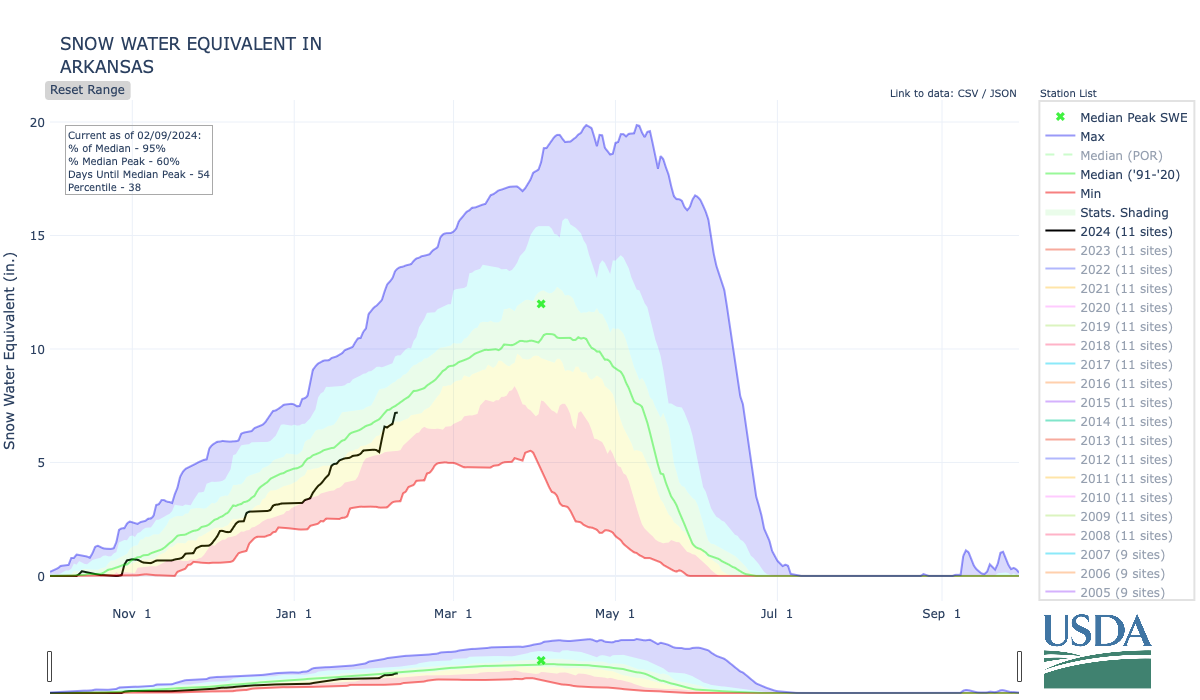
The project fits program goals to reduce depletions to Central Platte target flows and to protect, restore or maintain land used as habitat by threatened and endangered species — least terns, piping plovers and whooping cranes.
The basinwide plan allows entities in Nebraska, Colorado and Wyoming with federal licenses, permits and/or funding to comply with the Endangered Species Act. The U.S. Department of Interior is the other major participant.
The Elm Creek project will help meet an immediate goal to reduce by 120,000 acre-feet the annual depletions to target river flows set by the U.S. Fish and Wildlife Service for the protected species. Water held in shallow detention cells on the broad-scale site will seep into the groundwater that eventually reaches the adjacent Platte River.
Platte water will be diverted into Central Nebraska Public Power and Irrigation District’s Phelps Canal at times when flows exceed targets. According to PRRIP 1995-2017 data, that most commonly occurs in December and January.
A new pipeline built as part of the project links the canal to the 416-acre site where earthen berms up to 6 feet tall create eight shallow cells to temporarily hold water at depths of 12 inches or less.
Werbylo said the project budget is $4.3 million and there is $480,000 left to pay.
Dirt work needs to settle and vegetation is being established, he said, so it will be late spring to mid-summer 2020 before any water deliveries are made to the broad-scale project site.
PRRIP Executive Director Jason Farnsworth told the Hub that even if the original construction schedule had allowed the project’s use this fall, there would have been no diversions because of already high groundwater.
Here’s the release from the AWWA — Rocky Mountain Section:
The water has been tasted, the water has been tested and the winner of the “Best of the Rocky Mountain Section” water taste test has been announced! City of Fort Collins took first place with a panel of veteran judges and media reporters evaluating water appearance, quality, order, and taste, of course. Competition was stiffer this year with 15 municipalities, from Wyoming, Colorado and New Mexico, competing for the title of the best drinking water in the mountain west during the 2019 annual conference of the Rocky Mountain Section of the American Water Works (RMSAWWA) in Keystone, Colorado. You can learn more about the winner, City of Fort Collins Utility, by visiting http://www.fcgov.com. Second place was awarded to Aurora Water, Colorado with the City of Cheyenne Board of Public Utilities, Wyoming coming in third.
City of Fort Collins will now go on to represent the mountain west in the national “Best of the Best” water taste test at the American Water Work Association’s Annual Conference and Exposition (ACE20) in Orlando, Florida, June 14-17, 2020. Over 11,000 water professionals across the country will gather at ACE20 where the best-tasting tap water in North American will be declared.
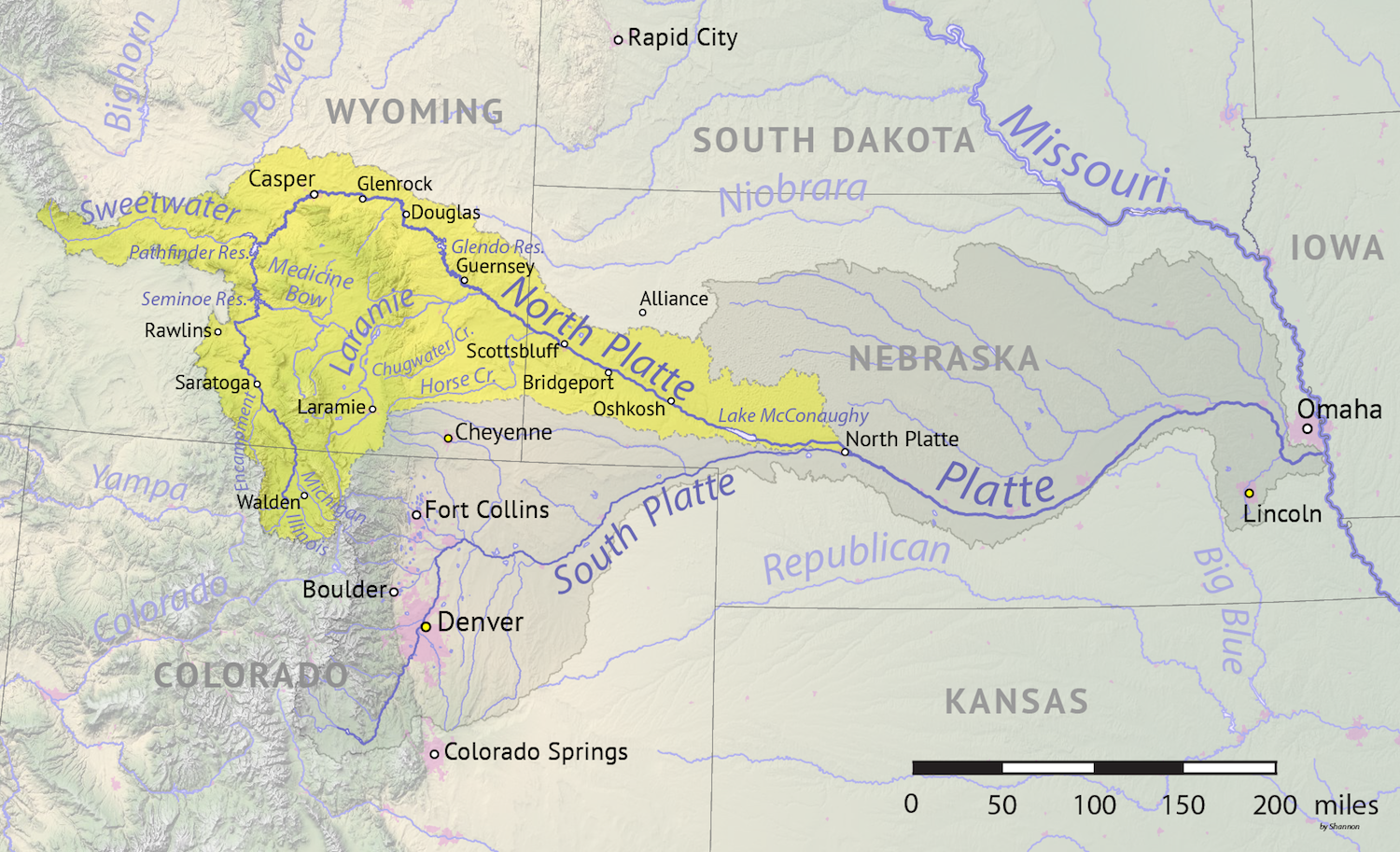
The RMSAWWA is the regional section for the AWWA, which is the largest non-profit, science-based organization in the world for drinking water professionals. The RMSAWWA covers Wyoming, Colorado and New Mexico and has over 2,400 members, representing water utilities, engineering consultants and water treatment specialty firms.
Gering-Ft. Laramie-Goshen canal. Photo credit: Wyoming Farm Bureau Federation
Here’s the release from Governor Gordon’s office:
Governor Mark Gordon expressed his gratitude to Wyoming and Nebraska’s congressional delegations, Nebraska Governor Pete Ricketts and State of Nebraska agencies, and especially to State of Wyoming agencies for their collaborative efforts to address the ongoing needs of farmers impacted by the July 17 Goshen/Ft. Laramie irrigation tunnel collapse. These efforts contributed to today’s announcement by the United States Department of Agriculture’s Risk Management Agency that crop losses and prevented planting due to the collapse will constitute an insurable event.
“We wouldn’t be here today if it weren’t for the diligent work of the Wyoming Office of Homeland Security, Wyoming State Geological Survey, Wyoming State Engineer’s Office and the Wyoming Department of Agriculture, alongside our counterparts in Nebraska, to help provide the necessary information to open the doors for crop insurance coverage for producers in the affected area,” said Governor Gordon. “The State of Wyoming will continue our ongoing efforts to obtain additional assistance for farmers impacted by this event. Many thanks to the numerous federal, state and local elected officials for bringing their resources to the table as well.”
The July 17, 2019 irrigation tunnel collapse and subsequent breach of a canal wall cut off irrigation to more than 100,000 acres of farmland in Wyoming and Nebraska. Work to repair the irrigation tunnel and stabilize a sinkhole that formed above the tunnel’s roof is continuing.
“The Wyoming Office of Homeland Security, our other sister agencies and Goshen Irrigation District have provided much-appreciated leadership since the collapse,” added Doug Miyamoto, Director of the Wyoming Department of Agriculture. “We need to continue this collaboration to ensure that the irrigation system is restored as quickly as possible. It is vital that we exhaust all avenues of potential assistance to our producers in the aftermath of this disaster.”