The unofficial results of Tuesday’s election are in, with Town of Pagosa Springs voters voting in favor of a 1 percent sales tax rate increase for sewerage and wastewater reuse facilities beginning Jan. 1, 2026. The following vote totals were accurate as of late Wednesday morning, Nov. 5. Election results will remain unofficial until Nov. 26, which is the deadline for county canvass boards to complete the canvass and submit the official election abstract to the Colorado Secretary of State’s Office.
“The voters confirmed loud and clear that we need to fix our ailing sewer collection and forced main system and to provide a long-term solution,” Pagosa Springs Town Manager David Harris wrote in a statement to The SUN. “We appreciate those who understand the necessity of this system and how it relates to the economic vitality of our community and region.”
According to the ballot issue, the increase is to “construct, reconstruct, improve, repair, better, extend, operate and maintain sewerage and wastewater reuse facilities to serve the town, including facilities of the Pagosa Springs Sanitation General Improvement District.
This November, voters in the Town of Pagosa Springs will decide if they want to raise the sales tax within town limits to fund critical sewer repairs and a wastewater treatment plant. On Aug. 19, the Pagosa Springs Town Council approved the second reading of an ordinance calling for the coordinated election and setting the language appearing on the ballot…
The town’s Public Works Department, in conjunction with an assessment by Roaring Fork engineering, has concluded that the overall system is rated as “poor” to “fair,” with the challenges including an aging pipe system (50 years of age on average) with one-third of the total system rated as needing “critical repairs or failing.” Most of the challenges stem from the 500-foot elevation gain the sewage must travel before it arrives for treatment at PAWSD’s Vista plant, the website indicates. The town has estimated that it will cost between $80 million and $100 million to make the system healthy and efficient, with $15 million needed “immediately” to repair the aging pipes just to keep the current system operational. After considering other options to fund the needed repairs and upgrades, such as raising rates on wastewater customers or raising property taxes, both town staff and the council determined that the sales tax option was “the most efficient” way to obtain the funding needed. Town Manager David Harris has stated that a 1 percent sales tax increase within the town would generate an estimated $3.6 million in the first year and take an estimated 25 years to generate all the funds necessary to complete the project, if the town decides to build its own treatment plant.
Dozens of small towns in Colorado have banded together to protest new wastewater treatment permits that are designed to protect state rivers and streams, saying they contain new rules that are too costly to implement and they haven’t had time to make the necessary changes to comply.
The controversy comes as climate change and drought reduce stream flows and cause water temperatures to rise, and as population growth increases the amount of wastewater being discharged to Colorado’s rivers.
In response to the towns’ concerns, the water quality control division of the Colorado Department of Public Health and Environment has taken the unusual step of holding off on taking enforcement action against at least some of the towns that say they can’t comply with the new regulations. It issued notice of its decision March 24.
“Some smaller communities have faced real technical and financial challenges meeting these new requirements,” CDPHE spokesman John Michael said in an email. “In response, we issued a temporary enforcement discretion memo to give systems time to work through compliance barriers without immediate penalties.”
Now Colorado lawmakers who represent the Eastern Plains have drafted a bill designed to help small communities cope with the new regulatory requirements by extending the time they have to build or upgrade new plants and raise the money to pay for them.
The issue came to a head last month. Akron Town Manager Gillian Laycock, whose town is trying to comply with its new permit, invited dozens of communities facing the same issues to attend a special meeting. Representatives from 64 towns attended along with lawmakers, Laycock said.
But problems have been brewing for years. The water quality control division has been battling a large backlog in wastewater discharge permits, meaning small towns have been allowed to operate their plants under old rules as they waited for their new permits to arrive. Laycock said Akron had been waiting for its new permit for at least eight years.
“We knew something was coming,” she said, “but this has been a shock.”
In recent years, lawmakers have given the division more money to hire additional people so that the backlog can be reduced and more towns can come into compliance with the new standards.
But Sen. Barbara Kirkmeyer, a Republican from Brighton, and Sen. Byron Pelton, a Republican from Sterling, said they are frustrated that the more than $2 million spent to address the problem isn’t helping.
“I told the CDPHE if they continue down this road, the folks out in the rural areas are about ready to tell them to pound sand,” Pelton said. “That’s how stressful it’s been for these small municipalities. The regulations just keep coming at them.”
Under the federal Clean Water Act, entities that discharge fluids into streams, including wastewater treatment plants and factories, must get approval from state water quality regulators to ensure what they’re putting into the waterways does not harm them.
Towns and water districts can receive either a general permit, which has standard terms and conditions, or individual permits, which take much longer to process, are typically more expensive and are often used by large systems in cities such as Denver.
The general permits were finalized in 2022 to help small towns comply with the stricter regulations quickly and at less cost, said Michael, the CDPHE spokesperson. But many haven’t been issued because of the backlog.
Akron finally received its new permit last October, Laycock said. But the town was unprepared for the strict new limits on what and how much can be discharged, the tight timelines to comply and the costs.
Once the new permit was issued, Laycock said, its old permit expired almost immediately, leaving the town out of compliance with the new regulations, exposing them to potential legal issues and fines.
The regulatory shock is understandable, but could have been avoided, according to Meg Parish, an attorney for the Environmental Integrity Project, a nonprofit focused on enforcing air and water pollution regulations. She previously worked for the state’s water quality control division and helped develop the new general permit that is causing current concerns.
“Some of these towns have really old permits,” Parish said. They’ve been allowed to continue discharging under a special administrative permit. In the interim, strict new standards have taken effect.
But she said the new rules shouldn’t have come as a surprise to anyone.
She said the new general permit was finalized after months of public work sessions and outreach meetings.
“We invited every small discharger in the state to participate. All the terms are on the state’s website….it literally says ‘if your (wastewater discharge) flow is this much, this is what your limit is going to be. There is no mystery.”
But Adam Sommers, an environmental engineer who has several clients trying to obtain new permits, said the process is cumbersome and expensive.
“Each permitting activity has a 180-day review period and if changes are needed, the clock starts over,” he said in an email.
“This frequently adds years to the schedule,” Sommers said. “The estimates engineers create are time sensitive. If years have passed between when they prepare the budget and when the project is constructed, they face affordability issues.”
Sens. Kirkmeyer and Pelton are working on a bill that will be introduced shortly forcing the CDPHE to give the towns more time to comply and help them address the financial challenges of the new regulations. It will also set strict deadlines on the permitting process, according to the latest draft of the bill. Kirkmeyer said the CDPHE has been helping with the new legislation.
Kirkmeyer said she was taking the unusual step of running the bill through the Joint Budget Committee because it approves the budget for the water quality control division and she wanted to send a strong message to the regulators.
“I want them to know we are serious about this,” she said.
Looking ahead, as water quality continues to deteriorate, treatment standards will continue to tighten, Parish said.
“One of the key realities is that wastewater treatment plants need to upgrade their plants and do better, and pollute less,” Parish said.
Laycock, the Akron town manager, said she understands the urgency of the problem but she said the state’s approach needs work.
“We are agricultural people and we love our land, but how do we as a town afford to meet these requirements? I understand what they are trying to do. But this is not the way to do it.”
The 40 million or so people who rely on the Colorado River for drinking, bathing, irrigating, cooling data centers or power plants, or filling their swimming pools with have a problem. The amount of water being pulled out of the river for all of this stuff exceeds the amount of water that’s actually in the river — at least during most years in the last couple decades. And on the rare exception that supply exceeds demand, the surplus does little to dent the deficit, resulting in perennially low reservoir levels and chronically high water-manager stress levels.
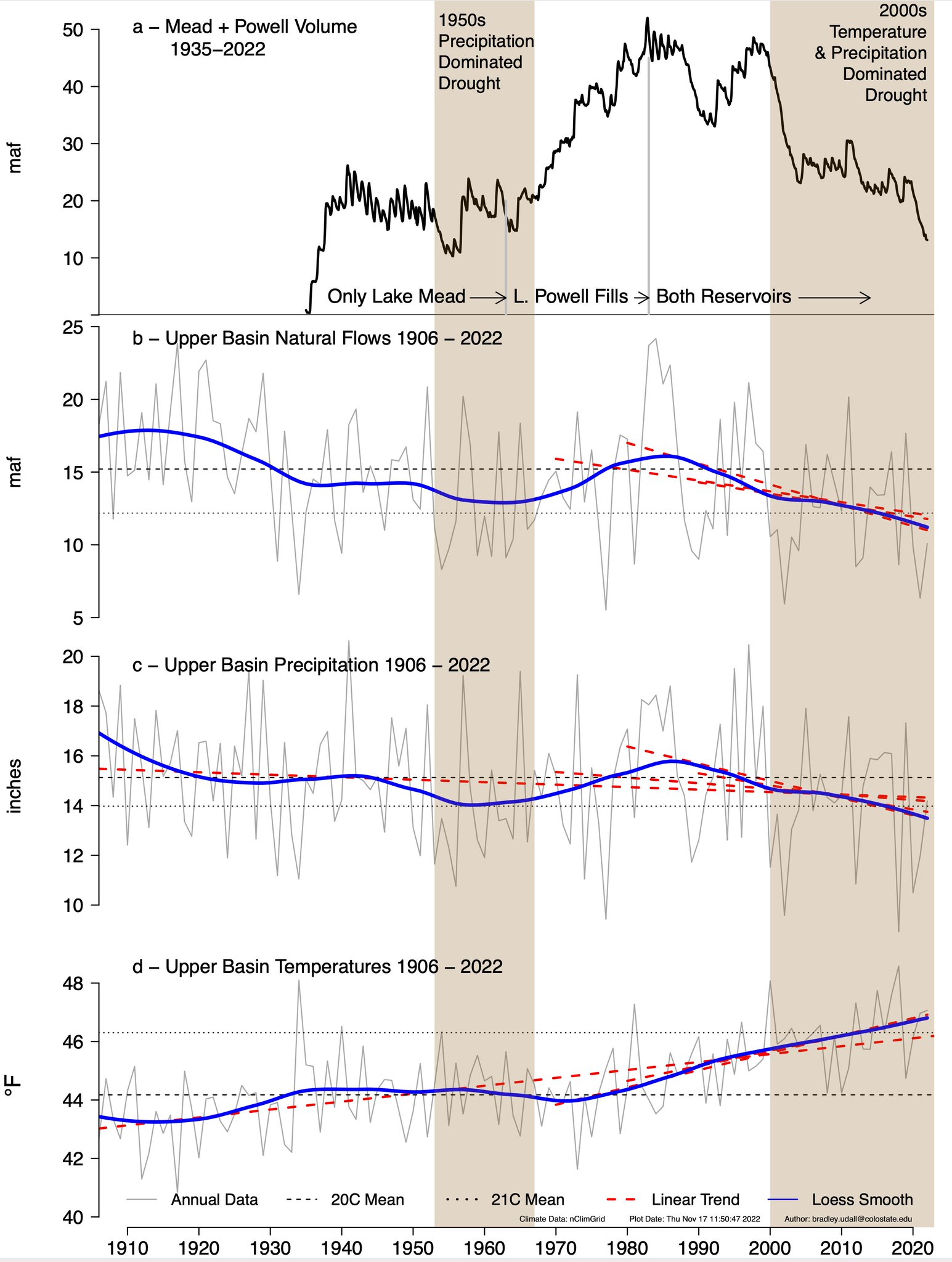
Udall/Overpeck 4-panel Figure Colorado River temperature/precipitation/natural flows with trend. Lake Mead and Lake Powell storage. Updated through Water Year 2024. Credit: Brad Udall
There is exactly one way out of this mess: The collective users simply need to use less.
Yet while the solution may be simple, it’s not exactly easy to carry out. That’s in part because people keep moving to the region, increasing demand. Plus, as the climate warms, we need more water to keep the crops or the grass or ourselves from drying up, making cutting consumption difficult and even dangerous.
An even bigger obstacle to reducing use is the societal urge to try to solve problems by consuming more, building more, and doing more (see the rise of the “Abundance” movement among American liberals). Using less goes directly against that urge (see Trump’s recent executive order titled: Maintaining Acceptable Water Pressure in Showerheads). That inclination drives the slew of schemes to try to produce more water, whether its by building dams, throwing dynamite into the sky, seeding clouds, desalinating seawater, or draining the Great Lakes and piping the water across the nation and over mountains to water Palm Springs golf courses. While it’s true that dams have given folks a bit more time to find a solution, building more of them now — with the exception of stormwater capture basins — won’t do any good (since even existing reservoirs are far from full).
But there is one thing we can do more of to help us consume less: recycling. While the idea of recycling water inspires turn-off terms like “toilet to tap,” the practice is actually quite common in the Colorado River states. (And, really, if you live downstream from any other community, you are probably drinking the upstream towns’ recycled wastewater, though that isn’t counted as recycling, per se.)
A new report out of UCLA’s Institute of the Environment & Sustainability gives the rundown on wastewater recycling in the Colorado River Basin, and reveals that Arizona and Nevada are way ahead of the Upper Basin when it comes to reusing water, yet still have room for improvement. And it finds that if all of the Colorado River states aside from Arizona and Nevada were to increase wastewater reuse by 50%, they would free up some 1.3 million acre-feet of water per year, which is about one-third of the way to the 4 million acre-feet of cuts deemed necessary.
To be clear, not all water recycling is “toilet to tap.” In fact, most is not. In Las Vegas, for example, treated effluent is used to irrigate golf courses, and it’s also returned back to Lake Mead, which is then credited against Nevada’s water allotment. And in Arizona, treated wastewater from the Phoenix-area is used for steam production and cooling at the Palo Verde nuclear plant (which evaporates a whopping 45,000 gallons of water per minute), and treated effluent is used to “recharge” groundwater aquifers (eventually ending up in taps).
While recycled water can be used to irrigate crops, you can’t really recycle irrigation water. That fact, in a way, is why Nevada is the leader in Colorado River water-recycling: Almost all of its allocation from the river goes to the Las Vegas metro area for public supply/domestic use, with virtually none of it going to irrigate crops. That means most of the water eventually goes into the sewer system, making it available for recycling. And that, in turn, makes it easier to slash water use in cities than on farms, further throwing off the balance between agricultural use and municipal use, and putting more pressure on farmers to either sell out or become more efficient, which has. Its own drawbacks.
Water recycling can have unintended side effects, too. While it’s nice that Palo Verde doesn’t rely on freshwater, the 72,000 acre-feet of recycled water it uses per year all evaporates — it is a zero water-discharge plant — meaning it does not soak into aquifers or otherwise benefit ecosystems, as it would if it were used to water parks or was discharged back into the Gila River. And, water treatment is highly energy-intensive, so the more water you want to recycle, the more power you’ll need.
Ultimately, using less water in the first place is going to be necessary. But recycling what we do use could help.
Senator Beck Basin on March 31. This is near Red Mountain Pass, one of the few SNOTEL sites in the San Juan Mountains that had a near normal snowpack on April 1. Andy Gleason photo.
⛈️ Wacky Weather Watch⚡️
In the days following my April 1 snowpack update, the snowpack updated itself, with a nice storm bolstering snow water equivalent levels by up to two inches in some places. But it was closely followed by an unusually warm spell, which erased all of the gains and then some. What that means is a relatively paltry spring runoff for many of the Upper Colorado River Basin streams, with water levels likely peaking earlier and at lower levels than in 2021. How much earlier and lower depends on how warm or cool (and dry or wet) the rest of the spring is, but at this point it’s safe to say it won’t be a big water year for irrigators or boaters.
I’m especially worried about the Upper San Juan River and the Rio Grande, both of which have their headwaters in the southeast San Juan Mountains, which are running close to empty, snow-wise. Yes, Wolf Creek got pounded by the April 6-9 storms, but it has also experienced some abnormally high average temperatures over the last several days — the average temperature in the Rio Grande Headwaters on April 12 was 45.5° F, compared to the median for that date of 32°. If that continues, what little snow is left will mostly be gone within weeks.
Meanwhile, the high temperature in Tucson and Phoenix, neither of which have received more than a hint of precipitation during the last eight months, exceeded 100° F on April 11, setting new daily records and further desiccating the soil.
It may seem a bit early, but I think it’s time to start predicting peak runoffs for Four Corners area rivers. I’ll start with the Animas, which I’m pessimistically predicting will peak on May 17 at 2,950 cubic-feet per-second, based on previous years’ snowpacks and peak runoffs. I say “pessimistic” because if I’m right, it would only be the fourth time this century that the Animas peaked below 3,000 cfs. Here’s hoping I’m wrong.
Waste rock from the Sunday Mine Complex near Slick Rock, Colorado. Jonathan P. Thompson photo.
⛏️ Mining Monitor ⛏️
Is the uranium mining renaissance upon us? I don’t think so. But the industry’s zombified carcass is beginning to twitch — figuratively speaking, of course. The stirrings include:
A couple of weeks ago, the Energy Information Administration crowed that U.S. uranium production last year was the highest in six years. That sounds huge, right? Really, it’s not: Production was virtually zero from 2019 to 2023, making last year’s total of 676,939 pounds look pretty good. But as recently as 2014 — which was not boom times, by any means — production was nearly 5 million pounds. The big 2024 producers were in-situ recovery operations in Wyoming and Texas, as well as Energy Fuels’ White Mesa Mill in southeastern Utah. It should be noted, however, that the White Mesa Mill’s production was not from the company’s mines, but from its “alternate feed program,” which is to say it extracted uranium from other folks’ waste streams.
Energy Fuels is now producing ore at its Pinyon Plain Mine near the Grand Canyon and hauling it by truck across the Navajo Nation to the White Mesa Mill. The company says it plans on beginning production and shipment at its La Sal and Pandora Mines as well. This represents the first conventional ore production in the U.S. in years.
Western Uranium & Vanadium says Energy Fuels has agreed to purchase up to 25,000 short tons of uranium ore from WU&V’s Sunday Mine complex near Slick Rock, Colorado, in the Uravan Uranium Belt. They plan to begin shipping later this year.
Meanwhile, there is plenty of noise around a potential nuclear renaissance, as tech giants look to promised advanced and small modular reactors to power their electricity-guzzling data centers. But there are no reactors yet. I tallied some of that talk for High Country News.
📸 Parting Shot 🎞️
McElmo Car. Jonathan P. Thompson photo-illustration.
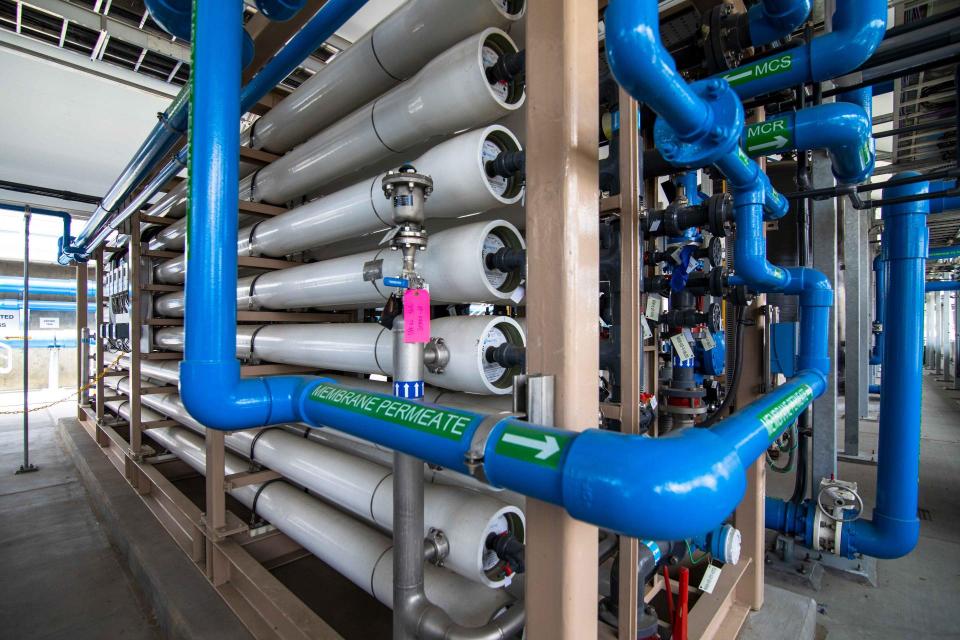
The recently opened PUR Water facility in Oceanside turns blackwater into potable water, or toilet to tap as it was once called, by pumping it into the ground then filtering it through a warehouse full of white filtration tubes. The colored pipes represent the different types of water at different stages. his facility in Oceanside, California turns recycled water into potable water by running it through filtration tubes. TED WOOD
Click the link to read the article on the Grist website (Matt Simon):
April 11, 2025
If you were to drink improperly recycled toilet water, it could really hurt you — but probably not in the way you’re thinking. Advanced purification technology so thoroughly cleans wastewater of feces and other contaminants that it also strips out natural minerals, which the treatment facility then has to add back in. If it didn’t, that purified water would imperil you by sucking those minerals out of your body as it moves through your internal plumbing.
So if it’s perfectly safe to consume recycled toilet water, why aren’t Americans living in parched western states drinking more of it? A new report from researchers at the University of California, Los Angeles, and the Natural Resources Defense Council finds that seven western states that rely on the Colorado River are on average recycling just a quarter of their water, even as they fight each other and Indigenous tribes for access to the river amid worsening droughts. Populations are also booming in the Southwest, meaning there’s less water for more people.
The report finds that states are recycling wildly different proportions of their water. On the high end, Nevada reuses 85 percent, followed by Arizona at 52 percent. But other states lag far behind, including California (22 percent) and New Mexico (18 percent), with Colorado and Wyoming at less than 4 percent and Utah recycling next to nothing.
“Overall, we are not doing nearly enough to develop wastewater recycling in the seven states that are part of the Colorado River Basin,” said Noah Garrison, a water researcher at UCLA and co-author of the report. “We’re going to have a 2 million to 4 million acre-foot per year shortage in the amount of water that we’ve promised to be delivered from the Colorado River.” (An acre-foot is what it would take to cover an acre of land in a foot of water, equal to 326,000 gallons.)
The report found that if the states other than high-achieving Nevada and Arizona increased their wastewater reuse to 50 percent, they’d boost water availability by 1.3 million acre-feet every year. Experts think that it’s not a question of whether states need to reuse more toilet water but how quickly they can build the infrastructure as droughts worsen and populations swell.
At the same time, states need to redouble efforts to reduce their demand for water, experts say. The Southern Nevada Water Authority, for example, provides cash rebates for homeowners to replace their water-demanding lawns with natural landscaping, stocking them with native plants that flourish without sprinklers. Between conserving water and recycling more of it, western states have to renegotiate their relationship with the increasingly precious resource.
“It’s unbelievable to me that people don’t recognize that the answer is: You’re not going to get more water,” said John Helly, a researcher at the Scripps Institution of Oceanography who wasn’t involved in the report. “We’ve lulled ourselves into this sense of complacency about the criticality of water and it’s just starting to dawn on people that this is a serious problem.”
Yet the report notes that states vary significantly in their development and regulation of water recycling. For one, they treat wastewater to varying levels of purity. To get it ultra pure for drinking, human waste and other solids are removed before the water is treated with ozone to kill bacteria and viruses. Next the water is forced through fine membranes to catch other particles. A facility then hits the liquid with UV light, killing off any microbes that might remain, and adds back those missing minerals.
That process is expensive, however, as building a wastewater-treatment facility itself is costly, and it takes a lot of electricity to pump the water hard enough to get it through the filters. Alternatively, some water agencies will treat wastewater and pump the liquid underground into aquifers, where the earth filters it further. To use the water for golf courses and nonedible crops, they treat wastewater less extensively.
Absent guidance from the federal government, every state goes about this differently, with their own regulations for how clean water needs to be for potable or nonpotable use. Nevada, which receives an average of just 10 inches of rainfall a year, has an environmental division that issues permits for water reuse and oversees quality standards, along with a state fund that bankrolls projects. “It is a costly enterprise, and we really do need to see states and the federal government developing new funding streams or revenue streams in order to develop wastewater treatment,” Garrison said. “This is a readily available, permanent supply of water.”
Wastewater recycling can happen at a much smaller scale, too. A company called Epic Cleantec, based in San Francisco, makes a miniature treatment facility that fits inside high-rises. It pumps recycled water back into the units for non-potable use like filling toilets. While it takes many years to build a large treatment facility, these smaller systems come online in a matter of months and can reuse up to 95 percent of a building’s water.
Epic Cleantec says its systems and municipal plants can work in tandem as a sort of distributed network of wastewater recycling. “In the same way that we do with energy, where it’s not just on-site rooftop solar and large energy plants, it’s both of them together creating a more resilient system,” said Aaron Tartakovsky, Epic Cleantec’s CEO and co-founder. “To use a water pun, I think there’s a lot of untapped potential here.”
Click the link to read the report on the UCLA website (Noah Garrison, Lauren Stack, Jessica McKay, and Mark Gold). Here’s the executive summary:
The impacts of climate change and prolonged drought on water scarcity in the Western United States have accelerated since the end of the 20th century. The Colorado River has been strained by a history of excessive withdrawals and long-term drought. Increasingly less water is available across the seven Colorado River Basin states—Arizona, California, Colorado, Nevada, New Mexico, Utah, and Wyoming—for natural ecosystems and the 40 million people that rely, in part or in whole, on its diverted flows to cities and farms. Faced with this challenge, the importance of recycled water at a large scale has never been greater. Water recycling of treated municipal wastewater is a cost-effective source of reliable, sustainable water supply; people shower, flush toilets, and wash clothes and dishes on a regular basis even in times of fluctuating water availability, and these waste flows go to publicly owned treatment works (POTWs) in urban areas.
To assess the current state of water recycling across the Colorado River Basin and its affected states, UCLA Institute of the Environment and Sustainability, in partnership with Natural Resources Defense Council, has investigated water recycling progress and policy development across the seven states in the basin. We analyzed the amount of water entering municipal wastewater treatment plants treating an average of greater than 1 million gallons per day across the 2022 calendar year, the amount these plants reclaim or reuse, and the amount they discharge back into the environment. Our analysis demonstrates that while individual treatment facilities, cities, or even regions may be making substantial progress toward water sustainability, most basin states are falling well short of their potential to reuse wastewater. Overall, the Colorado River Basin states are missing opportunities to ensure a safe, sustainable, climate-resilient supply of water in a hotter, drier future.
While across the Colorado River Basin, an average of 26% of municipal wastewater from POTWs was recycled, there are striking differences between states that are prioritizing reuse and those that are falling behind. Arizona (reusing 52% of treated wastewater) and Nevada (as much as 85%) deserve accolades for their efforts to develop the recycled water supply. California, which produces by far the largest volume of wastewater, only recycled 22% of its treated wastewater in 2022. Of the remaining four states, New Mexico recycles a similarly modest 18%, and Colorado (3.6%), Utah (less than 1%), and Wyoming (3.4%), for a variety of state-specific reasons, have made little to no progress to date on reusing meaningful volumes of treated wastewater. Further and distinct breaks appear to exist between efforts and progress made by states in the lower Colorado River Basin (Arizona, California, and Nevada) and those of the upper basin (Colorado, New Mexico, Utah, and Wyoming). In 2022, the upper basin states as a whole recycled less than 5% of their assessed influent, as compared to more than 30% for the lower basin. (See Figure EX-1 for state-by-state results of our analysis.)
Figure EX-1. Volume of municipal wastewater effluent vs. current reuse by state across the Colorado River Basin for 2022. Totals include figures for the whole state, not only for wastewater generated in the Colorado River watershed. Credit: UCLA
In addition to the lack of progress on wastewater reuse, the overall lack of data on wastewater recycling, including volume, level of treatment, and end use of the recycled water is also glaring. California maintains the most comprehensive database of recycled water, including its end uses, through the California Open Data Portal (see SWRCB, 2022). While we were able to gather data directly from individual wastewater treatment facilities in other states, determining how much water is being recycled was a significant challenge, and determining how much recycled water is ultimately directed to municipal, agricultural, or industrial users was often limited to qualitative description, if information was available at all.
All of the state results have been achieved in the absence of strong federal recycled water policy or any federal regulation. The lack of federal support for or consistency among state programs has hampered efforts and stands as a significant impediment to further growth of recycled water use. Promoting consistent and growing national water reuse will require action at both the federal and state level.
To this end, through our investigation we have developed a set of recommendations for the U.S. Environmental Protection Agency (EPA) and other federal and state partners and stakeholders. Additional detail and guidance for these recommendations is presented in the main report body and conclusions. These recommendations include the following:
Within two years, EPA, working with state partners, water agencies, and nongovernmental organizations, should develop a model state program and ordinance for recycling of municipal wastewater with minimum elements.
EPA should improve data acquisition and management, including developing guidance for standardized facility-level reporting and state data sharing, to ensure availability of information and comparability of data between states.
EPA should further develop and disseminate the latest science and technical information on treatment processes and pathogen risk assessment for different sources of water and reuse applications.
In partnership with the states, EPA should develop wastewater reuse goals and timelines.
EPA—working with other federal agencies including the Bureau of Reclamation and the Departments of Agriculture, Energy, and Defense—should develop and implement funding strategies beyond those already in existence, including furthering the Pilot Program for Alternative Water Source grants.
In addition, our analysis uncovered that, across the Colorado Basin states, inconsistency between programs and overall lack of state-level oversight or even awareness of wastewater recycling efforts in several states is alarming. Recommended improvements needed at the state level for those states without these programs include:
Work with local water reclamation or reuse agencies to develop funding strategies to meet targets for 30%, 40%, or 50% goals.
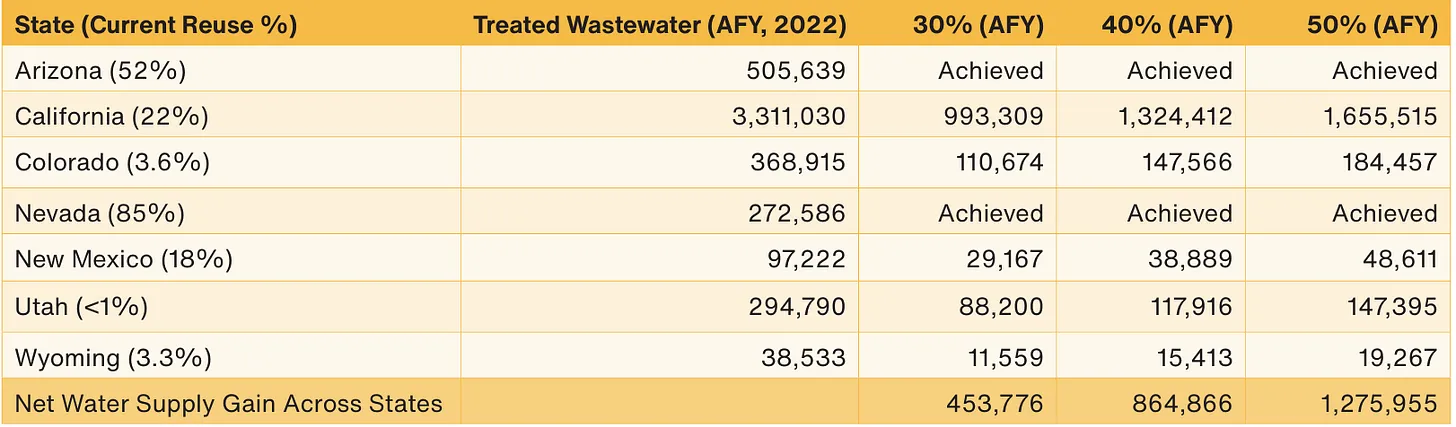
Work with EPA to establish numeric targets for wastewater reuse for each state, with timelines and interim goals. Figure EX-2 provides a breakdown of the total water supply that would be made available for each state with targeted goals of 30%, 40% or 50% reuse by 2040, a number already exceeded by two of the basin states.
Improve data acquisition and management, as well as reporting requirements where applicable, for wastewater treatment facilities and wastewater reuse operations.
Conduct assessments of current state legal and regulatory requirements to identify barriers to wastewater reuse and develop formal state policies for overcoming those barriers.
Overall, substantial action needs to be taken to achieve sustainable water management across the Colorado River Basin. Better use of climate modeling, water pricing that does not encourage waste and unreasonable use, stronger water conservation and efficiency programs and requirements for agricultural and urban users, enhanced stormwater capture, greater and longer-term cutbacks in Colorado River water withdrawals, and, critically, a substantial increase in water reuse all must be embraced as climate resiliency solutions.
Figure EX-2. Recycled water volume created for each state at targeted reuse percentage of 30%, 40%, and 50%of the state’s total wastewater influent, with net increase in overall potential available water supply. Credit: UCLA
As shown in Figure EX-2, if the Colorado Basin states other than Arizona and Nevada were to increase wastewater reuse to even 40% of treated influent it could increase current recycled water availability by nearly 900,000 acre-feet per year (AFY) over current efforts. Reuse of 50% of influent would increase water availability by nearly 1.3 million AFY. This represent a significant percentage of the projected shortfall on the Colorado River, and a rsolution that should be pursued aggressively to ensure sustainable management of the river.
Map of the Colorado River drainage basin, created using USGS data. By Shannon1 Creative Commons Attribution-Share Alike 4.0
When the flow of visitors in Steamboat Springs rises during heavy tourism times, so too does the waste, making management of the Steamboat Springs Wastewater Treatment Plant a challenging and often smelly job.
“It’s significantly harder to run a wastewater treatment plant in a resort town that sees a big influx of visitors than in a city where your population is static,” said Jon Snyder, the public works director for Steamboat Springs. “Consistent population makes a biological process easier to manage.”
The plant’s operational status averages 60% capacity, but utilization can range from 26% during “mud season” when Steamboat sees fewer people in town to a record high of 72% in January 2022, explained Gilbert Anderson, plant superintendent. The maximum 24-hour flow into the plant can fluctuate widely during the year; for example, the flow in 2024 peaked at 7.14 million gallons per day on April 5 and was the lowest at 1.87 million gallons per day on Oct. 16, Anderson reported. During specific atmospheric conditions such as on cold mornings with temperature inversions — especially during the busy holiday times of Christmas, New Year’s and Presidents’ Day — the waste smells may be most noticeable to nearby homeowners, Snyder said. The vintage 1980 plant maintains a six-step process inside buildings to try to contain as much odor as possible, Snyder said. Yet, residents say the wastewater smells can be noticed at homes downwind and in nearby neighborhoods
Click the link to read the report on the Pacific Institute website (Shannon McNeeley, Morgan Shimabuku, Rebecca Anderson, Rachel Will, Jessica Dery). Here’s and excerpt from the summary:
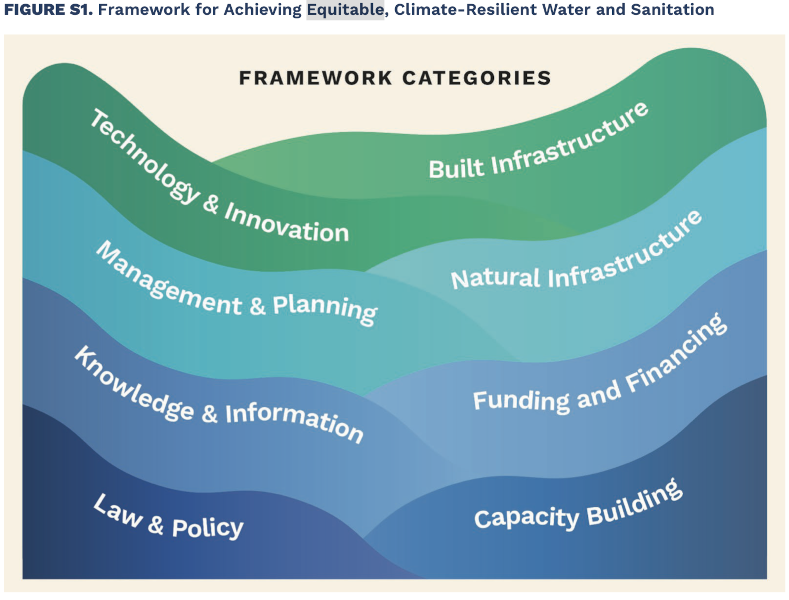
As climate change intensifies and causes more frequent extreme storms and catastrophic floods, raises sea level, intensifies heat waves and droughts, and sparks more intense wildfires, frontline communities in the US will be at greater risk of losing access to safe, reliable drinking water and functional plumbing (Pacific Institute and DigDeep 2024). However, frontline communities are resilient, and they are finding ways to overcome the myriad barriers and challenges they face from climate change to create equitable, climate-resilient water and sanitation access and systems. This report aims to identify documented strategies and approaches for achieving equitable, climate-resilient water and sanitation for frontline communities in the US. To do this, we first asked: What is equitable, climate-resilient water and sanitation? What are its characteristics or attributes? And what are communities, organizations, and government agencies doing to achieve it? We developed an eight-part framework to organize, categorize, and communicate the attributes, and then we identified documented strategies and approaches for achieving this goal. In doing this we reviewed academic publications, government and NGO reports, and online resources and tools. In addition, we solicited input from experts in the field at convening events and through online meetings and discussions. We primarily focused on literature, resources, and case examples from the US but drew on literature from non-US contexts when relevant.
Note: The figure depicts the eight categories of climate-resilient and equitable water and sanitation, which serves as the organizing framework for the attributes and corresponding strategies in the report. The visualization incorporates themes and colors from the Pacific Institute’s logo, using wave imagery to emphasize the eight framework categories and their interconnections in building equitable, climate-resilient water and sanitation systems. Figure designed by Pacific Institute and DigDeep, graphic design by Max Olson, DigDeep
While the framework includes the law and policy category, this report does not include this section. We will address this topic in a future report that focuses on law and policy attributes and criteria for identifying laws and policies necessary for achieving equitable, climate-resilient water and sanitation in frontline communities. We also covered law and policies in part 2 of this series titled Law and Policies that Address Equitable, Climate-Resilient Water and Sanitation: Water, Sanitation, and Climate Change in the United States Series, Part 2.
The Town of Palisade is pursuing a federal grant that would help it fund the remediation and regrading of its sewer lagoons and turn a portion of that property into a constructed wetlands for migrating waterfowl. Town Administrator Janet Hawkinson told the Palisade Board of Trustees at its Tuesday meeting that the grant is through the Bureau of Reclamation and could provide several million dollars without requiring a match.
“We are working right now with our town engineers on a cost estimate to look at if it’s $2 million, $3 million or $6 million we’ll request for this grant application,” Hawkinson said.
The town has a grant and loan from the Department of Agriculture to build a pipeline to the Clifton Sanitation District’s wastewater facility for its sewage. Once that is complete the current lagoons will be remediated. Palisade Community Development Director Devan Aziz said the proposed plan would improve water quality, mitigate health hazards and restore habitat in the area of the sewer lagoons. The lagoons are located along the Colorado River just east of Riverbend Park.
“The proposal would be to create a constructed wetlands for migratory waterfowl, as well as removing invasives like tamarisk and Russian olive and enhancing plant biodiversity,” Aziz said. “This project directly addresses drought related habitat loss while fostering environmental regeneration.”
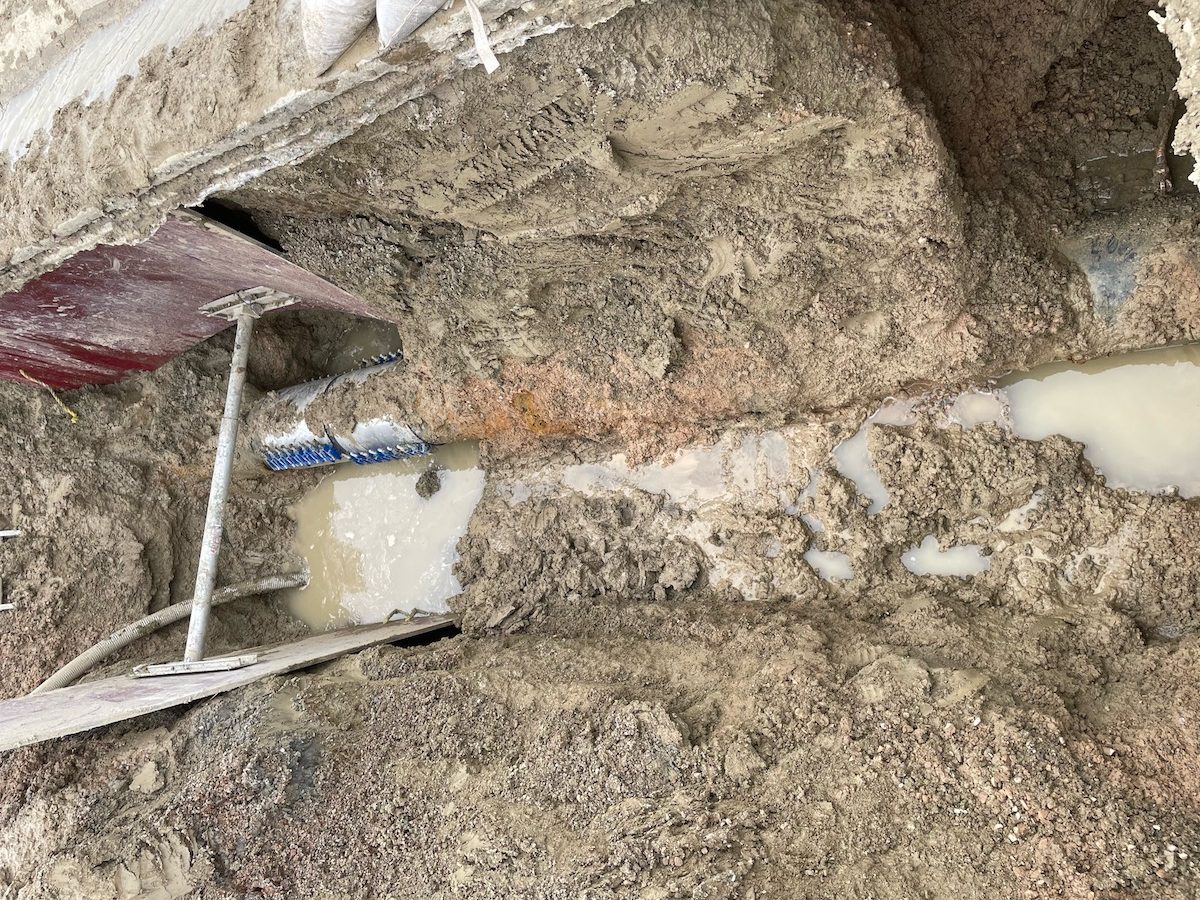
Crews scrambled in 2023 to repair multiple breaks in a water pipeline that serves the twin towns of Kemmerer and Diamondville. (courtesy/Kemmerer-Diamondville)
Waking up to long-overdue system upgrades, dozens of towns that were awarded federal ARPA dollars may see them ‘clawed back’ for lack of resources to complete paperwork.
This story is part of an ongoing series between WyoFile and The Water Desk exploring water issues in Wyoming. —Ed
After a town council shakeup, Micah Foster was suddenly mayor of his tiny eastern Wyoming agricultural town. A wave of resignations last April meant that in addition to getting up at 2 a.m. each day for his regular job — delivering bread to grocery stores for Bimbo Bakeries — Foster found himself running his 400-person town.
In June, as Foster was still adjusting to his new role, he got some good news. Lingle was awarded a $1.4 million American Rescue Plan Act grant to upgrade aging sewage pipelines — a big deal for any small town, sparing it from having to borrow the money because it cannot possibly raise rates high enough to cover such an expense. Lingle even secured the required 10% match from the state, Foster said.
But there was a hitch. To complete the required engineering plan, the town still needed the cooperation of BNSF Railway to cross its tracks on the south side — a slow process and an effort that the town’s small, overworked staff struggled to accomplish.
Wyoming officials, in July, reminded town leaders that the engineering plan must be complete, contracts signed and the project “shovel-ready” by Oct. 1, or the state would be forced to revert, or claw back, the grant to pre-empt the federal government from taking the money back — from Lingle and the state.
“There’s no way we can get that done,” Foster said, adding, “We’re not Cheyenne,” referring to the capital city’s advantage in having a full professional staff. “We don’t have an engineer on staff to do this and push it. So we were happy [when initially approved for the grant] and then we were sad.
“It’s like dangling a carrot in front of you but it was never really there,” he added.
Many Wyoming towns and entities that have been awarded ARPA grant dollars administered by the state worry they may suffer the same fate. In August, the Office of State Lands and Investments hosted a webinar with municipalities and others, striking a tone of urgency as staff reiterated the Oct. 1 deadline to prove ARPA grant projects are ready for shovels to hit dirt, or lose the money.
“We want to have this opportunity to make long-term investments with these dollars,” Wyoming Grants Management Office Administrator Christine Emminger told attendees. “So create the pressure on your contractors to get these dollars obligated, get them contracted at your local government or your entity level. Because if they are not contracted, and you do not provide that evidence to the Office of the State Lands and Investments (OSLI), we will have to go back and recapture those dollars.”
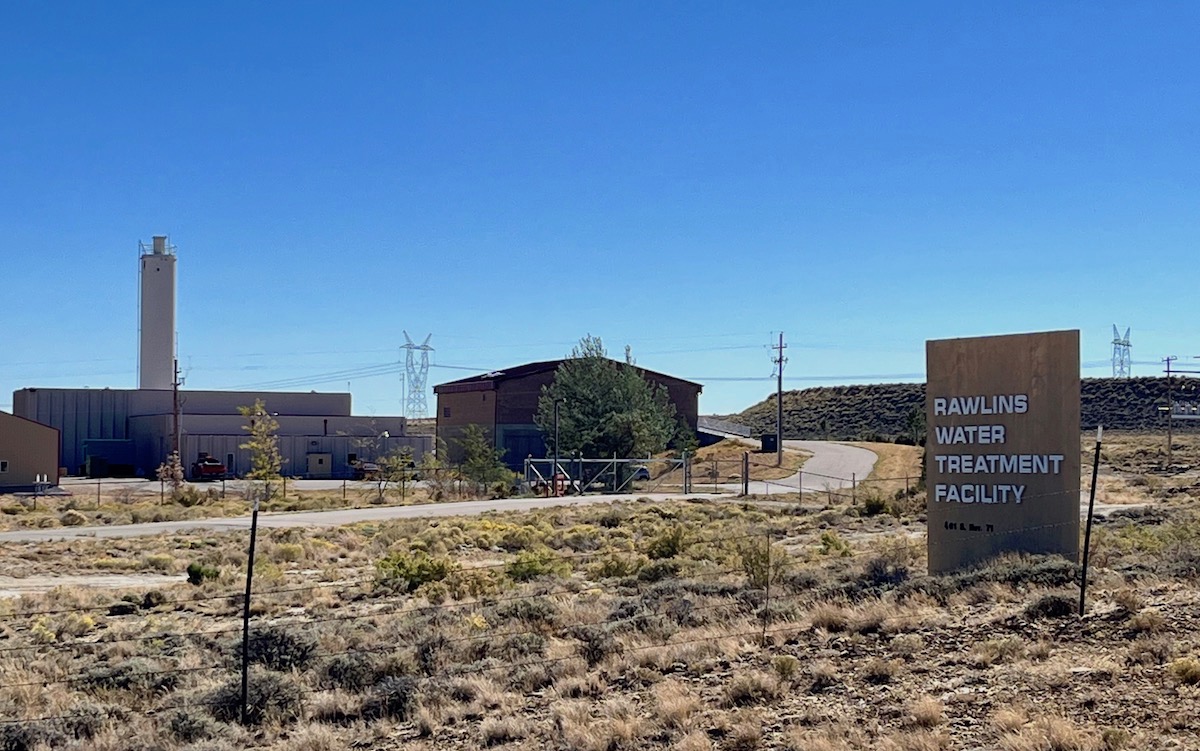
The Rawlins water treatment facility, pictured Sept. 16, 2022. (Dustin Bleizeffer/WyoFile)
More than 50 of 159 state-administered ARPA grant recipients for water and sewer projects have yet to file completed compliance documents to avoid recapture, according to state officials.
“OSLI is in regular communication with all the entities that have not yet provided the necessary information, and are making every effort to provide assistance, where possible,” Gov. Mark Gordon’s press secretary Michael Pearlman told WyoFile.
The state is also facing a tight deadline, and is at risk of losing potentially tens of millions of federal dollars that budget-strapped communities desperately need. Wyoming’s mineral royalty revenues, which used to fund such water infrastructure funds, are drying up due to the declining coal industry.
State officials, under the guidance of the governor’s office, will determine in October which ARPA grants to claw back, then rush to “redeploy” those dollars before the federal government’s Dec. 31 deadline, they say. Though Gordon has indicated his priorities for redeploying ARPA dollars, exactly who and what projects the state might choose before the end of the year is yet to be determined.
“Any funds available after the Oct. 1 deadline may be deployed to local governments to reimburse or reduce local matches for previously approved water infrastructure projects,” according to an Aug. 19 press release from the governor’s office.
Meanwhile, there’s an increasingly urgent need among Wyoming towns to update water and sewer systems.
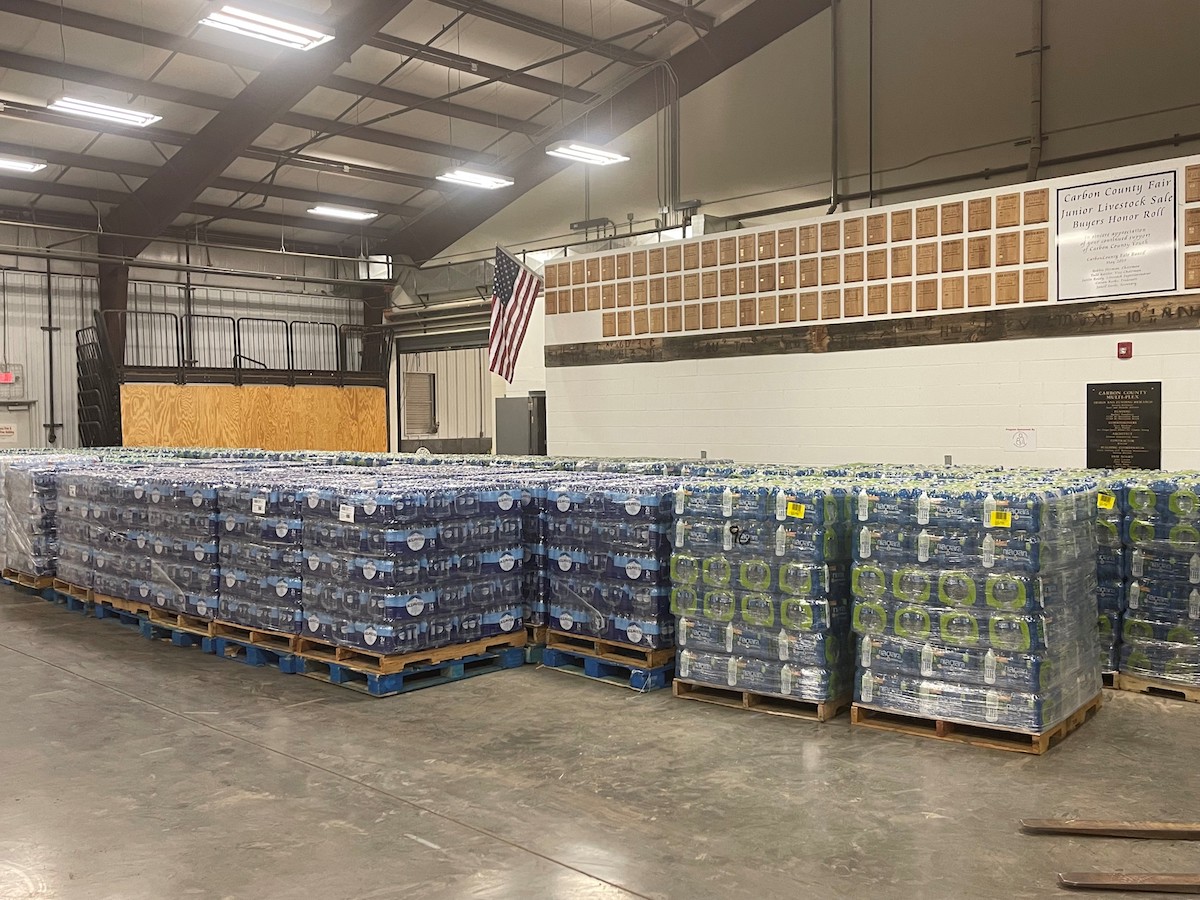
A stockpile of bottled water was collected to help residents in Rawlins and Sinclair to get through a temporary boil advisory in March 2022. (courtesy/City of Rawlins)
The neighboring oil boom-and-bust towns of Midwest and Edgerton in the middle of the historic Salt Creek oilfield are relying on ARPA dollars to help cover an estimated $5 million cost to replace 7 miles of potable water pipeline at risk of corrosion due to acidic soils in the oilfield.
In the neighboring towns of Kemmerer and Diamondville (with a combined population of about 3,000) in the state’s southwest corner, town officials have described a chicken-and-egg dilemma to fund long-overdue upgrades necessary to not only meet current demands, but to meet the needs of construction workers arriving for the $4 billion Natrium nuclear energy project already underway. The construction workforce is expected to peak at 1,600 in 2028, although many of the workers will commute from other nearby towns, according to officials. Project developers, backed by both the U.S. Department of Energy and Microsoft billionaire Bill Gates, say it’s up to local government entities in Wyoming or the federal government to make any needed investments.
Human-caused climate change plays a role, too, forcing many towns to consider increasing competition for secure sources of water made more scarce due to warming and drying trends.
Cascading water challenges
Sometimes when you patch a leak, you spring another one down the line. Then another, and another.
That was the challenge for city water crews in Rawlins over Labor Day weekend. They chased and patched six leaks at gushing “weak points” in the aging municipal water system that serves both Rawlins and neighboring Sinclair without major interruptions to water deliveries, according to officials.
Rawlins relies on several natural springs in the Sage Creek Basin for its municipal water supply. (courtesy/City of Rawlins)
It’s a routine that many water crews in Wyoming towns have become well practiced at in recent years: Fixing one leak in a frangible network begets another — a result of depressurizing then re-pressurizing segments of pipe. The problem worsens when you’re dealing with an aging system long overdue for upgrades.
And towns like Rawlins aren’t just patching leaks. They’re looking at systemwide water and sewer upgrades vital to simply meet existing demand, not to mention potential population growth and previously unfathomed pressures of climate change.
In March 2022, Rawlins residents were under a boil order for nearly a week due to a “catastrophic” failure in the 100-plus-year-old wood-stave pipelines that deliver the majority of water to the municipal system from springs 30 miles south of town.
In addition to the expense and task of gradually upgrading the wooden pipelines — nearly 2 miles have been replaced so far — the town also brought back online a long-derelict pre-water treatment plant so it can supplement its water supply by pumping from the North Platte River, as needed. Flow from the springs that provide Rawlins and Sinclair most of their water varies greatly, depending on seasonal snowpack, according to city officials. And those seasonal flows are only becoming more unpredictable.
All told, it will take nearly $60 million for necessary water system upgrades, according to Rawlins officials. They’ve already had some success landing grant dollars from state and federal sources, including ARPA dollars. But to secure those grants, and other fundsin the form of loans, water users have been asked to pony up.
The average residential water utility bill has increased by about $30 per month since 2022, officials say.
“Our rates were too low to support the maintenance and the work that we have to do on our lines,” Rawlins City Manager Tom Sarvey said.
“A lot of these grants or loans require that you show community buy-in,” Rawlins spokesperson Mira Miller said. “So you can’t apply for these things if you can’t show that you are charging your customers a fair rate.”
Rawlins — because it’s been in emergency mode for the past two years — is confident about the security of its state-administered ARPA funding so far, according to officials. But many other towns with pressing water system improvement needs aren’t so sure.
Many small towns, even those that clearly qualify for federal grants, struggle to complete engineering and other required planning in the arduous process due to a basic lack of resources and expertise, Wyoming Association of Municipalities Member Services Manager Justin Schilling said.
Kemmerer, population 2,800, was selected as the host community for TerraPower’s Natrium nuclear reactor power plant. (Dustin Bleizeffer/WyoFile)
“Municipal government, it’s a constant rotation of people, so they might not have been aware how urgent [completing grant requirements] was,” Schilling said. “So, we had a bunch of these small communities that got a lifeline tossed to them, but because of engineering delays, the state’s got to pull it back and slide it to shovel-ready projects so that it doesn’t just go back to the feds.”
State officials, in their August webinar with ARPA recipients in the state, fielded about a dozen questions from concerned community leaders.
“I know the process has been cumbersome,” State Loan and Investments Grants and Loans Manager Beth Blackwell told attendees, adding that state officials knew all along that the ARPA requirements were going to be a major challenge for many small, resource-strapped towns to meet. “My staff is working extremely hard, and it’s just, we’ve got to make sure that at the end of the day, the state’s not on the hook to paying these funds back.”
In Lingle, without the ARPA grant, there’s no alternative plan in the works to fund the wastewater system upgrades, Mayor Foster said.
On September 3, 2024 the board of the Pagosa Springs Sanitation General Improve- ment District (PSSGID) voted to move $500,000 from town funds to kick-start critical repairs on its sewer system, pushing off a bigger decision on financing for a larger overhaul of the system. Public Works Director Karl Johnson said that he fears a “catastrophic event” could be in the cards if the district doesn’t do something now to shore up the system.
Town Manager David Harris added, “We need to get moving here … and we need to move sooner rather than later.”
Johnson explained to the board that the biggest project on the district’s radar would be to continue repairing what has been deemed category 4 and 5 problems with sewer pipes, as well as its obligation to upgrade the Vista Treatment Plant, owned and operated by the Pagosa Area Water and Sanitation District (PAWSD), to bring it into compliance with state Regulation 85.
The Pagosa Area Water and Sanitation District (PAWSD) Board of Directors discussed funding mechanisms for the district’s regulatorily required upgrades to the Vista wastewater treatment plant at its Aug. 29 meeting. Following a discussion, the board directed staff to move forward with seeking funding through a revenue bond publicly issued by the district to finance upgrades to the Vista plant required by Colorado Department of Public Health and Environment (CD- PHE) Water Quality Control Com- mission Regulation 85, in addition to other collection system improve- ments mandated by the CDPHE. Regulation 85 requires that certain wastewater treatment plants in the state reduce the amount of nutrients, such as nitrogen or phosphorus, con- tained in the outflows of treated water from the plants.
Oak Creek officials are moving quickly to address needed rehabilitation work at the Sheriff Reservoir Dam while also working to identify and undertake improvements to the town’s drinking water and wastewater treatment systems. Town Council members on Thursday approved $10,000 in funding to hire W.W. Wheeler & Associates in its effort to secure funding for the dam rehabilitation project. In a separate decision, council approved $50,000 for an agreement with AquaWorks DBO Inc. to support wastewater and drinking water improvements needed for the town to comply with state and federal regulations…
Built in 1954 and located 12 miles southwest of Oak Creek within the Medicine Bow-Routt National Forest in Rio Blanco County, the Sheriff Reservoir Dam is owned and operated by the town of Oak Creek. The dam is currently subject to storage restrictions and is considered a “high-hazard embankment dam,” according to the state’s Division of Water Resources. Conditions leading to that designation include inadequate spillway capacity and operational issues linked to an aging low-level outlet works gate. Other issues include a sinkhole discovered in the dam’s foundation and outlet issues linked to a stem casing that is not watertight and a gate that does not close properly. W.W. Wheeler & Associates estimates total cost of the rehabilitation work to be $5.5 million…
A pilot wastewater treatment project in the Wet Mountain Valley west of Pueblo just got a boost from a state grant. The project is designed to address challenges some small communities are having in meeting increasing federal environmental standards combined with the demands created by a growing population. The system calls for upgraded wastewater lagoons stocked with specialized microbes, as well as a technology known as electrocoagulation to help clean sewage from water. Dave Schneider manages the Round Mountain Water and Sanitation District in Westcliffe and Silver Cliff. He said they’ve run small scale tests that show their concept works. The next step is to run a larger scale test on the upgraded lagoon system. They’ll also do separate assessments of the electrocoagulation component to determine whether it is necessary.
“What are the challenges we have (on a) big scale?” he said. “We might have to do one or two different tweaks that we might not have initially planned, but we’re going to find a methodology in this that will work.”
The state Department of Local Affairs awarded a $546,750 grant to the district to help fund the $800,000 pilot project…Schneider said they hope to submit the plans for the demonstration project to the state health department for approval this fall and get the upgrades started next spring.
Click the link to read the blog post on the Water — Use it wisely website (Amy Peterson):
May 6, 2024
This blog was originally featured on Water – Use It Wisely and was written by Amy Peterson, an Environmental & Water Resource Manager at the City of Surprise
THIS IS GOING TO “Be GROSS” It’s time to talk about something unpleasant, folks, because what you flush matters, and I’ll tell you why. Hold onto your seats while I take you through a guided tour of a typical wastewater treatment plant.
SOCKS, BASEBALLS, AND RUBBER DUCKIES. OH MY.
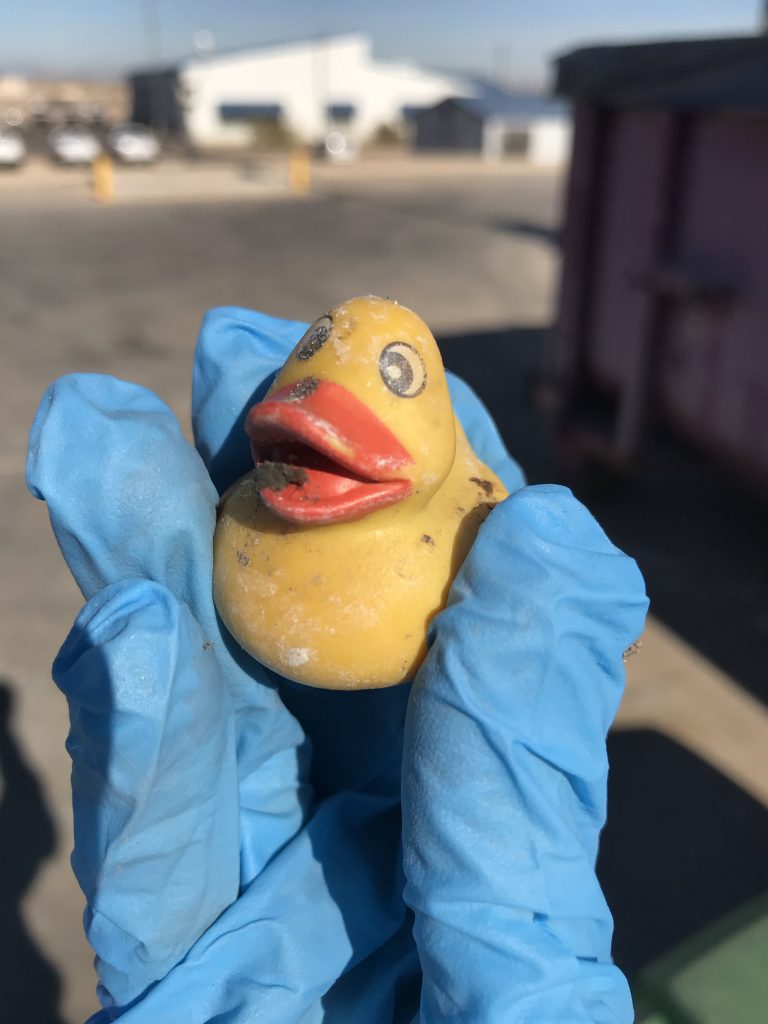
On any given day, wastewater treatment operators encounter a staggering variety of strange objects while operating and maintaining the equipment at their treatment plants. If it is small enough to fit through a typical household pipe, we’ve seen it. While at my job, I personally have encountered baby wipes, sanitary wipes, floss, hair, socks, miscellaneous clothing, a rubber ducky, thousands of feminine products, latex products (you know what I mean), a car key fob, ID badges, bandages, fruit stickers, candy wrappers, a regulation-sized baseball, and a twenty-dollar bill. Some of my colleagues in sewer collections have even claimed to find jewelry from time-to-time while emptying out their vacuum trucks at the landfill. While these “treasures” make for funny anecdotes, they can actually create major problems in the sewer pipes as well as the treatment plants.
It’s hard to believe that this duck is still smiling after what it’s been through. Photo credit: Water Use it Wisely
The simple truth is that napkins, paper towels, “flushable” wipes (they’re not really flushable), and other paper products should NOT go down the toilet. Period. Let alone any of the other oddities I mentioned previously.
BREAK IT DOWN FOR ME.
Toilet paper has been specifically engineered as a one-time-use product that is durable enough to “do the job” but breaks down fairly quickly when submerged and subjected to the scouring forces of the sewer or wastewater system. Other paper products, while biodegradable in the long run, do not break down quickly enough to be processed at a wastewater treatment plant. In fact, if they do make it through the miles of sewer pipe without accumulating and causing a blockage, they will have to be physically removed at the inlet end of the plant for the treatment process to continue effectively. Why is that? Traditional wastewater treatment is engineered and designed to stabilize organic waste. In other words, the main process used to treat municipal waste is the same biological process of decomposition that happens in nature—but done at an industrial scale. In order to process the millions of gallons (sometimes hundreds of millions at larger plants) of municipal waste that we receive every day, the raw waste must be entirely broken down by the time it gets to our bioreactors. (Note: a bioreactor is a large tank where the biological processes of wastewater treatment occur. It is the heart—or rather the stomach—of a wastewater treatment plant.)
While treatment plants are designed with an initial trash-removal step that we call “headworks,” the system is not foolproof, and solid debris often does make it past the initial removal phase, causing problems with downstream equipment.
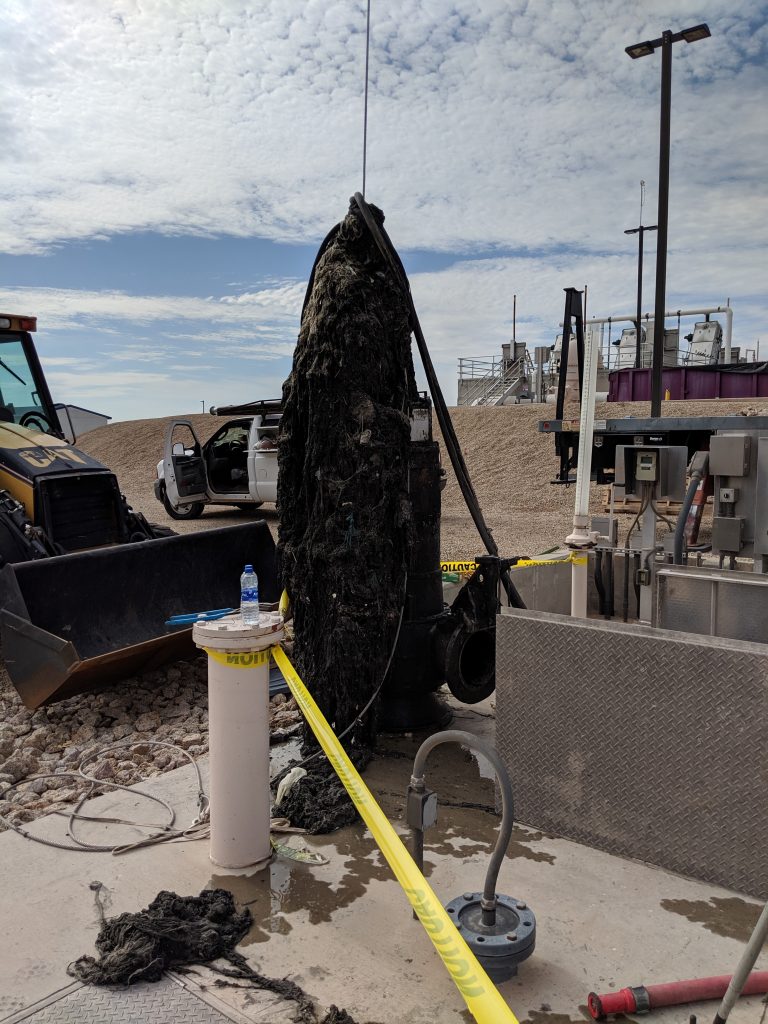
Found Cousin It! Rags that get caught in the system can include flushable wipes, tampons, napkins, Kleenex, hair, floss, water bottles, towels and clothing, or candy wrappers. Photo credit: Water Use it Wisely
SHOW AND TELL.
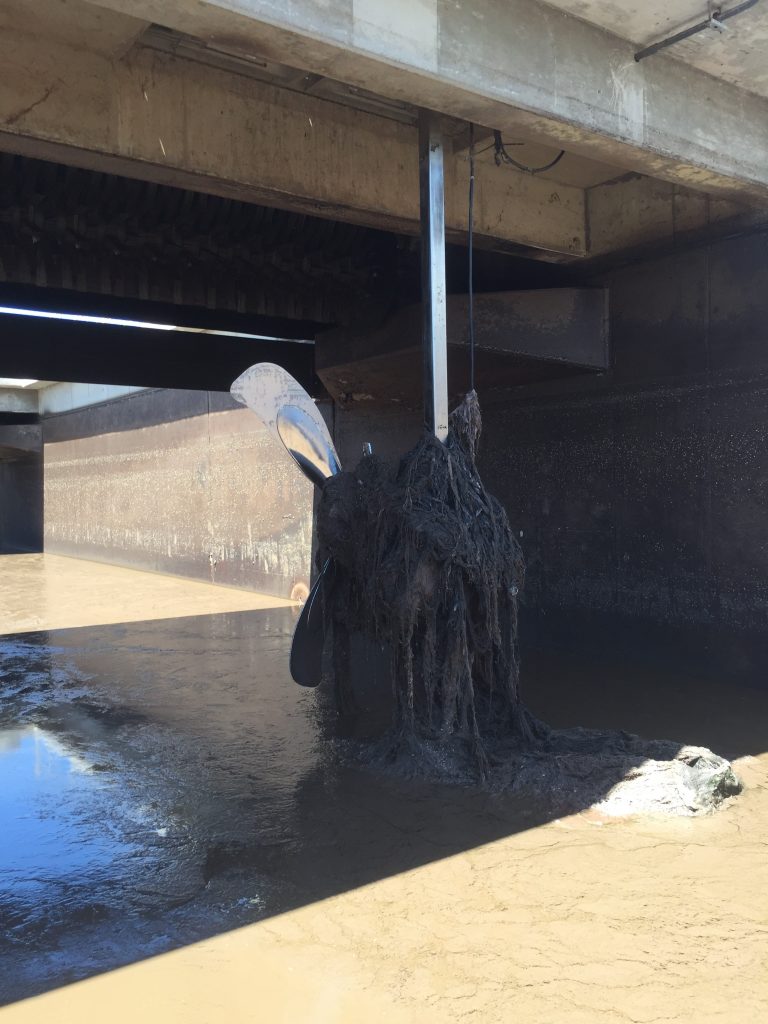
The images shown throughout this blog are examples of the various types of equipment that operate submerged and are downstream from the plant’s headworks and therefore tend to accumulate solid debris to a point of failure. About once a year, the bioreactors or oxidation ditches are individually emptied for maintenance and for repairs to the equipment housed in them. What is drained gets sent back to the start of the plant to be reprocessed. What is left after draining is a lot of solid garbage that should not enter that part of the plant in the first place. It tends to accumulate in the ditch, catching onto equipment and creating long strands of what we in the industry call “rags.” Rags are just a catch-all term for anything solid that doesn’t break down in the sewer system before reaching the plant: flushable wipes, tampons, napkins, Kleenex, hair, floss, water bottles, towels and clothing, candy wrappers, etc. The smaller non-biodegradable materials (eggshells, dirt, sand, orange peels, basically anything that people put into their garbage disposal), settle on the bottom of the ditch and create sand bar formations of what we call “grit.”
Clogged mud valve. Photo credit: Water Use it Wisely
About once a year, operators climb down into the empty ditches to physically remove tangled rags from equipment and shovel piles of grit out of the bottom of the ditch. It is a very labor-intensive process and can be particularly unpleasant on a hot summer day.
THIS IS PREVENTABLE.
While the cleaning of the ditches is a preventative maintenance task that every wastewater utility conducts, it is worth noting that the accumulation of rags on equipment can and does eventually lead to failure of the equipment. Rotors and mixers can eventually experience motor failure due to working against the resistance of a heavy load from a giant rag ball. Mud valves and gate stems get stuck with rag balls while trying to close them, thus preventing us from fully isolating a piece of equipment. A new rotor can cost up to $65,000 and a mixer can cost up to $25,000.
The utility’s goal is to protect the environment while keeping costs to the rate-payers (our customers) as low as possible. The more we all take responsible flushing seriously, the longer our equipment can last for the benefit of the environment and public health.
Mixer with a giant rag ball. Photo credit: Water Use it Wisely
So, can it be flushed? The simple answer is that unless it is one of the three P’s — pee, poo, paper (toilet paper) – then NO!
(OK, a fourth P can happen due to the flu or too much drinking).
Be G.R.O.S.S.
The City of Surprise Water Resource Management Department created a campaign in 2017 to help spread the word about what should and should not go down your pipes: Be G.R.O.S.S. stands for “Be Guardians Regarding our Sewer System.” If you’re interested in learning more about wastewater treatment and the ways you can help protect your local sewer, feel free to visit surpriseaz.gov/begross or follow our Instagram page @SurpriseBeGross for more icky photos. Lastly, we hope you take a minute to enjoy our fictional movie trailer that stars some of our local wastewater heroes:
If you enjoyed this blog and the video above you may enjoy The Case of the Missing Sign! Seriously, this is a great story having something to do with Winnie the Pooh (no pun intended… OK, maybe it was)!
LOVELAND, Colo. — The Bureau of Reclamation released a draft environmental assessment for the Upper Thompson Sanitation District Water Reclamation Facility and Lift Station Improvement Project. The project, located in the Estes Valley of Larimer County, Colorado, consists of construction, operation, and maintenance of a new wastewater treatment facility, two lift stations and connecting pipelines.
The project will allow the Upper Thompson Sanitation District to meet future wastewater flow estimates and applicable water quality standards and regulations. The replacement of aging and deficient infrastructure will also reduce long-term operation and maintenance costs for the district while allowing for future facility expansion.
“This project provides opportunities and partnerships to help meet the future wastewater treatment demands of Estes Park residents and visitors within the Upper Thompson Sanitation District,” said Reclamation’s Eastern Colorado Area Manager, Jeff Rieker.
The 2024 Upper Thompson Sanitation District Water Reclamation Facility and Lift Station Improvement Project Environmental Assessment has been prepared in compliance with the National Environmental Policy Act and is available for public review and comment at the Eastern Colorado Area Office Schedule of NEPA Actions. Please direct any questions to Matt Schultz at 970-461-5469 or mjschultz@usbr.gov. Please submit comments on the draft environmental assessment to Matt Schultz, Environmental Specialist at mjschultz@usbr.gov by June 3, 2024.
Click the link to read the article on the Pagosa Springs Sun website (Derek Kutzer and Josh Pike). Here’s an excerpt:
On March 21, the board of the Pagosa Springs Sanitation General Improvement District (PSSGID), which also sits as the Pagosa Springs Town Council, voted to approve a new memorandum of understanding (MOU) with the Pagosa Area Water and Sanitation District (PAWSD)…The PAWSD board approved the MOU at its March 14 meeting…
The new MOU establishes a framework for a potential merger of the two entities, exploring the idea of a new regional wastewater treatment plant at the southern end of Yamaguchi Park, which would eliminate PSSGID’s reliance on pumping its wastewater 7 miles uphill to the PAWSD-run Vista Wastewater Treatment Plant.
The agreement explains that the PSSGID has faced significant challenges maintaining its uphill wastewater conveyance system, including more than $1 million in pump replacement costs. Additionally, there remains serious concern about the long-term viability of this system, which has significant problems with root intrusions, pipe deterioration and clogging that result in significant inflow and infiltration (I and I) of water into the system, the MOU states.
The new agreement comes on the heels of a town-commissioned 2023 study by Roaring Fork Engineering that examined the town’s options, including consolidation with PAWSD. The study concludes that, if a merger occurred, the community might be better served by a single wastewater treatment plant, which would likely be located in the southern portion of Yamaguchi Park, than by the current pumping arrangement, the MOU states.
At its Feb. 15 meeting, the Pagosa Area Water and Sanitation District (PAWSD) Board of Directors voted to raise fees and rates for 2024 in accordance with the rate study by Stantec that the board approved at its Dec. 14, 2023, meeting. The board voted to increase the monthly service charge per equivalent unit (EU) by 3 percent, going from $31.44 in 2023 to $32.38 in 2024. The monthly service charge per EU for wastewater was voted to increase by 30 percent from $32.80 in 2023 to $42.64 in 2024. Short-term rentals (STRs) will be charged 140 percent of the wastewater rate, according to the fee schedule approved by the board.
The capital investment fee (CIF) for water increased from $5,352.37 in 2023 to $8,958, and the wastewater CIF increased from $1,178.98 in 2023 to $15,697 in 2024, according to the fee schedule.
Other fees, such as availability fees, dumping fees for septic haulers and water fill station fees also increased, with the increases matching the percentage increase in water rates for water-related fees and the percentage increase in wastewater rates for wastewater-related fees.
Colorado’s health department is years behind in processing special Clean Water Act permits critical to protecting water quality in the state’s streams and rivers.
Right now, just 33% of the active discharge permits on file with the Colorado Department of Public Health and Environment’s Water Quality Control Division, are current, far below the agency’s 75% goal, according to the agency. Under the federal Clean Water Act, entities that discharge fluids into streams, including wastewater treatment plants and factories, must get approval from water quality regulators to ensure what they’re putting into the waterways does not harm them.
But it is a tough job, as pressure on streams rises due to the warming climate, populations grow, and new toxins, such as PFAS, emerge. PFAS make up a large class of chemicals used in everything from firefighting foam to Teflon. They are known as “forever chemicals” because they last decades in the environment and the human body. The EPA has just begun setting regulatory standards for them. “Colorado could be doing better and it should be doing better,” said John Rumpler, senior attorney and director of clean water at the Boston-based Environment America.
Lagging EPA standards
Permitting backlogs exist across the country, due in part to the EPA’s failure to update the standards the states work to enforce, he said.
“We’re tolerating more pollution in our waterways than the law should abide,” Rumpler said. “Old threats we have succeeded in reducing, but new ones emerge. Now we have PFAS in our waterways, urban runoff and new chemicals. We’re just not keeping up.”
In an email, EPA officials said they’re aware of the issue. “EPA currently is in the process of evaluating permitting data for all states, including backlogs, and will be posting that information on our website by the end of January,” said Rich Mylott, a spokesman for EPA’s Region 8 office in Denver.
Of the more than 10,129 active discharge permits in Colorado, 67% have been continued without a formal review. The state’s Water Quality Control Division has wrestled with the problem for several years as staffing shortages and budget shortfalls grip the agency.
Though holders of expired permits are legally allowed to discharge under the Clean Water Act, the special status means dischargers face major uncertainty about what future requirements may be and how much it will cost to meet them, said Nicole Rowan, director of Colorado’s Water Quality Control Division.
“What is challenging is when permits are backlogged and older, they aren’t current with environmental regulations,” Rowan said.
“And if a facility wants to expand or change something, we can’t do it because it is in that administrative state,” she said.
Metropolitan Wastewater Reclamation District Hite plant outfall via South Platte Coalition for Urban River Evaluation
Those facilities operating with expired permits include Metro Water Recovery in Denver, which processes wastewater for millions of metro area residents. It is Colorado’s largest wastewater treatment plant. The agency declined an interview request, but in a statement said that resolving the backlog would help everyone.
“Like many public agencies, Metro understands that the Colorado Department of Public Health and Environment is resource constrained. … Metro believes that it is in the best interest of all parties for permits to be renewed within a five-year cycle so that they are consistent with the current regulatory framework.”
The City of Aurora is also among those agencies operating with a expired permit, according to spokesman Greg Baker. Aurora’s permit expired in 2017. Baker declined to comment on the impact of the delay.
In response to the problem, state lawmakers agreed earlier this year to add $2.4 million temporarily to the division’s budget.
“What the General Assembly did was a really big step in providing us some stability,” Rowan said.
But funding lasts only until June 2025, at which point the agency must present a formal plan to lawmakers for keeping the permitting system current and adequately funded.
Rowan and others are hopeful the revamp of the system will dramatically improve the state’s ability to monitor and protect water quality. Anyone interested in participating and tracking the state’s process can do so by signing up here. The next meeting is Dec. 18.
Fresh Water News was launched in 2018 as an independent, nonpartisan news initiative of Water Education Colorado. Our editorial policy and donor list can be viewed at wateredco.org.
More by Jerd SmithJerd Smith is editor of Fresh Water News. She can be reached at 720-398-6474, via email at jerd@wateredco.org or @jerd_smith.
Click the link to read the article on The Pagosa Springs Sun website (Derek Kutzer). Here’s an excerpt:
After a Pagosa Springs Sanitation General Improvement District (PSS- GID) Board of Directors special meet- ing on Dec. 5, it appears that the board is poised to raise its fee rates to $66.50 — the rate recommended by the hired consultant Roaring Fork Engineering, who analyzed the town’s wastewater system and conducted a rate study analysis for the district.
The rate for the district’s customers is currently set at $53.50, but after problems with a wastewater conveyance system that sends wastewater several miles uphill to the Vista wastewater treatment plant (run by the Pagosa Area Water and Sanitation District, or PAWSD), as well as confronting the reality of aging infrastructure, the board is “seeing increased operational costs and mounting costs for capital projects tomaintainandplanforfutureneeds,” states agenda documentation.
Interim Town Manager Greg Schulte explained that the board is faced with three choices, and that all of them include raising rates. The board could choose to raise rates to the $57.25 number that’s in the 2024 budget draft; it could raise them to the level recommended by Roaring Fork, $66.50; or it could arrive at a number somewhere in the middle.
On Tuesday, the town trustees approved a 5% annual rate hike for 2024-2028 that would cost the average ratepayer and extra $5.37 per month in winter and $12.45 in summer, when more water is used to water lawns. New rates will go into effect Jan. 1. Trustees also approved an increase in capital investment fees paid by developers from $10,437 for water and $9,742 for wastewater per single-family home to $10,959 and $10,229, respectively. The 2024 base water rate will go from $49.71 to $52.20 and the usage rate will go from $11.70 to $12.29 for the use of 4,000 to 7,000 gallons.
This is not a new problem for Wellington, which raised water rates and impact fees in 2020 to pay for an expansion of its water and wastewater treatment plants, imposed water restrictions and limited new residential building permits until the expansions are complete. Once the water and wastewater treatment plant expansions are completed, they should accommodate additional growth for 20 to 30 years, which would generate more building and tap fees, allowing the water and wastewater funds to show a profit.
Currently, however, the water fund will be in a $593,000 hole in 2026 and the sewer fund $700,000 short…Trustees also approved transferring the maximum amount from the general fund to the water and wastewater enterprise funds to reduce the impact to residents. Enterprise funds may only receive up to 10% of the revenue received in the fund from taxpayer transfers through the general fund under the Colorado Taxpayer’s Bill of Rights, known as TABOR. The total transfer will reduce the general fund by $935,000 in 2023 and an estimated $1.06 million in 2024.
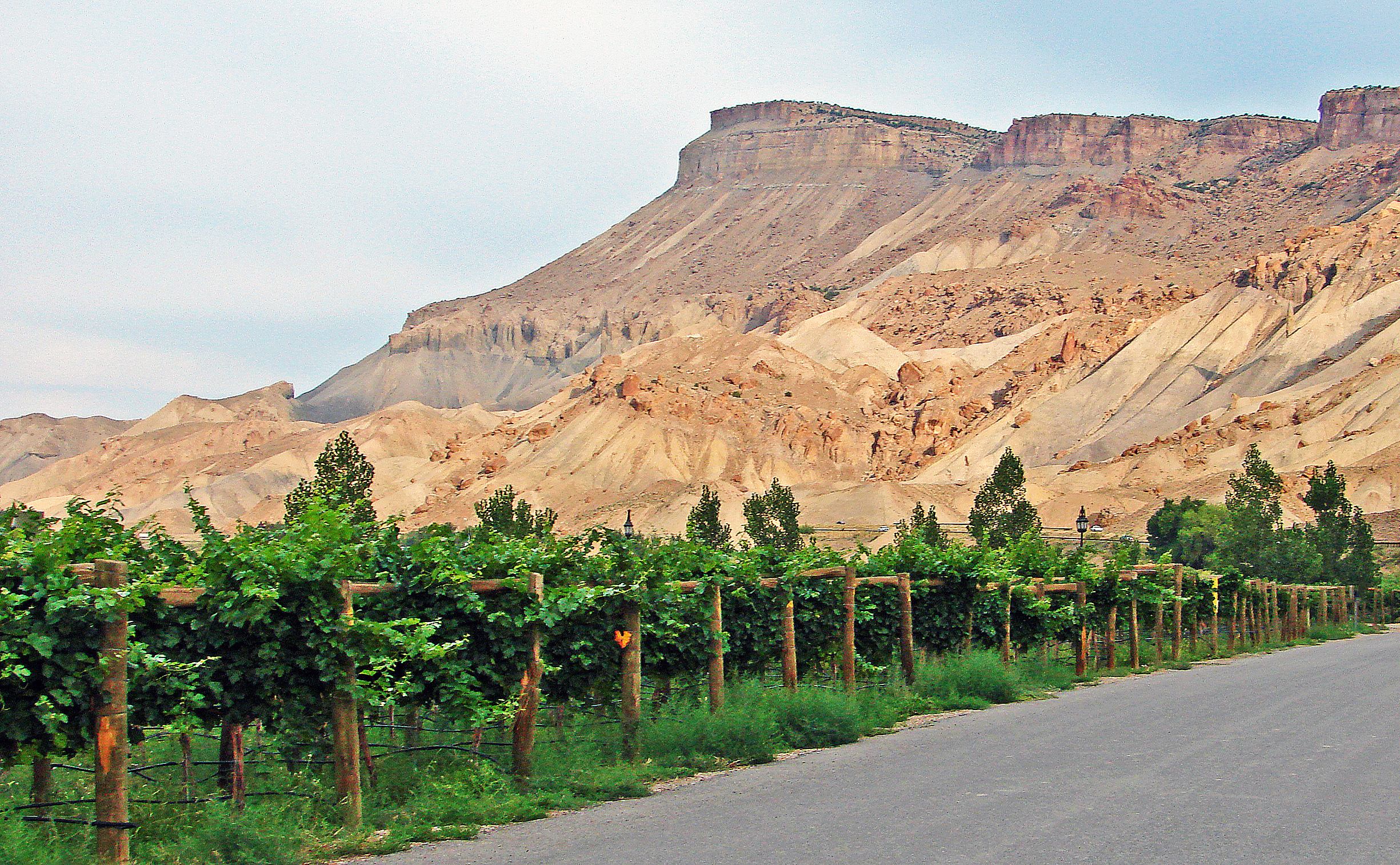
Palisade is just east of Grand Junction and lies in a fertile valley between the Colorado River and Mt. Garfield which is the formation in the picture. They’ve grown wonderful peaches here for many years and have recently added grape vineyards such as the one in the picture. By inkknife_2000 (7.5 million views +) – https://www.flickr.com/photos/23155134@N06/15301560980/, CC BY-SA 2.0,
The Palisade Board of Trustees voted unanimously last Tuesday to raise its sewer rates in 2024 to $57.23 from the current single family residential rate of $35.37. The rate increase is intended to pay for a capital project to construct a pipe for Palisade’s waste water to the Clifton Sanitation Districts chemical plant and decommission its sewer lagoons. The rate increase was recommended through a rate study, which was completed and presented to the Trustees earlier this year. The rates will help pay back a $16.5 million loan from the United States Department of Agriculture, which was announced in late April. It also got around $5.6 million in grant funding from the USDA.
The new rates will also come with a new method for determining how much impact individual users have on the wastewater system. That method is called EQU. It is currently used by the Clifton Sanitation District. Palisade has had an EQU ordinance in place for years, but never implemented it, Town Attorney Jim Neu said…A single family home is considered one EQU, while a building with larger use, like a school, could be several EQUs. The Palisade rate in 2024 will be $57.23 per EQU.
The Archuleta County Board of County Commissioners (BoCC) heard a proposal from Planning Manager Owen O’Dell and Water Quality Manager Kevin Torrez for the county Water Quality Department to take over plan reviews from San Juan Basin Public Health (SJBPH) at its Oct. 24 work session…[Kevin Torrez] explained that the Water Quality Department would oversee licensing of local septic system installers…Development Director Pamela Flowers stated that the cost for licensing would be approximately $50, which would cover administering a test created by the state and providing a certification document. [Torrez] highlighted that the Archuleta County Board of Health would ap- prove OWTS variances and that OWTS inspections would also occur upon transfer of title for a property with an OWTS…
Torrez briefly covered inspection and maintenance of high-level treatment systems before moving on to discussing lagoons, noting that lagoons are allowed if they were permitted before 1967. He indicated that there is an after- the-fact permitting system for unpermitted lagoons, but new lagoons are not allowed…Torrez explained that the Water Quality Department would inspect these lagoons and determine if they are functional and can receive a permit or if they need to be abandoned…
In response to a request for legal advice from [Verionica] Medina, [Todd] Weaver stated that this would be possible, noting that the laws governing the dissolution of health districts are limited. He added that he did not foresee a legal challenge to this change.
Discussion of the budget opened with PAWSD Business Manager Aaron Burns stating that the budget presentation was planned to include explanations of debt service coverage and projections — that PAWSD would have approximately $2,622,985 in excess debt service coverage in 2024 — a budget summary, a detailed examination of budget line items and discussion of 2024 capital projects. Burns noted that PAWSD’s actual expenses in a year are often lower than the budgeted expenses, which he partially attributed to difficulties in finding contractors or employees to complete the projects…
The board and District Engineer/ Manager Justin Ramsey then discussed the decision by the board at the September meeting to move forward with constructing workforce housing on a parcel adjacent to Running Iron Ranch. Ramsey noted that the funding in the budget would support initial work on creating such housing. PAWSD board member Glenn Walsh suggested that the board had not decided on the exact format for this housing, but that he believed the board was committed to “doing something really smart that helps our employees.”
[…]
Burns then reviewed the operating budget considerations, noting that the district is budgeting for 38 full- time equivalents — up one from last year — and the budget includes a 6 percent “across-the-board” wage increase. He stated that the workers’ compensation experience modification for the district decreased from 1.42 to 0.78 in 2024 and that the health insurance expenses are projected to increase by 5 percent, which he noted is less than expected…
Burns explained that the district’s annual debt service coverage ratio in the water fund dipped to a low of 0.86 in 2023 due to payments on loans for the Snowball plant expansion unex- pectedly beginning in 2023, but that the district would correct the coverage ratios in 2024 due to the ongoing rate study for the district.
The city recently completed a $35.5 million project expanding the treatment plant’s capacity and improving the quality of water the city discharges into the river. Though the city plans to rebuild and improve the front end of the process, the city’s Nitrification Project mostly expanded the capacity for biological treatment processes that remove nitrogen and phosphorous to meet state and federal regulations…Nitrogen and phosphorus support the growth of algae and aquatic plants, but too much causes algae to grow faster than ecosystems can handle, according to the Environmental Protection Agency. Algae blooms can severely reduce or eliminate oxygen in the water, harming fish populations and elevating toxins and bacterial growth in the water…
The city contracted with Garney Construction to complete the improvements at the plant, which took about 200,000 hours of work. Cadee Oakleaf, the project manager, said everyone involved had to plan carefully to prevent any interruptions in service to Greeley water customers. This included temporary piping throughout the plant and working overnight as wastewater collected in an empty basin when work required the plant to temporarily stop a step in the process.
“It was very meticulous planning, planning for months ahead of time at times,” Oakleaf said. “To bring on the new basins, we actually started talking about it a year in advance.”
Lab testing and real-time measurements at the plant have indicated the project was successful at further removing nitrogen and phosphorus, [Tyler] Eldridge said.
The plant now meets all new and existing state and federal regulations, while also ensuring the continued protection of local rivers. The improvements — which started in 2019 — cost $35.5 million and took more than 200,000 work hours to complete, according to a release by the City of Greeley. Construction stayed on schedule and on budget, and the plant operated without any service disruptions throughout. The city also spread out the cost over several years to reduce the burden on ratepayers.
Click the link to read the article on the Pagosa Springs website (Josh Pike). Here’s an excerpt:
On May 16, the Archuleta County Board of County Commissioners (BoCC) approved a budget amendment allocating $225,331 in Local Assistance and Tribal Contingency Fund (LATCF) monies received from the federal government to the Development Services Division and $137,428 in LATCF monies to the Public Health Department to support transition to a county health department. The money allocated to Development Services is intended to support the county’s water quality program, including permitting for on- site wastewater treatment systems (OWTS), as well as other environmental health programs that will be the responsibility of the department, according to Finance Director Chad Eaton…
At the request of [Derek] Woodman, [Pamela] Flowers also discussed process changes in the issuing of OWTS permits and the interactions between SJBPH and the county that had slowed the process of construction for new builds. She also mentioned that the county would need to purchase a permit processing system, although she had not chosen one yet…She noted she is working on regu- lations for OWTS that will need to be approved by the county and the state and will provide the basis for permitting in the county.
Colorado lawmakers approved seven major new water bills this year, including one that approves millions in more funding for the Colorado Water Plan, another that makes restoring streams easier, and a third that creates a high-profile Colorado River task force.
The 2023 General Assembly, which adjourned May 8, also approved four others that address water wise landscaping, water use in oil fields, “don’t flush” labels for the disposable wipes that plague water systems, and one giving more muscle to an interim legislative committee whose job is to evaluate water problems and propose laws to fix them.
Two of the bills, the labeling requirement, as well as the legislative committee changes, have been signed into law by Gov. Jared Polis. The five remaining bills await his signature.
Funding Water Projects
Each year the Colorado General Assembly considers the Colorado Water Conservation Board (CWCB) “projects bill,” which this year—Senate Bill 177—appropriates $95 million from three sources: CWCB’s construction fund, severance taxes on oil and gas production, and sports betting revenue. No general fund tax dollars are used. An important part of the funding goes to support grants for projects that help implement the state water plan.
A major difference in this year’s bill is the amount of money coming from sports betting. Last year’s bill appropriated $8.2 million from that source, the first time since the passage of Proposition DD in 2019, which legalized sports betting and authorized the state to collect up to $29 million in taxes on gambling proceeds, with over 90% of that going for water. SB 177 triples that amount, appropriating $25.2 million to fund projects that help implement the state water plan. Sen. Dylan Roberts, D-Avon, a bill sponsor, noted that sports betting revenue provides critical funding “that never existed before for water.” As he pointed out, “that number keeps growing every year which is positive for our water future.”
Construction of Beaver Dam analogue Photo courtesy of the Rio Grande Headwaters Restoration Project.
Stream Restoration
Senate Bill 270 allows minor stream restoration activities to proceed without having to secure a water right. Its intent is to promote the benefits natural stream systems provide—clean water, forest and watershed health, riparian and aquatic habitat protection—by mitigating damages caused by mining, erosion, flooding and wildfires. Minor stream restoration activities include stabilizing stream banks and beds, installing porous structures that slow down water flow and temporarily increase surface water area, and rechanneling streams to recover from wildfire and flood impacts.
At the bill’s initial hearing in the Senate Agriculture & Natural Resources Committee, Sen. Roberts, committee chair and a bill cosponsor, emphasized that stream restoration activities “help promote recovery from natural disasters like fires and floods.” He also noted the bill could “help access federal dollars that are available in sort of a once-in-a-lifetime opportunity right now that could be used for these very valuable projects.”
Another bill cosponsor, Sen. Cleave Simpson, R-Alamosa, a water right holder and water conservation district manager, recognized “the value and importance of healthy rivers and streams and what it means to all water users.”
As introduced, SB 270 would have created a “rebuttable presumption” that a stream restoration project does not cause material injury to a vested water right. It was amended in committee after testimony by several witnesses who expressed concern over the bill’s potential impacts on water rights—loss of water due to evaporation and infiltration into soils, and delayed timing of delivery downstream. They all expressed support for the concept of stream restoration and with the amendments adopted, pledged to work together in the future to strike a balance between stream restoration benefits and protecting water rights.
Updated Colorado River 4-Panel plot thru Water Year 2022 showing reservoirs, flows, temperatures and precipitation. All trends are in the wrong direction. Since original 2017 plot, conditions have deteriorated significantly. Brad Udall via Twitter: https://twitter.com/bradudall/status/1593316262041436160
Colorado River Drought Task Force
Faced with two decades of drought in the Colorado River Basin, Senate Bill 295 creates a task force to make legislative recommendations that will help water users most directly affected by drought and aid the state in meeting its commitments under the Colorado River Compact. The task force’s focus is on reducing water demand and on ensuring that any effort to achieve that goal by fallowing irrigated farmland must be done on a voluntary, temporary and compensated basis.
The task force is made up of 17 voting members representing agricultural, municipal, industrial, conservation, environmental and tribal stakeholders from across the state, with the state engineer serving in an advisory capacity. It includes a sub-task force to study and make recommendations on tribal matters comprised of five members, including representatives from the Southern Ute Indian Tribe and the Ute Mountain Ute Tribe. The task force and sub-task force must report any recommendations, which are to be made by majority vote, to the General Assembly’s Water Resources and Agriculture Review Committee by Dec. 15, 2023.
Testimony in the Senate Agriculture & Natural Resources Committee raised concern with the bill’s timing. Several Front Range municipal water providers said the state’s primary focus should be on supporting federal efforts to force lower basin states—primarily California and Arizona—to reduce their river use since they have consistently exceeded their compact allocations while the Upper Basin states have never fully utilized theirs. Sen. Roberts, the bill’s sponsor, acknowledged that but emphasized “There is drought happening in Colorado right now … The purpose of the task force isn’t just to consider interstate obligations, it’s also to make recommendations surrounding drought mitigation and drought security.”
Others worried that the bill might split the state’s West Slope and East Slope water users, but lawmakers pledged the task force would seek cooperative solutions. “This bill is going to codify a collaborative path forward on some difficult issues facing the Western Slope and the entire state,” said Rep. Marc Catlin, R-Montrose.
This home is part of the City of Aurora’s water-wise landscape rebate program. Aurora City Council last month passed an ordinance that prohibits turf for aesthetic purposes in all new development and redevelopment, and front yards. Photo credit: The City of Aurora
Water-Wise Landscaping
Senate Bill 178 is designed to reduce barriers to residents in homeowner association (HOA)-governed communities (roughly half the state’s population) who want to plant landscapes that use less water than bluegrass lawns. To encourage HOAs and owners of single-family detached homes to work together in planting landscapes that conserve water, improve biodiversity, and expand the amount of food grown in private gardens, SB 178 requires HOAs to adopt three pre-planned water-wise landscape designs that homeowners can install if they want to replace non-native turf. It doesn’t preclude other designs with HOA approval. Although the bill removes some aesthetic discretion, HOAs retain the authority to reject designs for safety, fire or drainage concerns.
Water Conservation in Oil and Gas Operations
House Bill 1242 seeks to reduce freshwater use in oil and gas operations and increase recycling and reuse of produced water, which is water in or injected into the ground and coproduced with oil or natural gas extraction. It is often disposed off-site but can be recycled and reused if properly treated.
The bill requires oil and gas well operators to report periodically to the Colorado Oil and Gas Conservation Commission on the volume of freshwater and recycled or reused produced water used, produced water removed for disposal, and produced water recycled or reused in another well and removed for recycling or reuse at a different location. The commission will use this data in adopting rules by July 1, 2024 to require a statewide reduction in freshwater use and a corresponding increase in recycled or reused produced water in oil and gas operations.
The bill also creates the Colorado Produced Water Consortium in the Department of Natural Resources to make recommendations to the General Assembly and state agencies by Nov. 1, 2024 on legislation or rules necessary to remove barriers to recycling and reuse of produced water. The consortium consists of 28 members that will work with state and federal agencies, research institutions, colleges and universities, non-government organizations, local governments, industries, environmental justice organizations and members of disproportionately impacted communities in conducting its work and making recommendations.
Disposable Wipes and Water Quality
Aimed at reducing sewer backups and water pollution in Colorado, Senate Bill 150 requires a manufacturer of disposable wipes sold or offered for sale in the state, and a wholesaler, supplier or retailor responsible for labeling or packaging those products to label them “Do Not Flush.” Disposable wipes include baby, cleaning and hand sanitizing wipes made of materials that do not break down like toilet paper when flushed. They end up clogging pipes and releasing plastics into waterways, costing water utilities a lot of money to fix.
Water Resources and Agriculture Review Committee
Senate Bill 10 turns the interim Water Resources and Agriculture Review Committee into a year-round committee. The committee will meet at the call of the chair, conduct hearings and vet issues as they come up instead of having to wait until after each session adjourns. It will not duplicate the functions of existing standing committees, but will continue to recommend bills to the Legislative Council, which will refer them to relevant committees for action.
Larry Morandi was formerly director of State Policy Research with the National Conference of State Legislatures in Denver, and is a frequent contributor to Fresh Water News. He can be reached at larrymorandi@comcast.net.
View of Denver and Rio Grande (Silverton Branch) Railroad tracks and the Animas River in San Juan County, Colorado; shows the Needle Mountains. Summer, 1911. Denver Public Library Special Collections
Density concerns, soundscapes and dark skies, wildlife impacts, preservation of the Animas River Corridor, and water and sanitation demands are only half of the issues Animas Valley residents face if a proposed luxury RV park is approved by La Plata County. Residents of the Animas Valley have also questioned the legality of the proposed RV park in terms of zoning. A preliminary sketch plan of the development targeting 876 Trimble Lane (County Road 252) was approved by the La Plata County Planning Commission in January and is now moving through a minor land-use permit process. Arizona-based developer Scott Roberts wants to build a 306-stall luxury RV park, which includes 49 tiny homes the proposal calls “adventure cabins.” But some residents fear the scope of the potential development would impede on the rural lifestyle they enjoy.
The Animas Valley Action Coalition, a community group organized to protect the Animas Valley from developments that pose major impacts to the area, hosted a meeting Saturday at the Durango Public Library to discuss impacts and continue the conversation about Roberts’ RV park. About 58 residents and friends of the Animas Valley gathered to hear two presentations about the history of the valley and an opportunity to protect the Animas River Corridor. Tom Penn said AVAC community members have different expectations of the RV park proposal. Some people don’t want an RV park to be built at all and others would prefer a smaller development.
The board voted 3-2 to pass a resolution setting new water rates. Members Joe Mahaney and Nick Madero voted against the resolution. The raise in rates includes a 94-cent monthly fee for residential water users and a $3.17 monthly fee for residential sewer customers. The fees are described as “readiness to serve” fees, which represent the fixed costs the utilities providers experience getting the services to customers, said Jim Blasing, utilities director for the district. The rates will go into effect in May…New residential customers will see an increase in the residential water resource fee and tap fee, totaling a little more than $1,000. Those increases are designed to have new residents help pay for the growth of the system…
Board member Jami Baker Orr said the district has “among the lowest paid district employees” and has been trying to bring those wages up. She also said that the rates are “based on the advice of a water expert” and noted that the district’s facilities are getting older and will need to be upgraded in the near future.
At its Jan. 30 meeting, the Pagosa Area Water and Sanitation Dis- trict (PAWSD) Board of Directors discussed state-mandated modi- fications to the Vista Wastewater Treatment Plant that come with a potential cost of $15 million during a public hearing on a potential State Revolving Fund (SRF) loan for the project. The modifications are intended to improve nutrient removal and allow the plant to comply with new state nutrient standards. Nutrient removal involves the removal of nutrients such as phosphorus or nitrogen, which can be damaging to drinking water and aquatic environments in high quan- tities, from wastewater.
According to the Colorado De- partment of Public Health and Environment (CDPHE), such nutrients from the Vista plant could impact both nearby drinking water wells and the Piedra River, claims disputed by PAWSD.
The hearing opened with PAWSD District Manager Justin Ramsey ex- plaining, in response to a question from board member Gene Tautges, that PAWSD is currently pursuing a “political route” in its efforts to delay the modifications and that it had some initial communication with Colorado Sen. Cleave Simpson.
According to PAWSD District Manager Justin Ramsey, the rate changes took effect immediately upon approval. According to the board packet for the meeting and as explained by PAWSD Director of Business Services Aaron Burns, the rate increases include a 6 percent increase in water rates and a 2.5 percent increase in wastewater rates.
With these changes, according to agenda documentation, the monthly service charge for water will rise from $29.66 to $31.44 per equivalent unit (EU). The volume charge per 1,000 gallons for between 2,001 and 8,000 gallons of usage will rise from $5.32 to $5.64, while the volume charge per 1,000 gallons for between 8,001 and 20,000 gallons of usage will increase from $10.65 to $11.29. The volume charge per 1,000 gallons for more than 20,001 gal- lons of usage will increase from $13.37 to $14.17. The water fill station charge per 1,000 gallons will increase from $11.49 to $12.18, while the water availability of service and waste- water availability of service fees remain the same at $14.30 and $12.50 respectively. According to the documenta- tion, the wastewater monthly service charge will rise from $32 to $32.80.
Prior to unanimously approving the rate changes, the board held a public hearing on the issue where it received no public comments concerning the altered rates.
Waterfalls along Yule Creek. CREDIT: COURTESY PHOTO BY JOHN ARMSTRONG
Click the link to read the guest column on the Aspen Times website (Stacy Standley). Here’s an excerpt:
Now is the time to take a giant step into the future with revolutionary ideas that transcend the parochial local interests of the Roaring Fork River Valley by recognizing that climate/weather change, along with population growth, has erased the boundaries of the Colorado River Basin…Aspen is now the pivotal headwaters of the Colorado River Basin, which has become a small, compacted irrigation canal instead of a great river system and has shrunk many hundreds of miles into but a few feet…
1. There should be 100% metering and billing of every drop of water: 7% of the Aspen distribution is unmetered and/or unbilled and unmetered, and this should be eliminated.
2. You can not distribute or control what you do not measure: Metering and billing should be by constant recorded, instantaneous, wifi-linked electronic services on all distribution points and reported to every customer and the Water Department on a instantaneous daily basis, with auto shutoffs for an aberration of usage by 1% or more.
3. All wastewater and storm water must be a fully-integrated part of the treated water-supply system by municipal recycling and/or irrigation and municipal water usage.
4. Downstream water flows that exceed minimum stream flow must be acquired and piped back into the upstream Aspen intake.
5. Aspen and Pitkin County must negotiate with Twin Lakes Canal and Reservoir Co. and the Fry-Ark project to create water savings for their service area and water that can be allowed to stay in the Roaring Fork River Valley.
6. Salvation Ditch, Red Mountain Ditch, and all other local irrigation systems should become a part of the Aspen water conservation and re-use ethic.
7. 100% of all leaks and water waste must be ended immediately.
8. Every tree, plant, and natural out-of-house improvement must be identified and the water usage calculated by Lysimeter and/or other instantaneous soil moisture storage measurement system and then a local research and development lab created to test, grow, and install water conserving plants and systems for out-of-house water management and control.
9. All local streets should be coated with bright reflective surfaces to maintain a cooler urban-heat island and, thus, improve out-of-house water usage.
10. Aspen should create its own bottled (no plastic) water supply for individual use from a high-quality spring and distribute at least 2 gallons per person per day inside of the city service area for drinking water usage at cost to increase the Aspen water supply.
11. Aspen should divert into vertically oriented pipeline coils (24 to 48 inch) in all area streams to capture water runoff that exceeds minimum stream flows and keep the vertical-coiled pipelines at or above the city base elevation for instantaneous “pipeline coil reservoir storage.”
12. Every new or remodeled home and business must have installed an on-site water-storage tank for at least three months of driest in-house water usage.
13. Aspen should participate individually and/or with other Colorado River Basin water users in regional ocean, salt flats, and poor quality oil field wastewater/produced water (i.e., Rangely Field and Utah Basin) purification desalination and urban wastewater recycling for earning water-use credits.
14. Aspen should negotiate with Colorado River Basin Native American tribes to create constructive water savings and water-credit system for the benefit of reservation and also Aspen water usage.
15. Aspen should negotiate to replace Colorado River Basin hydroelectric-power generation with renewable energy to earn water storage credits for regional reservoir.
After additional funds were approved by Pueblo City Council on Monday night, a total of $3 million in American Rescue Plan Act funds will be allocated to a 6,200-foot sanitary sewer line on Pueblo’s west side…Funded by ARPA and the Pueblo Wastewater Department, the project will cost an estimated $6.8 million, according to the city of Pueblo.
“We have been in the process of designing that sewer line,” Pueblo Mayor Nick Gradisar said. “There are a couple of arroyos. Some of that sewer line is going to be 13 to 30 feet deep. It turns out to be much more expensive.”
The multi-million dollar project is expected to benefit several developments, including Southern Colorado Clinic, the Pueblo YMCA, the Wildhorse Annexation, the proposed WL Annexation and the incoming Pueblo County detention center.
“This really is a major trunk line that will collect waste from a number of areas,” said Andrew Hayes, the city’s director of public works. “As the rest of the West Side develops in the vicinity of Southern Colorado Clinic, the YMCA— those areas will also feed into this very same line.”
At its Oct. 20 meeting, the Pagosa Area Water and Sanitation District (PAWSD) Board of Directors held a public hearing of the district’s proposed 2023 budget and dis- cussed potential accelerated rate increases. PAWSD Director of Business Services Aaron Burns opened the hearing by explaining that he would begin by discussing the summary sheet for the budget distributed to the board before discussing the details of the budget…
Burns explained that the changes in spending in the water and wastewater funds are partially driven by the work on the state- mandated expansion of the Snowball water treatment plant and state-mandated engineering for the potential Vista wastewater treatment plant upgrade, as well as a variety of other larger maintenance item expenditures. He highlighted that the 2023 budget meets debt services requirements and reflects the rate increases prescribed by a 2018 rate study, as well as accelerated rate increases that he and District Manager Justin Ramsey had agreed are necessary due to the additional costs of expanding the Snowball plant. Burns explained that, as part of the financing process for the Snowball plant, the state recommended an additional $8 per equivalent unit, also commonly referred to as EUs, charge for water rates on top of the 6 percent increase recom- mended by the rate study. He added that the rate study had recommended a 2.5 percent in- crease in wastewater rates in 2024, which Burns and Ramsey had decided to move forward to 2023.
He commented that the PAWSD 2021 audit indicated that the district’s rates are low and these changes would address this, as well as preparing PAWSD for the increasing costs of its upcoming projects.
Filtration pipes at Metropolitan Water District of Southern California’s wastewater recycling demonstration plant. (Source: Metropolitan Water District of Southern California)
Colorado regulators, after years of study, negotiations and testing, approved a new rule that clears the way for drinking treated wastewater this week, one of only a handful of states in the country to do so.
The action came in a unanimous vote of the Colorado Water Quality Control Commission Oct. 11.
Direct potable reuse (DPR) involves sophisticated filtering and disinfection of sewage water for drinking water purposes, with no environmental buffer, such as a wetland or river, between the wastewater treatment plant and drinking water treatment plant. That water is then sent out through the city’s drinking water system.
Colorado joins Ohio, South Carolina and New Mexico in setting up a regulated DPR system, with California, Florida and Arizona working to develop a similar regulatory scheme, according to Laura Belanger, a water reuse specialist and policy advisor at Western Resource Advocates.
Ron Falco, safe drinking water program manager for the Colorado Department of Public Health and Environment (CDPHE), said the new regulation would provide communities across the state important access to a new, safe source of drinking water, a critical factor in a water-short state.
“This is going to be a need in Colorado and we want to be prepared,” he said. “Can DPR be done safely? Our answer to that is yes.”
Aurora has had a reuse system in place for more than a decade that also uses treated wastewater. But Aurora’s water is treated and released from the wastewater treatment plant into the South Platte River, where it flows through the river’s alluvial aquifer, before Aurora pumps it out through groundwater wells. Aurora then mixes it with raw mountain water before treating it and distributing it to customers. That practice is known as indirect potable reuse — there’s an environmental buffer between the wastewater plant and the drinking water plant, in Aurora’s case, that’s the river. Indirect potable reuse is used by several big cities nationwide, including San Diego.
Graphic by Chas Chamberlin, Source: Western Resource Advocates
Under Colorado’s new regulation, water providers will be required to show they have the technical, managerial and financial resources needed to successfully treat wastewater.
Communities will also be required to show how they will remove contaminants in their watersheds before the water reaches rivers and streams.
Wastewater intended for drinking will require extensive disinfection and filtration, among other techniques, all of which are intended to eliminate pathogens like viruses and bacteria, and remove drugs and chemicals to safe and/or non-detectable levels, according to CDPHE.
And any community that seeks to add treated wastewater to its drinking water system will have to set up extensive public communication programs to show the public its process and to help educate residents about this new water source.
Communities will also have to collect a year’s worth of wastewater samples and prove that they can be successfully treated to meet the new standards.
Western Resource Advocates’ Belanger, who has long advocated for the use of DPR, said the approval has been a long time coming and is cause for celebration.
“We believe DPR is a very important water supply for our communities now and into the future. We feel [this new regulation] is robust and protective of public health.”
But key to tapping the new water source will be helping the public get over the “ick factor,” officials said.
Jason Rogers, vice chair of the Water Quality Control Commission who is also Commerce City’s director of community development, said public outreach should be carefully monitored to ensure it is actually reaching people in all communities and that it is being well-received.
“When thinking about that public meeting, where does it occur? People in some of these communities may have a high reliance on multi-modal transportation, it may not allow for that meaningful engagement,” Rogers said. “And if it isn’t being well received, we need to have them go out and do more public engagement.”
With a mega drought continuing to grip the Colorado River Basin and other Western regions, Colorado’s multi-year process to develop a sturdy new drinking water regulation drew widespread attention, said Tyson Ingels, the head drinking water engineer at the state’s Water Quality Control Division.
Ingels said Utah and Arizona participated in Colorado’s work sessions, demonstrating the interest in what could become an important new water source in the West. Arizona is just now kicking off its own rulemaking process, Ingels said, and Utah, while not yet regulating DPR, has seen a handful of communities proposing to use DPR.
Colorado’s rulemaking process, which dates back to 2015, was at times fractious, with water providers and wastewater operators concerned that the proposed regulation would interfere with what they’re doing already and could add burdensome costs to efforts to develop new water sources.
Ingels said the addition of a third-party facilitator was essential to resolving everyone’s concerns.
Jeni Arndt, a former lawmaker who also serves on the water quality commission, said finalizing the groundbreaking new regulation signaled an important step forward in navigating difficult public policy issues. [Editor’s note: Arndt is a former board member of Water Education Colorado, which sponsors Fresh Water News.]
“Gone are the days when we were struggling to come to agreement,” Arndt said. “I’m very excited to move forward into a new era.”
On Tuesday, several water utilities spoke in favor of the new regulation, including the Cherokee Metropolitan District, Castle Rock, and the City of Aurora.
Matt Benak, Castle Rock’s water resources manager, said the regulation will give his town the certainty it needs to move forward developing new water supplies. “DPR is a critical tool for sustainable water resources. Creating this regulation will allow water providers like us to plan and to potentially implement DPR,” he said.
Tuesday’s approval was contingent on fixing minor clerical errors in the regulation. Commissioners will give final formal approval of the regulation at its November meeting.
Jerd Smith is editor of Fresh Water News. She can be reached at 720-398-6474, via email at jerd@wateredco.org or @jerd_smith.
The global water crisis threatens U.S. national security and prosperity. Water insecurity endangers public health, undermines economic growth, deepens inequalities, and increases the likelihood of conflict and state failure. Strong water, sanitation, and hygiene services, finance, governance, and institutions are critical to increasing resilience in the face of global shocks and stressors, such as the COVID-19 pandemic and climate change.
The 2014 Water for the World Act requires that USAID and the Department of State deliver a whole-of-government Global Water Strategy to Congress, beginning in 2017 and refreshing it every five years until 2032 (see the 2017 Global Water Strategy). The 2022 strategy will operationalize the first-ever White House Action Plan on Global Water Security that Vice President Kamala Harris launched in June 2022.
Strategic Objectives
Under this strategy, the U.S. government will work through four interconnected and mutually reinforcing strategic objectives:
– Strengthen sector governance, financing, institutions, and markets;
– Increase equitable access to safe, sustainable, and climate-resilient water and sanitation services, and the adoption of key hygiene behaviors;
– Improve climate-resilient conservation and management of freshwater resources and associated ecosystems; and
– Anticipate and reduce conflict and fragility related to water.
New Priorities
This strategy advances new priorities, such as:
– Going beyond community-managed services for a comprehensive, professionalized, and scalable approach;
– Prioritizing local leadership of water and sanitation systems and services;
– Integrating climate resilience to respond to the growing threat that climate change poses to water security; and
– Increasing coherent implementation across humanitarian, development, and peacebuilding contexts.
Pagosa Springs Town Manager Andrea Phillips began the meeting by providing an update on the pumps the PSSGID recently purchased for the pipeline running from downtown to the PAWSD Vista wastewater treatment plant. She added that the project has experienced additional costs since its installation in 2015, including spending on odor-control devices, an underground storage vault to store overflow waste and the new pumps, which had cost PSSGID approximately $800,000. Utilities Supervisor Lucian Brewster also provided an update on the pumps, indicating that the system has been fully switched over to the new pumps and the pumps have been running well.
Phillips added that she anticipates that the PSSGID will have to perform an additional $500,000 in pretreatment screening upgrades to ensure the new pumps continue to perform effectively throughout their lifetimes. She also stated that the PSSGID is working on an emergency liner for one of the previously used lagoons by Yamaguchi Park to provide additional wastewater storage, an addition that would likely cost another $100,000…
PAWSD District Manager Justin Ramsey then gave an update on PAWSD’s efforts to acquire a delay on a state-mandated upgrade to the Vista wastewater plant that was originally mandated to be completed by 2025 and would cost approximately $20 million. He indicated that PAWSD is hop- ing to get the deadline for the implementation of certain nutrient- filtering upgrades delayed to at least 2027, although the delay had already been requested and rejected once by the Colorado Department of Public Health and Environment (CDPHE)…
The group then moved on to discuss the possibility of construct- ing a joint sewer plant for the PSS- GID and PAWSD, which Ramsey suggested could be a solution to PAWSD’s difficulties in upgrading the Vista plant.
Native Excavating installed 2,265 linear feet of 24-inch sewer pipe and eight manholes this year alone. Excluding lateral connections, about 71% of the main sewer line is complete and the crews are about one week ahead of schedule. Crews will install service connections into the new sewer main while abandoning the existing main, then they’ll test and inspect the new manhole connections and sewer main. Then, the private irrigation systems that were impacted by the construction will be repaired or replaced, such as the systems at City Market Fuel and The Village at Steamboat…
Elsewhere, starting this past week, culverts in four areas of town are being rehabilitated as part of a separate project seeking to upgrade critical water infrastructure.
Click the link to read the article on the Pagosa Springs Sun website (Dorothy Elder). Here’s an excerpt:
At its Sept. 6 meeting, the Pagosa Springs Sanitation General Improvement District (PSSGID) Board of Directors heard an update about the district’s major pump replacement project that relayed that the pumps are, so far, a success. The project, which began during the last week of June, was meant to address a history of broken parts and inefficiencies within the system. At this point, the new pumps are achieving flows “near to what is desired,” the agenda brief explains. However, the project has come with costs, with a total cost to date of $780,000, according to the brief. Town Manager Andrea Phillips explained that the project “may be slightly over budget” due to having to order some additional parts and retrofits.
However, the town will seek reimbursement from a $400,000 grant from the state, Phillips explained…
Some of these improvements include additional pretreatment that “may be needed in order to ensure that the longevity of the pumps continue,” such as a grit removal system or moving to an automated bar screen, Phillips explained.
AT THE NATIONAL WESTERN CENTER, an unparalleled system is mining dirty water for clean energy. It’s the largest sewer-heat recovery project in North America.
You’re not alone if you read the word “sewer” and thought, “Wait, what?”
Yes, this green energy relies on raw sewage from thousands of homes and businesses in Denver – a great gush of wastewater expelled from dishwashers, washing machines, sinks, showers, tubs, and toilets. Sewage often is associated with its fecal content, but it contains something far more relevant to sustainable energy. That’s heat. Consider: An 8-minute shower typically uses a whopping 20 gallons of water at roughly 105 degrees Fahrenheit. With each load of laundry, a high-efficiency washing machine could gulp 13 gallons of water at up to 130 degrees. And, with each cycle, a dishwasher might use 4 gallons of water at 140 degrees. That’s a lot of water – and a lot of heat – down the drain.
In fact, the U.S. Department of Energy estimates that Americans send the equivalent of 350 billion kilowatt-hours of energy down our drains each year – enough to power about 32 million U.S. homes.
“It really is just wasted heat,” said Leslie Fangman, a civil engineer and vice president of corporate development for CenTrio. CenTrio is part of a consortium called EAS Energy Partners, which was selected by the National Western Center Authority and the city and county of Denver to finance, design, build, operate, and maintain the sewer-heat recovery system.
The sewer-heat recovery system extracts heat from wastewater in the wintertime and uses it to warm buildings. In the summertime, the system reverses and rejects heat to cool buildings. Illustration: National Western Center Authority
The project relies on technology that is more than a decade old but has not been widely adopted, largely because of infrastructure complexities and high upfront costs. Yet, the concept is straightforward: During wintertime, extract heat from sewage and recycle it to warm a network of buildings, called an energy district; during summertime, use the same system to reject heat and cool the buildings. In so doing, dramatically reduce use of natural gas and electricity, which power furnaces and air conditioners.
After several years of planning and construction, the sewer-heat recovery system is poised to become a highlight of sustainability at the National Western Center. The center comprises 250 acres near I-25 and I-70 in north Denver. It is a $1 billion redevelopment, transforming the historic grounds of the National Western Stock Show into a year-round site for entertainment, education, and innovation. CSU Spur is the center’s educational anchor, with three new buildings dedicated to public education, research, and community outreach around the critical topics of food, water, and animal and human health.
“When I first heard about this system, I remember thinking, ‘Holy cow, there’s a lot of thermal energy capacity that’s going downstream that we could capture,’” said Brad Buchanan, chief executive officer of the National Western Center Authority, which contracted with EAS Energy Partners to build the sewer-heat recovery system. “It really grabbed my attention because we decided to hold a very high bar for sustainability. It seemed to be the perfect fit if we were really going to walk the talk of reducing carbon emissions.”
eslie Fangman, vice president of corporate development for CenTrio, has led project development on behalf of a business consortium hired for the job. Denver, CO – April 21, 2022 Leslie Fangman, a civil engineer and vice president of corporate development for CenTrio Energy is arranged for a portrait at the Central Utility Plant (CUP) at the National Western Center in Denver, Colorado, U.S., on Thursday, April 21, 2022. Photographer: Matthew Staver 303-916-6155 http://www.matthewstaver.com mattstaver@hotmail.com
The heat recovery system took 18 months to design and build. It is projected to fill 90 percent of heating and cooling needs in seven buildings encompassing more than 1 million square feet. That makes the system the largest of its kind in North America. With buildout of the National Western Center’s initial phases, the heat recovery system is expected to save 2,600 metric tons of carbon dioxide per year – equivalent to eliminating 6.6 million vehicle miles from roadways. And it has capacity to expand even beyond the center’s first planned phases of construction.
The system began operating in April. For now, it serves the Vida and Terra buildings on the CSU Spur campus, as well as the nearby HW Hutchison Family Stockyards Event Center; they are the first new buildings at the National Western Center. Soon, the Hydro building will open at CSU Spur, becoming the fourth building in the energy district.
“It’s a great way to recover resources that we usually think about as waste,” said Jocelyn Hittle, who has led development of CSU Spur for the Colorado State University System. “I love the idea of Spur being able to help advance the state of the art by using nascent technology that is novel at this scale.”
The system diverts sewage from a 72-inch pipeline that runs along the western border of the National Western Center. The pipeline carries wastewater from tens of thousands of homes and businesses to the Robert W. Hite Treatment Facility, which is operated by Metro Water Recovery on the city’s northern edge. It is the largest wastewater treatment facility in the Rocky Mountain West.
The side stream of dirty water enters the Central Utility Plant at the National Western Center and runs through a grinding system to break down solids before wastewater goes through a heat exchanger and then flushes back to the sewer. During cold months, an industrial plate-and-frame heat exchanger draws warmth from the dirty water and transfers it to clean water that constantly circulates through the energy district in a closed loop. Clean water never touches dirty water as it runs through this “ambient loop.” When warm water arrives at each building, equipment again transfers heat – this time, from the ambient loop to a forced-air system, which then cycles warmth through building air. Back at the Central Utility Plant, dirty water returns to the sewer; it is enclosed in pipes, so the sewage does not emit odors.
During warm months, the process reverses: The system extracts heat from air in district buildings and transfers it to the ambient loop, then on to sewage – thereby rejecting heat from the energy district. Wastewater again runs to the Hite Treatment Facility, while cool, clean water runs into the energy district. At each building, cooler temperatures then are pulled from the ambient loop and cycled through building air.
In both cases, heat pumps are needed to extract and exchange thermal energy, and water is the medium sharing that energy. In this way, the sewer-heat recovery system may warm or cool buildings. If clean water in the ambient loop isn’t the desired temperature, boilers give it a boost in cold months, and cooling towers reduce it in hot months.
“You wouldn’t even be aware it exists, but the system really is revolutionary. It really represents a lot of the city’s goals toward resiliency, and it’s a great example of how we can do something creatively and innovatively,” said Mike Bouchard, program director for the Mayor’s Office of the National Western Center. The city and county of Denver owns National Western Center land and several center facilities; the office spearheaded the procurement process for the heat recovery system, coordinated efforts with center partners, and constructed the ambient loop.
he Delgany Interceptor pipes run along the border of the National Western Center and convey sewage to a treatment plant. The pipes were above ground, shown at left (Photo: Metro Water Recovery). The pipes were replaced and buried, above right, providing a prime chance to build a new green energy system.
The system saves significant energy in part because sewage maintains a fairly constant temperature, typically ranging between 55 degrees and 75 degrees throughout the year. That means the source already is close to ideal building temperatures, said René Moffet, who managed system engineering and design for AECOM Technical Services Inc., another of the EAS Energy Partners. Saunders Construction of Denver built the system as part of the partnership.
“This system is something we can take a lot of pride in,” Moffet said. “It’s awesome – especially with a project that’s the first of this scope in North America. A lot of people are watching this to see how it will go.”
Top left: Wastewater enters the Central Utility Plant and runs through a heat exchanger, which extracts thermal energy and transfers it to clean water that flows to new buildings in the energy district. Bottom left: If water is not warm or cool enough, boilers or cooling towers adjust water temperature. Right: A closed pipeline of clean water, called an ambient loop, is the medium conveying thermal energy.
The sewer-heat recovery system cost $34 million, financed through a public-private partnership spanning 40 years. At the end of that period, total system costs are expected to be slightly above those of conventional systems, Buchanan, of the National Western Center Authority, said. However, those costs would decrease if the system were expanded to additional construction at the site or if partners were able to capitalize on potential carbon offsets, he said.
“I’m an evangelist for this system,” Buchanan said. “It will be a substantial difference maker with carbon reduction, and it’s pretty easy to get excited about that.”
Brad Buchanan, CEO of the National Western Center Authority, says he is an evangelist for the system. Denver, CO – April 25, 2022 Brad Buchanan, CEO of the National Western Center Authority is arranged for a portrait along the South Platte River near the Central Utility Plant (CUP) at the National Western Center in Denver, Colorado, U.S., on Monday, April 25, 2022. Photographer: Matthew Staver 303-916-6155 http://www.matthewstaver.com mattstaver@hotmail.com
The concept emerged in 2015 with Jim McQuarrie, former director of technology and innovation for Metro Water Recovery, Denver’s wastewater utility. The utility pursues sustainability and cost savings at the energy-water nexus. It also has a significant issue to manage: To meet state and federal regulations, effluent – or treated wastewater – must be a sufficiently low temperature, especially during cold months, before it can be discharged to the South Platte River. The guidelines are designed to avoid disrupting river ecology. Cooling effluent is a costly and energy-intensive undertaking, so Metro Water Recovery sought an environmentally sustainable way to do it – one that might have benefits well beyond regulatory compliance.
An opportunity arose during master planning for the National Western Center. Among stakeholder objectives was burial of the Delgany Interceptor sewer lines – two pipes, both 6 feet in diameter, that run along the South Platte River on the west side of the National Western Center. The pipes carry Denver sewage to the Hite Treatment Facility. For years, they were above ground – an eyesore that blocked access to the river. McQuarrie and other leaders thought site redevelopment offered a chance to replace and bury the interceptor lines, while fulfilling additional goals: It would be an ideal time to install a landmark renewable energy project, which would save carbon emissions and reduce wastewater temperatures to help meet effluent guidelines; meantime, pipeline burial would open the riverfront for new trails, open space, and National Western Center programming.
National Western Center. Photo credit: CSU
The new system cuts “thermal pollution” in effluent and contributes to Denver’s climate goals, making it a model for utilities and municipalities nationwide, said Blair Wisdom, who succeeded McQuarrie as director of technology and innovation at Metro Water Recovery. “It’s really a recycling concept that addresses single-use heat,” Wisdom said. “Denver and the state are recognizing that a lot of greenhouse gas emissions are from people heating and cooling their built environments, and that includes household water.”
The project, which involved dozens of National Western Center stakeholders, also demonstrates the power of collaboration, noted McQuarrie, who now leads water projects for Tetra Tech, a global engineering firm. “One of the most striking things about this whole project is the impact that can be created when people partner together and work toward a common goal,” McQuarrie said. “Something like this requires people to think big and challenge themselves about whether adhering to traditional past practices is truly the best thing for future generations.”
The utility plant is an unobtrusive building containing leading-edge technology. Denver, CO – April 21, 2022 A view of the Central Utility Plant (CUP) at the National Western Center in Denver, Colorado, U.S., on Thursday, April 21, 2022. Photographer: Matthew Staver 303-916-6155 http://www.matthewstaver.com mattstaver@hotmail.com
Early in the planning process, McQuarrie discussed the concept of a sewer-heat recovery system with Ken Carlson, a Colorado State University professor who served as McQuarrie’s adviser as he attained a master’s degree in civil and environmental engineering. Carlson is director of CSU’s Center for Energy Water Sustainability and is an expert on water recycling technologies. He agreed the heat recovery system might work well at the National Western Center; the two pitched the idea to the CSU System, which, in turn, took it to a larger leadership group. Carlson then asked six undergraduates to study the concept – a move that fit well with CSU Spur’s educational goals.
The students – calling themselves “the Sustainulators” – evaluated sewer-heat recovery systems as part of a senior design project, a capstone for CSU students in civil and environmental engineering. During 2015-2016, with the guidance of senior research manager Asma Hanif, the student team gathered reams of data; their meetings, site visits, and final report generated information and enthusiasm leading into formal planning for the heat recovery system. In fact, the CSU team recommended pipeline burial and system installation much like that later accomplished.
Natalie Thompson led the student team. In May 2016, she earned a bachelor’s degree in environmental engineering, with a minor in global environmental sustainability, and went on to attain a master’s degree at the University of Cincinnati. The CSU project heightened her interest in designing water and wastewater systems, Thompson said. Now, she’s doing that engineering work as part of international development projects throughout Uganda.
“Our project was such an exciting time to see how you can incorporate sustainability into design, while also making a space more beautiful,” Thompson wrote in an email sent from Kampala, Uganda. “This project opened my eyes to heat recovery, which makes so much sense when thinking about all the hot water we use in America. It made me see that we should not view wastewater as a waste, but as an opportunity. That really shifted my perspective as someone who has always been inspired by sustainability.”
Natalie Thompson, kneeling, led a CSU student engineering team that studied the sewer-heat recovery system; she’s now working on international water projects
Viewing wastewater as an opportunity – and, specifically, as an important source of thermal energy, nutrients, and fresh water – is at the core of a principle called “One Water.” The theory holds that water has value in all its forms and may be managed through integrated systems and technologies that together improve water quality, access, and sustainability on an increasingly thirsty planet. The sewer-heat recovery system at the National Western Center exemplifies the One Water concept, and university students and researchers will continue to study the system and its benefits, Hittle said. In the forthcoming Hydro building at CSU Spur, researchers with CSU’s One Water Solutions Institute also will advance the One Water idea by testing new technologies for the treatment and use of wastewater, stormwater, and roof runoff.
The combination of big ideas and technical challenges inspired the engineering students who first evaluated the sewer-heat recovery system, Thompson said. “It really ignited my passion for working with communities, understanding needs, and then designing,” she wrote. “I love the idea that sustainability is not just a buzzword, but a lifetime of serving a community.”
Click the link to read the guest column on the North Forty News website (Blaine Howerton). Here’s an excerpt:
Larimer County’s rules for selling a property with a septic system have been in place for one year now but few are aware of the new requirements. While it has always been customary for a seller to have the septic system pumped and inspected prior to closing, now it is mandatory. Why the change? The county is trying to protect buyers and uncover unhealthy systems. According to Larimer County’s website, Colorado counties operating similar programs found repairs were needed in approximately 20% of septic systems that were inspected.
A seller must use a Larimer County certified 3rd party inspector to pump and inspect the septic. If the system is in good working order, the inspector will submit documentation to Larimer County for review. A seller must then obtain an Acceptance Document from Larimer County and provide this to the buyer.
If the system fails, the seller must repair it. If the seller is unable or unwilling to repair the system, the buyer accepts responsibility and must obtain a permit and repair the system within 180 days of purchase.
We have seen the cost of inspections under this new system double. Prior to implementation, the cost for a septic pump and inspection was around $350 – $400. Now sellers are paying between $750 – $850 for the extra effort of providing documentation to the county.
Need more details? Visit http://www.larimer.org and enter Septic System Transfer of Title.
Upgrades made to the Santa Rita Water Reclamation Facility have improved water quality in the Animas River. Reduced nutrients and E. coli make the river safer for recreationists and limit impacts on aquatic life. (Courtesy of Mountain Studies Institute)
A study by Mountain Studies Institute, the city of Durango and the Colorado Department of Public Health and Environment released late last year has revealed that upgrades made to the Santa Rita Water Reclamation Facility from 2017 to 2020 have improved water quality in the Animas River. The improvements have decreased the nutrients and bacteria the reclamation facility discharges into the Animas River, creating a healthier ecosystem for aquatic life and making the river safer for recreation…
The improvements were extensive and included new headworks, which is where the wastewater enters the plant, secondary processing infrastructure and an ultraviolet disinfection system. They completely changed parts of the water treatment process at Santa Rita. From 2017 to 2020, the city, CDPHE and MSI conducted a study to quantify the water quality improvements in the Animas River from the facility’s upgrades as a part of CDPHE’s Measurable Results Program. They took water samples above and below Santa Rita, as well as at the point where the facility discharged treated water back into the river, and measured the concentrations of nutrients and E. coli.
The changes were significant.
The study found the upgrades reduced phosphorous by 93%, nitrogen by 59% and E. coli by 90% in the water the treatment plant releases into the Animas. Santa Rita’s May 2020 permit allowed for 100 mg/L of nitrogen in the water it released. After the improvements, it was releasing 7.16 mg/L. For E. coli, the facility’s permit allows 1,756 mpn/ml. With the new UV system, it now releases less than 10 mpn/ml, Elkins said. Mpn/ml stands for most probable number per milliliter and is a measurement of the concentration of bacteria in water.
“That should give you an idea of how well we’re doing,” Elkins said.
At the April 14 Pagosa Area Water and Sanitation District (PAWSD) board of directors meeting, District Manager Justin Ramsey updated the board on the situation concerning the Pagosa Springs Sanitation General Improvement District (PSSGID).
Ramsey highlighted that he had met with the Town of Pagosa Springs and PSSGID and that they had together developed an emergency plan if the pumps moving sewage from downtown to the PAWSD Vista Treatment Plant fail. Ramsey also explained that the town is “really frustrated” by the current pumping arrangement and is considering developing a new wastewater treatment facility near the proposed Yamaguchi South Park, which he estimated might cost the town $10 million to $20 million. Meanwhile, Ramsey added, PAWSD is planning state-mandated improvements to the Vista Wastewater Treatment Plant at the cost of $20 million to $30 million.
Ramsey then suggested the possibility of the town and PAWSD cooperating on developing a plant by Yamaguchi South and reversing the current pipeline from that area to Vista to transport sewage downhill from Vista to the new plant. However, he added that, even if this plan is approved, it would likely be at least eight years before the project would be completed.
Click the link to read the article on the Pagosa Springs Sun website (Dorothy Elder). Here’s an excerpt:
At its April 6 meeting, the Pagosa Springs Sanitation General Improvement District Board of Directors authorized up to $120,000 to be spent out of the sanitation fund reserve for additional emergency expenditures, most of which are meant to safeguard the system from an emergency as the sanitation system’s issues continue to worsen. The system has two pump stations. Each pump station is meant to have two pump trains and four pumps, and each is down to a single pump train with two pumps, Manager Andrea Phillips reminded the board on Wednesday.
Settling ponds used to precipitate iron oxide and other suspended materials at the Red and Bonita mine drainage near Gold King mine, shown Aug. 14, 2015. (Photo by Eric Vance/EPA)
Click the link to read the article on the PBS website (Matthew Brown). Here’s an excerpt:
Every day many millions of gallons of water loaded with arsenic, lead and other toxic metals flow from some of the most contaminated mining sites in the U.S. and into surrounding streams and ponds without being treated, The Associated Press has found. That torrent is poisoning aquatic life and tainting drinking water sources in Montana, California, Colorado, Oklahoma and at least five other states.
Bonita Mine acid mine drainage. Photo via the Animas River Stakeholders Group.
The pollution is a legacy of how the mining industry was allowed to operate in the U.S. for more than a century. Companies that built mines for silver, lead, gold and other “hardrock” minerals could move on once they were no longer profitable, leaving behind tainted water that still leaks out of the mines or is cleaned up at taxpayer expense.
Using data from public records requests and independent researchers, the AP examined 43 mining sites under federal oversight, some containing dozens or even hundreds of individual mines. The records show that at average flows, more than 50 million gallons of contaminated wastewater streams daily from the sites. In many cases, it runs untreated into nearby groundwater, rivers and ponds — a roughly 20-million-gallon daily dose of pollution that could fill more than 2,000 tanker trucks. The remainder of the waste is captured or treated in a costly effort that will need to carry on indefinitely, for perhaps thousands of years, often with little hope for reimbursement…
Perpetual pollution
Problems at some sites are intractable.
Among them:
In eastern Oklahoma’s Tar Creek mining district, waterways are devoid of life and elevated lead levels persist in the blood of children despite a two-decade effort to clean up lead and zinc mines. More than $300 million has been committed since 1983, but only a small fraction of the impacted land has been reclaimed and contaminated water continues to flow.
At northern California’s Iron Mountain Mine, cleanup teams battle to contain highly acidic water that percolates through a former copper and zinc mine and drains into a Sacramento River tributary. The mine discharged six tons of toxic sludge daily before an EPA cleanup. Authorities now spend $5 million a year to remove poisonous sludge that had caused massive fish kills, and they expect to keep at it forever.
In Colorado’s San Juan Mountains, site of the Gold King blowout, some 400 abandoned or inactive mine sites contribute an estimated 15 million gallons (57 million liters) of acid mine drainage per day.
This landscape of polluted sites occurred under mining industry rules largely unchanged since the 1872 Mining Act.
A long-planned project to restore healthy ecosystems along the South Platte River and two other waterways in central Denver got a major boost from the federal government this week, in the form of $350 million in funding from the U.S. Army Corps of Engineers.
The funding for the South Platte River Project, spearheaded by Denver and Adams counties, will cover nearly two-thirds of the $550 million that civic leaders plan to spend restoring wetland habitats, improving recreation and mitigating flood risk along a 6.5-mile stretch of the river, along with Weir Gulch and Harvard Gulch.
The funds awarded Tuesday by the Biden administration are part of the $17 billion appropriated by a new federal infrastructure law to the Army Corps of Engineers to support flood mitigation projects across the country.
GET THE MORNING HEADLINES DELIVERED TO YOUR INBOX
“I’m delighted to welcome funding from the bipartisan infrastructure bill for the South Platte River and surrounding communities after years of urging Washington to support this project,” Sen. Michael Bennet said in a statement. “For decades, the neighborhoods bordering the South Platte River have experienced environmental hardship. This project is an important part of Denver’s efforts to protect communities and businesses from flooding, build resilient infrastructure, and help ensure that anyone who wants to live and work in Denver is able to.”
The Army Corps of Engineers finalized a feasibility and impact study on the project in 2019, concluding more than a decade of planning and environmental reviews. In addition to restoring aquatic, wetland and riparian wildlife habitats along the South Platte, supporters say the plan will create more than 7,000 jobs and protect hundreds of homes and other structures from flood risk.
In December, Denver Mayor Michael Hancock convened a coalition of two dozen interest groups that signed a memorandum of understanding on the project in order to secure federal funding. Signatories included the Colorado Water Conservation Board, Denver Water and multiple environmental and conservation organizations — as well as business and real-estate groups like the Denver Metro Chamber of Commerce and Revesco Properties.
Revesco is the developer behind the massive, multi-billion-dollar River Mile project, which aims to redevelop 62 acres along the Platte south of Confluence Park over the next 25 years, adding homes for new 15,000 residents and ultimately displacing the Elitch Gardens amusement park. The river restoration project, too, is likely to take decades to complete, with city officials estimating in 2018 that the project could be finished in 10 to 20 years.
“The restoration and conservation of the South Platte River ecosystem is a phenomenal opportunity,” Hancock said in a statement. “Infrastructure investments like this do more than just improve our waterways, they build lives, they build communities and they build futures.”
SUPPORT NEWS YOU TRUST.
Colorado Newsline is part of States Newsroom, a network of news bureaus supported by grants and a coalition of donors as a 501c(3) public charity. Colorado Newsline maintains editorial independence. Contact Editor Quentin Young for questions: info@coloradonewsline.com. Follow Colorado Newsline on Facebook and Twitter.
El Paso County is accepting applications for its American Rescue Plan Act Water and Wastewater Infrastructure Grant funding opportunity. According to a news release, “[t]he county has allocated $20 million in ARPA funding for necessary investments in water and wastewater infrastructure, to include improvements to drinking water infrastructure, upgrading facilities, managing sewage and other eligible uses.”
“The community has expressed great interest in this particular grant, and it truly is going to be a once-in-a-lifetime opportunity for many communities and projects,” Commissioner Holly Williams said in the release. “This grant will have a monumental impact for decades to come, as it increases peoples’ access to clean drinking water, and replaces many aging infrastructures.”
According to the release, “[a]ll levels of infrastructure have seen increased demands during the pandemic, and our water and wastewater infrastructures are no exception. This $20 million allocation will help El Paso County preserve and be better stewards of our most precious and scarce resource, and is an investment directly allowed under ARPA guidance.”
The application opens Monday, March 28, 2022, and will remain open through 5 p.m. Friday, April 22.
Application Eligibility:
All projects must meet federal eligibility requirements, which include 17 project categories under guidelines published through the Environmental Protection Agency’s Clean Water State Revolving Fund and the Drinking Water State Revolving Fund.
Projects must be located in El Paso County.
The entire allocation for this funding is $20 million and the county expects to fund several projects, the release said, adding a portion of the funding will be reserved specifically for smaller communities and projects.
El Paso County will be hosting a pre-application webinar at 11:30 a.m. on April 4 to answer specific application related questions. To participate in the webinar, join using this link. Participants are encouraged to send questions ahead of time to ARPArequests@elpasoco.com. If you require accommodations or need a translator, send an email to JyotsnaKhattri@elpasoco.com by March 30.
The application is a fillable PDF available here and on El Paso County’s ARPA page. All completed applications and supporting documentation must be submitted electronically to ARPArequests@elpasoco.com. For more information, visit http://admin.elpasoco.com/arpa.
Wellington residents and business owners will not be seeing an increase in water rates at this time. The Town has decided to maintain the current rates and tiers established in October of 2020 and January of 2021. They accomplished this through a General Fund transfer of $653,000 to the Water fund, through 2021 Water fund operational savings of $400,000, and through continuing to identify operational efficiencies and cost-saving opportunities. They also decided to use the available $2.6 million American Rescue Fund Act (ARPA) Tranche II funds towards the water fund…
Sewer base rates and usage rates have remained the same since 2016. That is $20.63 for up to 3,000 gallons and an additional $6.50 per thousand gallons over that. Starting in April of 2022, that base rate will go up to $31, with the additional usage rate of $10 per thousand gallons over 3,000 gallons. An example bill for an average resident using 4,000 gallons of water shows a change from $122.70 a month to $136.57 a month, including water, sewer, and storm fees.
The plan is for a stepped base and usage rate increase with a 5% annual increase to base and tier rates for the subsequent three years. In 2023 folks can expect another increase to $44 for the base rate and $13 for the amount per thousand gallons over 3,000. However, a utility rate study will happen before this Year 2 projection is finalized. This plan included a $390,000 General Fund transfer to the Sewer Fund, and there will be a shortfall in the Town fund balance reserve that will remedy with time and should be back above the red line in 2026.
Construction on the Wastewater plant will begin mid-2022. The goals for this project are that the capacity for the Wastewater treatment plant expansion must align with the Water Treatment Plant expansion, and the new Wastewater plant will meet the more stringent compliance standards. The project is set for completion in mid-2024 when the new plant should be ready for processing our sewage.
The next steps are for the Town is to engage in a comprehensive rate study happening in 2022. Water and Sewer usage rates, impact fees, and indirect costs will be evaluated. The goal is to ensure an equitable impact on residential and non-residential customers and plan annual reviews and updates into the future. In addition, the Town is continuing to support and promote the Hardship Utility Grant (HUG) and the Water Efficiency Program and is looking into other financial solutions…
The Rate study will look at regional trends and provide a holistic review of the water and wastewater rate needs and implications. It will answer the equity question of how to handle commercial vs. residential rates and share options on how best to proceed with future rate changes. It seems that the affordability of water and utilities is affecting Colorado in general, and it is a hot topic currently with the Colorado Municipal League. This discussion topic is far from over, so stay tuned for further details on the progression.
Jill Morrison of the Powder River Basin Resource Council and rancher Kenny Clabaugh discuss the impacts of coal-bed methane gas on ranching operations in the Powder River Basin in 2006. (Dustin Bleizeffer/WyoFile)
The coal-bed methane gas boom that dotted northeast Wyoming with rigs and workers in the 2000s and left a legacy of bankruptcies and orphaned wells will also have lingering impacts on groundwater for up to 144 years, according to a new study by the Wyoming State Geological Survey.
Some sandstone aquifers in the Powder River Basin have declined by more than 100 feet due to the industry’s preferred method of pumping large volumes of water from coal seams to release the microbial-formed coal-bed methane gas, according the study, “Groundwater Level Recovery in the Sandstones of the Lower Tertiary Aquifer System of the Powder River Basin, Wyoming.”
The industry has pumped about 1 million acre-feet of water from coal seams since 2001 and discharged it onto the surface, partially depleting coal aquifers as well as associated sandstone aquifers. That’s enough water to fill Alcova Reservoir to maximum capacity more than five times.
“The calculated times of recovery, which vary from 20-144 years with a mean value of 52 years, probably represent best-case estimates because the calculations assume that environmental and hydrological conditions will largely remain unchanged from those of the last decade,” the study states.
This map depicts the location of 39 Bureau of Land Management sandstone and coal seam monitoring well sites in the Powder River Basin of Wyoming. (U.S. Geological Survey)
“Furthermore,” the study continues, “slowing recovery rates commonly observed in some coal seam aquifers may impede the return to predevelopment water levels in the proximal sandstones.”
The most severely drawn down aquifers are within 20 miles of the Powder River, both north and south of Interstate 90, study co-author Karl Taboga said. That’s also the area where much of the remaining active coal-bed methane wells are located. While the geographic coverage of the monitoring wells used to measure water tables is limited, it’s believed the industry’s impact to aquifers elsewhere in the Powder River Basin is less severe.
“It appears to be localized,” Taboga said. “In a couple of cases, a little farther east in the Powder River, you may have a site that has a significant groundwater decline, but five or six miles away you have another site where you’re not seeing a significant decline.”
Ongoing groundwater monitoring in the Powder River Basin provides “a unique opportunity to study long-term groundwater changes,” State Geologist and WSGA Director Erin Campbell said in a press statement. “Understanding how subsurface systems relate to groundwater recovery allow us to best plan future development.”
But there are perhaps even more critical lessons to learn, according to longtime critics of the industry’s dewatering practice.
“The big question is: Will we learn the lesson that we live in a high desert and pumping and dumping and wasting water is the height of greed and ignorance?” the Powder River Basin Resource Council’s former Executive Director Jill Morrison said.
Landowner group: The state was warned
The massive dewatering of groundwater resources has been a point of contention since the beginning of the coal-bed methane gas play in the Powder River Basin in the mid-1990s. In some cases, it sapped water from wells used for livestock and drinking water for homes. While the practice of discharging the water on the surface provided new stock watering ponds for ranchers, it also flooded critical grazing areas and loaded the surface with salts, wreaking havoc on native grasses.
The Sheridan-based landowner advocacy group Powder River Basin Resource Council pressured the state to minimize pumping groundwater and discharging it on the surface. Instead, it urged the state to insist on forcing operators to reinject the water “in a staged fashion.”
Most coal-bed methane wells bring up large volumes of water along with the methane. This 2006 photo shows a water-discharge facility on a Johnson County ranch near the Powder River. (Dustin Bleizeffer/WyoFile)
But the state didn’t take any actions to limit groundwater pumping and surface discharge until 2007 as the development began to decline.
There’s no agenda. WyoFile aims to provide you with the tools to make informed decisions by producing independent, unbiased reporting that is free and accessible to all. Donate today to help keep Wyoming empowered and informed.
“These aquifers took eons to establish and [coal-bed methane] development has significantly dewatered them in less than two decades,” Morrison said Wednesday, adding that she is “not at all surprised” by the report’s findings. “You can’t pump this gigantic volume of water out of aquifers that took eons to be created, and then expect that it’s going to regenerate.”
The diminished aquifers and long-term recovery rates represent potentially higher costs for rural landowners and agricultural operations to access groundwater, as well as municipalities that might rely on groundwater resources in the future, Morrison said.
Many in the Powder River Basin have already felt those types of impacts, Morrison added.
Diagram of a coal-bed methane well. (Wyoming State Geological Survey)
“The state said industry is responsible and they just have to drill you another water well that’s deeper,” Morrison said. “But that didn’t solve the problem because that [deeper] water isn’t as good, it costs more to pump and they didn’t pay for the extra electricity charges.”
For years, hydrologists have speculated at the potential rate that both coal and sandstone aquifers might replenish. Early estimates included a rate of 1 inch per year, Morrison said. The new WSGS study estimates a faster rate and notes that recovery rates will vary widely depending on geology.
“Typically, groundwater levels in the affected sandstone aquifers briefly rise by several feet for a few months after [coal-bed methane gas] production ceases,” according to the study. “But this rapid recovery frequently decreases to one foot or less annually after a year or two.”
Recharge and climate change
Climate change may also play a significant role in the rate of aquifer recovery in the Powder River Basin.
The WSGS study notes that its estimated recovery rates “represent best-case estimates because the calculations assume that environmental and hydrological conditions will largely remain unchanged from those of the last decade.”
But Wyoming’s precipitation and snowmelt dynamics are quickly changing due to human-caused climate change, according to National Oceanic and Atmospheric Administration data. While much of Wyoming could see more overall precipitation, less of it will come in the form of snow that drives annual springtime melt.
However, since 2000, the Powder and Tongue River Basins have experienced their longest and deepest droughts compared to the last 100 years, based on the Palmer Drought Severity Index, University of Wyoming Department of Geology and Geophysics professor J.J. Shinker said.
“The increase in temperatures coincides with prolonged and deepening regional drought conditions and the trend of increasing temperatures (globally and regionally) is likely to continue well into the projected recovery timeframe,” Shinker told WyoFile via email.
Wyoming’s evolving climate conditions make it extremely difficult to predict aquifer recharge cycles, Shinker said.
WyoFile is an independent nonprofit news organization focused on Wyoming people, places and policy.