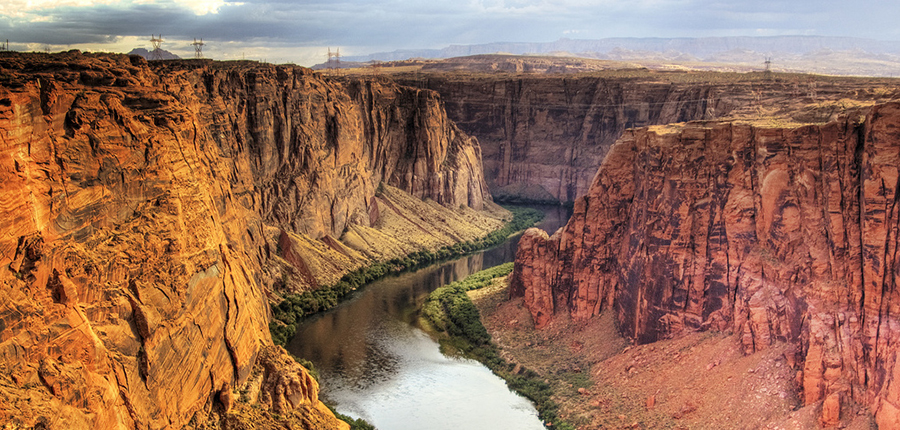
Wheat fields along the Colorado River at the Colorado River Indian Tribes Reservation. Wheat, alfalfa and melons are among the most important crops here. By Maunus at English Wikipedia, CC BY-SA 3.0, https://commons.wikimedia.org/w/index.php?curid=47854613
The Colorado River Indian Tribes and another tribe in Arizona played an outsized role in the drought contingency plans that had the state voluntarily give up water. As Arizona faces mandatory cuts next year in its Colorado River supply, the tribes see themselves as major players in the future of water.
“We were always told more or less what to do, and so now it’s taking shape where tribes have been involved and invited to the table to do negotiations, to have input into the issues about the river,” first-term Colorado River Indian Tribes Chairwoman Amelia Flores said.
Lake Mead on the Nevada-Arizona border has fallen to its lowest point since it was filled in the 1930s. Water experts say the situation would be worse had the tribe not agreed to store 150,000 acre-feet in the lake over three years. A single acre-foot is enough to serve one to two households per year. The Gila River Indian Community also contributed water.
The Colorado River Indian Tribes received $38 million in return, including $30 million from the state. Environmentalists, foundations and corporations fulfilled a pledge last month to chip in the rest.
Kevin Moran of the Environmental Defense Fund said the agreement signaled a new approach to combating drought, climate change and the demand from the river.
“The way we look at it, the Colorado River basin is ground zero for water-related impacts of climate change,” he said. “And we have to plan for the river and the watersheds that climate scientists tell us we’re probably going to have, not the one we might wish for.”
Tribal officials say the $38 million is more than what they would have made leasing the land. The Colorado River Indian Tribes stopped farming more than 15 square miles (39 square kilometers) to make water available, tribal attorney Margaret Vick said…
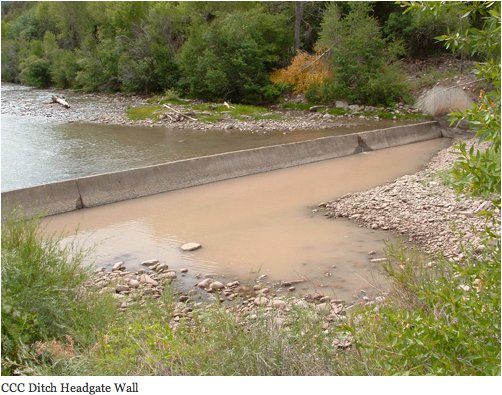
While some fields are dry on the reservation, the tribe plans to use the money to invest in its water infrastructure. It has the oldest irrigation system built by the U.S. Bureau of Indian Affairs, dating to 1867, serving nearly 125 square miles (323 square kilometers) of tribal land.
The age of the irrigation system means it’s in constant need of improvements. Flores, the tribal chairwoman, said some parts of the 232-mile (373-kilometer) concrete and earthen canal are lined and others aren’t, so water is lost through seepage or cracks.
A 2016 study conducted by the tribe put the price tag to fix deficiencies at more than $75 million. It’s leveraging grants, funding from previous conservation efforts and other money to put a dent in the repairs, Flores said.
“If we had all the dollars in the world to line all the canals that run through our reservation, that would be a great project to complete,” Flores said. “I don’t think that’s going to happen in our lifetime.”
The tribe is made up of four distinct groups of Native Americans — Chemehuevi, Mohave, Hopi and Navajo. The reservation includes more than 110 miles (177 kilometers) of Colorado River shoreline with some of the oldest and most secure rights to the river in both Arizona and California.
While much of the water goes to farming, it also sustains wildlife preserves and the tribe’s culture…
The tribe can’t take full advantage of its right to divert 662,000 acre-feet per year from the Colorado River on the Arizona side because it lacks the infrastructure. It also has water rights in California.
An additional 46 square miles (121 square kilometers) of land could be developed for agriculture if the tribe had the infrastructure, according to a 2018 study on water use and development among tribes in the Colorado River basin.
From the 2018 Tribal Water Study, this graphic shows the location of the 29 federally-recognized tribes in the Colorado River Basin. Map credit: USBR
“One of the things I like about the river is that my learning curve is perpetually steep because there are always challenges, there are always one-offs, and there are situations that we are facing on this river that we need to adapt to. Currently, we are facing hydrology and low reservoir conditions the likes of which we have never seen,” Haas said.
As Utah continues growing and drought intensifies the desert’s water scarcity, lawmakers fear losing some of the the state’s share of the river. Utah’s allocation is 1.725 million acre-feet of water or 23% of the water appropriated to the Upper Basin states that also include Colorado, Wyoming and New Mexico. Utah now uses about 1 million acre-feet and plans to develop about 1.4 million acre-feet of water, according to the Division of Natural Resources.
That’s where Haas comes in. She will lead the newly created Colorado River Authority of Utah, which begins its work in late July, officials announced last Tuesday.
A watchdog for Utah’s interests
Utah legislative leadership in the 2021 session sponsored the Colorado River Amendments bill, HB297, which, with $9 million in one-time money and $600,000 of ongoing money, set up the authority meant to serve as a “watchdog” for Utah’s share of water in the drought-challenged Colorado River.
Amy Haas, executive director, Upper Colorado River Commission, is critical of the 2007 operating guidelines (Source: Bureau of Reclamation via the Water Education Foundation)
Haas has lived in Utah part-time for the past four years for her work in the Upper Colorado River Commission, where she currently serves as executive director. She first began working on water issues about 20 years ago as an attorney in private practice in New Mexico representing institutional and private water interests. She then worked for New Mexico on policy representing that state in its interstate stream compacts.
Haas said she’s excited to be a part of Utah’s new authority as it forms “from the ground up.”
“The river is stressed, currently. I think many people know that, and I would like to be a part of sound water management, prudent water management, and I would like to be a part of a team. Utah has been and will continue to be a responsible steward of its Colorado River allocation. And I think that the authority, and the creation of the authority, really represents that Utah is proceeding in a very responsible manner regarding the development of its allocation,” Haas said.
In her new role, Haas will work with Gov. Spencer Cox, Brian Steed, executive director of the Utah Department of Natural Resources, and Colorado River Commissioner of Utah and Colorado River Authority of Utah Chairman Gene Shawcroft “to take full advantage of Utah’s entitlement to the Colorado River while engaging in prudent water management,” she said…
Lake Powell at historic low
Haas is stepping into her role even as Lake Powell’s water is at a record-low level. It’s 34% full now, she said, calling it “frighteningly” low.
“It’s about 35 feet above an elevation where the federal government together with the states (Colorado, Wyoming, New Mexico and Utah) will develop a plan to operate the reservoir such that the states can meet their obligations under a 100-year-old agreement and also that hydropower generation, which is a very important feature of Lake Powell, can be maintained and will not be jeopardized,” she said.
If the lake reaches that critical level, the Bureau of Reclamation will go in and shore up its elevations, according to Haas.
Haas was involved in developing the federally authorized drought contingency plan for the Upper Basin of the Colorado River, which is now being deployed. The plan includes releasing water from federal reservoirs upstream of Lake Powell to store and use in Lake Powell, enhancing cloud seeding, removal of non-native vegetation and additional conservation measures…
She’s optimistic that the states in the U.S. and Mexico with interests in the river will continue working closely together on its management, as they have done in the past — and that that collaboration will increase due to current conditions. For example, Mexico recently partnered with the Basin states and federal government to take shortages in its allocation of the river, which Haas said helped water managers address constraints.
Water releases increase to Blue River but not enough for commercial rafting
Dillon Reservoir is now 100% full, according to Denver Water, which manages the reservoir.
Nathan Elder, manager of water supply for Denver Water, said it’s normal for the reservoir to be full this time of year, but he noted that the reason it’s full despite an ongoing drought is because the water is carefully managed, and much less water was released from the reservoir to the Blue River than in an average year…
Elder said this was a year where the reservoir started out lower than normal and less water flowed in from the melting snowpack…
Elder noted that Denver Water is bringing much less water through the Roberts Tunnel than it typically would because of good moisture levels in the South Platte Basin, which is at 96% of normal, and water conservation by consumers on the Front Range…
While more water is being released into the Blue River now — 184 cubic feet per second as of Wednesday afternoon compared with 100 cfs prior to Monday — it’s still not enough for rafting this year. Elder said a flow of 500 cfs is needed for rafting, but the maximum outflow this year will likely only get to about 250 cfs.
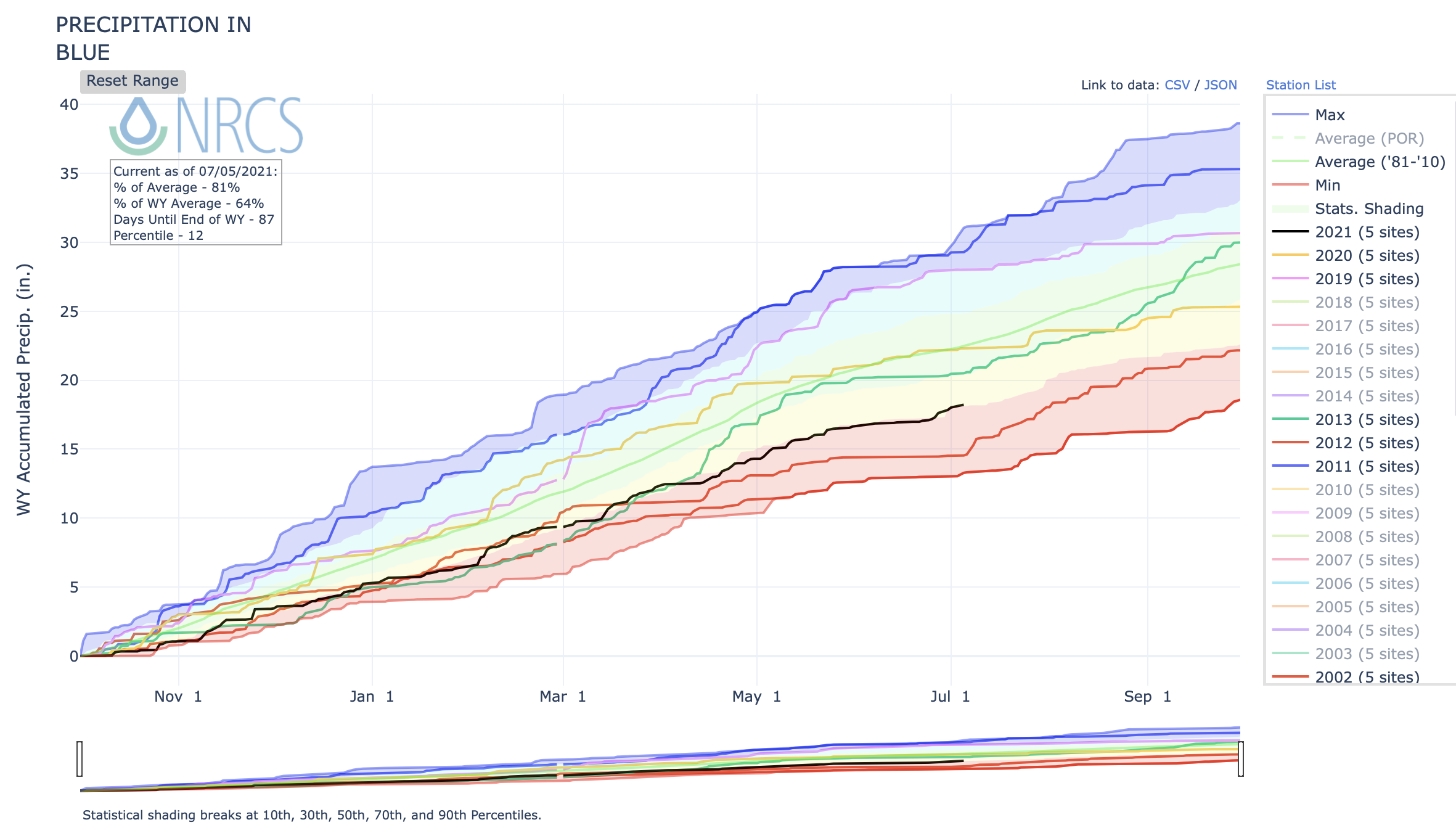
The main reason water levels are low this year is because the snowpack was below average. According to a measurement site at Copper Mountain, the 2021 snowpack peaked at 12.4 inches of snow-water equivalent, or the amount of water held in the snowpack. That’s nearly 5 inches less than the 17.3 inch median for the site, which is based on 30 years of data.
Recent rain has helped slightly but isn’t as much of a determining factor as snowpack…
Treste Huse, a senior hydrologist at the National Weather Service in Boulder, said stream flows in Summit County overall are below normal compared with historic levels. Huse said all streams in Summit County are below normal and that Straight Creek is running much below normal — 13 cfs Wednesday near Dillon compared with an average of 55 cfs for the same date. Recent precipitation levels have been above normal, but it hasn’t made much of a difference, Huse said…
In the past 30 days, the Dillon weather station has recorded 1.69 inches of precipitation — 50% above the normal 1.13 inches in the same time period. And in the past four months, precipitation is slightly above normal. Huse said that while precipitation is above normal, the difference is less than an inch, and with dry soil conditions, it doesn’t make much of a dent in the water supply.
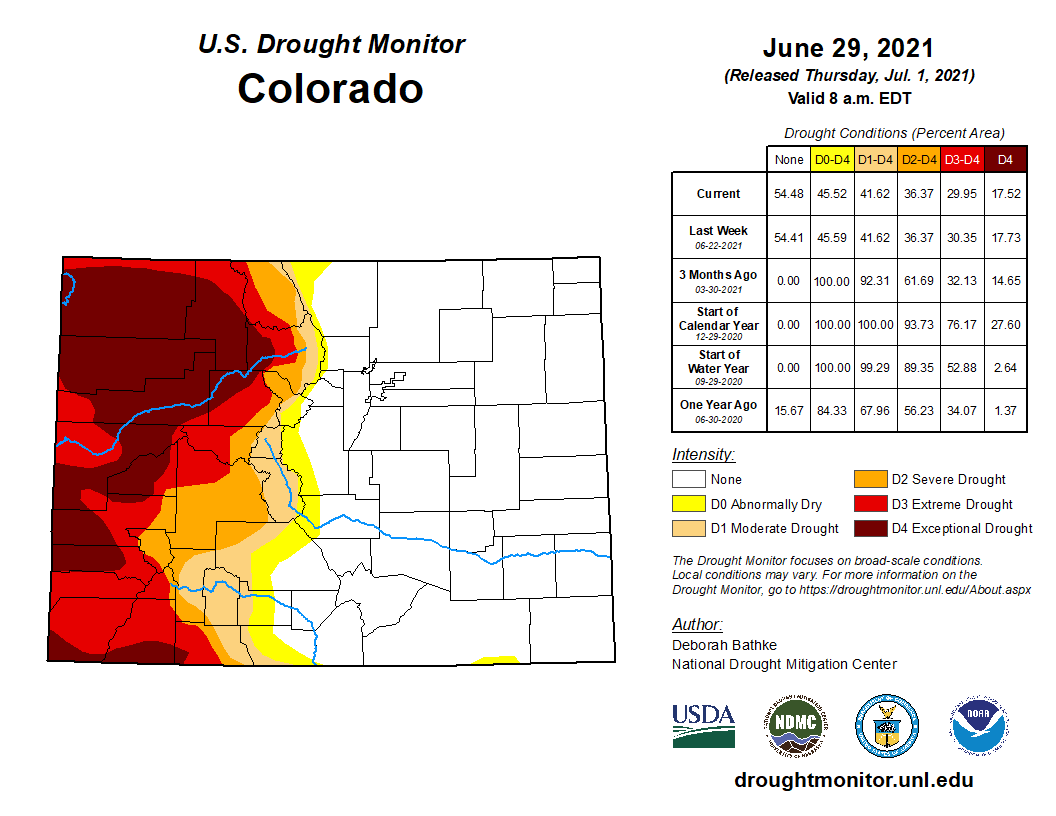
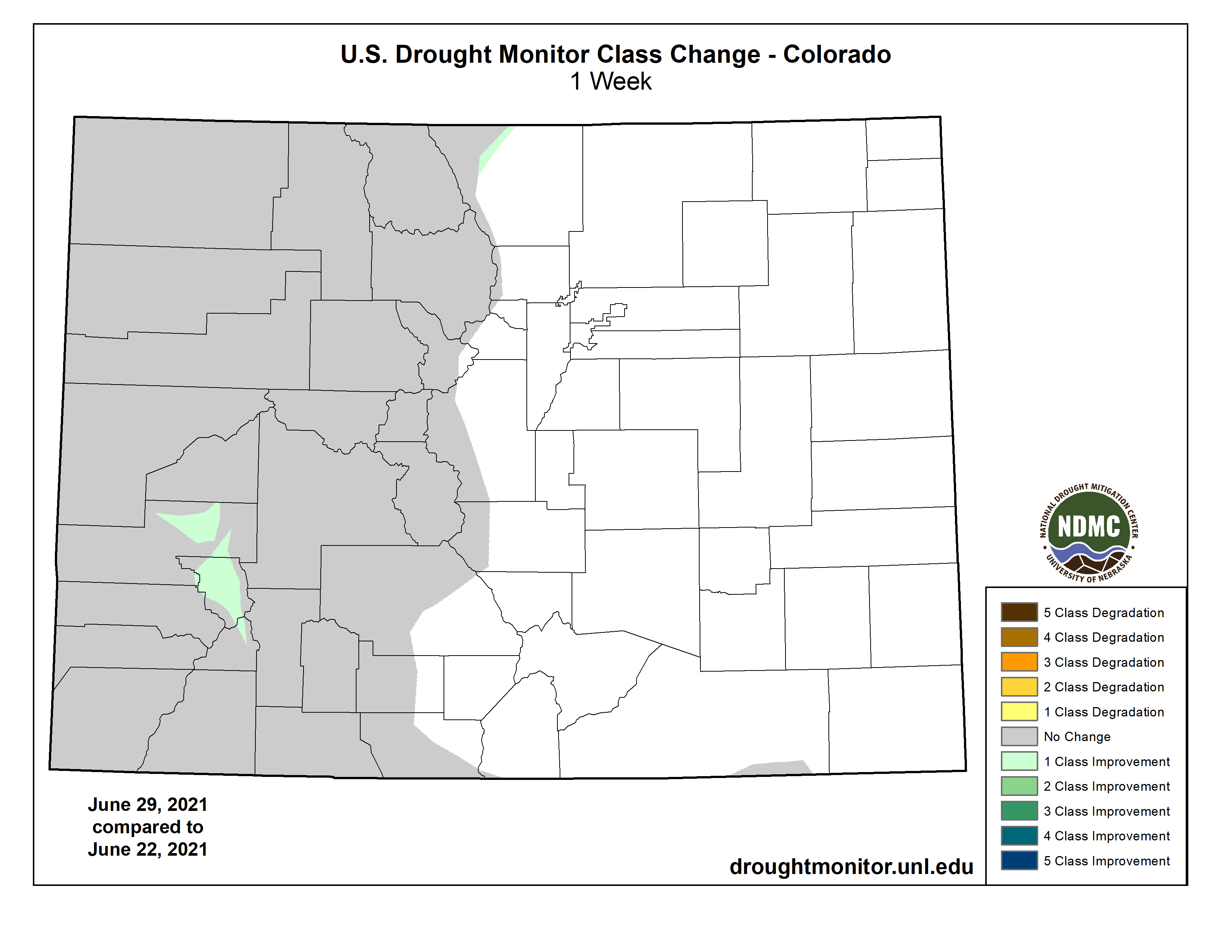
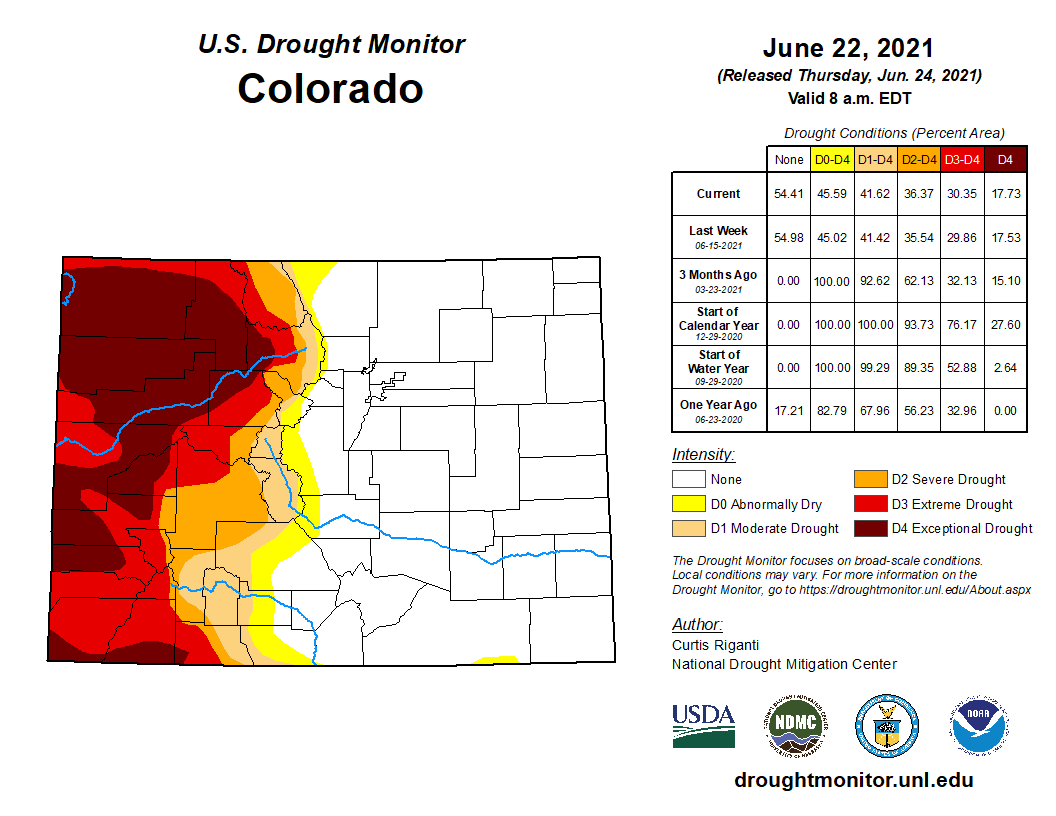
Colorado Drought Monitor map June 29, 2021.
Huse noted that while Summit County’s drought conditions have improved, the northern half of the county is still in a severe drought.
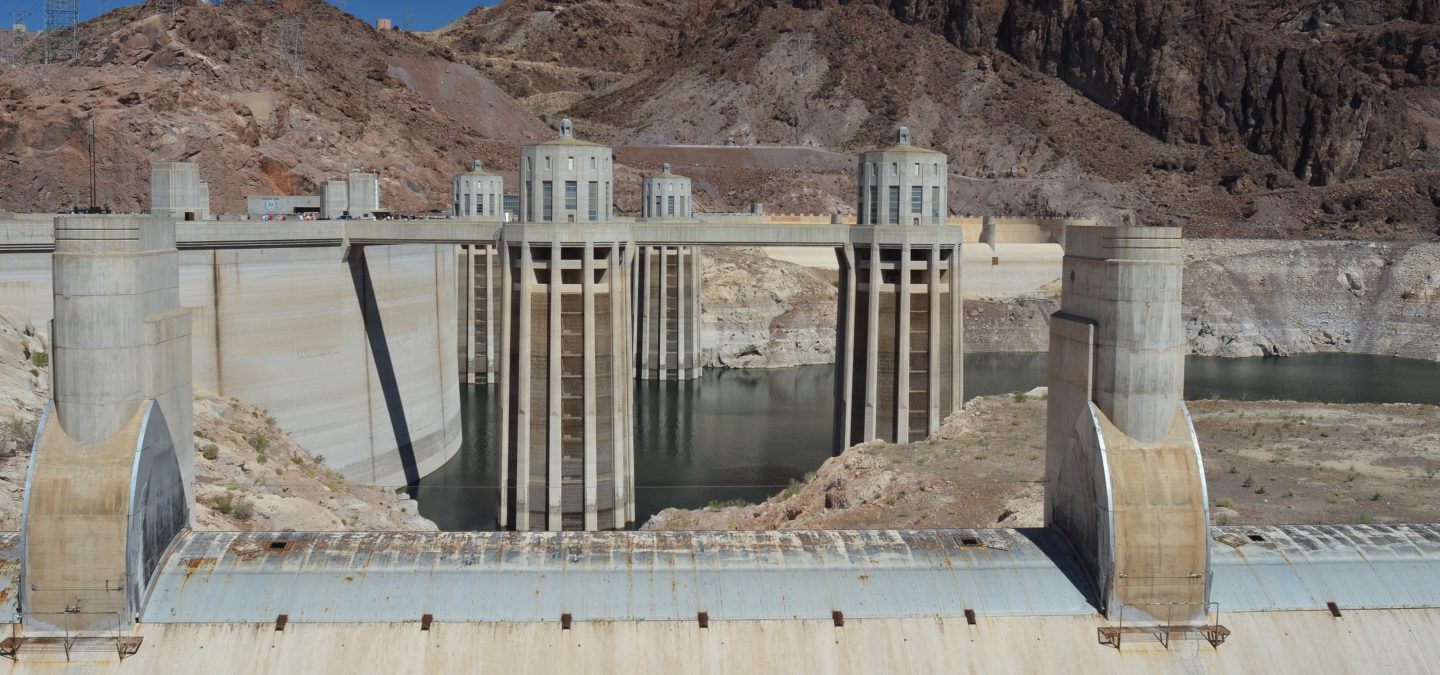
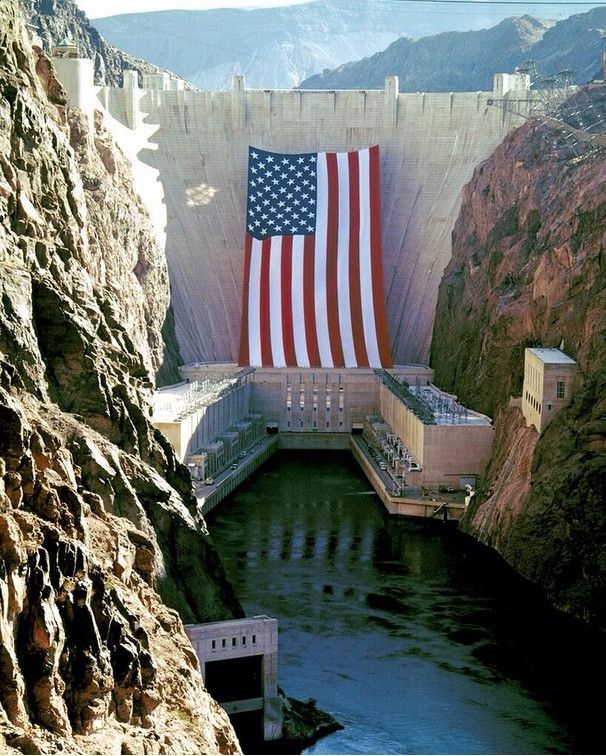
Lake Mead behind Hoover Dam. Lake Mead last month fell to its lowest level since the Hoover Dam was built in 1936. The shoreline has dropped 45 meters since the reservoir was last full in 2000. Photo by Ken Neubecker via American Rivers
New research reveals a positive feedback loop with negative consequences linked to lower springtime humidity across an already parched landscape
question has bothered climatologist Park Williams during the decade he’s been probing drought in the Southwest. Like other climate scientists, he knew from research papers and worldwide storm patterns that a warming atmosphere is thirstier and sops up more moisture from oceans and the land.
“But, in the Southwest, we’ve seen the exact opposite happening,” said Williams, an associate professor in the University of California, Los Angeles’ geography department. “For the last 50 or so years, we’ve actually seen the amount of water vapor molecules in the atmosphere decline” while temperatures have climbed about twice as fast as the global average.
A new paper from UCLA researcher Karen McKinnon largely solved that puzzle by showing the hottest days in the summer months are getting dramatically drier as a result of the Southwestern spring heating up and leaving less moisture behind to cool the summer through evaporation.
The study, published in the journal, Nature Climate Change, shows a surprising new way in which heat and humidity are interrelated and comes at the beginning of a summer that is already sweltering and plagued with wildfire and drought. For some, the paper also raises concerns about future warming in southwestern states.
“When you look at those hottest days, we’re starting to see pretty large decreases in humidity,” said McKinnon, who works in UCLA’s Department of Statistics and Institute of the Environment and Sustainability.
Her team analyzed spring and summer data from 28 weather stations at airports in southern California, Arizona, Colorado, Nevada, New Mexico and Utah. They zeroed in on “specific humidity,” a measure of the molecules of moisture in the atmosphere that ignores factors like temperature that are counted in the more commonly discussed “relative humidity.”
“On these hot dry days, the source of the moisture in the air is basically coming from the soils from the land surface—and we’re seeing declines in near surface soil moisture over the summer over these past couple of decades—and that’s leading pretty clearly to these decreases in humidity,” she explained. “So, we’re having lower humidity days as the soil moisture gets drier.”
The researchers found that specific humidity had decreased across the region by an average of about 20 percent. And, in California and Nevada, the decreases were about one-third of the mean value…
A feedback loop brings new drought concerns
The pattern identified in the study is a positive feedback loop with negative implications. Increasing heat in the spring dries the soil, which, in turn, raises summer temperatures due to the lack of soil moisture, which helps cool the landscape when it evaporates.
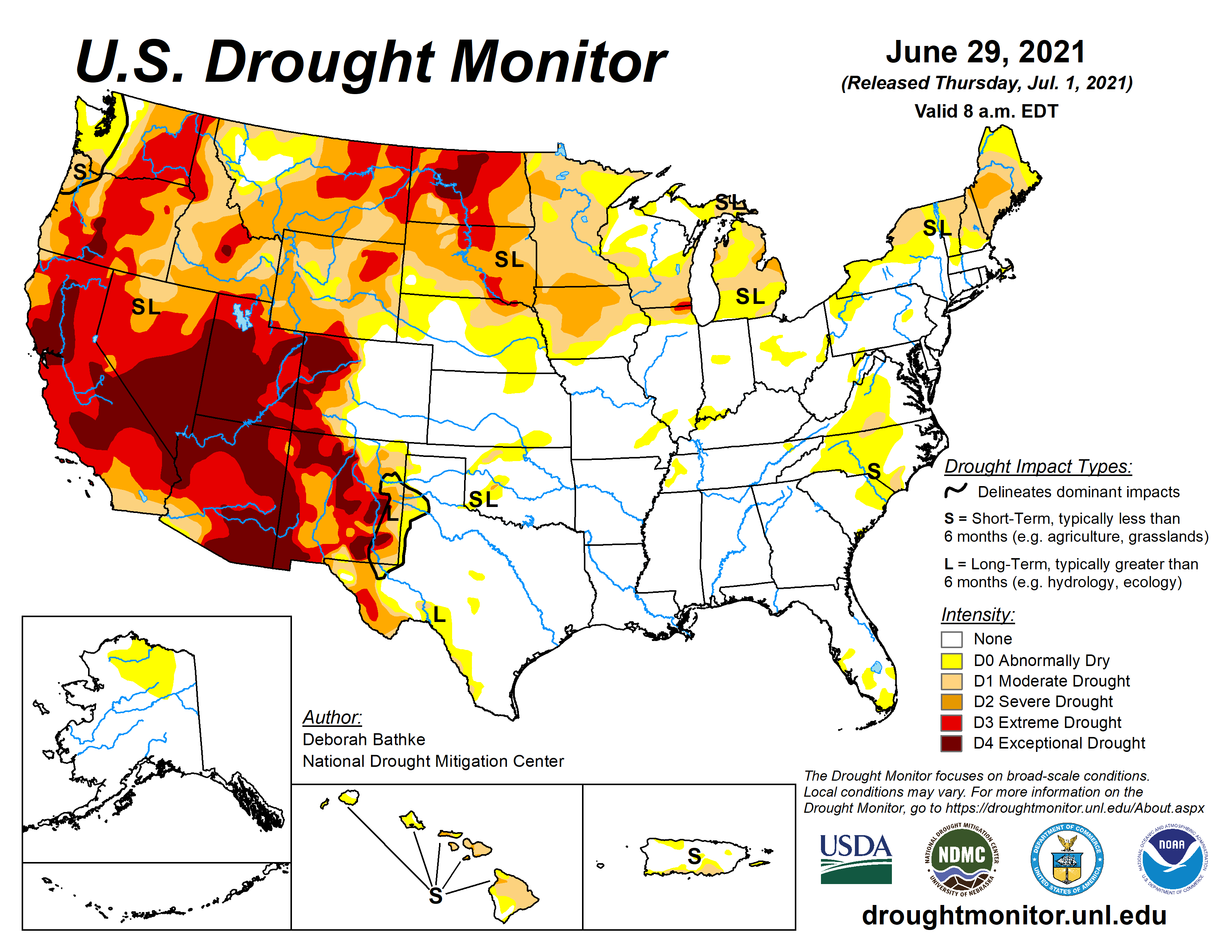
The weekly U.S. Drought Monitor classifies more than half of the West as being in “extreme” or “exceptional” drought, with between 86% and 92% of the land in California, Utah and Arizona in the most severe drought categories. Meanwhile, observations show drought conditions have dominated the region over the past two decades, pushing the Southwest into what’s called a “megadrought.”
West Drought Monitor map June 29, 2021.
The drought is easing in Colorado compared with 3 months ago, when the entire state was dry or in drought. The most recent drought map shows about 46% still experiencing some level of parched conditions, with nearly 30% of the state in extreme or exceptional drought.
Colorado Drought Monitor March 2, 2021.
Colorado Drought Monitor map June 29, 2021.
Simon (Shih-Yu) Wang, a professor of climate dynamics at Utah State University, called the McKinnon team’s new statistical analysis “a rigorous approach” that reaffirms the significance of the soil moisture and temperature link that researchers have been studying in earnest for a decade.
“When we don’t have water in the soil, we’re gonna get a lot hotter a lot faster,“ he said of the hot-dry pattern that’s become typical with climate change in the Southwest. “Basically, it’s what you expect in a drought situation in semi-arid regions.”
[…]
Mike Hobbins, senior research scientist at the University of Colorado Cooperative Institute for Research in Environmental Sciences in Boulder, said the McKinnon study has strong implications, especially for wildfire. Trends identified in the study suggest that fire seasons could become more explosive, he said.
That’s because fire is strongly influenced by the difference between the amount of moisture the atmosphere can potentially hold and how much it actually has.
The difference between the two is known as the “vapor pressure deficit.” And the bigger the deficit, the thirstier the atmosphere and the more erratic wildfire becomes. That, plus the dried out condition of vegetation means, “the fire season will grow at both ends,” he said.
The McKinnon paper noted that the future of this summertime trend remains unclear, even though it’s something that the research team considered in its analysis. Uncertainty surrounding precipitation trends in climate models for the Southwest—some models show precipitation increasing—makes it hard to know how much vapor pressure deficit the region will face.
The Southwest ought to prepare “for a range of possible outcomes,” McKinnon said. Still, with the projected rise in temperatures and the new information about the hot-dry dynamic leaves little room for optimism about a moister future in the Southwest…
But Williams, part of a research team behind a paper last year showing that the human-caused share of climate change can be blamed for about half of the historic Southwest drought, also thinks about how the extra warmth from the heat waves might promote enough convection to result in precipitation.
This story was originally published by InsideClimate News, an independent, nonprofit, nonpartisan news organization that covers energy, climate and the environment.
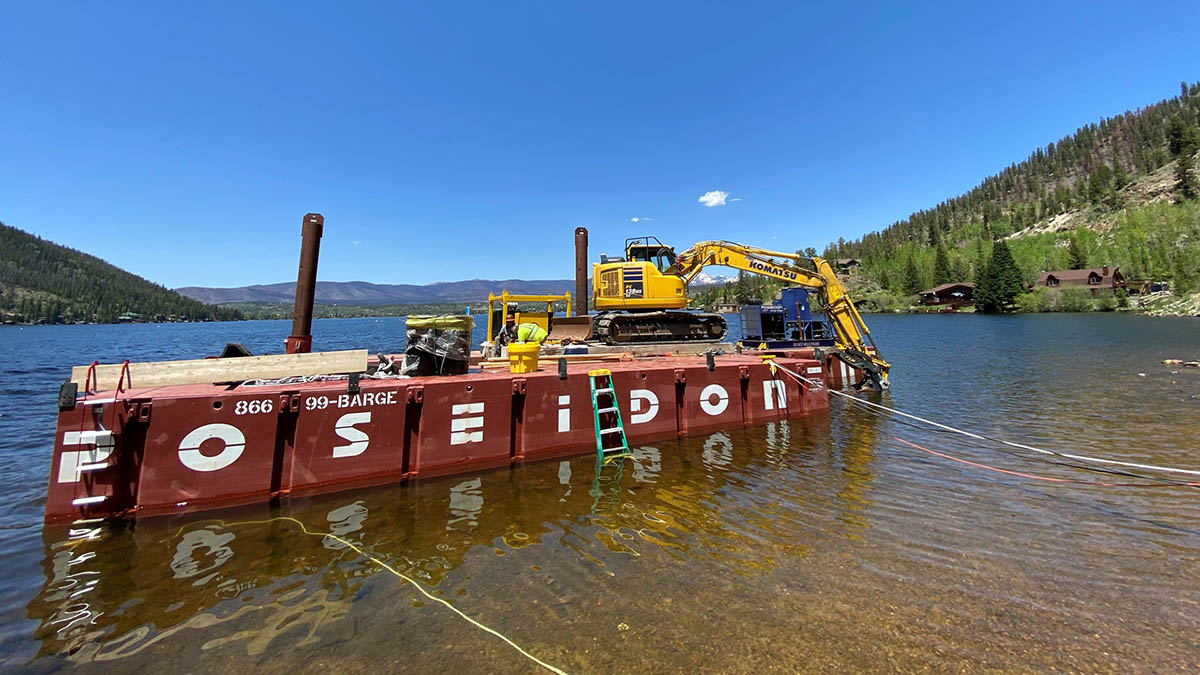
A work crew prepares to install a debris boom at Grand Lake. The boom will prevent floating debris from entering the Alva B. Adams Tunnel. Photo credit: Northern Water
While new wildfires across Colorado and the West are creating another year of smoky skies and damaged forests, work to contain debris and restore watersheds damaged by the East Troublesome Fire has started taking shape in Grand County.
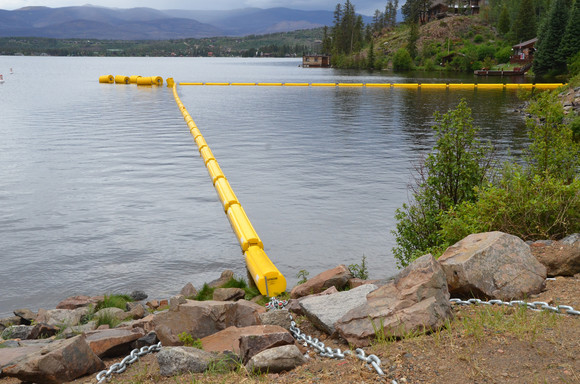
This month, crews started to place a series of booms at the east end of Grand Lake to capture floating debris that could move into the lake from heavy rainstorms that sometimes occur in the summertime. The bright yellow booms are anchored near the intake to the Alva B. Adams Tunnel, which delivers water from the West Slope to the East Slope components of the Colorado-Big Thompson Project.
In addition to the boom at Grand Lake, two more will be installed at Willow Creek Reservoir to capture debris from that heavily affected watershed. According to damage assessments, more than 90 percent of the Willow Creek watershed suffered damage in last October’s fire.
Work will also be concentrated to capture debris before it reaches the reservoirs. Starting in July, helicopter crews will drop mulch and seeds on burned areas that are inaccessible to ground-based efforts. That material will help to keep soil and debris in place, and in future years will provide appropriate ground cover at those sites.
Other methods for debris containment to be installed include catchment basins where smaller tributaries might be transporting loosened materials.
Funding for the efforts has come from the federal Natural Resources Conservation Service’s Emergency Watershed Protection program and state matching funds from the Colorado Water Conservation Board.
Finally, Northern Water has also provided a self-service site in Grand Lake where property owners can get sandbags and wattle to protect their property from high-water flows that might occur this year or in the future. In May, employees of Northern Water and Grand County volunteered to fill sandbags using equipment donated by the Salvation Army.
Because of the importance of the Upper Colorado River watershed to the Colorado-Big Thompson Project and the drinking water for more than 1 million residents in Northeastern Colorado, Northern Water has taken a lead role with Grand County as local sponsors for the Emergency Watershed Program.
The final position of the debris boom at Grand Lake will protect the inlet to the Alva B. Adams Tunnel. Photo credit: Northern Water
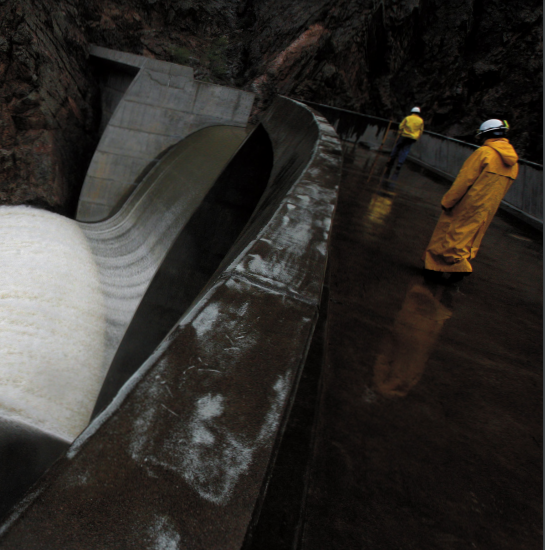
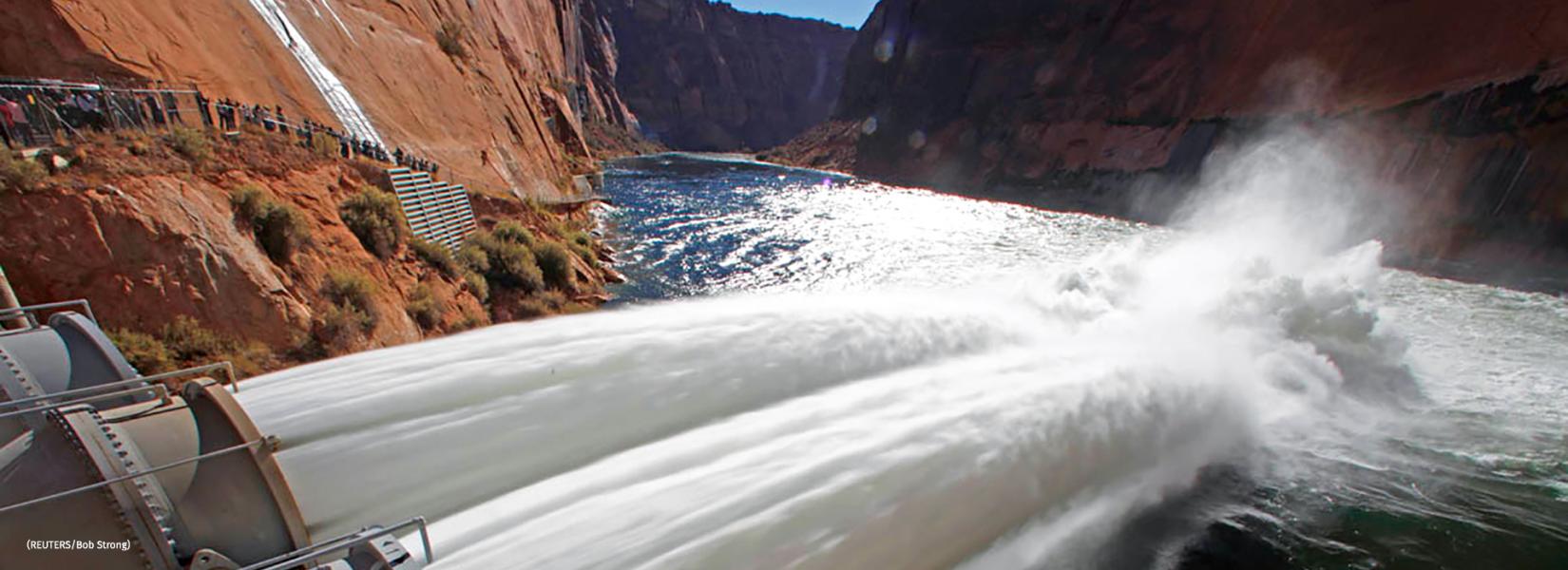
Safety inspectors walk on top of the Crystal Dam in the Black Canyon of the Gunnison National Park in May 2008, when high snowpack and warm temperatures prompted reservoir managers to make more room through a managed release, or spill. The reservoir spilled most recently in May 2019. Photo by William Woody
To address the water needs of a growing population amid shortages, the Colorado Water Plan in 2015 set a goal of attaining 400,000 acre-feet of new water storage by 2050.
Colorado is working its way toward that goal, but building new storage is easier said than done. Increasing environmental and social concerns, limited geographic locations, and even more limited water rights have made many traditional reservoir storage projects tougher to build. On top of that, long-range forecasting — to figure out how much water is going to be available to be stored — has become especially difficult as a result of climate change.
An April 2020 study published in the journal Science found that the American West’s current drought is as bad or worse than any in the past 1,200 years of tree-ring records. Ordinarily, storage would be the obvious solution to drought and dry years. You collect moisture in wet years and save it for times of need. But climate change has created a catch-22. Storage may be necessary, but it has become more challenging to build and less water is available to capture.
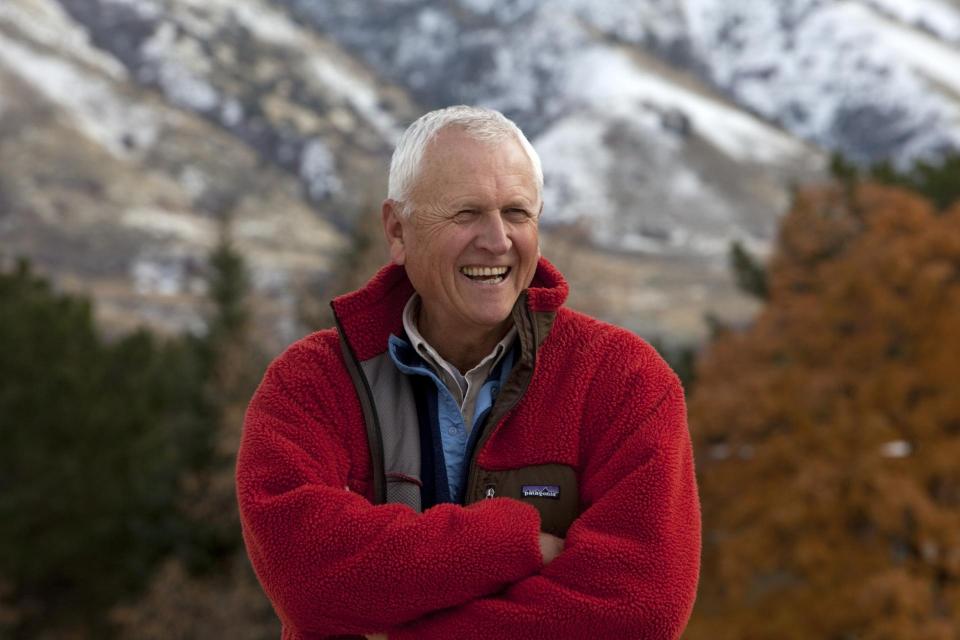
Dan Luecke, former director of the Environmental Defense Fund’s Rocky Mountain office, says these challenges have upended a philosophy long built on risk analysis to one defined by “decision-making under uncertainty.”
“For a long time, we’ve known there’s risk but we could look to the historical record to manage it,” says Luecke. (Luecke also serves on the Water Education Colorado Board of Trustees). “With climate change, that record is called into question … The nature of the game has changed.”
The cascading challenges of climate change have led water managers to think creatively about alternatives to traditional infrastructure. Greeley, for example, replaced a plan to expand an existing reservoir with one that will store water underground. Front Range districts collaborated to reallocate the space in Chatfield Reservoir, a flood storage basin, raising the water level to add permanent water storage supply. As part of the Basin Implementation Plan for the Yampa/White/Green River Basin, water managers are exploring putting reservoirs high in the mountains to limit evaporative loss.
Decision-making under uncertainty makes it all the more complicated for water providers to meet Colorado’s water needs and has caused many to reexamine what a smart storage project is made of — one that can help meet water supply goals for many water users while respecting the environment, one that is also acceptable to stakeholders, and one with minimum impacts so that it can make its way through the permitting process. Water managers are growing increasingly innovative, out of necessity, to develop water storage projects that will work.
Reservoirs under Climate Change
It’s not simply a matter of how much water is available to store. Everything from the location and size of reservoirs to the timing for capturing runoff and for making releases is being reviewed. Various climate models, including those used by the Colorado Water Conservation Board for state water planning, project warmer temperatures that will affect evaporation rates in rivers and reservoirs and seasonal shifts in precipitation, including reduced mountain snowpack and earlier runoff. Earlier and reduced flows could, for instance, necessitate dams releasing water earlier to meet demand.
Temperature rise, too, makes storing water a challenge. Any pool will lose water through evaporation, and more during hot, dry times, but the loss is worse for reservoirs at lower elevations with more exposed surface area. The science used to estimate evaporative loss is imprecise — estimates could be off by as much as 20 to 30 percent, according to the U.S. Bureau of Reclamation, which is conducting a study to refine its methods. Even so, a 2018 Bulletin of the American Meteorological Society study estimated that losses from Lake Powell and Lake Mead could total as much as 15% of the annual upper basin allocation among Colorado River Basin states, or five to six times the annual water use of Denver. The same study said that summer evaporation rates may have risen by as much as 6% over the last 25 years.
The National Climate Assessment, published in 2018, states that climate change is fueling stronger storms that could overwhelm dams and infrastructure designed to capture more moderate storm surge flows. It’s also intensifying wildfires that destroy landscapes, load reservoirs with sediment, and threaten water delivery infrastructure.
The 2019 Technical Update to the Colorado Water Plan lays out a number of alternatives to new traditional storage projects, including rehabilitating existing infrastructure, reallocating flood storage to active storage, and using below-ground aquifer storage alternatives. While the options are vast, the update says that to meet the state’s goals, “at least some new large reservoirs are needed.”
But building those reservoirs also requires water to fill them, says Brad Udall, senior water and climate research scientist at Colorado State University. Water rights are not as easy to come by in an era of constraint. Any new water rights claimed today are junior in the state’s legal priority system, making storage necessary to capture peak flows after all senior water rights are satisfied. But as climate change shifts the timing and magnitude of peak flows, reservoirs may not be as effective a tool for managing junior water rights.
“A dam is a bit like opening a bank account, there has to be something to put in it,” Udall says. “Ultimately, everything bends to the hydrological realities of what the supply is.”
The Jigsaw Puzzle
The era of uncertainty doesn’t just make individual storage projects a puzzle — the long-range plans that help utilities figure out what storage they need are now a tangle of variables. Balancing climate-complicated precipitation projections with population and water use trends, regulatory changes, and competition for resources can make the standard planning process a head-spinning endeavor.
When Colorado Springs Utilities started updating its 2017 Integrated Water Resource Plan (IWRP), the utility wanted a “comprehensive view” that would take a hard look at risk analysis, says water planner Kevin Lusk. Colorado Springs doesn’t sit on a major river system and relies on storage in remote watersheds to manage its variable supply. In the early 2000s, the utility’s water yield saw a 600% difference between the driest and wettest years.
Realizing that a backward-looking dataset might no longer apply to a present and future defined by climate change, the utility took a state-of-the-art new approach to its planning process. Recently, Colorado Springs partnered with the consulting firm Black and Veatch, which expanded the multi-objective evolutionary algorithm (MOEA) to utilities to help them assess the complexities in planning. The machine learning tool can project thousands of possible futures using precipitation, temperature and hydrological factors, then help planners narrow down their range of possible options.
“As these plans get so big, it’s hard for the human mind to comprehend them,” says Leon Basdekas, a private consultant who worked at Colorado Springs Utilities, then Black and Veatch, designing and managing the utility’s IWRP. “This tool allows you to evaluate complex planning options in ways that would be impossible to do otherwise.”
Leon Basdekas, pictured beside Monument Creek, worked with Colorado Springs Utilities using a machine learning tool to help the water provider assess complex future water supply and demand scenarios and evaluate where new water storage could be beneficial. Photo by Matthew Staver via Water Education Colorado
For Colorado Springs, the advanced IWRP process helped water planners see a range of climate and streamflow possibilities, then identify 14 storage options that could meet future water demand. Some, like a potential new reservoir on Williams Creek or one upstream of Rampart Reservoir, have been under discussion for years. Others are more general concepts without specific sites, such as gravel pit storage along the Arkansas River. Among those identified projects, Colorado Springs has also been exploring Eagle River storage options, including the potential Whitney Reservoir, to collect and store Western Slope water, although nearby towns and others have objected to possible impacts on the Holy Cross Wilderness Area. Lusk says Whitney Creek alternatives are “one of many possibilities” and that the IWRP analysis even considers “less tangible characteristics” like community values and opposition to any individual project when optimizing storage opportunities.
More than anything, Lusk says, the advanced modeling helped the utility gain a better appreciation for the full scope of storage and transmission. The “a-ha moment,” he says, is seeing how one individual new reservoir may not mean as much for the system as, say, shoring up existing pipelines to make the already-built system run more efficiently.
“We can’t just look at storage on its own, it’s a package deal with supply and conveyance,” Lusk says. “This is a complex jigsaw puzzle.”
When Mitigation Meets Enhancement
To the north, the Northern Integrated Supply Project, or NISP, has been moving through a decades-long process to obtain the necessary permits and to gain the favor of local stakeholders. NISP has been reshaped, with operational changes and environmental improvements now built in, in response to stakeholder concerns.
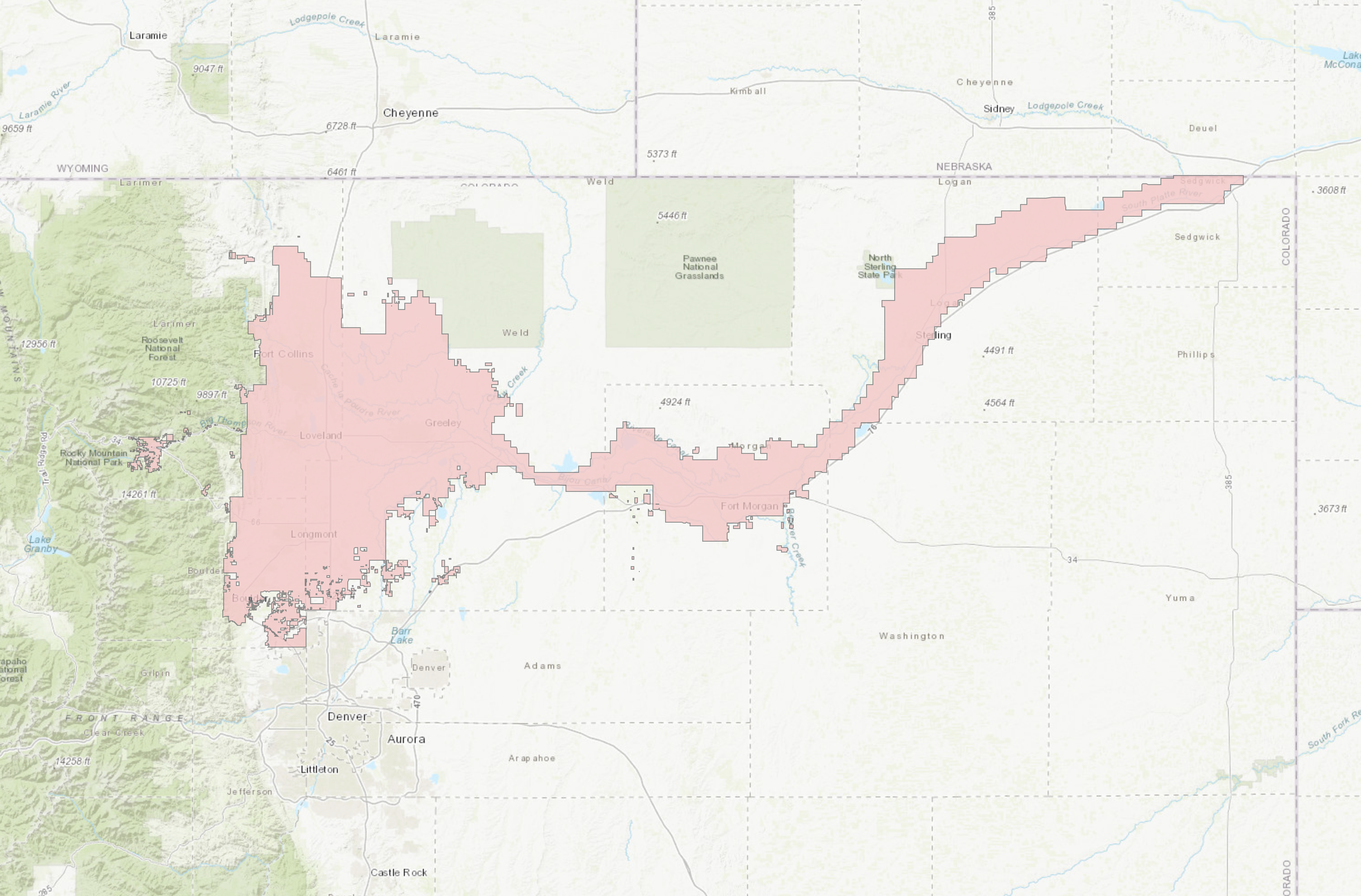
Northern Water’s project, if fully approved, will build two reservoirs, one northwest of Fort Collins off the Cache la Poudre River and another northeast of Greeley, to deliver nearly 40,000 acre-feet of water a year to 15 communities and irrigators along the Front Range. With the population of northern Colorado expected to double by 2050, backers say that such a large shared storage project is necessary to efficiently serve booming towns like Erie, Windsor and Severance. Through water exchanges with farmers — which will average about 25,000 acre-feet per year — and the purchase of conservation easements on farms, Northern Water says the project will also help farmers reduce the negative impacts of buy and dry by keeping water on farms while serving the growing Front Range population.
Northern Integrated Supply Project (NISP) map July 27, 2016 via Northern Water.
But supplying those growing towns will necessarily require impacts. NISP will involve constructing the 170,000 acre-foot Glade Reservoir (to accommodate the reservoir, seven miles of U.S. Highway 287 will be relocated) and the 45,600 acre-foot Galeton Reservoir. Northern Water will also build another forebay reservoir, five pump plants, and 80 miles of pipeline.
That kind of construction naturally attracted opposition from environmentalists and some communities. Concerns include that taking water out of the already-stressed Poudre River could reduce its crucial spring peak flows, which flush sediment downriver and restore habitat.
Several environmental reviews as part of the permitting process concluded that the need for storage was there, even after accounting for planned water conservation savings. With so many communities involved, scrapping the collaborative project, as some environmental groups advocated for, would leave them all competing for limited resources.
“I think quite a few participants who saw [NISP] as a [potential] future supply are now looking at this as the future,” says Christopher Smith, general manager of the Left Hand Water District and chairman of the NISP participants committee. “I don’t think anyone is left who is speculating on this. It’s necessary.”
So Northern Water started looking for what project manager Carl Brouwer calls “the wow factor.”
“We really changed our perspective to thinking about how we could put water back and be a part of the preservation of the Poudre River,” Brouwer says.
Cache la Poudre River. Photo credit: Allen Best
Project proponents added an estimated $60 million in mitigation and enhancement measures, bringing the total estimated project cost to about $1.1 billion. The idea is that water would be released from Glade Reservoir year round and no water will be diverted to storage when flows dip below 50 cubic feet per second (cfs) in the summer and 25 cfs in the winter to eliminate spots where the river already dries up. Collection operations will be adjusted to keep peak flows in the Poudre River two out of every three years, and 90% of the time little or no diversion will take place during peak flows. Organizers will also build new fish passage structures and improve 2.4 miles of stream channel near a Colorado Parks and Wildlife (CPW) fish hatchery north of Fort Collins.
The mitigation and enhancement plan received unanimous approval from CPW and the Colorado Water Conservation Board in 2017, and the Colorado Water Quality Control Division approved the project’s 401 Water Quality Certification in 2020. NISP has continued moving through the federal permitting process, with final approval expected this spring or summer.
Karlyn Armstrong, water project mitigation coordinator for CPW, says that the flow program will be a benefit to the river. “Currently the river goes dry in places — once the program comes online, the river will have water 365 days a year through the conveyance flow reach,” Armstrong says. “Aquatic life will benefit from sustained minimum flows.”
Critics remain. In August 2020, the Fort Collins City Council voted 5-1 to oppose the project, citing the potential loss of spring flows, and some environmentalists say communities should explore options with less of an environmental footprint.
But Brouwer says that the project, combined with Northern’s efforts on conservation and water exchanges, should set the new standard for infrastructure in the state with its environmental focus.
“What really changed was embracing the enhancement part of mitigation and enhancement. We can make it better,” Brouwer says. “We’ve set the bar pretty high and I do think this will become the norm.”
Addressing Demand
Improved or not, some still say a large storage project like NISP shouldn’t happen at all. Boulder-based Western Resource Advocates has been a long-time opponent of NISP and in 2012 released an alternative plan it said could meet the needs of Front Range communities without the footprint of new infrastructure. The nonprofit’s “Better Future” alternative included conservation tools that would offset 20,482 acre-feet of use by 2060 and apply reuse technology to another 4,905 acre-feet. Combined with flexible water sharing agreements between agricultural users and municipalities and more thoughtful expansion onto previously irrigated agricultural land that could come with water rights, WRA says their plan reimagines what adding supply could look like.
“We know we need more storage going forward, but new storage doesn’t have to be connected to new development,” says Laura Belanger, water resources engineer at Western Resource Advocates. “Alternative supply portfolios that include reuse or conservation can mean storage that optimizes existing supplies more efficiently.”
WRA’s plan as an alternative to NISP was rejected in 2018, as were all other alternatives proposed during the public comment period, when the U.S. Army Corps of Engineers issued NISP’s Environmental Impact Statement, saying that these options “did not meet the project’s purpose and need and practicability screening criteria.” WRA says it relies on different calculations than the economic reports backing NISP and has continued to update its alternative in a series of recent comments on the NISP proposal.
Whether or not it could replace NISP, the “Better Future” model represents how some are thinking about limiting demand as a way to reduce the need for additional storage. Aggressive conservation has started to decouple water use from population growth in some cities across the West; a survey of 20 Western cities published in the journal Water found that between 2000 and 2015, total water use dropped 19% while populations increased by 21% on average. Denver Water has reduced per capita water use by 22% over the past decade.
The City of Aurora has also made conservation and reuse a foundational part of its water plan, including more efficient landscaping requirements, rebates for low water-use appliances, and requirements that new developers make their buildings less wasteful. Tim York, the city’s water conservation supervisor, estimates that it costs about $600 in staff time and resources for each acre-foot of water conserved, compared to about $25,000 per acre-foot for water acquired on the open market.
That doesn’t mean Aurora isn’t looking for more storage. The city is moving ahead on the proposed Wild Horse Reservoir project, a 96,000 acre-foot storage site in Park County.
“There’s always going to be more to be done from conservation and efficiency. At the same time, you can only get so low,” says York. “You get to a point where you need storage. The mindset that you can conserve your way out of any drought is just not realistic.”
Many small- and medium-sized utilities don’t have the staff to mirror Aurora’s efforts, but Belanger says that the strain on resources under the drought makes it necessary for all municipalities to embrace conservation.
“The more efficient existing and new development is, the more water you can have in the supply,” Belanger says. “Managing the demands of your community produces sustainable savings.”
Can Restoration Double As Storage?
Some advocates say it’s time to think beyond cement and instead embrace natural watershed restoration as a storage solution.
In its 2016 Water Plan, the State of California declared that source watersheds would be considered “integral components of water infrastructure,” putting reviving watersheds on essentially the same level as building new dams or pipelines. While Colorado hasn’t adopted similar language yet (Montana is the only other state to do so), there is increased attention to restoring watersheds as an ecological tool with water storage benefits.
“Our water has so much to do, we should give it a longer reach and take advantage of all the benefits,” says Abby Burk of the Audubon Society. “When water is in rivers instead of sitting in reservoirs, there are so many more benefits that support healthy, thriving ecosystems.”
Snowmelt and storm events, for instance, flash quickly through incised streams that are disconnected from their floodplains. Healthier connected floodplain-riparian areas can restore plant life, recharge underground aquifers, preserve flows for aquatic species, and even reduce flood risk. Water in the ground also won’t evaporate like it does from reservoirs. However, it’s less clear if this restoration work can provide the kind of material storage benefits providers want to see.
“We’re careful about saying that restoration of floodplains and wetlands does not produce more water, but it can change the timing,” says Jackie Corday, a consultant working with American Rivers on healthy headwaters issues. “The water can be attenuated [by absorption into the restored floodplain], the runoff is slowed when it’s stored as groundwater, then it slowly gets released throughout the summer instead of all at once.”
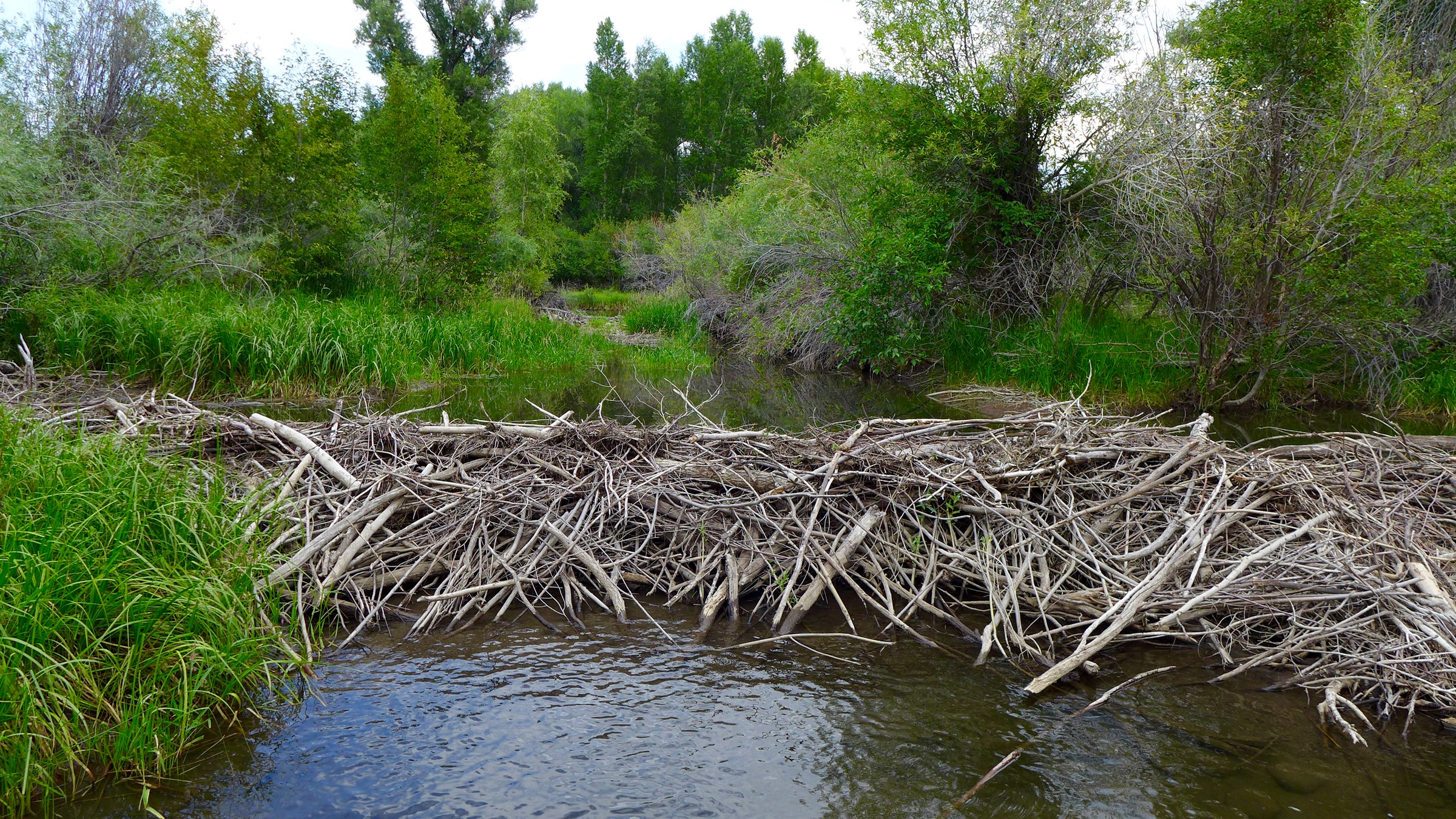
A beaver dam on the Gunnison River. Photo: Brent Gardner-Smith/Aspen Journalism
Stretching natural runoff releases into the hot summer months could help farmers irrigate for longer growing seasons without storing water above ground, but little research has quantified that potential. Researchers are eyeing projects meant to mimic beaver structures to see how they change flows. A project that’s currently underway to restore floodplains and wetlands upstream of Grand County’s Shadow Mountain Reservoir could offer a good model; preliminary assessments from that project are expected by the end of the year.
According to Melinda Kassen, senior counsel for the Theodore Roosevelt Conservation Partnership, restoration fits into a more natural philosophy of water systems. She hopes to see more municipalities begin to view natural infrastructure as just as valid as traditional infrastructure.
“You just have to remember that there is an alternative, and sometimes that’s hard when you’ve done something one way for 150 years,” Kassen says. “When we talk about water storage now, one of the first things we say is that we should be looking at green infrastructure instead of gray.”
Thinking System-Wide
A bigger way of thinking is taking hold in the South Platte River Basin, home to approximately 70% of the state’s population and its largest projected water supply gap. The South Platte Basin Implementation Plan, completed in 2015 to inform the state water plan, showed that, with a population expected to reach 6 million by 2050, there could be a maximum annual water supply gap of 540,000 acre-feet.
The “status quo” strategy to fill that gap for cities is buy and dry, says Joe Frank, general manager of the Lower South Platte Water Conservancy District in northeastern Colorado. Frank has always worked on behalf of the water users in his district, but as water stresses increase, he is thinking more creatively about the future of agriculture by “providing water security for both” farms and cities.
There are more water rights on the South Platte River than there is water to fulfill them in most years, which is why buy and dry — where cities purchase senior agricultural water rights, drying up a farm and gaining the priority to divert that water when flows are low — has been attractive to municipalities. As an alternative, new storage might help. Some flows are available for capture, just not every year. The South Platte Storage Study, ordered by the Colorado Legislature in 2016 and completed in 2017, found that while flows were extremely variable between 1996 and 2015, a median flow of 293,000 acre-feet per year in excess of South Platte River interstate compact obligations crossed the state line into Nebraska. The amount of water that could be put to use in Colorado is much less, the study found, but additional South Platte storage could help with a variety of things — from compact compliance to water sharing agreements to river flows and to better utilizing reusable return flows from upstream municipalities. It also found that a combination of storage pools working conjunctively up and down the river could be more beneficial than individual reservoirs.
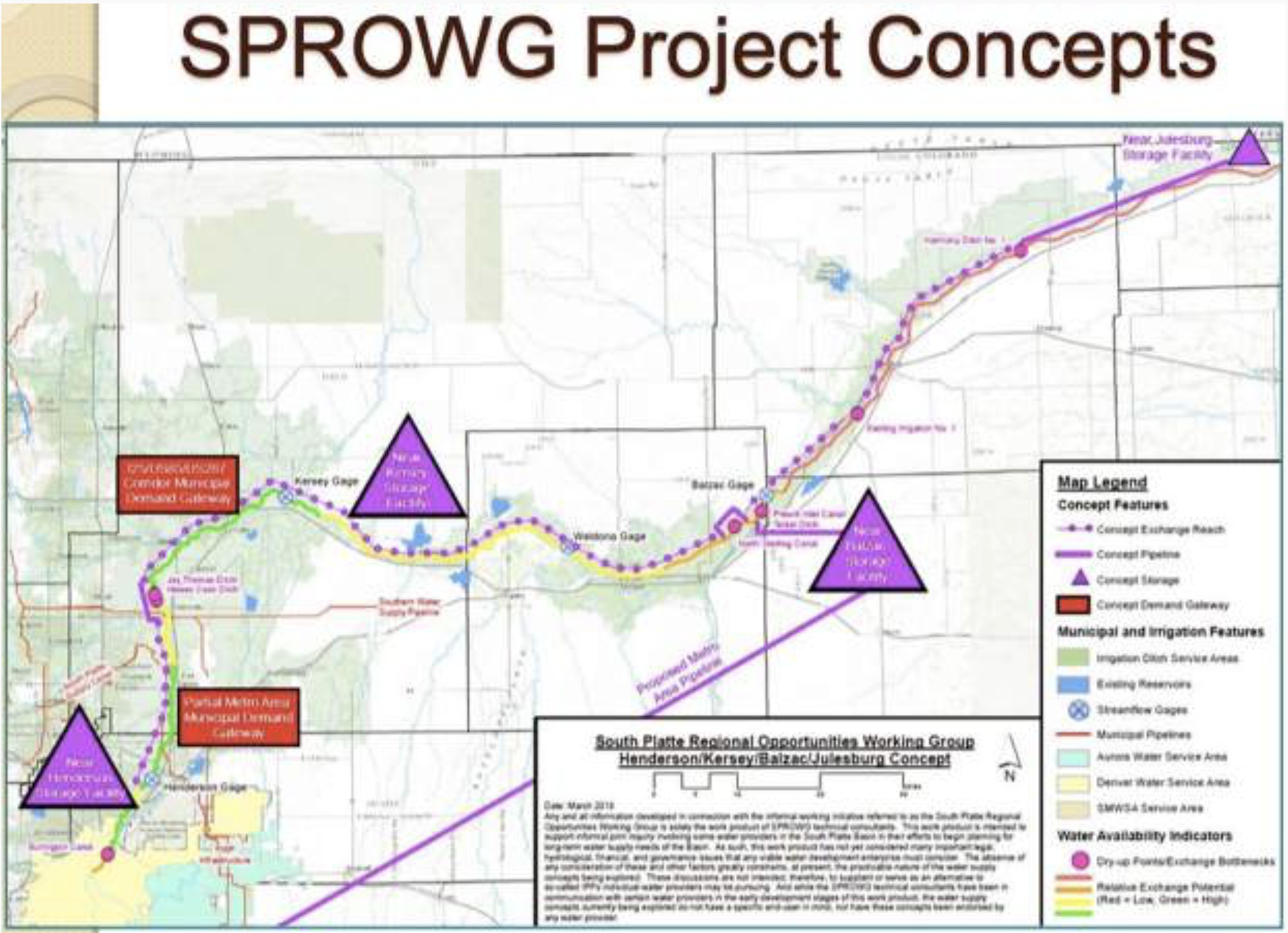
To explore ways to move beyond individual reservoirs to close the gap, Frank and other water managers throughout the basin are collaborating on the South Platte Regional Opportunities Water Group, or SPROWG, and working toward a system-wide approach to storage and water use.
A group called the South Platte Regional Opportunities Working Group, or SPROWG, is proposing to store 175,000 acre-feet of water in a series of reservoirs on the South Platte River, from north of Denver to the Morgan County line. The project also includes a long pipeline to pump water from the river back to the metro area to be cleaned and re-used. Graphic credit: CWCB via Aspen Journalism
In a feasibility study published in March 2020, SPROWG members identified four alternative concepts that could help close the supply gap without diverting additional water from the Western Slope or buying up valuable water rights from local farmers. The study analyzed the potential to store between 215,000 and 409,000 acre-feet of water in various generalized locations between Denver and the Nebraska state line. New storage would rely on available flows not obligated to existing water rights, water that can be reused, or temporary lease agreements with farmers. Stored water would then be used locally, transported through a pipeline for regional use, or exchanged between locations.
The idea, said SPROWG advisory committee member Lisa Darling, was to think regionally instead of by district, to move water where it’s needed at any given time.
“Maybe there was this sort of older water buffalo thinking in the past, but I think we know now that we can’t develop projects in a vacuum anymore,” says Darling, the executive director of the South Metro Water Supply Authority. (Darling also serves as president of Water Education Colorado’s Board of Trustees.) “There’s a holistic system and that’s the prism we have to look through now.”
Dan Luecke, who fought multiple large infrastructure projects across the state, says he’s been encouraged by an increase in innovation where cities and growers are thinking more collaboratively on both storage and use. In an era of constraints, he says, it will take all users — even those across state lines — working together to think about creative and efficient approaches to the storage dilemma.
“If we could get cities and irrigators to agree to some kind of combined management scheme, we might need more storage but we could look at it in a more integrated and efficient context,” Luecke says. “It’s not about storage for this user or that area, it’s about an entire system that’s more flexible.”
Jason Plautz is a journalist based in Denver specializing in environmental policy. His writing has appeared in High Country News, Reveal, HuffPost, National Journal, and Undark, among other outlets.
The ongoing drought across much of the West and above-average temperatures have water quality managers like [Chad] Rudow concerned.
“We had a below-average snowpack, and that snow melted off quicker than usual,” Rudow said. “The double whammy that we got is we went into the year with below-average soil moisture levels.”
When the snow did melt, a lot of that moisture went toward replenishing depleted soil and did not make it back into the rivers, necessarily.
Tanner Shelp, an employee at Roaring Fork Anglers, said although trout fishing had been “amazing” so far this summer, he was worried about it being short lived due to warmer water temperatures and the sheer number of people out on the water each day…
Trout can easily die, even if an angler adheres to proper catch-and-release techniques when water temperatures exceed the mid-60s…
Once river temperatures hit the mid- to upper 60s, the brown, rainbow and other species of trout swimming their waters get stressed, Shelp said…
According to data from the United States Geological Survey, the Roaring Fork River’s water temperature ranged between 57 and 61 degrees Fahrenheit [July 1, 2021]. The Roaring Fork Conservancy via its Instagram account warned that Wednesday night, the Roaring Fork River reached 64 degrees, adding “several stretches along the Colorado River (Upper Colorado and Utah border) have already reached 70 degrees.”
Last year’s Mullen fire burned almost 177,000 acres along the border between Colorado and Wyoming, leaving parts of Medicine Bow-Routt National Forests desolate and burnt. In the absence of normal vegetation, an invasive weed has taken root, and U.S. Forest Officials intend to reverse that.
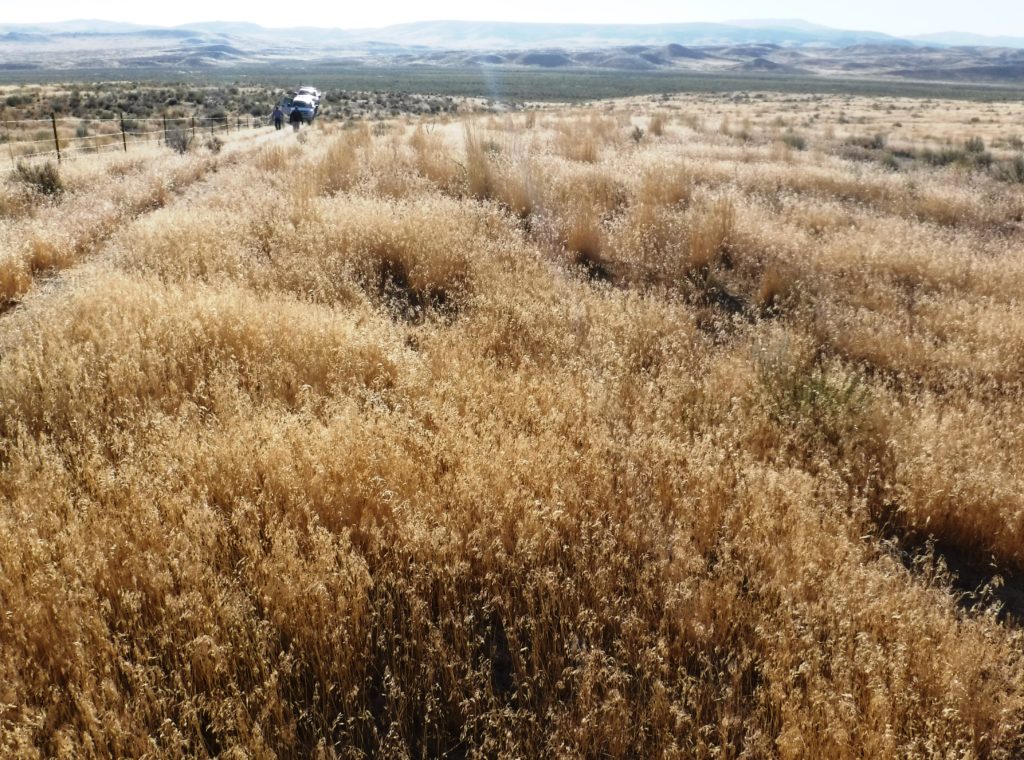
Cheatgrass is a non-native, invasive grass species in Colorado, characterized by its ability to thrive in areas heavily disturbed by events like construction, fire, and floods. A Colorado State University fact sheet says letting cheatgrass dominate an area could impact wildlife populations and change soil properties. Once introduced to an area, it can produce “more than 10,000 plants per square yard.”
In addition to being a general nuisance and extremely pervasive, cheatgrass is also a major fire risk.
“Though several components can affect flame length and fire spread, a typical cheatgrass fire on flat terrain with wind speeds of 20 miles per hour may generate flame lengths up to eight feet in height; the fire can travel more than four miles per hour,” the CSU fact sheet says.
The plant’s natural life cycle is part of why it presents such a fire hazard. Cheatgrass dies off between April and June, and when that happens, it dries out more quickly than native vegetation, according to the Sage Grouse Initiative. It also has particularly thin stems and leaves, which help it burn more quickly than many native species.
Cheatgrass is an annual invasive plant that crowds out native plants in sagebrush range. Near Elko, Nevada. Photo credit: The Sagebrush Initiative
The U.S. Forest Service, in partnership with the U.S. Department of Agriculture and the Wyoming Game & Fish Department, has begun treating a 9,200 acre area within the Mullen fire perimeter for cheatgrass, with the hopes of reducing or eradicating its presence.
“It is great to continue collaboration efforts with our partners on controlling invasive species in the footprint of the Mullen Fire. Our past treatments have proven to be successful in managing cheatgrass, which is a huge threat to native ecosystem recovery post wildfire.” said Forest Service specialist Jackie Roaque in a statement.
The Forest Service’s operation will last about two months and primarily take place in Wyoming. Recreationists in Medicine Bow-Routt, particularly along the North Platte River, might be affected by the spraying.
Research suggests wildfires are likely to become larger and more unpredictable because of drier and hotter conditions spurred on by climate change.
We have songs and stories to teach children about the connection between seemingly unrelated things. John Muir put it in perspective: “When you tug at one thing in nature, you find it hitched to everything else.”
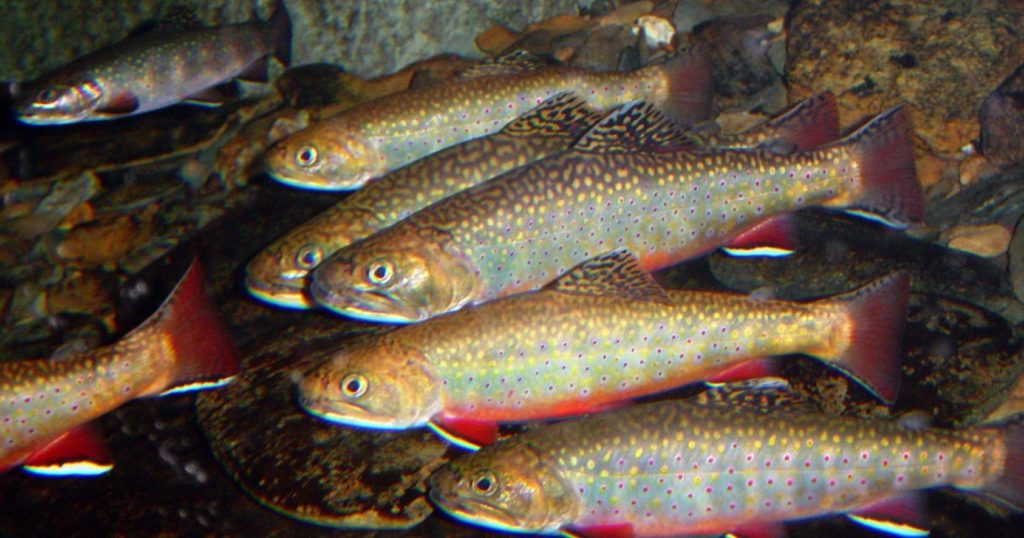
My “ah-ha!” moment happened at a presentation I attended a few years ago. A slide on the screen showed two rows of fish: on the left, smaller fish from a river with an urbanized floodplain, and on the right, fish of the same species and same age from a river with a natural, functioning floodplain. The fish on the right were almost twice the size as the ones on the left.
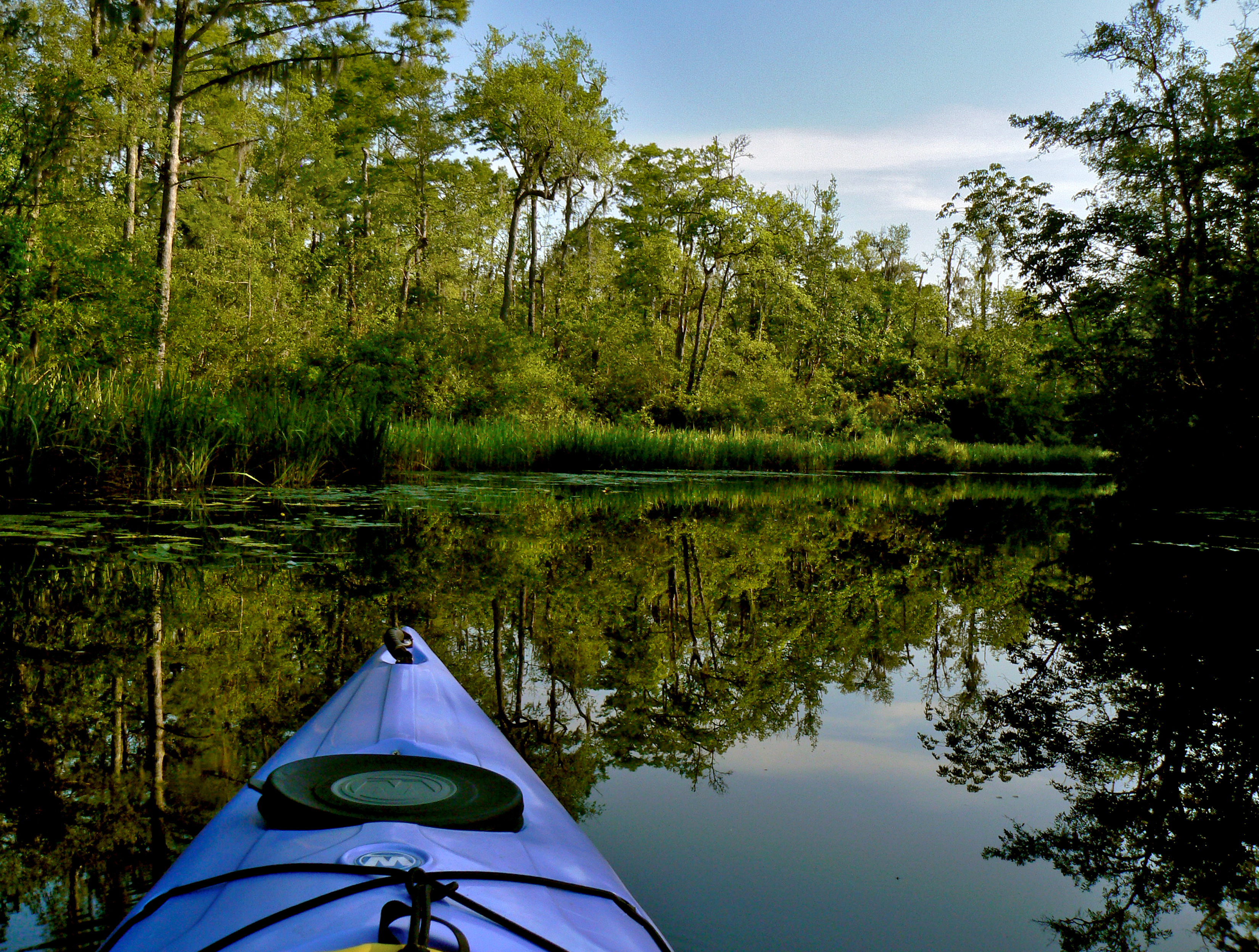
A healthy riparian corridor includes native trees and minimal disturbance within 100 feet of the streambank. Waccamaw River photo by Charles Slate.
Fish from rivers with healthy floodplains thrive, while those in rivers without a healthy floodplain merely survive.
The connection between thriving fish, healthy rivers, and functioning floodplains? Trees.
Forested watersheds have been shown much higher water quality than their urbanized counterparts. Trees provide a wide range of ecological services. Tree canopy lessens the erosive impact of rain and slows the velocity of stormwater flowing towards the river, as well as floodwaters spilling out onto the floodplain. Trees trap sediments that build the floodplain while the roots stabilize the riverbanks. Trees also provide shade for maintaining water temperature. Fallen leaves, limbs, and branches support the food web by providing food and habitat for the bugs that are in turn food for fish. Clean, cool water with more food equals bigger fish. Therefore, fish grow on trees.
The connection between fish and trees and rivers is now poised to emerge in our urban areas.
Many cities, from large to small, are recognizing the benefits of reestablishing the physical and emotional linkage between the river, trees and the community. For instance, San Antonio has its iconic River Walk, Chicago has just completed its riverfront, Washington DC has its Southwest Waterfront neighborhood, and Pittsburgh has reconnected neighborhoods to its three rivers via a network of urban trails. Furthermore, Hartford, Nashville, Providence, Denver, and Detroit all offer events on their downtown riverfronts that draw thousands, and Cincinnati, Columbus, Owensboro and many more are rediscovering their community-to-river reconnection. But when you look at images of these urban riverfronts, you notice they all have one thing in common: a lot of hardscape. Hard engineered solutions are meant to reduce maintenance and accommodate maximum access.
The trend in revitalizing urban riverfronts is a giant step forward, but our urban riverfronts also need soft green edges. They need the green space and trees that humans and fish, and all living things, require to thrive. It isn’t possible or desirable to return our urban rivers to forested watersheds, but we can reintroduce trees to our river corridors provide while also adding value to our urban communities.
Healthy for fish, healthy for people. Give trees to fish, and we’re also giving them to ourselves.
I’ve decided there needs to be a song about how fish grow on trees. Remember this folk song?
“…Oh, the limb on the tree,
And the tree in a hole
And the hole in the ground
And the green grass grew all around, all around
And the green grass grew all around…”
Let’s add “…and the green trees grew all around, all around…and big fish in the river are found.”
FromThe Associated Press (Seth Borenstein) via US News & World Report:
An Associated Press analysis shows that the recent heat wave struck places that are warming up faster than other parts of the United States.
As outlandish as the killer heat wave that struck the Pacific Northwest was, it fits into a decades-long pattern of uneven summer warming across the United States.
The West is getting roasted by hotter summer days while the East Coast is getting swamped by hotter and stickier summer nights, an analysis of decades of U.S. summer weather data by The Associated Press shows.
State-by-state average temperature trends from 1990 to 2020 show America’s summer swelter is increasing more in some of the places that just got baked with extreme heat over the past week: California, Nevada, New Mexico, Arizona, Utah, Oregon and Colorado.
The West is the fastest-warming region in the country during June, July and August, up 3 degrees on average since 1990. The Northwest has warmed nearly twice as much in the past 30 years as it has in the Southeast.
That includes Portland, Oregon which set a record 116-degree high that was 3 degrees warmer than temperatures ever recorded in Oklahoma City or Dallas-Fort Worth.
Although much of the primary cause of the past week’s extreme heat was an unusual but natural weather condition, scientists see the fingerprint of human-caused climate change, citing altered weather patterns that park heat in different places for longer periods…
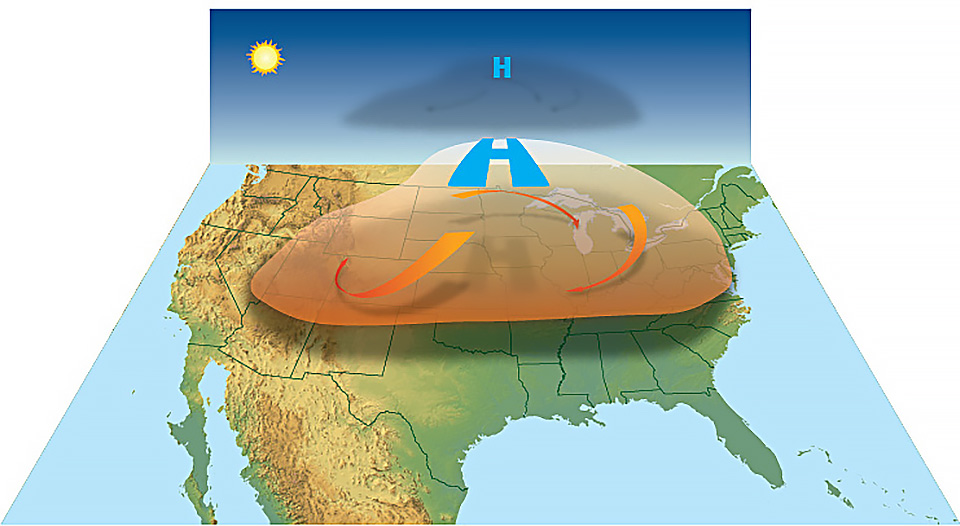
Climate change is altering and weakening the jet stream, narrow bands of wind that circle the Earth flowing west to east. Those changes allow key weather-producing patterns of high and low pressure to stall in place. High pressure is stalling more often in the West in summer, said Pennsylvania State University climate scientist Michael Mann. High pressure brings hot and dry weather that, when stalled, can create what are known as heat domes. Low pressure brings wet weather.
Another factor is higher water temperatures in the Pacific Ocean that also generate more so-called high-pressure ridges the West, said Gerald Meehl, a National Center for Atmospheric Research scientist who studies heat waves.
These patterns are showing up so often that their effects can be seen in long-term data. The U.S. Northwest, western Canada and Siberia, which also just saw a stunning heat wave, are among Earth’s fastest warming land areas during summer since 1990, Cohen said…
The Midwest is warming slower during the summer than either coast. That’s because stalled low pressure areas often drive cooler air into the Great Lakes region, said North Illinois University climate scientist Victor Gensini.
Water explains the big difference between western and eastern heat trends, scientists said.
“In western states where drought has been expanding and intensifying during the past decade, soil moisture has been declining. Dry soil heats up faster than moist soil during the day because all the solar energy goes into heating rather than into evaporating moisture,” said Jennifer Francis, a climate scientist at the Woodwell Climate Research Center. “Dry soil also cools off faster at night.”
That’s partly why the West, which is getting drier by the decade and is mired in a 20-year megadrought, is seeing those crazy triple digit daytime temperatures.
The East is getting wetter by the decade, NOAA records show, and the East Coast is seeing its biggest warming increase at night. The overnight lows in New Jersey and Delaware have warmed 3 degrees since 1990, the biggest increases in the nation.
Water vapor is a greenhouse gas, Francis explained, “So at night it traps more of the heat.”
Kathie Dello, North Carolina’s state climatologist, attributes the trends to human-caused warming. “There’s no other explanation,” she said.
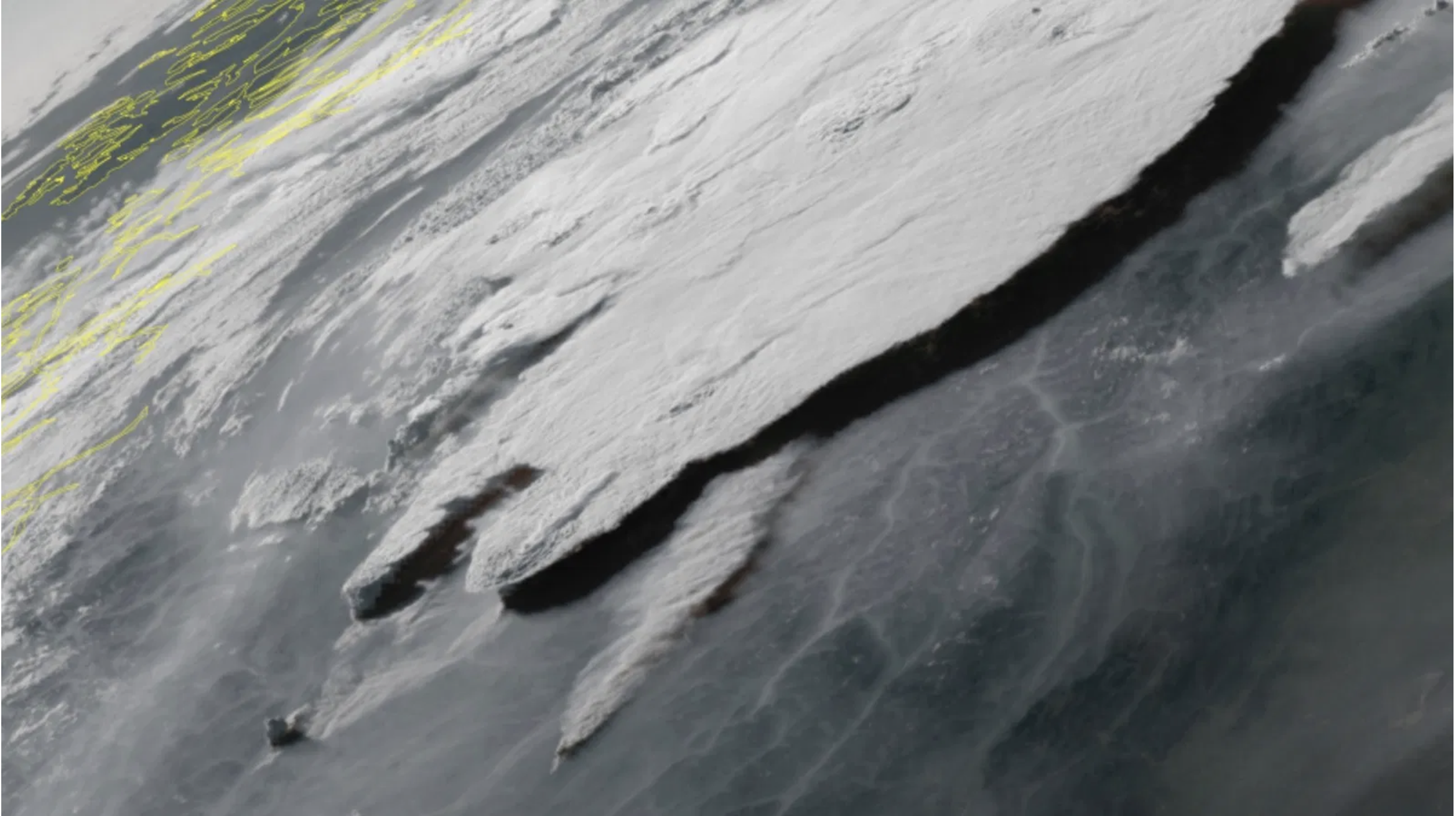
Wildfires exploded in the record-hot air over southern British Columbia on Wednesday, June 30, producing several massive fire-generated thunderstorms. The ‘pyrocu’ spit out lightning and cast the massive evening shadows seen in this satellite image from 0210Z Thursday, July 1, 2021 (7:10 pm PDT Wednesday). Climate scientist Daniel Swain called the event “a literal firestorm.” (Image credit: RAMMB/CIRA/CSU)
FromYale Climate Connections (Bob Henson and Jeff Masters):
Hundreds of North Americans – and perhaps many more yet to be tallied – have died of heat-related illness over the past week after a mind-boggling heat wave struck the U.S. Pacific Northwest U.S. and far southwest Canada. It’s virtually certain to be the deadliest weather event on record for the region. The unprecedented death toll is the result of a heat onslaught more intense by some measures than anything in global records, yet very much in line with the expected impacts of a human-warmed climate.
The poster community of this horrific episode has to be Lytton, British Columbia. The town broke Canada’s longstanding all-time national high temperature of 45 degrees Celsius (113 degrees Fahrenheit) with a high of 46.6°C (116°F) on Sunday, June 27. The next day brought 47.9°C (118.2°F), and Tuesday a stunning 49.6°C (121°F).
The intense heat flash-dried the rugged, forested landscape, and wildfires mushroomed across the area on Wednesday, June 30. By evening, the entire town of Lytton was under mandatory evacuation orders, and Mayor Jan Polderman told CBC News that “the whole town is on fire.” Most homes in Lytton have been destroyed, according to provincial authorities.
Lytton is home to the Lytton First Nation, a Nlaka'pamux band. In Canada and beyond, Indigenous people are disproportionately affected by climate impacts and Indigenous knowledge has much to contribute to climate solutions. https://t.co/Pgn8Xucvxz
The lighting from the dry thunderstorms (pyrocumulonimbus) that developed was so intense that over 700,000 intracloud and cloud-to-ground lightning flashes were recorded in 15 hours, including more than 100,000 cloud-to-ground strikes. That’s about 5% of the total number of lightning flashes Canada typically sees in an entire year (see Tweet below).
The fires have generated huge clouds of choking smoke that put air quality in the red “Unhealthy” range in Kamloops, British Columbia, on Thursday.
I've watched a lot of wildfire-associated pyroconvective events during the satellite era, and I think this might be the singularly most extreme I've ever seen. This is a literal firestorm, producing *thousands* of lightning strikes and almost certainly countless new fires. #BCwxhttps://t.co/jS0DrJldR3
This heat disaster’s tragic nature is evident even in initial data. British Columbia has reported 486 sudden deaths, three times more than usual for this time of year. At least 16 people died of heat-related causes in Seattle. And in Multnomah County, Oregon, which includes Portland, the county medical examiner announced in a poignant news release on Wednesday that 45 residents had died as a result of excessive heat.
“The preliminary cause of death is hyperthermia,” the county said. “The people who died ranged in age from 44 to 97 and include 17 women and 27 men … Many had underlying health conditions. Many of those who died were found alone, without air conditioning or a fan.”
Similarly, many of those who died in British Columbia were found alone in unventilated homes, according to the chief coroner of British Columbia, Lisa Lapointe, as cited by BBC.
The eventual death toll from this heat wave is likely to be much higher than current estimates, according to Kristie Ebi, a professor of global health at the University of Washington. Death certificates need to be gathered and analyzed from multiple areas, and the underlying and contributing causes of death ascertained (a challenge in itself). So it can take months to fully calculate the number of “excess deaths” related to a regional heat wave, as explained in detail in a YCC post last December.
“Those numbers are only going to go up,” Ebi said. Focusing only on factors such as heat stroke “gives you a massive underestimate of the overall [death toll].” Many heat wave deaths are triggered by respiratory and cardiovascular failures often under-recognized as being related to the torrid, often-polluted air of a heat wave.
If there’s one thing Ebi wants to avoid, it’s thinking of this catastrophic heat wave as the “new normal,” which she calls “really misleading” as it actually underestimates the gravity of the situation. “It implies we’re going from one state to another state. We’re in a period when there’s going to be ongoing change for decades.
“The new normal is not the current temperature. The new normal is the constant change.”
Otherworldly heat records
Never in the century-plus history of world weather observation have so many all-time heat records fallen by such a large margin than in the past week’s historic heat wave in western North America. The only heat wave that compares is the great Dust Bowl heat wave of July 1936 in the U.S. Midwest and south-central Canada. But even that cannot compare to what happened in the Northwest U.S. and western Canada over the past week.
“This is the most anomalous regional extreme heat event to occur anywhere on Earth since temperature records began. Nothing can compare,” said weather historian Christopher Burt, author of the book “Extreme Weather.”
Pointing to Lytton, Canada, he added, “There has never been a national heat record in a country with an extensive period of record and a multitude of observation sites that was beaten by 7°F to 8°F.”
International weather records researcher Maximiliano Herrera (@extremetemps) agrees. “What we are seeing now is totally unprecedented worldwide,” said Herrera, who tweeted on June 30, “It’s an endless waterfall of records being smashed.”
Some examples of the extremity of this event, based on preliminary data:
Portland, Oregon, broke its longstanding all-time record high (107°F from 1965 and 1981) on three days in a row – a stunning feat for any all-time record – with highs of 108°F on Saturday, June 26; 112°F on Sunday; and 116°F on Monday. That 116°F is one degree higher than the average daily high on June 28 at Death Valley, California.
• Quillayute, Washington, broke its official all-time high by a truly astonishing 11°F, after hitting 110°F on Monday (old record: 99°F on August 9, 1981). Quillayute is located near the lush Hoh Rain Forest on the Olympic Peninsula, just three miles from the Pacific Ocean, and receives an average of 100 inches of precipitation per year.
• Jasper, Alberta, broke its all-time high of 36.7°C (98.1°F) on four days in a row, June 27-30, with highs of 37.3°C, 39.0°C, 40.3°C, and 41.1°C (99.1°F, 102.2°F, 104.5°F, and 106°F).
• All-time state highs were tied in Washington (118°F at Dallesport) and set in Oregon (118°F at Hermiston, beating the reliable record of 117°F), and provincial highs were smashed in British Columbia (49.6°C at Lytton, beating 39.1°C) and Northwest Territories (39.9°C at Fort Smith, beating 31.7°C).
According to Herrera, more all-time heat records have been broken by at least 5°C (9°F) in the past week’s heat wave than in the previous 84-plus years of world weather recordkeeping, going back to July 1936. It’s worth noting that the record North American heat of the 1930s, including 1936, was largely connected to the Dust Bowl, in which the effects of a multiyear drought were amplified by over-plowed, denuded soil across the Great Plains – an example of human-induced climate change itself, albeit temporary.
Preliminary data from NOAA’s U.S. Records website shows that 55 U.S. stations had the highest temperatures in their history in the week ending June 28. More than 400 daily record highs were set. Over the past year, the nation has experienced about 38,000 daily record highs versus about 18,500 record lows, consistent with the 2:1 ratio of hot to cold records set in recent years.
What next?
The hellish heat dome that developed over the hardest-hit areas in this heat wave has now weakened and shifted east, though unusually hot conditions remain over a large part of the northern U.S. and western Canada.
Unrelenting drought has only intensified in recent weeks across the western U.S., where the overall extent of drought is at its highest level since the U.S. Drought Monitor was established in 2000. As of June 29, severe to exceptional drought (levels D2 to D4) covered 81% of the West, the first time on record that index has gone above 80%.
Meanwhile, a downstream buckling of the jet stream has led to an unusually mild, wet week from the Southern Rockies into the Midwest, though nothing close to record-setting on the same level as the heat wave. Oklahoma City received nearly 7” of rain in the last week of June, and parts of Detroit saw 6-8” of rain on June 26, triggering widespread high-impact flooding.
Uh-oh: another extreme high-pressure ridge predicted for the U.S. West
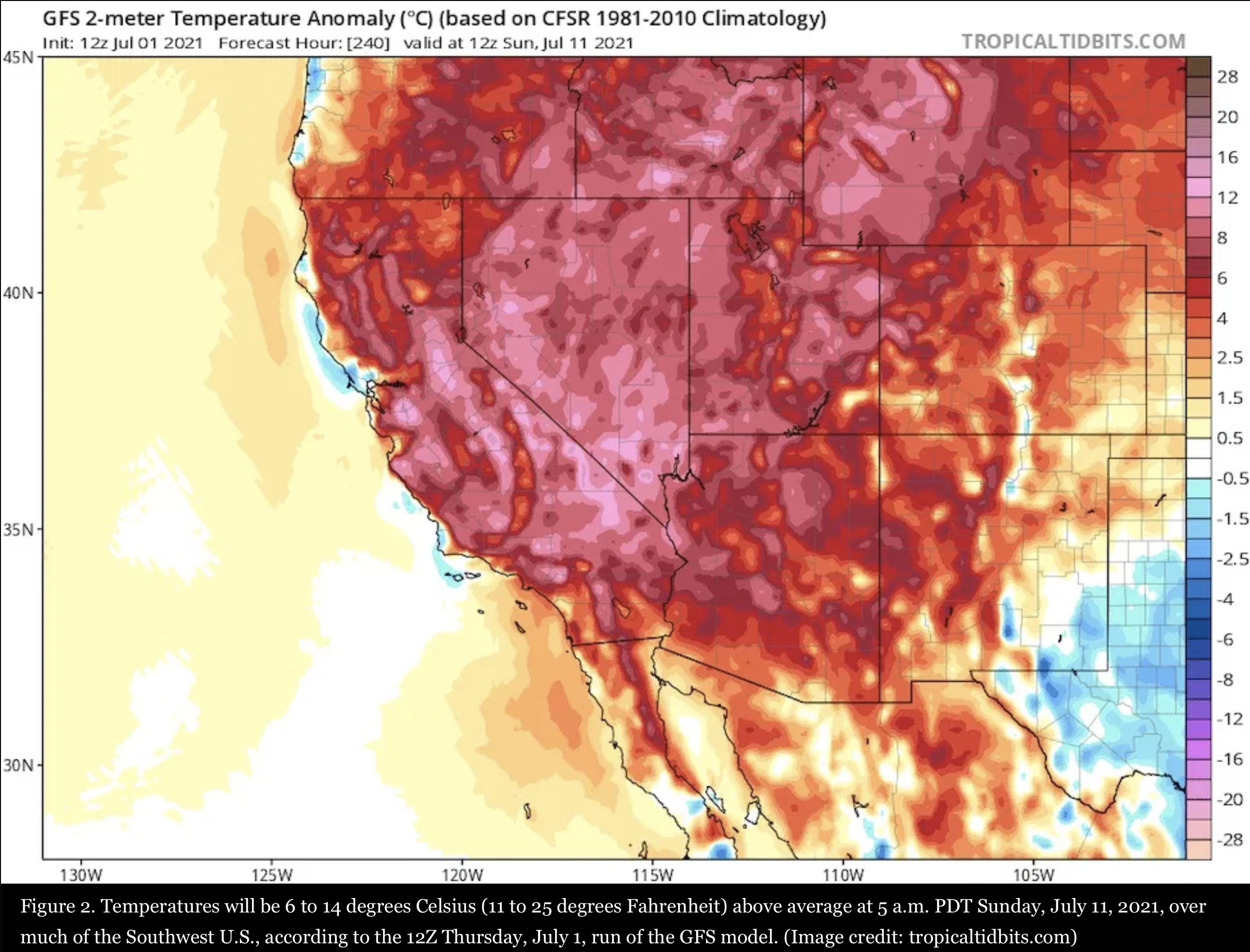
It’s July, the hottest month of the year in the Northern Hemisphere, and extreme ridges of high pressure forming in July have a good chance of setting all-time heat records. Unfortunately, the latest 10-day forecasts from the GFS and European models predict that the western U.S. will have an unusually intense ridge of high pressure capable of overthrowing more all-time U.S. heat records July 10-12.
By one common measure, the 12Z Thursday run of the GFS model is predicting that the heat dome at the center of this upper-level high will be nearly as strong as any ever observed. Warm air expanding at lower levels pushes up the height of the 500-millibar surface, roughly at the midpoint of the atmosphere, vertically. The 500-mb height is predicted by the GFS ensemble model average to exceed 598 decameters over the southwestern U.S. on July 11; the operational version of the model predicted 601 dm. The record-high 500-millibar height at Las Vegas, Nevada, as measured in twice-daily weather-balloon launches (soundings) since 1948, is 602 dm.
Ten-day forecasts of this nature are often inaccurate, so the coming heat wave may fall short of setting all-time records. Nevertheless, with record drought gripping the region, even an average-strength heat wave could boost the odds of significant wildfire activity.
Pagosa Country also remains in a voluntary drought stage…
“Under the Volun- tary Drought State there are no mandatory water use restrictions, however PAWSD does encourage responsible water use. This spring we have seen higher than normal temperatures. These high tempera- tures along with a reduction in late spring precipitation resulted in a quicker than normal melting of the snowpack reducing our available water and could lead to water use restrictions.”
[…]
River report
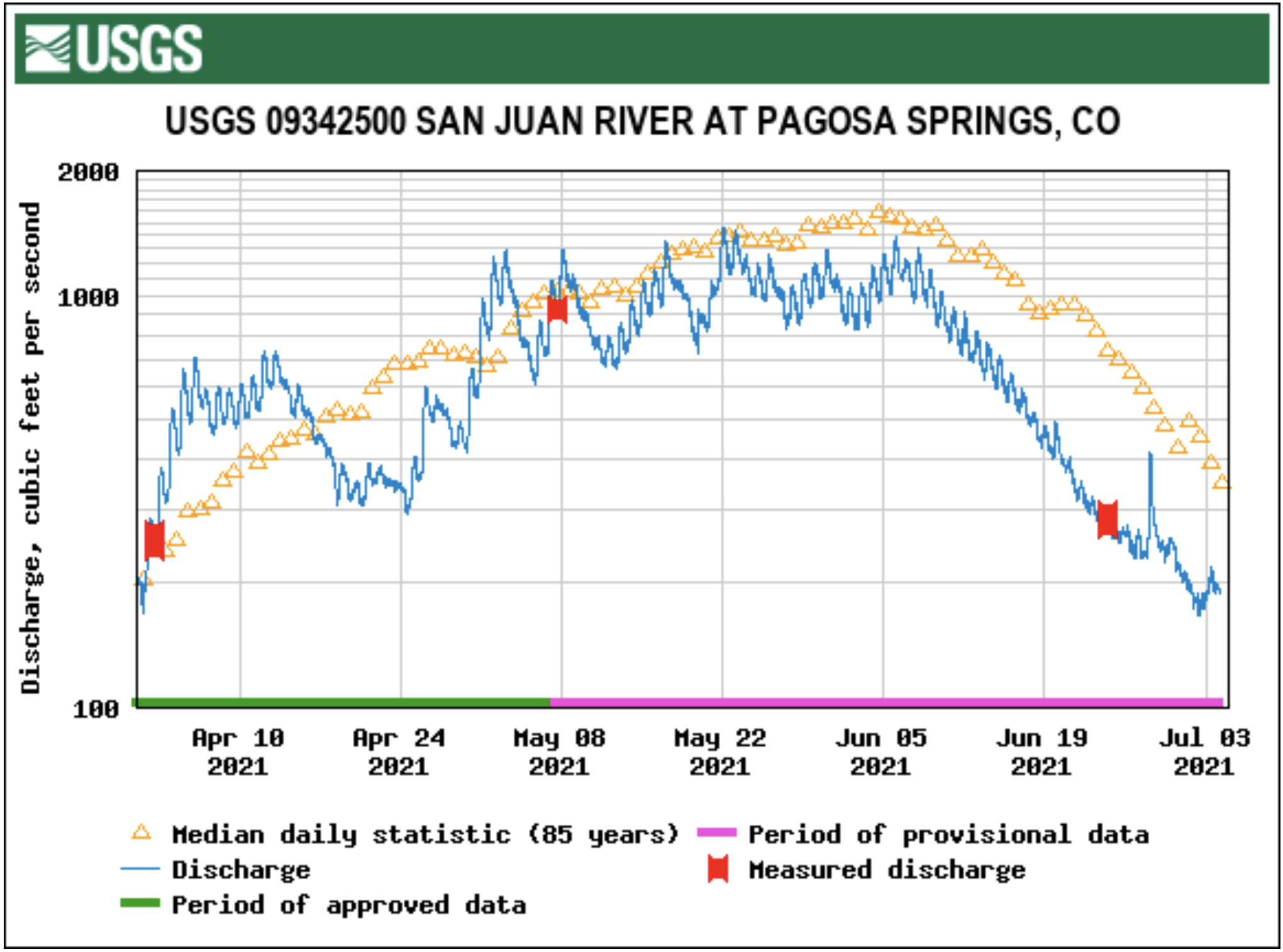
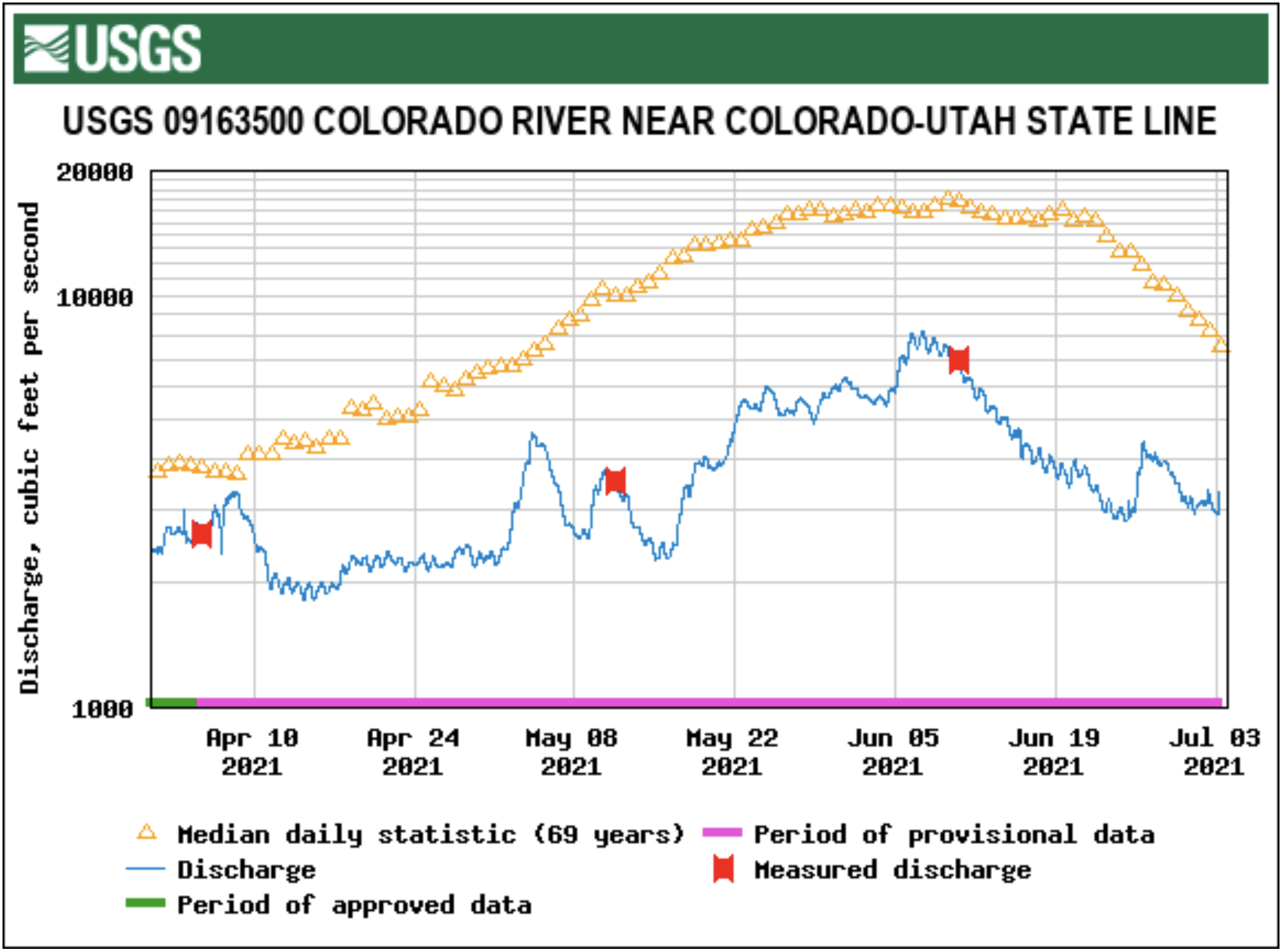
According to the U.S. Geological Survey (USGS), the San Juan River was flowing at a rate of 221 cfs in Pagosa Springs as of 10 a.m. on Wednesday, June 30.
Based on 85 years of water records at this site, the average flow rate for this date is 759 cfs.
The highest recorded rate for this date was in 1957 at 3,020 cfs. The lowest recorded rate was 19.9 cfs, recorded in 2002.
As of 10 a.m. on Wednesday, June 30, the Piedra River near Arboles was flowing at a rate of 176 cfs.
Based on 58 years of water records at this site, the average flow rate for this date is 764 cfs.
The highest recorded rate for this date was 2,030 cfs in 1979. The lowest recorded rate was 10.6 cfs in 2002.
Drought Report
According to the National Integrated Drought Information System (NIDIS) as of 10 a.m. on June 22, 100 percent of Archuleta County is in a moderate drought stage.
The NIDIS website notes that under a moderate drought stage dry-land crops may suffer, range- land growth is stunted, very little hay is available and risk of wildfires may increase.
The NIDIS website also notes that 71.17 percent of the county is in a severe drought stage.
According to the NIDIS, under a severe drought stage, fire season is extended.
Additionally, the NIDIS website notes that 51.04 percent, mostly the western portion, of the county is in an extreme drought.
The NIDIS website notes that under an extreme drought stage, large fires may develop and pasture conditions worsen.
According to the NIDIS, 6.24 percent of the county, in the south- western portion, is in an exceptional drought stage.
Under an exceptional drought stage, agricultural and recreational losses are large and dust storms and topsoil removal are widespread.
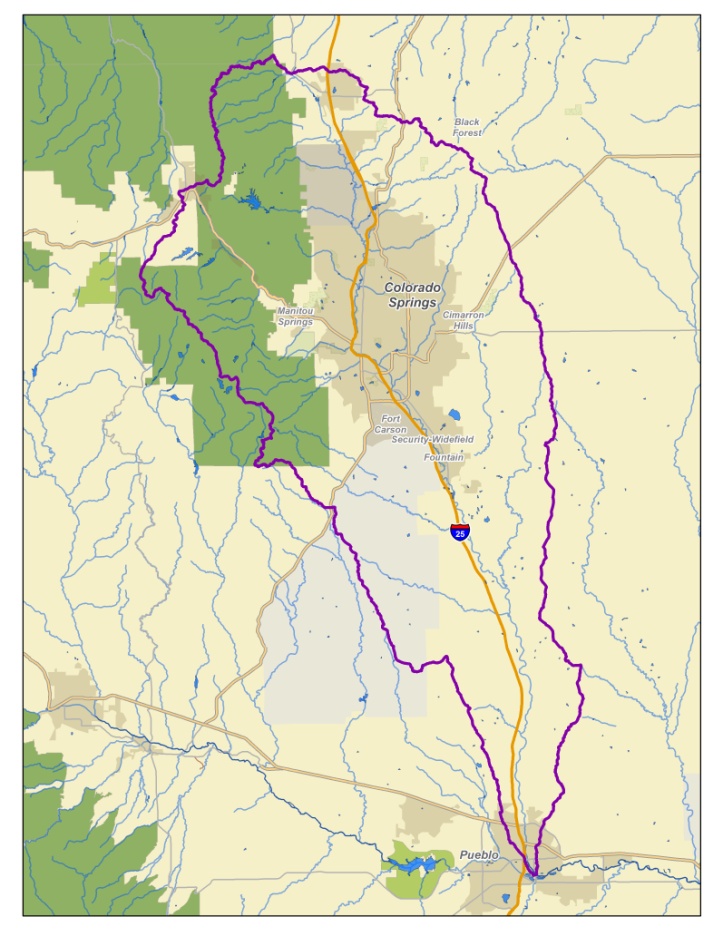
The Fountain Creek Watershed is located along the central front range of Colorado. It is a 927-square mile watershed that drains south into the Arkansas River at Pueblo. The watershed is bordered by the Palmer Divide to the north, Pikes Peak to the west, and a minor divide 20 miles east of Colorado Springs. Map via the Fountain Creek Watershed Flood Control and Greenway District.
Developers have dreams for Fountain that would quadruple the community’s size up to about 40,000 homes.
“It just hit us, that huge number of quadrupling,” Fountain City Manager Scott Trainor said. The requests to build the tens of thousands of homes poured in over the past two years, with many developers wanting to start immediately, he said.
Trainor said the city’s chances of adding more than 30,000 homes are “slim to none,” even with Security and Widefield water and sanitation districts serving about 20% of the city’s land.
The flood of proposals forced Fountain officials to take a step back and look at the critical needs with water at the top of the list. The community currently owns enough water to serve a little more than the equivalent of 1,200 taps and is setting out to find more as part of a water master plan.
The rush to build tens of thousands of new homes in Fountain is indicative of the growth pressure facing the bedroom community that supports Colorado Springs, Fort Carson and Pueblo. Fountain homes have traditionally been more affordable than those in Colorado Springs, in part because the land is cheaper, but the community has not been immune to rising housing construction costs, such as lumber, Trainor said.
If Fountain’s water supply can’t support the growth, developers will have to look for water from other sources and new residents may be pushed out to communities such as Pueblo West…
With current water supplies, Fountain officials said they expect to serve five new developments that will help fill the immediate need for housing…
The city will need to purchase, lease or otherwise secure water to meet additional demands outside of the Fountain and Widefield services areas and it is working on a water master plan to identify those future water sources, Blankenship said. The plan will work to identify water for the next 30 years, he said…
Not all of Fountain is dependent on the city’s water supply because Widefield and Security water and sanitation districts are serving numerous projects. Among them, the Security district may serve a shopping center redeveloping near Highway 85 and Main Street, and the Widefield district may provide water to a new subdivision of 1,180 homes called Corvalis, Trainor said.
FromThe Bulletin of Atomic Scientists (Peter Gleick):
No one wants to be a statistic in a climate disaster—an anonymous entry in a dataset of extreme events. But sometimes things sneak up on you. A couple of weeks ago, during one of the extraordinary and severe heat events striking western North America, I almost suffered from heat stroke.
You’d think I would know better—I’m a climate scientist and hydrologist. I’ve been researching, writing about, and discussing climate and weather risks for nearly four decades. I know that heat deaths are the most prevalent of all deaths from natural disasters, killing thousands or even tens of thousands of people every year. I know that extreme heat events are getting worse, precisely because of human-caused climate change.
And yet, there I was, trying to dig a simple hole in the ground for a wooden post in the dense, clay soils of the foothills of the Sierra Nevada in 100-degree-plus heat. Fifteen minutes was all it took for me to suddenly experience extreme dizziness and nausea. I came very close to passing out and was only saved by two nearby workers who brought me cold water and a cold compress to put on my head and neck and saw me safely back to an air-conditioned enclosure.
Climate change is already causing an increase in extreme events, including droughts and heat. The western United States is suffering from perhaps the most widespread and severe drought in recent history. As of early July, more than 98 percent of the American West was suffering from drought, with more than 80 percent in severe drought or worse. Extreme heat has struck several times since June, breaking records throughout the region and putting more than 20 million people under heat warnings from Canada to Mexico. Portland, Oregon broke a new record high of 115 degrees Fahrenheit; Seattle set a new record high of 108. Temperatures in the small town of Lytton, British Columbia, climbed to 121 degrees Fahrenheit (49.5 degrees Celsius), the highest temperature ever recorded in Canada, and then the town was destroyed by a fast-burning wildfire. Wildfires are now spreading rapidly throughout the region. Water levels in the major Colorado River reservoirs are at record lows, and Arizona and Nevada will almost certainly see reductions in their allocations from the river next year.
We’re not prepared for climate change, even in one of the wealthiest countries of the world and even with decades of warnings from scientists, in part because of extensive efforts of climate denial, the waffling of politicians, and legacy infrastructure built for yesterday’s climate, not tomorrow’s. In the Pacific Northwest, for example, struck by the recent extreme heat, very few people have air-conditioners, worsening the risk of heat illnesses among the most vulnerable populations. In a severe heat wave in Europe in 2019, several thousand people died and power plants had to be shut down because water temperatures were too high to cool them. A worse European heat wave in 2003 killed an estimated 70,000 people.
This is just the beginning. The Earth has only warmed by around a degree or two so far and is on track for several more degrees of warming. And yet the severe imbalances we’re now experiencing in extreme weather are only going to get worse with each passing year if rapid reductions in greenhouse gas emissions can’t be achieved. The heat extremes we’re seeing now will become the baseline—regular events—punctuated by even more extreme high temperatures as the planet warms further and weather patterns are increasingly disrupted.
I think I know better now than to try to do physical labor during extreme heat. But many workers have little or no ability to avoid these risks: farmworkers, construction workers, laborers of all kinds who are exposed to increasingly severe conditions and are often not informed about the risks or offered protections from them. More people are going to get sick; more are going to die from climate threats. Try not to be one of them, and do what you can to get our politicians to acknowledge and work to reduce these risks.
Monument is planning to install a new water treatment system in the coming months that will remove radium from one of its wells allowing it to start serving the town again.
The town expects to spend about $1.5 million on the new water treatment system, an associated building and lab space. The work will expand an existing facility at Second Street and Beacon Lite Road, said Tom Tharnish, Monument’s public works director.
Extended exposure to radium, a naturally occurring element and common along the Front Range, can cause cancer and other health problems over time, according to the Environmental Protection Agency…
The problem was discovered in the city’s 9th well about four years ago and no unsafe levels of radium ever reached residents’ taps. Monument’s engineers designed a system that diluted the radium to safe levels, but that proved to be only a temporary fix. The well was shut down late last year while the town worked on a more permanent solution, Tharnish said.
The new filtration system will employ a resin that will filter out the radium at the end of the water treatment process, he said…
The new technology will also come with ongoing maintenance costs. The resin will need to be replaced every year to 18 months and will require between $18,000 to $20,000, Tharnish said…
Monument’s board of trustees approved drilling a 10th well in November to help offset the loss of water from the well that had to be shut off because of radium pollution. The work was expected to cost $624,975. The new well is expected to be in production next week, Tharnish said.
The community is also seeking additional water rights, so that it doesn’t need to rely as heavily on its groundwater, Wilson said.
FromThe Durango Herald (Shannon Mullane) via The Cortez Journal:
Colorado Gov. Jared Polis declared a drought emergency Wednesday for La Plata County and 20 other counties on the Western Slope.
The declaration applies to counties experiencing severe, extreme or exceptional drought conditions, including the five-county region in Southwest Colorado. In response, Polis directed several state task forces to monitor the area and gather input about urgent, unmet needs…
The most recent water year, which runs from Oct. 1 to Sept. 30, was the 12th warmest on record in Colorado since 1895 and saw record-breaking fires around the state. It was the third driest water year, trailing 2002, the driest year, and 2018, the second driest year, according to the conservation board…
The Drought Response Plan and supporting task forces will remain activated, assessing conditions and recommending mitigation measures, until statewide conditions significantly improve, according to the conservation board…
Annual precipitation in Colorado averages 17 inches statewide, and its semi-arid climate means water availability is a consistent concern, according to the conservation board website.
Severe, widespread, multi-year droughts – like the one affecting the Western Slope – are less common.
Since 1893, Colorado has experienced six droughts that are widely considered “severe.” These droughts affected most of the state, involved record-breaking dry spells and/or lasted for multiple years.
L. to R. Dan Gibbs, Kate Greenberg, Jared Polis, Rebecca Mitchell at Confluence Park in Denver June 2021.
Here’s the release from the Colorado Water Conservation Board:
The Colorado Department of Natural Resources (DNR) and the Colorado Water Conservation Board (CWCB) celebrated with Governor Polis and legislative leaders on signing legislation into law, which will provide $20 million in state stimulus funding towards the Colorado Water Plan, the state’s collaborative framework for addressing water challenges.
“This investment in our water is a significant boost for the Colorado Water Plan. Our water supply is highly variable, and our demands are growing, all while much of our state deals with a lingering drought. The Water Plan sets a vision and allows our state to plan better for Colorado’s water future,” said Dan Gibbs, Executive Director, Colorado DNR. “We greatly appreciate the strong support of legislators, water providers and other partners for this needed and timely funding to help us address our water challenges head on.”
Of the funding from House Bill H.B.21-1260, $15 million is directed from the state’s General Fund to the Water Plan Grant Program for statewide goals, and $5 million is directed to local water projects recommended by each of the state’s nine stakeholder-driven basin roundtables.
“We are so grateful for the legislature’s support in funding critical water projects around the state that will help us all meet our future needs. This funding is not only important for water supply, but also for ensuring that we have a healthy environment, productive agriculture, and robust recreational opportunities,” said CWCB Director Becky Mitchell.
CWCB awards Water Plan Grants to agricultural water projects, conservation and land use planning efforts, engagement and innovation, environment and recreation projects, and projects that enhance water storage and supply. The upcoming deadlines for grant applications are July 1 and December 1.
Funding dedicated to projects at the local level are intended to assist Colorado water users in addressing their critical water supply issues and interests. Grants must be approved by at least one of Colorado’s nine basin roundtables and are then forwarded to the CWCB for final approval.
On the same day, Governor Polis signed Senate Bill 21-189, the annual CWCB Construction Fund Projects Bill, which includes funding for a variety of CWCB programs and projects including satellite monitoring systems, the floodplain map modernization program, weather modification permitting, and funding for Water Education Colorado, among other programs.
ON SEPTEMBER 24, WE WILL STRIKE TO DEMAND FOR INTERSECTIONAL CLIMATE JUSTICE! JOIN US!
The climate crisis does not exist in a vacuum. Other socio-economic crises such as racism, sexism, ableism, class inequality, and more amplify the climate crisis and vice versa. It is not just a single issue, our different struggles and liberations are connected and tied to each other. We are united in our fight for climate justice, but we must also acknowledge that we do not experience the same problems; nor do we experience them to the same extent.
MAPA (Most Affected Peoples and Areas) are experiencing the worst impacts of the climate crisis and are unable to adapt to it. This is because of the elite of the Global North who have caused the destruction of our lands through colonialism, imperialism, systemic injustices, and their wanton greed which ultimately caused the warming of the planet. With both the COVID, climate, and every crisis in history, overexploited countries and marginalized sectors of society are systematically left behind to fend for themselves.
The time to join the masses and follow the lead of our environmental defenders and workers has been long overdue. Reparations to MAPA must be paid for the historic injustices of the richest elite, vaccine equity, cancellation of debt, and climate finance are only the beginning of these. Together we will fight for a just future where no one is left behind. The historical victories of collective action have proven the need for the youth to stand united with the multisectoral, intergenerational struggle for a better future for all; a future where people and planet are prioritized.
As North America enters its peak summer growing season, gardeners are planting and weeding, and groundskeepers are mowing parks and playing fields. Many are using the popular weed killer Roundup, which is widely available at stores like Home Depot and Target.
In the past two years, three U.S. juries have awarded multimillion-dollar verdicts to plaintiffs who asserted that glyphosate, the active ingredient in Roundup, gave them non-Hodgkin lymphoma, a cancer of the immune system. Bayer, a German chemical company, bought Roundup’s inventor, Monsanto, in 2018 and inherited some 125,000 pending lawsuits, of which it has settled all but about 30,000. The company is now considering ending U.S. retail sales of Roundup to reduce the risk of further lawsuits from residential users, who have been the main source of legal claims.
Glyphosate is now showing up in humans, but scientists are still debating its health effects. One thing is clear, though: Because it’s an effective and very cheap weedkiller, it has become pervasive.
Research on glyphosate’s possible human health effects in inconclusive, but concern is rising over its heavy use worldwide.
How glyphosate went global
When glyphosate was commercialized under the Roundup brand name in 1974, it was widely viewed as safe. Monsanto scientists claimed that it would not harm people or other nontarget organisms and did not persist in soil and water. Scientific reviews determined that it did not build up in animal tissue.
In the 1990s Monsanto began packaging glyphosate with crops that were genetically modified to be resistant to it, including corn, soybeans, cotton and canola. Farmers who used these “Roundup Ready” seeds could apply a single herbicide to manage weeds during the growing season, saving time and simplifying production decisions. Roundup became the highest-selling and most profitable herbicide ever to appear on the global market.
An employee arranging boxes of agricultural chemicals at a warehouse of Anhui Fengle Agrochemical Co. on Feb. 26, 2021, in Hefei, China. Ruan Xuefeng/VCG via Getty Images)
China still dominates the pesticide industry – it exported 46% of all herbicides worldwide in 2018 – but now other countries are getting into the business, including Malaysia and India. Pesticides used to flow from Europe and North America to developing nations, but now developing countries export many pesticides to wealthy nations. More pesticide factories in more places leads to oversupply and even lower prices, with critical implications for human health and the environment.
The question of whether glyphosate causes cancer in humans has been hotly debated. In 2015 the International Agency for Research on Cancer, an agency of the World Health Organization, classified it as a probable human carcinogen based on “limited” evidence of cancer in humans from actual real-world exposures and “sufficient” evidence of cancer in experimental animals.
There also are questions about possible linkages between glyphosate and other human health problems. A 2019 study found that children whose mothers experienced prenatal exposure to glyphosate had a significantly higher risk of autism spectrum disorder than a control population.
However, the U.S. Environmental Protection Agency and the European Food Safety Authority maintain that glyphosate is unlikely to cause cancer in humans and does not threaten human health when used according to the manufacturer’s directions.
A challenge for regulators
In the 1990s and early 2000s, the world community adopted several groundbreaking agreements to restrict or monitor sales and use of hazardous pesticides. These agreements – the Stockholm and Rotterdam conventions – target compounds that are either acutely toxic or persist in the environment and accumulate in animals, including humans. Glyphosate does not appear to meet these criteria, but humans may be more exposed to it because of its ubiquity in soil and water and on food.
Today a handful of countries, including Luxembourg and Mexico, have banned or restricted the use of glyphosate, citing health concerns. In most countries, however, it remains legal with few restrictions.
Scientists are unlikely to reach consensus soon about glyphosate’s health and environmental impacts. But that has also been true of other pesticides.
For example, DDT – which is still used in developing countries to control mosquitoes that spread malaria and other diseases – was banned in the U.S. in 1972 for its effects on wildlife and potential harm to humans. But it was not thought to cause cancer in humans until 2015, when scientists analyzed data from women whose mothers were exposed to DDT while pregnant in the 1960s, and found that these women were more than four times as likely to develop breast cancer than others who were not exposed. This study was published 65 years after the first congressional testimony on DDT’s human health impacts.
In 1946, health officials who believed incorrectly that polio was spread by insects ordered widespread fogging with DDT in San Antonio, Texas, decades before the pesticide’s health and environmental effects were understood.
Science can take a long time to reach conclusive results. Given how widely glyphosate is used now, we expect that if it is definitively found to harm human health, its effects will be widespread, difficult to isolate and extremely challenging to regulate.
And finding a cheap silver bullet to safely replace it could be hard. Many substitutes on the market today are more acutely toxic. Nonetheless, there’s a need for better options, because weeds are developing resistance to glyphosate.
In our view, growing concerns about glyphosate’s effectiveness and possible health impacts should accelerate research into alternative solutions to chemical weed control. Without more public support for these efforts, farmers will turn to more toxic herbicides. Glyphosate looks cheap now, but its true costs could turn out to be much higher.
This article has been updated to remove a reference to glyphosate detection in breast milk, which was based on a study that was not peer-reviewed.
The Bureau of Reclamation is awarding $1.14 million in WaterSMART Water Marketing Grants to seven projects in California, Colorado, Utah, and Washington. These grants will provide cost-shared financial assistance for the selected entities to develop water marketing strategies to establish or expand water markets or water marketing activities.
“Water markets and water marketing allow the movement of water between willing buyers and sellers under state and federal law,” said Chief Engineer David Raff. “These strategies will provide water managers more flexibility in addressing their water management challenges and reduce conflicts over water.”
These grants will support more than $2.6 million in water marketing planning activities including the recipients’ cost share. The seven selected projects are:
City of Vallejo Water Department, Water Marketing Strategy Development for Lake Curry Reservoir (California): Reclamation Funding: $200,000, Total Project Cost: $495,995
San Luis Rey Indian Water Authority, San Luis Rey Indian Water Authority Water Marketing Strategy Plan (California): Reclamation Funding: $200,000, Total Project Cost: $400,000
City of Thornton, City of Thornton Northern Properties Stewardship Plan: Water Optimization Market Feasibility Study (Colorado): Reclamation Funding: $275,000, Total Project Cost: $550,000
Rio Grande Water Conservation District, Colorado’s Rio Grande Basin Water Cooperative Project (Colorado): Reclamation Funding: $212,755, Total Project Cost: $425,511
Mt. Nebo Water Agency, South Utah County Water Banking Strategy (Utah): Reclamation Funding: $44,000, Total Project Cost: $88,460
Selah Moxee Irrigation District, Easy Moxie Declining Groundwater Area Water Marketing Strategy (Washington): Reclamation Funding: $150,000, Total Project Cost: $480,000
TransAlta Centralia Generation, LLC, TransAlta Centralia Water Marketing Strategy (Washington): Reclamation Funding: $60,000, Total Project Cost: $120,000
Through WaterSMART, Reclamation works cooperatively with states, tribes, and local entities to plan for and implement actions to increase water supply reliability through investments to modernize existing infrastructure and attention to local water conflicts. Visit http://www.usbr.gov/watersmart to learn more.
Colorado River “Beginnings”. Photo: Brent Gardner-Smith/Aspen Journalism
FromInkStain (Eric Kuhn and John Fleck). Click through and read the whole thing. Here’s an excerpt:
Unlike the Lower Colorado River Basin States, which have traditionally taken pragmatic and self-serving views of the 1922 Colorado River Compact, the Upper Basin States have largely shown the century-old document unwavering reverence.
The reverence comes from the way the agreement protected Wyoming, Colorado, Utah, and New Mexico against the avaricious impulses of fast-growing Lower Basin states, especially Arizona and California. The Compact promised water that has driven a century of development and dreaming in the Upper Basin.
Now, however, climate change-driven aridification has the Upper Basin in a vise-like squeeze. Increasing regional temperatures are reducing the river’s natural flow while the compact imposes fixed delivery (or non-depletion) obligations on the four Upper Basin States.
The net difference between the amount of water flowing from the Upper Basin’s watersheds and the amount that must be passed to the Lower Basin at Lee Ferry is the amount that can be consumed. As recent discussions about implications of “Alternative Management Paradigms for the Future of the Colorado and Green Rivers” by Kevin Wheeler, et al from the Colorado River Futures Project out of Utah State University have shown, state water officials from the upper river are beginning to understand that today’s law of the river places most of the future climate change risk on their states. But their fealty to the compact remains a major factor. (One of us, Eric Kuhn, is a co-author of the report. The other, John Fleck, serves on the project’s advisory committee.)
This dilemma raises the fundamental question facing the basin as it begins to negotiate the post-2026 river:
In recent months the paper’s authors have held briefings for state and federal water management agencies, water districts, and environmental NGOs. Most recently, they met (via Zoom) with representatives of the Upper Basin States under the umbrella of the Upper Colorado River Commission. Although the briefings varied in length and how deeply they got “into the weeds” concerning the modelling and science behind the study, the general messages and discussions were similar:
Balancing the river system’s water budget will require deeper cuts in total system water use than now contemplated by the basin Drought Contingency Plans. Further, future conservation targets and reservoir operations rules cannot be static. They will have to accommodate declining long-term average flows and increased variability. There is a general agreement that the post-2026 guidelines should work effectively down to a mean natural flow of 11-12 million acre-feet per year. Nevada’s John Entsminger suggested 11 maf at the University of Colorado’s Getches-Wilkinson Center Conference in 2019 – one of the last and most meaningful public conversations among the basin leadership before the pandemic shut us all down. For comparison, the estimated natural flow at Lee Ferry for the current 2000-2021 period is about 12.4 maf/year…
Our hope is that collectively, they will be open to a wide range of different future options and that they will pursue different options in parallel. We would also hope that one of those options is to recognize that we now have a fundamentally different river to manage than the one that their predecessors thought they had when the 1922 Compact, 1944 Treaty with Mexico, and 1948 Compacts were negotiated, therefore, managing today’s river may require breaking the chains that unnecessarily tie us to the past.
Those caught in the July 1 rainstorm said it was like weeks of monsoon rains — that came all at once.
Thursday evening’s deluge gave the entire county some much-needed moisture — but it flooded Salida’s main streets several inches deep in places, as the storm sewers couldn’t keep up. Tourists and visitors in downtown Salida scrambled to find shelter from the continuing downpour that began there just before 7:00 p.m., as the slow-moving front hung over the Arkansas River Valley.
The National Weather Service issued flood warnings throughout the area from late afternoon onward. As of 1:00 p.m. Friday, it again issued flood warnings across the Chaffee County area until at least 4:00 p.m. MST. They included the message that the storms have the potential for dangerous and life-threatening situations to develop…
The storm caused the infamous Chalk Creek Canyon “dip” to flow, closing CR 162 and routing residents and camping visitors to the canyon onto the gravelled back route south of Mt. Princeton Hot Springs, where the downpour had flooded parts of that county road as well…
Chaffee County quickly moved from immediate concerns over agricultural ditch water shortages and drought to flooding concerns, especially in the burn scar areas left by the Decker Fire and the Hayden Pass Fire.
While residents of Buena Vista reported much lower rain amounts, more than two inches fell in the Chalk Creek Canyon, with estimates of three to four inches in the southern half of the county…
Muddy torrents are shown above, coursing through the CR 111 flood diversion ditch in Salida. Earlier flows washed over the banks, as evidenced by the pooled waters on either side. Video courtesy of area resident Maureen Parsons.
In other parts of the south end of the county, localized flash floods occurred on the north side of Methodist Mountain. Most flood controls worked but there is damage reported between CR 110-111.
Flooding also appears to have happened up and downstream along the South Arkansas (unconfirmed at press time), which has had little water the past few days…
Residents of the Central Colorado Rockies know that what is called the “summer monsoon flow” is what we depend upon for summer moisture. The storm clouds that boil up over the Sawatch and Sangre de Cristo mountain ranges in mid-afternoon often bring short-lived showers, clearing again in time for evening barbeques.
Strong storms brought heavy rain to Colorado’s Front Range on Thursday, causing flash flooding in some areas with more rain likely on the way.
Many streets in Greeley experienced flash flooding on Thursday afternoon after torrential downpours dropped an estimated 3 to 4 inches of rain in about an hour over the city, according to the National Weather Service (NWS) in Boulder.
An unprecedented heat wave worsened drought conditions in Northwest, according to the US Drought Monitor. Record-breaking temperatures in Oregon and Washington dried soil and vegetation further, leading to an expansion of moderate and severe drought in that region.
Vast swaths of the West remain in a historic and unrelenting drought, the worst in the region in at least 20 years. The most severe conditions are centered in the Southwest in California, Nevada, Utah and Arizona. But areas of extreme and exceptional drought extend north as well into Oregon and Washington, where oppressive weekend heat dried out the ground and vegetation even more.
Climate change is playing a key role in these compounding crises: Drought and extreme heat are fueling wildfires; reduced snowpack and the lack of substantial precipitation are exacerbating water demands for millions of people, as well as agriculture, ecosystems and deteriorating infrastructure.
In addition to mandatory water restrictions already in place, even stricter cuts are looming amid the drought in some states as water levels plummet along the Colorado River.
Around 93% of the West is in some level of drought, up from 91% last week. Nearly 60% of the West is under ‘extreme’ or ‘exceptional’ drought — the two most severe classifications. It is the largest area of the West under those classifications in the 21-year history of the US Drought Monitor.
Conditions in much of the Southwest remained the same, though the drought in some areas, such as central Arizona, expanded. The drought has also sparked an increase in wildfire encounters in California, Nevada, and Utah.
The record-shattering heat waves in the Pacific Northwest also led to worsening drought conditions across the region.
As the planet warms, drought and extreme heat will also fuel deadly wildfires. Multiple studies have linked rising carbon dioxide emissions and high temperatures to increased acreage of burning across the West, particularly in California…
Stream and river flow
Streamflow, a measure of how much water is carried by rivers and streams, is another significant indicator of drought and its impact.
As drought conditions have worsened in 2021, hundreds of stream and river locations are experiencing below-average flow. More than 50 percent of the western monitoring stations reported lighter-than-usual flows. Fishing restrictions have also been put in place on many rivers in Montana due to low flows and warm waters.
Changes in streamflow affect the water supply for our own municipal use, crop irrigation and power generation.
A Laramie County family said last week statutes and regulations obligate the state engineer to approve its plan to drill eight high-capacity water wells into the troubled High Plains Aquifer, a plan some neighbors strongly oppose.
Members of the Lerwick family made their case for the new wells in a three-day public hearing in Cheyenne that pit neighbor against neighbor. Farmers and ranchers living near the proposed development said it would draw water from the aquifer under their lands, imperiling springs, creeks and wells on which their operations depend.
If the project moves forward, opponents said, they will be left with unsatisfactory legal recourse. But expert witnesses called by the Lerwicks contested those claims, saying that there’s enough water for the development and that they’re not looking to harm their neighbors
The hearing stemmed from a 2019 application by Ty Lerwick, Keith Lerwick and Rod and Jill Lerwick to the State Engineer’s Office for eight permits to drill irrigation wells in the High Plains Aquifer system.
The proceeding’s purpose was to provide information to the Laramie County Control Area Advisory Board and the State Engineer’s Office. The advisory board will make a recommendation to the state engineer, who will then issue a decision on the Lerwick applications…
The various parties presented their cases, and participation was limited to the parties, their representatives and their identified witnesses. Those opposed to the Lerwick wells were identified as contestants, and the Lerwicks as contestees.
The applications would allow the Lerwicks to drill high-capacity wells that protesters say would draw more than 1.5 billion gallons from the ground each year. Several farmers and ranchers testified that they would have to drill new wells at significant cost to replace water sources that could be lost if the proposed wells are approved…
Epler even argued that approval could set a dangerous precedent for Wyoming.
The Lerwicks used their words sparsely throughout the proceeding. Rod Lerwick said his intention is to develop the water for irrigation, not harm his neighbors.
The area in question, which covers two-thirds of eastern Laramie County, is designated as the Laramie County Control Area. Since it was established in 1981, groundwater levels have continued to decline, according to the state engineer’s records. Despite that, in 2015, then-state engineer Pat Tyrell issued an order that created potential for new high-capacity wells to be drilled in the area.
Both the Lerwicks and their opponents contend that the law is on their side.
Evidence shows there is water available for appropriation in the aquifer and that law requires the state engineer to approve development that is of benefit to the public interest, according to the Lerwicks’ lawyer, Laramie attorney Bill Hiser. The state engineer could impose regulations on the Lerwicks’ development designed to protect the public interest, and that his clients would comply, Hiser said.
He also noted that guideposts are in place to ensure development proceeds properly. Not only would people who believe they’ve been injured by the development have an interference claim as a recourse, Hiser said, but the state engineer has the ability to monitor the development as it proceeds. (Hiser said there is “no chance” the Lerwicks would start eight new high capacity wells at one time.)…
Epler, attorney for the contestants, painted a different picture.
The Lerwicks’ permit applications are not legally sufficient, Epler said, pointing to what she saw as errors and omissions. The burden is on the applicants to demonstrate there is water available for appropriation in the source, and the Lerwicks failed to do so, she said.
The contestants’ position, Epler said, is that there is not, in fact, water available for the Lerwicks’ development. Granting the permits would only lead to more high capacity wells, she said, exacerbating the problem…
The rights of established water users needed to be considered, Mark Stewart, a Cheyenne attorney representing Lerwick-opponents at the Gross-Wilkinson Ranch, said. The ability to bring an interference claim, Stewart said, is an insufficient legal remedy.
“That’s too little too late,” Stewart said. “You’ve heard uncontroverted evidence that an injury to groundwater cannot be remedied immediately. It takes time to investigate, to determine the amount of injury, and it takes time to remedy and redress that.”
The development’s relative harm to the community would “far outweigh” the benefit to the Lerwicks, Conner Nicklas, a Cheyenne attorney representing Harding Ranch, Inc., said. Nicklas said his client had already seen water drying up in wells and on the surface, and estimated it would cost $500,000 to resupply water lost because of the Lerwick development…
Probing the ultimate purpose, contestants’ attorneys asked Lerwick about any plans to transfer water rights temporarily — potentially for significant profit — for oilfield use. Lerwick testified that he had not entered into third-party agreements to transfer water rights for fracking and that there was no third-party financing of the application…
Epler asked if there could be a profit incentive to eventually transfer water for fracking, to which Lerwick replied it was “possible, but not likely.”
Rod Lerwick said he has “nothing to hide” when it comes to the family’s plans for groundwater development. The plan for now, he said, is to use the development for irrigation.
When asked how he would feel if he were in the contestants’ situation, Rod Lerwick said he has thought about that, but doesn’t know if he would be among protesters to a permit application…
Expert testimony
Two expert witnesses testified for the Lerwicks that there is groundwater available for high-capacity irrigation wells in the Laramie County Conservation Area.
In 2012, the state engineer’s office contracted with AMEC Environment & Infrastructure to conduct a hydrogeologic study largely focused on the conservation area. The modeling depicted current aquifer drawdown compared to pre-development conditions, and also evaluated future groundwater level changes with several modeling scenarios…
Ben Jordan, senior hydrologist at Weston Groundwater Engineering in Laramie, said that the modeling in what’s known as the AMEC Report, as well as hydrographs and monitoring wells, tell him there is water available for appropriation in the district where the proposed wells would be located…
Jordan also said there “are tools in place to make sure harm is minimized,” whether that’s the state engineer putting certain requirements on the permit or the recourse of filing an interference claim…
The contestants responded with their own expert witnesses, who questioned the picture Jordan and Rhodes painted…
Russ Dahlgren, a hydrologist and engineer with Dahlgren Consulting, Inc., testified that he does not believe there is water available for a development like the one proposed by the Lerwicks. The AMEC model, he said, needs to be vetted, reviewed and modified. In an April 2020 letter to the State Engineer’s Office, Dahlgren wrote that the 2015 order that opened up the conservation area to high-capacity drilling should be discontinued and urged a moratorium on new high-capacity wells.
Dahlgren also testified that filing an interference claim takes a significant amount of time and effort. “I think we can do better than that particular standard,” he said.
The application now moves to the Laramie County Control Area Advisory Board, which has yet to set a date to consider the information gathered at the hearing.
Colorado Water Court for the Arkansas River Basin (Division 2) has issued a decree expanding the area within which the Upper Arkansas Water Conservancy District can provide augmentation water. The expansion includes parts of Custer and Fremont counties.
Attorney Kendall Burgemeister reported the news at the June meeting of the Upper Ark District board of directors. The decree is the culmination of a 3-year legal process that required the District to demonstrate its ability to provide replacement water and protect local water rights within the expanded boundary.
District General Manager Terry Scanga said the decree has already spurred several requests for water to replace evaporation from ponds within the new augmentation boundary, or “blue line.”
The Division 2 Engineer’s Office, Colorado Division of Water Resources, recently began evaluating ponds in the Arkansas River Basin for evaporative losses, identifying more than 10,000 ponds with no legal right to divert or store water.
An agency fact sheet describing the new pond management effort states, “For every acre of pond surface area, up to 1 million gallons of water is lost to evaporation each year.”
Under Colorado water law, water lost to evaporation from the ponds in question is injuring water rights owners by depriving them of water to which they are legally entitled.
The significance of these cumulative water losses prompted Division 2 Engineer Bill Tyner to implement the pond management initiative.
Tyner told Aspen Journalism, “Once we put the data together and we could look at the images of ponds and get a count of the number and relative sizes on average of those ponds, it did make us just very sure that this was a problem that could have some very negative consequences for the basin if we didn’t get more aggressive about the way that we took it on.”
Property owners within the new blue line are now seeking augmentation water from the Upper Ark District to avoid having to drain their ponds.
Scanga said the District’s agreements for pond augmentation are “curtailable.” During drought years, the district will stop augmenting ponds, and the pond owners will have to release water, which essentially provides a backup water supply.
Scanga said almost 50 parties filed statements of opposition in the case but that most opposers did not remain active in the case, including Custer County, prompting the judge to dismiss those filings “for lack of participation.”
Once stipulations were agreed upon with the handful of opposers did participate, the blue line decree was issued without the need for a trial.
From the USFS (Jonathan Hare) via The Montrose Press:
The Grand Mesa, Uncompahgre and Gunnison National Forests is planning to authorize Colorado Parks and Wildlife’s Spring Creek Reservoir Dam Outlet Rehabilitation Project.
The project would last approximately 90 days beginning August 2021. The purpose of this project is to address the most immediate maintenance concerns to reduce the risk of dam failure.
“In the fall of 2017, the U.S. Forest Service was approached by CPW with eminent structural concerns at Spring Creek Reservoir,” District Ranger Matt McCombs said.
“CPW and the USDA, Forest Service worked together to take immediate action to safeguard the dam and public safety. This project is a continuation of that important work and partnership.”
Work on U.S. Department of Agriculture, Forest Service lands would include the construction of a 625-foot access road to the dam’s outlet, repairs/upgrades of the outlet pipe and installation of a new gate stem and controller along with a reinforced grade beam with instrumentation for monitoring.
Reaching the outlet and upstream site for the grade beam requires the reservoir to be fully drained. To allow for the required work, CPW is actively drawing down the water in Spring Creek Reservoir.
The work proposed on Forest Service lands is expected to be cleared through the National Environmental Policy Act under a categorical exclusion. A preliminary evaluation of anticipated environmental effects indicate there are no extraordinary circumstances that would require preparation of an Environmental Assessment or Environmental Impact Statement.
For additional information, questions or concerns, please contact Jonathan Hare at 970-642-4445 or jonathan.hare@usda.gov.
The outflow at the bottom of Navajo Dam in New Mexico. Photo: Brent Gardner-Smith/Aspen Journalism
From email from Reclamation (Susan Novak Behery):
In response to decreasing flows in the critical habitat reach, the Bureau of Reclamation has scheduled an increase in the release from Navajo Dam from 500 cubic feet per second (cfs) to 600 cfs on Monday, July 5th, starting at 4:00 AM. Releases are made for the authorized purposes of the Navajo Unit, and to attempt to maintain a target base flow through the endangered fish critical habitat reach of the San Juan River (Farmington to Lake Powell).
The San Juan River Basin Recovery Implementation Program recommends a target base flow of between 500 cfs and 1,000 cfs through the critical habitat area. The target base flow is calculated as the weekly average of gaged flows throughout the critical habitat area from Farmington to Lake Powell.
Rejection of the NISP pipeline is yet another skirmish in a series of water and pipeline battles playing out in the northern Front Range.
The Fort Collins planning commission on Wednesday rejected an application by Northern Water to run more than three miles of pipeline in a 100-foot-wide construction zone through city parks and neighborhoods as part of the complex Northern Integrated Supply Project.
The 3-to-2 rejection may not stall the massive project for long, as state law allows Northern Water’s own board to override the decision by a two-thirds vote, which it is sure to get. But the unrest in Fort Collins is another skirmish in a series of water and pipeline battles playing out this year in northern Front Range counties.
Water developers say they need supply to meet the demands of growing cities and suburbs, while many residents are objecting to the cost to the environment and to their own wallets.
“What happens during that construction will forever change the activity of wildlife, the patterns of wildlife, and they may never come back to those areas,” Fort Collins planning board member Per Hogestad said before he voted against the NISP pipeline application.
Fort Collins city planners launched the night’s hearing by recommending the board reject the NISP pipeline. Among other objections, city staff said its construction would cut down important riparian cottonwood stands without rebuilding them, and that the plan lacked detailed restoration plans for other areas in the proposed easement…
Northern Water General Manager Brad Wind told the planning commission that the water agency, which serves more than 1 million people in parts of eight counties on the northern Front Range, has made numerous changes to the $1.1 billion NISP to accommodate the steady stream of objections made over more than 10 years. Most importantly, he said, the new system of water buckets and delivery pipes that make up NISP will put a steadier, stronger flow of water into the Poudre River through Fort Collins, improving the health of an overused river that nearly dries up in summer…
Friday morning, Northern Water issued a statement saying in part that it would “look closely at the concerns raised by the City of Fort Collins staff, planning and zoning commissioners and public commenters. We look forward to working with the city to address those concerns while keeping the long-term goal in sight” of building the water delivery project. The board will consider its next steps at a meeting in August, spokesman Jeff Stahla said…
The list of Front Range water fights is long
NISP is one of the longest-running of a growing number of water delivery disputes pitting neighbors against city and county planning boards, and cities and counties against each other.
Thornton wants to build a 74-mile underground pipeline from water it owns in a Larimer County reservoir, through Weld County and onto city treatment plants. After similar years of wrangling, Weld County listened to neighbor and landowner objections and voted against a permit through county space. But Thornton, in Adams County, on Tuesday overrode the decision, which state law allows the applying entity to do when it is financing and building the pipeline.
In Westminster, many residents are furious at city council members for a series of steep increases in domestic water prices, among other planning decisions, and their anger has helped fuel an ongoing series of recalls and marathon voting sessions. Some longtime city residents say the council and city utilities have botched long-term planning for adequate water resources and failed to maintain treatment plants and other infrastructure.
Brighton is also in a series of battles over water use and water prices, including conflicts over power sharing between the city manager and elected officials on water questions.
The Fort Collins planning decision is not likely to be a major hurdle for Northern Water, which is close to breaking ground on the reservoir-and-pipe system that makes up NISP but has more regulatory problems to solve.
The Northern Integrated Supply Project has navigated a tangled route of permits since at least 2004. Fifteen communities that are part of Northern Water want to build new reservoirs called Glade and Galeton, bracketing Fort Collins on the west and east, and connect them through the Poudre and a series of farm water ditches with complex withdrawal and return pipelines.
As part of the overall plan, Northern Water would let about 22 cubic feet per second out of its newly-stored pool in Glade to keep a steady flow in the Poudre through most of Fort Collins, for most of the year. The pipeline under debate Thursday night would then take that water back out of the river and carry it to a separate pipeline that runs on the north side of the project.
Conservationists ridicule that plan, saying Northern Water’s gesture toward the environment would turn the Poudre into a weedy, low-flow “ditch” populated by carp.
The Fort Collins Planning and Zoning Commission denied a development application for the Northern Integrated Supply Project, leaving the ball in Northern Water’s court for a possible overriding vote.
Commission members voted 3-2 on Wednesday to deny the Site Planning Advisory Review (SPAR) application for NISP infrastructure that would be located in Fort Collins city limits.
The components are part of Northern Water’s plan to run a portion of the project’s water deliveries through a 12-mile section of the Poudre River in Fort Collins. A river intake structure at Homestead Natural Area would take the water back out, and a 3.4-mile section of pipeline would shuttle the water southeast to meet up with another pipeline outside city limits.
The decision presents an obstacle to the proposal to take water from the Poudre and South Platte rivers for storage in two new reservoirs, but it isn’t binding…
Commission members who voted against the application — chair Michelle Haefele, vice chair Ted Shepard and member Per Hogestad — agreed with city staff, who recommended denial because of impacts to city natural areas and insufficient detail about several aspects of the project…
Degradation of wildlife and riparian habitat was of particular concern for some of the commission members who voted to deny the application. City staff said the pipeline location would damage restored wetlands and prohibit replanting of cottonwoods the city has worked to restore in riparian corridors. The pipeline route passes through Williams, Kingfisher and Riverbend Ponds natural areas…
Jeff Hansen and Jeff Schneider, the commission members who voted to move the application forward, said they had faith in Northern Water’s ability to address staff feedback. They also wanted to support the agency’s effort to mitigate some of the impacts of NISP by running between 18 and 25 cubic feet per second of water through a portion of the river, which would eliminate some dry-up spots on the river during low flow periods.
“They don’t have to do this pipeline at all,” Schneider said. “They could pull this water out and not even run it through the river. I think there’s some good intent that they’re trying to supply water to the Poudre instead of just pulling it directly out.”
Other points from city staff’s recommendation to deny the application stated that Northern Water didn’t adequately consider protection of natural resources and wildlife when it evaluated alternative routes. Staff also said the application didn’t include enough information about proximity of the NISP pipeline to city-owned utilities; downstream and floodplain impacts of the river intake structure; and how Northern Water will mitigate construction impacts to private property, historic and cultural resources.
Shepard said Northern Water should consider running the water through the river until it intersects with another project pipeline planned for the Larimer-Weld county line.
Brad Yatabe of the city attorney’s office interjected at that point in the meeting to caution commission members against suggesting alternative actions, which he said isn’t in the city’s purview for SPAR.
Northern Water staff described the diversion structure and pipeline as the culmination of a concerted effort to blunt NISP’s impacts on the Poudre through Fort Collins. Northern Water staff picked the diversion point for stability and with a goal of going as far downstream as possible while preserving water quality for drinking, project manager Christie Coleman said…
Northern Water expects that requirements associated with other permits for NISP, including the anticipated record of decision from the U.S. Army Corps of Engineers, will address some of the planning commission’s concerns about environmental impacts, Stahla said. He added that Northern Water will take a closer look at concerns about the construction easement’s impacts to city natural areas.
General currents upstream and downstream from a low-head dam. Graphic via Bruce a. Tschantz
Here’s the release from the Colorado Department of Natural Resources:
The Colorado Department of Natural Resources (DNR) launched a statewide public safety and digital media campaign around low head dams on Colorado rivers and streams.
Low head dams are engineered structures built into and across streams and river channels and represent a serious drowning hazard causing several accidents and fatalities in recent years.
“Led by the Department of Natural Resources, the low head dam initiative is a positive step to increase public safety and awareness around low head dams across Colorado,” said Dan Gibbs, Executive Director of Colorado DNR.
Low Head Dam Safety Campaign Awareness
Designed to educate the public about the presence and necessary safety precautions surrounding low head dams to convey the drowning dangers that low head dams present to river users. Public safety at low head dams is becoming an increasingly important issue as the population of Colorado increases and citizens recreate more and more on waterways within the state.
“Together with our partners, the goal of this campaign is to improve public safety and encourage river users to know their risks before they enter a Colorado waterway,” stated Bill McCormick, P.E., P.G., Chief of the Division of Water Resources Dam Safety Branch and chair of the Colorado Low Head Dam Safety Steering Committee, a multi-agency effort formed in 2019 in the interest of river safety.
The safety campaign takes aim at Colorado’s river recreationists and visitors. It includes radio, digital and social media education and awareness content. Other elements of the effort will include training for first responders who conduct rescues at low head dams and signage at selected low head dam sites to direct river users to safety before going over the dams.
Campaign Launch
The official kick-off was held at River Run Park in Sheridan, CO. It included representatives from the Ditch and Reservoir Company Alliance (Amber Weber), American Whitewater (Hattie Johnson), Mile High Flood District (Laura Kroeger), Public Safety Advocate and former State Legislator (Ruth Wright), Wright Water Engineers (Andrew Earles), and first responders specializing in swift water rescue (Technician Kyle Purdy, Denver Rescue One).
What is a Low Head Dam?
Low head dams are engineered to divert streams and rivers for agricultural, municipal, and industrial uses; to prevent erosion and degradation of stream channels (grade control structure); and in recent years have been engineered to provide recreational amenities for boating, rafting, and tubing. An example of a recently constructed combination grade control and recreational structure is at River Run Park in Sheridan, CO. Diversion structures can be difficult to detect by uneducated river users approaching from upstream. Once river users go over a diversion structure low head dam, they can become trapped, and it can be extremely difficult to get out. Unfortunately, this situation has resulted in many drownings.
New Thornton Water Treatment plant June 2021. Photo credit: Emily Hunt
Disclaimer: I work for the City of Thornton.
FromColorado Community Media (Liam Adams) via The Colorado Sun:
Thornton can start building a segment of a water pipeline in Weld County, even though the Weld County Board of Commissioners told the city “no” two months ago.
Thornton City Council on Tuesday night unanimously approved a resolution that overrides Weld County’s denial of a permit to build a segment of the Thornton Water Project, and authorized the start of construction.
The 74-mile Thornton Water Project will deliver water from a reservoir near Fort Collins, nearly doubling the city’s current water supply. Twelve miles of the pipeline will run through Larimer County, 34 miles through Weld County, and 5 miles through Adams County. The rest of the pipeline will pass through towns and cities in those counties…
The council was [approved the measure on June 29, 2021]…
Thornton Water Project route map via ThorntonWaterProject.com
Weld County landowners, including Hicks and her daughter, have been influential opponents of Thornton as the city moved through the permit application process. In 2019, the Weld County Planning Commission recommended approval of the project, but landowner protests caused the panel to reverse its recommendation in 2020. Residents’ complaints were also cited by commissioners as a reason for denying the permit at at a hearing on May 5.
The Weld County commissioners also said in a resolution dated June 3 that the pipeline would negatively affect future growth and that it was inconsistent with a new county comprehensive plan.
Some Weld County residents want Thornton to build its pipeline in the right-of-way, or literally underneath a county road, instead of on private land next to the road.
But since the beginning of the process, Thornton has pursued the private-land option, which was supported by Weld County staff.
Building in the right-of-way requires an easement from the county, while building outside of the right-of-way requires easements from private landowners. Thornton has obtained easements from 98% of landowners. Some were obtained through eminent domain proceedings, frustrating specific landowners and further provoking their protest.
The pipeline, which runs from Terry Lake near Fort Collins to just east of Cobb Lake in Weld County and then south to the Wes Brown Water Treatment Plant in Thornton, will be buried and the city will compensate any landowners, especially farmers, whose land and crops are damaged by construction…
City spokesman Todd Barnes confirmed that the city has already reached an agreement with Hicks’ family to construct part of the pipeline on their land…
Weld County negotiated terms with Thornton after the county recognized the city was able to override the denial. The terms still require the city to apply for road construction permits in areas where the pipeline crosses streets, to regularly communicate with county staff about the progress of construction, and to be diligent about dust management.
The city hasn’t said yet when it plans to break ground.
The Thornton Water Pipeline is closer to becoming reality in Weld County following a unanimous vote Tuesday night by Thornton City Council to override the county commissioners’ denial of a use by special review permit to construct the pipeline.
State law allows political subdivisions to override restrictions of county or municipal zoning regulations in certain cases. The board anticipated the city’s ability to override the decision, sending a letter acknowledging as much to Thornton Mayor Jan Kulmann earlier this month.
The letter, signed by Weld County Commission Chairman Steve Moreno, requested that the city council include a commitment to comply with terms and conditions set forth by the county in its override decision. In overriding the county’s decision, the city council agreed to adhere to the terms and conditions.
Commissioner Mike Freeman said the board denied Thornton’s permit for a number of reasons, including being inconsistent with the county’s comprehensive plan and going through multiple Opportunity Zones. Doing so will negatively affect development on those properties, Freeman said.
Thornton included in its resolution a response to the county’s concerns. The city responded that the pipeline and fiber optic cable will be buried so that it is compatible with the existing industrial zoned properties and heavy industrial use. It also worked with property owners to develop a pipeline alignment that would minimize impacts to those properties, according to the resolution. The city also said impacts to industrial properties will be of limited duration during construction.
Freeman said the county found that the permit application didn’t show that all reasonable efforts had been made to avoid irrigated cropland or minimize negative impacts to agriculture. Weld is the state’s leading producer of beef cattle, grain, sugar beets and dairy, according to the county’s website.
Thornton responded that the pipeline will be buried below the plow line to prevent interference with continuing agricultural and estate land uses. Effects on agricultural uses will be temporary during construction and are anticipated to be minimal after construction, according to the city. Thornton also said it worked with property owners to locate the pipeline, including minimizing effects to the operations of irrigation equipment.
Additional measures the city will take include stripping and storing topsoil separately from excavated trench materials and seeding or leaving land fallow in accordance with the property owner’s agreement for reclamation procedures following pipeline construction.
Another finding by the county that led to the commissioners’ unanimous denial of the permit was that the pipeline could have an undue adverse effect on existing and future development in areas along the municipal limits of Dacono, Firestone, Frederick, Johnstown, Platteville, Severance, Timnath and Windsor.
The city reiterated the pipeline will be buried and that impacts will be temporary during construction and are anticipated to be minimal after construction. Property owners are also compensated for any impacts to future residential, commercial and industrial development if that is the highest and best use of their property, the city added.
Finally, the county found that all reasonable alternatives to the proposal hadn’t been adequately addressed and that the pipeline isn’t consistent with the best interests of the people in Weld County. Multiple property owners have expressed opposition to the pipeline, with at least seven appearing at the Board of County Commissioners’ meeting on May 5, when the commissioners denied Thornton’s application.
The city responded that the pipeline will not have long-term impacts to continuing agricultural uses. It noted that two property owners who opposed the pipeline have since agreed Thornton accommodated their requests. For four property owners whose relocation requests weren’t feasible, the city argues the pipeline will not hinder the property owners’ future development plans.
“What we’re supposed to be looking at on applications is, ‘Is the application in the best interest of Weld County citizens?’ and obviously this pipeline doesn’t benefit Weld County at all,” Freeman said. “At the end of the day, this board did not approve an application that wasn’t in the best interest of the citizens of Weld County, but we can’t prohibit Thornton from doing what they did.”
[…]
While the council did not address Weinmeister’s concerns, Kulmann said the city remains committed to working with communities to the north. In a pointed message, she said, “We remain committed to cooperating with you on our project … we do take their concerns seriously.” She also said the city is committed to securing access to water that it bought back in the 1980s and soon will need for its growing population.
Here’s the proclamation from the Governor’s office:
WHEREAS, the State is in Phase 3 activation of the State Drought Plan for twenty-one (21) Colorado counties; and
WHEREAS, Phase 3 of the State Drought Plan advises a “Drought Emergency” be declared by Proclamation of the Governor; and
WHEREAS, the State received a summary of heightened concerns emerging from county commissioners, local emergency managers, and consistent, critical input from the Water Availability, Agriculture Impact, and Municipal Impact Task Forces; and
WHEREAS, the Department of Natural Resource and State Drought Task Force jointly sent a memorandum to the Governor recommending entering a drought emergency for western Colorado counties experiencing impacts from extensive severe (D2), extreme (D3), and exceptional (D4) drought conditions, including Moffat, Routt, Jackson, Rio Blanco, Grand, Garfield, Eagle, Summit, Mesa, Delta, Pitkin, Gunnison, Montrose, Ouray, San Miguel, San Juan, Hinsdale, Dolores, Montezuma, La Plata, and Archuleta; and
WHEREAS, counties impacted along the continental divide in abnormally dry (D0) conditions and moderate (D1) drought will continue to be closely monitored and added to a drought emergency proclamation as appropriate; and
WHEREAS, the severe drought conditions and associated impacts in Colorado constitute a drought emergency;
THEREFORE, I, Jared Polis, Governor of the State of Colorado, do hereby proclaim a drought emergency in Colorado for the following twenty-one (21) western counties: Moffat, Routt, Jackson, Rio Blanco, Grand, Garfield, Eagle, Summit, Mesa, Delta, Pitkin, Gunnison, Montrose, Ouray, San Miguel, San Juan, Hinsdale, Dolores, Montezuma, La Plata, and Archuleta; and
THEREFORE, I further direct the following measures:
The Drought Task Force will continue to meet and monitor evolving conditions;
Unmet and urgent needs from communities and regional liaisons will be reported to the Drought Task Force chairs;
The Agricultural Impact Task Force and Municipal Water Task Force will continue to meet monthly or as needed to recommend opportunities for incident mitigation to minimize potential impacts; and
The need for additional task forces, such as energy or wildlife response teams, will continue to be evaluated as conditions evolve through identified agency representatives.
in the State of Colorado.
GIVEN under my hand and the Executive Seal of the State of Colorado, this thirtieth day of June, 2021 — Jared Polis
West Drought Monitor map June 29, 2021.
FromHeart of the Rockies Radio (Danny “Dan R” Ridenour):
Governor Jared Polis has formally declared a drought emergency for western Colorado by Proclamation of the Governor as counties continue to face evolving impacts and water shortages from a multi-year, severe drought episode affecting industries and citizens.
On June 22, 2020, Phase 2 of the State’s Drought Mitigation and Response Plan was activated for 40 counties and expanded to all 64 counties by September. As extreme drought and record setting fires expanded across the state, drought response moved into Phase 3 (the highest level of activation) of the State Drought Plan. Spring 2021 precipitation resulted in the stark contrast between significant drought relief for counties east of the continental divide and deepening drought and fire danger for the entire west slope…
While Colorado can face a range of shortages across the state every year, the cumulative impacts of drought stress our landscapes, reservoir storage, wildfire risks, and capacity of many water-dependent economies to rebound from previous year impacts and debts. We continue to work with our neighboring states to implement interstate agreements and consider additional potential solutions.
To stay informed on Colorado drought issues, sign up for the State’s Drought Updates or visit the Colorado Water Conservation Board website.
Despite a stubborn, 20-year drought and reservoirs whose supplies are below normal, Colorado communities remain split on whether to impose permanent outdoor watering restrictions, according to a Fresh Water News analysis of local watering rules.
According to the analysis, which examined rules in 15 cities representing the state’s different geographies and major population centers, eight of the cities surveyed have enacted permanent restrictions. Seven cities have not, opting instead to enact variable, temporary watering rules each year.
But when communities do impose permanent rules, rather than adjusting them each spring depending on snowpack and reservoir levels, significant savings occur, with some communities seeing reductions of more than 40 percent in peak summer water demand, according to a recent study by Alliance for Water Efficiency, a nonprofit representing water and wastewater utilities across North America.
Those kinds of statistics helped Steamboat Springs last spring make the move to permanent water restrictions. Steamboat limits customers to watering their lawns three days per week based on the last digit of their address — even numbers can water on Sundays, Tuesdays and Fridays, while odd numbers can water on Mondays, Thursdays and Saturdays. The new rules also limit outdoor watering to between 6 p.m. and 10 a.m.
After years of variable outdoor watering rules that fluctuated depending on drought conditions, Steamboat Springs residents embraced the new permanent schedule right away, according to Kelly Romero-Heaney, the city’s former water resource manager who earlier this month became Assistant Director for Water at the Department of Natural Resources.
“Coloradans are ready to take this step,” said Romero-Heaney. “There really is no reason to water irrigated sod every day, unless it’s getting heavy use like you would see at a soccer field or a community park. It just makes perfect sense. We also recognize that it’s not fair for us to say to the Front Range utilities, ‘You need to conserve more, you need to conserve more, that’s your problem,’ if we’re not conserving ourselves. We wanted to lead by example.”
For its permanent watering rules, Steamboat Springs drew inspiration from the handful of other Colorado cities — both on the Front Range and in the mountains — that have made outdoor watering rules the norm, instead of the exception.
Some city and utility leaders say the watering rules help residents to permanently change their outdoor watering behaviors, given the aridification of the West and the accelerating pace of climate change. Others continue to monitor drought conditions throughout the summer months and adjust their watering rules depending on the current severity.
Permanent watering rules have indeed helped some Colorado cities reduce their outdoor water use, which can represent as much as half of all domestic water use. Castle Rock, for example, has seen a 20 percent reduction in per-person, per-day water use since enacting its permanent watering rules in 1985.
But city leaders also view permanent watering rules as just one tool in a broader water conservation toolbox, along with education and outreach, water-wise landscape and fixture incentives, tiered rate structures, and strict enforcement measures.
Conservation experts agree, noting that permanent watering rules aren’t a silver bullet and that there’s no one-size-fits-all approach to water supply and demand management.
“You can’t prescribe a blanket strategy across every water provider typically,” said Bill Christiansen, director of programs for the Alliance for Water Efficiency. “It’s not fair to say a certain strategy would work for every water provider. You have to do what makes sense for your area.”
Why watering rules?
In the broadest sense, watering rules — both permanent and temporary — help utilities manage peak demand, the period of time when water use is the highest. In most communities, peak demand occurs during the summer, when residential and commercial customers water their lawns and gardens. These rules help ensure that utilities have enough supply to meet the needs of their customers. During drought, when water supply is low, many communities enact or tighten watering rules to help lower the demand for water.
“Outdoor water use can often represent a very large percentage of a water provider’s portfolio, and the capacity of a system is built to meet peak water use,” Christiansen said. “If outdoor water use can be reduced, it can be a very effective way to reduce water consumption. It can also be very helpful if a community is facing the need to expand their capacity — they can lower that peak and avoid or downsize any capacity or expansion projects. That can save ratepayers a lot of money if a large investment can be avoided.”
In a recent study, the alliance found that mandatory watering restrictions of all kinds lead to significant decreases in water demand. Some cities involved in the study saw up to a 42 percent reduction in peak monthly demand. Meanwhile, voluntary watering restrictions produced no statistically significant difference in water demand.
When comparing permanent versus temporary watering rules, the study found that water demand rebounded after cities lifted temporary drought restrictions, while cities that made watering restrictions permanent saw very low levels of rebound. Strong messaging and enforcement, as well as drought surcharges, were also important for reducing demand.
“Increasing rates is often the most effective tool for achieving water savings,” according to the study.
“New” water supply for development
Some growing Colorado cities view permanent watering rules and other conservation measures as a “new” source of water, because these measures help buy them more time before they have to seek out other, often costly new water supplies in advance of future development.
That’s been the case for Aurora since 2002, when the city first enacted its permanent rules limiting residents to watering no more than three days a week and, from May 1 to Sept. 30, to watering before 10 a.m. and after 6 p.m.
But watering rules are just one piece of the puzzle in Aurora. The city also has a tiered rate structure, enforcement measures for violators and many financial incentives for water-conserving landscaping and devices; Aurora also re-uses much of its water through its innovative Prairie Waters system. These and other conservation efforts appear to be working, too. Since the early 2000s, Aurora’s water use has declined 36 percent, resulting in some of the lowest per-person water use on the Front Range.
“Aurora is not fully developed,” said Marshall Brown, general manager of Aurora Water. “We’ve got water supplies that are conservatively or easily able to meet the demand of our existing population. But we do have to continue to acquire supplies to meet future growth and demands that we know are coming our way. So with that, probably the easiest water supply we have is to extend our existing supplies. That’s the least costly option for us.”
“Sustained nutrition”
Other city leaders view permanent watering rules as a way to change their residents’ and businesses’ behaviors. Instead of flip-flopping between various watering schedules and rules throughout the summer, residents simply adapt to the new norm and move forward.
That was one big reason Thornton adopted permanent watering rules in March, where watering is limited to three days per week between 6 p.m. and 10 a.m. At the same time, the city also updated its code to include beefed-up enforcement measures for leaks and other water-wasting behaviors.
“Planning for drought is one thing — we’ve got these short-term strategies where we reduce demand or grab extra water, but one of the real strains on all of our systems is the aridification of the region,” said Emily Hunt, deputy infrastructure director for Thornton Water, which also has a tiered rate structure and various water-wise incentive programs. “We’re becoming progressively drier and warmer and that’s a challenge to plan for. We have to be able to rely on consistent behavior change from our customers and just a consistent ethic and not this, ‘Oh, we’re in a drought we’re in an emergency,’ like the crash-dieting approach. We need more of a sustained nutrition approach.”
The same is true for Colorado Springs, which enacted its permanent watering rules in January 2020. After years of messaging and education around droughts, the city’s customers immediately adapted to the new watering rules, said Julia Gallucci, water conservation supervisor for Colorado Springs Utilities.
“We started communication on May 1 and by the first week in July, we could see by usage that the majority of our customers were all watering no more than three days a week, which was really encouraging,” Gallucci said.
In the first year under the new rules, Colorado Springs saw a 1 percent reduction in commercial irrigation and a 4 percent to 5 percent reduction in residential irrigation, Gallucci said. Those initial numbers were right on target with the city’s goal of contributing 11,000 to 13,000 acre-feet to its supply through conservation over the next 50 years through the watering rules and other measures.
“This is one of the best ways to implement a water conservation ethic across the community, because instead of being really mindful of drought in drought years, we’re mindful of it year after year,” Gallucci said. “Unlike drought response, when you’re trying to manage a dearth in water supply for a shorter period of time, these are planning well out into our future. It was kind of amazing how quickly and supportively our community responded to our water-wise rules last year.”
Storage questions
Of course, if cities are conserving water for future use, they need to have somewhere to store it, Gallucci pointed out. Water storage projects can be expensive and unpopular among some residents, but they’re an important piece of the equation.
“Conservation can only contribute so much to supply,” Gallucci said. “If you use none, you’ll have all of that to use later. But when you curb your water use by 5 percent each year, you have to have the storage to keep that additional water to use later on. Conservation and storage is this really careful and important balance in Colorado. Every large provider is considering different ways to expand their storage as a form of taking care of their supply.”
That’s the main reason Durango has not enacted permanent watering rules, according to Jarrod Biggs, the city’s assistant utilities director.
“We did a pretty thorough and thoughtful evaluation of this when we were developing our drought management plan,” Biggs said. “It seems like a rational exercise, it drives conservation. But we’re a surface supply city, we don’t have significant reservoir space to speak of and so if we enact watering restrictions, we’re just letting the water go by us. There’s the old adage that canals move water in space and reservoirs move water in time. We don’t have enough of that time machine in the City of Durango and we’ve built our policies around that.”
That’s not to say that Durango encourages residents to use water needlessly. In fact, the city has some “pretty punitive” tiered pricing for heavy users, Biggs pointed out. In the meantime, Biggs is pursuing other ways to boost supply in Durango, including using water from Lake Nighthorse, part of the Animas-La Plata Project.
“I’ve got a two-pronged approach,” Biggs said. “Let’s push and strive and discuss and encourage conservation because that will push out the investment that we need to make in additional water supplies, but at the same time, let’s pursue those investments in water supplies because we know they’ll only be more expensive in the future.”
The City of Boulder also continues to make outdoor watering decisions each spring, looking at drought indicators and the city’s water supply status after May 1. Instead of permanent watering rules, the city relies on tiered water prices, customized water budgets for customers, and incentives and education to encourage conservation.
“So far, while current conditions are drier than normal, our snowpack and reservoir levels are looking sufficient enough to not require restrictions,” said Kim Hutton, Boulder’s water resources manager. Still, she said, “Due to drier conditions, we continue to encourage water customers to use water efficiently.”
Looking ahead
Since Colorado communities are at different points in their water conservation journey and are facing their own unique challenges, the path forward will look different for every city.
Some communities are installing automated metering infrastructure systems, which they hope will help water users track and better manage their water use in real-time. Others are providing grants to homeowners’ associations and working with developers to encourage more water-friendly landscaping in neighborhoods.
But according to conservation experts, even those cities with the most robust water-saving initiatives underway must keep working, as a good water year here and there isn’t likely to alleviate the West’s long-term drought.
“All the strategies we have at our disposal for water conservation and efficiency fall along a spectrum,” says Waverly Klaw, director of resilient communities and watersheds for the Sonoran Institute, a Tucson-based conservation organization. “It’s important to keep moving in the same direction of greater and greater water savings. Some communities might have permanent watering schedules and that’s great, and that will save them a certain amount of water, but they should continue to look forward and look at additional opportunities and strategies to go beyond that. One tool or strategy doesn’t solve the whole problem.”
Sarah Kuta is a freelance writer based in Longmont, Colorado. She can be reached at sarahkuta@gmail.com.
Click on a thumbnail graphic to view a gallery of drought data from the US Drought Monitor.
US Drought Monitor map June 29, 2021.
West Drought Monitor map June 29, 2021.
High Plains Drought Monitor map June 29, 2021.
Colorado Drought Monitor map June 29, 2021.
Click here to go to the US Drought Monitor website. Here’s an excerpt:
This Week’s Drought Summary
This week’s U.S. Drought Monitor saw changes to over 30 states this week. Record-breaking heat in the Northwest, Great Basin, and Northeast led to expansions of drought conditions. Meanwhile, multiple rounds of heavy rain across the Central U.S. led to large-scale improvements, and intense rainfall along the Gulf Coast led to the reduction or removal of lingering pockets of abnormal dryness…
The same stalled frontal boundary that affected the Lower Midwest this week also brought widespread rain to the region with the largest totals (2 to 8-plus inches) falling over eastern Kansas and eastern Nebraska. One-category improvements were made in southeast Kansas, eastern and north central Nebraska, and parts of North Dakota as short-term rainfall deficits decreased and streamflow and soil moisture improved. In Colorado, improvements were made to small areas of exceptional (D4) and extreme (D3) drought as recent rainfall has helped chip away at shorter term deficits. Hydrological and ecological drought, which generally occur on longer time scales, remain a concern. In areas which missed out on the heaviest rain, drought continues to impact the region with cattle producers feeling the brunt of the impacts. The USDA reports that 90% of South Dakota and 66% of North Dakota’s topsoil moisture is short to very short, leading to forage shortages. Producers from Wyoming eastward across the Dakotas are having to make tough decisions as to what to do with cattle, with many selling entire herds. In response to the worsening conditions, extreme drought (D3) expanded in South Dakota and parts of Wyoming where supported by increasing rainfall deficits, declining soil moisture and streamflow, and vegetation stress…
Colorado Drought Monitor one week change map ending June 29, 2021.
Unprecedented heat in the Northwest, combined with another week of dry weather, led to worsening drought conditions across the region. This week, high temperatures ranged from 20 to 30 degrees above normal, breaking multiple records. The excess heat greatly increased evaporative demand, further drying out soils and vegetation, and worsening conditions. Many areas in the Northwest saw one-category degradations, including expansions of severe (D2) and extreme (D3) drought. Conditions in the Southwest remained unchanged, except for the expansion of D3 in central Arizona. Much of the West is classified as severe drought or worse. Notable impacts include increased wildlife encounters in California, Nevada, and Utah, as drought has driven snakes and/or bears in search of food and water into urban areas in those states. In Montana, fishing restrictions have been put in place on many rivers due to low flows and warm waters. Drought-stricken ranchers are selling cattle due to poor forage conditions and a lack of feed. On top of this, grasshoppers have been denuding trees and competing with cattle for food. So far, at least eight national forests in the West now have fire restrictions…
A band of substantial rain (6 to 10-plus inches) fell from West Texas to northeast Oklahoma, leading to large areas of one-category improvements as well as some smaller areas of two-category improvements as short-term rainfall deficits, soil moisture, and streamflow improved. Drought and abnormal dryness remain in areas where indicators still show dryness at longer timescales. A re-evaluation next week will help determine the full effect of the rainfall…
Looking Ahead
The National Weather Service Weather Prediction Center forecast for the next five days (July 1 -4) shows that the prolonged heat wave is expected to continue across the interior sections of the Northwest and Northern Rockies and move into the Northern High Plains. In the East, a cold front is forecast to bring relief from the hot, muggy weather in the Northeast, Mid-Atlantic, and Southeast. As the front moves through the region, these areas can expect moderate to heavy rainfall and an increased chance of severe weather.
Moving into next week, the Climate Prediction Center six-to-10 day outlook (valid July 6-10) favors above normal temperatures across the West, Northern and Central Plains, Midwest, and Northeast. Below normal temperatures are most likely across the South, Southeast, and Alaska. Below normal precipitation is expected to continue across much of the west and Northern Plains, while above normal precipitation is favored across most of the rest of the Lower 48 and Alaska.
US Drought Monitor one week change map ending June 29, 2021.
On a spring morning in 1996, then–Interior Secretary Bruce Babbitt stood at Glen Canyon Dam, a concrete bulwark in Arizona that holds back the Colorado River to form Lake Powell. During a live broadcast on the Today show, a popular national TV program, Babbitt opened valves to unleash an unprecedented experimental flood into the Grand Canyon just downstream. As onlookers applauded, water gushed from gaping outlet pipes. Babbitt called the experiment, which was testing one way of restoring Grand Canyon ecosystems damaged by the dam, the start of “a new era” in environmental management.
Jack Schmidt was underwhelmed by the scene. He had spent years helping design the controversial experiment—which cost electric utilities nearly $3 million in lost revenue—and fighting to launch it. But compared with the natural deluges that raged down the canyon before the dam was completed in 1963, he remarked to a Los Angeles Times reporter, “This is a pretty wimpy flood.”
That verdict was typical of Schmidt, a river scientist at Utah State University who thinks big and speaks candidly. During his long research career, he has played a major role in revealing how the Colorado River functions, and how forces—natural and human—are reshaping and often damaging it. Despite his bluntness, Schmidt is a go-to expert for stakeholders and policymakers. He has taken them on river trips to explain key research findings, drawing graphs in the sand. And with other researchers, Schmidt has catalyzed far-reaching changes in how government agencies manage the Colorado River system, a critical source of water shared by seven states and Mexico.
“Jack looms very large in both the science and the policy of the Colorado River,” says Gordon Grant, a hydrologist and geomorphologist with the U.S. Forest Service in Oregon. “He’s not afraid to push back on the water managers and he’s not afraid to push back on the environmental groups,” says Tom Buschatzke, director of the Arizona Department of Water Resources. “He’s willing to use science to try to find practical solutions.”
As a warming climate reduces the river’s flow, Schmidt, 70, is making what could be his most important push to shape the fate of his beloved waterway. He and his colleagues are working to inject a dose of scientific reality into public debate over water resources that, the team says, is too often clouded by wishful or outdated thinking. The biggest delusion: that there will be enough water in a drier future to satisfy all the demands from cities, farmers, power producers, and others, while still protecting sensitive ecosystems and endangered species. The hard truth, according to long-term scenarios produced by Schmidt and his colleagues, is that some users will have to consume less water, and that policymakers will face agonizing choices sure to produce winners and losers.
Those are messages that many players aren’t eager to hear, especially states planning to drain more water from the river to fuel growth. But Schmidt says he and his colleagues simply want everyone to understand the potentially divisive trade-offs. “We ask provocative and uncomfortable questions,” he says.
Lake Mead behind Hoover Dam. Lake Mead last month fell to its lowest level since the Hoover Dam was built in 1936. The shoreline has dropped 45 meters since the reservoir was last full in 2000. Photo by Ken Neubecker via American Rivers
The moment is ripe, as a record-breaking drought provides a taste of what more climate change could bring. Last month, Lake Mead, a second massive reservoir downstream from Lake Powell, dropped to its lowest level ever. At the same time, government officials are beginning a 5-year process of renegotiating several key agreements over use and management of the river’s water. They have sought Schmidt’s views. “We had Jack and his team present to our leadership because of the high regard we hold for their research,” says Katrina Grantz, assistant regional director of the Upper Colorado Basin for the federal Bureau of Reclamation, which operates many major dams.
Some see Schmidt’s tell-it-as-it-is approach as critical to developing realistic policies. “Jack is never afraid to speak the truth, according to what the research is saying,” says Mike Fiebig of American Rivers, an environmental group that Schmidt advises. And, he adds, Schmidt will speak “to whoever is listening.”
FOR A CONTINENTAL-SCALE river, the Colorado is not very big, but it has an outsize importance. Rising in the Rocky Mountains, its muddy water has always been crucial to the development of the arid West. In 1936, the Hoover Dam created what is still North America’s largest reservoir, Lake Mead. The dam’s 17 turbines generate electricity that lights Los Angeles, Las Vegas, and other cities, and also powers pumps that lift river water over mountains and into southern California. Engineers built hundreds of kilometers of canals to carry the water to cities and farmers. In Colorado, they constructed numerous tunnels, including one below the continental divide, to deliver water to Denver. Today, more than 40 million people in seven states and many Native American tribes rely on the Colorado River.
The water has long been worth fighting over. In 1922, in a bid to prevent conflicts, states in the watershed divided the rights to nearly 20 cubic kilometers of water, which they assumed was only part of the river’s annual flow. The compact gave half of the water to the lower basin, where cities and farms, especially in California and Arizona, have long used about twice as much water as consumers in the upper basin. The other half was promised to the upper basin, so that states including Colorado and Utah could develop in the future. A follow-on agreement in 1944 gave water to Mexico, where the river’s last drops barely trickle into the sea.
Lawyers and politicians spent decades disputing the terms of the original compact, parts of which remain contested. Meanwhile, it became ever clearer that the compact rested on flawed assumptions, because it was struck when the region was abnormally wet. After the 1930s, the Colorado River carried considerably less water on average for the next 4 decades (see chart, below). The past 2 decades have seen another decline, as the region endures its worst dry spell in 1250 years; flows have been about 19% less than the entire 20th century average. Climate models suggest an additional 30% decline by 2050, as precipitation continues to decrease and the atmosphere warms. The heat dries the soil and causes plants to transpire more, reducing the runoff efficiency—the fraction of precipitation that reaches the river.
The impacts are impossible to miss. From the air, bathtub rings of white stone encircle Lake Mead, which has been less than 40% full since 2015, as well as Lake Powell, which has been below 50% capacity since 2013. Boat ramps have been extended to help keep a large recreational industry afloat. Farmers in multiple states are expecting cutbacks in water deliveries next year. Nevada is launching new conservation measures, including a ban on using Colorado River water to irrigate lawns after 2026.
In some states, the shrinking river has only intensified claims on its flow. “It’s our water,” Utah State Senator Don Ipson (R) proclaimed in March. He was urging his colleagues to support a bill, now awaiting the governor’s signature, that creates a new commission to advocate for the state’s right to develop future water supplies.
Such assertive political jockeying highlights the challenge facing negotiators. They must grapple with key agreements that expire in just 5 years, as well as an inexorably changing climate. “All of that,” says water policy expert Brad Udall of Colorado State University, Fort Collins, “has combined into this slow-moving trainwreck.”
SCHMIDT GREW UP far from the Colorado in suburban New Jersey. He first glimpsed southwestern landscapes in undergraduate geology classes at Bucknell University in Pennsylvania. An encounter with famed river scientist Luna Leopold during his master’s work at the University of California, Berkeley, inspired his passion for natural resource issues. He went on to a Ph.D. at Johns Hopkins University, studying water policy and how rivers reshape landscapes with one of the field’s top experts, Gordon “Reds” Wolman.
Soon he was immersed in a conflict over the Colorado River that had begun in the 1970s, not long after Glen Canyon Dam was completed. The barrier nearly doubled the storage capacity for water, but it dramatically changed river conditions in the Grand Canyon. It cut off supplies of sediment that had created vast sandbars, for example, and released clear, cold water that allowed introduced species, such as trout, to displace native fish adapted to warm, muddy flows. Sudden releases of water to meet electrical demand, an operation called hydropeaking, disturbed wildlife, plants, and thousands of rafters who were floating the canyon each year.
Annual U.S. precipitation changes by percentage from the 1981–2010 U.S. Climate Normals to the newest data in the 1991–2020 Normals, released by NOAA, May 2021. Decreases indicate a drier Southwest, and increases indicate wetter sections of the Northern Plains, Great Lakes region, and Southeast. Courtesy of CISESS.
Environmental groups sued, demanding that the Bureau of Reclamation do more to protect the ecosystem. In response, in 1982 the federal government launched what became a $12 million research program to probe dam impacts. Schmidt was funded to study the Grand Canyon’s sandbars, which river guides complained were shrinking, depriving them of camping spots.
Schmidt’s research helped explain the losses, revealing how swirling water digs up sediment in certain places and drops it elsewhere. The work “really has been foundational for all the thinking about sandbar dynamics since,” says Grant, who was a student alongside Schmidt at Johns Hopkins.
During a chilly rafting trip studying erosion, Schmidt and others discussed what could be done to prevent the losses. By the light of a campfire, they drafted a “beach bill” in his field book, sketching out the kind of federal legislation that could safeguard the canyon’s beaches.
A few years later, Bill Bradley, a Democratic senator from New Jersey, visited Middlebury College, where Schmidt was a faculty member. He and three students handed the senator a report they had written on sandbar erosion. Bradley took it with him when, the next month, he visited the canyon to see the problems for himself.
Bradley and other lawmakers were crafting their own bill, which became the Grand Canyon Protection Act of 1992. It helped set the stage for the experimental floods that began in 1996. The idea, developed by a small group of researchers including Schmidt, was that artificial floods could carry sand downstream. Although Glen Canyon Dam blocks most of the sand that used to wash down the main river channel, tributaries below the dam still supply some. The floods would drop the sediment onto sandbars. Dam operators weren’t eager to cede control to the scientists, though. “Jack had to duke it out,” Grant says.
The experimental floods have proved only modestly successful, in large part because the tributaries don’t deliver enough sediment to make a huge difference. Rich Ingebretsen, co-founder of the Glen Canyon Institute, an environmental group, says the real significance of the first experiment was that dam operators now consider environmental impacts—and not just the needs of electric utilities, farmers, or recreational boaters—in deciding when and how much water to release. “It ushered in a new world,” Ingebretsen says. “Environmentalists were now working with water managers for the first time in the history of the country.”
POLICYMAKERS HAVE BEEN slower to grapple, at least publicly, with a question that extends far beyond the river’s ecosystems and recreational opportunities: the limits of its ability to supply all the water the West wants, now and in the future.
Schmidt remained focused on river dynamics and developing strategies to lessen the impact of dams on ecosystems, first at Utah State and then, starting in 2011, as chief of the U.S. Geological Survey’s Grand Canyon Monitoring and Research Center (GCMRC), which helps guide restoration and management efforts. Martin Doyle, who studies river science and policy at Duke University, says he was skeptical that Schmidt would thrive as a government official, in part based on his frank approach to peer-reviewing papers. “He always signed his reviews and it was always just brutal, because he wasn’t tolerant of sloppy thinking.” But Schmidt had remarkable success boosting his staff ’s morale and conditions for research, Doyle says. “He started to turn the GCMRC from a monitoring center to a science center.”
The new abnormal
For the first third of the 20th century, the Colorado River supplied plentiful water on average, despite large annual fluctuations (top). Then water supply fell to a relatively constant level while use by cities and farms ramped up. Over the past 3 decades, climate change affected supply as rising air temperatures (bottom) increased water loss from soil and plants. Lower runoff efficiency means less rain and melted snow end up reaching the streams that feed the Colorado River.
One research goal was to figure out exactly when an experimental flood would most benefit ecosystems. “Jack had a huge influence,” says Anne Castle, a fellow at the University of Colorado, Boulder, who oversaw water and science policy at the Department of the Interior from 2009 to 2014. “He cares about getting it right, that the river is managed in a way that reflects the best science available.”
The experience at GCMRC also got Schmidt thinking about how regional water supply decisions, often made decades ago, could thwart efforts to improve river management. For example, when his team participated in writing a new plan for operating the Glen Canyon Dam to make sandbars more stable and protect endangered fish such as the humpback chub, it could not consider any changes that were inconsistent with existing water supply agreements. That was frustrating, Schmidt recalls: “Nobody really asked the question: What’s the way to manage the [whole] system that’s the best for Grand Canyon?”
AFTER SCHMIDT LEFT GCMRC to return to Utah State in 2014, he wanted to explore those possibilities—unhindered by political and institutional constraints. He set up an interdisciplinary research center, and 2 years ago pulled together an all-star team of water experts for the effort, called the Future of the Colorado River Project. Among the collaborators: Udall, a veteran of western water policy; Eric Kuhn, retired general manager of the Colorado River Water Conservation District, a planning agency, who provides a practical perspective; and Kevin Wheeler of the University of Oxford, a master of complex hydrological models.
The group has so far released six white papers. Some address technical matters, such as how to improve the models used to develop management policy for reservoirs. Others have scrutinized hot-button proposals, such as prioritizing water storage in Lake Mead and keeping less in Lake Powell. This proposal, called Fill Mead First, could be a first step toward dismantling Glen Canyon Dam and restoring the canyon behind it. (Schmidt’s team concluded the approach wouldn’t save much water and would likely greatly perturb the downstream ecosystem.)
The latest installment, released in February, evaluated for the first time how rising temperatures and declining runoff might jeopardize the regional water supply. The white paper also looked at how demand might change in coming decades. Using the same computer model that the Bureau of Reclamation and state water agencies use, known as the Colorado River Simulation System, the team examined numerous scenarios, including how meager runoff could reduce water storage in Lake Powell and Lake Mead to critical levels. At one threshold dam turbines couldn’t generate electricity. If levels fall even lower, the reservoirs can no longer release water to alleviate downstream shortages, leaving users at nature’s mercy.
Glen Canyon Dam high flow release photo.
The modeling, done by Wheeler, showed reservoirs might dip into the danger zone, perhaps within 2 to 3 decades, assuming the present drought persists. To maintain a degree of water security, the study found that upper basin users would have to cap consumption at a long-term average, and lower basin states might have to cut their use by as much as 40% by the 2050s. “Colorado River outlook darkens dramatically in new study,” ran a headline in the Arizona Daily Star.
That is a “really bold and difficult upshot,” Fiebig of American Rivers says. And although it’s not news to veteran water experts, says Elizabeth Koebele, an environmental social scientist at the University of Nevada, Reno, “bringing that [message] into the broader policy conversation is pretty provocative now.” The results mean the upper basin can’t develop all of its water rights, Schmidt says. Making that scenario “completely transparent forces everybody to deal with it.”
Not surprisingly, some groups argue the study is overly pessimistic. Amy Haas, executive director of the Upper Colorado River Commission, notes the white paper uses “obsolete” water demand forecasts from 2007. The more recent forecast predicts less of an increase, she says. (Schmidt says those numbers don’t change the overall picture.) Average demand for water has not risen in recent decades in the upper basin, Schmidt notes, and it will likely stay flat and shift. More water may become available to citiesas coal-fired power plants close and agricultural practices shift. Other change may be in store if Native American tribes decide to assert their water rights and develop or market them outside of their reservations.
Buschatzke of the Arizona Department of Water Resources says the group’s sobering scenarios are helpful for informing decision-making. “We understand what they’re doing is pushing the envelope, rightly so for academia.” But he says the department must create a water supply plan that is acceptable to diverse parties. Some lower basin groups are likely to oppose any plan that calls for cuts, he says, whereas conservation-minded advocates might push for even larger cuts.
Upper basin states, meanwhile, remain staunchly opposed to any notion of giving up future development. In Utah, which had the nation’s fastest growing population over the past decade, despite having the second driest climate, officials want to build a 225-kilometer pipeline to tap more water from Lake Powell. They shrug off concerns about how that could affect downstream supplies. Critics of Utah’s new water advocacy agency worry it will simply deny the reality of climate change as it attempts to protect the state’s water rights. “The Utah State Legislature is still mired in an era of unreality,” says Daniel McCool, a political scientist at the University of Utah. The state’s recent moves amount to “a declaration of water war, frankly.”
THE NEW ROUND OF NEGOTIATIONS over the Colorado compact will reveal just how far the parties are willing to go in acknowledging the worst case scenarios. “It’s all coming to a head,” Koebele says. “The extreme drought … is really highlighting that we do need to think more creatively.” Some of the big ideas floated by Schmidt’s group include new water accounting methods that span the entire basin, which would allow more flexible dam operations, and expand voluntary water banking and market exchanges of water rights.
Even as Schmidt works to highlight the risks of business as usual, he knows he may have to accept another difficult truth: that, in the end, people might once again decide to sacrifice the Colorado River ecosystems in order to get the water they want for cities, farms, and power.
Currently, environmental management programs—including some he helped design—mitigate some of the most severe impacts of existing dams and other infrastructure. But that won’t suffice as climate change and new water demands take hold. “We can’t solely rely on tweaking small aspects of reservoir operations to protect river ecosystems,” he says. “We also have to consider how much water rivers need to remain healthy.”
Schmidt would like that need to be a larger part of the upcoming negotiations. His own priority is to preserve the flows of rivers in the upper basin, which are wilder than the lower basin’s highly engineered reaches. When pressed, he confesses to an “aesthetic and philosophical wish” for a return to vanishing and long-gone landscapes of the Colorado. He recognizes that it may be impossible.
Still, Schmidt wants officials debating the future of the Colorado to know the region’s vast and growing human presence is not the only thing at stake. Next month, he will lead scientists, water managers, tribal leaders, and other river stakeholders on a raft trip down the Green River, the longest headwaters tributary of the Colorado. During the 5-day trip, organized by his center at Utah State and American Rivers, Schmidt will use sandbars as classrooms, sharing what he and other researchers have learned about the fish, plants, sand, and dams. The goal, he says, is that “when people are sitting in those conference rooms making decisions about water supply, they have in the back of their mind what these rivers are all about.”
Like humans, trees need water to survive on hot, dry days, and they can survive for only short times under extreme heat and dry conditions.
During prolonged droughts and extreme heat waves like the Western U.S. is experiencing, even native trees that are accustomed to the local climate can start to die.
Central and northern Arizona have been witnessing this in recent months. A long-running drought and resulting water stress have contributed to the die-off of as many as 30% of the junipers there, according to the U.S. Forest Service. In California, over 129 million trees died as a consequence of a severe drought in the last decade, leaving highly flammable dry wood that can fuel future wildfires.
Trees survive by moving water from their roots to their leaves, a process known as vascular water transport.
Water moves through small cylindrical conduits, called tracheids or vessels, that are all connected. Drought disrupts the water transport by reducing the amount of water available for the tree. As moisture in the air and soil decline, air bubbles can form in the vascular system of plants, creating embolisms that block the water’s flow.
The less water that is available for trees during dry and hot periods, the higher the chances of embolisms forming in those water conduits. If a tree can’t get water to its leaves, it can’t survive.
A dyed cross section of a ponderosa pine sapling shows the water transport tissue and conduits. Raquel Partelli Feltrin
Drought stress also weakens trees, leaving them susceptible to bark beetle infestations. During the 2012-2015 drought in the Sierra Nevada, nearly 90% of the ponderosa pines died, primarily due to infestations of western pine beetles.
Fire damage + drought also weakens trees
Although fire is beneficial for fire-prone forests to control their density and maintain their health, our research shows that trees under drought stress are more likely to die from fires. During droughts, trees have less water for insulation and cooling against fires. They may also reduce their production of carbohydrates – tree food – during droughts, which leaves them weaker, making it harder for them to recover from fire damage.
Trees that suffer trunk damage in a fire are also less likely to survive in the following years if drought follows. When trees have fire scars, their vascular conduits tend to be less functional for water transport around those scars. Traumatic damage to the vascular tissue can also decrease their resistance to embolisms.
So, burned trees are more likely to die from drought; and trees in drought are more likely to die from fire.
What does this mean for future forests?
Trees in Western forests have been dying at an alarming rate over the past two decades due to droughts, high temperatures, pests and fires. As continuing greenhouse gas emissions warm the planet and drive moisture loss, increasing the frequency, duration and intensity of droughts, research shows the U.S. and much of the world will likely witness more widespread tree deaths.
The impact that changing drought and fire regimes will have on forests farther in the future is still somewhat unclear, but several observations may offer some insight.
There is evidence of a transition from forests to shrublands or grasslands in parts of the Western U.S. Frequent burning in the same area can reinforce this transition. When drought or fire alone kills some of the trees, the forests often regenerate, but how long it will take for forests to recover to a pre-fire or pre-drought condition after a large-scale die-off or severe fire is unknown.
In the past decade, the Western U.S. has witnessed its most severe droughts in over 1,000 years, including in the Southwest and California. A recent study found subalpine forests in the central Rockies are more fire-prone now than they have been in at least 2,000 years.
If there is no change in greenhouse gas emissions, temperatures will continue to increase, and severe drought stress and fire danger days will rise as a result.
When the CC Ditch washed out on June 8 outside of Nucla, West End water shareholders did what they’ve been doing for more than a century in rallying together to do what needed to be done.
Stan Galley, the Colorado Cooperative Company Ditch board president, told The Norwood Post that upon investigation, the ditch appeared to have been leaking through the bank for some time and then ended up washing out about 175 feet of the waterway, leaving the area without its source of raw water.
The oldest water right on the San Miguel River and established in the late 1800s, the ditch runs 17 miles from the old site of Pinion and made the town of Nucla, otherwise a desert, possible.
Not having water in early June sounded an alarm for shareholders who have animals, crops, gardens, fruit trees and fields.
“We didn’t have any water on the morning of June 9,” Galley said.
As a result, Dean Naslund, who is the ditch superintendent, went to see what the issue was and found water running across the road below the head gate.
“We basically started work that afternoon-evening to start getting it fixed,” Galley said.
And that work took a few weeks to accomplish.
Shareholders had to dig about 15 feet back into the hillside to set the ditch back. There was no bank left. Then, they poured a concrete floor, and next a wall.
“You could see where they stacked rock and filled dirt,” Galley said. “It had been there 120 years before it gave out.”
[…]
The CC Ditch board hired Monty Spor, since he had the right size excavator. He and Chas Burbridge dug the hillside out.
“I was pretty impressed by that,” Galley said. “Monty got the machine out there and started digging at 2:30 p.m., and then by the next day had it to grade. … By the weekend, they started forming the grade and got the floor all ready.”
Galley’s family has been using CC ditchwater since its inception. His grandmother’s step-dad, a Bowen, was involved in constructing the ditch. A farmer and rancher, Galley said not having water in Nucla was difficult. For him, his corn suffered, and things got pretty dry. He’d already started haying, though, so he went ahead and cut hay and tried to be ready for when the water came back on…
Last week, Galley reported that the ditch was not back “at a full head” at that point. He said Naslund wanted to make sure the fix worked properly, like they wanted it to, before they started using water like they normally do.
Words cannot describe this historic event, says @ECCCWeatherBC British Columbia set more than 40 all-time records 🌡️Lytton broke #Canada's temperature record for the THIRD straight day on 29 June with 49.5°C. HIGHER than Las Vegas all-time record high of 47.2°C.#Climatechangepic.twitter.com/rbTiikCNEY
— World Meteorological Organization (@WMO) June 30, 2021
Graphic courtesy of Brian Brettschneider (@Climatologist49) showing locations that have ever recorded temperatures as high (yellow) or higher (red) than the 121F recorded in Lytton British Columbia today. pic.twitter.com/2kv7X8On1a
Click here for all the inside skinny and to register:
Join us in Northern Colorado this summer as we visit areas impacted by the states worst wildfires. We will also view ongoing infrastructure projects and water operations using innovative approaches to meet future demands.
Science denial is not new, of course. But it is more important than ever to understand why some people deny, doubt or resist scientific explanations – and what can be done to overcome these barriers to accepting science.
Here’s our advice on how to confront five psychological challenges that can lead to science denial.
Challenge #1: Social identity
People are social beings and tend to align with those who hold similar beliefs and values. Social media amplify alliances. You’re likely to see more of what you already agree with and fewer alternative points of view. People live in information filter bubbles created by powerful algorithms. When those in your social circle share misinformation, you are more likely to believe it and share it. Misinformation multiplies and science denial grows.
Action #1: Each person has multiple social identities. One of us talked with a climate change denier and discovered he was also a grandparent. He opened up when thinking about his grandchildren’s future, and the conversation turned to economic concerns, the root of his denial. Or maybe someone is vaccine-hesitant because so are mothers in her child’s play group, but she is also a caring person, concerned about immunocompromised children.
We have found it effective to listen to others’ concerns and try to find common ground. Someone you connect with is more persuasive than those with whom you share less in common. When one identity is blocking acceptance of the science, leverage a second identity to make a connection.
Challenge #2: Mental shortcuts
Everyone’s busy, and it would be exhausting to be vigilant deep thinkers all the time. You see an article online with a clickbait headline such as “Eat Chocolate and Live Longer” and you share it, because you assume it is true, want it to be or think it is ridiculous.
Action #2: Instead of sharing that article on how GMOs are unhealthy, learn to slow down and monitor the quick, intuitive responses that psychologist Daniel Kahneman calls System 1 thinking. Instead turn on the rational, analytical mind of System 2 and ask yourself, how do I know this is true? Is it plausible? Why do I think it is true? Then do some fact-checking. Learn to not immediately accept information you already believe, which is called confirmation bias.
Challenge #3: Beliefs on how and what you know
Everyone has ideas about what they think knowledge is, where it comes from and whom to trust. Some people think dualistically: There’s always a clear right and wrong. But scientists view tentativeness as a hallmark of their discipline. Some people may not understand that scientific claims will change as more evidence is gathered, so they may be distrustful of how public health policy shifted around COVID-19.
Action #3: Recognize that other people (or possibly even you) may be operating with misguided beliefs about science. You can help them adopt what philosopher of science Lee McIntyre calls a scientific attitude, an openness to seeking new evidence and a willingness to change one’s mind.
Recognize that very few individuals rely on a single authority for knowledge and expertise. Vaccine hesitancy, for example, has been successfully countered by doctors who persuasively contradict erroneous beliefs, as well as by friends who explain why they changed their own minds. Clergy can step forward, for example, and some have offered places of worship as vaccination hubs.
Challenge #4: Motivated reasoning
You might not think that how you interpret a simple graph could depend on your political views. But when people were asked to look at the same charts depicting either housing costs or the rise in carbon dioxide in the atmosphere over time, interpretations differed by political affiliation. Conservatives were more likely than progressives to misinterpret the graph when it depicted a rise in CO2 than when it displayed housing costs. When people reason not just by examining facts, but with an unconscious bias to come to a preferred conclusion, their reasoning will be flawed.
Action #4: Maybe you think that eating food from genetically modified organisms is harmful to your health, but have you really examined the evidence? Look at articles with both pro and con information, evaluate the source of that information, and be open to the evidence leaning one way or the other. If you give yourself the time to think and reason, you can short-circuit your own motivated reasoning and open your mind to new information.
Challenge #5: Emotions and attitudes
When Pluto got demoted to a dwarf planet, many children and some adults responded with anger and opposition. Emotions and attitudes are linked. Reactions to hearing that humans influence the climate can range from anger (if you do not believe it) to frustration (if you are concerned you may need to change your lifestyle) to anxiety and hopelessness (if you accept it is happening but think it’s too late to fix things). How you feel about climate mitigation or GMO labeling aligns with whether you are for or against these policies.
Action #5: Recognize the role of emotions in decision-making about science. If you react strongly to a story about stem cells used to develop Parkinson’s treatments, ask yourself if you are overly hopeful because you have a relative in early stages of the disease. Or are you rejecting a possibly lifesaving treatment because of your emotions?
Feelings shouldn’t (and can’t) be put in a box separate from how you think about science. Rather, it’s important to understand and recognize that emotions are fully integrated ways of thinking and learning about science. Ask yourself if your attitude toward a science topic is based on your emotions and, if so, give yourself some time to think and reason as well as feel about the issue.
Everyone can be susceptible to these five psychological challenges that can lead to science denial, doubt and resistance. Being aware of these challenges is the first step toward taking action to meet them.
Fish and wildlife leaders say they have their eye on potential closures of the Animas and San Juan rivers as well.
Devastating drought and disappearing runoff in far southwestern Colorado have prompted state officials to seek voluntary fishing restrictions on the Dolores River for the first time, and fish and wildlife leaders say they have their eye on potential closures of the Animas and San Juan rivers as well.
Intense rain over the weekend — generating eye-opening but perhaps deceptive coverage of flash floods and mudslides — are not nearly enough to bring Colorado’s Western Slope out of a 20-year drought that has drained rivers and desiccated pastures.
Conservation groups, meanwhile, say they are also worried about low river levels in more visible, main-stem branches of waterways usually popular with anglers and recreators in July, including the Colorado River…
Voluntary fishing closures on prime stretches of the Colorado are “imminent,” too, as soon as state weather warms up as expected in a few days, said Kendall Bakich, aquatic biologist for the Colorado Parks and Wildlife division in the Glenwood Springs area. Portions of the Colorado are seeing water temperatures above 70 degrees and related fish stress a month earlier than in a usual year, Bakich said.
Moreover, sediment from the heavy rains and mudslides that make some Front Range residents hear “drought relief” are actually making things harder on trout and other species, Bakich said. The murky water makes it harder for them to find food.
Even if you release a caught trout and it survives, Bakich said, this year’s far earlier than normal heat stresses are threatening the sperm and egg health in the species…
Bakich said she has worked the waters from Glenwood Springs upstream to State Bridge since 2007, and has not seen Colorado River temperatures rise this fast, this early…
Flow in the Dolores River is controlled almost completely by McPhee’s dam. Normally at this time of year, the stream is running at 60 to 80 cubic feet per second. Last week, it ran at 9 cfs, White said. Managers believe it will be down to 5 cfs later in the summer, barely a trickle in the wide stream bed.
So Parks and Wildlife is asking Dolores anglers to stop fishing by noon each day. Water comes out the bottom of McPhee at a chilly, trout-friendly 45 degrees, White said. In typical weather, anglers have a few miles of river to work below the dam before the water heats up to 75 degrees, a temperature band that starts weakening fish survival rates. Those 75-degree stretches have moved much closer to the dam this summer, he said.
The same is happening on the Animas and San Juan rivers in the southwest corner of the state, and voluntary closures are close on the horizon there, White said.
“We anticipate probably asking anglers to refrain from fishing at some point later in the summer if water temperatures start to get high, which we do anticipate this year,” he said.
Colorado transmountain diversions via the State Engineer’s office
The Colorado River sections could see some relief, from engineering if not from the weather.
Wildlife and conservation leaders said they are in talks with Front Range water diverters, who have rights to send Western Slope river water under the Continental Divide for urban and suburban household water, to release more flow west from their healthy reservoirs on the Colorado and its tributaries.
There are no water restrictions for residents in Pueblo, per Pueblo Water.
The utility released a statement Monday stating that “there are no water restrictions in place” and that “some communities not served by Pueblo Water have implemented water restrictions.”
One community with water restrictions in place is Pueblo West. Residents there are currently on Stage 1 voluntary water restrictions. That only applies to those in Pueblo West — not within the city.
“While everyone should use water as efficiently as possible,” the Pueblo Water release reads, “Pueblo Water does not plan to issue any restrictions this year.”
FromInside Climate News (Bob Berwyn and Judy Fahys):
As residents prepare for even more temperature records to fall in the heat dome forecast to persist for days, scientists see a heavy climate change fingerprint.
The latest in a seemingly endless series of heat waves around the world hit the Pacific Northwest last weekend and will continue through the week, showing that even regions with cool coastlines and lush forests cannot avoid the blistering extremes of global warming.
Temperatures across most of Oregon and Washington spiked 20 to 30 degrees Celsius above normal, with even hotter conditions expected through Tuesday driving concerns about impacts to human health, infrastructure and ecosystems.
In a Twitter thread over the weekend, Ben Noll, a meteorologist with the New Zealand National Institute of Water & Atmospheric Research, reported that Portland, Oregon would be hotter than 99.9 percent of the rest of the planet on Sunday. “The only places expected to be hotter: Africa’s Sahara Desert, Persian Gulf, California’s deserts,” he tweeted.
On Sunday, the heat buckled roads as Seattle-Tacoma International Airport in Washington reached a record temperature of 104 degrees Fahrenheit, 12 degrees hotter than its previous record of 92, which was set in 2015. And the western Canadian community of Lytton reached 116 on Sunday, an all-time record for the nation and one of 40 records set in British Columbia that day, according to the BBC.
Meanwhile, in Washington and Oregon east of the Cascade Mountains, the heat was expected to endure through the week, after reaching a projected high of 117 on Tuesday. At least 11 towns in northwest Oregon and southwest Washington state recorded all-time high temperatures, many surging past the previous maximums by 4 or 5 degrees Fahrenheit.
Excessive heat warnings covered western maps from British Columbia, Canada, to Montana in the east, and south to the U.S.-Mexico border. The heat wave shattered all-time temperature records on Saturday and Sunday with triple-digit temperatures, according to the National Weather Service. But still higher temperatures were forecast for Monday and Tuesday, as the “unprecedented event” continued to scorch the landscape and put health at risk through the week…
The intensity of the heat wave, measured by how far temperatures are spiking above normal, is among the greatest ever measured globally. The extremes are on par with a 2003 European heat wave that killed about 70,000 people, and a 2013 heat wave in Australia, when meteorologists added new shades of dark purple to their maps to show unprecedented temperatures.
And the more extreme the temperature records, climate scientists said, the more obvious the fingerprint of global warming will be on the heat wave. But even among climate scientists, the biggest concern was the immediate impacts of the record shattering temperatures…
North Seattle College climate scientist Heather Price taped aluminum foil inside her windows to try and protect her family of four as temperatures reached the 90s early Sunday morning. She used a handheld thermometer to check how much it cooled their home.
“This really is a public health emergency,” she said. “Of all disasters, heat kills the most people. The data is out there, and it’s worse in cool climates.” Even though Seattle has opened wading pools and spray parks that have been closed since early in the Covid-19 pandemic, some public water fountains are still turned off to prevent spread of the coronavirus.
Three consecutive years largely without monsoons, record-low soil moistures in the fall and below average winter snowpack have set the stage for the giant smoke plumes rising over Colorado this week…
The Sylvan fire was one of seven large fires in the state this year that collectively have burned 26,114 acres as of Friday. The fires put the state way ahead of where it was last year at this time. The Rocky Mountain Area Coordination Center, which helps to coordinate firefighting across five states, upgraded its preparedness level to 3 this week which did not happen until Aug. 7 last year. The level reflects the number of fires and crews needed to fight them, said Larry Helmerick, a spokesman for the agency…
As a potentially dry summer sets in, the state has been split by vastly different fire-danger conditions. Two back-to-back drought years have set the Western Slope up for an early and intense fire season while eastern Colorado made an unexpected recovery with a cold and wet May that has given rise to green slopes. The new, tall grasses could pose their own danger if hot temperatures dry them out in the coming months, experts say.
However, the conditions on the Western Slope and many part of the west are already reaching record drought levels. It’s possible the coming wildfire season could be worse than last year in the extreme conditions, said Jeff Colton, a warning coordination and incident meteorologist for the National Weather Service…
Colorado Drought Monitor map June 22, 2021.
When the monsoon largely failed for the third year in a row on the Western Slope in 2020, the soils hit record low moisture levels and that dry soil soaked up the below average snowfall, hurting runoff, he said. Then last week, high temperatures hit in force with even Aspen hitting 90 degrees, he said. Humidity has also been extremely low, a contributor to fire risk…
Conditions in Colorado Springs
In Colorado Springs, the fire danger is higher than it would be in an average year even though the community is not currently in a drought, Fire Marshal Brett Lacey said.
The tall green grasses that flourished after a wet spring will likely pose a risk as they go dormant or die and dry out during the predicted hot and dry summer, he said.
When the grass catches fire they can produce flame lengths, up to triple the height of their own height, he said…
In eastern Utah the vegetation is starting to disappear, similar to conditions seen in 2012 when the region saw blowing dust.
The All American Canal diverts water from the Lower Colorado River to irrigate crops in California’s Imperial Valley and supply 9 cities. Graphic credit: USGS
The U.S. Supreme Court on Monday unanimously declined a petition by Imperial Valley farmer Michael Abatti claiming he and a handful of other agricultural landowners, not the Imperial Irrigation District, held senior rights to Colorado River water that nearly 40 million people across the West depend on.
The decision likely is the last stop for a torturous legal battle that dates back to 2013. As the law stands, farmers have a guaranteed right to water delivery but not a special claim above other users like homes and geothermal plants…
The case’s legal questions dealt with intricate water law, but the stakes were high. If Abatti and the other small group of farmers had been ceded control of some of the oldest, largest rights to Colorado River water supply, the ripple effects could have affected Los Angeles, Denver, Phoenix, Las Vegas and rural users across several states.
IID board President James Hanks said the decision “brings closure to this dispute and clarifies certain misunderstandings about IID’s water rights.”
He said while “IID has always agreed that agricultural water users in Imperial Valley have a legally enforceable right to service by the district,” so do all water users in the district’s service area, thanks to water rights that IID holds in trust for its customers…
IID board Vice President J.B. Hamby said the decision allows the district to focus on ensuring supply for all its customers both now and in the long-term, including “preparing for critical drought discussions on the Colorado River.”
Other users were gratified by the news.
Drought in the Colorado River Basin has pushed the water level in Lake Mead, Southern Nevada’s main water source, to a historic low. (Source: Southern Nevada Water Authority)
Abatti wanted the court to vacate the judgement of the Fourth Appellate Court which ruled mostly in favor of IID, determining the water did not belong to the landowners, only the right of water service.
Abatti began the suit in 2013 after the IID instituted its Equitable Distribution Plan (EDP). In light of the continuing drought in the Western states, the IID needed a tool to ration Colorado water if needed. Abatti believed the IID had overstepped its jurisdiction and took the District to the Superior Court where Judge Brooks Anderholt ruled in favor of Abatti.
The IID appealed, and the Fourth Appellate Court’s three-paneled judges reversed Anderholt’s decision.
Abatti argued in his brief to the Supreme Court that landowners have actual water rights per the 1902 Federal Reclamation Act, not just the right to water service. The Abatti brief said his claim is not a new one but has long been protected under federal law.
He also argued that the Imperial Valley farmers and landowners have witnessed a loss of property value since the Fourth Appellate Court’s decision. According to the brief, farmers can’t make produce or field crop contracts, which are worth billions, because they cannot guarantee water delivery. The ruling, according to the brief, has reduced production and investment back into the land, a detriment, Abatti said, to the Nation.
The US Supreme Court did not validate Abatti’s claim by letting the lower court’s verdict stand.
Birdsong fills the air on a sunny May morning along Severance’s cottonwood-lined main street – but it’s soon drowned out by the roar of a backhoe.
The former farm town is replacing crumbling old water lines that serve a rapidly growing population. Severance, which is about an hour’s drive north of Denver, has seen its population double in the past five years, as home buyers thwarted by soaring prices in larger Front Range cities look for more affordable options.
“(We’re) a very quickly growing community in northern Colorado, I think a really good community, but definitely have seen a lot of growth,” said the town’s community development director, Mitch Nelson.
One of the biggest challenges Severance faces as its population climbs toward 8,000 is securing enough water for continued growth.
That wasn’t something Severance had to worry about just a decade ago. Now, as drought strains much of the state and tens of thousands of newcomers move to the bustling Front Range each year, places like Severance are thinking about growth – and water usage – in ways they never have before.
“In the past, the town’s future goals, from a land use standpoint, weren’t discussed alongside water conservation,” Nelson said. “That was the first step.”
As growing towns compare their existing water supplies to the needs of the new residents and businesses coming their way, they expect they’ll need more water. But figuring out where this new water will come from is the question. Large cities on the Front Range have senior water rights and long-established supplies, whereas small towns like Severance usually don’t.
Screenshot of the Colorado-Big Thompson Project boundaries via Northern Water’s interactive mapping tool , June 5, 2019.
Severance gets its water from the Northern Weld County Water District, which in turn draws on the Colorado-Big Thompson project. The CBT, as it’s called, delivers water to more than 1 million Front Range residents each year. That water comes from the state’s Western Slope, where snowmelt in the headwaters of the Colorado River is diverted through a tunnel through the Continental Divide.
However, the cost of one unit of CBT water is approaching $65,000, double the cost just a few years ago, thanks to rapidly escalating demand and shrinking supplies due to a 20-year drought. A unit, which is enough to serve two average households in northern Colorado for one year, sold for $1,500 in 1990.
The burgeoning costs mean that towns have a financial incentive to conserve their existing water instead of simply trying to buy more. Lindsay Rogers, the Colorado Basin program manager for the WaterNow Alliance, says the choice is obvious…
Conserving water also is cheaper for homeowners; their rates don’t have to be increased to cover expensive new water sources. But conservation alone can’t meet all of a town’s future needs, Nelson said.
“You have to do both,” he said. “You have to acquire the potable water because that is what people use to drink, and reduce the usage of water for irrigation.”
That reduction in irrigation water is mostly going to happen in new developments, as Severance and similar towns work to integrate water planning into their land use planning.
Making growth water-smart from the start provides more bang for the buck…
Colorado towns can get help with planning from the state, and through such nonprofits as the Babbitt Center, the WaterNow Alliance and the Sonoran Institute. Severance participated in WaterNow’s training last winter and will get ongoing support from the group’s experts. In January, town officials approved an updated comprehensive plan.
The final plan, which will guide Severance’s land use code, incorporates water conservation throughout and is in line with state objectives for water planning. The plan identifies such opportunities as adopting water-efficient regulations for landscaping, requiring developers to secure their own water supplies for new subdivisions, and working with the Northern Weld County Water District to develop a fee structure that will encourage conservation…
Other small Front Range towns, such as Frederick, Johnstown and Evans, have created similar maps and plans. They’ve implemented water efficiency improvements and passed conservation ordinances. And they’ve bought out farms to use the water rights for more subdivisions.
Nelson said Severance is trying to avoid that.
“I think the goal is to maintain those historic uses and not dry this area up,” he said, “but allow for small scale farming all the way up to the standard agriculture operations we’ve seen historically.”
Much of the groundwater pumped up from the Denver basin in northern and central El Paso County flows down Monument or Fountain creeks, never to be seen again after it’s been used and treated once.
Colorado Springs Utilities, Monument and six groundwater districts want to see that water returned back to homes and businesses to be reused and to help ease the pressure on groundwater.
The groundwater that’s already flowed through showers, sinks and toilets once could potentially be treated and reused twice, and that could help the diminishing aquifer last longer, said Jenny Bishop, a senior project engineer with the water resources group within Colorado Springs Utilities.
Reusing the water could reduce the amount of fresh groundwater that must be pumped annually, limit the need for new wells, give districts more time to pursue additional water rights and make the most of a finite resource, she said. The deeper groundwater in El Paso County is not replenished by rain or other natural sources.
Denver Basin Aquifer System graphic credit USGS.
While Colorado Springs Utilities does not rely on Denver basin groundwater, future water reuse projects identified by an ongoing study involving Monument and the groundwater districts could rely on Utilities infrastructure. In recent years, Utilities has also started to focus more on effective water use across the county.
Utilities “recognizes that long-term water security for the Pikes Peak region depends on the efficient use and reuse of reusable water supplies,” Bishop said.
The Pikes Peak Regional Water Authority Regional Water Reuse Study is going to determine how and where groundwater could be diverted from Monument or Fountain creeks and returned to the water providers. It’s possible the water could be diverted below Colorado Springs and may require new water storage, such as a reservoir or a tank, she said.
Larger projects that could serve multiple water providers, such as Tri-View and Forest Lakes metro districts, are expected to be efficient, Bishop said. The study could also recommend more than one project to recapture water, she said.
Not all of the groundwater that is pumped up from the ground will be available for reuse, because some of it goes into outdoor irrigation, some is used up by thirsty residents, some is lost in the treatment process and some is lost to evaporation in the creeks, among other points of loss. But the water returned to districts could be substantial…
Study participants
The following water providers are participating the water reuse study although not all of them would benefit from groundwater flowing back to be used again. Some are interested in portions of the project like additional water storage
Woodmoor Water and Sanitation District
Town of Monument
Triview Metropolitan District
Forest Lakes Metropolitan District
Cherokee Metropolitan District
Donala Water and Sanitation District
Security Water District
Colorado Springs Utilities…
The $100,000 study to identify the projects that would allow the most water reuse may be finished by the end of the year. The document is expected to project cost estimates for construction and operation of the projects. The work could include new water storage, such as reservoirs.
Funding, permitting and designing the projects is expected to take a few years as well, Bishop said.
American Lithium Corp. (“American Lithium” or the “Company”) (TSX-V:LI | OTCQB: LIACF | Frankfurt:5LA1) is pleased to provide details of a recent breakthrough on process development at its Tonopah Lithium Claims Project (“TLC”) located close to Tonopah, Nevada.
Highlights:
Ongoing process work at Hazen Research Inc. has shown that roasting TLC lithium bearing claystones with sulfate and chloride salts, followed by water leaching, results in 82% of lithium being extracted with a significantly lower impurity load as compared to acid leaching.
This alternative processing method will be investigated further at both Hazen Research Inc. in Golden, Colorado (“Hazen”) and at TECMMINE in Lima, Peru (“TECMMINE”).
Test work at Hazen has so far utilized non-upgraded TLC claystones. Additional work will also commence on mechanically upgraded TLC claystones with even better results anticipated.
Full roasting / water leaching results will be compared to results for sulfuric acid leaching to ascertain which method is best from an economic and environmental perspective.
TLC claystone mineralization continues to demonstrate exceptional ability to be concentrated and amenable to multiple process options with lithium carbonate having already been produced.
This latest round of process work is focused on optimizing flow-sheet design to deliver strong environmental and economic benefits to enable a robust Preliminary Economic Assessment.
Dr. Laurence Stefan, COO of American Lithium, states, “The early success of roasting demonstrates once again the robust nature of the TLC lithium resource and its processing versatility. This new metallurgical approach opens the door widely to produce either lithium carbonate or lithium hydroxide or both from the TLC project. The extremely low level of impurities in the leachate provides many advantages over the successful sulfuric acid leaching technique that has been the focus to date. We are excited to investigate the roasting route further and will be comparing the overall environmental and economic profiles of each route to make the best decision for the project moving forward.”
American Lithium Provides TLC Process Update:
The TLC project has previously shown that its Li-rich claystones are amenable to rapid sulfuric acid leaching, with lithium extraction in sulfate solution reaching 92% in 10 minutes, for some of the samples. While the flowsheet for sulfuric acid leaching has been successful and is being further optimized, an alternative roasting / water leaching technique has demonstrated early success and will be investigated with additional laboratory test work.
Experiments performed at Hazen Research Inc. in Golden, Colorado, demonstrate that roasting the lithium bearing claystones at 900°C with sulfate and chloride salts (sodium chloride, sodium sulfate, and/or gypsum – calcium sulfate dihydrate) and then leaching in 60°C water for 2 hours, results in 82% of the lithium being extracted into aqueous solution. This roasting process followed by water leaching not only increased the final pH of the solution to 8.5, making the eventual final lithium carbonate or hydroxide precipitation much easier, but also produced an astonishingly low level of impurities, when compared to sulfuric acid leaching.
Heavy elements such as iron, aluminum, and manganese in the leachate are below detection limit (<10 ppm), with magnesium extraction below 1% (54 ppm) and calcium extraction below 3% (500 ppm). As expected, sodium and potassium are leached in greater quantities, but still at manageable levels (Na 78%; K 52% extraction in aqueous solution). Test work at TECMMINE shows a good rubidium extraction of 63%. The high extraction of potassium and rubidium presents the opportunity to produce saleable by-products such as potash as fertilizer and rubidium hydroxide for industrial applications. The overall impurities level in the aqueous solution obtained to date, through roasting and water leaching, presents a legitimate alternative route to producing battery-grade lithium chemicals from TLC claystone mineralization.
Additional test work is underway to build on these initial results and further investigate the roasting process-route at Hazen and at TECMMINE and the results will be fully compared to sulfuric acid leaching once sufficient data is compiled. American Lithium plans to compare the roasting option to acid leaching both in terms of capex, opex, environmental footprint and economic performance.
As previously announced on March 23, 2021, TLC claystones can be upgraded by up to 66%, in terms of lithium grades, using hydrocyclones and centrifuges. The preliminary test work on roasting was performed on non-upgraded claystones and further progress and efficiencies are anticipated from testing upgraded samples.
In parallel, hydrochloric acid leaching test work has started with TECMMINE. TECMMINE was instrumental in optimizing the leaching and precipitation of battery grade lithium from the Company’s high-grade Falchani project in Peru and will be a key player in the optimization of flowsheets for TLC.
Dr. Laurence Stefan, COO of American Lithium, concluded “As we continue to optimize processes for the extraction of lithium from TLC claystone mineralization, we will be comparing overall environmental and economic performance for all relevant routes. American Lithium is fortunate that we have so many excellent options from which to produce battery grade lithium compounds from TLC which will enable us to select the best overall route for feasibility and to have other options if needed in the future. We currently anticipate finalizing this process this Fall.”
High-pressure circulation in the atmosphere acts like a dome or cap, trapping heat at the surface and favoring the formation of a heat wave. Graphic credit: NOAA
A heat dome occurs when the atmosphere traps hot ocean air like a lid or cap.
Summertime means hot weather — sometimes dangerously hot — and extreme heat waves have become more frequent in recent decades. Sometimes, the scorching heat is ensnared in what is called a heat dome. This happens when strong, high-pressure atmospheric conditions combine with influences from La Niña, creating vast areas of sweltering heat that gets trapped under the high-pressure “dome.”
A team of scientists funded by the NOAA MAPP Program investigated what triggers heat domes and found the main cause was a strong change (or gradient) in ocean temperatures from west to east in the tropical Pacific Ocean during the preceding winter.
Imagine a swimming pool when the heater is turned on — temperatures rise quickly in the areas surrounding the heater jets, while the rest of the pool takes longer to warm up. If one thinks of the Pacific as a very large pool, the western Pacific’s temperatures have risen over the past few decades as compared to the eastern Pacific, creating a strong temperature gradient, or pressure differences that drive wind, across the entire ocean in winter. In a process known as convection, the gradient causes more warm air, heated by the ocean surface, to rise over the western Pacific, and decreases convection over the central and eastern Pacific.
As prevailing winds move the hot air east, the northern shifts of the jet stream trap the air and move it toward land, where it sinks, resulting in heat waves.