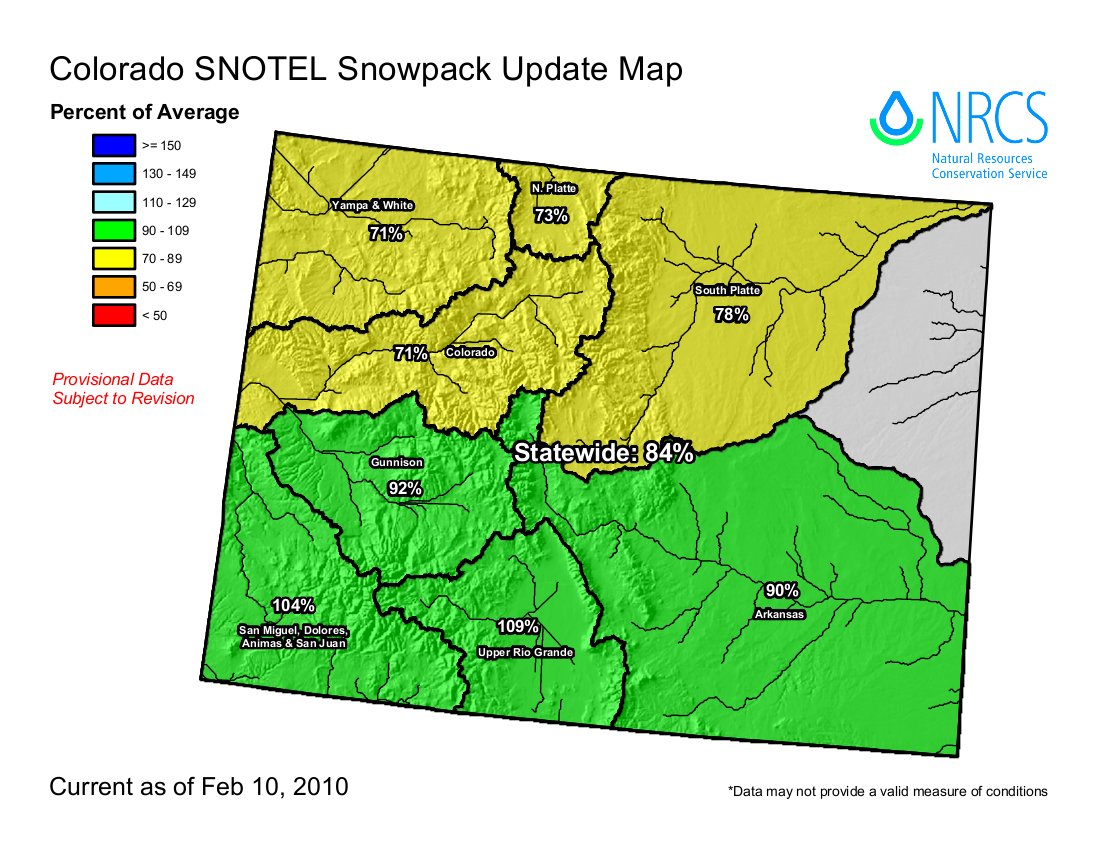
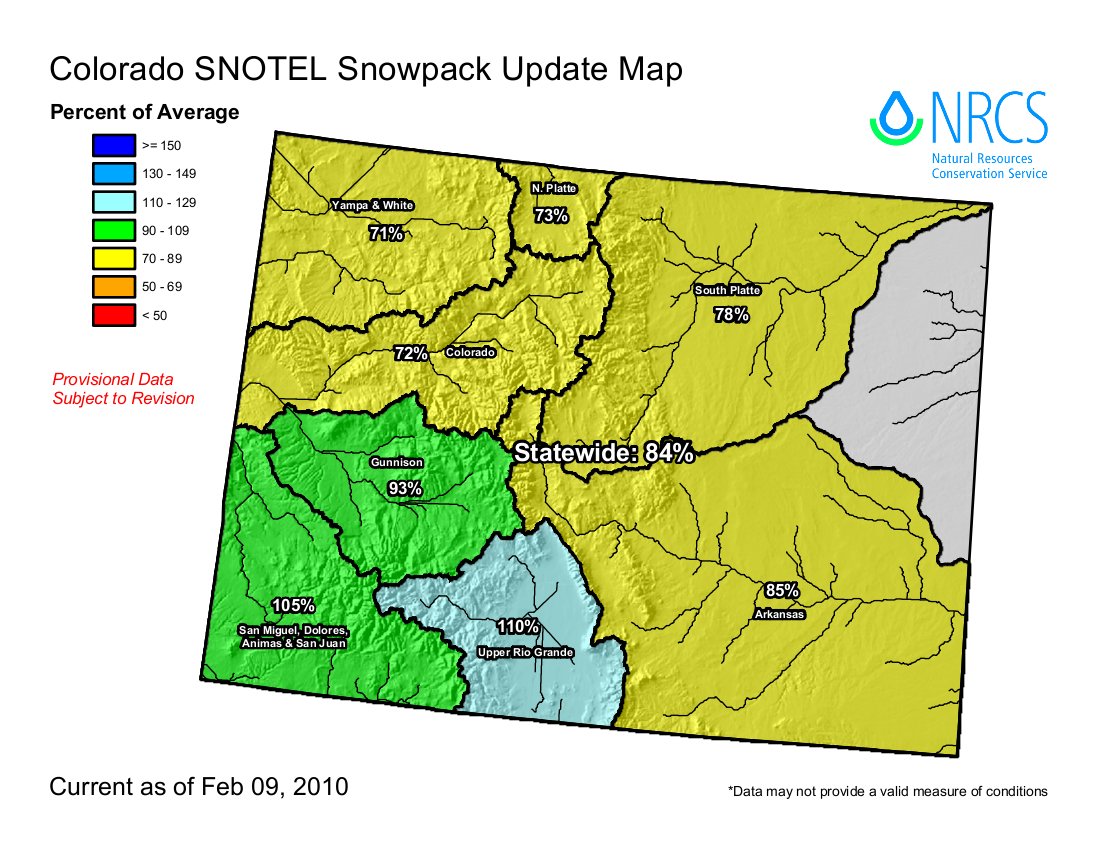
Click on the thumbnail to see today’s updated snowpack map from the Natural Resources Conservation Service here in Colorado.

Click on the thumbnail to see today’s updated snowpack map from the Natural Resources Conservation Service here in Colorado.

From The Durango Herald (Joe Hanel):
Energy Fuels Corp. plans to build the Piñon Ridge mill in the Paradox Valley of Montrose County, about 12 miles west of Naturita. The company applied to the state health department for a permit to operate last November. By law, the department has until early 2011 to either issue or deny the permit, Energy Fuels President George Glasier said Tuesday at a Colorado Mining Association conference. “If we didn’t think we could get the license, we wouldn’t have spent the time and money,” Glasier said.
The health department has scheduled a public meeting about the mill for Feb. 17 in Montrose…
“One of the things the United States needs badly is new uranium mills, because existing mills just cannot handle all the demand there’s going to be,” Glasier said. Only mills in Blanding, Utah, and Cañon City have processed uranium recently. The Naturita mill would spur new mining in Colorado and would draw workers from Cortez to Grand Junction, Glasier said. After state approval in January 2011, the mill could be built in nine months and operating by early 2012, Glasier said.
Others aren’t so sure. “That may be the plan he’s promoting,” said Travis Stills, a Durango-based lawyer for the mill’s opponents. “That doesn’t sound very realistic.” In addition to state approval, Energy Fuels needs to secure water rights, an air-quality permit and Environmental Protection Agency blessings for the design of its tailing cells, Stills said. The EPA in particular has a track record of being tough with uranium companies, Stills said. “That’s what a promoter does, is promote a best-case scenario,” Stills said.

From the Cortez Journal (Kimberly Benedict):
The U.S. Department of Agriculture announced Feb. 1 that the two counties, along with Mesa, Montrose and San Miguel counties, were granted disaster designation as a result of crop damage due to drought. Fremont County was also granted the designation due to frost and freezing temperatures.
The Western Slope experienced a wet spring that turned into a very dry summer in 2009, according to a statement from the state department of agriculture. As a result of the dramatic shift in moisture levels, various crops in the listed counties were damaged to an extent that warranted disaster designation. The designation was made in recognition of the hardships faced by producers in the midst of adverse conditions, whether drought or frost…
The official designation opens up opportunities for area producers to secure low interest emergency loans and other federal funding, according to Paul White, executive director of the Montezuma County Farm Service Agency. “This designation releases disaster assistance immediately through emergency loans administered by FSA,” White said. “For those producers who had crop insurance or Noninsured Assistance Program coverage on crops, they will be allowed to sign up for the Supplemental Revenue Assistance Payment Program.”[…]
To qualify for assistance funding, producers must suffer at least a 10 percent production loss to at least one crop of economic significance due to natural disaster…
For more information, contact the Montezuma County Farm Service Agency at 565-8879.
More Montezuma County coverage here.

From email from the ACWWA:
ACWWA will be hosting an Open House on Tuesday, February 16 from 5:00 PM – 7:00 PM at 13031 East Caley Avenue, Centennial, CO 80111. Please stop by to learn about the ACWWA Flow Project, water conservation tips, construction projects, and water supply. Staff will be here to answer any questions you may have.
More infrastructure coverage here.
From Steamboat Today:
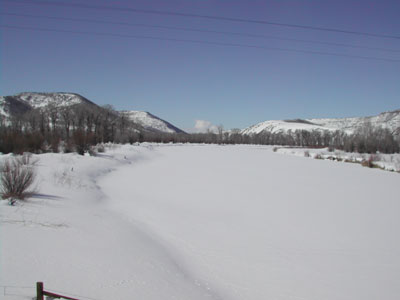
The city of Steamboat Springs Parks and Recreation Commission will hold a public meeting at 5:30 p.m. Wednesday at the Steamboat Springs Community Center, to discuss last year’s regulation monitoring, education and enforcement efforts on the Yampa River. The commission directed city staff last year to work with volunteers to address concerns expressed by the public about impacts — including trash, illegal parking and alcohol consumption — from a variety of river uses. Wednesday’s meeting will review last year’s efforts and discuss efforts for 2010. Call 879-4300 for more information.
From The Grand Junction Daily Sentinel (Charles Ashby):
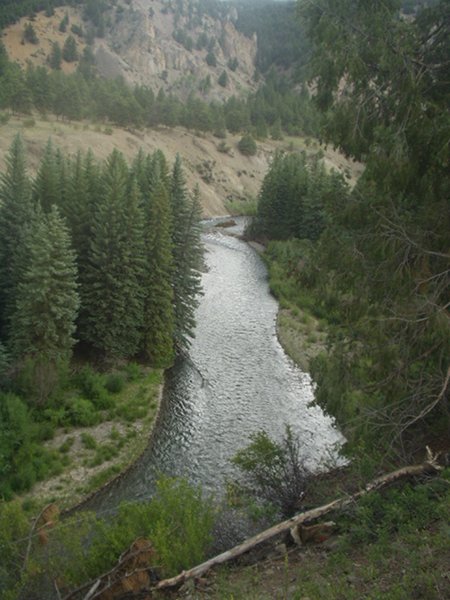
[Texas developer, Lewis Shaw], who plans to build ranch estates along the river, told the House Judiciary Committee he gave the rafters a year’s notice. “This is a case of, ‘Do good fences make good neighbors?’ ” he said. “We have enjoyed being very good neighbors, but I think I’d like a good fence, too.” But the committee said that proverbial fence is meant to keep people out of private property. Water flows in rivers owned by the public. It approved the bill 7-3…
A 1979 Colorado Supreme Court decision in People v. Emmert said rafters who touch the bank or riverbed are considered criminal trespassers, but subsequent laws changed that to a civil charge. The civil trespassing question has never been tested in court but came close when a Gunnison County landowner along the Lake Fork of the Gunnison River sued an outfitter that had been rafting a section of river for decades. The case, however, never made it to trial because the rafting company eventually sold its assets and went out of business, which sent ripple effects throughout the rafting community, said Lori Potter, an attorney for the Colorado River Outfitters Association.
“There is no taking of property,” she said. “There is no taking … because it (predates) the property rights.”
More 2010 Colorado legislation coverage here.
From the Douglas County News Press:
City Council voted to proceed with the dissolution at its Jan. 26 meeting. “We expect to achieve increased efficiency and savings for Castle Pines North taxpayers,” said City Manager Alan Lanning. This combination of district operations will put services such as water and parks and open space under city government’s control.
More infrastructure coverage here.

From the Circle of Blue Waternews (Steve Kellman):
What convinces a city to consider giving up control of its water in the first place? Some officials believe the private sector can do a better job maintaining and upgrading a leaky and inefficient water system. Others see an opportunity to leverage a successful water system and its guaranteed cash flow from its customers — city residents — to win a large up-front payment from a private firm. That money can then be used to plug budget shortfalls in other departments. Experts who have watched failed experiments in the privatization of municipal water systems say both beliefs are wrong.
John Keesecker, a senior organizer for the non-profit consumer organization Food & Water Watch, works with community groups across the United States to prevent the privatization of public water resources. “Our number one concern with systems that are privatized is that service goes down and there’s poor water quality,” Keesecker said. “There’s also less accountability and transparency, because at the end of the day these companies are beholden to shareholders and their concern is primarily with making a return and not with providing a good service.”
“When it’s publicly managed, council members or aldermen can be voted out if it’s not being managed well but that’s not the case when it’s been privatized. Voting them out won’t necessarily change the way the water system operates.”
More infrastructure coverage here.

From The Greeley Tribune:
Rep. Jerry Sonnenberg, R-Sterling, right, said had the bill passed, it would have hurt farmers along the South Platte River. The bill, introduced by Rep. Sal Pace, D-Pueblo, was defeated by a 40-21 vote. “If this bill passes you just as well paint a big red target on the back of farmers in eastern Colorado,” Sonnenberg argued during the debate last Friday. “Anytime you add more hurdles when trying to move Colorado’s water, you make it more difficult and cities will take the path of least resistance to obtain their needs. That path is ag water,” Sonnenberg said in a press release.
More 2010 Colorado legislation coverage here.
From The Denver Post (Mark Jaffe):
The Bureau of Land Management last month postponed the geothermal-lease sale scheduled for Thursday of 800 acres in Chaffee County to do further environmental reviews. It was the third time the bureau has postponed the sale. “They keep changing the rules,” said James Jones, the oil-and-gas landman who nominated the parcel for lease sale.
The outpouring of opposition — more than 240 protest letters and a five-hour meeting with 170 area residents — prompted the delay, said Lynn Rust, the bureau’s state deputy director for lands, energy and minerals. “Mr. Jones has expressed his concerns,” said Rust. “We just feel we have to go in and deal with public concerns.”
Jones said he nominated the area in the Chalk Creek Valley based on Colorado Geological Survey data. “It is the hottest and most active site in the state,” said Jones, who switched to developing geothermal resources when the oil-and- gas industry declined. Many issues opponents are raising cannot be addressed until after a lease is issued and there is a proposed project, said Jones, adding: “I will not be the man to ruin the Chalk Creek Valley.”[…]
The November sale was postponed, [Fred Henderson, head of locally based Mount Princeton Geothermal LLC] said, because the bureau and the state had not worked out an agreement on regulating geothermal wells — which fall under Colorado water law. The bureau and the state Department of Natural Resources are still negotiating that water agreement. “This has become a quagmire,” said Syd Schieren, who lives in the valley and operates a commercial geothermal greenhouse and hot-springs vacation cabins. The reason, Schieren said, is the bureau’s failure to do proper public outreach and adequately assess the site — which encompasses steep cliffs and a flood plain. “They really didn’t do an on-site analysis,” Schieren said. “They tried to go too fast.”

From The Pueblo Chieftain (Chris Woodka):
The [Colorado Water Quality Control Commission] voted to keep Fountain Creek impaired for selenium from Colorado 47 to its confluence with the Arkansas River and added a seasonal impairment, from May to October, for E. coli. The portion of Fountain Creek from the Monument Creek confluence to Colorado 47 was deemed impaired year-round for E. coli, but received no designation for selenium. “There just wasn’t enough data in order to list selenium on the upper reach,” said John Klomp, a member of the commission from Pueblo.
The decision represents a partial victory for environmental groups that argued for impairment of both reaches for E. coli and selenium, based on data that show Fountain Creek is nearing annual limits. After meetings with various parties, the Colorado Water Quality Control Division revised its initial recommendations to make the standards tougher for E. coli north of Pueblo and to retain selenium as a listed contaminant. “We heard a lot of testimony at the hearing and I feel comfortable with the decision we made,” Klomp said. “In particular, I’m glad we decided to continue listing E. coli annually with the problems we’ve seen downstream in Pueblo.”[…]
Colorado Springs Utilities supported the initial recommendations of Colorado Water Quality Control Division staff to list E. coli as a seasonal impairment for just six months and to not list selenium on both stretches. E. coli is an indicator of the presence of bacteria in the water, and some studies have shown the major causes may be from nonpoint sources other than sewer plants. For instance, a study by the U.S. Geological Survey completed on Upper Fountain Creek (above the Monument Creek confluence) concluded pigeons in Manitou Springs were the most probable source of bacteria in the way. Source studies have not been completed on the reaches of Fountain Creek affected by Monday’s decision, however. Data compiled by the state and other agencies show the levels of E. coli are highest in warmer months when there is more water in the creek. Selenium is an element essential to life but toxic in high concentrations. Studies show it probably loads as water passes over Pierre shale formations that are found throughout the Pueblo area.
From The Pueblo Chieftain (Chris Woodka):
The Colorado Water Quality Control Commission on Monday heard arguments about a state proposal to list Fountain Creek from its confluence with Monument Creek to the Arkansas River as only seasonally impaired for E. coli and not impaired for selenium.
The Rocky Mountain Environmental Labor Coalition, Sierra Club and Pueblo District Attorney Bill Thiebaut are challenging the proposal, saying the creek should be listed as impaired for E. coli, an indicator of potentially harmful bacteria, and selenium, a necessary element for living things that is harmful or deadly in elevated concentrations. Their arguments center on the potential for future limits on wastewater discharges to increase. Atencio and Chostner, both members of the newly formed Fountain Creek Watershed Flood Control and Greenway District board, point to plans that would increase future recreational use of Fountain Creek in Pueblo and urged the Water Quality Commission to adopt the stricter standards.
The city is working with Colorado Springs and the Lower Arkansas Valley Water Conservancy District to develop a park at the confluence of Fountain Creek and the Arkansas River. They said this will lead to year-round use, not just the May-October recreation season Colorado Springs attorney Richard Griffith argued for in a Jan. 27 statement. “Contrary to the statements made by Colorado Springs Utilities . . . we envision that, in the near future, Confluence Park will support recreational activities such as kayaking and canoeing, fishing, wading or just leisurely enjoy(ing) a walk by the creek,” Chostner and Atencio wrote in a joint letter last week to the commission. They also alluded to two recent decisions that “call into question El Paso County’s commitment to water quality on Fountain Creek” — the demise of Colorado Springs stormwater enterprise and the decision by El Paso County commissioners to allow a gravel pit opposed by the Fountain Creek district. “Water quality standards cannot be relaxed,” Chostner and Atencio told the water quality board. “Your action is vital in improving water quality in Fountain Creek, given the recent indifference shown by upstream users.”
Colorado Springs also answered charges by the environmental groups, in a motion last week from Kenneth Burgess, deputy city attorney for Utilities. Burgess took issue with the environmental groups’ interpretation of how discharge permits would be applied, saying the issue has been subject to differing federal court opinions, which have not been resolved by the U.S. Supreme Court. Courts reached vastly different opinions on how total maximum daily limits, or TMDLs, are applied in cases from Arizona, Arkansas and Minnesota. In some cases, courts ruled pollution, as measured by TMDLs, could be offset by reductions of nonpoint sources, while others prohibit adding more of a pollutant to an impaired stream. Burgess said the issues would apply statewide if the Water Quality Control Commission chose to act on it, and others have not been given adequate notice. “These issues are not within the scope of this proceeding, and in addition were raised too late in this proceeding and should be stricken,” Burgess said…
Colorado Springs Utilities also took issue with published statements by local Sierra Club Chairman Ross Vincent last week saying the change in seasonal levels for standards would allow for elevated discharges in winter months once the Southern Delivery System is built. Colorado Springs and other sewer plants on Fountain Creek would still be limited to TMDLs, under the Clean Water Act, said Keith Riley, SDS planning manager.
From the Montrose Daily Press (Katharhynn Heidelberg):
The Montrose area is sitting at around 80 percent of normal snowpack, as storm after storm gave us a miss this winter, instead socking it to locations to the south. Information from the National Weather Service’s Colorado River Basin Forecast Center shows that, because of “below average seasonal precipitation,” the April through July streamflow volume forecasts are also below average for the Lower Gunnison Basin. “We’re not as dry as we could be. We’re not as wet as we want to be,” said Marc Catlin, manager for the Uncompahgre Valley Water Users Association. “There is enough snow (in the basin) to raise a crop, but it’s really the type of spring season and the snowmelt. If nature will help us, it could be pretty much a normal year.”[…]
The district manages Ridgway Reservoir. Berry said that 80 percent of normal snowpack for the reservoir gives it around 80,000 acre feet of water. “We only have about 15,000 acre feet to fill the reservoir. If it quit snowing today, we could be down significantly by the first of May, when the real demand starts for irrigators out there.” he said. “But, I’m confident we can fill the reservoir, given an 80-percent snowpack.”
A warm spring (particularly warm nighttime temperatures), wind, and dust can quickly reduce even a large snowpack. So far this winter, it’s been quite cold in the area, and those temperatures “froze the snow down tight,” Catlin said.
From The Pueblo Chieftain (Loretta Sword):
“It’s not sloppy wet, but there’s a fair amount of moisture to go with this one,” said meteorologist Randy Gray of Pueblo’s National Weather Service office, adding that scant accumulations contained about three times the average measurable precipitation as most snowfalls this time of year. In the Rocky Mountain region, Gray said, it typically takes 20-30 inches of snowfall to produce an inch of water, but the storm that settled in Sunday and hung around through most of Monday produced a snow-to-water ratio of 10 to 1. “Sometimes, depending on other conditions and the time of year, even if it’s cold, the moisture has a way of coming out of the snow before it can pile up,” Gray said. “That’s what happened with this one.” Although it wasn’t a huge storm, it likely brought enough moisture to meet or top the average for all of February, which is 3.6 inches of snow containing 0.26 inches of water…
The Monarch Pass area was hit the hardest with snowfall overnight Sunday where Maysville residents reported 5 inches of new snow…
Up to 8 inches of snow fell in the foothills along the east side of the Sangre de Cristo Mountains.
Update: From The Denver Post (Yesnia Robles):
The snowstorm that started over the weekend brought about 4 inches of snow to the metro area but less than half an inch of moisture. National Weather Service meteorologist Robert Koopmeiners said moisture in the snow is determined by temperature. When the air mass is cold, he said, the snow doesn’t hold as much moisture…
Mike Gillespie, snow-survey supervisor with the NRCS, said playing catch-up [on the Colorado snowpack] will likely require more than 30 inches of snow each month for the next 2 1/2 months.
Update: From the Cortez Journal (Kimberly Benedict):
Snowfall began Sunday morning, tapering off midmorning. The area saw precipitation begin again in earnest late Sunday afternoon, continuing into the evening. Monday morning found Cortez and the surrounding area under a blanket of heavy, wet snow. “Out of this storm we got 8.1 inches of snow,” said local weather observer Jim Andrus…
Southwest Colorado has seen a number of storm systems move through the area this winter, all of which have produced measurable amounts of snow. “Our total snowfall for this winter is now 46.9 inches – almost four feet,” Andrus said. “We’ve had 63 days in a row of measurable snowfall on the ground. That is the longest stretch I’ve ever been able to report. From Dec. 8 through (Monday) morning.”[…]
“Our precipitation total for February is really impressive,” Andrus said. “We have .98 inches (of precipitation), and normal for the entire month is .95 (inches). So, we are 103 percent of normal for February already after only the first week of the month. “Total precipitation for the year has been 2.76 inches; normal through the end of February is 1.96 inches so that is already 141 percent of normal. It has been a really wet winter.”

From the Associated Press (Steven K. Paulson) via The Denver Post:
At a rally at the state Capitol, Duke Bradford, owner of Arkansas Valley Adventures, said his company guides about 23,000 tourists a year down five Colorado rivers. He is worried that a threat by Lewis Shaw II, president of Jackson-Shaw developers of Dallas, to file a civil suit would shut down a $142 million industry. Bradford said Colorado law reserves the use of Colorado rivers for the people, not for landowners. The state attorney general has ruled commercial rafters cannot be prosecuted for trespassing, but that didn’t settle the civil dispute. “He says we’re compromising his property rights. He’s coming to Colorado from another state and disputing our historical use of the river, threatening to shut us down,” Bradford said…
The bill would give commercial rafters the right to navigate rivers in Colorado and limited rights to use the river banks to avoid obstacles. The House Judiciary Committee approved it on a 7-3 vote after seven hours of testimony Monday and sent it to the full House for debate…
Rep. Kathleen Curry, an unaffiliated lawmaker from Gunnison, said North Dakota and Colorado are the only two states west of the Mississippi River that don’t have strict protection for commercial rafters. She said Utah clarified its rules four years ago, making it clear rafters have access. Curry acknowledged that rafters can interfere with fishermen and she said both sides need to respect each other’s rights. She said this issue has rippled throughout the West for decades, but states and the federal government have learned how to deal with it. “I’d say rafting and fishing can coexist. That’s been out there for years, even though they might not be the best of friends,” she said.
More coverage from the Aspen Daily News (Brent Gardner-Smith):
The six Democrats sitting on the judiciary committee last night voted for the bill, while three of the four Republicans voted against the bill. The committee members heard testimony for over five hours Monday night from advocates for private property rights, including complex examinations of ancient English law and what constitutes a “navigable” river.
And they heard from commercial rafting outfitters who said their livelihoods would be threatened without their right to float being clearly defined as it is in most other Western states, including Wyoming and Utah. Others testified that the bill did not go far enough because it did not give private boaters the same clear rights it was attempting to give to commercial outfitters.
For more than 30 years, both private and commercial rafters kayakers have generally understood that Colorado law gives boaters the right to float down any river or stream past private property as long as they don’t get out and touch the river bank…
But a bevy of experts testified that giving commercial rafters specific rights relating to private lands would constitute a taking that would require “just compensation.” “The right to exclude others is one of the most important sticks in the bundle that we know of as property rights,” said John Hill, an attorney with Bratton and Hill who represents Lewis Shaw and the Jackson-Shaw/Taylor River Ranch, LLC. “This bill is a taking of the right to exclude others.” Other groups that testified against the bill included the Colorado Cattleman’s Association, Club 20, and the Colorado Water Congress.
Update: More coverage from The Durango Herald (Joe Hanel). From the article:
Right now, Colorado law allows people to pass through private property on a river as long as they don’t touch the bottom or the banks. “Anybody who boats in this state knows that you can’t boat anywhere without touching something,” said the sponsor of HB 1188, Rep. Kathleen Curry, I-Gunnison.
Curry’s bill draws on the right of navigation in English common law, a body of law that lawyers imported to America during colonial times…
On the Animas River – one of the state’s four busiest for rafting – property owners usually don’t try to get in the way of rafting, said Bob Hamel, chairman of the Colorado River Outfitters Association. But outfitters on the less-traveled San Juan and Piedra rivers potentially could have trouble, Hamel said…
Opponents argued that the bill would take away their property rights. “It’s a piece of legislation that strikes at the very core of property ownership,” said Terry Fankhauser of the Colorado Cattlemen’s Association.
The bill would add rights only for licensed commercial outfitters. It says nothing about private boaters, tubers and kayakers. They still could be found guilty of trespassing even if the bill passes. The bill also applies only to stretches of river that commercial outfitters have used in the last two years.
More coverage from the Summit Daily News (Julie Sutor):
About two dozen Colorado rafters, many from Summit County, grabbed their boats, paddles and PFD’s Monday morning and gathered in the State Capitol in support of the measure, House Bill 1188. “We’ve already lost one river in Gunnison County,” said Mark Schumacher, owner of Three Rivers Outfitting. “We don’t want to lose another.”[…]
“I realized we had a statewide problem,” bill co-sponsor, state Rep. Kathleen Curry of Gunnison said Monday morning in front of the crowd of rafters. “We do need to tackle this issue in this building.” The bill is co-sponsored by state Rep. Christine Scanlan, who represents Summit County.
More 2010 Colorado legislation coverage here.
From The Aspen Times (Scott Condon) via the Vail Daily:
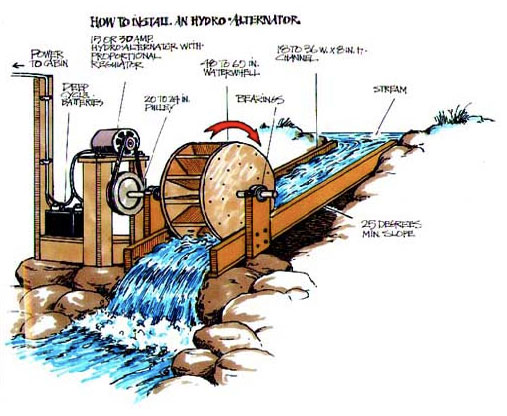
The town is studying the construction of a micro-hydro plant that would supply enough power to offset use of 30 average homes, according to Town Manager Bill Kane. The micro-hydro project could pro vide up to 40 kilowatts, he said. The town this spring will apply for a $350,000 grant from the state of Colorado, which has focused on clean energy proj ects under Gov. Bill Ritter’s leadership the past three years. The town might pursue the project even if it doesn’t receive state funds, Kane said. The town has a dedicat ed water fund that it would tap for the proj ect, so it wouldn’t require a new tax. Final design and cost estimates aren’t available yet. The concept would be to use the pipelines that deliver water from Lucksinger Springs, and possibly Basalt Springs, both of which are on Basalt Moun tain, downhill to the town’s water filtration plant. A hydroelectric turbine and genera tor, possibly two, would be added to the delivery lines, according to a prospectus. The power produced from the systems would be connected to the Holy Cross Energy grid.
From email from Reclamation (Dan Crabtree):
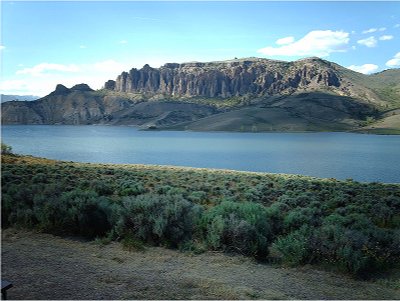
is a summary of our January 21, 2010 meeting to coordinate Reclamation’s operation of the Aspinall Unit. The meeting was held in Montrose. Handouts and presentations from the meeting can be found at http://www.usbr.gov/uc/wcao/water/rsvrs/mtgs/amcurrnt.html . As an update, the February 1 Blue Mesa Reservoir April through July inflow forecast is 600,000 ac-ft. The resultant 24 hour Black Canyon peak called for in the Federal Reserved Water Right is 4,492 cfs. At this time, it is Reclamation’s intent to operate the Unit to allow the water right to continue to be met. Highlights of the meeting include:
– January 1 forecast for 2010 spring runoff into Blue Mesa is around 80 percent of average. History has shown that the forecast can change significantly between January and the end of the runoff season because January is still early in the snow accumulation period. Currently El Nino conditions are present in the Eastern Pacific Ocean. El Nino years have resulted in drier winter hydrology followed by wetter than average spring conditions in years past.
– Based on the January 1 forecast, summer flows downstream from the Gunnison Tunnel should be between 600 cfs and 1000 cfs. A determination of the magnitude of the spring peak for the Black Canyon water right will be made on May 1. Blue Mesa is anticipated to fill this year.
– The Colorado Division of Wildlife made a presentation on the Gunnison River trout fishery and the relation of fish populations and river flows (link to presentation will be available on the operations summary websiteIf you have any suggestions on improving the operation meetings or summaries, please let us know. The next operation meeting will be on Thursday, April 22, 2010 in Grand Junction at the Western Colorado Area Office. If you have any questions, please call me at 970 248-0652.
More Aspinall Unit coverage here.

From email from the Interbasin Compact Committee (Jacob Bernstein):
The CWCB is extremely interested in projects and planning efforts that you have completed to protect environmental and recreational values in your watershed. We would also like to know what projects and planning efforts you have in mind to complete in the future (e.g. restoration projects, voluntary flow agreements, studies, instream flows, etc.). The CWCB will create a master list of past projects and planned projects. This will help us focus funding towards what you are planning and where additional resources are needed.
We would also like to invite you to this meeting, taking place from 10am to 3pm [February 10] at the Silverthorne Pavilion in Silverthorne to learn more about the nonconsumptive needs process, next steps, and information, seek input from you, and continuation of getting clarification and follow-up on the nonconsumptive planned and existing projects, methods, and studies.
Please RSVP to Jacob Bornstein (Jacob.bornstein@state.co.us; 303-866-3441 x3248). If you have questions, or wish to send your survey responses back (whether or not you attend the meeting).
More IBCC — basin roundtables coverage here.

From the Fort Collins Coloradoan (Bobby Magill):
In letters written to Million in January, the Fort Collins-Loveland Water District and the East Larimer County Water District both said they each want 5,000 acre-feet of water from the pipeline annually. In his Jan. 5 letter, Fort Collins-Loveland Water District general manager Michael DiTullio said water use in the district is expected to increase from 10,000 acre-feet per year to 17,000 acre-feet annually, and Million’s pipeline would help the district meet that demand. DiTullio said the district can’t commit to the pipeline water until a price can be negotiated. “What that letter says is we’re interested in any water storage project that could bring additional waters to Northern Colorado,” DiTullio said Thursday.
Loren Maxey, president of the East Larimer County Water District, or ELCO, said his district is interested in water from the project because the district’s water demand is expected to grow from 3,700 acre-feet per year to 11,000 acre-feet per year within the next 40 years.
The city of Brighton and a handful of other water users in northeast Colorado and in Adams, Douglas and El Paso counties also have said they are interested in Green River water…
Because it’s so unclear how much water is left to be developed in the Colorado River, Million’s project has the potential to create friction among people with different ideas about how to use the river’s remaining water. “That’s the center of our concern,” said Chris Treese of the Colorado River Water Conservation District. “How do we develop whatever’s left, or do we rush headlong into pursuing and approving very large projects that race us off the edge of the cliff before we know how close we are with regard to the Colorado River Compact? You don’t want to ever be in a deficit position. The Million project is perhaps taking us over the edge of that cliff.” Treese said he also wonders how the project can be regulated because Colorado has no power to control or regulate the pipeline’s diversion of the Green River’s water because it’s occurring in a different state.
Here’s what Montezuma Valley Irrigation Company did on the Mary Lateral, from Gerald W. Knudsen, P.E. writing for Environmental Protection. From the article:
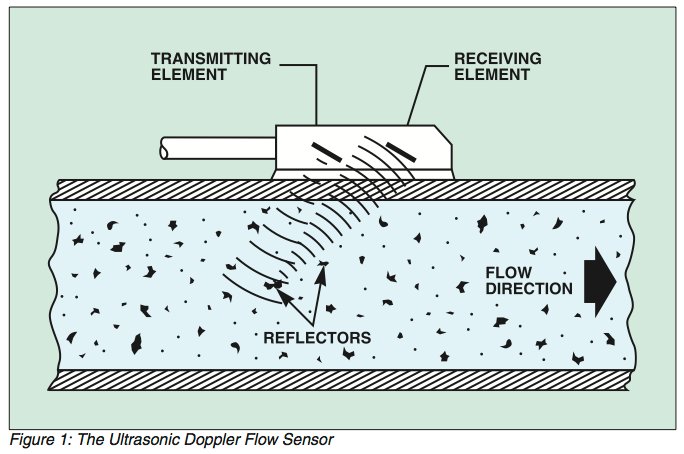
The pipe system has 45 branches off the main supply line, which ranges from 12 to 36 inches in diameter and from 30 to 50 pounds-per-square-inch high density polyethylene (HDPE). The turnout pipes that serve each shareholder are also HDPE with a transition to polyvinyl chloride. Turnout pipe diameters range from 4 to 8 inches. Each branch turnout is supplied with an ultrasonic flow meter and two butterfly valves. The meter measures the amount of water passing through the turnout. MVIC controls the first butterfly valve, setting flows according to the number of shares of water allocated The shareholder uses the second butterfly valve to shut off or reduce water volume. Each meter is either solar or battery powered.
On older parts of the system, MVIC is using impeller flow meters that require annual maintenance and are subject to plugging. To reduce maintenance and eliminate plugging problems, the team decided to use a non-intrusive flow meter.
More infrastructure coverage here.

From the Fort Collins Coloradoan (Bobby Magill):
If approved, Powertech will be allowed to test the feasibility of in situ leach mining for uranium at the Centennial Project site. The test could help regulators find answers to questions about how the underlying aquifer works and how any contamination from the mine could move through it and affect groundwater elsewhere…
The mining could have the greatest impact on the Laramie-Fox Hills aquifer, which many surrounding landowners have tapped for their well water.
The councils of most of the surrounding cities and towns, including Fort Collins and Greeley, have said they oppose the mine, partly for fear it could pollute the groundwater.
How far any pollution from the mine could spread within the aquifer and how that could affect water wells in the area isn’t well understood, but the pump test could shed some light on the matter, according to the EPA…
Information about the hydrogeology of the aquifer is sparse, and few people have studied how fast water moves in the aquifer to determine how pollutants could spread…
Vincent Matthews, state geologist and director of the Colorado Geological Survey, pointed only to a 1980 CGS study of hydrogeology and uranium resources northeast of the Centennial Project site, written at a time when Unocal and other companies were planning uranium exploration projects near Keota in Weld County. The state sampled 104 water wells — many of which tapped the Fox Hills formation — near uranium deposits in northern Weld County. The study showed that the well water quality was extremely poor and much of the water contained high levels of uranium and vanadium. The closer a well was to a uranium deposit, the more contaminated it was. But, Matthews said, the study doesn’t say much about what’s happening in the same aquifer and rock formations near Nunn…
The USGS has no specific data on the Fox Hills aquifer near the Centennial Project, and any other studies conducted in the area wouldn’t apply to that spot because each site has its own unique characteristics, said James K. Otton, a USGS geologist specializing in uranium. Otton last year wrote a brief on in situ leach uranium mining, saying the mines have always left increasing contamination behind and no one has ever succeeded at fully cleaning up the groundwater after an in situ mine has shut down.

From the Grand Junction Daily Sentinel (Dennis Webb):
The county is looking at a price tag of nearly $2 million to build a landfill cell capable of accepting the liners, which can be fouled by oil and gas contaminants. New state rules generally require that the liners be removed when a pit is closed rather than being buried on site. But they currently must be shipped outside the county for disposal. County manager Ed Green said the landfill cell would cost about four times as much as a normal cell because it would need to have a liner with leak-detection equipment beneath it and at liner seams. It’s also possible the liners could be characterized as hazardous waste, which would trigger state and federal rules and add to costs. Garfield is the state’s most active county for drilling, and Green said a local disposal site can be an attractive option to help companies comply with the law.
County staff targeted $1,000 as a presumably palatable price to charge companies to accept and bundle a liner at the landfill. However, it’s been projected that the cost to the county could be $1,750 per liner, including cell construction and operation costs.
At a meeting Tuesday, county commissioners expressed discomfort with the possible expense involved. Commissioner Tresi Houpt, who also is a member of the Colorado Oil and Gas Conservation Commission, which implemented the new pit liner rule, questioned the idea of asking taxpayers to subsidize drilling expenses.
More oil and gas coverage here.
Here’s an update on the geothermal picture in Chaffee County, from Ron Sering writing for Colorado Central Magazine. It’s a long piece so click through and read the whole thing. Here’s an excerpt:
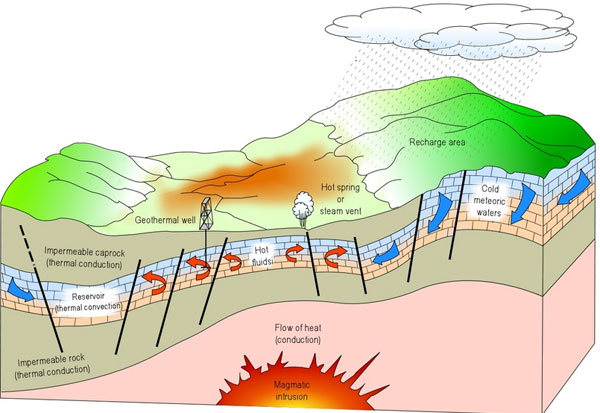
New technology makes it possible to generate power with water at a temperature below 400 degrees. These plants pump the water to the surface, where it passes through a heat exchanger containing a binary fluid that boils at a lower temperature than water. This in turn produces the steam that drives the generators…
The extent of Chaffee County’s geothermal resources was measured by Amax Exploration in the 1970s. The effort ceased with the return of cheap petroleum in the 80s, and because the technology of the time required natural steam to generate power, rather than the hot water found in Colorado. Subsequent research in the area around Mt. Princeton by the Colorado School of Mines indicate favorable potential for geothermal development using binary technology. “It is an area of exceptional heat flow,” [Matt Sares, Deputy Director of the Colorado Geological Survey] said.
More geothermal coverage here and here. Disclaimer: I write a water column for the print edition of Colorado Central.
It looks like the scare over losing my archives from the old weblog http://radio.weblogs.com/0101170/ is over. Jake Savin was able to transfer all of the Radio Userland hosted weblogs over to a new domain hosted by WordPress in a deal worked out by Dave Winer the former CEO of Userland Software.
You can still use the Google search text box on the home page at the old Coyote Gulch to search the archives. The calendar works as well if you just want to stroll backwards or forwards in time through the archives. I’m pretty happy that the situation has worked out so well. Thanks Dave and Jake. You guys are the best.

From The Durango Herald (State Senator Bruce Whitehead):
I’m happy to report Senate bill 25…[SB 10-025: Concerning the Long-term Funding of the Water Efficiency Grant Program extends the long-term funding of the water efficiency grant program to 2020 (currently set to expire in 2012).
More 2010 Colorado legislation coverage here.

From the Montrose Daily Press (Dick Kamp):
The filing of a “statement of opposition” by Sheep Mountain Alliance (SMA) of Telluride, preceded a separate filing last Tuesday by two groups in Moab, Utah based on similar issues…
Excerpting from Colorado state statutes, the law requires that “Applicants must demonstrate the legal and physical availability of the water -(show that rights are not) speculative -prove that waters can and will be diverted, stored or otherwise captured, possessed and controlled and will be beneficially used – with diligence within a reasonable time under their claimed conditional water rights..”

From The Aspen Times (John Gardner):
President of Glenwood Whitewater Events, Davis Farrar, and Bob Campbell, managing director for Whitewater Parks International, which is also based in Glenwood Springs, asked for the City Council’s support in applying for the pinnacle event of the kayaking world. “This is a partnership,” Farrar said. “It’s a big project. We are excited about it and we think that we can pull it off, but we will need some excited partners.”
While council members were excited at the prospect of Glenwood hosting a world championship, they were also concerned that, without having ever held an event as large as the world championships, it’s hard to know if Glenwood is ready. “I really would like to host a world-class event in Glenwood,” said Councilwoman Shelley Kaup. “But I have to question if we are ready for that yet.”
Glenwood could expect more than 300 competitors from 40 participating countries, five days of competition, one week of training prior to the event, and a minimum of 3,000 spectators at the site each day, according to Campbell’s calculations. The park is located on the Colorado River, on Glenwood’s west side…
Campbell estimated the cost of hosting the world championships at about $430,000, of which the city would be responsible for $160,000 up front; the rest would possibly be paid by sponsors. However, the city could be on the hook for more if sponsors didn’t ante up. That did not set well with Councilman Matt Steckler.
More whitewater coverage here.

When changing agricultural water to municipal use the water courts require an analysis of historical consumptive use. Here’s a report on the difficulties of obtaining that information, from Bill Jackson writing for The Greeley Tribune. From the article:
The [New Cache la Poudre Irrigating Co. and Reservoir Co] recently released a draft report on a ditchwide historical use analysis, which Don Magnuson, superintendent, said will probably become necessary for all irrigation companies in the future. The report, he told members of the Greeley Chamber of Commerce Agriculture Committee last week, really focused on consumptive use of water, which he predicted will become more important in future years. “The true value of water is how much you consume and not what is diverted,” Magnuson said. So that becomes even more important when that water is changed from agricultural to another use, and that change drove the need for the analysis.
Consumptive use is that water consumed by plants in a given field. Typically, under a flood irrigation system, about 50 percent of irrigation water is consumed while the other 50 percent either runs off the end of a field, evaporates or escapes past the root zone of the plants and goes into an aquifer. However, each crop consumes different amounts of water. Eventually, that water not consumed by plants returns to streams and rivers both on the surface and through aquifers. But the time that takes varies widely, from a matter of a few hours in the case of surface runoff to months or even years through an aquifer.
Over a 15-year period, the analysis tracked water requirements by crop type throughout the Cache la Poudre system. Those figures show the complicated job of growing and irrigating crops. Over that 15-year period, water requirements, on average, for alfalfa were slightly more than 26 inches through the season, grain corn about 18 inches, dry beans about 10.5 inches, grass more than 26 inches, small vegetables 13 inches, spring grain 17.5 inches and sugar beets 20 inches. The average annual combined diversion and reservoir releases for the study period was about 57,900 acre-feet, or about 1.79 acre-feet per irrigated acre. The average consumptive use was about 26,900 acre-feet or about 0.8 of an acre-foot per acre, so that means a lot of water went downstream for someone else to use. An acre-foot is about the equivalent of covering a football field with 12 inches of water. Throw into the mix the different types of soils, weather conditions and increased demands from growth, and things just get more complicated.
More South Platte River Basin coverage here.

From the Vail Daily (Lauren Glendenning):
Vail Mountain snowpack is at 57 percent of last year’s level, and 69 percent of average levels. Beaver Creek’s snowpack is at 45 percent of last year’s level, and 72 percent of average levels…
“I think it’s kind of time to get concerned about this low of a snowpack for this time of year,” said Mike Gillespie, the snow survey supervisor for the Natural Resources Conservation Service. “It’s considerably below average.”[…]
The Eagle River Water and Sanitation District analysts aren’t as concerned with snow depths as they are with snow water equivalents, or the amount of moisture found in snow. The District measures levels at each of the snow survey stations that directly affect local water supplies, with Vail Mountain’s site as one of them. The survey station on Vail Mountain just hit the 2002 drought level, meaning levels have been less than they were in 2002 until now, where they’re about even. The District compares levels to 2002 because that was a really dry year. A graph showing both 2002 and current levels proves there’s something to be concerned about.
Gillespie thinks this year is starting to look like 2002, but there’s still some room for hope. “The wild card is still for what El Nino could bring to the state in the late spring,” Gillespie said.
More coverage from NBC11News.com (James Hopkins):
The majority of the storms this winter have favored the south west mountain ranges leaving the rest of the state wanting. “The central mountains are around 80% of snow pack and the northern mountains tend to be 70–75 percent of normal,” says Brian Lawrence of the National Weather Service. Weather patterns, like the ones we are seeing this winter, are typical of an El Nino pattern. The sub–tropical jet, which normally tracks right through Colorado, pushes to the south. “Bringing quite a bit of precipitation to the southern mountains, while the northern mountains miss out on a lot of the action,” says Lawrence.
This pattern, not only benefits the Grand Valley when it comes to skiing in the winter , but also this coming spring. “So far we’re looking pretty good, kinda running along average, we’re at about 94%,” says Bret Guillory. Guillory is the Grand Junction Utility Engineer and his job is to keep a close eye on the city’s water supply. While the rest of the state is relatively dry, it’s a different story on the western slope. “The city of Grand Junction’s water shed is very healthy,” says Guillory.
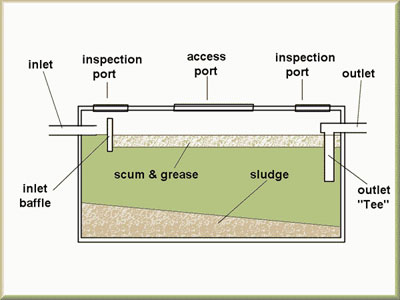
From The Fort Morgan Times (John La Porte):
The Fort Morgan meeting was part of an individual sewage disposal system stakeholder process coordinated by the state health department. Numerous committees with representatives from all over the state have been meeting, and plans call for making a recommendation for state legislation. Some involved in septic system installation and inspection, and some local government officials, believe state officials have their minds made up to adopt statewide regulations. “There’s a large group of people that think the die is cast on the direction that this group is going and the direction that the Department of Health is going,” said Dave Akers of the water quality control division of the state health department. The department’s goals, he said, are to protect ground water and public health…
“No matter how you look at it, you’re looking at an increased cost to the homeowner,” Carlson said. He asked about the possibility of tax credits to help defray those costs. Digging up septic systems for inspections could cost $1,500 to $1,800, excluding any landscaping costs, one Northeast Colorado Health Department official said…
Certification, licensing and registration of people involved in installing, inspecting and repairing systems is under study, said Kim Seipp, co-chair of the training and certification committee. She noted that many agencies have run into homeowners who are unaware of how a septic system works…
Costs, administration and implementation would be the big obstacles to a statewide licensing or certification system, she said. There is also concern that with increased requirements, some contractors who do a variety of jobs might drop septic systems, reducing the number of firms available to do them. That could hike costs. Several audience members indicated that inspections might help people buying homes to do so more confidently, knowing that the septic system was operating properly. Seipp said such inspections would present opportunities to educate homeowners on how to take care of a septic system. Some agencies think that inspections at the time of sale of a property would be a good idea.
More wastewater coverage here.

From the Pagosa Sun:
A special meeting of the Board of Directors of the Pagosa Area Water and Sanitation District has been scheduled for 9:15 a.m. Monday, Feb. 8. The primary purpose of this meeting is for discussions with the Board of Directors of the San Juan Water Conservancy District on water matters and the development of raw water projects. Towards the end of the meeting, the boards of directors are expected to enter into executive session for the purposes of conferences with legal counsel for receiving legal advice on litigation and discussing matters related to land acquisition for development of raw water facilities and other matters subject to negotiation involving both districts pursuant to Sections 24-6-402(4)(a), 24-6-402(4)(b), and 24-6-402(4)(e), C.R.S. The meeting will be held at the district’s administrative office located at 100 Lyn Ave.
From The Pueblo Chieftain (Patrick Malone):
Rep. Sal Pace’s HB1159 was killed on second reading, with 23 members in support and 36 opposed. Two members were absent, and Pace said they may have voted on his side, but wouldn’t have affected the outcome…
Pace hurried the bill along this week. He wanted it to move quickly because he said he was losing votes with each passing day as metropolitan water interests lobbied lawmakers against it. “I think about 10 (representatives) understood the bill,” Pace said. “(Denver legislators) acted like they were deeply concerned for (what the bill would do to) their districts, but they couldn’t say why.”[…]
Pace said the bill would have extended the same consideration to mitigation statewide that presently exists only in transfers that come from the Western Slope to the Front Range and Eastern Plains under the 1937 Conservancy District Act. Opponents said sufficient mechanisms are in place to address mitigation through the roundtables established by legislation five years ago. Pace countered that the roundtables would continue, and only be enhanced by his proposal…
With overwhelming opposition from metro lawmakers in the Legislature, Pace said he believes a ballot initiative, though challenging from a standpoint of expense, might be the most likely way to affect change in the way water transfers impact communities in the state. He cited a poll that shows state residents are more receptive to such changes than the Legislature is.
More coverage from The Grand Junction Daily Sentinel (Charles Ashby):
…that was because Denver Water lobbied hard against the bill and managed to turn some lawmakers to its side, said Rep. Sal Pace, who introduced House Bill 1159…
The issue is not a new one for the Legislature, but each time it comes up, urban lawmakers along the Front Range and even rural ones on the South Platte River Basin manage to find ways to kill it, Western Slope lawmakers said. “We on the Western Slope have seen how the water’s been taken and used, so we’re just trying to get some mitigation things going here,” said Rep. Randy Baumgardner, R-Hot Sulphur Springs. “We’re really concerned about the amount of water that leaves our districts and goes to other areas, and we’re just trying to protect those interests.”
Opponents of the measure said that’s all they’re trying to do, too. Rep. Jerry Sonnenberg, R-Sterling, said the bill’s true intent was to end all transmountain water diversions in the state, which would put more pressure on smaller communities downstream of the Denver metropolitan area.
More coverage from The Durango Herald (Joe Hanel):
[State Representative Sal Pace] got help from the strangest coalition the Legislature has seen this year. Supporters included local Republicans Ellen Roberts of Durango and Scott Tipton of Cortez, the other Republicans and Democrats on the Western Slope, and environmentalist Democrats from Boulder and Denver.
But a larger coalition opposed the bill, including many Denver Democrats plus Republicans from the suburbs and Eastern Plains. Major metro utilities like Denver Water and Aurora Water lobbied against the bill. The bill failed 40-21. Pace decided to ask for a vote Friday, even though he didn’t have commitments from the 33 lawmakers needed to pass a bill. “Every day, I was losing votes to Denver Water. It was better to do it quicker,” Pace said.
More 2010 Colorado legislation coverage here.
Say hello to the The Pulse of Colorado Farm Bureau weblog. They’ve been around since March according to their archives. Here’s the link to their water category RSS feed.
From the Glenwood Springs Post Independent (John Stroud):
The Thompson Divide Coalition (TDC), in cooperation with the Roaring Fork Conservancy, will take a second water sample this week from locations in both the Thompson Creek and Fourmile Creek watersheds. Two more samples will be taken later this year, said Lisa Moreno, TDC campaign director.
Carbondale trustees on Tuesday agreed to fund half of the remaining $13,970 to complete the $79,000 study. An anonymous donor has agreed to match the town’s share, Moreno said. Other organizations financing the study include the Pitkin County Open Space and Trails Program, the Aspen Skiing Company Environment Foundation, outdoor gear company Patagonia and the Brown Foundation. A funding request is also before the Colorado River Water Conservation District, Moreno said. The TDC, which includes area ranchers, recreation and environmental groups, formed in the fall of 2008 in an attempt to protect federal lands in the Thompson Divide area west of Carbondale from oil and gas development.
The group is currently working with mineral leaseholders to retire the existing leases, and is seeking federal legislation to withdraw the area from the future leasing. “We have talked to the lease holders, and one is willing to talk,” Moreno reported to the Carbondale board. “The other one says it has plans for those leases.”
In the meantime, the group is working to collect baseline water quality data for the watershed to have on hand when and if drilling activity does take place.

From the Montrose Daily Press (Katharhynn Heidelberg):
Red Rock Forests and Living Rivers filed a statement of opposition to three of EF’s water-permit applications for groundwater that is tributary to the Dolores River. The water would be used for Energy Fuels’ proposed Piñon Ridge Uranium Mill near Paradox.
More coverage from The Grand Junctional Daily Sentinel:
[Energy Fuels Resources LLC] is seeking 500 acre-feet of water that feeds into to the Dolores River for milling at the proposed Piñon Ridge Uranium Mill near Paradox and 500 acre-feet in the form of captured rainwater needed to prevent water discharges from the site. Red Rock Forests is concerned about the “speculative nature of uranium mining and milling” in the region and whether Energy Fuels Resources will hold the water right without developing the mill, acting Director Harold Shepherd said…
The Bureau of Land Management is considering the Dolores River for status as a wild and scenic river, and diverting water for the mill could threaten that, said John Weisheit, conservation director for Living Rivers.

From The Fort Morgan Times (Aaron Burnett):
U.S. Representatives Betsy Markey and John Salazar announced that the 2011 federal budget released Monday includes $3 million for the Arkansas Valley Conduit, a proposed 130-mile water delivery system from Pueblo Dam to communities throughout the Arkansas River Valley. The Conduit was originally authorized in 1962 as part of the Fryingpan-Arkansas project. It is intended to provide high quality, clean water to more than 40 municipalities and water districts serving approximately 50,000 people. “Water sustains our farms, our families and our communities in southeast Colorado,” said Markey. “This project has been a long time coming, and I’m happy to see this funding in the budget. Construction of the conduit will not only help ensure clean, reliable water in the future, but it will put Coloradans to work today.”
Bill Long, a Bent County commissioner and a Southeastern Colorado Water Conservancy District board member, said the inclusion in the federal budget by the president is a first for the project. “This is the first time that any administration has included funding for the conduit for their budget. We had $5 million in the budget last year, initially it was not part of the budget, but we got it added through John Salazar and Betsy Markey and the two senators.”
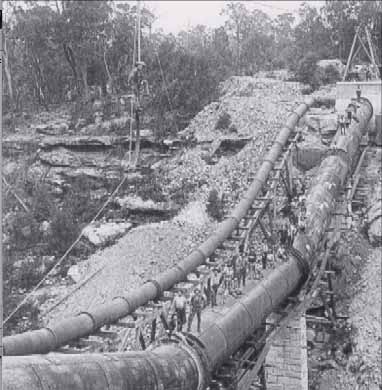
From the North Forty News (Cherry Solkoloski):
The city is planning to bore underground, rather than excavating a ditch, through sensitive areas just south of the Cache la Poudre River. Spokesperson Dan Moore said preliminary plans call for a series of bores, for a total of about a quarter mile of pipeline. The so-called northern segment through LaPorte is just one of several sections of pipeline that will take water from the city’s Bellvue treatment plant all the way to Greeley. Some of the segments have already been completed, but the northern segment’s preferred route has drawn intense criticism from some landowners who will be affected. However, Moore said, the boring method “should avoid most of the concerns we have heard.”[…]
Moore said that with the boring method, the city should be able to avoid destroying the historic features and the Point of Rocks. The city would bore under the irrigation canals and through a ridge just south of the Point of Rocks. It would go under the old railroad bed at some point, but the intact tracks would not be disturbed. Moore said the approach would be friendlier to the environment. The access road could be smaller, and the area would be easier to restore. The process would likely involve digging three boreholes, about 20 feet deep, from which the tunnels would be bored. There are always surprises when doing underground work, Moore cautioned, and the city might have to excavate in some areas if they encounter large chunks of rock…
Moore said that the cost difference between boring and trenching is difficult to assess. Although boring is a more expensive construction method, restoration of the property would cost less with that approach. Even with boring, he said, Greeley is sure that the preferred route on the south side of the river would be less expensive than the other alternatives considered…
Construction could begin next winter on the project, Moore said, and the project could take two seasons to complete. The city avoids doing pipeline work in the spring and early summer because of farming activity, irrigation and wildlife. Before work can begin, the city must acquire necessary permits from Larimer County and the U.S. Army Corps of Engineers. The Army Corps will consult with the Colorado Historical Society before issuing a permit.

From the Grand Junction Daily Sentinel (Dave Buchanan):
“The bill would allow incidental contact with property when commercial rafters went through private property,” said Mark Schumacher, owner of Three Rivers Outfitters in Almont. “It would also allow commercial rafts to portage around obstacles in the river.”[…]
[State Representative Kathleen Curry’s] bill, called the “River Outfitters Viability Act,” has the support of the Colorado River Outfitters Association, which represents more than 50 licensed outfitters in Colorado. According to the CROA Web site, commercial rafting contributed $142 million to Colorado’s economy in 2008.
More coverage from Chris Woodka writing for The Pueblo Chieftain. From the article:
Along with the outfitters association, he is working hard to keep access to one stretch of the Taylor River where a landowner wants to block access to commercial float trips through the property. The outfitters are supporting HB1188, co-sponsored by Rep. Kathleen Curry, I-Gunnison, and Sen. Mary Hodge, R-Brighton, that would explicitly allow commercial rafters to conduct float trips across private and government lands.
Past court cases have removed the outfitters from criminal liability if they do not make contact with the banks or riverbed of a stream, but simply pass through. There is still the possibility of a civil case being filed, such as a 2000 case on Lake Fork in the Gunnison River basin that essentially shut down a rafting company, Schumacher said. “We raised money after the Lake Fork case in 2000 to protect the right to float,” Schumacher said. “Right now, people are buying up ranches on the middle Taylor and forming private fishing clubs.” The new law is needed to clarify existing decisions on the rights of rafters and property owners, he added. “There is no statute or law in Colorado in reference to civil trespassing,” Schumacher said. “This is a David vs. Goliath situation, where we have to defend ourselves from private developers who bought the land knowing we float through it.”
More 2010 Colorado legislation coverage here.

From The Pueblo Chieftain (Matt Hildner):
Coupled with a prior easement, a 6-mile stretch of the Rio Grande and its bottom lands will now be protected along with habitat for elk, eagles and trout and the mountain views that greet drivers along Colorado 149 west of town. “We just thought it was too valuable a piece of land in its present state to ever dive off it,” Alan Lisenby said.
The family bought the ranch in 1996, and with their love of trout fishing immediately focused on shoring up the river, he said. The family has worked with the Natural Resources Conservation Service to reduce the river bank erosion that harms trout habitat and in high runoff years sends silt downstream as far as Del Norte. The Lisenby’s also adjusted their cattle operation, which includes anywhere from 400 to 900 cows in a given year, to accommodate the elk herds that wander down from the surrounding high country. “All of that stuff fits in together,” Lisenby said. “It threads the needle with what the conservation people want to do.”[…]
A $7.4 million award from Great Outdoors Colorado in 2007 helped the land trust complete the easement on the Rio Oxbow in addition to completing agreements on six other ranches along the Rio Grande. Other contributors to the easement included the Nature Conservancy, the Rio Grande Basin Roundtable and the Colorado Water Conservation Board. The land trust has protected 18,000 acres along the Rio Grande. The group is pushing to protect a 175-mile stretch of the river from the headwaters to the state line that remains largely in the hands of ranchers and farmers.
Meanwhile, a recent study commissioned by the Trust for Public Land has determined that there Colorado nets $6 of economic benefit for every $1 spent on conservation easement tax credits, according to a report from Cathy Proctor writing for the Denver Business Journal. From the article:
The study was done by Jessica Sargent-Michaud, a staff economist for the land conservation organization. It looked at the investments and returns in Colorado’s conservation easements since 1995. Over that time, the state invested an estimated $511 million in conservation easements, including $373 million through tax credits and another $138 million through the lottery-funded Great Colorado Outdoors (GOCO) grants. That’s equal to $595 million in today’s dollars, the study said…
The study separated the easement land by type of ecosystem and looked at the value such ecosystems offer on a per-acre basis. It concluded that Colorado’s land in easements gave $3.51 billion in economic benefits to the state through water-supply protection, waste treatment and flood control; farm and ranch production; and recreation, including hunting, fishing and hiking.

From The Pueblo Chieftain (Chris Woodka):
A storm last year damaged Smith Dam, located near Blanca in the Rio Grande Basin. Smith Reservoir is one of two — the other is Mountain Home Reservoir — that serve the Costilla County farming district, and without it, the farmers lost valuable water. The CWCB approved a $660,000 loan to repair the nearly 100-year-old dam. The repairs have already been made, financed in part by a bridge loan from one of the irrigators. CWCB staff deemed the Trinchera District a good risk, since it had repaid two other construction loans in the past. “The construction fund we use has to have money in it in order to make loans for the water community for unanticipated projects like this,” said Travis Smith, CWCB director from the Rio Grande Basin…
The board also approved a $4 million loan for a reservoir company east of Greeley on [January 27]…
[In January], Gimbel said funds from the $60 million loan for the Arkansas Valley Conduit are available if they are needed to match the local share for the $300 million project for the next two years. The conduit received $5 million funding for this year from Congress and another $14 million is being sought for next year.
More infrastructure coverage here.

From the Telluride Daily Planet (Katie Klingsporn):
…with Mill Creek running at the upper reaches of capacity and the town’s growing population, town officials have been working to change that for years, setting their sights instead on the pure, high mountain lakes above Bridal Veil as a source of municipal water. The town has been working to make the Pandora water treatment plant — which would pipe the pure water up there to a plant at the end of the box canyon before dispersing it to town — a reality for most of the decade. Now, it appears that the plan, which was thrown off track by litigation in the past couple years, is on the horizon. The town expects open it up for bids in February and begin construction of Pandora by early this summer. That was the news delivered this week during a presentation to the town by URS Engineer Bill Wemmert, who has been working with the town on the plans for several years. “Slowly but surely we’re getting closer to where we can pull the trigger on construction,” said Town Manager Frank Bell.
Right now, the town relies on Mill Creek and a water treatment plant on Mill Creek Road for its primary source of water, with the Stillwell tunnel as a backup. However, in the early part of the decade a study concluded that during extended lapses of drought, there isn’t adequate raw water to meet Telluride’s demand — and that set the town on a path to create the Pandora system.
As planned, the system will tap water from Blue Lake, Lewis Lake and Mud Lake — pure, deep-blue alpine lakes above Bridal Veil — and carry it down an 11,000-foot pipe that follows the switchbacks of Black Bear Road to the plant, which will be located on a small shelf of land above the Pandora Mill. The plant is designed with the capacity to handle 2 million cubic gallons of water a day, and will be the primary source of drinking water for Telluride. In addition, it will be outfitted with provisions for the installation of a micro-hydro unit capable of creating 250 kilowatts of renewable energy, but Idarado would have to approve installation of the unit. The plant itself will be partially buried in the hillside and obscured by the surrounding vegetation. The water will be filtered through a membrane system and will receive chlorine treatment, but Wemmert said very little chemicals will be used for treating the water.
Though it diverts water from the San Miguel, Bell said it will not affect the watershed. “There aren’t any effects of this plant on downstream users,” he said.
The project also includes the creation of a chemical storage and transfer facility
More water treatment coverage here.

From The Pueblo Chieftain (Chris Woodka):
2009’s HB1129, set up a pilot study for new developments that would supplement other water sources with rainwater runoff captured from streets, parking lots and structures. The CWCB began looking at guidelines for the study last September, and finalized them at this week’s meeting. The first applications could be considered in March. “It really comes back to conservation,” said Veva DeHeza of the CWCB staff. “The pilot proposal will be assessing the conservation potential of rainwater harvesting.”
Guidelines from areas that already have rainwater harvest rules — Texas, New Mexico, Oregon and Tucson, Ariz. — were considered in writing Colorado guidelines, DeHeza said. The guidelines are flexible, allowing the state to look at household or development-wide systems. Features such as retention ponds and cisterns will be evaluated. “There are many ways to do rainwater harvesting,” DeHeza said.
Because of funding constraints, only two projects will be considered over the next two years. They will take at least two years to complete, by documenting the amount of runoff from the site before development and the measures put in place to capture rainwater. The study will also look at landscaping features that reduce outdoor water use…
Under the new law, it could be possible to reduce the amount of augmentation, based on how much conservation contributes to maintaining natural flows. The pilot study will be critical for future claims in water court for new developments. While the guidelines were approved unanimously, some board members expressed concern about possible unforeseen complications. “I continue to be concerned about unintended consequences, especially with centralized collection ponds,” said Barbara Biggs, who represents the Denver metro area on the board. “Unsuspecting homeowners might have to deal with green ponds, mosquitoes, plugged-up sprinklers and sick dogs.” DeHeza replied that the guidelines look at water quality and stormwater management.
More CWCB coverage here.
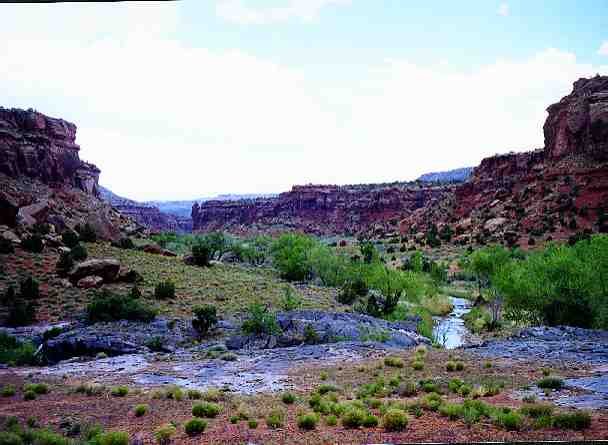
Click here for the list of proposed instream flow appropriations from the Colorado Water Conservation Board. From email from the CWCB (Rob Viehl):
At its January 26–27, 2010 regular meeting, the Colorado Water Conservation Board (CWCB) declared its intent to appropriate instream flow water rights for the streams listed on the attached Instream Flow Appropriation List. The attached list contains a description of the Instream Flow (ISF) Recommendations including stream name, water division, watershed, county, upper terminus, lower terminus, length, USGS quad sheet name(s) and recommended instream flow amounts. Copies of the Instream Flow Recommendation Summary Reports and Appendices submitted into the Official CWCB Record are available for review during regular business hours (8:00 a.m. – 5:00 p.m.) at the Colorado Water Conservation Board’s Office, located at 1313 Sherman Street, Room 721, Denver, Colorado, 80203.
More CWCB coverage here.

From the Cañon City Daily Record (Rachel Alexander):
The Uranium Processing Accountability Act would require uranium processors to comply with clean-up orders before new applications are processed, strengthen public oversight of bonding requirements; require processors to inform residents about threats to their water if they have registered wells in close proximity to known groundwater contamination; and require processors to amend their operating license before accepting new sources of “alternate feeds.”
The legislation would affect the Cotter uranium mill south of Cañon City…
“There’s one reason why we’re here, to protect the community, the environment of Colorado,” said Matt Garrington of Environment Colorado, which helped develop the legislation. The group hosted a press conference announcing the legislation at the Fremont County Administration Building. Commissioner Mike Stiehl spoke about contamination from leaking CCD tanks on the site. “Without the legislation we’re proposing, there is no reason to clean that up prior to decommissioning of the mill,” he said…
Also among Tuesday’s speakers was Bill Edrington, owner of Royal Gorge Anglers. “I’m not really here to protect my business, I’m here to protect this river, which I love,” he said. He said the Arkansas River is a “wonderful” wild fish producer, but that if the fish start to die from loss of food because of contamination, then the river is lost. “My mother always taught me if I made a mess, clean it up,” he said. “We want to keep (Cotter) around to clean up their mess.”
More 2010 Colorado legislation coverage here.
From the Center Post Dispatch (Teresa L. Benns):
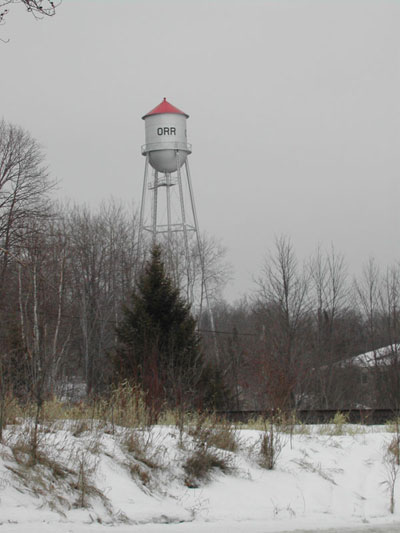
[Utilities Supervisor Kelly Stone] explained that while the leakage problem is solved for now, there would always be a problem with the tank because some movement of the tower will always occur. There also has been a problem with over filling in the past he said, but the filling process is on a timer now and this should be resolved. Further work on the tower will be done in the spring, Stone said.
In working with Rural Development on the water meter funding, Town Clerk Bill McClure reported that Rural Development authorities are suggesting that, “We get the water tower resealed from the inside.” The estimate on the resealing is about $10,000, and the funds for the project would be included in the current request for Rural Development funds.
More infrastructure coverage here.

From the Fort Collins Coloradoan (Bobby Magill):
Since Gov. Bill Ritter signed a 2008 law, House Bill 1161, requiring companies doing in situ leach mining to safeguard groundwater, state mining regulators have been working with Powertech and others in the uranium mining industry to write rules governing how the law is implemented. So far, the rules-writing has been informal, but the state on [January 27] released its plans for a formal public process for the final approval of the rules by the state Mined Land Reclamation Board…
The board is asking for the public to make its voice heard on the proposed rules at an April 15 hearing at the Embassy Suites Hotel in Loveland. It will be the first formal public hearing on the rules, but how many hearings there will be isn’t clear…
The board set a March 1 deadline for written comments from the public about the proposed rules. Those who want to be a party to the hearing – someone who believes they have a direct interest in the rules and can offer alternatives – must submit a written request by Feb. 23. Those granted “party” status are given an elevated legal status in the hearing process and must attend an April 6 prehearing conference at the Denver Art Museum.
Jackie Adolph of Citizens Against Resource Destruction, which opposes the Centennial Project’s potential impact on groundwater, said she believes public input in the rulemaking process is important to protect the water. “I think that we will have quite a bit of public participation in this process,” she said.
From the Pine River Times (Carole McWilliams):
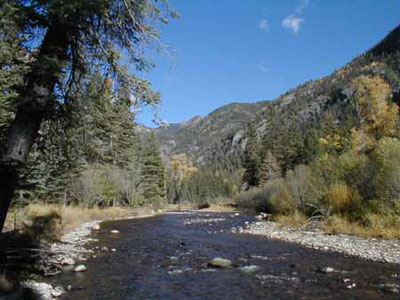
About 60 area residents plus gas production company and Colorado Division of Water Resources representatives turned out Tuesday evening at Bayfield High School for a presentation on all the water that’s pumped out of coalbed methane wells to get the gas to flow. The meeting was prompted by new state rules for coalbed methane well water deemed to be “non-tributary,” and by massive company filings in District 7 Water Court for rights to water – both tributary and non-tributary – that they are pumping out of coalbed methane wells…
“In the past, if there was no beneficial use, no water well permit or augmentation plan was required,” [State Engineer Dick Wolfe] said. “The change is in what’s considered beneficial use.” The other big distinction is whether the water is tributary to a stream. If it is, an augmentation plan may be needed to protect senior water rights from stream depletion.
Attorney John Cyran from the State Attorney General’s Office Water Rights Division said that as a result of the Vance decision, Fruitland formation coalbed methane wells need water well permits. “We have authority to issue permits or to stop any withdrawal if there’s injury to senior rights,” he said. “We still don’t think we should have to issue permits. If you issue permits, they are water rights.”
Cyran continued, “The Vance Supreme Court ruling means produced water is an appropriation for beneficial use, and they need well permits. If they are tributary, they have to replace any water that’s out of priority with augmentation. It means we have to issue thousands of permits. And we have to make sure there’s no injury to senior rights.” With many Fruitland coal wells, the connection with surface streams (mainly at the formation outcrop) is so distant that potential depletion “isn’t enough to worry about,” he said. “We have to administer the tributary wells and figure out which aren’t tributary. It’s a lot of them.”
The State Engineer’s recently released rules governing non-tributary coalbed methane wells include a map designating non-tributary areas, almost all south of Highway 160, and much of it south of the Ute Line.
The rules state that they “shall not be construed to establish the jurisdiction of either the State of Colorado or the Southern Ute Indian Tribe over non-tributory ground water within the boundaries of the Southern Ute Indian Reservation…”[…]Wolfe described the 1973 and 1985 laws dealing with non-tributary groundwater rights. The 1973 law gave exclusive right to the surface owner. The 1985 law allows “incidental withdrawal of non-tributary water in mining operations,” only the amount necessary to produce the oil or gas, and only while oil or gas production is happening. A man asked about recent production company letters to landowners referring to an absolute water right. Wolfe said the term absolute refers to water production from existing wells while conditional right refers to potential future wells. Sarah Klahn, the palintiffs’ attorney in the Vance suit, said a primary legal issue yet to be determined is, “Can you get the right to non-tributary water if you don’t own the surface?” Cyran clarified that the Engineer’s Office issues water well permits, while water rights must go through Water Court…
Ron Burkett, whose family owns one of the county’s largest private properties with many gas wells on it, asked where the augmentation water will come from. From Vallecito or from ditch company rights, Assistant State Engineer Kevin Rein said. “There’s a real strict court process for that.”[…]
As for the flood of company Water Court filings [by energy firms], he said, “You can’t claim water you won’t actually use. No speculative claims.” It can’t injure senior rights, and it has to be administered in priority…
Wolfe advised a couple augmentation plans have just been filed, and March 31 is the deadline for producers to file augmentation plans for all existing tributary coalbed methane wells. These can be blanket applications by individual operators or groups of operators. They have to identify every coalbed methane well in the plan and the source of replacement water, he said. Anyone wanting to file statements of opposition to the company filings for water rights or augmentation plans must satisfy criteria to have standing with the court, Cyran said. “You need some kind of water right to have standing.” Owners of water wells that don’t have an adjudicated water right – which is different from a water well permit – have to the end of this month to apply for that and gain standing, he said, adding, “It’s not that hard to file a water right application.” However, Bayfield attorney Marian Tone pointed out to the Times that it costs $224 per water well to file a rights application, plus $158 to file a statement of opposition. “They say it’s no big deal, but it is.”
More coverage from Katie Burford writing for The Durango Herald. From the article:
“The oil and gas industry is only seeking the water rights associated with oil and gas production,” said Bruce Gantner, a ConocoPhillips environmental consultant who is handling comments about the company’s application. Others filing applications in the area include BP, the Southern Ute Tribe and Chevron.
But some observers of the process called it a “water grab” and question the legal framework for the gas companies’ claims. “I think that the applications are overreaching, and they’re very broad, and they’re probably speculative, as well,” said Amy Huff, a water attorney who recently presented at a public meeting about the subject…
Gas companies firmly assert that water to which they are seeking rights is deep underground and has no effect on water people use for drinking or irrigating. “This water is not of a drinking-water quality,” Gantner, with ConocoPhillips, said. Zeller argued that domestic wells run a couple hundred feet deep or less while gas wells are about 3,500 feet or deeper.

Click here to download a copy (pdf) of the report.
Here’s a look at the presentation at the Colorado Water Congress’ 52nd Annual Convention where the report was discussed, from Chris Woodka writing for The Pueblo Chieftain. From the article:
A study by Summit Economics, working in conjunction with Tucker Hart Adams’ group, was commissioned by the Front Range Water Council to explain the relationship of water to the Colorado Economy. The council is made up of the state’s largest water providers, who are also importing most of the water from the Western Slope. Denver, Aurora, Colorado Springs, Pueblo, Twin Lakes and the Northern and Southeastern water conservancy districts are members of the council. “The trade between regions operates like gravity,” economist Tom Binnings told the Colorado Water Congress this week, describing the report, Water and Colorado’s Economy. “The larger two regions are and the closer they are means the more likely they are to trade.”
So, in the solar system barnyard of Colorado, what results is a Jupiter-sized chicken surrounded by a bunch of smaller inner planet eggs. Well, OK . . . Binnings didn’t exactly put it that way, but chart after chart in his presentation showed how Front Range counties — the area used in the study stretched along the Front Range from the Wyoming to New Mexico — dwarf the economies of the Eastern Plains, Central Colorado, San Luis Valley and Western Slope. With 82 percent of the population and 86 percent of income, the change has been readily apparent in the past 50 years.
Perhaps the most alarming computation in the report was the economic output of a region divided by the amount of water diverted. By that yardstick, the Front Range showed a value of $132,268 per acre-foot, with Central Colorado (the Upper Arkansas Valley, Huerfano and Park counties) at $12,326, and the Western Slope at $7,200. The two areas most dependent on agriculture fell behind distantly: the Eastern Plains, $3,342, and San Luis Valley, $1,209. The study admits agriculture is more dependent on water for value, while other sectors of the economy use relatively little water for the value of their output…
Members of the Front Range Council on the Water Congress panel said the study brought home the idea of interdependence in the state. “We live in a great state with a strong economic base and a bright future,” said Bruce McCormick, water services chief for Colorado Springs Utilities. “The industrial and municipal uses have high productivity, but it’s not the intent of this study to put one use against another. Our planning has to include agriculture, the environment and the lifestyle. What we learned is that we’re more interdependent than we thought.”
“One of the reasons people come here are the things that occur in the areas outside the Front Range,” said Mark Pifher, director of Aurora water. “So, it’s all tied together.”
From the DenverChannel.com (Ryan Budnick):
“I would think for some of the northern basins you have to be a little concerned,” said Chris Pacheco, assistant snow survey supervisor. “The likelihood of getting back to normal is pretty slight.”
The snow surveys showed the South Platte river basin at 73 percent and the state at 86 percent of average. Denver and much of the Front Range receives its water supply from the South Platte and the Upper Colorado river basins. Pacheco said the northern part of the state is hurting most particularly. The Colorado and the Yampa river basins are currently at 72 percent of its normal snowpack levels…
The Front Range could also find a reprieve with good reservoir levels. Denver Water’s storage system is at the same levels it was last year — which was considered to be a good snow year. “The reservoir storage is in good shape,” Pacheco said. “If we are running a little short reservoirs can supplement that.”
Stacy Chesney, spokeswoman for Denver Water, said the company’s public outreach efforts in promoting water conservation will be affirmed this year. “This is one of the reasons we ask customers to conserve,” she said. “It helps us in drier years. It is the right thing to do in a dry climate and this will help illustrate.”
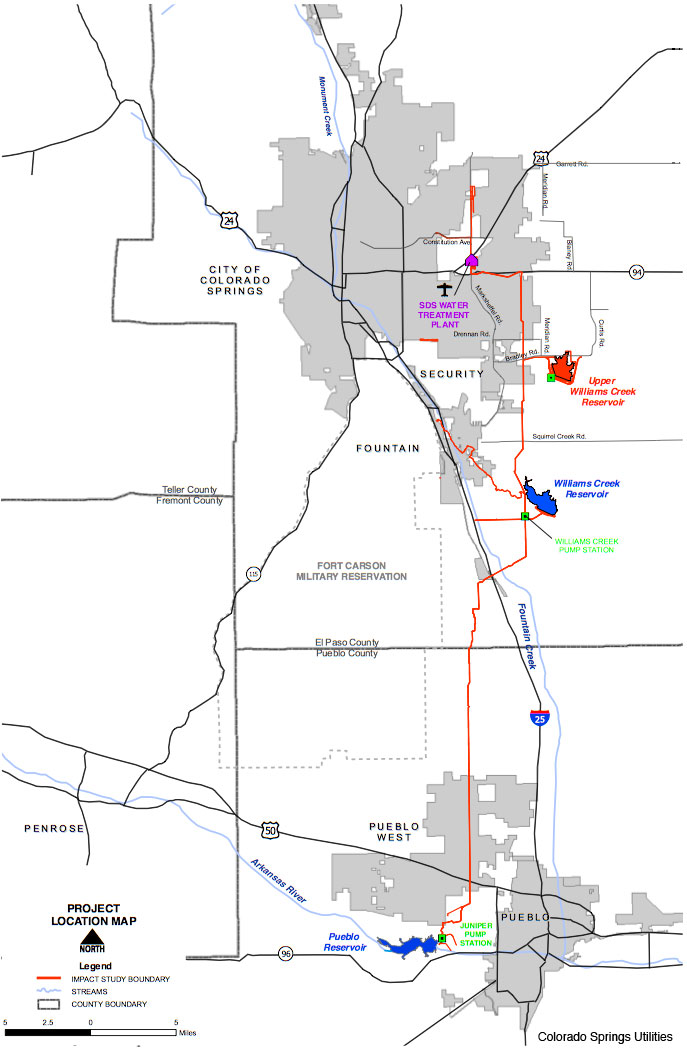
From The Pueblo Chieftain (Chris Woodka):
The water pipeline project will employ an average of 380 workers per year through 2016 with the peak hiring anticipated to come in 2014 with an estimated 700 jobs, according to Colorado Springs Utilities. “As you can imagine, once construction begins this year, a project of this scope and magnitude will have a significant impact on local economies,” said John Fredell, SDS project manager for Colorado Springs Utilities.
Of the total, about $550 million will go for construction of the connection to Pueblo Dam, the 50-mile pipeline, three pump stations along the route and a treatment plant east of Colorado Springs. About $400 million of that will go for the El Paso County portion of the project and $150 million will go for the Pueblo County portion. The remaining $330 million will go for property acquisition, legal, engineering and permitting costs. The first phase is scheduled to be completed by 2016. Labor costs are estimated at $160 million. “We are committed to hiring as much local labor as possible,” Fredell said. “We expect average employment of 380 workers between 2010 and 2016 with a peak employment of 700 workers anticipated for 2014.”


