From the Sky-Hi Daily News (Reid Armstrong):
This winter, scientists have been keeping a close eye on the weather in Grand County, hoping to catch the right kind of clouds headed in the right direction to give storms the little boost they need to produce more snow. Cloud seeding in Grand County is being funded by the organizations that stand to benefit most from big snow in the mountains — those who supply drinking water to metropolitan areas along the Colorado River and those who provide snow- and river-based recreation. While this is not the first cloud seeding project in the area, it is the first partnership of this size and scale…
Studies of the 35-year-old cloud seeding project in Vail and Beaver Creek have shown that water flows coming out of the creeks and rivers in seeded areas are 10 to 15 percent higher on average than those in nearby areas that aren’t affected by the seeding program. In some years, when storm tracks favor Vail, the seeding program has been shown to increase stream flows by as much as 35 percent…
Denver Water has been funding cloud seeding projects in the upper Fraser Valley on and off for two decades. It funded a program in the early 1980s and again in 2002/03 and 2003/04. But the program was halted — primarily for funding reasons — until this year when the new partnerships were formed, said Steve Schmitzer, Manager of Water Resources Analysis for Denver Water. This partnership has given the project the strength of scale. The partners are spending $110,000 with Western Water Research, which is running 10 manual generators (operated by private property owners), and $62,000 with Desert Research Institute, witch is running two remote generators (operated by cell phone) in the area…
This year [the Colorado Water Conservation Board] is spreading about $320,000 to programs around the state, including Winter Park, Vail, Gunnison, Grand Mesa and the San Juans, [Joe Busto, weather modification program coordinator for Colorado Water Conservation Board] said.
From the Sky-Hi Daily News (Matt Barnes):
Snowpack in the high-elevation mountains above Middle Park now ranges from 50 percent to 101 percent of the 30-year average, with the highest readings on the southeast side of the valley and the lowest readings on the north side. This is slightly more than 2002, except for the north side and Jones Pass, which still have even less snow than they did in 2002.
Snow density is averaging 22 percent, which means that for a foot of snow there are 2.7 inches of water. This is less water than normal for this depth of snow on March 1.
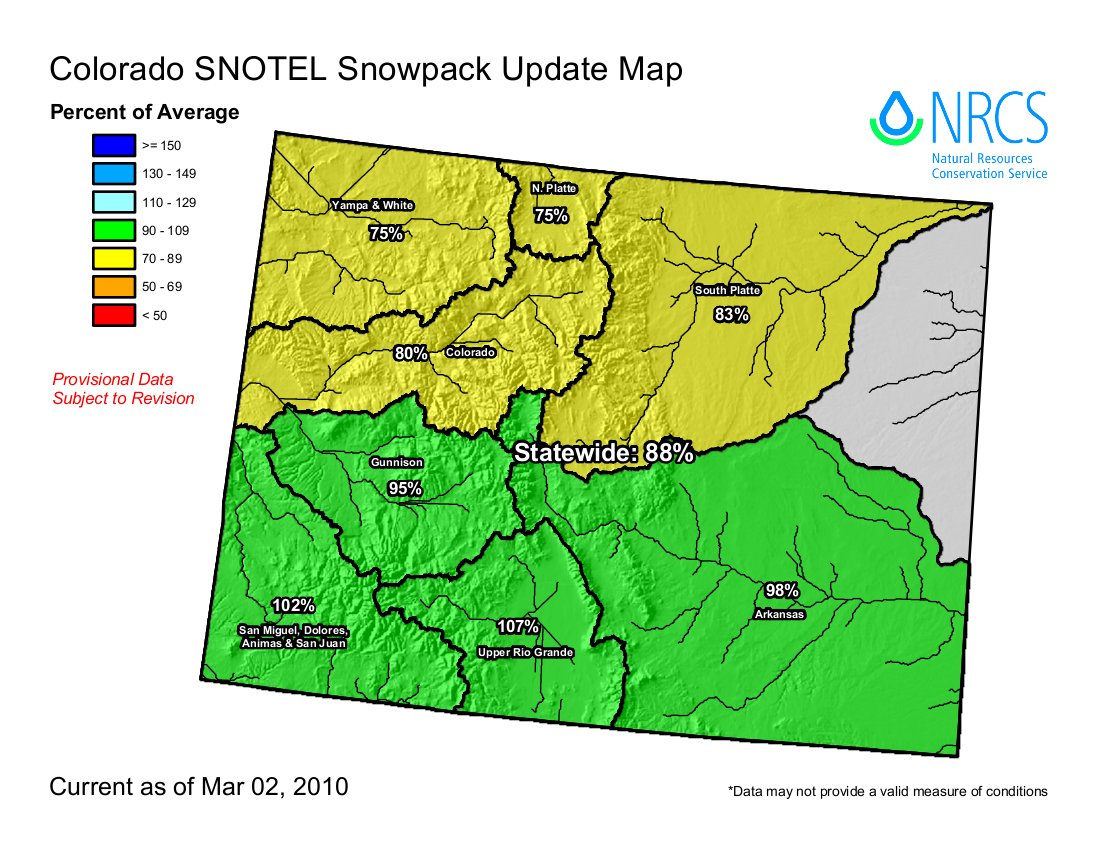
Northwestern Colorado and the North Platte River have the lowest snowpack in the state. The highest snowpack, relative to normal, is in the upper Rio Grande Basin and the San Juan Mountains of southwestern Colorado.