From The Durango Herald (Dale Rodebaugh):
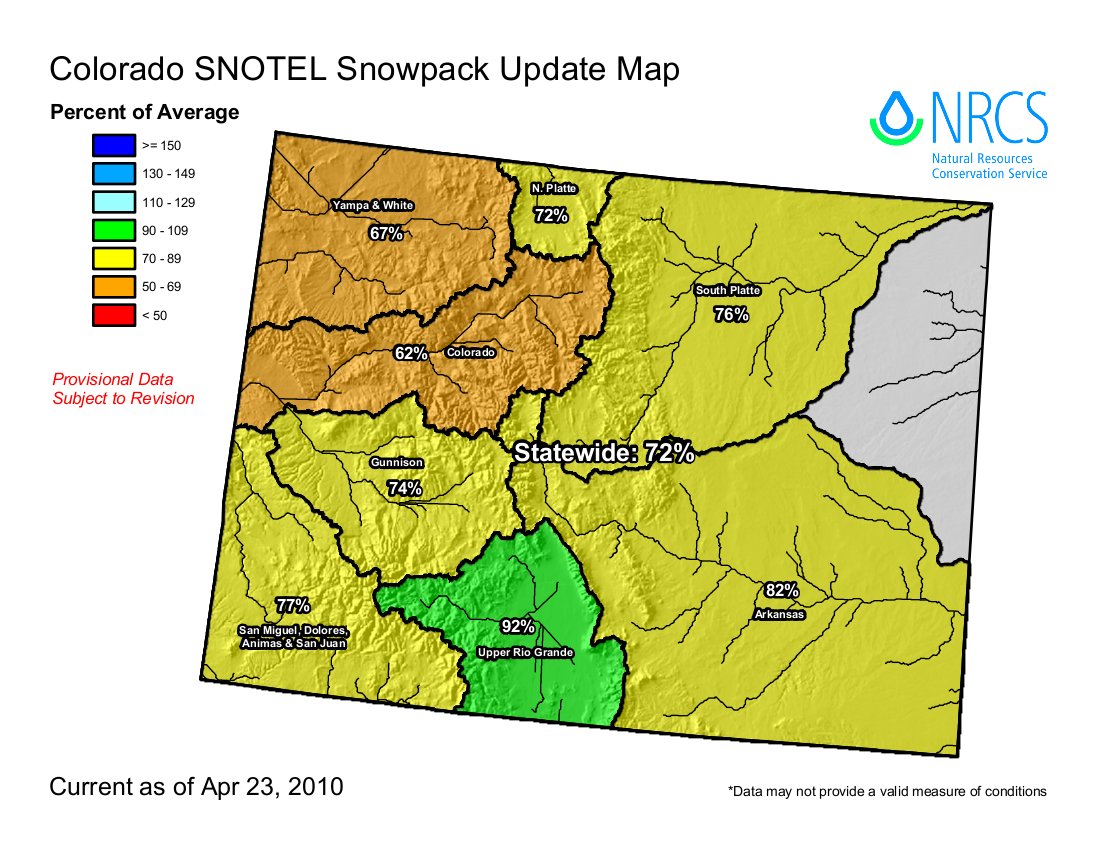
The snowpack in the San Juan Mountains that feeds the Animas, Dolores, Pine and San Juan rivers and fills reservoirs peaked at 101 percent of average on April 1. But bare tree trunks and rocks were visible in Vallecito and Lemon reservoirs where, on March 30, the water level stood at only 33 percent of capacity in Vallecito (the 30-year average for the period is 49 percent) and at 20 percent of capacity in Lemon (the 30-year average being almost 54 percent). Runoff from snowmelt should fill the reservoirs. But the Colorado Basin River Forecast Center predicts that Vallecito will receive only 80 percent of the amount it normally receives from April through July and that the inflow to Lemon for the same period will be only 78 percent of normal. When full, Vallecito holds 125,000 acre-feet of water. The capacity of Lemon is 40,000 acre-feet…
Hal Pierce, the dam superintendent at Vallecito Reservoir, expects the lake, despite its current status, to fill this year. “I felt a lot more confident a month ago,” Pierce said Thursday. “But the water level is rising a foot a day, and the 80 percent (of normal) inflow should still fill it.”[…]
In comparison to Vallecito and Lemon reservoirs, Navajo Reservoir is 72 percent full, and McPhee Reservoir is 66 percent full. The predicted April-July runoff at Navajo is 81 percent of normal and 72 percent of normal at McPhee…
Because snow levels reach their peaks in April, the outlook for near-average snowpack is less than 10 percent, the report said. March provided little significant improvement in the snowpack, the report said. “Given the marginal snowpack conditions across much of the state, the outlook for spring and summer water supplies remain below average for most of Colorado,” the report said. “At least reservoir storage continues to track near-average volumes across most of the state. This water should help alleviate late-summer shortages in basins producing below-average runoff this year.”
Meanwhile March was the warmest month on record around the world, according to a report from Randolph E. Schmid writing for The Durango Herald. From the article:
Last month was the warmest March on record worldwide, based on records back to 1880, scientists reported last week. The average temperature for the month was 56.3 degrees Fahrenheit (13.5 degrees Celsius), the National Oceanic and Atmospheric Administration reported. That was 1.39 degrees F above the average for the month over the 20th century. NOAA researchers said the warmer-than-normal conditions were especially notable in northern Africa, South Asia, Tibet, Delhi, India and Canada. Cooler-than-normal regions included Mongolia and eastern Russia, northern and western Europe, Mexico, northern Australia, western Alaska and the southeastern United States…
NOAA also reported that in March Arctic sea ice, which normally reaches its maximum in that month, covered an average of 5.8 million square miles. That was 4.1 percent below the 1979-2000 average expanse, and the fifth-smallest March coverage since records began in 1979.
From Steamboat Today (Joe Reichenberger):
A spike in the river’s discharge turned the still-lazy Yampa into a kayaker’s delight earlier this week. The river was running at about 300 cubic feet per second as recently as Monday afternoon. A surge of water doubled that mark in the next 48 hours, however, and by Wednesday afternoon the river was running at nearly 650 cfs in downtown Steamboat Springs.
Just because the river was running Wednesday doesn’t mean much for the season, however. Local kayakers said just what the spring of 2010 will hold remains to be seen…
A warm streak could melt off the high-country snow and send all that water crashing into the Yampa in a short span. A more tempered weather cycle could lead to a longer season but no overwhelming whitewater.