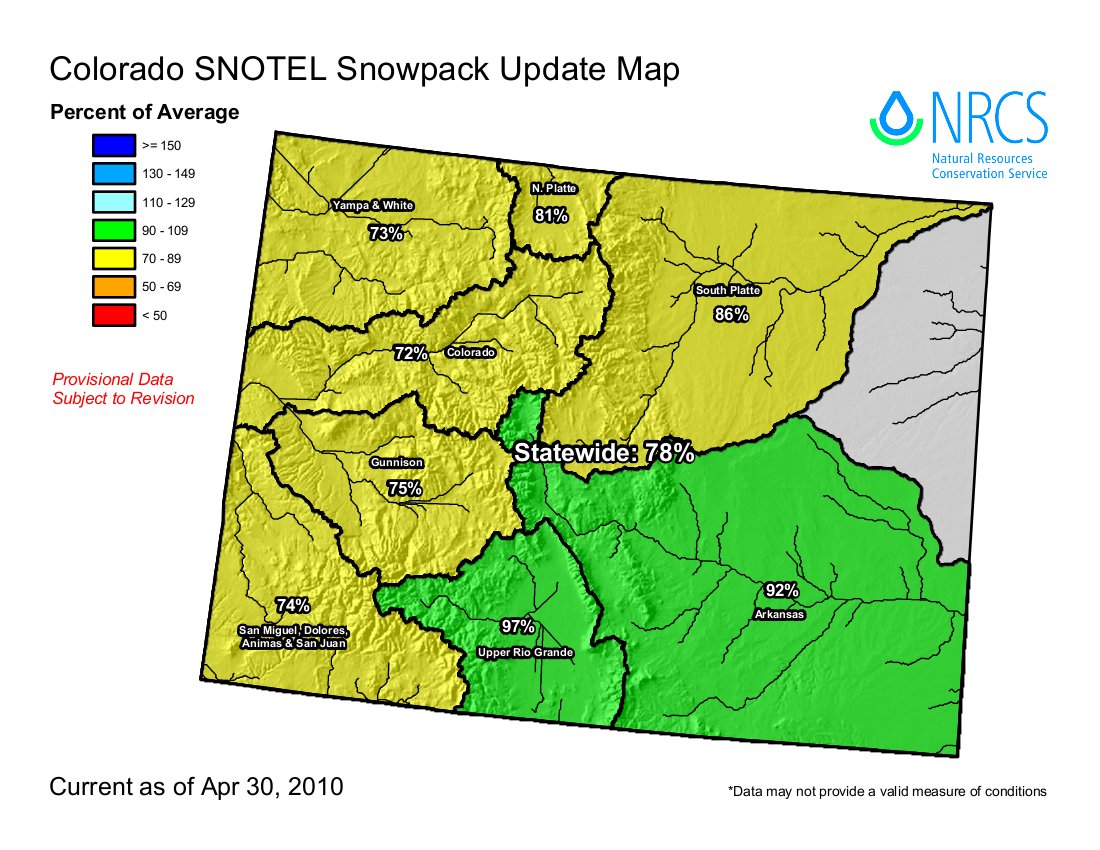
Storage news: NRCS reports that Colorado storage is generally in good shape

A picture named mclellanreservoir.jpg

From The Denver Post:

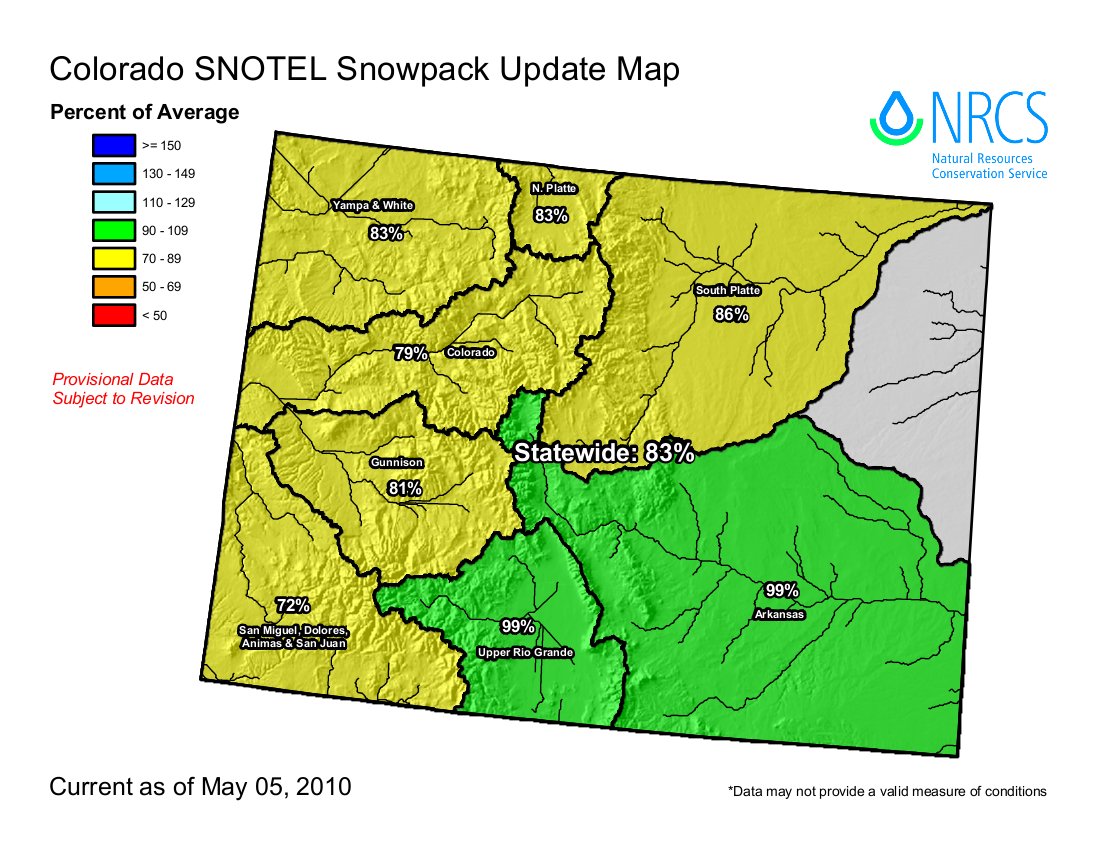
Full reservoirs can mainly be attributed to good snow and reservoir accumulations the previous two years, according to the NRCS. Snow accounts for most of the state’s year-round water supply for drinking and household use, agriculture and recreation. Officials were concerned by the warm, dry weather of early April, but recent mountain storms improved the situation. “These late-season improvements in the snowpack will have positive impacts on this summer’s runoff and water supplies in these basins,” according to a statement today from the federal agency, which measures the state’s snowpack.

Voters approve taxing authority for the La Plata Archuleta Water District

A picture named fountainpavementdrawing.jpg

From The Durango Herald (Ann Butler):

Voters approved Issue A by a 734-616 vote Monday in a mail-in election. More than 31 percent of eligible voters cast a vote, high for a special election, where turnout generally is in the 10 percent range, said Amy Kraft, a consulting engineer with Harris Water Engineering, who was the designated election official. “Ballots were coming in heavier in the morning than the afternoon, but it was steady all afternoon,” she said. The issue includes a 5 mill levy, which would cost the owner of a $200,000 house about $7 a month, and allows the district to lift the district’s revenue limit, which now is held in check by the Taxpayer’s Bill of Rights, or TABOR. The district was approved by voters in November 2008, but it was not funded until this election. “This is the big one,” said Dick Lunceford, president of the water district’s board. “Now we have the district formed and the money in place. While we still have a lot of hurdles and challenges to face, with this step on the ladder, this whole phase is over.”

More San Juan Basin coverage here.

Upper Colorado Endangered Fish Recovery Program: U.S. Fish and Wildlife Service reports increase in Colorado Pikeminnow population in the Green River below Dinosaur National Park

A picture named lodorecanyonfromdouglasmtnnps.jpg

From the Associated Press via the Casper Star Tribune (Mike Stark):

In some years, wildlife officials have come up empty when looking for young, torpedo-shaped Colorado pikeminnow on a 120-mile stretch of the Green below Dinosaur National Monument. Last year, though, they found 325, the U.S. Fish and Wildlife Service said. “It’s the first year in a long time that we’ve seen a number this high,” said Tom Chart, a fish recovery program director with the agency offices in Denver. The tally was a bright spot in the long road toward recovery for the endangered pikeminnow, which has been federally protected since 1973. The fish occurs naturally in the Green and Colorado river basins and has struggled for decades primarily because of a nonnative fish and a loss of water for human development. There have been encouraging signs in recent years along the Green River. That’s due to several factors, Chart said, including increased water flows from Flaming Gorge dam and efforts to drive down populations of predatory smallmouth bass. Wildlife officials gauge success by looking at trends in the number of adults and young pikeminnows…

Crews also spend five days each September looking for young Colorado pikeminnow on the Green River in northeastern Utah. On average, they’ve found perhaps 50 each time, but sometimes none and sometimes fewer than 10, Chart said. That’s why the most recent count was such a surprise.

More endangered species coverage here and here.

St. Charles Mesa Water District/Penrose Water District/Pagosa Area Water and Sanitation District board elections recap

A picture named bessermerditch.jpg

From The Pueblo Chieftain (Peter Roper):

Two incumbents, John Dorsch and William Coughlin, were re-elected to the St. Charles Mesa Water District board in balloting Tuesday. Newcomer Bob Pritikel was also elected. All will serve four-year terms. According to the informal tally provided by the Pueblo County Clerk and Recorder’s Office, Dorsch received 63 votes; Pritikel 54 votes; Coughlin 43 votes; and Larry Giltner 35 votes. The top three vote-getters won seats on the board.

From The Pueblo Chieftain (Tracy Harmon):

The top three vote-getters [Penrose Water District] were Gail Wacholtz with 355 votes, Lance Tyler with 348 votes and Larvetta Carlos with 320 votes. Candidates who did not make the board were incumbent Roland Smith with 151 votes and Les Wilson with 144 votes.

From the Pagosa Sun:

Roy Vega and Allan Bunch were elected to the board with 628 and 558 votes, respectively. Sue Walan pulled in 199 votes, Ray Finney won 177 votes, and Ron Decker tallied 92.

More coverage from the Pagosa Daily Post (Bill Hudson):

Pagosa Area Water and Sanitation District board candidates Roy Vega and Allan Bunch sat at a large table at Pagosa Pub Works, with their campaign manager Lee Vorhies and four of their loyal supporters — Allan’s wife Marilyn Bunch; Steve Van Horn, the owner of Great Divide Title; Glenn Walsh, the editor of the Pagosa Post magazine; and myself. Roy and Allan were quietly celebrating. Marilyn had arrived a few minutes ago from the EMS offices next door, where she’d been serving as a “poll watcher” — and she’d brought us the unofficial results of the PAWSD election. Approximately 764 voters had cast their ballots in the Tuesday election — about twice the number that have typically showed up to vote in PAWSD elections in the past, I was told — and Roy had pulled in 628 votes, Allan 558.

More Arkansas Basin coverage here. More San Juan Basin coverage here.

Snowpack news: Third snowiest winter on record for Fort Collins

A picture named snowpackcolorado05052010.jpg

From the Fort Collins Coloradoan (Bobby Magill):

This year’s snow season, which runs from the beginning of September through the end of April, saw 84.6 inches of snow fall at the weather station on CSU’s main campus. More snow fell in 1988 and 1980, when 114 inches fell on the city. Most of the snow this winter fell early in the season, when October turned out to be an unusually cold and snowy month, said Don Day of DayWeather in Cheyenne. Once the snow season entered the new year, however, Fort Collins experienced a dry spell for most of January and February before seeing more snow in March and April, he said. The snowy winter was generally unique to the plains of the Front Range urban corridor, while the mountains received much less snow. “The best snow years in the plains do not equal good snow in the high country,” Day said.

By April 29, the quality of Larimer County’s snowpack was spotty; with the water content of the snow at Chambers Lake north of Colorado Highway 14 a tepid 55 percent of normal, according to Natural Resources Conservation Service data. Not far away at Cameron Pass, the snowpack was 72 percent of normal, while Deadman Hill west of Red Feather Lakes saw a snowpack 139 percent of normal…

This year’s snow season ended on a wet note. Last month was the 19th wettest but 39th least snowy April on record at CSU. Fort Collins received 1.9 inches of snow last month – 5.2 inches below normal for April.

Delta: Irrigation audit workshop May 20

A picture named watersprinkler.jpg

From the Delta County Independent:

Colorado State Extension horticultural agent Curtis Swift will conduct an irrigation audit workshop on Thursday, May 20, from 1:30-3:30 p.m. at Bill Heddles Recreation Center. You will learn how to determine the water pressure at critical locations in your system, irrigation application rate and distribution uniformity for your sprinkler system. Then you will learn how to schedule your system for best frequency, rate and duration for your intended crop (grass, vegetable and flower gardens, trees and shrubs). Locating and identifying irrigation system problems will also be covered. And an actual audit of one of the rec center systems will be conducted so you will have some practical experience to help you learn.

Please pre-register at Delta’s CSU Extension center at 874-2195. Cost is $5 per person. Class is limited to 35 participants.

More conservation coverage here.

La Plata Archuleta Water District special election recap

A picture named fountainpavementdrawing.jpg

From The Durango Herald (Dale Rodebaugh):

About 25 percent of an estimated 4,600 eligible voters had returned ballots as of 4 p.m. Monday in an election to fund the La Plata Archuleta Water District. “It’s a good showing,” said Amy Kraft with Harris Water Engineering, the designated election official. “Special-district elections can have turnouts of 10 percent.” All ballots must be received by 7 p.m. today at 954 East Second Ave., Suite 101, Kraft said. The results will be posted in the window as soon as the final ballot is counted, she said.

Voters are being asked to approve Issue A, which authorizes a levy on the market value of their property of 5 mills (half a penny) and lift the district’s revenue limit, now held in check by the Taxpayer’s Bill of Rights, also known as TABOR.

More La Plata Archuleta Water District coverage here and here.

Mesa County approves new wastewater tap fees and rates for Whitewater residents

A picture named wastewatertreatmentwtext.jpg

From The Grand Junction Daily Sentinel:

Under an agreement between the Clifton Sanitation District and the Whitewater Public Improvement District, the owners of the 74 parcels within the original public improvement district boundaries will pay the Clifton Sanitation District a one-time $2,900 plant investment fee and a $19.04-a-month service fee. Landowners who purchase taps after May 31, 2011, or who aren’t within the original public improvement district boundaries will pay a $3,720 plant fee.

More wastewater coverage here.

Snowpack news

A picture named snowpackcolorado05052010.jpg

From the Glenwood Springs Post Independent (Scott Condon):

Aspen appears to have set a record with 36.35 inches of snow for April, barely eclipsing the old mark of 36 inches in 1970, according to Charlie Bailey, water treatment supervisor with the Aspen Water Department. The water department tracks Aspen’s precipitation for the National Weather Service. The report hasn’t been filed out for April yet, so the numbers are unofficial, Bailey said…

Even so, the Aspen area snowpack remained below average, according to the Natural Resources Conservation Service. The snowpack for the Roaring Fork basin was 74 percent of the 30-year average on Tuesday afternoon. At the agency’s Independence site east of Aspen, the snowpack was 83 percent of average. In the Fryingpan Valley, the snowpack ranged from a high of 98 percent at Ivanhoe to a low of 0 percent at Nast. Ivanhoe is the highest snow measuring station in the Fryingpan Valley and Nast is the lowest. In the Crystal drainage, the snowpack was at 80 percent at Schofield Pass and 62 percent at McClure Pass. The conservation service, part of the U.S. Department of Agriculture, reported that snowpack was below average in all of the major river basins in Colorado on May 1 — despite cold and snowy weather over the last half of April. “For the most part, any gains we saw during the last week of April were far surpassed by the melt we saw earlier in the month,” said Allen Green, state conservationist with the NRCS. Colorado’s statewide snowpack decreased to the lowest reading of the season on May 1 at only 78 percent of average.

From the Grand Junction Free Press (John Gardner):

However, [Bryon Lawrence, a hydrologist with the National Oceanic and Atmospheric Administration in Grand Junction] is not too excited about the spring runoff season this year due to a lack of snow accumulation this winter. He said that this year is shaping up to be a “mediocre” runoff year at best. “The snowpack has been considerably below normal,” he said. “And we are not expecting a really good runoff this year.”[…]

According to the National Weather Service, The Colorado River peaked on May 21 in 2009, running at 10,000 cubic feet per second (CFS) at Dotsero. The average peak runoff for the Colorado River at Dotsero is 9,425 cfs. The weather service predicts the peak runoff to be well below the 2009 levels, at only 4,500 cfs this year at the same location. “That is less than half of normal,” Lawrence said. He also expected the peak runoff not to occur until the end of May, or even as late as June 20. However, that is the typical time frame for the runoff to occur, he said. The National Water Information System real-time water flows used by the United States Geological Survey reported the Colorado River near Dotsero at 1,360 cfs on Monday. In comparison, this year the Roaring Fork River Basin is currently at 95 percent of average for precipitation. The Roaring Fork River’s peak flow is expected to be about 4,200 cfs, just 300 cfs less than experts are expecting for the Colorado River. However, that is still well below the average peak runoff of 6,150 for the Roaring Fork River.

Southern Delivery System update

A picture named sdspreferredalternative.jpg

From The Pueblo Chieftain (Chris Woodka):

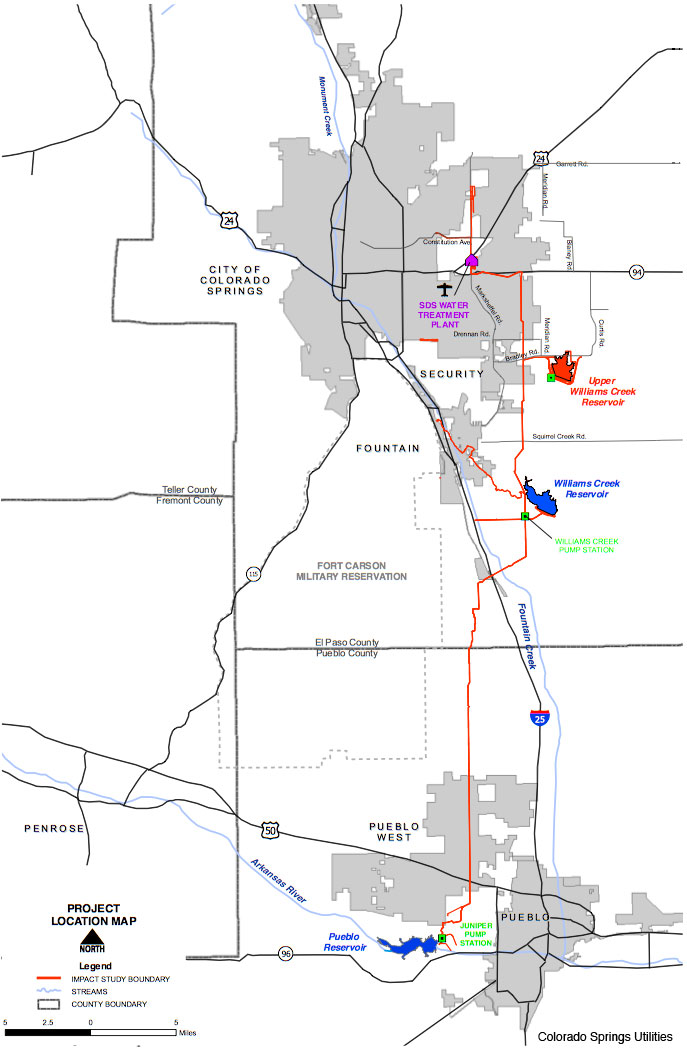
Colorado Springs City Council last week approved closing on one home and 24 easements in Pueblo West for more than $250,000. That was added to 18 properties at more than $750,000 earlier this year. Colorado Springs, as part of Pueblo County 1041 negotiations, agreed to use eminent domain only as a last resort…

Colorado Springs plans to begin building the $1 billion-plus SDS later this year, but must first begin contract negotiations with the Bureau of Reclamation. A date for negotiations has not been set. Pueblo West would benefit from SDS by tapping into the line near Pueblo Dam. A Pueblo West company, ASI Constructors, has been chosen to build the North Outlet Works as one of the initial SDS projects. A workshop for SDS contractors is planned for 3:30 to 6:30 p.m. Monday at El Pueblo History Museum, 301 N., Union Ave.

Meanwhile, Colorado Springs Utilities will have to raise rates 12% to pay for the pipeline and increasing maintenance costs. Here’s a report from Chris Woodka writing for The Pueblo Chieftain. From the article:

Colorado Springs City Council Tuesday will consider approving water rate hikes of 12 percent for 2011 and 2012. Similar increases are foreseen for 2013-16, according to testimony last week at a public hearing on the rate hikes. The hikes are needed not only to pay for the bonds to finance SDS, but increasing maintenance costs. In April, for instance, a boulder damaged part of the Homestake Pipeline that brings water to Colorado Springs from Twin Lakes. Currently, the residential water bill in Colorado Springs is near the average among Front Range utilities, about $37 per month. Cities on rivers, like Pueblo and Denver, have the lowest rates, while cities with complicated water systems like Aurora, Palmer Lake and Woodmoor, are at the upper end of the scale. If the 12 percent increases are approved, that would jump to about $41 a month in 2011 and $46 a month in 2012. If the 12 percent rate hikes continue through 2016, the Colorado Springs average would be about $71.

More Southern Delivery System coverage here and here.

Runoff news

A picture named kayaker.jpg

From 9News.com (Jeffrey Wolf/Matt Renoux):

Without massive moisture, rivers like the Colorado, Eagle, and Clear Creek are expected to be 30 percent to 40 percent below average.

That does not mean the rafting season is washed up, thanks to big rivers, like the Gunnison and Arkansas where snow has been pretty good and water flows are expected to be normal. “The Gunnison should flow well, and the Upper Arkansas will have runoff well above 90 percent, or very close to average,” Hummer said.

Republican River Basin: Kansas asks the U.S. Supreme Court to find Nebraska in contempt of court

A picture named republicanriverbasin.jpg

From the Salina Journal (Michael Strand):

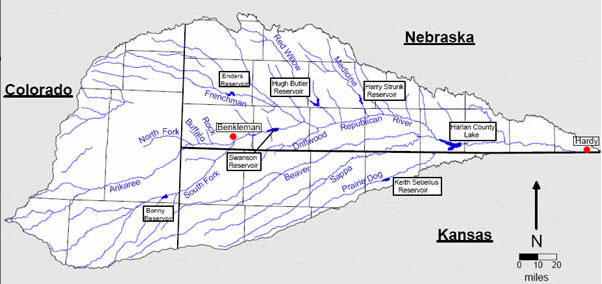
Through much of the 1990s, Kansas and Nebraska argued in court over water usage, with the dispute being settled in 2002 and the U.S. Supreme Court adopting the settlement as a court order, Barfield said. The first measure of Nebraska’s compliance, Barfield said, was in 2005 and 2006. “Nebraska used 80,000 acre-feet more than allowed,” Barfield said; that’s roughly the amount of water a city of 100,000 would use over 10 years.

More coverage from Bruce Finley writing for The Denver Post. From the article:

Towns and farmers in Kansas “have been deprived of the water they rely upon,” Kansas Attorney General Steve Six said. He vowed to “continue this fight until Nebraska complies with our agreement.”[…]

Colorado Attorney General John Suthers expressed disappointment at the slide into litigation. “We have seen in the past that litigation is not an effective or efficient alternative for resolution of interstate disputes,” Suthers said. Suthers called on Nebraska and Kansas “to sit down with us” to hash out a solution…

Kansas officials have been trying to bring groundwater pumping along the river in Nebraska under control. Past agreements were aimed at letting states monitor and control water use to comply with the 1942 compact, which allotted 300,000 acre-feet a year for Nebraska, 240,000 acre-feet a year for Kansas and 40,000 acre-feet a year for Colorado. Kansas officials argue that Kansas is losing 16 percent of its water under the compact.

More Republican River Basin coverage here and here.

Snowpack news: Black Canyon peak flows

A picture named snowpackcolorado05032010.jpg

From The Grand Junction Daily Sentinel (Dave Buchanan):

As of April 29, the Bureau of Reclamation reported the Colorado River basin registered among the lowest overall snowpack in the state at only 72 percent of average. Most of the other major basins ranged from 61-80 percent ranges, including the Gunnison Basin at 71 percent. The upper Rio Grande Basin topped the state list at 87 percent of average. Although reservoir storage remains adequate across the state, the lack of a snowpack to augment water needed for early-summer irrigation may mean shortages or cutbacks later in the year…

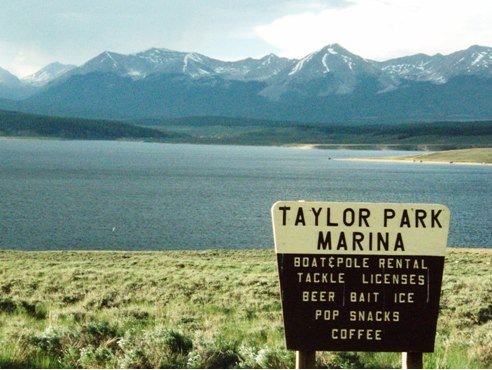
Hydrologists from the Bureau of Reclamation said neither Taylor Park nor Blue Mesa reservoirs are expected to fill this summer. The Bureau on its website said it’s likely Blue Mesa will top out at 7,512 feet elevation, about 4 feet short of filling. At current snowpack levels, it’s predicted the Gunnison River through the Gorge and Black Canyon will remain in the 550-600 cubic feet per second range most of the summer. The most recent forecast for a peak flow to meet the senior Black Canyon Water Right is a one-day peak in the range of 3,425 cfs, along with a six-day ramp up and a six-day ramp down to about 800 cfs. If and when that peak might occur won’t be decided until after the May snowpack readings are available, said lead hydrologist Dan Crabtree of the Bureau’s Grand Junction office. “It may be the middle of May but we can’t pin ourselves down until we get the May 1 forecast and we know what we are working with,” Crabtree said…

Bureau of Reclamation hydrologists are watching the Cimarron River and the level of Silver Jack Reservoir, changes in which affect the Cimarron’s flows into Crystal Dam, the last dam before the Gunnison River spills into the Black Canyon. “We want to use that water as efficiently as possible, but I’m guessing (the peak flow will come) the second or third week of May,” Crabtree said…

A sudden burst from the upper Cimarron River basin last spring pushed Silver Jack to spill and that in turn pushed the Gunnison River higher and faster than expected. Those Cimarron flows, along with additional runoff flows from the North Fork of the Gunnison, gave water managers a little concern when peak flows at Delta neared flood stage.

From the Glenwood Springs Post Independent (John Gardner):

“This is our favorite time of year,” said Bryon Lawrence, a hydrologist with the National Oceanic and Atmospheric Administration in Grand Junction. “Because this is when things start to happen.” However, Lawrence is not too excited about the spring runoff season this year due to a lack of snow accumulation this winter. He said that this year is shaping up to be a “mediocre” runoff year at best…

As of Monday, the Colorado River Basin was reportedly at 90 percent of year-to-date precipitation average, according to the Natural Resources Conservation Service. The recent snowstorms have helped bring the precipitation levels up slightly, but they have not added much to the snowpack, according to Dave Merritt with the Colorado River Water Conservation District…

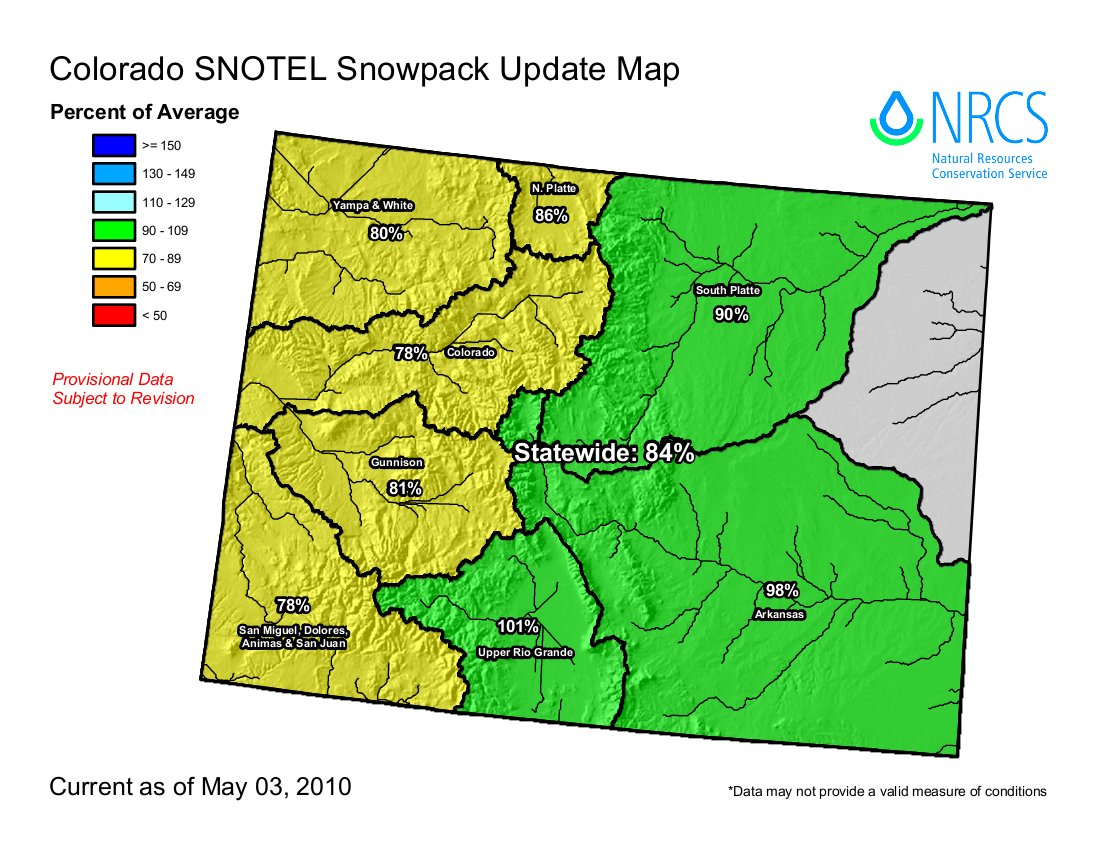
According to Merritt the area from Grand Lake to Grand Junction remains at 78 percent of average snowpack levels. And statewide, Colorado is at 84 percent of average, he said. Western Colorado is currently at 80 percent of annual snowpack, he said. The low amount of snowpack will result in a less than average runoff, Lawrence said. According to the National Weather Service, The Colorado River peaked on May 21 in 2009, running at 10,000 cubic feet per second (CFS) at Dotsero. The average peak runoff for the Colorado River at Dotsero is 9,425 cfs. The weather service predicts the peak runoff to be well below the 2009 levels, at only 4,500 cfs this year at the same location.

R.I.P. Chips Barry

A picture named firstwaterovercheesman.jpg

What sad news this morning. Everyone I know in Colorado water is saddened by the news out of Hawaii this morning. I didn’t know Mr. Barry well but it’s safe to say that he was mentioned many times here on Coyote Gulch. Here’s a report from 9News.com (Dan Boniface). From the article:

The chief executive officer of Denver Water, Hamlet “Chips” Barry was found dead Sunday underneath a tractor on his farm, less than a month after his replacement at Denver Water was named.

The Honolulu Advertiser says Hawaii County firefighters found the 66-year-old man dead under his tractor on Paauilo Mauka Road at [7:45 p.m.] and used airbags to extricate his body.

Last month, Barry announced his plans to retire after 19 years. The Denver Board of Water Commissioners said Jim Lochhead would take over in June. Lochhead has represented the state of Colorado and a coalition of major water utilities and districts, including Denver’s, on interstate issues arising from the Colorado River.

Barry was a Denver native who graduated from George Washington High School in 1962. After graduating from Yale in 1966 and earning a law degree from Columbia in 1969, Barry went on to volunteer in Alaska, before working as a law clerk in Denver.

Here’s the release from Denver Water (Stacy Chesney):

Denver Water Manager Chips Barry was killed in a fatal accident Sunday afternoon on his farm in Hawaii.

“We are greatly saddened by the news,” said Penfield Tate, president of the Denver Board of Water Commissioners.

Barry, 66, was the manager of Denver Water for 19 years and had planned to retire this summer. Bob Mahoney, Director of Engineering, will be acting manager until Jim Lochhead, who was named as Barry’s successor, takes the post.

Barry was a Denver native who attended Denver Public Schools, graduating from George Washington High School in 1962. He graduated cum laude from Yale College in 1966 and earned a law degree from Columbia University Law School in 1969. Prior to his position at Denver Water, he was the executive director of the Colorado Department of Natural Resources for Gov. Roy Romer from 1987 to 1990. He was named manager of Denver Water in January 1991.

During his tenure at Denver Water, the utility implemented a conservation program that is nationally and internationally recognized as a model of success, built a recycled water distribution system, invested millions of dollars in improvements at its treatment facilities, monitored recovery from several devastating wildfires in Denver Water’s watershed and led the work to recover from one of the worst droughts in the city’s history. The 1997 Integrated Resource Plan, which details Denver Water’s long-term water supply plan, was adopted under Barry. He also was very active in regional cooperative efforts to open up new relations and continual dialogues among water providers throughout Colorado, and in national efforts dealing with global climate change, water infrastructure funding and regulations concerning transfer of water from one basin to another.

Grief counselors are being made available to Denver Water’s 1,100 employees.

This is all the information available at this time. Local authorities are investigating the accident.

Mentions of Mr. Barry on Coyote Gulch here and here.

Glenwood Springs: New wastewater treatment plant construction should start in the coming months

A picture named wastewatertreatmentwtext.jpg

From the Glenwood Springs Post Independent (John Gardner):

The city is finalizing the remaining steps in the process before construction can begin, after months of delays halted the project. But it looks like things are back on track. According to City Manager Jeff Hecksel, the bond sale issued by the Colorado Water Development and Power Authority was issued Thursday, bringing the project one step closer to beginning construction. Hecksel said that everything is nearly in place, and only a few steps remain before work can begin on the new wastewater plant. Those steps include closing on the financing with the water and power authority, scheduled to take place on May 10. And the city still has to issue a notice to proceed, but Hecksel said that is likely to happen very soon. “The contracts have been signed,” he said. “We just have not issued the notice to proceed but we are looking at doing that in the immediate future.”

More wastewater coverage here.

A look at the San Luis People’s Ditch

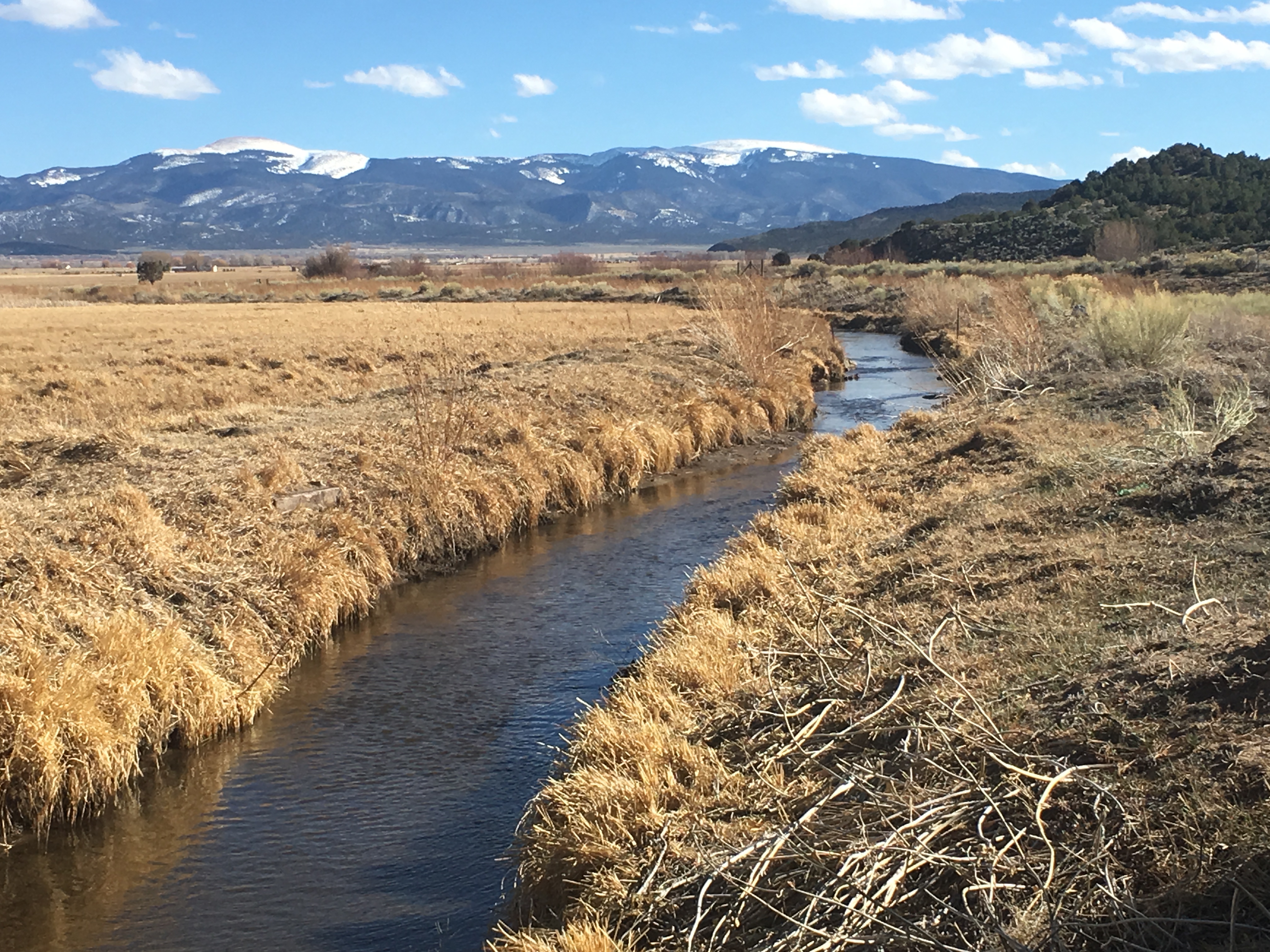
San Luis People’s Ditch March 17, 2018. Photo credit: Greg Hobbs

From The Pueblo Chieftain:

Originally a long, shallow, earthwork excavation, this “acequia” or gravity-fed irrigation channel was hand-dug by San Luis’ first settlers to channel water for crops and livestock from the Culebra River and its tributaries. Extending 4 miles west from La Vega, the town’s communal grazing land, it is the oldest continuously used, community irrigation ditch in Colorado.

According to a plaque at the now-concrete-lined “acequia madre” portion of the channel on the south side of town, the People’s Ditch was granted the first adjudicated water rights in what is now Colorado. Referred to as “court decree priority No. 1” and dating from April 10, 1852, these rights were conveyed just 370 days after San Luis was established — and 24 years before Colorado became a state.

Today, the ditch serves some 16 “parciantes” or affiliated water-users, and irrigates more than 2,000 acres of hay and other crops. It also stands as a legacy to its builders, among them Dario Gallegos, a founder of San Luis who opened the town’s first store in 1857.

More Rio Grande Basin coverage here.

Summit County State of the River meeting May 12

A picture named blueriver.jpg

From the Summit Daily News:

The Colorado River District and the Blue River Watershed Group will hold the annual Summit County State of the River public meeting at 6:30 p.m. May 12, at the Summit County Community and Senior Center, next to the Summit County Commons, just south of Frisco. This free public event will provide information on how this season’s snowpack will influence stream flows and reservoir operations this year. Event organizers will also give updates on critical negotiations among water users of the Blue and Colorado rivers. For information, call (970) 945-8522, ext. 236.

More Blue River watershed coverage here.

Upper Blue Sanitation District board election update

A picture named wastewatertreatmentwtext.jpg

From the Summit Daily News (Robert Allen):

Locals will vote in four special-district elections regarding fire and sewer services across the county Tuesday. While these are ordinarily low-key campaigns, the Upper Blue Sanitation District race has raised a few eyebrows.

More wastewater coverage here.

S. 1264: Pine River Indian Irrigation Project Act of 2009

A picture named lospinos.jpg

From The Durango Herald (Dale Rodebaugh):

“Water users have gone far too long without water to sustain their crops,” Udall said at the committee meeting Thursday, at which time he introduced Southern Ute Indian Tribe Chairman Matthew Box. “Individuals who depend on the project have forgone the opportunity to bring idle lands back into production and continue to be good stewards of the land.” Box described to committee members the tribe’s need for irrigation water. He said the tribe would be willing to contribute to the cost of repairs. Udall and fellow Colorado Sen. Michael Bennet introduced Senate Bill S-1264 on June 15, 2009, to rescue the irrigation project from years of neglect and deterioration. S-1264 would allocate $4 million to determine the system’s deficiencies and $10 million annually for six years to fix problems.

The Pine River Indian Irrigation Project, which dates to the late 19th century, distributes 124,000 acre-feet of Pine River water via 175 miles of canals and ditches to 12,000 acres, including 10,000 acres of tribal land, in southern La Plata County.

More San Juan Basin coverage here.

Energy policy — oil and gas: Oxy USA agrees to fines of nearly $650,000 for spring contamination

A picture named derrick.jpg

From The Grand Junction Daily Sentinel (Dennis Webb):

If approved, the $390,000 fine would be among the largest, if not the largest, ever imposed by the commission…

Regulators say in investigative documents that Oxy operated pits without necessary permits in both incidents. In the Cascade Canyon case, leaks occurred in an unlined pit. Had Oxy sought a permit, the state would have required it to line the pit because of the potential for groundwater impacts in the area, regulators say. Tests of one spring in that case reportedly found levels of benzene, a carcinogen, that were 300 times above groundwater standards. The spring’s levels of toluene were 15 times above standards in place at the time, and the state since has made its toluene standards stricter. The contamination also affected up to a half-mile of a tributary to Cascade Canyon…

Under the settlement agreement, Oxy admits no liability and denies there was significant environmental impact. Regulators scaled back their proposed fine amounts 22 percent because of Oxy’s cooperation in the investigation and work in reducing the levels of contamination. Oxy has spent $2.4 million to date on remediation efforts. It spent another $8 million to better protect ground and surface water in the area of the violations by reducing its number of pits and using more storage tanks.

“When we have an incident, we conduct a thorough investigation to determine the cause or causes,” Oxy spokesman Eric Moses said. “At that point we take appropriate measures to prevent similar incidents from occurring in the future.” The company regrets that the incidents occurred, he said, adding, “Oxy … is committed to safeguarding the environment and protecting the safety and health of our employees and neighboring communities.” Moses said Oxy responded in a timely manner to the incidents, and neither one affected drinking water or fish and other wildlife.

More oil and gas coverage here and here.

Energy policy — hydroelectric: Taylor Park Dam retrofit update

A picture named taylorparkreservoir2.jpg

From The Crested Butte News (Mike Horn):

…the Taylor Dam is once again being looked at as a source of power. This time around, the Upper Gunnison River Water Conservancy District (UGRWCD), Gunnison County Electric Association (GCEA), and the Uncompahgre Valley Water Users Association are collectively examining the dam’s power potential. A recent “flyover” feasibility study on the project yielded some positive results…

Frank Kugel is general manager for the UGRWCD. “From its inception Taylor Park Dam has always been envisioned to produce power,” said Kugel. “Our district is very supportive of the concept of constructing a hydropower installation at Taylor Park Dam. We feel that it could provide a source of green power while utilizing the water resources in our basin.” Getting power from the dam to Highway 135 using the existing single-phase cable was deemed economically unfeasible in the past. But according to Kugel, “With today’s interest in green energy and the funding assistance that is available, we felt it was worth a fresh look at generating hydropower.”

Mike Wells, Chief Executive Officer for the GCEA, described the first study as a “20,000-foot flyover on the project.” Half the $30,000 study was paid for with a grant, and the other three entities split the remainder. “It did come back feasible, but what it does is take us to the next level where we get into it more in depth,” Wells said. “The next step is a higher reconnaissance feasibility study, more of the design phase, to see what it would look like and how it would work.” Wells said that next phase would assess operational needs and concerns, and possibly take a look at the regulatory agencies that would be required for permitting. “There would be other players such as the Bureau of Recreation since it’s their dam,” added Wells. “There would have to be an agreement about liabilities, who owns the structure, what sort of lease agreement, compensation and ownership, but these kind of details weren’t looked at during this first step.”

The next level study would cost in the range of $90,000 to $120,000, according to Kugel. “We are currently in the process of seeking sources for that money and we will decide whether to move forward in the next couple months based on [the availability of] those funding sources.” As far as the price of the project itself is concerned, there is a wide gap between the two main options. Wells said, “An initial estimate—just rough numbers—it’s a $14 million project if we make it into three-phase, or $6.5 million if we size it for the single-phase line. Either would provide a rate of return if we are using average water conditions. If you have a wet year or average year it makes the project feasible. In dry years it’s a losing proposition.”[…]

The proposed hydropower generation would not damage fisheries or river hydrology either, according to Wells. “Since that water is so critical to farming operations and fishing, there would be no changes in the river flow. We would not want to mess with any change in streamflows. Our other partners would be very resistant with changing that, it’s just not practical. The stream releases would be as regularly scheduled.

More hydroelectric coverage here and here.

Snowpack news: Gunnison Basin runoff forecast to be below average

A picture named snowpackcolorado04302010.jpg

From The Crested Butte News (Mike Horn):

…according to UGRWCD general manager Frank Kugel, when we are “slightly below normal on snowpack we often end up significantly below on runoff.” Why that happens is largely unknown, as it’s not a linear relationship between the two, though Kugel said soil moisture plays a role. In line with that precipitation-runoff equation, Kugel’s report stated the unregulated inflow into Blue Mesa Reservoir was 82 percent of average for March and the projected April-through-July info is only 74 percent. That despite precipitation levels being 94 percent of normal. “Dust and high temperatures brought the snowpack down in a hurry,” said Kugel…

“The latest projections are that we won’t fill Taylor Reservoir and Blue Mesa,” Kugel concluded. For Taylor, Kugel projected that the maximum content will be 96,080 acre-feet or 90 percent of capacity, and the inflow forecast is 75 percent of normal. The same projections for Blue Mesa were unavailable at press time…

According to Kugel’s report, Blue Mesa and Taylor Park Reservoirs are currently at 69 percent and 62 percent of capacity, respectively (compared to 65 percent and 60 percent last month).
For comparison, storage levels in two other prominent western reservoirs, Lake Powell and Lake Mead, dropped over the past month. They are currently at 56 percent and 44 percent of capacity, respectively.

HB 10-1197 (Reduce Conservation Easement Cap Amount): Governor Ritter inks the deal

A picture named saguachecreek.jpg

From The Durango Herald (Joe Hanel):

Gov. Bill Ritter on Thursday signed House Bill 1197, which sets a statewide limit of $26 million on conservation easement tax credits. The Department of Revenue estimates the bill will save $37 million in the popular tax credit program.

More HB 10-1197 coverage here. More 2010 Colorado legislation coverage here. More conservation easement coverage here and here.

Vega Reservoir open for boating

A picture named vegareservoir.jpg

From The Grand Junction Daily Sentinel:

With ice finally gone from Vega Reservoir, the popular camping and fishing destination 12 miles east of Collbran opens the boating season Saturday.

More Colorado River Basin coverage here.

Taylor River rafting rift negotiations recap

A picture named taylorriver.jpg

From The Crested Butte News (Seth Mensing):

Meetings between Three Rivers Outfitters, Scenic River Tours and the Wilder resumed Thursday, April 22 at the request of Colorado Governor Bill Ritter and are still ongoing with a possible agreement that would let boaters and anglers share a two-mile stretch of the river. That is the stick and carrot keeping both sides going. Three Rivers and Scenic River, which are the only two commercial companies running the Taylor, have said that banning them from a two-mile section of water will lead them to financial ruin. But according to Forest Service records obtained by Dick Bratton, a partner with the Gunnison law firm Bratton, Hill, Wilderson & Lock, which is representing the developers of the exclusive Wilder on the Taylor subdivision, Three Rivers only took 62 clients on the disputed section of river last year.

And Brad Roberts, co-owner of Harmel’s Resort just upstream from the Wilder property, isn’t shy about placing the blame for the dispute squarely on the shoulders of Scenic River Tours. “Scenic River Tours has this obnoxious trespassing thing,” Roberts says.

More HB 10-1188 coverage here. More 2010 Colorado elections coverage here.

Pueblo County: Will land under the Huerfano-Cucharas Irrigation Company be put back in production?

A picture named huerfanoriver1.jpg

From The Pueblo Chieftain (Chris Woodka):

Denver businessman [John McKowen] has purchased the vast majority of shares of the Huerfano-Cucharas Irrigation Co. with an eye toward putting thousands of acres back into crop production. Under a $30 million plan, McKowen wants to fix Cucharas Reservoir, strengthen water rights and improve the value of farmland in southern Pueblo County. McKowen also intends to develop a 100-megawatt solar array as a secondary piece of the project. “Our intent is to rebuild the dam at Cucharas Reservoir, continue with the ditch and reintroduce agriculture to the area,” said McKowen, 60, chairman and CEO of the Two Rivers Water Co. “It would be a shame to see the land go to waste.”[…]

The centerpiece of the project, however, is the rehabilitation of Cucharas Reservoir, which could be done in early 2011. McKowen is working with ASI Constructors of Pueblo West to build a roller-compacted concrete dam just downstream of the existing dam. GEI consultants is doing the engineering work for the project. Because of sedimentation, the capacity of the new dam would be about 50,000 acre-feet, compared to about 10,000 acre-feet at present. As of this week, it was storing just 2,000 acre-feet. The project will cost about $30 million over the first five years, with possibly $100 million in eventual investment. The project also has a secondary component to develop a 100-megawatt solar energy array on land in the area that McKowen intends to buy. McKowen is putting up much of the capital himself, as he has in past business ventures, but will seek other investors.

More Arkansas Basin coverage here.

It’s spring — the bears are waking up

A picture named grizzlyfishing.jpg

From the Summit Daily News (Julie Sutor):

At this time of year, bears are looking for new plant growth and fresh grass to eat to help them restart their digestive systems. But once they are up and running, bears are opportunistic feeders and will exploit any available food supply, including garbage, pet food, bird seed, and home and restaurant table scraps. Bears that become habituated to human food sources can be dangerous and often must be euthanized. Because they are large omnivores, bears are nearly always on a search for food. Wild foods are essential for bears — berries, insects, acorns, plants and carrion. But when people fail to store garbage, pet food or bird feeders properly, bears will find those sources and cause conflicts in residential and business areas. In Colorado, bears are ubiquitous from the Front Range across the Western Slope. Although sightings of grizzly bears are reported on rare occasion in the Centennial State, North American black bears (Ursus americanus) are the only bear species known to have established Colorado populations. Their preferred habitats are areas with aspen trees and oak brush.

More coverage from the Telluride Daily Planet (Kathrine Warren):

“We have a lot of bears moving around,” said Division of Wildlife Spokesman Joe Lewandowski. They’re on the move for food of any kind. These large omnivores usually eat new plant growth, fresh grass to help restart their digestive systems, berries, insects and acorn forbs. Lewandowski said the DOW wants to remind people that they’ll start wandering around looking for food of any kind, including trash.

Salida: FIBArk (June 17-20) organizers are calling for volunteer help

A picture named hooliganrace.jpg

From Citizen Team via the Salida Citizen:

It’s hard to believe FIBArk is a little over a month away! The FIBArk Board has been hard at work planning this year’s festival, and it’s gonna be the best yet! A great way to give back to this fabulous, FREE festival is to volunteer. We can use people of all shapes and sizes, for jobs big and small. If you have volunteered in the past, or are contemplating helping out this year, we would love to hear from you! Jobs include everything from set-up to take-down, event registration, information booth, pouring beer, educating people at recycling and compost stations, or whatever floats your boat! Grab a friend or two and do it together! Shifts range from two hours to however long you’d like to help us out. For those that want to help staff the New Belgium Brewery beer tent, contact Shannon at 719-221-1988, or email shannon@summitmobility.com. For all other aspects of volunteering, please call Kate at 719-207-2323 or email kateyost@gmail.com. We look forward to hearing from you! Festival dates are June 17–20, 2010.

More FIBArk coverage here and here.

Snowpack news: Recent storms help snowpack

A picture named snowpackcolorado04302010.jpg

From The Greeley Tribune (Bill Jackson):

Recent snows have left a lot of snow in the lower levels of the northern mountains — which tends to melt quickly once spring finally gets a grip on things — but higher level fields continued a season-long trend of trailing the long-term average as well as last year’s readings. Because the snow is not that deep at lower levels, the melt-off later this spring is not anticipated to bring much threat for flooding — unless, of course, it is combined with heavy rains. And those heavy rains of the past week, expected to continue into the first part of next week, go a long way in reducing concerns for a lack of water, especially for farmers…

John Fusaro and Todd Boldt with the U.S. Department of Agriculture Natural Resources Conservation Service office in Fort Collins, took the survey earlier this week in the Big Thompson and Poudre Canyons, where two rivers bring water out of the mountains and empty into the South Platte River. Fusaro said there were about 2 inches of new snow in the lower levels of the canyons, and seven inches of new snow at the summit of Cameron Pass in the Poudre Canyon. He estimated there were maybe 15 inches of new snow in the upper regions of the canyons since the last survey in late February. “But the density wasn’t there. That’s been a common theme all year long. There just wasn’t much water in the snow,” Fusaro said. “It just wasn’t a typical April snow survey, but who knows? There have been years when we’ve seen 2 feet of new snow in the mountains in May. Maybe it’s going to be one of those years.”

Snowmass attorney Alan Schwartz named to Great Outdoors Colorado board

A picture named unaweepcanyon.jpg

From The Pueblo Chieftain (Patrick Malone):

Schwartz has committed much of his career to land preservation and conservation of natural resources, which Gov. Bill Ritter said will suit him well on the 17-member board that determines how a portion of lottery proceeds will be used…

Schwartz has served on the boards of the Colorado Conservation Trust and the Rocky Mountain chapter of Environmental Defense. He helped develop Boulder’s growth-management plan and represented several Colorado municipalities during development of their land-use plans.

More conservation coverage here.

Energy policy — nuclear: Colorado Land Reclamation Board uranium production rules public meeting recap

A picture named uraniuminsituleaching.jpg

From the North Forty News (Dan MacArthur):

Despite the intensity of opposition, just 26 residents registered their concerns at the April public hearing scheduled from 1 p.m. to 9 p.m. at a Loveland hotel’s conference hall capable of seating more than 100. The lack of testimony prompted the board to cut the session short at 6:30 p.m. The hearing may have been subdued in part because the board already had received some 3,500 written comments, which are posted on the board’s web site.

Speakers urged the board to affirm proposed regulations developed to reflect the intent of three bills approved by the legislature applying to hard-rock and in situ uranium mining. Notably, the regulations require in situ mine applicants to establish a baseline of existing conditions for ongoing monitoring of surface and groundwater. The state can hire an independent agency at the applicant’s expense to oversee development of such plans. Reclamation to those baseline standards must be completed within five years following the mining of each phase. Any effect on groundwater beyond the mined land that fails to meet established standards could require immediate reclamation.

Jay Davis, a Weld County resident who lives next to the proposed Centennial Mine project, urged the board to adopt the rules as proposed and resist any attempts to dilute them. “Colorado water is far too valuable to be compromised from being used as a mining tool,” he said.

More nuclear coverage here and here.

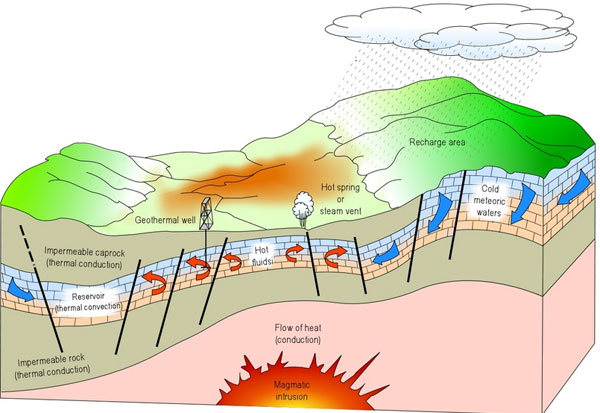
Energy policy — geothermal: Governor Ritter signs SB 10-174 (Promote Geothermal Energy Development)

A picture named geothermalenergy.jpg

Here’s the release from the Governor’s office (Megan Castle/Evan Dreyer):

GOV. RITTER DEDICATES SALIDA’S TOUBER BUILDING AND PROMOTES GEOTHERMAL ENERGY

Gov. Ritter was joined today by Sen. Gail Schwartz and local officials at the dedication of the new Touber Building, named after former Salida Mayor Edward Touber. The City of Salida and Chaffee County will use this historic building for office space.

“The Touber Building is a shining example of the success that can happen when local and state governments and public and private entities pool their collective financial and creative resources,” said Gov. Ritter. “I know the struggles of Chaffee County, along with the rest of the state and the nation, have not been easy. Partnering together to build a complex like this that will house both city and county community services helps from a financial standpoint. Also, it is a 21st century solution towards building sustainable communities. The state was honored to partner with you on this solution.”

Immediately following the Touber Building dedication ceremony, Gov. Ritter signed Senate Bill [10-174] (pdf), sponsored by Sen. Gail Schwartz and Reps. Christine Scanlan and Tom Massey, which promotes geothermal energy in Colorado.

“Senate Bill 174 will help Colorado to begin to realize the potential of geothermal energy,” Gov. Ritter said. “Geothermal is a great clean renewable energy source, that can be a base load provider and help to bring the benefits of the New Energy Economy to rural Colorado.”

“Geothermal energy will diversify Colorado’s energy portfolio. This bill will improve cooperation between the federal, state, and local governments, strengthen Colorado’s energy sector, and create jobs for Coloradans,” Sen. Schwartz said. “I would like to thank Chaffee County for their efforts on this bill and the broader water community for the work on protecting existing geothermal water rights and those in the future.”

“Geothermal is an exciting clean energy movement with the potential to exceed even solar and wind in supplying the US’s electricity needs in the future. In fact, the state Capitol will be moving towards using it next year for the building’s energy needs,” said Rep. Scanlan. “I am pleased that we have made a commitment to strengthen this energy sector.”

For a complete list of Gov. Ritter’s 2010 legislation decisions, visit www.colorado.gov/governor or click here.

More geothermal coverage here and here.

The Leadville Sanitation District is spending $1.6 million for sewer line replacement this year

A picture named sewerusa.jpg

From the Leadville Herald Democrat (Ann E. Wibbenmeyer):

The project cost is approximately $1,607,000. $728,000 of that is from a mineral impact grant. The rest of the funding comes from the district’s capital reserve fund, according to Scott Marcella, manager. The district has been saving and working on the project for eight years, he said. The line will be replacing a problem line from the West Park subdivision to the highway. At one time, said Marcella, a part of that line was dug up and it was discovered that there wasn’t any pipeline present for the line. The line was put in when West Park was moved from Climax in the 1960s, and done hastily, said Marcella.

More wastewater coverage here.

Gunnison River: Hartland dam project site preparation and fish ladder design work begins

A picture named gunnisonriver.jpg

From the Delta County Independent:

Painted Sky Resource, Conservation and Development Council (RC&D) awarded the final design contract for the Hartland Dam project to McLaughlin Water Engineering on March 19. McLaughlin, a Denver company, has experience in designing fish and boat passage projects in rivers with high rates of flow.

McLaughlin will complete the final design by mid-June 2010, according to the updated project schedule. After approval of the final design, Painted Sky will release bid packages for construction. Slated to begin in August, construction should be completed by the end of October 2010.

Three workers, under the Teens on the Farm program, have been helping take down and move fences on private land bordering the program site on the Gunnison River near Delta.

Painted Sky started site prep work in mid-March. Three boys, paid through Teens on the Farm, a non-profit program in Delta County, helped move and take down fences on private land bordering the river. ECO Contracting, LLC built a berm and prepared a site for rock storage. Dirt Merchants Construction was hired to install a culvert and improve the access for delivery of rocks.

McLaughlin started work for the final design on March 29 by gathering data to map the river bottom. McLaughlin engineers will use the data to understand and predict how water flows over the riverbed. Their design must provide for the impact of up to a 100-year flood event.

Using laser-surveying equipment similar to devices used for surveying along roadsides, one man stands on the riverbank aiming a laser beam. A second man in a wetsuit stands in the river, holding the laser’s target. The team spent two days taking measurements 1,000 feet above the current dam and 1,000 feet below the dam.

The Hartland Dam Project will insure Hartland Irrigation Company’s access to their senior water rights and improve boater safety while traversing the dam.

The fish passage will reconnect river habitats and fish populations above and below the dam. As it exists now, the dam blocks three threatened species of bottom-dwelling, native fish, the flannelmouth sucker, bluehead sucker and roundtail chub, from swimming upstream past the dam.

The new design will connect navigable river for rafters as well. Rafts crossing over the current dam without portaging around it have overturned, resulting in deaths. The new design will be safer for rafters and make trespassing on private property unnecessary…

For more information, contact Mike Drake, Painted Sky project manager at 970-527-4535 (office) or cell 801-710-8372 or NRCS coordinator Paul Van Ryzin at 970-874-5726 ext. 133.

More Hartland Dam coverage here.

Cedaredge: The Colorado Department of Health and Environment is looking into turbidity reporting for the treatment plant

A picture named watertreatment.jpg

From the Delta County Independent (Bob Borchardt):

In his report to the Cedaredge Town Council, Roberts told the trustees that in the month of March he had received a call from the Colorado Department of Public Health and Environment (CDPHE) questioning the town’s turbidity readings over the past several months…

In a separate interview, Roberts said CDPHE District Engineer Joycelyn Mullen told him that her office had flagged the town’s turbidity testing results. Roberts said Mullen told him that it was impossible for a town to have water as clean as is being reported by the Town of Cedaredge. Roberts noted that over the past several months, the turbidity readings for the town have been at a consistent .02. “Mullen told me that distilled water is .014, and that nobody can consistently produce .02 water.” But Randy Bodwell, chief plant operator for the Town of Cedaredge, told Roberts that a .02 reading is typical for Cedaredge during the winter months. Roberts said Mullen told him that Denver would launch an investigation to determine whether or not the town had been reporting fraudulent numbers on their reports to the CDPHE. Bodwell told Roberts that all the CDPHE had to do was to compare the current report to previous years.

More water treatment coverage here.

Pagosa Springs Area Water and Sanitation District board of directors election

A picture named sanjuan.jpg

Here’s Part I and Part III (I haven’t found Part II yet) of Bill Hudson’s look at the election of the board. I would think that Dry Gulch Reservoir will be part of conversation.

More Pagosa Springs coverage here and here.

Colorado-Big Thompson Project update

A picture named coloradobigthompsonin2007.jpg

From email from Reclamation (Kara Lamb):

Now that it is spring, we will be increasing our releases from Olympus Dam to the Big Thompson River to meet the seasonal minimum stream flow. At 8 p.m. on Saturday, May 1, we will increase our releases to 100 cfs.

More Colorado-Big Thompson Project coverage here and here.

Ruedi Reservoir operations update

A picture named ruedidam.jpg

From email from Reclamation (Kara Lamb):

With the advent of May tomorrow, we will make our first operational change at Ruedi for the water year. In the early morning, we will increase releases to 110 cfs.

Also, please make sure Wednesday, May 12 is on your calendars. That will be our first of two public meetings this year to share information on Ruedi Reservoir operations. The meeting will be from 7-9 p.m. at the Basalt Town Hall.

Last, don’t forget to visit our new Webpage for additonal Ruedi information at www.usbr.gov/gp/ecao/ruedi.html.

More Roaring Fork watershed coverage here.