Pagosa Area Water and Sanitation District board election recap

A picture named sanjuan.jpg

From the Pagosa Daily Post (Bill Hudson):

On May 4, the residents and property owners within the PAWSD district went to the polls and elected two new board members, in a landslide election: Allan Bunch, owner of the Malt Shoppe restaurant, and Roy Vega, owner of Vega Insurance. Bunch and Vega ran on a platform that questioned current PAWSD policies — particularly the proposed Dry Gulch Reservoir and its funding mechanisms, along with the high level of debt the district has incurred in recent years.

More Pagosa Springs coverage here.

The Colorado Department of Wildlife launches kokanee salmon research at Blue Mesa

A picture named kokaneesalmon.jpg

From The Telluride Watch:

The research will examine several issues: how many kokanee fingerlings are consumed by predator fish on their way to Blue Mesa Reservoir shortly after they’re released from the Roaring Judy Hatchery; the population, life cycle and diet habits of lake trout; the amount of predation by perch which were illegally planted in the reservoir several years ago and have a self-sustaining population; and continued assessment of kokanee population trends. The reservoir is a very productive fishery, upon which the DOW has relied for many years as the primary water for kokanee salmon production in Colorado. But during the last 10 years the kokanee population in the lake has dropped precipitously primarily due to predation by lake trout. Rainbow trout survival has also declined significantly because of lake trout predation.

The first part of the research will look at survival of kokanee fingerlings after they’re released from the Roaring Judy Hatchery. Each spring, some of the fish are eaten by brown trout as they make their way down the East River and Gunnison River and into the reservoir. The young fish were released the evening of April 27 and biologists electro-fished at spots in the Gunnison River on April 28; the stomach contents of the caught brown and rainbow trout caught will now be examined.
 At various locations throughout the reservoir during May, nets will be set to catch other fish, to determine the amount of kokanee they’re eating. All samples will be submitted to researchers from Colorado State University who will conduct a diet analysis.

“The intent of this work is to assess predation on kokanee,” said Dan Brauch, aquatic biologist for the DOW in Gunnison. “The more we can learn about the extent of all predation the better we can manage the reservoir for multiple species.”

More Aspinall Unit coverage here.

Southern Delivery System: Colorado Springs city council approves water rate hikes

A picture named pikespeak.jpg

From The Pueblo Chieftain (Chris Woodka):

Colorado Springs City Council voted 8-1 Tuesday to increase water rates 12 percent in 2011 and 2012, largely to pay for the costs of the Southern Delivery System. Councilman Tom Gallagher was the lone vote in opposition to the rate increase…

Colorado Springs Utilities officials say similar increases will be needed each year until the project is completed in 2016. That will double rates, which are now at the midpoint for cities on the Front Range. The increase also is needed for maintenance on an aging infrastructure, such as a break on the Homestake Pipeline last month when a boulder fell on it. The line is still being repaired. The rate increase will amount to about $5 per month each year for the average home in Colorado Springs

More coverage from Eileen Welsome writing for The Colorado Springs Gazette. From the article:

The city-owned utility plans to seek a 3 percent rate increase in 2017, no increase in 2018 and a 2 percent rate increase in 2019, the forecast shows. Utilities spokesman Dave Grossman emphasized that the proposed increases are based on assumptions that could change dramatically in coming years. “A dry or wet summer can change the amount of revenue by millions of dollars,” he said. The increases will come on top of six planned 12 percent rate hikes scheduled for 2011 through 2016. The six increases come after a 40.6 percent rate hike that went into effect in 2009 and a 6.2 percent increase that went into effect on Jan. 1. In sum, that means that water bills for CSU customers could more than triple from 2008 to 2019, with the typical residential bill going from $24.67 to $76.37. Utilities officials have said the bulk of the rate hikes will pay for SDS, while the rest will be used for repairs and upgrades on existing facilities.

More SDS coverage from Charlotte Burroughs writing for the Cañon City Daily Record. From the article:

The workshop provided information on the opportunities for businesses regarding work related to the new Southern Delivery System. “We’re really excited to be moving out of the permitting phase that we’ve been in for seven years and move into the implementation phase to get rolling with construction here,” said SDS Project Director John Fredell. “That’s a huge step forward for the project.” He stressed there are real regional opportunities and benefits in terms of employment for the businesses in Fremont County. Available jobs include carpentry, civil contractors, job site trailers, electrical, equipment, insulation, gravel, landscaping, welding, truck drivers, rebar and more. “We’re already seeing that come to fruition,” Fredell said. “One of the first pieces of work we’re going to do is the dam connection to Pueblo Reservoir.”

Fredell estimated the major permits would be completed by the end of the year. It also has its record of decision from the Bureau of Land Reclamation and is nearing 30 percent of the initial components from the Army Corps of Engineering. “We only need about 100 permits to actually build everything for the projects,” Fredell said. But the company also needs to attain about 300 land acquisitions before it begins construction. “We’ll be ready to start up in 2015 or 2016,” he said. “In 2010, we plan to complete the dam connection. We also have to put in some pipe on the other end of the pipeline at Mark Sheffield Road.”[…]

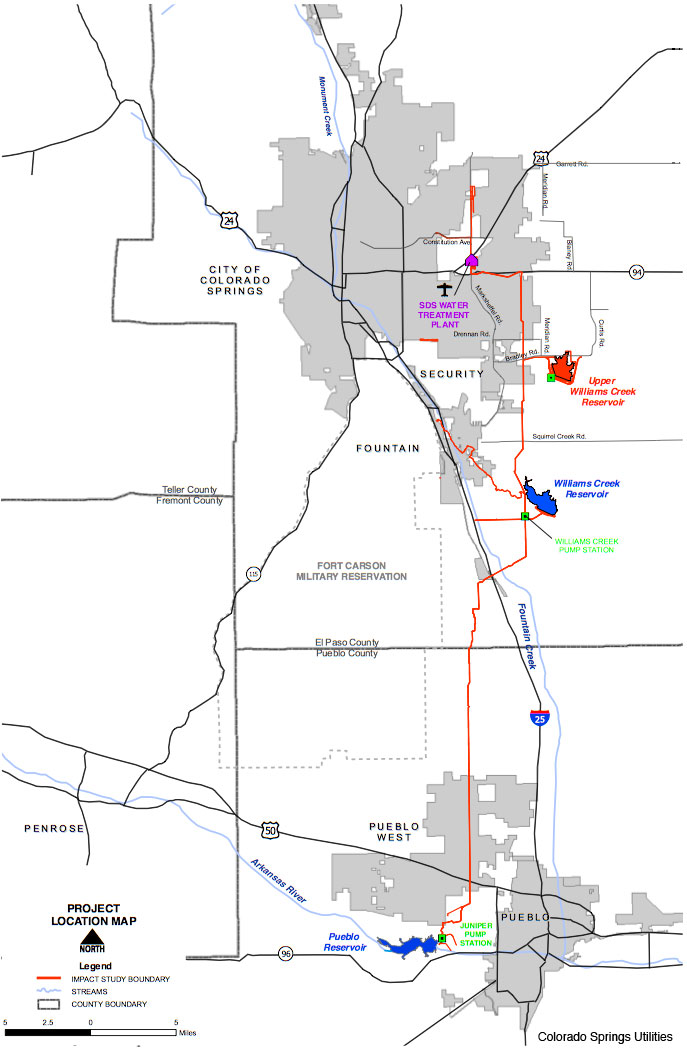
SDS will be completed in two phases, which include the Juniper Valley, Williams Creek and Bradley pump stations then 62 miles of underground pipeline and a water treatment plant, which initially will treat 50 million gallons and then be expandable to more than 100 million gallons. “The first piece of the dam will connect to the north outlet works, which will begin later this summer or early fall,” Fredell said…

Phase 2 is roughly between 2020 and 2025, which will expand the pump stations, the water treatment plant and building Williams Creek Reservoir and Upper Williams Creek Reservoir. “We won’t build phase 2 all at once,” Fredell said. “We’ll start with Upper Williams Creek first, expanding the treatment facility then Williams Creek last.”[…]

When asked how to bid on the projects, Fredell said it would post a general list of jobs to bid on every week. To stay in touch with the program, register for the e-newsletter or e-mail sdsinfo@csu.org or http://www.sdswater.org.

More Southern Delivery System coverage here and here.

Longmont: City council OKs $14 million debt for wastewater treatment plant

A picture named wastewatertreatmentwtext.jpg

From the Longmont Times-Call (Rachel Carter):

The Longmont City Council voted unanimously Tuesday night to issue as much as $14 million in bonds this month to fund capital projects at the plant. The city will sell the bonds May 24, and the funds will be available in mid-June. City finance director Jim Golden said the city’s bonds are rated individually, and the sewer plant bonds that will go to public sale later this month received AA ratings — a good, solid rating that is the same the city received in the recent past on its storm drainage and open space bonds.

More wastewater coverage here.

HB 10-1188 (Clarify River Outfitter Navigation Right) dies in conference committee

A picture named raftingarkriver.jpg

From The Grand Junction Daily Sentinel (Charles Ashby):

“What we tried to do with this bill was relate the statutes with reality,” said Rep. Kathleen Curry, the unaffiliated Gunnison legislator who introduced the bill with Sen. Mary Hodge, D-Brighton. “What unraveled the legislative process was the fear of litigation and how the courts would interpret (it). We had a bill that looked reasonable when you read the bill, but the opposition felt like … the courts would make a broader finding and open up everything.”

When Curry introduced the measure in January, it was designed to allow rafters to float down Colorado rivers through private land, touching the riverbed and banks only in cases of emergencies.

But when it reached the Senate, lawmakers there said the idea constituted a taking of private property. As a result, that chamber turned it into a study, but sent it to a nongovernmental organization made up of landowners and water companies, not recreational river users.

Curry said without the bill, a slew of ballot questions may be placed before voters this fall to decide the matter one way or the other. There are 16 pro-landowner measures pending, and four designed to open private land to all rafting.

Regardless of what gets on the ballot in November, Curry predicted the uneasy peace that has existed between rafting companies and landowners will end, and a heated war will erupt this summer between the two sides. She said she already is hearing reports of rafters cutting down fences that property owners have erected to stop them from traversing rivers that cross their land.

More HB 10-1188 coverage here.

Senators Bennet and Udall plan to question President Obama’s supreme court nominee, Elena Kagan, about her understanding of water law and water issues

A picture named uswaterwatch05152020.jpg

From the Grand Junction Daily Sentinel (Gary Harmon):

U.S. Solicitor General Elena Kagan’s position on water rights will be high on the lists of issues for U.S. Sens. Michael Bennet and Mark Udall when considering Kagan’s nomination to the U.S. Supreme Court. Bennet also will pay close attention to her position on individual rights, while fellow Colorado Democrat Udall said he’d like to know how Kagan would tackle other natural-resources law…

Bennet said he would like to hear Kagan acknowledge the critical importance of water in the West and the need to preserve and protect Colorado’s rightful share under current law, a Bennet spokesman said in an e-mail.

More Colorado Water coverage here.

The Chieftain’s Chris Woodka water stories section

A picture named arkansasriverleadville.jpg

Here’s a collection of water stories written by Chris Woodka from The Pueblo Chieftain website. Chris is a favorite of mine. If you don’t know his work take time to click through and read his stuff for a real treat.

Today was the first time that I saw the news website. Thanks to Loretta Lohman (Nonpoint Source Colorado) for the link.

Wiggins: Waiting for funding for new water supply project

A picture named soplatteapril09.jpg

From The Fort Morgan Times (Dan Barker):

The town of Wiggins is still waiting for a response from the U.S. Fish and Wildlife Service to see if it will get a loan and perhaps a grant for its new water project…

The U.S. Department of Agriculture has said it will likely offer a loan, but all of the federal paperwork must be done first. The last part of that process is getting the green light from the Fish and Wildlife Service, said engineer Tim Holbrook of Industrial Facilities Engineering, which is organizing the project. The wildlife service said it may complete its files on the project in the next 30 days, but there is no way to predict that with any accuracy, he said. The service has not defined what it needs very clearly, Holbrook said.

More South Platte Basin coverage here.

Fryingpan-Arkansas Project: Federal legislation to allow Aurora’s use of project facilities making little headway in D.C.

A picture named fryingpanarkansasproject.jpg

From The Pueblo Chieftain (Chris Woodka):

Little progress has been reported in attempts to change federal legislation to allow Aurora to legally use the Fryingpan-Arkansas Project to move water out of the Arkansas Valley. Aurora and the Lower Arkansas Valley Water Conservancy District are attempting to persuade federal lawmakers to change the law as part of a settlement of the Lower Ark’s 2007 lawsuit against the Bureau of Reclamation…

While there have been numerous behind-the-scenes, often closed-door meetings among lawyers, staff and lawmakers since then, there has been no movement toward federal legislation, according to a joint brief by attorneys Stuart Somach, for Aurora, and Peter Nichols, for the Lower Ark. The brief was filed Wednesday in the Denver U.S. District Court. “For the majority of the current 111th Congress, the U.S. House of Representatives and Senate have both been preoccupied with drafting, debating and passing health care reform legislation, and more recently with financial reform legislation,” the lawyers reported. “This preoccupation and the upcoming congressional election have rendered it difficult for Colorado’s delegation to fully engage in the process for developing the necessary legislation to implement the settlement agreement.”

Nevertheless, there have been meetings with lawmakers and Secretary of Interior Ken Salazar toward drafting the legislation, which includes many of the same provisions that once were bundled in attempts to gain approval for the Preferred Storage Options Plan sponsored by the Southeastern Colorado Water Conservancy District. Meetings this year began Jan. 20, when Aurora met with representatives from the Lower Arkansas Valley Super Ditch, when negotiations on possible leases were opened. No deals have been reached…

On March 9, staff from the Lower Ark district and Aurora met with other PSOP parties: Colorado Springs Utilities, Pueblo Board of Water Works, city of Pueblo, the Southeastern Colorado Water Conservancy District and Fountain. The meeting was not open the public or press, a change from a negotiating process that Salazar, then a U.S. senator, used in 2007 to attempt to solve PSOP. It apparently did not include other parties that had been invited to the PSOP meetings, such as Pueblo West, Lake County, Pitkin County or the Colorado River Conservation District…

Aurora made presentations to the Lower Ark district on March 23, which were covered in The Chieftain. The presentations detailed progress on Super Ditch negotiations, Aurora’s commitment to pay $2 million for Lower Ark projects and shared Aurora’s experience in water lease programs. Meetings with lawmakers began in March, when Aurora and the Lower Ark met with U.S. Sen. Mark Udall and his staff in Washington. Udall directed his staff to set up meetings with staff from other members of the Colorado delegation to discuss the legislation sought under the settlement agreement. There was no public mention of the meetings until the federal court brief was filed. In the March 22-24 trip, Aurora and the Lower Ark district also met with U.S. Rep. Ed Perlmutter and staff for U.S. Sen. Michael Bennet, and U.S. Reps. Mike Coffman, Betsy Markey and Doug Lamborn. Lower Ark officials also met with Ken Salazar’s staff. The first legislative staff meeting was at Udall’s Denver office, was April 30, as staff from the offices of Udall, Bennet, Perlmutter and U.S. Rep. John Salazar met with Lower Ark and Aurora attorneys.

More Aurora coverage here and here.

Snowpack/Runoff news

A picture named snowpackcolorado05142010.jpg

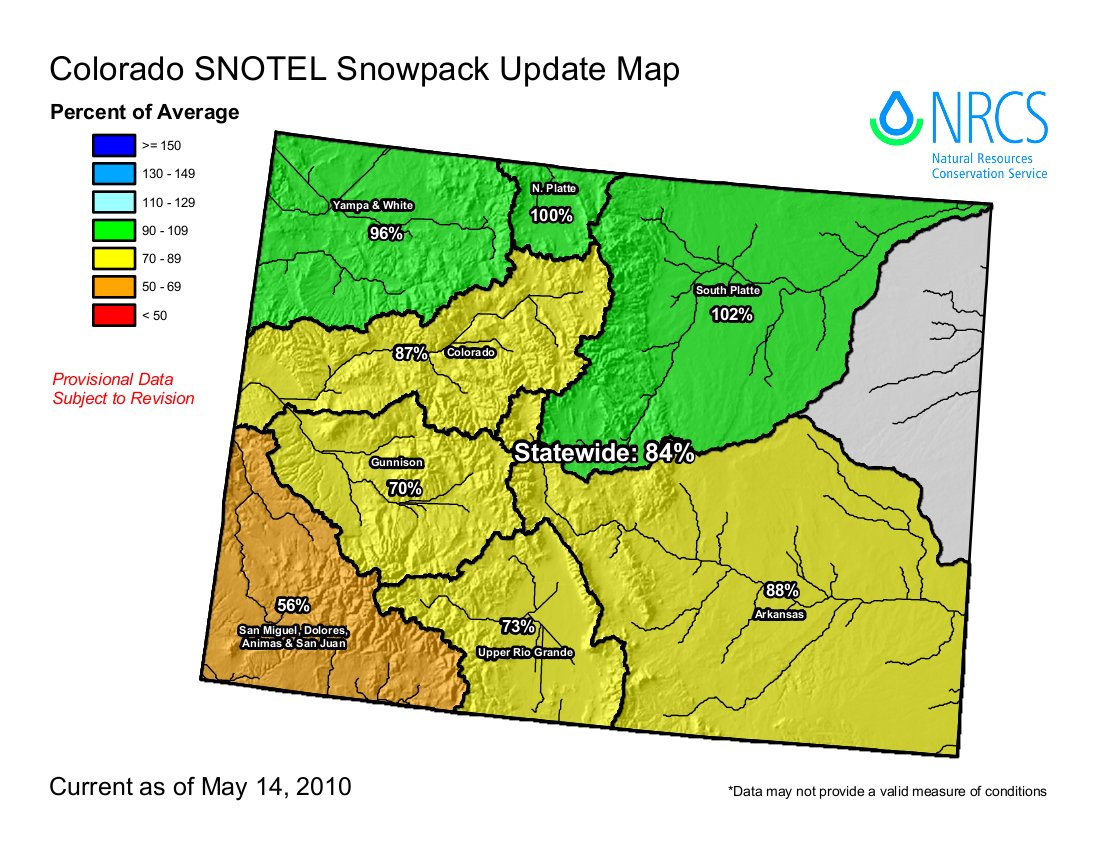
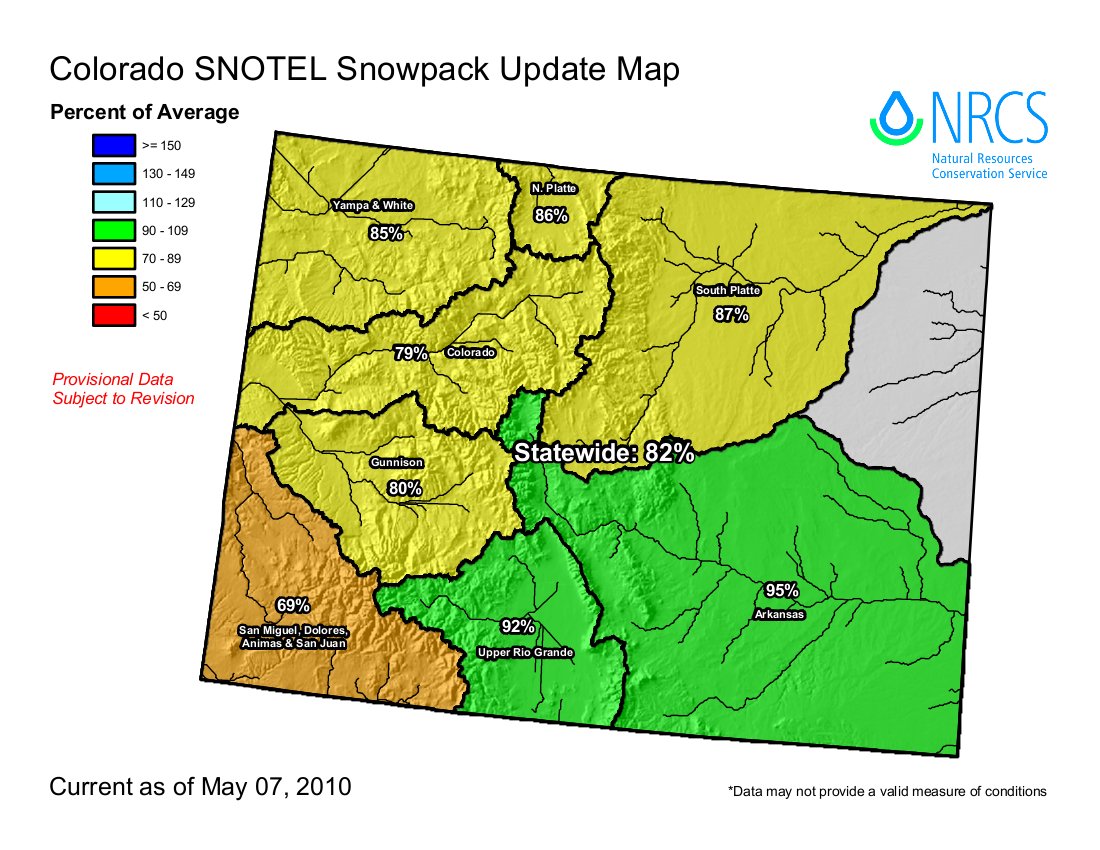
What a difference one storm system can make. The South Platte Basin snowpack went from 86% to 102% of average from May 11 to today.

From The Denver Post (Heather McWilliams):

“Overall, the runoff is expected to be lower than average across the state,” said Mike Gillespie, snow-survey supervisor for the National Resources Conservation Service. Gillespie said that with statewide precipitation totals at about 87 percent of average, the chilly, wet weather would need to linger into June for a turnaround.

The recent wet weather did haul the state back from the brink of a year like 2002, one of the driest on record, said Treste Huse, service hydrologist for the National Oceanic and Atmospheric Administration…

Huse monitors the likelihood of flooding in Colorado and said she doesn’t see much chance of runoff-caused floods this season. “That doesn’t mean we won’t have flash flooding caused by rainstorms, though.”

Gillespie said he’s projecting runoff in the South Platte basin — which includes much of the Front Range — to be about 11 percent below average. But he’s more worried about areas west of the Continental Divide. “The upper Colorado area from Granby to Steamboat is a problem area,” Gillespie said. “Those streams are anywhere from 50 to 75 percent of the average” runoff. That could affect water flow for rafters, irrigation options for farmers and even fish, Gillespie said…

That’s not the only bright spot in Colorado’s water forecast. “Reservoir storage is the best it’s been since 2001,” Gillespie said, with statewide storage 12 percent above average.

Reclamation Advances Implementation of Rural Water Program

A picture named watertreatment.jpg

Here’s the release from Reclamation (Peter Soeth):

Bureau of Reclamation Commissioner Michael L. Connor announced today the implementation of the Rural Water Program, a new program within Reclamation. The Rural Water Program is a program to work with small communities in rural area to assess their potable water supply needs and identify options to address those needs.

“Reclamation will work with small communities, including Indian tribes, on a cost-shared basis to explore opportunities to supply water for domestic, municipal, and industrial uses in rural areas,” said Commissioner Connor. “This program will assist Reclamation and other organizations to efficiently address rural water supply needs in the West.”

Under this program Reclamation will work with small communities of no more than 50,000 people to investigate opportunities to ensure safe and adequate rural water supply projects for domestic, municipal and industrial use; plan the design and construction of rural water supply projects through the conduct of appraisal investigations and feasibility studies; and oversee, as appropriate, the construction of rural water supply projects that are recommended for construction by Reclamation in a feasibility report developed under the program and subsequently authorized by Congress.

Reclamation will have a Funding Opportunity Announcement in the next few days on http://www.grants.gov. It will outline all the requirements for requesting program assistance.

Eligible entities can also participate by submitting an appraisal investigation or feasibility study prepared without any financial or technical support from Reclamation. This option provides the opportunity to have Reclamation review previously completed appraisal investigations or feasibility studies and prepare a report with recommendations on whether to proceed to the next step in the planning process. If the submitted investigations or studies meet the criteria they will be incorporated into the program.

Eligible entities can submit their completed appraisal investigation or feasibility study to their local Reclamation Area Office at any time and without having to respond to the upcoming Funding Opportunity Announcement. While the Rural Water Program provides authority to undertake appraisal investigations and feasibility studies, it does not provide authority to undertake the construction of water delivery facilities recommended for development under the program. Construction of projects would require a specific Act of Congress.

The Rural Water Program was authorized in 2006 in Title I of the Reclamation Rural Water Supply Act, P.L. 109-451. Rulemaking for the program was conducted with public comment in 2008 and an interim final rule was instituted in 2009 that established the programmatic criteria for the program.

To learn more about Reclamation’s Rural Water Program please visit www.usbr.gov/ruralwater.

More Reclamation coverage here.

South Platte River: Funding wetland restoration to improve duck habitat and restore population

A picture named wetlandspondgrass.jpg

From the Bismarck Tribune (Bruce Finley):

“We’d like to get it back to what it was,” said Greg Kernohan, manager of the projects for Ducks Unlimited, a national hunting and conservation group. Otherwise, he said, “we’ll lose our wildlife heritage.”

The loss of duck habitat in the South Platte River basin, at least partly the result of man-made alteration of the river to make it flow like a channel, is likely a major reason for a decline in duck populations by as much as 50 percent in some parts of eastern Colorado.

The newly created duck habitat is designed to mimic natural conditions. Colorado has gained 16,000 acres of reworked wetlands at about 100 areas along the South Platte, with plans for another 11,000 acres by 2014, funded in part by $1.5 million from the Colorado Water Conservation Board. Hundreds of duck hunters also held banquets and auctions statewide and ponied up $150,000 for the effort.

Water is pumped and piped from the South Platte to ponds carved out of adjacent prairie. This water then is routed through sloughs and filtered back into the river’s main stem. Diversion of water into wetlands is done during low-demand periods and builds water credits for participating landowners, giving some the ability to draw water for farming…

The longterm future for waterfowl looks bleak, said Dave Sharp, a U.S. Fish and Wildlife Service biologist. “Our needs for water are only going to grow,” Sharp said. Dams and diversions for cities and farming “take away those natural pulses, like in the spring. The flooding that used to occur no longer occurs.” Woody vegetation is taking over sand bars essential for ducks. Colorado Division of Wildlife tables show duck populations across the central flyway parts of Colorado decreasing from an average of 104,207 between 2003 and 2008 to 85,695 last year. But in northeastern Colorado, where the South Platte meanders about 300 miles to Nebraska, a duck population that decreased to 36,689 from a 2003-08 average of 79,114 now may be swinging back up. State wildlife officials counted 129,447 ducks in January, according to Jim Gammonley, avian research leader for the Colorado Division of Wildlife. Duck numbers fluctuate widely year to year, depending largely on climate conditions here and elsewhere, Gammonley said. Overall, “the hydrology and habitat conditions associated with the South Platte River have changed dramatically and negatively — from a duck’s perspective,” he said. “There’s likely less waste corn and other grains left in agricultural fields, and corn is being picked later every year, so there may be less food available to attract and hold wintering mallards.”

More restoration coverage here and here.

Southern Delivery System: Cost update

A picture named sdspreferredalternative.jpg

From the Colorado Springs Independent (Pam Zubeck):

At the contractor meeting, Utilities CEO Jerry Forte and Colorado Springs Mayor Lionel Rivera call SDS’ pipeline, pump stations and water treatment plant a shot in the arm for the local economy, one that will grease the way for growth. “There is no question this is the most important project in the region,” Rivera says. He and Utilities officials dangle $550 million in construction projects in front of the hungry contractors. They note that during the six-year construction period, up to 700 workers (at peak employment in 2014) will share in a $160 million payroll.

What they don’t say is how much it will cost all of us. Estimates for Phase 1, which includes construction of the pipeline, pump stations, dam hookup and a water treatment plant, have changed through the years due to inflation and growing construction costs, Utilities officials explain. The estimate has gone from $490 million in 2002 to $631 million in 2007 to $880 million in 2009. After the city’s partners — Fountain, Security and Pueblo West — pay their shares, Utilities’ cost now will be $838 million. But wait. Inflation will add another $140 million during the construction period, according to Utilities, as estimated using the Construction Cost Index, an industry standard for project pricing. And then there’s borrowing costs spanning 40 years of $1.33 billion, for a grand total of $2.3 billion.

And that doesn’t include Phase 2, which would expand the treatment plant and pumping capability and build two reservoirs. Those components are now termed “not essential” — however, $22 million to buy land for the reservoirs is included in Phase 1, so the reservoirs apparently are essential. In fact, Phase 2 gives the project its biggest selling point: redundancy.

In a 2008 permit application submitted to Pueblo County, Utilities wrote, “The SDS project will allow the Applicant [Utilities] to develop water storage, delivery, and treatment capacity to provide critical system redundancy.” But Phase 1 includes no water storage facility. Phase 2, to be built from 2020 to 2025 at the earliest, would range from $387 million to $744 million, not including financing costs. “It’s so far out in the future, you’re fooling yourself if you say you have a grasp on it,” Utilities chief water services officer Bruce McCormick says. He notes too many unknowns — reservoir size, dam type, treatment regulations — preclude a more exact estimate. And with a slow economy, Phase 2 could move “way, way out” into the future.

Councilor Tom Gallagher says ratepayers haven’t seen the half of it, because considerable costs, starting with power, aren’t included in the SDS estimates. “I’m not opposed to bringing the water to this community,” he says. “It just needs to be done in a way we can afford. … We are following the defense contractor model, which produces $2,000 hammers, $10,000 toilet seats and $18,000 coffee pots.”

More Southern Delivery System coverage here and here.

HB 10-1358 (Water-smart Homes) and HB 10-1051 (Water Efficiency Plans Annual Reports) both head to Governor Ritter’s desk for his signature

A picture named waterefficenttoilet.jpg

From the Summit County Voice (Bob Berwyn):

House Bill 1358 is a pro-active piece of legislation that simply requires homebuilders to give buyers the up-front option for various water-saving options, including low-flow toilets and faucets, high-efficiency washing machines, as well as low-water-use landscaping. House Bill 1051 would help water planners collect more accurate information about water efficiency efforts.

Both the measures appear to enjoy widespread support and have bipartisan backing in the State Legislature, although the homebuilding industry opposes HB 1358′s mandatory requirement that buyers be notified of water-wise options for appliances and landscaping. New homes incorporating water-smart appliances and fixtures could easily use 20 percent less water, said Becky Long, water caucus organizer for the Colorado Environmental Coalition. If, by 2050, 100,000 new homes are built using water-smart measures, it could save up to 2 billion gallons of water, Long said, explaining that the latest generation of low-flow toilets and other water-saving appliances and fixtures are far improved over earlier models.

More 2010 Colorado legislation coverage here.

CWCB: Board meeting May 18-19 in Denver

A picture named cachelapoudre.jpg

From email from the Colorado Water Conservation Board (Lisa Barr):

The Colorado Water Conservation Board is meeting on May 18-19, 2010, at 1580 Logan Street, Suite 610, Denver, CO 80203.

The agenda (pdf) is available on the CWCB website. CWCB staff memos and other materials will be available May 14, 2010, on our website.

The meeting will be “streamed” via the internet through the CWCB’s website. Click on the “Listen to the meeting LIVE!” link, found on our home page just before the meeting begins.

Presentations are also being made available. To watch presentations that accompany agenda items, click the “Watch Presentations” link on the CWCB website homepage just before the meeting begins.

The CWCB is implementing a new email system in an effort to improve our communication with citizens, customers, and constituents. If you do not wish to receive notices of Board activities, please let us know.

If you need more information about this Board meeting, please contact Lisa Barr at lisa.barr@state.co.us

More CWCB coverage here.

HB 10-1188 (Clarify River Outfitter Navigation Right) dies in conference committee

A picture named raftingarkriver.jpg

From The Denver Post (Jessica Fender):

The six-lawmaker panel deadlocked when members couldn’t settle on rules regarding how, when or whether river enthusiasts should be able to float through private property. The lack of a legislative resolution probably means voters will be asked to settle the fight on the November ballot. Twenty ballot initiatives on the subject are currently waiting in the wings, though that number will certainly be culled before Election Day. Rep. Kathleen Curry, sponsor of House Bill 1188, said none of the initiatives fully address complicated issues such as portage and trespassing that are likely to be glossed over by campaigns on both sides. “We are unable to reach an agreement, but that doesn’t mean the issue goes away,” said Curry, I-Gunnison. “Tensions are up back home, but I couldn’t help them.”[…]

Meanwhile, private mediation on the conflict that brought the bill to the fore continues, according to lobbyist Mike Feeley, who represents land developer Jackson-Shaw. The Texas company purchased both sides of the bank along a 2-mile stretch of the Taylor River and plans an exclusive vacation community. It threatened to bar two Almont rafting outfitters from floating through the property. At Gov. Bill Ritter’s direction, the rafting and land-development companies have started to negotiate a compromise.

More HB 10-1188 coverage here.

Snowpack/runoff news: Boulder –No water restrictions this summer

A picture named snowpackcolorado05122010.jpg

From the Boulder Daily Camera (Heath Urie):

In a news release Monday, the city wrote that the wet weather and low water use across the city so far this year has led to above-average water supplies going into the snow runoff season. Snowpack in the mountain areas that supply Boulder’s municipal water supply was below average through the winter, and peak streamflows will be lower than average as a result. But city officials say the water levels in the reservoirs and water-rights agreements will cover the difference.

The recommended watering guidelines for the summer are as follows: Water your lawn in the evenings or early mornings, after 6 p.m. or before 10 a.m.; Water your lawn every three days; Do not over water; Do not water when it is raining or when the soil is already wet; Trees, shrubs and vegetable gardens can be watered more effectively with a hand-held hose or low-volume non-spray irrigation, after 6 p.m. or before 10 a.m.; Check your sprinkler system and make sure it is working properly and that you are only watering landscaping and not the surrounding areas like streets or sidewalks.

From The Aspen Times (Will Sands):

Generally at this time of the month the Roaring Fork should be in the beginning stages of runoff, especially below the confluence of the Crystal River. Cooler weather this past week has slowed the spring snowmelt, however, and we are experiencing some very good fishing that would not normally be available to us.

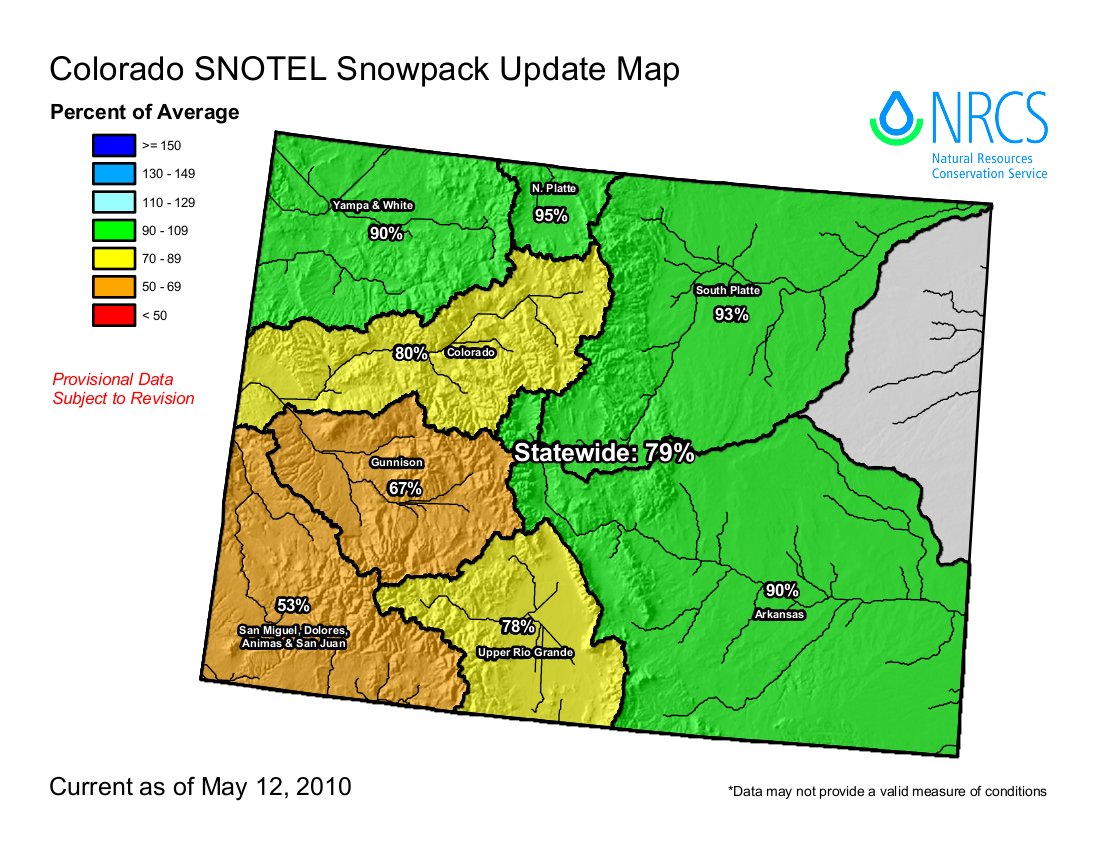
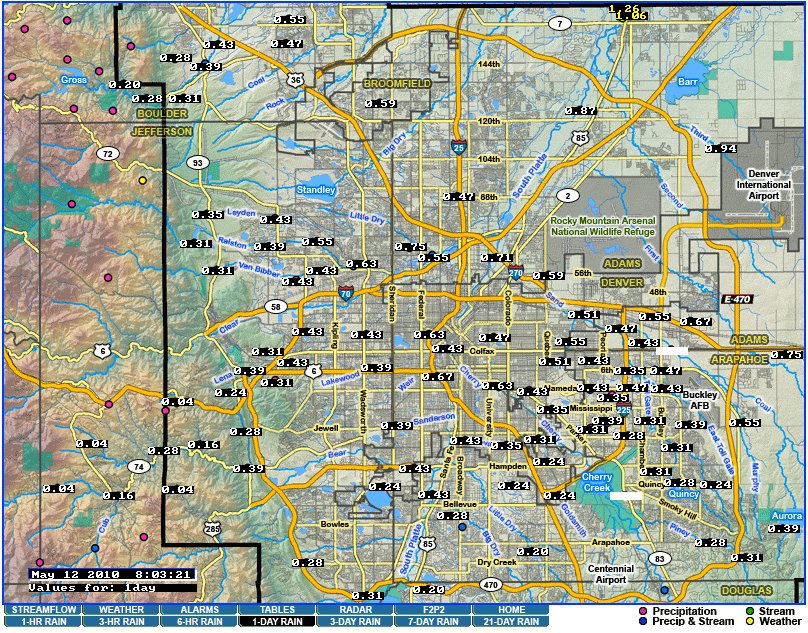
Click here to check out the one day precipitation map from the Urban Drainage Flood and Control District. The northern part of the metro area has received more than an inch while a half inch is the norm. If you click on the thumbnail graphic above you can see the effect of this storm on snowpack as a percent of average. Here’s the link to yesterday’s snowpack chart.

From The Greeley Tribune:

People along Colorado’s northern Front Range and in the mountains west of Denver are waking up to several inches or a foot or more of snow. Rain turned to snow Tuesday night amid forecasts of snowfall rates of 1 to 2 inches per hour in the foothills of Larimer County and west of Denver. A storm system centered over northern Utah is bringing the spring snow to Colorado and parts of Wyoming.

From the Associated Press via the Sky-Hi Daily News:

The National Weather Service says 11 inches of snow was reported near Jamestown in Boulder County as of early Wednesday, and there was about an inch of precipitation reported at Denver International Airport. Some areas around Grand Lake are reported to have received as much as 18 inches of snow.

Colorado River District: Colorado River water availability study gets mixed reviews

A picture named coloradoriverbasincgs.jpg

From the Grand Junction Daily Sentinel (Gary Harmon):

The underpinning of the study — to determine how much water remains for Western Slope and Front Range development — came under some fire, however. “Why should we take the risk” of a call on the river from California or Arizona that would fall hardest on the Western Slope, Gunnison Valley rancher Ken Spann asked. Spann sits on the Gunnison River Basin Roundtable, one of four such groups in the Colorado River Basin. All four gathered Monday at the Grand Vista Hotel, 2790 Crossroad Blvd., to discuss the study conducted by AECOM, an international environmental consulting firm.

The study, which can be seen at http://www.crwcd.org, is the first phase of the Colorado River Water Conservation District’s effort to nail down how much water is available in the river. Preliminary conclusions are predicated on computer models based on three sets of assumptions about climate change, AECOM Vice President Blaine Dwyer said…

“What possible incentive could the East Slope provide” to encourage the Western Slope to accommodate water development that could lead to a downstream demand for water, Spann asked. “The Broncos, DIA, the Rockies, the Denver Center for the Performing Arts?” The Front Range would be unlikely to suffer under a call, so, “Why should this basin take the risk?” Spann asked.

The Western Slope should engage in talks that might lead to benefits for the Front Range because to do otherwise would be to court disaster, said Alexandra Davis, director of compact negotiations for the Colorado Department of Natural Resources. “The risk exists today that money, politics or a crisis will combine forces to pull the water out of the Western Slope in a way that would be far more harmful than if there wasn’t a crisis,” Davis responded.

More Colorado River Basin coverage here.

Energy policy — nuclear: State Water Quality Control Division nukes Cotter plan for Schwartzwalder mine mitigation

A picture named uranium.jpg

From the Associated Press via CBS4Denver.com:

Cotter Corp. has submitted a plan to state mining regulators to reduce uranium levels in Ralston Creek from the closed Schwartzwalder Mine. The water flows into a reservoir that supplies some of Denver’s drinking water. The Water Quality Control Division of the state health department told mining regulators in a memo Monday that Cotter’s plan doesn’t reduce uranium in the water to acceptable levels…

The state Office of Mined Land Reclamation expects to decide by May 19 whether to approve or reject Cotter’s plan or seek more information.

Meanwhile here’s a look at HB 10-1348 and how it will impact Cotter’s plans for their mill in Cañon City from Marjorie Childress writing for the Colorado Independent. From the article:

A controversial plan to open an old uranium mine on Mt. Taylor near Grants, New Mexico, faces an obstacle in the new law passed by the Colorado legislature that forbids increased operations at uranium mills until the mill companies clean up sites contaminated in the past. The Cotter Uranium Mill, just a little over a mile south of Cañon City is owned by the same company that owns the Mt. Taylor mine and is the designated recipient of future Mt. Taylor uranium ore. Under the new law, which Colorado Gov. Bill Ritter has yet to sign, Cotter would not be able to accept the ore, at least not any time soon. “This is not unexpected,” John Hamrick, vice president of milling at Cotter, told the Cañon City Daily Record. “This bill will prevent us from processing the Mount Taylor ore.”

Click through and read the whole article — there is a lot of good detail.

More HB 10-1348 coverage from Matthew Beaudin writing for the Telluride Daily Planet. From the article:

The bill will essentially require companies to clean as they go, curtailing the toxic sites that dot the Western landscape and the towering cleanup costs that saddled taxpayers. (Colorado alone has shelled out more than $1 billion to cleanup the industry.) Last week, the Senate voted 24-9 in favor of the bill and the house later readopted the bill resoundingly, 60-3. Now, it waits for Ritter to vault it into law…

Hilary White, Sheep Mountain Alliance’s executive director, helped work on the measure and said Ritter will sign the bill “shortly.”[…]

Taxpayers have spent more than $950 million to clean up toxic pollution at past uranium milling operations located primarily on Colorado’s Western Slope, according to the U.S. Department of Energy. “It means that the bad actors in the uranium industry will not be allowed to operate if they are in violation of contaminating the environment,” White said. “It’s been shown time and time again that uranium companies just walk away from their messes.”[…]

Jeffrey Parsons, a senior attorney with the Western Mining Action Project, which supports the bill, said there’s no guarantee Cotter will be able to get ore from Mount Taylor, which is considered sacred land by as many as 30 Indian tribes. White said the measure will also increase bonding obligations for operators in hopes of stanching the costs of future cleanup. All told, the Naturita mill site cost $67 million to clean up and the Uravan site, designated a Superfund site, cost $120 million to clean, White said. Also according to Sheep Mountain, Energy Fuels, the company planning to build a mill in Paradox Valley, plans to put up $12 million in bonding. Bonding in general, she said, was “less than adequate.” “The industry is a mess and needs to be cleaned up,” she said.

More Schwartzwalder mine coverage here.

Tamarisk control: Tamarisk is not the water hog it has been made out to be

A picture named tamarisk.jpg

From The Pueblo Chieftain (Chris Woodka):

“In a few cases, clearing saltcedar has resulted in temporary, measurable increases in streamflow,” a report by the U.S. Geological Survey states. “Most studies, however, have found that although evapotranspiration may be decreased by large-scale removal of saltcedar, no significant long-term changes in streamflow are detected as a result of vegetation removal.” The report is a scientific assessment ordered under the Saltcedar and Russian Olive Control Demonstration Act of 2006. It reviews past studies in order to assess the scientific information available about tamarisks and Russian olives, while providing a common background for those applying for federal grants.

In Colorado, the Arkansas River basin is the most heavily infested with tamarisk, with 69 percent of the state’s total acreage. Many of the trees were planted in the 1900s as a means of erosion control. The trees have spread over time, taking over cottonwood stands in the river beds and colonizing upland areas as well. More than 67,000 acres are affected…

Today, the [Southeastern Colorado Water Conservancy District] is coordinating efforts throughout the valley under the Arkansas River Watershed Invasive Plant Plan. In addition to water usage, the trees have been identified as crowding out beneficial native plants and restricting flood control channels. According to the project’s website, tamarisk use 76,600 acre-feet of water per year, and infilling of partially infested areas eventually could increase that amount to 198,000 acre-feet…

The report acknowledges that tamarisk stands spread areas of vegetation into upland areas as well as along the banks, but states that simply removing the trees does not increase the water supply. Instead, the natural vegetation that replaces tamarisk may use the same amount or even more water, nullifying any water gain. Evaporation could actually increase if shading by tamarisk is reduced. Water made available to groundwater is used by other plant species, and does not increase long-term streamflow, the USGS report states.

More tamarisk control coverage here and here.

Greeley: City council voices opposition to proposed revised floodplain regulations from the Colorado Water Conservation Board

A picture named southplatteflood.jpg

From The Greeley Tribune (Chris Casey):

Council members sharply criticized the flood plain regulation changes being proposed by the Colorado Water Conservation Board. Under current rules, the city must abide 100-year flood plain precautions for all facilities, whether they’re deemed critical or not. The Conservation Board has suggested modifications that protect “critical facilities” in the event of a 500-year-flood to better ensure public safety and reduce flood losses.

If such rules were enacted, said Derek Glosson, Greeley’s engineering development review manager, the state has “a laundry list of what it considers critical facilities.” For example, he said, a road would be considered critical and thus require a bridge to be built, “which would be a major cost to the city.” He said it would be easy to ensure that new facilities handle a 500-year-flood — of which there is a two-tenths of one percent chance any given year — but retrofitting existing structures is “very dicey.” “In that analysis you have to include the cost of restricting development and the costs of that land” in compensation to private property owners, Norton said. “I think there’s a big legal question that I think is unanswered in their rather arbitrary approach to this.”

More CWCB coverage here.

CSU: New climate model project hopes build a system capable of simulating the circulations associated with large convective clouds

A picture named cloudswiki.jpg

Here’s the link to the website. Here’s the link to the images.

Southern Delivery System: Colorado Springs city council approves water rate hikes

A picture named sdspreferredalternative.jpg

From The Colorado Springs Gazette (Eileen Welsome):

“We recognize the sacrifice that our citizen-owners are making, but we also recognize that SDS is the very best cost alternative for our future,” he said in a brief interview after the vote.

Councilor Tom Gallagher and several witnesses who spoke during the hearing urged councilmembers to postpone a vote until further information could be obtained.

But William Cherrier, the utility’s chief planning and finance officer, told council members that up to $49 million — or $1 million a year — could be saved over the life of the project if the utility was able to take advantage now of historically low interest rates and special bonds available through the American Reinvestment and Recovery Act.

More coverage from KKTV.com. From the article:

At Tuesday’s city council meeting, Tom Gallagher was the only vote in opposition to the hike. He asked council to postpone the vote to do more research on the project. “There will be no second chance and I believe we have just gone down a road that future generations will look back and curse this council,” said Gallagher.

More coverage from Fox21 (Rachel Welte). From the article:

“I think it is the right thing to do for our community, it is going to secure our water supply for at least 40 years,” Mayor Lionel Rivera said. Mayor Rivera said the city has done numerous studies dating back to 1997 on the project. He said in the long run it is going to benefit more than just the residents of Colorado Springs. “We are going to be developing regional partnerships to provide water for some of our neighbors who rely on ground water,” Rivera said.

More Southern Delivery System coverage here and here.

Snowpack/Runoff news: Durango just short of 100 inches of snowfall

A picture named snowpackcolorado05112010.jpg

From The Durango Herald (Shane Benjamin):

Durango received 96.3 inches of snow from October through April, said Briggen Wrinkle, a local weather observer. The average winter snowfall in Durango is 66.7 inches, according to the National Weather Service in Grand Junction.

While it was a big snow year in Durango, surrounding areas received close to an average amount of snowpack and moisture. The Animas River valley from Silverton south to the Colorado-New Mexico border was 90 to 99 percent of normal, said Bryon Lawrence, a hydrologist for the Weather Service. “It wasn’t an exceptional snow year, but it was near normal,” Lawrence said.

From the Vail Daily (Edward Stoner):

Through March, local snowpack was tracking at about the same level of the 2001-02 drought year. But, by Monday, the April storms had pushed snowpack levels at Vail Mountain to about twice of what they were in 2001-2002. That means there is plenty of snow at high altitudes waiting to melt into rivers. There was 19.3 inches of “snow water equivalent” at Vail Mountain on Monday. The average for that time of year is 23.6 inches. Rivers are still running below average this week. The Eagle River at Avon was flowing at 350 cubic feet per second on Wednesday, compared to an average of about 700 cubic feet per second.

Donala Water and Sanitation District’s special election recap

A picture named denveraquifer.jpg

From The Tri-Lakes Tribune (Nicole Chillino):

Voters approved a measure to allow the district to expand its debt by up to $20 million, with about 67 percent of votes, or 1020 out of 1515, being cast in favor of the measure. The district also received permission to increase the district’s mill levy up to five mills, with nearly 73 percent of votes, or 1098 out of 1508, supporting the ballot question. Approximately 33 percent of the district’s residents participated in the election, according to general manager Dana Duthie. “The number of voters is phenomenal,” he said…

Now that the measures have passed, the district is waiting on a decision from Colorado Springs Utilities regarding whether to relax its limitations and city code to allow it to engage in regional partnerships, Duthie said. If the change comes through, Donala hopes it will allow the district to hookup to the utility district to move water from the Arkansas River, its access point to the water rights it purchased on Mount Massive Ranch near Leadville.

The district’s future actions with regard to its potential use of at least a portion of the money approved by voters will also partially depend on whether it can get water from the Flaming Gorge Reservoir, Duthie said. While the district might have to wait for either of its potential uses of the money, it wanted to receive voter approval to increase its debt and increase its mill rate prior to the passage of several pieces of legislation coming down the pipe that, according to Duthie, would curtail the financing of infrastructure for small districts like Donala. Donala Water and Sanitation District also elected three members, including William Nance, David Powell and incumbent Timothy Murphy, to its board of directors for four-year terms.

More infrastructure coverage here.

Southern Delivery System: Contractors meet with the project management team

A picture named sdspreferredalternative.jpg

From The Pueblo Chieftain (Chris Woodka):

SDS will provide an average of 380 jobs annually, with a peak of 700 jobs in 2014, said Dan Higgins, construction manager for Colorado Springs Utilities. “Utilities will not be doing the main hires, that will be done by the primes and subs,” Higgins told a crowd of about 60 local contractors.

The purpose of Monday’s workshop, along with one last week in Colorado Springs and another planned for Thursday in Canon City, is to guide contractors through a procurement process that can be daunting. SDS has been broken down into several project segments that will give local firms the opportunity to meet bonding requirements, rather than running the whole project under one large contractor. That also includes a wide array of jobs ranging from carpenters, landscapers, fencing, stucco and welding to sign-making, security and traffic control. Colorado Springs has hired MWH, the same engineering firm that completed the Environmental Impact Statement, to manage construction, but is keeping CH2MHill on board to bring design up to 30 percent levels…

“We’re really excited at this point to stop planning and permitting and begin constructing,” said John Fredell, SDS project manager. “This is truly a regional project, situated well for Pueblo and El Paso counties. The regional economic benefits are going to be huge.”[…]

A second phase of the project is planned to construct two reservoirs on Williams Creek, probably sometime after 2020.

More Southern Delivery System coverage here and here.

Upper Yampa Water Conservancy District update

A picture named yampariverbasin.jpg

From Steamboat Today (Mike Lawrence):

The Upper Yampa Water Conservancy District already has announced plans to raise Stagecoach Reservoir in South Routt County, adding nearly 3,200 acre-feet of water storage capacity to the reservoir’s existing 33,275 acre-feet. Work on that project will begin this summer. On Sunday, general manager Kevin McBride said the district also is taking steps toward a mission statement and, eventually, a master plan. Those steps include public input, beginning with the district’s board meeting later this month. McBride said developing a mission statement and master plan will help formalize, among many district goals, “how we will protect the water resources of the Yampa Valley in light of the pressures outside of the district.”[…]

hose pressures continue to intensify. They include three proposals, in various stages of planning and feasibility, for massive pipelines to transfer water from the Yampa River, Green River or Flaming Gorge Reservoir to Front Range communities. Such proposals have been floated for several years, but the demand for such a large-scale transfer was highlighted in March when the Colorado Water Conservation Board released its Colorado River Water Availability Study for public comment.

Local water attorney Tom Sharp noted that the study provides a range of zero to 1 million acre-feet of remaining, developable water in the Colorado River system, depending on climate and consumption projections. The interesting thing about that range, Sharp said, is its low end. “Until this study, no study had been done by any regional or state government saying that the number remaining for Colorado River development could be zero,” Sharp said…

Combine the pipeline proposals and state projections with population growth and the potential for increased energy development on the Western Slope, and the need for formalized planning is clear. There currently is no comprehensive, guiding document specific to the Upper Yampa Water Conservancy District, which oversees Stagecoach and Yamcolo reservoirs and supplies untreated water to local municipalities, agricultural users and Tri-State Generation and Transmission’s Craig Station power plant. McBride said the district has founding documents, various objectives and some principles for projects and transactions, but nothing under one roof, so to speak.

McBride said Conservancy District officials will make a presentation to Steamboat Spr­ings City Council on May 18 in Centennial Hall on 10th Street. The district’s board meets at 3 p.m. May 19 in the Routt County Courthouse, in the Commissioners Hearing Room on the third floor.

More Yampa River Basin coverage here and here.

Colorado Springs: Council poised to raise water rates May 11

A picture named pikespeak.jpg

From The Colorado Springs Gazette (Eileen Welsome):

The rate hikes are the first of six planned increases through 2016, documents submitted to the City Clerk’s Office show. If approved, water bills will more than double.

More Southern Delivery System coverage here and here.

The Woodmoor Water and Sanitation District is buying a reservoir site at Stonewall Springs Ranch

A picture named stonewallspringsproject.jpg

From The Tri-Lakes Tribune:

The Board of Directors of the Woodmoor Water and Sanitation District No. 1 approved on May 6 contracts for an additional water right along the Lower Arkansas River and a portion of the Stonewall Springs Storage site near Pueblo. The district’s board approved one contract for 6.6 shares of Rocky Ford Highline, representing approximately 100 acre feet of water in an average year. This will be added to the 40 shares of Rocky Ford Highline that were put under contract by the board on April 8. Additionally, Woodmoor contracted for a portion of the Stonewall Springs Storage site. Woodmoor is purchasing just over 300 acres downstream of Pueblo along the Arkansas River. Once constructed, this reservoir will allow the district to release stored water rights into the Arkansas River in exchange for diversions out of Pueblo Reservoir or off Fountain Creek near the City of Fountain. The Stonewall Springs site also includes 771 shares of Excelsior Ditch water rights — about 326 acre feet per average year— to augment other water sources. Woodmoor continues to fill in the pieces of its Renewable Water Plan to move the district away from dependence on Denver Basin aquifer water.

More Arkansas Basin coverage here.

Snowpack news

A picture named westusstreamflowforecastmap05012010.jpg

From the Grand Junction Free Press (Julie Sutor):

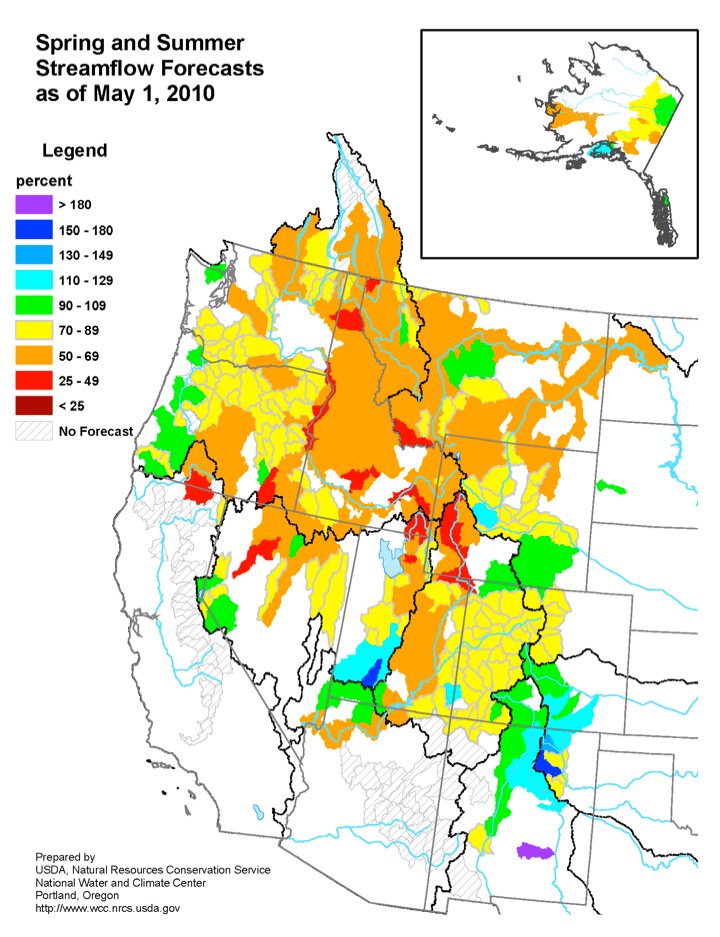
Weather turned wetter and cooler throughout the mountains in late April, halting, and in some cases even reversing, the melt trend. Statistics from the latest NRCS surveys show snowpack is below average in all of the state’s major river basins. Snowpack in the Blue River Basin in Summit County is 70 percent of average and 65 percent of last year’s snowpack. At one NRCS survey site in the lower Snake River, snowpack is at only 7 percent of average…

Colorado’s statewide snowpack decreased to the lowest reading of the season on May 1 at only 78 percent of average…

Inflow into Dillon Reservoir is expected to be 73 percent of average during the April-July period. Inflows into Green Mountain Reservoir and Williams Fork Reservoir are projected to be 75 percent of average and 78 percent of average, respectively. “Reservoir stores are now in good shape, but they’ll probably drop quite a bit as we go into the fall. They will be put to use in late summer to make up for these deficits in natural flows,” Gillespie said. “Without having much of a cushion, it increases the need for a good year next year.”

Aspinall Unit update: Black Canyon Water Right 24 hour peak flow target of 3,883 cfs set for May 18

A picture named gunnisonblackcanyon.jpg

From email from Reclamation (Dan Crabtree):

Reclamation has set the 2010 spring operation plan for the Aspinall Unit. The May 1st Blue Mesa Reservoir April through July runoff volume forecast from the Colorado Basin River Forecast Center is 560,000 ac-ft. This results in a Black Canyon Water Right 24 hour peak flow target of 3,883 cfs. Reclamation plans to operate the Aspinall Unit to allow this target to be met on about May 18th. To accomplish this, releases from Crystal Reservoir will begin to increase starting tomorrow, [May 11] and ramp up at about 500 cfs per day, using two changes per day until a maximum release of around 5,000 cfs (depending on side-inflow fluctuations) is achieved on the 18th. This will require a spill in the neighborhood of 800 cfs at Crystal Dam. The spill will take place starting on Monday the 17th ending on Wednesday the 19th. Flow decreases should begin on May 19th. Again, two changes per day totaling 400 cfs per day and stabilize in the Black Canyon and Gunnison Gorge on about May 26th in the 700 – 800 cfs range. Please reply to this email or contact Dan Crabtree at 970-248-0652 with questions regarding this operation.

Here’s a late addition:

Starting at 8:00 a.m. releases will increase about 250 cfs with a second 250 cfs increase planned for 4:00 p.m. Similar increases will take place each day until the peak release of about 5000 cfs occurs May 18th. Ramp-down will begin on the 19th and flows should stabilize in the 700 – 800 cfs range around May 26th.

Please contact me with questions by [dcrabtree@usbr.gov] or call 970-248-0652.

Update: From email from Reclamation (Dan Crabtree):

We’ve had a few questions regarding the possible actual peak flows in the Black Canyon and Gunnison Gorge. The target peak in the Black Canyon is 3,883 cfs however, in order to accommodate diversions through the Gunnison Tunnel for the Uncompahgre Valley Water Users and compensate for possible side-inflow fluctuations, total releases from Crystal Dam will have to be about 5,000 cfs. Sorry for the confusion.

More Aspinall Unit coverage here.

Colorado Water Trust’s ‘Riverbank’ June 1

A picture named northplatteriver.jpg

Click here to purchase tickets for the event. From email from the CWT:

Join us for a new tradition! You’re invited to CWT’s 2nd Annual RiverBank–a gathering of Colorado water professionals and enthusiasts to celebrate CWT’s successes. The event will include an open bar, appetizers, silent and live auctions, and the opportunity to socialize with people across the Colorado water world. It’s also a time to gather and show support for our efforts to preserve streamflows across the state!

DATE: Tuesday, June 1, 2010
TIME: 5:30-8:30 pm
LOCATION: EventGallery 910arts, 910 Santa Fe Drive, Denver
TICKETS:
$45 Stewardship level for students, non-profits, and government staff
$90 Patron level for all others

More Colorado water coverage here.

Southern Delivery System: Project costs now stand at $2.3 billion

A picture named sdspreferredalternative.jpg

From The Pueblo Chieftain (Chris Woodka):

Financing for the first phase of the Southern Delivery System will push costs for Colorado Springs to $2.3 billion, a financial analysis of the project reveals. The cost includes inflation over the next six years and financing for bonds, according to a memo to Colorado Springs City Council released this week…

The first phase of the project includes the North Outlet Works at Pueblo Dam, a 66-inch diameter pipeline 50 miles north, a treatment plant and additional water delivery lines in Colorado Springs. The total cost of that portion of the project is $880 million, of which Colorado Springs Utilities would pay $838 million. Its partners, Security, Fountain and Pueblo West also are paying into the project. Pueblo West is paying about $1 million to tap into the line from the North Outlet Works. Of the $880 million, $761 million is going for design and construction of SDS, while the remaining $119 million is accounted for by land, permitting and mitigation. Colorado Springs has budgeted an additional $10 million for the North Outlet Works, $22 million for land acquisition for the Upper Williams Creek Reservoir and $56 million for Pueblo County 1041 permit mitigation to cover changes in the project during the last two years.

Meanwhile State Representative Sal Pace is pushing on the project permitting agencies to reopen the applications in light of Colorado Springs’ voters dismantling of Colorado Springs stormwater enterprise fund. Here’s a report from Chris Woodka writing for The Pueblo Chieftain. From the article:

Rep. Sal Pace, D-Pueblo, last month asked three federal agencies to perform a supplemental evaluation of SDS because of the demise of Colorado Springs’ stormwater enterprise last year. The enterprise would have generated $17 million per year over the 40-year life of the project to deal with a $300 million backlog of stormwater projects, planning and new problems. Only a portion of the most critical projects were completed, Pace said.

The study that you have requested at this late stage will undoubtedly reach the same conclusions that have already been reached by the numerous permitting entities and will only serve to delay a project that is critically important to the communities of Colorado Springs, Security, Fountain and Pueblo West,” Bruce McCormick, chief of water services, replied in a letter this week…

Without written commitments to control stormwater, there would be no leverage to insist on the action when SDS is built, Pace implied. “History proves that without available stormwater funding, Colorado Springs, on its own, will not tax itself or fund stormwater projects to protect downstream landowners and communities on Fountain Creek,” Pace wrote. “Instead, Colorado Springs will effectively levy a tax on downstream residents in Pueblo County without their vote, and it will rely upon federal subsidies to undo the damage.”

McCormick responded that the controls are in place through Bureau of Reclamation and Pueblo County processes that have led to measures designed to improve Fountain Creek. Among those efforts are:

* Drainage control policies are still being studied by Colorado Springs and could be implemented regionally to contain flows throughout the watershed.

* Drainage basin studies already conducted by Colorado Springs have led to $20 million in projects that primarily benefit those downstream on Fountain Creek. Other identified projects would have more specific benefits within Colorado Springs.

* The new Fountain Creek Watershed Flood Control and Greenway District will receive a $50 million payment when SDS is completed, in addition to other projects Colorado Springs has agreed to complete.

Colorado Springs also plans to charge new development with the costs of managing stormwater flows so they do not increase the intensity of floods…

McCormick said the adaptive management plan, which Reclamation included as a way to manage stormwater flows in its evaluation of SDS, is sufficient to deal with the impacts directly associated with the project. “It is our firm belief and commitment that the measures put in place through the 1041 permit and (Reclamation’s) record of decision, as well as the numerous other agency permits and approvals, will adequately address the impacts of the SDS,” McCormick said. “We are doing our part to address regional water quality and quantity issues.”

More Southern Delivery System coverage here and here.

Colorado State University Pueblo’s Children’s Water Festival recap

A picture named studentslesherjhsamples.jpg

From The Pueblo Chieftain (Chris Woodka):

More than 1,800 fourth-graders from Pueblo City Schools and District 70 attended the annual event, enjoying a sunny day interrupted by showers — not from the sky, but from firehoses or irrigation siphons or fountains or . . .

Just about everywhere.

“I think water is awesome. Water is in everything,” said Sam Moore, a Goodnight Elementary student who studied for a week and a half to play Water Wizards.

More education coverage here.

Castle Rock voluntary water conservation rebates

A picture named watersprinkler.jpg

Click here for the lowdown on the rebates from the Douglas County News Press.

More conservation coverage here.

Parker Water and Sanitation District board election recap

A picture named rueter-hessplans.jpg

From the Parker Chronicle (Ashley Dieterle):

Two positions are now filled on the Parker Water and Sanitation District board of directors after an all mail-in ballot election. Current board president Mary Spencer earned the most votes, with a total of 1,327 followed by candidate Darcy Beard earning 1,166 votes. Both women earned four-year terms.

More Parker coverage here and here.

Natural Resources Conservation Service’s May 1 Colorado Basin Outlook Report

A picture named westusstreamflowforecastmap05012010.jpg

The May 1 basin outlook report is hot off the presses. Click here to download the report.

Here’s a preview:

Nowhere else in the state have the effects of the cool spring temperatures and winter storms of this past April impacted the snow totals as much as they have in the South Platte River Basin. Two snowpack peaks have occurred so far this winter, one in the first full week in April and the second higher one at the beginning of May. The second peak brought the snowpack to 87 percent of the average maximum snowpack, up from 82 percent during the first peak. Although the total snowpack did not reach average conditions, the delayed melt will help runoff timing seem more in line with average snowmelt runoff.

Snowpack news: Gunnison Basin snowpack — 80%

A picture named snowpackcolorado05092010.jpg

From the Montrose Daily Press (Kati O’Hare):

The Gunnison River Basin encompasses water from Monarch Pass west to the Utah border and Grand Mesa south to Mount Wilson. As of Tuesday, precipitation is at 97 percent of average with snowpack at 78 percent of average. “Because of the way the snow tracks have been running, it’s been dumping mostly in the southern mountains,” said Bob Hurford, Water Division 4 engineer for the Colorado Division of Water Resources. Southern areas of the basin are doing well, such as Lake City, which is at more than 100 percent of average total precipitation. But eastern areas, such as McClure Pass, are at about 90 percent.

From The Greeley Tribune (Bill Jackson):

“For the most part, any gains we saw during the last week of April were far surpassed by the melt we saw earlier in the month,” [Allen Green, state conservationist with the USDA’s Natural Resources Conservation Service] said in a press release. The statewide snowpack fell to the lowest level of the season on May 1, at only 78 percent of average.

For most of the state, however, reservoir storage remains in good condition, with nearly average to above-average storage volumes reported in most of the major river basins. The South Platte was at 105 percent of average and 4 percent above last year. The strong reservoir storage readings are attributed to average to above-average runoff levels in spring 2008 and 2009, Green said. The additional storage should help alleviate some late-summer shortages from this year’s below-average snowpack.

Across northern Colorado, where the winter’s lowest snowpack readings have been common, snowpack declines were minimal in April. The lone exception was the North Platte basin, where an increase in April was recorded and which is at its highest percentage of the year, at 84 percent of average. Those basins showing the greatest declines were the Gunnison, Arkansas, Rio Grande and the combined San Juan, Animas, Dolores and San Miguel basins. Above-average levels were measured in the Gunnison, Colorado, South Platte, Yampa, White and North Platte basins. Statewide, precipitation levels in April were 117 percent of average. It was the first month of above-average precipitation since December.

Breckenridge: Summit Chamber of Commerce Legislative Affairs Council meeting May 12

A picture named dilloncolorado.jpg

From the Summit Daily News:

[Colorado Supreme Court Justice Gregory Hobbs] will speak on the topic of “The Role of Climate on Colorado Water Law.” Justice Hobbs is one of Colorado’s top authorities on Colorado water law and related issues. The May 12 Legislative Affairs Council meeting will take place from noon until 1:30 p.m. at Spencer’s Restaurant at Beaver Run Resort, 620 Village Rd, Breckenridge. Lunch will be available for individual purchase. Please RSVP to Del at delbush@yahoo.com or (970) 453-4779.

More Blue River watershed coverage here and here.

Ruedi Reservoir operations update

A picture named ruedidam.jpg

From email from Reclamation (Kara Lamb):

If you’re interested in what releases from Ruedi Reservoir to the Fryingpan River will look like this spring, then Wednesday May 12, 2010 needs to be on your calendar. On that day, Reclamation will host the first of two Ruedi Reservoir operations meeting scheduled for this year.

The May 12 meeting will be held at the Basalt Town Hall, 101 Midland Avenue, Basalt, from 7:00—9:00 p.m.

The primary focus of the meeting will be on Ruedi Reservoir’s operations over the past water year (2009) and projected operations for the current water year (2010). Included in the presentation will be an overview of Reclamation’s role as a water resource manager in Colorado.

As always, the meeting will conclude with a public question and answer session.

A second operations meeting will be held at the same location in late July. The second meeting will provide an update on projected reservoir operations for the month of August and for early fall, key fishing seasons in Basalt, Colo.

For more information, please contact Kara Lamb, Public Information Coordinator for Reclamation’s Eastern Colorado Area Office, by phone or e-mail: 970/962-4326 or klamb@usbr.gov or visit our Website at http://www.usbr.gov/gp/ecao/ruedi.html.

More Fryingpan-Arkansas Project coverage here and here.

House Subcommittee on Water and Power Congressional field hearing on managing water for the future May 17

A picture named fraservalleycollection.jpg

From email from the South Platte Basin Roundtable:

Please join Congresswoman Betsy Markey, Chairwoman Janet Napolitano, and members of the House Subcommittee on Water and Power for a Congressional field hearing on managing water for the future. The hearing includes discussion about the roles of the federal and state governments, as well as local entities, in supporting agriculture. Among the topics to be discussed: the importance of agriculture in the region and the federal, state and local programs and grants available for water conservation and efficiencies; and ongoing water supply studies. It will also highlight the innovative practices of farmers in the region.

Testimony is by invitation only and is being arranged by the subcommittee, but the hearing, which begins promptly at 10 a.m., is open to the public. Booths from agricultural service organizations will be open from 9 a.m.- 10 a.m. and 12-1 p.m.

What: Congressional Field Hearing

When: 9 am-1 pm, Monday, May 17, 2010

Where: UNC University Center, 2045 10th Ave., Greeley

http://www.unco.edu/uncmap/

The Congresswoman Napolitano held one of these hearings down in Castle Rock back in 2008.

More South Platte Basin coverage here.

La Plata West Water Authority informational meeting recap

A picture named fountainpavementdrawing.jpg

From The Durango Herald (Ann Butler):

“We have a very singular opportunity for us to finance a significant amount of the project,” La Plata West Water Authority Board President Roy Horvath told the more than 60 attendees at an informational meeting Thursday. “The USDA (U.S. Department of Agriculture) has $3.4 billion in rural development funding to spend across the whole nation. Normally, the USDA only has $6 million to $8 million for the whole state of Colorado.” It was the third such meeting in three weeks. More than 70 people attended the first meeting, and about 35 went to the second. Questions ranged from timing to the status of current and planned wells.

The answers: The earliest water could be available is within 2½ to three years. Current wells are grandfathered in, and new wells would require approval by the board and the Colorado Division of Water Resources, but the board couldn’t imagine the circumstances where it wouldn’t grant approval. Horvath said this is far different from the original plan to bring in irrigation water from Lake Nighthorse. “All we have access to is water for domestic use,” he said about A-LP. “It’s not meant for production-scale agriculture.” But in a part of the county where many residents truck in their drinking water, that sounds good enough. More than 200 property owners already have made a commitment of $500 per tap desired to demonstrate community interest to the USDA. This series of open houses is an attempt to encourage more to commit. The commitments also allow the board to determine what areas the system would serve based on clusters of interest…

The La Plata West Water Authority has scheduled an additional meeting about the effort to bring drinking water to western La Plata County. It will take place at 7 p.m. Wednesday at Fort Lewis Mesa Elementary School, 11274, Colorado Highway 140.

Further information, a map of the proposed service area and a copy of a user-comment form are available by calling 385-2340. Information about the project and copies of the project-commitment letter are available at www.lpwwa.org.

More San Juan Basin coverage here.

The Colorado River District is hosting a ‘State of the River’ meeting in Granby May 12

A picture named fraservalleycollection.jpg

From email from the Colorado River District (Martha Moore):

The Colorado River District and Grand County are hosting the annual Grand County “State of the River” public meeting on Tues., May 11th from 7:00-8:30 p.m. at the Mountain Parks Electric Community Center, 321 West Agate, Granby.

Learn about:

* how this year’s snowpack will translate into stream flows,
* Grand Lake water quality issues, and
* critical negotiations affecting the Fraser and Colorado Rivers.

Will Grandma be able to float the Fraser? Will Junior be fishing his favorite fishing hole come August? Which reservoir should Aunt Mille head to for the best boating? And what’s up with all that brown dust on our white snow?

These and more pertinent questions will be answered at the Grand County “State of the River” meeting beginning at 7:00 p.m., Tuesday, May 11th at Mountain Parks Electric Community Room, 321 W. Agate Ave. (Hwy 40), Granby.

Forecasted stream flows, anticipated reservoir operations, water required for endangered fish and projected long-term county water supply and demands will be the main subjects at this annual public meeting sponsored by the Colorado River District and Grand County.

For more information, please contact Martha Moore at (970) 945-8522, ext. 226, or e-mail edinfo@crwcd.org

More Colorado River Basin coverage here.

The Woodmoor Water and Sanitation District is buying a reservoir site at Stonewall Springs Ranch

A picture named stonewallspringsproject.jpg

From The Pueblo Chieftain (Chris Woodka):

The district’s board voted Thursday to purchase 300 acres on the Excelsior Ditch for $5.85 million from Colorado Springs developers Mark and Jim Morley. The ground is part of the Stonewall Springs Ranch, which the Morleys have for years planned to develop as a reservoir site. The Morleys most recently planned three reservoirs storing up to 25,000 acre-feet on the 1,400 acre property, which they purchased from Dick Evans for $6.275 million in 2006. The property is located south of U.S. 50 near Nyberg Road and the Pueblo Chemical Depot…

Woodmoor purchased the middle site, but has not determined how big the reservoir on the site would be, said Jessie Shaffer, manager of the district. “There would be the opportunity to store up to 8,300 acre-feet, but we haven’t decided on a final size,” Shaffer said. The Morleys are operating a quarry on land to the west of the site Woodmoor purchased and could build up to a 6,500 acre-foot reservoir there. On the parcel to the east, an 11,500 acre-foot reservoir could be built, Mark Morley said…

Along with the land, Woodmoor purchased 771 shares of the Excelsior Ditch, which is expected to generate about 326 acre-feet of water in an average year. The Woodmoor board also voted to buy 6.6 shares on the High Line Canal. It will be added to the 41.2 shares that went under contract April 8. The purchase will bring the district’s total investment in the High Line to more than $2 million. Each share on the ditch irrigates 10 acres, only the historical consumptive use of the water rights…

Woodmoor is buying the water rights in the Arkansas Valley as part of a plan to reduce its reliance on Denver Basin aquifers. Late last year, Woodmoor filed an application in Division 2 Water Court to exchange water upstream along the Arkansas River, Fountain Creek and Monument Creek in order to use shares from either the Holbrook or High Line canals. Shaffer did not rule out future purchases on the Holbrook Canal. The Woodmoor district is located in northern El Paso County east of Interstate 25 and serves 3,300 customers.

More Woodmoor coverage here.

Governor Ritter appoints Mike King to head up the Colorado Department of Natural Resources

A picture named crystalcreekreservoir.jpg

Here’s the release from Governor Ritter (Theo Stein/Evan Dreyer):

Gov. Bill Ritter today announced he has appointed Mike King as executive director of the Colorado Department of Natural Resources. King, a native of Montrose, has served in a variety of roles in the department since 1999, most recently as deputy director for the past four years. He also was an assistant attorney general in the natural resources section of the Colorado Attorney General’s Office from 1993 to 1999.

“Mike is a strong, steady leader with a sharp understanding of natural resource issues,” Gov. Ritter said. “He approaches problem-solving with a commitment to treating people fairly and bringing people with opposing viewpoints together to find common ground. As a native Coloradan, Mike knows it’s the little things and the big things that make this state so special. I am confident that under his leadership the department will continue to manage and protect Colorado’s rich natural resources for the benefit of this and future generations.”

King earned his bachelor’s degree in journalism from the University of Colorado at Boulder in 1989, a law degree from the University of Denver in 1992 and a master’s in public administration from CU-Denver in 1998. An avid hunter and angler, King lives in Parker with his wife, Amy, and their three children.

“From water to wildlife to energy development, the Department of Natural Resources is entrusted with protecting and managing some of Colorado’s most important assets,” King said. “I am deeply grateful to the Governor for his confidence in me, and I am committed to continue working with the myriad groups and individuals who look to DNR for leadership in these critical areas.”

King will replace Jim Martin, who was recently appointed by the Obama administration to head the Environmental Protection Agency’s Denver-based Region 8 office.

More Colorado water coverage here.

Tamarisk control: Tamarisk is not the water hog it has been made out to be

A picture named goatmunchingtamarisk.jpg

From The Grand Junction Daily Sentinel (Dave Buchanan):

A recent study by the U.S. Geological Service says tamarisk, commonly known as saltcedar, consumes no more water than native plants such as cottonwoods and willows. Also, the report says tamarisk-dominated landscapes aren’t totally inhospitable to wildlife. Reptiles, amphibians and birds, including the endangered southwestern willow flycatcher, use and breed in tamarisk stands. The report was requested by Congress asking for a review of the scientific literature about tamarisk and Russian olive to assess the impacts, distribution, water consumption and control methods for the two invasive species.

Click through to if you want to download the report. Here’s the pitch from the authors:

The primary intent of this document is to provide the science assessment called for under The Saltcedar and Russian Olive Control Demonstration Act of 2006 (Public Law 109–320; the Act). A secondary purpose is to provide a common background for applicants for prospective demonstration projects, should funds be appropriated for this second phase of the Act. This document synthesizes the state-of-the-science on the following topics: the distribution and abundance (extent) of saltcedar (Tamarix spp.) and Russian olive (Elaeagnus angustifolia) in the Western United States, potential for water savings associated with controlling saltcedar and Russian olive and the associated restoration of occupied sites, considerations related to wildlife use of saltcedar and Russian olive habitat or restored habitats, methods to control saltcedar and Russian olive, possible utilization of dead biomass following removal of saltcedar and Russian olive, and approaches and challenges associated with revegetation or restoration following control efforts. A concluding chapter discusses possible long-term management strategies, needs for additional study, potentially useful field demonstration projects, and a planning process for on-the-ground projects involving removal of saltcedar and Russian olive.

More Tamarisk control coverage here.

Southern Delivery System: SDS partners starting negotiations with Reclamation for excess capacity contracts in Lake Pueblo

A picture named sdspreferredalternative.jpg

From The Pueblo Chieftain (Chris Woodka):

The first negotiation session is planned for 9 a.m. May 25 in the third floor boardroom of the Helen T. White building at the Sangre de Cristo Arts and Conference Center, 210 N. Santa Fe. The second session is set for 9 a.m. June 15 in the Max Kade Theater in the Armstrong Building at Colorado College, 14 E. Cache La Poudre St., Colorado Springs. Colorado Springs and its SDS partners are asking the Bureau of Reclamation for federal excess-capacity contracts to store water, connect a pipeline to Pueblo Dam and to exchange water as part of SDS, a $1 billion-plus project that would build a pipeline through Pueblo and El Paso counties…

The hearings are open to the public, and will include public comments at the end of each negotiating session, said Kara Lamb, spokeswoman for Reclamation. “Written comments also may be submitted on the draft contract,” Lamb said…

Colorado Springs Utilities intends to begin construction later this year, and has identified ASI Constructors of Pueblo West as the lead contractor on building the North Outlet Works at Pueblo Dam. Utilities also hosted its first workshop for contractors Thursday in Colorado Springs. Other workshops are planned for 3:30 p.m. Monday at El Pueblo History Museum, 301 N. Union Ave., and 3:30 p.m. Thursday at the Fremont Campus of Pueblo Community College at 51320 W. U.S. 50, Canon City. The first phase of SDS will cost about $880 million, with $550 million going toward construction. The rest goes toward planning, legal and permit costs. An average of 380 workers is anticipated with a labor costs of $160 million by the time the project is completed in 2016. During that time, Colorado Springs ratepayers could see their rates double, if Colorado Springs City Council implements 12 percent rate increases Utilities is seeking.

From email from Reclamation (Kara Lamb):

The Bureau of Reclamation invites the public to attend two contract negotiation sessions on May 25 and June 15. Reclamation is negotiating with the cities of Colorado Springs and Fountain, the Security Water District, and the Pueblo West Metropolitan District for the proposed excess capacity contracts related to the Southern Delivery System Project. The first contract negotiation session will be held May 25 at the Sangre de Cristo Arts and Conference Center in the 3rd Floor Board Room at 210 N. Santa Fe Avenue in Pueblo, Colo. The second negotiation session will be held June 15 in the Max Kade Theater at Colorado College, 14 East Cache la Poudre Street in Colorado Springs, Colo. Each session will begin at 9 a.m. There will be a designated time in each session for public comments to be heard. Reclamation is also accepting written comments on the draft contract.

For more information, to obtain a copy of the draft contract, or to submit written comments, please contact Kara Lamb at (970) 962-4326 or klamb@usbr.gov.

More Southern Delivery System coverage here and here.

Cañon City picks Avalanche Excavating for new 20″ main

A picture named fountainpavementdrawing.jpg

From the Cañon City (Charlotte Burrous):

The Cañon City Council awarded a bid to Avalanche Excavating to install a 20-inch water main between Fourth and Ninth streets on College Avenue during its regularly scheduled meeting Monday. “As indicated in the city engineer’s memo to City Council, we did do this with alternate materials, PVC or ductile pipe,” said City Administrator Steve Rabe. “In this instance, Avalanche’s estimate (of $297,749.70) came in the lowest over almost all bidders, but with a better product, ductile pipe.”

More Arkansas Basin coverage here.

The City of Greeley and the American Water Works Association are celebrating Drinking Water Week

A picture named waterfromtap.jpg

From The Greeley Tribune:

Jon Monson, director of water and sewer, said the city has a four-point plan that guides water management:

• strengthen water system infrastructure to properly deliver water to residents;

• balanced approach to buying water from willing agricultural sellers; the city then leases it back to them for decades to allow them to keep farming;

• expand capacity to store water, including the Milton Seaman Reservoir project; and

• improve water conservation — an area in which the city is already a leader in the state.
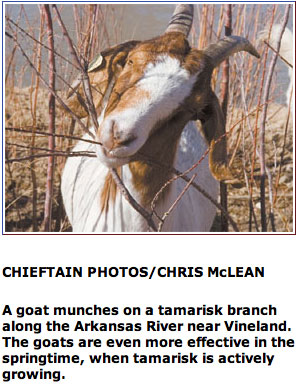
HB 10-1188 (Clarify River Outfitter Navigation Right): What are the impacts to riparian areas and fish populations?

A picture named eisenhowerfishing.jpg

From Steamboat Today (Michael J. Mitchell):

The sustainability of one of Colorado’s most sensitive natural resources, our waterways, is being pitted against the demand for recreation and commerce. Floating, while it may seem to be non-consumptive, has impacts on the habitats where it occurs. There is bank damage at put in/take outs, toilets next to rivers, bank side parking lots, trails along rivers, overfishing and trash to name just a few. These impacts add up, resulting in real biological consequences. The impact is not limited to fish; fish-eating bald eagles, water dependent river otters, migratory waterfowl and other riparian dependent species will also be affected if constant boat traffic is present.

The unregulated floating of Colorado rivers is proposed for one of the most precious wildlife habitats in our state; the thin vegetated line along waterways known as riparian habitat. Our riparian habitat represents just 3 percent of the land area but it is essential to sustain 75 percent of our wildlife species. If we were to consider such a major change within one of our National Forests or other federal lands we would be required by law to evaluate the environmental consequences through professional assessments and impact statements. Why would we want less for Colorado’s rivers?

More HB 10-1188 coverage here.