
Update: From The Colorado Springs Gazette (Eileen Welsome):
After a 12-hour session Tuesday, the two sides returned to the bargaining table Wednesday morning and agreed on a price of $36 dollar per acre foot to store, convey and exchange water through the federally owned Pueblo Reservoir. That means that SDS and its partners, which include Pueblo West, Fountain and Security, will pay about $70 million over a 38-year period, or approximately one-fifth of the bureau’s opening offer of roughly $350 million. “The contracts are another significant milestone for the project,” said John Fredell, SDS project director and chief negotiator. “This ensures a reliable supply of water for our community well into the century.”[…]
Once the terms of the contracts have been finalized, the public will have 60 days to comment, [Mike Collins, the bureau’s area manager and chief negotiator] said.
The price of the water contracts negotiated by Utilities was within its projected budget and won’t affect already projected water rates, said Janet Rummel, a Utilities spokewoman. If Reclamation had held out for the higher number, it “definitely” would have affected rates, Rummel said. To help pay for the SDS pipeline, the Utilities plans to increase rates by 12 percent a year through 2016.
In a major concession, the bureau offered to give Utilities a $5 million credit for construction of an outlet in the dam for the pipeline. That’s nearly 20 times more than an earlier offer of $287,500. The North Outlet Works, as it’s called, will cost Utilities $31 million to construct and will be available to other water users…
The SDS partners have been seeking contracts to store, convey and transport roughly 42,000 acre feet of water through Pueblo Reservoir…Three types of contracts are involved. One will allow the SDS partners to store nonproject water in the reservoir if and when space is available. A second will enable pipeline participants to convey water through the reservoir. A third will allow Utilities to move water, through paper transfers, to other reservoirs in the Fry-Ark system.
From The Pueblo Chieftain (Chris Woodka):
“Let’s split the difference,” SDS Program Manager John Fredell said Wednesday, after recapping a marathon session the previous day that left the two sides $2 apart. Colorado Springs, Fountain, Security and Pueblo West will pay $36 per acre-foot annually for excess-capacity storage under the SDS contract beginning next year. The rate will increase 1.79 percent annually, and Colorado Springs will get an additional credit of $5 million over five years for sizing the North Outlet Works to allow more capacity than SDS requires. Colorado Springs also will pay the same rate for paper trades of water from Pueblo to Twin Lakes up to 10,000 acre-feet each year…
Throughout the rest of the day in Pueblo West, the two sides ironed out the contract line by line and concluded negotiations…
Currently, there are 24 contracts for nearly 62,000 acre-feet of excess-capacity space in Lake Pueblo, said Roy Vaughan, Fryingpan-Arkansas Project manager. Excess-capacity space is available only when there is not enough Fry-Ark water to fill Lake Pueblo. If the lake’s conservation pool fills, the excess-capacity accounts spill. About 25 percent of the space in Lake Pueblo is set aside for flood control. Only two of the contracts are long-term, Pueblo‘s for 6,000 acre-feet and Aurora’s for 10,000 acre-feet. Aurora’s water would be the first to spill if Fry-Ark water and other accounts begin filling Lake Pueblo. Pueblo’s water is relatively protected from spilling.
Next year, the SDS partners are planning to begin using accounts under the new contract totaling nearly 28,000 acre-feet, meaning revenues of more than $1 million that could be applied to the Fryingpan-Arkansas Project. In 2011, Colorado Springs plans to store 18,000 acre-feet; Pueblo West, 9,000 acre-feet; Fountain 400 acre-feet; and Security, 250 acre-feet, according to water managers from each community. By 2050, Colorado Springs would ramp up to 28,000 acre-feet; Pueblo West, 10,000 acre-feet; Fountain, 2,500 acre-feet; and Security, 1,500 acre-feet. They would ramp up, over a period of several years, to 42,000 acre feet. A master contract by the Southeastern Colorado Water Conservancy District for 28,200 acre-feet is also being considered, and Pueblo’s contract will ramp up to 15,000 acre-feet by 2025. Many of the smaller entities now using one-year excess-capacity contracts would be part of the Southeastern master contract.
Meanwhile, State Representative Sal Pace is concerned that the contract will be used to move water out of the Arkansas Basin, according to a report from Chris Woodka writing for The Pueblo Chieftain. From the article:
The Pueblo Democrat also repeated his contention that the demise of the Colorado
Springs stormwater enterprise renders the SDS Environmental Impact Statement invalid, and he wants a new EIS “from scratch.” “It is imperative that Reclamation halt all negotiations immediately and restart the National Environmental and Policy Act process,” Pace wrote in a letter Tuesday to the Bureau of Reclamation and to Interior Secretary Ken Salazar. Pace said there have been substantial alterations to SDS from both the end of the stormwater enterprise and the potential sale of water to other communities in El Paso County that are not in the Southeastern Colorado Water Conservancy District.Woodmoor Water and Sanitation District, which straddles the Palmer Divide between the Arkansas and South Platte river basins in northern El Paso County, is among communities interested in working with Colorado Springs to obtain water or carriage of water in the future.
Colorado Springs has made no deals, and is not in active negotiations with any communities other than its SDS partners at this time.
Also, Bob Norris, who owns the T-Cross Ranch, which has been identified as the site for storage reservoirs for both SDS and Aaron Million’s Flaming Gorge Pipeline, was at Tuesday’s negotiations looking for information, according to a report from Chris Woodka writing for The Pueblo Chieftain. From the article:
“It’s a little strange that they haven’t nailed down where they’re going to put the water,” said Bob Norris, owner of the T-Cross Ranches in El Paso and Pueblo counties. “They’ve bought and paid for rights of way, but not the reservoir site.”[…]
While Million has offered a letter of intent for the site, Colorado Springs Utilities has not fully shared its plan, Norris said…
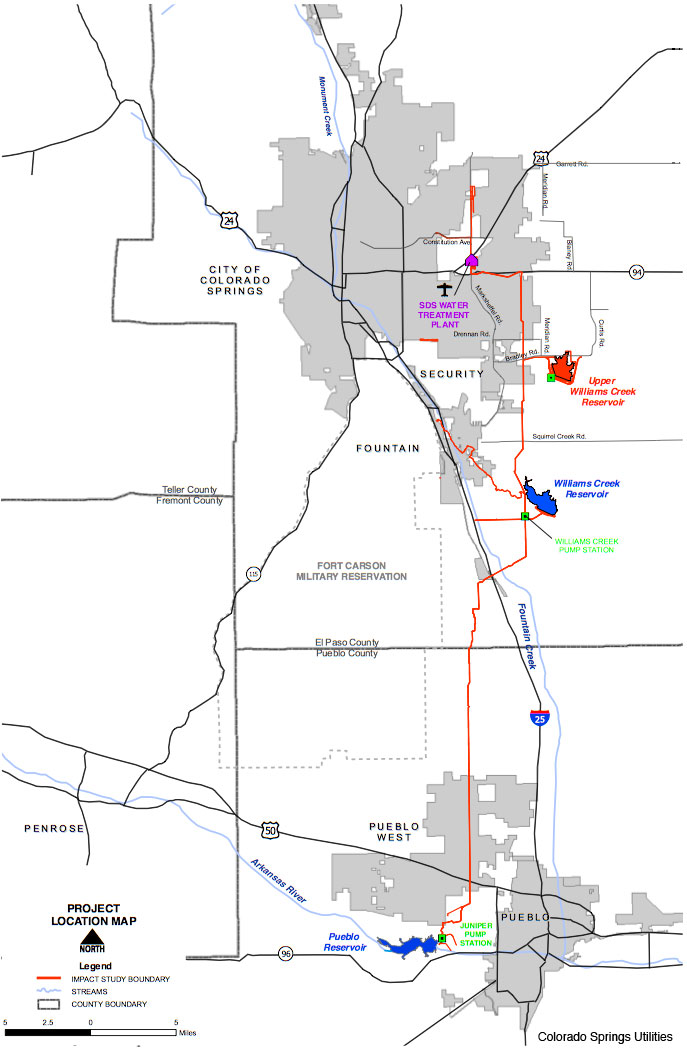
The first phase of SDS is scheduled to be completed in 2016, but the terminal storage reservoir is more than a decade away. The first phase of the project will cost $880 million, with $2.3 billion in financing.
Colorado Springs Utilities has not finalized a cost for the second phase, which includes two 30,000 acre-foot reservoirs on Williams Creek. The upper reservoir would be built first and used for terminal storage, while the lower one would regulate flows on Fountain Creek. The upper reservoir is at the site identified in both Million’s plan and SDS. Originally, a site further north on Jimmy Camp Creek was identified for terminal storage, but the Williams Creek option was deemed the least environmentally damaging by the U.S. Army Corps of Engineers, resulting in the supplemental report.